EP0761753A2 - Tuyau pour radiateur - Google Patents
Tuyau pour radiateur Download PDFInfo
- Publication number
- EP0761753A2 EP0761753A2 EP96305136A EP96305136A EP0761753A2 EP 0761753 A2 EP0761753 A2 EP 0761753A2 EP 96305136 A EP96305136 A EP 96305136A EP 96305136 A EP96305136 A EP 96305136A EP 0761753 A2 EP0761753 A2 EP 0761753A2
- Authority
- EP
- European Patent Office
- Prior art keywords
- radiator hose
- weight
- vulcanized rubber
- parts
- volume resistivity
- Prior art date
- Legal status (The legal status is an assumption and is not a legal conclusion. Google has not performed a legal analysis and makes no representation as to the accuracy of the status listed.)
- Granted
Links
Images


Classifications
-
- C—CHEMISTRY; METALLURGY
- C08—ORGANIC MACROMOLECULAR COMPOUNDS; THEIR PREPARATION OR CHEMICAL WORKING-UP; COMPOSITIONS BASED THEREON
- C08K—Use of inorganic or non-macromolecular organic substances as compounding ingredients
- C08K13/00—Use of mixtures of ingredients not covered by one single of the preceding main groups, each of these compounds being essential
- C08K13/02—Organic and inorganic ingredients
-
- C—CHEMISTRY; METALLURGY
- C08—ORGANIC MACROMOLECULAR COMPOUNDS; THEIR PREPARATION OR CHEMICAL WORKING-UP; COMPOSITIONS BASED THEREON
- C08L—COMPOSITIONS OF MACROMOLECULAR COMPOUNDS
- C08L23/00—Compositions of homopolymers or copolymers of unsaturated aliphatic hydrocarbons having only one carbon-to-carbon double bond; Compositions of derivatives of such polymers
- C08L23/02—Compositions of homopolymers or copolymers of unsaturated aliphatic hydrocarbons having only one carbon-to-carbon double bond; Compositions of derivatives of such polymers not modified by chemical after-treatment
- C08L23/16—Ethylene-propylene or ethylene-propylene-diene copolymers
Definitions
- the present invention relates to a radiator hose. More specifically, the present invention relates to a radiator hose which contains, in its outermost layer, a vulcanized rubber whose rubber component is an ethylene/ ⁇ -olefin/nonconjugated diene copolymer rubber and has overcome a problem that corrosion occurs in a metal clamp in contact with the radiator hose.
- Ethylene/ ⁇ -olefin/nonconjugated diene copolymer rubbers such as ethylene/propylene/nonconjugated diene copolymer rubber are widely used in radiator hoses of cars and the like due to their excellent thermal resistance. While a radiator hose is usually supported by a metal clamp, there has been a problem that corrosion occurs in the metal clamp in contact with the radiator hose when in use.
- radiator hose containing, in its outermost layer, a vulcanized rubber whose volume resistivity under compression is not lower than 10 50 ⁇ cm does not generate corrosion in the metal clamp in contact with the radiator hose, thereby accomplishing the present invention.
- the present invention provides a radiator hose containing, in an outermost layer thereof, a vulcanized rubber whose rubber component is an ethylene/ ⁇ -olefin/nonconjugated diene copolymer rubber and whose volume resistivity under compression is not lower than 10 5 ⁇ cm.
- the present invention provides the radiator hose, wherein the volume resistivity of the vulcanized rubber under compression is not lower than 10 6 ⁇ cm.
- the present invention provides the radiator hose, wherein the vulcanized rubber is obtained when a rubber composition containing the following (A) to (C) are vulcanized:
- the present invention provides the radiator hose, wherein (B) comprises carbon black, a softener, zinc oxide, stearic acid, a vulcanization accelerator, and sulfur.
- the present invention provides the radiator hose, wherein 50 to 170 parts by weight of carbon black are added to 100 parts by weight of (A).
- the present invention provides the radiator hose, wherein 100 to 170 parts by weight of carbon black are added to 100 parts by weight of (A).
- the present invention provides the radiator hose, wherein 100 to 150 parts by weight of carbon black are added to 100 parts by weight of (A).
- the present invention provides the radiator hose, wherein (C) is clay.
- the present invention provides the radiator hose, wherein the vulcanized rubber has a hardness of 66 to 74.
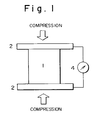
- Fig. 1 shows a measuring system of a volume resistivity under compression of a vulcanized rubber of the present invention.
- Fig. 2 shows a Table of experimental data of Example 1-7 and Comparative Example 1.
- Fig. 3 shows a graph of measured volume resistivity of Example 1 and 2, and Comparative example 1 under various compression condition.
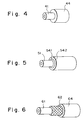
- Fig. 4 shows an example of a radiator hose according to the present invention.
- Fig. 5 shows another example of a radiator hose according to the present invention.
- Fig. 6 shows another example of a radiator hose according to the present invention.
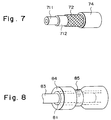
- Fig. 7 shows another example of a radiator hose according to the present invention.
- Fig. 8 shows a radiator hose according to the present invention into which a metal tube is inserted, and which is tightened by a metal clamp.
- the rubber composition of the present invention preferably contains (A) to (C) as components.
- (A) is ethylene/ ⁇ -olefin/nonconjugated diene copolymer rubber
- (C) is inorganic filler
- (B) is additives except (C).
- ⁇ -olefin in (A), ethylene/ ⁇ -olefin/nonconjugated diene copolymer rubber include propylene, 1-butene, 1-pentene, 1-hexene, 4-methyl-1-pentene, 1-octene, and 1-decene. Among them, propylene is preferable.
- nonconjugated diene examples include chain nonconjugated dienes such as 1,4-hexadiene, 1,6-octadiene, 2-methyl-1,5-hexadiene, 6-methyl-1,5-heptadiene, and 7-methyl-1,6-octadiene; cyclic nonconjugated dienes such as cyclohexadiene, dicyclopentadiene, methyltetrahydroindene, 5-vinylnorbornene, 5-ethylidene-2-norbornene, 5-methylene-2-norbornene, 5-isopropylidene-2-norbornene, and 6-chloromethyl-5-isopropenyl-2-norbornene; and trienes such as 2,3-diisopropylidene-5-norbornene, 2-ethylidene-3-isopropylidene-5-norbornene, 2-propenyl-2,2-norborn
- the ratio (molar ratio) of ethylene/ ⁇ -olefin/nonconjugated diene in the ethylene/ ⁇ -olefin/nonconjugated diene copolymer is preferably 1/(0.1 to 1)/(0.005 to 0.2).
- (B) is specifically exemplified by a component comprising carbon black, a softener, zinc oxide, stearic acid, a vulcanization accelerator, and sulfur.
- carbon black is preferable.
- examples of carbon black include HAF carbon black, FEF carbon black, and SRF carbon black.
- SRF carbon black having a large particle size is preferable.
- 50 to 170 parts by weight or, more preferably, 100 to 170 parts by weight or, most preferably 100 to 150 parts by weight of carbon black are used with respect to 100 parts by weight of (A).
- the amount of use thereof is too small, the strength of the vulcanized rubber may lower; whereas, when the amount of use thereof is too large, the volume resistivity may lower.
- the softener is exemplified by process oil.
- 30 to 150 parts by weight of the softener are used with respect to 100 parts by weight of (A).
- the amount of use thereof is too small, processability may lower; whereas, when the amount of use thereof is too large, the hardness of the vulcanized rubber may lower.
- 0.5 to 5 parts by weight of stearic acid are used with respect to 100 parts by weight of (A).
- the amount of use thereof is too small, the processability may lower; whereas, when the amount of use thereof is too large, bloom may occur in the surface of the vulcanized rubber.
- the vulcanization accelerator examples include MBT, MBTS, CBS, TMTD, DPTT, ZnBDC, and TeEDC. Usually, a mixture of two kinds or more thereof are used. Preferably, 2 to 8 parts by weight of the vulcanization accelerator are used with respect to 100 parts by weight of (A). When the amount of use thereof is too small, the vulcanization may not proceed; whereas, when the amount of use thereof is too large, bloom may occur in the surface of the vulcanized rubber.
- 0.1 to 3.0 parts by weight of sulfur are used with respect to 100 parts by weight of (A).
- the amount of use thereof is too small, the vulcanization may not proceed; whereas, when the amount of use thereof is too large, bloom may occur in the surface of the vulcanized rubber.
- (C) inorganic filler examples include clay, talc, silica, calcium carbonate, calcium silicate, magnesium carbonate, magnesium hydroxide, magnesium oxide, aluminum hydroxide, aluminum oxide, wollastonite, and zeolite.
- clay is preferable in particular.
- a preferable vulcanized rubber in the present invention is obtainable by vulcanization of a rubber composition of the present invention containing following components (A) to (C).
- 300 to 400 parts by weight or, more preferably, 340 to 400 parts by weight of (A) to (C) in total are used with respect 100 parts by weight of (A), while the ratio of (C) in the total amount of (A) to (C) is preferably 5 to 20% by weight and more preferably 5 to 14% by weight.
- the ratio of (C) in the total amount of (A) to (C) is preferably 5 to 20% by weight and more preferably 5 to 14% by weight.
- the ratio of (C) in the total amount of (A) to (C) is preferably 5 to 20% by weight and more preferably 5 to 14% by weight.
- the vulcanized rubber preferably has a hardness of 66 to 74. When this hardness is too low, the vulcanized rubber is likely to be deformed, whereby the hose may tend to collapse or to be damaged; whereas, when this hardness is too high, the flexibility may be lost such that the hose may be broken.
- An example of the method for obtaining the vulcanized rubber of the present invention is as follows: Initially, an ethylene/ ⁇ -olefin/nonconjugated diene copolymer rubber (A), an additive (B), and an inorganic filler (C), as well as ingredients appropriately usable such as antioxidant and processing aid are mixed by means of a typical kneader such as roll or banbury so as to yield a vulcanizable rubber composition. Thereafter, this rubber composition is shaped into a predetermined form and then vulcanized. Vulcanization is effected for about 1 to 30 minutes at a temperature normally not lower than 120°C or preferably within the range of 150 to 220°C. Any of press vulcanization, steam vulcanization, and hot-air vulcanization can be appropriately used therefor.
- the most characteristic feature of the present invention is that a vulcanized rubber whose volume resistivity under compression is not smaller than a predetermined value is used in an outermost layer of a radiator hose. More specifically vulcanized rubber of the present invention has volume resistivity under compression by 30% of not lower than 10 5 ⁇ cm and preferably not lower than 10 6 ⁇ cm. When this volume resistivity is too small, anticorrosion effect of a radiator hose which contains the vulcanized rubber in its outermost layer, is not expressed sufficiently.
- volume resistivity under compression by 30% refers to the volume resistivity of the vulcanized rubber when its length is compressed by 30% of the original length thereof in one direction . The method of measuring it will be explained in Examples described later.
- the compression in the present invention is not limited, but may be increased from 30% to 50%.
- the vulcanized rubber including carbon black has a general tendency of decreasing of its volume resistivity under compression condition, although a quantitative relationship between a volume resistivity and compression is not well known.
- the present inventors found in Comparative example 1 that the volume resistivity decreased from 10 6 ⁇ cm down to 10 3 ⁇ cm under compression by 30% (See Table in Fig. 2, and Fig. 3).
- the data show that 30% compression condition decreases the volume resistivity to about 1/1000 times the value in the uncompressed condition. Accordingly, the corrosion of the metal clamp in contact with the radiator hose, which depends on the volume resistivity of the radiator hose, cannot be prevented from occurring when the volume resistivity of the radiator hose under no compression is simply defined.
- a vulcanized rubber of the present invention shows significantly small decrease of a volume resistivity under compression condition. As shown in Table in Fig. 2 and Fig. 3, even under compression by about 30% the volume resistivity decreases only 1/10 even under compression by about 30%. Accordingly, a volume resistivity of a radiator hose containing, in an outermost layer thereof, a vulcanized rubber of the present invention is not lower than 10 5 ⁇ cm, more preferably not lower than 10 6 ⁇ cm.
- a radiator hose in the present invention may have a multiple configuration comprising, successively from the inside (center portion) of the hose, an inner rubber layer, an intermediate rubber layer, an intermediate reinforcement layer, and an outer rubber layer.
- Fig. 4 shows a simplified radiator hose which includes an inner layer 41 and an outer layer (outermost layer in this configuration) 44.
- Fig. 5 shows a modification example of the radiator hose shown in Fig. 4, which has more than two outer layers 541 and 542 as an example of multiple outer layer structure, instead.
- an outermost layer described in the present invention is 542, which may contact with a metal tightening device such as metal clamp.
- the multiple outer layer structure shown in the modification example is also possible in all radiator hose structures described below in detail.
- radiator hose suitable in the present invention is shown in Fig. 6 indicating an example of a radiator hose which comprises an additional intermediate reinforced layer 62.
- the intermediate layer is normally used for increasing mechanical strength of the hose, and may be made, for example, of polyester.
- Fig. 7 shows an modification of the hose shown in Fig. 6 which comprises two inner rubber layers 711 and 712 as an example of a multiple inner layer structure.
- the innermost layer 711 and outer layer (outermost layer in the example) 74 may contact with a metal tube and metal tightening device ,respectively.
- the multiple inner layer structure is also possible in all radiator hose described above and below.
- a radiator hose described above may generally be used with a metal tube such as iron or aluminum for a radiator fluid outlet-inlet tube and a metal tightening device such as metal clamp.
- Fig. 8 shows a typical example of a radiator hose in the present invention.
- the metal radiator tube 83 is inserted into the hose which comprises an inner rubber layer 81 and an outer rubber layer 84, and a metal clamp 85 tightens the hose with a compression of the outer rubber layer 84. Under the compression condition the inner rubber layer 81 may also be compressed with a contact with the metal tube surface.
- an outermost rubber layer may contact with a metal material such as metal tube or metal tightening device under compression condition.
- Both rubber layers may use the above-mentioned vulcanized rubber related to the present invention. Therefore the present invention should not be restricted to the specific hose structure such as multiple layer configuration mentioned above, but may be applicable to other various type of radiator hose for various type of utilities.
- a vulcanizable rubber composition (unvulcanized material). Then, this rubber composition was subjected to press vulcanization at a temperature of 150°C for 20 minutes, whereby a vulcanized rubber was obtained. This vulcanized rubber was measured and evaluated as follows.
- the radiator hose and an iron clamp were brought into contact with each other under compression by 30%, and repeatedly subjected to processings of salt-water spraying, hot-air drying, and exposure to wet-atmosphere, and the state of corrosion of the iron clamp thereafter was evaluated.
- the sample with no corrosion was indicated by "O"
- the sample with corrosion was indicated by "x”.
Landscapes
- Chemical & Material Sciences (AREA)
- Health & Medical Sciences (AREA)
- Chemical Kinetics & Catalysis (AREA)
- Medicinal Chemistry (AREA)
- Polymers & Plastics (AREA)
- Organic Chemistry (AREA)
- Compositions Of Macromolecular Compounds (AREA)
- Rigid Pipes And Flexible Pipes (AREA)
Applications Claiming Priority (3)
| Application Number | Priority Date | Filing Date | Title |
|---|---|---|---|
| JP176175/95 | 1995-07-12 | ||
| JP17617595 | 1995-07-12 | ||
| JP17617595A JP3240884B2 (ja) | 1995-07-12 | 1995-07-12 | ラジエーターホース |
Publications (3)
| Publication Number | Publication Date |
|---|---|
| EP0761753A2 true EP0761753A2 (fr) | 1997-03-12 |
| EP0761753A3 EP0761753A3 (fr) | 1997-07-16 |
| EP0761753B1 EP0761753B1 (fr) | 2000-10-18 |
Family
ID=16008981
Family Applications (1)
| Application Number | Title | Priority Date | Filing Date |
|---|---|---|---|
| EP96305136A Expired - Lifetime EP0761753B1 (fr) | 1995-07-12 | 1996-07-12 | Tuyau pour radiateur |
Country Status (4)
| Country | Link |
|---|---|
| EP (1) | EP0761753B1 (fr) |
| JP (1) | JP3240884B2 (fr) |
| CA (1) | CA2181014A1 (fr) |
| DE (1) | DE69610677T2 (fr) |
Cited By (3)
| Publication number | Priority date | Publication date | Assignee | Title |
|---|---|---|---|---|
| EP1348733A1 (fr) * | 2002-03-26 | 2003-10-01 | Tokai Rubber Industries, Ltd. | Composition de caoutchouc et tuyau produit en utilisant la même et entraínant une faible contamination |
| US11312114B2 (en) | 2018-03-16 | 2022-04-26 | Mitsui Chemicals, Inc. | Laminate including ethylene/α-olefin/non-conjugated polyene copolymer composition, and ethylene/α-olefin/non-conjugated polyene copolymer composition |
| US12036778B2 (en) | 2018-11-02 | 2024-07-16 | Mitsui Chemicals, Inc. | Laminate including layer of ethylene-α-olefin-nonconjugated polyene copolymer composition, and application thereof |
Families Citing this family (4)
| Publication number | Priority date | Publication date | Assignee | Title |
|---|---|---|---|---|
| KR100711229B1 (ko) * | 2005-11-07 | 2007-04-25 | 평화산업주식회사 | 냉각기 호스용 고무 조성물 |
| JP6922367B2 (ja) * | 2017-04-13 | 2021-08-18 | 横浜ゴム株式会社 | ゴム組成物及びホース |
| JP7636258B2 (ja) * | 2021-04-28 | 2025-02-26 | 株式会社イノアックコーポレーション | 成形体 |
| JP2025025645A (ja) * | 2023-08-10 | 2025-02-21 | 鬼怒川ゴム工業株式会社 | ゴム組成物およびホース |
Family Cites Families (4)
| Publication number | Priority date | Publication date | Assignee | Title |
|---|---|---|---|---|
| US4153589A (en) * | 1975-11-26 | 1979-05-08 | Amerace Corporation | Thermoplastic elastomeric molding composition and articles molded therefrom |
| US4102855A (en) * | 1977-12-05 | 1978-07-25 | The General Tire & Rubber Company | Compositions comprising EPDM, E/VA and poly-alpha-methylstyrene |
| JP2610165B2 (ja) * | 1988-05-17 | 1997-05-14 | 本田技研工業株式会社 | 自動車車体構成部材におけるゴム製部材とアルミニウム合金製部材の組合せ |
| JPH07119365B2 (ja) * | 1989-03-29 | 1995-12-20 | 東レ・ダウコーニング・シリコーン株式会社 | シリコーンゴム組成物 |
-
1995
- 1995-07-12 JP JP17617595A patent/JP3240884B2/ja not_active Expired - Fee Related
-
1996
- 1996-07-11 CA CA002181014A patent/CA2181014A1/fr not_active Abandoned
- 1996-07-12 DE DE69610677T patent/DE69610677T2/de not_active Expired - Fee Related
- 1996-07-12 EP EP96305136A patent/EP0761753B1/fr not_active Expired - Lifetime
Cited By (3)
| Publication number | Priority date | Publication date | Assignee | Title |
|---|---|---|---|---|
| EP1348733A1 (fr) * | 2002-03-26 | 2003-10-01 | Tokai Rubber Industries, Ltd. | Composition de caoutchouc et tuyau produit en utilisant la même et entraínant une faible contamination |
| US11312114B2 (en) | 2018-03-16 | 2022-04-26 | Mitsui Chemicals, Inc. | Laminate including ethylene/α-olefin/non-conjugated polyene copolymer composition, and ethylene/α-olefin/non-conjugated polyene copolymer composition |
| US12036778B2 (en) | 2018-11-02 | 2024-07-16 | Mitsui Chemicals, Inc. | Laminate including layer of ethylene-α-olefin-nonconjugated polyene copolymer composition, and application thereof |
Also Published As
| Publication number | Publication date |
|---|---|
| DE69610677D1 (de) | 2000-11-23 |
| JP3240884B2 (ja) | 2001-12-25 |
| EP0761753B1 (fr) | 2000-10-18 |
| EP0761753A3 (fr) | 1997-07-16 |
| CA2181014A1 (fr) | 1997-01-13 |
| DE69610677T2 (de) | 2001-06-07 |
| JPH0925374A (ja) | 1997-01-28 |
Similar Documents
| Publication | Publication Date | Title |
|---|---|---|
| DE69602293T2 (de) | Reifen-Innerliner, enthaltend halogenierten Butylkautschuk und durch Lösungspolymerisation hergestellten SBR | |
| EP0446573B1 (fr) | Mélange de caoutchoucs vulcanisable | |
| WO2014041856A1 (fr) | Composition de caoutchouc, et vulcanisat et article moulé à base de celle-ci | |
| WO1991005011A1 (fr) | Caoutchouc d'ethylene-propylene-diene, composition elastomere et caoutchouc vulcanise prepare a partir d'eux | |
| EP0761753B1 (fr) | Tuyau pour radiateur | |
| JP2718997B2 (ja) | 1,1,1,2―テトラフルオロエタン系冷媒低透過性ホース | |
| US6910507B2 (en) | Pipes containing heat insulating material | |
| JP6733529B2 (ja) | ゴム並びにシール部品及びホース | |
| EP0313045B1 (fr) | Joints en caoutchouc EPDM pour cylindres hydrauliques | |
| KR101001779B1 (ko) | Epdm 조성물 | |
| EP3330316A1 (fr) | Composition de caoutchouc butylique halogéné et rondelle antivibration | |
| DE10109852B4 (de) | Kautschukmasse und vulkanisierte Kautschukmasse | |
| DE60019806T2 (de) | Innenreifen mit verbesserten hitzeresistenten eigenschaften | |
| US20030194522A1 (en) | Aqueous liquid contact rubber part | |
| KR100703575B1 (ko) | 호스 제조용 고무 조성물, 호스 및 냉매용 호스의 제조방법 | |
| US5446097A (en) | Vulcanizable rubber composition and vulcanized rubber | |
| US4708992A (en) | Rubber compositions | |
| US12509538B2 (en) | Flame-retardant rubber composition | |
| JP2001294715A (ja) | ラジエーターホースの組成物 | |
| DE69912889T2 (de) | Vernetzte Kautschuk-Zusammensetzung und Verfahren zur Herstellung von halbleitender Gummirolle | |
| JP3465814B2 (ja) | 熱可塑性エラストマー組成物及び該熱可塑性エラストマー組成物を用いた配管用継ぎ手 | |
| KR0184751B1 (ko) | 타이어 블래더용 고무조성물 | |
| JP2876697B2 (ja) | スポンジ用ゴム組成物 | |
| JPS58164953A (ja) | 太陽熱集熱器 | |
| JP3915567B2 (ja) | 非酸化亜鉛系ゴム組成物およびそれを用いたホース |
Legal Events
| Date | Code | Title | Description |
|---|---|---|---|
| PUAI | Public reference made under article 153(3) epc to a published international application that has entered the european phase |
Free format text: ORIGINAL CODE: 0009012 |
|
| AK | Designated contracting states |
Kind code of ref document: A2 Designated state(s): DE ES FR GB IT NL |
|
| PUAL | Search report despatched |
Free format text: ORIGINAL CODE: 0009013 |
|
| AK | Designated contracting states |
Kind code of ref document: A3 Designated state(s): DE ES FR GB IT NL |
|
| 17P | Request for examination filed |
Effective date: 19971223 |
|
| 17Q | First examination report despatched |
Effective date: 19980720 |
|
| GRAG | Despatch of communication of intention to grant |
Free format text: ORIGINAL CODE: EPIDOS AGRA |
|
| 17Q | First examination report despatched |
Effective date: 19980720 |
|
| GRAG | Despatch of communication of intention to grant |
Free format text: ORIGINAL CODE: EPIDOS AGRA |
|
| GRAH | Despatch of communication of intention to grant a patent |
Free format text: ORIGINAL CODE: EPIDOS IGRA |
|
| GRAH | Despatch of communication of intention to grant a patent |
Free format text: ORIGINAL CODE: EPIDOS IGRA |
|
| GRAA | (expected) grant |
Free format text: ORIGINAL CODE: 0009210 |
|
| AK | Designated contracting states |
Kind code of ref document: B1 Designated state(s): DE ES FR GB IT NL |
|
| PG25 | Lapsed in a contracting state [announced via postgrant information from national office to epo] |
Ref country code: NL Free format text: LAPSE BECAUSE OF FAILURE TO SUBMIT A TRANSLATION OF THE DESCRIPTION OR TO PAY THE FEE WITHIN THE PRESCRIBED TIME-LIMIT Effective date: 20001018 Ref country code: IT Free format text: LAPSE BECAUSE OF FAILURE TO SUBMIT A TRANSLATION OF THE DESCRIPTION OR TO PAY THE FEE WITHIN THE PRE;WARNING: LAPSES OF ITALIAN PATENTS WITH EFFECTIVE DATE BEFORE 2007 MAY HAVE OCCURRED AT ANY TIME BEFORE 2007. THE CORRECT EFFECTIVE DATE MAY BE DIFFERENT FROM THE ONE RECORDED.SCRIBED TIME-LIMIT Effective date: 20001018 Ref country code: ES Free format text: THE PATENT HAS BEEN ANNULLED BY A DECISION OF A NATIONAL AUTHORITY Effective date: 20001018 |
|
| REF | Corresponds to: |
Ref document number: 69610677 Country of ref document: DE Date of ref document: 20001123 |
|
| ET | Fr: translation filed | ||
| NLV1 | Nl: lapsed or annulled due to failure to fulfill the requirements of art. 29p and 29m of the patents act | ||
| PG25 | Lapsed in a contracting state [announced via postgrant information from national office to epo] |
Ref country code: GB Free format text: LAPSE BECAUSE OF NON-PAYMENT OF DUE FEES Effective date: 20010712 |
|
| PLBE | No opposition filed within time limit |
Free format text: ORIGINAL CODE: 0009261 |
|
| STAA | Information on the status of an ep patent application or granted ep patent |
Free format text: STATUS: NO OPPOSITION FILED WITHIN TIME LIMIT |
|
| 26N | No opposition filed | ||
| GBPC | Gb: european patent ceased through non-payment of renewal fee |
Effective date: 20010712 |
|
| PGFP | Annual fee paid to national office [announced via postgrant information from national office to epo] |
Ref country code: DE Payment date: 20050707 Year of fee payment: 10 |
|
| PGFP | Annual fee paid to national office [announced via postgrant information from national office to epo] |
Ref country code: FR Payment date: 20050708 Year of fee payment: 10 |
|
| PG25 | Lapsed in a contracting state [announced via postgrant information from national office to epo] |
Ref country code: DE Free format text: LAPSE BECAUSE OF NON-PAYMENT OF DUE FEES Effective date: 20070201 |
|
| REG | Reference to a national code |
Ref country code: FR Ref legal event code: ST Effective date: 20070330 |
|
| PG25 | Lapsed in a contracting state [announced via postgrant information from national office to epo] |
Ref country code: FR Free format text: LAPSE BECAUSE OF NON-PAYMENT OF DUE FEES Effective date: 20060731 |