EP0762330A2 - Appareil de traitement de signaux vidéo mélangés YUV et table de couleurs - Google Patents
Appareil de traitement de signaux vidéo mélangés YUV et table de couleurs Download PDFInfo
- Publication number
- EP0762330A2 EP0762330A2 EP96305724A EP96305724A EP0762330A2 EP 0762330 A2 EP0762330 A2 EP 0762330A2 EP 96305724 A EP96305724 A EP 96305724A EP 96305724 A EP96305724 A EP 96305724A EP 0762330 A2 EP0762330 A2 EP 0762330A2
- Authority
- EP
- European Patent Office
- Prior art keywords
- pixel
- data
- pixel data
- sprite
- line
- Prior art date
- Legal status (The legal status is an assumption and is not a legal conclusion. Google has not performed a legal analysis and makes no representation as to the accuracy of the status listed.)
- Ceased
Links
- 238000012545 processing Methods 0.000 title claims description 39
- 239000000872 buffer Substances 0.000 claims abstract description 87
- 230000015654 memory Effects 0.000 claims abstract description 49
- 230000005540 biological transmission Effects 0.000 claims abstract description 8
- 239000011159 matrix material Substances 0.000 claims abstract description 7
- 230000003139 buffering effect Effects 0.000 claims description 18
- 238000000034 method Methods 0.000 abstract description 6
- 230000008569 process Effects 0.000 abstract description 5
- 239000002131 composite material Substances 0.000 description 10
- 238000010586 diagram Methods 0.000 description 10
- 230000006870 function Effects 0.000 description 8
- 238000012546 transfer Methods 0.000 description 6
- 238000004519 manufacturing process Methods 0.000 description 5
- 230000001902 propagating effect Effects 0.000 description 4
- 239000003795 chemical substances by application Substances 0.000 description 3
- 230000002452 interceptive effect Effects 0.000 description 3
- 238000013459 approach Methods 0.000 description 2
- 230000008859 change Effects 0.000 description 2
- 239000003086 colorant Substances 0.000 description 2
- 238000004891 communication Methods 0.000 description 2
- 230000003190 augmentative effect Effects 0.000 description 1
- 238000013475 authorization Methods 0.000 description 1
- 238000006243 chemical reaction Methods 0.000 description 1
- 230000007423 decrease Effects 0.000 description 1
- 230000003247 decreasing effect Effects 0.000 description 1
- 230000001934 delay Effects 0.000 description 1
- 230000003111 delayed effect Effects 0.000 description 1
- 239000000203 mixture Substances 0.000 description 1
- 238000012986 modification Methods 0.000 description 1
- 230000004048 modification Effects 0.000 description 1
- 230000010363 phase shift Effects 0.000 description 1
- 230000000750 progressive effect Effects 0.000 description 1
- 230000004044 response Effects 0.000 description 1
- 238000005070 sampling Methods 0.000 description 1
- 230000001360 synchronised effect Effects 0.000 description 1
- 238000011144 upstream manufacturing Methods 0.000 description 1
Images


Classifications
-
- H—ELECTRICITY
- H04—ELECTRIC COMMUNICATION TECHNIQUE
- H04N—PICTORIAL COMMUNICATION, e.g. TELEVISION
- H04N9/00—Details of colour television systems
- H04N9/64—Circuits for processing colour signals
- H04N9/641—Multi-purpose receivers, e.g. for auxiliary information
-
- G—PHYSICS
- G09—EDUCATION; CRYPTOGRAPHY; DISPLAY; ADVERTISING; SEALS
- G09G—ARRANGEMENTS OR CIRCUITS FOR CONTROL OF INDICATING DEVICES USING STATIC MEANS TO PRESENT VARIABLE INFORMATION
- G09G5/00—Control arrangements or circuits for visual indicators common to cathode-ray tube indicators and other visual indicators
- G09G5/02—Control arrangements or circuits for visual indicators common to cathode-ray tube indicators and other visual indicators characterised by the way in which colour is displayed
- G09G5/06—Control arrangements or circuits for visual indicators common to cathode-ray tube indicators and other visual indicators characterised by the way in which colour is displayed using colour palettes, e.g. look-up tables
-
- G—PHYSICS
- G09—EDUCATION; CRYPTOGRAPHY; DISPLAY; ADVERTISING; SEALS
- G09G—ARRANGEMENTS OR CIRCUITS FOR CONTROL OF INDICATING DEVICES USING STATIC MEANS TO PRESENT VARIABLE INFORMATION
- G09G5/00—Control arrangements or circuits for visual indicators common to cathode-ray tube indicators and other visual indicators
- G09G5/02—Control arrangements or circuits for visual indicators common to cathode-ray tube indicators and other visual indicators characterised by the way in which colour is displayed
-
- G—PHYSICS
- G09—EDUCATION; CRYPTOGRAPHY; DISPLAY; ADVERTISING; SEALS
- G09G—ARRANGEMENTS OR CIRCUITS FOR CONTROL OF INDICATING DEVICES USING STATIC MEANS TO PRESENT VARIABLE INFORMATION
- G09G5/00—Control arrangements or circuits for visual indicators common to cathode-ray tube indicators and other visual indicators
- G09G5/36—Control arrangements or circuits for visual indicators common to cathode-ray tube indicators and other visual indicators characterised by the display of a graphic pattern, e.g. using an all-points-addressable [APA] memory
- G09G5/37—Details of the operation on graphic patterns
- G09G5/377—Details of the operation on graphic patterns for mixing or overlaying two or more graphic patterns
-
- G—PHYSICS
- G09—EDUCATION; CRYPTOGRAPHY; DISPLAY; ADVERTISING; SEALS
- G09G—ARRANGEMENTS OR CIRCUITS FOR CONTROL OF INDICATING DEVICES USING STATIC MEANS TO PRESENT VARIABLE INFORMATION
- G09G5/00—Control arrangements or circuits for visual indicators common to cathode-ray tube indicators and other visual indicators
- G09G5/42—Control arrangements or circuits for visual indicators common to cathode-ray tube indicators and other visual indicators characterised by the display of patterns using a display memory without fixed position correspondence between the display memory contents and the display position on the screen
-
- H—ELECTRICITY
- H04—ELECTRIC COMMUNICATION TECHNIQUE
- H04N—PICTORIAL COMMUNICATION, e.g. TELEVISION
- H04N5/00—Details of television systems
- H04N5/44—Receiver circuitry for the reception of television signals according to analogue transmission standards
-
- G—PHYSICS
- G09—EDUCATION; CRYPTOGRAPHY; DISPLAY; ADVERTISING; SEALS
- G09G—ARRANGEMENTS OR CIRCUITS FOR CONTROL OF INDICATING DEVICES USING STATIC MEANS TO PRESENT VARIABLE INFORMATION
- G09G2310/00—Command of the display device
- G09G2310/02—Addressing, scanning or driving the display screen or processing steps related thereto
- G09G2310/0202—Addressing of scan or signal lines
-
- G—PHYSICS
- G09—EDUCATION; CRYPTOGRAPHY; DISPLAY; ADVERTISING; SEALS
- G09G—ARRANGEMENTS OR CIRCUITS FOR CONTROL OF INDICATING DEVICES USING STATIC MEANS TO PRESENT VARIABLE INFORMATION
- G09G2340/00—Aspects of display data processing
- G09G2340/10—Mixing of images, i.e. displayed pixel being the result of an operation, e.g. adding, on the corresponding input pixels
-
- H—ELECTRICITY
- H04—ELECTRIC COMMUNICATION TECHNIQUE
- H04N—PICTORIAL COMMUNICATION, e.g. TELEVISION
- H04N5/00—Details of television systems
- H04N5/44—Receiver circuitry for the reception of television signals according to analogue transmission standards
- H04N5/445—Receiver circuitry for the reception of television signals according to analogue transmission standards for displaying additional information
-
- H—ELECTRICITY
- H04—ELECTRIC COMMUNICATION TECHNIQUE
- H04N—PICTORIAL COMMUNICATION, e.g. TELEVISION
- H04N7/00—Television systems
- H04N7/16—Analogue secrecy systems; Analogue subscription systems
- H04N7/173—Analogue secrecy systems; Analogue subscription systems with two-way working, e.g. subscriber sending a programme selection signal
Definitions
- the present invention relates to apparatus for processing mixed YUV and color palettized graphic video signals and displaying such graphic video signals by themselves or superimposing such mixed graphic video signals on live television signals received from a remote source when desired.
- Some commercially available computers particularly personal computers, provide circuitry which permits a merger of a composite video signal (e.g., a National Television Standards Committee signal) with computer generated video graphics display signals, typically red, green, and blue (RGB). More particularly, modern video graphics equipment has the ability to produce backgrounds, characters, symbols, and other pictorial representations and arrangements in operator-selected sizes, shapes, and colors.
- a composite video signal e.g., a National Television Standards Committee signal
- computer generated video graphics display signals typically red, green, and blue (RGB).
- RGB red, green, and blue
- U.S. Patent No. 4,737,772 discloses a video display controller comprising a video display processor (VDP), a Central Processing Unit (CPU), a memory, and a Video Random Access Memory (VRAM).
- VDP video display processor
- CPU Central Processing Unit
- VRAM Video Random Access Memory
- the memory stores both programs to be executed by the CPU and various kinds of image data.
- the VRAM stores image data which the VDP can change and then transfer to the outside for display on a screen of a Cathode Ray Tube (CRT) display.
- CTR Cathode Ray Tube
- a timing signal generator In the VDP, a timing signal generator generates timing signals for correctly scanning elements of the picture to be displayed which are used by a horizontal and a vertical counter and the CRT display to synchronize data processing in an image data processing circuit (IDPC) and correctly display such processed data on the screen of the CRT display.
- a Video Digitizer samples an externally supplied analog video signal and converts signal levels or amplitudes of the analog video signal into digital data composed of 2 or 4 bits each.
- the Video Digitizer digitized amplitude output data represents a still image and is supplied to the IDPC.
- the IDPC selectively stores both the Video Digitizer output data and color codes supplied from the CPU into the VRAM through an interface circuit. Each color code from the CPU represents a color of a respective one of the display elements (e.g.
- the IDPC in response to a display command from the CPU, sequentially reads dot data from the VRAM in synchronization with the scanning position on the CRT display and outputs the dot data to a color palette circuit. Concurrently, the IDPC calculates and reads data necessary for displaying an animation image from the VRAM and supplies color codes to the color palette circuit. Where an animation and still image are located at a same display position on the screen of the CRT display, the animation image is preferably displayed.
- the color palette circuit converts each color code into three color data for red, green, and blue, each composed of three bits.
- a Digital to Analog Converter (DAC) converts the color data from the color palette circuit into R, G, and B signals which are provided to the CRT display.
- U.S. Patent No. 5,355,175 (Okada et al.), issued on October 11, 1994, discloses video mixing apparatus that mixes a graphics video image and a playback video image at a plurality of mixture ratios in one image plane. Fade data indicative of the mixing ratio of at least one line of the playback video signal and the graphics video signal is sequentially generated in accordance with a predetermined order. The fade data is held in holding means and is outputted from the holding means synchronously with a horizontal sync signal. The levels of the playback video signal and the graphics video signal are individually adjusted in accordance with the fade data outputted from the holding means, and the adjusted signals are added together. The playback video signal and the graphics video signal are mixed at the mixing ratio set for every line on one image plane to generate a video output signal from the apparatus.
- U.S. Patent No. 4,420,770 (Rahman), issued on December 13, 1983, discloses a video background generation system for generating rectangular video patterns having operator-selected video attributes.
- the system comprises a horizontal bit memory and a vertical bit memory, each of the memories being a 16 entity memory for storing information for 16 background entities.
- the memory for each background entity defines opposite corners of the background area for an entity on the screen.
- a first entity defines a first rectangular area
- a second higher priority entity defines a second partially overlapping rectangular area.
- An attribute look-up table stores information for each entity related to the color video output (red, green, blue) for that entity.
- the first entity is produced in its defined area and the second entity is produced in its defined area.
- the second entity has a higher priority which results in the overlapping region of the two entities to be presented with the stored attributes of the second entity.
- U.S. Patent No. 4,580,165 (Patton et al.), issued on April 1, 1986, discloses a graphics video overlay system that synchronizes a color graphics module both horizontally and vertically with an externally received video signal. More particularly, the system comprises a color graphics module and a video mixing module that are coupled together to provide a graphics image overlaid on a video image.
- the color graphics module comprises timing means for producing both color graphics horizontal and vertical sync pulses.
- the video mixing module comprises a video decoder and sync processor means. The video decoder separates an externally received video signal into red, green, and blue (RGB) components and generates therefrom an external video composite sync signal.
- RGB red, green, and blue
- the sync processor means comprises horizontal and vertical sync processor means that synchronize color graphics signals both horizontally and vertically with the video composite sync signals.
- the horizontal sync processor means filters the external video composite sync signal and generates a processed horizontal sync pulse that is phase adjustable.
- the vertical sync processor means uses the external video composite sync signal to generate external video vertical sync signals for vertically synchronizing the video image and the color graphics image.
- a multiplexer combines the video image with the color graphics image to provide a composite image output signal.
- the present invention is directed to apparatus for processing mixed YUV and color palettized graphic video signals and displaying such graphic video signals by themselves or superimposing such mixed graphic video signals on live television signals received from a remote source when desired on an interlaced television receiver.
- the present invention is directed to apparatus for processing mixed video and graphic signals for display on a standard interlaced television receiver.
- the apparatus comprises buffering and processing means and convolving means.
- the buffering and processing means is responsive to a reception of first and second horizontal lines of sprite pixel data from first and second fields, respectively, of each of one or more sprites to be selectively displayed in separate selected predetermined areas of a display of the standard interlaced television receiver.
- the buffering and processing means generates from the sprite pixel data from first and second fields of each of the one or more sprites, first, second, and third output signals including sequential sprite pixel data for three adjacent horizontal lines of a picture for display on the television receiver.
- the pixel data for sprites of a highest priority are outputted for each pixel position of the first, second, and third output signal at any instant of time when sprites overlap an area of the display on the television receiver.
- the first and third output signals include sprite pixel data for lines of one of the first and second fields
- the second output signals includes sprite pixel data for lines of the other one of the first and second fields and includes chrominance data when the sprite data relates to the true color format.
- the convolving means receives the first, second, and third output signals from the buffering and processing means and generates therefrom an output signal providing a weighted average for a central pixel of a predetermined matrix of pixel data.
- This output signal is transmitted to the television receiver when a sprite is included in a pixel area of the display of the television receiver, and the central pixel is part of the second output signal from the buffering and processing means.
- the convolving means transmits a live video signal to the display of the television receiver when no sprite is included in a pixel area of the display of the television receiver.
- the subscriber cable box unit 10 comprises a first module (MODULE 1) 12 (shown within a first dashed line rectangle) and a second module (MODULE 2) 14 (shown within a second dashed line rectangle).
- the first module 12 is a conventional arrangement that comprises a Radio Frequency (RF) to Baseband Converter 20 and a Converter Control System 22, which are each known in the art.
- RF Radio Frequency
- the RF to Baseband Converter 20 receives multiplexed RF television channel signals in the NTSC or PAL standard format propagating on a cable 27 from a remote cable company central office (not shown), and selectively converts such multiplexed RF television channel signals from their multiplexed channel frequencies to baseband frequencies.
- the RF to Baseband Converter 20 transmits a resultant baseband composite video output signal from the conversion process over a bus 24 to the second module 14.
- the Converter Control System 22 is user (subscriber) is typically controlled by either an Infra Red remote control device or a keypad on the cable box as is well known in the art.
- the Converter Control System 22 functions to receive and/or transmit authorization and access control signals via the cable 27 to or from a remote cable company central office, activate baseband video scrambling or descrambling, and produce On Screen Display (OSD) messaging.
- the Converter Control System 22 outputs control signals via a bus 29 to the RF to Baseband Converter 20 for selecting desired channel programming, and various control and decrypted data signals (e.g., control and upstream data output signals, Infra Red receive and transmit signals, and decrypted T1 Quadrature Phase Shift Keying data signals) via leads 31 and 33 to the second module 14.
- control and decrypted data signals e.g., control and upstream data output signals, Infra Red receive and transmit signals, and decrypted T1 Quadrature Phase Shift Keying data signals
- the second module 14 comprises a Serial Interface Processor (SIP) 30, Input/Output (I/O) devices 32, a Read Only Memory (ROM) 34, a Random Access Memory (RAM) 35, a Central Processing Unit (CPU) 36, a Graphics Memory 38, and a Video and Memory Control (VIDEO & MEM. CONT.) integrated circuit 40 (shown within a dashed line rectangle).
- SIP Serial Interface Processor
- I/O Input/Output
- RAM Random Access Memory
- CPU Central Processing Unit
- GPU Graphics Memory 38
- VIDEO & MEM. CONT. Video and Memory Control
- the SIP 30, I/O devices 32, ROM 34, RAM 35, CPU 36, and a Memory Controller and Sprite State Machine (MACH.) 42 of the Video and Memory Control integrated circuit 40 are interconnected by a data bus 48.
- the CPU 36 can comprise any suitable processing unit and, in accordance with the present invention, is a 386 type CPU which is relatively inexpensive.
- the ROM 34 can comprise any suitable memory as, for example, an EPROM for initialization purposes and for programming of the CPU 36.
- the RAM 35 can comprise any suitable memory as, for example, two 256 Kilobyte-by-16 bit DRAMs connected in series to provide a 512K-by-16 bit RAM configuration for use as a scratchpad memory for the CPU 36.
- the Graphics Memory 38 can comprise any suitable memory as, for example, a 32 bit wide RAM area or preferably two 256K-by-16 bit DRAMs arranged in parallel for use with a 32-bit wide bus 39.
- the Graphics Memory 38 is used to store sprite data relating to graphics and video pictures.
- the use of a 32-bit wide bus 39 permits the use of fast-page mode memory addressing for both a Memory Controller and Sprite State Machine 42 and a block memory mover (not shown) forming part of the Video and Memory Controller 40.
- block mode memory addressing an average data transfer rate of approximately 52 nanoseconds can be achieved, which corresponds to processing approximately 77 million bytes of data per second.
- the SIP 30 functions to handle data communications between the first module 12 and the second module 14. More particularly, the SIP 30 handles all data transfer signals between the second module 14 and the converter control system 22 of the first module 12. These data transfer signals can have formats such as, for example, a T1-like data stream at 1.5 Mbits/second which involves the bulk of the communication transfers, and raw data from an infrared receiver (not shown) in the converter control system 22.
- the SIP 30 can also include a full duplex synchronous serial port (not shown) for future expansion. Such data transfer signal formats are used to communicate between the converter control system 22 on the first module 12 and the CPU 36 in the second module 14 to activate desired actions in the second module 14.
- the Video and Memory Control integrated circuit 40 comprises the Memory Controller and Sprite State Machine 42, Composite to YUV circuitry 44, and Video Processing (PROC.) circuitry 46.
- the Memory Controller and Sprite State Machine 42 is coupled to the Graphics Memory 38 by a data bus 39, and to the Video Processing circuitry 46 by a data bus 45.
- the Composite to YUV circuitry 44 receives the baseband composite video signal from the bus 24 and outputs resultant YUV video signals to the Memory Controller and Sprite State Machine 42 on a bus 43.
- the Video Processing circuitry 46 receives video signals from the Memory Controller and Sprite State Machine 44 over the data bus 45, and outputs NTSC or PAL standard video signals on a bus 47 to a remote television receiver (not shown) or further processing circuitry (not shown).
- the present invention lies within the area of the Video and Memory Control integrated circuit 40 and the Graphics Memory 38.
- the elements of the first module 12 and the second module 14 were introduced and discussed hereinbefore for a better understanding of how the present invention fits into the interactive subscriber cable box unit 10.
- FIGS. 2 and 3 there are shown block diagrams of first and second portions, respectively, of a Video Processing Circuitry 46 (shown within a dashed line area) found in the second module 14 of the subscriber cable box unit 10 of FIG. 1 in accordance with the present invention.
- a Graphics Memory 38 forming an element of the second module 14 of FIG. 1, is coupled via a data bus 39 to a Memory Controller and Sprite State Machine 42 which is part of a Video and Memory Controller 40 (shown within a dashed line area) of the second module 14 of FIG. 1.
- a first portion of the Video Processing Circuitry 46 comprises a Data Pipe 50, and a Pixel Assembly Buffer 52 (shown within a dashed line rectangle).
- the Data Pipe 50 receives data over a bus 45 that was obtained by the Memory Controller and Sprite State Machine 42 from the Graphics Memory 38 for a particular sprite for transmission to the Pixel Assembly Buffer 52. More particularly, the Data Pipe 50 receives data for a sprite from the Graphics Memory 38 via the Memory Controller and Sprite State Machine 42 and provides separate outputs as to luminance data (ydata) and chrominance data (cdata) for transmission to the Pixel Assembly Buffer 52.
- the Pixel Assembly Buffer 52 comprises first, second, and third double line buffers 53, 54, and 55, respectively, and a Y/G Line 0 buffer 58.
- the first double line buffer 53 is used for storing Y/G (luminance) line 1a data and Y/G line 1b data for first and second lines of a first field of a sprite picture received via a bus 49 from the Data Pipe 50.
- the line luminance data comprises 10 bits (bits 9-0) of data and control for each pixel of a line.
- the second double line buffer 54 is used for storing C (chrominance) Line 1a and C Line 1b data of the first and second lines of the first field of the sprite picture received via a bus 51 from the Data Pipe 50.
- the line chrominance data comprises 8 bits (bits 7-0) of data for each pixel of a line.
- the third double line buffer 55 is used for storing Y/G (luminance) line 2a data and Y/G line 2b data of first and second lines of a second field of a sprite picture received via the bus 49 from the Data Pipe 50.
- the line luminance data comprises 10 bits (bits 9-0) of data and control for each pixel of a line. It is to be understood that the Lines 1a and 2a of the first and third double line buffers 53 and 55 store first and second horizontal lines of pixel data, respectively, where the first and second horizontal lines are adjacent lines within separate fields of the sprite picture in an interlaced display format.
- Lines 1b and 2b of the first and third double line buffers 53 and 55 store third and fourth horizontal lines of pixel data, respectively, where the third and fourth horizontal lines are adjacent lines within separate fields of the sprite picture in an interlaced display format.
- the first and third double line buffers 53 and 55 sequentially store luminance data and control for, for example, pixels of a pair of odd and even lines, respectively, of respective first and second fields, or vice versa, of the sprite picture during a scanning of an interlaced display format.
- the second double line buffer 54 stores the chrominance data for the data of lines stored in the double line buffer 53.
- a chrominance double line buffer (not shown) similar to double line buffer 54 can be provided for double line buffer 55, but it is not necessary for reasons of economy and unimportance in a Convolver that will be explained hereinafter.
- the output data from the first double line buffer 53 comprises ten bits of luminance data and control for each pixel of the lines stored therein which is outputted in parallel for each pixel over a bus designated LINE 1 to circuitry in FIG. 3.
- the output data from the second double line buffer 54 comprises eight bits of chrominance data for each pixel of the lines stored therein which is outputted in parallel for each pixel over a bus designated LINE 1c to circuitry in FIG. 3.
- the output data from the third double line buffer 55 comprises ten bits of luminance data and control for each pixel of the lines stored therein which is outputted in parallel for each pixel over a bus designated LINE 2 to circuitry in FIG. 3 and to the Y/G Line 0 Buffer 58.
- the Y/G Line 0 Buffer 58 functions to delay the line data outputted by the third double line buffer 55 by one horizontal line period to provide a delayed line output comprising ten bits of luminance data and control for each pixel of the line stored therein which is outputted in parallel over a bus designated LINE 0 to circuitry in FIG. 3. It is to be understood that at a sampling rate of 13.5 MHz for the NTSC standard television display, there are 858 pixels per line of the picture of which only about 704 pixels are actually displayed, and that there are 525 horizontal lines of pixels in two fields of a picture of which about 440-500 lines are normally seen depending on the television receiver used.
- FIGS. 4, 5, and 6, there is shown an exemplary sequence of operation for the first and third double line buffers 53 and 55, respectively, and the Y/G Line 0 Buffer 58 of the Pixel Assembly Buffer 52 of FIG. 2 in accordance with the present invention. It is to be understood that in a normal operation of the double line buffers 53 and 55, a horizontal line of pixel data in a first field is inputted to one half of the first double line buffer 53 concurrent with a horizontal line of pixel data in a second field being inputted to one half of the third double line buffer 55.
- a first horizontal line of pixel data from the first field is inputted to, for example, the Y/G LINE 1a portion of the first double line buffer 53, and during a next horizontal line period a second horizontal line of pixel data from a first field of a frame is inputted to the Y/G LINE 1b portion of the first double line buffer 53 while the first horizontal line of pixel data from the Y/G LINE 1a portion is read out onto output LINE 1.
- a third horizontal line of pixel data from the first field is inputted to the Y/G LINE 1a portion of the first double line buffer 53 while the second horizontal line of pixel data from the Y/G LINE 1b portion is read out onto output LINE 1.
- first, second, and third horizontal lines of pixel data from a second field of the frame are similarly read into the third double line buffer 55 and outputted therefrom onto output LINE 2.
- FIG. 4 shows an end point of an initialization stage of the Pixel Assembly Buffer 52 after the subscriber cable box unit 10 of FIG. 1 is first turned on. More particularly, on turn on, pixel data for a horizontal line 0 of a first field and pixel data for a horizontal line 1 of a second field are inputted to the Y/G line 1a portion of the first double line buffer 53 and the Y/G line 2a portion of the double line buffer 55, respectively, during a first horizontal line period.
- pixel data for a horizontal line 2 of a first field and pixel data for a horizontal line 3 of a second field are inputted to the Y/G line 1b portion of the first double line buffer 53 and the Y/G line 2b portion of the third double line buffer 55, respectively, while the pixel data for horizontal lines 0 and 1 are read out of Y/G line 1a portion of the first double line buffer 53 and the Y/G line 2a portion of the third double line buffer 55, respectively, on respective output LINES 1 and 2.
- the pixel data for a horizontal line 1 from the Y/G line 2a portion of the third double line buffer 55 is inputted to Y/G Line 0 Buffer 58. Since the Y/G Line 0 Buffer 58 functions to delay horizontal line data stored therein by one horizontal line period, and the Buffer 58 had no data stored therein upon initialization, the output therefrom on output LINE 0 includes no valid data.
- FIG. 5 continues the loading and outputting process after the initialization steps shown in FIG. 4. More particularly, pixel data for a horizontal line 4 of a first field and pixel data for a horizontal line 5 of a second field are inputted to the Y/G line 1a portion of the first double line buffer 53 and the Y/G line 2a portion of the third double line buffer 55, respectively, during a third horizontal line period. Concurrent therewith, the pixel data for the horizontal lines 2 and 3 are read out of Y/G line 1b portion of the first double line buffer 53 and the Y/G line 2b portion of the third double line buffer 55, respectively, on their respective output LINES 1 and 2.
- the pixel data for the horizontal line 3 from the Y/G line 2b portion of the third double line buffer 55 is inputted to Y/G Line 0 Buffer 58 while the previously stored pixel data for the horizontal line 1 data is outputted on output LINE 0. Therefore, the Buffers 58, 53, and 55 are outputting pixel data for the horizontal lines 1, 2, and 3, respectively, for a sprite on respective output LINES 0, 1, and 2 during the third horizontal line period, where the pixel data for the horizontal lines 1 and 3 are part of the second field and the pixel data for the horizontal line 2 is part of the first field of a sprite picture that were stored in the Graphics Memory 38 (shown in FIGS. 1 and 2).
- FIG. 6 continues the loading and outputting process from the step shown in FIG. 5. More particularly, pixel data for a horizontal line 6 of a first field and pixel data for a horizontal line 7 of a second field of a sprite are inputted to the Y/G horizontal line 1b portion of the first double line buffer 53 and the Y/G horizontal line 2b portion of the third double line buffer 55, respectively, during a fourth horizontal line period. Concurrent therewith, the pixel data for the horizontal lines 4 and 5 of the sprite are read out of Y/G horizontal line 1a portion of the first double line buffer 53 and the Y/G horizontal line 2a portion of the third double line buffer 55, respectively, on respective output LINES 1 and 2.
- the pixel data for the horizontal line 5 from the Y/G line 2a portion of the third double line buffer 55 is inputted to Y/G Line 0 Buffer 58 while the previously stored pixel data for the horizontal line 3 data is outputted on output LINE 0. Therefore, the Buffers 58, 53, and 55 are outputting pixel data for the horizontal lines 3, 4, and 5, respectively, on respective output LINES 0, 1, and 2 during the fourth horizontal line period, where the data for the horizontal lines 3 and 5 are part of the second field of the sprite picture while the data for the horizontal line 4 is obtained from the first field of the sprite picture that were stored in the Graphics Memory 38 (shown in FIGS. 1 and 2).
- the pixel data on the output LINE 1 represents data for sequential horizontal lines (e.g., even numbered horizontal lines (0-254) of an NTSC standard picture) of a first field of the two fields of a frame for an NTSC interlaced display.
- the output continues with sequentially numbered horizontal lines (e.g., odd numbered horizontal lines 1-255 of an NTSC standard picture) of the second field of the frame in the manner found for scanning an interlaced display.
- the chrominance data is outputted on output LINE 1c from the second double line buffer 54 shown in FIG. 2, concurrent with the associated luminance pixel data for each horizontal line being outputted on output LINE 1 .
- FIG. 3 there is shown a block diagram of a second portion of a Video Processing Circuitry 46 found in the subscriber cable box unit 10 of FIG. 1 in accordance with the present invention.
- the second portion of the Video Processing Circuitry 46 comprises Color Palette circuitry 60, a YC to YUV Demultiplexer 62, a Multiplexer/Fader (MUX./FADER) 64, a 3:1 Multiplexer and Control (3:1 MUX. & CONT.) 66, and a Convolver 68.
- the 10-bit pixel data (bits 9:0) propagating on each of LINES 0, 1, 2 from the output of the Pixel Assembly Buffer 52 of FIG.
- bits 7-0 of the parallel 10-bit/pixel output from the Pixel Assembly Buffer 52 for each of output LINES 0, 1, and 2 are received at the inputs of the Color Palette circuitry 60 and the YC to YUV Demultiplexer 62, while bits 9 and 8 of the parallel 10-bit/pixel output from the Pixel Assembly Buffer 52 for each of output LINES 0, 1, and 2 are received at the inputs of the 3:1 Multiplexer and Control 66.
- the YC to YUV Demultiplexer 62 receives the chrominance data bits 7-0 outputted in parallel on output LINE 1c from the Pixel Assembly Buffer 52 since the chrominance data is only used when the sprite pixel data relates to a True Color sprite signal. More particularly, where sprite data is encoded as a color palette signal, the code itself defines the color, and chrominance data is not required as is needed with a true color video signal.
- the Color Palette circuitry 60 functions to detect when the 8 bits (bits 7:0) of parallel received pixel data on each of output LINES 0, 1, and 2 represent separate codes for particular colors of a color palette, and to convert those color palette codes into an output signal on bus 61 representing a 24-bit YUV multiplexed color palette signal for three 8-bit pixel data received for those three lines.
- Color Palette circuitry 60 is a well known device, and any suitable circuit can be used therefor.
- the YC to YUV Demultiplexer 62 detects when 8 bits (bits 7:0) of parallel received data for pixels on each of the output LINES 0, 1, and 2 from the Pixel Assembly Buffer 52 represents true color data (e.g., a sprite obtained directly from a television picture), and also uses the 8-bit chrominance data obtained via output LINE 1c from the Pixel Assembly Buffer 52 to generate a 24-bit True Color YUV output signal for pixels of the three lines for transmission on bus 63.
- the Multiplexer/Fader (MUX./FADER) 64 receives, at separate inputs thereof, each of the 24-bit color palette YUV data signals propagating on a bus 61 from the Color Palette circuitry 60, the 24-bit true color YUV data signals propagating on bus 63 from the YC to YUV Demultiplexer 62, and 24-bit YUV live video signals on a bus 59.
- the Multiplexer/Fader 64 is responsive to control signals on a lead 67 from the 3:1 Multiplexer and Control 66 to output one of the three input signals (24-bit color palette YUV, 24-bit true color YUV, or 24-bit live video YUV) received at the Multiplexer/Fader 64 during each pixel period as digitized YUV mixed output signals on a bus 65.
- the 3:1 Multiplexer and Control 66 determines from the bits 9 and 8 received on the output LINES 0, 1, and 2 from the Pixel Assembly Buffer 52 whether the pixel data from the Pixel Assembly Buffer 52 on the output LINES 0, 1, and 2 represents color palette data, true color data, or data (non-valid data) for a pixel that is not part of a sprite to be overlaid on a live video signal, and, therefore, the live video signal should be used for that pixel instead of the color palette or true color data received from the Pixel Assembly Buffer 52.
- the 3:1 Multiplexer and Control 66 sends control signals over the lead 67 to the Multiplexer/Fader 64 to select the correct input data for each pixel of a picture to be displayed on a remote NTSC or PAL television receiver (not shown).
- the Convolver 68 uses sequential sets of three pixel data values received in the signal from the Multiplexer/Fader 64 on bus 65 to provide an 8-bit weighted output signal for pixel data for a central pixel in a 3-by-3 matrix of corresponding pixels in three adjacent lines of a television picture or provide the signal from the Multiplexer/Fader 64 on bus 65 as a YUV output signal on bus 47 depending on control signals from the 3:1 Multiplexer and Control 66 over a lead 69.
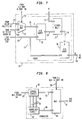
- FIG. 7 there is shown a block diagram of an exemplary Multiplexer/Fader circuit 64 (shown within a dashed line rectangle) which comprises a 2:1 Multiplexer (MUX.) 72, and a Fader 74 (shown within a dashed line rectangle).
- the Fader 74 comprises an A-B Adder 75, a Signed Multiplier (SIGNED MULT.) 77, and an A+B Adder 78.
- the 2:1 Multiplexer receives each of the Graphic data signals from the Color Palette 60 on bus 61 at a first input terminal (A), and the Graphic data signals from the YC to YUV Demultiplexer 62 on bus 63 at a second input terminal (B).
- a control signal on lead 67 from the 3:1 Multiplexer and Control 66 selects which of the two Graphic input signals (from input terminal A or B) will be output from the 2:1 Multiplexer 72 at output terminal (O).
- Pixel Graphic output signals (Y, U, or V) from an output terminal (O) of the 2:1 Multiplexer 72 (designated G) on a bus 70 are received at a first input terminal (A) of the A-B Adder 75 of the Fader 74.
- a live video YUV signal (Y, U, or V) (designated L) is received from a bus 59 at a second input terminal (B) of the A-B Adder 75.
- the pixel data values of the A terminal input data from the 2:1 Multiplexer 72 less the data values of the live video YUV pixel data received the B input terminal is provided as an output at an output terminal (O) of the A-B adder 75.
- the Signed Multiplier 77 receives from, for example, a register (not shown) a 9-bit changeable ratio control value (R) on a bus 71 at a first input terminal (A), and the output from the A-B Adder 75 on a bus 76 at a second input terminal (B).
- the resultant multiplied value of the ratio control value (R) on the bus 71 and the Graphic signal output data from the A-B Adder 75 on the bus 76 is output at an output terminal (0) on a bus 79 to a first input terminal (A) of the A+B Adder 78.
- the live video signal (Y, U, or V) on bus 59 is received at a second input terminal (B) of A+B Adder 78, and the sum of the two input signal values are provided as a output signal (designated Q) on the bus 65 to the Convolver 68 (shown in FIG. 3).
- the Fader 74 functions to fade a graphic signal for a sprite in or out so that the graphic does not appear or disappear instantaneously over the live a video signal.
- the Fader 74 causes the graphic to appear with increasing intensity on a television receiver while the live video signal decreases in intensity in the area of the graphic over a short period of time so that the graphic is totally visible.
- the Fader 74 causes the graphic to appear with decreasing intensity on a television receiver while the live video signal increases in intensity in the area of the graphic over a short period of time until the graphic disappears.
- the operation of the Fader 74 can be explained in accordance with the following algorithms.
- an exemplary 9-bit fade multiplier (R) bus 71 is defined as follows.
- R is the fade control value and ranges from 0 to 256. From the above definitions, where "L” is a pixel value of the live video, “G” is a pixel value of the sprite overlay, and the symbol "*" represents a multiplying function. From Equation 1 above, as the ratio used for the multiplying value R changes, the intensity of the graphic and live video signals change in a opposite directions.
- the Convolver 68 (shown within a dashed line rectangle) comprises a Bypass circuit 80, a convolver circuit 82, and a Multiplexer (MUX.) 84.
- the Bypass circuit 80 receives sequential pixel data from the Multiplexer/Fader 64 (shown in FIGS. 3 and 7) on bus 65, and concurrently generates therefrom data on buses 81 for three pixels in a vertical of a sprite to be displayed on a television receiver. More particularly, the three pixels are obtained from corresponding pixels in three adjacent lines of both fields of a frame making up a sprite picture.
- the three pixel data values are obtained by any suitable arrangement such as a plurality of delay circuits operating from a pixel clock or a three times pixel clock.
- the three pixel data values are received via buses 81 by the Convolver circuit 82.
- the sequential pixel data from the Multiplexer/Fader 64 is received by the Bypass circuit 80 on the bus 65.
- the sequential pixel data from the Multiplexer/Fader 64 passes through the Bypass circuit 80 and is provided to a first input (A) of the Multiplexer 84 via a bus 85.
- the Bypass circuit 80 transmits sequential sets of three pixel data values from separate outputs thereof to separate inputs of Convolver circuit 82 on buses 81.
- the Convolver circuit 82 provides an 8-bit weighted output signal for pixel data for a central pixel in a 3-by-3 matrix of corresponding pixels in three adjacent lines of a television picture at an output thereof to a second input (B) of the Multiplexer 84 via a bus 86.
- the Multiplexer 84 selects the signals at the first (A) or second (B) inputs for transmission to the output terminal (O) and bus 47 depending on control signals from the 3:1 Multiplexer and Control 66 over a lead 69.
- the Convolver circuit 82 effectively multiplies (using just adders and delays) the three pixels of a vertical received on buses 81 in a 3-by-3 matrix of pixels with predetermined weight values, and provides an averaged output signal for the central pixel of the 3-by-3 matrix to a second input (B) of the Multiplexer 84.
- This process continues for each pixel of a central row (output LINE 1 of the Pixel Assembly Buffer 52 of FIG. 2) as the sprite data for the corresponding pixels of the three adjacent lines as the pixel data progresses (shifts) horizontally across the sprite picture for three adjacent lines.
- the present invention can be used at, for example, a production editing station prior to the television signal being broadcast.
- the present invention can be used in television productions for creating initial products prior to their being broadcast rather than manipulating the television signal afterwards at a remote subscriber's location. This is possible because the quality and the resolution of the picture will be the same regardless of whether the editing is performed during production or thereafter at the subscriber's location. Therefore, it does not matter if the quality or resolution might be better in a nonedited television production if the editing is performed somewhere prior to the production being seen on the subscriber's interlaced television set.
Landscapes
- Engineering & Computer Science (AREA)
- Physics & Mathematics (AREA)
- Computer Hardware Design (AREA)
- General Physics & Mathematics (AREA)
- Theoretical Computer Science (AREA)
- Multimedia (AREA)
- Signal Processing (AREA)
- Processing Of Color Television Signals (AREA)
- Controls And Circuits For Display Device (AREA)
- Color Television Systems (AREA)
Applications Claiming Priority (2)
| Application Number | Priority Date | Filing Date | Title |
|---|---|---|---|
| US08/523,396 US5739868A (en) | 1995-08-31 | 1995-08-31 | Apparatus for processing mixed YUV and color palettized video signals |
| US523396 | 1995-08-31 |
Publications (2)
| Publication Number | Publication Date |
|---|---|
| EP0762330A2 true EP0762330A2 (fr) | 1997-03-12 |
| EP0762330A3 EP0762330A3 (fr) | 1998-06-17 |
Family
ID=24084825
Family Applications (1)
| Application Number | Title | Priority Date | Filing Date |
|---|---|---|---|
| EP96305724A Ceased EP0762330A3 (fr) | 1995-08-31 | 1996-08-02 | Appareil de traitement de signaux vidéo mélangés YUV et table de couleurs |
Country Status (7)
| Country | Link |
|---|---|
| US (1) | US5739868A (fr) |
| EP (1) | EP0762330A3 (fr) |
| JP (1) | JPH09107559A (fr) |
| KR (1) | KR100208552B1 (fr) |
| CA (1) | CA2179784C (fr) |
| MX (1) | MX9603750A (fr) |
| NO (1) | NO963576L (fr) |
Families Citing this family (10)
| Publication number | Priority date | Publication date | Assignee | Title |
|---|---|---|---|---|
| GB9512565D0 (en) * | 1995-06-21 | 1995-08-23 | Sgs Thomson Microelectronics | Video signal processor |
| IT1285258B1 (it) * | 1996-02-26 | 1998-06-03 | Cselt Centro Studi Lab Telecom | Dispositivo di manipolazione di sequenze video compresse. |
| US6229296B1 (en) * | 1996-02-27 | 2001-05-08 | Micron Technology, Inc. | Circuit and method for measuring and forcing an internal voltage of an integrated circuit |
| US5877802A (en) * | 1996-05-21 | 1999-03-02 | Asahi Kogaku Kogyo Kabushiki Kaisha | Video-signal processing device connectable to an electronic endoscope |
| US6946863B1 (en) | 1998-02-27 | 2005-09-20 | Micron Technology, Inc. | Circuit and method for measuring and forcing an internal voltage of an integrated circuit |
| JP4131052B2 (ja) | 1998-07-17 | 2008-08-13 | ソニー株式会社 | 撮像装置 |
| US6999089B1 (en) * | 2000-03-30 | 2006-02-14 | Intel Corporation | Overlay scan line processing |
| US6906725B2 (en) * | 2002-02-22 | 2005-06-14 | L-3 Communications Corporation | Apparatus and method for simulating sensor imagery |
| JP2004356939A (ja) * | 2003-05-29 | 2004-12-16 | Fujitsu Component Ltd | 遠隔ユニット及び遠隔システム |
| US20080106646A1 (en) * | 2006-11-06 | 2008-05-08 | Media Tek Inc. | System, apparatus, method, and computer program product for generating an on-screen display |
Citations (1)
| Publication number | Priority date | Publication date | Assignee | Title |
|---|---|---|---|---|
| EP0310176A2 (fr) * | 1987-09-30 | 1989-04-05 | Philips Electronics Uk Limited | Méthode et appareil pour générer une image en deux dimensions |
Family Cites Families (24)
| Publication number | Priority date | Publication date | Assignee | Title |
|---|---|---|---|---|
| US4420770A (en) * | 1982-04-05 | 1983-12-13 | Thomson-Csf Broadcast, Inc. | Video background generation system |
| US4754270A (en) * | 1984-02-16 | 1988-06-28 | Nintendo Co., Ltd. | Apparatus for varying the size and shape of an image in a raster scanning type display |
| US4580165A (en) * | 1984-04-12 | 1986-04-01 | General Electric Company | Graphic video overlay system providing stable computer graphics overlayed with video image |
| US5089811A (en) * | 1984-04-16 | 1992-02-18 | Texas Instruments Incorporated | Advanced video processor having a color palette |
| JPS60254190A (ja) * | 1984-05-31 | 1985-12-14 | 株式会社 アスキ− | デイスプレイコントロ−ラ |
| CA1243779A (fr) * | 1985-03-20 | 1988-10-25 | Tetsu Taguchi | Systeme de traitement de la parole |
| DE3702220A1 (de) * | 1987-01-26 | 1988-08-04 | Pietzsch Ibp Gmbh | Verfahren und einrichtung zur darstellung eines gesamtbildes auf einem bildschirm eines bildschirmgeraetes |
| US4951038A (en) * | 1987-05-15 | 1990-08-21 | Hudson Soft Co., Ltd. | Apparatus for displaying a sprite on a screen |
| US5258843A (en) * | 1987-09-04 | 1993-11-02 | Texas Instruments Incorporated | Method and apparatus for overlaying displayable information |
| US5179642A (en) * | 1987-12-14 | 1993-01-12 | Hitachi, Ltd. | Image synthesizing apparatus for superposing a second image on a first image |
| US5185597A (en) * | 1988-06-29 | 1993-02-09 | Digital Equipment Corporation | Sprite cursor with edge extension and clipping |
| US5065231A (en) * | 1988-09-26 | 1991-11-12 | Apple Computer, Inc. | Apparatus and method for merging input RGB and composite video signals to provide both RGB and composite merged video outputs |
| US5235677A (en) * | 1989-06-02 | 1993-08-10 | Atari Corporation | Raster graphics color palette architecture for multiple display objects |
| US4965670A (en) * | 1989-08-15 | 1990-10-23 | Research, Incorporated | Adjustable overlay display controller |
| US5227863A (en) * | 1989-11-14 | 1993-07-13 | Intelligent Resources Integrated Systems, Inc. | Programmable digital video processing system |
| US5097257A (en) * | 1989-12-26 | 1992-03-17 | Apple Computer, Inc. | Apparatus for providing output filtering from a frame buffer storing both video and graphics signals |
| US5389947A (en) * | 1991-05-06 | 1995-02-14 | Compaq Computer Corporation | Circuitry and method for high visibility cursor generation in a graphics display |
| KR940001439B1 (ko) * | 1991-08-30 | 1994-02-23 | 삼성전자 주식회사 | 자막정보 중첩회로 |
| US5258826A (en) * | 1991-10-02 | 1993-11-02 | Tandy Corporation | Multiple extended mode supportable multimedia palette and multimedia system incorporating same |
| US5313231A (en) * | 1992-03-24 | 1994-05-17 | Texas Instruments Incorporated | Color palette device having big/little endian interfacing, systems and methods |
| JPH05336441A (ja) * | 1992-06-03 | 1993-12-17 | Pioneer Electron Corp | 映像合成エフェクト装置 |
| JP3059302B2 (ja) * | 1992-06-03 | 2000-07-04 | 株式会社ハドソン | 映像混合装置 |
| JP2593427B2 (ja) * | 1992-10-14 | 1997-03-26 | 株式会社ハドソン | 画像処理装置 |
| JPH08511390A (ja) * | 1993-06-07 | 1996-11-26 | サイエンティフィック−アトランタ・インコーポレーテッド | 加入者端末用ディスプレーシステム |
-
1995
- 1995-08-31 US US08/523,396 patent/US5739868A/en not_active Expired - Fee Related
-
1996
- 1996-06-24 CA CA002179784A patent/CA2179784C/fr not_active Expired - Fee Related
- 1996-08-02 EP EP96305724A patent/EP0762330A3/fr not_active Ceased
- 1996-08-27 NO NO963576A patent/NO963576L/no unknown
- 1996-08-28 KR KR1019960035943A patent/KR100208552B1/ko not_active Expired - Fee Related
- 1996-08-29 MX MX9603750A patent/MX9603750A/es unknown
- 1996-08-30 JP JP8229733A patent/JPH09107559A/ja active Pending
Patent Citations (1)
| Publication number | Priority date | Publication date | Assignee | Title |
|---|---|---|---|---|
| EP0310176A2 (fr) * | 1987-09-30 | 1989-04-05 | Philips Electronics Uk Limited | Méthode et appareil pour générer une image en deux dimensions |
Also Published As
| Publication number | Publication date |
|---|---|
| EP0762330A3 (fr) | 1998-06-17 |
| KR970014408A (ko) | 1997-03-29 |
| CA2179784A1 (fr) | 1997-03-01 |
| NO963576L (no) | 1997-03-03 |
| US5739868A (en) | 1998-04-14 |
| NO963576D0 (no) | 1996-08-27 |
| CA2179784C (fr) | 2000-04-25 |
| JPH09107559A (ja) | 1997-04-22 |
| KR100208552B1 (ko) | 1999-07-15 |
| MX9603750A (es) | 1997-06-28 |
Similar Documents
| Publication | Publication Date | Title |
|---|---|---|
| EP0762325B1 (fr) | Appareil d'agrandissement vidéo | |
| EP0951777B1 (fr) | Procede et appareil destines a la mise a l'echelle et a la reduction du papillotement avec ponderation de coefficients dynamiques | |
| US6166772A (en) | Method and apparatus for display of interlaced images on non-interlaced display | |
| KR100261638B1 (ko) | 비디오시스템및그이용방법 | |
| US6151079A (en) | Image display apparatus having a circuit for magnifying and processing a picture image in accordance with the type of image signal | |
| EP0484981B1 (fr) | Dispositif de traitement de données d'image | |
| US5739868A (en) | Apparatus for processing mixed YUV and color palettized video signals | |
| GB2331196A (en) | Gamma correction method and apparatus | |
| MXPA96003750A (en) | Apparatus for processing yuv video signals and mezcl color envelope | |
| US5835103A (en) | Apparatus using memory control tables related to video graphics processing for TV receivers | |
| US5784116A (en) | Method of generating high-resolution video | |
| MXPA96003752A (es) | Aparato que usa tablas de control de memoriarelacionadas con el procesamiento de graficos devideo para receptores de television | |
| EP1164787A2 (fr) | Appareil de transmission vidéo | |
| HK1014067A (en) | Apparatus for processing mixed yuv and color palettized video signals | |
| KR19990028352A (ko) | 비디오 신호들의 주사선을 보간하기 위한 회로 및 그 이용 방법 | |
| HK1014068B (en) | Video magnification apparatus | |
| JPS61189089A (ja) | ス−パ−インポ−ズ装置 | |
| JP2002300598A (ja) | 送信装置および方法、受信装置および方法、放送システム、並びにプログラム |
Legal Events
| Date | Code | Title | Description |
|---|---|---|---|
| PUAI | Public reference made under article 153(3) epc to a published international application that has entered the european phase |
Free format text: ORIGINAL CODE: 0009012 |
|
| AK | Designated contracting states |
Kind code of ref document: A2 Designated state(s): BE CH DE DK ES FI FR GB IE IT LI NL SE |
|
| PUAL | Search report despatched |
Free format text: ORIGINAL CODE: 0009013 |
|
| AK | Designated contracting states |
Kind code of ref document: A3 Designated state(s): BE CH DE DK ES FI FR GB IE IT LI NL SE |
|
| RAP1 | Party data changed (applicant data changed or rights of an application transferred) |
Owner name: GENERAL INSTRUMENT CORPORATION |
|
| 17P | Request for examination filed |
Effective date: 19981211 |
|
| 17Q | First examination report despatched |
Effective date: 20010131 |
|
| STAA | Information on the status of an ep patent application or granted ep patent |
Free format text: STATUS: THE APPLICATION HAS BEEN REFUSED |
|
| 18R | Application refused |
Effective date: 20020722 |
|
| REG | Reference to a national code |
Ref country code: HK Ref legal event code: WD Ref document number: 1014067 Country of ref document: HK |
|
| P01 | Opt-out of the competence of the unified patent court (upc) registered |
Effective date: 20230525 |