EP0762797A2 - Skalierbare Architektur für ATM-Segmentierung und Wiederzusammensetzung - Google Patents
Skalierbare Architektur für ATM-Segmentierung und Wiederzusammensetzung Download PDFInfo
- Publication number
- EP0762797A2 EP0762797A2 EP96111520A EP96111520A EP0762797A2 EP 0762797 A2 EP0762797 A2 EP 0762797A2 EP 96111520 A EP96111520 A EP 96111520A EP 96111520 A EP96111520 A EP 96111520A EP 0762797 A2 EP0762797 A2 EP 0762797A2
- Authority
- EP
- European Patent Office
- Prior art keywords
- atm
- datagram
- payload
- coupled
- generator
- Prior art date
- Legal status (The legal status is an assumption and is not a legal conclusion. Google has not performed a legal analysis and makes no representation as to the accuracy of the status listed.)
- Withdrawn
Links
Images




Classifications
-
- H—ELECTRICITY
- H04—ELECTRIC COMMUNICATION TECHNIQUE
- H04Q—SELECTING
- H04Q11/00—Selecting arrangements for multiplex systems
- H04Q11/04—Selecting arrangements for multiplex systems for time-division multiplexing
- H04Q11/0428—Integrated services digital network, i.e. systems for transmission of different types of digitised signals, e.g. speech, data, telecentral, television signals
- H04Q11/0478—Provisions for broadband connections
-
- H—ELECTRICITY
- H04—ELECTRIC COMMUNICATION TECHNIQUE
- H04L—TRANSMISSION OF DIGITAL INFORMATION, e.g. TELEGRAPHIC COMMUNICATION
- H04L12/00—Data switching networks
- H04L12/54—Store-and-forward switching systems
- H04L12/56—Packet switching systems
- H04L12/5601—Transfer mode dependent, e.g. ATM
- H04L2012/5614—User Network Interface
- H04L2012/5616—Terminal equipment, e.g. codecs, synch.
-
- H—ELECTRICITY
- H04—ELECTRIC COMMUNICATION TECHNIQUE
- H04L—TRANSMISSION OF DIGITAL INFORMATION, e.g. TELEGRAPHIC COMMUNICATION
- H04L12/00—Data switching networks
- H04L12/54—Store-and-forward switching systems
- H04L12/56—Packet switching systems
- H04L12/5601—Transfer mode dependent, e.g. ATM
- H04L2012/5638—Services, e.g. multimedia, GOS, QOS
- H04L2012/5646—Cell characteristics, e.g. loss, delay, jitter, sequence integrity
- H04L2012/5652—Cell construction, e.g. including header, packetisation, depacketisation, assembly, reassembly
-
- H—ELECTRICITY
- H04—ELECTRIC COMMUNICATION TECHNIQUE
- H04L—TRANSMISSION OF DIGITAL INFORMATION, e.g. TELEGRAPHIC COMMUNICATION
- H04L12/00—Data switching networks
- H04L12/54—Store-and-forward switching systems
- H04L12/56—Packet switching systems
- H04L12/5601—Transfer mode dependent, e.g. ATM
- H04L2012/5678—Traffic aspects, e.g. arbitration, load balancing, smoothing, buffer management
- H04L2012/5679—Arbitration or scheduling
Definitions
- the present invention relates to a communication system. More particularly, the present invention relates to an asynchronous transfer mode segmentation and reassembly interface ("ATM interface”) which can be easily modified to accommodate different types of workstations and/or networks.
- ATM interface asynchronous transfer mode segmentation and reassembly interface
- a conventional ATM networking systems 100 comprises a workstation 105 coupled to a network 110 (e.g., fiber optics, twisted pair or any other conventional medium) through a conventional ATM interface 115 and a physical device 120.
- the conventional ATM interface 115 and the physical device 120 are connected together through a plurality of unidirectional communication lines 125 configured in accordance with a well-known, standard ATM "Utopia" interface 130 (i.e. Universal Testing Operation Interface for ATM). This guarantees compatibility between the ATM interface 115 and the physical device 120.
- One important function of the conventional ATM interface 115 and the physical device 120 is to accurately translate a "datagram" of information from a first data type supported by the workstation 105 into a standard format (e.g., an ATM cell) which can be transferred subsequently to other data types.
- a "datagram" is generally defined herein as a plurality of information bits in series.
- the workstation 105 internally processes data as a datagram having an arbitrary length, commonly referred to as a Service Data Unit (“SDU”) 190. Thereafter, in order to transmit the SDU to a remotely located device coupled to the network 110, the workstation 105 performs operations on the SDU 190 to produce a protocol data unit (“PDU”) 191 therefrom.
- SDU Service Data Unit
- PDU protocol data unit
- the PDU 191 is a datagram having a variable bit length so as to include at least the SDU 190 and bytes of information such as padding 192 used for completely “filling" the PDU 191, control 193 and a Cyclic Redundancy Checkword 194 which is used to check that no errors occur in transmission, generally referred to as "PAD” information, "CNTL” information and "CRC”, respectively.
- the conventional ATM interface 115 converts the PDU 191 into at least one ATM cell 195 depending on the size of the PDU 191. If the PDU 191 has a maximum of forty (40) bytes of data, the conventional ATM interface 115 produces one ATM cell. Otherwise, the conventional ATM interface 115 produces a sequence of ATM cells wherein only the last of the sequence of ATM cells include the CNTL information 193 and CRC 194 and at most the last two ATM cells may include PAD information 192.
- each ATM cell 195 includes a four (4) byte header 196 for indicating a designated "target" location of its corresponding ATM cell 195 and a one (1) error byte 197 which is used to monitor for errors in transmitting the header.
- the error byte 197 is provided by a physical layer of the physical device 120 (discussed below).
- each of the ATM cells 195 includes a forty-eight (48) byte "payload" 198 which solely includes data of the PDU 191 until the last few ATM cells as discussed above.
- the physical device 120 consists of a physical layer 135 and a physical media dependency ("PMD") 140, collectively operating as both a transmitter and a receiver, to propagate information between the network 110 and the workstation 105.
- PMD physical media dependency
- the conventional ATM interface 115 serially transmits the ATM cells to the physical layer 135.
- the physical layer 135 converts these ATM cells into a bit stream which is input into the PMD 140.
- the PMD 140 formats the bit stream according a particular data type used by the network 110.
- the physical device 120 operates in an opposite manner for the receiving operation.
- the conventional ATM interface 115 provides a reception signal path 146 and a transmission signal path 147, both of which including in series a pair of state machines working in combination with a storage queue (e.g., a First-In, First-Out "FIFO" queue).
- a storage queue e.g., a First-In, First-Out "FIFO" queue.
- a receiver (“RX") state machine 150 receives an ATM cell from the physical layer 135. Then, the RX state machine 150 (i) removes the header portion of the ATM cell, (ii) performs CRC calculations on the payload of the ATM cell and if no transmission errors, (iii) transfers the payload into a first storage queue (e.g., a First-In, First-Out queue) 155 for temporary storage.
- the first storage queue 155 transfers the payload through a system bus interface 170 and onto a system bus 165 for appropriate storage in the memory element 145. This transfer is controlled by a first interface state machine 160.
- the memory element 145 places information onto the system bus 165 addressed to be transferred through the system bus interface 170 and into a second storage queue 180.
- the second storage queue 180 outputs the information into a transmitter ("TX") state machine 185 for transmission through the Utopia interface 130 and into the physical device 120.
- TX transmitter
- This implementation for the ATM interface has a number of disadvantages.
- One disadvantage is that the conventional ATM interface is not easily modifiable (i.e., scalable) to accommodate for different capabilities of the workstation and/or the selected network. For example, if the operational speed of the network is increased from 616 mega-bits-per-second ("Mbps") to 1.2 giga-bits-per-second("Gbps"), the entire architecture of the conventional ATM interface would likely be required to be completely re-designed to allow for the increased throughput.
- Mbps mega-bits-per-second
- Gbps giga-bits-per-second
- the prsent invention relates to a scalable, asynchronous transfer mode ("ATM") interface used for generating at least one ATM cell.
- the ATM interface comprises an addressing element, a memory element and a cell generating element.
- the addressing element is used to initiate generation of the ATM cell(s) by transmitting at least one memory address(es) to the memory element. It is contemplated that the addressing element may include a scheduler and an address generator.
- the memory element accessible by the addressing element, is used to store at least one datagram corresponding to the memory address(es) and subsequently outputting at least one datagram to the cell generating element.
- the cell generating element is coupled to the memory element in order to receive at least one datagram and produce the ATM cell(s), including a header and a payload, including at least one datagram. It is contemplated that the cell generating element includes a payload generator for generating the payload and a header generator for generating the header.
- a controlling element is coupled to the addressing element and the cell generating element in order to control the operations of the addressing element and the cell generating element so that collectively, the addressing, memory and cell generating elements produce the ATM cell(s).
- the present invention describes an ATM segmentation and reassembly interface enabling an ATM communication network to be scalable and reusable.
- the present application there are numerous specific details set forth, such as the specific construction of the scheduler, address generator, payload generator and the like. It is apparent, however, to one skilled in the art, that the present invention may be practiced without incorporating these specific details. Moreover, it should be noted that there exist some instances where well-known circuits and the like are not set forth in detail in order to avoid unnecessarily obscuring the present invention.
- a “state machine” is a combination of conventional logic, typically synchronous in nature, which receives inputs that are combined with its self-contained state information in order to "intelligently” produce at least one output.
- a “selector” is defined as one or more conventional multiplexing logic gates arranged to selectively output one of a plurality of inputs.
- An “event” is an operation predetermined to occur at a specific time.
- a “line” is an electrical and mechanical connection or multiple independent connections between two electronic elements.
- the workstation 200 generally comprises a system bus 205 including address, data and control bus lines for communicating information between a plurality of bus agents 210.
- the plurality of bus agents 210 including but not limited to a host processor 215, host memory 220, a plurality of input/output ("I/O") devices 225 and a network module 230, all of which are coupled together through the system bus 205.
- These bus agents 215-230 are those typically found in most general purpose workstations, including those manufactured by Sun Microsystems, Inc. of Mountain View, California.
- the network module 230 which includes an ATM segmentation and reassembly interface ("ATM interface") 300 and a physical device 400.
- ATM interface 300 and the physical device 400 are used collectively to enable the workstation 200 to transfer information to and receive information from a network 250 having medium such as fiber optics, twisted pair and the like.
- the ATM interface 300 supports data transfers to and from the physical device 400, for clarity sake, only the operations concerning the data transmission path are described.
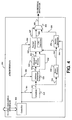
- the ATM interface 300 comprises a scheduler 310, an address generator 330, an allocated portion of host memory (“allocated host memory”) 340, a payload generator 350, a header generator 370 and a controller 380.
- the controller 380 is coupled to the scheduler 310, address generator 330, payload generator 350 and the header generator 370 via control lines 381-384, respectively.
- the controller 380 receives control information from the host processor (not shown) executing system software and propagates such control information through these control lines 381-384 to maintain tables, registers and local memories within the scheduler 310, the address generator 330, the payload generator 350 and the header generator 370.
- the scheduler 310 coupled to an address generator 330 and a delay element 345 via communication lines 301 and 302. These communication lines 301 and 302, whose construction is dependent from the number of data bus lines, transmits data (preferably a byte in size) into both the address generator 330 and the delay element 345.
- the data is used as a channel number operating as a table index ranging in value from "0" and "255". It is contemplated that the channel number could have any range of values depending on the number of data bits allocated to the channel number.
- the address generator 330 receives the channel number from the scheduler 310 and translates that channel number into an address.
- the address represents a unique address for a preselected amount of memory (i.e., an entry) within a limited address space forming the allocated host memory 340.
- the address generator 330 coupled to the allocated host memory 340 via a communication line 303, transmits the address accompanied by an appropriate "READ" control signal into the allocated host memory 340.
- the address generator 330 internally generates a number of control signals, transferred to the payload generator 350 via a control line 304, for use in reassembling one or a sequence of ATM cells if needed. For convenience, the remaining description will focus on the situation where only one ATM cell is necessary.
- the allocated host memory 340 Upon receipt of an address from the address generator 330, the allocated host memory 340 retrieves a datagram corresponding to the address and transmits the datagram into the payload generator 350 through a communication line 305. The manner in which this datagram is stored corresponds to how the address generator 330 updates its read address.
- the delay element 345 In synchronism with the transmission of the datagram into the payload generator 350, the delay element 345 also inputs the channel number into the payload generator 350. This can be accomplished by configuring the time delay associated with the delay element 345 to substantially correspond to the propagation time for information from the address generator 330 to emerge as retrieved data from the allocated host memory 340.
- the payload generator 350 formats the datagram from the allocated host memory 340 into an ATM cell with CNTL information and CRC as well as PAD information, if necessary, appended to the datagram to form the payload of the ATM cell. Thereafter, the payload generator 350 outputs the payload into a main selector element 365 through a payload communication line 366.
- the header of the ATM cell is stored in a header generator 370.
- the header generator 370 is local memory maintained by system software. This local memory is separated into a number of entries according to a "table" format, wherein one of the entries is selected by the channel number transmitted through a communication line 306.
- the header generator 370 Upon the response, the header generator 370 outputs the header stored in the selected entry through communication line 368 and into the main selector element 365.
- the header and payload are combined by the selector element 365 under control by the payload generator 350 via control line 367 to produce the ATM cell.
- the scheduler 310 is used for generating an event or a sequence of events to initiate the generation of a corresponding one or sequence of ATM cells.
- the scheduler 310 comprises at least one scheduler element, but preferably a plurality of scheduler elements 311a-311m ("m" being arbitrary) as illustrated, each capable of generating a single or a sequence of events in order to prompt the generation of ATM cell(s).
- Each of the scheduler elements 311a-311m is a collection of asynchronous logic gates, which are configured to control traffic according to a selected algorithm and under a priority-based protocol.
- the scheduler elements may include a constant bit rate scheduler element ("CBR scheduler”), a variable bit rate scheduler element (“VBR scheduler”) or any other well-known schedulers. It is appreciated that the scheduler 310 is scalable, thereby allowing any number of scheduler elements to be implemented and configured as required by the ATM networking system.
- CBR scheduler constant bit rate scheduler element
- VBR scheduler variable bit rate scheduler element
- the scheduler elements 311a-311m are correspondingly coupled to a priority-based scheduling unit 313 (e.g., round-robin scheduling unit) via transmission lines 312a-312m which outputs a channel number from one of the scheduler elements 311a-311m with the highest priority.
- a priority-based scheduling unit 313 e.g., round-robin scheduling unit
- the priority associated with each of the scheduler elements 311a-311m is dynamically alterable through software.
- the scheduler element 311a may be a CBR scheduler having a first priority "P1" (highest) and scheduler element 311b may be a VBR scheduler having a second priority "P2", where "P2" is assigned a priority less than "P1". Accordingly, if the CBR scheduler 311a is in operation, its channel number is always output from the priority-based scheduling unit 313. If the CBR scheduler 311a is not in operation, the priority-based scheduling unit 313 checks whether the VBR scheduler 311b is in operation and if so, outputs the channel number generated from the VBR scheduler 311b. The same process occurs for all of the scheduler elements 311a-311m having different priority levels.
- the CBR scheduler 311a is preferably a memory lookup table storing a plurality of channel numbers, identified as "channel 1" - "channel 5" for example, in unique address entries 315-319 as shown.
- the host processor controls which channel number is output to the priority-based scheduling unit 313 by selection of one of the address entries through control line 381.
- the CBR scheduler 311a may include a circular buffer including a plurality of registers for storing the channel number.
- the VBR scheduler 311b includes a timer module (e.g., counter) 320 and a token storage module 325 operating in conjunction to control ATM cell traffic propagating through communication line 301.
- a "token” represents an abstract measurement value used by the VBR scheduler 311b to indicate that an ATM cell requests transmission.
- the token module 320 is programmable to generate a sequence of tokens representing of the desired transmission rate (i.e., "drip rate") of ATM cells through the ATM communication network.
- the drip rate is achieved by configuring the activation and deactivation of a signal line 321 such that the "drip" rate is equal to the desired speed of the ATM network divided by 48 bytes (i.e., size of an ATM cell).
- the token storage module 325 is a queue for storing a predetermined number of tokens from the timer module 320. This predetermined number (i.e., queue size) is loaded via signal line 326, based on control line 381, to indicate the number of ATM cells that can be transferred in a burst (i.e., back-to-back). The tokens are input from the timer module 320 through signal line 322 causing the queue to "fill”. Once an ATM cell associated with one of the tokens stored in the token storage module 325 is output from the ATM interface, a token decrement line 327 is asserted causing the token storage size to be decremented by one. If the number of tokens exceed the queue size, the tokens are discarded resulting in the ATM networking system failing to achieve its intended drip rate. This may be corrected by re-programming the queue size to be larger than the predetermined number.
- the address generator 330 comprises a first local storage element 331, a second local storage element 332, an incremental counter 333, a decremental counter 334 and a state machine 335.
- Both the first and second local storage elements 331 and 332 include a predetermined amount of memory of which collectively is significantly less than the memory size of host memory. This memory is used to support a table having an arbitrary number of entries, each of which is storing a datagram of a predetermined bit length.
- these local storage elements 331 and 332 are represented as block elements including (i) at least one input labeled "I” for receiving a channel number; (ii) an update input labeled "U” for receiving an incremented address or a decremented payload byte count from the incremental counter 333 or decremental counter 334, respectively; and (iii) an output labeled "O" for transmitting a memory address to the allocated host memory or the decremented payload byte count to the state machine 335 (see Figure 4 ).
- the scheduler inputs the channel number through the communication line 301 into the "I" inputs of both the first and second local storage elements 331 and 332.
- the channel number is used as an index by the first local storage element 331 for obtaining a memory address used to obtain a datagram stored within the allocated host memory which is needed to form the ATM cell.
- the second local storage element 332 is a predetermined amount of memory. However, that memory is used in maintaining the number of bytes remaining to be transferred to form the "payload" of a current ATM cell.
- the address generator 330 Since the address generator 330 contains information on what data locations are to be read from the allocated host memory, the address generator 330 must generate the addressing sequence required to read data from the allocated host memory necessary and to appropriately construct the "payload" of the ATM cell. This addressing sequence is accomplished by the first local storage element 331 transferring a first address associated with the channel number on communication line 303. The first address is used by the allocated host memory to supply a number of bytes associated with the first address ("supply bytes"). The second local storage element 332, on the other hand, uses the channel number to decrement the number of supply bytes from the number of bytes to be transferred thereby calculating the remaining bytes to be transferred. This number is stored back into the second local storage element 332 while the first address is incremented and returned to the first local storage element.
- the state machine 335 controls the generation of READ, END and PAD control signals propagating through control lines 337-339.
- the READ control signal indicates a read from memory is requested and signals the allocated host memory 340 should respond with the current memory address.
- the END control signal indicates that the transmission of data associated with the "payload" of the ATM cell is completed.
- the PAD control signal indicates that padding is needed in order to correctly fill the ATM cell.
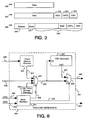
- the payload generator (see Figure 4 and 8 ) performs the actual padding by monitoring the number of bytes of data forming the datagram.
- the payload generator does not need to perform padding operations of the ATM cell(s) if the datagram is equal in size to forty plus forty-eight times "k" bytes (40 + 48 x "k” bytes, where "k" is a whole number). Otherwise, the datagram requires padding.
- padding is needed only in the last ATM cell.
- the exception is that padding may be required in the last two ATM cells of a sequence, provided after insertion of the payload, there is insufficient space remaining in the ATM cell to append the CRC in the last four bytes of the ATM cell.
- the address generator will generate another ATM cell for transmission of the CRC and reallocate data as needed in both ATM cells accompanied by padding.
- the payload generator 350 comprises a third local storage element 351, a first and second selector 352 and 353, a state machine 354, a pad value storage element 355 (set to any whole number including zero) and a CRC generator 356.
- the allocated host memory inputs the datagram via data line 305 into the first selector 352.
- the delay element (see Figure 4 ) inputs the channel number via communication line 306 into the third local storage element 351 and the address generator inputs the PAD and END control signals via control lines 338 and 339 into the state machine 354.
- the channel number operates as an index for the third local storage element 351 to selectively output CNTL information into the first selector 352 via signal line 357.
- the PAD and END signals are used by the state machine 354 to appropriately assert and deassert the select lines 358 to control the first selector 352 to output the datagram along with the CNTL information and correctly padded by the pad value storage element 355 (e.g., register), if appropriate, through a signal line 359. This datagram is transferred into the CRC generator 356 and the second selector 353.
- the CRC generator 356 receives the datagram and produces a CRC number which is input into the second selector 353 through signal line 360. Based on the value of the PAD and END signals, the state machine 354 will determine whether the CRC generator 356 is to append the CRC checkword by appropriately asserting a control line 361 of the second selector 353.
- the payload is input into the main selector 365 along the payload communication line 366 while the header generator 370 inserts the header via communication line 367 based on the channel number.
- the payload generator 350 selects the main selector 365 to output an ATM cell, minus the error byte provided by the physical device, through communication line 369.
Landscapes
- Engineering & Computer Science (AREA)
- Computer Networks & Wireless Communication (AREA)
- Data Exchanges In Wide-Area Networks (AREA)
Applications Claiming Priority (2)
| Application Number | Priority Date | Filing Date | Title |
|---|---|---|---|
| US522432 | 1990-05-11 | ||
| US08/522,432 US5610921A (en) | 1995-08-31 | 1995-08-31 | Scalable architecture for asynchronous transfer mode segmentation and reassembly |
Publications (2)
| Publication Number | Publication Date |
|---|---|
| EP0762797A2 true EP0762797A2 (de) | 1997-03-12 |
| EP0762797A3 EP0762797A3 (de) | 1999-05-19 |
Family
ID=24080825
Family Applications (1)
| Application Number | Title | Priority Date | Filing Date |
|---|---|---|---|
| EP96111520A Withdrawn EP0762797A3 (de) | 1995-08-31 | 1996-07-17 | Skalierbare Architektur für ATM-Segmentierung und Wiederzusammensetzung |
Country Status (4)
| Country | Link |
|---|---|
| US (1) | US5610921A (de) |
| EP (1) | EP0762797A3 (de) |
| JP (1) | JPH09130406A (de) |
| SG (1) | SG93800A1 (de) |
Cited By (2)
| Publication number | Priority date | Publication date | Assignee | Title |
|---|---|---|---|---|
| EP0884924A1 (de) * | 1997-06-10 | 1998-12-16 | NEC Corporation | ATM-Kommunikationseinrichtung |
| WO1999000959A1 (en) * | 1997-06-26 | 1999-01-07 | Madge Networks Limited | Communications network end station |
Families Citing this family (50)
| Publication number | Priority date | Publication date | Assignee | Title |
|---|---|---|---|---|
| US5446726A (en) * | 1993-10-20 | 1995-08-29 | Lsi Logic Corporation | Error detection and correction apparatus for an asynchronous transfer mode (ATM) network device |
| US5949781A (en) * | 1994-08-31 | 1999-09-07 | Brooktree Corporation | Controller for ATM segmentation and reassembly |
| SE506955C2 (sv) * | 1995-07-06 | 1998-03-09 | Ericsson Telefon Ab L M | ATM-flödesstyrning |
| US6452927B1 (en) | 1995-12-29 | 2002-09-17 | Cypress Semiconductor Corporation | Method and apparatus for providing a serial interface between an asynchronous transfer mode (ATM) layer and a physical (PHY) layer |
| US5784370A (en) * | 1995-12-29 | 1998-07-21 | Cypress Semiconductor Corp. | Method and apparatus for regenerating a control signal at an asynchronous transfer mode (ATM) layer or a physical (PHY) layer |
| US5982749A (en) * | 1996-03-07 | 1999-11-09 | Lsi Logic Corporation | ATM communication system interconnect/termination unit |
| US5848068A (en) * | 1996-03-07 | 1998-12-08 | Lsi Logic Corporation | ATM communication system interconnect/termination unit |
| US5841772A (en) * | 1996-03-07 | 1998-11-24 | Lsi Logic Corporation | ATM communication system interconnect/termination unit |
| US6535512B1 (en) * | 1996-03-07 | 2003-03-18 | Lsi Logic Corporation | ATM communication system interconnect/termination unit |
| US6373846B1 (en) | 1996-03-07 | 2002-04-16 | Lsi Logic Corporation | Single chip networking device with enhanced memory access co-processor |
| US5920561A (en) * | 1996-03-07 | 1999-07-06 | Lsi Logic Corporation | ATM communication system interconnect/termination unit |
| US5926464A (en) * | 1996-04-04 | 1999-07-20 | Lucent Technologies Inc. | Customer telecommunication interface device with built-in network features |
| US5878045A (en) * | 1996-04-26 | 1999-03-02 | Motorola, Inc. | Method and apparatus for converting data streams in a cell based communications system |
| US5898688A (en) * | 1996-05-24 | 1999-04-27 | Cisco Technology, Inc. | ATM switch with integrated system bus |
| US5884064A (en) * | 1996-09-04 | 1999-03-16 | Lucent Technologies Inc. | System for emulating a virtual path in an ATM network |
| US5995995A (en) * | 1996-09-12 | 1999-11-30 | Cabletron Systems, Inc. | Apparatus and method for scheduling virtual circuit data for DMA from a host memory to a transmit buffer memory |
| US5970229A (en) * | 1996-09-12 | 1999-10-19 | Cabletron Systems, Inc. | Apparatus and method for performing look-ahead scheduling of DMA transfers of data from a host memory to a transmit buffer memory |
| US5922046A (en) * | 1996-09-12 | 1999-07-13 | Cabletron Systems, Inc. | Method and apparatus for avoiding control reads in a network node |
| US5966546A (en) * | 1996-09-12 | 1999-10-12 | Cabletron Systems, Inc. | Method and apparatus for performing TX raw cell status report frequency and interrupt frequency mitigation in a network node |
| US5941952A (en) * | 1996-09-12 | 1999-08-24 | Cabletron Systems, Inc. | Apparatus and method for transferring data from a transmit buffer memory at a particular rate |
| US5999980A (en) * | 1996-09-12 | 1999-12-07 | Cabletron Systems, Inc. | Apparatus and method for setting a congestion indicate bit in an backwards RM cell on an ATM network |
| US5940415A (en) * | 1996-09-17 | 1999-08-17 | Lucent Technologies Inc. | Error tolerant addressing system and method for noisy ATM links |
| US6829240B1 (en) * | 1996-11-27 | 2004-12-07 | Mindspeed Technologies, Inc. | System for, and method of, ATM segmentation and re-assembly of cells providing streaming data |
| US5889779A (en) * | 1996-12-02 | 1999-03-30 | Rockwell Science Center | Scheduler utilizing dynamic schedule table |
| US6791947B2 (en) | 1996-12-16 | 2004-09-14 | Juniper Networks | In-line packet processing |
| US5844890A (en) * | 1997-03-25 | 1998-12-01 | International Business Machines Corporation | Communications cell scheduler and scheduling method for providing proportional use of network bandwith |
| US6041060A (en) * | 1997-04-30 | 2000-03-21 | International Business Machines Corporation | Communications cell scheduler and scheduling method for providing periodic activities |
| US5940404A (en) * | 1997-04-30 | 1999-08-17 | International Business Machines Corporation | Method and apparatus for enhanced scatter mode allowing user data to be page aligned |
| US6097734A (en) * | 1997-04-30 | 2000-08-01 | Adaptec, Inc. | Programmable reassembly of data received in an ATM network |
| KR100247837B1 (ko) | 1997-06-11 | 2000-04-01 | 윤종용 | 협대역 종합정보통신망의 트래픽 처리가 가능한 에이티엠 스위치장치 및 방법 |
| US6052387A (en) * | 1997-10-31 | 2000-04-18 | Ncr Corporation | Enhanced interface for an asynchronous transfer mode segmentation controller |
| KR100256677B1 (ko) | 1997-12-24 | 2000-05-15 | 이계철 | 공유 매체 액세스가 가능한 비동기 전달 모드 호스트 어뎁팅 장치 |
| US6483839B1 (en) | 1998-03-18 | 2002-11-19 | Conexant Systems, Inc. | Apparatus and method for scheduling multiple and simultaneous traffic in guaranteed frame rate in ATM communication system |
| US6795442B1 (en) * | 1998-04-23 | 2004-09-21 | Emulex Design & Manufacturing Corporation | System and method for scheduling message transmission and processing in a digital data network |
| US6570850B1 (en) | 1998-04-23 | 2003-05-27 | Giganet, Inc. | System and method for regulating message flow in a digital data network |
| US6414963B1 (en) | 1998-05-29 | 2002-07-02 | Conexant Systems, Inc. | Apparatus and method for proving multiple and simultaneous quality of service connects in a tunnel mode |
| US6381647B1 (en) * | 1998-09-28 | 2002-04-30 | Raytheon Company | Method and system for scheduling network communication |
| US6317415B1 (en) | 1998-09-28 | 2001-11-13 | Raytheon Company | Method and system for communicating information in a network |
| US6374314B1 (en) | 1998-09-28 | 2002-04-16 | Raytheon Company | Method for managing storage of data by storing buffer pointers of data comprising a sequence of frames in a memory location different from a memory location for pointers of data not comprising a sequence of frames |
| US6266702B1 (en) | 1998-09-28 | 2001-07-24 | Raytheon Company | Method and apparatus to insert and extract data from a plurality of slots of data frames by using access table to identify network nodes and their slots for insertion and extraction data |
| US6424658B1 (en) * | 1999-01-29 | 2002-07-23 | Neomagic Corp. | Store-and-forward network switch using an embedded DRAM |
| US6765911B1 (en) | 1999-02-03 | 2004-07-20 | International Business Machines Corporation | Communications adapter for implementing communications in a network and providing multiple modes of communications |
| DE19958042A1 (de) * | 1999-12-03 | 2001-06-21 | Invitek Gmbh | Oberflächenmodifizierte Trägermaterialien zur Bindung biologischer Materialien, Verfahren zu ihrer Herstellung und ihre Verwendung |
| US6724758B1 (en) | 1999-12-20 | 2004-04-20 | Cisco Technology, Inc. | Stage specific dilation in multi-stage interconnection networks |
| US6785291B1 (en) * | 2000-09-29 | 2004-08-31 | Nortel Networks Limited | Apparatus and method for channel assignment of packet flows |
| US7483411B2 (en) | 2001-06-04 | 2009-01-27 | Nec Corporation | Apparatus for public access mobility LAN and method of operation thereof |
| EP1520380B1 (de) * | 2002-07-10 | 2005-12-07 | Telefonaktiebolaget LM Ericsson (publ) | Synchrones datenübertragungsystem für zeitempfindliche daten in einem paketvermittelten netzwerk |
| US7434150B1 (en) | 2004-03-03 | 2008-10-07 | Marvell Israel (M.I.S.L.) Ltd. | Methods, circuits, architectures, software and systems for determining a data transmission error and/or checking or confirming such error determinations |
| US7360142B1 (en) | 2004-03-03 | 2008-04-15 | Marvell Semiconductor Israel Ltd. | Methods, architectures, circuits, software and systems for CRC determination |
| JP4567373B2 (ja) * | 2004-05-20 | 2010-10-20 | ルネサスエレクトロニクス株式会社 | データ転送装置及び通信データ処理システム |
Family Cites Families (10)
| Publication number | Priority date | Publication date | Assignee | Title |
|---|---|---|---|---|
| JP2947956B2 (ja) * | 1991-03-05 | 1999-09-13 | 株式会社日立製作所 | スイッチングシステム |
| JPH0687569B2 (ja) * | 1989-09-28 | 1994-11-02 | アメリカン テレフォン アンド テレグラフ カムパニー | 端末アダプタおよびデータ伝送方法 |
| US5136584A (en) * | 1990-07-11 | 1992-08-04 | At&T Bell Laboratories | Hardware interface to a high-speed multiplexed link |
| CA2047982C (en) * | 1990-07-27 | 1997-01-28 | Hiroshi Yamashita | Atm cell format conversion system |
| US5274768A (en) * | 1991-05-28 | 1993-12-28 | The Trustees Of The University Of Pennsylvania | High-performance host interface for ATM networks |
| JP3037476B2 (ja) * | 1991-08-28 | 2000-04-24 | 富士通株式会社 | Atmセル組立・分解方式 |
| JPH0779226A (ja) * | 1993-09-07 | 1995-03-20 | Fujitsu Ltd | 複数チャネル送出セル帯域制御回路 |
| US5414707A (en) * | 1993-12-01 | 1995-05-09 | Bell Communications Research, Inc. | Broadband ISDN processing method and system |
| US5428609A (en) * | 1994-01-03 | 1995-06-27 | At&T Corp. | STM-to-ATM converters |
| US5664116A (en) * | 1995-07-07 | 1997-09-02 | Sun Microsystems, Inc. | Buffering of data for transmission in a computer communication system interface |
-
1995
- 1995-08-31 US US08/522,432 patent/US5610921A/en not_active Expired - Fee Related
-
1996
- 1996-07-17 EP EP96111520A patent/EP0762797A3/de not_active Withdrawn
- 1996-07-24 SG SG9610356A patent/SG93800A1/en unknown
- 1996-09-02 JP JP24851796A patent/JPH09130406A/ja active Pending
Cited By (3)
| Publication number | Priority date | Publication date | Assignee | Title |
|---|---|---|---|---|
| EP0884924A1 (de) * | 1997-06-10 | 1998-12-16 | NEC Corporation | ATM-Kommunikationseinrichtung |
| US6414961B1 (en) | 1997-06-10 | 2002-07-02 | Nec Corporation | ATM switching with virtual circuit FIFO buffers |
| WO1999000959A1 (en) * | 1997-06-26 | 1999-01-07 | Madge Networks Limited | Communications network end station |
Also Published As
| Publication number | Publication date |
|---|---|
| JPH09130406A (ja) | 1997-05-16 |
| EP0762797A3 (de) | 1999-05-19 |
| SG93800A1 (en) | 2003-01-21 |
| US5610921A (en) | 1997-03-11 |
Similar Documents
| Publication | Publication Date | Title |
|---|---|---|
| US5610921A (en) | Scalable architecture for asynchronous transfer mode segmentation and reassembly | |
| EP0924954B1 (de) | ATM-Zellenübertragung | |
| EP0939573B1 (de) | ATM Zellenübertragungsplanung | |
| US5796735A (en) | System and method for transmission rate control in a segmentation and reassembly (SAR) circuit under ATM protocol | |
| US6097734A (en) | Programmable reassembly of data received in an ATM network | |
| US6414963B1 (en) | Apparatus and method for proving multiple and simultaneous quality of service connects in a tunnel mode | |
| US5995511A (en) | Digital network including mechanism for grouping virtual message transfer paths having similar transfer service rates to facilitate efficient scheduling of transfers thereover | |
| EP0772130B1 (de) | Verfahren und Vorrichtung zur Übertragung und Verarbeitung virtueller Befehle | |
| US6483839B1 (en) | Apparatus and method for scheduling multiple and simultaneous traffic in guaranteed frame rate in ATM communication system | |
| US5633870A (en) | Method and apparatus for controlling data flow through an ATM interface | |
| US5875352A (en) | Method and apparatus for multiple channel direct memory access control | |
| US5889779A (en) | Scheduler utilizing dynamic schedule table | |
| JP2686872B2 (ja) | ディジタル情報信号ルーチングのための共通メモリスイッチ及びスイッチング方法 | |
| US5963543A (en) | Error detection and correction apparatus for an asynchronous transfer mode (ATM) network device | |
| US5640399A (en) | Single chip network router | |
| US5838904A (en) | Random number generating apparatus for an interface unit of a carrier sense with multiple access and collision detect (CSMA/CD) ethernet data network | |
| EP1062780B1 (de) | Anlage und verfahren zur bereitstellung von verbindungen unterschiedlicher dienstqualitäten in einem tunnelmodus | |
| JPH07321822A (ja) | マルチキャスティング機能を備えた装置 | |
| EP0752798B1 (de) | Verfahren und Apparat zur Aufteilung von Lade- und Entladefunktionen in einer ATM-Schnittstelle | |
| JPH07321823A (ja) | マルチキャスティング機能を備えた装置 | |
| US5940397A (en) | Methods and apparatus for scheduling ATM cells | |
| US6327271B1 (en) | Programmable reassembly of data received in an ATM network | |
| US7050461B2 (en) | Packet buffer equipment | |
| US7215673B2 (en) | Multiplexing and demultiplexing method and apparatus | |
| GB2375196A (en) | Method for optimisation of memory storage by measuring filling |
Legal Events
| Date | Code | Title | Description |
|---|---|---|---|
| PUAI | Public reference made under article 153(3) epc to a published international application that has entered the european phase |
Free format text: ORIGINAL CODE: 0009012 |
|
| AK | Designated contracting states |
Kind code of ref document: A2 Designated state(s): DE FR GB NL SE |
|
| PUAL | Search report despatched |
Free format text: ORIGINAL CODE: 0009013 |
|
| AK | Designated contracting states |
Kind code of ref document: A3 Designated state(s): DE FR GB NL SE |
|
| 17P | Request for examination filed |
Effective date: 19991112 |
|
| STAA | Information on the status of an ep patent application or granted ep patent |
Free format text: STATUS: THE APPLICATION IS DEEMED TO BE WITHDRAWN |
|
| 18D | Application deemed to be withdrawn |
Effective date: 20040203 |