EP0762829B1 - Methode permettant d'inhiber une reponse de l'ethylene dans les vegetaux - Google Patents
Methode permettant d'inhiber une reponse de l'ethylene dans les vegetaux Download PDFInfo
- Publication number
- EP0762829B1 EP0762829B1 EP95921357A EP95921357A EP0762829B1 EP 0762829 B1 EP0762829 B1 EP 0762829B1 EP 95921357 A EP95921357 A EP 95921357A EP 95921357 A EP95921357 A EP 95921357A EP 0762829 B1 EP0762829 B1 EP 0762829B1
- Authority
- EP
- European Patent Office
- Prior art keywords
- plant
- compound
- ethylene
- group
- ethylene response
- Prior art date
- Legal status (The legal status is an assumption and is not a legal conclusion. Google has not performed a legal analysis and makes no representation as to the accuracy of the status listed.)
- Expired - Lifetime
Links
Images


Classifications
-
- A—HUMAN NECESSITIES
- A01—AGRICULTURE; FORESTRY; ANIMAL HUSBANDRY; HUNTING; TRAPPING; FISHING
- A01N—PRESERVATION OF BODIES OF HUMANS OR ANIMALS OR PLANTS OR PARTS THEREOF; BIOCIDES, e.g. AS DISINFECTANTS, AS PESTICIDES OR AS HERBICIDES; PEST REPELLANTS OR ATTRACTANTS; PLANT GROWTH REGULATORS
- A01N35/00—Biocides, pest repellants or attractants, or plant growth regulators containing organic compounds containing a carbon atom having two bonds to hetero atoms with at the most one bond to halogen, e.g. aldehyde radical
- A01N35/08—Biocides, pest repellants or attractants, or plant growth regulators containing organic compounds containing a carbon atom having two bonds to hetero atoms with at the most one bond to halogen, e.g. aldehyde radical at least one of the bonds to hetero atoms is to nitrogen
-
- A—HUMAN NECESSITIES
- A01—AGRICULTURE; FORESTRY; ANIMAL HUSBANDRY; HUNTING; TRAPPING; FISHING
- A01N—PRESERVATION OF BODIES OF HUMANS OR ANIMALS OR PLANTS OR PARTS THEREOF; BIOCIDES, e.g. AS DISINFECTANTS, AS PESTICIDES OR AS HERBICIDES; PEST REPELLANTS OR ATTRACTANTS; PLANT GROWTH REGULATORS
- A01N27/00—Biocides, pest repellants or attractants, or plant growth regulators containing hydrocarbons
-
- A—HUMAN NECESSITIES
- A01—AGRICULTURE; FORESTRY; ANIMAL HUSBANDRY; HUNTING; TRAPPING; FISHING
- A01N—PRESERVATION OF BODIES OF HUMANS OR ANIMALS OR PLANTS OR PARTS THEREOF; BIOCIDES, e.g. AS DISINFECTANTS, AS PESTICIDES OR AS HERBICIDES; PEST REPELLANTS OR ATTRACTANTS; PLANT GROWTH REGULATORS
- A01N3/00—Preservation of plants or parts thereof, e.g. inhibiting evaporation, improvement of the appearance of leaves or protection against physical influences such as UV radiation using chemical compositions; Grafting wax
- A01N3/02—Keeping cut flowers fresh chemically
-
- A—HUMAN NECESSITIES
- A01—AGRICULTURE; FORESTRY; ANIMAL HUSBANDRY; HUNTING; TRAPPING; FISHING
- A01N—PRESERVATION OF BODIES OF HUMANS OR ANIMALS OR PLANTS OR PARTS THEREOF; BIOCIDES, e.g. AS DISINFECTANTS, AS PESTICIDES OR AS HERBICIDES; PEST REPELLANTS OR ATTRACTANTS; PLANT GROWTH REGULATORS
- A01N33/00—Biocides, pest repellants or attractants, or plant growth regulators containing organic nitrogen compounds
- A01N33/02—Amines; Quaternary ammonium compounds
- A01N33/04—Nitrogen directly attached to aliphatic or cycloaliphatic carbon atoms
Definitions
- the present invention generally relates to plant growth regulation, and particularly relates to methods of inhibiting various ethylene responses by applying cyclopropene, 1.1.1. propellane, or derivatives thereof to the plant.
- Ethylene is known to mediate a variety of growth phenomena in plants. See generally Fritz et al. U.S. Pat. No. 3,879,188. This activity is understood to be achieved through a specific ethylene receptor in plants. Many compounds other than ethylene interact with this receptor: some mimic the action of ethylene; others prevent ethylene from binding and thereby counteract its action.
- Photoaffinity labeling has been used in biological studies to label binding sites in a permanent manner: usually be generating a carbene or nitrene intermediate. Such intermediates are very reactive and react rapidly and indiscriminately with many things. A compound already bound, however, would react mostly to the binding site.
- cyclopentadiene was an effective blocking agent for ethylene binding. See E. Sisler et al., Plant Growth Reg. 9, 157-164 (1990). Methods of combatting the ethylene response in plants with diazocyclopentadiene and derivatives thereof are disclosed in U.S. Patent No. 5,100,462 to Sisler and Blankenship.
- Pirrung et al. Journal of the Chemical Society, Chemical Communications, Vol. 13, 857-859 (1989) relates to, 2-cycloalkyl-1-aminocyclopropanecarboxylic acid formulations, along with methods for using 2-cycloalkyl-1-aminocyclopropanecarboxylic acid to modulate the rate of ripening and senescence of agricultural products.
- a method of inhibiting an ethylene response in a plant comprises applying to the plant an effective ethylene response-inhibiting amount of cyclopropene or a derivative thereof.
- Another aspect of the present invention is a method of blocking ethylene receptors in plants by applying cyclopropene or a derivative thereof to the plants in an effective receptor-blocking amount.
- Also disclosed is a method of inhibiting abscission in a plant comprising applying to the plant an effective abscission-inhibiting amount of cyclopropene or a derivative thereof.
- the methods described herein may be carried out in any suitable manner, such as by contacting the plant. to cyclopropene gas or a gas of a cyclopropene derivative, or by spraying the plant with a solution comprised of cyclopropene or a derivative thereof.
- a second method of inhibiting an ethylene response in a plant disclosed herein comprises applying to the plant an effective ethylene response-inhibiting amount of 1.1.1. propellane or a derivative thereof.
- Another aspect of the present invention is a method of blocking ethylene receptors in plants by applying 1.1.1. propellane or a derivative thereof to the plants in an effective receptor-blocking amount.
- Also disclosed is a method of inhibiting abscission in a plant comprising applying to the plant an effective abscission-inhibiting amount of 1.1.1. propellane or a derivative thereof.
- Yet another method of inhibiting an ethylene response in a plant includes applying to the plant an effective ethylene response-inhibiting amount of a compound isolated from light treated diazocyclopentadiene by Gas chromatography, wherein the compound elutes at about 0.7 minutes from a 23% SP-1700 on 80/100 Chromosorb P AWTM glass column.
- the present invention also contemplates methods of blocking ethylene receptors in plants, inhibiting abscission in plants, and prolonging the life of cut flowers which include applying to the plant an effective ethylene response-inhibiting amount of a compound isolated from diazocyclopentadiene by Gas chromatography, wherein the compound elutes at about 0.7 seconds from a 23% SP-1700 on 80/100 Chromosorb P AWTM glass column.
- cyclopropene and 1.1.1. propellane various derivatives of cyclopropene and 1.1.1. propellane may also be used to carry out the methods set forth herein.
- Derivatives of 1.1.1. propellane which may be used to carry out the present invention include those defined by Formula (II) below: wherein n is from 1 to 3, preferably 1, and R is as defined above with reference to Formula (I).
- R groups are preferably substituted on the compound of formula (II) on those carbon atoms which are covalently bound to two other carbon atoms, rather than those carbon atoms which are covalently bound to three other carbon atoms (i.e., to carbon atoms at the apexes of the structure shown).
- alkyl refers to linear or branched, saturated or unsaturated alkyl. Examples include, but are not limited to, methyl, ethyl, propyl, isopropyl, and butyl. Alkyl groups of the present invention are preferably linear and saturated.
- Plant is used in a generic sense herein, and encompasses woody-stemmed plants such as trees and shrubs. Plants to be treated by the methods described herein include whole plants and any portions thereof, such as field crops, potted plants, cut flowers (stems and flowers), and harvested fruits and vegetables.
- Plants treated by the methods of the present invention are preferably treated with a non-phytotoxic amount of the active compound.
- Ethylene responses may be initiated by either exogenous or endogenous sources of ethylene.
- Ethylene responses include, for example, the ripening and/or senescence of flowers, fruits and vegetables, abscission of foliage, flowers and fruit, the prolongation of the life of ornamentals such as potted plants, cut flowers, shrubbery, and dormant seedlings, in some plants (e.g., pea) the inhibition of growth, and in other plants (e.g., rice) the stimulation of growth.
- Vegetables which may be treated by the method of the present invention to inhibit ripening and/or senescence include leafy green vegetables such as lettuce (e.g., Lactuea sativa ), spinach ( Spinaca oleracea ), and cabbage ( Brassica oleracea ), various roots, such as potatoes ( Solanum tuberosum ) and carrots ( Daucus ), bulbs, such as onions ( Allium sp .), herbs, such as basil ( Ocimum basilicum ), oregano ( Origanum vulgare ), dill ( Anethum graveolens ), as well as soybean ( Glycine max ), lima beans ( Phaseolus limensis ), peas ( Lathyrus spp. ), corn ( Zea mays ), broccoli ( Brassica oleracea italica ), cauliflower ( Brassica oleracea botrytis ), and asparagus ( Asparagus officinalis ).
- leafy green vegetables such as lettuce
- Fruits which may be treated by the method of the present invention to inhibit ripening include tomatoes ( Lycopersicon esculentum ), apples ( Malus domestica ), bananas ( Musa sapientum ), pears ( Pyrus communis ), papaya ( Carica papaya ), mangoes ( Mangifera indica ), peaches ( Prunus persica ), apricots ( Prunus armeniaca ), nectarines ( Prunus persica nectarina ).
- Ornamental plants which may be treated by the method of the present invention to inhibit senescence and/or to prolong flower life and appearance (e.g., delay wilting), include potted ornamentals, and cut flowers.
- Potted ornamentals and cut flowers which may be treated with the present invention include azalea ( Rhododendron spp. ), hydrangea ( Macrophylla hydrangea ) hybiscus ( Hibiscus rosasanensis ), snapdragons ( Antirrhinum sp. ), poinsettia ( Euphorbia pulcherima ), cactus (e.g.
- alstroemeria Alstoemeria brasiliensis
- anemone e.g., Anemone blanda
- columbine Aquilegia sp .
- aralia e.g., Aralia chinensis
- aster e.g., Aster carolinianus
- bougainvillea Bougainvillea sp .
- camellia Camellia sp.
- bellflower Campanula sp.
- cockscomb celosia sp .
- falsecypress Chamaecyparis sp .
- chrysanthemum Chrysanthemum sp .
- clematis Clematis sp.
- cyclamen Cyclamen sp.
- freesia e.g., Freesia refracta
- orchids of the family Orchidaceae e.g., Freesia refracta
- Plants which may be treated by the method of the present invention to inhibit abscission of foliage, flowers and fruit include cotton ( Gossypium spp. ), apples, pears, cherries ( Prunus avium ), pecans ( Carva illinoensis ), grapes ( Vitis vinifera ), olives (e.g. Vitis vinifera and Olea europaea ), coffee ( Coffea arabica ), snapbeans ( Phaseolus vulgaris ), and weeping fig ( ficus benjamina ), as well as dormant seedlings such as various fruit trees including apple, ornamental plants, shrubbery, and tree seedlings.
- shrubbery which may be treated according to the present invention to inhibit abscission of foliage include privet ( Ligustrum sp .), photinea ( Photinia sp. ), holly ( Ilex sp. ) ferns of the family Polypodiaceae , schefflera ( Schefflera sp .), aglaonema ( Aglaonema sp. ), Laceaster ( Cotoneaster sp. ), barberry ( Berberis sp. ), waxmyrtle ( Myrica sp. ) abelia ( Abelia sp. ), acacia ( Acacia sp. ) and bromeliades of the family Bromeliaceae.
- the active compound of the present invention can be applied to plants by any suitable means. They may be applied alone, or in combination with inert carriers.
- the active compound may be applied alone in gaseous, liquid, or solid form, by contacting the compound to the plant to be treated. Additionally the active compound may be converted to the salt form, and then applied to the plants. Alternatively, the compound may be applied with a inert carrier. Suitable solid carriers include dust.
- the active compound may also be suspended in a liquid solution, as an organic solvent or an aqueous solution. Similarly, the gaseous form of the compound may be dispersed in an inert gaseous carrier to provide a gaseous solution.
- organic solvents may be used as a carrier for the active compounds of the present invention, e.g., hydrocarbons such as hexane, benzene, toluene, xylene, kerosene, diesel oil, fuel oil and petroleum naphtha, ketones such as acetone, methyl ethyl ketone and cyclohexanone, chlorinated hydrocarbons such as carbon tetrachloride, esters such as ethyl acetate, amyl acetate and butyl acetate, ethers, e.g., ethylene glycol monomethyl ether and diethylene glycol monomethyl ether, alcohols, e.g., ethanol, methanol, isopropanol, amyl alcohol, ethylene glycol, propylene glycol, butyl carbitol acetate and glycerine.
- hydrocarbons such as hexane, benzene, toluene, xylene,
- the active compounds can be applied as aerosols, e.g., by dispersing them in air by means of a compressed gas such as dichlorodifluoromethane or trichlorofluoromethane and other Freons, for example.
- a compressed gas such as dichlorodifluoromethane or trichlorofluoromethane and other Freons, for example.
- the active compounds of the present invention can also be applied with adjuvants or carriers such as talc, pyrophyllite, synthetic fine silica, attapulgus clay (attaclay), kieselguhr, chalk, diatomaceous earth, lime, calcium carbonate, bentonite, fuller's earth, cottonseed hulls, wheat flour, soybean flour pumice, tripoli, wood flour, walnut shell flour, redwood flour and lignin.
- adjuvants or carriers such as talc, pyrophyllite, synthetic fine silica, attapulgus clay (attaclay), kieselguhr, chalk, diatomaceous earth, lime, calcium carbonate, bentonite, fuller's earth, cottonseed hulls, wheat flour, soybean flour pumice, tripoli, wood flour, walnut shell flour, redwood flour and lignin.
- wetting agent it may be desirable to incorporate a wetting agent in the compositions of the present invention.
- Such wetting agents may be employed in both the solid and liquid compositions.
- the wetting agent can be anionic, cationic or nonionic in character.
- Typical classes of wetting agents include alkyl sulfonate salts, alkylaryl sulfonate salts, alkyl sulfate salts, alkylamide sulfonate salts, alkylaryl polyether alcohols, fatty acid esters of polyhydric alcohols and the alkylene oxide addition products of such esters, and addition products of long chain mercaptans and alkylene oxides.
- Typical examples of such wetting agents include the sodium alkylbenzene sulfonates having 10 to 18 carbon atoms in the akyl group, alkylphenol ethylene oxide condensation products, e.g., p-isooctylphenol condensed with 10 ethylene oxide units, soaps, e.g., sodium stearate and potassium oleate, sodium salt of propylnaphthalene sulfonic acid (di-2-ethylhexyl), ester of sodium sulfosuccinic acid, sodium lauryl sulfate, sodium stearate and potassium oleate, sodium salt of the sulfonated monoglyceride of coconut fatty acids, sorbitan, sesquioleate, lauryl trimethyl ammonium chloride, octadecyl trimethyl ammonium chloride, polyethylene glycol lauryl ether, polyethylene esters of fatty acids and rosin acids, e.g.
- the solid, liquid, and gaseous formulations can be prepared by any of the conventional procedures.
- the active ingredient, in finely divided form if a solid may be tumbled together with finely divided solid carrier.
- the active ingredient in liquid form including solutions, dispersions, emulsions and suspensions thereof, may be admixed with the solid carrier in finely divided form.
- ⁇ l means microliters
- ml means milliliters
- 1 means liters
- cm means centimeters
- temperatures are given in degrees Centigrade.
- Diazocyclopentadiene was placed in a glass container and exposed to light.
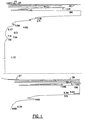
- a VARIANTM Gas chromatograph equipped with a flame ionization detector and a 23% SP-1700 on 80/100 Chromosorb P AWTM glass column with nitrogen as a carrier gas was used to separate the mixture.
- Diazocyclopentadiene was analyzed at ambient temperature. A chromatogram was produced and the elution of each peak was timed using a stopwatch. An exemplary chromatogram is reproduced as Figure 1 .
- the detector flame was extinguished and a piece of TYGONTM tubing was placed securely over the flame tip.
- the opposite end of the tubing was fitted with the hub of a syringe needle.
- carnations were placed in glass jars containing water. Each peak was then permitted to elute into a separate jar. The procedure was repeated 5 times. Approximately 1 ml of pure oxygen was added to the jar to compensate for the reduction in the oxygen level due to the nitrogen carrier gas. The carnations were maintained overnight. The next day, the carnations were aired. Thereafter, the jars were resealed and ethylene gas was injected into the jars. The flowers were exposed to the ethylene atmosphere overnight.
- the carnations need to have an exogenous ethylene exposure at least for 6 hours to have a visible. sign of senescence.
- Treatment with 3 nl/l of 1-methylcyclopropene is enough to stop that process.
- Carnations treated only with ethylene exhibited petal in-rolling, whereas carnations treated with ethylene and then 1-methylcyclopropene exhibited no visible sign of the phenomenon (data not shown).
- 1-methylcyclopropene seems to reduce and prevent the autocatalytic production of ethylene.
- Ethylene production was followed from the beginning of the ethylene climacteric production.
- the control exhibited a rise in ethylene production 4 days after beginning the experiment.
- Flowers first treated with ethylene exhibited a rise in ethylene production 2 days earlier.
- 1- Methylcyclopropene was applied. Thereafter ethylene production was measured.
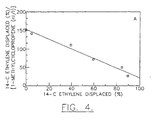
- Figure 3 the measure of the ethylene production observed in the control was considerably lower than that observed in flowers treated with 1-methylcyclopropene.
- Cut carnations at stage I and stage III were treated with 1-methylcyclopropene.
- concentration of 1-methylcyclopropene giving a protective effect was about 1.25 and 2.5 nl/l.
- the protection against ethylene was total.
- rates between 2.5 and 5 nl/l of 1-methylcyclopropene were sufficient to give a response, but total protection was not achieved.
- Total protection of older carnations was only achieved with 10 nl/1 of 1-methylcyclopropene (data not shown).
- Bananas were individually placed in a 3 l jar. 1-Methylcyclopropene was injected into the jar at a determined concentration. The plant material was then aerated and 1 ml/l of ethylene was added for 12 hours. Controls were held in jars without chemical treatment. Chlorophyll measurement was made as previously described in Sisler and Wood, 1988). The experiment was done 7 days after 1-methylcyclopropene treatment.
- the Ki obtained for chlorophyll disappearance was 40 ul/1 when experiments were done in the dark and 1.2 ul/1 when they were done in the light.
- the quantification of the effect of 1-methylcyclopropene was done by chlorophyll measurement.
- the Ki obtained for 1-methylcyclopropene was 0.4 nl/l.
- the ripening of 1-methylcyclopropene treated bananas was prevented for about 15 days and fruits turned brown after this period.
- Tomato seeds were washed with NaOCl (10%) and rinsed with water. The seeds were placed on wetted filter paper with 10 mM sodium phosphate buffer at pH 5.8. The germination was done in the dark. When the seedlings were about 1 mm height, 30 seeds by sample were placed on wet filter paper in a 0.5 1 jar. 1-Methylcyclopropene was added over 24 hours before adding 10 ⁇ l/l ethylene for 5 days.
- 1-methylcyclopropene When 1-methylcyclopropene was applied for 12 hours before the ethylene treatment, only 10 nl/l of compound was enough to preserve tomatoes. On these fruits, 1-methylcyclopropene had a temporary effect to prevent the ripening, which occurred about 7 to 10 days after the 1-methylcyclopropene treatment.
Landscapes
- Life Sciences & Earth Sciences (AREA)
- Health & Medical Sciences (AREA)
- General Health & Medical Sciences (AREA)
- Wood Science & Technology (AREA)
- Environmental Sciences (AREA)
- Engineering & Computer Science (AREA)
- Dentistry (AREA)
- Plant Pathology (AREA)
- Agronomy & Crop Science (AREA)
- Zoology (AREA)
- Pest Control & Pesticides (AREA)
- Toxicology (AREA)
- Agricultural Chemicals And Associated Chemicals (AREA)
- Organic Low-Molecular-Weight Compounds And Preparation Thereof (AREA)
- Catalysts (AREA)
- Cultivation Of Plants (AREA)
- Storage Of Fruits Or Vegetables (AREA)
Claims (30)
- Procédé pour inhiber une réponse à l'éthylène chez une plante, comprenant l'application à la plante d'une quantité efficace inhibant la réponse à l'éthylène d'un composé de Formule (I)dans lequel :
 n est égal à 1 ; etR est choisi au sein du groupe consistant en l'hydrogène, les groupes alkyle C1 à C4 saturés ou insaturés, hydroxy, les halogènes, le groupe alcoxy, amino et carboxy.
 - Procédé pour inhiber l'abscission chez une plante, comprenant l'application à la plante d'une quantité efficace inhibant l'abscission d'un composé de Formule (I)dans lequel :
 n est égal à 1 ; etR est choisi au sein du groupe consistant en l'hydrogène, les groupes alkyle C1 à C4 saturés ou insaturés, hydroxy, les halogènes, le groupe alcoxy, amino et carboxy.
 - Procédé pour prolonger la vie d'une fleur coupée, comprenant l'application à la fleur coupée, d'une quantité efficace prolongeant la vie, d'un composé de Formule (1)dans laquelle :
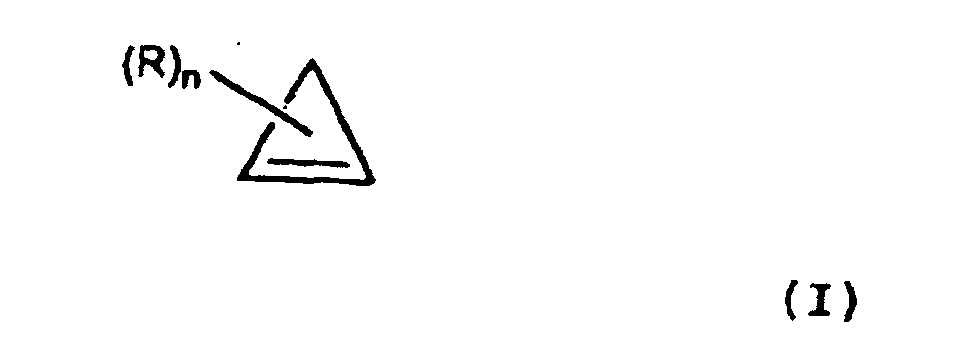 n est égal à 1 ; etR est choisi au sein du groupe consistant en l'hydrogène, les groupes alkyle C1 à C4 saturés ou insaturés, hydroxy, les halogènes, le groupe alcoxy, amino et carboxy.
 - Procédé selon l'une quelconque des revendication 1 à 3, dans lequel ledit composé est le 1-méthylcyclopropène.
- Procédé selon l'une quelconque des revendications 1 à 3, dans lequel ledit composé est le cyclopropène.
- Procédé selon l'une quelconque des revendications 1 à 3, dans lequel ladite étape d'application est effectuée en mettant ladite plante ou ladite fleur coupée en contact avec un gaz dudit composé.
- Procédé selon l'une quelconque des revendications 1 à 3, dans lequel ladite étape d'application est effectuée en pulvérisant sur ledit végétal ou ladite fleur coupée avec une solution comprenant ledit composé.
- Procédé selon l'une quelconque des revendications 1 à 3, dans lequel ladite étape d'application est effectuée en mettant en contact ladite plante ou ladite fleur coupée avec un solide comprenant ledit composé.
- Procédé selon la revendication 1, dans lequel ladite réponse de l'éthylène est le mûrissement du fruit.
- Procédé selon la revendication 9, dans lequel ledit fruit est choisi au sein du groupe consistant en les tomates, les pommes, les bananes, les poires, les papayes, les mangues, les pêches, les abricots, les nectarines, le kiwi, l'ananas, le kaki, les melons, les baies, le genus Cucumis, les haricots verts et les avocats.
- Procédé selon la revendication 1, dans lequel ladite réponse de l'éthylène est le mûrissement du légume.
- Procédé selon la revendication 11, dans lequel ledit légume est choisi au sein du groupe consistant en la laitue, l'épinard, le chou, les pommes de terre, les carottes, les oignons, le basilic, l'origan, l'aneth, le soja, les haricots de Lima, les pois, le maïs, le brocoli, le chou-fleur et l'asperge.
- Procédé selon la revendication 1, dans lequel ladite réponse de l'éthylène est la sénescence de la fleur.
- Procédé selon la revendication 13, dans lequel ladite fleur est choisie au sein du groupe consistant en l'azalée, l'hortensia, l'hibiscus, les gueules-de-loup, les poinsettias, le cactus, les bégonias, les roses, les tulipes, les jonquilles, les pétunias, les oeillets, le lis, les glaïeuls, l'alstroméria, l'anémone, l'ancolie, l'avalia, l'aster, la bougainvillée, le camélia, la campanule, la crête-de-coq, le faux cyprès, le chrysanthème, la clématite, le cyclamen, la freesia et les orchidées.
- Procédé selon la revendication 2, dans lequel la plante est choisie au sein du groupe consistant en le coton, la pomme, la poire, la cerise, la noix de pécan, le raisin, l'olive, le café, le haricot vert, la figue pleureuse, les jeunes plantes dormantes, le troène, le photinéa, le houx, les fougères, la schefflera, l'aglaonéma, le cotoneaster, le berberis, la myrte cirière, l'abelia, l'acacia et les broméliades.
- Procédé pour inhiber une réponse à l'éthylène chez une plante, comprenant l'application à la plante d'une quantité efficace inhibant la réponse de l'éthylène d'un composé de Formule (II) :dans lequel :
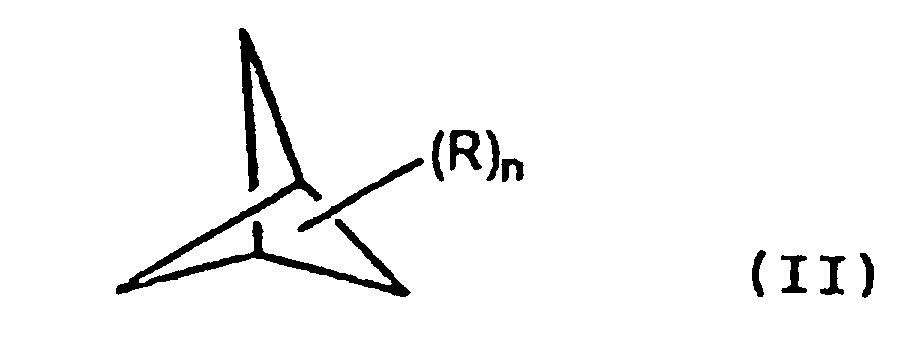 n est un nombre variant de 1 à 3 ; etR est choisi au sein du groupe comprenant l'hydrogène, les groupes alkyle C1 à C4 saturés ou insaturés, hydroxy, les halogènes, le groupe alcoxy, amino et carboxy.
 - Procédé pour inhiber l'abscission chez une plante, comprenant l'application à la plante d'une quantité efficace inhibant l'abscission d'un composé de Formule (II)dans lequel :
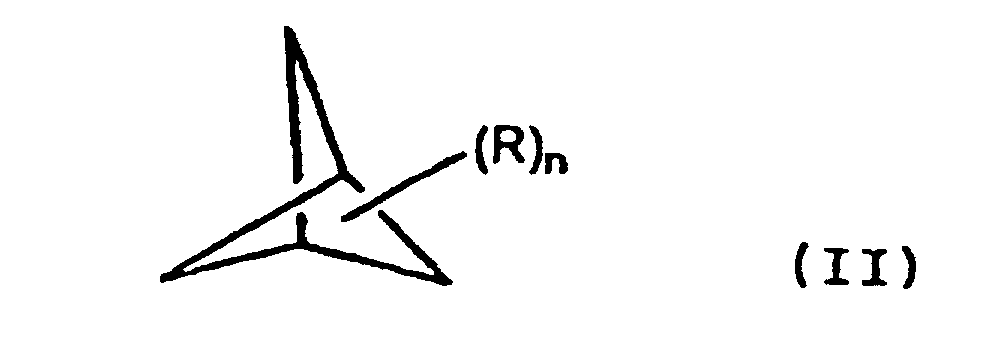 n est un nombre variant de 1 à 3 ; etR est choisi au sein du groupe comprenant l'hydrogène, les groupes alkyle C1 à C4 saturés ou insaturés, hydroxy, les halogènes, le groupe alcoxy, amino et carboxy.
 - Procédé pour prolonger la vie d'une fleur coupée, comprenant l'application à la fleur coupée d'une quantité efficace prolongeant la vie d'un composé de Formule (II) :dans lequel :
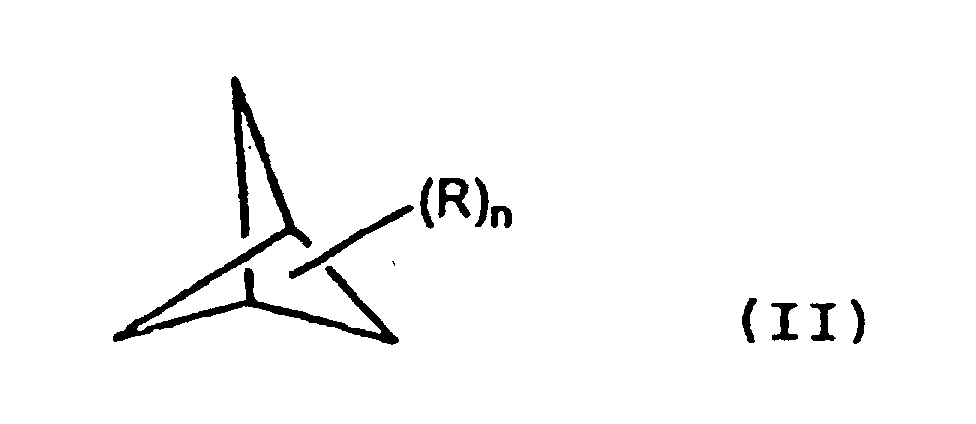 n est un nombre variant de 1 à 3 ; etR est choisi au sein du groupe comprenant l'hydrogène, les groupes alkyle C1 à C4 saturés ou insaturés, hydroxy, les halogènes, le groupe alcoxy, amino et carboxy.
 - Procédé selon l'une quelconque des revendications 16 à 18, dans lequel n varie de 1 à 2.
- Procédé selon l'une quelconque des revendications 16 à 18, dans lequel ledit composé est le 1.1.1 propellane.
- Procédé selon l'une quelconque des revendications 16 à 18, dans lequel ladite étape d'application est effectuée par la mise en contact de ladite plante ou de ladite fleur coupée avec un gaz dudit composé.
- Procédé selon l'une quelconque des revendications 16 à 18, dans lequel ladite étape d'application est effectuée en pulvérisant sur ladite plante ou ladite fleur coupée une solution comprenant ledit composé.
- Procédé selon l'une quelconque des revendications 16 à 18, dans lequel ladite étape d'application est effectuée en mettant en contact ladite plante ou ladite fleur coupée, avec un solide comprenant ledit composé.
- Procédé selon la revendication 16, dans lequel ladite réponse à l'éthylène est le mûrissement du fruit.
- Procédé selon la revendication 24, dans lequel ledit fruit est choisi au sein du groupe consistant en les tomates, les pommes, les bananes, les poires, la papaye, les mangues, les pêches, les abricots, les nectarines, le kiwi, les melons, l'ananas, le kaki, les baies, le genus Cucumis, les haricots verts et les avocats.
- Procédé selon la revendication 16, dans lequel ladite réponse à l'éthylène est le mûrissement du légume.
- Procédé selon la revendication 26, dans lequel ledit légume est choisi au sein du groupe comprenant la laitue, l'épinard, le chou, les pommes de terre, les carottes, les oignons, le basilic, l'origan, l'aneth, le soja, les haricots de Lima, les pois, le maïs, le brocoli et le chou-fleur, et l'asperge.
- Procédé selon la revendication 16, dans lequel ladite. réponse à l'éthylène est la sénescence de la fleur.
- Procédé selon la revendication 28, dans lequel ladite fleur est choisie au sein du groupe consistant en l'azalée, l'hortensia, l'hibiscus, les gueules-de-loup, les poinsettias, le cactus, les bégonias, les roses, les tulipes, les jonquilles, les pétunias, les oeillets, le lis, les glaïeuls, l'alstroméria, l'anémone, l'ancolie, l'avalia, l'aster, la bougainvillée, le camélia, la campanule, la crête-de-coq, le faux cyprès, le chrysanthème, la clématite, le cyclamen, la freesia et les orchidées.
- Procédé selon la revendication 17, dans lequel la plante est choisie au sein du groupe consistant en le coton, la pomme, la poire, la cerise, la noix de pécan, le raisin, l'olive, le café, le haricot vert, la figue pleureuse, les jeunes plantes dormantes, le troène, le photinéa, le houx, les fougères, la schefflera, l'aglaonéma, le cotoneaster, le berberis, la myrte cirière, l'abelia, l'acacia et les broméliades.
Priority Applications (3)
| Application Number | Priority Date | Filing Date | Title |
|---|---|---|---|
| DK03028079T DK1410712T3 (da) | 1994-06-03 | 1995-05-22 | Fremgangsmåde til at modvirke en ethylenreaktion i planter |
| EP06013926A EP1728426B1 (fr) | 1994-06-03 | 1995-05-22 | Méthode permettant d'inhiber une réponse de l'éthylene dans les végétaux |
| EP03028079A EP1410712B1 (fr) | 1994-06-03 | 1995-05-22 | Méthode permettant d'inhiber une réponse de l'éthylene dans les végétaux |
Applications Claiming Priority (3)
| Application Number | Priority Date | Filing Date | Title |
|---|---|---|---|
| US253951 | 1994-06-03 | ||
| US08/253,951 US5518988A (en) | 1994-06-03 | 1994-06-03 | Method of counteracting an ethylene response in plants |
| PCT/US1995/006501 WO1995033377A1 (fr) | 1994-06-03 | 1995-05-22 | Methode permettant d'inhiber une reponse de l'ethylene dans les vegetaux |
Related Child Applications (1)
| Application Number | Title | Priority Date | Filing Date |
|---|---|---|---|
| EP03028079A Division EP1410712B1 (fr) | 1994-06-03 | 1995-05-22 | Méthode permettant d'inhiber une réponse de l'éthylene dans les végétaux |
Publications (3)
| Publication Number | Publication Date |
|---|---|
| EP0762829A1 EP0762829A1 (fr) | 1997-03-19 |
| EP0762829A4 EP0762829A4 (fr) | 1999-07-21 |
| EP0762829B1 true EP0762829B1 (fr) | 2004-09-08 |
Family
ID=22962324
Family Applications (3)
| Application Number | Title | Priority Date | Filing Date |
|---|---|---|---|
| EP06013926A Expired - Lifetime EP1728426B1 (fr) | 1994-06-03 | 1995-05-22 | Méthode permettant d'inhiber une réponse de l'éthylene dans les végétaux |
| EP95921357A Expired - Lifetime EP0762829B1 (fr) | 1994-06-03 | 1995-05-22 | Methode permettant d'inhiber une reponse de l'ethylene dans les vegetaux |
| EP03028079A Expired - Lifetime EP1410712B1 (fr) | 1994-06-03 | 1995-05-22 | Méthode permettant d'inhiber une réponse de l'éthylene dans les végétaux |
Family Applications Before (1)
| Application Number | Title | Priority Date | Filing Date |
|---|---|---|---|
| EP06013926A Expired - Lifetime EP1728426B1 (fr) | 1994-06-03 | 1995-05-22 | Méthode permettant d'inhiber une réponse de l'éthylene dans les végétaux |
Family Applications After (1)
| Application Number | Title | Priority Date | Filing Date |
|---|---|---|---|
| EP03028079A Expired - Lifetime EP1410712B1 (fr) | 1994-06-03 | 1995-05-22 | Méthode permettant d'inhiber une réponse de l'éthylene dans les végétaux |
Country Status (11)
| Country | Link |
|---|---|
| US (1) | US5518988A (fr) |
| EP (3) | EP1728426B1 (fr) |
| JP (2) | JP3504667B2 (fr) |
| AT (3) | ATE333792T1 (fr) |
| AU (1) | AU699373B2 (fr) |
| CA (3) | CA2319203C (fr) |
| DE (3) | DE69535957D1 (fr) |
| DK (1) | DK1410712T3 (fr) |
| ES (3) | ES2229239T3 (fr) |
| PT (1) | PT1410712E (fr) |
| WO (1) | WO1995033377A1 (fr) |
Cited By (1)
| Publication number | Priority date | Publication date | Assignee | Title |
|---|---|---|---|---|
| US9485918B2 (en) | 2010-05-13 | 2016-11-08 | Paper-Pak Industries | Treatment system to prolong life of cut flowers |
Families Citing this family (92)
| Publication number | Priority date | Publication date | Assignee | Title |
|---|---|---|---|---|
| US6448474B1 (en) | 1995-06-07 | 2002-09-10 | University Of Hawaii | Purified proteins, recombinant DNA sequences and processes for controlling the ripening of coffee plants |
| US5874269A (en) * | 1995-06-07 | 1999-02-23 | University Of Hawaii | Purified proteins, recombinant DNA sequences and processes for controlling the ripening of coffee plant |
| US6017849A (en) * | 1998-08-20 | 2000-01-25 | Biotechnologies For Horticulture, Inc. | Synthesis methods, complexes and delivery methods for the safe and convenient storage, transport and application of compounds for inhibiting the ethylene response in plants |
| US6194350B1 (en) | 1999-11-23 | 2001-02-27 | North Carolina State University | Methods of blocking ethylene response in plants using cyclopropene derivatives |
| PT1233669E (pt) | 1999-11-23 | 2004-06-30 | Univ North Carolina State | Metodos de bloquear uma resposta ao etileno em plantas usando derivados do ciclopropeno |
| AU783351B2 (en) | 1999-12-17 | 2005-10-20 | Agrofresh, Inc | Synthesis methods, complexes and delivery methods for the safe and convenient storage, transport and application of compounds for inhibiting the ethylene response in plants |
| US6897185B1 (en) | 2000-09-22 | 2005-05-24 | Lytone Enterprise, Inc. | Formulation for counteracting and ethylene response in plants, preparation process thereof, and method using the same |
| CN1210021C (zh) * | 2000-09-22 | 2005-07-13 | 利统股份有限公司 | 阻碍植物乙烯反应的新配方,其制备方法及其使用方法 |
| US8110232B2 (en) * | 2000-09-26 | 2012-02-07 | Apio, Inc. | Packaging of bananas |
| US6444619B1 (en) * | 2000-09-28 | 2002-09-03 | Rohm And Haas Company | Delivery system for cyclopropenes |
| IL145476A (en) * | 2000-09-29 | 2006-07-05 | Rohm & Haas | Cyclopropene release systems that require less water |
| EP1399011B1 (fr) * | 2001-01-29 | 2005-04-06 | Kristian Madsen | Methode d'enlevement de phylloclades de phyllocactus |
| TWI240613B (en) | 2001-02-26 | 2005-10-01 | Rohm & Haas | Delivery systems for cyclopropenes |
| WO2002068367A1 (fr) | 2001-02-26 | 2002-09-06 | Rohm And Haas Company | Procede d'inhibition de reponses de l'ethylene chez des vegetaux |
| EP1408751B1 (fr) * | 2001-02-26 | 2010-09-01 | Rohm And Haas Company | Procedes inhibant les reponses a l'ethylene par des plantes |
| EP1408752B1 (fr) * | 2001-02-26 | 2006-11-08 | Rohm And Haas Company | Methode d'inhibition des reponses a l'ethylene chez des vegetaux |
| US6762153B2 (en) | 2001-10-18 | 2004-07-13 | Rohm And Haas Company | Delivery system for cyclopropenes |
| US20040072694A1 (en) * | 2002-02-25 | 2004-04-15 | Jacobson Richard Martin | Method to inhibit ethylene responses in plants |
| TW200401609A (en) * | 2002-05-14 | 2004-02-01 | Rohm & Haas | Method and device for the generation of cyclopropene compounds |
| DE10231541A1 (de) * | 2002-07-11 | 2004-01-29 | Gäbler, Ralph, Dr. | Verfahren zur Bestimmung der Reaktion eines biologischen Systems |
| NZ540109A (en) * | 2002-08-06 | 2007-02-23 | Rohm & Haas | Stable ethylene inhibiting compounds and methods for their preparation |
| US20100184600A1 (en) * | 2003-07-30 | 2010-07-22 | Richard Martin Jacobson | Stable Ethylene Inhibiting Compounds and Methods for Their Preparation |
| JP4728641B2 (ja) * | 2002-08-09 | 2011-07-20 | バレント バイオサイエンシス コーポレーション | エチレン阻害薬によるジャガイモ作物の早期定着の促進 |
| US6770600B1 (en) | 2003-02-28 | 2004-08-03 | Rohm And Haas Company | Delivery systems for cyclopropene compounds |
| JP4415140B2 (ja) * | 2003-03-31 | 2010-02-17 | 独立行政法人農業・食品産業技術総合研究機構 | 1−置換−シクロプロペンの効率的処理技術 |
| US20050065033A1 (en) * | 2003-08-21 | 2005-03-24 | Jacobson Richard Martin | Method to inhibit ethylene responses in plants |
| US7041625B2 (en) * | 2003-08-21 | 2006-05-09 | Rohm And Haas Company | Method to inhibit ethylene responses in plants |
| CN1640232A (zh) * | 2003-12-23 | 2005-07-20 | 罗姆和哈斯公司 | 逆转植物的乙烯抑制剂效应的方法 |
| CA2504840C (fr) * | 2004-05-05 | 2008-03-18 | Rohm And Haas Company | Systemes de distribution active par l'humidite pour des cyclopropenes |
| US20050260907A1 (en) * | 2004-05-18 | 2005-11-24 | Chang William T H | Laminate for counteraction an ethylene response in plants, method of making, or using the same |
| TW200538037A (en) | 2004-05-19 | 2005-12-01 | Rohm & Haas | Compositions with cyclopropenes and adjuvants |
| TW200603731A (en) * | 2004-05-19 | 2006-02-01 | Rohm & Haas | Compositions with cyclopropenes and metal-complexing agents |
| US20090088323A1 (en) * | 2004-05-19 | 2009-04-02 | Basel Richard M | Compositions with cyclopropenes and adjuvants |
| EP1609359A3 (fr) | 2004-06-24 | 2011-10-05 | Rohm and Haas Company | Procédé pour traiter des plantes ou des parties de plantes |
| US20060135369A1 (en) * | 2004-12-17 | 2006-06-22 | Beltran J A | Method to reverse ethylene inhibitor responses in plants |
| AU2005242218A1 (en) | 2005-01-14 | 2006-08-03 | Rohm And Haas Company | Plant growth regulation |
| AU2007201831B8 (en) * | 2005-01-14 | 2013-02-21 | Agrofresh Inc. | Contacting crop plants with compositions |
| CN100367851C (zh) * | 2005-11-01 | 2008-02-13 | 济南营养源食品科技有限公司 | 环丙烯复合保鲜剂及其制作方法 |
| AU2006233187A1 (en) * | 2005-11-08 | 2007-05-24 | Rohm And Haas Company | Compositions with cyclopropenes and non-hydrocarbon oils |
| KR100823872B1 (ko) * | 2005-11-18 | 2008-04-21 | 유상구 | 농산물의 숙성 과정을 조절하기 위한 시클로프로펜유도체의 발생장치 |
| US20070265167A1 (en) * | 2006-05-15 | 2007-11-15 | Todd Edgington | Treating horticultural crops |
| BRPI0806751B1 (pt) * | 2007-01-17 | 2018-08-14 | Agrofresh Inc. | Liberação de agentes de bloqueio e/ou promoção de etileno |
| MX2008002145A (es) | 2007-02-22 | 2009-02-25 | Rohm & Haas | Metodo para elaborar un complejo. |
| CA2631186A1 (fr) * | 2007-06-19 | 2008-12-19 | Rohm And Haas Company | Securisation de pesticides avec cyclopropenes |
| EP2173691B1 (fr) * | 2007-06-22 | 2013-11-13 | North Carolina State University | Procédés d'inhibition des réponses à l'éthylène dans des plantes utilisant des composés aminés de cyclopropène |
| NZ599870A (en) | 2007-06-22 | 2013-11-29 | Univ North Carolina State | Methods of inhibiting ethylene responses in plants using dicyclopropene compounds |
| IL184729A0 (en) | 2007-07-19 | 2008-01-20 | Yissum Res Dev Co | Compositions and methods for blocking ethylene response in plants using 3-cyclopropyl-1-enyl-propanoic acid salt |
| JP5128392B2 (ja) | 2007-08-03 | 2013-01-23 | ローム アンド ハース カンパニー | 油配合物 |
| JP5080513B2 (ja) * | 2008-03-13 | 2012-11-21 | ローム アンド ハース カンパニー | シクロプロペン複合体組成物 |
| PT2158812E (pt) | 2008-08-25 | 2011-11-30 | Rohm & Haas | Tratamentos de bananas |
| KR101605677B1 (ko) * | 2008-09-25 | 2016-03-25 | (주)이룸바이오테크놀러지 | 1-메틸시클로프로펜을 제조하여 식물에 부가하는 방법 |
| HUE030498T2 (en) | 2009-03-20 | 2017-05-29 | Basf Se | A method of treating sowing with an encapsulated pesticide |
| EP2283727A3 (fr) * | 2009-08-06 | 2013-06-12 | Rohm and Haas Company | Traitement de plantes ornementales |
| RU2409949C1 (ru) * | 2009-08-13 | 2011-01-27 | Валерий Федорович Швец | Способ повышения продуктивности растениеводческих и плодоовощных культур и увеличения срока хранения урожая |
| CA2692211C (fr) * | 2009-12-14 | 2011-09-13 | Cellresin Technologies, Llc | Inhibiteur de maturation ou de murissement relache par un polymere, une fibre, un film, une feuille ou un emballage |
| KR101416086B1 (ko) * | 2009-12-28 | 2014-07-09 | 다우 글로벌 테크놀로지스 엘엘씨 | 바나나 취급 방법 |
| WO2011082059A1 (fr) * | 2009-12-28 | 2011-07-07 | Rohm And Haas Company | Procédé de manipulation de bananes |
| KR101429554B1 (ko) | 2010-04-22 | 2014-08-14 | (주)이룸바이오테크놀러지 | 시클로프로펜 화합물 및 이를 농작물에 부가하는 방법 |
| JP2011246463A (ja) * | 2010-05-25 | 2011-12-08 | Rohm & Haas Co | 植物部分上のワックス状コーティング |
| EP2580201B1 (fr) | 2010-06-11 | 2017-08-02 | Rhodes Technologies | Procédés catalysés par métal de transition pour la préparation de composés de n-allyle et utilisation de ceux-ci |
| PL2690951T3 (pl) | 2011-03-27 | 2016-01-29 | Cellresin Tech Llc | Kompozycje cyklodekstryny, wyroby i sposoby |
| US10182567B2 (en) | 2011-03-27 | 2019-01-22 | Cellresin Technologies, Llc | Cyclodextrin compositions, articles, and methods |
| CA2770949C (fr) | 2011-04-05 | 2013-06-18 | Rohm And Haas Company | Compositions a liberation controlee |
| US20130004634A1 (en) * | 2011-06-29 | 2013-01-03 | Rohm And Haas Company | Method of handling mangoes |
| JP5999552B2 (ja) * | 2012-06-28 | 2016-09-28 | 国立大学法人東京農工大学 | 植物栽培システム及び植物栽培システムを用いた植物栽培方法 |
| CA2887804A1 (fr) | 2012-10-11 | 2014-04-17 | Agrofresh Inc. | Amelioration de rendement pour plantes sensibles aux contraintes |
| US9320288B2 (en) | 2012-11-30 | 2016-04-26 | Cellresin Technologies, Llc | Controlled release compositions and methods of using |
| TW201438577A (zh) | 2012-12-11 | 2014-10-16 | Agrofresh Inc | 用於保護和增進香蕉產量的方法和系統 |
| US9867370B2 (en) | 2013-01-15 | 2018-01-16 | Agrofresh Inc. | Compositions and methods for stabilizing cyclopropene in solutions |
| US20150366189A1 (en) | 2013-02-08 | 2015-12-24 | Christian Guy Becker | Dry melt coating process and formulation for volatile compounds |
| MX2015010753A (es) | 2013-02-19 | 2016-10-28 | Agrofresh Inc | Metodos para incrementar el rendimiento de los cultivos. |
| RU2538717C2 (ru) * | 2013-03-12 | 2015-01-10 | федеральное государственное бюджетное образовательное учреждение высшего профессионального образования "Мичуринский государственный аграрный университет" | Способ определения степени зрелости плодов томатов с различной окраской |
| AU2014202928B1 (en) * | 2013-06-05 | 2014-09-11 | Agrofresh Inc. | Compounds and compositions |
| US9992995B2 (en) | 2013-09-25 | 2018-06-12 | Agrofresh Inc. | Systems and methods for solvent-free delivery of volatile compounds |
| US9421793B2 (en) | 2014-06-26 | 2016-08-23 | Cellresin Technologies, Llc | Electrostatic printing of cyclodextrin compositions |
| CN105437676B (zh) | 2014-08-14 | 2020-03-24 | 上海利统生化制品有限公司 | 用于阻碍植物乙烯反应的层合物及其制备方法 |
| US9394216B2 (en) | 2014-11-10 | 2016-07-19 | Mirtech, Inc. | Complexes of 1-methylcyclopropene with metal coordination polymer networks |
| JP7046606B2 (ja) * | 2015-04-29 | 2022-04-04 | シネクシス・リミテッド・ライアビリティ・カンパニー | 農業生産、輸送、および貯蔵における精製過酸化水素ガスの使用方法 |
| KR20180003600A (ko) | 2015-05-06 | 2018-01-09 | 애그로프레쉬 인크. | 캡슐화된 휘발성 화합물의 안정적인 에멀전 제제 |
| BR112018006610B8 (pt) | 2015-10-05 | 2023-05-16 | Dow Agrosciences Llc | Isca e método para atrair insetos |
| IL292558A (en) | 2016-02-19 | 2022-06-01 | Hazel Tech Inc | Preparations for the controlled release of active ingredients and methods for their preparation |
| EP3426031A4 (fr) * | 2016-03-07 | 2019-08-14 | AgroFresh Inc. | Dispositif alternatif et procédés pour l'application de 1-méthylcyclopropène à des fruits |
| EP3429351A4 (fr) | 2016-03-18 | 2019-08-14 | AgroFresh Inc. | Procédés à long terme d'amélioration de la tolérance aux maladies dans des plantes |
| JP6086414B2 (ja) * | 2016-05-17 | 2017-03-01 | 国立大学法人東京農工大学 | 植物栽培システム及び植物栽培システムを用いた植物栽培方法 |
| CN107926459A (zh) * | 2017-12-15 | 2018-04-20 | 贵州黎美农业科技开发有限公司 | 一种碧根果果材两用的高效种植栽培方法 |
| WO2019133076A1 (fr) | 2017-12-27 | 2019-07-04 | Hazel Technologies, Inc. | Compositions et procédés de libération de cyclopropènes |
| PL3784038T3 (pl) | 2018-04-27 | 2025-11-24 | Fresh Inset S.A. | Kompozycje i wyroby zawierające kompleksy 1-metylocykloproprenu i alfa-cyklodekstryny |
| CN110249953B (zh) * | 2019-07-17 | 2021-08-17 | 景维杰 | 促进彩叶粗肋草观赏色彩显现的方法 |
| US11033870B1 (en) * | 2019-11-16 | 2021-06-15 | Nazir Mir | Generators for 1-methylcyclopropene release from carrier complex |
| US11306046B2 (en) * | 2019-11-16 | 2022-04-19 | Nazir Mir | Generators for 1-methylcyclopropene release from carrier complex |
| BR112022015315A2 (pt) | 2020-02-03 | 2022-09-27 | Fresh Inset S A | Composições estáveis de 1-metilciclopropeno e utilizações das mesmas |
| WO2023101935A1 (fr) | 2021-11-30 | 2023-06-08 | Verdant Technologies, Llc | Poches actives et procédés d'utilisation |
Family Cites Families (4)
| Publication number | Priority date | Publication date | Assignee | Title |
|---|---|---|---|---|
| US3879188A (en) * | 1969-10-24 | 1975-04-22 | Amchem Prod | Growth regulation process |
| DE2948024A1 (de) * | 1979-11-29 | 1981-08-27 | Bayer Ag, 5090 Leverkusen | 1-amino-cyclopropancarbonsaeure-derivate, verfahren zu ihrer herstellung und ihre verwendung als pflanzenwachstumsregulatoren |
| US4851035A (en) * | 1986-05-01 | 1989-07-25 | The Board Of Trustees Of The Leland Stanford Junior University, Stanford University | Composition for inhibition of ethylene production in plants |
| US5100462A (en) * | 1991-04-01 | 1992-03-31 | North Carolina State University | Method of counteracting ethylene response by treating plants with diazocyclopentadiene and derivatives thereof |
-
1994
- 1994-06-03 US US08/253,951 patent/US5518988A/en not_active Expired - Lifetime
-
1995
- 1995-05-22 DE DE69535957T patent/DE69535957D1/de not_active Expired - Lifetime
- 1995-05-22 CA CA002319203A patent/CA2319203C/fr not_active Expired - Fee Related
- 1995-05-22 DE DE69535138T patent/DE69535138T2/de not_active Expired - Lifetime
- 1995-05-22 CA CA002191434A patent/CA2191434C/fr not_active Expired - Lifetime
- 1995-05-22 AT AT03028079T patent/ATE333792T1/de active
- 1995-05-22 WO PCT/US1995/006501 patent/WO1995033377A1/fr not_active Ceased
- 1995-05-22 AT AT06013926T patent/ATE431073T1/de not_active IP Right Cessation
- 1995-05-22 ES ES95921357T patent/ES2229239T3/es not_active Expired - Lifetime
- 1995-05-22 EP EP06013926A patent/EP1728426B1/fr not_active Expired - Lifetime
- 1995-05-22 PT PT03028079T patent/PT1410712E/pt unknown
- 1995-05-22 EP EP95921357A patent/EP0762829B1/fr not_active Expired - Lifetime
- 1995-05-22 ES ES03028079T patent/ES2269899T3/es not_active Expired - Lifetime
- 1995-05-22 DK DK03028079T patent/DK1410712T3/da active
- 1995-05-22 CA CA002319204A patent/CA2319204C/fr not_active Expired - Fee Related
- 1995-05-22 DE DE69533477T patent/DE69533477T2/de not_active Expired - Lifetime
- 1995-05-22 AT AT95921357T patent/ATE275337T1/de not_active IP Right Cessation
- 1995-05-22 EP EP03028079A patent/EP1410712B1/fr not_active Expired - Lifetime
- 1995-05-22 AU AU26457/95A patent/AU699373B2/en not_active Expired
- 1995-05-22 ES ES06013926T patent/ES2325452T3/es not_active Expired - Lifetime
- 1995-05-22 JP JP50099396A patent/JP3504667B2/ja not_active Expired - Lifetime
-
2002
- 2002-11-21 JP JP2002337668A patent/JP2003201201A/ja active Pending
Cited By (1)
| Publication number | Priority date | Publication date | Assignee | Title |
|---|---|---|---|---|
| US9485918B2 (en) | 2010-05-13 | 2016-11-08 | Paper-Pak Industries | Treatment system to prolong life of cut flowers |
Also Published As
| Publication number | Publication date |
|---|---|
| EP1728426B1 (fr) | 2009-05-13 |
| WO1995033377A1 (fr) | 1995-12-14 |
| EP1410712A3 (fr) | 2004-05-06 |
| DK1410712T3 (da) | 2006-11-27 |
| EP0762829A4 (fr) | 1999-07-21 |
| JP2003201201A (ja) | 2003-07-18 |
| PT1410712E (pt) | 2006-12-29 |
| EP1728426A1 (fr) | 2006-12-06 |
| DE69533477T2 (de) | 2005-09-22 |
| ES2325452T3 (es) | 2009-09-04 |
| US5518988A (en) | 1996-05-21 |
| CA2319204C (fr) | 2001-11-27 |
| DE69535138T2 (de) | 2007-08-09 |
| EP1410712A2 (fr) | 2004-04-21 |
| ATE275337T1 (de) | 2004-09-15 |
| CA2191434C (fr) | 2001-03-27 |
| DE69535138D1 (de) | 2006-09-07 |
| ATE431073T1 (de) | 2009-05-15 |
| AU2645795A (en) | 1996-01-04 |
| JPH10501231A (ja) | 1998-02-03 |
| CA2191434A1 (fr) | 1995-12-14 |
| EP0762829A1 (fr) | 1997-03-19 |
| CA2319204A1 (fr) | 1995-12-14 |
| DE69533477D1 (de) | 2004-10-14 |
| ES2229239T3 (es) | 2005-04-16 |
| JP3504667B2 (ja) | 2004-03-08 |
| DE69535957D1 (de) | 2009-06-25 |
| CA2319203A1 (fr) | 1995-12-14 |
| AU699373B2 (en) | 1998-12-03 |
| EP1410712B1 (fr) | 2006-07-26 |
| ES2269899T3 (es) | 2007-04-01 |
| ATE333792T1 (de) | 2006-08-15 |
| CA2319203C (fr) | 2001-11-27 |
Similar Documents
| Publication | Publication Date | Title |
|---|---|---|
| EP0762829B1 (fr) | Methode permettant d'inhiber une reponse de l'ethylene dans les vegetaux | |
| US6194350B1 (en) | Methods of blocking ethylene response in plants using cyclopropene derivatives | |
| AU2008269161B2 (en) | Methods of inhibiting ethylene responses in plants using cyclopropene amine compounds | |
| US9326505B2 (en) | Methods of inhibiting ethylene responses in plants using dicyclopropene compounds |
Legal Events
| Date | Code | Title | Description |
|---|---|---|---|
| PUAI | Public reference made under article 153(3) epc to a published international application that has entered the european phase |
Free format text: ORIGINAL CODE: 0009012 |
|
| 17P | Request for examination filed |
Effective date: 19961203 |
|
| AK | Designated contracting states |
Kind code of ref document: A1 Designated state(s): AT BE CH DE DK ES FR GB GR IE IT LI LU MC NL PT SE |
|
| RIC1 | Information provided on ipc code assigned before grant |
Free format text: 6A 01N 3/00 A, 6A 01N 3/02 B, 6A 01N 27/00 B, 6A 01N 29/04 B, 6A 01N 29/08 B, 6A 01N 33/04 B, 6A 01N 37/08 B, 6A 01N 45/00 B, 6A 01N 53/00 B, 6A 01N 45/02 B |
|
| A4 | Supplementary search report drawn up and despatched |
Effective date: 19990608 |
|
| AK | Designated contracting states |
Kind code of ref document: A4 Designated state(s): AT BE CH DE DK ES FR GB GR IE IT LI LU MC NL PT SE |
|
| 17Q | First examination report despatched |
Effective date: 20011016 |
|
| GRAP | Despatch of communication of intention to grant a patent |
Free format text: ORIGINAL CODE: EPIDOSNIGR1 |
|
| GRAP | Despatch of communication of intention to grant a patent |
Free format text: ORIGINAL CODE: EPIDOSNIGR1 |
|
| GRAS | Grant fee paid |
Free format text: ORIGINAL CODE: EPIDOSNIGR3 |
|
| GRAA | (expected) grant |
Free format text: ORIGINAL CODE: 0009210 |
|
| AK | Designated contracting states |
Kind code of ref document: B1 Designated state(s): AT BE CH DE DK ES FR GB GR IE IT LI LU MC NL PT SE |
|
| PG25 | Lapsed in a contracting state [announced via postgrant information from national office to epo] |
Ref country code: LI Free format text: LAPSE BECAUSE OF FAILURE TO SUBMIT A TRANSLATION OF THE DESCRIPTION OR TO PAY THE FEE WITHIN THE PRESCRIBED TIME-LIMIT Effective date: 20040908 Ref country code: CH Free format text: LAPSE BECAUSE OF FAILURE TO SUBMIT A TRANSLATION OF THE DESCRIPTION OR TO PAY THE FEE WITHIN THE PRESCRIBED TIME-LIMIT Effective date: 20040908 Ref country code: BE Free format text: LAPSE BECAUSE OF FAILURE TO SUBMIT A TRANSLATION OF THE DESCRIPTION OR TO PAY THE FEE WITHIN THE PRESCRIBED TIME-LIMIT Effective date: 20040908 Ref country code: AT Free format text: LAPSE BECAUSE OF FAILURE TO SUBMIT A TRANSLATION OF THE DESCRIPTION OR TO PAY THE FEE WITHIN THE PRESCRIBED TIME-LIMIT Effective date: 20040908 |
|
| REG | Reference to a national code |
Ref country code: GB Ref legal event code: FG4D |
|
| REG | Reference to a national code |
Ref country code: CH Ref legal event code: EP |
|
| REG | Reference to a national code |
Ref country code: IE Ref legal event code: FG4D |
|
| REF | Corresponds to: |
Ref document number: 69533477 Country of ref document: DE Date of ref document: 20041014 Kind code of ref document: P |
|
| PG25 | Lapsed in a contracting state [announced via postgrant information from national office to epo] |
Ref country code: SE Free format text: LAPSE BECAUSE OF FAILURE TO SUBMIT A TRANSLATION OF THE DESCRIPTION OR TO PAY THE FEE WITHIN THE PRESCRIBED TIME-LIMIT Effective date: 20041208 Ref country code: GR Free format text: LAPSE BECAUSE OF FAILURE TO SUBMIT A TRANSLATION OF THE DESCRIPTION OR TO PAY THE FEE WITHIN THE PRESCRIBED TIME-LIMIT Effective date: 20041208 Ref country code: DK Free format text: LAPSE BECAUSE OF FAILURE TO SUBMIT A TRANSLATION OF THE DESCRIPTION OR TO PAY THE FEE WITHIN THE PRESCRIBED TIME-LIMIT Effective date: 20041208 |
|
| REG | Reference to a national code |
Ref country code: CH Ref legal event code: PL |
|
| REG | Reference to a national code |
Ref country code: ES Ref legal event code: FG2A Ref document number: 2229239 Country of ref document: ES Kind code of ref document: T3 |
|
| PG25 | Lapsed in a contracting state [announced via postgrant information from national office to epo] |
Ref country code: LU Free format text: LAPSE BECAUSE OF NON-PAYMENT OF DUE FEES Effective date: 20050522 |
|
| PG25 | Lapsed in a contracting state [announced via postgrant information from national office to epo] |
Ref country code: IE Free format text: LAPSE BECAUSE OF NON-PAYMENT OF DUE FEES Effective date: 20050523 Ref country code: ES Free format text: LAPSE BECAUSE OF NON-PAYMENT OF DUE FEES Effective date: 20050523 |
|
| PG25 | Lapsed in a contracting state [announced via postgrant information from national office to epo] |
Ref country code: MC Free format text: LAPSE BECAUSE OF NON-PAYMENT OF DUE FEES Effective date: 20050531 |
|
| PLBE | No opposition filed within time limit |
Free format text: ORIGINAL CODE: 0009261 |
|
| STAA | Information on the status of an ep patent application or granted ep patent |
Free format text: STATUS: NO OPPOSITION FILED WITHIN TIME LIMIT |
|
| ET | Fr: translation filed | ||
| 26N | No opposition filed |
Effective date: 20050609 |
|
| REG | Reference to a national code |
Ref country code: IE Ref legal event code: MM4A |
|
| REG | Reference to a national code |
Ref country code: ES Ref legal event code: FD2A Effective date: 20050523 |
|
| PG25 | Lapsed in a contracting state [announced via postgrant information from national office to epo] |
Ref country code: PT Free format text: LAPSE BECAUSE OF NON-PAYMENT OF DUE FEES Effective date: 20050208 |
|
| PGFP | Annual fee paid to national office [announced via postgrant information from national office to epo] |
Ref country code: GB Payment date: 20140527 Year of fee payment: 20 |
|
| PGFP | Annual fee paid to national office [announced via postgrant information from national office to epo] |
Ref country code: IT Payment date: 20140526 Year of fee payment: 20 Ref country code: FR Payment date: 20140519 Year of fee payment: 20 Ref country code: NL Payment date: 20140526 Year of fee payment: 20 Ref country code: DE Payment date: 20140529 Year of fee payment: 20 |
|
| REG | Reference to a national code |
Ref country code: DE Ref legal event code: R071 Ref document number: 69533477 Country of ref document: DE |
|
| REG | Reference to a national code |
Ref country code: NL Ref legal event code: V4 Effective date: 20150522 |
|
| REG | Reference to a national code |
Ref country code: GB Ref legal event code: PE20 Expiry date: 20150521 |
|
| PG25 | Lapsed in a contracting state [announced via postgrant information from national office to epo] |
Ref country code: GB Free format text: LAPSE BECAUSE OF EXPIRATION OF PROTECTION Effective date: 20150521 |