EP0763601A2 - Test d'hybridation homogène avec un récepteur pour le marquer - Google Patents
Test d'hybridation homogène avec un récepteur pour le marquer Download PDFInfo
- Publication number
- EP0763601A2 EP0763601A2 EP96113136A EP96113136A EP0763601A2 EP 0763601 A2 EP0763601 A2 EP 0763601A2 EP 96113136 A EP96113136 A EP 96113136A EP 96113136 A EP96113136 A EP 96113136A EP 0763601 A2 EP0763601 A2 EP 0763601A2
- Authority
- EP
- European Patent Office
- Prior art keywords
- label
- gene probe
- target sequence
- receptor
- hybridized
- Prior art date
- Legal status (The legal status is an assumption and is not a legal conclusion. Google has not performed a legal analysis and makes no representation as to the accuracy of the status listed.)
- Granted
Links
Images


Classifications
-
- C—CHEMISTRY; METALLURGY
- C12—BIOCHEMISTRY; BEER; SPIRITS; WINE; VINEGAR; MICROBIOLOGY; ENZYMOLOGY; MUTATION OR GENETIC ENGINEERING
- C12Q—MEASURING OR TESTING PROCESSES INVOLVING ENZYMES, NUCLEIC ACIDS OR MICROORGANISMS; COMPOSITIONS OR TEST PAPERS THEREFOR; PROCESSES OF PREPARING SUCH COMPOSITIONS; CONDITION-RESPONSIVE CONTROL IN MICROBIOLOGICAL OR ENZYMOLOGICAL PROCESSES
- C12Q1/00—Measuring or testing processes involving enzymes, nucleic acids or microorganisms; Compositions therefor; Processes of preparing such compositions
- C12Q1/68—Measuring or testing processes involving enzymes, nucleic acids or microorganisms; Compositions therefor; Processes of preparing such compositions involving nucleic acids
- C12Q1/6813—Hybridisation assays
- C12Q1/6816—Hybridisation assays characterised by the detection means
-
- C—CHEMISTRY; METALLURGY
- C12—BIOCHEMISTRY; BEER; SPIRITS; WINE; VINEGAR; MICROBIOLOGY; ENZYMOLOGY; MUTATION OR GENETIC ENGINEERING
- C12Q—MEASURING OR TESTING PROCESSES INVOLVING ENZYMES, NUCLEIC ACIDS OR MICROORGANISMS; COMPOSITIONS OR TEST PAPERS THEREFOR; PROCESSES OF PREPARING SUCH COMPOSITIONS; CONDITION-RESPONSIVE CONTROL IN MICROBIOLOGICAL OR ENZYMOLOGICAL PROCESSES
- C12Q1/00—Measuring or testing processes involving enzymes, nucleic acids or microorganisms; Compositions therefor; Processes of preparing such compositions
- C12Q1/68—Measuring or testing processes involving enzymes, nucleic acids or microorganisms; Compositions therefor; Processes of preparing such compositions involving nucleic acids
- C12Q1/6813—Hybridisation assays
-
- C—CHEMISTRY; METALLURGY
- C12—BIOCHEMISTRY; BEER; SPIRITS; WINE; VINEGAR; MICROBIOLOGY; ENZYMOLOGY; MUTATION OR GENETIC ENGINEERING
- C12Q—MEASURING OR TESTING PROCESSES INVOLVING ENZYMES, NUCLEIC ACIDS OR MICROORGANISMS; COMPOSITIONS OR TEST PAPERS THEREFOR; PROCESSES OF PREPARING SUCH COMPOSITIONS; CONDITION-RESPONSIVE CONTROL IN MICROBIOLOGICAL OR ENZYMOLOGICAL PROCESSES
- C12Q2563/00—Nucleic acid detection characterized by the use of physical, structural and functional properties
- C12Q2563/125—Nucleic acid detection characterized by the use of physical, structural and functional properties the label being enzymatic, i.e. proteins, and non proteins, such as nucleic acid with enzymatic activity
Definitions
- the invention relates to a homogeneous gene probe test which is based on the fact that the signal of the non-hybridized gene probe is changed by a receptor directed against the label.
- gene probe assays have already been described in the literature. More frequently used embodiments are the "hybridization protection assay” (Clin. Chem. 35/8, 1989, 1588-1594), the technique of “Kissing Probes” (Nachr. Chem. Tech. Lab. 37/7, 1989, 698) and the "energy transfer” principle.
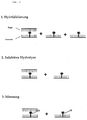
- Fig. 1 A very general principle of a gene probe assay according to the prior art is shown in Fig. 1: in the first step, target sequence and labeled gene probe are hybridized with one another, which results in double-stranded constructs with sufficient homology of both sequences. In addition, however, non-hybridized single-stranded portions of the gene probe are usually also left over.
- a selective hydrolysis is carried out, which is characterized in that essentially the label of the single-stranded gene probe is attacked due to the selected conditions, while the label of the double-stranded construct is largely protected against a hydrophilic attack.
- the signal caused by the label bound in the double-stranded construct is essentially measured.
- a disadvantage of the above method is that despite the treatment with the selection reagent (step 2), a residue of single-stranded gene probe with an intact label remains, which falsifies the measurement.
- the object of the present invention is therefore to provide a method for determining a nucleic acid sequence (a "gene probe assay") in which the non-hybridized labeled gene probe is in one contributes to an undesirable signal formation to a lesser extent than in the methods according to the prior art.
- the desired improvement should in particular enable an improved homogeneous test execution.
- the homogeneous test execution is fundamentally characterized by the lack of a physical separation step between nucleic acid hybridization and signal detection. In such a method, a particularly strong interference from the non-hybridized labeled gene probe can be expected according to the prior art.
- the object was surprisingly achieved by using a receptor in the process according to the invention which can bind to the label and, as a result of the binding, detectably changes, for example attenuates ("quenched") the signal attributable to the label.
- a receptor in the process according to the invention which can bind to the label and, as a result of the binding, detectably changes, for example attenuates ("quenched") the signal attributable to the label.
- the present invention further relates to a method in which, in an additional step, the label of a possibly excess, non-hybridized gene probe is partially inactivated by incubation with a selection reagent.
- a preferred embodiment of the present invention is characterized in that first the incubation with the selection reagent and then the addition of the receptor.
- the receptor is a monoclonal or polyclonal antibody, an antibody fragment, a chemically modified antibody or a chemically modified antibody fragment, provided that the antigen binding ability is sufficiently preserved after the chemical modification.
- label is a group capable of fluorescence, phosphorescence, chemiluminescence, bioluminescence or electroluminescence.
- the label is an acridinium ester, an acridinium acylsulfonamide, a luminol, an isoluminol or a derivative thereof, a dioxetane, a luciferin, an oxalic acid ester or an oxalic acid amide.
- the label is an enzyme.
- Suitable labels are all groups which are capable of fluorescence, phosphorescence, chemiluminescence, bioluminescence or electroluminescence and which, owing to their chemical structure, can interact with a nucleic acid duplex in such a way, for example by intercalating into the duplex, that the binding of one directed against this group Receptor compared to binding to the corresponding single-stranded group is difficult.
- Acridinium ester and acridinium acylsulfonamide groups which intercalate into a double-stranded nucleic acid are particularly suitable.
- a luminol, an isoluminol or a derivative thereof, a dioxetane, a luciferin, an oxalic acid ester or an oxalic acid amide are particularly suitable.
- Luminescent compounds are already widely used. They are used as indicators in enzyme immunoassays, luminescence immunoassays (see WP Collins “Alternative Immunoassays”, Verlag John Wiley & Sons Ltd., Chichester, 1985) and bioassays (tests that do not test for antigen-antibody interactions, but on binding affinities between molecules that are not attributed to the immune system), but also used in nucleic acid hybridization assays (cf. JA Matthews et al. "Analytical Biochemistry", 151, 205-209, 1985).
- chemiluminescent compounds are used in "flow injection analysis", in "post-column” detectors in liquid chromatography, in flow research and for the production of artificial light sources. Acridine derivatives are still suitable in test procedures for food and environmental analysis.
- EP-A-0 407 816 describes nucleotide derivatives with the base uracil, which in turn is labeled with a chemiluminescent compound via a spacer.
- EP A 602 524 describes luminescence-labeled gene probes with properties which are advantageous compared to the prior art, and, inter alia, a homogeneous gene probe assay according to the "hybridization protection assay” principle, which is based on the advantageous properties of the disclosed gene probes.
- Antibodies directed against the label can generally be obtained in a conventional manner, e.g. by immunizing a laboratory animal with the label and then selecting suitable signal-influencing antibodies. Both polyclonal and monoclonal antibodies are suitable, with monoclonal antibodies (MAK) being preferred. Some antibodies directed against luminogenic acridinium labels have the property of reducing the signal strength by binding the label (quench effect). For example, in a single test batch below 10 mouse MAK directed against a luminogenic acridinium acylsulfonamide label, which were not preselected with regard to possible signal-quenching properties, a MAK was found which had the desired signal-quenching properties.
- An example of a well-suited antibody is the monoclonal mouse antibody secreted from the cell line BW 90-614-8-04, which is available from the German Collection of Microorganisms and Cell Cultures GmbH, Mascheroder Weg 1B, D-38124 Braunschweig under the entry number DSM ACC 2184.
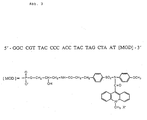
- This MAK is directed against the acridinium acylsulfonamide shown in Fig. 2.
- Suitable gene probes can be produced using methods known in principle to the person skilled in the art. Gene probes are discussed in detail in a large number of publications, for example in: S.L. Beaucage and R.P. Iyer: "The Functionalization of Oligonucleotides Via Phosphoramidite Derivatives"; Tetrahedron 49, 1925-1963 (1993) and J. Goodchild: "Conjugates of Oligonucleotides and Modified Oligonucleotides: A Review of Their Synthesis and Properties"; Bioconjugate Chemistry 1, 165-187 (1990).
- a suitable gene probe is shown as an example in Fig. 3.
- the base sequence shown can be replaced by any other suitable sequence.
- other labels known to any person skilled in the art can be linked to the nucleic acid to be used as a gene probe by any method known to those skilled in the art.
- the gene probe assay :
- the method according to the invention can be implemented on the basis of all methods known in the prior art.
- the gene probe technology according to the invention can be used particularly advantageously in homogeneous tests. Due to the strong signal quenching by an anti-label MAK, it is possible to develop much more sensitive homogeneous gene probe tests with comparable stability than are known in the prior art. Homogeneous gene probe assays according to the invention are also characterized by simple handling and easy automation.
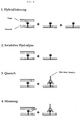
- Fig. 4 A preferred variant of the method according to the invention is shown schematically in Fig. 4: in the first step, target sequence and labeled gene probe are hybridized with one another, which results in double-stranded constructs with sufficient homology of both sequences. In addition, non-hybridized single-stranded portions of the gene probe are usually also left over.
- a receptor for example an antibody, is used that can bind to the label of the single-stranded gene probe and as a result of the binding changes the signal attributable to the label in a detectable manner, for example attenuates (quenched).
- the signal caused by the label bound in the double-stranded construct is then measured almost exclusively, since the label of the hybridized gene probe cannot be bound by the receptor, or only less well than the label of the non-hybridized gene probe.
- This method has the advantage over known methods that even less single-stranded gene probe makes an (undesirable) contribution to the measurement signal.
- the above method can be further improved by performing a selective hydrolysis of the single-stranded gene probe after treatment with a selection reagent after the first hybridization step and only then using a receptor directed against the label, as shown above.
- the subsequent measurement is practically no longer falsified by the unbound label due to the previous double elimination of the label of the single-stranded gene probe (see Fig. 5).
- a further preferred embodiment variant is based on the "hybridization protection assay" (see above) and is characterized according to the invention in that the label of the non-hybridized single-stranded portions of the gene probe is added in a further step by adding a receptor which can bind to the label of the single-stranded gene probe. detectably changed, e.g. is quenched so that these unbound gene probes can not falsify the measurement signal.
- a siglalquenching monoclonal or polyclonal antibody directed against the label is preferably used as the receptor in the method according to the invention, as already described above.
- mice For the production of monoclonal antibodies, BALB-c mice were injected subcutaneously or intraperitoneally with 10 ⁇ g acridnium acylsulfonamide-BSA conjugate, emulsified in complete Freund's adjuvant.
- the acridinium acylsulfonamide-BSA conjugate can be obtained by reacting N- (4-methoxyphenyl) -N- [4- (2-succinimidyloxycabonylethyl) benzenesulfonyl] -10-methylacridinium-9-carboxamide fluorosulfonate or trifluoroacetate (Fig. 2) with BSA after Processes known to those skilled in the art can be produced. 4 to 5 additional immunizations without adjuvant followed every four weeks. The mice received intravenous booster injections (10 ⁇ g per day) the last four days before the fusion.
- the immunized animals were killed by means of cervical dislocation.
- the spleen was removed aseptically and plucked apart to obtain a single suspension of spleen cells in serum-free Dulbecco modified Eagle Medium (DMEM).
- DMEM serum-free Dulbecco modified Eagle Medium
- the cells were collected by centrifugation (5 min; 1800 rpm) and washed once in DMEM. The total number of cells was determined by hemocytometer counting using the trypan blue exclusion technique.
- the mouse myeloma cells SP2 / 0
- the culture supernatants were screened for antigen-specific antibodies using the EIA technique.
- Each well of a microtitration plate coated with acridinium acylsulfonamide BSA (3 ⁇ g / ml) was filled with 100 ⁇ l of the supernatant and incubated for 1 hour at room temperature. After washing, 100 ⁇ l of a rabbit anti-mouse peroxidase (POD) conjugate was added for an additional hour at room temperature. After 30 minutes of incubation with the substrate, the color development at 492 nm was read on a Behring ELISA processor (BEP). Hybridomas that produce antibodies with an appropriate antigen specificity were selected and cloned using a single cell manipulator. The clones were grown in bulk to produce large amounts of monoclonal antibodies. The subsequent purification of the individual monoclonal antibodies was carried out by means of protein A chromatography.
- 50 ⁇ l standard (from Flash Track® test from Gen Probe, Lot 11276/11278 for positive / negative standard) are pipetted into polystyrene tubes.
- 50 ⁇ l of the gene probe according to Fig. 3 (2.5 x 10 6 RLU, 1 M Tris buffer, pH7) are added and hybridized at 60 ° C for 15 minutes.
- 300 ⁇ l of a selection reagent (0.2 M tetraborate, pH 8) are then added, shaken 2 ⁇ 3 seconds and incubated again at 60 ° C. for 15 minutes. The tubes are then allowed to cool for 5 minutes.
- the measurement is carried out by adding 300 ⁇ l each of Analyzer Reagent 1 (0.1 M HNO 3 , 0.5% H 2 O 2 ) and Analyzer Reagent 2 (0.25 M NaOH) in a luminometer (AutoCliniLumat® from Berthold).
- the measuring time is 1 sec / sample.
- 50 ⁇ l standard (from Flash Track® test from Gen Probe, Lot 11276/11278 for positive / negative standard) are pipetted into polystyrene tubes.
- 50 ⁇ l of the gene probe according to Fig. 3 (2.5 x 10 6 RLU, 1 M Tris buffer, pH7) are added and hybridized at 60 ° C for 15 minutes.
- 300 ⁇ l of a selection reagent (0.2 M tetraborate, pH8) are added, shaken 2 ⁇ 3 seconds and again incubated at 60 ° C. for 15 minutes. The tubes are then allowed to cool for 5 minutes.
- anti-label MAK solution 10 ⁇ g / ml Tris buffer pH7.4, 1 M, 0.1% Triton X-100
- 50 ⁇ l anti-label MAK solution 10 ⁇ g / ml Tris buffer pH7.4, 1 M, 0.1% Triton X-100
- the measurement is carried out by adding 300 ⁇ l each of Analyzer Reagent 1 (0.1 M HNO 3 , 0.5% H 2 O 2 ) and Analyzer Reagent 2 (0.25 M NaOH) in a luminometer (AutoCliniLumat® from Berthold).
- the measuring time is 1 sec / sample.
- the signal differentiation between positive and negative standards is significantly improved by adding the anti-label MAK (see table).
- a signal differentiation is achieved which is otherwise only possible in a heterogeneous embodiment with magnetic particles as the solid phase (see EP-A-0 602 524, pp. 50 to 51, example 17).
- Example 5 Homogeneous gene probe test for detection of E. coli with unspecific MAK (control experiment)
- 50 ⁇ l standard (from Flash Track® test from Gen Probe, Lot 11276/11278 for positive / negative standard) are pipetted into polystyrene tubes.
- 50 ⁇ l of the gene probe according to Fig. 3 (2.5 x 10 6 RLU, 1 M Tris buffer, pH7) are added and hybridized at 60 ° C for 15 minutes.
- 300 ⁇ l of a selection reagent (0.2 M tetraborate, pH8) are added, shaken 2 x 3 seconds and incubated again at 60 ° C for 15 minutes. The tubes are then allowed to cool for 5 minutes.
Landscapes
- Chemical & Material Sciences (AREA)
- Organic Chemistry (AREA)
- Life Sciences & Earth Sciences (AREA)
- Health & Medical Sciences (AREA)
- Wood Science & Technology (AREA)
- Proteomics, Peptides & Aminoacids (AREA)
- Zoology (AREA)
- Engineering & Computer Science (AREA)
- Immunology (AREA)
- General Engineering & Computer Science (AREA)
- Microbiology (AREA)
- Molecular Biology (AREA)
- Analytical Chemistry (AREA)
- Biotechnology (AREA)
- Physics & Mathematics (AREA)
- Biochemistry (AREA)
- Bioinformatics & Cheminformatics (AREA)
- Biophysics (AREA)
- General Health & Medical Sciences (AREA)
- Genetics & Genomics (AREA)
- Measuring Or Testing Involving Enzymes Or Micro-Organisms (AREA)
- Preparation Of Compounds By Using Micro-Organisms (AREA)
- Peptides Or Proteins (AREA)
- Saccharide Compounds (AREA)
- Investigating Or Analysing Biological Materials (AREA)
Applications Claiming Priority (2)
| Application Number | Priority Date | Filing Date | Title |
|---|---|---|---|
| DE19534122A DE19534122A1 (de) | 1995-09-14 | 1995-09-14 | Homogener Gensondentest mit einem gegen das Label gerichteten Rezeptor |
| DE19534122 | 1995-09-14 |
Publications (3)
| Publication Number | Publication Date |
|---|---|
| EP0763601A2 true EP0763601A2 (fr) | 1997-03-19 |
| EP0763601A3 EP0763601A3 (fr) | 2002-01-02 |
| EP0763601B1 EP0763601B1 (fr) | 2008-01-02 |
Family
ID=7772184
Family Applications (1)
| Application Number | Title | Priority Date | Filing Date |
|---|---|---|---|
| EP96113136A Expired - Lifetime EP0763601B1 (fr) | 1995-09-14 | 1996-08-16 | Test d'hybridation homogène avec un récepteur pour le marquer |
Country Status (10)
| Country | Link |
|---|---|
| US (1) | US5858668A (fr) |
| EP (1) | EP0763601B1 (fr) |
| JP (1) | JP4286334B2 (fr) |
| KR (1) | KR970015747A (fr) |
| AT (1) | ATE382709T1 (fr) |
| AU (1) | AU6560096A (fr) |
| CA (1) | CA2185516C (fr) |
| DE (2) | DE19534122A1 (fr) |
| ES (1) | ES2297834T3 (fr) |
| MX (1) | MX9604079A (fr) |
Cited By (1)
| Publication number | Priority date | Publication date | Assignee | Title |
|---|---|---|---|---|
| WO2012016936A1 (fr) * | 2010-07-31 | 2012-02-09 | Aj Innuscreen Gmbh | Détection de séquences d'acide nucléique spécifiques par extinction de la fluorescence |
Families Citing this family (2)
| Publication number | Priority date | Publication date | Assignee | Title |
|---|---|---|---|---|
| DE19808936A1 (de) * | 1998-03-03 | 1999-09-16 | Aventis Res & Tech Gmbh & Co | Photodetektor und seine Verwendung |
| US6723851B2 (en) | 2001-10-31 | 2004-04-20 | Quest Diagnostics Investment Incorporated | Chemiluminescent compounds and use thereof |
Family Cites Families (12)
| Publication number | Priority date | Publication date | Assignee | Title |
|---|---|---|---|---|
| EP0144913A3 (fr) * | 1983-12-12 | 1986-08-20 | Miles Inc. | Test d'hybridation utilisant une sonde marquée et un antihybride |
| US4743535A (en) * | 1984-11-07 | 1988-05-10 | Miles Inc. | Hybridization assay employing labeled probe and anti-hybrid |
| JP2509574B2 (ja) * | 1985-08-15 | 1996-06-19 | アモコ・コーポレーション | 標識付けした核酸 |
| DE3750503T2 (de) * | 1986-10-22 | 1995-02-09 | Abbott Lab | Chemilumineszierende Acridinium- und Phenantridiniumsalze. |
| EP0281390B1 (fr) * | 1987-03-02 | 1994-06-22 | Gen-Probe Incorporated | Supports polycationiques pour la purification, la séparation et l'hybridation d'acide nucléique |
| JP3012244B2 (ja) * | 1987-09-21 | 2000-02-21 | ジェン―プローブ インコーポレイテッド | ヌクレオチドプローブ用非ヌクレオチド連結試薬 |
| EP0310312A3 (fr) * | 1987-10-02 | 1990-08-16 | M.L. Technology Ventures, L.P. | Réactifs non nucléotides pour substituer les extrémités d'oligonucléotides |
| PT88665B (pt) * | 1987-10-05 | 1992-12-31 | Ml Tecnology Ventures Lp | Metodo para a marcacao com ester de acridinio e purificacao de sondas nucleotidicas |
| EP0407816A3 (en) * | 1989-07-14 | 1993-01-27 | Abbott Laboratories | Base modified nucleosides |
| DE69132765T2 (de) * | 1990-12-24 | 2002-02-21 | Enzo Diagnostics, Inc. | Verfahren zum Nachweis eines Zielpolynukleotids in einer Probe unter Verwendung eines Reagenz, das den Hintergrund verringert, und eine dieses Reagenz enthaltende Zusammensetzung und Kit. |
| US5830642A (en) * | 1992-04-03 | 1998-11-03 | Amersham Life Science, Inc. | Electrophoresis of nucleic acid fragments |
| EP0602524A1 (fr) * | 1992-12-15 | 1994-06-22 | Hoechst Aktiengesellschaft | Sondes marqués par chemiluminescence et leur utilisation dans épreuves des sondes |
-
1995
- 1995-09-14 DE DE19534122A patent/DE19534122A1/de not_active Ceased
-
1996
- 1996-08-16 ES ES96113136T patent/ES2297834T3/es not_active Expired - Lifetime
- 1996-08-16 AT AT96113136T patent/ATE382709T1/de active
- 1996-08-16 DE DE59611456T patent/DE59611456D1/de not_active Expired - Lifetime
- 1996-08-16 EP EP96113136A patent/EP0763601B1/fr not_active Expired - Lifetime
- 1996-09-12 AU AU65600/96A patent/AU6560096A/en not_active Abandoned
- 1996-09-13 MX MX9604079A patent/MX9604079A/es unknown
- 1996-09-13 CA CA002185516A patent/CA2185516C/fr not_active Expired - Fee Related
- 1996-09-13 KR KR1019960039770A patent/KR970015747A/ko not_active Withdrawn
- 1996-09-16 US US08/712,094 patent/US5858668A/en not_active Expired - Lifetime
- 1996-09-17 JP JP24524996A patent/JP4286334B2/ja not_active Expired - Fee Related
Cited By (1)
| Publication number | Priority date | Publication date | Assignee | Title |
|---|---|---|---|---|
| WO2012016936A1 (fr) * | 2010-07-31 | 2012-02-09 | Aj Innuscreen Gmbh | Détection de séquences d'acide nucléique spécifiques par extinction de la fluorescence |
Also Published As
| Publication number | Publication date |
|---|---|
| JP4286334B2 (ja) | 2009-06-24 |
| US5858668A (en) | 1999-01-12 |
| JPH09220100A (ja) | 1997-08-26 |
| DE19534122A1 (de) | 1997-03-20 |
| CA2185516C (fr) | 2008-01-22 |
| ES2297834T3 (es) | 2008-05-01 |
| EP0763601A3 (fr) | 2002-01-02 |
| AU6560096A (en) | 1997-03-20 |
| EP0763601B1 (fr) | 2008-01-02 |
| MX9604079A (es) | 1997-08-30 |
| CA2185516A1 (fr) | 1997-03-15 |
| DE59611456D1 (de) | 2008-02-14 |
| KR970015747A (ko) | 1997-04-28 |
| ATE382709T1 (de) | 2008-01-15 |
Similar Documents
| Publication | Publication Date | Title |
|---|---|---|
| DE69425072T2 (de) | Polyklonaler antikörper gegen pna/nukleinsäurekomplexe | |
| DE3486262T3 (de) | Verfahren zur Herstellung eines monoklonalen Antikörpers mit Spezifizität für vernetzte Fibrinderivate und ein Testverfahren mittels dieses Antikörpers. | |
| DE69026615T2 (de) | Igg3-antikörper mit verkürzter hinge-region und einem komplementaktivierungstest | |
| WO2000045176A2 (fr) | PROCEDE D'IDENTIFICATION DE proBNP N-TERMINAL | |
| EP0089008A2 (fr) | Antisérum hautement specifique contre le peptide procollagèneCol 1 (Type III) et le peptide procollagène (Type III), sa préparation et son utilisation. | |
| DE60028233T2 (de) | Immuno-real-time-pcr unter verwendung einer chimären dna als amplifikationsmarker | |
| EP0378175A2 (fr) | Méthode diagnostique utilisant des anticorps chimériques | |
| EP0576842B1 (fr) | Méthode et moyens pour détecter listeria | |
| DE68923608T2 (de) | Verfahren zur Vorbereitung von Nukleotid-Sonden unter Verwendung eines hybridizierbaren Komplementärelements. | |
| DE3942999A1 (de) | Verfahren zum nachweis von malignen erkrankungen | |
| DE69033457T2 (de) | Prohormonspaltungsplatzblockierungsantikörper | |
| DE3486290T2 (de) | In vivo-Markierung von Polynucleotide-Sequenzen. | |
| WO1995011919A2 (fr) | PROTEINES PilC RECOMBINANTES, PROCEDES DE PREPARATION ET UTILISATION | |
| DE3876124T2 (de) | Immunoassay fuer thrombomodulin. | |
| DE69128127T2 (de) | NUKLEINSÄUREPROBEN mit über Hydrazin-Bindungen verbundenen negativ geladenen Haptenen | |
| EP0763601B1 (fr) | Test d'hybridation homogène avec un récepteur pour le marquer | |
| EP0547059B1 (fr) | Anticorps specifique a la pancreas-elastase-1, un procede pour son obtention et un kit de test contenant de tels anticorps | |
| DE69619226T2 (de) | Monoklonaler antikörper gegen den komplex aus faktor xa und dem inhibitor für den gewebefaktor (xa. tfpi) | |
| EP1254913A1 (fr) | Anticorps monoclonaux contre CK-MB | |
| DE68922846T2 (de) | Enzymimmuntest für menschliches typiv-collagen gemäss dem sandwichverfahren. | |
| DE69211371T2 (de) | Bestimmung von Analyten mit hohem Molekulargewicht | |
| DE3854834T2 (de) | Immuntest unter Verwendung von Antigenen, produziert in heterologen Organismen | |
| EP0766734B1 (fr) | Procede de stabilisation de molecules sensibles a l'hydrolysis | |
| DE19653358A1 (de) | Immunoassay zum Nachweis von MIA | |
| DE3687542T2 (de) | Monoklonaler antikoerper gegen humanes protein c. |
Legal Events
| Date | Code | Title | Description |
|---|---|---|---|
| PUAI | Public reference made under article 153(3) epc to a published international application that has entered the european phase |
Free format text: ORIGINAL CODE: 0009012 |
|
| AK | Designated contracting states |
Kind code of ref document: A2 Designated state(s): AT BE CH DE DK ES FR GB IT LI LU NL PT SE |
|
| RIN1 | Information on inventor provided before grant (corrected) |
Inventor name: UHLMANN, EUGEN, DR. Inventor name: KAESMARKER, REINHARD Inventor name: LEUTSCH, THOMAS Inventor name: MADRY, NORBERT, DR. Inventor name: SKRZIPCZYK, HEINZ JUERGEN, DR. Inventor name: NEUENHOFER, STEPHAN, DR. |
|
| RAP1 | Party data changed (applicant data changed or rights of an application transferred) |
Owner name: BEHRING DIAGNOSTICS GMBH |
|
| RAP1 | Party data changed (applicant data changed or rights of an application transferred) |
Owner name: DADE BEHRING MARBURG GMBH |
|
| PUAL | Search report despatched |
Free format text: ORIGINAL CODE: 0009013 |
|
| AK | Designated contracting states |
Kind code of ref document: A3 Designated state(s): AT BE CH DE DK ES FR GB IT LI LU NL PT SE |
|
| 17P | Request for examination filed |
Effective date: 20020702 |
|
| 17Q | First examination report despatched |
Effective date: 20020906 |
|
| GRAP | Despatch of communication of intention to grant a patent |
Free format text: ORIGINAL CODE: EPIDOSNIGR1 |
|
| GRAS | Grant fee paid |
Free format text: ORIGINAL CODE: EPIDOSNIGR3 |
|
| GRAA | (expected) grant |
Free format text: ORIGINAL CODE: 0009210 |
|
| AK | Designated contracting states |
Kind code of ref document: B1 Designated state(s): AT BE CH DE DK ES FR GB IT LI LU NL PT SE |
|
| REG | Reference to a national code |
Ref country code: GB Ref legal event code: FG4D Free format text: NOT ENGLISH |
|
| REG | Reference to a national code |
Ref country code: CH Ref legal event code: EP |
|
| REF | Corresponds to: |
Ref document number: 59611456 Country of ref document: DE Date of ref document: 20080214 Kind code of ref document: P |
|
| REG | Reference to a national code |
Ref country code: SE Ref legal event code: TRGR |
|
| GBT | Gb: translation of ep patent filed (gb section 77(6)(a)/1977) |
Effective date: 20080408 |
|
| REG | Reference to a national code |
Ref country code: ES Ref legal event code: FG2A Ref document number: 2297834 Country of ref document: ES Kind code of ref document: T3 |
|
| ET | Fr: translation filed | ||
| PG25 | Lapsed in a contracting state [announced via postgrant information from national office to epo] |
Ref country code: PT Free format text: LAPSE BECAUSE OF FAILURE TO SUBMIT A TRANSLATION OF THE DESCRIPTION OR TO PAY THE FEE WITHIN THE PRESCRIBED TIME-LIMIT Effective date: 20080602 |
|
| RAP2 | Party data changed (patent owner data changed or rights of a patent transferred) |
Owner name: SIEMENS HEALTHCARE DIAGNOSTICS PRODUCTS GMBH |
|
| PG25 | Lapsed in a contracting state [announced via postgrant information from national office to epo] |
Ref country code: DK Free format text: LAPSE BECAUSE OF FAILURE TO SUBMIT A TRANSLATION OF THE DESCRIPTION OR TO PAY THE FEE WITHIN THE PRESCRIBED TIME-LIMIT Effective date: 20080102 |
|
| PLBE | No opposition filed within time limit |
Free format text: ORIGINAL CODE: 0009261 |
|
| STAA | Information on the status of an ep patent application or granted ep patent |
Free format text: STATUS: NO OPPOSITION FILED WITHIN TIME LIMIT |
|
| NLT2 | Nl: modifications (of names), taken from the european patent patent bulletin |
Owner name: SIEMENS HEALTHCARE DIAGNOSTICS PRODUCTS GMBH Effective date: 20081015 |
|
| 26N | No opposition filed |
Effective date: 20081003 |
|
| REG | Reference to a national code |
Ref country code: CH Ref legal event code: PFA Owner name: SIEMENS HEALTHCARE DIAGNOSTICS PRODUCTS GMBH Free format text: DADE BEHRING MARBURG GMBH#POSTFACH 11 49#35001 MARBURG (DE) -TRANSFER TO- SIEMENS HEALTHCARE DIAGNOSTICS PRODUCTS GMBH#EMIL-VON-BEHRING-STRASSE 76#35041 MARBURG (DE) Ref country code: CH Ref legal event code: NV Representative=s name: SIEMENS SCHWEIZ AG |
|
| NLT1 | Nl: modifications of names registered in virtue of documents presented to the patent office pursuant to art. 16 a, paragraph 1 |
Owner name: SIEMENS HEALTHCARE DIAGNOSTICS PRODUCTS GMBH |
|
| REG | Reference to a national code |
Ref country code: FR Ref legal event code: CD |
|
| PGFP | Annual fee paid to national office [announced via postgrant information from national office to epo] |
Ref country code: NL Payment date: 20100813 Year of fee payment: 15 Ref country code: ES Payment date: 20100922 Year of fee payment: 15 |
|
| PGFP | Annual fee paid to national office [announced via postgrant information from national office to epo] |
Ref country code: SE Payment date: 20100810 Year of fee payment: 15 Ref country code: LU Payment date: 20100812 Year of fee payment: 15 Ref country code: IT Payment date: 20100825 Year of fee payment: 15 Ref country code: FR Payment date: 20100901 Year of fee payment: 15 Ref country code: AT Payment date: 20100714 Year of fee payment: 15 |
|
| PGFP | Annual fee paid to national office [announced via postgrant information from national office to epo] |
Ref country code: GB Payment date: 20100812 Year of fee payment: 15 |
|
| PGFP | Annual fee paid to national office [announced via postgrant information from national office to epo] |
Ref country code: DE Payment date: 20101018 Year of fee payment: 15 Ref country code: CH Payment date: 20101109 Year of fee payment: 15 Ref country code: BE Payment date: 20100817 Year of fee payment: 15 |
|
| BERE | Be: lapsed |
Owner name: DADE BEHRING MARBURG G.M.B.H. Effective date: 20110831 |
|
| REG | Reference to a national code |
Ref country code: NL Ref legal event code: V1 Effective date: 20120301 |
|
| REG | Reference to a national code |
Ref country code: CH Ref legal event code: PL |
|
| REG | Reference to a national code |
Ref country code: SE Ref legal event code: EUG |
|
| GBPC | Gb: european patent ceased through non-payment of renewal fee |
Effective date: 20110816 |
|
| PG25 | Lapsed in a contracting state [announced via postgrant information from national office to epo] |
Ref country code: LI Free format text: LAPSE BECAUSE OF NON-PAYMENT OF DUE FEES Effective date: 20110831 Ref country code: CH Free format text: LAPSE BECAUSE OF NON-PAYMENT OF DUE FEES Effective date: 20110831 |
|
| REG | Reference to a national code |
Ref country code: FR Ref legal event code: ST Effective date: 20120430 |
|
| PG25 | Lapsed in a contracting state [announced via postgrant information from national office to epo] |
Ref country code: NL Free format text: LAPSE BECAUSE OF NON-PAYMENT OF DUE FEES Effective date: 20120301 Ref country code: BE Free format text: LAPSE BECAUSE OF NON-PAYMENT OF DUE FEES Effective date: 20110831 Ref country code: IT Free format text: LAPSE BECAUSE OF NON-PAYMENT OF DUE FEES Effective date: 20110816 |
|
| REG | Reference to a national code |
Ref country code: DE Ref legal event code: R119 Ref document number: 59611456 Country of ref document: DE Effective date: 20120301 |
|
| PG25 | Lapsed in a contracting state [announced via postgrant information from national office to epo] |
Ref country code: FR Free format text: LAPSE BECAUSE OF NON-PAYMENT OF DUE FEES Effective date: 20110831 Ref country code: GB Free format text: LAPSE BECAUSE OF NON-PAYMENT OF DUE FEES Effective date: 20110816 |
|
| REG | Reference to a national code |
Ref country code: ES Ref legal event code: FD2A Effective date: 20121207 |
|
| REG | Reference to a national code |
Ref country code: AT Ref legal event code: MM01 Ref document number: 382709 Country of ref document: AT Kind code of ref document: T Effective date: 20110816 |
|
| PG25 | Lapsed in a contracting state [announced via postgrant information from national office to epo] |
Ref country code: AT Free format text: LAPSE BECAUSE OF NON-PAYMENT OF DUE FEES Effective date: 20110816 |
|
| PG25 | Lapsed in a contracting state [announced via postgrant information from national office to epo] |
Ref country code: ES Free format text: LAPSE BECAUSE OF NON-PAYMENT OF DUE FEES Effective date: 20110817 |
|
| PG25 | Lapsed in a contracting state [announced via postgrant information from national office to epo] |
Ref country code: SE Free format text: LAPSE BECAUSE OF NON-PAYMENT OF DUE FEES Effective date: 20110817 |
|
| PG25 | Lapsed in a contracting state [announced via postgrant information from national office to epo] |
Ref country code: LU Free format text: LAPSE BECAUSE OF NON-PAYMENT OF DUE FEES Effective date: 20110816 |
|
| PG25 | Lapsed in a contracting state [announced via postgrant information from national office to epo] |
Ref country code: DE Free format text: LAPSE BECAUSE OF NON-PAYMENT OF DUE FEES Effective date: 20120301 |