EP0764332B1 - Verarbeitbare, elektrisch leitfähige polyamilinzusammensetzungen und verfahren zu ihrer herstellung - Google Patents
Verarbeitbare, elektrisch leitfähige polyamilinzusammensetzungen und verfahren zu ihrer herstellung Download PDFInfo
- Publication number
- EP0764332B1 EP0764332B1 EP95920924A EP95920924A EP0764332B1 EP 0764332 B1 EP0764332 B1 EP 0764332B1 EP 95920924 A EP95920924 A EP 95920924A EP 95920924 A EP95920924 A EP 95920924A EP 0764332 B1 EP0764332 B1 EP 0764332B1
- Authority
- EP
- European Patent Office
- Prior art keywords
- alkyl
- polyaniline
- pani
- group
- weight
- Prior art date
- Legal status (The legal status is an assumption and is not a legal conclusion. Google has not performed a legal analysis and makes no representation as to the accuracy of the status listed.)
- Expired - Lifetime
Links
- 229920000767 polyaniline Polymers 0.000 title claims description 257
- 239000000203 mixture Substances 0.000 title claims description 117
- 238000000034 method Methods 0.000 title description 73
- 238000002360 preparation method Methods 0.000 title description 7
- 230000008569 process Effects 0.000 title description 7
- QAOWNCQODCNURD-UHFFFAOYSA-N Sulfuric acid Chemical compound OS(O)(=O)=O QAOWNCQODCNURD-UHFFFAOYSA-N 0.000 claims description 110
- -1 alkyl amide Chemical class 0.000 claims description 108
- QIGBRXMKCJKVMJ-UHFFFAOYSA-N 1,4-Benzenediol Natural products OC1=CC=C(O)C=C1 QIGBRXMKCJKVMJ-UHFFFAOYSA-N 0.000 claims description 61
- GHMLBKRAJCXXBS-UHFFFAOYSA-N resorcinol Chemical group OC1=CC=CC(O)=C1 GHMLBKRAJCXXBS-UHFFFAOYSA-N 0.000 claims description 58
- 125000000217 alkyl group Chemical group 0.000 claims description 26
- 238000012545 processing Methods 0.000 claims description 26
- YCIMNLLNPGFGHC-UHFFFAOYSA-N o-dihydroxy-benzene Natural products OC1=CC=CC=C1O YCIMNLLNPGFGHC-UHFFFAOYSA-N 0.000 claims description 24
- 229920001940 conductive polymer Polymers 0.000 claims description 20
- 125000004432 carbon atom Chemical group C* 0.000 claims description 18
- 125000003118 aryl group Chemical group 0.000 claims description 17
- 125000001424 substituent group Chemical group 0.000 claims description 15
- 125000002723 alicyclic group Chemical group 0.000 claims description 13
- FJKROLUGYXJWQN-UHFFFAOYSA-N 4-hydroxybenzoic acid Chemical compound OC(=O)C1=CC=C(O)C=C1 FJKROLUGYXJWQN-UHFFFAOYSA-N 0.000 claims description 12
- 239000000654 additive Substances 0.000 claims description 12
- 150000001491 aromatic compounds Chemical class 0.000 claims description 12
- IISBACLAFKSPIT-UHFFFAOYSA-N bisphenol A Chemical compound C=1C=C(O)C=CC=1C(C)(C)C1=CC=C(O)C=C1 IISBACLAFKSPIT-UHFFFAOYSA-N 0.000 claims description 10
- 125000001997 phenyl group Chemical group [H]C1=C([H])C([H])=C(*)C([H])=C1[H] 0.000 claims description 10
- OKTJSMMVPCPJKN-UHFFFAOYSA-N Carbon Chemical group [C] OKTJSMMVPCPJKN-UHFFFAOYSA-N 0.000 claims description 8
- 230000000996 additive effect Effects 0.000 claims description 8
- PXKLMJQFEQBVLD-UHFFFAOYSA-N bisphenol F Chemical compound C1=CC(O)=CC=C1CC1=CC=C(O)C=C1 PXKLMJQFEQBVLD-UHFFFAOYSA-N 0.000 claims description 8
- XDTMQSROBMDMFD-UHFFFAOYSA-N Cyclohexane Chemical compound C1CCCCC1 XDTMQSROBMDMFD-UHFFFAOYSA-N 0.000 claims description 7
- 125000003545 alkoxy group Chemical group 0.000 claims description 7
- 239000003945 anionic surfactant Substances 0.000 claims description 7
- 125000001072 heteroaryl group Chemical group 0.000 claims description 7
- 125000000956 methoxy group Chemical group [H]C([H])([H])O* 0.000 claims description 7
- 229940090248 4-hydroxybenzoic acid Drugs 0.000 claims description 6
- IJGRMHOSHXDMSA-UHFFFAOYSA-N Atomic nitrogen Chemical compound N#N IJGRMHOSHXDMSA-UHFFFAOYSA-N 0.000 claims description 6
- 229910019142 PO4 Inorganic materials 0.000 claims description 6
- 150000004996 alkyl benzenes Chemical class 0.000 claims description 6
- 235000021317 phosphate Nutrition 0.000 claims description 6
- 229920001577 copolymer Polymers 0.000 claims description 5
- 150000005208 1,4-dihydroxybenzenes Chemical group 0.000 claims description 4
- 125000003342 alkenyl group Chemical group 0.000 claims description 4
- 125000004183 alkoxy alkyl group Chemical group 0.000 claims description 4
- 125000004453 alkoxycarbonyl group Chemical group 0.000 claims description 4
- 125000002877 alkyl aryl group Chemical group 0.000 claims description 4
- 125000004644 alkyl sulfinyl group Chemical group 0.000 claims description 4
- 125000004390 alkyl sulfonyl group Chemical group 0.000 claims description 4
- 229940092714 benzenesulfonic acid Drugs 0.000 claims description 4
- 125000003178 carboxy group Chemical group [H]OC(*)=O 0.000 claims description 4
- IJFXRHURBJZNAO-UHFFFAOYSA-N meta--hydroxybenzoic acid Natural products OC(=O)C1=CC=CC(O)=C1 IJFXRHURBJZNAO-UHFFFAOYSA-N 0.000 claims description 4
- 150000003871 sulfonates Chemical class 0.000 claims description 4
- ABLZXFCXXLZCGV-UHFFFAOYSA-N Phosphorous acid Chemical class OP(O)=O ABLZXFCXXLZCGV-UHFFFAOYSA-N 0.000 claims description 3
- NINIDFKCEFEMDL-UHFFFAOYSA-N Sulfur Chemical compound [S] NINIDFKCEFEMDL-UHFFFAOYSA-N 0.000 claims description 3
- 125000004450 alkenylene group Chemical group 0.000 claims description 3
- 125000005157 alkyl carboxy group Chemical group 0.000 claims description 3
- 125000005189 alkyl hydroxy group Chemical group 0.000 claims description 3
- 125000006350 alkyl thio alkyl group Chemical group 0.000 claims description 3
- 125000004414 alkyl thio group Chemical group 0.000 claims description 3
- 125000002947 alkylene group Chemical group 0.000 claims description 3
- 125000003710 aryl alkyl group Chemical group 0.000 claims description 3
- 125000001589 carboacyl group Chemical group 0.000 claims description 3
- PSZYNBSKGUBXEH-UHFFFAOYSA-N naphthalene-1-sulfonic acid Chemical class C1=CC=C2C(S(=O)(=O)O)=CC=CC2=C1 PSZYNBSKGUBXEH-UHFFFAOYSA-N 0.000 claims description 3
- 229910052757 nitrogen Inorganic materials 0.000 claims description 3
- 125000004430 oxygen atom Chemical group O* 0.000 claims description 3
- 229910052717 sulfur Inorganic materials 0.000 claims description 3
- 239000011593 sulfur Substances 0.000 claims description 3
- DEQUKPCANKRTPZ-UHFFFAOYSA-N (2,3-dihydroxyphenyl)-phenylmethanone Chemical compound OC1=CC=CC(C(=O)C=2C=CC=CC=2)=C1O DEQUKPCANKRTPZ-UHFFFAOYSA-N 0.000 claims description 2
- 150000005206 1,2-dihydroxybenzenes Chemical class 0.000 claims description 2
- NBIBDIKAOBCFJN-UHFFFAOYSA-N 2,2-dihydroxy-1-phenylethanone Chemical class OC(O)C(=O)C1=CC=CC=C1 NBIBDIKAOBCFJN-UHFFFAOYSA-N 0.000 claims description 2
- DNUYOWCKBJFOGS-UHFFFAOYSA-N 2-[[10-(2,2-dicarboxyethyl)anthracen-9-yl]methyl]propanedioic acid Chemical compound C1=CC=C2C(CC(C(=O)O)C(O)=O)=C(C=CC=C3)C3=C(CC(C(O)=O)C(O)=O)C2=C1 DNUYOWCKBJFOGS-UHFFFAOYSA-N 0.000 claims description 2
- 150000003013 phosphoric acid derivatives Chemical class 0.000 claims description 2
- 150000004028 organic sulfates Chemical class 0.000 claims 1
- 239000011701 zinc Substances 0.000 description 79
- 150000001875 compounds Chemical class 0.000 description 72
- 239000004094 surface-active agent Substances 0.000 description 64
- 229920000642 polymer Polymers 0.000 description 59
- 239000002904 solvent Substances 0.000 description 46
- 150000003839 salts Chemical class 0.000 description 35
- 238000002156 mixing Methods 0.000 description 25
- 239000002253 acid Substances 0.000 description 22
- 230000003993 interaction Effects 0.000 description 22
- 150000002894 organic compounds Chemical class 0.000 description 19
- 238000005325 percolation Methods 0.000 description 18
- 239000011159 matrix material Substances 0.000 description 15
- 239000012071 phase Substances 0.000 description 15
- 239000001257 hydrogen Substances 0.000 description 14
- 229910052739 hydrogen Inorganic materials 0.000 description 14
- SULYEHHGGXARJS-UHFFFAOYSA-N 2',4'-dihydroxyacetophenone Chemical compound CC(=O)C1=CC=C(O)C=C1O SULYEHHGGXARJS-UHFFFAOYSA-N 0.000 description 12
- LFQSCWFLJHTTHZ-UHFFFAOYSA-N Ethanol Chemical compound CCO LFQSCWFLJHTTHZ-UHFFFAOYSA-N 0.000 description 12
- 239000000463 material Substances 0.000 description 12
- 239000002245 particle Substances 0.000 description 12
- 239000007788 liquid Substances 0.000 description 11
- 150000007513 acids Chemical class 0.000 description 10
- 239000000835 fiber Substances 0.000 description 10
- 239000012530 fluid Substances 0.000 description 10
- 239000004014 plasticizer Substances 0.000 description 10
- 229920001169 thermoplastic Polymers 0.000 description 10
- WSFSSNUMVMOOMR-UHFFFAOYSA-N Formaldehyde Chemical compound O=C WSFSSNUMVMOOMR-UHFFFAOYSA-N 0.000 description 9
- VEXZGXHMUGYJMC-UHFFFAOYSA-N Hydrochloric acid Chemical compound Cl VEXZGXHMUGYJMC-UHFFFAOYSA-N 0.000 description 9
- 229910052751 metal Inorganic materials 0.000 description 9
- 239000002184 metal Substances 0.000 description 9
- 239000007787 solid Substances 0.000 description 9
- WBIQQQGBSDOWNP-UHFFFAOYSA-N 2-dodecylbenzenesulfonic acid Chemical compound CCCCCCCCCCCCC1=CC=CC=C1S(O)(=O)=O WBIQQQGBSDOWNP-UHFFFAOYSA-N 0.000 description 8
- PTFIPECGHSYQNR-UHFFFAOYSA-N 3-Pentadecylphenol Chemical compound CCCCCCCCCCCCCCCC1=CC=CC(O)=C1 PTFIPECGHSYQNR-UHFFFAOYSA-N 0.000 description 8
- 229940060296 dodecylbenzenesulfonic acid Drugs 0.000 description 8
- 229920000775 emeraldine polymer Polymers 0.000 description 8
- AUFZRCJENRSRLY-UHFFFAOYSA-N 2,3,5-trimethylhydroquinone Chemical compound CC1=CC(O)=C(C)C(C)=C1O AUFZRCJENRSRLY-UHFFFAOYSA-N 0.000 description 7
- 230000000052 comparative effect Effects 0.000 description 7
- 239000002019 doping agent Substances 0.000 description 7
- 229910000041 hydrogen chloride Inorganic materials 0.000 description 7
- IXCSERBJSXMMFS-UHFFFAOYSA-N hydrogen chloride Substances Cl.Cl IXCSERBJSXMMFS-UHFFFAOYSA-N 0.000 description 7
- 238000004519 manufacturing process Methods 0.000 description 7
- 229920001778 nylon Polymers 0.000 description 7
- 238000006116 polymerization reaction Methods 0.000 description 7
- 239000000047 product Substances 0.000 description 7
- RPACBEVZENYWOL-XFULWGLBSA-M sodium;(2r)-2-[6-(4-chlorophenoxy)hexyl]oxirane-2-carboxylate Chemical compound [Na+].C=1C=C(Cl)C=CC=1OCCCCCC[C@]1(C(=O)[O-])CO1 RPACBEVZENYWOL-XFULWGLBSA-M 0.000 description 7
- 239000000758 substrate Substances 0.000 description 7
- BDHFUVZGWQCTTF-UHFFFAOYSA-M sulfonate Chemical compound [O-]S(=O)=O BDHFUVZGWQCTTF-UHFFFAOYSA-M 0.000 description 7
- XLYOFNOQVPJJNP-UHFFFAOYSA-N water Substances O XLYOFNOQVPJJNP-UHFFFAOYSA-N 0.000 description 7
- ZXDDPOHVAMWLBH-UHFFFAOYSA-N 2,4-Dihydroxybenzophenone Chemical compound OC1=CC(O)=CC=C1C(=O)C1=CC=CC=C1 ZXDDPOHVAMWLBH-UHFFFAOYSA-N 0.000 description 6
- 239000004793 Polystyrene Substances 0.000 description 6
- ZTHYODDOHIVTJV-UHFFFAOYSA-N Propyl gallate Chemical compound CCCOC(=O)C1=CC(O)=C(O)C(O)=C1 ZTHYODDOHIVTJV-UHFFFAOYSA-N 0.000 description 6
- 239000002322 conducting polymer Substances 0.000 description 6
- 229920005669 high impact polystyrene Polymers 0.000 description 6
- 239000004797 high-impact polystyrene Substances 0.000 description 6
- KLAKIAVEMQMVBT-UHFFFAOYSA-N p-hydroxy-phenacyl alcohol Natural products OCC(=O)C1=CC=C(O)C=C1 KLAKIAVEMQMVBT-UHFFFAOYSA-N 0.000 description 6
- 239000000243 solution Substances 0.000 description 6
- 229940124530 sulfonamide Drugs 0.000 description 6
- 239000004416 thermosoftening plastic Substances 0.000 description 6
- VXGAPBLISGTEKE-UHFFFAOYSA-N 2-methylbenzenesulfonamide;4-methylbenzenesulfonamide Chemical compound CC1=CC=C(S(N)(=O)=O)C=C1.CC1=CC=CC=C1S(N)(=O)=O VXGAPBLISGTEKE-UHFFFAOYSA-N 0.000 description 5
- 239000004677 Nylon Substances 0.000 description 5
- ISWSIDIOOBJBQZ-UHFFFAOYSA-N Phenol Natural products OC1=CC=CC=C1 ISWSIDIOOBJBQZ-UHFFFAOYSA-N 0.000 description 5
- 239000004698 Polyethylene Substances 0.000 description 5
- 239000004743 Polypropylene Substances 0.000 description 5
- QAOWNCQODCNURD-UHFFFAOYSA-L Sulfate Chemical compound [O-]S([O-])(=O)=O QAOWNCQODCNURD-UHFFFAOYSA-L 0.000 description 5
- 230000008901 benefit Effects 0.000 description 5
- 239000011575 calcium Substances 0.000 description 5
- 150000002500 ions Chemical class 0.000 description 5
- NWVVVBRKAWDGAB-UHFFFAOYSA-N p-methoxyphenol Chemical compound COC1=CC=C(O)C=C1 NWVVVBRKAWDGAB-UHFFFAOYSA-N 0.000 description 5
- 229920000573 polyethylene Polymers 0.000 description 5
- 229920001155 polypropylene Polymers 0.000 description 5
- 229920002223 polystyrene Polymers 0.000 description 5
- 229920000915 polyvinyl chloride Polymers 0.000 description 5
- 239000004800 polyvinyl chloride Substances 0.000 description 5
- 241000894007 species Species 0.000 description 5
- 239000000126 substance Substances 0.000 description 5
- XCZKKZXWDBOGPA-UHFFFAOYSA-N 2-phenylbenzene-1,4-diol Chemical compound OC1=CC=C(O)C(C=2C=CC=CC=2)=C1 XCZKKZXWDBOGPA-UHFFFAOYSA-N 0.000 description 4
- RTAQQCXQSZGOHL-UHFFFAOYSA-N Titanium Chemical compound [Ti] RTAQQCXQSZGOHL-UHFFFAOYSA-N 0.000 description 4
- XLOMVQKBTHCTTD-UHFFFAOYSA-N Zinc monoxide Chemical compound [Zn]=O XLOMVQKBTHCTTD-UHFFFAOYSA-N 0.000 description 4
- 230000002378 acidificating effect Effects 0.000 description 4
- XECAHXYUAAWDEL-UHFFFAOYSA-N acrylonitrile butadiene styrene Chemical compound C=CC=C.C=CC#N.C=CC1=CC=CC=C1 XECAHXYUAAWDEL-UHFFFAOYSA-N 0.000 description 4
- 239000004676 acrylonitrile butadiene styrene Substances 0.000 description 4
- 229920000122 acrylonitrile butadiene styrene Polymers 0.000 description 4
- 229940106691 bisphenol a Drugs 0.000 description 4
- 239000006229 carbon black Substances 0.000 description 4
- 150000001768 cations Chemical class 0.000 description 4
- 239000007795 chemical reaction product Substances 0.000 description 4
- 238000000576 coating method Methods 0.000 description 4
- 150000001923 cyclic compounds Chemical class 0.000 description 4
- 230000002349 favourable effect Effects 0.000 description 4
- PYGSKMBEVAICCR-UHFFFAOYSA-N hexa-1,5-diene Chemical group C=CCCC=C PYGSKMBEVAICCR-UHFFFAOYSA-N 0.000 description 4
- 229920001903 high density polyethylene Polymers 0.000 description 4
- 239000004700 high-density polyethylene Substances 0.000 description 4
- 125000002887 hydroxy group Chemical group [H]O* 0.000 description 4
- 239000000155 melt Substances 0.000 description 4
- 125000001971 neopentyl group Chemical group [H]C([*])([H])C(C([H])([H])[H])(C([H])([H])[H])C([H])([H])[H] 0.000 description 4
- 239000003921 oil Substances 0.000 description 4
- 239000010452 phosphate Substances 0.000 description 4
- 229920002959 polymer blend Polymers 0.000 description 4
- 235000010388 propyl gallate Nutrition 0.000 description 4
- 238000007493 shaping process Methods 0.000 description 4
- 150000003456 sulfonamides Chemical class 0.000 description 4
- 229910052725 zinc Inorganic materials 0.000 description 4
- MIOPJNTWMNEORI-GMSGAONNSA-N (S)-camphorsulfonic acid Chemical compound C1C[C@@]2(CS(O)(=O)=O)C(=O)C[C@@H]1C2(C)C MIOPJNTWMNEORI-GMSGAONNSA-N 0.000 description 3
- PAYRUJLWNCNPSJ-UHFFFAOYSA-N N-phenyl amine Natural products NC1=CC=CC=C1 PAYRUJLWNCNPSJ-UHFFFAOYSA-N 0.000 description 3
- 239000004952 Polyamide Substances 0.000 description 3
- 125000000129 anionic group Chemical group 0.000 description 3
- 125000004429 atom Chemical group 0.000 description 3
- 230000015572 biosynthetic process Effects 0.000 description 3
- 239000004020 conductor Substances 0.000 description 3
- 239000006185 dispersion Substances 0.000 description 3
- 239000012153 distilled water Substances 0.000 description 3
- 238000005516 engineering process Methods 0.000 description 3
- 230000007613 environmental effect Effects 0.000 description 3
- 238000002474 experimental method Methods 0.000 description 3
- 238000007306 functionalization reaction Methods 0.000 description 3
- 238000010128 melt processing Methods 0.000 description 3
- 238000010587 phase diagram Methods 0.000 description 3
- NBIIXXVUZAFLBC-UHFFFAOYSA-K phosphate Chemical compound [O-]P([O-])([O-])=O NBIIXXVUZAFLBC-UHFFFAOYSA-K 0.000 description 3
- UEZVMMHDMIWARA-UHFFFAOYSA-M phosphonate Chemical compound [O-]P(=O)=O UEZVMMHDMIWARA-UHFFFAOYSA-M 0.000 description 3
- 229920003023 plastic Polymers 0.000 description 3
- 239000004033 plastic Substances 0.000 description 3
- 229920006112 polar polymer Polymers 0.000 description 3
- 229920002647 polyamide Polymers 0.000 description 3
- 239000004417 polycarbonate Substances 0.000 description 3
- 229920000515 polycarbonate Polymers 0.000 description 3
- 230000009467 reduction Effects 0.000 description 3
- 239000000523 sample Substances 0.000 description 3
- 239000011734 sodium Substances 0.000 description 3
- 238000009987 spinning Methods 0.000 description 3
- 238000006467 substitution reaction Methods 0.000 description 3
- 150000003467 sulfuric acid derivatives Chemical class 0.000 description 3
- JOXIMZWYDAKGHI-UHFFFAOYSA-N toluene-4-sulfonic acid Chemical compound CC1=CC=C(S(O)(=O)=O)C=C1 JOXIMZWYDAKGHI-UHFFFAOYSA-N 0.000 description 3
- MAGFQRLKWCCTQJ-UHFFFAOYSA-N 4-ethenylbenzenesulfonic acid Chemical compound OS(=O)(=O)C1=CC=C(C=C)C=C1 MAGFQRLKWCCTQJ-UHFFFAOYSA-N 0.000 description 2
- IKHGUXGNUITLKF-UHFFFAOYSA-N Acetaldehyde Chemical compound CC=O IKHGUXGNUITLKF-UHFFFAOYSA-N 0.000 description 2
- KXDAEFPNCMNJSK-UHFFFAOYSA-N Benzamide Chemical compound NC(=O)C1=CC=CC=C1 KXDAEFPNCMNJSK-UHFFFAOYSA-N 0.000 description 2
- LSNNMFCWUKXFEE-UHFFFAOYSA-M Bisulfite Chemical compound OS([O-])=O LSNNMFCWUKXFEE-UHFFFAOYSA-M 0.000 description 2
- KAKZBPTYRLMSJV-UHFFFAOYSA-N Butadiene Chemical compound C=CC=C KAKZBPTYRLMSJV-UHFFFAOYSA-N 0.000 description 2
- VTYYLEPIZMXCLO-UHFFFAOYSA-L Calcium carbonate Chemical compound [Ca+2].[O-]C([O-])=O VTYYLEPIZMXCLO-UHFFFAOYSA-L 0.000 description 2
- RTZKZFJDLAIYFH-UHFFFAOYSA-N Diethyl ether Chemical compound CCOCC RTZKZFJDLAIYFH-UHFFFAOYSA-N 0.000 description 2
- 239000004593 Epoxy Substances 0.000 description 2
- LYCAIKOWRPUZTN-UHFFFAOYSA-N Ethylene glycol Chemical compound OCCO LYCAIKOWRPUZTN-UHFFFAOYSA-N 0.000 description 2
- 229920001732 Lignosulfonate Polymers 0.000 description 2
- 229920001730 Moisture cure polyurethane Polymers 0.000 description 2
- PXHVJJICTQNCMI-UHFFFAOYSA-N Nickel Chemical compound [Ni] PXHVJJICTQNCMI-UHFFFAOYSA-N 0.000 description 2
- 229920002292 Nylon 6 Polymers 0.000 description 2
- PPBRXRYQALVLMV-UHFFFAOYSA-N Styrene Chemical compound C=CC1=CC=CC=C1 PPBRXRYQALVLMV-UHFFFAOYSA-N 0.000 description 2
- ULUAUXLGCMPNKK-UHFFFAOYSA-N Sulfobutanedioic acid Chemical class OC(=O)CC(C(O)=O)S(O)(=O)=O ULUAUXLGCMPNKK-UHFFFAOYSA-N 0.000 description 2
- XSQUKJJJFZCRTK-UHFFFAOYSA-N Urea Chemical compound NC(N)=O XSQUKJJJFZCRTK-UHFFFAOYSA-N 0.000 description 2
- 150000001299 aldehydes Chemical class 0.000 description 2
- 150000008051 alkyl sulfates Chemical class 0.000 description 2
- 150000008052 alkyl sulfonates Chemical class 0.000 description 2
- 150000001450 anions Chemical group 0.000 description 2
- WPYMKLBDIGXBTP-UHFFFAOYSA-N benzoic acid Chemical compound OC(=O)C1=CC=CC=C1 WPYMKLBDIGXBTP-UHFFFAOYSA-N 0.000 description 2
- LLEMOWNGBBNAJR-UHFFFAOYSA-N biphenyl-2-ol Chemical compound OC1=CC=CC=C1C1=CC=CC=C1 LLEMOWNGBBNAJR-UHFFFAOYSA-N 0.000 description 2
- QDHFHIQKOVNCNC-UHFFFAOYSA-N butane-1-sulfonic acid Chemical compound CCCCS(O)(=O)=O QDHFHIQKOVNCNC-UHFFFAOYSA-N 0.000 description 2
- 238000006243 chemical reaction Methods 0.000 description 2
- MWKFXSUHUHTGQN-UHFFFAOYSA-N decan-1-ol Chemical compound CCCCCCCCCCO MWKFXSUHUHTGQN-UHFFFAOYSA-N 0.000 description 2
- 230000001419 dependent effect Effects 0.000 description 2
- GYZLOYUZLJXAJU-UHFFFAOYSA-N diglycidyl ether Chemical class C1OC1COCC1CO1 GYZLOYUZLJXAJU-UHFFFAOYSA-N 0.000 description 2
- 238000004090 dissolution Methods 0.000 description 2
- 238000001035 drying Methods 0.000 description 2
- 239000011521 glass Substances 0.000 description 2
- 150000002430 hydrocarbons Chemical group 0.000 description 2
- 229910052500 inorganic mineral Inorganic materials 0.000 description 2
- 239000007791 liquid phase Substances 0.000 description 2
- 238000002844 melting Methods 0.000 description 2
- 230000008018 melting Effects 0.000 description 2
- 239000002923 metal particle Substances 0.000 description 2
- 150000002739 metals Chemical class 0.000 description 2
- BDAGIHXWWSANSR-UHFFFAOYSA-N methanoic acid Natural products OC=O BDAGIHXWWSANSR-UHFFFAOYSA-N 0.000 description 2
- 239000011707 mineral Substances 0.000 description 2
- KVBGVZZKJNLNJU-UHFFFAOYSA-N naphthalene-2-sulfonic acid Chemical compound C1=CC=CC2=CC(S(=O)(=O)O)=CC=C21 KVBGVZZKJNLNJU-UHFFFAOYSA-N 0.000 description 2
- 230000003287 optical effect Effects 0.000 description 2
- 239000007800 oxidant agent Substances 0.000 description 2
- 230000001590 oxidative effect Effects 0.000 description 2
- RARSHUDCJQSEFJ-UHFFFAOYSA-N p-Hydroxypropiophenone Chemical compound CCC(=O)C1=CC=C(O)C=C1 RARSHUDCJQSEFJ-UHFFFAOYSA-N 0.000 description 2
- 238000004806 packaging method and process Methods 0.000 description 2
- UDKSLGIUCGAZTK-UHFFFAOYSA-N phenyl pentadecane-1-sulfonate Chemical compound CCCCCCCCCCCCCCCS(=O)(=O)OC1=CC=CC=C1 UDKSLGIUCGAZTK-UHFFFAOYSA-N 0.000 description 2
- XNGIFLGASWRNHJ-UHFFFAOYSA-N phthalic acid Chemical compound OC(=O)C1=CC=CC=C1C(O)=O XNGIFLGASWRNHJ-UHFFFAOYSA-N 0.000 description 2
- 229920003229 poly(methyl methacrylate) Polymers 0.000 description 2
- 229920000728 polyester Polymers 0.000 description 2
- 238000010094 polymer processing Methods 0.000 description 2
- 239000004926 polymethyl methacrylate Substances 0.000 description 2
- 229920000098 polyolefin Polymers 0.000 description 2
- 229940075579 propyl gallate Drugs 0.000 description 2
- 239000000473 propyl gallate Substances 0.000 description 2
- 230000005588 protonation Effects 0.000 description 2
- 229920005989 resin Polymers 0.000 description 2
- 239000011347 resin Substances 0.000 description 2
- 238000012216 screening Methods 0.000 description 2
- 239000004065 semiconductor Substances 0.000 description 2
- 239000007790 solid phase Substances 0.000 description 2
- 230000007928 solubilization Effects 0.000 description 2
- 238000005063 solubilization Methods 0.000 description 2
- 230000003381 solubilizing effect Effects 0.000 description 2
- 150000003460 sulfonic acids Chemical class 0.000 description 2
- 239000000725 suspension Substances 0.000 description 2
- 238000003786 synthesis reaction Methods 0.000 description 2
- 229920001187 thermosetting polymer Polymers 0.000 description 2
- CNHDIAIOKMXOLK-UHFFFAOYSA-N toluquinol Chemical compound CC1=CC(O)=CC=C1O CNHDIAIOKMXOLK-UHFFFAOYSA-N 0.000 description 2
- RTKIYFITIVXBLE-QEQCGCAPSA-N trichostatin A Chemical compound ONC(=O)/C=C/C(/C)=C/[C@@H](C)C(=O)C1=CC=C(N(C)C)C=C1 RTKIYFITIVXBLE-QEQCGCAPSA-N 0.000 description 2
- 239000001993 wax Substances 0.000 description 2
- 239000011787 zinc oxide Substances 0.000 description 2
- 239000004711 α-olefin Substances 0.000 description 2
- 0 *c1cccc(O)c1* Chemical compound *c1cccc(O)c1* 0.000 description 1
- ROLAGNYPWIVYTG-UHFFFAOYSA-N 1,2-bis(4-methoxyphenyl)ethanamine;hydrochloride Chemical compound Cl.C1=CC(OC)=CC=C1CC(N)C1=CC=C(OC)C=C1 ROLAGNYPWIVYTG-UHFFFAOYSA-N 0.000 description 1
- 150000005207 1,3-dihydroxybenzenes Chemical class 0.000 description 1
- 239000005968 1-Decanol Substances 0.000 description 1
- WJFKNYWRSNBZNX-UHFFFAOYSA-N 10H-phenothiazine Chemical compound C1=CC=C2NC3=CC=CC=C3SC2=C1 WJFKNYWRSNBZNX-UHFFFAOYSA-N 0.000 description 1
- CZNRFEXEPBITDS-UHFFFAOYSA-N 2,5-bis(2-methylbutan-2-yl)benzene-1,4-diol Chemical compound CCC(C)(C)C1=CC(O)=C(C(C)(C)CC)C=C1O CZNRFEXEPBITDS-UHFFFAOYSA-N 0.000 description 1
- FWLHAQYOFMQTHQ-UHFFFAOYSA-N 2-N-[8-[[8-(4-aminoanilino)-10-phenylphenazin-10-ium-2-yl]amino]-10-phenylphenazin-10-ium-2-yl]-8-N,10-diphenylphenazin-10-ium-2,8-diamine hydroxy-oxido-dioxochromium Chemical compound O[Cr]([O-])(=O)=O.O[Cr]([O-])(=O)=O.O[Cr]([O-])(=O)=O.Nc1ccc(Nc2ccc3nc4ccc(Nc5ccc6nc7ccc(Nc8ccc9nc%10ccc(Nc%11ccccc%11)cc%10[n+](-c%10ccccc%10)c9c8)cc7[n+](-c7ccccc7)c6c5)cc4[n+](-c4ccccc4)c3c2)cc1 FWLHAQYOFMQTHQ-UHFFFAOYSA-N 0.000 description 1
- QTWJRLJHJPIABL-UHFFFAOYSA-N 2-methylphenol;3-methylphenol;4-methylphenol Chemical compound CC1=CC=C(O)C=C1.CC1=CC=CC(O)=C1.CC1=CC=CC=C1O QTWJRLJHJPIABL-UHFFFAOYSA-N 0.000 description 1
- 229940061334 2-phenylphenol Drugs 0.000 description 1
- BJEMXPVDXFSROA-UHFFFAOYSA-N 3-butylbenzene-1,2-diol Chemical group CCCCC1=CC=CC(O)=C1O BJEMXPVDXFSROA-UHFFFAOYSA-N 0.000 description 1
- XMIIGOLPHOKFCH-UHFFFAOYSA-N 3-phenylpropionic acid Chemical compound OC(=O)CCC1=CC=CC=C1 XMIIGOLPHOKFCH-UHFFFAOYSA-N 0.000 description 1
- OSWFIVFLDKOXQC-UHFFFAOYSA-N 4-(3-methoxyphenyl)aniline Chemical compound COC1=CC=CC(C=2C=CC(N)=CC=2)=C1 OSWFIVFLDKOXQC-UHFFFAOYSA-N 0.000 description 1
- GDBUZIKSJGRBJP-UHFFFAOYSA-N 4-acetoxy benzoic acid Chemical compound CC(=O)OC1=CC=C(C(O)=O)C=C1 GDBUZIKSJGRBJP-UHFFFAOYSA-N 0.000 description 1
- DWJXWSIJKSXJJA-UHFFFAOYSA-N 4-n-[4-(4-aminoanilino)phenyl]benzene-1,4-diamine Chemical compound C1=CC(N)=CC=C1NC(C=C1)=CC=C1NC1=CC=C(N)C=C1 DWJXWSIJKSXJJA-UHFFFAOYSA-N 0.000 description 1
- NLHHRLWOUZZQLW-UHFFFAOYSA-N Acrylonitrile Chemical compound C=CC#N NLHHRLWOUZZQLW-UHFFFAOYSA-N 0.000 description 1
- 239000005711 Benzoic acid Substances 0.000 description 1
- BVKZGUZCCUSVTD-UHFFFAOYSA-L Carbonate Chemical compound [O-]C([O-])=O BVKZGUZCCUSVTD-UHFFFAOYSA-L 0.000 description 1
- 241000750682 Cuora pani Species 0.000 description 1
- 239000004641 Diallyl-phthalate Substances 0.000 description 1
- 102000004190 Enzymes Human genes 0.000 description 1
- 108090000790 Enzymes Proteins 0.000 description 1
- UFHFLCQGNIYNRP-UHFFFAOYSA-N Hydrogen Chemical compound [H][H] UFHFLCQGNIYNRP-UHFFFAOYSA-N 0.000 description 1
- DGAQECJNVWCQMB-PUAWFVPOSA-M Ilexoside XXIX Chemical compound C[C@@H]1CC[C@@]2(CC[C@@]3(C(=CC[C@H]4[C@]3(CC[C@@H]5[C@@]4(CC[C@@H](C5(C)C)OS(=O)(=O)[O-])C)C)[C@@H]2[C@]1(C)O)C)C(=O)O[C@H]6[C@@H]([C@H]([C@@H]([C@H](O6)CO)O)O)O.[Na+] DGAQECJNVWCQMB-PUAWFVPOSA-M 0.000 description 1
- 229920000271 Kevlar® Polymers 0.000 description 1
- 229920000877 Melamine resin Polymers 0.000 description 1
- 239000007832 Na2SO4 Substances 0.000 description 1
- 229920002302 Nylon 6,6 Polymers 0.000 description 1
- 229920003171 Poly (ethylene oxide) Polymers 0.000 description 1
- 229920000562 Poly(ethylene adipate) Polymers 0.000 description 1
- 229920000954 Polyglycolide Polymers 0.000 description 1
- 229920002367 Polyisobutene Polymers 0.000 description 1
- 229910006069 SO3H Inorganic materials 0.000 description 1
- PMZURENOXWZQFD-UHFFFAOYSA-L Sodium Sulfate Chemical compound [Na+].[Na+].[O-]S([O-])(=O)=O PMZURENOXWZQFD-UHFFFAOYSA-L 0.000 description 1
- 229920002125 Sokalan® Polymers 0.000 description 1
- 239000004809 Teflon Substances 0.000 description 1
- 229920006362 Teflon® Polymers 0.000 description 1
- 239000000159 acid neutralizing agent Substances 0.000 description 1
- 230000009471 action Effects 0.000 description 1
- 238000007259 addition reaction Methods 0.000 description 1
- 150000001298 alcohols Chemical class 0.000 description 1
- 125000001931 aliphatic group Chemical group 0.000 description 1
- 229920000180 alkyd Polymers 0.000 description 1
- 125000004948 alkyl aryl alkyl group Chemical group 0.000 description 1
- 229940045714 alkyl sulfonate alkylating agent Drugs 0.000 description 1
- 125000000746 allylic group Chemical group 0.000 description 1
- 229910052782 aluminium Inorganic materials 0.000 description 1
- XAGFODPZIPBFFR-UHFFFAOYSA-N aluminium Chemical compound [Al] XAGFODPZIPBFFR-UHFFFAOYSA-N 0.000 description 1
- 150000001408 amides Chemical class 0.000 description 1
- 229920003180 amino resin Polymers 0.000 description 1
- 229910001870 ammonium persulfate Inorganic materials 0.000 description 1
- 239000002280 amphoteric surfactant Substances 0.000 description 1
- 229910052925 anhydrite Inorganic materials 0.000 description 1
- 150000001448 anilines Chemical class 0.000 description 1
- 230000003466 anti-cipated effect Effects 0.000 description 1
- 239000002216 antistatic agent Substances 0.000 description 1
- 239000007864 aqueous solution Substances 0.000 description 1
- QVGXLLKOCUKJST-UHFFFAOYSA-N atomic oxygen Chemical compound [O] QVGXLLKOCUKJST-UHFFFAOYSA-N 0.000 description 1
- WRUAHXANJKHFIL-UHFFFAOYSA-N benzene-1,3-disulfonic acid Chemical compound OS(=O)(=O)C1=CC=CC(S(O)(=O)=O)=C1 WRUAHXANJKHFIL-UHFFFAOYSA-N 0.000 description 1
- 229940077388 benzenesulfonate Drugs 0.000 description 1
- 150000008107 benzenesulfonic acids Chemical class 0.000 description 1
- 235000010233 benzoic acid Nutrition 0.000 description 1
- ZPOLOEWJWXZUSP-WAYWQWQTSA-N bis(prop-2-enyl) (z)-but-2-enedioate Chemical compound C=CCOC(=O)\C=C/C(=O)OCC=C ZPOLOEWJWXZUSP-WAYWQWQTSA-N 0.000 description 1
- QUDWYFHPNIMBFC-UHFFFAOYSA-N bis(prop-2-enyl) benzene-1,2-dicarboxylate Chemical compound C=CCOC(=O)C1=CC=CC=C1C(=O)OCC=C QUDWYFHPNIMBFC-UHFFFAOYSA-N 0.000 description 1
- 238000000071 blow moulding Methods 0.000 description 1
- 229910000019 calcium carbonate Inorganic materials 0.000 description 1
- OSGAYBCDTDRGGQ-UHFFFAOYSA-L calcium sulfate Chemical compound [Ca+2].[O-]S([O-])(=O)=O OSGAYBCDTDRGGQ-UHFFFAOYSA-L 0.000 description 1
- OOCMUZJPDXYRFD-UHFFFAOYSA-L calcium;2-dodecylbenzenesulfonate Chemical compound [Ca+2].CCCCCCCCCCCCC1=CC=CC=C1S([O-])(=O)=O.CCCCCCCCCCCCC1=CC=CC=C1S([O-])(=O)=O OOCMUZJPDXYRFD-UHFFFAOYSA-L 0.000 description 1
- 238000003490 calendering Methods 0.000 description 1
- 239000004202 carbamide Substances 0.000 description 1
- 229910052799 carbon Inorganic materials 0.000 description 1
- 150000007942 carboxylates Chemical class 0.000 description 1
- 230000015556 catabolic process Effects 0.000 description 1
- 125000002091 cationic group Chemical group 0.000 description 1
- 239000003093 cationic surfactant Substances 0.000 description 1
- 239000013626 chemical specie Substances 0.000 description 1
- 239000002131 composite material Substances 0.000 description 1
- 238000013329 compounding Methods 0.000 description 1
- 238000001816 cooling Methods 0.000 description 1
- 230000008878 coupling Effects 0.000 description 1
- 238000010168 coupling process Methods 0.000 description 1
- 238000005859 coupling reaction Methods 0.000 description 1
- 229930003836 cresol Natural products 0.000 description 1
- 125000000753 cycloalkyl group Chemical group 0.000 description 1
- 238000006731 degradation reaction Methods 0.000 description 1
- 239000003599 detergent Substances 0.000 description 1
- 238000011161 development Methods 0.000 description 1
- 238000010586 diagram Methods 0.000 description 1
- 229960000878 docusate sodium Drugs 0.000 description 1
- GVGUFUZHNYFZLC-UHFFFAOYSA-N dodecyl benzenesulfonate;sodium Chemical compound [Na].CCCCCCCCCCCCOS(=O)(=O)C1=CC=CC=C1 GVGUFUZHNYFZLC-UHFFFAOYSA-N 0.000 description 1
- 125000003438 dodecyl group Chemical group [H]C([H])([H])C([H])([H])C([H])([H])C([H])([H])C([H])([H])C([H])([H])C([H])([H])C([H])([H])C([H])([H])C([H])([H])C([H])([H])C([H])([H])* 0.000 description 1
- JRBPAEWTRLWTQC-UHFFFAOYSA-N dodecylamine Chemical compound CCCCCCCCCCCCN JRBPAEWTRLWTQC-UHFFFAOYSA-N 0.000 description 1
- MCPKSFINULVDNX-UHFFFAOYSA-N drometrizole Chemical compound CC1=CC=C(O)C(N2N=C3C=CC=CC3=N2)=C1 MCPKSFINULVDNX-UHFFFAOYSA-N 0.000 description 1
- 238000000578 dry spinning Methods 0.000 description 1
- 239000000975 dye Substances 0.000 description 1
- 229920001971 elastomer Polymers 0.000 description 1
- 239000000806 elastomer Substances 0.000 description 1
- 238000003487 electrochemical reaction Methods 0.000 description 1
- 125000003700 epoxy group Chemical group 0.000 description 1
- 230000032050 esterification Effects 0.000 description 1
- 238000005886 esterification reaction Methods 0.000 description 1
- 150000002148 esters Chemical class 0.000 description 1
- 238000001704 evaporation Methods 0.000 description 1
- 230000008020 evaporation Effects 0.000 description 1
- 230000007717 exclusion Effects 0.000 description 1
- 238000001125 extrusion Methods 0.000 description 1
- 239000000945 filler Substances 0.000 description 1
- 238000010096 film blowing Methods 0.000 description 1
- 238000005187 foaming Methods 0.000 description 1
- 235000019253 formic acid Nutrition 0.000 description 1
- 238000009472 formulation Methods 0.000 description 1
- 125000000524 functional group Chemical group 0.000 description 1
- 238000001891 gel spinning Methods 0.000 description 1
- 238000007429 general method Methods 0.000 description 1
- 239000003365 glass fiber Substances 0.000 description 1
- 239000008187 granular material Substances 0.000 description 1
- 229910002804 graphite Inorganic materials 0.000 description 1
- 239000010439 graphite Substances 0.000 description 1
- 230000005484 gravity Effects 0.000 description 1
- 235000015220 hamburgers Nutrition 0.000 description 1
- 231100001261 hazardous Toxicity 0.000 description 1
- 239000012456 homogeneous solution Substances 0.000 description 1
- 229930195733 hydrocarbon Natural products 0.000 description 1
- QAOWNCQODCNURD-UHFFFAOYSA-M hydrogensulfate Chemical compound OS([O-])(=O)=O QAOWNCQODCNURD-UHFFFAOYSA-M 0.000 description 1
- 230000002209 hydrophobic effect Effects 0.000 description 1
- WGCNASOHLSPBMP-UHFFFAOYSA-N hydroxyacetaldehyde Natural products OCC=O WGCNASOHLSPBMP-UHFFFAOYSA-N 0.000 description 1
- 239000004615 ingredient Substances 0.000 description 1
- 238000001746 injection moulding Methods 0.000 description 1
- 239000002198 insoluble material Substances 0.000 description 1
- 239000011810 insulating material Substances 0.000 description 1
- 239000004761 kevlar Substances 0.000 description 1
- 229920000763 leucoemeraldine polymer Polymers 0.000 description 1
- 230000007246 mechanism Effects 0.000 description 1
- JDSHMPZPIAZGSV-UHFFFAOYSA-N melamine Chemical compound NC1=NC(N)=NC(N)=N1 JDSHMPZPIAZGSV-UHFFFAOYSA-N 0.000 description 1
- 238000002074 melt spinning Methods 0.000 description 1
- 239000012528 membrane Substances 0.000 description 1
- QSHDDOUJBYECFT-UHFFFAOYSA-N mercury Chemical compound [Hg] QSHDDOUJBYECFT-UHFFFAOYSA-N 0.000 description 1
- 229910052753 mercury Inorganic materials 0.000 description 1
- 150000002736 metal compounds Chemical class 0.000 description 1
- 239000000178 monomer Substances 0.000 description 1
- 238000000465 moulding Methods 0.000 description 1
- PSZYNBSKGUBXEH-UHFFFAOYSA-M naphthalene-1-sulfonate Chemical compound C1=CC=C2C(S(=O)(=O)[O-])=CC=CC2=C1 PSZYNBSKGUBXEH-UHFFFAOYSA-M 0.000 description 1
- 230000003472 neutralizing effect Effects 0.000 description 1
- 229910052759 nickel Inorganic materials 0.000 description 1
- 239000002736 nonionic surfactant Substances 0.000 description 1
- 229920003986 novolac Polymers 0.000 description 1
- OEIJHBUUFURJLI-UHFFFAOYSA-N octane-1,8-diol Chemical compound OCCCCCCCCO OEIJHBUUFURJLI-UHFFFAOYSA-N 0.000 description 1
- 239000003960 organic solvent Substances 0.000 description 1
- 235000010292 orthophenyl phenol Nutrition 0.000 description 1
- 239000001301 oxygen Substances 0.000 description 1
- 229910052760 oxygen Inorganic materials 0.000 description 1
- 150000002989 phenols Chemical class 0.000 description 1
- 229950000688 phenothiazine Drugs 0.000 description 1
- 150000003008 phosphonic acid esters Chemical class 0.000 description 1
- 235000011007 phosphoric acid Nutrition 0.000 description 1
- 150000003014 phosphoric acid esters Chemical class 0.000 description 1
- 150000003016 phosphoric acids Chemical class 0.000 description 1
- 229920002587 poly(1,3-butadiene) polymer Polymers 0.000 description 1
- 229920001618 poly(2-methyl styrene) Polymers 0.000 description 1
- 229920002848 poly(3-alkoxythiophenes) Polymers 0.000 description 1
- 229920003366 poly(p-phenylene terephthalamide) Polymers 0.000 description 1
- 229920002492 poly(sulfone) Polymers 0.000 description 1
- 229920002432 poly(vinyl methyl ether) polymer Polymers 0.000 description 1
- 229920003251 poly(α-methylstyrene) Polymers 0.000 description 1
- 229920002239 polyacrylonitrile Polymers 0.000 description 1
- 229920001748 polybutylene Polymers 0.000 description 1
- 238000006068 polycondensation reaction Methods 0.000 description 1
- 229920000647 polyepoxide Polymers 0.000 description 1
- 229920001195 polyisoprene Polymers 0.000 description 1
- 229920000306 polymethylpentene Polymers 0.000 description 1
- 239000011116 polymethylpentene Substances 0.000 description 1
- 235000013824 polyphenols Nutrition 0.000 description 1
- 229920000069 polyphenylene sulfide Polymers 0.000 description 1
- 229920001451 polypropylene glycol Polymers 0.000 description 1
- 150000007519 polyprotic acids Polymers 0.000 description 1
- 229920001296 polysiloxane Polymers 0.000 description 1
- 229920001021 polysulfide Polymers 0.000 description 1
- 239000005077 polysulfide Substances 0.000 description 1
- 150000008117 polysulfides Polymers 0.000 description 1
- 229920001343 polytetrafluoroethylene Polymers 0.000 description 1
- 239000011118 polyvinyl acetate Substances 0.000 description 1
- 229920002689 polyvinyl acetate Polymers 0.000 description 1
- 229920002451 polyvinyl alcohol Polymers 0.000 description 1
- 229920002620 polyvinyl fluoride Polymers 0.000 description 1
- 238000012805 post-processing Methods 0.000 description 1
- 239000000843 powder Substances 0.000 description 1
- QQONPFPTGQHPMA-UHFFFAOYSA-N propylene Natural products CC=C QQONPFPTGQHPMA-UHFFFAOYSA-N 0.000 description 1
- 125000004805 propylene group Chemical group [H]C([H])([H])C([H])([*:1])C([H])([H])[*:2] 0.000 description 1
- 239000012783 reinforcing fiber Substances 0.000 description 1
- GDESWOTWNNGOMW-UHFFFAOYSA-N resorcinol monobenzoate Chemical compound OC1=CC=CC(OC(=O)C=2C=CC=CC=2)=C1 GDESWOTWNNGOMW-UHFFFAOYSA-N 0.000 description 1
- 238000001175 rotational moulding Methods 0.000 description 1
- 239000004332 silver Substances 0.000 description 1
- 229910052709 silver Inorganic materials 0.000 description 1
- 229910052708 sodium Inorganic materials 0.000 description 1
- APSBXTVYXVQYAB-UHFFFAOYSA-M sodium docusate Chemical compound [Na+].CCCCC(CC)COC(=O)CC(S([O-])(=O)=O)C(=O)OCC(CC)CCCC APSBXTVYXVQYAB-UHFFFAOYSA-M 0.000 description 1
- 229940080264 sodium dodecylbenzenesulfonate Drugs 0.000 description 1
- 229910052938 sodium sulfate Inorganic materials 0.000 description 1
- HLPHHOLZSKWDAK-UHFFFAOYSA-M sodium;formaldehyde;naphthalene-1-sulfonate Chemical compound [Na+].O=C.C1=CC=C2C(S(=O)(=O)[O-])=CC=CC2=C1 HLPHHOLZSKWDAK-UHFFFAOYSA-M 0.000 description 1
- 239000008247 solid mixture Substances 0.000 description 1
- 239000012453 solvate Substances 0.000 description 1
- 239000007921 spray Substances 0.000 description 1
- 229910001220 stainless steel Inorganic materials 0.000 description 1
- 239000010935 stainless steel Substances 0.000 description 1
- 230000003068 static effect Effects 0.000 description 1
- 238000003756 stirring Methods 0.000 description 1
- 125000000565 sulfonamide group Chemical group 0.000 description 1
- 230000008961 swelling Effects 0.000 description 1
- 229940104261 taurate Drugs 0.000 description 1
- XOAAWQZATWQOTB-UHFFFAOYSA-N taurine Chemical compound NCCS(O)(=O)=O XOAAWQZATWQOTB-UHFFFAOYSA-N 0.000 description 1
- KUCOHFSKRZZVRO-UHFFFAOYSA-N terephthalaldehyde Chemical compound O=CC1=CC=C(C=O)C=C1 KUCOHFSKRZZVRO-UHFFFAOYSA-N 0.000 description 1
- 229920001897 terpolymer Polymers 0.000 description 1
- 125000000999 tert-butyl group Chemical group [H]C([H])([H])C(*)(C([H])([H])[H])C([H])([H])[H] 0.000 description 1
- 238000012360 testing method Methods 0.000 description 1
- 238000003856 thermoforming Methods 0.000 description 1
- 239000004634 thermosetting polymer Substances 0.000 description 1
- DKZBBWMURDFHNE-UHFFFAOYSA-N trans-coniferylaldehyde Natural products COC1=CC(C=CC=O)=CC=C1O DKZBBWMURDFHNE-UHFFFAOYSA-N 0.000 description 1
- 150000003673 urethanes Chemical class 0.000 description 1
- MWOOGOJBHIARFG-UHFFFAOYSA-N vanillin Chemical compound COC1=CC(C=O)=CC=C1O MWOOGOJBHIARFG-UHFFFAOYSA-N 0.000 description 1
- 238000005406 washing Methods 0.000 description 1
- 238000002166 wet spinning Methods 0.000 description 1
- XOOUIPVCVHRTMJ-UHFFFAOYSA-L zinc stearate Chemical compound [Zn+2].CCCCCCCCCCCCCCCCCC([O-])=O.CCCCCCCCCCCCCCCCCC([O-])=O XOOUIPVCVHRTMJ-UHFFFAOYSA-L 0.000 description 1
- NMOHFBPSMIYLGY-UHFFFAOYSA-L zinc;2-dodecylbenzenesulfonate Chemical compound [Zn+2].CCCCCCCCCCCCC1=CC=CC=C1S([O-])(=O)=O.CCCCCCCCCCCCC1=CC=CC=C1S([O-])(=O)=O NMOHFBPSMIYLGY-UHFFFAOYSA-L 0.000 description 1
Images


Classifications
-
- H—ELECTRICITY
- H01—ELECTRIC ELEMENTS
- H01B—CABLES; CONDUCTORS; INSULATORS; SELECTION OF MATERIALS FOR THEIR CONDUCTIVE, INSULATING OR DIELECTRIC PROPERTIES
- H01B1/00—Conductors or conductive bodies characterised by the conductive materials; Selection of materials as conductors
- H01B1/06—Conductors or conductive bodies characterised by the conductive materials; Selection of materials as conductors mainly consisting of other non-metallic substances
- H01B1/12—Conductors or conductive bodies characterised by the conductive materials; Selection of materials as conductors mainly consisting of other non-metallic substances organic substances
- H01B1/124—Intrinsically conductive polymers
- H01B1/128—Intrinsically conductive polymers comprising six-membered aromatic rings in the main chain, e.g. polyanilines, polyphenylenes
-
- C—CHEMISTRY; METALLURGY
- C08—ORGANIC MACROMOLECULAR COMPOUNDS; THEIR PREPARATION OR CHEMICAL WORKING-UP; COMPOSITIONS BASED THEREON
- C08G—MACROMOLECULAR COMPOUNDS OBTAINED OTHERWISE THAN BY REACTIONS ONLY INVOLVING UNSATURATED CARBON-TO-CARBON BONDS
- C08G73/00—Macromolecular compounds obtained by reactions forming a linkage containing nitrogen with or without oxygen or carbon in the main chain of the macromolecule, not provided for in groups C08G12/00 - C08G71/00
- C08G73/02—Polyamines
- C08G73/026—Wholly aromatic polyamines
- C08G73/0266—Polyanilines or derivatives thereof
-
- C—CHEMISTRY; METALLURGY
- C08—ORGANIC MACROMOLECULAR COMPOUNDS; THEIR PREPARATION OR CHEMICAL WORKING-UP; COMPOSITIONS BASED THEREON
- C08K—Use of inorganic or non-macromolecular organic substances as compounding ingredients
- C08K5/00—Use of organic ingredients
- C08K5/0008—Organic ingredients according to more than one of the "one dot" groups of C08K5/01 - C08K5/59
-
- C—CHEMISTRY; METALLURGY
- C08—ORGANIC MACROMOLECULAR COMPOUNDS; THEIR PREPARATION OR CHEMICAL WORKING-UP; COMPOSITIONS BASED THEREON
- C08L—COMPOSITIONS OF MACROMOLECULAR COMPOUNDS
- C08L79/00—Compositions of macromolecular compounds obtained by reactions forming in the main chain of the macromolecule a linkage containing nitrogen with or without oxygen or carbon only, not provided for in groups C08L61/00 - C08L77/00
- C08L79/02—Polyamines
Definitions
- the present invention relates to conducting polymers.
- it relates to fluid-phase processible, electrically conductive polyaniline compositions and to processes for the preparation thereof as well as to shaped articles, such as parts, containers, fibers, tapes, films, coatings and the like, produced from the present polyaniline compositions.
- the invention also concerns the use of the compositions and conductive articles.
- thermoplastic polymer compounds are of increased practical interest, e.g., for packaging electronic instruments and parts, and for solving a wide range of static discharge, electrostatic dissipation and electromagnetic shielding problems.
- such compounds are made by mixing solid conductive particles such as carbon black, stainless steel fibers, silver or aluminum flakes or nickel-coated fibers with insulating bulk thermoplastics, for example polystyrene, polyolefins, nylons, polycarbonate, acrylonitrile-butadiene-styrene co-polymers (ABS), and the like.
- Polyaniline (or abbreviated PANI) is well known in the art, and its synthesis and the preparation of the electrically conductive form of this polymer by, for example, contacting polyanilines with protonic acids resulting in salt complexes has been described in great detail in the prior art [cf., for instance, Green, A.G., and Woodhead, A. E., "Aniline-black and Allied Compounds, Part 1," J. Chem. Soc., Vol. 101, pp. 1117 (1912); Kobayashi, et al., "Electrochemical Reactions ... of Polyaniline Film-Coated Electrodes,” J. Electroanl. Chem., Vol. 177, pp.
- Typical examples of protonic acids disclosed in the above prior art are HCI, H 2 SO 4 , sulfonic acids of the type R 1 -SO 3 H, wherein R 1 stands for an hydrocarbon residue, phosphoric acids, etc.
- Such acids form salt complexes with polyaniline, which may exhibit electrical conductivities of 10 -3 S/cm or more.
- these so-called “doped” polyanilines or, as used hereinafter, polyaniline salt complexes]
- these blends and compounds with common insulating bulk polymers are suitable for a variety of the anti-static and shielding applications that are currently served by metal or carbon black filled polymer composition.
- US Patent Specification No. 5,006,278 teaches the preparation of a conductive product by mixing a liquid, a doping agent and an undoped polyaniline. The liquid is removed by evaporation.
- PCT Patent Application WO 89/01694 discloses a processible polyaniline doped with a sulfonic acid. Said polyaniline is useful in processing conducting polymer blends using polyethylene, polypropylene and polyamides as the matrix polymer.
- WO 90/13601 a polymer mixture is prepared by mixing a suitable liquid with a mixture of polyaniline and a multi-sulfonic acid, used as a doping agent, whereafter the liquid is evaporated.
- the doping is generally carried out at a temperature of 20 to 25 °C, and it is disclosed that the doping can be carried out as a heterogeneous reaction, followed by dissolution of the mixture in a suitable solvent. The processing into a final shape is carried out in the presence of a solvent.
- PCT Patent Application WO 90/10297, EP Patent Application No. 152 632 and US Patent Specification No. 5,002,700 all disclose the use of dodecylbenzenesulfonic acid as a doping agent for polyaniline.
- PCT Patent Application WO 90/01775 describes the use of multisulfonic acids as doping agents for polyaniline with the advantage of better thermal stability compared with other sulfonic acids.
- a relatively high content of conductive polyaniline is required to reach desirable levels of conductivity in the polyblend; or, in other words, the percolation threshold for the onset of conductivity is relatively high.
- the "percolation threshold” is defined as the weight fraction of conductive material needed to impart a conductivity of 10 -8 S/cm or more to a blend with an insulating matrix polymer.
- a percolation threshold existed of about at least 13 wt-% of the conductive polyaniline.
- Such high content of conductive polyaniline particles is not desirable, because it is not economical and, in addition, may substantially alter the mechanical properties of the blend in comparison with those of the pure matrix polymer.
- Percolation thresholds for the onset of conductivity of parts made according to this method were lower than in the case where solid polyaniline particles were mixed with thermoplastic matrix materials.
- use of the required excess quantity of protonic acid is highly undesirable, as it causes the materials to be acidic, corrosive and hygroscopic, which is undesirable for processing and application of these compositions.
- US Patent Specification No. 5,232,631 discloses solution- and melt-processible polyaniline compositions and blends that exhibit much lower percolation thresholds, sometimes even below 1 wt-%, of conductive polyaniline and a wide variety of non-conducting matrix polymers; such as, polyethylenes, isotactic polypropylene, elastomers, and the like; poly(vinylchloride), polystyrene, polyamides, such as PA 6, PA 12, and the like; poly(methylmethacrylate), polycarbonate, acrylonitrile-butadiene-styrene copolymers (ABS), and the like.
- non-conducting matrix polymers such as, polyethylenes, isotactic polypropylene, elastomers, and the like; poly(vinylchloride), polystyrene, polyamides, such as PA 6, PA 12, and the like; poly(methylmethacrylate), polycarbonate, acrylonitrile-butad
- compositions that exhibit a low percolation threshold are made from solutions of the conductive polyaniline and the matrix polymers in volatile organic solvents, which is uneconomical and environmentally hazardous and limits the use to products such as film, coatings and fibers.
- the same reference discloses mixtures of conductive polyaniline and insulating matrix polymers, such as polyethylenes and isotactic polypropylene, which are processed from the melt.
- the percolation threshold was only slightly lower than for mixtures in which the conductive polyaniline is in the solid form during processing and simply dispersed; cf. Plastics Technology 37 (1991):9 p. 19-20.
- US Patent Specification No. 5,232,631 and EP Patent Application No.
- EP Patent Application No. 582,919 teaches the use of reaction products of metal compounds and protonic acids as plasticizers for conducting polyanilines and for reducing the percolation threshold for the onset of conductivity in blends comprising bulk polymers; and for neutralizing acidic, protonated polyaniline compositions.
- This reference specifically teaches the use of the reaction product between zinc oxide and dodecylbenzenesulfonic acid as a plasticizer and neutralization agent for conducting forms of polyaniline and blends thereof.
- the use of the afore-mentioned reaction product in conducting polyaniline compositions involves additional process steps that are uneconomical and reduce the environmental stability of the final materials.
- manufacturing of the above metal oxide-acid reaction products involves large amounts of highly corrosive and highly hygroscopic acids, which is unacceptable from a production and processing point of view.
- plasticizers are well known to those skilled in the art of polymer technology, and, not surprisingly, has also been employed in conductive polymer processing, cf. EP Patent Application No. 497,514, US Patent Specification No. 5,171,478 EP 643 397, WO 92/18988, Synth. Met. 48, 91(1992) and PCT Patent Application WO 92/22911.
- plasticizers are used to enhance flow, and/or reduce the viscosity of polymeric materials during processing; and generally form a part of the polymer composition.
- EP 497,514 cited supra teaches the use of highly polar, ester-free plasticizer to plasticize the thermoplastic component of polymer blends comprising polyaniline.
- the plasticizer is selected to facilitate the flow only of the thermoplastic matrix, such as poly(vinyl chloride); and not to induce flow, or dissolve the polyaniline.
- plasticizers an extraordinary wide variety of chemical species termed plasticizers, ranging from water, p-toluene sulfonic acid to synthetic waxes and fluorinated hydrocarbons, to assist in thermally induced chain coupling of polyaniline which, according to the text, should be in the solid state.
- plasticizers ranging from water, p-toluene sulfonic acid to synthetic waxes and fluorinated hydrocarbons
- compositions according to the invention are mainly characterized in that they comprise admixtures of:
- the processes for preparing electrically conducting polymeric compositions basically comprise the steps of
- compositions of this invention typically comprise the following ingredients or components:
- the present conducting polyaniline compositions comprising both said molecular recognition compounds and surfactants open a new field of development which allows for enhanced processibility and electrical conductivity of blends which were previously obtainable only by special counter-ions.
- One component of the present compositions comprises an electrically conducting unsubstituted or substituted polyaniline salt complex or an electrically conducting polyaniline copolymer salt complex, or mixtures thereof, as described in US Patent Specifications Nos. 5,069,820 and 5,160,457 and U.S. Patent 5,232,631.
- electrically conducting polyaniline salt complex When the term “electrically conducting polyaniline salt complex” is used in this application, it is used generically to denote electrically conducting unsubstituted and substituted polyanilines and electrically conducting polyaniline copolymers, and mixtures thereof, that have been rendered electrically conducting by applying HCI or H 2 SO 4 as counter-ions with pK a value of less than about 3.0.
- polyaniline is directly polymerized in the presence of the said protonic acids, H 2 SO 4 , HCl, leading to doped polyaniline.
- the doped polyaniline can be directly used without reduction to emeraldine base form.
- the emeraldine base form of PANI is prepared to produce non-conducting polyaniline, which is subsequently protonated by a HCI or H 2 SO 4 with a pKa value of less than about 3.0. No requirements are posed on the functionalization of the counter-ion.
- the known emeraldine base intermediate process step is employed in this embodiment, but instead of being limited to the use of functionalized counter ions such as DBSA, TSA or CSA, strong protonic acids, are used according to the present invention.
- the polyaniline used for the preparation of the electrically conductive polyaniline employed in the present invention can be in any of its physical forms. Illustrative of useful forms are those described in US Patents 5,232,631 and 4,983,322, incorporated by reference herein. For unsubstituted polyaniline, useful forms include leucoemeraldine, protoemeraldine, emeraldine, nigraniline and pernigraniline forms. Useful polyanilines can be prepared by any chemical and electrochemical synthetic procedures referred to, for example, in the above publications incorporated herein by reference.
- polyanilines useful for the preparation of the electrically conductive polyaniline used in implementing this invention are those which are of sufficiently high molecular weight to exhibit high electrical conductivity; i.e. those polyanilines having a weight average molecular weight of more than 5,000 daltons.
- substituted and unsubstituted polyanilines and polyaniline copolymers will be of at least 20 repeating units. In the preferred embodiments of the invention, the number of repeating units is at least about 25, and in the most preferred embodiments, the number of repeating units is at least about 50.
- the second, essential component of the compositions of the present invention is comprised of the cyclic organic compounds which are capable of forming ring-to-ring interactions with the 6-membered rings of the polyaniline polymer and hydrogen bonds with the NH groups of said polyaniline.
- the surface active additives such as anionic sulfonate, sulfate, phosphonate or phosphate surfactants
- the organic compounds work as "solvent-plasticizers" of the conductive polyaniline composition when the counter ion is not functionalized; and, additionally, as "compatibilizers" in blends, wherein the conductive polymer is compounded with insulating or semiconductive polymers or pre-polymers.
- van der Waals interaction which consists of attractive and repulsive parts.
- the attractive part consists mainly of induced dipolar interactions while the repulsive part is due to Pauli exclusion principle.
- the induced dipolar interaction between two atoms is very weak and significant attraction can be achieved only when the distance between the interacting atoms is proper.
- the induced dipolar interaction can be enhanced if several atoms simultaneously meet the favourable distance requirement.
- a simple example of such a situation is the ring-to-ring interaction between two phenyl rings.
- the same type of interaction benefitting from several favourable interatomic distances can be observed between a phenyl ring and an alicyclic ring, or two alicyclic rings, albeit especially in the latter case the interaction can be critically dependent on the relative position of the rings.
- the backbone of the protonated polyaniline consists of six-membered rings that are able to have said ring-to-ring interaction with phenyl rings or alicyclic rings of the molecular recognition compound or aromatic sulfonamides, respectively.
- the organic cyclic compounds or additives capable of forming ring-ring interactions with the 6-membered rings of the polyaniline polymer and hydrogen bonding with said polyaniline are, according to the present invention, molecular recognition compounds. These materials have low polarity (dielectric constant less than 25 and they are not capable of protonating polyaniline (pK a > 3). Thus, in the present polymeric compositions, the cyclic organic compound capable of forming ring-to-ring interactions with the polyaniline are different from the protonic acid dopant of polyaniline.
- the molecular recognition compounds are employed in combination with surfactants. This unique combination renders conductive polyaniline polymers, which have been doped without functionalized counter-ions, fluid during processing. It enhances flow, and reduces the percolation threshold in blends with insulating or semiconducting polymers.
- polyaniline salt complexes doped with non-functionalized counter-ions H 2 SO 4 or HCI do not dissolve in said molecular recognition compounds or said surfactants alone at least at temperatures that are preferred for polyaniline processing.
- the conductive polyaniline salt complexes according to the present invention are in fluid form during processing, which has the above described major advantages with regard to product homogeneity, properties, and shaping options.
- the molecular recognition compounds in combination with surfactants according to the present invention form a permanent and integral part of the compositions.
- such solvates may exhibit unusual electrical, optical magnetic and mechanical characteristics.
- the second important role of the molecular recognition compounds of the present invention is that of a "compatibilizer” in blends of the conductive polyaniline complexes and insulating or semiconductive polymers or prepolymers.
- the designation “compatibilizer” hereinafter refers to a species that improves the interaction between two immiscible liquid phases through close matching of the physico-chemical nature of the species and the two liquids.
- common surface active agents reduce the interfacial tension of water and oil, and, thereby “compatibilize” these two liquids, as it is understood in this invention.
- This compatibilizing is achieved in this simple example by providing a species [the surface active agent] that has two, covalently bonded moieties: one of which that strongly interacts with water; and the other moiety that has a favorable interaction with oil.
- the compatibilizing role of the substituted aromatic compounds according to the present invention in blends of the conducting polyaniline complexes and insulating or semiconductive polymers is similarly understood.
- the molecular recognition compounds shall have a moiety that favorably interacts with the polar polymers, and hence contain common polar groups such as, for example -OH, -O-, -COOH, -COO-Q 1 , -CO-Q 1 , -SO-Q 1 , -SO 2 -Q 1 , -SO 2 NH-Q 1 , -OCOO-Q 1 , -O-Q 1 , -SH, -S-Q 1 , -P(O)(O-Q 1 )(O-Q 2 ), -NO 2 , -CN, -CONH-Q 1 , -F, -Cl, -Br, and -I, wherein Q 1 and Q 2 are aliphatic or aromatic moieties.
- the molecular recognition compound in blends with non-polar or weakly polar polymers, such as polyethylene, polypropylene, and the like, the molecular recognition compound shall have a non-polar or weakly polar moiety, such as alkyls, alkenyl, cycloalkyls, phenyls, and the like.
- a non-polar or weakly polar moiety such as alkyls, alkenyl, cycloalkyls, phenyls, and the like.
- the molecular recognition compound has to fit to the aromatic character of the matrix polymer.
- the critically important feature of the molecular recognition compounds according to the present invention is that they are capable of simultaneously forming hydrogen bonds and ring-to-ring interactions with, respectively, the NH-groups and the six-membered rings of conducting polyaniline salt complexes.
- This unique behavior requires that the molecular recognition compounds has to fit in with the steric features of the polyaniline salt complex; the distances between the hydrogen bonding moieties and rings of the molecular recognition compounds have to match the corresponding distances of the polyaniline salt complex.
- the corresponding mechanisms are known in biological sciences where they are known as Fischer's lock and key notion of enzyme action, inclusion complex, host-guest complex or molecular recognition.
- the molecular recognition compounds are part of oligomeric or polymeric chain molecules; in the polymer chain or as pendant side-groups.
- oligomeric or polymeric substituted compounds can be prepared according to the usual polymerization or functionalization and substitution methods known to those skilled in the art of synthesis of oligomers and polymers.
- the molecular recognition compounds of the present invention comprise a polymerizable moiety, such as substituted and unsubstituted unsaturated C-C bonds, or moieties that can be polymerized by well-known polycondensation methods, and the like.
- Such polymerizable compounds can be polymerized to yield an oligomeric or polymer chain comprising a multitude of substituted aromatic functional groups useful according to the present invention.
- oligomeric and polymeric materials can be functionalized with one or more substituted aromatic moieties according to the present invention.
- Such functionalization can be carried out according to any technique well known to those skilled in the art of substituted and functionalized polymers.
- the molecular recognition compounds are aromatic compounds having the Formula (II) wherein:
- aromatic molecular recognition compound can be selected from the group consisting of substituted aromatic compounds of Formulas (IV) to, (IX) wherein:
- At least one of the substituents R 1 , R 2 , Y 1 , Y 2 , W 1 , W 2 and W 3 which is adjacent to at least one -OH substituents on any benzene ring, can be selected from the group consisting of -H and -OH.
- a surfactant phase is a novel and essential component of the present PANI compositions in addition to the molecular recognition compound.
- Surfactants are amphiphilic compounds which have two types of groups of opposing nature in the molecules. One of the groups is easily mixed with water (i.e. hydrophilic) while the other end mixes with oils (hydrophobic).
- the main groups of surfactants are anionic, cationic, nonionic and amphoteric surfactants.
- the preferred surfactants in this patent specification are anionic surfactants and still the most preferred surfactants are the ones which have a strongly anionic moiety, such as sulfonate, sulfate, phosphate and phosphonate, as the hydrophilic moiety.
- the yet still most preferred group is sulfonate or sulfate.
- Examples of such compounds are well known detergents; such as alkyl sulfonates, alkyl benzene sulfonates, naphthalene sulfonates, ⁇ -olefin sulfonates, lignosulfonates, dialkyl sulfosuccinates, taurates, alkyl sulfates, ethoxylated sulfates, ethoxylated and sulfated alkyl phenols phosphate esters, phosphonates.
- detergents such as alkyl sulfonates, alkyl benzene sulfonates, naphthalene sulfonates, ⁇ -olefin sulfonates, lignosulfonates, dialkyl sulfosuccinates, taurates, alkyl sulfates, ethoxylated sulfates, ethoxylated and sulfated al
- the selection of the metal cation depends on the solvent used, formulation and mixing temperature and polymer matrix to be used.
- the accepted monovalent cations are Na + , K + , and Li + ;
- the preferred divalent metal cations have small ionic radius such as are Zn 2+ , Mg 2+ , Mn 2+ , Cu 2+ , Pb 2+ , Fe 2+ , Ca 2+ ; Ti 4+ and Zr 4+ are also acceptable.
- the most preferred surfactant for polyolefin matrix is Zn(DBS) 2 . In the case of aromatic sulfonamides only Zn(DBS) 2 is preferred.
- the surfactants do not alone render solubility of PANI salt complex without functionalized counter ions, but they have to be combined with the said molecular recognition compounds or sulfonamides.
- the surfactant has to dissolve well enough into the molecular recognition compound or sulfonamide. Usually this is no problem for surfactants that melt at the typical processing conditions of about 200 °C. Thus, Zn(DBS) 2 , e.g., dissolves into hydroquinone. In that case, the amount of surfactant compared to the molecular recognition compound can be quite high. In contrast, if the neat surfactant does not melt at processing conditions, the limiting factor is its solubility to the molecular recognition compound. As an example it can be mentioned that NaDBS does not melt below 250 °C. However, it dissolves into hydroquinone.
- the anionic surfactant according to the invention can be an oligomeric or polymeric surfactant selected from the group comprising sulfonates, sulfates, phosphonates and phosphates.
- the surfactant can, for instance, be one of the following:
- a fourth, optional, component of the materials of the compositions of this invention is a substrate phase.
- This component which makes up about 1 to about 99.95 wt-% of the polymer blend, can comprise oligomeric, or polymeric, or pre-polymeric materials which can be transformed into a fluid (liquid or semisolid) form during processing so as to achieve the required intimate mixing with the electrically conducting polyaniline salt complex and the solvent-plasticizing substituted aromatic compound.
- the substrate phase can be electrically insulating or semiconductive.
- Useful common polymeric substrates are those belonging to the group of thermoplastic and thermoset polymers.
- thermopl a stic polymers are polymers derived from the polymerization of ⁇ , ⁇ -unsaturated monomers such as polyethylene, acrylonitrile/butadiene/styrene terpolymer, polypropylene, poly(1-butene), poly(3-methyl-1-butene), poly(1-pentene), poly(4-methyl-1-pentene), poly(1-hexene), polyisobutylene, polyisoprene, polystyrene, poly( ⁇ -methylstyrene), poly(2-methylstyrene), poly(vinyl fluoride), poly(vinyl chloride), poly(tetrafluoroethylene)(Teflon), poly(vinyl alcohol), poly(vinyl methyl ether), poly(vinyl methyl ketone), poly(vinyl acetate), poly(vinyl pyrrolidone), poly(acrylic acid), poly(methyl methacrylate
- thermosetting polymers are polymers derived from alkyds derived from the esterification of a polybasic acid such as phthalic acid and a polyhydric acid such as glycol; allylics such as those produced by polymerization of diallyl phthalate, diallyl isophthalate, diallyl maleate and the like; amino resins such as those produced by addition reaction between formaldehyde and such compounds as melamine, urea, sulfonamide; epoxies such as epoxy phenol novolak resins, diglycidyl ethers, diglycidylethers of bisphenol A and the like; phenolics such as resins derived from reaction of substituted or unsubstituted phenols such as cresol, and phenol with an aldehyde, such as formaldehyde and acetaldehyde; polyesters; silicones and urethanes.
- a polybasic acid such as phthalic acid and a polyhydric acid such as glycol
- the molecular recognition compound is selected from the group consisting of alkyl substituted or unsubstituted hydroquinone, resorcinol, alkyl substituted or unsubstituted catechol, alkyl gallates, dihydroxy acetophenones, bisphenol A, bisphenol F, dihydroxy benzophenone, p-hydroxy benzoic acid, m-hydroxy benzoic acid, and the surface active additive from the group consisting of Na + , Zn 2+ , Mg 2+ or Cu 2+ salts of alkyl benzene sulfonic acid, or alkyl Na + , Zn 2+ , Mg 2+ or Cu 2+ sulfates or the Na + , Zn 2+ , Mg 2+ or Cu 2+ salts of naphthalene sulfonic acid.
- the proportions of materials of the present invention can vary widely, depending on the desired level of conductivity and the application. However, the relative amounts of the electrically conducting polyaniline salt complexes, the molecular recognition compounds and surfactant is such that during processing a homogeneous or nearly homogeneous solution and/or plasticized melt is obtained.
- compositions of this invention include electrically conductive polyaniline, substituted polyaniline, copolymers and/or mixtures thereof, doped by nonfunctionalized counter-ion H 2 SO 4 and HCI with from about 0.1 to 0.6 moles of protonic acid per substituted or unsubstituted aniline repeating unit (PhN), and most preferably directly in the process of polymerization in which case no reduction to emeraldine base form is employed.
- the amount of molecular recognition compounds and surfactants may vary widely, depending on their structure, application, the desired conductivity, their molecular weights, the amount of electrically conductive polyaniline salt complex in the final composition and processing temperature. Typically the amount of molecular recognition compound varies from 10 to 90 parts by weight of the total plasticized complex and the amount of surfactant also varies from 10 to 90 parts by weight of the total plasticized complex. The upper limit of the weight fraction of the surfactant is determined so that the surfactant has to dissolve or nearly dissolve into the aromatic compound.
- the amount of insulating substrates in blends with the conductive polyaniline salt complexes, molecular recognition compounds and the surfactants according to the present invention may vary widely, and is dependent on the desired level of conductivity.
- the content of insulating substrates ranges from at least about 1 % by weight to about 99.95 % by weight, preferably from about 5 % by weight to about 99.9 % by weight, and most preferably from about 10 % by weight to about 99.5 % by weight.
- Optional common additional components may be included in the compositions of the present invention.
- additional components include other conductive polymers, other polymers such as poly(3-alkylthiophenes) which may become conductive upon doping, graphite, metal conductors, reinforcing fibers, inert fillers (such as clays and glass), dyes, common plasticizers, and the like.
- the process for preparing the present compositions comprises preparing a protonated polyaniline polymer and admixing it with a surfactant and with a cyclic organic compound as claimed capable of forming ring-ring-interactions with the 6-membered rings of the polyaniline polymer and hydrogen bonding with said polyaniline.
- the admixing is preferably carried out immediately after step a.
- the method of preparing and forming the compositions of this invention into compounded polymer products is not critical and can vary widely. Standard polymer processing operations can be employed, such as solid-state blending and subsequent melting or dissolving, melt-blending and solution-blending or combinations thereof.
- common shaping operations can be used to manufacture useful articles from the present compositions, such as extrusion, thermo-forming, blow molding, injection molding, rotational molding, reactive molding, foaming and the like; common fiber spinning methods can be employed, such as melt-spinning, dry-spinning, wet-spinning, air-gap spinning, gel-spinning, flash-spinning and the like; films can be cast from the melt or solutions of the present compositions to yield dense or porous articles or membranes, or can prepared by calendering, film-blowing, and the like.
- the protonated conductive polymer will form around, or be filled with, the insoluble material. If, for example, the additional components are glass fibers, the relative amounts of fibers and protonated conductive polymer remaining will cause either the polymer to be fiber-filled, the fibers to be polymer coated or impregnated, or some intermediate composite of fibers and protonated conductive polymer to be formed. In the case of systems wherein the amount of non-soluble component greatly exceeds the protonated conductive polymer remaining, individual particles or shapes of non-soluble components coated or impregnated with protonated conductive polymer will be formed.
- Examples of articles formed from non-soluble components and the present polymer solutions include conductive polymer coated housings for sensitive electronic equipment (microprocessors), infrared arid microwave absorbing shields, flexible electrical conducting connectors, conductive bearings, brushes and semi-conducting photoconductor junctions, antistatic materials for packaging electronic components, carpet fibers, waxes for floors in computer rooms and an antistatic spray finisher for plastics, and thin, optically transparent antistatic finishes for CRT screens, aircraft, auto windows and the like.
- liquid mercury is used in various devices.
- examples of such devices include gravity switches, fluid level detecting devices or other electrical or electronic switches.
- Polyaniline (PANI) was prepared essentially according to the method described by Y. Cao, A. Andreatta, A. J. Heeger and P. Smith, Polymer, 30 (1989) 2305: A solution of 10.2 I of aniline (Merck), 6.0 I of 93 % H 2 SO 4 and 110 I distilled water was prepared in an polymerization reactor. The reactor was placed in a cooling bath maintained at 0 °C. Polymerization was effected by addition of an oxidant solution consisting of 31.09 kg of (NH 4 ) 2 S 2 O 8 and 67.651 of distilled water.
- the precipitated polymer powder was recovered by centrifuging and washed with distilled water until the pH of the washing liquid was 6-7. Subsequently, the polymer was washed twice with 200 liters of 94 % ethanol. Finally, the polymer was dried for 8 h at 60 °C in dynamic vacuum.
- the solubility of the electrically conducting polyaniline complex in the organic compound/surfactant was investigated using a polarizing light optical microscope. If a homogeneous, one-phase sample, free or nearly free of any remaining solid particles was observed, the organic compound/surfactant was classified as a solvent for the polyaniline salt complex at the temperature of mixing. In some cases, a birefringent structure is observed showing a crystalline structure without any observable dispersion. If transparent dispersed particles with softened edges were observed, the organic compound/surfactant was designated as a moderate solvent at the temperature of mixing.
- the substituted organic compound/surfactant was classified as a non-solvent for the conductive polyaniline complex at the temperature of mixing. Said combination will be considered a poor solvent if only some swelling can be observed.
- the cyclic organic compound and the surfactant are considered capable of dissolving the polyaniline polymer if the solubility thereof, as determined above, is "very good”, “good” or “moderate”.
- the electrically conducting plasticized complex PANI(H 2 SO 4 ) / organic compound / surfactant, to be specified in the Examples, is prepared first by Method B.
- Said electrically conducting plasticized polyaniline complex and polymeric matrix is mixed (at the weight fraction to be specified in the examples) by using a miniature corotating twin screw extruder at constant temperature, defined specifically in the examples.
- the extruder is used in batch mode by using mixing time of 5 minutes at a rotation speed of 200 rpm.
- the matrices used were high impact polystyrene (HIPS) (SB 735 by Neste Oy) and high density polyethylene NCPE 3415 (Neste Oy).
- the temperatures used are 175 °C for HIPS and 180 °C for HDPE.
- the electrical conductivity was measured using the conventional 4-probe method.
- Zinc dodecyl benzene sulfonate was prepared by mixing 2.4 kg ZnO (supplied by Kuusakoski Oy, Finland) in 9.0 I ethanol of technical purity grade by carefully mixing in a Burger mixer. Thereafter 19.2 kg of DBSA (Sulfosoft) is added and carefully mixed. To ensure the neutrality, 864 g of CaCO 3 is added. The temperature is gradually raised to approximately 150 °C while continuously stirring. The temperature is kept at 150 °C until all the ethanol is distilled (the total time 8 h). The drying was done at 60 °C in vacuum.
- Calcium dodecyl benzene sulfonate is prepared by mixing 8.6 g CaO in 400 ml ethanol of technical purity grade (Solventol) by carefully mixing in a laboratory mixer. Thereafter 100 g of DBSA (Sulfosoft) is added and carefully mixed. The mixture is heated at 60 °C while mixing for 1 h. The drying was done at 60 °C in vacuum.
- Solventol technical purity grade
- the electrical conductivity will be classified into the following groups: ⁇ > 10 -3 S/cm very good 10 -3 S/cm > ⁇ > 5•10 -5 S/cm good 5•10 -5 S/cm > ⁇ >10 -6 S/cm moderate *10 -6 S/cm > ⁇ > 10 -9 S/cm slight 10 -9 S/cm > ⁇ no
- a polyaniline complex comprising of 7.5 parts by weight PANI(H 2 SO 4 ), 50 parts by weight 3-Pentadecyl phenol and 42.5 prts by weight Zn(DBS) 2 was prepared according to Method B. 30 parts by weight of said complex was mixed with 70 parts by weight PS SB 735 according to Method C and found non-conducting.
- Comparative Examples 1 and 2 above show that non-solvent organic compound and surfactant combinations do not lead to reduced percolation thresholds for the onset of conductivity in blends with the insulating polystyrene.
- PANI(H 2 SO 4 ) was prepared according to Method A.
- PANI(HCI) was prepared in similar way with the exception that H 2 SO 4 was replaced by HCI.
- 7.5 wt-% PANI(H 2 SO 4 ) or 7.5 wt-% PANI(HCl), respectively, were mixed with 92.5 wt-% of a molecular recognition compound according to Method B. The results are shown in
- PANI(H 2 SO 4 ) was prepared according to Method A. 7.5 wt-% PANI(H 2 SO 4 ) are mixed with 92.5 wt-% Zn(DBS) 2 which was prepared according to Method D. The mixing takes place at 190 °C, 230 °C, 250 °C, 260 °C or 270 °C.
- PANI(H 2 SO 4 ) is not soluble to trimethyl hydroquinone at 190 °C.
- 7.5 parts by weight PANI(H 2 SO 4 ) was mixed with 92.5 parts by weight Zn(DBS) 2 prepared by method D. No signs of solubility are observed in this case. But when 7.5 parts by weight PANI(H 2 SO 4 ) was mixed with a combination of trimethyl hydroquinone and Zn(DBS) 2 a solubilized complex is observed as is shown in Table 3.
- PANI(H 2 SO 4 ) is only poorly soluble to 2,4-dihydroxy benzophenone. 7.5 parts by weight PANI(H 2 SO 4 ) was mixed with 92.5 parts by weight Zn(DBS) 2 prepared by the Method D and poor solubility is observed. But when 7.5 parts by weight PANI(H 2 SO 4 ) was mixed with 43.8 parts by weight 2,4-dihydroxy benzophenone and 48.6 parts by weight Zn(DBS) 2 a well solubilized complex is observed.
- a dispersion-like morphology was observed indicating poor solubility. However, the conductivity was 5.9•10 -5 S/cm which shows that some signs of solubility may actually exist.
- a new mixture was prepared by mixing 7.5 weight parts of PANI(H 2 SO 4 ) with 92.5 weight parts of sodium dodecyl benzene sulfonate (NaDBS) (Aldrich) according to the method B. It was observed that PANI(H 2 SO 4 ) is not soluble NaDBS. The mixture was non-conducting.
- 7.5 parts by weight PANI(H 2 SO 4 ) was mixed with 92.5 parts by weight catechol.
- the method B was used at 190 °C. It was observed that PANI(H 2 SO 4 ) is only poorly soluble to catechol.
- Ca(DBS) 2 was prepared by Method E. 7.5 parts by weight PANI(H 2 SO 4 ) was mixed with 92.5 parts by weight Ca(DBS) 2 . The solubility is poor in this case. But when 7.5 parts by weight PANI(H 2 SO 4 ) was mixed with a combination of 50 parts by weight catechol and 42.5 parts by weight Ca(DBS) 2 a well solubilized complex was observed having a conducivity of 1.2•10 -4 S/cm.
- Crystalline solubilized structures can be observed in some cases: 7.5 % PANI (H 2 SO 4 ) /50 % resorcinol / 42.5 % Zn(DBS) 2 is nearly homogeneous showing macroscopic crystalline structure.
- PANI H 2 SO 4
- resorcinol / 42.5 % Zn(DBS) 2
- Zn(DBS) 2 Zn(DBS) 2
- Example 15 was repeated with PANI(H 2 SO 4 ) and various combinations of molecular recognition compounds and surfactants by using method B at 190 °C.
- the results are shown in Table 8: Solubilities of mixtures of PANI(H 2 SO 4 ) and some molecular recognition compound with various surfactants PANI(H2SO 4 ) [wt-%] Molecular recognition compound Surfactant Solubility ⁇ (S/cm) [wt-%] type [wt-%] type 7.5 50 Catechol 42.5 Zn(DBS) 2 Good Good 7.5 50 Catechol 42.5 Ca(DBS) 2 Good Moderate 7.5 50 Catechol 42.5 NaDBS Good Very good 7.5 50 2,4-Dihydroxy acetophenone 42.5 Zn(DBS) 2 Moderate 7.5 50 2,4-dihydroxy acetophenone 42.5 Ca(DBS) 2 Moderate Slight
- Example 18 was repeated with PANI(H 2 SO 4 ) and combinations of organic compounds and Zn(DBS) 2 by using method B at 190 °C, as shown in Table 10: Properties of mixtures of PANI(H 2 SO 4 ) and organic compounds with Zn(DBS) 2 comparison) PANI(H2SO 4 ) Organic compound Surfactant Solubility ⁇ (S/cm) (wt-%) [wt-%] type [wt-%] type 7.5 50 4-Hydroxy-3-methoxy benzaldehyde 42.5 Zn(DBS) 2 Poor Slight 7.5 50 4-Acetoxy benzoic acid 42.5 Zn(DBS) 2 No Slight 7.5 50 Lowilite 55 42.5 Zn(DBS) 2 No No 7.5 50 Lowinox 44B25 42.5 Zn(DBS) 2 Poor No 7.5 50 Lowinox AH25 42.5 Zn(DBS) 2 Poor Slight 7.5 50 Lowinox 44S46 42.5 Zn(DBS) 2 No No 7.5 50 Low
- solubility is reduced if the hydrogen bonding ability of the organic compound is not sufficient as in the case of aldehydes or there is a bulky substitute hindering the secondary interactions or if an internal hydrogen bond is formed within the organic compound. Therefore bulky substitutions such as branched alkyl chains are not preferred.
- PANI(HCl) was prepared as described in Method A by replacing H 2 SO 4 with HCI.
- Method B was used to prepare the mixtures indicated in Table 11.
- Properties of mixtures of PANI(HCl) and organic compounds with Zn(DBS) 2 PANI(HCI) Organic compound Surfactant Solubility ⁇ (S/cm) [wt-%] [wt-%] type [wt-%] type 7.5 50 Hydroquinone 42.5 Zn(DBS) 2 Good Good Good 7.5 50 Methyl hydroquinone 42.5 Zn(DBS) 2 Good Slight 7.5 50 t-Bu hydroquinone 42.5 Zn(DBS) 2 Good Slight 7.5 50 Catechol 42.5 Zn(DBS) 2 Good No 7.5 50 Bisphenol-A 42.5 Zn(DBS) 2 Good No 7.5 50 2,4-Dihydroxy aceto phenone 42.5 Zn(DBS) 2 Good Very good
- phase diagrams for solubility are shown in Figures 2.
- the figures illustrate the observation that there is an optimum concentration of surfactant relative to the molecular recognition compound, depending on the actual selected molecular recognition compound and surfactant.
- 7.5 parts by weight of PANI(H 2 SO 4 ) was mixed at 215 °C with 92.5 parts by weight sodium naphthalene sulfonate formaldehyde condensate DEMOL T (KAO Corporation) (n is generally 4 - 5). No solubility was observed. However, when 7.5 parts by weight of PANI(H 2 SO 4 ), 70 parts by weight of hydroquinone and 22.5 parts by weight of DEMOL T are mixed at 215 °C according to method B a good solubilization is observed with very good conductivity.
- 7.5 parts by weight of PANI(H 2 SO 4 ) was mixed with 92.5 parts by weight of sodium alkylnaphthalene sulfonate formaldehyde condensate DEMOL SNB (KAO Corporation) at 215 °C (n and alkyl R are not known). No solubility was observed. However, when 7.5 parts by weight of PANI(H 2 SO 4 ), 70 parts by weight of hydroquinone and 22.5 parts by weight of DEMOL SNB are mixed at 215 °C according to method B a good solubilization is observed with very good conductivity.
- Examples 21 and 22 teach that the anionic surfactant can also be a polymer.
- a plasticized electrically conducting complex was prepared by Method B using the weight fraction of additives shown in Table 12. 30 parts by weight of said complex is mixed with 70 parts by weight of HIPS (Neste SB 735) at a temperature of 175 °C by using Method C.
- PANI -salt complex / HIPS-Blends Conductivities by using P / A 1 / A 2 mixtures with varying composition PANI-salt complex PANI salt complex HIPS ⁇ (S/cm) of PANI/HIPS blend P A 1 A 2 (wt-%) (wt-%) type (wt-%) type (wt-%) (wt-%) (wt-%) 7.5 50 Trimethyl HQ 42.5 Zn(DBS) 2 30 70 3.8 ⁇ 10 -4 7.5 32.5 Trimethyl HQ 60 Zn(DBS) 2 30 70 1.5 ⁇ 10 -7 7.5 17.5 Trimethyl HQ 75 Zn(DBS) 2 30 70 ⁇ 1 ⁇ 10 -9
- P denotes PANI(H 2 SO 4 )
- TrimethylHQ denotes trimethyl hydroquinone
- a plasticized electrically conducting salt complex was prepared by Method B at 190 °C from 7.5 parts by weight of PANI(H 2 SO 4 ), 50 parts by weight of catechol (Aldrich) and 42.5 parts by weight of Zn(DBS) 2 by method D. 30 parts of said plasticized complex has been mixed with 70 parts by weight high density polyethylene HDPE NCPE 3415 (Neste Oy) at 180 °C by using a single screw mixer. The achieved conductivity was 1 ⁇ 10 -4 S/cm.
- o,p-toluene sulfonamide is able to solubilize PANI(H 2 SO 4 ).
- o,p-toluene sulfonamide does not have at least two hydrogen bondable moieties combined with one phenyl ring, it has one phenyl ring capable of van der Waals interaction combined with sulfonamide group which is known to have very large partial charge.
Landscapes
- Chemical & Material Sciences (AREA)
- Health & Medical Sciences (AREA)
- Chemical Kinetics & Catalysis (AREA)
- Medicinal Chemistry (AREA)
- Polymers & Plastics (AREA)
- Organic Chemistry (AREA)
- Physics & Mathematics (AREA)
- Spectroscopy & Molecular Physics (AREA)
- Compositions Of Macromolecular Compounds (AREA)
- Macromolecular Compounds Obtained By Forming Nitrogen-Containing Linkages In General (AREA)
Claims (7)
- Fluid-Phasen verarbeitbare elektrisch leitfähige Polymerzusammensetzung, die eine Mischung umfaßt von:(a) wenigstens einem elektrisch leitfähigen Polymer, das aus der Gruppe, die aus elektrisch leitfähigen, mit HCl oder H2SO4 protonierten, wahlweise substituierten Polyanilinen und Copolymeren davon besteht, ausgewählt wird;(b) wenigstens einer aromatischen Verbindung, die aus der Gruppe ausgewählt wird, die besteht aus substituierten aromatischen Verbindungen der Formeln (IV) bis (IX)


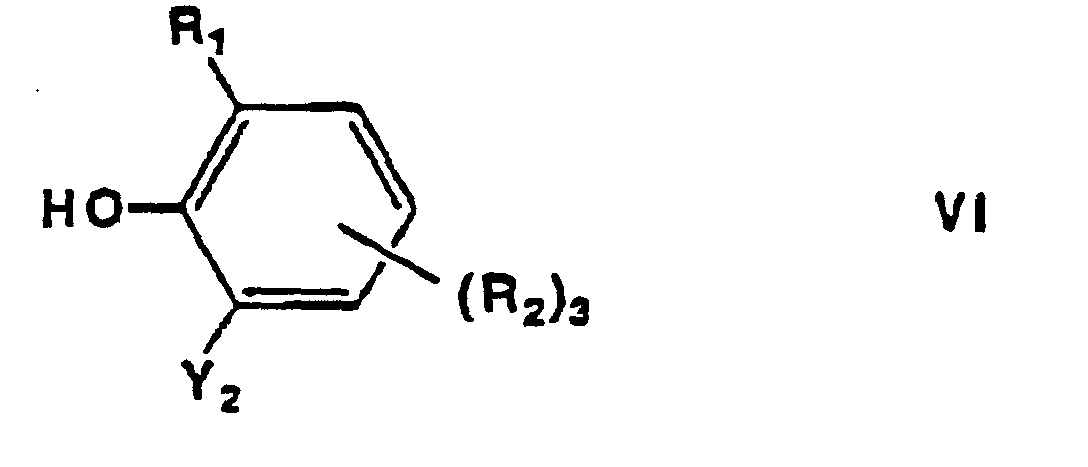
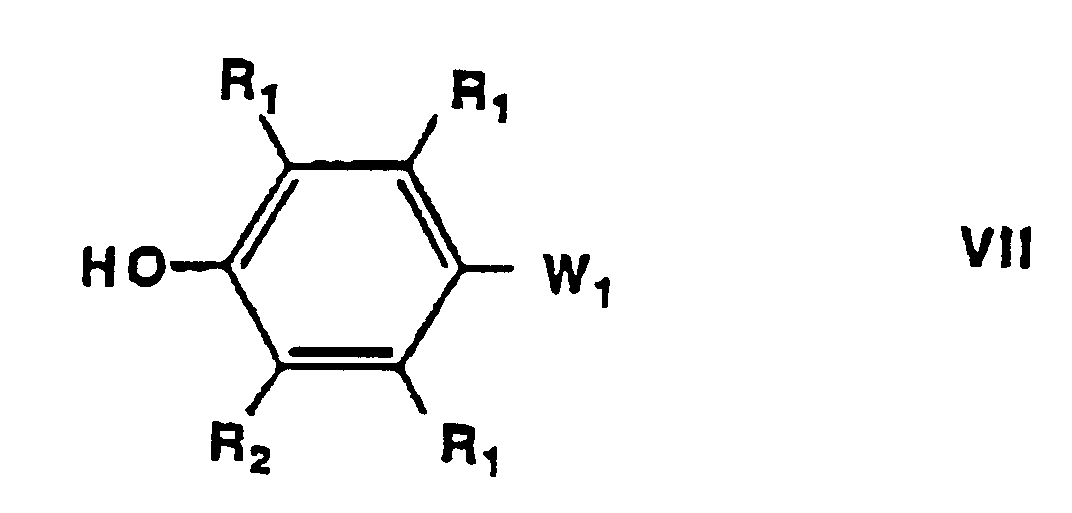
 wobei:
- jedes R1
- für H, -OH, -F, -Cl, -CH3 oder -OCH3 steht, wobei wenigstens eins der H in -CH3 oder -OCH3 durch -F oder -Cl substituiert sein kann;
- jedes R2
- unabhängig ausgewählt wird aus der Gruppe, die besteht aus -H, -OH, Alkyl, Alkenyl, Alkoxy, Alkanoyl, Alkylthio, Alkylthioalkyl, Alkylamid, Alkylamidalkyl, Alkylhydroxy, Alkylcarboxyl, mit 1 bis etwa wenigstens 20 Kohlenstoffatomen, oder Alkylaryl, Arylalkyl, Alkylsulfinyl, Alkoxyalkyl, Alkylsulfonyl, Alkoxycarbonyl, wobei das Alkyl oder Alkoxy 0 bis etwa 20 Kohlenstoffatome aufweist, oder Alkyl mit 1 bis etwa 20 Kohlenstoffatomen, oder zwei beliebige R2-Gruppen zusammen können eine Alkylen- oder Alkenylenkette bilden, die einen 3 bis 7-gliedrigen aromatischen oder alicyclischen Ring bilden, wobei der Ring wahlweise wenigstens ein Stickstoff-, Schwefel- oder Sauerstoffatom enthalten kann, R2verzweigt sein kann und tert.-Alkyl, wobei das Alkyl 1 bis etwa 20 Kohlenstoffatome aufweist, sein kann, R2 wenigstens einen polaren Substituenten enthalten kann, der aus der Gruppe, die aus -NO2, -CN, -F, -Cl, -Br und -J besteht, ausgewählt wird;
- jedes Y1
- unabhängig ausgewählt wird aus der Gruppe, die besteht aus -OH, -COOH, -COO-Z, -CO-Z, -SO-Z, -SO2-Z, -SO2NH-Z und -OCOO-Z, wobei Z Alkyl mit 1 bis 20 Kohlenstoffatomen, bevorzugt mehr als etwa 10 Kohlenstoffatomen, ist;
- jedes Y2
- -OH ist
- jedes W1
- unabhängig ausgewählt wird aus der Gruppe, die besteht aus Substituenten der Formeln X1, -C(CnHn+1)(CmHm+1)-X1, wobei n und m ganze Zahlen von 1 bis etwa wenigstens 20 sind, -COO-X1, -CO-X1, -OCO-X1, -CH2-O-X1, -O-CH2 X1, -O-X1, -S-X1, -SO-X1, -SO2-X1-, -SO2NH-X1, -OCOO-X1, Cyclohexan oder 5- oder 6-gliedriger aromatischer, heteroalicyclischer, heteroaromatischer oder alicyclischer Kohlenstoffring;
- jedes W2
- unabhängig ausgewählt wird aus der Gruppe, die besteht aus Substituenten der Formeln X1, -C(CnHn+1)(CmHm+1)-X1, wobei n und m ganze Zahlen von 1 bis etwa wenigstens 20 sind, -COO-X1, -CO-X1, -OCO-X1, -O-X1, -S-X1, -SO-X1, -SO2-X1-, -SO2NH-X1, -OCOO-X1, -COO-CH2-X1, -OCO-CH2-X1, -CH2-COO-X1, -CH2-OCO-X1, -O-C2H4-O-X1, Cyclohexan oder 5- oder 6-gliedriger aromatischer, heteroalicyclischer, heteroaromatischer oder alicyclischer Kohlenstoffring, und
- jedes W3
- unabhängig ausgewählt wird aus der Gruppe, die besteht aus Substituenten der Formeln X1, -C(CnHn+1)(CmHm+1)-X1, wobei n und m ganze Zahlen von 1 bis etwa wenigstens 20 sind, -COO-X1, -CO-X1, -OCO-X1, -O-X1, -S-X1, -SO-X1, -SO2-X1-, -OCOO-X1, -CH2-X1, Cyclohexan oder 5- oder 6-gliedriger aromatischer, heteroalicyclischer, heteroaromatischer oder alicyclischer Kohlenstoffring, und
- jedes X1
- für eine Gruppe der Formel (X) steht
wobei R1 und R2 sind, wie oben definiert; und
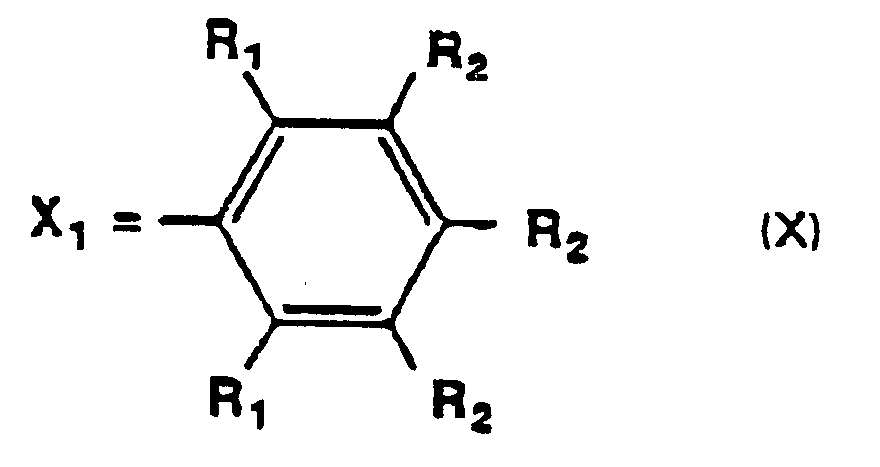
c) wenigstens einem oberflächenaktiven Additiv,
wobei die substituierte aromatische Verbindung zusammen mit dem oberflächenaktiven Additiv geeignet ist, das elektrisch leitfähige Polymer während des Verarbeitens zu lösen. - Zusammensetzung gemäß Anspruch 1, wobei das oberflächenaktive Additiv ein anionischer oberflächenaktiver Stoff ist, der aus der Gruppe, die aus organischen Sulfonaten, organischen Sulfaten, organischen Phosphonaten und organischen Phosphaten besteht, ausgewählt wird.
- Zusammensetzung gemäß Anspruch 1, wobei in den Formeln (IV) bis (X) wenigstens einer der Substituenten R1, R2, Y1, Y2, W1, W2 und W3 benachbart zu wenigstens einem OH-Substituenten an einem Benzolring ist und aus der Gruppe, die aus -H und -OH besteht, ausgewählt wird.
- Zusammensetzung gemäß Anspruch 1, wobei die elektrische Leitfähigkeit der Zusammensetzung wenigstens etwa 10-9 S/cm beträgt.
- Zusammensetzung gemäß Anspruch 1, wobei die elektrische Leitfähigkeit der Zusammensetzung wenigstens etwa 10-6 S/cm beträgt.
- Zusammensetzung gemäß Anspruch 1, wobei die elektrische Leitfähigkeit der Zusammensetzung wenigstens etwa 10-3 S/cm beträgt.
- Zusammensetzung gemäß Anspruch 1, wobei die aromatische Verbindung aus der Gruppe ausgewählt wird, die aus Alkyl substituiertem oder unsubstituiertem Hydrochinon, Resorcinol, Alkyl substituiertem oder unsubstituiertem Catechin, Alkylgallaten, Dihydroxyacetophenonen, Bisphenol A, Bisphenol F, Dihydroxybenzophenon, p-Hydroxybenzoesäure, m-Hydroxybenzoesäure besteht, und das oberflächenaktive Additiv aus der Gruppe, die aus Na+, Zn2+, Mg2+ oder Cu2+-Salzen von Alkylbenzolsulfonsäure oder Alkyl Na+, Zn2+, Mg2+ oder Cu2+-Sulfaten oder den Na+, Zn2+, Mg2+ oder Cu2+-Salzen von Naphthalinsulfonsäure besteht.
Applications Claiming Priority (3)
| Application Number | Priority Date | Filing Date | Title |
|---|---|---|---|
| US08/257,115 US5520852A (en) | 1994-06-08 | 1994-06-08 | Processible electrically conducting polyaniline compositions |
| US257115 | 1994-06-08 | ||
| PCT/FI1995/000332 WO1995034080A1 (en) | 1994-06-08 | 1995-06-08 | Processible electrically conducting polyaniline compositions and processes for the preparation thereof |
Publications (2)
| Publication Number | Publication Date |
|---|---|
| EP0764332A1 EP0764332A1 (de) | 1997-03-26 |
| EP0764332B1 true EP0764332B1 (de) | 2001-08-16 |
Family
ID=22974954
Family Applications (1)
| Application Number | Title | Priority Date | Filing Date |
|---|---|---|---|
| EP95920924A Expired - Lifetime EP0764332B1 (de) | 1994-06-08 | 1995-06-08 | Verarbeitbare, elektrisch leitfähige polyamilinzusammensetzungen und verfahren zu ihrer herstellung |
Country Status (7)
| Country | Link |
|---|---|
| US (2) | US5520852A (de) |
| EP (1) | EP0764332B1 (de) |
| JP (1) | JP2944222B2 (de) |
| AU (1) | AU693558B2 (de) |
| CA (1) | CA2190595A1 (de) |
| DE (1) | DE69522222T2 (de) |
| WO (1) | WO1995034080A1 (de) |
Families Citing this family (59)
| Publication number | Priority date | Publication date | Assignee | Title |
|---|---|---|---|---|
| US5783111A (en) * | 1993-09-03 | 1998-07-21 | Uniax Corporation | Electrically conducting compositions |
| US5520852A (en) * | 1994-06-08 | 1996-05-28 | Neste Oy | Processible electrically conducting polyaniline compositions |
| US5804100A (en) * | 1995-01-09 | 1998-09-08 | International Business Machines Corporation | Deaggregated electrically conductive polymers and precursors thereof |
| US6087472A (en) * | 1995-01-09 | 2000-07-11 | International Business Machines Corporation | Methods of fabrication of deaggregated electrically conductive polymers and precursors thereof |
| US6099757A (en) * | 1995-06-05 | 2000-08-08 | Americhem, Inc. | Tuned conductive coatings and blends from intrinisically conductive polymers and processes for making same |
| US5855755A (en) * | 1995-06-19 | 1999-01-05 | Lynntech, Inc. | Method of manufacturing passive elements using conductive polypyrrole formulations |
| US6210537B1 (en) * | 1995-06-19 | 2001-04-03 | Lynntech, Inc. | Method of forming electronically conducting polymers on conducting and nonconducting substrates |
| US6150032A (en) * | 1995-07-13 | 2000-11-21 | The Board Of Governors For Higher Education, State Of Rhode Island And Providence Plantations | Electroactive polymer coatings for corrosion control |
| US6024895A (en) * | 1995-08-11 | 2000-02-15 | Mitsubishi Rayon Co., Ltd. | Cross-linkable, electrically conductive composition, electric conductor and process for forming the same |
| US5745360A (en) * | 1995-08-14 | 1998-04-28 | International Business Machines Corp. | Dynamic hypertext link converter system and process |
| JPH09123513A (ja) * | 1995-11-06 | 1997-05-13 | Fuji Xerox Co Ltd | 導電性高分子薄膜及びその製造方法、導電性高分子薄 膜の駆動方法並びに画像形成方法及び画像形成装置 |
| US5969024A (en) * | 1995-11-29 | 1999-10-19 | International Business Machines Corporation | Methods of fabricating plasticized, antiplasticized and crystalline conducting polymers and precursors thereof |
| US5928566A (en) | 1995-11-29 | 1999-07-27 | International Business Machines Corporation | Plasticized, antiplasticized and crystalline conducting polymers |
| US5932143A (en) * | 1995-11-29 | 1999-08-03 | International Business Machines Corporation | Polycrystalline conducting polymers and precursors thereof having adjustable morphology and physical properties |
| US5723084A (en) * | 1996-03-08 | 1998-03-03 | E. I. Du Pont De Nemours And Company | Flash spinning process |
| US5776370A (en) * | 1996-04-25 | 1998-07-07 | International Business Machines Corporation | Charge transfer complexes between polyaniline and organic electron acceptors and method of fabrication |
| US5756879A (en) * | 1996-07-25 | 1998-05-26 | Hughes Electronics | Volatile organic compound sensors |
| US5840214A (en) * | 1996-07-26 | 1998-11-24 | Monsanto Company | Method of increasing polyaniline conductivity with ionic surfactants |
| US5772923A (en) * | 1996-10-29 | 1998-06-30 | Levon; Kalle M. J. | Solution comprising polyaniline and amphiphilic solubilizer |
| US5990249A (en) * | 1997-01-16 | 1999-11-23 | International Business Machines Corporation | Methods of fabrication of deaggregated electrically conductive polymers and precursors thereof |
| JP3153142B2 (ja) * | 1997-02-25 | 2001-04-03 | 日本電気株式会社 | 導電性偏光板 |
| US5871671A (en) * | 1997-10-14 | 1999-02-16 | Monsanto Company | Intrinsically conductive polymer/plasticizer blends with enhanced conductivity |
| AU9637798A (en) * | 1997-11-07 | 1999-05-31 | Bicc Public Limited Company | Conductive polymer compositions |
| US5908898A (en) * | 1998-02-12 | 1999-06-01 | Monsanto Company | Intrinsically conductive polymer blends having a low percolation threshold |
| US6762238B1 (en) | 1998-12-02 | 2004-07-13 | The Board Of Governors For Higher Education, State Of Rhode Island And Providence Plantations | Water-borne polymeric complex and anti-corrosive composition |
| US6806349B2 (en) * | 1999-01-12 | 2004-10-19 | International Business Machines Corporation | Methods of fabrication of deaggregated electrically conductive polymers and precursors thereof |
| US6334965B1 (en) | 1999-09-07 | 2002-01-01 | Lynntech, Inc. | Electronically conductive polymers |
| US6552107B1 (en) * | 2000-03-24 | 2003-04-22 | Council Of Scientific And Industrial Research | Melt or solution processable highly conducting polyaniline and process for preparation thereof, and blends thereof with PVC and EVA |
| US6730212B1 (en) | 2000-10-03 | 2004-05-04 | Hrl Laboratories, Llc | Sensor for chemical and biological materials |
| US7008524B2 (en) * | 2000-10-03 | 2006-03-07 | Hrl Laboratories, Llc | Sensors with variable response behavior |
| GB2379935B (en) * | 2000-11-17 | 2005-06-01 | Council Scient Ind Res | A process for the preparation of polyaniline salt |
| US6764617B1 (en) | 2000-11-17 | 2004-07-20 | The United States Of America As Represented By The Administrator Of The National Aeronautics & Space Administration | Ferromagnetic conducting lignosulfonic acid-doped polyaniline nanocomposites |
| US7316838B2 (en) * | 2001-02-15 | 2008-01-08 | Integral Technologies, Inc. | Low cost electrically conductive carpeting manufactured from conductive loaded resin-based materials |
| US20050202160A1 (en) * | 2001-02-15 | 2005-09-15 | Integral Technologies, Inc. | Low cost electrically conductive carpeting manufactured from conductive loaded resin-based materials |
| KR100426344B1 (ko) * | 2001-03-21 | 2004-04-06 | 이석현 | 용해성 자발배열 물질 및 그 물질을 포함하는 전도성고분자 조성물 |
| US6685854B2 (en) * | 2001-04-10 | 2004-02-03 | Honeywell International, Inc. | Electrically conductive polymeric mixture, method of molding conductive articles using same, and electrically conductive articles formed therefrom |
| US7687582B1 (en) | 2001-08-31 | 2010-03-30 | Tda Research, Inc. | Methods of production, purification, and processing of poly(heteroaromatic) block copolymers with improved solubility or dispersability |
| WO2003018648A1 (en) * | 2001-08-31 | 2003-03-06 | Tda Research, Inc. | Poly(heteroaromatic) block copolymers with electrical conductivity |
| FR2830535B1 (fr) * | 2001-10-10 | 2003-12-19 | Commissariat Energie Atomique | Utilisation d'acides sulfoniques, phosphoniques comme dopants de la polyaniline et de materiaux composites conducteurs a base de polyaniline |
| JP4186002B2 (ja) * | 2001-10-31 | 2008-11-26 | 学校法人日本大学 | 樹脂組成物およびそれを用いた熱可塑性樹脂積層体とそれらの製造方法 |
| EP1483320A2 (de) * | 2002-03-01 | 2004-12-08 | E.I. Du Pont De Nemours And Company | Drucken von leitfähigen organischen polymeren, die zusatzmittel enthalten |
| US20040092004A1 (en) * | 2002-11-07 | 2004-05-13 | Hrl Laboratories, Llc | Sensor for detection of enzyme and enzyme detection method for aerosolized bacteria in the enviromnment |
| US6962959B2 (en) * | 2003-08-28 | 2005-11-08 | Hoku Scientific, Inc. | Composite electrolyte with crosslinking agents |
| ATE548990T1 (de) | 2003-09-09 | 2012-03-15 | Procter & Gamble | Beleuchtete elektrische zahnbürsten |
| WO2005085355A1 (ja) * | 2004-03-10 | 2005-09-15 | Japan Science And Technology Agency | 導電性ポリアニリン組成物、その製造方法およびポリアニリンドーパント |
| WO2006076016A2 (en) * | 2004-05-21 | 2006-07-20 | Krzysztof Matyjaszewski | Conducting polymers |
| US7361728B1 (en) | 2004-09-30 | 2008-04-22 | Tda Research, Inc. | Electrically conducting materials from branched end-capping intermediates |
| TWI325007B (en) | 2004-10-08 | 2010-05-21 | Shinetsu Polymer Co | Conductive composition and production method thereof, antistatic coating material, antistatic coating, antistatic film, optical filter, and optical information recording medium, and capacitors and production method thereof |
| JP4786206B2 (ja) * | 2004-11-22 | 2011-10-05 | 信越ポリマー株式会社 | 帯電防止塗料、帯電防止膜及び帯電防止フィルム、光学フィルタ、光情報記録媒体 |
| JP2008532619A (ja) | 2005-03-09 | 2008-08-21 | ザ プロクター アンド ギャンブル カンパニー | センサー反応型電動歯ブラシ及びその使用法 |
| KR100761321B1 (ko) | 2006-01-18 | 2007-10-04 | 재단법인 대구테크노파크 | 고강도 전도성필름 제재 및 그를 이용한 고강도전도성필름과 그 제조방법 |
| US8187293B2 (en) * | 2006-02-06 | 2012-05-29 | Novartis Ag | Microsurgical instrument |
| JP5303107B2 (ja) * | 2006-09-25 | 2013-10-02 | 出光興産株式会社 | 導電性ポリアニリン複合体の製造方法 |
| WO2009034816A1 (ja) * | 2007-09-14 | 2009-03-19 | Idemitsu Kosan Co., Ltd. | 導電性ポリアニリン組成物 |
| EP2222755B1 (de) * | 2007-12-07 | 2016-10-05 | Agfa-Gevaert N.V. | Schichtaufbau mit verbesserter stabilität gegenüber der einwirkung von sonnenlicht |
| PL2445374T3 (pl) | 2009-06-26 | 2017-04-28 | The Gillette Company | Wskaźnik nacisku dla szczoteczki do zębów |
| JP5731974B2 (ja) * | 2009-07-02 | 2015-06-10 | 出光興産株式会社 | 導電性組成物 |
| WO2011027578A1 (ja) * | 2009-09-07 | 2011-03-10 | 出光興産株式会社 | 導電性組成物 |
| JP5915826B2 (ja) * | 2011-04-19 | 2016-05-11 | イーメックス株式会社 | フェノール化合物含有導電性高分子 |
Citations (2)
| Publication number | Priority date | Publication date | Assignee | Title |
|---|---|---|---|---|
| WO1992018988A1 (en) * | 1991-04-22 | 1992-10-29 | Allied-Signal Inc. | Polyaniline compositions having a surface/core dopant arrangement |
| WO1992022911A1 (en) * | 1991-06-12 | 1992-12-23 | Uniax Corporation | Processible forms of electrically conductive polyaniline and conductive products formed therefrom |
Family Cites Families (32)
| Publication number | Priority date | Publication date | Assignee | Title |
|---|---|---|---|---|
| US4442187A (en) * | 1980-03-11 | 1984-04-10 | University Patents, Inc. | Batteries having conjugated polymer electrodes |
| US5006278A (en) * | 1987-01-12 | 1991-04-09 | Allied-Signal | Solution processible forms of electrically conductive polyaniline and the method of manufacture of electroconductive articles therefrom |
| US4983322A (en) * | 1987-01-12 | 1991-01-08 | Allied-Signal Inc. | Solution processible forms of electrically conductive polyaniline |
| FI82702C (fi) * | 1987-07-29 | 1991-04-10 | Neste Oy | Elledande plastkompositer, som innehaoller poly (3-alkyltiofen) |
| US5069820A (en) * | 1987-08-07 | 1991-12-03 | Allied-Signal Inc. | Thermally stable forms of electrically conductive polyaniline |
| US5378403A (en) * | 1987-08-07 | 1995-01-03 | Alliedsignal Inc. | High electrically conductive polyanaline complexes having polar substitutents |
| US5160457A (en) * | 1987-08-07 | 1992-11-03 | Allied-Signal Inc. | Thermally stable forms of electrically conductive polyaniline |
| US4935163A (en) * | 1988-08-01 | 1990-06-19 | Lockheed Corporation | High service temperature conductive polymers and method of producing same |
| JP2739148B2 (ja) * | 1988-09-30 | 1998-04-08 | 日東電工株式会社 | 有機重合体又は導電性有機重合体組成物のフィルム,繊維又は複合体の製造方法 |
| JP2868564B2 (ja) * | 1989-03-13 | 1999-03-10 | 日立マクセル株式会社 | 磁気記録媒体 |
| WO1990013601A1 (en) * | 1989-05-12 | 1990-11-15 | Lockheed Corporation | Conductive polymer-polyamide blends and method of producing same |
| US5240644A (en) * | 1989-12-11 | 1993-08-31 | Milliken Research Corporation | Polyaniline dispersion and method for making same |
| US5135682A (en) * | 1990-03-15 | 1992-08-04 | E. I. Du Pont De Nemours And Company | Stable solutions of polyaniline and shaped articles therefrom |
| US5185100A (en) * | 1990-03-29 | 1993-02-09 | Allied-Signal Inc | Conductive polymers formed from conjugated backbone polymers doped with non-oxidizing protonic acids |
| US5217649A (en) * | 1991-01-31 | 1993-06-08 | Americhem, Inc. | Electrically conductive blends of intrinsically conductive polymers and thermoplastic polymers containing sulfonamide plasticizer and acidic surfactant |
| JP2866996B2 (ja) * | 1991-02-01 | 1999-03-08 | 日東電工株式会社 | 有機重合体溶液 |
| US5171478A (en) * | 1991-03-05 | 1992-12-15 | Allied-Signal Inc. | Thermally induced chain coupling in solid state polyaniline |
| US5378404A (en) * | 1991-04-22 | 1995-01-03 | Alliedsignal Inc. | Process for forming dispersions or solutions of electrically conductive conjugated polymers in a polymeric or liquid phase |
| US5246627A (en) * | 1991-05-06 | 1993-09-21 | Uniax Corporation | Melt-processible conducting polymer blends based on fibrils of intractable conducting polymers |
| US5232631A (en) * | 1991-06-12 | 1993-08-03 | Uniax Corporation | Processible forms of electrically conductive polyaniline |
| DE69232601T2 (de) * | 1991-12-05 | 2002-12-12 | Neste Oy, Kulloo | Verfahren zur Herstellung von leitfähigem Polyermaterial |
| US5648416A (en) * | 1992-01-21 | 1997-07-15 | Monsanto Company | Corrosion resistant paint |
| DK0643736T3 (da) * | 1992-06-03 | 1998-08-10 | Zipperling Kessler & Co | Termisk stabile, elektrisk ledende, konjugerede polymerkomplekse, der har hydrogenbindende modioner |
| EP0643735B1 (de) * | 1992-06-03 | 1998-04-22 | Monsanto Company | Oberflächen-dotierungsmittel als blendhilfe in conjugiert-ungesättigten polymeren |
| US5422423A (en) * | 1992-06-03 | 1995-06-06 | Alliedsignal Inc. | Thermally stable electrically conductive conjugated polymer complexes having hydrogen bonding counterions |
| US5324453A (en) * | 1992-08-07 | 1994-06-28 | Neste Oy | Electrically conducting polyaniline: method for emulsion polymerization |
| US5340499A (en) * | 1992-08-11 | 1994-08-23 | Neste Oy | Electrically conductive compositions and methods for their preparation |
| EP0582919B2 (de) * | 1992-08-11 | 2006-02-15 | Fortum Oil and Gas Oy | Leitendes Kunststoffmaterial und Methode zu seiner Herstellung |
| US5403913A (en) * | 1993-08-12 | 1995-04-04 | The Trustees Of The University Of Pennsylvania | Methods for preparing conductive polyanilines |
| CN1046750C (zh) * | 1993-09-03 | 1999-11-24 | 耐斯特欧公司 | 导电组合物 |
| US5589108A (en) * | 1993-12-29 | 1996-12-31 | Nitto Chemical Industry Co., Ltd. | Soluble alkoxy-group substituted aminobenzenesulfonic acid aniline conducting polymers |
| US5520852A (en) * | 1994-06-08 | 1996-05-28 | Neste Oy | Processible electrically conducting polyaniline compositions |
-
1994
- 1994-06-08 US US08/257,115 patent/US5520852A/en not_active Expired - Fee Related
-
1995
- 1995-06-08 EP EP95920924A patent/EP0764332B1/de not_active Expired - Lifetime
- 1995-06-08 CA CA002190595A patent/CA2190595A1/en not_active Abandoned
- 1995-06-08 DE DE69522222T patent/DE69522222T2/de not_active Expired - Fee Related
- 1995-06-08 AU AU26183/95A patent/AU693558B2/en not_active Ceased
- 1995-06-08 WO PCT/FI1995/000332 patent/WO1995034080A1/en not_active Ceased
- 1995-06-08 JP JP8500409A patent/JP2944222B2/ja not_active Expired - Fee Related
-
1996
- 1996-03-08 US US08/612,585 patent/US5866043A/en not_active Expired - Fee Related
Patent Citations (2)
| Publication number | Priority date | Publication date | Assignee | Title |
|---|---|---|---|---|
| WO1992018988A1 (en) * | 1991-04-22 | 1992-10-29 | Allied-Signal Inc. | Polyaniline compositions having a surface/core dopant arrangement |
| WO1992022911A1 (en) * | 1991-06-12 | 1992-12-23 | Uniax Corporation | Processible forms of electrically conductive polyaniline and conductive products formed therefrom |
Non-Patent Citations (1)
| Title |
|---|
| Synth.Met. 48, 91(1992). * |
Also Published As
| Publication number | Publication date |
|---|---|
| JPH10501017A (ja) | 1998-01-27 |
| WO1995034080A1 (en) | 1995-12-14 |
| AU693558B2 (en) | 1998-07-02 |
| DE69522222T2 (de) | 2002-05-08 |
| US5866043A (en) | 1999-02-02 |
| EP0764332A1 (de) | 1997-03-26 |
| JP2944222B2 (ja) | 1999-08-30 |
| DE69522222D1 (de) | 2001-09-20 |
| US5520852A (en) | 1996-05-28 |
| AU2618395A (en) | 1996-01-04 |
| CA2190595A1 (en) | 1995-12-14 |
Similar Documents
| Publication | Publication Date | Title |
|---|---|---|
| EP0764332B1 (de) | Verarbeitbare, elektrisch leitfähige polyamilinzusammensetzungen und verfahren zu ihrer herstellung | |
| US5783111A (en) | Electrically conducting compositions | |
| EP0643397B1 (de) | Elektrisch leitfähige Zusammensetzungen | |
| US5531932A (en) | Metal compound/protonic acid containing electrically conductive compositions and methods for their preparation | |
| US5624605A (en) | Processible forms of electrically conductive polyaniline | |
| FI113374B (fi) | Sähköä johtavan polyaniliinin prosessoitavat muodot ja niistä muodostetut johtavat tuotteet | |
| US5232631A (en) | Processible forms of electrically conductive polyaniline | |
| US5595689A (en) | Highly conductive polymer blends with intrinsically conductive polymers | |
| US5378404A (en) | Process for forming dispersions or solutions of electrically conductive conjugated polymers in a polymeric or liquid phase | |
| KR100225392B1 (ko) | 탈응집된 전도성 중합체 및 그의 전구체 | |
| JP3017903B2 (ja) | 導電性プラスチック材およびその製造方法 | |
| US7771621B2 (en) | Sulfosuccinate protonated conductive polyaniline composition, process for producing the same, and molded object thereof | |
| US5871671A (en) | Intrinsically conductive polymer/plasticizer blends with enhanced conductivity | |
| KR100209043B1 (ko) | 탈응집된 전도성 중합체 및 그의 전구체의 제조 방법 | |
| Pron et al. | Flexible, highly transparent, and conductive polyaniline‐cellulose acetate composite films | |
| EP0625280B1 (de) | Elektroleitfähige farbige polyaniline-verbindungen | |
| WO1996001480A1 (en) | Electrically conducting polymer compositions | |
| US5266617A (en) | Lewis base catalyzed phase transfer coating process for polyanilines | |
| WO1993024554A1 (en) | High electrically conductive polyaniline complexes having polar or polar and hydrogen bonding substituents | |
| EP0668594B1 (de) | Leitfähiges Polymer und Verfahren zu seiner Herstellung | |
| WO1993022775A1 (en) | Electrically conductive polyaniline with phosphorus-containing dopant | |
| Passiniemi et al. | Electrically conducting polymer blends based on polyaniline | |
| US5507977A (en) | Conducting plastic material and method of producing such material |
Legal Events
| Date | Code | Title | Description |
|---|---|---|---|
| PUAI | Public reference made under article 153(3) epc to a published international application that has entered the european phase |
Free format text: ORIGINAL CODE: 0009012 |
|
| 17P | Request for examination filed |
Effective date: 19961128 |
|
| AK | Designated contracting states |
Kind code of ref document: A1 Designated state(s): BE DE FR GB NL SE |
|
| 17Q | First examination report despatched |
Effective date: 19990709 |
|
| GRAG | Despatch of communication of intention to grant |
Free format text: ORIGINAL CODE: EPIDOS AGRA |
|
| GRAG | Despatch of communication of intention to grant |
Free format text: ORIGINAL CODE: EPIDOS AGRA |
|
| GRAH | Despatch of communication of intention to grant a patent |
Free format text: ORIGINAL CODE: EPIDOS IGRA |
|
| GRAH | Despatch of communication of intention to grant a patent |
Free format text: ORIGINAL CODE: EPIDOS IGRA |
|
| GRAA | (expected) grant |
Free format text: ORIGINAL CODE: 0009210 |
|
| AK | Designated contracting states |
Kind code of ref document: B1 Designated state(s): BE DE FR GB NL SE |
|
| PG25 | Lapsed in a contracting state [announced via postgrant information from national office to epo] |
Ref country code: NL Free format text: LAPSE BECAUSE OF FAILURE TO SUBMIT A TRANSLATION OF THE DESCRIPTION OR TO PAY THE FEE WITHIN THE PRESCRIBED TIME-LIMIT Effective date: 20010816 Ref country code: FR Free format text: LAPSE BECAUSE OF FAILURE TO SUBMIT A TRANSLATION OF THE DESCRIPTION OR TO PAY THE FEE WITHIN THE PRESCRIBED TIME-LIMIT Effective date: 20010816 Ref country code: BE Free format text: LAPSE BECAUSE OF FAILURE TO SUBMIT A TRANSLATION OF THE DESCRIPTION OR TO PAY THE FEE WITHIN THE PRESCRIBED TIME-LIMIT Effective date: 20010816 |
|
| REF | Corresponds to: |
Ref document number: 69522222 Country of ref document: DE Date of ref document: 20010920 |
|
| PG25 | Lapsed in a contracting state [announced via postgrant information from national office to epo] |
Ref country code: SE Free format text: LAPSE BECAUSE OF FAILURE TO SUBMIT A TRANSLATION OF THE DESCRIPTION OR TO PAY THE FEE WITHIN THE PRESCRIBED TIME-LIMIT Effective date: 20011116 |
|
| REG | Reference to a national code |
Ref country code: GB Ref legal event code: IF02 |
|
| NLV1 | Nl: lapsed or annulled due to failure to fulfill the requirements of art. 29p and 29m of the patents act | ||
| PLBE | No opposition filed within time limit |
Free format text: ORIGINAL CODE: 0009261 |
|
| STAA | Information on the status of an ep patent application or granted ep patent |
Free format text: STATUS: NO OPPOSITION FILED WITHIN TIME LIMIT |
|
| 26N | No opposition filed | ||
| PGFP | Annual fee paid to national office [announced via postgrant information from national office to epo] |
Ref country code: GB Payment date: 20070621 Year of fee payment: 13 |
|
| PGFP | Annual fee paid to national office [announced via postgrant information from national office to epo] |
Ref country code: DE Payment date: 20080620 Year of fee payment: 14 |
|
| GBPC | Gb: european patent ceased through non-payment of renewal fee |
Effective date: 20080608 |
|
| PG25 | Lapsed in a contracting state [announced via postgrant information from national office to epo] |
Ref country code: GB Free format text: LAPSE BECAUSE OF NON-PAYMENT OF DUE FEES Effective date: 20080608 |
|
| PG25 | Lapsed in a contracting state [announced via postgrant information from national office to epo] |
Ref country code: DE Free format text: LAPSE BECAUSE OF NON-PAYMENT OF DUE FEES Effective date: 20100101 |