EP0765401B1 - Procede de sequencage d'acide nucleique par spectroscopie de masse a extension d'amorce - Google Patents
Procede de sequencage d'acide nucleique par spectroscopie de masse a extension d'amorce Download PDFInfo
- Publication number
- EP0765401B1 EP0765401B1 EP95900868A EP95900868A EP0765401B1 EP 0765401 B1 EP0765401 B1 EP 0765401B1 EP 95900868 A EP95900868 A EP 95900868A EP 95900868 A EP95900868 A EP 95900868A EP 0765401 B1 EP0765401 B1 EP 0765401B1
- Authority
- EP
- European Patent Office
- Prior art keywords
- primer
- mass
- values
- primer extension
- mass spectrum
- Prior art date
- Legal status (The legal status is an assumption and is not a legal conclusion. Google has not performed a legal analysis and makes no representation as to the accuracy of the status listed.)
- Expired - Lifetime
Links
- 238000004949 mass spectrometry Methods 0.000 title claims description 16
- 238000003203 nucleic acid sequencing method Methods 0.000 title 1
- 239000013615 primer Substances 0.000 claims description 83
- 238000001819 mass spectrum Methods 0.000 claims description 53
- 238000000034 method Methods 0.000 claims description 46
- 238000009396 hybridization Methods 0.000 claims description 30
- 108091034117 Oligonucleotide Proteins 0.000 claims description 26
- 238000012163 sequencing technique Methods 0.000 claims description 23
- 150000007523 nucleic acids Chemical class 0.000 claims description 21
- 125000001453 quaternary ammonium group Chemical group 0.000 claims description 19
- 108020004707 nucleic acids Proteins 0.000 claims description 17
- 102000039446 nucleic acids Human genes 0.000 claims description 17
- 230000015572 biosynthetic process Effects 0.000 claims description 12
- 239000011159 matrix material Substances 0.000 claims description 10
- 239000007787 solid Substances 0.000 claims description 10
- 238000013467 fragmentation Methods 0.000 claims description 9
- 238000006062 fragmentation reaction Methods 0.000 claims description 9
- 230000008569 process Effects 0.000 claims description 7
- 125000002467 phosphate group Chemical group [H]OP(=O)(O[H])O[*] 0.000 claims description 5
- 229910019142 PO4 Inorganic materials 0.000 claims description 4
- 238000004364 calculation method Methods 0.000 claims description 4
- 125000003729 nucleotide group Chemical group 0.000 claims description 4
- 239000003155 DNA primer Substances 0.000 claims description 3
- 238000004458 analytical method Methods 0.000 claims description 3
- 150000001875 compounds Chemical class 0.000 claims description 3
- NBIIXXVUZAFLBC-UHFFFAOYSA-K phosphate Chemical compound [O-]P([O-])([O-])=O NBIIXXVUZAFLBC-UHFFFAOYSA-K 0.000 claims description 3
- 239000010452 phosphate Substances 0.000 claims description 3
- 238000004252 FT/ICR mass spectrometry Methods 0.000 claims description 2
- 150000003863 ammonium salts Chemical class 0.000 claims description 2
- 238000007385 chemical modification Methods 0.000 claims description 2
- 238000010438 heat treatment Methods 0.000 claims description 2
- 238000009830 intercalation Methods 0.000 claims description 2
- 238000012417 linear regression Methods 0.000 claims description 2
- 239000002773 nucleotide Substances 0.000 claims description 2
- 238000005096 rolling process Methods 0.000 claims description 2
- 230000005588 protonation Effects 0.000 claims 1
- 238000001269 time-of-flight mass spectrometry Methods 0.000 claims 1
- 230000008878 coupling Effects 0.000 description 22
- 238000010168 coupling process Methods 0.000 description 22
- 238000005859 coupling reaction Methods 0.000 description 22
- 239000000126 substance Substances 0.000 description 20
- 150000001793 charged compounds Chemical class 0.000 description 19
- 230000001419 dependent effect Effects 0.000 description 13
- QGZKDVFQNNGYKY-UHFFFAOYSA-N Ammonia Chemical compound N QGZKDVFQNNGYKY-UHFFFAOYSA-N 0.000 description 12
- 125000002924 primary amino group Chemical group [H]N([H])* 0.000 description 12
- 238000006243 chemical reaction Methods 0.000 description 11
- 239000003153 chemical reaction reagent Substances 0.000 description 11
- 238000003786 synthesis reaction Methods 0.000 description 11
- JLCPHMBAVCMARE-UHFFFAOYSA-N [3-[[3-[[3-[[3-[[3-[[3-[[3-[[3-[[3-[[3-[[3-[[5-(2-amino-6-oxo-1H-purin-9-yl)-3-[[3-[[3-[[3-[[3-[[3-[[5-(2-amino-6-oxo-1H-purin-9-yl)-3-[[5-(2-amino-6-oxo-1H-purin-9-yl)-3-hydroxyoxolan-2-yl]methoxy-hydroxyphosphoryl]oxyoxolan-2-yl]methoxy-hydroxyphosphoryl]oxy-5-(5-methyl-2,4-dioxopyrimidin-1-yl)oxolan-2-yl]methoxy-hydroxyphosphoryl]oxy-5-(6-aminopurin-9-yl)oxolan-2-yl]methoxy-hydroxyphosphoryl]oxy-5-(6-aminopurin-9-yl)oxolan-2-yl]methoxy-hydroxyphosphoryl]oxy-5-(6-aminopurin-9-yl)oxolan-2-yl]methoxy-hydroxyphosphoryl]oxy-5-(6-aminopurin-9-yl)oxolan-2-yl]methoxy-hydroxyphosphoryl]oxyoxolan-2-yl]methoxy-hydroxyphosphoryl]oxy-5-(5-methyl-2,4-dioxopyrimidin-1-yl)oxolan-2-yl]methoxy-hydroxyphosphoryl]oxy-5-(4-amino-2-oxopyrimidin-1-yl)oxolan-2-yl]methoxy-hydroxyphosphoryl]oxy-5-(5-methyl-2,4-dioxopyrimidin-1-yl)oxolan-2-yl]methoxy-hydroxyphosphoryl]oxy-5-(5-methyl-2,4-dioxopyrimidin-1-yl)oxolan-2-yl]methoxy-hydroxyphosphoryl]oxy-5-(6-aminopurin-9-yl)oxolan-2-yl]methoxy-hydroxyphosphoryl]oxy-5-(6-aminopurin-9-yl)oxolan-2-yl]methoxy-hydroxyphosphoryl]oxy-5-(4-amino-2-oxopyrimidin-1-yl)oxolan-2-yl]methoxy-hydroxyphosphoryl]oxy-5-(4-amino-2-oxopyrimidin-1-yl)oxolan-2-yl]methoxy-hydroxyphosphoryl]oxy-5-(4-amino-2-oxopyrimidin-1-yl)oxolan-2-yl]methoxy-hydroxyphosphoryl]oxy-5-(6-aminopurin-9-yl)oxolan-2-yl]methoxy-hydroxyphosphoryl]oxy-5-(4-amino-2-oxopyrimidin-1-yl)oxolan-2-yl]methyl [5-(6-aminopurin-9-yl)-2-(hydroxymethyl)oxolan-3-yl] hydrogen phosphate Polymers Cc1cn(C2CC(OP(O)(=O)OCC3OC(CC3OP(O)(=O)OCC3OC(CC3O)n3cnc4c3nc(N)[nH]c4=O)n3cnc4c3nc(N)[nH]c4=O)C(COP(O)(=O)OC3CC(OC3COP(O)(=O)OC3CC(OC3COP(O)(=O)OC3CC(OC3COP(O)(=O)OC3CC(OC3COP(O)(=O)OC3CC(OC3COP(O)(=O)OC3CC(OC3COP(O)(=O)OC3CC(OC3COP(O)(=O)OC3CC(OC3COP(O)(=O)OC3CC(OC3COP(O)(=O)OC3CC(OC3COP(O)(=O)OC3CC(OC3COP(O)(=O)OC3CC(OC3COP(O)(=O)OC3CC(OC3COP(O)(=O)OC3CC(OC3COP(O)(=O)OC3CC(OC3COP(O)(=O)OC3CC(OC3COP(O)(=O)OC3CC(OC3CO)n3cnc4c(N)ncnc34)n3ccc(N)nc3=O)n3cnc4c(N)ncnc34)n3ccc(N)nc3=O)n3ccc(N)nc3=O)n3ccc(N)nc3=O)n3cnc4c(N)ncnc34)n3cnc4c(N)ncnc34)n3cc(C)c(=O)[nH]c3=O)n3cc(C)c(=O)[nH]c3=O)n3ccc(N)nc3=O)n3cc(C)c(=O)[nH]c3=O)n3cnc4c3nc(N)[nH]c4=O)n3cnc4c(N)ncnc34)n3cnc4c(N)ncnc34)n3cnc4c(N)ncnc34)n3cnc4c(N)ncnc34)O2)c(=O)[nH]c1=O JLCPHMBAVCMARE-UHFFFAOYSA-N 0.000 description 9
- 238000000816 matrix-assisted laser desorption--ionisation Methods 0.000 description 9
- -1 quaternary ammonium compound 2-aminoethyl trimethylammonium chloride Chemical class 0.000 description 9
- 235000011178 triphosphate Nutrition 0.000 description 9
- 239000001226 triphosphate Substances 0.000 description 9
- 238000003795 desorption Methods 0.000 description 8
- 238000002372 labelling Methods 0.000 description 7
- 229910021529 ammonia Inorganic materials 0.000 description 6
- 238000010511 deprotection reaction Methods 0.000 description 5
- 239000012634 fragment Substances 0.000 description 5
- 238000004422 calculation algorithm Methods 0.000 description 4
- 238000010586 diagram Methods 0.000 description 4
- TVZRAEYQIKYCPH-UHFFFAOYSA-N 3-(trimethylsilyl)propane-1-sulfonic acid Chemical compound C[Si](C)(C)CCCS(O)(=O)=O TVZRAEYQIKYCPH-UHFFFAOYSA-N 0.000 description 3
- KWIUHFFTVRNATP-UHFFFAOYSA-N Betaine Natural products C[N+](C)(C)CC([O-])=O KWIUHFFTVRNATP-UHFFFAOYSA-N 0.000 description 3
- KWIUHFFTVRNATP-UHFFFAOYSA-O N,N,N-trimethylglycinium Chemical compound C[N+](C)(C)CC(O)=O KWIUHFFTVRNATP-UHFFFAOYSA-O 0.000 description 3
- 229960003237 betaine Drugs 0.000 description 3
- 150000001718 carbodiimides Chemical class 0.000 description 3
- 238000001514 detection method Methods 0.000 description 3
- 238000001502 gel electrophoresis Methods 0.000 description 3
- 238000001840 matrix-assisted laser desorption--ionisation time-of-flight mass spectrometry Methods 0.000 description 3
- 235000021317 phosphate Nutrition 0.000 description 3
- 238000003752 polymerase chain reaction Methods 0.000 description 3
- 150000003856 quaternary ammonium compounds Chemical class 0.000 description 3
- 238000007480 sanger sequencing Methods 0.000 description 3
- 238000001228 spectrum Methods 0.000 description 3
- 125000003396 thiol group Chemical group [H]S* 0.000 description 3
- ASNTZYQMIUCEBV-UHFFFAOYSA-N 2,5-dioxo-1-[6-[3-(pyridin-2-yldisulfanyl)propanoylamino]hexanoyloxy]pyrrolidine-3-sulfonic acid Chemical compound O=C1C(S(=O)(=O)O)CC(=O)N1OC(=O)CCCCCNC(=O)CCSSC1=CC=CC=N1 ASNTZYQMIUCEBV-UHFFFAOYSA-N 0.000 description 2
- 239000002253 acid Substances 0.000 description 2
- 230000027455 binding Effects 0.000 description 2
- 230000000295 complement effect Effects 0.000 description 2
- 230000005284 excitation Effects 0.000 description 2
- 125000002887 hydroxy group Chemical group [H]O* 0.000 description 2
- 150000002500 ions Chemical class 0.000 description 2
- 239000000203 mixture Substances 0.000 description 2
- 150000004713 phosphodiesters Chemical group 0.000 description 2
- 239000000523 sample Substances 0.000 description 2
- 229920006395 saturated elastomer Polymers 0.000 description 2
- XLEYFDVVXLMULC-UHFFFAOYSA-N 2',4',6'-trihydroxyacetophenone Chemical compound CC(=O)C1=C(O)C=C(O)C=C1O XLEYFDVVXLMULC-UHFFFAOYSA-N 0.000 description 1
- 108010008286 DNA nucleotidylexotransferase Proteins 0.000 description 1
- 102100033215 DNA nucleotidylexotransferase Human genes 0.000 description 1
- 102000052510 DNA-Binding Proteins Human genes 0.000 description 1
- 108700020911 DNA-Binding Proteins Proteins 0.000 description 1
- 108010014303 DNA-directed DNA polymerase Proteins 0.000 description 1
- 102000016928 DNA-directed DNA polymerase Human genes 0.000 description 1
- 108060002716 Exonuclease Proteins 0.000 description 1
- 108010014594 Heterogeneous Nuclear Ribonucleoprotein A1 Proteins 0.000 description 1
- 101100286901 Homo sapiens IMPDH2 gene Proteins 0.000 description 1
- 102100025891 Inosine-5'-monophosphate dehydrogenase 2 Human genes 0.000 description 1
- 239000004677 Nylon Chemical group 0.000 description 1
- 108020005187 Oligonucleotide Probes Proteins 0.000 description 1
- 108010021757 Polynucleotide 5'-Hydroxyl-Kinase Proteins 0.000 description 1
- 102000008422 Polynucleotide 5'-hydroxyl-kinase Human genes 0.000 description 1
- RYYWUUFWQRZTIU-UHFFFAOYSA-N Thiophosphoric acid Chemical group OP(O)(S)=O RYYWUUFWQRZTIU-UHFFFAOYSA-N 0.000 description 1
- 230000001133 acceleration Effects 0.000 description 1
- 230000029936 alkylation Effects 0.000 description 1
- 238000005804 alkylation reaction Methods 0.000 description 1
- 229940027998 antiseptic and disinfectant acridine derivative Drugs 0.000 description 1
- 238000013459 approach Methods 0.000 description 1
- 238000006254 arylation reaction Methods 0.000 description 1
- 230000008901 benefit Effects 0.000 description 1
- KLOIYEQEVSIOOO-UHFFFAOYSA-N carbocromen Chemical compound CC1=C(CCN(CC)CC)C(=O)OC2=CC(OCC(=O)OCC)=CC=C21 KLOIYEQEVSIOOO-UHFFFAOYSA-N 0.000 description 1
- 238000002288 cocrystallisation Methods 0.000 description 1
- 230000001427 coherent effect Effects 0.000 description 1
- 238000004590 computer program Methods 0.000 description 1
- 238000004132 cross linking Methods 0.000 description 1
- 239000003431 cross linking reagent Substances 0.000 description 1
- 230000029087 digestion Effects 0.000 description 1
- 230000005684 electric field Effects 0.000 description 1
- 238000001704 evaporation Methods 0.000 description 1
- 230000008020 evaporation Effects 0.000 description 1
- 102000013165 exonuclease Human genes 0.000 description 1
- 238000002474 experimental method Methods 0.000 description 1
- 238000011049 filling Methods 0.000 description 1
- 239000013628 high molecular weight specie Substances 0.000 description 1
- 238000010348 incorporation Methods 0.000 description 1
- 238000000752 ionisation method Methods 0.000 description 1
- 238000002955 isolation Methods 0.000 description 1
- 230000000155 isotopic effect Effects 0.000 description 1
- YACKEPLHDIMKIO-UHFFFAOYSA-N methylphosphonic acid Chemical group CP(O)(O)=O YACKEPLHDIMKIO-UHFFFAOYSA-N 0.000 description 1
- 230000004048 modification Effects 0.000 description 1
- 238000012986 modification Methods 0.000 description 1
- 238000010369 molecular cloning Methods 0.000 description 1
- 229920001778 nylon Chemical group 0.000 description 1
- 229940124276 oligodeoxyribonucleotide Drugs 0.000 description 1
- 239000002751 oligonucleotide probe Substances 0.000 description 1
- 150000003013 phosphoric acid derivatives Chemical class 0.000 description 1
- 230000026731 phosphorylation Effects 0.000 description 1
- 238000006366 phosphorylation reaction Methods 0.000 description 1
- 239000013612 plasmid Substances 0.000 description 1
- 102000004169 proteins and genes Human genes 0.000 description 1
- 108090000623 proteins and genes Proteins 0.000 description 1
- 230000035945 sensitivity Effects 0.000 description 1
- 239000002904 solvent Substances 0.000 description 1
- 238000004611 spectroscopical analysis Methods 0.000 description 1
- RYYWUUFWQRZTIU-UHFFFAOYSA-K thiophosphate Chemical compound [O-]P([O-])([O-])=S RYYWUUFWQRZTIU-UHFFFAOYSA-K 0.000 description 1
- 238000012546 transfer Methods 0.000 description 1
Images


Classifications
-
- C—CHEMISTRY; METALLURGY
- C12—BIOCHEMISTRY; BEER; SPIRITS; WINE; VINEGAR; MICROBIOLOGY; ENZYMOLOGY; MUTATION OR GENETIC ENGINEERING
- C12Q—MEASURING OR TESTING PROCESSES INVOLVING ENZYMES, NUCLEIC ACIDS OR MICROORGANISMS; COMPOSITIONS OR TEST PAPERS THEREFOR; PROCESSES OF PREPARING SUCH COMPOSITIONS; CONDITION-RESPONSIVE CONTROL IN MICROBIOLOGICAL OR ENZYMOLOGICAL PROCESSES
- C12Q1/00—Measuring or testing processes involving enzymes, nucleic acids or microorganisms; Compositions therefor; Processes of preparing such compositions
- C12Q1/68—Measuring or testing processes involving enzymes, nucleic acids or microorganisms; Compositions therefor; Processes of preparing such compositions involving nucleic acids
- C12Q1/6869—Methods for sequencing
- C12Q1/6872—Methods for sequencing involving mass spectrometry
-
- C—CHEMISTRY; METALLURGY
- C12—BIOCHEMISTRY; BEER; SPIRITS; WINE; VINEGAR; MICROBIOLOGY; ENZYMOLOGY; MUTATION OR GENETIC ENGINEERING
- C12Q—MEASURING OR TESTING PROCESSES INVOLVING ENZYMES, NUCLEIC ACIDS OR MICROORGANISMS; COMPOSITIONS OR TEST PAPERS THEREFOR; PROCESSES OF PREPARING SUCH COMPOSITIONS; CONDITION-RESPONSIVE CONTROL IN MICROBIOLOGICAL OR ENZYMOLOGICAL PROCESSES
- C12Q1/00—Measuring or testing processes involving enzymes, nucleic acids or microorganisms; Compositions therefor; Processes of preparing such compositions
- C12Q1/68—Measuring or testing processes involving enzymes, nucleic acids or microorganisms; Compositions therefor; Processes of preparing such compositions involving nucleic acids
- C12Q1/6869—Methods for sequencing
- C12Q1/6874—Methods for sequencing involving nucleic acid arrays, e.g. sequencing by hybridisation
Definitions
- Schemes for nucleic acid sequencing by hybridisation [2] rely upon the stringent hybridisation of many oligonucleotide probes (such as all the possible 8 mers) to target nucleic acid. Although elegant, such schemes are critically dependent on the ability to discriminate perfect matches from mismatches. Such discrimination is currently far from a reality.
- SBH is a compromise between the size of the experiment (65,536 8 mers need to be synthesised to make the complete set) and the quality of the data used to reconstruct the target sequence. The longer the sequence data obtained from each hybridisation, the easier the target sequence is to reconstruct but the larger the number of hybridisations that need to be carried out.
- This invention directly addresses a great many of the abovementioned problems.
- the invention provides a method of sequencing a target nucleic acid by using primer extension mass spectroscopy to generate an observed mass spectrum wherein the observed mass spectrum is generated by the steps of:
- PEMS sequencing according to this invention differs from Sanger sequencing and sequencing by hybridisation in that it generates extension products from primers (with all four dNTPs and all four ddNTPs together in one reaction) and thence allows the sequence to be directly read by the observed mass difference between sequential peaks in a mass spectrum.
- Many hybridisation events may be spatially arrayed, extended in parallel and then sequentially analysed by sequential desorption/ionisation followed by mass spectroscopy.
- the amount of sequence data obtained from each initial hybridisation is greater than that of just the oligonucleotide used for hybridisation.
- the amount of sequence data obtained from each initial hybridisation is potentially of the order of 100 or more bases (dependent upon the resolution of the mass spectrometer used for sequence determination).
- the rate of sequence acquisition with mass spectroscopy is potentially vastly greater than that possible using gel electrophoresis.
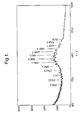
- the PEMS method gives rise to an observed mass spectrum for the extension fragments.
- the present invention also relates to a method for determining the order of the bases from a PEMS sequencing observed mass spectrum.
- oligonucleotide primers could be synthesized, hybridized to the target and extended into nested sets in separate reactions.
- the oligonucleotides could be arranged in a spatial array and simultaneously hybridized to the target.
- the primer extension to generate nested sets from each oligonucleotide primer hybridized to the target could be simultaneously carried out for the whole array. Mass spectroscopic detection would then be sequential for each nested set generated in the array.
- the amount of sequence generated from each oligonucleotide to target hybridization event in the PEMS method is greater than that of just the oligonucleotide used for hybridization, fewer oligonucleotide to target hybridization events are required in order to reconstruct the target sequence than are required in SBH schemes.
- the number of gaps in the sequence will be considerably less with PEMS sequencing than with SBH schemes.
- One further advantage of the PEMS method is the ability to walk along the target for gap filling in the sequence. Oligonucleotide primers corresponding to the end of the readable part of one round of PEMS sequencing can be synthesized (or formed by stacking two or more smaller oligonucleotides) and used for a subsequent round of PEMS sequencing.
- Oligonucleotides may be DNA or RNA based. They may contain one or more modified residue (modification may be in the base, sugar or backbone moiety or combinations of the above). They may also contain a non-phosphodiester backbone (phoshorothioate, methylphosphonate and nylon backbones are just some examples of non-phosphodiester backbones). Oligonucleotides may also have attached intercalating groups (such as acridine derivatives) in order to stabilize their binding to target molecules.
- intercalating groups such as acridine derivatives
- Target molecules may be DNA or RNA based, rendered temporarily, partially or wholly single stranded for the purposes of hybridization. They may be genomic DNA, YACs, P1 clones, cosmids, lambda, plasmids, M13 clones, phagemids, PCR products or chemically synthesized oligonucleotides.
- Oligonucleotides are hybridized to target nucleic acid molecules. Hybridization may be in free solution, with oligonucleotide bound to a solid support or with target bound to a solid support.
- Hybridization and/or extension may be carried out within the matrix used for MALDI. Alternatively, Hybridization and/or extension may be carried out elsewhere followed by transfer to the matrix used for MALDI.
- Hybridization can be to single oligonucleotides or to multiples of stacked oligonucleotides [3] (these stacks may or may not be stabilized by DNA binding proteins, for example single strand binding proteins).
- the polymerase for primer extension may be either an RNA- or a DNA- dependent RNA or DNA polymerase. It may be either thermophilic or mesophilic and may be used with Mg, Mn or Mg+Mn based buffer systems.
- a hybridization reaction is carried out for each combination of oligonucleotide primer and target.
- Primer extension is then carried out using a polymerase.
- the nested set of extension products generated by this process is then analyzed by mass spectroscopy, as described below, to give the sequence of bases extending from the oligonucleotide primer.
- MALDI Matrix Assisted Laser Desorption Ionization
- MALDI-TOF MS Matrix Assisted Laser Desorption Ionization Time-of-Flight Mass Spectroscopy
- MALDI-FT MS Matrix Assisted Laser Desorption Ionization Fourier Transform Mass Spectroscopy
- MALDI-TOF MS and MALDI-FT MS are tools for the mass determination of high molecular weight species.
- a laser pulse is used to desorb and ionize the species of interest from a matrix in which it is embedded.
- the desorption and ionization are very mild and produce molecular ions with very few fragmentation products.
- the very low level of molecular ion fragmentation allows the direct readout of the sequence or residues in the mass spectrum of a nested set originating from the hybridization primer. Any other desorption and ionization method could potentially be used provided that similarly low levels of molecular ion fragmentation could be achieved.
- desorption and ionization need not necessarily be limited to matrix assisted laser pulsing.
- the desorbed molecular ions are accelerated in a constant electric field and are detected at the end of a linear tube.
- the time difference between laser pulse desorption and detection is proportional to the square root of the mass/charge for each molecular ion.
- ions are trapped by a combination of magnetic and electostatic fields.
- the trapped ions are induced into coherent cyclotron motion by a variety of pulsed excitation techniques.
- the time domain signal produced after this excitation is then Fourier Transformed to give a spectrum of abundance against mass/charge for each molecular ion.
- Desorption, ionisation and molecular ion fragmentation are very much dependent upon: the nature of the matrix, the concentration of the matrix, the nature of the species of interest, the concentration of the species of interest, the nature of the buffer, the concentration of various buffer components, the co-crystallisation of the matrix and species of interest and the laser power used for the pulse.
- the MALDI technique also generally requires a high ratio of matrix to species of interest thus compromising sensitivity. Much work is generally required in order to optimise all of the above factors.
- the laser pulse gives rise to a 'cloud' of molecular ions that do not all have exactly the same initial spatial locations or initial kinetic energies.
- the nonidentical initial spatial locations and nonidentical initial kinetic energies of the molecular ions combine to limit the available resolution of the subsequent mass spectroscopy.
- IPMD Inter Peak Mass Difference
- the sequence of the extension product can thus be read directly from the values of IPMD r for the mass spectroscopic peaks in the order of increasing mass from the primer.
- the ratio of signal to noise from the observed mass spectrum can be greatly improved by the summation of several spectra from the original sample. This is possible with MALDI if the sample surface area is larger than the area over which the laser pulse can be focussed.
- CM-dA-, CM-dC-, CM-dG-, CM-dT-, CM-ddA-, CM-ddC-, CM-ddG-, CM-ddT- and CM0 the mass of the primer used.
- CM1 is therefore also known with certainty.
- the calculated values CM0 and CM1 can be used in order to calibrate the observed mass spectrum. As bases are called from the calibrated OIPMD values, more masses can be calculated from the called sequence. More calibration points thus become available for the base calling algorithm.
- OM0 appears at a given point in the mass spectrum.
- CM0 is known with certainty and allows the observed mass spectrum to be calibrated.
- CM1 is known with certainty and allows the observed mass spectrum to be calibrated.
- OM2 appears at a given point in the mass spectrum (now calibrated using CM0 and CM1 as reference points)
- CM2 is now known with certainty.
- CM0 and CM1 are also known with certainty. These three values therefore allow the observed mass spectrum to be more extensively calibrated in order to further increase its accuracy
- OM3 appears at a given point in the mass spectrum (now calibrated using CM0, CM1 and CM2 as reference points)
- CM3 is now known with certainty.
- CM0, CM1 and CM2 are also known with certainty. These four values therefore allow the observed mass spectrum to be more extensively calibrated in order to further increase its accuracy
- OM4 appears at a given point in the mass spectrum (now calibrated using CM0, CM1, CM2 and CM3 as reference points)
- CM4 is now known with certainty.
- CM0, CM1, CM2 and CM3 are also known with certainty. These five values therefore allow the observed mass spectrum to be more extensively calibrated in order to further increase its accuracy
- OMr (OIPMDr) (OMr) - (OMr-1) primer-dA-dC-dG-dT-ddA OM5 OIPMD5
- OM5 appears at a given point in the mass spectrum (now calibrated using CM0, CM1, CM2, CM3 and CM4 as reference points)
- CM5 is now known with certainty.
- CM0, CM1, CM2, CM3 and CM4 are also known with certainty. These six values therefore allow the observed mass spectrum to be more extensively calibrated in order to further increase its accuracy
- OMr (OIPMDr) (OMr) - (OMr-1) primer-dA-dC-dG-dT-dA-ddT OM6 OIPMD6
- OM6 appears at a given point in the mass spectrum (now calibrated using CM0, CM1, CM2, CM3, CM4 and CM5 as reference points)
- CM6 is now known with certainty.
- CM0, CM1, CM2, CM3, CM4 and CM5 are also known with certainty. These seven values therefore allow the observed mass spectrum to be more extensively calibrated in order to further increase its accuracy
- OMr (OIPMDr) (OMr) - (OMr-1) primer-dA-dC-dG-dT-dA-dT-ddG OM7 OIPMD7
- OM7 appears at a given point in the mass spectrum (now calibrated using CM0, CM1, CM2, CM3, CM4, CM5 and CM6 as reference points)
- CM7 is now known with certainty.
- CM0, CM1, CM2, CM3, CM4, CM5 and CM6 are also known with certainty. These eight values therefore allow the observed mass spectrum to be more extensively calibrated in order to further increase its accuracy.
- the present invention can in one embodiment use all available data for base calling (whereupon calibration of the observed mass spectrum actually improves for base calling further from the sequencing primer).
- the present invention can also use only a selected number of bases prior to the base about to be called for calibration and base calling. For this latter process, a rolling local calibration can be carried out for each base called (with a fixed number of bases prior to the base about to be called being used for the calibration used for base calling).
- CM0 and CM1 were known with certainty and were used in order to initially calibrate the observed mass spectrum.
- Other peaks of known mass in the mass spectrum obvious to those skilled in the art could be chosen for the calibration (including calibration compounds of known mass not taking part of the PEMS sequencing reaction).
- the algorithm for calling the bases from the observed mass spectrum of a PEMS sequencing reaction could be written such that the confidence of base calling is measured by the closeness between the values for CM-dA-, CM-dC-, CM-dG-, CM-dT- and the calibrated OIPMD values.
- Figure 3 gives a flow diagram for the base calling program the results of which are reported in Figure 2.
- the diagram below shows the expected mass differences for the addition of an A, C, G or T residue. It also shows the mass at the mid point between expected mass and upper and lower points based on the mid point mass differences.
- the base is provisionally assigned on the basis of whichever is closest. Thus if the mass difference is between 321.06 and 308.55, the base will be assigned as an A.
- the confidence level is assigned as the proportion of the difference between the relevant mid, upper or lower point and the A, C, G or T value.
- a mass difference of 311.98 will be assigned as an A with a confidence of 75.95% because it is 75.95% of the distance between 308.55 and 313.06.
- step 2 If the base has been accepted, recalculate the calibration using the observed mass and the mass calculated in step 2 as another data pair. If the base is rejected then continue to use the previous calibration.
- the number of data pairs used in the regression calculation can be specified by the software operator, this can be designated as r. Thus only the data from peaks n-r to n (or 0 to n) would be used.
- the primer extension products generated in step b) and subjected to minimum fragmentation mass spectrometry in step c), have been chemically charged by means of a stably charged group.
- the primer extension products are then desorbed into a vacuum from a solid surface (under conditions that do not cause molecular ion fragmentation) for subsequent mass spectrometry.
- the primer used for extension in a sequencing reaction is covalently attached to a stably charged group at the 5' end (or internally, if this does not interfere with hybridisation and/or polymerase extension from the primer/template complex).
- the stably charged group is 'stable' in that its charge is not dependent upon the local pH conditions.
- One example of such a stably charged group is a quaternary ammonium group.
- the charge on the stably charged group may be either positive or negative.
- the charge may be either z+ or z-, where z is greater than or equal to 1.
- each of the ddNTPs or other chain terminating analogues used for chain termination in a sequencing reaction is covalently attached to a stably charged group.
- the stably charged group is 'stable' in that its charge is not dependent upon the local pH conditions.
- One example of such a stably charged group is a quaternary ammonium group.
- the charge on the stably charged group may be either positive or negative.
- the charge may be either z+ or z-, where z is greater than or equal to 1.
- one of the dNTPs or other chain extending analogues used for chain extension in a sequencing reaction is covalently attached to a stably charged group.
- the stably charged group is 'stable' in that its charge is not dependent upon the local pH conditions.
- One example of such a stably charged group is a quaternary ammonium group.
- the charge on the stably charged group may be either positive or negative.
- the charge may be either z+ or z-, where z is greater than or equal to 1.
- the primer used for extension on a template is covalently attached to a stably charged group at the 5' end (or internally, if this does not interfere with hybridisation and/or polymerase extension from the primer/template complex).
- This extension reaction may be part of a Polymerase Chain Reaction (PCR).
- the stably charged group is 'stable' in that its charge is not dependent upon the local pH conditions.
- One example of such a stably charged group is a quaternary ammonium group.
- the charge on the stably charged group may be either positive or negative.
- the charge may be either z+ or z-, where z is greater than or equal to 1.
- one of the ddNTPs or other, chain terminating analogues used for chain termination is covalently attached to a stably charged group.
- This chain terminating analogue is then used for 3' end labelling of a nucleic acid molecule with terminal deoxynucleotidyl transferase.
- the stably charged group is 'stable' in that its charge is not dependent upon the local pH conditions.
- One example of such a stably charged group is a quaternary ammonium group.
- the charge on the stably charged group may be either positive or negative.
- the charge may be either z+ or z-, where z is greater than or equal to 1.
- one of the ddNTPs or other chain terminating analogues used for chain termination is covalently attached to a stably charged group.
- This chain terminating analogue is then used for recessed 3' end labelling ('fill-in' labelling [1]) of a partially double stranded nucleic acid molecule with a polymerase.
- the stably charged group is 'stable' in that its charge is not dependent upon the local pH conditions.
- One example of such a stably charged group is a quaternary ammonium group.
- the charge on the stably charged group may be either positive or negative.
- the charge may be either z+ or z-, where z is greater than or equal to 1.
- one of the dNTPs or other chain extending analogues used for chain extension is covalently attached to a stably charged group.
- This chain extending analogue is then used for recessed 3' end labelling ('fill-in' labelling [1]) of a partially double stranded nucleic acid molecule with a polymerase and the other three dNTPs not attached to stably charged groups.
- the stably charged group is 'stable' in that its charge is not dependent upon the local pH conditions.
- One example of such a stably charged group is a quaternary ammonium group.
- the charge on the stably charged group may be either positive or negative.
- the charge may be either z+ or z-, where z is greater than or equal to 1.
- one of the dNTPs or other chain extending analogues used for chain extension is covalently attached to a stably charged group.
- This chain extending analogue is then used for incorporation labelling during primer extension with a polymerase.
- the stably charged group is 'stable' in that its charge is not dependent upon the local pH conditions.
- One example of such a stably charged group is a quaternary ammonium group.
- the charge on the stably charged group may be either positive or negative.
- the charge may be either z+ or z-, where z is greater than or equal to 1.
- a single stranded nucleic acid fragment (which may be an oligonucleotide primer) is covalently attached to a stably charged group by any of the above methods.
- the stably charged single stranded nucleic acid fragment is then used in a hybridisation reaction with nucleic acid(s) (some or all of which contain sequence complementary to the single stranded nucleic acid fragment).
- nucleic acid(s) some or all of which contain sequence complementary to the single stranded nucleic acid fragment.
- the stably charged single stranded nucleic acid fragment and its hybridised complement are covalently crosslinked (either by an exogeneous crosslinking reagent or by a crosslinking moiety on the stably charged single stranded nucleic acid fragment).
- the covalently crosslinked complex is then analysed by mass spectroscopy.
- the stably charged group is 'stable' in that its charge is not dependent upon the local pH conditions.
- One example of such a stably charged group is a quaternary ammonium group.
- the charge on the stably charged group may be either positive or negative.
- the charge may be either z+ or z-, where z is greater than or equal to 1.
- the charge on the phosphate backbone of the extension product can be removed by controlled chemical modification (such as alkylation or arylation).
- the charge on the phosphate backbone of the extension product can also be removed by forming the ammonium salt of the phosphate backbone and then subjecting the extension product to a vacuum (wherein the ammonium ions protonate the phosphates, evaporate as ammonia and produce the acid form of the phosphate backbone).
- the extension products thus consist of a stably charged group covalently attached to the molecule of interest (charge may be either z+ or z-) and the chemically modified or acid form of the phosphate backbone (both of which are uncharged). All the extension products are thus molecular ions with the same charge on each molecular ion (either z+ or z-). m/z for each species is thus directly related to mass.
- charge may be either z+ or z-
- m/z for each species is thus directly related to mass.
- conditions will need to be empirically determined such that the same number of charged dNTPs (preferably one) is incorporated in each extension product.
- molecular ions may be applied to a solid surface, conveniently in solution in a volatile solvent which is afterwards removed by evaporation. They may be applied alone or in admixture with a matrix material.
- the solid surface could be one of the electrodes for molecular ion acceleration in a TOF mass spectrometer. This would ensure that all of the molecular ions started out from known positions (i.e. the electrode surface, which could be planar and in the same plane a the TOF detector) and with identical initial kinetic energies. These two factors should combine to greatly improve the resolution of the mass spectrometer.
Landscapes
- Life Sciences & Earth Sciences (AREA)
- Proteomics, Peptides & Aminoacids (AREA)
- Chemical & Material Sciences (AREA)
- Organic Chemistry (AREA)
- Zoology (AREA)
- Wood Science & Technology (AREA)
- Health & Medical Sciences (AREA)
- Engineering & Computer Science (AREA)
- Physics & Mathematics (AREA)
- Analytical Chemistry (AREA)
- Biochemistry (AREA)
- Microbiology (AREA)
- Molecular Biology (AREA)
- Biotechnology (AREA)
- Biophysics (AREA)
- Genetics & Genomics (AREA)
- Immunology (AREA)
- Bioinformatics & Cheminformatics (AREA)
- General Engineering & Computer Science (AREA)
- General Health & Medical Sciences (AREA)
- Spectroscopy & Molecular Physics (AREA)
- Measuring Or Testing Involving Enzymes Or Micro-Organisms (AREA)
- Other Investigation Or Analysis Of Materials By Electrical Means (AREA)
Claims (22)
- Procédé de séquençage d'un acide nucléique cible, à l'aide de spectroscopie de masse à extension d'amorce, pour engendrer un spectre de masse observé, dans lequel le spectre de masse observé est obtenu par les étapes consistant à :dans lequel les valeurs suivantes sont connues avec certitude :a) hybrider au moins une amorce oligonucléotidique avec l'acide nucléique cible, de manière à former au moins un hybride amorce-cible,b) soumettre chaque hybride amorce-cible à des conditions d'extension de chaíne catalysée par polymérase, en présence de quatre nucléotides d'extension de chaíne et de quatre analogues de nucléotide de terminaison de chaíne, de manière à produire une série emboítée de produits d'extension d'amorce,c) soumettre chaque série emboítée de produits d'extension d'amorce à une spectroscopie de masse à fragmentation minimale, de manière à obtenir le spectre de masse observé,CM-dA-, CM-dC-, CM-dG-, CM-dT-, CM-ddA-, CM-ddC-, CM-ddG-, CM-ddT-et CM0 (la masse de l'amorce utilisée),la valeur CM0 calculée utilisée pour étalonner les valeurs de différences de masse inter-pics (OIPMD) du spectre de masse observé,on effectue des cycles de détermination de bases, en utilisant les valeurs OIPMD étalonnées, de sorte que :chaque base déterminée permet le calcul de la masse pour le pic à base déterminée dans le spectre de masse observé,on utilise ensuite cette masse calculée en tant que nouveau point d'étalonnage pour des cycles subséquents de détermination de bases.
- Procédé selon la revendication 1, dans lequel les valeurs suivantes sont connues avec certitude :CM-dA-, CM-dC-, CM-dG-, CM-dT-, CM-ddA-, CM-ddC-, CM-ddG-, CM-ddT-, CM0 (la masse de l'amorce utilisée) et CM1 (la masse du premier pic au-delà de l'amorce utilisée), etles valeurs calculées CM0 et CM1 sont utilisées pour étalonner les valeurs OIPMD du spectre de masse observé.
- Procédé selon la revendication 1 ou 2, dans lequel les valeurs suivantes sont connues avec certitude :CM-dA-, CM-dC-, CM-dG-, CM-dT-, CM-ddA-, CM-ddC-, CM-ddG-, CM-ddT-, CM0 (la masse de l'amorce utilisée) et CM1 (la masse du premier pic au-delà de l'amorce utilisée), ..., CMr (la masse du rème pic au-delà de l'amorce utilisée), etles valeurs calculées CM0, CM1, ..., CMr sont utilisées pour étalonner les valeurs OIPMD du spectre de masse observé.
- Procédé selon l'une quelconque des revendications 1 à 3, dans lequel les valeurs suivantes sont connues avec certitude :CM-dA-, CM-dC-, CM-dG-, CM-dT-, CM-ddA-, CM-ddC-, CM-ddG-, CM-ddT- et CM0 (la masse de l'amorce utilisée), et la masse d'un ou plusieurs composés d'étalonnage (de masse connue), etles valeurs calculées CM0 et la(les) masse(s) de composé(s) d'étalonnage sont utilisées pour étalonner les valeurs OIPMD du spectre de masse observé.
- Procédé selon l'une quelconque des revendications 1 à 4, dans lequel toutes les bases déterminées sont utilisées pour le processus d'étalonnage.
- Procédé selon l'une quelconque des revendications 1 à 4, dans lequel on utilise pour le processus d'étalonnage une sous-série roulante de toutes les bases déterminées.
- Procédé selon l'une quelconque des revendications 1 à 6, dans lequel on utilise une régression linéaire pour le processus d'étalonnage.
- Procédé selon l'une quelconque des revendications 1 à 6, dans lequel on utilise une régression non linéaire pour le processus d'étalonnage.
- Procédé selon l'une quelconque des revendications 1 à 8, dans lequel la confiance de la détermination des bases est mesurée par la proximité entre les valeurs pour CM-dA-, CM-dC-, CM-dG-, CM-dT- et les valeurs OIPMD étalonnées.
- Procédé selon l'une quelconque des revendications 1 à 9, dans lequel une pluralité d'amorces oligonucléotidiques est hybridée dans l'étape a) avec l'acide nucléique cible, de manière à former une pluralité d'hybrides amorce-cible.
- Procédé selon l'une quelconque des revendications 1 à 10, dans lequel une amorce oligonucléotidique comprend un ou plusieurs résidus modifiés dans la base et/ou le sucre et/ou le squelette et/ou comporte un ou plusieurs groupes d'intercalation attachés.
- Procédé selon l'une quelconque des revendications 1 à 11, dans lequel chaque amorce oligonucléotidique utilisée dans l'étape a) est fixée à une phase solide.
- Procédé selon l'une quelconque des revendications 1 à 12, dans lequel chaque série emboítée de produits d'extension d'amorce dans l'étape c) est noyée dans une matrice, à partir de laquelle elle est désorbée et ionisée au moyen d'une impulsion de laser, pour analyse par spectroscopie de masse.
- Procédé selon l'une quelconque des revendications 1 à 13, dans lequel chaque série emboítée de produits d'extension d'amorce est d'abord désorbée et ionisée et ensuite analysée par spectroscopie de masse à temps de vol ou par spectroscopie de masse à transformée de Fourier.
- Procédé selon l'une quelconque des revendications 1 à 14, dans lequel les produits d'extension d'amorce engendrés dans l'étape b) et soumis à une spectroscopie de masse à fragmentation minimale dans l'étape c), ont été chargés chimiquement au moyen d'un groupe chargé de façon stable.
- Procédé selon la revendication 15, dans lequel chaque produit d'extension d'amorce comporte un groupe chargé de façon stable, lié par covalence.
- Procédé selon la revendication 16, dans lequel le groupe chargé de façon stable est un ion ammonium quaternaire.
- Procédé selon l'une quelconque des revendications 15 à 17, dans lequel les produits d'extension d'amorce sont élaborés sous forme d'un dépôt sur une surface solide, à partir de laquelle ils sont désorbés par un chauffage localisé effectué par laser ou une autre irradiation et/ou par répulsion de charges entre les produits d'extension d'amorce et la surface solide.
- Procédé selon l'une quelconque des revendications 15 à 18, dans lequel les produits d'extension d'amorce ont été élaborés au moyen d'au moins une amorce liée par covalence à un groupe chargé de façon stable, à l'extrémité 5' (ou intérieurement si cela n'interfère pas avec l'hybridation et/ou l'extension par polymérase d'un complexe amorce/ matrice).
- Procédé selon l'une quelconque des revendications 15 à 18, dans lequel les produits d'extension d'amorce ont été élaborés au moyen de ddNTP ou d'autres analogues de terminaison de chaíne, liés par covalence à des groupes chargés de façon stable.
- Procédé selon l'une quelconque des revendications 15 à 18, dans lequel les produits d'extension d'amorce ont été élaborés au moyen de dNTP ou d'autres analogues d'extension de chaíne, liés par covalence à des groupes chargés de façon stable.
- Procédé selon l'une quelconque des revendications 15 à 18, dans lequel la charge sur le squelette phosphate de chaque produit d'extension d'amorce a été éliminée par modification chimique ou par protonation ou la formation d'un sel d'ammonium du phosphate.
Priority Applications (1)
| Application Number | Priority Date | Filing Date | Title |
|---|---|---|---|
| EP95900868A EP0765401B1 (fr) | 1993-11-17 | 1994-11-17 | Procede de sequencage d'acide nucleique par spectroscopie de masse a extension d'amorce |
Applications Claiming Priority (8)
| Application Number | Priority Date | Filing Date | Title |
|---|---|---|---|
| EP93309176 | 1993-11-17 | ||
| EP93309176 | 1993-11-17 | ||
| GB9411575A GB9411575D0 (en) | 1994-06-09 | 1994-06-09 | Primer extension mass spectroscopy nucleic acid sequencing method |
| GB9411575 | 1994-06-09 | ||
| GB9415265A GB9415265D0 (en) | 1994-07-28 | 1994-07-28 | Mass spectroscopy method |
| GB9415265 | 1994-07-28 | ||
| PCT/GB1994/002527 WO1995014108A1 (fr) | 1993-11-17 | 1994-11-17 | Procede de sequencage d'acide nucleique par spectroscopie de masse a extension d'amorce |
| EP95900868A EP0765401B1 (fr) | 1993-11-17 | 1994-11-17 | Procede de sequencage d'acide nucleique par spectroscopie de masse a extension d'amorce |
Publications (2)
| Publication Number | Publication Date |
|---|---|
| EP0765401A1 EP0765401A1 (fr) | 1997-04-02 |
| EP0765401B1 true EP0765401B1 (fr) | 2001-02-21 |
Family
ID=27235524
Family Applications (1)
| Application Number | Title | Priority Date | Filing Date |
|---|---|---|---|
| EP95900868A Expired - Lifetime EP0765401B1 (fr) | 1993-11-17 | 1994-11-17 | Procede de sequencage d'acide nucleique par spectroscopie de masse a extension d'amorce |
Country Status (5)
| Country | Link |
|---|---|
| US (1) | US5849542A (fr) |
| EP (1) | EP0765401B1 (fr) |
| JP (1) | JPH09505397A (fr) |
| DE (1) | DE69426731T2 (fr) |
| WO (1) | WO1995014108A1 (fr) |
Families Citing this family (106)
| Publication number | Priority date | Publication date | Assignee | Title |
|---|---|---|---|---|
| US6436635B1 (en) | 1992-11-06 | 2002-08-20 | Boston University | Solid phase sequencing of double-stranded nucleic acids |
| US5605798A (en) | 1993-01-07 | 1997-02-25 | Sequenom, Inc. | DNA diagnostic based on mass spectrometry |
| US6194144B1 (en) | 1993-01-07 | 2001-02-27 | Sequenom, Inc. | DNA sequencing by mass spectrometry |
| EP0765401B1 (fr) * | 1993-11-17 | 2001-02-21 | Amersham Pharmacia Biotech UK Limited | Procede de sequencage d'acide nucleique par spectroscopie de masse a extension d'amorce |
| GB9504598D0 (en) | 1995-03-03 | 1995-04-26 | Imp Cancer Res Tech | Method of nucleic acid analysis |
| EP0992511B1 (fr) * | 1996-01-23 | 2009-03-11 | Operon Biotechnologies, Inc. | Méthodes et compositions de détermination de la séquence de molécules d'acides nucléiques |
| EP0868535B9 (fr) * | 1996-01-23 | 2007-05-09 | Qiagen Genomics, Inc. | Procedes et compositions permettant de determiner la sequence de molecules d'acides nucleiques |
| US6027890A (en) | 1996-01-23 | 2000-02-22 | Rapigene, Inc. | Methods and compositions for enhancing sensitivity in the analysis of biological-based assays |
| EP0962464A3 (fr) * | 1996-01-23 | 2004-02-11 | Qiagen Genomics, Inc. | Procédés et compositions pour détecter une paire de ligands par marquage non fluorescent |
| US6312893B1 (en) | 1996-01-23 | 2001-11-06 | Qiagen Genomics, Inc. | Methods and compositions for determining the sequence of nucleic acid molecules |
| US6613508B1 (en) | 1996-01-23 | 2003-09-02 | Qiagen Genomics, Inc. | Methods and compositions for analyzing nucleic acid molecules utilizing sizing techniques |
| WO1997037041A2 (fr) * | 1996-03-18 | 1997-10-09 | Sequenom, Inc. | Sequençage d'adn par spectrometrie de masse |
| US5885775A (en) * | 1996-10-04 | 1999-03-23 | Perseptive Biosystems, Inc. | Methods for determining sequences information in polynucleotides using mass spectrometry |
| DE19710166C1 (de) | 1997-03-12 | 1998-12-10 | Bruker Franzen Analytik Gmbh | Zwei-Schritt-Verfahren der DNA-Amplifikation für MALDI-TOF-Messungen |
| CN1270598A (zh) * | 1997-07-22 | 2000-10-18 | 拉普吉恩公司 | 用于质谱分析核酸的方法和组合物 |
| EP1088103A2 (fr) * | 1998-06-26 | 2001-04-04 | Visible Genetics Inc. | Procede de sequen age d'acides nucleiques, avec un taux reduit d'erreurs |
| US6605434B1 (en) | 1999-03-16 | 2003-08-12 | Human Genome Sciences, Inc. | Direct bacterial lysate sequencing |
| US6994969B1 (en) * | 1999-04-30 | 2006-02-07 | Methexis Genomics, N.V. | Diagnostic sequencing by a combination of specific cleavage and mass spectrometry |
| JP2001245698A (ja) * | 1999-11-22 | 2001-09-11 | Xiao Bing Wang | 核酸検出法 |
| US6762018B1 (en) | 1999-12-23 | 2004-07-13 | Tetragen Sa | Analysis of nucleotide polymorphisms at a site |
| US6760668B1 (en) | 2000-03-24 | 2004-07-06 | Bayer Healthcare Llc | Method for alignment of DNA sequences with enhanced accuracy and read length |
| US6824980B2 (en) * | 2000-06-08 | 2004-11-30 | Xiao Bing Wang | Isometric primer extension method and kit for detection and quantification of specific nucleic acid |
| EP1679381A1 (fr) * | 2000-06-08 | 2006-07-12 | Xiao Bing Wang | Procédé d'extension d'amorce isomère et trousse pour la détection et la quantification des acides nucléiques spécifiques |
| US7846733B2 (en) | 2000-06-26 | 2010-12-07 | Nugen Technologies, Inc. | Methods and compositions for transcription-based nucleic acid amplification |
| GB0021286D0 (en) * | 2000-08-30 | 2000-10-18 | Gemini Genomics Ab | Identification of drug metabolic capacity |
| US20060057565A1 (en) * | 2000-09-11 | 2006-03-16 | Jingyue Ju | Combinatorial fluorescence energy transfer tags and uses thereof |
| US9708358B2 (en) | 2000-10-06 | 2017-07-18 | The Trustees Of Columbia University In The City Of New York | Massive parallel method for decoding DNA and RNA |
| ATE356222T1 (de) | 2000-10-06 | 2007-03-15 | Univ Columbia | Massives parallelverfahren zur dekodierung von dna und rna |
| US7374882B2 (en) * | 2000-11-28 | 2008-05-20 | Riken | Method for base sequencing and biologically active nucleic acids |
| WO2002048402A2 (fr) | 2000-12-13 | 2002-06-20 | Nugen Technologies, Inc. | Methodes et compositions de generation de copies multiples de sequences d'acides nucleiques et methodes de detection correspondantes |
| KR20030082535A (ko) | 2001-03-09 | 2003-10-22 | 뉴젠 테크놀로지스 인코포레이티드 | Rna 서열의 증폭을 위한 방법 및 조성물 |
| US20030027140A1 (en) * | 2001-03-30 | 2003-02-06 | Jingyue Ju | High-fidelity DNA sequencing using solid phase capturable dideoxynucleotides and mass spectrometry |
| US7222059B2 (en) * | 2001-11-15 | 2007-05-22 | Siemens Medical Solutions Diagnostics | Electrophoretic trace simulator |
| US7057026B2 (en) * | 2001-12-04 | 2006-06-06 | Solexa Limited | Labelled nucleotides |
| GB0129012D0 (en) | 2001-12-04 | 2002-01-23 | Solexa Ltd | Labelled nucleotides |
| AU2003222269A1 (en) * | 2002-03-11 | 2003-09-29 | Nugen Technologies, Inc. | Methods for generating double stranded dna comprising a 3' single stranded portion and uses of these complexes for recombination |
| US6815167B2 (en) * | 2002-04-25 | 2004-11-09 | Geneohm Sciences | Amplification of DNA to produce single-stranded product of defined sequence and length |
| US20030220844A1 (en) * | 2002-05-24 | 2003-11-27 | Marnellos Georgios E. | Method and system for purchasing genetic data |
| US20040018533A1 (en) * | 2002-06-04 | 2004-01-29 | Adam Gail Isabel Reid | Diagnosing predisposition to fat deposition and therapeutic methods for reducing fat deposition and treatment of associated conditions |
| WO2004002295A2 (fr) * | 2002-06-27 | 2004-01-08 | Sequenom, Inc. | Diagnostic des predispositions au depot graisseux et aux troubles associes |
| AU2003248794B2 (en) * | 2002-06-27 | 2007-10-04 | Harkness Pharmaceuticals, Inc. | Therapeutic methods for reducing fat deposition and treating associated conditions |
| US7074597B2 (en) * | 2002-07-12 | 2006-07-11 | The Trustees Of Columbia University In The City Of New York | Multiplex genotyping using solid phase capturable dideoxynucleotides and mass spectrometry |
| US11008359B2 (en) | 2002-08-23 | 2021-05-18 | Illumina Cambridge Limited | Labelled nucleotides |
| EP2607369B1 (fr) * | 2002-08-23 | 2015-09-23 | Illumina Cambridge Limited | Nucléotides modifiés pour le séquençage de polynucléotide |
| US7414116B2 (en) | 2002-08-23 | 2008-08-19 | Illumina Cambridge Limited | Labelled nucleotides |
| WO2005027710A2 (fr) * | 2002-09-11 | 2005-03-31 | Sequenom, Inc. | Procedes d'identification de sujets a risque pour le melanome et traitements correspondants |
| US20050118117A1 (en) * | 2002-11-06 | 2005-06-02 | Roth Richard B. | Methods for identifying risk of melanoma and treatments thereof |
| WO2004048546A2 (fr) * | 2002-11-25 | 2004-06-10 | Sequenom, Inc. | Procedes permettant de detecter le risque de cancer du sein et traitements pour ce dernier |
| AU2003298742A1 (en) * | 2002-11-25 | 2004-06-18 | Sequenom, Inc. | Methods for identifying risk of breast cancer and treatments thereof |
| CA2505786C (fr) * | 2002-11-25 | 2011-06-21 | Sequenom, Inc. | Procedes pour identifier les risques de cancer du sein et traitements correspondants |
| EP2112229A3 (fr) | 2002-11-25 | 2009-12-02 | Sequenom, Inc. | Procédés d'identification du risque du cancer du sein et traitements associés |
| CA2507189C (fr) | 2002-11-27 | 2018-06-12 | Sequenom, Inc. | Procedes et systemes de detection et d'analyse de variations de sequences bases sur la fragmentation |
| WO2004055160A2 (fr) * | 2002-12-13 | 2004-07-01 | The Trustees Of Columbia University In The City Of New York | Methodes de couplage biomoleculaire par cycloaddition 1,3-dipolaire |
| JP2006523465A (ja) | 2003-04-14 | 2006-10-19 | ニューゲン テクノロジーズ, インコーポレイテッド | ランダムにプライミングされる複合プライマーを用いる大規模増幅 |
| US20050233341A1 (en) * | 2003-07-23 | 2005-10-20 | Roth Richard R | Methods for identifying risk of melanoma and treatments thereof |
| WO2005014846A2 (fr) * | 2003-07-24 | 2005-02-17 | Sequenom, Inc. | Procedes pour reperer le risque de cancer du sein et traitements correspondants |
| WO2005024068A2 (fr) | 2003-09-05 | 2005-03-17 | Sequenom, Inc. | Analyse de variations de sequences alleles specifiques |
| CA2557818A1 (fr) * | 2004-03-03 | 2005-09-15 | The Trustees Of Columbia University In The City Of New York | Nucleotides fluorescents photoclivables destines a sequencer de l'adn sur une puce construite par chimie de couplage specifique au site |
| US9249456B2 (en) | 2004-03-26 | 2016-02-02 | Agena Bioscience, Inc. | Base specific cleavage of methylation-specific amplification products in combination with mass analysis |
| WO2006073436A2 (fr) * | 2004-04-29 | 2006-07-13 | The Trustees Of Columbia University In The City Of New York | Pcr a marqueur de masse permettant de proceder a un diagnostic multiplex |
| US20080241827A1 (en) * | 2004-05-10 | 2008-10-02 | Exact Sciences Corporation | Methods For Detecting A Mutant Nucleic Acid |
| AU2005323451B2 (en) | 2004-05-21 | 2010-11-18 | Qiagen Sciences Llc | Kits and processes for removing contaminants from nucleic acids in environmental and biological samples |
| WO2005118856A1 (fr) * | 2004-05-27 | 2005-12-15 | Sequenom, Inc. | Procedes pour identifier un risque de cancer du sein et traitements associes |
| WO2006022628A1 (fr) * | 2004-07-22 | 2006-03-02 | Sequenom, Inc. | Méthodes d’évaluation du risque d’apparition de diabètes de type ii et traitements associés |
| US9109256B2 (en) | 2004-10-27 | 2015-08-18 | Esoterix Genetic Laboratories, Llc | Method for monitoring disease progression or recurrence |
| WO2007044071A2 (fr) | 2005-04-21 | 2007-04-19 | Exact Sciences Corporation | Analyse d'echantillons d'acide nucleique heterogenes |
| WO2007002204A2 (fr) | 2005-06-21 | 2007-01-04 | The Trustees Of Columbia University In The City Of New York | Procedes de pyrosequencage et compositions associees |
| GB0517097D0 (en) | 2005-08-19 | 2005-09-28 | Solexa Ltd | Modified nucleosides and nucleotides and uses thereof |
| US7939258B2 (en) | 2005-09-07 | 2011-05-10 | Nugen Technologies, Inc. | Nucleic acid amplification procedure using RNA and DNA composite primers |
| CA2630544A1 (fr) * | 2005-11-21 | 2007-05-31 | The Trustees Of Columbia University In The City Of New York | Immunocapture numerique multiplex utilisant une bibliotheque de marqueurs de masse photoclivable |
| EP3260556B1 (fr) | 2006-05-31 | 2019-07-31 | Sequenom, Inc. | Procédés pour l'extraction d'acide nucléique à partir d'un échantillon |
| WO2007140599A1 (fr) | 2006-06-05 | 2007-12-13 | Cancer Care Ontario | Évaluation de risque pour cancer colorectal |
| US8399188B2 (en) | 2006-09-28 | 2013-03-19 | Illumina, Inc. | Compositions and methods for nucleotide sequencing |
| DE112007002932B4 (de) | 2006-12-01 | 2015-08-06 | The Trustees Of Columbia University In The City Of New York | Vierfarben DNA-Sequenzierung mittels Synthese unter Verwendung von abspaltbaren, reversiblen, fluoreszierenden Nucleotidterminatoren |
| US7902345B2 (en) | 2006-12-05 | 2011-03-08 | Sequenom, Inc. | Detection and quantification of biomolecules using mass spectrometry |
| WO2008093098A2 (fr) | 2007-02-02 | 2008-08-07 | Illumina Cambridge Limited | Procedes pour indexer des echantillons et sequencer de multiples matrices nucleotidiques |
| CA2677517C (fr) | 2007-02-08 | 2015-11-03 | Sequenom, Inc. | Tests a base d'acide nucleique destines au typage rhd, a la determination du sexe et la quantification d'acide nucleique |
| US20110189663A1 (en) | 2007-03-05 | 2011-08-04 | Cancer Care Ontario | Assessment of risk for colorectal cancer |
| AU2008230813B2 (en) | 2007-03-26 | 2014-01-30 | Sequenom, Inc. | Restriction endonuclease enhanced polymorphic sequence detection |
| US9404150B2 (en) | 2007-08-29 | 2016-08-02 | Sequenom, Inc. | Methods and compositions for universal size-specific PCR |
| US9115163B2 (en) | 2007-10-19 | 2015-08-25 | The Trustees Of Columbia University In The City Of New York | DNA sequence with non-fluorescent nucleotide reversible terminators and cleavable label modified nucleotide terminators |
| EP4310194A3 (fr) | 2007-10-19 | 2024-10-16 | The Trustees of Columbia University in the City of New York | Conception et synthèse de nucléotides fluorescents clivables en tant que terminateurs réversibles pour le séquençage d'adn par synthèse |
| US20090108191A1 (en) * | 2007-10-30 | 2009-04-30 | George Yefchak | Mass Spectrometer gain adjustment using ion ratios |
| US8034568B2 (en) | 2008-02-12 | 2011-10-11 | Nugen Technologies, Inc. | Isothermal nucleic acid amplification methods and compositions |
| WO2009114543A2 (fr) | 2008-03-11 | 2009-09-17 | Sequenom, Inc. | Tests adn pour déterminer le sexe d'un bébé avant sa naissance |
| GB2470672B (en) | 2008-03-21 | 2012-09-12 | Nugen Technologies Inc | Methods of RNA amplification in the presence of DNA |
| US8206926B2 (en) | 2008-03-26 | 2012-06-26 | Sequenom, Inc. | Restriction endonuclease enhanced polymorphic sequence detection |
| US8476013B2 (en) | 2008-09-16 | 2013-07-02 | Sequenom, Inc. | Processes and compositions for methylation-based acid enrichment of fetal nucleic acid from a maternal sample useful for non-invasive prenatal diagnoses |
| US8962247B2 (en) | 2008-09-16 | 2015-02-24 | Sequenom, Inc. | Processes and compositions for methylation-based enrichment of fetal nucleic acid from a maternal sample useful for non invasive prenatal diagnoses |
| CA2751888C (fr) | 2009-02-11 | 2022-06-14 | Caris Mpi, Inc. | Profil moleculaire de tumeurs |
| EP2414545B1 (fr) | 2009-04-03 | 2017-01-11 | Sequenom, Inc. | Compositions constituées d'une préparation d'acides nucléiques et procédés associés |
| CA2779223A1 (fr) | 2009-10-27 | 2011-05-12 | Caris Mpi, Inc. | Profilage moleculaire pour medecine personnalisee |
| DK2516680T3 (en) | 2009-12-22 | 2016-05-02 | Sequenom Inc | Method and kits to identify aneuploidy |
| EP2702168B1 (fr) | 2011-04-29 | 2018-01-17 | Sequenom, Inc. | Quantification d'une minorité d'espèces d'acide nucléique |
| US9624539B2 (en) | 2011-05-23 | 2017-04-18 | The Trustees Of Columbia University In The City Of New York | DNA sequencing by synthesis using Raman and infrared spectroscopy detection |
| US9605313B2 (en) | 2012-03-02 | 2017-03-28 | Sequenom, Inc. | Methods and processes for non-invasive assessment of genetic variations |
| US9920361B2 (en) | 2012-05-21 | 2018-03-20 | Sequenom, Inc. | Methods and compositions for analyzing nucleic acid |
| US10504613B2 (en) | 2012-12-20 | 2019-12-10 | Sequenom, Inc. | Methods and processes for non-invasive assessment of genetic variations |
| EP2872648B1 (fr) | 2012-07-13 | 2019-09-04 | Sequenom, Inc. | Procédés et compositions pour l'enrichissement basé sur la méthylation d'un échantillon maternel en acide nucléique foetal, utiles pour les diagnostics prénatals non invasifs |
| US9896728B2 (en) | 2013-01-29 | 2018-02-20 | Arcticrx Ltd. | Method for determining a therapeutic approach for the treatment of age-related macular degeneration (AMD) |
| WO2014168711A1 (fr) | 2013-03-13 | 2014-10-16 | Sequenom, Inc. | Amorces pour analyse de la méthylation de l'adn |
| US10648026B2 (en) | 2013-03-15 | 2020-05-12 | The Trustees Of Columbia University In The City Of New York | Raman cluster tagged molecules for biological imaging |
| KR102230831B1 (ko) | 2013-03-15 | 2021-03-22 | 일루미나 케임브리지 리미티드 | 변형된 뉴클레오사이드 또는 뉴클레오타이드 |
| US11365447B2 (en) | 2014-03-13 | 2022-06-21 | Sequenom, Inc. | Methods and processes for non-invasive assessment of genetic variations |
| WO2020113237A1 (fr) | 2018-11-30 | 2020-06-04 | Caris Mpi, Inc. | Profilage moléculaire de nouvelle génération |
| KR20260043144A (ko) | 2019-12-02 | 2026-03-31 | 캐리스 엠피아이, 아이엔씨. | 범-암 백금 반응 예측기 |
Family Cites Families (10)
| Publication number | Priority date | Publication date | Assignee | Title |
|---|---|---|---|---|
| US5221518A (en) * | 1984-12-14 | 1993-06-22 | Mills Randell L | DNA sequencing apparatus |
| US5003059A (en) * | 1988-06-20 | 1991-03-26 | Genomyx, Inc. | Determining DNA sequences by mass spectrometry |
| FR2636738B1 (fr) * | 1988-09-20 | 1992-12-11 | Commissariat Energie Atomique | Procede et installation de sequencage de l'adn |
| US5108892A (en) * | 1989-08-03 | 1992-04-28 | Promega Corporation | Method of using a taq dna polymerase without 5'-3'-exonuclease activity |
| US5288644A (en) * | 1990-04-04 | 1994-02-22 | The Rockefeller University | Instrument and method for the sequencing of genome |
| WO1992013629A1 (fr) * | 1991-01-31 | 1992-08-20 | Wayne State University | Procede d'analyse d'un echantillon organique |
| US5228644A (en) * | 1991-05-28 | 1993-07-20 | The United States Of America As Represented By The United States National Aeronautics And Space Administration | Solar powered system for a space vehicle |
| CA2153387A1 (fr) * | 1993-01-07 | 1994-07-21 | Hubert Koester | Sequencage de l'adn par spectrometrie de masse |
| CA2158642A1 (fr) * | 1993-03-19 | 1994-09-29 | Hubert Koster | Sequencage de l'adn par spectrometrie de masse, via la degradation de l'exonuclease |
| EP0765401B1 (fr) * | 1993-11-17 | 2001-02-21 | Amersham Pharmacia Biotech UK Limited | Procede de sequencage d'acide nucleique par spectroscopie de masse a extension d'amorce |
-
1994
- 1994-11-17 EP EP95900868A patent/EP0765401B1/fr not_active Expired - Lifetime
- 1994-11-17 WO PCT/GB1994/002527 patent/WO1995014108A1/fr not_active Ceased
- 1994-11-17 JP JP7514302A patent/JPH09505397A/ja active Pending
- 1994-11-17 DE DE69426731T patent/DE69426731T2/de not_active Expired - Fee Related
- 1994-11-17 US US08/640,920 patent/US5849542A/en not_active Expired - Fee Related
Non-Patent Citations (1)
| Title |
|---|
| C.H.CHEN ET AL: "A novel vacuum ultraviolet ionizer mass spectrometer for DNA sequencing", INT. J. GENOM. RES, vol. 1, no. 1, 1992, pages 25 - 43 * |
Also Published As
| Publication number | Publication date |
|---|---|
| JPH09505397A (ja) | 1997-05-27 |
| DE69426731D1 (de) | 2001-03-29 |
| EP0765401A1 (fr) | 1997-04-02 |
| WO1995014108A1 (fr) | 1995-05-26 |
| US5849542A (en) | 1998-12-15 |
| DE69426731T2 (de) | 2001-06-28 |
Similar Documents
| Publication | Publication Date | Title |
|---|---|---|
| US5849542A (en) | Primer extension mass spectroscopy nucleic acid sequencing method | |
| Kirpekar et al. | Matrix assisted laser desorption/ionization mass spectrometry of enzymatically synthesized RNA up to 150 kDa | |
| AU725966B2 (en) | Mass label linked hybridisation probes | |
| US6991903B2 (en) | Solid phase sequencing of double-stranded nucleic acids | |
| US8758995B2 (en) | Solid phase sequencing of biopolymers | |
| US20050042625A1 (en) | Mass label linked hybridisation probes | |
| AU5544696A (en) | Solid phase sequencing of biopolymers | |
| US20030134290A1 (en) | Method for identifying polymorphisms | |
| JP2002531053A (ja) | 核酸のヌクレオチド配列を解析するための方法および試薬 | |
| US6270976B1 (en) | Characterizing nucleic acid by mass spectrometry | |
| JPH08509857A (ja) | マススペクトロメトリーによるdna配列決定法 | |
| EP1117838B1 (fr) | Procede d'analyse de polynucleotides | |
| Mouradian et al. | Analyzing sequencing reactions from bacteriophage M13 by matrix‐assisted laser desorption/ionization mass spectrometry | |
| US6699668B1 (en) | Mass label linked hybridisation probes | |
| AU746443B2 (en) | Characterising nucleic acid by mass spectrometry | |
| AU758454B2 (en) | Solid phase sequencing of biopolymers | |
| WO1998045700A2 (fr) | Procede de sequençage de biopolymeres par spectrometrie de masse | |
| US20060063193A1 (en) | Solid phase sequencing of double-stranded nucleic acids | |
| Frahm et al. | Nucleic Acid analysis by fourier transform ion cyclotron resonance mass spectrometry at the beginning of the twenty-first century | |
| Golovina et al. | Methods for modified nucleotide identification in ribosomal RNA | |
| Tang et al. | Fast DNA analysis by laser mass spectrometry for human genome analysis |
Legal Events
| Date | Code | Title | Description |
|---|---|---|---|
| PUAI | Public reference made under article 153(3) epc to a published international application that has entered the european phase |
Free format text: ORIGINAL CODE: 0009012 |
|
| 17P | Request for examination filed |
Effective date: 19960511 |
|
| AK | Designated contracting states |
Kind code of ref document: A1 Designated state(s): DE FR GB IT NL SE |
|
| REG | Reference to a national code |
Ref country code: GB Ref legal event code: 732E |
|
| 17Q | First examination report despatched |
Effective date: 19980429 |
|
| RAP1 | Party data changed (applicant data changed or rights of an application transferred) |
Owner name: AMERSHAM PHARMACIA BIOTECH UK LIMITED |
|
| GRAG | Despatch of communication of intention to grant |
Free format text: ORIGINAL CODE: EPIDOS AGRA |
|
| 17Q | First examination report despatched |
Effective date: 19980429 |
|
| GRAG | Despatch of communication of intention to grant |
Free format text: ORIGINAL CODE: EPIDOS AGRA |
|
| GRAH | Despatch of communication of intention to grant a patent |
Free format text: ORIGINAL CODE: EPIDOS IGRA |
|
| GRAH | Despatch of communication of intention to grant a patent |
Free format text: ORIGINAL CODE: EPIDOS IGRA |
|
| GRAA | (expected) grant |
Free format text: ORIGINAL CODE: 0009210 |
|
| ITF | It: translation for a ep patent filed | ||
| RIN1 | Information on inventor provided before grant (corrected) |
Inventor name: SCHWARZ, TEREK, AMERSHAM LABORATORIES Inventor name: HOWE, ROLAND PAUL, 10 BAYLEYS HATCH Inventor name: REEVE, MICHAEL ALAN, 149 GREYS ROAD |
|
| AK | Designated contracting states |
Kind code of ref document: B1 Designated state(s): DE FR GB IT NL SE |
|
| REF | Corresponds to: |
Ref document number: 69426731 Country of ref document: DE Date of ref document: 20010329 |
|
| ET | Fr: translation filed | ||
| PGFP | Annual fee paid to national office [announced via postgrant information from national office to epo] |
Ref country code: SE Payment date: 20011106 Year of fee payment: 8 |
|
| PGFP | Annual fee paid to national office [announced via postgrant information from national office to epo] |
Ref country code: FR Payment date: 20011113 Year of fee payment: 8 |
|
| PGFP | Annual fee paid to national office [announced via postgrant information from national office to epo] |
Ref country code: GB Payment date: 20011121 Year of fee payment: 8 |
|
| PGFP | Annual fee paid to national office [announced via postgrant information from national office to epo] |
Ref country code: NL Payment date: 20011129 Year of fee payment: 8 |
|
| PGFP | Annual fee paid to national office [announced via postgrant information from national office to epo] |
Ref country code: DE Payment date: 20011203 Year of fee payment: 8 |
|
| PLBE | No opposition filed within time limit |
Free format text: ORIGINAL CODE: 0009261 |
|
| STAA | Information on the status of an ep patent application or granted ep patent |
Free format text: STATUS: NO OPPOSITION FILED WITHIN TIME LIMIT |
|
| REG | Reference to a national code |
Ref country code: GB Ref legal event code: IF02 |
|
| 26N | No opposition filed | ||
| PG25 | Lapsed in a contracting state [announced via postgrant information from national office to epo] |
Ref country code: GB Free format text: LAPSE BECAUSE OF NON-PAYMENT OF DUE FEES Effective date: 20021117 |
|
| PG25 | Lapsed in a contracting state [announced via postgrant information from national office to epo] |
Ref country code: SE Free format text: LAPSE BECAUSE OF NON-PAYMENT OF DUE FEES Effective date: 20021118 |
|
| PG25 | Lapsed in a contracting state [announced via postgrant information from national office to epo] |
Ref country code: NL Free format text: LAPSE BECAUSE OF NON-PAYMENT OF DUE FEES Effective date: 20030601 |
|
| PG25 | Lapsed in a contracting state [announced via postgrant information from national office to epo] |
Ref country code: DE Free format text: LAPSE BECAUSE OF NON-PAYMENT OF DUE FEES Effective date: 20030603 |
|
| EUG | Se: european patent has lapsed | ||
| GBPC | Gb: european patent ceased through non-payment of renewal fee | ||
| PG25 | Lapsed in a contracting state [announced via postgrant information from national office to epo] |
Ref country code: FR Free format text: LAPSE BECAUSE OF NON-PAYMENT OF DUE FEES Effective date: 20030731 |
|
| NLV4 | Nl: lapsed or anulled due to non-payment of the annual fee |
Effective date: 20030601 |
|
| REG | Reference to a national code |
Ref country code: FR Ref legal event code: ST |
|
| PG25 | Lapsed in a contracting state [announced via postgrant information from national office to epo] |
Ref country code: IT Free format text: LAPSE BECAUSE OF NON-PAYMENT OF DUE FEES;WARNING: LAPSES OF ITALIAN PATENTS WITH EFFECTIVE DATE BEFORE 2007 MAY HAVE OCCURRED AT ANY TIME BEFORE 2007. THE CORRECT EFFECTIVE DATE MAY BE DIFFERENT FROM THE ONE RECORDED. Effective date: 20051117 |