EP0765635A2 - Dispositif et méthode pour étalonner et assurer la qualité d'un appareil d'analyse ultrasonique d'un os - Google Patents
Dispositif et méthode pour étalonner et assurer la qualité d'un appareil d'analyse ultrasonique d'un os Download PDFInfo
- Publication number
- EP0765635A2 EP0765635A2 EP96307032A EP96307032A EP0765635A2 EP 0765635 A2 EP0765635 A2 EP 0765635A2 EP 96307032 A EP96307032 A EP 96307032A EP 96307032 A EP96307032 A EP 96307032A EP 0765635 A2 EP0765635 A2 EP 0765635A2
- Authority
- EP
- European Patent Office
- Prior art keywords
- phantom
- transducer
- pads
- passed
- signal
- Prior art date
- Legal status (The legal status is an assumption and is not a legal conclusion. Google has not performed a legal analysis and makes no representation as to the accuracy of the status listed.)
- Withdrawn
Links
Images




Classifications
-
- A—HUMAN NECESSITIES
- A61—MEDICAL OR VETERINARY SCIENCE; HYGIENE
- A61B—DIAGNOSIS; SURGERY; IDENTIFICATION
- A61B5/00—Measuring for diagnostic purposes; Identification of persons
- A61B5/103—Measuring devices for testing the shape, pattern, colour, size or movement of the body or parts thereof, for diagnostic purposes
- A61B5/107—Measuring physical dimensions, e.g. size of the entire body or parts thereof
- A61B5/1074—Foot measuring devices
-
- A—HUMAN NECESSITIES
- A61—MEDICAL OR VETERINARY SCIENCE; HYGIENE
- A61B—DIAGNOSIS; SURGERY; IDENTIFICATION
- A61B8/00—Diagnosis using ultrasonic, sonic or infrasonic waves
- A61B8/08—Clinical applications
- A61B8/0875—Clinical applications for diagnosis of bone
-
- A—HUMAN NECESSITIES
- A61—MEDICAL OR VETERINARY SCIENCE; HYGIENE
- A61B—DIAGNOSIS; SURGERY; IDENTIFICATION
- A61B8/00—Diagnosis using ultrasonic, sonic or infrasonic waves
- A61B8/58—Testing, adjusting or calibrating the diagnostic device
- A61B8/587—Calibration phantoms
Definitions
- This invention relates to the field of ultrasonic analysis of bone tissue in humans, and more particularly to an improvement in the calibration and quality assurance of an ultrasonic bone analysis apparatus by using, for example, phantoms.
- ultrasound in methods for detecting changes in bone characteristics
- an ultrasound bone analysis apparatus has been used to analyze the properties of the heel bone or os calcis.
- the use of ultrasound is advantageous because it is non-invasive and is well-suited to repeated measurements or studies during medication since no ionizing radiation is used.
- the apparatus undergoes calibration and quality assurance regularly during its lifetime. Rather than using a human subject, the calibration and quality assurance is performed using a substitute medium that has specific ultrasonic properties. The calibration and quality assurance facilitate adjustment of the apparatus according to the specification of the instrument.
- An ultrasonic bone analysis apparatus typically measures the rate of change of attenuation of ultrasound with frequency in the range of 200 to 600 kHz ("broadband ultrasound attenuation” or “BUA”), and also the speed of passage of acoustic waves ("speed of sound” or “SOS”) through the bone.
- BUA is a relative quantity calculated using a baseline signal as a reference of the transmitted signal entering the bone.
- the baseline is typically acquired by measuring the signal after passage through a reference medium. Because the reference signal is used to assess the transmitted signal, the reference medium should minimally affect the ultrasonic signal.
- phantoms While some commercially available phantoms are suitable for monitoring temporal changes in scanner performance, the acoustic properties of these phantoms are typically significantly different from those of bones such as the os calcis. Therefore, these phantoms might not adequately mimic the human foot.
- Clarke et al. proposed in "A Phantom for Quantitative Ultrasound of Trabecular Bone", 39 Phys. Med. Biol. 1677-87, to use a phantom as a substitute medium in a wet system.
- the proposed phantom consists of a rectangular block manufactured from a mixture of liquid epoxy and gelatine particles. While the proposed phantom does have acoustic properties similar to bone and may be adequate for experimental purposes, Clarke et al. admit that the proposed phantom has a number of unsolved practical problems such as durability.
- a phantom manufactured from an epoxy and glass bead mixture has also been used with a wet system.
- the manufacture of this phantom is believed to be complex and to require substantial supervision and control.
- SOS The measurement of SOS depends on the ambient conditions. Measuring accurately and comparing SOS data can be difficult due to the wide range of possible conditions, and such difficulties can be aggravated by imprecise control and determination of the conditions of the measurement.
- Another object of this invention is to provide a method of acquiring a reference signal which can be used for, amongst other purposes, calibration and quality assurance.
- a further object of this invention is to provide a phantom for an ultrasound bone analysis apparatus which minimally affects the ultrasound signal so that the ultrasound signal transmitted through the phantom can be compared in both the time and frequency domain to a signal obtained when a foot is interposed between the coupling pads of the apparatus.
- a further object of this invention is to provide a phantom that is convenient and easy to use.
- a further object of this invention is to provide a phantom for an ultrasonic bone analysis apparatus which includes a white cylindrical plug cast inside a hard plastic housing.
- the plug is made of a soft elastic material having an attenuation-versus-frequency profile that is substantially flat. Furthermore, indentations having a shape complementary to respective transducer pads are provided on respective opposite sides of the plug.
- a further object of this invention is to provide a phantom for an ultrasound bone analysis apparatus which approximates the ultrasonic properties of the human foot.
- a further object of this invention is to provide a phantom that is uncomplicated and easily manufactured.
- a further object of this invention is to provide a phantom for an ultrasonic bone analysis apparatus which is a block of polyurethane having an attenuation in the frequency range-of 200-1000 kHz which is approximately the same as the human foot. Indentations having a shape complementary to the respective transducer pads are provided on respective opposite sides of the block.
- a further object of this invention is to provide an phantom for an ultrasound bone analysis apparatus which has a predetermined SOS that is temperature-independent over the range of normal ambient temperatures.
- a further object of this invention is to provide an phantom that is convenient and easily manufactured.
- a further object of this invention is to provide an phantom for an ultrasonic bone analysis apparatus which includes a polyurethane housing having inner walls and indentations located on respective opposite sides of the housing.
- a mixture of ethyl alcohol and water which is 17% ethyl alcohol by weight fills an air-tight receptacle formed by the inner walls of the housing which prevents a change in alcohol concentration by evaporation of the alcohol or absorption of water by the mixture.
- the inner walls that are adjacent to the respective indentations are relatively thin compared to the distance between the inner walls.
- a further object of this invention is to provide a method of calibration which accounts for variations in ultrasonic and electronic properties with temperature and time.
- a further object of this invention is to provide a method of calibration which measures an ultrasonic signal transmitted through coupling pads mutually in contact, the measurement being. relatively close in time to a measurement of a signal passing through a heel or a phantom interposed between the pads.
- the received signal passing through the mutually touching pads may be used as a reference for a BUA measurement.
- a measurement of a propagation time of the ultrasonic signal through the mutually touching pads may be used as a reference time for comparison to the signal passing through the heel, and thereby used for calculating a time of propagation through the heel. Because proximity in time is accompanied, presumptively, by proximity in ambient temperatures for the respective measurements, no correction for time or temperature drift between the measurements is required.
- the received signal passing through the mutually touching pads may be compared to an ultrasonic signal measured at a known temperature, and the times of arrival of the two may be used to calculate an effective temperature of the pads.
- the effective temperature may be used to adjust temperature dependent coefficients of the BUA for the temporally-proximate measurements of the signals that pass through the heel or phantom.
- a further object of this invention is to provide a method of calibration which measures a reflected signal produced by transmission of an ultrasonic signal through mutually contacting coupling pads, from a reflection by either the interface between the pads, a reflecting object placed in the pads, or a non-transmitting transducer face.
- a reflected signal is also produced by transmission of an ultrasonic signal through non-contacting coupling pads, from a reflection by either the interface between the pad and air, a reflecting object placed in the pads, or an object interposed between the pads.
- the reflected signal in either instance, may be used to determine a time of propagation through all or part of the transmitting media, and scaled for comparison to the temporally-proximate measurement of the signal passing through the heel or phantom.
- a further object of this invention is to monitor and control the environment of the ultrasound measurement.
- a transducer assembly of the apparatus is provided with a heater and the environment of the transmission media is controlled to maintain approximately a predetermined ambient temperature.
- the predetermined temperature may be approximately body temperature.
- a temperature sensor is buried inside the coupling pad and thereby the temperature of the pad can be monitored.
- a heater is provided in the phantoms according to the present invention, and thereby controlling the temperature at which an ultrasound measurement of the signal passing through the phantom is made.
- the phantoms may be controlled to maintain a predetermined temperature, such as approximately body temperature.
- a temperature sensor is buried inside the phantoms used for calibration or quality assurance according to the present invention, and thereby the temperature of the phantoms can be monitored.
- FIG. 1 is a perspective view of a foot well assembly of an ultrasonic bone analysis apparatus that can use phantoms according to the present invention.
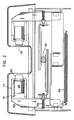
- FIG. 2 is a sectional view of a transducer drive mechanism of the ultrasonic bone analysis apparatus.
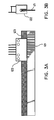
- FIG. 3A and FIG. 3B are front and side views of a position encoder of the ultrasonic bone analysis apparatus.
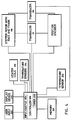
- FIG. 4 is a block diagram showing control of the transducer drive mechanism of the ultrasonic bone analysis apparatus.
- FIG. 5A and FIG. 5B are front and side views of a pad/delay unit of the ultrasonic bone analysis apparatus.
- FIG. 5C is a contour diagram of an end of the pad/delay unit.
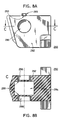
- FIG. 6A is a front view of a first phantom according to the present invention.
- FIG. 6B is a sectional view of the first phantom taken essentially on the line A--A of FIG. 6A.
- FIG. 7A is a front view of a second phantom according to the present invention.
- FIG. 7B is a sectional view of the second phantom taken essentially on the line B--B of FIG. 7A.
- FIG. 8A is a front view of a third phantom according to the present invention.
- FIG. 8B is a sectional view of the third phantom taken essentially on the line C--C of FIG. 9A.
- FIG. 9A and FIG. 9B are a perspective view and an exploded view, respectively, of a transducer assembly of the ultrasonic bone analysis apparatus.
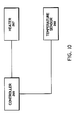
- FIG. 10 is a block diagram showing control of temperature of a phantom of the present invention.
- an ultrasonic bone analysis apparatus with which the phantoms according to the present invention can be used has a foot well assembly 3.
- the foot well assembly 3 comprises a box cover 38 having a foot support 39, and foot well bottom 37.
- the foot support 39 has an area slightly larger than a human foot.
- Transducer ports 36 are located on the sides of the foot support 39, towards the rear.
- Bridge brackets 30 with respective channels 31 which are located along the sides of the foot support 39 facilitate the mounting of a shin guide assembly (not shown) for restraining the foot and lower leg.
- a transducer drive mechanism of the ultrasonic bone analysis apparatus includes a pair of transducer assemblies 110.
- the transducer assemblies 110 include respective transducers 101, respective acoustical delay lines 109 and respective coupling pads 102.
- the transducer assemblies 110 are mounted to respective carriages 103 that slide along a lateral-medial axis.
- the carriages 103 are provided with sufficient freedom of movement such that the respective coupling pads 102 can be brought into mutual contact.
- Respective compression springs 104 attached to the carriages 103 apply opposing lateral forces towards the center of the foot or phantom.
- the carriage/spring assembly is free floating and will center itself on the foot or phantom with equal pressure on both sides.
- An extension spring 105 applies the initial pressure when the coupling pads 102 reach the phantom or the patient's foot.
- a stepper motor with rack and pinion mechanism 106 will move a finite number of steps and compress the compression springs 104 that are attached to the respective carriages 103.
- the compression springs 104 will pull the respective transducers 101 and pads 102 inward at a force proportional to the spring rate and distance translated.
- FIG. 3A and FIG. 3B illustrate respective front and side views of the position encoder 120.
- the position encoder has a code strip 121 mounted onto one of the carriages 103 and an optical encoder reader 122 mounted on the other of the carriages 103. As the distance between the transducers 101 changes, the code strip 121 moves between the slot of the optical encoder reader 122, and the optical reader 122 reads lines 123 of the code strip 121 as the lines 123 are traversed.
- the stepper motor with rack and pinion mechanism 106 under the control of controller 200 automatically positions transducers 101 against the patient's heel or the phantom with sufficient pressure to insure ultrasonic coupling. Signals received by the receiving transducer 101 are supplied to the controller 200.
- the microprocessor-based controller 200 controls the execution of system and application software and has a timer 203 and input/output circuitry 205 for interfacing with user input 220 and display device 210. Data and the system and application software are stored in memory 201 (e.g., RAM and ROM).
- the controller 200 controls the operations of the stepper motor 106 according to positional data supplied by the position encoder 120.
- the controller 200 monitors the position encoder 120 throughout the measurement to detect movement of the transducers 101 which may have a deleterious effect on the measurement.
- the controller 200 determines the quality of the signals received by the receiving transducer 101 at least in part according to the attenuation of the signals, and controls the operations of the stepper motor 106 according to the quality of the signals received by the receiving transducer 101 and positional data supplied by the position encoder 120. These steps are repeated by the controller 200 until the signals received by the receiving transducer 101 achieve a predetermined quality.
- the controller 200 determines other parameters of interest, including BUA and bone velocity. Also, the controller 200 uses timing data supplied by the timer 203 to determine the arrival time of the received ultrasonic signal combined with timing data for the reference signal which is stored in memory and the distance between the transducers as determined by the position encoder 120 to calculate the speed of the ultrasonic signals through the foot or phantom.
- the controller 200 uses temperature readings from temperature sensor 250 to improve the accuracy of the position encoder measurements and correct for temperature dependent inaccuracy in the ultrasound measurement. For example, the controller 200 accounts for linear expansion of the encoder strip-121 by applying a temperature dependent term to the data supplied by the position encoder 120. Additionally, the controller 200 applies a temperature dependent term to correct an estimation of the time delay through the delay line 109 and the coupling pad 102. The controller 200 also applies a temperature dependent term to correct an estimation of the frequency-dependent attenuation of the coupling pad 102. Furthermore, the controller 200 uses the temperature reading to determine if the apparatus is operating within the specified environmental range allowed, and if not, the operator is informed that the apparatus is not ready to be used.
- the coupling pads 102 have a durometer corresponding to a sufficiently flexible waveguide that can partially conform to the shape of a foot.
- the shape of the pads 102 conforms to the heel to eliminate any gaps between the foot and pad.
- the surfaces of the pads 102 which contact the transducers 101, the delay line 109, or the patent's skin is shaped at an angle to the propagation axis to reduce the acoustic reflection at the pad-to-skin interface by spreading the reflected energy over time and position.
- FIG. 5A and FIG. 5B illustrate top and side views of the pad/delay unit 150.
- the surface of the pad that contacts the patient's skin is shaped to expel air bubbles from the contact area when pressure is applied.
- FIG. 5C shows the contours of the surface of the pad/delay unit 150 which contacts the patient's skin.
- the controller 200 When executing software for calibration or quality assurance, the controller 200 via the display device 210 prompts the operator to insert a phantom in the foot support 39 of the foot well assembly 3.
- Figs. 6A and 6B illustrate a phantom 260 having a cylindrical plug 262 cast inside a hard plastic housing 264.
- the cylindrical plug 262 is a soft elastic material having a very low attenuation coefficient.
- the sound impedance of the soft elastic material is relatively close to that of soft human tissue.
- the attenuation-versus-frequency profile of the material in the frequency range of 200-1000 kHz is substantially flat.
- the soft elastic material has a minimal effect on the ultrasonic wave, and a predetermined SOS.
- the soft material is preferably an elastomeric, white castable polyurethane set to a durometer of 10 to 50 Shore A.
- One such material is Ciba-Geigy TDT 178-34, which has a durometer of 15 Shore A and is also the preferred material of the transducer pads 150.
- Indentations 266 are provided on opposite sides of the cylindrical plug 262 to accommodate the respective transducer pads 150.
- the shapes of the indentations 266 complement the shapes of the respective transducer pads 150.
- the hard plastic housing 264 positions the cylindrical plug 262 properly in relation to the transducer pads 150 of the apparatus.
- the complementary shapes of the pads 150 and respective indentations 266 of the cylindrical plug 262 facilitate the coupling of the pads 150 with the plug 262.
- the phantom 260 has approximately the width of the typical female heel, and thereby mimics the conditions at which the heel is measured. As a result, the reference signal spreads out in a pattern similar to that in an ultrasonic measurement of the heel.
- a signal is transmitted through the phantom.
- the controller 200 controls movement of the transducer assemblies 110 using feedback from the encoder 120.
- the received signal which had passed through the phantom 260 is used to calibrate the apparatus.
- the controller 200 uses timing data supplied by the timer 203 to calculate the propagation time of the transmitted signal through the phantom 260.
- the controller 200 saves data of the received signal in the memory 201 and uses the saved data in subsequent calculations of BUA and SOS.
- the propagation time through the phantom 260 is used to calibrate a zero point of the apparatus, so that the propagation time through the foot can be calculated at a later time.
- the zero point is the difference between a predetermined time of propagation through the phantom 260, including an adjustment for temperature, and the measured time of propagation of a transmitted ultrasound signal through the phantom 260.
- the controller 200 also determines the frequency spectrum of the received signal which is used in the BUA calculation.
- the received signal that passed through the phantom 260 is used as a baseline with which a signal that passes through the foot is compared.
- the BUA calculation will be explained in more detail hereinbelow.
- the phantom 260 is also used for quality assurance of the apparatus.
- the controller 200 calculates the drift of the apparatus by using the measurement of the current received signal that passed through the phantom 260 and recorded measurements of past received signals that had passed through the phantom 260 which are stored in memory 201.
- the drift is temperature-dependent. Therefore, because the human foot is typically at 98.6 degrees F and the phantom 260 is at room temperature (generally between 60-90 degrees F), the measured value is temperature-corrected according to the temperature reading from the temperature sensor 250.
- a phantom 270 is provided to mimic the BUA of the human foot.
- the phantom 270 attenuates an ultrasonic wave in the frequency range of 200-1000 kHz by approximately the same amount as a human foot.
- the attenuation-versus-frequency profile of the phantom 270 is substantially linear in the frequency range of 200-600 kHz and is approximately 1 dB/MHz per mm. This profile is very similar to the attenuation-versus-frequency profile of the human foot.
- the phantom 270 is a cut, castable, or otherwise manufactured block of material 272 having indentations 276 on opposite sides thereof to accommodate the respective transducer pads 150.
- the shapes of the indentations 276 complement the shapes of the respective transducer pads 150.
- the complementary shapes of the pads 150 and respective indentations 276 facilitate the coupling of the pads 150 with the block 272.
- the phantom 270 also has approximately the width of the typical female heel, and thereby mimics the conditions at which the heel is measured.
- the block 272 is shaped to position the phantom 270 properly in relation to the transducer pads 150 when the phantom 270 is placed in the foot support 39 of the apparatus.
- the block 272 is preferably a castable polyurethane.
- One such polyurethane is black and has approximately an 80 Shore A durometer.
- the polyurethane block is simple to manufacture and suitably mimics the human foot.
- Software for calibration and quality assurance also measures a received signal that passed through the phantom 270.
- the steps for acquiring this measurement are similar to the steps for acquiring a measurement of the signal that passed through the phantom 260, as set forth hereinabove.
- the received signals that passed through the phantom 270 are used for quality assurance of the apparatus for a BUA measurement.
- the BUA of a measured signal is calculated in the frequency domain.
- the measured signal and the reference signal in the time domain are transferred to respective frequency-domain counterparts
- the BUA is the slope of a line fit to a function A(f) in a specific frequency range.
- a commonly used frequency range is 0.2 to 0.6 MHz.
- the reference signal may be obtained by measuring a signal that passed through the phantom 260. Magnitudes of respective frequency components of this reference signal are used as the reference
- the same reference signal may be used as the reference for calculating the BUA of a signal that passed through the phantom 270.
- the magnitudes of the respective frequency components of the signal that passed through the phantom 270 are the
- the measurement of the received signal that passed through the phantom 270 is used by the quality assurance software to determine instrument drift. Because the phantom 270 mimics the human foot, the determined drift would reflect the expected drift when a human foot is analyzed using the apparatus. Again, because drift is temperature-dependent, the calculation includes a temperature correction term.
- Figs. 8A and 8B illustrate a phantom 280 that has a substantially zero temperature coefficient over a range of normal ambient temperatures.
- the temperature-independent phantom 280 has a housing 282 containing a mixture of ethyl alcohol and water which is 17% ethyl alcohol by weight.
- the housing 282 has a filler port 283 through which the mixture is introduced.
- a cap 285 plugs the filler port 283 after the mixture fills a receptacle 284 formed by inner walls of the housing 282.
- the plugged receptacle 284 is air-tight to prevent a change in alcohol concentration by evaporation of the alcohol or absorption of water by the mixture.
- the housing 282 is made from preferably a polymer such as polyurethane which has a predetermined SOS.
- Indentations 286 are provided on opposite sides of the housing 282 to accommodate the respective transducer pads 150.
- the bottoms of the respective indentations 286 are parallel to respective adjacent inner walls 288 of the housing. Therefore, the shapes of the indentations 286 do not complement the shape of the respective transducer pads 150. Nevertheless, because the pads 150 are elastomers, when the phantom is placed in the foot support 39, the transducer assemblies 110 can be moved under the control of controller 200 to compress the respective transducer pads 150 against the bottoms of the respective indentations 286 until there is adequate coupling. The compression of the transducer pads 150 does not affect the SOS measurement.
- the housing 282 between each of the indentations 286 and the mixture should be relatively thin compared to the distance between the inner walls 288.
- the other portions of the housing 282 can be relatively thicker than the distance between the indentations 286 and the respective adjacent inner walls 288.
- the phantom 280 also has approximately the width of the typical female heel, and thereby mimics the conditions at which the heel is measured.
- the housing 282 is shaped to position the phantom 280 properly in relation to the transducer pads 150 when the phantom 280 is placed in the foot support 39 of the apparatus.
- the housing 282 encloses the fluid mixture
- the phantom 280 is convenient to use. Furthermore, the phantom 280 having a polymer housing is easily manufactured.
- the phantom 280 is used to calibrate the apparatus for the SOS calculation. Furthermore, the phantom 280 can be used for quality assurance to measure instrument drift. Because the phantom 280 has a predetermined SOS that is temperature-independent, the drift can be determined by comparing the measured value with the predetermined value.
- the steps for acquiring a signal that passed through the phantom 280 are similar to the steps for acquiring a signal that passed through the phantom 260, as set forth hereinabove.
- the phantom 280 as described is substantially temperature-independent over a range of normal ambient temperatures because a mixture of ethyl alcohol and water which is 17% ethyl alcohol by weight is used. The temperature independence is preferred. Alternatively, the 17% mixture can be replaced by pure water or a mixture of water and ethyl alcohol which has a predetermined temperature coefficient. Measurements of an ultrasonic signal that passed through a phantom using pure water or the alternative mixture would need to be adjusted with an appropriate temperature-correction term which can be determined by one skilled in the art.
- a reference signal can be obtained by another method using the ultrasonic bone analysis apparatus without a phantom.
- the controller 200 controls movement of the transducer assemblies 110 until the transducer pads 150 are mutually in contact.
- a received signal that passed through the mutually touching transducer pads can be used for many of the same purposes, which are described hereinabove, for which the received signals that passed through the phantom 260 is used.
- the measurement of the received signal that passed through the mutually contacting coupling pads is obtained relatively close in time to a measurement of a signal passing through a heel or a phantom interposed between the pads. Because proximity in time is accompanied, presumptively, by proximity in ambient temperatures for the respective measurements, no correction for time or temperature drift between the measurements is required. Therefore, the measured signal obtained while the pads 150 are mutually touching may be used to compare with the signal that passed through the heel to measure quantities that are of interest to bone quality without contamination of the measurement by the ambient temperature at which the measurement was taken.
- the received signal that passed through the mutually touching pads may be used as a reference for a BUA measurement. Additionally, a propagation time of the ultrasonic signal through the mutually touching pads is measured and may be used as a reference time for propagation through the pads. The reference time measurement may be compared to the measurement of the signal that passed through the heel to determine a time of propagation through the heel. The calculated time of propagation through the heel along with information about the width of the heel are used to calculate a SOS of the heel.
- the received signal that passed through the mutually touching pads may be compared to an ultrasonic signal measured at a known temperature, and the time of arrival of the two may be used to calculate an effective temperature of the pads.
- the effective temperature may be used to adjust temperature-dependent coefficients of the BUA for the temporally-proximate measurements of the signals that pass through the heel or phantom.
- the transmission of an ultrasonic signal through mutually contacting coupling pads may produce a reflected signal from a reflection by either the interface between the pads, a reflecting object placed in the pads, or a non-transmitting transducer face.
- a measurement of the reflected signal may be used to determine a time of propagation through all or part of the transmitting media, including the transducer 101 and the transducer pads 150, and scaled for comparison to the temporally-proximate measurement of the signal passing through the heel or phantom.
- Transmission of an ultrasonic signal through non-contacting coupling pads can also produce a reflected signal.
- a measurement of the reflected signal produced from a reflection by either the interface between the pad and air, a reflecting object placed in the pads, or an object interposed between the pads may be used for the same purposes as the measurement of the reflected signal produced by transmitting through mutually contacting coupling pads.
- the present invention makes other provisions for controlling the environment of the transmission media.
- the transducer assembly 110 includes a heater coil 291, a cap 292, and a housing 293.
- the heater coil 291 is wrapped around a portion of the coupling pad 150.
- the cap 292 isolates the heater coil 291 from the housing 293.
- a temperature sensor 294 (shown in Fig. 4) is buried inside the coupling pad 150, and thereby the temperature of the pad 150 can be monitored.
- the controller 200 monitors a temperature reading supplied by the temperature sensor 294 and controls the heater coil 291 accordingly to maintain the pads 150 at a predetermined temperature, such as approximately body temperature.
- the phantoms 260, 270 and 280 which are used for calibration or quality assurance according to the present invention are preferably also provided with respective heaters 267, temperature sensors 268 and controllers 269.
- the temperature sensor 268 are also buried inside the respective phantoms and supply readings of the respective temperatures of the respective phantoms.
- the controllers 269 monitor the respective temperature readings of the respective temperature sensors 268 and controls the respective heaters accordingly to maintain a predetermined value.
- the temperature of the phantom can be maintained at approximately body temperature to simulate the measurement of the heel.
- the temperature at which an ultrasound measurement of the signal passing through one of the phantoms thereby can be controlled.
- Coupling gel can be used with the phantoms of the present invention.
- the coupling gel applied between the phantom and coupling pads does not affect the efficacy of the phantoms.
- a non-aqueous jelly is preferred.
- petroleum jelly can be used as a coupling gel.
- the present invention has been described by using three separate phantoms.
- the relevant features of the respective phantoms can be combined into a single phantom.
- the single phantom can have the configuration of one of the above-described phantoms, and includes combined materials to provide the above-described properties of the three phantoms so that a received signal that passed through the single phantom has signal characteristics corresponding to these properties.
Landscapes
- Health & Medical Sciences (AREA)
- Life Sciences & Earth Sciences (AREA)
- Medical Informatics (AREA)
- Molecular Biology (AREA)
- Veterinary Medicine (AREA)
- Biophysics (AREA)
- Pathology (AREA)
- Engineering & Computer Science (AREA)
- Biomedical Technology (AREA)
- Heart & Thoracic Surgery (AREA)
- Public Health (AREA)
- Physics & Mathematics (AREA)
- Surgery (AREA)
- Animal Behavior & Ethology (AREA)
- General Health & Medical Sciences (AREA)
- Nuclear Medicine, Radiotherapy & Molecular Imaging (AREA)
- Radiology & Medical Imaging (AREA)
- Dentistry (AREA)
- Oral & Maxillofacial Surgery (AREA)
- Orthopedic Medicine & Surgery (AREA)
- Rheumatology (AREA)
- Ultra Sonic Daignosis Equipment (AREA)
Applications Claiming Priority (2)
| Application Number | Priority Date | Filing Date | Title |
|---|---|---|---|
| US08/534,131 US5755228A (en) | 1995-06-07 | 1995-09-26 | Equipment and method for calibration and quality assurance of an ultrasonic bone anaylsis apparatus |
| US534131 | 1995-09-26 |
Publications (2)
| Publication Number | Publication Date |
|---|---|
| EP0765635A2 true EP0765635A2 (fr) | 1997-04-02 |
| EP0765635A3 EP0765635A3 (fr) | 1997-10-01 |
Family
ID=24128811
Family Applications (1)
| Application Number | Title | Priority Date | Filing Date |
|---|---|---|---|
| EP96307032A Withdrawn EP0765635A3 (fr) | 1995-09-26 | 1996-09-26 | Dispositif et méthode pour étalonner et assurer la qualité d'un appareil d'analyse ultrasonique d'un os |
Country Status (5)
| Country | Link |
|---|---|
| US (2) | US5755228A (fr) |
| EP (1) | EP0765635A3 (fr) |
| JP (1) | JPH09192129A (fr) |
| AU (1) | AU704278B2 (fr) |
| CA (1) | CA2185761A1 (fr) |
Cited By (6)
| Publication number | Priority date | Publication date | Assignee | Title |
|---|---|---|---|---|
| WO1997043606A1 (fr) * | 1996-05-09 | 1997-11-20 | Osteometer Meditech A/S | Fantomes pour ultrasons |
| GB2321704A (en) * | 1997-02-01 | 1998-08-05 | Huntleigh Technology Plc | Ultrasound device for measuring bone density |
| WO2000015115A1 (fr) * | 1998-09-10 | 2000-03-23 | Metra Biosystems, Inc. | Appareil et procede d'etalonnage d'une sonde de transmission d'ultrasons |
| WO2000028900A1 (fr) * | 1998-11-17 | 2000-05-25 | Metra Biosystems, Inc. | Geometrie d'un objet de test pour calibrage par transmission ultrasonore |
| EP1038501A1 (fr) * | 1999-03-26 | 2000-09-27 | Hologic, Inc. | Dispositif et procédé pour calibrer et pour assurer la qualité d'un appareil d'analyse ultrasonique d'os |
| CN104582583A (zh) * | 2012-08-17 | 2015-04-29 | 富士胶片株式会社 | 光声图像生成装置及方法 |
Families Citing this family (141)
| Publication number | Priority date | Publication date | Assignee | Title |
|---|---|---|---|---|
| US6050943A (en) | 1997-10-14 | 2000-04-18 | Guided Therapy Systems, Inc. | Imaging, therapy, and temperature monitoring ultrasonic system |
| US6391005B1 (en) | 1998-03-30 | 2002-05-21 | Agilent Technologies, Inc. | Apparatus and method for penetration with shaft having a sensor for sensing penetration depth |
| US6234969B1 (en) | 1999-02-01 | 2001-05-22 | Hologic, Inc. | Bone sonometry, densitometry and imaging |
| US6631353B1 (en) * | 1999-06-10 | 2003-10-07 | Hologic, Inc. | Sonometry and densitometry medical diagnostic devices enabled for per-use patient examinations charged via internet connections to financial cards |
| US6835178B1 (en) * | 1999-06-23 | 2004-12-28 | Hologic, Inc. | Ultrasonic bone testing with copolymer transducers |
| WO2000078219A1 (fr) * | 1999-06-23 | 2000-12-28 | Hologic, Inc. | Examen des os par ultrasons au moyen de transducteurs en copolymere |
| US6238343B1 (en) * | 1999-06-28 | 2001-05-29 | Wisconsin Alumni Research Foundation | Quality assurance ultrasound phantoms |
| US7510536B2 (en) * | 1999-09-17 | 2009-03-31 | University Of Washington | Ultrasound guided high intensity focused ultrasound treatment of nerves |
| US7520856B2 (en) * | 1999-09-17 | 2009-04-21 | University Of Washington | Image guided high intensity focused ultrasound device for therapy in obstetrics and gynecology |
| JP2003513691A (ja) | 1999-10-25 | 2003-04-15 | シーラス、コーポレイション | 血管を封止するための集束超音波の使用 |
| US6626855B1 (en) | 1999-11-26 | 2003-09-30 | Therus Corpoation | Controlled high efficiency lesion formation using high intensity ultrasound |
| JP4681109B2 (ja) * | 2000-11-02 | 2011-05-11 | アロカ株式会社 | 超音波生体組織評価装置 |
| JP4681108B2 (ja) * | 2000-11-02 | 2011-05-11 | アロカ株式会社 | 超音波生体組織評価システム |
| JP4666749B2 (ja) * | 2000-11-10 | 2011-04-06 | アロカ株式会社 | 超音波骨評価装置 |
| JP4681110B2 (ja) * | 2000-11-13 | 2011-05-11 | アロカ株式会社 | 超音波生体組織評価システム |
| US8641644B2 (en) | 2000-11-21 | 2014-02-04 | Sanofi-Aventis Deutschland Gmbh | Blood testing apparatus having a rotatable cartridge with multiple lancing elements and testing means |
| US7914453B2 (en) | 2000-12-28 | 2011-03-29 | Ardent Sound, Inc. | Visual imaging system for ultrasonic probe |
| US9795747B2 (en) | 2010-06-02 | 2017-10-24 | Sanofi-Aventis Deutschland Gmbh | Methods and apparatus for lancet actuation |
| ES2336081T3 (es) | 2001-06-12 | 2010-04-08 | Pelikan Technologies Inc. | Dispositivo de puncion de auto-optimizacion con medios de adaptacion a variaciones temporales en las propiedades cutaneas. |
| US7981056B2 (en) | 2002-04-19 | 2011-07-19 | Pelikan Technologies, Inc. | Methods and apparatus for lancet actuation |
| US9427532B2 (en) | 2001-06-12 | 2016-08-30 | Sanofi-Aventis Deutschland Gmbh | Tissue penetration device |
| AU2002348683A1 (en) | 2001-06-12 | 2002-12-23 | Pelikan Technologies, Inc. | Method and apparatus for lancet launching device integrated onto a blood-sampling cartridge |
| US8337419B2 (en) | 2002-04-19 | 2012-12-25 | Sanofi-Aventis Deutschland Gmbh | Tissue penetration device |
| ATE485766T1 (de) | 2001-06-12 | 2010-11-15 | Pelikan Technologies Inc | Elektrisches betätigungselement für eine lanzette |
| US7041068B2 (en) | 2001-06-12 | 2006-05-09 | Pelikan Technologies, Inc. | Sampling module device and method |
| US9226699B2 (en) | 2002-04-19 | 2016-01-05 | Sanofi-Aventis Deutschland Gmbh | Body fluid sampling module with a continuous compression tissue interface surface |
| US7901362B2 (en) | 2002-04-19 | 2011-03-08 | Pelikan Technologies, Inc. | Method and apparatus for penetrating tissue |
| US7232451B2 (en) | 2002-04-19 | 2007-06-19 | Pelikan Technologies, Inc. | Method and apparatus for penetrating tissue |
| US8267870B2 (en) | 2002-04-19 | 2012-09-18 | Sanofi-Aventis Deutschland Gmbh | Method and apparatus for body fluid sampling with hybrid actuation |
| US7297122B2 (en) | 2002-04-19 | 2007-11-20 | Pelikan Technologies, Inc. | Method and apparatus for penetrating tissue |
| US7175642B2 (en) | 2002-04-19 | 2007-02-13 | Pelikan Technologies, Inc. | Methods and apparatus for lancet actuation |
| US7229458B2 (en) | 2002-04-19 | 2007-06-12 | Pelikan Technologies, Inc. | Method and apparatus for penetrating tissue |
| US7892183B2 (en) | 2002-04-19 | 2011-02-22 | Pelikan Technologies, Inc. | Method and apparatus for body fluid sampling and analyte sensing |
| US7331931B2 (en) | 2002-04-19 | 2008-02-19 | Pelikan Technologies, Inc. | Method and apparatus for penetrating tissue |
| US8702624B2 (en) | 2006-09-29 | 2014-04-22 | Sanofi-Aventis Deutschland Gmbh | Analyte measurement device with a single shot actuator |
| US8221334B2 (en) | 2002-04-19 | 2012-07-17 | Sanofi-Aventis Deutschland Gmbh | Method and apparatus for penetrating tissue |
| US8372016B2 (en) | 2002-04-19 | 2013-02-12 | Sanofi-Aventis Deutschland Gmbh | Method and apparatus for body fluid sampling and analyte sensing |
| US9248267B2 (en) | 2002-04-19 | 2016-02-02 | Sanofi-Aventis Deustchland Gmbh | Tissue penetration device |
| US7491178B2 (en) | 2002-04-19 | 2009-02-17 | Pelikan Technologies, Inc. | Method and apparatus for penetrating tissue |
| US9795334B2 (en) | 2002-04-19 | 2017-10-24 | Sanofi-Aventis Deutschland Gmbh | Method and apparatus for penetrating tissue |
| US7226461B2 (en) | 2002-04-19 | 2007-06-05 | Pelikan Technologies, Inc. | Method and apparatus for a multi-use body fluid sampling device with sterility barrier release |
| US8579831B2 (en) | 2002-04-19 | 2013-11-12 | Sanofi-Aventis Deutschland Gmbh | Method and apparatus for penetrating tissue |
| US9314194B2 (en) | 2002-04-19 | 2016-04-19 | Sanofi-Aventis Deutschland Gmbh | Tissue penetration device |
| US8784335B2 (en) | 2002-04-19 | 2014-07-22 | Sanofi-Aventis Deutschland Gmbh | Body fluid sampling device with a capacitive sensor |
| US7674232B2 (en) | 2002-04-19 | 2010-03-09 | Pelikan Technologies, Inc. | Method and apparatus for penetrating tissue |
| US7547287B2 (en) | 2002-04-19 | 2009-06-16 | Pelikan Technologies, Inc. | Method and apparatus for penetrating tissue |
| US7909778B2 (en) | 2002-04-19 | 2011-03-22 | Pelikan Technologies, Inc. | Method and apparatus for penetrating tissue |
| US7976476B2 (en) | 2002-04-19 | 2011-07-12 | Pelikan Technologies, Inc. | Device and method for variable speed lancet |
| US8360992B2 (en) | 2002-04-19 | 2013-01-29 | Sanofi-Aventis Deutschland Gmbh | Method and apparatus for penetrating tissue |
| US8574895B2 (en) | 2002-12-30 | 2013-11-05 | Sanofi-Aventis Deutschland Gmbh | Method and apparatus using optical techniques to measure analyte levels |
| JP2006524798A (ja) * | 2003-02-13 | 2006-11-02 | ネクセンス リミテッド | 様々なパラメータの高感度測定を行なうための装置、およびそのような装置で特に有用なセンサ |
| CN100507547C (zh) * | 2003-02-13 | 2009-07-01 | 内克申斯有限公司 | 用于测量预定参数的设备、传感器及系统 |
| EP1628567B1 (fr) | 2003-05-30 | 2010-08-04 | Pelikan Technologies Inc. | Procede et appareil pour injection de fluide |
| EP1633235B1 (fr) | 2003-06-06 | 2014-05-21 | Sanofi-Aventis Deutschland GmbH | Appareil d'echantillonnage de fluides anatomiques et d'examen de l'analysat |
| WO2006001797A1 (fr) | 2004-06-14 | 2006-01-05 | Pelikan Technologies, Inc. | Element penetrant peu douloureux |
| EP1671096A4 (fr) | 2003-09-29 | 2009-09-16 | Pelikan Technologies Inc | Procede et appareil permettant d'obtenir un dispositif de capture d'echantillons ameliore |
| US9351680B2 (en) | 2003-10-14 | 2016-05-31 | Sanofi-Aventis Deutschland Gmbh | Method and apparatus for a variable user interface |
| US20110040171A1 (en) * | 2003-12-16 | 2011-02-17 | University Of Washington | Image guided high intensity focused ultrasound treatment of nerves |
| EP1706026B1 (fr) | 2003-12-31 | 2017-03-01 | Sanofi-Aventis Deutschland GmbH | Procédé et appareil permettant d'améliorer le flux fluidique et le prélèvement d'échantillons |
| US7822454B1 (en) | 2005-01-03 | 2010-10-26 | Pelikan Technologies, Inc. | Fluid sampling device with improved analyte detecting member configuration |
| US8235909B2 (en) * | 2004-05-12 | 2012-08-07 | Guided Therapy Systems, L.L.C. | Method and system for controlled scanning, imaging and/or therapy |
| WO2006011062A2 (fr) | 2004-05-20 | 2006-02-02 | Albatros Technologies Gmbh & Co. Kg | Hydrogel imprimable pour biocapteurs |
| US9775553B2 (en) | 2004-06-03 | 2017-10-03 | Sanofi-Aventis Deutschland Gmbh | Method and apparatus for a fluid sampling device |
| WO2005120365A1 (fr) | 2004-06-03 | 2005-12-22 | Pelikan Technologies, Inc. | Procede et appareil pour la fabrication d'un dispositif d'echantillonnage de liquides |
| US9066679B2 (en) | 2004-08-31 | 2015-06-30 | University Of Washington | Ultrasonic technique for assessing wall vibrations in stenosed blood vessels |
| US9011336B2 (en) | 2004-09-16 | 2015-04-21 | Guided Therapy Systems, Llc | Method and system for combined energy therapy profile |
| US7824348B2 (en) | 2004-09-16 | 2010-11-02 | Guided Therapy Systems, L.L.C. | System and method for variable depth ultrasound treatment |
| US7393325B2 (en) | 2004-09-16 | 2008-07-01 | Guided Therapy Systems, L.L.C. | Method and system for ultrasound treatment with a multi-directional transducer |
| AU2005284695A1 (en) * | 2004-09-16 | 2006-03-23 | University Of Washington | Acoustic coupler using an independent water pillow with circulation for cooling a transducer |
| US10864385B2 (en) | 2004-09-24 | 2020-12-15 | Guided Therapy Systems, Llc | Rejuvenating skin by heating tissue for cosmetic treatment of the face and body |
| US8444562B2 (en) | 2004-10-06 | 2013-05-21 | Guided Therapy Systems, Llc | System and method for treating muscle, tendon, ligament and cartilage tissue |
| US8535228B2 (en) | 2004-10-06 | 2013-09-17 | Guided Therapy Systems, Llc | Method and system for noninvasive face lifts and deep tissue tightening |
| EP2279699B1 (fr) | 2004-10-06 | 2019-07-24 | Guided Therapy Systems, L.L.C. | Procédé pour l'amélioration cosmétique non invasive de la cellulite |
| US7758524B2 (en) | 2004-10-06 | 2010-07-20 | Guided Therapy Systems, L.L.C. | Method and system for ultra-high frequency ultrasound treatment |
| US9694212B2 (en) | 2004-10-06 | 2017-07-04 | Guided Therapy Systems, Llc | Method and system for ultrasound treatment of skin |
| US8133180B2 (en) | 2004-10-06 | 2012-03-13 | Guided Therapy Systems, L.L.C. | Method and system for treating cellulite |
| US9827449B2 (en) | 2004-10-06 | 2017-11-28 | Guided Therapy Systems, L.L.C. | Systems for treating skin laxity |
| US8690778B2 (en) | 2004-10-06 | 2014-04-08 | Guided Therapy Systems, Llc | Energy-based tissue tightening |
| US11235179B2 (en) | 2004-10-06 | 2022-02-01 | Guided Therapy Systems, Llc | Energy based skin gland treatment |
| US11883688B2 (en) | 2004-10-06 | 2024-01-30 | Guided Therapy Systems, Llc | Energy based fat reduction |
| KR20240113495A (ko) | 2004-10-06 | 2024-07-22 | 가이디드 테라피 시스템스, 엘.엘.씨. | 초음파 치료 시스템 |
| US20060111744A1 (en) | 2004-10-13 | 2006-05-25 | Guided Therapy Systems, L.L.C. | Method and system for treatment of sweat glands |
| US11207548B2 (en) | 2004-10-07 | 2021-12-28 | Guided Therapy Systems, L.L.C. | Ultrasound probe for treating skin laxity |
| US11724133B2 (en) | 2004-10-07 | 2023-08-15 | Guided Therapy Systems, Llc | Ultrasound probe for treatment of skin |
| US8652831B2 (en) | 2004-12-30 | 2014-02-18 | Sanofi-Aventis Deutschland Gmbh | Method and apparatus for analyte measurement test time |
| EP1875327A2 (fr) | 2005-04-25 | 2008-01-09 | Guided Therapy Systems, L.L.C. | Procede et systeme pour ameliorer la securite de peripherique d'ordinateur |
| EP1921976A2 (fr) * | 2005-08-12 | 2008-05-21 | University of Washington | Procédé et appareil de préparation d`organes et de tissus pour chirurgie laparoscopique |
| US8414494B2 (en) * | 2005-09-16 | 2013-04-09 | University Of Washington | Thin-profile therapeutic ultrasound applicators |
| US8016757B2 (en) * | 2005-09-30 | 2011-09-13 | University Of Washington | Non-invasive temperature estimation technique for HIFU therapy monitoring using backscattered ultrasound |
| US20070233185A1 (en) | 2005-10-20 | 2007-10-04 | Thomas Anderson | Systems and methods for sealing a vascular opening |
| US9566454B2 (en) | 2006-09-18 | 2017-02-14 | Guided Therapy Systems, Llc | Method and sysem for non-ablative acne treatment and prevention |
| EP2152351B1 (fr) | 2007-05-07 | 2016-09-21 | Guided Therapy Systems, L.L.C. | Procédés et systèmes de modulation de substances médicamenteuses utilisant l'énergie acoustique |
| US8764687B2 (en) | 2007-05-07 | 2014-07-01 | Guided Therapy Systems, Llc | Methods and systems for coupling and focusing acoustic energy using a coupler member |
| US20150174388A1 (en) | 2007-05-07 | 2015-06-25 | Guided Therapy Systems, Llc | Methods and Systems for Ultrasound Assisted Delivery of a Medicant to Tissue |
| JP5531307B2 (ja) * | 2007-05-09 | 2014-06-25 | 国立大学法人山梨大学 | 踵骨音速測定装置 |
| FI124644B (fi) * | 2008-03-05 | 2014-11-28 | Oscare Medical Oy | Menetelmä ja laite luun tiheyden mittaamista varten |
| FI124645B (fi) * | 2008-03-05 | 2014-11-28 | Oscare Medical Oy | Kalibroitava menetelmä ja laite luun tiheyden mittaamista varten |
| WO2009126900A1 (fr) | 2008-04-11 | 2009-10-15 | Pelikan Technologies, Inc. | Procédé et appareil pour dispositif de détection d’analyte |
| US12102473B2 (en) | 2008-06-06 | 2024-10-01 | Ulthera, Inc. | Systems for ultrasound treatment |
| KR102087909B1 (ko) | 2008-06-06 | 2020-03-12 | 얼테라, 인크 | 코스메틱 치료 시스템 |
| US20100160781A1 (en) * | 2008-12-09 | 2010-06-24 | University Of Washington | Doppler and image guided device for negative feedback phased array hifu treatment of vascularized lesions |
| JP2012513837A (ja) | 2008-12-24 | 2012-06-21 | ガイデッド セラピー システムズ, エルエルシー | 脂肪減少および/またはセルライト処置のための方法およびシステム |
| US9375169B2 (en) | 2009-01-30 | 2016-06-28 | Sanofi-Aventis Deutschland Gmbh | Cam drive for managing disposable penetrating member actions with a single motor and motor and control system |
| EP2416709A2 (fr) * | 2009-04-07 | 2012-02-15 | Beam-Med Ltd. | Sonomètre osseux amélioré |
| US8459095B2 (en) * | 2009-09-30 | 2013-06-11 | General Electric Company | Phantom for a quantitative ultrasound device |
| US8438900B2 (en) * | 2009-09-30 | 2013-05-14 | General Electric Company | Electronic phantom and method for electronically controlling a phantom for a quantitative ultrasound device |
| US20160059044A1 (en) | 2009-10-12 | 2016-03-03 | Kona Medical, Inc. | Energy delivery to intraparenchymal regions of the kidney to treat hypertension |
| US11998266B2 (en) | 2009-10-12 | 2024-06-04 | Otsuka Medical Devices Co., Ltd | Intravascular energy delivery |
| US20110092880A1 (en) | 2009-10-12 | 2011-04-21 | Michael Gertner | Energetic modulation of nerves |
| US8469904B2 (en) | 2009-10-12 | 2013-06-25 | Kona Medical, Inc. | Energetic modulation of nerves |
| US20110118600A1 (en) | 2009-11-16 | 2011-05-19 | Michael Gertner | External Autonomic Modulation |
| US8517962B2 (en) | 2009-10-12 | 2013-08-27 | Kona Medical, Inc. | Energetic modulation of nerves |
| US9119951B2 (en) | 2009-10-12 | 2015-09-01 | Kona Medical, Inc. | Energetic modulation of nerves |
| US9174065B2 (en) | 2009-10-12 | 2015-11-03 | Kona Medical, Inc. | Energetic modulation of nerves |
| US8295912B2 (en) | 2009-10-12 | 2012-10-23 | Kona Medical, Inc. | Method and system to inhibit a function of a nerve traveling with an artery |
| US8986231B2 (en) | 2009-10-12 | 2015-03-24 | Kona Medical, Inc. | Energetic modulation of nerves |
| US8986211B2 (en) | 2009-10-12 | 2015-03-24 | Kona Medical, Inc. | Energetic modulation of nerves |
| US8715186B2 (en) | 2009-11-24 | 2014-05-06 | Guided Therapy Systems, Llc | Methods and systems for generating thermal bubbles for improved ultrasound imaging and therapy |
| US8965476B2 (en) | 2010-04-16 | 2015-02-24 | Sanofi-Aventis Deutschland Gmbh | Tissue penetration device |
| US9504446B2 (en) | 2010-08-02 | 2016-11-29 | Guided Therapy Systems, Llc | Systems and methods for coupling an ultrasound source to tissue |
| EP2600783A4 (fr) | 2010-08-02 | 2017-05-17 | Guided Therapy Systems, L.L.C. | Systèmes et procédés de traitement ultrasonore |
| US8857438B2 (en) | 2010-11-08 | 2014-10-14 | Ulthera, Inc. | Devices and methods for acoustic shielding |
| WO2013009785A2 (fr) | 2011-07-10 | 2013-01-17 | Guided Therapy Systems, Llc. | Système et procédé pour améliorer l'aspect extérieur de la peau en utilisant les ultrasons comme source d'énergie |
| KR20190080967A (ko) | 2011-07-11 | 2019-07-08 | 가이디드 테라피 시스템스, 엘.엘.씨. | 조직에 초음파원을 연결하는 시스템 및 방법 |
| US9263663B2 (en) | 2012-04-13 | 2016-02-16 | Ardent Sound, Inc. | Method of making thick film transducer arrays |
| US9510802B2 (en) | 2012-09-21 | 2016-12-06 | Guided Therapy Systems, Llc | Reflective ultrasound technology for dermatological treatments |
| CN204017181U (zh) | 2013-03-08 | 2014-12-17 | 奥赛拉公司 | 美学成像与处理系统、多焦点处理系统和执行美容过程的系统 |
| US10561862B2 (en) | 2013-03-15 | 2020-02-18 | Guided Therapy Systems, Llc | Ultrasound treatment device and methods of use |
| US20150196275A1 (en) * | 2014-01-14 | 2015-07-16 | Cyberlogic, Inc. | Ultrasound Measurement Device and Method for Ultrasonic Measurement |
| KR20150118732A (ko) | 2014-04-15 | 2015-10-23 | 삼성전자주식회사 | 초음파 장치 및 그 제어 방법 |
| SG11201608691YA (en) | 2014-04-18 | 2016-11-29 | Ulthera Inc | Band transducer ultrasound therapy |
| US10925579B2 (en) | 2014-11-05 | 2021-02-23 | Otsuka Medical Devices Co., Ltd. | Systems and methods for real-time tracking of a target tissue using imaging before and during therapy delivery |
| CA3007665A1 (fr) | 2016-01-18 | 2017-07-27 | Ulthera, Inc. | Dispositif a ultrasons compact possedant un reseau a ultrasons peripherique annulaire electriquement connecte a une carte de circuit imprime flexible et son procede d'assemblage |
| IL264440B (en) | 2016-08-16 | 2022-07-01 | Ulthera Inc | Systems and methods for cosmetic treatment of the skin using ultrasound |
| TW202529848A (zh) | 2018-01-26 | 2025-08-01 | 美商奧賽拉公司 | 用於多個維度中的同時多聚焦超音治療的系統和方法 |
| WO2019164836A1 (fr) | 2018-02-20 | 2019-08-29 | Ulthera, Inc. | Systèmes et procédés de traitement cosmétique combiné de la cellulite par ultrasons |
| JP2022513577A (ja) | 2018-11-30 | 2022-02-09 | ウルセラ インコーポレイテッド | 超音波処置の効能を増強させるためのシステムおよび方法 |
| CN111743569B (zh) * | 2019-03-28 | 2021-07-27 | 无锡声美达医学技术有限公司 | 一种仪器测试方法、装置及设备 |
| CA3137928A1 (fr) | 2019-07-15 | 2021-01-21 | Ulthera, Inc. | Systemes et procedes de mesure de l'elasticite par imagerie d'ondes de cisaillement multi-foyer a ultrasons dans de multiples dimensions |
| EP3988167A1 (fr) * | 2020-10-23 | 2022-04-27 | Cardiawave SA | Procédé permettant de tester la précision et la performance d'un transducteur à ultrasons |
| CN112741650B (zh) * | 2020-12-11 | 2021-11-05 | 浙江大学 | 高精度全干式超声骨密度仪和测量方法 |
Family Cites Families (22)
| Publication number | Priority date | Publication date | Assignee | Title |
|---|---|---|---|---|
| US32782A (en) * | 1861-07-09 | Improvement in sewing-machines | ||
| US4361154A (en) * | 1978-07-28 | 1982-11-30 | Massachusetts Institute Of Technology | Method for establishing, in vivo, bone strength |
| US4421119A (en) * | 1979-06-15 | 1983-12-20 | Massachusetts Institute Of Technology | Apparatus for establishing in vivo, bone strength |
| USRE32782E (en) * | 1978-07-28 | 1988-11-15 | Massachusetts Institute Of Technology | Method for determining in vivo, bone strength |
| US4286455A (en) * | 1979-05-04 | 1981-09-01 | Acoustic Standards Corporation | Ultrasound phantom |
| US4774959A (en) * | 1986-01-10 | 1988-10-04 | Walker Sonix A/S | Narrow band ultrasonic frequency attentuation bone measurement system |
| US4913157A (en) * | 1986-06-03 | 1990-04-03 | Analog Devices, Inc. | Ultrasound method and apparatus for evaluating, in vivo, bone conditions |
| EP0299906A3 (fr) * | 1987-07-16 | 1990-06-13 | The University Of Melbourne | Mesure de la qualité d'os in-vivo |
| DE8717504U1 (de) * | 1987-10-19 | 1989-01-05 | Siemens AG, 1000 Berlin und 8000 München | Stoßwellenquelle mit zentralem Ultraschall-Ortungssystem |
| US5343863A (en) * | 1988-05-11 | 1994-09-06 | Lunar Corporation | Ultrasonic densitometer device and method |
| US4930511A (en) * | 1988-05-11 | 1990-06-05 | Lunar Radiation, Inc. | Ultrasonic densitometer device and method |
| US5349959A (en) * | 1988-05-11 | 1994-09-27 | Lunar Corporation | Ultrasonic densitometer device and method |
| US4941474A (en) * | 1988-07-01 | 1990-07-17 | Massachusetts Institute Of Technology | Multivariable analysis of bone condition |
| US4894013A (en) * | 1988-10-13 | 1990-01-16 | The United States Of America As Represented By The Department Of Health And Human Services | Anthropomorphic cardiac ultrasound phantom |
| US5052934A (en) * | 1990-04-20 | 1991-10-01 | The United States Of America As Represented By The Department Of Health And Human Services | Phantom for evaluation of prosthetic valves and cardiac ultrasound procedures |
| US5014970A (en) * | 1990-05-31 | 1991-05-14 | Walker Magnetics Group, Inc. | Body member positioner |
| US5196343A (en) * | 1990-10-04 | 1993-03-23 | Zerhouni Moustafa B | Ultrasonic calibration material and method |
| US5134999A (en) * | 1991-05-22 | 1992-08-04 | Walker Magnetics Group, Inc. | Ultrasonic transducer assembly |
| GB2257253B (en) * | 1991-06-17 | 1995-01-11 | Christian Mcdonald Langton | Ultrasound bone analyser |
| GB9213220D0 (en) * | 1992-06-22 | 1992-08-05 | Langton Christian M | Ultrasound bone analyser |
| IT1268599B1 (it) * | 1994-01-14 | 1997-03-06 | Igea Srl | Sistema di misura ad ultrasuoni per la rilevazione della densita' e struttura ossea. |
| JP2840040B2 (ja) * | 1994-12-22 | 1998-12-24 | アロカ株式会社 | 組織内音速測定方法 |
-
1995
- 1995-09-26 US US08/534,131 patent/US5755228A/en not_active Expired - Fee Related
-
1996
- 1996-09-17 CA CA002185761A patent/CA2185761A1/fr not_active Abandoned
- 1996-09-18 AU AU65686/96A patent/AU704278B2/en not_active Ceased
- 1996-09-26 EP EP96307032A patent/EP0765635A3/fr not_active Withdrawn
- 1996-09-26 JP JP8254900A patent/JPH09192129A/ja active Pending
-
1997
- 1997-05-30 US US08/866,804 patent/US5935073A/en not_active Expired - Lifetime
Cited By (10)
| Publication number | Priority date | Publication date | Assignee | Title |
|---|---|---|---|---|
| US6352512B1 (en) | 1995-06-07 | 2002-03-05 | Hologic, Inc. | Bone analysis apparatus and method for calibration and quality assurance of an ultrasonic bone analysis apparatus |
| WO1997043606A1 (fr) * | 1996-05-09 | 1997-11-20 | Osteometer Meditech A/S | Fantomes pour ultrasons |
| US6086536A (en) * | 1996-09-27 | 2000-07-11 | Metra Biosystems, Inc. | Apparatus and method for calibration of an ultrasound transmission probe |
| GB2321704A (en) * | 1997-02-01 | 1998-08-05 | Huntleigh Technology Plc | Ultrasound device for measuring bone density |
| WO2000015115A1 (fr) * | 1998-09-10 | 2000-03-23 | Metra Biosystems, Inc. | Appareil et procede d'etalonnage d'une sonde de transmission d'ultrasons |
| WO2000028900A1 (fr) * | 1998-11-17 | 2000-05-25 | Metra Biosystems, Inc. | Geometrie d'un objet de test pour calibrage par transmission ultrasonore |
| US6264607B1 (en) | 1998-11-17 | 2001-07-24 | Metra Biosystems, Inc. | Test object geometry for ultrasound transmission calibration |
| EP1038501A1 (fr) * | 1999-03-26 | 2000-09-27 | Hologic, Inc. | Dispositif et procédé pour calibrer et pour assurer la qualité d'un appareil d'analyse ultrasonique d'os |
| CN104582583A (zh) * | 2012-08-17 | 2015-04-29 | 富士胶片株式会社 | 光声图像生成装置及方法 |
| CN104582583B (zh) * | 2012-08-17 | 2016-08-31 | 富士胶片株式会社 | 光声图像生成装置及方法 |
Also Published As
| Publication number | Publication date |
|---|---|
| CA2185761A1 (fr) | 1997-03-27 |
| AU6568696A (en) | 1997-04-10 |
| US5935073A (en) | 1999-08-10 |
| EP0765635A3 (fr) | 1997-10-01 |
| JPH09192129A (ja) | 1997-07-29 |
| US5755228A (en) | 1998-05-26 |
| AU704278B2 (en) | 1999-04-15 |
Similar Documents
| Publication | Publication Date | Title |
|---|---|---|
| US5755228A (en) | Equipment and method for calibration and quality assurance of an ultrasonic bone anaylsis apparatus | |
| US6352512B1 (en) | Bone analysis apparatus and method for calibration and quality assurance of an ultrasonic bone analysis apparatus | |
| EP0576217B1 (fr) | Dispositif à ultrasons pour l'analyse des os | |
| JP2840040B2 (ja) | 組織内音速測定方法 | |
| US5603325A (en) | Ultrasonic densitometer with width compensation | |
| EP3446635B1 (fr) | Sonde ultrasonore et dispositif de détection ultrasonore compris avec ladite sonde ultrasonore | |
| US6004272A (en) | Ultrasonic bone testing apparatus with repeatable positioning and repeatable coupling | |
| CN100488458C (zh) | 超声波诊断装置 | |
| Bacon et al. | Experimental validation of predicted temperature rises in tissue-mimicking materials | |
| US4930507A (en) | Double chamber acoustical tonometer | |
| US6264607B1 (en) | Test object geometry for ultrasound transmission calibration | |
| WO2010093769A2 (fr) | Appareil et procédé d'évaluation des os par ultrasons | |
| JPH0321208Y2 (fr) | ||
| WO2002041750A2 (fr) | Procede et appareil non invasifs de mesure de la pression du liquide cephalorachidien spinal | |
| EP0782839B1 (fr) | Dispositif pour la détermination de propriétés des os | |
| US5704360A (en) | Ultrasound bone analyzers and methods for sensing body part | |
| AU7256896A (en) | Apparatus and method for measuring an induced perturbation to determine a physical condition of the human arterial system | |
| JP4681110B2 (ja) | 超音波生体組織評価システム | |
| Peters et al. | Non-invasive ICP monitoring in infants: the Rotterdam Teletransducer revisited | |
| CA2242507C (fr) | Ultrasonometre utilisant des membranes de dilatation | |
| JPH0143899B2 (fr) | ||
| GB2321704A (en) | Ultrasound device for measuring bone density | |
| JP4681108B2 (ja) | 超音波生体組織評価システム | |
| CA2176619A1 (fr) | Appareil d'analyse osseuse aux ultrasons, avec positionnement et couplage repetables | |
| JPS58169434A (ja) | 生体用診断装置 |
Legal Events
| Date | Code | Title | Description |
|---|---|---|---|
| PUAI | Public reference made under article 153(3) epc to a published international application that has entered the european phase |
Free format text: ORIGINAL CODE: 0009012 |
|
| AK | Designated contracting states |
Kind code of ref document: A2 Designated state(s): DE FR GB IT NL |
|
| PUAL | Search report despatched |
Free format text: ORIGINAL CODE: 0009013 |
|
| AK | Designated contracting states |
Kind code of ref document: A3 Designated state(s): DE FR GB IT NL |
|
| 17P | Request for examination filed |
Effective date: 19980318 |
|
| 17Q | First examination report despatched |
Effective date: 20020816 |
|
| STAA | Information on the status of an ep patent application or granted ep patent |
Free format text: STATUS: THE APPLICATION IS DEEMED TO BE WITHDRAWN |
|
| 18D | Application deemed to be withdrawn |
Effective date: 20021228 |