EP0765758B1 - Tintenstrahlaufzeichnungsverfahren und Tintenstrahlaufzeichnungsgerät - Google Patents
Tintenstrahlaufzeichnungsverfahren und Tintenstrahlaufzeichnungsgerät Download PDFInfo
- Publication number
- EP0765758B1 EP0765758B1 EP96115544A EP96115544A EP0765758B1 EP 0765758 B1 EP0765758 B1 EP 0765758B1 EP 96115544 A EP96115544 A EP 96115544A EP 96115544 A EP96115544 A EP 96115544A EP 0765758 B1 EP0765758 B1 EP 0765758B1
- Authority
- EP
- European Patent Office
- Prior art keywords
- ink
- temperature
- recording
- recording medium
- jet
- Prior art date
- Legal status (The legal status is an assumption and is not a legal conclusion. Google has not performed a legal analysis and makes no representation as to the accuracy of the status listed.)
- Expired - Lifetime
Links
- 238000000034 method Methods 0.000 title claims description 65
- 230000008569 process Effects 0.000 title claims description 46
- 229920000642 polymer Polymers 0.000 claims description 87
- 238000010438 heat treatment Methods 0.000 claims description 75
- 230000008719 thickening Effects 0.000 claims description 62
- 230000007704 transition Effects 0.000 claims description 54
- 238000004040 coloring Methods 0.000 claims description 34
- 239000004094 surface-active agent Substances 0.000 claims description 26
- 230000003287 optical effect Effects 0.000 claims description 23
- 230000008859 change Effects 0.000 claims description 20
- 125000002947 alkylene group Chemical group 0.000 claims description 9
- 239000007788 liquid Substances 0.000 claims description 9
- 150000001875 compounds Chemical class 0.000 claims description 8
- QJGQUHMNIGDVPM-UHFFFAOYSA-N nitrogen group Chemical group [N] QJGQUHMNIGDVPM-UHFFFAOYSA-N 0.000 claims description 5
- 239000001257 hydrogen Substances 0.000 claims description 4
- 229910052739 hydrogen Inorganic materials 0.000 claims description 4
- 239000000470 constituent Substances 0.000 claims description 3
- UFHFLCQGNIYNRP-UHFFFAOYSA-N Hydrogen Chemical compound [H][H] UFHFLCQGNIYNRP-UHFFFAOYSA-N 0.000 claims description 2
- 229920002554 vinyl polymer Polymers 0.000 claims description 2
- NIXOWILDQLNWCW-UHFFFAOYSA-N Acrylic acid Chemical compound OC(=O)C=C NIXOWILDQLNWCW-UHFFFAOYSA-N 0.000 claims 1
- 239000000976 ink Substances 0.000 description 316
- 239000000203 mixture Substances 0.000 description 19
- 230000000052 comparative effect Effects 0.000 description 17
- 238000011156 evaluation Methods 0.000 description 13
- 239000000049 pigment Substances 0.000 description 13
- 230000007246 mechanism Effects 0.000 description 12
- -1 hydrogen compound Chemical class 0.000 description 11
- 239000000975 dye Substances 0.000 description 10
- XLYOFNOQVPJJNP-UHFFFAOYSA-N water Substances O XLYOFNOQVPJJNP-UHFFFAOYSA-N 0.000 description 10
- 239000000499 gel Substances 0.000 description 9
- IAYPIBMASNFSPL-UHFFFAOYSA-N Ethylene oxide Chemical compound C1CO1 IAYPIBMASNFSPL-UHFFFAOYSA-N 0.000 description 8
- 239000006096 absorbing agent Substances 0.000 description 8
- 230000000694 effects Effects 0.000 description 8
- OKTJSMMVPCPJKN-UHFFFAOYSA-N Carbon Chemical compound [C] OKTJSMMVPCPJKN-UHFFFAOYSA-N 0.000 description 7
- CERQOIWHTDAKMF-UHFFFAOYSA-M Methacrylate Chemical compound CC(=C)C([O-])=O CERQOIWHTDAKMF-UHFFFAOYSA-M 0.000 description 7
- PEDCQBHIVMGVHV-UHFFFAOYSA-N Glycerine Chemical compound OCC(O)CO PEDCQBHIVMGVHV-UHFFFAOYSA-N 0.000 description 6
- KFZMGEQAYNKOFK-UHFFFAOYSA-N Isopropanol Chemical compound CC(C)O KFZMGEQAYNKOFK-UHFFFAOYSA-N 0.000 description 6
- YNAVUWVOSKDBBP-UHFFFAOYSA-N Morpholine Natural products C1COCCN1 YNAVUWVOSKDBBP-UHFFFAOYSA-N 0.000 description 6
- 239000007864 aqueous solution Substances 0.000 description 6
- FFBHFFJDDLITSX-UHFFFAOYSA-N benzyl N-[2-hydroxy-4-(3-oxomorpholin-4-yl)phenyl]carbamate Chemical compound OC1=C(NC(=O)OCC2=CC=CC=C2)C=CC(=C1)N1CCOCC1=O FFBHFFJDDLITSX-UHFFFAOYSA-N 0.000 description 6
- 238000010586 diagram Methods 0.000 description 6
- 150000002148 esters Chemical class 0.000 description 6
- 239000000243 solution Substances 0.000 description 6
- 239000002904 solvent Substances 0.000 description 6
- 239000000758 substrate Substances 0.000 description 6
- 239000000654 additive Substances 0.000 description 5
- 238000010276 construction Methods 0.000 description 5
- 239000000047 product Substances 0.000 description 5
- SMZOUWXMTYCWNB-UHFFFAOYSA-N 2-(2-methoxy-5-methylphenyl)ethanamine Chemical compound COC1=CC=C(C)C=C1CCN SMZOUWXMTYCWNB-UHFFFAOYSA-N 0.000 description 4
- CERQOIWHTDAKMF-UHFFFAOYSA-N Methacrylic acid Chemical compound CC(=C)C(O)=O CERQOIWHTDAKMF-UHFFFAOYSA-N 0.000 description 4
- PXHVJJICTQNCMI-UHFFFAOYSA-N Nickel Chemical compound [Ni] PXHVJJICTQNCMI-UHFFFAOYSA-N 0.000 description 4
- DNIAPMSPPWPWGF-UHFFFAOYSA-N Propylene glycol Chemical group CC(O)CO DNIAPMSPPWPWGF-UHFFFAOYSA-N 0.000 description 4
- GOOHAUXETOMSMM-UHFFFAOYSA-N Propylene oxide Chemical compound CC1CO1 GOOHAUXETOMSMM-UHFFFAOYSA-N 0.000 description 4
- RWRDLPDLKQPQOW-UHFFFAOYSA-N Pyrrolidine Chemical group C1CCNC1 RWRDLPDLKQPQOW-UHFFFAOYSA-N 0.000 description 4
- WYURNTSHIVDZCO-UHFFFAOYSA-N Tetrahydrofuran Chemical compound C1CCOC1 WYURNTSHIVDZCO-UHFFFAOYSA-N 0.000 description 4
- 150000007942 carboxylates Chemical class 0.000 description 4
- 230000007423 decrease Effects 0.000 description 4
- 230000007613 environmental effect Effects 0.000 description 4
- 230000006870 function Effects 0.000 description 4
- 230000006872 improvement Effects 0.000 description 4
- 239000000463 material Substances 0.000 description 4
- FQPSGWSUVKBHSU-UHFFFAOYSA-N methacrylamide Chemical compound CC(=C)C(N)=O FQPSGWSUVKBHSU-UHFFFAOYSA-N 0.000 description 4
- 239000000126 substance Substances 0.000 description 4
- LYCAIKOWRPUZTN-UHFFFAOYSA-N Ethylene glycol Chemical compound OCCO LYCAIKOWRPUZTN-UHFFFAOYSA-N 0.000 description 3
- OKKJLVBELUTLKV-UHFFFAOYSA-N Methanol Chemical compound OC OKKJLVBELUTLKV-UHFFFAOYSA-N 0.000 description 3
- ZMXDDKWLCZADIW-UHFFFAOYSA-N N,N-Dimethylformamide Chemical compound CN(C)C=O ZMXDDKWLCZADIW-UHFFFAOYSA-N 0.000 description 3
- LRHPLDYGYMQRHN-UHFFFAOYSA-N N-Butanol Chemical compound CCCCO LRHPLDYGYMQRHN-UHFFFAOYSA-N 0.000 description 3
- DKGAVHZHDRPRBM-UHFFFAOYSA-N Tert-Butanol Chemical compound CC(C)(C)O DKGAVHZHDRPRBM-UHFFFAOYSA-N 0.000 description 3
- 229940114077 acrylic acid Drugs 0.000 description 3
- 230000000740 bleeding effect Effects 0.000 description 3
- 125000004432 carbon atom Chemical group C* 0.000 description 3
- SWXVUIWOUIDPGS-UHFFFAOYSA-N diacetone alcohol Natural products CC(=O)CC(C)(C)O SWXVUIWOUIDPGS-UHFFFAOYSA-N 0.000 description 3
- MTHSVFCYNBDYFN-UHFFFAOYSA-N diethylene glycol Chemical compound OCCOCCO MTHSVFCYNBDYFN-UHFFFAOYSA-N 0.000 description 3
- 238000004090 dissolution Methods 0.000 description 3
- 229910052751 metal Inorganic materials 0.000 description 3
- 239000002184 metal Substances 0.000 description 3
- 239000000178 monomer Substances 0.000 description 3
- 239000003960 organic solvent Substances 0.000 description 3
- 239000011347 resin Substances 0.000 description 3
- 229920005989 resin Polymers 0.000 description 3
- 230000002441 reversible effect Effects 0.000 description 3
- 239000010703 silicon Substances 0.000 description 3
- 229910052710 silicon Inorganic materials 0.000 description 3
- 239000010936 titanium Substances 0.000 description 3
- RYHBNJHYFVUHQT-UHFFFAOYSA-N 1,4-Dioxane Chemical compound C1COCCO1 RYHBNJHYFVUHQT-UHFFFAOYSA-N 0.000 description 2
- SVTBMSDMJJWYQN-UHFFFAOYSA-N 2-methylpentane-2,4-diol Chemical compound CC(O)CC(C)(C)O SVTBMSDMJJWYQN-UHFFFAOYSA-N 0.000 description 2
- CSCPPACGZOOCGX-UHFFFAOYSA-N Acetone Chemical compound CC(C)=O CSCPPACGZOOCGX-UHFFFAOYSA-N 0.000 description 2
- KAKZBPTYRLMSJV-UHFFFAOYSA-N Butadiene Chemical compound C=CC=C KAKZBPTYRLMSJV-UHFFFAOYSA-N 0.000 description 2
- 241000557626 Corvus corax Species 0.000 description 2
- IAZDPXIOMUYVGZ-UHFFFAOYSA-N Dimethylsulphoxide Chemical compound CS(C)=O IAZDPXIOMUYVGZ-UHFFFAOYSA-N 0.000 description 2
- LFQSCWFLJHTTHZ-UHFFFAOYSA-N Ethanol Chemical compound CCO LFQSCWFLJHTTHZ-UHFFFAOYSA-N 0.000 description 2
- XEEYBQQBJWHFJM-UHFFFAOYSA-N Iron Chemical compound [Fe] XEEYBQQBJWHFJM-UHFFFAOYSA-N 0.000 description 2
- RRHGJUQNOFWUDK-UHFFFAOYSA-N Isoprene Chemical compound CC(=C)C=C RRHGJUQNOFWUDK-UHFFFAOYSA-N 0.000 description 2
- BAPJBEWLBFYGME-UHFFFAOYSA-N Methyl acrylate Chemical compound COC(=O)C=C BAPJBEWLBFYGME-UHFFFAOYSA-N 0.000 description 2
- SECXISVLQFMRJM-UHFFFAOYSA-N N-Methylpyrrolidone Chemical compound CN1CCCC1=O SECXISVLQFMRJM-UHFFFAOYSA-N 0.000 description 2
- AMQJEAYHLZJPGS-UHFFFAOYSA-N N-Pentanol Chemical compound CCCCCO AMQJEAYHLZJPGS-UHFFFAOYSA-N 0.000 description 2
- SJEYSFABYSGQBG-UHFFFAOYSA-M Patent blue Chemical compound [Na+].C1=CC(N(CC)CC)=CC=C1C(C=1C(=CC(=CC=1)S([O-])(=O)=O)S([O-])(=O)=O)=C1C=CC(=[N+](CC)CC)C=C1 SJEYSFABYSGQBG-UHFFFAOYSA-M 0.000 description 2
- NQRYJNQNLNOLGT-UHFFFAOYSA-N Piperidine Chemical compound C1CCNCC1 NQRYJNQNLNOLGT-UHFFFAOYSA-N 0.000 description 2
- 239000002202 Polyethylene glycol Substances 0.000 description 2
- OFOBLEOULBTSOW-UHFFFAOYSA-N Propanedioic acid Natural products OC(=O)CC(O)=O OFOBLEOULBTSOW-UHFFFAOYSA-N 0.000 description 2
- PPBRXRYQALVLMV-UHFFFAOYSA-N Styrene Chemical compound C=CC1=CC=CC=C1 PPBRXRYQALVLMV-UHFFFAOYSA-N 0.000 description 2
- RTAQQCXQSZGOHL-UHFFFAOYSA-N Titanium Chemical compound [Ti] RTAQQCXQSZGOHL-UHFFFAOYSA-N 0.000 description 2
- GSEJCLTVZPLZKY-UHFFFAOYSA-N Triethanolamine Chemical compound OCCN(CCO)CCO GSEJCLTVZPLZKY-UHFFFAOYSA-N 0.000 description 2
- XSQUKJJJFZCRTK-UHFFFAOYSA-N Urea Chemical compound NC(N)=O XSQUKJJJFZCRTK-UHFFFAOYSA-N 0.000 description 2
- 239000000980 acid dye Substances 0.000 description 2
- 230000000996 additive effect Effects 0.000 description 2
- 125000000217 alkyl group Chemical group 0.000 description 2
- 229910052782 aluminium Inorganic materials 0.000 description 2
- XAGFODPZIPBFFR-UHFFFAOYSA-N aluminium Chemical compound [Al] XAGFODPZIPBFFR-UHFFFAOYSA-N 0.000 description 2
- 239000007900 aqueous suspension Substances 0.000 description 2
- BTANRVKWQNVYAZ-UHFFFAOYSA-N butan-2-ol Chemical compound CCC(C)O BTANRVKWQNVYAZ-UHFFFAOYSA-N 0.000 description 2
- 239000004202 carbamide Substances 0.000 description 2
- 229910052799 carbon Inorganic materials 0.000 description 2
- 235000019241 carbon black Nutrition 0.000 description 2
- 239000006229 carbon black Substances 0.000 description 2
- 239000000982 direct dye Substances 0.000 description 2
- 238000006073 displacement reaction Methods 0.000 description 2
- ZXEKIIBDNHEJCQ-UHFFFAOYSA-N isobutanol Chemical compound CC(C)CO ZXEKIIBDNHEJCQ-UHFFFAOYSA-N 0.000 description 2
- VZCYOOQTPOCHFL-UPHRSURJSA-N maleic acid Chemical compound OC(=O)\C=C/C(O)=O VZCYOOQTPOCHFL-UPHRSURJSA-N 0.000 description 2
- 239000011976 maleic acid Substances 0.000 description 2
- 229910052759 nickel Inorganic materials 0.000 description 2
- QMHLJNFGMZBHIP-UHFFFAOYSA-N oxirane;propane-1,2-diol Chemical compound C1CO1.CC(O)CO QMHLJNFGMZBHIP-UHFFFAOYSA-N 0.000 description 2
- 125000003386 piperidinyl group Chemical group 0.000 description 2
- 229920001223 polyethylene glycol Polymers 0.000 description 2
- 238000002360 preparation method Methods 0.000 description 2
- 230000002265 prevention Effects 0.000 description 2
- 238000012545 processing Methods 0.000 description 2
- UBQKCCHYAOITMY-UHFFFAOYSA-N pyridin-2-ol Chemical compound OC1=CC=CC=N1 UBQKCCHYAOITMY-UHFFFAOYSA-N 0.000 description 2
- 239000000985 reactive dye Substances 0.000 description 2
- 230000000717 retained effect Effects 0.000 description 2
- 150000003839 salts Chemical class 0.000 description 2
- 239000010935 stainless steel Substances 0.000 description 2
- 229910001220 stainless steel Inorganic materials 0.000 description 2
- 238000003756 stirring Methods 0.000 description 2
- KZNICNPSHKQLFF-UHFFFAOYSA-N succinimide Chemical compound O=C1CCC(=O)N1 KZNICNPSHKQLFF-UHFFFAOYSA-N 0.000 description 2
- YODZTKMDCQEPHD-UHFFFAOYSA-N thiodiglycol Chemical compound OCCSCCO YODZTKMDCQEPHD-UHFFFAOYSA-N 0.000 description 2
- 229910052719 titanium Inorganic materials 0.000 description 2
- VZCYOOQTPOCHFL-UHFFFAOYSA-N trans-butenedioic acid Natural products OC(=O)C=CC(O)=O VZCYOOQTPOCHFL-UHFFFAOYSA-N 0.000 description 2
- 239000004034 viscosity adjusting agent Substances 0.000 description 2
- PUPZLCDOIYMWBV-UHFFFAOYSA-N (+/-)-1,3-Butanediol Chemical compound CC(O)CCO PUPZLCDOIYMWBV-UHFFFAOYSA-N 0.000 description 1
- ZWVMLYRJXORSEP-UHFFFAOYSA-N 1,2,6-Hexanetriol Chemical compound OCCCCC(O)CO ZWVMLYRJXORSEP-UHFFFAOYSA-N 0.000 description 1
- QCGOYKXFFGQDFY-UHFFFAOYSA-M 1,3,3-trimethyl-2-[3-(1,3,3-trimethylindol-1-ium-2-yl)prop-2-enylidene]indole;chloride Chemical compound [Cl-].CC1(C)C2=CC=CC=C2N(C)\C1=C\C=C\C1=[N+](C)C2=CC=CC=C2C1(C)C QCGOYKXFFGQDFY-UHFFFAOYSA-M 0.000 description 1
- CYSGHNMQYZDMIA-UHFFFAOYSA-N 1,3-Dimethyl-2-imidazolidinon Chemical compound CN1CCN(C)C1=O CYSGHNMQYZDMIA-UHFFFAOYSA-N 0.000 description 1
- KSYGJAFGQWTAFW-UHFFFAOYSA-N 1,3-bis(2-hydroxyethyl)urea Chemical compound OCCNC(=O)NCCO KSYGJAFGQWTAFW-UHFFFAOYSA-N 0.000 description 1
- QDVBKXJMLILLLB-UHFFFAOYSA-N 1,4'-bipiperidine Chemical compound C1CCCCN1C1CCNCC1 QDVBKXJMLILLLB-UHFFFAOYSA-N 0.000 description 1
- PVOAHINGSUIXLS-UHFFFAOYSA-N 1-Methylpiperazine Chemical compound CN1CCNCC1 PVOAHINGSUIXLS-UHFFFAOYSA-N 0.000 description 1
- TXQDHQBSNAJSHQ-UHFFFAOYSA-N 2,5-dimethyl-2,5-dihydro-1h-pyrrole Chemical compound CC1NC(C)C=C1 TXQDHQBSNAJSHQ-UHFFFAOYSA-N 0.000 description 1
- SBASXUCJHJRPEV-UHFFFAOYSA-N 2-(2-methoxyethoxy)ethanol Chemical compound COCCOCCO SBASXUCJHJRPEV-UHFFFAOYSA-N 0.000 description 1
- AFKGRKSGOFNHCQ-UHFFFAOYSA-N 2-(2-morpholin-4-ylethoxy)ethyl 2-methylprop-2-enoate Chemical compound CC(=C)C(=O)OCCOCCN1CCOCC1 AFKGRKSGOFNHCQ-UHFFFAOYSA-N 0.000 description 1
- DPBJAVGHACCNRL-UHFFFAOYSA-N 2-(dimethylamino)ethyl prop-2-enoate Chemical compound CN(C)CCOC(=O)C=C DPBJAVGHACCNRL-UHFFFAOYSA-N 0.000 description 1
- HZAXFHJVJLSVMW-UHFFFAOYSA-N 2-Aminoethan-1-ol Chemical compound NCCO HZAXFHJVJLSVMW-UHFFFAOYSA-N 0.000 description 1
- XNWFRZJHXBZDAG-UHFFFAOYSA-N 2-METHOXYETHANOL Chemical compound COCCO XNWFRZJHXBZDAG-UHFFFAOYSA-N 0.000 description 1
- OZDGMOYKSFPLSE-UHFFFAOYSA-N 2-Methylaziridine Chemical compound CC1CN1 OZDGMOYKSFPLSE-UHFFFAOYSA-N 0.000 description 1
- NNWUEBIEOFQMSS-UHFFFAOYSA-N 2-Methylpiperidine Chemical compound CC1CCCCN1 NNWUEBIEOFQMSS-UHFFFAOYSA-N 0.000 description 1
- XUDBVJCTLZTSDC-UHFFFAOYSA-N 2-ethenylbenzoic acid Chemical compound OC(=O)C1=CC=CC=C1C=C XUDBVJCTLZTSDC-UHFFFAOYSA-N 0.000 description 1
- QBBKKFZGCDJDQK-UHFFFAOYSA-N 2-ethylpiperidine Chemical compound CCC1CCCCN1 QBBKKFZGCDJDQK-UHFFFAOYSA-N 0.000 description 1
- OMIGHNLMNHATMP-UHFFFAOYSA-N 2-hydroxyethyl prop-2-enoate Chemical compound OCCOC(=O)C=C OMIGHNLMNHATMP-UHFFFAOYSA-N 0.000 description 1
- ANCPBLUIOKGULL-UHFFFAOYSA-N 2-methylidene-3-oxopent-4-enamide Chemical group NC(=O)C(=C)C(=O)C=C ANCPBLUIOKGULL-UHFFFAOYSA-N 0.000 description 1
- LQMMFVPUIVBYII-UHFFFAOYSA-N 2-methylmorpholine Chemical compound CC1CNCCO1 LQMMFVPUIVBYII-UHFFFAOYSA-N 0.000 description 1
- MNZNJOQNLFEAKG-UHFFFAOYSA-N 2-morpholin-4-ylethyl 2-methylprop-2-enoate Chemical compound CC(=C)C(=O)OCCN1CCOCC1 MNZNJOQNLFEAKG-UHFFFAOYSA-N 0.000 description 1
- AGBXYHCHUYARJY-UHFFFAOYSA-N 2-phenylethenesulfonic acid Chemical compound OS(=O)(=O)C=CC1=CC=CC=C1 AGBXYHCHUYARJY-UHFFFAOYSA-N 0.000 description 1
- MDKHWJFKHDRFFZ-UHFFFAOYSA-N 3,5-dimethylmorpholine Chemical compound CC1COCC(C)N1 MDKHWJFKHDRFFZ-UHFFFAOYSA-N 0.000 description 1
- IDWRJRPUIXRFRX-UHFFFAOYSA-N 3,5-dimethylpiperidine Chemical compound CC1CNCC(C)C1 IDWRJRPUIXRFRX-UHFFFAOYSA-N 0.000 description 1
- XUYDVDHTTIQNMB-UHFFFAOYSA-N 3-(diethylamino)propyl prop-2-enoate Chemical compound CCN(CC)CCCOC(=O)C=C XUYDVDHTTIQNMB-UHFFFAOYSA-N 0.000 description 1
- NJIRSTSECXKPCO-UHFFFAOYSA-M 3-[n-methyl-4-[2-(1,3,3-trimethylindol-1-ium-2-yl)ethenyl]anilino]propanenitrile;chloride Chemical compound [Cl-].C1=CC(N(CCC#N)C)=CC=C1\C=C\C1=[N+](C)C2=CC=CC=C2C1(C)C NJIRSTSECXKPCO-UHFFFAOYSA-M 0.000 description 1
- KZKZKKVCUTUIPF-UHFFFAOYSA-N 3-ethyl-1-methylpiperazine Chemical compound CCC1CN(C)CCN1 KZKZKKVCUTUIPF-UHFFFAOYSA-N 0.000 description 1
- JVQIKJMSUIMUDI-UHFFFAOYSA-N 3-pyrroline Chemical compound C1NCC=C1 JVQIKJMSUIMUDI-UHFFFAOYSA-N 0.000 description 1
- IHZXTIBMKNSJCJ-UHFFFAOYSA-N 3-{[(4-{[4-(dimethylamino)phenyl](4-{ethyl[(3-sulfophenyl)methyl]amino}phenyl)methylidene}cyclohexa-2,5-dien-1-ylidene)(ethyl)azaniumyl]methyl}benzene-1-sulfonate Chemical compound C=1C=C(C(=C2C=CC(C=C2)=[N+](C)C)C=2C=CC(=CC=2)N(CC)CC=2C=C(C=CC=2)S([O-])(=O)=O)C=CC=1N(CC)CC1=CC=CC(S(O)(=O)=O)=C1 IHZXTIBMKNSJCJ-UHFFFAOYSA-N 0.000 description 1
- AXDJCCTWPBKUKL-UHFFFAOYSA-N 4-[(4-aminophenyl)-(4-imino-3-methylcyclohexa-2,5-dien-1-ylidene)methyl]aniline;hydron;chloride Chemical compound Cl.C1=CC(=N)C(C)=CC1=C(C=1C=CC(N)=CC=1)C1=CC=C(N)C=C1 AXDJCCTWPBKUKL-UHFFFAOYSA-N 0.000 description 1
- STWODXDTKGTVCJ-UHFFFAOYSA-N 4-pyrrolidin-1-ylpiperidine Chemical compound C1CCCN1C1CCNCC1 STWODXDTKGTVCJ-UHFFFAOYSA-N 0.000 description 1
- AVERNFJXXRIVQN-XSDYUOFFSA-N 5-[(4-ethoxyphenyl)diazenyl]-2-[(e)-2-[4-[(4-ethoxyphenyl)diazenyl]-2-sulfophenyl]ethenyl]benzenesulfonic acid Chemical compound C1=CC(OCC)=CC=C1N=NC(C=C1S(O)(=O)=O)=CC=C1\C=C\C1=CC=C(N=NC=2C=CC(OCC)=CC=2)C=C1S(O)(=O)=O AVERNFJXXRIVQN-XSDYUOFFSA-N 0.000 description 1
- STOOUUMSJPLRNI-UHFFFAOYSA-N 5-amino-4-hydroxy-3-[[4-[4-[(4-hydroxyphenyl)diazenyl]phenyl]phenyl]diazenyl]-6-[(4-nitrophenyl)diazenyl]naphthalene-2,7-disulfonic acid Chemical compound OS(=O)(=O)C1=CC2=CC(S(O)(=O)=O)=C(N=NC=3C=CC(=CC=3)C=3C=CC(=CC=3)N=NC=3C=CC(O)=CC=3)C(O)=C2C(N)=C1N=NC1=CC=C([N+]([O-])=O)C=C1 STOOUUMSJPLRNI-UHFFFAOYSA-N 0.000 description 1
- NIXOWILDQLNWCW-UHFFFAOYSA-M Acrylate Chemical compound [O-]C(=O)C=C NIXOWILDQLNWCW-UHFFFAOYSA-M 0.000 description 1
- NLHHRLWOUZZQLW-UHFFFAOYSA-N Acrylonitrile Chemical group C=CC#N NLHHRLWOUZZQLW-UHFFFAOYSA-N 0.000 description 1
- NOWKCMXCCJGMRR-UHFFFAOYSA-N Aziridine Chemical compound C1CN1 NOWKCMXCCJGMRR-UHFFFAOYSA-N 0.000 description 1
- JUQPZRLQQYSMEQ-UHFFFAOYSA-N CI Basic red 9 Chemical compound [Cl-].C1=CC(N)=CC=C1C(C=1C=CC(N)=CC=1)=C1C=CC(=[NH2+])C=C1 JUQPZRLQQYSMEQ-UHFFFAOYSA-N 0.000 description 1
- 229910000881 Cu alloy Inorganic materials 0.000 description 1
- HMEKVHWROSNWPD-UHFFFAOYSA-N Erioglaucine A Chemical compound [NH4+].[NH4+].C=1C=C(C(=C2C=CC(C=C2)=[N+](CC)CC=2C=C(C=CC=2)S([O-])(=O)=O)C=2C(=CC=CC=2)S([O-])(=O)=O)C=CC=1N(CC)CC1=CC=CC(S([O-])(=O)=O)=C1 HMEKVHWROSNWPD-UHFFFAOYSA-N 0.000 description 1
- 239000004606 Fillers/Extenders Substances 0.000 description 1
- 229910003862 HfB2 Inorganic materials 0.000 description 1
- GYCMBHHDWRMZGG-UHFFFAOYSA-N Methylacrylonitrile Chemical compound CC(=C)C#N GYCMBHHDWRMZGG-UHFFFAOYSA-N 0.000 description 1
- FXHOOIRPVKKKFG-UHFFFAOYSA-N N,N-Dimethylacetamide Chemical compound CN(C)C(C)=O FXHOOIRPVKKKFG-UHFFFAOYSA-N 0.000 description 1
- WHNWPMSKXPGLAX-UHFFFAOYSA-N N-Vinyl-2-pyrrolidone Chemical compound C=CN1CCCC1=O WHNWPMSKXPGLAX-UHFFFAOYSA-N 0.000 description 1
- 239000004698 Polyethylene Substances 0.000 description 1
- 239000004743 Polypropylene Substances 0.000 description 1
- 239000004372 Polyvinyl alcohol Substances 0.000 description 1
- NRCMAYZCPIVABH-UHFFFAOYSA-N Quinacridone Chemical compound N1C2=CC=CC=C2C(=O)C2=C1C=C1C(=O)C3=CC=CC=C3NC1=C2 NRCMAYZCPIVABH-UHFFFAOYSA-N 0.000 description 1
- JQYMGXZJTCOARG-UHFFFAOYSA-N Reactive blue 2 Chemical compound C1=2C(=O)C3=CC=CC=C3C(=O)C=2C(N)=C(S(O)(=O)=O)C=C1NC(C=C1S(O)(=O)=O)=CC=C1NC(N=1)=NC(Cl)=NC=1NC1=CC=CC(S(O)(=O)=O)=C1 JQYMGXZJTCOARG-UHFFFAOYSA-N 0.000 description 1
- 229910052581 Si3N4 Inorganic materials 0.000 description 1
- VYPSYNLAJGMNEJ-UHFFFAOYSA-N Silicium dioxide Chemical compound O=[Si]=O VYPSYNLAJGMNEJ-UHFFFAOYSA-N 0.000 description 1
- XUIMIQQOPSSXEZ-UHFFFAOYSA-N Silicon Chemical compound [Si] XUIMIQQOPSSXEZ-UHFFFAOYSA-N 0.000 description 1
- 229910004490 TaAl Inorganic materials 0.000 description 1
- 229910004166 TaN Inorganic materials 0.000 description 1
- XTXRWKRVRITETP-UHFFFAOYSA-N Vinyl acetate Chemical compound CC(=O)OC=C XTXRWKRVRITETP-UHFFFAOYSA-N 0.000 description 1
- BZHJMEDXRYGGRV-UHFFFAOYSA-N Vinyl chloride Chemical compound ClC=C BZHJMEDXRYGGRV-UHFFFAOYSA-N 0.000 description 1
- GRPFBMKYXAYEJM-UHFFFAOYSA-M [4-[(2-chlorophenyl)-[4-(dimethylamino)phenyl]methylidene]cyclohexa-2,5-dien-1-ylidene]-dimethylazanium;chloride Chemical compound [Cl-].C1=CC(N(C)C)=CC=C1C(C=1C(=CC=CC=1)Cl)=C1C=CC(=[N+](C)C)C=C1 GRPFBMKYXAYEJM-UHFFFAOYSA-M 0.000 description 1
- AUNAPVYQLLNFOI-UHFFFAOYSA-L [Pb++].[Pb++].[Pb++].[O-]S([O-])(=O)=O.[O-][Cr]([O-])(=O)=O.[O-][Mo]([O-])(=O)=O Chemical compound [Pb++].[Pb++].[Pb++].[O-]S([O-])(=O)=O.[O-][Cr]([O-])(=O)=O.[O-][Mo]([O-])(=O)=O AUNAPVYQLLNFOI-UHFFFAOYSA-L 0.000 description 1
- CQPFMGBJSMSXLP-UHFFFAOYSA-M acid orange 7 Chemical compound [Na+].OC1=CC=C2C=CC=CC2=C1N=NC1=CC=C(S([O-])(=O)=O)C=C1 CQPFMGBJSMSXLP-UHFFFAOYSA-M 0.000 description 1
- 229940048053 acrylate Drugs 0.000 description 1
- 230000002411 adverse Effects 0.000 description 1
- 150000005215 alkyl ethers Chemical class 0.000 description 1
- 125000005233 alkylalcohol group Chemical group 0.000 description 1
- WPPDFTBPZNZZRP-UHFFFAOYSA-N aluminum copper Chemical compound [Al].[Cu] WPPDFTBPZNZZRP-UHFFFAOYSA-N 0.000 description 1
- 150000001408 amides Chemical class 0.000 description 1
- 230000002421 anti-septic effect Effects 0.000 description 1
- 239000003429 antifungal agent Substances 0.000 description 1
- 229940121375 antifungal agent Drugs 0.000 description 1
- 239000003963 antioxidant agent Substances 0.000 description 1
- 229940064004 antiseptic throat preparations Drugs 0.000 description 1
- 239000012298 atmosphere Substances 0.000 description 1
- 125000004069 aziridinyl group Chemical group 0.000 description 1
- WXLFIFHRGFOVCD-UHFFFAOYSA-L azophloxine Chemical compound [Na+].[Na+].OC1=C2C(NC(=O)C)=CC(S([O-])(=O)=O)=CC2=CC(S([O-])(=O)=O)=C1N=NC1=CC=CC=C1 WXLFIFHRGFOVCD-UHFFFAOYSA-L 0.000 description 1
- IRERQBUNZFJFGC-UHFFFAOYSA-L azure blue Chemical compound [Na+].[Na+].[Na+].[Na+].[Na+].[Na+].[Na+].[Na+].[Al+3].[Al+3].[Al+3].[Al+3].[Al+3].[Al+3].[S-]S[S-].[O-][Si]([O-])([O-])[O-].[O-][Si]([O-])([O-])[O-].[O-][Si]([O-])([O-])[O-].[O-][Si]([O-])([O-])[O-].[O-][Si]([O-])([O-])[O-].[O-][Si]([O-])([O-])[O-] IRERQBUNZFJFGC-UHFFFAOYSA-L 0.000 description 1
- JRPBQTZRNDNNOP-UHFFFAOYSA-N barium titanate Chemical compound [Ba+2].[Ba+2].[O-][Ti]([O-])([O-])[O-] JRPBQTZRNDNNOP-UHFFFAOYSA-N 0.000 description 1
- 229910002113 barium titanate Inorganic materials 0.000 description 1
- VJDDAARZIFHSQY-UHFFFAOYSA-N basic black 2 Chemical compound [Cl-].C=1C2=[N+](C=3C=CC=CC=3)C3=CC(N(CC)CC)=CC=C3N=C2C=CC=1NN=C1C=CC(=O)C=C1 VJDDAARZIFHSQY-UHFFFAOYSA-N 0.000 description 1
- 239000000981 basic dye Substances 0.000 description 1
- 235000012709 brilliant black BN Nutrition 0.000 description 1
- CQEYYJKEWSMYFG-UHFFFAOYSA-N butyl acrylate Chemical compound CCCCOC(=O)C=C CQEYYJKEWSMYFG-UHFFFAOYSA-N 0.000 description 1
- 229920002678 cellulose Polymers 0.000 description 1
- 235000010980 cellulose Nutrition 0.000 description 1
- 239000000919 ceramic Substances 0.000 description 1
- IWWWBRIIGAXLCJ-BGABXYSRSA-N chembl1185241 Chemical compound C1=2C=C(C)C(NCC)=CC=2OC2=C\C(=N/CC)C(C)=CC2=C1C1=CC=CC=C1C(=O)OCC IWWWBRIIGAXLCJ-BGABXYSRSA-N 0.000 description 1
- ZBNARPCCDMHDDV-UHFFFAOYSA-N chembl1206040 Chemical compound C1=C(S(O)(=O)=O)C=C2C=C(S(O)(=O)=O)C(N=NC3=CC=C(C=C3C)C=3C=C(C(=CC=3)N=NC=3C(=CC4=CC(=CC(N)=C4C=3O)S(O)(=O)=O)S(O)(=O)=O)C)=C(O)C2=C1N ZBNARPCCDMHDDV-UHFFFAOYSA-N 0.000 description 1
- 239000003086 colorant Substances 0.000 description 1
- 239000004020 conductor Substances 0.000 description 1
- 229920001577 copolymer Polymers 0.000 description 1
- PMHQVHHXPFUNSP-UHFFFAOYSA-M copper(1+);methylsulfanylmethane;bromide Chemical compound Br[Cu].CSC PMHQVHHXPFUNSP-UHFFFAOYSA-M 0.000 description 1
- HZBTZQVWJPRVDN-UHFFFAOYSA-J copper;disodium;5-[[4-[4-[[2,6-dioxido-3-[(2-oxido-5-sulfonatophenyl)diazenyl]phenyl]diazenyl]phenyl]phenyl]diazenyl]-2-oxidobenzoate;hydron Chemical compound [H+].[H+].[Na+].[Na+].[Cu+2].C1=C([O-])C(C(=O)[O-])=CC(N=NC=2C=CC(=CC=2)C=2C=CC(=CC=2)N=NC=2C(=C(N=NC=3C(=CC=C(C=3)S([O-])(=O)=O)[O-])C=CC=2[O-])[O-])=C1 HZBTZQVWJPRVDN-UHFFFAOYSA-J 0.000 description 1
- 150000001923 cyclic compounds Chemical class 0.000 description 1
- 238000013461 design Methods 0.000 description 1
- 238000011161 development Methods 0.000 description 1
- 239000003989 dielectric material Substances 0.000 description 1
- ZBCBWPMODOFKDW-UHFFFAOYSA-N diethanolamine Chemical compound OCCNCCO ZBCBWPMODOFKDW-UHFFFAOYSA-N 0.000 description 1
- AOMZHDJXSYHPKS-UHFFFAOYSA-L disodium 4-amino-5-hydroxy-3-[(4-nitrophenyl)diazenyl]-6-phenyldiazenylnaphthalene-2,7-disulfonate Chemical compound [Na+].[Na+].[O-]S(=O)(=O)C1=CC2=CC(S([O-])(=O)=O)=C(N=NC=3C=CC=CC=3)C(O)=C2C(N)=C1N=NC1=CC=C([N+]([O-])=O)C=C1 AOMZHDJXSYHPKS-UHFFFAOYSA-L 0.000 description 1
- YCMOBGSVZYLYBZ-UHFFFAOYSA-L disodium 5-[[4-[4-[(2-amino-8-hydroxy-6-sulfonatonaphthalen-1-yl)diazenyl]phenyl]phenyl]diazenyl]-2-hydroxybenzoate Chemical compound NC1=CC=C2C=C(C=C(O)C2=C1N=NC1=CC=C(C=C1)C1=CC=C(C=C1)N=NC1=CC=C(O)C(=C1)C(=O)O[Na])S(=O)(=O)O[Na] YCMOBGSVZYLYBZ-UHFFFAOYSA-L 0.000 description 1
- 239000000986 disperse dye Substances 0.000 description 1
- 239000002270 dispersing agent Substances 0.000 description 1
- 239000000428 dust Substances 0.000 description 1
- 238000004043 dyeing Methods 0.000 description 1
- 229920001971 elastomer Polymers 0.000 description 1
- 238000009713 electroplating Methods 0.000 description 1
- JBKVHLHDHHXQEQ-UHFFFAOYSA-N epsilon-caprolactam Chemical compound O=C1CCCCCN1 JBKVHLHDHHXQEQ-UHFFFAOYSA-N 0.000 description 1
- 235000019441 ethanol Nutrition 0.000 description 1
- 150000002170 ethers Chemical class 0.000 description 1
- SZIKRGHFZTYTIT-UHFFFAOYSA-N ethyl piperidine-2-carboxylate Chemical compound CCOC(=O)C1CCCCN1 SZIKRGHFZTYTIT-UHFFFAOYSA-N 0.000 description 1
- 238000001704 evaporation Methods 0.000 description 1
- 230000008020 evaporation Effects 0.000 description 1
- 230000001747 exhibiting effect Effects 0.000 description 1
- 239000000989 food dye Substances 0.000 description 1
- 239000011521 glass Substances 0.000 description 1
- PCHJSUWPFVWCPO-UHFFFAOYSA-N gold Chemical compound [Au] PCHJSUWPFVWCPO-UHFFFAOYSA-N 0.000 description 1
- 229910052737 gold Inorganic materials 0.000 description 1
- 239000010931 gold Substances 0.000 description 1
- 230000017525 heat dissipation Effects 0.000 description 1
- 229940051250 hexylene glycol Drugs 0.000 description 1
- 230000002209 hydrophobic effect Effects 0.000 description 1
- 239000001023 inorganic pigment Substances 0.000 description 1
- 229910052742 iron Inorganic materials 0.000 description 1
- DCYOBGZUOMKFPA-UHFFFAOYSA-N iron(2+);iron(3+);octadecacyanide Chemical compound [Fe+2].[Fe+2].[Fe+2].[Fe+3].[Fe+3].[Fe+3].[Fe+3].N#[C-].N#[C-].N#[C-].N#[C-].N#[C-].N#[C-].N#[C-].N#[C-].N#[C-].N#[C-].N#[C-].N#[C-].N#[C-].N#[C-].N#[C-].N#[C-].N#[C-].N#[C-] DCYOBGZUOMKFPA-UHFFFAOYSA-N 0.000 description 1
- 229940035429 isobutyl alcohol Drugs 0.000 description 1
- PXZQEOJJUGGUIB-UHFFFAOYSA-N isoindolin-1-one Chemical compound C1=CC=C2C(=O)NCC2=C1 PXZQEOJJUGGUIB-UHFFFAOYSA-N 0.000 description 1
- 150000002576 ketones Chemical class 0.000 description 1
- FPYJFEHAWHCUMM-UHFFFAOYSA-N maleic anhydride Chemical compound O=C1OC(=O)C=C1 FPYJFEHAWHCUMM-UHFFFAOYSA-N 0.000 description 1
- 238000004519 manufacturing process Methods 0.000 description 1
- 239000012528 membrane Substances 0.000 description 1
- 230000005499 meniscus Effects 0.000 description 1
- 229940063559 methacrylic acid Drugs 0.000 description 1
- 239000003607 modifier Substances 0.000 description 1
- 150000002780 morpholines Chemical class 0.000 description 1
- JQZWHMOVSQRYRN-UHFFFAOYSA-M n-(2-chloroethyl)-n-ethyl-3-methyl-4-[2-(1,3,3-trimethylindol-1-ium-2-yl)ethenyl]aniline;chloride Chemical compound [Cl-].CC1=CC(N(CCCl)CC)=CC=C1C=CC1=[N+](C)C2=CC=CC=C2C1(C)C JQZWHMOVSQRYRN-UHFFFAOYSA-M 0.000 description 1
- ZTBANYZVKCGOKD-UHFFFAOYSA-M n-(2-chloroethyl)-n-methyl-4-[2-(1,3,3-trimethylindol-1-ium-2-yl)ethenyl]aniline;chloride Chemical compound [Cl-].C1=CC(N(CCCl)C)=CC=C1C=CC1=[N+](C)C2=CC=CC=C2C1(C)C ZTBANYZVKCGOKD-UHFFFAOYSA-M 0.000 description 1
- 239000012860 organic pigment Substances 0.000 description 1
- RPQRDASANLAFCM-UHFFFAOYSA-N oxiran-2-ylmethyl prop-2-enoate Chemical compound C=CC(=O)OCC1CO1 RPQRDASANLAFCM-UHFFFAOYSA-N 0.000 description 1
- TWNQGVIAIRXVLR-UHFFFAOYSA-N oxo(oxoalumanyloxy)alumane Chemical compound O=[Al]O[Al]=O TWNQGVIAIRXVLR-UHFFFAOYSA-N 0.000 description 1
- 239000002245 particle Substances 0.000 description 1
- 230000035699 permeability Effects 0.000 description 1
- 239000012466 permeate Substances 0.000 description 1
- 125000002080 perylenyl group Chemical group C1(=CC=C2C=CC=C3C4=CC=CC5=CC=CC(C1=C23)=C45)* 0.000 description 1
- CSHWQDPOILHKBI-UHFFFAOYSA-N peryrene Natural products C1=CC(C2=CC=CC=3C2=C2C=CC=3)=C3C2=CC=CC3=C1 CSHWQDPOILHKBI-UHFFFAOYSA-N 0.000 description 1
- IEQIEDJGQAUEQZ-UHFFFAOYSA-N phthalocyanine Chemical compound N1C(N=C2C3=CC=CC=C3C(N=C3C4=CC=CC=C4C(=N4)N3)=N2)=C(C=CC=C2)C2=C1N=C1C2=CC=CC=C2C4=N1 IEQIEDJGQAUEQZ-UHFFFAOYSA-N 0.000 description 1
- 230000000704 physical effect Effects 0.000 description 1
- 125000004193 piperazinyl group Chemical group 0.000 description 1
- 229920003023 plastic Polymers 0.000 description 1
- 239000004033 plastic Substances 0.000 description 1
- 229920001515 polyalkylene glycol Polymers 0.000 description 1
- 229920000573 polyethylene Polymers 0.000 description 1
- 229920000098 polyolefin Polymers 0.000 description 1
- 229920001155 polypropylene Polymers 0.000 description 1
- 229920001451 polypropylene glycol Polymers 0.000 description 1
- 229920002635 polyurethane Polymers 0.000 description 1
- 239000004814 polyurethane Substances 0.000 description 1
- 229920002451 polyvinyl alcohol Polymers 0.000 description 1
- 239000011148 porous material Substances 0.000 description 1
- 238000003825 pressing Methods 0.000 description 1
- 230000001681 protective effect Effects 0.000 description 1
- 229960003351 prussian blue Drugs 0.000 description 1
- 239000013225 prussian blue Substances 0.000 description 1
- PTMBWNZJOQBTBK-UHFFFAOYSA-N pyridin-4-ylmethanol Chemical compound OCC1=CC=NC=C1 PTMBWNZJOQBTBK-UHFFFAOYSA-N 0.000 description 1
- VTGOHKSTWXHQJK-UHFFFAOYSA-N pyrimidin-2-ol Chemical compound OC1=NC=CC=N1 VTGOHKSTWXHQJK-UHFFFAOYSA-N 0.000 description 1
- HNJBEVLQSNELDL-UHFFFAOYSA-N pyrrolidin-2-one Chemical compound O=C1CCCN1 HNJBEVLQSNELDL-UHFFFAOYSA-N 0.000 description 1
- 238000001454 recorded image Methods 0.000 description 1
- OARRHUQTFTUEOS-UHFFFAOYSA-N safranin Chemical compound [Cl-].C=12C=C(N)C(C)=CC2=NC2=CC(C)=C(N)C=C2[N+]=1C1=CC=CC=C1 OARRHUQTFTUEOS-UHFFFAOYSA-N 0.000 description 1
- HBMJWWWQQXIZIP-UHFFFAOYSA-N silicon carbide Chemical compound [Si+]#[C-] HBMJWWWQQXIZIP-UHFFFAOYSA-N 0.000 description 1
- 229910010271 silicon carbide Inorganic materials 0.000 description 1
- HQVNEWCFYHHQES-UHFFFAOYSA-N silicon nitride Chemical compound N12[Si]34N5[Si]62N3[Si]51N64 HQVNEWCFYHHQES-UHFFFAOYSA-N 0.000 description 1
- 229910052814 silicon oxide Inorganic materials 0.000 description 1
- KKJOSHGDFRDDGD-UHFFFAOYSA-M sodium 2-[[4-methyl-3-(phenylsulfamoyl)phenyl]diazenyl]-4-sulfonaphthalen-1-olate Chemical compound [Na+].Cc1ccc(cc1S(=O)(=O)Nc1ccccc1)N=Nc1cc(c2ccccc2c1O)S([O-])(=O)=O KKJOSHGDFRDDGD-UHFFFAOYSA-M 0.000 description 1
- BQHRKYUXVHKLLZ-UHFFFAOYSA-M sodium 7-amino-2-[[4-[(4-aminophenyl)diazenyl]-2-methoxy-5-methylphenyl]diazenyl]-3-sulfonaphthalen-1-olate Chemical compound [Na+].COc1cc(N=Nc2ccc(N)cc2)c(C)cc1N=Nc1c(O)c2cc(N)ccc2cc1S([O-])(=O)=O BQHRKYUXVHKLLZ-UHFFFAOYSA-M 0.000 description 1
- UDTJJVCMRRCRDB-UHFFFAOYSA-M sodium;4-(3-methyl-5-oxo-4-phenyldiazenyl-4h-pyrazol-1-yl)benzenesulfonate Chemical compound [Na+].CC1=NN(C=2C=CC(=CC=2)S([O-])(=O)=O)C(=O)C1N=NC1=CC=CC=C1 UDTJJVCMRRCRDB-UHFFFAOYSA-M 0.000 description 1
- 229960002317 succinimide Drugs 0.000 description 1
- 150000005846 sugar alcohols Polymers 0.000 description 1
- YLQBMQCUIZJEEH-UHFFFAOYSA-N tetrahydrofuran Natural products C=1C=COC=1 YLQBMQCUIZJEEH-UHFFFAOYSA-N 0.000 description 1
- GMMAPXRGRVJYJY-UHFFFAOYSA-J tetrasodium 4-acetamido-5-hydroxy-6-[[7-sulfonato-4-[(4-sulfonatophenyl)diazenyl]naphthalen-1-yl]diazenyl]naphthalene-1,7-disulfonate Chemical compound [Na+].[Na+].[Na+].[Na+].OC1=C2C(NC(=O)C)=CC=C(S([O-])(=O)=O)C2=CC(S([O-])(=O)=O)=C1N=NC(C1=CC(=CC=C11)S([O-])(=O)=O)=CC=C1N=NC1=CC=C(S([O-])(=O)=O)C=C1 GMMAPXRGRVJYJY-UHFFFAOYSA-J 0.000 description 1
- MPCYPRXRVWZKGF-UHFFFAOYSA-J tetrasodium 5-amino-3-[[4-[4-[(8-amino-1-hydroxy-3,6-disulfonatonaphthalen-2-yl)diazenyl]phenyl]phenyl]diazenyl]-4-hydroxynaphthalene-2,7-disulfonate Chemical compound [Na+].[Na+].[Na+].[Na+].C1=C(S([O-])(=O)=O)C=C2C=C(S([O-])(=O)=O)C(N=NC3=CC=C(C=C3)C3=CC=C(C=C3)N=NC3=C(C=C4C=C(C=C(C4=C3O)N)S([O-])(=O)=O)S([O-])(=O)=O)=C(O)C2=C1N MPCYPRXRVWZKGF-UHFFFAOYSA-J 0.000 description 1
- SMBAGGHBUKLZPQ-UHFFFAOYSA-J tetrasodium 6-amino-4-hydroxy-3-[[7-sulfinato-4-[(4-sulfonatophenyl)diazenyl]naphthalen-1-yl]diazenyl]naphthalene-2,7-disulfonate Chemical compound C1=CC(=CC=C1N=NC2=C3C=CC(=CC3=C(C=C2)N=NC4=C(C5=CC(=C(C=C5C=C4S(=O)(=O)[O-])S(=O)(=O)[O-])N)O)S(=O)[O-])S(=O)(=O)[O-].[Na+].[Na+].[Na+].[Na+] SMBAGGHBUKLZPQ-UHFFFAOYSA-J 0.000 description 1
- JAHOBQDOBYFPTP-UHFFFAOYSA-J tetrasodium;5-[[4-[[4-[(4-amino-6-chloro-1,3,5-triazin-2-yl)amino]-7-sulfonatonaphthalen-1-yl]diazenyl]-2,5-dimethylphenyl]diazenyl]naphthalene-1,3,6-trisulfonate Chemical compound [Na+].[Na+].[Na+].[Na+].CC1=CC(N=NC=2C3=CC(=CC(=C3C=CC=2S([O-])(=O)=O)S([O-])(=O)=O)S([O-])(=O)=O)=C(C)C=C1N=NC(C1=CC(=CC=C11)S([O-])(=O)=O)=CC=C1NC1=NC(N)=NC(Cl)=N1 JAHOBQDOBYFPTP-UHFFFAOYSA-J 0.000 description 1
- 229950006389 thiodiglycol Drugs 0.000 description 1
- ZIBGPFATKBEMQZ-UHFFFAOYSA-N triethylene glycol Chemical compound OCCOCCOCCO ZIBGPFATKBEMQZ-UHFFFAOYSA-N 0.000 description 1
- JLGLQAWTXXGVEM-UHFFFAOYSA-N triethylene glycol monomethyl ether Chemical compound COCCOCCOCCO JLGLQAWTXXGVEM-UHFFFAOYSA-N 0.000 description 1
- VRVDFJOCCWSFLI-UHFFFAOYSA-K trisodium 3-[[4-[(6-anilino-1-hydroxy-3-sulfonatonaphthalen-2-yl)diazenyl]-5-methoxy-2-methylphenyl]diazenyl]naphthalene-1,5-disulfonate Chemical compound [Na+].[Na+].[Na+].COc1cc(N=Nc2cc(c3cccc(c3c2)S([O-])(=O)=O)S([O-])(=O)=O)c(C)cc1N=Nc1c(O)c2ccc(Nc3ccccc3)cc2cc1S([O-])(=O)=O VRVDFJOCCWSFLI-UHFFFAOYSA-K 0.000 description 1
- WDWBPYFNRWQKNZ-UHFFFAOYSA-K trisodium 5-[(4-anilino-6-chloro-1,3,5-triazin-2-yl)amino]-4-hydroxy-3-[(2-sulfonatophenyl)diazenyl]naphthalene-2,7-disulfonate Chemical compound [Na+].[Na+].[Na+].[O-]S(=O)(=O)C1=CC2=CC(S([O-])(=O)=O)=CC(NC=3N=C(NC=4C=CC=CC=4)N=C(Cl)N=3)=C2C(O)=C1N=NC1=CC=CC=C1S([O-])(=O)=O WDWBPYFNRWQKNZ-UHFFFAOYSA-K 0.000 description 1
- MBAYVHBJJXOOIY-UHFFFAOYSA-K trisodium 7-[[4-chloro-6-(3-sulfonatoanilino)-1,3,5-triazin-2-yl]-methylamino]-4-hydroxy-3-[(2-sulfonatophenyl)diazenyl]naphthalene-2-sulfonate Chemical compound [Na+].[Na+].[Na+].CN(c1ccc2c(O)c(N=Nc3ccccc3S([O-])(=O)=O)c(cc2c1)S([O-])(=O)=O)c1nc(Cl)nc(Nc2cccc(c2)S([O-])(=O)=O)n1 MBAYVHBJJXOOIY-UHFFFAOYSA-K 0.000 description 1
- WTPOYMNMKZIOGO-UHFFFAOYSA-K trisodium;2,5-dichloro-4-[4-[[5-[[4-chloro-6-(4-sulfonatoanilino)-1,3,5-triazin-2-yl]amino]-2-sulfonatophenyl]diazenyl]-3-methyl-5-oxo-4h-pyrazol-1-yl]benzenesulfonate Chemical compound [Na+].[Na+].[Na+].CC1=NN(C=2C(=CC(=C(Cl)C=2)S([O-])(=O)=O)Cl)C(=O)C1N=NC(C(=CC=1)S([O-])(=O)=O)=CC=1NC(N=1)=NC(Cl)=NC=1NC1=CC=C(S([O-])(=O)=O)C=C1 WTPOYMNMKZIOGO-UHFFFAOYSA-K 0.000 description 1
- 235000013799 ultramarine blue Nutrition 0.000 description 1
- 125000000391 vinyl group Chemical group [H]C([*])=C([H])[H] 0.000 description 1
- 239000002699 waste material Substances 0.000 description 1
- 229920003169 water-soluble polymer Polymers 0.000 description 1
- 239000000080 wetting agent Substances 0.000 description 1
Images




Classifications
-
- B—PERFORMING OPERATIONS; TRANSPORTING
- B41—PRINTING; LINING MACHINES; TYPEWRITERS; STAMPS
- B41J—TYPEWRITERS; SELECTIVE PRINTING MECHANISMS, i.e. MECHANISMS PRINTING OTHERWISE THAN FROM A FORME; CORRECTION OF TYPOGRAPHICAL ERRORS
- B41J2/00—Typewriters or selective printing mechanisms characterised by the printing or marking process for which they are designed
- B41J2/005—Typewriters or selective printing mechanisms characterised by the printing or marking process for which they are designed characterised by bringing liquid or particles selectively into contact with a printing material
- B41J2/01—Ink jet
- B41J2/21—Ink jet for multi-colour printing
- B41J2/2107—Ink jet for multi-colour printing characterised by the ink properties
Definitions
- This invention relates to an ink-jet recording process making use of a water-based ink especially suited for ink-jet printers, and an ink-jet recording apparatus making use of such an ink.
- Ink-jet recording process is a process in which flying ink droplets are formed using a recording solution such as ink by various methods and the ink droplets are adhered to a recording medium such as paper to make a record.
- Ink-jet recording apparatus employing a recording process of this type enable high-speed printing at low noise and high-density recording. Moreover, the apparatus can print images on plain paper without requiring any processing such as developing and fixing, and hence the apparatus itself can be made down sized. Also, such apparatus can be manufactured in a good productivity when mass-produced and can be manufactured at a low production cost.
- On-Demand type ink-jet recording apparatus can readily form color images and make the apparatus itself small-sized, simple and inexpensive, and therefore their application is considered promising.
- This method includes a technique in which a shot-in quantity of ink in one pixel is varied to change a size of dot diameter so that the coverage of pixels is changed, a technique in which, while the dot diameter is unchanged, a number of dots arranged in one pixel is changed so that the coverage of pixels is changed, a technique in which one dot is shot into each pixel using plural kinds of inks having different concentrations of coloring matter components in ink so that pixels themselves have different densities, and also a technique in which some of these technique are used in combination.
- efforts have been made on the achievement of improvements in color reproduction by changing density gradation of colored pixels to make higher the ability to form intermediate tints.
- EP-A-0,704,504 a document according to Art. 59(3) EPC, discloses an ink-jet ink and ink-jet recording process using such ink.
- the ink contains a heat-reversible type thickening polymer in order to achieve high image density and high-coloring ability as well as to suppress feathering.
- a paper sheet may be heated during recording while controlling the temperature of the heating element in the recording apparatus to the transition temperature of the polymer + 15°C (the heating element comes into contact with surface paper sheet).
- EP-A-0,761,782 a document according to Art. 54(3) EPC, discloses an ink-jet ink and ink-recording process using such ink.
- the ink contains a polymer exhibiting a heat-reversible type thickening property and a compound having a light-heat converting function, in order to achieve a high color development of images and to suppress bleeding.
- the compound having a light-heat converting function converts the light to thermal energy to cause viscosity increase of the thermal reversible thickening polymer.
- an object of the present invention is to provide at a low cost an ink-jet recording process and a recording apparatus that can make higher the ability to form intermediate tints and achieve an improvement in color reproducibility by merely adding a simple device to an ink-jet recording apparatus.
- Such an object can be achieved by employing an ink-jet recording process comprising, using an ink containing a coloring matter such as a dye and a pigment, a liquid medium and at least one thermoreversible thickening polymer, ejecting the ink from orifices of a recording head onto a recording medium in accordance with recording signals to perform recording, wherein the ink is heated to a temperature corresponding to recording image color signals to vary an optical density or a color reproduction range of a printed matter formed on a recording medium, thereby performing recording; and an ink-jet recording apparatus making use of this ink-jet recording process.
- an ink-jet recording process comprising, using an ink containing a coloring matter such as a dye and a pigment, a liquid medium and at least one thermoreversible thickening polymer, ejecting the ink from orifices of a recording head onto a recording medium in accordance with recording signals to perform recording, wherein the ink is heated to a temperature corresponding to recording image color signals
- an ink-jet recording process comprising, using an ink containing a coloring matter such as a dye or a pigment, a liquid medium and at least one thermoreversible thickening polymer having a transition temperature or cloud point ejecting the ink from orifices of a recording head onto a recording medium in accordance with recording signals to perform recording, wherein the process is defined in one of claims 1, 2 and 3.
- an ink-jet recording apparatus as defined in one of claims 8, 11 and 14.
- the present inventors have found a process to use an ink containing a thermoreversible thickening polymer having a transition temperature on claimed point which gels thermoreversibly upon sensing temperature at its transition temperature or above, in which an ink droplets is ejected from an ink-jet recording head after heating the ink at a temperature not lower than the transition temperature of the ink immediately before the ink is ejected, and the ink droplets is changed in state while they fly, e.g., to partly gel, to record images on a recording medium.
- this ink is heated to a temperature corresponding to recording image color signals so that the form and size of impacted dots formed by the ink on the recording medium and the thickness of a colored layer formed by the coloring matter on the recording medium are changed by an elevated temperature of ink to vary an optical density or a color reproduction range, thereby performing recording.
- thermoreversible thickening polymer which gels thermoreversibly upon sensing temperature at its transition temperature or above is meant to be a substance to increase the viscosity of part or the whole of the ink by a water-soluble polymer molecule which is dissolved and dissociated in ink at a temperature lower than the transition temperature and causes association of polymer molecules at its transition temperature or above.
- the association rate of polymer molecules changes depending on temperatures, and hence the viscosity of ink at the transition temperature or above changes depending on the changes of temperature.
- the part of ink that has a high viscosity because of the associated polymer molecules remains at the surface portion of the recording medium.
- unassociated polymer molecules are dissolved in the ink and hence the ink having a low viscosity at that part permeates into the recording medium.
- the extent of dot diameters of an impacted ink on the recording medium can be suppressed and the coloring matter layer having a high density can be formed on the surface portion of the recording medium in a thickness corresponding to the change in temperature.
- the degree of association of polymers in ink remaining on the recording medium is changed in accordance with the change in temperature and the extent and thickness of the coloring matter layer at the surface portion of the recording medium are changed, whereby the improvement in optical density and color reproduction range are achieved.
- the degree of change in the extent and the thickness of the coloring matter layer at the surface portion of the recording medium becomes greater as the difference between an environmental temperature and the transition temperature of the thermoreversible thickening polymer which gels thermoreversibly upon sensing temperature in ink is greater.
- thermoreversible thickening polymer used in the present invention which gels thermoreversibly upon sensing temperature in ink may preferably have a transition temperature of from 10°C to 100°C, and preferably from 30°C to 85°C, in order to make the transition temperature higher than the environmental temperature (room temperature) at which the recording apparatus is usually used, and also in order to effectively cause the viscosity increase due to a temperature change, i.e., in order to make the temperature difference greater before and after the change in state.
- a transition temperature higher than 100°C is not preferable because a viscosity increase may greatly occur due to an evaporation of water in the ink, making it difficult to well bring out the performance of the ink containing the thermoreversible thickening polymer which gels thermoreversibly upon sensing temperature.
- thermoreversible thickening polymer which gels thermoreversibly upon sensing temperature at its transition temperature or above, capable of undergoing dissociation-dissolution and association-viscosity increase at temperatures where the ink of the present invention is used will be described first.
- the thermoreversible thickening polymer is meant to be a polymer the aqueous solution or the aqueous suspension of which increases in viscosity at a certain temperature (transition temperature) or higher and exhibits a reversible temperature-viscosity relationship.
- thermoreversible thickening polymer used in the present invention is a water-soluble vinyl-type polymer (A) containing as a constituent unit not less than 50% by weight of a vinyl-type carboxylate (a) of an addition product of alkylene oxide with an active hydrogen compound having a nitrogen-containing ring, and the compound (a) is an acrylate or methacrylate of an addition product of 1 mol of unsubstituted or substituted morpholine with 1 to 20 mol of an ethylene oxide and/or propylene oxide.
- the above active hydrogen compound having a nitrogen-containing ring includes compounds having an active hydrogen through which the nitrogen-containing ring and the alkylene oxide form an addition product, as exemplified by nitrogen-containing alicyclic compounds, e.g., those having an aziridine ring, such as aziridine and 2-methylaziridine, those having a pyrrolidine ring, such as pyrrolidine, 2-methylpyrroridine, 2-pyrrolidone and succinimide, those having a piperidine ring, such as piperidine, 2-methylpiperidine, 3,5-dimethylpiperidine, 2-ethylpiperidine, 4-piperidinopiperidine, 4-pyrrolidinopiperidine and ethyl pipecolinate, those having a piperazine ring, such as 1-methylpiperazine and 1-methyl-3-ethylpiperazine, those having a morpholine ring, such as morpholine, 2-methylmorpholine and 3,5-dimethylmorpholine, e-caprolactu
- nitrogen-containing alicyclic compounds are preferred. Those having a piperidine ring or a morpholine ring are more preferred, and those having a morpholine ring are most preferred.
- the alkylene oxide in the present invention may preferably include ethylene oxide, propylene oxide and butylene oxide.
- the transition temperature of the thermoreversible thickening polymer used in the present invention can be readily adjusted by controlling the type of alkylene oxides or the addition molar number thereof.
- the transition temperature becomes higher with an increase in the addition molar number.
- the transition temperature becomes lower with an increase in the addition molar number.
- the alkylene oxide may preferably have a molar number of from 1 to 20 mol, and more preferably from 1 to 5 mol.
- the vinyl-type carboxylate (a) is an ester of the alkylene oxide addition product with the vinyl-type carboxylate.
- the vinyl-type carboxylate may preferably include acrylic- or methacrylic acid, maleic acid, vinyl benzoic acid and derivatives of these, and particularly preferably acrylic- or methacrylic acid and acrylic- or methacrylic acid derivatives.
- the water-soluble vinyl-type polymer (A) is a polymer of one or more of the ester (a) or a copolymer of one or more of the ester (b) with other vinyl monomer, and may have at least 50% by weight of at least one ester (a) as its constituent unit.
- vinyl-type monomer (b) hydroxyethyl acrylate or methacrylate, monoacrylate or monomethacrylate of polyethylene glycol, acryl- or methacrylamide, N-hydroxymethyl acryl- or methacrylamide, N-vinyl-2-pyrrolidone, acrylic or methacrylic acid, maleic acid or anhydride thereof, styrenesulfonic acid, N,N-dimethylaminoethyl acrylate or methacrylate, N,N-diethylaminopropyl acrylate or methacrylate, methyl acrylate or methacrylate, butyl acrylate or methacrylate, glycidyl acrylate or methacrylate, N-butyl acryl- or methacrylamide, N-cyclohexyl acryl- or methacrylamide, acryl- or methacrylonitrile, styrene, vinyl acetate, vinyl chloride, butadiene, and isopre
- the ester (a) causes to change a temperature range of viscosity increase, depending on its compositional ratio.
- the ester (a) may preferably be in an amount of not less than 50% by weight, and more preferably not less than 70% by weight.
- thermoreversible thickening polymer When the above thermoreversible thickening polymer is dissolved in water to form an aqueous solution, its viscosity decreases with an increase in temperature up to a certain transition temperature, but the viscosity steeply increases when exceeding the transition temperature. It also has a feature that the temperature-viscosity relationship has almost no hysteresis.
- the temperature gradation of its viscosity is 40 mPa•s/°C at the transition temperature or above, and hence a sufficient viscosity-increasing effect can be obtained on the recording medium.
- the transition temperature as previously stated, can be readily adjusted to any desired temperatures by changing the type of alkylene oxides or the addition molar number thereof, and hence such a thermoreversible thickening polymer solution can be applied in various recording heads whose temperature rise characteristics change depending on form and recording methods.
- thermoreversible thickening polymer changes depending on the types and amount of additive components such as salts, surface active agents and solvents in inks, it is necessary to use a transition temperature at a composition of ink applied.
- the molecular weight and amount of the thermoreversible thickening polymer to be added must be controlled within the tolerance limit (20 mPa•s or below) of ink viscosity.
- the thermoreversible thickening polymer may preferably have a weight average molecular weight ranging from 1,000 to 1,000,000. If this molecular weight is more than 1,000,000, the thermoreversible thickening polymer may have an excessively long molecular chain to cause a decrease in rate of re-dissolution or come to have a stringiness. Thus, such a molecular weight is not preferable.
- a relatively low molecular weight range of, e.g., less than 1,000 is also not preferable since the thermoreversible thickening polymer may have a weak viscosity-increasing effect.
- the amount of the thermoreversible thickening polymer to be added may be influenced by other additives and solvents, and it is difficult to absolutely define it.
- the thermoreversible thickening polymer has a small molecular weight, it has a weak ink viscosity-increasing effect, and must be added in a large amount.
- it has a large molecular weight, it may be added in a small amount to have a sufficient ink viscosity-increasing effect. Accordingly, in usual cases, it may be added in an amount ranging from 0.005 to 10% by weight to obtain preferable results.
- it When it has a molecular weight of near to 1,000 within the above range, it may preferably be added in an amount of from 2 to 10% by weight, and when having a molecular weight of near to 1,000,000 within the above range, from 0.005 to 3% by weight.
- the present invention is well effective also when thermoreversible thickening polymers having different molecular weights are used in the form of a mixture.
- the thermoreversible thickening polymer used in the present invention also includes a surface active agent having a cloud point.
- the surface active agent having a cloud point is a nonionic surface active agent, the aqueous solutions or aqueous suspensions of which increases a viscosity at a certain temperature (clouding point Tc), having a maximum viscosity point Tp, having the properties to cause a decrease in viscosity at a temperature not lower than the maximum viscosity point and exhibits a reversible temperature-viscosity relationship.
- the surface active agent compounds shown below are preferably usable.
- a higher alcohol-ethylene oxide addition product type surface active agents of the formula R-O-(CH 2 CH 2 O) n - H wherein R represents an alkyl group having 8 to 22 carbon atoms, and n represents an integer of 6 to 20.
- a propylene glycol-ethylene oxide addition type surface active agents of the formula wherein m represents an integer of 20 to 80, and n an integer of 5 to 200.
- the above surface active agent When the above surface active agent is used in the form of an aqueous solution, its viscosity does not almost change with temperature rise up to a certain cloud point Tc, and the viscosity steeply increases at the cloud point Tc or above.
- Tc a certain cloud point
- Tp a maximum viscosity point
- the cloud point can be readily adjusted to any desired temperatures by changing the type of alkylene oxides or the addition molar number thereof, and hence such an aqueous solution can be applied in various recording heads whose temperature rise characteristics change depending on form and recording methods. Since, however, the cloud point thereof may change depending on the types and amount of the thermoreversible thickening polymer used in combination and additive components such as salts, surface active agents and solvents in inks, it is necessary to use a cloud point at a composition of ink applied.
- the molecular weight and amount of the surface active agent to be added must be controlled within the tolerance limit (20 mPa•s or below) of the viscosity of the ink used.
- the surface active agent of the formula (I) those in which R is an alkyl group of 8 to 22 carbon atoms and n is a molar number of 6 to 20 are preferred.
- the surface active agent of the formula (II) those in which the propylene glycol moiety functions as a hydrophobic part, m is a molar number of 20 to 80, and in the hydrophilic part ethylene oxide, n is in the range of from 5 to 200 (10 to 80% by weight of the whole molecule).
- the cloud point increases with an increase in a proportion of the ethylene oxide in the whole molecules, and hence the cloud point can be arbitrarily set by controlling the ethylene oxide proportion and the propylene oxide proportion.
- the amount of the above surface active agent added to the ink may be influenced by other additives and solvents, and it is difficult to absolutely define it. Since it has a relatively small molecular weight, it can be added in an amount set in a wide range, and may preferably be added in an amount ranging from 0.1 to 10% by weight. If added in an amount less than 0.1% by weight, it may weaken the viscosity-increasing effect, and if added in an amount more than 10% by weight, the ink may have a too high viscosity, and also its permeability to paper or the like may become too high to cause feathering to make color forming performance lower, undesirably.
- the present invention is well effective also when different surface active agents of any of the formulae (I) and (II) are used in the form of a mixture so long as those having cloud points close to each other are used in combination.
- the ink containing the thermoreversible thickening polymer or surface active agent as described above may be enough when a viscosity is increased to 10 mPa•s or above on the recording medium in order to prevent any bleeding due to viscosity increase.
- a sufficient viscosity-increasing effect can be obtained on the recording medium by controlling the viscosity temperature gradient of the ink so as to be 20 mPa•s/°C or above at the transition temperature or above when the ink is heated at a rate of temperature rise of 1°C/min.
- thermoreversible thickening polymers, the water-soluble vinyl-type polymer and the surface active agent, as described above may each be used in a single form, or may be used in combination thereof, without any difference in effects. Also, at least one of these may be used. It is preferable to use them in combination.
- the coloring matter usable in the ink used in the present invention includes those known in the art, as exemplified by water-soluble dyes such as direct dyes, acid dyes, basic dyes, reactive dyes and food dyes, and insoluble coloring matters such as pigments and disperse dyes.
- water-soluble dyes may include;
- Pigments may also be used since they do not adversely affect the present invention. More specifically, it is possible to use carbon black such as No. 2300, No. 900, MCF 88, No. 33, No. 40, No. 45, No. 52, MA 7, MA 8, #2200B and MA-100, available from Mitsubishi Chemical Corporation; RAVEN 1255 and RAVEN 1066, available from Columbian Carbon Japan Limited; REGAL 330R, REGAL 660R and MOGUL L, available from Cabot Corp.; COLOR BLACK FW 18, PRINTEX 35 and PRINTEX U, available from Degussa Japan Co., Ltd; carbon black whose particle surfaces have been oxidized or treated with plasma; organic pigments such as insoluble azo pigments, azo lake pigments, phthalocyanine pigments, isoindolinone high-grade pigments, quinacridone high-grade pigments, dioxane violet, and perynone or perylene high-grade pigments; and inorganic pigments such as ultramarine blue (la
- toner pigments obtained by dyeing a dye to an extender pigment, may also be used as the coloring matter of the present invention.
- Such a coloring matter may preferably be used in the ink usually in such a proportion that it holds about 0.1 to 25% by weight based on the total weight of the ink.
- the water-soluble organic solvent may include alkyl alcohols having 1 to 5 carbon atoms, such as methyl alcohol, ethyl alcohol, isopropyl alcohol, n-butyl alcohol, isobutyl alcohol, sec-butyl alcohol, tert-butyl alcohol and n-pentanol, amides such as dimethylformamide and dimethylacetamide, ketones or ketols such as acetone and diacetone alcohol, ethers such as tetrahydrofuran and dioxane, polyalkylene glycols such as polyethylene glycol and polypropylene glycol, alkylene glycols such as ethylene glycol, propylene glycol, butylene glycol, triethylene glycol, hexylene glycol and diethylene glycol, 1,2,6-hexanetriol, thiodiglycol, lower alkyl ethers of polyhydric alcohols, such as ethylene glyco
- any of these water-soluble organic solvent held in the ink There are no particular limitations on the proportion of any of these water-soluble organic solvent held in the ink. Usually, as a preferable range, it may be used in an amount of from 1 to 80% by weight, and preferably from 2 to 60% by weight, based on the total weight of the ink.
- a content of water in the ink depends on the type and composition of the above solvent, and is determined in a wide range. Usually, it may be used in an amount ranging from 10.0 to 98.0% by weight, and preferably from 35.0 to 95.0% by weight, based on the total weight of the ink.
- the ink used in the present invention may optionally also contain additives including dispersants, viscosity modifiers such as polyvinyl alcohol, celluloses and water-soluble resins, surface tension modifiers such as diethanolamine and triethanolamine, viscosity modifiers, pH adjusters, antiseptics, antioxidants, wetting agents, antifungal agents and other surface active agents.
- dispersants such as polyvinyl alcohol, celluloses and water-soluble resins
- surface tension modifiers such as diethanolamine and triethanolamine
- viscosity modifiers such as diethanolamine and triethanolamine
- pH adjusters such as sodium biethanolamine, sodium metabisulfite, sodium metabisulfite, sodium metabisulfite, sodium metabisulfite, sodium metabisulfite, sodium metabisulfite, sodium metabisulfite, sodium metabisulfite, sodium metabisulfite, sodium metabisulfite, sodium metabisulfite, sodium metabisulfite, sodium metabisulfite, sodium metabisulfite
- the ink used in the present invention may also preferably have physical properties such as a viscosity at 25°C of from 1 to 20 mPa•s, a surface tension of 30 mN/m or above and a pH of about 6 to 10.
- the ink used in the present invention as described above is effective when used in ink-jet recording.
- the ink-jet recording process includes a recording process in which a mechanical energy is applied to an ink to eject the ink, and a process in which a heat energy is imparted to an ink to bubble the ink, thereby ejecting the ink.
- the ink described above is particularly preferable in such recording processes.
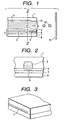
- a head 1 is formed by bonding a glass, ceramic, silicon or plastic plate or the like provided with an ink channel (a nozzle) 2, to a heating element substrate 3.
- the heating element substrate 3 is comprised of a protective film 4 formed of silicon oxide, silicon nitride, silicon carbide or the like, electrodes 5 formed of aluminum, gold, an aluminum-copper alloy or the like, a heating resistor layer 6 formed of HfB 2 , TaN, TaAl or the like, a heat accumulating layer 7 formed of thermally oxidized silicon, aluminum oxide or the like, and a substrate 8 formed of a material having good heat dissipation properties, made of silicon, aluminum, aluminum nitride or the like.
- Fig. 3 schematically illustrates a multi-head comprising the head as shown in Fig. 1 arranged in a large number.
- Fig. 1 is a cross-sectional view of the head along its ink channel
- Fig. 2 is a cross-sectional view along the line 2-2 in Fig. 1.
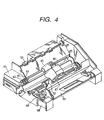
- Fig. 4 shows an example of the ink-jet recording apparatus in which such a head has been incorporated.
- reference numeral 61 denotes a blade serving as a wiping member in the form of a cantilever, one end of which is a stationary end retained by a blade-retaining member.
- the blade 61 is provided at the position adjacent to the region in which a recording head makes a record.
- the blade is provided at the position adjacent to the region in which recording is performed by the recording head, and is so constituted that it moves in the direction perpendicular to the movement of the recording head to come in touch with the ejection opening face and performs capping.
- Reference numeral 63 denotes an ink absorber provided adjoiningly to the blade 61, and, similar to the blade 61, is retained in such a form that it projects to the course through which the recording head is moved.
- the above blade 61, cap 62 and absorber 63 constitute an ejection restoration assembly 64, where the blade 61 and the absorber 63 remove water, dust and so forth from the ink ejection opening face.
- Reference numeral 65 denotes the recording head having an ejection energy generating means and ejects ink to the recording medium set opposingly to the ejection opening face provided with ejection openings, to perform recording.
- Reference numeral 66 denotes a carriage on which the recording head 65 is mounted so that the recording head 65 can be moved.
- the carriage 66 is slidably associated with a guide shaft 67. Part of the carriage 66 is connected (not shown) with a belt 59 driven by a motor 68.
- the carriage 66 can be moved along the guide 67 and hence the recording head 65 can be moved from a recording region to a region adjacent thereto.
- Reference numeral 51 denotes a feeding part from which a recording medium is inserted, and 52, a feed roller driven by a motor (not shown). With such construction, the recording medium is fed to the position opposing to the ejection opening face of the recording head 65, and, with progress of recording, outputted from an output section provided with an output roller 53.
- the cap 62 of the head restoration assembly 64 is receded from the moving course of the recording head 65 when the recording head 65 is returned to its home position after completion of recording, and the blade 61 stands projected to the moving course. As the result, the ejection opening face of the recording head 65 is wiped.
- the cap 62 comes into contact with the ejection opening face of the recording head 65 to carry out capping, the cap 62 is moved in such a way that it projects to the moving course of the recording head.
- the recording head 65 is moved from its home position to the position at which recording is started, the cap 62 and the blade 61 are at the same position as the position where the ejection opening face is wiped. As the result, the ejection opening face of the recording head 65 of the recording head 65 is wiped also at the time of this movement.
- the above movement of the recording head to its home position is made not only at the time of the completion of recording or restoration of ejection, but also when the recording head is moved between recording regions for the purpose of recording, during which it is moved to the home position adjacent to each recording region at given intervals, where the ejection opening face is wiped in accordance with this movement.
- Fig. 5 is a vertical cross section showing an example of an ink cartridge that has held the ink being fed to the head through an ink-feeding member, e.g., a tube.
- reference numeral 45 denotes the ink cartridge
- 40 denotes an ink holder, e.g., an ink bag, that has held the feeding ink.
- the top thereof is provided with a stopper 42 made of rubber.
- a needle (not shown) may be inserted to this stopper 42 so that the ink in the ink holder 40 can be fed to the head.
- Reference numeral 44 denotes an ink absorber that receives a waste ink. It is preferable for the ink holder to be formed of a polyolefine, especially polyethylene, at its face coming into contact with ink.
- the ink-jet recording apparatus used in the present invention is not limited to the apparatus as described above in which the head and the ink cartridge are separately provided, and a device can also be preferably used in which these are integrally formed as shown in Fig. 6.
- reference numeral 70 denotes a recording unit, in the interior of which an ink receiving member, e.g., an ink absorber, that has held an ink is received.
- the recording unit 70 is so constructed that the ink in such an ink absorber is ejected in the form of ink droplets from a head 71 having a plurality of orifices.
- the recording unit may be so constructed that the ink receiving member is an ink bag internally provided with a spring or the like.
- Reference numeral 72 denotes an air path opening through which the interior of the cartridge is made to communicate with the atmosphere.
- This recording unit 70 can be used in place of the recording head shown in Fig. 4, and is detachably mounted to the carriage 66.
- an On-Demand type ink-jet recording head which is provided with a nozzle substrate having a plurality of nozzles, a pressure generating device comprised of a piezoelectric material and a conductive material, provided opposingly to the nozzles, and an ink with which the surrounding of the pressure generating device is filled, and in which the pressure generating device is caused to undergo displacement by an applied voltage to eject minute ink droplets from the nozzles.
- the recording head is constituted of an ink channel 80 communicating with an ink chamber (not shown), an orifice plate 81 for ejecting ink droplets with the desired volume, a vibrating plate 82 that causes a pressure to directly act on ink, a piezoelectric device 83 that is joined to this vibrating plate 82 and is caused to undergo displacement by electric signals, and a substrate 84 for supporting and fixing the piezoelectric device 83, the orifice plate 81, the vibrating plate 82 and so forth.
- the ink channel 80 is formed of a photosensitive resin or the like, and the orifice plate 81 is made of a metal such as stainless steel or nickel, and is provided with an ejection orifice 85 formed by making a hole by electroplating or pressing.
- the vibrating plate 82 is formed of a metal film of stainless steel, nickel, titanium or the like, or a highly resilient resin.
- the piezoelectric device 83 is formed of a dielectric material such as barium titanate or PZT (Pb-Zr-Ti).
- the recording head constituted as described above operates as follows: It imparts a pulsewise voltage to the piezoelectric device 83 to produce a strain stress, the energy thus produced causes a change in form of the vibrating plate 82 jointed to the piezoelectric device 83, and the ink inside the ink channel 80 is vertically pressed, so that ink droplets (not shown) are ejected from the ejection orifice 85 of the orifice plate 81 to make a record.
- Such a recording head is used in the state it is incorporated into the same recording apparatus as that shown in Fig. 4. Individual parts of the recording apparatus may operate in the same manner as previously described.
- the ink-jet recording process of the present invention is a recording process comprising ejecting an ink from orifices of a recording head onto a recording medium in accordance with recording signals to perform recording, wherein the ink is heated to a temperature corresponding to recording image color signals so that the form and size of impacted dots formed by the ink on the recording medium and the thickness of a colored layer formed by the coloring matter on the recording medium are changed by an elevated temperature of ink to vary an optical density or a color reproduction range, thereby performing recording.
- the ink-jet recording process of the present invention includes any one of the following three processes.
- the heating of the ink in accordance with recording image color signals is carried out at a temperature exceeding the transition temperature or cloud point of the thermoreversible thickening polymer contained in the ink.
- the degree of change in the extent and the thickness of the coloring matter layer formed on the recording medium by the ink having been impacted there to form dots thereon becomes greater as the difference between an environmental temperature and the transition temperature or cloud point of the thermoreversible thickening polymer in the ink is greater.
- the ink at the time of recording is heated to a temperature corresponding to recording image color signals
- the ink is heated according to one alternative of the present invention immediately before it is ejected, in order to prevent nozzles of the recording head from clogging.
- the ink temperature in the recording head may preferably be lower than the transition temperature or cloud point of the thermoreversible thickening polymer contained in the ink.
- Recording may preferably be performed by applying heat energy or mechanical energy to the ink to eject ink.
- Fig. 8 is a block diagram illustrating an example of a mechanism for heating the ejecting ink to the stated temperature.
- a recording head 200 has a sensor (not shown) for detecting the temperature of ink in the ink holder provided in the recording head. This temperature sensor is connected with a drive circuit 208 of the recording head 200, and detects temperatures so that the temperature of ink 203 held in the ink holder does not exceed the transition temperature or cloud point of the thermoreversible thickening polymer contained in the ink 203.
- the recording head 200 has in its nozzles an ink ejecting portion 202 for ejecting the ink in the form of ink droplets 204 and an ink heating portion 201 for heating the ink immediately before it is ejected in the form of ink droplets 204.
- the ink ejecting portion 202 and ink heating portion 201 are connected with the same drive circuit 208 of the recording head 200.
- the recording signals 210 are separated into an ink ejecting portion drive pulse 206 and an ink heating portion drive pulse 207.
- the ink heating portion drive pulse 207 is imparted to the ink heating portion 201 prior to the ink ejecting portion drive pulse 206 for driving the ink ejecting portion 202 of the recording head 200 from which the ink is ejected in the form of ink droplets 204, thereby raising a temperature of the ink heating portion 201 to heat to the desired temperature the ink portion to be ejected in the form of ink droplets 204.
- the ink ejecting portion drive pulse 206 is imparted to the ink ejecting portion 202, so that the recording operation is started.
- the ink heating portion drive pulse 207 to the ink heating portion 201 is changed so that the temperature of the ink portion to be ejected in the form of ink droplets 204 is changed, whereby the form and size of impacted dots formed by the ink droplets 204 on the recording medium 205 and the thickness of a colored layer formed by the coloring matter on the recording medium can be changed by an elevated temperature of ink to vary an optical density or a color reproduction range, thereby performing recording.
- the ink portion the ejected ink droplets 204 had held in the nozzles of the recording head 200 is newly supplied with the ink 203 held in the ink holder, and hence the temperature at the ink portion around the ink heating portion 201 abruptly is lowered. Accordingly, any nozzle clogging due to the viscosity increase of the ink by no means occurs.
- the ink heating portion 201 is separated from the ink ejecting portion 202 as so illustrated in Fig. 8, but may be formed in one unit together with the ink ejecting portion 202.
- the ink heating portion drive pulse 207 is separated from the ink ejecting portion drive pulse 206 as so illustrated in Fig. 8, but may preferably be combined so that the ink ejecting portion drive pulse 206 and the ink heating portion drive pulse 207 are controlled by the drive circuit 208 in such a manner that the latter is imparted to the lead of the former.
- Fig. 9 is a block diagram illustrating an example of a mechanism for heating the recording medium to a desired temperature.
- a recording head 200 has a sensor (not shown) for detecting the temperature of ink in the ink holder provided in the recording head. This temperature sensor is connected with a drive circuit 208 of the recording head 200, and detects temperatures so that the temperature of ink 203 held in the ink holder does not exceed the transition temperature or cloud point of the thermoreversible thickening polymer contained in the ink 203. Meanwhile, a recording medium heating means 211 provided in contact with, or at a little distance from, a recording medium 205 is connected with the same drive circuit 208 of the recording head 200.
- the recording signals 210 are separated into an ink ejecting portion drive pulse 206 and a recording medium heating means drive pulse 212.
- the recording medium heating means drive pulse 212 is imparted to the recording medium heating means 211 prior to the ink ejecting portion drive pulse 206 for driving the ink ejecting portion 202 of the recording head 200, thereby raising a temperature of the recording medium heating means 211 to heat to the desired temperature the part where the ink droplets 204 will arrive at the recording medium 205.
- the ink ejecting portion drive pulse 206 is imparted to the ink ejecting portion 202 so that the ink droplets 204 arrive at that part, whereupon the recording operation is started.
- the recording medium heating means drive pulse 212 to the recording medium heating means 211 is changed so that the temperature of the ink droplets 204 having been impacted at the recording medium 205 to form dots thereon is changed, whereby the form and size of impacted dots formed by the ink droplets 204 on the recording medium 205 and the thickness of a colored layer formed by the coloring matter on the recording medium can be changed by an elevated temperature of ink (ink is heated through the recording medium) to vary an optical density or a color reproduction range thereby performing recording.
- the recording medium heating means drive pulse 212 fed from the drive circuit 208 to the recording medium heating means 211 is interrupted to lower the temperature of the recording medium 205.
- the recording medium heating means 211 may be a means that can control the recording medium to the desired temperature, as exemplified by a thermal head, an infrared heater and a lamp. There are no particular limitations on its shape, size, number and so forth by reason of the mechanism.
- Fig. 10 is a block diagram illustrating an example of a mechanism for heating both the ejecting ink and the recording medium to a desired temperature.
- a recording head 200 has a sensor (not shown) for detecting the temperature of ink in the ink holder provided in the recording head. This temperature sensor is connected with a drive circuit 208 of the recording head 200, and detects temperatures so that the temperature of ink 203 held in the ink holder does not exceed the transition temperature or cloud point of the thermoreversible thickening polymer contained in the ink 203.
- the recording head 200 has in its nozzles an ink ejecting portion 202 for ejecting the ink in the form of ink droplets 204 and an ink heating portion 201 for heating the ink immediately before it is ejected in the form of ink droplets 204.
- the ink ejecting portion 202 and ink heating portion 201 are connected with the same drive circuit 208 of the recording head 200.
- a recording medium heating means 211 provided in contact with, or at a little distance from, a recording medium 205 is connected with the same drive circuit 208 of the recording head 200.
- the recording signals 210 are separated into an ink ejecting portion drive pulse 206, an ink heating portion drive pulse 207 and a recording medium heating means drive pulse 212.
- the ink heating portion drive pulse 207 and the recording medium heating means drive pulse 212 are imparted to the ink heating portion 201 and the recording medium heating means 211, respectively, prior to the ink ejecting portion drive pulse 206 for driving the ink ejecting portion 202 of the recording head 200 from which the ink is ejected in the form of ink droplets 204.
- the ink heating portion 201 heats to the desired temperature the ink portion to be ejected in the form of ink droplets 204.
- the recording medium heating means 211 heats to the desired temperature the part where the ink droplets 204 will arrive at the recording medium 205.
- the ink ejecting portion drive pulse 206 is imparted to the ink ejecting portion 202, so that the recording operation is started.
- the ink heating portion drive pulse 207 to the ink heating portion 201 and the recording medium heating means drive pulse 212 to the recording medium heating means 211 are both, or either of them is, changed so that the temperature of the ink portion to be ejected in the form of ink droplets 204 and the temperature of the ink droplets 204 having been impacted at the recording medium 205 to form dots thereon are changed, whereby the form and size of impacted dots formed by the ink droplets 204 on the recording medium 205 and the thickness of a colored layer formed by the coloring matter on the recording medium can be changed by an elevated temperature of ink (ink is heated directly and through the recording medium) to vary an optical density or a color reproduction range, thereby performing recording.
- the ink portion being occupied by the ejected ink droplets 204 in the nozzles of the recording head 200 is newly supplied with the ink 203 held in the ink holder, and hence the temperature at the ink portion around the ink heating portion 201 abruptly is lowered. Accordingly, any nozzle clogging due to the viscosity increase of the ink by no means occurs.
- the recording medium heating means drive pulse 212 fed from the drive circuit 208 to the recording medium heating means 211 is interrupted to lower the temperature of the recording medium 205.
- the temperature of the ejected ink droplets 204 and the temperature at the time when the ink droplets 204 have been impacted at the recording medium 205 to form dots thereon need not necessarily be identical. Any desired combination of these makes it possible to markedly change the control range of the form and size of impacted dots formed on the recording medium 205 and the thickness of a colored layer formed by the coloring matter on the recording medium.
- the ink heating portion 201 is separated from the ink ejecting portion 202 as so illustrated in Fig. 10, but may be formed in one unit together with the ink ejecting portion 202.
- the ink heating portion drive pulse 207 is separated from the ink ejecting portion drive pulse 206 as so illustrated in Fig. 10, but may preferably be combined so that the ink ejecting portion drive pulse 206 and the ink heating portion drive pulse 207 are controlled by the drive circuit 208 in such a manner that the latter is imparted to the lead of the former.
- the recording medium heating means 211 may be a means that can control the recording medium to the desired temperature, as exemplified by a thermal head, an infrared heater and a lamp. There are no particular limitations on its shape, size, number and so forth by reason of the mechanism.
- thermoreversible thickening polymers used in the present invention water-soluble vinyl-type polymers are shown in Table 1 and surface active agents having a cloud point are shown in Table 2.
- Vinyl-type Polymer Symbol Compound Molecular weight Viscosity of 5% aqueous solution (mPa ⁇ s),30°C Transition temp.
- Ts (°C) A Morpholino ethyl methacrylate 500,000 80 35 B 2-(2-morpholino-ethoxy)ethyl methacrylate 300,000 15 56 Surface Active Agent Having Cloud Point Symbol Compound Trade name Cloud point Tc (°C)
- thermoreversible thickening polymer (vinyl-type polymer) solution was beforehand prepared by dissolving each thermoreversible thickening polymer in an appropriate concentration (10 to 40%) in ion-exchanged water, and the inks were prepared in the manner as described below.
- thermoreversible thickening polymer vinyl-type polymer
- solvent an aqueous dye solution and surface active agent having a cloud point
- each ink composition obtained was adjusted to have a desired concentration.
- the ink composition was filtered with a membrane filter having a pore size of 0.45 ⁇ m.
- color (magenta, cyan) inks used in Examples 1 to 4 of the present invention were prepared.
- Dye M1 of the formula was used as a magenta dye.
- inks were prepared in the same manner as in Examples 1 and 2, respectively, except for using neither the thermoreversible thickening polymer (vinyl-type polymer) nor the surface active agent having a cloud point, to obtain corresponding inks of Comparative Examples 1 and 2.
- Bubble Jet Printer BJC600 trade name, manufactured by CANON INC.
- Intended ink was supplied by filling with the ink container exclusively used for the printer.
- the printer BJC600 used here is incorporated with a mechanism for heating paper during recording (having the same circuit construction as those shown in Figs. 8 to 10).
- This recording apparatus is schematically shown in Fig. 11.
- the recording apparatus shown in Fig. 11 has the basic construction of the recording apparatus shown in Fig. 4, and is provided with a heating element 100.
- the heating element 100 has ten thermal heads 101, P-8010, manufactured by Nippon Toki K.K., arranged in a A4-width direction, is driven at an applied voltage of 19V and an applied power of 56 W/mm 2 , and can heat the paper surface in a temperature range of from 30° to 300°C at an environmental temperature of 23°C by controlling driving pulse width and driving frequency.
- Reference numerals 66, 67 and 90 are a carriage, a carriage guide and an ink container equipped on the carriage 67 for feeding inks to ink-jet heads, respectively.
- NP-SK PAPER Lit. No. OKK10
- Fig. 12 is a graph showing an optical density, when tested according to Recording Process 1 in which the ink is directly heated, in combination of Example 1 and Example 2 and in combination of Comparative Example 1 and Comparative Example 2.
- Fig. 13 is a graph showing evaluation results on an optical density, when tested according to Recording Process 1 in which the ink is directly heated, in combination of Example 3 and Example 4 and in combination of Comparative Example 1 and Comparative Example 2.
- Fig. 14 is a graph showing evaluation results on an optical density, when tested according to Recording Process 2 in which the recording medium surface is heated, in combination of Example 1 and Example 2 and in combination of Comparative Example 1 and Comparative Example 2.
- Fig. 15 is a graph showing evaluation results on an optical density, when tested according to Recording Process 2 in which the recording medium surface is heated, in combination of Example 3 and Example 4 and in combination of Comparative Example 1 and Comparative Example 2.
- blue colors are evaluated by a procedure as follows: Respective cyan inks of Examples and Comparative Examples are first underlayingly recorded on recording media with Printing Processes 1 and 2, and then respective magenta inks of Examples and Comparative Examples are overlappingly recorded on the recording media with Printing Processes 1 and 2, just on the printed portions of cyan inks with an amount of ink droplets per unit area equal to the amount of the cyan inks on the recording media, to obtain a blue color print.
- the ink water-based ink
- the ink ejected from orifices of a recording head is heated to a temperature exceeding the transition temperature or cloud point of the ink in accordance with recording image color signals so that the form and size of impacted dots formed by the ink on the recording medium and the thickness of a colored layer formed by the coloring matter on the recording medium are changed by an elevated temperature of ink to vary an optical density or a color reproduction range, thereby performing recording.
- the recording medium is heated according to the steps of claim 3 to reach said inventive effects.
- an ink-jet recording process and an ink-jet recording apparatus can be provided in which the optical density and color reproduction range are changed to greatly expand the a*-b* color space and the color forming performance and color reproducibility are improved.
- the ink used in the present invention changes in state only in accordance with the temperature change, and hence is useful since it is not affected by the surface pH and irregularities of recording media even when various recording media other than plain paper, e.g., transparency films, cloths and metal sheets are used.
Landscapes
- Inks, Pencil-Leads, Or Crayons (AREA)
- Ink Jet Recording Methods And Recording Media Thereof (AREA)
- Ink Jet (AREA)
Claims (17)
- Verfahren zum Verbessern der Qualität eines Farbbildes auf einem Aufzeichnungsmedium, das durch ein Tintenstrahlaufzeichnungsverfahren aufgezeichnet wurde, mit den Schritten des Ausstoßens einer Tinte aus einer Tintenstrahldüse eines Tintenstrahldruckers; und dem Anbringen der aus der Tintenstrahldüse ausgestoßenen Tinte, um auf einem Aufzeichnungsmedium einen Tintenpunkt zu erzeugen, wobei die Tinte enthält ein wasserlösliches thermoreversibles Verdickungspolymer mit einer Übergangstemperatur oder einem Trübungspunkt, einen färbenden Stoff und ein flüssiges Medium, und die Tinte eine Viskosität hat, die ansteigt, wenn die Temperatur der Tinte die Übergangstemperatur oder den Trübungspunkt des wasserlöslichen thermoreversiblen Verdickungspolymers übersteigt, wobei das Verfahren ferner umfasst die Schritte:wobei die Temperatur unter ii) so bestimmt wird, dass die jeweiligen Tintenpunkte auf dem Aufzeichnungsmedium voneinander in der optischen Dichte oder dem Farbwiedergabebereich unterschiedlich sind.i) Beibehalten der aus der Tintenstrahldüse auszustoßenden Tinte für einen Tintenpunkt bei einer Temperatur unterhalb der Übergangstemperatur oder des Trübungspunktes des wasserlöslichen thermoreversiblen Verdickungspolymers; undii) Anwenden von Wärme und Verändern der Temperatur der Tinte unmittelbar vor der Ausstoßung aus der Tintenstrahldüse für einen Tintenpunkt, zu einer Temperatur, welche die Übergangstemperatur oder den Trübungspunkt des wasserlöslichen thermoreversiblen Verdickungspolymers übersteigt,
- Verfahren zum Verbessern der Qualität eines Farbbildes auf einem Aufzeichnungsmedium, das durch ein Tintenstrahlaufzeichnungsverfahren aufgezeichnet wurde, wobei das Tintenstrahlaufzeichnungsverfahren die Schritte umfasst des Ausstoßens einer Tinte aus einer Tintenstrahldüse eines Tintenstrahldruckers; und des Anbringens der aus der Tintenstrahldüse ausgestoßenen Tinte, um auf einem Aufzeichnungsmedium einen Tintenpunkt zu erzeugen, wobei die Tinte enthält ein wasserlösliches thermoreversibles Verdickungspolymer mit einer Übergangstemperatur oder einem Trübungspunkt, einen färbenden Stoff und ein flüssiges Medium, und die Tinte eine Viskosität hat, die ansteigt, wenn die Temperatur der Tinte die Übergangstemperatur oder den Trübungspunkt des wasserlöslichen thermorevesiblen Verdickungspolymers übersteigt, wobei das Verfahren ferner die Schritte umfasst:wobei die Temperatur unter i) und die Temperatur unter ii) voneinander unterschiedlich sind, so dass jeweilige Tintenpunkte auf dem Aufzeichnungsmedium in der optischen Dichte oder dem Farbwiedergabebereich voneinander unterschiedlich sind.i) Anwenden von Wärme an der Tinte unmittelbar vor Ausstoßung aus der Tintenstrahldüse für einen Tintenpunkt, so dass die Temperatur der aus der Düse ausgestoßenen Tinte die Übergangstemperatur oder den Trübungspunkt des wasserlöslichen thermoreversiblen Verdickungspolymers übersteigt; undii) Anwenden von Wärme und Verändern der Temperatur der Tinte, wenn Ausstoßung aus der Tintenstrahldüse gestartet wird, zu einer Temperatur, welche die Übergangstemperatur oder den Trübungspunkt des wasserlöslichen thermoreversiblen Verdickungspolymers übersteigt,
- Verfahren zum Verbessern der Qualität eines Farbbildes auf einem Aufzeichnungsmedium, das durch ein Tintenstrahlaufzeichnungsverfahren aufgezeichnet wurde, mit den Schritten des Ausstoßens einer Tinte aus einer Tintenstrahldüse eines Tintenstrahldruckers; und dem Anbringen der aus der Tintenstrahldüse ausgestoßenen Tinte, um auf einem Aufzeichnungsmedium einen Tintenpunkt zu erzeugen, wobei die Tinte enthält ein wasserlösliches thermoreversibles Verdickungspolymer mit einer Übergangstemperatur oder einem Trübungspunkt, einen färbenden Stoff und ein flüssiges Medium, und die Tinte eine Viskosität hat, die ansteigt, wenn die Temperatur der Tinte die Übergangstemperatur oder den Trübungspunkt des wasserlöslichen thermoreversiblen Verdickungspolymers übersteigt, wobei das Verfahren ferner umfasst die Schritte:wobei die Temperatur unter i) und die Temperatur unter ii) oberhalb der Übergangstemperatur des wasserlöslichen thermoreversiblen Verdickungspolymers sind, und so bestimmt werden, dass jeweilige, auf dem Aufzeichnungsmedium erzeugte Tintenpunkte in der optischen Dichte oder dem Farbwiedergabebereich voneinander unterschiedlich sind.i) Erwärmen einer Position des Aufzeichnungsmediums, an der ein Tintenpunkt erzeugt werden soll, auf eine erwünschte Temperatur, undii) Verändern der Temperatur des Aufzeichnungsmediums, wo ein Tintenpunkt erzeugt wird,
- Verfahren nach einem der Ansprüche 1 bis 3, wobei das wasserlösliche thermoreversible Verdickungspolymer ist ein wasserlösliches Vinylpolymer, das als eine konstituierende Einheit nicht weniger als 50 Gew-% eines Vinylcarboxylats eines Additionsprodukts eines Alkylenoxids mit einer einen aktiven Wasserstoff enthaltenden Verbindung mit einem Stickstoff-haltigen Ring enhält.
- Verfahren nach einem der Ansprüche 1 bis 3, wobei das wasserlösliche thermoreversible Verdickungspolymer ein einen Trübungspunkt besitzender, nichtionischer oberflächenaktiver Stoff ist.
- Verfahren nach einem der Ansprüche 1 bis 5, wobei der Schritt des Ausstoßens der Tinte aus der Tintenstrahldüse eines Tintenstrahldruckers durch Anwenden von Wärmeenergie an der Tinte durchgeführt wird.
- Verfahren nach einem der Ansprüche 1 bis 5, wobei der Schritt zum Ausstoßen der Tinte aus der Tintenstrahldüse eines Tintenstrahldruckers durch Anwenden von mechanischer Energie an der Tinte durchgeführt wird.
- Tintenstrahlaufzeichnende Vorrichtung mit einem Tintenstrahlkopf, bereitgestellt mit einer Tintenstrahldüse, die eine Spitze hat, zum Ausstoßen einer Tinte, die enthält ein wasserlösliches thermoreversibles Verdickungspolymer mit einer Übergangstemperatur oder einem Trübungspunkt, einen färbenden Stoff und ein flüssiges Medium, wobei die Tinte eine Viskosität hat, die ansteigt, wenn die Temperatur der Tinte die Übergangstemperatur oder den Trübungspunkt des wasserlöslichen thermoreversiblen Verdickungspolymers übersteigt,
wobei die Vorrichtung ferner umfasst eine Heizvorrichtung, bereitgestellt bei der Spitze der Düse, und einen Treiberkreis, der ein aufzeichnendes Signal teilt in einen ersten Impuls zum Betätigen einer eine Tinte ausstoßenden Einrichtung angrenzend zur Heizvorrichtung, und einen zweiten Impuls zum Betätigen der Heizvorrichtung, und welcher den ersten Impuls an der tintenausstoßenden Einrichtung, und den zweiten Impuls an der Heizvorrichtung anwendet, wobei der zweite Impuls an der Heizvorrichtung vor dem Anwenden des ersten Impulses an der die Tinte ausstoßenden Einrichtung angewendet wird. - Tintenstrahlaufzeichnende Vorrichtung nach Anspruch 8, wobei der erste Impuls an der die Tinte ausstoßenden Einrichtung angewendet wird, nachdem Wärme an der Tinte an der Spitze der Düse angewandt worden ist, um das Polymer in der ausgestoßenen Tinte zu gelieren.
- Tintenstrahlaufzeichnende Vorrichtung nach Anspruch 8, wobei der zweite Impuls verändert wird gemäß Farbbildaufzeichnungssignalen, um die Temperatur der aus der Düse ausgestoßenen Tinte zu verändern.
- Tintenstrahlaufzeichnende Vorrichtung mit einem Tintenstrahlkopf, bereitgestellt mit einer Tintenstrahldüse zum Ausstoßen einer Tinte auf ein Aufzeichnungsmedium, wobei die Tinte enthält ein wasserlösliches thermoreversibles Verdickungspolymer mit einer Übergangstemperatur oder einem Trübungspunkt, einen färbenden Stoff und ein flüssiges Medium, wobei die Tinte eine Viskosität hat, die ansteigt, wenn die Temperatur der Tinte die Übergangstemperatur oder den Trübungspunkt des wasserlöslichen thermoreversiblen Verdickungspolymers übersteigt,
wobei die Vorrichtung ferner umfasst eine Heizvorrichtung, angeordnet zum Erwärmen des Aufzeichnungsmediums, und einen Treiberkreis, der ein aufzeichnendes Signal teilt in einen ersten Impuls zum Betätigen einer eine Tinte ausstoßenden Einrichtung, angeordnet in der Düse, und einen zweiten Impuls zum Betätigen der Heizvorrichtung, und welcher den ersten Impuls an der tintenausstoßenden Einrichtung, und den zweiten Impuls an der Heizvorrichtung anwendet, wobei der zweite Impuls an der Heizvorrichtung angewendet wird, um eine bestimmte Position des Aufzeichnungsmediums zu erwärmen, wo eine aus der Düse ausgestoßene Tinte angebracht wird, vor dem Anwenden des ersten Impulses an der die Tinte ausstoßenden Einrichtung. - Tintenstrahlaufzeichnende Vorrichtung nach Anspruch 11, wobei der erste Impuls an der die Tinte ausstoßenden Einrichtung angewendet wird, nachdem die Position erwärmt worden ist, so dass die angebrachte Tinte auf dem Aufzeichnungsmedium geliert wird.
- Tintenstrahlaufzeichnende Vorrichtung nach Anspruch 11, wobei der zweite Impuls verändert wird gemäß Farbbildaufzeichnungssignalen, um die Temperatur der Position des Aufzeichnungsmediums zu verändern.
- Tintenstrahlaufzeichnende Vorrichtung mit einem Tintenstrahlkopf, bereitgestellt mit einer Tintenstrahldüse, die eine Spitze hat, zum Ausstoßen einer Tinte auf ein Aufzeichnungsmedium, wobei die Tinte enthält ein wasserlösliches thermoreversibles Verdickungspolymer mit einer Übergangstemperatur oder einem Trübungspunkt, einen färbenden Stoff und ein flüssiges Medium, wobei die Tinte eine Viskosität hat, die ansteigt, wenn die Temperatur der Tinte die Übergangstemperatur oder den Trübungspunkt des wasserlöslichen thermoreversiblen Verdickungspolymers übersteigt,
wobei die Vorrichtung ferner umfasst eine erste Heizvorrichtung, bereitgestellt an der Spitze der Düse, eine zweite Heizvorrichtung in der Nähe des Aufzeichnungsmediums, und einen Treiberkreis, der ein aufzeichnendes Signal teilt in einen ersten Impuls zum Betätigen einer eine Tinte ausstoßenden Einrichtung, angeordnet in der Düse, und einen zweiten Impuls zum Betätigen der ersten und der zweiten Heizvorrichtung, und welcher den ersten Impuls an der tintenausstoßenden Einrichtung, und den zweiten Impuls an der ersten und der zweiten Heizvorrichtung anwendet, wobei der zweite Impuls an der ersten und der zweiten Heizvorrichtung angewendet wird vor dem Anwenden des ersten Impulses an der die Tinte ausstoßenden Einrichtung. - Tintenstrahlaufzeichnende Vorrichtung nach Anspruch 14, wobei der erste Impuls angewendet wird an der die Tinte ausstoßenden Einrichtung, nachdem Wärme an der Tinte an der Spitze der Düse angewendet worden ist, um das Polymer in der ausgestoßenen Tinte zu gelieren, und eine Position auf dem Aufzeichnungsmedium erwärmt wird, so dass die Tinte, die bei der Position angewendet wird, auf dem Aufzeichnungsmedium geliert wird.
- Tintenstrahlaufzeichnende Vorrichtung nach Anspruch 14, wobei der zweite Impuls verändert wird gemäß aufzeichnenden Bildfarbsignalen, um die Temperatur der aus der Düse ausgestoßenen Tinte und die Temperatur einer Position des Aufzeichnungsmedium zu verändern.
- Tintenstrahlaufzeichnende Vorrichtung nach einem der Ansprüche 8 bis 16, ferner mit einem die Tinte enthaltenden Tintenbehälter.
Applications Claiming Priority (3)
| Application Number | Priority Date | Filing Date | Title |
|---|---|---|---|
| JP27515695 | 1995-09-29 | ||
| JP27515695 | 1995-09-29 | ||
| JP275156/95 | 1995-09-29 |
Publications (3)
| Publication Number | Publication Date |
|---|---|
| EP0765758A2 EP0765758A2 (de) | 1997-04-02 |
| EP0765758A3 EP0765758A3 (de) | 1998-04-15 |
| EP0765758B1 true EP0765758B1 (de) | 2005-11-30 |
Family
ID=17551463
Family Applications (1)
| Application Number | Title | Priority Date | Filing Date |
|---|---|---|---|
| EP96115544A Expired - Lifetime EP0765758B1 (de) | 1995-09-29 | 1996-09-27 | Tintenstrahlaufzeichnungsverfahren und Tintenstrahlaufzeichnungsgerät |
Country Status (3)
| Country | Link |
|---|---|
| US (1) | US5969740A (de) |
| EP (1) | EP0765758B1 (de) |
| DE (1) | DE69635509T2 (de) |
Families Citing this family (13)
| Publication number | Priority date | Publication date | Assignee | Title |
|---|---|---|---|---|
| EP0798119B1 (de) | 1996-03-27 | 2002-12-04 | Canon Kabushiki Kaisha | Verfahren zum und Apparat zur Durchführung dieses Verfahrens |
| US6276793B1 (en) * | 1998-11-02 | 2001-08-21 | Xerox Corporation | Ink jet printer having a wear resistant and efficient substrate heating and supporting assembly |
| JP4185988B2 (ja) * | 1999-06-07 | 2008-11-26 | 富士フイルム株式会社 | 記録装置及び方法並びに搬送装置 |
| US7001934B2 (en) * | 2002-01-24 | 2006-02-21 | Cabot Coroporation | Inkjet ink systems comprising a gelling agent |
| US8869698B2 (en) | 2007-02-21 | 2014-10-28 | R.R. Donnelley & Sons Company | Method and apparatus for transferring a principal substance |
| US20070199460A1 (en) * | 2006-02-21 | 2007-08-30 | Cyman Theodore F Jr | Systems and methods for high speed variable printing |
| US9463643B2 (en) | 2006-02-21 | 2016-10-11 | R.R. Donnelley & Sons Company | Apparatus and methods for controlling application of a substance to a substrate |
| US8967044B2 (en) | 2006-02-21 | 2015-03-03 | R.R. Donnelley & Sons, Inc. | Apparatus for applying gating agents to a substrate and image generation kit |
| US8733248B2 (en) | 2006-02-21 | 2014-05-27 | R.R. Donnelley & Sons Company | Method and apparatus for transferring a principal substance and printing system |
| KR101597703B1 (ko) | 2007-08-20 | 2016-02-26 | 알.알.도넬리앤드선즈컴퍼니 | 기판에 대한 물질의 도포를 제어하는 장치 및 방법 |
| US9701120B2 (en) | 2007-08-20 | 2017-07-11 | R.R. Donnelley & Sons Company | Compositions compatible with jet printing and methods therefor |
| US8044115B2 (en) * | 2007-12-27 | 2011-10-25 | Eastman Kodak Company | Pigment-based inks with improved jetting latency |
| JP2011201037A (ja) * | 2010-03-24 | 2011-10-13 | Fujifilm Corp | インクジェット記録方法及びインクセット |
Family Cites Families (14)
| Publication number | Priority date | Publication date | Assignee | Title |
|---|---|---|---|---|
| US4394669A (en) * | 1980-07-22 | 1983-07-19 | Canon Kabushiki Kaisha | Liquid jet recording apparatus |
| US4635078A (en) * | 1983-04-28 | 1987-01-06 | Canon Kabushiki Kaisha | Intermediate gradient image producing method |
| US4514540A (en) * | 1983-09-26 | 1985-04-30 | Union Camp Corporation | Water reducible polyamides |
| EP0329026B1 (de) * | 1988-02-19 | 1993-11-24 | Dataproducts Corporation | Thermisch reversible Sol-Gel-Phasenaustausch-Tinte oder Tinte für den Impulstintenstrahldruck |
| JPH02231148A (ja) * | 1988-11-04 | 1990-09-13 | Canon Inc | 記録ヘッド駆動方法および前記ヘッド駆動方法を用いた記録装置 |
| JP2787216B2 (ja) * | 1988-12-21 | 1998-08-13 | 株式会社ヤマトヤ商会 | インクジエットプリンタ |
| JP2739587B2 (ja) * | 1989-02-20 | 1998-04-15 | 株式会社サクラクレパス | 熱可逆変色性マイクロカプセルの製造方法 |
| JPH0723443B2 (ja) * | 1992-01-31 | 1995-03-15 | 三洋化成工業株式会社 | 熱可逆型増粘剤 |
| CA2100977C (en) * | 1992-07-24 | 2000-02-08 | Noribumi Koitabashi | Ink container, ink and ink jet recording apparatus using ink container |
| JP3453399B2 (ja) * | 1992-07-30 | 2003-10-06 | キヤノン株式会社 | サーマルインクジェット記録方法 |
| DE69425599T2 (de) * | 1993-03-02 | 2001-04-19 | Canon K.K., Tokio/Tokyo | Aufzeichnungsgerät, welches ein Abfalltinte-absorbierendes Element enthält |
| EP0618278B1 (de) * | 1993-03-31 | 1999-07-07 | Canon Kabushiki Kaisha | Tinte, Tintenstrahl-Aufzeichnungsverfahren und Vorrichtung unter Verwendung derselben |
| JP3376183B2 (ja) * | 1994-09-29 | 2003-02-10 | キヤノン株式会社 | インクジェット用水性インク、インクジェット記録方法及びブリード緩和方法 |
| US6372818B1 (en) * | 1995-08-31 | 2002-04-16 | Canon Kabushiki Kaisha | Water-based ink for ink-jet, and ink-jet recording method and instruments using the same |
-
1996
- 1996-09-27 EP EP96115544A patent/EP0765758B1/de not_active Expired - Lifetime
- 1996-09-27 DE DE69635509T patent/DE69635509T2/de not_active Expired - Lifetime
- 1996-09-30 US US08/720,451 patent/US5969740A/en not_active Expired - Lifetime
Also Published As
| Publication number | Publication date |
|---|---|
| EP0765758A2 (de) | 1997-04-02 |
| DE69635509T2 (de) | 2006-07-06 |
| EP0765758A3 (de) | 1998-04-15 |
| US5969740A (en) | 1999-10-19 |
| DE69635509D1 (de) | 2006-01-05 |
Similar Documents
| Publication | Publication Date | Title |
|---|---|---|
| JP3376183B2 (ja) | インクジェット用水性インク、インクジェット記録方法及びブリード緩和方法 | |
| EP0761782B1 (de) | Wässrige Tintenstrahltinte, Tintenstrahl-Aufzeichnungsverfahren und Verwendung dieser Tinte | |
| US5985975A (en) | Liquid composition, ink set and method and apparatus for image by using the composition and ink set | |
| JP3428742B2 (ja) | 水性インク、インクジェット記録方法、インクカートリッジ、記録ユニット、インクジェット記録装置及びブリーディングの緩和方法 | |
| US5969740A (en) | Ink-jet recording process, and ink-jet recording apparatus | |
| EP1052097B1 (de) | Flüssigkeitsstrahlvorrichtung | |
| US7959280B2 (en) | Ink-jet recording method, ink-jet ink, ink-jet recording unit, ink cartridge for ink-jet recording and ink-jet recording apparatus | |
| JPH08143804A (ja) | バブルジェット用水系分散インク、これを用いるインクジェット記録方法および記録装置 | |
| US6281917B1 (en) | Image forming process employing liquid composition and ink in combination | |
| US7731346B2 (en) | Ink-jet recording method, ink-jet ink, ink-jet recording unit, ink cartridge for ink-jet recording and ink-jet recording apparatus | |
| JPH08333533A (ja) | 水性インク、これを用いたインクジェット記録方法及びかかるインクを用いた機器 | |
| JP4014056B2 (ja) | インクジェット用のインク、これを用いたインクジェット記録方法及びインクジェット記録装置 | |
| JPH08333532A (ja) | 水性インク、これを用いたインクジェット記録方法及びかかるインクを用いた機器 | |
| JPH09124984A (ja) | インクジェット用水性インク及びこれを用いたインクジェット記録方法、機器類 | |
| JP3204761B2 (ja) | インクジェット記録方法ならびに黒色画像の濃度および定着性の向上方法 | |
| JP3524273B2 (ja) | インクジェット記録方法 | |
| JPH08333537A (ja) | インクジェット用水性インク及びこれを用いたインクジェット記録方法及びかかるインクを用いた機器 | |
| JPH10237371A (ja) | インクジェット用水性インク、これを用いたインクジェット記録方法及び機器類 | |
| JPH08253717A (ja) | 水性インクセット、これを用いたインクジェット記録方法及びかかるインクを用いた機器 | |
| JPH08333534A (ja) | 水性インク及びこれを用いたインクジェット記録方法及びかかるインクを用いた機器 | |
| JP2001181540A (ja) | インクセット、印刷方法、インク、印刷物、印刷装置、インクカートリッジ、記録ユニット及び高分子化合物膜の形成方法 | |
| JPH10265725A (ja) | 水性インク、これを用いたインクジェット記録方法及び機器類 | |
| JPH06248208A (ja) | インク及びこれを用いた画像形成方法 | |
| JPH08333535A (ja) | 水性インク及びこれを用いたインクジェット記録方法及びかかるインクを用いた機器 | |
| JPH09124986A (ja) | インクジェット記録用水性インク、これを用いたインクジェット記録方法及びかかるインクを用いた機器 |
Legal Events
| Date | Code | Title | Description |
|---|---|---|---|
| PUAI | Public reference made under article 153(3) epc to a published international application that has entered the european phase |
Free format text: ORIGINAL CODE: 0009012 |
|
| AK | Designated contracting states |
Kind code of ref document: A2 Designated state(s): DE FR GB IT |
|
| PUAL | Search report despatched |
Free format text: ORIGINAL CODE: 0009013 |
|
| AK | Designated contracting states |
Kind code of ref document: A3 Designated state(s): DE FR GB IT |
|
| 17P | Request for examination filed |
Effective date: 19980907 |
|
| 17Q | First examination report despatched |
Effective date: 20010918 |
|
| GRAP | Despatch of communication of intention to grant a patent |
Free format text: ORIGINAL CODE: EPIDOSNIGR1 |
|
| GRAS | Grant fee paid |
Free format text: ORIGINAL CODE: EPIDOSNIGR3 |
|
| GRAA | (expected) grant |
Free format text: ORIGINAL CODE: 0009210 |
|
| AK | Designated contracting states |
Kind code of ref document: B1 Designated state(s): DE FR GB IT |
|
| REG | Reference to a national code |
Ref country code: GB Ref legal event code: FG4D |
|
| REF | Corresponds to: |
Ref document number: 69635509 Country of ref document: DE Date of ref document: 20060105 Kind code of ref document: P |
|
| ET | Fr: translation filed | ||
| PLBE | No opposition filed within time limit |
Free format text: ORIGINAL CODE: 0009261 |
|
| STAA | Information on the status of an ep patent application or granted ep patent |
Free format text: STATUS: NO OPPOSITION FILED WITHIN TIME LIMIT |
|
| 26N | No opposition filed |
Effective date: 20060831 |
|
| PGFP | Annual fee paid to national office [announced via postgrant information from national office to epo] |
Ref country code: IT Payment date: 20080918 Year of fee payment: 13 |
|
| PGFP | Annual fee paid to national office [announced via postgrant information from national office to epo] |
Ref country code: FR Payment date: 20080923 Year of fee payment: 13 |
|
| REG | Reference to a national code |
Ref country code: FR Ref legal event code: ST Effective date: 20100531 |
|
| PG25 | Lapsed in a contracting state [announced via postgrant information from national office to epo] |
Ref country code: FR Free format text: LAPSE BECAUSE OF NON-PAYMENT OF DUE FEES Effective date: 20090930 |
|
| PG25 | Lapsed in a contracting state [announced via postgrant information from national office to epo] |
Ref country code: IT Free format text: LAPSE BECAUSE OF NON-PAYMENT OF DUE FEES Effective date: 20090927 |
|
| PGFP | Annual fee paid to national office [announced via postgrant information from national office to epo] |
Ref country code: DE Payment date: 20140930 Year of fee payment: 19 |
|
| PGFP | Annual fee paid to national office [announced via postgrant information from national office to epo] |
Ref country code: GB Payment date: 20140924 Year of fee payment: 19 |
|
| REG | Reference to a national code |
Ref country code: DE Ref legal event code: R119 Ref document number: 69635509 Country of ref document: DE |
|
| GBPC | Gb: european patent ceased through non-payment of renewal fee |
Effective date: 20150927 |
|
| PG25 | Lapsed in a contracting state [announced via postgrant information from national office to epo] |
Ref country code: GB Free format text: LAPSE BECAUSE OF NON-PAYMENT OF DUE FEES Effective date: 20150927 Ref country code: DE Free format text: LAPSE BECAUSE OF NON-PAYMENT OF DUE FEES Effective date: 20160401 |