EP0765895A2 - Résine pour revêtement métallique et objet métallique revêtu - Google Patents
Résine pour revêtement métallique et objet métallique revêtu Download PDFInfo
- Publication number
- EP0765895A2 EP0765895A2 EP96306817A EP96306817A EP0765895A2 EP 0765895 A2 EP0765895 A2 EP 0765895A2 EP 96306817 A EP96306817 A EP 96306817A EP 96306817 A EP96306817 A EP 96306817A EP 0765895 A2 EP0765895 A2 EP 0765895A2
- Authority
- EP
- European Patent Office
- Prior art keywords
- resin
- coating
- coating layer
- poly
- sulfide
- Prior art date
- Legal status (The legal status is an assumption and is not a legal conclusion. Google has not performed a legal analysis and makes no representation as to the accuracy of the status listed.)
- Withdrawn
Links
- 229920005989 resin Polymers 0.000 title claims abstract description 284
- 239000011347 resin Substances 0.000 title claims abstract description 284
- 238000000576 coating method Methods 0.000 title claims abstract description 218
- 239000011248 coating agent Substances 0.000 title claims abstract description 203
- 229910052751 metal Inorganic materials 0.000 title claims abstract description 150
- 239000002184 metal Substances 0.000 title claims abstract description 150
- 239000011247 coating layer Substances 0.000 claims abstract description 275
- 238000010438 heat treatment Methods 0.000 claims abstract description 96
- -1 poly(arylene sulfide Chemical compound 0.000 claims abstract description 58
- 238000002425 crystallisation Methods 0.000 claims abstract description 56
- 230000008025 crystallization Effects 0.000 claims abstract description 56
- 239000000155 melt Substances 0.000 claims abstract description 48
- 239000002585 base Substances 0.000 claims abstract description 45
- 229910052977 alkali metal sulfide Inorganic materials 0.000 claims abstract description 42
- 230000000379 polymerizing effect Effects 0.000 claims abstract description 16
- 239000004020 conductor Substances 0.000 claims description 162
- 229920000642 polymer Polymers 0.000 claims description 152
- 238000000034 method Methods 0.000 claims description 24
- 230000008569 process Effects 0.000 claims description 20
- 238000002844 melting Methods 0.000 claims description 9
- 230000008018 melting Effects 0.000 claims description 9
- 238000004519 manufacturing process Methods 0.000 abstract 2
- 238000006243 chemical reaction Methods 0.000 description 78
- SECXISVLQFMRJM-UHFFFAOYSA-N N-Methylpyrrolidone Chemical compound CN1CCCC1=O SECXISVLQFMRJM-UHFFFAOYSA-N 0.000 description 74
- 238000006116 polymerization reaction Methods 0.000 description 69
- XLYOFNOQVPJJNP-UHFFFAOYSA-N water Substances O XLYOFNOQVPJJNP-UHFFFAOYSA-N 0.000 description 63
- 238000009864 tensile test Methods 0.000 description 58
- 238000012360 testing method Methods 0.000 description 50
- 230000032683 aging Effects 0.000 description 45
- PBKONEOXTCPAFI-UHFFFAOYSA-N 1,2,4-trichlorobenzene Chemical compound ClC1=CC=C(Cl)C(Cl)=C1 PBKONEOXTCPAFI-UHFFFAOYSA-N 0.000 description 42
- 239000008188 pellet Substances 0.000 description 34
- 238000001125 extrusion Methods 0.000 description 32
- OKKJLVBELUTLKV-UHFFFAOYSA-N Methanol Chemical compound OC OKKJLVBELUTLKV-UHFFFAOYSA-N 0.000 description 30
- 238000002474 experimental method Methods 0.000 description 27
- 230000015572 biosynthetic process Effects 0.000 description 26
- 238000003786 synthesis reaction Methods 0.000 description 26
- 239000000463 material Substances 0.000 description 24
- OCJBOOLMMGQPQU-UHFFFAOYSA-N 1,4-dichlorobenzene Chemical compound ClC1=CC=C(Cl)C=C1 OCJBOOLMMGQPQU-UHFFFAOYSA-N 0.000 description 21
- RYGMFSIKBFXOCR-UHFFFAOYSA-N Copper Chemical compound [Cu] RYGMFSIKBFXOCR-UHFFFAOYSA-N 0.000 description 20
- 229910052979 sodium sulfide Inorganic materials 0.000 description 19
- GRVFOGOEDUUMBP-UHFFFAOYSA-N sodium sulfide (anhydrous) Chemical compound [Na+].[Na+].[S-2] GRVFOGOEDUUMBP-UHFFFAOYSA-N 0.000 description 19
- IJGRMHOSHXDMSA-UHFFFAOYSA-N Atomic nitrogen Chemical compound N#N IJGRMHOSHXDMSA-UHFFFAOYSA-N 0.000 description 17
- RWSOTUBLDIXVET-UHFFFAOYSA-N Dihydrogen sulfide Chemical compound S RWSOTUBLDIXVET-UHFFFAOYSA-N 0.000 description 17
- 239000012298 atmosphere Substances 0.000 description 17
- 238000005336 cracking Methods 0.000 description 17
- 229910001873 dinitrogen Inorganic materials 0.000 description 17
- 229910000037 hydrogen sulfide Inorganic materials 0.000 description 17
- 239000007788 liquid Substances 0.000 description 17
- 239000011259 mixed solution Substances 0.000 description 17
- 239000011541 reaction mixture Substances 0.000 description 17
- 230000000052 comparative effect Effects 0.000 description 15
- CSCPPACGZOOCGX-UHFFFAOYSA-N Acetone Chemical compound CC(C)=O CSCPPACGZOOCGX-UHFFFAOYSA-N 0.000 description 14
- 238000001816 cooling Methods 0.000 description 12
- 238000005453 pelletization Methods 0.000 description 11
- 239000004033 plastic Substances 0.000 description 11
- 229920003023 plastic Polymers 0.000 description 11
- NLXLAEXVIDQMFP-UHFFFAOYSA-N Ammonia chloride Chemical compound [NH4+].[Cl-] NLXLAEXVIDQMFP-UHFFFAOYSA-N 0.000 description 10
- 229910000831 Steel Inorganic materials 0.000 description 9
- 239000010959 steel Substances 0.000 description 9
- 230000005855 radiation Effects 0.000 description 7
- 239000011342 resin composition Substances 0.000 description 7
- 239000007864 aqueous solution Substances 0.000 description 6
- 230000001771 impaired effect Effects 0.000 description 6
- 239000000126 substance Substances 0.000 description 6
- 235000019270 ammonium chloride Nutrition 0.000 description 5
- 239000000203 mixture Substances 0.000 description 5
- FWCDLNRNBHJDQB-UHFFFAOYSA-N [2-(hydroxymethyl)-3-octadecanoyloxy-2-(octadecanoyloxymethyl)propyl] octadecanoate Chemical compound CCCCCCCCCCCCCCCCCC(=O)OCC(CO)(COC(=O)CCCCCCCCCCCCCCCCC)COC(=O)CCCCCCCCCCCCCCCCC FWCDLNRNBHJDQB-UHFFFAOYSA-N 0.000 description 4
- 239000003795 chemical substances by application Substances 0.000 description 4
- 229920000069 polyphenylene sulfide Polymers 0.000 description 4
- 239000002002 slurry Substances 0.000 description 4
- 239000003381 stabilizer Substances 0.000 description 4
- 238000004804 winding Methods 0.000 description 4
- ZMXDDKWLCZADIW-UHFFFAOYSA-N N,N-Dimethylformamide Chemical compound CN(C)C=O ZMXDDKWLCZADIW-UHFFFAOYSA-N 0.000 description 3
- RQPZNWPYLFFXCP-UHFFFAOYSA-L barium dihydroxide Chemical compound [OH-].[OH-].[Ba+2] RQPZNWPYLFFXCP-UHFFFAOYSA-L 0.000 description 3
- 229910001863 barium hydroxide Inorganic materials 0.000 description 3
- 239000000178 monomer Substances 0.000 description 3
- 230000000704 physical effect Effects 0.000 description 3
- 239000011369 resultant mixture Substances 0.000 description 3
- RELMFMZEBKVZJC-UHFFFAOYSA-N 1,2,3-trichlorobenzene Chemical compound ClC1=CC=CC(Cl)=C1Cl RELMFMZEBKVZJC-UHFFFAOYSA-N 0.000 description 2
- KTXUOWUHFLBZPW-UHFFFAOYSA-N 1-chloro-3-(3-chlorophenyl)benzene Chemical group ClC1=CC=CC(C=2C=C(Cl)C=CC=2)=C1 KTXUOWUHFLBZPW-UHFFFAOYSA-N 0.000 description 2
- VTYYLEPIZMXCLO-UHFFFAOYSA-L Calcium carbonate Chemical compound [Ca+2].[O-]C([O-])=O VTYYLEPIZMXCLO-UHFFFAOYSA-L 0.000 description 2
- VEXZGXHMUGYJMC-UHFFFAOYSA-N Hydrochloric acid Chemical compound Cl VEXZGXHMUGYJMC-UHFFFAOYSA-N 0.000 description 2
- RZUHBLGLDSYPOM-UHFFFAOYSA-N OP(O)(=O)OP(=O)(O)O.C(CCCCCCCCCCCCCCCCC)C(O)(C(CO)(CO)CO)CCCCCCCCCCCCCCCCCC Chemical compound OP(O)(=O)OP(=O)(O)O.C(CCCCCCCCCCCCCCCCC)C(O)(C(CO)(CO)CO)CCCCCCCCCCCCCCCCCC RZUHBLGLDSYPOM-UHFFFAOYSA-N 0.000 description 2
- VYPSYNLAJGMNEJ-UHFFFAOYSA-N Silicium dioxide Chemical compound O=[Si]=O VYPSYNLAJGMNEJ-UHFFFAOYSA-N 0.000 description 2
- 229910052783 alkali metal Inorganic materials 0.000 description 2
- 150000001875 compounds Chemical class 0.000 description 2
- 229920001971 elastomer Polymers 0.000 description 2
- 239000000806 elastomer Substances 0.000 description 2
- 229920000840 ethylene tetrafluoroethylene copolymer Polymers 0.000 description 2
- 238000011156 evaluation Methods 0.000 description 2
- 238000001879 gelation Methods 0.000 description 2
- 239000011256 inorganic filler Substances 0.000 description 2
- 229910003475 inorganic filler Inorganic materials 0.000 description 2
- 238000011835 investigation Methods 0.000 description 2
- 239000010445 mica Substances 0.000 description 2
- 229910052618 mica group Inorganic materials 0.000 description 2
- 239000003495 polar organic solvent Substances 0.000 description 2
- 238000009751 slip forming Methods 0.000 description 2
- WYTZZXDRDKSJID-UHFFFAOYSA-N (3-aminopropyl)triethoxysilane Chemical compound CCO[Si](OCC)(OCC)CCCN WYTZZXDRDKSJID-UHFFFAOYSA-N 0.000 description 1
- AVQQQNCBBIEMEU-UHFFFAOYSA-N 1,1,3,3-tetramethylurea Chemical compound CN(C)C(=O)N(C)C AVQQQNCBBIEMEU-UHFFFAOYSA-N 0.000 description 1
- GMVJKSNPLYBFSO-UHFFFAOYSA-N 1,2,3-tribromobenzene Chemical compound BrC1=CC=CC(Br)=C1Br GMVJKSNPLYBFSO-UHFFFAOYSA-N 0.000 description 1
- FWAJPSIPOULHHH-UHFFFAOYSA-N 1,2,4-tribromobenzene Chemical compound BrC1=CC=C(Br)C(Br)=C1 FWAJPSIPOULHHH-UHFFFAOYSA-N 0.000 description 1
- YWDUZLFWHVQCHY-UHFFFAOYSA-N 1,3,5-tribromobenzene Chemical compound BrC1=CC(Br)=CC(Br)=C1 YWDUZLFWHVQCHY-UHFFFAOYSA-N 0.000 description 1
- XKEFYDZQGKAQCN-UHFFFAOYSA-N 1,3,5-trichlorobenzene Chemical compound ClC1=CC(Cl)=CC(Cl)=C1 XKEFYDZQGKAQCN-UHFFFAOYSA-N 0.000 description 1
- CYSGHNMQYZDMIA-UHFFFAOYSA-N 1,3-Dimethyl-2-imidazolidinon Chemical compound CN1CCN(C)C1=O CYSGHNMQYZDMIA-UHFFFAOYSA-N 0.000 description 1
- ZPQOPVIELGIULI-UHFFFAOYSA-N 1,3-dichlorobenzene Chemical compound ClC1=CC=CC(Cl)=C1 ZPQOPVIELGIULI-UHFFFAOYSA-N 0.000 description 1
- SWJPEBQEEAHIGZ-UHFFFAOYSA-N 1,4-dibromobenzene Chemical compound BrC1=CC=C(Br)C=C1 SWJPEBQEEAHIGZ-UHFFFAOYSA-N 0.000 description 1
- QKMNFFSBZRGHDJ-UHFFFAOYSA-N 1,4-dichloro-2-methoxybenzene Chemical compound COC1=CC(Cl)=CC=C1Cl QKMNFFSBZRGHDJ-UHFFFAOYSA-N 0.000 description 1
- KFAKZJUYBOYVKA-UHFFFAOYSA-N 1,4-dichloro-2-methylbenzene Chemical compound CC1=CC(Cl)=CC=C1Cl KFAKZJUYBOYVKA-UHFFFAOYSA-N 0.000 description 1
- JDPKCYMVSKDOGS-UHFFFAOYSA-N 1,4-dichloronaphthalene Chemical compound C1=CC=C2C(Cl)=CC=C(Cl)C2=C1 JDPKCYMVSKDOGS-UHFFFAOYSA-N 0.000 description 1
- ZFPGARUNNKGOBB-UHFFFAOYSA-N 1-Ethyl-2-pyrrolidinone Chemical compound CCN1CCCC1=O ZFPGARUNNKGOBB-UHFFFAOYSA-N 0.000 description 1
- DZHFFMWJXJBBRG-UHFFFAOYSA-N 1-bromo-3,5-dichlorobenzene Chemical compound ClC1=CC(Cl)=CC(Br)=C1 DZHFFMWJXJBBRG-UHFFFAOYSA-N 0.000 description 1
- URUJZHZLCCIILC-UHFFFAOYSA-N 1-chloro-4-(4-chlorophenoxy)benzene Chemical compound C1=CC(Cl)=CC=C1OC1=CC=C(Cl)C=C1 URUJZHZLCCIILC-UHFFFAOYSA-N 0.000 description 1
- CXKCZFDUOYMOOP-UHFFFAOYSA-N 3,5-dichlorobenzoic acid Chemical compound OC(=O)C1=CC(Cl)=CC(Cl)=C1 CXKCZFDUOYMOOP-UHFFFAOYSA-N 0.000 description 1
- OKISUZLXOYGIFP-UHFFFAOYSA-N 4,4'-dichlorobenzophenone Chemical compound C1=CC(Cl)=CC=C1C(=O)C1=CC=C(Cl)C=C1 OKISUZLXOYGIFP-UHFFFAOYSA-N 0.000 description 1
- YTBRNEUEFCNVHC-UHFFFAOYSA-N 4,4'-dichlorobiphenyl Chemical group C1=CC(Cl)=CC=C1C1=CC=C(Cl)C=C1 YTBRNEUEFCNVHC-UHFFFAOYSA-N 0.000 description 1
- GPAPPPVRLPGFEQ-UHFFFAOYSA-N 4,4'-dichlorodiphenyl sulfone Chemical compound C1=CC(Cl)=CC=C1S(=O)(=O)C1=CC=C(Cl)C=C1 GPAPPPVRLPGFEQ-UHFFFAOYSA-N 0.000 description 1
- 239000005995 Aluminium silicate Substances 0.000 description 1
- 229920000049 Carbon (fiber) Polymers 0.000 description 1
- 239000004609 Impact Modifier Substances 0.000 description 1
- FXHOOIRPVKKKFG-UHFFFAOYSA-N N,N-Dimethylacetamide Chemical compound CN(C)C(C)=O FXHOOIRPVKKKFG-UHFFFAOYSA-N 0.000 description 1
- ZWXPDGCFMMFNRW-UHFFFAOYSA-N N-methylcaprolactam Chemical compound CN1CCCCCC1=O ZWXPDGCFMMFNRW-UHFFFAOYSA-N 0.000 description 1
- 239000004952 Polyamide Substances 0.000 description 1
- UCKMPCXJQFINFW-UHFFFAOYSA-N Sulphide Chemical compound [S-2] UCKMPCXJQFINFW-UHFFFAOYSA-N 0.000 description 1
- 239000002253 acid Substances 0.000 description 1
- 150000007513 acids Chemical class 0.000 description 1
- 229920000800 acrylic rubber Polymers 0.000 description 1
- 150000008044 alkali metal hydroxides Chemical class 0.000 description 1
- 150000001336 alkenes Chemical class 0.000 description 1
- 235000012211 aluminium silicate Nutrition 0.000 description 1
- 150000001408 amides Chemical class 0.000 description 1
- QVGXLLKOCUKJST-UHFFFAOYSA-N atomic oxygen Chemical compound [O] QVGXLLKOCUKJST-UHFFFAOYSA-N 0.000 description 1
- 229910000019 calcium carbonate Inorganic materials 0.000 description 1
- 235000010216 calcium carbonate Nutrition 0.000 description 1
- 239000004917 carbon fiber Substances 0.000 description 1
- 150000003857 carboxamides Chemical class 0.000 description 1
- 230000015556 catabolic process Effects 0.000 description 1
- 239000000919 ceramic Substances 0.000 description 1
- 239000007822 coupling agent Substances 0.000 description 1
- 238000004132 cross linking Methods 0.000 description 1
- 230000003247 decreasing effect Effects 0.000 description 1
- QTNDMWXOEPGHBT-UHFFFAOYSA-N dicesium;sulfide Chemical compound [S-2].[Cs+].[Cs+] QTNDMWXOEPGHBT-UHFFFAOYSA-N 0.000 description 1
- 235000014113 dietary fatty acids Nutrition 0.000 description 1
- BXKDSDJJOVIHMX-UHFFFAOYSA-N edrophonium chloride Chemical compound [Cl-].CC[N+](C)(C)C1=CC=CC(O)=C1 BXKDSDJJOVIHMX-UHFFFAOYSA-N 0.000 description 1
- 229920006351 engineering plastic Polymers 0.000 description 1
- 150000002170 ethers Chemical class 0.000 description 1
- 239000000194 fatty acid Substances 0.000 description 1
- 229930195729 fatty acid Natural products 0.000 description 1
- 239000000835 fiber Substances 0.000 description 1
- 229920001973 fluoroelastomer Polymers 0.000 description 1
- 239000011521 glass Substances 0.000 description 1
- 239000003365 glass fiber Substances 0.000 description 1
- 150000004677 hydrates Chemical class 0.000 description 1
- 230000036571 hydration Effects 0.000 description 1
- 238000006703 hydration reaction Methods 0.000 description 1
- 239000012535 impurity Substances 0.000 description 1
- 238000011065 in-situ storage Methods 0.000 description 1
- 230000001788 irregular Effects 0.000 description 1
- NLYAJNPCOHFWQQ-UHFFFAOYSA-N kaolin Chemical compound O.O.O=[Al]O[Si](=O)O[Si](=O)O[Al]=O NLYAJNPCOHFWQQ-UHFFFAOYSA-N 0.000 description 1
- GLNWILHOFOBOFD-UHFFFAOYSA-N lithium sulfide Chemical compound [Li+].[Li+].[S-2] GLNWILHOFOBOFD-UHFFFAOYSA-N 0.000 description 1
- 239000000314 lubricant Substances 0.000 description 1
- GVALZJMUIHGIMD-UHFFFAOYSA-H magnesium phosphate Chemical compound [Mg+2].[Mg+2].[Mg+2].[O-]P([O-])([O-])=O.[O-]P([O-])([O-])=O GVALZJMUIHGIMD-UHFFFAOYSA-H 0.000 description 1
- 239000004137 magnesium phosphate Substances 0.000 description 1
- 229960002261 magnesium phosphate Drugs 0.000 description 1
- 229910000157 magnesium phosphate Inorganic materials 0.000 description 1
- 235000010994 magnesium phosphates Nutrition 0.000 description 1
- 150000002739 metals Chemical class 0.000 description 1
- 239000002667 nucleating agent Substances 0.000 description 1
- JRZJOMJEPLMPRA-UHFFFAOYSA-N olefin Natural products CCCCCCCC=C JRZJOMJEPLMPRA-UHFFFAOYSA-N 0.000 description 1
- 230000001590 oxidative effect Effects 0.000 description 1
- 239000001301 oxygen Substances 0.000 description 1
- 229910052760 oxygen Inorganic materials 0.000 description 1
- 229920000058 polyacrylate Polymers 0.000 description 1
- 229920002647 polyamide Polymers 0.000 description 1
- 238000006068 polycondensation reaction Methods 0.000 description 1
- 229920001296 polysiloxane Polymers 0.000 description 1
- DPLVEEXVKBWGHE-UHFFFAOYSA-N potassium sulfide Chemical compound [S-2].[K+].[K+] DPLVEEXVKBWGHE-UHFFFAOYSA-N 0.000 description 1
- 238000002360 preparation method Methods 0.000 description 1
- 238000012545 processing Methods 0.000 description 1
- 230000009257 reactivity Effects 0.000 description 1
- 230000009467 reduction Effects 0.000 description 1
- 230000000717 retained effect Effects 0.000 description 1
- AHKSSQDILPRNLA-UHFFFAOYSA-N rubidium(1+);sulfide Chemical compound [S-2].[Rb+].[Rb+] AHKSSQDILPRNLA-UHFFFAOYSA-N 0.000 description 1
- 239000000377 silicon dioxide Substances 0.000 description 1
- 229920002379 silicone rubber Polymers 0.000 description 1
- 239000002904 solvent Substances 0.000 description 1
- 150000003457 sulfones Chemical class 0.000 description 1
- 239000000454 talc Substances 0.000 description 1
- 229910052623 talc Inorganic materials 0.000 description 1
- 229920005992 thermoplastic resin Polymers 0.000 description 1
- 229920001187 thermosetting polymer Polymers 0.000 description 1
- 230000009466 transformation Effects 0.000 description 1
Images
Classifications
-
- C—CHEMISTRY; METALLURGY
- C08—ORGANIC MACROMOLECULAR COMPOUNDS; THEIR PREPARATION OR CHEMICAL WORKING-UP; COMPOSITIONS BASED THEREON
- C08G—MACROMOLECULAR COMPOUNDS OBTAINED OTHERWISE THAN BY REACTIONS ONLY INVOLVING UNSATURATED CARBON-TO-CARBON BONDS
- C08G75/00—Macromolecular compounds obtained by reactions forming a linkage containing sulfur with or without nitrogen, oxygen, or carbon in the main chain of the macromolecule
- C08G75/02—Polythioethers
- C08G75/0204—Polyarylenethioethers
- C08G75/025—Preparatory processes
- C08G75/0254—Preparatory processes using metal sulfides
-
- C—CHEMISTRY; METALLURGY
- C08—ORGANIC MACROMOLECULAR COMPOUNDS; THEIR PREPARATION OR CHEMICAL WORKING-UP; COMPOSITIONS BASED THEREON
- C08G—MACROMOLECULAR COMPOUNDS OBTAINED OTHERWISE THAN BY REACTIONS ONLY INVOLVING UNSATURATED CARBON-TO-CARBON BONDS
- C08G75/00—Macromolecular compounds obtained by reactions forming a linkage containing sulfur with or without nitrogen, oxygen, or carbon in the main chain of the macromolecule
- C08G75/02—Polythioethers
- C08G75/0204—Polyarylenethioethers
- C08G75/0231—Polyarylenethioethers containing chain-terminating or chain-branching agents
-
- H—ELECTRICITY
- H01—ELECTRIC ELEMENTS
- H01B—CABLES; CONDUCTORS; INSULATORS; SELECTION OF MATERIALS FOR THEIR CONDUCTIVE, INSULATING OR DIELECTRIC PROPERTIES
- H01B3/00—Insulators or insulating bodies characterised by the insulating materials; Selection of materials for their insulating or dielectric properties
- H01B3/18—Insulators or insulating bodies characterised by the insulating materials; Selection of materials for their insulating or dielectric properties mainly consisting of organic substances
- H01B3/30—Insulators or insulating bodies characterised by the insulating materials; Selection of materials for their insulating or dielectric properties mainly consisting of organic substances plastics; resins; waxes
Definitions
- the present invention relates to a metal coating resin and coated metal members, and more particularly to a metal coating resin composed of a poly(arylene sulfide) resin excellent in heat resistance, Freon resistance, flame retardancy, chemical resistance, radiation resistance, low-temperature properties, electrical insulating properties, mechanical properties and the like, and coated metal members covered with such a resin.
- a metal coating resin composed of a poly(arylene sulfide) resin excellent in heat resistance, Freon resistance, flame retardancy, chemical resistance, radiation resistance, low-temperature properties, electrical insulating properties, mechanical properties and the like, and coated metal members covered with such a resin.
- the metal coating resin and coated metal members according to the present invention are used in wide fields such as conduit tubes and inner cables for control cables in automobiles or ships, windings for heat-resistant coils or motors, solenoid lead wires for automobiles, Freon-resistant wires for compressors and the like, windings for transformers, radiation-resistant equipment wirings for nuclear power plants, cables, magnet wires, metal rods, metal tubes, other heat-resistant wires, sheaths, and wires.
- PAS resins Poly(arylene sulfide) resins
- PPS resins poly(phenylene sulfide) resins
- PAS resins are used in wide fields as engineering plastics excellent in heat resistance, chemical resistance, flame retardance, electrical insulating properties and the like.
- the PAS resins are expected to be used as resins for coating wires, metal rods and the like making the best use of such excellent properties, and specific proposals have been made.
- Japanese Patent Application Laid-Open No. 185306/1985 has proposed to melt-extrude a PPS resin, which has a melt viscosity of 300-100,000 poises as measured at 310°C and a shear rate of 200/sec and a primary draw ratio of at least 10 times when melt-extruded at 310°C through a nozzle having a bore diameter of 0.5 mm to spin, on a metallic conductor wire to produce an enameled wire type coated wire.
- Japanese Patent Application Laid-Open No. 143307/1987 has proposed an insulated wire formed by extruding a PPS resin composition having a melt index of 0.5-100 g/10 min on a conductor.
- Another object of the present invention is to provide a coated metal member on which a coating layer composed of a PAS resin excellent in heat resistance, Freon resistance, flame retardancy, chemical resistance, radiation resistance, low-temperature properties, electrical insulating properties, mechanical properties and the like has been formed.
- the present inventors have carried out an extensive investigation with a view toward overcoming the above-described problems involved in the prior art.
- a resin selected from branched PAS resins obtained by polymerizing an alkali metal sulfide and a dihalo-aromatic compound in the presence of a trihalo-aromatic compound and having a melt viscosity within a specific range and specific melt properties is used, the resin exhibits excellent processability without causing any breaking of the resin even when stretched upon melt coating of the resin on a metal base, and the coating layer undergoes no cracking even when subjected to a heat treatment to crystallize the resin after the coating.
- the present inventors have also found that when a PAS resin having a specific elongational viscosity is used, and a crystallization temperature upon heating of a coating layer (coating film) formed of the PAS resin, which is measured by means of a differential scanning calorimeter (DSC), is made lower by at least 6°C than that of an unoriented noncrystalline sheet formed of the PAS resin by selecting conditions for coating the metal base, the above described objects can be achieved.
- the strength at 10% strain of the coating layer formed of the PAS resin is preferably at least 0.93 times the yield strength of the coating layer.
- the selection of such coating conditions permits the provision of a coating layer which undergoes no cracking even when subjected to a heat treatment to crystallize the PAS resin after the coating and retains an elongation of at least 30% even after subjected to a severe heat aging test or heat history under heat-treating conditions.
- the PAS resin may be a completely linear resin. It is however preferable that the resin be a branched PAS resin obtained by polymerizing an alkali metal sulfide and a dihalo-aromatic compound in the presence of a trihalo-aromatic compound as described above.
- Coated metal members such as coated wires, which have been covered with such a selected PAS resin, not only exhibit excellent properties inherent in the PAS resin, such as excellent heat resistance, flame retardancy, chemical resistance, Freon resistance, radiation resistance, electrical insulating properties and low-temperature properties, but also are excellent in properties such as flexing resistance, tensile properties, flexibility and weather resistance.
- the present invention has been led to completion on the basis of these findings.
- a metal coating resin comprising a branched PAS resin obtained by polymerizing an alkali metal sulfide and a dihalo-aromatic compound in the presence of a trihalo-aromatic compound, wherein the PAS resin has a melt viscosity ⁇ 200 of 50-3,000 Pa ⁇ s as measured at 310°C and a shear rate of 200/sec, and a ratio R ( ⁇ 200 / ⁇ 1200 ) of the melt viscosity ⁇ 200 to a melt viscosity ⁇ 1200 as measured at 310°C and a shear rate of 1200/sec satisfies the following relationship (1): 0.91 x log( ⁇ 200 ) - 0.3 ⁇ R ⁇ 0.91 x log( ⁇ 200 ) + 0.3
- a coated metal member obtained by coating a metal base with a metal coating resin comprising a branched PAS resin obtained by polymerizing an alkali metal sulfide and a dihalo-aromatic compound in the presence of a trihalo-aromatic compound, wherein the PAS resin has a melt viscosity ⁇ 200 of 50-3,000 Pa ⁇ s as measured at 310°C and a shear rate of 200/sec, and a ratio R ( ⁇ 200 / ⁇ 1200 ) of the melt viscosity ⁇ 200 to a melt viscosity ⁇ 1200 as measured at 310°C and a shear rate of 1200/sec satisfies the following relationship (1): 0.91 x log( ⁇ 200 ) - 0.3 ⁇ R ⁇ 0.91 x log( ⁇ 200 ) + 0.3
- a coated metal member obtained by coating a metal base with a PAS resin, wherein the PAS resin has an elongational viscosity of at least 10,000 Pa ⁇ s as measured at 310°C and a shear rate of 400/sec, and a crystallization temperature upon heating of a coating layer formed of the PAS resin, which is measured by means of a differential scanning calorimeter, is lower by at least 6°C than that of an unorientated noncrystalline sheet of the PAS resin.
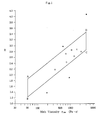
- Fig. 1 is a graph illustrating a relationship between a melt viscosity ⁇ 200 and an R ( ⁇ 200 / ⁇ 1200 ) value of a PAS resin.
- a range satisfying the relationship (1) is within an area enclosed by a line connecting points A, B, C and D in Fig. 1.
- the first feature of the present invention resides in that the following specifically selected PAS resin is used as a metal coating resin.
- the present inventors have proceeded with an extensive investigation as to continuous coating with a PAS resin on a metal base. As a result, it has been found that when the select PAS resin satisfying the requirements 1-3 is used, melt-coating processing can be performed stably, and a coated product having excellent mechanical properties can be obtained.
- the PAS resin useful in the practice of the present invention is not a completely linear resin obtained from only an alkali metal sulfide and a dihalo-aromatic compound, but a branched resin obtained by causing a small amount of a trihalo-aromatic compound, which is a trifunctional monomer, to coexist with the above components.
- the PAS resin satisfying the relationship (1) can be obtained by making a resin branched.
- excellent processability and mechanical properties can be achieved.
- a crosslinked resin obtained by subjecting a low molecular weight PAS resin to oxidative crosslinking (curing) in the presence of oxygen undergoes gelation upon its melting and stretching and is hence poor in processability, and besides has poor utility from the standpoints of strength of the resulting coating layer, adhesion to the metal base, wear resistance, resistance to dielectric breakdown, heat resistance and the like.
- the PAS resin used in the present invention has a melt viscosity ⁇ 200 of 50-3,000 Pa ⁇ s, preferably 200-2,500 Pa ⁇ s, more preferably 300-2,000 Pa ⁇ s as measured at 310°C and a shear rate of 200/sec. If the melt viscosity ⁇ 200 is lower than 50 Pa ⁇ s, the elasticity of such a PAS resin in a molten state becomes poor when extruded through an extruder, resulting in difficulty in stretching it. If the melt viscosity ⁇ 200 exceeds 3,000 Pa ⁇ s, the PAS resin markedly undergoes gelation, resulting in deteriorated processability, and moreover reduction in the flexing resistance and flexibility of the resulting coating.
- the PAS resin used in the present invention requires to satisfy the relationship (1). If R ( ⁇ 200 / ⁇ 1200 ) falls within a range represented by the following inequality (3), the elasticity of such a PAS resin in a molten state becomes poor when extruded through an extruder, resulting in difficulty in adequate draw. 0.91 x log( ⁇ 200 ) - 0.3 > R
- R falls within a range represented by the following inequality (4), difficulty is encountered on even stretching, so that many irregular uneven portions occur in the resulting coating layer.
- R 0.91 x log( ⁇ 200 ) + 0.3
- Fig. 1 diagrammatically illustrates the relationship between the melt viscosity ⁇ 200 (axis of abscissa) and the R value (axis of ordinate) of the PAS resin.
- the PAS resin used in the present invention falls within a range enclosed by points A, B, C and D in Fig. 1.
- white square marks indicate the property values plotted as to resins obtained in Synthesis Examples 1-7 (Examples), while black triangle marks denote the property values plotted as to resins obtained in Synthesis Examples 8-11 (Comparative Examples).
- a PAS resin having the melt viscosity and melt properties as described above can be obtained by suitably controlling proportions of individual monomers and polymerization conditions upon polymerizing an alkali metal sulfide and a dihalo-aromatic compound in the presence of a trihalo-aromatic compound.
- alkali metal sulfide examples include sodium sulfide, potassium sulfide, lithium sulfide, rubidium sulfide, cesium sulfide and mixtures of two or more of these compounds.
- the alkali metal sulfide may be formed in situ in a reaction vessel in accordance with a method known per se in the art. These alkali metal sulfides can be used as hydrates or aqueous mixtures, or in anhydrous forms.
- a small amount of an alkali metal hydroxide may be added to react with an alkali metal bisulfide and an alkali metal thiosulfate present in a trace amount in the alkali metal sulfide, thereby removing these impurities or converting them into the sulfide.
- sodium sulfide is industrially preferred because it is cheapest.
- dihalo-aromatic compound examples include dihalobenzenes such as p-dichlorobenzene, m-dichlorobenzene and p-dibromobenzene; substituted dihalo-aromatic compounds such as 2,5-dichlorotoluene and 1-methoxy-2,5-dichlorobenzene; dihalonaphthalene such as 1,4-dichloronaphthalene; dihalobiphenyls such as 4,4'-dichlorobiphenyl and 3,3'-dichlorobiphenyl; dihalobenzoic acids such as 3,5-dichlorobenzoic acid; dihalobenzophenones such as 4,4'-dichlorobenzophenone; dihalodiphenyl sulfones such as 4,4'-dichlorodiphenyl sulfone and 3,3'-dichlorodiphenyl sulfone; and dihalophenyl ethers such
- the dihalobenzenes are preferred from the viewpoint of economy, physical properties and the like, with p-dihalobenzenes such as p-dichlorobenzene being more preferred.
- p-dihalobenzenes such as p-dichlorobenzene
- Those containing p-dichlorobenzene in a proportion of preferably at least 70 wt.%, more preferably at least 80 wt.%, still more preferably at least 90 wt.% are particularly preferred.
- trihalo-aromatic compound examples include trihalobenzenes such as 1,2,3-trichlorobenzene, 1,2,3-tribromobenzene, 1,2,4-trichlorobenzene, 1,2,4-tribromobenzene, 1,3,5-trichlorobenzene, 1,3,5-tribromobenzene and 1,3-dichloro-5-bromobenzene; alkyl-substituted trihalobenzenes; and mixtures of these compounds.
- 1,2,4-trihalobenzenes, 1,3,5-trihalobenzenes and 1,2,3-trichlorobenzene are preferred from the viewpoint of economy, reactivity, physical properties and the like.
- the alkali metal sulfide and the dihalo-aromatic compound are subjected to a polycondensation reaction in the presence of the trihalo-aromatic compound in a polar organic solvent containing water.
- the water include water of hydration in the alkali metal sulfide, water to be added, water formed in the reaction and water in an aqueous solution of the alkali metal sulfide.
- organic amide solvents may be mentioned N-methylpyrrolidone, N-ethylpyrrolidone, N,N-dimethylformamide, N,N-dimethylacetamide, N-methylcaprolactam, dimethylimidazolidinone, tetramethylurea and hexamethylphosphoric amide.
- NMP N-methyl-2-pyrrolidone
- a ratio a/b of the number of moles a of the dihalo-aromatic compound charged to the number of moles b of the alkali metal sulfide charged is controlled so as to fall within a range of generally 0.95-1.10, preferably 0.98-1.08, more preferably 1.00-1.06.
- the trihalo-aromatic compound is added to the polymerization reaction system under control so as to fall within a range of generally 0.0002-0.01 moles, preferably 0.0004-0.009 moles, more preferably 0.0005-0.007 moles per mole of the alkali metal sulfide charged.
- the amount of the trihalo-aromatic compound is less than 0.0002 moles per mole of the alkali metal sulfide charged, the elasticity of the resulting PAS resin becomes insufficient in a molten state, so that the resin fails to adequate orientate when directly stretched in the molten state. Therefore, the mechanical properties of a coating layer to be formed is lowered.
- the amount of the trihalo-aromatic compound exceeds 0.01 moles, the melt viscosity of the resulting PAS resin becomes high, so that breaking of resin occurs upon coating, resulting in difficulty in continuously obtaining an even coated product.
- amounts outside the above range are not preferred.
- the trihalo-aromatic compound may be added to the polymerization reaction system either in the initial stage or in the final stage of polymerization. However, the addition in the initial stage is more effective even in the addition in a less amount.
- any conventional process may be used.
- the amount of the polar organic solvent to be used is generally 0.2-2.0 kg, preferably 0.3-1.0 kg per mole of the alkali metal sulfide.
- the resin is melted at a temperature not lower than the melting point of this resin, preferably a temperature ranging from (the melting point + 5°C) to 370°C, more preferably a temperature ranging from (the melting point + 20°C) to 350°C by means of an extruder, and then applied to the metal base on the outside of a die while forming a parison.
- the metal body to be coated i.e., a metal member to be coated
- the coated metal body is then cooled in a cooling zone and generally taken up by a take-up machine or the like.
- a heating zone may be optionally provided between the die of the extruder through which the molten resin is extruded to form a parison, thereby coating the metal base, and the pinch rollers to heat-treat the coated metal body.
- the heat-treating temperature for the coated metal body is generally 120-290°C, preferably 130-270°C.
- the heat-treating time (namely, residence time in the heating zone) varies according to productivity, the thickness of the coating layer, take-off speed, and the crystallization rate and crystallization temperature of the resin and can hence not be specified unqualifiedly. However, it is generally not shorter than 0.1 seconds but not longer than 10 minutes.
- the coated metal body taken up once may also be optionally heat-treated in order to control the crystallinity and mechanical properties of the coating layer to obtain a desired coated metal body.
- the heat-treating temperature for the coated metal body is within a range of generally 120-290°C, preferably 130-270°C.
- the heat-treating time varies according to productivity, the thickness of the coating layer, take-off speed, and the crystallization rate and crystallization temperature of the resin and can hence not be specified unqualifiedly. However, it is generally not shorter than 1 second but not longer than 100 hours.
- a heat treatment at a temperature lower than 120°C is not preferable because the resin cannot be fully crystallized, so that high-temperature dimensional stability or surface quality may be impaired in some cases.
- a heat treatment at a temperature exceeding 290°C may impair surface quality due to deformation of the coating layer.
- a heat treatment for a period of time shorter than 1 second is not preferable because the resin cannot be fully crystallized, so that high-temperature dimensional stability or surface quality may be impaired in some cases.
- a heat treatment too long is also not preferable because surface quality is impaired due to deformation of the coating layer.
- high elongation at breakage can be achieved by using heat-treating conditions that the heat-treating temperature is preferably 200-270°C, more preferably 230-260°C, and the heat-treating time is preferably 1 second to 10 minutes, more preferably about 1-60 seconds.
- the crystallinity of the resin forming the coating layer is preferably controlled to 30% or lower by the heat treatment. If the crystallinity exceeds 30%, there is a possibility that the coating layer formed may become brittle.
- the crystallinity of the resin forming the coating layer is preferably within a range of 15-30%.
- the elongation of the coating layer shows a tendency to vary even when the crystallinity of the resin is the same if the heat-treating temperature varies. A higher elongation is easy to attain even when the crystallinity of the resin is the same or higher as the heat-treating temperature becomes higher.
- the second feature of the present invention resides in that a PAS resin having an elongational viscosity of at least 10,000 Pa ⁇ s as measured at 310°C and a shear rate of 400/sec is used, and the PAS resin is coated on a metal base, thereby forming a coating layer whose crystallization temperature upon heating as measured by means of a DSC is lower by at least 6°C than that of an unorientated noncrystalline sheet of the PAS resin.
- the PAS resin useful in the practice of the present invention there may be used a completely linear resin obtained from only an alkali metal sulfide and a dihalo-aromatic compound.
- the resin is desirably a branched resin obtained by causing a small amount of a trihalo-aromatic compound, which is a trifunctional monomer, to coexist upon the reaction of the alkali metal sulfide with a dihalo-aromatic compound because its elongational viscosity is sufficiently high as at least 10,000 Pa ⁇ s.
- a branched resin can be obtained in accordance with the polymerization process described above.
- the elongational viscosity of the PAS resin used in the present invention must be as high as at least 10,000 Pa ⁇ s.
- the viscosity is preferably 10,000-300,000 Pa ⁇ s, more preferably 10,000-200,000 Pa ⁇ s.
- the elongational viscosity can be calculated out in accordance with the method of F.N. Cogswell [Polym. Eng. Sci. 12 , p. 64 (1972)]. Its details will be described subsequently. If the elongational viscosity of the PAS resin is too low, the molecular weight or branching degree of the PAS resin becomes insufficient.
- the melt viscosity of the PAS resin as measured at 310°C and a shear rate of 1200/sec is preferably at least 50 Pa ⁇ s.
- the resin is melted at a temperature not lower than the melting point of this resin, preferably a temperature ranging from (the melting point + 5°C) to 370°C, more preferably a temperature ranging from (the melting point + 20°C) to 350°C by means of an extruder, and then applied to the metal base on the outside of a die while forming a parison.
- the metal body to be coated i.e., a metal member to be coated
- the coated metal body is then cooled in a cooling zone and generally taken up by a take-up machine or the like.
- the strength at 10% strain of the coating layer formed of the PAS resin be preferably at least 0.93 times, more preferably at least 0.95 times the yield strength of the coating layer, that (3) the crystallinity of the coating layer formed of the PAS resin after subjected to a heat treatment at a heat-treating temperature of 120-290°C be within a range of 10-40%, that (4) the strength at 10% strain of the coating layer of the PAS resin after the heat treatment be at least 0.95 times the yield strength of the coating layer, and that (5) the elongation at break of the coating layer formed of the PAS resin after the heat treatment be at least 30%.
- a range of ⁇ Tc 1 is generally -35°C ⁇ ⁇ Tc 1 ⁇ -6°C, preferably -25°C ⁇ ⁇ Tc 1 ⁇ -7°C.
- the strength at 10% strain (B) of the coating layer formed of the PAS resin as determined by a tensile test is preferably at least 0.93 times (B/A ⁇ 0.93), more preferably at least 0.95 times (B/A ⁇ 0.95) the yield strength (A) of the coating layer. If this ratio is lower than 0.93 times (B/A ⁇ 0.93), the elongation at break of the coating layer formed of the PAS resin becomes low, so that the flexing resistance and flexibility of the coating layer are deteriorated.
- the ratio (B/A) is more preferably 0.93 ⁇ B/A ⁇ 2, still more preferably 0.95 ⁇ B/A ⁇ 1.8.
- the crystallinity of the coating layer formed of the PAS resin after subjected to a heat treatment at a heat-treating temperature of 120-290°C is preferably within a range of 10-40%.
- the coating layer according to the present invention has a sufficient elongation even when it is heat-treated until its crystallinity reaches, for example, at least 30%, because the PAS resin undergoes molecular chain orientation.
- the strength at 10% strain (B) of the coating layer formed of the PAS resin after the heat treatment is preferably at least 0.95 times the yield strength (A) of the coating layer, and the elongation at break of the coating layer formed of the PAS resin after the heat treatment is preferably at least 30%.
- an area drawdown ratio (R1) upon coating is selected according to the elongational viscosity ( ⁇ 400 ) of the PAS resin.
- R1 area drawdown ratio
- the PAS resin of the coating layer becomes easier to orientate even when the area drawdown ratio is low as the molecular weight or branching degree of the PAS resin increases.
- area drawdown ratio (R1) means a value obtained by dividing an sectional area of a resin melt-extruded through a die of an extruder by a sectional area of the resulting coating layer.
- the strength at 10% strain (B) of the coating layer formed of the PAS resin is preferably at least 0.93 times the yield strength (A) of the coating layer in the present invention, it is desirable to select an area drawdown ratio (R1), by which B/A ⁇ 0.93 is achieved, in relation to the elongational viscosity ( ⁇ 400 ).
- values of the elongational viscosity ( ⁇ 400 ) of the PAS resin and B/A are determined to calculate a value of the area drawdown ratio (R1) satisfying these values from the relationship (II).
- the relationship (I) is preferably substituted by B/A ⁇ 0.95 [relationship (III)].
- a heating zone may be optionally provided between the die of the extruder through which the molten resin is extruded to form a parison, thereby coating the metal base, and the pinch rollers to heat-treat the coated metal body.
- the heat-treating temperature for the coated metal body is generally 120-290°C, preferably 130-270°C.
- the heat-treating time (namely, residence time in the heating zone) varies according to productivity, the thickness of the coating layer, take-off speed, and the crystallization rate and crystallization temperature of the resin and can hence not be specified unqualifiedly. However, it is generally not shorter than 0.1 seconds but not longer than 10 minutes.
- the coated metal body taken up once may also be optionally heat-treated in order to control the crystallinity and mechanical properties of the coating layer to obtain a desired coated metal body.
- the heat-treating temperature for the coated metal body is within a range of generally 120-290°C, preferably 130-270°C.
- the heat-treating time varies according to productivity, the thickness of the coating layer, take-off speed, and the crystallization rate and crystallization temperature of the resin and can hence not be specified unqualifiedly. However, it is generally not shorter than 1 second but not longer than 100 hours.
- a heat treatment at a temperature lower than 120°C is not preferable because the resin cannot be fully crystallized, so that high-temperature dimensional stability or surface quality may be impaired in some cases.
- a heat treatment at a temperature exceeding 290°C may impair surface quality due to deformation of the coating layer.
- a heat treatment for a period of time shorter than 1 second is not preferable because the resin cannot be fully crystallized, so that high-temperature dimensional stability or surface quality may be impaired in some cases.
- a heat treatment too long is also not preferable because surface quality is impaired due to deformation of the coating layer.
- the crystallinity of the resin forming the coating layer is preferably controlled to generally 30% or lower by the heat treatment if the orientation of the PAS resin forming the coating layer is low.
- a PAS resin having an elongational viscosity of at least 10,000 Pa ⁇ s is used, and an area drawdown ratio is suitably selected to enhance orientation, a sufficient elongation can be retained even when the crystallinity is heightened beyond 30% by the heat treatment, so that there is no possibility that the coating layer may become brittle.
- the crystallinity of the resin forming the coating layer is preferably controlled within a range of 15-40%, more preferably 17-35%.
- other minor components miscible with the PAS resin may be contained within limits not impeding the objects of the present invention.
- other components include granular, powdery or scaly inorganic fillers such as silica, talc, mica, kaolin, calcium carbonate, magnesium phosphate and glass; fluororesins such as polytetrafluoroethylene, tetrafluoroethylene-hexafluoropropylene copolymers and ethylene-tetrafluoroethylene copolymers; fibrous inorganic fillers such as glass fibers, carbon fibers and mica ceramic fibers; impact modifiers such as silicone elastomers, acrylic elastomers, olefin elastomers, polyamide elastomers and fluoroelastomers; and besides, other thermoplastic resins, thermosetting resins, coupling agents, lubricants, parting agents, stabilizers and nucleating agents.
- the PAS resins according to the present invention are excellent in adhesion to metal bases.
- a parting agent may be mentioned fatty acid esters such as pentaerythritol tristearate and distearyl pentaerythritol diphosphate.
- the parting agent is generally used in a proportion of 0.1-3 parts by weight per 100 parts by weight of the resin.
- a stabilizer any known stabilizer for poly(arylene sulfide) resins may be used.
- barium hydroxide or the like is preferred for the purpose of stably melt-extruding a resin through a die of an extruder to conduct coating.
- the stabilizer is generally used in a proportion of 0.1-3 parts by weight per 100 parts by weight of the resin.
- metal bases may be mentioned continuous metal bases, such as metallic conductors (metallic conductor wires) such as electric wires, metal rods, metal tubes and wires.
- metallic conductors metallic conductor wires
- the thickness of the coating layer formed of the PAS resin can be suitably determined according to application purpose and desired properties.
- coated metal members such as coated wires, on which a coating layer composed of the PAS resin excellent in heat resistance, Freon resistance, flame retardancy, chemical resistance, radiation resistance, low-temperature properties, electrical insulating properties, mechanical properties and the like has been formed.
- coated metal members include conduit tubes and inner cables for control cables in automobiles or ships, windings for heat-resistant coils or motors, solenoid lead wires for automobiles, Freon-resistant wires for compressors and the like, windings for transformers, radiation-resistant equipment wirings for nuclear power plants, cables, magnet wires, metal rods, metal tubes, other heat-resistant wires, sheaths, and wires.
- poly(arylene sulfide) resins for coating metals by which when a metal base is coated with such a resin, the resin can be stably continuously applied without any breaking of the resin, and the resulting coating layer undergoes no cracking even when subjected to a heat treatment after the coating.
- metal members coated with the PAS resin excellent in heat resistance, Freon resistance, flame retardancy, chemical resistance, radiation resistance, low-temperature properties, electrical insulating properties, mechanical properties and the like.
- the coated metal members according to the present invention each have a stable continuous coating layer free from breaking of resin.
- the coating layer retains excellent tensile properties, flexibility, flexing resistance and the like even when subjected to a heat treatment after the coating.
- a titanium-lined polymerizer was charged with 373 kg of hydrous sodium sulfide (purity: 46.06%) and 800 kg of N-methylpyrrolidone (hereinafter abbreviated as "NMP"), and the temperature of the reaction system was gradually raised up to about 200°C in a nitrogen gas atmosphere, thereby distilling off 141 kg of water together with 54.4 moles of hydrogen sulfide.
- NMP N-methylpyrrolidone
- a mixed solution of 324.7 kg of p-dichlorobenzene (hereinafter abbreviated as "p-DCB”), 0.796 kg of 1,2,4-trichlorobenzene and 274 kg of NMP was then fed to conduct a polymerization reaction at 220°C for 5 hours.
- the polymer obtained above was fed to a twin-screw kneader extruder (BT-30 Model, manufactured by Plastic Engineering Laboratory) having a cylinder bore of 30 mm and kneaded at a cylinder temperature of 300-330°C to obtain a pellet-like material.
- the thus-obtained pellet-like material was fed to a twin-screw extruder (Laboplastomill, manufactured by Toyo Seiki Seisaku-Sho, Ltd.) equipped with a wire coating die to coat a conductor wire.
- Conditions for coating the conductor wire were as follows:
- coating could be stably performed continuously for 6 hours without causing any breaking of resin, thereby obtaining a coated product having an outer diameter of 0.7 mm and an even surface.
- After cooling the coated product it was introduced into a heating zone to heat-treat under conditions of 250°C and residence time of 3 seconds, thereby crystallizing the coating resin. Thereafter, the coated product was taken up on a roll.
- the thus-obtained coated product underwent neither cracking nor fracturing in its coating layer even when bent.
- the conductor wire was drawn out of the coated product to conduct a tensile test of the coating layer under the following conditions:
- the coating layer was found to have a tensile strength at break of 136 MPa and an elongation at break of 150%.
- Example 2 The same pellet-like material and conductor wire as those used in Example 1 were used, and the coating conditions were changed so as to give a draw ratio of 50 times, thereby conducting coating.
- the conditions for coating the conductor wire were as follows:
- Example 1 As a result of the coating experiment, a coated product having an outer diameter of 0.7 mm was obtained. The thus-obtained coated product was subjected to the same heat treatment as in Example 1. The resultant coated product underwent neither cracking nor fracturing in its coating layer even when bent. As a result of the same tensile test as in Example 1, the coating layer was found to have a tensile strength at break of 170 MPa and an elongation at break of 135%.
- a titanium-lined polymerizer was charged with 370 kg of hydrous sodium sulfide (purity: 46.21%) and 800 kg of NMP, and the temperature of the reaction system was gradually raised up to about 200°C in a nitrogen gas atmosphere, thereby distilling off 140.5 kg of water together with 53.4 moles of hydrogen sulfide.
- a mixed solution of 324 kg of p-DCB, 0.790 kg of 1,2,4-trichlorobenzene and 270 kg of NMP was then fed to conduct a polymerization reaction at 220°C for 5 hours.
- the polymer obtained above was fed to a twin-screw kneader extruder (BT-30 Model, manufactured by Plastic Engineering Laboratory) having a cylinder bore of 30 mm and kneaded at a cylinder temperature of 300-320°C to obtain a pellet-like material.
- the thus-obtained pellet-like material was fed to a twin-screw extruder (Laboplastomill, manufactured by Toyo Seiki Seisaku-Sho, Ltd.) equipped with a wire coating die to conduct coating under the same conditions as in Example 1 except that the cylinder temperature and reduced pressure by evacuation between the conductor wire and a coating layer were changed to 320°C and -13 cmHg, respectively.
- a titanium-lined polymerizer was charged with 371 kg of hydrous sodium sulfide (purity: 46.10%) and 800 kg of NMP, and the temperature of the reaction system was gradually raised up to about 200°C in a nitrogen gas atmosphere, thereby distilling off 140.0 kg of water together with 54.0 moles of hydrogen sulfide.
- a mixed solution of 325 kg of p-DCB, 0.885 kg of 1,2,4-trichlorobenzene and 270 kg of NMP was then fed to conduct a polymerization reaction at 220°C for 5 hours.
- the polymer obtained above was fed to a twin-screw kneader extruder (BT-30 Model, manufactured by Plastic Engineering Laboratory) having a cylinder bore of 30 mm and kneaded at a cylinder temperature of 300-320°C to obtain a pellet-like material.
- the thus-obtained pellet-like material was fed to a twin-screw extruder (Laboplastomill, manufactured by Toyo Seiki Seisaku-Sho, Ltd.) equipped with a wire coating die to conduct coating under the same conditions as in Example 3 except that the reduced pressure by evacuation between the conductor wire and a coating film was changed to -10 cmHg, respectively.
- Example 1 coating could be stably performed continuously for 6 hours without causing any breaking of resin, thereby obtaining a coated product having an outer diameter of 0.7 mm and an even surface.
- the thus-obtained coated product was subjected to the same heat treatment as in Example 1.
- the resultant coated product underwent neither cracking nor fracturing in its coating layer even when bent.
- the coating layer was found to have a tensile strength at break of 110 MPa and an elongation at break of 105%.
- a titanium-lined polymerizer was charged with 373 kg of hydrous sodium sulfide (purity: 46.10%) and 810 kg of NMP, and the temperature of the reaction system was gradually raised up to about 200°C in a nitrogen gas atmosphere, thereby distilling off 140.0 kg of water together with 53.8 moles of hydrogen sulfide.
- a mixed solution of 321.0 kg of p-DCB, 0.795 kg of 1,2,4-trichlorobenzene and 266 kg of NMP was then fed to conduct a polymerization reaction at 220°C for 5 hours.
- the polymer obtained above was fed to a twin-screw kneader extruder (BT-30 Model, manufactured by Plastic Engineering Laboratory) having a cylinder bore of 30 mm and kneaded at a cylinder temperature of 300-330°C to obtain a pellet-like material.
- the thus-obtained pellet-like material was fed to a twin-screw extruder (Laboplastomill, manufactured by Toyo Seiki Seisaku-Sho, Ltd.) equipped with a wire coating die to coat a conductor wire under the following conditions:
- Example 1 coating could be stably performed continuously for 6 hours without causing any breaking of resin, thereby obtaining a coated product having an outer diameter of 0.7 mm and an even surface.
- the thus-obtained coated product was subjected to the same heat treatment as in Example 1.
- the resultant coated product underwent neither cracking nor fracturing-in its coating layer even when bent.
- the coating layer was found to have a tensile strength at break of 145 MPa and an elongation at break of 170%.
- a titanium-lined polymerizer was charged with 372 kg of hydrous sodium sulfide (purity: 46.21%) and 820 kg of NMP, and the temperature of the reaction system was gradually raised up to about 200°C in a nitrogen gas atmosphere, thereby distilling off 140.5 kg of water together with 53.9 moles of hydrogen sulfide.
- a mixed solution of 326 kg of p-DCB, 0.856 kg of 1,2,4-trichlorobenzene and 255 kg of NMP was then fed to conduct a polymerization reaction at 220°C for 5 hours.
- the temperature of the reaction system was lowered down to 245°C to continue the polymerization reaction for 5 hours.
- the reaction system was cooled, and the liquid reaction mixture was then sifted through a screen having an opening of 150 ⁇ m (100 mesh) to separate a granular polymer.
- the thus-separated granular polymer was washed each 3 times with methanol and water, dehydrated and then dried.
- the granular polymer thus obtained had a melt viscosity of 1,100 Pa ⁇ s as measured at 310°C and a shear rate of 200/sec, and an R value of 2.85.
- the polymer obtained above was fed to a twin-screw kneader extruder (BT-30 Model, manufactured by Plastic Engineering Laboratory) having a cylinder bore of 30 mm and kneaded at a cylinder temperature of 300-320°C to obtain a pellet-like material.
- BT-30 Model, manufactured by Plastic Engineering Laboratory having a cylinder bore of 30 mm and kneaded at a cylinder temperature of 300-320°C to obtain a pellet-like material.
- the thus-obtained pellet-like material was fed to a twin-screw extruder (Laboplastomill, manufactured by Toyo Seiki Seisaku-Sho, Ltd.) equipped with a wire coating die to coat a conductor wire under the following conditions:
- Example 1 coating could be stably performed continuously for 6 hours without causing any breaking of resin, thereby obtaining a coated product having an outer diameter of 0.7 mm and an even surface.
- the thus-obtained coated product was subjected to the same heat treatment as in Example 1.
- the resultant coated product underwent neither cracking nor fracturing in its coating layer even when bent.
- the coating layer was found to have a tensile strength at break of 140 MPa and an elongation at break of 140%.
- Example 6 The same pellet-like material as that used in Example 6 was used to conduct coating. The coating was conducted under the following conditions:
- coating could be stably performed continuously for 6 hours without causing any breaking of resin, thereby obtaining a coated product having an outer diameter of 0.8 mm and an even surface.
- the thus-obtained coated product was subjected to a heat treatment under conditions of 250°C and residence time of 5 seconds.
- the resultant coated product underwent neither cracking nor fracturing in its coating layer even when bent.
- the coating layer was found to have a tensile strength at break of 130 MPa and an elongation at break of 145%.
- a titanium-lined polymerizer was charged with 370 kg of hydrous sodium sulfide (purity: 46.40%) and 810 kg of NMP, and the temperature of the reaction system was gradually raised up to about 200°C in a nitrogen gas atmosphere, thereby distilling off 140.0 kg of water together with 54.0 moles of hydrogen sulfide.
- a mixed solution of 320 kg of p-DCB, 0.465 kg of 1,2,4-trichlorobenzene and 263 kg of NMP was then fed to conduct a polymerization reaction at 220°C for 5 hours.
- the polymer obtained above was fed to a twin-screw kneader extruder (BT-30 Model, manufactured by Plastic Engineering Laboratory) having a cylinder bore of 30 mm and kneaded at a cylinder temperature of 290-315°C to obtain a pellet-like material.
- the thus-obtained pellet-like material was fed to a twin-screw extruder (Laboplastomill, manufactured by Toyo Seiki Seisaku-Sho, Ltd.) equipped with a wire coating die to coat a conductor wire under the following conditions:
- Example 1 coating could be stably performed continuously for 6 hours without causing any breaking of resin, thereby obtaining a coated product having an outer diameter of 0.7 mm and an even surface.
- the thus-obtained coated product was subjected to the same heat treatment as in Example 1.
- the resultant coated product underwent neither cracking nor fracturing in its coating layer even when bent.
- the coating layer was found to have a tensile strength at break of 100 MPa and an elongation at break of 100%.
- a titanium-lined polymerizer was charged with 372 kg of hydrous sodium sulfide (purity: 46.21%) and 824 kg of NMP, and the temperature of the reaction system was gradually raised up to about 200°C in a nitrogen gas atmosphere, thereby distilling off 142.0 kg of water together with 56.6 moles of hydrogen sulfide.
- a mixed solution of 322.2 kg of p-DCB, 0.796 kg of 1,2,4-trichlorobenzene and 249 kg of NMP was then fed to conduct a polymerization reaction at 220°C for 5 hours.
- the polymer obtained above was fed to a twin-screw kneader extruder (BT-30 Model, manufactured by Plastic Engineering Laboratory) having a cylinder bore of 30 mm and kneaded at a cylinder temperature of 310-350°C to obtain a pellet-like material.
- the thus-obtained pellet-like material was fed to a twin-screw extruder (Laboplastomill, manufactured by Toyo Seiki Seisaku-Sho, Ltd.) equipped with a wire coating die to coat a conductor wire under the following conditions:
- Example 1 coating could be stably performed continuously for 6 hours without causing any breaking of resin, thereby obtaining a coated product having an outer diameter of 0.8 mm and an even surface.
- the thus-obtained coated product was subjected to the same heat treatment as in Example 1.
- the resultant coated product underwent neither cracking nor fracturing in its coating layer even when bent.
- the coating layer was found to have a tensile strength at break of 120 MPa and an elongation at break of 65%.
- a titanium-lined polymerizer was charged with 390 kg of hydrous sodium sulfide (purity: 46.40%) and 800 kg of NMP, and the temperature of the reaction system was gradually raised up to about 200°C in a nitrogen gas atmosphere, thereby distilling off 148.0 kg of water together with 57.8 moles of hydrogen sulfide.
- a mixed solution of 354.6 kg of p-DCB, 8.210 kg of 1,2,4-trichlorobenzene and 218 kg of NMP was then fed to conduct a polymerization reaction at 220°C for 4 hours.
- the polymer obtained above was fed to a twin-screw kneader extruder (BT-30 Model, manufactured by Plastic Engineering Laboratory) having a cylinder bore of 30 mm to pelletize it. However, the resin was not melted, resulting in a failure to obtain a pellet-like material.
- BT-30 Model manufactured by Plastic Engineering Laboratory
- a titanium-lined polymerizer was charged with 390 kg of hydrous sodium sulfide (purity: 46.40%) and 800 kg of NMP, and the temperature of the reaction system was gradually raised up to about 200°C in a nitrogen gas atmosphere, thereby distilling off 147.0 kg of water together with 57.2 moles of hydrogen sulfide.
- a mixed solution of 337.5 kg of p-DCB and 219 kg of NMP was then fed to conduct a polymerization reaction at 220°C for 4.5 hours. After 80.8 kg of water were then introduced under pressure into the reaction system to conduct the polymerization reaction at 255°C for 2 hours, the temperature of the reaction system was lowered down to 245°C to continue the polymerization reaction for 11 hours.
- the reaction system was cooled, and the liquid reaction mixture was then sifted through a screen having an opening of 150 ⁇ m (100 mesh) to separate a granular polymer.
- the thus-separated granular polymer was washed each 3 times with methanol and water, dehydrated and then dried.
- the polymer thus obtained had a melt viscosity of 916 Pa ⁇ s as measured at 310°C and a shear rate of 200/sec, and an R value of 1.90.
- the polymer obtained above was fed to a twin-screw kneader extruder (BT-30 Model, manufactured by Plastic Engineering Laboratory) having a cylinder bore of 30 mm and kneaded at a cylinder temperature of 290-320°C to obtain a pellet-like material.
- the thus-obtained pellet-like material was fed to a twin-screw extruder (Laboplastomill, manufactured by Toyo Seiki Seisaku-Sho, Ltd.) equipped with a wire coating die to coat a conductor wire under the following conditions:
- the resultant coated product had an outer diameter of 0.7 mm and an even surface.
- the coated product was subjected to the same heat treatment as in Example 1 and then to the same tensile test as in Example 1. As a result, the coating layer was found to have a tensile strength at break of 67 MPa and an elongation at break of 4%. This coated product underwent cracking in its coating layer when bent.
- the same pellet-like material and conductor wire as those used in Comparative Example 2 were used, and the coating conditions were changed to conduct coating.
- the coating conditions were as follows:
- a titanium-lined polymerizer was charged with 420 kg of hydrous sodium sulfide (purity: 46.21%) and 720 kg of NMP, and the temperature of the reaction system was gradually raised up to about 200°C in a nitrogen gas atmosphere, thereby distilling off 160.0 kg of water together with 61.8 moles of hydrogen sulfide.
- a mixed solution of 363.6 kg of p-DCB and 250 kg of NMP was then fed to conduct a polymerization reaction at 220°C for 4.5 hours. Then, 56.5 kg of water were then introduced under pressure into the reaction system to conduct the polymerization reaction at 255°C for 5 hours.
- the reaction system was cooled, and the liquid reaction mixture was then sifted through a screen having an opening of 150 ⁇ m (100 mesh) to separate a granular polymer.
- the thus-separated granular polymer was washed 3 times with methanol, 3 times with water, once with a 3% aqueous solution of ammonium chloride and twice with water.
- hydrochloric acid was added to the slurry to adjust the pH of the slurry to about 5.
- the thus-treated slurry was dehydrated and dried.
- the polymer thus obtained had a melt viscosity of 192 Pa ⁇ s as measured at 310°C and a shear rate of 200/sec, and an R value of 1.37.
- the polymer obtained above was fed to a twin-screw kneader extruder (BT-30 Model, manufactured by Plastic Engineering Laboratory) having a cylinder bore of 30 mm and kneaded at a cylinder temperature of 290-305°C to obtain a pellet-like material.
- the thus-obtained pellet-like material was fed to a twin-screw extruder (Laboplastomill, manufactured by Toyo Seiki Seisaku-Sho, Ltd.) equipped with a wire coating die to coat a conductor wire under the following conditions:
- the resultant coated product had an outer diameter of 0.7 mm and an even surface.
- the coated product was subjected to the same heat treatment as in Example 1 and then to the same tensile test as in Example 1. As a result, the coating layer was found to have a tensile strength at break of 58 MPa and an elongation at break of 3%. This coated product underwent cracking in its coating layer when bent.
- a titanium-lined polymerizer was charged with 372 kg of hydrous sodium sulfide (purity: 46.40%) and 805 kg of NMP, and the temperature of the reaction system was gradually raised up to about 200°C in a nitrogen gas atmosphere, thereby distilling off 140.3 kg of water together with 53.9 moles of hydrogen sulfide.
- a mixed solution of 330 kg of p-DCB, 0.989 kg of 1,2,4-trichlorobenzene and 274 kg of NMP was then fed to conduct a polymerization reaction at 220°C for 5 hours.
- the polymer obtained above was fed to a twin-screw kneader extruder (BT-30 Model, manufactured by Plastic Engineering Laboratory) having a cylinder bore of 30 mm and kneaded at a cylinder temperature of 290-310°C to obtain a pellet-like material.
- the thus-obtained pellet-like material was fed to a twin-screw extruder (Laboplastomill, manufactured by Toyo Seiki Seisaku-Sho, Ltd.) equipped with a wire coating die to coat a conductor wire under the following conditions:
- Example 1 The coated product was subjected to the same heat treatment as in Example 1 and then to the same tensile test as in Example 1. As a result, the coating layer was found to have a tensile strength at break of 52 MPa and an elongation at break of 3%. This coated product underwent cracking in its coating layer when bent.
- a polymer was synthesized in the same manner as in Synthesis Example (1) of polymer in Example 1.
- the polymer was then used to conduct a metal coating experiment in the same manner as in Example 1, thereby obtaining a coated product (a resin coated conductor wire).
- the thus-obtained coated product was introduced into a heating zone to heat-treat it under its corresponding conditions of heat-treating temperature and heat-treating time (residence time) shown in individual run numbers of Table 3, thereby crystallizing the coating resin.
- the thus-treated coated product was then taken up on a roll.
- the resultant coated product was subjected to the same tensile test as in Example 1.
- the crystallinity of the coating resin was also determined in accordance with the following measuring method. The results are shown in Table 3.
- the density of a coating resin sample was measured by the density-gradient tube method to calculate a crystallinity from the measured density according to its volume fraction on the basis of a crystalline density of 1.43 g/cm 3 and a noncrystalline density of 1.3195 g/cm 3 .
- Table 3 Run No. Heat-treating temp.
- a polymer was synthesized in the same manner as in Synthesis Example (1) of polymer in Example 1. Then, 100 parts by weight of the polymer were mixed with 1 part by weight of pentaerythritol tristearate (Unistar H476, product of Nippon Oil & Fats Co., Ltd.) for 3 minutes in a tumbler mixer to obtain a resin composition.
- a metal coating experiment was performed in the same manner as in Example 1 except that this resin composition was used in place of the polymer used in Example 1, thereby obtaining a coated product (a resin coated conductor wire). After cooling the thus-obtained coated product, it was introduced into a heating zone to heat-treat it under the same conditions as in Example 1, thereby crystallizing the coating resin.
- the thus-treated coated product was then taken up on a roll.
- the resultant coated product was subjected to the same tensile test as in Example 1.
- the coating layer was found to have a tensile strength at break of 134 MPa and an elongation at break of 180%. This coated product had good strippability.
- a polymer was synthesized in the same manner as in Synthesis Example (1) of polymer in Example 1. Then, 100 parts by weight of the polymer were mixed with 0.5 parts by weight of barium hydroxide for 3 minutes in a tumbler mixer to obtain a resin composition.
- a metal coating experiment was performed in the same manner as in Example 1 except that this resin composition was used in place of the polymer used in Example 1, thereby obtaining a coated product (a resin coated conductor wire). After cooling the thus-obtained coated product, it was introduced into a heating zone to heat-treat it under the same conditions as in Example 1, thereby crystallizing the coating resin. The thus-treated coated product was then taken up on a roll. The resultant coated product was subjected to the same tensile test as in Example 1. As a result, the coating layer was found to have a tensile strength at break of 125 MPa and an elongation at break of 120%. In this metal coating experiment, coating could be stably conducted continuously for 10 hours.
- a polymer was synthesized in the same manner as in Synthesis Example (1) of polymer in Example 1. Then, 100 parts by weight of the polymer were mixed with 0.5 parts by weight of barium hydroxide and 0.5 parts by weight of distearyl pentaerythritol diphosphate (product of Specially Chemicals Co.) for 3 minutes in a tumbler mixer to obtain a resin composition.
- a metal coating experiment was performed in the same manner as in Example 1 except that this resin composition was used in place of the polymer used in Example 1, thereby obtaining a coated product (a resin coated conductor wire). After cooling the thus-obtained coated product, it was introduced into a heating zone to heat-treat it under the same conditions as in Example 1, thereby crystallizing the coating resin.
- the thus-treated coated product was then taken up on a roll.
- the resultant coated product was subjected to the same tensile test as in Example 1.
- the coating layer was found to have a tensile strength at break of 123 MPa and an elongation at break of 100%. This coated product had good strippability.
- a titanium-lined polymerizer was charged with 373 kg of hydrous sodium sulfide (purity: 46.10%) and 800 kg of NMP, and the temperature of the reaction system was gradually raised up to about 200°C in a nitrogen gas atmosphere, thereby distilling off 142 kg of water together with 54.4 moles of hydrogen sulfide.
- a mixed solution of 320.6 kg of p-DCB, 0.796 kg of 1,2,4-trichlorobenzene and 274 kg of NMP was then fed to conduct a polymerization reaction at 220°C for 1 hour, the temperature of the reaction system was raised up to 230°C to conduct the polymerization reaction for 3 hours.
- Polymer P12 was fed to a twin-screw kneader extruder (TEX-44, manufactured by The Japan Steel Works, Ltd.) having a cylinder bore of 44 mm and kneaded at a cylinder temperature of 300-330°C to produce pellets.
- the elongational viscosity of the polymer at 310°C and a shear rate of 400/sec was measured under the following measuring conditions and was found to be 33,000 Pa ⁇ s.
- the polymer also had a melt viscosity of 360 Pa ⁇ s as measured at 310°C and a shear rate of 1200/sec.
- the pellets obtained above were fed to a bench twin-screw extruder (MP-2015, manufactured by Tsubako ⁇ APV Co.) equipped with a wire coating die to coat a conductor wire. Coating conditions were as follows:
- the strength was calculated out by dividing a load by a sectional area of a sample before the test.
- the conductor wire was drawn out of the coated product to conduct a further tensile test of the coating layer.
- the crystallinity of the coating resin after the heat aging test was 34%.
- the conductor wire was drawn out of the coated product to conduct a tensile test of the coating layer.
- the crystallinity of the coating resin after the heat aging test was determined and found to be 35%.
- the crystallinity of the coating resin after the heat aging test was determined and found to be 35%.
- the coated product was continuously heat-treated by passing through a heating oven heated to 280°C and having a length of about 3 m (heat-treating conditions: 280°C/5.5 seconds), and then taken up.
- the resultant coated product had an outer diameter of 0.62 mm and an even surface.
- the conductor wire was drawn out of the coated product to conduct a tensile test of the coating layer.
- the crystallinity of the coating resin was determined and found to be 12%.
- the crystallinity of the coating resin after the heat aging test was determined and found to be 33%.
- the conductor wire was drawn out of the coated product to conduct a tensile test of the coating layer.
- the coating layer was found to have a maximum strength of 88 MPa and an elongation at break of 5%.
- the crystallinity of the coating resin after the heat aging test was determined and found to be 36%.
- the area drawdown ratio (R1) of this coated product was as low as 6, while its ⁇ Tc 1 was as great as -2°C, and so the coating layer was insufficient in molecular chain orientation. As a result, its elongation (elongation at break) after the heat aging test became extremely low, and the flexing resistance and flexibility thereof were hence poor.
- the crystallinity of the coating resin after the heat aging test was determined and found to be 35%.
- the crystallinity of the coating resin after the heat aging test was determined and found to be 33%.
- the elongational viscosity of the pellets thus obtained at 310°C and a shear rate of 400/sec was 38,000 Pa ⁇ s.
- the crystallinity of the coating resin after the heat aging test was determined and found to be 34%.
- a titanium-lined polymerizer was charged with 370 kg of hydrous sodium sulfide (purity: 46.21%) and 800 kg of NMP, and the temperature of the reaction system was gradually raised up to about 200°C in a nitrogen gas atmosphere, thereby distilling off 141 kg of water together with 53.4 moles of hydrogen sulfide.
- a mixed solution of 317.4 kg of p-DCB, 0.79 kg of 1,2,4-trichlorobenzene and 270 kg of NMP was then fed to conduct a polymerization reaction at 220°C for 1 hour, the temperature of the reaction system was raised up to 230°C to conduct the polymerization reaction for 3 hours.
- Polymer P13 obtained above was fed to a twin-screw kneader extruder (TEX-44, manufactured by The Japan Steel Works, Ltd.) having a cylinder bore of 44 mm and kneaded at a cylinder temperature of 300-330°C to produce pellets.
- the elongational viscosity of the polymer at 310°C and a shear rate of 400/sec was 90,000 Pa ⁇ s.
- the polymer also had a melt viscosity of 430 Pa ⁇ s as measured at 310°C and a shear rate of 1200/sec.
- the pellets obtained above were fed to a bench twin-screw extruder (MP-2015, manufactured by Tsubako ⁇ APV Co.) equipped with a wire coating die to coat a conductor wire. Coating conditions were as follows:
- the crystallinity of the coating resin after the heat aging test was determined and found to be 34%.
- the crystallinity of the coating resin after the heat aging test was determined and found to be 34%.
- the crystallinity of the coating resin after the heat aging test was determined and found to be 34%.
- the area drawdown ratio (R1) of this coated product was as low as 7, while its ⁇ Tc 1 was as great as -4°C, and so the coating layer was insufficient in molecular chain orientation. As a result, its elongation (elongation at break) after the heat aging test became extremely low, and the flexing resistance and flexibility thereof were hence poor.
- a titanium-lined polymerizer was charged with 371 kg of hydrous sodium sulfide (purity: 46.10%) and 800 kg of NMP, and the temperature of the reaction system was gradually raised up to about 200°C in a nitrogen gas atmosphere, thereby distilling off 142 kg of water together with 54 moles of hydrogen sulfide.
- a mixed solution of 318.9 kg of p-DCB, 1.16 kg of 1,2,4-trichlorobenzene and 270 kg of NMP was then fed to conduct a polymerization reaction at 220°C for 1 hour, the temperature of the reaction system was raised up to 230°C to conduct the polymerization reaction for 3 hours.
- the pellets obtained above were fed to a bench twin-screw extruder (MP-2015, manufactured by Tsubako ⁇ APV Co.) equipped with a wire coating die to coat a conductor wire. Coating conditions were as follows:
- the crystallinity of the coating resin after the heat aging test was determined and found to be 33%.
- the crystallinity of the coating resin after the heat aging test was determined and found to be 33%.
- a titanium-lined polymerizer was charged with 373 kg of hydrous sodium sulfide (purity: 46.10%) and 800 kg of NMP, and the temperature of the reaction system was gradually raised up to about 200°C in a nitrogen gas atmosphere, thereby distilling off 143 kg of water together with 53.8 moles of hydrogen sulfide.
- a mixed solution of 320.7 kg of p-DCB, 0.39 kg of 1,2,4-trichlorobenzene and 266 kg of NMP was then fed to conduct a polymerization reaction at 220°C for 1 hour, the temperature of the reaction system was raised up to 230°C to conduct the polymerization reaction for 3 hours.
- Polymer P15 obtained above was fed to a twin-screw kneader extruder (TEX-44, manufactured by The Japan Steel Works, Ltd.) having a cylinder bore of 44 mm and kneaded at a cylinder temperature of 300-330°C to produce pellets.
- the elongational viscosity of the polymer thus obtained at 310°C and a shear rate of 400/sec was 11,100 Pa ⁇ s.
- the polymer also had a melt viscosity of 340 Pa.s as measured at 310°C and a shear rate of 1200/sec.
- the pellets obtained above were fed to a bench twin-screw extruder (MP-2015, manufactured by Tsubako ⁇ APV Co.) equipped with a wire coating die to coat a conductor wire. Coating conditions were as follows:
- This coated product was heat-treated at 150°C for 96 hours.
- the tensile properties of the coating layer turned as follows:
- the crystallinity of the coating resin after the heat aging test was determined and found to be 34%.
- the crystallinity of the coating resin after the heat aging test was determined and found to be 35%.
- the coated product was subjected to a heat aging test under conditions of 180°C and 96 hours in an air-circulating oven, another tensile test of the coating layer was conducted. As a result, the coating layer was found to have a maximum strength of 76 MPa and an elongation at break of 6%. The crystallinity of the coating resin after the heat aging test was determined and found to be 34%.
- the area drawdown ratio (R1) of this coated product was as low as 59, while its ⁇ Tc 1 was as great as -4°C, and so the coating layer was insufficient in molecular chain orientation. As a result, its elongation (elongation at break) after the heat aging test became extremely low, and the flexing resistance and flexibility thereof were hence poor.
- a titanium-lined polymerizer was charged with 390 kg of hydrous sodium sulfide (purity: 46.40%) and 800 kg of NMP, and the temperature of the reaction system was gradually raised up to about 200°C in a nitrogen gas atmosphere, thereby distilling off 147 kg of water together with 57.2 moles of hydrogen sulfide.
- a mixed solution of 337.5 kg of p-DCB and 219 kg of NMP was then fed to conduct a polymerization reaction at 220°C for 4.5 hour. After 80.8 kg of water were then introduced under pressure into the reaction system to conduct the polymerization reaction at 255°C for 2 hours, the temperature of the reaction system was lowered down to 245°C to continue the polymerization reaction for 11 hours.
- the liquid reaction mixture was sifted through a screen having an opening of 150 ⁇ m (100 mesh) to separate a granular polymer.
- the thus-separated granular polymer was washed each 4 times with acetone and water, dehydrated and then dried, thereby obtaining a polymer.
- Polymer P16 obtained above was fed to a twin-screw kneader extruder (TEX-44, manufactured by The Japan Steel Works, Ltd.) having a cylinder bore of 44 mm and kneaded at a cylinder temperature of 300-330°C to produce pellets.
- the elongational viscosity of the polymer thus obtained at 310°C and a shear rate of 400/sec was 8,990 Pa ⁇ s.
- the polymer also had a melt viscosity of 390 Pa ⁇ s as measured at 310°C and a shear rate of 1200/sec.
- the pellets obtained above were fed to a bench twin-screw extruder (MP-2015, manufactured by Tsubako ⁇ APV Co.) equipped with a wire coating die to coat a conductor wire. Coating conditions were as follows:
- the coated product was subjected to a heat aging test under conditions of 180°C and 96 hours in an air-circulating oven, another tensile test of the coating layer was conducted. As a result, the coating layer was found to have a maximum strength of 86 MPa and an elongation at break of 6%. The crystallinity of the coating resin after the heat aging test was determined and found to be 34%.
- This coated product was low in the elongational viscosity of the resin and great in ⁇ Tc 1 . As a result, its elongation (elongation at break) after the heat aging test became extremely low, and the flexing resistance and flexibility thereof were hence poor.
- a titanium-lined polymerizer was charged with 420 kg of hydrous sodium sulfide (purity: 46.21%) and 720 kg of NMP, and the temperature of the reaction system was gradually raised up to about 200°C in a nitrogen gas atmosphere, thereby distilling off 160 kg of water together with 61.8 moles of hydrogen sulfide.
- a mixed solution of 363.6 kg of p-DCB and 250 kg of NMP was then fed to conduct a polymerization reaction at 220°C for 4.5 hour. Then, 56.5 kg of water were then introduced under pressure into the reaction system to conduct the polymerization reaction at 255°C for 5 hours.
- the liquid reaction mixture was sifted through a screen having an opening of 150 ⁇ m (100 mesh) to separate a granular polymer.
- the thus-separated granular polymer was washed 3 times with acetone, twice with water, once with a 0.6% aqueous solution of ammonium chloride, twice with water and once with a 0.06% aqueous solution of ammonium chloride, dehydrated and then dried, thereby obtaining a polymer.
- Polymer P17 obtained above was fed to a twin-screw kneader extruder (TEX-44, manufactured by The Japan Steel Works, Ltd.) having a cylinder bore of 44 mm and kneaded at a cylinder temperature of 300-320°C to produce pellets.
- the elongational viscosity of the polymer thus obtained at 310°C and a shear rate of 400/sec was 4,000 Pa ⁇ s.
- the polymer also had a melt viscosity of 150 Pa ⁇ s as measured at 310°C and a shear rate of 1200/sec.
- the pellets obtained above were fed to a bench twin-screw extruder (MP-2015, manufactured by Tsubako ⁇ APV Co.) equipped with a wire coating die to coat a conductor wire. Coating conditions were as follows:
- the coated product was subjected to a heat aging test under conditions of 180°C and 96 hours in an air-circulating oven, another tensile test of the coating layer was conducted. As a result, the coating layer was found to have a maximum strength of 78 MPa and an elongation at break of 4%. The crystallinity of the coating resin after the heat aging test was determined and found to be 34%.
- This coated product was low in the elongational viscosity of the resin and great in ⁇ Tc 1 . As a result, its elongation (elongation at break) after the heat aging test became extremely low, and the flexing resistance and flexibility thereof were hence poor.
Landscapes
- Chemical & Material Sciences (AREA)
- Health & Medical Sciences (AREA)
- Chemical Kinetics & Catalysis (AREA)
- Medicinal Chemistry (AREA)
- Polymers & Plastics (AREA)
- Organic Chemistry (AREA)
- Physics & Mathematics (AREA)
- Spectroscopy & Molecular Physics (AREA)
- Laminated Bodies (AREA)
- Polymers With Sulfur, Phosphorus Or Metals In The Main Chain (AREA)
- Application Of Or Painting With Fluid Materials (AREA)
Applications Claiming Priority (6)
| Application Number | Priority Date | Filing Date | Title |
|---|---|---|---|
| JP26938395 | 1995-09-21 | ||
| JP269383/95 | 1995-09-21 | ||
| JP18114596A JP3724665B2 (ja) | 1995-09-21 | 1996-06-21 | 金属被覆用樹脂、樹脂被覆金属部材及び該部材の製造方法 |
| JP181145/96 | 1996-06-21 | ||
| JP247234/96 | 1996-08-29 | ||
| JP24723496A JP3618485B2 (ja) | 1996-08-29 | 1996-08-29 | 被覆金属部材 |
Publications (2)
| Publication Number | Publication Date |
|---|---|
| EP0765895A2 true EP0765895A2 (fr) | 1997-04-02 |
| EP0765895A3 EP0765895A3 (fr) | 1998-11-11 |
Family
ID=27324962
Family Applications (1)
| Application Number | Title | Priority Date | Filing Date |
|---|---|---|---|
| EP96306817A Withdrawn EP0765895A3 (fr) | 1995-09-21 | 1996-09-19 | Résine pour revêtement métallique et objet métallique revêtu |
Country Status (2)
| Country | Link |
|---|---|
| EP (1) | EP0765895A3 (fr) |
| CA (1) | CA2185938A1 (fr) |
Family Cites Families (5)
| Publication number | Priority date | Publication date | Assignee | Title |
|---|---|---|---|---|
| JPS60185306A (ja) * | 1984-03-01 | 1985-09-20 | 呉羽化学工業株式会社 | エナメル線型被覆電線の製造法 |
| CA1260174A (fr) * | 1984-06-29 | 1989-09-26 | Kureha Chemical Ind Co Ltd | Copolymeres sequences de sulfure de para-phenylene; methode de preparation et utilisation |
| JPS62143307A (ja) * | 1985-12-16 | 1987-06-26 | 住友電気工業株式会社 | 絶縁電線 |
| JPH0623259B2 (ja) * | 1987-02-24 | 1994-03-30 | 呉羽化学工業株式会社 | ポリアリ−レンチオエ−テル成形物および用途 |
| JP2514832B2 (ja) * | 1988-05-26 | 1996-07-10 | 呉羽化学工業株式会社 | ポリアリ―レンスルフィド架橋重合体の製造方法 |
-
1996
- 1996-09-19 CA CA002185938A patent/CA2185938A1/fr not_active Abandoned
- 1996-09-19 EP EP96306817A patent/EP0765895A3/fr not_active Withdrawn
Also Published As
| Publication number | Publication date |
|---|---|
| EP0765895A3 (fr) | 1998-11-11 |
| CA2185938A1 (fr) | 1997-03-22 |
Similar Documents
| Publication | Publication Date | Title |
|---|---|---|
| EP0189895B1 (fr) | Compositions de résines de sulfures de phénylène | |
| JP4388479B2 (ja) | ポリアリーレンスルフィドの製造方法 | |
| JPH07121985B2 (ja) | ポリアリ−レンスルフイドの製造法 | |
| EP0166451A2 (fr) | Copolymères séquencés de sulfure de para-phénylène, procédé pour leur préparation et leur utilisation | |
| CA2141993C (fr) | Produit de moulage obtenu par extrusion tubulaire, comprenant du poly(sulfure d'arylene) de masse moleculaire elevee | |
| US4895924A (en) | Poly(arylene thioether-ketone) fibers and production process thereof | |
| JPH0480053B2 (fr) | ||
| US4962143A (en) | Poly(arylene thioether) block copolymer fibers and production process thereof | |
| JP2551458B2 (ja) | ポリアリーレンチオエーテルケトン系繊維およびその製造方法 | |
| US4810566A (en) | Highly crystallized molded polyarylene thioether and process for producing it | |
| JPH11335559A (ja) | ポリアリーレンスルフィド樹脂組成物並びにそれからなる成形体及びコネクター | |
| EP0367470A2 (fr) | Films étirés de copolymères séquencés de polyarylène-thioéthers et leur procédé de préparation | |
| US4840986A (en) | Process for producing a polyarylene sulfide | |
| JP3618485B2 (ja) | 被覆金属部材 | |
| EP0280385B1 (fr) | Procédé pour la préparation de produits façonnés à partir de polyarylène thioéther | |
| JP3724665B2 (ja) | 金属被覆用樹脂、樹脂被覆金属部材及び該部材の製造方法 | |
| EP0321215A2 (fr) | Film résistant à la chaleur et procédé de sa préparation | |
| US5369191A (en) | Aromatic thioether ketone/thioether sulfone copolymer and production process thereof | |
| EP0409524A1 (fr) | Composition de résine à base de polyphénylène sulfide | |
| JPH08118503A (ja) | ケミカル配管用の高分子量ポリアリーレンスルフィド | |
| JP3538878B2 (ja) | 管状押出成形物用の高分子量ポリアリーレンスルフィド | |
| JPH08118502A (ja) | 給湯管用の高分子量ポリアリーレンスルフィド | |
| CA2185938A1 (fr) | Resine de revetement de metal et element metallique revetu de ladite resine | |
| JP3969465B2 (ja) | 難着雪リング | |
| JPH07224165A (ja) | 管状押出成形物用の高分子量ポリアリーレンスルフィド |
Legal Events
| Date | Code | Title | Description |
|---|---|---|---|
| PUAI | Public reference made under article 153(3) epc to a published international application that has entered the european phase |
Free format text: ORIGINAL CODE: 0009012 |
|
| 17P | Request for examination filed |
Effective date: 19961004 |
|
| AK | Designated contracting states |
Kind code of ref document: A2 Designated state(s): DE FR GB |
|
| PUAL | Search report despatched |
Free format text: ORIGINAL CODE: 0009013 |
|
| AK | Designated contracting states |
Kind code of ref document: A3 Designated state(s): DE FR GB |
|
| STAA | Information on the status of an ep patent application or granted ep patent |
Free format text: STATUS: THE APPLICATION IS DEEMED TO BE WITHDRAWN |
|
| 18D | Application deemed to be withdrawn |
Effective date: 19990512 |