EP0766302A2 - Procédé de fabrication d'une couche d'aluminium par CVD dans un dispositif semi-conducteur - Google Patents
Procédé de fabrication d'une couche d'aluminium par CVD dans un dispositif semi-conducteur Download PDFInfo
- Publication number
- EP0766302A2 EP0766302A2 EP96115276A EP96115276A EP0766302A2 EP 0766302 A2 EP0766302 A2 EP 0766302A2 EP 96115276 A EP96115276 A EP 96115276A EP 96115276 A EP96115276 A EP 96115276A EP 0766302 A2 EP0766302 A2 EP 0766302A2
- Authority
- EP
- European Patent Office
- Prior art keywords
- aluminum
- layer
- metal
- substrate
- sputtering
- Prior art date
- Legal status (The legal status is an assumption and is not a legal conclusion. Google has not performed a legal analysis and makes no representation as to the accuracy of the status listed.)
- Withdrawn
Links
Images

Classifications
-
- H—ELECTRICITY
- H10—SEMICONDUCTOR DEVICES; ELECTRIC SOLID-STATE DEVICES NOT OTHERWISE PROVIDED FOR
- H10W—GENERIC PACKAGES, INTERCONNECTIONS, CONNECTORS OR OTHER CONSTRUCTIONAL DETAILS OF DEVICES COVERED BY CLASS H10
- H10W20/00—Interconnections in chips, wafers or substrates
- H10W20/40—Interconnections external to wafers or substrates, e.g. back-end-of-line [BEOL] metallisations or vias connecting to gate electrodes
- H10W20/41—Interconnections external to wafers or substrates, e.g. back-end-of-line [BEOL] metallisations or vias connecting to gate electrodes characterised by their conductive parts
- H10W20/425—Barrier, adhesion or liner layers
-
- H—ELECTRICITY
- H10—SEMICONDUCTOR DEVICES; ELECTRIC SOLID-STATE DEVICES NOT OTHERWISE PROVIDED FOR
- H10P—GENERIC PROCESSES OR APPARATUS FOR THE MANUFACTURE OR TREATMENT OF DEVICES COVERED BY CLASS H10
- H10P14/00—Formation of materials, e.g. in the shape of layers or pillars
- H10P14/40—Formation of materials, e.g. in the shape of layers or pillars of conductive or resistive materials
- H10P14/42—Formation of materials, e.g. in the shape of layers or pillars of conductive or resistive materials using a gas or vapour
- H10P14/43—Chemical deposition, e.g. chemical vapour deposition [CVD]
-
- H—ELECTRICITY
- H10—SEMICONDUCTOR DEVICES; ELECTRIC SOLID-STATE DEVICES NOT OTHERWISE PROVIDED FOR
- H10P—GENERIC PROCESSES OR APPARATUS FOR THE MANUFACTURE OR TREATMENT OF DEVICES COVERED BY CLASS H10
- H10P14/00—Formation of materials, e.g. in the shape of layers or pillars
- H10P14/40—Formation of materials, e.g. in the shape of layers or pillars of conductive or resistive materials
- H10P14/42—Formation of materials, e.g. in the shape of layers or pillars of conductive or resistive materials using a gas or vapour
- H10P14/44—Physical vapour deposition [PVD]
-
- H—ELECTRICITY
- H10—SEMICONDUCTOR DEVICES; ELECTRIC SOLID-STATE DEVICES NOT OTHERWISE PROVIDED FOR
- H10P—GENERIC PROCESSES OR APPARATUS FOR THE MANUFACTURE OR TREATMENT OF DEVICES COVERED BY CLASS H10
- H10P72/00—Handling or holding of wafers, substrates or devices during manufacture or treatment thereof
- H10P72/04—Apparatus for manufacture or treatment
- H10P72/0451—Apparatus for manufacturing or treating in a plurality of work-stations
- H10P72/0452—Apparatus for manufacturing or treating in a plurality of work-stations characterised by the layout of the process chambers
- H10P72/0454—Apparatus for manufacturing or treating in a plurality of work-stations characterised by the layout of the process chambers surrounding a central transfer chamber
Definitions
- This invention relates, in general, to a method for fabricating a semiconductor device, and more particularly, to a method for fabricating a chemical vapor deposited metal layer having high specularity and low surface roughness.
- a reduction in device feature size is often accompanies by a concomitant increase in the aspect ration of via openings.
- the aspect ratio of a via opening is defined as the depth of the opening divided by the width of the opening.
- new device metallization processes are required to achieve adequate bottom surface coverage in the via.
- Conventional chemical vapor deposition (CVD) processes have failed to provide a metal film having sufficient conformality to completely cover the bottom surface of a high aspect ratio via.
- PVD physical vapor deposition
- sputtering techniques have also failed to provide adequate metal coverage of the sidewalls and bottom surface in a high aspect ratio via.
- a typical method for forming a via in a very-large-scale integration (VLSI) device is to form a refractory metal plug in the via using a combination of chemical vapor deposition and planarization processes.
- conventional deposition techniques such as CVD and PVD, can be used to deposit a metal layer over the plug.
- the via plug process is an effective method for forming a metal interconnect through a high aspect ratio via
- the process is complex and requires the use of a refractory metal, such as tungsten, which has a different electrical conductivity than that of aluminum alloys typically used for metal interconnects.
- a refractory metal such as tungsten
- the disparity in electrical conductance characteristics can lead to the formation of voids in the metal interconnect structure as a result of electromigration and other phenomenon.
- a process for fabricating a CVD aluminum layer in a semiconductor device in which a CVD aluminum film is formed having high specularity and low surface roughness The CVD deposited aluminum film formed in accordance with the invention can be patterned by high resolution photolithographic techniques to form fine metal interconnect leads in an integrated circuit device.
- a substrate is provided having a dielectric layer thereon. The substrate is placed in an inert atmosphere and a titanium film is sputtered onto the dielectric layer. Then, a first aluminum film is sputtered onto the titanium film while maintaining the substrate in an inert atmosphere. A chemical vapor deposited second aluminum layer is formed on the first aluminum film, wherein the second aluminum film is in intimate contact with the first aluminum film.
- the process of the invention propagates the specularity and surface roughness of the first aluminum film throughout the second aluminum film yielding a chemical vapor deposited aluminum layer having high specularity and low surface roughness.
- the present invention provides a process or the fabrication of a metal layer having high film specularity (mirror-like quality) and low surface roughness.
- the process of the invention further provides a method for conformally depositing the metal layer so as to fill openings having high aspect ratios.
- a metal film formed in accordance with the invention can be patterned by high-resolution lithography techniques to form fine metal leads in integrated circuit devices.
- the high degree of metal step coverage provided by the invention eliminates the need for refractory metal plugs in multi-level metal devices. Both improved reflectivity and low surface roughness are obtained by forming a compound nucleation layer upon which a metal interconnect is formed.
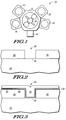
- FIG. 1 Shown in FIG. 1 is a schematic diagram of an exemplary processing apparatus 10 useful for practicing the present invention.
- Processing apparatus 10 includes a transfer chamber 12 surrounded by a plurality of processing chambers.
- a load lock 14 is provided to transfer semiconductor wafers in and out of transfer chamber 12.
- a wafer transport mechanism 16 transfers semiconductor substrates to the various processing chambers surrounding transfer chamber 12.
- a first processing chamber 18 resides adjacent to transfer chamber 12 in a clockwise direction from load lock chamber 14.
- Second, third and fourth processing chambers 20, 22, and 24, respectively, reside adjacent to transfer chamber 12 in a clockwise direction from first processing chamber 18. All processing chambers can be accessed through vacuum sealed doors (not shown) located in the wall between each processing chamber and transfer chamber 12. Wafer transfer mechanism 16 can rotate so as to align itself with each processing chamber for the transfer of a semiconductor substrate into a processing chamber, and load lock chamber 14.
- Each chamber in processing apparatus 10 can be independently evacuated to a desired pressure through vacuum lines and independent vacuum pumps (not shown) attached to each chamber. Additionally, each processing chamber is independently supplied with processing gases (not shown) as necessary to perform the intended processes.
- the arrangement of multiple processing chambers around a central transfer chamber permits semiconductor substrates to be transferred from one processing chamber to the next without exposing the semiconductor substrates to ambient atmospheric conditions.
- This is an important aspect of the present invention because a number of metals commonly used in the fabrication of semiconductor devices rapidly react with oxygen in the ambient atmosphere to form oxide layers on exposed metal surfaces. The formation of oxide layers on exposed metal surfaces is undesirable because an oxide layer can prevent the nucleation of a new metal layer upon a previously-formed exposed metal surface. Additionally, oxides of metals commonly used in semiconductor fabrication are not electrically conductive and their formation leads to increased electrical resistance at metal junctions formed during device fabrication.
- FIG. 2 illustrates, in cross-section, a portion of a semiconductor substrate 25 having already undergone several steps in accordance with the invention.
- a dielectric layer 26 overlies the surface of semiconductor substrate 25.
- An opening 28 exposes a surface portion 30 of semiconductor substrate 25.
- the cross-sectional representation of semiconductor substrate 25 has been substantially simplified.
- the present invention contemplates the formation of opening 28 in a variety of dielectric materials employed in various stages of semiconductor device processing.
- semiconductor substrate 25 is illustrated as a continuous body, it is intended that semiconductor substrate 25 generally represent a semiconductor device at many different stages during semiconductor device fabrication.
- dielectric layer 26 can be a first dielectric layer applied over transistors, and capacitors, and the like, formed in a first conductive level of a semiconductor device, or alternatively, an interlevel dielectric (ILD) layer formed over a first metal layer overlying many transistor devices, capacitor devices, resistors, and the like.
- opening 28 can be an opening exposing a portion of a single crystal silicon substrate, or a refractory-metal silicide region formed in a single crystal silicon body, and the like.
- surface portion 30 can be a portion of a patterned metal lead for the purposes of forming a via opening between multiple metal layers.
- composite nucleation layer 32 is formed to overlie dielectric layer 26 and surface portion 30.
- composite nucleation layer 32 is comprised of a sputtered titanium layer 34 and an overlying a sputtered aluminum layer 36.
- Composite nucleation layer 32 provides a surface having high specularity and low surface roughness overlying dielectric layer 26 and opening 28.
- composite nucleation layer 32 is employed to nucleate the formation of an aluminum metal layer 38 preferably formed by chemical vapor deposition.
- aluminum atoms adhere to the surface of nucleation layer 32 in successive layers.
- the high specularity and low surface roughness of composite nucleation layer 32 is propagated throughout aluminum metal layer 38.
- aluminum metal layer 38 exhibits the same high specularity and low surface roughness as underlying composite nucleation layer 32. Additionally, because of the isotropic deposition characteristics of the chemical vapor deposition process, opening 28 is completely filled with the chemical vapor deposited metal.
- the high specularity and low surface roughness of aluminum metal layer 38 enables the application of high resolution lithographic techniques to pattern aluminum metal layer 38 into fine metal leads interconnecting the various functional components of a complex integrated circuit. Additionally, the process of the invention permits the complete filling of high-aspect ratio openings, such as opening 28 to form metal interconnects in multi-level metal devices.
- composite nucleation layer 32 to propagate its morphological properties into an overlying CVD deposited metal layer is dependent upon complete processing of the various metal layers in an inert, high-vacuum environment.
- a preferred process is illustrated with reference to processing apparatus 10 illustrated in FIG. 1.
- semiconductor substrate 25 is transported into transfer chamber 12 through load lock chamber 14.
- An initial etching process can be carried out in first processing chamber 18 to remove oxides from the surface portion 30. The initial etching process may or may not be necessary depending upon the particular electrical interconnect structure being fabricated.
- semiconductor substrate 25 is transferred by wafer transfer mechanism 16 into second processing chamber 20 and titanium layer 34 is deposited by PVD deposition onto semiconductor substrate 25.
- titanium layer 34 is sputter deposited to a thickness of about 200 to 500 angstroms at a temperature of less than about 200°C.
- a layer of aluminum is PVD deposited onto titanium layer 34.
- aluminum layer 36 is a sputter deposited aluminum-copper alloy having about 0.5 to 2.0 weight percent copper. It is important to note that the PVD process again deposits a conformal layer of metal having a uniform thickness overlying all surfaces of semiconductor substrate 25. In a preferred embodiment, aluminum layer 36 is sputtered to a thickness of about 400 to 600 angstroms.
- semiconductor substrate 25 is transferred from third processing chamber 22 into fourth processing chamber 24.
- fourth processing chamber 24 a CVD deposition process is carried out to deposit aluminum metal layer 38 onto composite nucleation layer 32.
- semiconductor substrate 25 is returned to ambient surroundings through load lock chamber 14.
- semiconductor substrate 25 is maintained under high vacuum conditions, and in addition, under inert atmospheric conditions in the PVD deposition chambers.
- the formation of oxide layers on any exposed metal surface is avoided.
- oxide formation the pristine surface of each metal layer is maintained throughout the multi-step metal deposition process of the invention.
- the PVD process is carried out in second and third processing chambers 20 and 22, can be performed by a variety of sputtering methods.
- titanium layer 34 and aluminum layer 36 can be deposited by conventional sputtering at processing pressures ranging from 1 to 20 millitorr using target powers ranging from 100 to 20,000 watts and temperature conditions varying from about 0 to about 500°C.
- the sputtering process is carried out in an argon ambient atmosphere.
- xenon or krypton gas ambient can be used.
- the sputtering system can be an inductively coupled plasma (ICP) sputtering device operating at a coil frequency of 400 kilohertz to 60 megahertz and a pedestal frequency of 0 to 600 megahertz.
- the target in the ICP device is powered with about 500 to 20,000 watts RF power and the chamber is maintained at 5 to 100 millitorr in a temperature of about 20 to 500°C.
- an electron cyclotron resonance (ECR) sputtering process can be used, operating at about 2.45 gigahertz with magnetic coils generating a flux density of about 875 Gauss.
- the ECR process is carried out at a chamber pressure of about 0.2 to about 5.0 millitorr and a temperature of 0 to 400°C.
- microwave power is input from about 50 to 2,000 watts RF.
- the CVD process used to form aluminum metal layer 38 is preferably carried out at about 215 to about 325°C at a chamber pressure of about 500 millitorr to about 60 torr.
- the metal precursor dimethyl aluminum hydride (DMAH) is employed to deposit an aluminum film in fourth processing chamber 24.
- DMAH dimethyl aluminum hydride
- other precursors can be used, such as triisobutyl aluminum, trimethyl aluminum, dimethyl aluminum alane, triethyl aluminum, aluminum monochloride, and the like.
- all of the foregoing precursors can be complexed with copper in varying concentrations to form an aluminum-copper alloy.
- FIG. 4 is a plot of reflectivity versus aluminum thickness for three processes of the prior art and for the process of the present invention.
- the vertical axis is a scaled reference number in which reflectivity is measured relative to a pure single crystal silicon reference standard measured at a wave length of 480 nanometers.
- the horizontal axis represents the thickness of the CVD deposited aluminum layer over various nucleation layers of the prior art in comparison with that of the invention.
- the reflectivity measurements were carried out with a model FT 750 reflectometer manufactured by Prometrix, Corp. of Santa Clara, California.
- Plotted lines 40, 42 and 44 represent reflectance as a function chemical vapor deposited aluminum thickness for three different processes of the prior art.
- line 46 represents a plot of reflectance versus chemical vapor deposited aluminum thickness for the process of the present invention.
- Line 40 shows reflectance characteristics for chemical vapor deposited aluminum over a underlying composite layer of titanium and titanium nitride.
- the titanium has a thickness of 400 angstroms and the titanium nitride has a thickness of 800 angstroms.
- Line 42 represents reflectance characteristics of chemical vapor deposited aluminum over 1,000 angstroms of sputtered aluminum
- line 44 represents reflectance characteristics of chemical vapor deposit aluminum over 400 angstroms of titanium.
- a chemical vapor deposited film formed in accordance with the present invention shows a substantial increase in reflectance relative to the various prior art processes illustrated.
- the reflectance data illustrated by line 46 is taken from chemical vapor deposited aluminum over a composite nucleation layer of 400 angstroms of titanium underlying 500 angstroms of sputtered aluminum.
- FIG. 5 Shown in FIG. 5 is a plot of surface roughness of a CVD aluminum film versus underlying metal composition for processes of the prior art in comparison with the processes of the invention.
- the vertical access is the route mean square of the surface profile in nanometers.
- the horizontal axis represents data points for the three processes of the prior art illustrated in FIG. 4, and for the process of the invention.
- the surface profiles were obtained using a Nanoscope III atomic force microscope manufactured by Digital Instuments, Inc. of Santa Barbara, California.
- data point 48 represents the route mean square of surface roughness for a CVD deposited aluminum film over an underlying film of 800 angstroms of titanium nitride over 400 angstroms of titanium.
- Data point 50 represents the root mean square of the surface roughness of a CVD deposited aluminum film over 400 angstroms of titanium, and data point 52 illustrates the root mean square of the surface roughness of a CVD deposited aluminum layer over 1,000 angstroms of sputtered aluminum.
- the root mean square of the surface roughness for the process of the present invention is illustrated by data point 54.
- the root mean square of the surface roughness of an aluminum film fabricated in accordance with the invention is substantially less than that of the aluminum layers formed in accordance with the prior art.
- a distinct advantage of the present invention is the potential for the fabrication of an aluminum layer in high aspect ratio via openings for the purposes of interconnecting metal layers in multi-level metal devices without the need for forming a refractory metal plug, such as a tungsten plug.
- This offers several advantages for contact formation in VLSI integrated circuits.
- the elimination of the necessity for forming a tungsten metal plug dramatically reduces the complexity of a multi-level metal process.
- the articulation technique of the present invention enables the filling of high aspect ratio vias directly with aluminum rather than performing multiple processing steps to form a refractory metal plug in the via openings.
- the low degree of surface roughness and high specularity realized in an aluminum metal layer formed in accordance with the invention enables fine line lithographic techniques to be employed in order to pattern the chemical vapor deposited metal into interconnects having extremely small feature sizes.
Landscapes
- Internal Circuitry In Semiconductor Integrated Circuit Devices (AREA)
- Electrodes Of Semiconductors (AREA)
- Physical Deposition Of Substances That Are Components Of Semiconductor Devices (AREA)
Applications Claiming Priority (2)
| Application Number | Priority Date | Filing Date | Title |
|---|---|---|---|
| US53436795A | 1995-09-27 | 1995-09-27 | |
| US534367 | 1995-09-27 |
Publications (2)
| Publication Number | Publication Date |
|---|---|
| EP0766302A2 true EP0766302A2 (fr) | 1997-04-02 |
| EP0766302A3 EP0766302A3 (fr) | 1998-05-13 |
Family
ID=24129737
Family Applications (1)
| Application Number | Title | Priority Date | Filing Date |
|---|---|---|---|
| EP96115276A Withdrawn EP0766302A3 (fr) | 1995-09-27 | 1996-09-24 | Procédé de fabrication d'une couche d'aluminium par CVD dans un dispositif semi-conducteur |
Country Status (5)
| Country | Link |
|---|---|
| EP (1) | EP0766302A3 (fr) |
| JP (1) | JPH09115908A (fr) |
| KR (1) | KR970018001A (fr) |
| CN (1) | CN1150325A (fr) |
| SG (1) | SG42438A1 (fr) |
Cited By (3)
| Publication number | Priority date | Publication date | Assignee | Title |
|---|---|---|---|---|
| EP1096036A1 (fr) * | 1999-11-01 | 2001-05-02 | Applied Materials, Inc. | Pulvérisation par plasma au moyen de gaz lourds |
| EP0799906B1 (fr) * | 1996-04-04 | 2002-07-03 | Texas Instruments Incorporated | Dispositif semi-conducteur |
| KR100395906B1 (ko) * | 2000-12-29 | 2003-08-27 | 주식회사 하이닉스반도체 | 반도체소자의 금속층 형성 방법 |
Families Citing this family (8)
| Publication number | Priority date | Publication date | Assignee | Title |
|---|---|---|---|---|
| CN1295756C (zh) * | 2000-11-17 | 2007-01-17 | 东京毅力科创株式会社 | 在阻挡膜上形成钨膜的方法 |
| KR100515828B1 (ko) * | 2002-11-25 | 2005-09-21 | 삼성에스디아이 주식회사 | 전도성 박막 제조 방법 |
| CN104253087B (zh) * | 2014-04-18 | 2019-06-11 | 上海华虹宏力半导体制造有限公司 | 铝金属工艺接触孔的填充方法 |
| CN105304510B (zh) * | 2014-07-22 | 2018-05-08 | 北京北方华创微电子装备有限公司 | 铝薄膜制备方法 |
| CN104282536B (zh) * | 2014-10-31 | 2017-05-24 | 丽晶美能(北京)电子技术有限公司 | 金属层的形成工艺 |
| CN105112976A (zh) * | 2015-07-31 | 2015-12-02 | 深圳市星火辉煌系统工程有限公司 | 一种cvd工装表面微弧改性工艺 |
| CN105736903B (zh) * | 2016-02-02 | 2018-05-01 | 上海交通大学 | 带有防溅屏结构的独立b型lng船液货舱绝热系统 |
| US11421318B2 (en) * | 2018-05-04 | 2022-08-23 | Applied Materials, Inc. | Methods and apparatus for high reflectivity aluminum layers |
Family Cites Families (3)
| Publication number | Priority date | Publication date | Assignee | Title |
|---|---|---|---|---|
| JPH069199B2 (ja) * | 1984-07-18 | 1994-02-02 | 株式会社日立製作所 | 配線構造体およびその製造方法 |
| US5356836A (en) * | 1993-08-19 | 1994-10-18 | Industrial Technology Research Institute | Aluminum plug process |
| KR0127271B1 (ko) * | 1993-11-23 | 1998-04-02 | 김주용 | 반도체 소자의 금속배선 형성방법 |
-
1996
- 1996-09-04 SG SG1996010578A patent/SG42438A1/en unknown
- 1996-09-23 KR KR1019960043381A patent/KR970018001A/ko not_active Withdrawn
- 1996-09-24 JP JP8273096A patent/JPH09115908A/ja active Pending
- 1996-09-24 EP EP96115276A patent/EP0766302A3/fr not_active Withdrawn
- 1996-09-27 CN CN96113088A patent/CN1150325A/zh active Pending
Cited By (3)
| Publication number | Priority date | Publication date | Assignee | Title |
|---|---|---|---|---|
| EP0799906B1 (fr) * | 1996-04-04 | 2002-07-03 | Texas Instruments Incorporated | Dispositif semi-conducteur |
| EP1096036A1 (fr) * | 1999-11-01 | 2001-05-02 | Applied Materials, Inc. | Pulvérisation par plasma au moyen de gaz lourds |
| KR100395906B1 (ko) * | 2000-12-29 | 2003-08-27 | 주식회사 하이닉스반도체 | 반도체소자의 금속층 형성 방법 |
Also Published As
| Publication number | Publication date |
|---|---|
| KR970018001A (ko) | 1997-04-30 |
| EP0766302A3 (fr) | 1998-05-13 |
| CN1150325A (zh) | 1997-05-21 |
| SG42438A1 (en) | 1997-08-15 |
| JPH09115908A (ja) | 1997-05-02 |
Similar Documents
| Publication | Publication Date | Title |
|---|---|---|
| US5633199A (en) | Process for fabricating a metallized interconnect structure in a semiconductor device | |
| US5569961A (en) | Semiconductor device having a multi-layer metallization structure | |
| JP3963494B2 (ja) | 半導体装置およびその形成方法 | |
| US5378660A (en) | Barrier layers and aluminum contacts | |
| US5371042A (en) | Method of filling contacts in semiconductor devices | |
| US6538324B1 (en) | Multi-layered wiring layer and method of fabricating the same | |
| US6458684B1 (en) | Single step process for blanket-selective CVD aluminum deposition | |
| US6518668B2 (en) | Multiple seed layers for metallic interconnects | |
| US6120844A (en) | Deposition film orientation and reflectivity improvement using a self-aligning ultra-thin layer | |
| US20090081863A1 (en) | Method of forming metal wiring layer of semiconductor device | |
| US6066358A (en) | Blanket-selective chemical vapor deposition using an ultra-thin nucleation layer | |
| US20050074968A1 (en) | Tantalum barrier layer for copper metallization | |
| KR100489920B1 (ko) | 통합된플러그/상호접속금속부를위해선택적cvda1을사용하는인슈트캐핑된알루미늄플러그(캡)형성방법 | |
| JPH08250497A (ja) | 半導体装置の金属配線層の形成方法 | |
| US6025269A (en) | Method for depositioning a substantially void-free aluminum film over a refractory metal nitride layer | |
| EP0766302A2 (fr) | Procédé de fabrication d'une couche d'aluminium par CVD dans un dispositif semi-conducteur | |
| US5747879A (en) | Interface between titanium and aluminum-alloy in metal stack for integrated circuit | |
| KR100259692B1 (ko) | 매립형 접촉 구조를 가진 반도체 장치의 제조 방법 | |
| KR100560296B1 (ko) | 다층 금속박막의 제조 방법 | |
| US7645698B2 (en) | Method for forming barrier layer | |
| US5989633A (en) | Process for overcoming CVD aluminum selectivity loss with warm PVD aluminum | |
| US7943505B2 (en) | Advanced VLSI metallization | |
| US20240258103A1 (en) | Plasma treatment of barrier and liner layers | |
| US20250157932A1 (en) | Low resistance liner | |
| KR940011006B1 (ko) | 알킬알루미늄 하이드라이드를 사용한 알루미늄을 주성분으로 하는 금속의 퇴적막 형성법 |
Legal Events
| Date | Code | Title | Description |
|---|---|---|---|
| PUAI | Public reference made under article 153(3) epc to a published international application that has entered the european phase |
Free format text: ORIGINAL CODE: 0009012 |
|
| AK | Designated contracting states |
Kind code of ref document: A2 Designated state(s): DE FR GB IT |
|
| PUAL | Search report despatched |
Free format text: ORIGINAL CODE: 0009013 |
|
| AK | Designated contracting states |
Kind code of ref document: A3 Designated state(s): DE FR GB IT |
|
| STAA | Information on the status of an ep patent application or granted ep patent |
Free format text: STATUS: THE APPLICATION IS DEEMED TO BE WITHDRAWN |
|
| 18D | Application deemed to be withdrawn |
Effective date: 19981114 |