EP0767251B1 - Acier à durcissement par vieillissement pour moules de coulée sous pression - Google Patents
Acier à durcissement par vieillissement pour moules de coulée sous pression Download PDFInfo
- Publication number
- EP0767251B1 EP0767251B1 EP19960112457 EP96112457A EP0767251B1 EP 0767251 B1 EP0767251 B1 EP 0767251B1 EP 19960112457 EP19960112457 EP 19960112457 EP 96112457 A EP96112457 A EP 96112457A EP 0767251 B1 EP0767251 B1 EP 0767251B1
- Authority
- EP
- European Patent Office
- Prior art keywords
- die
- age
- steel
- ratio
- dimensional change
- Prior art date
- Legal status (The legal status is an assumption and is not a legal conclusion. Google has not performed a legal analysis and makes no representation as to the accuracy of the status listed.)
- Revoked
Links
- 238000003483 aging Methods 0.000 title claims description 39
- 229910000831 Steel Inorganic materials 0.000 title claims description 38
- 239000010959 steel Substances 0.000 title claims description 38
- 238000004512 die casting Methods 0.000 title claims description 32
- 230000008859 change Effects 0.000 claims description 20
- 230000032683 aging Effects 0.000 claims description 15
- ATJFFYVFTNAWJD-UHFFFAOYSA-N Tin Chemical compound [Sn] ATJFFYVFTNAWJD-UHFFFAOYSA-N 0.000 claims description 13
- 229910052750 molybdenum Inorganic materials 0.000 claims description 11
- 239000000203 mixture Substances 0.000 claims description 10
- 229910052782 aluminium Inorganic materials 0.000 claims description 8
- 229910052804 chromium Inorganic materials 0.000 claims description 7
- 229910052759 nickel Inorganic materials 0.000 claims description 7
- 229910052748 manganese Inorganic materials 0.000 claims description 6
- 229910052799 carbon Inorganic materials 0.000 claims description 4
- 230000001105 regulatory effect Effects 0.000 claims description 3
- 239000012535 impurity Substances 0.000 claims description 2
- 238000010438 heat treatment Methods 0.000 description 17
- 238000011282 treatment Methods 0.000 description 9
- 239000000463 material Substances 0.000 description 8
- 238000004519 manufacturing process Methods 0.000 description 7
- 229910001315 Tool steel Inorganic materials 0.000 description 6
- 238000005266 casting Methods 0.000 description 6
- 230000009467 reduction Effects 0.000 description 6
- 238000001816 cooling Methods 0.000 description 5
- 239000002245 particle Substances 0.000 description 5
- 238000010791 quenching Methods 0.000 description 5
- 230000000171 quenching effect Effects 0.000 description 5
- 238000005496 tempering Methods 0.000 description 5
- 230000009466 transformation Effects 0.000 description 5
- 238000009863 impact test Methods 0.000 description 4
- 229910052742 iron Inorganic materials 0.000 description 4
- 229910052698 phosphorus Inorganic materials 0.000 description 4
- 238000000151 deposition Methods 0.000 description 3
- 238000009661 fatigue test Methods 0.000 description 3
- 238000003754 machining Methods 0.000 description 3
- 238000005259 measurement Methods 0.000 description 3
- 230000000630 rising effect Effects 0.000 description 3
- 230000008646 thermal stress Effects 0.000 description 3
- 230000000052 comparative effect Effects 0.000 description 2
- 230000001276 controlling effect Effects 0.000 description 2
- 229910052802 copper Inorganic materials 0.000 description 2
- 230000003111 delayed effect Effects 0.000 description 2
- 230000008021 deposition Effects 0.000 description 2
- 230000000694 effects Effects 0.000 description 2
- 230000006872 improvement Effects 0.000 description 2
- 229910052751 metal Inorganic materials 0.000 description 2
- 239000002184 metal Substances 0.000 description 2
- 238000000034 method Methods 0.000 description 2
- 239000006104 solid solution Substances 0.000 description 2
- 230000035882 stress Effects 0.000 description 2
- 239000000126 substance Substances 0.000 description 2
- XLYOFNOQVPJJNP-UHFFFAOYSA-N water Substances O XLYOFNOQVPJJNP-UHFFFAOYSA-N 0.000 description 2
- 229910003178 Mo2C Inorganic materials 0.000 description 1
- XAGFODPZIPBFFR-UHFFFAOYSA-N aluminium Chemical compound [Al] XAGFODPZIPBFFR-UHFFFAOYSA-N 0.000 description 1
- 229910052785 arsenic Inorganic materials 0.000 description 1
- 230000007423 decrease Effects 0.000 description 1
- 238000010586 diagram Methods 0.000 description 1
- 230000006698 induction Effects 0.000 description 1
- 229910000734 martensite Inorganic materials 0.000 description 1
- 239000011159 matrix material Substances 0.000 description 1
- 238000002844 melting Methods 0.000 description 1
- 230000008018 melting Effects 0.000 description 1
- 229910052757 nitrogen Inorganic materials 0.000 description 1
- 230000000717 retained effect Effects 0.000 description 1
- 238000005096 rolling process Methods 0.000 description 1
- 238000005204 segregation Methods 0.000 description 1
Images
Classifications
-
- C—CHEMISTRY; METALLURGY
- C22—METALLURGY; FERROUS OR NON-FERROUS ALLOYS; TREATMENT OF ALLOYS OR NON-FERROUS METALS
- C22C—ALLOYS
- C22C38/00—Ferrous alloys, e.g. steel alloys
- C22C38/18—Ferrous alloys, e.g. steel alloys containing chromium
- C22C38/40—Ferrous alloys, e.g. steel alloys containing chromium with nickel
- C22C38/52—Ferrous alloys, e.g. steel alloys containing chromium with nickel with cobalt
-
- C—CHEMISTRY; METALLURGY
- C22—METALLURGY; FERROUS OR NON-FERROUS ALLOYS; TREATMENT OF ALLOYS OR NON-FERROUS METALS
- C22C—ALLOYS
- C22C38/00—Ferrous alloys, e.g. steel alloys
- C22C38/18—Ferrous alloys, e.g. steel alloys containing chromium
- C22C38/40—Ferrous alloys, e.g. steel alloys containing chromium with nickel
- C22C38/44—Ferrous alloys, e.g. steel alloys containing chromium with nickel with molybdenum or tungsten
Definitions
- This invention relates to an age-hardening steel for die-casting dies and particularly to an age-hardening steel for die -casting dies which is superior in heat check resistance and has a small ratio of dimensional change by ageing.
- the tool steel for hot working which mainly contains 5 % Cr and 1 ⁇ 1.5 % Mo.
- the quenching and tempering treatments are carried out to cause the tool steel to display the required hardness and strength.
- the age -hardening steel such as typically 18 % Ni marageing steel has been examined to apply to the die-casting dies.
- this marageing steel includes a problem that the life of the casting die constituted by this steel is remarkably short comparing to that made of the conventional tool steel for hot working.
- the form and dimension of the dies before the ageing treatment are determined making allowances for the shrinkage due to the heat treatment.
- the shrinking deformation due to the heat treatment is in excess of a certain level, it becomes difficult to finally assure the dimensional accuracy of the die-casting dies.
- EP-A- 105 864 there is disclosed a composition for railway applications, wherein Ni: 7 ⁇ 20%, Cr: 0 ⁇ 13%, Mo: 1 ⁇ 5 ⁇ 6%, Co: 0 ⁇ 15%, Ti: 0.1 ⁇ 1%, Al: 0 ⁇ 0.2%, Si: 0.01 ⁇ 0.2%, Mn: 0.01 ⁇ 0.2%, C: 0.01 ⁇ 0.05%, Fe: the remainder.
- Japan unscreened publication Toku-kai -hei 6-248389 there is disclosed a marageing steel for die -casting die having the following composition to increase the softening resistance so as to improve the heat check resistance, wherein Ni : 12 ⁇ 14 %, Mo : 4.5 ⁇ 6.0 %, Co : 7.5 ⁇ 9.5 %, Ti : 0.5 ⁇ 1.0 %, C : ⁇ 0.03 %, Si : ⁇ 0.1 %, Mn : ⁇ 0.1%, P : ⁇ 0.01 %, S : ⁇ 0.01 %, Cr : ⁇ 0.05 %, N : ⁇ 0.01 %, Al : 0.02 ⁇ 0.20 %, Fe : the remainder.
- Japan unscreened patent publication Toku-kai-sho 63-145753 there is disclosed a marageing steel having the following composition to improve the delayed fracture resistance, wherein C : ⁇ 0.03 %, Si : ⁇ 0.10 %, Mn : ⁇ 0.10 %, Cu : ⁇ 0.10 %, Ni : 7 ⁇ 20 %, Cr : ⁇ 0.10 %, Mo : 2 ⁇ 6 %, Co : 5 ⁇ 18 %, Al : ⁇ 0.50 %, Ti : 0.8 ⁇ 2.5 %, B : 0.0005 ⁇ 0.005 %, P : ⁇ 0.0025 %, S : ⁇ 0.0025 % , %, Fe : P + S : ⁇ 0.0030 the remainder.
- Japan unscreened patent publication -kai-sho 62-228455 there is disclosed a marageing steel having the following composition to improve the fatigue property, wherein C : ⁇ 0.03 %, Si : ⁇ 0.10 %, Mn : ⁇ 0.10 %, Cu : ⁇ 0.1 %, Ni : 7 ⁇ 20 %, Cr : ⁇ 0.1 %, Mo : 1 ⁇ 10 %, Co : ⁇ 18 %, Al : ⁇ 1 %, Ti : ⁇ 2.5 %, P : ⁇ 0.002 %, S : ⁇ 0.0015 %, P + S : ⁇ 0.0030%, Fe : the remainder.
- the object of the present invention is to provide an age-hardening steel for die-casting dies which is superior in heat check resistance, displays long life of the die, and has an improved ratio of dimensional change in the age heat treatment in the case of the application to the die-casting dies.
- the present invention to accomplish this object is characterized in that the composition of the age-hardening steel for die-casting die, in weight %, contains C : ⁇ 0.03 %, Si : ⁇ 0.10 %, Mn : ⁇ 0.10 %, Ni : 9.0 ⁇ 11.0 %, Cr : 0.10 ⁇ 5.0 %, Mo : 5.0 ⁇ 8.0 %, Co : 5.0 ⁇ 8.0 %, Ti : 0.10 ⁇ 1.0 %, Al : 0.05 ⁇ 0.15 %, and 30 ⁇ Co (%) x Mo (%) ⁇ 50, and the remainder Fe and incidental impurities.
- the composition may contain Cr : 0.30 ⁇ 1.0 %.
- N may be regulated to 0.0050 % or less.
- the TiN inclusion in the steel material it is preferable that the TiN inclusion larger than 10 ⁇ m in the equivalent circular diameter may be 2 % of the whole or less.
- the age-hardening steel according to the present invention has a small ratio of dimensional change in the heat treatment, so that it is possible to reduce the machining man power in the manufacturing of the die-casting dies and to improve the dimensional accuracy of the die-casting dies as well.
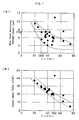
- Figure 1 is a diagram illustrating the heat check resistance and the Charpy impact value respectively relating to the solubility product of Co(%) and Mo(%) based on the example of the present invention.
- the present inventor When researching the technical measures to improve the heat check resistance and the ratio of dimensional change in the heat treatment for the age-hardening steel for die -casting dies, the present inventor has obtain a knowledge that the reduction of the Ni quantity and the addition of the proper Cr quantity are effective to the reduction of the ratio of dimensional change in the ageing treatment.
- the reduction of the Ni quantity results in the rising of the austenitic transformation point (As point) and contributes to the improvement of the heat check resistance.
- the temperature of the As point is low, according to the heating operation of the molten metal during the use of the die-casting dies, the surface stratum of the die is liable to austenitize from the martensitic structure, and it promotes the generation of the cracks.
- the As point is caused to be high, this problem can be prevented, so that it is possible to improve the heat check resistance.
- the ratio of dimensional change in the heat treatment is caused to be small according to the addition of the appropriate Cr quantity.
- the addition of Cr causes to lower the As point, so that it is feared that the heat check resistance may be made inferior.
- the adding quantity of Cr is controlled under the certain level.
- the preferred content of Cr is in 0.30 ⁇ 1.0 % and the quantity of N is preferable to be as little as possible.
- the increase of N results in the deposition of the TiN, and thereby the low cycle fatigue property of the die-casting dies is made inferior, wherein the low cycle fatigue is the phenomenon that the casting die is broken under the big die-tightening force, for example.
- the N quantity is as little as possible.
- the extreme minimization of N results in the rising of the manufacturing cost, so that it is preferable that the upper limit of the N quantity is set in 0.0050 % even when the quantity of N is made as little as possible.
- the TiN particles larger than 10 ⁇ m in the equivalent circular diameter may be 2% of the whole or less.
- Si causes the toughness inferior, it is necessary that Si is made 0.10 % or less.
- Mn ⁇ 0.10 %
- Mn is controlled to 0.10 % or less because it produces the MnS inclusion combining with S so as to make the toughness inferior.
- Ni 9.0 ⁇ 11.0 %
- Ni is an essential element to form a matrix superior in the toughness in a solid solution of Fe.
- the quantity of depositing material increases along with the increase of the adding quantity, so that it causes to extend the ratio of age shrinkage (ratio of dimensional change).
- the austenitic transformation point As lowers to make the heat check resistance inferior. Since the surface of the casting die is exposed to the molten aluminum in high temperature of 600 ⁇ 650 °C , for example, it is required that the As point is over the arriving surface temperature. For that purpose, it is necessary that Ni may be 11.0 % or less. However, if the adding quantity of Ni is less than 9.0 %, the necessary toughness can not be assured. For that reason, the content of Ni is set in 9.0 ⁇ 11.0 % in the present invention. Cr : 0.10 ⁇ 5.0 %
- the increase of the Co quantity has an effect to promote the age hardening property because it results in the lowering of the solubility degree of Mo in the solid solution.
- Ti is a hardening element which forms Ni 3 Ti and contributes the age-hardening
- the excessive addition of Ti causes to deposit TiN and to make the toughness and the low cycle fatigue property inferior.
- the Ms point is caused to lower, so that the Ti segregation band becomes the retained austenitic band, and also the austenitic transformation point is caused to lower, so that the heat check resistance is made inferior. Consequently, the upper limit of Ti is set in 1.0 %.
- Al is a component to be added as a deoxidizer and contributes even to the age-hardening together with Ti. However, when it is under 0.05 %, the age-hardening property is insufficient, and on the contrary, when it is over 0.15 %, the toughness is made inferior. Consequently, Al is set in 0.05 ⁇ 0.15 % in the present invention. N : ⁇ 0.0050 %
- the quantity of N may be reduced as far as possible.
- the extreme minimization of N results in rising of the manufacturing cost, so that the upper limit is set in 0.0050 %.
- the particles become the starting points of fracture in the portion under the die-tightening force, the teeming stress or the thermal stress. As a result, it causes the lowering of the low cycle fatigue property and even the big fracture of the casting die. Consequently, it is required that the particles of TiN inclusion larger than 10 ⁇ m may be 2 % of the whole or less. 30 ⁇ Co (%) x Mo (%) ⁇ 50
- the solubility product of Co (%) x Mo (%) indicates the age-hardening property, and when this solubility product is reduced, also the aged hardness is lowered. As a result, it restrains the toughness from lowering due to the reduction of the Ni quantity and results in the assurance of the toughness. Consequently, the upper limit of this value is set in 50.
- the age-hardening steel of the chemical composition shown in Table 1 was treated in atmospheric induction melting and in ingot-making (350 mm phi), cooled by water after holding in 930 ⁇ 1130 °C, and moreover cooled by air after holding in 880 ⁇ 980 °C. From such a steel material were extracted a JIS No.3 Charpy impact test piece in the T direction (vertical to the rolling direction) of 1/2R (radius) portion, a heat check test piece of 15 mm phi (diameter) x 5 mm t (thickness), and a low cycle fatigue test piece. Then, the Charpy impact test, heat check test, and low cycle fatigue test were performed with those test pieces.
- the ageing 520 °C x 5 hr, Air cooling (in the peak ageing condition)
- the heat check resistance test High-frequency heating 650 °C x 4 sec and Water cooling 3 sec, repeated in 1000 times of this heating and cooling cycle.
- the Charpy impact test 2 mm U-notched test piece, extracted in the T direction, tested in the room temperature.
- the measurements of the ratio of dimensional change by ageing were performed respectively in the longitudinal (L) and transverse (T) directions of the block test piece of 210 mm L x 130 mm W x 45 mm t.
- the low cycle fatigue test was carried out by examining the number of the repeated times to result in the fracture when the one-side tension was repeatedly applied to the test piece along the single axis under the maximum stress of 123 kgf/ mm 2 .
- the comparative example 18, in which the content of Ni is out of the range limited in the present invention, is low in As point and inferior in the heat check resistance; the comparative example 19, which contains Ni : 18 %, is extremely low in As point and also remarkably inferior in heat check resistance although it shows a good figure of the Charpy impact value.
- the figures 1 (A) and 1 (B) show the heat check resistance and the Charpy impact value respectively relating to the solubility product of Co and Mo based on the results of Table 2. Referring to those figures, it will be seen that the good results are obtained either in the heat check resistance or in the Charpy impact value by controlling the solubility product of Co and Mo in the range of 30 ⁇ 50.
Landscapes
- Chemical & Material Sciences (AREA)
- Engineering & Computer Science (AREA)
- Materials Engineering (AREA)
- Mechanical Engineering (AREA)
- Metallurgy (AREA)
- Organic Chemistry (AREA)
- Heat Treatment Of Steel (AREA)
- Heat Treatment Of Articles (AREA)
- Molds, Cores, And Manufacturing Methods Thereof (AREA)
- Moulds For Moulding Plastics Or The Like (AREA)
Claims (4)
- Un acier durcissant au vieillissement pour moule de coulée sous pression présentant une résistance supérieure aux craquelures par choc thermique et un meilleur rapport de variation dimensionnelle au vieillissement, comprenant : en poids %, C : ≤ 0,03%, Si : ≤ 0,10%, Mn : ≤ 0,10%, Ni : 9,0 à 11,0%, Cr : 0,10 à 5,0%, Mo : 5,0 à 8,0%, Co : 5,0 à 8,0%, Ti : 0,10 à 1,0%, Al : 0,05 à 0,15% et 30 < Co (%) x Mo (%) < 50, et le reste étant Fe et d'éventuelles impuretés.
- Un acier durcissant au vieillissement pour moule de coulée sous pression présentant une résistance supérieure aux craquelures par choc thermique et un meilleur rapport de variation dimensionnelle au vieillissement selon la revendication 1 caractérisé en ce que la composition est contrôlée dans des valeurs de Cr comprises entre 0,30 et 1,0%.
- Un acier durcissant au vieillissement pour moule de coulée sous pression présentant une résistance supérieure aux craquelures par choc thermique et un meilleur rapport de variation dimensionnelle au vieillissement selon la revendication 1 ou 2, caractérisé en ce que la composition est contrôlée dans une valeur de N ≤ 0,0050%.
- Un acier durcissant au vieillissement pour moule de coulée sous pression présentant une résistance supérieure aux craquelures par choc thermique, un meilleur rapport de variation dimensionnelle au vieillissement et des cycles de fatigue réduits selon les revendications 1, 2 ou 3, caractérisé en ce que la proportion des inclusions de TiN d'un diamètre circulaire supérieur à 10 µm (micromètres) est inférieure ou égale à 2% de l'ensemble.
Applications Claiming Priority (2)
| Application Number | Priority Date | Filing Date | Title |
|---|---|---|---|
| JP227080/95 | 1995-08-10 | ||
| JP22708095A JP3201711B2 (ja) | 1995-08-10 | 1995-08-10 | ダイカスト型用時効硬化鋼 |
Publications (2)
| Publication Number | Publication Date |
|---|---|
| EP0767251A1 EP0767251A1 (fr) | 1997-04-09 |
| EP0767251B1 true EP0767251B1 (fr) | 1998-10-21 |
Family
ID=16855203
Family Applications (1)
| Application Number | Title | Priority Date | Filing Date |
|---|---|---|---|
| EP19960112457 Revoked EP0767251B1 (fr) | 1995-08-10 | 1996-08-01 | Acier à durcissement par vieillissement pour moules de coulée sous pression |
Country Status (3)
| Country | Link |
|---|---|
| EP (1) | EP0767251B1 (fr) |
| JP (1) | JP3201711B2 (fr) |
| DE (1) | DE69600831T2 (fr) |
Cited By (1)
| Publication number | Priority date | Publication date | Assignee | Title |
|---|---|---|---|---|
| EP1094125B2 (fr) † | 1999-03-19 | 2014-09-03 | Honda Giken Kogyo Kabushiki Kaisha | Acier maraging tres resistant a la fatigue et son procede de fabrication |
Families Citing this family (3)
| Publication number | Priority date | Publication date | Assignee | Title |
|---|---|---|---|---|
| FI107269B (fi) * | 1998-12-02 | 2001-06-29 | Metso Powdermet Oy | Muottiteräs |
| CA2715998C (fr) * | 2008-02-20 | 2015-07-28 | Questek Innovations Llc | Acier tres dur a ultra haute resistance |
| CN104087859A (zh) * | 2014-07-02 | 2014-10-08 | 钢铁研究总院 | 钼强化10Ni7Co二次硬化超高强度钢及制备方法 |
Family Cites Families (4)
| Publication number | Priority date | Publication date | Assignee | Title |
|---|---|---|---|---|
| JPS5161B1 (fr) * | 1967-09-18 | 1976-01-05 | ||
| AT374846B (de) * | 1982-09-15 | 1984-06-12 | Voest Alpine Ag | Herzstueck, insbesondere herzstueckspitze, fuer schienenkreuzungen oder -weichen, sowie verfahren zu seiner herstellung |
| JPS60255959A (ja) * | 1984-05-28 | 1985-12-17 | Japan Steel Works Ltd:The | 高硬度高飽和磁束密度合金鋼 |
| JPS61190050A (ja) * | 1985-02-20 | 1986-08-23 | Hitachi Metals Ltd | 高強度,高電気抵抗値および軟質な磁気特性を兼ね備えたマルエ−ジング鋼 |
-
1995
- 1995-08-10 JP JP22708095A patent/JP3201711B2/ja not_active Expired - Fee Related
-
1996
- 1996-08-01 EP EP19960112457 patent/EP0767251B1/fr not_active Revoked
- 1996-08-01 DE DE1996600831 patent/DE69600831T2/de not_active Revoked
Cited By (1)
| Publication number | Priority date | Publication date | Assignee | Title |
|---|---|---|---|---|
| EP1094125B2 (fr) † | 1999-03-19 | 2014-09-03 | Honda Giken Kogyo Kabushiki Kaisha | Acier maraging tres resistant a la fatigue et son procede de fabrication |
Also Published As
| Publication number | Publication date |
|---|---|
| DE69600831T2 (de) | 1999-04-08 |
| EP0767251A1 (fr) | 1997-04-09 |
| JPH0949057A (ja) | 1997-02-18 |
| DE69600831D1 (de) | 1998-11-26 |
| JP3201711B2 (ja) | 2001-08-27 |
Similar Documents
| Publication | Publication Date | Title |
|---|---|---|
| EP3943623B1 (fr) | Corps moulé par estampage à chaud | |
| EP2041330B1 (fr) | Procede de fabrication d'une tole d'acier austenitique fer-carbone-manganese ayant une excellente resistance a la fissuration differee, et tole ainsi produit | |
| EP3483297B1 (fr) | Élément de formage à chaud présentant une résistance à la propagation des fissures et une ductilité excellentes, et son procédé de production | |
| EP2357260B1 (fr) | Acier de cémentation, composant cémenté, et procédé de production d'acier de cémentation | |
| EP2053139B1 (fr) | Feuilles d'acier laminees a chaud excellentes a la fois en matiere d'usinabilite et de resistance et robustesse apres un traitement thermique et leur processus de fabrication | |
| EP2039791B1 (fr) | Tôle d'acier de grande résistance et son procédé de production | |
| EP4332254B1 (fr) | Tôle d'acier à haute résistance, et procédé de fabrication de celle-ci | |
| EP3252184A1 (fr) | Matériau en barreau pour composant de machine non trempé, barreau d'acier pour composant de machine non trempé et composant de machine non trempé | |
| EP1602742B1 (fr) | Acier à haute résistance pour la fabrication de grosses pièces forgées notamment de villebrequins | |
| EP4092144A1 (fr) | Produit estampé à chaud | |
| EP2735623A1 (fr) | Feuille d'acier à haute résistance pour le formage à chaud et son procédé de fabrication | |
| EP1980635A1 (fr) | Feuille d'acier convenant parfaitement a un decoupage fin et son procede de production | |
| EP1087030A2 (fr) | Procédé de fabrication d'un acier à outils et outil | |
| EP0637636B1 (fr) | Acier de construction à graphite et à haute usinabilité et forgeabilité et procédé de fabrication de cet acier | |
| EP2792761A1 (fr) | Poutre en h en acier de grande épaisseur et à haute résistance | |
| EP4092145A1 (fr) | Corps moulé par estampage à chaud | |
| EP3875625A1 (fr) | Élément à haute résistance, procédé de fabrication d'un élément à haute résistance, et procédé de fabrication d'une tôle en acier pour élément à haute résistance | |
| EP4332253B1 (fr) | Tôle d'acier à haute résistance, et procédé de fabrication de celle-ci | |
| EP4263882B1 (fr) | Tôle d'acier revêtue, pièce en acier trempé sous presse à haute résistance et leur procédé de fabrication | |
| CN109790602B (zh) | 钢 | |
| EP1659191B1 (fr) | Tole d'acier lamine a froid a haute resistance a la traction et son procede de production | |
| JP3915284B2 (ja) | 非調質窒化鍛造部品およびその製造方法 | |
| EP0767251B1 (fr) | Acier à durcissement par vieillissement pour moules de coulée sous pression | |
| EP3385398A1 (fr) | Boulon à résistance élevée | |
| JPH1192868A (ja) | 結晶粒粗大化防止特性と耐遅れ破壊特性に優れた冷間鍛造用鋼とその製造方法 |
Legal Events
| Date | Code | Title | Description |
|---|---|---|---|
| PUAI | Public reference made under article 153(3) epc to a published international application that has entered the european phase |
Free format text: ORIGINAL CODE: 0009012 |
|
| 17P | Request for examination filed |
Effective date: 19960801 |
|
| AK | Designated contracting states |
Kind code of ref document: A1 Designated state(s): DE FR GB |
|
| GRAG | Despatch of communication of intention to grant |
Free format text: ORIGINAL CODE: EPIDOS AGRA |
|
| 17Q | First examination report despatched |
Effective date: 19971124 |
|
| GRAG | Despatch of communication of intention to grant |
Free format text: ORIGINAL CODE: EPIDOS AGRA |
|
| GRAG | Despatch of communication of intention to grant |
Free format text: ORIGINAL CODE: EPIDOS AGRA |
|
| GRAH | Despatch of communication of intention to grant a patent |
Free format text: ORIGINAL CODE: EPIDOS IGRA |
|
| GRAG | Despatch of communication of intention to grant |
Free format text: ORIGINAL CODE: EPIDOS AGRA |
|
| GRAH | Despatch of communication of intention to grant a patent |
Free format text: ORIGINAL CODE: EPIDOS IGRA |
|
| GRAH | Despatch of communication of intention to grant a patent |
Free format text: ORIGINAL CODE: EPIDOS IGRA |
|
| GRAA | (expected) grant |
Free format text: ORIGINAL CODE: 0009210 |
|
| AK | Designated contracting states |
Kind code of ref document: B1 Designated state(s): DE FR GB |
|
| REF | Corresponds to: |
Ref document number: 69600831 Country of ref document: DE Date of ref document: 19981126 |
|
| ET | Fr: translation filed | ||
| PLBQ | Unpublished change to opponent data |
Free format text: ORIGINAL CODE: EPIDOS OPPO |
|
| PLBI | Opposition filed |
Free format text: ORIGINAL CODE: 0009260 |
|
| PGFP | Annual fee paid to national office [announced via postgrant information from national office to epo] |
Ref country code: DE Payment date: 19990802 Year of fee payment: 4 |
|
| PGFP | Annual fee paid to national office [announced via postgrant information from national office to epo] |
Ref country code: FR Payment date: 19990810 Year of fee payment: 4 |
|
| PLBF | Reply of patent proprietor to notice(s) of opposition |
Free format text: ORIGINAL CODE: EPIDOS OBSO |
|
| 26 | Opposition filed |
Opponent name: EDELSTAHL WITTEN KREFELD GMBH Effective date: 19990720 |
|
| PLBF | Reply of patent proprietor to notice(s) of opposition |
Free format text: ORIGINAL CODE: EPIDOS OBSO |
|
| RDAH | Patent revoked |
Free format text: ORIGINAL CODE: EPIDOS REVO |
|
| RDAG | Patent revoked |
Free format text: ORIGINAL CODE: 0009271 |
|
| STAA | Information on the status of an ep patent application or granted ep patent |
Free format text: STATUS: PATENT REVOKED |
|
| 27W | Patent revoked |
Effective date: 20000415 |
|
| GBPR | Gb: patent revoked under art. 102 of the ep convention designating the uk as contracting state |
Free format text: 20000415 |