EP0768304A1 - N-(Pyrimidinyl)-benzolsulfonamide als Arzneimittel - Google Patents
N-(Pyrimidinyl)-benzolsulfonamide als Arzneimittel Download PDFInfo
- Publication number
- EP0768304A1 EP0768304A1 EP96116409A EP96116409A EP0768304A1 EP 0768304 A1 EP0768304 A1 EP 0768304A1 EP 96116409 A EP96116409 A EP 96116409A EP 96116409 A EP96116409 A EP 96116409A EP 0768304 A1 EP0768304 A1 EP 0768304A1
- Authority
- EP
- European Patent Office
- Prior art keywords
- hydroxy
- pyrimidine
- carboxylic acid
- tert
- methoxy
- Prior art date
- Legal status (The legal status is an assumption and is not a legal conclusion. Google has not performed a legal analysis and makes no representation as to the accuracy of the status listed.)
- Granted
Links
Classifications
-
- C—CHEMISTRY; METALLURGY
- C07—ORGANIC CHEMISTRY
- C07D—HETEROCYCLIC COMPOUNDS
- C07D239/00—Heterocyclic compounds containing 1,3-diazine or hydrogenated 1,3-diazine rings
- C07D239/02—Heterocyclic compounds containing 1,3-diazine or hydrogenated 1,3-diazine rings not condensed with other rings
- C07D239/24—Heterocyclic compounds containing 1,3-diazine or hydrogenated 1,3-diazine rings not condensed with other rings having three or more double bonds between ring members or between ring members and non-ring members
- C07D239/28—Heterocyclic compounds containing 1,3-diazine or hydrogenated 1,3-diazine rings not condensed with other rings having three or more double bonds between ring members or between ring members and non-ring members with hetero atoms or with carbon atoms having three bonds to hetero atoms with at the most one bond to halogen, directly attached to ring carbon atoms
- C07D239/69—Benzenesulfonamido-pyrimidines
-
- A—HUMAN NECESSITIES
- A61—MEDICAL OR VETERINARY SCIENCE; HYGIENE
- A61P—SPECIFIC THERAPEUTIC ACTIVITY OF CHEMICAL COMPOUNDS OR MEDICINAL PREPARATIONS
- A61P9/00—Drugs for disorders of the cardiovascular system
-
- A—HUMAN NECESSITIES
- A61—MEDICAL OR VETERINARY SCIENCE; HYGIENE
- A61P—SPECIFIC THERAPEUTIC ACTIVITY OF CHEMICAL COMPOUNDS OR MEDICINAL PREPARATIONS
- A61P9/00—Drugs for disorders of the cardiovascular system
- A61P9/08—Vasodilators for multiple indications
-
- A—HUMAN NECESSITIES
- A61—MEDICAL OR VETERINARY SCIENCE; HYGIENE
- A61P—SPECIFIC THERAPEUTIC ACTIVITY OF CHEMICAL COMPOUNDS OR MEDICINAL PREPARATIONS
- A61P9/00—Drugs for disorders of the cardiovascular system
- A61P9/10—Drugs for disorders of the cardiovascular system for treating ischaemic or atherosclerotic diseases, e.g. antianginal drugs, coronary vasodilators, drugs for myocardial infarction, retinopathy, cerebrovascula insufficiency, renal arteriosclerosis
-
- A—HUMAN NECESSITIES
- A61—MEDICAL OR VETERINARY SCIENCE; HYGIENE
- A61P—SPECIFIC THERAPEUTIC ACTIVITY OF CHEMICAL COMPOUNDS OR MEDICINAL PREPARATIONS
- A61P9/00—Drugs for disorders of the cardiovascular system
- A61P9/12—Antihypertensives
Definitions
- Phenyl radicals can be substituted by lower alkyl, lower alkoxy, methylenedioxy, ethylenedioxy, lower alkanoyl, hydroxy, amino, mono- or di-lower alkylamino and / or halogen.
- the term "lower” used here denotes groups with 1-7 C atoms, preferably 1-4 C atoms.
- Alkyl and alkoxy groups and alkyl groups as constituents of alkanoyl groups can be straight-chain or branched. Examples of such alkyl groups are methyl, ethyl, propyl, isopropyl, butyl, sec. and tert-butyl.
- Halogen denotes fluorine, chlorine, bromine and iodine, with chlorine being preferred.
- heterocyclyl radicals are mono- or bicyclic 5- and 6-membered heterocyclic radicals with oxygen, nitrogen or sulfur as the hetero atom, such as 2- and 3-furyl, pyrimidinyl, 2-, 3- and 4-pyridyl, 2-tetrazolyl-4 -pyridyl, 1,2- and 1,4-diazinyl, morpholino, 2- and 3-thienyl, isoxazolyl, oxazolyl, thiazolyl, imidazolyl, pyrrolyl and tetrazolyl, for example by lower alkyl, lower alkanoyl, hydroxy, lower Alkanoyloxy, lower alkoxy, lower alkoxycarbonyl, formyl, amino, mono- or di-lower alkylamino or halogen can be substituted.
- N-heterocyclic radicals formed with R 4 and R 5 are preferably monocyclic 6-membered heterocyclyl radicals which may contain a further oxygen or nitrogen breath, such as morpholino, piperidino, piperazino and N 4 -lower alkylpiperazino.
- Preferred radicals R 1 are phenyl substituted by lower alkyl or lower alkoxy and monocyclic heterocyclic radicals containing a nitrogen atom, such as pyridyl, in particular 2-pyridyl, which can preferably be substituted by lower alkyl, preferably in a simple manner.
- Preferred radicals R 2 are phenyl substituted by lower alkoxy and / or halogen.
- Preferred radicals R 3 are hydroxy and -NR 4 R 5 , where R 4 is hydrogen and R 5 is phenyl or tetrazolyl.
- R a is preferably hydrogen or hydroxy.
- R b is preferably hydrogen.
- X and Y are preferably oxygen.
- Z is preferably hydrogen.
- n is preferably 0 or 1.
- the compounds of formula I and their salts are inhibitors of endothelin receptors. They can therefore be used for the treatment of diseases which are associated with endothelin activities, in particular circular disorders such as hypertension, ischemia, vasospasm and angina pectoris.
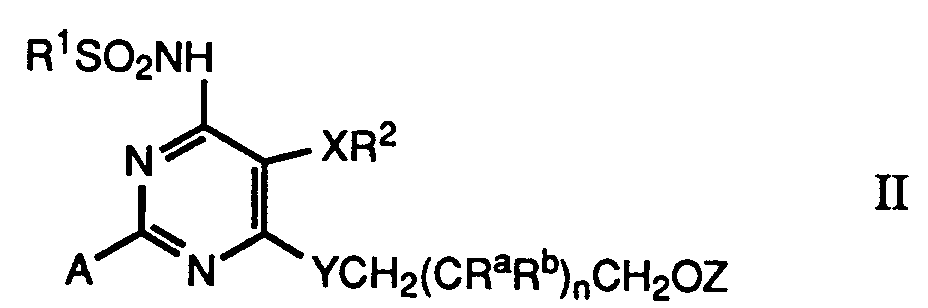
- the compounds of the formula I and their salts can be prepared by in a compound of formula II in which A represents a radical which can be converted into a carboxyl group and R 1 , R 2 , X, Y, Z, R a , R b and n have the meaning given above, converts the radical A into a carboxyl group, optionally in the compound of the formula I thus obtained in which R 3 is hydroxy, converts the hydroxyl group R 3 into a lower alkoxy group or a group —NR 4 R 5 or into a pharmaceutically acceptable salt.
- radicals A are in particular the formyl group and the radical furan-2-yl. These residues can be converted into a carboxy group in a manner known per se by treatment with oxidizing agents, groups present in the starting material of the formula II which are not inert to the oxidizing agent used. like hydroxyl groups, are appropriately protected.
- a suitable oxidizing agent for the oxidation of a formyl group to a carboxyl group is, for example, potassium permanganate.
- the oxidation can be carried out in a suitable inert solvent such as benzene in the presence of a crown ether at room temperature.
- hydroxy group explicitly specified in formula I and as R a and / or in R 1 Hydroxy groups present can be protected in a manner known per se in the form of an ester, such as the acetate or as a ketal, for example as an acetonide.
- a furan-2-yl group can be oxidized to the carboxyl group by treatment with periodate, for example Na periodate in the presence of ruthenium trichloride in a two-phase system containing CCl 4 , acetonitrile and water.
- the compounds of formula II are new and also a subject of the invention.
- Compounds of the formula II in which A is a formyl radical can be prepared from corresponding methyl compounds (see European patent publication EP-A-0526708) by oxidation, for example with selenium dioxide (see European patent publication EP-A-0601386) ).
- pharmaceutically acceptable salts are alkali salts, such as the Na and K salts, and alkaline earth salts, such as the Ca and Mg salts.
- the compounds of the formula I show a selective inhibitory effect on the endothelin receptors A and B (ET A and ET B ), which can be shown with the experimental arrangements described below:
- a cDNA encoding human ET A receptor from human placenta was cloned (M. Adachi, Y.-Y. Yang, Y. Furuichi and C-Miyamoto, BBRC 180 , 1265-1272) and in baculovirus insect cell- System expressed.
- Baculovirus-infected insect cells from a 23 l fermenter are centrifuged off 60 hours after the infection (3,000 ⁇ g, 15 minutes, 4 ° C.), resuspended in Tris buffer (5 mM, pH 7.4, 1 mM MgCl 2 ) and centrifuged again.
- the cells are suspended in 800 ml of the same buffer and frozen at -120 ° C. The cells are broken open when the suspension is thawed in this hypotonic buffer mixture. After repeated freeze / thaw cycle, the suspension is homogenized and centrifuged (25,000 xg, 15 minutes, 4 ° C). After suspension in Tris buffer (75 mM, pH 7.4, 25 mM MgCl 2 , 250 mM sucrose), 1 ml aliquots (protein content approx. 3.5 mg / ml) are stored at -85 ° C.
- Tris buffer 75 mM, pH 7.4, 25 mM MgCl 2 , 250 mM sucrose
- the frozen membrane preparations are thawed and after 10 minutes of centrifugation at 25,000 g at 20 ° C. in assay buffer (50 mM Tris buffer pH 7.4, containing 25 mM MnCl 2 , 1 mM EDTA and 0.5% bovine serum albumin ) resuspended.
- assay buffer 50 mM Tris buffer pH 7.4, containing 25 mM MnCl 2 , 1 mM EDTA and 0.5% bovine serum albumin
- 100 ⁇ l of this membrane suspension containing 5 ⁇ g protein are mixed with 50 ⁇ l 125 I-endothelin (specific activity 2200 Ci / mmol) in assay buffer (25000 cpm, final concentration 20 pM) and 100 ⁇ l assay buffer, the varying concentrations of the test compound contains, incubated. Incubation is carried out at 20 ° C for 2 hours or at 4 ° C for 24 hours.
- the free and membrane-bound radio ligands are separated by filtration
- Human placenta is homogenized in 5 mM Tris buffer, pH 7.4, which contains 1 mM MgCl 2 and 250 mM sucrose.
- the homogenate is centrifuged at 3000 g for 15 minutes at 4 ° C., the supernatant containing the plasma membrane fraction is centrifuged at 72,000 g for 30 minutes and the bottom body is washed with 75 mM Tris buffer, pH 7.4, which contains 25 mM MgCl 2 . Thereafter, the soil body obtained from 10 g of original tissue in 1 ml of 75 mM Tris buffer pH 7.4, containing 25 mM MgCl 2 and 250 mM sucrose, suspended and frozen in 1 ml aliquots at -20 ° C.
- the frozen membrane preparations are thawed and after 10 minutes of centrifugation at 25,000 g at 20 ° C. in assay buffer (50 mM Tris buffer pH 7.4, containing 25 mM MnCl 2 , 1 mM EDTA and 0.5% bovine serum albumin ) resuspended.
- assay buffer 50 mM Tris buffer pH 7.4, containing 25 mM MnCl 2 , 1 mM EDTA and 0.5% bovine serum albumin
- 100 ⁇ l of this membrane suspension containing 35 ⁇ g protein are mixed with 50 ⁇ l 125 I-endothelin (specific activity 2200 Ci / mmol) in assay buffer (25000 cpm, final concentration 20 pM) and 100 ⁇ l assay buffer, the varying concentrations of the test compound contains, incubated. Incubation is carried out at 20 ° C for 2 hours or at 4 ° C for 24 hours.
- the free and membrane-bound radio ligands are separated by filtration
- Table 1 shows the inhibitory effect on the ET A and ET B receptor of compounds of the formula I determined as IC 50 in this test arrangement, ie 50% of the specific binding of 125 I-endothelin as the concentration [ ⁇ M] which is required to inhibit.
- Table 1 Connection of example ET A IC 50 [ ⁇ M] ET B IC 50 [ ⁇ M] 1 73 0.08 2nd 1.83 0.062 5 16.4 0.29 6 38 0.63 7 18.2 0.3 8th 13 0.06 9 21.4 0.086 10th 13 0.14
- the compounds of formula I because of their ability to inhibit endothelin binding, can be used as agents for treating diseases associated with vasoconstriction-increasing processes.
- diseases associated with vasoconstriction-increasing processes.
- diseases are high blood pressure, in particular pulmonary high pressure, and subarachnoid hemorrhage.
- Connections are coronary disease, heart failure, renal and myocardial ischemia, kidney failure, cerebral ischemia, cerebral infarction, migraine and Raynaud's syndrome.
- the compounds according to the invention can also be used for atherosclerosis, prevention of restenosis after balloon-induced vascular dilatation, inflammation, gastric and duodenal ulcers, leg ulcers, gram-negative sepsis, shock, glomerulonephritis, renal colic, glaucoma, asthma, dialysis and therapy and prophylaxis diabetic complications and complications in the administration of cyclosporin, as well as other diseases associated with endothelin activities.
- the compounds of formula I can be administered orally, rectally, parenterally, e.g. intravenously, intramuscularly, subcutaneously, intrathecal or transdermally; or sublingually or as an ophthalmic preparation, or as an aerosol.
- parenterally e.g. intravenously, intramuscularly, subcutaneously, intrathecal or transdermally; or sublingually or as an ophthalmic preparation, or as an aerosol.
- application forms are capsules, tablets, orally administrable suspensions or solutions, suppositories, injection solutions, eye drops, ointments or spray solutions.
- a preferred form of application is intravenous, intramuscular or oral application.
- the dosage in which the compounds of formula I are administered in effective amounts depend on the type of specific active ingredient, the age and the needs of the patient and the mode of administration. Doses of about 0.1-100 mg / kg body weight per day are generally suitable.
- the preparations containing the compounds of formula I can contain inert or pharmacodynamically active additives. Tablets or granules e.g. can contain a number of binders, fillers, carriers or diluents. Liquid preparations can, for example, be in the form of a sterile, water-miscible solution.
- capsules can also contain a filler or thickener.
- taste-improving additives, as well as the substances usually used as preservatives, stabilizers, moisturizers and emulsifiers, as well as salts for changing the osmotic pressure, buffers and other additives can also be present.
- carrier substances and diluents can consist of organic or inorganic substances, for example water, gelatin, milk sugar, starch, magnesium stearate, talc, gum arabic, polyalkylene glycols and the like. requirement is that all auxiliaries used in the manufacture of the preparations are non-toxic.
- Tablets containing the following ingredients can be made in a conventional manner: Components per tablet Compound of formula I. 10.0-100.0 mg Lactose 125.0 mg Cornstarch 75.0 mg Talk 4.0 mg Magnesium stearate 1.0 mg
- Capsules containing the following ingredients can be made in a conventional manner: Components per capsule Compound of formula I. 25.0 mg Lactose 150.0 mg Cornstarch 20.0 mg Talk 5.0 mg
- Injection solutions can have the following composition: Compound of formula I. 3.0 mg gelatin 150.0 mg phenol 4.7 mg Water for injection solutions ad 1.0 ml
Landscapes
- Health & Medical Sciences (AREA)
- Chemical & Material Sciences (AREA)
- Organic Chemistry (AREA)
- Engineering & Computer Science (AREA)
- Bioinformatics & Cheminformatics (AREA)
- Medicinal Chemistry (AREA)
- Veterinary Medicine (AREA)
- Cardiology (AREA)
- Chemical Kinetics & Catalysis (AREA)
- General Chemical & Material Sciences (AREA)
- Heart & Thoracic Surgery (AREA)
- Nuclear Medicine, Radiotherapy & Molecular Imaging (AREA)
- Public Health (AREA)
- Pharmacology & Pharmacy (AREA)
- Life Sciences & Earth Sciences (AREA)
- Animal Behavior & Ethology (AREA)
- General Health & Medical Sciences (AREA)
- Urology & Nephrology (AREA)
- Vascular Medicine (AREA)
- Pharmaceuticals Containing Other Organic And Inorganic Compounds (AREA)
- Plural Heterocyclic Compounds (AREA)
- Acyclic And Carbocyclic Compounds In Medicinal Compositions (AREA)
Abstract
Description
- Die vorliegende Erfindung betrifft neue Sulfonamide und deren Verwendung als Heilmittel. Insbesondere betrifft die Erfindung neue Verbindungen der Formel I

- R1 Phenyl, substituiertes Phenyl oder Heterocyclyl;
- R2 Phenyl oder substituiertes Phenyl;
- R3 Hydroxy, nieder-Alkoxy oder einen Rest -NR4R5;
- R4 Wasserstoff oder einen Rest -R6;
- R5 Wasserstoff oder einen Rest -(CH2)mR6, oder
- R4 und R5 gemeinsam mit dem damit verbundenen N-Atom einen N-heterocyclischen Rest;
- R6 Phenyl, substituiertes Phenyl, Cycloalkyl, Heterocyclyl, nieder-Alkyl, Hydroxy-nieder-alkyl, Amino-nieder-alkyl, Carboxy-nieder-alkyl oder nieder-Alkoxycarbonyl-nieder-alkyl;
- Ra Wasserstoff, nieder-Alkyl oder Hydroxy;
- Rb Wasserstoff oder nieder-Alkyl;
- X Sauerstoff oder Schwefel ;
- Y Sauerstoff oder Schwefel;
- Z Wasserstoff, nieder-Alkyl, Aryl, Aryl-nieder-alkyl, Heterocyclyl oder Heterocyclyl-nieder-alkyl;
- m 0, 1 oder 2; und
- n 0, 1 oder 2
- bedeuten;
- und pharmazeutisch anwendbare Salze davon.
- Phenylreste können durch nieder-Alkyl, nieder-Alkoxy, Methylendioxy, Aethylendioxy, nieder-Alkanoyl, Hydroxy, Amino, mono- oder di-nieder-Alkylamino und/oder Halogen substituiert sein. Der hier verwendete Ausdruck "nieder" bezeichnet Gruppen mit 1-7 C-Atomen, vorzugsweise 1-4 C-Atomen. Alkyl- und Alkoxygruppen sowie Alkylgruppen als Bestandteile von Alkanoylgruppen können geradkettig oder verzweigt sein. Beispiele solcher Alkylgruppen sind Methyl, Aethyl, Propyl, Isopropyl, Butyl, sek. und tert.Butyl. Halogen bezeichnet Fluor, Chlor, Brom und Jod, wobei Chlor bevorzugt ist.
- Beispiele von Heterocyclylresten sind mono- oder bicyclische 5- und 6-gliedrige heterocyclische Reste mit Sauerstoff, Stickstoff oder Schwefel als Heteroatom, wie 2- und 3-Furyl, Pyrimidinyl, 2-, 3- und 4-Pyridyl, 2-Tetrazolyl-4-pyridyl, 1,2- und 1,4-Diazinyl, Morpholino, 2- und 3-Thienyl, Isoxazolyl, Oxazolyl, Thiazolyl, Imidazolyl, Pyrrolyl und Tetrazolyl, die z.B. durch nieder-Alkyl, nieder-Alkanoyl, Hydroxy, nieder-Alkanoyloxy, nieder-Alkoxy, nieder-Alkoxycarbonyl, Formyl, Amino, mono- oder di-nieder-Alkylamino oder Halogen substituiert sein können. Mit R4 und R5 gebildete N-heterocyclische Reste sind vorzugsweise monocylische 6-gliedrige Heterocyclylreste, die ein weiteres Sauerstoff- oder Stickstoffatem enthalten können, wie Morpholino, Piperidino, Piperazino und N4-nieder-Alkylpiperazino.
- Bevorzugte Reste R1 sind durch nieder-Alkyl oder nieder-Alkoxy substituiertes Phenyl und monocyclische, ein Stickstoffatom enthaltende Heterocyclreste, wie Pyridyl, insbesondere 2-Pyridyl, die durch nieder-Alkyl, vorzugsweise einfach, substituiert sein können. Bevorzugte Reste R2 sind durch nieder-Alkoxy und /oder Halogen substituiertes Phenyl. Bevorzugte Reste R3 sind Hydroxy und -NR4R5, wobei R4 Wasserstoff und R5 Phenyl oder Tetrazolyl ist. Ra ist vorzugsweise Wasserstoff oder Hydroxy. Rb ist vorzugsweise Wasserstoff. X und Y sind vorzugsweise Sauerstoff. Z ist vorzugsweise Wasserstoff. n ist vorzugsweise 0 oder 1.
- Die Verbindungen der Formel I und ihre Salze sind Hemmstoffe für Endothelin-Rezeptoren. Sie können daher zur Behandlung von Erkrankungen, die mit Endothelin-Aktivitäten assoziiert sind, insbesondere Kreislaulerkrankungen, wie Hypertonie, Ischämie, Vasospasmen und Angina pectoris verwendet werden.
- Die Verbindungen der Formel I und ihre Salze können erfindungsgemäss dadurch hergestellt werden, dass man
in einer Verbindung der Formel II
den Rest A in eine Carboxylgruppe umwandelt, gegebenenfalls in der so erhaltenen Verbindung der Formel I, in der R3 Hydroxy ist, die Hydroxygruppe R3 in eine nieder-Alkoxygruppe oder eine Gruppe -NR4R5 oder in ein pharmazeutisch anwendbares Salz umwandelt. - Beispiele für Reste A sind insbesondere die Formylgruppe und der Rest Furan-2-yl. Diese Reste können in an sich bekannter Weise durch Behandlung mit Oxidationsmitteln in eine Carboxygruppe umgewandelt werden, wobei im Ausgangsmaterial der Formel II anwesende Gruppen, die gegen das angewandte Oxidationsmittel nicht inert sind. wie Hydroxygruppen, zweckmässig geschützt werden. Ein geeignetes Oxidationsmittel für die Oxidation einer Formylgruppe zu einer Carboxylgruppe ist z.B. Kaliumpermanganat. Die Oxidation kann in einem geeigneten inerten Lösungsmittel, wie Benzol in Gegenwart eines Kronenäthers, bei Raumtemperatur durchgeführt werden. Die in der Formel I explizit angegebene Hydroxygruppe sowie als Ra und/oder in R1 anwesende Hydroxygruppen können in an sich bekannter Weise in Form eines Esters, wie des Acetats oder als Ketal, z.B. als Acetonid, geschützt werden. Eine Furan-2-yl-Gruppe kann durch Behandlung mit Periodat, z.B. Na-Periodat in Gegenwart von Rutheniumtrichlorid in einem Zweiphasensystem, enthaltend CCl4, Acetonitril und Wasser zur Carboxylgrupe oxidiert werden.
- Die Verbindungen der Formel II sind neu und ebenfalls Gegenstand der Erfindung. Verbindungen der Formel II, in denen A ein Formylrest ist, können aus entsprechenden Methyl-Verbindungen (vgl. die europäische Patentpublikation EP-A-0526708) durch Oxidation, z.B. mit Selendioxid, hergestellt werden (vgl. die europäische Patentpublikation EP-A-0601386). Verbindungen der Formel II, in denen A der Furan-2-yl-Rest und Y Sauerstoff oder Schwefel ist, können ausgehend von Verbindungen der Formel
CH3COOCH(R2X)COOCH3
durch Kondensation mit 2-Furanylamidin zu einem 2-Furan-2-yl-(5-XR2)-pyrimidin-4,6-diol, Austausch der OH-Gruppen gegen Cl durch Behandlung mit POCl3, Umsetzung des 4,6-Dichlorpyrimidinderivats mit einem Sulfonamidsalz der Formel R1SO2NHM und danach mit einer Verbindung der Formel
MY'CH2(CRaRb)nCH2OB
worin Y' Sauerstoff oder Schwefel, M ein Kation, z.B. ein Alkalikation wie Na+ oder K+, und B eine Schutzgruppe darstellen und wobei eine gegebenenfalls durch Ra dargestellte Hydroxygruppe in geschützter Form vorliegt,
hergestellt werden. - Die so gebildete Carboxygruppe kann in an sich bekannter Weise in einen nieder-Alkylester (R3 = nieder Alkoxy) oder ein Amid (R3 = -NR4R5) oder in ein pharmazeutisch anwendbares Salz umgewandelt werden. Beispiele von pharmazeutisch anwendbaren Salzen sind Alkalisalze, wie das Na- und das K-Salz, und Erdalkalisalze, wie das Ca- und das Mg-Salz.
- Die Verbindungen der Formel I zeigen eine selektive Hemmwirkung auf die Endothelinrezeptoren A und B (ETA und ETB) was mit den nachstehend beschriebenen Versuchsanordnungen gezeigt werden kann:
- Eine cDNA, die für humanen ETA-Rezeptor von menschlicher Plazenta kodiert, wurde kloniert (M. Adachi, Y.-Y. Yang, Y. Furuichi und C-Miyamoto, BBRC 180, 1265-1272) und im Baculovirus-Insektenzellen-System exprimiert. Baculovirus-infizierte Insektenzellen aus einem 23 l Fermenter werden 60 Stunden nach der Infektion abzentrifugiert (3 000 x g, 15 Minuten, 4°C), in Tris-Puffer (5 mM, pH 7.4, 1 mM MgCl2) resuspendiert und erneut zentrifugiert. Nach erneuter Resuspension und Zentrifugation werden die Zellen in 800 ml des gleichen Puffers suspendiert und bei -120°C eingefroren. Der Aufbruch der Zellen erfolgt beim Auftauen der Suspension in diesem hypotonen Puffergemisch. Nach wiederholtem Gefrier/Auftau-Zyklus wird die Suspension homogenisiert und zentrifugiert (25 000 x g, 15 Minuten, 4°C). Nach Suspension in Tris-Puffer (75 mM, pH 7.4, 25mM MgCl2, 250 mM Saccharose) werden 1 ml Aliquots (Proteingehalt ca. 3.5 mg/ml) bei -85°C aufbewahrt.
- Für den Bindungs-Assay werden die eingefrorenen Membranpräparate anfgetaut und nach 10 Minuten Zentrifugieren mit 25000 g bei 20°C in Assay-Puffer (50 mM Tris-Puffer pH 7.4, enthaltend 25 mM MnCl2, 1 mM EDTA und 0,5% Rinderserumalbumin) resuspendiert. 100 µl dieser Membransuspension, enthaltend 5 µg Protein werden mit 50 µl 125I-Endothelin (spezif. Aktivität 2200 Ci/mMol) in Assay-Puffer (25000 cpm, Endkonzentration 20 pM) und 100 µl Assay-Puffer, der variierende Konzentrationen der Testverbindung enthält, inkubiert. Die Inkubation wird 2 Stunden bei 20°C oder 24 Stunden bei 4°C durchgeführt. Die Trennung von freiem und Membran-gebundenen Radioliganden wird durch Filtration über Glasfaserfilter vorgenommen.
- Humanplacenta wird in 5 mM Tris-Puffer, pH 7.4, der 1 mM MgCl2 und 250 mM Sucrose enthält, homogenisiert. Das Homogenisat wird mit 3000 g 15 Minuten bei 4°C zentrifugiert, der die Plasmamembranfraktion enthaltende Ueberstand mit 72000 g 30 Minuten zentrifugiert und der Bodenkörper mit 75 mM Tris-Puffer, pH 7.4, der 25 mM MgCl2 enthält, gewaschen. Danach wird der aus jeweils 10 g Originalgewebe erhaltene Bodenkörper in 1 ml 75 mM Tris-Puffer pH 7.4, enthaltend 25 mM MgCl2 und 250 mM Sucrose, suspendiert und in 1-ml-Aliquots bei -20°C eingefroren.
- Für den Bindungs-Assay werden die eingefrorenen Membranpräparate anfgetaut und nach 10 Minuten Zentrifugieren mit 25000 g bei 20°C in Assay-Puffer (50 mM Tris-Puffer pH 7.4, enthaltend 25 mM MnCl2, 1 mM EDTA und 0,5% Rinderserumalbumin) resuspendiert. 100 µl dieser Membransuspension, enthaltend 35 µg Protein werden mit 50 µl 125I-Endothelin (spezif. Aktivität 2200 Ci/mMol) in Assay-Puffer (25000 cpm, Endkonzentration 20 pM) und 100 µl Assay-Puffer, der variierende Konzentrationen der Testverbindung enthält, inkubiert. Die Inkubation wird 2 Stunden bei 20°C oder 24 Stunden bei 4°C durchgeführt. Die Trennung von freiem und Membran-gebundenen Radioliganden wird durch Filtration über Glasfaserfilter vorgenommen.
- In der Tabelle 1 ist die in diesen Versuchsanordnungen ermittelte Hemmwirkung am ETA und ETB - Rezeptor von Verbindungen der Formel I als IC50 angegeben, d.h., als Konzentration [µM] die erforderlich ist, 50% der spezifischen Bindung von 125I-Endothelin zu hemmen.
Tabelle 1 Verbindung von Beispiel ETA IC50 [µM] ETB IC50 [µM] 1 73 0,08 2 1,83 0,062 5 16,4 0,29 6 38 0,63 7 18,2 0,3 8 13 0,06 9 21,4 0,086 10 13 0,14 - Die Verbindungen der Formel I können aufgrund ihrer Fähigkeit, die Endothelinbindung zu hemmen, als Mittel zur Behandlung von Erkrankungen verwendet werden, die mit die Vasokonstriktion erhöhenden Vorgängen assoziiert sind. Beispiele solcher Erkrankungen sind Bluthochdruck, insbesondere pulmonärer Hochdruck, sowie subarachnoidale Hämorrhagie. Weitere Indikationen zur Anwendung der erfindungsgemässen Verbindungen sind Koronarerkrankungen, Herzinsuffizienz, renale und myocardiale Ischämie, Niereninsuffizienz, cerebrale Ischämie, Hirninfarkt, Migräne und Raynaud-Syndrom. Die erfindungsgemässen Verbindungen können auch bei Atherosklerose, Verhinderung der Restenosierung nach Ballon-induzierter Gefässdilatation, Entzündungen, Magen- und Duodenalulcera, Ulcus cruris, Gram-negativer Sepsis, Schock, Glomerulonephritis, Nierenkolik, Glaukom, Asthma, bei Dialyse und bei der Therapie und Prophylaxe diabetischer Komplikationen und Komplikationen bei der Verabreichung von Cyclosporin, sowie anderen, mit Endothelin-Aktivitäten assoziierten Erkrankungen Anwendung finden.
- Die Verbindungen der Formel I können oral, rectal, parenteral, z.B. intravenös, intramuskulär, subcutan, intrathecal oder transdermal; oder sublingual oder als ophthalmologische Zubereitung, oder als Aerosol verabreicht werden. Beispiele von Applikationsformen sind Kapseln, Tabletten, oral verabreichbare Suspensionen oder Lösungen, Suppositorien, Injektionslösungen, Augentropfen, Salben oder Spraylösungen.
- Eine bevorzugte Anwendungsform ist die intravenöse, intramuskuläre oder orale Applikation. Die Dosierung, in denen die Verbindungen der Formel I in wirksamen Mengen verabreicht werden, hängen von der Art des spezifischen Wirkstoffs, dem Alter und den Bedürfnissen des Patienten und der Applikationsweise ab. Im allgemeinen kommen Dosierungen von etwa 0,1-100 mg/kg Körpergewicht pro Tag in Betracht. Die die Verbindungen der Formel I enthaltenden Präparate können inerte oder auch pharmakodynamisch aktive Zusätze enthalten. Tabletten oder Granulate z.B. können eine Reihe von Bindemitteln, Füllstoffen, Trägersubstanzen oder Verdünnungsmitteln enthalten. Flüssige Präparate können beispielsweise in Form einer sterilen, mit Wasser mischbaren Lösung vorliegen. Kapseln können neben dem Wirkstoff zusätzlich ein Füllmaterial oder Verdickungsmittel enthalten. Des weiteren können geschmacksverbessernde Zusätze, sowie die üblicherweise als Konservierungs-, Stabilisierungs-, Feuchthalte- und Emulgiermittel verwendeten Stoffe, ferner auch Salze zur Veränderung des osmotischen Druckes, Puffer und andere Zusätze vorhanden sein.
- Die vorstehend erwähnten Trägersubstanzen und Verdünnungsmittel können aus organischen oder anorganischen Stoffen, z.B. aus Wasser, Gelatine, Milchzucker, Stärke, Magnesiumstearat, Talkum, Gummi arabicum, Polyalkylenglykolen und dergleichen bestehen. Voraussetzung ist, dass alle bei der Herstellung der Präparate verwendeten Hilfsstoffe untoxisch sind.
- Die nachstehenden Beispiele erläutern die Erfindung weiter.
-
- a) Zu einer Lösung von 4,6 g Natrium in 150 ml Methanol wurden 25 g Resorcinmonomethyläther und 37 g Chlormalonsäuredimethylester gegeben. Das Reaktionsgemisch wurde bei 45°C unter Argon 4 Stunden gerührt, filtriert, und zwischen Toluol-Wasser verteilt. Die organische Phase wurde mit Natriumsulfat getrocknet, und das Lösungsmittel abdestilliert. Man erhielt 40,7 g Dimethyl-2-(3-Methoxy-phenoxy)-malonat als Oel, MS: (M+H)+ 255.
- b) Zu einer Natriummethylatlösung aus 450 ml Methanol und 11,3 g Natrium wurden 17 g Acetamidinhydrochlorid und 40 g Dimethyl-2-(3-Methoxy-phenoxy)-malonat gegeben. Das Reaktionsgemisch wurde 2 Stunden bei 20°C gerührt, eingeengt und zwischen Toluol-Wasser verteilt. Die wässrige Phase wurde auf pH 4 mit 2N HCl gestellt, und bei 0°C 16 Stunden gerührt. Der Niederschlag wurde abfiltriert, mit Wasser und Aether gewaschen und getrocknet. Man erhielt 25,7 g 6-Hydroxy-5-(3-methoxy-phenoxy)-2-methyl-3H-pyrimidin-4-on als weissen Festoff, MS: (M+H)+ 249.
- c) Zu einer Lösung von 11,9 g 6-Hydroxy-5-(3-methoxy-phenoxy)-2-methyl-3H-pyrimidin-4-on in 150 ml Dioxan wurden 24,5 ml Hünig-Base und 23,6 ml POCl3 gegeben. Das Reaktionsgemisch wurde 16 Stunden bei 120°C gerührt, danach das überschüssige Reagens und das Dioxan abdestilliert. Der Rückstand wurde zweimal mit Toluol eingeengt, und zwischen Chloroform-Wasser verteilt. Die organische Phase wurde mit NaHCO3 und mit Wasser gewaschen, getrocknet und eingeengt. Der Rückstand wurde über Kieselgel mit Hexan und Dichlormethan gereinigt. Man erhielt 9,1 g 4,6-Dichlor-5-(3-methoxy-phenoxy)-2-methyl-pyrimidin als gelbliches Oel, MS: (M+H)+ 286.
- d) 9 g 4,6-Dichlor-5-(3-methoxy-phenoxy)-2-methyl-pyrimidin und 17 g p-tert.-Butylsulfonamid-K in 35 ml trockenem Dimethylsulfoxid wurden unter Argon 3 Stunden auf 120°C erwärmt. Danach wurde das DMSO abdestilliert, der Rückstand zwischen Aethylacetat und 1N Salzsäure verteilt und die organische Phase neutral gewaschen. Die organische Phase wurde getrocknet, das Lösungsmittel abgedampft und der Rückstand mit 35 ml Methanol versetzt. Man erhielt 11,1 g p-tert.Butyl-N-[6-chlor-5-(m-methoxyphenoxy)-2-methyl-4-pyrimidinyl-benzolsulfonamid, Smp. 170°C.
- e) Zu einer Natriumglykolatlösung aus 35 g Aethylenglykol und 1,66 g Natrium wurden 11 g p-tert.Butyl-N-[6-chlor-5-(m-methoxyphenoxy)-2-methyl-4-pyrimidinyl]benzolsulfonamid gegeben. Das Reaktionsgemisch wurde unter Argon 16 Stunden bei 95°C gerührt, danach mit 100 ml 1N Salzsäure und 50 ml Wasser versetzt, und mit 2 x 100 ml Aethylacetat extrahiert. Die organische Phase wurde mit Wasser gewaschen, getrocknet und eingedampft. Der Rückstand wurde aus Dichlormethan-Isopropyläther kristallisiert. Man erhielt 8,8 g p-tert.Butyl-N-[6-(2-hydroxyäthoxy)-2-methyl-5-(m-methoxyphenoxy)-4-pyrimidinyl]benzolsulfonamid, Smp. 139°C, MS: (M+H)+ 488.
- f) Zu einer Lösung von 1 g p-tert.Butyl-N-[6-(2-hydroxyäthoxy)-2-methyl-5-(m-methoxy-phenoxy)-4-pyrimidinyl]benzolsulfonamid in 40 ml Dichlormethan wurden 0,2 g Dimethylaminopyridin und 3,9 ml Acetanhydrid gegeben. Das Reaktionsgemisch wurde 3 Stunden bei 20°C gerührt, und mit einer ges. NaHCO3-Lösung auf pH 7 gestellt. Die organische Phase wurde mit Wasser gewaschen, getrocknet und eingedampft. Der Rückstand wurde über Kieselgel mit Chloroform gereinigt. Man erhielt 1,1 g Essigsäure-2-[6-acetyl-(4-tert.butyl-phenylsulfonyl)-amino]-5-(3-methoxy-phenoxy)-2-methylpyrimidin-4-yloxy]-äthylester als Schaum, MS: (M+H)+ 572.
- g) 0,2 g Essigsäure-2-[6-acetyl-(4-tert.butyl-phenylsulfonyl)-amino]-5-(3-methoxy-phenoxy)-2-methyl-pyrimidin-4-yloxy]-äthylester und 0,6 g Selendioxid in 10 ml Dioxan wurden in einem Autoklaven bei 140°C während 50 Stunden gerührt. Das Reaktionsgemisch wurde filtriert und das Filtrat eingeengt. Der Rückstand wurde zwischen Aethylacetat und Wasser verteilt. Die organische Phase wurde getrocknet, das Lösungsmittel abgedampft und der Rückstand über Kieselgel mit Chloroform-Methanol 95:5 gereinigt. Man erhielt 0,27 g Essigsäure-2-[6-(4-tert.butyl-phenylsulfonylamino)-2-formyl-5-(3-methoxy-phenoxy)-pyrimidin-4-yloxy]-äthylester als Schaum, MS: (M+H)+ 544.
- h) 0,27 g Essigsäure-2-[6-(4-tert.butyl-phenylsulfonylamino)-2-formyl-5-(3-methoxy-phenoxy)-pyrimidin-4-yloxy]-äthylester und 0,19 g Dicyclohexyl-18-crown-6 in 15 ml Benzol wurden mit 0,078 g Kaliumpermanganat 16 Stunden bei 20°C gerührt. Das Reaktionsgemisch wurde zwischen Toluol und Wasser verteilt. Die organische Phase wurde getrocknet, abgedampft und der Rückstand über Kieselgel mit Chloroform-Methanol gereinigt. Man erhielt 0,09 g 4-(2-Acetoxy-äthoxy)-6-(4-tert.butyl-phenylsulfonylamino)-5-(3-methoxy-phenoxy)-pyrimidin-2-carbonsäure als Schaum, MS: (M-H)- 558.
- i) 0,09 g 4-(2-Acetoxy-äthoxy)-6-(4-tert.butyl-phenylsulfonylamino)-5-(3-methoxy-phenoxy)-pyrimidin-2-carbonsäure wurden in 4 ml Methanol und 1,5 ml Wasser mit 0,05 g Natriumcarbonat während 2 Stunden bei 20°C gerührt. Das Methanol wurde abgedampft und der Rückstand zwischen Chloroform und wässriger 1N Salzsäure verteilt. Die organische Phase wurde getrocknet und eingedampft. Der Rückstand wurde über Kieselgel mit Chloroform-Methanol-Wasser, 60:35:5 gereinigt. Man erhielt 0,034 g 6-(4-tert.Butyl-phenylsulfonylamino)-4-(2-hydroxy-äthoxy)-5-(3-methoxyphenoxy)-pyrimidin-2-carbonsäure, MS: (M-H)- 515,9.
- In Analogie zu Beispiel 1 wurde die 4-(4-tert.Butyl-phenylsulfonylamino)-5-(2-chlor-5-methoxy-phenoxy)-6-(2-hydroxy-äthoxy)-pyrimidin-2-carbonsäure, MS: (M-H)- 550,2 aus 2-Chlor-5-methoxy-phenol über folgende Zwischenstufen hergestellt:
- a) Dimethyl-(2-Chlor-5-methoxy-phenoxy)-malonat,
- b) 6-Hydroxy-5-(2-chlor-5-methoxy-phenoxy)-2-methyl-3H-pyrimidin-4-on,
- c) 4,6-Dichlor-5-(2-chlor-5-methoxy-phenoxy)-2-methyl-pyrimidin,
- d) p-tert.Butyl-N-[6-chlor-5-(2-chlor-5-methoxyphenoxy)-2-methyl-4-pyrimidinyl]benzolsulfonamid,
- e) p-tert.Butyl-N-[6-(2-hydroxyäthoxy)-2-methyl-5-(2-chlor-5-methoxyphenoxy)-4-pyrimidinyl]benzolsulfonamid,
- f) Essigsäure-2-[6-(4-tert.butyl-phenylsulfonylamino)-5-(2-chlor-5-methoxy-phenoxy)-2-methyl-pyrimidin-4-yloxy]-äthylester,
- g) Essigsäure-2-[6-(4-tert.butyl-phenylsulfonylamino)-5-(2-chlor-5-methoxy-phenoxy)-2-formyl-pyrimidin-4-yloxy]-äthylester,
- h) 4-(2-Acetoxy-äthoxy)-6-(4-tert.butyl-phenylsulfonylamino)-5-(2-chlor-5-methoxy-phenoxy)-pyrimidin-2-carbonsäure.
- In Analogie zu Beispiel 1 wurde die 4-(2-Hydroxy-äthoxy)-5-(3-methoxyphenoxy)-6-(4-methoxy-phenylsulfonylamino)-pyrimidin-2-carbonsäure, MS: (M-H)- 490,3 aus 4,6-Dichlor-5-(3-methoxy-phenoxy)-2-methyl-pyrimidin über folgende Zwischenstufen hergestellt:
- a) N-[6-Chlor-5-(3-methoxy-phenoxy)-2-methyl-pyrimidin-4-yl]-4-methoxybenzolsulfonamid,
- b) N-[6-(2-Hydroxy-äthoxy)-5-(3-methoxy-phenoxy)-2-methyl-pyrimidin-4-yl]-4-methoxy-benzolsulfonamid,
- c) Essigsäure-2-[6-(4-methoxy-phenylsulfonylamino)-5-(m-methoxyphenoxy)-2-methyl-pyrimidin-4-yloxy]-äthylester,
- d) Essigsäure-2-[6-(4-methoxy-phenylsulfonylamino)-5-(m-methoxyphenoxy)-2-formyl-pyrimidin-4-yloxy]-äthylester,
- e) 4-(2-Acetoxy-äthoxy)-6-(4-methoxy-phenylsulfonylamino)-5-(m-methoxyphenoxy)-pyrimidin-2-carbonsäure.
- a) In Analogie zu Beispiel 1b) wurde aus 34 g Dimethyl-2-(3-Methoxyphenoxy)-malonat und 23 g 2-Furanylamidin, 15,6 g 2-Furan-2-yl-5-(3-methoxy-phenoxy)-pyrimidin-4,6-diol als Schaum, MS: (M+H)+ 300, erhalten.
- b) In Analogie zu Beispiel 1c) wurde aus 15,5 g 2-Furan-2-yl-5-(3-methoxyphenoxy)-pyrimidin-4,6-diol und 43 ml POCl3, 15,9 g 4,6-Dichlor-2-furan-2-yl-5-(3-methoxy-phenoxy)-pyrimidin, Smp. 106°C, MS: (M+H)+ 338, erhalten.
- c) In Analogie zu Beispiel 1d) wurde aus 1 g 4,6-Dichlor-2-furan-2-yl-5-(3-methoxy-phenoxy)-pyrimidin und 1,5 g p-tert.Butylsulfonamid-K, 1,34 g 4-tert.Butyl-N-[6-chlor-2-furan-2-yl-5-(3-methoxy-phenoxy)-pyrimidin-4-yl]-benzolsulfonamid, MS: (M-H)- 513, erhalten.
- d) In Analogie zu Beispiel 1e) wurde aus 0,3 g 4-tert.Butyl-N-[6-chlor-2-furan-2-yl-5-(3-methoxy-phenoxy)-pyrimidin-4-yl]-benzolsulfonamid und 12 ml DL-Isopropyliden-glycerol, 0,25 g (RS)-4-tert.Butyl-N-[6-(2,2-dimethyl[1,3]dioxolan-4-ylmethoxy)-2-furan-2-yl-5-(3-methoxy-phenoxy)-pyrimidin-4- yl]-benzolsulfonamid, Smp. 135°C, MS: (M-H)- 608, erhalten.
- e) Zu einer Lösung von 0,25 g (RS)-4-tert.Butyl-N-[6-(2,2-dimethyl-[1,3]-dioxolan-4-ylmethoxy)-2-furan-2-yl-5-(3-methoxy-phenoxy)-pyrimidin-4-yl]-benzolsulfonamid in 3,6 ml CCl4 und 3,6 ml Acetonitril wurde eine Lösung von 0,7 g Natriumperiodat und 0,015 g Rutheniumchlorid in 10 ml Wasser gegeben. Das Reaktionsgemisch wurde 1 Stunde bei 20°C gerührt, und mit Methylenchlorid extrahiert. Die organische Phase wurde getrocknet und abgedampft. Der Rückstand wurde über Kieselgel mit Chloroform gereinigt. Man erhielt 0,04 g (RS)-4-(4-tert.Butyl-phenylsulfonylamino-6-(2,2-dimethyl[1,3]dioxolan-4-ylmethoxy)-5-(3-methoxy-phenoxy)-pyrimidin-2-carbonsäure, MS: (M-H)- 586.
- f) Eine Lösung von 0,033 g (RS)-4-(4-tert.Butyl-phenylsulfonylamino-6-(2,2-dimethyl-[1,3]dioxolan-4-ylmethoxy)-5-(3-methoxy-phenoxy)-pyrimidin-2-carbonsäure in 2 ml Dioxan wurde mit 1,3 ml 1N HCl versetzt und 30 Minuten auf 90°C erwärmt. Nach Eindampfen wurde der Rückstand über Kieselgel mit Chloroform-Methanol-Wasser 60:35:5 als Fliessmittel chromatographiert und lieferte 0,007 g (RS)-6-(4-tert.Butyl-phenylsulfonylamino)-4-(2,3-dihydroxy-propoxy)-5-(3-methoxy-phenoxy)-pyrimidin-2-carbonsäure als Schaum, MS: (M-H)- 546.
- In Analogie zu Beispiel 4e) wurde aus Essigsäure-2-[6-(4-tert.butylphenylsulfonylamino)-2-furan-2-yl-5-(2-methoxy-phenoxy)-pyrimidin-4-yloxy]-äthylester die 4-(2-Acetoxy-äthoxy)-6-(4-tert.butyl-phenylsulfonylamino)-5-(2-methoxy-phenoxy)-pyrimidin-2-carbonsäure, MS: (M-H)- 558 und daraus in Analogie zu Beispiel 1i) die 6-(4-tert.Butyl-phenylsulfonylamino)-4-(2-hydroxy-äthoxy)-5-(2-methoxy-phenoxy)-pyrimidin-2-carbonsäure, MS: (M-H)- 516,4, erhalten.
- Zu einer Lösung von 0,053 g 6-(4-tert.Butyl-phenylsulfonylamino)-4-(2-hydroxy-äthoxy)-5-(3-methoxy-phenoxy)-pyrimidin-2-carbonsäure in 5 ml Acetonitril, wurden 0,02 ml Hünig-Base, 0,052 g Bis-(2-oxo-3-oxazolidinyl)phosphinsäurechlorid und 0,01 ml Anilin gegeben. Nach 3 Stunden wurde das Reaktionsgemisch abgedampft und zwischen Essigester und Wasser verteilt. Die organische Phase wurde getrocknet, abgedampft, und der Rückstand über Kieselgel mit Chloroform gereinigt. Man erhielt 0,032 g 6-(4-tert.Butyl-phenylsulfonylamino)-4-(2-hydroxy-äthoxy)-5-(3-methoxyphenoxy)-pyrimidin-2-carbonsäure-phenylamid, Smp. 143°C, MS: (M-H)-591.
- In Analogie zu Beispiel 6 wurde das 4-(2-Hydroxy-äthoxy)-5-(3-methoxyphenoxy)-6-(4-methoxy-phenylsulfonylamino)-pyrimidin-2-carbonsäurephenylamid, MS: (M+H)+ 567, erhalten.
- In Analogie zu Beispiel 6 wurde das 6-(4-tert.Butyl-phenylsulfonylamino)-5-(2-methoxy-phenoxy)-4-(2-hydroxy-äthoxy)-pyrimidin-2-carbonsäure-phenylamid, MS: (M-H)- 591, erhalten.
- In Analogie zu Beispiel 6 wurde das 4-(4-tert.Butyl-phenylsulfonylamino)-5-(2-chlor-5-methoxy-phenoxy)-6-(2-hydroxy-äthoxy)-pyrimidin-2-carbonsäure-phenylamid, MS: (M+H)+ 628, erhalten.
- In Analogie zu Beispiel 6 wurde das 4-(4-tert.Butyl-phenylsulfonylamino)-6-(2-hydroxy-äthoxy)-5-(3-methoxy-phenoxy)-pyrimidin-2-carbonsäure-(1H-tetrazol-5-yl)-amid, MS: (M-H)- 583, erhalten. Beispiel 11
- In Analogie zu Beispiel 4, Abschnitt c), d), e) wurde aus 4,6-Dichlor-2-furan-2-yl-5-(3-methoxy-phenoxy)-pyrimidin:
- a) 5-Isopropyl-pyridin-2-sulfonsäure-[6-chlor-2-furan-2-yl-5-(3-methoxyphenoxy)-pyrimidin-4-yl]-amid
- b) 5-Isopropyl-pyridin-2-sulfonsäure-[2-furan-2-yl-6-(2-hydroxy-äthoxy)-5-(3-methoxy-phenoxy)-pyrimidin-4-yl]-amid
- c) Essigsäure-2-[6-[acetyl-(5-isopropyl-pyridin-2-ylsulfonyl)-amino]-2-furan-2-yl-5-(3-methoxy-phenoxy)-pyrimidin-4-yloxy]-äthylester
- d) 4-(2-Acetoxy-äthoxy)-6-(5-isopropyl-pyridin-2-ylsulfonyl)-amino]-5-(3-methoxy-phenoxy)-pyrimidin-2-carbonsäure
- In Analogie zu Beispiel 4, Abschnitt c), d), e) wurde aus 4,6-Dichlor-2-furan-2-yl-5-(3-methoxy-phenoxy)-pyrimidin:
- a) 5-Methyl-pyridin-2-sulfonsäure-[6-chlor-2-furan-2-yl-5-(3-methoxyphenoxy)-pyrimidin-4-yl]-amid
- b) 5-Methyl-pyridin-2-sulfonsäure-[2-furan-2-yl-6-(2-hydroxy-äthoxy)-5-(3-methoxy-phenoxy)-pyrimidin-4-yl]-amid
- c) Essigsäure-2-[2-furan-2-yl-5-(3-methoxy-phenoxy)-6-(5-methyl-pyridin-2-ylsulfonylamino)-pyrimidin-4-yloxy]-äthylester
- d) 4-(2-Acetoxy-äthoxy)-6-(5-methyl-pyridin-2-ylsulfonyl)-amino]-5-(3-methoxy-phenoxy)-pyrimidin-2-carbonsäure
- In Analogie zu Beispiel 6 kann das 4-(2-Hydroxyäthoxy)-5-(3-methoxyphenoxy)-6-(5-methyl-pyridin-2-ylsulfonylamino)pyrimidin-2-carbonsäure (1H-tetrazol-5-yl)amid erhalten werden.
- In Analogie zu Beispiel 4 kann die (R,S)-6-(2,3-Dihydroxy-propoxy)-5-(3-methoxyphenoxy)-4-(5-methylpyridin-2-yl-sulfonylamino)-pyrimidin-2-carbonsäure erhalten werden.
- In Analogie zu Beispiel 6 kann das 6-(4-tert.Butylphenylsulfonylamino)-4-(2,3-dihydroxypropoxy)-5-(3-methoxyphenoxy)pyrimidin-2-carbonsäure (1H-tetrazol-5-yl)amid erhalten werden.
- In Analogie zu Beispiel 6 wurde das 4-tert-Butyl-N-[6-(2-hydroxyäthoxy)-5-(3-methoxy-phenoxy)-2-(morpholin-4-ylcarboxyl)-pyrimidin-4-yl]benzolsulfonamid erhalten. MS: (M-H)- 585.
- In Analogie zu Beispiel 6 wurde das 4-(4-tert-Butyl-phenylsulfonylamino)-6-(2-hydroxy-äthoxy)-5-(3-methoxy-phenoxy)-pyrimidin-2-carbonsäure-pyridin-3-ylamid erhalten. MS: (M-H)- 592.
- In Analogie zu Beispiel 6 wurde das 4-(4-tert-Butyl-phenylsulfonylamino)-6-(2-hydroxy-äthoxy)-5-(3-methoxy-phenoxy)-pyrimidin-2-carbonsäure (3-hydroxy-phenyl)-amid erhalten. MS: (M-H)- 607.
- In Analogie zu Beispiel 6 wurde das 4-(4-tert-Butyl-phenylsulfonylamino)-6-(2-hydroxy-äthoxy)-5-(3-methoxy-phenoxy)-pyrimidin-2-carbonsäure (2-hydroxymethyl-phenyl)-amid erhalten. MS: (M+H)+ 623.
- In Analogie zu Beispiel 6 wurde das 4-(4-tert-Butyl-phenylsulfonylamino)-6-(2-hydroxyäthoxy)-5-(3-methoxy-phenoxy)-pyrimidin-2-carbonsäure (3-hydroxymethyl-phenyl)-amid erhalten. MS (M-H)- 621.
- In Analogie zu Beispiel 6 wurde das (RS)-4-(4-tert-Butyl-phenylsulfonylamino)-6-(2,3-dihydroxy-propoxy)-5-(3-methoxy-phenoxy)-pyrimidin-2-carbonsäure-pyridin-3-ylamid erhalten. MS: (M-H)- 622.
- In Analogie zu Beispiel 6 wurde das (RS)-4-(4-tert-Butyl-phenylsulfonylamino)-6-(2,3-dihydroxy-propoxy)-5-(3-methoxy-phenoxy)-pyrimidin-2-carbonsäure (3-hydroxy-phenyl)-amid erhalten. MS: (M-H)- 637.
- 0,2 g 6-(4-tert-Butyl-phenylsulfonylamino)-4-(2-hydroxy-äthoxy)-5-(3-methoxy-phenoxy)-pyrimidin-2-carbonsäure wurden in 5 ml Dimethylacetamid mit 0,04 g Natriumhydrid und 0,07 g 2-Chlorpyrimidin, 3 Stunden bei 20°C gerührt, und mit einer gesättigten NH4Cl-Lösung neutralisiert. Das Reaktionsgemisch wurde mit Aethylacetat gewaschen. Die wässrige Phase wurde mit HCl 1N auf pH 2 gestellt, und mit Chloroform extrahiert. Die organische Phase wurde getrocknet, das Lösungsmittel abgedampft und der Rückstand über Kieselgel mit Chloroform-Methanol-Wasser, 60:35:5 gereinigt. Man erhielt 0,16 g 4-(4-tert-Butyl-phenylsulfonylamino)-5-(3-methoxy-phenoxy)-6-(2-pyrimidin-2-yloxy-äthoxy)-pyrimidin-2-carbonsäure, MS: (M+H)+ 596.
- Tabletten enthaltend die folgenden Bestandteile können in herkömmlicher Weise hergestellt werden:
Bestandteile pro Tablette Verbindung der Formel I 10,0 - 100,0 mg Lactose 125,0 mg Maisstärke 75,0 mg Talk 4,0 mg Magnesiumstearat 1,0 mg - Kapseln enthaltend die folgenden Bestandteile können in herkömmlicher Weise hergestellt werden:
Bestandteile pro Kapsel Verbindung der Formel I 25,0 mg Lactose 150,0 mg Maisstärke 20,0 mg Talk 5,0 mg - Injektionslösungen können folgende Zusammensetzung aufweisen:
Verbindung der Formel I 3,0 mg Gelatine 150,0 mg Phenol 4,7 mg Wasser für Injektionslösungen ad 1,0 ml - In 3,5 ml Myglyol 812 und 0,08 g Benzylalkohol werden 500 mg Verbindung der Formel I suspendiert. Diese Suspension wird in einen Behälter mit Dosierventil eingefüllt. Es werden 5,0 g Freon 12 unter Druck durch das Ventil in den Behälter abgefüllt. Durch Schütteln wird das Freon in der Myglyol-Benzylalkoholmischung gelöst. Dieser Spraybehälter enthält ca. 100 Einzeldosen, die einzeln appliziert werden können.
Claims (15)
- Verbindungen der Formel I
 R1 Phenyl, substituiertes Phenyl oder Heterocyclyl;R2 Phenyl oder substituiertes Phenyl;R3 Hydroxy, nieder-Alkoxy oder einen Rest -NR4R5;R4 Wasserstoff oder einen Rest -R6;R5 Wasserstoff oder einen Rest -(CH2)mR6, oderR4 und R5 gemeinsam mit dem damit verbundenen N-Atom einen N-heterocyclischen Rest;R6 Phenyl, substituiertes Phenyl, Cycloalkyl, Heterocyclyl, nieder-Alkyl, Hydroxy-nieder-alkyl, Amino-nieder-alkyl, Carboxy-nieder-alkyl oder nieder-Alkoxycarbonyl-nieder-alkyl;Ra Wasserstoff, nieder-Alkyl oder Hydroxy;Rb Wasserstoff oder nieder-Alkyl;X Sauerstoff oder Schwefel ;Y Sauerstoff oder Schwefel;Z Wasserstoff, nieder-Alyl, Aryl, Aryl-nieder-alkyl, Heterocyclyl oder Heterocyclyl-nieder-alkyl;m 0, 1 oder 2; undn 0, 1 oder 2bedeuten;und pharmazeutisch anwendbare Salze davon.
 - Verbindungen gemäss Anspruch 1, in denen X und Y Sauerstoff sind.
- Verbindungen gemäss Anspruch 1 oder 2, in denen n 0 oder 1 ist.
- Verbindungen gemäss den Ansprüchen 1 bis 3, in denen R1 durch nieder-Alkyl oder nieder-Alkoxy substituiertes Phenyl ersetzt werden kann.
- Verbindungen gemäss den Ansprüchen 1 bis 4, in denen R1 durch einen monocyclischen, ein Stickstoffatom enthaltenden Heterocyclrest, der durch nieder-Alkyl, substituiert sein kann, entsprichen kann.
- Verbindungen gemäss den Ansprüchen 1 bis 5, in denen R2 durch nieder-Alkoxy und/oder Halogen substituiertes Phenyl.
- Verbindungen nach den Ansprüchen 1 bis 3, worin R3 Hydroxy oder NR4R5 ist.
- Verbindungen gemäss den Ansprüchen 1 bis 6, worin R3 NR4R5, R5 -(CH2)mR6 und R6 Phenyl, substituiertes Phenyl, C3-8-Cycloalkyl oder Heterocyclyl ist.
- Die Verbindungen gemäss Anspruch 4,6-(4-tert.Butyl-phenylsulfonylamino)-4-(2-hydroxy-äthoxy)-5-(3-methoxyphenoxy)-pyrimidin-2-carbonsäure,4-(4-tert.Butyl-phenylsulfonylamino)-5-(2-chlor-5-methoxy-phenoxy)-6-(2-hydroxy-äthoxy)-pyrimidin-2-carbonsäure,4-(2-Hydroxy-äthoxy)-5-(3-methoxy-phenoxy)-6-(4-methoxyphenylsulfonylamino)-pyrimidin-2-carbonsäure,(RS)-6-(4-tert.Butyl-phenylsulfonylamino)-4-(2,3-dihydroxy-propoxy)-5-(3-methoxy-phenoxy)-pyrimidin-2-carbonsäure,6-(4-tert.Butyl-phenylsulfonylamino)-4-(2-hydroxy-äthoxy)-5-(2-methoxyphenoxy)-pyrimidin-2-carbonsäure,6-(4-tert.Butyl-phenylsulfonylamino)-4-(2-hydroxy-äthoxy)-5-(3-methoxyphenoxy)-pyrimidin-2-carbonsäure-phenylamid,4-(2-Hydroxy-äthoxy)-5-(3-methoxy-phenoxy)-6-(4-methoxyphenylsulfonylamino)-pyrimidin-2-carbonsäure-phenylamid,6-(4-tert.Butyl-phenylsulfonylamino)-5-(2-methoxy-phenoxy)-4-(2-hydroxy-äthoxy)-pyrimidin-2-carbonsäure-phenylamid,4-(4-tert.Butyl-phenylsulfonylamino)-5-(2-chlor-5-methoxy-phenoxy)-6-(2-hydroxy-äthoxy)-pyrimidin-2-carbonsäure-phenylamid,4-(4-tert.Butyl-phenylsulfonylamino)-6-(2-hydroxy-äthoxy)-5-(3-methoxyphenoxy)-pyrimidin-2-carbonsäure-(1H-tetrazol-5-yl)-amid.
- Die Verbindungen gemäss Anspruch 5,4-(2-Hydroxy-äthoxy)-6-(5-isopropyl-pyridin-2-ylsulfonylamino)-5-(3-methoxy-phenoxy)-pyrimidin-2-carbonsäure,4-(2-Hydroxy-äthoxy)-6-(5-isopropyl-pyridin-2-ylsulfonylamino)-5-(3-methoxy-phenoxy)-pyrimidin-2-carbonsäure.
- Verbindungen der Formel
- Die Verbindungen der Ansprüche 1-10 zur Anwendung als Heilmittel.
- Pharmazeutische Präparate, enthaltend eine Verbindung der Ansprüche 1-10 und übliche Träger- und Hilfsstoffe.
- Verwendung von Verbindungen der Ansprüche 1-10 als Wirkstoffe bei der Herstellung von Heilmitteln zur Behandlung von Erkrankungen, die mit Endothelin-Aktivitäten assoziiert sind, insbesondere Kreislauferkrankungen wie Hypertonie, Ischämie, Vasopasmen und Angina pectoris.
- Verfahren zur Herstellung von Verbindungen der Ansprüche 1-10, dadurch gekennzeichnet, dass man
in einer Verbindung der Formel II
den Rest A in eine Carboxylgruppe umwandelt, gegebenenfalls in der so erhaltenen Verbindung der Formel I, in der R3 Hydroxy ist, die Hydroxygruppe R3 in eine nieder-Alkoxygruppe oder eine Gruppe -NR4R5 oder in ein pharmazeutisch anwendbares Salz umwandelt.
Applications Claiming Priority (3)
| Application Number | Priority Date | Filing Date | Title |
|---|---|---|---|
| CH289395 | 1995-10-12 | ||
| CH289395 | 1995-10-12 | ||
| CH2893/95 | 1995-10-12 |
Publications (2)
| Publication Number | Publication Date |
|---|---|
| EP0768304A1 true EP0768304A1 (de) | 1997-04-16 |
| EP0768304B1 EP0768304B1 (de) | 2002-05-22 |
Family
ID=4243971
Family Applications (1)
| Application Number | Title | Priority Date | Filing Date |
|---|---|---|---|
| EP96116409A Expired - Lifetime EP0768304B1 (de) | 1995-10-12 | 1996-10-14 | N-(Pyrimidinyl)-benzolsulfonamide als Arzneimittel |
Country Status (28)
| Country | Link |
|---|---|
| US (1) | US5856484A (de) |
| EP (1) | EP0768304B1 (de) |
| JP (1) | JP2723496B2 (de) |
| CN (1) | CN1115339C (de) |
| AR (1) | AR004215A1 (de) |
| AT (1) | ATE217867T1 (de) |
| AU (1) | AU706748B2 (de) |
| BR (1) | BR9605046B1 (de) |
| CA (1) | CA2187130C (de) |
| CO (1) | CO4770959A1 (de) |
| CZ (1) | CZ260596A3 (de) |
| DE (1) | DE59609225D1 (de) |
| DK (1) | DK0768304T3 (de) |
| ES (1) | ES2175006T3 (de) |
| HU (1) | HUP9602748A3 (de) |
| IL (1) | IL119371A (de) |
| MA (1) | MA23980A1 (de) |
| MX (1) | MX9604762A (de) |
| NO (1) | NO308000B1 (de) |
| NZ (1) | NZ299519A (de) |
| PE (1) | PE17098A1 (de) |
| PL (1) | PL316486A1 (de) |
| PT (1) | PT768304E (de) |
| SG (1) | SG46753A1 (de) |
| TR (1) | TR199600778A2 (de) |
| TW (1) | TW438779B (de) |
| UY (1) | UY24346A1 (de) |
| ZA (1) | ZA968451B (de) |
Cited By (3)
| Publication number | Priority date | Publication date | Assignee | Title |
|---|---|---|---|---|
| US5856484A (en) * | 1995-10-12 | 1999-01-05 | Hoffmann-La Roche Inc. | Sulfonylaminopyrimidine carboxylic acid derivatives having endothelin inhibiting activity |
| WO2001046156A1 (en) * | 1999-12-22 | 2001-06-28 | Actelion Pharmaceuticals Ltd. | Butyne diol derivatives |
| US6720322B2 (en) | 1999-12-22 | 2004-04-13 | Actelion Pharamceuticals Ltd. | Butyne diol derivatives |
Families Citing this family (8)
| Publication number | Priority date | Publication date | Assignee | Title |
|---|---|---|---|---|
| JP4058507B2 (ja) * | 1997-07-10 | 2008-03-12 | 国立大学法人 東京医科歯科大学 | 4,5−ジヒドロ−[1H]−ベンズ[g]インダゾール−3−カルボン酸誘導体 |
| US6191170B1 (en) * | 1998-01-13 | 2001-02-20 | Tularik Inc. | Benzenesulfonamides and benzamides as therapeutic agents |
| US6136971A (en) * | 1998-07-17 | 2000-10-24 | Roche Colorado Corporation | Preparation of sulfonamides |
| CA2315614C (en) * | 1999-07-29 | 2004-11-02 | Pfizer Inc. | Pyrazoles |
| WO2001081338A1 (en) * | 2000-04-25 | 2001-11-01 | Actelion Pharmaceuticals Ltd | Substituted sulfonylaminopyrimidines |
| US6387915B2 (en) | 2000-05-31 | 2002-05-14 | Pfizer Inc. | Isoxazole-sulfonamide endothelin antagonists |
| US6670362B2 (en) | 2000-09-20 | 2003-12-30 | Pfizer Inc. | Pyridazine endothelin antagonists |
| US8463964B2 (en) * | 2009-05-29 | 2013-06-11 | Invensys Systems, Inc. | Methods and apparatus for control configuration with enhanced change-tracking |
Citations (4)
| Publication number | Priority date | Publication date | Assignee | Title |
|---|---|---|---|---|
| EP0526708A1 (de) * | 1991-06-13 | 1993-02-10 | F. Hoffmann-La Roche Ag | Sulfonamide, ihre Herstellung und Verwendung als Heilmittel und Zwischenprodukte |
| EP0601386A1 (de) * | 1992-12-10 | 1994-06-15 | F. Hoffmann-La Roche Ag | Neue Sulfonamide |
| EP0633259A1 (de) * | 1993-06-28 | 1995-01-11 | F. Hoffmann-La Roche Ag | Neue Sulfonylaminopyrimidine, ihre Herstellung und Verwendung als Heilmittel |
| EP0658548A1 (de) * | 1993-12-17 | 1995-06-21 | Tanabe Seiyaku Co., Ltd. | Benzolsulfonamid-Derivate und Verfahren zur Herstellung |
Family Cites Families (2)
| Publication number | Priority date | Publication date | Assignee | Title |
|---|---|---|---|---|
| TW270116B (de) * | 1991-04-25 | 1996-02-11 | Hoffmann La Roche | |
| CZ260596A3 (en) * | 1995-10-12 | 1997-12-17 | Hoffmann La Roche | Sulfonamide derivative, process of its preparation and pharmaceutical composition containing thereof |
-
1996
- 1996-09-05 CZ CZ962605A patent/CZ260596A3/cs unknown
- 1996-09-23 TW TW085111636A patent/TW438779B/zh not_active IP Right Cessation
- 1996-09-30 TR TR96/00778A patent/TR199600778A2/xx unknown
- 1996-10-01 MA MA24359A patent/MA23980A1/fr unknown
- 1996-10-04 CA CA002187130A patent/CA2187130C/en not_active Expired - Fee Related
- 1996-10-07 NZ NZ299519A patent/NZ299519A/en unknown
- 1996-10-07 HU HU9602748A patent/HUP9602748A3/hu unknown
- 1996-10-07 ZA ZA968451A patent/ZA968451B/xx unknown
- 1996-10-07 US US08/726,712 patent/US5856484A/en not_active Expired - Fee Related
- 1996-10-07 IL IL11937196A patent/IL119371A/en not_active IP Right Cessation
- 1996-10-08 CN CN96113071A patent/CN1115339C/zh not_active Expired - Fee Related
- 1996-10-09 PE PE1996000714A patent/PE17098A1/es not_active Application Discontinuation
- 1996-10-10 UY UY24346A patent/UY24346A1/es unknown
- 1996-10-10 AR ARP960104691A patent/AR004215A1/es active IP Right Grant
- 1996-10-10 CO CO96054000A patent/CO4770959A1/es unknown
- 1996-10-10 BR BRPI9605046-2A patent/BR9605046B1/pt not_active IP Right Cessation
- 1996-10-11 JP JP8269962A patent/JP2723496B2/ja not_active Expired - Fee Related
- 1996-10-11 PL PL96316486A patent/PL316486A1/xx unknown
- 1996-10-11 NO NO964334A patent/NO308000B1/no not_active IP Right Cessation
- 1996-10-11 AU AU68172/96A patent/AU706748B2/en not_active Ceased
- 1996-10-11 MX MX9604762A patent/MX9604762A/es not_active IP Right Cessation
- 1996-10-12 SG SG1996010855A patent/SG46753A1/en unknown
- 1996-10-14 EP EP96116409A patent/EP0768304B1/de not_active Expired - Lifetime
- 1996-10-14 PT PT96116409T patent/PT768304E/pt unknown
- 1996-10-14 ES ES96116409T patent/ES2175006T3/es not_active Expired - Lifetime
- 1996-10-14 DK DK96116409T patent/DK0768304T3/da active
- 1996-10-14 DE DE59609225T patent/DE59609225D1/de not_active Expired - Lifetime
- 1996-10-14 AT AT96116409T patent/ATE217867T1/de not_active IP Right Cessation
Patent Citations (4)
| Publication number | Priority date | Publication date | Assignee | Title |
|---|---|---|---|---|
| EP0526708A1 (de) * | 1991-06-13 | 1993-02-10 | F. Hoffmann-La Roche Ag | Sulfonamide, ihre Herstellung und Verwendung als Heilmittel und Zwischenprodukte |
| EP0601386A1 (de) * | 1992-12-10 | 1994-06-15 | F. Hoffmann-La Roche Ag | Neue Sulfonamide |
| EP0633259A1 (de) * | 1993-06-28 | 1995-01-11 | F. Hoffmann-La Roche Ag | Neue Sulfonylaminopyrimidine, ihre Herstellung und Verwendung als Heilmittel |
| EP0658548A1 (de) * | 1993-12-17 | 1995-06-21 | Tanabe Seiyaku Co., Ltd. | Benzolsulfonamid-Derivate und Verfahren zur Herstellung |
Cited By (3)
| Publication number | Priority date | Publication date | Assignee | Title |
|---|---|---|---|---|
| US5856484A (en) * | 1995-10-12 | 1999-01-05 | Hoffmann-La Roche Inc. | Sulfonylaminopyrimidine carboxylic acid derivatives having endothelin inhibiting activity |
| WO2001046156A1 (en) * | 1999-12-22 | 2001-06-28 | Actelion Pharmaceuticals Ltd. | Butyne diol derivatives |
| US6720322B2 (en) | 1999-12-22 | 2004-04-13 | Actelion Pharamceuticals Ltd. | Butyne diol derivatives |
Also Published As
Similar Documents
| Publication | Publication Date | Title |
|---|---|---|
| DE69531457T2 (de) | Sulfonamide | |
| DE60118782T2 (de) | Neue sulfamiden und deren verwendung als endothelin-antagonisten | |
| DE602004010206T2 (de) | Dipeptidyl Peptidase Inhibitoren. | |
| EP0510526B1 (de) | Verwendung von Sulfonamiden als Heilmittel und neue Sulfonamide | |
| EP0601386B1 (de) | Neue Sulfonamide | |
| DE69917296T2 (de) | Neue substituierte triazolverbindungen | |
| DE60213216T2 (de) | Metalloproteinaseinhibitoren | |
| EP0633259B1 (de) | Sulfonylaminopyrimidine, ihre Herstellung und Verwendung als Heilmittel | |
| EP0526708B1 (de) | Sulfonamide, ihre Herstellung und Verwendung als Heilmittel und Zwischenprodukte | |
| KR101368988B1 (ko) | 디펩티딜 펩티다제 억제제 | |
| EP1110952B9 (de) | Neue Carbonsäurederivate, ihre Herstellung und Verwendung | |
| DE69914357T2 (de) | Pyridin-4-yl oder pyrimidin-4-yl substituierte pyrazine | |
| TWI617308B (zh) | 犬尿胺酸-3-單氧化酶抑制劑、其醫藥組成物及其使用方法 | |
| DE60037308T2 (de) | Bis-sulfonamiden | |
| US8853420B2 (en) | Compounds | |
| EP2041116A1 (de) | Phenyl substituierte heteroaryl-derivate und deren verwendung als antitumormittel | |
| US20120270859A1 (en) | Indoline derivatives and their use in treating disease-states such as cancer | |
| EP0768304B1 (de) | N-(Pyrimidinyl)-benzolsulfonamide als Arzneimittel | |
| DE69724098T2 (de) | Chinolin- und benzimidazolderivate als bradykinin agonisten | |
| DE60120711T2 (de) | Arylethene-sulfonamid derivate, deren herstellung und deren verwendung als endothelin-antagonisten | |
| AU691353B2 (en) | Novel sulfonamides | |
| DE60033280T2 (de) | 4-heterocyclylsulfonamidyl-6-methoxy-5-(2-methoxy-phenoxy)-2-pyridyl-pyrimidin derivate, deren herstellung und deren verwendung als endothelin rezeptor antagonisten | |
| DE60224223T2 (de) | Neue alkylsulfonamide als endothelinantagonisten | |
| KR100521950B1 (ko) | 설포닐아미노피리미딘 | |
| RU2173317C2 (ru) | Сульфонамидные производные и фармацевтический препарат |
Legal Events
| Date | Code | Title | Description |
|---|---|---|---|
| PUAI | Public reference made under article 153(3) epc to a published international application that has entered the european phase |
Free format text: ORIGINAL CODE: 0009012 |
|
| AK | Designated contracting states |
Kind code of ref document: A1 Designated state(s): AT BE CH DE DK ES FI FR GB GR IE IT LI LU MC NL PT SE |
|
| 17P | Request for examination filed |
Effective date: 19961014 |
|
| 17Q | First examination report despatched |
Effective date: 20000411 |
|
| GRAG | Despatch of communication of intention to grant |
Free format text: ORIGINAL CODE: EPIDOS AGRA |
|
| GRAG | Despatch of communication of intention to grant |
Free format text: ORIGINAL CODE: EPIDOS AGRA |
|
| GRAH | Despatch of communication of intention to grant a patent |
Free format text: ORIGINAL CODE: EPIDOS IGRA |
|
| GRAH | Despatch of communication of intention to grant a patent |
Free format text: ORIGINAL CODE: EPIDOS IGRA |
|
| GRAA | (expected) grant |
Free format text: ORIGINAL CODE: 0009210 |
|
| REF | Corresponds to: |
Ref document number: 217867 Country of ref document: AT Date of ref document: 20020615 Kind code of ref document: T |
|
| REG | Reference to a national code |
Ref country code: GB Ref legal event code: FG4D Free format text: NOT ENGLISH |
|
| REG | Reference to a national code |
Ref country code: CH Ref legal event code: EP |
|
| REG | Reference to a national code |
Ref country code: IE Ref legal event code: FG4D Free format text: GERMAN |
|
| REF | Corresponds to: |
Ref document number: 59609225 Country of ref document: DE Date of ref document: 20020627 |
|
| REG | Reference to a national code |
Ref country code: DK Ref legal event code: T3 |
|
| REG | Reference to a national code |
Ref country code: GR Ref legal event code: EP Ref document number: 20020402601 Country of ref document: GR |
|
| REG | Reference to a national code |
Ref country code: PT Ref legal event code: SC4A Free format text: AVAILABILITY OF NATIONAL TRANSLATION Effective date: 20020822 |
|
| ET | Fr: translation filed | ||
| REG | Reference to a national code |
Ref country code: ES Ref legal event code: FG2A Ref document number: 2175006 Country of ref document: ES Kind code of ref document: T3 |
|
| GBT | Gb: translation of ep patent filed (gb section 77(6)(a)/1977) |
Effective date: 20021119 |
|
| REG | Reference to a national code |
Ref country code: GB Ref legal event code: 9110 Free format text: EXTENSION ALLOWED: PERIOD(S) PRESCRIBED BY RULE(S) SCHEDULE 4 PARA 2 EXTENDED UNDER RULE 110(6) IN ACCORDANCE WITH THE DECISION OF THE COMPTROLLER DATED 20021107 |
|
| PLBE | No opposition filed within time limit |
Free format text: ORIGINAL CODE: 0009261 |
|
| STAA | Information on the status of an ep patent application or granted ep patent |
Free format text: STATUS: NO OPPOSITION FILED WITHIN TIME LIMIT |
|
| PG25 | Lapsed in a contracting state [announced via postgrant information from national office to epo] |
Ref country code: MC Free format text: LAPSE BECAUSE OF NON-PAYMENT OF DUE FEES Effective date: 20030501 |
|
| 26N | No opposition filed |
Effective date: 20030225 |
|
| REG | Reference to a national code |
Ref country code: HK Ref legal event code: WD Ref document number: 1012344 Country of ref document: HK |
|
| PGFP | Annual fee paid to national office [announced via postgrant information from national office to epo] |
Ref country code: DK Payment date: 20050916 Year of fee payment: 10 |
|
| PGFP | Annual fee paid to national office [announced via postgrant information from national office to epo] |
Ref country code: PT Payment date: 20050923 Year of fee payment: 10 |
|
| PGFP | Annual fee paid to national office [announced via postgrant information from national office to epo] |
Ref country code: LU Payment date: 20050926 Year of fee payment: 10 |
|
| PGFP | Annual fee paid to national office [announced via postgrant information from national office to epo] |
Ref country code: FI Payment date: 20051005 Year of fee payment: 10 |
|
| PGFP | Annual fee paid to national office [announced via postgrant information from national office to epo] |
Ref country code: GR Payment date: 20051024 Year of fee payment: 10 |
|
| PGFP | Annual fee paid to national office [announced via postgrant information from national office to epo] |
Ref country code: IE Payment date: 20051026 Year of fee payment: 10 |
|
| PG25 | Lapsed in a contracting state [announced via postgrant information from national office to epo] |
Ref country code: FI Free format text: LAPSE BECAUSE OF NON-PAYMENT OF DUE FEES Effective date: 20061014 |
|
| PG25 | Lapsed in a contracting state [announced via postgrant information from national office to epo] |
Ref country code: IE Free format text: LAPSE BECAUSE OF NON-PAYMENT OF DUE FEES Effective date: 20061016 |
|
| PG25 | Lapsed in a contracting state [announced via postgrant information from national office to epo] |
Ref country code: DK Free format text: LAPSE BECAUSE OF NON-PAYMENT OF DUE FEES Effective date: 20061031 |
|
| PG25 | Lapsed in a contracting state [announced via postgrant information from national office to epo] |
Ref country code: PT Free format text: LAPSE BECAUSE OF NON-PAYMENT OF DUE FEES Effective date: 20070416 |
|
| REG | Reference to a national code |
Ref country code: PT Ref legal event code: MM4A Free format text: LAPSE DUE TO NON-PAYMENT OF FEES Effective date: 20070416 |
|
| REG | Reference to a national code |
Ref country code: IE Ref legal event code: MM4A |
|
| PG25 | Lapsed in a contracting state [announced via postgrant information from national office to epo] |
Ref country code: LU Free format text: LAPSE BECAUSE OF NON-PAYMENT OF DUE FEES Effective date: 20061014 |
|
| PG25 | Lapsed in a contracting state [announced via postgrant information from national office to epo] |
Ref country code: GR Free format text: LAPSE BECAUSE OF NON-PAYMENT OF DUE FEES Effective date: 20070503 |
|
| PGFP | Annual fee paid to national office [announced via postgrant information from national office to epo] |
Ref country code: GB Payment date: 20090914 Year of fee payment: 14 |
|
| PGFP | Annual fee paid to national office [announced via postgrant information from national office to epo] |
Ref country code: SE Payment date: 20091007 Year of fee payment: 14 Ref country code: ES Payment date: 20091014 Year of fee payment: 14 Ref country code: DE Payment date: 20091030 Year of fee payment: 14 Ref country code: CH Payment date: 20091026 Year of fee payment: 14 Ref country code: AT Payment date: 20090914 Year of fee payment: 14 |
|
| PGFP | Annual fee paid to national office [announced via postgrant information from national office to epo] |
Ref country code: NL Payment date: 20091009 Year of fee payment: 14 |
|
| PGFP | Annual fee paid to national office [announced via postgrant information from national office to epo] |
Ref country code: IT Payment date: 20091014 Year of fee payment: 14 Ref country code: FR Payment date: 20091020 Year of fee payment: 14 |
|
| PGFP | Annual fee paid to national office [announced via postgrant information from national office to epo] |
Ref country code: BE Payment date: 20091118 Year of fee payment: 14 |
|
| BERE | Be: lapsed |
Owner name: F. *HOFFMANN-LA ROCHE A.G. Effective date: 20101031 |
|
| REG | Reference to a national code |
Ref country code: NL Ref legal event code: V1 Effective date: 20110501 |
|
| REG | Reference to a national code |
Ref country code: CH Ref legal event code: PL |
|
| GBPC | Gb: european patent ceased through non-payment of renewal fee |
Effective date: 20101014 |
|
| PG25 | Lapsed in a contracting state [announced via postgrant information from national office to epo] |
Ref country code: LI Free format text: LAPSE BECAUSE OF NON-PAYMENT OF DUE FEES Effective date: 20101031 Ref country code: FR Free format text: LAPSE BECAUSE OF NON-PAYMENT OF DUE FEES Effective date: 20101102 Ref country code: CH Free format text: LAPSE BECAUSE OF NON-PAYMENT OF DUE FEES Effective date: 20101031 |
|
| REG | Reference to a national code |
Ref country code: FR Ref legal event code: ST Effective date: 20110630 |
|
| PG25 | Lapsed in a contracting state [announced via postgrant information from national office to epo] |
Ref country code: GB Free format text: LAPSE BECAUSE OF NON-PAYMENT OF DUE FEES Effective date: 20101014 Ref country code: NL Free format text: LAPSE BECAUSE OF NON-PAYMENT OF DUE FEES Effective date: 20110501 Ref country code: BE Free format text: LAPSE BECAUSE OF NON-PAYMENT OF DUE FEES Effective date: 20101031 Ref country code: AT Free format text: LAPSE BECAUSE OF NON-PAYMENT OF DUE FEES Effective date: 20101014 |
|
| REG | Reference to a national code |
Ref country code: DE Ref legal event code: R119 Ref document number: 59609225 Country of ref document: DE Effective date: 20110502 |
|
| PG25 | Lapsed in a contracting state [announced via postgrant information from national office to epo] |
Ref country code: SE Free format text: LAPSE BECAUSE OF NON-PAYMENT OF DUE FEES Effective date: 20101015 |
|
| REG | Reference to a national code |
Ref country code: ES Ref legal event code: FD2A Effective date: 20111118 |
|
| PG25 | Lapsed in a contracting state [announced via postgrant information from national office to epo] |
Ref country code: IT Free format text: LAPSE BECAUSE OF NON-PAYMENT OF DUE FEES Effective date: 20101014 |
|
| PG25 | Lapsed in a contracting state [announced via postgrant information from national office to epo] |
Ref country code: ES Free format text: LAPSE BECAUSE OF NON-PAYMENT OF DUE FEES Effective date: 20101015 |
|
| PG25 | Lapsed in a contracting state [announced via postgrant information from national office to epo] |
Ref country code: DE Free format text: LAPSE BECAUSE OF NON-PAYMENT OF DUE FEES Effective date: 20110502 |