EP0633259A1 - Neue Sulfonylaminopyrimidine, ihre Herstellung und Verwendung als Heilmittel - Google Patents
Neue Sulfonylaminopyrimidine, ihre Herstellung und Verwendung als Heilmittel Download PDFInfo
- Publication number
- EP0633259A1 EP0633259A1 EP94109257A EP94109257A EP0633259A1 EP 0633259 A1 EP0633259 A1 EP 0633259A1 EP 94109257 A EP94109257 A EP 94109257A EP 94109257 A EP94109257 A EP 94109257A EP 0633259 A1 EP0633259 A1 EP 0633259A1
- Authority
- EP
- European Patent Office
- Prior art keywords
- pyrimidin
- yloxy
- ethyl ester
- methoxyphenoxy
- tert
- Prior art date
- Legal status (The legal status is an assumption and is not a legal conclusion. Google has not performed a legal analysis and makes no representation as to the accuracy of the status listed.)
- Granted
Links
Classifications
-
- C—CHEMISTRY; METALLURGY
- C07—ORGANIC CHEMISTRY
- C07D—HETEROCYCLIC COMPOUNDS
- C07D401/00—Heterocyclic compounds containing two or more hetero rings, having nitrogen atoms as the only ring hetero atoms, at least one ring being a six-membered ring with only one nitrogen atom
- C07D401/14—Heterocyclic compounds containing two or more hetero rings, having nitrogen atoms as the only ring hetero atoms, at least one ring being a six-membered ring with only one nitrogen atom containing three or more hetero rings
-
- C—CHEMISTRY; METALLURGY
- C07—ORGANIC CHEMISTRY
- C07D—HETEROCYCLIC COMPOUNDS
- C07D239/00—Heterocyclic compounds containing 1,3-diazine or hydrogenated 1,3-diazine rings
- C07D239/02—Heterocyclic compounds containing 1,3-diazine or hydrogenated 1,3-diazine rings not condensed with other rings
- C07D239/24—Heterocyclic compounds containing 1,3-diazine or hydrogenated 1,3-diazine rings not condensed with other rings having three or more double bonds between ring members or between ring members and non-ring members
- C07D239/28—Heterocyclic compounds containing 1,3-diazine or hydrogenated 1,3-diazine rings not condensed with other rings having three or more double bonds between ring members or between ring members and non-ring members with hetero atoms or with carbon atoms having three bonds to hetero atoms with at the most one bond to halogen, directly attached to ring carbon atoms
- C07D239/46—Two or more oxygen, sulphur or nitrogen atoms
- C07D239/52—Two oxygen atoms
-
- A—HUMAN NECESSITIES
- A61—MEDICAL OR VETERINARY SCIENCE; HYGIENE
- A61K—PREPARATIONS FOR MEDICAL, DENTAL OR TOILETRY PURPOSES
- A61K31/00—Medicinal preparations containing organic active ingredients
- A61K31/33—Heterocyclic compounds
- A61K31/395—Heterocyclic compounds having nitrogen as a ring hetero atom, e.g. guanethidine or rifamycins
- A61K31/495—Heterocyclic compounds having nitrogen as a ring hetero atom, e.g. guanethidine or rifamycins having six-membered rings with two or more nitrogen atoms as the only ring heteroatoms, e.g. piperazine or tetrazines
- A61K31/505—Pyrimidines; Hydrogenated pyrimidines, e.g. trimethoprim
-
- A—HUMAN NECESSITIES
- A61—MEDICAL OR VETERINARY SCIENCE; HYGIENE
- A61P—SPECIFIC THERAPEUTIC ACTIVITY OF CHEMICAL COMPOUNDS OR MEDICINAL PREPARATIONS
- A61P1/00—Drugs for disorders of the alimentary tract or the digestive system
- A61P1/04—Drugs for disorders of the alimentary tract or the digestive system for ulcers, gastritis or reflux esophagitis, e.g. antacids, inhibitors of acid secretion, mucosal protectants
-
- A—HUMAN NECESSITIES
- A61—MEDICAL OR VETERINARY SCIENCE; HYGIENE
- A61P—SPECIFIC THERAPEUTIC ACTIVITY OF CHEMICAL COMPOUNDS OR MEDICINAL PREPARATIONS
- A61P11/00—Drugs for disorders of the respiratory system
- A61P11/08—Bronchodilators
-
- A—HUMAN NECESSITIES
- A61—MEDICAL OR VETERINARY SCIENCE; HYGIENE
- A61P—SPECIFIC THERAPEUTIC ACTIVITY OF CHEMICAL COMPOUNDS OR MEDICINAL PREPARATIONS
- A61P13/00—Drugs for disorders of the urinary system
- A61P13/02—Drugs for disorders of the urinary system of urine or of the urinary tract, e.g. urine acidifiers
-
- A—HUMAN NECESSITIES
- A61—MEDICAL OR VETERINARY SCIENCE; HYGIENE
- A61P—SPECIFIC THERAPEUTIC ACTIVITY OF CHEMICAL COMPOUNDS OR MEDICINAL PREPARATIONS
- A61P15/00—Drugs for genital or sexual disorders; Contraceptives
-
- A—HUMAN NECESSITIES
- A61—MEDICAL OR VETERINARY SCIENCE; HYGIENE
- A61P—SPECIFIC THERAPEUTIC ACTIVITY OF CHEMICAL COMPOUNDS OR MEDICINAL PREPARATIONS
- A61P25/00—Drugs for disorders of the nervous system
- A61P25/04—Centrally acting analgesics, e.g. opioids
-
- A—HUMAN NECESSITIES
- A61—MEDICAL OR VETERINARY SCIENCE; HYGIENE
- A61P—SPECIFIC THERAPEUTIC ACTIVITY OF CHEMICAL COMPOUNDS OR MEDICINAL PREPARATIONS
- A61P27/00—Drugs for disorders of the senses
- A61P27/02—Ophthalmic agents
-
- A—HUMAN NECESSITIES
- A61—MEDICAL OR VETERINARY SCIENCE; HYGIENE
- A61P—SPECIFIC THERAPEUTIC ACTIVITY OF CHEMICAL COMPOUNDS OR MEDICINAL PREPARATIONS
- A61P9/00—Drugs for disorders of the cardiovascular system
-
- A—HUMAN NECESSITIES
- A61—MEDICAL OR VETERINARY SCIENCE; HYGIENE
- A61P—SPECIFIC THERAPEUTIC ACTIVITY OF CHEMICAL COMPOUNDS OR MEDICINAL PREPARATIONS
- A61P9/00—Drugs for disorders of the cardiovascular system
- A61P9/08—Vasodilators for multiple indications
-
- A—HUMAN NECESSITIES
- A61—MEDICAL OR VETERINARY SCIENCE; HYGIENE
- A61P—SPECIFIC THERAPEUTIC ACTIVITY OF CHEMICAL COMPOUNDS OR MEDICINAL PREPARATIONS
- A61P9/00—Drugs for disorders of the cardiovascular system
- A61P9/10—Drugs for disorders of the cardiovascular system for treating ischaemic or atherosclerotic diseases, e.g. antianginal drugs, coronary vasodilators, drugs for myocardial infarction, retinopathy, cerebrovascula insufficiency, renal arteriosclerosis
-
- A—HUMAN NECESSITIES
- A61—MEDICAL OR VETERINARY SCIENCE; HYGIENE
- A61P—SPECIFIC THERAPEUTIC ACTIVITY OF CHEMICAL COMPOUNDS OR MEDICINAL PREPARATIONS
- A61P9/00—Drugs for disorders of the cardiovascular system
- A61P9/12—Antihypertensives
-
- C—CHEMISTRY; METALLURGY
- C07—ORGANIC CHEMISTRY
- C07D—HETEROCYCLIC COMPOUNDS
- C07D239/00—Heterocyclic compounds containing 1,3-diazine or hydrogenated 1,3-diazine rings
- C07D239/02—Heterocyclic compounds containing 1,3-diazine or hydrogenated 1,3-diazine rings not condensed with other rings
- C07D239/24—Heterocyclic compounds containing 1,3-diazine or hydrogenated 1,3-diazine rings not condensed with other rings having three or more double bonds between ring members or between ring members and non-ring members
- C07D239/28—Heterocyclic compounds containing 1,3-diazine or hydrogenated 1,3-diazine rings not condensed with other rings having three or more double bonds between ring members or between ring members and non-ring members with hetero atoms or with carbon atoms having three bonds to hetero atoms with at the most one bond to halogen, directly attached to ring carbon atoms
- C07D239/69—Benzenesulfonamido-pyrimidines
-
- C—CHEMISTRY; METALLURGY
- C07—ORGANIC CHEMISTRY
- C07D—HETEROCYCLIC COMPOUNDS
- C07D401/00—Heterocyclic compounds containing two or more hetero rings, having nitrogen atoms as the only ring hetero atoms, at least one ring being a six-membered ring with only one nitrogen atom
- C07D401/02—Heterocyclic compounds containing two or more hetero rings, having nitrogen atoms as the only ring hetero atoms, at least one ring being a six-membered ring with only one nitrogen atom containing two hetero rings
- C07D401/12—Heterocyclic compounds containing two or more hetero rings, having nitrogen atoms as the only ring hetero atoms, at least one ring being a six-membered ring with only one nitrogen atom containing two hetero rings linked by a chain containing hetero atoms as chain links
-
- C—CHEMISTRY; METALLURGY
- C07—ORGANIC CHEMISTRY
- C07D—HETEROCYCLIC COMPOUNDS
- C07D403/00—Heterocyclic compounds containing two or more hetero rings, having nitrogen atoms as the only ring hetero atoms, not provided for by group C07D401/00
- C07D403/02—Heterocyclic compounds containing two or more hetero rings, having nitrogen atoms as the only ring hetero atoms, not provided for by group C07D401/00 containing two hetero rings
- C07D403/12—Heterocyclic compounds containing two or more hetero rings, having nitrogen atoms as the only ring hetero atoms, not provided for by group C07D401/00 containing two hetero rings linked by a chain containing hetero atoms as chain links
-
- C—CHEMISTRY; METALLURGY
- C07—ORGANIC CHEMISTRY
- C07D—HETEROCYCLIC COMPOUNDS
- C07D403/00—Heterocyclic compounds containing two or more hetero rings, having nitrogen atoms as the only ring hetero atoms, not provided for by group C07D401/00
- C07D403/14—Heterocyclic compounds containing two or more hetero rings, having nitrogen atoms as the only ring hetero atoms, not provided for by group C07D401/00 containing three or more hetero rings
-
- C—CHEMISTRY; METALLURGY
- C07—ORGANIC CHEMISTRY
- C07D—HETEROCYCLIC COMPOUNDS
- C07D405/00—Heterocyclic compounds containing both one or more hetero rings having oxygen atoms as the only ring hetero atoms, and one or more rings having nitrogen as the only ring hetero atom
- C07D405/02—Heterocyclic compounds containing both one or more hetero rings having oxygen atoms as the only ring hetero atoms, and one or more rings having nitrogen as the only ring hetero atom containing two hetero rings
- C07D405/12—Heterocyclic compounds containing both one or more hetero rings having oxygen atoms as the only ring hetero atoms, and one or more rings having nitrogen as the only ring hetero atom containing two hetero rings linked by a chain containing hetero atoms as chain links
-
- C—CHEMISTRY; METALLURGY
- C07—ORGANIC CHEMISTRY
- C07D—HETEROCYCLIC COMPOUNDS
- C07D405/00—Heterocyclic compounds containing both one or more hetero rings having oxygen atoms as the only ring hetero atoms, and one or more rings having nitrogen as the only ring hetero atom
- C07D405/14—Heterocyclic compounds containing both one or more hetero rings having oxygen atoms as the only ring hetero atoms, and one or more rings having nitrogen as the only ring hetero atom containing three or more hetero rings
-
- C—CHEMISTRY; METALLURGY
- C07—ORGANIC CHEMISTRY
- C07D—HETEROCYCLIC COMPOUNDS
- C07D409/00—Heterocyclic compounds containing two or more hetero rings, at least one ring having sulfur atoms as the only ring hetero atoms
- C07D409/02—Heterocyclic compounds containing two or more hetero rings, at least one ring having sulfur atoms as the only ring hetero atoms containing two hetero rings
- C07D409/12—Heterocyclic compounds containing two or more hetero rings, at least one ring having sulfur atoms as the only ring hetero atoms containing two hetero rings linked by a chain containing hetero atoms as chain links
-
- C—CHEMISTRY; METALLURGY
- C07—ORGANIC CHEMISTRY
- C07D—HETEROCYCLIC COMPOUNDS
- C07D409/00—Heterocyclic compounds containing two or more hetero rings, at least one ring having sulfur atoms as the only ring hetero atoms
- C07D409/14—Heterocyclic compounds containing two or more hetero rings, at least one ring having sulfur atoms as the only ring hetero atoms containing three or more hetero rings
-
- C—CHEMISTRY; METALLURGY
- C07—ORGANIC CHEMISTRY
- C07D—HETEROCYCLIC COMPOUNDS
- C07D413/00—Heterocyclic compounds containing two or more hetero rings, at least one ring having nitrogen and oxygen atoms as the only ring hetero atoms
- C07D413/02—Heterocyclic compounds containing two or more hetero rings, at least one ring having nitrogen and oxygen atoms as the only ring hetero atoms containing two hetero rings
- C07D413/12—Heterocyclic compounds containing two or more hetero rings, at least one ring having nitrogen and oxygen atoms as the only ring hetero atoms containing two hetero rings linked by a chain containing hetero atoms as chain links
-
- C—CHEMISTRY; METALLURGY
- C07—ORGANIC CHEMISTRY
- C07D—HETEROCYCLIC COMPOUNDS
- C07D413/00—Heterocyclic compounds containing two or more hetero rings, at least one ring having nitrogen and oxygen atoms as the only ring hetero atoms
- C07D413/14—Heterocyclic compounds containing two or more hetero rings, at least one ring having nitrogen and oxygen atoms as the only ring hetero atoms containing three or more hetero rings
Definitions
- lower used here denotes groups with 1-7 C atoms, preferably 1-4 C atoms.
- Alkyl, alkoxy and alkylthio groups and alkyl groups as constituents of alkanoyl groups can be straight-chain or branched. Examples of such alkyl groups are methyl, ethyl, propyl, isopropyl, butyl, sec. and tert-butyl.
- Halogen denotes fluorine, chlorine, bromine and iodine, with chlorine being preferred.
- Cycloalkyl radicals contain 3 to 8 carbon atoms such as cyclopropyl, cyclobutyl, cyclopentyl or cyclohexyl.
- aryl radicals are phenyl and substituted phenyl radicals, where halogen, lower alkyl, lower alkoxy, lower alkylenedioxy, carboxyl and trifluoromethyl are particularly suitable as substituents.
- heterocyclyl residues are residues of mono- or bicyclic, 5-, 6- and 7-membered heterocycles with oxygen, nitrogen or sulfur as heteroatom, such as 2- and 3-furyl, 2-, 4- and 5-pyrimidinyl, 2- , 3- and 4-pyridyl and pyridyl-N-oxide, 1,2- and 1,4-diazinyl, morpholino, thiomorpholino, thiomorpholino-4,4-dioxide, 2,2-dimethyl-1,3-dioxolanyl, 2 and 3-thienyl, isoxazolyl, oxazolyl, thiazolyl, imidazolyl, pyrrolyl, pyrrolidinyl, piperid
- X is preferably -O-.
- Y is preferably -OC (O) NR10R11.
- m is preferably 2.
- Preferred radicals R1-R3 are hydrogen, lower alkyl, cyclo-lower alkyl, lower alkylthio, lower alkoxy, lower alkenyl, alkanoyloxy-lower alkoxy, hydroxy-lower alkoxy, lower alkoxy -carbonyl-lower alkoxy, halogen-lower alkoxy, di- (lower alkyl) amino, or the radicals (R c , R d ) NC (O) (CH2) 0 ⁇ 4O- and (R c , R d ) NC (O) (CH2) 0 ⁇ 4-, in which R c and R d together form a piperidino or morpholino radical. Also preferred
- Preferred radicals R4 are hydrogen, lower alkyl, lower alkylthio, phenyl lower alkoxy lower alkyl, cyclo lower alkyl, lower alkoxy lower alkyl; Phenyl, lower alkoxyphenyl, thienyl, pyrimidinyl and morpholino.
- Preferred radicals R10 are lower alkyl, hydroxy lower alkyl, carboxy lower alkyl, lower alkoxycarbonyl lower alkyl, lower alkanoyloxy lower alkyl, phenyl which is substituted by halogen, hydroxy, lower alkyl, Alkoxy, lower alkoxycarbonyl, lower alkanoyloxy, trifluoromethyl or methylenedioxy can be substituted; Phenyl-carbamoyl-lower alkyl, cyclohexyl; heterocyclic radicals such as pyridyl, pyridyl-N-oxide, N-lower alkylpyridyl, thienyl, furyl, N-lower alkylpyrrolyl, 1,4-di
- the compounds of formula I above are inhibitors of endothelin receptors. They can therefore be used for the treatment of diseases associated with endothelin activities, in particular circulatory diseases such as hypertension, ischemia, vasospasm and angina pectoris.
- the invention therefore encompasses the use of the compounds of the formula I and their salts for the treatment of the abovementioned diseases, their use as active compounds in the preparation of medicaments for the mentioned indications, and pharmaceutical preparations which contain compounds of the formula I or their salts.
- the reaction according to process variant a) can be carried out in a manner known per se for the production of carbamates and ureas from alcohols or amines.
- a compound of formula II in which A is hydroxy can be reacted with an isocyanate of formula R10NCO in a suitable anhydrous organic solvent, e.g. a hydrocarbon such as toluene, conveniently with heating, to a compound of formula I, in which Y is -OC (O) NHR1 slaughter, are implemented.
- a suitable anhydrous organic solvent e.g. a hydrocarbon such as toluene
- Y is -OC (O) NHR1 Anlagen
- the isocyanate can be used in situ, e.g. be generated from an azide of the formula R10CON3 by thermal decomposition.
- compounds of the formula II in which A is amino can be obtained.
- compounds of the formula II in which A is hydroxy can be reacted with compounds of the formula R10R11NC (O) Cl under analogous reaction conditions to compounds of the formula I in which Y is a radical -OC (O) NR10R11 and compounds of the formula II in which A is amino, to give compounds of the formula I in which Y is a radical -NHC (O) NR11R11.
- a compound of formula II in which A is hydroxy can be reacted with phosgene and then with an alcohol of formula R10OH to give a compound of formula I in which Y is a radical -OC (O) OR10.
- phosgene a phosgene salt such as diphosgene (Cl-COOCCl3) or triphosgene (CO (OCCl3) 2 can be used.
- ester groups can be saponified or reduced to the alcohol group; N-heterocyclic radicals, such as pyridyl radicals, can be oxidized to N-oxides or N-alkylated; Carboxylic acid groups can be converted into esters or amides.
- the compounds of formula I can be converted into salts, e.g. Alkali salts, such as Na and K salts, or alkaline earth metal salts, such as Ca or Mg salts, are converted. All of these operations can be carried out in a manner known per se.
- the compounds used as starting material are generally known, e.g. from the European patent publications EP-A-0526708 and EP-A-510526 or, unless they are known in detail or their preparation is described below, can be prepared analogously to known methods or the methods described below.
- a cDNA encoding human ET A receptor from human placenta was cloned (M. Adachi, Y.-Y. Yang, Y. Furuichi and C-Miyamoto, BBRC 180 , 1265-1272) and in baculovirus insect cell- System expressed.
- Baculovirus-infected insect cells from a 23 l fermenter are centrifuged off 60 hours after the infection (3,000 xg, 15 minutes, 4 ° C.), resuspended in Tris buffer (5 mM, pH 7.4, 1 mM MgCl2) and centrifuged again. After resuspension and centrifugation, the cells are suspended in 800 ml of the same buffer and frozen at -120 ° C.
- the cells are broken open when the suspension is thawed in this hypotonic buffer mixture. After repeated freeze / thaw cycle, the suspension is homogenized and centrifuged (25,000 xg, 15 minutes, 4 ° C). After suspension in Tris buffer (75 mM, pH 7.4, 25 mM MgCl2, 250 mM sucrose), 1 ml aliquots (protein content approx. 3.5 mg / ml) are stored at -85 ° C.
- the frozen membrane preparations are thawed and after 10 minutes centrifugation with 25000 g at 20 ° C. in assay buffer (50 mM Tris buffer pH 7.4, containing 25 mM MnCl2, 1 mM EDTA and 0.5% bovine serum albumin) resuspended.
- assay buffer 50 mM Tris buffer pH 7.4, containing 25 mM MnCl2, 1 mM EDTA and 0.5% bovine serum albumin
- 100 ⁇ l of this membrane suspension, containing 70 ⁇ g protein are mixed with 50 ⁇ l 12 -I-endothelin (specific activity 2200 Ci / mmol) in assay buffer (25000 cpm, final concentration 20 pM) and 100 ⁇ l assay buffer containing varying concentrations of the test compound , incubated. Incubation is carried out at 20 ° C for 2 hours or at 4 ° C for 24 hours.
- the free and membrane-bound radio ligands are separated by filtration through glass fiber filters
- Table 1 shows the inhibitory activity of compounds of the formula I determined as IC50 in this test arrangement, ie as the concentration [ ⁇ M] which is required to inhibit 50% of the specific binding of 125I-endothelin.
- Table 1 Connection of example IC50 [ ⁇ M] 10th 0.001 70 0.006 75 0.003 120 0.007 134 0.044 140 0.009
- Rings of 5 mm in length were excised from the thoracic aorta of adult Wistar Kyoto rats. The endothelium was removed by lightly rubbing the inner surface. Each ring was immersed in an isolated bath at 37 ° C in 10 ml of Krebs-Henseleit solution with gassing with 95% O2 and 5% CO2. The isometric tension of the rings was measured. The rings were stretched to a preload of 3 g. After 10 minutes incubation with the test compound or vehicle, cumulative doses of endothelin-1 were added. The activity of the test compound was determined by the observed shift to the right of the dose-response curve of endothelin-1 in the presence of various concentrations of antagonist.
- This shift to the right corresponds to the quotient of the EC50 values of endothelin-1 in the presence and in the absence of an antagonist, the EC50 value denoting the endothelin concentration required for a half-maximum contraction.
- the compounds of formula I because of their ability to inhibit endothelin binding, can be used as agents for treating diseases associated with vasoconstriction-increasing processes.
- diseases are high blood pressure, coronary diseases, heart failure, renal and myocardial ischemia, renal insufficiency, dialysis, cerebral ischemia, cerebral infarction, migraines, subarachnoid hemorrhage, Raynaud's syndrome and pulmonary high pressure.
- Atherosclerosis prevention of restenosis after balloon-induced vascular dilatation, inflammation, gastric and duodenal ulcers, leg ulcers, gram-negative sepsis, shock, glomerulonephritis, renal colic, glaucoma, asthma, therapy and prophylaxis for diabetic complications and complications and diabetic complications and complications administration of cyclosporin, as well as other diseases associated with endothelin activities.
- the compounds of formula I can be administered orally, rectally, parenterally, e.g. intravenously, intramuscularly, subcutaneously, intrathecal or transdermally; or sublingually or as an ophthalmic preparation, or as an aerosol.
- parenterally e.g. intravenously, intramuscularly, subcutaneously, intrathecal or transdermally; or sublingually or as an ophthalmic preparation, or as an aerosol.
- application forms are capsules, tablets, orally administrable suspensions or solutions, suppositories, injection solutions, eye drops, ointments or spray solutions.
- a preferred form of application is intravenous, intramuscular or oral application.
- the dosage in which the compounds of formula I are administered in effective amounts depend on the type of specific active ingredient, the age and the needs of the patient and the mode of administration. Doses of about 0.1-100 mg / kg body weight per day are generally suitable.
- the preparations containing the compounds of formula I can contain inert or pharmacodynamically active additives. Tablets or granules e.g. can contain a number of binders, fillers, carriers or diluents. Liquid preparations can be in the form of a sterile, water-miscible solution, for example. In addition to the active ingredient, capsules can also contain a filler or thickener.
- taste-improving additives as well as the substances usually used as preservatives, stabilizers, humectants and emulsifiers, as well as salts for changing the osmotic pressure, buffers and other additives can also be present.
- the above-mentioned carriers and diluents can be made from organic or inorganic substances, e.g. consist of water, gelatin, milk sugar, starch, magnesium stearate, talc, gum arabic, polyalkylene glycols and the like.
- organic or inorganic substances e.g. consist of water, gelatin, milk sugar, starch, magnesium stearate, talc, gum arabic, polyalkylene glycols and the like.
- the prerequisite is that all auxiliary substances used in the manufacture of the preparations are non-toxic.
- THF means tetrahydrofuran
- DMSO dimethyl sulfoxide MeOH methanol
- Bp boiling point Bp boiling point
- mp. melting point
- the 1-methyl-pyrrole-2-carboxylic acid azide was obtained as a colorless liquid from 1-methyl-pyrrole-2-carboxylic acid using the procedure of Example 2e). IR: 2132 cm ⁇ 1 (N3).
- the thiophene-3-carboxylic acid azide was obtained from thiophene-3-carboxylic acid according to the procedure of Example 2, Section e) as a colorless liquid which crystallized in a freezer (-18 ° C). IR: 2139, 2273 cm ⁇ 1 (N3).
- pyridin-4-ylcarbamic acid 2- [6- (4-tert-butylphenylsulfonylamino) -5- (2-methoxyphenoxy) was obtained from 4-pyridylcarboxylic acid azide and the starting compound from Example 60 ) -2-propyl-pyrimidin-4-yloxy] ethyl ester.
- pyridin-4-ylcarbamic acid was obtained from 4-pyridylcarboxylic acid azide and the starting compound from Example 64 2- [6- (4-tert-butylphenylsulfonylamino) -2-cyclopropyl-5- (2-methoxyphenoxy) pyrimidin-4-yloxy] ethyl ester.
- pyridin-4-ylcarbamic acid 2- [6- (4-tert-butylphenylsulfonylamino) -5- (2-methoxyphenoxy) was obtained from 4-pyridylcarboxylic acid azide and the starting compound from Example 68 ) -2-methyl-pyrimidin-4-yloxy] ethyl ester. Mp 155-158 ° C.
- the carboxylic acid used was obtained from 3-methyl-isoxazol-5-yl-carboxylic acid (Tetrahedron Letters, 327, 1967 ) and NaN3 in analogy to Example 2, Section e).
- the starting compound used above was prepared according to Example 72, section b), with (4-dimethylaminobenzenesulfonamide) -K as the reaction component.
- Tablets containing the following ingredients can be made in a conventional manner: Components per tablet Compound of formula I. 10.0-100.0 mg Lactose 125.0 mg Cornstarch 75.0 mg Talk 4.0 mg Magnesium stearate 1.0 mg
- Capsules containing the following ingredients can be made in a conventional manner: Components per capsule Compound of formula I. 25.0 mg Lactose 150.0 mg Cornstarch 20.0 mg Talk 5.0 mg
- Injection solutions can have the following composition: Compound of formula I. 3.0 mg gelatin 150.0 mg phenol 4.7 mg Water for injection solutions ad 1.0 ml
Landscapes
- Chemical & Material Sciences (AREA)
- Organic Chemistry (AREA)
- Health & Medical Sciences (AREA)
- Veterinary Medicine (AREA)
- Animal Behavior & Ethology (AREA)
- Engineering & Computer Science (AREA)
- Public Health (AREA)
- General Health & Medical Sciences (AREA)
- Medicinal Chemistry (AREA)
- Life Sciences & Earth Sciences (AREA)
- Bioinformatics & Cheminformatics (AREA)
- Pharmacology & Pharmacy (AREA)
- Nuclear Medicine, Radiotherapy & Molecular Imaging (AREA)
- General Chemical & Material Sciences (AREA)
- Chemical Kinetics & Catalysis (AREA)
- Cardiology (AREA)
- Heart & Thoracic Surgery (AREA)
- Urology & Nephrology (AREA)
- Pain & Pain Management (AREA)
- Endocrinology (AREA)
- Biomedical Technology (AREA)
- Vascular Medicine (AREA)
- Neurosurgery (AREA)
- Ophthalmology & Optometry (AREA)
- Pulmonology (AREA)
- Neurology (AREA)
- Reproductive Health (AREA)
- Epidemiology (AREA)
- Pharmaceuticals Containing Other Organic And Inorganic Compounds (AREA)
- Plural Heterocyclic Compounds (AREA)
- Compositions Of Macromolecular Compounds (AREA)
- Pyridine Compounds (AREA)
- Agricultural Chemicals And Associated Chemicals (AREA)
- Nitrogen Condensed Heterocyclic Rings (AREA)
Abstract

worin R¹ bis R⁹, Ra, Rb, X, Y, Z, m und n die in der Beschreibung angegebene Bedeutung haben, können als Heilmittel, insbesondere zur Behandlung und Prophylaxe von mit Endothelinaktivitäten assoziierten Zuständen Verwendung finden.
Description
- Die vorliegende Erfindung betrifft neue Sulfonylaminopyrimidine und deren Verwendung als Heilmittel. Insbesondere betrifft die Erfindung neue Sulfonylaminopyrimidine der Formel

worin - R¹-R³
- unabhängig voneinander Wasserstoff, nieder-Alkyl, nieder-Alkoxy, nieder-Alkylthio, nieder-Alkenyl, Halogen, Trifluormethyl, Hydroxy-nieder-alkoxy, Halogen-nieder-alkoxy, Cyclo-nieder-alkyl, Hydroxyniederalkyl, Aminoniederalkyl, Aminoniederalkoxy, Alkanoylaminoniederalkoxy, Alkanoylaminoniederalkyl, Carboxyniederalkoxy, Carboxyniederalkyl, Niederalkoxycarbonylniederalkyl, Niederalkoxycarbonylniederalkoxy, Alkanoyloxyniederalkoxy, Alkanoyloxyniederalkyl, Alkoxycarbonyl, Carboxy, Amino, mono- oder di-(nieder-Alkyl)amino oder einen Rest (Rc,Rd)N-C(O)(CH₂)₀₋₄O- oder (Rc,Rd)N-C(O)(CH₂)₀₋₄-;
- R² und R³
- zusammen Butadienyl, Methylendioxy, Aethylendioxy oder Isopropylidendioxy;
- R⁴
- Wasserstoff, nieder-Alkyl, Cyclo-nieder-alkyl, Trifluormethyl, nieder-Alkoxy, nieder-Alkinyloxy, nieder-Alkylthio, nieder-Alkylthio-nieder-alkyl, nieder-Alkylthio-nieder-alkoxy, Hydroxy-nieder-alkyl, Hydroxy-nieder-alkoxy, Dihydroxy-nieder-alkoxy, nieder-Alkoxy-nieder-alkyl, Hydroxy-nieder-alkoxy-nieder-alkyl, nieder-Alkoxy-nieder-alkoxy, Di-(nieder-alkoxy)-alkoxy, Hydroxy-nieder-alkoxy-nieder-alkoxy, nieder-Alkylsulfinyl, nieder-Alkylsulfinyl-nieder-alkoxy, nieder-Alkylsulfonyl, 2-Methoxy-3-hydroxypropoxy, 2-Hydroxy-3-phenylpropyl, Amino-nieder-alkyl, nieder-Alkylamino-nieder-alkyl, Di-nieder-alkylamino-nieder-alkyl, Amino, nieder-Alkylamino, Di-nieder-alkylamino, Arylamino, Aryl, Arylthio, Aryloxy, Aryl-nieder-alkyl, Aryl-nieder-alkoxy-nieder-alkyl, Aryl-nieder-alkyl-nieder-alkoxy, Heterocyclyl, Heterocyclyl-nieder-alkyl oder Heterocyclylalkoxy;
- R⁵ bis R⁹
- unabhängig voneinander Wasserstoff, Halogen, Trifluormethyl, nieder-Alkyl, nieder-Alkoxy, nieder-Alkylthio, nieder-Alkylsulfinyl oder nieder-Alkylsulfonyl;
- R⁶
- zusammen mit R⁵ oder R⁷ Butadienyl, Methylendioxy, Aethylendioxy oder Isopropylidendioxy;
- Ra und Rb
- unabhängig voneinander Wasserstoff, nieder-Alkyl, nieder-Alkoxy oder nieder-Alkylthio;
- Rc und Rd
- unabhängig voneinander Wasserstoff, nieder-Alkyl oder Aryl; oder Rc und Rd zusammen mit dem daran gebundenen N-Atom einen 5-7-gliedrigen heterocyclischen Rest;
- Y
- einen Rest -OC(O)NR¹⁰,R¹¹, -NHC(O)NR¹⁰R¹¹, -OC(O)OR¹⁰ oder -NHC(O)OR¹⁰;
- R¹⁰
- nieder-Alkyl, Cyclo-nieder-alkyl, Hydroxy-nieder-alkyl, Carboxy-nieder-alkyl, nieder-Alkoxycarbonyl-nieder-alkyl, nieder-Alkanoyloxy-nieder-alkyl, Aryl, Aryl-nieder-alkyl, Arylcarbamoyl--nieder-alkyl, Heterocyclyl, Heterocyclyl-nieder-alkyl, oder einen Rest (Rc,Rd)N-C(O)(CH₂)₁₋₄-;
- R¹¹
- Wasserstoff oder ein Rest R¹⁰;
- R¹⁰ und R¹¹
- zusammen mit dem davon gebundenen N-Atom einen 5-7 gliedrigen heterocyclischen Rest;
- Z
- -O-, -S- oder -CH₂-;
- X
- -O-, -S- oder -NH-;
- n
- 0 oder 1; und
- m
- 1, 2 oder 3
- Der hier verwendete Ausdruck "nieder" bezeichnet Gruppen mit 1-7 C-Atomen, vorzugsweise 1-4 C-Atomen. Alkyl-, Alkoxy- und Alkylthiogruppen sowie Alkylgruppen als Bestandteile von Alkanoylgruppen können geradkettig oder verzweigt sein. Beispiele solcher Alkylgruppen sind Methyl, Aethyl, Propyl, Isopropyl, Butyl, sek. und tert.Butyl. Halogen bezeichnet Fluor, Chlor, Brom und Jod, wobei Chlor bevorzugt ist. Cycloalkylreste enthalten 3 bis 8 C-Atome wie Cyclopropyl, Cyclobutyl, Cyclopentyl oder Cyclohexyl. Beispiele von Arylresten sind Phenyl und substituierte Phenylreste, wobei als Substituenten insb. Halogen, nieder-Alkyl, nieder-Alkoxy, nieder-Alkylendioxy, Carboxyl und Trifluormethyl in Betracht kommen. Beispiele von Heterocyclylresten sind Reste von mono- oder bicyclischen, 5-, 6- und 7-gliedrigen Heterocyclen mit Sauerstoff, Stickstoff oder Schwefel als Heteroatom, wie 2- und 3-Furyl, 2-, 4- und 5-Pyrimidinyl, 2-, 3- und 4-Pyridyl und Pyridyl-N-oxid, 1,2- und 1,4-Diazinyl, Morpholino, Thiomorpholino, Thiomorpholino-4,4-dioxid, 2,2-Dimethyl-1,3-dioxolanyl, 2-und 3-Thienyl, Isoxazolyl, Oxazolyl, Thiazolyl, Imidazolyl, Pyrrolyl, Pyrrolidinyl, Piperidinyl, Azepanyl, Benzofuranyl, Benzothienyl, Indolyl, Purinyl, Chinolyl, Isochinolyl und Chinazolyl, welche Reste substituiert sein können, z.B. durch 1 oder 2 nieder-Alkyl- oder nieder-Alkoxygruppen oder Halogenatome.
- Eine bevorzugte Gruppe von Verbindungen der Formel I sind die, in denen n = 1 ist und von diesen sind solche bevorzugt, in denen Z = -O- ist. X ist vorzugsweise -O-. Y ist vorzugsweise -OC(O)NR¹⁰R¹¹. m ist vorzugsweise 2. Bevorzugte Reste R¹-R³ sind Wasserstoff, nieder-Alkyl, Cyclo-nieder-alkyl, nieder-Alkylthio, nieder-Alkoxy, nieder-Alkenyl, Alkanoyloxy-nieder-alkoxy, Hydroxy-nieder-alkoxy, nieder-Alkoxy-carbonyl-nieder-alkoxy, Halogen-nieder-alkoxy, di-(nieder-Alkyl)amino, oder die Reste (Rc,Rd)N-C(O)(CH₂)₀₋₄O- und (Rc,Rd)N-C(O)(CH₂)₀₋₄-, in denen Rc und Rd zusammen einen Piperidino- oder Morpholinorest bilden, darstellen. Weiterhin bevorzugt sind solche Verbindungen, in denen R² und R³ zusammen Methylendioxy darstellen.
- Bevorzugte Reste R⁴ sind Wasserstoff, nieder-Alkyl, nieder-Alkylthio, Phenyl-nieder-alkoxy-nieder-alkyl, Cyclo-nieder-alkyl, nieder-Alkoxy-nieder-alkyl; Phenyl, nieder-Alkoxyphenyl, Thienyl, Pyrimidinyl und Morpholino.
- Bevorzugte Reste R⁵-R⁹ sind Wasserstoff, Halogen und nieder-Alkoxy. Besonders bevorzugt sind Verbindungen mit R⁵ = Halogen, R⁶, R⁷ und R⁹ = Wasserstoff, und R⁸ = nieder-Alkoxy. Bevorzugte Reste R¹⁰ sind nieder-Alkyl, Hydroxy-nieder-alkyl, Carboxy-nieder-alkyl, nieder-Alkoxycarbonyl-nieder-alkyl, nieder-Alkanoyloxy-nieder-alkyl, Phenyl, das durch Halogen, Hydroxy, nieder-Alkyl, nieder-Alkoxy, nieder-Alkoxycarbonyl, nieder-Alkanoyloxy, Trifluormethyl oder Methylendioxy substituiert sein kann; Phenyl-carbamoyl-nieder-alkyl, Cyclohexyl; heterocyclische Reste wie Pyridyl, Pyridyl-N-oxid, N-nieder-Alkylpyridyl, Thienyl, Furyl, N-nieder-Alkyl-pyrrolyl, 1,4-Diazinyl; Picolyl, Picolyl-N-oxid, Furylmethyl, Chinolyl, Morpholino-carbonyl, Morpholino-carbonyl-nieder-alkyl, und Pyrrolidino-carbonyl-nieder-alkyl. R¹¹ ist vorzugsweise Wasserstoff.
- Die Verbindungen der oben angegebenen Formel I sind Hemmstoffe für Endothelin-Rezeptoren. Sie können daher zur Behandlung von Erkrankungen, die mit Endothelin-Aktivitäten assoziiert sind, insbesondere Kreislauferkrankungen, wie Hypertonie, Ischämie, Vasospasmen und Angina pectoris verwendet werden.
- Die Erfindung umfasst daher die Verwendung der Verbindungen der Formel I und ihrer Salze zur Behandlung der oben erwähnten Erkrankungen, ihre Verwendung als Wirkstoffe bei der Herstellung von Heilmitteln für die erwähnten Indikationen, sowie pharmazeutische Präparate, die Verbindungen der Formel I oder deren Salze enthalten.
- Die Verbindungen der Formel I können erfindungsgemäss dadurch hergestellt werden, dass man eine Verbindung der Formel
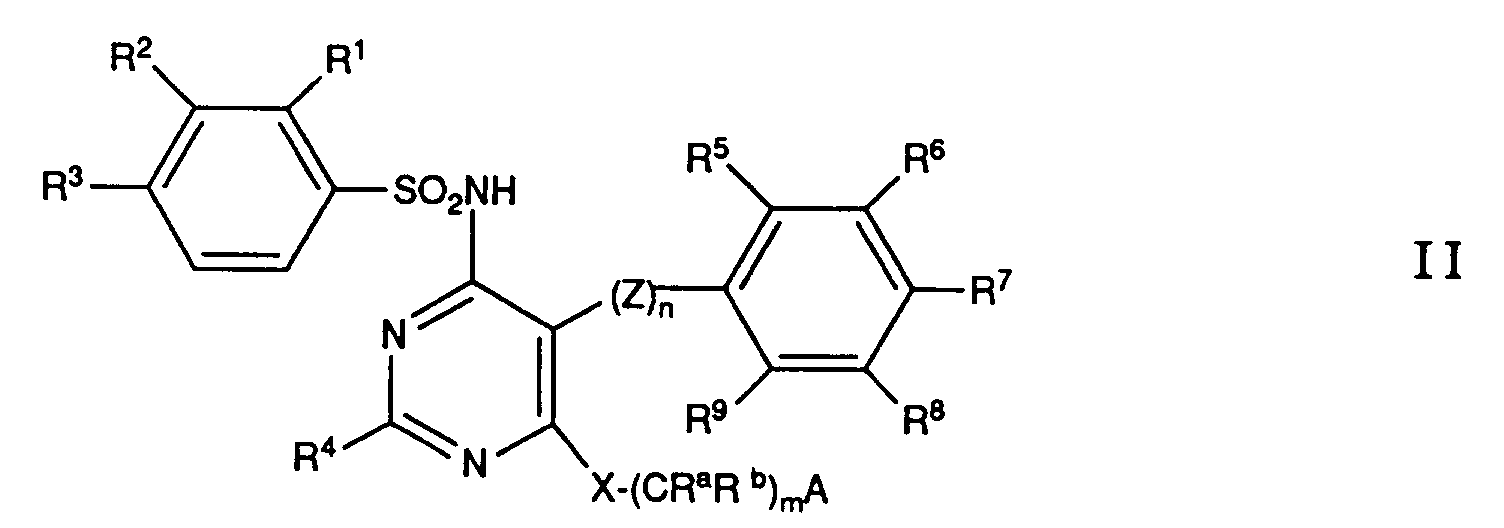
worin R¹-R⁹, Ra, Rb, X, Z, m und n die oben angegebene Bedeutung haben und A Hydroxy oder Amino ist, - a) mit einem Isocyanat der Formel R¹⁰NCO oder einem Carbamoylchlorid der Formel (R¹⁰R¹¹)NCOCl umsetzt, worin R¹⁰ und R¹¹ die in Anspruch 1 angegebene Bedeutung haben, oder
- b) mit Phosgen und danach mit einem Alkohol der Formel R¹⁰OH; oder mit einem Chlorameisensäureester der Formel R¹⁰OC(O)Cl umsetzt,
- Die Umsetzung gemäss Verfahrensvariante a) kann in für die Herstellung von Carbamaten und Harnstoffen aus Alkoholen bzw. Aminen an sich bekannter Weise erfolgen. So kann eine Verbindung der Formel II, in der A Hydroxy ist, mit einem Isocyanat der Formel R¹⁰NCO in einem geeigneten wasserfreien organischen Lösungsmittel, z.B. einem Kohlenwasserstoff wie Toluol, zweckmässig unter Erwärmen, zu einer Verbindung der Formel I, in der Y -OC(O)NHR¹⁰ ist, umgesetzt werden. Das Isocyanat kann dabei in situ, z.B. aus einem Azid der Formel R¹⁰CON₃ durch thermische Zersetzung, erzeugt werden. Entsprechend können unter Verwendung von Verbindungen der Formel II, in denen A Amino ist, Verbindungen der Formel I mit Y = -NHC(O)NR¹⁰ erhalten werden. Alternativ können Verbindungen der Formel II, in der A Hydroxy ist, mit Verbindungen der Formel R¹⁰R¹¹NC(O)Cl unter analogen Reaktionsbedingungen zu Verbindungen der Formel I, in denen Y ein Rest -OC(O)NR¹⁰R¹¹ ist, und Verbindungen der Formel II, in der A Amino ist, zu Verbindungen der Formel I, in der Y ein Rest -NHC(O)NR¹⁰R¹¹ ist, umgesetzt werden.
- Nach Verfahrensvariante b) kann eine Verbindung der Formel II, in der A Hydroxy ist, mit Phosgen und danach mit einem Alkohol der Formel R¹⁰OH zu einer Verbindung der Formel I, in der Y ein Rest -OC(O)OR¹⁰ ist, umgesetzt werden. Anstelle von Phosgen kann ein Phosgensalz, wie Diphosgen (Cl-COOCCl₃) oder Triphosgen (CO(OCCl₃)₂ eingesetzt werden. Analog erhält man ausgehend von Verbindungen der Formel II mit A = Amino Verbindungen der Formel I mit Y = NHC(O)OR¹⁰. Das Phosgen wird dabei zweckmässig als Lösung in einem inerten wasserfreien organischen Lösungsmittel, z.B. einem Kohlenwasserstoff wie Toluol, eingesetzt. Die Umsetzung mit Phosgen kann bei Raumtemperatur vorgenommen werden. Das intermediär erhaltene Säurechlorid wird unmittelbar mit dem Alkohol R¹⁰OH, zweckmässig unter Erwärmen, umgesetzt.
- In den so erhaltenen Verbindungen der Formel I können darin anwesende Substituenten abgewandelt werden. Beispielsweise können Estergruppen verseift oder zur Alkoholgruppe reduziert werden; N-heterocyclische Reste, wie Pyridylreste, können zu N-Oxiden oxidiert oder N-alkyliert werden; Carbonsäuregruppen können in Ester oder Amide überführt werden. Schliesslich können die Verbindungen der Formel I in Salze, z.B. Alkalisalze, wie Na- und K-Salze, oder Erdalkalimetallsalze, wie Ca- oder Mg-Salze überführt werden. Alle diese Operationen können in an sich bekannter Weise vorgenommen werden.
- Die als Ausgangsmaterial eingesetzten Verbindungen sind generell bekannt, z.B. aus den europäischen Patentpublikationen EP-A-0526708 und EP-A-510526 oder können, soweit sie nicht im einzelnen bekannt oder ihre Herstellung nachstehend beschrieben ist, in Analogie zu bekannten oder den nachstehend beschriebenen Methoden hergestellt werden.
- Die Hemmwirkung der Verbindungen der Formel I auf Endothelinrezeptoren kann mit der nachstehend beschriebenen Versuchsanordnungen gezeigt werden:
- Eine cDNA, die für humanen ETA-Rezeptor von menschlicher Plazenta kodiert, wurde kloniert (M. Adachi, Y.-Y. Yang, Y. Furuichi und C-Miyamoto, BBRC 180, 1265-1272) und im Baculovirus-Insektenzellen-System exprimiert. Baculovirus-infizierte Insektenzellen aus einem 23 l Fermenter werden 60 Stunden nach der Infektion abzentrifugiert (3 000 x g, 15 Minuten, 4°C), in Tris-Puffer (5 mM, pH 7.4, 1 mM MgCl₂) resuspendiert und erneut zentrifugiert. Nach erneuter Resuspension und Zentrifugation werden die Zellen in 800 ml des gleichen Puffers suspendiert und bei -120°C eingefroren. Der Aufbruch der Zellen erfolgt beim Auftauen der Suspension in diesem hypotonen Puffergemisch. Nach wiederholtem Gefrier/Auftau-Zyklus wird die Suspension homogenisiert und zentrifugiert (25 000 x g, 15 Minuten, 4°C). Nach Suspension in Tris-Puffer (75 mM, pH 7.4, 25mM MgCl₂, 250 mM Saccharose) werden 1 ml Aliquots (Proteingehalt ca. 3.5 mg/ml) bei -85°C aufbewahrt.
- Für den Bindungs-Assay werden die eingefrorenen Membranpräparate aufgetaut und nach 10 Minuten Zentrifugieren mit 25000 g bei 20°C in Assay-Puffer (50 mM Tris-Puffer pH 7.4, enthaltend 25 mM MnCl₂, 1 mM EDTA und 0,5% Rinderserumalbumin) resuspendiert. 100 µl dieser Membransuspension, enthaltend 70 µg Protein werden mit 50 µl ¹²⁵I-Endothelin (spezif. Aktivität 2200 Ci/mMol) in Assay-Puffer (25000 cpm, Endkonzentration 20 pM) und 100 µl Assay-Puffer, der variierende Konzentrationen der Testverbindung enthält, inkubiert. Die Inkubation wird 2 Stunden bei 20°C oder 24 Stunden bei 4°C durchgeführt. Die Trennung von freiem und Membran-gebundenen Radioliganden wird durch Filtration über Glasfaserfilter vorgenommen.
- In der Tabelle 1 ist die in dieser Versuchsanordnung ermittelte Hemmwirkung von Verbindungen der Formel I als IC₅₀ angegeben, d.h., als Konzentration [µM] die erforderlich ist, 50% der spezifischen Bindung von ¹²⁵I-Endothelin zu hemmen.
Tabelle 1 Verbindung von Beispiel IC₅₀ [µM] 10 0,001 70 0,006 75 0,003 120 0,007 134 0,044 140 0,009 - Aus der Thoraxaorta von erwachsenen Wistar-Kyoto-Ratten wurden Ringe von 5 mm Länge herausgeschnitten. Das Endothel wurde durch leichtes Reiben der Innenfläche entfernt. Jeder Ring wurde bei 37°C in 10 ml Krebs-Henseleit-Lösung unter Begasung mit 95% O₂ und 5% CO₂ in ein isoliertes Bad eingetaucht. Die isometrische Spannung der Ringe wurde gemessen. Die Ringe wurden auf eine Vorspannung von 3 g gedehnt. Nach 10 Minuten Inkubation mit der Testverbindung oder Vehikel wurden kumulative Dosen von Endothelin-1 zugegeben. Die Aktivität der Testverbindung wurde ermittelt durch die zu beobachtende Rechtsverschiebung der Dosis-Wirkungskurve von Endothelin-1 in gegenwart verschiedener Konzentrationen an Antagonist. Diese Rechtsverschiebung (oder auch "dose ratio", DR) entspricht dabei dem Quotienten aus den EC₅₀-Werten von Endothelin-1 in Gegenwart und in Abwesenheit von Antagonist, wobei der EC₅₀-Wert die für eine halbmaximale Kontraktion erforderliche Endothelin-Konzentration bezeichnet.
- Aus der "dose ratio" DR wurde mittels eines Computerprogramms für jede einzelne Dosis-Wirkungskurve der entsprechende PA₂-Wert nach untenstehender Gleichung berechnet, welcher ein Mass für die Aktivität der Testverbindung darstellt.

Die EC₅₀ von Endothelin in Abwesenheit von Testverbindungen ist 0,3 nM. - Die mit Verbindungen der Formel I so erhaltenen Werte für pA₂ sind in Tabelle 2 angegeben.
Tabelle 2 Verbindung von Beispiel Dosisverhältnis (Rechtsverschiebung) 10 8,2 70 9,0 75 7,3 120 7,2 134 7,3 140 7,0 - In "stroke-prone", spontan-hypertensive Ratten wurde unter Anästhesie ein Telemetrie-System (PA-C40 Implantate) implantiert, um kontinuierlich den arteriellen Blutdruck und die Herzfrequenz messen zu können. Nach der Operation liess man den Tieren 2 Wochen Zeit, sich zu erholen.
- Telemetrische Messungen zeigten, dass der mittlere arterielle Blutdruck der Tiere erhöht war und etwa 190 mm Hg betrug. Die entsprechende Testverbindung (30 mg/kg in Gummi arabicum) wurde schliesslich mittels einer Sonde verabreicht und der Blutdruck kontinuierlich registriert. Es zeigte sich dabei, dass Verbindungen der Formel I einen Blutdruckabfall verursachten, wobei die Verabreichung von Gummi arabicum allein (Placebo-Kontrolle) keinen signifikanten Effekt auf den Blutdruck hatte.
- Der mit einer Verbindung der Formel I erhaltenen Messwert ist in Tabelle 3 angegeben.
Tabelle 3 Verbindung von Beispiel % Abnahme der mittleren arteriellen Blutdrucks (mm Hg) 70 30 - Die Verbindungen der Formel I können aufgrund ihrer Fähigkeit, die Endothelinbindung zu hemmen, als Mittel zur Behandlung von Erkrankungen verwendet werden, die mit die Vasokonstriktion erhöhenden Vorgängen assoziiert sind. Beispiele solcher Erkrankungen sind Bluthochdruck, Koronarerkrankungen, Herzinsuffizienz, renale und myocardiale Ischämie, Niereninsüffizienz, Dialyse, cerebrale Ischämie, Hirninfarkt, Migräne, subarachnoidale Hämorrhagie, Raynaud-Syndrom und pulmonärer Hochdruck. Sie können ebenfalls bei Atherosklerose, Verhinderung der Restenosierung nach Ballon-induzierter Gefässdilatation, Entzündungen, Magen- und Duodenalulcera, Ulcus cruris, Gram-negativer Sepsis, Schock, Glomerulonephritis, Nierenkolik, Glaukom, Asthma, bei der Therapie und Prophylaxe diabetischer Komplikationen und Komplikationen bei der Verabreichung von Cyclosporin, sowie anderen, mit Endothelin-Aktivitäten assoziierten Erkrankungen Anwendung finden.
- Die Verbindungen der Formel I können oral, rectal, parenteral, z.B. intravenös, intramuskulär, subcutan, intrathecal oder transdermal; oder sublingual oder als ophthalmologische Zubereitung, oder als Aerosol verabreicht werden. Beispiele von Applikationsformen sind Kapseln, Tabletten, oral verabreichbare Suspensionen oder Lösungen, Suppositorien, Injektionslösungen, Augentropfen, Salben oder Spraylösungen.
- Eine bevorzugte Anwendungsform ist die intravenöse, intramuskuläre oder orale Applikation. Die Dosierung, in denen die Verbindungen der Formel I in wirksamen Mengen verabreicht werden, hängen von der Art des spezifischen Wirkstoffs, dem Alter und den Bedürfnissen des Patienten und der Applikationsweise ab. Im allgemeinen kommen Dosierungen von etwa 0,1-100 mg/kg Körpergewicht pro Tag in Betracht. Die die Verbindungen der Formel I enthaltenden Präparate können inerte oder auch pharmakodynamisch aktive Zusätze enthalten. Tabletten oder Granulate z.B. können eine Reihe von Bindemitteln, Füllstoffen, Trägersubstanzen oder Verdünnungsmitteln enthalten. Flüssige Präparate können beispielsweise in Form einer sterilen, mit Wasser mischbaren Lösung vorliegen. Kapseln können neben dem Wirkstoff zusätzlich ein Füllmaterial oder Verdickungsmittel enthalten. Des weiteren können geschmacksverbessernde Zusätze, sowie die üblicherweise als Konservierungs-, Stabilisierungs-, Feuchthalte- und Emulgiermittel verwendeten Stoffe, ferner auch Salze zur Veränderung des osmotischen Druckes, Puffer und andere Zusätze vorhanden sein.
- Die vorstehend erwähnten Trägersubstanzen und Verdünnungsmittel können aus organischen oder anorganischen Stoffen, z.B. aus Wasser, Gelatine, Milchzucker, Stärke, Magnesiumstearat, Talkum, Gummi arabicum, Polyalkylenglykolen und dergleichen bestehen. Voraussetzung ist, dass alle bei der Herstellung der Präparate verwendeten Hilfsstoffe untoxisch sind.
- Die nachstehenden Beispiele erläutern die Erfindung weiter. Von den darin verwendeten Abkürzungen bedeutet THF Tetrahydrofuran; DMSO Dimethylsulfoxid; MeOH Methanol; Sdp. Siedepunkt; und Smp. Schmelzpunkt.
-
- a) Zu 121,5 mg N-[5-(2-Chloro-5-methoxy-phenoxy)-6-(2-hydroxy-ethoxy)-pyrimidin-4-yl]-2,3-dihydro-1,4-benzodioxin-6-sulfonamid, in 1 ml trockenem Toluol gelöst, gab man 57 mg 3-Pyridyl-isocyanat. Das Reaktionsgemisch wurde während 1 Stunde bei 100°C gerührt. Dann wurde die Lösung auf eine Kieselgelsäule gegeben und es wurde mit EtOAc eluiert. Man erhielt Pyridin-3-ylcarbaminsäure 2-[5-(2-chloro-5-methoxy-phenoxy]-6-(2,3-dihydro-1,4-benzodioxin-6-ylsulfonylamino)-pyrimidin-4-yloxy]-ethylester, weisses Pulver, MS: m/e = 630,4 (M+H)⁺.
-
- b) 3-Methoxyphenol wurde nach der Vorschrift von M. Julia und I. de Rosnay, Chimie Thérapeutique 5 (1969), 334 in 2-Chlor-5-methoxyphenol mit Sulfurylchlorid umgewandelt.
- c) 18,2 g 2-Chlor-5-methoxyphenol wurden in 150 ml trockenem Methanol gelöst. Man gab 9,3 g MeONa zu, gefolgt von 25 g Chlormalonsäuredimethylester. Das Reaktionsgemisch wurde während 2 Stunden bei 50°C gerührt. Nach Abdestillieren des Lösungsmittels wurde der Rückstand im Scheidetrichter zwischen Toluol und H₂O verteilt und neutral gewaschen. Nach Kristallisation in Ethanol erhielt man (2-Chlor-5-methoxy)phenoxy-dimethylmalonat, weisse Kristalle mit Smp. 68-69°C.
- d) 1,43 g Na wurden in 70 ml MeOH gelöst. Dann wurden 5,8 g (2-Chlor-5-methoxy)phenoxy-dimethylmalonat und 2,29 g Formamidin-acetat zugegeben; das Reaktionsgemisch wurde während 1,5 Stunden unter Rückfluss gerührt. Dann wurde das Lösungsmittel abdestilliert, der Rückstand in H₂O aufgenommen, die wässrige Phase mit Essigester extrahiert, die organische Phase verworfen und die wässrige Phase mit Essigsäure auf pH 4 angesäuert, wobei das 5-(2-Chlor-5-methoxy)phenoxy-4,6(1H,5H)-pyrimidindion als weisses Pulver ausfiel. MS: m/e = 268 (M).
- e) Ein Gemisch von 3,75 g 5-(2-Chlor-5-methoxy)phenoxy-4,6(1H,5H)-pyrimidindion, 5,4 g N-Ethyldiisopropylamin, 12,5 ml POCl₃ in 20 ml Dioxan wurde unter Rückfluss während 18 Stunden gerührt. Nach Abdestillieren der flüchtigen Komponenten, wurde der Rückstand zwischen Essigester und H₂O verteilt und neutral gewaschen. Nach Abdestillieren des Lösungsmittels wurde die Verbindung an Kieselgel mit CH₂Cl₂ als Fliessmittel gereinigt. Nach Kristallisation aus EtOH erhielt man 4,6-Dichlor-5-(2-chlor-5-methoxy-phenoxy)-pyrimidin als weisse Kristalle mit Smp. 88-89°C.
- f) Ein Vilsmeier-Reagens wurde hergestellt, indem man unter Eiskühlung 29 g Sulfurylchlorid zu 15,7 g DMF tropfte. Anschliessend wurden 27,3 g 1,2-Ethylendioxy-benzol zugetropft. Nach Ende der Zugabe wurde das Reaktionsgemisch während einer Stunde bei 100°C gerührt. Dann wurde die Lösung auf Eis gegossen und das gebildete Sulfochlorid mit CH₂Cl₂ extrahiert. Nach Abdestillieren des Dichlormethans wurde der Rückstand in THF aufgenommen. Man gab 10 ml 25%ige NH₄OH-Lösung zu und rührte während 0,5 Stunden. Das gebildete 1,4-Benzodioxan-6-sulfonamid wurde aus Essigester kristallisiert. Man erhielt leicht gelbe Kristalle. Das Sulfonamid wurde in das K-Salz durch Zugabe der stöchiometrischen Menge KOH übergeführt.
- g) 917 mg 4,6-Dichlor-5-(2-chlor-5-methoxy-phenoxy)-pyrimidin und 1,29 g des 1,4-Benzodioxan-6-sulfonamid-Salzes aus 1f) wurden in 4 ml DMSO gelöst. Nach 1 Stunde bei 100°C war die Reaktion beendet. Nach Abdestillieren des Lösungsmittels wurde der Rückstand zwischen 1N HCl und Essigester verteilt. Nach Isolieren des Reaktionsproduktes wurde das N-[6-Chlor-5-(2-chlor-5-methoxy-phenoxy)-pyrimidin-4-yl]-2,3-dihydro-1,4-benzodioxan-6-sulfonamid aus Propanol kristallisiert. Smp. 185-186°C.
- h) 485 mg N-[6-Chlor-5-(2-chlor-5-methoxy-phenoxy)-pyrimidin-4-yl]-2,3-dihydro-1,4-benzodioxan-6-sulfonamid wurden zu einer Na-Glykolat-Lösung (115 mg Na in 2 g Ethylenglykol) gegeben. Man liess während 1 Stunde bei 100°C reagieren. Nach Isolieren des Reaktionsproduktes wurde an Kieselgel mit Dichlormethan-Diäthyläther (1:1 in Vol.) als Fliessmittel chromatographiert. Man kristallisierte aus Diisopropyläther und erhielt N-[5-(2-Chlor-5-methoxy-phenoxy)-6-(2-hydroxy-ethoxy)-pyrimidin-4-yl]-2,3-dihydro-1,4-benzodioxan-6-sulfonamid als weisse Kristalle mit Smp. 180-181°C.
-
- a) Eine Lösung von 100 mg 4-Pyridylcarbonsäureazid in 2 ml absolutem Toluol wurde während 1 Stunde bei 100°C gehalten, wobei das entsprechende Isocyanat gebildet wurde. Man gab dann 100 mg N-[5-(2-Chlor-5-methoxy-phenoxy)-6-(2-hydroxy-ethoxy)-pyrimidin-4-yl]-1,3-benzodioxol-5-sulfonamid zu und liess 2 Stunden bei dieser Temperatur reagieren. Dann wurde die Reaktionslösung auf eine Kieselgelsäule gegeben und es wurde mit Essigester eluiert. Der erhaltene Pyridin-4-ylcarbamylsäure 2-[6-(1,3-benzodioxol-5-ylsulfonylamino)-5-(2-chlor-5-methoxy-phenoxy)-pyrimidin-4-yloxy]-ethylester wurde aus CHCl₃ kristallisiert. Smp. 230°C (Zers.).
-
- b) Das (1,3-Benzodioxol-5-sulfonamid)-K wurde nach dem Verfahren des Beispiels 1, Abschnitt f) aus 1,3-Benzodioxol hergestellt.
- c) 458 mg 4,6-Dichlor-5-(2-chlor-5-methoxy-phenoxy)-pyrimidin und 574 mg (1,3-Benzodioxol-5-sulfonamid)-K wurden zu N-[6-Chlor-5-(2-chlor-5-methoxy-phenoxy)-pyrimidin-4-yl]-1,3-benzodioxol-5-sulfonamid umgesetzt. Weisse Kristalle (aus MeOH). Smp. 230°C.
- d) 470,3 mg der Verbindung aus 2c) wurden mit Na-Glykolat in Ethylenglykol in N-[5-(2-Chlor-5-methoxy-phenoxy)-6-(2-hydroxy-ethoxy)-pyrimidin-4-yl]-1,3-benzodioxol-5-sulfonamid überführt. Weisse Kristalle, Smp. 164°C.
- e) 6,15 g Isonicotinsäure und 5,55 g Triäthylamin wurden in 50 ml Aceton gelöst. Zu dieser auf -10°C gekühlten Lösung wurden 6 g Chlorameisensäure-äthylester getropft. Nach 2 Stunden wurde bei 0°C eine Lösung von 5 g NaN₃ in 20 ml H₂O gelöst zugetropft. Nach 1 Stunde bei Raumtemperatur wurde der Feststoff abfiltriert und verworfen. Die Lösung wurde bei Raumtemperatur abdestilliert und der Rückstand mit Dichlormethan extrahiert. Nach Trocknen über MgSO₄ wurde das Lösungsmittel abdestilliert und die zurückbleibende Flüssigkeit über Kieselgel mit Dichlormethan als Fliessmittel filtriert. Man erhielt das 4-Pyridylcarbonsäureazid als farblose Flüssigkeit, die im Tiefkühler (-18°C) kristallisierte. IR: 2141, 2190 cm⁻¹ (N₃).
-
- a) In Analogie zu Beispiel 2 erhielt man aus 100 mg N-[5-(2-Chlor-5-methoxy-phenoxy)-6-(2-hydroxy-ethoxy)-pyrimidin-4-yl]-1,3-benzodioxol-5-sulfonamid und 100 mg 3-Pyridyl-carbonsäureazid den Pyridin-3-carbamylsäure 2-[6-(1,3-benzodioxol-5-ylsulfonylamino)-5-(2-chlor-5-methoxy-phenoxy)-pyrimidin-4-yloxy)-ethylester. Smp. 114-115°C (Zers.).
-
- b) Das 3-Pyridyl-carbonsäureazid wurde nach dem Verfahren von Beispiel 2, Abschnitt c) aus Nicotinsäure hergestellt. IR: 2137, 2179 cm⁻¹ (N₃).
-
- a) In Analogie zu Beispiel 2 erhielt man aus 250 mg N-[5-(2-Chlor-5-methoxy-phenoxy)-6-(2-hydroxy-ethoxy)-pyrimidin-4-yl)-1,3-benzodioxol-5-sulfonamid und 225 mg 2-Pyridyl-carbonsäureazid den Pyridin-2-carbamylsäure 2-[6-(1,3-benzodioxol-5-ylsulfonylamino)-5-(2-chlor-5-methoxy-phenoxy)-pyrimidin-4-yloxy]-ethylester. Smp. 206°C (Zers.).
-
- b) Das 2-Pyridyl-carbonsäureazid wurde nach dem Verfahren von Beispiel 2, Abschnitt e) aus Picolinsäure hergestellt.
-
- a) In Analogie zu Beispiel 2 erhielt man aus 100 mg 4-tert-Butyl-N-[5-(2-chlor-5-methoxy-phenoxy)-6-(2-hydroxy-ethoxy)-2-methoxymethyl]-benzolsulfonamid und 100 mg 3-Pyridyl-carbonsäureazid den Pyridin-3-carbamylsäure 2-[6-(4-tert-butyl-phenylsulfonylamino)-5-(2-chlor-5-methoxy-phenoxy)-2-methoxymethyl-pyrimidin-4-yloxy]-ethylester. MS: m/e = 672,6 (M+H⁺).
-
- b) 16 g Methoxyacetonitril und 11,45 g Ethanol wurden in 50 ml Diäthyläther gelöst. Die Lösung wurde bei 0°C mit trockenem HCl gesättigt. Man liess die Lösung während 3 Tagen bei Raumtemperatur stehen. Dann wurde das Lösungsmittel abdestilliert, wobei Kristallisation eintrat. Smp. 122°C (Zers.).
- c) 15,3 g des Imidoesterhydrochlorids aus b) wurden in 25 ml Methanol gelöst. 15,4 ml einer 6,5N NH₃-Lösung in Methanol wurden in einem Guss zugegeben, wobei sich ein Niederschlag bildete, der sich rasch auflöste. Man liess die Lösung während 24 Stunden bei Raumtemperatur stehen. Dann wurde das Lösungsmittel abdestilliert, wobei allmählich Kristallisation eintrat.
- d) In Analogie zu Beispiel 1, Abschnitt d) erhielt man aus 5,1 g Methoxymethyl-amidin-hydrochlorid und 11,2 g (2-Chlor-5-methoxy-phenoxy)-dimethylmalonat das 2-Methoxymethyl-5-(2-chlor-5-methoxy-phenoxy-4,6(1H,5H)-pyrimidindion als weisses Pulver. MS: 312 (M).
- e) In Analogie zu Beispiel 1, Abschnitt e) erhielt man das 4,6-Dichlor-2-methoxymethyl-5-(2-chlor-5-methoxy-phenoxy)-pyrimidin, Smp. 105°C (aus EtOH).
- f) In Analogie zu Beispiel 1, Abschnitt g) erhielt man aus dem Dichlorid aus e) und (4-tert-Butyl-benzolsulfonamid)-K das 4-tert-Butyl-N-[6-chlor-5-(2-chlor-5-methoxy-phenoxy)-2-methoxymethyl-pyrimidin-4-yl]-benzolsulfonamid. MS: 526 (M+H⁺).
- g) In Analogie zu Beispiel 1, Abschnitt h) erhielt man aus 0,3 g der Verbindung aus Beispiel 5, Abschnitt f) das 4-tert-Butyl-N-[5-(2-chlor-5-methoxy-phenoxy)-6-(2-hydroxy-ethoxy)-2-methoxymethyl-pyrimidin-4-yl]-benzolsulfonamid. MS: 551 (M).
- In Analogie zu Beispiel 2 erhielt man aus 100 mg 4-tert-Butyl-N-[5-(2-chlor-5-methoxy-phenoxy)-6-(2-hydroxy-ethoxy)-2-methoxymethyl-pyrimidin-4-yl]-benzolsulfonamid und 100 mg 2-Pyridylcarbonsäureazid den Pyridin-2-carbamylsäure 2-[6-(4-tert-butyl-phenylsulfonylamino)-5-(2-chlor-5-methoxy-phenoxy)-2-methoxymethyl-pyrimidin-4-yloxy]-ethylester. Smp. 174-175°C (aus EtOH).
-
- a) In Analogie zu Beispiel 2 erhielt man aus 200 mg N-[5-(2-Chlor-5-methoxy-phenoxy)-6-(2-hydroxy-ethoxy)-2-methoxymethyl-pyrimidin-4-yl]-1,3-benzodioxol-5-sulfonamid und 165 mg 2-Pyridyl-carbonsäureazid den Pyridin-2-carbamylsäure 2-[6-(1,3-benzodioxol-5-ylsulfonylamino)-5-(2-chlor-5-methoxy-phenoxy)-2-methoxymethyl-pyrimidin-4-yloxy]-ethylester. Smp. 160-162°C.
-
- b) In Analogie zu Beispiel 1, Abschnitt g) erhielt man aus 700 mg 4,6-Dichlor-2-methoxymethyl-5-(2-chlor-5-methoxy-phenoxy)-pyrimidin und 766 mg (1,3-Benzodioxol-5-sulfonamid)-K das N-[6-Chlor-5-(2-chlor-5-methoxy-phenoxy)-2-methoxymethyl-pyrimidin-4-yl]-1,3-benzodioxol-5-sulfonamid. Smp. 114-116°C (aus EtOH).
- c) In Analogie zu Beispiel 1, Abschnitt h) wurde diese Verbindung in das N-[5-(2-Chlor-5-methoxy-phenoxy)-6-(2-hydroxy-ethoxy)-2-methoxymethyl-pyrimidin-4-yl]-1,3-benzodioxol-5-sulfonamid übergeführt.
- In Analogie zu Beispiel 2 erhielt man aus 125 mg N-[5-(2-Chlor-5-methoxy-phenoxy)-6-(2-hydroxy-ethoxy)-pyrimidin-4-yl]-1,3-benzodioxol-5-sulfonamid und 90 mg 1-Methyl-pyrrol-2-carbonsäureazid den 1-Methyl-pyrrol-2-carbamylsäure 2-[6-(1,3-benzodioxol-5-ylsulfonylamino)-5-(2-chlor-5-methoxy-phenoxy)-pyrimidin-4-yloxy]-ethylester. MS: 618,3 (M+H⁺).
- Das 1-Methyl-pyrrol-2-carbonsäureazid wurde aus 1-Methyl-pyrrol-2-carbonsäure mittels des Verfahrens von Beispiel 2e) als farblose Flüssigkeit erhalten. IR: 2132 cm⁻¹ (N₃).
- In Analogie zu Beispiel 2 erhielt man aus 95 mg 4-tert-Butyl-N-[5-(2-chlor-5-methoxy-phenoxy)-6-(2-hydroxy-ethoxy)-pyrimidin-4-yl]-benzolsulfonamid und 90 mg 1,3-Benzodioxol-5-carbonsäureazid den 1,3-Benzodioxol-5-ylcarbaminsäure 2-[6-(4-tert-butyl-phenylsulfonylamino)-5-(2-chlor-5-methoxy-phenoxy)-pyrimidin-4-yloxy]-ethylester. MS: 671,4 (M+H⁺).
- Das 1,3-Benzodioxol-5-carbonsäureazid wurde ausgehend von der entsprechenden Carbonsäure nach dem Verfahren des Beispiels 2e) erhalten. IR: 2144 cm⁻¹ (N₃).
-
- a) In Analogie zu Beispiel 2 erhielt man aus 100 mg N-[5-(2-Chlor-5-methoxy-phenoxy)-6-(2-hydroxy-ethoxy)-2-(2-methoxyethyl)-pyrimidin-4-yl]-1,3-benzodioxol-5-sulfonamid und 80 mg 2-Pyridyl-carbonsäureazid den Pyridin-2-ylcarbaminsäure 2-[6-(1,3-benzodioxol-5-ylsulfonylamino)-5-(2-chlor-5-methoxy-phenoxy)-2-(2-methoxyethyl)-pyrimidin-4-yloxy]-ethylester. Smp. 156°C (aus EtOH).
-
- b) In Analogie zu Beispiel 5, Abschnitt b) erhielt man aus Methoxypropionitril, HCl und Ethanol das Methoxyethyl-imidoethylester-hydrochlorid. MS: 116 (M-CH₃).
- c) In Analogie zu Beispiel 5, Abschnitt c) erhielt man das Methoxyethyl-amidin-hydrochlorid.
- d) In Analogie zu Beispiel 1, Abschnitt d) erhielt man aus 4,16 g Amidin-hydrochlorid aus 10c) und 8,66 g (2-Chlor-5-methoxy-phenoxy)-dimethylmalonat das (2-Chlor-5-methoxy-phenoxy)-2-methoxyethyl-4,6(1H,5H)-pyrimidindion. MS: 326 (M).
- e) Nach dem Verfahren des Beispiels 1, Abschnitt e) wurde das Pyrimidindion in das 4,6-Dichlor-5-(2-chlor-5-methoxy-phenoxy)-2-methoxyethyl-pyrimidin überführt. Smp. 66,5-67,5°C (aus EtOH).
- f) Aus 727 mg des Dichlorids aus 10e) und 718 mg (1,3-Benzodioxol-5-sulfonamid)-K erhielt man das N-[6-Chlor-5-(2-chlor-5-methoxy-phenoxy)-2-(2-methoxy-ethyl)-pyrimidin-4-yl]-1,3-benzodioxol-5-sulfonamid. Smp. 154-155°C (aus MeOH).
- g) In Analogie zu Beispiel 1, Abschnitt h) wurde die Verbindung aus 10f) in das N-[5-(2-Chlor-5-methoxy-phenoxy)-6-(2-hydroxy-ethoxy)-2-(2-methoxyethyl)-pyrimidin-4-yl]-1,3-benzodioxol-5-sulfonamid überführt. Smp. 135-136°C (aus Diethylether).
- In Analogie zu Beispiel 2 erhielt man aus 100 mg 4-tert-Butyl-N-[(2-chlor-5-methoxy-phenoxy)-6-(2-hydroxy-ethoxy)-pyrimidin-4-yl]-benzolsulfonamid und 122 mg Thiophen-3-carbonsäureazid den Thiophen-3-ylcarbaminsäure 2-[6-(4-tert-butyl-phenylsulfonylamino)-5-(2-chlor-5-methoxy-phenoxy)-pyrimidin-4-yloxy]-ethylester. MS: 633,2 (M+H⁺).
- Das Thiophen-3-carbonsäureazid wurde aus Thiophen-3-carbonsäure nach der Vorschrift des Beispiels 2, Abschnitt e) als farblose Flüssigkeit, die im Tiefkühler (-18°C) kristallisierte, erhalten. IR: 2139, 2273 cm⁻¹ (N₃).
- In Analogie zu Beispiel 2 erhielt man aus 100 mg N-[(2-Chlor-5-methoxy-phenoxy)-6-(2-hydroxy-ethoxy)-pyrimidin-4-yl]-1,3-benzodioxol-5-sulfonamid und 122 mg Thiophen-3-carbonsäureazid den Thiophen-3-ylcarbamylsäure 2-[6-(1,3-benzodioxol-5-ylsulfonylamino)-5-(2-chlor-5-methoxy-phenoxy)-pyrimidin-4-yloxy]-ethylester. MS: 621,2 (M+H⁺).
-
- a) In Analogie zu Beispiel 2 erhielt man aus 100 mg N-[5-(2-Chlor-5-methoxy-phenoxy)-6-(2-hydroxy-ethoxy)-2-methylsulfanyl-pyrimidin-4-yl]-1,3-benzodioxol-5-sulfonamid und 82 mg 2-Pyridyl-carbonsäureazid den Pyridin-2-ylcarbaminsäure 2-[6-(1,3-benzodioxol-5-ylsulfonylamino)-5-(2-chlor-5-methoxy-phenoxy)-2-methylsulfanyl-pyrimidin-4-yloxy]-ethylester. Weisse Kristalle. Smp. 173-174°C (aus EtOH).
- b) Eine Lösung von 230 mg Na-Methylat in 15 ml Methanol, 1,45 g (2-Chlor-5-methoxy-phenoxy)-dimethylmalonat und 381 mg Thioharnstoff wurde während 5 Stunden am Rückfluss gehalten. Dann wurde das Lösungsmittel abdestilliert und der Rückstand in 10 ml H₂O gelöst. Zu dieser Lösung gab man 630 mg Dimethylsulfat und es wurde während 2 Stunden bei Raumtemperatur gerührt. Dann wurden 300 mg Essigsäure zugefügt, wobei das gebildete 5-(2-Chlor-5-methoxy-phenoxy)-4,6-dihydroxy-2-methylsulfanyl-pyrimidin ausfiel. MS: 314 (M).
- c) Dieses 4,6-Dihydroxypyrimidin wurde in Analogie zu Beispiel 1e) in die 4,6-Dichlor-Verbindung umgewandelt. Smp. 113-114°C.
- d) In Analogie zu Beispiel 1, Abschnitt g) erhielt man aus 500 mg der Dichlor-Verbindung und 547 mg (1,3-Benzodioxol-5-sulfonamid)-K das N-[6-Chlor-5-(2-chlor-5-methoxy-phenoxy)-2-methylsulfanyl-pyrimidin-4-yl]-1,3-benzodioxol-5-sulfonamid. Smp. 110-112°C (aus EtOH).
- e) In Analogie zu Beispiel 1, Abschnitt h) erhielt man aus 350 mg der Verbindung aus 13d) und Na-Glykolat in Ethylenglykol das N-[5-(2-Chlor-5-methoxy-phenoxy)-6-(2-hydroxy-ethoxy)-2-methylsulfanyl-pyrimidin-4-yl]-1,3-benzodioxol-5-sulfonamid. MS: 542 (M).
- In Analogie zu Beispiel 2 erhielt man aus 90 mg N-[(2-Chlor-5-methoxy-phenoxy)-6-(2-hydroxy-ethoxy)-2-methoxymethyl-pyrimidin-4-yl]-1,3-benzodioxol-5-sulfonamid und 89 mg Thiophen-3-carbonsäureazid den Thiophen-3-ylcarbaminsäure 2-[6-(1,3-benzodioxol-5-ylsulfonylamino)-5-(2-chlor-5-methoxy-phenoxy)-2-methoxymethyl-pyrimidin-4-yloxy]-ethylester. MS: 665,1 (M+H⁺).
-
- a) In Analogie zu Beispiel 2 erhielt man aus 150 mg N-[(2-Chlor-5-methoxy-phenoxy)-6-(2-hydroxy-ethoxy)-pyrimidin-4-yl]-1,3-benzodioxol-5-sulfonamid und 139 mg Thiophen-2-carbonsäureazid den Thiophen-2-ylcarbamylsäure 2-[6-(1,3-benzodioxol-5-ylsulfonylamino)-5-(2-chlor-5-methoxy-phenoxy)-pyrimidin-4-yloxy]-ethylester. MS: 621,3 (M+H⁺), Smp. 175°C (Zers.).
- b) Das Thiophen-2-carbonsäureazid wurde nach dem Verfahren des Beispiels 2, Abschnitt e) aus Thiophen-2-carbonsäure hergestellt.
- In Analogie zu Beispiel 2 erhielt man aus 125 mg N-[(2-Chlor-5-methoxy-phenoxy)-6-(2-hydroxy-ethoxy)-2-(methoxyethyl)-pyrimidin-4-yl]-1,3-benzodioxol-5-sulfonamid und 103 mg Thiophen-3-carbonsäureazid den Thiophen-3-ylcarbaminsäure 2-[6-(1,3-benzodioxol-5-ylsulfonylamino)-5-(2-chlor-5-methoxy-phenoxy)-2-(2-methoxy-ethyl)-pyrimidin-4-yloxy]-ethylester. MS: 679,3 (M+H⁺).
-
- a) In Analogie zu Beispiel 2 erhielt man aus 200 mg N-[6-(2-Hydroxy-ethoxy)-5-(2-methoxy-phenoxy)-2-(4-methoxy-phenyl)-pyrimidin-4-yl]-1,3-benzodioxol-5-sulfonamid und 195 mg 2-Pyridyl-carbonsäureazid den Pyridin-2-ylcarbaminsäure 2-[6-(1,3-benzodioxol-5-ylsulfonylamino)-5-(2-methoxy-phenoxy)-2-(4-methoxy-phenyl)-pyrimidin-4-yloxy]-ethylester. Smp. 217-218°C (aus EtOH).
-
- b) In Analogie zu Beispiel 5, Abschnitt b) erhielt man aus 4-Methoxy-phenylcyanid, Methanol und HCl das 4-Methoxyphenyl-methylimidoester-hydrochlorid. MS: 165 (M).
- c) Diese Verbindung wurde mit NH₃ zum 4-Methoxy-phenylamidin-hydrochlorid umgesetzt. MS: 150 (M).
- d) In Analogie zu Beispiel 1, Abschnitt d) erhielt man aus 7,63 g (2-Methoxy-phenoxy)-dimethylmalonat und 5,6 g (4-Methoxy-phenyl)-amidin-hydrochlorid das 2-(4-Methoxyphenyl)-5-(2-methoxy-phenoxy)-4,6(1H,5H)-pyrimidindion. MS: 340 (M).
- e) In Analogie zu Beispiel 1, Abschnitt c) erhielt man das 4,6-Dichlor-2-(4-methoxy-phenyl)-5-(2-methoxy-phenoxy)-pyrimidin. Smp. 113-114°C (aus EtOH).
- f) In Analogie zu Beispiel 1, Abschnitt g) erhielt man aus 755 mg der Verbindung aus 17e) und 765 mg (1,3-Benzodioxol-5-sulfonamid)-K das N-[6-Chlor-5-(2-methoxy-phenoxy)-2-(4-methoxy-phenyl)-pyrimidin-4-yl]-1,3-benzodioxol-5-sulfonamid. Smp. 187-188°C (aus EtOH).
- g) In Analogie zu Beispiel 1, Abschnitt h) erhielt man aus 542 mg der Verbindung aus 17f) und Na-Glykolat das N-[6-(2-Hydroxy-ethoxy)-5-(2-methoxy-phenoxy)-2-(4-methoxy-phenyl)-pyrimidin-4-yl]-1,3-benzodioxol-5-sulfonamid. MS: 567 (M).
-
- a) In Analogie zu Beispiel 2 erhielt man aus 200 mg N-[6-(2-Hydroxy-ethoxy)-5-(2-methoxy-phenoxy)-2-phenyl-pyrimidin-4-yl]-1,3-benzodioxol-5-sulfonamid und 165 mg 2-Pyridyl-carbonsäureazid den Pyridin-2-ylcarbaminsäure 2-[6-(1,3-benzodioxol-5-ylsulfonylamino)-5-(2-methoxy-phenoxy)-2-phenyl-pyrimidin-4-yloxy]-ethylester. Smp. 187°C (aus EtOH).
-
- b) In Analogie zu Beispiel 1, Abschnitt g) erhielt man aus 1,4 g 4,6-Dichlor-5-(2-methoxy-phenoxy)-2-phenyl-pyrimidin und 1,9 g (1,3-Benzodioxol-5-sulfonamid)-K das N-[6-Chlor-5-(2-methoxy-phenoxy)-2-phenyl-pyrimidin-4-yl]-1,3-benzodioxol-5-sulfonamid. Smp. 185-186°C.
- c) In Analogie zu Beispiel 1, Abschnitt h) erhielt man aus 1,5 der Verbindung aus 18b) und Na-Glykolat das N-[6-(2-Hydroxy-ethoxy)-5-(2-methoxy-phenoxy)-2-phenyl-pyrimidin-4-yl]-1,3-benzodioxol-5-sulfonamid. Smp. 159,5-160°C.
-
- a) In Analogie zu Beispiel 2 erhielt man aus 125 mg N-[6-(2-Hydroxy-ethoxy)-5-(3,5-dimethoxy-phenoxy)-pyrimidin-4-yl]-1,3-benzodioxol-5-sulfonamid und 75 mg 2-Pyridyl-carbonsäureazid den Pyridin-2-ylcarbamylsäure 2-[6-(1,3-benzodioxol-5-ylsulfonylamino)-5-(3,5-dimethoxy-phenoxy)-pyrimidin-4-yloxy]-ethylester. MS: 612,3 (M+H⁺), Smp. 212°C (Zers.).
-
- b) In Analogie zu Beispiel 1, Abschnitt g) erhielt man aus 1,2 g 4,6-Dichlor-5-(3,5-dimethoxy-phenoxy)-pyrimidin und 1,45 g (1,3-Benzodioxol-5-sulfonamid)-K das N-[6-Chlor-5-(3,5-dimethoxy-phenoxy)-pyrimidin-4-yl]-1,3-benzodioxol-5-sulfonamid. Smp. 167-168°C.
- c) In Analogie zu Beispiel 1, Abschnitt h) erhielt man aus 0,31 g der Verbindung aus 19b) das N-[6-(2-Hydroxy-ethoxy)-5-(3,5-dimethoxy-phenoxy)-pyrimidin-4-yl]-1,3-benzodioxol-5-sulfonamid. Smp. 182°C (aus Essigester).
-
- a) In Analogie zu Beispiel 1, Abschnitt a) erhielt man aus 0,044 ml 3-Fluorphenylisocyanat und 100 mg p-tert-Butyl-N-[5-(2-chloro-5-methoxy-phenoxy)-6-(2-hydroxyethoxy)-4-pyrimidinyl]benzolsulfonamid den 3-Fluoro-phenylcarbaminsäure 2-[6-(4-tert-butylphenylsulfonylamino)-5-(2-chloro-5-methoxy-phenoxy)-pyrimidin-4-yloxy]ethylester. MS: 644 (M).
-
- b) In Analogie zu Beispiel 1g) erhielt man aus 4 g 4,6-Dichloro-5-(2-chlor-5-methoxy-phenoxy)pyrimidin aus Beispiel 1e) und 7,1 g (4-tert-Butyl-benzolsulfonamid)-K das p-tert-Butyl-N-[(6-chloro-5-(2-chloro-5-methoxy-phenoxy)-4-pyrimidinyl]benzolsulfonamid. Smp. 152-153°C.
- c) In Analogie zu Beispiel 1h) erhielt man aus 2,55 g des Chlorids von Beispiel 20b) und 0,85 g Natrium in 30 ml Ethylenglykol das p-tert-Butyl-N-[5-(2-chloro-5-methoxyphenoxy)-6-(2-hydroxyethoxy)-4-pyrimidinyl]benzolsulfonamid. Smp. 140°C.
- In Analogie zu Beispiel 1, Abschnitt a) erhielt man aus 0,044 ml 2-Fluorophenylisocyanat und 100 mg p-tert-Butyl-N-[5-(2-chloro-5-methoxyphenoxy)-6-(2-hydroxyethoxy)-4-pyrimidinyl]benzolsulfonamid den 2-Fluorophenylcarbaminsäure 2-[(6-(4-tert-butyl-phenylsulfonylamino)-5-(2-chloro-5-methoxy-phenoxy)-pyrimidin-4-yloxy]ethylester. MS: 644 (M).
- In Analogie zu Beispiel 1, Abschnitt a) erhielt man aus 0,042 ml Phenylisocyanat und 100 mg p-tert-Butyl-N-[5-(2-chloro-5-methoxyphenoxy)-6-(2-hydroxyethoxy)-4-pyrimidinyl]benzolsulfonamid den Phenylcarbaminsäure 2-[6-(4-tert-butyl-phenylsulfonylamino)-5-(2-chloro-5-methoxyphenoxy)pyrimidin-4-yloxy]ethylester. MS: 627,4 (M+H).
- In Analogie zu Beispiel 1, Abschnitt a) erhielt man aus 60 mg 4-Chlor-phenylisocyanat und 100 mg p-tert-Butyl-N-[5-(2-chloro-5-methoxyphenoxy)-6-(2-hydroxyethoxy)-4-pyrimidinyl]benzolsulfonamid den 4-Chloro-phenylcarbaminsäure 2-[6-(4-tert-butyl-phenylsulfanoylamino)-5-(2-chloro-5-methoxy-phenoxy)-pyrimidin-4-yloxy]ethylester. MS: 661,3 (M+H).
- In Analogie zu Beispiel 1, Abschnitt a) erhielt man aus 50 mg 3-Methoxyphenylisocyanat und 100 mg p-tert-Butyl-N-[5-(2-chloro-5-methoxyphenoxy)-6-(2-hydroxyethoxy)-4-pyrimidinyl]benzolsulfonamid den 3-Methoxy-phenylcarbaminsäure 2-[6-(4-tert-butyl-phenylsulfonylamino)-5-(2-chloro-5-methoxy-phenoxy)-pyrimidin-4-yloxy]ethylester. MS: 657,3 (M+H).
- In Analogie zu Beispiel 1, Abschnitt a) erhielt man aus 0,056 ml 4-Trifluoromethylphenylisocyanat und 100 mg p-tert-Butyl-N-[5-(2-chloro-5-methoxyphenoxy)-6-(2-hydroxyethoxy)-4-pyrimidinyl]benzolsulfonamid den 4-Trifluoromethyl-phenylcarbaminsäure 2-[6-(4-tert-butyl-phenylsulfonylamino)-5-(2-chloro-5-methoxy-phenoxy)-pyrimidin-4-yloxy]ethylester. MS: 695,3 (M+H).
- In Analogie zu Beispiel 1, Abschnitt a) erhielt man aus 69 mg 2-Carbomethoxyphenylisocyanat und 100 mg p-tert-Butyl-N-[5-(2-chloro-5-methoxy-phenoxy)-6-(2-hydroxyethoxy)-4-pyrimidinyl]benzolsulfonamid den 2-[2-[6-(4-tert-Butyl-phenylsulfonylamino)-5-(2-chloro-5-methoxy)-pyrimidin-4-yloxy]-ethoxycarbonylamino]-benzoesäure-methylester. MS: 685,3 (M+H).
- In Analogie zu Beispiel 1, Abschnitt a) erhielt man aus 0,05 ml 3-Methylphenylisocyanat und 100 mg p-tert-Butyl-N-[5-(2-chloro-5-methoxy-phenoxy)-6-(2-hydroxyethoxy)-4-pyrimidinyl]benzolsulfonamid den 3-Tolylcarbaminsäure 2-(6-(4-tert-butyl-phenylsulfonylamino)-5-(2-chloro-5-methoxy-phenoxy)-pyrimidin-4-yloxy]ethylester. MS: 640 (M).
- In Analogie zu Beispiel 2, Abschnitt a) erhielt man aus 58 mg 2-Pyridylcarbonsäureazid und 100 mg p-tert-Butyl-N-[5-(2-chloro-5-methoxyphenoxy)-6-(2-hydroxyethoxy)-4-pyrimidinyl]benzolsulfonamid den Pyridin-2-ylcarbaminsäure 2-[6-(4-tert-butylphenylsulfonylamino)-5-(2-chloro-5-methoxy-phenoxy)-pyrimidin-4-yloxy]ethylester. MS: 628,4 (M+H).
- In Analogie zu Beispiel 2, Abschnitt a) erhielt man aus 59 mg 2-Pyrazincarbonsäureazid und 100 mg p-tert-Butyl-N-[5-(2-chloro-5-methoxy-phenoxy)-6-(2-hydroxyethoxy)-4-pyrimidinyl]benzolsulfonamid den Pyrazin-2-ylcarbaminsäure 2-[6-(4-tert-butylphenylsulfonylamino)-5-(2-chloro-5-methoxy-phenoxy)-pyrimidin-4-yloxy]ethylester. MS: 408 (M-C₅H₄N₃O₃SCl).
- In Analogie zu Beispiel 2, Abschnitt a) erhielt man aus 58 mg 3-Pyridylcarbonsäureazid und 100 mg p-tert-Butyl-N-[5-(2-chloro-5-methoxyphenoxy)-6-(2-hydroxyethoxy)-4-pyrimidinyl]benzolsulfonamid den Pyridin-3-ylcarbaminsäure 2-[6-(4-tert-butylphenylsulfonylamino)-5-(2-chloro-5-methoxy-phenoxy)-pyrimidin-4-yloxy]ethylester. MS: 628,4 (M+H).
- In Analogie zu Beispiel 2, Abschnitt a) erhielt man aus 58 mg 4-Pyridylcarbonsäureazid und 100 mg p-tert-Butyl-N-[5-(2-chloro-5-methoxyphenoxy)-6-(2-hydroxyethoxy)-4-pyrimidinyl]benzolsulfonamid den Pyridin-4-ylcarbaminsäure 2-[6-(4-tert-butylphenylsulfonylamino)-5-(2-chloro-5-methoxy-phenoxy)-pyrimidin-4-yloxy]ethylester.
- In Analogie zu Beispiel 1, Abschnitt a) erhielt man aus 0,052 ml 2-Methoxyphenylisocyanat und 100 mg p-tert-Butyl-N-[5-(2-chloro-5-methoxy-phenoxy)-6-(2-hydroxyethoxy)-4-pyrimidinyl]benzolsulfonamid den 2-Methoxy-phenoxycarbaminsäure 2-[6-(4-tert-butylphenylsulfonylamino)-5-(2-chloro-5-methoxy-phenoxy)-pyrimidin-4-yloxy]ethylester. MS: 656 (M).
- In Analogie zu Beispiel 2, Abschnitt a) erhielt man aus 2-Acetoxy-phenylcarbonsäureazid und 100 mg p-tert-Butyl-N-[5-(2-chloro-5-methoxy-phenoxy)-6-(2-hydroxyethoxy)-4-pyrimidinyl]benzolsulfonamid den Essigsäure 2-[2-[(6-tert-butyl-phenylsulfonylamino)-5-(2-chloro-5-methoxy)-pyrimidin-4-yloxy]-ethoxycarbonylamino]-phenylester. MS: 642 (M-C₂H₂O).
- 90 mg der Verbindung aus Beispiel 33 wurden in 5 ml Ethanol gelöst, mit 1 ml 6N HCl versetzt und 6 Stunden am Rückfluss erhitzt. Das Lösungsmittel wurde abgezogen, das Rohprodukt zwischen Essigester und Wasser verteilt. Die organische Phase wurde getrocknet, das Lösungsmittel am Rotationsverdampfer entfernt und der Rückstand an Kieselgel chromatographiert mit CH₂Cl₂/Essigester (6:1) als Laufmittel. Man erhielt so den 2-Hydroxy-phenylcarbaminsäure 2-[6-(4-tert-butylphenylsulfonylamino)-5-(2-chloro-5-methoxy-phenoxy)-pyrimidin-4-yloxy]ethylester. MS: 428 (M-C₇H₅NO₄SCl).
- In Analogie zu Beispiel 1, Abschnitt a) erhielt man aus 0,048 ml Benzylisocyanat und 100 mg p-tert-Butyl-N-[5-(2-chloro-5-methoxyphenoxy)-6-(2-hydroxyethoxy)-4-pyrimidinyl]benzolsulfonamid den Benzylcarbaminsäure 2-[6-(4-tert-butylphenylsulfonylamino)-5-(2-chloro-5-methoxy-phenoxy)pyrimidin-4-yloxy]ethylester. MS: 641 (M+H).
- In Analogie zu Beispiel 1, Abschnitt a) erhielt man aus 0,038 ml Isopropylisocyanat und 100 mg p-tert-Butyl-N-[5-(2-chloro-5-methoxy-phenoxy)-6-(2-hydroxyethoxy)-4-pyrimidinyl]benzolsulfonamid den Isopropylcarbaminsäure 2-[6-(4-tert-butyl-phenylsulfonylamino)-5-(2-chloro-5-methoxy-phenoxy)-pyrimidin-4-yloxy]ethylester. MS: 592 (M).
- In Analogie zu Beispiel 1, Abschnitt a) erhielt man aus 0,025 ml Ethylsocyanat und 75 mg p-tert-Butyl-N-[5-(2-chloro-5-methoxyphenoxy)-6-(2-hydroxyethoxy)-4-pyrimidinyl]benzolsulfonamid den Ethylcarbaminsäure 2-[6-(4-tert-butyl-phenylsulfonylamino)-5-(2-chloro-5-methoxy-phenoxy)-pyrimidin-4-yloxy]-ethylester. MS: 579 (M).
- 100 mg der Verbindung von Beispiel 28 löste man in 15 ml CH₂Cl₂, versetzte mit 60 mg 3-Chlorperbenzoesäure und erhitzte anschliessend 12 Stunden am Rückfluss. Anschliessend wurde auf Wasser gegossen und mit CH₂Cl₂ extrahiert. Die organische Phase wurde getrocknet und schliesslich am Rotationsverdampfer entfernt. Den Rückstand chromatographierte man an Kieselgel mit CH₂Cl₂/MeOH (20:1) als Laufmittel. Man erhielt so den 1-Oxy-pyridin-2-ylcarbaminsäure 2-[6-(4-tert-butyl-phenylsulfonylamino)-5-(2-chloro-5-methoxy-phenoxy)-pyrimidin-4-yloxy]-ethylester. MS: 644,4 (M+H).
- In Analogie zu Beispiel 38 erhielt man aus 60 mg der in Beispiel 31 hergestellten Verbindung und 33 mg 3-Chlorperbenzoesäure den 1-Oxy-pyridin-4-ylcarbaminsäure 2-[6-(4-tert-butyl-phenylsulfonylamino)-5-(2-chloro-5-methoxyphenoxy)-pyrimidin-4-yloxy]-ethylester. MS: 644,5 (M+H).
- Durch Alkylierung der Verbindung aus Beispiel 1, Abschnitt a) mit Methyljodid erhielt man das 3-[2-[5-(2-Chloro-5-methoxy-phenoxy)-6-(2,3-dihydro-1,4-benzodioxin-6-ylsulfonylamino)-pyrimidin-4-yloxy]-ethoxycarbonylamino]-1-methyl-pyridiniumjodid.
- Durch Deprotonierung der Verbindung in Beispiel 40 mit Natriummethylat als Base wurde das N-[5-(2-Chloro-5-methoxy-phenoxy)-6-[2-(1-methyl-pyridin-3-yliocarbamoyloxy)-ethoxy]-pyrimidin-4-yl]-1,3-benzodioxol- 5-sulfonamid erhalten.
- In Analogie zu Beispiel 1, Abschnitt a) erhielt man aus 0,05 ml Phenylisocyanat und 100 mg p-tert-Butyl-N-[6-(2-hydroxyethoxy)-5-(m-methoxy-phenoxy)-4-pyrimidinyl]benzolsulfonamid (vgl. EP-A-526708) den Phenylcarbaminsäure 2-[6-(4-tert-butyl-phenylsulfonylamino)-5-(3-methoxy-phenoxy)-pyrimidin-4-yloxy]-ethylester. MS: 593,4 (M+H).
- In Analogie zu Beispiel 2, Abschnitt a) erhielt man aus 62 mg 2-Pyridylcarbonsäureazid und 100 mg p-tert-Butyl-N-[6-(2-hydroxyethoxy)-5-(m-methoxyphenoxy)-4-pyrimidinyl]benzolsulfonamid den Pyridin-2-ylcarbaminsäure 2-[6-(4-tert-butyl-phenylsulfonylamino)-5-(3-methoxy-phenoxy)-pyrimidin-4-yloxy]-ethylester. MS: 594,5 (M+H).
- In Analogie zu Beispiel 2, Abschnitt a) erhielt man aus 62 mg 4-Pyridylcarbonsäureazid und 100 mg p-tert-Butyl-N-[6-(2-hydroxyethoxy)-5-(m-methoxyphenoxy)-4-pyrimidinyl]benzolsulfonamid den Pyridin-4-ylcarbaminsäure 2-[6-(4-tert-butyl-phenylsulfonylamino)-5-(3-methoxy-phenoxy)-pyrimidin-4-yloxy]-ethylester. MS: 594,5 (M+H).
- In Analogie zu Beispiel 2, Abschnitt a) erhielt man aus 84 mg Chinaldinsäureazid und 100 mg p-tert-Butyl-N-[6-(2-hydroxyethoxy)-5-(m-methoxyphenoxy)-4-pyrimidinyl]benzolsulfonamid den Chinolin-2-ylcarbaminsäure-2-[6-(4-tert-butyl-phenylsulfonylamino)-5-(3-methoxy-phenoxy)-pyrimidin-4-yloxy]-ethylester. MS: 644,3 (M+H).
- In Analogie zu Beispiel 1, Abschnitt a) erhielt man aus 0,062 ml (R)-1-Phenyl-ethylisocyanat und 100 mg p-tert-Butyl-N-[6-(2-hydroxyethoxy)-5-(m-methoxyphenoxy)-4-pyrimidinyl]benzolsulfonamid den (R)-1-Phenyl-ethylcarbaminsäure-2-[6-(4-tert-butyl-phenylsulfonylamino)-5-(3-methoxy-phenoxy)-pyrimidin-4-yloxy]-ethylester. MS: 621 (M+H).
- In Analogie zu Beispiel 1, Abschnitt a) erhielt man aus 0,05 ml Cyclohexylisocyanat und 100 mg p-tert-Butyl-N-[6-(2-hydroxyethoxy)-5-(m-methoxyphenoxy)-4-pyrimidinyl]benzolsulfonamid den Cyclohexylcarbaminsäure 2-[6-(4-tert-butyl-phenylsulfonylamino)-5-(3-methoxy-phenoxy)-pyrimidin-4-yloxy]-ethylester. MS: 599,4 (M+H).
- In Analogie zu Beispiel 1, Abschnitt a) erhielt man aus 0,24 ml Isocyanatoessigsäureethylester und 500 mg p-tert-Butyl-N-[6-(2-hydroxy-ethoxy)-5-(m-methoxyphenoxy)-4-pyrimidinyl]benzolsulfonamid den [2-[6-(4-tert-Butyl-phenylsulfonylamino)-5-(3-methoxy-phenoxy)-pyrimidin-4-yloxy]-ethoxycarbonylamino]-essigsäureethylester. MS: 603,5 (M+H).
- 410 mg [2-[6-(4-tert-Butyl-phenylsulfonylamino)-5-(3-methoxy-phenoxy)-pyrimidin-4-yloxy]-ethoxycarbonylamino]-essigsäureethylester in 20 ml Ethanol versetzte man mit 1,36 ml 1N NaOH und erhitzte die Reaktionslösung 2 Stunden bei 60°C. Anschliessend versetzte man mit 1,36 ml 1N HCl und engte am Rotationsverdampfer ein. Der Rückstand wurde an Kieselgel chromatographiert mit CH₂Cl₂/MeOH (10:1) als Laufmittel. Man erhielt so 300 mg 2-[6-(4-tert-Butyl-phenylsulfonylamino)-5-(3-methoxy-phenoxy)-pyrimidin-4-yloxy]-ethoxycarbonylamino-essigsäure. MS: 573,3 (M-H).
- 100 mg [2-[6-(4-tert-Butyl-phenylsulfonylamino)-5-(3-methoxy-phenoxy)-pyrimidin-4-yloxy]-ethoxycarbonylamino]-essigsäureethylester löste man in 3 ml Ethanol, versetzte mit 3 ml THF und gab anschliessend 36 mg CaCl₂ und 25 mg NaBH₄ bei Raumtemperatur zu. Man liess 2 Stunden bei Raumtemperatur rühren, engte am Rotationsverdampfer ein und verteilte den Rückstand zwischen verdünnter Zitronensäure und Essigester. Die organische Phase wurde getrocknet, das Lösungsmittel entfernt und der Rückstand an Kieselgel mit CH₂Cl₂ (20:1) als Laufmittel chromatographiert. Man erhielt so 78 mg 2-Hydroxy-ethylcarbaminsäure 2-[6-(4-tert-butyl-phenylsulfonylamino)-5-(3-methoxy-phenoxy)-pyrimidin-4-yloxy]-ethylester. MS: 561 (M+H).
- In Analogie zu Beispiel 1, Abschnitt a) erhielt man aus 0,15 ml Morpholin-4-carbonylchlorid und 200 mg p-tert-Butyl-N-[6-(2-hydroxy-ethoxy)-5-(m-methoxyphenoxy)-4-pyrimidinyl]benzolsulfonamid, unter Zusatz von 154 mg Dimethylaminopyridin bei einer Reaktionszeit von 12 Stunden, den Morpholin-4-carbonsäure 2-[6-(4-tert-butyl-phenylsulfonylamino)-5-(3-methoxy-phenoxy)-pyrimidin-4-yloxy]-ethylester. MS: 587,4 (M+H).
- 100 mg 2-[6-(4-tert-Butyl-phenylsulfonylamino)-5-(3-methoxy-phenoxy)-pyrimidin-4-yloxy]-ethoxycarbonylamino-essigsäure in 15 ml CH₂Cl₂ versetzte man mit 0,015 ml Morpholin, 22 mg Dimethylaminopyridin, 33 mg N-Aethyl-N'-(3-dimethylaminopropyl)-carbodiimid-hydrochlorid und rührte die Lösung über Nacht bei Raumtemperatur. Anschliessend engte man am Rotationsverdampfer ein, verteilte den Rückstand zwischen Essigester und H₂O. Nach Trocknen der organischen Phase entfernte man das Lösungsmittel am Rotationsverdampfer und chromatographierte den Rückstand an Kieselgel mit CH₂Cl₂/MeOH (40:1) als Laufmittel. Man erhielt so 80 mg 2-Morpholin-4-yl-2-oxo-ethylcarbaminsäure 2-[6-(4-tert-butyl-phenylsulfonylamino)-5-(3-methoxy-phenoxy)-pyrimidin-4-yloxy]-ethylester. MS: 644,5 (M+H).
- In Analogie zu Beispiel 52 erhielt man aus 100 mg 2-[6-(4-tert-Butyl-phenylsulfonylamino)-5-(3-methoxy-phenoxy)-pyrimidin-4-yloxy]-ethoxy-carbonylamino-essigsäure und 0,014 ml Pyrrolidin den 2-Oxo-2-pyrrolidin-1-yl-ethylcarbaminsäure 2-[6-(4-tert-butyl-phenylsulfonylamino)-5-(3-methoxy-phenoxy)-pyrimidin-4-yloxy]ethylester. MS: 628,5 (M+H).
- In Analogie zu Beispiel 52 erhielt man aus 100 mg 2-[6-(4-tert-Butyl-phenylsulfonylamino)-5-(3-methoxy-phenoxy)-pyrimidin-4-yloxy]-ethoxy-carbonylamino-essigsäure und 0,016 ml Anilin den Phenylcarbamoylmethylcarbaminsäure 2-[6-(4-tert-butyl-phenylsulfonylamino)-5-(3-methoxy-phenoxy)-pyrimidin-4-yloxy]ethylester. MS: 650,5 (M+H).
- In Analogie zu Beispiel 1, Abschnitt a) erhielt man aus 100 mg p-tert-Butyl-N-[6-(2-hydroxyethoxy)-5-(m-methoxyphenoxy)-4-pyrimidinyl]benzolsulfonamid und 78 mg Ethyl-2-isocyanato-4-methyl-valerat den 2-[2-[6-(4-tert-Butyl-phenylsulfonylamino)-5-(3-methoxy-phenoxy)-pyrimidin-4-yloxy]-ethoxycarbonylamino]-4-methyl-pentansäureethylester. MS: 659 (M+H).
- Durch Alkylierung von Pyridin-4-ylcarbaminsäure 2-[6-(4-tert-butylphenylsulfonylamino)-5-(2-chloro-5-methoxy-phenoxy)-pyrimidin-4-yloxy]ethylester mit Methyljodid erhielt man das 4-[2-[6-(4-tert-Butyl-phenylsulfonylamino)-5-(2-chloro-5-methoxy-phenoxy-pyrimidin-4-yloxy]-ethoxycarbonylamino]-1-methyl-pyridiniumjodid.
- Analog zu Beispiel 2, Abschnitt a) erhielt man aus 3-Furylisocyanat und N-[5-(2-Chlor-5-methoxy-phenoxy)-6-(2-hydroxy-ethoxy)-pyrimidin-4-yl]-1,3-benzodioxol-5-sulfonamid den Furan-3-ylcarbaminsäure 2-[6-(1,3-benzodioxol-5-ylsulfonylamino)-5-(2-chloro-5-methoxy-phenoxy)-pyrimidin-4-yloxy]-ethylester.
- In Analogie zu Beispiel 2, Abschnitt a) erhielt man aus 2-Pyridylcarbonsäureazid und 4-tert-Butyl-N-[6-(2-hydroxyethoxy)-2-isopropyl-5-(2-methoxy-phenoxy)-pyrimidin-4-yl]-benzolsulfonamid (vgl. EP-A-526708) den Pyridin-2-ylcarbaminsäure 2-[6-(4-tert-butyl-phenylsulfonylamino)-2-isopropyl-5-(2-methoxy-phenoxy)-pyrimidin-4-yloxy]-ethylester. Smp. 119-120°C.
- In Analogie zu Beispiel 2, Abschnitt a) erhielt man aus 4-Pyridylcarbonsäureazid und der Ausgangsverbindung von Beispiel 58 den Pyridin-4-ylcarbaminsäure 2-[6-(4-tert-butyl-phenylsulfonylamino)-2-isopropyl-5-(2-methoxy-phenoxy)-pyrimidin-4-yloxy]-ethylester.
- In Analogie zu Beispiel 2, Abschnitt a) erhielt man aus 2-Pyridylcarbonsäureazid und p-tert-Butyl-N-[6-(2-hydroxyethoxy)-5-(o-methoxy-phenoxy)-2-propyl-4-pyrimidinyl]benzolsulfonamid (vgl. EP-A-526708) den Pyridin-2-ylcarbaminsäure 2-[6-(4-tert-butyl-phenylsulfonylamino)-5-(2-methoxy-phenoxy)-2-propyl-pyrimidin-4-yloxy]-ethylester. Smp. 147-149°C.
- In Analogie zu Beispiel 2, Abschnitt a) erhielt man aus 4-Pyridylcarbonsäureazid und der Ausgangsverbindung von Beispiel 60 den Pyridin-4-ylcarbaminsäure 2-[6-(4-tert-butyl-phenylsulfonylamino)-5-(2-methoxy-phenoxy)-2-propyl-pyrimidin-4-yloxy]-ethylester.
- In Analogie zu Beispiel 2, Abschnitt a) erhielt man aus 2-Pyridylcarbonsäureazid und p-tert-Butyl-N-[2-tert-butyl-6-(2-hydroxyethoxy)-5-(o-methoxyphenoxy)-4-pyrimidinyl]benzolsulfonamid (vgl. EP-A-526708) den Pyridin-2-ylcarbaminsäure 2-[2-tert-butyl-6-(4-tert-butyl-phenylsulfonylamino)-5-(2-methoxy-phenoxy)-pyrimidin-4-yloxy]-ethylester.
- In Analogie zu Beispiel 2, Abschnitt a) erhielt man aus 4-Pyridylcarbonsäureazid und der Ausgangsverbindung von Beispiel 62 den Pyridin-4-ylcarbaminsäure 2-[2-tert-butyl-6-(4-tert-butylphenylsulfonylamino)-5-(2-methoxy-phenoxy)-pyrimidin-4-yloxy]-ethylester.
- In Analogie zu Beispiel 2, Abschnitt a) erhielt man aus 2-Pyridylcarbonsäureazid und 4-tert-Butyl-N-[2-cyclopropyl-6-(2-hydroxy-ethoxy)-5-(2-methoxy-phenoxy)-pyrimidin-4-yl]benzolsulfonamid (vgl. EP-A-526708) den Pyridin-2-ylcarbaminsäure 2-[6-(4-tert-butyl-phenylsulfonylamino)-2-cyclopropyl-5-(2-methoxy-phenoxy)-pyrimidin-4-yloxy]-ethylester.
- In Analogie zu Beispiel 2, Abschnitt a) erhielt man aus 4-Pyridylcarbonsäureazid und der Ausgangsverbindung von Beispiel 64 den Pyridin-4-ylcarbaminsäure 2-[6-(4-tert-butyl-phenylsulfonylamino)-2-cyclopropyl-5-(2-methoxy-phenoxy)-pyrimidin-4-yloxy]-ethylester.
- In Analogie zu Beispiel 2, Abschnitt a) erhielt man aus 2-Pyridylcarbonsäureazid und 4-tert-Butyl-N-[6-(2-hydroxy-ethoxy)-5-(2-methoxy-phenoxy)-2-(thiophen-2-yl)-pyrimidin-4-yl]benzolsulfonamid (vgl. EP-A-526708) den Pyridin-2-ylcarbaminsäure 2-[6-(4-tert-butyl-phenylsulfonylamino)-5-(2-methoxy-phenoxy)-2-thiophen-2-yl-pyrimidin-4-yloxy]-ethylester. Smp. 175-180°C.
- In Analogie zu Beispiel 2, Abschnitt a) erhielt man aus 4-Pyridylcarbonsäureazid und der Ausgangsverbindung von Beispiel 66 den Pyrimidin-4-ylcarbaminsäure 2-[6-(4-tert-butyl-phenylsulfonylamino)-5-(2-methoxy-phenoxy)-2-thiophen-2-yl-pyrimidin-4-yloxy]-ethylester. Smp. 188-192°C.
- In Analogie zu Beispiel 2, Abschnitt a) erhielt man aus 2-Pyridylcarbonsäureazid und p-tert-Butyl-N-[6-(2-hydroxyethoxy)-5-(o-methoxy-phenoxy)-2-methyl-4-pyrimidinyl]benzolsulfonamid (vgl. EP-A-526708) den Pyridin-2-ylcarbaminsäure 2-[6-(4-tert-butyl-phenylsulfonylamino)-5-(2-methoxy-phenoxy)-2-methyl-pyrimidin-4-yloxy]-ethylester. Smp. 169-170°C.
- In Analogie zu Beispiel 2, Abschnitt a) erhielt man aus 4-Pyridylcarbonsäureazid und der Ausgangsverbindung von Beispiel 68 den Pyridin-4-ylcarbaminsäure 2-[6-(4-tert-butyl-phenylsulfonylamino)-5-(2-methoxy-phenoxy)-2-methyl-pyrimidin-4-yloxy]-ethylester. Smp. 155-158°C.
-
- a) In Analogie zu Beispiel 2, Abschnitt a) erhielt man aus 2-Pyridylcarbonsäureazid und 4-tert-Butyl-N-[6-(2-hydroxy-ethoxy)-5-(2-methoxy-phenoxy)-2,2'-bipyrimidin-4-yl]-benzolsulfonamid (vgl. EP-A-526708) den Pyridin-2-ylcarbaminsäure-2-[6-(4-tert-butyl-phenylsulfonylamino)-5-(2-methoxy-phenoxy)-2,2'-bipyrimidin-4-yloxy]-ethylester. Smp. 203-204°C.
-
b) 414 mg der obigen Verbindung löste man in Dioxan. Anschliessend versetzte man mit der stöchiometrischen Menge an Natriummethylat in 2 ml Methanol, wobei das entsprechende Natriumsalz ausfiel. Man nutschte anschliessend das Salz ab und trocknete es sorgfältig bei 60°C.Ber. C 57,14 H 4,65 N 14,13 S 4,62 Gef. C 56,85 H 4,85 N 13,94 S 4,60 -
- c) 414 mg der in Beispiel 70a) hergestellten Verbindung löste man in absolutem Dioxan und versetzte mit einem Ueberschuss an Chlorwasserstoff in absolutem Dioxan. Es bildete sich ein amorpher Niederschlag, der abgenutscht wurde und bis zur Gewichtskonstanz bei 30°C im Wasserstrahlvakuum getrocknet wurde.
- In Analogie zu Beispiel 2, Abschnitt a) erhielt man aus 4-Pyridylcarbonsäureazid und der Ausgangsverbindung von Beispiel 70, Abschnitt a) den Pyridin-4-ylcarbaminsäure 2-[6-(4-tert-butyl-phenylsulfonylamino)-5-(2-methoxy-phenoxy)-2,2'-bipyrimidin-4-yloxy]-ethylester. Smp. 138-141°C.
-
- a) In Analogie zu Beispiel 2, Abschnitt a) erhielt man aus 2-Pyridincarbonsäureazid und 4-tert-Butyl-N-[6-(2-hydroxy-ethoxy)-5-(2-methoxy-phenoxy)-2-(morpholin-4-yl)-pyrimidin-4-yl]-benzolsulfonamid den Pyridin-2-ylcarbaminsäure-2-[6-(2-tert-butyl-phenylsulfonylamino)-5-(2-methoxy-phenoxy)-2-morpholin-4-yl-pyrimidin-4-yloxy]-ethylester. MS: 679,3 (M+H); IR: 1735 (KBr, Carbamat).
-
- b) In Analogie zu Beispiel 1, Abschnitt d) wurde aus (2-Methoxy-phenoxy)-malonsäuredimethylester (EP-A-526708) und Morpholin-formamidin das 5-(2-Methoxy-phenoxy)-2-(morpholin-4-yl)-4,6(1H,5H)-pyrimidindion hergestellt. Daraus wurde mit POCl₃ das 4,6-Dichloro-5-(2-methoxy-phenoxy)-2-(morpholin-4-yl)pyrimidin, daraus mit (4-tert-Butylbenzolsulfonamid)-K das [4-tert-Butyl-N-[6-chloro-5-(2-methoxyphenoxy)-2-(morpholin-4-yl)-pyrimidin-4-yl]-benzolsulfonamid] und schliesslich mit Na-Aethylenglykolat das 4-tert-Butyl-N-[6-(2-hydroxy-ethoxy)-5-(2-methoxy-phenoxy)-2-(morpholin-4-yl]-benzolsulfonamid erhalten.
- In Analogie zu Beispiel 2, Abschnitt a) erhielt man aus 4-Pyridylcarbonsäureazid und 4-tert-Butyl-N-[6-(2-hydroxy-ethoxy)-5-(2-methoxy-phenoxy)-2-(morpholin-4-yl-pyrimidin-4-yl]-benzolsulfonamid den Pyridin-4-ylcarbaminsäure 2-[6-(2-tert-butyl-phenylsulfonylamino)-5-(2-methoxy-phenoxy)-2-morpholin-4-yl-pyrimidin-4-yloxy]-ethylester. MS: 679,5 (M+H); IR: 1739 (KBr, Carbamat).
- In Analogie zu Beispiel 2, Abschnitt a) erhielt man aus 3-Pyridylcarbonsäureazid und 4-tert-Butyl-N-[6-(2-hydroxy-ethoxy)-5-(2-methoxy-phenoxy)-2-(morpholin-4-yl-pyrimidin-4-yl]-benzolsulfonamid den Pyridin-3-ylcarbaminsäure 2-[6-(2-tert-butyl-phenylsulfonylamino)-5-(2-methoxy-phenoxy)-2-morpholin-4-yl-pyrimidin-4-yloxy]-ethylester. MS: 679,7 (M+H); IR: 1735 (KBr, Carbamat).
- In Analogie zu Beispiel 2, Abschnitt a) erhielt man aus 2-Furancarbonsäureazid und 4-tert-Butyl-N-[6-(2-hydroxy-ethoxy)-5-(2-methoxy-phenoxy-2-(morpholin-4-yl-pyrimidin-4-yl]-benzolsulfonamid den Furan-2-ylcarbaminsäure 2-[6-(4-tert-butyl-phenylsulfonylamino)-5-(2-methoxy-phenoxy)-2-morpholin-4-yl-pyrimidin-4-yloxy]-ethylester. MS: 668,2 (M+H); IR: 1718 (KBr, Carbamat).
- In Analogie zu Beispiel 2, Abschnitt a) erhielt man aus 3-Methyl-isoxazol-5-yl-carbonsäureazid und 4-tert-Butyl-N-[6-(2-hydroxy-ethoxy)-5-(2-methoxy-phenoxy)-2-(morpholin-4-yl-pyrimidinyl-4-yl]-benzolsulfonamid den 3-Methyl-isoxazol-5-yl-carbaminsäure 2-[6-(4-tert-butyl-phenylsulfonylamino)-5-(2-methoxy-phenoxy)-2-morpholin-4-yl-pyrimidin-4-yloxy]-ethylester. Smp. 103-107°C.
- Das eingesetzte Carbonsäureazid erhielt man aus 3-Methyl-isoxazol-5-yl-carbonsäure (Tetrahedron Letters, 327, 1967) und NaN₃ in Analogie zu Beispiel 2, Abschnitt e).
-
- a) In Analogie zu Beispiel 2, Abschnitt a) erhielt man aus 2-Pyridylcarbonsäureazid und 4-Cyclopropyl-N-[6-(2-hydroxy-ethoxy)-5-(2-methoxy-phenoxy)-2,2'-bipyrimidin-4-yl]-benzolsulfonamid den Pyridin-2-yl-carbaminsäure 2-[6-(4-cyclopropyl-phenylsulfonylamino)-5-(2-methoxy-phenoxy)-2,2'-bipyrimidin-4-yloxy]-ethylester. MS: 656 (M+H); IR: 1732 (Carbamat).
-
- b) 4-Cyclopropylanilin (Bull. Soc. Chim. Belg. 1975, 84, 1197) wurde diazotiert und mit SO₂/Cu₂Cl₂ (3 Stunden, Raumtemperatur) zu dem entsprechenden 4-Cyclopropylbenzolsulfonylchlorid umgesetzt. Anschliessende Aminolyse mit Ammoniumhydroxid lieferte das entsprechende 4-Cyclopropylbenzolsulfonamid, Smp. 158-168°C, welches schliesslich mit KOH in EtOH in das Kaliumsalz überführt wurde.
Aus (4-Cyclopropylbenzolsulfonamid)-K und 4,6-Dichloro-5-(2-methoxy-phenoxy)-2,2'-bipyrimidin (vgl. EP-A-526708) wurde 4-Cyclopropyl-N-[6-chlor-5-(2-methoxy-phenoxy)-2-(pyrimidin-2-yl)-pyrimidin-4-yl]-benzolsulfonamid das schliesslich mit Natriumäthylenglykolat umgesetzt wurde. -
- a) In Analogie zu Beispiel 2, Abschnitt a) erhielt man aus 2-Pyridylcarbonylazid und 4-Methylsulfanyl-N-[6-(2-hydroxy-ethoxy)-5-(2-methoxy-phenoxy)-2,2'-bipyrimidin-4-yl]-benzolsulfonamid den Pyridin-2-ylcarbaminsäure 2-[5-(2-methoxy-phenoxy)-6-(4-methylsulsulfanyl-phenylsulfonylamino)-2,2'-bipyrimidin-4-yloxy]-ethylester. Smp. 175-178°C.
-
- b) In Analogie zu Beispiel 1, Abschnitt g) wurde aus (p-Methylthiobenzolsulfonamid)-K und 4,6-Dichloro-5-(2-methoxy-phenoxy)-2,2'-bipyrimidin das 4-Methylsulfanyl-N-[6-chlor-5-(2-methoxy-phenoxy)-2-(pyrimidin-2-yl)-pyrimidin-4-yl]-benzolsulfonamid und daraus mit Natriumäthylenglykolat das 4-Methylsulfonyl-N-[6-(2-hydroxy-ethoxy)-5-(2-methoxy-phenoxy)-2,2'-bipyrimidin-4-yl]-benzolsulfonamid erhalten. Smp. 194-195°C, erhalten.
- In Analogie zu Beispiel 2, Abschnitt a) erhielt man aus 4-Methylsulfanyl-N-[6-(2-hydroxy-ethoxy)-5-(2-methoxy-phenoxy)-2-(pyrimidin-2-yl)-pyrimidin-4-yl]-benzolsulfonamid und 3-Methyl-isoxazol-5-yl-carbonsäureazid den 3-Methyl-isoxazol-5-ylcarbaminsäure 2-[5-(2-methoxy-phenoxy)-6-(4-methylsulfanyl-phenylsulfonylamino)-2,2'-bipyrimidin-4-yloxy-ethylester. Smp. 187-189°C.
-
- a) In Analogie zu Beispiel 2, Abschnitt a) erhielt man aus 2-Pyridylcarbonsäureazid und 4-Vinyl-N-[6-(2-hydroxy-ethoxy)-5-(2-methoxy-phenoxy)-2,2'-bipyrimidin-4-yl]-benzolsulfonamid den Pyridin-2-ylcarbaminsäure 2-[5-(2-methoxy-phenoxy)-6-(4-vinyl-phenylsulfonylamino)-2,2'-bipyridin-4-yloxy]-ethylester. Smp. 166-173°C.
Die Ausgangsverbindung erhielt man durch Umsetzung von (p-Vinylbenzosulfonamid)-K und 4,6-Dichloro-5-(2-methoxy-phenoxy)-2,2'-bipyrimidin zu 4-Vinyl-N-[6-chlor-5-(2-methoxy-phenoxy-2-pyrimidin-2-yl)-pyrimidin-4-yl]-benzolsulfonamid und Umsetzung dieser Verbindung mit Natriumäthylenglycolat. Smp. 182-184°C. -
- a) In Analogie zu Beispiel 2, Abschnitt a) erhielt man aus 4-tert-Butyl-N-[6-(2-hydroxyethoxy)-5-(2-chloro-5-methoxybenzyl)-2-(morpholin-4-yl)-pyrimidin-4-yl]-benzolsulfonamid und 3-Methyl-isoxazol-5-yl-carbonsäureazid den 3-Methyl-isoxazol-5-ylcarbaminsäure 2-[6-(4-tert-butyl-phenylsulfonylamino)-5-(2-chloro-5-methoxy-benzyl)-2-morpholin-4-yl-pyrimidin-4-yloxy]-ethylester. MS: 715,5 (M).
Die Ausgangsverbindung wurde wie folgt synthetisiert: - b) 4-Chloro-m-kresol wurde mit Dimethylsulfat methyliert zu 1-Chloro-4-methoxy-2-methylbenzol. Dieses wurde mit N-Bromosuccinimid zu 2-Bromomethyl-1-chloro-4-methoxybenzol umgesetzt. Anschliessende Alkylierung mit Diethylmalonat lieferte (2-Chloro-5-methoxy-benzyl)-malonsäurediethylester. Dieser wurde in Analogie zu Beispiel 1, Abschnitt d) mit Morpholinformamidin zu 5-(2-Chloro-5-methoxy-benzyl)-2-(morpholin-4-yl)-4,6(1H,5H)-pyrimidindion kondensiert. Anschliessende Chlorierung mit POCl₃, analog zu Beispiel 1e), ergab das 4,6-Dichloro-5-(2-chloro-5-methoxy-benzyl)-2-(morpholin-4-yl)-pyrimidin, welches weiter mit (4-tert-Butylbenzolsulfonamid)-K, analog zu Beispiel 1g), zu 4-tert-Butyl-N-[6-chloro-5-(2-chloro-5-methoxy-benzyl)-2-(morpholin-4-yl)-pyrimidin-4-yl]benzolsulfonamid umgesetzt wurde. Anschliessende Umsetzung, analog zu Beispiel 1h), mit Natriumäthylenglykolat ergab schliesslich das 4-tert-Butyl-N-[6-(2-hydroxy-ethoxy)-5-(2-chloro-5-methoxybenzyl)-2-(morpholin-4-yl)pyrimidin-4-yl]-benzolsulfonamid. Smp. 159-162°C.
- 0,1 g 4-tert-Butyl-N-[6-(2-hydroxy-ethoxy)-5-(2-methoxyphenylsulfanyl)-pyrimidin-4-yl]-benzolsulfonamid und 0,1 g 2-Pyridylcarbonsäureazid wurden in 20 ml Toluol während 3 Stunden bei 110°C gerührt und eingeengt. Der Rückstand wurde zwischen Wasser und Chloroform verteilt, die organische Phase getrocknet und eingeengt. Der Rückstand wurde über Kieselgel mit Chloroform gereinigt, und aus Chloroform-Aether umkristallisiert. Man erhielt 0,09 g Pyridin-2-ylcarbaminsäure 2-[6-(4-tert-butyl-phenylsulfonylamino)-5-(2-methoxy-phenylsulfanyl)-pyrimidin-4-yloxy)-ethylester. Smp. 193°C, MS: M = 609.
- Das Ausgangsmaterial wurde wie folgt hergestellt:
- a) Zu einer Natriummethylatlösung aus 40 ml MeOH und 0,54 g Natrium wurde 0,86 g Formamidinacetat und 2 g (2-Methoxy-phenylsulfanyl)-malonsäuredimethylester (J. Org. Chem. 55, 33-38 [1990]) gegeben. Das Reaktionsgemisch wurde 4 Stunden bei 80°C gerührt und eingeengt. Der Rückstand wurde zwischen Toluol und Wasser verteilt, und die wässrige Phase auf pH 3 gestellt. Der Niederschlag wurde abgenutscht, mit Aether gewaschen und getrocknet. Man erhielt 0,4 g 6-Hydroxy-5-(2-methoxy-phenylsulfanyl)-3,4-dihydro-pyrimidin-4-on. Smp. 291°C.
- b) 0,35 g 6-Hydroxy-5-(2-methoxy-phenylsulfanyl)-3,4-dihydro-pyrimidin-4-on wurden in 10 ml Dioxan mit 0,7 ml Hünigs Base und 0,65 ml POCl₃ versetzt. Das orange Reaktionsgemisch wurde 20 Stunden bei 80°C gerührt, danach das überschüssige Reagens und Dioxan abdestilliert. Der Rückstand wurde in Dichlormethan aufgenommen und mit Wasser, gesättigte NaHCO₃ und Wasser gewaschen. Die organische Phase wurde getrocknet, eingeengt und der Rückstand über Kieselgel mit Dichlormethan gereinigt. Man erhielt 0,27 g 4,6-Dichloro-5-(2-methoxy-phenylsulfanyl)-pyrimidin. Smp. 103°C.
- c) 0,24 g 4,6-Dichloro-5-(2-methoxy-phenylsulfanyl)-pyrimidin und 0,415 g (p-t-Butyl-sulfonamid)-Kalium in 5 ml trockenem Dimethylsulfoxid wurden unter Argon 1 Stunde auf 120°C erwärmt. Danach wurde das Reaktionsgemisch mit 50 ml Wasser versetzt und auf pH 1 gestellt. Der Niederschlag wurde abgenutscht, mit Wasser gewaschen und zwischen Essigester und Wasser verteilt. Die organische Phase wurde getrocknet, das Lösungsmittel abgedampft und der Rückstand über Kieselgel mit Dichlormethan und Chloroform gereinigt. Man erhielt 0,26 g 4-tert-Butyl-N-[6-chloro-5-(2-methoxy-phenylsulfanyl)-pyrimidin-4yl]-benzolsulfonamid. Smp. 186°C.
- d) Zu einer Natriumglykolatlösung aus 0,015 g Natrium und 0,326 g Aethylenglykol wurden 0,1 g 4-tert-Butyl-N-[6-chloro-5-(2-methoxy-phenylsulfanyl)-pyrimidin-4-yl-benzolsulfonamid gegeben. Das Reaktionsgemisch wurde unter Argon 2 Stunden bei 60°C gerührt, und zwischen 1N Salzsäure und Essigester verteilt. Die organische Phase wurde mit Wasser gewaschen, über Natriumsulfat getrocknet und das Lösungsmittel abdestilliert. Der Rückstand wurde über Kieselgel mit Chloroform chromatographiert. Man erhielt 0,077 g 4-tert-Butyl-N-[6-(2-hydroxy-ethoxy)-5-(2-methoxy-phenylsulfanyl)-pyrimidin-4-yl]-benzolsulfonamid als Schaum. MS: 489 (M).
- In Analogie zu Beispiel 82 wurde aus 4-tert-Butyl-N-[6-(2-hydroxy-ethoxy)-5-(2-methoxy-phenylsulfanyl)-2,2'-bipyrimidin-4-yl]-benzolsulfonamid das Pyridin-3-ylcarbaminsäure 2-[6-tert-butyl-phenylsulfonylamino)-5-(2-methoxy-phenylsulfanyl)-2,2'-bipyrimidin-4-yloxy]-ethylester erhalten. Smp. 115°C.
- Das Ausgangsmaterial wurde wie folgt hergestellt:
- a) In Analogie zu Beispiel 82, Abschnitt a) wurde aus (2-Methoxy-phenylsulfanyl)-malonsäuredimethylester und 2-Amidinpyrimidin das 6-Hydroxy-5-(2-methoxy-phenylsulfanyl)-3,4-dihydro-2,2'-bipyrimidin-4-on als Oel erhalten, welches in Analogie zu Beispiel 82, Abschnitt b) mit POCl₃ umgesetzt wurde. Man erhielt das 4,6-Dichloro-5-(2-methoxy-phenylsulfanyl)-2,2'-dipyrimidin, welches in Analogie zu Beispiel 82, Abschnitt c) mit (p-t-Butyl-benzolsulfonamid)-Kalium umgesetzt wurde. Man erhielt das 4-tert-Butyl-N-[6-chloro-5-(2-methoxy-phenylsulfanyl)-2,2'-bipyrimidin-4-yl]-benzol sulfonamid, welches in Analogie zu Beispiel 82, Abschnitt d) mit Natriumglykolat zu 4-tert-Butyl-N-[6-(2-hydroxy-ethoxy)-5-(2-methoxy-phenylsulfanyl)-2,2'-bipyrimidin-4-yl]-benzolsulfonamid umgesetzt wurde.
-
- a) In Analogie zu Beispiel 82 erhielt man aus 4-tert-Butyl-N-[6-(2-hydroxy-ethoxy)-5-(2-methoxy-phenylsulfanyl)-2-methyl-pyrimidin-4-yl]-benzolsulfonamid und 2-Pyridylcarbonsäureazid den Pyridin-4-ylcarbaminsäure 2-[6-(4-tert-butyl-phenylsulfonylamino)-5-(2-methoxy-phenylsulfanyl)-2-methyl-pyrimidin-4-yloxy]-ethylester. Smp. 157°C.
- b) Das oben eingesetzte Sulfonamid wurde gemäss der Synthesesequenz von Beispiel 82a)-d) synthetisiert, wobei Formamidinacetat in Abschnitt a) durch Acetamidinhydrochlorid ersetzt wurde.
-
- a) In Analogie zu Beispiel 2, Abschnitt a) erhielt man aus p-tert-Butyl-N-[5-(2-bromo-5-methoxyphenoxy)-6-(2-hydroxy-ethoxy)-4-pyrimidinyl]-benzolsulfonamid und 2-Pyridylcarbonsäureazid den Pyridyl-2-ylcarbaminsäure 2-[5-(2-bromo-5-methoxy-phenoxy)-6-(4-tert-butyl-phenylsulfonylamino)-pyrimidin-4-yloxy]-ethylester.
-
- b) Durch Bromierung von 4,6-Dichloro-5-(3-methoxyphenoxy)-pyrimidin mit N-Bromsuccinimid in Essigsäure/Acetanhydrid bei 100°C erhielt man das 4,6-Dichloro-5-(2-bromo-5-methoxyphenoxy)pyrimidin; daraus mit p-tert-Benzolsulfonamid-K das N-[5-(2-Bromo-5-methoxyphenoxy)-6-chloropyrimidin-4-yl]-4-tert-butyl-benzolsulfonamid und daraus mit Na-Aethylenglykolat das p-tert-Butyl-N-[5-(2-bromo-5-methoxyphenoxy)-6-(2-hydroxyethoxy)-4-pyrimidinyl]-benzolsulfonamid.
-
- a) In Analogie zu Beispiel 2, Abschnitt a) erhielt man aus p-tert-Butyl-N-[5-(3,4-dimethoxy-phenoxy)-6-(2-hydroxyethoxy)-4-pyrimidinyl]-benzolsulfonamid den Pyridin-4-ylcarbaminsäure 2-[6-(4-tert-butyl-phenylsulfonylamino)-5-(3,4-dimethoxy-phenoxy)-pyrimidin-4-yloxy]-ethylester.
-
- b) Durch Kondensation von 2-(3,4-Dimethoxy-phenoxy)-propan-1,3-dionsäure mit Formamidinacetat erhielt man das 5-(3,4-Dimethoxy-phenoxy)-pyrimidin-4,6-diol, daraus mit POCl₃ das 4,6-Dichloro-5-(3,4-dimethoxy-phenoxy)-pyrimidin, daraus mit p-tert-Butylbenzolsulfonamid-K das 4-tert-Butyl-N-[6-chloro-5-(3,4-dimethoxy-phenoxy)-pyrimidin-4-yl]-benzolsulfonamid und daraus mit Na-Aethylenglykolat das p-tert-Butyl-N-[5-(3,4-dimethoxy-phenoxy)-6-(2-hydroxyethoxy)-4-pyrimidinyl]-benzolsulfonamid.
- In Analogie zu Beispiel 2, Abschnitt a) erhielt man aus 2-Pyridylcarbonsäureazid und 4-tert-Butyl-N-[5-(3,4-dimethoxyphenoxy)-6-(2-hydroxyethoxy)-4-pyrimidinyl]-benzolsulfonamid den Pyridin-2-ylcarbaminsäure 2-[6-(4-tert-butyl-phenylsulfonylamino)-5-(3,4-dimethoxy-phenoxy)-pyrimidin-4-yloxy]-ethylester. MS: 624,2 (M+H).
-
- a) In Analogie zu Beispiel 2, Abschnitt a) erhielt man aus 2-Pyridylcarbonsäureazid und 3,4-Dimethoxy-N-[5-(2-chloro-5-methoxyphenoxy)-6-(2-hydroxy-ethoxy)-4-pyrimidinyl]-benzolsulfonamid den Pyridin-2-ylcarbaminsäure 2-[5-(2-chloro-5-methoxy-phenoxy)-6-(3,4-dimethoxy-phenylsulfonylamino)-pyrimidin-4-yloxy]-ethylester. MS: 632,5 (M+H).
- b) Die Ausgangsverbindung erhielt man ausgehend von der Verbindung aus Beispiel 1e) analog dem Verfahren von Beispiel 1g) und 1h) mit (3,4-Dimethoxybenzolsulfonamid)-K als Komponente. MS: 412 (M-SO₂Cl).
-
- a) In Analogie zu Beispiel 1, Abschnitt a) erhielt man aus Phenylisocyanat und Essigsäure 2-[4-[6-(2-hydroxy-ethoxy)-5-(2-methoxy-phenoxy)-pyrimidin-4-ylaminosulfonyl]-phenoxy]-ethylester den Essigsäure 2-[4-[5-(2-methoxy-phenoxy)-6-(2-phenylcarbamoyloxy-ethoxy)-pyrimidin-4-ylsulfamoyl]-phenoxy]-ethylester. MS: 639,4 (M+H).
-
- b) 9 g Essigsäure-2-phenoxy-ethylester löste man in 75 ml Methylenchlorid und tropfte die Lösung anschliessend in 11 ml eiskalte Chlorsulfonsäure ein. Man liess noch 1 Stunde bei Raumtemperatur nachreagieren, verteilte zwischen Eiswasser und CH₂Cl₂, trocknete die organische Phase und entfernte das Lösungsmittel schliesslich am Rotationsverdampfer. Den Rückstand kristallisierte man aus Essigester-Hexan. Man erhielt so 4,3 g Essigsäure 2-(4-chlorsulfonylphenoxy)ethylester.
- c) Eine Lösung von 0,783 g 6-[2-(t-Butyl-dimethylsilyloxy)ethoxy]-5-(2-methoxy-phenoxy)pyrimidin-4-ylamin (beschrieben in EP 526708) in 30 ml Tetrahydrofuran wurde mit 0,436 g NaH (60%ig) versetzt und 1 Stunde bei Raumtemperatur gerührt. Danach wurden 0,7 g Essigsäure 2-(4-chloro-sulfonyl-phenoxy)-ethylester zugesetzt. Das Reaktionsgemisch wurde 3,5 Stunden bei Raumtemperatur gerührt, auf Eis gegossen, mit Aethylacetat extrahiert und die organische Phase getrocknet. Nach Entfernen des Lösungsmittels und Chromatographie an Kieselgel mit CH₂Cl₂/Essigester (10:1) wurden 460 mg des noch silylgeschützten Produkts erhalten, als weisser Schaum. Dieser wurde in 20 ml Acetonitril bei 0°C langsam mit 3 ml 40%iger HF versetzt. Das Reaktionsgemisch wurde 30 Minuten bei 0°C und 90 Minuten bei Raumtemperatur gerührt, danach auf Eis/2N KHCO₃-Lösung gegossen, mit CH₂Cl₂ extrahiert und die organische Phase getrocknet. Nach Entfernen des Lösungsmittels wurde der Rückstand an Kieselgel mit CH₂Cl₂/MeOH (30:1) als Laufmittel chromatographiert. Man erhielt so 319 mg des gewünschten Produkts. MS: 520 (M+H).
- In Analogie zu Beispiel 2, Abschnitt a) erhielt man aus 2-Pyridylcarbonsäureazid und Essigsäure 2-[4-[6-(2-hydroxyethoxy)-5-(2-methoxyphenoxy)-pyrimidin-4-ylaminosulfonyl]phenoxy]ethylester den Essigsäure 2-[4-5-(2-methoxy-phenoxy)-6-(2-pyridin-2-ylcarbamoyloxy-ethoxy)-pyrimidin-4-ylsulfamoyl]-phenoxy]-ethylester. MS: 640,5 (M+H).
- In Analogie zu Beispiel 2, Abschnitt a) erhielt man aus 4-Pyridylcarbonsäureazid und Essigsäure 2-[4-[6-(2-hydroxyethoxy)-5-(2-methoxy-phenoxy)pyrimidin-4-ylaminosulfonyl]phenoxy]ethylester den Essigsäure 2-[4-5-(2-methoxy-phenoxy)-6-(2-pyridin-4-ylcarbamoyloxy-ethoxy)-pyrimidin-4-ylsulfamoyl]-phenoxy]-ethylester. MS: 640,5 (M+H).
- In Analogie zu Beispiel 2, Abschnitt a) erhielt man aus 3-Pyridylcarbonsäureazid und Essigsäure 2-[4-[6-(2-hydroxyethoxy)-5-(2-methoxy-phenoxy)pyrimidin-4-ylaminosulfonyl]phenoxy]ethylester den Essigsäure 2-[4-[5-(2-methoxy-phenoxy)-6-(2-pyridin-4-ylcarbamoyloxy-ethoxy)-pyrimidin-4-ylsulfamoyl]-phenoxy]-ethylester. MS: 640,4 (M+H).
- In Analogie zu Beispiel 1, Abschnitt a) erhielt man aus 2-Fluorphenylisocyanat und Essigsäure 2-[4-[6-(2-hydroxyethoxy)-5-(2-methoxyphenoxy)-pyrimidin-4-ylaminosulfonyl]phenoxy]ethylester den Essigsäure 2-[4-[6-[2-(2-fluoro-phenylcarbamoyloxy)-ethoxy]-5-(2-methoxy-phenoxy)-pyrimidin-4-ylsulfamoyl]-phenoxy]-ethylester. MS: 657,4 (M+H).
- Durch basische Verseifung der Verbindung von Beispiel 89 erhielt man Phenylcarbaminsäure 2-[6-[4-(2-hydroxy-ethoxy)-phenylsulfonylamino]-5-(2-methoxy-phenoxy)-pyrimidln-4-yloxy]-ethylester. MS: 597,3 (M+H).
- Durch basische Verseifung der in Beispiel 90 hergestellten Verbindung erhielt man den Pyridin-2-ylcarbaminsäure 2-[6-[4-(2-hydroxy-ethoxy)-phenylsulfonylamino]-5-(2-methoxy-phenoxy)-pyrimidin-4-yloxy]-ethylester. MS: 598,6 (M+H).
- Durch basische Verseifung der in Beispiel 91 hergestellten Verbindung erhielt man den Pyridin-4-ylcarbaminsäure 2-[6-[4-(2-hydroxy-ethoxy)-phenylsulfonylamino]-5-(2-methoxy-phenoxy)-pyrimidin-4-yloxy]-ethylester. MS: 596,6 (M-H).
- Durch basische Verseifung der in Beispiel 92 hergestellten Verbindung erhielt man den Pyridin-3-ylcarbaminsäure 2-[6-[4-(2-hydroxy-ethoxy)-phenylsulfonylamino]-5-(2-methoxy-phenoxy)-pyrimidin-4-yloxy]-ethylester. MS: 598,4 (M+H).
- Durch basische Verseifung der in Beispiel 93 hergestellten Verbindung erhielt man den 2-Fluoro-phenylcarbaminsäure 2-[6-[4-(2-hydroxy-ethoxy)-phenylsulfonylamino]-5-(2-methoxy-phenoxy)-pyrimidin-4-yloxy]-ethylester. MS: 615,4 (M+H).
- In Analogie zu Beispiel 1, Abschnitt a) erhielt man aus N-[6-(2-Hydroxy-ethoxy)-5-(2-methoxy-phenoxy)-pyrimidin-4-yl]-4-methoxy-3-(2-morpholin-4-yl-2-oxo-ethoxy)-benzolsulfonamid und 2-Fluorisocyanat den 2-Fluoro-phenylcarbaminsäure 2-[6-[4-methoxy-3-(2-morpholin-4-yl-2-oxo-ethoxy)-phenylsulfonylamino]-5-(2-methoxy-phenoxy)-pyrimidin-4-yloxy]-ethylester. MS: 728,5 (M+H).
- Zur Herstellung der Ausgangsverbindung wurde 2-(2-Methoxy-phenoxy)-1-(morpholin-4-yl)-ethan mit Chlorsulfonsäure zu 4-Methoxy-3-(2-morpholin-4-yl-2-oxo-ethoxy)-benzolsulfonylchlorid und dieses mit dem Amin aus Beispiel 89c) in analoger Weise umgesetzt. MS: 591 (M+H).
- In Analogie zu Beispiel 2, Abschnitt a) erhielt man aus 2-Pyridylcarbonsäureazid und N-[6-(2-Hydroxy-ethoxy)-5-(2-methoxy-phenoxy)-pyrimidin-4-yl]-4-methoxy-3-(2-morpholin-4-yl-2-oxo-ethoxy)-benzolsulfonamid den Pyridin-2-ylcarbaminsäure 2-[6-[4-methoxy-3-[2-morpholin-4-yl-2-oxo-ethoxy)-phenylsulfonylamino]-5-(2-methoxy-phenoxy)-pyrimidin-4-yloxy]-ethylester. MS: 709,2 (M-H).
- In Analogie zu Beispiel 2, Abschnitt a) erhielt man aus 4-Pyridylcarbonsäureazid und N-[6-(2-Hydroxy-ethoxy)-5-(2-methoxy-phenoxy)-pyrimidin-4-yl]-4-methoxy-3-(2-morpholin-4-yl-2-oxo-ethoxy)-benzolsulfonamid den Pyridin-4-ylcarbaminsäure 2-[6-[4-methoxy-3-[2-morpholin-4-yl-2-oxo-ethoxy)-phenylsulfonylamino]-5-(2-methoxy-phenoxy)-pyrimidin-4-yloxy]-ethylester. MS: 711,4 (M+H).
- In Analogie zu Beispiel 2, Abschnitt a) erhielt man aus Pyrazincarbonsäureazid und N-[6-(2-Hydroxy-ethoxy)-5-(2-methoxy-phenoxy)-pyrimidin-4-yl]-4-methoxy-3-(2-morpholin-4-yl-2-oxo-ethoxy)-benzolsulfonamid den Pyrazin-2-ylcarbaminsäure 2-[6-[4-methoxy-3-[2-morpholin-4-yl-2-oxo-ethoxy)-phenylsulfonylamino]-5-(2-methoxy-phenoxy)-pyrimidin-4-yloxy]-ethylester. MS: 712,5 (M+H).
-
- a) In Analogie zu Beispiel 1, Abschnitt a) erhielt man aus 2-Fluorisocyanat und Essigsäure 2-[4-[5-(2-chloro-5-methoxy-phenoxy)-6-(2-hydroxy-ethoxy)-pyrimidin-4-ylaminosulfonyl]-phenoxy]-ethylester den Essigsäure 2-[4-[5-(2-chloro-5-methoxy-phenoxy)-6-[2-(2-fluoro-phenylcarbamoyloxy)-ethoxy]-pyrimidin-4-ylsulfamoyl]-phenoxy]-ethylester. MS: 691,6 (M+H).
-
- b) In Analogie zu Beispiel 89, Abschnitt c) erhielt man aus 6-[2-(tert-Butyl-dimethyl-silanyloxy)-ethoxy]-5-(2-chloro-5-methoxy-phenoxy)-pyrimidin-4-ylamin und dem Sulfonylchlorid aus Beispiel 89, Abschnitt b) die oben eingesetzte Verbindung. MS: 554,3 (M+H).
- c) In eine Lösung von 9,9 g 4,6-Dichloro-5-(2-chloro-5-methoxy-phenoxy)-pyrimidin aus Beispiel 1e) in 400 ml Ethanol wurden bei -78°C ca. 500 ml NH₃ eingeleitet. Danach wurde das Reaktionsgemisch 15 Stunden bei -78°C und 50 Stunden bei Raumtemperatur gerührt und schliesslich eingedampft. Der Rückstand wurde zwischen Aethylacetat und Wasser verteilt und die organische Phase aufgearbeitet. Man erhielt so 8,53 g 6-Chloro-5-(2-chloro-5-methoxy-phenoxy)-pyrimidin-4-ylamin als gelbe Kristalle. MS: 285 (M).
- d) 8,53 g der vorstehend erhaltenen Verbindung wurden zu einer Lösung von 0,82 g Natrium in 100 ml Aethylenglykol bei 50°C gegeben. Die Lösung wurde 20 Stunden auf 100°C erwärmt, danach zwischen halbgesättigter NH₄Cl-Lösung und CH₂Cl₂ verteilt und aufgearbeitet. Man erhielt 8,3 g 2-[6-Amino-5-(2-chloro-5-methoxy-phenoxy)-4-pyrimidin-4-yloxy]-1-ethanol als weissen Feststoff, der ohne weitere Reinigung silyliert wurde. Dazu wurde obiges Material (8,3 g) in 300 ml Methylenchlorid gelöst, mit 8,15 g Dimethylaminopyridin versetzt und schliesslich bei Raumtemperatur mit 10,05 g t-Butyldimethylchlorsilan. Die Reaktionslösung wurde 5 Stunden bei Raumtemperatur gerührt. Dann wurde filtriert, die Lösung eingeengt, der Eindampfrückstand zwischen halbgesättigter NH₄Cl-Lösung und Aethylacetat verteilt und die organische Phase aufgearbeitet. Anschliessende Kristallisation aus Methylenchlorid/Hexan lieferte 7 g 6-[2-(tert-Butyl-dimethyl-silanyloxy)-ethoxy]-5-(2-chloro-5-methoxy-phenoxy)-pyrimidin-4-ylamin. MS: 410 (M-CH₃).
- Durch basische Verseifung der in Beispiel 103a) hergestellten Verbindung erhielt man 2-Fluoro-phenylcarbaminsäure 2-[5-(2-chloro-5-methoxy-phenoxy)-6-[4-(2-hydroxy-ethoxy)-phenylsulfonylamino]-pyrimidin-4-yloxy]-ethylester.
- In Analogie zu Beispiel 2, Abschnitt a) erhielt man aus Essigsäure 2-[4-[5-(2-chloro-5-methoxy-phenoxy)-6-(2-hydroxy-ethoxy)-pyrimidin-4-ylaminosulfonyl]-phenoxy]-ethylester und 2-Pyridylcarbonsäureazid den Essigsäure 2-[4-[5-(2-chloro-5-methoxy-phenoxy)-6-(2-pyridin-2-ylcarbamoyloxy-ethoxy)-pyrimidin-4-ylsulfamoyl]-phenoxy]-ethylester. MS: 674,5 (M+H).
- Durch basische Verseifung der in Beispiel 105 hergestellten Verbindung erhielt man den Pyridin-2-ylcarbaminsäure 2-[5-(2-chloro-5-methoxy-phenoxy)-6-[4-(2-hydroxy-ethoxy)-phenylsulfonylamino]-pyrimidin-4-yloxy]-ethylester. MS: 632,4 (M+H).
-
- a) In Analogie zu Beispiel 1, Abschnitt a) erhielt man aus N-[5-(2-chloro-5-methoxy-phenoxy)-6-(2-hydroxy-ethoxy)-pyrimidin-4-yl]-4-methoxy-3-(2-morpholin-4-yl-2-oxo-ethoxy)-benzolsulfonamid und 2-Fluorisocyanat den 2-Fluoro-phenylcarbaminsäure 2-[5-(2-chloro-5-methoxy-phenoxy)-6-[4-methoxy-3-(2-morpholin-4-yl-2-oxo-ethoxy)-phenylsulfonylamino]-pyrimidin-4-yloxy]-ethylester. MS: 762,5 (M+H).
-
- b) In Analogie zu Beispiel 89, Abschnitt c) erhielt man aus dem Sulfonylchlorid von Beispiel 99 und 6-[2-(tert-Butyl-dimethyl-silanyloxy)-ethoxy]-5-(2-chloro-5-methoxy-phenoxy)-pyrimidin-4-ylamin die oben eingesetzte Ausgangsverbindung. MS: 525 (M-SO₂Cl).
- In Analogie zu Beispiel 2, Abschnitt a) erhielt man aus N-[5-(2-Chloro-5-methoxy-phenoxy)-6-(2-hydroxy-ethoxy)-pyrimidin-4-yl]-4-methoxy-3-(2-morpholin-4-yl-2-oxo-ethoxy)-benzolsulfonamid und 2-Pyridylcarbonsäureazid den Pyridin-2-ylcarbaminsäure 2-[5-(2-chloro-5-methoxy-phenoxy)-6-[4-methoxy-3-(2-morpholin-4-yl-2-oxo-ethoxy)-phenylsulfonylamino]-pyrimidin-4-yloxy]-ethylester. MS: 745,5 (M+H).
- In Analogie zu Beispiel 2, Abschnitt a) erhielt man aus N-[5-(2-Chloro-5-methoxy-phenoxy)-6-(2-hydroxy-ethoxy)-pyrimidin-4-yl]-4-methoxy-3-(2-morpholin-4-yl-2-oxo-ethoxy)-benzolsulfonamid und 4-Pyridylcarbonsäureazid den Pyridin-4-ylcarbaminsäure 2-[5-(2-chloro-5-methoxy-phenoxy)-6-[4-methoxy-3-(2-morpholin-4-yl-2-oxo-ethoxy)-phenylsulfonylamino]-pyrimidin-4-yloxy]-ethylester. MS: 745,6 (M+H).
- In Analogie zu Beispiel 2, Abschnitt a) erhielt man aus N-[5-(2-Chloro-5-methoxy-phenoxy)-6-(2-hydroxy-ethoxy)-pyrimidin-4-yl]-4-methoxy-3-(2-morpholin-4-yl-2-oxo-ethoxy)-benzolsulfonamid und Pyrazincarbonsäureazid den Pyrazin-2-ylcarbaminsäure 2-[5-(2-chloro-5-methoxy-phenoxy)-6-[4-methoxy-3-(2-morpholin-4-yl-2-oxo-ethoxy)-phenylsulfonylamino]-pyrimidin-4-yloxy]-ethylester. MS: 746,4 (M+H).
-
- a) In Analogie zu Beispiel 1, Abschnitt a) erhielt man aus Phenylisocyanat und N-[6-(2-Hydroxy-ethoxy)-5-(-3-methoxy-phenoxy)-pyrimidin-4-yl]-4-methoxy-3-(2-morpholin-4-yl-2-oxo-ethoxy)-benzolsulfonamid den Phenylcarbaminsäure 2-[6-[4-methoxy-3-(2-morpholin-4-yl-2-oxo-ethoxy)-phenyl-sulfonylamino]-5-(3-methoxy-phenoxy)-pyrimidin-4-yloxy]-ethylester. MS: 710,5 (M+H).
-
- b) In Analogie zu Beispiel 89, Abschnitt c) erhielt man aus dem Sulfonylchlorid von Beispiel 99 und 6-[2-(tert-Butyl-dimethyl-silanyloxy)-ethoxy]-5-(3-methoxy-phenoxy)-pyrimidin-4-ylamin die oben eingesetzte Verbindung.
- c) Das in b) eingesetzte Amin wurde aus 4,6-Dichloro-5-(3-methoxy-phenoxy)-pyrimidin (beschrieben in EP 526708) gemäss dem Beispiel 103, Abschnitt c) und d) erhalten.
-
- a) In Analogie zu Beispiel 1, Abschnitt a) erhielt man aus 2-Fluorisocyanat und 5-[N-[5-(2-Chloro-5-methoxy-phenoxy)-6-(2-hydroxy-ethoxy)-pyrimidin-4-yl]aminosulfonyl]-2-methoxy-phenoxyessigsäure-ethylester den [5-[5-(2-Chloro-5-methoxy-phenoxy)-6-[2-(2-fluorophenylcarbamoyloxy)-ethoxy]-pyrimidin-4-ylsulfamoyl]-2-methoxy-phenoxy]-essigsäure-ethylester. MS: 621 (M-SO₂Cl).
-
- b) In Analogie zu Beispiel 89, Abschnitt c) erhielt man aus 6-[2-(tert-Butyl-dimethyl-silanyloxy)-ethoxy]-5-(2-chloro-5-methoxy-phenoxy)-pyrimidin-4-ylamin und (2-Methoxy-5-chlorosulfonyl)phenoxyessigsäure-ethylester (Herstellung beschrieben in EP 526708) die oben eingesetzte Ausgangsverbindung. MS: 484 (M-SO₂Cl).
- Durch basische Verseifung der in Beispiel 112a) hergestellten Verbindung erhielt man 5-[5-(2-Chloro-5-methoxy-phenoxy)-6-[2-(2-fluoro-phenylcarbamoyloxy)-ethoxy]-pyrimidin-4-ylsulfamoyl]-2-methoxy-phenoxy]-essigsäure. MS: 693.4 (M+H).
-
- a) In Analogie zu Beispiel 2, Abschnitt a) erhielt man aus 2-Pyridylcarbonsäureazid und N-[5-(2-Chloro-5-methoxy-phenoxy)-6-(2-hydroxy-ethoxy)-pyrimidin-4-yl]-4-(2-morpholin-4-yl-2-oxo-ethoxy)-benzolsulfonamid den Pyridin-2-ylcarbaminsäure 2-[5-(2-chloro-5-methoxy-phenoxy)-6-[4-(2-morpholin-4-yl-2-oxo-ethoxy]-phenylsulfonylamino]-pyrimidin-4-yloxy]-ethylester. MS: 715,3 (M+H).
-
- b) In Analogie zu Beispiel 89, Abschnitt c) erhielt man aus 6-[2-(tert-Butyl-dimethyl-silanyloxy)-ethoxy]-5-(2-chloro-5-methoxy-phenoxy)-pyrimidin-4-ylamin und 4-(2-Morpholin-4-yl-2-oxo-ethoxy)-benzolsulfonylchlorid die oben eingesetzte Verbindung. MS: 495 (M-SO₂Cl).
- c) Das oben eingesetzte Sulfonylchlorid erhielt man analog zu Beispiel 89, Abschnitt b) aus 4-(Phenoxyacetyl)-morpholin und Chlorsulfonsäure.
- In Analogie zu Beispiel 2, Abschnitt a) erhielt man aus N-[5-(2-Chloro-5-methoxy-phenoxy)-6-(2-hydroxy-ethoxy)-pyrimidin-4-yl]-4-(2-morpholin-4-yl-2-oxo-ethoxy)-benzolsulfonamid und Pyrazincarbonsäureazid den Pyrazin-2-ylcarbaminsäure 2-[5-(2-chloro-5-methoxy-phenoxy)-6-[4-(2-morpholin-4-yl-2-oxo-ethoxy]-phenylsulfonylamino]-pyrimidin-4-yloxy]-ethylester. MS: 716,4 (M+H).
-
- a) In Analogie zu Beispiel 2, Abschnitt a) erhielt man aus 2-Pyridylcarbonsäureazid und N-[6-(2-Hydroxy-ethoxy)-5-(2-methoxy-phenoxy)-pyrimidin-4-yl]-4-(2-morpholin-4-yl-2-oxo-ethoxy)-benzolsulfonamid den Pyridin-2-ylcarbaminsäure 2-[5-(2-methoxy-phenoxy)-6-[4-(2-morpholin-4-yl-2-oxo-ethoxy)-phenylsulfonylamino]-pyrimidin-4-yloxy]-ethylester. MS: 681,3 (M+H).
-
- b) Obige Ausgangsverbindung wurde in Analogie zu Beispiel 89, Abschnitt c) hergestellt, wobei als Sulfonylchlorid die Verbindung aus Beispiel 114 eingesetzt wurde.
- In Analogie zu Beispiel 2, Abschnitt a) erhielt man aus 4-Pyridylcarbonsäureazid und N-[6-(2-Hydroxy-ethoxy)-5-(2-methoxy-phenoxy)-pyrimidin-4-yl]-4-(2-morpholin-4-yl-2-oxo-ethoxy)-benzolsulfonamid den Pyridin-4-ylcarbaminsäure 2-[5-(2-methoxy-phenoxy)-6-[4-(2-morpholin-4-yl-2-oxo-ethoxy)-phenylsulfonylamino]-pyrimidin-4-yloxy]-ethylester. MS: 681,5 (M+H).
-
- a) In Analogie zu Beispiel 2, Abschnitt a) erhielt man aus 2-Pyridylcarbonsäureazid und N-[6-(2-Hydroxy-ethoxy)-5-(2-methoxy-phenoxy)-pyrimidin-4-yl]-4-(3-morpholin-4-yl-3-oxo-propyl)-benzolsulfonamid den Pyridin-2-ylcarbaminsäure 2-[5-(2-methoxy-phenoxy)-6-[4-(3-morpholin-4-yl-3-oxo-propyl)-phenylsulfonylamino]-pyrimidin-4-yloxy]-ethylester. MS: 679,4 (M+H).
-
- b) Obige Ausgangsverbindung erhielt man in Analogie zu Beispiel 89, Abschnitt c), wobei als Sulfonylchlorid das 4-(3-Morpholin-4-yl-3-oxo-propyl)-benzolsulfonylchlorid eingesetzt wurde. MS: 558 (M).
- c) Vorstehendes Sulfochlorid wurde gemäss Beispiel 89, Abschnitt b) aus 4-(1-Oxo-3-phenylpropyl)-morpholin und Chlorsulfonsäure erhalten. MS: 317 (M+H).
-
- a) In Analogie zu Beispiel 2, Abschnitt a) erhielt man aus 2-Pyridylcarbonsäureazid und N-[5-(2-Chloro-5-methoxy-phenoxy)-6-(2-hydroxy-ethoxy)-pyrimidin-4-yl]-4-(3-morpholin-4-yl-3-oxo-propyl)-benzolsulfonamid den Pyridin-2-ylcarbaminsäure 2-[5-(2-chloro-5-methoxy-phenoxy)-6-[4-(3-morpholin-4-yl-3-oxo-propyl)-phenylsulfonylamino]-pyrimidin-4-yloxy]-ethylester. MS: 713,6 (M+H).
-
- b) In Analogie zu Beispiel 89, Abschnitt c) erhielt man aus 6-[2-(tert-Butyl-dimethyl-silanyloxy)-ethoxy]-5-(2-chloro-5-methoxy-phenoxy)-pyrimidin-4-ylamin und dem Sulfochlorid von Beispiel 118 die obige Ausgangsverbindung. MS: 557 (M-Cl).
-
- a) In Analogie zu Beispiel 2, Abschnitt a) erhielt man aus 2-Pyridylcarbonsäureazid und N-[6-(2-Hydroxy-ethoxy)-5-(2-methoxy-phenoxy)-pyrimidin-4-yl]-4-methoxy-3-(3-morpholin-4-yl-3-oxo-propyl)-benzolsulfonamid den Pyridin-2-ylcarbaminsäure 2-[6-[4-methoxy-3-(3-morpholin-4-yl-3-oxo-propyl)-phenylsulfonylamino]-5-(2-methoxy-phenoxy)-pyrimidin-4- yloxy]-ethylester. MS: 709,5 (M+H).
-
- b) In Analogie zu Beispiel 89, Abschnitt c) mit 4-Methoxy-3-(3-morpholin-4-yl-3-oxo-propyl)-benzolsulfonylchlorid als Ausgangsmaterial erhielt man vorstehende Verbindung. MS: 524 (M-SO₂).
- c) Obiges Sulfochlorid wurde analog zu Beispiel 89b) aus 3-(2-Methoxy-phenyl)-1-morpholin-4-ylpropanon und Chlorsulfonsäure hergestellt.
-
- a) In Analogie zu Beispiel 2, Abschnitt a) erhielt man aus 2-Pyridylcarbonsäureazid und N-[5-(2-Chloro-5-methoxy-phenoxy)-6-(2-hydroxy-ethoxy)-pyrimidin-4-yl]-4-methoxy-3-(3-morpholin-4-yl-3-oxo-propyl)-benzolsulfonamid den Pyridin-2-ylcarbaminsäure 2-[5-(2-chloro-5-methoxy-phenoxy)-6-[4-methoxy-3-(3-morpholin-4-yl-3-oxo-propyl)-phenylsulfonylamino]-pyrimidin-4-yloxy]-ethylester. MS: 743,4 (M+H).
- b) Vorstehende Verbindung erhielt man in Analogie zu Beispiel 89, Abschnitt c) aus 6-[2-(tert-Butyl-dimethyl-silanyloxy)-ethoxy]-5-(2-chloro-5-methoxy-phenoxy)-pyrimidin-4-ylamin und dem Sulfochlorid von Beispiel 120b). MS: 623,6 (M+H).
- In Analogie zu Beispiel 2, Abschnitt a) erhielt man aus N-[5-(2-Chloro-5-methoxy-phenoxy)-6-(2-hydroxy-ethoxy)-pyrimidin-4-yl]-4-methoxy-3-(3-morpholin-4-yl-3-oxo-propyl)-benzolsulfonamid und Pyrazincarbonsäureazid den Pyrimidin-2-ylcarbaminsäure 2-[5-(2-chloro-5-methoxy-phenoxy)-6-[4-methoxy-3-(3-morpholin-4-yl-3-oxo-propyl)-phenylsulfonylamino]-pyrimidin-4-yloxy]-ethylester. MS: 744,5 (M+H).
-
- a) In Analogie zu Beispiel 2, Abschnitt a) erhielt man aus 2-Pyridylcarbonsäureazid und N-[6-(2-Hydroxy-ethoxy)-5-(2-methoxy-phenoxy)-pyrimidin-4-yl]-4-methoxy-3-(3-oxo-3-piperidin-1-yl-propyl)-benzolsulfonamid den Pyridin-2-ylcarbaminsäure 2-[5-(4-methoxy-phenoxy)-6-[4-methoxy-3-(3-piperidin-1-yl-3-oxo-propyl)-phenylsufonylamino]-pyrimidin-4-yloxy]- ethylester. MS: 707,5 (M+H).
-
- b) In Analogie zu Beispiel 89, Abschnitt c) mit 4-Methoxy-3-(3-oxo-3-piperidin-1-yl-propyl)-benzolsulfonylchlorid als Reaktionskomponente erhielt man obige Ausgangsverbindung.
- c) Vorstehendes Sulfochlorid wurde synthetisiert gemäss Beispiel 89b) aus 3-(2-Methoxy-phenyl)-1-piperidin-1-yl-propanon und Chlorsulfonsäure. MS: 345 (M).
-
- a) In Analogie zu Beispiel 2, Abschnitt a) erhielt man aus 2-Pyridylcarbonsäureazid und N-[6-[2-Hydroxy-ethoxy)-5-(2-methoxy-phenoxy)-2,2'-bipyrimidin-4-yl]-4-methoxy-3-(3-piperidin-1-yl-3-oxo-propyl)-benzolsulfonamid den Pyridin-2-ylcarbaminsäure 2-[5-(2-methoxy-phenoxy)-6-[4-methoxy-3-(3-piperidin-1-yl-3-oxo-propyl)-phenylsulfonylamino]-2,2'-bipyrimidin-4-yloxy]-ethylester. MS: 785,5 (M+H).
-
- b) In Analogie zu Beispiel 89, Abschnitt c) erhielt man aus dem Sulfochlorid von Beispiel 123b) und 6-[2-(tert-Butyl-dimethyl-silanyloxy)-ethoxy]-5-(2-methoxy-phenoxy)-2,2'-bipyrimidin-4-ylamin die oben eingesetzte Verbindung. MS: 665,5 (M+H).
- c) Obige Ausgangsverbindung erhielt man aus 4,6-Dichloro-5-(2-methoxy-phenoxy)-2,2'-bipyrimidin gemäss Beispiel 103, Abschnitt c) und d). MS: 454 (M-CH₃).
-
- a) In Analogie zu Beispiel 1, Abschnitt a) erhielt man aus 2-Fluorisocyanat und N-[6-(2-Hydroxy-ethoxy)-5-(2-methoxy-phenoxy)-pyrimidin-4-yl]-4-methoxy-3-(2-oxo-2-piperidin-1-yl-ethoxy)-benzolsulfonamid den 2-Fluoro-phenylcarbaminsäure 2-[6-[4-methoxy-3-(2-oxo-2-piperidin-1-yl-ethoxy)-phenylsulfonylamino]-5-(2-methoxy-phenoxy)-pyridin-4-yloxy]-ethylester. MS: 726,6 (M+H).
-
- b) In Analogie zu Beispiel 89, Abschnitt c) mit 4-Methoxy-3-(2-oxo-2-piperidin-1-yl-ethoxy)-benzolsulfonylchlorid als Reaktionskomponente erhielt man obige Ausgangsverbindung. MS: 524 (M-SO₂).
- c) Vorstehendes Sulfochlorid wurde synthetisiert gemäss Beispiel 89b) aus 2-(2-Methoxy-phenoxy)-1-piperidin-1-yl-ethanon.
-
- a) In Analogie zu Beispiel 2, Abschnitt a) erhielt man aus 2-Pyridylcarbonsäureazid und N-[6-(2-Hydroxy-ethoxy)-5-(2-methoxy-phenoxy)-pyrimidin-4-yl]-4-methoxy-2-(3-morpholin-4-yl-3-oxo-propyl)-benzolsulfonamid den Pyridin-2-ylcarbaminsäure 2-[6-[4-methoxy-2-(3-morpholin-4-yl-3-oxo-propyl)-phenylsulfonylamino]-5-(2-methoxy-phenoxy)-pyrimidin-4-yloxy]-ethylester. MS: 709,4 (M+H).
-
- b) In Analogie zu Beispiel 89, Abschnitt c) mit 4-Methoxy-2-(3-morpholin-4-yl-3-oxo-propyl)-benzolsulfonamid als Reaktionskomponente erhielt man obiges Ausgangsmaterial. MS: 524 (M-SO₂).
- c) Das vorstehende Sulfochlorid wurde analog zu Beispiel 89b) aus 3-(3-Methoxy-phenyl)-1-morpholin-4-yl-propanon und Chlorsulfonsäure synthetisiert.
-
- a) In Analogie zu Beispiel 2, Abschnitt a) erhielt man aus 2-Pyridylcarbonsäureazid und 4-(2-Bromo-ethoxy)-N-[6-(2-hydroxyethoxy)-5-(2-methoxy-phenoxy)-4-pyrimidinyl]-benzolsulfonamid den Pyridin-2-ylcarbaminsäure 2-[6-[4-(2-bromo-ethoxy)-phenylsulfonylamino]-5-(2-methoxy-phenoxy)-pyrimidin-4-yloxy]-ethylester. MS: 660,3 (M+H).
-
- b) Obige Ausgangsverbindung erhielt man gemäss Beispiel 89, Abschnitt c) mit 4-(2-Bromo-ethoxy)-benzolsulfonylchlorid als Reaktionskomponente. MS: 475 (M-SO₂).
-
- a) In Analogie zu Beispiel 2, Abschnitt a) erhielt man aus 2-Pyridylcarbonsäureazid und Essigsäure 3-[4-[6-(2-hydroxy-ethoxy)-5-(2-methoxy-phenoxy)-pyrimidin-4-ylsulfamoyl]-phenoxy]-propylester den Essigsäure 3-[4-[5-(2-methoxy-phenoxy)-6-(2-pyridin-2-ylcarbamoyloxy-ethoxy)-pyrimidin-4-ylsulfamoyl]-phenoxy]-propylester. MS: 654,5 (M+H).
-
- b) Die oben eingesetzte Verbindung erhielt man gemäss Beispiel 89, Abschnitt c) mit Essigsäure 3-(4-chlorsulfonylphenoxy)-propylester als Sulfonylchlorid. MS: 534,3 (M+H).
- c) Das vorstehende Sulfochlorid wurde analog zu Beispiel 89b) aus 3-Phenoxy-1-propanolacetat und Chlorsulfonsäure erhalten.
- Durch alkalische Verseifung der in Beispiel 128a) hergestellten Verbindung erhielt man den Pyridin-2-ylcarbaminsäure 2-[6-[4-(3-hydroxy-propoxy)-phenylsulfonylamino]-5-(2-methoxy-phenoxy)-pyrimidin-4-yloxy]-ethylester. MS: 612,4 (M+H).
-
- a) In Analogie zu Beispiel 2, Abschnitt a) erhielt man aus N-[6-(2-Hydroxy-ethoxy)-5-(2-methoxy-phenoxy)-pyrimidin-4-yl]-4-methoxy-3-(2-morpholin-4-yl-2-oxo-ethyl)-benzolsulfonamid und 2-Pyridylcarbonsäureazid den Pyridin-2-ylcarbaminsäure 2-[6-[4-methoxy-3-(2-morpholin-4-yl-2-oxo-ethyl)-phenylsulfonylamino]-5-(2-methoxy-phenoxy)-pyrimidin-4-yloxy]-ethylester. MS: 695,6 (M+H).
-
- b) In Analogie zu Beispiel 89, Abschnitt c) erhielt man aus 4-Methoxy-3-(2-morpholin-4-yl-2-oxo-ethyl)-benzolsulfonylchlorid obige Verbindung. MS: 510 (M-SO₂).
- c) Das oben eingesetzte Sulfochlorid wurde analog zu Beispiel 89b) aus 2-(2-Methoxy-phenyl)-1-(morpholin-4-yl)-ethanon und Chlorsulfonsäure erhalten.
-
- a) In Analogie zu Beispiel 1, Abschnitt a) erhielt man aus 4-tert-Butyl-N-[6-(2-amino-ethoxy)-5-(2-chloro-5-methoxy-phenoxy)-pyrimidin-4-yl]-benzolsulfonamid und Phenylisocyanat das 4-tert-Butyl-N-[5-(2-chloro-5-methoxy-phenoxy)-6-[2-(3-phenyl-ureido)-ethoxy]-pyrimidin-4-yl]-benzolsulfonamid. MS: 526 (M-SO₂Cl).
-
- b) In Analogie zu Beispiel 1h), wobei Ethylenglykol durch Ethanolamin ersetzt wurde, und der Verbindung aus Beispiel 20b) erhielt man obige Ausgangsverbindung. MS: 407 (M-SO₂Cl).
- In Analogie zu Beispiel 1, Abschnitt a) erhielt man aus 4-tert-Butyl-N-[6-(2-amino-ethoxy)-5-(2-chloro-5-methoxy-phenoxy)-pyrimidin-4-yl]-benzolsulfonamid und 2-Fluorisocyanat das 4-tert-Butyl-N-[5-(2-chloro-5-methoxy-phenoxy)-6-[2-[3-(2-fluoro-phenyl)-ureido]-ethoxy]-pyrimidin-4-yl]-benzolsulfonamid. MS: 544 (M-SO₂Cl).
- In Analogie zu Beispiel 2, Abschnitt a) erhielt man aus 2-Pyridylcarbonsäureazid und 4-tert-Butyl-N-[6-(2-amino-ethoxy)-5-(2-chloro-5-methoxy-phenoxy)-pyrimidin-4-yl]-benzolsulfonamid das 4-tert-Butyl-N-[5-(2-chloro-5-methoxy-phenoxy)-6-[2-(3-pyridin-2-yl-ureido)-ethoxy]-pyrimidin-4-yl]-benzolsulfonamid. MS: 627,4 (M+H).
- In Analogie zu Beispiel 2, Abschnitt a) erhielt man aus 4-Pyridylcarbonsäureazid und 4-tert-Butyl-N-[6-(2-amino-ethoxy)-5-(2-chloro-5-methoxy-phenoxy)-pyrimidin-4-yl]-benzolsulfonamid das 4-tert-Butyl-N-[5-(2-chloro-5-methoxy-phenoxy)-6-[2-(3-pyridin-4-yl-ureido)-ethoxy]-pyrimidin-4-yl[-benzolsulfonamid. MS: 627,5 (M+H).
- In Analogie zu Beispiel 2, Abschnitt a) erhielt man aus 3-Pyridylcarbonsäureazid und 4-tert-Butyl-N-[6-(2-amino-ethoxy)-5-(2-chloro-5-methoxy-phenoxy)-pyrimidin-4-yl]-benzolsulfonamid das 4-tert-Butyl-N-[5-(2-chloro-5-methoxy-phenoxy)-6-[2-(3-pyridin-3-yl-ureido)-ethoxy]-pyrimidin-4-yl]-benzolsulfonamid. MS: 407 (M-SO₂-C₆N₄N₂O).
- In Analogie zu Beispiel 38 erhielt man durch Oxidation der in Beispiel 135 hergestellten Verbindung das 4-tert-Butyl-N-[5-(2-chloro-5-methoxy-phenoxy)-6-[2-(3-1-oxy-pyridin-4-yl)-ureido]-ethoxy]-pyrimidin-4-yl]-benzolsulfonamid.
-
- a) In Analogie zu Beispiel 2, Abschnitt a) erhielt man aus 4-tert-Butyl-N-[6-(2-amino-ethoxy)-5-(2-methoxy-phenoxy)-2-methyl-pyrimidin-4-yl]-benzolsulfonamid und 2-Pyridylcarbonsäureazid das 4-tert-Butyl-N-[5-(2-methoxy-phenoxy)-2-methyl-6-[2-(3-pyridin-2-yl-ureido)-ethoxy]-pyrimidin-4-yl]-benzolsulfonamid. MS: 607,4 (M+H).
-
- b) In Analogie zu Beispiel 1, Abschnitt h) mit Ethanolamin anstatt Ethylenglykol erhielt man aus 4-tert-Butyl-N-[6-chloro-5-(2-methoxy-phenoxy)-2-methyl-pyrimidin-4-yl]-benzolsulfonamid (Herstellung beschrieben in EP 510526) obige Verbindung. MS: 487,5 (M+H).
- 110 mg N-[6-(2-Hydroxy-ethoxy)-5-(3,5-dimethoxy-phenoxy)-pyrimidin-4-yl]-1,3-benzodioxol-5-sulfonamid wurden in 3 ml trockenem THF gelöst, dann wurden 3 ml einer 2M-Lösung COCl₂ in Toluol zugegeben. Man liess während 2 Tagen bei Raumtemperatur reagieren. Dann wurden die Lösungsmittel und der Ueberschuss an Reagens abdestilliert. Der Rückstand wurde in 2 ml absoluten Dioxan gelöst und 250 mg 2-Hydroxymethyl-Pyridin wurden zugegeben. Diese Lösung wurde während 2 Stunden bei 70°C gehalten. Dann wurden die flüchtigen Komponenten abdestilliert. Der zurückbleibende Rückstand wurde an Kieselgel mit Essigester als Fliessmittel chromatographiert. Man erhielt 70 mg Carbonsäure 2-[6-(1,3-benzodioxol-5-ylsulfonylamino)-5-(3,5-dimethoxy-phenoxy)-pyrimidin-4-yloxy]-ethylester-pyridin-3-ylmethylester. MS: 627,3 (M+H⁺).
- In Analogie zu Beispiel 138 erhielt man aus 250 mg N-[6-(2-Hydroxy-ethoxy)-5-(2-chlor-5-methoxy-phenoxy)-pyrimidin-4-yl]-1,3-benzodioxol-5-sulfonamid den Carbonsäure 2-[6-(1,3-benzodioxol-5-sulfonylamino)-5-(2-chlor-5-methoxy-phenoxy)-pyrimidin-4-yloxy]-ethylester-pyridin-2-ylmethylester. Smp. 148-150°C (aus EtOH).
- In Analogie zu Beispiel 138 erhielt man aus 250 mg N-[6-(2-Hydroxy-ethoxy)-5-(2-chlor-5-methoxy-phenoxy)-pyrimidin-4-yl]-1,3-benzodioxol-5-sulfonamid den Carbonsäure 2-[6-(1,3-benzodioxol-5-ylsulfonylamino)-5-(2-chlor-5-methoxy-phenoxy)-pyrimidin-4-yloxy]-ethylester-pyridin 2-ylmethylester. MS: 629,2 (M-H⁻).
- In Analogie zu Beispiel 138 erhielt man aus 175 mg 4-tert-Butyl-N-[6-(2-hydroxy-ethoxy)-5-(2-chlor-5-methoxy-phenoxy)-pyrimidin-4-yl)-benzolsulfonamid und 2-Hydromethyl-pyridin den Carbonsäure 2-[6-(4-tert-butyl-benzolsulfonylamino)-5-(2-chlor-5-methoxy-phenoxy)-pyrimidin-4-yloxy]-ethylester-pyridin-2-ylmethylester. IR: 1751 cm⁻¹ (Ester C=O).
- In Analogie zu Beispiel 138 erhielt man aus 125 mg N-[6-(2-Hydroxy-ethoxy)-5-(2-chlor-5-methoxy-phenoxy)-pyrimidin-4-yl]-1,3-benzodioxol-5-sulfonamid und 3-(Hydroxymethylfuran) den Carbonsäure 2-[6-(1,3-benzodioxol-5-ylsulfonylamino)-5-(2-chlor-5-methoxy-phenoxy)-pyrimidin-4-yloxy]-ethylester-furan-3-ylmethylester. MS: 620 (M+H⁺).
- Zu einer Lösung von 0,1 g 4-tert-Butyl-N-[5-(2-chloro-5-methoxy-phenoxy)-6-(2-hydroxy-ethoxy)-2-methyl-pyrimidin-4-yl]-benzolsulfonamid (EP-A-0526,708) in 1 ml Dichlormethan wurden 0,3 ml einer Lösung von Phosgen 20% in Toluol gegeben. Das Reaktionsgemisch wurde während 30 Minuten bei 20°C gerührt und eingeengt. Der Rückstand wurde in 5 ml Toluol mit 0,183 ml 3-Hydroxymethylpyridin versetzt und eingeengt. Der Rückstand wurde zwischen Chloroform und Wasser verteilt, die organische Phase getrocknet und eingeengt. Nach Kieselgelchromatographie mit Dichlormethan-Essigester 8:2 und Kristallisation aus Aethanol erhielt man 43 mg Carbonsäure 2-[6-(4-tert-butyl-phenylsulfonylamino)-5-(2-chloro-5-methoxy-phenoxy)-2-methyl-pyrimidin-4-yloxy]-ethylester-pyridin-3-ylmethylester. Smp. 118-119°C. MS: M = 657.
- In Analogie zu Beispiel 143 wurde aus 4-tert-Butyl-N-[5-(2-chloro-5-methoxy-phenoxy)-6-(2-hydroxy-ethoxy)-2-methyl-pyrimidin-4-yl]-benzolsulfonamid und 2-Hydroxymethylpyridin der Carbonsäure 2-[6-(4-tert-butylphenylsulfonylamino)-5-(2-chloro-5-methoxy-phenoxy)-2-methyl-pyrimidin-4-yloxy]-ethylester-pyridin-2-ylmethylester, Smp. 122°C, MS: M = 657 erhalten.
- In Analogie zu Beispiel 143 wurde aus 4-tert-Butyl-N-[5-(2-chloro-5-methoxy-phenoxy)-6-(2-hydroxy-ethoxy)-2-methyl-pyrimidin-4-yl]-benzolsulfonamid und 4-Hydroxymethylpyridin der Carbonsäure 2-[6-(4-tert-butyl-phenylsulfonylamino)-5-(2-chloro-5-methoxy-phenoxy)-2-methyl-pyrimidin-4-yloxy]-ethylester-pyrimidin-4-ylmethylester, Schaum, MS: M = 657 erhalten.
- In Analogie zu Beispiel 138 erhielt man aus 4-tert-Butyl-N-[6-(2-hydroxy-ethoxy)-5-(2-methoxy-phenylsulfanyl)-2,2'-bipyrimidin-4-yl]-benzolsulfonamid und 3-Hydroxymethylpyridin den Carbonsäure 2-[6-(4-tert-Butyl-phenylsulfonylamino)-5-(2-methoxy-phenylsulfanyl)-2,2'-bipyrimidin-4-yloxy]-ethylester-pyridin-3-ylmethylester.
- In Analogie zu Beispiel 138 erhielt man aus 4-tert-Butyl-N-[6-(2-hydroxy-ethoxy)-5-(2-methoxy-phenylsulfanyl)-2-methyl-pyrimidin-4-yl]-benzolsulfonamid und 3-Hydroxymethylpyridin den Carbonsäure 2-[6-(4-tert-Butyl-phenylsulfonylamino)-5-(2-methoxy-phenylsulfanyl)-2-methylpyrimidin-4-yloxy]-ethylester-pyridin-3-ylmethylester.
-
- a) In Analogie zu Beispiel 2, Abschnitt a) erhielt man aus N-[2-(2-Benzyloxy-ethyl)-5-(2-chloro-5-methoxy-phenoxy)-6-(2-hydroxy-ethoxy)-pyrimidin-4-yl]-1,3-benzoldioxol-5-sulfonamid und 2-Pyridylcarbonsäureazid den Pyridin-2-ylcarbaminsäure 2-[6-(1,3-benzodioxol-5-ylsulfonylamino)-2-(2-benzyloxy-ethyl]-5-(2-chloro-5-methoxy-phenoxy)-pyrimidin-4-yloxy]-ethylester. Smp. 143°C.
- b) Die oben eingesetzte Ausgangsverbindung erhielt man gemäss dem Verfahren von Beispiel 1, Abschnitt d) und e) und Beispiel 2, Abschnitt b), c) und d), wobei in Beispiel 1d) Formamidinacetat durch 2-Benzyloxyethylamidin-hydrochlorid ersetzt wurde.
-
- a) In Analogie zu Beispiel 2, Abschnitt a) erhielt man aus N-[5-(2-Chloro-5-methoxy-phenoxy)-6-(2-hydroxy-ethoxy)-pyrimidin-4-yl]-3-isopropyl-4-methoxy-benzolsulfonamid und 2-Pyridylcarbonsäureazid den Pyridin-2-ylcarbaminsäure 2-[5-(2-chloro-5-methoxy-phenoxy)-6-(3-isopropyl-4-methoxy-phenylsulfonylamino)-pyrimidin-4-yloxy]-ethylester. Smp. 191-193°C.
- b) Die oben eingesetzte Ausgangsverbindung erhielt man aus der Verbindung von Beispiel 1e) durch Umsetzung mit (4-Methoxy-3-isopropyl-phenylsulfonamid)-K analog zu Beispiel 1g) und anschliessende Glykolyse gemäss Beispiel 1h). Smp. 167-168°C.
-
- a) In Analogie zu Beispiel 2, Abschnitt a) erhielt man aus N-[5-(2-Chloro-5-methoxy-phenoxy)-6-(2-hydroxy-ethoxy)-2-(3-methoxy-propyl)-pyrimidin-4-yl]-1,3-benzodioxol-5-sulfonamid und 2-Pyridylcarbonsäureazid den Pyridin-2-ylcarbaminsäure 2-[6-(1,3-benzodioxol-5-ylsulfonylamino)-5-(2-chloro-5-methoxy-phenoxy)-2-(3-methoxy-propyl)-pyrimidin-4-yloxy]-ethylester. Smp. 163-164°C.
- b) Obige Ausgangsverbindung erhielt man in Analogie zu Beispiel 10, Abschnitt b)-g), wobei in 10b) Methoxybutyronitril anstatt Methoxyproprionitril eingesetzt wurde. Smp. 137°C.
- In Analogie zu Beispiel 2, Abschnitt a) erhielt man aus 2-Pyridincarbonsäureazid und 4-Dimethylamino-N-[6-(2-hydroxy-ethoxy)-5-(2-methoxy-phenoxy)-2-morpholin-4-yl-pyrimidin-4-yl]-benzolsulfonamid den Pyridin-2-ylcarbaminsäure 2-[6-(4-dimethylaminophenylsulfonylamino)-5-(2-methoxy-phenoxy)-2-morpholin-4-yl-pyrimidin-4-yloxy]ethylester. MS: 664.4 (M-H).
- Die oben eingesetzte Ausgangsverbindung wurde gemäss Beispiel 72, Abschnitt b) hergestellt, mit (4-Dimethylaminobenzolsulfonamid)-K als Reaktionskomponente.
- In Analogie zu Beispiel 1 wurden hergestellt:
Furan-3-ylcarbaminsäure 2-[6-(1,3-benzodioxol-5-ylsulfonylamino)-5-(2-chlor-5-methoxy-phenoxy)-pyrimidin-4-yloxy]-ethylester, MS: 604,9 (M+H⁺),
Pyridin-2-ylcarbaminsäure 2-[6-(1,3-benzodioxol-5-ylsulfonylamino)-5-(2-methoxy-phenoxy)-2-methylsulfanyl-pyrimidin-4-yloxy]-ethylester, Smp. 171-172°C (aus Ethanol),
Pyridin-2-ylcarbaminsäure 2-[6-(1,3-benzodioxol-5-ylsulfonylamino)-5-(2-chlor-5-methoxy-phenoxy)-2-(4-methoxy-phenyl)-pyrimidin-4-yloxy]-ethylester, Smp: Zersetzung bei 135°C,
Furan-3-ylcarbaminsäure 2-[6-(1,3-benzodioxol-5-ylsulfonylamino)-5-(2-chlor-5-methoxy-phenoxy)-2-(4-methoxy-phenyl)-pyrimidin-4-yloxy]-ethylester, MS: 711,2 (M+H⊕),
Pyridin-2-ylcarbaminsäure 2-[6-(4-tert.butyl-phenylsulfonylamino)-5-(2-methoxy-phenoxy)-2-methylsulfanyl-pyrimidin-4-yloxy]-ethylester, Smp. 155°C (aus Ethanol),
Pyridin-2-ylcarbaminsäure 2-[6-(1,3-benzodioxol-5-ylsulfonylamino)-5-(2-methoxy-phenoxy)-2-(3-methoxy-phenyl)-pyrimidin-4-yloxy]-ethylester, Smp. 199-200°C,
Pyridin-2-ylcarbaminsäure 2-[6-(1,3-benzodioxol-5-ylsulfonylamino)-5-(2-chlor-5-methoxy-phenoxy)-2-morpholin-4-yl-pyrimidin-4-yloxy]-ethylester, Smp. 199-200°C (aus Ethanol),
Pyridin-2-ylcarbaminsäure 2-[6-(4-tert.butyl-phenylsulfonylamino)-5-(2-methoxy-phenoxy)-2-(4-methoxy-phenyl)-pyrimidin-4-yloxy]-ethylester, Smp. 168°C,
Pyridin-2-ylcarbaminsäure 2-[6-(1,3-benzodioxol-5-ylsulfonylamino)-5-(2-chlor-5-methoxy-phenoxy)-2-(2-methoxy-ethoxy)-pyrimidin-4-yloxy]-ethylester, Smp. 188°C,
Pyridin-2-ylcarbaminsäure 2-[6-(4-tert.butyl-phenylsulfonylamino)-5-(2-chlor-5-methoxy-phenoxy)-2-morpholin-4-yl-pyrimidin-4-yloxy]-ethylester, Smp. 219-220°C,
Pyridin-2-ylcarbaminsäure 2-[6-(4-tert.butyl-phenylsulfonylamino)-5-(2-methoxy-phenoxy)-2-(3-methoxy-phenyl)-pyrimidin-4-yloxy]-ethylester, Smp. 178-179°C (aus Ethanol),
Pyridin-2-ylcarbaminsäure 2-[6-(1,3-benzodioxol-5-ylsulfonylamino)-5-(2-methoxy-phenoxy)-2-(3,4,5-trimethoxy-phenyl)-pyrimidin-4-yloxy]-ethylester, MS: 748,4 (M+H⊕),
Pyridin-2-ylcarbaminsäure 2-[5-(2-chlor-5-methoxy-phenoxy)-6-[4-methylsulfanyl-3-(morpholin-4-ylcarbonyl)-phenylsulfonylamino]-pyrimidin-4-yloxy]-ethylester, Smp: Zersetzung bei 203°C,
Pyridin-2-ylcarbaminsäure 2-[6-(4-tert.butyl-phenylsulfonylamino)-5-(2-chlor-5-methoxy-phenoxy)-2-methylsulfanyl-pyrimidin-4-yloxy]-ethylester, Smp. 168-169°C (aus Ethanol),
Pyridin-2-ylcarbaminsäure (RS)-2-[6-(1,3-benzodioxol-5-ylsulfonylamino)-5-(2-chlor-5-methoxy-phenoxy)-2-(2,3-dimethoxy-propoxy)-pyrimidin-4-yloxy]-ethylester, Smp. 173-174°C (aus EtOH),
Pyridin-2-ylcarbaminsäure 2-[6-(1,3-benzodioxol-5-ylsulfonylamino)-5-(2-chlor-5-methoxy-phenoxy)-2-(2-methylsulfanyl-ethoxy)-pyrimidin-4-yloxy]-ethylester, Smp. 158-159°C (aus Ethanol),
Pyridin-2-ylcarbaminsäure 2-[6-(4-tert.butyl-phenylsulfonylamino)-2-furan-2-ylmethoxy-5-(2-methoxy-phenoxy)-pyrimidin-4-yloxy]-ethylester, MS: 690,2 (M+H⁺),
Pyridin-2-ylcarbaminsäure 2-[5-(2-methoxy-phenoxy)-2-(3-methoxy-phenyl)-6-(4-methylsulfanyl-3-morpholin-4-ylcarbonyl-phenylsulfonylamino)-pyrimidin-4-yloxy]-ethylester, MS: 801,4 [(M-H)⊕],
Pyridin-2-ylcarbaminsäure (RS)-2-[6-(1,3-benzodioxol-5-ylsulfonylamino)-5-(2-chlor-5-methoxy-phenoxy)-2-(2-methylsulfinyl-ethoxy)-pyrimidin-4-yloxy]-ethylester, Smp. 183°C (aus Ethanol),
Thiophen-3-ylcarbaminsäure 2-[6-(1,3-benzodioxol-5-ylsulfonylamino)-5-(2-chlor-5-methoxy-phenoxy)-2-(2-methoxy-ethoxy)-pyrimidin-4-yloxy]-ethylester, MS: 695,2 (M+H⊕),
Pyridin-2-ylcarbaminsäure 2-[6-(4-tert.butyl-phenylsulfonylamino)-5-(2-chlor-5-methoxy-phenoxy)-2-methylsulfanyl-pyrimidin-4-yloxy]-ethylester, Smp. 211-212°C (aus Ethanol),
Thiophen-3-ylcarbaminsäure (RS)-2-[6-(1,3-benzodioxol-5-ylsulfonylamino)-5-(2-chlor-5-methoxy-phenoxy)-2-(2-methylsulfinyl-ethoxy)-pyrimidin-4-yloxy]-ethylester, MS: 727,3 (M+H⊕),
Pyridin-2-ylcarbaminsäure 2-[6-(4-methoxy-5-phenylsulfonylamino)-5-(2-methoxy-phenoxy)-2,2'-bipyrimidin-4-yloxy]-ethylester, Smp. 188-189°C (aus Ethanol),
Thiophen-3-ylcarbaminsäure 2-[6-(4-tert.butyl-phenylsulfonylamino)-5-(2-methoxy-phenoxy)-2,2'-bipyrimidin-4-yloxy]-ethylester, MS: 677,3 (M+H⊕),
Thiophen-2-ylcarbaminsäure 2-[6-(4-tert.butyl-phenylsulfonylamino)-5-(2-methoxy-phenoxy)-2,2'-bipyrimidin-4-yloxy]-ethylester, MS: 675,3 [(M-H)⁻],
Pyridin-2-ylcarbaminsäure 2-[6-(1,3-benzodioxol-5-ylsulfonylamino)-5-(3,5-dimethoxy-phenoxy)-2-phenyl-pyrimidin-4-yloxy]-ethylester,
Pyridin-2-ylcarbaminsäure 2-[6-(1,3-benzodioxol-5-ylsulfonylamino)-5-(2-methoxy-phenoxy)-(2-methoxy-phenyl)-pyrimidin-4-yloxy]-ethylester, Smp: Zersetzung bei 157°C,
Thiophen-3-ylcarbaminsäure 2-[6-(1,3-benzodioxol-5-sulfonylamino)-5-(2-methoxy-phenoxy)-2-(2-methoxy-phenyl)-pyrimidin-4-yloxy]-ethylester, MS: 693,1 [(M+H)⊕],
Pyridin-2-ylcarbaminsäure 2-[2-(1,3-benzodioxol-5-yl)-6-(1,3-benzodioxol-5-ylsulfonylamino)-5-(2-methoxy-phenoxy)-pyrimidin-4-yloxy]-ethylester, Smp. 185-186°C (aus Ethanol),
Pyrimidin-2-ylcarbaminsäure 2-[6-(1,3-benzodioxol-5-ylsulfonylamino)-5-(2-chlor-5-methoxy-phenoxy)-pyrimidin-4-yloxy]-ethylester, MS: 615,2 [(M-H)⊕],
Pyridin-2-ylcarbaminsäure 2-[5-(2-methoxy-phenoxy)-6-phenylsulfonylamino-2,2'-bipyrimidin-4-yloxy]-ethylester, Smp. 190°C (aus Ethanol),
Pyridin-2-ylcarbaminsäure 2-[5-(2-methoxy-phenoxy)-6-(4-methyl-phenylsulfonylamino)-2,2'-bipyrimidin-4-yloxy]-ethylester, Smp. 194°C (aus Ethanol),
Thiophen-3-ylcarbaminsäure 2-[5-(2-methoxy-phenoxy)-6-(4-methoxy-phenylsulfonylamino)-2,2'-bipyrimidin-4-yloxy]-ethylester, MS: 649,4 [M-H)⁻],
Pyrimidin-2-ylcarbaminsäure 2-[6-(4-tert.butyl-phenylsulfonylamino)-5-(2-methoxy-phenoxy)-2,2'-bipyrimidin-4-yloxy]-ethylester, MS: 671,4 [(M-H)⁻],
Furan-2-ylcarbaminsäure 2-[5-(2-methoxy-phenoxy)-6-(4-methoxy-phenylsulfonylamino)-2,2'-bipyrimidin-4-yloxy]-ethylester, MS: 635,4 [M+H⁺],
Pyridin-2-ylcarbaminsäure 2-[6-(4-isobutyl-phenylsulfonylamino)-5-(2-methoxy-phenoxy)-2,2'-bipyrimidin-4-yloxy]-ethylester, Smp. 176-177°C,
Pyrazin-2-ylcarbaminsäure 2-[5-(2-methoxy-phenoxy)-6-(4-methoxy-phenylsulfonylamino)-2,2'-bipyrimidin-4-yloxy]-ethylester, Smp. 182-183°C,
Furan-2-ylcarbaminsäure 2-[6-(4-tert.butyl-phenylsulfonylamino)-5-(2-methoxy-phenoxy)-2,2'-bipyrimidin-4-yloxy]-ethylester, MS: 659,5 [(M-H)⁻],
Pyridin-2-ylcarbaminsäure (S)-2-[6-(1,3-benzodioxol-5-ylsulfonylamino)-5-(2-chlor-5-methoxy-phenoxy)-2-(2,2-dimethyl-1,3-dioxolan-4-ylmethoxy)-pyrimidin-4-yloxy]-ethylester, Smp. 178°C (aus Ethanol),
Pyridin-2-ylcarbaminsäure 2-[6-(4-methoxy-3-morpholin-4-ylcarbonyl-phenylsulfonylamino)-5-(2-methoxy-phenoxy)-2-(2-methoxy-phenyl)-pyrimidin-4-yloxy]-ethylester, Smp: Zersetzung bei 147°C,
Pyridin-2-ylcarbaminsäure 2-[6-(1,3-benzodioxol-5-ylsulfonylamino)-5-(2-methoxy-phenoxy)-2-piperidin-1-yl-pyrimidin-4-yloxy]-ethylester, Smp. 214-215°C,
Pyridin-2-ylcarbaminsäure 2-[6-(1,3-benzodioxol-5-ylsulfonylamino)-5-(2-methoxy-phenoxy)-2-thiomorpholin-4-yl-pyrimidln-4-yloxy]-ethylester, Smp. 210°C,
Pyridin-2-ylcarbaminsäure 2-[6-(1,3-benzodioxol-5-ylsulfonylamino)-5-(2-methoxy-phenoxy)-2-prop-2-ynyloxy-pyrimidin-4-yloxy]-ethylester, Smp. 177-178°C,
Pyridin-2-ylcarbaminsäure 2-[6-(1,3-benzodioxol-5-ylsulfonylamino)-5-(2-methoxy-phenoxy)-2-pyrrolidin-1-yl-pyrimidin-4-yloxy]-ethylester, Smp: Zersetzung bei 236°C,
Pyridin-2-ylcarbaminsäure 2-[6-(1,3-benzodioxol-5-ylsulfonylamino)-5-(2-methoxy-phenoxy)-2-azepan-1-yl-pyrimidin-4-yloxy]-ethylester, Smp. 201-202°C. - Zu 125 mg N-[6-(2-Hydroxy-ethoxy)-2-(2-methoxy-phenoxy)-2,2'-bipyrimidin-4-yl]-4-isobutyl-benzosulfonamid in 2 ml Dichlormethan gelöst, tropfte man 3 ml einer 1,9 molaren COCl₂-Lösung in Toluol. Nach 1 Stunde Reaktion bei Raumtemperatur war das Chlorformiat gebildet. Der Ueberschuss an Reagens wurde abdestilliert und der Rückstand wurde in 5 ml THF gelöst. Dann wurden bei heftigem Rühren 2 ml 25%ige Ammoniumhydroxid-Lösung zugegeben. Nach 15 Minuten bei Raumtemperatur wurde das gebildete Carbamat isoliert. Man erhielt 100 mg Carbamylsäure 2-[6-(4-isobutyl-phenylsulfonylamino)-5-(2-methoxy-phenoxy)-2,2'-bipyrimidin-4- yloxy]-ethylester. Smp. 138-140°C (aus Diethylether).
- In Analogie zu Beispiel 153 erhielt man
Morpholin-4-carbonsäure 2-[6-(4-isobutyl-phenylsulfonylamino)-5-(2-methoxy-phenoxy)-2,2'-bipyrimidin-4-yloxy]-ethylester, Smp. 178-179°C (aus Diethylether),
Imidazol-1-carbonsäure 2-[6-(4-isobutyl-phenylsulfonylamino)-5-(2-methoxy-phenoxy)-2,2'-bipyrimidin-4-yloxy]-ethylester, Smp: Zersetzung bei 153°C,
Imidazol-2-carbonsäure 2-[6-(4-tert.butyl-phenylsulfonyl)-5-(2-methoxy-phenoxy)-2-methylsulfonyl-pyrimidin-4-yloxy]-ethylester, MS: 646,4 (M+H⊕),
Pyridin-2-ylcarbaminsäure 2-[6-(4-tert.butyl-phenylsulfonylamino)-5-(2-methoxy-phenoxy)-2-methylsulfonyl-pyrimidin-4-yloxy]-ethylester, MS: 672,2 (M+H⊕),
(S)-2-[2-[6-(1,3-Benzodioxol-5-ylsulfonylamino)-5-(2-methoxy-phenoxy)-2-phenyl-pyrimidin-4-yloxy]-ethoxycarbonylamino]-3-phenyl-propionsäure-tert.butylester, MS: 785,4 (M+H⊕),
(S)-2-[2-[6-(1,3-Benzodioxol-5-ylsulfonylamino)-5-(2-methoxy-phenoxy)-2-phenyl-pyrimidin-4-yloxy]-ethoxycarbonylamino]-3-phenyl-propionsäureethylester, MS: 757 (M+H⊕),
Thiazol-2-ylcarbaminsäure 2-[5-(2-methoxy-phenoxy)-6-(4-methoxy-phenylsulfonylamino)-2,2'-bipyrimidin-4-yloxy]-ethylester, MS: 650,3 [(M-H)⁻]. - In Analogie zu Beispiel 138 erhielt man
Carbonsäure 1,3-benzodioxol-5-ylmethylester 2-[6-(1,3-benzodioxol-5-ylsulfonylamino)-5-(2-chlor-5-methoxy-phenoxy)-pyrimidin-4-yloxy]-ethylester, Smp. 154-155°C (aus Ethanol),
Carbonsäure 2-[6-(1,3-benzodioxol-5-ylsulfonylamino)-5-(2-methoxy-phenoxy)-2-(2-methoxy-phenyl)-pyrimdin-4-yloxy]-ethylester, MS: 692,4 (M+H⊕),
Carbonsäure 2-[6-(4-tert.butyl-phenylsulfonylamino)-5-(2-methoxy-phenoxy)-2,2'-bipyrimidin-4-yloxy]-ethylester-pyridin-3-ylmethylester, MS: 685,4 [(M-H)⁻],
Carbonsäure 2-[6-(4-tert.butyl-phenylsulfonylamino)-5-(2-methoxy-phenoxy)-2,2'-bipyrimidin-4-yloxy]-ethylester-furan-2-ylmethylester, MS: 674,4 [(M-H)⁻],
Carbonsäure 2-[6-(4-tert.butyl-phenylsulfonylamino)-5-(2-methoxy-phenoxy)-2,2'-bipyrimidin-4-yloxy]-ethylester-furan-3-ylmethylester, MS: 674,4 [(M-H)⁻]. - Durch Verseifung der Ethylestergruppe des [S]-2-[2-[6-(1,3-Benzodioxol-5-ylsulfonylamino)-5-(2-methoxy-phenoxy)-2-phenyl-pyrimidin-4-yloxy]-ethoxycarbonylamino]-3-phenyl-propionsäure-ethylester mit KOH erhielt man (S)-2-[2-[6-(1,3-Benzodioxol-5-ylsulfonylamino)-5-(2-methoxy-phenoxy)-2-phenyl-pyrimidin-4-yloxy]-ethoxycarbonylamino]-3-phenyl-propionsäure (weisser Feststoff). MS: 729,3 (M+H⁺).
- Durch Behandlung mit 1N HCl in Dioxan bei 80° während 1 Stunde wurde aus Pyridin-2-ylcarbaminsäure (S)-2-[6-(1,3-benzodioxol-5-ylsulfonylamino)-5-(2-chlor-5-methoxy-phenoxy)-2-(2,2-dimethyl-1,3-dioxolan-4-ylmethoxy)-pyrimidin-4-yloxy]-ethylester der Pyridin-2-ylcarbaminsäure (R)-2-[6-(1,3-benzodioxol-5-sulfonylamino)-5-(2-chlor-5-methoxy-phenoxy)-2-(2,3-dihydroxy-propoxy)-6-(2-hydroxy-ethoxy)-pyrimidin-4-yloxy]-ethylester, Smp. 142-143°C (aus Ethanol) erhalten.
- Tabletten enthaltend die folgenden Bestandteile können in herkömmlicher Weise hergestellt werden:
Bestandteile pro Tablette Verbindung der Formel I 10,0 - 100,0 mg Lactose 125,0 mg Maisstärke 75,0 mg Talk 4,0 mg Magnesiumstearat 1,0 mg - Kapseln enthaltend die folgenden Bestandteile können in herkömmlicher Weise hergestellt werden:
Bestandteile pro Kapsel Verbindung der Formel I 25,0 mg Lactose 150,0 mg Maisstärke 20,0 mg Talk 5,0 mg - Injektionslösungen können folgende Zusammensetzung aufweisen:
Verbindung der Formel I 3,0 mg Gelatine 150,0 mg Phenol 4,7 mg Wasser für Injektionslösungen ad 1,0 ml - In 3,5 ml Myglyol 812 und 0,08 g Benzylalkohol werden 500 mg Verbindung der Formel I suspendiert. Diese Suspension wird in einen Behälter mit Dosierventil eingefüllt. Es werden 5,0 g Freon 12 unter Druck durch das Ventil in den Behälter abgefüllt. Durch Schütteln wird das Freon in der Myglyol-Benzylalkoholmischung gelöst. Dieser Spraybehälter enthält ca. 100 Einzeldosen, die einzeln appliziert werden können.
und pharmazeutisch anwendbare Salze davon.
Claims (25)
- Verbindungen der Formel
 R¹-R³ unabhängig voneinander Wasserstoff, nieder-Alkyl, nieder-Alkoxy, nieder-Alkylthio, nieder-Alkenyl, Halogen, Trifluormethyl, Hydroxy-nieder-alkoxy, Halogen-nieder-alkoxy, Cyclo-nieder-alkyl, Hydroxyniederalkyl, Aminoniederalkyl, Aminoniederalkoxy, Alkanoylaminoniederalkoxy, Alkanoylaminoniederalkyl, Carboxyniederalkoxy, Carboxyniederalkyl, Niederalkoxycarbonylniederalkyl, Niederalkoxycarbonylniederalkoxy, Alkanoyloxyniederalkoxy, Alkanoyloxyniederalkyl, Alkoxycarbonyl, Carboxy, Amino, mono-oder di-(nieder-Alkyl)amino oder einen Rest (Rc,Rd)N-C(O)(CH₂)₀₋₄O- oder (Rc,Rd)N-C(O)(CH₂)O₀₋₄-;R² und R³ zusammen Butadienyl, Methylendioxy, Aethylendioxy oder Isopropylidendioxy;R⁴ Wasserstoff, nieder-Alkyl, Cyclo-nieder-alkyl, Trifluormethyl, nieder-Alkoxy, nieder-Alkinyloxy, nieder-Alkylthio, nieder-Alkylthio-nieder-alkyl, nieder-Alkylthio-nieder-alkoxy, Hydroxy-nieder-alkyl, Hydroxy-nieder-alkoxy, Dihydroxy-nieder-alkoxy, nieder-Alkoxy-nieder-alkyl, Hydroxy-nieder-alkoxy-nieder-alkyl, nieder-Alkoxy-nieder-alkoxy, Di-(nieder-alkoxy)-alkoxy, Hydroxy-nieder-alkoxy-nieder-alkoxy, nieder-Alkylsulfinyl, nieder-Alkylsulfinyl-nieder-alkoxy, nieder-Alkylsulfonyl, 2-Methoxy-3-hydroxypropoxy, 2-Hydroxy-3-phenylpropyl, Amino-nieder-alkyl, nieder-Alkylamino-nieder-alkyl, Di-nieder-alkylamino-nieder-alkyl, Amino, nieder-Alkylamino, Di-nieder-alkylamino, Arylamino, Aryl, Arylthio, Aryloxy, Aryl-nieder-alkyl, Aryl-nieder-alkoxy-nieder-alkyl, Aryl-nieder-alkyl-nieder-alkoxy, Heterocyclyl, Heterocyclyl-nieder-alkyl oder Heterocyclylalkoxy;R⁵ bis R⁹ Wasserstoff, Halogen, Trifluormethyl, nieder-Alkyl, nieder-Alkoxy, nieder-Alkylthio, nieder-Alkylsulfinyl oder nieder-Alkylsulfonyl;R⁶ zusammen mit R⁵ oder R⁷ Butadienyl, Methylendioxy, Aethylendioxy oder Isopropylidendioxy;R¹⁰ nieder-Alkyl, Cyclo-nieder-alkyl, Hydroxy-nieder-alkyl, Carboxy-nieder-alkyl, nieder-Alkoxycarbonyl-nieder-alkyl, nieder-Alkanoyloxy-nieder-alkyl, Aryl, Aryl-nieder-alkyl, Arylcarbamoyl--nieder-alkyl, Heterocyclyl, Heterocyclyl-nieder-alkyl, oder einen Rest (Rc,Rd)N-C(O)(CH₂)₁₋₄-;R¹¹ Wasserstoff oder ein Rest R¹⁰;R¹⁰ und R¹¹ zusammen mit dem davon gebundenen N-Atom einen 5-7 gliedrigen heterocyclischen Rest;Ra und Rb unabhängig voneinander Wasserstoff, nieder-Alkyl, nieder-Alkoxy oder nieder-Alkylthio;Rc und Rd unabhängig voneinander Wasserstoff, nieder-Alkyl oder Aryl; oder Rc und Rd zusammen mit dem daran gebundenen N-Atom einen 5-7-gliedrigen heterocyclischen Rest;Y einen Rest -OC(O)NR¹⁰,R¹¹, -NHC(O)NR¹⁰R¹¹, -OC(O)OR¹⁰ oder -NHC(O)OR¹⁰;Z -O-, -S- oder -CH₂-;X -O-, -S- oder -NH-;n 0 oder 1; undm 1,2 oder 3bedeuten,
und pharmazeutisch anwendbare Salze davon. - Verbindungen gemäss Anspruch 1, in denen n = 1 und Z = -O- ist.
- Verbindungen gemäss Anspruch 2, in denen X = -O- ist.
- Verbindungen gemäss den Ansprüchen 1-3, in denen R⁵ Halogen, R⁸ nieder-Alkoxy; und R⁶, R⁸ und R⁹ Wasserstoff sind.
- Verbindungen gemäss den Ansprüchen 1-4, in denen R³ nieder-Alkyl und R¹ und R² Wasserstoff sind.
- Verbindungen gemäss den Ansprüchen 1-5, in denen R⁴ Wasserstoff, nieder-Alkyl, nieder-Alkoxy-nieder-alkyl, nieder-Alkylthio, Phenyl, nieder-Alkoxyphenyl, Phenyl-nieder-alkoxy-nieder-alkyl, Cyclo-nieder-alkyl, Pyrimidinyl, Morpholino oder Thienyl ist.
- Verbindungen gemäss den Ansprüchen 1-6, in denen Y = -OC(O)NR¹⁰R¹¹ ist.
- Verbindungen gemäss Anspruch 7, in denen R¹⁰ Heterocyclyl und R¹¹ Wasserstoff ist.
- Verbindungen gemäss Anspruch 8, in denen der Heterocyclylrest R¹⁰ ein Pyridylrest ist.
- Die Verbindungen gemäss Anspruch 9,
Pyridin-2-carbamylsäure 2-[6-(1,3-benzodioxol-5-ylsulfonylamino)-5-(2-chlor-5-methoxy-phenoxy)-pyrimidin-4-yloxy]-ethylester,
Pyridin-2-carbamylsäure 2-[6-(4-tert-butyl-phenylsulfonylamino)-5-(2-chlor-5-methoxy-phenoxy)-2-methoxymethyl-pyrimidin-4-yloxy]-ethylester,
Pyridin-2-carbamylsäure 2-[6-(1,3-benzodioxol-5-ylsulfonylamino)-5-(2-chlor-5-methoxy-phenoxy)-2-methoxymethyl-pyrimidin-4-yloxy]-ethylester,
Pyridin-2-ylcarbaminsäure 2-[6-(1,3-benzodioxol-5-ylsulfonylamino)-5-(2-chlor-5-methoxy-phenoxy)-2-(2-methoxyethyl)-pyrimidin-4-yloxy]-ethylester,
Pyridin-2-ylcarbaminsäure 2-[6-(1,3-benzodioxol-5-ylsulfonylamino)-5-(2-chlor-5-methoxy-phenoxy)-2-methylsulfanyl-pyrimidin-4-yloxy]-ethylester,
Pyridin-2-ylcarbaminsäure 2-[6-(1,3-benzodioxol-5-ylsulfonylamino)-5-(2-methoxy-phenoxy)-2-(4-methoxy-phenyl)-pyrimidin-4-yloxy]-ethylester,
Pyridin-2-ylcarbaminsäure 2-[6-(1,3-benzodloxol-5-ylsulfonylamino)-5-(2-methoxy-phenoxy)-2-phenyl-pyrimidin-4-yloxy]-ethylester,
Pyridin-2-ylcarbamylsäure 2-[6-(1,3-benzodioxol-5-ylsulfonylamino)-5-(3,5-dimethoxy-phenoxy)-pyrimidin-4-yloxy]-ethylester,
Pyridin-2-ylcarbaminsäure 2-[6-(4-tert-butylphenylsulfonylamino)-5-(2-chloro-5-methoxy-phenoxy)-pyrimidin-4-yloxy]ethylester,
1-Oxy-pyridin-2-ylcarbaminsäure 2-[6-(4-tert-butyl-phenylsulfonylamino)-5-(2-chloro-5-methoxy-phenoxy)-pyrimidin-4-yloxy]-ethylester,
Pyridin-2-ylcarbaminsäure 2-[6-(4-tert-butyl-phenylsulfonylamino)-5-(3-methoxy-phenoxy)-pyrimidin-4-yloxy]-ethylester,
Pyridin-2-ylcarbaminsäure 2-[6-(4-tert-butyl-phenylsulfonylamino)-2-isopropyl-5-(2-methoxy-phenoxy)-pyrimidin-4-yloxy]-ethylester,
Pyridin-2-ylcarbaminsäure 2-[6-(4-tert-butyl-phenylsulfonylamino)-5-(2-methoxy-phenoxy)-2-propyl-pyrimidin-4-yloxy]-ethylester,
Pyridin-2-ylcarbaminsäure 2-[2-tert-butyl-6-(4-tert-butyl-phenylsulfonylamino)-5-(2-methoxy-phenoxy)-pyrimidin-4-yloxy]-ethylester,
Pyridin-2-ylcarbaminsäure 2-[6-(4-tert-butyl-phenylsulfonylamino)-2-cyclopropyl-5-(2-methoxy-phenoxy)-pyrimidin-4-yloxy]-ethylester,
Pyridin-2-ylcarbaminsäure 2-[6-(4-tert-butyl-phenylsulfonylamino)-5-(2-methoxy-phenoxy)-2-thiophen-2-yl-pyrimidln-4-yloxy]-ethylester,
Pyridin-2-ylcarbaminsäure 2-[6-(4-tert-butyl-phenylsulfonylamino)-5-(2-methoxy-phenoxy)-2-methyl-pyrimidin-4-yloxy]-ethylester,
Pyridin-2-ylcarbaminsäure-2-[6-(4-tert-butyl-phenylsulfonylamino)-5-(2-methoxy-phenoxy)-2,2'-bipyrimidin-4-yloxy]-ethylester,
Pyridin-2-ylcarbaminsäure-2-[6-(2-tert-butyl-phenylsulfonylamino)-5-(2-methoxyphenoxy)-2-morpholin-4-ylpyrimidin-4-yloxy]-ethylester,
Pyridin-2-yl-carbaminsäure 2-[6-(4-cyclopropyl-phenylsulfonylamino)-5-(2-methoxy-phenoxy)-2,2'-bipyrimidin-4-yloxy]-ethylester,
Pyridin-2-ylcarbaminsäure 2-[5-(2-methoxy-phenoxy)-6-(4-methylsulsulfanyl-phenylsulfonylamino)-2,2'-bipyrimidin-4-yloxy]-ethylester,
Pyridin-2-ylcarbaminsäure 2-[5-(2-methoxy-phenoxy)-6-(4-vinyl-phenylsulfonylamino)-2,2'-bipyridin-4-yloxy]-ethylester,
Pyridyl-2-ylcarbaminsäure 2-[5-(2-bromo-5-methoxy-phenoxy)-6-(4-tert-butyl-phenylsulfonylamino)-pyrimidin-4-yloxy]-ethylester,
Pyridin-2-ylcarbaminsäure 2-[6-(4-tert-butyl-phenylsulfonylamino)-5-(3,4-dimethoxy-phenoxy)-pyrimidin-4-yloxy]-ethylester,
Pyridin-2-ylcarbaminsäure 2-[5-(2-chloro-5-methoxy-phenoxy)-6-(3,4-dimethoxy-phenylsulfonylamino)-pyrimidin-4-yloxy]-ethylester,
Essigsäure 2-[4-5-(2-methoxy-phenoxy)-6-(2-pyridin-2-ylcarbamoyloxy-ethoxy)-pyrimidin-4-ylsulfamoyl]-phenoxy]-ethylester,
Pyridin-2-ylcarbaminsäure 2-[6-[4-(2-hydroxy-ethoxy)-phenylsulfonylamino]-5-(2-methoxy-phenoxy)-pyrimidin-4-yloxy]-ethylester,
Pyridin-2-ylcarbaminsäure 2-[6-[4-methoxy-3-[2-morpholin-4-yl-2-oxo-ethoxy)-phenylsulfonylamino]-5-(2-methoxy-phenoxy)-pyrimidin-4-yloxy]-ethylester,
Essigsäure 2-[4-[5-(2-chloro-5-methoxy-phenoxy)-6-(2-pyridin-2-ylcarbamoyloxy-ethoxy)-pyrimidin-4-ylsulfamoyl]-phenoxy]-ethylester,
Pyridin-2-ylcarbaminsäure 2-[5-(2-chloro-5-methoxy-phenoxy)-6-[4-(2-hydroxy-ethoxy)-phenylsulfonylamino]-pyrimidin-4-yloxy]-ethylester,
Pyridin-2-ylcarbaminsäure 2-[5-(2-chloro-5-methoxy-phenoxy)-6-[4-methoxy-3-(2-morpholin-4-yl-2-oxo-ethoxy)-phenylsulfonylamino]-pyrimidin-4-yloxy]-ethylester,
Pyridin-2-ylcarbaminsäure 2-[5-(2-chloro-5-methoxy-phenoxy)-6-[4-(2-morpholin-4-yl-2-oxo-ethoxy]-phenylsulfonylamino]-pyrimidin-4-yloxy]-ethylester,
Pyridin-2-ylcarbaminsäure 2-[5-(2-methoxy-phenoxy)-6-[4-(2-morpholin-4-yl-2-oxo-ethoxy)-phenylsulfonylamino]-pyrimidin-4-yloxy]-ethylester,
Pyridin-2-ylcarbaminsäure 2-[5-(2-methoxy-phenoxy)-6-[4-(3-morpholin-4-yl-oxo-propyl)-phenylsulfonylamino]-pyrimidin-4-yloxy]-ethylester,
Pyridin-2-ylcarbaminsäure 2-[5-(2-chloro-5-methoxy-phenoxy)-6-[4-(3-morpholin-4-yl-3-oxo-propyl)-phenylsulfonylamino]-pyrimidin-4-yloxy]-ethylester,
Pyridin-2-ylcarbaminsäure 2-[6-[4-methoxy-3-(3-morpholin-4-yl-3-oxo-propyl)-phenylsulfonylamino]-5-(2-methoxy-phenoxy)-pyrimidin-4-yloxy]-ethylester,
Pyridin-2-ylcarbaminsäure 2-[5-(2-chloro-5-methoxy-phenoxy)-6-[4-methoxy-3-(3-morpholin-4-yl-3-oxo-propyl)-phenylsulfonylamino)-pyrimidin-4-yloxy]-ethylester,
Pyridin-2-ylcarbaminsäure 2-[5-(4-methoxy-phenoxy)-6-[4-methoxy-3-(3-piperidin-1-yl-3-oxo-propyl)-phenylsufonylamino]-pyrimidin-4-yloxy]-ethylester,
Pyridin-2-ylcarbaminsäure 2-[5-(2-methoxy-phenoxy)-6-[4-methoxy-3-(3-piperidin-1-yl-3-oxo-propyl)-phenylsulfonylamino]-2,2'-bipyrimidin-4-yloxy]-ethylester,
Pyridin-2-ylcarbaminsäure 2-[6-[4-methoxy-2-(3-morpholin-4-yl-3-oxo-propyl)-phenylsulfonylamino]-5-(2-methoxy-phenoxy)-pyrimidin-4-yloxy]-ethylester,
Pyridin-2-ylcarbaminsäure 2-[6-[4-(2-bromo-ethoxy)-phenylsulfonylamino]-5-(2-methoxy-phenoxy)-pyrimidin-4-yloxy]-ethylester,
Essigsäure 3-[4-[5-(2-methoxy-phenoxy)-6-(2-pyridin-2-ylcarbamoyloxy-ethoxy)-pyrimidin-4-ylsulfamoyl]-phenoxy]-propylester,
Pyridin-2-ylcarbaminsäure 2-[6-[4-(3-hydroxy-propoxy)-phenylsulfonylamino]-5-(2-methoxy-phenoxy)-pyrimidin-4-yloxy]-ethylester,
Pyridin-2-ylcarbaminsäure 2-[6-[4-methoxy-3-(2-morpholin-4-yl-2-oxo-ethyl)-phenylsulfonylamino]-5-(2-methoxy-phenoxy)-pyrimidin-4-yloxy]- ethylester,
Pyridin-2-ylcarbaminsäure 2-[6-(1,3-benzodioxol-5-ylsulfonylamino)-2-(2-benzyloxy-ethyl]-5-(2-chloro-5-methoxy-phenoxy)-pyrimidin-4-yloxy]-ethylester,
Pyridin-2-ylcarbaminsäure 2-[5-(2-chloro-5-methoxy-phenoxy)-6-(3-isopropyl-4-methoxy-phenylsulfonylamino)-pyrimidin-4-yloxy]-ethylester,
Pyridin-2-ylcarbaminsäure 2-[6-(1,3-benzodioxol-5-ylsulfonylamino)-5-(2-chloro-5-methoxy-phenoxy)-2-(3-methoxy-propyl)-pyrimidin-4-yloxy]-ethylester,
Pyridin-2-ylcarbaminsäure 2-[6-(4-dimethylaminophenylsulfonylamino)-5-(2-methoxy-phenoxy)-2-morpholin-4-yl-pyrimidin-4-yloxy]-ethylester. - Die Verbindungen gemäss Anspruch 9,
Pyridin-3-ylcarbaminsäure 2-[5-(2-chloro-5-methoxy-phenoxy]-6-(2,3-dihydro-1,4-benzodioxin-6-ylsulfonylamino)-pyrimidin-4-yloxy]-ethylester,
Pyridin-4-ylcarbamylsäure 2-[6-(1,3-benzodioxol-5-ylsulfonylamino)-5-(2-chlor-5-methoxy-phenoxy)-pyrimidin-4-yloxy]-ethylester,
Pyridin-3-carbamylsäure 2-[6-(1,3-benzodioxol-5-ylsulfonylamino)-5-(2-chlor-5-methoxy-phenoxy)-pyrimidin-4-yloxy)-ethylester,
Pyridin-3-carbamylsäure 2-[6-(4-tert-butyl-phenylsulfonylamino)-5-(2-chlor-5-methoxy-phenoxy)-2-methoxymethyl-pyrimidin-4-yloxy]-ethylester,
Pyridin-3-ylcarbaminsäure 2-[6-(4-tert-butylphenylsulfonylamino)-5-(2-chloro-5-methoxy-phenoxy)-pyrimidin-4-yloxy]ethylester,
Pyridin-4-ylcarbaminsäure 2-[6-(4-tert-butylphenylsulfonylamino)-5-(2-chloro-5-methoxy-phenoxy)-pyrimidin-4-yloxy]ethylester,
1-Oxy-pyridin-4-ylcarbaminsäure 2-[6-(4-tert-butyl-phenylsulfonylamino)-5-(2-chloro-5-methoxyphenoxy)-pyrimidin-4-yloxy]-ethylester,
3-[2-[5-(2-Chloro-5-methoxy-phenoxy)-6-(2,3-dihydro-1,4-benzodioxin-6-ylsulfonylamino)-pyrimidin-4-yloxy]-ethoxycarbonylamino]-1-methylpyridiniumjodid,
N-[5-(2-Chloro-5-methoxy-phenoxy)-6-[2-(1-methyl-pyridin-3-yliocarbamoyloxy)-ethoxy]-pyrimidin-4-yl]-1,3-benzodioxol-5-sulfonamid,
Pyridin-4-ylcarbaminsäure 2-[6-(4-tert-butyl-phenylsulfonylamino)-5-(3-methoxy-phenoxy)-pyrimidin-4-yloxy]-ethylester,
4-[2-[6-(4-tert-Butyl-phenylsulfonylamino)-5-(2-chloro-5-methoxy-phenoxy-pyrimidin-4-yloxy]-ethoxycarbonylamino]-1-methylpyridiniumjodid,
Pyridin-4-ylcarbaminsäure 2-[6-(4-tert-butyl-phenylsulfonylamino)-2-isopropyl-5-(2-methoxy-phenoxy)-pyrimidin-4-yloxy]-ethylester,
Pyridin-4-ylcarbaminsäure 2-[6-(4-tert-butyl-phenylsulfonylamino)-5-(2-methoxy-phenoxy)-2-propyl-pyrimidin-4-yloxy]-ethylester,
Pyridin-4-ylcarbaminsäure 2-[2-tert-butyl-6-(4-tert-butylphenylsulfonylamino)-5-(2-methoxy-phenoxy)-pyrimidin-4-yloxy]-ethylester,
Pyridin-4-ylcarbaminsäure 2-[6-(4-tert-butyl-phenylsulfonylamino)-2-cyclopropyl-5-(2-methoxy-phenoxy)-pyrimidin-4-yloxy]-ethylester,
Pyrimidin-4-ylcarbaminsäure 2-[6-(4-tert-butyl-phenylsulfonylamino)-5-(2-methoxy-phenoxy)-2-thiophen-2-yl-pyrimidin-4-yloxy]-ethylester,
Pyridin-4-ylcarbaminsäure 2-[6-(4-tert-butyl-phenylsulfonylamino)-5-(2-methoxy-phenoxy)-2-methyl-pyrimidin-4-yloxy]-ethylester,
Pyridin-4-ylcarbaminsäure 2-[6-(4-tert-butyl-phenylsulfonylamino)-5-(2-methoxyphenoxy)-2,2'-bipyrimidin-4-yloxy]-ethylester,
Pyridin-4-ylcarbaminsäure 2-[6-(2-tert-butyl-phenylsulfonylamino)-5-(2-methoxy-phenoxy)-2-morpholin-4-yl-pyrimidin-4-yloxy]-ethylester,
Pyridin-3-ylcarbaminsäure 2-[6-(2-tert-butyl-phenylsulfonylamino)-5-(2-methoxy-phenoxy)-2-morpholin-4-yl-pyrimidin-4-yloxy]-ethylester,
Pyridin-4-ylcarbaminsäure 2-[6-(4-tert-butyl-phenylsulfonylamino)-5-(3,4-dimethoxy-phenoxy)-pyrimidin-4-yloxy]-ethylester,
Essigsäure 2-[4-5-(2-methoxy-phenoxy)-6-(2-pyridin-4-ylcarbamoyloxy-ethoxy)-pyrimidin-4-ylsulfamoyl]-phenoxy]-ethylester,
Essigsäure 2-[4-[5-(2-methoxy-phenoxy)-6-(2-pyridin-4-ylcarbamoyloxy-ethoxy)-pyrimidin-4-ylsulfamoyl]-phenoxy]-ethylester,
Pyridin-4-ylcarbaminsäure 2-[6-[4-(2-hydroxy-ethoxy)-phenylsulfonylamino]-5-(2-methoxy-phenoxy)-pyrimidin-4-yloxy]-ethylester,
Pyridin-3-ylcarbaminsäure 2-[6-[4-(2-hydroxy-ethoxy)-phenylsulfonylamino]-5-(2-methoxy-phenoxy)-pyrimidin-4-yloxy]-ethylester,
Pyridin-4-ylcarbaminsäure 2-[6-[4-methoxy-3-[2-morpholin-4-yl-2-oxo-ethoxy)-phenylsulfonylamino]-5-(2-methoxy-phenoxy)-pyrimidin-4-yloxy]-ethylester,
Pyridin-4-ylcarbaminsäure 2-[5-(2-chloro-5-methoxy-phenoxy)-6-[4-methoxy-3-(2-morpholin-4-yl-2-oxo-ethoxy)-phenylsulfonylamino]-pyrimidin-4-yloxy]-ethylester,
Pyridin-4-ylcarbaminsäure 2-[5-(2-methoxy-phenoxy)-6-[4-(2-morpholin-4-yl-2-oxo-ethoxy)-phenylsulfonylamino]-pyrimidin-4-yloxy]-ethylester. - Die Verbindungen gemäss Anspruch 8,
1-Methyl-pyrrol-2-carbamylsäure 2-[6-(1,3-benzodioxol-5-ylsulfonylamino)-5-(2-chlor-5-methoxy-phenoxy)-pyrimidin-4-yloxy]-ethylester,
Thiophen-3-ylcarbaminsäure 2-[6-(4-tert-butyl-phenylsulfonylamino)-5-(2-chlor-5-methoxy-phenoxy)-pyrimidin-4-yloxy]-ethylester,
Thiophen-3-yl-carbamylsäure 2-[6-(1,3-benzodioxol-5-ylsulfonylamino)-5-(2-chlor-5-methoxy-phenoxy)-pyrimidin-4-yloxy]-ethylester,
Thiophen-3-ylcarbaminsäure 2-[6-(1,3-benzodioxol-5-ylsulfonylamino)-5-(2-chlor-5-methoxy-phenoxy)-2-methoxymethyl-pyrimidin-4-yloxy]-ethylester,
Thiophen-2-ylcarbamylsäure 2-[6-(1,3-benzodioxol-5-ylsulfonylamino)-5-(2-chlor-5-methoxy-phenoxy)-pyrimidin-4-yloxy]-ethylester,
Thiophen-3-ylcarbaminsäure 2-[6-(1,3-benzodioxol-5-ylsulfonylamino)-5-(2-chlor-5-methoxy-phenoxy)-2-(2-methoxy-ethyl)-pyrimidin-4-yloxy]-ethylester,
Pyrazin-2-ylcarbaminsäure 2-[6-(4-tert-butylphenylsulfonylamino)-5-(2-chloro-5-methoxy-phenoxy)-pyrimidin-4-yloxy]ethylester,
Chinolin-2-ylcarbaminsäure-2-[6-(4-tert-butyl-phenylsulfonylamino)-5-(3-methoxy-phenoxy)-pyrimidin-4-yloxy]-ethylester,
Furan-3-ylcarbaminsäure 2-[6-(1,3-benzodioxol-5-ylsulfonylamino)-5-(2-chloro-5-methoxy-phenoxy)-pyrimidin-4-yloxy]-ethylester,
Furan-2-ylcarbaminsäure 2-[6-(4-tert-butyl-phenylsulfonylamino)-5-(2-methoxy-phenoxy)-2-morpholin-4-yl-pyrimidin-4-yloxy]-ethylester,
3-Methyl-isoxazol-5-yl-carbaminsäure 2-[6-(4-tert-butyl-phenylsulfonylamino)-5-(2-methoxy-phenoxy)-2-morpholin-4-yl-pyrimidin-4-yloxy]-ethylester,
3-Methyl-isoxazol-5-ylcarbaminsäure 2-[5-(2-methoxy-phenoxy)-6-(4-methylsulfanyl-phenylsulfonylamino)-2,2'-bipyrimidin-4-yloxy-ethylester,
Pyrazin-2-ylcarbaminsäure 2-[6-[4-methoxy-3-[2-morpholin-4-yl-2-oxo-ethoxy)-phenylsulfonylamino]-5-(2-methoxy-phenoxy)-pyrimidin-4-yloxy]-ethylester,
Pyrazin-2-ylcarbaminsäure 2-[5-(2-chloro-5-methoxy-phenoxy)-6-[4-methoxy-3-(2-morpholin-4-yl-2-oxo-ethoxy)-phenylsulfonylamino]-pyrimidin-4-yloxy]-ethylester,
Pyrazin-2-ylcarbaminsäure 2-[5-(2-chloro-5-methoxy-phenoxy)-6-[4-(2-morpholin-4-yl-2-oxo-ethoxy]-phenylsulfonylamino]-pyrimidin-4-yloxy]-ethylester,
Pyrimidin-2-ylcarbaminsäure 2-[5-(2-chloro-5-methoxy-phenoxy)-6-[4-methoxy-3-(3-morpholin-4-yl-3-oxo-propyl)-phenylsulfonylamino]-pyrimidin- 4-yloxy]-ethylester. - Verbindungen gemäss Anspruch 7, in denen R¹⁰ Aryl oder Cyclo-nieder-alkyl und R¹¹ Wasserstoff ist.
- Die Verbindungen gemäss Anspruch 13,
1,3-Benzodioxol-5-ylcarbaminsäure 2-[6-(4-tert-butyl-phenylsulfonylamino)-5-(2-chlor-5-methoxy-phenoxy)-pyrimidin-4-yloxy]-ethylester,
3-Fluorophenylcarbaminsäure 2-[6-(4-tert-butylphenylsulfonylamino)-5-(2-chloro-5-methoxy-phenoxy)-pyrimidin-4-yloxy]ethylester,
2-Fluorophenylcarbaminsäure 2-[(6-(4-tert-butyl-phenylsulfonylamino)-5-(2-chloro-5-methoxy-phenoxy)-pyrimidin-4-yloxy]ethylester,
Phenylcarbaminsäure 2-[6-(4-tert-butyl-phenylsulfonylamino)-5-(2-chloro-5-methoxy-phenoxy)pyrimidin-4-yloxy]-ethylester,
4-Chloro-phenylcarbaminsäure 2-[6-(4-tert-butyl-phenylsulfanoylamino)-5-(2-chloro-5-methoxy-phenoxy)-pyrimidin-4-yloxy]ethylester,
3-Methoxy-phenylcarbaminsäure 2-[6-(4-tert-butyl-phenylsulfonylamino)-5-(2-chloro-5-methoxy-phenoxy)-pyrimidin-4-yloxy]ethylester,
4-Trifluoromethyl-phenylcarbaminsäure 2-[6-(4-tert-butyl-phenylsulfonylamino)-5-(2-chloro-5-methoxy-phenoxy)-pyrimidin-4-yloxy]-ethylester,
2-[2-[6-(4-tert-Butyl-phenylsulfonylamino)-5-(2-chloro-5-methoxy)-pyrimidin-4-yloxy]-ethoxycarbonylamino]-benzoesäure-methylester,
3-Tolylcarbaminsäure 2-(6-(4-tert-butyl-phenylsulfonylamino)-5-(2-chloro-5-methoxy-phenoxy)-pyrimidin-4-yloxy]ethylester,
2-Methoxy-phenoxycarbaminsäure 2-[6-(4-tert-butylphenylsulfonylamino)-5-(2-chloro-5-methoxy-phenoxy)-pyrimidin-4-yloxy]ethylester,
Essigsäure 2-[2-[(6-tert-butyl-phenylsulfonylamino)-5-(2-chloro-5-methoxy)-pyrimidin-4-yloxy]-ethoxycarbonylamino]-phenylester,
2-Hydroxy-phenylcarbaminsäure 2-[6-(4-tert-butylphenylsulfonylamino)-5-(2-chloro-5-methoxy-phenoxy)-pyrimidin-4-yloxy]ethylester,
Benzylcarbaminsäure 2-[6-(4-tert-butylphenylsulfonylamino)-5-(2-chloro-5-methoxy-phenoxy)pyrimidin-4-yloxy]ethylester,
Phenylcarbaminsäure 2-[6-(4-tert-butyl-phenylsulfonylamino)-5-(3-methoxy-phenoxy)-pyrimidin-4-yloxy]-ethylester,
(R)-1-Phenyl-ethylcarbaminsäure-2-[6-(4-tert-butyl-phenylsulfonylamino)-5-(3-methoxy-phenoxy)-pyrimidin-4-yloxy]-ethylester,
Cyclohexylcarbaminsäure 2-[6-(4-tert-butyl-phenylsulfonylamino)-5-(3-methoxy-phenoxy)-pyrimidin-4-yloxy]-ethylester,
Essigsäure 2-[4-[5-(2-methoxy-phenoxy)-6-(2-phenylcarbamoyloxy-ethoxy)-pyrimidin-4-ylsulfamoyl]-phenoxy]-ethylester,
Essigsäure 2-[4-[6-[2-(2-fluoro-phenylcarbamoyloxy)-ethoxy]-5-(2-methoxy-phenoxy)-pyrimidin-4-ylsulfamoyl]-phenoxy]-ethylester,
Phenylcarbaminsäure 2-[6-[4-(2-hydroxy-ethoxy)-phenylsulfonylamino]-5-(2-methoxy-phenoxy)-pyrimidin-4-yloxy]-ethylester,
2-Fluoro-phenylcarbaminsäure 2-[6-[4-(2-hydroxy-ethoxy)-phenylsulfonylamino]-5-(2-methoxy-phenoxy)-pyrimidin-4-yloxy]-ethylester,
2-Fluoro-phenylcarbaminsäure 2-[6-[4-methoxy-3-(2-morpholin-4-yl-2-oxo-ethoxy)-phenylsulfonylamino]-5-(2-methoxy-phenoxy)-pyrimidin-4-yloxy]-ethylester,
Essigsäure 2-[4-[5-(2-chloro-5-methoxy-phenoxy)-6-[2-(2-fluoro-phenylcarbamoyloxy)-ethoxy]-pyrimidin-4-ylsulfamoyl]-phenoxy]-ethylester,
2-Fluoro-phenylcarbaminsäure 2-[5-(2-chloro-5-methoxy-phenoxy)-6-[4-(2-hydroxy-ethoxy)-phenylsulfonylamino]-pyrimidin-4-yloxy]-ethylester,
2-Fluoro-phenylcarbaminsäure 2-[5-(2-chloro-5-methoxy-phenoxy)-6-[4-methoxy-3-(2-morpholin-4-yl-2-oxo-ethoxy)-phenylsulfonylamino]-pyrimidin-4-yloxy]-ethylester,
Phenylcarbaminsäure 2-[6-[4-methoxy-3-(2-morpholin-4-yl-2-oxo-ethoxy)-phenylsulfonylamino]-5-(3-methoxy-phenoxy)-pyrimidin-4-yloxy]-ethylester,
[5-[5-(2-Chloro-5-methoxy-phenoxy)-6-[2-(2-fluorophenylcarbamoyloxy)-ethoxy]-pyrimidin-4-ylsulfamoyl]-2-methoxy-phenoxy]-essigsäure-ethylester,
5-[5-(2-Chloro-5-methoxy-phenoxy)-6-[2-(2-fluoro-phenylcarbamoyloxy)-ethoxy]-pyrimidin-4-ylsulfamoyl]-2-methoxy-phenoxy]-essigsäure,
2-Fluoro-phenylcarbaminsäure 2-[6-[4-methoxy-3-(2-oxo-2-piperidin-1-yl-ethoxy)-phenylsulfonylamino]-5-(2-methoxy-phenoxy)-pyridin-4-yloxy]-ethylester. - Die Verbindungen gemäss Anspruch 7,
Isopropylcarbaminsäure 2-[6-(4-tert-butyl-phenylsulfonylamino)-5-(2-chloro-5-methoxy-phenoxy)-pyrimidin-4-yloxy]ethylester,
Ethylcarbaminsäure 2-[6-(4-tert-butyl-phenylsulfonylamino)-5-(2-chloro-5-methoxy-phenoxy)-pyrimidin-4-yloxy]-ethylester,
[2-[6-(4-tert-Butyl-phenylsulfonylamino)-5-(3-methoxy-phenoxy)-pyrimidin-4-yloxy]-ethoxycarbonylamino]-essigsäureethylester,
2-[6-(4-tert-Butyl-phenylsulfonylamino)-5-(3-methoxy-phenoxy)-pyrimidin-4-yloxy]-ethoxycarbonylamino-essigsäure,
2-Hydroxy-ethylcarbaminsäure 2-[6-(4-tert-butyl-phenylsulfonylamino)-5-(3-methoxy-phenoxy)-pyrimidin-4-yloxy]-ethylester,
Morpholin-4-carbonsäure 2-[6-(4-tert-butyl-phenylsulfonylamino)-5-(3-methoxy-phenoxy)-pyrimidin-4-yloxy]-ethylester,
2-Morpholin-4-yl-2-oxo-ethylcarbaminsäure 2-[6-(4-tert-butyl-phenylsulfonylamino)-5-(3-methoxy-phenoxy)-pyrmidin-4-yloxy]-ethylester,
2-Oxo-2-pyrrolidin-1-yl-ethylcarbaminsäure 2-[6-(4-tert-butyl-phenylsulfonylamino)-5-(3-methoxy-phenoxy)-pyrimidin-4-yloxy]ethylester,
Phenylcarbamoylmethylcarbaminsäure 2-[6-(4-tert-butyl-phenylsulfonylamino)-5-(3-methoxy-phenoxy)-pyrimidin-4-yloxy]ethylester,
2-[2-[6-(4-tert-Butyl-phenylsulfonylamino)-5-(3-methoxy-phenoxy)-pyrimidin-4-yloxy]-ethoxycarbonylamino]-4-methyl-pentansäureethylester. - Verbindungen gemäss den Ansprüchen 1-6, in denen Y -NHC(O)NR¹⁰R¹¹ ist.
- Die Verbindungen gemäss Anspruch 16,
4-tert-Butyl-N-[5-(2-chloro-5-methoxy-phenoxy)-6-[2-(3-phenyl-ureido)-ethoxy]-pyrimidin-4-yl]-benzolsulfonamid,
4-tert-Butyl-N-[5-(2-chloro-5-methoxy-phenoxy)-6-[2-[3-(2-fluoro-phenyl)-ureido]-ethoxy]-pyrimidin-4-yl]-benzolsulfonamid,
4-tert-Butyl-N-[5-(2-chloro-5-methoxy-phenoxy)-6-[2-(3-pyridin-2-yl-ureido)-ethoxy]-pyrimidin-4-yl]-benzolsulfonamid,
4-tert-Butyl-N-[5-(2-chloro-5-methoxy-phenoxy)-6-[2-(3-pyridin-4-yl-ureido)-ethoxy]-pyrimidin-4-yl[-benzolsulfonamid,
4-tert-Butyl-N-[5-(2-chloro-5-methoxy-phenoxy)-6-[2-(3-pyridin-3-yl-ureido)-ethoxy]-pyrimidin-4-yl]-benzolsulfonamid,
4-tert-Butyl-N-[5-(2-chloro-5-methoxy-phenoxy)-6-[2-(3-1-oxy-pyridin-4-yl)-ureido]-ethoxy]-pyrimidin-4-yl]-benzolsulfonamid,
4-tert-Butyl-N-[5-(2-methoxy-phenoxy)-2-methyl-6-[2-(3-pyridin-2-yl-ureido)-ethoxy]-pyrimidin-4-yl]-benzolsulfonamid. - Verbindungen gemäss den Ansprüchen 1-6, in denen Y -OC(O)COR¹⁰ ist.
- Die Verbindungen gemäss Anspruch 18,
Carbonsäure 2-[6-(1,3-benzodioxol-5-ylsulfonylamino)-5-(3,5-dimethoxy-phenoxy)-pyrimidin-4-yloxy]-ethylester-pyridin-3-ylmethylester,
Carbonsäure 2-[6-(1,3-benzodioxol-5-sulfonylamino)-5-(2-chlor-5-methoxy-phenoxy)-pyrimidin-4-yloxy]-ethylester-pyridin-2-ylmethylester,
Carbonsäure 2-[6-(1,3-benzodioxol-5-ylsulfonylamino)-5-(2-chlor-5-methoxy-phenoxy)-pyrimidin-4-yloxy]-ethylester-pyridin-2-ylmethylester,
Carbonsäure 2-[6-(4-tert-butyl-benzolsulfonylamino)-5-(2-chlor-5-methoxy-phenoxy)-pyrimidin-4-yloxy]-ethylester-pyridin-2-ylmethylester,
Carbonsäure 2-[6-(1,3-benzodioxol-5-ylsulfonylamino)-5-(2-chlor-5-methoxy-phenoxy)-pyrimidin-4-yloxy]-ethylester-furan-3-ylmethylester,
Carbonsäure 2-[6-(4-tert-butyl-phenylsulfonylamino)-5-(2-chloro-5-methoxy-phenoxy)-2-methyl-pyrimidin-4-yloxy]-ethylester-pyridin-3-yl-methylester,
Carbonsäure 2-[6-(4-tert-butyl-phenylsulfonylamino)-5-(2-chloro-5-methoxy-phenoxy)-2-methyl-pyrimidin-4-yloxy]-ethylester-pyridin-2-ylmethylester,
Carbonsäure 2-[6-(4-tert-butyl-phenylsulfonylamino)-5-(2-chloro-5-methoxy-phenoxy)-2-methyl-pyrimidin-4-yloxy]-ethylester-pyrimidin-4-ylmethylester,
Carbonsäure 2-[6-(4-tert-Butyl-phenylsulfonylamino)-5-(2-methoxy-phenylsulfanyl)-2,2'-bipyrimidin-4-yloxy]-ethylester-pyridin-3-ylmethylester,
Carbonsäure 2-[6-(4-tert-Butyl-phenylsulfonylamino)-5-(2-methoxy-phenylsulfanyl)-2-methyl-pyrimidin-4-yloxy]-ethylester-pyridin-3-ylmethylester. - Verbindungen gemäss Anspruch 1, in denen n = 1 und Z = -S- ist.
- Die Verbindungen gemäss Anspruch 20,
Pyridin-2-ylcarbaminsäure 2-[6-(4-tert-butyl-phenylsulfonylamino)-5-(2-methoxy-phenylsulfanyl)-pyrimidin-4-yloxy)-ethylester,
Pyridin-3-ylcarbaminsäure 2-[6-tert-butyl-phenylsulfonylamino)-5-(2-methoxy-phenylsulfanyl)-2,2'-bipyrimidin-4-yloxy]-ethylester,
Pyridin-4-ylcarbaminsäure 2-[6-(4-tert-butyl-phenylsulfonylamino)-5-(2-methoxy-phenylsulfanyl)-2-methyl-pyrimidin-4-yloxy]-ethylester. - Die Verbindungen der Ansprüche 1-21 zur Anwendung als Heilmittel.
- Pharmazeutische Präparate, enthaltend eine Verbindung der Ansprüche 1-21 und übliche Träger- und Hilfsstoffe.
- Verwendung von Verbindungen der Ansprüche 1-21 als Wirkstoffe bei der Herstellung von Heilmitteln zur Behandlung von Erkrankungen, die mit Endothelin-Aktivitäten assoziiert sind, insbesondere Kreislauferkrankungen wie Hypertonie, Ischämie, Vasopasmen und Angina pectoris.
- Verfahren zur Herstellung von Verbindungen der Ansprüche 1-21, dadurch gekennzeichnet, dass man eine Verbindung der Formel
 a) mit einem Isocyanat der Formel R¹⁰NCO oder einem Carbamoylchlorid der Formel (R¹⁰R¹¹)NCOCl umsetzt, worin R¹⁰ und R¹¹ der in Anspruch 1 angegebene Bedeutung haben, oderb) mit Phosgen und danach mit einem Alkohol der Formel R¹⁰OH; oder mit einem Chlorameisensäureester der Formel R¹⁰OC(O)Cl umsetzt,und gewünschtenfalls in der so erhaltenen Verbindung der Formel I anwesende Substituenten abwandelt und gewünschtenfalls eine Verbindung der Formel I in ein pharmazeutisch anwendbares Salz überführt.
Priority Applications (1)
| Application Number | Priority Date | Filing Date | Title |
|---|---|---|---|
| SI9430236T SI0633259T1 (en) | 1993-06-28 | 1994-06-16 | Sulfonylaminopyrimidines, their preparation and their use as medicine |
Applications Claiming Priority (2)
| Application Number | Priority Date | Filing Date | Title |
|---|---|---|---|
| CH192493 | 1993-06-28 | ||
| CH1924/93 | 1993-06-28 |
Publications (2)
| Publication Number | Publication Date |
|---|---|
| EP0633259A1 true EP0633259A1 (de) | 1995-01-11 |
| EP0633259B1 EP0633259B1 (de) | 1999-01-13 |
Family
ID=4221780
Family Applications (1)
| Application Number | Title | Priority Date | Filing Date |
|---|---|---|---|
| EP94109257A Expired - Lifetime EP0633259B1 (de) | 1993-06-28 | 1994-06-16 | Sulfonylaminopyrimidine, ihre Herstellung und Verwendung als Heilmittel |
Country Status (41)
| Country | Link |
|---|---|
| US (1) | US5541186A (de) |
| EP (1) | EP0633259B1 (de) |
| JP (1) | JP2545200B2 (de) |
| KR (1) | KR100338905B1 (de) |
| CN (1) | CN1050839C (de) |
| AT (1) | ATE175669T1 (de) |
| AU (1) | AU678467B2 (de) |
| BG (1) | BG61691B1 (de) |
| BR (2) | BR9402558A (de) |
| CA (1) | CA2125730C (de) |
| CO (1) | CO4230230A1 (de) |
| CZ (1) | CZ287184B6 (de) |
| DE (1) | DE59407626D1 (de) |
| DK (1) | DK0633259T3 (de) |
| EC (1) | ECSP941111A (de) |
| ES (1) | ES2127850T3 (de) |
| FI (1) | FI112944B (de) |
| GR (1) | GR3029874T3 (de) |
| HR (1) | HRP940370B1 (de) |
| HU (2) | HUT67636A (de) |
| IL (1) | IL110089A (de) |
| IS (1) | IS4185A (de) |
| LT (1) | LT3723B (de) |
| LV (1) | LV11175B (de) |
| MY (1) | MY110871A (de) |
| NO (1) | NO306403B1 (de) |
| NZ (1) | NZ260842A (de) |
| PE (1) | PE56794A1 (de) |
| PH (1) | PH30688A (de) |
| PL (2) | PL175771B1 (de) |
| RO (1) | RO114325B1 (de) |
| RU (1) | RU2142457C1 (de) |
| SG (1) | SG43888A1 (de) |
| SI (1) | SI0633259T1 (de) |
| SK (1) | SK280736B6 (de) |
| SV (1) | SV1994000028A (de) |
| TW (1) | TW394761B (de) |
| UA (1) | UA40578C2 (de) |
| UY (1) | UY23797A1 (de) |
| YU (1) | YU40794A (de) |
| ZA (1) | ZA944434B (de) |
Cited By (31)
| Publication number | Priority date | Publication date | Assignee | Title |
|---|---|---|---|---|
| WO1996019459A1 (en) * | 1994-12-20 | 1996-06-27 | F. Hoffmann-La Roche Ag | Novel sulfonamides |
| US5573762A (en) * | 1995-04-24 | 1996-11-12 | Genentech, Inc. | Use of leukemia inhibitory factor specific antibodies and endothelin antagonists for treatment of cardiac hypertrophy |
| US5612359A (en) * | 1994-08-26 | 1997-03-18 | Bristol-Myers Squibb Company | Substituted biphenyl isoxazole sulfonamides |
| EP0768304A1 (de) * | 1995-10-12 | 1997-04-16 | F. Hoffmann-La Roche Ag | N-(Pyrimidinyl)-benzolsulfonamide als Arzneimittel |
| EP0801062A4 (de) * | 1994-12-28 | 1998-04-29 | Kowa Co | Pyrimidin-derivate |
| US5760038A (en) * | 1995-02-06 | 1998-06-02 | Bristol-Myers Squibb Company | Substituted biphenyl sulfonamide endothelin antagonists |
| US5780473A (en) * | 1995-02-06 | 1998-07-14 | Bristol-Myers Squibb Company | Substituted biphenyl sulfonamide endothelin antagonists |
| US5846990A (en) * | 1995-07-24 | 1998-12-08 | Bristol-Myers Squibb Co. | Substituted biphenyl isoxazole sulfonamides |
| US5856507A (en) * | 1997-01-21 | 1999-01-05 | Bristol-Myers Squibb Co. | Methods for the preparation of biphenyl isoxazole sulfonamides |
| US5916907A (en) * | 1997-01-30 | 1999-06-29 | Bristol-Myers Squibb Company | Method for preventing or treating low renin hypertension by administering an endothelin antagonist |
| US5939446A (en) * | 1996-04-09 | 1999-08-17 | Bristol-Myers Squibb Co. | Heteroaryl substituted phenyl isoxazole sulfonamide endothelin antagonists |
| US6043265A (en) * | 1997-01-30 | 2000-03-28 | Bristol-Myers Squibb Co. | Isoxazolyl endothelin antagonists |
| US6071880A (en) * | 1996-09-16 | 2000-06-06 | Dalhousie University | Use of IGF-I for the treatment of renal insufficiencies, steriod toxicity and related indications |
| RU2151767C1 (ru) * | 1994-12-20 | 2000-06-27 | Ф.Хоффманн-Ля Рош Аг | Сульфонамиды и фармацевтическая композиция |
| US6080774A (en) * | 1995-10-11 | 2000-06-27 | Bristol-Myers Squibb Company | Substituted biphenylsulfonamide endothelin antagonists |
| US6083955A (en) * | 1995-12-20 | 2000-07-04 | Yamanouchi Pharmaceutical Co., Ltd. | Arylethenesulfonamide derivatives and drug composition containing the same |
| US6107320A (en) * | 1992-05-06 | 2000-08-22 | Bristol-Myers Squibb Co. | Phenyl sulfonamide endothelin antagonists |
| RU2170734C2 (ru) * | 1995-09-06 | 2001-07-20 | Кова Ко., Лтд. | Производные пиримидина, фармацевтическая композиция и способ профилактики и лечения болезни |
| RU2173317C2 (ru) * | 1995-10-12 | 2001-09-10 | Ф.Хоффманн-Ля Рош Аг | Сульфонамидные производные и фармацевтический препарат |
| EP0743307B1 (de) * | 1995-05-16 | 2001-09-12 | Tanabe Seiyaku Co., Ltd. | Sulfonamide Derivate und Verfahren zu deren Herstellung |
| WO2001081338A1 (en) * | 2000-04-25 | 2001-11-01 | Actelion Pharmaceuticals Ltd | Substituted sulfonylaminopyrimidines |
| WO2002083650A1 (en) * | 2001-04-11 | 2002-10-24 | Actelion Pharmaceuticals Ltd | Novel sulfonylamino-pyrimidines |
| US6515136B1 (en) | 1996-02-20 | 2003-02-04 | Bristol-Myers Squibb Company | Methods for the preparation of biphenyl isoxazole sulfonamides |
| US6639082B2 (en) | 2000-10-17 | 2003-10-28 | Bristol-Myers Squibb Company | Methods for the preparation of biphenyl isoxazole sulfonamides |
| US6951856B2 (en) | 2000-07-21 | 2005-10-04 | Actelion Pharmaceuticals Ltd. | Arylethene-sulfonamides |
| WO2006000371A2 (en) | 2004-06-28 | 2006-01-05 | F.Hoffmann-La Roche Ag | Pyrimidine derivatives as 11beta-hsd1 inhibitors |
| US7091201B2 (en) | 2000-09-25 | 2006-08-15 | Actelion Pharmaceuticals Ltd. | Arylalkane-sulfonamides having endothelin-antagonist activity |
| US7094781B2 (en) | 2000-12-18 | 2006-08-22 | Actelion Pharmaceuticals Ltd. | Sulfamides and their use as endothelin receptor antagonists |
| US7375043B2 (en) | 2003-06-06 | 2008-05-20 | Schott Ag | UV-radiation absorbing glass with reduced absorption of visible light and methods of making and using same |
| US8324232B2 (en) | 2007-08-17 | 2012-12-04 | Actelion Pharmaceuticals Ltd. | 4-pyrimidinesulfamide derivative |
| US9840481B2 (en) | 2016-03-22 | 2017-12-12 | Merck Sharp & Dohme Corp. | Allosteric modulators of nicotinic acetylcholine receptors |
Families Citing this family (39)
| Publication number | Priority date | Publication date | Assignee | Title |
|---|---|---|---|---|
| US6063911A (en) * | 1993-12-01 | 2000-05-16 | Marine Polymer Technologies, Inc. | Methods and compositions for treatment of cell proliferative disorders |
| US6743783B1 (en) * | 1993-12-01 | 2004-06-01 | Marine Polymer Technologies, Inc. | Pharmaceutical compositions comprising poly-β-1→4-N-acetylglucosamine |
| US6268369B1 (en) | 1994-11-16 | 2001-07-31 | Synaptic Pharmaceutical Corporation | 5-(heterocyclic alkyl)-6-aryl-dihydropyrimidines |
| JP3200070B2 (ja) | 1994-11-16 | 2001-08-20 | シナプティック・ファーマスーティカル・コーポレーション | ジヒドロピリミジン類およびその使用 |
| CA2162630C (en) * | 1994-11-25 | 2007-05-01 | Volker Breu | Sulfonamides |
| US6228861B1 (en) | 1995-11-16 | 2001-05-08 | Synaptic Pharmaceutical Corporation | Dihydropyrimidines and uses thereof |
| US6172066B1 (en) | 1996-05-16 | 2001-01-09 | Synaptic Pharmaceutical Corporation | Dihydropyrimidines and uses thereof |
| US6245773B1 (en) | 1996-05-16 | 2001-06-12 | Synaptic Pharmaceutical Corporation | 5-(heterocyclic alkyl)-6-aryl-dihydropyrimidines |
| US6274585B1 (en) | 1998-12-23 | 2001-08-14 | Synaptic Pharmaceutical Corporation | Dihydropyrimidines and uses thereof |
| US6680323B2 (en) | 1998-12-23 | 2004-01-20 | Synaptic Pharmaceutical Corporation | Dihydropyrimidines and uses thereof |
| US7566452B1 (en) | 1999-05-04 | 2009-07-28 | New York University | Cancer treatment with endothelin receptor antagonists |
| CA2315614C (en) * | 1999-07-29 | 2004-11-02 | Pfizer Inc. | Pyrazoles |
| US6720324B2 (en) | 2000-07-05 | 2004-04-13 | Synaptic Pharmaceutical Corporation | Selective melanin concentrating hormone-1 (MCH1) receptor antagonists and uses thereof |
| US6670362B2 (en) | 2000-09-20 | 2003-12-30 | Pfizer Inc. | Pyridazine endothelin antagonists |
| CN100503579C (zh) * | 2000-10-17 | 2009-06-24 | 庵原化学工业株式会社 | 取代的苯胺化合物的制备方法 |
| KR100374326B1 (ko) * | 2000-11-29 | 2003-03-03 | 한국과학기술연구원 | 6-히드록시-1, 3-디옥신-4-온 고리를 가진인간면역결핍바이러스 프로테아제 억제 화합물 및 그의제조방법 |
| EP2399903A1 (de) * | 2002-05-24 | 2011-12-28 | Millennium Pharmaceuticals, Inc. | CCR9-Hemmer und Verwendungsverfahren dafür |
| AU2011218661B2 (en) * | 2002-05-24 | 2012-07-05 | Millennium Pharmaceuticals, Inc. | CCR9 inhibitors and methods of use thereof |
| US7420055B2 (en) | 2002-11-18 | 2008-09-02 | Chemocentryx, Inc. | Aryl sulfonamides |
| US7227035B2 (en) * | 2002-11-18 | 2007-06-05 | Chemocentryx | Bis-aryl sulfonamides |
| AU2003298661B2 (en) * | 2002-11-18 | 2007-05-10 | Chemocentryx, Inc. | Aryl sulfonamides |
| US7741519B2 (en) | 2007-04-23 | 2010-06-22 | Chemocentryx, Inc. | Bis-aryl sulfonamides |
| EP1569914B1 (de) * | 2002-12-02 | 2009-02-18 | Actelion Pharmaceuticals Ltd. | Pyrimidin-sulfonamide und ihre verwendung als endothelin-rezeptor-antagonisten |
| ES2391636T3 (es) * | 2004-03-05 | 2012-11-28 | F. Hoffmann-La Roche Ag | Diaminopirimidinas como antagonistas de P2X3 y P2X2/3 |
| US7745436B2 (en) * | 2004-04-13 | 2010-06-29 | Synta Pharmaceuticals Corporation | Disalt inhibitors of IL-12 production |
| KR100847203B1 (ko) * | 2004-06-28 | 2008-07-17 | 에프. 호프만-라 로슈 아게 | 피리미딘 유도체 |
| TW200628467A (en) | 2004-11-11 | 2006-08-16 | Actelion Pharmaceuticals Ltd | Novel sulfamides |
| ES2612890T3 (es) * | 2005-09-01 | 2017-05-19 | F. Hoffmann-La Roche Ag | Diaminopirimidinas como moduladores de P2X3 y P2X2/3 |
| JP4850912B2 (ja) * | 2005-09-01 | 2012-01-11 | エフ.ホフマン−ラ ロシュ アーゲー | P2x3およびp3x2/3モジュレーターとしてのジアミノピリミジン |
| WO2007025901A1 (en) | 2005-09-01 | 2007-03-08 | F. Hoffmann-La Roche Ag | Diaminopyrimidines as p2x3 and p2x2/3 modulators |
| AU2007225139A1 (en) * | 2006-03-13 | 2007-09-20 | Encysive Pharmaceuticals, Inc. | Methods and compositions for treatment of diastolic heart failure |
| CA2644784A1 (en) * | 2006-03-13 | 2007-09-20 | Jinling Chen | Formulations of sitaxsentan sodium |
| US20080026061A1 (en) * | 2006-06-22 | 2008-01-31 | Reichwein John F | Crystalline N-(4-chloro-3-methyl-5-isoxazolyl)-2-[2-methyl-4.5-(methylenedioxy)phenylacetyl]-thiophene-3-sulfonamide |
| AR062501A1 (es) | 2006-08-29 | 2008-11-12 | Actelion Pharmaceuticals Ltd | Composiciones terapeuticas |
| ES2552842T3 (es) | 2007-02-19 | 2015-12-02 | Marine Polymer Technologies, Inc. | Composiciones hemostáticas y regímenes terapéuticos |
| AU2011239466B2 (en) | 2010-04-15 | 2015-01-22 | Marine Polymer Technologies, Inc. | Anti-bacterial applications of poly -N-acetylglucosamine nanofibers |
| MX356877B (es) | 2011-04-15 | 2018-06-19 | Marine Polymer Tech Inc | Tratamiento de enfermedades con nanofibras de poli-n-acetil-glucosamina. |
| RU2604060C1 (ru) * | 2015-10-06 | 2016-12-10 | федеральное государственное бюджетное образовательное учреждение высшего образования "Санкт-Петербургская государственная химико-фармацевтическая академия" Министерства здравоохранения Российской Федерации (ФГБОУ ВО СПХФА Минздрава России) | Способ получения 2,5-дизамещенных 6-гидроксипиримидин-4(3н)-онов |
| RU2643356C2 (ru) * | 2016-06-22 | 2018-02-01 | федеральное государственное бюджетное образовательное учреждение высшего образования "Волгоградский государственный медицинский университет" Министерства здравоохранения Российской Федерации | Новое n-арилсульфамидное производное о-бензоиламинобензойной кислоты, обладающее анксиолитической, актопротекторной и антидепрессивной активностью |
Citations (2)
| Publication number | Priority date | Publication date | Assignee | Title |
|---|---|---|---|---|
| EP0510526A1 (de) | 1991-04-25 | 1992-10-28 | F.Hoffmann-La Roche & Co. Aktiengesellschaft | Verwendung von Sulfonamiden als Heilmittel und neue Sulfonamide |
| EP0526708A1 (de) | 1991-06-13 | 1993-02-10 | F. Hoffmann-La Roche Ag | Sulfonamide, ihre Herstellung und Verwendung als Heilmittel und Zwischenprodukte |
Family Cites Families (2)
| Publication number | Priority date | Publication date | Assignee | Title |
|---|---|---|---|---|
| EP0210526B1 (de) | 1985-07-24 | 1989-05-24 | Siemens Aktiengesellschaft | Kernreaktorbrennelement |
| TW287160B (de) * | 1992-12-10 | 1996-10-01 | Hoffmann La Roche |
-
1994
- 1994-06-08 TW TW083105221A patent/TW394761B/zh not_active IP Right Cessation
- 1994-06-13 CA CA002125730A patent/CA2125730C/en not_active Expired - Fee Related
- 1994-06-16 SG SG1996004116A patent/SG43888A1/en unknown
- 1994-06-16 AT AT94109257T patent/ATE175669T1/de active
- 1994-06-16 EP EP94109257A patent/EP0633259B1/de not_active Expired - Lifetime
- 1994-06-16 DK DK94109257T patent/DK0633259T3/da active
- 1994-06-16 DE DE59407626T patent/DE59407626D1/de not_active Expired - Lifetime
- 1994-06-16 ES ES94109257T patent/ES2127850T3/es not_active Expired - Lifetime
- 1994-06-16 SI SI9430236T patent/SI0633259T1/xx unknown
- 1994-06-21 ZA ZA944434A patent/ZA944434B/xx unknown
- 1994-06-22 IL IL11008994A patent/IL110089A/xx not_active IP Right Cessation
- 1994-06-24 NZ NZ260842A patent/NZ260842A/en unknown
- 1994-06-24 HU HU9401907A patent/HUT67636A/hu unknown
- 1994-06-24 AU AU65948/94A patent/AU678467B2/en not_active Ceased
- 1994-06-24 IS IS4185A patent/IS4185A/is unknown
- 1994-06-24 HR HR01924/93-6A patent/HRP940370B1/xx not_active IP Right Cessation
- 1994-06-27 CN CN94106574A patent/CN1050839C/zh not_active Expired - Fee Related
- 1994-06-27 CO CO94027814A patent/CO4230230A1/es unknown
- 1994-06-27 PH PH48525A patent/PH30688A/en unknown
- 1994-06-27 LV LVP-94-131A patent/LV11175B/lv unknown
- 1994-06-27 BR BR9402558A patent/BR9402558A/pt not_active Application Discontinuation
- 1994-06-27 BG BG98880A patent/BG61691B1/bg unknown
- 1994-06-27 UY UY23797A patent/UY23797A1/es not_active IP Right Cessation
- 1994-06-27 PE PE1994245279A patent/PE56794A1/es not_active Application Discontinuation
- 1994-06-27 UA UA94005281A patent/UA40578C2/uk unknown
- 1994-06-27 CZ CZ19941573A patent/CZ287184B6/cs not_active IP Right Cessation
- 1994-06-27 PL PL94304007A patent/PL175771B1/pl unknown
- 1994-06-27 EC EC1994001111A patent/ECSP941111A/es unknown
- 1994-06-27 FI FI943084A patent/FI112944B/fi not_active IP Right Cessation
- 1994-06-27 NO NO942428A patent/NO306403B1/no unknown
- 1994-06-27 US US08/266,072 patent/US5541186A/en not_active Expired - Lifetime
- 1994-06-27 YU YU40794A patent/YU40794A/sh unknown
- 1994-06-27 PL PL94323036A patent/PL177031B1/pl unknown
- 1994-06-27 RU RU94022258/04A patent/RU2142457C1/ru not_active IP Right Cessation
- 1994-06-27 MY MYPI94001661A patent/MY110871A/en unknown
- 1994-06-27 LT LTIP1979A patent/LT3723B/lt not_active IP Right Cessation
- 1994-06-27 KR KR1019940014774A patent/KR100338905B1/ko not_active Expired - Fee Related
- 1994-06-28 RO RO94-01112A patent/RO114325B1/ro unknown
- 1994-06-28 SK SK779-94A patent/SK280736B6/sk unknown
- 1994-06-28 JP JP6146003A patent/JP2545200B2/ja not_active Expired - Fee Related
- 1994-06-28 SV SV1994B00028A patent/SV1994000028A/es not_active Application Discontinuation
-
1995
- 1995-06-21 HU HU95P/P00298P patent/HU211533A9/hu unknown
-
1996
- 1996-12-05 BR BR1100089-9A patent/BR1100089A/pt active IP Right Grant
-
1999
- 1999-04-05 GR GR990400963T patent/GR3029874T3/el unknown
Patent Citations (2)
| Publication number | Priority date | Publication date | Assignee | Title |
|---|---|---|---|---|
| EP0510526A1 (de) | 1991-04-25 | 1992-10-28 | F.Hoffmann-La Roche & Co. Aktiengesellschaft | Verwendung von Sulfonamiden als Heilmittel und neue Sulfonamide |
| EP0526708A1 (de) | 1991-06-13 | 1993-02-10 | F. Hoffmann-La Roche Ag | Sulfonamide, ihre Herstellung und Verwendung als Heilmittel und Zwischenprodukte |
Non-Patent Citations (4)
| Title |
|---|
| BULL. SOC. CHIM. BELG., vol. 84, 1975, pages 1197 |
| J. ORG. CHEM., vol. 55, 1990, pages 33 - 38 |
| M. ADACHI ET AL., BBRC, vol. 180, pages 1265 - 1272 |
| TETRAHEDRON LETTERS, vol. 327, 1967 |
Cited By (45)
| Publication number | Priority date | Publication date | Assignee | Title |
|---|---|---|---|---|
| US6107320A (en) * | 1992-05-06 | 2000-08-22 | Bristol-Myers Squibb Co. | Phenyl sulfonamide endothelin antagonists |
| US5827869A (en) * | 1994-08-26 | 1998-10-27 | Bristol-Myers Squibb Company | Substituted biphenyl isoxazole sulfonamides |
| US5612359A (en) * | 1994-08-26 | 1997-03-18 | Bristol-Myers Squibb Company | Substituted biphenyl isoxazole sulfonamides |
| RU2151767C1 (ru) * | 1994-12-20 | 2000-06-27 | Ф.Хоффманн-Ля Рош Аг | Сульфонамиды и фармацевтическая композиция |
| CN1098254C (zh) * | 1994-12-20 | 2003-01-08 | 弗·哈夫曼-拉罗切有限公司 | 新的磺酰胺 |
| US6004965A (en) * | 1994-12-20 | 1999-12-21 | Hoffmann-La Roche Inc. | Sulfonamides |
| WO1996019459A1 (en) * | 1994-12-20 | 1996-06-27 | F. Hoffmann-La Roche Ag | Novel sulfonamides |
| US6008224A (en) * | 1994-12-28 | 1999-12-28 | Kowa Co., Ltd. | Pyrimidine derivatives |
| US6337334B1 (en) | 1994-12-28 | 2002-01-08 | Kowa Co., Ltd. | Pyrimidine derivatives |
| EP0801062A4 (de) * | 1994-12-28 | 1998-04-29 | Kowa Co | Pyrimidin-derivate |
| US5780473A (en) * | 1995-02-06 | 1998-07-14 | Bristol-Myers Squibb Company | Substituted biphenyl sulfonamide endothelin antagonists |
| US5760038A (en) * | 1995-02-06 | 1998-06-02 | Bristol-Myers Squibb Company | Substituted biphenyl sulfonamide endothelin antagonists |
| US5573762A (en) * | 1995-04-24 | 1996-11-12 | Genentech, Inc. | Use of leukemia inhibitory factor specific antibodies and endothelin antagonists for treatment of cardiac hypertrophy |
| US6653287B1 (en) | 1995-04-24 | 2003-11-25 | Genentech, Inc. | Use of leukemia inhibitory factor and endothelin antagonists |
| US6156733A (en) * | 1995-04-24 | 2000-12-05 | Genentech, Inc. | Use of leukemia inhibitory factor and endothelin antagonists |
| US5837241A (en) * | 1995-04-24 | 1998-11-17 | Genentech, Inc. | Method of treating heart failure using leukemia inhibitory factor antagonists optionally with endothelin antagonists |
| EP0743307B1 (de) * | 1995-05-16 | 2001-09-12 | Tanabe Seiyaku Co., Ltd. | Sulfonamide Derivate und Verfahren zu deren Herstellung |
| US5846990A (en) * | 1995-07-24 | 1998-12-08 | Bristol-Myers Squibb Co. | Substituted biphenyl isoxazole sulfonamides |
| RU2170734C2 (ru) * | 1995-09-06 | 2001-07-20 | Кова Ко., Лтд. | Производные пиримидина, фармацевтическая композиция и способ профилактики и лечения болезни |
| US6080774A (en) * | 1995-10-11 | 2000-06-27 | Bristol-Myers Squibb Company | Substituted biphenylsulfonamide endothelin antagonists |
| US6271248B1 (en) | 1995-10-11 | 2001-08-07 | Bristol-Myers Squibb Company | Substituted biphenysulfonamide endothelin antagonists |
| EP0768304A1 (de) * | 1995-10-12 | 1997-04-16 | F. Hoffmann-La Roche Ag | N-(Pyrimidinyl)-benzolsulfonamide als Arzneimittel |
| RU2173317C2 (ru) * | 1995-10-12 | 2001-09-10 | Ф.Хоффманн-Ля Рош Аг | Сульфонамидные производные и фармацевтический препарат |
| US6083955A (en) * | 1995-12-20 | 2000-07-04 | Yamanouchi Pharmaceutical Co., Ltd. | Arylethenesulfonamide derivatives and drug composition containing the same |
| US6515136B1 (en) | 1996-02-20 | 2003-02-04 | Bristol-Myers Squibb Company | Methods for the preparation of biphenyl isoxazole sulfonamides |
| US5939446A (en) * | 1996-04-09 | 1999-08-17 | Bristol-Myers Squibb Co. | Heteroaryl substituted phenyl isoxazole sulfonamide endothelin antagonists |
| US6071880A (en) * | 1996-09-16 | 2000-06-06 | Dalhousie University | Use of IGF-I for the treatment of renal insufficiencies, steriod toxicity and related indications |
| US5856507A (en) * | 1997-01-21 | 1999-01-05 | Bristol-Myers Squibb Co. | Methods for the preparation of biphenyl isoxazole sulfonamides |
| US5916907A (en) * | 1997-01-30 | 1999-06-29 | Bristol-Myers Squibb Company | Method for preventing or treating low renin hypertension by administering an endothelin antagonist |
| US6043265A (en) * | 1997-01-30 | 2000-03-28 | Bristol-Myers Squibb Co. | Isoxazolyl endothelin antagonists |
| WO2001081338A1 (en) * | 2000-04-25 | 2001-11-01 | Actelion Pharmaceuticals Ltd | Substituted sulfonylaminopyrimidines |
| US6951856B2 (en) | 2000-07-21 | 2005-10-04 | Actelion Pharmaceuticals Ltd. | Arylethene-sulfonamides |
| US7091201B2 (en) | 2000-09-25 | 2006-08-15 | Actelion Pharmaceuticals Ltd. | Arylalkane-sulfonamides having endothelin-antagonist activity |
| US6639082B2 (en) | 2000-10-17 | 2003-10-28 | Bristol-Myers Squibb Company | Methods for the preparation of biphenyl isoxazole sulfonamides |
| US7094781B2 (en) | 2000-12-18 | 2006-08-22 | Actelion Pharmaceuticals Ltd. | Sulfamides and their use as endothelin receptor antagonists |
| US7285549B2 (en) | 2000-12-18 | 2007-10-23 | Actelion Pharmaceuticals Ltd. | Sulfamides and their use as endothelin receptor antagonists |
| WO2002083650A1 (en) * | 2001-04-11 | 2002-10-24 | Actelion Pharmaceuticals Ltd | Novel sulfonylamino-pyrimidines |
| US7375043B2 (en) | 2003-06-06 | 2008-05-20 | Schott Ag | UV-radiation absorbing glass with reduced absorption of visible light and methods of making and using same |
| WO2006000371A3 (en) * | 2004-06-28 | 2006-04-27 | Hoffmann La Roche | Pyrimidine derivatives as 11beta-hsd1 inhibitors |
| WO2006000371A2 (en) | 2004-06-28 | 2006-01-05 | F.Hoffmann-La Roche Ag | Pyrimidine derivatives as 11beta-hsd1 inhibitors |
| US7507733B2 (en) | 2004-06-28 | 2009-03-24 | Hoffmann-La Roche Inc. | 11b-HSD1 inhibitors for the treatment of diabetes |
| RU2375351C2 (ru) * | 2004-06-28 | 2009-12-10 | Ф.Хоффманн-Ля Рош Аг | ПРОИЗВОДНЫЕ ПИРИМИДИНА, ОБЛАДАЮЩИЕ ИНГИБИРУЮЩИМ ДЕЙСТВИЕМ В ОТНОШЕНИИ 11b-HSD1 |
| US8324232B2 (en) | 2007-08-17 | 2012-12-04 | Actelion Pharmaceuticals Ltd. | 4-pyrimidinesulfamide derivative |
| US9840481B2 (en) | 2016-03-22 | 2017-12-12 | Merck Sharp & Dohme Corp. | Allosteric modulators of nicotinic acetylcholine receptors |
| US9926285B2 (en) | 2016-03-22 | 2018-03-27 | Merck Sharp & Dohme Corp. | Allosteric modulators of nicotinic acetylcholine receptors |
Also Published As
Similar Documents
| Publication | Publication Date | Title |
|---|---|---|
| EP0633259B1 (de) | Sulfonylaminopyrimidine, ihre Herstellung und Verwendung als Heilmittel | |
| EP0601386B1 (de) | Neue Sulfonamide | |
| DE69531457T2 (de) | Sulfonamide | |
| EP0526708B1 (de) | Sulfonamide, ihre Herstellung und Verwendung als Heilmittel und Zwischenprodukte | |
| DE69624010T2 (de) | Sulfonamide Derivate und Verfahren zu deren Herstellung | |
| EP0510526A1 (de) | Verwendung von Sulfonamiden als Heilmittel und neue Sulfonamide | |
| EP0713875B1 (de) | Neue Sulfonamide | |
| US5837708A (en) | Sulphonamides | |
| WO1996016963A1 (de) | Sulfonamide und deren verwendung als heilmittel | |
| JP2790065B2 (ja) | ベンゼンスルホンアミド誘導体及びその製法 | |
| HK1012345B (zh) | 磺胺 |
Legal Events
| Date | Code | Title | Description |
|---|---|---|---|
| PUAI | Public reference made under article 153(3) epc to a published international application that has entered the european phase |
Free format text: ORIGINAL CODE: 0009012 |
|
| AK | Designated contracting states |
Kind code of ref document: A1 Designated state(s): AT BE CH DE DK ES FR GB GR IE IT LI LU MC NL PT SE |
|
| RAX | Requested extension states of the european patent have changed |
Free format text: SI PAYMENT 940616 |
|
| 17P | Request for examination filed |
Effective date: 19940616 |
|
| 17Q | First examination report despatched |
Effective date: 19960924 |
|
| GRAG | Despatch of communication of intention to grant |
Free format text: ORIGINAL CODE: EPIDOS AGRA |
|
| GRAG | Despatch of communication of intention to grant |
Free format text: ORIGINAL CODE: EPIDOS AGRA |
|
| GRAH | Despatch of communication of intention to grant a patent |
Free format text: ORIGINAL CODE: EPIDOS IGRA |
|
| GRAH | Despatch of communication of intention to grant a patent |
Free format text: ORIGINAL CODE: EPIDOS IGRA |
|
| GRAA | (expected) grant |
Free format text: ORIGINAL CODE: 0009210 |
|
| AK | Designated contracting states |
Kind code of ref document: B1 Designated state(s): AT BE CH DE DK ES FR GB GR IE IT LI LU MC NL PT SE |
|
| AX | Request for extension of the european patent |
Free format text: SI PAYMENT 940616 |
|
| REF | Corresponds to: |
Ref document number: 175669 Country of ref document: AT Date of ref document: 19990115 Kind code of ref document: T |
|
| REG | Reference to a national code |
Ref country code: CH Ref legal event code: EP |
|
| REG | Reference to a national code |
Ref country code: IE Ref legal event code: FG4D Free format text: GERMAN |
|
| REF | Corresponds to: |
Ref document number: 59407626 Country of ref document: DE Date of ref document: 19990225 |
|
| GBT | Gb: translation of ep patent filed (gb section 77(6)(a)/1977) |
Effective date: 19990209 |
|
| ITF | It: translation for a ep patent filed | ||
| ET | Fr: translation filed | ||
| REG | Reference to a national code |
Ref country code: PT Ref legal event code: SC4A Free format text: AVAILABILITY OF NATIONAL TRANSLATION Effective date: 19990126 |
|
| REG | Reference to a national code |
Ref country code: ES Ref legal event code: FG2A Ref document number: 2127850 Country of ref document: ES Kind code of ref document: T3 |
|
| REG | Reference to a national code |
Ref country code: DK Ref legal event code: T3 |
|
| PLBE | No opposition filed within time limit |
Free format text: ORIGINAL CODE: 0009261 |
|
| STAA | Information on the status of an ep patent application or granted ep patent |
Free format text: STATUS: NO OPPOSITION FILED WITHIN TIME LIMIT |
|
| 26N | No opposition filed | ||
| REG | Reference to a national code |
Ref country code: GB Ref legal event code: IF02 |
|
| PGFP | Annual fee paid to national office [announced via postgrant information from national office to epo] |
Ref country code: MC Payment date: 20020628 Year of fee payment: 9 |
|
| PG25 | Lapsed in a contracting state [announced via postgrant information from national office to epo] |
Ref country code: MC Free format text: LAPSE BECAUSE OF NON-PAYMENT OF DUE FEES Effective date: 20030630 |
|
| PGFP | Annual fee paid to national office [announced via postgrant information from national office to epo] |
Ref country code: PT Payment date: 20050413 Year of fee payment: 12 |
|
| PGFP | Annual fee paid to national office [announced via postgrant information from national office to epo] |
Ref country code: IE Payment date: 20050414 Year of fee payment: 12 |
|
| PGFP | Annual fee paid to national office [announced via postgrant information from national office to epo] |
Ref country code: GR Payment date: 20050421 Year of fee payment: 12 |
|
| PGFP | Annual fee paid to national office [announced via postgrant information from national office to epo] |
Ref country code: DK Payment date: 20050510 Year of fee payment: 12 |
|
| PGFP | Annual fee paid to national office [announced via postgrant information from national office to epo] |
Ref country code: LU Payment date: 20050603 Year of fee payment: 12 |
|
| PG25 | Lapsed in a contracting state [announced via postgrant information from national office to epo] |
Ref country code: IE Free format text: LAPSE BECAUSE OF NON-PAYMENT OF DUE FEES Effective date: 20060616 |
|
| PG25 | Lapsed in a contracting state [announced via postgrant information from national office to epo] |
Ref country code: DK Free format text: LAPSE BECAUSE OF NON-PAYMENT OF DUE FEES Effective date: 20060630 |
|
| PG25 | Lapsed in a contracting state [announced via postgrant information from national office to epo] |
Ref country code: PT Free format text: LAPSE BECAUSE OF NON-PAYMENT OF DUE FEES Effective date: 20061218 |
|
| REG | Reference to a national code |
Ref country code: DK Ref legal event code: EBP |
|
| REG | Reference to a national code |
Ref country code: PT Ref legal event code: MM4A Free format text: LAPSE DUE TO NON-PAYMENT OF FEES Effective date: 20061218 |
|
| REG | Reference to a national code |
Ref country code: IE Ref legal event code: MM4A |
|
| PG25 | Lapsed in a contracting state [announced via postgrant information from national office to epo] |
Ref country code: LU Free format text: LAPSE BECAUSE OF NON-PAYMENT OF DUE FEES Effective date: 20060616 |
|
| PG25 | Lapsed in a contracting state [announced via postgrant information from national office to epo] |
Ref country code: GR Free format text: LAPSE BECAUSE OF NON-PAYMENT OF DUE FEES Effective date: 20070104 |
|
| PGFP | Annual fee paid to national office [announced via postgrant information from national office to epo] |
Ref country code: NL Payment date: 20120620 Year of fee payment: 19 Ref country code: CH Payment date: 20120427 Year of fee payment: 19 |
|
| PGFP | Annual fee paid to national office [announced via postgrant information from national office to epo] |
Ref country code: SE Payment date: 20120607 Year of fee payment: 19 Ref country code: GB Payment date: 20120525 Year of fee payment: 19 Ref country code: FR Payment date: 20120614 Year of fee payment: 19 |
|
| PGFP | Annual fee paid to national office [announced via postgrant information from national office to epo] |
Ref country code: IT Payment date: 20120619 Year of fee payment: 19 |
|
| PGFP | Annual fee paid to national office [announced via postgrant information from national office to epo] |
Ref country code: BE Payment date: 20120710 Year of fee payment: 19 Ref country code: DE Payment date: 20120629 Year of fee payment: 19 Ref country code: ES Payment date: 20120618 Year of fee payment: 19 |
|
| PGFP | Annual fee paid to national office [announced via postgrant information from national office to epo] |
Ref country code: AT Payment date: 20120525 Year of fee payment: 19 |
|
| BERE | Be: lapsed |
Owner name: F. *HOFFMANN-LA ROCHE A.G. Effective date: 20130630 |
|
| REG | Reference to a national code |
Ref country code: NL Ref legal event code: V1 Effective date: 20140101 |
|
| PG25 | Lapsed in a contracting state [announced via postgrant information from national office to epo] |
Ref country code: SE Free format text: LAPSE BECAUSE OF NON-PAYMENT OF DUE FEES Effective date: 20130617 |
|
| REG | Reference to a national code |
Ref country code: CH Ref legal event code: PL |
|
| REG | Reference to a national code |
Ref country code: SE Ref legal event code: EUG |
|
| REG | Reference to a national code |
Ref country code: AT Ref legal event code: MM01 Ref document number: 175669 Country of ref document: AT Kind code of ref document: T Effective date: 20130616 |
|
| GBPC | Gb: european patent ceased through non-payment of renewal fee |
Effective date: 20130616 |
|
| REG | Reference to a national code |
Ref country code: FR Ref legal event code: ST Effective date: 20140228 |
|
| PG25 | Lapsed in a contracting state [announced via postgrant information from national office to epo] |
Ref country code: BE Free format text: LAPSE BECAUSE OF NON-PAYMENT OF DUE FEES Effective date: 20130630 |
|
| REG | Reference to a national code |
Ref country code: DE Ref legal event code: R119 Ref document number: 59407626 Country of ref document: DE Effective date: 20140101 |
|
| PG25 | Lapsed in a contracting state [announced via postgrant information from national office to epo] |
Ref country code: LI Free format text: LAPSE BECAUSE OF NON-PAYMENT OF DUE FEES Effective date: 20130630 Ref country code: GB Free format text: LAPSE BECAUSE OF NON-PAYMENT OF DUE FEES Effective date: 20130616 Ref country code: NL Free format text: LAPSE BECAUSE OF NON-PAYMENT OF DUE FEES Effective date: 20140101 Ref country code: CH Free format text: LAPSE BECAUSE OF NON-PAYMENT OF DUE FEES Effective date: 20130630 Ref country code: DE Free format text: LAPSE BECAUSE OF NON-PAYMENT OF DUE FEES Effective date: 20140101 |
|
| PG25 | Lapsed in a contracting state [announced via postgrant information from national office to epo] |
Ref country code: AT Free format text: LAPSE BECAUSE OF NON-PAYMENT OF DUE FEES Effective date: 20130616 Ref country code: IT Free format text: LAPSE BECAUSE OF NON-PAYMENT OF DUE FEES Effective date: 20130616 Ref country code: FR Free format text: LAPSE BECAUSE OF NON-PAYMENT OF DUE FEES Effective date: 20130701 |
|
| REG | Reference to a national code |
Ref country code: ES Ref legal event code: FD2A Effective date: 20140707 |
|
| PG25 | Lapsed in a contracting state [announced via postgrant information from national office to epo] |
Ref country code: ES Free format text: LAPSE BECAUSE OF NON-PAYMENT OF DUE FEES Effective date: 20130617 |