EP0768785A2 - Appareil téléphonique avec des moyens de programmation pour composer un code d'identification de l'appelant et pour recevoir un signal d'identification d'un appel en attente - Google Patents
Appareil téléphonique avec des moyens de programmation pour composer un code d'identification de l'appelant et pour recevoir un signal d'identification d'un appel en attente Download PDFInfo
- Publication number
- EP0768785A2 EP0768785A2 EP96307355A EP96307355A EP0768785A2 EP 0768785 A2 EP0768785 A2 EP 0768785A2 EP 96307355 A EP96307355 A EP 96307355A EP 96307355 A EP96307355 A EP 96307355A EP 0768785 A2 EP0768785 A2 EP 0768785A2
- Authority
- EP
- European Patent Office
- Prior art keywords
- block
- block code
- caller
- code
- hook
- Prior art date
- Legal status (The legal status is an assumption and is not a legal conclusion. Google has not performed a legal analysis and makes no representation as to the accuracy of the status listed.)
- Withdrawn
Links
- 230000005540 biological transmission Effects 0.000 claims abstract description 6
- 230000000903 blocking effect Effects 0.000 claims description 9
- 238000012790 confirmation Methods 0.000 claims description 6
- 230000003213 activating effect Effects 0.000 claims 1
- PWPJGUXAGUPAHP-UHFFFAOYSA-N lufenuron Chemical compound C1=C(Cl)C(OC(F)(F)C(C(F)(F)F)F)=CC(Cl)=C1NC(=O)NC(=O)C1=C(F)C=CC=C1F PWPJGUXAGUPAHP-UHFFFAOYSA-N 0.000 description 10
- 238000010586 diagram Methods 0.000 description 4
- 238000000034 method Methods 0.000 description 3
- 230000000977 initiatory effect Effects 0.000 description 2
- 239000003990 capacitor Substances 0.000 description 1
- 230000000694 effects Effects 0.000 description 1
- 230000002708 enhancing effect Effects 0.000 description 1
- 238000002955 isolation Methods 0.000 description 1
- 230000008520 organization Effects 0.000 description 1
- 230000002062 proliferating effect Effects 0.000 description 1
- 230000011664 signaling Effects 0.000 description 1
Images

Classifications
-
- H—ELECTRICITY
- H04—ELECTRIC COMMUNICATION TECHNIQUE
- H04M—TELEPHONIC COMMUNICATION
- H04M1/00—Substation equipment, e.g. for use by subscribers
- H04M1/57—Arrangements for indicating or recording the number of the calling subscriber at the called subscriber's set
-
- H—ELECTRICITY
- H04—ELECTRIC COMMUNICATION TECHNIQUE
- H04M—TELEPHONIC COMMUNICATION
- H04M3/00—Automatic or semi-automatic exchanges
- H04M3/42—Systems providing special services or facilities to subscribers
- H04M3/428—Arrangements for placing incoming calls on hold
-
- H—ELECTRICITY
- H04—ELECTRIC COMMUNICATION TECHNIQUE
- H04M—TELEPHONIC COMMUNICATION
- H04M1/00—Substation equipment, e.g. for use by subscribers
- H04M1/57—Arrangements for indicating or recording the number of the calling subscriber at the called subscriber's set
- H04M1/571—Blocking transmission of caller identification to called party
Definitions
- the present invention relates to the dialing and prompting of a caller ID block code and the receiving of a call-waiting caller ID signal.
- Caller ID services have been provided by telephone companies in recent years. However, some callers are reluctant to send their telephone number and identity to the called parties.
- the telephone companies have provided a block number service for those telephone users who wish to remain anonymous. Before initiating a call, the caller predials a block code number *67 to the phone company before dialing the called party's telephone number. Then the telephone company will block the caller's number and identifications, thereby preventing this information from being sent to the called party.
- caller ID service for call waiting.
- the second caller's telephone number and/or name will be sent to the subscriber.
- the second caller's identifying information is received and displayed to the called party. This allows the called party to know who is calling, enabling a decision as to whether the called party wants to switch to the second call or not.
- the successful transmission of call-waiting caller ID information requires a successful handshaking operation during the transmission.
- the handshaking involves an exchange of signals between the central telephone switch and the called party's telephone. There is a certain probability that these signals may be masked by the speech in the telephone conversation, and then the caller ID data transmission would fail.
- the present invention gives a telephone user greater flexibility and convenience over the prior art in dialing block codes for caller ID blocking.
- the present invention also helps ensure that caller ID information is accurately received by those phone systems enabled to receive caller ID information on a call-waiting line.
- the first aspect of the present invention is directed to an apparatus and method for generating the block code to block caller ID information from being received by a called party.
- the preferred embodiment of the invention includes an apparatus that is programmable to operate in one of several operating modes. In a first operating mode, pressing a BLOCK key while the phone is on-hook causes the device to display the block code to the user. The user therefore does not have to memorize the block code from among the proliferating number of special codes which are being used by local telephone service providers. Pressing the BLOCK key while the phone is off-hook and before initiating a call causes the device to auto-dial the block code.
- the preferred embodiment of the present invention is also programmable to operate in a second, "block code dialing prompt," mode.
- a prompt message is shown on a display which asks the user whether or not to send a block code.
- the preferred embodiment of the present invention is also programmable to operate in a third, "off-hook automatic block dialing" mode. In this mode, the blocking code is automatically dialed whenever the user picks up the phone to initiate a call.
- a second aspect of the invention provides a circuit that effects reliable receipt of a caller ID signal when the phone is off-hook and a telephone conversation is in progress.
- the preferred embodiment of this aspect of the invention is a special Wheatstone bridge that reduces the interference between voice signals and caller ID signalling information thereby enhancing the reliability of receiving the call-waiting caller ID signal.
- the apparatus includes a RECEIVING, TRANSMITTING and DIALING circuitry 101, LCD DISPLAY 102, MPU 103, BLOCK key 104, PROGRAM key 105, CODE keys 106, DELETE key 107, TONE BUZZER 108 and PHONE LINE STATUS DETECTOR 109.
- BLOCK key 104 is preprogrammed to generate a block code description on the LCD display and to dial the block code.
- pressing BLOCK key 104 causes the apparatus to display a blocking prompt, e.g., "BLOCK”, and the block code, e.g., "*67". That is, LCD screen 102 displays "BLOCK *67" in this embodiment.
- pressing BLOCK key 104 causes the device to dial the block code.
- a confirmation message e.g., "BLOCK DIALED" is also shown on LCD display 102 for the user's benefit.
- the device is programmable to operate in a "block code dialing prompt" mode.
- this mode is entered by pressing BLOCK key 104 and an extra code key 106, e.g., an "*" key, while the device is in a PROGRAM mode.
- the PROGRAM mode is entered by pressing PROGRAM key 105.
- a block code dialing prompt e.g., "TO BLOCK PRESS BLOCK”
- the block code dialing prompt message flashes and tone buzzer 108 generates an alert sound.
- the user may then press BLOCK key 104 to block the phone number if so desired.
- the device is further programmable to operate in an "off-hook automatic block dialing" mode.
- this mode is entered by pressing the BLOCK key 104 and an extra key 106, e.g., a "#" key, while the device is in a PROGRAM mode. Thereafter, whenever the phone line status changes to OFF-HOOK, as detected by the phone line status detector 109, the block code *67 is automatically dialed.
- the automatic block dialing feature may be overridden by the user on a per call basis as follows.
- pressing BLOCK key 104 while the phone line is ON-HOOK causes the device to display an override description message, e.g., "TO CANCEL PRESS DELETE,” on LCD display 102.
- DELETE key 107 is pressed in response to the override description message, the block code will not be automatically dialed when the user picks up the phone and the phone line goes OFF-HOOK.
- the automatic block dialing mode resumes.
- the apparatus described above may be embodied as a stand-alone caller ID adjunct unit or integrated with a caller ID telephone, and the CODE key 106 shared with other functional keys of the apparatus.
- the (original) function of CODE keys 106 may be implemented using the UP and DOWN REVIEW keys of a stand-alone caller ID unit. After PROGRAM key 105 is pressed, UP and DOWN are changed to CODE "*" and code "#" keys, respectively.
- CODE keys 106, as well as PROGRAM key 105 may be shared with any key of a telephone.
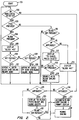
- FIG. 2 is a flow chart that shows a preferred embodiment of the present invention which allows the user to dial the caller ID block code in more convenient and flexible ways.
- the apparatus is initialized at step 201 after power up.
- phone line status detector 109 determines if the apparatus or the phone line status is currently ON-HOOK. If the status is currently ON-HOOK, MPU 103 waits in step 203 to determine if the user presses PROGRAM key 105. If PROGRAM key 105 is pressed, step 204 determines if BLOCK key 104 is pressed. If BLOCK key 104 is pressed, the message "BLOCK *67 is shown on LCD Display 102 at step 205.
- MPU 103 next determines if one of the special code keys 106 is pressed at steps 206 and 208. If the user presses the "*" key, an "*" is appended to the block code description to be shown on LCD Display 102 (e.g., "BLOCK* *67") and the apparatus enters the block code dialing prompt mode at step 207. Alternatively, if the '#' key is pressed, a "#” is appended to the block code description to be shown on LCD display 102 (e.g., "BLOCK# *67") and the apparatus enters the automatic block dialing mode at step 209. After completing the foregoing operations, MPU 103 returns to step 201.
- MPU 103 determines if BLOCK key 104 is pressed. If BLOCK key 104 is pressed, MPU 103 determines whether a "#" has been appended to the block code description at step 211, thus indicating that the apparatus is in the automatic block dialing mode. If not, then the standard block code description, e.g., "BLOCK *67,” is shown on LCD Display 102. If, on the other hand, MPU 103 determines that a "#" has been appended to the block code description at step 211, then the override description message, e.g., "TO CANCEL PRESS DELETE,” is shown on LCD display 102 at step 212. If DELETE key 107 is pressed, as determined at step 213, then the automatic block dialing mode is disabled at step 214. The automatic block dialing mode resumes after the current call is completed.
- the standard block code description e.g., "BLOCK *67”
- the override description message e.g., "TO
- MPU 103 next determines if the apparatus is in the automatic block dialing mode or the block code dialing prompt mode at steps 216 and 219, respectively.
- MPU 103 determines if the apparatus is in the automatic block dialing mode by determining if a "#" has been appended to the block code description. If so, then MPU 103 automatically dials the block code and displays a blocking confirmation message, e.g., "BLOCK DIALED," on LCD Display 102 at step 217.
- a blocking confirmation message e.g., "BLOCK DIALED
- MPU 103 determines, at step 219, if an "*" has been appended to the block code description, thus indicating that the apparatus is in the block code dialing prompt mode. If an "*" is appended to the block code description, then MPU 103 causes the block code dialing prompt, e.g., "TO BLOCK PRESS BLOCK,” to flash on LCD Display 102 and generates an alert sound on tone buzzer 108 at step 220.
- MPU 103 next determines if the user has pressed BLOCK key 104. If BLOCK key 104 was pressed, MPU 103 proceeds to step 217 described above.
- MPU 103 determines at step 221 that BLOCK key 104 was not pressed, then MPU 103 proceeds to step 218 to allow normal dialing without caller ID blocking. If, at step 219, MPU determines that neither the automatic block dialing mode or the block code dialing prompt mode are enabled, then MPU 103 jumps to step 221 described above. After the phone call is terminated, MPU 103 returns to start step 201.
- dialing key may be further extended within the scope of the invention.
- the basic function of the BLOCK key is used to pre-store a block code and the description of the block code.
- the extra code is added for automatic prompting or dialing of the block code when the ON/OFF-HOOK status of a telephone or telephone line is changed.
- the key is not limited to preprogramming of the block code and the description of the blocking.
- any other predetermined function may be preprogrammed to any key, and when programmed with an added extra code, the key can be used to perform not only automatic prompting or dialing of blocking in link with the ON/OFF-HOOK status of the telephone or telephone line, but may also be extended to perform any other predetermined automatic control function in link with predetermined changes of any status.
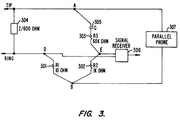
- FIG. 3 is a circuit diagram of an embodiment reduces speech/voice interference to a call-waiting caller ID signal when a telephone conversation is in progress with parallel phone 307.
- Resistors 301, 302, 303 and line impedance 304 are connected, comprising a special Wheatstone bridge.
- 305 is a DC isolation capacitor.
- Parallel phone 307 is connected to points A and B of the bridge.
- Signal receiver 306 is used for receiving the call-waiting caller ID signal. The input of this signal receiver is connected to points D and E.
- the impedance Z of the phone line is a typical 600 Ohm.
- the value of the resistors 301(R1), 302(R2) and 303(R3) is suitably adjusted to balance the bridge, is well known in the art.
- the level of speech which comes from points A and B that appear between points D and E, i.e., the input of the signal receiver 306, is ideally reduced to zero.
- the interference by speech coming from parallel phone 307 is reduced.
- speech sent to the phone line TIP and Ring from parallel phone 307 is only negligibly reduced by resistor 301 (in serial) whose low value (e.g., 10 Ohm) is intentionally selected to minimize attenuation.
- the signal coming from the phone line to parallel phone 307 and to signal receiver 306 is also only negligibly reduced.
Landscapes
- Engineering & Computer Science (AREA)
- Signal Processing (AREA)
- Telephone Function (AREA)
Applications Claiming Priority (2)
| Application Number | Priority Date | Filing Date | Title |
|---|---|---|---|
| US540532 | 1983-10-11 | ||
| US08/540,532 US5796810A (en) | 1995-10-10 | 1995-10-10 | Apparatus for dialing of caller ID block code and receiving call waiting caller-ID-signal |
Publications (2)
| Publication Number | Publication Date |
|---|---|
| EP0768785A2 true EP0768785A2 (fr) | 1997-04-16 |
| EP0768785A3 EP0768785A3 (fr) | 1997-06-25 |
Family
ID=24155855
Family Applications (1)
| Application Number | Title | Priority Date | Filing Date |
|---|---|---|---|
| EP96307355A Withdrawn EP0768785A3 (fr) | 1995-10-10 | 1996-10-09 | Appareil téléphonique avec des moyens de programmation pour composer un code d'identification de l'appelant et pour recevoir un signal d'identification d'un appel en attente |
Country Status (5)
| Country | Link |
|---|---|
| US (1) | US5796810A (fr) |
| EP (1) | EP0768785A3 (fr) |
| JP (1) | JPH09168048A (fr) |
| CN (1) | CN1069473C (fr) |
| DE (1) | DE768785T1 (fr) |
Cited By (4)
| Publication number | Priority date | Publication date | Assignee | Title |
|---|---|---|---|---|
| WO1999012327A1 (fr) * | 1997-09-04 | 1999-03-11 | Conexant Systems, Inc. | Signalisation a une premiere partie pour systeme d'appel en attente-identification de numero demandeur (cwcid) |
| WO1999046911A1 (fr) * | 1998-03-10 | 1999-09-16 | Qualcomm Incorporated | Systeme et procede permettant d'utiliser des codes de fonction dans un dispositif de communications sans fil |
| US6553110B1 (en) | 1999-10-01 | 2003-04-22 | Koninklijke Philips Electronics N.V. | Selective telephone caller identification service |
| US10270893B2 (en) | 2001-11-30 | 2019-04-23 | Nokia Technologies Oy | Apparatus and method for performing software functions when a keypad is locked |
Families Citing this family (20)
| Publication number | Priority date | Publication date | Assignee | Title |
|---|---|---|---|---|
| US20040199402A1 (en) * | 1996-09-06 | 2004-10-07 | Walker Jay S. | Method and system for anonymous communication of information about a home |
| US5883942A (en) * | 1996-11-20 | 1999-03-16 | Cybiotronics, Ltd. | Voice caller I.D. apparatus |
| US6980633B1 (en) * | 1997-04-04 | 2005-12-27 | Henderson Daniel A | Enhanced call-waiting with caller identification method and apparatus using notch filters |
| US6339639B1 (en) * | 1997-04-04 | 2002-01-15 | Daniel A. Henderson | Enhanced call-waiting with caller identification method and apparatus |
| DE69835380T2 (de) | 1997-05-30 | 2007-07-26 | Hino Jidosha Kogyo K.K., Hino | Mehrfarben-spritzlackiersystem für kleine mengen |
| US6173041B1 (en) * | 1997-11-13 | 2001-01-09 | Advanced Micro Devices, Inc. | System and method for reducing call interruptions on a telephone |
| JP3111956B2 (ja) * | 1997-12-05 | 2000-11-27 | 日本電気株式会社 | 電話回線接続時の情報通知システム及び方法 |
| DE69817527T2 (de) * | 1998-01-12 | 2004-08-05 | Alcatel | Dienstaktivierung |
| US6628779B1 (en) * | 1998-05-11 | 2003-09-30 | Telcordia Technologies, Inc. | Method and system for scaleable near-end speech cancellation for tip and ring tone signal detectors |
| US6275582B1 (en) | 1999-12-17 | 2001-08-14 | Telcordia Technologies, Inc. | Differential line bridge for scaleable near-end speech cancellation for tip and ring tone signal detectors |
| US7353274B1 (en) * | 2000-05-09 | 2008-04-01 | Medisys/Rjb Consulting, Inc. | Method, apparatus, and system for determining whether a computer is within a particular location |
| US6940965B1 (en) | 2000-07-07 | 2005-09-06 | Bruce H. Arnold | Telephonic apparatus with automatic area code dialing capability responsive to dialing key operation |
| US6751311B1 (en) | 2000-07-07 | 2004-06-15 | Bruce H. Arnold | Telephonic apparatus with automatic preceding number dialing capability responsive to dedicated function key operation |
| US20020052225A1 (en) * | 2000-11-01 | 2002-05-02 | Davis Derek L. | Feature timer functionality for a wireless communication unit |
| US6744868B2 (en) | 2001-05-31 | 2004-06-01 | Alcatel | Call party profile presentation service in a multimedia-capable network |
| US7702089B2 (en) * | 2004-10-22 | 2010-04-20 | Broadcom Corporation | Selective unblocking of caller ID based on security level |
| CN1774081B (zh) * | 2005-11-03 | 2010-04-28 | 耿直 | 多个外线专用通信终端之间相互呼叫连接的方法 |
| US8369501B2 (en) | 2008-10-13 | 2013-02-05 | TelTech Systems Inc. | System and method for providing caller information to a called party utilizing call forwarding |
| US8369508B2 (en) | 2010-06-21 | 2013-02-05 | Tel-Tech Systems, Inc. | Call routing in telephone switch based on duplicate leg detection |
| US9270816B2 (en) | 2013-10-04 | 2016-02-23 | Tel-Tech Systems, Inc. | Redirecting telephone call to packet-switched data call via voicemail |
Family Cites Families (11)
| Publication number | Priority date | Publication date | Assignee | Title |
|---|---|---|---|---|
| DE3815908A1 (de) * | 1988-05-10 | 1989-11-23 | Telefonbau & Normalzeit Gmbh | Verfahren zur wahrung der anonymitaet eines anrufenden teilnehmers in kommunikationsvermittlungsanlagen |
| US5161181A (en) * | 1990-01-10 | 1992-11-03 | Dialogic Corporation | Automatic number identification blocking system |
| US5033076A (en) * | 1990-01-31 | 1991-07-16 | At&T Bell Laboratories | Enhanced privacy feature for telephone systems |
| JPH0652914B2 (ja) * | 1990-09-21 | 1994-07-06 | 橋本コーポレイション株式会社 | 発呼者電話番号表示装置 |
| US5263084A (en) * | 1991-07-22 | 1993-11-16 | Northern Telecom Limited | Spontaneous caller identification with call-waiting |
| US5309508A (en) * | 1992-09-23 | 1994-05-03 | Howard Rosen | Apparatus and method for automatically blocking the transmission of identifying information concerning a telephone calling party |
| US5588049A (en) * | 1993-01-25 | 1996-12-24 | Detering; Greig R. | Method for the automatic insertion of removal of a calling number identification (CNID) blocking prefix from within a telephone number in a personal computer based telephone management system |
| JPH07264323A (ja) * | 1994-03-18 | 1995-10-13 | Fujitsu Ltd | キープコールバック装置 |
| US5583924A (en) * | 1995-02-13 | 1996-12-10 | Cidco Incorporated | Caller ID and call waiting for multiple CPES on a single telephone line |
| US5550908A (en) * | 1995-06-01 | 1996-08-27 | Lucent Technologies Inc. | Modem communications interoperability with services equipped to provide calling party identity delivery with call waiting |
| US5619561A (en) * | 1995-06-22 | 1997-04-08 | Reese; Morris | Call-waiting and caller identification with three-way conversations arrangements |
-
1995
- 1995-10-10 US US08/540,532 patent/US5796810A/en not_active Expired - Fee Related
-
1996
- 1996-10-09 JP JP8285922A patent/JPH09168048A/ja active Pending
- 1996-10-09 DE DE0768785T patent/DE768785T1/de active Pending
- 1996-10-09 EP EP96307355A patent/EP0768785A3/fr not_active Withdrawn
- 1996-10-10 CN CN96121048A patent/CN1069473C/zh not_active Expired - Fee Related
Cited By (6)
| Publication number | Priority date | Publication date | Assignee | Title |
|---|---|---|---|---|
| WO1999012327A1 (fr) * | 1997-09-04 | 1999-03-11 | Conexant Systems, Inc. | Signalisation a une premiere partie pour systeme d'appel en attente-identification de numero demandeur (cwcid) |
| US6404863B1 (en) | 1997-09-04 | 2002-06-11 | Conexant Systems, Inc. | First party signalling for call waiting calling number identification (CWCID) system |
| WO1999046911A1 (fr) * | 1998-03-10 | 1999-09-16 | Qualcomm Incorporated | Systeme et procede permettant d'utiliser des codes de fonction dans un dispositif de communications sans fil |
| US6449497B1 (en) | 1998-03-10 | 2002-09-10 | Qualcomm Incorporated | System and method for use of feature codes in a wireless communication device |
| US6553110B1 (en) | 1999-10-01 | 2003-04-22 | Koninklijke Philips Electronics N.V. | Selective telephone caller identification service |
| US10270893B2 (en) | 2001-11-30 | 2019-04-23 | Nokia Technologies Oy | Apparatus and method for performing software functions when a keypad is locked |
Also Published As
| Publication number | Publication date |
|---|---|
| CN1175839A (zh) | 1998-03-11 |
| JPH09168048A (ja) | 1997-06-24 |
| CN1069473C (zh) | 2001-08-08 |
| DE768785T1 (de) | 1997-11-20 |
| EP0768785A3 (fr) | 1997-06-25 |
| US5796810A (en) | 1998-08-18 |
Similar Documents
| Publication | Publication Date | Title |
|---|---|---|
| US5796810A (en) | Apparatus for dialing of caller ID block code and receiving call waiting caller-ID-signal | |
| US5836009A (en) | Caller ID telephone with signal attenuation | |
| CA2235492C (fr) | Methode de surveillance des appels de messagerie vocale dans une installation d'abonne compatible adsi | |
| US20030035520A1 (en) | Display of call related information regarding a called party | |
| JPH01152847A (ja) | 発信者番号通知通信網用端末 | |
| GB2311908A (en) | ISDN exchange system | |
| EP0999691A1 (fr) | Sonnerie de téléphone contrôlé par une information relative à l'appel entrant | |
| HK1014621A (en) | Telephone apparatus with programming means for dialing of caller id block code and receiving call waiting caller-id-signal | |
| US6868150B1 (en) | Method for use with caller ID system | |
| AU739213B2 (en) | Remote function setting for telecommunication terminal | |
| KR950009426B1 (ko) | 발신자 전화번호 표시방법 | |
| CN1151095A (zh) | 自动应答电话机在来话呼叫切换服务下对外部来话呼叫的切换方法 | |
| US6980633B1 (en) | Enhanced call-waiting with caller identification method and apparatus using notch filters | |
| JP3265959B2 (ja) | 通信装置 | |
| JP3305891B2 (ja) | ボタン電話装置 | |
| JP3349980B2 (ja) | 電話装置 | |
| JP3328178B2 (ja) | 電話装置 | |
| KR100329730B1 (ko) | 다기능 전화기의 예약 경보 호출 방법 | |
| JP3286590B2 (ja) | 電話装置 | |
| JPH041547B2 (fr) | ||
| JPS61274460A (ja) | 電話機 | |
| JPH0946435A (ja) | テレビ電話装置およびテレビ電話通信方法 | |
| JPH01212055A (ja) | 自動交換機の自動呼出制御方式 | |
| JPS62263749A (ja) | デ−タ通信装置 | |
| KR20000037199A (ko) | 발신자 확인기능이 있는 단말기에 착신된 전화번호로간편히 전화를 할 수 있는 기능 |
Legal Events
| Date | Code | Title | Description |
|---|---|---|---|
| PUAI | Public reference made under article 153(3) epc to a published international application that has entered the european phase |
Free format text: ORIGINAL CODE: 0009012 |
|
| AK | Designated contracting states |
Kind code of ref document: A2 Designated state(s): AT BE CH DE DK ES FI FR GB GR IE IT LI LU MC NL PT SE |
|
| PUAL | Search report despatched |
Free format text: ORIGINAL CODE: 0009013 |
|
| AK | Designated contracting states |
Kind code of ref document: A3 Designated state(s): AT BE CH DE DK ES FI FR GB GR IE IT LI LU MC NL PT SE |
|
| EL | Fr: translation of claims filed | ||
| DET | De: translation of patent claims | ||
| 17P | Request for examination filed |
Effective date: 19971118 |
|
| 17Q | First examination report despatched |
Effective date: 20030923 |
|
| STAA | Information on the status of an ep patent application or granted ep patent |
Free format text: STATUS: THE APPLICATION IS DEEMED TO BE WITHDRAWN |
|
| 18D | Application deemed to be withdrawn |
Effective date: 20040204 |
|
| REG | Reference to a national code |
Ref country code: HK Ref legal event code: WD Ref document number: 1014621 Country of ref document: HK |