EP0769732B1 - Gerät zur Informationsübertragung - Google Patents
Gerät zur Informationsübertragung Download PDFInfo
- Publication number
- EP0769732B1 EP0769732B1 EP96119389A EP96119389A EP0769732B1 EP 0769732 B1 EP0769732 B1 EP 0769732B1 EP 96119389 A EP96119389 A EP 96119389A EP 96119389 A EP96119389 A EP 96119389A EP 0769732 B1 EP0769732 B1 EP 0769732B1
- Authority
- EP
- European Patent Office
- Prior art keywords
- charges
- pattern
- flow
- voltage
- charge
- Prior art date
- Legal status (The legal status is an assumption and is not a legal conclusion. Google has not performed a legal analysis and makes no representation as to the accuracy of the status listed.)
- Expired - Lifetime
Links
Images




Classifications
-
- G—PHYSICS
- G01—MEASURING; TESTING
- G01D—MEASURING NOT SPECIALLY ADAPTED FOR A SPECIFIC VARIABLE; ARRANGEMENTS FOR MEASURING TWO OR MORE VARIABLES NOT COVERED IN A SINGLE OTHER SUBCLASS; TARIFF METERING APPARATUS; MEASURING OR TESTING NOT OTHERWISE PROVIDED FOR
- G01D15/00—Component parts of recorders for measuring arrangements not specially adapted for a specific variable
- G01D15/06—Electric recording elements, e.g. electrolytic
-
- B—PERFORMING OPERATIONS; TRANSPORTING
- B41—PRINTING; LINING MACHINES; TYPEWRITERS; STAMPS
- B41J—TYPEWRITERS; SELECTIVE PRINTING MECHANISMS, i.e. MECHANISMS PRINTING OTHERWISE THAN FROM A FORME; CORRECTION OF TYPOGRAPHICAL ERRORS
- B41J2/00—Typewriters or selective printing mechanisms characterised by the printing or marking process for which they are designed
- B41J2/525—Arrangement for multi-colour printing, not covered by group B41J2/21, e.g. applicable to two or more kinds of printing or marking process
-
- G—PHYSICS
- G03—PHOTOGRAPHY; CINEMATOGRAPHY; ANALOGOUS TECHNIQUES USING WAVES OTHER THAN OPTICAL WAVES; ELECTROGRAPHY; HOLOGRAPHY
- G03G—ELECTROGRAPHY; ELECTROPHOTOGRAPHY; MAGNETOGRAPHY
- G03G15/00—Apparatus for electrographic processes using a charge pattern
- G03G15/14—Apparatus for electrographic processes using a charge pattern for transferring a pattern to a second base
- G03G15/18—Apparatus for electrographic processes using a charge pattern for transferring a pattern to a second base of a charge pattern
-
- G—PHYSICS
- G03—PHOTOGRAPHY; CINEMATOGRAPHY; ANALOGOUS TECHNIQUES USING WAVES OTHER THAN OPTICAL WAVES; ELECTROGRAPHY; HOLOGRAPHY
- G03G—ELECTROGRAPHY; ELECTROPHOTOGRAPHY; MAGNETOGRAPHY
- G03G15/00—Apparatus for electrographic processes using a charge pattern
- G03G15/22—Apparatus for electrographic processes using a charge pattern involving the combination of more than one step according to groups G03G13/02 - G03G13/20
- G03G15/32—Apparatus for electrographic processes using a charge pattern involving the combination of more than one step according to groups G03G13/02 - G03G13/20 in which the charge pattern is formed dotwise, e.g. by a thermal head
- G03G15/321—Apparatus for electrographic processes using a charge pattern involving the combination of more than one step according to groups G03G13/02 - G03G13/20 in which the charge pattern is formed dotwise, e.g. by a thermal head by charge transfer onto the recording material in accordance with the image
-
- G—PHYSICS
- G06—COMPUTING OR CALCULATING; COUNTING
- G06K—GRAPHICAL DATA READING; PRESENTATION OF DATA; RECORD CARRIERS; HANDLING RECORD CARRIERS
- G06K15/00—Arrangements for producing a permanent visual presentation of the output data, e.g. computer output printers
- G06K15/02—Arrangements for producing a permanent visual presentation of the output data, e.g. computer output printers using printers
- G06K15/14—Arrangements for producing a permanent visual presentation of the output data, e.g. computer output printers using printers by electrographic printing, e.g. xerography; by magnetographic printing
Definitions
- the present invention relates to apparatus and methods for non-contact printing, reading and imaging.
- An additional technique in general use is ionography, wherein an electrostatic image is formed on a dielectric substrate by firing charges directly on the substrate using an imagewise ion source.
- the dielectric substrate can be any suitable dielectric substrate and may include a photoconductor or any substrate which exhibits dielectric qualities at a given time.
- the charge pattern 100 to be read is created by any suitable technique on a surface 104 of a dielectric substrate having first and second opposite surfaces 104 and 106, such as any dielectric substrate described hereinabove.
- the charge pattern 100 is distributed over discrete regions (P1..PN) of the substrate.
- each region of the pattern is read individually using the technique described below.
- Each such region typically defines a pixel. Normally a two dimensional pixel distribution is envisioned. For convenience of illustration, only one dimension is illustrated in many of the drawings herein.
- an alternating polarity charge source (APCS) 108 which may be as mentioned hereinabove, is employed to supply a flow of charges to the region P1 of surface 104.
- APCS alternating polarity charge source
- a current is induced in a conductive backing 110 lying adjacent surface 106 and a charge, corresponding to the charge originally at region P1, is accumulated, preferably by capacitive means 112.
- the capacitive means is electrically coupled to the conductive backing 110 and comprises a capacitor having a capacitance of C o .
- Electronic means for sensing and measuring the accumulated charge are coupled to the capacitive means.
- the electronic means further comprises an electronic switch 116 which, when open, causes charge to accumulate in the capacitive means 112.
- an output of the electronic means is indicative of the charge at region P1 prior to the supply of charges thereto by APCS 108.
- the voltage V r may be serially stored in an external digital memory device (not shown) by using an analog to digital converter.
- the steps of supplying a flow of charges and then sensing the generated voltage signal may be repeated across the entire substrate resulting in serial data outputs from pixel regions P1 to Pn where n is the number of pixels on the substrate.
- the serial data of the different regions represents the entire pattern.
- Fig 1B illustrates an equivalent circuit corresponding to the electrical relationship of the APCS 108, the substrate 102, the conductive backing 110 and the capacitive means 112.
- the electronic means comprising switch 116 and sample and hold circuit 114 may be collectively referred to as "read electronics".
- FIG. 2A - 2C illustrate the behavior of voltages at different points on the electronic circuit described in Figs. 1A and 1B.
- Fig. 2A illustrates the status of the electronic switch 116.
- switch 116 When closed, switch 116 causes the capacitor 112 to discharge and reset.
- switch 116 When switch 116 is open, the capacitor 112 may accumulate charge.
- Fig. 2B illustrates the effective voltage across the capacitor 112 as a function of time.
- the APCS 108 begins to sweep over region P1 and supplies a net flow of charges to that region, inducing a current flow from the conductive backing 110 to capacitor 112, producing accumulation of charge thereat.
- the equivalent circuit of Fig. 1B can be further employed to describe the behavior of the apparatus of Fig. 1A.
- the dielectric substrate 102 is represented by capacitor C d in Fig. 1B.
- the APCS 108 provides a flow of charges to the dielectric surface 102 causing charging of the accumulator 112. This may be envisioned as the result of an equivalent current flow i across both the dielectric C d and the capacitor C o , which represents accumulator 112.
- V d * V d + 1/C d ⁇ idt
- T1 and T2 are the T1 and T2 defined in association with Fig. 2B and i is the current flowing.
- V acc 1/C o ⁇ idt
- V acc (V set + V d ) C d /(C d +C o )
- the value for C o may be determined by examining the ratio between the voltage V d , prior to APCS charge supply, and V acc . Since the potentials of electrostatic images are typically on the order of hundreds of volts and V acc is desirably no more than a few volts, a typical value for C o is 100 times greater than the pixel capacitance C d .
- V acc is considerably smaller than V set , the ultimate potential across the dielectric surface is practically equal to V set , irrespective of the previous charge Q d .
- FIG. 3A illustrates the operation of the apparatus of Figs. 1A and 1B at a single pixel location on the surface of the dielectric substrate 102.
- Fig. 3A illustrates the voltage V d , at that same pixel location as it varies with time for a case where V set is ground. Therefore following the sweep of the APCS of the pixel location, the voltage remaining thereat is effectively zero.
- Fig. 3B illustrates, on the same time scale as that of Fig. 3A, the application of a flow of charges by the APCS to the same pixel location whereby, following application of such flow of charges, the voltage at that pixel location is zero.
- the flow of charges comprises an alternating polarity charge flow to the surface of the dielectric substrate.
- This charge flow occurs over a time span which is short relative to the time necessary to sweep the pixel dimension along a given direction of motion of the APCS. Therefore, during this time span the location of the APCS relative to the pixel location does not change considerably, and the charge flow may be represented by a stack of positive and negative charges as shown in Fig. 3B.
- the beginning and end of the duration of the alternating polarity charge flow are indicated in Fig. 3B respectively as T1 and T2.
- Fig. 3C is an expanded time scale illustration corresponding to Fig. 3A and illustrates with greater particularity one possible application of typical alternating charge flow to the surface 104 of the dielectric substrate 102, which produces a change in the voltage at the pixel location on surface 104 from the voltage at time T1 to effectively a zero voltage at time T2.
- the flow of charges illustrated induces a corresponding current in the conductive backing 110.
- the current induced in the conductive backing 110 causes a charge to be accumulated by the capacitor 112, which is electronically coupled to the conductive backing 110.
- Fig. 3D illustrates the voltage V r , output by the read electronics, which sense and measure the charge accumulated in capacitor 112.
- the voltage output by the read electronics is in direct negative proportion to the original charge at the pixel location at which the flow of charges was applied.
- FIG. 4A there is shown schematically an arbitrary "original" charge pattern 118 on a surface 119 of a dielectric substrate 120, which substrate 120 is preferably backed with a conductive backing 122.
- Accumulative means 123 and read electronics 124 are electronically coupled to the conductive backing 122.
- an alternating polarity charge source (APCS) 126 is also illustrated, of the type illustrated in Figs. 1A and 1B, which is typically capable of achieving a spatial edge accuracy consistent with a desired resolution.
- the APCS 126 is preferably moved at a constant velocity v along the surface of the dielectric substrate.
- Fig. 4B illustrates the voltage signal which results from reading the charge pattern 118 in accordance with the techniques described hereinabove.
- Figure 5 is a pictorial illustration of apparatus for reading a charge pattern on a dielectric substrate according to the steps described hereinabove in conjunction with Figs. 1A and 1B.
- a charge source 138 such as an APCS which produces charges which vary in polarity as a function of time, sweeps a surface 139 of a dielectric substrate 130 along an arbitrary pattern such as the up/down and sideways pattern of Fig. 5.
- a conductive backing 132 Associated with the dielectric substrate 130 is a conductive backing 132.
- a charge pattern which is uniformly negative above a diagonal line 136 and is uniformly positive below the diagonal line. It is appreciated that this charge pattern may be generated by any suitable technique.
- Figs. 6A - 6C all of which represent events taking place along the same time scale, illustrate operational parameters of the apparatus of Fig. 5.
- Fig. 6A illustrates the voltage V r output by the read electronics 141 as a function of time.
- the time indications t1 - t6 illustrate the position of the APCS 138 at various times.
- Figs. 6B and 6C illustrate the Y and X positions of the APCS 138 as a function of time.
- an elongate alternating polarity charge source (EAPCS) 146 scans in one dimension, perpendicular to its longitudinal axis, along a surface 148 of a dielectric substrate 142, by means of a linear drive mechanism including a worm screw 150 cooperating with a screw rider 152, fixed to source 146.
- An electric motor 154 drives the worm screw 150.
- a commercially available synchronized encoder 156 provides position information about the EAPCS 146 to a host computer (NOT SHOWN) at any given time.
- a multisectional conductive backing layer 160 typically comprising a plurality of elongate strips 144, is associated with a surface of the dielectric substrate 142.
- Each strip 144 is associated with individual means 162 for accumulating the charge which flows from that strip.
- the accumulating means 162 includes a capacitor.
- a multiplexer 158 is associated with the individual accumulators 162 and functions to select the accumulator 162 whose output is sampled by read electronics 159 at any given time.
- the read electronics 159 measures the voltage stored in the selected accumulator 162 in accordance with the technique described hereinabove in conjunction with Figs. 1A and 1B.
- Information from the read electronics 159 may be serially fed to a host computer (NOT SHOWN).
- both accumulators 162 and drivers not shown can be electronically coupled to the same conductive strips.
- the read electronics 159 may be activated in a time shared manner with the write electronics.
- a desired twodimensional spatial resolution may be achieved by adjusting appropriate parameters.
- the parameters to be adjusted include the width of the elongate strips 144, the width of the gap 145 between adjacent strips 144 and the thickness of the dielectric layer 142.
- the parameters include the edge definition of the EAPCS 146 and time intervals between two subsequent sampling cycles of the read electronics 159 from the same accumulator.
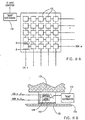
- Figs. 8A and 8B are respectively generalized and detail illustrations of apparatus for reading a charge pattern on a dielectric substrate in accordance with yet another embodiment of the present invention.
- strips 144 in the embodiment of Figs. 7A and 7B are replaced by a plurality of pixel sized conductive pads 170 which define a two-dimensionally addressable array 172 disposed adjacent a surface 174 of a dielectric substrate 176.
- an accumulator 178 is associated with each pad 170 in the array 172.
- a scanning alternating polarity charge source having precisely defined edge resolution need not be provided and may be replaced by static apparatus for supplying a uniform flow of alternating polarity charges over the entire array 172.
- Read electronics 173 measures the voltage stored in a selected accumulator 178 in accordance with the technique, described hereinabove in conjunction with Figs. 1A and 1B.
- Information from the read electronics 173 may be serially fed to a host computer (NOT SHOWN).
- Accumulators are selected for reading by common matrix addressing techniques.
- Fig. 8B illustrates a schematic arrangement for addressing a given pad 170, corresponding to a given area element or pixel on the dielectric surface 176.
- Mechanical support for the array of pads 172 is provided by a plate 179 which is typically glass.
- both accumulators 178 and drivers associated with data flip-flops can be electronically coupled to the same conductive pads.
- the read electronics 173 may be activated in a time shared manner with the write electronics.
- FIGs. 9A - 9C illustrate the operation and structure of an imaging system constructed and operated in accordance with a preferred embodiment of the present invention.
- the imaging system of Figs. 9A - 9C may constitute any suitable imaging system such as a camera or scanner.
- the illustrated embodiment preferably comprises an EAPCS 238 of the type above described in conjunction with Fig. 7A and further preferably comprises a multi-layered drum 240 having an external photoconductive layer 242, which operates as a dielectric, and an innermost supporting substrate 244. Disposed intermediate the photoconductive layer 242 and the support substrate 244 is a layer 246 incorporating a plurality of conductive bands 248.
- the supporting substrate 244 is a dielectric substrate.
- a dielectric layer 250 is required between layer 246 and substrate 244 to electrically insulate the conductive bands 248 from metal substrate 244.
- the conductive bands 248 are preferably continuously biased to a voltage +V which corresponds to voltage V set of Figs. 1A - 1B.
- an electronic reader circuit 252 schematically represented in Fig. 9C.
- the reader circuit 252 preferably comprises a plurality of accumulators 254 which correspond to accumulators 162 of Fig. 7A, a multiplexer 256 which corresponds to multiplexer 158 of Fig. 14A and read electronics 258 which correspond to read electronics 159 of Fig. 7A.
- a standard optical imaging system 259 is employed to project an image on a region 260 of the photoconductor 242, which has preferably been precharged. As a result of the image projection an electrostatic pattern corresponding to the image is created on the corresponding portion 260 of an outer surface 261 of photoconductor 242.
- the electrostatic pattern is read by applying a flow of charges to the pattern bearing region of surface 261 of the dielectric photoconductor 242, using EAPCS 238, thereby inducing a current flow representing the pattern in accordance with the read techniques above described in conjunction with Figs. 7A and 7B.
- the current flow is sensed by electronic read circuit 252.
- the surface 261 of the photoconductive layer 242 is effectively erased and simultaneously uniformly charged, thus providing precharging of the photoconductor prior to imaging by imaging system 259.
- electrostatic image generation on a portion of the surface 261 of the photoconductor 242 and reading of an electrostatic pattern from a different portion of the surface 261 of the photoconductor 242 in accordance with the present invention can occur simultaneously.
- Figs. 9A-9C is illustrated schematically and that the invention may be embodied in any suitable type of configuration, not limited to the use of drums, conductive bands and EAPCSs.
- external photoconductive layer 242 is replaced by an external dielectric layer.
- read electronics circuit 252 is replaced by write electronics as described hereinabove. It is appreciated that this alternate embodiment may comprises a cylindrical write apparatus and that the need for image source 259 is obviated.
- FIGs 10A and 10B are pictorial illustrations of an alternative embodiment of an apparatus for providing an alternating polarity charge beam having at least one defined edge.
- Apparatus 550 comprises alternating charge pool generating apparatus 552, a casing 556 and an elongate electrostatic shield 560.
- Apparatus 552 preferably comprises one or more corona wires 554 some or all of which may be dielectrically coated. Alternately, corona wires 554 may not be dielectrically coated. Each corona wire 554 is functional to receive a high AC voltage. All of the wires 554 may be biased by the same AC source (not shown). Alternately, corona wires 554 may be biased by AC sources having different amplitudes. It is appreciated that each corona wire 554 may receive a different AC voltage.
- Corona wires 554 are confined by isolating casing 556.
- casing 556 comprises a dielectric material.
- Casing 556 typically contains an elongate grounded section 558 which is partially open and wherein an ion pool is created.
- the open area of grounded section 558 may comprise a gridlike area. Alternately, the open area may comprise at least one elongate slot.
- casing 556 may further comprise an inlet through which conditioned air may flow onto corona wires 554.
- the intensity of the ion pool created at section 558 may be increased.
- electrostatic shield 560 typically comprising a grounded conductive material is placed with some spacing relative to charge pool apparatus 552. Electrostatic shield 560 may be configured as illustrated whereby charge pool apparatus 552 is partially obscured.
- apparatus 550 may serve as an elongate alternating polarity charge (EAPCS) source described hereinabove in accordance with the read and/or write techniques described hereinabove. It is further appreciated that this configuration is presented to offer an example of possible configurations for the EAPCS and is not intended to be limiting.
- EAPCS elongate alternating polarity charge
Landscapes
- Physics & Mathematics (AREA)
- General Physics & Mathematics (AREA)
- Engineering & Computer Science (AREA)
- General Engineering & Computer Science (AREA)
- Theoretical Computer Science (AREA)
- Printers Or Recording Devices Using Electromagnetic And Radiation Means (AREA)
- Facsimile Heads (AREA)
Claims (14)
- Vorrichtung zum Lesen eines elektrostatischen Ladungsmusters (100), wobei die Vorrichtung folgendes umfasst:ein dielektrisches Substrat (102) mit ersten (106) und zweiten (104) entgegengesetzten Oberflächen;einen leitfähigen Träger (110), der funktionsfähig mit der genannten ersten Oberfläche verbunden ist;eine Informationen tragende Ladungsverteilung (P1 - PN), die ein der genannten zweiten Oberfläche zugeordnetes Muster definiert;eine Einrichtung (108) zum Vorsehen eines Ladungsflusses an die genannte zweite Oberfläche, wodurch das genannte Informationen tragende Ladungsmuster in ein entsprechendes elektrisches Signal in dem genannten Träger konvertiert wird; undeine mit dem genannten leitfähigen Träger gekoppelte Einrichtung (112 - 116) zum Erfassen des genannten elektrischen Signals und zum Vorsehen einer elektrischen Ausgabe, die das genannte Muster darstellt.
- Vorrichtung nach Anspruch 1, wobei der Ladungsfluss. der an die genannte zweite Oberfläche des dielektrischen Substrats vorgesehen wird, Ladungen mit einer einzigen Polarität aufweist.
- vorrichtung nach Anspruch 1, wobei der Ladungsfluss, der an die genannte zweite Oberfläche des dielektrischen Substrats vorgesehen wird, Ladungen mit positiver und negativer Polarität aufweist.
- Vorrichtung nach Anspruch 3, wobei der Ladungsfluss zeitlich zwischen positiven und negativen Ladungen wechselt.
- Vorrichtung nach Anspruch 1, wobei das Vorsehen der genannten Ladungen an die zweite Oberfläche an der ersten Oberfläche funktionsmäßig ein Spannungssignal gemäß dem Ladungsmuster auf der zweiten Oberfläche erzeugt.
- Vorrichtung nach Anspruch 1, wobei die mit dem genannten leitfähigen Träger gekoppelte genannte Einrichtung folgendes umfasst:eine kapazitive Einrichtung (112) zum Empfang des genannten elektrischen Signals; undeine Einrichtung (116, 114), die mit der genannten kapazitiven Einrichtung gekoppelt ist, um räumliche Musterinformationen vorzusehen, die dem genannten elektrischen Signal entsprechen.
- Vorrichtung nach Anspruch 6, wobei die genannte Einrichtung zum Vorsehen räumlicher Musterinformationen eine Einrichtung (116, 114) zum Erfassen der Spannung an der genannten kapazitiven Einrichtung in einem Zeitbereich umfasst, der dem räumlichen Bereich entspricht, in dem das Muster definiert ist.
- Vorrichtung nach Anspruch 7, wobei die genannte Einrichtung zum Erfassen der Spannung eine Abfrage- und Speichereinrichtung (114) umfasst.
- Vorrichtung nach Anspruch 1, wobei folgendes vorgesehen ist:eine Einrichtung (552) zum Vorsehen eines Ladungsflusses an die genannte zweite Oberfläche des dielektrischen Substrats, wobei die Ladungen von einer allgemein nicht bildlichen Quelle fließen, und wobei die zweite Oberfläche als Folge des Vorsehens derartiger Ladungen ein nicht sichtbares Ladungsmuster speichert, das dem gewünschten Muster entspricht, das durch die Spannungssignale dargestellt wird; undeine Einrichtung (554, 560) zum folgenden Einsatz des nicht sichtbaren Ladungsmusters zum Vorsehen eines sichtbaren Bilds, wobei die genannte Einrichtung zum Vorsehen von Ladungsflüssen eine Ionenquellenanordnung aufweist, die eine Randschärfe vorsieht und folgendes umfasst:eine elongierte Ionenquelle (554);eine elongierte elektrostatische Abschirmung (560), die um die genannte elongierte Ionenquelle angeordnet ist und eine elongierte Öffnung parallel zu der genannten elongierten Ionenquelle definiert, wobei die genannte Öffnung einen elongierten Rand aufweist, der das räumliche Ausmaß der sich durch die genannte Öffnung erstreckenden Ionenpfade beschränkt.
- Verfahren zum Lesen eines elektrostatischen Ladungsmusters, wobei das Verfahren die folgenden Schritte umfasst:Vorsehen eines dielektrischen Substrats mit ersten und zweiten entgegengesetzten Oberflächen;funktionsfähiges Zuordnen eines leitfähigen Trägers zu der genannten ersten Oberfläche;Zuordnen einer Informationen tragenden Ladungsverteilung, die ein Muster definiert, zu der genannten zweiten Oberfläche;vorsehen eines Ladungsflusses zu der genannten zweiten Oberfläche, wodurch das genannte Informationen tragende Ladungsmuster in ein entsprechendes elektrisches Signal in dem genannten leitfähigen Träger konvertiert wird; undErfassen des genannten elektrischen Signals und vorsehen einer elektrischen Ausgabe, die das genannte Muster darstellt.
- Verfahren nach Anspruch 10, wobei der Ladungsfluss, der an der zweiten Oberfläche des dielektrischen Substrats vorgesehen wird, Ladungen mit positiver und negativer Polarität aufweist.
- Verfahren nach Anspruch 10, wobei der genannte Schritt des Erfassens ferner die folgenden Schritte umfasst:kapazitives Akkumulieren des genannten elektrischen Signals;Vorsehen räumlicher Musterinformationen, die dem genannten elektrischen Signal entsprechen.
- Verfahren nach Anspruch 12, wobei das Verfahren ferner den Schritt des Erfassens der Spannung umfasst, die dem genannten akkumulierten elektrischen Signal in einem Zeitbereich entspricht, der einem räumlichen Bereich entspricht, in dem das Muster definiert ist.
- Verfahren nach Anspruch 13, wobei der Schritt des Erfassens der Spannung den Schritt des Erfassens der Spannung unter Verwendung einer Abfrage- und Speichereinrichtung umfasst
Applications Claiming Priority (9)
| Application Number | Priority Date | Filing Date | Title |
|---|---|---|---|
| US697166 | 1991-05-08 | ||
| US07/697,166 US5157423A (en) | 1991-05-08 | 1991-05-08 | Apparatus for pattern generation on a dielectric substrate |
| US07/766,691 US5289214A (en) | 1991-05-08 | 1991-09-27 | Apparatus for information transfer including a dielectric element and generally non-imagewise charge service |
| US766691 | 1991-09-27 | ||
| IL10069492A IL100694A (en) | 1992-01-17 | 1992-01-17 | Apparatus for information transfer |
| IL10069492 | 1992-01-17 | ||
| IL10096192 | 1992-02-14 | ||
| IL100961A IL100961A0 (en) | 1992-02-14 | 1992-02-14 | Apparatus for information transfer |
| EP92912165A EP0538454B1 (de) | 1991-05-08 | 1992-05-08 | Datenübertragungsvorrichtung |
Related Parent Applications (2)
| Application Number | Title | Priority Date | Filing Date |
|---|---|---|---|
| EP92912165A Division EP0538454B1 (de) | 1991-05-08 | 1992-05-08 | Datenübertragungsvorrichtung |
| EP92912165.5 Division | 1992-11-20 |
Publications (3)
| Publication Number | Publication Date |
|---|---|
| EP0769732A2 EP0769732A2 (de) | 1997-04-23 |
| EP0769732A3 EP0769732A3 (de) | 1997-07-09 |
| EP0769732B1 true EP0769732B1 (de) | 2001-12-05 |
Family
ID=27513996
Family Applications (1)
| Application Number | Title | Priority Date | Filing Date |
|---|---|---|---|
| EP96119389A Expired - Lifetime EP0769732B1 (de) | 1991-05-08 | 1992-05-08 | Gerät zur Informationsübertragung |
Country Status (2)
| Country | Link |
|---|---|
| EP (1) | EP0769732B1 (de) |
| KR (1) | KR930702658A (de) |
Family Cites Families (7)
| Publication number | Priority date | Publication date | Assignee | Title |
|---|---|---|---|---|
| NL273832A (de) | 1961-01-24 | |||
| US4155093A (en) * | 1977-08-12 | 1979-05-15 | Dennison Manufacturing Company | Method and apparatus for generating charged particles |
| US4409604A (en) * | 1981-01-05 | 1983-10-11 | Dennison Manufacturing Company | Electrostatic imaging device |
| ATE113746T1 (de) | 1986-06-03 | 1994-11-15 | Cubital Ltd | Gerät zur entwicklung dreidimensionaler modelle. |
| DE68919481T2 (de) * | 1988-01-24 | 1995-04-06 | Victor Company Of Japan | Bildaufnahmegerät. |
| US5003402A (en) * | 1988-11-10 | 1991-03-26 | Victor Company Of Japan, Ltd. | Apparatus for recording and reproducing charge latent image |
| JPH02143778A (ja) * | 1988-11-25 | 1990-06-01 | Victor Co Of Japan Ltd | 電荷潜像の読取り方式 |
-
1992
- 1992-05-08 EP EP96119389A patent/EP0769732B1/de not_active Expired - Lifetime
- 1992-05-08 KR KR1019930700059A patent/KR930702658A/ko not_active Ceased
Also Published As
| Publication number | Publication date |
|---|---|
| KR930702658A (ko) | 1993-09-09 |
| EP0769732A2 (de) | 1997-04-23 |
| EP0769732A3 (de) | 1997-07-09 |
Similar Documents
| Publication | Publication Date | Title |
|---|---|---|
| US5289214A (en) | Apparatus for information transfer including a dielectric element and generally non-imagewise charge service | |
| US5268569A (en) | Imaging system having optimized electrode geometry and processing | |
| CA1150946A (en) | Method and apparatus for electrically biasing developing electrode of electrophotographic device | |
| JP3005130B2 (ja) | 帯電装置及び画像形成装置及びプロセスカートリッジ | |
| US5640190A (en) | Non-impact printer with evenness control | |
| JPH11288152A (ja) | デジタルゼログラフィ用画像形成装置 | |
| EP0751440B1 (de) | Bilderzeugungsgerät | |
| US4546364A (en) | Head for electrostatic recording | |
| US4868907A (en) | Self-biased scorotron grid power supply and electrostatic voltmeter operable therefrom | |
| AU672987B2 (en) | Imaging system and device having a simplified electrode design | |
| US6043830A (en) | Apparatus for pattern generation on a dielectric substrate | |
| US4620203A (en) | Electrostatic image forming apparatus using field effect transistors | |
| US4559564A (en) | Two-dimensional image reader | |
| US4447821A (en) | Method and apparatus of electrostatic recording | |
| US3638110A (en) | Device for measuring charge on a material by converting into electrical signals the frictional forces caused by the charge | |
| US4541017A (en) | Apparatus for contact-free measurement of electrical charge images generated by electro-radiographic recording methods | |
| EP0667565A2 (de) | Vorrichtung und Verfahren zur Mustererzeugung auf einem dielektrischen Substrat | |
| EP0769732A2 (de) | Gerät zur Informationsübertragung | |
| US5563688A (en) | Charging device for charging in one of a plurality of predefined image areas on a surface of an imaging member | |
| EP0538454A1 (de) | Datenübertragungsvorrichtung. | |
| JPS5941346B2 (ja) | 2次元光電変換装置 | |
| Bartscher et al. | Comparison of the electric fields of electrophotography and contact electrography | |
| IL100694A (en) | Apparatus for information transfer | |
| US5742051A (en) | Micro sized ion generating device | |
| EP0706891A2 (de) | Gerät und Verfahren für anschlaglose digitale Drucktechnik |
Legal Events
| Date | Code | Title | Description |
|---|---|---|---|
| PUAI | Public reference made under article 153(3) epc to a published international application that has entered the european phase |
Free format text: ORIGINAL CODE: 0009012 |
|
| AC | Divisional application: reference to earlier application |
Ref document number: 538454 Country of ref document: EP |
|
| AK | Designated contracting states |
Kind code of ref document: A2 Designated state(s): AT BE CH DE DK ES FR GB GR IT LI LU MC NL SE |
|
| PUAL | Search report despatched |
Free format text: ORIGINAL CODE: 0009013 |
|
| AK | Designated contracting states |
Kind code of ref document: A3 Designated state(s): AT BE CH DE DK ES FR GB GR IT LI LU MC NL SE |
|
| RHK1 | Main classification (correction) |
Ipc: H04N 5/30 |
|
| 17P | Request for examination filed |
Effective date: 19980107 |
|
| 17Q | First examination report despatched |
Effective date: 19990804 |
|
| GRAG | Despatch of communication of intention to grant |
Free format text: ORIGINAL CODE: EPIDOS AGRA |
|
| GRAG | Despatch of communication of intention to grant |
Free format text: ORIGINAL CODE: EPIDOS AGRA |
|
| GRAH | Despatch of communication of intention to grant a patent |
Free format text: ORIGINAL CODE: EPIDOS IGRA |
|
| GRAH | Despatch of communication of intention to grant a patent |
Free format text: ORIGINAL CODE: EPIDOS IGRA |
|
| GRAA | (expected) grant |
Free format text: ORIGINAL CODE: 0009210 |
|
| AC | Divisional application: reference to earlier application |
Ref document number: 538454 Country of ref document: EP |
|
| AK | Designated contracting states |
Kind code of ref document: B1 Designated state(s): AT BE CH DE DK ES FR GB GR IT LI LU MC NL SE |
|
| PG25 | Lapsed in a contracting state [announced via postgrant information from national office to epo] |
Ref country code: NL Free format text: LAPSE BECAUSE OF FAILURE TO SUBMIT A TRANSLATION OF THE DESCRIPTION OR TO PAY THE FEE WITHIN THE PRESCRIBED TIME-LIMIT Effective date: 20011205 Ref country code: LI Free format text: LAPSE BECAUSE OF FAILURE TO SUBMIT A TRANSLATION OF THE DESCRIPTION OR TO PAY THE FEE WITHIN THE PRESCRIBED TIME-LIMIT Effective date: 20011205 Ref country code: IT Free format text: LAPSE BECAUSE OF FAILURE TO SUBMIT A TRANSLATION OF THE DESCRIPTION OR TO PAY THE FEE WITHIN THE PRESCRIBED TIME-LIMIT;WARNING: LAPSES OF ITALIAN PATENTS WITH EFFECTIVE DATE BEFORE 2007 MAY HAVE OCCURRED AT ANY TIME BEFORE 2007. THE CORRECT EFFECTIVE DATE MAY BE DIFFERENT FROM THE ONE RECORDED. Effective date: 20011205 Ref country code: GR Free format text: LAPSE BECAUSE OF FAILURE TO SUBMIT A TRANSLATION OF THE DESCRIPTION OR TO PAY THE FEE WITHIN THE PRESCRIBED TIME-LIMIT Effective date: 20011205 Ref country code: FR Free format text: LAPSE BECAUSE OF FAILURE TO SUBMIT A TRANSLATION OF THE DESCRIPTION OR TO PAY THE FEE WITHIN THE PRESCRIBED TIME-LIMIT Effective date: 20011205 Ref country code: CH Free format text: LAPSE BECAUSE OF FAILURE TO SUBMIT A TRANSLATION OF THE DESCRIPTION OR TO PAY THE FEE WITHIN THE PRESCRIBED TIME-LIMIT Effective date: 20011205 Ref country code: BE Free format text: LAPSE BECAUSE OF FAILURE TO SUBMIT A TRANSLATION OF THE DESCRIPTION OR TO PAY THE FEE WITHIN THE PRESCRIBED TIME-LIMIT Effective date: 20011205 Ref country code: AT Free format text: LAPSE BECAUSE OF FAILURE TO SUBMIT A TRANSLATION OF THE DESCRIPTION OR TO PAY THE FEE WITHIN THE PRESCRIBED TIME-LIMIT Effective date: 20011205 |
|
| REF | Corresponds to: |
Ref document number: 210353 Country of ref document: AT Date of ref document: 20011215 Kind code of ref document: T |
|
| REG | Reference to a national code |
Ref country code: CH Ref legal event code: EP |
|
| REG | Reference to a national code |
Ref country code: GB Ref legal event code: IF02 |
|
| REF | Corresponds to: |
Ref document number: 69232275 Country of ref document: DE Date of ref document: 20020117 |
|
| PG25 | Lapsed in a contracting state [announced via postgrant information from national office to epo] |
Ref country code: SE Free format text: LAPSE BECAUSE OF FAILURE TO SUBMIT A TRANSLATION OF THE DESCRIPTION OR TO PAY THE FEE WITHIN THE PRESCRIBED TIME-LIMIT Effective date: 20020305 Ref country code: DK Free format text: LAPSE BECAUSE OF FAILURE TO SUBMIT A TRANSLATION OF THE DESCRIPTION OR TO PAY THE FEE WITHIN THE PRESCRIBED TIME-LIMIT Effective date: 20020305 |
|
| PG25 | Lapsed in a contracting state [announced via postgrant information from national office to epo] |
Ref country code: DE Free format text: LAPSE BECAUSE OF FAILURE TO SUBMIT A TRANSLATION OF THE DESCRIPTION OR TO PAY THE FEE WITHIN THE PRESCRIBED TIME-LIMIT Effective date: 20020306 |
|
| NLV1 | Nl: lapsed or annulled due to failure to fulfill the requirements of art. 29p and 29m of the patents act | ||
| PG25 | Lapsed in a contracting state [announced via postgrant information from national office to epo] |
Ref country code: MC Free format text: LAPSE BECAUSE OF NON-PAYMENT OF DUE FEES Effective date: 20020508 Ref country code: LU Free format text: LAPSE BECAUSE OF NON-PAYMENT OF DUE FEES Effective date: 20020508 Ref country code: GB Free format text: LAPSE BECAUSE OF NON-PAYMENT OF DUE FEES Effective date: 20020508 |
|
| REG | Reference to a national code |
Ref country code: CH Ref legal event code: PL |
|
| PG25 | Lapsed in a contracting state [announced via postgrant information from national office to epo] |
Ref country code: ES Free format text: LAPSE BECAUSE OF FAILURE TO SUBMIT A TRANSLATION OF THE DESCRIPTION OR TO PAY THE FEE WITHIN THE PRESCRIBED TIME-LIMIT Effective date: 20020627 |
|
| PLBE | No opposition filed within time limit |
Free format text: ORIGINAL CODE: 0009261 |
|
| STAA | Information on the status of an ep patent application or granted ep patent |
Free format text: STATUS: NO OPPOSITION FILED WITHIN TIME LIMIT |
|
| EN | Fr: translation not filed | ||
| 26N | No opposition filed | ||
| GBPC | Gb: european patent ceased through non-payment of renewal fee |
Effective date: 20020508 |