EP0770075B1 - Verfahren zur herstellung von chiralen zwischenprodukten für die synthese von antifungalen mitteln - Google Patents
Verfahren zur herstellung von chiralen zwischenprodukten für die synthese von antifungalen mitteln Download PDFInfo
- Publication number
- EP0770075B1 EP0770075B1 EP95925282A EP95925282A EP0770075B1 EP 0770075 B1 EP0770075 B1 EP 0770075B1 EP 95925282 A EP95925282 A EP 95925282A EP 95925282 A EP95925282 A EP 95925282A EP 0770075 B1 EP0770075 B1 EP 0770075B1
- Authority
- EP
- European Patent Office
- Prior art keywords
- formula
- compound
- defined above
- chiral
- alkyl
- Prior art date
- Legal status (The legal status is an assumption and is not a legal conclusion. Google has not performed a legal analysis and makes no representation as to the accuracy of the status listed.)
- Expired - Lifetime
Links
- 0 *C[C@@](C1)(CO[C@@](CC*2*=C*=C2)[C@]1c1ccc(*)cc1*)I Chemical compound *C[C@@](C1)(CO[C@@](CC*2*=C*=C2)[C@]1c1ccc(*)cc1*)I 0.000 description 11
- LCVYLRYKVROLED-PQQGAPLLSA-N CC(C)(OC1)OC1[C@@H](C1)CO[C@@]1(C(N1[I]=NC=N1)=C)c(ccc(F)c1)c1F Chemical compound CC(C)(OC1)OC1[C@@H](C1)CO[C@@]1(C(N1[I]=NC=N1)=C)c(ccc(F)c1)c1F LCVYLRYKVROLED-PQQGAPLLSA-N 0.000 description 1
- HEBKXWCBWHMFTN-XEOOHOINSA-N CC(C)(OC1)OC1[C@@H](C1)CO[C@@]1(CI)C1C=CC(F)=CC1F Chemical compound CC(C)(OC1)OC1[C@@H](C1)CO[C@@]1(CI)C1C=CC(F)=CC1F HEBKXWCBWHMFTN-XEOOHOINSA-N 0.000 description 1
- SWFLYRCDZYNDHR-YGRLFVJLSA-N O=C[C@@H](C1)CO[C@@]1(C[n]1ncnc1)c(ccc(F)c1)c1F Chemical compound O=C[C@@H](C1)CO[C@@]1(C[n]1ncnc1)c(ccc(F)c1)c1F SWFLYRCDZYNDHR-YGRLFVJLSA-N 0.000 description 1
- YGEFLWFVJLRJDL-YGRLFVJLSA-N OC[C@@H](C1)CO[C@@]1(C[n]1ncnc1)c(ccc(F)c1)c1F Chemical compound OC[C@@H](C1)CO[C@@]1(C[n]1ncnc1)c(ccc(F)c1)c1F YGEFLWFVJLRJDL-YGRLFVJLSA-N 0.000 description 1
- YGEFLWFVJLRJDL-QMTHXVAHSA-N OC[C@@H](C1)CO[C@]1(C[n]1ncnc1)c(ccc(F)c1)c1F Chemical compound OC[C@@H](C1)CO[C@]1(C[n]1ncnc1)c(ccc(F)c1)c1F YGEFLWFVJLRJDL-QMTHXVAHSA-N 0.000 description 1
Classifications
-
- C—CHEMISTRY; METALLURGY
- C07—ORGANIC CHEMISTRY
- C07D—HETEROCYCLIC COMPOUNDS
- C07D249/00—Heterocyclic compounds containing five-membered rings having three nitrogen atoms as the only ring hetero atoms
- C07D249/02—Heterocyclic compounds containing five-membered rings having three nitrogen atoms as the only ring hetero atoms not condensed with other rings
- C07D249/08—1,2,4-Triazoles; Hydrogenated 1,2,4-triazoles
-
- C—CHEMISTRY; METALLURGY
- C07—ORGANIC CHEMISTRY
- C07D—HETEROCYCLIC COMPOUNDS
- C07D231/00—Heterocyclic compounds containing 1,2-diazole or hydrogenated 1,2-diazole rings
- C07D231/02—Heterocyclic compounds containing 1,2-diazole or hydrogenated 1,2-diazole rings not condensed with other rings
- C07D231/10—Heterocyclic compounds containing 1,2-diazole or hydrogenated 1,2-diazole rings not condensed with other rings having two or three double bonds between ring members or between ring members and non-ring members
- C07D231/12—Heterocyclic compounds containing 1,2-diazole or hydrogenated 1,2-diazole rings not condensed with other rings having two or three double bonds between ring members or between ring members and non-ring members with only hydrogen atoms, hydrocarbon or substituted hydrocarbon radicals, directly attached to ring carbon atoms
-
- C—CHEMISTRY; METALLURGY
- C07—ORGANIC CHEMISTRY
- C07D—HETEROCYCLIC COMPOUNDS
- C07D233/00—Heterocyclic compounds containing 1,3-diazole or hydrogenated 1,3-diazole rings, not condensed with other rings
- C07D233/54—Heterocyclic compounds containing 1,3-diazole or hydrogenated 1,3-diazole rings, not condensed with other rings having two double bonds between ring members or between ring members and non-ring members
- C07D233/56—Heterocyclic compounds containing 1,3-diazole or hydrogenated 1,3-diazole rings, not condensed with other rings having two double bonds between ring members or between ring members and non-ring members with only hydrogen atoms or radicals containing only hydrogen and carbon atoms, attached to ring carbon atoms
-
- C—CHEMISTRY; METALLURGY
- C07—ORGANIC CHEMISTRY
- C07D—HETEROCYCLIC COMPOUNDS
- C07D407/00—Heterocyclic compounds containing two or more hetero rings, at least one ring having oxygen atoms as the only ring hetero atoms, not provided for by group C07D405/00
- C07D407/02—Heterocyclic compounds containing two or more hetero rings, at least one ring having oxygen atoms as the only ring hetero atoms, not provided for by group C07D405/00 containing two hetero rings
- C07D407/04—Heterocyclic compounds containing two or more hetero rings, at least one ring having oxygen atoms as the only ring hetero atoms, not provided for by group C07D405/00 containing two hetero rings directly linked by a ring-member-to-ring-member bond
Definitions
- the present invention comprises a process for preparing chiral intermediates useful in the preparation of tri-substituted tetrahydrofuran triazole or imidazole antifungals.
- PCT International Publication No. WO 89/04829 disclose substituted tetrahydrofuran azole and imidazole compounds having utility as antifungal agents. A number of processes for the synthesis of these compounds are known.
- PCT International Application No. PCT/US92/08981 discloses a process for the synthesis of tri-substituted tetrahydrofuran azole antifungals via a tosylate intermediate of the formula wherein X is both F or both Cl or one X is F and the other is Cl.
- PCT International Application No. PCT/US94/04355 describes a process for preparing chiral intermediates of the formula (I) wherein: a is CH or N; X 1 and X 2 are independently F or Cl; and E is -SO 2 R 6 , wherein R 6 is C 1 -C 6 alkyl, aryl, substituted aryl or -CF 3 .
- Compounds of the formula (I) are useful as intermediates in the preparation of tetrahydrofuran azole or imidazole antifungal agents.
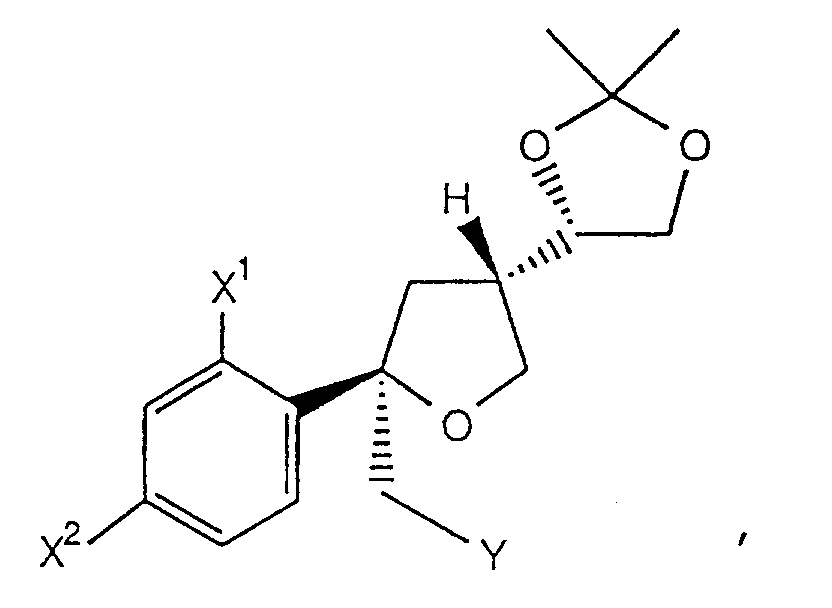
- the present invention provides a process for preparing chiral compounds of the formula (II) wherein X 1 and X 2 are independently F or Cl, and Y is Cl, Br or I.
- the process of the present invention comprises reacting a chiral triol of the formula wherein X 1 and X 2 are as defined above, with acetone in the presence of a catalyst, then with a halogen selected from Cl 2 , Br 2 or I 2 or with NBS or NIS, to form a compound of formula (II).
- the catalyst is I 2 .
- the present invention also provides a process for preparing a compound of the formula (II) comprising the steps:
- the present invention provides a process for preparing a compound of the formula (III)
- Compounds of the formula (III) are enantiomers of compounds of the formula (II).
- the process of the present invention comprises the steps:
- the present invention comprises a process for preparing a compound of the formula (II) and for converting the compound of formula (II) into a compound of the formula (I), as shown in Reaction Scheme 1.
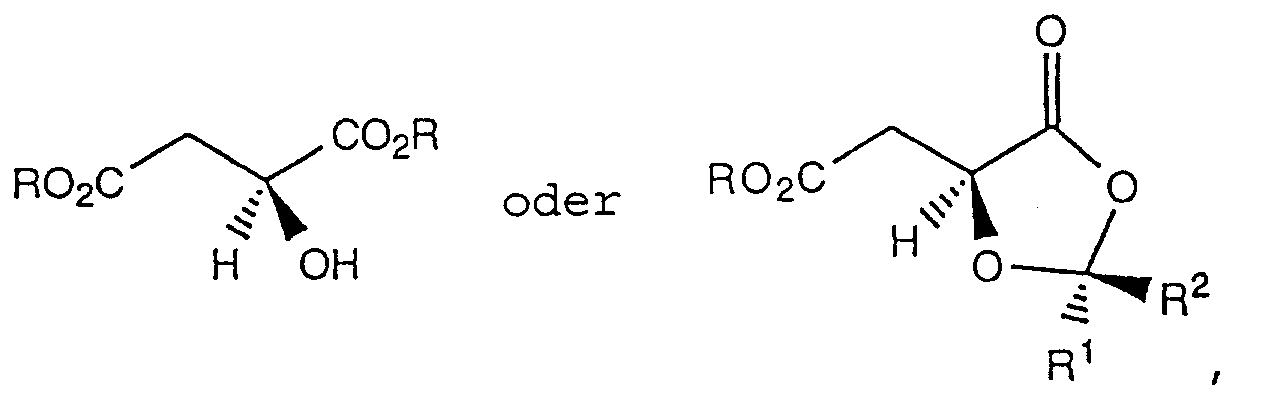
- Step (a) of Reaction Scheme 1 a diester of L-malic acid (V) wherein R is C 1 -C 6 alkyl, or a L-malic acid derivative of the formula (XIX) wherein R, R 1 and R 2 are as defined above, is deprotonated by treating with a nonaqueous base, such as LiHMDS, in a suitable solvent, such as THF, at -100° to 0°C, preferably at -80°C to -20°C, and the resulting anion reacted with a compound of the formula (VI), wherein X 1 , X 2 and L are as defined above, at -100° to 0°C, preferably at -80°C to -10°C, then quenched with KH 2 PO 4 (aqueous) and extracted with an organic solvent, such as EtOAc, to give the product (VII) or (XX), respectively.
- a nonaqueous base such as LiHMDS
- THF a suitable solvent
- Step (b) compound (VII) or (XX) is treated with a hydride reducing agent, such as LiBH 4 or a mixture of NaBH 4 and LiCl, in a suitable solvent, such as an organic water miscible solvent, preferably THF, MeOH, EtOH or iPrOH, and optionally in the presence of water, at -30° to 50°C, preferably at -10° to 30°C, and most preferably at 0° to 25°C, to give the triol product (VIII).
- a hydride reducing agent such as LiBH 4 or a mixture of NaBH 4 and LiCl
- Step (c) the trio (VIII) is reacted with acetone and a catalyst, such as a catalytic amount of I 2 , at 0° to 50°C, preferably at 10° to 30°C, and most preferably at about 25°C.
- the reaction mixture is treated with a halogen, preferably I 2 , and a moderate base, such as Na 2 CO 3 , or alternatively with NBS or NIS, at -50° to 25°C, preferably about -30° to 0°C, then quenched with a mixture of Na 2 S 2 O 3 , water and a moderate base, such as K 2 CO 3 , and extracted with an organic solvent, such as EtOAc to give a compound of the formula (II).
- a catalyst such as a catalytic amount of I 2 , at 0° to 50°C, preferably at 10° to 30°C, and most preferably at about 25°C.
- the reaction mixture is treated with a halogen, preferably I 2 , and
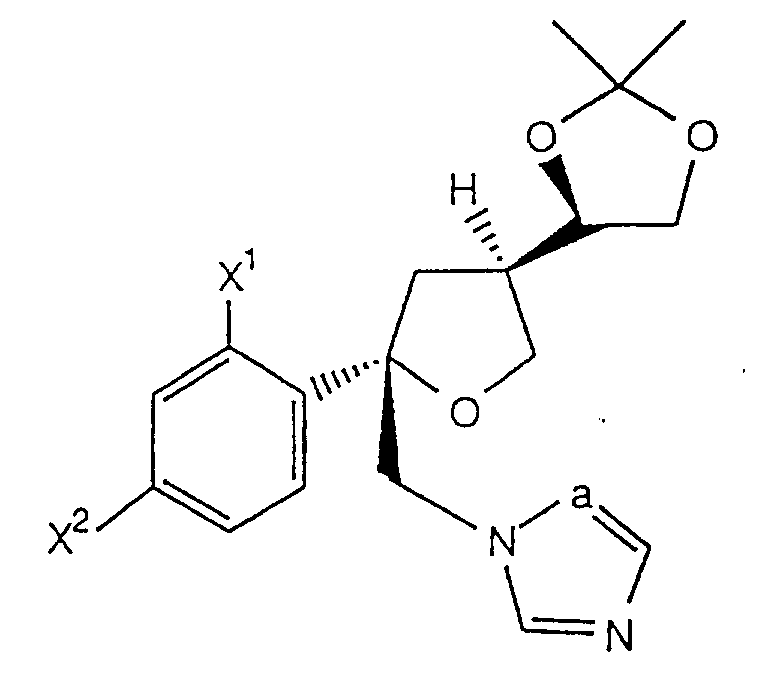
- Step (d) a compound of formula (II) is treated with an alkali metal triazole or imidazole of formula (X), wherein M is an alkali metal selected from Li, Na or K, and a is as defined above, at 50° to 150°C, preferably at 80°-120°C, and most preferably at 100°-110°C, in a suitable solvent, such as DMSO or DMF, to give the product (IX).
- a suitable solvent such as DMSO or DMF
- a compound (IX) is hydrolyzed by treating with an aqueous acid, such as aqueous HCl, and a suitable solvent, such as THF at 0° to 50°C, preferably at 20° to 30°C, then treated with H 5 IO 6 , NaIO 4 or Pb(OAc) 4 , at 0° to 50°C, preferably at 20° to 30°C, then quenched with a mixture of Na 2 S 2 O 3 , water and a moderate base, such as K 2 CO 3 , and extracted with an organic solvent, such as EtOAc, to give the aldehyde (XI).
- an aqueous acid such as aqueous HCl
- a suitable solvent such as THF
- Step (f) the aldehyde (XI) is treated with a hydride reducing agent, such as NaBH 4 , in a suitable solvent, such as an organic water miscible solvent, preferably THF, MeOH, EtOH or iPrOH, preferably MeOH or iPrOH, at -30° to 50°C, preferably at -10° to 30°C, and most preferably at 0° to 25°C, to give an alcohol of the formula (XII).
- a hydride reducing agent such as NaBH 4
- a suitable solvent such as an organic water miscible solvent, preferably THF, MeOH, EtOH or iPrOH, preferably MeOH or iPrOH, at -30° to 50°C, preferably at -10° to 30°C, and most preferably at 0° to 25°C, to give an alcohol of the formula (XII).
- a more reactive hydride reducing agent such as LiAlH 4
- the reaction is carried out under an
- Step (g) the alcohol (XII) is treated with a compound of the formula E-X, wherein X is Cl or Br, preferably Cl, and E is as defined above, preferably -SO 2 C 6 H 4 CH 3 or -SO 2 C 6 H 4 Cl, in the presence of a base and a suitable solvent to form a compound of the formula (I).
- a base is a hydroxide base, such as NaOH
- the solvent is preferably THF
- the base is a tertiary amine base, such as pyridine
- the solvent is preferably CH 2 Cl 2 ,
- the present invention comprises a process for preparing an enantiomer of a compound (II), e.g. a compound of the formula (III), and for converting compound (III) to an enantiomer of compound (I), e.g. a compound of the formula (IV), as shown in Reaction Scheme 2.
- Step (ai) of Reaction Scheme 2 a diester of D-malic acid (XIII) wherein R is C 1 -C 6 alkyl, or a D-malic acid derivative of the formula (XXI) wherein R, R 1 and R 2 are as defined above, is converted to the product (XIV) or (XXII), respectively, via essentially the same procedure as described for Step (a) of Reaction Scheme 1.
- Steps (bi) through (gi) are carried out via essentially the same procedures as described for Steps (b) through (g) of Reaction Scheme 1 to give compounds of formulae (III) and (IV).
- Compounds of the formula (XIX) and (XXI) can be prepared from L- or D-malic acid, respectively, using standard methods. For example, by reacting L- or D-malic acid with a compound of the formula wherein R 1 and R 2 are as defined above, in the presence of an acid catalyst, such as BF 3 ⁇ OEt 2 , p-TSA, or H 2 SO 4 , in a suitable solvent, such as CH 2 Cl 2 , pentane, THF or toluene, to form a compound of the formula respectively.
- an acid catalyst such as BF 3 ⁇ OEt 2 , p-TSA, or H 2 SO 4
- a suitable solvent such as CH 2 Cl 2 , pentane, THF or toluene
- the compound (XXIII) or (XXIV) is then esterified using standard methods, such as treating with diazomethane in an ether solvent, such as Et 2 O or THF, or treating with a compound of the formula R-L, wherein R and L are as defined above, in the presence of a base to form the desired compound (XIX) or (XXI), respectively.
- Compounds of the formula (XIX) or (XXI) can also be prepared from a compound of the formula (V) or (XIII), respectively, by treating (V) or (XIII) with a compound of the formula wherein R 1 and R 2 are as defined above, in the presence of an acid catalyst, such as BF 3 ⁇ OEt 2 , p-TSA, or H 2 SO 4 , in a suitable solvent, such as CH 2 Cl 2 , pentane, THF or toluene.
- an acid catalyst such as BF 3 ⁇ OEt 2 , p-TSA, or H 2 SO 4
- Compounds of the formula (XIX) or (XXI), wherein one of R 1 or R 2 is H and the other is -C(CH 3 ) 3 can also be prepared by reacting L- or D-malic acid, respectively, with [(CH 3 ) 3 Si] 2 NH and (CH 3 ) 3 SiCl, followed by treatment with (CH 3 ) 3 CCHO in the presence of TMSOTf in a suitable solvent, such as CH 2 Cl 2 , at -40° to 10°C, preferably at -25° to 0°C.
- a suitable solvent such as CH 2 Cl 2
- the Enantiomeric purity of compound P-1B was determined by treating a solution of 57 mg (0.3 mmol) of compound P-1B in 0.5 mL of CH 2 Cl 2 with 0.3 mL of pyridine and 101 mg (0.4 mmol) of (R)-MTPACl at 0°-10°C. Stir the mixture for 1 h. at room temperature, then add 0.5 mL of 5% HCl (aqueous). Extract the aqueous phase with CH 2 Cl 2 , combine the organic phases and dry over MgSO 4 . Concentrate in vacuo to give 180 mg of the product.
Landscapes
- Chemical & Material Sciences (AREA)
- Organic Chemistry (AREA)
- Organic Low-Molecular-Weight Compounds And Preparation Thereof (AREA)
- Pharmaceuticals Containing Other Organic And Inorganic Compounds (AREA)
- Low-Molecular Organic Synthesis Reactions Using Catalysts (AREA)
- Plural Heterocyclic Compounds (AREA)
- Agricultural Chemicals And Associated Chemicals (AREA)
Claims (13)
- Verfahren zur Herstellung chiraler Verbindungen der Formelworin X1 und X2 unabhängig voneinander F oder Cl sind, und Y Cl, Br oder I ist, umfassend die Umsetzung eines chiralen Triols der Formel
 worin X1 und X2 wie oben definiert sind, mit Aceton in Gegenwart eines Katalysators, dann mit einem Halogen, das aus Cl2, Br2 oder I2 ausgewählt ist, oder N-Bromsuccinimid oder N-Iodsuccinimid.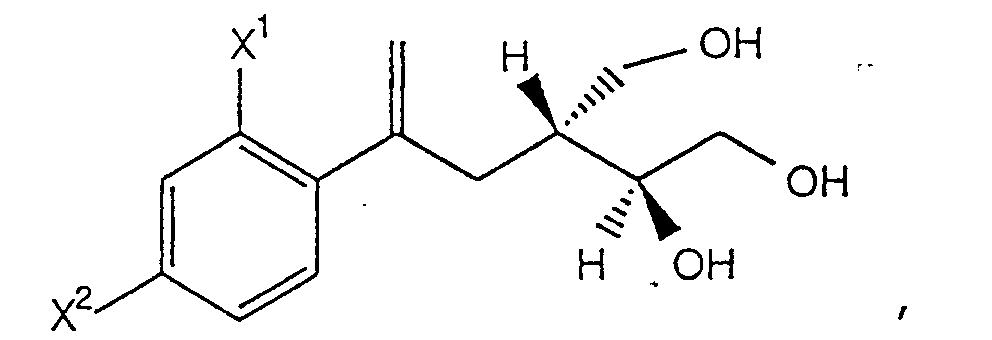
- Verfahren gemäß Anspruch 1, worin X1 und X2 jeweils F sind, Y I ist und das Halogen I2 ist.
- Verfahren gemäß Anspruch 2, worin der Katalysator I2 ist.
- Verfahren gemäß Anspruch 3, worin die Behandlung mit Halogen in Gegenwart einer mittelstarken Base bei einer Temperatur von -50 °C bis 25 °C durchgeführt wird.
- Verfahren gemäß Anspruch 4, worin die mittelstarke Base Na2CO3 oder K2CO3 ist, und die Temperatur -30 °C bis 0 °C beträgt.
- Verfahren zur Herstellung chiraler Verbindungen der Formelworin X1 und X2 unabhängig voneinander F oder Cl sind, und Y Cl, Br oder I ist, umfassend die Stufen:
 (a) der Verwendung einer nichtwäßrigen Base zur Deprotonierung einer chiralen Verbindung der Formelworin R C1-C6-Alkyl ist, eines von R1 oder R2 H ist und das andere -C(CH3)3 oder -CCl3 ist, oder R1 und R2 jeweils C1-C6-Alkyl sind, oder R1 und R2 zusammen mit dem Kohlenstoff, an den sie gebunden sind, einen 6-gliedrigen, carbocyclischen Ring umfassen,
der anschließenden Behandlung mit einer Verbindung der Formelworin X1 und X2 wie oben definiert sind, und L eine austretende Gruppe ist, um eine chirale Verbindung der Formel zu bilden, worin X1, X2, R, R1 und R2 wie oben definiert sind;
 (b) der Reduzierung des Produkts der Stufe (a) mit einem Hydrid-Reduktionsmittel, um ein chirales Triol der Formelzu bilden, worin X1 und X2 wie oben definiert sind; und
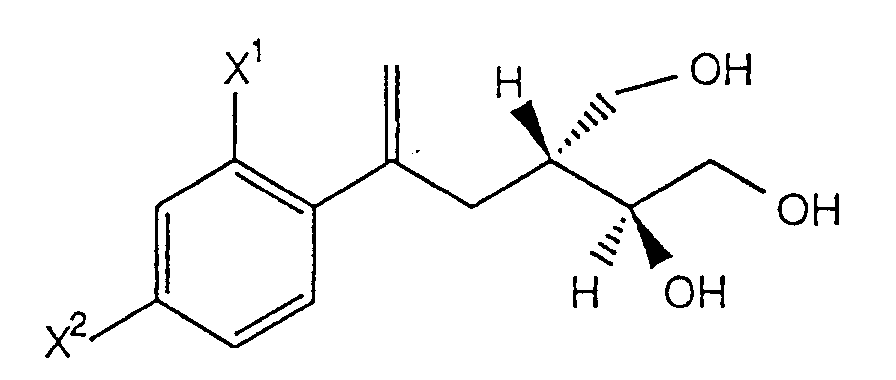 (c) der Umsetzung des Triols der Stufe (b) mit Aceton in Gegenwart eines Katalysators, dann mit Halogen, das aus Cl2, Br2 oder I2 ausgewählt ist, oder N-Bromsuccinimid oder N-Iodsuccinimid.
 - Verfahren zur Herstellung einer Verbindung der Formelworin a CH oder N ist; X1 und X2 unabhängig voneinander F oder Cl sind, und E -SO2R6 ist, worin R6 C1-C6-Alkyl, Aryl, substituiertes Aryl oder -CF3 ist, umfassend die Stufen:
 (a) der Verwendung einer nichtwäßrigen Base zur Deprotonierung einer chiralen Verbindung der Formelworin R C1-C6-Alkyl ist; eines von R1 oder R2 H ist und das andere -C(CH3)3 oder -CCl3 ist, oder R1 und R2 jeweils C1-C6-Alkyl sind, oder R1 und R2 zusammen mit dem Kohlenstoff, an den sie gebunden sind, einen 6-gliedrigen, carbocyclischen Ring umfassen, der anschließenden Behandlung mit einer Verbindung der Formel
 worin X1 und X2 wie oben definiert sind, und L eine austretende Gruppe ist, um eine chirale Verbindung der Formel
 zu bilden, worin X1, X2, R, R1 und R2 wie oben definiert sind;
 (b) der Reduzierung des Produkts der Stufe (a) mit einem Hydrid-Reduktionsmittel, um eine chirale Verbindung der Formelzu bilden, worin X1 und X2 wie oben definiert sind;
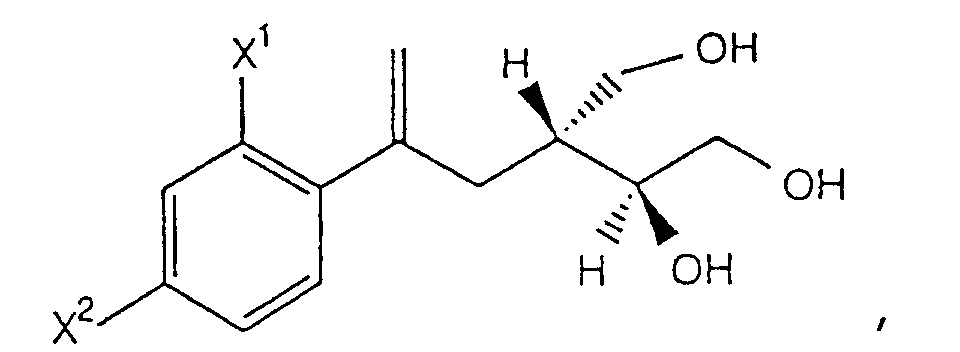 (c) der Umsetzung des Triols der Stufe (b) mit Aceton in Gegenwart eines Katalysators, anschließend mit einem Halogen, das aus Cl2, Br2 oder I2 ausgewählt ist, oder N-Bromsuccinimid oder N-Iodsuccinimid, um ein chirales Tetrahydrofuran der Formelzu bilden, worin X1 und X2 wie oben definiert sind, und Y Cl, Br oder I ist;
 (d) der Behandlung des Tetrahydrofurans der Stufe (c) mit einem Alkalimetalltriazol oder -imidazol, um ein chirales Triazol- oder Imidazol-Derivat der Formelzu bilden, worin a, X1 und X2 wie oben definiert sind;
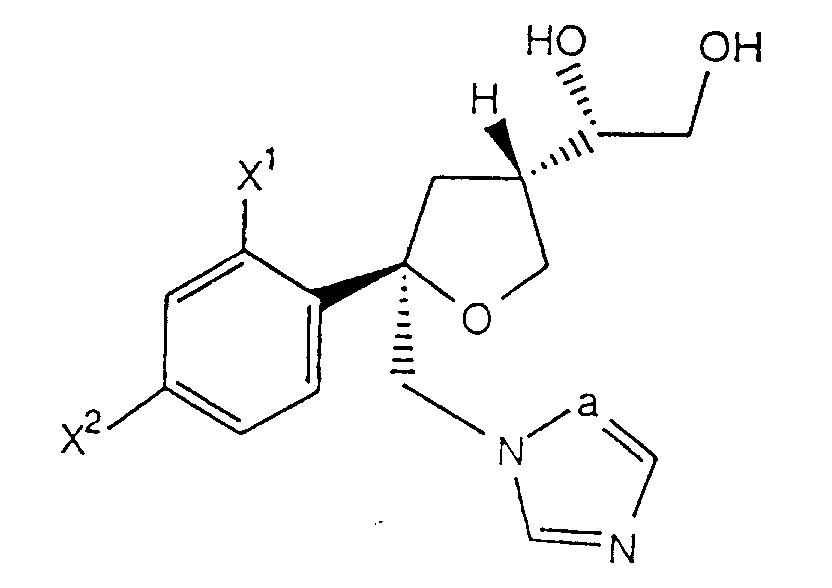
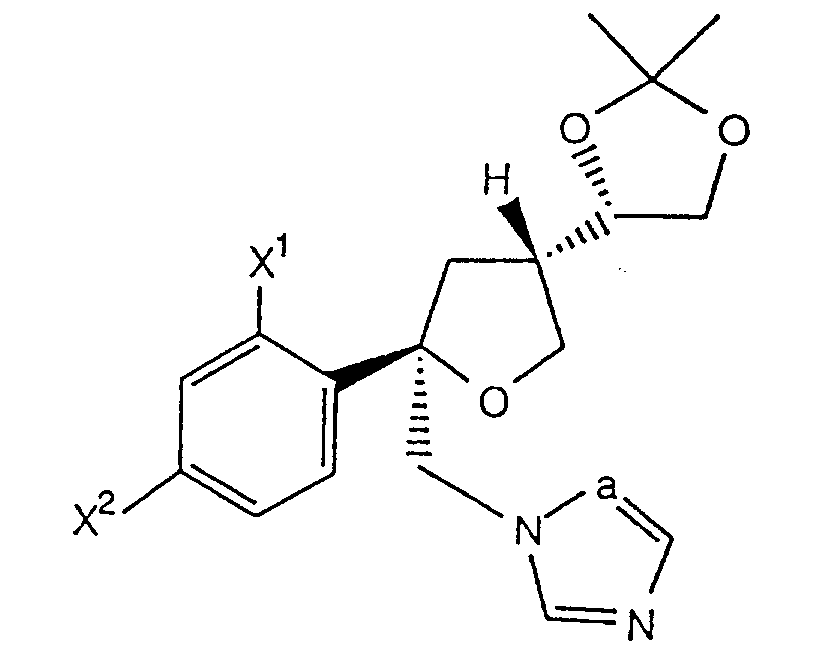 (e) der Hydrolyse des Triazol- oder Imidazol-Produkts der Stufe (d) mit einer wäßrigen Säure, um eine Diol-Zwischenstufe der Formelzu bilden, worauf die oxidative Spaltung des Diols unter Verwendung von H5IO6, NaIO4 oder Pb(OAc)4 erfolgt, um einen Aldehyd der Formel
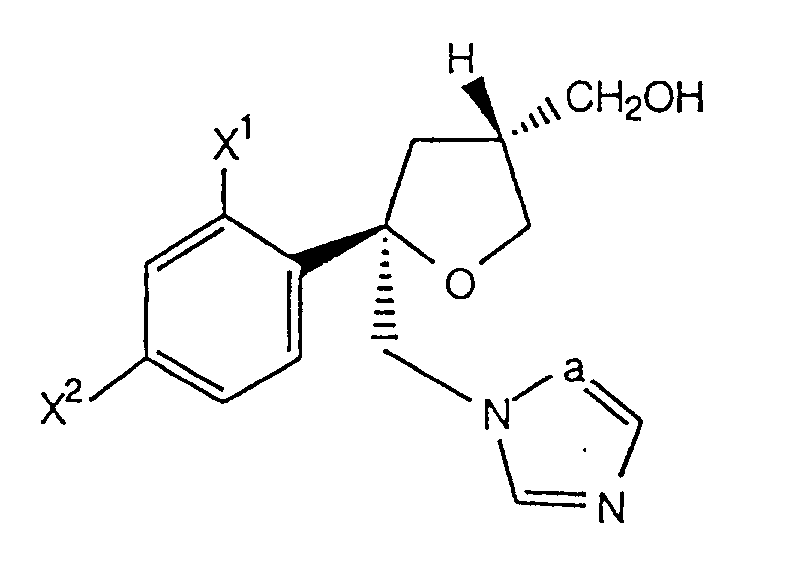
 zu bilden, worin a, X1 und X2 wie oben definiert sind;
 (f) der Reduzierung des Aldehyds der Stufe (e) mit einem Hydrid-Reduktionsmittel, um einen Alkohol der Formelzu bilden, worin a, X1 und X2 wie oben definiert sind; und
 (g) der Behandlung des Alkohols der Stufe (f) mit einer Verbindung der Formel E-X, worin X Cl oder Br ist, und E wie oben definiert ist.
 - Verfahren zur Herstellung einer Verbindung der Formel (III)worin X1 und X2 unabhängig voneinander F oder Cl sind, und Y Cl, Br oder I ist, umfassend
 (ai) die Verwendung einer nichtwäßrigen Base zur Deprotonierung einer chiralen Verbindung der Formelworin R C1-C6-Alkyl ist, eines von R1 oder R2 H ist, das andere -C(CH3)3 oder -CCl3 ist, oder R1 und R2 jeweils C1-C6-Alkyl sind, oder R1 und R2 zusammen mit dem Kohlenstoff, an den sie gebunden sind, einen 6-gliedrigen, carbocyclischen Ring umfassen,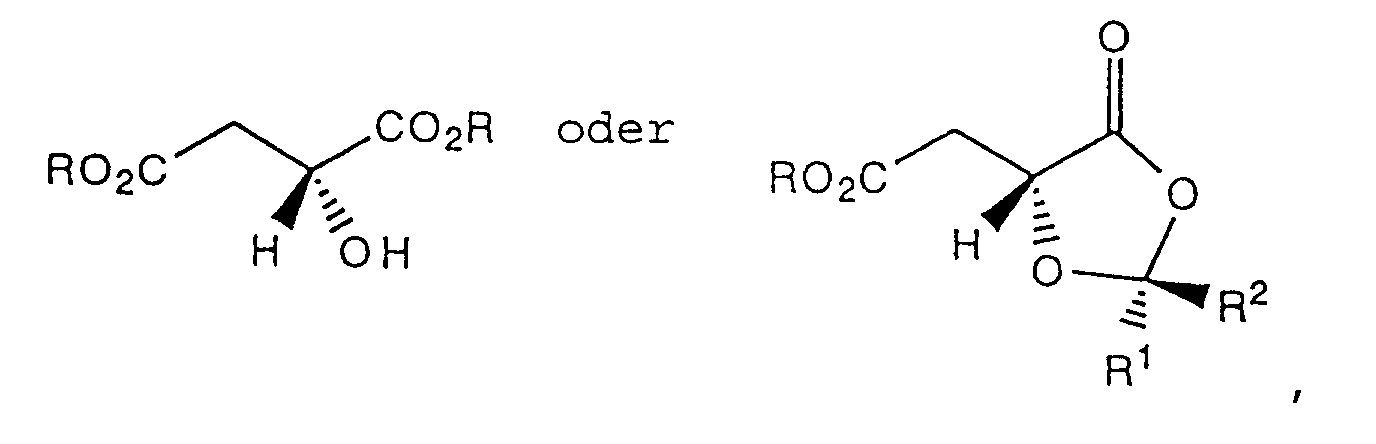
die anschließende Behandlung mit einer Verbindung der Formelworin X1 und X2 wie oben definiert sind, und L eine austretende Gruppe ist, um eine chirale Verbindung der Formel zu bilden, worin X1, X2, R, R1 und R2 wie oben definiert sind; und
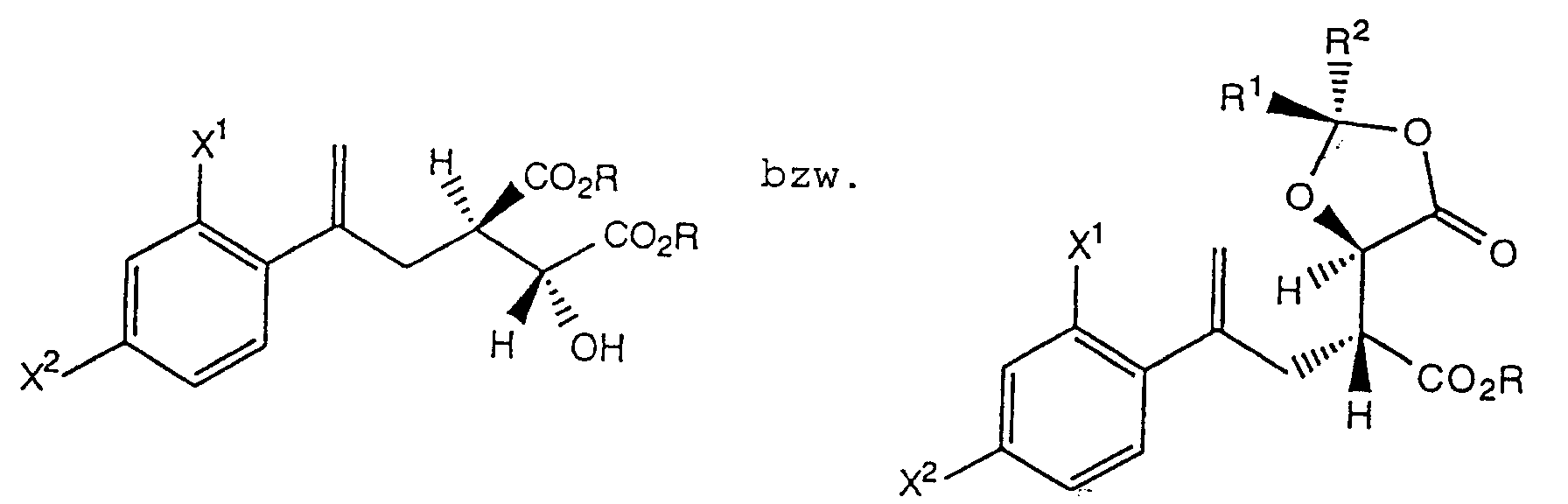 (bi) die Reduzierung des Produkts der Stufe (ai) mit einem Reduktionsmittel, um ein chirales Triol der Formelzu bilden, worin X1 und X2 wie oben definiert sind; und
 (ci) die Umsetzung des Triols der Stufe (bi) mit Aceton in Gegenwart eines Katalysators, dann mit einem Halogen, das aus Cl2, Br2 oder I2 ausgewählt ist, oder mit NBS oder NIS, um eine chirale Verbindung der Formel (III) zu bilden.
 - Verfahren gemäß den Ansprüchen 6 oder 8, worin X1 und X2 jeweils F sind; L I ist; R Methyl, Ethyl oder i-Propyl ist; die nichtwäßrige Base LiN[Si(CH3)3]2 ist; das Hydrid-Reduktionsmittel LiBH4 oder eine Mischung von NaBH4 und LiCl ist; der Katalysator in der Stufe (c) I2 ist; und das Halogen I2 ist.
- Verfahren zur Herstellung einer Verbindung der Formel (IV)worin a CH oder N ist; X1 und X2 unabhängig voneinander F oder Cl sind; und E -SO2R6 ist, worin R6 C1-C6-Alkyl, Aryl, substituiertes Aryl oder -CF3 ist, umfassend die Stufen:
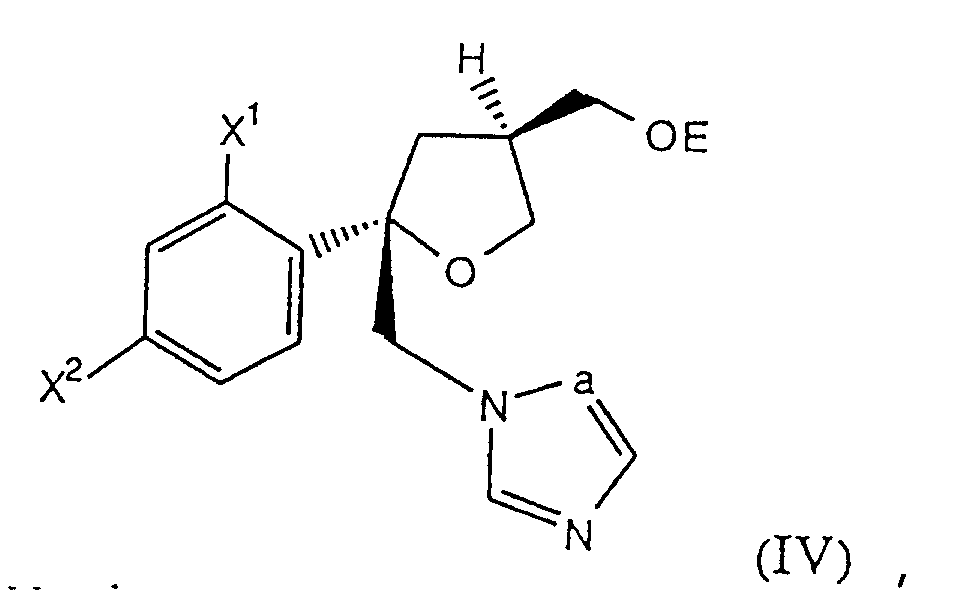 (ai) der Verwendung einer nichtwäßrigen Base zur Deprotonierung einer chiralen Verbindung der Formelworin R C1-C6-Alkyl ist, eines von R1 oder R2 H ist, das andere -C(CH3)3 oder -CCl3 ist, oder R1 und R2 jeweils C1-C6-Alkyl sind, oder R1 und R2 zusammen mit dem Kohlenstoff, an den sie gebunden sind, einen 6-gliedrigen, carbocyclischen Ring umfassen,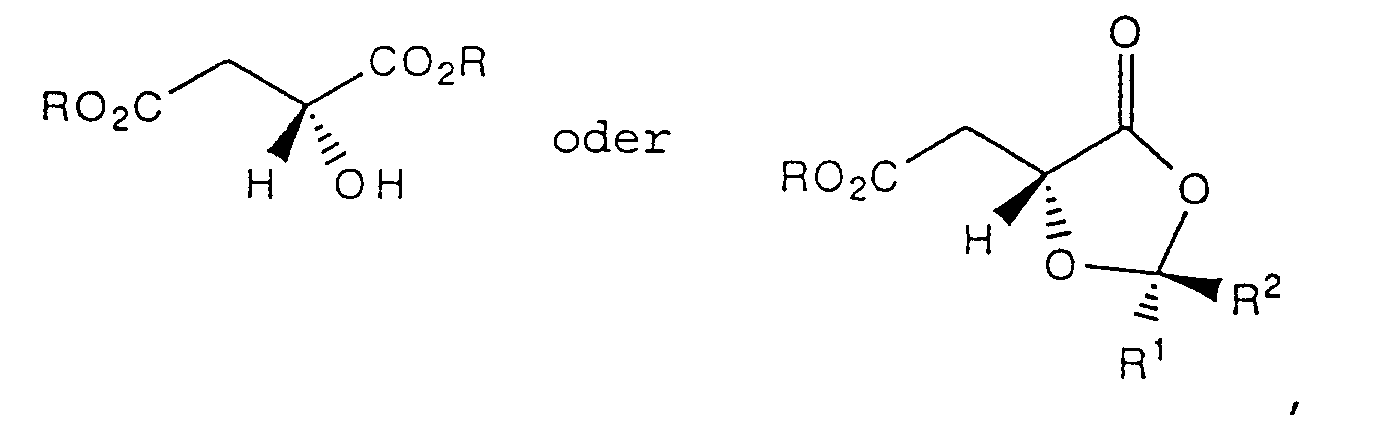
der anschließenden Behandlung mit einer Verbindung der Formelworin X1 und X2 wie oben definiert sind, und L eine austretende Gruppe ist, um eine chirale Verbindung der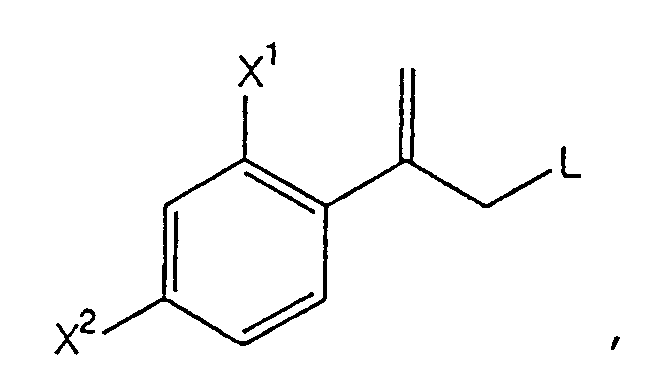 Formel zu bilden, worin X1, X2, R, R1 und R2 wie oben definiert sind;
 und (bi) der Reduzierung des Produkts der Stufe (ai) mit einem Reduktionsmittel, um ein chirales Triol der Formelzu bilden, worin X1 und X2 wie oben definiert sind; und
 (ci) der Umsetzung des Triols der Stufe (bi) mit Aceton in Gegenwart eines Katalysators, dann mit einem Halogen, das aus Cl2, Br2 oder I2 ausgewählt ist, oder mit NBS oder NIS, um eine chirale Verbindung der Formel (III)zu bilden, worin X1 und X2 unabgängig voneinander F oder Cl sind, und Y Cl, Br oder I ist; und
 (di) der Behandlung einer Verbindung der Formel (III) mit einem Alkalimetalltriazol- oder -imidazol, um eine chirale Verbindung der Formelzu bilden, worin a, X1 und X2 wie oben definiert sind;
 (ei) der Hydrolyse des Produkts der Stufe (di) mit einer wäßrigen Säure, um eine Diol-Zwischenstufe der Formelzu bilden, worauf eine oxidative Spaltung des Diols unter Verwendung von H5IO6, NaIO4 oder Pb(OAc)4 erfolgt, um einen Aldehyd der Formel
 zu bilden, worin a, X1 und X2 wie oben definiert sind;
 (fi) der Reduzierung des Aldehyds der Stufe (ei) mit einem Hydrid-Reduktionsmittel, um einen Alkohol der Formelzu bilden, worin a, X1 und X2 wie oben definiert sind; und
 (gi) der Behandlung des Alkohols der Stufe (fi) mit einer Verbindung der Formel E-X, worin X Cl oder Br ist, und E wie oben definiert ist, um eine Verbindung der Formel (IV)zu bilden, worin a CH oder N ist; X1 und X2 unabhängig voneinander F oder Cl sind; und E -SO2R6 ist, worin R6 C1-C6-Alkyl, Aryl, substituiertes Aryl oder -CF3 ist.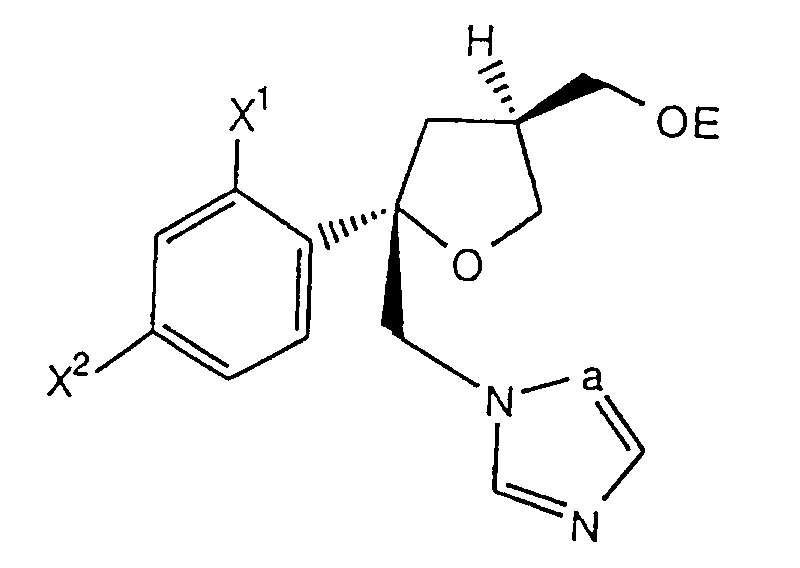
- Verfahren gemäß den Ansprüchen 7 oder 10, worin a N ist; X1 und X2 jeweils F sind; L I ist; R Methyl, Ethyl oder i-Propyl ist; in der Stufe (a) die nichtwäßrige Base LiN[Si(CH3)3]2 ist; in der Stufe (b) das Hydrid-Reduktionsmittel LiBH4 oder eine Mischung von NaBH4 und LiCl ist; in Stufe (c) der Katalysator I2 ist; und das Halogen I2 ist, und Y I ist; in der Stufe (d) das Alkalimetalltriazol Natriumtriazol ist; in der Stufe (e) die wäßrige Säure wäßriges HCl ist; in der Stufe (f) das Hydrid-Reduktionsmittel NaBH4 ist, und in der Stufe (g) E CH3C6H4SO2- oder ClC6H4SO2- ist, und X Cl ist.
- Verfahren gemäß Anspruch 11, worin die Stufe (a) in Tetrahydrofuran bei einer Temperatur von -100 °C bis 0 °C durchgeführt wird, die Stufe (b) in einem organischen, wassermischbaren Lösungsmittel in Gegenwart von Wasser durchgeführt wird; in der Stufe (c) die Behandlung mit Halogen in Gegenwart einer mittelstarken Base bei einer Temperatur von 50 °C bis 25 °C durchgeführt wird; die Stufe (d) bei 50 °C bis 150 °C in N,N-Dimethylformamid oder Dimethylsulfoxid durchgeführt wird; die Stufe (e) in Tetrahydrofuran bei einer Temperatur von 0 °C bis 50 °C durchgeführt wird; die Stufe (f) in einem organischen, wassermischbaren Lösungsmittel bei -30 °C bis 50 °C durchgeführt wird; und die Stufe (g) in Gegenwart einer Base und eines Lösungsmittels durchgeführt wird, das aus Tetrahydrofuran oder CH2Cl2 ausgewählt wird.
- Verfahren gemäß Anspruch 12, worin in der Sufe (b) das wassermischbare Lösungsmittel Tetrahydrofuran ist; in der Stufe (c) die mittelstarke Base Na2CO3 ist; in der Stufe (f) das wassermischbare Lösungsmittel MeOH ist; und in der Stufe (g) die Base Pyridin oder NaOH ist.
Applications Claiming Priority (3)
| Application Number | Priority Date | Filing Date | Title |
|---|---|---|---|
| US272411 | 1994-07-08 | ||
| US08/272,411 US5486625A (en) | 1994-07-08 | 1994-07-08 | Process for the preparation of chiral intermediates useful for the synthesis of antifungal agents |
| PCT/US1995/007873 WO1996001823A1 (en) | 1994-07-08 | 1995-07-05 | Process for the preparation of chiral intermediates useful for the synthesis of antifungal agents |
Publications (2)
| Publication Number | Publication Date |
|---|---|
| EP0770075A1 EP0770075A1 (de) | 1997-05-02 |
| EP0770075B1 true EP0770075B1 (de) | 1999-01-13 |
Family
ID=23039688
Family Applications (1)
| Application Number | Title | Priority Date | Filing Date |
|---|---|---|---|
| EP95925282A Expired - Lifetime EP0770075B1 (de) | 1994-07-08 | 1995-07-05 | Verfahren zur herstellung von chiralen zwischenprodukten für die synthese von antifungalen mitteln |
Country Status (12)
| Country | Link |
|---|---|
| US (1) | US5486625A (de) |
| EP (1) | EP0770075B1 (de) |
| JP (1) | JP3856822B2 (de) |
| AT (1) | ATE175670T1 (de) |
| AU (1) | AU703696B2 (de) |
| CA (1) | CA2192186C (de) |
| DE (1) | DE69507305T2 (de) |
| ES (1) | ES2126911T3 (de) |
| FI (1) | FI970055L (de) |
| HU (1) | HU216166B (de) |
| NZ (1) | NZ289575A (de) |
| WO (1) | WO1996001823A1 (de) |
Families Citing this family (11)
| Publication number | Priority date | Publication date | Assignee | Title |
|---|---|---|---|---|
| MXPA04010066A (es) * | 2002-04-12 | 2004-12-13 | Ranbaxy Lab Ltd | Derivados de tetrahidrofurano 2,2,4-trisubstituido como agentes antifungicos. |
| US9040539B2 (en) | 2010-05-19 | 2015-05-26 | Sandoz Ag | Process for the preparation of chiral triazolones |
| RU2585683C2 (ru) * | 2010-05-19 | 2016-06-10 | Сандоз Аг | Очистка позаконазола и промежуточных продуктов для синтеза позаконазола |
| CN102892762B (zh) * | 2010-05-19 | 2016-04-20 | 桑多斯股份公司 | 制备泊沙康唑中间体 |
| EP2571847B1 (de) | 2010-05-19 | 2016-09-21 | Sandoz AG | Verfahren zur herstellung chiraler hydrazide |
| CN103635465A (zh) | 2011-06-16 | 2014-03-12 | 桑多斯股份公司 | 制备手性化合物的方法 |
| EP2746266A1 (de) * | 2012-12-19 | 2014-06-25 | Basf Se | Neue substituierte Triazole und Imidazole sowie ihre Verwendung als Fungizide |
| ES2790875T3 (es) | 2014-12-05 | 2020-10-29 | Pulmocide Ltd | Compuesto antimicótico |
| KR102653821B1 (ko) | 2015-05-21 | 2024-04-02 | 풀모사이드 리미티드 | 항진균성 4-(4-(4-(((3r,5r)-5-((1h-1,2,4-트리아졸-1-일)메틸)-5-(2,4-디플루오로페닐)테트라하이드로푸란-3-일)메톡시)-3-메틸페닐)피페라진-1-일)-n-(2-하이드록시사이클로헥실)벤즈아미드 또는 이의 약학적으로 허용가능한 염. |
| GB201917867D0 (en) | 2019-12-06 | 2020-01-22 | Pulmocide Ltd | Polymorphs |
| CN118765275A (zh) * | 2022-02-28 | 2024-10-11 | 基因泰克公司 | 用于制备苯基四氢呋喃化合物的方法 |
Family Cites Families (12)
| Publication number | Priority date | Publication date | Assignee | Title |
|---|---|---|---|---|
| US4619931A (en) * | 1983-02-28 | 1986-10-28 | Janssen Pharmaceutica, N.V. | [[4-[4-(4-phenyl-1-piperazinyl)phenoxymethyl]-1,3-dioxolan-2-yl]methyl]-1H-imidazoles and 1H-1,2,4-triazoles |
| US4791111A (en) * | 1985-12-23 | 1988-12-13 | Janssen Pharmaceutica, N.V. | [[4-[4-(4-phenyl-1-piperazinyl)phenoxymethyl]-1,3-dioxolan-2-yl]methyl]-1H-imidazoles and 1H-1,2,4-triazoles having anti-microbial properties |
| DE3609597A1 (de) * | 1986-03-21 | 1987-10-01 | Hoechst Ag | 2-azolylmethyl-2-aryl-1,3-dioxolane und deren salze, verfahren zu ihrer herstellung, sie enthaltende mittel und ihre verwendung |
| DE3622791A1 (de) * | 1986-07-07 | 1988-01-21 | Heumann Pharma Gmbh & Co | Neue 1,4-piperazinderivate, verfahren zu ihrer herstellung, ihre verwendung und diese verbindungen enthaltendes arzneimittel |
| AU2811689A (en) * | 1987-11-20 | 1989-06-14 | Schering Corporation | Tri-and tetra-substituted-oxetanes and tetrahydrofurans and intermediates thereof |
| JPH0253780A (ja) * | 1988-08-12 | 1990-02-22 | Kaken Pharmaceut Co Ltd | Δ↑2‐1,2,4‐トリアゾリン‐5‐オン誘導体、その製造法およびそれを有効成分とする抗潰瘍剤 |
| NZ233502A (en) * | 1989-06-09 | 1991-11-26 | Janssen Pharmaceutica Nv | 4-(1,2,4-triazole- or imidazole-phenyl-substituted) -1-(1,3-dioxolan-4-ylmethoxyphenyl) piperazine derivatives; preparatory processes: fungicidal and antiviral compositions |
| US5039676A (en) * | 1990-05-11 | 1991-08-13 | Schering Corporation | Tri- and tetra-substituted-oxetanes and tetrahydrofurans and intermediates thereof |
| IL103558A0 (en) * | 1991-10-30 | 1993-03-15 | Schering Corp | Tri-substituted tetrahydrofuran antifungals |
| RU2127733C1 (ru) * | 1992-03-18 | 1999-03-20 | Жансен Фармасетика Н.В. | Стереоизомеры итраконазола или саперконазола, способ их получения, их комплексы и фармацевтическая композиция на их основе |
| AU4556693A (en) * | 1992-08-11 | 1994-03-15 | Vetrotech Ag | Light-transparent heat-protection element |
| US5403937A (en) * | 1993-04-30 | 1995-04-04 | Schering Corporation | Process for preparing intermediates for the synthesis of antifungal agents |
-
1994
- 1994-07-08 US US08/272,411 patent/US5486625A/en not_active Expired - Lifetime
-
1995
- 1995-07-05 WO PCT/US1995/007873 patent/WO1996001823A1/en not_active Ceased
- 1995-07-05 AT AT95925282T patent/ATE175670T1/de not_active IP Right Cessation
- 1995-07-05 HU HUP9700040A patent/HU216166B/hu not_active IP Right Cessation
- 1995-07-05 CA CA002192186A patent/CA2192186C/en not_active Expired - Fee Related
- 1995-07-05 FI FI970055A patent/FI970055L/fi unknown
- 1995-07-05 DE DE69507305T patent/DE69507305T2/de not_active Expired - Lifetime
- 1995-07-05 ES ES95925282T patent/ES2126911T3/es not_active Expired - Lifetime
- 1995-07-05 AU AU29465/95A patent/AU703696B2/en not_active Ceased
- 1995-07-05 NZ NZ289575A patent/NZ289575A/en unknown
- 1995-07-05 JP JP50431296A patent/JP3856822B2/ja not_active Expired - Fee Related
- 1995-07-05 EP EP95925282A patent/EP0770075B1/de not_active Expired - Lifetime
Also Published As
| Publication number | Publication date |
|---|---|
| DE69507305T2 (de) | 1999-07-01 |
| CA2192186C (en) | 2007-01-23 |
| US5486625A (en) | 1996-01-23 |
| NZ289575A (en) | 1998-04-27 |
| JPH10502637A (ja) | 1998-03-10 |
| JP3856822B2 (ja) | 2006-12-13 |
| FI970055A7 (fi) | 1997-01-07 |
| ATE175670T1 (de) | 1999-01-15 |
| AU703696B2 (en) | 1999-04-01 |
| CA2192186A1 (en) | 1996-01-25 |
| DE69507305D1 (de) | 1999-02-25 |
| ES2126911T3 (es) | 1999-04-01 |
| FI970055A0 (fi) | 1997-01-07 |
| HUT76689A (en) | 1997-10-28 |
| HU216166B (hu) | 1999-04-28 |
| FI970055L (fi) | 1997-01-07 |
| AU2946595A (en) | 1996-02-09 |
| EP0770075A1 (de) | 1997-05-02 |
| WO1996001823A1 (en) | 1996-01-25 |
Similar Documents
| Publication | Publication Date | Title |
|---|---|---|
| JP3411283B2 (ja) | 抗カビ剤合成用中間体の製造方法 | |
| EP0770075B1 (de) | Verfahren zur herstellung von chiralen zwischenprodukten für die synthese von antifungalen mitteln | |
| US4939248A (en) | Optically active azetidinones | |
| EP0244364A2 (de) | Herstellung von olefinischen Verbindungen | |
| US4639335A (en) | Stereocontrolled acetoxyazetidinone process | |
| EP0322815A2 (de) | Propoxybenzolderivate und Verfahren zu ihrer Herstellung | |
| US4940797A (en) | Process for synthesis of FK-506 C10-C18 intermediates | |
| US5097049A (en) | Process and intermediates for chiral epoxides | |
| JPH05178875A (ja) | フコピラノース類縁体の製造方法およびその合成中間化合物 | |
| RU2012555C1 (ru) | Способ получения оптически активного циклобутанона и производные циклобутанона | |
| US4277401A (en) | Total synthesis of 1RS,4SR,5RS-4-(4,8-dimethyl)-5-hydroxy-7-nonen-1-yl)-4-methyl-3,8-dioxabicyclo[3.2.1]octane-1-acetic acid | |
| US5183910A (en) | Process and intermediates for chiral epoxides | |
| US5155228A (en) | FK-506 C10-C18 process intermediates | |
| US5498719A (en) | Diastereoselective process leading to a key intermediate for the preparation of fluorinated reverse transcriptase inhibitors | |
| US4222937A (en) | Total synthesis of the utero-evacuant substance D,L-zoapatanol | |
| US6214611B1 (en) | Process for the preparation of prostaglandin precursors | |
| US5256807A (en) | Process and intermediates for chiral epoxides | |
| JP3573357B2 (ja) | 3−アミノ−2−ヒドロキシ−酪酸エステル誘導体を出発原料とする光学活性3−アミノ−2−ブタノール誘導体の製造法及びその中間体 | |
| JPH0325419B2 (de) | ||
| EP0398474A2 (de) | Oxazolederivate und Zwischenprodukte für ihre Herstellung | |
| KR20020087500A (ko) | 3-치환 아제티디논의 제조방법 | |
| JPH0220616B2 (de) | ||
| JPH04316537A (ja) | 光学活性3,5−アンチ−ジヒドロキシカルボン酸エステル誘導体 | |
| JPS58154559A (ja) | 1−(置換ピロリル)−2−オキシ−1−アルカノンアセタ−ル |
Legal Events
| Date | Code | Title | Description |
|---|---|---|---|
| PUAI | Public reference made under article 153(3) epc to a published international application that has entered the european phase |
Free format text: ORIGINAL CODE: 0009012 |
|
| 17P | Request for examination filed |
Effective date: 19961203 |
|
| AK | Designated contracting states |
Kind code of ref document: A1 Designated state(s): AT BE CH DE DK ES FR GB GR IE IT LI LU NL PT SE |
|
| RIN1 | Information on inventor provided before grant (corrected) |
Inventor name: SMITH, LYMAN, H. Inventor name: LEONG, WILLIAM |
|
| GRAG | Despatch of communication of intention to grant |
Free format text: ORIGINAL CODE: EPIDOS AGRA |
|
| 17Q | First examination report despatched |
Effective date: 19980309 |
|
| GRAG | Despatch of communication of intention to grant |
Free format text: ORIGINAL CODE: EPIDOS AGRA |
|
| GRAG | Despatch of communication of intention to grant |
Free format text: ORIGINAL CODE: EPIDOS AGRA |
|
| GRAH | Despatch of communication of intention to grant a patent |
Free format text: ORIGINAL CODE: EPIDOS IGRA |
|
| GRAH | Despatch of communication of intention to grant a patent |
Free format text: ORIGINAL CODE: EPIDOS IGRA |
|
| GRAA | (expected) grant |
Free format text: ORIGINAL CODE: 0009210 |
|
| AK | Designated contracting states |
Kind code of ref document: B1 Designated state(s): AT BE CH DE DK ES FR GB GR IE IT LI LU NL PT SE |
|
| PG25 | Lapsed in a contracting state [announced via postgrant information from national office to epo] |
Ref country code: SE Free format text: THE PATENT HAS BEEN ANNULLED BY A DECISION OF A NATIONAL AUTHORITY Effective date: 19990113 Ref country code: NL Free format text: LAPSE BECAUSE OF FAILURE TO SUBMIT A TRANSLATION OF THE DESCRIPTION OR TO PAY THE FEE WITHIN THE PRESCRIBED TIME-LIMIT Effective date: 19990113 Ref country code: LI Free format text: LAPSE BECAUSE OF FAILURE TO SUBMIT A TRANSLATION OF THE DESCRIPTION OR TO PAY THE FEE WITHIN THE PRESCRIBED TIME-LIMIT Effective date: 19990113 Ref country code: GR Free format text: LAPSE BECAUSE OF NON-PAYMENT OF DUE FEES Effective date: 19990113 Ref country code: CH Free format text: LAPSE BECAUSE OF FAILURE TO SUBMIT A TRANSLATION OF THE DESCRIPTION OR TO PAY THE FEE WITHIN THE PRESCRIBED TIME-LIMIT Effective date: 19990113 Ref country code: BE Free format text: LAPSE BECAUSE OF FAILURE TO SUBMIT A TRANSLATION OF THE DESCRIPTION OR TO PAY THE FEE WITHIN THE PRESCRIBED TIME-LIMIT Effective date: 19990113 Ref country code: AT Free format text: LAPSE BECAUSE OF FAILURE TO SUBMIT A TRANSLATION OF THE DESCRIPTION OR TO PAY THE FEE WITHIN THE PRESCRIBED TIME-LIMIT Effective date: 19990113 |
|
| REF | Corresponds to: |
Ref document number: 175670 Country of ref document: AT Date of ref document: 19990115 Kind code of ref document: T |
|
| REG | Reference to a national code |
Ref country code: CH Ref legal event code: EP |
|
| REG | Reference to a national code |
Ref country code: IE Ref legal event code: FG4D |
|
| REF | Corresponds to: |
Ref document number: 69507305 Country of ref document: DE Date of ref document: 19990225 |
|
| ITF | It: translation for a ep patent filed | ||
| REG | Reference to a national code |
Ref country code: ES Ref legal event code: FG2A Ref document number: 2126911 Country of ref document: ES Kind code of ref document: T3 |
|
| PG25 | Lapsed in a contracting state [announced via postgrant information from national office to epo] |
Ref country code: PT Free format text: LAPSE BECAUSE OF FAILURE TO SUBMIT A TRANSLATION OF THE DESCRIPTION OR TO PAY THE FEE WITHIN THE PRESCRIBED TIME-LIMIT Effective date: 19990413 Ref country code: DK Free format text: LAPSE BECAUSE OF FAILURE TO SUBMIT A TRANSLATION OF THE DESCRIPTION OR TO PAY THE FEE WITHIN THE PRESCRIBED TIME-LIMIT Effective date: 19990413 |
|
| ET | Fr: translation filed | ||
| NLV1 | Nl: lapsed or annulled due to failure to fulfill the requirements of art. 29p and 29m of the patents act | ||
| PG25 | Lapsed in a contracting state [announced via postgrant information from national office to epo] |
Ref country code: LU Free format text: LAPSE BECAUSE OF NON-PAYMENT OF DUE FEES Effective date: 19990705 Ref country code: IE Free format text: LAPSE BECAUSE OF NON-PAYMENT OF DUE FEES Effective date: 19990705 |
|
| REG | Reference to a national code |
Ref country code: CH Ref legal event code: PL |
|
| PLBE | No opposition filed within time limit |
Free format text: ORIGINAL CODE: 0009261 |
|
| STAA | Information on the status of an ep patent application or granted ep patent |
Free format text: STATUS: NO OPPOSITION FILED WITHIN TIME LIMIT |
|
| 26N | No opposition filed | ||
| REG | Reference to a national code |
Ref country code: IE Ref legal event code: MM4A |
|
| REG | Reference to a national code |
Ref country code: GB Ref legal event code: IF02 |
|
| REG | Reference to a national code |
Ref country code: ES Ref legal event code: PC2A Owner name: MERCK SHARP & DOHME CORP. Effective date: 20121023 |
|
| REG | Reference to a national code |
Ref country code: FR Ref legal event code: CD Owner name: SCHERING CORPORATION, US Effective date: 20130319 |
|
| REG | Reference to a national code |
Ref country code: DE Ref legal event code: R082 Ref document number: 69507305 Country of ref document: DE Representative=s name: VON KREISLER SELTING WERNER - PARTNERSCHAFT VO, DE Effective date: 20130516 Ref country code: DE Ref legal event code: R082 Ref document number: 69507305 Country of ref document: DE Representative=s name: VON KREISLER SELTING WERNER, DE Effective date: 20130516 Ref country code: DE Ref legal event code: R081 Ref document number: 69507305 Country of ref document: DE Owner name: MERCK SHARP & DOHME CORP., RAHWAY, US Free format text: FORMER OWNER: SCHERING CORP., 07033-0530 KENILWORTH, NEW JERSEY, US Effective date: 20130516 Ref country code: DE Ref legal event code: R081 Ref document number: 69507305 Country of ref document: DE Owner name: MERCK SHARP & DOHME CORP., US Free format text: FORMER OWNER: SCHERING CORP., 07033-0530 KENILWORTH, US Effective date: 20130516 |
|
| PGFP | Annual fee paid to national office [announced via postgrant information from national office to epo] |
Ref country code: GB Payment date: 20130624 Year of fee payment: 19 |
|
| PGFP | Annual fee paid to national office [announced via postgrant information from national office to epo] |
Ref country code: DE Payment date: 20130731 Year of fee payment: 19 Ref country code: ES Payment date: 20130709 Year of fee payment: 19 |
|
| PGFP | Annual fee paid to national office [announced via postgrant information from national office to epo] |
Ref country code: FR Payment date: 20130712 Year of fee payment: 19 |
|
| PGFP | Annual fee paid to national office [announced via postgrant information from national office to epo] |
Ref country code: IT Payment date: 20130715 Year of fee payment: 19 |
|
| REG | Reference to a national code |
Ref country code: DE Ref legal event code: R119 Ref document number: 69507305 Country of ref document: DE |
|
| GBPC | Gb: european patent ceased through non-payment of renewal fee |
Effective date: 20140705 |
|
| REG | Reference to a national code |
Ref country code: FR Ref legal event code: ST Effective date: 20150331 |
|
| PG25 | Lapsed in a contracting state [announced via postgrant information from national office to epo] |
Ref country code: IT Free format text: LAPSE BECAUSE OF NON-PAYMENT OF DUE FEES Effective date: 20140705 Ref country code: DE Free format text: LAPSE BECAUSE OF NON-PAYMENT OF DUE FEES Effective date: 20150203 |
|
| REG | Reference to a national code |
Ref country code: DE Ref legal event code: R119 Ref document number: 69507305 Country of ref document: DE Effective date: 20150203 |
|
| PG25 | Lapsed in a contracting state [announced via postgrant information from national office to epo] |
Ref country code: FR Free format text: LAPSE BECAUSE OF NON-PAYMENT OF DUE FEES Effective date: 20140731 Ref country code: GB Free format text: LAPSE BECAUSE OF NON-PAYMENT OF DUE FEES Effective date: 20140705 |
|
| REG | Reference to a national code |
Ref country code: ES Ref legal event code: FD2A Effective date: 20150826 |
|
| PG25 | Lapsed in a contracting state [announced via postgrant information from national office to epo] |
Ref country code: ES Free format text: LAPSE BECAUSE OF NON-PAYMENT OF DUE FEES Effective date: 20140706 |