EP0770631B1 - Procédé de préparation de polybutadiène à haute teneur en cis - Google Patents
Procédé de préparation de polybutadiène à haute teneur en cis Download PDFInfo
- Publication number
- EP0770631B1 EP0770631B1 EP19960202878 EP96202878A EP0770631B1 EP 0770631 B1 EP0770631 B1 EP 0770631B1 EP 19960202878 EP19960202878 EP 19960202878 EP 96202878 A EP96202878 A EP 96202878A EP 0770631 B1 EP0770631 B1 EP 0770631B1
- Authority
- EP
- European Patent Office
- Prior art keywords
- polymerisation
- cobalt
- butadiene
- process according
- catalyst
- Prior art date
- Legal status (The legal status is an assumption and is not a legal conclusion. Google has not performed a legal analysis and makes no representation as to the accuracy of the status listed.)
- Expired - Lifetime
Links
- -1 poly(butadiene) Polymers 0.000 title claims description 21
- 238000004519 manufacturing process Methods 0.000 title claims description 9
- 239000002904 solvent Substances 0.000 claims description 42
- 239000003054 catalyst Substances 0.000 claims description 33
- 238000000034 method Methods 0.000 claims description 28
- XLYOFNOQVPJJNP-UHFFFAOYSA-N water Substances O XLYOFNOQVPJJNP-UHFFFAOYSA-N 0.000 claims description 20
- 150000001924 cycloalkanes Chemical class 0.000 claims description 16
- 125000004432 carbon atom Chemical group C* 0.000 claims description 15
- UHOVQNZJYSORNB-UHFFFAOYSA-N monobenzene Natural products C1=CC=CC=C1 UHOVQNZJYSORNB-UHFFFAOYSA-N 0.000 claims description 13
- 150000001869 cobalt compounds Chemical class 0.000 claims description 11
- 150000001875 compounds Chemical class 0.000 claims description 7
- LKUDPHPHKOZXCD-UHFFFAOYSA-N 1,3,5-trimethoxybenzene Chemical compound COC1=CC(OC)=CC(OC)=C1 LKUDPHPHKOZXCD-UHFFFAOYSA-N 0.000 claims description 6
- 125000003545 alkoxy group Chemical group 0.000 claims description 4
- 150000002899 organoaluminium compounds Chemical class 0.000 claims description 4
- 150000001555 benzenes Chemical class 0.000 claims description 2
- 125000000956 methoxy group Chemical group [H]C([H])([H])O* 0.000 claims description 2
- 239000000203 mixture Substances 0.000 description 24
- KAKZBPTYRLMSJV-UHFFFAOYSA-N Butadiene Chemical compound C=CC=C KAKZBPTYRLMSJV-UHFFFAOYSA-N 0.000 description 22
- 239000004411 aluminium Substances 0.000 description 19
- 229910052782 aluminium Inorganic materials 0.000 description 19
- 239000010941 cobalt Substances 0.000 description 19
- 229910017052 cobalt Inorganic materials 0.000 description 19
- GUTLYIVDDKVIGB-UHFFFAOYSA-N cobalt atom Chemical compound [Co] GUTLYIVDDKVIGB-UHFFFAOYSA-N 0.000 description 19
- SQNZJJAZBFDUTD-UHFFFAOYSA-N durene Chemical compound CC1=CC(C)=C(C)C=C1C SQNZJJAZBFDUTD-UHFFFAOYSA-N 0.000 description 18
- XAGFODPZIPBFFR-UHFFFAOYSA-N aluminium Chemical compound [Al] XAGFODPZIPBFFR-UHFFFAOYSA-N 0.000 description 17
- 239000000178 monomer Substances 0.000 description 14
- 238000006243 chemical reaction Methods 0.000 description 13
- 229920000642 polymer Polymers 0.000 description 13
- XDTMQSROBMDMFD-UHFFFAOYSA-N Cyclohexane Chemical compound C1CCCCC1 XDTMQSROBMDMFD-UHFFFAOYSA-N 0.000 description 12
- YXFVVABEGXRONW-UHFFFAOYSA-N Toluene Chemical compound CC1=CC=CC=C1 YXFVVABEGXRONW-UHFFFAOYSA-N 0.000 description 12
- VXNZUUAINFGPBY-UHFFFAOYSA-N 1-Butene Chemical compound CCC=C VXNZUUAINFGPBY-UHFFFAOYSA-N 0.000 description 11
- 239000000243 solution Substances 0.000 description 9
- YNLAOSYQHBDIKW-UHFFFAOYSA-M diethylaluminium chloride Chemical compound CC[Al](Cl)CC YNLAOSYQHBDIKW-UHFFFAOYSA-M 0.000 description 8
- 239000003607 modifier Substances 0.000 description 7
- 150000004996 alkyl benzenes Chemical class 0.000 description 6
- 239000000047 product Substances 0.000 description 5
- RGSFGYAAUTVSQA-UHFFFAOYSA-N Cyclopentane Chemical compound C1CCCC1 RGSFGYAAUTVSQA-UHFFFAOYSA-N 0.000 description 4
- LFQSCWFLJHTTHZ-UHFFFAOYSA-N Ethanol Chemical compound CCO LFQSCWFLJHTTHZ-UHFFFAOYSA-N 0.000 description 4
- 125000000217 alkyl group Chemical group 0.000 description 4
- 239000000460 chlorine Substances 0.000 description 4
- 230000000052 comparative effect Effects 0.000 description 4
- DMEGYFMYUHOHGS-UHFFFAOYSA-N heptamethylene Natural products C1CCCCCC1 DMEGYFMYUHOHGS-UHFFFAOYSA-N 0.000 description 4
- XEKOWRVHYACXOJ-UHFFFAOYSA-N Ethyl acetate Chemical compound CCOC(C)=O XEKOWRVHYACXOJ-UHFFFAOYSA-N 0.000 description 3
- YNQLUTRBYVCPMQ-UHFFFAOYSA-N Ethylbenzene Chemical compound CCC1=CC=CC=C1 YNQLUTRBYVCPMQ-UHFFFAOYSA-N 0.000 description 3
- OKKJLVBELUTLKV-UHFFFAOYSA-N Methanol Chemical compound OC OKKJLVBELUTLKV-UHFFFAOYSA-N 0.000 description 3
- QVGXLLKOCUKJST-UHFFFAOYSA-N atomic oxygen Chemical compound [O] QVGXLLKOCUKJST-UHFFFAOYSA-N 0.000 description 3
- 238000009835 boiling Methods 0.000 description 3
- IAQRGUVFOMOMEM-UHFFFAOYSA-N butene Natural products CC=CC IAQRGUVFOMOMEM-UHFFFAOYSA-N 0.000 description 3
- 239000003795 chemical substances by application Substances 0.000 description 3
- 229910052801 chlorine Inorganic materials 0.000 description 3
- 229920003193 cis-1,4-polybutadiene polymer Polymers 0.000 description 3
- 150000001868 cobalt Chemical class 0.000 description 3
- 238000005227 gel permeation chromatography Methods 0.000 description 3
- 239000000463 material Substances 0.000 description 3
- GYNNXHKOJHMOHS-UHFFFAOYSA-N methyl-cycloheptane Natural products CC1CCCCCC1 GYNNXHKOJHMOHS-UHFFFAOYSA-N 0.000 description 3
- VLKZOEOYAKHREP-UHFFFAOYSA-N n-Hexane Chemical compound CCCCCC VLKZOEOYAKHREP-UHFFFAOYSA-N 0.000 description 3
- 229910052760 oxygen Inorganic materials 0.000 description 3
- 239000001301 oxygen Substances 0.000 description 3
- 239000000126 substance Substances 0.000 description 3
- QEGNUYASOUJEHD-UHFFFAOYSA-N 1,1-dimethylcyclohexane Chemical compound CC1(C)CCCCC1 QEGNUYASOUJEHD-UHFFFAOYSA-N 0.000 description 2
- FYGHSUNMUKGBRK-UHFFFAOYSA-N 1,2,3-trimethylbenzene Chemical class CC1=CC=CC(C)=C1C FYGHSUNMUKGBRK-UHFFFAOYSA-N 0.000 description 2
- DSNHSQKRULAAEI-UHFFFAOYSA-N 1,4-Diethylbenzene Chemical compound CCC1=CC=C(CC)C=C1 DSNHSQKRULAAEI-UHFFFAOYSA-N 0.000 description 2
- CSCPPACGZOOCGX-UHFFFAOYSA-N Acetone Chemical compound CC(C)=O CSCPPACGZOOCGX-UHFFFAOYSA-N 0.000 description 2
- VEXZGXHMUGYJMC-UHFFFAOYSA-M Chloride anion Chemical compound [Cl-] VEXZGXHMUGYJMC-UHFFFAOYSA-M 0.000 description 2
- ZAMOUSCENKQFHK-UHFFFAOYSA-N Chlorine atom Chemical compound [Cl] ZAMOUSCENKQFHK-UHFFFAOYSA-N 0.000 description 2
- IFTRQJLVEBNKJK-UHFFFAOYSA-N Ethylcyclopentane Chemical compound CCC1CCCC1 IFTRQJLVEBNKJK-UHFFFAOYSA-N 0.000 description 2
- 239000005063 High cis polybutadiene Substances 0.000 description 2
- NHTMVDHEPJAVLT-UHFFFAOYSA-N Isooctane Chemical compound CC(C)CC(C)(C)C NHTMVDHEPJAVLT-UHFFFAOYSA-N 0.000 description 2
- IMNFDUFMRHMDMM-UHFFFAOYSA-N N-Heptane Chemical compound CCCCCCC IMNFDUFMRHMDMM-UHFFFAOYSA-N 0.000 description 2
- URLKBWYHVLBVBO-UHFFFAOYSA-N Para-Xylene Chemical group CC1=CC=C(C)C=C1 URLKBWYHVLBVBO-UHFFFAOYSA-N 0.000 description 2
- 150000001399 aluminium compounds Chemical class 0.000 description 2
- VSCWAEJMTAWNJL-UHFFFAOYSA-K aluminium trichloride Chemical class Cl[Al](Cl)Cl VSCWAEJMTAWNJL-UHFFFAOYSA-K 0.000 description 2
- 238000004458 analytical method Methods 0.000 description 2
- 239000003849 aromatic solvent Substances 0.000 description 2
- OCKPCBLVNKHBMX-UHFFFAOYSA-N butylbenzene Chemical compound CCCCC1=CC=CC=C1 OCKPCBLVNKHBMX-UHFFFAOYSA-N 0.000 description 2
- AMFIJXSMYBKJQV-UHFFFAOYSA-L cobalt(2+);octadecanoate Chemical compound [Co+2].CCCCCCCCCCCCCCCCCC([O-])=O.CCCCCCCCCCCCCCCCCC([O-])=O AMFIJXSMYBKJQV-UHFFFAOYSA-L 0.000 description 2
- FCEOGYWNOSBEPV-FDGPNNRMSA-N cobalt;(z)-4-hydroxypent-3-en-2-one Chemical compound [Co].C\C(O)=C\C(C)=O.C\C(O)=C\C(C)=O FCEOGYWNOSBEPV-FDGPNNRMSA-N 0.000 description 2
- FJDJVBXSSLDNJB-LNTINUHCSA-N cobalt;(z)-4-hydroxypent-3-en-2-one Chemical compound [Co].C\C(O)=C\C(C)=O.C\C(O)=C\C(C)=O.C\C(O)=C\C(C)=O FJDJVBXSSLDNJB-LNTINUHCSA-N 0.000 description 2
- 239000000470 constituent Substances 0.000 description 2
- QWHNJUXXYKPLQM-UHFFFAOYSA-N dimethyl cyclopentane Natural products CC1(C)CCCC1 QWHNJUXXYKPLQM-UHFFFAOYSA-N 0.000 description 2
- 230000000694 effects Effects 0.000 description 2
- 229920001971 elastomer Polymers 0.000 description 2
- 230000007613 environmental effect Effects 0.000 description 2
- 125000001495 ethyl group Chemical group [H]C([H])([H])C([H])([H])* 0.000 description 2
- 229910052736 halogen Inorganic materials 0.000 description 2
- 150000002367 halogens Chemical group 0.000 description 2
- 125000002496 methyl group Chemical group [H]C([H])([H])* 0.000 description 2
- UAEPNZWRGJTJPN-UHFFFAOYSA-N methylcyclohexane Chemical compound CC1CCCCC1 UAEPNZWRGJTJPN-UHFFFAOYSA-N 0.000 description 2
- GDOPTJXRTPNYNR-UHFFFAOYSA-N methylcyclopentane Chemical compound CC1CCCC1 GDOPTJXRTPNYNR-UHFFFAOYSA-N 0.000 description 2
- 235000005985 organic acids Nutrition 0.000 description 2
- 150000002894 organic compounds Chemical class 0.000 description 2
- ODLMAHJVESYWTB-UHFFFAOYSA-N propylbenzene Chemical compound CCCC1=CC=CC=C1 ODLMAHJVESYWTB-UHFFFAOYSA-N 0.000 description 2
- GWHJZXXIDMPWGX-UHFFFAOYSA-N pseudo-cymene Natural products CC1=CC=C(C)C(C)=C1 GWHJZXXIDMPWGX-UHFFFAOYSA-N 0.000 description 2
- 239000005060 rubber Substances 0.000 description 2
- POILWHVDKZOXJZ-ARJAWSKDSA-M (z)-4-oxopent-2-en-2-olate Chemical compound C\C([O-])=C\C(C)=O POILWHVDKZOXJZ-ARJAWSKDSA-M 0.000 description 1
- CRGBHZNMDZJGAI-UHFFFAOYSA-N 1,1-dimethylcycloheptane Chemical compound CC1(C)CCCCCC1 CRGBHZNMDZJGAI-UHFFFAOYSA-N 0.000 description 1
- YGARNADKFWBJEX-UHFFFAOYSA-N 1,2,3,4-tetramethylbenzene;1,2,3,5-tetramethylbenzene Chemical class CC1=CC(C)=C(C)C(C)=C1.CC1=CC=C(C)C(C)=C1C YGARNADKFWBJEX-UHFFFAOYSA-N 0.000 description 1
- AUHZEENZYGFFBQ-UHFFFAOYSA-N 1,3,5-trimethylbenzene Chemical compound CC1=CC(C)=CC(C)=C1 AUHZEENZYGFFBQ-UHFFFAOYSA-N 0.000 description 1
- SNHKEQOYVVRBQO-UHFFFAOYSA-N 1,3-benzodioxole-5,6-diamine Chemical compound C1=C(N)C(N)=CC2=C1OCO2 SNHKEQOYVVRBQO-UHFFFAOYSA-N 0.000 description 1
- PRBHEGAFLDMLAL-UHFFFAOYSA-N 1,5-Hexadiene Natural products CC=CCC=C PRBHEGAFLDMLAL-UHFFFAOYSA-N 0.000 description 1
- VYXHVRARDIDEHS-UHFFFAOYSA-N 1,5-cyclooctadiene Chemical compound C1CC=CCCC=C1 VYXHVRARDIDEHS-UHFFFAOYSA-N 0.000 description 1
- 239000004912 1,5-cyclooctadiene Substances 0.000 description 1
- LIKMAJRDDDTEIG-UHFFFAOYSA-N 1-hexene Chemical compound CCCCC=C LIKMAJRDDDTEIG-UHFFFAOYSA-N 0.000 description 1
- RYPKRALMXUUNKS-UHFFFAOYSA-N 2-Hexene Natural products CCCC=CC RYPKRALMXUUNKS-UHFFFAOYSA-N 0.000 description 1
- MMEDJBFVJUFIDD-UHFFFAOYSA-N 2-[2-(carboxymethyl)phenyl]acetic acid Chemical compound OC(=O)CC1=CC=CC=C1CC(O)=O MMEDJBFVJUFIDD-UHFFFAOYSA-N 0.000 description 1
- 239000004215 Carbon black (E152) Substances 0.000 description 1
- 238000005033 Fourier transform infrared spectroscopy Methods 0.000 description 1
- 101150012648 Odam gene Proteins 0.000 description 1
- 102100027069 Odontogenic ameloblast-associated protein Human genes 0.000 description 1
- 238000013019 agitation Methods 0.000 description 1
- 125000001931 aliphatic group Chemical group 0.000 description 1
- 150000001338 aliphatic hydrocarbons Chemical class 0.000 description 1
- 150000001336 alkenes Chemical class 0.000 description 1
- PNEYBMLMFCGWSK-UHFFFAOYSA-N aluminium oxide Inorganic materials [O-2].[O-2].[O-2].[Al+3].[Al+3] PNEYBMLMFCGWSK-UHFFFAOYSA-N 0.000 description 1
- 150000001412 amines Chemical class 0.000 description 1
- RDOXTESZEPMUJZ-UHFFFAOYSA-N anisole Chemical compound COC1=CC=CC=C1 RDOXTESZEPMUJZ-UHFFFAOYSA-N 0.000 description 1
- 229940077746 antacid containing aluminium compound Drugs 0.000 description 1
- 239000012298 atmosphere Substances 0.000 description 1
- 230000009286 beneficial effect Effects 0.000 description 1
- QNRMTGGDHLBXQZ-UHFFFAOYSA-N buta-1,2-diene Chemical compound CC=C=C QNRMTGGDHLBXQZ-UHFFFAOYSA-N 0.000 description 1
- 150000001732 carboxylic acid derivatives Chemical class 0.000 description 1
- 238000012512 characterization method Methods 0.000 description 1
- 239000003153 chemical reaction reagent Substances 0.000 description 1
- 231100000481 chemical toxicant Toxicity 0.000 description 1
- 125000001309 chloro group Chemical group Cl* 0.000 description 1
- XSFUDFCHRDGTSU-RJNTXXOISA-L cobalt(2+);(2e,4e)-hexa-2,4-dienoate Chemical compound [Co+2].C\C=C\C=C\C([O-])=O.C\C=C\C=C\C([O-])=O XSFUDFCHRDGTSU-RJNTXXOISA-L 0.000 description 1
- QAEKNCDIHIGLFI-UHFFFAOYSA-L cobalt(2+);2-ethylhexanoate Chemical compound [Co+2].CCCCC(CC)C([O-])=O.CCCCC(CC)C([O-])=O QAEKNCDIHIGLFI-UHFFFAOYSA-L 0.000 description 1
- ATFHQVJTPHERNM-UHFFFAOYSA-L cobalt(2+);hexanedioate Chemical compound [Co+2].[O-]C(=O)CCCCC([O-])=O ATFHQVJTPHERNM-UHFFFAOYSA-L 0.000 description 1
- BKFAZDGHFACXKY-UHFFFAOYSA-N cobalt(II) bis(acetylacetonate) Chemical compound [Co+2].CC(=O)[CH-]C(C)=O.CC(=O)[CH-]C(C)=O BKFAZDGHFACXKY-UHFFFAOYSA-N 0.000 description 1
- SZKXDURZBIICCF-UHFFFAOYSA-N cobalt;pentane-2,4-dione Chemical compound [Co].CC(=O)CC(C)=O SZKXDURZBIICCF-UHFFFAOYSA-N 0.000 description 1
- 238000010960 commercial process Methods 0.000 description 1
- UVJHQYIOXKWHFD-UHFFFAOYSA-N cyclohexa-1,4-diene Chemical compound C1C=CCC=C1 UVJHQYIOXKWHFD-UHFFFAOYSA-N 0.000 description 1
- WJTCGQSWYFHTAC-UHFFFAOYSA-N cyclooctane Chemical compound C1CCCCCCC1 WJTCGQSWYFHTAC-UHFFFAOYSA-N 0.000 description 1
- 239000004914 cyclooctane Substances 0.000 description 1
- 230000001419 dependent effect Effects 0.000 description 1
- 150000001993 dienes Chemical class 0.000 description 1
- 238000009792 diffusion process Methods 0.000 description 1
- 238000010790 dilution Methods 0.000 description 1
- 239000012895 dilution Substances 0.000 description 1
- 239000003480 eluent Substances 0.000 description 1
- 238000011067 equilibration Methods 0.000 description 1
- RTZKZFJDLAIYFH-UHFFFAOYSA-N ether Substances CCOCC RTZKZFJDLAIYFH-UHFFFAOYSA-N 0.000 description 1
- SHZIWNPUGXLXDT-UHFFFAOYSA-N ethyl hexanoate Chemical compound CCCCCC(=O)OCC SHZIWNPUGXLXDT-UHFFFAOYSA-N 0.000 description 1
- FBGUQAGGWLRXTP-UHFFFAOYSA-N ethylcyclooctane Chemical compound CCC1CCCCCCC1 FBGUQAGGWLRXTP-UHFFFAOYSA-N 0.000 description 1
- 239000011521 glass Substances 0.000 description 1
- PYGSKMBEVAICCR-UHFFFAOYSA-N hexa-1,5-diene Chemical compound C=CCCC=C PYGSKMBEVAICCR-UHFFFAOYSA-N 0.000 description 1
- DPUXQWOMYBMHRN-UHFFFAOYSA-N hexa-2,3-diene Chemical compound CCC=C=CC DPUXQWOMYBMHRN-UHFFFAOYSA-N 0.000 description 1
- 229930195733 hydrocarbon Natural products 0.000 description 1
- 150000002430 hydrocarbons Chemical class 0.000 description 1
- ADFCQWZHKCXPAJ-UHFFFAOYSA-N indofine Natural products C1=CC(O)=CC=C1C1CC2=CC=C(O)C=C2OC1 ADFCQWZHKCXPAJ-UHFFFAOYSA-N 0.000 description 1
- 238000012986 modification Methods 0.000 description 1
- 230000004048 modification Effects 0.000 description 1
- 239000012299 nitrogen atmosphere Substances 0.000 description 1
- TVMXDCGIABBOFY-UHFFFAOYSA-N octane Chemical compound CCCCCCCC TVMXDCGIABBOFY-UHFFFAOYSA-N 0.000 description 1
- 125000005474 octanoate group Chemical group 0.000 description 1
- 150000007524 organic acids Chemical class 0.000 description 1
- 125000002370 organoaluminium group Chemical group 0.000 description 1
- YWAKXRMUMFPDSH-UHFFFAOYSA-N pentene Chemical compound CCCC=C YWAKXRMUMFPDSH-UHFFFAOYSA-N 0.000 description 1
- 230000000704 physical effect Effects 0.000 description 1
- 239000002244 precipitate Substances 0.000 description 1
- 239000000376 reactant Substances 0.000 description 1
- 239000011541 reaction mixture Substances 0.000 description 1
- 238000010992 reflux Methods 0.000 description 1
- 229920006395 saturated elastomer Polymers 0.000 description 1
- 239000007787 solid Substances 0.000 description 1
- 239000011877 solvent mixture Substances 0.000 description 1
- 125000001424 substituent group Chemical group 0.000 description 1
- 238000006467 substitution reaction Methods 0.000 description 1
- 239000003440 toxic substance Substances 0.000 description 1
- 239000003643 water by type Substances 0.000 description 1
- 150000003738 xylenes Chemical class 0.000 description 1
- 239000004711 α-olefin Substances 0.000 description 1
Classifications
-
- C—CHEMISTRY; METALLURGY
- C08—ORGANIC MACROMOLECULAR COMPOUNDS; THEIR PREPARATION OR CHEMICAL WORKING-UP; COMPOSITIONS BASED THEREON
- C08F—MACROMOLECULAR COMPOUNDS OBTAINED BY REACTIONS ONLY INVOLVING CARBON-TO-CARBON UNSATURATED BONDS
- C08F136/00—Homopolymers of compounds having one or more unsaturated aliphatic radicals, at least one having two or more carbon-to-carbon double bonds
- C08F136/02—Homopolymers of compounds having one or more unsaturated aliphatic radicals, at least one having two or more carbon-to-carbon double bonds the radical having only two carbon-to-carbon double bonds
- C08F136/04—Homopolymers of compounds having one or more unsaturated aliphatic radicals, at least one having two or more carbon-to-carbon double bonds the radical having only two carbon-to-carbon double bonds conjugated
- C08F136/06—Butadiene
Definitions
- the invention relates to a manufacturing process for high cis poly(butadiene). More in particular the invention relates to a process for the manufacture of cis-1,4-poly(butadiene) by polymerising 1.3 butadiene, in the presence of a catalyst comprising a mixture of a cobalt compound, at least one organoaluminium compound and water.
- polymerisation control agents polymerisation regulators
- polymerisation regulators polymerisation regulators
- Said application discloses that, with the use of a cycloalkane having 5 to 8 carbon atoms, in particular cyclohexane, as main solvent in the polymerisation of butadiene, the polymerisation proceeded too rapidly, as a result of which it was difficult to control the polymerisation temperature, and as a consequence provided a high cis-poly(butadiene) of lower linearity which did not show the desired physical properties.
- the alkyl substituted benzene polymerisation regulator applied in said process had 1 to 4 alkyl substituents with each substituent having from 1 to 4 carbon atoms and preferably two or three methyl or ethyl groups.
- alkyl substituted benzene polymerisation regulator examples include toluene, 0-, m-, p-xylene or a mixture of xylene isomers, 1,3,5-trimethylbenzene (mesitylene) and other isomers of trimethylbenzene, or a mixture thereof, 1,2,4,5 tetramethylbenzene(durene) or other isomers of tetramethylbenzene (isodurene) or a mixture thereof, ethylbenzene, 1,2-, 1,3- or 1,4-diethylbenzene or a mixture of of said isomers, n-propylbenzene 1,4-3-dipropylbenzene, n-butyl-benzene or a mixture of various alkyl substituted benzenes.
- cobalt catalyst component any organic compound such as cobalt salts of organic acids cobalt complexes and, the cobalt compound preferably being soluble in the solvent or the monomer.
- an organoaluminium catalyst component preferably was used an alkyl aluminium halide, which could be used as a mono- or dialkyl aluminium halide, a mixture thereof, or a mixture of R 3 Al,R 2 AlX, RA1X 2 , or AlX 3 wherein R is alkyl of 1 to 12 carbon atoms and X is halogen and more preferably chloride.
- aluminium to cobalt ratios those in the range from 50 to 300 and more preferably from 100 to 200.
- Trace amounts of water were also regarded as useful components of the polymerisation catalyst system, normally added via either the solvents or the monomers.
- alkyl-substituted benzenes may offer good polymerisation control in cyclohexane based feeds, still relatively high levels of these compounds are needed to attain the required effects. This may be a draw-back in view of environmental concerns and acceptability of the product. More effective polymerisation regulators are therefore needed,which allow sufficient kinetic control and the production of polymers within the required (existing) specification limits, at very low concentration levels.
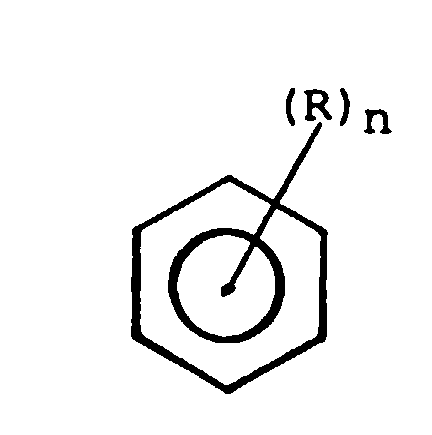
- the present invention relates to a process of polymerising butadiene-1,3 to produce primarily linear, substantially gel free cis-1,4-poly(butadiene), comprising the polymerisation in the presence of a catalyst, comprising at least one cobalt compound, at least one organoaluminium compound, water, and in the presence of a cycloalkane as main solvent component, containing at least one substituted benzene as polymerisation regulator, characterised in that as polymerisation regulator are used compounds of the general formula wherein n is an integer in the range of from 3 to 5. wherein each R represents lower alkoxy group, containing from 1 to 6 carbon atoms and preferably 1-4.
- Suitable modifiers may be selected from those having methoxy, ethoxy, isopropoxy, tert-butoxy, isobutoxy, n-pentoxy or isopentoxy substituents or mixtures thereof.
- More preferred embodiments of presently proposed polymerisation regulators are those containing 3 or 4 of the hereinbefore defined lower alkoxy groups. More preferably compounds are used wherein 3 or 4 methoxy substituents are present.
- the most preferred modifiers was found to be 1,3,5-trimethoxy benzene.
- the polymerisation regulators are in general used in amounts of 100 ppm or less and in particular in amounts of from 5 to 60 ppm relative to the weight of the polymerisation feed (solvent/butadiene/butene). More preferably amounts of from 5 to 40 ppm are used.
- the hereinbefore specified polymerisation regulators are known per se and are manufactured and/or marketed by e.g. APIN Chemicals Ltd., Milton Park, Abingdon, United Kingdom; Indofine Chemical Comp. Inc., Somerville, NJ 8876, USA; Penta Manufacturing Company, Fairfield NJ, USA; Air Products SA, 11760, Brussels, Belgium.
- cycloalkanes useful in the process of the present invention are those having 5 to 8 and preferably 5 or 6 carbon atoms in the rings. They also include methyl and ethyl substituted cycloalkanes. Illustrative examples of said cycloalkanes are cyclopentane, cyclohexane, cycloheptane, cyclooctane, methylcyclopentane, methylcyclohexane, methylcycloheptane, methycyclooctane, dimethylcyclopentane, dimethylcyclohexane, dimethylcycloheptane, ethylcyclopentane, ethylcylohexane, ethylcyclooctane or mixtures thereof.
- Preferred are unsubstituted cycloalkanes.
- Most preferred solvents are cyclopentane or cyclohexane.
- solvent One of the purposes of a solvent in this process is to control the polymerisation temperature by refluxing the solvent and to keep dissolved the formed polymer. Often the desired temperature control is difficult to accomplish with only one solvent. However, by selecting two or more solvents which have certain desirable boiling points, the polymerisation temperature can be relatively easily controlled. Therefore, the selection of the secondary solvent will depend primarily on its boiling point and the temperature that is to be maintained during polymerisation. Thus by “solvent” is meant either a cycloalkane solvent or a mixture of two or more solvents which is substantially free of aromatics and in particular benzene. In any event the monomer and the resulting polymer should be substantially soluble in the solvent.
- Useful secondary solvents are saturated aliphatic hydrocarbons for example hexane, heptane or octane; olefins having 2 to 10 carbons for example butene-1, pentene-1 or hexene-1.
- Various ISOPAR solvents are also found to be useful. They are a mixture of isoparaffinic hydrocarbon fractions boiling at certain temperature ranges. For example, ISOPAR C is primarily 2,2,4-trimethylpentane and other trimethyl pentane isomers. This mixture boils at a range of approximately 206-220°F (96.7 - 104°C).
- the preferred secondary solvents are ⁇ -olefins, especially butene-1.
- the secondary solvent may be used in an amount 0 percent to 80 percent by weight of the cycloalkane solvent, and more preferably from 5 to 30 percent.
- a molecular weight modifier may be employed in the process of this invention in order to control the molecular weight of the product.
- the molecular weight may be controlled by the monomer concentration, the catalyst concentration and the ratio of the two catalyst components. However, it may be more convenient or more economical to employ a molecular weight modifier.
- Illustrative examples of particular useful molecular weight modifiers are non-conjugated dienes preferably those having 2 to 18 carbon atoms such as 1,2-butadiene, 1,4- and 1,5-hexadiene and the like; cyclic dienes preferably those having 6 to 12 carbon atoms such as 1,4-cyclohexadiene and 1,2 and 1,5-cyclooctadiene and the like.
- the molecular weight modifier is generally used in the amount of significantly less than 0.1 to 2 percent by weight of the cycloalkane, and more preferably from 200 ppm or less.
- the cobalt compound can be any organic compound such as the cobalt salts of organic acids, cobalt complexes and the like, since the cobalt compound preferably should be soluble in the solvent or the monomer.
- Typical of such solvent or monomer soluble cobalt compounds are cobalt octoate, cobalt sorbate, cobalt adipate, cobalt 2-ethylhexanoate, cobalt stearate, cobalt acetylacetonate and the like compounds wherein the organic portion of the molecule contains about 5 to 20, preferably 8 to 18 carbon atoms and one or two carboxylic functions, as well as acetylacetonate, as are well known to those skilled in the art.
- the other essential catalyst component is an organoalumnium compound preferably an alkyl aluminium halide which can be used as a mono- or dialkyl aluminium halide, a mixture thereof, or a mixture of R 3 Al, R 2 AlX, RAlS 2 or AlX 3 type compounds wherein R is an alkyl and X is halogen, more preferably, the chloride.
- the alkyl groups normally contain 1 to 12 carbon atoms, more preferably, about 2 to 8 carbon atoms.
- dialkyl aluminium chlorides wherein the alkyl contains 2 to 6 carbon atoms
- sesquichloride which is a mixture of aluminium trichloride and trialkyl aluminium, normally having a composition of about R 1.5-1.9 AlX 1.6-1.1 .
- Typical catalyst combinations are cobalt II octoate + Et 1.66 AlCl 1.33 ; cobalt II ethylhexoate + Et 1.33 AlCl + H 2 O; cobalt-acetylacetone + AlHCl 2 -ether; cobalt-3-acetylacetonate +Et 3 Al 2 Cl 3 + ethyl acetate; cobalt diacetylacetonate + Et 2 AlCl; cobalt stearate + Et 2 AlCl; cobalt acetylacetonate - Et 2 AlCl; and the like.
- These catalyst components are well known and clearly defined in the patent literature, including the molar ratio of cobalt to aluminium and the amounts of catalyst components used.
- the amounts of catalyst used based on cobalt will generally be at least about 0.0005 millimol per 100 grams of butadiene up to about 5 to 10 millimols of cobalt per 100 grams. Normally, it is preferred to use from about 0.005 to about 0.5 millimols of cobalt per 100 grams of monomer.
- the concentration of aluminium will vary generally from as low as about 0.5 millimols to about 10 millimols or more per 100 grams of monomer, preferably about 1 to 4 millimoles. This generally means that less than about 2% by weight of total catalyst will be used.
- a preferred aluminium to cobalt ratio is from about 50 to about 300, and more preferably about 100 to 200. Trace amounts of water are also a useful component of the polymerisation recipe, normally added either in the solvents or monomers.
- the water to aluminium ratio often used is from about 0.1 to about 0.7 but ratios as low as 0.05 to as high as 0.9 are contemplated.
- the catalyst components may be added in any order to the polymerisation mixture or they may be premixed if desired. Solvents and/or monomer may be present during the addition of catalyst. Agitation is beneficial to obtain good heat transfer and diffusion of monomers. Batch and continuous polymerisations may be employed. It is understood, of course, that other than the catalyst water added to the polymerisation, precautions are normally taken to exclude moisture and air, particularly oxygen and oxygen-containing materials. Moisture is normally controlled to the desired amount by use of dry reactants and maintaining an inner dry atmosphere over the polymerisation materials including charging procedures.
- polymerisation procedures may be followed.
- One useful method is to charge the solvents and the monomer and then the catalyst components.
- the polymerisation may be conducted within a temperature range of from -35°C up to about 100°C. Normally the polymerisation is conducted at a temperature in the range of from -10°C to 50°C, and preferably between 5° and 40°C.
- a pressure autoclave may be employed and the pressure of the system, if any, at this temperature normally is observed.
- the process of this invention is particularly effective when it is employed in combination with a specific order of addition of the catalysts the solvents and the monomer.
- a preferred embodiment of the process of the present invention to produce primarily linear, gel-free cis-1,4-polybutadiene is carried out in the presence of a catalyst comprising a mixture of a cobalt compound, at least one organoaluminium compound and water, characterised in that it comprises
- the molar ratio of aluminium to cobalt be in the range of 50:1 to 800:1 and more preferably 50:1 to 300:1; the molar ratio of chlorine to aluminium be in the range of 0.5:1 to 1.5:1 and the molar ratio of water to aluminium be in the range of 0.1:1 to 0.7:1 and more preferably 0.45:1 to 0.55:1.
- the cobalt compound is pre-dissolved in an appropriate cycloalkane solvent.
- a convenient procedure is to first prepare a solution of a cobalt compound in a solvent such as cyclohexane the concentration of which is approximately 12 percent based on the cobalt (which solution is available commercially). Then the solution is diluted with either the same solvent or with alkylsubstituted benzene or a mixture thereof to the concentration of 0.0063 millimole/cc. of the cobalt compound. Of course, the dilution could be made to a higher or a lower concentration if desired.
- the most preferred modification of the present improved process comprises mixing the starting monomer with solvent, water and the aluminium containing starting reagent and mixing this cocatalyst containing solution with the cobalt component and a polymerisation regulator, as specified hereinbefore.
- solvent is meant a specific solvent or a mixture of two or more solvents, the mixtures being preferred.
- Conversion of butadiene-1,3 to cis-1,4-polybutadiene is in the range of from 30 to 90 percent, but the degree of conversion is dependent on the concentration of butadiene, total catalyst concentration, catalyst component ratios, nature of the solvent, time of reaction, temperature and possible other factors.
- the reaction is normally stopped with an agent that reacts with the catalyst, such as water and alcohol, carboxylic acid, acetone, amine and the like, to destroy the catalyst and convert it to an oxygen insensitive material.
- an agent that reacts with the catalyst such as water and alcohol, carboxylic acid, acetone, amine and the like
- This step is normally carried out in the absence of air. It is also often desirable to treat the reaction mixture to remove the catalyst residues. This can be effected for example by water washes, alcohol washes and the like.
- the polymer may be simultaneously precipitated by the addition of alcohol solvent mixtures that both destroy the catalyst and precipitate the polymer as a solid crumb which may be further washed with water or alcohol which is thereafter dried.
- Microstructure determination (1,4-cis-content) was carried out with Fourier Transform InfraRed (FT-IR) spectroscopy using solutions of the polymer in CS 2 .
- FT-IR Fourier Transform InfraRed
- Cobalt (II) acetylacetonate (ex-Chemische Fabriek Zaltbommel) and methoxy-substituted benzenes (ex-Aldrich Chem. Co.) were used as received.
- Polymerisations were carried out in 0.5 L glass pressure bottles equipped with a rubber seal. After addition of ca. 150 gram of a mixture of cyclohexane, 1,-butadiene, 1-butene and water and equilibration to the desired temperature (using a thermostated water-bath tumbler) an amount of DEAC in cyclohexane is added as to adjust the water/DEAC ratio to 0.5. Typically, at a water concentration of 30 ppm, 5 ml of a 0.1 M solution of DEAC is used to give a DEAC level of ca. 400 ppm on feed.
- polymerisatin rate moderator and cobalt (II) acetylacetonate are added to start the polymerisation, which is allowed to proceed for 30-180 min.
- the polymerisation is terminated by addition of a BHT/methanol mixture and a weighed sample is taken and dried overnight in a vacuum stove at 40°C for conversion determination and polymer analysis.
- Table 1 shows conversion data of polymerisations carried out in the presence of various concentrations of different methoxy-substituted benzenes.
- a feed ratio of butadiene/butene/cyclohexane of 10/55/35 is used applying a cobalt level of 1.5 ppm wt. on feed at 30°C.
- Table II shows conversion data of polymerisations carried out in the presence of various concentrations of 1,3,5-TMB and 1,2,4,5-tetramethylbenzene (durene).
- a feed ratio of butadiene/butene/cyclohexane of 15/55/30 is used applying a cobalt level of 1.5 ppm wt. on feed at 15°C.
Landscapes
- Chemical & Material Sciences (AREA)
- Health & Medical Sciences (AREA)
- Chemical Kinetics & Catalysis (AREA)
- Medicinal Chemistry (AREA)
- Polymers & Plastics (AREA)
- Organic Chemistry (AREA)
- Transition And Organic Metals Composition Catalysts For Addition Polymerization (AREA)
- Addition Polymer Or Copolymer, Post-Treatments, Or Chemical Modifications (AREA)
Claims (8)
- Procédé de fabrication de 1,4-poly(butadiène) à teneur élevée en cis essentiellement exempt de gel, linéaire, comprenant la polymérisation de butadiène-1,3 en présence d'un catalyseur, comprenant au moins un composé de cobalt, au moins un composé d'organoaluminium, de l'eau, et en présence d'un cycloalcane comme composant de solvant principal, contenant au moins un benzène substitué comme régulateur de polymérisation, caractérisé en ce qu'on utilise comme régulateur de polymérisation des composés de la formule générale :dans laquelle n est un nombre entier dans la gamme de 3 à 5 et dans laquelle chaque R représente un groupe alcoxy inférieur contenant de 1 à 6 atomes de carbone.
- Procédé suivant la revendication 1, caractérisé en ce que chaque R représente un groupe alcoxy inférieur contenant de 1 à 4 atomes de carbone.
- Procédé suivant la revendication 1, caractérisé en ce que le régulateur de polymérisation contient 3 ou 4 groupes alcoxy inférieurs.
- Procédé suivant la revendication 3, caractérisé en ce que 3 ou 4 groupes méthoxy sont présents.
- Procédé suivant la revendication 4, caractérisé en ce qu'on utilise le 1,3,5-triméthoxybenzène comme régulateur de polymérisation.
- Procédé suivant l'une quelconque des revendications 1 à 5, caractérisé en ce que le régulateur de polymérisation est utilisé en des quantités de 5 à 60 ppm.
- Procédé suivant la revendication 7, caractérisé en ce que le régulateur de polymérisation est utilisé en des quantités de 5 à 40 ppm.
- Procédé suivant l'une quelconque des revendications 1 à 7, caractérisé en ce que comme solvant principal on utilise un cycloalcane, comportant 5 ou 6 atomes de carbone.
Priority Applications (1)
| Application Number | Priority Date | Filing Date | Title |
|---|---|---|---|
| EP19960202878 EP0770631B1 (fr) | 1995-10-18 | 1996-10-16 | Procédé de préparation de polybutadiène à haute teneur en cis |
Applications Claiming Priority (3)
| Application Number | Priority Date | Filing Date | Title |
|---|---|---|---|
| EP95307411 | 1995-10-18 | ||
| EP95307411 | 1995-10-18 | ||
| EP19960202878 EP0770631B1 (fr) | 1995-10-18 | 1996-10-16 | Procédé de préparation de polybutadiène à haute teneur en cis |
Publications (2)
| Publication Number | Publication Date |
|---|---|
| EP0770631A1 EP0770631A1 (fr) | 1997-05-02 |
| EP0770631B1 true EP0770631B1 (fr) | 2000-06-21 |
Family
ID=26140405
Family Applications (1)
| Application Number | Title | Priority Date | Filing Date |
|---|---|---|---|
| EP19960202878 Expired - Lifetime EP0770631B1 (fr) | 1995-10-18 | 1996-10-16 | Procédé de préparation de polybutadiène à haute teneur en cis |
Country Status (1)
| Country | Link |
|---|---|
| EP (1) | EP0770631B1 (fr) |
Families Citing this family (2)
| Publication number | Priority date | Publication date | Assignee | Title |
|---|---|---|---|---|
| KR100344230B1 (ko) * | 1999-10-13 | 2002-07-24 | 금호석유화학 주식회사 | 산소분자를 이용한 하이드록시 고 1,4-시스 폴리부타디엔의 제조방법 |
| US6887956B2 (en) | 2000-10-12 | 2005-05-03 | Dow Global Technologies Inc. | Catalyst system for high-cis polybutadiene |
Family Cites Families (4)
| Publication number | Priority date | Publication date | Assignee | Title |
|---|---|---|---|---|
| FR77017E (fr) * | 1954-12-02 | 1962-01-08 | Goodrich Gulf Chem Inc | Perfectionnements apportés à la production de polymères et de copolymères d'hydrocarbures polyoléfines conjugués |
| US4314045A (en) * | 1978-11-13 | 1982-02-02 | The B. F. Goodrich Company | Polymerization process for cis-1,4-polybutadiene using aliphatic solvents and an aromatic polymerization regulator |
| US4224426A (en) * | 1978-11-13 | 1980-09-23 | The B. F. Goodrich Company | Polymerization process for cis-1,4-polybutadiene using cycloalkane solvents and an aromatic polymerization regulator |
| US4696986A (en) * | 1986-08-12 | 1987-09-29 | The Goodyear Tire & Rubber Company | Modifier for lithium catalysts |
-
1996
- 1996-10-16 EP EP19960202878 patent/EP0770631B1/fr not_active Expired - Lifetime
Also Published As
| Publication number | Publication date |
|---|---|
| EP0770631A1 (fr) | 1997-05-02 |
Similar Documents
| Publication | Publication Date | Title |
|---|---|---|
| KR100338903B1 (ko) | 시스-1,4-폴리부타디엔의분자량감소및가공성개선방법 | |
| EP0652239B1 (fr) | Procédé de préparation de polybutadiène-1,4-cis ayant une formation de gel réduite | |
| US5905125A (en) | Process for producing polybutadiene | |
| US5519101A (en) | Process for preparation of unsaturated oligomers or polymers by acyclic olefin metathesis | |
| US3966697A (en) | Production of high-vinyl group, high-molecular weight unsaturated hydrocarbon polymers | |
| US5691429A (en) | Manufacturing process for high cis poly(butadiene) | |
| RU2141382C1 (ru) | Способ получения катализатора полимеризации и сополимеризации ненасыщенных углеводородов | |
| EP0823441B1 (fr) | Catalyseur contenant du cobalt | |
| US4224426A (en) | Polymerization process for cis-1,4-polybutadiene using cycloalkane solvents and an aromatic polymerization regulator | |
| EP0770631B1 (fr) | Procédé de préparation de polybutadiène à haute teneur en cis | |
| JP2004204229A (ja) | 希土類元素系触媒の存在下における分岐したポリジエンの製造方法 | |
| US4303769A (en) | Process for preparing substantially gel-free cis-1,4-polybutadiene | |
| Throckmorton et al. | An HF-Nickel-R3Al catalyst system for producing high cis-1, 4-polybutadiene | |
| JPH10330428A (ja) | ポリブタジエンの製造方法 | |
| EP1325040B1 (fr) | Systeme catalyseur pour polybutadiene a caractere cis eleve | |
| US4031300A (en) | High molecular weight, high unsaturation isobutylene-cyclopentadiene copolymers | |
| US4314045A (en) | Polymerization process for cis-1,4-polybutadiene using aliphatic solvents and an aromatic polymerization regulator | |
| US3472824A (en) | Sulfur curable copolymers of olefins and iso-ethenyl norbornenes and method for production thereof | |
| JP3614275B2 (ja) | ポリブタジエンの製造方法 | |
| EP0652234B1 (fr) | Encrassement réduit dans un procédé pour la préparation de EP | |
| KR830001101B1 (ko) | 지방족용매와 방향족 중합 조절제를 사용한 시스-1, 4-폴리부타디엔의 중합 공정 | |
| US3756995A (en) | Svanadium compound trialkyl aluminum haloorganic acid catalytic proces | |
| WO2003102041A1 (fr) | Procede de polymerisation de butadiene en deux etapes pour produire du 1,4-polybutadiene a cis eleve | |
| CA1108798A (fr) | Polymerisation du butadiene dans un milieu pauvre en benzene | |
| CA1074047A (fr) | Procede pour polymeriser des alcenes-1 |
Legal Events
| Date | Code | Title | Description |
|---|---|---|---|
| PUAI | Public reference made under article 153(3) epc to a published international application that has entered the european phase |
Free format text: ORIGINAL CODE: 0009012 |
|
| AK | Designated contracting states |
Kind code of ref document: A1 Designated state(s): AT BE CH DE DK ES FI FR GB GR IE IT LI NL PT SE |
|
| 17P | Request for examination filed |
Effective date: 19970910 |
|
| 17Q | First examination report despatched |
Effective date: 19980209 |
|
| GRAG | Despatch of communication of intention to grant |
Free format text: ORIGINAL CODE: EPIDOS AGRA |
|
| GRAG | Despatch of communication of intention to grant |
Free format text: ORIGINAL CODE: EPIDOS AGRA |
|
| GRAH | Despatch of communication of intention to grant a patent |
Free format text: ORIGINAL CODE: EPIDOS IGRA |
|
| GRAH | Despatch of communication of intention to grant a patent |
Free format text: ORIGINAL CODE: EPIDOS IGRA |
|
| GRAA | (expected) grant |
Free format text: ORIGINAL CODE: 0009210 |
|
| RAP1 | Party data changed (applicant data changed or rights of an application transferred) |
Owner name: THE DOW CHEMICAL COMPANY |
|
| AK | Designated contracting states |
Kind code of ref document: B1 Designated state(s): AT BE CH DE DK ES FI FR GB GR IE IT LI NL PT SE |
|
| PG25 | Lapsed in a contracting state [announced via postgrant information from national office to epo] |
Ref country code: LI Free format text: LAPSE BECAUSE OF FAILURE TO SUBMIT A TRANSLATION OF THE DESCRIPTION OR TO PAY THE FEE WITHIN THE PRESCRIBED TIME-LIMIT Effective date: 20000621 Ref country code: GR Free format text: LAPSE BECAUSE OF NON-PAYMENT OF DUE FEES Effective date: 20000621 Ref country code: FI Free format text: LAPSE BECAUSE OF FAILURE TO SUBMIT A TRANSLATION OF THE DESCRIPTION OR TO PAY THE FEE WITHIN THE PRESCRIBED TIME-LIMIT Effective date: 20000621 Ref country code: CH Free format text: LAPSE BECAUSE OF FAILURE TO SUBMIT A TRANSLATION OF THE DESCRIPTION OR TO PAY THE FEE WITHIN THE PRESCRIBED TIME-LIMIT Effective date: 20000621 Ref country code: AT Free format text: LAPSE BECAUSE OF FAILURE TO SUBMIT A TRANSLATION OF THE DESCRIPTION OR TO PAY THE FEE WITHIN THE PRESCRIBED TIME-LIMIT Effective date: 20000621 |
|
| REF | Corresponds to: |
Ref document number: 194008 Country of ref document: AT Date of ref document: 20000715 Kind code of ref document: T |
|
| REG | Reference to a national code |
Ref country code: CH Ref legal event code: EP |
|
| REG | Reference to a national code |
Ref country code: IE Ref legal event code: FG4D |
|
| REF | Corresponds to: |
Ref document number: 69608941 Country of ref document: DE Date of ref document: 20000727 |
|
| ITF | It: translation for a ep patent filed | ||
| PG25 | Lapsed in a contracting state [announced via postgrant information from national office to epo] |
Ref country code: SE Free format text: LAPSE BECAUSE OF FAILURE TO SUBMIT A TRANSLATION OF THE DESCRIPTION OR TO PAY THE FEE WITHIN THE PRESCRIBED TIME-LIMIT Effective date: 20000921 Ref country code: DK Free format text: LAPSE BECAUSE OF FAILURE TO SUBMIT A TRANSLATION OF THE DESCRIPTION OR TO PAY THE FEE WITHIN THE PRESCRIBED TIME-LIMIT Effective date: 20000921 |
|
| ET | Fr: translation filed | ||
| REG | Reference to a national code |
Ref country code: ES Ref legal event code: FG2A Ref document number: 2147894 Country of ref document: ES Kind code of ref document: T3 |
|
| PG25 | Lapsed in a contracting state [announced via postgrant information from national office to epo] |
Ref country code: IE Free format text: LAPSE BECAUSE OF NON-PAYMENT OF DUE FEES Effective date: 20001016 |
|
| REG | Reference to a national code |
Ref country code: PT Ref legal event code: SC4A Free format text: AVAILABILITY OF NATIONAL TRANSLATION Effective date: 20000825 |
|
| REG | Reference to a national code |
Ref country code: CH Ref legal event code: PL |
|
| PLBE | No opposition filed within time limit |
Free format text: ORIGINAL CODE: 0009261 |
|
| STAA | Information on the status of an ep patent application or granted ep patent |
Free format text: STATUS: NO OPPOSITION FILED WITHIN TIME LIMIT |
|
| 26N | No opposition filed | ||
| REG | Reference to a national code |
Ref country code: IE Ref legal event code: MM4A |
|
| REG | Reference to a national code |
Ref country code: GB Ref legal event code: IF02 |
|
| PG25 | Lapsed in a contracting state [announced via postgrant information from national office to epo] |
Ref country code: PT Free format text: LAPSE BECAUSE OF NON-PAYMENT OF DUE FEES Effective date: 20020430 |
|
| REG | Reference to a national code |
Ref country code: PT Ref legal event code: MM4A Free format text: LAPSE DUE TO NON-PAYMENT OF FEES Effective date: 20020430 |
|
| PGFP | Annual fee paid to national office [announced via postgrant information from national office to epo] |
Ref country code: NL Payment date: 20040827 Year of fee payment: 9 |
|
| PGFP | Annual fee paid to national office [announced via postgrant information from national office to epo] |
Ref country code: GB Payment date: 20040923 Year of fee payment: 9 |
|
| PGFP | Annual fee paid to national office [announced via postgrant information from national office to epo] |
Ref country code: ES Payment date: 20041007 Year of fee payment: 9 |
|
| PGFP | Annual fee paid to national office [announced via postgrant information from national office to epo] |
Ref country code: BE Payment date: 20041015 Year of fee payment: 9 |
|
| PG25 | Lapsed in a contracting state [announced via postgrant information from national office to epo] |
Ref country code: GB Free format text: LAPSE BECAUSE OF NON-PAYMENT OF DUE FEES Effective date: 20051016 |
|
| PG25 | Lapsed in a contracting state [announced via postgrant information from national office to epo] |
Ref country code: ES Free format text: LAPSE BECAUSE OF NON-PAYMENT OF DUE FEES Effective date: 20051017 |
|
| PG25 | Lapsed in a contracting state [announced via postgrant information from national office to epo] |
Ref country code: BE Free format text: LAPSE BECAUSE OF NON-PAYMENT OF DUE FEES Effective date: 20051031 |
|
| PG25 | Lapsed in a contracting state [announced via postgrant information from national office to epo] |
Ref country code: NL Free format text: LAPSE BECAUSE OF NON-PAYMENT OF DUE FEES Effective date: 20060501 |
|
| GBPC | Gb: european patent ceased through non-payment of renewal fee |
Effective date: 20051016 |
|
| NLV4 | Nl: lapsed or anulled due to non-payment of the annual fee |
Effective date: 20060501 |
|
| REG | Reference to a national code |
Ref country code: ES Ref legal event code: FD2A Effective date: 20051017 |
|
| BERE | Be: lapsed |
Owner name: THE *DOW CHEMICAL CY Effective date: 20051031 |
|
| PG25 | Lapsed in a contracting state [announced via postgrant information from national office to epo] |
Ref country code: PT Free format text: LAPSE BECAUSE OF NON-PAYMENT OF DUE FEES Effective date: 20001016 |
|
| REG | Reference to a national code |
Ref country code: FR Ref legal event code: TP Owner name: STYRON EUROPE GMBH, CH Effective date: 20120412 |
|
| REG | Reference to a national code |
Ref country code: FR Ref legal event code: GC Effective date: 20120423 |
|
| PGFP | Annual fee paid to national office [announced via postgrant information from national office to epo] |
Ref country code: FR Payment date: 20121107 Year of fee payment: 17 Ref country code: DE Payment date: 20121029 Year of fee payment: 17 |
|
| PGFP | Annual fee paid to national office [announced via postgrant information from national office to epo] |
Ref country code: IT Payment date: 20121024 Year of fee payment: 17 |
|
| REG | Reference to a national code |
Ref country code: DE Ref legal event code: R119 Ref document number: 69608941 Country of ref document: DE Effective date: 20140501 |
|
| REG | Reference to a national code |
Ref country code: FR Ref legal event code: ST Effective date: 20140630 |
|
| PG25 | Lapsed in a contracting state [announced via postgrant information from national office to epo] |
Ref country code: DE Free format text: LAPSE BECAUSE OF NON-PAYMENT OF DUE FEES Effective date: 20140501 Ref country code: IT Free format text: LAPSE BECAUSE OF NON-PAYMENT OF DUE FEES Effective date: 20131016 Ref country code: FR Free format text: LAPSE BECAUSE OF NON-PAYMENT OF DUE FEES Effective date: 20131031 |