EP0770728A2 - Séchoir pour papier et procédé pour le séchage d'une bande de papier dans ce séchoir - Google Patents
Séchoir pour papier et procédé pour le séchage d'une bande de papier dans ce séchoir Download PDFInfo
- Publication number
- EP0770728A2 EP0770728A2 EP96115184A EP96115184A EP0770728A2 EP 0770728 A2 EP0770728 A2 EP 0770728A2 EP 96115184 A EP96115184 A EP 96115184A EP 96115184 A EP96115184 A EP 96115184A EP 0770728 A2 EP0770728 A2 EP 0770728A2
- Authority
- EP
- European Patent Office
- Prior art keywords
- drying
- rotatable drum
- paper web
- fabric sheet
- paper
- Prior art date
- Legal status (The legal status is an assumption and is not a legal conclusion. Google has not performed a legal analysis and makes no representation as to the accuracy of the status listed.)
- Withdrawn
Links
Images
Classifications
-
- D—TEXTILES; PAPER
- D21—PAPER-MAKING; PRODUCTION OF CELLULOSE
- D21F—PAPER-MAKING MACHINES; METHODS OF PRODUCING PAPER THEREON
- D21F5/00—Dryer section of machines for making continuous webs of paper
- D21F5/18—Drying webs by hot air
- D21F5/182—Drying webs by hot air through perforated cylinders
Definitions
- the present invention relates to a paper drying machine and a method of drying a paper web in a paper drying machine. More particularly, the invention pertains to a paper drying machine which employs through air drying of a paper web in two different directions.
- Paper products have conventionally been manufactured by forming a wet paper web on a fabric carrying sheet which then carries the paper web through a pressing section to remove the excess water from the web. After pressing the web to remove excess water, the paper web would then be fed to a separate drying section to fully remove the remaining moisture from the web.
- This step of pressing the web did not function effectively with the presently required high-speed operation of such papermaking machines. Therefore, as opposed to leaving the web as a flat sheet on a single plane, rotatable steam-heated drum dryers over which the web traveled were utilized, The cost of supplying steam to these multiple drum dryers for heating the dryers is quite high and the ability to maintain uniform drum surface temperatures and humidity in the dryers is difficult.
- dryer hoods are widely used in connection with these rotary drums, wherein pressurized drying air, instead of steam, is introduced at various points in the hood to contact one exposed surface of the wet web as it progresses around the dryer with the exit path for the air being positioned on the other side of the rotary drum.
- pressurized drying air instead of steam
- TAD through air drying
- U.S. Patent No. 3,432,936 issued to Sisson discloses one such drying assembly in which a moving stream of pressurized drying air is circulated about a paper web traveling about the periphery of a rotatable roll having apertures formed therein.
- Sisson utilizes a system where the hot drying air travels from the inside of the rotatable roll to the outside through the apertures, while the web travels about the outer surface of the roll.
- this inside-to-outside type drying requires smaller diameter rolls because the roll metal is on the hot side of the web, and larger diameter rolls create roll integrity problems with this inside-to-outside drying.
- U.S. Patent No. 3,432,936 issued to Cole et al. avoids the problems with inside-to-outside drying by employing a configuration which moves drying air from the exterior of a rotatable roll through the paper web and into the interior of the rotatable roll, otherwise known as outside-to-inside drying.
- This configuration positions the metal rotatable roll on the cool side of the paper web which allows larger diameter rotatable rolls to be used.
- at least two carrying rolls must contact the paper web.
- a carrying roll machine runability problems as well as product quality problems are encountered.
- 1,718,573 issued to Millspaugh discloses a paper making machine which discloses removing moisture from a paper web in an outside-to-inside fashion using a suction roll followed by an inside-to-outside removal of moisture by forcing steam through the paper web as it passes over a blower roll. It should be noted, however, that the device disclosed by Millspaugh utilizes steam with its blower roll, wherein the same problems discussed in the above prior art associated with using steam in a paper drying device are present in Millspaugh. Furthermore, it is economically more efficient and proficient to employ heated air rather than a combination of air and steam when using a blowing device to dry a wet paper web.
- Another object of the present invention is to provide a paper drying apparatus which employs through-air-drying of a paper web in different directions in order to make optimal use of the available space in a drying apparatus.
- Yet another object of the present invention is to provide a paper drying apparatus in which the paper web never contacts a carrying roll so that product quality is increased and machine runability problems may be avoided.
- a paper drying apparatus including a first rotatable drum, wherein the first rotatable drum has a inner perimeter and an outer perimeter.
- the paper drying apparatus also includes a second rotatable drum having an inner perimeter and an outer perimeter, and fabric sheet for carrying a paper web, wherein the fabric sheet passes around the outer perimeter of the first rotatable drum and succeeds to next pass around the outer perimeter of the second rotatable drum.
- the fabric sheet conveys the paper web around the first rotatable drum, drying air is applied to the paper web in a direction from the inner perimeter of the first rotatable drum toward the outer perimeter of the first rotatable drum and further passing through the paper web.
- drying air is applied to the paper web in a direction from the outer perimeter of the second rotatable drum toward the inner perimeter of the second rotatable drum, and further passing through the paper web in a similar direction.
- the fabric sheet then conveys the paper web toward a final drying drum where the paper web is transferred from the fabric sheet to the final drying drum through the use of a pressure roll.
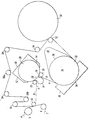
- the paper drying apparatus in accordance with the present invention is illustrated for removing moisture from a wet paper web 4 which is the product of a paper making machine.
- the paper web 4 is carried from a paper making process to the drying device by a fabric sheet 2, wherein the fabric sheet travels about the perimeter of couch roller 5 and roller 6.
- the fabric sheet 8 In between rollers 5 and 6, the paper web 4 is contacted by and transferred to fabric sheet 8 as the fabric sheet 8 passes by pick up device 10.
- the fabric sheet 8 conveys the paper web 4 throughout the drying apparatus and forms a single loop through the drying apparatus and returning to the paper web transfer area at pick up shoe 10.
- Pick up device 10 may comprise a transfer roller, transfer shoe or any other structure to transfer the paper web 4 from fabric sheet 2 to fabric sheet 8.
- Such transfer devices often employ a vacuum to aid in the transfer of the paper web from one transfer fabric to another.
- the fabric sheet 8 carries paper web 4 into a first drying chamber 12.
- the drying chamber 12 comprises a rotatable drum 14, a heated air supply 16, and an exhaust area 18 for providing an exit for the heated air within the drying chamber 12.
- Rotatable drum 14 has a porous surface permeable to air so that the drying air provided by air supply 16 passes through the surface of the drum 14 and into the interior 20 of the drum 14.
- the paper web 4 passes between a carrier roll 22 and the rotatable drum 14. In order to minimize any machine downtime due to running problems, the wet paper web 4 does not contact carrier roll 22.
- the path of the fabric sheet 8 and paper web 4 is such that fabric sheet 8 contacts carrier roll 22 as the fabric sheet 8 and web 4 passes by carrier roll 22 while the paper web 4 abuts rotatable drum 14. Thereafter, the paper web 4 and fabric sheet 8 travel about the perimeter of the drum 14 as it rotates within drying chamber 12. After traveling about a substantial portion of the perimeter of the rotatable drum 14, the paper web 4 and fabric sheet 8 exit the first drying chamber 12 at 24, where the web and sheet pass between the rotatable drum 14 and a carrier roll 26. Similar to the path of the fabric sheet 8 as it enters drying chamber 12, fabric sheet 8 remains in contact with carrier roll 26 while paper web 4 is abutting rotatable drum 14.
- Carrier rolls 22 and 26 are positioned with respect to rotatable drum 14 to create additional tension in the fabric sheet 8 while passing through drying chamber 12 in order to maximize the contact between the paper web 4 and the surface of the rotatable drum 14. Additionally, the distance and angle of the fabric sheet 8 between pick up shoe 10 and carrier roll 22 can be adjusted to accommodate various sized rotatable drums for desired drying characteristics.
- the drying chamber 12 employs through-air-drying (TAD) to remove moisture from the paper web 4 while it travels around the perimeter of the rotatable drum 14.
- TAD through-air-drying
- the air supply 16 is situated between carrier rolls 22 and 26 so that the air supply 16 forces air into the interior 20 of drum 14 through a portion 28 of the rotatable drum 14 on which the fabric sheet 8 does not travel.
- the air then travels from the interior 20 of the drum 14 through the porous surface of the drum 14 toward the exhaust port 18 in drying chamber 12. Accordingly, as the air passes through the surface of the drum, the air is forced through the paper web 4 which is traveling about the surface of the rotatable drum 14.
- the path of the drying air is known as inside-to-outside TAD, because the air is traveling from the inside of the drum 14 to the outside of the drum 14 while it is removing moisture from the paper web 4. While the inside-to-outside drying air exits the rotatable drum 14 and passes through paper web 4, the air applies a force to lift the paper web 4 from the surface of the drum 14, wherein the tautness of the fabric sheet 8 resists this force and holds the paper web 4 in abutment to drum 14.
- Drying chamber 30 also includes a rotatable drum 32 which employs TAD to further dry the paper web 4; however, drying chamber 30 employs outside to inside drying air as opposed to the inside-to-outside drying air used in chamber 12.
- the fabric sheet 8 enters drying chamber 30 and travels about an outer surface of the rotatable drum 32, wherein the fabric sheet 8 is in abutment with the surface of rotatable drum 32.
- Drying chamber 30 includes a heated air supply 34 which forces heated air initially through the paper web 4 as the web 4 rotates through the drying chamber 30, then the air passes through the fabric sheet 8, and finally the air passes through the air permeable surface of the rotatable drum 32 into the interior 36 of the drum. After passing into the interior 36 of drum 32, the air passes through a portion 38 of rotatable drum 32 on which the fabric sheet 8 does not travel and exits the drying chamber 30 through an exhaust hood 40.
- the exhaust hood 40 extends around the portion 38 of the rotatable drum 32 from where the fabric sheet 8 enters rotatable drum 32 to where the fabric sheet 8 exits rotatable drum 32. While rotatable drum 32 may be similar in size to rotatable drum 14, rotatable drum 32 can be larger in diameter than drum 14 as the larger drum is generally more effective in removing moisture from the paper web 4 when using outside-to-inside drying air.
- This arrangement of using one TAD roll with inside-to-outside drying air and another TAD roll with outside-to-inside drying air minimizes the space required for the drying apparatus and improves reliability, as the arrangement allows for the use of at least one large diameter drying roll without roll integrity problems. If strictly inside-to-outside drying was employed, then a large diameter-roll could not be used due to the integrity problems caused by the drying roll being on the hot side of the paper web 4.
- the minimal space required for this double TAD roll configuration allows current paper drying machines to be adapted to include this improved configuration without having to move the large components in the drying process, such as the yankee dryer 50. Therefore, the operational downtime of a paper drying machine which would result from adapting the paper drying machine to incorporate this improved double TAD roll configuration would be minimal.
- the second TAD roll employing outside-to-inside drying air may comprise almost any diameter, the second TAD roll may be selected to include a diameter which most adequately conforms to the spacial requirements of the paper drying machine while taking drying efficiency into account.
- the fabric sheet 8 conveys the paper web 4 from rotatable drum 32 to a final rotatable drying drum 50, conventionally known as a yankee or crepe dryer.
- the fabric sheet 8 and the paper web 4 proceed between the periphery of a pressure roll 52 and the drying drum 50, wherein the pressure roll 52 abuts the fabric sheet 8 and transfers the paper web 4 from the fabric sheet carrier to the perimeter of the drying drum 50.
- the paper web 4 then rotates along with the perimeter of drying drum 50 in a final drying procedure for the paper web 4.
- the fabric sheet 8 continues to travel about the perimeter of a series of carrier rolls 54 to return its loop back to the pick up shoe 10 and repeat the above stated process of drying the paper web 4.
- guide rolls 56a and 56b are adjustably mounted so that their position may be altered to modify the tension of the fabric sheet 8 as it travels through the drying loop.
- the use of a single fabric sheet 8 in conveying the paper web 4 throughout the drying process increases the paper integrity by not transferring the paper web 4 to other conveying sheets while the paper web 4 is still in a substantially wet state, as transferring a wet paper web 4 to another conveying sheet can damage the integrity of the paper bonds and cause runability problems.
- the fabric sheet 8 may be imprinted with a desired pattern which is formed in the paper web 4 as the wet paper web 4 conforms to the surface of the fabric sheet 8. As the paper web 4 is dried while being conveyed by the fabric sheet 8, this pattern is retained by the paper web 4. Therefore, using a single fabric sheet 8 to convey the paper web 4 through the drying process assists in forming this design pattern in the paper web, while transferring of the paper web to another conveying sheet would prevent the registering of the fabric imprint in the paper web.
- first and second TAD rolls may employ either inside-to-outside or outside-to-inside drying air.
- a drying apparatus for a paper web constructed in accordance with the present invention will provide two TAD rolls with one TAD roll employing inside-to-outside drying air and the other TAD roll employing outside-to-inside drying air, thus making the most efficient use of space with two TAD drying rolls without having roll integrity problems.
- the paper web travels through the paper drying apparatus without contacting any carrying rolls which will improve the paper product quality and diminish runability problems of the drying rolls.
Landscapes
- Drying Of Solid Materials (AREA)
- Paper (AREA)
Applications Claiming Priority (2)
| Application Number | Priority Date | Filing Date | Title |
|---|---|---|---|
| US08/549,149 US5636452A (en) | 1995-10-27 | 1995-10-27 | Paper drying machine and method for drying a paper web in a paper drying machine |
| US549149 | 1995-10-27 |
Publications (2)
| Publication Number | Publication Date |
|---|---|
| EP0770728A2 true EP0770728A2 (fr) | 1997-05-02 |
| EP0770728A3 EP0770728A3 (fr) | 1998-05-20 |
Family
ID=24191862
Family Applications (1)
| Application Number | Title | Priority Date | Filing Date |
|---|---|---|---|
| EP96115184A Withdrawn EP0770728A3 (fr) | 1995-10-27 | 1996-09-20 | Séchoir pour papier et procédé pour le séchage d'une bande de papier dans ce séchoir |
Country Status (3)
| Country | Link |
|---|---|
| US (2) | US5636452A (fr) |
| EP (1) | EP0770728A3 (fr) |
| CA (1) | CA2188521C (fr) |
Families Citing this family (8)
| Publication number | Priority date | Publication date | Assignee | Title |
|---|---|---|---|---|
| US7006569B1 (en) * | 1999-02-05 | 2006-02-28 | Samsung Electronics Co., Ltd. | Digital video processing method and apparatus thereof |
| DE19934868A1 (de) * | 1999-07-24 | 2001-01-25 | Voith Paper Patent Gmbh | Beheizter Trockenzylinder |
| US6581301B1 (en) * | 2000-11-21 | 2003-06-24 | Georgia-Pacific Corporation | Paper drying machine |
| US6551461B2 (en) | 2001-07-30 | 2003-04-22 | Kimberly-Clark Worldwide, Inc. | Process for making throughdried tissue using exhaust gas recovery |
| US6568249B2 (en) * | 2001-08-07 | 2003-05-27 | Gilson Company, Inc. | Test method and apparatus for determining the surface saturated dry condition of aggregates |
| US6953516B2 (en) * | 2004-01-16 | 2005-10-11 | Kimberly-Clark Worldwide, Inc. | Process for making throughdried tissue by profiling exhaust gas recovery |
| US7861437B2 (en) * | 2006-02-27 | 2011-01-04 | Metso Paper Usa, Inc. | System and method for mixing distinct air streams |
| EP3947811B1 (fr) * | 2019-03-26 | 2025-09-03 | Toscotec S.p.a. | Sécheur yankee et procédé de fabrication d'un sécheur yankee |
Family Cites Families (13)
| Publication number | Priority date | Publication date | Assignee | Title |
|---|---|---|---|---|
| US1718573A (en) * | 1922-09-14 | 1929-06-25 | Paper & Textile Machinery Comp | Paper-making method and machine |
| US3237316A (en) * | 1962-09-28 | 1966-03-01 | Hans W Sachs | Apparatus for drying continuous lengths of film or paper or the like |
| CH416688A (fr) * | 1965-03-31 | 1966-07-15 | Paillard Sa | Dispositif pour fournir des signaux électriques pour la commande d'un dispositif d'affichage |
| US3303576A (en) * | 1965-05-28 | 1967-02-14 | Procter & Gamble | Apparatus for drying porous paper |
| DE1635346A1 (de) * | 1966-10-12 | 1971-07-08 | Vepa Ag | Verfahren und Vorrichtung zum Waermebehandeln,insbesondere von Textilgut |
| DE1635106A1 (de) * | 1966-12-03 | 1971-03-25 | Vepa Ag | Verfahren und Vorrichtung zum Nassbehandeln von fluessigkeitsdurchlaessigen Guetern |
| US3432936A (en) * | 1967-05-31 | 1969-03-18 | Scott Paper Co | Transpiration drying and embossing of wet paper webs |
| US3889325A (en) * | 1968-08-17 | 1975-06-17 | Vepa Ag | Process for shrinking non-woven webs |
| DE2364346C3 (de) * | 1973-12-22 | 1978-04-06 | J.M. Voith Gmbh, 7920 Heidenheim | Trockeneinrichtung für Papierbahnen o.dgl |
| US3956832A (en) * | 1974-09-13 | 1976-05-18 | Beloit Corporation | Web dryer arrangement |
| US4297794A (en) * | 1977-08-02 | 1981-11-03 | Ingersoll-Rand Company | Paper sheet dryer |
| AU517579B2 (en) * | 1977-10-11 | 1981-08-13 | Kimberly-Clark Corporation | Absorbent creped tissue paper |
| FI102624B (fi) * | 1994-06-23 | 1999-01-15 | Valmet Corp | Menetelmä ja laite paperiradan tai vastaavan kuivatuksessa tai jäähdyt yksessä |
-
1995
- 1995-10-27 US US08/549,149 patent/US5636452A/en not_active Expired - Fee Related
-
1996
- 1996-09-20 EP EP96115184A patent/EP0770728A3/fr not_active Withdrawn
- 1996-10-22 CA CA002188521A patent/CA2188521C/fr not_active Expired - Fee Related
- 1996-12-09 US US08/762,249 patent/US5784801A/en not_active Expired - Fee Related
Also Published As
| Publication number | Publication date |
|---|---|
| CA2188521A1 (fr) | 1997-04-28 |
| EP0770728A3 (fr) | 1998-05-20 |
| US5784801A (en) | 1998-07-28 |
| CA2188521C (fr) | 1999-03-16 |
| US5636452A (en) | 1997-06-10 |
Similar Documents
| Publication | Publication Date | Title |
|---|---|---|
| EP0345266B1 (fr) | Appareil de sechage de bande | |
| US4194947A (en) | Transferring a web from a pick-up fabric to a flow-through drying wire | |
| EP0445487B1 (fr) | Appareil pour le séchage d'une bande | |
| FI94652C (fi) | Laite rainan sivureunan pitämiseksi paperikoneen kuivaimen huopaa seuraavana | |
| KR900018472A (ko) | 종이 웨브 이송장치 | |
| EP0334899B1 (fr) | Dispositif de sechage sequentiel des deux faces d'une bande de papier | |
| US5636452A (en) | Paper drying machine and method for drying a paper web in a paper drying machine | |
| US6336996B1 (en) | Process and device for the transfer of a fibrous material web | |
| JPH07189159A (ja) | 製紙機械用プレス部分 | |
| US6581301B1 (en) | Paper drying machine | |
| JP2516180B2 (ja) | プレス装置 | |
| US5175945A (en) | Apparatus for drying a web | |
| EP1341963B1 (fr) | Procede de modification d'une feuille de tissu sechee a coeur non crepee | |
| US6425981B1 (en) | Apparatus and associated method for drying a wet web of paper | |
| US5337490A (en) | Single tier dryer threading nozzle for paper machines | |
| AU2002236601A1 (en) | Method for calendering an uncreped throughdried tissue sheet | |
| US6916405B2 (en) | Process and device for drying of a material web | |
| US5830323A (en) | Apparatus for dewatering a fiber web | |
| US6436239B2 (en) | Method to reduce the adhesion of a damp fibrous material web to a rotating roll | |
| EP0771904A2 (fr) | Séchoir à infrarouge pour papier et procédé pour le séchage d'une bande de papier dans un séchoir à infrarouge | |
| US20050056393A1 (en) | Serpentine paper drying machine | |
| US20010009181A1 (en) | Press section and method of using the same | |
| WO1996023931A1 (fr) | Appareil de transfert de nappe | |
| JP2585145Y2 (ja) | シートトランスファ装置 | |
| CA2186407A1 (fr) | Systeme de transfert de la section pressage a la section sechage d'une machine a papier |
Legal Events
| Date | Code | Title | Description |
|---|---|---|---|
| PUAI | Public reference made under article 153(3) epc to a published international application that has entered the european phase |
Free format text: ORIGINAL CODE: 0009012 |
|
| 17P | Request for examination filed |
Effective date: 19960920 |
|
| AK | Designated contracting states |
Kind code of ref document: A2 Designated state(s): DE ES FR GB IT |
|
| PUAL | Search report despatched |
Free format text: ORIGINAL CODE: 0009013 |
|
| AK | Designated contracting states |
Kind code of ref document: A3 Designated state(s): DE ES FR GB IT |
|
| RAP1 | Party data changed (applicant data changed or rights of an application transferred) |
Owner name: FORT JAMES CORPORATION |
|
| STAA | Information on the status of an ep patent application or granted ep patent |
Free format text: STATUS: THE APPLICATION IS DEEMED TO BE WITHDRAWN |
|
| 18D | Application deemed to be withdrawn |
Effective date: 19981121 |