EP0771796A1 - Substituierte s-Triazine und Verfahren zu ihrer Herstellung - Google Patents
Substituierte s-Triazine und Verfahren zu ihrer Herstellung Download PDFInfo
- Publication number
- EP0771796A1 EP0771796A1 EP96117262A EP96117262A EP0771796A1 EP 0771796 A1 EP0771796 A1 EP 0771796A1 EP 96117262 A EP96117262 A EP 96117262A EP 96117262 A EP96117262 A EP 96117262A EP 0771796 A1 EP0771796 A1 EP 0771796A1
- Authority
- EP
- European Patent Office
- Prior art keywords
- group
- formula
- alkyl
- bis
- phenyl
- Prior art date
- Legal status (The legal status is an assumption and is not a legal conclusion. Google has not performed a legal analysis and makes no representation as to the accuracy of the status listed.)
- Granted
Links
- 238000002360 preparation method Methods 0.000 title claims abstract description 11
- 238000000034 method Methods 0.000 title claims abstract description 10
- JIHQDMXYYFUGFV-UHFFFAOYSA-N 1,3,5-triazine Chemical class C1=NC=NC=N1 JIHQDMXYYFUGFV-UHFFFAOYSA-N 0.000 title description 2
- 125000001997 phenyl group Chemical group [H]C1=C([H])C([H])=C(*)C([H])=C1[H] 0.000 claims abstract description 17
- 125000000217 alkyl group Chemical group 0.000 claims abstract description 14
- 125000003903 2-propenyl group Chemical group [H]C([*])([H])C([H])=C([H])[H] 0.000 claims abstract description 9
- 125000002877 alkyl aryl group Chemical group 0.000 claims abstract description 7
- 125000005843 halogen group Chemical group 0.000 claims abstract description 7
- 125000003118 aryl group Chemical group 0.000 claims abstract description 6
- 125000003710 aryl alkyl group Chemical group 0.000 claims abstract description 4
- 125000005842 heteroatom Chemical group 0.000 claims abstract description 4
- 125000000623 heterocyclic group Chemical group 0.000 claims abstract description 4
- 125000004433 nitrogen atom Chemical group N* 0.000 claims abstract description 4
- 125000003342 alkenyl group Chemical group 0.000 claims abstract description 3
- 125000000304 alkynyl group Chemical group 0.000 claims abstract description 3
- 125000001624 naphthyl group Chemical group 0.000 claims abstract description 3
- 125000004430 oxygen atom Chemical group O* 0.000 claims abstract description 3
- 125000004434 sulfur atom Chemical group 0.000 claims abstract description 3
- UHOVQNZJYSORNB-UHFFFAOYSA-N Benzene Chemical compound C1=CC=CC=C1 UHOVQNZJYSORNB-UHFFFAOYSA-N 0.000 claims abstract 6
- 125000002485 formyl group Chemical class [H]C(*)=O 0.000 claims abstract 4
- -1 3-methoxycarbonylpropyl group Chemical group 0.000 claims description 60
- 150000001875 compounds Chemical class 0.000 claims description 31
- 125000004169 (C1-C6) alkyl group Chemical group 0.000 claims description 8
- 239000007795 chemical reaction product Substances 0.000 claims description 7
- 125000004108 n-butyl group Chemical group [H]C([H])([H])C([H])([H])C([H])([H])C([H])([H])* 0.000 claims description 6
- 150000003918 triazines Chemical class 0.000 claims description 6
- 229910052757 nitrogen Inorganic materials 0.000 claims description 5
- 125000002496 methyl group Chemical group [H]C([H])([H])* 0.000 claims description 4
- 150000001412 amines Chemical class 0.000 claims description 3
- 150000004820 halides Chemical class 0.000 claims description 3
- 125000006273 (C1-C3) alkyl group Chemical group 0.000 claims description 2
- 125000004209 (C1-C8) alkyl group Chemical group 0.000 claims description 2
- 229910052783 alkali metal Inorganic materials 0.000 claims description 2
- 125000001309 chloro group Chemical group Cl* 0.000 claims description 2
- 125000001495 ethyl group Chemical group [H]C([H])([H])C([H])([H])* 0.000 claims description 2
- 125000004051 hexyl group Chemical group [H]C([H])([H])C([H])([H])C([H])([H])C([H])([H])C([H])([H])C([H])([H])* 0.000 claims description 2
- 125000004435 hydrogen atom Chemical group [H]* 0.000 claims description 2
- 229920006395 saturated elastomer Polymers 0.000 claims description 2
- 229910052717 sulfur Inorganic materials 0.000 claims description 2
- 125000000999 tert-butyl group Chemical group [H]C([H])([H])C(*)(C([H])([H])[H])C([H])([H])[H] 0.000 claims description 2
- 125000002221 trityl group Chemical group [H]C1=C([H])C([H])=C([H])C([H])=C1C([*])(C1=C(C(=C(C(=C1[H])[H])[H])[H])[H])C1=C([H])C([H])=C([H])C([H])=C1[H] 0.000 claims description 2
- 229910052801 chlorine Inorganic materials 0.000 claims 1
- 238000006243 chemical reaction Methods 0.000 abstract description 3
- JYEUMXHLPRZUAT-UHFFFAOYSA-N 1,2,3-triazine Chemical compound C1=CN=NN=C1 JYEUMXHLPRZUAT-UHFFFAOYSA-N 0.000 abstract description 2
- MDFFNEOEWAXZRQ-UHFFFAOYSA-N aminyl Chemical group [NH2] MDFFNEOEWAXZRQ-UHFFFAOYSA-N 0.000 abstract description 2
- ROWMQJJMCWDJDT-UHFFFAOYSA-N tribromomethane Chemical group Br[C](Br)Br ROWMQJJMCWDJDT-UHFFFAOYSA-N 0.000 abstract description 2
- 125000003866 trichloromethyl group Chemical group ClC(Cl)(Cl)* 0.000 abstract description 2
- 229910052736 halogen Inorganic materials 0.000 abstract 2
- 150000002367 halogens Chemical class 0.000 abstract 1
- YXFVVABEGXRONW-UHFFFAOYSA-N Toluene Chemical compound CC1=CC=CC=C1 YXFVVABEGXRONW-UHFFFAOYSA-N 0.000 description 40
- 239000000460 chlorine Substances 0.000 description 39
- 239000000203 mixture Substances 0.000 description 19
- WYURNTSHIVDZCO-UHFFFAOYSA-N Tetrahydrofuran Chemical compound C1CCOC1 WYURNTSHIVDZCO-UHFFFAOYSA-N 0.000 description 18
- XEKOWRVHYACXOJ-UHFFFAOYSA-N Ethyl acetate Chemical compound CCOC(C)=O XEKOWRVHYACXOJ-UHFFFAOYSA-N 0.000 description 16
- QTBSBXVTEAMEQO-UHFFFAOYSA-N Acetic acid Chemical compound CC(O)=O QTBSBXVTEAMEQO-UHFFFAOYSA-N 0.000 description 14
- MDCWDBMBZLORER-UHFFFAOYSA-N triphenyl borate Chemical compound C=1C=CC=CC=1OB(OC=1C=CC=CC=1)OC1=CC=CC=C1 MDCWDBMBZLORER-UHFFFAOYSA-N 0.000 description 14
- LETDRANQSOEVCX-UHFFFAOYSA-N 2-methyl-4,6-bis(trichloromethyl)-1,3,5-triazine Chemical compound CC1=NC(C(Cl)(Cl)Cl)=NC(C(Cl)(Cl)Cl)=N1 LETDRANQSOEVCX-UHFFFAOYSA-N 0.000 description 13
- 125000000484 butyl group Chemical group [H]C([*])([H])C([H])([H])C([H])([H])C([H])([H])[H] 0.000 description 13
- 150000003839 salts Chemical class 0.000 description 13
- 239000000243 solution Substances 0.000 description 13
- VLKZOEOYAKHREP-UHFFFAOYSA-N n-Hexane Chemical compound CCCCCC VLKZOEOYAKHREP-UHFFFAOYSA-N 0.000 description 10
- YLQBMQCUIZJEEH-UHFFFAOYSA-N tetrahydrofuran Natural products C=1C=COC=1 YLQBMQCUIZJEEH-UHFFFAOYSA-N 0.000 description 9
- RTZKZFJDLAIYFH-UHFFFAOYSA-N Diethyl ether Chemical compound CCOCC RTZKZFJDLAIYFH-UHFFFAOYSA-N 0.000 description 8
- HGINCPLSRVDWNT-UHFFFAOYSA-N Acrolein Chemical compound C=CC=O HGINCPLSRVDWNT-UHFFFAOYSA-N 0.000 description 6
- OKKJLVBELUTLKV-UHFFFAOYSA-N Methanol Chemical compound OC OKKJLVBELUTLKV-UHFFFAOYSA-N 0.000 description 6
- 150000001299 aldehydes Chemical class 0.000 description 6
- NQRYJNQNLNOLGT-UHFFFAOYSA-N Piperidine Chemical compound C1CCNCC1 NQRYJNQNLNOLGT-UHFFFAOYSA-N 0.000 description 5
- 230000005855 radiation Effects 0.000 description 5
- 239000002904 solvent Substances 0.000 description 5
- PEIRJCZXFPMXTI-UHFFFAOYSA-N 3-pyridin-4-ylprop-2-enal Chemical compound O=CC=CC1=CC=NC=C1 PEIRJCZXFPMXTI-UHFFFAOYSA-N 0.000 description 4
- SCERGNMAENCRKY-UHFFFAOYSA-N 5-quinolin-4-ylpenta-2,4-dienal Chemical compound C1=CC=C2C(C=CC=CC=O)=CC=NC2=C1 SCERGNMAENCRKY-UHFFFAOYSA-N 0.000 description 4
- 238000006000 Knoevenagel condensation reaction Methods 0.000 description 4
- MZRVEZGGRBJDDB-UHFFFAOYSA-N N-Butyllithium Chemical compound [Li]CCCC MZRVEZGGRBJDDB-UHFFFAOYSA-N 0.000 description 4
- IJOOHPMOJXWVHK-UHFFFAOYSA-N chlorotrimethylsilane Chemical compound C[Si](C)(C)Cl IJOOHPMOJXWVHK-UHFFFAOYSA-N 0.000 description 4
- 239000002244 precipitate Substances 0.000 description 4
- 238000003756 stirring Methods 0.000 description 4
- XLYOFNOQVPJJNP-UHFFFAOYSA-N water Substances O XLYOFNOQVPJJNP-UHFFFAOYSA-N 0.000 description 4
- LXRUOSHDDMLKFF-UHFFFAOYSA-N 3-quinolin-4-ylprop-2-enal Chemical compound C1=CC=C2C(C=CC=O)=CC=NC2=C1 LXRUOSHDDMLKFF-UHFFFAOYSA-N 0.000 description 3
- RMUYIXLSBRUQKB-UHFFFAOYSA-N 4-[6-[4,6-bis(trichloromethyl)-1,3,5-triazin-2-yl]hexa-1,3,5-trienyl]quinoline Chemical compound ClC(Cl)(Cl)C1=NC(C(Cl)(Cl)Cl)=NC(C=CC=CC=CC=2C3=CC=CC=C3N=CC=2)=N1 RMUYIXLSBRUQKB-UHFFFAOYSA-N 0.000 description 3
- WEVYAHXRMPXWCK-UHFFFAOYSA-N Acetonitrile Chemical compound CC#N WEVYAHXRMPXWCK-UHFFFAOYSA-N 0.000 description 3
- LFQSCWFLJHTTHZ-UHFFFAOYSA-N Ethanol Chemical compound CCO LFQSCWFLJHTTHZ-UHFFFAOYSA-N 0.000 description 3
- CERQOIWHTDAKMF-UHFFFAOYSA-N Methacrylic acid Chemical compound CC(=C)C(O)=O CERQOIWHTDAKMF-UHFFFAOYSA-N 0.000 description 3
- ZMXDDKWLCZADIW-UHFFFAOYSA-N N,N-Dimethylformamide Chemical compound CN(C)C=O ZMXDDKWLCZADIW-UHFFFAOYSA-N 0.000 description 3
- DNIAPMSPPWPWGF-UHFFFAOYSA-N Propylene glycol Chemical compound CC(O)CO DNIAPMSPPWPWGF-UHFFFAOYSA-N 0.000 description 3
- 150000001252 acrylic acid derivatives Chemical class 0.000 description 3
- UAOMVDZJSHZZME-UHFFFAOYSA-N diisopropylamine Chemical compound CC(C)NC(C)C UAOMVDZJSHZZME-UHFFFAOYSA-N 0.000 description 3
- 239000007791 liquid phase Substances 0.000 description 3
- VSHTWPWTCXQLQN-UHFFFAOYSA-N n-butylaniline Chemical compound CCCCNC1=CC=CC=C1 VSHTWPWTCXQLQN-UHFFFAOYSA-N 0.000 description 3
- MHYFEEDKONKGEB-UHFFFAOYSA-N oxathiane 2,2-dioxide Chemical compound O=S1(=O)CCCCO1 MHYFEEDKONKGEB-UHFFFAOYSA-N 0.000 description 3
- BGUWFUQJCDRPTL-UHFFFAOYSA-N pyridine-4-carbaldehyde Chemical compound O=CC1=CC=NC=C1 BGUWFUQJCDRPTL-UHFFFAOYSA-N 0.000 description 3
- 238000010992 reflux Methods 0.000 description 3
- 239000011734 sodium Substances 0.000 description 3
- 239000007858 starting material Substances 0.000 description 3
- BDHFUVZGWQCTTF-UHFFFAOYSA-M sulfonate Chemical compound [O-]S(=O)=O BDHFUVZGWQCTTF-UHFFFAOYSA-M 0.000 description 3
- 229920002554 vinyl polymer Polymers 0.000 description 3
- FCEHBMOGCRZNNI-UHFFFAOYSA-N 1-benzothiophene Chemical compound C1=CC=C2SC=CC2=C1 FCEHBMOGCRZNNI-UHFFFAOYSA-N 0.000 description 2
- LBLYYCQCTBFVLH-UHFFFAOYSA-M 2-methylbenzenesulfonate Chemical compound CC1=CC=CC=C1S([O-])(=O)=O LBLYYCQCTBFVLH-UHFFFAOYSA-M 0.000 description 2
- 125000000175 2-thienyl group Chemical group S1C([*])=C([H])C([H])=C1[H] 0.000 description 2
- SRWDQSRTOOMPMO-UHFFFAOYSA-N 3-bromo-1-benzothiophene Chemical compound C1=CC=C2C(Br)=CSC2=C1 SRWDQSRTOOMPMO-UHFFFAOYSA-N 0.000 description 2
- IKHGUXGNUITLKF-UHFFFAOYSA-N Acetaldehyde Chemical compound CC=O IKHGUXGNUITLKF-UHFFFAOYSA-N 0.000 description 2
- NIXOWILDQLNWCW-UHFFFAOYSA-M Acrylate Chemical compound [O-]C(=O)C=C NIXOWILDQLNWCW-UHFFFAOYSA-M 0.000 description 2
- XKRFYHLGVUSROY-UHFFFAOYSA-N Argon Chemical compound [Ar] XKRFYHLGVUSROY-UHFFFAOYSA-N 0.000 description 2
- YMWUJEATGCHHMB-UHFFFAOYSA-N Dichloromethane Chemical compound ClCCl YMWUJEATGCHHMB-UHFFFAOYSA-N 0.000 description 2
- VEXZGXHMUGYJMC-UHFFFAOYSA-N Hydrochloric acid Chemical compound Cl VEXZGXHMUGYJMC-UHFFFAOYSA-N 0.000 description 2
- MHAJPDPJQMAIIY-UHFFFAOYSA-N Hydrogen peroxide Chemical compound OO MHAJPDPJQMAIIY-UHFFFAOYSA-N 0.000 description 2
- OFBQJSOFQDEBGM-UHFFFAOYSA-N Pentane Chemical compound CCCCC OFBQJSOFQDEBGM-UHFFFAOYSA-N 0.000 description 2
- JUJWROOIHBZHMG-UHFFFAOYSA-N Pyridine Chemical compound C1=CC=NC=C1 JUJWROOIHBZHMG-UHFFFAOYSA-N 0.000 description 2
- WQDUMFSSJAZKTM-UHFFFAOYSA-N Sodium methoxide Chemical compound [Na+].[O-]C WQDUMFSSJAZKTM-UHFFFAOYSA-N 0.000 description 2
- PPBRXRYQALVLMV-UHFFFAOYSA-N Styrene Chemical compound C=CC1=CC=CC=C1 PPBRXRYQALVLMV-UHFFFAOYSA-N 0.000 description 2
- 239000002253 acid Substances 0.000 description 2
- IMHBYKMAHXWHRP-UHFFFAOYSA-N anilazine Chemical compound ClC1=CC=CC=C1NC1=NC(Cl)=NC(Cl)=N1 IMHBYKMAHXWHRP-UHFFFAOYSA-N 0.000 description 2
- 150000001450 anions Chemical class 0.000 description 2
- 125000002091 cationic group Chemical group 0.000 description 2
- 239000000975 dye Substances 0.000 description 2
- KWIUHFFTVRNATP-UHFFFAOYSA-N glycine betaine Chemical compound C[N+](C)(C)CC([O-])=O KWIUHFFTVRNATP-UHFFFAOYSA-N 0.000 description 2
- 238000010438 heat treatment Methods 0.000 description 2
- XMBWDFGMSWQBCA-UHFFFAOYSA-N hydrogen iodide Chemical compound I XMBWDFGMSWQBCA-UHFFFAOYSA-N 0.000 description 2
- 150000002576 ketones Chemical class 0.000 description 2
- HSZCZNFXUDYRKD-UHFFFAOYSA-M lithium iodide Chemical compound [Li+].[I-] HSZCZNFXUDYRKD-UHFFFAOYSA-M 0.000 description 2
- 125000005397 methacrylic acid ester group Chemical group 0.000 description 2
- 239000012074 organic phase Substances 0.000 description 2
- 239000012071 phase Substances 0.000 description 2
- 229920001223 polyethylene glycol Polymers 0.000 description 2
- 229920000642 polymer Polymers 0.000 description 2
- 229920001451 polypropylene glycol Polymers 0.000 description 2
- 239000000047 product Substances 0.000 description 2
- MGCGJBXTNWUHQE-UHFFFAOYSA-N quinoline-4-carbaldehyde Chemical compound C1=CC=C2C(C=O)=CC=NC2=C1 MGCGJBXTNWUHQE-UHFFFAOYSA-N 0.000 description 2
- 150000003254 radicals Chemical class 0.000 description 2
- 230000035945 sensitivity Effects 0.000 description 2
- 239000007787 solid Substances 0.000 description 2
- 125000004953 trihalomethyl group Chemical group 0.000 description 2
- 125000000391 vinyl group Chemical group [H]C([*])=C([H])[H] 0.000 description 2
- QGKMIGUHVLGJBR-UHFFFAOYSA-M (4z)-1-(3-methylbutyl)-4-[[1-(3-methylbutyl)quinolin-1-ium-4-yl]methylidene]quinoline;iodide Chemical compound [I-].C12=CC=CC=C2N(CCC(C)C)C=CC1=CC1=CC=[N+](CCC(C)C)C2=CC=CC=C12 QGKMIGUHVLGJBR-UHFFFAOYSA-M 0.000 description 1
- 125000004191 (C1-C6) alkoxy group Chemical group 0.000 description 1
- RHKPJTFLRQNNGJ-UHFFFAOYSA-N 1,3-benzothiazole-2-carbaldehyde Chemical compound C1=CC=C2SC(C=O)=NC2=C1 RHKPJTFLRQNNGJ-UHFFFAOYSA-N 0.000 description 1
- BCMCBBGGLRIHSE-UHFFFAOYSA-N 1,3-benzoxazole Chemical compound C1=CC=C2OC=NC2=C1 BCMCBBGGLRIHSE-UHFFFAOYSA-N 0.000 description 1
- RXXZBZOUCQAOSC-UHFFFAOYSA-N 1,3-benzoxazole-2-carbaldehyde Chemical compound C1=CC=C2OC(C=O)=NC2=C1 RXXZBZOUCQAOSC-UHFFFAOYSA-N 0.000 description 1
- OYLCUJRJCUXQBQ-UHFFFAOYSA-N 1-hepten-3-one Chemical compound CCCCC(=O)C=C OYLCUJRJCUXQBQ-UHFFFAOYSA-N 0.000 description 1
- SMZOUWXMTYCWNB-UHFFFAOYSA-N 2-(2-methoxy-5-methylphenyl)ethanamine Chemical class COC1=CC=C(C)C=C1CCN SMZOUWXMTYCWNB-UHFFFAOYSA-N 0.000 description 1
- MHNTYVAOILFLFN-UHFFFAOYSA-N 2-(4,5-dihydro-1,3-oxazol-2-yl)prop-2-enal Chemical compound O1C(=NCC1)C(C=O)=C MHNTYVAOILFLFN-UHFFFAOYSA-N 0.000 description 1
- NIXOWILDQLNWCW-UHFFFAOYSA-N 2-Propenoic acid Chemical class OC(=O)C=C NIXOWILDQLNWCW-UHFFFAOYSA-N 0.000 description 1
- BRBLRDKYXKYBOU-UHFFFAOYSA-N 2-[4-[4,6-bis(trichloromethyl)-1,3,5-triazin-2-yl]buta-1,3-dienyl]-1,3,3-trimethylbenzo[f]indol-1-ium Chemical compound ClC(C1=NC(=NC(=N1)C(Cl)(Cl)Cl)C=CC=CC1=[N+](C2=CC3=C(C=C2C1(C)C)C=CC=C3)C)(Cl)Cl BRBLRDKYXKYBOU-UHFFFAOYSA-N 0.000 description 1
- CSIUGAMHLYFGHO-UHFFFAOYSA-N 2-[4-[4,6-bis(trichloromethyl)-1,3,5-triazin-2-yl]buta-1,3-dienyl]-3-ethyl-2H-1,3-benzothiazole Chemical compound CCN1C(SC2=CC=CC=C21)C=CC=CC3=NC(=NC(=N3)C(Cl)(Cl)Cl)C(Cl)(Cl)Cl CSIUGAMHLYFGHO-UHFFFAOYSA-N 0.000 description 1
- FOTRNKJOOXTIBT-UHFFFAOYSA-N 2-[4-[4,6-bis(trichloromethyl)-1,3,5-triazin-2-yl]buta-1,3-dienyl]-3-ethyl-4,5-dihydro-1,3-oxazol-3-ium Chemical compound ClC(C1=NC(=NC(=N1)C(Cl)(Cl)Cl)C=CC=CC=1OCC[N+]1CC)(Cl)Cl FOTRNKJOOXTIBT-UHFFFAOYSA-N 0.000 description 1
- NYWCWYKELRWWIL-UHFFFAOYSA-N 2-[4-[4,6-bis(trichloromethyl)-1,3,5-triazin-2-yl]buta-1,3-dienyl]-3-ethyl-4,5-dihydro-1,3-thiazol-3-ium Chemical compound ClC(C1=NC(=NC(=N1)C(Cl)(Cl)Cl)C=CC=CC=1SCC[N+]1CC)(Cl)Cl NYWCWYKELRWWIL-UHFFFAOYSA-N 0.000 description 1
- WVVWGWVACWCKCV-UHFFFAOYSA-N 2-[4-[4,6-bis(trichloromethyl)-1,3,5-triazin-2-yl]buta-1,3-dienyl]-3-ethyl-4-methyl-1,3-oxazol-3-ium Chemical compound ClC(C1=NC(=NC(=N1)C(Cl)(Cl)Cl)C=CC=CC=1OC=C([N+]1CC)C)(Cl)Cl WVVWGWVACWCKCV-UHFFFAOYSA-N 0.000 description 1
- QZCSROIEQFAOJS-UHFFFAOYSA-N 2-[4-[4,6-bis(trichloromethyl)-1,3,5-triazin-2-yl]buta-1,3-dienyl]-3-ethyl-4-methyl-1,3-thiazol-3-ium Chemical compound ClC(C1=NC(=NC(=N1)C(Cl)(Cl)Cl)C=CC=CC=1SC=C([N+]1CC)C)(Cl)Cl QZCSROIEQFAOJS-UHFFFAOYSA-N 0.000 description 1
- ABPJHDJRNKNQMZ-UHFFFAOYSA-N 2-[4-[4,6-bis(trichloromethyl)-1,3,5-triazin-2-yl]buta-1,3-dienyl]-3-hexyl-1,3-benzoxazol-3-ium Chemical compound ClC(C1=NC(=NC(=N1)C(Cl)(Cl)Cl)C=CC=CC=1OC2=C([N+]1CCCCCC)C=CC=C2)(Cl)Cl ABPJHDJRNKNQMZ-UHFFFAOYSA-N 0.000 description 1
- BKYQGKKRPXCQJH-UHFFFAOYSA-N 2-[4-[4,6-bis(trichloromethyl)-1,3,5-triazin-2-yl]buta-1,3-dienyl]-3-methyl-4-phenyl-1,3-thiazol-3-ium Chemical compound ClC(C1=NC(=NC(=N1)C(Cl)(Cl)Cl)C=CC=CC=1SC=C([N+]1C)C1=CC=CC=C1)(Cl)Cl BKYQGKKRPXCQJH-UHFFFAOYSA-N 0.000 description 1
- YGKSPHVRABUZLP-UHFFFAOYSA-N 3,3-dimethylbenzo[f]indole-2-carbaldehyde Chemical compound C1=CC=C2C=C3C(C)(C)C(C=O)=NC3=CC2=C1 YGKSPHVRABUZLP-UHFFFAOYSA-N 0.000 description 1
- AALNILXFCFRQMF-UHFFFAOYSA-N 3-(1,3-benzothiazol-2-yl)prop-2-enal Chemical compound C1=CC=C2SC(C=CC=O)=NC2=C1 AALNILXFCFRQMF-UHFFFAOYSA-N 0.000 description 1
- AWNPMHRTQVXAFQ-UHFFFAOYSA-N 3-(1,3-benzoxazol-2-yl)prop-2-enal Chemical compound C1=CC=C2OC(C=CC=O)=NC2=C1 AWNPMHRTQVXAFQ-UHFFFAOYSA-N 0.000 description 1
- IHRVEQVOMXBIFI-UHFFFAOYSA-N 3-(3,3-dimethylbenzo[f]indol-2-yl)prop-2-enal Chemical compound C1=CC=C2C=C3C(C)(C)C(C=CC=O)=NC3=CC2=C1 IHRVEQVOMXBIFI-UHFFFAOYSA-N 0.000 description 1
- QFXWXIYZOTXRJB-UHFFFAOYSA-N 3-(4-methyl-1,3-oxazol-2-yl)prop-2-enal Chemical compound CC1=COC(C=CC=O)=N1 QFXWXIYZOTXRJB-UHFFFAOYSA-N 0.000 description 1
- PGGKNMNCWJHJCY-UHFFFAOYSA-N 3-(4-methyl-1,3-thiazol-2-yl)prop-2-enal Chemical compound CC1=CSC(C=CC=O)=N1 PGGKNMNCWJHJCY-UHFFFAOYSA-N 0.000 description 1
- BFQBYDKCULAQKP-UHFFFAOYSA-N 3-(4-phenyl-1,3-thiazol-2-yl)prop-2-enal Chemical compound S1C(C=CC=O)=NC(C=2C=CC=CC=2)=C1 BFQBYDKCULAQKP-UHFFFAOYSA-N 0.000 description 1
- QTPHJVMFPSRMFA-UHFFFAOYSA-N 3-(4-phenylpyridin-2-yl)prop-2-enal Chemical compound C1=NC(C=CC=O)=CC(C=2C=CC=CC=2)=C1 QTPHJVMFPSRMFA-UHFFFAOYSA-N 0.000 description 1
- VWVAKBPDODQOAR-UHFFFAOYSA-N 3-(5,6-dichloro-1-ethylbenzimidazol-2-yl)prop-2-enal Chemical compound ClC1=C(Cl)C=C2N(CC)C(C=CC=O)=NC2=C1 VWVAKBPDODQOAR-UHFFFAOYSA-N 0.000 description 1
- HZKIKHNGTVTUHW-UHFFFAOYSA-N 3-(5-chloro-1,3-benzoxazol-2-yl)prop-2-enal Chemical compound ClC1=CC=C2OC(C=CC=O)=NC2=C1 HZKIKHNGTVTUHW-UHFFFAOYSA-N 0.000 description 1
- KORMCFXFBQCWPK-UHFFFAOYSA-N 3-(5-phenyl-1,3-benzoxazol-2-yl)prop-2-enal Chemical compound C=1C=C2OC(C=CC=O)=NC2=CC=1C1=CC=CC=C1 KORMCFXFBQCWPK-UHFFFAOYSA-N 0.000 description 1
- DGPGXFHQWUKMAP-UHFFFAOYSA-N 3-(6-methyl-2-phenylpyrimidin-4-yl)prop-2-enal Chemical compound CC1=CC(C=CC=O)=NC(C=2C=CC=CC=2)=N1 DGPGXFHQWUKMAP-UHFFFAOYSA-N 0.000 description 1
- MAJZJDIGHMIGNQ-UHFFFAOYSA-N 3-benzo[e][1,3]benzoxazol-2-ylprop-2-enal Chemical compound C1=CC=C2C(N=C(O3)C=CC=O)=C3C=CC2=C1 MAJZJDIGHMIGNQ-UHFFFAOYSA-N 0.000 description 1
- LMRKTTRUKSEJOZ-UHFFFAOYSA-N 3-benzo[f][1,3]benzothiazol-2-ylprop-2-enal Chemical compound C1=CC=C2C=C(SC(C=CC=O)=N3)C3=CC2=C1 LMRKTTRUKSEJOZ-UHFFFAOYSA-N 0.000 description 1
- IYTDRKPQWIJJBY-UHFFFAOYSA-N 3-hydroxy-1-benzothiophene-6-carboxylic acid Chemical compound OC(=O)C1=CC=C2C(O)=CSC2=C1 IYTDRKPQWIJJBY-UHFFFAOYSA-N 0.000 description 1
- LLRXGUHGJHAMFC-UHFFFAOYSA-N 3-methoxy-1-benzothiophene Chemical compound C1=CC=C2C(OC)=CSC2=C1 LLRXGUHGJHAMFC-UHFFFAOYSA-N 0.000 description 1
- DIEFKJUFJHCQEE-UHFFFAOYSA-N 3-quinolin-2-ylprop-2-enal Chemical compound C1=CC=CC2=NC(C=CC=O)=CC=C21 DIEFKJUFJHCQEE-UHFFFAOYSA-N 0.000 description 1
- ZODCFJISOKNDCB-UHFFFAOYSA-N 4,5-dihydro-1,3-oxazole-2-carbaldehyde Chemical compound O=CC1=NCCO1 ZODCFJISOKNDCB-UHFFFAOYSA-N 0.000 description 1
- UYXNILLHLVMIQE-UHFFFAOYSA-N 4,5-dihydro-1,3-thiazole-2-carbaldehyde Chemical compound O=CC1=NCCS1 UYXNILLHLVMIQE-UHFFFAOYSA-N 0.000 description 1
- WQFUYXRLSRTPKS-UHFFFAOYSA-N 4-methyl-1,3-oxazole-2-carbaldehyde Chemical compound CC1=COC(C=O)=N1 WQFUYXRLSRTPKS-UHFFFAOYSA-N 0.000 description 1
- NYMCQLLAIMUVSY-UHFFFAOYSA-N 4-methyl-1,3-thiazole-2-carbaldehyde Chemical compound CC1=CSC(C=O)=N1 NYMCQLLAIMUVSY-UHFFFAOYSA-N 0.000 description 1
- DJWIXPPOXVIXSZ-UHFFFAOYSA-N 4-phenyl-1,3-thiazole-2-carbaldehyde Chemical compound S1C(C=O)=NC(C=2C=CC=CC=2)=C1 DJWIXPPOXVIXSZ-UHFFFAOYSA-N 0.000 description 1
- AAUMFILRCKHZQP-UHFFFAOYSA-N 4-phenylpyridine-2-carbaldehyde Chemical compound C1=NC(C=O)=CC(C=2C=CC=CC=2)=C1 AAUMFILRCKHZQP-UHFFFAOYSA-N 0.000 description 1
- NNHODSNGXQDRID-UHFFFAOYSA-N 5,6-dichloro-1-ethylbenzimidazole-2-carbaldehyde Chemical compound ClC1=C(Cl)C=C2N(CC)C(C=O)=NC2=C1 NNHODSNGXQDRID-UHFFFAOYSA-N 0.000 description 1
- NBRBVVODBZTABO-UHFFFAOYSA-N 5-chloro-1,3-benzoxazole-2-carbaldehyde Chemical compound ClC1=CC=C2OC(C=O)=NC2=C1 NBRBVVODBZTABO-UHFFFAOYSA-N 0.000 description 1
- RAQRMDLFFXHXIV-UHFFFAOYSA-N 5-phenyl-1,3-benzoxazole-2-carbaldehyde Chemical compound C=1C=C2OC(C=O)=NC2=CC=1C1=CC=CC=C1 RAQRMDLFFXHXIV-UHFFFAOYSA-N 0.000 description 1
- QEFJOYUOHFWIEF-UHFFFAOYSA-N 5-pyridin-4-ylpenta-2,4-dienal Chemical compound O=CC=CC=CC1=CC=NC=C1 QEFJOYUOHFWIEF-UHFFFAOYSA-N 0.000 description 1
- AXPRMYWOXWRCOZ-UHFFFAOYSA-N 6-methyl-2-phenylpyrimidine-4-carbaldehyde Chemical compound CC1=CC(C=O)=NC(C=2C=CC=CC=2)=N1 AXPRMYWOXWRCOZ-UHFFFAOYSA-N 0.000 description 1
- BTBUEUYNUDRHOZ-UHFFFAOYSA-N Borate Chemical compound [O-]B([O-])[O-] BTBUEUYNUDRHOZ-UHFFFAOYSA-N 0.000 description 1
- ZOXJGFHDIHLPTG-UHFFFAOYSA-N Boron Chemical compound [B] ZOXJGFHDIHLPTG-UHFFFAOYSA-N 0.000 description 1
- CPELXLSAUQHCOX-UHFFFAOYSA-M Bromide Chemical compound [Br-] CPELXLSAUQHCOX-UHFFFAOYSA-M 0.000 description 1
- VEXZGXHMUGYJMC-UHFFFAOYSA-M Chloride anion Chemical compound [Cl-] VEXZGXHMUGYJMC-UHFFFAOYSA-M 0.000 description 1
- JIGUQPWFLRLWPJ-UHFFFAOYSA-N Ethyl acrylate Chemical class CCOC(=O)C=C JIGUQPWFLRLWPJ-UHFFFAOYSA-N 0.000 description 1
- DGAQECJNVWCQMB-PUAWFVPOSA-M Ilexoside XXIX Chemical compound C[C@@H]1CC[C@@]2(CC[C@@]3(C(=CC[C@H]4[C@]3(CC[C@@H]5[C@@]4(CC[C@@H](C5(C)C)OS(=O)(=O)[O-])C)C)[C@@H]2[C@]1(C)O)C)C(=O)O[C@H]6[C@@H]([C@H]([C@@H]([C@H](O6)CO)O)O)O.[Na+] DGAQECJNVWCQMB-PUAWFVPOSA-M 0.000 description 1
- WHXSMMKQMYFTQS-UHFFFAOYSA-N Lithium Chemical compound [Li] WHXSMMKQMYFTQS-UHFFFAOYSA-N 0.000 description 1
- AFVFQIVMOAPDHO-UHFFFAOYSA-N Methanesulfonic acid Chemical compound CS(O)(=O)=O AFVFQIVMOAPDHO-UHFFFAOYSA-N 0.000 description 1
- VVQNEPGJFQJSBK-UHFFFAOYSA-N Methyl methacrylate Chemical class COC(=O)C(C)=C VVQNEPGJFQJSBK-UHFFFAOYSA-N 0.000 description 1
- 239000002202 Polyethylene glycol Substances 0.000 description 1
- NUNSMZYPMQAPIW-UHFFFAOYSA-N S1C(=NCC1)C(C=O)=C Chemical compound S1C(=NCC1)C(C=O)=C NUNSMZYPMQAPIW-UHFFFAOYSA-N 0.000 description 1
- VYPSYNLAJGMNEJ-UHFFFAOYSA-N Silicium dioxide Chemical compound O=[Si]=O VYPSYNLAJGMNEJ-UHFFFAOYSA-N 0.000 description 1
- QAOWNCQODCNURD-UHFFFAOYSA-L Sulfate Chemical compound [O-]S([O-])(=O)=O QAOWNCQODCNURD-UHFFFAOYSA-L 0.000 description 1
- DRUIESSIVFYOMK-UHFFFAOYSA-N Trichloroacetonitrile Chemical compound ClC(Cl)(Cl)C#N DRUIESSIVFYOMK-UHFFFAOYSA-N 0.000 description 1
- 125000005396 acrylic acid ester group Chemical class 0.000 description 1
- 229910052786 argon Inorganic materials 0.000 description 1
- DLGYNVMUCSTYDQ-UHFFFAOYSA-N azane;pyridine Chemical compound N.C1=CC=NC=C1 DLGYNVMUCSTYDQ-UHFFFAOYSA-N 0.000 description 1
- 229940077388 benzenesulfonate Drugs 0.000 description 1
- SRSXLGNVWSONIS-UHFFFAOYSA-M benzenesulfonate Chemical compound [O-]S(=O)(=O)C1=CC=CC=C1 SRSXLGNVWSONIS-UHFFFAOYSA-M 0.000 description 1
- KEFSJZAHZNOWIY-UHFFFAOYSA-N benzo[e][1,3]benzoxazole-2-carbaldehyde Chemical compound C1=CC=C2C(N=C(O3)C=O)=C3C=CC2=C1 KEFSJZAHZNOWIY-UHFFFAOYSA-N 0.000 description 1
- IQMQPSCLPKNMHJ-UHFFFAOYSA-N benzo[f][1,3]benzothiazole-2-carbaldehyde Chemical compound C1=CC=C2C=C(SC(C=O)=N3)C3=CC2=C1 IQMQPSCLPKNMHJ-UHFFFAOYSA-N 0.000 description 1
- RWCCWEUUXYIKHB-UHFFFAOYSA-N benzophenone Chemical compound C=1C=CC=CC=1C(=O)C1=CC=CC=C1 RWCCWEUUXYIKHB-UHFFFAOYSA-N 0.000 description 1
- 239000012965 benzophenone Substances 0.000 description 1
- IOJUPLGTWVMSFF-UHFFFAOYSA-N benzothiazole Chemical group C1=CC=C2SC=NC2=C1 IOJUPLGTWVMSFF-UHFFFAOYSA-N 0.000 description 1
- 229960003237 betaine Drugs 0.000 description 1
- 230000015572 biosynthetic process Effects 0.000 description 1
- 238000009835 boiling Methods 0.000 description 1
- 229910052796 boron Inorganic materials 0.000 description 1
- 239000003054 catalyst Substances 0.000 description 1
- 150000001768 cations Chemical class 0.000 description 1
- 239000003610 charcoal Substances 0.000 description 1
- JOYKCMAPFCSKNO-UHFFFAOYSA-N chloro benzenesulfonate Chemical compound ClOS(=O)(=O)C1=CC=CC=C1 JOYKCMAPFCSKNO-UHFFFAOYSA-N 0.000 description 1
- 150000001851 cinnamic acid derivatives Chemical class 0.000 description 1
- 238000003776 cleavage reaction Methods 0.000 description 1
- 238000000576 coating method Methods 0.000 description 1
- 229920001577 copolymer Polymers 0.000 description 1
- 238000004132 cross linking Methods 0.000 description 1
- 238000004042 decolorization Methods 0.000 description 1
- 229940043279 diisopropylamine Drugs 0.000 description 1
- JLTDJTHDQAWBAV-UHFFFAOYSA-O dimethyl(phenyl)azanium Chemical compound C[NH+](C)C1=CC=CC=C1 JLTDJTHDQAWBAV-UHFFFAOYSA-O 0.000 description 1
- 238000004821 distillation Methods 0.000 description 1
- FHJUNZDWQYDDNJ-UHFFFAOYSA-N ethoxy ethyl sulfate Chemical compound CCOOS(=O)(=O)OCC FHJUNZDWQYDDNJ-UHFFFAOYSA-N 0.000 description 1
- HNPDNOZNULJJDL-UHFFFAOYSA-N ethyl n-ethenylcarbamate Chemical compound CCOC(=O)NC=C HNPDNOZNULJJDL-UHFFFAOYSA-N 0.000 description 1
- 239000007789 gas Substances 0.000 description 1
- 238000011905 homologation Methods 0.000 description 1
- 239000003999 initiator Substances 0.000 description 1
- HVTICUPFWKNHNG-UHFFFAOYSA-N iodoethane Chemical compound CCI HVTICUPFWKNHNG-UHFFFAOYSA-N 0.000 description 1
- 239000012948 isocyanate Substances 0.000 description 1
- 150000002513 isocyanates Chemical group 0.000 description 1
- LVHBHZANLOWSRM-UHFFFAOYSA-N itaconic acid Chemical group OC(=O)CC(=C)C(O)=O LVHBHZANLOWSRM-UHFFFAOYSA-N 0.000 description 1
- 229910052744 lithium Inorganic materials 0.000 description 1
- FPYJFEHAWHCUMM-UHFFFAOYSA-N maleic anhydride Chemical compound O=C1OC(=O)C=C1 FPYJFEHAWHCUMM-UHFFFAOYSA-N 0.000 description 1
- 238000004519 manufacturing process Methods 0.000 description 1
- 238000002844 melting Methods 0.000 description 1
- 230000008018 melting Effects 0.000 description 1
- 229920003145 methacrylic acid copolymer Polymers 0.000 description 1
- 125000000956 methoxy group Chemical group [H]C([H])([H])O* 0.000 description 1
- DPWGBTKXCLUNNW-UHFFFAOYSA-N methyl 4-[2-[4-[4,6-bis(trichloromethyl)-1,3,5-triazin-2-yl]buta-1,3-dienyl]benzo[f][1,3]benzothiazol-3-ium-3-yl]butanoate Chemical compound ClC(C1=NC(=NC(=N1)C(Cl)(Cl)Cl)C=CC=CC=1SC2=C([N+]1CCCC(=O)OC)C=C1C=CC=CC1=C2)(Cl)Cl DPWGBTKXCLUNNW-UHFFFAOYSA-N 0.000 description 1
- 239000000178 monomer Substances 0.000 description 1
- FZPXKEPZZOEPGX-UHFFFAOYSA-N n,n-dibutylaniline Chemical compound CCCCN(CCCC)C1=CC=CC=C1 FZPXKEPZZOEPGX-UHFFFAOYSA-N 0.000 description 1
- DYFFAVRFJWYYQO-UHFFFAOYSA-N n-methyl-n-phenylaniline Chemical compound C=1C=CC=CC=1N(C)C1=CC=CC=C1 DYFFAVRFJWYYQO-UHFFFAOYSA-N 0.000 description 1
- SLCVBVWXLSEKPL-UHFFFAOYSA-N neopentyl glycol Chemical compound OCC(C)(C)CO SLCVBVWXLSEKPL-UHFFFAOYSA-N 0.000 description 1
- IJGRMHOSHXDMSA-UHFFFAOYSA-N nitrogen Substances N#N IJGRMHOSHXDMSA-UHFFFAOYSA-N 0.000 description 1
- 229920003986 novolac Polymers 0.000 description 1
- 239000012044 organic layer Substances 0.000 description 1
- WXZMFSXDPGVJKK-UHFFFAOYSA-N pentaerythritol Chemical compound OCC(CO)(CO)CO WXZMFSXDPGVJKK-UHFFFAOYSA-N 0.000 description 1
- VLTRZXGMWDSKGL-UHFFFAOYSA-M perchlorate Inorganic materials [O-]Cl(=O)(=O)=O VLTRZXGMWDSKGL-UHFFFAOYSA-M 0.000 description 1
- VLTRZXGMWDSKGL-UHFFFAOYSA-N perchloric acid Chemical compound OCl(=O)(=O)=O VLTRZXGMWDSKGL-UHFFFAOYSA-N 0.000 description 1
- 239000003208 petroleum Substances 0.000 description 1
- 229920002120 photoresistant polymer Polymers 0.000 description 1
- 239000002685 polymerization catalyst Substances 0.000 description 1
- 238000006116 polymerization reaction Methods 0.000 description 1
- UMJSCPRVCHMLSP-UHFFFAOYSA-N pyridine Natural products COC1=CC=CN=C1 UMJSCPRVCHMLSP-UHFFFAOYSA-N 0.000 description 1
- JUJWROOIHBZHMG-UHFFFAOYSA-O pyridinium Chemical compound C1=CC=[NH+]C=C1 JUJWROOIHBZHMG-UHFFFAOYSA-O 0.000 description 1
- 125000001453 quaternary ammonium group Chemical group 0.000 description 1
- UCFSULAKAYDAAE-UHFFFAOYSA-N quinolin-1-ium;iodide Chemical compound I.N1=CC=CC2=CC=CC=C21 UCFSULAKAYDAAE-UHFFFAOYSA-N 0.000 description 1
- WPYJKGWLDJECQD-UHFFFAOYSA-N quinoline-2-carbaldehyde Chemical compound C1=CC=CC2=NC(C=O)=CC=C21 WPYJKGWLDJECQD-UHFFFAOYSA-N 0.000 description 1
- 239000011541 reaction mixture Substances 0.000 description 1
- 238000001953 recrystallisation Methods 0.000 description 1
- 230000007017 scission Effects 0.000 description 1
- 239000000741 silica gel Substances 0.000 description 1
- 229910002027 silica gel Inorganic materials 0.000 description 1
- 229910052708 sodium Inorganic materials 0.000 description 1
- 239000007790 solid phase Substances 0.000 description 1
- 125000000547 substituted alkyl group Chemical group 0.000 description 1
- 150000005846 sugar alcohols Polymers 0.000 description 1
- 238000003786 synthesis reaction Methods 0.000 description 1
- 229920001897 terpolymer Polymers 0.000 description 1
- YBRBMKDOPFTVDT-UHFFFAOYSA-N tert-butylamine Chemical compound CC(C)(C)N YBRBMKDOPFTVDT-UHFFFAOYSA-N 0.000 description 1
- QEMXHQIAXOOASZ-UHFFFAOYSA-N tetramethylammonium Chemical compound C[N+](C)(C)C QEMXHQIAXOOASZ-UHFFFAOYSA-N 0.000 description 1
- ZBZJXHCVGLJWFG-UHFFFAOYSA-N trichloromethyl(.) Chemical compound Cl[C](Cl)Cl ZBZJXHCVGLJWFG-UHFFFAOYSA-N 0.000 description 1
- ITMCEJHCFYSIIV-UHFFFAOYSA-M triflate Chemical compound [O-]S(=O)(=O)C(F)(F)F ITMCEJHCFYSIIV-UHFFFAOYSA-M 0.000 description 1
Classifications
-
- C—CHEMISTRY; METALLURGY
- C07—ORGANIC CHEMISTRY
- C07D—HETEROCYCLIC COMPOUNDS
- C07D401/00—Heterocyclic compounds containing two or more hetero rings, having nitrogen atoms as the only ring hetero atoms, at least one ring being a six-membered ring with only one nitrogen atom
- C07D401/02—Heterocyclic compounds containing two or more hetero rings, having nitrogen atoms as the only ring hetero atoms, at least one ring being a six-membered ring with only one nitrogen atom containing two hetero rings
- C07D401/06—Heterocyclic compounds containing two or more hetero rings, having nitrogen atoms as the only ring hetero atoms, at least one ring being a six-membered ring with only one nitrogen atom containing two hetero rings linked by a carbon chain containing only aliphatic carbon atoms
-
- C—CHEMISTRY; METALLURGY
- C07—ORGANIC CHEMISTRY
- C07D—HETEROCYCLIC COMPOUNDS
- C07D403/00—Heterocyclic compounds containing two or more hetero rings, having nitrogen atoms as the only ring hetero atoms, not provided for by group C07D401/00
- C07D403/02—Heterocyclic compounds containing two or more hetero rings, having nitrogen atoms as the only ring hetero atoms, not provided for by group C07D401/00 containing two hetero rings
- C07D403/06—Heterocyclic compounds containing two or more hetero rings, having nitrogen atoms as the only ring hetero atoms, not provided for by group C07D401/00 containing two hetero rings linked by a carbon chain containing only aliphatic carbon atoms
-
- C—CHEMISTRY; METALLURGY
- C07—ORGANIC CHEMISTRY
- C07D—HETEROCYCLIC COMPOUNDS
- C07D409/00—Heterocyclic compounds containing two or more hetero rings, at least one ring having sulfur atoms as the only ring hetero atoms
- C07D409/02—Heterocyclic compounds containing two or more hetero rings, at least one ring having sulfur atoms as the only ring hetero atoms containing two hetero rings
- C07D409/06—Heterocyclic compounds containing two or more hetero rings, at least one ring having sulfur atoms as the only ring hetero atoms containing two hetero rings linked by a carbon chain containing only aliphatic carbon atoms
-
- C—CHEMISTRY; METALLURGY
- C07—ORGANIC CHEMISTRY
- C07D—HETEROCYCLIC COMPOUNDS
- C07D413/00—Heterocyclic compounds containing two or more hetero rings, at least one ring having nitrogen and oxygen atoms as the only ring hetero atoms
- C07D413/02—Heterocyclic compounds containing two or more hetero rings, at least one ring having nitrogen and oxygen atoms as the only ring hetero atoms containing two hetero rings
- C07D413/06—Heterocyclic compounds containing two or more hetero rings, at least one ring having nitrogen and oxygen atoms as the only ring hetero atoms containing two hetero rings linked by a carbon chain containing only aliphatic carbon atoms
-
- C—CHEMISTRY; METALLURGY
- C07—ORGANIC CHEMISTRY
- C07D—HETEROCYCLIC COMPOUNDS
- C07D417/00—Heterocyclic compounds containing two or more hetero rings, at least one ring having nitrogen and sulfur atoms as the only ring hetero atoms, not provided for by group C07D415/00
- C07D417/02—Heterocyclic compounds containing two or more hetero rings, at least one ring having nitrogen and sulfur atoms as the only ring hetero atoms, not provided for by group C07D415/00 containing two hetero rings
- C07D417/06—Heterocyclic compounds containing two or more hetero rings, at least one ring having nitrogen and sulfur atoms as the only ring hetero atoms, not provided for by group C07D415/00 containing two hetero rings linked by a carbon chain containing only aliphatic carbon atoms
-
- G—PHYSICS
- G03—PHOTOGRAPHY; CINEMATOGRAPHY; ANALOGOUS TECHNIQUES USING WAVES OTHER THAN OPTICAL WAVES; ELECTROGRAPHY; HOLOGRAPHY
- G03F—PHOTOMECHANICAL PRODUCTION OF TEXTURED OR PATTERNED SURFACES, e.g. FOR PRINTING, FOR PROCESSING OF SEMICONDUCTOR DEVICES; MATERIALS THEREFOR; ORIGINALS THEREFOR; APPARATUS SPECIALLY ADAPTED THEREFOR
- G03F7/00—Photomechanical, e.g. photolithographic, production of textured or patterned surfaces, e.g. printing surfaces; Materials therefor, e.g. comprising photoresists; Apparatus specially adapted therefor
- G03F7/004—Photosensitive materials
- G03F7/027—Non-macromolecular photopolymerisable compounds having carbon-to-carbon double bonds, e.g. ethylenic compounds
- G03F7/028—Non-macromolecular photopolymerisable compounds having carbon-to-carbon double bonds, e.g. ethylenic compounds with photosensitivity-increasing substances, e.g. photoinitiators
- G03F7/029—Inorganic compounds; Onium compounds; Organic compounds having hetero atoms other than oxygen, nitrogen or sulfur
-
- G—PHYSICS
- G03—PHOTOGRAPHY; CINEMATOGRAPHY; ANALOGOUS TECHNIQUES USING WAVES OTHER THAN OPTICAL WAVES; ELECTROGRAPHY; HOLOGRAPHY
- G03F—PHOTOMECHANICAL PRODUCTION OF TEXTURED OR PATTERNED SURFACES, e.g. FOR PRINTING, FOR PROCESSING OF SEMICONDUCTOR DEVICES; MATERIALS THEREFOR; ORIGINALS THEREFOR; APPARATUS SPECIALLY ADAPTED THEREFOR
- G03F7/00—Photomechanical, e.g. photolithographic, production of textured or patterned surfaces, e.g. printing surfaces; Materials therefor, e.g. comprising photoresists; Apparatus specially adapted therefor
- G03F7/004—Photosensitive materials
- G03F7/027—Non-macromolecular photopolymerisable compounds having carbon-to-carbon double bonds, e.g. ethylenic compounds
- G03F7/028—Non-macromolecular photopolymerisable compounds having carbon-to-carbon double bonds, e.g. ethylenic compounds with photosensitivity-increasing substances, e.g. photoinitiators
- G03F7/029—Inorganic compounds; Onium compounds; Organic compounds having hetero atoms other than oxygen, nitrogen or sulfur
- G03F7/0295—Photolytic halogen compounds
Definitions
- the invention relates to chromophore-substituted trihalomethyl-s-triazines and a process for their preparation.
- the second trihalomethyl group can be replaced by an amino, anilino, diphenylamino or (C 1 -C 6 ) alkoxy group.
- These compounds are used as photoinitiators in radiation-sensitive mixtures. They can be prepared in a Knoevenagel reaction from a trihalomethyl-substituted s-triazine and a 2-formyl-, 2- (3-oxopropenyl) - or 2- (5-oxopenta-1,3-dienyl) -oxazolinium- or - Prepare thiazolinium salt.
- These salts can contain chloride, bromide, iodide, sulfate, toluenesulfonate or ethoxyethyl sulfate as an anion.
- Polymerization catalysts are also known from EP-A 438 123. These contain a near infrared absorbing cationic dye and a boron-containing sensitizer. Cyanine, triarylmethane, aminium and diimonium are cited as cationic dyes which contain anions such as halide, perchlorate, hexafluorophosphate, tetrafluoroborate, hexafluoroantimonate, methanesulfonate, trifluoromethanesulfonate, benzenesulfonate, toluenesulfonate, chlorobenzene sulfonate sulfonate, borobenzene sulfonate sulfonate.
- a complex of quaternary ammonium and borate such as tetramethylammonium n-butyl triphenylborate or tetraethylammonium tetrabutylborate, is used as the sensitizer.
- JP-A 04-081 761 discloses a light-sensitive composition for producing presensitized printing plates.
- This can be a 2- [2- (4,6-bis-trichloromethyl-s-triazin-2-yl) vinyl] -1-methyl-quinolinium salt, a 4- [2- (4,6-bis-trichloromethyl) s-triazin-2-yl) vinyl] -1-methyl-pyridinium salt or similar salts. When irradiated, these compounds release an acid.
- the composition usually also contains a novolak.
- borate anions are known per se and have been described by S. Murphy et al. in J. Org. Chem. 60 [1995] 2411-2422.
- Hal in formula I is chlorine atoms are preferred.
- Compounds in which Q is also a trichloromethyl group are particularly preferred.
- R ' is preferably a methyl, ethyl, hexyl or 3-methoxycarbonylpropyl group.
- Preferred borate ions in the compounds of the formula I-IIb are those in which R 1 , R 2 and R 3 are identical and denote a phenyl or anisyl group and R 4 denotes an n-butyl group.
- Preferred ammonium ions in the compounds of the formula I-IIc are those in which at least one of the radicals R 5 - R 8 is a phenyl group and the other, if present, independently of one another methyl, n-butyl, tert-butyl, Allyl, phenyl or triphenylmethyl groups mean.
- Preferred cations in formula IIc are N, N-dibutylanilinium [C 6 H 5 -N + H (C 4 H 9 ) 2 ], N, N-diallylanilinium, N, N-dimethylanilinium and N-methyl-N-phenylanilinium ( Butyl means n-butyl unless otherwise stated).
- the compounds according to the invention are prepared by methods known in principle to the person skilled in the art.
- a compound of formula I-IIa such as 4- [4- (4,6-bis-trichloromethyl- [1,3,5] triazin-2-yl) buta-1,3-dienyl] -1- (4-sulfobutyl) pyridinium betaine, obtained from pyridine-4-carbaldehyde.
- the starting material is first, as described by M. Allasoued et al. in J. Org. Chem.
- Treatment of the reaction product with a halide of the formula R-halide, wherein R has the meaning given above, and final treatment of the resulting reaction product with an alkali metal borate of the formula where Me + means an alkaline application.
- a compound of formula I-IIb such as 1-ethyl-4- [6- (4,6-bis-trichloromethyl- [1,3,5] triazin-2-yl) hexa-1 , 3,5-trienyl) pyridinium butyl triphenylborate, by converting pyridine-4-carbaldehyde into 5-pyridin-4-yl-penta-2,4-dienal as described by M. Allasoued et al. described, received.
- the compounds of the formula I-IIc can be obtained by reacting an aldehyde of the formula wherein n has the meaning given above, with the above-mentioned triazine derivative and subsequent treatment of the reaction product with an amine of the formula R 5 NR 6 R 7 , in which R 5 , R 6 and R 7 have the meaning given above.
- a compound of formula I-IIc such as N-butylanilinium-1,1-dioxo-2- [6- (4,6-bis-trichloromethyl-triazin-2-yl) hexa-1,3, 5-trienyl] -l ⁇ 6 -benzo [b] thiophene-3-olate, by converting benzo [b] thiophene into 3-bromo-benzo [b] thiophene by treatment with Br 2 in acetic acid. Then the 3-bromo-benzo [b] thiophene is reacted with sodium methoxide in methanol to give 3-methoxy-benzo [b] thiophene.
- the compounds according to the invention When irradiated, in particular with radiation having a wavelength of 330 to 720 nm, the compounds according to the invention release radicals. They can therefore be used to induce the polymerization or crosslinking of ethylenically unsaturated compounds.
- Suitable ethylenically unsaturated compounds are monomers, oligomers or polymers.
- Examples include polyvinyl cinnamic acid esters, hydroxy (meth) acrylic acid esters such as (meth) acrylic acid (3-hydroxypropyl) ester or (meth) acrylic acid (4-hydroxybutyl) ester, 1,3-di (meth) acryloylbutane, pentaerythritol tri (meth ) acrylate, 2,2-dimethylpropane-1,3-diol (meth) acrylate, polyethylene glycol mono (meth) acrylates, polypropylene glycol mono (meth) acrylates and poly (ethylene glycol / propylene glycol) mono- (meth) acrylates .
- the oligomers preferably have a molecular weight M w of 1500 to 3500.
- Suitable polymers are copolymers of methacrylic acid ester and methacrylic acid, copolymers of styrene and maleic anhydride, terpolymers of acrylic acid ethyl ester, methacrylic acid methyl ester and acrylic acid, acrylic acid esters modified with isocyanate, methacrylic acid esters and itaconic acid esters of polyhydric alcohols and vinyl urethane prepolymers.
- the radiation-sensitive mixtures produced with the compounds according to the invention are suitable as curable coatings in the field of photography, in the production of presensitized printing plates, printed circuit boards, photoresists and photomasks, black and white and color transfer films and color films. They can also be used as photopolymerization initiators in tooth fillings, tooth seals and the like.
Landscapes
- Chemical & Material Sciences (AREA)
- Organic Chemistry (AREA)
- Physics & Mathematics (AREA)
- Inorganic Chemistry (AREA)
- Spectroscopy & Molecular Physics (AREA)
- General Physics & Mathematics (AREA)
- Plural Heterocyclic Compounds (AREA)
Abstract
Description
- Die Erfindung betrifft chromophor-substituierte Trihalogenmethyl-s-triazine und ein Verfahren zu ihrer Herstellung.
- Verbindungen dieser Art und Verfahren zu ihrer Herstellung sind bekannt. Aus der GB-A 1 388 492 sind Triazine bekannt, die mit einer oder zwei Trihalogenmethylgruppe(n) und - über eine Brückengruppe -[CH=CH]n- (wobei n eine ganze Zahl von 1 bis 3 bedeutet) - mit einer heterocyclischen Gruppe, nämlich einer Benzooxazol-2-ylidenmethyl- oder Benzothiazol-2-ylidenmethylgruppe, substituiert sind. Der Benzooxazol- oder Benzothiazolring kann am Stickstoffatom (C1-C6)-Alkyl- oder Phenylsubstituenten tragen. Die zweite Trihalogenmethylgruppe kann durch eine Amino-, Anilino-, Diphenylamino- oder (C1-C6)-Alkoxygruppe ersetzt sein. Diese Verbindungen finden als Photoinitiatoren in strahlungsempfindlichen Gemischen Anwendung. Man kann sie in einer Knoevenagel-Reaktion aus einem trihalogenmethyl-substituierten s-Triazin und einem 2-Formyl-, 2-(3-Oxopropenyl)- oder 2-(5-Oxopenta-1,3-dienyl)-oxazolinium- oder -thiazoliniumsalz herstellen. Als Anion können diese Salze Chlorid, Bromid, Iodid, Sulfat, Toluolsulfonat oder Ethoxyethylsulfat enthalten.
- Gemäß US-A 4 239 850 erhöht sich die Strahlungsempfindlichkeit von chromophor-substituierten Trihalogenmethyl-s-triazinen, wenn man sie im Gemisch mit einem Keton einsetzt, das mit einem Stickstoff-Heterocyclus substituiert ist. Das substituierte Keton hat die Formel

- R1
- eine gegebenenfalls substituierte Alkylgruppe und
- R2
- eine Alkyl- oder Arylgruppe bedeutet.
- Polymerisationskatalysatoren sind auch aus der EP-A 438 123 bekannt. Diese enthalten einen im nahen Infrarot absorbierenden kationischen Farbstoff und einen borhaltigen Sensibilisator. Cyanin, Triarylmethan, Aminium und Diimonium werden als kationische Farbstoffe genannt, die Anionen wie Halogenid, Perchlorat, Hexafluorophosphat, Tetrafluoroborat, Hexafluoroantimonat, Methansulfonat, Trifluormethansulfonat, Benzolsulfonat, Toluolsulfonat, Hydroxybenzolsulfonat, Chlorbenzolsulfonat und quaternäres Borat enthalten. Als Sensibilisator wird ein Komplex aus quaternärem Ammonium und Borat verwendet, wie Tetramethylammonium-n-butyltriphenylborat oder Tetraethylammonium-tetrabutylborat.
- Aus der JP-A 04-081 761 ist eine lichtempfindliche Zusammensetzung zur Herstellung von vorsensibilisierten Druckplatten bekannt. Diese kann ein 2-[2-(4,6-Bis-trichlormethyl-s-triazin-2-yl)-vinyl]-1-methyl-chinoliniumsalz, ein 4-[2-(4,6-Bis-trichlormethyl-s-triazin-2-yl)-vinyl]-1-methyl-pyridiniumsalz oder ähnliche Salze enthalten. Bei Bestrahlung setzen diese Verbindungen eine Säure frei. Die Zusammensetzung enthält in der Regel zusätzlich noch einen Novolak.
- Aus der JP-A 04-362 643 ist eine lichtempfindliche Zusammensetzung bekannt, in der die Säure freisetzenden Salze mit säurespaltbaren Verbindungen kombiniert werden.
- Es ist die Aufgabe dieser Erfindung, Sensibilisatoren mit verbesserter Strahlungsempfindlichkeit bei Wellenlängen von 330 bis 720 nm bereitzustellen.
- Diese Aufgabe wird gelöst durch Verbindungen der Formel I

- n
- eine ganze Zahl von 1 bis 3,
- Hal
- ein Halogenatom,
- Q
- CCl3, CBr3, NH2, NHR, NRR' oder OR, wobei R und R' unabhängig voneinander eine (C1-C6)-Alkylgruppe oder eine Phenylgruppe bedeuten, und
- A
- ein Rest einer der folgenden Formeln
- m
- eine ganze Zahl von 2 bis 4,
- R'
- eine (C1-C6)-Alkylgruppe oder eine Gruppe der Formel (CH2)p-CO-O-(C1-C6)-Alkyl, wobei p eine ganze Zahl von 1 bis 6 ist,
- R1 - R4
- unabhängig voneinander eine Alkyl-, Aryl-, Alkaryl-, Allyl-, Aralkyl-, Alkenyl- oder Alkynylgruppe oder eine gesättigte oder ungesättigte heterocyclische Gruppe, mit der Maßgabe, daß mindestens eine der Gruppen R1 bis R4 eine (C1-C8)-Alkylgruppe ist,
- R5 - R8
- unabhängig voneinander ein Wasserstoffatom, eine Alkyl-, Alkaryl- oder Allylgruppe,
- Z
- eine Gruppe der Formel =CH-CH= und
- Z'
- eine Gruppe, die einen 5- oder 6-gliedrigen Ring vervollständigt, der als zweites Heteroatom ein Stickstoffatom, ein Sauerstoffatom oder ein Schwefelatom enthalten kann und gegebenenfalls mit einer (C1-C3)-Alkylgruppe oder einer Phenylgruppe substituiert oder mit einem Benzol- oder Naphthalinring anelliert ist, der seinerseits gegebenenfalls mit einem Halogenatom oder einer Phenylgruppe substituiert ist,
- Die Borat-Anionen sind an sich bekannt und von S. Murphy et al. in J. Org. Chem. 60 [1995] 2411 - 2422 beschrieben.
- Als Halogenatome in Formel I sind Chloratome bevorzugt. Besonders bevorzugt sind Verbindungen, in denen darüber hinaus Q eine Trichlormethylgruppe ist. R' ist vorzugsweise eine Methyl-, Ethyl-, Hexyl- oder 3-Methoxycarbonylpropylgruppe. Bevorzugte Borat-Ionen in den Verbindungen der Formel I-IIb sind solche, in denen R1, R2 und R3 gleich sind und eine Phenyl- oder Anisylgruppe bedeuten und R4 eine n-Butylgruppe bedeutet. Bevorzugte Ammoniumionen in den Verbindungen der Formel I-IIc sind solche, in denen mindestens einer der Reste R5 - R8 eine Phenylgruppe ist und die anderen, falls vorhanden, unabhängig voneinander Methyl-, n-Butyl-, tert.-Butyl-, Allyl-, Phenyl- oder Triphenylmethylgruppen bedeuten.
- Bevorzugte Kationen in der Formel IIc sind N,N-Dibutylanilinium [C6H5-N+H(C4H9)2], N,N-Diallylanilinium, N,N-Dimethylanilinium und N-Methyl-N-phenylanilinium (Butyl bedeutet n-Butyl, wenn nicht anders angegeben).
- Die Herstellung der erfindungsgemäßen Verbindungen erfolgt nach dem Fachmann prinzipiell bekannten Methoden.
- Die Verbindungen der Formel I-IIa lassen sich durch Umsetzung eines Aldehyds der Formel OHC-[CH=CH]n-1-A', wobei n die oben angegebene Bedeutung hat, und A' eine Gruppe der Formel


- So läßt sich zum Beispiel eine Verbindung der Formel I-IIa, wie 4-[4-(4,6-Bis-trichlormethyl-[1,3,5]triazin-2-yl)-buta-1,3-dienyl]-1-(4-sulfobutyl)-pyridinium-betain, aus Pyridin-4-carbaldehyd erhalten. Das Ausgangsmaterial wird zunächst, wie von M. Allasoued et al. in J. Org. Chem. 58 [1993] 2517 beschrieben, unter Verwendung von tert.-Butyl-(2,2-bis-trimethylsilanyl-ethyliden)amin [= (H3C)3C-N=CH(Si(CH3)2] als Katalysator zu 3-Pyridin-4-yl-propenal homologisiert. Dieses wird dann in einer Knoevenagel-Reaktion mit 2-Methyl-4,6-bis-trichlormethyl-[1,3,5]triazin zu 2-(4-pyridin-4-yl-buta-1,3-dienyl)-4,6-bis-trichlormethyl-[1,3,5]triazin umgesetzt, das man schließlich unter Verwendung von [1,2]-Oxathian-2,2-dioxid (= 1,4-Butansulton) in das obengenannte innere Salz überführt.
- Die Verbindungen der Formel I-IIb lassen sich durch Umsetzung eines Aldehyds der Formel OHC-[CH=CH]n-1-A', wobei n und A' die oben angegebenen Bedeutungen haben, mit dem obenerwähnten Triazinderivat, anschließender Behandlung des Reaktionsprodukts mit einem Halogenid der Formel R-Halogenid, worin R die oben angegebene Bedeutung hat, und abschließende Behandlung des sich dabei ergebenden Reaktionsprodukts mit einem Alkalimmetallborat der Formel

- So läßt sich zum Beispiel eine Verbindung der Formel I-IIb, wie 1-Ethyl-4-[6-(4,6-bis-trichlormethyl-[1,3,5]-triazin-2-yl)-hexa-1,3,5-trienyl)-pyridinium-butyltriphenylborat, durch Überführung von Pyridin-4-carbaldehyd in 5-Pyridin-4-yl-penta-2,4-dienal, wie von M. Allasoued et al. beschrieben, erhalten. Diese Verbindung wird dann in einer Knoevenagel-Reaktion mit 2-Methyl-4,6-bis-trichlormethyl-[1,3,5]triazin zu 2-(6-Pyridin-4-yl-hexa-1,3,5-trienyl)-4,6-bis-trichlormethyl-[1,3,5]triazin umgesetzt. Schließlich wird noch der Pyridinstickstoff quaternisiert. Die Herstellung von 2-Methyl-4,6-bis-trichlormethyl-[1,3,5]triazin wurde von K. Wakabayashi et al. in Bl. Chem. Soc. Japan 42 [1969] 2924 - 2930 beschrieben.
- Die Verbindungen der Formel I-IIc lassen sich durch Umsetzung eines Aldehyds der Formel

- Zum Beispiel läßt sich eine Verbindung der Formel I-IIc, wie N-Butylanilinium-1,1-dioxo-2-[6-(4,6-bis-trichlormethyl-triazin-2-yl)-hexa-1,3,5-trienyl]-lλ6-benzo[b]thiophen-3-olat, herstellen, indem man Benzo[b]thiophen durch Behandlung mit Br2 in Essigsäure in 3-Brom-benzo[b]thiophen überführt. Dann setzt man das 3-Brom-benzo[b]thiophen mit Natriummethanolat in Methanol zu 3-Methoxy-benzo[b]thiophen um. Aus diesem erhält man durch Behandlung mit Wasserstoffperoxid in Essigsäure 1,1-Dioxo-3-methoxy-lλ6-benzo[b]thiophen, das dann nach einer Behandlung mit i) n-Butyllithium, ii) Dimethylformamid und iii) Wasser 1,1-Dioxo-3-methoxy-lλ6-benzo[b]thiophen-2-carbaldehyd ergibt. Durch Abspaltung der Methoxygruppe mit HCl/Pyridin erhält man 1,1-Dioxo-3-hydroxy-lλ6-benzo[b]thiophen-2-carbaldehyd. Die Homologisierung der Aldehydfunktion z. B. nach der Methode von Allasoued et al. führt zu 3-(1,1-Dioxo-3-hydroxy-lλ6-benzo[b]thiophen-2-yl)-propenal. Nach der Durchführung der Knoevenagel-Reaktion zwischen diesem Aldehyd und 2-Methyl-4,6-bis-trichlormethyl-[1,3,5]triazin in Piperidin/Essigsäure setzt man das Produkt mit N-Butylanilin um, was das obengenannte Salz ergibt.
- Bei Bestrahlung, insbesondere mit Strahlung einer Wellenlänge von 330 bis 720 nm, setzen die erfindungsgemäßen Verbindungen Radikale frei. Somit lassen sie sich zur Induktion der Polymerisation oder Vernetzung ethylenisch ungesättigter Verbindungen einsetzen. Als ethylenisch ungesättigte Verbindungen kommen Monomere, Oligomere oder Polymere in Frage. Als Beispiele sind Polyvinylzimtsäureester, Hydroxy(meth)-acrylsäureester wie (Meth)acrylsäure-(3-hydroxypropyl)-ester oder (Meth)acrylsäure-(4-hydroxybutyl)ester, 1,3-Di(meth)acryloylbutan, Pentaerythrittri(meth)acrylat, 2,2-Dimethylpropan-1,3-diol-(meth)acrylat, Polyethylen-glykolmono(meth)acrylate, Polypropylenglykolmono(meth)-acrylate und Poly(ethylenglykol/propylenglykol)-mono-(meth)acrylate zu nennen. Die Oligomere weisen vorzugsweise ein Molekulargewicht Mw von 1500 bis 3500 auf. Als Polymere eignen sich Copolymere aus Methacrylsäureester und Methacrylsäure, Copolymere aus Styrol und Maleinsäureanhydrid, Terpolymere aus Acrylsäureethylester, Methacrylsäuremethylester und Acrylsäure, mit Isocyanat modifizierte Acrylsäureester, Methacrylsäureester und Itaconsäureester mehrwertiger Alkohole sowie Vinylurethan-Präpolymere.
- Die mit den erfindungsgemäßen Verbindungen hergestellten strahlungsempfindlichen Gemische eignen sich als härtbare Beschichtungen im Bereich der Photographie, bei der Herstellung von vorsensibilisierten Druckplatten, Leiterplatten, Photoresists und Photomasken, Schwarzweiß- und Farbtransferfolien sowie Farbfolien. Außerdem sind sie als Photopolymerisationsinitiatoren in Zahnfüllungen, Zahnversiegelungen und dergleichen einsetzbar.
- Die Erfindung wird nun anhand der folgenden Beispiele näher erläutert.
-
- a) 132.15 g (3 mol) Acetaldehyd und 219.42 g (3 mol) tert.-Butylamin wurden unter Rühren gemischt, wobei die Temperatur auf 0°C gehalten wurde. Anschließend wurde wäßrige KOH zugegeben und die Mischung stehengelassen, bis sich zwei flüssige Phasen ausgebildet hatten. Die organische Schicht wurde abgetrennt und über KOH destilliert. Bei einem Siedepunkt (Kp.) von 85°C destillierten 267 g tert.-Butyl-ethyliden-amin (= H3C-CH=N-C(CH3)3) über (Ausbeute: 90%).
- b) 1000 ml einer 2M Lösung von n-Butyllithium in Pentan wurden unter Argon zu einer auf -20°C gehaltenen Mischung von 282 ml (2,2 mol) Diisopropylamin in 600 ml wasserfreiem Tetrahydrofuran (THF; durch Destillation über Natrium/Benzophenon gereinigt) gegeben. Zu dem auf -60°C gekühlten Gemisch wurde dann unter Rühren eine Mischung aus 100 g (1 mol) tert.-Butyl-ethyliden-amin in 200 ml wasserfreiem THF getropft. Nach 20 Stunden bei -60°C wurden 130 ml (1,1 mol) Chlortrimethylsilan zugegeben. Nach weiteren 5 Stunden bei -60°C wurden 134,9 g (1,1 mol) Chlortrimethylsilan zugegeben. Man ließ das Reaktionsgemisch langsam auf Raumtemperatur erwärmen. Der gebildete Niederschlag wurde entfernt und das Lösungsmittel bei verringertem Druck abgezogen. Schließlich wurde der verbleibende Rückstand im Vakuum destilliert. Es wurden 150 g tert.-Butyl-(2,2-bis-trimethyl-silanyl-ethyliden)-amin (Kp. 95°C/20 mmHg) erhalten (Ausbeute: 50%).
- Zu einer Mischung von 300 ml (3 mol) Trichloracetonitril und 96 ml (1,9 mol) Acetonitril wurden bei -10°C unter Rühren 4,5 g wasserfreies AlBr3 gegeben. HCl-Gas wurde bis zur Sättigung eingeleitet. Nach 5 Stunden bei -10°C wurde auf 25,5°C erwärmt und weitere 17 h bei dieser Temperatur gehalten. Der so erhaltene Feststoff wurde durch Erwärmen auf 95°C geschmolzen und in 3000 ml kaltes Wasser gegossen. Der Niederschlag wurde abfiltriert, an der Luft getrocknet und umkristallisiert (aus Ethanol), was 400 g 2-Methyl-4,6-bis-trichlormethyl-[1,3,5]triazin (Schmelzpunkt: 96-97 °C, λmax (Methanol): 219 nm, ε 1920) ergab.
-
- a) Zu einer Lösung von 7,53 g (48 mmol) Chinolin-4-carbaldehyd und 1,08 g (48 mmol) ZnBr2 in 50 ml THF wurde bei Raumtemperatur unter Rühren eine Lösung von 12,85 g (52,8 mmol) tert.-Butyl-(2,2-bis-trimethylsilanyl-ethyliden)-amin in 25 ml THF gegeben. Nach 3 Stunden bei Raumtemperatur wurde eine Lösung von 10 g ZnCl2 in einer Mischung von 100 ml Wasser, 125 ml Diethylether und 200 ml Essigsäureethylester zugegeben. Die Mischung wurde dann 2 Stunden bei Raumtemperatur stehengelassen. Es bildete sich eine feste Phase, die nun abgetrennt wurde. Das Lösungsmittel wurde von der flüssigen Phase so lange abgezogen, bis ein Niederschlag vorhanden war. Zu diesem wurde Essigsäureethylester gegeben, bis sich zwei Phasen gebildet hatten. Die organische Phase wurde dann über Na2SO4 getrocknet und das Lösungsmittel nochmals abgezogen. Der Rückstand bestand aus 42,8 mmol 3-Chinolin-4-yl-propenal (Ausbeute: 89,2%).
- b) Zu einer Lösung von 3,9 g (21,3 mmol) 3-Chinolin-4-yl-propenal und 0,48 g (21,3 mmol) ZnBr2 in THF wurde bei Raumtemperatur unter Rühren eine Lösung von 5,7 g (23,5 mmol) tert.-Butyl-(2,2-bis-trimethylsilanyl-ethyliden)-amin in 10 ml THF gegeben. Nach 4 h wurde eine Lösung von 4,3 g ZnCl2 in einer Mischung aus 50 ml Wasser, 55 ml Diethylether und 100 ml Essigsäureethylester zugegeben. Nach weiteren 2 h wurde der gebildete Feststoff abfiltriert und die flüssige Phase wiederum bis zur Bildung eines Niederschlags aufkonzentriert. Zu diesem wurde Essigsäureethyl-ester gegeben, bis sich zwei Phasen gebildet hatten. Die organische Phase wurde dann über Na2SO4 getrocknet und das Lösungsmittel bei vermindertem Druck abgezogen. Der Rückstand bestand aus 17,3 mmol 5-Chinolin-4-yl-penta-2,4-dienal (Ausbeute: 81,4%).
- Die folgenden Ausgangsmaterialien wurden analog zum obengenannten 3-Chinolin-4-yl-propenal erhalten (die bei jeder Reaktion eingesetzten molaren Mengen waren die gleichen wie dort angegeben).
- 3-Benzothiazol-2-yl-propenal (aus Benzothiazol-2-carbaldehyd), Ausbeute: 89%
- 3-Naphtho[2,3-d]thiazol-2-yl-propenal (aus Naphtho[2,3-d]thiazol-2-carbaldehyd), Ausbeute: 90%
- 3-Chinolin-2-yl-propenal (aus Chinolin-2-carbaldehyd), Ausbeute: 88%
- 3-(3,3-Dimethyl-3H-benzo[f]indol-2-yl)-propenal (aus 3,3-Dimethyl-3H-benzo[f]indol-2-carbaldehyd), Ausbeute: 91%
- 3-(6-Methyl-2-phenyl-pyrimidin-4-yl)-propenal (aus 6-Methyl-2-phenyl-pyrimidin-4-carbaldehyd), Ausbeute: 90%
- 3-(4-Phenyl-[1,3]-thiazol-2-yl)propenal (aus 4-Phenyl-[1,3]thiazol-2-carbaldehyd), Ausbeute: 89%
- 3-(4,5-Dihydro-[1,3]thiazol-2-yl-propenal (aus 4,5-Dihydro-[1,3]thiazol-2-carbaldehyd), Ausbeute: 91%
- 3-(4-Methyl-[1,3]thiazol-2-yl)-propenal (aus 4-Methyl-[1,3]thiazol-2-carbaldehyd), Ausbeute: 88%
- 3-(4-Phenyl-pyridin-2-yl)-propenal (aus 4-Phenyl-pyridin-2-carbaldehyd), Ausbeute: 89,6%
- 3-(4,5-Dihydro-[1,3]oxazol-2-yl-propenal (aus 4,5-Dihydro-[1,3]oxazol-2-carbaldehyd), Ausbeute: 88%
- 3-(4-Methyl-[1,3]oxazol-2-yl)-propenal (aus 4-Methyl-[1,3]oxazol-2-carbaldehyd), Ausbeute: 90%
- 3-Benzooxazol-2-yl-propenal (aus Benzooxazol-2-carbaldehyd), Ausbeute: 87%
- 3-(3-Hydroxy-1,1-dioxo-lλ6-benzo[b]thiophen-2-yl)-propenal (aus 3-Hydroxy-1,1-dioxo-lλ6-benzo[b]thiophen-2-carbaldehyd), Ausbeute: 91%
- 3-(5,6-Dichlor-1-ethyl-benzimidazol-2-yl)-propenal (aus 5,6-Dichlor-1-ethyl-benzimidazol-2-carbaldehyd), Ausbeute: 89%
- 3-(5-Chlor-benzooxazol-2-yl)-propenal (aus 5-Chlorbenzooxazol-2-carbaldehyd), Ausbeute: 90%
- 3-Naphtho[1,2-d]oxazol-2-yl-propenal (aus Naphtho[1,2-d]oxazol-2-carbaldehyd), Ausbeute: 88%
- 3-(5-Phenyl-benzooxazol-2-yl)-propenal (aus 5-Phenylbenzooxazol-2-carbaldehyd), Ausbeute: 91%
- 3-Pyridin-4-yl-propenal (aus Pyridin-4-carbaldehyd), Ausbeute: 90%
- 1-Ethyl-4-[6-(4,6-bis-trichlormethyl-[1,3,5]triazin-2-yl)-hexa-1,3,5-trienyl]-chinolinium-butyltriphenylborat
- a) Eine Mischung aus 7,06 g (33,8 mmol) 5-Chinolin-4-yl-penta-2,4-dienal, 11,2 g (33, 8 mmol) 2-Methyl-4,6-bis-trichlormethyl-[1,3,5]triazin und 80 ml destilliertem Toluol wurden in einem Reaktionsbehälter mit Rückflußkühler, mechanischem Rührer und Thermometer vorgelegt. Dann wurden 1,6 ml (28 mmol) Essigsäure und 1,94 ml (19,1 mmol) Piperidin zugegeben und die erhaltene Mischung 4 h zum Rückfluß erhitzt. Anschließend wurde das Toluol bei vermindertem Druck abgezogen und der Rückstand mit kaltem Hexan gewaschen. Der nicht in Hexan lösliche Rückstand wurde in einer Mischung aus Petrolether und Ethylacetat (3:7) aufgenommen und über einer Silicagel-Säule gereinigt. Nach Umkristallisieren (CH2Cl2) und Entfärbung (mit Tierkohle) wurden 8,4 mmol 2-(6-Chinolin-4-yl-hexa-1,3,5-trienyl)-4,6-bis-trichlormethyl-[1,3,5]triazin erhalten (Ausbeute: 25%).
- b) Zu einer Lösung von 7,4 mmol 2-(6-Chinolin-4-yl-hexa-1,3,5-trienyl)-4,6-bis-trichlormethyl-[1,3,5]triazin in 80 ml Toluol wurden 1,17 g (7,4 mmol) Iodethan gegeben. Das Toluol wurde ohne Erwärmen im Vakuum abgezogen. Es wurden 7,2 mmol 1-Ethyl-4-[6-(4,6-bis-trichlormethyl-[1,3,5]triazin-2-yl)-hexa-1,3,5-trienyl)-chinoliniumiodid erhalten (Ausbeute: 97%).
- c) Eine Lösung von 7,0 mmol 1-Ethyl-4-[6-(4,6-bis-trichlormethyl-[1,3,5]triazin-2-yl)-hexa-1,3,5-trienyl)-chinoliniumiodid in 80 ml THF wurde mit 7,0 mmol Lithium-butyltriphenylborat (Li+ [n-C4H9B(C6H5)3]-) versetzt. Nach 1 h wurde das Lösungsmittel bei vermindertem Druck abgezogen, das Produkt lithiumiodidfrei gewaschen und anschließend getrocknet. Auf diese Art wurden 5,6 g 1-Ethyl-4-[6-(4,6-bis-trichlormethyl-[1,3,5]triazin-2-yl)-hexa-1,3,5-trienyl]-chinolinium-butyltriphenylborat (C22H17Cl6N4·C22H24B) erhalten (Ausbeute: 97%).
- Analog - durch Umsetzung äquimolarer Mengen an 2-Methyl-4,6-bis-trichlormethyl-[1,3,5]triazin und einem Aldehyd - wurden die folgenden Salze hergestellt; das Iodid des jeweiligen Zwischenprodukts wurde durch n-Butyltriphenyl-borat ersetzt.
- 2) 2-[4-(4,6-Bis-trichlormethyl-[1,3,5]triazin-2-yl)-buta-1,3-dienyl]-3-ethyl-3H-benzothiazolium-butyltriphenylborat (C18H13Cl6N4S·C22H24B)
- 3) 2-[4-(4,6-Bis-trichlormethyl-[1,3,5]triazin-2-yl)-buta-1,3-dienyl]-3-(3-methoxycarbonylpropyl)-naphtho[2,3-d]thiazolium-butyltriphenylborat (C25H19Cl6N4O2S·C22H24B)
- 4) 2-[4-(4,6-Bis-trichlormethyl-[1,3,5]triazin-2-yl)-buta-1,3-dienyl]-1-ethyl-chinolinium-butyltriphenylborat (C20H15Cl6N4·C22H24B)
- 5) 2-[4-(4,6-Bis-trichlormethyl-[1,3,5]triazin-2-yl)-buta-1,3-dienyl]-1,3,3-trimethyl-3H-benzo-[f]indolium-butyltriphenylborat (C24H19Cl6N4·C22H24B)
- 6) 4-[4-(4,6-Bis-trichlormethyl-[1,3,5]triazin-2-yl)-buta-1,3-dienyl]-3,6-dimethyl-2-phenylpyrimidinium-butyltriphenylborat (C21H16Cl6N4·C22H24B)
- 7) 2-[4-(4,6-Bis-trichlormethyl-[1,3,5]triazin-2-yl)-buta-1,3-dienyl]-3-methyl-4-phenyl-[1,3]thiazolium-butyltriphenylborat (C19H13Cl6N4S·C22H24B)
- 8) 2-[4-(4,6-Bis-trichlormethyl-[1,3,5]triazin-2-yl)-buta-1,3-dienyl]-3-ethyl-4,5-dihydro-[1,3]thiazolium-butyltriphenylborat (C14H13Cl6N4S·C22H24B)
- 9) 2-[4-(4,6-Bis-trichlormethyl-[1,3,5]triazin-2-yl)-buta-1,3-dienyl]-3-ethyl-4-methyl-[1,3]thiazolium-butyltriphenylborat (C15H13Cl6N4S·C22H24B)
- 10) 2-[4-(4,6-Bis-trichlormethyl-[1,3,5]triazin-2-yl)-buta-1,3-dienyl]-1-ethyl-4-phenyl-pyridiniumbutyltriphenylborat (C22H17Cl6N4S·C22H24B)
- 11) 2-[4-(4,6-Bis-trichlormethyl-[1,3,5]triazin-2-yl)-buta-1,3-dienyl]-3-ethyl-4,5-dihydro-[1,3]oxazolium-butyltriphenylborat (C14H13Cl6N4O·C22H24B)
- 12) 2-[4-(4,6-Bis-trichlormethyl-[1,3,5]triazin-2-yl)-buta-1,3-dienyl]-3-ethyl-4-methyl-[1,3]oxazolium-butyltriphenylborat (C15H13Cl6N4O·C22H24B)
- 13) 2-[4-(4,6-Bis-trichlormethyl-[1,3,5]triazin-2-yl)-buta-1,3-dienyl]-3-hexyl-benzooxazolium-butyltriphenylborat (C22H21Cl6N4O·C22H24B)
- 14) Analog Beispiel 1 wurden 7,98 g (33,8 mmol) 3-(3-Hydroxy-1,1-dioxo-lλ6-benzo[b]thiophen-2-yl)-propenal mit 11,29 g (33,8 mmol) 2-Methyl-4,6-bis-trichlormethyl-[1,3,5]triazin umgesetzt. Es wurden 8,1 mmol 2-[4-(3-Hydroxy-1,1-dioxo-lλ6-benzo[b]-thiophen-2-yl)-buta-1,3-dienyl]-4,6-bis-trichlormethyl-[1,3,5]triazin erhalten (Ausbeute: 24%). Zu einer Lösung von 7,4 mmol dieser Verbindung in Toluol wurden 1,1 g (7,4 mmol) N-Butylanilin gegeben. Das Toluol wurde im Vakuum entfernt. Es wurden 7,1 mmol des N-Butylanilium-Salzes von 2-[4-(3-Hydroxy-1,1-dioxo-lλ6-benzo[b]thiophen-2-yl)-buta-1,3-dienyl]-4,6-bis-trichlormethyl-[1,3,5]triazin (C17H8Cl6N3O3S·C10H16N) erhalten.
- 15) Analog Beispiel 1 wurden 38 mmol 3-Pyridin-4-yl-propenal mit der äquimolaren Menge 2-Methyl-4,6-bis-trichlormethyl-[1,3,5]triazin umgesetzt. So wurden 8,3 mmol 2-(4-Pyridin-4-yl-buta-1,3-dienyl)-4,6-bis-trichlormethyl-[1,3,5]triazin erhalten. 8,1 mmol davon wurden mit 1,10 g (8,3 mmol) 1,4-Butansulton und 80 ml Toluol vermischt. Die Mischung wurde 1 h am Rückfluß erhitzt, das Toluol im Vakuum entfernt und der Rückstand mit kaltem Hexan gewaschen. Es wurden 4,82 g (7,9 mmol) des inneren Salzes 4-[4-(4,6-bis-trichlormethyl-[1,3,5]triazin-2-yl)-buta-1,3-dienyl]-1-(4-sulfobutyl)-pyridinium (C18H16Cl6N4O3S) erhalten (Ausbeute: 97,5%).
- Analog wurden die folgenden Betaine erhalten:
- 16) das innere Salz des 2-[4-(4,6-bis-trichlormethyl-[1,3,5]triazin-2-yl)-buta-1,3-dienyl]-5,6-dichlor-1-ethyl-3-(4-sulfobutyl)-3H-benzoimidazoliums (C22H19Cl8N5O3S)
- 17) das innere Salz des 2-[4-(4,6-bis-trichlormethyl-[1,3,5]triazin-2-yl)-buta-1,3-dienyl]-5-chlor-3-(4-sulfobutyl)-benzooxazoliums (C20H15Cl7N4O4S)
- 18) das innere Salz des 2-[4-(4,6-bis-trichlormethyl-[1,3,5]triazin-2-yl)-buta-1,3-dienyl]-1-(4-sulfobutyl)-naphtho[1,2-d]oxazoliums (C24H18Cl6N4O4S)
- 19) das innere Salz des 2-[4-(4,6-bis-trichlormethyl-[1,3,5]triazin-2-yl)-buta-1,3-dienyl]-5-phenyl-3-(4-sulfobutyl)-benzooxazoliums (C26H20Cl6N4O4S)


Claims (10)
- Verbindungen der Formel I
 n eine ganze Zahl von 1 bis 3,Hal ein Halogenatom,Q CCl3, CBr3, NH2, NHR, NRR' oder OR, wobei R und R' unabhängig voneinander eine (C1-C6)-Alkylgruppe oder eine Phenylgruppe undA ein Rest einer der folgenden Formeln
 m eine ganze Zahl von 2 bis 4,R' eine (C1-C6)-Alkylgruppe oder eine Gruppe der Formel (CH2)p-CO-O-(C1-C6)-Alkyl, wobei p eine ganze Zahl von 1 bis 6 ist,R1 - R4 unabhängig voneinander eine Alkyl-, Aryl-, Alkaryl-, Allyl-, Aralkyl-, Alkenyl- oder Alkynylgruppe oder eine gesättigte oder ungesättigte heterocyclische Gruppe, mit der Maßgabe, daß mindestens eine der Gruppen R1 bis R4 eine (C1-C8)-Alkylgruppe ist,R5 - R8 unabhängig voneinander ein Wasserstoffatom, eine Alkyl-, Alkaryl- oder Allylgruppe,Z eine Gruppe der Formel =CH-CH= undZ' eine Gruppe, die einen 5- oder 6-gliedrigen Ring vervollständigt, der als zweites Heteroatom ein Stickstoffatom, ein Sauerstoffatom oder ein Schwefelatom enthalten kann und gegebenenfalls mit einer (C1-C3)-Alkylgruppe oder einer Phenylgruppe substituiert oder mit einem Benzol- oder Naphthalinring anelliert ist, der seinerseits gegebenenfalls mit einem Halogenatom oder einer Phenylgruppe substituiert ist,bedeuten.
 - Verbindungen nach Anspruch 1, wobei Hal ein Chloratom bedeutet.
- Verbindungen nach Anspruch 1 oder 2, wobei Q eine CCl3-Gruppe bedeutet.
- Verbindungen nach einem der Ansprüche 1 bis 3, wobei m die Zahl 4 bedeutet.
- Verbindungen nach einem der Ansprüche 1 bis 3, wobei R' eine Methyl-, Ethyl-, Hexyl- oder 3-Methoxycarbonylpropylgruppe bedeutet.
- Verfahren nach einem der Ansprüche 1, 2, 3 oder 5, wobei R1, R2 und R3 eine Phenyl- oder Anisylgruppe und R4 eine n-Butylgruppe bedeuten.
- Verbindungen nach einem der Ansprüche 1 bis 3, wobei mindestens eine der Gruppen R5 - R8 eine Phenylgruppe und die anderen gegebenenfalls Methyl-, n-Butyl-, tert.-Butyl-, Allyl-, Phenyl- oder Triphenylmethylgruppen bedeuten.
- Verfahren zur Herstellung von Verbindungen der Formel I-IIa nach einem der Ansprüche 1 bis 4, bei dem man ein Aldehyd der Formel OHC-[CH=CH]n-1-A', worinn die im Anspruch 1 angegebene Bedeutung hat undA' eine Gruppe der Formel


- Verfahren zur Herstellung von Verbindungen der Formel I-IIb nach einem der Ansprüche 1, 2, 3, 5 oder 6, bei dem man ein Aldehyd der Formel OHC-[CH=CH]n-1-A', worin n und A' die in Anspruch 8 angegebene Bedeutung haben, mit dem Triazinderivat nach Anspruch 8 umsetzt und das Reaktionsprodukt anschließend mit einem Halogenid der Formel R-Halogenid, worin R die in Anspruch 1 angegebene Bedeutung hat, umsetzt und es schließlich mit einem Alkalimetallborat der Formel

- Verfahren zur Herstellung von Verbindungen der Formel I-IIc nach einem der Ansprüche 1 bis 3 und 7, bei dem man ein Aldehyd der Formel
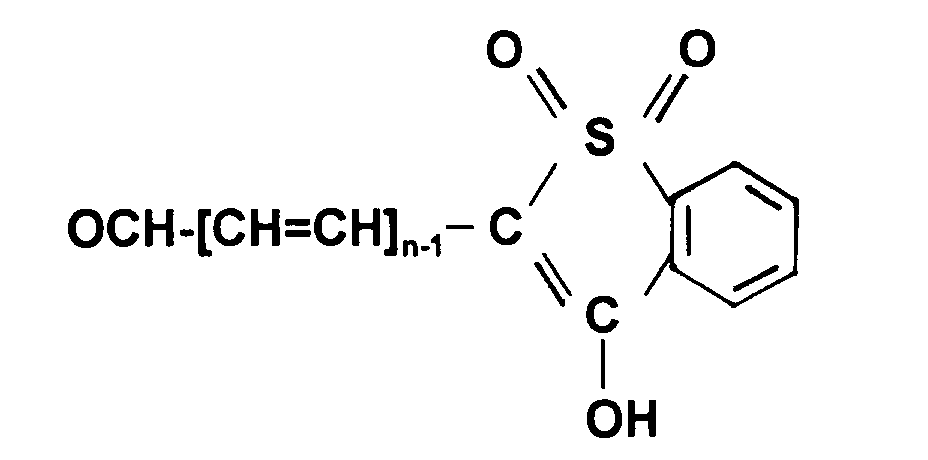
Applications Claiming Priority (2)
| Application Number | Priority Date | Filing Date | Title |
|---|---|---|---|
| DE19540796 | 1995-11-02 | ||
| DE19540796 | 1995-11-02 |
Publications (2)
| Publication Number | Publication Date |
|---|---|
| EP0771796A1 true EP0771796A1 (de) | 1997-05-07 |
| EP0771796B1 EP0771796B1 (de) | 2002-06-19 |
Family
ID=7776417
Family Applications (1)
| Application Number | Title | Priority Date | Filing Date |
|---|---|---|---|
| EP96117262A Expired - Lifetime EP0771796B1 (de) | 1995-11-02 | 1996-10-28 | Substituierte s-Triazine und Verfahren zu ihrer Herstellung |
Country Status (2)
| Country | Link |
|---|---|
| EP (1) | EP0771796B1 (de) |
| DE (1) | DE59609362D1 (de) |
Cited By (1)
| Publication number | Priority date | Publication date | Assignee | Title |
|---|---|---|---|---|
| CN120623885A (zh) * | 2025-07-24 | 2025-09-12 | 汕头市天凌安防科技有限公司 | 一种适用于钢质门窗的高硬度耐腐蚀涂层材料及其制备方法 |
Citations (8)
| Publication number | Priority date | Publication date | Assignee | Title |
|---|---|---|---|---|
| GB1388492A (en) | 1971-09-03 | 1975-03-26 | Minnesota Mining & Mfg | Chromophore-substituted halomethyl-s-triazines |
| US4239850A (en) | 1977-11-29 | 1980-12-16 | Fuji Photo Film Co., Ltd. | Photopolymerizable composition |
| EP0359430A2 (de) * | 1988-09-07 | 1990-03-21 | Minnesota Mining And Manufacturing Company | Eine Monomergruppe enthaltende Halogenmethyl-1,3,5-Triazine |
| JPH0481761A (ja) | 1990-07-24 | 1992-03-16 | Konica Corp | 感光性組成物 |
| JPH04362643A (ja) | 1991-06-10 | 1992-12-15 | Konica Corp | 感光性組成物 |
| DE4435791A1 (de) * | 1993-10-07 | 1995-04-13 | Fuji Photo Film Co Ltd | Photoresist-Zusammensetzung vom Negativ-Typ und Ätzverfahren unter Verwendung derselben |
| DE4438137A1 (de) * | 1993-10-26 | 1995-04-27 | Fuji Photo Film Co Ltd | Lichtempfindliche Trihalogenmethyl-s-Triazin-Verbindung und photopolymerisierbare Zusammensetzung unter Verwendung derselben |
| JPH08217813A (ja) * | 1995-02-17 | 1996-08-27 | Toyo Ink Mfg Co Ltd | 光開始剤組成物、光重合性組成物および光重合方法 |
-
1996
- 1996-10-28 EP EP96117262A patent/EP0771796B1/de not_active Expired - Lifetime
- 1996-10-28 DE DE59609362T patent/DE59609362D1/de not_active Expired - Fee Related
Patent Citations (8)
| Publication number | Priority date | Publication date | Assignee | Title |
|---|---|---|---|---|
| GB1388492A (en) | 1971-09-03 | 1975-03-26 | Minnesota Mining & Mfg | Chromophore-substituted halomethyl-s-triazines |
| US4239850A (en) | 1977-11-29 | 1980-12-16 | Fuji Photo Film Co., Ltd. | Photopolymerizable composition |
| EP0359430A2 (de) * | 1988-09-07 | 1990-03-21 | Minnesota Mining And Manufacturing Company | Eine Monomergruppe enthaltende Halogenmethyl-1,3,5-Triazine |
| JPH0481761A (ja) | 1990-07-24 | 1992-03-16 | Konica Corp | 感光性組成物 |
| JPH04362643A (ja) | 1991-06-10 | 1992-12-15 | Konica Corp | 感光性組成物 |
| DE4435791A1 (de) * | 1993-10-07 | 1995-04-13 | Fuji Photo Film Co Ltd | Photoresist-Zusammensetzung vom Negativ-Typ und Ätzverfahren unter Verwendung derselben |
| DE4438137A1 (de) * | 1993-10-26 | 1995-04-27 | Fuji Photo Film Co Ltd | Lichtempfindliche Trihalogenmethyl-s-Triazin-Verbindung und photopolymerisierbare Zusammensetzung unter Verwendung derselben |
| JPH08217813A (ja) * | 1995-02-17 | 1996-08-27 | Toyo Ink Mfg Co Ltd | 光開始剤組成物、光重合性組成物および光重合方法 |
Non-Patent Citations (3)
| Title |
|---|
| DATABASE WPI Week 9218, Derwent World Patents Index; AN 92-145276, XP002021757 * |
| DATABASE WPI Week 9304, Derwent World Patents Index; AN 93-033452, XP002021758 * |
| DATABASE WPI Week 9644, Derwent World Patents Index; AN 96-439587, XP002021759 * |
Cited By (1)
| Publication number | Priority date | Publication date | Assignee | Title |
|---|---|---|---|---|
| CN120623885A (zh) * | 2025-07-24 | 2025-09-12 | 汕头市天凌安防科技有限公司 | 一种适用于钢质门窗的高硬度耐腐蚀涂层材料及其制备方法 |
Also Published As
| Publication number | Publication date |
|---|---|
| EP0771796B1 (de) | 2002-06-19 |
| DE59609362D1 (de) | 2002-07-25 |
Similar Documents
| Publication | Publication Date | Title |
|---|---|---|
| DE2243621C2 (de) | ||
| CA1337765C (en) | Titanocenes, the use thereof, and n-substituted pyrroles | |
| DE68923318T2 (de) | Photosensitive Zusammensetzungen und Materialien. | |
| AT406775B (de) | Borat-coinitiatoren für die photopolymerisation | |
| US5807905A (en) | Borate photoinitiators from polyboranes | |
| DE3780669T2 (de) | 2-pyrazolin-5-ones und ein verfahren zu deren herstellung. | |
| EP1468994A1 (de) | Verfahren zur Herstellung von Cyclischen Amin substituierten Phenyl-alkyl-Ketonen | |
| JPH0263053A (ja) | 色素増感写真画像形成システム | |
| EP0401166B1 (de) | Neue, stickstoffhaltige Titanocene und deren Verwendung | |
| US5075467A (en) | Process for the preparation of titanocenes containing o,o'-difluoroaryl ligands | |
| DE4006471A1 (de) | Neue thienodiazepine | |
| US4287335A (en) | Nitrogen-containing heterocyclic compound having acetal group and method for manufacture thereof | |
| DE2912288C2 (de) | ||
| EP0771796B1 (de) | Substituierte s-Triazine und Verfahren zu ihrer Herstellung | |
| US3381006A (en) | Certain beta-substituted-alpha-(4, 5-dimethoxy-2-nitrophenyl) acrylonitriles and 2-aminophenyl derivatives thereof | |
| JPH069892A (ja) | クマリン誘導体 | |
| DE2118315C3 (de) | 2-(1H)-Chinazolinonderivate, Verfahren zu ihrer Herstellung und diese Verbindungen enthaltende Arzneimittel | |
| US3378566A (en) | Certain 5-(r-r1-r2-methyl)-7-(r3-r4-methylene)-(r6)-5-norbornene-2, 3-dicarboximides | |
| US3666765A (en) | Synthesis of 2-pyridones and derivatives thereof | |
| US4451659A (en) | Method of making known and previously unavailable pyrylium salts | |
| DE2844394A1 (de) | Neue 4-chloroxazole und verfahren zu deren herstellung | |
| DE2650961A1 (de) | Verfahren zur herstellung von tertiaeren aminen | |
| DE69609219T2 (de) | Peroxycarbonsäureester Photoinitiatoren abgeleitet von Stickstoff-Heterozyklen | |
| EP0579638B1 (de) | Polyketomethinfarbstoffe | |
| US2785172A (en) | Dialkylaminoalkylphenetidinopyridine |
Legal Events
| Date | Code | Title | Description |
|---|---|---|---|
| PUAI | Public reference made under article 153(3) epc to a published international application that has entered the european phase |
Free format text: ORIGINAL CODE: 0009012 |
|
| AK | Designated contracting states |
Kind code of ref document: A1 Designated state(s): DE FR GB |
|
| 17P | Request for examination filed |
Effective date: 19971107 |
|
| 17Q | First examination report despatched |
Effective date: 19990504 |
|
| RBV | Designated contracting states (corrected) |
Designated state(s): DE FR GB |
|
| GRAG | Despatch of communication of intention to grant |
Free format text: ORIGINAL CODE: EPIDOS AGRA |
|
| RAP1 | Party data changed (applicant data changed or rights of an application transferred) |
Owner name: AGFA-GEVAERT |
|
| GRAG | Despatch of communication of intention to grant |
Free format text: ORIGINAL CODE: EPIDOS AGRA |
|
| GRAG | Despatch of communication of intention to grant |
Free format text: ORIGINAL CODE: EPIDOS AGRA |
|
| GRAH | Despatch of communication of intention to grant a patent |
Free format text: ORIGINAL CODE: EPIDOS IGRA |
|
| GRAH | Despatch of communication of intention to grant a patent |
Free format text: ORIGINAL CODE: EPIDOS IGRA |
|
| GRAA | (expected) grant |
Free format text: ORIGINAL CODE: 0009210 |
|
| AK | Designated contracting states |
Kind code of ref document: B1 Designated state(s): DE FR GB |
|
| REG | Reference to a national code |
Ref country code: GB Ref legal event code: FG4D Free format text: NOT ENGLISH |
|
| REF | Corresponds to: |
Ref document number: 59609362 Country of ref document: DE Date of ref document: 20020725 |
|
| GBT | Gb: translation of ep patent filed (gb section 77(6)(a)/1977) |
Effective date: 20020830 |
|
| ET | Fr: translation filed | ||
| PLBE | No opposition filed within time limit |
Free format text: ORIGINAL CODE: 0009261 |
|
| STAA | Information on the status of an ep patent application or granted ep patent |
Free format text: STATUS: NO OPPOSITION FILED WITHIN TIME LIMIT |
|
| 26N | No opposition filed |
Effective date: 20030320 |
|
| PGFP | Annual fee paid to national office [announced via postgrant information from national office to epo] |
Ref country code: FR Payment date: 20030827 Year of fee payment: 8 |
|
| PGFP | Annual fee paid to national office [announced via postgrant information from national office to epo] |
Ref country code: GB Payment date: 20030828 Year of fee payment: 8 |
|
| PGFP | Annual fee paid to national office [announced via postgrant information from national office to epo] |
Ref country code: DE Payment date: 20030902 Year of fee payment: 8 |
|
| PG25 | Lapsed in a contracting state [announced via postgrant information from national office to epo] |
Ref country code: GB Free format text: LAPSE BECAUSE OF NON-PAYMENT OF DUE FEES Effective date: 20041028 |
|
| PG25 | Lapsed in a contracting state [announced via postgrant information from national office to epo] |
Ref country code: DE Free format text: LAPSE BECAUSE OF NON-PAYMENT OF DUE FEES Effective date: 20050503 |
|
| GBPC | Gb: european patent ceased through non-payment of renewal fee |
Effective date: 20041028 |
|
| PG25 | Lapsed in a contracting state [announced via postgrant information from national office to epo] |
Ref country code: FR Free format text: LAPSE BECAUSE OF NON-PAYMENT OF DUE FEES Effective date: 20050630 |
|
| REG | Reference to a national code |
Ref country code: FR Ref legal event code: ST |