EP0772771B2 - Bestimmung der biodegradabilität von asparaginsäurederivaten, abbaubare chelatbildner, verwendungen und zusammensetzungen davon - Google Patents
Bestimmung der biodegradabilität von asparaginsäurederivaten, abbaubare chelatbildner, verwendungen und zusammensetzungen davon Download PDFInfo
- Publication number
- EP0772771B2 EP0772771B2 EP95927158A EP95927158A EP0772771B2 EP 0772771 B2 EP0772771 B2 EP 0772771B2 EP 95927158 A EP95927158 A EP 95927158A EP 95927158 A EP95927158 A EP 95927158A EP 0772771 B2 EP0772771 B2 EP 0772771B2
- Authority
- EP
- European Patent Office
- Prior art keywords
- chelate
- distance
- compound
- contacting
- moiety
- Prior art date
- Legal status (The legal status is an assumption and is not a legal conclusion. Google has not performed a legal analysis and makes no representation as to the accuracy of the status listed.)
- Expired - Lifetime
Links
- 239000000203 mixture Substances 0.000 title claims description 16
- 150000001509 aspartic acid derivatives Chemical class 0.000 title description 2
- 150000001875 compounds Chemical class 0.000 claims description 81
- 238000000034 method Methods 0.000 claims description 68
- 230000008569 process Effects 0.000 claims description 49
- 239000013522 chelant Substances 0.000 claims description 40
- 229910052751 metal Inorganic materials 0.000 claims description 40
- 239000002184 metal Substances 0.000 claims description 40
- 238000004768 lowest unoccupied molecular orbital Methods 0.000 claims description 28
- 229910052802 copper Inorganic materials 0.000 claims description 24
- 239000010949 copper Substances 0.000 claims description 24
- RYGMFSIKBFXOCR-UHFFFAOYSA-N Copper Chemical compound [Cu] RYGMFSIKBFXOCR-UHFFFAOYSA-N 0.000 claims description 23
- 238000006065 biodegradation reaction Methods 0.000 claims description 19
- 239000003599 detergent Substances 0.000 claims description 18
- 229910021645 metal ion Inorganic materials 0.000 claims description 15
- 239000002253 acid Substances 0.000 claims description 14
- 150000003839 salts Chemical class 0.000 claims description 14
- 238000004061 bleaching Methods 0.000 claims description 13
- 229910052799 carbon Inorganic materials 0.000 claims description 13
- 238000004140 cleaning Methods 0.000 claims description 13
- XLYOFNOQVPJJNP-UHFFFAOYSA-N water Substances O XLYOFNOQVPJJNP-UHFFFAOYSA-N 0.000 claims description 13
- 239000012530 fluid Substances 0.000 claims description 12
- 239000007864 aqueous solution Substances 0.000 claims description 11
- 239000000243 solution Substances 0.000 claims description 11
- -1 alkali metal salts Chemical class 0.000 claims description 10
- 125000003118 aryl group Chemical group 0.000 claims description 10
- 239000000463 material Substances 0.000 claims description 10
- 125000003178 carboxy group Chemical group [H]OC(*)=O 0.000 claims description 9
- 125000002877 alkyl aryl group Chemical group 0.000 claims description 8
- 125000003710 aryl alkyl group Chemical group 0.000 claims description 8
- 230000008021 deposition Effects 0.000 claims description 8
- 239000007789 gas Substances 0.000 claims description 8
- 239000004753 textile Substances 0.000 claims description 8
- 238000005406 washing Methods 0.000 claims description 8
- 102000004190 Enzymes Human genes 0.000 claims description 7
- 108090000790 Enzymes Proteins 0.000 claims description 7
- 239000007844 bleaching agent Substances 0.000 claims description 7
- 239000001257 hydrogen Substances 0.000 claims description 7
- 229910052739 hydrogen Inorganic materials 0.000 claims description 7
- 230000003647 oxidation Effects 0.000 claims description 7
- 238000007254 oxidation reaction Methods 0.000 claims description 7
- JPVYNHNXODAKFH-UHFFFAOYSA-N Cu2+ Chemical compound [Cu+2] JPVYNHNXODAKFH-UHFFFAOYSA-N 0.000 claims description 6
- 125000000217 alkyl group Chemical group 0.000 claims description 6
- 239000008139 complexing agent Substances 0.000 claims description 6
- 238000007747 plating Methods 0.000 claims description 6
- 150000001879 copper Chemical class 0.000 claims description 5
- 238000004519 manufacturing process Methods 0.000 claims description 5
- UQSXHKLRYXJYBZ-UHFFFAOYSA-N Iron oxide Chemical compound [Fe]=O UQSXHKLRYXJYBZ-UHFFFAOYSA-N 0.000 claims description 4
- 239000003054 catalyst Substances 0.000 claims description 4
- 125000004435 hydrogen atom Chemical group [H]* 0.000 claims description 4
- 125000002887 hydroxy group Chemical group [H]O* 0.000 claims description 4
- 125000004430 oxygen atom Chemical group O* 0.000 claims description 4
- 229920000642 polymer Polymers 0.000 claims description 4
- 230000006641 stabilisation Effects 0.000 claims description 4
- 238000011105 stabilization Methods 0.000 claims description 4
- 229910019142 PO4 Inorganic materials 0.000 claims description 3
- 229910052783 alkali metal Inorganic materials 0.000 claims description 3
- 125000003277 amino group Chemical group 0.000 claims description 3
- 150000003863 ammonium salts Chemical class 0.000 claims description 3
- 238000002845 discoloration Methods 0.000 claims description 3
- 238000005553 drilling Methods 0.000 claims description 3
- 235000015097 nutrients Nutrition 0.000 claims description 3
- 235000021317 phosphate Nutrition 0.000 claims description 3
- 150000003013 phosphoric acid derivatives Chemical class 0.000 claims description 3
- LFGREXWGYUGZLY-UHFFFAOYSA-N phosphoryl Chemical group [P]=O LFGREXWGYUGZLY-UHFFFAOYSA-N 0.000 claims description 3
- 238000011084 recovery Methods 0.000 claims description 3
- 125000000472 sulfonyl group Chemical group *S(*)(=O)=O 0.000 claims description 3
- 239000004094 surface-active agent Substances 0.000 claims description 3
- 125000005210 alkyl ammonium group Chemical group 0.000 claims description 2
- 238000009835 boiling Methods 0.000 claims description 2
- MMCOUVMKNAHQOY-UHFFFAOYSA-N carbonoperoxoic acid Chemical group OOC(O)=O MMCOUVMKNAHQOY-UHFFFAOYSA-N 0.000 claims description 2
- 125000002091 cationic group Chemical group 0.000 claims description 2
- 230000006866 deterioration Effects 0.000 claims description 2
- 150000003949 imides Chemical class 0.000 claims description 2
- JEIPFZHSYJVQDO-UHFFFAOYSA-N iron(III) oxide Inorganic materials O=[Fe]O[Fe]=O JEIPFZHSYJVQDO-UHFFFAOYSA-N 0.000 claims description 2
- 239000003960 organic solvent Substances 0.000 claims description 2
- 239000003208 petroleum Substances 0.000 claims description 2
- 229910001431 copper ion Inorganic materials 0.000 claims 2
- VTLYFUHAOXGGBS-UHFFFAOYSA-N Fe3+ Chemical compound [Fe+3] VTLYFUHAOXGGBS-UHFFFAOYSA-N 0.000 claims 1
- 229910001447 ferric ion Inorganic materials 0.000 claims 1
- XEEYBQQBJWHFJM-UHFFFAOYSA-N Iron Chemical compound [Fe] XEEYBQQBJWHFJM-UHFFFAOYSA-N 0.000 description 30
- CKLJMWTZIZZHCS-REOHCLBHSA-N aspartic acid group Chemical group N[C@@H](CC(=O)O)C(=O)O CKLJMWTZIZZHCS-REOHCLBHSA-N 0.000 description 20
- MWUXSHHQAYIFBG-UHFFFAOYSA-N nitrogen oxide Inorganic materials O=[N] MWUXSHHQAYIFBG-UHFFFAOYSA-N 0.000 description 20
- 229910052742 iron Inorganic materials 0.000 description 16
- 229960005261 aspartic acid Drugs 0.000 description 15
- 235000003704 aspartic acid Nutrition 0.000 description 14
- OQFSQFPPLPISGP-UHFFFAOYSA-N beta-carboxyaspartic acid Natural products OC(=O)C(N)C(C(O)=O)C(O)=O OQFSQFPPLPISGP-UHFFFAOYSA-N 0.000 description 14
- 150000002739 metals Chemical class 0.000 description 11
- 125000004429 atom Chemical group 0.000 description 10
- RWSOTUBLDIXVET-UHFFFAOYSA-N Dihydrogen sulfide Chemical compound S RWSOTUBLDIXVET-UHFFFAOYSA-N 0.000 description 9
- 125000004432 carbon atom Chemical group C* 0.000 description 9
- 229910000037 hydrogen sulfide Inorganic materials 0.000 description 9
- 238000012360 testing method Methods 0.000 description 9
- PXHVJJICTQNCMI-UHFFFAOYSA-N Nickel Chemical compound [Ni] PXHVJJICTQNCMI-UHFFFAOYSA-N 0.000 description 8
- 125000002915 carbonyl group Chemical group [*:2]C([*:1])=O 0.000 description 8
- 229910001385 heavy metal Inorganic materials 0.000 description 8
- 239000002689 soil Substances 0.000 description 8
- 239000000126 substance Substances 0.000 description 8
- GLUUGHFHXGJENI-UHFFFAOYSA-N Piperazine Chemical compound C1CNCCN1 GLUUGHFHXGJENI-UHFFFAOYSA-N 0.000 description 6
- 241000196324 Embryophyta Species 0.000 description 5
- 238000006243 chemical reaction Methods 0.000 description 5
- 239000011133 lead Substances 0.000 description 5
- WPBNNNQJVZRUHP-UHFFFAOYSA-L manganese(2+);methyl n-[[2-(methoxycarbonylcarbamothioylamino)phenyl]carbamothioyl]carbamate;n-[2-(sulfidocarbothioylamino)ethyl]carbamodithioate Chemical compound [Mn+2].[S-]C(=S)NCCNC([S-])=S.COC(=O)NC(=S)NC1=CC=CC=C1NC(=S)NC(=O)OC WPBNNNQJVZRUHP-UHFFFAOYSA-L 0.000 description 5
- 239000011785 micronutrient Substances 0.000 description 5
- 235000013369 micronutrients Nutrition 0.000 description 5
- KDLHZDBZIXYQEI-UHFFFAOYSA-N palladium Substances [Pd] KDLHZDBZIXYQEI-UHFFFAOYSA-N 0.000 description 5
- 238000006467 substitution reaction Methods 0.000 description 5
- OKTJSMMVPCPJKN-UHFFFAOYSA-N Carbon Chemical compound [C] OKTJSMMVPCPJKN-UHFFFAOYSA-N 0.000 description 4
- KCXVZYZYPLLWCC-UHFFFAOYSA-N EDTA Chemical compound OC(=O)CN(CC(O)=O)CCN(CC(O)=O)CC(O)=O KCXVZYZYPLLWCC-UHFFFAOYSA-N 0.000 description 4
- 230000015572 biosynthetic process Effects 0.000 description 4
- 230000008859 change Effects 0.000 description 4
- 239000002738 chelating agent Substances 0.000 description 4
- 230000004807 localization Effects 0.000 description 4
- 229910052759 nickel Inorganic materials 0.000 description 4
- BASFCYQUMIYNBI-UHFFFAOYSA-N platinum Chemical compound [Pt] BASFCYQUMIYNBI-UHFFFAOYSA-N 0.000 description 4
- 238000012545 processing Methods 0.000 description 4
- 239000000047 product Substances 0.000 description 4
- 239000010802 sludge Substances 0.000 description 4
- 239000002904 solvent Substances 0.000 description 4
- 125000000547 substituted alkyl group Chemical group 0.000 description 4
- 239000002699 waste material Substances 0.000 description 4
- 229910052725 zinc Inorganic materials 0.000 description 4
- 239000011701 zinc Substances 0.000 description 4
- 241000894006 Bacteria Species 0.000 description 3
- WVDDGKGOMKODPV-UHFFFAOYSA-N Benzyl alcohol Chemical compound OCC1=CC=CC=C1 WVDDGKGOMKODPV-UHFFFAOYSA-N 0.000 description 3
- 0 C*([C@@](C)*)[N+](*)[O-] Chemical compound C*([C@@](C)*)[N+](*)[O-] 0.000 description 3
- UFHFLCQGNIYNRP-UHFFFAOYSA-N Hydrogen Chemical compound [H][H] UFHFLCQGNIYNRP-UHFFFAOYSA-N 0.000 description 3
- HCHKCACWOHOZIP-UHFFFAOYSA-N Zinc Chemical compound [Zn] HCHKCACWOHOZIP-UHFFFAOYSA-N 0.000 description 3
- 239000002250 absorbent Substances 0.000 description 3
- 230000002745 absorbent Effects 0.000 description 3
- 230000004308 accommodation Effects 0.000 description 3
- 230000015556 catabolic process Effects 0.000 description 3
- 229910052804 chromium Inorganic materials 0.000 description 3
- 239000011651 chromium Substances 0.000 description 3
- 230000003750 conditioning effect Effects 0.000 description 3
- 238000006731 degradation reaction Methods 0.000 description 3
- 239000003814 drug Substances 0.000 description 3
- 238000004043 dyeing Methods 0.000 description 3
- 238000007772 electroless plating Methods 0.000 description 3
- 239000003546 flue gas Substances 0.000 description 3
- 239000012634 fragment Substances 0.000 description 3
- RAXXELZNTBOGNW-UHFFFAOYSA-N imidazole Natural products C1=CNC=N1 RAXXELZNTBOGNW-UHFFFAOYSA-N 0.000 description 3
- 230000003287 optical effect Effects 0.000 description 3
- 229910052763 palladium Inorganic materials 0.000 description 3
- 238000006116 polymerization reaction Methods 0.000 description 3
- 238000001556 precipitation Methods 0.000 description 3
- 239000000344 soap Substances 0.000 description 3
- 229910052717 sulfur Inorganic materials 0.000 description 3
- 229910052718 tin Inorganic materials 0.000 description 3
- 239000011135 tin Substances 0.000 description 3
- 229910052721 tungsten Inorganic materials 0.000 description 3
- HOKKHZGPKSLGJE-VKHMYHEASA-N (2s)-2-(methylamino)butanedioic acid Chemical compound CN[C@H](C(O)=O)CC(O)=O HOKKHZGPKSLGJE-VKHMYHEASA-N 0.000 description 2
- JBDHASFPCAUEGF-CEOVSRFSSA-N (2s)-2-aminobutanedioic acid;ethane-1,2-diamine Chemical compound NCCN.OC(=O)[C@@H](N)CC(O)=O.OC(=O)[C@@H](N)CC(O)=O JBDHASFPCAUEGF-CEOVSRFSSA-N 0.000 description 2
- MLZZUGZJEKYORT-UHFFFAOYSA-N 2,2,3,3,3-pentafluoropropanoic acid;silver Chemical compound [Ag].OC(=O)C(F)(F)C(F)(F)F MLZZUGZJEKYORT-UHFFFAOYSA-N 0.000 description 2
- VQKFNUFAXTZWDK-UHFFFAOYSA-N 2-Methylfuran Chemical compound CC1=CC=CO1 VQKFNUFAXTZWDK-UHFFFAOYSA-N 0.000 description 2
- XLSZMDLNRCVEIJ-UHFFFAOYSA-N 4-methylimidazole Chemical compound CC1=CNC=N1 XLSZMDLNRCVEIJ-UHFFFAOYSA-N 0.000 description 2
- VYZAMTAEIAYCRO-UHFFFAOYSA-N Chromium Chemical compound [Cr] VYZAMTAEIAYCRO-UHFFFAOYSA-N 0.000 description 2
- YLQBMQCUIZJEEH-UHFFFAOYSA-N Furan Chemical compound C=1C=COC=1 YLQBMQCUIZJEEH-UHFFFAOYSA-N 0.000 description 2
- SIKJAQJRHWYJAI-UHFFFAOYSA-N Indole Chemical compound C1=CC=C2NC=CC2=C1 SIKJAQJRHWYJAI-UHFFFAOYSA-N 0.000 description 2
- 241001465754 Metazoa Species 0.000 description 2
- ZOKXTWBITQBERF-UHFFFAOYSA-N Molybdenum Chemical compound [Mo] ZOKXTWBITQBERF-UHFFFAOYSA-N 0.000 description 2
- HOKKHZGPKSLGJE-UHFFFAOYSA-N N-methyl-D-aspartic acid Natural products CNC(C(O)=O)CC(O)=O HOKKHZGPKSLGJE-UHFFFAOYSA-N 0.000 description 2
- NQRYJNQNLNOLGT-UHFFFAOYSA-N Piperidine Chemical compound C1CCNCC1 NQRYJNQNLNOLGT-UHFFFAOYSA-N 0.000 description 2
- KAESVJOAVNADME-UHFFFAOYSA-N Pyrrole Chemical compound C=1C=CNC=1 KAESVJOAVNADME-UHFFFAOYSA-N 0.000 description 2
- ATJFFYVFTNAWJD-UHFFFAOYSA-N Tin Chemical compound [Sn] ATJFFYVFTNAWJD-UHFFFAOYSA-N 0.000 description 2
- RTAQQCXQSZGOHL-UHFFFAOYSA-N Titanium Chemical compound [Ti] RTAQQCXQSZGOHL-UHFFFAOYSA-N 0.000 description 2
- 229910052784 alkaline earth metal Inorganic materials 0.000 description 2
- 150000001342 alkaline earth metals Chemical class 0.000 description 2
- 230000008901 benefit Effects 0.000 description 2
- 229910052791 calcium Inorganic materials 0.000 description 2
- 239000011575 calcium Substances 0.000 description 2
- 239000003638 chemical reducing agent Substances 0.000 description 2
- 229910017052 cobalt Inorganic materials 0.000 description 2
- 239000010941 cobalt Substances 0.000 description 2
- GUTLYIVDDKVIGB-UHFFFAOYSA-N cobalt atom Chemical compound [Co] GUTLYIVDDKVIGB-UHFFFAOYSA-N 0.000 description 2
- 238000012790 confirmation Methods 0.000 description 2
- 238000000354 decomposition reaction Methods 0.000 description 2
- 230000002950 deficient Effects 0.000 description 2
- 239000003337 fertilizer Substances 0.000 description 2
- 235000013305 food Nutrition 0.000 description 2
- 238000009472 formulation Methods 0.000 description 2
- 239000008233 hard water Substances 0.000 description 2
- 239000004009 herbicide Substances 0.000 description 2
- XLYOFNOQVPJJNP-UHFFFAOYSA-M hydroxide Chemical compound [OH-] XLYOFNOQVPJJNP-UHFFFAOYSA-M 0.000 description 2
- 230000006872 improvement Effects 0.000 description 2
- 239000012535 impurity Substances 0.000 description 2
- 150000002500 ions Chemical class 0.000 description 2
- 239000003446 ligand Substances 0.000 description 2
- 229910052749 magnesium Inorganic materials 0.000 description 2
- FPYJFEHAWHCUMM-UHFFFAOYSA-N maleic anhydride Chemical compound O=C1OC(=O)C=C1 FPYJFEHAWHCUMM-UHFFFAOYSA-N 0.000 description 2
- 229910052748 manganese Inorganic materials 0.000 description 2
- 239000011572 manganese Substances 0.000 description 2
- 229910052753 mercury Inorganic materials 0.000 description 2
- QSHDDOUJBYECFT-UHFFFAOYSA-N mercury Chemical compound [Hg] QSHDDOUJBYECFT-UHFFFAOYSA-N 0.000 description 2
- 238000005555 metalworking Methods 0.000 description 2
- 238000000324 molecular mechanic Methods 0.000 description 2
- 238000004776 molecular orbital Methods 0.000 description 2
- 229910052750 molybdenum Inorganic materials 0.000 description 2
- 239000011733 molybdenum Substances 0.000 description 2
- 238000006864 oxidative decomposition reaction Methods 0.000 description 2
- 230000001590 oxidative effect Effects 0.000 description 2
- 229910052697 platinum Inorganic materials 0.000 description 2
- 239000002244 precipitate Substances 0.000 description 2
- 238000002360 preparation method Methods 0.000 description 2
- 125000002924 primary amino group Chemical group [H]N([H])* 0.000 description 2
- 238000012552 review Methods 0.000 description 2
- 229960001922 sodium perborate Drugs 0.000 description 2
- YKLJGMBLPUQQOI-UHFFFAOYSA-M sodium;oxidooxy(oxo)borane Chemical compound [Na+].[O-]OB=O YKLJGMBLPUQQOI-UHFFFAOYSA-M 0.000 description 2
- 238000003786 synthesis reaction Methods 0.000 description 2
- 229910052719 titanium Inorganic materials 0.000 description 2
- 239000010936 titanium Substances 0.000 description 2
- WFKWXMTUELFFGS-UHFFFAOYSA-N tungsten Chemical compound [W] WFKWXMTUELFFGS-UHFFFAOYSA-N 0.000 description 2
- 239000010937 tungsten Substances 0.000 description 2
- 229910052720 vanadium Inorganic materials 0.000 description 2
- GPPXJZIENCGNKB-UHFFFAOYSA-N vanadium Chemical compound [V]#[V] GPPXJZIENCGNKB-UHFFFAOYSA-N 0.000 description 2
- 230000005428 wave function Effects 0.000 description 2
- 238000002424 x-ray crystallography Methods 0.000 description 2
- 229910052726 zirconium Inorganic materials 0.000 description 2
- VKZRWSNIWNFCIQ-WDSKDSINSA-N (2s)-2-[2-[[(1s)-1,2-dicarboxyethyl]amino]ethylamino]butanedioic acid Chemical compound OC(=O)C[C@@H](C(O)=O)NCCN[C@H](C(O)=O)CC(O)=O VKZRWSNIWNFCIQ-WDSKDSINSA-N 0.000 description 1
- JYEUMXHLPRZUAT-UHFFFAOYSA-N 1,2,3-triazine Chemical compound C1=CN=NN=C1 JYEUMXHLPRZUAT-UHFFFAOYSA-N 0.000 description 1
- PAAZPARNPHGIKF-UHFFFAOYSA-N 1,2-dibromoethane Chemical compound BrCCBr PAAZPARNPHGIKF-UHFFFAOYSA-N 0.000 description 1
- MCTWTZJPVLRJOU-UHFFFAOYSA-N 1-methyl-1H-imidazole Chemical compound CN1C=CN=C1 MCTWTZJPVLRJOU-UHFFFAOYSA-N 0.000 description 1
- TVCXVUHHCUYLGX-UHFFFAOYSA-N 2-Methylpyrrole Chemical compound CC1=CC=CN1 TVCXVUHHCUYLGX-UHFFFAOYSA-N 0.000 description 1
- IZXIZTKNFFYFOF-UHFFFAOYSA-N 2-Oxazolidone Chemical compound O=C1NCCO1 IZXIZTKNFFYFOF-UHFFFAOYSA-N 0.000 description 1
- ZMGMDXCADSRNCX-UHFFFAOYSA-N 5,6-dihydroxy-1,3-diazepan-2-one Chemical compound OC1CNC(=O)NCC1O ZMGMDXCADSRNCX-UHFFFAOYSA-N 0.000 description 1
- QTBSBXVTEAMEQO-UHFFFAOYSA-M Acetate Chemical compound CC([O-])=O QTBSBXVTEAMEQO-UHFFFAOYSA-M 0.000 description 1
- OYPRJOBELJOOCE-UHFFFAOYSA-N Calcium Chemical compound [Ca] OYPRJOBELJOOCE-UHFFFAOYSA-N 0.000 description 1
- 239000004215 Carbon black (E152) Substances 0.000 description 1
- UGFAIRIUMAVXCW-UHFFFAOYSA-N Carbon monoxide Chemical compound [O+]#[C-] UGFAIRIUMAVXCW-UHFFFAOYSA-N 0.000 description 1
- 235000008733 Citrus aurantifolia Nutrition 0.000 description 1
- CKLJMWTZIZZHCS-UHFFFAOYSA-N D-OH-Asp Natural products OC(=O)C(N)CC(O)=O CKLJMWTZIZZHCS-UHFFFAOYSA-N 0.000 description 1
- 102100026816 DNA-dependent metalloprotease SPRTN Human genes 0.000 description 1
- PIICEJLVQHRZGT-UHFFFAOYSA-N Ethylenediamine Chemical compound NCCN PIICEJLVQHRZGT-UHFFFAOYSA-N 0.000 description 1
- CWYNVVGOOAEACU-UHFFFAOYSA-N Fe2+ Chemical compound [Fe+2] CWYNVVGOOAEACU-UHFFFAOYSA-N 0.000 description 1
- CKLJMWTZIZZHCS-UWTATZPHSA-N L-Aspartic acid Natural products OC(=O)[C@H](N)CC(O)=O CKLJMWTZIZZHCS-UWTATZPHSA-N 0.000 description 1
- PWHULOQIROXLJO-UHFFFAOYSA-N Manganese Chemical compound [Mn] PWHULOQIROXLJO-UHFFFAOYSA-N 0.000 description 1
- AMQJEAYHLZJPGS-UHFFFAOYSA-N N-Pentanol Chemical compound CCCCCO AMQJEAYHLZJPGS-UHFFFAOYSA-N 0.000 description 1
- OAICVXFJPJFONN-UHFFFAOYSA-N Phosphorus Chemical compound [P] OAICVXFJPJFONN-UHFFFAOYSA-N 0.000 description 1
- 229920000388 Polyphosphate Polymers 0.000 description 1
- JUJWROOIHBZHMG-UHFFFAOYSA-N Pyridine Chemical group C1=CC=NC=C1 JUJWROOIHBZHMG-UHFFFAOYSA-N 0.000 description 1
- 241000220317 Rosa Species 0.000 description 1
- QAOWNCQODCNURD-UHFFFAOYSA-L Sulfate Chemical compound [O-]S([O-])(=O)=O QAOWNCQODCNURD-UHFFFAOYSA-L 0.000 description 1
- NINIDFKCEFEMDL-UHFFFAOYSA-N Sulfur Chemical compound [S] NINIDFKCEFEMDL-UHFFFAOYSA-N 0.000 description 1
- 235000011941 Tilia x europaea Nutrition 0.000 description 1
- QCWXUUIWCKQGHC-UHFFFAOYSA-N Zirconium Chemical compound [Zr] QCWXUUIWCKQGHC-UHFFFAOYSA-N 0.000 description 1
- 238000000367 ab initio method Methods 0.000 description 1
- 230000002378 acidificating effect Effects 0.000 description 1
- 150000007513 acids Chemical class 0.000 description 1
- 230000009471 action Effects 0.000 description 1
- 150000001298 alcohols Chemical class 0.000 description 1
- 150000001340 alkali metals Chemical class 0.000 description 1
- 229910001420 alkaline earth metal ion Inorganic materials 0.000 description 1
- 150000001336 alkenes Chemical class 0.000 description 1
- 150000001412 amines Chemical class 0.000 description 1
- 238000004458 analytical method Methods 0.000 description 1
- 230000003190 augmentative effect Effects 0.000 description 1
- 235000019445 benzyl alcohol Nutrition 0.000 description 1
- 150000001720 carbohydrates Chemical class 0.000 description 1
- 150000001732 carboxylic acid derivatives Chemical class 0.000 description 1
- 125000002057 carboxymethyl group Chemical group [H]OC(=O)C([H])([H])[*] 0.000 description 1
- 238000003421 catalytic decomposition reaction Methods 0.000 description 1
- 239000001913 cellulose Substances 0.000 description 1
- 229920002678 cellulose Polymers 0.000 description 1
- 239000003795 chemical substances by application Substances 0.000 description 1
- 239000012459 cleaning agent Substances 0.000 description 1
- 239000003245 coal Substances 0.000 description 1
- 230000002860 competitive effect Effects 0.000 description 1
- 239000000498 cooling water Substances 0.000 description 1
- 230000007797 corrosion Effects 0.000 description 1
- 238000005260 corrosion Methods 0.000 description 1
- 239000002537 cosmetic Substances 0.000 description 1
- 239000006071 cream Substances 0.000 description 1
- 230000007812 deficiency Effects 0.000 description 1
- 238000005238 degreasing Methods 0.000 description 1
- 239000002781 deodorant agent Substances 0.000 description 1
- 238000013461 design Methods 0.000 description 1
- 238000009990 desizing Methods 0.000 description 1
- MTHSVFCYNBDYFN-UHFFFAOYSA-N diethylene glycol Chemical class OCCOCCO MTHSVFCYNBDYFN-UHFFFAOYSA-N 0.000 description 1
- 238000002050 diffraction method Methods 0.000 description 1
- 201000010099 disease Diseases 0.000 description 1
- 208000037265 diseases, disorders, signs and symptoms Diseases 0.000 description 1
- 238000004851 dishwashing Methods 0.000 description 1
- 230000000694 effects Effects 0.000 description 1
- 150000002148 esters Chemical class 0.000 description 1
- 125000001033 ether group Chemical group 0.000 description 1
- 229940071106 ethylenediaminetetraacetate Drugs 0.000 description 1
- 238000002474 experimental method Methods 0.000 description 1
- 238000000605 extraction Methods 0.000 description 1
- 239000004744 fabric Substances 0.000 description 1
- 230000002349 favourable effect Effects 0.000 description 1
- 230000004720 fertilization Effects 0.000 description 1
- 239000000835 fiber Substances 0.000 description 1
- 239000000446 fuel Substances 0.000 description 1
- 230000002070 germicidal effect Effects 0.000 description 1
- 125000005842 heteroatom Chemical group 0.000 description 1
- 125000000623 heterocyclic group Chemical group 0.000 description 1
- WJRBRSLFGCUECM-UHFFFAOYSA-N hydantoin Chemical compound O=C1CNC(=O)N1 WJRBRSLFGCUECM-UHFFFAOYSA-N 0.000 description 1
- 229940091173 hydantoin Drugs 0.000 description 1
- 229930195733 hydrocarbon Natural products 0.000 description 1
- 150000002430 hydrocarbons Chemical class 0.000 description 1
- 238000007037 hydroformylation reaction Methods 0.000 description 1
- RWSOTUBLDIXVET-UHFFFAOYSA-M hydrosulfide Chemical compound [SH-] RWSOTUBLDIXVET-UHFFFAOYSA-M 0.000 description 1
- PZOUSPYUWWUPPK-UHFFFAOYSA-N indole Natural products CC1=CC=CC2=C1C=CN2 PZOUSPYUWWUPPK-UHFFFAOYSA-N 0.000 description 1
- RKJUIXBNRJVNHR-UHFFFAOYSA-N indolenine Natural products C1=CC=C2CC=NC2=C1 RKJUIXBNRJVNHR-UHFFFAOYSA-N 0.000 description 1
- 235000014413 iron hydroxide Nutrition 0.000 description 1
- NCNCGGDMXMBVIA-UHFFFAOYSA-L iron(ii) hydroxide Chemical compound [OH-].[OH-].[Fe+2] NCNCGGDMXMBVIA-UHFFFAOYSA-L 0.000 description 1
- 238000004900 laundering Methods 0.000 description 1
- 229910052745 lead Inorganic materials 0.000 description 1
- 239000004571 lime Substances 0.000 description 1
- 239000007788 liquid Substances 0.000 description 1
- 239000006210 lotion Substances 0.000 description 1
- 239000002932 luster Substances 0.000 description 1
- 238000005259 measurement Methods 0.000 description 1
- 230000007246 mechanism Effects 0.000 description 1
- 230000004060 metabolic process Effects 0.000 description 1
- 125000002496 methyl group Chemical group [H]C([H])([H])* 0.000 description 1
- 125000001570 methylene group Chemical group [H]C([H])([*:1])[*:2] 0.000 description 1
- 230000000813 microbial effect Effects 0.000 description 1
- 235000020802 micronutrient deficiency Nutrition 0.000 description 1
- 238000000302 molecular modelling Methods 0.000 description 1
- VSEAAEQOQBMPQF-UHFFFAOYSA-N morpholin-3-one Chemical compound O=C1COCCN1 VSEAAEQOQBMPQF-UHFFFAOYSA-N 0.000 description 1
- 229910052757 nitrogen Inorganic materials 0.000 description 1
- 125000004433 nitrogen atom Chemical group N* 0.000 description 1
- QJGQUHMNIGDVPM-UHFFFAOYSA-N nitrogen group Chemical group [N] QJGQUHMNIGDVPM-UHFFFAOYSA-N 0.000 description 1
- 235000021048 nutrient requirements Nutrition 0.000 description 1
- 239000002674 ointment Substances 0.000 description 1
- 238000001139 pH measurement Methods 0.000 description 1
- 229910052698 phosphorus Inorganic materials 0.000 description 1
- 239000011574 phosphorus Substances 0.000 description 1
- IWELDVXSEVIIGI-UHFFFAOYSA-N piperazin-2-one Chemical compound O=C1CNCCN1 IWELDVXSEVIIGI-UHFFFAOYSA-N 0.000 description 1
- XUWHAWMETYGRKB-UHFFFAOYSA-N piperidin-2-one Chemical compound O=C1CCCCN1 XUWHAWMETYGRKB-UHFFFAOYSA-N 0.000 description 1
- 239000002574 poison Substances 0.000 description 1
- 231100000614 poison Toxicity 0.000 description 1
- 229920000768 polyamine Polymers 0.000 description 1
- 239000001205 polyphosphate Substances 0.000 description 1
- 235000011176 polyphosphates Nutrition 0.000 description 1
- 238000005182 potential energy surface Methods 0.000 description 1
- 239000003755 preservative agent Substances 0.000 description 1
- 235000018102 proteins Nutrition 0.000 description 1
- 102000004169 proteins and genes Human genes 0.000 description 1
- 108090000623 proteins and genes Proteins 0.000 description 1
- 239000000376 reactant Substances 0.000 description 1
- 238000009991 scouring Methods 0.000 description 1
- 238000012216 screening Methods 0.000 description 1
- 238000005201 scrubbing Methods 0.000 description 1
- 239000013049 sediment Substances 0.000 description 1
- 239000010865 sewage Substances 0.000 description 1
- 229910052709 silver Inorganic materials 0.000 description 1
- 239000004332 silver Substances 0.000 description 1
- 239000007921 spray Substances 0.000 description 1
- 239000003381 stabilizer Substances 0.000 description 1
- 230000000087 stabilizing effect Effects 0.000 description 1
- 230000000707 stereoselective effect Effects 0.000 description 1
- 238000003860 storage Methods 0.000 description 1
- 229910052712 strontium Inorganic materials 0.000 description 1
- 239000011593 sulfur Substances 0.000 description 1
- 229910052815 sulfur oxide Inorganic materials 0.000 description 1
- 208000024891 symptom Diseases 0.000 description 1
- 239000012209 synthetic fiber Substances 0.000 description 1
- 229920002994 synthetic fiber Polymers 0.000 description 1
- 229910052715 tantalum Inorganic materials 0.000 description 1
- GUVRBAGPIYLISA-UHFFFAOYSA-N tantalum atom Chemical compound [Ta] GUVRBAGPIYLISA-UHFFFAOYSA-N 0.000 description 1
- 238000005494 tarnishing Methods 0.000 description 1
- 150000003505 terpenes Chemical class 0.000 description 1
- 235000007586 terpenes Nutrition 0.000 description 1
- 238000004065 wastewater treatment Methods 0.000 description 1
Images


Classifications
-
- G—PHYSICS
- G01—MEASURING; TESTING
- G01N—INVESTIGATING OR ANALYSING MATERIALS BY DETERMINING THEIR CHEMICAL OR PHYSICAL PROPERTIES
- G01N33/00—Investigating or analysing materials by specific methods not covered by groups G01N1/00 - G01N31/00
- G01N33/48—Biological material, e.g. blood, urine; Haemocytometers
-
- G—PHYSICS
- G01—MEASURING; TESTING
- G01N—INVESTIGATING OR ANALYSING MATERIALS BY DETERMINING THEIR CHEMICAL OR PHYSICAL PROPERTIES
- G01N33/00—Investigating or analysing materials by specific methods not covered by groups G01N1/00 - G01N31/00
- G01N33/24—Earth materials
- G01N33/243—Earth materials for determining biological parameters concerning composting, biodegradability or bioavailability
-
- Y—GENERAL TAGGING OF NEW TECHNOLOGICAL DEVELOPMENTS; GENERAL TAGGING OF CROSS-SECTIONAL TECHNOLOGIES SPANNING OVER SEVERAL SECTIONS OF THE IPC; TECHNICAL SUBJECTS COVERED BY FORMER USPC CROSS-REFERENCE ART COLLECTIONS [XRACs] AND DIGESTS
- Y10—TECHNICAL SUBJECTS COVERED BY FORMER USPC
- Y10S—TECHNICAL SUBJECTS COVERED BY FORMER USPC CROSS-REFERENCE ART COLLECTIONS [XRACs] AND DIGESTS
- Y10S423/00—Chemistry of inorganic compounds
- Y10S423/09—Reaction techniques
- Y10S423/17—Microbiological reactions
Definitions
- a computer system can comprise:
- the invention includes a cleaning process of contacting with a hard surface, a hard surface cleaning composition comprising at least one acid or salt of said compound and subsequently contacting the compound or resultant chelates with Effective Microbes under conditions and for a time sufficient for biodegradation.
- X-ray crystallography data can be used to acertain distances.
- the crystallography data is preferably input to a programmed computer or microprocessor to determine distances.
- molecular models can be used to determine inert atomic distances when the models are dimensionally correct. Examples of such modeling include those disclosed in U.S. Patents 4,877,406; 4,906,122; 4,622,014, and 5,030,103. Because of speed and accuracy, determining by programmed computer or microprocessor is preferred.
- An energetically feasible conformation is a conformation having a heat of formation within 1.5 KCal (6285 Joule (J)) of the heated formation of the lowest energy conformation.
- J Joule
- Ascertaining the lowest conformation in the energetically feasible conformation is within the skill in the art as shown by such references as Reviews in Computational Chemistry II, Lickowitz et al. ed., VCH Publishers, 1991, pp. 1-47 and Hehre et al., Experiments in Computational Organic Chemistry, Wavefunction, Inc., 1993, pp. 47-66. Software is advantageously used in calculating these conformations.
- the lowest energy conformation and energetically feasible conformations are preferably determined by means known as (a) semiclassical (model), harmonic, or molecular mechanical; (b) semiempirical quantum mechanical; and/or (c) ab initio quantum mechanical methods. These methods are within the skill in the art as shown by Reviews in Computational Chemistry II, Lickowitz et al. ed., VCH Publishers, 1991, pp. 313-315.
- a compound having a distance A of from 3.81 to 3.86 Angstroms (3.81 x 10 -10 to 3.86 x 10 -10 m), a distance B of from 5.13 to 5.52 Angstroms ( 5.13 x 10 -10 to 5.52 x 10 -10 m) and a distance C from 5.28 to 6.09 Angstroms ( 5.58 x 10 -10 to 6.09 x 10 -10 m) in their feasible energy conformations and having its lowest unoccupied molecular orbital, hereinafter referred to as LUMO, on at least one carboxyl carbon atom of the aspartic portion of the molecule can be predicted to be at least borderline biodegradable: that is the onset of biodegradation is within 49 days.
- the sequence of steps represented by Boxes 4, 5, 6, 7 and 15 is not critical in the practice of the invention.
- Distance C is optionally ascertained first and determined to be or not be within the given range for Distance C before or after other distances are ascertained or compared with their ranges.
- An alternative means of accomplishing these steps is to continuously or repetitively compare a distance with the corresponding range as confirmations are explored and not continue exploring any series of molecular conformations, such as, for instance, are obtained by rotation of a molecular fragment or portion which would take any of the distances outside the range.
- confirmations within the ranges would be explored, advantageously except in so far as others might facilitate identifying feasible energy conformations.
- the determination of Box 15 is suitably before, after or parallel with that of Boxes 5, 6 and 7.
- Box 9 schematically represents a determination of whether there are additional energetically feasible conformations. If there are, the steps represented by Boxes 4, 5, 6, 7 and 15 are repeated. If there are not other energetically feasible conformations, then the molecule whose energetically feasible conformations have not met the criteria represented in Boxes 5, 6, 7 and 15 are determined not to be biodegradable within 49 days.
- Figure 2 illustrates an advantageous variation on the system represented in Figure 1. More than one chemical structure is considered. The steps and means represented by Boxes 1-11 and 15 are as described for Figure 1 except that any advantageous output function of Boxes 10 and 11 is advantageously replaced by output represented by Box 14. After a compound is concluded to be biodegradable as represented by Box 11 or to not be biodegradable as represented by Box 10, then the system checks for whether to proceed as represented by Box 12.
- Optional Box 13 which is executed if the test of Box 12 succeeds, schematically represents a change in the molecular structure from that originally input in Box 1.
- a change is within the skill in the art. For instance, methylene groups, aromatic groups and/or preselected substitutents are successively added at predetermined positions on a molecule.
- a predetermined sequence of R groups are considered for the structures of Formula 1.
- a change is considered preselected if it is a change in a programmed sequence of changes including, but not limited to, a sequence of molecular structures in a input fil or other input sequence.
- Examples of compounds having a moiety of Formula la having these intraatomic dimensions and placement of LUMO, their salts and chelates include
- Kezerian et al disclose reacting maleic anhydride (or ester or salt) with a polyamine corresponding to the desired polyamino diaspartic acid under alkaline conditions.
- the reaction yields a number of optical isomers, for example, the reaction of ethylenediamine with maleic anhydride yields a mixture of three optical isomers [R,R], [S,S] and [S,R] ethylenediamine diaspartic acid (EDDS) because there are two asymmetric carbon atoms in ethylenediamine diaspartic acid.
- EDDS ethylenediamine diaspartic acid
- Biodegradable chelants are useful, for instance, in food products vulnerable to metal-catalyzed spoilage or discoloration; in cleaning and laundering products for removing metal ions, for example from hard water, that may reduce the effectiveness, appearance, stability, rinsibility, bleaching effectiveness, germicidal effectiveness or other property of the cleaning agents; in personal care products like creams, lotions, deodorants and ointments to avoid metal-catalyzed oxidation and rancidity, turbidity, reduced shelf-life and the like; in pulp and paper processing to enhance or maintain bleaching effectiveness; in pipes, vessels, heat exchangers, evaporators, filters and the like to avoid or remove scaling, in pharmaceuticals; in metal working; in textile preparation, desizing, scouring, bleaching, dyeing and the like; in agriculture as in chelated micronutrients or herbicides; in polymerization or stabilization of polymers; in photography, for example in developers or bleaches; in the oil field such as for drilling, production, recovery hydrogen sul
- metals include alkaline earth metals and heavy metals including Fe, Cu, Mn, Zn, Pb, Hg, Ni, Cr, Co, W, Sn, Va, Ti, Ta, Pt, Pd, Zr, Mo, Ca, Mg and Sr.
- biodegradable chelants can be used as preservatives advantageously in an amount from 0.05 to 15 percent by weight, based on the total weight of the formulation.
- Such processes are within the skill in the art such as represented by U. S. Patent 5,045,580 which is incorporated herein by reference in its entirety
- biodegradable chelants prevent, for example, metal catalyzed oxidative decompositions.
- the chelants can be used in industrial processes whenever precipitates of Ca, Mg and other heavy metal and alkaline earth salts are a nuisance and are to be prevented. They are used, for example, for preventing scale deposits and encrustations in kettles, pipelines, spray nozzles or generally on smooth surfaces. Such processes are within the skill in the art such as represented by U. S. Patents 4,683,008; 4,606,850; 4,357,254; 4,496,470; 3,460,989, and 4,005,506 which are incorporated herein by reference in their entireties.
- the chelants are suitably used for preparing for example the redox catalysts used therein. They additionally prevent the precipitation of such compounds as iron hydroxide in an alkaline polymerization medium.
- the chelants are suitably used in developer/fixing baths made up with hard water to alleviate precipitations that lead to fogging on films and photographs and alleviate deposits in the tanks.
- Iron(III)-complexes of the biodegradable chelants solutions are advantageously used in bleaching and/or bleach fixing baths to bleach silver off exposed color photographic materials.
- Such processes are within the skill in the art such as represented by U. S. Patents 3,893,858; 4,294,914; 4,707,434; and 4,933,266 which are incorporated herein by reference in their entireties.
- the chelants are suitably used for removing heavy metal traces during the manufacture and dyeing of natural and synthetic fibers, thereby preventing many problems, such as dirt spots and stripes on the textile material, loss of luster, poor wettability, unlevelness and off-shade dyeings.
- Such processes are within the skill in the art such as represented by U. S. Patents 4,619,663; 3,539,445, and 4,339,236 which are incorporated herein by reference in their entireties.
- the chelants are suitably used for eliminating heavy metal/iron ions. Iron deposits on paper lead to hot spots where oxidative, catalytic decomposition of the cellulose starts.
- Such processes are within the skill in the art such as represented by U. S. Patents 4,732,650; 4,734,161; 4,938,842; 5,143,580; 5,143,581, and 3,830,690 which are incorporated herein by reference in their entireties.
- Exemplary of various other uses are applications in pharmaceuticals, cosmetics and foodstuffs where metal catalyzed oxidation of olefinic double bonds and hence rancidification of goods is prevented.
- the chelates are also useful as catalysts for organic syntheses (for example air oxidation of paraffins, hydroformylation of olefins to alcohols).
- the chelants for alkaline earth metal and heavy metal ions according to the invention are used as complexing agents in general and specifically in detergents and also rinse and wash assistants, in particular as complexing agents for heavy metal and/or alkaline earth metal ions, as bleaching agent stabilizers and as builders.
- Such processes are within the skill in the art such as represented by U. S. Patents 4,997,587; 4,983,315; 4,906,397; 4,698,181; 4,436,637; 4,439,355, and 4,207,198 which are incorporated herein by reference in their entireties.
- Chelants of the invention are also useful in surfactant-free cleaning compositions including built cleaning compositions suitable for hard-surface cleaning, such as certain automatic dishwashing agents and kitchen or bathroom cleaners.
- cleaning compositions generally comprise from 1 percent to 99.95 percent, preferably 90 percent to 99 weight percent, of a conventional builder and at least 0.5 weight percent, typically 0.1 to 5 weight percent chelant.
- the hard surface cleaners preferably include at least one organic solvent with the chelant and, more preferably also contain at least one builder and/or surfactant.
- builders which are primarily polyphosphates or nitrogenous chelants like NTA with terpenes, benzyl alcohol or butyl carbinol are discussed in European Patents 40,882; 80,749 and 126,545.
- glycol ether derivatives as solvents are discussed in European Patent 105,863 and U.S. Patent 3,591,510 which patents are incorporated herein by reference in their entireties. More recently, it was noted that solvents preferably have a boiling point of at least 90°C. (See European Patents 317,542 and 513,948 and U.S.
- Patent 5,202,050 which patents are incorporated herein by reference in their entireties.
- Use of solvents of at least 90°C results in improved soil-release benefits from the chelate-solvent composition, especially in the removal of calcium soap-soil from surfaces such as bathtub surfaces.
- Electroless plating is the controlled autocatalytic deposition of a continuous film of metal without the assistance of an external supply of electrons such as is described in U.S. Patents 3,119,709 (Atkinson) and 3,257,215 (Schneble et al.) which patents are incorporated herein by reference in their entireties.
- Non-metallic surfaces are pretreated by means within the skill in the art to make them receptive or autocatalytic for deposition. All or selected portions of a surface are suitably pretreated.
- Complexing agents are used to chelate a metal being deposited and prevent the metal from being precipitated from solution (that is as the hydroxide and the like). Chelating a metal renders the metal available to the reducing agent which converts the metal ions to metallic form.
- Such electroless plating is especially useful in the electronics industry, especially for printed circuits.
- Metal chelates are important in agriculture because they supply micronutrients (trace metals such as iron, zinc, manganese, and copper) which are vital in the metabolism of both plants and animals. Plant problems previously ascribed to disease and drought are now recognized as possible symptoms of micronutrient deficiencies.
- these metal chelates are more readily utilized by the plant than are the inorganic forms of the metals. This is especially true in highly competitive ionic systems. As a result, the micronutrients that are chelated to the biodegradable chelants are more efficient than when compared to the inorganic sources.
- the chelates of iron, manganese, copper, and zinc with the biodegradable chelants are particularly preferred. Biodegradable chelants have less residence time in soil.
- Such processes are within the skill in the art such as represented by U. S. Patents 4,322,361; 4,312,815, and 4,364,871 which are incorporated herein by reference in their entireties.
- biodegradable chelants include gas washing, conditioning or scrubbing (of for example flue, geothermal, sour, synthesis, process, fuel, or hydrocarbon gas) to remove at least one acidic gas, preferably the removal of NO x from flue gases, H 2 S oxidation and metal extraction.
- gas washing, conditioning or scrubbing of for example flue, geothermal, sour, synthesis, process, fuel, or hydrocarbon gas
- Polyvalent metal chelates of the biodegradable chelants are particularly useful in removing H 2 S from a fluid, particularly a gas, containing H 2 S, by (directly or indirectly) contacting the fluid with at least one chelate of at least one, preferably one polyvalent metal in a higher valence state such that sulfur is formed along with the chelate of the metal in a lower valence state.
- the chelate of any oxidizing polyvalent metal capable of being reduced by reaction with H 2 S or hydrosulfide and/or sulfide ions and, preferably which can be regenerated by oxidation, is suitable.
- the chelates are watersoluble.
- Exemplary metals include lead, mercury, nickel, chromium, cobalt, tungsten, tin, vanadium, titanium, tantalum, platinum, palladium, zirconium, molybdenum, preferably iron, copper, or manganese, most preferably iron.
- the biodegradable chelants are suitably used in any process of removal of H 2 S within the skill in the art such as those exemplified by United States Patents 4,421,733; 4,614,644; 4,629,608; 4,683,076; 4,696,802; 4,774,071; 4,816,238; and 4,830,838 which are incorporated by reference herein in their entireties.
- the polyvalent metal chelates are readily formed in aqueous solution by reaction of an appropriate salt, oxide or hydroxide of the polyvalent metal and the chelating agent in the acid form or an alkali metal or ammonium salt thereof.
- the biodegradable chelants are used in removal of nitrogen oxides, preferably nitric oxide (NO), from fluids containing them.
- nitrogen oxides (NO x ) and SO 2 can be removed from flue gas streams by absorbing the SO 2 using an absorbent or reactant therefor, particularly an amine based absorbent such as a nitrogen-containing heterocyclic compound preferably having at least one carbonyl group such as a piperazinone; piperidinone, piperidine, piperazine or triazine having a carbonyl group; hydantoin; cyclic urea, oxazolidone or morpholinone in conjunction with a chelate of a polyvalent metal.
- an absorbent or reactant therefor particularly an amine based absorbent such as a nitrogen-containing heterocyclic compound preferably having at least one carbonyl group such as a piperazinone; piperidinone, piperidine, piperazine or triazine having a carbonyl group; hydantoin
- Representative metal ions are chromium, cobalt, copper, iron, lead, manganese, mercury, molybdenum, nickel, palladium, platinum, tin, titanium, tungsten, and vanadium; preferably iron, copper, and/or nickel all preferably with a valence of +2, the more preferably iron, most preferably iron in the ferrous state.
- Such chelates are conveniently prepared by admixing a water soluble salt of the metal, such as a sulfate or acetate with a water soluble form of the chelating agent, for example a salt, advantageously in water.
- the chelates are useful in any process within the skill in the art such as those disclosed in United States Patents 4,732,744 to Chang et al.; 4,612,175 to Harkness et al.; 4,708,854 to Grinstead; 4,615,780 to Walker; 4,126,529 to DeBerry; 4,820,391 to Walker; and 4,957,716 to Cichanowicz et al. which patents are incorporated herein by reference in their entireties.
- an SO 2 absorbent When an SO 2 absorbent is used, it is preferably regenerated, more preferably thermally regenerated, and preferably recycled.
- the concentration of NO x in the fluid (directly or indirectly) contacting the chelate is preferably from 1 ppm to 15,000 ppm by volume such as is found, for instance, in flue gases from burning for example coal.
- biodegradability of said compounds renders these processes novel when combined with a biodegradation step.
- a biodegradation step involves contacting said compounds with microbes such as are specified for ASTM 2667-89, ISO 5815 (BOD 5 test) or effective enzymes thereof under conditions and for a time sufficient to result in degradation, preferably of at least 80 weight percent of the compounds.
- the time for accommodation is preferably less than or equal to 49 days more preferably less than or equal to 35 days, most preferably less than or equal to 28 days.
- the compounds advantageously biodegrade within at least 24 hours, more preferably at least 12 hours, most preferably at least 8 hours.
- Preferred conditions include contacting said compounds preferably in concentrations below 1 millimolar, with environmentally obtained microbes in an aerated, aqueous solution with an exogenous supply of nutrients for the microbes, more preferably contacting said compounds in concentrations of below 0.1 millimolar with microbes obtained from the activated sludge of a municipal waste treatment plant in an aerated, aqueous solution with intermittent exogenous supply of a portion of the protein and carbohydrate nutrient requirements of the microbes such as is within the skill in the art, for instance as discussed in ASTM 2667-89.
- the microbes are advantageously environmentally obtained bacteria, preferably environmentally obtained bacteria from aqueous solutions more preferably bacteria obtained from municipal waste treatment plants as activated sludge.
- microbes obtained from soil, water, sewage, public waste water treatment plants, and the like such as is discussed in ASTM 2667-89, especially for the presumptive test. While environmentally obtained microbes are preferred, those skilled in the art will recognize that other microbes, including commercially obtained and bioengineered microbes are suitably used as are enzymes from or acting similarly to the enzymes of any of the microbes. Thus any microbe, enzyme or the like which degrades said compound is suitably used.
- the following examples are offered to illustrate but not limit the invention. Percentages, ratios and parts are by weight unless stated otherwise. Examples of the invention (Ex.) are designated numerically
- This feature of CACheTM creates a "map" of the potential energy surface by setting one of the angles at the first value specified, setting the second angle at its first specified value, optimizing the rest of the molecule, incrementing the second angle by an amount (such as, for example, 10 degrees), and repeating the process.
- the result was a set of optimized conformations for every combination of values of the two angles. Five to twenty of the lowest energy conformations in this map were then optimized with MOPACTM using PM3 semiempirical parameters with no restriction on the angles. The energies of these optimized conformations were compared to determine the lowest energy conformation and any other energetically feasible conformations.
- the measured distances in the lowest energy conformations were compared with the limits for each distance, and the localization of the LUMO of the molecule was examined. If the three distance criteria and the criteria for the localization of the LUMO were met, the molecule was found to be biodegradable.
Landscapes
- Life Sciences & Earth Sciences (AREA)
- Health & Medical Sciences (AREA)
- Engineering & Computer Science (AREA)
- Chemical & Material Sciences (AREA)
- Pathology (AREA)
- General Physics & Mathematics (AREA)
- Immunology (AREA)
- General Health & Medical Sciences (AREA)
- Food Science & Technology (AREA)
- Medicinal Chemistry (AREA)
- Physics & Mathematics (AREA)
- Analytical Chemistry (AREA)
- Biochemistry (AREA)
- Urology & Nephrology (AREA)
- Molecular Biology (AREA)
- Hematology (AREA)
- Biomedical Technology (AREA)
- Environmental & Geological Engineering (AREA)
- General Life Sciences & Earth Sciences (AREA)
- Geology (AREA)
- Remote Sensing (AREA)
- Organic Low-Molecular-Weight Compounds And Preparation Thereof (AREA)
- Detergent Compositions (AREA)
- Investigating Or Analysing Biological Materials (AREA)
- Chemically Coating (AREA)
- Measuring Or Testing Involving Enzymes Or Micro-Organisms (AREA)
Claims (12)
- Verfahren zum Chelieren eines Metallions, um ein Chelat zu bilden, und biologischen Abbauen des Chelats, umfassend: (a) Auswählen mindestens einer Verbindung, die eine Gruppe der Formel la:aufweist,
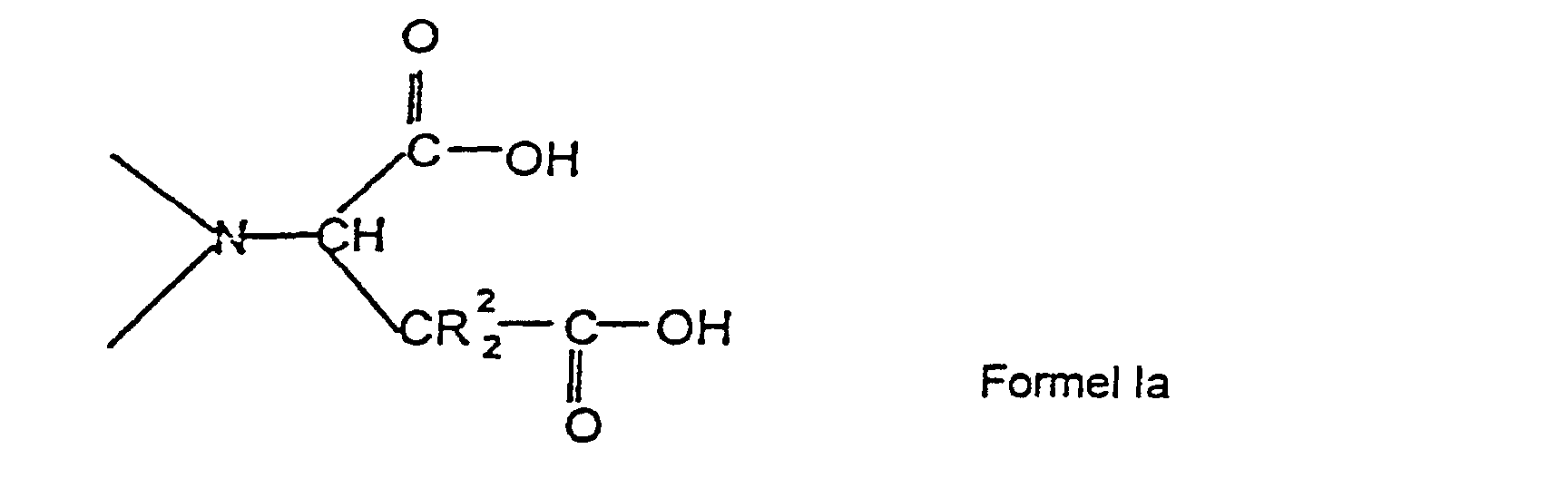
worin jeder R2 unabhängig Wasserstoff oder eine nicht substituierte Alkyl-, Aryl-, Alkaryl- oder Aralkylgruppe oder eine mit einer Hydroxyl-, Carboxyl-, Sulfonyl-, Phosphoryl-, Amino-, Imid- oder Aminogruppe substituierte Alkyl-, Aryl-, Alkaryloder Aralkylgruppe ist, und worin der Abstand zwischen den Carboxyl-Kohlenstoffatomen als "Abstand A" bezeichnet wird, der Abstand zwischen doppelbindigen Carboxyl-Sauerstoffatomen als "Abstand B" bezeichnet wird, und der Abstand zwischen Carboxyl-Hydroxylsauerstoffatomen als "Abstand C" bezeichnet wird, und Feststellen, ob die folgenden Eigenschaften erfüllt sind: Abstand A beträgt mindestens ungefähr 3,81 x 10⁻¹⁰ m, jedoch weniger als oder gleich ungefähr 3,86 x 10⁻¹⁰ m; Abstand B beträgt mindestens ungefähr 5,13 x 10⁻¹⁰ m, jedoch weniger als oder gleich ungefähr 5,52 x 10⁻¹⁰ m und Abstand C beträgt mindestens ungefähr 5,28 x 10⁻¹⁰ m, jedoch weniger als oder gleich 6,09 x 10⁻¹⁰ m; und das niedrigste nicht besetzte Molekülorbital, nachfolgend als LUMO bezeichnet, sich auf mindestens einem Carboxyl-Kohlenstoffatom der Gruppe der Formel la befindet; (b) Inkontaktbringen des Metallions mit mindestens einer Verbindung, von der festgestellt wurde, daß sie die Eigenschaften von Schritt (a) erfüllt, um ein Chelat zu bilden; und (c) Inkontaktbringen des resultierenden Chelats oder eines Chelatbildnerrests oder eines Chelatbildners, aus dem das Metall entfernt ist, mit Mikroben des in ASTM 2667-89, ISO 5815 spezifizierten Typs oder wirksamen Enzymen davon unter Bedingungen und für eine Zeit, die für einen biologischen Abbau ausreichend sind. - Verfahren nach Anspruch 1, worin das in Schritt (b) gebildete Chelat in einem Reinigungs- oder Waschverfahren; einem Verfahren zum Entfernen von Ablagerungen, Belägen oder Rost; einem Verfahren zum Kontrollieren von metallinitiierter oder -katalysierter Oxidation oder Zersetzung, einschließlich Fäulnis, Verfärbung oder Ranzigwerden; einem Verfahren zur Textilbehandlung; einem Verfahren zur Papierherstellung; einem Verfahren zur Stabilisierung von Polymeren oder Phosphaten; oder einem Verfahren zur Erdölbohrung, -Produktion oder - Gewinnung gebildet wird.
- Verfahren nach Anspruch 1, worin das in Schritt (b) gebildete Chelat vor Schritt (c) als Redox-Katalysator, in einem Verfahren zum photographischen Bleichen, Bleichfixieren oder Entwickeln; in der stromlosen Abscheidung oder Plattierung; bei dem Entfernen von sauren oder oxidischen Gasen, einschließlich H2S, NOx, SOx, CO und CO2; oder bei der Bereitstellung von landwirtschaftlichen Nährstoffen verwendet wird.
- Verfahren nach einem der vorhergehenden Ansprüche, worin das Metallion ein Eisen-(III)-Ion ist und worin nach Schritt (b) und vor Schritt (c) das resultierende Eisen-(III)-Chelat zum Bleichen oder Bleichfixieren eines belichteten farbphotographischen Materials verwendet wird, umfassend Inkontaktbringen des Materials mit einer Bleich- oder Bleichfixierungslösung, welche ein das Eisen-(III)-Chelat umfassendes Bleichmittel enthält.
- Verfahren nach einem der Ansprüche 1 bis 3, worin das Metallion ein Kupferion ist, und worin nach Schritt (b) und vor Schritt (c) das resultierende Kupferchelat in einem Verfahren der stromlosen Kupferabscheidung auf eine nicht metallische Oberfläche, die für das abgeschiedene Kupfer aufnahmefähig ist, verwendet wird, umfassend einen Schritt des Inkontaktbringens der nicht metallischen Oberfläche mit einer wäßrigen Lösung, welche ein lösliches Kupfersalz und eine Verbindung mit einer Gruppe der Formel la umfaßt.
- Verfahren nach einem der Ansprüche 1 bis 3 und 5, worin das Metallion ein Kupferion ist, und worin nach Schritt (b) und vor Schritt (c) das resultierende Kupferchelat in einem Verfahren der stromlosen Kupferplattierung verwendet wird, umfassend Eintauchen einer aufnahmefähigen zu plattierenden Oberfläche in ein alkalisches, autokatalytisches Kupferbad, welches Wasser, ein wasserlösliches Kupfersalz und ein Komplexierungsmittel für ein Kupfer-(II)-Ion, das eine Verbindung mit einer Gruppe der Formel la ist, umfaßt.
- Verfahren nach einem der Ansprüche 1 bis 3, worin Schritt (b) in einem Verfahren zum Entfernen von Eisenoxidablagerungen von einer Oberfläche erfolgt, umfassend einen Schritt des Inkontaktbringens der Ablagerungen mit einer Lösung, welche eine ammonierte Verbindung mit einer Gruppe der Formel la umfaßt.
- Verfahren nach einem der vorhergehenden Ansprüche, worin Schritt (b) in einem Verfahren zum Reinigen einer harten Oberfläche erfolgt, umfassend Inkontaktbringen der Oberfläche mit einer Zusammensetzung einer Verbindung mit einer Gruppe der Formel Ia.
- Verfahren nach Anspruch 8, worin die Zusammensetzung zusätzlich ein organisches Lösungsmittel mit einem Siedepunkt von mindestens ungefähr 90°C enthält.
- Verfahren nach einem der vorhergehenden Ansprüche, worin Schritt (b) in einem Verfahren zum Waschen von Gegenständen erfolgt, umfassend Inkontaktbringen der Gegenstände mit einem wäßrigen Waschsystem, weiches im wesentlichen aus Wasser, einem organischen oberflächenaktiven Detergens, ausgewählt aus der Gruppe bestehend aus anionischen Detergenzien, kationischen Detergenzien, nicht-ionischen Detergenzien, ampholytischen Detergenzien, zwitterionischen Detergenzien und Gemischen solcher Detergenzien, und mindestens einem wasserlöslichen Salz einer Säure einer Verbindung mit einer Gruppe der Formel Ia, ausgewählt aus der Gruppe bestehend aus Alkalimetallsalzen, Ammoniumsalzen und Alkylammoniumsalzen, besteht.
- Verfahren nach einem der vorhergehenden Ansprüche, worin nach Schritt (b) und vor Schritt (c) das Chelat in einem Verfahren zum Entfernen von H2S aus einem Fluid verwendet wird, umfassend Inkontaktbringen des Fluids mit einer wäßrigen Lösung bei einem zum Entfernen von H2S geeigneten pH-Wert, worin die Lösung mindestens ein mehrwertiges Metallchelat hoher Valenz einer Verbindung mit einer Gruppe der Formel la enthält.
- Verfahren nach einem der vorhergehenden Ansprüche, worin nach Schritt (b) und vor Schritt (c) das Chelat in einem Verfahren zum Entfernen von NOx aus einem Fluid verwendet wird, umfassend Inkontaktbringen des Fluids mit einer wäßrigen Lösung mindestens eines mehrwertigen Metallchelats einer Verbindung mit einer Gruppe der Formel la in einem niedrigen Valenzzustand.
Priority Applications (1)
| Application Number | Priority Date | Filing Date | Title |
|---|---|---|---|
| EP99115425A EP0959352A1 (de) | 1994-07-27 | 1995-07-14 | Bestimmung der Biodegradabilität von Asparaginsäurederivaten, abbaubare Chelatbildner, Verwendung und Zusammensetzungen davon |
Applications Claiming Priority (3)
| Application Number | Priority Date | Filing Date | Title |
|---|---|---|---|
| US28106094A | 1994-07-27 | 1994-07-27 | |
| US281060 | 1994-07-27 | ||
| PCT/US1995/008809 WO1996003644A1 (en) | 1994-07-27 | 1995-07-14 | Determining biodegradability of aspartic acid derivatives, degradable chelants, uses and compositions thereof |
Related Child Applications (1)
| Application Number | Title | Priority Date | Filing Date |
|---|---|---|---|
| EP99115425A Division EP0959352A1 (de) | 1994-07-27 | 1995-07-14 | Bestimmung der Biodegradabilität von Asparaginsäurederivaten, abbaubare Chelatbildner, Verwendung und Zusammensetzungen davon |
Publications (3)
| Publication Number | Publication Date |
|---|---|
| EP0772771A1 EP0772771A1 (de) | 1997-05-14 |
| EP0772771B1 EP0772771B1 (de) | 2000-03-15 |
| EP0772771B2 true EP0772771B2 (de) | 2003-12-17 |
Family
ID=23075779
Family Applications (2)
| Application Number | Title | Priority Date | Filing Date |
|---|---|---|---|
| EP99115425A Ceased EP0959352A1 (de) | 1994-07-27 | 1995-07-14 | Bestimmung der Biodegradabilität von Asparaginsäurederivaten, abbaubare Chelatbildner, Verwendung und Zusammensetzungen davon |
| EP95927158A Expired - Lifetime EP0772771B2 (de) | 1994-07-27 | 1995-07-14 | Bestimmung der biodegradabilität von asparaginsäurederivaten, abbaubare chelatbildner, verwendungen und zusammensetzungen davon |
Family Applications Before (1)
| Application Number | Title | Priority Date | Filing Date |
|---|---|---|---|
| EP99115425A Ceased EP0959352A1 (de) | 1994-07-27 | 1995-07-14 | Bestimmung der Biodegradabilität von Asparaginsäurederivaten, abbaubare Chelatbildner, Verwendung und Zusammensetzungen davon |
Country Status (8)
| Country | Link |
|---|---|
| US (2) | US5776763A (de) |
| EP (2) | EP0959352A1 (de) |
| JP (1) | JP3504668B2 (de) |
| DE (1) | DE69515671T3 (de) |
| ES (1) | ES2143060T5 (de) |
| MX (1) | MX9700622A (de) |
| NZ (1) | NZ290516A (de) |
| WO (1) | WO1996003644A1 (de) |
Families Citing this family (7)
| Publication number | Priority date | Publication date | Assignee | Title |
|---|---|---|---|---|
| EP0968658A1 (de) * | 1998-07-02 | 2000-01-05 | Akzo Nobel N.V. | Tierfutterzusätze, die Äthylendiamin-dibernsteinsäure als Chelatbildner enthalten |
| JP2004507718A (ja) * | 2000-07-28 | 2004-03-11 | ライオン バイオサイエンス アクチェンゲゼルシャフト | 化合物のadme/tox特性を予測するためのシステム及び方法 |
| EP1358612A2 (de) * | 2000-07-28 | 2003-11-05 | LION Bioscience AG | Abschnittsspezifisches permeabilitäts-modell des darms |
| CA2649239C (en) * | 2006-04-21 | 2014-07-08 | Dow Global Technologies Inc. | Formulations with unexpected cleaning performance incorporating a biodegradable chelant |
| CA2722431C (en) | 2008-04-28 | 2016-08-02 | Dow Global Technologies Inc. | Polyalkylene glycol lubricant composition |
| RU2687174C1 (ru) * | 2018-06-13 | 2019-05-07 | Федеральное государственное бюджетное образовательное учреждение высшего образования "Санкт-Петербургский государственный технологический институт (технический университет)" | Способ определения устойчивости органических полимеров к деградации, индуцируемой различными факторами |
| US11525086B2 (en) | 2019-05-06 | 2022-12-13 | Gpcp Ip Holdings Llc | Paper sheet mulches and methods of making the same |
Citations (5)
| Publication number | Priority date | Publication date | Assignee | Title |
|---|---|---|---|---|
| US4704233A (en) † | 1986-11-10 | 1987-11-03 | The Procter & Gamble Company | Detergent compositions containing ethylenediamine-N,N'-disuccinic acid |
| WO1992009680A1 (en) † | 1990-11-14 | 1992-06-11 | The Procter & Gamble Company | Nonphosphated dishwashing compositions with oxygen bleach systems |
| EP0556782A1 (de) † | 1992-02-17 | 1993-08-25 | Konica Corporation | Bleichlösung oder Bleichfixierlösung und Verfahren zum Verarbeiten von lichtempfindlichen, farbphotographischen Materialien unter verwendung dieser Lösungen |
| DE4211713A1 (de) † | 1992-04-08 | 1993-10-14 | Basf Ag | Verfahren zur Herstellung von Aminodicarbonsäure-N,N-diessigsäuren |
| WO1994003553A1 (en) † | 1992-08-01 | 1994-02-17 | The Procter & Gamble Company | Peroxy bleaching composition stabilized with ethylenediamine-n,n'-disuccinic acid |
Family Cites Families (10)
| Publication number | Priority date | Publication date | Assignee | Title |
|---|---|---|---|---|
| US3158635A (en) * | 1959-03-18 | 1964-11-24 | Stauffer Chemical Co | Bis-adduction products and methods of preparing same |
| DK17885D0 (da) * | 1985-01-14 | 1985-01-14 | Karlsson Karl Anders | Antiviralt middel |
| US4855931A (en) * | 1988-03-25 | 1989-08-08 | Yale University | Stochastic method for finding molecular conformations |
| JPH02151650A (ja) * | 1988-12-02 | 1990-06-11 | Polyplastics Co | 熱可塑性ポリエステル樹脂組成物 |
| EP0431189A4 (en) * | 1989-06-30 | 1992-04-22 | Hitachi, Ltd. | Method of assisting material design and apparatus therefor |
| CA2002536C (en) * | 1989-11-08 | 1996-02-20 | Peter H. Buist | Dynamic molecular model |
| AU7034791A (en) * | 1989-12-29 | 1991-07-24 | University Technologies International Inc. | Methods for modelling tertiary structures of biologically active ligands including agonists and antagonists thereto and novel synthetic antagonists based on angiotensin |
| WO1992006949A1 (en) * | 1990-10-23 | 1992-04-30 | Nippon Shokubai Co., Ltd. | Process for producing salt of amino carboxylic acid |
| US5362412A (en) * | 1991-04-17 | 1994-11-08 | Hampshire Chemical Corp. | Biodegradable bleach stabilizers for detergents |
| US5208369A (en) * | 1991-05-31 | 1993-05-04 | The Dow Chemical Company | Degradable chelants having sulfonate groups, uses and compositions thereof |
-
1995
- 1995-07-14 JP JP50578596A patent/JP3504668B2/ja not_active Expired - Lifetime
- 1995-07-14 EP EP99115425A patent/EP0959352A1/de not_active Ceased
- 1995-07-14 DE DE69515671T patent/DE69515671T3/de not_active Expired - Lifetime
- 1995-07-14 EP EP95927158A patent/EP0772771B2/de not_active Expired - Lifetime
- 1995-07-14 MX MX9700622A patent/MX9700622A/es unknown
- 1995-07-14 NZ NZ290516A patent/NZ290516A/en not_active IP Right Cessation
- 1995-07-14 ES ES95927158T patent/ES2143060T5/es not_active Expired - Lifetime
- 1995-07-14 WO PCT/US1995/008809 patent/WO1996003644A1/en not_active Ceased
-
1996
- 1996-03-04 US US08/607,253 patent/US5776763A/en not_active Expired - Lifetime
-
1997
- 1997-09-18 US US08/932,972 patent/US5854060A/en not_active Expired - Lifetime
Patent Citations (5)
| Publication number | Priority date | Publication date | Assignee | Title |
|---|---|---|---|---|
| US4704233A (en) † | 1986-11-10 | 1987-11-03 | The Procter & Gamble Company | Detergent compositions containing ethylenediamine-N,N'-disuccinic acid |
| WO1992009680A1 (en) † | 1990-11-14 | 1992-06-11 | The Procter & Gamble Company | Nonphosphated dishwashing compositions with oxygen bleach systems |
| EP0556782A1 (de) † | 1992-02-17 | 1993-08-25 | Konica Corporation | Bleichlösung oder Bleichfixierlösung und Verfahren zum Verarbeiten von lichtempfindlichen, farbphotographischen Materialien unter verwendung dieser Lösungen |
| DE4211713A1 (de) † | 1992-04-08 | 1993-10-14 | Basf Ag | Verfahren zur Herstellung von Aminodicarbonsäure-N,N-diessigsäuren |
| WO1994003553A1 (en) † | 1992-08-01 | 1994-02-17 | The Procter & Gamble Company | Peroxy bleaching composition stabilized with ethylenediamine-n,n'-disuccinic acid |
Also Published As
| Publication number | Publication date |
|---|---|
| ES2143060T5 (es) | 2004-06-16 |
| DE69515671D1 (de) | 2000-04-20 |
| NZ290516A (en) | 1998-07-28 |
| DE69515671T3 (de) | 2004-06-17 |
| EP0772771B1 (de) | 2000-03-15 |
| AU3127095A (en) | 1996-02-22 |
| EP0772771A1 (de) | 1997-05-14 |
| JP3504668B2 (ja) | 2004-03-08 |
| US5854060A (en) | 1998-12-29 |
| DE69515671T2 (de) | 2000-07-06 |
| ES2143060T3 (es) | 2000-05-01 |
| WO1996003644A1 (en) | 1996-02-08 |
| MX9700622A (es) | 1997-12-31 |
| AU697099B2 (en) | 1998-09-24 |
| US5776763A (en) | 1998-07-07 |
| JPH10503843A (ja) | 1998-04-07 |
| EP0959352A1 (de) | 1999-11-24 |
Similar Documents
| Publication | Publication Date | Title |
|---|---|---|
| Blanck et al. | Variability in zinc tolerance, measured as incorporation of radio-labeled carbon dioxide and thymidine, in periphyton communities sampled from 15 European river stretches | |
| Ma et al. | Sensitive detection of organophosphorus pesticides in agricultural food products by a highly luminescent coordination polymer | |
| Hassan et al. | Atomically precise hexanuclear Ce (IV) clusters as functional fluorescent nanosensors for rapid one‐step detection of PFAS | |
| EP0772771B2 (de) | Bestimmung der biodegradabilität von asparaginsäurederivaten, abbaubare chelatbildner, verwendungen und zusammensetzungen davon | |
| AU692906B2 (en) | Determining biodegradability of iminodiacetic acid derivatives | |
| US5569443A (en) | Method for removing hydrogen sulfide from a gas using polyamino disuccinic acid | |
| dos Santos Carlos et al. | A highly selective acridine-based fluorescent probe for detection of Al3+ in alcoholic beverage samples | |
| US5447575A (en) | Degradable chelants having sulfonate groups, uses and compositions thereof | |
| Zhang et al. | Comparison of the yields of mono-, Di-and tri-chlorinated HAAs and THMs in chlorination and chloramination based on experimental and quantum-chemical data | |
| WO1994028464A1 (en) | Succinic acid derivative degradable chelants, uses and compositions thereof | |
| AU697099C (en) | Determining biodegradability of aspartic acid derivatives, degradable chelants, uses and compositions thereof | |
| CA2194184C (en) | Determining biodegradability of aspartic acid derivatives, degradable chelants, uses and compositions thereof | |
| US5741555A (en) | Succinic acid derivative degradable chelants, uses and compositions thereof | |
| WO1996003644B1 (en) | Determining biodegradability of aspartic acid derivatives, degradable chelants, uses and compositions thereof | |
| WO1996003643B1 (en) | Determining biodegradability of iminodiacetic acid derivatives, degradable chelants, uses and compositions thereof | |
| Dudás et al. | Calcium complexing behaviour of lactate in neutral to highly alkaline medium | |
| Aoyagi et al. | Optical properties of trinuclear citrate complexes containing 4f and 5f block metals | |
| TW475003B (en) | Inhibition of corrosion in aqueous systems | |
| El Qami et al. | Prebiotic formation of thioesters via cyclic anhydrides as a key step in the emergence of metabolism | |
| Căluşaru | Hydrogen catalytic waves for the polarographic determination of 2-mercaptobenzothiazole in the presence of cobalt (II) | |
| Heckel | Investigating Mechanisms of Reductive Chlorinated Hydrocarbon Degradation with Compound-Specific Isotope Analysis | |
| Bos | Utilizing Phosphorus Budgets and Isotopic Tracers to Evaluate Phosphorus Fate in Soils with Long Term Poultry Litter Application | |
| JPH07128324A (ja) | 工業用水中の添加物の経時的濃度検知方法 |
Legal Events
| Date | Code | Title | Description |
|---|---|---|---|
| PUAI | Public reference made under article 153(3) epc to a published international application that has entered the european phase |
Free format text: ORIGINAL CODE: 0009012 |
|
| 17P | Request for examination filed |
Effective date: 19970109 |
|
| AK | Designated contracting states |
Kind code of ref document: A1 Designated state(s): BE DE ES FR GB IT NL SE |
|
| RAP3 | Party data changed (applicant data changed or rights of an application transferred) |
Owner name: THE DOW CHEMICAL COMPANY |
|
| 17Q | First examination report despatched |
Effective date: 19981028 |
|
| GRAG | Despatch of communication of intention to grant |
Free format text: ORIGINAL CODE: EPIDOS AGRA |
|
| GRAG | Despatch of communication of intention to grant |
Free format text: ORIGINAL CODE: EPIDOS AGRA |
|
| GRAG | Despatch of communication of intention to grant |
Free format text: ORIGINAL CODE: EPIDOS AGRA |
|
| GRAH | Despatch of communication of intention to grant a patent |
Free format text: ORIGINAL CODE: EPIDOS IGRA |
|
| GRAH | Despatch of communication of intention to grant a patent |
Free format text: ORIGINAL CODE: EPIDOS IGRA |
|
| GRAA | (expected) grant |
Free format text: ORIGINAL CODE: 0009210 |
|
| AK | Designated contracting states |
Kind code of ref document: B1 Designated state(s): BE DE ES FR GB IT NL SE |
|
| REF | Corresponds to: |
Ref document number: 69515671 Country of ref document: DE Date of ref document: 20000420 |
|
| ET | Fr: translation filed | ||
| ITF | It: translation for a ep patent filed | ||
| REG | Reference to a national code |
Ref country code: ES Ref legal event code: FG2A Ref document number: 2143060 Country of ref document: ES Kind code of ref document: T3 |
|
| PLBQ | Unpublished change to opponent data |
Free format text: ORIGINAL CODE: EPIDOS OPPO |
|
| PLBI | Opposition filed |
Free format text: ORIGINAL CODE: 0009260 |
|
| 26 | Opposition filed |
Opponent name: BASF AKTIENGESELLSCHAFT Effective date: 20001214 Opponent name: AKZO NOBEL N.V. Effective date: 20001213 Opponent name: THE PROCTER & GAMBLE COMPANY Effective date: 20001207 |
|
| PLBF | Reply of patent proprietor to notice(s) of opposition |
Free format text: ORIGINAL CODE: EPIDOS OBSO |
|
| NLR1 | Nl: opposition has been filed with the epo |
Opponent name: BASF AKTIENGESELLSCHAFT Opponent name: AKZO NOBEL N.V. Opponent name: THE PROCTER & GAMBLE COMPANY |
|
| PLBF | Reply of patent proprietor to notice(s) of opposition |
Free format text: ORIGINAL CODE: EPIDOS OBSO |
|
| PLBF | Reply of patent proprietor to notice(s) of opposition |
Free format text: ORIGINAL CODE: EPIDOS OBSO |
|
| PLBF | Reply of patent proprietor to notice(s) of opposition |
Free format text: ORIGINAL CODE: EPIDOS OBSO |
|
| REG | Reference to a national code |
Ref country code: GB Ref legal event code: IF02 |
|
| PLAW | Interlocutory decision in opposition |
Free format text: ORIGINAL CODE: EPIDOS IDOP |
|
| PUAH | Patent maintained in amended form |
Free format text: ORIGINAL CODE: 0009272 |
|
| STAA | Information on the status of an ep patent application or granted ep patent |
Free format text: STATUS: PATENT MAINTAINED AS AMENDED |
|
| 27A | Patent maintained in amended form |
Effective date: 20031217 |
|
| AK | Designated contracting states |
Kind code of ref document: B2 Designated state(s): BE DE ES FR GB IT NL SE |
|
| NLR2 | Nl: decision of opposition |
Effective date: 20031217 |
|
| REG | Reference to a national code |
Ref country code: SE Ref legal event code: RPEO |
|
| NLR3 | Nl: receipt of modified translations in the netherlands language after an opposition procedure | ||
| REG | Reference to a national code |
Ref country code: ES Ref legal event code: DC2A Date of ref document: 20031224 Kind code of ref document: T5 |
|
| ET3 | Fr: translation filed ** decision concerning opposition | ||
| PGFP | Annual fee paid to national office [announced via postgrant information from national office to epo] |
Ref country code: ES Payment date: 20050712 Year of fee payment: 11 |
|
| PGFP | Annual fee paid to national office [announced via postgrant information from national office to epo] |
Ref country code: NL Payment date: 20060703 Year of fee payment: 12 |
|
| PGFP | Annual fee paid to national office [announced via postgrant information from national office to epo] |
Ref country code: GB Payment date: 20060712 Year of fee payment: 12 |
|
| PGFP | Annual fee paid to national office [announced via postgrant information from national office to epo] |
Ref country code: FR Payment date: 20060719 Year of fee payment: 12 |
|
| PGFP | Annual fee paid to national office [announced via postgrant information from national office to epo] |
Ref country code: IT Payment date: 20060731 Year of fee payment: 12 |
|
| EUG | Se: european patent has lapsed | ||
| GBPC | Gb: european patent ceased through non-payment of renewal fee |
Effective date: 20070714 |
|
| PGFP | Annual fee paid to national office [announced via postgrant information from national office to epo] |
Ref country code: BE Payment date: 20071004 Year of fee payment: 13 |
|
| NLV4 | Nl: lapsed or anulled due to non-payment of the annual fee |
Effective date: 20080201 |
|
| PG25 | Lapsed in a contracting state [announced via postgrant information from national office to epo] |
Ref country code: SE Free format text: LAPSE BECAUSE OF NON-PAYMENT OF DUE FEES Effective date: 20070715 Ref country code: NL Free format text: LAPSE BECAUSE OF NON-PAYMENT OF DUE FEES Effective date: 20080201 |
|
| PG25 | Lapsed in a contracting state [announced via postgrant information from national office to epo] |
Ref country code: GB Free format text: LAPSE BECAUSE OF NON-PAYMENT OF DUE FEES Effective date: 20070714 |
|
| REG | Reference to a national code |
Ref country code: FR Ref legal event code: ST Effective date: 20080331 |
|
| PLAB | Opposition data, opponent's data or that of the opponent's representative modified |
Free format text: ORIGINAL CODE: 0009299OPPO |
|
| PGFP | Annual fee paid to national office [announced via postgrant information from national office to epo] |
Ref country code: SE Payment date: 20060705 Year of fee payment: 12 |
|
| PG25 | Lapsed in a contracting state [announced via postgrant information from national office to epo] |
Ref country code: FR Free format text: LAPSE BECAUSE OF NON-PAYMENT OF DUE FEES Effective date: 20070731 |
|
| REG | Reference to a national code |
Ref country code: ES Ref legal event code: FD2A Effective date: 20070716 |
|
| PG25 | Lapsed in a contracting state [announced via postgrant information from national office to epo] |
Ref country code: ES Free format text: LAPSE BECAUSE OF NON-PAYMENT OF DUE FEES Effective date: 20070716 |
|
| PG25 | Lapsed in a contracting state [announced via postgrant information from national office to epo] |
Ref country code: IT Free format text: LAPSE BECAUSE OF NON-PAYMENT OF DUE FEES Effective date: 20070714 |
|
| PG25 | Lapsed in a contracting state [announced via postgrant information from national office to epo] |
Ref country code: BE Free format text: LAPSE BECAUSE OF NON-PAYMENT OF DUE FEES Effective date: 20080731 |
|
| PGFP | Annual fee paid to national office [announced via postgrant information from national office to epo] |
Ref country code: DE Payment date: 20140709 Year of fee payment: 20 |
|
| REG | Reference to a national code |
Ref country code: DE Ref legal event code: R071 Ref document number: 69515671 Country of ref document: DE |