EP0773302A1 - Procédé de coulée de gelées métalliques et gelées d'aluminium - Google Patents
Procédé de coulée de gelées métalliques et gelées d'aluminium Download PDFInfo
- Publication number
- EP0773302A1 EP0773302A1 EP96307358A EP96307358A EP0773302A1 EP 0773302 A1 EP0773302 A1 EP 0773302A1 EP 96307358 A EP96307358 A EP 96307358A EP 96307358 A EP96307358 A EP 96307358A EP 0773302 A1 EP0773302 A1 EP 0773302A1
- Authority
- EP
- European Patent Office
- Prior art keywords
- alloy material
- aluminum alloy
- semi
- aluminium alloy
- molten
- Prior art date
- Legal status (The legal status is an assumption and is not a legal conclusion. Google has not performed a legal analysis and makes no representation as to the accuracy of the status listed.)
- Granted
Links
- 229910000838 Al alloy Inorganic materials 0.000 title claims abstract description 219
- 239000000956 alloy Substances 0.000 title claims abstract description 140
- 238000010117 thixocasting Methods 0.000 title claims abstract description 39
- 238000000034 method Methods 0.000 title claims abstract description 33
- 230000008569 process Effects 0.000 title claims abstract description 33
- 238000005266 casting Methods 0.000 claims abstract description 67
- 239000013078 crystal Substances 0.000 claims abstract description 58
- 230000005496 eutectics Effects 0.000 claims abstract description 58
- 239000007790 solid phase Substances 0.000 claims abstract description 49
- 238000002844 melting Methods 0.000 claims abstract description 45
- 239000007791 liquid phase Substances 0.000 claims abstract description 39
- 230000008018 melting Effects 0.000 claims abstract description 32
- 239000000203 mixture Substances 0.000 claims abstract description 22
- 238000010438 heat treatment Methods 0.000 claims abstract description 20
- 229910019752 Mg2Si Inorganic materials 0.000 claims description 36
- 239000003795 chemical substances by application Substances 0.000 claims description 2
- 239000012071 phase Substances 0.000 abstract description 48
- 229910018125 Al-Si Inorganic materials 0.000 abstract description 36
- 229910018520 Al—Si Inorganic materials 0.000 abstract description 36
- 238000001556 precipitation Methods 0.000 abstract description 4
- IUVCFHHAEHNCFT-INIZCTEOSA-N 2-[(1s)-1-[4-amino-3-(3-fluoro-4-propan-2-yloxyphenyl)pyrazolo[3,4-d]pyrimidin-1-yl]ethyl]-6-fluoro-3-(3-fluorophenyl)chromen-4-one Chemical class C1=C(F)C(OC(C)C)=CC=C1C(C1=C(N)N=CN=C11)=NN1[C@@H](C)C1=C(C=2C=C(F)C=CC=2)C(=O)C2=CC(F)=CC=C2O1 IUVCFHHAEHNCFT-INIZCTEOSA-N 0.000 description 31
- 238000003825 pressing Methods 0.000 description 18
- 239000011159 matrix material Substances 0.000 description 17
- 239000000463 material Substances 0.000 description 16
- 238000007711 solidification Methods 0.000 description 15
- 230000008023 solidification Effects 0.000 description 15
- 229910052739 hydrogen Inorganic materials 0.000 description 10
- 239000001257 hydrogen Substances 0.000 description 10
- 150000002431 hydrogen Chemical class 0.000 description 9
- 230000007547 defect Effects 0.000 description 8
- 239000000470 constituent Substances 0.000 description 7
- 238000009749 continuous casting Methods 0.000 description 7
- 230000005484 gravity Effects 0.000 description 7
- 239000000126 substance Substances 0.000 description 7
- 230000003247 decreasing effect Effects 0.000 description 6
- 230000006698 induction Effects 0.000 description 6
- 238000007493 shaping process Methods 0.000 description 6
- 239000006185 dispersion Substances 0.000 description 5
- 238000005054 agglomeration Methods 0.000 description 4
- 230000002776 aggregation Effects 0.000 description 4
- 238000000113 differential scanning calorimetry Methods 0.000 description 4
- 230000013011 mating Effects 0.000 description 3
- 229910052751 metal Inorganic materials 0.000 description 3
- 239000002184 metal Substances 0.000 description 3
- 230000009467 reduction Effects 0.000 description 3
- 238000009864 tensile test Methods 0.000 description 3
- 229910045601 alloy Inorganic materials 0.000 description 2
- 229910052782 aluminium Inorganic materials 0.000 description 2
- 230000000694 effects Effects 0.000 description 2
- 239000006023 eutectic alloy Substances 0.000 description 2
- 238000009863 impact test Methods 0.000 description 2
- 230000002401 inhibitory effect Effects 0.000 description 2
- 238000005259 measurement Methods 0.000 description 2
- 229910018563 CuAl2 Inorganic materials 0.000 description 1
- 241000282326 Felis catus Species 0.000 description 1
- UFHFLCQGNIYNRP-UHFFFAOYSA-N Hydrogen Chemical compound [H][H] UFHFLCQGNIYNRP-UHFFFAOYSA-N 0.000 description 1
- XAGFODPZIPBFFR-UHFFFAOYSA-N aluminium Chemical compound [Al] XAGFODPZIPBFFR-UHFFFAOYSA-N 0.000 description 1
- 239000000109 continuous material Substances 0.000 description 1
- 238000005520 cutting process Methods 0.000 description 1
- 230000006866 deterioration Effects 0.000 description 1
- 230000002708 enhancing effect Effects 0.000 description 1
- 230000006872 improvement Effects 0.000 description 1
- 238000003780 insertion Methods 0.000 description 1
- 230000037431 insertion Effects 0.000 description 1
- 229910000765 intermetallic Inorganic materials 0.000 description 1
- 230000014759 maintenance of location Effects 0.000 description 1
- 150000002739 metals Chemical class 0.000 description 1
- 230000002093 peripheral effect Effects 0.000 description 1
Images













Classifications
-
- C—CHEMISTRY; METALLURGY
- C22—METALLURGY; FERROUS OR NON-FERROUS ALLOYS; TREATMENT OF ALLOYS OR NON-FERROUS METALS
- C22C—ALLOYS
- C22C1/00—Making non-ferrous alloys
- C22C1/12—Making non-ferrous alloys by processing in a semi-solid state, e.g. holding the alloy in the solid-liquid phase
Definitions
- the present invention relates to a thixocasting process, and particularly, to an improvement in a thixocasting process which involves subjecting an aluminum alloy material to a heating treatment to prepare a semi-molten aluminum alloy material having a solid phase (which is a substantially solid phase and so forth) and a liquid phase coexisting therein, pouring the semi-molten aluminum alloy material into a cavity in a casting mold under pressure, and then solidifying the semi-molten aluminum alloy material under pressure.
- a thixocasting process which involves subjecting an aluminum alloy material to a heating treatment to prepare a semi-molten aluminum alloy material having a solid phase (which is a substantially solid phase and so forth) and a liquid phase coexisting therein, pouring the semi-molten aluminum alloy material into a cavity in a casting mold under pressure, and then solidifying the semi-molten aluminum alloy material under pressure.
- thixocasting aluminum alloy material which has a hypo eutectic crystal composition and a characteristic that a first angle endothermic section appearing due to the melting of an eutectic crystal and a second angle endothermic section appearing due to the melting of a component having a melting point higher than an eutectic point exist in a differential calorimetric curve.
- T 2 the temperature of a drop-end point in the first angle endothermic section
- T 3 the temperature of a peak in the second angle endothermic section
- the casting temperature of the semi-molten aluminum alloy material is set in a range of T 2 ⁇ T ⁇ T 3 .
- the reason why the casting temperature T is set at a relative high level in this manner is for the purpose of decreasing the solid phase proportion in the semi-molten aluminum alloy material to improve the castability of the latter.
- the metallographic structure of the resulting aluminum alloy cast product comprises an ⁇ phase formed by the solidification of the solid phase, and a matrix, i.e., a ⁇ - ⁇ eutectic crystal phase formed by the solidification of the liquid phase.
- the aluminum alloy cast product has a mechanical characteristic depending upon the metallographic structure thereof.
- an Al-Mg 2 Si based alloy material as an aluminum alloy malleable material may be used as a thixocasting aluminum alloy material.
- the content of Mg in the Al-Mg 2 Si based alloy material i.e., the Mg 2 Si content is too small, the liquid phase amount is insufficient due to the appearing of only a single angle endothermic section in the differential calorimetric curve. For this reason, a shrink cavity is liable to be produced around an spherical ⁇ -Al portion of the aluminum alloy cast product.
- a thixocasting aluminum alloy material which contains a relative large amount of Sr added thereto.
- the reason why the Sr content is defined is to reliably finely divide the metallographic structure of the matrix produced by the solidification of the liquid phase and to increase the electric resistance value of the aluminum alloy material to enhance the red-heated degree of the semi-molten aluminum alloy material by an induction heating.
- the toughness of the aluminum alloy cast product is largely lost.
- thixocasting aluminum alloy material having a characteristic that a first endothermic section appearing due to the melting of an eutectic component and a second endothermic section appearing due to the melting of a component having a melting point higher than an eutectic point are exist in a differential calorimetric curve.
- the ratio u/t of the maximum value u to the maximum value t is in a range of u/t > 0.1.
- the known semi-molten aluminum alloy material suffers from the following problem:
- the high-melting component is colloidal and is in a softened state.
- the ratio u/t is in the range of u/t > 0.1, the amount of heat of the solidification of the high-melting component is large and hence, the time until the solidification of such component is relatively long. Due to these facts, the high-melting component is agglomerated to cause the deterioration of the fluidity of the semi-molten aluminum alloy material and hence, casting defects such as a cold shut are liable to be produced in an aluminum alloy product.
- a thixocasting process comprising the steps of: subjecting, to a heating treatment, an aluminum alloy material having a hypo eutectic crystal composition and a characteristic that a first angle endothermic section appearing due to the melting of an eutectic crystal and a second angle endothermic section appearing due to the melting of a component having a melting point higher than an eutectic point coexist in a differential calorimetric curve, thereby preparing a semi-molten aluminum alloy material having solid and liquid phases coexisting therein; pouring the semi-molten aluminum alloy material into a cavity in a casting mold under pressure; and solidifying the semi-molten aluminum alloy material under pressure, wherein when the temperature of a rise-start point in the first angle endothermic section is represented by T 1 , and the temperature of a drop-end point is represented by T 2 , the casting temperature of the semi-molten aluminum alloy material is set in a range of T 1 ⁇ T ⁇ T
- the liquid phase has an eutectic composition in such range of the temperature T, i.e., in the range of T 1 ⁇ T ⁇ T 2 .
- the composition of the liquid phase is varied so as to waver toward an over-eutectic crystal side and a hypo eutectic crystal side across with respect to the eutectic point serving as a boundary. Therefore, a ⁇ phase is precipitated on the over-eutectic side and an ⁇ - ⁇ eutectic crystal is precipitated on the hypo eutectic side.
- the growth of the ⁇ phase is hindered by the ⁇ phase which is a solid phase and hence, the fine division of the ⁇ phase is achieved.
- the casting temperature T is set as described above, the proportion of the solid phase in the semi-molten aluminum alloy material is increased, but the ⁇ phase exhibits an effect of inhibiting the mutual agglomeration of the solid phases and hence, the semi-molten aluminum alloy material has a good fluidity.
- a thixocasting process comprising the steps of: subjecting an aluminum alloy material to a heating treatment to prepare a semi-molten aluminum alloy material having solid and liquid phases coexisting therein; and pouring the semi-molten aluminum alloy material into a cavity in a casting mold under pressure, wherein the aluminum alloy material used is a material having a Mg 2 Si content in a range of 2 % by weight ⁇ Mg 2 Si ⁇ 11 % by weight.
- the liquid phase amount is suitable in the semi-molten aluminum alloy material. Therefore, during pouring of the semi-molten aluminum alloy material, the liquid phase is supplied sufficiently to around the solid phase, and a Mg 2 Si portion of a aluminum alloy cast product is finely divided and is of a suitable presence amount. Further, the aluminum alloy material is used in a semi-molten state and moreover, the content of Mg 2 Si which will be the liquid phase is set as described above, and hence, the liquid phase amount is small, whereby the amount of hydrogen into the liquid phase is largely decreased.
- the Mg 2 Si content in the aluminum alloy material is in a range of Mg 2 Si ⁇ 2 % by weight, a shrinkage cavity is liable to be produced in an aluminum alloy cast product as a result of a decrease in liquid phase amount.
- Mg 2 Si > 11 % by weight a brittle Mg 2 Si crystal exists in a large amount in an aluminum alloy cast product and moreover, blow holes are liable to be produced in the aluminum alloy cast product as a result of an increase in liquid phase amount.
- a thixocasting aluminum alloy material which is to be poured into a cavity in a casting mold in a semi-molten state having solid and liquid phase coexisting therein and which has Mg 2 Si content set in a range of 2 % by weight ⁇ Mg 2 Si ⁇ 11 % by weight.
- a thixocasting process comprising the steps of subjecting an aluminum alloy material, to a heating treatment to prepare a semi-molten aluminum alloy material having solid and liquid phases coexisting therein, pouring the semi-molten aluminum alloy material into a cavity in a casting mold under pressure, and solidifying the semi-molten aluminum alloy material under pressure, wherein the amount of Sr added in the aluminum alloy material is set in a range of 0 ppm ⁇ Sr ⁇ 100 ppm, and the shear rate Rs of the semi-molten aluminum alloy material in the cavity is set in a range of Rs ⁇ 50 S -1 .
- the amount of Sr added and the shear rate Rs are set as described above, notwithstanding that the amount of Sr added is very small, the metallographic structure of a matrix produced by the solidification of the liquid phase can be reliably finely divided, and the wettability of the matrix and a dispersion phase produced by the solidification of the solid phase can be improved, thereby enhancing the toughness of the aluminum alloy cast product.
- a red-heated degree of the semi-molten aluminum alloy material by a high-frequency heating is sufficiently enhanced by the amount of Sr added.
- an aluminum alloy cast product has the substantially same toughness as that when Sr > 100 ppm.
- a thixocasting aluminum alloy material which contains Sr added thereto as a modifying agent, the amount of Sr added being set in a range of 0 ppm ⁇ Sr ⁇ 100 ppm.
- this aluminum alloy material makes it possible to produce an aluminum alloy cast product having a high toughness by utilizing a thixocasting process.
- a thixocasting aluminum alloy material which has a characteristic that a first angle endothermic section appearing due to the melting of an eutectic component and a second angle endothermic section appearing due to the melting of a component having a melting point higher than an eutectic point exist in a differential calorimetric curve, and in which when the maximum value of the distance between the first endothermic section and a straight line interconnecting a melt-start point of the eutectic component and a melt-end point of the high-melting component is represented by t, and the maximum value of the distance between the straight line and the second endothermic section is represented by u, the ratio u/t of the maximum value u to the maximum value t is in a range of u/t ⁇ 0.1.
- the ratio u/t is in the range of u/t ⁇ 0.1 as described above, the heat amount of solidification of the high-melting component is small and hence, the time taken for such component to be solidified is shortened. Thus, the agglomeration of the high-melting component in the semi-molten aluminum alloy material is avoided and hence, such aluminum alloy material has a good fluidity.
- the lower limit of the ratio u/t is equal to 0.005.
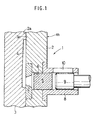
- a pressure casting machine 1 shown in Fig,1 is used to cast an aluminum alloy cast product in a thixocasting process using an aluminum ailoy material.
- the pressure casting machine 1 includes a casting mold m which is comprised of a stationary die 2 and a movable die 3 having vertical mating faces 2a and 3a.
- a cast product forming cavity 4 is defined between both the mating faces 2a and 3a.
- a chamber 6 for placement of a semi-molten aluminum alloy material 5 is defined in the stationary die 2 and communicates with the cavity 4 through a gate 7.
- a sleeve 8 is horizontally mounted to the stationary die 2 to communicate with the chamber 6, and a pressing plunger 9 is slidably received in the sleeve 8 and inserted into and withdrawn from the chamber 6.
- the sleeve 8 has a material insertion inlet 10 in an upper portion of a peripheral wall thereof.
- the clamping force is set, for example, at 200 tons
- the input pressure is set, for example,
- Table 1 shows the composition of an example A of an Al-Si based alloy material having a hypo eutectic crystal composition.
- the example A is made by cutting from a long continuous cast material having a high quality and produced utilizing a continuous casting process. In producing the long continuous cast material in the casting process, a spheroidization of ⁇ -aluminum is performed. The example A has a diameter of 50 mm and a length of 65 mm.
- Table 1 Example A of Al-Si based alloy material Chemical constituent (% by weight) Si Mg Fe Sr Balance 6.9 0.57 0.10 0.034 Al
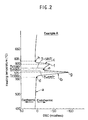
- the example A was subjected to a differential scanning calorimetry (DSC) to provide results shown in Fig.2.
- DSC differential scanning calorimetry
- a differential calorimetric curve a in Fig.2 a first angle endothermic section b appearing due to the melting of an eutectic crystal and a second angle endothermic section c appearing due to the melting of a component having a melting point higher than an eutectic point exist.
- the temperature T 1 of a rise-start point d in the first angle endothermic section b is equal to 556°C
- T 2 of a drop-end point (corresponding to a rise-start point in the second angle endothermic section c and so forth) is equal to 580°C.
- the temperature T 3 of a peak f in the second angle endothermic section c is equal to 598°C.
- the temperature of a peak g in the first angle endothermic section b is 571°C, and the temperature of a drop-end point h of the second angle endothermic section c is 608°C.
- the example A was placed into a heating coil of an induction heating device and then heated under conditions of a frequency of 1 kHz and a maximum output power of 37 kW to prepare a semi-molten Al-Si based alloy material having solid and liquid phases coexisting therein.
- the heating temperature for the example A was set at 575°C, and the solid phase rate was set at 70 %.
- a pressing force was applied to the example A filled in the cavity 4 by retaining the pressing plunger 9 at a stroke terminal end, thereby solidifying the example A under such a pressure to provide an aluminum alloy cast product A 1 .
- the casting operation was carried out under the same conditions, except that the casting temperature T of the example A was set at 585°C (T 2 ⁇ T ⁇ T 3 ), and the solid phase rate was set at 45 %, thereby producing an aluminum alloy cast product A 2 .
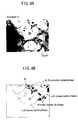
- Figs.3 and 4A are photomicrographs showing the metallographic structure of the aluminum alloy cast product A 1
- Fig.4B is a tracing of an essential portion of Fig.4A.
- the metallographic structure is comprised of an ⁇ -Al phase formed by the solidification of a solid phase, and a matrix M and thus a primary crystal Si phase and an Al-Si eutectic crystal phase formed by the solidification of a liquid phase.
- the primary crystal Si phase was dispersed around the solid phase and has a volume fraction rate Vf of 2.8 %.
- the metallographic structure having the primary crystal Si phase existing therein was produced in spite of the use of the Al-Si based alloy material having the hypo eutectic crystal composition as described above is as follows: if the casting temperature T is set at 575°C, the liquid phase has an eutectic composition containing 11.7 % by weight of Si, as shown in Fig.5 because the temperature T is in a range of T 1 (556°C) ⁇ T (575°C) ⁇ T 2 (580°C) in Fig.2.
- the composition of the liquid phase is varied so as to waver toward an over-eutectic crystal side and a hypo eutectic crystal side with respect to the eutectic point serving as a boundary, as shown by a curve i in Fig.5 and hence, a primary crystal Si phase is precipitated on the over-eutectic side and an Al-Si eutectic crystal is precipitated on the hypo eutectic side.
- the growth of the primary crystal Si phase is hindered by the ⁇ -Al phase which is a solid phase and hence, the grain size D of the primary crystal Si phase is in a range of 5 ⁇ m ⁇ D ⁇ 20 ⁇ m.
- the fine division of the primary crystal Si phase is performed using P or the like.
- the grain size D of the primary crystal Si phase is in a range of 20 ⁇ m ⁇ D ⁇ 50 ⁇ m.
- the solid phase rate in the semi-molten Al-Si based alloy material is increased to 70 %.
- the primary crystal Si phase exhibited an effect of inhibiting the mutual agglomeration of the solid phases and hence, the semi-molten Al-Si based alloy material had a good fluidity, and the generation of casting defects was not observed in the aluminum alloy cast product.
- Figs.6 and 7A are photomicrographs showing the metallographic structure of an example A 2 of an aluminum alloy cast product, and Fig.7B is a tracing of an essential portion of Fig.7A.
- This metallographic structure is comprised of an ⁇ -Al phase and a matrix and thus an Al-Si eutectic crystal formed by the solidification of a liquid phase. No primary crystal Si phase exists in this metallographic structure.
- the reason why no primary crystal Si phase exists is as follows: if the casting temperature T is set at 585°C, the liquid phase has a hypo eutectic crystal composition containing about 10.4 % by weight of Si, as shown in Fig.5, because the temperature T is in a range of T 2 (580°C) ⁇ T (585°C) ⁇ T 3 (598°C) in Fig.2. In the solidifying step, the composition is varied so as to waver toward a higher-Si side and a lower-Si side with respect to about 10.4 % by weight of Si, as shown by a curve j in Fig.5, but cannot exceed an eutectic point. Therefore, no primary crystal Si phase is precipitated.
- Test pieces A 1 and A 2 were made from the aluminum alloy cast product examples A 1 and A 2 and subjected to a T6 treatment and then to a tensile test and a Charpy impact test to provide results given in Table 2.
- Table 2 Test piece 0.2 % proof strength (MPa) Tensile strength (MPa) Elongation (%) Charpy impact value (J/cm 2 ) A 1 311 342 7.5 3.9 A 2 254 319 10.9 5.8
- test piece A 1 having the primary crystal Si phase existing therein has an enhanced strength, as compared with the test piece A 2 having no primary crystal Si phase.
- test piece A 1 reductions in ductility and toughness were inhibited, because the primary crystal Si phase was finely divided and had a suitable volume fraction rate Vf.
- Table 3 shows chemical constituents of examples B 1 , B 2 and B 3 of Al-Si based alloy materials having a hypo eutectic crystal composition and an example B 4 of an Al-Si based alloy material having an over-eutectic composition.
- These examples B 1 to B 4 are materials cut away from a long continuous cast product made in a continuous casting process, and in this casting thereof, the spheroidization of ⁇ -Al was performed.
- Each of the examples B 1 to B 4 has a diameter of 50 mm and a length of 65 mm.
- Table 3 Example of Al-Si based alloy material Chemical constituent (% by weight) Si Mg Cu Balance B 1 3.2 0.5 - Al B 2 5.7 0.5 - Al B 3 9.1 0.8 2.8 Al B 4 12.9 0.2 3.8 Al
- each of the examples B 1 to B 4 was subjected to a differential scanning calorimetry (DSC) and as a result, it was made clear that a first angle endothermic section appearing due to the melting of an eutectic crystal and a second angle endothermic section appearing due to the melting of a component having a melting point higher than an eutectic point exist in a differential calorimetric curve.
- DSC differential scanning calorimetry
- Table 4 shows temperatures of various points in the differential calorimetric curve.
- the example B 1 was placed into the heating coil in the induction heating device and then heated under conditions of a frequency of 1 kHz and a maximum output power of 37 kW to prepare an example B 1 of a semi-molten Al-Si based alloy material having solid and liquid phases coexisting therein.
- the example B 1 of the semi-molten Al-Si based alloy material was placed into the chamber 6 and poured into the cavity 4 through the gate 7 while being pressurized under conditions of a moving speed of the pressing plunger 9 of 0.2 m/sec and a mold temperature of 20°C.
- a pressing force was applied to the example B 1 filled in the cavity 4 by retaining the pressing plunger 9 at a stroke terminal end, thereby solidifying the example B 1 under pressure to produce an example B 1 of an aluminum alloy cast product.
- examples B 2 , B 3 and B 4 of other Al-Si based alloy materials the same casting operation was carried out to produce examples B2, B 3 and B 4 of aluminum alloy cast products.
- the metallographic structure of each of the examples B 2 , B 3 and B 4 of the aluminum alloy cast products was examined. It was made clear from the result that the metallographic structure was comprised of an ⁇ -Al phase formed by the solidification of a solid phase and a matrix M and thus a primary crystal Si phase and an Al-Si eutectic crystal phase formed by the solidification of a liquid phase. In addition, no casting defect was observed in each of the examples B 2 , B 3 and B 4 of the aluminum alloy cast products.
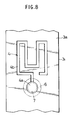
- a movable die 3 1 used for this test includes a cavity 4 1 which is comprised of a circular portion 4a communicating with the gate 7, and a substantially U-shaped bent portion 4b extending from the circular portion 4a, as shown in Fig.8.
- an example B 1 of a semi-molten Al-Si based alloy material was prepared under the same conditions as in the casting operation. Then, the example B 1 was poured into the cavity 4 1 under the same conditions and solidified therein.
- the flow length of the example B 1 was defined as "1.0", and the flow length ratio of the other examples B 2 , B 3 and B 4 was determined.
- test pieces were fabricated from the four examples B 1 , B 2 , B 3 and B 4 of aluminum alloy cast products and subjected to a T6 treatment and then to a Charpy impact test.
- Table 5 shows the casting temperature T, the solid phase rate and various measurements for the examples B 1 , B 2 , B 3 and B 4 of aluminum alloy cast products.
- the casting temperature T for the examples B 1 , B 2 , B 3 and B 4 of the aluminum alloy cast products was set in a range of T 1 ⁇ T ⁇ T 2 . It can be also seen that if the volume fraction rate Vf of the primary crystal Si phase is increased, the fluidity of the semi-molten Al-Si based alloy material is enhanced.
- Fig.9 is a graph taken from Table 5 and showing the relationship between the volume fraction Vf of the primary crystal Si phase and the flow length ratio as well as the Charpy impact value for the aluminum alloy cast product examples B 1 , B 2 , B 3 and B 4 .
- points B 1 , B 2 , B 3 and B 4 correspond to the aluminum alloy cast product examples B 1 , B 2 , B 3 and B 4 .
- the relationship between the point and the example applies to Figures which will be described hereinafter.
- the grain size D of the primary crystal Si phase is in the range of 5 ⁇ m ⁇ D ⁇ 20 ⁇ m and the volume fraction Vf thereof is in the range of 1.5 % ⁇ Vf ⁇ 4.7 % as in the aluminum alloy cast product examples B 1 , B 2 and B 3 , the fluidity of the semi-molten Al-Si based alloy material can be improved; the generation of casting defects can be prevented, and the strength and toughness of the aluminum alloy cast product can be insured.
- the flow length ratio for the aluminum alloy cast product example A 1 in Example 1 was 1.1.
- the aluminum alloy materials include not only the Al-Si based alloy material, but also an Al-CuAl 2 based alloy material, an Al-Mg 2 Si based alloy material, an Al-AlFeSi intermetallic compound based alloy material and the like.
- Table 6 shows the composition and the density of examples A, B, C, D, E and F of aluminum alloy materials.
- the examples A to F are materials cut away from a long continuous material having a high quality and made in a continuous casting process. In the casting them, the spheroidization of ⁇ -Al was performed.
- Each of the examples A to F has a diameter of 50 mm and a length of 65 mm.
- the example A was subjected to a differential scanning calorimetry (DSC) to provide a result shown in Fig.10. Only a single angle endothermic section appears in a differential calorimetric curve a shown in Fig.10.
- DSC differential scanning calorimetry
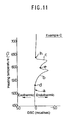
- Fig.11 shows a differential calorimetric curve for an example C.
- a first angle endothermic section b appearing due to the melting of an eutectic crystal and a second angle endothermic section c appearing due to the melting of a component having a melting point higher than an eutectic point exist in the differential calorimetric curve.
- the temperature of a rise-start point d in the first angle endothermic section b is a melt-start temperature (a solidification-end temperature) of the eutectic component
- the temperature of a drop-end point e in the first angle endothermic section b is a melt-end temperature of the eutectic component (a melt-start temperature of the high-melting component)
- the temperature of a drop-end point h in the second angle endothermic section c is a melt-end temperature (a solidification-start temperature) of the high-melting component.
- the aluminum alloy material example A was placed into the heating coil in the induction heating device and then heated under conditions of a frequency of l kHz and a maximum output power of 37 kW to prepare an example A of a semi-molten aluminum alloy material having solid and liquid phases coexisting therein.
- a primary pressing step for the example A was started under conditions of a casting temperature of 640°C, a solid phase rate of 40 %, a moving speed of the pressing plunger 9 of 0.5 m/sec, a gate-passing speed of the example A of 0.8 m/sec and a mold temperature of 250°C, and the example A was poured through the gate 7 into the cavity 4 while being pressed.
- the plunger pressure at the completion of the primary pressing step was set at 360 kgf/cm 2 .
- a secondary pressing step for the example A was immediately started.
- the example A was solidified to provide an example A of an aluminum alloy cast product.
- the plunger pressure in the secondary pressing step was set at 760 kgf/cm 2 , and the pressing retention time was set at 30 sec.
- the thixocasting process was carried out in the same manner, except that the solid phase rate R of the aluminum alloy material example A was varied to 5 % and 10 %; the solid phase rate S of examples B, C and D was varied to 5 %, 10 % and 40 % and the solid phase rate S of an example E was set at 40 %, thereby producing various examples A 2 , A 3 , B 1 , B 2 , B 3 , C 1 , C 2 , C 3 , D 1 , D 2 , D 3 , E 1 and F 1 of aluminum alloy cast products.
- Tensile test pieces were fabricated from the aluminum alloy cast product examples A 1 to A 4 , B 1 to B 4 , C 1 to C 4 , D 1 to D 4 , E 1 , E 4 , F 1 and F 4 and subjected to a tensile test to measure the ultimate strength, thereby providing results shown in Table 7.
- Fig.12 is a graph taken from Table 7 and showing the relationship between the Mg 2 Si content and the ultimate strength.
- the aluminum alloy cast product made by the thixocasting process has a strength higher than that of the aluminum alloy cast product made by the gravity casting process, but the aluminum alloy cast product examples E 1 and E 2 as well as F 1 and F 4 having the Mg 2 Si content larger than 11 % by weight have substantially equivalent strengths. This is for the following reason: In the case of the examples E 1 (F 1 ), the amount of hydrogen dissolved is small, but the presence amount of the brittle Mg 2 Si is large. On the other hand, in the case of the example E 4 (F 4 ), the amount of hydrogen dissolved is large. Due to these facts, the strengths of the examples E 1 (F 1 ) and the example E 4 (F 4 ) are decreased and substantially equal to each other.
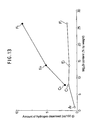
- Fig.13 shows the relationship between the Mg 2 Si content and the amount of hydrogen dissolved for the aluminum alloy cast product examples A 1 , C 1 , E 1 and F 1 produced using the semi-molten aluminum alloy material examples A, C, E and F having the solid phase rate S equal to 40 % and the aluminum alloy cast product examples C 4 , E 4 and F 4 produced by the gravity casting process using the aluminum alloy material examples C, E and F having the solid phase rate equal to 0 %, i.e., molten metals thereof.
- the amount of hydrogen dissolved in the aluminum alloy cast product examples C 1 , E 1 and F 1 produced by the thixocasting process is smaller than that in the aluminum alloy cast product examples C 4 , E 4 and F 4 produced by the gravity casting.
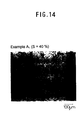
- Fig.14 is a photomicrograph showing the metallographic structure of the aluminum alloy cast product example A 1 produced using the semi-molten aluminum alloy material having the solid phase rate S equal to 40 %. It can be seen from Fig.14 that a shrinkage cavity (a black area) was produced around the spherical ⁇ -Al. This is due to the fact that the liquid phase was sufficiently not supplied to around the solid phase in the semi-molten aluminum alloy material example A.
- Fig.15A is a photomicrograph showing the metallographic structure of the aluminum alloy cast product example C 1 produced using the semi-molten aluminum alloy material example C having the solid phase rate equal to 40 %
- Fig.15B is a tracing of an essential portion of Fig.15A. It can be seen from Figs.15A and 15B that no shrinkage cavity and no blow hole are produced in the aluminum alloy cast product example C 1 , and the Mg 2 Si was finely divided and was of a suitable presence amount and thus, the aluminum alloy cast product example C 1 has a good casting quality.
- Figs.16A and 16B are photomicrographs showing the metallographic structure of the aluminum alloy cast product example F 1 produced using the semi-molten aluminum alloy material having the solid phase rate equal to 40 %. It can be observed in Fig.16A that Mg 2 Si is a dark gray massive portion and exists in a large amount. It can be observed in Fig.16B that Mg 2 Si is a large massive portion and is brittle and hence, has cracks produced. The cracks appear as black lines in some Mg2Si in Fig.16A.
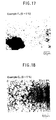
- Fig.17 is a photomicrograph showing the metallographic structure of the aluminum alloy cast product example F 4 produced by the gravity casting process using the aluminum alloy material example F having the solid phase rate S equal to 0 %, i.e., the molten metal thereof. Blow holes (black portions) were produced in the aluminum alloy cast product example F 4 due to a large amount of hydrogen dissolved.
- Fig.18 is a photomicrograph showing the metallographic structure of the aluminum alloy cast product example C 4 produced by the gravity casting process using the molten metal of the aluminum alloy material example C (having the solid phase rate S equal to 0 %) .
- Blow holes black portions were also produced in the aluminum alloy cast product example C 4 , as in the aluminum alloy cast product example F 4 shown in Fig.17.
- the solid phase rate S of the material is set in the range of S ⁇ 10 %.
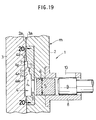
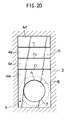
- a cavity 4 in a casting mold m in a pressure casting machine shown in Figs.19 and 20 is of a rectangular parallelepiped shape with a long side extending vertically and is formed so that the volume is stepwise decreased from the below to the above by a stepped surface 11 located on a mating face 2a of a stationary die 2.
- the other structures are the same as in the pressure casting machine 1 shown in Fig.1 and hence, the same components are designated by like reference characters in Figs.19 and 20.
- Table 8 shows the compositions of aluminum alloy material examples A 1 , A 2 and A 3 and examples B 1 and B 2 for comparison.
- the examples A 1 , A 2 , A 3 , B 1 and B 2 are materials cut away from a long continuous casting material made in a continuous casting process and having a high quality. In the casting thereof, the spheroidization of ⁇ -Al was performed.
- Each of the examples A 1 , A 2 , A 3 , B 1 and B 2 has a diameter of 50 mm and a length of 65 mm. In this case, the inside diameter k of the chamber 6 is equal to 55 mm.
- the example A 1 was placed into the heating coil in the induction heating device and then heated under conditions of a frequency of 1 kHz and a maximum output power of 30 kW to prepare an example A 1 of a semi-molten aluminum alloy material having solid and liquid phases coexisting therein.
- the solid phase rate was set at 45 %.
- the example A 1 of the semi-molten aluminum alloy material 5 was placed into the chamber 6 poured through the gate 7 into the cavity 4 while being pressed under conditions of a casting temperature of the example A 1 of 580°C, a moving speed of the plunger 9 of 0.20 m/sec, a casting pressure of 800 kgf/(sec ⁇ cm 2 ) and a mold temperature of 250°C.
- a pressing force was applied to the example A 1 filled in the cavity 4 by retaining the pressing plunger 9 at a stroke terminate end, so that the example A 1 was solidified under pressure to produce an aluminum alloy cast product example A 1 .
- the aluminum alloy cast product example A 1 was subjected to a T6 treatment (this applies to an aluminum alloy cast product which will be described hereinafter in this embodiment III).
- Fig.21 shows the aluminum alloy cast product example A 1 .
- Fig.22 is a photomicrograph showing the metallographic structure of the first intermediate portion Y of the aluminum alloy cast product example A 1 after the T6 treatment.
- a relatively large and rounded portion is a dispersion phase formed by the solidification of the solid phase, namely, an ⁇ -Al phase, and a portion filling an area between the dispersion phases is a matrix formed by the solidification of the liquid phase.
- the matrix is comprised of an infinite number of black dot-like Al-Si eutectic crystal phases, and ⁇ -Al phases filling the areas between the Al-Si eutectic crystal phases. It can be seen from Fig.22 that the metallographic structure of the matrix was finely divided, and the matrix and the dispersion phases were sufficiently in contact with each other.
- the casting operation was carried out in the same manner using examples A 2 and A 3 and examples B 1 and B 2 , thereby producing four aluminum alloy cast product examples A 2 , A 3 , B 1 and B 2 having the same shape as the aluminum alloy cast product example A 1 .
- Table 9 shows the flow speed V and the shear speed Rs in shaping the portions W to Z as well as the Charpy impact value C and the fracture toughness value K IC for the aluminum alloy cast product examples A 1 , A 2 , A 3 , B 1 and B 2 .
- the flow speeds V for the tip end Z, the first and second intermediate portions Y and X and the base end W were measured at entrances r 1 , r 2 , r 3 and r 4 of a tip end shaping zone 4z, first and second intermediate portion shaping zone 4y and 4z and a base end shaping zone 4z in the cavity 4, as shown in Fig.19, immediately before the completion of the pouring of the examples A 1 and the like into the cavity 4.
- Fig.23 is a graph taken from Table 9 and showing the relationship between the amount of Sr added and the Charpy impact value C as well as the fracture toughness value K IC for the tip ends Z of the aluminum alloy cast product examples A 1 , A 2 , A 3 , B 1 and B 2 . It can be seen from Fig.23 that if the amount of Sr added is set in a range of Sr ⁇ 100 ppm as in the examples A 1 , A 2 and A 3 , the toughness of the aluminum alloy cast product examples A 1 , A 2 and A 3 is largely enhanced.
- Fig.24 is a graph taken from Table 9 and showing the relationship between the shear speed Rs and the Charpy impact value C for the portions W to Z of the aluminum alloy cast product examples A 1 , A 2 , A 3 , B 1 and B 2 . It can be seen from Fig.24 that if the amount of Sr added is set in the range of Sr ⁇ 100 ppm and the shear speed Rs is set in the range of Rs ⁇ 50 s -1 as in the examples A 1 , A 2 and A 3 , the Charpy impact value C is enhanced as in the portions X, Y and Z of the aluminum alloy cast product examples A 1 , A 2 and A 3 .
- Fig.25 is a graph taken from Table 9 and showing the relationship between the shear speed Rs and the fracture toughness value K IC for the portions W to Z of the aluminum alloy cast product examples A 1 , A 2 , A 3 , B 1 and B 2 . It can be seen from Fig.25 that if the amount of Sr added is set in the range of Sr ⁇ 100 ppm and the shear speed Rs is set in the range of Rs ⁇ 50 s -1 , as in the examples A 1 , A 2 and A 3 , the fracture toughness value K IC is enhanced as in the portions X, Y and Z of the aluminum alloy cast product examples A 1 , A 2 and A 3 .
- Table 10 shows the compositions of examples A 4 having a Mg content decreased from that in Example 1 and an example B 3 for comparison.
- the examples A 4 and B 3 are likewise materials cut away from a long continuous cast product made in a continuous casting process and having a high quality, and in the casting thereof, the spheroidization of ⁇ -Al was performed.
- Each of the examples A 4 and B 3 has a diameter of 50 mm and a length of 65 mm.
- Table 10 Example of aluminum alloy material Chemical constituent (% by weight) Si Mg Fe Sr(ppm) Al A 4 7.00 0.28 0.13 5 Balance B 3 7.10 0.30 0.09 167 Balance
- Table 11 shows the flow speed V and the shear speed Rs in shaping portions W to Z, and the Charpy impact value C and the fracture toughness value K IC of the portions W to Z in the aluminum alloy cast product examples A 4 and B 3 .
- Fig.26 is a graph taken from Table 11 and showing the relationship between the shear speed Rs and the Charpy impact value C for the portions W to Z of the aluminum alloy cast product examples A 4 and B 3 .
- the Charpy impact value C is enhanced as in the portions X, Y and Z of the aluminum alloy cast product example A 4 .
- Fig.27 is a graph taken from Table 11 and showing the relationship between the shear speed Rs and the fracture toughness K IC for the portions W to Z of the aluminum alloy cast product examples A 4 and B 3 .
- the fracture toughness value K IC is enhanced as in the portions X, Y and Z of the aluminum alloy cast product example A 4 .
- Table 12 shows the compositions of examples A 1 and A 2 of thixocasting aluminum alloy materials and examples B 1 , B 2 , B 3 and B 4 for comparison. These examples A 1 , A 2 , B 1 , B 2 , B 3 and B 4 are materials cut away from a long continuous cast product made in a continuous casting process and having a high quality, and in the casting thereof, the spheroidization of ⁇ -Al was performed.
- the example A 1 was subjected to a differential scanning calorimetry (DSC) to provide a result shown in Fig.28.
- DSC differential scanning calorimetry
- a first endothermic section b 1 appearing due to the melting of an eutectic component, i.e., an Al-Si eutectic crystal and a second endothermic section c 1 appearing due to the melting of a primary crystal Si exist in a differential calorimetric curve a shown in Fig.28.
- the first endothermic section b 1 forms an angle shape having a peak g remarkably spaced apart from a straight line s connecting a melt-start point (a rise-start point) d of the eutectic component and a melt-end point (a drop-end point) h of the high-melting component.
- the second endothermic section has a flatness extending along the straight line s .
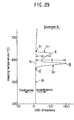
- Figs.29 to 32 show differential calorimetric curves for the examples B 1 , B 2 , B 3 and B 4 .
- Each of the first and second endothermic sections b 1 and c 1 in the examples B 1 , B 2 and B 3 forms an angle shape having a peak g , f , respectively.
- the eutectic crystal is an Al-Si eutectic crystal
- the high-melting component is ⁇ -Al.
- the example A 1 having a diameter of 50 mm and a length of 65 mm was first placed into the heating coil in the induction heating device and heated under conditions of a frequency of 1 kHz and a maximum output power of 30 kW to prepare an example A 1 of a semi-molten aluminum alloy material having solid and liquid phases.
- the solid phase rate was set at 50 %.
- the example A 1 of the semi-molten aluminum alloy material 5 was placed into the chamber 6 and poured through the gate 7 into the cavity 4 while being pressed under conditions of a casting temperature of the example A 1 of 572°C, a moving speed of the pressing plunger 9 of 0.20 m/sec and a mold temperature of 250°C, so that it was solidified under such a pressure.
- the weight of the solidified portion located in the bent portion 4b of the cavity 4 was measured and defined as a flow length of the example A 1 .
- each of the examples A 2 , B 1 , B 2 , B 3 and B 4 was subjected to a similar fluidity test to measure a flow length.
- This example B 4 is unsuitable as a thixocasting alloy material.
- Table 13 shows the ratio u/t and the flow length ratio for the examples A 1 and the like. Each of the flow length ratios was determined based on the flow length of the example B 1 defined as "1.0". Table 13 Example of Al alloy material Ratio u/t Flow length ratio A 1 0.05 1.7 A 2 0.1 1.6 B 1 0.5 1.0 B 2 0.8 0.85 B 3 0.3 1.2 B 4 0 1.5
- the examples A 1 and A 2 having the ratio u/t ⁇ 0.1 are good in fluidity in their semi-molten states, as compared with the examples B 1 , B 2 , B 3 and B 4 having the ratio u/t > 0.1.
- the first endothermic section b 1 is of an angle shape, while the second endothermic section c 1 has a flatness extending along the straight line s .
- 13 to 90 % by weight of Si is contained as an alloy element in the aluminum alloy material. If the Si content departs from this range, a differential calorimetric curve as described above does not appear.
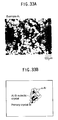
- Fig.33A is a photomicrograph showing the metallographic structure of the aluminum alloy cast product example A 1
- Fig.33B is a tracing of an essential portion of Fig.33A. It can be seen from Figs.33A and 33B that the aluminum alloy cast product example A 1 has no casting defects produced therein such as a cold shut and is sound. This is attributable to the fact that the fluidity of the example A 1 in the semi-molten state is good.
- Fig.34 is a photomicrograph showing the metallographic structure of the aluminum alloy cast product example B 1 . It can be seen from Fig.34 that black cold shuts were produced in the matrix and between the matrix and the spherical ⁇ -Al in the aluminum alloy cast product example B 1 . This is attributable to the fact that the fluidity of the example B 1 in the semi-molten state is poor.
- the matrix is comprised of an Al-Si eutectic crystal (a dark gray portion) and the ⁇ -Al (a light gray portion).
Landscapes
- Chemical & Material Sciences (AREA)
- Engineering & Computer Science (AREA)
- Materials Engineering (AREA)
- Mechanical Engineering (AREA)
- Metallurgy (AREA)
- Organic Chemistry (AREA)
- Manufacture Of Alloys Or Alloy Compounds (AREA)
- Continuous Casting (AREA)
Applications Claiming Priority (12)
| Application Number | Priority Date | Filing Date | Title |
|---|---|---|---|
| JP7288071A JP2981977B2 (ja) | 1995-10-09 | 1995-10-09 | チクソキャスティング法 |
| JP28807195 | 1995-10-09 | ||
| JP288071/95 | 1995-10-09 | ||
| JP29048995 | 1995-10-12 | ||
| JP290489/95 | 1995-10-12 | ||
| JP7290489A JP2876392B2 (ja) | 1995-10-12 | 1995-10-12 | チクソキャスティング法 |
| JP308175/95 | 1995-11-01 | ||
| JP7308175A JP2869889B2 (ja) | 1995-11-01 | 1995-11-01 | チクソキャスティング法 |
| JP30817595 | 1995-11-01 | ||
| JP348890/95 | 1995-12-19 | ||
| JP7348890A JPH09170036A (ja) | 1995-12-19 | 1995-12-19 | チクソキャスティング法およびチクソキャスティング用Al合金材料 |
| JP34889095 | 1995-12-19 |
Publications (2)
| Publication Number | Publication Date |
|---|---|
| EP0773302A1 true EP0773302A1 (fr) | 1997-05-14 |
| EP0773302B1 EP0773302B1 (fr) | 2002-07-31 |
Family
ID=27479476
Family Applications (1)
| Application Number | Title | Priority Date | Filing Date |
|---|---|---|---|
| EP96307358A Revoked EP0773302B1 (fr) | 1995-10-09 | 1996-10-09 | Procédé de coulée de gelées métalliques |
Country Status (3)
| Country | Link |
|---|---|
| US (1) | US5993572A (fr) |
| EP (1) | EP0773302B1 (fr) |
| DE (1) | DE69622664T2 (fr) |
Cited By (7)
| Publication number | Priority date | Publication date | Assignee | Title |
|---|---|---|---|---|
| WO2001002612A1 (fr) * | 1999-07-06 | 2001-01-11 | Thixomat, Inc. | Charge d'alimentation activee |
| WO2001009401A1 (fr) * | 1999-07-28 | 2001-02-08 | Sm Schweizerische Munitionsunternehmung Ag | Procede de production d'une matiere premiere constituee d'un alliage metallique |
| GB2354472A (en) * | 1999-09-24 | 2001-03-28 | Univ Brunel | Manufacturing castings from immiscible metallic liquids |
| CN1085740C (zh) * | 1998-02-11 | 2002-05-29 | 国营八一三厂 | 铸造铝合金的长效变质剂 |
| EP1528111A1 (fr) | 2003-10-28 | 2005-05-04 | Aisin Seiki Kabushiki Kaisha | Produit en alliage d'aluminium Al-Si-Mg et sa méthode de production |
| WO2005046911A1 (fr) * | 2003-11-07 | 2005-05-26 | Mahle Gmbh | Procede de production de materiaux composites a base de matrice metallique |
| CN117066485A (zh) * | 2023-08-22 | 2023-11-17 | 江西洪都国际机电有限责任公司 | 一种基于真空差压铸造的耐高温zl114a制备工艺方法 |
Families Citing this family (2)
| Publication number | Priority date | Publication date | Assignee | Title |
|---|---|---|---|---|
| US6355090B1 (en) * | 1998-04-08 | 2002-03-12 | The Furukawa Electric Co., Ltd. | Method of manufacturing aluminum alloy for flattening material and aluminum alloy flattening material for automobiles |
| US6863017B2 (en) * | 2003-03-14 | 2005-03-08 | David Charles | Safety seat for a marine craft or other vehicle |
Citations (3)
| Publication number | Priority date | Publication date | Assignee | Title |
|---|---|---|---|---|
| EP0375025A1 (fr) * | 1988-12-20 | 1990-06-27 | METALLGESELLSCHAFT Aktiengesellschaft | Alliage léger pour le moulage |
| EP0572683A1 (fr) * | 1992-01-13 | 1993-12-08 | Honda Giken Kogyo Kabushiki Kaisha | Procede de moulage de pieces en alliage d'aluminium et pieces ainsi produites |
| DE19518127A1 (de) * | 1994-05-17 | 1995-11-23 | Honda Motor Co Ltd | Legierungsmaterial zum Thixo-Gießen, Verfahren zum Zubereiten semi-geschmolzenen Legierungsmaterials zum Thixo-Gießen und Thixo-Gießverfahren |
Family Cites Families (3)
| Publication number | Priority date | Publication date | Assignee | Title |
|---|---|---|---|---|
| US3031299A (en) * | 1960-08-23 | 1962-04-24 | Aluminum Co Of America | Aluminum base alloy |
| GB1430758A (en) * | 1972-08-23 | 1976-04-07 | Alcan Res & Dev | Aluminium alloys |
| US5178686A (en) * | 1988-12-20 | 1993-01-12 | Metallgesellschaft Aktiengesellschaft | Lightweight cast material |
-
1996
- 1996-10-09 DE DE69622664T patent/DE69622664T2/de not_active Expired - Lifetime
- 1996-10-09 US US08/728,435 patent/US5993572A/en not_active Expired - Fee Related
- 1996-10-09 EP EP96307358A patent/EP0773302B1/fr not_active Revoked
Patent Citations (3)
| Publication number | Priority date | Publication date | Assignee | Title |
|---|---|---|---|---|
| EP0375025A1 (fr) * | 1988-12-20 | 1990-06-27 | METALLGESELLSCHAFT Aktiengesellschaft | Alliage léger pour le moulage |
| EP0572683A1 (fr) * | 1992-01-13 | 1993-12-08 | Honda Giken Kogyo Kabushiki Kaisha | Procede de moulage de pieces en alliage d'aluminium et pieces ainsi produites |
| DE19518127A1 (de) * | 1994-05-17 | 1995-11-23 | Honda Motor Co Ltd | Legierungsmaterial zum Thixo-Gießen, Verfahren zum Zubereiten semi-geschmolzenen Legierungsmaterials zum Thixo-Gießen und Thixo-Gießverfahren |
Non-Patent Citations (2)
| Title |
|---|
| F. KLEIN: "Druckgiessen mit rheocastgegossenenm Aluminium", GIESSEREI, no. 9, 2 May 1994 (1994-05-02), DÜSSELDORF, pages 263, XP002023896 * |
| H. KAUFMANN: "Endabmessungsnahes Giessen: Ein Vergleich von Squeeze-casting und Thixocasting", GIESSEREI, vol. 81, no. 11, 6 June 1994 (1994-06-06), DÜSSELDORF, pages 342 - 350, XP002023897 * |
Cited By (13)
| Publication number | Priority date | Publication date | Assignee | Title |
|---|---|---|---|---|
| CN1085740C (zh) * | 1998-02-11 | 2002-05-29 | 国营八一三厂 | 铸造铝合金的长效变质剂 |
| US6514308B2 (en) | 1999-07-06 | 2003-02-04 | Thixomat, Inc. | Activated feedstock |
| US6299665B1 (en) | 1999-07-06 | 2001-10-09 | Thixomat, Inc. | Activated feedstock |
| US6514309B2 (en) | 1999-07-06 | 2003-02-04 | Thixomat, Inc. | Activated feedstock |
| WO2001002612A1 (fr) * | 1999-07-06 | 2001-01-11 | Thixomat, Inc. | Charge d'alimentation activee |
| AU777285B2 (en) * | 1999-07-06 | 2004-10-07 | Thixomat, Inc. | Activated feedstock |
| WO2001009401A1 (fr) * | 1999-07-28 | 2001-02-08 | Sm Schweizerische Munitionsunternehmung Ag | Procede de production d'une matiere premiere constituee d'un alliage metallique |
| US6547896B2 (en) | 1999-07-28 | 2003-04-15 | Ruag Munition | Process for the production of a material made of a metal alloy |
| GB2354472A (en) * | 1999-09-24 | 2001-03-28 | Univ Brunel | Manufacturing castings from immiscible metallic liquids |
| EP1528111A1 (fr) | 2003-10-28 | 2005-05-04 | Aisin Seiki Kabushiki Kaisha | Produit en alliage d'aluminium Al-Si-Mg et sa méthode de production |
| WO2005046911A1 (fr) * | 2003-11-07 | 2005-05-26 | Mahle Gmbh | Procede de production de materiaux composites a base de matrice metallique |
| US8282748B2 (en) | 2003-11-07 | 2012-10-09 | Mahle Gmbh | Process for producing metal matrix composite materials |
| CN117066485A (zh) * | 2023-08-22 | 2023-11-17 | 江西洪都国际机电有限责任公司 | 一种基于真空差压铸造的耐高温zl114a制备工艺方法 |
Also Published As
| Publication number | Publication date |
|---|---|
| DE69622664T2 (de) | 2002-11-14 |
| US5993572A (en) | 1999-11-30 |
| EP0773302B1 (fr) | 2002-07-31 |
| DE69622664D1 (de) | 2002-09-05 |
Similar Documents
| Publication | Publication Date | Title |
|---|---|---|
| EP0572683B1 (fr) | Procede de moulage de pieces en alliage d'aluminium et pieces ainsi produites | |
| EP0575796B1 (fr) | Procédé de fabrication d'alliages de magnésium thixotropiques | |
| EP0701002A1 (fr) | Procédé de fabrication d'alliages d'aluminium ou de magnésium à l'état semi-solide | |
| EP0144898A2 (fr) | Alliages d'aluminium et procédé pour leur fabrication | |
| US4126448A (en) | Superplastic aluminum alloy products and method of preparation | |
| JPH02503331A (ja) | 機械抵抗の高いマグネシウム合金及び該合金の急速凝固による製造方法 | |
| JP3000442B2 (ja) | チクソキャスティング法 | |
| EP0773302B1 (fr) | Procédé de coulée de gelées métalliques | |
| US5925199A (en) | Process for producing a thixocast semi-molten material | |
| US6053997A (en) | Thixocasting process of an alloy material | |
| US5849115A (en) | Alloy material for thixocasting, process for preparing semi-molten alloy material for thixocasting and thixocasting process | |
| US3544761A (en) | Process of welding aluminum | |
| PL182441B1 (pl) | Masa stopu metalowego do formowania w stanie półstałym | |
| JP2794539B2 (ja) | チクソキャスティング法 | |
| JP2000303133A (ja) | 疲労強度に優れた圧力鋳造用アルミニウム合金 | |
| JP2794540B2 (ja) | チクソキャスティング用Al−Cu−Si系合金材料 | |
| US3492119A (en) | Filament reinforced metals | |
| JPH08165529A (ja) | 気密性に優れたアルミニウム合金ダイカストの製造方法 | |
| JP3290603B2 (ja) | チクソキャスティング法の適用下で得られたFe−C−Si系合金鋳物 | |
| JP2869889B2 (ja) | チクソキャスティング法 | |
| JP3473214B2 (ja) | 半溶融金属の成形方法 | |
| JP2832660B2 (ja) | Al系合金鋳物の鋳造方法 | |
| JP2981977B2 (ja) | チクソキャスティング法 | |
| EP0539417B1 (fr) | Materiaux composites coules | |
| JP3339333B2 (ja) | 溶融金属の成形方法 |
Legal Events
| Date | Code | Title | Description |
|---|---|---|---|
| PUAI | Public reference made under article 153(3) epc to a published international application that has entered the european phase |
Free format text: ORIGINAL CODE: 0009012 |
|
| AK | Designated contracting states |
Kind code of ref document: A1 Designated state(s): DE FR GB |
|
| 17P | Request for examination filed |
Effective date: 19970507 |
|
| 17Q | First examination report despatched |
Effective date: 19981207 |
|
| GRAG | Despatch of communication of intention to grant |
Free format text: ORIGINAL CODE: EPIDOS AGRA |
|
| RTI1 | Title (correction) |
Free format text: THIXOCASTING PROCESS |
|
| GRAG | Despatch of communication of intention to grant |
Free format text: ORIGINAL CODE: EPIDOS AGRA |
|
| GRAH | Despatch of communication of intention to grant a patent |
Free format text: ORIGINAL CODE: EPIDOS IGRA |
|
| GRAH | Despatch of communication of intention to grant a patent |
Free format text: ORIGINAL CODE: EPIDOS IGRA |
|
| GRAA | (expected) grant |
Free format text: ORIGINAL CODE: 0009210 |
|
| AK | Designated contracting states |
Kind code of ref document: B1 Designated state(s): DE FR GB |
|
| REG | Reference to a national code |
Ref country code: GB Ref legal event code: FG4D |
|
| REF | Corresponds to: |
Ref document number: 69622664 Country of ref document: DE Date of ref document: 20020905 |
|
| ET | Fr: translation filed | ||
| PLBQ | Unpublished change to opponent data |
Free format text: ORIGINAL CODE: EPIDOS OPPO |
|
| PLBI | Opposition filed |
Free format text: ORIGINAL CODE: 0009260 |
|
| PLBF | Reply of patent proprietor to notice(s) of opposition |
Free format text: ORIGINAL CODE: EPIDOS OBSO |
|
| 26 | Opposition filed |
Opponent name: ALUMINIUM LEND GMBH Effective date: 20030430 |
|
| PLAX | Notice of opposition and request to file observation + time limit sent |
Free format text: ORIGINAL CODE: EPIDOSNOBS2 |
|
| PLAX | Notice of opposition and request to file observation + time limit sent |
Free format text: ORIGINAL CODE: EPIDOSNOBS2 |
|
| PLAX | Notice of opposition and request to file observation + time limit sent |
Free format text: ORIGINAL CODE: EPIDOSNOBS2 |
|
| PGFP | Annual fee paid to national office [announced via postgrant information from national office to epo] |
Ref country code: FR Payment date: 20041008 Year of fee payment: 9 |
|
| PGFP | Annual fee paid to national office [announced via postgrant information from national office to epo] |
Ref country code: GB Payment date: 20051005 Year of fee payment: 10 |
|
| PG25 | Lapsed in a contracting state [announced via postgrant information from national office to epo] |
Ref country code: FR Free format text: LAPSE BECAUSE OF NON-PAYMENT OF DUE FEES Effective date: 20060630 |
|
| REG | Reference to a national code |
Ref country code: FR Ref legal event code: ST Effective date: 20060630 |
|
| GBPC | Gb: european patent ceased through non-payment of renewal fee |
Effective date: 20061009 |
|
| PG25 | Lapsed in a contracting state [announced via postgrant information from national office to epo] |
Ref country code: GB Free format text: LAPSE BECAUSE OF NON-PAYMENT OF DUE FEES Effective date: 20061009 |
|
| PLAB | Opposition data, opponent's data or that of the opponent's representative modified |
Free format text: ORIGINAL CODE: 0009299OPPO |
|
| R26 | Opposition filed (corrected) |
Opponent name: ALUMINIUM LEND GMBH Effective date: 20030430 |
|
| PGFP | Annual fee paid to national office [announced via postgrant information from national office to epo] |
Ref country code: DE Payment date: 20101006 Year of fee payment: 15 |
|
| RDAF | Communication despatched that patent is revoked |
Free format text: ORIGINAL CODE: EPIDOSNREV1 |
|
| REG | Reference to a national code |
Ref country code: DE Ref legal event code: R103 Ref document number: 69622664 Country of ref document: DE Ref country code: DE Ref legal event code: R064 Ref document number: 69622664 Country of ref document: DE |
|
| RDAG | Patent revoked |
Free format text: ORIGINAL CODE: 0009271 |
|
| STAA | Information on the status of an ep patent application or granted ep patent |
Free format text: STATUS: PATENT REVOKED |
|
| 27W | Patent revoked |
Effective date: 20120727 |
|
| REG | Reference to a national code |
Ref country code: DE Ref legal event code: R107 Ref document number: 69622664 Country of ref document: DE Effective date: 20130124 |