EP0773377A2 - Kugelgelenk - Google Patents
Kugelgelenk Download PDFInfo
- Publication number
- EP0773377A2 EP0773377A2 EP96117743A EP96117743A EP0773377A2 EP 0773377 A2 EP0773377 A2 EP 0773377A2 EP 96117743 A EP96117743 A EP 96117743A EP 96117743 A EP96117743 A EP 96117743A EP 0773377 A2 EP0773377 A2 EP 0773377A2
- Authority
- EP
- European Patent Office
- Prior art keywords
- locking ring
- ball
- ball joint
- joint according
- bearing shell
- Prior art date
- Legal status (The legal status is an assumption and is not a legal conclusion. Google has not performed a legal analysis and makes no representation as to the accuracy of the status listed.)
- Granted
Links
- 229920003023 plastic Polymers 0.000 claims abstract description 10
- 239000004033 plastic Substances 0.000 claims abstract description 10
- 239000002184 metal Substances 0.000 claims abstract description 5
- 239000011324 bead Substances 0.000 claims description 6
- 210000002414 leg Anatomy 0.000 description 23
- 238000007789 sealing Methods 0.000 description 4
- 238000002347 injection Methods 0.000 description 2
- 239000007924 injection Substances 0.000 description 2
- 230000002787 reinforcement Effects 0.000 description 2
- 230000007704 transition Effects 0.000 description 2
- 238000010276 construction Methods 0.000 description 1
- 239000004519 grease Substances 0.000 description 1
- 230000003993 interaction Effects 0.000 description 1
- 239000000463 material Substances 0.000 description 1
- 239000000243 solution Substances 0.000 description 1
- 239000000725 suspension Substances 0.000 description 1
- 210000000689 upper leg Anatomy 0.000 description 1
Images

Classifications
-
- F—MECHANICAL ENGINEERING; LIGHTING; HEATING; WEAPONS; BLASTING
- F16—ENGINEERING ELEMENTS AND UNITS; GENERAL MEASURES FOR PRODUCING AND MAINTAINING EFFECTIVE FUNCTIONING OF MACHINES OR INSTALLATIONS; THERMAL INSULATION IN GENERAL
- F16C—SHAFTS; FLEXIBLE SHAFTS; ELEMENTS OR CRANKSHAFT MECHANISMS; ROTARY BODIES OTHER THAN GEARING ELEMENTS; BEARINGS
- F16C11/00—Pivots; Pivotal connections
- F16C11/04—Pivotal connections
- F16C11/06—Ball-joints; Other joints having more than one degree of angular freedom, i.e. universal joints
-
- F—MECHANICAL ENGINEERING; LIGHTING; HEATING; WEAPONS; BLASTING
- F16—ENGINEERING ELEMENTS AND UNITS; GENERAL MEASURES FOR PRODUCING AND MAINTAINING EFFECTIVE FUNCTIONING OF MACHINES OR INSTALLATIONS; THERMAL INSULATION IN GENERAL
- F16C—SHAFTS; FLEXIBLE SHAFTS; ELEMENTS OR CRANKSHAFT MECHANISMS; ROTARY BODIES OTHER THAN GEARING ELEMENTS; BEARINGS
- F16C11/00—Pivots; Pivotal connections
- F16C11/04—Pivotal connections
- F16C11/06—Ball-joints; Other joints having more than one degree of angular freedom, i.e. universal joints
- F16C11/0666—Sealing means between the socket and the inner member shaft
-
- F—MECHANICAL ENGINEERING; LIGHTING; HEATING; WEAPONS; BLASTING
- F16—ENGINEERING ELEMENTS AND UNITS; GENERAL MEASURES FOR PRODUCING AND MAINTAINING EFFECTIVE FUNCTIONING OF MACHINES OR INSTALLATIONS; THERMAL INSULATION IN GENERAL
- F16C—SHAFTS; FLEXIBLE SHAFTS; ELEMENTS OR CRANKSHAFT MECHANISMS; ROTARY BODIES OTHER THAN GEARING ELEMENTS; BEARINGS
- F16C11/00—Pivots; Pivotal connections
- F16C11/04—Pivotal connections
- F16C11/06—Ball-joints; Other joints having more than one degree of angular freedom, i.e. universal joints
- F16C11/0619—Ball-joints; Other joints having more than one degree of angular freedom, i.e. universal joints the female part comprising a blind socket receiving the male part
- F16C11/0623—Construction or details of the socket member
- F16C11/0628—Construction or details of the socket member with linings
- F16C11/0633—Construction or details of the socket member with linings the linings being made of plastics
-
- F—MECHANICAL ENGINEERING; LIGHTING; HEATING; WEAPONS; BLASTING
- F16—ENGINEERING ELEMENTS AND UNITS; GENERAL MEASURES FOR PRODUCING AND MAINTAINING EFFECTIVE FUNCTIONING OF MACHINES OR INSTALLATIONS; THERMAL INSULATION IN GENERAL
- F16C—SHAFTS; FLEXIBLE SHAFTS; ELEMENTS OR CRANKSHAFT MECHANISMS; ROTARY BODIES OTHER THAN GEARING ELEMENTS; BEARINGS
- F16C11/00—Pivots; Pivotal connections
- F16C11/04—Pivotal connections
- F16C11/06—Ball-joints; Other joints having more than one degree of angular freedom, i.e. universal joints
- F16C11/0619—Ball-joints; Other joints having more than one degree of angular freedom, i.e. universal joints the female part comprising a blind socket receiving the male part
- F16C11/0623—Construction or details of the socket member
- F16C11/0657—Construction or details of the socket member the socket member being mainly made of plastics
-
- F—MECHANICAL ENGINEERING; LIGHTING; HEATING; WEAPONS; BLASTING
- F16—ENGINEERING ELEMENTS AND UNITS; GENERAL MEASURES FOR PRODUCING AND MAINTAINING EFFECTIVE FUNCTIONING OF MACHINES OR INSTALLATIONS; THERMAL INSULATION IN GENERAL
- F16C—SHAFTS; FLEXIBLE SHAFTS; ELEMENTS OR CRANKSHAFT MECHANISMS; ROTARY BODIES OTHER THAN GEARING ELEMENTS; BEARINGS
- F16C11/00—Pivots; Pivotal connections
- F16C11/04—Pivotal connections
- F16C11/06—Ball-joints; Other joints having more than one degree of angular freedom, i.e. universal joints
- F16C11/0666—Sealing means between the socket and the inner member shaft
- F16C11/0671—Sealing means between the socket and the inner member shaft allowing operative relative movement of joint parts due to flexing of the sealing means
-
- B—PERFORMING OPERATIONS; TRANSPORTING
- B60—VEHICLES IN GENERAL
- B60G—VEHICLE SUSPENSION ARRANGEMENTS
- B60G2204/00—Indexing codes related to suspensions per se or to auxiliary parts
- B60G2204/40—Auxiliary suspension parts; Adjustment of suspensions
- B60G2204/416—Ball or spherical joints
-
- Y—GENERAL TAGGING OF NEW TECHNOLOGICAL DEVELOPMENTS; GENERAL TAGGING OF CROSS-SECTIONAL TECHNOLOGIES SPANNING OVER SEVERAL SECTIONS OF THE IPC; TECHNICAL SUBJECTS COVERED BY FORMER USPC CROSS-REFERENCE ART COLLECTIONS [XRACs] AND DIGESTS
- Y10—TECHNICAL SUBJECTS COVERED BY FORMER USPC
- Y10T—TECHNICAL SUBJECTS COVERED BY FORMER US CLASSIFICATION
- Y10T403/00—Joints and connections
- Y10T403/32—Articulated members
- Y10T403/32606—Pivoted
- Y10T403/32631—Universal ball and socket
-
- Y—GENERAL TAGGING OF NEW TECHNOLOGICAL DEVELOPMENTS; GENERAL TAGGING OF CROSS-SECTIONAL TECHNOLOGIES SPANNING OVER SEVERAL SECTIONS OF THE IPC; TECHNICAL SUBJECTS COVERED BY FORMER USPC CROSS-REFERENCE ART COLLECTIONS [XRACs] AND DIGESTS
- Y10—TECHNICAL SUBJECTS COVERED BY FORMER USPC
- Y10T—TECHNICAL SUBJECTS COVERED BY FORMER US CLASSIFICATION
- Y10T403/00—Joints and connections
- Y10T403/32—Articulated members
- Y10T403/32606—Pivoted
- Y10T403/32631—Universal ball and socket
- Y10T403/32737—Universal ball and socket including liner, shim, or discrete seat
-
- Y—GENERAL TAGGING OF NEW TECHNOLOGICAL DEVELOPMENTS; GENERAL TAGGING OF CROSS-SECTIONAL TECHNOLOGIES SPANNING OVER SEVERAL SECTIONS OF THE IPC; TECHNICAL SUBJECTS COVERED BY FORMER USPC CROSS-REFERENCE ART COLLECTIONS [XRACs] AND DIGESTS
- Y10—TECHNICAL SUBJECTS COVERED BY FORMER USPC
- Y10T—TECHNICAL SUBJECTS COVERED BY FORMER US CLASSIFICATION
- Y10T403/00—Joints and connections
- Y10T403/32—Articulated members
- Y10T403/32606—Pivoted
- Y10T403/32631—Universal ball and socket
- Y10T403/32737—Universal ball and socket including liner, shim, or discrete seat
- Y10T403/32778—Completely spacing the members
Definitions
- the invention relates to a ball joint, in particular for motor vehicles, with a ball pin, the joint ball of which is rotatably mounted and can be tilted to a limited extent in a joint housing by means of a bearing shell, preferably made of plastic, the bearing shell being fixed in the joint housing by means of a locking ring.
- Such ball joints are known in various designs, the locking ring which fixes the bearing shell in the joint housing being held on the joint housing by flanging or caulking.
- the invention has for its object to develop a ball joint of the type described in such a way that with a simple construction and mechanizable assembly results in high strength with a tensile load of the ball pin in the axial direction even when using a plastic joint housing.
- the locking ring which is preferably made of metal, is formed with a two-legged cross section, the radially inner leg of which forms a supporting surface for the part of the bearing shell running between the equator and the opening for the ball pin, and its radial the outer leg in the assembled state rests with its free end edge on an approximately radial annular surface which is formed by an undercut in the joint housing.
- This inventive design of the locking ring results in a reliable fixing of the bearing shell in the joint housing using simple components, the locking ring essentially taking on two functions.
- the locking ring With its radially inner leg, it serves as a support surface for that part of the bearing shell which surrounds the ball pin between its equator and the opening which is provided for the ball pin, taking into account the maximum tilt angle.
- the radially outer leg of the locking ring reliably fixes the bearing shell in the joint housing, since in the assembled state, this leg is supported with its free end edge on an approximately radially extending annular surface which is formed by an undercut in the joint housing.
- annular stop surface for the apex or web area of the two-leg locking ring is formed in the joint housing, preferably in the area of the equator of the bearing shell. This annular stop surface results in a defined position of the locking ring within the joint housing, so that simple assembly of the ball joint is possible with inexpensive assembly machines.
- the locking ring which is preferably made of metal, can be V-shaped in cross-section or U-shaped in cross-section with diverging legs extending from a web. In both cases it is achieved that the radially inner leg serves as a support surface for the bearing shell and the radially outer leg with its free end edge ensures reliable fixing of the locking ring and thus the bearing shell in the joint housing.
- the outer leg of the locking ring can be elastically deformable so that it automatically due to its assembly Resilience properties with the free end edge on the ring surface formed by an undercut in the joint housing.
- the outer leg of the locking ring can also be plastically deformable, so that it can be widened when the locking ring is inserted into the joint housing in such a way that its free end edge lies against the ring surface in the joint housing.
- the outer leg of the locking ring can be slotted at least once.
- the invention also proposes to design the bearing shell in the area of the equator with a radially outwardly projecting flange ring for fixing between the joint housing and the locking ring. This results in the bearing shell being secured against rotation and tilting with the aid of the locking ring in the joint housing. If, according to a further feature of the invention, the flange ring is provided at least on one side with a tolerance-compensating bead, the requirements for the accuracy of the individual parts can be reduced because this bead compensates for existing tolerances by deformation.
- the joint housing of the ball joint further developed according to the invention is preferably made of a suitable plastic.
- the invention finally proposes to divide this annular surface into a plurality of spaced-apart annular surface sections, so that there is a simple possibility for demolding the joint housing from an injection mold.
- the ball joint intended in particular for use on motor vehicles comprises a ball pin 1 which is fastened to a part of the wheel suspension or steering of a motor vehicle by means of a threaded pin 1a and which is rotatably and tiltably supported in a joint housing 3 by means of a joint ball 1b via a bearing shell 2.
- the joint housing 3, which is made of plastic as shown, is formed in the embodiment at the end of a chassis strut 3a.
- the ball pin 1 is formed in the region between the joint ball 1b and the threaded pin 1a with a flange part 1c with an enlarged diameter, in the outer surface of which a groove 1d is formed for fixing the pin-side end of a sealing bellows 4.
- the end of the sealing bellows 4 on the housing side is fixed in an annular groove 3b of the joint housing 3.
- the setting can be supported by one or more retaining rings 5.
- the bearing shell 2 also made of plastic, has the shape shown in FIG. 2 with a hemispherical upper part 2a and a lower part 2b adjoining this upper part 2a in the form of a circular cylindrical ring.
- the transition between the upper part 2a and the lower part 2b lies approximately in the area of the equator 1e of the joint ball 1b, which is shown in FIG. 2.
- the bearing shell 2 is provided on its outer surface with a radially outwardly projecting flange ring 2c, which in the exemplary embodiment is provided with a small bead 2d both on the upper side and on the underside.
- the material of these beads 2d is easily deformable and thus serves to compensate for any tolerances that may exist when the bearing shell 2 is fixed in the joint housing 3.
- a locking ring 6 which is preferably made of metal, but also from a suitable plastic can exist.
- the locking ring 6 has a two-legged cross section with a radially inner leg 6a and a radially outer leg 6b, the overall cross section being either V-shaped or U-shaped.
- the locking ring 6 has a U-shaped cross section with a web 6c, from which the diverging legs 6a and 6b extend, as can be seen particularly clearly in FIG. 2.
- the articulated housing 3 is designed with an annular stop surface 3d for the apex or web area of the two-legged locking ring 6.
- This stop surface 3d like the annular recess 3c for the flange ring 2c of the bearing shell 2, can best be seen in FIG. 2.
- the joint housing 3 shown in section in FIG. 2 is further provided with an approximately radial annular surface 3e, which is formed by an undercut in the joint housing 3.
- annular surface 3e is divided into a plurality of spaced-apart annular surface sections 3e ', so that the undercuts in an injection mold, for example, by commercially available collapsible cores or Have the tool cores twisted easily.
- the ball pin 1 with the bearing shell 2 placed on the joint ball 1b is inserted into the joint housing 3 until the flange ring 2c of the bearing shell 2 bears against the annular recess 3c of the joint housing 3.
- the cylindrical lower part 2b of the bearing shell 2 protrudes from the lower part of the joint ball 1b.
- the locking ring 6 is introduced until its web 6c abuts the stop surface 3d of the joint housing 3.
- the radially inner leg 6a of the locking ring 6 deforms the lower part 2b of the bearing shell 2 such that this lower part also abuts the part of the joint ball 1b which extends between the equator 1e of the joint ball 1b and the adjoining neck-shaped part of the ball pin 1. That forming a spherical ring-shaped support surface for the lower part 2b of the bearing shell 2 the inner leg 6a of the locking ring 6 thus causes a large-area and reliable mounting and fixing of the joint ball 1b by the bearing shell 2.
- the radially outer leg 6b of the locking ring 6 lies in the assembled state with its free end edge 6d on the ring surface 3e or on the ring surface sections 3e 'of the joint housing 3, as can be seen from FIG. 1.
- This interaction between the free end edges 6d of the outer leg 6b and the annular surface 3e or the annular surface sections 3e 'of the joint housing 3 is achieved either with the resiliently deformable leg 6b by its spring-back force or with a plastically deformable leg 6b by an expanding tool W, which is shown in FIG. 1 is indicated by dashed lines and is introduced into the interior of the locking ring 6 after the individual parts have been joined together.
- the end edge 6d of the locking ring 6 which is supported on the annular surface sections 3e 'produced by undercuts, is a self-reinforcing securing means in the event of an axial tensile load on the ball pin 1, since such a tensile load reinforces the support of the locking ring 6 via its outer leg 6b in the joint housing 3 with increasing load .
- the sealing bellows 4 can be installed by inserting its edge reinforcement in the housing into the annular groove 3b of the joint housing 3 and its edge reinforcement in the groove 1d of the ball stud 1 and securing it there in each case by a retaining ring 5.
- the tilting range of the pivotable and limitedly tiltable ball pin 1 is indicated by dashed lines in FIG. 1.
Landscapes
- Engineering & Computer Science (AREA)
- General Engineering & Computer Science (AREA)
- Mechanical Engineering (AREA)
- Pivots And Pivotal Connections (AREA)
Abstract
Description
- Die Erfindung betrifft ein insbesondere für Kraftfahrzeuge bestimmtes Kugelgelenk mit einem Kugelzapfen, dessen Gelenkkugel mittels einer Lagerschale, vorzugsweise aus Kunststoff, in einem Gelenkgehäuse verdrehbar und begrenzt kippbar gelagert ist, wobei die Lagerschale mittels eines Verschlußringes im Gelenkgehäuse festgelegt ist.
- Derartige Kugelgelenke sind in verschiedenen Ausführungen bekannt, wobei der die Lagerschale im Gelenkgehäuse festlegende Verschlußring durch Umbördeln oder Verstemmen am Gelenkgehäuse gehalten wird.
- Der Erfindung liegt die Aufgabe zugrunde, ein Kugelgelenk der eingangs beschriebenen Art derart weiterzubilden, daß sich bei einfacher Konstruktion und mechanisierbarer Montage auch bei der Verwendung eines Gelenkgehäuses aus Kunststoff eine hohe Festigkeit bei einer Zugbelastung des Kugelzapfens in axialer Richtung ergibt.
- Die Lösung dieser Aufgabenstellung durch die Erfindung ist dadurch gekennzeichnet, daß der vorzugsweise aus Metall bestehende Verschlußring mit einem zweischenkligen Querschnitt ausgebildet ist, dessen radial innenliegender Schenkel eine Abstützfläche für den zwischen dem Äquator und der Öffnung für den Kugelzapfen verlaufenden Teil der Lagerschale bildet und dessen radial außenliegender Schenkel in montiertem Zustand mit seiner freien Stirnkante an einer etwa radial verlaufenden Ringfläche anliegt, die durch eine Hinterschneidung im Gelenkgehäuse gebildet ist.
- Durch diese erfindungsgemäße Ausbildung des Verschlußringes ergibt sich unter Verwendung einfacher Bauteile eine zuverlässige Festlegung der Lagerschale im Gelenkgehäuse, wobei der Verschlußring im wesentlichen zwei Funktionen übernimmt. Zum einen dient er mit seinem radial innenliegenden Schenke als Abstützfläche für denjenigen Teil der Lagerschale, die den Kugelzapfen zwischen dessen Äquator und der Öffnung umschließt, die für den Kugelzapfen unter Berücksichtigung des maximalen Kippwinkels vorgesehen ist. Zum anderen bewirkt der radial außenliegende Schenkel des Verschlußringes eine zuverlässige Festlegung der Lagerschale im Gelenkgehäuse, da sich dieser Schenkel in montiertem Zustand mit seiner freien Stirnkante an einer etwa radial verlaufenden Ringfläche abstützt, die durch eine Hinterschneidung im Gelenkgehäuse gebildet ist. Hierdurch ergibt sich bei einer Zugbelastung des Kugelzapfens in axialer Richtung eine mit steigender Belastung zunehmende Haltekraft, so daß das erfindungsgemäß weitergebildete Kugelgelenk aus wenigen und kostengünstig herstellbaren Einzelteilen auch bei der Verwendung eines aus Kunststoff hergestellten Gelenkgehäuses sowohl als Radialgelenk als auch Axialgelenk eingesetzt werden kann.
- Gemäß einem weiteren Merkmal der Erfindung ist im Gelenkgehäuse eine ringförmige Anschlagfläche für den Scheitel- bzw. Stegbereich des zweischenkligen Verschlußringes ausgebildet, und zwar vorzugsweise im Bereich des Äquators der Lagerschale. Diese ringförmige Anschlagfläche ergibt eine definierte Lage des Verschlußringes innerhalb des Gelenkgehäuses, so daß eine einfache Montage des Kugelgelenks mit kostengünstigen Montagemaschinen möglich ist.
- Der vorzugsweise aus Metall bestehende Verschlußring kann im Querschnitt V-förmig oder im Querschnitt U-förmig mit von einem Steg ausgehenden, divergierenden Schenkeln ausgebildet sein. In beiden Fällen wird erreicht, daß der radial innenliegende Schenkel als Abstützfläche für die Lagerschale dient und der radial außenliegende Schenkel mit seiner freien Stirnkante für eine zuverlässige Festlegung des Verschlußringes und damit der Lagerschale im Gelenkgehäuse sorgt.
- Der außenliegende Schenkel des Verschlußringes kann hierbei elastisch verformbar sein, so daß er bei der Montage sich selbsttätig aufgrund seiner Rückfedereigenschaften mit der freien Stirnkante an der durch eine Hinterschneidung im Gelenkgehäuse gebildeten Ringfläche anlegt. Alternativ kann der außenliegende Schenkel des Verschlußringes auch plastisch verformbar sein, so daß er beim Einsetzen des Verschlußringes in das Gelenkgehäuse derart aufgeweitet werden kann, daß sich seine freie Stirnkante an der Ringfläche im Gelenkgehäuse anlegt. Um das Maß der Verformbarkeit bzw. die Elastizität zu erhöhen, kann der außenliegende Schenke des Verschlußringes mindestens einmal geschlitzt sein.
- Mit der Erfindung wird weiterhin vorgeschlagen, die Lagerschale im Bereich des Äquators mit einem radial nach außen abstehenden Flanschring zur Festlegung zwischen dem Gelenkgehäuse und dem Verschlußring auszubilden. Hierdurch erfolgt eine verdreh- und kippsichere Festlegung der Lagerschale mit Hilfe des Verschlußringes im Gelenkgehäuse. Wenn der Flanschring gemäß einem weiteren Merkmal der Erfindung mindestens einseitig mit einem toleranzausgleichenden Wulst versehen wird, können zugleich die Anforderungen an die Genauigkeit der Einzelteile verringert werden, weil dieser Wulst durch Verformung vorhandene Toleranzen ausgleicht.
- Das Gelenkgehäuse des erfindungsgemäß weitergebildeten Kugelgelenkes wird vorzugsweise aus geeignetem Kunststoff hergestellt. Um die der Anlage der freien Stirnkante des radial außenliegenden Schenkels des Verschlußringes dienende, etwa radial verlaufende Ringfläche preiswert in Form einer Hinterschneidung im Gelenkgehäuse herstellen zu können, wird mit der Erfindung schließlich vorgeschlagen, diese Ringfläche auf mehrere, im Abstand voneinander liegende Ringflächenabschnitte aufzuteilen, so daß sich eine einfache Möglichkeit zur Entformung des Gelenkgehäuses aus einem Spritzgießwerkzeug ergibt.
- Auf der Zeichnung ist ein Ausführungsbeispiel des erfindungsgemäßen Kugelgelenks dargestellt, und zwar zeigen:
- Fig. 1
- einen Axialschnitt durch das Kugelgelenk,
- Fig. 2
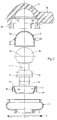
- die Einzelteile des Kugelgelenks nach Fig. 1 im Schnitt und
- Fig. 3
- eine Ansicht des Gelenkgehäuses von der Öffnungsseite her.
- Das insbesondere zur Verwendung an Kraftfahrzeugen bestimmte Kugelgelenk umfaßt einen Kugelzapfen 1, der mittels eines Gewindezapfens 1a an einem Teil der Radaufhängung oder Lenkung eines Kraftfahrzeuges befestigt wird und der mittels einer Gelenkkugel 1b über eine Lagerschale 2 in einem Gelenkgehäuse 3 verdrehbar und begrenzt kippbar gelagert ist. Das gemäß der Darstellung aus Kunststoff hergestellte Gelenkgehäuse 3 ist beim Ausführungsbeispiel am Ende einer Fahrwerksstrebe 3a angeformt.
- Beim Ausführungsbeispiel ist der Kugelzapfen 1 im Bereich zwischen der Gelenkkugel 1b und dem Gewindezapfen 1a mit einem im Durchmesser vergrößerten Flanschteil 1c ausgebildet, in dessen Mantelfläche eine Rille 1d zur Festlegung des zapfenseitigen Endes eines Dichtungsbalges 4 ausgebildet ist. Das gehäuseseitige Ende des Dichtungsbalges 4 ist in einer Ringnut 3b des Gelenkgehäuses 3 festgelegt. In beiden Fällen kann die Festlegung durch einen oder mehrere Halteringe 5 unterstützt werden.
- Die ebenfalls aus Kunststoff hergestellte Lagerschale 2 besitzt im Ausgangszustand die in Fig. 2 dargestellte Form mit einem halbkugelförmigen Oberteil 2a und einem sich an dieses Oberteil 2a anschließenden Unterteil 2b in der Form eines kreiszylindrischen Ringes. Der Übergang zwischen Oberteil 2a und Unterteil 2b liegt etwa im Bereich des Äquators 1e der Gelenkkugel 1b, der in Fig. 2 eingezeichnet ist.
- Im Bereich des Übergangs zwischen Oberteil 2a und Unterteil 2b ist die Lagerschale 2 auf ihrer Mantelfläche mit einem radial nach außen abstehenden Flanschring 2c versehen, der beim Ausführungsbeispiel sowohl an der Oberseite als auch an der Unterseite mit einem kleinen Wulst 2d versehen ist. Das Material dieser Wülste 2d ist leicht verformbar und dient auf diese Weise dem Ausgleich etwa vorhandener Toleranzen bei der Festlegung der Lagerschale 2 im Gelenkgehäuse 3.
- Diese Festlegung der Lagerschale 2 mittels ihres Flanschringes 2c an einer ringförmigen Aussparung 3c des Gelenkgehäuses 3 erfolgt durch einen Verschlußring 6, der vorzugsweise aus Metall hergestellt ist, aber auch aus einem geeigneten Kunststoff bestehen kann. Der Verschlußring 6 hat einen zweischenkligen Querschnitt mit einem radial innenliegenden Schenkel 6a und einem radial außenliegenden Schenkel 6b, wobei der Querschnitt insgesamt entweder V-förmig oder U-förmig sein kann. Bei dem auf der Zeichnung dargestellten Ausführungsbeispiel hat der Verschlußring 6 einen U-förmigen Querschnitt mit einem Steg 6c, von dem die divergierenden Schenkel 6a und 6b ausgehen, wie dies besonders deutlich in Fig. 2 zu erkennen ist.
- Um eine exakten Sitz des Verschlußringes 6 im Gelenkgehäuse 3 vorzugeben, ist das Gelenkgehäuse 3 mit einer ringförmigen Anschlagfläche 3d für den Scheitel- bzw. Stegbereich des zweischenkligen Verschlußringes 6 ausgebildet. Diese Anschlagfläche 3d ist ebenso wie die ringförmige Aussparung 3c für den Flanschring 2c der Lagerschale 2 am besten in Fig. 2 zu erkennen.
- Das in Fig. 2 im Schnitt dargestellte Gelenkgehäuse 3 ist weiterhin mit einer etwa radial verlaufenden Ringfläche 3e versehen, die durch eine Hinterschneidung im Gelenkgehäuse 3 gebildet ist. Sowohl die Schnittdarstellung in Fig. 2 als auch die Ansicht in Fig. 3 lassen erkennen, daß beim Ausführungsbeispiel die Ringfläche 3e auf mehrere, im Abstand voneinander liegende Ringflächenabschnitte 3e' aufgeteilt ist, so daß sich die Hinterschneidungen in einem Spritzgießwerkzeug beispielsweise durch handelsübliche Einfallkerne oder Verdrehen von Werkzeugkernen problemlos herstellen lassen.
- Zur Montage des Kugelgelenks wird der Kugelzapfen 1 mit auf die Gelenkkugel 1b aufgesetzter Lagerschale 2 in das Gelenkgehäuse 3 eingeführt bis der Flanschring 2c der Lagerschale 2 an der ringförmigen Aussparung 3c des Gelenkgehäuses 3 anliegt. Hierbei steht das zylindrische Unterteil 2b der Lagerschale 2 vom unteren Teil der Gelenkkugel 1b ab.
- Nunmehr wird der Verschlußring 6 eingebracht bis dessen Steg 6c an der Anschlagfläche 3d des Gelenkgehäuses 3 anliegt. Hierbei verformt der radial innenliegende Schenke 6a des Verschlußringes 6 das Unterteil 2b der Lagerschale 2 derart, daß auch dieses Unterteil an demjenigen Teil der Gelenkkugel 1b anliegt, der sich zwischen dem Äquator 1e der Gelenkkugel 1b und dem sich anschließenden halsförmigen Teil des Kugelzapfens 1 erstreckt. Der eine kugelringförmige Abstützfläche für das Unterteil 2b der Lagerschale 2 bildende innenliegende Schenkel 6a des Verschlußringes 6 bewirkt somit eine großflächige und zuverlässige Lagerung und Fixierung der Gelenkkugel 1b durch die Lagerschale 2.
- Der radial außenliegende Schenkel 6b des Verschlußringes 6 liegt in montiertem Zustand mit seiner freien Stirnkante 6d an der Ringfläche 3e bzw. an den Ringflächenabschnitten 3e' des Gelenkgehäuses 3, wie aus Fig. 1 hervorgeht. Dieses Zusammenwirken zwischen den freien Stirnkanten 6d des außenliegenden Schenkels 6b und der Ringfläche 3e bzw. den Ringflächenabschnitten 3e' des Gelenkgehäuses 3 wird entweder bei elastisch verformbarem Schenkel 6b durch dessen Rückfederkraft oder bei plastisch verformbarem Schenkel 6b durch ein Aufweitwerkzeug W erreicht, das in Fig. 1 gestrichelt angedeutet ist und nach Zusammenfügen der Einzelteile in das Innere des Verschlußringes 6 eingebracht wird.
- Sobald der Verschlußring 6 die in Fig. 1 dargestellte Lage einnimmt, ist die Montage des Kugelgelenkes beendet. Die sich an den durch Hinterschneidungen hergestellten Ringflächenabschnitten 3e' abstützende Stirnkante 6d des Verschlußringes 6 stellt bei einer axialen Zugbelastung des Kugelzapfens 1 eine selbstverstärkende Sicherung dar, da eine derartige Zugbelastung die Abstützung des Verschlußringes 6 über seinen außenliegenden Schenkel 6b im Gelenkgehäuse 3 mit zunehmender Belastung verstärkt.
- Abschließend kann - ggf. nach einer Fettfüllung des Gelenkes - der Dichtungsbalg 4 montiert werden, indem dessen gehäuseseitige Randverstärkung in die Ringnut 3b des Gelenkgehäuses 3 und seine zapfenseitige Randverstärkung in die Rille 1d des Kugelzapfens 1 eingelegt und dort jeweils durch einen Haltering 5 gesichert wird. Der Kippbereich des verdrehbar und begrenzt kippbar gelagerten Kugelzapfens 1 ist gestrichelt in Fig. 1 angedeutet.
-
- 1
- Kugelzapfen
- 1a
- Gewindezapfen
- 1b
- Gelenkkugel
- 1c
- Flanschteil
- 1d
- Rille
- 1e
- Äquator
- 2
- Lagerschale
- 2a
- Oberteil
- 2b
- Unterteil
- 2c
- Flanschring
- 2d
- Wulst
- 3
- Gelenkgehäuse
- 3a
- Fahrwerksstrebe
- 3b
- Ringnut
- 3c
- Aussparung
- 3d
- Anschlagfläche
- 3e
- Ringfläche
- 3e'
- Ringflächenabschnitt
- 4
- Dichtungsbalg
- 5
- Haltering
- 6
- Verschlußring
- 6a
- innenliegender Schenkel
- 6b
- außenliegender Schenkel
- 6c
- Steg
- 6d
- Stirnkante
- W
- Aufweitwerkzeug
Claims (12)
- Kugelgelenk, insbesondere für Kraftfahrzeuge, mit einem Kugelzapfen (1), dessen Gelenkkugel (1b) mittels einer Lagerschale (2), vorzugsweise aus Kunststoff, in einem Gelenkgehäuse (3) verdrehbar und begrenzt kippbar gelagert ist, wobei die Lagerschale (2) mittels eines Verschlußringes (6) im Gelenkgehäuse (3) festgelegt ist,
dadurch gekennzeichnet,
daß der vorzugsweise aus Metall bestehende Verschlußring (6) mit einem zweischenkligen Querschnitt ausgebildet ist, dessen radial innenliegender Schenkel (6a) eine Abstützfläche für den zwischen dem Äquator (1e) und der Öffnung für den Kugelzapfen (1) verlaufenden Teil (2b) der Lagerschale (2) bildet und dessen radial außenliegender Schenkel (6b) in montiertem Zustand mit seiner freien Stirnkante (6d) an einer etwa radial verlaufenden Ringfläche (3e) anliegt, die durch eine Hinterschneidung im Gelenkgehäuse (3) gebildet ist. - Kugelgelenk nach Anspruch 1, dadurch gekennzeichnet, daß im Gelenkgehäuse (3) eine ringförmige Anschlagfläche (3d) für den Scheitel- bzw. Stegbereich des zweischenkligen Verschlußringes (6) ausgebildet ist.
- Kugelgelenk nach Anspruch 2, dadurch gekennzeichnet, daß die Anschlagfläche (3d) im Bereich des Äquators (1e) der Lagerschale (2) ausgebildet ist.
- Kugelgelenk nach mindestens einem der Ansprüche 1 bis 3, dadurch gekennzeichnet, daß der Verschlußring (6) im Querschnitt V-förmig ausgebildet ist.
- Kugelgelenk nach mindestens einem der Ansprüche 1 bis 3, dadurch gekennzeichnet, daß der Verschlußring (6) im Querschnitt U-förmig mit von einem Steg (6c) ausgehenden, divergierenden Schenkeln (6a,6b) ausgebildet ist.
- Kugelgelenk nach mindestens einem der Ansprüche 1 bis 5, dadurch gekennzeichnet, daß der außenliegende Schenkel (6b) des Verschlußringes (6) elastisch verformbar ist.
- Kugelgelenk nach mindestens einem der Ansprüche 1 bis 5, dadurch gekennzeichnet, daß der außenliegende Schenke (6b) des Verschlußringes (6) plastisch verformbar ist.
- Kugelgelenk nach Anspruch 6 oder 7, dadurch gekennzeichnet, daß der außenliegende Schenkel (6b) des Verschlußringes (6) mindestens einmal geschlitzt ist.
- Kugelgelenk nach mindestens einem der Ansprüche 1 bis 8, dadurch gekennzeichnet, daß die Lagerschale (2) im Bereich des Äquators (1e) mit einem radial nach außen abstehenden Flanschring (2c) zur Festlegung zwischen dem Gelenkgehäuse (3) und dem Verschlußring (6) ausgebildet ist.
- Kugelgelenk nach Anspruch 9, dadurch gekennzeichnet, daß der Flanschring (2c) mindestens einseitig mit einem toleranzausgleichenden Wulst (2d) versehen ist.
- Kugelgelenk nach mindestens einem der Ansprüche 1 bis 10, dadurch gekennzeichnet, daß das Gelenkgehäuse (3) aus Kunststoff hergestellt ist.
- Kugelgelenk nach Anspruch 11, dadurch gekennzeichnet, daß die der Anlage der freien Stirnkante (6d) des Verschlußringes (6) dienende Ringfläche (3e) im Gelenkgehäuse (3) auf mehrere, im Abstand voneinander liegende Ringflächenabschnitte (3e') aufgeteilt ist.
Applications Claiming Priority (2)
| Application Number | Priority Date | Filing Date | Title |
|---|---|---|---|
| DE19542071A DE19542071C2 (de) | 1995-11-11 | 1995-11-11 | Kugelgelenk |
| DE19542071 | 1995-11-11 |
Publications (3)
| Publication Number | Publication Date |
|---|---|
| EP0773377A2 true EP0773377A2 (de) | 1997-05-14 |
| EP0773377A3 EP0773377A3 (de) | 1997-11-12 |
| EP0773377B1 EP0773377B1 (de) | 2002-03-27 |
Family
ID=7777207
Family Applications (1)
| Application Number | Title | Priority Date | Filing Date |
|---|---|---|---|
| EP96117743A Expired - Lifetime EP0773377B1 (de) | 1995-11-11 | 1996-11-06 | Kugelgelenk |
Country Status (5)
| Country | Link |
|---|---|
| US (1) | US5752780A (de) |
| EP (1) | EP0773377B1 (de) |
| JP (1) | JPH09196046A (de) |
| KR (1) | KR100443632B1 (de) |
| DE (2) | DE19542071C2 (de) |
Cited By (5)
| Publication number | Priority date | Publication date | Assignee | Title |
|---|---|---|---|---|
| EP0896162A1 (de) * | 1997-08-07 | 1999-02-10 | S.I.V. S.p.A. | Befestigungseinrichtung für das Bremspedal eines Fahrzeugs an der Druckstange einer Leistungsbremse |
| WO2008098550A1 (de) * | 2007-02-16 | 2008-08-21 | Zf Friedrichshafen Ag | Starrachse für ein nutzkraftfahrzeug |
| WO2010031396A1 (de) * | 2008-09-19 | 2010-03-25 | Zf Friedrichshafen Ag | Kugelgelenk |
| EP2270344A4 (de) * | 2008-04-18 | 2011-08-24 | Nhk Spring Co Ltd | Kugelgelenk und verfahren zu seiner herstellung |
| CZ306114B6 (cs) * | 2012-10-29 | 2016-08-10 | Ĺ KODA AUTO a.s. | Sestava axiálního pojištění kulového čepu |
Families Citing this family (34)
| Publication number | Priority date | Publication date | Assignee | Title |
|---|---|---|---|---|
| US6109816A (en) * | 1996-09-30 | 2000-08-29 | Bridgestone Corporation | Stabilizer link rod, and method of manufacturing same |
| JPH11351233A (ja) * | 1998-06-09 | 1999-12-24 | Somic Ishikawa:Kk | ボールスタッド、その製造方法、その装置およびボールジョイント |
| US6123181A (en) * | 1998-07-28 | 2000-09-26 | Mannesmann Sachs Ag | Articulation head for a clutch-release rocker arm of a friction clutch |
| DE19841410C1 (de) | 1998-09-10 | 2000-07-20 | Trw Fahrwerksyst Gmbh & Co | Kugelgelenk |
| IT249529Y1 (it) * | 2000-06-02 | 2003-05-19 | Siv Spa | Dispositivo antivibrazioni per il pedale della frizione di unautoveicolo. |
| DE20116358U1 (de) * | 2001-10-04 | 2001-12-20 | ZF Lemförder Metallwaren AG, 49448 Lemförde | Kugelgelenk |
| US20030086756A1 (en) * | 2001-11-07 | 2003-05-08 | Trotter Jason K | Modular linkage system |
| US6875388B2 (en) | 2001-11-07 | 2005-04-05 | Illinois Tool Works Inc. | Method for making a ball and socket joint |
| US6929271B2 (en) | 2001-11-09 | 2005-08-16 | Illinois Tool Works Inc. | Hydraulically compensated stabilizer system |
| DE10201022A1 (de) | 2002-01-11 | 2003-07-24 | Zf Lemfoerder Metallwaren Ag | Kugelgelenk |
| DE20202241U1 (de) * | 2002-02-14 | 2002-06-13 | TRW Fahrwerksysteme GmbH & Co KG, 40547 Düsseldorf | Elastomergelenk |
| EP1440858A1 (de) * | 2003-01-27 | 2004-07-28 | Autotech Engineering, A.I.E. | System zur Verbindung der Betätigungsstange mit dem Bremspedal eines Kraftfahrzeugs |
| EP1630431B1 (de) * | 2003-04-07 | 2009-11-11 | Kabushiki Kaisha Somic Ishikawa | Kugelgelenk |
| DE102006008250A1 (de) * | 2006-02-22 | 2007-08-23 | Trw Automotive Gmbh | Kugelgelenk |
| DE102006052254B4 (de) * | 2006-11-03 | 2012-12-20 | Zf Friedrichshafen Ag | Kugelgelenk |
| DE102007016713B4 (de) * | 2007-04-04 | 2011-07-14 | Saint-Gobain Performance Plastics Pampus GmbH, 47877 | Gelenklager |
| US9476447B2 (en) * | 2008-05-21 | 2016-10-25 | Federal-Mogul Powertrain, Inc. | Ball joint assembly and method of making |
| DE102008049747A1 (de) | 2008-09-30 | 2010-04-01 | Saint-Gobain Performance Plastics Pampus Gmbh | Schwingungsdämpfendes Gleitlager-Verbundmaterial und Gleitlagerbuchse und Gleitlageranordnung |
| JP5970187B2 (ja) * | 2008-11-12 | 2016-08-17 | ボーグワーナー インコーポレーテッド | ターボチャージャの連結ロッド |
| USD628143S1 (en) * | 2009-10-02 | 2010-11-30 | Tomtom International B.V. | Non-integrated mounting device for use in a vehicle |
| KR20110063164A (ko) * | 2009-12-04 | 2011-06-10 | 현대자동차주식회사 | 서스펜션 암 |
| KR20110063173A (ko) * | 2009-12-04 | 2011-06-10 | 현대자동차주식회사 | 서스펜션 암 |
| DE202009014886U1 (de) * | 2009-12-18 | 2010-05-12 | Kamax-Werke Rudolf Kellermann Gmbh & Co. Kg | Kugelzapfen |
| JP5222885B2 (ja) * | 2010-04-21 | 2013-06-26 | 日本発條株式会社 | スタッドボール、ダストカバー、および、スタビリンク |
| GB201014213D0 (en) * | 2010-08-26 | 2010-10-06 | Airbus Operations Ltd | Aircraft bearing assembly |
| KR101179383B1 (ko) | 2012-05-21 | 2012-09-03 | 주식회사 한국센트랄 | 볼 조인트 조립장치 |
| US10119562B2 (en) | 2014-12-16 | 2018-11-06 | Itt Manufacturing Enterprises Llc | One-hand operable end fitting connector assembly |
| CZ310002B6 (cs) * | 2016-10-27 | 2024-05-01 | Hella Autotechnik Nova, S.R.O. | Kloubové spojení komponentů automobilu šroubem s kulovou hlavou a plastovou objímkou |
| US9771971B1 (en) * | 2016-10-31 | 2017-09-26 | Mevotech Lp | Locking boot for ball joint |
| EP3669092B1 (de) | 2017-08-16 | 2022-06-22 | Multimatic, Inc. | Kugelgelenk mit spritzgegossenem lager |
| CN108775330A (zh) * | 2018-06-26 | 2018-11-09 | 吉安汽车配件(苏州)有限公司 | 一种拉杆球头及其生产方法 |
| FR3084007B1 (fr) * | 2018-07-19 | 2022-01-14 | Arianegroup Sas | Piece de liaison thermodurcissable partiellement polymerisee et procedes de fabrication et d'assemblage d'une telle piece de liaison |
| DE102018220954B4 (de) | 2018-12-04 | 2020-06-25 | Zf Friedrichshafen Ag | Kugelgelenk |
| CN113090639B (zh) * | 2021-02-22 | 2023-02-28 | 中国科学院深圳先进技术研究院 | 一种球关节装置及机械电子设备 |
Family Cites Families (15)
| Publication number | Priority date | Publication date | Assignee | Title |
|---|---|---|---|---|
| FR709337A (fr) * | 1930-01-30 | 1931-08-05 | Budd Wheel Co | Perfectionnements aux dispositifs d'accouplement souples |
| GB886571A (en) * | 1959-01-09 | 1962-01-10 | Victor Langen | Improvements in or relating to ball and socket joints |
| US3545797A (en) * | 1968-08-22 | 1970-12-08 | Barmatic Machines Inc | Ball joint with plastic seat |
| US3574368A (en) * | 1970-01-16 | 1971-04-13 | Perfect Equip Corp | Preloaded ball joint |
| DE2443091A1 (de) * | 1974-09-09 | 1976-03-25 | Leopold F Schmid | Kugelgelenk, insbesondere fuer lenkgestaenge von kraftfahrzeugen |
| DE3715360A1 (de) * | 1987-05-08 | 1988-12-01 | Lemfoerder Metallwaren Ag | Molekulargelenk fuer achsstreben, lenker oder dergleichen in kraftfahrzeugen |
| JPS646512A (en) * | 1987-06-30 | 1989-01-11 | Tokai Trw & Co | Joint |
| DE8913506U1 (de) * | 1989-11-15 | 1990-02-15 | Fritz Himmermann Gmbh & Co Kg, 53940 Hellenthal | Kunststoffgleitlager |
| DE4109697C1 (de) * | 1991-03-23 | 1992-06-25 | Trw Ehrenreich Gmbh & Co Kg, 4000 Duesseldorf, De | |
| JPH04136313U (ja) * | 1991-06-12 | 1992-12-18 | 株式会社ヨロズ | ボールジヨイント |
| JPH0575513U (ja) * | 1992-03-18 | 1993-10-15 | 埼玉機器株式会社 | ボールジョイント |
| DE4211897C2 (de) * | 1992-04-09 | 1996-05-30 | Daimler Benz Ag | Kugelgelenk für Teile der Lenkung oder Radaufhängung von Kraftfahrzeugen |
| JPH06235417A (ja) * | 1993-02-05 | 1994-08-23 | Musashi Seimitsu Ind Co Ltd | 球面摺動ブッシュ |
| JPH0667919U (ja) * | 1993-02-26 | 1994-09-22 | 武蔵精密工業株式会社 | ボールジョイント |
| DE4338916C1 (de) * | 1993-11-15 | 1995-05-04 | Trw Fahrwerksyst Gmbh & Co | Kugelgelenk |
-
1995
- 1995-11-11 DE DE19542071A patent/DE19542071C2/de not_active Expired - Fee Related
-
1996
- 1996-11-06 DE DE59608953T patent/DE59608953D1/de not_active Expired - Fee Related
- 1996-11-06 EP EP96117743A patent/EP0773377B1/de not_active Expired - Lifetime
- 1996-11-08 KR KR1019960052716A patent/KR100443632B1/ko not_active Expired - Fee Related
- 1996-11-08 JP JP8296590A patent/JPH09196046A/ja active Pending
- 1996-11-12 US US08/745,433 patent/US5752780A/en not_active Expired - Fee Related
Non-Patent Citations (1)
| Title |
|---|
| None |
Cited By (5)
| Publication number | Priority date | Publication date | Assignee | Title |
|---|---|---|---|---|
| EP0896162A1 (de) * | 1997-08-07 | 1999-02-10 | S.I.V. S.p.A. | Befestigungseinrichtung für das Bremspedal eines Fahrzeugs an der Druckstange einer Leistungsbremse |
| WO2008098550A1 (de) * | 2007-02-16 | 2008-08-21 | Zf Friedrichshafen Ag | Starrachse für ein nutzkraftfahrzeug |
| EP2270344A4 (de) * | 2008-04-18 | 2011-08-24 | Nhk Spring Co Ltd | Kugelgelenk und verfahren zu seiner herstellung |
| WO2010031396A1 (de) * | 2008-09-19 | 2010-03-25 | Zf Friedrichshafen Ag | Kugelgelenk |
| CZ306114B6 (cs) * | 2012-10-29 | 2016-08-10 | Ĺ KODA AUTO a.s. | Sestava axiálního pojištění kulového čepu |
Also Published As
| Publication number | Publication date |
|---|---|
| DE19542071C2 (de) | 2000-03-30 |
| DE59608953D1 (de) | 2002-05-02 |
| EP0773377A3 (de) | 1997-11-12 |
| EP0773377B1 (de) | 2002-03-27 |
| KR100443632B1 (ko) | 2004-11-06 |
| JPH09196046A (ja) | 1997-07-29 |
| DE19542071A1 (de) | 1997-05-15 |
| US5752780A (en) | 1998-05-19 |
| KR970027875A (ko) | 1997-06-24 |
Similar Documents
| Publication | Publication Date | Title |
|---|---|---|
| EP0773377A2 (de) | Kugelgelenk | |
| EP0775841B1 (de) | Vorrichtung zur Festlegung einer Lagerschale eines Gelenkes in einer Aufnahmeöffnung | |
| DE69225629T2 (de) | Kombination eines Querstabilisators und eines Befestigungselementes | |
| EP2414180B1 (de) | Elastomergelenk | |
| DE3105170A1 (de) | Schwingungsdaempfer oder federbein mit mindestens einem am behaelterrohr angeordneten beschlag | |
| EP0667464B1 (de) | Metallischer, nach Art eines Baukastensystems kombinierbarer Kugelzapfen eines Kugelgelenks | |
| DE3921457C2 (de) | ||
| EP1474615B2 (de) | Elastomergelenk | |
| EP2134555A1 (de) | Befestigungselement, insbesondere zur verbindung zweier teile in einem fahrwerk | |
| EP1456544A1 (de) | Kugelgelenk | |
| EP1668262A1 (de) | Kugelschale | |
| DE69931693T2 (de) | Halter für ein Gleichlaufgelenk | |
| EP0327810A2 (de) | Gummilager für Federn, Achsen und ähnliche Teile an Kraftfahrzeugen | |
| DE3821146C2 (de) | Dichtungselement für ein Kugelgelenk | |
| DE4420489C2 (de) | Kugelgelenk | |
| DE10258987B4 (de) | Gelenklager | |
| EP1681478B1 (de) | Kugelgelenk | |
| EP1806517A1 (de) | Elastomer-Metall-Gelenklager, insbesondere als Zentralgelenklager eines Dreieckslenkers zur Verbindung eines Achskörpers mit einem Fahrzeugaufbau | |
| DE4412597C2 (de) | Kugelgelenk für Fahrwerksteile in einem Kraftfahrzeug | |
| EP2493730B1 (de) | Scheibenwischvorrichtung in einem fahrzeug | |
| WO2005061911A1 (de) | Kugelgelenk | |
| DE3714067C2 (de) | ||
| DE19838943A1 (de) | Befestigung eines Anlenkteils auf einem Kolben-Zylinderaggregat | |
| DE102004038561A1 (de) | Verfahren zur Herstellung eines Blechrings oder einer Blechschale und ein nach dem Verfahren hergestellter Blechring oder hergestellte Blechschale | |
| DE112019005255T5 (de) | Lenksäule und Lenkvorrichtung |
Legal Events
| Date | Code | Title | Description |
|---|---|---|---|
| PUAI | Public reference made under article 153(3) epc to a published international application that has entered the european phase |
Free format text: ORIGINAL CODE: 0009012 |
|
| AK | Designated contracting states |
Kind code of ref document: A2 Designated state(s): DE ES FR GB IT SE |
|
| PUAL | Search report despatched |
Free format text: ORIGINAL CODE: 0009013 |
|
| AK | Designated contracting states |
Kind code of ref document: A3 Designated state(s): DE ES FR GB IT SE |
|
| 17P | Request for examination filed |
Effective date: 19980502 |
|
| 17Q | First examination report despatched |
Effective date: 19990712 |
|
| GRAG | Despatch of communication of intention to grant |
Free format text: ORIGINAL CODE: EPIDOS AGRA |
|
| GRAG | Despatch of communication of intention to grant |
Free format text: ORIGINAL CODE: EPIDOS AGRA |
|
| GRAH | Despatch of communication of intention to grant a patent |
Free format text: ORIGINAL CODE: EPIDOS IGRA |
|
| GRAH | Despatch of communication of intention to grant a patent |
Free format text: ORIGINAL CODE: EPIDOS IGRA |
|
| REG | Reference to a national code |
Ref country code: GB Ref legal event code: IF02 |
|
| GRAA | (expected) grant |
Free format text: ORIGINAL CODE: 0009210 |
|
| AK | Designated contracting states |
Kind code of ref document: B1 Designated state(s): DE ES FR GB IT SE |
|
| GBT | Gb: translation of ep patent filed (gb section 77(6)(a)/1977) |
Effective date: 20020403 |
|
| REF | Corresponds to: |
Ref document number: 59608953 Country of ref document: DE Date of ref document: 20020502 |
|
| PG25 | Lapsed in a contracting state [announced via postgrant information from national office to epo] |
Ref country code: SE Free format text: LAPSE BECAUSE OF FAILURE TO SUBMIT A TRANSLATION OF THE DESCRIPTION OR TO PAY THE FEE WITHIN THE PRESCRIBED TIME-LIMIT Effective date: 20020627 |
|
| ET | Fr: translation filed | ||
| PG25 | Lapsed in a contracting state [announced via postgrant information from national office to epo] |
Ref country code: ES Free format text: LAPSE BECAUSE OF FAILURE TO SUBMIT A TRANSLATION OF THE DESCRIPTION OR TO PAY THE FEE WITHIN THE PRESCRIBED TIME-LIMIT Effective date: 20020925 |
|
| PLBE | No opposition filed within time limit |
Free format text: ORIGINAL CODE: 0009261 |
|
| STAA | Information on the status of an ep patent application or granted ep patent |
Free format text: STATUS: NO OPPOSITION FILED WITHIN TIME LIMIT |
|
| 26N | No opposition filed |
Effective date: 20021230 |
|
| PGFP | Annual fee paid to national office [announced via postgrant information from national office to epo] |
Ref country code: GB Payment date: 20051004 Year of fee payment: 10 |
|
| PGFP | Annual fee paid to national office [announced via postgrant information from national office to epo] |
Ref country code: FR Payment date: 20051104 Year of fee payment: 10 |
|
| PGFP | Annual fee paid to national office [announced via postgrant information from national office to epo] |
Ref country code: DE Payment date: 20051130 Year of fee payment: 10 |
|
| PGFP | Annual fee paid to national office [announced via postgrant information from national office to epo] |
Ref country code: IT Payment date: 20061130 Year of fee payment: 11 |
|
| PG25 | Lapsed in a contracting state [announced via postgrant information from national office to epo] |
Ref country code: DE Free format text: LAPSE BECAUSE OF NON-PAYMENT OF DUE FEES Effective date: 20070601 |
|
| GBPC | Gb: european patent ceased through non-payment of renewal fee |
Effective date: 20061106 |
|
| REG | Reference to a national code |
Ref country code: FR Ref legal event code: ST Effective date: 20070731 |
|
| PG25 | Lapsed in a contracting state [announced via postgrant information from national office to epo] |
Ref country code: GB Free format text: LAPSE BECAUSE OF NON-PAYMENT OF DUE FEES Effective date: 20061106 |
|
| PG25 | Lapsed in a contracting state [announced via postgrant information from national office to epo] |
Ref country code: FR Free format text: LAPSE BECAUSE OF NON-PAYMENT OF DUE FEES Effective date: 20061130 |
|
| PG25 | Lapsed in a contracting state [announced via postgrant information from national office to epo] |
Ref country code: IT Free format text: LAPSE BECAUSE OF NON-PAYMENT OF DUE FEES Effective date: 20071106 |