EP0775983A2 - Wiederherstellungsfilter für abgeschnittene Pixel - Google Patents
Wiederherstellungsfilter für abgeschnittene Pixel Download PDFInfo
- Publication number
- EP0775983A2 EP0775983A2 EP96308414A EP96308414A EP0775983A2 EP 0775983 A2 EP0775983 A2 EP 0775983A2 EP 96308414 A EP96308414 A EP 96308414A EP 96308414 A EP96308414 A EP 96308414A EP 0775983 A2 EP0775983 A2 EP 0775983A2
- Authority
- EP
- European Patent Office
- Prior art keywords
- pixel
- truncated
- displayed
- bits
- comparing
- Prior art date
- Legal status (The legal status is an assumption and is not a legal conclusion. Google has not performed a legal analysis and makes no representation as to the accuracy of the status listed.)
- Granted
Links
Images


Classifications
-
- G—PHYSICS
- G06—COMPUTING OR CALCULATING; COUNTING
- G06T—IMAGE DATA PROCESSING OR GENERATION, IN GENERAL
- G06T5/00—Image enhancement or restoration
- G06T5/20—Image enhancement or restoration using local operators
Definitions
- This invention relates generally to computer graphics systems, and more specifically to a system and method for restoring bits of pixels prior to display where the original bits of the pixels were truncated.
- Computer graphics systems in which graphics processors are used to draw images on a display screen are enjoying widespread acceptance in many facets of the current electronics marketplace. This is true for high-end computer graphics workstations as well as mid-range and low-end consumer oriented products.
- the graphics processor draws, or renders, the image by generating attribute information for each pixel of the display.
- Each pixel of the display is represented by a plurality of bits. Depending on the display characteristics and the complexity of the graphics system, these bits can represent attributes of the pixel such as color (e.g., red, green and blue bits or a grey scale), transparency or opacity, depth, and other like attributes.
- cost-benefit tradeoffs that must be performed when specifying a computer graphics system.
- One such cost-benefit trodeoff is that which exists between the cost of memory and the number of planes provided in the frame buffer (i.e., the number of bits dedicated to each pixel).
- Systems with more planes i.e., more bits per pixel
- One way to decrease the number of bits per pixel used is to truncate the bits. That is, the pixels are generated with the full complement of bits, and the low-order bits are truncated prior to storage in the frame buffer. Thus, the image can be rendered with fewer bits per pixel and the size of the frame buffer can be decreased.
- the 3 least significant bits are truncated.
- mach banding quantization
- image quality quality of artifacts
- dithering is sometimes used to disrupt the regularity of the artifacts, thereby softening the effects of mach banding.
- dithering is perceived by the eye as noise and can itself be objectionable, especially at low quantifies of bits per pixel.
- the present invention is directed toward a system and method for restoring bits of pixels prior to display where the original bits of the pixels were truncated.
- the restoration process is accomplished by comparing each pixel to its neighbors to determine the relative value of each pixel as compared to its neighbors. As a result of this comparison, a restoration value is determined for each pixel. This restoration value is added to the truncated pixel prior to display.
- the restoration process is executed for each pixel as follows. First, the pixel is shifted. That is, the remaining bits of the pixel are shifted to the left and additional bits are added in the least significant bit positions. These additional bits are referred to as the restoration offset of the pixel. Preferably, these additional bits are zeroes. The entire pixel comprising the shifted truncated portion and the restoration offset is referred to as the truncated shifted pixel, or the restored pixel.
- the pixel is compared to each neighbor to determine their relative values. For each neighbor that is greater than the pixel in question, the restoration offset is incremented by one. Similarly, for each neighbor that is less than the pixel in question, the restoration offset is decremented by one. In the preferred embodiment, overflow of the restoration offset resulting from the increment/decrement operations is carried over into the truncated and shifted portion of the pixel. In other words, in the preferred embodiment, it is actually the truncated shifted pixel which is incremented or decremented for each neighbor compared.
- the restored pixel can then be displayed including the original truncated and shifted portion and the determined restoration offset.
- the number of bits by which the truncated portion is shifted, and hence the number of bits used for the restoration offset is the same as the number of bits which were removed from the pixel during truncation.
- One advantage of the invention is that it allows image data to be stored in a truncated format while minimizing the visible side effects of truncation and dithering.
- FIG. 1 is a block diagram illustrating a simplified graphics system which forms an example environment of the invention.
- FIG. 2 is a diagram illustrating a neighborhood of pixels having a central pixel and eight neighbor pixels.
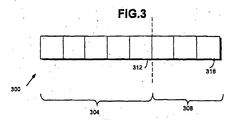
- FIG. 3 is a diagram illustrating a restored pixel having a truncated portion and a restored portion.
- FIG. 4 is an operational now diagram illustrating the operation of the restoration filter according to one embodiment of the invention.
- the present invention is directed toward a system and method for back-filtering to remove the unwanted side effects of dithering in a computer graphics system.
- the back filtering is a process of comparing each pixel to its surrounding neighbors and determining a restoration offset for the pixel based on the results of the comparison process.
- each truncated pixel is shifted left by the number of bits to be restored. This has the effect of appending a series of zeroes to the pixel. This series of appended bits is referred to as the restoration offset of the pixel.
- the resultant pixel, including the truncated portion and the restoration offset is referred to as the truncated shifted pixel, or the restored pixel.
- the truncated shifted pixd For each neighbor having a greater value than the pixel in question, the truncated shifted pixd is incremented by one. Similarly, for each neighbor having a value less than the pixel in question, the truncated shifted pixel is decremented by one. The net result of this increment/decrement operation is that a restored value of the restored pixel is computed and the restored pixel can be displayed.
- FIG. 1 is a block diagram illustrating a basic graphics system 100.
- the basic graphics system 100 includes a graphics processor 104, a frame buffer 108, a video interface 112 and a display device 116.
- graphics processor 104 renders the image to be displayed by generating each pixel of the image.
- Each pixel is comprised of a plurality of bits representing attributes of that pixel such as color or grey scale, transparency, opacity, reflectivity, etc.
- the pixels generated by graphics processor 104 are stored in frame buffer 108 as they are generated. When the entire frame is generated, the image is transferred from frame buffer 108 to display device 116 via video interface 112.
- Video interface 112 provides synchronization and timing signals needed to display the image on display device 116.
- the present invention is desaibed in terms of this example environment. Description in these terms is provided for convenience only. It is not intended that the invention be limited to application in this example environment. In fact, after reading the following description, it will become apparent to a person skilled in the relevant art how to implement the invention with other graphics systems having different architectures and levels of complexity. Examples of other, more complex graphics systems can be found in numerous references, including U.S. Patent No. 4,951,232, to Hannah and U.S. Patent No, 5,038,297 to Hannah, both of which are assigned to Silicon Graphics, Inc., and both of which are incorporated herein by reference. Additionally, the application of the invention is not limited to the computer graphics environments. Other environments that will benefit from the invention include other graphics systems where images are stored and displayed in the form of pixels such as video systems.
- Dithering adds a dither noise to the calculated intensity of the pixels.
- the amount of dither added to each pixel can be determined with a random process, a pseudo random process or with a calculation based on the coordinate position of the pixel. Adding a dither value to the pixel tends to break up the contours of objects and the overall appearance of the rendered scene is improved.
- a dither matrix is defined with integers zero through three assigned to matrix positions.
- An example dither matrix for this case may be:
- any of a number of commonly known dither matrices can be employed for the dithering operation.
- One such matrix is the well known Bayer ordered dither matrix. In the example where 8 bits are being truncated to five, three bits of dither need to be added before truncation. In this case, a four-by-four dither matrix is used with the four-bit values truncated to three bits (by shifting down and dropping the least significant bit).
- the truncated Bayer matrix is as follows:
- This matrix is as follows:
- the dithering is done in two parts. First, a dither pattern is generated and added to the full complement of bits before truncation. This can be done in the end of the rendering pipeline at the time of rendering just before the image is stored in frame buffer 108. In conventional systems, the stored image is processed and displayed using the truncated format.
- the restoration filter according to the invention is used to replace the bits of the original image that were removed during truncation. This operation is performed at the time that the image is displayed and, preferably performed by video interface 112.
- the restoration filter is used to replace the truncated bits for each pixel by comparing the pixel to the immediately adjacent pixels.
- This section of the patent document describes the restoration filter in terms of an example graphics system having an original complement of eight bits per pixel which has been truncated to five bits per pixel and which is to be restored to the full complement of eight bits per pixel prior to display. After reading this description, it will become apparent to a person skilled in the relevant art how to implement the restoration filter with graphics systems having other bit complements and other levels of truncation.
- the number of bits in the restoration offset are three, and there are eight neighbors.
- the value used to increment or decrement the restoration offset is one.
- alternative embodiments can be implemented.
- alternative embodiments can be implemented wherein the neighborhood size is larger or smaller.
- Additional alternatives include embodiments where the increment and/or decrement value is some amount other than one.
- Still other alternatives encompass a combination of these two variations (i.e., different neighborhood size and a different increment and/or decrement values). Such variations will become obvious to one of ordinary skill in the art after reading the above disclosure.
- FIG. 2 illustrates a three-by-three block of pixels 200.
- Center pixel 204 the pixel being restored, is compared to each of its neighboring pixels 208.
- FIG. 3 illustrates the restored complement of eight bits for a sample pixel having two portions.
- the first portion is truncated portion 304 which in the example description is a five bit portion.
- the second portion is the restoration offset portion 308.
- the least significant bit (LSB) of truncated portion 304 is referred to as LSB 312 and the least significant bit of restoration offset portion 308 is referred to as sub-LSB 316.
- the restoration according to the invention is based on the assumption that the neighbor pixels 208 were ofthe same or similar eight-bit-per-component color ofthe center pixel 204. If this is not the case, the truncation error is probably not noticeable due to the higher contrast real gradient.
- the restoration filter simply compares each of the eight neighbor pixels 208 with center pixel 204.
- the manner in which this is accomplished is described with reference to the operational flow diagram illustrated in FIG. 4.
- the first step is to identify the eight neighboring pixels 208 of the pixel in question (i.e., identify the neighbors of center pixel 204). This is illustrated by box 404 in FIG. 4. Note that where the pixel in question is a corner pixel or a border pixel, it may not have a full complement of eight neighbors 208.
- the next operation performed by the restoration filter is to shift center pixel 204 up three bits, inserting all zeroes to the three least significant bits.
- the five bit truncated portion 304 of center pixel 204 is augmented by adding an all zero restored portion 308.
- This shifting step is illustrated by operation box 408 in FIG. 4. This results in a truncated shifted pixel.
- the operation continues by comparing center pixel 204 with a neighboring pixel 208 to determine whether the neighboring pixel's five-bit truncated value is greater than or less than the value of truncated portion 304 of center pixel 204. This step of comparing to determine the relative value of center pixel 204 with neighboring pixel 208 is illustrated by decision box 412.
- truncated portion 304 for the compared neighboring pixel 208 is greater than the value of truncated portion 304 of center pixel 204
- the truncated shifted center pixel 204 is incremented by one. This is illustrated by operation box 416.
- the steps of comparing and incrementing or decrementing are repeated for each neighboring pixel 208 as illustrated by decision box 424 and flow line 462.
- decision box 424 the steps of comparing and incrementing or decrementing are repeated for each neighboring pixel 208 as illustrated by decision box 424 and flow line 462.
- the operation is complete as illustrated by done block 426. Note that it is possible to do the comparison, increment and decrement operations for each neighbor in parallel.
- the restoration filter according to the present invention effectively reconstructs the missing bits which were removed during truncation prior to storage into frame buffer 108,
- the maximum error introduced by the restoration is limited to the restored portion 308.
- the maximum error is three bits, or eight levels out of 256. This results in a slight error in steep gradients, which is acceptable.
- the center pixel 204 is compared to the neighbors and its restored portion 308 incremented or decremented based on the results ofthe comparison.
- Alternative embodiments are contemplated wherein other algorithms are used to reconstruct restored portion 308.
- the restoration filter described above works for any ordered dither pattern, pseudo-random dither pattern and for systems where no dithering is used, it works best where dithering is performed using a matrix that is carefully chosen to match the reconstruction filter. Results achieved using the standard Bayer matrix during the dithering process are passable but result in a visible highfrequency pattern after the restoration filter is applied.
- the 'magic square' matrix, described above spreads the error energy more effectively into lower-amplitude, lower-frequency patterns that are frequently less visually objectionable, although which looks better is, to some extent, a function of the image content.
Landscapes
- Physics & Mathematics (AREA)
- General Physics & Mathematics (AREA)
- Engineering & Computer Science (AREA)
- Theoretical Computer Science (AREA)
- Image Processing (AREA)
- Editing Of Facsimile Originals (AREA)
- Facsimile Image Signal Circuits (AREA)
- Controls And Circuits For Display Device (AREA)
Applications Claiming Priority (2)
| Application Number | Priority Date | Filing Date | Title |
|---|---|---|---|
| US561584 | 1990-08-06 | ||
| US08/561,584 US5699079A (en) | 1995-11-21 | 1995-11-21 | Restoration filter for truncated pixels |
Publications (3)
| Publication Number | Publication Date |
|---|---|
| EP0775983A2 true EP0775983A2 (de) | 1997-05-28 |
| EP0775983A3 EP0775983A3 (de) | 1997-12-29 |
| EP0775983B1 EP0775983B1 (de) | 2002-05-15 |
Family
ID=24242578
Family Applications (1)
| Application Number | Title | Priority Date | Filing Date |
|---|---|---|---|
| EP96308414A Expired - Lifetime EP0775983B1 (de) | 1995-11-21 | 1996-11-21 | Wiederherstellungsfilter für abgeschnittene Pixel |
Country Status (4)
| Country | Link |
|---|---|
| US (1) | US5699079A (de) |
| EP (1) | EP0775983B1 (de) |
| JP (1) | JPH1026965A (de) |
| DE (1) | DE69621208T2 (de) |
Cited By (3)
| Publication number | Priority date | Publication date | Assignee | Title |
|---|---|---|---|---|
| EP1096425A3 (de) * | 1999-10-28 | 2003-06-18 | Hewlett-Packard Company, A Delaware Corporation | Verfahren und Gerät zur Filterung von Bildern unzureichender Tongenauigkeit |
| US7483574B2 (en) | 2001-09-14 | 2009-01-27 | Nec Corporation | Image processing apparatus, image transmission apparatus, image reception apparatus, and image processing method |
| CN101640753B (zh) * | 2009-09-09 | 2011-03-30 | 青岛海信移动通信技术股份有限公司 | 图像处理方法及图像处理装置 |
Families Citing this family (16)
| Publication number | Priority date | Publication date | Assignee | Title |
|---|---|---|---|---|
| US7171016B1 (en) | 1993-11-18 | 2007-01-30 | Digimarc Corporation | Method for monitoring internet dissemination of image, video and/or audio files |
| DE69737785T2 (de) * | 1996-04-18 | 2008-02-07 | Kanebo Trinity Holdings, Ltd. | Nahen infrarotstrahlen absorbierender film und damit ausgerüstete mehrschichtige verbrundplatte |
| US5771033A (en) * | 1996-05-24 | 1998-06-23 | Microsoft Corporation | Method and system for dissolving an image displayed on a computer screen |
| TW341018B (en) * | 1997-09-23 | 1998-09-21 | Winbond Electronics Corp | The compress and de-compress apparatus for video signal and its method |
| US7075555B1 (en) * | 2000-05-26 | 2006-07-11 | Palmsource, Inc. | Method and apparatus for using a color table scheme for displaying information on either color or monochrome display |
| US6812939B1 (en) | 2000-05-26 | 2004-11-02 | Palm Source, Inc. | Method and apparatus for an event based, selectable use of color in a user interface display |
| US6483927B2 (en) * | 2000-12-18 | 2002-11-19 | Digimarc Corporation | Synchronizing readers of hidden auxiliary data in quantization-based data hiding schemes |
| US6879721B2 (en) | 2001-01-02 | 2005-04-12 | Hewlett-Packard Development Company, L.P. | Pixel processing system for image production |
| US7231061B2 (en) | 2002-01-22 | 2007-06-12 | Digimarc Corporation | Adaptive prediction filtering for digital watermarking |
| US7268790B1 (en) * | 2002-08-29 | 2007-09-11 | National Semiconductor Corporation | Display system with framestore and stochastic dithering |
| JP2006025123A (ja) * | 2004-07-07 | 2006-01-26 | Olympus Corp | 画像処理装置 |
| EP1862995A1 (de) * | 2006-05-31 | 2007-12-05 | Texas Instruments France S.A. | Verfahren und Vorrichtung mit räumlichen und zeitlichen Zittertechniken |
| JP2008129420A (ja) * | 2006-11-22 | 2008-06-05 | Nec Electronics Corp | 表示装置およびコントローラドライバ |
| US9621890B2 (en) * | 2011-10-20 | 2017-04-11 | Thomson Licensing | Method and device for encoding a video frame, method and device for decoding a video frame and storage medium |
| TWI463468B (zh) * | 2012-03-03 | 2014-12-01 | Mstar Semiconductor Inc | 影像處理裝置及影像處理方法 |
| US9183453B2 (en) * | 2013-10-31 | 2015-11-10 | Stmicroelectronics Asia Pacific Pte. Ltd. | Banding noise detector for digital images |
Citations (2)
| Publication number | Priority date | Publication date | Assignee | Title |
|---|---|---|---|---|
| US4951232A (en) | 1988-09-12 | 1990-08-21 | Silicon Graphics, Inc. | Method for updating pipelined, single port Z-buffer by segments on a scan line |
| US5038297A (en) | 1988-09-13 | 1991-08-06 | Silicon Graphics, Inc. | Method and apparatus for clearing a region of Z-buffer |
Family Cites Families (6)
| Publication number | Priority date | Publication date | Assignee | Title |
|---|---|---|---|---|
| JPS6453274A (en) * | 1987-08-25 | 1989-03-01 | Hitachi Ltd | Interpolation device having line segment processing part running parallel with coordinate axis |
| US4979136A (en) * | 1988-03-01 | 1990-12-18 | Transitions Research Corporation | Processing system and method for enhancing image data |
| JPH0652470B2 (ja) * | 1988-09-14 | 1994-07-06 | インターナショナル・ビジネス・マシーンズ・コーポレーション | カラー変換のための方法及び装置 |
| US5081450A (en) * | 1990-03-09 | 1992-01-14 | International Business Machines Corporation | Apparatus and method for compressing and expanding multibit digital pixel data |
| US5374963A (en) * | 1990-06-01 | 1994-12-20 | Thomson Consumer Electronics, Inc. | Picture resolution enhancement with dithering and dedithering |
| US5469190A (en) * | 1991-12-23 | 1995-11-21 | Apple Computer, Inc. | Apparatus for converting twenty-four bit color to fifteen bit color in a computer output display system |
-
1995
- 1995-11-21 US US08/561,584 patent/US5699079A/en not_active Expired - Lifetime
-
1996
- 1996-11-20 JP JP8351768A patent/JPH1026965A/ja active Pending
- 1996-11-21 EP EP96308414A patent/EP0775983B1/de not_active Expired - Lifetime
- 1996-11-21 DE DE69621208T patent/DE69621208T2/de not_active Expired - Lifetime
Patent Citations (2)
| Publication number | Priority date | Publication date | Assignee | Title |
|---|---|---|---|---|
| US4951232A (en) | 1988-09-12 | 1990-08-21 | Silicon Graphics, Inc. | Method for updating pipelined, single port Z-buffer by segments on a scan line |
| US5038297A (en) | 1988-09-13 | 1991-08-06 | Silicon Graphics, Inc. | Method and apparatus for clearing a region of Z-buffer |
Cited By (4)
| Publication number | Priority date | Publication date | Assignee | Title |
|---|---|---|---|---|
| EP1096425A3 (de) * | 1999-10-28 | 2003-06-18 | Hewlett-Packard Company, A Delaware Corporation | Verfahren und Gerät zur Filterung von Bildern unzureichender Tongenauigkeit |
| US6731822B1 (en) | 1999-10-28 | 2004-05-04 | Hewlett-Packard Development Company, L.P. | Method and apparatus for filtering images having insufficient tonal precision |
| US7483574B2 (en) | 2001-09-14 | 2009-01-27 | Nec Corporation | Image processing apparatus, image transmission apparatus, image reception apparatus, and image processing method |
| CN101640753B (zh) * | 2009-09-09 | 2011-03-30 | 青岛海信移动通信技术股份有限公司 | 图像处理方法及图像处理装置 |
Also Published As
| Publication number | Publication date |
|---|---|
| US5699079A (en) | 1997-12-16 |
| DE69621208T2 (de) | 2002-11-07 |
| DE69621208D1 (de) | 2002-06-20 |
| EP0775983A3 (de) | 1997-12-29 |
| EP0775983B1 (de) | 2002-05-15 |
| JPH1026965A (ja) | 1998-01-27 |
Similar Documents
| Publication | Publication Date | Title |
|---|---|---|
| EP0775983B1 (de) | Wiederherstellungsfilter für abgeschnittene Pixel | |
| EP0681280B1 (de) | Verfahren zum senkrechten Filtern einer nach einem Gitter abgetasteten Anzeige | |
| EP0358498B1 (de) | Verfahren und Vorrichtung zur Erzeugung von beweglichen Bildern | |
| US5832141A (en) | Image processing method and apparatus using separate processing for pseudohalf tone area | |
| EP1114399A1 (de) | Verfahren und vorrichtung zum zoom und bildabschneiden von bilddateien die direkt auf den digitalen orthogonalen transformationskodierten bildsignalen arbeiten | |
| US6898327B1 (en) | Anti-flicker system for multi-plane graphics | |
| AU675387B2 (en) | Method and apparatus for graphic processing | |
| US20110102479A1 (en) | Image processing apparatus, image processing method and storage medium | |
| US5491769A (en) | Method and apparatus for variable minification of an image | |
| US5264840A (en) | Method and apparatus for vector aligned dithering | |
| US5479594A (en) | Digital color video image enhancement for a diffusion dither circuit | |
| US5404176A (en) | Digital color video image enhancement for a random dither circuit | |
| US5666137A (en) | Packed YUV9 format for interleaved storage and efficient processing of digital video data | |
| US6301596B1 (en) | Partial sum filter and method therefore | |
| JP4235306B2 (ja) | 低複雑性、低メモリ消費の逆ディザ方法 | |
| US6842184B2 (en) | Three dimensional stochastic screen for LCD and video | |
| US6559857B2 (en) | Method and apparatus for pseudo-random noise generation based on variation of intensity and coloration | |
| AU673556B2 (en) | Colour display system | |
| WO2005084033A1 (en) | Error diffusion applied to digital video sample size reduction | |
| JP2697679B2 (ja) | ディザ画像表示装置 | |
| JPH03243063A (ja) | 階調画像の二値化方法 | |
| Lucht | Variable-Resolution Rendering System Extends Television Animation Graphics to Film and Print Media | |
| HK1013160B (en) | Vertical filtering method for raster scanner display | |
| JPS62219170A (ja) | 画像圧縮復元表示制御方式 | |
| HK1012458B (en) | Vertical filtering method for raster scanner display |
Legal Events
| Date | Code | Title | Description |
|---|---|---|---|
| PUAI | Public reference made under article 153(3) epc to a published international application that has entered the european phase |
Free format text: ORIGINAL CODE: 0009012 |
|
| AK | Designated contracting states |
Kind code of ref document: A2 Designated state(s): DE FR GB |
|
| PUAL | Search report despatched |
Free format text: ORIGINAL CODE: 0009013 |
|
| AK | Designated contracting states |
Kind code of ref document: A3 Designated state(s): DE FR GB |
|
| 17P | Request for examination filed |
Effective date: 19971208 |
|
| 17Q | First examination report despatched |
Effective date: 20001102 |
|
| RAP1 | Party data changed (applicant data changed or rights of an application transferred) |
Owner name: SILICON GRAPHICS, INC. Owner name: NINTENDO CO., LIMITED |
|
| GRAG | Despatch of communication of intention to grant |
Free format text: ORIGINAL CODE: EPIDOS AGRA |
|
| GRAG | Despatch of communication of intention to grant |
Free format text: ORIGINAL CODE: EPIDOS AGRA |
|
| GRAH | Despatch of communication of intention to grant a patent |
Free format text: ORIGINAL CODE: EPIDOS IGRA |
|
| GRAH | Despatch of communication of intention to grant a patent |
Free format text: ORIGINAL CODE: EPIDOS IGRA |
|
| GRAA | (expected) grant |
Free format text: ORIGINAL CODE: 0009210 |
|
| AK | Designated contracting states |
Kind code of ref document: B1 Designated state(s): DE FR GB |
|
| REG | Reference to a national code |
Ref country code: GB Ref legal event code: FG4D |
|
| REF | Corresponds to: |
Ref document number: 69621208 Country of ref document: DE Date of ref document: 20020620 |
|
| ET | Fr: translation filed | ||
| PLBE | No opposition filed within time limit |
Free format text: ORIGINAL CODE: 0009261 |
|
| STAA | Information on the status of an ep patent application or granted ep patent |
Free format text: STATUS: NO OPPOSITION FILED WITHIN TIME LIMIT |
|
| 26N | No opposition filed |
Effective date: 20030218 |
|
| REG | Reference to a national code |
Ref country code: FR Ref legal event code: PLFP Year of fee payment: 20 |
|
| PGFP | Annual fee paid to national office [announced via postgrant information from national office to epo] |
Ref country code: GB Payment date: 20151118 Year of fee payment: 20 Ref country code: DE Payment date: 20151118 Year of fee payment: 20 |
|
| PGFP | Annual fee paid to national office [announced via postgrant information from national office to epo] |
Ref country code: FR Payment date: 20151008 Year of fee payment: 20 |
|
| REG | Reference to a national code |
Ref country code: DE Ref legal event code: R071 Ref document number: 69621208 Country of ref document: DE |
|
| REG | Reference to a national code |
Ref country code: GB Ref legal event code: PE20 Expiry date: 20161120 |
|
| PG25 | Lapsed in a contracting state [announced via postgrant information from national office to epo] |
Ref country code: GB Free format text: LAPSE BECAUSE OF EXPIRATION OF PROTECTION Effective date: 20161120 |