EP0776005A2 - Dispositif de séchage d'une couche de vernis - Google Patents
Dispositif de séchage d'une couche de vernis Download PDFInfo
- Publication number
- EP0776005A2 EP0776005A2 EP96117747A EP96117747A EP0776005A2 EP 0776005 A2 EP0776005 A2 EP 0776005A2 EP 96117747 A EP96117747 A EP 96117747A EP 96117747 A EP96117747 A EP 96117747A EP 0776005 A2 EP0776005 A2 EP 0776005A2
- Authority
- EP
- European Patent Office
- Prior art keywords
- heating plate
- heating
- master
- plate
- master disc
- Prior art date
- Legal status (The legal status is an assumption and is not a legal conclusion. Google has not performed a legal analysis and makes no representation as to the accuracy of the status listed.)
- Withdrawn
Links
- 239000004922 lacquer Substances 0.000 title claims description 13
- 238000001035 drying Methods 0.000 title claims description 12
- 238000010438 heat treatment Methods 0.000 claims abstract description 46
- 238000001816 cooling Methods 0.000 claims abstract description 14
- 239000000463 material Substances 0.000 claims description 2
- 239000000969 carrier Substances 0.000 abstract description 2
- 239000002966 varnish Substances 0.000 abstract 1
- 239000003570 air Substances 0.000 description 4
- 238000000034 method Methods 0.000 description 4
- 238000004519 manufacturing process Methods 0.000 description 3
- 239000003973 paint Substances 0.000 description 3
- 239000012080 ambient air Substances 0.000 description 2
- 238000010276 construction Methods 0.000 description 2
- 238000011109 contamination Methods 0.000 description 2
- 230000015572 biosynthetic process Effects 0.000 description 1
- 239000011248 coating agent Substances 0.000 description 1
- 238000000576 coating method Methods 0.000 description 1
- 238000005553 drilling Methods 0.000 description 1
- 238000005485 electric heating Methods 0.000 description 1
- 238000001465 metallisation Methods 0.000 description 1
- 229920002120 photoresistant polymer Polymers 0.000 description 1
- 230000000284 resting effect Effects 0.000 description 1
- 239000002904 solvent Substances 0.000 description 1
- 229910001220 stainless steel Inorganic materials 0.000 description 1
- 239000010935 stainless steel Substances 0.000 description 1
Images
Classifications
-
- F—MECHANICAL ENGINEERING; LIGHTING; HEATING; WEAPONS; BLASTING
- F26—DRYING
- F26B—DRYING SOLID MATERIALS OR OBJECTS BY REMOVING LIQUID THEREFROM
- F26B15/00—Machines or apparatus for drying objects with progressive movement; Machines or apparatus with progressive movement for drying batches of material in compact form
- F26B15/02—Machines or apparatus for drying objects with progressive movement; Machines or apparatus with progressive movement for drying batches of material in compact form with movement in the whole or part of a circle
- F26B15/04—Machines or apparatus for drying objects with progressive movement; Machines or apparatus with progressive movement for drying batches of material in compact form with movement in the whole or part of a circle in a horizontal plane
-
- B—PERFORMING OPERATIONS; TRANSPORTING
- B05—SPRAYING OR ATOMISING IN GENERAL; APPLYING FLUENT MATERIALS TO SURFACES, IN GENERAL
- B05D—PROCESSES FOR APPLYING FLUENT MATERIALS TO SURFACES, IN GENERAL
- B05D1/00—Processes for applying liquids or other fluent materials
- B05D1/002—Processes for applying liquids or other fluent materials the substrate being rotated
-
- B—PERFORMING OPERATIONS; TRANSPORTING
- B05—SPRAYING OR ATOMISING IN GENERAL; APPLYING FLUENT MATERIALS TO SURFACES, IN GENERAL
- B05D—PROCESSES FOR APPLYING FLUENT MATERIALS TO SURFACES, IN GENERAL
- B05D3/00—Pretreatment of surfaces to which liquids or other fluent materials are to be applied; After-treatment of applied coatings, e.g. intermediate treating of an applied coating preparatory to subsequent applications of liquids or other fluent materials
- B05D3/02—Pretreatment of surfaces to which liquids or other fluent materials are to be applied; After-treatment of applied coatings, e.g. intermediate treating of an applied coating preparatory to subsequent applications of liquids or other fluent materials by baking
- B05D3/0254—After-treatment
-
- F—MECHANICAL ENGINEERING; LIGHTING; HEATING; WEAPONS; BLASTING
- F26—DRYING
- F26B—DRYING SOLID MATERIALS OR OBJECTS BY REMOVING LIQUID THEREFROM
- F26B3/00—Drying solid materials or objects by processes involving the application of heat
- F26B3/18—Drying solid materials or objects by processes involving the application of heat by conduction, i.e. the heat is conveyed from the heat source, e.g. gas flame, to the materials or objects to be dried by direct contact
- F26B3/20—Drying solid materials or objects by processes involving the application of heat by conduction, i.e. the heat is conveyed from the heat source, e.g. gas flame, to the materials or objects to be dried by direct contact the heat source being a heated surface, e.g. a moving belt or conveyor
-
- G—PHYSICS
- G11—INFORMATION STORAGE
- G11B—INFORMATION STORAGE BASED ON RELATIVE MOVEMENT BETWEEN RECORD CARRIER AND TRANSDUCER
- G11B7/00—Recording or reproducing by optical means, e.g. recording using a thermal beam of optical radiation by modifying optical properties or the physical structure, reproducing using an optical beam at lower power by sensing optical properties; Record carriers therefor
- G11B7/24—Record carriers characterised by shape, structure or physical properties, or by the selection of the material
- G11B7/26—Apparatus or processes specially adapted for the manufacture of record carriers
Definitions
- the invention relates to a device for drying a lacquer layer on a flat information carrier, in particular compact disks, for optically readable, flat information carriers.
- Such devices are currently used for the production of master discs, with which, for example, compact discs are subsequently produced.
- the lacquer layer is primarily photoresist lacquer.
- the known devices are designed similar to a conventional oven and lead the heat to the master disc by convection. To do this, they often work with circulating air. The process of drying is commonly referred to as "baking”. Usually several master discs are “baked" simultaneously in the device.
- a disadvantage of the known devices is that a drying process takes more than 30 minutes, since the lacquer layer is relatively sensitive to excessively high temperatures and can therefore only be used at relatively low temperatures in order to avoid excessively hot streaks of temperature. Furthermore, the baking conditions are not reproducible because the temperature in the device can drop below the desired setpoint for different lengths of time due to different opening times or due to a different number of inserted master discs, or because the temperature distribution in the device is uneven, as a result of which the dried lacquer layers on the subsequent Processes such as exposure, development and metallization behave differently chemically and physically. Furthermore, the previous, non-reproducible baking processes lead to different coating thicknesses and thus to non-reproducible spot geometries.
- the invention is based on the problem of developing a device of the type mentioned at the outset with which paint layers can be dried particularly quickly and under reproducible conditions on a master disk.
- the device has a heating plate provided with a heater in its interior for placing the respective master disc.
- Such a device is designed to be comparable to an electric stove. Since the master discs are placed flat on the heating plate to dry their lacquer layer, the required baking temperature in the lacquer is reached precisely and in a defined manner after only a few minutes, so that the drying process proceeds much faster than with the previously known devices using convection. Physically, the device according to the invention offers the advantage that when drying the heat gradient leads vertically from the rear through the master disk. As a result, the paint layer heats up from the inside out, preventing skin formation on the surface of the paint layer, which would hinder the release of solvent during the drying process.
- An advantageous development of the invention consists in that the diameter of the heating plate is at least as large as the area of the master disk that can be used for information, but is smaller than the diameter of the master disk. This dimensioning makes the handling of the master disc particularly easy, because with the master disc resting on a heating plate, the outer edge area of the master disc remains free for gripping from both sides.
- the master discs can be cooled in the usual way on a station set up for this purpose using the ambient air.
- a corresponding, unheated cooling plate is provided in addition to the heating plate. Then you can put the master slices on the cooling plate after drying, so that they can cool down very quickly to room temperature. Of course, care must be taken that the dew point of the ambient air is never exceeded.
- Master discs often have a centering pin that projects downwards. This does not interfere with the placement and drying on the heating plate if a hole is provided centrally in the heating plate and possibly cooling plate for receiving a centering pin of the master disc.
- the bore is closed by a removable plug which is flush with the surface of the heating plate or cooling plate and is made of a material having the same thermal conductivity and specific heat as the heating plate.
- a removable plug ensures that on hot plates or cooling plates with a hole for receiving the centering pin even master disks can be heated or cooled evenly without such a centering pin.
- the device is particularly simple if a plurality of heating plates are arranged on a carousel.
- the heating plate In order to avoid contamination of the master disc, one could apply clean air to the heating plate. This can be carried out with particularly little construction effort if the heating plate is assigned a hood which can be charged with clean air. Such a hood also influences the heat balance in the lacquer layer during the drying process.
- the device is particularly simple in terms of construction if the hood is designed as a tunnel, into which the carousel engages with an area having at least one heating disk.
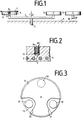
- FIG. 1 shows a work table 1 in which a support 3 is rotatably mounted with a shaft 2.
- This support 3 carries at both ends a heating plate 4, 5, which is designed similar to the heating plate of a conventional household stove and has a heater 6 in its interior, which can be conventional electric heating coils.
- the heating plates 4, 5 are preferably made of stainless steel and have a very smooth, polished surface.
- This has a central, downward centering pin 8 with which it engages in a corresponding hole 9 in the heating plate 4.
- the diameter of the master disc 7 is slightly larger than that of the heating plates 4 and 5. As a result, it can be placed on and removed from the heating plates 4, 5 without difficulty using a conventional gripper (not shown).
- a partial area of a further carrier 10 is shown, which carries a cooling plate 11, which is similar to the heating plates 4 and 5, but has no electrical heating.
- a lacquered master disc 7 is placed on the heating plate 4.
- the lacquer layer dries, as heat from the heating plate 4 rises from the bottom up through the master disc 7 and the lacquer layer applied to it.
- the master disk 7 can be removed from the heating plate 4 and placed on the cooling plate 11, where the master disk 7 cools down rapidly.
- FIG. 2 shows, compared to FIG. 1, an enlarged portion of the heating plate 4 Bore 9 has internal thread 12, so that a stopper 13 with external thread 14 can be screwed into the bore 9 from above so that its top is flush with the surface of the heating plate 4.
- a carousel 15 is arranged below a hood 16.
- three heating plates 17, 18, 19 are arranged on the carousel 15.
- the hood 16 has two passages 20, 21 which are spaced so that a heating plate 17, 19 can be positioned in each. This makes it possible to place a master disc 7 shown in FIG. 1 on the heating plate 17, remove a dried master disc 7 from the heating plate 19 and then turn the carousel 15 until the heating plate 17 with the master disc 7 placed on it reaches the passage 21, so that again a master disc 7 can be removed there and a new master disc 7 can be placed in the passage 20.
- hood 16 is acted upon by clean air so that contamination of the lacquer layer to be dried cannot occur.
Landscapes
- Engineering & Computer Science (AREA)
- Mechanical Engineering (AREA)
- General Engineering & Computer Science (AREA)
- Life Sciences & Earth Sciences (AREA)
- Microbiology (AREA)
- Manufacturing & Machinery (AREA)
- Manufacturing Optical Record Carriers (AREA)
- Drying Of Solid Materials (AREA)
Applications Claiming Priority (2)
| Application Number | Priority Date | Filing Date | Title |
|---|---|---|---|
| DE19543354 | 1995-11-21 | ||
| DE1995143354 DE19543354A1 (de) | 1995-11-21 | 1995-11-21 | Vorrichtung zum Trocknen einer Lackschicht |
Publications (2)
| Publication Number | Publication Date |
|---|---|
| EP0776005A2 true EP0776005A2 (fr) | 1997-05-28 |
| EP0776005A3 EP0776005A3 (fr) | 1999-04-07 |
Family
ID=7778004
Family Applications (1)
| Application Number | Title | Priority Date | Filing Date |
|---|---|---|---|
| EP96117747A Withdrawn EP0776005A3 (fr) | 1995-11-21 | 1996-11-06 | Dispositif de séchage d'une couche de vernis |
Country Status (3)
| Country | Link |
|---|---|
| EP (1) | EP0776005A3 (fr) |
| JP (1) | JPH09171642A (fr) |
| DE (1) | DE19543354A1 (fr) |
Cited By (1)
| Publication number | Priority date | Publication date | Assignee | Title |
|---|---|---|---|---|
| EP1083557A4 (fr) * | 1999-03-23 | 2005-04-13 | Dainippon Ink & Chemicals | Dispositif de production de disque optique |
Families Citing this family (1)
| Publication number | Priority date | Publication date | Assignee | Title |
|---|---|---|---|---|
| DE29816588U1 (de) | 1998-09-16 | 1998-12-24 | Leybold Systems GmbH, 63450 Hanau | Vorrichtung zum Trocknen von mit Lack überzogenen Substraten, beispielsweise für schutzlackierte Compact Disks innerhalb einer Fertigungslinie |
Family Cites Families (11)
| Publication number | Priority date | Publication date | Assignee | Title |
|---|---|---|---|---|
| US3702749A (en) * | 1965-06-23 | 1972-11-14 | Joseph Flusfeder | Apparatus for manufacturing disc records |
| US4390487A (en) * | 1982-01-26 | 1983-06-28 | Rca Corporation | Method of making a laminated recorded disc |
| JPS61249721A (ja) * | 1985-04-30 | 1986-11-06 | Idemitsu Petrochem Co Ltd | 高密度情報記録用デイスクの射出成形金型 |
| DE8610843U1 (de) * | 1986-04-21 | 1987-09-03 | Kaindl, Josef, Dipl. Ing., 5400 Koblenz | Beheizbare Gießplatte zum Gießen spannungsoptischer Schichten |
| JPS6370940A (ja) * | 1986-09-11 | 1988-03-31 | Pioneer Electronic Corp | レジスト原盤の熱処理装置 |
| JPH071149B2 (ja) * | 1988-09-02 | 1995-01-11 | パイオニア株式会社 | 光ディスク原盤の加熱乾燥装置 |
| JPH02102009A (ja) * | 1988-10-12 | 1990-04-13 | Canon Inc | 加圧成型用金型および加圧成型方法 |
| DE69033285T2 (de) * | 1990-01-09 | 2000-03-23 | Sony Corp., Tokio/Tokyo | Plattenspieler und Plattenlader |
| DE4301718A1 (de) * | 1993-01-22 | 1994-07-28 | Jochen Dipl Ing Hagedorn | UV-Bestrahlungseinrichtung |
| JP3254291B2 (ja) * | 1993-03-01 | 2002-02-04 | 株式会社リコー | 光ディスク用原盤作成装置 |
| JPH07220308A (ja) * | 1994-01-31 | 1995-08-18 | Nec Corp | 光ディスク原盤の露光方法及び装置 |
-
1995
- 1995-11-21 DE DE1995143354 patent/DE19543354A1/de not_active Withdrawn
-
1996
- 1996-11-06 EP EP96117747A patent/EP0776005A3/fr not_active Withdrawn
- 1996-11-21 JP JP8310893A patent/JPH09171642A/ja active Pending
Non-Patent Citations (1)
| Title |
|---|
| None |
Cited By (1)
| Publication number | Priority date | Publication date | Assignee | Title |
|---|---|---|---|---|
| EP1083557A4 (fr) * | 1999-03-23 | 2005-04-13 | Dainippon Ink & Chemicals | Dispositif de production de disque optique |
Also Published As
| Publication number | Publication date |
|---|---|
| DE19543354A1 (de) | 1997-05-22 |
| EP0776005A3 (fr) | 1999-04-07 |
| JPH09171642A (ja) | 1997-06-30 |
Similar Documents
| Publication | Publication Date | Title |
|---|---|---|
| EP1042787B1 (fr) | Dispositif de retenue | |
| CH673351A5 (fr) | ||
| DE60029256T2 (de) | Vorrichtung zum schnellen thermischen recycling | |
| EP2216417B1 (fr) | Dispositif de chauffage destiné à réchauffer une platine métallique | |
| EP3632569B1 (fr) | Module de bloc de mise en température et dispositif destinés au traitement thermique des échantillons | |
| DE615805C (de) | Verfahren und Vorrichtung zur Waermebehandlung von Glasgegenstaenden | |
| EP1144706B1 (fr) | Procede et dispositif de traitement thermique de substrats | |
| DE102008060496A1 (de) | Heizvorrichtung für ein Formwerkzeug | |
| DE69211241T2 (de) | Vorrichtung zur Wärmebehandlung und Reparatur von Turbinenschaufeln | |
| DE19543354A1 (de) | Vorrichtung zum Trocknen einer Lackschicht | |
| DE19721689C2 (de) | Vorrichtung zum Trocknen von Substraten | |
| DE3209245C2 (fr) | ||
| DE4142466C2 (de) | Verfahren zur schnellen Abkühlung beim Kurzzeittempern einer Halbleiterscheibe | |
| DE102015220979A1 (de) | Vorrichtung zum Erwärmen mehrerer Funktionselemente | |
| DE3852190T2 (de) | Herstellung von magnetischen Aufzeichnungsplatten. | |
| DE69420291T2 (de) | Substratplatte zur Herstellung einer Matrize für optische Aufzeichnungsträgerproduktion und Verfahren zu ihrer Herstellung | |
| EP1618596A1 (fr) | Dispositif et procede de traitement thermique | |
| DE630204C (de) | Vorrichtung zum Formen und Trocknen klebenden Gutes, z.B. von Zementrohschlamm | |
| DE2722545C2 (de) | Diffusionsofen zur Behandlung von Halbleitersubstraten | |
| DE4028891C2 (fr) | ||
| DE19747164A1 (de) | Anordnung zur Bearbeitung einer Substratscheibe und Verfahren zu deren Betrieb | |
| DE3838012C2 (fr) | ||
| EP0105968A1 (fr) | Dispositif de chauffage électrique pour des fourneaux ou des plaques de cuisson | |
| CH644399A5 (de) | Verfahren zum formen einer heizschlange. | |
| DE102023128226A1 (de) | Glasumformsystem und Verfahren zum Umformen eines Glasrohlings sowie Glaswerkzeug |
Legal Events
| Date | Code | Title | Description |
|---|---|---|---|
| PUAI | Public reference made under article 153(3) epc to a published international application that has entered the european phase |
Free format text: ORIGINAL CODE: 0009012 |
|
| AK | Designated contracting states |
Kind code of ref document: A2 Designated state(s): CH DE FR GB LI NL |
|
| PUAL | Search report despatched |
Free format text: ORIGINAL CODE: 0009013 |
|
| AK | Designated contracting states |
Kind code of ref document: A3 Designated state(s): CH DE FR GB LI NL |
|
| STAA | Information on the status of an ep patent application or granted ep patent |
Free format text: STATUS: THE APPLICATION IS DEEMED TO BE WITHDRAWN |
|
| 18D | Application deemed to be withdrawn |
Effective date: 19990531 |