EP0776376B1 - Verwendung von rna-polymerase zur verbesserung von nukeinsaeure-amplifikationsverfahren - Google Patents
Verwendung von rna-polymerase zur verbesserung von nukeinsaeure-amplifikationsverfahren Download PDFInfo
- Publication number
- EP0776376B1 EP0776376B1 EP95929679A EP95929679A EP0776376B1 EP 0776376 B1 EP0776376 B1 EP 0776376B1 EP 95929679 A EP95929679 A EP 95929679A EP 95929679 A EP95929679 A EP 95929679A EP 0776376 B1 EP0776376 B1 EP 0776376B1
- Authority
- EP
- European Patent Office
- Prior art keywords
- dna
- rna
- rna polymerase
- template
- polymerase
- Prior art date
- Legal status (The legal status is an assumption and is not a legal conclusion. Google has not performed a legal analysis and makes no representation as to the accuracy of the status listed.)
- Expired - Lifetime
Links
Images




Classifications
-
- C—CHEMISTRY; METALLURGY
- C12—BIOCHEMISTRY; BEER; SPIRITS; WINE; VINEGAR; MICROBIOLOGY; ENZYMOLOGY; MUTATION OR GENETIC ENGINEERING
- C12Q—MEASURING OR TESTING PROCESSES INVOLVING ENZYMES, NUCLEIC ACIDS OR MICROORGANISMS; COMPOSITIONS OR TEST PAPERS THEREFOR; PROCESSES OF PREPARING SUCH COMPOSITIONS; CONDITION-RESPONSIVE CONTROL IN MICROBIOLOGICAL OR ENZYMOLOGICAL PROCESSES
- C12Q1/00—Measuring or testing processes involving enzymes, nucleic acids or microorganisms; Compositions therefor; Processes of preparing such compositions
- C12Q1/68—Measuring or testing processes involving enzymes, nucleic acids or microorganisms; Compositions therefor; Processes of preparing such compositions involving nucleic acids
- C12Q1/6844—Nucleic acid amplification reactions
- C12Q1/6865—Promoter-based amplification, e.g. nucleic acid sequence amplification [NASBA], self-sustained sequence replication [3SR] or transcription-based amplification system [TAS]
Definitions
- This invention relates to the use of DNA-directed RNA polymerase of a class that synthesizes cellular RNA to improve a process of amplifying a specific nucleic acid sequence.
- nucleic acids in a sample may indicate that a source from which the sample is taken has a disease, disorder or abnormal physical state.
- Certain diagnostics determine whether nucleic acids are present in a sample. These diagnostics invariably require amplification of nucleic acids because of the copy number problem.
- a DNA template is formed in including a double stranded promoter and the RNA polymerase recognizing the promoter transcribes multiple copies of RNA, including the target sequence, therefrom.
- the RNA serves as input for further rounds of amplification.
- DNA polymerase a reverse transcriptase can be used.
- WO91/01384 describes a process wherein the RnaseH activity is also supplied by the reverse transcriptase.
- WO 91/02818 describes a transcription based amplification process wherein DMSO is used to enhance the reaction. Malek's amplification processes require less participation and fewer manipulations by the user.
- the amplification cycle takes place at a relatively constant ambient temperature and without the serial addition of reagents.
- the template nucleic acid sequence generates more than one product from one substrate in each cycle of the amplification process.
- the amplification processes use either DNA or RNA as a starting template.
- a first primer hybridizes to the DNA. Then, a DNA-directed DNA polymerase makes a double-stranded DNA product. The product of the polymerization then undergoes either thermal or alkali denaturation before the single-stranded DNA enters the cycle.
- double-stranded DNA is a starting template
- the double-stranded DNA first undergoes either thermal or alkali denaturation.
- the first primer then hybridizes to one of the single strands of DNA.
- a DNA-directed DNA polymerase makes a double-stranded DNA product.
- the product of the polymerization then undergoes a second thermal or alkali denaturation before the single-stranded DNA enters the cycle.
- Thermal denaturation is problematic because entry into the amplification cycle is not isothermal. Alkali denaturation is problematic because it requires participation and manipulations by a user of the amplification process. Thermal denaturation may be used not only in Malek's processes, but in other amplification processes (for example, PCR and LCR).
- RNA-directed RNA polymerase means such polymerase of a quality suitable for use in molecular biological reactions.
- One "unit” of a first RNA polymerase means the amount of RNA polymerase which catalyzes the incorporation of one nanomole of radiolabelled ribonucleoside triphosphate into an RNA first template in 10 minutes at 37°C.
- This invention makes the amplification of nucleic acids more expedient, requiring less participation and fewer manipulations than conventional amplification processes.
- the amplification including the entry into any amplification cycle, takes place at a relatively constant ambient temperature. The entry into the cycle does not require serial steps.
- This invention relates to the use of a prokaryotic DNA-directed RNA polymerase of a class that synthesizes cellular RNA, in a process for the amplification of a specific nucleic acid sequence.
- the polymerase is Escherichia coli RNA polymerase.
- the use may also include the use of an inhibitor of such polymerase.
- This invention also relates to a process for the amplification of a specific nucleic acid sequence.
- the process includes the steps (A)-(D).
- Step (A) one provides reagents including, (i) a DNA first template, (ii) a first RNA polymerase which is a prokaryotic RNA polymerase, the polymerase being of a class that synthesizes cellular RNA, and (iii) ribonucleoside triphosphates.
- the RNA polymerase uses the DNA first template to synthesize an RNA first template which includes the specific nucleic acid sequence.
- the DNA first template could be double-stranded DNA or single-stranded DNA.
- the first RNA polymerase may be Escherichia coli RNA polymerase.
- the concentration of Escherichia coli RNA polymerase could be in the range of, but not limited to, 0.04-0.2 units per ⁇ l.
- step (B) the said first prokaryotic RNA polymerase is inactivated.
- Step (C) one provides in one or more steps reagents including (i) a first oligonucleotide primer having a plus sequence of a promoter recognised by a second RNA polymerase, (ii) a second oligonucleotide primer, (iii) a second RNA polymerase which is a DNA-directed RNA polymerase that recognizes the promoter, (iv) an RNA-directed DNA polymerase, (v) a DNA-directed DNA polymerase, (vi) a ribonuclease that hydrolyzes RNA of an RNA-DNA hybrid without hydrolyzing single or double-stranded RNA Qr DNA, (vii) ribonucleoside and deoxyribonucleoside triphosphates, and (viii) the RNA first template, under conditions such that (1) the first oligonucleotide primer hybridizes to the RNA first template, (2) the RNA-directed DNA polymerase uses the RNA first template to
- the second oligonucleotide primer hybridizes to the RNA second template
- the RNA-directed DNA polymerase uses the RNA second template to synthesize a DNA third template by extension of the second oligonucleotide primer and thereby forms an RNA-DNA hybrid intermediate
- the ribonuclease hydrolyzes RNA of the RNA-DNA hybrid intermediate
- the first oligonucleotide primer hybridizes to the DNA third template
- the DNA-directed DNA polymerase uses the first oligonucleotide primer as template to synthesize a functional promoter recognized by the second RNA polymerase by extension of the DNA third template
- the second RNA polymerase recognizes the functional promoter and transcribes the DNA third template, thereby providing copies of an RNA second template.
- Step (D) Thereafter, in Step (D), one maintains the conditions for a time sufficient to achieve a desired amplification of the specific nucleic acid sequence or of a sequence complementary to the specific nucleic acid sequence. For example, one may maintain the conditions for a time between, but not limited to, 30 minutes and 4 hours.
- Step (A) one could also provide deoxyribonucleoside triphosphates.
- the deoxyribonucleoside triphosphates and the ribonucleoside triphosphates need not be added to the second reaction medium.
- Step (B) one could also provide an inhibitor of the first RNA polymerase.
- the inhibitor is rifampicin which is provided at a concentration in the range of, but not limited to, 10-100 ⁇ g per ml.
- Step (A) could be followed by heating the first reaction medium to about 65°C before Step (B).
- Step (A) or (B) one could also provide an alkylated sulfoxide and a suitable carrier protein.
- the alkyl sulfoxide may be dimethylsulfoxide (DMSO) and the carrier protein may be bovine serum albumin (BSA).
- DMSO dimethylsulfoxide
- BSA bovine serum albumin
- the first oligonucleotide primer may also include a plus sequence of a transcription initiation site for the second RNA polymerase.
- the plus sequence of the transcription initiation site would be operatively linked to the plus sequence of the promoter.
- the first RNA polymerase could be any prokaryotic RNA polymerase, such as E. coli RNA polymerase, an RNA polymerase of Bacillus or of Archae bacteria.
- the first RNA polymerase could be any eukaryotic RNA polymerase, such as RNA polymerase I, RNA polymerase II, or RNA polymerase III.
- the second RNA polymerase could be bacteriophage T7 RNA polymerase. In such a case, the plus sequence of the transcription initiation site and the plus sequence of the promoter together are the nucleotide sequence:
- the process may include a further step of monitoring the reaction medium for consumption of any of the first primer, second primer, ribonucleoside and deoxyribunucleoside triphosphates or for accumulation of any product of the cycle.
- the monitoring step could be (1) detecting a nucleic acid product of the cycle using a nucleic acid probe, or restriction endonucleases and electrophoretic separation, (2) monitoring the accumulation of the RNA second template, (3) monitoring the accumulation of the DNA second template, (4) monitoring DNA containing a functional promoter recognized by the RNA polymerase, (5) monitoring the accumulation of the RNA-DNA hybrid intermediate, (6) monitoring consumption of any first primer, second primer, ribonucleoside and deoxyribunucleoside triphosphates or accumulation of any product of the cycle with a value representing consumption of the reagent or accumulation of the product in the second reaction medium in the absence of the specific nucleic acid sequence.
- the ribonuclease could be Escherichia coli ribonuclease H or calf thymus ribonuclease H.
- the first oligonucleotide primer or the second oligonucleotide primer could be bound reversibly to an immobilized support.
- the DNA-directed RNA polymerase could be bacteriophage RNA polymerase, bacteriophage T7 RNA polymerase, bacteriophage T3 polymerase, bacteriophage ⁇ II polymerase, Salmonella bacteriophage sp6 polymerase, or Pseudomonas bacteriophage gh-1 polymerase.
- the RNA-directed DNA polymerase could be retrovirus reverse transcriptase such as an avian myeloblastosis virus polymerase or a Moloney murine leukemia virus polymerase.
- the DNA-directed DNA polymerase lacks DNA exonuclease activity. In another instance, all DNA polymerases in the second reaction medium lack DNA exonuclease and DNA endonuclease activity.
- the DNA-directed DNA polymerase could be avian myeloblastosis virus polymerase, DNA polymerase ⁇ or DNA polymerase ⁇ , or calf thymus DNA polymerase.
- the process may include the steps of ligating a DNA product of the cycle into a cloning vector and then cloning the DNA product, expressing a product encoded by the DNA product of the cycle in an expression system.
- the invention includes a kit for amplifying nucleic acid sequences.
- the kit includes one or more receptacles containing (a) a first RNA polymerase which is a DNA-directed RNA polymerase which synthesizes cellular RNA, (b) ribonucleoside triphosphates, (c) deoxyribonucleoside triphosphates, (d) a first oligonucleotide primer including a plus sequence of a promoter recognized by a second RNA polymerase, (e) a second oligonucleotide primer, (f) a second.
- a first RNA polymerase which is a DNA-directed RNA polymerase which synthesizes cellular RNA
- ribonucleoside triphosphates ribonucleoside triphosphates
- deoxyribonucleoside triphosphates deoxyribonucleoside triphosphates
- a first oligonucleotide primer including a
- RNA polymerase which is a DNA-directed RNA polymerase that recognizes the promoter, (g) an RNA-directed DNA polymerase, (h) a DNA-directed DNA polymerase, and (i) a ribonuclease that hydrolyzes RNA of an RNA-DNA hybrid without hydrolyzing single- or double-stranded RNA or DNA.
- the first RNA polymerase may be Escherichia coli RNA polymerase.
- the kit may also include a receptacle containing an inhibitor of Escherichia coli RNA polymerase.
- the inhibitor is rifampicin.
- the kit may also include a receptacle containing an alkylated sulfoxide and a receptacle containing a suitable carrier protein.
- Figure 1 is a general illustration of a nucleic acid amplification process starting with double-stranded DNA or with single-stranded DNA.
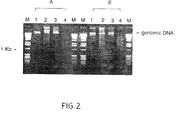
- Figure 2 shows the sensitivity of transcripts generated by using Escherichia coli RNA polymerase and genomic DNA to RNase A and DNase I.
- Figure 3A shows the inhibition of Escherichia coli RNA polymerase by rifampicin.
- Figure 3B shows the effect of rifampicin in NASBATM amplification.
- I shows an agarose gel containing ethidium bromide.
- II shows a northern blot hybridization.
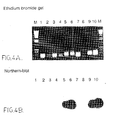
- Figure 4 shows the evidence for specific amplification from transcriptions generated from Escherichia coli RNA polymerase where 4A shows the results of an agarose gel containing ethidium bromide and 4B shows a northern blot hybridization.
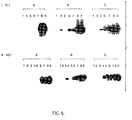
- Figure 5 shows the specific amplification of (I) GM-CSF and (II) G3PDH Sequences from transcripts generated using Escherichia coli RNA polymerase.
- Figure 6 shows the amplification in NASBATM of specific sequences of Chlamydia trachomatis from Escherichia coli RNA polymerase generated RNA, (I), PL1, and (II) VD1.
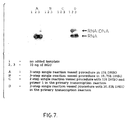
- Figure 7 shows the amplification in NASBATM of DNA transcribed with Escherichia coli RNA polymerase using a 2-step versus a 3 step procedure and a single reaction vessel.
- This invention relates to the use of a prokaryotic DNA-directed RNA polymerase which is of a class that synthesizes cellular RNA, in a process for the amplification of a specific nucleic acid sequence.
- a prokaryotic DNA-directed RNA polymerase which is of a class that synthesizes cellular RNA
- such polymerase is used in the amplification process which is described in United States Patent Number 5,409,818 (Malek et al.).
- such polymerase is used in the amplification process which is described in United States Patent No. 5,130,238 (Malek et al.).
- this invention relates to a novel process for entering the amplification cycle.
- the polymerase is used in the amplification process described in United States Patent No. 4,683,195 (Mullis), United States Patent No. 4,683,202 (Mullis) and GenProbe U.S. Patent No. 5,399,491 (Kacian e
- RNA first template single-stranded or double-stranded DNA
- Escherichia coli RNA polymerase and ribonucleoside triphosphates are added to a first reaction medium containing single-stranded or double-stranded DNA (DNA first template) suspected of containing or known to contain a specific nucleic acid sequence.
- the Escherichia coli RNA polymerase non-specifically transcribes the DNA template independent of specific promoter sequences (Chamberlin, 1976; Ovchinnikov et al., 1977) to provide an RNA first template.
- RNA first template RNA first template
- the first primer hybridizes to the RNA first template
- the RNA-directed DNA polymerase uses the RNA first template to synthesize a DNA second template by extending the first primer, resulting in a RNA-DNA hybrid intermediate.
- the ribonuclease hydrolyzes RNA of the RNA-DNA hybrid.
- the second primer hybridizes to the DNA second template.
- the DNA-directed DNA polymerase uses the second primer and the DNA second template to synthesize a functional promoter recognized by the second RNA polymerase.
- the second RNA polymerase recognizes the functional promoter and transcribes the DNA second template providing copies of the RNA second template.
- the RNA second template then enters the cycle described in United States Patent No. 5,130,238 and in United States Patent No. 5,409,818 (Malek et al.) such that the process results in multiple copies of the specific nucleic acid sequence.
- this improvement eliminates the need for DNA strand separation and first primer-primed extension of the DNA first template.
- the DNA first template is used in a single transcription reaction rather than in a separate priming reaction before amplification of a specific nucleic acid.
- Oligonucleotides were synthesized using an Applied Biosystems DNA synthesizer. Columns, phosphoramidites, and reagents used for oligonucleotide synthesis were purchased from Applied Biosystems, Inc. Oligonucleotides were purified by polyacrylamide gel electrophoresis followed by DEAE cellulose chromatography. The radioisotope ⁇ - 32 P-CTP ( ⁇ 3000 Cl/mmol) and ⁇ - 32 P-ATP ( ⁇ 3000 Cl/mmol) (was from Amersham. RNase A and rifampicin were purchased from Sigma. DNase I was obtained from Promega. Escherichia coli RNA polymerase was purchased from Boehringer Mannheim and Epicentre Technologies Inc.
- Agarose gels were prepared and run according to Sambrook et al., 1989.
- the gels contained either 3% low-melt agarose (NuSieveTM; FMC) and 1% agarose or only 2% agarose in 1X Tris-acetate EDTA (TAE) with 0.2 ⁇ g/ml ethidium bromide. Aliquots (5 ⁇ l) of the amplification reactions were analysed.
- the amplified materials were transferred to a nylon membrane by electroblotting (Sambrook et al., 1989).
- the nucleic acids were fixed to the nylon membrane and hybridized to specific probes using conditions described by Sooknanan et al., 1993.
- the probes were labelled at the 5' - end with 32 P (Sambrook et al., 1989).
- autoradiography was performed using Kodak XAR-5 film.
- a standard Escherichia coli RNA polymerase transcription reaction comprised 66.67 mM Tris (pH 8.5), 83.3 mM KCI, 20 mM MgCl 2 , 3.3 mM of each ATP, CTP, GTP and UTP, 1.6 mM of each dATP, dCTP, dGTP and dTTP, 5 ⁇ g bovine serum albumin, 16.6 mM DTT, 7.5 units placental ribonuclease inhibitor, ⁇ 500 ng double-stranded DNA and 1 unit Escherichia coli RNA polymerase core enzyme in a final volume of 15 ⁇ l. The reaction mixture was incubated at 40°C for 30 minutes.
- RNA synthesized appeared to be a heterogenous mixture as indicated by the smear extending above the 1 Kb DNA molecular weight marker on the native ethidium bromide stained agarose gel.
- the following lanes have the following materials: A - 250 ng KG-1 genomic DNA B - 250 ng Salmonella typhimurium genomic DNA M - double-strand DNA molecular weight marker 1 - mock transcription reaction (no enzyme) 2 - untreated transcription reaction 3 - RNase A treated transcription reaction 4 - DNase I treated transcription reaction
- RNA synthesized were measured by TCA precipitation of the transcribed materials. Both 10 and 100 ⁇ g/ml rifampicin were sufficient to inhibited 1 unit of Escherichia coli RNA polymerase resulting in less than 2% RNA synthesis compared to 10% for 1 mg/ml rifampicin and 100% when no rifampicin was present (Figure 3A).
- Example 1 Six separate transcription reactions each containing 10 ng of native human genomic DNA were performed as described in Example 1. The reactions were pooled and re-divided into 6 equal amounts for the purpose of standardization. Two of the aliquots were then digested with 2 ⁇ g RNase A each and another two with 2 units DNase I each as described in Example 1. The final two aliquots were incubated as the others but without any added nuclease.
- the following lanes have the following materials: 1 - no added template 2,3 - 10 ng native DNA as template 4 - no added template 5,6 - untreated transcription reaction as template 7,8 - RNase A treated transcription reaction as template 9,10 - DNase I treated transcription reaction as template
- Escherichia coli RNA polymerase transcription reactions containing 1 ng, 10 ng or 100 ng of HGD were performed as described in Example 1. Following transcription, the appropriate primer mixture was added directly to the transcription reaction to give a final concentration in a 25 ⁇ l volume of 0.2 ⁇ M of the first primer (P1), 0.2 ⁇ M of the send primer (P2) and 15% (v/v) DMSO. The reaction mixture was heated at 65°C for 2 minutes and then transferred to 40°C. After 2 minutes at 40°C, an enzyme mixture containing 8 units AMV reverse transcriptase, 0.2 units RNase H, 40 units T7 RNA polymerase and 100 ⁇ g/ml BSA was added to each reaction and the final reaction volume adjusted to 25 ml with H 2 O. The reactions were incubated at 40°C for an additional 90 minutes.
- Escherichia coli RNA polymerase transcription reactions containing different amounts of total nucleic acids isolated from Chlamydia trachomatis infected HeLa cells were performed as described in Example 1.
- Primers specific for the cryptic plasmid (PL1) and the MOMP gene (VD1) of Chlamydia trachomatis were tested in NASBATM.
- the appropriate primer mixture was added directly to the transcription reaction to give a final concentration in a 25 ⁇ l volume of 0.2 ⁇ M P1, 0.2 ⁇ M P2 and 15% (v/v) DMSO.
- the reactions were heated at 65°C for 2 minutes and then transferred to 40°C.
- NASBATM enzyme mixture containing 8 units AMV reverse transcriptase, 0.2 unit RNase H, 40 units T7 RNA polymerase and 100 ⁇ g/ml BSA was added to each reaction. The final reaction volume was adjusted to 25 ml with H 2 O and the reactions were incubated at 40°C for an additional 90 minutes. Parallel NASBATM reactions were performed with P1-primed material and neat material at similar concentrations.
- the following lanes have the following material: A - untreated total nucleic acids B - P1-primed DNA C - Escherichia coli RNA polymerase RNA from DNA 1 - no template 2,3 - 10 fg total nucleic acids 4,5 - 100 fg total nucleic acids 6,7 - 1 pg total nucleic acids 8,9 - 10 pg total nucleic acids
- Example 6 Direct amplification in NASBATM of DNA transcribed with Escherichia coli RNA polymerase using a 2-step versus a 3-step procedure and a single reaction vessel.
- Example 3 describes a 3-step procedure using 2 separate reaction vessels for the amplification of Escherichia coli RNA polymerase generated transcripts from DNA in NASBATM.
- Example 4 describes a 3-step procedure for performing the same task which uses a single reaction vessel.
- the 3-step procedure using a single reaction vessel is replaced by a 2-step procedure using a single reaction vessel. That- is, instead of the addition of a primer mixture to the primary transcription reaction as in example 4, DMSO (final 20.83% (v/v)) was added to the primary transcription reaction, and primers 1 and 2 were combined with the enzyme mixture, and added later. All primary transcription reactions in this example contained 10 ng of HGD and the amplification was performed using GM-CSF specific primers.
- the primary transcription reaction as set out in Example 1 contained in addition 15% (v/v) DMSO and 5 pmoles of primer 1 in a total volume of 18 ⁇ l.
- the reactions were incubated at 40°C for 30 minutes, heated to 65°C for 2 minutes and then placed at 40°C for 2 minutes.
- a standard enzyme mixture containing in addition 15% (v/v) DMSO and 5 pmoles of primer 2 was then added to each reaction tube. Amplification was allowed to proceed at 40°C for 90 minutes.
- the primary transcription reaction as set out in Example 1 contained in addition 20.83% (v/v) DMSO in a total volume of 18 ⁇ l.
- the reactions were incubated at 40°C for 30 minutes, heated to 65°C for 2 minutes and then placed at 40°C.
- a standard enzyme mixture containing in addition 5 pmoles of each of primers 1 and 2 was added to each reaction tube. Amplification was allowed to proceed at 40°C for 90 minutes.
Landscapes
- Chemical & Material Sciences (AREA)
- Life Sciences & Earth Sciences (AREA)
- Organic Chemistry (AREA)
- Engineering & Computer Science (AREA)
- Zoology (AREA)
- Wood Science & Technology (AREA)
- Proteomics, Peptides & Aminoacids (AREA)
- Health & Medical Sciences (AREA)
- Molecular Biology (AREA)
- Bioinformatics & Cheminformatics (AREA)
- Immunology (AREA)
- Microbiology (AREA)
- Biophysics (AREA)
- Analytical Chemistry (AREA)
- Physics & Mathematics (AREA)
- Chemical Kinetics & Catalysis (AREA)
- Biochemistry (AREA)
- Biotechnology (AREA)
- General Engineering & Computer Science (AREA)
- General Health & Medical Sciences (AREA)
- Genetics & Genomics (AREA)
- Measuring Or Testing Involving Enzymes Or Micro-Organisms (AREA)
- Saccharide Compounds (AREA)
- Preparation Of Compounds By Using Micro-Organisms (AREA)
- Enzymes And Modification Thereof (AREA)
Claims (17)
- Verfahren zur Amplifikation einer spezifischen Nukleinsäuresequenz von einer DNA-Erstmatrize, welches die Schritte umfasst:(A) In-Kontakt-bringen der DNA-Erstmatrize mit einer prokaryotischen RNA-Polymerase, wobei die genannte RNA-Polymerase einer Klasse angehört, die zelluläre RNA und Ribonukleosidtriphosphate unter Bedingungen synthetisiert, unter denen eine RNA-Erstmatrize synthetisiert wird, welche die genannte spezifische Nukleinsäuresequenz umfasst,(B) Inaktivierung genannter RNA-Polymerase, welche der Klasse angehört, die zelluläre RNA synthetisiert(C) In-Kontakt-bringen der RNA-Erstmatrize mit:einem ersten Oligonukleotid-Primer, der eine Plussequenz eines Promotors umfasst, der durch eine zweite RNA-Polymerase erkannt wird,einem zweiten Oligonuleotid-Primer,Ribonukleosidtriphosphaten,Desoxyribonukleosidtriphosphaten,einer zweiten RNA-Polymerase, welche eine DNA-gerichtete RNA-Polymerase ist, die genannten Promotor erkennt,einem Enzym, das eine RNA-gerichtete DNA-Polymeraseaktivität besitzt,einem Enzym, das eine DNA-gerichtete DNA-Polymeraseaktivität besitzt,einem Enzym, das eine RNase-H-Aktivität besitzt und(D) Halten des hieraus resultierenden Reaktionsgemisches unter geeigneten Bedingungen über einen ausreichenden Zeitraum, um eine gewünschte Amplifikation der genannten Nukleinsäuresequenz oder einer zu dieser Nukleinsäuresequenz komplementären Sequenz zu erhalten.
- Verfahren nach Anspruch 1, worin genannte prokaryotische RNA-Polymerase aus einer Gruppe ausgewählt ist, die Escherichia coli-RNA-Polymerase, RNA-Polymerase von Bacillus und RNA-Polymerase des Archae Bakteriums umfasst.
- Verfahren nach Anspruch 1, worin Schritt (B) die zur Verfügungstellung eines Inhibitors der prokaryotischen Polymerase umfasst.
- Verfahren nach Anspruch 3, worin ein solcher Inhibitor Rifampicin ist.
- Verfahren nach Anspruch 1, worin Schritt (B) die Erhitzung von genannten Reagenzien und genannter RNA-Matrize vor Schritt C umfasst.
- Verfahren nach Anspruch 5, worin das genannte Reaktionsmedium auf ca. 65°C erhitzt wird.
- Verfahren nach Anspruch 1, welches weiter die Herstellung eines alkylierten Sulfoxid und BSA umfasst.
- Verfahren nach Anspruch 7, worin genanntes alkyliertes Sulfoxid Dimethylsulfoxid (DMSO) ist.
- Verfahren nach Anspruch 2, worin genannte prokaryotische RNA-Polymerase eine Escherichia coli-RNA-Polymerase ist, die in einer Konzentration im Bereich von 0,04 - 0,2 Einheiten/µl hergestellt wird.
- Verfahren nach Anspruch 3, worin der Inhibitor in einer Konzentration im Bereich von 10 - 100 µg/ml zur Verfügung gestellt wird.
- Verfahren nach Anspruch 1, worin in Schritt (A) die genannte DNA-Erstmatrize eine doppelsträngige DNA ist.
- Verfahren nach Anspruch 1, worin in Schritt (A) die genannte DNA-Erstmatrize eine einsträngige DNA ist.
- Set zur Amplifikation von Nukleinsäuresequenzen, das eine oder mehrere Rezipienten umfasst, diebeinhalten.(a) eine erste RNA-Polymerase , die eine prokaryotische DNA-gerichtete RNA-Polymerase ist, die zelluläre RNA synthetisiert,(b) Ribonukleosidtriphosphate,(c) Desoxyribonukleosidtriphosphate,(d) einen ersten Oligonukleotid-Primer, der eine Plussequenz eines Promotors umfasst, der durch einen zweite RNA-Polymerase erkannt wird,(e) einen zweiten Oligonukleotid-Primer(f) eine zweite RNA-Polymerase, die eine DNA-gerichtete RNA-Polymerase ist, die den genannten Promotor erkennt,(g) eine RNA-gerichtete DNA-Polymerase,(h) eine DNA-gerichtete DNA-Polymerase und(i) eine Ribonuklease, die die RNA eines RNA-DNA-Hybrids hydrolysiert, ohne eine ein- oder doppelsträngigen RNA oder DNA zu hydrolysieren,
- Set nach Anspruch 13, worin genannte erste RNA-Polymerase eine Escherichia coli-RNA-Polymerase ist.
- Set nach Anspruch 13, das weiter einen Rezipienten umfasst, das einen Inhibitor der Escherichia coli-RNA-Polymerase beinhaltet.
- Set nach Anspruch 13, worin der Inhibitor Rifampicin ist.
- Set nach Anspruch 13, das weiter einen Rezipienten umfasst, der alkyliertes Sulfoxid beinhaltet, und einen Rezipienten, der BSA beinhaltet.
Applications Claiming Priority (3)
| Application Number | Priority Date | Filing Date | Title |
|---|---|---|---|
| US27525094A | 1994-07-15 | 1994-07-15 | |
| PCT/CA1995/000423 WO1996002668A1 (en) | 1994-07-15 | 1995-07-13 | Use of rna polymerase to improve nucleic acid amplification process |
| US275250 | 1999-03-24 |
Publications (2)
| Publication Number | Publication Date |
|---|---|
| EP0776376A1 EP0776376A1 (de) | 1997-06-04 |
| EP0776376B1 true EP0776376B1 (de) | 2001-11-21 |
Family
ID=23051486
Family Applications (1)
| Application Number | Title | Priority Date | Filing Date |
|---|---|---|---|
| EP95929679A Expired - Lifetime EP0776376B1 (de) | 1994-07-15 | 1995-07-13 | Verwendung von rna-polymerase zur verbesserung von nukeinsaeure-amplifikationsverfahren |
Country Status (12)
| Country | Link |
|---|---|
| US (1) | US6025134A (de) |
| EP (1) | EP0776376B1 (de) |
| JP (1) | JP3881009B2 (de) |
| KR (1) | KR100392551B1 (de) |
| AT (1) | ATE209258T1 (de) |
| AU (1) | AU711115B2 (de) |
| CA (1) | CA2195209C (de) |
| DE (1) | DE69524105T2 (de) |
| DK (1) | DK0776376T3 (de) |
| ES (1) | ES2168380T3 (de) |
| PT (1) | PT776376E (de) |
| WO (1) | WO1996002668A1 (de) |
Families Citing this family (87)
| Publication number | Priority date | Publication date | Assignee | Title |
|---|---|---|---|---|
| US5712127A (en) * | 1996-04-29 | 1998-01-27 | Genescape Inc. | Subtractive amplification |
| US6225062B1 (en) | 1996-11-12 | 2001-05-01 | Visible Genetics Inc. | Method and kit for direct isothermal sequencing of nucleic acids |
| ZA989950B (en) * | 1997-11-17 | 1999-05-04 | Akzo Nobel Nv | Transcription based amplification of double stranded DNA targets |
| KR100440044B1 (ko) * | 1998-02-27 | 2004-07-14 | 팸진 비.브이. | 핵산의 비특이적 증폭방법 |
| AU4515699A (en) * | 1998-06-26 | 2000-01-17 | Akzo Nobel N.V. | Tagging of rna amplicons generated by transcription-based amplification |
| ATE330031T1 (de) * | 1998-07-31 | 2006-07-15 | Gen Probe Inc | Reversibel inhibierende sonden |
| WO2003064679A2 (en) | 2002-01-30 | 2003-08-07 | Id Biomedical Corporation | Methods for detecting vancomycin-resistant microorganisms and compositions therefor |
| EP1558758B1 (de) | 2002-05-17 | 2009-09-23 | The Government of the United States of America as Represented by the Secretary of the Department of Health and Human Services, | Molekulare identifizierung von aspergillus-spezies |
| US20040018494A1 (en) * | 2002-07-25 | 2004-01-29 | Shurtliff Roxanne N | Isothermal transcription based amplification assay for detection and quantification of guanylyl cyclase C |
| EP1545575A4 (de) | 2002-09-19 | 2006-04-05 | Us Gov Health & Human Serv | P. ariasi polypeptide, p. perniciosus polypeptide und anwendungsverfahren |
| ES2447843T3 (es) | 2002-10-29 | 2014-03-13 | The Government Of The United States Of America As Represented By The Secretary Of The Department Of Health And Human Services | Polip�ptidos de Lutzomyia longipalpis y m�todos de uso |
| EP1945780B1 (de) | 2005-10-14 | 2015-09-16 | THE GOVERNMENT OF THE UNITED STATES OF AMERICA as represented by THE SECRETARY OF THE DEPARTMENT OF HEALTH AND HUMAN SERVICES | Tollwutvirusvektorsysteme sowie zusammensetzungen und verfahren dazu |
| CA3031887C (en) | 2006-02-13 | 2023-02-07 | The Government Of The United States Of America As Represented By The Secretary Of The Department Of Health And Human Services, Centers For Disease Control And Prevention | Primers and probes for detection and discrimination of types and subtypes of influenza viruses |
| EP2441469A1 (de) | 2006-03-14 | 2012-04-18 | Oregon Health and Science University | Verfahren zur Erzeugung einer Immunantwort auf Tuberculosis |
| KR101523391B1 (ko) | 2006-12-27 | 2015-05-27 | 에모리 유니버시티 | 감염 및 종양 치료를 위한 조성물 및 방법 |
| WO2008106551A2 (en) | 2007-02-28 | 2008-09-04 | The Govt. Of The U.S.A. As Represented By The Secretary Of The Dept. Of Health & Human Serv. | Brachyury polypeptides and methods for use |
| WO2009125303A2 (en) | 2008-04-10 | 2009-10-15 | Genenews Corporation | Method and apparatus for determining a probability of colorectal cancer in a subject |
| JP2012503206A (ja) | 2008-09-22 | 2012-02-02 | オレゴン ヘルス アンド サイエンス ユニバーシティ | Mycobacteriumtuberculosis感染を検出するための方法 |
| MX2011005691A (es) | 2008-11-28 | 2011-07-20 | Univ Emory | Metodos para el tratamiento de infecciones y tumores. |
| WO2010096713A2 (en) | 2009-02-20 | 2010-08-26 | The United States Of America, As Represented By The Secretary, Department Of Health And Human Services | Method for the diagnosis of age-associated vascular disorders |
| WO2010138908A1 (en) | 2009-05-29 | 2010-12-02 | Ventana Medical Systems, Inc. | Igfir gene copy number as a prognostic marker in a non-small cell lung cancer |
| CA2763321C (en) | 2009-05-29 | 2018-10-16 | Ventana Medical Systems, Inc. | Methods of scoring gene copy number in a biological sample using in situ hybridization |
| US8835117B2 (en) | 2009-05-29 | 2014-09-16 | The United States Of America As Represented By The Secretary Of The Department Of Health And Human Services, Centers For Disease Control And Prevention | Nucleic acids for detection and discrimination of genotypes of Chlamydophila psittaci |
| CA2774636C (en) | 2009-09-25 | 2019-05-21 | The United States Of America, As Represented By The Secretary, Department Of Health And Human Services | Neutralizing antibodies to hiv-1 and their use |
| WO2011047340A1 (en) | 2009-10-16 | 2011-04-21 | The United States Of America, As Represented By The Secretary, Department Of Health & Human Services | Insertion of foreign genes in rubella virus and their stable expression in a live, attenuated viral vaccine |
| CN102713629B (zh) | 2009-11-20 | 2016-02-24 | 俄勒冈健康科学大学 | 用于检测结核分枝杆菌感染的方法 |
| WO2011133474A2 (en) | 2010-04-18 | 2011-10-27 | Beth Israel Deaconess Medical Center | Methods of predicting predisposition to or risk of kidney disease |
| WO2011133433A2 (en) | 2010-04-16 | 2011-10-27 | The Government Of The United States Of America As Represented By The Secretary Of The Department Of Health And Human Services, Centers For Disease Control And Prevention | Real time pcr assay for detection of bacterial respiratory pathogens |
| EP2582727B8 (de) | 2010-06-16 | 2017-04-19 | University of Pittsburgh- Of the Commonwealth System of Higher Education | Antikörper zu endoplasmin und deren verwendung |
| WO2012006056A2 (en) | 2010-06-29 | 2012-01-12 | Oregon Health & Science University | Ccr6 as a biomarker of alzheimer's disease |
| ES2657233T3 (es) | 2010-08-30 | 2018-03-02 | Dow Agrosciences, Llc | Potenciador viral baciliforme de la caña de azúcar (SCBV) y su uso en la genómica vegetal funcional |
| AR082785A1 (es) | 2010-08-30 | 2013-01-09 | Agrigenetics Inc | Plataforma de activacion por marcado para genes de maiz y poblaciones y plantas marcadas resultantes |
| KR20140006898A (ko) | 2011-01-25 | 2014-01-16 | 알막 다이아그노스틱스 리미티드 | 결장암 유전자 발현 시그니처 및 이용 방법 |
| US9150644B2 (en) | 2011-04-12 | 2015-10-06 | The United States Of America, As Represented By The Secretary, Department Of Health And Human Services | Human monoclonal antibodies that bind insulin-like growth factor (IGF) I and II |
| ES2597032T3 (es) | 2011-05-04 | 2017-01-13 | HTG Molecular Diagnostics, Inc | Mejoras en un ensayo cuantitativo de protección contra la nucleasa (qNPA) y secuenciación (qNPS) |
| WO2013006684A1 (en) | 2011-07-05 | 2013-01-10 | The Gov. Of The U.S.A. As Represented By The Secretary Of The Dept. Of Health And Human Services. | Hiv-1 genotyping assay for global surveillance of hiv-1 drug resistance |
| WO2013049535A2 (en) | 2011-09-30 | 2013-04-04 | The United States Of America, As Represented By The Secretary, Department Of Health & Human Services | Influenza vaccine |
| WO2013071954A1 (en) | 2011-11-15 | 2013-05-23 | Université Libre de Bruxelles | Streptococcus pneumoniae detection in blood |
| AU2013202941B2 (en) | 2012-02-29 | 2015-06-25 | Dow Agrosciences Llc | Sugarcane bacilliform viral (SCBV) enhancer and its use in plant functional genomics |
| CA2866185C (en) | 2012-03-23 | 2021-04-06 | The Government Of The United States Of America As Represented By The Secretary Of The Department Of Health And Human Services | Pathogenic phlebovirus isolates and compositions and methods of use |
| WO2013148147A1 (en) | 2012-03-26 | 2013-10-03 | The U.S.A., As Represented By The Secretary Dept. Of Health And Human Services | Dna methylation analysis for the diagnosis, prognosis and treatment of adrenal neoplasms |
| US9566329B2 (en) | 2012-04-06 | 2017-02-14 | The United States Of America, As Represented By The Secretary, Department Of Health And Human Services | Live, attenuated rubella vector to express vaccine antigens |
| WO2013162828A1 (en) | 2012-04-27 | 2013-10-31 | The United States Of America, As Represented By The Secretary, Department Of Health & Human Services | Use of cpg oligonucleotides co-formulated with an antibiotic to accelarate wound healing |
| WO2013165551A1 (en) | 2012-05-03 | 2013-11-07 | The Government Of The Usa As Represented By The Secretary Of The Department Of Health And Human Services | Methods of detecting influenza virus |
| US9394574B2 (en) | 2012-06-12 | 2016-07-19 | The United States Of America As Represented By The Secretary Of The Department Of Health And Human Services | Methods for detecting Legionella nucleic acids in a sample |
| WO2013192100A1 (en) | 2012-06-18 | 2013-12-27 | The United States Of America, As Represented By The Secretary, Department Of Health & Human Services | Methods and compositions for detecting jc virus |
| WO2014043518A1 (en) | 2012-09-14 | 2014-03-20 | The United States Of America, As Represented By The Secretary, Department Of Health And Human Services | Brachyury protein, non-poxvirus non-yeast vectors encoding brachyury protein, and their use |
| US9775895B2 (en) | 2012-12-12 | 2017-10-03 | The United States Of America, As Represented By The Secretary, Department Of Health And Human Services | HIV therapeutics and methods of making and using same |
| EP2951290B1 (de) | 2013-02-01 | 2017-11-29 | The United States of America, as represented by The Secretary, Department of Health and Human Services | Verfahren zur erzeugung von zellen im retinalen pigmentepithel aus induzierten pluripotenten stammzellen |
| WO2014126921A1 (en) | 2013-02-12 | 2014-08-21 | The United States Of America, As Represented By The Secretary, Department Of Health And Human Services | Monoclonal antibodies that neutralize norovirus |
| WO2014152155A1 (en) | 2013-03-14 | 2014-09-25 | The Broad Institute, Inc. | Massively multiplexed rna sequencing |
| US20160083698A1 (en) | 2013-04-19 | 2016-03-24 | The Regents Of The University Of California | Lone star virus |
| EP2994163B1 (de) | 2013-05-09 | 2019-08-28 | The United States of America, as represented by The Secretary, Department of Health and Human Services | Single-domain-vhh-antikörper gegen norovirus gi.1 und gii.4 und deren verwendung |
| WO2015061475A2 (en) | 2013-10-22 | 2015-04-30 | THE GOVERNMENT OF THE USA as represented by THE SECRETARY OF THE DEPARTMENT OF HEATLH AND HUMAN SERV | Compositions and methods for detection and discrimination of influenza viruses |
| US10398772B2 (en) | 2014-01-08 | 2019-09-03 | The United States Of America, As Represented By The Secretary, Department Of Health And Human Services | Ras pathways as markers of protection against HIV and methods to improve vaccine efficacy |
| US20170058366A1 (en) | 2014-02-21 | 2017-03-02 | The United States of America, as represented by th e Secretary, Dept. of Health and Human Services | Hiv-2 nucleic acids and methods of detection |
| WO2015160536A1 (en) | 2014-04-14 | 2015-10-22 | The United States Of America, As Represented By The Secretary Department Of Health And Human Services | Methods for rapid detection and identification of viral nucleic acids |
| WO2015199976A1 (en) | 2014-06-24 | 2015-12-30 | The United States Of America, As Represented By The Secretary, Department Of Health & Human Services | Target activated microdissection |
| US20170252364A1 (en) | 2014-07-30 | 2017-09-07 | Mor Research Applications Ltd. | Compositions for treatment of acute lymphoblastic leukemia and methods of use thereof |
| JP6811706B2 (ja) | 2014-07-31 | 2021-01-13 | ザ ホンコン ユニヴァーシティ オブ サイエンス アンド テクノロジー | Epha4に対するヒトモノクローナル抗体及びそれらの使用 |
| WO2016089920A1 (en) | 2014-12-01 | 2016-06-09 | The Broad Institute, Inc. | Method for in situ determination of nucleic acid proximity |
| WO2016090170A1 (en) | 2014-12-05 | 2016-06-09 | The United States Of America, As Represented By The Secretary, Department Of Health And Human Services | A potent anti-influenza a neuraminidase subtype n1 antibody |
| WO2016134144A1 (en) | 2015-02-20 | 2016-08-25 | The United States Of America, As Represented By The Secretary, Department Of Health And Human Services | Methods and reagents for detecting ebola virus |
| US11873483B2 (en) | 2015-03-11 | 2024-01-16 | The Broad Institute, Inc. | Proteomic analysis with nucleic acid identifiers |
| WO2017031370A1 (en) | 2015-08-18 | 2017-02-23 | The Broad Institute, Inc. | Methods and compositions for altering function and structure of chromatin loops and/or domains |
| EP3359651A1 (de) | 2015-10-05 | 2018-08-15 | THE UNITED STATES OF AMERICA, represented by the S | Stamm des menschlichen rota-virus g9p[6] und verwendung als impfstoff |
| WO2017192589A1 (en) | 2016-05-02 | 2017-11-09 | The United States Of America, As Represented By The Secretary, Department Of Health And Human Services | Neutralizing antibodies to influenza ha and their use and identification |
| US11155885B2 (en) | 2016-05-20 | 2021-10-26 | The United States Of America, As Represented By The Secretary, Department Of Health And Human Services | Real-time reverse transcriptase-polymerase chain reaction assay with modified probe for the diagnosis of rabies viruses and other lyssaviruses |
| US11248272B2 (en) | 2016-06-27 | 2022-02-15 | The United States Of America, As Represented By The Secretary, Department Of Health And Human Services | Methods and compositions for influenza a virus subtyping |
| US12209292B2 (en) | 2016-08-26 | 2025-01-28 | The Broad Institute, Inc. | Nucleic acid amplification assays for detection of pathogens |
| PE20191767A1 (es) | 2016-12-06 | 2019-12-17 | Univ Oregon State | Composiciones y metodos para la produccion incrementada de enduracina en una cepa geneticamente modificada de streptomyces fungicidicus |
| US11708613B2 (en) | 2017-05-03 | 2023-07-25 | The United States of America, as Represened by the Secretary, Department of Health and Human Services | Rapid detection of Zika virus by reverse transcription loop-mediated isothermal amplification |
| US11466329B2 (en) | 2017-06-14 | 2022-10-11 | The United States Of America, As Represented By The Secretary, Department Of Health And Human Services | Detection of blaIMP antibacterial resistance genes |
| GB201710838D0 (en) | 2017-07-05 | 2017-08-16 | Ucl Business Plc | Bispecific antibodies |
| DK4060041T5 (en) | 2017-09-25 | 2024-07-22 | Fred Hutchinson Cancer Center | High efficiency targeted in situ genome-wide profiling |
| WO2019071054A1 (en) | 2017-10-04 | 2019-04-11 | The Broad Institute, Inc. | METHODS AND COMPOSITIONS FOR MODIFYING THE FUNCTION AND STRUCTURE OF BUCKLES AND / OR CHROMATIN DOMAINS |
| WO2019133727A1 (en) | 2017-12-29 | 2019-07-04 | The United States Of America, As Represented By The Secretary, Department Of Health And Human Services | Universal influenza virus probe set for enrichment of any influenza virus nucleic acid |
| WO2019152860A1 (en) | 2018-02-02 | 2019-08-08 | The United States Of America, As Represented By The Secretary, Department Of Health And Human Services | Random amplification methods for extremely low input nucleic acids |
| JP7569781B2 (ja) | 2018-07-27 | 2024-10-18 | アペルタ バイオサイエンシズ,エルエルシー | デモデックスにより誘発される眼の異常および顔面の異常を治療するためのスピノシン配合 |
| US12188099B2 (en) | 2018-12-12 | 2025-01-07 | University Of Pittsburgh-Of The Commonwealth System Of Higher Education | Integrated proviral sequencing assay |
| US20220262462A1 (en) | 2019-04-10 | 2022-08-18 | University Of Pittsburgh - Of The Commonwealth System Of Higher Education | Computational filtering of methylated sequence data for predictive modeling |
| EP3976764B1 (de) | 2019-05-30 | 2025-07-23 | Viti, Inc. | Verfahren zum erkennen einer infektion mit dem mycobakterium tuberculosis |
| WO2021016374A1 (en) | 2019-07-23 | 2021-01-28 | Snapdna | System and method for detecting and monitoring pathogens |
| US11844800B2 (en) | 2019-10-30 | 2023-12-19 | Massachusetts Institute Of Technology | Methods and compositions for predicting and preventing relapse of acute lymphoblastic leukemia |
| WO2022056078A1 (en) | 2020-09-11 | 2022-03-17 | The United States Of America, As Represented By The Secretary, Department Of Health And Human Services | Rnase h-assisted detection assay for rna (radar) |
| IL308870A (en) | 2021-05-26 | 2024-01-01 | Centarix Biotech Ltd | Methods for identifying critically short telomeres |
| WO2024191684A1 (en) | 2023-03-10 | 2024-09-19 | The United States Of America, As Represented By The Secretary, Department Of Health And Human Services | Detection of hepatitis c virus ribonucleic acid from whole blood using reverse transcription loop-mediated isothermal amplification |
Citations (1)
| Publication number | Priority date | Publication date | Assignee | Title |
|---|---|---|---|---|
| EP0329822A2 (de) * | 1988-02-24 | 1989-08-30 | Cangene Corporation | Verfahren zur Amplifizierung von Nukleinsäuren |
Family Cites Families (4)
| Publication number | Priority date | Publication date | Assignee | Title |
|---|---|---|---|---|
| US5130238A (en) * | 1988-06-24 | 1992-07-14 | Cangene Corporation | Enhanced nucleic acid amplification process |
| WO1991001384A1 (en) * | 1989-07-11 | 1991-02-07 | Gen-Probe, Incorporated | Nucleic acid sequence amplification methods utilizing a transcription complex |
| WO1991004340A1 (en) * | 1989-09-20 | 1991-04-04 | Cambridge Biotech Corporation | In vitro, isothermal nucleic acid amplification |
| DE69029401T2 (de) * | 1989-09-21 | 1997-07-10 | Camborne Ind Plc | Wiedergewinnung von schrott |
-
1995
- 1995-07-13 ES ES95929679T patent/ES2168380T3/es not_active Expired - Lifetime
- 1995-07-13 AT AT95929679T patent/ATE209258T1/de active
- 1995-07-13 AU AU33366/95A patent/AU711115B2/en not_active Expired
- 1995-07-13 DE DE69524105T patent/DE69524105T2/de not_active Expired - Lifetime
- 1995-07-13 CA CA002195209A patent/CA2195209C/en not_active Expired - Lifetime
- 1995-07-13 PT PT95929679T patent/PT776376E/pt unknown
- 1995-07-13 KR KR1019970700255A patent/KR100392551B1/ko not_active Expired - Lifetime
- 1995-07-13 WO PCT/CA1995/000423 patent/WO1996002668A1/en not_active Ceased
- 1995-07-13 EP EP95929679A patent/EP0776376B1/de not_active Expired - Lifetime
- 1995-07-13 DK DK95929679T patent/DK0776376T3/da active
- 1995-07-13 JP JP50454596A patent/JP3881009B2/ja not_active Expired - Lifetime
-
1997
- 1997-01-28 US US08/790,249 patent/US6025134A/en not_active Expired - Lifetime
Patent Citations (1)
| Publication number | Priority date | Publication date | Assignee | Title |
|---|---|---|---|---|
| EP0329822A2 (de) * | 1988-02-24 | 1989-08-30 | Cangene Corporation | Verfahren zur Amplifizierung von Nukleinsäuren |
Also Published As
| Publication number | Publication date |
|---|---|
| DK0776376T3 (da) | 2002-02-18 |
| DE69524105D1 (de) | 2002-01-03 |
| CA2195209A1 (en) | 1996-02-01 |
| AU3336695A (en) | 1996-02-16 |
| PT776376E (pt) | 2002-05-31 |
| ATE209258T1 (de) | 2001-12-15 |
| ES2168380T3 (es) | 2002-06-16 |
| US6025134A (en) | 2000-02-15 |
| DE69524105T2 (de) | 2002-07-18 |
| JP3881009B2 (ja) | 2007-02-14 |
| WO1996002668A1 (en) | 1996-02-01 |
| AU711115B2 (en) | 1999-10-07 |
| EP0776376A1 (de) | 1997-06-04 |
| JPH11505402A (ja) | 1999-05-21 |
| KR100392551B1 (ko) | 2003-10-30 |
| CA2195209C (en) | 2008-09-23 |
Similar Documents
| Publication | Publication Date | Title |
|---|---|---|
| EP0776376B1 (de) | Verwendung von rna-polymerase zur verbesserung von nukeinsaeure-amplifikationsverfahren | |
| US5409818A (en) | Nucleic acid amplification process | |
| US6063603A (en) | Nucleic acid amplification process | |
| US5130238A (en) | Enhanced nucleic acid amplification process | |
| US5322770A (en) | Reverse transcription with thermostable DNA polymerases - high temperature reverse transcription | |
| US5744308A (en) | Chimera oligonucleotide and its utilization for obtaining transcripts of a nucleic acid | |
| US6063604A (en) | Target nucleic acid sequence amplification | |
| US5334515A (en) | Method for altering a nucleotide sequence | |
| WO2000056877A1 (en) | Method for amplifying nucleic acid sequence | |
| CA2252801A1 (en) | Subtractive amplification | |
| US5500341A (en) | Species-specific detection of Mycobacterium kansasii | |
| CA2249643C (en) | Assay for chlamydia trachomatis by amplification and detection of chlamydia trachomatis nucleic acid | |
| US6261773B1 (en) | Reagent for nucleic acid amplification and process for nucleic acid amplification | |
| EP1404697B1 (de) | Nukleinsäureamplifikation mit duplexzwischenprodukten | |
| EP0682121B1 (de) | Verfahren zur ampflifizierung und zum nachweis bestimmter nukleinsäuresequenzen mittels thermostabiler enzyme | |
| AU2002310366A1 (en) | Nucleic acid amplification utilizing intermediate duplexes | |
| US6156508A (en) | Detection of M. tuberculosis complex via reverse transcriptase SDA | |
| US20010031466A1 (en) | Preparation of sequence libraries from non-denatured RNA and kits therefor | |
| US8309303B2 (en) | Reverse transcription and amplification of RNA with simultaneous degradation of DNA | |
| US5955271A (en) | Method and kits for determining messenger RNA molecules in a sample | |
| EP0517154A1 (de) | Verfahren zum Nachweis von Giardia | |
| CA2102963A1 (en) | Simple nucleic acid amplification |
Legal Events
| Date | Code | Title | Description |
|---|---|---|---|
| PUAI | Public reference made under article 153(3) epc to a published international application that has entered the european phase |
Free format text: ORIGINAL CODE: 0009012 |
|
| 17P | Request for examination filed |
Effective date: 19970207 |
|
| AK | Designated contracting states |
Kind code of ref document: A1 Designated state(s): AT BE CH DE DK ES FR GB GR IE IT LI LU MC NL PT SE |
|
| 17Q | First examination report despatched |
Effective date: 19990628 |
|
| GRAG | Despatch of communication of intention to grant |
Free format text: ORIGINAL CODE: EPIDOS AGRA |
|
| GRAG | Despatch of communication of intention to grant |
Free format text: ORIGINAL CODE: EPIDOS AGRA |
|
| GRAH | Despatch of communication of intention to grant a patent |
Free format text: ORIGINAL CODE: EPIDOS IGRA |
|
| GRAH | Despatch of communication of intention to grant a patent |
Free format text: ORIGINAL CODE: EPIDOS IGRA |
|
| GRAA | (expected) grant |
Free format text: ORIGINAL CODE: 0009210 |
|
| AK | Designated contracting states |
Kind code of ref document: B1 Designated state(s): AT BE CH DE DK ES FR GB GR IE IT LI LU MC NL PT SE |
|
| REF | Corresponds to: |
Ref document number: 209258 Country of ref document: AT Date of ref document: 20011215 Kind code of ref document: T |
|
| RAP2 | Party data changed (patent owner data changed or rights of a patent transferred) |
Owner name: ORGANON TEKNIKA B.V. |
|
| REG | Reference to a national code |
Ref country code: CH Ref legal event code: EP |
|
| REG | Reference to a national code |
Ref country code: IE Ref legal event code: FG4D |
|
| REG | Reference to a national code |
Ref country code: CH Ref legal event code: NV Representative=s name: ISLER & PEDRAZZINI AG |
|
| REG | Reference to a national code |
Ref country code: GB Ref legal event code: IF02 |
|
| REF | Corresponds to: |
Ref document number: 69524105 Country of ref document: DE Date of ref document: 20020103 |
|
| ET | Fr: translation filed | ||
| NLT2 | Nl: modifications (of names), taken from the european patent patent bulletin |
Owner name: ORGANON TEKNIKA B.V. |
|
| REG | Reference to a national code |
Ref country code: DK Ref legal event code: T3 |
|
| REG | Reference to a national code |
Ref country code: GR Ref legal event code: EP Ref document number: 20020400530 Country of ref document: GR |
|
| REG | Reference to a national code |
Ref country code: PT Ref legal event code: SC4A Free format text: AVAILABILITY OF NATIONAL TRANSLATION Effective date: 20020207 |
|
| REG | Reference to a national code |
Ref country code: ES Ref legal event code: FG2A Ref document number: 2168380 Country of ref document: ES Kind code of ref document: T3 |
|
| PG25 | Lapsed in a contracting state [announced via postgrant information from national office to epo] |
Ref country code: LU Free format text: LAPSE BECAUSE OF NON-PAYMENT OF DUE FEES Effective date: 20020713 |
|
| PLBE | No opposition filed within time limit |
Free format text: ORIGINAL CODE: 0009261 |
|
| STAA | Information on the status of an ep patent application or granted ep patent |
Free format text: STATUS: NO OPPOSITION FILED WITHIN TIME LIMIT |
|
| 26N | No opposition filed | ||
| PG25 | Lapsed in a contracting state [announced via postgrant information from national office to epo] |
Ref country code: MC Free format text: LAPSE BECAUSE OF NON-PAYMENT OF DUE FEES Effective date: 20030201 |
|
| REG | Reference to a national code |
Ref country code: CH Ref legal event code: PCAR Free format text: ISLER & PEDRAZZINI AG;POSTFACH 1772;8027 ZUERICH (CH) |
|
| PGFP | Annual fee paid to national office [announced via postgrant information from national office to epo] |
Ref country code: PT Payment date: 20140623 Year of fee payment: 20 |
|
| PGFP | Annual fee paid to national office [announced via postgrant information from national office to epo] |
Ref country code: IE Payment date: 20140728 Year of fee payment: 20 Ref country code: DE Payment date: 20140729 Year of fee payment: 20 Ref country code: DK Payment date: 20140725 Year of fee payment: 20 Ref country code: GR Payment date: 20140729 Year of fee payment: 20 Ref country code: CH Payment date: 20140728 Year of fee payment: 20 Ref country code: NL Payment date: 20140726 Year of fee payment: 20 |
|
| PGFP | Annual fee paid to national office [announced via postgrant information from national office to epo] |
Ref country code: ES Payment date: 20140728 Year of fee payment: 20 Ref country code: FR Payment date: 20140717 Year of fee payment: 20 Ref country code: SE Payment date: 20140729 Year of fee payment: 20 Ref country code: AT Payment date: 20140619 Year of fee payment: 20 Ref country code: GB Payment date: 20140729 Year of fee payment: 20 |
|
| PGFP | Annual fee paid to national office [announced via postgrant information from national office to epo] |
Ref country code: IT Payment date: 20140724 Year of fee payment: 20 |
|
| PGFP | Annual fee paid to national office [announced via postgrant information from national office to epo] |
Ref country code: BE Payment date: 20140730 Year of fee payment: 20 |
|
| REG | Reference to a national code |
Ref country code: DE Ref legal event code: R071 Ref document number: 69524105 Country of ref document: DE |
|
| REG | Reference to a national code |
Ref country code: PT Ref legal event code: MM4A Free format text: MAXIMUM VALIDITY LIMIT REACHED Effective date: 20150713 Ref country code: DK Ref legal event code: EUP Effective date: 20150713 |
|
| REG | Reference to a national code |
Ref country code: NL Ref legal event code: V4 Effective date: 20150713 |
|
| REG | Reference to a national code |
Ref country code: NL Ref legal event code: V4 Effective date: 20150713 |
|
| REG | Reference to a national code |
Ref country code: CH Ref legal event code: PL |
|
| REG | Reference to a national code |
Ref country code: GB Ref legal event code: PE20 Expiry date: 20150712 |
|
| REG | Reference to a national code |
Ref country code: IE Ref legal event code: MK9A |
|
| REG | Reference to a national code |
Ref country code: SE Ref legal event code: EUG |
|
| REG | Reference to a national code |
Ref country code: GR Ref legal event code: MA Ref document number: 20020400530 Country of ref document: GR Effective date: 20150714 |
|
| REG | Reference to a national code |
Ref country code: AT Ref legal event code: MK07 Ref document number: 209258 Country of ref document: AT Kind code of ref document: T Effective date: 20150713 |
|
| REG | Reference to a national code |
Ref country code: ES Ref legal event code: FD2A Effective date: 20151026 |
|
| PG25 | Lapsed in a contracting state [announced via postgrant information from national office to epo] |
Ref country code: IE Free format text: LAPSE BECAUSE OF EXPIRATION OF PROTECTION Effective date: 20150713 Ref country code: PT Free format text: LAPSE BECAUSE OF EXPIRATION OF PROTECTION Effective date: 20150720 Ref country code: GB Free format text: LAPSE BECAUSE OF EXPIRATION OF PROTECTION Effective date: 20150712 |
|
| PG25 | Lapsed in a contracting state [announced via postgrant information from national office to epo] |
Ref country code: ES Free format text: LAPSE BECAUSE OF EXPIRATION OF PROTECTION Effective date: 20150714 |