EP0776852A1 - Navette d'ascenseur utilisant une cabine transférable horizontalement - Google Patents
Navette d'ascenseur utilisant une cabine transférable horizontalement Download PDFInfo
- Publication number
- EP0776852A1 EP0776852A1 EP96308667A EP96308667A EP0776852A1 EP 0776852 A1 EP0776852 A1 EP 0776852A1 EP 96308667 A EP96308667 A EP 96308667A EP 96308667 A EP96308667 A EP 96308667A EP 0776852 A1 EP0776852 A1 EP 0776852A1
- Authority
- EP
- European Patent Office
- Prior art keywords
- car
- hoistway
- deck
- passengers
- doors
- Prior art date
- Legal status (The legal status is an assumption and is not a legal conclusion. Google has not performed a legal analysis and makes no representation as to the accuracy of the status listed.)
- Granted
Links
- 238000012546 transfer Methods 0.000 claims abstract description 46
- 238000012545 processing Methods 0.000 claims description 7
- 238000000034 method Methods 0.000 claims description 6
- 230000000977 initiatory effect Effects 0.000 claims description 2
- 230000000903 blocking effect Effects 0.000 claims 1
- 238000012360 testing method Methods 0.000 description 59
- 230000008569 process Effects 0.000 description 4
- 208000019901 Anxiety disease Diseases 0.000 description 3
- 238000010586 diagram Methods 0.000 description 3
- 230000036506 anxiety Effects 0.000 description 2
- 238000007792 addition Methods 0.000 description 1
- 238000013459 approach Methods 0.000 description 1
- 230000000712 assembly Effects 0.000 description 1
- 238000000429 assembly Methods 0.000 description 1
- 239000000872 buffer Substances 0.000 description 1
- 230000000694 effects Effects 0.000 description 1
- 238000005265 energy consumption Methods 0.000 description 1
- 230000006698 induction Effects 0.000 description 1
- 238000003801 milling Methods 0.000 description 1
- 230000009467 reduction Effects 0.000 description 1
- 230000004044 response Effects 0.000 description 1
- 230000001360 synchronised effect Effects 0.000 description 1
Images


Classifications
-
- B—PERFORMING OPERATIONS; TRANSPORTING
- B66—HOISTING; LIFTING; HAULING
- B66B—ELEVATORS; ESCALATORS OR MOVING WALKWAYS
- B66B1/00—Control systems of elevators in general
- B66B1/24—Control systems with regulation, i.e. with retroactive action, for influencing travelling speed, acceleration, or deceleration
- B66B1/2408—Control systems with regulation, i.e. with retroactive action, for influencing travelling speed, acceleration, or deceleration where the allocation of a call to an elevator car is of importance, i.e. by means of a supervisory or group controller
- B66B1/2458—For elevator systems with multiple shafts and a single car per shaft
-
- B—PERFORMING OPERATIONS; TRANSPORTING
- B66—HOISTING; LIFTING; HAULING
- B66B—ELEVATORS; ESCALATORS OR MOVING WALKWAYS
- B66B9/00—Kinds or types of lifts in, or associated with, buildings or other structures
-
- B—PERFORMING OPERATIONS; TRANSPORTING
- B66—HOISTING; LIFTING; HAULING
- B66B—ELEVATORS; ESCALATORS OR MOVING WALKWAYS
- B66B2201/00—Aspects of control systems of elevators
- B66B2201/30—Details of the elevator system configuration
- B66B2201/303—Express or shuttle elevators
-
- B—PERFORMING OPERATIONS; TRANSPORTING
- B66—HOISTING; LIFTING; HAULING
- B66B—ELEVATORS; ESCALATORS OR MOVING WALKWAYS
- B66B2201/00—Aspects of control systems of elevators
- B66B2201/30—Details of the elevator system configuration
- B66B2201/304—Transit control
-
- B—PERFORMING OPERATIONS; TRANSPORTING
- B66—HOISTING; LIFTING; HAULING
- B66B—ELEVATORS; ESCALATORS OR MOVING WALKWAYS
- B66B2201/00—Aspects of control systems of elevators
- B66B2201/30—Details of the elevator system configuration
- B66B2201/306—Multi-deck elevator cars
-
- Y—GENERAL TAGGING OF NEW TECHNOLOGICAL DEVELOPMENTS; GENERAL TAGGING OF CROSS-SECTIONAL TECHNOLOGIES SPANNING OVER SEVERAL SECTIONS OF THE IPC; TECHNICAL SUBJECTS COVERED BY FORMER USPC CROSS-REFERENCE ART COLLECTIONS [XRACs] AND DIGESTS
- Y10—TECHNICAL SUBJECTS COVERED BY FORMER USPC
- Y10S—TECHNICAL SUBJECTS COVERED BY FORMER USPC CROSS-REFERENCE ART COLLECTIONS [XRACs] AND DIGESTS
- Y10S187/00—Elevator, industrial lift truck, or stationary lift for vehicle
- Y10S187/902—Control for double-decker car
Definitions
- This invention relates to moving passengers in very tall buildings by having adjacent, overlapping hoistways with double deck elevators therein, and causing the passengers to move from a lower deck of one elevator to the lower deck of another elevator simultaneously with moving from the upper deck of the other elevator to the upper deck of the one elevator.
- an elevator cab may be moved in a first car frame in a first hoistway, from the ground floor up to a transfer floor, moved horizontally into a second elevator car frame in a second hoistway, and moved therein upwardly in the building, and so forth, as disclosed in our copending International patent application No. PCT/US96/17040, a copy of which is in the file of the present application.
- Objects of the invention include moving passengers in a building greater vertical distances than the limit of length of a conventional elevator, in a simple and effective manner, without wasting core.
- an elevator shuttle system for moving passengers between landings at two levels of a building, comprising:
- passengers are moved in a lower deck of a double deck elevator car in a first hoistway from a first landing in a direction toward a second landing while simultaneously passengers are moved toward said first landing in an upper deck of a second double deck elevator car in a second hoistway adjacent the first hoistway, the first and second elevator cars are brought to rest adjacent each other, and the passengers in the lower deck of the first car move to the lower deck of the second car as the passengers in the upper deck of the second car move to the upper deck of the first car, and then the passengers in the lower deck of the second car are moved toward the second landing while passengers in the upper deck of the first car are moved toward the first landing.
- Fig. 1 is a partially broken away, partially sectioned, simplified side elevation view of an elevator shuttle system in accordance with the present invention.
- Fig. 2 is a partial, partially sectioned simplified side elevational view of an alternative embodiment of the invention.
- Fig. 3 is a logic flow diagram of a synchronization routine for operating elevators within the shuttle of the present invention.
- Fig. 4 is a logic flow diagram of a door synchronization routine which may be used for controlling elevator doors within the shuttle of the present invention.
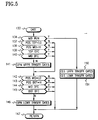
- Fig. 5 is a logic flow diagram of a hoistway gate routine which may be used within the shuttle of the present invention.
- an elevator shuttle system includes a top elevator 7 which overlaps with a middle elevator 8 which in turn overlaps with a bottom elevator 9.
- Each of the elevators has a double deck car 10-12 which is moved vertically in hoistways 13-15 by hoist motor/brake assemblies 19-21 connected thereto by the usual roping 22-24.
- Each elevator has the usual buffers 25 and controller 26, which provide the usual motion and other car controls, one of which may serve as a controller for the shuttle group as a whole.
- the upper landing 32 of the summit level 34 is used as an entrance landing and passengers entering at the summit landing will enter the upper deck of the elevator 10, transfer to the upper deck of the other two elevators, and emerge at the upper landing 40 of the ground level.
- the upper decks could be used for upward traveling and the lower decks could be used for downward traveling, if desired.
- hoistway doors 52 are shown at the ground level 42, because these doors are closed. Hoistway doors at the summit level 34 are not shown because they are open. Similarly, car doors 51 for the cars 10-12 are shown closed in Fig. 2, but not shown in Fig. 1 since they are open. The cars 10 and 12 could have rear doors and the landing levels 34, 42 could be on the opposite sides of the hoistways 13, 15. As is described more fully hereinafter, hoistway gates may be utilized to ensure passenger safety in the event that one of the elevator cars reaches a transfer level before the other elevator car, and the car doors become open. The hoistway gates would prevent inadvertent entrance into the opposing hoistway.
- hoistway gates 53 are shown in a closed position.
- the hoistway gates 53 may comprise sets of ordinary hoistway doors 52 (Fig. 2), the same as the hoistway doors 52 used at the lower landing 42 (Fig. 1), with the hallway side of the hoistway doors facing each other across the sill.
- a single, special gate may be used at each landing, operated separately from the car doors (which however can remain conventional).
- the operation of such a special gate is described with respect to Fig. 5, hereinafter.
- the invention can be practised in other embodiments with no hoistway gates at all, as is described with respect to Fig. 4, hereinafter.
- the elevator shaft 14 is essentially contiguous with both of the other elevator shafts 13, 15.
- the shafts are separated by the minimal amount permitted in order to allow safe passage of cars past each other as each approach and depart from the corresponding end of the respective hoistway.
- the sills 50 are very narrow, on the order of 1/4 of a meter, so that the cars are very close together and the passengers can step from one car into the next.
- wider sills 50a may be utilized as illustrated in Fig. 2, to permit having an emergency exit 54 at the passenger transfer level.
- a routine which may be used in a controller that controls the shuttle group for synchronizing the group may be entered through an entry point 60.
- Each of the cars 10-12 will be advanced by its own motor in the hoistway in accordance with a motion profile, brought to rest at the destination level, and its doors will be opened, all in a usual way.
- the control of Fig. 3 senses the point in time when all three elevators are standing still with their doors open.
- a first pair of tests 61, 62 determine if locally used flags (described hereinafter) are set or not. Initially they will not be, so a series of tests 63-65 are reached to see if all three cars (top, middle and bottom) have their doors fully open, or not.
- a corresponding one of the tests 63-65 will be negative, causing other programming of the controller to be reverted to through a return point 66.
- a step 70 initiates a door timer which will determine how long the doors remain open, and a step 71 sets a door timer flag, indicating that the timer has been initiated. Then a test 72 determines if the position of the top car is high, as shown in Fig. 1.
- an affirmative result of test 72 reaches a step 73 to enable the top door switches so that passengers can reopen the door for a late arriving passenger, if necessary, and a step 74 disables the bottom elevator door switches so that passengers cannot control the doors at the transfer level 49.
- a pair of steps 76, 77 command that an announcement be played on the middle elevator and on the bottom elevator, respectively. The announcement is to the effect that the passengers should please walk from this car to the adjacent car. This feature need not be used if not desired in any implementation of the present invention. And then other programming is reached through the return point 66.
- test 61 is negative but test 62 is now positive since the door timer flag has just been set in the step 71.
- negative results of a test 78 will cause other programming to be reached through the return point 66.
- the door timer will time out and a subsequent pass through the routine of Fig. 3 will have a positive result of test 78 reaching a test 79 to determine whether the position of the top car is the high end of its shaft, as shown in Fig. 1. Assuming that it is, an affirmative result of test 79 reaches a series of steps 80-82 to set direction for the top car to down, direction for the middle car to up, and direction for the bottom car to down.
- a series of steps 86-88 send a close door command to the respective top, middle and bottom cars to commence door closure, which is effected in the usual fashion by a cab controller. Then, a step 89 sets a closing flag so as to indicate that the doors are in the process of closing, and other programming is reverted to through the return point 66.
- test 61 is now affirmative since the closing flag was set in step 89 as the doors begin to close. Then a series of tests 91-93 determine when all of the doors are fully closed. In each pass through Fig. 3, as the doors are closing, a negative result of any of tests 91-93 cause other programming to be reached through the return point 66. Eventually, all three sets of doors are closed and affirmative results of tests 91-93 reach a series of steps 94-96 to tell each of the elevators it is now time to run. Then, a pair of steps 97, 98 reset the door timer flag and the closing flag to ready them for use at the next stop.
- the top elevator will run down to the low end of its hoistway at the transfer level 49.
- the middle elevator will run up to the high end of its hoistway at the transfer level 49 and the bottom elevator will run down to the low end of its hoistway at the ground level 42.
- tests 61-65 are all negative reaching the return point 66 so that the remainder of Fig. 3 is bypassed.
- the elevators will each come to rest and in the process will cause door open commands to be provided to its doors.
- test 72 determines if the top car is at the high end of its hoistway; in this case, it will not be, so a negative result of test 72 reaches a pair of steps 99, 100 to disable the top car door switches, so passengers will have no control over the doors at the transfer level 49, and to enable the door switches of the bottom car so that the passengers can accommodate late arrivals at the ground level 42. And a pair of steps 101, 102 cause the announcement (to walk to the other car) to be played on the top elevator and on the middle elevator, respectively. Then pother programming is reached through the return point 66.
- test 61 is negative
- test 62 is positive
- test 78 will remain negative until the door timer times out.
- test 79 determines if the position of the top car is the high end of its hoistway. This time it is not, so a negative result of test 79 reaches a step 103 to command the direction for the top car to be up, a step 104 to command the direction for the middle car to be down, and a step 104 to command the direction of the bottom car to be up.
- the steps 86-89 are performed as before, and other programming is reverted to through the return point 66.
- steps 94-98 are performed as before, and the process continues in the same fashion as the elevators go up and down.
- Fig. 3 only three tests 63-65 are used to determine when doors are fully open. Obviously, doors of both the upper and lower decks are included in those tests; and it is assumed that the fully open status of both sets of doors is utilized in the same fashion as would be for timing the doors in an ordinary double decker elevator. However, if desired, six tests may be used, one for each deck of each of the three elevators. Similarly, six tests may be used in place of the tests 91-93 to determine when all doors are fully closed and six commands to close doors can be provided in place of the steps 86-88. All of this is irrelevant to the present invention.
- the embodiment of Fig. 1 includes only three elevators.
- the invention may be used with two elevators, four elevators or more.
- the embodiment of Fig. 1 shows the hoistway 13 disposed above the hoistway 15. This permits use of elevator cars having doors on only one side.
- the elevator car 11 can be provided with doors on both the front and the back of the car to permit placing the hoistway 13 to the right of the hoistway 14 as seen in Fig. 1, rather than being above the hoistway 15.
- the invention has been shown using double deck elevators, in which only one of the decks carries passengers in each run. However, in severe cases of restriction on elevator core, the elevator cars could have four or six decks within the purview of the present invention.
- double deck means having two decks, or more, and references to "upper deck” and “lower deck” are construed to be references to any decks of an elevator, one above the other, carrying opposing traffic; thus, lower deck may mean the first, third, fifth, etc. while upper deck means the second, fourth, sixth, etc., or lower deck may mean the first through third while upper deck means the fourth through sixth, and so forth.
- the ground level 42 has two landings 40, 41, one being aligned with the upper deck and the other being aligned with the lower deck of an elevator standing at the ground level.
- the summit level 34 comprises a landing level having upper and lower landings 32, 33 that are aligned with the upper and lower decks of an elevator stopped thereat.
- the term "landing level” encompasses both the upper and lower landings (or more) at a corresponding one of the levels 34, 42.
- the invention has been shown and described for operation which assumes that the runs of each elevator take essentially the same time as each other elevator. While it is immaterial how long an elevator stays at a floor landing, such as at the summit level 34 and the floor level 42, passenger apprehension can be intolerable if passengers have to wait midway in a closed, still elevator, such as at the transfer levels 48, 49. If any of the hoistways have a different length than the others, the speed of the corresponding car can be adjusted so that run time will be essentially the same in each of them, within limits.
- door opening and closing controls have not been shown because they are conventional, and door closing may be as disclosed, for instance in our co-pending International patent application, except for the fact that door opening will occur in both directions of travel of all of the cars at all levels, and except for the fact that further constraints may be imposed upon opening doors at the transfer levels 48, 49, as described hereinafter.
- a first test 107 determines if the doors have been disabled already (as described hereinafter), or not. Initially, they will not have, so a negative result of test 107 reaches a test 108 to determine if the middle car is currently set to run, or not. If the middle car is not running, the remainder of Fig.
- a test 111 determines if the direction of the top car is up, or not. If it is up, then it is known that the next stop will be at the landings of the upper level 34 and that it is therefore alright to allow the car's normal door controls to control the opening of the car doors.
- test 110 reaches a step 111 to enable operation of the doors in the top car.
- the direction for the top car is not up, it is not known that it will be at a landing, and presumably the next stop will be at the upper transfer level 49. Therefore, it would be unsafe to open the car doors unless it is known that the other car is adjacent and its doors are opening.
- test 111 is negative and a test 112 determines if the top car is within its outer door zone of the upper transfer level yet. If it is, then a test 113 determines if the middle car is within its outer door zone of the upper transfer level.
- a step 120 determines if the direction of the bottom car is down, or not. If it is down, then the bottom car is headed for the landings at the ground level 42, and therefore it is permissible for the car to control its own door openings. An affirmative result of test 120 reaches a step 121 to enable the bottom car doors. But if the bottom car does not have a down direction, it presumably is headed for the lower transfer level 48.
- a test 122 determines if the middle car is within its outer door zone of the lower transfer level or not, and a test 123 determines if the bottom car is within its outer door zone of the lower transfer level or not.
- test 130 determines if the middle car is running or not. Prior to reaching the outer door zones, and after reaching the outer door zones, the middle car will still be running for a while, so an affirmative result of test 130 will cause other programming to be reached through the return point 109. While the car is running, once the disable flag is set, the routine of Fig. 4 will be performed periodically, even after the doors are enabled.
- special hoistway gates 53, 54 may be provided at the transfer levels 48, 49 between the shafts 13, 14 and 14, 15. Then either the coincidence of outer door zone (as in Fig. 4), or inner door zone, or otherwise, may be utilized to operate a special hoistway gate between the two cars. For instance, in Fig. 5, a gate routine is reached through an entry point 133 and a first test 134 determines if the middle car is running, or not. Assuming the situation in Fig.
- test 134 determines if the middle car is the low end of its shaft. If so, a test 138 determines if the position of the mid car is at the high end of its shaft. If so, a pair of tests 139, 140 determine if the doors on both cars are no longer fully closed; that is, both are opening or open. If all of this is true, affirmative results reach a step 141 which causes the transfer gates 53 at the upper transfer level 49 to be opened.
- step 141 will be bypassed, and the gates 53 between the two cars will remain closed at the upper transfer level 49.
- Similar tests 142-145 and step 146 will control the hoistway gates at the lower transfer level 48. After that, other programming is reverted to through a return point 147.
- the routine of Fig. 5 will be performed repetitively as described so long as the middle car has not-been enabled to run. This will simply redundantly order the opening of one or the other of the transfer gates, which is harmless. If desired, a flag could be provided to avoid redundant performance of the routine of Fig. 5, once either of the transfer gates has been opened. Eventually, the passengers will be transferred and the doors closed, as described with respect to Fig. 3, and the middle car will again be set to run by the step 95. When this happens, the doors of the middle car and of whichever car was facing it will have already closed, and an affirmative result of the test 134 will reach a pair of steps 150, 151 to ensure that both of the transfer gates are closed. And then other programming is reached through the return point 147.
Landscapes
- Engineering & Computer Science (AREA)
- Automation & Control Theory (AREA)
- Structural Engineering (AREA)
- Elevator Control (AREA)
- Types And Forms Of Lifts (AREA)
- Cage And Drive Apparatuses For Elevators (AREA)
Applications Claiming Priority (2)
| Application Number | Priority Date | Filing Date | Title |
|---|---|---|---|
| US564697 | 1995-11-29 | ||
| US08/564,697 US5663539A (en) | 1995-11-29 | 1995-11-29 | Passenger transfer, double deck, multi-elevator shuttle system |
Publications (2)
| Publication Number | Publication Date |
|---|---|
| EP0776852A1 true EP0776852A1 (fr) | 1997-06-04 |
| EP0776852B1 EP0776852B1 (fr) | 2001-04-04 |
Family
ID=24255519
Family Applications (1)
| Application Number | Title | Priority Date | Filing Date |
|---|---|---|---|
| EP96308667A Expired - Lifetime EP0776852B1 (fr) | 1995-11-29 | 1996-11-29 | Navette d'ascenseur utilisant une cabine transférable horizontalement |
Country Status (10)
| Country | Link |
|---|---|
| US (1) | US5663539A (fr) |
| EP (1) | EP0776852B1 (fr) |
| JP (1) | JPH09165146A (fr) |
| CN (1) | CN1076313C (fr) |
| AU (1) | AU7191796A (fr) |
| CA (1) | CA2189938A1 (fr) |
| DE (1) | DE69612354T2 (fr) |
| SG (1) | SG90699A1 (fr) |
| TW (1) | TW349073B (fr) |
| ZA (1) | ZA969389B (fr) |
Cited By (1)
| Publication number | Priority date | Publication date | Assignee | Title |
|---|---|---|---|---|
| WO2009085039A1 (fr) * | 2007-12-27 | 2009-07-09 | Otis Elevator Company | Système d'ascenseur dans un immeuble de grande hauteur ayant une plate-forme de transfert de passagers entre les cabines d'ascenseur |
Families Citing this family (12)
| Publication number | Priority date | Publication date | Assignee | Title |
|---|---|---|---|---|
| SG77211A1 (en) * | 1997-12-26 | 2000-12-19 | Toshiba Kk | Controlling apparatus for double deck elevator |
| JP4131456B2 (ja) * | 2001-11-26 | 2008-08-13 | 三菱電機株式会社 | エレベーター群管理制御装置 |
| US20060163008A1 (en) * | 2005-01-24 | 2006-07-27 | Michael Godwin | Autonomous linear retarder/motor for safe operation of direct drive gearless, rope-less elevators |
| WO2007133173A2 (fr) * | 2006-04-11 | 2007-11-22 | Otis Elevator Company | Système d'ascenseurs comprenant un transfert de passagers de cabine à cabine |
| US7743890B2 (en) * | 2007-06-12 | 2010-06-29 | Mitsubishi Electric Research Laboratories, Inc. | Method and system for determining instantaneous peak power consumption in elevator banks |
| MX351208B (es) * | 2012-06-25 | 2017-10-05 | Inventio Ag | Transbordos en sistemas de ascensor de varios pisos. |
| ES2536799B1 (es) * | 2013-11-28 | 2016-03-04 | Fernando Antolín García | Sistema optimizado de transporte en ascensor en edificios de gran altura |
| US10227209B2 (en) * | 2016-04-06 | 2019-03-12 | Otis Elevator Company | Orchestration of an occupant evacuation operation using destination entry fixtures |
| CN106081758A (zh) * | 2016-08-25 | 2016-11-09 | 张凡 | 一种电梯系统 |
| CN107458949A (zh) * | 2017-07-29 | 2017-12-12 | 福州快科电梯工业有限公司 | 一井道多轿厢自主换乘电梯系统及其工作方法 |
| CN107840213B (zh) * | 2017-09-04 | 2020-02-18 | 深圳市盛路物联通讯技术有限公司 | 一种传送设备控制方法、相关设备及计算机可读介质 |
| CN111942998B (zh) * | 2020-08-24 | 2024-05-03 | 贵阳普天物流技术有限公司 | 一种应用于高层建筑的接力式提升方法及提升系统 |
Citations (4)
| Publication number | Priority date | Publication date | Assignee | Title |
|---|---|---|---|---|
| US1939729A (en) * | 1930-01-29 | 1933-12-19 | Thomas W Cohill | Elevator system |
| US3750849A (en) * | 1970-04-21 | 1973-08-07 | Westinghouse Electric Corp | Duplex counterweightless shuttle elevator system |
| EP0388814A2 (fr) * | 1989-03-20 | 1990-09-26 | Hitachi, Ltd. | Equipement de transport de personnes |
| US9617040B1 (en) | 2014-12-05 | 2017-04-11 | Pen Inc. | Disinfectant material comprising copper iodide |
Family Cites Families (3)
| Publication number | Priority date | Publication date | Assignee | Title |
|---|---|---|---|---|
| BE741454A (fr) * | 1969-11-07 | 1970-04-16 | Dispositif d'entrainement rapide de la bande dans les appareils d'enregistrement et /ou de reproduction sur ou à partir d'une bande magnétique | |
| JPH06100272A (ja) * | 1992-09-25 | 1994-04-12 | Toshiba Corp | 自走式エレベータ |
| JP2902874B2 (ja) * | 1992-09-30 | 1999-06-07 | 株式会社東芝 | 自走式エレベータ |
-
1995
- 1995-11-29 US US08/564,697 patent/US5663539A/en not_active Expired - Fee Related
-
1996
- 1996-11-07 ZA ZA969389A patent/ZA969389B/xx unknown
- 1996-11-08 CA CA002189938A patent/CA2189938A1/fr not_active Abandoned
- 1996-11-21 AU AU71917/96A patent/AU7191796A/en not_active Abandoned
- 1996-11-25 SG SG9611415A patent/SG90699A1/en unknown
- 1996-11-28 CN CN96123405A patent/CN1076313C/zh not_active Expired - Fee Related
- 1996-11-29 DE DE69612354T patent/DE69612354T2/de not_active Expired - Fee Related
- 1996-11-29 JP JP8319344A patent/JPH09165146A/ja not_active Withdrawn
- 1996-11-29 EP EP96308667A patent/EP0776852B1/fr not_active Expired - Lifetime
-
1997
- 1997-03-03 TW TW086102475A patent/TW349073B/zh active
Patent Citations (4)
| Publication number | Priority date | Publication date | Assignee | Title |
|---|---|---|---|---|
| US1939729A (en) * | 1930-01-29 | 1933-12-19 | Thomas W Cohill | Elevator system |
| US3750849A (en) * | 1970-04-21 | 1973-08-07 | Westinghouse Electric Corp | Duplex counterweightless shuttle elevator system |
| EP0388814A2 (fr) * | 1989-03-20 | 1990-09-26 | Hitachi, Ltd. | Equipement de transport de personnes |
| US9617040B1 (en) | 2014-12-05 | 2017-04-11 | Pen Inc. | Disinfectant material comprising copper iodide |
Cited By (1)
| Publication number | Priority date | Publication date | Assignee | Title |
|---|---|---|---|---|
| WO2009085039A1 (fr) * | 2007-12-27 | 2009-07-09 | Otis Elevator Company | Système d'ascenseur dans un immeuble de grande hauteur ayant une plate-forme de transfert de passagers entre les cabines d'ascenseur |
Also Published As
| Publication number | Publication date |
|---|---|
| JPH09165146A (ja) | 1997-06-24 |
| US5663539A (en) | 1997-09-02 |
| SG90699A1 (en) | 2002-08-20 |
| ZA969389B (en) | 1997-06-02 |
| DE69612354D1 (de) | 2001-05-10 |
| HK1006116A1 (en) | 1999-02-12 |
| CN1076313C (zh) | 2001-12-19 |
| CN1166445A (zh) | 1997-12-03 |
| DE69612354T2 (de) | 2001-10-31 |
| EP0776852B1 (fr) | 2001-04-04 |
| TW349073B (en) | 1999-01-01 |
| AU7191796A (en) | 1997-06-05 |
| CA2189938A1 (fr) | 1997-05-30 |
Similar Documents
| Publication | Publication Date | Title |
|---|---|---|
| EP0776852B1 (fr) | Navette d'ascenseur utilisant une cabine transférable horizontalement | |
| US5651426A (en) | Synchronous elevator shuttle system | |
| US5758748A (en) | Synchronized off-shaft loading of elevator cabs | |
| JP3062907B2 (ja) | 周期的にエレベータ群を変化させるエレベータ装置 | |
| WO1981001550A1 (fr) | Attributions d'appels d'ascenseurs a reponses relatives du systeme | |
| US7392883B2 (en) | Elevator group control system | |
| JPH06305648A (ja) | マルチカー方式エレベーターの運行制御装置 | |
| JP2010137969A (ja) | エレベーター装置 | |
| EP0814048A1 (fr) | Navettes d'ascenseur alimentant les ascenseurs locaux | |
| JPH04361960A (ja) | 自走式エレベータの制御装置 | |
| JPH04226285A (ja) | エレベータ群内のエレベータの選択方法 | |
| US4401190A (en) | Cars/floors and calls/cars elevator assignments | |
| CN100371231C (zh) | 双层电梯 | |
| CA2189922A1 (fr) | Poste de commande d'une cabine de secours pour ascenseur | |
| US5829553A (en) | Fail-safe movement of elevator cabs between car frames and landings | |
| JP3059006B2 (ja) | 縦横自走式エレベーターの運行制御方法及びその装置 | |
| HK1006116B (en) | Elevator shuttle employing horizontally transferred cab | |
| JPH0539173A (ja) | 自走エレベータの運行制御方法 | |
| CN114906686B (zh) | 电梯系统 | |
| JP3201082B2 (ja) | ダブルデッキエレベーターの運転装置 | |
| JP7141273B2 (ja) | マルチカーエレベーター | |
| JPH02106570A (ja) | エレベータ | |
| JP2001233553A (ja) | ダブルデッキエレベータの制御装置 | |
| CN119306090B (zh) | 用于运送机器人的电梯 | |
| JP2004018178A (ja) | エレベーター装置 |
Legal Events
| Date | Code | Title | Description |
|---|---|---|---|
| PUAI | Public reference made under article 153(3) epc to a published international application that has entered the european phase |
Free format text: ORIGINAL CODE: 0009012 |
|
| AK | Designated contracting states |
Kind code of ref document: A1 Designated state(s): DE FR GB |
|
| 17P | Request for examination filed |
Effective date: 19970705 |
|
| GRAG | Despatch of communication of intention to grant |
Free format text: ORIGINAL CODE: EPIDOS AGRA |
|
| 17Q | First examination report despatched |
Effective date: 20000418 |
|
| GRAG | Despatch of communication of intention to grant |
Free format text: ORIGINAL CODE: EPIDOS AGRA |
|
| GRAH | Despatch of communication of intention to grant a patent |
Free format text: ORIGINAL CODE: EPIDOS IGRA |
|
| GRAH | Despatch of communication of intention to grant a patent |
Free format text: ORIGINAL CODE: EPIDOS IGRA |
|
| GRAA | (expected) grant |
Free format text: ORIGINAL CODE: 0009210 |
|
| AK | Designated contracting states |
Kind code of ref document: B1 Designated state(s): DE FR GB |
|
| REF | Corresponds to: |
Ref document number: 69612354 Country of ref document: DE Date of ref document: 20010510 |
|
| ET | Fr: translation filed | ||
| REG | Reference to a national code |
Ref country code: GB Ref legal event code: IF02 |
|
| PLBE | No opposition filed within time limit |
Free format text: ORIGINAL CODE: 0009261 |
|
| STAA | Information on the status of an ep patent application or granted ep patent |
Free format text: STATUS: NO OPPOSITION FILED WITHIN TIME LIMIT |
|
| 26N | No opposition filed | ||
| PGFP | Annual fee paid to national office [announced via postgrant information from national office to epo] |
Ref country code: FR Payment date: 20020828 Year of fee payment: 7 |
|
| PGFP | Annual fee paid to national office [announced via postgrant information from national office to epo] |
Ref country code: GB Payment date: 20020905 Year of fee payment: 7 |
|
| PGFP | Annual fee paid to national office [announced via postgrant information from national office to epo] |
Ref country code: DE Payment date: 20030124 Year of fee payment: 7 |
|
| PG25 | Lapsed in a contracting state [announced via postgrant information from national office to epo] |
Ref country code: GB Free format text: LAPSE BECAUSE OF NON-PAYMENT OF DUE FEES Effective date: 20031129 |
|
| PG25 | Lapsed in a contracting state [announced via postgrant information from national office to epo] |
Ref country code: DE Free format text: LAPSE BECAUSE OF NON-PAYMENT OF DUE FEES Effective date: 20040602 |
|
| GBPC | Gb: european patent ceased through non-payment of renewal fee |
Effective date: 20031129 |
|
| PG25 | Lapsed in a contracting state [announced via postgrant information from national office to epo] |
Ref country code: FR Free format text: LAPSE BECAUSE OF NON-PAYMENT OF DUE FEES Effective date: 20040730 |
|
| REG | Reference to a national code |
Ref country code: FR Ref legal event code: ST |