EP0776893B1 - Antagonistes azacycliques du récepteur des tachykinines; NK1 et NK2 - Google Patents
Antagonistes azacycliques du récepteur des tachykinines; NK1 et NK2 Download PDFInfo
- Publication number
- EP0776893B1 EP0776893B1 EP96308711A EP96308711A EP0776893B1 EP 0776893 B1 EP0776893 B1 EP 0776893B1 EP 96308711 A EP96308711 A EP 96308711A EP 96308711 A EP96308711 A EP 96308711A EP 0776893 B1 EP0776893 B1 EP 0776893B1
- Authority
- EP
- European Patent Office
- Prior art keywords
- group
- groups
- carbon atoms
- reaction
- aryl group
- Prior art date
- Legal status (The legal status is an assumption and is not a legal conclusion. Google has not performed a legal analysis and makes no representation as to the accuracy of the status listed.)
- Expired - Lifetime
Links
- 150000001875 compounds Chemical class 0.000 title claims abstract description 245
- 230000000694 effects Effects 0.000 title abstract description 10
- 239000002462 tachykinin receptor antagonist Substances 0.000 title abstract description 4
- 125000001453 quaternary ammonium group Chemical group 0.000 claims abstract description 3
- -1 sulphonyl group Chemical group 0.000 claims description 575
- 125000004432 carbon atom Chemical group C* 0.000 claims description 200
- 125000003118 aryl group Chemical group 0.000 claims description 132
- 125000001424 substituent group Chemical group 0.000 claims description 115
- 125000002837 carbocyclic group Chemical group 0.000 claims description 75
- 125000001495 ethyl group Chemical group [H]C([H])([H])C([H])([H])* 0.000 claims description 50
- 125000000217 alkyl group Chemical group 0.000 claims description 49
- 125000006615 aromatic heterocyclic group Chemical group 0.000 claims description 49
- 125000002947 alkylene group Chemical group 0.000 claims description 47
- 150000002148 esters Chemical class 0.000 claims description 46
- 125000002252 acyl group Chemical group 0.000 claims description 39
- 208000037265 diseases, disorders, signs and symptoms Diseases 0.000 claims description 34
- 125000000623 heterocyclic group Chemical group 0.000 claims description 34
- 125000003545 alkoxy group Chemical group 0.000 claims description 32
- 150000003839 salts Chemical class 0.000 claims description 31
- 125000005605 benzo group Chemical group 0.000 claims description 30
- 125000000753 cycloalkyl group Chemical group 0.000 claims description 28
- 125000004312 morpholin-2-yl group Chemical group [H]N1C([H])([H])C([H])([H])OC([H])(*)C1([H])[H] 0.000 claims description 28
- IJGRMHOSHXDMSA-UHFFFAOYSA-N Atomic nitrogen Chemical compound N#N IJGRMHOSHXDMSA-UHFFFAOYSA-N 0.000 claims description 27
- 201000010099 disease Diseases 0.000 claims description 27
- 229910052799 carbon Inorganic materials 0.000 claims description 26
- 239000000203 mixture Substances 0.000 claims description 26
- 125000005843 halogen group Chemical group 0.000 claims description 25
- 229910052757 nitrogen Inorganic materials 0.000 claims description 23
- 125000002887 hydroxy group Chemical group [H]O* 0.000 claims description 22
- 125000004453 alkoxycarbonyl group Chemical group 0.000 claims description 21
- 125000001931 aliphatic group Chemical group 0.000 claims description 20
- NINIDFKCEFEMDL-UHFFFAOYSA-N Sulfur Chemical group [S] NINIDFKCEFEMDL-UHFFFAOYSA-N 0.000 claims description 18
- QVGXLLKOCUKJST-UHFFFAOYSA-N atomic oxygen Chemical compound [O] QVGXLLKOCUKJST-UHFFFAOYSA-N 0.000 claims description 18
- 229910052760 oxygen Inorganic materials 0.000 claims description 18
- 239000001301 oxygen Substances 0.000 claims description 18
- ATTZFSUZZUNHBP-UHFFFAOYSA-N Piperonyl sulfoxide Chemical compound CCCCCCCCS(=O)C(C)CC1=CC=C2OCOC2=C1 ATTZFSUZZUNHBP-UHFFFAOYSA-N 0.000 claims description 15
- 125000002915 carbonyl group Chemical group [*:2]C([*:1])=O 0.000 claims description 15
- 125000003277 amino group Chemical group 0.000 claims description 12
- 125000004430 oxygen atom Chemical group O* 0.000 claims description 12
- 125000006413 ring segment Chemical group 0.000 claims description 12
- 206010020751 Hypersensitivity Diseases 0.000 claims description 10
- 125000001570 methylene group Chemical group [H]C([H])([*:1])[*:2] 0.000 claims description 10
- 238000011282 treatment Methods 0.000 claims description 10
- 125000003710 aryl alkyl group Chemical group 0.000 claims description 9
- 239000005864 Sulphur Substances 0.000 claims description 8
- 125000001589 carboacyl group Chemical group 0.000 claims description 8
- 125000004433 nitrogen atom Chemical group N* 0.000 claims description 8
- 208000026935 allergic disease Diseases 0.000 claims description 7
- 125000001188 haloalkyl group Chemical group 0.000 claims description 7
- 125000004442 acylamino group Chemical group 0.000 claims description 6
- 125000004450 alkenylene group Chemical group 0.000 claims description 6
- 125000004429 atom Chemical group 0.000 claims description 6
- 125000004122 cyclic group Chemical group 0.000 claims description 6
- 230000009610 hypersensitivity Effects 0.000 claims description 6
- 208000027866 inflammatory disease Diseases 0.000 claims description 6
- 208000023504 respiratory system disease Diseases 0.000 claims description 6
- 208000017520 skin disease Diseases 0.000 claims description 6
- 206010012335 Dependence Diseases 0.000 claims description 5
- 208000002193 Pain Diseases 0.000 claims description 5
- 208000015114 central nervous system disease Diseases 0.000 claims description 5
- 125000004093 cyano group Chemical group *C#N 0.000 claims description 5
- 230000004770 neurodegeneration Effects 0.000 claims description 5
- 208000015122 neurodegenerative disease Diseases 0.000 claims description 5
- 230000036407 pain Effects 0.000 claims description 5
- 238000011321 prophylaxis Methods 0.000 claims description 5
- 230000011514 reflex Effects 0.000 claims description 5
- 230000000392 somatic effect Effects 0.000 claims description 5
- 230000002889 sympathetic effect Effects 0.000 claims description 5
- 206010014950 Eosinophilia Diseases 0.000 claims description 4
- 206010047700 Vomiting Diseases 0.000 claims description 4
- 230000002159 abnormal effect Effects 0.000 claims description 4
- 230000007815 allergy Effects 0.000 claims description 4
- 230000017531 blood circulation Effects 0.000 claims description 4
- 125000003178 carboxy group Chemical group [H]OC(*)=O 0.000 claims description 4
- 208000010643 digestive system disease Diseases 0.000 claims description 4
- 239000003814 drug Substances 0.000 claims description 4
- 208000024732 dysthymic disease Diseases 0.000 claims description 4
- 125000000816 ethylene group Chemical group [H]C([H])([*:1])C([H])([H])[*:2] 0.000 claims description 4
- 230000008105 immune reaction Effects 0.000 claims description 4
- 230000002434 immunopotentiative effect Effects 0.000 claims description 4
- 125000000325 methylidene group Chemical group [H]C([H])=* 0.000 claims description 4
- 210000003932 urinary bladder Anatomy 0.000 claims description 4
- 125000005155 haloalkylene group Chemical group 0.000 claims description 3
- 238000004519 manufacturing process Methods 0.000 claims description 3
- 239000003085 diluting agent Substances 0.000 claims description 2
- 208000035475 disorder Diseases 0.000 claims description 2
- 239000003937 drug carrier Substances 0.000 claims description 2
- 125000004043 oxo group Chemical group O=* 0.000 claims description 2
- 125000001174 sulfone group Chemical group 0.000 claims description 2
- 108010040718 Neurokinin-1 Receptors Proteins 0.000 abstract description 3
- 108010040722 Neurokinin-2 Receptors Proteins 0.000 abstract description 3
- 102000002002 Neurokinin-1 Receptors Human genes 0.000 abstract description 2
- 102100037342 Substance-K receptor Human genes 0.000 abstract description 2
- 238000006243 chemical reaction Methods 0.000 description 556
- 239000002904 solvent Substances 0.000 description 292
- 239000003153 chemical reaction reagent Substances 0.000 description 219
- RTZKZFJDLAIYFH-UHFFFAOYSA-N Diethyl ether Chemical compound CCOCC RTZKZFJDLAIYFH-UHFFFAOYSA-N 0.000 description 158
- YMWUJEATGCHHMB-UHFFFAOYSA-N Dichloromethane Chemical compound ClCCl YMWUJEATGCHHMB-UHFFFAOYSA-N 0.000 description 138
- UHOVQNZJYSORNB-UHFFFAOYSA-N monobenzene Natural products C1=CC=CC=C1 UHOVQNZJYSORNB-UHFFFAOYSA-N 0.000 description 116
- YXFVVABEGXRONW-UHFFFAOYSA-N Toluene Chemical compound CC1=CC=CC=C1 YXFVVABEGXRONW-UHFFFAOYSA-N 0.000 description 108
- WYURNTSHIVDZCO-UHFFFAOYSA-N Tetrahydrofuran Chemical compound C1CCOC1 WYURNTSHIVDZCO-UHFFFAOYSA-N 0.000 description 106
- WEVYAHXRMPXWCK-UHFFFAOYSA-N Acetonitrile Chemical compound CC#N WEVYAHXRMPXWCK-UHFFFAOYSA-N 0.000 description 102
- ZMXDDKWLCZADIW-UHFFFAOYSA-N N,N-Dimethylformamide Chemical compound CN(C)C=O ZMXDDKWLCZADIW-UHFFFAOYSA-N 0.000 description 93
- 239000002585 base Substances 0.000 description 93
- SECXISVLQFMRJM-UHFFFAOYSA-N N-Methylpyrrolidone Chemical compound CN1CCCC1=O SECXISVLQFMRJM-UHFFFAOYSA-N 0.000 description 86
- HEDRZPFGACZZDS-UHFFFAOYSA-N Chloroform Chemical compound ClC(Cl)Cl HEDRZPFGACZZDS-UHFFFAOYSA-N 0.000 description 76
- LFQSCWFLJHTTHZ-UHFFFAOYSA-N Ethanol Chemical compound CCO LFQSCWFLJHTTHZ-UHFFFAOYSA-N 0.000 description 76
- XEKOWRVHYACXOJ-UHFFFAOYSA-N Ethyl acetate Chemical compound CCOC(C)=O XEKOWRVHYACXOJ-UHFFFAOYSA-N 0.000 description 69
- 238000000034 method Methods 0.000 description 62
- OKKJLVBELUTLKV-UHFFFAOYSA-N Methanol Chemical compound OC OKKJLVBELUTLKV-UHFFFAOYSA-N 0.000 description 60
- VZGDMQKNWNREIO-UHFFFAOYSA-N tetrachloromethane Chemical compound ClC(Cl)(Cl)Cl VZGDMQKNWNREIO-UHFFFAOYSA-N 0.000 description 60
- VLKZOEOYAKHREP-UHFFFAOYSA-N n-Hexane Chemical compound CCCCCC VLKZOEOYAKHREP-UHFFFAOYSA-N 0.000 description 57
- MVPPADPHJFYWMZ-UHFFFAOYSA-N chlorobenzene Chemical compound ClC1=CC=CC=C1 MVPPADPHJFYWMZ-UHFFFAOYSA-N 0.000 description 54
- 150000002170 ethers Chemical class 0.000 description 53
- YLQBMQCUIZJEEH-UHFFFAOYSA-N tetrahydrofuran Natural products C=1C=COC=1 YLQBMQCUIZJEEH-UHFFFAOYSA-N 0.000 description 53
- 239000007858 starting material Substances 0.000 description 52
- CSCPPACGZOOCGX-UHFFFAOYSA-N Acetone Chemical compound CC(C)=O CSCPPACGZOOCGX-UHFFFAOYSA-N 0.000 description 51
- 231100000989 no adverse effect Toxicity 0.000 description 49
- ZHNUHDYFZUAESO-UHFFFAOYSA-N Formamide Chemical compound NC=O ZHNUHDYFZUAESO-UHFFFAOYSA-N 0.000 description 46
- RYHBNJHYFVUHQT-UHFFFAOYSA-N 1,4-Dioxane Chemical compound C1COCCO1 RYHBNJHYFVUHQT-UHFFFAOYSA-N 0.000 description 45
- 150000008282 halocarbons Chemical class 0.000 description 43
- ZWEHNKRNPOVVGH-UHFFFAOYSA-N 2-Butanone Chemical compound CCC(C)=O ZWEHNKRNPOVVGH-UHFFFAOYSA-N 0.000 description 39
- ZMANZCXQSJIPKH-UHFFFAOYSA-N Triethylamine Chemical compound CCN(CC)CC ZMANZCXQSJIPKH-UHFFFAOYSA-N 0.000 description 39
- 150000004945 aromatic hydrocarbons Chemical class 0.000 description 38
- 230000008569 process Effects 0.000 description 38
- QTBSBXVTEAMEQO-UHFFFAOYSA-N Acetic acid Chemical compound CC(O)=O QTBSBXVTEAMEQO-UHFFFAOYSA-N 0.000 description 36
- IMNFDUFMRHMDMM-UHFFFAOYSA-N N-Heptane Chemical compound CCCCCCC IMNFDUFMRHMDMM-UHFFFAOYSA-N 0.000 description 36
- JUJWROOIHBZHMG-UHFFFAOYSA-N Pyridine Chemical compound C1=CC=NC=C1 JUJWROOIHBZHMG-UHFFFAOYSA-N 0.000 description 36
- HEMHJVSKTPXQMS-UHFFFAOYSA-M Sodium hydroxide Chemical compound [OH-].[Na+] HEMHJVSKTPXQMS-UHFFFAOYSA-M 0.000 description 36
- CTQNGGLPUBDAKN-UHFFFAOYSA-N O-Xylene Chemical compound CC1=CC=CC=C1C CTQNGGLPUBDAKN-UHFFFAOYSA-N 0.000 description 35
- 150000001408 amides Chemical class 0.000 description 35
- 150000002825 nitriles Chemical class 0.000 description 35
- XLYOFNOQVPJJNP-UHFFFAOYSA-N water Substances O XLYOFNOQVPJJNP-UHFFFAOYSA-N 0.000 description 35
- 239000008096 xylene Substances 0.000 description 35
- XTHFKEDIFFGKHM-UHFFFAOYSA-N Dimethoxyethane Chemical compound COCCOC XTHFKEDIFFGKHM-UHFFFAOYSA-N 0.000 description 34
- ZAFNJMIOTHYJRJ-UHFFFAOYSA-N Diisopropyl ether Chemical compound CC(C)OC(C)C ZAFNJMIOTHYJRJ-UHFFFAOYSA-N 0.000 description 32
- 239000002253 acid Substances 0.000 description 32
- SJRJJKPEHAURKC-UHFFFAOYSA-N N-Methylmorpholine Chemical compound CN1CCOCC1 SJRJJKPEHAURKC-UHFFFAOYSA-N 0.000 description 30
- FXHOOIRPVKKKFG-UHFFFAOYSA-N N,N-Dimethylacetamide Chemical compound CN(C)C(C)=O FXHOOIRPVKKKFG-UHFFFAOYSA-N 0.000 description 29
- SBZXBUIDTXKZTM-UHFFFAOYSA-N diglyme Chemical compound COCCOCCOC SBZXBUIDTXKZTM-UHFFFAOYSA-N 0.000 description 29
- GNOIPBMMFNIUFM-UHFFFAOYSA-N hexamethylphosphoric triamide Chemical compound CN(C)P(=O)(N(C)C)N(C)C GNOIPBMMFNIUFM-UHFFFAOYSA-N 0.000 description 29
- SCYULBFZEHDVBN-UHFFFAOYSA-N 1,1-Dichloroethane Chemical compound CC(Cl)Cl SCYULBFZEHDVBN-UHFFFAOYSA-N 0.000 description 28
- OCJBOOLMMGQPQU-UHFFFAOYSA-N 1,4-dichlorobenzene Chemical compound ClC1=CC=C(Cl)C=C1 OCJBOOLMMGQPQU-UHFFFAOYSA-N 0.000 description 28
- 229940117389 dichlorobenzene Drugs 0.000 description 28
- KDLHZDBZIXYQEI-UHFFFAOYSA-N Palladium Chemical compound [Pd] KDLHZDBZIXYQEI-UHFFFAOYSA-N 0.000 description 26
- 150000001338 aliphatic hydrocarbons Chemical class 0.000 description 26
- 239000007800 oxidant agent Substances 0.000 description 26
- 239000003795 chemical substances by application Substances 0.000 description 25
- WMFOQBRAJBCJND-UHFFFAOYSA-M Lithium hydroxide Chemical compound [Li+].[OH-] WMFOQBRAJBCJND-UHFFFAOYSA-M 0.000 description 24
- KWYUFKZDYYNOTN-UHFFFAOYSA-M Potassium hydroxide Chemical compound [OH-].[K+] KWYUFKZDYYNOTN-UHFFFAOYSA-M 0.000 description 24
- LRDFRRGEGBBSRN-UHFFFAOYSA-N isobutyronitrile Chemical compound CC(C)C#N LRDFRRGEGBBSRN-UHFFFAOYSA-N 0.000 description 24
- JGFZNNIVVJXRND-UHFFFAOYSA-N N,N-Diisopropylethylamine (DIPEA) Chemical compound CCN(C(C)C)C(C)C JGFZNNIVVJXRND-UHFFFAOYSA-N 0.000 description 22
- 229910052783 alkali metal Inorganic materials 0.000 description 22
- 150000001298 alcohols Chemical class 0.000 description 21
- 239000003638 chemical reducing agent Substances 0.000 description 21
- PAMIQIKDUOTOBW-UHFFFAOYSA-N 1-methylpiperidine Chemical compound CN1CCCCC1 PAMIQIKDUOTOBW-UHFFFAOYSA-N 0.000 description 20
- GQHTUMJGOHRCHB-UHFFFAOYSA-N 2,3,4,6,7,8,9,10-octahydropyrimido[1,2-a]azepine Chemical compound C1CCCCN2CCCN=C21 GQHTUMJGOHRCHB-UHFFFAOYSA-N 0.000 description 20
- KFZMGEQAYNKOFK-UHFFFAOYSA-N Isopropanol Chemical compound CC(C)O KFZMGEQAYNKOFK-UHFFFAOYSA-N 0.000 description 20
- JLTDJTHDQAWBAV-UHFFFAOYSA-N N,N-dimethylaniline Chemical compound CN(C)C1=CC=CC=C1 JLTDJTHDQAWBAV-UHFFFAOYSA-N 0.000 description 20
- SMWDFEZZVXVKRB-UHFFFAOYSA-N Quinoline Chemical compound N1=CC=CC2=CC=CC=C21 SMWDFEZZVXVKRB-UHFFFAOYSA-N 0.000 description 20
- 239000003054 catalyst Substances 0.000 description 20
- GGSUCNLOZRCGPQ-UHFFFAOYSA-N diethylaniline Chemical compound CCN(CC)C1=CC=CC=C1 GGSUCNLOZRCGPQ-UHFFFAOYSA-N 0.000 description 20
- YKYONYBAUNKHLG-UHFFFAOYSA-N n-Propyl acetate Natural products CCCOC(C)=O YKYONYBAUNKHLG-UHFFFAOYSA-N 0.000 description 20
- 229940090181 propyl acetate Drugs 0.000 description 20
- NQPDZGIKBAWPEJ-UHFFFAOYSA-N valeric acid Chemical compound CCCCC(O)=O NQPDZGIKBAWPEJ-UHFFFAOYSA-N 0.000 description 20
- VHYFNPMBLIVWCW-UHFFFAOYSA-N 4-Dimethylaminopyridine Chemical compound CN(C)C1=CC=NC=C1 VHYFNPMBLIVWCW-UHFFFAOYSA-N 0.000 description 18
- DKPFZGUDAPQIHT-UHFFFAOYSA-N Butyl acetate Natural products CCCCOC(C)=O DKPFZGUDAPQIHT-UHFFFAOYSA-N 0.000 description 18
- JHIVVAPYMSGYDF-UHFFFAOYSA-N cyclohexanone Chemical compound O=C1CCCCC1 JHIVVAPYMSGYDF-UHFFFAOYSA-N 0.000 description 18
- FUZZWVXGSFPDMH-UHFFFAOYSA-N hexanoic acid Chemical compound CCCCCC(O)=O FUZZWVXGSFPDMH-UHFFFAOYSA-N 0.000 description 18
- HJOVHMDZYOCNQW-UHFFFAOYSA-N isophorone Chemical compound CC1=CC(=O)CC(C)(C)C1 HJOVHMDZYOCNQW-UHFFFAOYSA-N 0.000 description 18
- BWHMMNNQKKPAPP-UHFFFAOYSA-L potassium carbonate Chemical compound [K+].[K+].[O-]C([O-])=O BWHMMNNQKKPAPP-UHFFFAOYSA-L 0.000 description 18
- UMJSCPRVCHMLSP-UHFFFAOYSA-N pyridine Natural products COC1=CC=CN=C1 UMJSCPRVCHMLSP-UHFFFAOYSA-N 0.000 description 18
- OIFBSDVPJOWBCH-UHFFFAOYSA-N Diethyl carbonate Chemical compound CCOC(=O)OCC OIFBSDVPJOWBCH-UHFFFAOYSA-N 0.000 description 17
- MUBZPKHOEPUJKR-UHFFFAOYSA-N Oxalic acid Chemical compound OC(=O)C(O)=O MUBZPKHOEPUJKR-UHFFFAOYSA-N 0.000 description 17
- 150000007513 acids Chemical class 0.000 description 17
- 239000003960 organic solvent Substances 0.000 description 17
- CDBYLPFSWZWCQE-UHFFFAOYSA-L Sodium Carbonate Chemical compound [Na+].[Na+].[O-]C([O-])=O CDBYLPFSWZWCQE-UHFFFAOYSA-L 0.000 description 16
- WBJINCZRORDGAQ-UHFFFAOYSA-N formic acid ethyl ester Natural products CCOC=O WBJINCZRORDGAQ-UHFFFAOYSA-N 0.000 description 16
- 238000007254 oxidation reaction Methods 0.000 description 16
- RGUKYNXWOWSRET-UHFFFAOYSA-N 4-pyrrolidin-1-ylpyridine Chemical compound C1CCCN1C1=CC=NC=C1 RGUKYNXWOWSRET-UHFFFAOYSA-N 0.000 description 15
- IAZDPXIOMUYVGZ-UHFFFAOYSA-N Dimethylsulphoxide Chemical compound CS(C)=O IAZDPXIOMUYVGZ-UHFFFAOYSA-N 0.000 description 15
- XBDQKXXYIPTUBI-UHFFFAOYSA-M Propionate Chemical compound CCC([O-])=O XBDQKXXYIPTUBI-UHFFFAOYSA-M 0.000 description 15
- VYPSYNLAJGMNEJ-UHFFFAOYSA-N Silicium dioxide Chemical compound O=[Si]=O VYPSYNLAJGMNEJ-UHFFFAOYSA-N 0.000 description 15
- 229960001760 dimethyl sulfoxide Drugs 0.000 description 15
- 150000002576 ketones Chemical class 0.000 description 15
- 239000000741 silica gel Substances 0.000 description 15
- 229910002027 silica gel Inorganic materials 0.000 description 15
- VEXZGXHMUGYJMC-UHFFFAOYSA-N Hydrochloric acid Chemical compound Cl VEXZGXHMUGYJMC-UHFFFAOYSA-N 0.000 description 14
- 239000002841 Lewis acid Substances 0.000 description 14
- LRHPLDYGYMQRHN-UHFFFAOYSA-N N-Butanol Chemical compound CCCCO LRHPLDYGYMQRHN-UHFFFAOYSA-N 0.000 description 14
- WQDUMFSSJAZKTM-UHFFFAOYSA-N Sodium methoxide Chemical compound [Na+].[O-]C WQDUMFSSJAZKTM-UHFFFAOYSA-N 0.000 description 14
- 150000007517 lewis acids Chemical class 0.000 description 14
- 229910052751 metal Inorganic materials 0.000 description 14
- 239000002184 metal Substances 0.000 description 14
- 125000006239 protecting group Chemical group 0.000 description 14
- 235000011054 acetic acid Nutrition 0.000 description 13
- 150000007530 organic bases Chemical class 0.000 description 13
- 229960000583 acetic acid Drugs 0.000 description 12
- PHTQWCKDNZKARW-UHFFFAOYSA-N isoamylol Chemical compound CC(C)CCO PHTQWCKDNZKARW-UHFFFAOYSA-N 0.000 description 12
- ZXEKIIBDNHEJCQ-UHFFFAOYSA-N isobutanol Chemical compound CC(C)CO ZXEKIIBDNHEJCQ-UHFFFAOYSA-N 0.000 description 12
- BDAGIHXWWSANSR-UHFFFAOYSA-N methanoic acid Natural products OC=O BDAGIHXWWSANSR-UHFFFAOYSA-N 0.000 description 12
- VLTRZXGMWDSKGL-UHFFFAOYSA-N perchloric acid Chemical compound OCl(=O)(=O)=O VLTRZXGMWDSKGL-UHFFFAOYSA-N 0.000 description 12
- NROKBHXJSPEDAR-UHFFFAOYSA-M potassium fluoride Chemical compound [F-].[K+] NROKBHXJSPEDAR-UHFFFAOYSA-M 0.000 description 12
- BDERNNFJNOPAEC-UHFFFAOYSA-N propan-1-ol Chemical compound CCCO BDERNNFJNOPAEC-UHFFFAOYSA-N 0.000 description 12
- RIOQSEWOXXDEQQ-UHFFFAOYSA-N triphenylphosphine Chemical compound C1=CC=CC=C1P(C=1C=CC=CC=1)C1=CC=CC=C1 RIOQSEWOXXDEQQ-UHFFFAOYSA-N 0.000 description 12
- PXHVJJICTQNCMI-UHFFFAOYSA-N Nickel Chemical compound [Ni] PXHVJJICTQNCMI-UHFFFAOYSA-N 0.000 description 11
- GDTBXPJZTBHREO-UHFFFAOYSA-N bromine Substances BrBr GDTBXPJZTBHREO-UHFFFAOYSA-N 0.000 description 11
- 238000002955 isolation Methods 0.000 description 11
- HVHZEKKZMFRULH-UHFFFAOYSA-N 2,6-ditert-butyl-4-methylpyridine Chemical compound CC1=CC(C(C)(C)C)=NC(C(C)(C)C)=C1 HVHZEKKZMFRULH-UHFFFAOYSA-N 0.000 description 10
- BSKHPKMHTQYZBB-UHFFFAOYSA-N 2-methylpyridine Chemical compound CC1=CC=CC=N1 BSKHPKMHTQYZBB-UHFFFAOYSA-N 0.000 description 10
- QGZKDVFQNNGYKY-UHFFFAOYSA-N Ammonia Chemical compound N QGZKDVFQNNGYKY-UHFFFAOYSA-N 0.000 description 10
- XBPCUCUWBYBCDP-UHFFFAOYSA-N Dicyclohexylamine Chemical compound C1CCCCC1NC1CCCCC1 XBPCUCUWBYBCDP-UHFFFAOYSA-N 0.000 description 10
- NBIIXXVUZAFLBC-UHFFFAOYSA-N Phosphoric acid Chemical compound OP(O)(O)=O NBIIXXVUZAFLBC-UHFFFAOYSA-N 0.000 description 10
- UIIMBOGNXHQVGW-UHFFFAOYSA-M Sodium bicarbonate Chemical compound [Na+].OC([O-])=O UIIMBOGNXHQVGW-UHFFFAOYSA-M 0.000 description 10
- QAOWNCQODCNURD-UHFFFAOYSA-N Sulfuric acid Chemical compound OS(O)(=O)=O QAOWNCQODCNURD-UHFFFAOYSA-N 0.000 description 10
- DKGAVHZHDRPRBM-UHFFFAOYSA-N Tert-Butanol Chemical compound CC(C)(C)O DKGAVHZHDRPRBM-UHFFFAOYSA-N 0.000 description 10
- DTQVDTLACAAQTR-UHFFFAOYSA-N Trifluoroacetic acid Chemical compound OC(=O)C(F)(F)F DTQVDTLACAAQTR-UHFFFAOYSA-N 0.000 description 10
- HTZCNXWZYVXIMZ-UHFFFAOYSA-M benzyl(triethyl)azanium;chloride Chemical compound [Cl-].CC[N+](CC)(CC)CC1=CC=CC=C1 HTZCNXWZYVXIMZ-UHFFFAOYSA-M 0.000 description 10
- 238000004440 column chromatography Methods 0.000 description 10
- 125000004185 ester group Chemical group 0.000 description 10
- 238000006460 hydrolysis reaction Methods 0.000 description 10
- LQNUZADURLCDLV-UHFFFAOYSA-N nitrobenzene Chemical compound [O-][N+](=O)C1=CC=CC=C1 LQNUZADURLCDLV-UHFFFAOYSA-N 0.000 description 10
- 230000003647 oxidation Effects 0.000 description 10
- PUZPDOWCWNUUKD-UHFFFAOYSA-M sodium fluoride Chemical compound [F-].[Na+] PUZPDOWCWNUUKD-UHFFFAOYSA-M 0.000 description 10
- 239000001117 sulphuric acid Substances 0.000 description 10
- 235000011149 sulphuric acid Nutrition 0.000 description 10
- NHGXDBSUJJNIRV-UHFFFAOYSA-M tetrabutylammonium chloride Chemical compound [Cl-].CCCC[N+](CCCC)(CCCC)CCCC NHGXDBSUJJNIRV-UHFFFAOYSA-M 0.000 description 10
- IMFACGCPASFAPR-UHFFFAOYSA-N tributylamine Chemical compound CCCCN(CCCC)CCCC IMFACGCPASFAPR-UHFFFAOYSA-N 0.000 description 10
- WFDIJRYMOXRFFG-UHFFFAOYSA-N Acetic anhydride Chemical compound CC(=O)OC(C)=O WFDIJRYMOXRFFG-UHFFFAOYSA-N 0.000 description 9
- NTIZESTWPVYFNL-UHFFFAOYSA-N Methyl isobutyl ketone Chemical compound CC(C)CC(C)=O NTIZESTWPVYFNL-UHFFFAOYSA-N 0.000 description 9
- UIHCLUNTQKBZGK-UHFFFAOYSA-N Methyl isobutyl ketone Natural products CCC(C)C(C)=O UIHCLUNTQKBZGK-UHFFFAOYSA-N 0.000 description 9
- 239000003377 acid catalyst Substances 0.000 description 9
- AZDRQVAHHNSJOQ-UHFFFAOYSA-N alumane Chemical class [AlH3] AZDRQVAHHNSJOQ-UHFFFAOYSA-N 0.000 description 9
- 230000003197 catalytic effect Effects 0.000 description 9
- 229910052801 chlorine Inorganic materials 0.000 description 9
- 229910052763 palladium Inorganic materials 0.000 description 9
- 229910000027 potassium carbonate Inorganic materials 0.000 description 9
- 235000011181 potassium carbonates Nutrition 0.000 description 9
- 108020003175 receptors Proteins 0.000 description 9
- 102000005962 receptors Human genes 0.000 description 9
- HZNVUJQVZSTENZ-UHFFFAOYSA-N 2,3-dichloro-5,6-dicyano-1,4-benzoquinone Chemical compound ClC1=C(Cl)C(=O)C(C#N)=C(C#N)C1=O HZNVUJQVZSTENZ-UHFFFAOYSA-N 0.000 description 8
- CSNNHWWHGAXBCP-UHFFFAOYSA-L Magnesium sulfate Chemical compound [Mg+2].[O-][S+2]([O-])([O-])[O-] CSNNHWWHGAXBCP-UHFFFAOYSA-L 0.000 description 8
- PMZURENOXWZQFD-UHFFFAOYSA-L Sodium Sulfate Chemical compound [Na+].[Na+].[O-]S([O-])(=O)=O PMZURENOXWZQFD-UHFFFAOYSA-L 0.000 description 8
- 229910000288 alkali metal carbonate Inorganic materials 0.000 description 8
- 150000008041 alkali metal carbonates Chemical class 0.000 description 8
- 229910000102 alkali metal hydride Inorganic materials 0.000 description 8
- 150000008046 alkali metal hydrides Chemical class 0.000 description 8
- VSCWAEJMTAWNJL-UHFFFAOYSA-K aluminium trichloride Chemical compound Cl[Al](Cl)Cl VSCWAEJMTAWNJL-UHFFFAOYSA-K 0.000 description 8
- XGZVUEUWXADBQD-UHFFFAOYSA-L lithium carbonate Chemical compound [Li+].[Li+].[O-]C([O-])=O XGZVUEUWXADBQD-UHFFFAOYSA-L 0.000 description 8
- 229910052808 lithium carbonate Inorganic materials 0.000 description 8
- 150000007524 organic acids Chemical class 0.000 description 8
- 238000002360 preparation method Methods 0.000 description 8
- 239000011541 reaction mixture Substances 0.000 description 8
- 125000003808 silyl group Chemical group [H][Si]([H])([H])[*] 0.000 description 8
- 229910000029 sodium carbonate Inorganic materials 0.000 description 8
- JOXIMZWYDAKGHI-UHFFFAOYSA-N toluene-4-sulfonic acid Chemical compound CC1=CC=C(S(O)(=O)=O)C=C1 JOXIMZWYDAKGHI-UHFFFAOYSA-N 0.000 description 8
- JIAARYAFYJHUJI-UHFFFAOYSA-L zinc dichloride Chemical compound [Cl-].[Cl-].[Zn+2] JIAARYAFYJHUJI-UHFFFAOYSA-L 0.000 description 8
- WHXSMMKQMYFTQS-UHFFFAOYSA-N Lithium Chemical compound [Li] WHXSMMKQMYFTQS-UHFFFAOYSA-N 0.000 description 7
- 150000001340 alkali metals Chemical class 0.000 description 7
- 125000005129 aryl carbonyl group Chemical group 0.000 description 7
- RQPZNWPYLFFXCP-UHFFFAOYSA-L barium dihydroxide Chemical compound [OH-].[OH-].[Ba+2] RQPZNWPYLFFXCP-UHFFFAOYSA-L 0.000 description 7
- 229910001863 barium hydroxide Inorganic materials 0.000 description 7
- 229910052794 bromium Inorganic materials 0.000 description 7
- 150000001732 carboxylic acid derivatives Chemical class 0.000 description 7
- 238000009903 catalytic hydrogenation reaction Methods 0.000 description 7
- 239000000460 chlorine Substances 0.000 description 7
- 235000019253 formic acid Nutrition 0.000 description 7
- 230000007062 hydrolysis Effects 0.000 description 7
- 150000007522 mineralic acids Chemical class 0.000 description 7
- OSWFIVFLDKOXQC-UHFFFAOYSA-N 4-(3-methoxyphenyl)aniline Chemical compound COC1=CC=CC(C=2C=CC(N)=CC=2)=C1 OSWFIVFLDKOXQC-UHFFFAOYSA-N 0.000 description 6
- ZCYVEMRRCGMTRW-UHFFFAOYSA-N 7553-56-2 Chemical group [I] ZCYVEMRRCGMTRW-UHFFFAOYSA-N 0.000 description 6
- AFVFQIVMOAPDHO-UHFFFAOYSA-N Methanesulfonic acid Chemical compound CS(O)(=O)=O AFVFQIVMOAPDHO-UHFFFAOYSA-N 0.000 description 6
- MZRVEZGGRBJDDB-UHFFFAOYSA-N N-Butyllithium Chemical compound [Li]CCCC MZRVEZGGRBJDDB-UHFFFAOYSA-N 0.000 description 6
- KEAYESYHFKHZAL-UHFFFAOYSA-N Sodium Chemical compound [Na] KEAYESYHFKHZAL-UHFFFAOYSA-N 0.000 description 6
- 150000008044 alkali metal hydroxides Chemical class 0.000 description 6
- 125000005092 alkenyloxycarbonyl group Chemical group 0.000 description 6
- 238000005804 alkylation reaction Methods 0.000 description 6
- 125000005098 aryl alkoxy carbonyl group Chemical group 0.000 description 6
- 125000005279 aryl sulfonyloxy group Chemical group 0.000 description 6
- UORVGPXVDQYIDP-UHFFFAOYSA-N borane Chemical compound B UORVGPXVDQYIDP-UHFFFAOYSA-N 0.000 description 6
- WTEOIRVLGSZEPR-UHFFFAOYSA-N boron trifluoride Chemical compound FB(F)F WTEOIRVLGSZEPR-UHFFFAOYSA-N 0.000 description 6
- DCFKHNIGBAHNSS-UHFFFAOYSA-N chloro(triethyl)silane Chemical compound CC[Si](Cl)(CC)CC DCFKHNIGBAHNSS-UHFFFAOYSA-N 0.000 description 6
- 229940013688 formic acid Drugs 0.000 description 6
- 229940093915 gynecological organic acid Drugs 0.000 description 6
- RAXXELZNTBOGNW-UHFFFAOYSA-N imidazole Natural products C1=CNC=N1 RAXXELZNTBOGNW-UHFFFAOYSA-N 0.000 description 6
- 229910000103 lithium hydride Inorganic materials 0.000 description 6
- NUJOXMJBOLGQSY-UHFFFAOYSA-N manganese dioxide Chemical compound O=[Mn]=O NUJOXMJBOLGQSY-UHFFFAOYSA-N 0.000 description 6
- 235000005985 organic acids Nutrition 0.000 description 6
- 239000011698 potassium fluoride Substances 0.000 description 6
- 235000003270 potassium fluoride Nutrition 0.000 description 6
- NTTOTNSKUYCDAV-UHFFFAOYSA-N potassium hydride Chemical compound [KH] NTTOTNSKUYCDAV-UHFFFAOYSA-N 0.000 description 6
- 229910000105 potassium hydride Inorganic materials 0.000 description 6
- 238000000746 purification Methods 0.000 description 6
- KOUKXHPPRFNWPP-UHFFFAOYSA-N pyrazine-2,5-dicarboxylic acid;hydrate Chemical compound O.OC(=O)C1=CN=C(C(O)=O)C=N1 KOUKXHPPRFNWPP-UHFFFAOYSA-N 0.000 description 6
- LEHBURLTIWGHEM-UHFFFAOYSA-N pyridinium chlorochromate Chemical compound [O-][Cr](Cl)(=O)=O.C1=CC=[NH+]C=C1 LEHBURLTIWGHEM-UHFFFAOYSA-N 0.000 description 6
- 239000012312 sodium hydride Substances 0.000 description 6
- 229910000104 sodium hydride Inorganic materials 0.000 description 6
- HXJUTPCZVOIRIF-UHFFFAOYSA-N sulfolane Chemical compound O=S1(=O)CCCC1 HXJUTPCZVOIRIF-UHFFFAOYSA-N 0.000 description 6
- SGUVLZREKBPKCE-UHFFFAOYSA-N 1,5-diazabicyclo[4.3.0]-non-5-ene Chemical compound C1CCN=C2CCCN21 SGUVLZREKBPKCE-UHFFFAOYSA-N 0.000 description 5
- 238000006751 Mitsunobu reaction Methods 0.000 description 5
- 229920005654 Sephadex Polymers 0.000 description 5
- 239000012507 Sephadex™ Substances 0.000 description 5
- 125000002777 acetyl group Chemical group [H]C([H])([H])C(*)=O 0.000 description 5
- 239000003463 adsorbent Substances 0.000 description 5
- 229910001515 alkali metal fluoride Inorganic materials 0.000 description 5
- 125000004849 alkoxymethyl group Chemical group 0.000 description 5
- 230000029936 alkylation Effects 0.000 description 5
- 229910000091 aluminium hydride Inorganic materials 0.000 description 5
- PNEYBMLMFCGWSK-UHFFFAOYSA-N aluminium oxide Inorganic materials [O-2].[O-2].[O-2].[Al+3].[Al+3] PNEYBMLMFCGWSK-UHFFFAOYSA-N 0.000 description 5
- 229910000147 aluminium phosphate Inorganic materials 0.000 description 5
- 229920001429 chelating resin Polymers 0.000 description 5
- 150000003983 crown ethers Chemical class 0.000 description 5
- YSSSPARMOAYJTE-UHFFFAOYSA-N dibenzo-18-crown-6 Chemical compound O1CCOCCOC2=CC=CC=C2OCCOCCOC2=CC=CC=C21 YSSSPARMOAYJTE-UHFFFAOYSA-N 0.000 description 5
- 229910052731 fluorine Inorganic materials 0.000 description 5
- 150000004820 halides Chemical class 0.000 description 5
- 238000004128 high performance liquid chromatography Methods 0.000 description 5
- 238000004255 ion exchange chromatography Methods 0.000 description 5
- 229910000032 lithium hydrogen carbonate Inorganic materials 0.000 description 5
- HQRPHMAXFVUBJX-UHFFFAOYSA-M lithium;hydrogen carbonate Chemical compound [Li+].OC([O-])=O HQRPHMAXFVUBJX-UHFFFAOYSA-M 0.000 description 5
- 125000002496 methyl group Chemical group [H]C([H])([H])* 0.000 description 5
- 150000002828 nitro derivatives Chemical class 0.000 description 5
- MCSAJNNLRCFZED-UHFFFAOYSA-N nitroethane Chemical compound CC[N+]([O-])=O MCSAJNNLRCFZED-UHFFFAOYSA-N 0.000 description 5
- 238000003953 normal phase liquid chromatography Methods 0.000 description 5
- 150000002894 organic compounds Chemical class 0.000 description 5
- 238000005192 partition Methods 0.000 description 5
- 239000003208 petroleum Substances 0.000 description 5
- 125000001997 phenyl group Chemical group [H]C1=C([H])C([H])=C(*)C([H])=C1[H] 0.000 description 5
- 235000015497 potassium bicarbonate Nutrition 0.000 description 5
- 229910000028 potassium bicarbonate Inorganic materials 0.000 description 5
- 239000011736 potassium bicarbonate Substances 0.000 description 5
- TYJJADVDDVDEDZ-UHFFFAOYSA-M potassium hydrogencarbonate Chemical compound [K+].OC([O-])=O TYJJADVDDVDEDZ-UHFFFAOYSA-M 0.000 description 5
- 229940086066 potassium hydrogencarbonate Drugs 0.000 description 5
- 238000001953 recrystallisation Methods 0.000 description 5
- 238000001226 reprecipitation Methods 0.000 description 5
- 238000004366 reverse phase liquid chromatography Methods 0.000 description 5
- 125000000467 secondary amino group Chemical group [H]N([*:1])[*:2] 0.000 description 5
- 235000017557 sodium bicarbonate Nutrition 0.000 description 5
- 229910000030 sodium bicarbonate Inorganic materials 0.000 description 5
- 239000011775 sodium fluoride Substances 0.000 description 5
- 235000013024 sodium fluoride Nutrition 0.000 description 5
- 238000001179 sorption measurement Methods 0.000 description 5
- FKHIFSZMMVMEQY-UHFFFAOYSA-N talc Chemical compound [Mg+2].[O-][Si]([O-])=O FKHIFSZMMVMEQY-UHFFFAOYSA-N 0.000 description 5
- IMNIMPAHZVJRPE-UHFFFAOYSA-N triethylenediamine Chemical compound C1CN2CCN1CC2 IMNIMPAHZVJRPE-UHFFFAOYSA-N 0.000 description 5
- ITMCEJHCFYSIIV-UHFFFAOYSA-N triflic acid Chemical compound OS(=O)(=O)C(F)(F)F ITMCEJHCFYSIIV-UHFFFAOYSA-N 0.000 description 5
- 125000003258 trimethylene group Chemical group [H]C([H])([*:2])C([H])([H])C([H])([H])[*:1] 0.000 description 5
- GLVYLTSKTCWWJR-UHFFFAOYSA-N 2-carbonoperoxoylbenzoic acid Chemical compound OOC(=O)C1=CC=CC=C1C(O)=O GLVYLTSKTCWWJR-UHFFFAOYSA-N 0.000 description 4
- NHQDETIJWKXCTC-UHFFFAOYSA-N 3-chloroperbenzoic acid Chemical compound OOC(=O)C1=CC=CC(Cl)=C1 NHQDETIJWKXCTC-UHFFFAOYSA-N 0.000 description 4
- WKBOTKDWSSQWDR-UHFFFAOYSA-N Bromine atom Chemical compound [Br] WKBOTKDWSSQWDR-UHFFFAOYSA-N 0.000 description 4
- KZBUYRJDOAKODT-UHFFFAOYSA-N Chlorine Chemical compound ClCl KZBUYRJDOAKODT-UHFFFAOYSA-N 0.000 description 4
- 239000007818 Grignard reagent Substances 0.000 description 4
- CPELXLSAUQHCOX-UHFFFAOYSA-N Hydrogen bromide Chemical compound Br CPELXLSAUQHCOX-UHFFFAOYSA-N 0.000 description 4
- PCLIMKBDDGJMGD-UHFFFAOYSA-N N-bromosuccinimide Chemical compound BrN1C(=O)CCC1=O PCLIMKBDDGJMGD-UHFFFAOYSA-N 0.000 description 4
- KFSLWBXXFJQRDL-UHFFFAOYSA-N Peracetic acid Chemical compound CC(=O)OO KFSLWBXXFJQRDL-UHFFFAOYSA-N 0.000 description 4
- XYFCBTPGUUZFHI-UHFFFAOYSA-N Phosphine Chemical compound P XYFCBTPGUUZFHI-UHFFFAOYSA-N 0.000 description 4
- 150000008065 acid anhydrides Chemical class 0.000 description 4
- 125000005604 azodicarboxylate group Chemical group 0.000 description 4
- ILAHWRKJUDSMFH-UHFFFAOYSA-N boron tribromide Chemical compound BrB(Br)Br ILAHWRKJUDSMFH-UHFFFAOYSA-N 0.000 description 4
- 150000001718 carbodiimides Chemical class 0.000 description 4
- XMPZTFVPEKAKFH-UHFFFAOYSA-P ceric ammonium nitrate Chemical compound [NH4+].[NH4+].[Ce+4].[O-][N+]([O-])=O.[O-][N+]([O-])=O.[O-][N+]([O-])=O.[O-][N+]([O-])=O.[O-][N+]([O-])=O.[O-][N+]([O-])=O XMPZTFVPEKAKFH-UHFFFAOYSA-P 0.000 description 4
- KQIADDMXRMTWHZ-UHFFFAOYSA-N chloro-tri(propan-2-yl)silane Chemical compound CC(C)[Si](Cl)(C(C)C)C(C)C KQIADDMXRMTWHZ-UHFFFAOYSA-N 0.000 description 4
- 235000014113 dietary fatty acids Nutrition 0.000 description 4
- 230000009977 dual effect Effects 0.000 description 4
- 230000008030 elimination Effects 0.000 description 4
- 238000003379 elimination reaction Methods 0.000 description 4
- 239000000194 fatty acid Substances 0.000 description 4
- 229930195729 fatty acid Natural products 0.000 description 4
- 150000004665 fatty acids Chemical class 0.000 description 4
- 238000001914 filtration Methods 0.000 description 4
- 239000011737 fluorine Substances 0.000 description 4
- 125000002485 formyl group Chemical group [H]C(*)=O 0.000 description 4
- 150000004795 grignard reagents Chemical class 0.000 description 4
- 125000004435 hydrogen atom Chemical group [H]* 0.000 description 4
- 229910052740 iodine Inorganic materials 0.000 description 4
- 239000003446 ligand Substances 0.000 description 4
- ZCSHNCUQKCANBX-UHFFFAOYSA-N lithium diisopropylamide Chemical compound [Li+].CC(C)[N-]C(C)C ZCSHNCUQKCANBX-UHFFFAOYSA-N 0.000 description 4
- JILPJDVXYVTZDQ-UHFFFAOYSA-N lithium methoxide Chemical compound [Li+].[O-]C JILPJDVXYVTZDQ-UHFFFAOYSA-N 0.000 description 4
- 229910052943 magnesium sulfate Inorganic materials 0.000 description 4
- 235000019341 magnesium sulphate Nutrition 0.000 description 4
- 230000000269 nucleophilic effect Effects 0.000 description 4
- 230000003287 optical effect Effects 0.000 description 4
- 239000012044 organic layer Substances 0.000 description 4
- 229910000489 osmium tetroxide Inorganic materials 0.000 description 4
- 235000006408 oxalic acid Nutrition 0.000 description 4
- 229940116315 oxalic acid Drugs 0.000 description 4
- CTSLXHKWHWQRSH-UHFFFAOYSA-N oxalyl chloride Chemical compound ClC(=O)C(Cl)=O CTSLXHKWHWQRSH-UHFFFAOYSA-N 0.000 description 4
- 150000004965 peroxy acids Chemical class 0.000 description 4
- BASFCYQUMIYNBI-UHFFFAOYSA-N platinum Chemical compound [Pt] BASFCYQUMIYNBI-UHFFFAOYSA-N 0.000 description 4
- RPDAUEIUDPHABB-UHFFFAOYSA-N potassium ethoxide Chemical compound [K+].CC[O-] RPDAUEIUDPHABB-UHFFFAOYSA-N 0.000 description 4
- BDAWXSQJJCIFIK-UHFFFAOYSA-N potassium methoxide Chemical compound [K+].[O-]C BDAWXSQJJCIFIK-UHFFFAOYSA-N 0.000 description 4
- LPNYRYFBWFDTMA-UHFFFAOYSA-N potassium tert-butoxide Chemical compound [K+].CC(C)(C)[O-] LPNYRYFBWFDTMA-UHFFFAOYSA-N 0.000 description 4
- FVSKHRXBFJPNKK-UHFFFAOYSA-N propionitrile Chemical compound CCC#N FVSKHRXBFJPNKK-UHFFFAOYSA-N 0.000 description 4
- 150000003242 quaternary ammonium salts Chemical class 0.000 description 4
- 238000007086 side reaction Methods 0.000 description 4
- QDRKDTQENPPHOJ-UHFFFAOYSA-N sodium ethoxide Chemical compound [Na+].CC[O-] QDRKDTQENPPHOJ-UHFFFAOYSA-N 0.000 description 4
- 229910052938 sodium sulfate Inorganic materials 0.000 description 4
- 235000011152 sodium sulphate Nutrition 0.000 description 4
- KZNICNPSHKQLFF-UHFFFAOYSA-N succinimide Chemical compound O=C1CCC(=O)N1 KZNICNPSHKQLFF-UHFFFAOYSA-N 0.000 description 4
- FPGGTKZVZWFYPV-UHFFFAOYSA-M tetrabutylammonium fluoride Chemical compound [F-].CCCC[N+](CCCC)(CCCC)CCCC FPGGTKZVZWFYPV-UHFFFAOYSA-M 0.000 description 4
- YFTHZRPMJXBUME-UHFFFAOYSA-N tripropylamine Chemical compound CCCN(CCC)CCC YFTHZRPMJXBUME-UHFFFAOYSA-N 0.000 description 4
- VNDYJBBGRKZCSX-UHFFFAOYSA-L zinc bromide Chemical compound Br[Zn]Br VNDYJBBGRKZCSX-UHFFFAOYSA-L 0.000 description 4
- 239000011592 zinc chloride Substances 0.000 description 4
- 235000005074 zinc chloride Nutrition 0.000 description 4
- QBYIENPQHBMVBV-HFEGYEGKSA-N (2R)-2-hydroxy-2-phenylacetic acid Chemical compound O[C@@H](C(O)=O)c1ccccc1.O[C@@H](C(O)=O)c1ccccc1 QBYIENPQHBMVBV-HFEGYEGKSA-N 0.000 description 3
- YUCBLVFHJWOYDN-HVLQGHBFSA-N 1,4-bis[(s)-[(2r,4s,5r)-5-ethyl-1-azabicyclo[2.2.2]octan-2-yl]-(6-methoxyquinolin-4-yl)methoxy]phthalazine Chemical compound C1=C(OC)C=C2C([C@H](OC=3C4=CC=CC=C4C(O[C@H]([C@@H]4N5CC[C@H]([C@H](C5)CC)C4)C=4C5=CC(OC)=CC=C5N=CC=4)=NN=3)[C@H]3C[C@@H]4CCN3C[C@@H]4CC)=CC=NC2=C1 YUCBLVFHJWOYDN-HVLQGHBFSA-N 0.000 description 3
- SAILTPCYIYNOEL-UHFFFAOYSA-N 2-bromo-1,3,2-benzodioxaborole Chemical compound C1=CC=C2OB(Br)OC2=C1 SAILTPCYIYNOEL-UHFFFAOYSA-N 0.000 description 3
- XQIOBBHIEUGFCI-UHFFFAOYSA-N 3,4-dihydropyrido[1,2-a]pyrimidin-2-one Chemical compound C1=CC=CC2=NC(=O)CCN21 XQIOBBHIEUGFCI-UHFFFAOYSA-N 0.000 description 3
- BMYNFMYTOJXKLE-UHFFFAOYSA-N 3-azaniumyl-2-hydroxypropanoate Chemical compound NCC(O)C(O)=O BMYNFMYTOJXKLE-UHFFFAOYSA-N 0.000 description 3
- 208000024827 Alzheimer disease Diseases 0.000 description 3
- VHUUQVKOLVNVRT-UHFFFAOYSA-N Ammonium hydroxide Chemical compound [NH4+].[OH-] VHUUQVKOLVNVRT-UHFFFAOYSA-N 0.000 description 3
- 229910015900 BF3 Inorganic materials 0.000 description 3
- VEXZGXHMUGYJMC-UHFFFAOYSA-M Chloride anion Chemical compound [Cl-] VEXZGXHMUGYJMC-UHFFFAOYSA-M 0.000 description 3
- ZAMOUSCENKQFHK-UHFFFAOYSA-N Chlorine atom Chemical compound [Cl] ZAMOUSCENKQFHK-UHFFFAOYSA-N 0.000 description 3
- 239000004593 Epoxy Substances 0.000 description 3
- LYCAIKOWRPUZTN-UHFFFAOYSA-N Ethylene glycol Chemical compound OCCO LYCAIKOWRPUZTN-UHFFFAOYSA-N 0.000 description 3
- KRHYYFGTRYWZRS-UHFFFAOYSA-N Fluorane Chemical compound F KRHYYFGTRYWZRS-UHFFFAOYSA-N 0.000 description 3
- DGAQECJNVWCQMB-PUAWFVPOSA-M Ilexoside XXIX Chemical compound C[C@@H]1CC[C@@]2(CC[C@@]3(C(=CC[C@H]4[C@]3(CC[C@@H]5[C@@]4(CC[C@@H](C5(C)C)OS(=O)(=O)[O-])C)C)[C@@H]2[C@]1(C)O)C)C(=O)O[C@H]6[C@@H]([C@H]([C@@H]([C@H](O6)CO)O)O)O.[Na+] DGAQECJNVWCQMB-PUAWFVPOSA-M 0.000 description 3
- 239000012448 Lithium borohydride Substances 0.000 description 3
- 239000004159 Potassium persulphate Substances 0.000 description 3
- DNIAPMSPPWPWGF-UHFFFAOYSA-N Propylene glycol Chemical compound CC(O)CO DNIAPMSPPWPWGF-UHFFFAOYSA-N 0.000 description 3
- IWYDHOAUDWTVEP-UHFFFAOYSA-N R-2-phenyl-2-hydroxyacetic acid Natural products OC(=O)C(O)C1=CC=CC=C1 IWYDHOAUDWTVEP-UHFFFAOYSA-N 0.000 description 3
- 239000007868 Raney catalyst Substances 0.000 description 3
- 229910000564 Raney nickel Inorganic materials 0.000 description 3
- KDYFGRWQOYBRFD-UHFFFAOYSA-N Succinic acid Natural products OC(=O)CCC(O)=O KDYFGRWQOYBRFD-UHFFFAOYSA-N 0.000 description 3
- 102000003141 Tachykinin Human genes 0.000 description 3
- 238000007239 Wittig reaction Methods 0.000 description 3
- DJKHDIWPSBMISY-UHFFFAOYSA-N [Na].[TeH2] Chemical compound [Na].[TeH2] DJKHDIWPSBMISY-UHFFFAOYSA-N 0.000 description 3
- 238000010521 absorption reaction Methods 0.000 description 3
- 230000002378 acidificating effect Effects 0.000 description 3
- 239000003513 alkali Substances 0.000 description 3
- 150000004703 alkoxides Chemical class 0.000 description 3
- 125000005194 alkoxycarbonyloxy group Chemical group 0.000 description 3
- 159000000013 aluminium salts Chemical class 0.000 description 3
- 150000001412 amines Chemical class 0.000 description 3
- 229910021529 ammonia Inorganic materials 0.000 description 3
- 235000011114 ammonium hydroxide Nutrition 0.000 description 3
- 230000008485 antagonism Effects 0.000 description 3
- CBHOOMGKXCMKIR-UHFFFAOYSA-N azane;methanol Chemical compound N.OC CBHOOMGKXCMKIR-UHFFFAOYSA-N 0.000 description 3
- IVRMZWNICZWHMI-UHFFFAOYSA-N azide group Chemical group [N-]=[N+]=[N-] IVRMZWNICZWHMI-UHFFFAOYSA-N 0.000 description 3
- 125000001797 benzyl group Chemical group [H]C1=C([H])C([H])=C(C([H])=C1[H])C([H])([H])* 0.000 description 3
- AZWXAPCAJCYGIA-UHFFFAOYSA-N bis(2-methylpropyl)alumane Chemical compound CC(C)C[AlH]CC(C)C AZWXAPCAJCYGIA-UHFFFAOYSA-N 0.000 description 3
- YNHIGQDRGKUECZ-UHFFFAOYSA-L bis(triphenylphosphine)palladium(ii) dichloride Chemical compound [Cl-].[Cl-].[Pd+2].C1=CC=CC=C1P(C=1C=CC=CC=1)C1=CC=CC=C1.C1=CC=CC=C1P(C=1C=CC=CC=1)C1=CC=CC=C1 YNHIGQDRGKUECZ-UHFFFAOYSA-L 0.000 description 3
- 229910000085 borane Inorganic materials 0.000 description 3
- 238000001311 chemical methods and process Methods 0.000 description 3
- IJOOHPMOJXWVHK-UHFFFAOYSA-N chlorotrimethylsilane Chemical compound C[Si](C)(C)Cl IJOOHPMOJXWVHK-UHFFFAOYSA-N 0.000 description 3
- KRKNYBCHXYNGOX-UHFFFAOYSA-N citric acid Chemical compound OC(=O)CC(O)(C(O)=O)CC(O)=O KRKNYBCHXYNGOX-UHFFFAOYSA-N 0.000 description 3
- FAMRKDQNMBBFBR-BQYQJAHWSA-N diethyl azodicarboxylate Substances CCOC(=O)\N=N\C(=O)OCC FAMRKDQNMBBFBR-BQYQJAHWSA-N 0.000 description 3
- MTHSVFCYNBDYFN-UHFFFAOYSA-N diethylene glycol Chemical compound OCCOCCO MTHSVFCYNBDYFN-UHFFFAOYSA-N 0.000 description 3
- SIPUZPBQZHNSDW-UHFFFAOYSA-N diisobutylaluminium hydride Substances CC(C)C[Al]CC(C)C SIPUZPBQZHNSDW-UHFFFAOYSA-N 0.000 description 3
- 238000005868 electrolysis reaction Methods 0.000 description 3
- 125000005678 ethenylene group Chemical group [H]C([*:1])=C([H])[*:2] 0.000 description 3
- 125000003754 ethoxycarbonyl group Chemical group C(=O)(OCC)* 0.000 description 3
- FAMRKDQNMBBFBR-UHFFFAOYSA-N ethyl n-ethoxycarbonyliminocarbamate Chemical compound CCOC(=O)N=NC(=O)OCC FAMRKDQNMBBFBR-UHFFFAOYSA-N 0.000 description 3
- 238000010438 heat treatment Methods 0.000 description 3
- 150000004678 hydrides Chemical class 0.000 description 3
- 238000007327 hydrogenolysis reaction Methods 0.000 description 3
- RCBVKBFIWMOMHF-UHFFFAOYSA-L hydroxy-(hydroxy(dioxo)chromio)oxy-dioxochromium;pyridine Chemical compound C1=CC=NC=C1.C1=CC=NC=C1.O[Cr](=O)(=O)O[Cr](O)(=O)=O RCBVKBFIWMOMHF-UHFFFAOYSA-L 0.000 description 3
- 125000002883 imidazolyl group Chemical group 0.000 description 3
- 125000001841 imino group Chemical group [H]N=* 0.000 description 3
- 125000005929 isobutyloxycarbonyl group Chemical group [H]C([H])([H])C([H])(C([H])([H])[H])C([H])([H])OC(*)=O 0.000 description 3
- 125000001449 isopropyl group Chemical group [H]C([H])([H])C([H])(*)C([H])([H])[H] 0.000 description 3
- 239000012280 lithium aluminium hydride Substances 0.000 description 3
- MHCFAGZWMAWTNR-UHFFFAOYSA-M lithium perchlorate Chemical compound [Li+].[O-]Cl(=O)(=O)=O MHCFAGZWMAWTNR-UHFFFAOYSA-M 0.000 description 3
- 229910001486 lithium perchlorate Inorganic materials 0.000 description 3
- 229960002510 mandelic acid Drugs 0.000 description 3
- 229910001511 metal iodide Inorganic materials 0.000 description 3
- 125000001160 methoxycarbonyl group Chemical group [H]C([H])([H])OC(*)=O 0.000 description 3
- 239000002808 molecular sieve Substances 0.000 description 3
- 229910052759 nickel Inorganic materials 0.000 description 3
- 125000000449 nitro group Chemical group [O-][N+](*)=O 0.000 description 3
- 150000002908 osmium compounds Chemical class 0.000 description 3
- 239000012285 osmium tetroxide Substances 0.000 description 3
- 125000002971 oxazolyl group Chemical group 0.000 description 3
- 230000001590 oxidative effect Effects 0.000 description 3
- 150000003003 phosphines Chemical class 0.000 description 3
- 238000006303 photolysis reaction Methods 0.000 description 3
- 230000015843 photosynthesis, light reaction Effects 0.000 description 3
- NLKNQRATVPKPDG-UHFFFAOYSA-M potassium iodide Chemical compound [K+].[I-] NLKNQRATVPKPDG-UHFFFAOYSA-M 0.000 description 3
- USHAGKDGDHPEEY-UHFFFAOYSA-L potassium persulfate Chemical compound [K+].[K+].[O-]S(=O)(=O)OOS([O-])(=O)=O USHAGKDGDHPEEY-UHFFFAOYSA-L 0.000 description 3
- 235000019394 potassium persulphate Nutrition 0.000 description 3
- 125000001501 propionyl group Chemical group O=C([*])C([H])([H])C([H])([H])[H] 0.000 description 3
- 125000001436 propyl group Chemical group [H]C([*])([H])C([H])([H])C([H])([H])[H] 0.000 description 3
- 125000003373 pyrazinyl group Chemical group 0.000 description 3
- 125000004076 pyridyl group Chemical group 0.000 description 3
- 238000007142 ring opening reaction Methods 0.000 description 3
- 239000011734 sodium Substances 0.000 description 3
- 229910052708 sodium Inorganic materials 0.000 description 3
- URGAHOPLAPQHLN-UHFFFAOYSA-N sodium aluminosilicate Chemical compound [Na+].[Al+3].[O-][Si]([O-])=O.[O-][Si]([O-])=O URGAHOPLAPQHLN-UHFFFAOYSA-N 0.000 description 3
- 239000012279 sodium borohydride Substances 0.000 description 3
- 229910000033 sodium borohydride Inorganic materials 0.000 description 3
- CHQMHPLRPQMAMX-UHFFFAOYSA-L sodium persulfate Chemical compound [Na+].[Na+].[O-]S(=O)(=O)OOS([O-])(=O)=O CHQMHPLRPQMAMX-UHFFFAOYSA-L 0.000 description 3
- 239000000126 substance Substances 0.000 description 3
- 108060008037 tachykinin Proteins 0.000 description 3
- DYHSDKLCOJIUFX-UHFFFAOYSA-N tert-butoxycarbonyl anhydride Chemical compound CC(C)(C)OC(=O)OC(=O)OC(C)(C)C DYHSDKLCOJIUFX-UHFFFAOYSA-N 0.000 description 3
- 125000003718 tetrahydrofuranyl group Chemical group 0.000 description 3
- 125000001412 tetrahydropyranyl group Chemical group 0.000 description 3
- 125000004632 tetrahydrothiopyranyl group Chemical group S1C(CCCC1)* 0.000 description 3
- 125000000335 thiazolyl group Chemical group 0.000 description 3
- 150000003608 titanium Chemical class 0.000 description 3
- 125000004665 trialkylsilyl group Chemical group 0.000 description 3
- GKASDNZWUGIAMG-UHFFFAOYSA-N triethyl orthoformate Chemical compound CCOC(OCC)OCC GKASDNZWUGIAMG-UHFFFAOYSA-N 0.000 description 3
- FTVLMFQEYACZNP-UHFFFAOYSA-N trimethylsilyl trifluoromethanesulfonate Chemical compound C[Si](C)(C)OS(=O)(=O)C(F)(F)F FTVLMFQEYACZNP-UHFFFAOYSA-N 0.000 description 3
- 125000003774 valeryl group Chemical group O=C([*])C([H])([H])C([H])([H])C([H])([H])C([H])([H])[H] 0.000 description 3
- 150000003751 zinc Chemical class 0.000 description 3
- CYPYTURSJDMMMP-WVCUSYJESA-N (1e,4e)-1,5-diphenylpenta-1,4-dien-3-one;palladium Chemical compound [Pd].[Pd].C=1C=CC=CC=1\C=C\C(=O)\C=C\C1=CC=CC=C1.C=1C=CC=CC=1\C=C\C(=O)\C=C\C1=CC=CC=C1.C=1C=CC=CC=1\C=C\C(=O)\C=C\C1=CC=CC=C1 CYPYTURSJDMMMP-WVCUSYJESA-N 0.000 description 2
- QDZOEBFLNHCSSF-PFFBOGFISA-N (2S)-2-[[(2R)-2-[[(2S)-1-[(2S)-6-amino-2-[[(2S)-1-[(2R)-2-amino-5-carbamimidamidopentanoyl]pyrrolidine-2-carbonyl]amino]hexanoyl]pyrrolidine-2-carbonyl]amino]-3-(1H-indol-3-yl)propanoyl]amino]-N-[(2R)-1-[[(2S)-1-[[(2R)-1-[[(2S)-1-[[(2S)-1-amino-4-methyl-1-oxopentan-2-yl]amino]-4-methyl-1-oxopentan-2-yl]amino]-3-(1H-indol-3-yl)-1-oxopropan-2-yl]amino]-1-oxo-3-phenylpropan-2-yl]amino]-3-(1H-indol-3-yl)-1-oxopropan-2-yl]pentanediamide Chemical compound C([C@@H](C(=O)N[C@H](CC=1C2=CC=CC=C2NC=1)C(=O)N[C@@H](CC(C)C)C(=O)N[C@@H](CC(C)C)C(N)=O)NC(=O)[C@@H](CC=1C2=CC=CC=C2NC=1)NC(=O)[C@H](CCC(N)=O)NC(=O)[C@@H](CC=1C2=CC=CC=C2NC=1)NC(=O)[C@H]1N(CCC1)C(=O)[C@H](CCCCN)NC(=O)[C@H]1N(CCC1)C(=O)[C@H](N)CCCNC(N)=N)C1=CC=CC=C1 QDZOEBFLNHCSSF-PFFBOGFISA-N 0.000 description 2
- 125000004502 1,2,3-oxadiazolyl group Chemical group 0.000 description 2
- KBPLFHHGFOOTCA-UHFFFAOYSA-N 1-Octanol Chemical compound CCCCCCCCO KBPLFHHGFOOTCA-UHFFFAOYSA-N 0.000 description 2
- LMDZBCPBFSXMTL-UHFFFAOYSA-N 1-ethyl-3-(3-dimethylaminopropyl)carbodiimide Chemical compound CCN=C=NCCCN(C)C LMDZBCPBFSXMTL-UHFFFAOYSA-N 0.000 description 2
- 125000000453 2,2,2-trichloroethyl group Chemical group [H]C([H])(*)C(Cl)(Cl)Cl 0.000 description 2
- XYPISWUKQGWYGX-UHFFFAOYSA-N 2,2,2-trifluoroethaneperoxoic acid Chemical compound OOC(=O)C(F)(F)F XYPISWUKQGWYGX-UHFFFAOYSA-N 0.000 description 2
- YQTCQNIPQMJNTI-UHFFFAOYSA-N 2,2-dimethylpropan-1-one Chemical group CC(C)(C)[C]=O YQTCQNIPQMJNTI-UHFFFAOYSA-N 0.000 description 2
- 125000005999 2-bromoethyl group Chemical group 0.000 description 2
- 125000001340 2-chloroethyl group Chemical group [H]C([H])(Cl)C([H])([H])* 0.000 description 2
- 125000006176 2-ethylbutyl group Chemical group [H]C([H])([H])C([H])([H])C([H])(C([H])([H])*)C([H])([H])C([H])([H])[H] 0.000 description 2
- 125000004777 2-fluoroethyl group Chemical group [H]C([H])(F)C([H])([H])* 0.000 description 2
- BVXMSQWCZAGNTO-UHFFFAOYSA-N 3,5-dinitrobenzenecarboperoxoic acid Chemical compound OOC(=O)C1=CC([N+]([O-])=O)=CC([N+]([O-])=O)=C1 BVXMSQWCZAGNTO-UHFFFAOYSA-N 0.000 description 2
- SWKRDCRSJPRVNF-DOGDSVMGSA-N 4-[(s)-[(2r,4s,5r)-5-ethyl-1-azabicyclo[2.2.2]octan-2-yl]-[6-[(s)-[(2r,4s,5r)-5-ethyl-1-azabicyclo[2.2.2]octan-2-yl]-(6-methoxyquinolin-4-yl)methoxy]-2,5-diphenylpyrimidin-4-yl]oxymethyl]-6-methoxyquinoline Chemical compound O([C@H]([C@H]1C[C@@H]2CCN1C[C@@H]2CC)C=1C2=CC(OC)=CC=C2N=CC=1)C1=NC(C=2C=CC=CC=2)=NC(O[C@H]([C@@H]2N3CC[C@H]([C@H](C3)CC)C2)C=2C3=CC(OC)=CC=C3N=CC=2)=C1C1=CC=CC=C1 SWKRDCRSJPRVNF-DOGDSVMGSA-N 0.000 description 2
- 208000019901 Anxiety disease Diseases 0.000 description 2
- CIWBSHSKHKDKBQ-JLAZNSOCSA-N Ascorbic acid Chemical compound OC[C@H](O)[C@H]1OC(=O)C(O)=C1O CIWBSHSKHKDKBQ-JLAZNSOCSA-N 0.000 description 2
- KZMGYPLQYOPHEL-UHFFFAOYSA-N Boron trifluoride etherate Chemical compound FB(F)F.CCOCC KZMGYPLQYOPHEL-UHFFFAOYSA-N 0.000 description 2
- 206010011224 Cough Diseases 0.000 description 2
- RGHNJXZEOKUKBD-SQOUGZDYSA-N D-gluconic acid Chemical compound OC[C@@H](O)[C@@H](O)[C@H](O)[C@@H](O)C(O)=O RGHNJXZEOKUKBD-SQOUGZDYSA-N 0.000 description 2
- 201000004624 Dermatitis Diseases 0.000 description 2
- 206010012442 Dermatitis contact Diseases 0.000 description 2
- FEWJPZIEWOKRBE-JCYAYHJZSA-N Dextrotartaric acid Chemical compound OC(=O)[C@H](O)[C@@H](O)C(O)=O FEWJPZIEWOKRBE-JCYAYHJZSA-N 0.000 description 2
- QOSSAOTZNIDXMA-UHFFFAOYSA-N Dicylcohexylcarbodiimide Chemical compound C1CCCCC1N=C=NC1CCCCC1 QOSSAOTZNIDXMA-UHFFFAOYSA-N 0.000 description 2
- KRHYYFGTRYWZRS-UHFFFAOYSA-M Fluoride anion Chemical compound [F-] KRHYYFGTRYWZRS-UHFFFAOYSA-M 0.000 description 2
- PXGOKWXKJXAPGV-UHFFFAOYSA-N Fluorine Chemical compound FF PXGOKWXKJXAPGV-UHFFFAOYSA-N 0.000 description 2
- 238000005727 Friedel-Crafts reaction Methods 0.000 description 2
- VZCYOOQTPOCHFL-OWOJBTEDSA-N Fumaric acid Chemical compound OC(=O)\C=C\C(O)=O VZCYOOQTPOCHFL-OWOJBTEDSA-N 0.000 description 2
- PEDCQBHIVMGVHV-UHFFFAOYSA-N Glycerine Chemical compound OCC(O)CO PEDCQBHIVMGVHV-UHFFFAOYSA-N 0.000 description 2
- DHMQDGOQFOQNFH-UHFFFAOYSA-N Glycine Chemical compound NCC(O)=O DHMQDGOQFOQNFH-UHFFFAOYSA-N 0.000 description 2
- MHAJPDPJQMAIIY-UHFFFAOYSA-N Hydrogen peroxide Chemical compound OO MHAJPDPJQMAIIY-UHFFFAOYSA-N 0.000 description 2
- 208000022559 Inflammatory bowel disease Diseases 0.000 description 2
- FYYHWMGAXLPEAU-UHFFFAOYSA-N Magnesium Chemical compound [Mg] FYYHWMGAXLPEAU-UHFFFAOYSA-N 0.000 description 2
- KWYHDKDOAIKMQN-UHFFFAOYSA-N N,N,N',N'-tetramethylethylenediamine Chemical compound CN(C)CCN(C)C KWYHDKDOAIKMQN-UHFFFAOYSA-N 0.000 description 2
- GRYLNZFGIOXLOG-UHFFFAOYSA-N Nitric acid Chemical compound O[N+]([O-])=O GRYLNZFGIOXLOG-UHFFFAOYSA-N 0.000 description 2
- 102100024304 Protachykinin-1 Human genes 0.000 description 2
- 239000002262 Schiff base Substances 0.000 description 2
- 150000004753 Schiff bases Chemical class 0.000 description 2
- PXIPVTKHYLBLMZ-UHFFFAOYSA-N Sodium azide Chemical compound [Na+].[N-]=[N+]=[N-] PXIPVTKHYLBLMZ-UHFFFAOYSA-N 0.000 description 2
- UCKMPCXJQFINFW-UHFFFAOYSA-N Sulphide Chemical compound [S-2] UCKMPCXJQFINFW-UHFFFAOYSA-N 0.000 description 2
- FEWJPZIEWOKRBE-UHFFFAOYSA-N Tartaric acid Natural products [H+].[H+].[O-]C(=O)C(O)C(O)C([O-])=O FEWJPZIEWOKRBE-UHFFFAOYSA-N 0.000 description 2
- ATJFFYVFTNAWJD-UHFFFAOYSA-N Tin Chemical class [Sn] ATJFFYVFTNAWJD-UHFFFAOYSA-N 0.000 description 2
- 229910021627 Tin(IV) chloride Inorganic materials 0.000 description 2
- 208000024780 Urticaria Diseases 0.000 description 2
- WETWJCDKMRHUPV-UHFFFAOYSA-N acetyl chloride Chemical compound CC(Cl)=O WETWJCDKMRHUPV-UHFFFAOYSA-N 0.000 description 2
- 239000012346 acetyl chloride Substances 0.000 description 2
- 150000001266 acyl halides Chemical class 0.000 description 2
- 238000005917 acylation reaction Methods 0.000 description 2
- 150000001299 aldehydes Chemical class 0.000 description 2
- 229910000272 alkali metal oxide Inorganic materials 0.000 description 2
- 229910001860 alkaline earth metal hydroxide Inorganic materials 0.000 description 2
- 125000003342 alkenyl group Chemical group 0.000 description 2
- 125000005090 alkenylcarbonyl group Chemical group 0.000 description 2
- VOZYXUHNEBULJT-UHFFFAOYSA-N aluminum oxygen(2-) rhodium(3+) Chemical compound [O--].[O--].[O--].[Al+3].[Rh+3] VOZYXUHNEBULJT-UHFFFAOYSA-N 0.000 description 2
- 235000001014 amino acid Nutrition 0.000 description 2
- 150000001413 amino acids Chemical class 0.000 description 2
- 150000008064 anhydrides Chemical class 0.000 description 2
- 150000001450 anions Chemical class 0.000 description 2
- 230000036506 anxiety Effects 0.000 description 2
- 239000007864 aqueous solution Substances 0.000 description 2
- 208000006673 asthma Diseases 0.000 description 2
- 238000006256 asymmetric dihydroxylation reaction Methods 0.000 description 2
- 125000002785 azepinyl group Chemical group 0.000 description 2
- TZCXTZWJZNENPQ-UHFFFAOYSA-L barium sulfate Inorganic materials [Ba+2].[O-]S([O-])(=O)=O TZCXTZWJZNENPQ-UHFFFAOYSA-L 0.000 description 2
- FHCIILYMWWRNIZ-UHFFFAOYSA-N benzhydryl(chloro)silane Chemical compound C=1C=CC=CC=1C([SiH2]Cl)C1=CC=CC=C1 FHCIILYMWWRNIZ-UHFFFAOYSA-N 0.000 description 2
- WPYMKLBDIGXBTP-UHFFFAOYSA-N benzoic acid Chemical compound OC(=O)C1=CC=CC=C1 WPYMKLBDIGXBTP-UHFFFAOYSA-N 0.000 description 2
- AQIHMSVIAGNIDM-UHFFFAOYSA-N benzoyl bromide Chemical compound BrC(=O)C1=CC=CC=C1 AQIHMSVIAGNIDM-UHFFFAOYSA-N 0.000 description 2
- PASDCCFISLVPSO-UHFFFAOYSA-N benzoyl chloride Chemical compound ClC(=O)C1=CC=CC=C1 PASDCCFISLVPSO-UHFFFAOYSA-N 0.000 description 2
- AGEZXYOZHKGVCM-UHFFFAOYSA-N benzyl bromide Chemical compound BrCC1=CC=CC=C1 AGEZXYOZHKGVCM-UHFFFAOYSA-N 0.000 description 2
- KCXMKQUNVWSEMD-UHFFFAOYSA-N benzyl chloride Chemical compound ClCC1=CC=CC=C1 KCXMKQUNVWSEMD-UHFFFAOYSA-N 0.000 description 2
- 229940073608 benzyl chloride Drugs 0.000 description 2
- 125000001584 benzyloxycarbonyl group Chemical group C(=O)(OCC1=CC=CC=C1)* 0.000 description 2
- 230000015572 biosynthetic process Effects 0.000 description 2
- MCQRPQCQMGVWIQ-UHFFFAOYSA-N boron;methylsulfanylmethane Chemical compound [B].CSC MCQRPQCQMGVWIQ-UHFFFAOYSA-N 0.000 description 2
- UCKORWKZRPKRQE-UHFFFAOYSA-N bromo(triethyl)silane Chemical compound CC[Si](Br)(CC)CC UCKORWKZRPKRQE-UHFFFAOYSA-N 0.000 description 2
- 206010006451 bronchitis Diseases 0.000 description 2
- NRDQFWXVTPZZAZ-UHFFFAOYSA-N butyl carbonochloridate Chemical compound CCCCOC(Cl)=O NRDQFWXVTPZZAZ-UHFFFAOYSA-N 0.000 description 2
- 125000000484 butyl group Chemical group [H]C([*])([H])C([H])([H])C([H])([H])C([H])([H])[H] 0.000 description 2
- 125000004744 butyloxycarbonyl group Chemical group 0.000 description 2
- 125000004063 butyryl group Chemical group O=C([*])C([H])([H])C([H])([H])C([H])([H])[H] 0.000 description 2
- MIOPJNTWMNEORI-UHFFFAOYSA-N camphorsulfonic acid Chemical compound C1CC2(CS(O)(=O)=O)C(=O)CC1C2(C)C MIOPJNTWMNEORI-UHFFFAOYSA-N 0.000 description 2
- PFKFTWBEEFSNDU-UHFFFAOYSA-N carbonyldiimidazole Chemical compound C1=CN=CN1C(=O)N1C=CN=C1 PFKFTWBEEFSNDU-UHFFFAOYSA-N 0.000 description 2
- 125000001309 chloro group Chemical group Cl* 0.000 description 2
- MNKYQPOFRKPUAE-UHFFFAOYSA-N chloro(triphenyl)silane Chemical compound C=1C=CC=CC=1[Si](C=1C=CC=CC=1)(Cl)C1=CC=CC=C1 MNKYQPOFRKPUAE-UHFFFAOYSA-N 0.000 description 2
- OSBPGFIPLLCQMO-UHFFFAOYSA-N chloro-diethyl-propan-2-ylsilane Chemical compound CC[Si](Cl)(CC)C(C)C OSBPGFIPLLCQMO-UHFFFAOYSA-N 0.000 description 2
- YCXVDEMHEKQQCI-UHFFFAOYSA-N chloro-dimethyl-propan-2-ylsilane Chemical compound CC(C)[Si](C)(C)Cl YCXVDEMHEKQQCI-UHFFFAOYSA-N 0.000 description 2
- GGRHYQCXXYLUTL-UHFFFAOYSA-N chloromethyl 2,2-dimethylpropanoate Chemical compound CC(C)(C)C(=O)OCCl GGRHYQCXXYLUTL-UHFFFAOYSA-N 0.000 description 2
- RTFGZMKXMSDULM-UHFFFAOYSA-N chloromethyl ethyl carbonate Chemical compound CCOC(=O)OCCl RTFGZMKXMSDULM-UHFFFAOYSA-N 0.000 description 2
- 208000010247 contact dermatitis Diseases 0.000 description 2
- 238000007796 conventional method Methods 0.000 description 2
- XBDQKXXYIPTUBI-UHFFFAOYSA-N dimethylselenoniopropionate Natural products CCC(O)=O XBDQKXXYIPTUBI-UHFFFAOYSA-N 0.000 description 2
- 150000002009 diols Chemical group 0.000 description 2
- 125000005982 diphenylmethyl group Chemical group [H]C1=C([H])C([H])=C(C([H])=C1[H])C([H])(*)C1=C([H])C([H])=C([H])C([H])=C1[H] 0.000 description 2
- MKRTXPORKIRPDG-UHFFFAOYSA-N diphenylphosphoryl azide Chemical compound C=1C=CC=CC=1P(=O)(N=[N+]=[N-])C1=CC=CC=C1 MKRTXPORKIRPDG-UHFFFAOYSA-N 0.000 description 2
- 208000037765 diseases and disorders Diseases 0.000 description 2
- 238000004821 distillation Methods 0.000 description 2
- 229940079593 drug Drugs 0.000 description 2
- 238000006735 epoxidation reaction Methods 0.000 description 2
- QPUSANCBJDDXSA-UHFFFAOYSA-N ethanethiol;sodium Chemical compound [Na].CCS QPUSANCBJDDXSA-UHFFFAOYSA-N 0.000 description 2
- RIFGWPKJUGCATF-UHFFFAOYSA-N ethyl chloroformate Chemical compound CCOC(Cl)=O RIFGWPKJUGCATF-UHFFFAOYSA-N 0.000 description 2
- YWGHUJQYGPDNKT-UHFFFAOYSA-N hexanoyl chloride Chemical compound CCCCCC(Cl)=O YWGHUJQYGPDNKT-UHFFFAOYSA-N 0.000 description 2
- PKHMTIRCAFTBDS-UHFFFAOYSA-N hexanoyl hexanoate Chemical compound CCCCCC(=O)OC(=O)CCCCC PKHMTIRCAFTBDS-UHFFFAOYSA-N 0.000 description 2
- KIWBRXCOTCXSSZ-UHFFFAOYSA-N hexyl carbonochloridate Chemical compound CCCCCCOC(Cl)=O KIWBRXCOTCXSSZ-UHFFFAOYSA-N 0.000 description 2
- 229910000042 hydrogen bromide Inorganic materials 0.000 description 2
- IXCSERBJSXMMFS-UHFFFAOYSA-N hydrogen chloride Substances Cl.Cl IXCSERBJSXMMFS-UHFFFAOYSA-N 0.000 description 2
- 229910000041 hydrogen chloride Inorganic materials 0.000 description 2
- 238000002347 injection Methods 0.000 description 2
- 239000007924 injection Substances 0.000 description 2
- 150000007529 inorganic bases Chemical class 0.000 description 2
- 239000003456 ion exchange resin Substances 0.000 description 2
- 229920003303 ion-exchange polymer Polymers 0.000 description 2
- 125000000959 isobutyl group Chemical group [H]C([H])([H])C([H])(C([H])([H])[H])C([H])([H])* 0.000 description 2
- 125000004491 isohexyl group Chemical group C(CCC(C)C)* 0.000 description 2
- 125000005928 isopropyloxycarbonyl group Chemical group [H]C([H])([H])C([H])(OC(*)=O)C([H])([H])[H] 0.000 description 2
- 125000001786 isothiazolyl group Chemical group 0.000 description 2
- 125000000842 isoxazolyl group Chemical group 0.000 description 2
- JVTAAEKCZFNVCJ-UHFFFAOYSA-N lactic acid Chemical compound CC(O)C(O)=O JVTAAEKCZFNVCJ-UHFFFAOYSA-N 0.000 description 2
- YNESATAKKCNGOF-UHFFFAOYSA-N lithium bis(trimethylsilyl)amide Chemical compound [Li+].C[Si](C)(C)[N-][Si](C)(C)C YNESATAKKCNGOF-UHFFFAOYSA-N 0.000 description 2
- PQXKHYXIUOZZFA-UHFFFAOYSA-M lithium fluoride Chemical compound [Li+].[F-] PQXKHYXIUOZZFA-UHFFFAOYSA-M 0.000 description 2
- 231100000053 low toxicity Toxicity 0.000 description 2
- 229910052749 magnesium Inorganic materials 0.000 description 2
- 239000011777 magnesium Substances 0.000 description 2
- QARBMVPHQWIHKH-UHFFFAOYSA-N methanesulfonyl chloride Chemical compound CS(Cl)(=O)=O QARBMVPHQWIHKH-UHFFFAOYSA-N 0.000 description 2
- XHXXWWGGXFUMAJ-UHFFFAOYSA-N methanethiol;sodium Chemical compound [Na].SC XHXXWWGGXFUMAJ-UHFFFAOYSA-N 0.000 description 2
- QQHNGZNHRRLNKI-UHFFFAOYSA-N methyl carbonobromidate Chemical compound COC(Br)=O QQHNGZNHRRLNKI-UHFFFAOYSA-N 0.000 description 2
- XMJHPCRAQCTCFT-UHFFFAOYSA-N methyl chloroformate Chemical compound COC(Cl)=O XMJHPCRAQCTCFT-UHFFFAOYSA-N 0.000 description 2
- OQJBFFCUFALWQL-UHFFFAOYSA-N n-(piperidine-1-carbonylimino)piperidine-1-carboxamide Chemical compound C1CCCCN1C(=O)N=NC(=O)N1CCCCC1 OQJBFFCUFALWQL-UHFFFAOYSA-N 0.000 description 2
- NSNPSJGHTQIXDO-UHFFFAOYSA-N naphthalene-1-carbonyl chloride Chemical compound C1=CC=C2C(C(=O)Cl)=CC=CC2=C1 NSNPSJGHTQIXDO-UHFFFAOYSA-N 0.000 description 2
- 229910017604 nitric acid Inorganic materials 0.000 description 2
- 125000002524 organometallic group Chemical group 0.000 description 2
- 201000008482 osteoarthritis Diseases 0.000 description 2
- MUMZUERVLWJKNR-UHFFFAOYSA-N oxoplatinum Chemical compound [Pt]=O MUMZUERVLWJKNR-UHFFFAOYSA-N 0.000 description 2
- NFHFRUOZVGFOOS-UHFFFAOYSA-N palladium;triphenylphosphane Chemical compound [Pd].C1=CC=CC=C1P(C=1C=CC=CC=1)C1=CC=CC=C1.C1=CC=CC=C1P(C=1C=CC=CC=1)C1=CC=CC=C1.C1=CC=CC=C1P(C=1C=CC=CC=1)C1=CC=CC=C1.C1=CC=CC=C1P(C=1C=CC=CC=1)C1=CC=CC=C1 NFHFRUOZVGFOOS-UHFFFAOYSA-N 0.000 description 2
- UQPUONNXJVWHRM-UHFFFAOYSA-N palladium;triphenylphosphane Chemical compound [Pd].C1=CC=CC=C1P(C=1C=CC=CC=1)C1=CC=CC=C1 UQPUONNXJVWHRM-UHFFFAOYSA-N 0.000 description 2
- XGISHOFUAFNYQF-UHFFFAOYSA-N pentanoyl chloride Chemical compound CCCCC(Cl)=O XGISHOFUAFNYQF-UHFFFAOYSA-N 0.000 description 2
- DUCKXCGALKOSJF-UHFFFAOYSA-N pentanoyl pentanoate Chemical compound CCCCC(=O)OC(=O)CCCC DUCKXCGALKOSJF-UHFFFAOYSA-N 0.000 description 2
- 208000033808 peripheral neuropathy Diseases 0.000 description 2
- 150000002978 peroxides Chemical class 0.000 description 2
- UEZVMMHDMIWARA-UHFFFAOYSA-M phosphonate Chemical compound [O-]P(=O)=O UEZVMMHDMIWARA-UHFFFAOYSA-M 0.000 description 2
- 229910000073 phosphorus hydride Inorganic materials 0.000 description 2
- 125000005633 phthalidyl group Chemical group 0.000 description 2
- 125000005936 piperidyl group Chemical group 0.000 description 2
- 229910003446 platinum oxide Inorganic materials 0.000 description 2
- RZWZRACFZGVKFM-UHFFFAOYSA-N propanoyl chloride Chemical compound CCC(Cl)=O RZWZRACFZGVKFM-UHFFFAOYSA-N 0.000 description 2
- WYVAMUWZEOHJOQ-UHFFFAOYSA-N propionic anhydride Chemical compound CCC(=O)OC(=O)CC WYVAMUWZEOHJOQ-UHFFFAOYSA-N 0.000 description 2
- QQKDTTWZXHEGAQ-UHFFFAOYSA-N propyl carbonochloridate Chemical compound CCCOC(Cl)=O QQKDTTWZXHEGAQ-UHFFFAOYSA-N 0.000 description 2
- 125000004742 propyloxycarbonyl group Chemical group 0.000 description 2
- 125000003226 pyrazolyl group Chemical group 0.000 description 2
- 125000002098 pyridazinyl group Chemical group 0.000 description 2
- 125000000714 pyrimidinyl group Chemical group 0.000 description 2
- 125000000168 pyrrolyl group Chemical group 0.000 description 2
- 239000002464 receptor antagonist Substances 0.000 description 2
- 229940044551 receptor antagonist Drugs 0.000 description 2
- 230000002829 reductive effect Effects 0.000 description 2
- 238000010992 reflux Methods 0.000 description 2
- 206010039083 rhinitis Diseases 0.000 description 2
- WOCIAKWEIIZHES-UHFFFAOYSA-N ruthenium(iv) oxide Chemical compound O=[Ru]=O WOCIAKWEIIZHES-UHFFFAOYSA-N 0.000 description 2
- 125000002914 sec-butyl group Chemical group [H]C([H])([H])C([H])([H])C([H])(*)C([H])([H])[H] 0.000 description 2
- 125000005930 sec-butyloxycarbonyl group Chemical group [H]C([H])([H])C([H])([H])C([H])(OC(*)=O)C([H])([H])[H] 0.000 description 2
- JPJALAQPGMAKDF-UHFFFAOYSA-N selenium dioxide Chemical compound O=[Se]=O JPJALAQPGMAKDF-UHFFFAOYSA-N 0.000 description 2
- BABPEPRNSRIYFA-UHFFFAOYSA-N silyl trifluoromethanesulfonate Chemical class FC(F)(F)S(=O)(=O)O[SiH3] BABPEPRNSRIYFA-UHFFFAOYSA-N 0.000 description 2
- BEOOHQFXGBMRKU-UHFFFAOYSA-N sodium cyanoborohydride Chemical compound [Na+].[B-]C#N BEOOHQFXGBMRKU-UHFFFAOYSA-N 0.000 description 2
- BAZAXWOYCMUHIX-UHFFFAOYSA-M sodium perchlorate Chemical compound [Na+].[O-]Cl(=O)(=O)=O BAZAXWOYCMUHIX-UHFFFAOYSA-M 0.000 description 2
- 229910001488 sodium perchlorate Inorganic materials 0.000 description 2
- UOSKWYONTYQYHE-UHFFFAOYSA-J sodium trichloroalumane iodide Chemical compound [Na+].[I-].Cl[Al](Cl)Cl UOSKWYONTYQYHE-UHFFFAOYSA-J 0.000 description 2
- 229960002317 succinimide Drugs 0.000 description 2
- 229910052717 sulfur Inorganic materials 0.000 description 2
- AKEJUJNQAAGONA-UHFFFAOYSA-N sulfur trioxide Chemical compound O=S(=O)=O AKEJUJNQAAGONA-UHFFFAOYSA-N 0.000 description 2
- 238000003786 synthesis reaction Methods 0.000 description 2
- 235000002906 tartaric acid Nutrition 0.000 description 2
- 229960001367 tartaric acid Drugs 0.000 description 2
- 239000011975 tartaric acid Substances 0.000 description 2
- 125000000999 tert-butyl group Chemical group [H]C([H])([H])C(*)(C([H])([H])[H])C([H])([H])[H] 0.000 description 2
- MHYGQXWCZAYSLJ-UHFFFAOYSA-N tert-butyl-chloro-diphenylsilane Chemical compound C=1C=CC=CC=1[Si](Cl)(C(C)(C)C)C1=CC=CC=C1 MHYGQXWCZAYSLJ-UHFFFAOYSA-N 0.000 description 2
- BCNZYOJHNLTNEZ-UHFFFAOYSA-N tert-butyldimethylsilyl chloride Chemical compound CC(C)(C)[Si](C)(C)Cl BCNZYOJHNLTNEZ-UHFFFAOYSA-N 0.000 description 2
- CIHOLLKRGTVIJN-UHFFFAOYSA-N tert‐butyl hydroperoxide Chemical compound CC(C)(C)OO CIHOLLKRGTVIJN-UHFFFAOYSA-N 0.000 description 2
- 125000003831 tetrazolyl group Chemical group 0.000 description 2
- 230000001225 therapeutic effect Effects 0.000 description 2
- 238000002560 therapeutic procedure Methods 0.000 description 2
- 125000001113 thiadiazolyl group Chemical group 0.000 description 2
- 125000001984 thiazolidinyl group Chemical group 0.000 description 2
- FYSNRJHAOHDILO-UHFFFAOYSA-N thionyl chloride Chemical compound ClS(Cl)=O FYSNRJHAOHDILO-UHFFFAOYSA-N 0.000 description 2
- UMGDCJDMYOKAJW-UHFFFAOYSA-N thiourea Chemical compound NC(N)=S UMGDCJDMYOKAJW-UHFFFAOYSA-N 0.000 description 2
- HPGGPRDJHPYFRM-UHFFFAOYSA-J tin(iv) chloride Chemical compound Cl[Sn](Cl)(Cl)Cl HPGGPRDJHPYFRM-UHFFFAOYSA-J 0.000 description 2
- XJDNKRIXUMDJCW-UHFFFAOYSA-J titanium tetrachloride Chemical compound Cl[Ti](Cl)(Cl)Cl XJDNKRIXUMDJCW-UHFFFAOYSA-J 0.000 description 2
- 231100000331 toxic Toxicity 0.000 description 2
- 230000002588 toxic effect Effects 0.000 description 2
- VZCYOOQTPOCHFL-UHFFFAOYSA-N trans-butenedioic acid Natural products OC(=O)C=CC(O)=O VZCYOOQTPOCHFL-UHFFFAOYSA-N 0.000 description 2
- 125000001425 triazolyl group Chemical group 0.000 description 2
- TUQOTMZNTHZOKS-UHFFFAOYSA-N tributylphosphine Chemical compound CCCCP(CCCC)CCCC TUQOTMZNTHZOKS-UHFFFAOYSA-N 0.000 description 2
- FAQYAMRNWDIXMY-UHFFFAOYSA-N trichloroborane Chemical compound ClB(Cl)Cl FAQYAMRNWDIXMY-UHFFFAOYSA-N 0.000 description 2
- FEQPHYCEZKWPNE-UHFFFAOYSA-K trichlororhodium;triphenylphosphane Chemical compound Cl[Rh](Cl)Cl.C1=CC=CC=C1P(C=1C=CC=CC=1)C1=CC=CC=C1 FEQPHYCEZKWPNE-UHFFFAOYSA-K 0.000 description 2
- QAEDZJGFFMLHHQ-UHFFFAOYSA-N trifluoroacetic anhydride Chemical compound FC(F)(F)C(=O)OC(=O)C(F)(F)F QAEDZJGFFMLHHQ-UHFFFAOYSA-N 0.000 description 2
- 125000002023 trifluoromethyl group Chemical group FC(F)(F)* 0.000 description 2
- PYOKUURKVVELLB-UHFFFAOYSA-N trimethyl orthoformate Chemical compound COC(OC)OC PYOKUURKVVELLB-UHFFFAOYSA-N 0.000 description 2
- CSRZQMIRAZTJOY-UHFFFAOYSA-N trimethylsilyl iodide Chemical compound C[Si](C)(C)I CSRZQMIRAZTJOY-UHFFFAOYSA-N 0.000 description 2
- WJTPULFEHRBUCP-UHFFFAOYSA-N trimethylsilyl perchlorate Chemical compound C[Si](C)(C)OCl(=O)(=O)=O WJTPULFEHRBUCP-UHFFFAOYSA-N 0.000 description 2
- BYGOPQKDHGXNCD-UHFFFAOYSA-N tripotassium;iron(3+);hexacyanide Chemical compound [K+].[K+].[K+].[Fe+3].N#[C-].N#[C-].N#[C-].N#[C-].N#[C-].N#[C-] BYGOPQKDHGXNCD-UHFFFAOYSA-N 0.000 description 2
- 125000002221 trityl group Chemical group [H]C1=C([H])C([H])=C([H])C([H])=C1C([*])(C1=C(C(=C(C(=C1[H])[H])[H])[H])[H])C1=C([H])C([H])=C([H])C([H])=C1[H] 0.000 description 2
- FUCBQMFTYFQCOB-UHFFFAOYSA-N trityl perchlorate Chemical compound C=1C=CC=CC=1C(C=1C=CC=CC=1)(OCl(=O)(=O)=O)C1=CC=CC=C1 FUCBQMFTYFQCOB-UHFFFAOYSA-N 0.000 description 2
- 229910052727 yttrium Inorganic materials 0.000 description 2
- 229940102001 zinc bromide Drugs 0.000 description 2
- BJEPYKJPYRNKOW-REOHCLBHSA-N (S)-malic acid Chemical compound OC(=O)[C@@H](O)CC(O)=O BJEPYKJPYRNKOW-REOHCLBHSA-N 0.000 description 1
- ONRNRVLJHFFBJG-UHFFFAOYSA-N 1,2-di(imidazol-1-yl)ethane-1,2-dione Chemical compound C1=CN=CN1C(=O)C(=O)N1C=CN=C1 ONRNRVLJHFFBJG-UHFFFAOYSA-N 0.000 description 1
- OLYMKHFFLBFZGU-UHFFFAOYSA-N 1,2-dimethoxyethane;1-methoxy-2-(2-methoxyethoxy)ethane Chemical compound COCCOC.COCCOCCOC OLYMKHFFLBFZGU-UHFFFAOYSA-N 0.000 description 1
- 125000005918 1,2-dimethylbutyl group Chemical group 0.000 description 1
- BDNKZNFMNDZQMI-UHFFFAOYSA-N 1,3-diisopropylcarbodiimide Chemical compound CC(C)N=C=NC(C)C BDNKZNFMNDZQMI-UHFFFAOYSA-N 0.000 description 1
- BGPJLYIFDLICMR-UHFFFAOYSA-N 1,4,2,3-dioxadithiolan-5-one Chemical compound O=C1OSSO1 BGPJLYIFDLICMR-UHFFFAOYSA-N 0.000 description 1
- VYXHVRARDIDEHS-UHFFFAOYSA-N 1,5-cyclooctadiene Chemical compound C1CC=CCCC=C1 VYXHVRARDIDEHS-UHFFFAOYSA-N 0.000 description 1
- 239000004912 1,5-cyclooctadiene Substances 0.000 description 1
- ASOKPJOREAFHNY-UHFFFAOYSA-N 1-Hydroxybenzotriazole Chemical compound C1=CC=C2N(O)N=NC2=C1 ASOKPJOREAFHNY-UHFFFAOYSA-N 0.000 description 1
- 125000004973 1-butenyl group Chemical group C(=CCC)* 0.000 description 1
- 125000006074 1-ethyl-2-butenyl group Chemical group 0.000 description 1
- 125000006075 1-ethyl-3-butenyl group Chemical group 0.000 description 1
- HNEGJTWNOOWEMH-UHFFFAOYSA-N 1-fluoropropane Chemical group [CH2]CCF HNEGJTWNOOWEMH-UHFFFAOYSA-N 0.000 description 1
- 125000006039 1-hexenyl group Chemical group 0.000 description 1
- 125000006025 1-methyl-1-butenyl group Chemical group 0.000 description 1
- 125000006019 1-methyl-1-propenyl group Chemical group 0.000 description 1
- 125000006028 1-methyl-2-butenyl group Chemical group 0.000 description 1
- 125000006048 1-methyl-2-pentenyl group Chemical group 0.000 description 1
- 125000006021 1-methyl-2-propenyl group Chemical group 0.000 description 1
- 125000006030 1-methyl-3-butenyl group Chemical group 0.000 description 1
- 125000006052 1-methyl-3-pentenyl group Chemical group 0.000 description 1
- 125000006055 1-methyl-4-pentenyl group Chemical group 0.000 description 1
- 125000001088 1-naphthoyl group Chemical group C1(=CC=CC2=CC=CC=C12)C(=O)* 0.000 description 1
- 125000001637 1-naphthyl group Chemical group [H]C1=C([H])C([H])=C2C(*)=C([H])C([H])=C([H])C2=C1[H] 0.000 description 1
- 125000006023 1-pentenyl group Chemical group 0.000 description 1
- 125000006017 1-propenyl group Chemical group 0.000 description 1
- YBYIRNPNPLQARY-UHFFFAOYSA-N 1H-indene Natural products C1=CC=C2CC=CC2=C1 YBYIRNPNPLQARY-UHFFFAOYSA-N 0.000 description 1
- UTQNKKSJPHTPBS-UHFFFAOYSA-N 2,2,2-trichloroethanone Chemical group ClC(Cl)(Cl)[C]=O UTQNKKSJPHTPBS-UHFFFAOYSA-N 0.000 description 1
- 125000004206 2,2,2-trifluoroethyl group Chemical group [H]C([H])(*)C(F)(F)F 0.000 description 1
- 125000001617 2,3-dimethoxy phenyl group Chemical group [H]C1=C([H])C(*)=C(OC([H])([H])[H])C(OC([H])([H])[H])=C1[H] 0.000 description 1
- 125000005808 2,4,6-trimethoxyphenyl group Chemical group [H][#6]-1=[#6](-[#8]C([H])([H])[H])-[#6](-*)=[#6](-[#8]C([H])([H])[H])-[#6]([H])=[#6]-1-[#8]C([H])([H])[H] 0.000 description 1
- 125000004201 2,4-dichlorophenyl group Chemical group [H]C1=C([H])C(*)=C(Cl)C([H])=C1Cl 0.000 description 1
- 125000004215 2,4-difluorophenyl group Chemical group [H]C1=C([H])C(*)=C(F)C([H])=C1F 0.000 description 1
- JYWKEVKEKOTYEX-UHFFFAOYSA-N 2,6-dibromo-4-chloroiminocyclohexa-2,5-dien-1-one Chemical compound ClN=C1C=C(Br)C(=O)C(Br)=C1 JYWKEVKEKOTYEX-UHFFFAOYSA-N 0.000 description 1
- KLIDCXVFHGNTTM-UHFFFAOYSA-N 2,6-dimethoxyphenol Chemical group COC1=CC=CC(OC)=C1O KLIDCXVFHGNTTM-UHFFFAOYSA-N 0.000 description 1
- XNWFRZJHXBZDAG-UHFFFAOYSA-N 2-METHOXYETHANOL Chemical compound COCCO XNWFRZJHXBZDAG-UHFFFAOYSA-N 0.000 description 1
- 125000004974 2-butenyl group Chemical group C(C=CC)* 0.000 description 1
- 125000000069 2-butynyl group Chemical group [H]C([H])([H])C#CC([H])([H])* 0.000 description 1
- ABFPKTQEQNICFT-UHFFFAOYSA-M 2-chloro-1-methylpyridin-1-ium;iodide Chemical compound [I-].C[N+]1=CC=CC=C1Cl ABFPKTQEQNICFT-UHFFFAOYSA-M 0.000 description 1
- 125000004182 2-chlorophenyl group Chemical group [H]C1=C([H])C(Cl)=C(*)C([H])=C1[H] 0.000 description 1
- LDJXFZUGZASGIW-UHFFFAOYSA-L 2-diphenylphosphanylethyl(diphenyl)phosphane;palladium(2+);dichloride Chemical compound Cl[Pd]Cl.C=1C=CC=CC=1P(C=1C=CC=CC=1)CCP(C=1C=CC=CC=1)C1=CC=CC=C1 LDJXFZUGZASGIW-UHFFFAOYSA-L 0.000 description 1
- 125000004198 2-fluorophenyl group Chemical group [H]C1=C([H])C(F)=C(*)C([H])=C1[H] 0.000 description 1
- 125000006040 2-hexenyl group Chemical group 0.000 description 1
- 125000000954 2-hydroxyethyl group Chemical group [H]C([*])([H])C([H])([H])O[H] 0.000 description 1
- 125000004204 2-methoxyphenyl group Chemical group [H]C1=C([H])C(*)=C(OC([H])([H])[H])C([H])=C1[H] 0.000 description 1
- 125000006020 2-methyl-1-propenyl group Chemical group 0.000 description 1
- 125000006049 2-methyl-2-pentenyl group Chemical group 0.000 description 1
- 125000006022 2-methyl-2-propenyl group Chemical group 0.000 description 1
- 125000006031 2-methyl-3-butenyl group Chemical group 0.000 description 1
- 125000006053 2-methyl-3-pentenyl group Chemical group 0.000 description 1
- 125000006056 2-methyl-4-pentenyl group Chemical group 0.000 description 1
- 125000004493 2-methylbut-1-yl group Chemical group CC(C*)CC 0.000 description 1
- 125000005916 2-methylpentyl group Chemical group 0.000 description 1
- 125000001216 2-naphthoyl group Chemical group C1=C(C=CC2=CC=CC=C12)C(=O)* 0.000 description 1
- 125000001622 2-naphthyl group Chemical group [H]C1=C([H])C([H])=C2C([H])=C(*)C([H])=C([H])C2=C1[H] 0.000 description 1
- 125000006024 2-pentenyl group Chemical group 0.000 description 1
- 125000003890 2-phenylbutyl group Chemical group [H]C1=C([H])C([H])=C(C([H])=C1[H])C([H])(C([H])([H])*)C([H])([H])C([H])([H])[H] 0.000 description 1
- 125000000094 2-phenylethyl group Chemical group [H]C1=C([H])C([H])=C(C([H])=C1[H])C([H])([H])C([H])([H])* 0.000 description 1
- 125000003903 2-propenyl group Chemical group [H]C([*])([H])C([H])=C([H])[H] 0.000 description 1
- 125000001494 2-propynyl group Chemical group [H]C#CC([H])([H])* 0.000 description 1
- 125000004362 3,4,5-trichlorophenyl group Chemical group [H]C1=C(Cl)C(Cl)=C(Cl)C([H])=C1* 0.000 description 1
- 125000004361 3,4,5-trifluorophenyl group Chemical group [H]C1=C(F)C(F)=C(F)C([H])=C1* 0.000 description 1
- 125000005809 3,4,5-trimethoxyphenyl group Chemical group [H]C1=C(OC([H])([H])[H])C(OC([H])([H])[H])=C(OC([H])([H])[H])C([H])=C1* 0.000 description 1
- 125000004189 3,4-dichlorophenyl group Chemical group [H]C1=C([H])C(Cl)=C(Cl)C([H])=C1* 0.000 description 1
- 125000003762 3,4-dimethoxyphenyl group Chemical group [H]C1=C([H])C(OC([H])([H])[H])=C(OC([H])([H])[H])C([H])=C1* 0.000 description 1
- 125000004211 3,5-difluorophenyl group Chemical group [H]C1=C(F)C([H])=C(*)C([H])=C1F 0.000 description 1
- MWOOKDULMBMMPN-UHFFFAOYSA-N 3-(2-ethyl-1,2-oxazol-2-ium-5-yl)benzenesulfonate Chemical compound O1[N+](CC)=CC=C1C1=CC=CC(S([O-])(=O)=O)=C1 MWOOKDULMBMMPN-UHFFFAOYSA-N 0.000 description 1
- 125000004975 3-butenyl group Chemical group C(CC=C)* 0.000 description 1
- 125000000474 3-butynyl group Chemical group [H]C#CC([H])([H])C([H])([H])* 0.000 description 1
- 125000004179 3-chlorophenyl group Chemical group [H]C1=C([H])C(*)=C([H])C(Cl)=C1[H] 0.000 description 1
- 125000004180 3-fluorophenyl group Chemical group [H]C1=C([H])C(*)=C([H])C(F)=C1[H] 0.000 description 1
- 125000006041 3-hexenyl group Chemical group 0.000 description 1
- QOXOZONBQWIKDA-UHFFFAOYSA-N 3-hydroxypropyl Chemical group [CH2]CCO QOXOZONBQWIKDA-UHFFFAOYSA-N 0.000 description 1
- 125000004207 3-methoxyphenyl group Chemical group [H]C1=C([H])C(*)=C([H])C(OC([H])([H])[H])=C1[H] 0.000 description 1
- 125000005917 3-methylpentyl group Chemical group 0.000 description 1
- 125000006201 3-phenylpropyl group Chemical group [H]C1=C([H])C([H])=C(C([H])=C1[H])C([H])([H])C([H])([H])C([H])([H])* 0.000 description 1
- 125000006281 4-bromobenzyl group Chemical group [H]C1=C([H])C(=C([H])C([H])=C1Br)C([H])([H])* 0.000 description 1
- 125000000242 4-chlorobenzoyl group Chemical group ClC1=CC=C(C(=O)*)C=C1 0.000 description 1
- 125000006283 4-chlorobenzyl group Chemical group [H]C1=C([H])C(=C([H])C([H])=C1Cl)C([H])([H])* 0.000 description 1
- 125000001255 4-fluorophenyl group Chemical group [H]C1=C([H])C(*)=C([H])C([H])=C1F 0.000 description 1
- 125000006042 4-hexenyl group Chemical group 0.000 description 1
- 125000004217 4-methoxybenzyl group Chemical group [H]C1=C([H])C(=C([H])C([H])=C1OC([H])([H])[H])C([H])([H])* 0.000 description 1
- 125000004172 4-methoxyphenyl group Chemical group [H]C1=C([H])C(OC([H])([H])[H])=C([H])C([H])=C1* 0.000 description 1
- 125000006181 4-methyl benzyl group Chemical group [H]C1=C([H])C(=C([H])C([H])=C1C([H])([H])[H])C([H])([H])* 0.000 description 1
- YYROPELSRYBVMQ-UHFFFAOYSA-N 4-toluenesulfonyl chloride Chemical compound CC1=CC=C(S(Cl)(=O)=O)C=C1 YYROPELSRYBVMQ-UHFFFAOYSA-N 0.000 description 1
- 125000004199 4-trifluoromethylphenyl group Chemical group [H]C1=C([H])C(=C([H])C([H])=C1*)C(F)(F)F 0.000 description 1
- 125000006043 5-hexenyl group Chemical group 0.000 description 1
- 208000030507 AIDS Diseases 0.000 description 1
- 239000004475 Arginine Substances 0.000 description 1
- 206010003645 Atopy Diseases 0.000 description 1
- 239000005711 Benzoic acid Substances 0.000 description 1
- 206010006482 Bronchospasm Diseases 0.000 description 1
- AVGSVZUTVLQUID-UHFFFAOYSA-N CC(C)(C)OC(C1=CC=C[S+]1C1=NC(C)=CC(C)=N1)=O Chemical compound CC(C)(C)OC(C1=CC=C[S+]1C1=NC(C)=CC(C)=N1)=O AVGSVZUTVLQUID-UHFFFAOYSA-N 0.000 description 1
- UXVMQQNJUSDDNG-UHFFFAOYSA-L Calcium chloride Chemical compound [Cl-].[Cl-].[Ca+2] UXVMQQNJUSDDNG-UHFFFAOYSA-L 0.000 description 1
- BVKZGUZCCUSVTD-UHFFFAOYSA-L Carbonate Chemical compound [O-]C([O-])=O BVKZGUZCCUSVTD-UHFFFAOYSA-L 0.000 description 1
- XVZXOLOFWKSDSR-UHFFFAOYSA-N Cc1cc(C)c([C]=O)c(C)c1 Chemical group Cc1cc(C)c([C]=O)c(C)c1 XVZXOLOFWKSDSR-UHFFFAOYSA-N 0.000 description 1
- 208000006545 Chronic Obstructive Pulmonary Disease Diseases 0.000 description 1
- 206010010741 Conjunctivitis Diseases 0.000 description 1
- 206010010744 Conjunctivitis allergic Diseases 0.000 description 1
- XDTMQSROBMDMFD-UHFFFAOYSA-N Cyclohexane Chemical compound C1CCCCC1 XDTMQSROBMDMFD-UHFFFAOYSA-N 0.000 description 1
- RGHNJXZEOKUKBD-UHFFFAOYSA-N D-gluconic acid Natural products OCC(O)C(O)C(O)C(O)C(O)=O RGHNJXZEOKUKBD-UHFFFAOYSA-N 0.000 description 1
- 206010012289 Dementia Diseases 0.000 description 1
- 208000016192 Demyelinating disease Diseases 0.000 description 1
- 206010012438 Dermatitis atopic Diseases 0.000 description 1
- 206010048768 Dermatosis Diseases 0.000 description 1
- 201000010374 Down Syndrome Diseases 0.000 description 1
- VGGSQFUCUMXWEO-UHFFFAOYSA-N Ethene Chemical compound C=C VGGSQFUCUMXWEO-UHFFFAOYSA-N 0.000 description 1
- 239000005977 Ethylene Substances 0.000 description 1
- 206010016654 Fibrosis Diseases 0.000 description 1
- YCKRFDGAMUMZLT-UHFFFAOYSA-N Fluorine atom Chemical compound [F] YCKRFDGAMUMZLT-UHFFFAOYSA-N 0.000 description 1
- 208000018522 Gastrointestinal disease Diseases 0.000 description 1
- WHUUTDBJXJRKMK-UHFFFAOYSA-N Glutamic acid Natural products OC(=O)C(N)CCC(O)=O WHUUTDBJXJRKMK-UHFFFAOYSA-N 0.000 description 1
- 239000004471 Glycine Substances 0.000 description 1
- 206010019233 Headaches Diseases 0.000 description 1
- AHLPHDHHMVZTML-BYPYZUCNSA-N L-Ornithine Chemical compound NCCC[C@H](N)C(O)=O AHLPHDHHMVZTML-BYPYZUCNSA-N 0.000 description 1
- ODKSFYDXXFIFQN-BYPYZUCNSA-P L-argininium(2+) Chemical compound NC(=[NH2+])NCCC[C@H]([NH3+])C(O)=O ODKSFYDXXFIFQN-BYPYZUCNSA-P 0.000 description 1
- CKLJMWTZIZZHCS-REOHCLBHSA-N L-aspartic acid Chemical compound OC(=O)[C@@H](N)CC(O)=O CKLJMWTZIZZHCS-REOHCLBHSA-N 0.000 description 1
- WHUUTDBJXJRKMK-VKHMYHEASA-N L-glutamic acid Chemical compound OC(=O)[C@@H](N)CCC(O)=O WHUUTDBJXJRKMK-VKHMYHEASA-N 0.000 description 1
- KDXKERNSBIXSRK-YFKPBYRVSA-N L-lysine Chemical compound NCCCC[C@H](N)C(O)=O KDXKERNSBIXSRK-YFKPBYRVSA-N 0.000 description 1
- KDXKERNSBIXSRK-UHFFFAOYSA-N Lysine Natural products NCCCCC(N)C(O)=O KDXKERNSBIXSRK-UHFFFAOYSA-N 0.000 description 1
- 239000004472 Lysine Substances 0.000 description 1
- MPCRDALPQLDDFX-UHFFFAOYSA-L Magnesium perchlorate Chemical compound [Mg+2].[O-]Cl(=O)(=O)=O.[O-]Cl(=O)(=O)=O MPCRDALPQLDDFX-UHFFFAOYSA-L 0.000 description 1
- 241001465754 Metazoa Species 0.000 description 1
- RLAHWVDQYNDAGG-UHFFFAOYSA-N Methanetriol Chemical class OC(O)O RLAHWVDQYNDAGG-UHFFFAOYSA-N 0.000 description 1
- 208000019695 Migraine disease Diseases 0.000 description 1
- 206010027646 Miosis Diseases 0.000 description 1
- ZOKXTWBITQBERF-UHFFFAOYSA-N Molybdenum Chemical compound [Mo] ZOKXTWBITQBERF-UHFFFAOYSA-N 0.000 description 1
- NQTADLQHYWFPDB-UHFFFAOYSA-N N-Hydroxysuccinimide Chemical compound ON1C(=O)CCC1=O NQTADLQHYWFPDB-UHFFFAOYSA-N 0.000 description 1
- LFTLOKWAGJYHHR-UHFFFAOYSA-N N-methylmorpholine N-oxide Chemical compound CN1(=O)CCOCC1 LFTLOKWAGJYHHR-UHFFFAOYSA-N 0.000 description 1
- HEAUFJZALFKPBA-YRVBCFNBSA-N Neurokinin A Chemical compound C([C@@H](C(=O)N[C@H](C(=O)NCC(=O)N[C@@H](CC(C)C)C(=O)N[C@@H](CCSC)C(N)=O)C(C)C)NC(=O)[C@H](CO)NC(=O)[C@H](CC(O)=O)NC(=O)[C@@H](NC(=O)[C@H](CCCCN)NC(=O)[C@@H](N)CC=1NC=NC=1)C(C)O)C1=CC=CC=C1 HEAUFJZALFKPBA-YRVBCFNBSA-N 0.000 description 1
- 101800000399 Neurokinin A Proteins 0.000 description 1
- 102400000097 Neurokinin A Human genes 0.000 description 1
- 102000009493 Neurokinin receptors Human genes 0.000 description 1
- 108050000302 Neurokinin receptors Proteins 0.000 description 1
- AHLPHDHHMVZTML-UHFFFAOYSA-N Orn-delta-NH2 Natural products NCCCC(N)C(O)=O AHLPHDHHMVZTML-UHFFFAOYSA-N 0.000 description 1
- UTJLXEIPEHZYQJ-UHFFFAOYSA-N Ornithine Natural products OC(=O)C(C)CCCN UTJLXEIPEHZYQJ-UHFFFAOYSA-N 0.000 description 1
- WYNCHZVNFNFDNH-UHFFFAOYSA-N Oxazolidine Chemical compound C1COCN1 WYNCHZVNFNFDNH-UHFFFAOYSA-N 0.000 description 1
- 229910019142 PO4 Inorganic materials 0.000 description 1
- 229930040373 Paraformaldehyde Natural products 0.000 description 1
- 206010035664 Pneumonia Diseases 0.000 description 1
- 229920000388 Polyphosphate Polymers 0.000 description 1
- OFOBLEOULBTSOW-UHFFFAOYSA-N Propanedioic acid Natural products OC(=O)CC(O)=O OFOBLEOULBTSOW-UHFFFAOYSA-N 0.000 description 1
- 201000004681 Psoriasis Diseases 0.000 description 1
- 208000028017 Psychotic disease Diseases 0.000 description 1
- 240000004808 Saccharomyces cerevisiae Species 0.000 description 1
- 235000014680 Saccharomyces cerevisiae Nutrition 0.000 description 1
- 206010039966 Senile dementia Diseases 0.000 description 1
- 101800003906 Substance P Proteins 0.000 description 1
- 238000006859 Swern oxidation reaction Methods 0.000 description 1
- 108010072901 Tachykinin Receptors Proteins 0.000 description 1
- 102000007124 Tachykinin Receptors Human genes 0.000 description 1
- 206010044688 Trisomy 21 Diseases 0.000 description 1
- XSQUKJJJFZCRTK-UHFFFAOYSA-N Urea Natural products NC(N)=O XSQUKJJJFZCRTK-UHFFFAOYSA-N 0.000 description 1
- WLYPBMBWKYALCG-UHFFFAOYSA-N [2,4-bis(trifluoromethyl)phenyl]boronic acid Chemical group OB(O)C1=CC=C(C(F)(F)F)C=C1C(F)(F)F WLYPBMBWKYALCG-UHFFFAOYSA-N 0.000 description 1
- XAKBSHICSHRJCL-UHFFFAOYSA-N [CH2]C(=O)C1=CC=CC=C1 Chemical group [CH2]C(=O)C1=CC=CC=C1 XAKBSHICSHRJCL-UHFFFAOYSA-N 0.000 description 1
- ZKEVWYZZASPFEQ-UHFFFAOYSA-N [N+](=O)([O-])C1=CC=C(C=C1)S(=O)(=O)C1=[C-]N=NN1 Chemical compound [N+](=O)([O-])C1=CC=C(C=C1)S(=O)(=O)C1=[C-]N=NN1 ZKEVWYZZASPFEQ-UHFFFAOYSA-N 0.000 description 1
- JEDZLBFUGJTJGQ-UHFFFAOYSA-N [Na].COCCO[AlH]OCCOC Chemical compound [Na].COCCO[AlH]OCCOC JEDZLBFUGJTJGQ-UHFFFAOYSA-N 0.000 description 1
- ROZSPJBPUVWBHW-UHFFFAOYSA-N [Ru]=O Chemical class [Ru]=O ROZSPJBPUVWBHW-UHFFFAOYSA-N 0.000 description 1
- KQEBXPJDWCTEEM-UHFFFAOYSA-N [Se]=[SeH2](C1=NC=CC=C1)C1=NC=CC=C1 Chemical compound [Se]=[SeH2](C1=NC=CC=C1)C1=NC=CC=C1 KQEBXPJDWCTEEM-UHFFFAOYSA-N 0.000 description 1
- 125000000738 acetamido group Chemical group [H]C([H])([H])C(=O)N([H])[*] 0.000 description 1
- 150000001243 acetic acids Chemical class 0.000 description 1
- RBYGDVHOECIAFC-UHFFFAOYSA-L acetonitrile;palladium(2+);dichloride Chemical compound [Cl-].[Cl-].[Pd+2].CC#N.CC#N RBYGDVHOECIAFC-UHFFFAOYSA-L 0.000 description 1
- 125000003647 acryloyl group Chemical group O=C([*])C([H])=C([H])[H] 0.000 description 1
- HAXFWIACAGNFHA-UHFFFAOYSA-N aldrithiol Chemical compound C=1C=CC=NC=1SSC1=CC=CC=N1 HAXFWIACAGNFHA-UHFFFAOYSA-N 0.000 description 1
- 229910001485 alkali metal perchlorate Inorganic materials 0.000 description 1
- 150000001336 alkenes Chemical class 0.000 description 1
- 125000000304 alkynyl group Chemical group 0.000 description 1
- IYABWNGZIDDRAK-UHFFFAOYSA-N allene Chemical group C=C=C IYABWNGZIDDRAK-UHFFFAOYSA-N 0.000 description 1
- 208000002205 allergic conjunctivitis Diseases 0.000 description 1
- HSFWRNGVRCDJHI-UHFFFAOYSA-N alpha-acetylene Natural products C#C HSFWRNGVRCDJHI-UHFFFAOYSA-N 0.000 description 1
- BJEPYKJPYRNKOW-UHFFFAOYSA-N alpha-hydroxysuccinic acid Natural products OC(=O)C(O)CC(O)=O BJEPYKJPYRNKOW-UHFFFAOYSA-N 0.000 description 1
- 125000003368 amide group Chemical group 0.000 description 1
- 150000003863 ammonium salts Chemical class 0.000 description 1
- 206010002026 amyotrophic lateral sclerosis Diseases 0.000 description 1
- 238000010171 animal model Methods 0.000 description 1
- 230000003042 antagnostic effect Effects 0.000 description 1
- 125000002178 anthracenyl group Chemical group C1(=CC=CC2=CC3=CC=CC=C3C=C12)* 0.000 description 1
- 239000003125 aqueous solvent Substances 0.000 description 1
- 125000001124 arachidoyl group Chemical group O=C([*])C([H])([H])C([H])([H])C([H])([H])C([H])([H])C([H])([H])C([H])([H])C([H])([H])C([H])([H])C([H])([H])C([H])([H])C([H])([H])C([H])([H])C([H])([H])C([H])([H])C([H])([H])C([H])([H])C([H])([H])C([H])([H])C([H])([H])[H] 0.000 description 1
- ODKSFYDXXFIFQN-UHFFFAOYSA-N arginine Natural products OC(=O)C(N)CCCNC(N)=N ODKSFYDXXFIFQN-UHFFFAOYSA-N 0.000 description 1
- 125000005099 aryl alkyl carbonyl group Chemical group 0.000 description 1
- 125000004391 aryl sulfonyl group Chemical group 0.000 description 1
- 235000010323 ascorbic acid Nutrition 0.000 description 1
- 229960005070 ascorbic acid Drugs 0.000 description 1
- 239000011668 ascorbic acid Substances 0.000 description 1
- 235000003704 aspartic acid Nutrition 0.000 description 1
- 238000011914 asymmetric synthesis Methods 0.000 description 1
- 239000012298 atmosphere Substances 0.000 description 1
- 201000008937 atopic dermatitis Diseases 0.000 description 1
- 208000010668 atopic eczema Diseases 0.000 description 1
- 150000001540 azides Chemical class 0.000 description 1
- MEGROZMJHSAQKL-UHFFFAOYSA-N azido(triethyl)silane Chemical compound CC[Si](CC)(CC)N=[N+]=[N-] MEGROZMJHSAQKL-UHFFFAOYSA-N 0.000 description 1
- 230000004888 barrier function Effects 0.000 description 1
- 230000008901 benefit Effects 0.000 description 1
- SRSXLGNVWSONIS-UHFFFAOYSA-N benzenesulfonic acid Chemical compound OS(=O)(=O)C1=CC=CC=C1 SRSXLGNVWSONIS-UHFFFAOYSA-N 0.000 description 1
- 125000004618 benzofuryl group Chemical group O1C(=CC2=C1C=CC=C2)* 0.000 description 1
- 235000010233 benzoic acid Nutrition 0.000 description 1
- 229960004365 benzoic acid Drugs 0.000 description 1
- 125000004196 benzothienyl group Chemical group S1C(=CC2=C1C=CC=C2)* 0.000 description 1
- 125000003354 benzotriazolyl group Chemical group N1N=NC2=C1C=CC=C2* 0.000 description 1
- 125000004541 benzoxazolyl group Chemical group O1C(=NC2=C1C=CC=C2)* 0.000 description 1
- 125000003236 benzoyl group Chemical group [H]C1=C([H])C([H])=C(C([H])=C1[H])C(*)=O 0.000 description 1
- HSDAJNMJOMSNEV-UHFFFAOYSA-N benzyl chloroformate Chemical compound ClC(=O)OCC1=CC=CC=C1 HSDAJNMJOMSNEV-UHFFFAOYSA-N 0.000 description 1
- GDZIODIYBLTRRJ-UHFFFAOYSA-N benzyl cyanoformate Chemical compound N#CC(=O)OCC1=CC=CC=C1 GDZIODIYBLTRRJ-UHFFFAOYSA-N 0.000 description 1
- FHRRJZZGSJXPRQ-UHFFFAOYSA-N benzyl phenylmethoxycarbonyl carbonate Chemical compound C=1C=CC=CC=1COC(=O)OC(=O)OCC1=CC=CC=C1 FHRRJZZGSJXPRQ-UHFFFAOYSA-N 0.000 description 1
- OQFSQFPPLPISGP-UHFFFAOYSA-N beta-carboxyaspartic acid Natural products OC(=O)C(N)C(C(O)=O)C(O)=O OQFSQFPPLPISGP-UHFFFAOYSA-N 0.000 description 1
- 238000006065 biodegradation reaction Methods 0.000 description 1
- 230000004071 biological effect Effects 0.000 description 1
- 238000010170 biological method Methods 0.000 description 1
- 230000031018 biological processes and functions Effects 0.000 description 1
- PFYXSUNOLOJMDX-UHFFFAOYSA-N bis(2,5-dioxopyrrolidin-1-yl) carbonate Chemical compound O=C1CCC(=O)N1OC(=O)ON1C(=O)CCC1=O PFYXSUNOLOJMDX-UHFFFAOYSA-N 0.000 description 1
- OMAHFYGHUQSIEF-UHFFFAOYSA-N bis(2,5-dioxopyrrolidin-1-yl) oxalate Chemical compound O=C1CCC(=O)N1OC(=O)C(=O)ON1C(=O)CCC1=O OMAHFYGHUQSIEF-UHFFFAOYSA-N 0.000 description 1
- 210000001124 body fluid Anatomy 0.000 description 1
- 239000010839 body fluid Substances 0.000 description 1
- UWTDFICHZKXYAC-UHFFFAOYSA-N boron;oxolane Chemical compound [B].C1CCOC1 UWTDFICHZKXYAC-UHFFFAOYSA-N 0.000 description 1
- 125000005997 bromomethyl group Chemical group 0.000 description 1
- 230000007885 bronchoconstriction Effects 0.000 description 1
- 244000309464 bull Species 0.000 description 1
- KTUQUZJOVNIKNZ-UHFFFAOYSA-N butan-1-ol;hydrate Chemical compound O.CCCCO KTUQUZJOVNIKNZ-UHFFFAOYSA-N 0.000 description 1
- KDYFGRWQOYBRFD-NUQCWPJISA-N butanedioic acid Chemical compound O[14C](=O)CC[14C](O)=O KDYFGRWQOYBRFD-NUQCWPJISA-N 0.000 description 1
- QAWBXZYPFCFQLA-UHFFFAOYSA-N butanoyl bromide Chemical compound CCCC(Br)=O QAWBXZYPFCFQLA-UHFFFAOYSA-N 0.000 description 1
- DVECBJCOGJRVPX-UHFFFAOYSA-N butyryl chloride Chemical compound CCCC(Cl)=O DVECBJCOGJRVPX-UHFFFAOYSA-N 0.000 description 1
- 239000006227 byproduct Substances 0.000 description 1
- 239000001110 calcium chloride Substances 0.000 description 1
- 229910001628 calcium chloride Inorganic materials 0.000 description 1
- BVKZGUZCCUSVTD-UHFFFAOYSA-N carbonic acid Chemical compound OC(O)=O BVKZGUZCCUSVTD-UHFFFAOYSA-N 0.000 description 1
- 150000004649 carbonic acid derivatives Chemical class 0.000 description 1
- 150000001735 carboxylic acids Chemical class 0.000 description 1
- 239000003729 cation exchange resin Substances 0.000 description 1
- 229940023913 cation exchange resins Drugs 0.000 description 1
- 150000001768 cations Chemical class 0.000 description 1
- 210000003169 central nervous system Anatomy 0.000 description 1
- 125000002668 chloroacetyl group Chemical group ClCC(=O)* 0.000 description 1
- 125000004218 chloromethyl group Chemical group [H]C([H])(Cl)* 0.000 description 1
- WRJWRGBVPUUDLA-UHFFFAOYSA-N chlorosulfonyl isocyanate Chemical compound ClS(=O)(=O)N=C=O WRJWRGBVPUUDLA-UHFFFAOYSA-N 0.000 description 1
- KRVSOGSZCMJSLX-UHFFFAOYSA-L chromic acid Substances O[Cr](O)(=O)=O KRVSOGSZCMJSLX-UHFFFAOYSA-L 0.000 description 1
- 229960004106 citric acid Drugs 0.000 description 1
- 235000015165 citric acid Nutrition 0.000 description 1
- GVPFVAHMJGGAJG-UHFFFAOYSA-L cobalt dichloride Chemical compound [Cl-].[Cl-].[Co+2] GVPFVAHMJGGAJG-UHFFFAOYSA-L 0.000 description 1
- 206010009887 colitis Diseases 0.000 description 1
- 230000008878 coupling Effects 0.000 description 1
- 238000010168 coupling process Methods 0.000 description 1
- 238000005859 coupling reaction Methods 0.000 description 1
- 238000006880 cross-coupling reaction Methods 0.000 description 1
- 150000003950 cyclic amides Chemical class 0.000 description 1
- 125000000000 cycloalkoxy group Chemical group 0.000 description 1
- 125000001995 cyclobutyl group Chemical group [H]C1([H])C([H])([H])C([H])(*)C1([H])[H] 0.000 description 1
- 125000000582 cycloheptyl group Chemical group [H]C1([H])C([H])([H])C([H])([H])C([H])([H])C([H])(*)C([H])([H])C1([H])[H] 0.000 description 1
- HPXRVTGHNJAIIH-UHFFFAOYSA-N cyclohexanol Chemical compound OC1CCCCC1 HPXRVTGHNJAIIH-UHFFFAOYSA-N 0.000 description 1
- 125000000113 cyclohexyl group Chemical group [H]C1([H])C([H])([H])C([H])([H])C([H])(*)C([H])([H])C1([H])[H] 0.000 description 1
- 125000000640 cyclooctyl group Chemical group [H]C1([H])C([H])([H])C([H])([H])C([H])([H])C([H])(*)C([H])([H])C([H])([H])C1([H])[H] 0.000 description 1
- NXQGGXCHGDYOHB-UHFFFAOYSA-L cyclopenta-1,4-dien-1-yl(diphenyl)phosphane;dichloropalladium;iron(2+) Chemical compound [Fe+2].Cl[Pd]Cl.[CH-]1C=CC(P(C=2C=CC=CC=2)C=2C=CC=CC=2)=C1.[CH-]1C=CC(P(C=2C=CC=CC=2)C=2C=CC=CC=2)=C1 NXQGGXCHGDYOHB-UHFFFAOYSA-L 0.000 description 1
- 125000001511 cyclopentyl group Chemical group [H]C1([H])C([H])([H])C([H])([H])C([H])(*)C1([H])[H] 0.000 description 1
- 125000001559 cyclopropyl group Chemical group [H]C1([H])C([H])([H])C1([H])* 0.000 description 1
- 201000003146 cystitis Diseases 0.000 description 1
- 230000006378 damage Effects 0.000 description 1
- 125000003074 decanoyl group Chemical group [H]C([H])([H])C([H])([H])C([H])([H])C([H])([H])C([H])([H])C([H])([H])C([H])([H])C([H])([H])C([H])([H])C(*)=O 0.000 description 1
- 230000018044 dehydration Effects 0.000 description 1
- 238000006297 dehydration reaction Methods 0.000 description 1
- 238000010511 deprotection reaction Methods 0.000 description 1
- 125000004772 dichloromethyl group Chemical group [H]C(Cl)(Cl)* 0.000 description 1
- ZBQUMMFUJLOTQC-UHFFFAOYSA-N dichloronickel;3-diphenylphosphaniumylpropyl(diphenyl)phosphanium Chemical compound Cl[Ni]Cl.C=1C=CC=CC=1[PH+](C=1C=CC=CC=1)CCC[PH+](C=1C=CC=CC=1)C1=CC=CC=C1 ZBQUMMFUJLOTQC-UHFFFAOYSA-N 0.000 description 1
- TXFOLHZMICYNRM-UHFFFAOYSA-N dichlorophosphoryloxybenzene Chemical compound ClP(Cl)(=O)OC1=CC=CC=C1 TXFOLHZMICYNRM-UHFFFAOYSA-N 0.000 description 1
- ZWWWLCMDTZFSOO-UHFFFAOYSA-N diethoxyphosphorylformonitrile Chemical compound CCOP(=O)(C#N)OCC ZWWWLCMDTZFSOO-UHFFFAOYSA-N 0.000 description 1
- LGTLXDJOAJDFLR-UHFFFAOYSA-N diethyl chlorophosphate Chemical compound CCOP(Cl)(=O)OCC LGTLXDJOAJDFLR-UHFFFAOYSA-N 0.000 description 1
- 125000001028 difluoromethyl group Chemical group [H]C(F)(F)* 0.000 description 1
- WASQWSOJHCZDFK-UHFFFAOYSA-N diketene Chemical compound C=C1CC(=O)O1 WASQWSOJHCZDFK-UHFFFAOYSA-N 0.000 description 1
- DGODWNOPHMXOTR-UHFFFAOYSA-N dipotassium;dioxido(dioxo)osmium;dihydrate Chemical compound O.O.[K+].[K+].[O-][Os]([O-])(=O)=O DGODWNOPHMXOTR-UHFFFAOYSA-N 0.000 description 1
- GCSAXWHQFYOIFE-UHFFFAOYSA-N dipyridin-2-yl carbonate Chemical compound C=1C=CC=NC=1OC(=O)OC1=CC=CC=N1 GCSAXWHQFYOIFE-UHFFFAOYSA-N 0.000 description 1
- 230000002500 effect on skin Effects 0.000 description 1
- 230000004406 elevated intraocular pressure Effects 0.000 description 1
- 125000003700 epoxy group Chemical group 0.000 description 1
- 230000032050 esterification Effects 0.000 description 1
- 238000005886 esterification reaction Methods 0.000 description 1
- CCIVGXIOQKPBKL-UHFFFAOYSA-N ethanesulfonic acid Chemical compound CCS(O)(=O)=O CCIVGXIOQKPBKL-UHFFFAOYSA-N 0.000 description 1
- 125000001301 ethoxy group Chemical group [H]C([H])([H])C([H])([H])O* 0.000 description 1
- 125000005745 ethoxymethyl group Chemical group [H]C([H])([H])C([H])([H])OC([H])([H])* 0.000 description 1
- 125000002534 ethynyl group Chemical group [H]C#C* 0.000 description 1
- 238000000605 extraction Methods 0.000 description 1
- 208000030533 eye disease Diseases 0.000 description 1
- 230000004761 fibrosis Effects 0.000 description 1
- 125000001153 fluoro group Chemical group F* 0.000 description 1
- 125000004216 fluoromethyl group Chemical group [H]C([H])(F)* 0.000 description 1
- 150000004674 formic acids Chemical class 0.000 description 1
- 238000010575 fractional recrystallization Methods 0.000 description 1
- 239000001530 fumaric acid Substances 0.000 description 1
- 235000011087 fumaric acid Nutrition 0.000 description 1
- 229960002598 fumaric acid Drugs 0.000 description 1
- AWJWCTOOIBYHON-UHFFFAOYSA-N furo[3,4-b]pyrazine-5,7-dione Chemical compound C1=CN=C2C(=O)OC(=O)C2=N1 AWJWCTOOIBYHON-UHFFFAOYSA-N 0.000 description 1
- 125000002541 furyl group Chemical group 0.000 description 1
- 239000000174 gluconic acid Substances 0.000 description 1
- 235000012208 gluconic acid Nutrition 0.000 description 1
- 229950006191 gluconic acid Drugs 0.000 description 1
- 235000013922 glutamic acid Nutrition 0.000 description 1
- 239000004220 glutamic acid Substances 0.000 description 1
- 235000011187 glycerol Nutrition 0.000 description 1
- 125000005203 haloalkylcarbonyloxy group Chemical group 0.000 description 1
- 125000004969 haloethyl group Chemical group 0.000 description 1
- 229910052736 halogen Inorganic materials 0.000 description 1
- 150000002367 halogens Chemical class 0.000 description 1
- 231100000869 headache Toxicity 0.000 description 1
- XLYOFNOQVPJJNP-ZSJDYOACSA-N heavy water Substances [2H]O[2H] XLYOFNOQVPJJNP-ZSJDYOACSA-N 0.000 description 1
- 125000005842 heteroatom Chemical group 0.000 description 1
- 150000002391 heterocyclic compounds Chemical class 0.000 description 1
- 125000004051 hexyl group Chemical group [H]C([H])([H])C([H])([H])C([H])([H])C([H])([H])C([H])([H])C([H])([H])* 0.000 description 1
- 125000005935 hexyloxycarbonyl group Chemical group 0.000 description 1
- 150000004677 hydrates Chemical class 0.000 description 1
- 229910000040 hydrogen fluoride Inorganic materials 0.000 description 1
- XMBWDFGMSWQBCA-UHFFFAOYSA-N hydrogen iodide Chemical compound I XMBWDFGMSWQBCA-UHFFFAOYSA-N 0.000 description 1
- 229940071870 hydroiodic acid Drugs 0.000 description 1
- XLYOFNOQVPJJNP-UHFFFAOYSA-M hydroxide Chemical compound [OH-] XLYOFNOQVPJJNP-UHFFFAOYSA-M 0.000 description 1
- 125000002768 hydroxyalkyl group Chemical group 0.000 description 1
- 125000004029 hydroxymethyl group Chemical group [H]OC([H])([H])* 0.000 description 1
- QWPPOHNGKGFGJK-UHFFFAOYSA-N hypochlorous acid Chemical class ClO QWPPOHNGKGFGJK-UHFFFAOYSA-N 0.000 description 1
- 125000003392 indanyl group Chemical group C1(CCC2=CC=CC=C12)* 0.000 description 1
- 125000003454 indenyl group Chemical group C1(C=CC2=CC=CC=C12)* 0.000 description 1
- 125000001041 indolyl group Chemical group 0.000 description 1
- 230000002757 inflammatory effect Effects 0.000 description 1
- 230000005764 inhibitory process Effects 0.000 description 1
- 229910052500 inorganic mineral Inorganic materials 0.000 description 1
- 239000000543 intermediate Substances 0.000 description 1
- XMBWDFGMSWQBCA-UHFFFAOYSA-M iodide Chemical compound [I-] XMBWDFGMSWQBCA-UHFFFAOYSA-M 0.000 description 1
- 229940006461 iodide ion Drugs 0.000 description 1
- 239000011630 iodine Substances 0.000 description 1
- PNDPGZBMCMUPRI-UHFFFAOYSA-N iodine Chemical compound II PNDPGZBMCMUPRI-UHFFFAOYSA-N 0.000 description 1
- 229910052741 iridium Inorganic materials 0.000 description 1
- GKOZUEZYRPOHIO-UHFFFAOYSA-N iridium atom Chemical compound [Ir] GKOZUEZYRPOHIO-UHFFFAOYSA-N 0.000 description 1
- 239000012948 isocyanate Substances 0.000 description 1
- 150000002513 isocyanates Chemical class 0.000 description 1
- 238000006317 isomerization reaction Methods 0.000 description 1
- 125000001972 isopentyl group Chemical group [H]C([H])([H])C([H])(C([H])([H])[H])C([H])([H])C([H])([H])* 0.000 description 1
- 125000005932 isopentyloxycarbonyl group Chemical group 0.000 description 1
- 125000005956 isoquinolyl group Chemical group 0.000 description 1
- 235000014655 lactic acid Nutrition 0.000 description 1
- 239000004310 lactic acid Substances 0.000 description 1
- 229960000448 lactic acid Drugs 0.000 description 1
- 125000000400 lauroyl group Chemical group O=C([*])C([H])([H])C([H])([H])C([H])([H])C([H])([H])C([H])([H])C([H])([H])C([H])([H])C([H])([H])C([H])([H])C([H])([H])C([H])([H])[H] 0.000 description 1
- 229910052744 lithium Inorganic materials 0.000 description 1
- GUWHRJQTTVADPB-UHFFFAOYSA-N lithium azide Chemical compound [Li+].[N-]=[N+]=[N-] GUWHRJQTTVADPB-UHFFFAOYSA-N 0.000 description 1
- 229910001496 lithium tetrafluoroborate Inorganic materials 0.000 description 1
- UBJFKNSINUCEAL-UHFFFAOYSA-N lithium;2-methylpropane Chemical compound [Li+].C[C-](C)C UBJFKNSINUCEAL-UHFFFAOYSA-N 0.000 description 1
- WGOPGODQLGJZGL-UHFFFAOYSA-N lithium;butane Chemical compound [Li+].CC[CH-]C WGOPGODQLGJZGL-UHFFFAOYSA-N 0.000 description 1
- LTFUIUOXHVKIAE-UHFFFAOYSA-M lithium;ethanethioate Chemical compound [Li+].CC([O-])=S LTFUIUOXHVKIAE-UHFFFAOYSA-M 0.000 description 1
- 235000018977 lysine Nutrition 0.000 description 1
- 125000000040 m-tolyl group Chemical group [H]C1=C([H])C(*)=C([H])C(=C1[H])C([H])([H])[H] 0.000 description 1
- VZCYOOQTPOCHFL-UPHRSURJSA-N maleic acid Chemical compound OC(=O)\C=C/C(O)=O VZCYOOQTPOCHFL-UPHRSURJSA-N 0.000 description 1
- 229940098895 maleic acid Drugs 0.000 description 1
- 239000011976 maleic acid Substances 0.000 description 1
- 239000001630 malic acid Substances 0.000 description 1
- 235000011090 malic acid Nutrition 0.000 description 1
- 229940099690 malic acid Drugs 0.000 description 1
- AMWRITDGCCNYAT-UHFFFAOYSA-L manganese oxide Inorganic materials [Mn].O[Mn]=O.O[Mn]=O AMWRITDGCCNYAT-UHFFFAOYSA-L 0.000 description 1
- PPNAOCWZXJOHFK-UHFFFAOYSA-N manganese(2+);oxygen(2-) Chemical class [O-2].[Mn+2] PPNAOCWZXJOHFK-UHFFFAOYSA-N 0.000 description 1
- 125000000628 margaroyl group Chemical group O=C([*])C([H])([H])C([H])([H])C([H])([H])C([H])([H])C([H])([H])C([H])([H])C([H])([H])C([H])([H])C([H])([H])C([H])([H])C([H])([H])C([H])([H])C([H])([H])C([H])([H])C([H])([H])C([H])([H])[H] 0.000 description 1
- 239000000463 material Substances 0.000 description 1
- 230000001404 mediated effect Effects 0.000 description 1
- 229910001510 metal chloride Inorganic materials 0.000 description 1
- 125000000956 methoxy group Chemical group [H]C([H])([H])O* 0.000 description 1
- 125000004184 methoxymethyl group Chemical group [H]C([H])([H])OC([H])([H])* 0.000 description 1
- BLLFVUPNHCTMSV-UHFFFAOYSA-N methyl nitrite Chemical compound CON=O BLLFVUPNHCTMSV-UHFFFAOYSA-N 0.000 description 1
- UJNZOIKQAUQOCN-UHFFFAOYSA-N methyl(diphenyl)phosphane Chemical compound C=1C=CC=CC=1P(C)C1=CC=CC=C1 UJNZOIKQAUQOCN-UHFFFAOYSA-N 0.000 description 1
- LSEFCHWGJNHZNT-UHFFFAOYSA-M methyl(triphenyl)phosphanium;bromide Chemical compound [Br-].C=1C=CC=CC=1[P+](C=1C=CC=CC=1)(C)C1=CC=CC=C1 LSEFCHWGJNHZNT-UHFFFAOYSA-M 0.000 description 1
- JNMIXMFEVJHFNY-UHFFFAOYSA-M methyl(triphenyl)phosphanium;iodide Chemical compound [I-].C=1C=CC=CC=1[P+](C=1C=CC=CC=1)(C)C1=CC=CC=C1 JNMIXMFEVJHFNY-UHFFFAOYSA-M 0.000 description 1
- 244000005700 microbiome Species 0.000 description 1
- 206010027599 migraine Diseases 0.000 description 1
- 235000010755 mineral Nutrition 0.000 description 1
- 239000011707 mineral Substances 0.000 description 1
- 230000003547 miosis Effects 0.000 description 1
- 229910052750 molybdenum Inorganic materials 0.000 description 1
- 239000011733 molybdenum Substances 0.000 description 1
- 125000002757 morpholinyl group Chemical group 0.000 description 1
- 125000001419 myristoyl group Chemical group O=C([*])C([H])([H])C([H])([H])C([H])([H])C([H])([H])C([H])([H])C([H])([H])C([H])([H])C([H])([H])C([H])([H])C([H])([H])C([H])([H])C([H])([H])C([H])([H])[H] 0.000 description 1
- FSTSWGNPHCPTNB-UHFFFAOYSA-N n,n-dimethyl-2-phenylethynamine Chemical group CN(C)C#CC1=CC=CC=C1 FSTSWGNPHCPTNB-UHFFFAOYSA-N 0.000 description 1
- YHHNXMTTWKAUEQ-UHFFFAOYSA-N n-(4-methylphenyl)-2,2-diphenylethenimine Chemical compound C1=CC(C)=CC=C1N=C=C(C=1C=CC=CC=1)C1=CC=CC=C1 YHHNXMTTWKAUEQ-UHFFFAOYSA-N 0.000 description 1
- GPUJRAHVBREFQT-UHFFFAOYSA-N n-ethyl-n-ethynylethanamine Chemical group CCN(CC)C#C GPUJRAHVBREFQT-UHFFFAOYSA-N 0.000 description 1
- 125000001624 naphthyl group Chemical group 0.000 description 1
- 201000009240 nasopharyngitis Diseases 0.000 description 1
- 125000001971 neopentyl group Chemical group [H]C([*])([H])C(C([H])([H])[H])(C([H])([H])[H])C([H])([H])[H] 0.000 description 1
- 125000005933 neopentyloxycarbonyl group Chemical group 0.000 description 1
- 208000004296 neuralgia Diseases 0.000 description 1
- 201000001119 neuropathy Diseases 0.000 description 1
- 230000007823 neuropathy Effects 0.000 description 1
- BMGNSKKZFQMGDH-FDGPNNRMSA-L nickel(2+);(z)-4-oxopent-2-en-2-olate Chemical compound [Ni+2].C\C([O-])=C\C(C)=O.C\C([O-])=C\C(C)=O BMGNSKKZFQMGDH-FDGPNNRMSA-L 0.000 description 1
- ZBRJXVVKPBZPAN-UHFFFAOYSA-L nickel(2+);triphenylphosphane;dichloride Chemical compound [Cl-].[Cl-].[Ni+2].C1=CC=CC=C1P(C=1C=CC=CC=1)C1=CC=CC=C1.C1=CC=CC=C1P(C=1C=CC=CC=1)C1=CC=CC=C1 ZBRJXVVKPBZPAN-UHFFFAOYSA-L 0.000 description 1
- 150000002826 nitrites Chemical class 0.000 description 1
- 125000001402 nonanoyl group Chemical group O=C([*])C([H])([H])C([H])([H])C([H])([H])C([H])([H])C([H])([H])C([H])([H])C([H])([H])C([H])([H])[H] 0.000 description 1
- 125000003261 o-tolyl group Chemical group [H]C1=C([H])C(*)=C(C([H])=C1[H])C([H])([H])[H] 0.000 description 1
- 125000002801 octanoyl group Chemical group C(CCCCCCC)(=O)* 0.000 description 1
- 229960003104 ornithine Drugs 0.000 description 1
- 125000000160 oxazolidinyl group Chemical group 0.000 description 1
- 125000005475 oxolanyl group Chemical group 0.000 description 1
- 125000003854 p-chlorophenyl group Chemical group [H]C1=C([H])C(*)=C([H])C([H])=C1Cl 0.000 description 1
- 125000006505 p-cyanobenzyl group Chemical group [H]C1=C([H])C(=C([H])C([H])=C1C#N)C([H])([H])* 0.000 description 1
- NOOLISFMXDJSKH-UHFFFAOYSA-N p-menthan-3-ol Chemical compound CC(C)C1CCC(C)CC1O NOOLISFMXDJSKH-UHFFFAOYSA-N 0.000 description 1
- 125000003232 p-nitrobenzoyl group Chemical group [N+](=O)([O-])C1=CC=C(C(=O)*)C=C1 0.000 description 1
- 125000006503 p-nitrobenzyl group Chemical group [H]C1=C([H])C(=C([H])C([H])=C1[N+]([O-])=O)C([H])([H])* 0.000 description 1
- 125000001037 p-tolyl group Chemical group [H]C1=C([H])C(=C([H])C([H])=C1*)C([H])([H])[H] 0.000 description 1
- 150000002941 palladium compounds Chemical class 0.000 description 1
- LXNAVEXFUKBNMK-UHFFFAOYSA-N palladium(II) acetate Substances [Pd].CC(O)=O.CC(O)=O LXNAVEXFUKBNMK-UHFFFAOYSA-N 0.000 description 1
- YJVFFLUZDVXJQI-UHFFFAOYSA-L palladium(ii) acetate Chemical compound [Pd+2].CC([O-])=O.CC([O-])=O YJVFFLUZDVXJQI-UHFFFAOYSA-L 0.000 description 1
- 125000001312 palmitoyl group Chemical group O=C([*])C([H])([H])C([H])([H])C([H])([H])C([H])([H])C([H])([H])C([H])([H])C([H])([H])C([H])([H])C([H])([H])C([H])([H])C([H])([H])C([H])([H])C([H])([H])C([H])([H])C([H])([H])[H] 0.000 description 1
- 229920002866 paraformaldehyde Polymers 0.000 description 1
- 125000003538 pentan-3-yl group Chemical group [H]C([H])([H])C([H])([H])C([H])(*)C([H])([H])C([H])([H])[H] 0.000 description 1
- 125000001147 pentyl group Chemical group C(CCCC)* 0.000 description 1
- 125000001148 pentyloxycarbonyl group Chemical group 0.000 description 1
- JRKICGRDRMAZLK-UHFFFAOYSA-L persulfate group Chemical group S(=O)(=O)([O-])OOS(=O)(=O)[O-] JRKICGRDRMAZLK-UHFFFAOYSA-L 0.000 description 1
- 239000008194 pharmaceutical composition Substances 0.000 description 1
- 125000001792 phenanthrenyl group Chemical group C1(=CC=CC=2C3=CC=CC=C3C=CC12)* 0.000 description 1
- UYWQUFXKFGHYNT-UHFFFAOYSA-N phenylmethyl ester of formic acid Natural products O=COCC1=CC=CC=C1 UYWQUFXKFGHYNT-UHFFFAOYSA-N 0.000 description 1
- NBIIXXVUZAFLBC-UHFFFAOYSA-K phosphate Chemical compound [O-]P([O-])([O-])=O NBIIXXVUZAFLBC-UHFFFAOYSA-K 0.000 description 1
- 239000010452 phosphate Substances 0.000 description 1
- 235000021317 phosphate Nutrition 0.000 description 1
- 125000002467 phosphate group Chemical group [H]OP(=O)(O[H])O[*] 0.000 description 1
- RLOWWWKZYUNIDI-UHFFFAOYSA-N phosphinic chloride Chemical compound ClP=O RLOWWWKZYUNIDI-UHFFFAOYSA-N 0.000 description 1
- 125000004193 piperazinyl group Chemical group 0.000 description 1
- 125000000587 piperidin-1-yl group Chemical group [H]C1([H])N(*)C([H])([H])C([H])([H])C([H])([H])C1([H])[H] 0.000 description 1
- 150000003053 piperidines Chemical class 0.000 description 1
- 125000003386 piperidinyl group Chemical group 0.000 description 1
- 229910052697 platinum Inorganic materials 0.000 description 1
- 229920001467 poly(styrenesulfonates) Polymers 0.000 description 1
- 239000001205 polyphosphate Substances 0.000 description 1
- 235000011176 polyphosphates Nutrition 0.000 description 1
- TZLVRPLSVNESQC-UHFFFAOYSA-N potassium azide Chemical compound [K+].[N-]=[N+]=[N-] TZLVRPLSVNESQC-UHFFFAOYSA-N 0.000 description 1
- 239000012286 potassium permanganate Substances 0.000 description 1
- 125000001844 prenyl group Chemical group [H]C([*])([H])C([H])=C(C([H])([H])[H])C([H])([H])[H] 0.000 description 1
- 230000002265 prevention Effects 0.000 description 1
- 150000003138 primary alcohols Chemical class 0.000 description 1
- 108090000765 processed proteins & peptides Proteins 0.000 description 1
- VVWRJUBEIPHGQF-UHFFFAOYSA-N propan-2-yl n-propan-2-yloxycarbonyliminocarbamate Chemical compound CC(C)OC(=O)N=NC(=O)OC(C)C VVWRJUBEIPHGQF-UHFFFAOYSA-N 0.000 description 1
- 230000000069 prophylactic effect Effects 0.000 description 1
- 235000019260 propionic acid Nutrition 0.000 description 1
- 125000005767 propoxymethyl group Chemical group [H]C([H])([H])C([H])([H])C([H])([H])[#8]C([H])([H])* 0.000 description 1
- 125000004309 pyranyl group Chemical group O1C(C=CC=C1)* 0.000 description 1
- GRJJQCWNZGRKAU-UHFFFAOYSA-N pyridin-1-ium;fluoride Chemical compound F.C1=CC=NC=C1 GRJJQCWNZGRKAU-UHFFFAOYSA-N 0.000 description 1
- 125000000719 pyrrolidinyl group Chemical group 0.000 description 1
- IUVKMZGDUIUOCP-BTNSXGMBSA-N quinbolone Chemical compound O([C@H]1CC[C@H]2[C@H]3[C@@H]([C@]4(C=CC(=O)C=C4CC3)C)CC[C@@]21C)C1=CCCC1 IUVKMZGDUIUOCP-BTNSXGMBSA-N 0.000 description 1
- 125000005493 quinolyl group Chemical group 0.000 description 1
- 125000001567 quinoxalinyl group Chemical group N1=C(C=NC2=CC=CC=C12)* 0.000 description 1
- 238000011946 reduction process Methods 0.000 description 1
- 238000006268 reductive amination reaction Methods 0.000 description 1
- 206010039073 rheumatoid arthritis Diseases 0.000 description 1
- 238000006798 ring closing metathesis reaction Methods 0.000 description 1
- 229910001925 ruthenium oxide Inorganic materials 0.000 description 1
- 201000000980 schizophrenia Diseases 0.000 description 1
- 238000010517 secondary reaction Methods 0.000 description 1
- 229940065287 selenium compound Drugs 0.000 description 1
- 150000003343 selenium compounds Chemical class 0.000 description 1
- RBBWNXJFTBCLKT-UHFFFAOYSA-M sodium;ethanethioate Chemical compound [Na+].CC([S-])=O RBBWNXJFTBCLKT-UHFFFAOYSA-M 0.000 description 1
- 125000003003 spiro group Chemical group 0.000 description 1
- 125000003696 stearoyl group Chemical group O=C([*])C([H])([H])C([H])([H])C([H])([H])C([H])([H])C([H])([H])C([H])([H])C([H])([H])C([H])([H])C([H])([H])C([H])([H])C([H])([H])C([H])([H])C([H])([H])C([H])([H])C([H])([H])C([H])([H])C([H])([H])[H] 0.000 description 1
- 150000001420 substituted heterocyclic compounds Chemical class 0.000 description 1
- 238000006467 substitution reaction Methods 0.000 description 1
- 239000000758 substrate Substances 0.000 description 1
- 239000001384 succinic acid Substances 0.000 description 1
- 235000011044 succinic acid Nutrition 0.000 description 1
- 229960005137 succinic acid Drugs 0.000 description 1
- YBBRCQOCSYXUOC-UHFFFAOYSA-N sulfuryl dichloride Chemical compound ClS(Cl)(=O)=O YBBRCQOCSYXUOC-UHFFFAOYSA-N 0.000 description 1
- WDXXKETZCOFWQL-UHFFFAOYSA-N tert-butyl 1,2,2,2-tetrachloroethyl carbonate Chemical compound CC(C)(C)OC(=O)OC(Cl)C(Cl)(Cl)Cl WDXXKETZCOFWQL-UHFFFAOYSA-N 0.000 description 1
- QQWYQAQQADNEIC-RVDMUPIBSA-N tert-butyl [(z)-[cyano(phenyl)methylidene]amino] carbonate Chemical compound CC(C)(C)OC(=O)O\N=C(/C#N)C1=CC=CC=C1 QQWYQAQQADNEIC-RVDMUPIBSA-N 0.000 description 1
- IXZDIALLLMRYOU-UHFFFAOYSA-N tert-butyl hypochlorite Chemical compound CC(C)(C)OCl IXZDIALLLMRYOU-UHFFFAOYSA-N 0.000 description 1
- ILMRJRBKQSSXGY-UHFFFAOYSA-N tert-butyl(dimethyl)silicon Chemical group C[Si](C)C(C)(C)C ILMRJRBKQSSXGY-UHFFFAOYSA-N 0.000 description 1
- 125000004192 tetrahydrofuran-2-yl group Chemical group [H]C1([H])OC([H])(*)C([H])([H])C1([H])[H] 0.000 description 1
- 125000004187 tetrahydropyran-2-yl group Chemical group [H]C1([H])OC([H])(*)C([H])([H])C([H])([H])C1([H])[H] 0.000 description 1
- 125000001544 thienyl group Chemical group 0.000 description 1
- VOVUARRWDCVURC-UHFFFAOYSA-N thiirane Chemical compound C1CS1 VOVUARRWDCVURC-UHFFFAOYSA-N 0.000 description 1
- 125000001166 thiolanyl group Chemical group 0.000 description 1
- 125000004568 thiomorpholinyl group Chemical group 0.000 description 1
- 208000004371 toothache Diseases 0.000 description 1
- 125000004784 trichloromethoxy group Chemical group ClC(O*)(Cl)Cl 0.000 description 1
- 125000003866 trichloromethyl group Chemical group ClC(Cl)(Cl)* 0.000 description 1
- STMPXDBGVJZCEX-UHFFFAOYSA-N triethylsilyl trifluoromethanesulfonate Chemical compound CC[Si](CC)(CC)OS(=O)(=O)C(F)(F)F STMPXDBGVJZCEX-UHFFFAOYSA-N 0.000 description 1
- 125000004044 trifluoroacetyl group Chemical group FC(C(=O)*)(F)F 0.000 description 1
- 125000004951 trihalomethoxy group Chemical group 0.000 description 1
- 125000000025 triisopropylsilyl group Chemical group C(C)(C)[Si](C(C)C)(C(C)C)* 0.000 description 1
- SEDZOYHHAIAQIW-UHFFFAOYSA-N trimethylsilyl azide Chemical compound C[Si](C)(C)N=[N+]=[N-] SEDZOYHHAIAQIW-UHFFFAOYSA-N 0.000 description 1
- 125000000026 trimethylsilyl group Chemical group [H]C([H])([H])[Si]([*])(C([H])([H])[H])C([H])([H])[H] 0.000 description 1
- 125000000297 undecanoyl group Chemical group O=C([*])C([H])([H])C([H])([H])C([H])([H])C([H])([H])C([H])([H])C([H])([H])C([H])([H])C([H])([H])C([H])([H])C([H])([H])[H] 0.000 description 1
- 229910052720 vanadium Inorganic materials 0.000 description 1
- GPPXJZIENCGNKB-UHFFFAOYSA-N vanadium Chemical compound [V]#[V] GPPXJZIENCGNKB-UHFFFAOYSA-N 0.000 description 1
- 201000005539 vernal conjunctivitis Diseases 0.000 description 1
- 125000000391 vinyl group Chemical group [H]C([*])=C([H])[H] 0.000 description 1
- 229920002554 vinyl polymer Polymers 0.000 description 1
- CITILBVTAYEWKR-UHFFFAOYSA-L zinc trifluoromethanesulfonate Chemical compound [Zn+2].[O-]S(=O)(=O)C(F)(F)F.[O-]S(=O)(=O)C(F)(F)F CITILBVTAYEWKR-UHFFFAOYSA-L 0.000 description 1
Classifications
-
- C—CHEMISTRY; METALLURGY
- C07—ORGANIC CHEMISTRY
- C07D—HETEROCYCLIC COMPOUNDS
- C07D263/00—Heterocyclic compounds containing 1,3-oxazole or hydrogenated 1,3-oxazole rings
- C07D263/02—Heterocyclic compounds containing 1,3-oxazole or hydrogenated 1,3-oxazole rings not condensed with other rings
- C07D263/04—Heterocyclic compounds containing 1,3-oxazole or hydrogenated 1,3-oxazole rings not condensed with other rings having no double bonds between ring members or between ring members and non-ring members
-
- A—HUMAN NECESSITIES
- A61—MEDICAL OR VETERINARY SCIENCE; HYGIENE
- A61P—SPECIFIC THERAPEUTIC ACTIVITY OF CHEMICAL COMPOUNDS OR MEDICINAL PREPARATIONS
- A61P11/00—Drugs for disorders of the respiratory system
-
- A—HUMAN NECESSITIES
- A61—MEDICAL OR VETERINARY SCIENCE; HYGIENE
- A61P—SPECIFIC THERAPEUTIC ACTIVITY OF CHEMICAL COMPOUNDS OR MEDICINAL PREPARATIONS
- A61P17/00—Drugs for dermatological disorders
-
- A—HUMAN NECESSITIES
- A61—MEDICAL OR VETERINARY SCIENCE; HYGIENE
- A61P—SPECIFIC THERAPEUTIC ACTIVITY OF CHEMICAL COMPOUNDS OR MEDICINAL PREPARATIONS
- A61P19/00—Drugs for skeletal disorders
-
- A—HUMAN NECESSITIES
- A61—MEDICAL OR VETERINARY SCIENCE; HYGIENE
- A61P—SPECIFIC THERAPEUTIC ACTIVITY OF CHEMICAL COMPOUNDS OR MEDICINAL PREPARATIONS
- A61P25/00—Drugs for disorders of the nervous system
-
- C—CHEMISTRY; METALLURGY
- C07—ORGANIC CHEMISTRY
- C07D—HETEROCYCLIC COMPOUNDS
- C07D413/00—Heterocyclic compounds containing two or more hetero rings, at least one ring having nitrogen and oxygen atoms as the only ring hetero atoms
- C07D413/02—Heterocyclic compounds containing two or more hetero rings, at least one ring having nitrogen and oxygen atoms as the only ring hetero atoms containing two hetero rings
- C07D413/06—Heterocyclic compounds containing two or more hetero rings, at least one ring having nitrogen and oxygen atoms as the only ring hetero atoms containing two hetero rings linked by a carbon chain containing only aliphatic carbon atoms
-
- C—CHEMISTRY; METALLURGY
- C07—ORGANIC CHEMISTRY
- C07D—HETEROCYCLIC COMPOUNDS
- C07D413/00—Heterocyclic compounds containing two or more hetero rings, at least one ring having nitrogen and oxygen atoms as the only ring hetero atoms
- C07D413/14—Heterocyclic compounds containing two or more hetero rings, at least one ring having nitrogen and oxygen atoms as the only ring hetero atoms containing three or more hetero rings
-
- C—CHEMISTRY; METALLURGY
- C07—ORGANIC CHEMISTRY
- C07D—HETEROCYCLIC COMPOUNDS
- C07D471/00—Heterocyclic compounds containing nitrogen atoms as the only ring hetero atoms in the condensed system, at least one ring being a six-membered ring with one nitrogen atom, not provided for by groups C07D451/00 - C07D463/00
- C07D471/02—Heterocyclic compounds containing nitrogen atoms as the only ring hetero atoms in the condensed system, at least one ring being a six-membered ring with one nitrogen atom, not provided for by groups C07D451/00 - C07D463/00 in which the condensed system contains two hetero rings
- C07D471/10—Spiro-condensed systems
-
- C—CHEMISTRY; METALLURGY
- C07—ORGANIC CHEMISTRY
- C07D—HETEROCYCLIC COMPOUNDS
- C07D491/00—Heterocyclic compounds containing in the condensed ring system both one or more rings having oxygen atoms as the only ring hetero atoms and one or more rings having nitrogen atoms as the only ring hetero atoms, not provided for by groups C07D451/00 - C07D459/00, C07D463/00, C07D477/00 or C07D489/00
- C07D491/02—Heterocyclic compounds containing in the condensed ring system both one or more rings having oxygen atoms as the only ring hetero atoms and one or more rings having nitrogen atoms as the only ring hetero atoms, not provided for by groups C07D451/00 - C07D459/00, C07D463/00, C07D477/00 or C07D489/00 in which the condensed system contains two hetero rings
- C07D491/10—Spiro-condensed systems
-
- C—CHEMISTRY; METALLURGY
- C07—ORGANIC CHEMISTRY
- C07D—HETEROCYCLIC COMPOUNDS
- C07D495/00—Heterocyclic compounds containing in the condensed system at least one hetero ring having sulfur atoms as the only ring hetero atoms
- C07D495/02—Heterocyclic compounds containing in the condensed system at least one hetero ring having sulfur atoms as the only ring hetero atoms in which the condensed system contains two hetero rings
- C07D495/10—Spiro-condensed systems
Definitions
- the present invention relates to a series of new heterocyclic compounds having tachykinin receptor antagonist activity. It also provides methods and compositions using them for therapeutic and prophylactic purposes, as well as process for their preparation and intermediates used in their preparation.
- tachykinin The presence in the mammalian body of the various forms of tachykinin is associated with a variety of diseases and disorders, including respiratory diseases, such as asthma, bronchitis, rhinitis and coughs; dermal diseases, such as contact dermatitis, atopic dermatosis and urticaria; inflammatory diseases, such as rheumatism and arthrosis deformans; pain, such as migraine, headache and toothache; central nervous system diseases, such as anxiety and Alzheimer's disease; and gastrointestinal diseases, such as colitis; and cystitis; and many others. Inhibition of the activity of these forms of tachykinin will, therefore, result in a new therapy and/or prophylaxis for these diseases and disorders.
- respiratory diseases such as asthma, bronchitis, rhinitis and coughs
- dermal diseases such as contact dermatitis, atopic dermatosis and urticaria
- inflammatory diseases such as rheumatism and arthros
- the compounds of the present invention exhibit antagonism generally to tachykinin receptors, but especially to the receptors for substance P (which receptors are generally referred to as “neurokinin 1 receptors" - NK 1 ) and the receptors for neurokinin A (which receptors are generally referred to as “neurokinin 2 receptors" - NK 2 ). It is a particular advantage of the compounds of the present invention that they exhibit antagonism to both of these receptors, a so-called “dual effect”.
- WO 96/23787 discloses substituted heterocyclic compounds, preparations therefor and pharmaceutical compositions containing the same. These differ from the compounds of the present application in that the group herein defined as L and the nitrogen heterocycle in which it is incorporated do not complete a spiro group as required by the compounds of the present application.
- EP-A-673928 discloses compounds which are close in structure to the compounds of the present invention, the difference being the presence of a piperidyl group in place of the corresponding heterocyclic group of the present invention which contains an oxygen or sulphur atom as well as a nitrogen atom. These compounds are stated to be selective NK 3 receptor antagonists.
- EP-A-630887 discloses 4-(aryl-substituted) piperidines as neurokinin receptor antagonists, which differ from the compounds of the present application in that they contain only one nitrogen-containing heterocycle, the compounds of the present application containing both the piperidyl group and the second heterocycle referred to above which contains an oxygen or sulphur atom as well as a nitrogen atom.
- the compounds of the present invention are those compounds of formula (I): and the quaternary ammonium derivative thereof of formula (Ia): in which:
- the invention also provides a composition for the treatment or prophylaxis of central nervous system diseases, neurodegenerative diseases, respiratory diseases, inflammatory diseases, allergies, hypersensitivity diseases, ophthalmological diseases, skin diseases, addictions, somatic diseases caused by stress, sympathetic reflex dystrophy, dysthymia, undesirable immune reactions, diseases relating to immunopotentiation, digestive diseases, emesis, urinary bladder functional diseases, eosinophilia, diseases caused by abnormal blood flow, and pain, which comprises an effective amount of a compound of formula (I) or (Ia), or a pharmaceutically acceptable salt or ester thereof, in admixture with a pharmaceutically acceptable carrier or diluent.
- the invention still further provides the use of the compounds of the present invention for the manufacture of a medicament for the treatment or prophylaxis of a disease or disorder selected from central nervous system diseases, neurodegenerative diseases, respiratory diseases, inflammatory diseases, allergies, hypersensitivity diseases, ophthalmological diseases, skin diseases, addictions, somatic diseases caused by stress, sympathetic reflex dystrophy, dysthymia, undesirable immune reactions, diseases relating to immunopotentiation, digestive diseases, emesis, urinary bladder functional diseases, eosinophilia, diseases caused by abnormal blood flow, and pain.
- a disease or disorder selected from central nervous system diseases, neurodegenerative diseases, respiratory diseases, inflammatory diseases, allergies, hypersensitivity diseases, ophthalmological diseases, skin diseases, addictions, somatic diseases caused by stress, sympathetic reflex dystrophy, dysthymia, undesirable immune reactions, diseases relating to immunopotentiation, digestive diseases, emesis, urinary bladder functional diseases, eosinophilia, diseases caused by abnormal blood flow, and pain.
- R 1 , R 2 , Ar or substituent ⁇ represents a carbocyclic aryl group, this has from 5 to 14, preferably from 6 to 14, more preferably from 6 to 10, and most preferably 6 or 10, ring carbon atoms.
- the group may have a single aromatic ring or it may have two or more fused aromatic rings.
- the group may be unsubstituted or it may be substituted by one or more of substituents ⁇ , defined above and exemplified below. There is no particular restriction on the number of substituents, except such as may be imposed by the number of substitutable positions, and sometimes by steric constraints. However, in general, where the group is substituted, we prefer from 1 to 3 substituents.
- unsubstituted groups examples include the phenyl, 1-naphthyl, 2-naphthyl, indenyl, phenanthrenyl and anthracenyl groups, of which the phenyl and naphthyl groups are preferred, the phenyl group being most preferred.
- substituted groups include the 2-methoxyphenyl, 3-methoxyphenyl, 4-methoxyphenyl, 2,4-dimethoxyphenyl, 2,3-dimethoxyphenyl, 2,5-dimethoxyphenyl, 3,4-dimethoxyphenyl, 3,5-dimethoxyphenyl, 2,6-dimethoxyphenyl, 3,4,5-trimethoxyphenyl, 2,4,5-trimethoxyphenyl, 2,3,4-trimethoxyphenyl, 2,3,5-trimethoxyphenyl, 2,3,6-trimethoxyphenyl, 2,4,6-trimethoxyphenyl, 2-ethoxyphenyl, 3-ethoxyphenyl, 4-ethoxyphenyl, 2-isopropoxyphenyl, 3-isopropoxyphenyl, 4-isopropoxyphenyl, 2-methylphenyl, 3-methylphenyl, 4-methylphenyl, 2,4-dimethylphenyl, 2,3-dimethylphenyl,
- substituent ⁇ is an alkylene group having from 1 to 8 carbon atoms, this forms, together with the two carbon atoms of the aryl group to which it is attached, a cycloalkyl group fused to the aryl group.
- a fused ring group is the indanyl group.
- R 1 , R 2 or Ar represents an aromatic heterocyclic group
- this is a single ring which has from 5 to 7 ring atoms, of which from 1 to 3 atoms are nitrogen and/or oxygen and/or sulphur hetero-atoms, or is a fused ring system in which at least one of the rings is an aromatic heterocyclic group as defined above and the or each other ring is such an aromatic heterocyclic group or a carbocyclic aryl group as defined above.
- there are 3 hetero atoms in the aromatic heterocyclic group these are preferably all nitrogen atoms or one or two are nitrogen atoms and, correspondingly, two or one are oxygen and/or sulphur atoms.
- aromatic heterocyclic groups include the furyl, thienyl, pyrrolyl, azepinyl, pyrazolyl, imidazolyl, oxazolyl, isoxazolyl, thiazolyl, isothiazolyl, 1,2,3-oxadiazolyl, triazolyl, tetrazolyl, thiadiazolyl, pyranyl, pyridyl, pyridazinyl, pyrimidinyl and pyrazinyl groups.
- Preferred groups are 5- to 7-membered aromatic heterocyclic groups which have at least one nitrogen atom and optionally one additional nitrogen, oxygen or sulphur atom.
- Examples of such groups include the pyrrolyl, azepinyl, pyrazolyl, imidazolyl, oxazolyl, isoxazolyl, thiazolyl, isothiazolyl, 1,2,3-oxadiazolyl, triazolyl, tetrazolyl, thiadiazolyl, pyridyl, pyridazinyl, pyrimidinyl and pyrazinyl groups. Of these, the pyridyl, imidazolyl, oxazolyl, pyrazinyl and thiazolyl groups are more preferred.
- Such an aromatic heterocyclic group may form a fused ring with another cyclic group, and examples of such fused ring systems include the indolyl, benzofuryl, benzothienyl, benzoxazolyl, benzoimidazolyl, isoquinolyl, quinolyl and quinoxalyl groups.
- aromatic heterocyclic groups may be unsubstituted or they may be substituted by one or more of substituents ⁇ , defined above and exemplified below. There is no particular restriction on the number of substituents, except such as may be imposed by the number of substitutable positions, and sometimes by steric constraints. However, in general, where the group is substituted, we prefer from 1 to 3 substituents.
- B or G represents an alkylene group having from 1 to 4 carbon atoms
- this may be a straight or branched chain group having from 1 to 4 carbon atoms
- examples include the methylene, methylmethylene, ethylene, propylene, trimethylene, tetramethylene, 1-methyltrimethylene, 2-methyltrimethylene and 3-methyltrimethylene groups, of which we prefer the straight or branched chain alkylene groups having from 1 to 3 carbon atoms, more preferably the straight or branched chain alkylene groups having 2 or 3 carbon atoms, and most preferably the ethylene or trimethylene group.
- B or G represents an alkenylene group having from 2 to 4 carbon atoms
- this may be a straight or branched chain group having from 2 to 4 carbon atoms
- examples include the ethenylene, 2-propenylene, 1-methyl-2-propenylene, 2-methyl-2-propenylene, 2-ethyl-2-propenylene and 2-butenylene groups, of which we prefer the ethenylene, 2-propenylene and 3-butenylene groups, more preferably the ethenylene or 2-propynylene group.
- E or J represents an alkylene group having from I to 6 carbon atoms
- this may be a straight or branched chain group having from 1 to 6 carbon atoms
- examples include the methylene, methylmethylene, ethylene, propylene, trimethylene, tetramethylene, 1-methyltrimethylene, 2-methyltrimethylene, 3-methyltrimethylene, pentamethylene, hexamethylene, 1,1-dimethyltrimethylene, 2,2-dimethyltrimethylene, 1,1-dimethyltetramethylene and 2,2-dimethyltetramethylene groups, of which we prefer the straight or branched chain alkylene groups having from 1 to 4 carbon atoms, more preferably the methylene or ethylene group.
- E may also represent a haloalkylene group having from 1 to 6 carbon atoms and substituted by from 1 to 3 halogen atoms, preferably selected from fluorine, chlorine, bromine and iodine atoms, in which the alkylene group may be any of the unsubstituted alkylene groups exemplified above.
- E represents a cycloalkane-1,1-diyl group having from 3 to 6 carbon atoms
- this is a group of formula where m is an integer from 2 to 5.
- E represents a cycloalkane-1,1-diylmethyl group having from 3 to 6 carbon atoms in the cycloalkane part
- this is a group of formula in which m is as defined above.
- E represents a cycloalkane-1,1-di(ylmethyl) group having from 3 to 6 carbon atoms in the cycloalkane part
- this is a group of formula in which m is as defined above.
- Examples of these groups include the cyclopropane-1,1-diyl, cyclobutane-1,1-diyl, cyclopentane-1,1-diyl, cyclohexane-1,1-diyl, cyclopropane-1,1-diylmethyl, cyclobutane-1,1-diylmethyl, cyclopentane-1,1-diylmethyl, cyclohexane-1,1-diylmethyl, cyclopropane-1,1-di(ylmethyl), cyclobutane-1,1-di(ylmethyl), cyclopentane-1,1-di(ylmethyl) and cyclohexane-1,1-di(ylmethyl) groups, of which we prefer the cyclopropane-1,1-diyl, cyclobutane-1,1-diyl, cyclopropane-1,1-diylmethyl
- R7, substituent ⁇ or substituent ⁇ represents an alkyl group having from 1 to 6 carbon atoms, this may be a straight or branched chain alkyl group having from 1 to 6, carbon atoms, and examples include the methyl, ethyl, propyl, isopropyl, butyl, isobutyl, sec-butyl, t-butyl, pentyl, isopentyl, 2-methylbutyl, neopentyl, 1-ethylpropyl, hexyl, isohexyl, 4-methylpentyl, 3-methylpentyl, 2-methylpentyl, 1-methylpentyl, 3,3-dimethylbutyl, 2,2-dimethylbutyl, 1,1-dimethylbutyl, 1,2-dimethylbutyl, 1,3-dimethylbutyl, 2,3-dimethylbutyl and 2-ethylbutyl groups, preferably straight or branched chain alkyl groups
- substituent ⁇ or substituent ⁇ represents an alkoxy group having from 1 to 6 carbon atoms
- this may be a straight or branched chain alkoxy group having from 1 to 6 carbon atoms
- examples include the methoxy, ethoxy, propoxy, isopropoxy, butoxy, isobutoxy, sec-butoxy, t-butoxy, pentyloxy, isopentyloxy, 2-methylbutoxy, neopentyloxy, 1-ethylpropoxy, hexyloxy, isohexyloxy, 4-methylpentyloxy, 3-methylpentyloxy, 2-methylpentyloxy, 1-methylpentyloxy, 3,3-dimethylbutoxy, 2,2-dimethylbutoxy, 1,1-dimethylbutoxy, 1,2-dimethylbutoxy, 1,3-dimethylbutoxy, 2,3-dimethylbutyl and 2-ethylbutyl groups, preferably straight or branched chain alkoxy groups having from 1 to 4 carbon
- substituent ⁇ or substituent ⁇ represents an aliphatic carboxylic acyl group
- this may be any of the aliphatic acyl groups, haloalkanoyl groups, alkoxyalkanoyl groups, alkenoyl groups, alkynoyl groups, alkoxycarbonyl groups, alkoxycarbonyl groups substituted with a halogen atom, and alkenylcarbonyl groups, defined and exemplified below in relation to acyl groups, particularly the formyl, acetyl, propionyl, butyryl, isobutyryl, pentanoyl, pivaloyl, valeryl and isovaleryl groups, preferably the acetyl and propionyl groups.
- substituent ⁇ or substituent ⁇ represents an alkanesulphonyl group, or a haloalkanesulphonyl group, this may be any of those groups defined and exemplified below in relation to acyl groups.
- R 4 and R 5 together with the carbon atom to which they are attached represent a cycloalkyl or heterocyclic group having from 5 to 10 ring atoms, this group is unsubstituted or is substituted by at least one substituent selected from substituents ⁇ , defined above.
- suitable cycloalkyl groups include the cyclopropyl, cyclobutyl, cyclopentyl, cyclohexyl, cycloheptyl and cyclooctyl groups.
- the heterocyclic group has a single nitrogen and/or oxygen and/or sulphur heteroatom.
- R 4 and R 5 together with the carbon atom to which they are attached may represent a cycloalkyl or heterocyclic group as defined above which is fused to a carbocyclic aryl group or to an aromatic heterocyclic group as defined above, said aryl group and said aromatic heterocyclic group being unsubstituted or being substituted by at least one substituent preferably selected from substituents ⁇ , defined above.
- suitable aromatic heterocyclic groups are those exemplified above in relation to R 1 etc.
- saturated heterocyclic groups include the pyrrolidinyl, piperidinyl, piperazinyl, N -methylpiperazinyl, morpholinyl, thiomorpholinyl, oxazolidinyl, thiazolidinyl, diazolidinyl, oxolanyl, thiolanyl and perhydropyridyl groups.
- a particularly preferred group which may be represented by R 4 and R 5 , together with the carbon atom to which they are attached, is the group of formula: in which Ar, J and S* ⁇ O are as defined above.
- substituent ⁇ or substituent ⁇ represents a halogen atom, this may be a fluorine, chlorine, bromine or iodine atom, preferably a fluorine or chlorine atom.
- substituent ⁇ represents a haloalkyl group
- the alkyl part may be a straight or branched chain group having from I to 6, preferably from 1 to 3, carbon atoms.
- Examples of such groups include the trifluoromethyl, trichloromethyl, difluoromethyl, dichloromethyl, dibromomethyl, fluoromethyl, chloromethyl, bromomethyl, iodomethyl, 2,2,2-trichloroethyl, 2,2,2-trifluoroethyl, 2-bromoethyl, 2-chloroethyl, 2-fluoroethyl, 2-iodoethyl, 2,2-dibromoethyl, 3-bromopropyl, 3-chloropropyl, 3-fluoropropyl, 3-iodopropyl, 4-bromobutyl, 4-chlorobutyl, 4-fluorobutyl, 4-iodobutyl, 5-bromopentyl, 5-chloropentyl, 5-fluoropentyl, 5-iodopentyl, 6-bromohexyl, 6-chlorohexyl, 6-fluorohexy
- substituent ⁇ or substituent ⁇ represents an alkoxycarbonyl group having from 1 to 6 carbon atoms in the alkoxy part, this may be any of the groups defined and exemplified below in relation to acyl groups.
- substituent ⁇ or substituent ⁇ represents an acylamino group
- the acyl part of this may be selected from a variety of acyl groups well known in the art. For example, it may be:
- Such groups include aliphatic carboxylic acylamino groups, such as the formamido, acetamido, propionamido, butyramido, isobutyramido, pentanoylamino, pivaloylamino, valerylamino and isovalerylamino groups, preferably the acetamido and propionamido groups.
- substituent ⁇ represents an alkanesulphonyl group having from 1 to 6 carbon atoms
- this may be a straight or branched chain group having from 1 to 6, preferably from 1 to 4, carbon atoms
- examples include the methanesulphonyl, ethanesulphonyl, propanesulphonyl, isopropanesulphonyl, butanesulphonyl, isobutanesulphonyl, sec-butanesulphonyl, t-butanesulphonyl, pentanesulphonyl, isopentanesulphonyl, neopentanesulphonyl, 2-methylbutanesulphonyl, 1-ethylpropanesulphonyl, 4-methylpentanesulphonyl, 3-methylpentanesulphonyl, 2-methylpentanesulphonyl, 1-methylpentanesulphonyl, 3,3-dimethylbutanesulphonyl, 2,2-dimethylbutanesul
- alkanesulphonyl groups having from 1 to 4 carbon atoms preferably the methanesulphonyl, ethanesulphonyl, propanesulphonyl, isopropanesulphonyl, butanesulphonyl and isobutanesulphonyl groups, and most preferably the methanesulphonyl group.
- substituent ⁇ represents an aralkyl group in which an alkyl group having from 1 to 4 carbon atoms is substituted by from 1 to 3 carbocyclic aryl groups, this is as defined above, and examples include the benzyl, ⁇ -naphthyl methyl, ⁇ -naphthylmethyl, indenylmethyl, phenanthrenylmethyl, anthracenylmethyl, diphenylmethyl, triphenylmethyl, 1-phenethyl, 2-phenethyl, 1- ⁇ -naphthylethyl, 2- ⁇ -naphthylethyl, 1- ⁇ -naphthylethyl, 2- ⁇ -naphthylethyl, 1-phenylpropyl, 2-phenylpropyl, 3-phenylpropyl, 1- ⁇ -naphthylpropyl, 2- ⁇ -naphthylpropyl, 3- ⁇ -naphthylpropyl
- substituent ⁇ represents an alkanesulphonylamino group, or a haloalkanesulphonylamino group
- the alkanesulphonyl or haloalkanesulphonyl part of this may be any of those groups defined and exemplified above in relation to the definition of acyl groups or of substituent ⁇ .
- R 14' represents an amino-protecting group
- this may be any of the aliphatic acyl groups, the aromatic acyl groups and the alkoxycarbonyl groups defined and exemplified above in relation to acyl groups, or the alkenyloxycarbonyl groups, the aralkyloxycarbonyl groups and the silyl groups as defined and exemplified below in relation to ester groups, preferably an alkoxycarbonyl group.
- Each compound of the present invention contains a basic group in its molecule and can thus form acid addition salts.
- acid addition salts include: salts with mineral acids, especially hydrohalic acids (such as hydrofluoric acid, hydrobromic acid, hydroiodic acid or hydrochloric acid), nitric acid, perchloric acid, carbonic acid, sulphuric acid or phosphoric acid; salts with lower alkylsulphonic acids, such as methanesulphonic acid, trifluoromethanesulphonic acid or ethanesulphonic acid; salts with arylsulphonic acids, such as benzenesulphonic acid or p -toluenesulphonic acid; salts with organic carboxylic acids, such as acetic acid, fumaric acid, tartaric acid, oxalic acid, maleic acid, malic acid, succinic acid, benzoic acid, mandelic acid, ascorbic acid, lactic acid, gluconic acid or citric acid; and salts with
- the compounds of formula (I) of the present invention can be converted into a quaternary amine by modifying the nitrogen atom of the piperidino or piperazino group in the molecule with a group R 7 , and thus salts of the compounds of formula (I) having a cation and an anion (which may be any atom or group which can form an anion, examples of which include halide ions, such as the chloride ion, and the iodide ion) these quaternary amines are also included in the present invention.
- an anion which may be any atom or group which can form an anion, examples of which include halide ions, such as the chloride ion, and the iodide ion
- the compounds of formula (I) of the present invention can sometimes be converted into a hydrate by absorption of water or adhesion of absorbed water when they are allowed to stand in the atmosphere, and such hydrates are also included in the present invention.
- esters which also form part of the present invention.
- the ester should be pharmaceutically acceptable, which, as is well known, means that it should not be more toxic (or unacceptably more toxic) than the parent compound, nor should it be less active (or unacceptably less active) than the parent compound.
- esters can be regarded as either “general” esters or “biologically cleavable” esters, either of which may act as protecting groups.
- esters which can be cleaved by a chemical process such as hydrogenolysis, hydrolysis, electrolysis, photolysis and the like.
- groups which can form esters with a hydroxy group include:
- Biologically cleavable esters contain groups which can be cleaved by a biological process, such as biodegradation, to form a free acid or a salt thereof. It can be determined whether an ester is biologically cleavable by administering it to an experimental animal (e.g. a rat or mouse) due to phlebclysis, examining the body fluid of the animal after administration and detecting an original compound or a pharmaceutical acceptable salt thereof.
- an experimental animal e.g. a rat or mouse
- biologically cleavable esters examples include:
- the compounds of formula (I) of the present invention have an asymmetric carbon atom in the molecule, and stereoisomers whose asymmetric carbon atom has the R or S configurations are present.
- the stereoisomers whose asymmetric carbon atom has the R or S configurations and a mixture thereof having any proportion are also included in the present invention.
- Preferred classes of compounds of the present invention are those compounds of formula (I) and salts and esters thereof in which E represents a methylene group and
- Still further preferred classes of compounds of the present invention are those compounds of formula (I) and salts and esters thereof in which R 4 and R 5 together with the carbon atom to which they are attached represent a group of formula: and
- Each of the compound numbers shown in these Tables covers 2 compounds, one in which G represents a dimethylene group (which may be referred to by the number assigned to it in the Table and the suffix "a") and one in which G represents a trimethylene group (which may be referred to by the number assigned to it in the Table and the suffix "b").
- each of Compounds No. 2-1571 to 2-3072 of the present invention also covers compounds in which B can represent a single bond or a CH 2 group.
- B can represent a single bond or a CH 2 group.
- These may be identified by a further suffix, ⁇ or ⁇ , respectively, so that, for example, Compound No. 2-1571 where G represents a dimethylene group and B represents a single bond may be known as Compound No. 2-1571a ⁇ , Compound No. 2-1571 where G represents a dimethylene group and B represents a CH 2 group may be known as Compound No. 2-1571a ⁇ , Compound No. 2-1571 where G represents a trimethylene group and B represents a single bond may be known as Compound No. 2-1571b ⁇ , and Compound No. 2-1571 where G represents a trimethylene group and B represents a CH 2 group may be known as Compound No. 2-1537b ⁇ .
- More preferred compounds are Compounds No. 2-1859 to 2-1872, 2-1907 to 2-1920, 2-2003 to 2-2016, 2-2291 to 2-2304, 2-2339 to 2-2352, 3-5 to 3-11, 3-17, 3-18, 3-37 to 3-43, 3-49, 3-50, 3-101 to 3-107, 3-113, 3-114, 3-133 to 3-139, 3-145 and 3-146.
- Still more preferred compounds are Compounds No. 2-2003 to 2-2016, 3-7, 3-8, 3-10, 3-11, 3-39, 3-40, 3-42, 3-43, 3-103, 3-104, 3-106, 3-107, 3-135, 3-136, 3-138, and 3-139.
- the compounds of the present invention may be prepared by a variety of processes well known for the preparation of compounds of this type, for example as illustrated by the following Reaction Schemes A to J.
- a compound of formula (IV) is prepared by reacting a compound of formula (II) according to the Friedel-Crafts reaction with an acid derivative of formula (III) in the presence of a Lewis acid and in a solvent (Step A1a), optionally esterifying the resultant free carboxylic acid with a group of formula R 10 when the acid derivative of formula (III) is an acid anhydride (Step A1b), and then converting a carbonyl group into an exo-methylene group according to the Wittig reaction in a solvent in the presence of a base (Step A1c).
- Lewis acids used in the Friedel-Crafts reaction, and any Lewis acid commonly used in reactions of this type may equally be used here.
- Lewis acids include: tri(C 1 - C 6 alkyl)silyl trifluoromethanesulphonates, such as trimethylsilyl trifluoromethanesulphonate; aluminium salts, such as aluminium chloride; tin salts, such as tin tetrachloride; zinc salts, such as zinc bromide; titanium salts, such as titanium tetrachloride; perchlorates, such as trimethylsilyl perchlorate or triphenylmethyl perchlorate.
- aluminium salts and the titanium salts aluminium chloride being particularly preferred.
- the reaction is normally and preferably effected in the presence of a solvent.
- a solvent there is no particular restriction on the nature of the solvent to be employed, provided that it has no adverse effect on the reaction or on the reagents involved and that it can dissolve the reagents, at least to some extent.
- suitable solvents include: aromatic hydrocarbons, such as benzene, toluene and xylene; halogenated hydrocarbons, such as methylene chloride, chloroform, carbon tetrachloride, dichloroethane, chlorobenzene and dichlorobenzene; ethers, such as diethyl ether, diisopropyl ether, tetrahydrofuran, dioxane, dimethoxyethane and diethylene glycol dimethyl ether; and nitro compounds, such as nitroethane and nitrobenzene. Of these, we particularly prefer the halogenated hydrocarbons.
- aromatic hydrocarbons such as benzene, toluene and xylene
- halogenated hydrocarbons such as methylene chloride, chloroform, carbon tetrachloride, dichloroethane, chlorobenzene and dichlorobenzene
- ethers such as diethyl ether, diiso
- the reaction can take place over a wide range of temperatures, and the precise reaction temperature is not critical to the invention.
- the preferred reaction temperature will depend upon such factors as the nature of the solvent, and the starting material or reagent used. However, in general, we find it convenient to carry out the reaction at a temperature of from -10 to 150°C, more preferably from 0 to 100°C.
- the time required for the reaction may also vary widely, depending on many factors, notably the reaction temperature and the nature of the reagents and solvent employed. However, provided that the reaction is effected under the preferred conditions outlined above, a period of from 30 minutes to 24 hours, more preferably from 1 to 12 hours, will usually suffice.
- the reaction may be accomplished by any one of the following processes.
- Alkylation may be accomplished by reacting the resulting carboxylic acid with a compound of formula R 10 -X', wherein:
- the reaction is normally and preferably effected in the presence of a solvent.
- a solvent there is no particular restriction on the nature of the solvent to be employed, provided that it has no adverse effect on the reaction or on the reagents involved and that it can dissolve the reagents, at least to some extent.
- suitable solvents include: aliphatic hydrocarbons, such as hexane or heptane; aromatic hydrocarbons, such as benzene, toluene or xylene; halogenated hydrocarbons, such as methylene chloride, chloroform, carbon tetrachloride, dichloroethane, chlorobenzene or dichlorobenzene; ethers, such as diethyl ether, diisopropyl ether, tetrahydrofuran, dioxane, dimethoxyethane or diethylene glycol dimethyl ether; ketones, such as acetone, methyl ethyl ketone, methyl isobutyl ketone, isophorone or cyclohexanone; nitriles, such as acetonitrile or isobutyronitrile; amides, such as formamide, dimethylformamide, dimethylacetamide, N -methyl-2-pyrrolidone, N
- the reaction is also normally and preferably carried out in the presence of a base.
- bases include: alkali metal carbonates, such as sodium carbonate, potassium carbonate and lithium carbonate; alkali metal hydrogencarbonates, such as sodium hydrogencarbonate, potassium hydrogencarbonate and lithium hydrogencarbonate; alkali metal hydrides, such as lithium hydride, sodium hydride, and potassium hydride; alkali metal hydroxides, such as sodium hydroxide, potassium hydroxide, barium hydroxide and lithium hydroxide; alkali metal fluorides, such as lithium fluoride, sodium fluoride, and potassium fluoride; alkali metal alkoxides, such as sodium methoxide, sodium ethoxide, potassium methoxide, potassium ethoxide, potassium t-butoxide and lithium methoxide; alkali metal mercaptans, such as sodium methylmercaptan
- the reaction can take place over a wide range of temperatures, and the precise reaction temperature is not critical to the invention.
- the preferred reaction temperature will depend upon such factors as the nature of the solvent, and the starting material or reagent used. However, in general, we find it convenient to carry out the reaction at a temperature of from -20 to 120°C, more preferably from 0 to 80°C.
- the time required for the reaction may also vary widely, depending on many factors, notably the reaction temperature and the nature of the reagents and solvent employed. However, provided that the reaction is effected under the preferred conditions outlined above, a period of from 0.5 to 10 hours will usually suffice.
- Alkylation may be accomplished by reacting the resulting carboxylic acid with a compound of formula R 10 -OH [wherein R 10 is as defined above], using a condensing agent.
- condensing agents there is no particular restriction on the nature of the condensing agents used, and any condensing agent commonly used in reactions of this type may equally be used here. Examples of such condensing agents include:
- carbodiimides or a combination of a phosphine and an azodicarboxylate or azodicarboxyamide.
- the reaction is normally and preferably effected in the presence of a solvent.
- a solvent there is no particular restriction on the nature of the solvent to be employed, provided that it has no adverse effect on the reaction or on the reagents involved and that it can dissolve the reagents, at least to some extent.
- suitable solvents include: aliphatic hydrocarbons, such as hexane and heptane; aromatic hydrocarbons, such as benzene, toluene and xylene; halogenated hydrocarbons, such as methylene chloride, chloroform, carbon tetrachloride, dichloroethane, chlorobenzene and dichlorobenzene; esters, such as ethyl formate, ethyl acetate, propyl acetate, butyl acetate and diethyl carbonate; ethers, such as diethyl ether, diisopropyl ether, tetrahydrofuran, dioxane, dimethoxyethane and diethylene glycol dimethyl ether, nitriles, such as acetonitrile and isobutyronitrile; amides, such as formamide, dimethylformamide, dimethylacetamide, N -methyl-2-pyrrolidone, N
- bases there is likewise no particular restriction on the nature of the bases used, and any base commonly used in reactions of this type may equally be used here.
- bases include: organic bases, such as N -methylmorpholine, triethylamine, tributylamine, diisopropylethylamine, dicyclohexylamine, N -methylpiperidine, pyridine, 4-pyrrolidinopyridine, picoline, 4-( N , N -dimethylamino)pyridine, 2,6-di(t-butyl)-4-methylpyridine, quinoline, N , N -dimethylaniline and N , N -diethylaniline.
- organic bases such as N -methylmorpholine, triethylamine, tributylamine, diisopropylethylamine, dicyclohexylamine, N -methylpiperidine, pyridine, 4-pyrrolidinopyridine, picoline, 4-( N , N
- 4-(N,N-dimethylamino)pyridine or 4-pyrrolidinopyridine can be used in a catalytic amount in combination with one or more of the other bases.
- the efficiency of the reaction may also, if desired, be improved by conducting it in the presence of one or more of the following: dehydrating agents (e.g. molecular sieves), quatemary ammonium salts (e.g. benzyltriethylammonium chloride or tetrabutylammonium chloride), crown ethers (e.g. dibenzo-18-crown-6) and acid scavengers (e.g. 3,4-dihydro-2 H -pyrido[1,2-a]pyrimidin-2-one).
- dehydrating agents e.g. molecular sieves
- quatemary ammonium salts e.g. benzyltriethylammonium chloride or tetrabutylammonium chloride
- the reaction can take place over a wide range of temperatures, and the precise reaction temperature is not critical to the invention.
- the preferred reaction temperature will depend upon such factors as the nature of the solvent, and the starting material or reagent used. However, in general, we find it convenient to carry out the reaction at a temperature of from -20 to 80°C, more preferably from 0°C to room temperature.
- the time required for the reaction may also vary widely, depending on many factors, notably the reaction temperature and the nature of the reagents and solvent employed. However, provided that the reaction is effected under the preferred conditions outlined above, a period of from 10 minutes to 3 days, more preferably from 30 minutes to 1 day, will usually suffice.
- Introduction of a lower alkyl protecting group by alkylation may be accomplished by reacting the resulting carboxylic acid with a corresponding alcohol (e.g. methanol, ethanol, propanol or butanol).
- a corresponding alcohol e.g. methanol, ethanol, propanol or butanol.
- the reaction is normally and preferably effected in the presence of a solvent.
- a solvent there is no particular restriction on the nature of the solvent to be employed, provided that it has no adverse effect on the reaction or on the reagents involved and that it can dissolve the reagents, at least to some extent.
- suitable solvents include: the same alcohols as those of the reagent; aliphatic hydrocarbons, such as hexane or heptane; aromatic hydrocarbons, such as benzene, toluene or xylene; halogenated hydrocarbons, such as methylene chloride, chloroform, carbon tetrachloride, dichloroethane, chlorobenzene or dichlorobenzene; ethers, such as diethyl ether, diisopropyl ether, tetrahydrofuran, dioxane, dimethoxyethane or diethylene glycol dimethyl ether; ketones, such as acetone, methyl ethyl ketone, methyl isobutyl ketone, isophorone or cyclohexanone; nitriles, such as acetonitrile or isobutyronitrile; and amides, such as formamide, dimethylformamide, dimethylacetamide,
- the reaction is carried out in the presence of an acid catalyst.
- an acid catalyst there is likewise no particular restriction on the nature of the acid catalysts used, and any acid catalyst commonly used in reactions of this type may equally be used here.
- acid catalysts include: Br ⁇ nsted acids, such as inorganic acids (e.g. hydrogen chloride, hydrogen bromide, sulphuric acid, perchloric acid or phosphoric acid) and organic acids (e.g. acetic acid, formic acid, oxalic acid, methanesulphonic acid, p -toluenesulphonic acid, trifluoroacetic acid or trifluoromethanesulphonic acid); and Lewis acids (e.g. boron trichloride, boron trifluoride or boron tribromide) or acidic ion-exchange resins.
- inorganic acids e.g. hydrogen chloride, hydrogen bromide, sulphuric acid, perchloric acid or phosphoric acid
- organic acids
- the reaction can take place over a wide range of temperatures, and the precise reaction temperature is not critical to the invention.
- the preferred reaction temperature will depend upon such factors as the nature of the solvent, and the starting material or reagent used. However, in general, we find it convenient to carry out the reaction at a temperature of from 0 to 150°C, more preferably from 50 to 100°C.
- the time required for the reaction may also vary widely, depending on many factors, notably the reaction temperature and the nature of the reagents and solvent employed. However, provided that the reaction is effected under the preferred conditions outlined above, a period of from 10 minutes to 24 hours, more preferably from 30 minutes to 5 hours, will usually suffice.
- Wittig reaction there is likewise no particular restriction on the nature of the Wittig reagents used, and any Wittig reagent commonly used in reactions of this type may equally be used here.
- Examples of such Wittig reagents include: methyltriphenylphosphonium halides, such as methyltriphenylphosphonium bromide and methyltriphenylphosphonium iodide.
- the reaction is normally and preferably effected in the presence of a solvent.
- a solvent there is no particular restriction on the nature of the solvent to be employed, provided that it has no adverse effect on the reaction or on the reagents involved and that it can dissolve the reagents, at least to some extent.
- suitable solvents include: aromatic hydrocarbons, such as benzene, toluene and xylene; halogenated hydrocarbons, such as methylene chloride, chloroform, carbon tetrachloride, dichloroethane, chlorobenzene and dichlorobenzene; ethers, such as diethyl ether, diisopropyl ether and tetrahydrofuran; nitriles, such as acetonitrile and isobutyronitrile; amides, such as formamide, dimethylformamide, dimethylacetamide and hexamethylphosphoric triamide; and sulphoxides, such as dimethyl sulphoxide and sulpholane.
- aromatic hydrocarbons most preferably benzene.
- any base commonly used in reactions of this type may equally be used here.
- bases include: alkali metal carbonates, such as sodium carbonate, potassium carbonate and lithium carbonate; alkali metal hydrogencarbonates, such as sodium hydrogencarbonate, potassium hydrogencarbonate and lithium hydrogencarbonate; alkali metal hydrides, such as lithium hydride, sodium hydride and potassium hydride; alkali metal and alkaline earth metal hydroxides, such as sodium hydroxide, potassium hydroxide, barium hydroxide and lithium hydroxide; alkali metal fluorides, such as sodium fluoride and potassium fluoride; and alkali metal alkoxides, such as sodium methoxide, sodium ethoxide, potassium methoxide, potassium ethoxide, potassium t-butoxide and lithium methoxide.
- alkali metal carbonates such as sodium carbonate, potassium carbonate and lithium carbonate
- alkali metal hydrogencarbonates such as sodium hydrogencarbonate, potassium hydrogencarbonate and lithium hydrogencarbonate
- the reaction can take place over a wide range of temperatures, and the precise reaction temperature is not critical to the invention.
- the preferred reaction temperature will depend upon such factors as the nature of the solvent, and the starting material or reagent used. However, in general, we find it convenient to carry out the reaction at a temperature of from -20 to 100°C, more preferably from 0 to 50°C.
- the time required for the reaction may also vary widely, depending on many factors, notably the reaction temperature and the nature of the reagents and solvent employed. However, provided that the reaction is effected under the preferred conditions outlined above, a period of from 10 minutes to 24 hours, more preferably from 30 minutes to 12 hours, will usually suffice.
- a compound of formula (V) is prepared by reducing the ester compound of formula (IV) (which may have been prepared as described in Step A1) in a solvent using a reducing agent to convert the ester group into a primary hydroxy group and then protecting this hydroxy group with a group R 11 .
- reducing agents used, and any reducing agent commonly used in reactions of this type may equally be used here.
- reducing agents include: hydride reagents, such as alkali metal borohydrides (e.g. sodium borohydride or lithium borohydride), aluminium hydride compounds (e.g. lithium aluminium hydride or lithium tri-t-butoxyaluminohydride), sodium tellurium hydride and organic aluminium hydride reducing agents [e.g. diisobutylaluminium hydride or sodium bis(methoxyethoxy)aluminium hydride].
- alkali metal borohydrides e.g. sodium borohydride or lithium borohydride
- aluminium hydride compounds e.g. lithium aluminium hydride or lithium tri-t-butoxyaluminohydride
- sodium tellurium hydride e.g. diisobutylaluminium hydride or sodium bis(methoxyethoxy)aluminium hydride.
- the reaction is normally and preferably effected in the presence of a solvent.
- a solvent there is no particular restriction on the nature of the solvent to be employed, provided that it has no adverse effect on the reaction or on the reagents involved and that it can dissolve the reagents, at least to some extent.
- suitable solvents include: aromatic hydrocarbons, such as benzene, toluene and xylene; halogenated hydrocarbons, such as methylene chloride, chloroform, carbon tetrachloride, dichloroethane, chlorobenzene and dichlorobenzene; and ethers, such as diethyl ether, diisopropyl ether, tetrahydrofuran, dioxane, dimethoxyethane and diethylene glycol dimethyl ether. Of these, we particularly prefer the ethers, most preferably diethyl ether and tetrahydrofuran.
- the reaction can take place over a wide range of temperatures, and the precise reaction temperature is not critical to the invention.
- the preferred reaction temperature will depend upon such factors as the nature of the solvent, and the starting material or reagent used. However, in general, we find it convenient to carry out the reaction at a temperature of from -78 to 50°C, more preferably from -20 to 20°C.
- the time required for the reaction may also vary widely, depending on many factors, notably the reaction temperature and the nature of the reagents and solvent employed. However, provided that the reaction is effected under the preferred conditions outlined above, a period of from 5 minutes to 24 hours, more preferably from 10 minutes to 2 hours, will usually suffice.
- the protecting group R 11 may be introduced by reacting the unprotected compound with a suitable amount, preferably from 1 to 4 equivalents (more preferably from 2 to 3 equivalents) of a compound of formula R 11 -X" or R 11 -O-R 11 (R 11 in the latter compound should be a group of the acyl type) wherein
- the reaction is normally and preferably effected in the presence of a solvent.
- a solvent there is no particular restriction on the nature of the solvent to be employed, provided that it has no adverse effect on the reaction or on the reagents involved and that it can dissolve the reagents, at least to some extent.
- suitable solvents include: aliphatic hydrocarbons, such as hexane and heptane; aromatic hydrocarbons, such as benzene, toluene and xylene; halogenated hydrocarbons, such as methylene chloride, chloroform, carbon tetrachloride, dichloroethane, chlorobenzene and dichlorobenzene; esters, such as ethyl formate, ethyl acetate, propyl acetate, butyl acetate and diethyl carbonate; ethers, such as diethyl ether, diisopropyl ether, tetrahydrofuran, dioxane, dimethoxyethane and diethylene glycol dimethyl ether, nitriles, such as acetonitrile and isobutyronitrile; and amides, such as formamide, dimethylformamide, dimethylacetamide, N -methyl-2-pyrrolidone, N
- the reaction may be carried out in the presence of a base.
- bases include: organic bases such as N -methylmorpholine, triethylamine, tributylamine, diisopropylethylamine, dicyclohexylamine, N -methylpiperidine, pyridine, 4-pyrrolidinopyridine, picoline, 4-( N , N -dimethylamino)pyridine, 2,6-di(t-butyl)-4-methylpyridine, imidazole, quinoline, N , N -dimethylaniline and N , N -diethylaniline. Of these, we particularly prefer triethylamine and 4-( N , N -dimethylamino)pyridine.
- 4-( N , N -dimethylamino)pyridine or 4-pyrrolidinopyridine can be used in a catalytic amount in combination with one or more of the other bases.
- the efficiency of the reaction may, if desired, be further improved by carrying it out in the presence of one or more of the following: quaternary ammonium salts (e.g. benzyltriethylammonium chloride or tetrabutylammonium chloride) and crown ethers (e.g. dibenzo-18-crown-6).
- the reaction can take place over a wide range of temperatures, and the precise reaction temperature is not critical to the invention.
- the preferred reaction temperature will depend upon such factors as the nature of the solvent, and the starting material or reagent used. However, in general, we find it convenient to carry out the reaction at a temperature of from -20 to 100°C, more preferably from -10 to 50°C.
- the time required for the reaction may also vary widely, depending on many factors, notably the reaction temperature and the nature of the reagents and solvent employed. However, provided that the reaction is effected under the preferred conditions outlined above, a period of from 10 minutes to 1 day, more preferably from 30 minutes to 10 hours, will usually suffice.
- acyl halides such as aliphatic acyl halides (e.g. acetyl chloride, propionyl chloride, butyryl bromide, valeryl chloride and hexanoyl chloride); alkoxycarbonyl halides having from 1 to 6 carbon atoms in the alkoxy part (e.g. methoxycarbonyl chloride, methoxycarbonyl bromide, ethoxycarbonyl chloride, propoxycarbonyl chloride, butoxycarbonyl chloride and hexyloxycarbonyl chloride); arylcarbonyl halides (e.g.
- silyl halides such as t-butyldimethylsilyl chloride, trimethylsilyl chloride, triethylsilyl chloride, triethylsilyl bromide, triisopropylsilyl chloride, dimethylisopropylsilyl chloride, diethylisopropylsilyl chloride, t-butyldiphenylsilyl chloride, diphenylmethylsilyl chloride, triphenylsilyl chloride or corresponding silyl trifluoromethanesulphonates; aralkyl halides, such as benzyl chloride and benzyl bromide; carbonyloxyalkyl halides having from 1 to 6 carbon atoms in the alkyl part, such as pivaloyloxymethyl chloride and ethoxycarbonyloxymethyl chloride.
- Specific examples of the compound of formula R 11 -O-R 11 include aliphatic carboxylic anhydrides, such as acetic anhydride, propionic anhydride, valeric anhydride and hexanoic anhydride.
- An mixed acid anhydride e.g. a mixed anhydride of formic acid and acetic acid
- the protecting group R 11 may be introduced by reacting the unprotected compound with a compound of formula R 11 -OH [wherein R 11 is one of the groups of the acyl type included in those defined above] in a solvent in the presence of a condensing agent, as exemplified above in relation to Step A1b(ii), and in the presence or absence of a base.
- the reaction is normally and preferably effected in the presence of a solvent.
- a solvent there is no particular restriction on the nature of the solvent to be employed, provided that it has no adverse effect on the reaction or on the reagents involved and that it can dissolve the reagents, at least to some extent.
- suitable solvents include: aliphatic hydrocarbons, such as hexane and heptane; aromatic hydrocarbons, such as benzene, toluene and xylene; halogenated hydrocarbons, such as methylene chloride, chloroform, carbon tetrachloride, dichloroethane, chlorobenzene and dichlorobenzene; esters, such as ethyl formate, ethyl acetate, propyl acetate, butyl acetate and diethyl carbonate; ethers, such as diethyl ether, diisopropyl ether, tetrahydrofuran, dioxane, dimethoxyethane and diethylene glycol dimethyl ether; nitriles, such as acetonitrile and isobutyronitrile; and amides, such as formamide, dimethylformamide, dimethylacetamide, N -methyl-2-pyrrolidone, N
- the base used in Step A2(ii) may be any of those exemplified above in relation to Step A2(i).
- the reaction can take place over a wide range of temperatures, and the precise reaction temperature is not critical to the invention.
- the preferred reaction temperature will depend upon such factors as the nature of the solvent, and the starting material or reagent used. However, in general, we find it convenient to carry out the reaction at a temperature of from -20 to 80°C, more preferably from 0°C to room temperature.
- the time required for the reaction may also vary widely, depending on many factors, notably the reaction temperature and the nature of the reagents and solvent employed. However, provided that the reaction is effected under the preferred conditions outlined above, a period of from 10 minutes to 3 days, more preferably from 30 minutes to 1 day, will usually suffice.
- the protecting group R 11 may be introduced by reacting the unprotected compound with a compound of formula R 11 -OH [wherein R 11 is one of the groups of the acyl type included in those defined above] in a solvent and in the presence of a dialkyl halophosphate (e.g. diethyl chlorophosphate) and a base.
- a dialkyl halophosphate e.g. diethyl chlorophosphate
- the reaction is normally and preferably effected in the presence of a solvent.
- a solvent there is no particular restriction on the nature of the solvent to be employed, provided that it has no adverse effect on the reaction or on the reagents involved and that it can dissolve the reagents, at least to some extent.
- suitable solvents include: aliphatic hydrocarbons, such as hexane and heptane; aromatic hydrocarbons, such as benzene, toluene and xylene; halogenated hydrocarbons, such as methylene chloride, chloroform, carbon tetrachloride, dichloroethane, chlorobenzene and dichlorobenzene; esters, such as ethyl formate, ethyl acetate, propyl acetate, butyl acetate and diethyl carbonate; ethers, such as diethyl ether, diisopropyl ether, tetrahydrofuran, dioxane, dimethoxyethane and diethylene glycol dimethyl ether; nitriles, such as acetonitrile and isobutyronitrile; and amides, such as formamide, dimethylformamide, dimethylacetamide, N -methyl-2-pyrrolidone, N
- the base used in Step A2(iii) may be any of those exemplified above in relation to Step A2(i).
- the reaction can take place over a wide range of temperatures, and the precise reaction temperature is not critical to the invention.
- the preferred reaction temperature will depend upon such factors as the nature of the solvent, and the starting material or reagent used. However, in general, we find it convenient to carry out the reaction at a temperature of from 0°C to the reflux temperature of the solvent used, more preferably from room temperature to 50°C.
- the time required for the reaction may also vary widely, depending on many factors, notably the reaction temperature and the nature of the reagents and solvent employed. However, provided that the reaction is effected under the preferred conditions outlined above, a period of from 10 minutes to 3 days, more preferably from 30 minutes to 1 day, will usually suffice.
- a compound of formula (VI) is prepared by oxidizing the exo-methylene group of a compound of formula (V) in a solvent using an oxidizing agent to convert the compound into a diol form.
- oxidizing agents there is likewise no particular restriction on the nature of the oxidizing agents used, and any oxidizing agent commonly used in reactions of this type may equally be used here.
- oxidizing agents include: manganese oxides, such as potassium permanganate and manganese dioxide; ruthenium oxides, such as ruthenium (IV) oxide; selenium compounds, such as selenium dioxide; and osmium compounds, such as osmium tetroxide and potassium osmate dihydrate (K 2 OsO 4 ⁇ 2H 2 O).
- ruthenium oxides such as ruthenium (IV) oxide
- selenium compounds such as selenium dioxide
- osmium compounds such as osmium tetroxide and potassium osmate dihydrate (K 2 OsO 4 ⁇ 2H 2 O).
- K 2 OsO 4 ⁇ 2H 2 O potassium osmate dihydrate
- reoxidizing agents include: metal ferricyanides, such as potassium ferricyanide (III); oxides of amines, such as 4-methylmorpholine oxide; inorganic oxidizing agents, such as persulphate compounds (e.g. potassium persulphate or sodium persulphate); peroxides, such as t-butyl hydroperoxide; hypochlorite compounds, such as t-butyl hypochlorite; and nitrites, such as methyl nitrite.
- metal ferricyanides such as potassium ferricyanide (III)
- oxides of amines such as 4-methylmorpholine oxide
- inorganic oxidizing agents such as persulphate compounds (e.g. potassium persulphate or sodium persulphate); peroxides, such as t-butyl hydroperoxide; hypochlorite compounds, such as t-butyl hypochlorite; and nitrites, such as methyl nitrite.
- persulphate compounds
- the reaction is normally and preferably effected in the presence of a solvent.
- a solvent there is no particular restriction on the nature of the solvent to be employed, provided that it has no adverse effect on the reaction or on the reagents involved and that it can dissolve the reagents, at least to some extent.
- suitable solvents include: aromatic hydrocarbons, such as benzene, toluene and xylene; halogenated hydrocarbons, especially halogenated aliphatic hydrocarbons, such as methylene chloride and chloroform; ethers, such as diethyl ether, tetrahydrofuran, dioxane and dimethoxyethane; amides, such as dimethylformamide, dimethylacetamide and hexamethylphosphoric triamide; sulphoxides, such as dimethyl sulphoxide; alcohols, such as methanol, ethanol, propanol, isopropanol, butanol, isobutanol, t-butanol and isoamyl alcohol; esters, such as ethyl acetate, propyl acetate, butyl acetate and diethyl carbonate; dilute acids, such as aqueous sulphuric acid; dilute bases, such as an a
- the reaction can take place over a wide range of temperatures, and the precise reaction temperature is not critical to the invention.
- the preferred reaction temperature will depend upon such factors as the nature of the solvent, and the starting material or reagent used. However, in general, we find it convenient to carry out the reaction at a temperature of from -20 to 80°C, more preferably from -5 to 50°C.
- the time required for the reaction may also vary widely, depending on many factors, notably the reaction temperature and the nature of the reagents and solvent employed. However, provided that the reaction is effected under the preferred conditions outlined above, a period of from 1 to 24 hours, more preferably from 2 to 12 hours, will usually suffice.
- An optically active diol derivative having a specific absolute configuration can be produced by optionally conducting an asymmetric dihydroxylation reaction using a chiral ligand.
- the asymmetric dihydroxylation reaction can be accomplished, for example, by the process of Sharpless et al. (Chemical Review, Vol. 94, page 2483 (1994)).
- Examples of the oxidizing agent used for this reaction include from 0.0001 to 0.1 equivalents (more preferably from 0.001 to 0.005 equivalents) of osmium tetroxide.
- Examples of the chiral ligand include hydroquinidines, such as hydroquinidine 1,4-phthalazinediyl diether ((DHQD) 2 -PHAL) and hydroquinidine 2,5-diphenyl-4,6-pyrimidinediyl diether ((DHQD) 2 -PYR) (preferably (DHQD) 2 -PHAL).
- Examples of the oxidizing agent for reoxidizing osmium compounds include potassium ferricyanide (III) and potassium carbonate.
- halogenated hydrocarbons especially halogenated aliphatic hydrocarbons, such as methylene chloride or chloroform
- ethers such as diethyl ether, tetrahydrofuran, dioxane or dimethoxyethane
- amides such as dimethylformamide, dimethylacetamide or hexamethylphosphoric triamide
- sulphoxides such as dimethyl sulphoxide
- alcohols such as methanol, ethanol, propanol, isopropanol, butanol, isobutanol, t-butanol or isoamyl alcohol
- ketones such as acetone or methyl ethyl ketone
- esters such as ethyl acetate, propyl acetate, butyl acetate or diethyl carbonate
- nitriles such as acetonitrile
- a compound of formula (VI) wherein D is a sulphur atom can be produced by converting the exo-methylene group of the compound of formula (V) into thiirane according to a conventional process, followed by ring-opening with a hydroxy ion.
- a compound of formula (VII) is prepared by: (a) converting a primary hydroxy group of a compound of formula (VI) into a group that can be eliminated (this reaction takes place in the presence of a base in the presence or absence of a solvent); and (b) then reacting the resulting compound with an azidation reagent in a solvent in the presence or absence of a catalyst to convert it into an azide group.
- the reactions are normally and preferably effected in the presence of a solvent.
- a solvent there is no particular restriction on the nature of the solvent to be employed, provided that it has no adverse effect on the reactions or on the reagents involved and that it can dissolve the reagents, at least to some extent.
- suitable solvents include: aromatic hydrocarbons, such as benzene, toluene and xylene; halogenated hydrocarbons, especially halogenated aliphatic hydrocarbons, such as methylene chloride and chloroform; ethers, such as diethyl ether, tetrahydrofuran, dioxane and dimethoxyethane; nitriles, such as acetonitrile; and amides, such as formamide, dimethylformamide, dimethylacetamide, N -methyl-2-pyrrolidone, N -methylpyrrolidinone and hexamethylphosphoric triamide; more preferably a halogenated hydrocarbon or an ether in the first stage reaction or an amide in the second stage reaction.
- aromatic hydrocarbons such as benzene, toluene and xylene
- halogenated hydrocarbons especially halogenated aliphatic hydrocarbons, such as methylene chloride and chloroform
- bases used in the first stage reaction there is no particular restriction on the nature of the bases used in the first stage reaction, and any base commonly used in reactions of this type may equally be used here.
- bases include: organic bases such as N -methylmorpholine, triethylamine, tripropylamine, tributylamine, diisopropylethylamine, dicyclohexylamine, N -methylpiperidine, pyridine, 4-pyrrolidinopyridine, picoline, 4-( N , N -dimethylamino)pyridine, 2,6-di(t-butyl)-4-methylpyridine, quinoline, N , N -dimethylaniline, N , N -diethylaniline, 1,5-diazabicyclo[4.3.0]non-5-ene (DBN), 1,4-diazabicyclo[2.2.2]octane (DABCO) and 1,8-diazabicyclo[5.4.0]-undec-7-
- the reaction is most preferably accomplished using pyridine as a solvent and adding a catalytic amount of 4-( N , N -dimethylamino)pyridine.
- the reaction can take place over a wide range of temperatures, and the precise reaction temperature is not critical to the invention.
- the preferred reaction temperature will depend upon such factors as the nature of the solvent, and the starting material or reagent used. However, in general, we find it convenient to carry out the reaction at a temperature of from -20 to 50°C, more preferably from -10 to 20°C.
- the time required for the reaction may also vary widely, depending on many factors, notably the reaction temperature and the nature of the reagents and solvent employed. However, provided that the reaction is effected under the preferred conditions outlined above, a period of from 15 minutes to 24 hours, more preferably from 30 minutes to 6 hours, will usually suffice.
- the group capable of being eliminated is the same group as that defined above for X.
- the reagent for forming the elimination group is preferably a corresponding halide, and examples of such a reagent include sulphonyl halides, such as methanesulphonyl chloride and p -toluenesulphonyl chloride.
- the reaction may be conducted in the same manner as that employed to introduce the protecting group R 11 .
- azidation reagents used in the second stage reaction, and any azidation reagent commonly used in reactions of this type may equally be used here.
- azidation reagents include: diarylphosphoryl azides, such as diphenylphosphoryl azide; trialkylsilyl azides, such as trimethylsilyl azide and triethylsilyl azide; and alkali metal azides, such as sodium azide, potassium azide and lithium azide. Of these, we particularly prefer the alkali metal azides.
- catalysts examples include trialkylsilyl triflates, such as trimethylsilyl triflate and triethylsilyl triflate; Lewis acids, such as boron trifluoride etherate, aluminium chloride and zinc chloride.
- the reaction can take place over a wide range of temperatures, and the precise reaction temperature is not critical to the invention.
- the preferred reaction temperature will depend upon such factors as the nature of the solvent, and the starting material or reagent used. However, in general, we find it convenient to carry out the reaction at a temperature of from 20 to 180°C, more preferably from 50 to 150°C.
- the time required for the reaction may also vary widely, depending on many factors, notably the reaction temperature and the nature of the reagents and solvent employed. However, provided that the reaction is effected under the preferred conditions outlined above, a period of from 10 minutes to 24 hours, more preferably from 30 minutes to 8 hours, will usually suffice.
- an amino compound of formula (VIII) is prepared by reducing the azide group of a compound of formula (VII) in a solvent.
- the reduction process may be carried out using any reagent capable of reducing an azide group to form an amino group, and is not specifically limited.
- the reaction is conducted at a temperature of from 20 to 150°C (more preferably from 50 to 100°C) for a period of from 15 minutes to 1 day (more preferably from 1 to 12 hours) in a water-containing solvent (preferably an ether, such as tetrahydrofuran) using triphenylphosphine as the reducing agent.
- a water-containing solvent preferably an ether, such as tetrahydrofuran
- the reaction may be accomplished by conducting a catalytic hydrogenation reaction at a temperature of from -10 to 100°C (more preferably from 0 to 50°C) for a period of from 1 hour to 4 days (more preferably from 2 hours to 2 days) in an organic solvents, such as an alcohol (e.g. methanol or ethanol), an ester (e.g. ethyl acetate, propyl acetate, butyl acetate or diethyl acetate), an ether (e.g. tetrahydrofuran or dioxane) or a fatty acid (e.g. acetic acid) or a mixture of any one or more of these organic solvent and water (preferably an alcohol) using a catalyst, such as palladium-on-carbon, platinum or Raney nickel.
- an organic solvents such as an alcohol (e.g. methanol or ethanol), an ester (e.g. ethyl acetate, propyl acetate, butyl acetate
- a compound of formula (X) is prepared by the acylation reaction of the amino group of a compound of formula (VIII) with a compound of formula (IX) in a solvent in the presence of a base (Step A6a), followed by ring-closing alkylation on a group of formula DH, to form a cyclic amide (Step A6b).
- the acylation reaction in this stage is normally and preferably effected in the presence of a solvent.
- a solvent there is no particular restriction on the nature of the solvent to be employed, provided that it has no adverse effect on the reaction or on the reagents involved and that it can dissolve the reagents, at least to some extent.
- suitable solvents include: aliphatic hydrocarbons, such as hexane and heptane; aromatic hydrocarbons, such as benzene, toluene and xylene; halogenated hydrocarbons, such as methylene chloride, chloroform, carbon tetrachloride, dichloroethane, chlorobenzene and dichlorobenzene; esters, such as ethyl formate, ethyl acetate, propyl acetate, butyl acetate and diethyl carbonate; ethers, such as diethyl ether, diisopropyl ether, tetrahydrofuran, dioxane, dimethoxyethane and diethylene glycol dimethyl ether; nitriles, such as acetonitrile and isobutyronitrile; and amides, such as formamide, dimethylformamide, dimethylacetamide, N -methyl-2-pyrrolidone, N
- bases there is likewise no particular restriction on the nature of the bases used, and any base commonly used in reactions of this type may equally be used here.
- bases include: organic bases such as N -methylmorpholine, triethylamine, tributylamine, diisopropylethylamine, dicyclohexylamine, N -methylpiperidine, pyridine, 4-pyrrolidinopyridine, picoline, 4-( N , N -dimethylamino)pyridine, 2,6-di(t-butyl)-4-methylpyridine, quinoline, N , N -dimethylaniline and N , N -diethylaniline.
- 4-( N , N -dimethylamino)pyridine or 4-pyrrolidinopyridine can be used in a catalytic amount in combination with one or more of the other bases.
- the efficiency of the reaction may, if desired, be improved by carrying it out in the presence of one or more of the following: dehydrating agents (e.g. molecular sieves), quaternary ammonium salts (e.g. benzyltriethylammonium chloride or tetrabutylammonium chloride), crown ethers (e.g. dibenzo-18-crown-6) and acid scavengers (e.g. 3,4-dihydro-2H-pyrido[1,2-a]pyrimidin-2-one).
- dehydrating agents e.g. molecular sieves
- quaternary ammonium salts e.g. benzyltriethylammonium chloride or tetrabutylammonium chloride
- the reaction can take place over a wide range of temperatures, and the precise reaction temperature is not critical to the invention.
- the preferred reaction temperature will depend upon such factors as the nature of the solvent, and the starting material or reagent used. However, in general, we find it convenient to carry out the reaction at a temperature of from -20 to 80°C, more preferably from 0°C to room temperature.
- the time required for the reaction may also vary widely, depending on many factors, notably the reaction temperature and the nature of the reagents and solvent employed. However, provided that the reaction is effected under the preferred conditions outlined above, a period of from 10 minutes to 3 days, more preferably from 30 minutes to 1 day, will usually suffice.
- this reaction can also be accomplished by reacting the compounds of formulae (VIII) and (IX) with the condensing agent described in Step A1b(ii) in the above solvent in the presence or absence of the above base.
- the ring-closing alkylation reaction in this stage is normally and preferably effected in the presence of a solvent.
- a solvent there is no particular restriction on the nature of the solvent to be employed, provided that it has no adverse effect on the reaction or on the reagents involved and that it can dissolve the reagents, at least to some extent.
- suitable solvents include: aromatic hydrocarbons, such as benzene, toluene and xylene; halogenated hydrocarbons, such as methylene chloride, chloroform, carbon tetrachloride, dichloroethane, chlorobenzene and dichlorobenzene; ethers, such as diethyl ether, diisopropyl ether, tetrahydrofuran, dioxane, dimethoxyethane and diethylene glycol dimethyl ether; nitriles, such as acetonitrile, propionitrile and isobutyronitrile; amides, such as formamide, dimethylformamide, dimethylacetamide, N -methyl-2-pyrrolidone, N -methylpyrrolidinone and hexamethylphosphoric triamide; and sulphoxides, such as dimethyl sulphoxide and sulpholane.
- aromatic hydrocarbons such as benzene, toluene and
- any base commonly used in reactions of this type may equally be used here.
- bases include: alkali metal carbonates, such as sodium carbonate, potassium carbonate and lithium carbonate; alkali metal hydrogencarbonates, such as sodium hydrogencarbonate, potassium hydrogencarbonate and lithium hydrogencarbonate; alkali metal hydrides, such as lithium hydride, sodium hydride and potassium hydride; alkali metal hydroxides, such as sodium hydroxide, potassium hydroxide, barium hydroxide and lithium hydroxide; alkali metal fluorides, such as sodium fluoride and potassium fluoride; and alkali metal alkoxides, such as sodium methoxide, sodium ethoxide, potassium methoxide, potassium ethoxide, potassium t-butoxide and lithium methoxide.
- alkali metal hydrides and alkali metal alkoxides we particularly prefer the alkali metal hydrides and alkali metal alkoxides.
- the reaction can take place over a wide range of temperatures, and the precise reaction temperature is not critical to the invention.
- the preferred reaction temperature will depend upon such factors as the nature of the solvent, and the starting material or reagent used. However, in general, we find it convenient to carry out the reaction at a temperature of from -20 to 100°C, more preferably from 0 to 50°C.
- the time required for the reaction may also vary widely, depending on many factors, notably the reaction temperature and the nature of the reagents and solvent employed. However, provided that the reaction is effected under the preferred conditions outlined above, a period of from 10 minutes to 24 hours, more preferably from 30 minutes to 12 hours, will usually suffice.
- a compound of formula (XI) is prepared by reducing the amide group of a compound of formula (X) in a solvent using a reducing agent to convert into an imino group; it is then optionally reprotected with a group R 12 .
- the reaction in the main step is normally and preferably effected in the presence of a solvent.
- a solvent there is no particular restriction on the nature of the solvent to be employed, provided that it has no adverse effect on the reaction or on the reagents involved and that it can dissolve the reagents, at least to some extent.
- suitable solvents include: aromatic hydrocarbons, such as benzene, toluene and xylene; halogenated hydrocarbons, such as methylene chloride, chloroform, carbon tetrachloride, dichloroethane, chlorobenzene and dichlorobenzene; and ethers, such as diethyl ether, diisopropyl ether, tetrahydrofuran, dioxane, dimethoxyethane and diethylene glycol dimethyl ether. Of these, we particularly prefer the ethers, most preferably diethyl ether or tetrahydrofuran.
- reducing agents include: hydride reagents, such as alkali metal borohydrides (e.g. sodium borohydride or lithium borohydride), aluminium hydride compounds (e.g. lithium aluminium hydride or lithium tri-t-butoxyaluminohydride), sodium tellurium hydride, and organic aluminium hydride reducing agents [e.g. diisobutylaluminium hydride or sodium bis(methoxyethoxy)aluminium hydride] and borane reducing agents (e.g.
- alkali metal borohydrides e.g. sodium borohydride or lithium borohydride
- aluminium hydride compounds e.g. lithium aluminium hydride or lithium tri-t-butoxyaluminohydride
- sodium tellurium hydride e.g. diisobutylaluminium hydride or sodium bis(methoxyethoxy)aluminium hydride
- borane reducing agents e.g.
- boranedimethyl sulphide complex or borane-tetrahydrofuran complex, etc.).
- aluminium hydride compounds and borane reducing agents we particularly prefer the aluminium hydride compounds and borane reducing agents, further still more prefer the borane reducing agents, most preferably boranedimethyl sulphide complex.
- the reaction can take place over a wide range of temperatures, and the precise reaction temperature is not critical to the invention.
- the preferred reaction temperature will depend upon such factors as the nature of the solvent, and the starting material or reagent used. However, in general, we find it convenient to carry out the reaction at a temperature of from -78 to 150°C, more preferably from -20 to 100°C.
- the time required for the reaction may also vary widely, depending on many factors, notably the reaction temperature and the nature of the reagents and solvent employed. However, provided that the reaction is effected under the preferred conditions outlined above, a period of from 5 minutes to 24 hours, more preferably from 10 minutes to 2 hours, will usually suffice.
- a compound of formula (XIII) in which an imino group of the compound of formula (XI) is modified with a group of formula -A-B-R 1 (A, B and R 1 are as defined above) is prepared by reacting the compound of formula (XI) with a compound of formula (XII) in a solvent and in the presence of a base.
- the reaction is normally and preferably effected in the presence of a solvent.
- a solvent there is no particular restriction on the nature of the solvent to be employed, provided that it has no adverse effect on the reaction or on the reagents involved and that it can dissolve the reagents, at least to some extent.
- suitable solvents include: aliphatic hydrocarbons, such as hexane, heptane, ligroin and petroleum ether, aromatic hydrocarbons, such as benzene, toluene and xylene; halogenated hydrocarbons, such as methylene chloride, chloroform, carbon tetrachloride, dichloroethane, chlorobenzene and dichlorobenzene; esters, such as ethyl formate, ethyl acetate, propyl acetate, butyl acetate and diethyl carbonate; ethers, such as diethyl ether, diisopropyl ether, tetrahydrofuran, dioxane, dimethoxyethane and diethylene glycol dimethyl ether; ketones, such as acetone, methyl ethyl ketone, methyl isobutyl ketone, isophorone and cyclohexanone; nitro compounds
- bases include: organic bases such as N -methylmorpholine, triethylamine, tripropylamine, tributylamine, diisopropylethylamine, dicyclohexylamine, N -methylpiperidine, pyridine, 4-pyrrolidinopyridine, picoline, 4-( N , N -dimethylamino)pyridine, 2,6-di(t-butyl)-4-methylpyridine, quinoline, N , N -dimethylaniline, N , N -diethylaniline, 1,5-diazabicyclo[4.3.0]non-5-ene (DBN), 1,4-diazabicyclo[2.2.2]octane (DABCO) and 1,8-diazabicyclo-[5.4.0]undec-7-ene (DBU).
- organic bases such as N -methylmorpholine, triethylamine, tripropylamine, tributylamine, diiso
- the reaction can take place over a wide range of temperatures, and the precise reaction temperature is not critical to the invention.
- the preferred reaction temperature will depend upon such factors as the nature of the solvent, and the starting material or reagent used. However, in general, we find it convenient to carry out the reaction at a temperature of from -20 to 100°C, more preferably from 0 to 20°C.
- the time required for the reaction may also vary widely, depending on many factors, notably the reaction temperature and the nature of the reagents and solvent employed. However, provided that the reaction is effected under the preferred conditions outlined above, a period of from 5 minutes to 24 hours, more preferably from 10 minutes to 12 hours, will usually suffice.
- this Step may also be accomplished by reacting the compound of formula (XI) with a compound of formula R 1 -B-A-OH (in which A, B and R 1 are as defined above) and a condensing agent in a solvent in the presence or absence of a base.
- condensing agent examples include those described above in relation to Step Alb(ii). Of these, we prefer a combination of a phosphonate and one or more of the bases described below.
- the reaction is normally and preferably effected in the presence of a solvent.
- a solvent there is no particular restriction on the nature of the solvent to be employed, provided that it has no adverse effect on the reaction or on the reagents involved and that it can dissolve the reagents, at least to some extent.
- suitable solvents include: aliphatic hydrocarbons, such as hexane and heptane; aromatic hydrocarbons, such as benzene, toluene and xylene; halogenated hydrocarbons, such as methylene chloride, chloroform, carbon tetrachloride, dichloroethane, chlorobenzene and dichlorobenzene; esters, such as ethyl formate, ethyl acetate, propyl acetate, butyl acetate and diethyl carbonate; ethers, such as diethyl ether, diisopropyl ether, tetrahydrofuran, dioxane, dimethoxyethane and diethylene glycol dimethyl ether; nitriles, such as acetonitrile and isobutyronitrile; and amides, such as formamide, dimethylformamide, dimethylacetamide, N -methyl-2-pyrrolidone, N
- bases there is likewise no particular restriction on the nature of the bases used, and any base commonly used in reactions of this type may equally be used here.
- bases include: organic bases such as N -methylmorpholine, triethylamine, tributylamine, diisopropylethylamine, dicyclohexylamine, N -methylpiperidine, pyridine, 4-pyrrolidinopyridine, picoline, 4-( N , N dimethylamino)pyridine, 2,6-di(t-butyl)-4-methylpyridine, quinoline, N , N -dimethylaniline and N , N -diethylaniline.
- 4-( N , N -dimethylamino)pyridine or 4-pyrrolidinopyridine can be used in a catalytic amount in combination with one or more of the other bases.
- the efficiency of the reaction may, if desired, be improved by carrying it out in the presence of one or more of the following: dehydrating agents (e.g. molecular sieves), quaternary ammonium salts (e.g. benzyltriethylammonium chloride or tetrabutylammonium chloride), crown ethers (e.g. dibenzo-18-crown-6) and acid scavengers (e.g. 3,4-dihydro-2 H -pyrido[1,2-a]pyrimidin-2-one).
- dehydrating agents e.g. molecular sieves
- quaternary ammonium salts e.g. benzyltriethylammonium chloride or tetrabutylammonium chloride
- the reaction can take place over a wide range of temperatures, and the precise reaction temperature is not critical to the invention.
- the preferred reaction temperature will depend upon such factors as the nature of the solvent, and the starting material or reagent used. However, in general, we find it convenient to carry out the reaction at a temperature of from -20 to 80°C, more preferably from 0°C to room temperature.
- the time required for the reaction may also vary widely, depending on many factors, notably the reaction temperature and the nature of the reagents and solvent employed. However, provided that the reaction is effected under the preferred conditions outlined above, a period of from 10 minutes to 3 days, more preferably from 30 minutes to 1 day, will usually suffice.
- a compound of formula (XIV) is prepared by removing the group R 12 (where R 12 is a group other than a hydrogen atom) from the compound of formula (XIII) and converting the resulting hydroxy group into an elimination group Y", which process may be effected by the procedure described in the first stage of Step A4.
- the method used to remove the group R 12 will vary depending on the nature of that group. However, methods of removing such groups are well known in this technical field.
- the group R 12 when the group R 12 is a silyl group, it can normally be removed by treatment with a compound forming a fluorine anion (e.g. tetrabutylammonium fluoride, hydrogen fluoride, hydrogen fluoride-pyridine or potassium fluoride) or by treatment with an organic acid (e.g. acetic acid, methanesulphonic acid, p -toluenesulphonic acid, trifluoromethanesulphonic acid or B -bromocatechol borane) or an inorganic acid (e.g. hydrochloric acid).
- a compound forming a fluorine anion e.g. tetrabutylammonium fluoride, hydrogen fluoride, hydrogen fluoride-pyridine or potassium fluoride
- an organic acid e.g. acetic acid, methanesulphonic acid, p -toluenesulphonic acid, trifluoromethanesulphonic acid or B -
- the reaction may sometimes be promoted by adding an organic acid, such as formic acid, acetic acid or propionic acid.
- organic acid such as formic acid, acetic acid or propionic acid.
- the reaction is normally and preferably effected in the presence of a solvent.
- a solvent there is no particular restriction on the nature of the solvent to be employed, provided that it has no adverse effect on the reaction or on the reagents involved and that it can dissolve the reagents, at least to some extent.
- suitable solvents include: ethers, such as diethyl ether, diisopropyl ether, tetrahydrofuran, dioxane, dimethoxyethane and diethylene glycol dimethyl ether; nitriles, such as acetonitrile and isobutyronitrile; water; and organic acids, such as acetic acid; or a mixture of any two or more thereof.
- the reaction can take place over a wide range of temperatures, and the precise reaction temperature is not critical to the invention.
- the preferred reaction temperature will depend upon such factors as the nature of the solvent, and the starting material or reagent used. However, in general, we find it convenient to carry out the reaction at a temperature of from 0 to 150°C, more preferably from 10 to 150°C.
- the time required for the reaction may also vary widely, depending on many factors, notably the reaction temperature and the nature of the reagents and solvent employed. However, provided that the reaction is effected under the preferred conditions outlined above, a period of from I to 48 hours, more preferably from 2 to 12 hours, will usually suffice.
- the group R 12 is an aralkyl or aralkyloxycarbonyl group, it may preferably be removed by contacting it with a reducing agent (preferably by a catalytic hydrogenation reaction at ambient temperature in the presence of a catalyst) in a solvent or by using an oxidizing agent.
- a reducing agent preferably by a catalytic hydrogenation reaction at ambient temperature in the presence of a catalyst
- the catalytic hydrogenation reaction is normally and preferably effected in the presence of a solvent.
- a solvent there is no particular restriction on the nature of the solvent to be employed, provided that it has no adverse effect on the reaction or on the reagents involved and that it can dissolve the reagents, at least to some extent.
- suitable solvents include: alcohols, such as methanol, ethanol and isopropanol; ethers, such as diethyl ether, diisopropyl ether, tetrahydrofuran and dioxane; aromatic hydrocarbons, such as benzene, toluene and xylene; aliphatic hydrocarbons, such as hexane and cyclohexane; esters, such as ethyl acetate and propyl acetate; amides, such as formamide, dimethylformamide, dimethylacetamide, N -methyl-2-pyrrolidone and hexamethylphosphoric triamide; fatty acids, such as formic acid and acetic acid; water, or a mixture of any two or more thereof. Of these, we particularly prefer the alcohols, fatty acids and a mixture of an alcohol and an ether, a mixture of an alcohol and water or a mixture of a fatty acid and water.
- catalysts used there is likewise no particular restriction on the nature of the catalysts used, and any catalyst commonly used in catalytic hydrogenation reactions of this type may equally be used here.
- catalysts include: palladium-on-carbon, palladium black, Raney nickel, platinum oxide, platinum black, rhodium-aluminium oxide, triphenylphosphine-rhodium chloride and palladium-barium sulphate.
- the reaction can take place over a wide range of temperatures, and the precise reaction temperature is not critical to the invention.
- the preferred reaction temperature will depend upon such factors as the nature of the solvent, and the starting material or reagent used. However, in general, we find it convenient to carry out the reaction at a temperature of from 0 to 100°C, more preferably from 20 to 70°C.
- the time required for the reaction may also vary widely, depending on many factors, notably the reaction temperature and the nature of the reagents and solvent employed. However, provided that the reaction is effected under the preferred conditions outlined above, a period of from 5 minutes to 48 hours, more preferably from 1 to 24 hours, will usually suffice.
- the reaction is normally and preferably effected in the presence of a solvent.
- a solvent there is no particular restriction on the nature of the solvent to be employed, provided that it has no adverse effect on the reaction or on the reagents involved and that it can dissolve the reagents, at least to some extent.
- a water-containing organic solvent is preferred.
- suitable organic solvents include: ketones, such as acetone; halogenated hydrocarbons, especially halogenated aliphatic hydrocarbons, such as methylene chloride, chloroform and carbon tetrachloride; nitriles, such as acetonitrile; ethers, such as diethyl ether, tetrahydrofuran and dioxane; amides, such as dimethylformamide, dimethylacetamide and hexamethylphosphoric triamide; and sulphoxides, such as dimethyl sulphoxide.
- ketones such as acetone
- halogenated hydrocarbons especially halogenated aliphatic hydrocarbons, such as methylene chloride, chloroform and carbon tetrachloride
- nitriles such as acetonitrile
- ethers such as diethyl ether, tetrahydrofuran and dioxane
- amides such as dimethylformamide, dimethylace
- oxidizing agents used in reactions of this type, and any oxidizing agent commonly used in reactions of this type may equally be used here.
- examples of such oxidizing agents include: potassium persulphate, sodium persulphate, cerium ammonium nitrate (CAN) and 2,3-dichloro-5,6-dicyano- p -benzoquinone (DDQ).
- the reaction can take place over a wide range of temperatures, and the precise reaction temperature is not critical to the invention.
- the preferred reaction temperature will depend upon such factors as the nature of the solvent, and the starting material or reagent used. However, in general, we find it convenient to carry out the reaction at a temperature of from 0 to 150°C.
- the time required for the reaction may also vary widely, depending on many factors, notably the reaction temperature and the nature of the reagents and solvent employed. However, provided that the reaction is effected under the preferred conditions outlined above, a period of from 10 minutes to 24 hours will usually suffice.
- an alkali metal e.g. metallic lithium or metallic sodium
- an alcohol e.g. methanol or ethanol
- a solvent for removing the protecting group by reaction with aluminium chloride-sodium iodide or an alkylsilyl halide (e.g. trimethylsilyl iodide) in a solvent.
- suitable solvents include: nitriles, such as acetonitrile; halogenated hydrocarbons, especially halogenated aliphatic hydrocarbons, such as methylene chloride and chloroform; or a mixture of any two or more thereof.
- the reaction can take place over a wide range of temperatures, and the precise reaction temperature is not critical to the invention.
- the preferred reaction temperature will depend upon such factors as the nature of the solvent, and the starting material or reagent used. However, in general, we find it convenient to carry out the reaction at a temperature of from 0 to 50°C.
- the time required for the reaction may also vary widely, depending on many factors, notably the reaction temperature and the nature of the reagents and solvent employed. However, provided that the reaction is effected under the preferred conditions outlined above, a period of from 5 minutes to 3 days will usually suffice.
- reaction substrate has a sulphur atom
- aluminium chloride-sodium iodide is preferably used.
- the group R 12 is an aliphatic acyl group, an aromatic acyl group or an alkoxycarbonyl group, it is preferably removed by treating it with a base in a solvent.
- bases there is no particular restriction on the nature of the bases used provided that it has no adverse effect on any other part of the compound, and any base commonly used in reactions of this type may equally be used here.
- bases include: metal alkoxides, such as sodium methoxide; alkali metal carbonates, such as sodium carbonate, potassium carbonate or lithium carbonate; alkali metal hydroxides, such as sodium hydroxide, potassium hydroxide, lithium hydroxide or barium hydroxide; or various forms of ammonia, such as aqueous ammonia or concentrated ammonia-methanol.
- the reaction is normally and preferably effected in the presence of a solvent.
- a solvent there is no particular restriction on the nature of the solvent to be employed, provided that it has no adverse effect on the reaction or on the reagents involved and that it can dissolve the reagents, at least to some extent and any solvent commonly used for hydrolysis reactions may equally be employed here.
- suitable solvents include: water; organic solvents, such as alcohols (e.g. methanol, ethanol or propanol) and ethers (e.g. tetrahydrofuran or dioxane); or a mixture of water and one or more of the above organic solvents are preferred.
- the reaction can take place over a wide range of temperatures, and the precise reaction temperature is not critical to the invention.
- the preferred reaction temperature will depend upon such factors as the nature of the solvent, and the starting material or reagent used. However, in general, in order to inhibit secondary reactions, we find it convenient to carry out the reaction at a temperature of from 0 to 150°C.
- the time required for the reaction may also vary widely, depending on many factors, notably the reaction temperature and the nature of the reagents and solvent employed. However, provided that the reaction is effected under the preferred conditions outlined above, a period of from 1 to 10 hours will usually suffice.
- the group R 12 is an alkoxymethyl group, a tetrahydropyranyl group, a tetrahydrothiopyranyl group, a tetrahydrofuranyl group, a tetrahydrothiofuranyl group or a substituted ethyl group, it is normally removed by treatment with an acid in a solvent.
- acids used inorganic acids (e.g. hydrochloric acid, sulphuric acid or nitric acid); organic acids (e.g. acetic acid, trifluoroacetic acid, methanesulphonic acid or p -toluenesulphonic acid); and Lewis acids, such as boron trifluoride.
- Br ⁇ nsted acids such as inorganic acids (e.g. hydrochloric acid, sulphuric acid or nitric acid); organic acids (e.g. acetic acid, trifluoroacetic acid, methanesulphonic acid or p -toluenesulphonic acid); and Lewis acids, such as boron trifluoride.
- a strong acidic cation exchange resins such as Dowex (trade mark) 50W, can also be used.
- the reaction is normally and preferably effected in the presence of a solvent.
- a solvent there is no particular restriction on the nature of the solvent to be employed, provided that it has no adverse effect on the reaction or on the reagents involved and that it can dissolve the reagents, at least to some extent.
- suitable solvents include: aliphatic hydrocarbons, such as hexane, heptane, ligroin and petroleum ether; aromatic hydrocarbons, such as benzene, toluene and xylene; halogenated hydrocarbons, such as methylene chloride, chloroform, carbon tetrachloride, dichloroethane, chlorobenzene and dichlorobenzene; esters, such as ethyl formate, ethyl acetate, propyl acetate, butyl acetate and diethyl carbonate; ethers, such as diethyl ether, diisopropyl ether, tetrahydrofuran, dioxane, dimethoxyethane and diethylene glycol dimethyl ether, alcohols, such as methanol, ethanol, propanol, isopropanol, butanol, isobutanol, t-butanol, isoa
- the reaction can take place over a wide range of temperatures, and the precise reaction temperature is not critical to the invention.
- the preferred reaction temperature will depend upon such factors as the nature of the solvent, and the starting material or reagent used. However, in general, we find it convenient to carry out the reaction at a temperature of from -10 to 100°C, more preferably from -5 to 50°C.
- the time required for the reaction may also vary widely, depending on many factors, notably the reaction temperature and the nature of the reagents and solvent employed. However, provided that the reaction is effected under the preferred conditions outlined above, a period of from 5 minutes to 48 hours, more preferably from 30 minutes to 10 hours, will usually suffice.
- the group R 12 is an alkenyloxycarbonyl group, it is preferably removed by treatment with a base under the same condition as are used to remove the group R 12 when that group is an aliphatic acyl group, an aromatic acyl group or an alkoxycarbonyl group.
- an allyloxycarbonyl group it may be removed by using palladium and triphenylphosphine or bis(methyldiphenylphosphine) (1,5-cyclooctadiene)iridium (I) hexafluorophosphate, which is simple and can be conducted with few side reactions.
- a compound of formula (I), which is a compound of the present invention is prepared by reacting a compound of formula (XIV) with a compound of formula (XV) in a solvent and in the presence of a base.
- the reaction is normally and preferably effected in the presence of a solvent.
- a solvent there is no particular restriction on the nature of the solvent to be employed, provided that it has no adverse effect on the reaction or on the reagents involved and that it can dissolve the reagents, at least to some extent.
- suitable solvents include: aliphatic hydrocarbons, such as hexane, heptane, ligroin and petroleum ether; aromatic hydrocarbons, such as benzene, toluene and xylene; halogenated hydrocarbons, such as methylene chloride, chloroform, carbon tetrachloride, dichloroethane, chlorobenzene and dichlorobenzene; esters, such as ethyl formate, ethyl acetate, propyl acetate, butyl acetate and diethyl carbonate; ethers, such as diethyl ether, diisopropyl ether, tetrahydrofuran, dioxane, dimethoxyethane and diethylene glycol dimethyl ether; ketones, such as acetone, methyl ethyl ketone, methyl isobutyl ketone, isophorone and cyclohexanone; nitro compounds
- bases include: a combination of a metal iodide (e.g. potassium iodide) and an inorganic base, such as an alkali metal carbonate (e.g. sodium carbonate, potassium carbonate or lithium carbonate), an alkali metal hydrogencarbonate (e.g. sodium hydrogencarbonate, potassium hydrogencarbonate or lithium hydrogencarbonate), an alkali metal hydride (e.g. lithium hydride, sodium hydride or potassium hydride), an alkali metal hydroxide (e.g.
- a metal iodide e.g. potassium iodide
- an inorganic base such as an alkali metal carbonate (e.g. sodium carbonate, potassium carbonate or lithium carbonate), an alkali metal hydrogencarbonate (e.g. sodium hydrogencarbonate, potassium hydrogencarbonate or lithium hydrogencarbonate), an alkali metal hydride (e.g. lithium hydride, sodium hydride or potassium hydride), an alkali metal hydroxide (e.g.
- N -methylmorpholine triethylamine, tripropylamine, tributylamine, diisopropylethylamine, dicyclohexylamine, N -methylpiperidine, pyridine, 4-pyrrolidinopyridine, picoline, 4-( N , N -dimethylamino)pyridine, 2,6-di(t-butyl)-4-methylpyridine, quinoline, N , N -dimethylaniline, N , N -diethylaniline, 1,5-diazabicyclo[4.3.0]non-5-ene (DBN), 1,4-diazabicyclo[2.2.2]octane (DABCO) and 1,8-diazabicyclo[5.4.0]undec-7-en
- DBN 1,4-diazabicyclo[2.2.2]octane
- DBCO 1,8-diazabicyclo[5.4.0]undec-7-en
- the reaction can take place over a wide range of temperatures, and the precise reaction temperature is not critical to the invention.
- the preferred reaction temperature will depend upon such factors as the nature of the solvent, and the starting material or reagent used. However, in general, we find it convenient to carry out the reaction at a temperature of from 0 to 150°C, more preferably from 20 to 120°C.
- the time required for the reaction may also vary widely, depending on many factors, notably the reaction temperature and the nature of the reagents and solvent employed. However, provided that the reaction is effected under the preferred conditions outlined above, a period of from 30 minutes to 48 hours, more preferably from 1 to 12 hours, will usually suffice.
- the compounds produced by these reactions may be collected from the reaction mixture by a conventional process.
- the reaction mixture is appropriately neutralized and, after insoluble matter, if any, has been removed by filtration, a water-immiscible solvent (e.g. ethyl acetate) is added.
- a water-immiscible solvent e.g. ethyl acetate
- the organic layer is separated, and washed with, for example, water, and the desired compound is dried, for example over anhydrous magnesium sulphate or anhydrous sodium sulphate.
- the solvent is then removed by distillation under reduced pressure to give the desired compound.
- the desired compound can, if desired, be isolated and purified by any one or more of the following procedures: recrystallization; reprecipitation; or another process which is normally used for isolation and purification of organic compounds, for example an adsorption column chromatography process using a carrier, such as silica gel, alumina or magnesium-silica gel, Florisil; a process using a synthetic adsorbent, for example, partition column chromatography using Sephadex (trade mark) LH-20 (manufactured by Pharmacia Co.), Amberlite (trade mark) XAD-11 (manufactured by Rohm & Haas Co.), Diaion (trade mark) HP-20 (manufactured by Mitsubishi Kasei Co., Ltd.); a process using ion-exchange chromatography; or a normal/reverse phase liquid chromatography process (preferably high performance liquid chromatography) using silica gel or alkylated silica gel.
- a carrier such as silica gel, alumina or magnesium-
- the isolation can be conducted by the above isolation and purification means after the completion of the reactions of the above respective steps or at the suitable time after the completion of the desired steps.
- R 2 , R 10 and G' are as defined above.
- a compound of formula (IV) is prepared by: reacting a compound of formula (XVI) with metallic magnesium according to the process of Ito et al . [described in Bull. Chem. Soc. Jpn., Vol. 64, page 3746 (1991)], to give a Grignard reagent; coupling this Grignard reagent with diketene of formula (XVII) in a solvent in the presence or absence of a Lewis acid and in the presence of a catalytic amount (preferably from 0.1 to 0.5 equivalents) of a palladium catalyst; and reacting the resulting carboxylic acid according to the optional step described in Step A1 to esterify it.
- the reaction can be accomplished in a good yield with few by-products when conducted in the presence of the Lewis acid, which is, accordingly preferred.
- the nature of the Lewis acid if used, and any Lewis acid commonly used in reactions of this type may equally be used here.
- Lewis acids examples include: trialkylsilyl trifluoromethanesulphonates having from 1 to 6 carbon atoms in the alkyl part, such as trimethylsilyl trifluoromethanesulphonate; aluminium salts, such as aluminium chloride; tin salts, such as tin tetrachloride; zinc salts, such as zinc bromide or zinc chloride; titanium salts, such as titanium tetrachloride; or perchlorates, such as trimethylsilyl perchlorate or triphenylmethyl perchlorate.
- the zinc salts most preferably zinc chloride.
- the palladium catalyst used may be any one which contains palladium, and is not particularly limited.
- Preferred examples include organophosphine palladium compounds, such as dichloro bis(triphenylphosphine)palladium (II).
- the reaction is normally and preferably effected in the presence of a solvent.
- a solvent there is no particular restriction on the nature of the solvent to be employed, provided that it has no adverse effect on the reaction or on the reagents involved and that it can dissolve the reagents, at least to some extent.
- suitable solvents include: ethers, such as diethyl ether, diisopropyl ether, tetrahydrofuran, dioxane, dimethoxyethane and diethylene glycol dimethyl ether. Of these, we particularly prefer diethyl ether.
- the reaction can take place over a wide range of temperatures, and the precise reaction temperature is not critical to the invention.
- the preferred reaction temperature will depend upon such factors as the nature of the solvent, and the starting material or reagent used. However, in general, we find it convenient to carry out the reaction at a temperature of from -20 to 50°C, more preferably from 0 to 20°C.
- the time required for the reaction may also vary widely, depending on many factors, notably the reaction temperature and the nature of the reagents and solvent employed. However, provided that the reaction is effected under the preferred conditions outlined above, a period of from 15 minutes to 8 hours, more preferably from 30 minutes to 2 hours, will usually suffice.
- the desired compound of formula (IV) may be isolated from the reaction mixture by conventional means.
- the reaction mixture is appropriately neutralized and, after insoluble matter, if any, has been removed by filtration, a water-immiscible solvent (e.g. ethyl acetate) is added.
- a water-immiscible solvent e.g. ethyl acetate
- the organic layer is separated and washed with, for example, water.
- the desired compound is then dried, for example over anhydrous magnesium sulphate or anhydrous sodium sulphate. Then, the solvent is distilled off to give the desired compound.
- the desired compound can, if desired, be isolated and purified by any one or more of the following procedures: recrystallization; reprecipitation; or another process which is normally used for isolation and purification of organic compounds, for example an adsorption column chromatography process using a carrier, such as silica gel, alumina or magnesium-silica gel, Florisil; a process using a synthetic adsorbent, for example, partition column chromatography using Sephadex (trade mark) LH-20 (manufactured by Pharmacia Co.), Amberlite (trade mark) XAD-11 (manufactured by Rohm & Haas Co.), Diaion (trade mark) HP-20 (manufactured by Mitsubishi Kasei Co., Ltd.); a process using ion-exchange chromatography; or a normal/reverse phase liquid chromatography process (preferably high performance liquid chromatography) using silica gel or alkylated silica gel.
- a carrier such as silica gel, alumina or magnesium-
- R 2 , R 11 , R 12 , D, E and G are as defined above.
- R 13 represents a hydrogen atom or a hydroxy-protecting group and may be any of the same groups defined and exemplified above for the group R 11 .
- R 14 represents an amino-protecting group, and examples thereof include the aliphatic acyl groups, the aromatic acyl groups, the alkoxycarbonyl groups, the alkenyloxycarbonyl groups, the aralkyloxycarbonyl groups and the silyl groups as defined and exemplified above, preferably an alkoxycarbonyl group. Of these, we particularly prefer the t-butoxycarbonyl group.
- an epoxy compound of formula (XVIII) is prepared by reacting the exo-methylene group of a compound of formula (V) with an oxidizing agent in a solvent.
- oxidizing agents used, and any oxidizing agent commonly used in epoxidation reactions of olefins may equally be used here.
- oxidizing agents include: peracids, such as m -chloroperbenzoic acid, 3,5-dinitroperbenzoic acid, o -carboxyperbenzoic acid, peracetic acid, pertrifluoroacetic acid and perphthalic acid; hydrogen peroxide; peroxides, such as t-butyl hydroperoxide (which may be used in combination with vanadium or a molybdenum complex); and a combination of a succinimide (e.g. N -bromosuccinimide) and an alkali.
- peracids most preferably m -chloroperbenzoic acid.
- the reaction is normally and preferably effected in the presence of a solvent.
- a solvent there is no particular restriction on the nature of the solvent to be employed, provided that it has no adverse effect on the reaction or on the reagents involved and that it can dissolve the reagents, at least to some extent.
- suitable solvents include: aromatic hydrocarbons, such as benzene, toluene and xylene; halogenated hydrocarbons, especially halogenated aliphatic hydrocarbons, such as methylene chloride and chloroform; ethers, such as diethyl ether, tetrahydrofuran, dioxane and dimethoxyethane; amides, such as dimethylformamide, dimethylacetamide and hexamethylphosphoric triamide; sulphoxides, such as dimethyl sulphoxide; alcohols, such as methanol, ethanol, propanol, isopropanol, butanol, isobutanol, t-butanol and isoamyl alcohol; dilute acids, such as aqueous sulphuric acid; dilute bases, such as an aqueous solution of sodium hydroxide; water; ketones, such as acetone and methyl ethyl ketone; organic bases, such
- the reaction can take place over a wide range of temperatures, and the precise reaction temperature is not critical to the invention.
- the preferred reaction temperature will depend upon such factors as the nature of the solvent, and the starting material or reagent used. However, in general, we find it convenient to carry out the reaction at a temperature of from -20 to 80°C, more preferably from -5 to 50°C.
- the time required for the reaction may also vary widely, depending on many factors, notably the reaction temperature and the nature of the reagents and solvent employed. However, provided that the reaction is effected under the preferred conditions outlined above, a period of from 1 to 24 hours, more preferably from 2 to 12 hours, will usually suffice.
- An optically active epoxy compound having a specific absolute configuration can be produced by conducting an asymmetric epoxidation reaction using a chiral ligand, for example, according to the process of Sharpless et al . or the process of Jacobsen et al. [see Catalytic Asymmetric Synthesis, VCH Publishers Inc. (1993)].
- a compound of formula (XX) is prepared by ring-opening the epoxy group of the epoxy compound of formula (XVIII) using an amino alcohol compound of formula (XIX) in the presence or absence of a base (Step C2a) and then protecting the secondary amino group thus formed with a group R 14 (Step C2b).
- the ring opening reaction in the first stage is normally and preferably effected in the presence of a solvent.
- a solvent there is no particular restriction on the nature of the solvent to be employed, provided that it has no adverse effect on the reaction or on the reagents involved and that it can dissolve the reagents, at least to some extent.
- suitable solvents include: aromatic hydrocarbons, such as benzene, toluene and xylene; halogenated hydrocarbons, such as methylene chloride, chloroform, carbon tetrachloride, dichloroethane, chlorobenzene and dichlorobenzene; ethers, such as diethyl ether, diisopropyl ether, tetrahydrofuran, dioxane, dimethoxyethane and diethylene glycol dimethyl ether; nitriles, such as acetonitrile, propionitrile and isobutyronitrile; amides, such as formamide, dimethylformamide, dimethylacetamide, N -methyl-2-pyrrolidone, N -methylpyrrolidinone and hexamethylphosphoric triamide; and sulphoxides, such as dimethyl sulphoxide and sulpholane. Of these, we particularly prefer the nitriles.
- aromatic hydrocarbons
- bases include: alkali metal perchlorates, such as lithium perchlorate and sodium perchlorate; alkali metal carbonates, such as sodium carbonate, potassium carbonate and lithium carbonate; alkali metal hydrogencarbonates, such as sodium hydrogencarbonate, potassium hydrogencarbonate and lithium hydrogencarbonate; alkali metal hydrides, such as lithium hydride, sodium hydride and potassium hydride; alkali metal hydroxides, such as sodium hydroxide, potassium hydroxide, barium hydroxide and lithium hydroxide; alkali metal fluorides, such as sodium fluoride and potassium fluoride; alkali metal alkoxides, such as sodium methoxide, sodium ethoxide, potassium methoxide, potassium ethoxide, potassium t-butoxide and lithium methoxide; alkali metal mercaptans, such as sodium methylmercaptan, sodium
- the reaction can take place over a wide range of temperatures, and the precise reaction temperature is not critical to the invention.
- the preferred reaction temperature will depend upon such factors as the nature of the solvent, and the starting material or reagent used. However, in general, we find it convenient to carry out the reaction at a temperature of from -20 to 150°C, more preferably from room temperature to 100°C.
- the time required for the reaction may also vary widely, depending on many factors, notably the reaction temperature and the nature of the reagents and solvent employed. However, provided that the reaction is effected under the preferred conditions outlined above, a period of from 10 minutes to 3 days, more preferably from 30 minutes to 1 day, will usually suffice.
- Protection of the secondary amino group with a group R 14 in this stage may be carried out as follows.
- the unprotected compound is reacted with a suitable amount, for example from 1 to 4 equivalents (preferably from 2 to 3 equivalents) of a compound of formula R 14 -X" (in which R 14 is as defined above and in which X" represents an elimination group capable of being eliminated as a nucleophilic residue, and is not specifically limited), or with a compound of formula R 14 -O-R 14 (in which R 14 is a group of the acyl type selected from those defined above for R 14 ), in a solvent in the presence or absence of a base.
- a suitable amount for example from 1 to 4 equivalents (preferably from 2 to 3 equivalents) of a compound of formula R 14 -X" (in which R 14 is as defined above and in which X" represents an elimination group capable of being eliminated as a nucleophilic residue, and is not specifically limited), or with a compound of formula R 14 -O-R 14 (in which R 14 is a group of the acyl type selected from those defined above for R 14 ), in a solvent
- elimination groups include: halogen atoms, such as the chlorine, bromine and iodine atoms; alkoxycarbonyloxy groups having from 1 to 6 carbon atoms in the alkoxy part, such as the methoxycarbonyloxy and ethoxycarbonyloxy groups; haloalkylcarbonyloxy groups having from 1 to 6 carbon atoms in the alkyl part, such as the chloroacetoxy, dichloroacetoxy, trichloroacetoxy and trifluoroacetoxy groups; alkanesulphonyloxy groups having from 1 to 6 carbon atoms, such as the methanesulphonyloxy and ethanesulphonyloxy groups; haloalkanesulphonyloxy groups having from 1 to 6 carbon atoms, such as the trifluoromethanesulphonyloxy and pentafluoroethanesulphonyloxy groups; arylsulphonyloxy groups in which the ary
- acyl halides such as aliphatic acyl halides (e.g. acetyl chloride, propionyl chloride, butyryl chloride, valeryl chloride and hexanoyl chloride), alkoxycarbonyl halides having from 1 to 6 carbon atoms in the alkoxy part (e.g. methoxycarbonyl chloride, methoxycarbonyl bromide, ethoxycarbonyl chloride, propoxycarbonyl chloride, butoxycarbonyl chloride and hexyloxycarbonyl chloride), and arylcarbonyl halides, (e.g.
- silyl halides such as t-butyldimethylsilyl chloride, trimethylsilyl chloride, triethylsilyl chloride, triethylsilyl bromide, triisopropylsilyl chloride, dimethylisopropylsilyl chloride, diethylisopropylsilyl chloride, t-butyldiphenylsilyl chloride, diphenylmethylsilyl chloride and triphenylsilyl chloride or the corresponding silyl trifluoromethanesulphonates; aralkyl halides, such as benzyl chloride and benzyl bromide; or carbonyloxyalkyl halides, such as pivaloyloxymethyl chloride or ethoxycarbonyloxymethyl chloride.
- Such compounds of formula R 14 -O-R 14 include aliphatic carboxylic anhydrides, such as acetic anhydride, propionic anhydride, valeric anhydride or hexanoic anhydride, and carbonates, such as di-t-butyl dicarbonate.
- a mixed acid anhydride e.g. the mixed anhydride of formic and acetic acids can also be used.
- the reaction is normally and preferably effected in the presence of a solvent.
- a solvent there is no particular restriction on the nature of the solvent to be employed, provided that it has no adverse effect on the reaction or on the reagents involved and that it can dissolve the reagents, at least to some extent.
- suitable solvents include: aliphatic hydrocarbons, such as hexane, heptane, ligroin and petroleum ether, aromatic hydrocarbons, such as benzene, toluene and xylene; halogenated hydrocarbons, such as methylene chloride, chloroform, carbon tetrachloride, dichloroethane, chlorobenzene and dichlorobenzene; esters, such as ethyl formate, ethyl acetate, propyl acetate, butyl acetate and diethyl carbonate; ethers, such as diethyl ether, diisopropyl ether, tetrahydrofuran, dioxane, dimethoxyethane and diethylene glycol dimethyl ether; nitriles, such as acetonitrile and isobutyronitrile; and amides, such as formamide, dimethylformamide, dimethylacetamide, N -
- bases there is likewise no particular restriction on the nature of the bases used, and any base commonly used in reactions of this type may equally be used here.
- bases include: organic bases such as N -methylmorpholine, triethylamine, tributylamine, diisopropylethylamine, dicyclohexylamine, N -methylpiperidine, pyridine, 4-pyrrolidinopyridine, picoline, 4-( N , N -dimethylamino)pyridine, 2,6-di(t-butyl)-4-methylpyridine, quinoline, N , N -dimethylaniline and N , N -diethylaniline.
- 4-( N , N -dimethylamino)pyridine or 4-pyrrolidinopyridine can be used in a catalytic amount in combination with one or more of the other bases.
- the efficiency of the reaction may, if desired, be improved by effecting it in the presence of one or more of the following: quaternary ammonium salts (e.g. benzyltriethylammonium chloride or tetrabutylammonium chloride) and crown ethers (e.g. dibenzo-18-crown-6).
- the reaction can take place over a wide range of temperatures, and the precise reaction temperature is not critical to the invention.
- the preferred reaction temperature will depend upon such factors as the nature of the solvent, and the starting material or reagent used. However, in general, we find it convenient to carry out the reaction at a temperature of from -20 °C to the reflux temperature of the solvent employed, more preferably from 0°C to room temperature.
- the time required for the reaction may also vary widely, depending on many factors, notably the reaction temperature and the nature of the reagents and solvent employed. However, provided that the reaction is effected under the preferred conditions outlined above, a period of from 10 minutes to 3 days, more preferably from 1 hour to 1 day, will usually suffice.
- the unprotected compound is reacted with a compound of formula R 14 -OH (in which R 14 is a group of the acyl type selected from those defined above for R 14 ) in a solvent in the presence of a condensing agent and in the presence or absence of a base.
- condensing agents which may be used include those given above in Step Alb(ii).
- the reaction is normally and preferably effected in the presence of a solvent.
- a solvent there is no particular restriction on the nature of the solvent to be employed, provided that it has no adverse effect on the reaction or on the reagents involved and that it can dissolve the reagents, at least to some extent.
- suitable solvents include: aliphatic hydrocarbons, such as hexane and heptane; aromatic hydrocarbons, such as benzene, toluene and xylene; halogenated hydrocarbons, such as methylene chloride, chloroform, carbon tetrachloride, dichloroethane, chlombenzene and dichlorobenzene; esters, such as ethyl formate, ethyl acetate, propyl acetate, butyl acetate and diethyl carbonate; ethers, such as diethyl ether, diisopropyl ether, tetrahydrofuran, dioxane, dimethoxyethane and diethylene glycol dimethyl ether, nitriles, such as acetonitrile and isobutyronitrile; and amides, such as formamide, dimethylformamide, dimethylacetamide, N -methyl-2-pyrrolidone,
- the reaction can take place over a wide range of temperatures, and the precise reaction temperature is not critical to the invention.
- the preferred reaction temperature will depend upon such factors as the nature of the solvent, and the starting material or reagent used. However, in general, we find it convenient to carry out the reaction at a temperature of from -20 to 80°C, more preferably from 0°C to room temperature.
- the time required for the reaction may also vary widely, depending on many factors, notably the reaction temperature and the nature of the reagents and solvent employed. However, provided that the reaction is effected under the preferred conditions outlined above, a period of from 10 minutes to 3 days, more preferably from 30 minutes to 1 day, will usually suffice.
- R 14 is a t-butoxycarbonyl group or a benzyloxycarbonyl group
- the compound formed in Step C1b is reacted with a t-butoxycarbonylating agent or a benzyloxycarbonylating agent in a solvent in the presence of a base, and thus the secondary amino group can be protected with the R 14 group.
- the reaction is normally and preferably effected in the presence of a solvent.
- a solvent there is no particular restriction on the nature of the solvent to be employed, provided that it has no adverse effect on the reaction or on the reagents involved and that it can dissolve the reagents, at least to some extent.
- suitable solvents include: aliphatic hydrocarbons, such as hexane and heptane; aromatic hydrocarbons, such as benzene, toluene and xylene; halogenated hydrocarbons, such as methylene chloride, chloroform, carbon tetrachloride, dichloroethane, chlorobenzene and dichlorobenzene; esters, such as ethyl formate, ethyl acetate, propyl acetate, butyl acetate and diethyl carbonate; ethers, such as diethyl ether, diisopropyl ether, tetrahydrofuran, dioxane, dimethoxyethane and diethylene glycol dimethyl ether; nitriles, such as acetonitrile and isobutyronitrile; amides, such as formamide, dimethylformamide, dimethylacetamide, N -methyl-2-pyrrolidone, N
- the bases employed in this Step may be any of those suggested above in Step C1c(i).
- t-butoxycarbonylating agents used, and any t-butoxycarbonylating agent commonly used in reactions of this type may equally be used here.
- examples of such t-butoxycarbonylating agents include: di-t-butyl dicarbonate, 2-(t-butoxycarbonyloxyimino)-2-phenyl acetonitrile, t-butyl S -(4,6-dimethylpyrimidin-2-yl)thiolcarboxylate and 1,2,2,2-tetrachloroethyl t-butyl carbonate, more preferably di-t-butyl dicarbonate.
- benzyloxycarbonylating agents used, and any benzyloxycarbonylating agent commonly used in reactions of this type may equally be used here.
- examples of such benzyloxycarbonylating agents include: benzyloxycarbonyl chloride, benzyloxycarbonyl cyanide and dibenzyl dicarbonate.
- the reaction can take place over a wide range of temperatures, and the precise reaction temperature is not critical to the invention.
- the preferred reaction temperature will depend upon such factors as the nature of the solvent, and the starting material or reagent used. However, in general, we find it convenient to carry out the reaction at a temperature of from -20°C to 80°C, more preferably from 0°C to room temperature.
- the time required for the reaction may also vary widely, depending on many factors, notably the reaction temperature and the nature of the reagents and solvent employed. However, provided that the reaction is effected under the preferred conditions outlined above, a period of from 10 minutes to three days, more preferably from 30 minutes to 24 hours, will usually suffice.
- a compound of formula (XXI) is prepared by dehydrating a compound of formula (XX) using the Mitsunobu reaction
- reagents used in the Mitsunobu reaction there is no particular restriction on the nature of the reagents used in the Mitsunobu reaction, and any reagent commonly used in reactions of this type may equally be used here.
- reagents include: combination of azo compounds, such as dialkyl azodicarboxylates having from 1 to 6 carbon atoms in the alkyl part (e.g. diethyl azodicarboxylate or diisopropyl azodicarboxylate) or azodicarbonyls [e.g. 1,1'-(azodicarbonyl)dipiperidine]; and phosphines, such as triarylphosphines in which the aryl part is as defined and exemplified above in relation to R 1 etc.
- azo compounds such as dialkyl azodicarboxylates having from 1 to 6 carbon atoms in the alkyl part (e.g. diethyl azodicarboxylate or diis
- triphenylphosphine e.g. triphenylphosphine
- trialkylphosphines having from 1 to 6 carbon atoms in each alkyl part e.g. tributylphosphine
- a dialkyl azodicarboxylate and a triarylphosphine most preferably a combination of diethyl azodicarboxylate and triphenylphosphine.
- the reaction is normally and preferably effected in the presence of a solvent.
- a solvent there is no particular restriction on the nature of the solvent to be employed, provided that it has no adverse effect on the reaction or on the reagents involved and that it can dissolve the reagents, at least to some extent.
- suitable solvents include: aromatic hydrocarbons, such as benzene, toluene and xylene; halogenated hydrocarbons, such as methylene chloride, chloroform, carbon tetrachloride, dichloroethane, chlorobenzene and dichlorobenzene; esters, such as ethyl formate, ethyl acetate, propyl acetate, butyl acetate and diethyl carbonate; ethers, such as diethyl ether, diisopropyl ether, tetrahydrofuran, dioxane, dimethoxyethane and diethylene glycol dimethyl ether; nitriles, such as acetonitrile and isobutyronitrile; amides, such as formamide, dimethylformamide, dimethylacetamide, N -methyl-2-pyrrolidone, N -methylpyrrolidinone and hexamethylphosphoric triamide; and sulphide
- the reaction can take place over a wide range of temperatures, and the precise reaction temperature is not critical to the invention.
- the preferred reaction temperature will depend upon such factors as the nature of the solvent, and the starting material or reagent used. However, in general, we find it convenient to carry out the reaction at a temperature of from -20 to 100°C, more preferably from 0 to 50°C.
- the time required for the reaction may also vary widely, depending on many factors, notably the reaction temperature and the nature of the reagents and solvent employed. However, provided that the reaction is effected under the preferred conditions outlined above, a period of from 10 minutes to 3 days, more preferably from 30 minutes to 12 hours, will usually suffice.
- reaction employed to remove the group R 14 will vary, depending on the nature of the group, but reactions which may be employed to remove such groups are well known in this technical field.
- amino-protecting group is a silyl group
- it is normally removed by treatment with a compound which forms fluorine anions, such as tetrabutylammonium fluoride.
- the reaction is normally and preferably effected in the presence of a solvent.
- a solvent there is no particular restriction on the nature of the solvent to be employed, provided that it has no adverse effect on the reaction or on the reagents involved and that it can dissolve the reagents, at least to some extent.
- suitable solvents include: ethers, such as tetrahydrofuran or dioxane.
- the reaction can take place over a wide range of temperatures, and the precise reaction temperature is not critical to the invention.
- the preferred reaction temperature will depend upon such factors as the nature of the solvent, and the starting material or reagent used. However, in general, we find it convenient to carry out the reaction at a temperature of about room temperature.
- the time required for the reaction may also vary widely, depending on many factors, notably the reaction temperature and the nature of the reagents and solvent employed. However, provided that the reaction is effected under the preferred conditions outlined above, a period of from 10 minutes to 18 hours will usually suffice.
- amino-protecting group is an aliphatic acyl group, an aromatic acyl group, an alkoxycarbonyl group or a substituted methylene group which forms a Schiff base, it can be removed by treatment with an acid or a base in the presence of an aqueous solvent.
- acids there is no particular restriction on the nature of the acids used, and any acid commonly used in reactions of this type may equally be used here.
- examples of such acids include: inorganic acids, such as hydrochloric acid, sulphuric acid, phosphoric acid and hydrogen bromide; and Lewis acids, such as B -bromocatechol borane. Of these, we prefer B -bromocatechol borane or hydrochloric acid.
- the reaction is normally and preferably effected in the presence of a solvent.
- a solvent there is no particular restriction on the nature of the solvent to be employed, provided that it has no adverse effect on the reaction or on the reagents involved and that it can dissolve the reagents, at least to some extent.
- suitable solvents include: aromatic hydrocarbons, such as benzene, toluene and xylene; halogenated hydrocarbons, such as methylene chloride, chloroform, carbon tetrachloride, dichloroethane, chlorobenzene and dichlorobenzene; ethers, such as diethyl ether, diisopropyl ether, tetrahydrofuran, dioxane, dimethoxyethane and diethylene glycol dimethyl ether; nitro compounds, such as nitroethane and nitrobenzene. Of these, we particularly prefer the halogenated hydrocarbons.
- aromatic hydrocarbons such as benzene, toluene and xylene
- halogenated hydrocarbons such as methylene chloride, chloroform, carbon tetrachloride, dichloroethane, chlorobenzene and dichlorobenzene
- ethers such as diethyl ether, diisoprop
- bases there is likewise no particular restriction on the nature of the bases used, provided that it has no adverse effect on any other part of the compound, and any base commonly used in reactions of this type may equally be used here.
- bases include: metal alkoxides, such as sodium methoxide; alkali metal carbonates, such as sodium carbonate, potassium carbonate and lithium carbonate; alkali metal hydroxides, such as sodium hydroxide, potassium hydroxide and lithium hydroxide; and ammonia in various forms, such as aqueous ammonia or concentrated methanolic ammonia.
- the reaction is normally and preferably effected in the presence of a solvent.
- a solvent there is no particular restriction on the nature of the solvent to be employed, and any solvent commonly used for hydrolysis reactions may be used, provided that it has no adverse effect on the reaction or on the reagents involved and that it can dissolve the reagents, at least to some extent.
- suitable solvents include: water; organic solvents, such as alcohols (e.g. methanol, ethanol or propanol) and ethers (e.g. tetrahydrofuran or dioxane); or a mixture of water and one or more of the above organic solvents.
- the reaction can take place over a wide range of temperatures, and the precise reaction temperature is not critical to the invention.
- the preferred reaction temperature will depend upon such factors as the nature of the solvent, and the starting material or reagent used. However, in general, in order to inhibit side reactions, we find it convenient to carry out the reaction at a temperature of from 0 to 150°C.
- the time required for the reaction may also vary widely, depending on many factors, notably the reaction temperature and the nature of the reagents and solvent employed. However, provided that the reaction is effected under the preferred conditions outlined above, a period of from 1 to 10 hours will usually suffice.
- amino-protecting group is an aralkyl or aralkyloxycarbonyl group
- a reducing agent in a solvent (preferably by catalytic hydrogenation at ambient temperature in the presence of catalyst) or by using an oxidizing agent.
- the catalytic hydrogenation reaction is normally and preferably effected in the presence of a solvent.
- a solvent there is no particular restriction on the nature of the solvent to be employed, provided that it has no adverse effect on the reaction or on the reagents involved and that it can dissolve the reagents, at least to some extent.
- suitable solvents include: organic solvents, such as alcohols (e.g. methanol, ethanol or isopropanol), ethers (e.g. diethyl ether, tetrahydrofuran or dioxane), aromatic hydrocarbons (e.g. toluene, benzene or xylene), esters (e.g. ethyl acetate or propyl acetate) and aliphatic acids (e.g. acetic acid) or a mixture of one or more of these organic solvents and water.
- organic solvents such as alcohols (e.g. methanol, ethanol or isopropanol), ethers (
- catalysts used in the catalytic hydrogenation reaction there is likewise no particular restriction on the nature of the catalysts used in the catalytic hydrogenation reaction, and any catalyst commonly used in reactions of this type may equally be used here.
- catalysts include: palladium-on-carbon, palladium black, Raney nickel, platinum oxide, platinum black, rhodium-aluminium oxide, triphenylphosphine-rhodium chloride and palladium-barium sulphate.
- the reaction can take place over a wide range of temperatures, and the precise reaction temperature is not critical to the invention.
- the preferred reaction temperature will depend upon such factors as the nature of the solvent, and the starting material or reagent used. However, in general, we find it convenient to carry out the reaction at a temperature of from 0 to 100°C.
- the time required for the reaction may also vary widely, depending on many factors, notably the reaction temperature and the nature of the reagents and solvent employed. However, provided that the reaction is effected under the preferred conditions outlined above, a period of from 1 to 24 hours will usually suffice.
- the oxidation reaction is normally and preferably effected in the presence of a solvent.
- a solvent there is no particular restriction on the nature of the solvent to be employed, provided that it has no adverse effect on the reaction or on the reagents involved and that it can dissolve the reagents, at least to some extent.
- a mixture of water and an organic solvent is preferred.
- suitable organic solvents include: ketones, such as acetone; halogenated hydrocarbons, especially halogenated aliphatic hydrocarbons, such as methylene chloride, chloroform and carbon tetrachloride; nitriles, such as acetonitrile; ethers, such as diethyl ether, tetrahydrofuran and dioxane; and amides, such as dimethylformamide, dimethylacetamide and hexamethylphosphoric triamide.
- ketones such as acetone
- halogenated hydrocarbons especially halogenated aliphatic hydrocarbons, such as methylene chloride, chloroform and carbon tetrachloride
- nitriles such as acetonitrile
- ethers such as diethyl ether, tetrahydrofuran and dioxane
- amides such as dimethylformamide, dimethylacetamide and hexamethylphosphoric triamide.
- oxidizing agents used in oxidation reactions of this type, and any oxidizing agent commonly used in oxidation reactions of this type may equally be used here.
- oxidizing agents include: potassium persulphate, sodium persulphate, cerium ammonium nitrate (CAN) and 2,3-dichloro-5,6-dicyano- p -benzoquinone (DDQ).
- the reaction can take place over a wide range of temperatures, and the precise reaction temperature is not critical to the invention.
- the preferred reaction temperature will depend upon such factors as the nature of the solvent, and the starting material or reagent used. However, in general, we find it convenient to carry out the reaction at a temperature of from 0 to 150°C.
- the time required for the reaction may also vary widely, depending on many factors, notably the reaction temperature and the nature of the reagents and solvent employed. However, provided that the reaction is effected under the preferred conditions outlined above, a period of from 10 minutes to 24 hours will usually suffice.
- the amino-protecting group is an alkenyloxycarbonyl group
- it is preferably removed by treating the protected compound with a base under the same conditions as are employed when the amino-protecting group is an aliphatic acyl group, an aromatic acyl group, an alkoxycarbonyl group or a substituted methylene group which forms a Schiff base.
- an allyloxycarbonyl group it may be removed by using palladium and triphenylphosphine or nickel tetracarbonyl, which is a simple process that can be conducted with few side reactions.
- the removal of the group R 12 may be carried out according to the same procedure as that described in Step A9.
- the desired compound may be isolated from the reaction mixture by conventional means.
- the reaction mixture is appropriately neutralized and, after insoluble matter, if any, is removed by filtration, a water-immiscible organic solvent (e.g. ethyl acetate) is added.
- a water-immiscible organic solvent e.g. ethyl acetate
- the organic layer is then separated and washed with, for example, water.
- the desired compound is then dried over, for example, anhydrous magnesium sulphate or anhydrous sodium sulphate.
- the solvent is then removed by distillation to give the desired compound.
- the desired compound can, if desired, be isolated and purified by any one or more of the following procedures: recrystallization; reprecipitation; or another process which is normally used for isolation and purification of organic compounds, for example an adsorption column chromatography process using a carrier, such as silica gel, alumina or magnesium-silica gel, Florisil; a process using a synthetic adsorbent, for example, partition column chromatography using Sephadex (trade mark) LH-20 (manufactured by Pharmacia Co.), Amberlite (trade mark) XAD-11 (manufactured by Rohm & Haas Co.), Diaion (trade mark) HP-20 (manufactured by Mitsubishi Kasei Co., Ltd.); a process using ion-exchange chromatography, or a normal/reverse phase liquid chromatography process (preferably high performance liquid chromatography) using silica gel or an alkylated silica gel.
- a carrier such as silica gel, alumina or magnesium
- a compound of formula (XIa) is prepared by reacting the amino group and the group of formula DH of a compound of formula (VIII) with paraformaldehyde in the presence or absence of an acid catalyst and in the presence or absence of a solvent to form an oxazolidine or thiazolidine ring.
- the reaction is normally and preferably effected in the presence of a solvent.
- a solvent there is no particular restriction on the nature of the solvent to be employed, provided that it has no adverse effect on the reaction or on the reagents involved and that it can dissolve the reagents, at least to some extent.
- suitable solvents include: aliphatic hydrocarbons, such as hexane, heptane, ligroin and petroleum ether; aromatic hydrocarbons, such as benzene, toluene and xylene; halogenated hydrocarbons, such as methylene chloride, chloroform, carbon tetrachloride, dichloroethane, chlorobenzene and dichlorobenzene; esters, such as ethyl formate, ethyl acetate, propyl acetate, butyl acetate and diethyl carbonate; ethers, such as diethyl ether, diisopropyl ether, tetrahydrofuran, dioxane, dimethoxyethane and diethylene glycol dimethyl ether; ketones, such as acetone, methyl ethyl ketone, methyl isobutyl ketone, isophorone and cyclohexanone; nitro compounds
- any acid catalyst commonly used in reactions of this type may equally be used here.
- acid catalysts include: Br ⁇ nsted acids, such as inorganic acids (e.g. hydrochloric acid, hydrobromic acid, sulphuric acid, perchloric acid or phosphoric acid) or organic acids (e.g. acetic acid, formic acid, oxalic acid, methanesulphonic acid, p -toluenesulphonic acid, camphorsulphonic acid, trifluoroacetic acid or trifluoromethanesulphonic acid).
- inorganic acids e.g. hydrochloric acid, hydrobromic acid, sulphuric acid, perchloric acid or phosphoric acid
- organic acids e.g. acetic acid, formic acid, oxalic acid, methanesulphonic acid, p -toluenesulphonic acid, camphorsulphonic acid, trifluoroacetic acid or trifluoromethanesulphonic acid.
- the reaction can take place over a wide range of temperatures, and the precise reaction temperature is not critical to the invention.
- the preferred reaction temperature will depend upon such factors as the nature of the solvent, and the starting material or reagent used. However, in general, we find it convenient to carry out the reaction at a temperature of from 50 to 200°C, more preferably from 80 to 150°C.
- the time required for the reaction may also vary widely, depending on many factors, notably the reaction temperature and the nature of the reagents and solvent employed. However, provided that the reaction is effected under the preferred conditions outlined above, a period of from 30 minutes to 48 hours, more preferably from 1 to 12 hours, will usually suffice.
- Steps correspond to Steps A8, A9 and A10, respectively, and may be carried out using the same reagents and reaction conditions, ultimately to give a compound of formula (Ia).
- the desired compound can, if desired, be isolated and purified by any one or more of the following procedures: recrystallization; reprecipitation; or another process which is normally used for isolation and purification of organic compounds, for example an adsorption column chromatography process using a carrier, such as silica gel, alumina or magnesium-silica gel, Florisil; a process using a synthetic adsorbent, for example, partition column chromatography using Sephadex (trade mark) LH-20 (manufactured by Pharmacia Co.), Amberlite (trade mark) XAD-11 (manufactured by Rohm & Haas Co.), Diaion (trade mark) HP-20 (manufactured by Mitsubishi Kasei Co., Ltd.); a process using ion-exchange chromatography; or a normal/reverse phase liquid chromatography process (preferably high performance liquid chromatography) using silica gel or an alkylated silica gel.
- a carrier such as silica gel, alumina or magnesium
- This reaction corresponds to Step A10 and may be carried out using the same reagents and reaction conditions, to give a compound of formula (Ib).
- This Reaction Scheme provides an alternative method of preparing the optically active sulphoxide compound of formula (Ib).
- an aldehyde derivative of formula (XXIII) is prepared by oxidizing an alcohol derivative of formula (XIIIf). This reaction is usually carried out in a solvent in the presence of an oxidizing agent.
- any oxidation reaction commonly used for forming an aldehyde from a primary alcohol may equally be used here.
- oxidation reactions include: Collins oxidation which is carried out in methylene chloride using pyridine and chromic acid; PCC oxidation which is carried out in methylene chloride using pyridinium chlorochromate (PCC); PDC oxidation which is carried out in methylene chloride using pyridinium dichromate (PDC); DMSO oxidation such as Swern oxidation which is carried out in methylene chloride using an electrophilic agent (e.g., acetic anhydride, trifluoroacetic anhydride, thionyl chloride, sulphuryl chloride, oxalyl chloride, dicyclohexylcarbodiimide, diphenylketene- p -tolylimine, N , N -diethylaminoace
- an electrophilic agent e.g., acetic an
- Swem oxidation which is carried out in methylene chloride using oxalyl chloride and DMSO is employed.
- the reaction can take place over a wide range of temperatures, and the precise reaction temperature is not critical to the invention.
- the preferred reaction temperature will depend upon such factors as the nature of the solvent, and the starting material or reagent used. However, in general, we find it convenient to carry out the reaction at a temperature of from -100°C to room temperature, more preferably from -78°C to -20°C.
- the time required for the reaction may also vary widely, depending on many factors, notably the reaction temperature and the nature of the reagents and solvent employed. However, provided that the reaction is effected under the preferred conditions outlined above, a period of from 10 minutes to two days, more preferably from 10 minutes to 6 hours, will usually suffice.
- an optically active sulphoxide derivative of formula (Ib) is prepared by reacting a compound of formula (XXIII) with the compound of formula (XXII) by means of a reductive amination reaction.
- the reaction is normally and preferably effected in the presence of a solvent.
- a solvent there is no particular restriction on the nature of the solvent to be employed, provided that it has no adverse effect on the reaction or on the reagents involved and that it can dissolve the reagents, at least to some extent.
- suitable solvents include: alcohols such as methanol, ethanol and propanol; and ethers such as diethyl ether, tetrahydrofuran and dioxane. Of these, we prefer the alcohols, most preferably methanol or ethanol.
- reducing agents include: hydride reagents such as alkali metal borohydrides such as sodium cyanoborohydride, sodium borohydride and lithium borohydride; aluminium hydride compounds such as lithium aluminium hydride and lithium tri-t-butoxyaluminohydride; sodium tellurium hydride; and organoaluminium hydride reducing agents such as diisobutylaluminium hydride and sodium bis(methoxyethoxy)aluminium hydride.
- alkali metal borohydrides most preferably sodium cyanoborohydride.
- the reaction can take place over a wide range of temperatures, and the precise reaction temperature is not critical to the invention.
- the preferred reaction temperature will depend upon such factors as the nature of the solvent, and the starting material or reagent used. However, in general, we find it convenient to carry out the reaction at a temperature of from -10°C to 100°C, more preferably from room temperature to 80°C.
- the time required for the reaction may also vary widely, depending on many factors, notably the reaction temperature and the nature of the reagents and solvent employed. However, provided that the reaction is effected under the preferred conditions outlined above, a period of from 10 minutes to two days, more preferably from one hour to 6 hours, will usually suffice.
- This Reaction Scheme describes the preparation of compounds of formula (XI) wherein the ring has from 6 to 8-members.
- a compound of formula (XX) is prepared by converting the primary hydroxy group of the diol compound of formula (VI) into a group to be eliminated (Step G1a), which is then replaced by the amino group of an amino alcohol compound of formula (XIX) to form a secondary amino group (Step Glb), which is then protected with an R 14 group (Step G1c).
- the conversion of the primary hydroxy group of the diol compound of formula (VI) into a group to be eliminated may be effected by the procedure described in the first stage of Step A4.
- reaction of replacing the group to be eliminated in the resulting compound by an amino group of the amino alcohol compound of formula (XIX) is usually carried out in a solvent using a metal salt.
- the reaction is normally and preferably effected in the presence of a solvent.
- a solvent there is no particular restriction on the nature of the solvent to be employed, provided that it has no adverse effect on the reaction or on the reagents involved and that it can dissolve the reagents, at least to some extent.
- suitable solvents include: aromatic hydrocarbons, such as benzene, toluene and xylene; halogenated hydrocarbons, such as methylene chloride, chloroform, carbon tetrachloride, dichloroethane, chlorobenzene and dichlorobenzene; ethers, such as diethyl ether, diisopropyl ether, tetrahydrofuran, dioxane, dimethoxyethane and diethylene glycol dimethyl ether, ketones, such as acetone, methyl ethyl ketone, methyl isobutyl ketone, isophorone and cyclohexanone; nitriles, such as acetonitrile, propionitrile and isobutyronitrile; and amides, such as formamide, dimethylformamide, dimethylacetamide, N -methyl-2-pyrrolidone, N -methylpyrrolidinone and hexamethylphosphoric
- metal salts such as lithium perchlorate, magnesium perchlorate and sodium perchlorate
- metal chlorides such as calcium chloride, zinc chloride and cobalt chloride
- metal tetrafluoroborates such as lithium tetrafluoroborate and potassium tetrafluoroborate
- zinc trifluoromethanesulphonate preferably metal perchlorates, more preferably lithium perchlorate.
- the reaction can take place over a wide range of temperatures, and the precise reaction temperature is not critical to the invention.
- the preferred reaction temperature will depend upon such factors as the nature of the solvent, and the starting material or reagent used. However, in general, we find it convenient to carry out the reaction at a temperature of from -20°C to 150°C, more preferably from room temperature to 100°C.
- the time required for the reaction may also vary widely, depending on many factors, notably the reaction temperature and the nature of the reagents and solvent employed. However, provided that the reaction is effected under the preferred conditions outlined above, a period of from 30 minutes to 2 days, more preferably from 2 hours to 24 hours, will usually suffice.
- the final step of protecting the secondary amino group with the R 14 group may be carried out as described in Step C2b.
- a compound of formula (XXI) is prepared by subjecting the compound of formula (XX) to a Mitsunobu reaction so as to effect dehydration and ring closure.
- This reaction is essentially the same as that described in Step C3, and may be carried out using the same reagents and reaction conditions.
- R 11 and R 14 groups may be eliminated during the process of this step.
- the imino group can, if necessary, be protected again with the R 14 group according to the procedures of Step G1c; while the hydroxy group can be protected again with the R 11 group, according to the procedures of Steps A2(i) to (iii).
- a compound of formula (XI) is prepared by removing the R 11 and R 14 groups of the compound of formula (XXI). This reaction is essentially the same as that described in Step C4(i), and may be carried out using the same reagents and reaction conditions.
- This Reaction Scheme illustrates the preparation of a compound of formula (XXXII), which corresponds to the compound of formula (V) wherein the group represented by G has two carbon atoms.
- a ⁇ -ketoester derivative of formula (XXIX) is prepared from a compound of formula (XXVIII).
- This reaction may be effected by conventional procedures according to, for example, the method of J. Wemple et al . [Synthesis, 290 (1993)].
- a ketal is prepared by reacting the ⁇ -ketoester derivative of formula (XXIX) with an alcohol having the formula R 15 -OH (wherein R 15 is as defined above), with an alkanediol having the formula HO-R 15' -OH (wherein R 15' represents an alkylene group to be formed by the two R 15 groups together) or with an orthoformic acid ester having the formula (R 15 -O) 3 CH (wherein R 15 is as defined above).
- This reaction may be carried out, for example, in the alcohol or the alkanediol in the presence or absence of an acid catalyst with heating.
- alcohols having the formula R 15 -OH include methanol, ethanol, propanol and isopropanol, preferably ethanol.
- alkanediols having the formula HO-R 15' -OH examples include ethylene glycol and propylene glycol.
- orthoformic acid esters having the formula (R 15 -O) 3 CH include trimethoxymethane and triethoxymethane, preferably triethoxymethane.
- This step is preferably carried out with heating in ethanol in the presence of ethyl orthoformate using p -toluenesulphonic acid as the catalyst.
- the reaction can take place over a wide range of temperatures, and the precise reaction temperature is not critical to the invention.
- the preferred reaction temperature will depend upon such factors as the nature of the solvent, and the starting material or reagent used. However, in general, we find it convenient to carry out the reaction at a temperature of from 40°C to 150°C, more preferably from 50°C to 100°C.
- the time required for the reaction may also vary widely, depending on many factors, notably the reaction temperature and the nature of the reagents and solvent employed. However, provided that the reaction is effected under the preferred conditions outlined above, a period of from 30 minutes to two days, more preferably from two hours to 12 hours, will usually suffice.
- the reaction to reduce the ester is essentially the same as that in the first stage of Step A2, and may be carried out using the same reagents and reaction conditions.
- the deprotection of the ketal group is usually carried out in a solvent in the presence of an acid, preferably in chloroform using trifluoroacetic acid.
- the reaction can take place over a wide range of temperatures, and the precise reaction temperature is not critical to the invention.
- the preferred reaction temperature will depend upon such factors as the nature of the solvent, and the starting material or reagent used. However, in general, we find it convenient to carry out the reaction at a temperature of from -20°C to 100°C, more preferably from -10°C to room temperature.
- the time required for the reaction may also vary widely, depending on many factors, notably the reaction temperature and the nature of the reagents and solvent employed. However, provided that the reaction is effected under the preferred conditions outlined above, a period of from 10 minutes to 24 hours, more preferably from 30 minutes to 2 hours, will usually suffice.
- the reaction protecting the primary hydroxy group may be carried out according to any of Steps A2(i) to (iii), preferably according to Step A2(i).
- a compound of formula (XXXII) is prepared by converting the carbonyl group of the compound of formula (XXXI) into an exo-methylene group by the Wittig reaction in a solvent in the presence of a base.
- the reaction in this step is essentially the same as that in Step A1c, and may be carried out using the same reagents and reaction conditions.
- G, R 2 and R 11 are as defined above.
- a compound of formula (V) is prepared by reacting a compound of formula (XVI) with metallic magnesium by any conventional method to prepare a Grignard reagent and thereafter carrying out a cross coupling reaction of the above-mentioned Grignard reagent with a compound of formula (XXXIII) using a palladium catalyst or a nickel catalyst.
- palladium catalysts there is no particular restriction on the nature of the palladium catalysts used, and any palladium catalyst commonly used in reactions of this type may equally be used here.
- palladium catalysts include: tetrakis(triphenylphosphine)palladium(0), bis(acetonitrile)palladium(II) chloride, bis(triphenylphosphine)palladium(II) chloride, [1,1'-bis(diphenylphosphino)-ferrocene]palladium (II) chloride, tris(dibenzylideneacetone)dipalladium(0), [1,2-bis(diphenylphosphino)ethane]dichloropalladium(II) and palladium (II) acetate.
- nickel catalysts there is likewise no particular restriction on the nature of the nickel catalysts used, and any nickel catalyst commonly used in reactions of this type may equally be used here.
- nickel catalysts include: bis(triphenylphosphine)-nickel(II) chloride, [1,3-bis(diphenylphosphino)propane]nickel(II) chloride and nickel(II) acetylacetonate.
- the reaction is normally and preferably effected in the presence of a solvent.
- a solvent there is no particular restriction on the nature of the solvent to be employed, provided that it has no adverse effect on the reaction or on the reagents involved and that it can dissolve the reagents, at least to some extent.
- suitable solvents include: ethers such as diethyl ether, diisopropyl ether, tetrahydrofuran, dioxane, and dimethoxyethane diethylene glycol dimethyl ether, more preferably diethyl ether or tetrahydrofuran.
- the reaction can take place over a wide range of temperatures, and the precise reaction temperature is not critical to the invention.
- the preferred reaction temperature will depend upon such factors as the nature of the solvent, and the starting material or reagent used. However, in general, we find it convenient to carry out the reaction at a temperature of from 0°C to 120°C, more preferably from at room temperature to 80°C.
- the time required for the reaction may also vary widely, depending on many factors, notably the reaction temperature and the nature of the reagents and solvent employed. However, provided that the reaction is effected under the preferred conditions outlined above, a period of from 10 minutes to 24 hours, more preferably from 30 minutes to 5 hours, will usually suffice.
- This Reaction Scheme illustrates the preparation of the optically active sulphoxide compound of formula (XXII) used as a starting material in Reaction Scheme E.
- this step can be achieved by converting the hydroxy group of the compound of formula (XXXIV) into an acetylthio group, followed by hydrolysis of the acetylthio group using a base so as to remove the acetyl group.
- the first stage of these reactions may be achieved:
- the reaction converting the hydroxy group into a group to be eliminated in (a) may be carried out according to the latter substep in Step A9; whereas the thioacetyl group substitution reaction is usually achieved by reaction with a salt of thioacetic acid in a solvent.
- the reaction is normally and preferably effected in the presence of a solvent.
- a solvent there is no particular restriction on the nature of the solvent to be employed, provided that it has no adverse effect on the reaction or on the reagents involved and that it can dissolve the reagents, at least to some extent.
- suitable solvents include: aromatic hydrocarbons, such as benzene, toluene and xylene; halogenated hydrocarbons, such as methylene chloride, chloroform, carbon tetrachloride, dichloroethane, chlorobenzene and dichlorobenzene; ethers, such as diethyl ether, diisopropyl ether, tetrahydrofuran, dioxane, dimethoxyethane and diethylene glycol dimethyl ether; ketones, such as acetone, methyl ethyl ketone, methyl isobutyl ketone, isophorone and cyclohexanone; nitriles, such as acetonitrile, propionitrile and isobutyronitrile; and amides, such as formamide, dimethylformamide, dimethylacetamide, N -methyl-2-pyrrolidone, N -methylpyrrolidinone and hexamethylphosphoric
- salts of thioacetic acid which may be employed in this reaction include metal salts of thioacetic acid such as lithium thioacetate, sodium thioacetate and potassium thioacetate.
- the reaction can take place over a wide range of temperatures, and the precise reaction temperature is not critical to the invention.
- the preferred reaction temperature will depend upon such factors as the nature of the solvent, and the starting material or reagent used. However, in general, we find it convenient to carry out the reaction at a temperature of from-20°C to 150 °C, more preferably from room temperature to 100°C.
- the time required for the reaction may also vary widely, depending on many factors, notably the reaction temperature and the nature of the reagents and solvent employed. However, provided that the reaction is effected under the preferred conditions outlined above, a period of from 30 minutes to two days, more preferably from 2 hours to 24 hours, will usually suffice.
- reaction eliminating the acetyl moiety in the acetylthio group can be achieved by treating it with a base in a solvent.
- bases used, and any base commonly used in reactions of this type may equally be used here.
- bases include: metal alkoxides, such as sodium methoxide; alkali metal carbonates, such as sodium carbonate, potassium carbonate and lithium carbonate; alkali metal and alkaline earth metal hydroxides, such as sodium hydroxide, potassium hydroxide, lithium hydroxide and barium hydroxide; and various forms of ammonia such as aqueous ammonia water or concentrated methanolic ammonia.
- the reaction is normally and preferably effected in the presence of a solvent.
- a solvent there is no particular restriction on the nature of the solvent to be employed, and any solvent commonly employed in hydrolysis reactions may be used, provided that it has no adverse effect on the reaction or on the reagents involved and that it can dissolve the reagents, at least to some extent.
- suitable solvents include: water; organic solvents, for example, alcohols (such as methanol, ethanol or propanol), ethers (such as tetrahydrofuran or dioxane) or a mixture of water with any one or more of these organic solvents.
- the reaction can take place over a wide range of temperatures, and the precise reaction temperature is not critical to the invention.
- the preferred reaction temperature will depend upon such factors as the nature of the solvent, and the starting material or reagent used. However, in general, in order to control side reactions, we find it convenient to carry out the reaction at a temperature of from 0 to 150°C.
- the time required for the reaction may also vary widely, depending on many factors, notably the reaction temperature and the nature of the reagents and solvent employed. However, provided that the reaction is effected under the preferred conditions outlined above, a period of from one to 10 hours will usually suffice.
- this step can be achieved by heating the compound of formula (XXXIV) and thiourea in a solvent to effect reaction therebetween, followed by hydrolysis.
- the first stage of this reaction is normally and preferably effected in the presence of a solvent.
- a solvent there is no particular restriction on the nature of the solvent to be employed, provided that it has no adverse effect on the reaction or on the reagents involved and that it can dissolve the reagents, at least to some extent.
- suitable solvents include alcohols, such as methanol, ethanol and isopropanol.
- the reaction can take place over a wide range of temperatures, and the precise reaction temperature is not critical to the invention.
- the preferred reaction temperature will depend upon such factors as the nature of the solvent, and the starting material or reagent used. However, in general, we find it convenient to carry out the reaction at a temperature of from room temperature to 150°C, more preferably from 50°C to 100°C.
- the time required for the reaction may also vary widely, depending on many factors, notably the reaction temperature and the nature of the reagents and solvent employed. However, provided that the reaction is effected under the preferred conditions outlined above, a period of from 30 minutes to four days, more preferably from 12 hours to 24 hours, will usually suffice.
- the hydrolysis in the latter substep is usually carried out in a mixture of water with one or more of the alcohols described above.
- the reaction can take place over a wide range of temperatures, and the precise reaction temperature is not critical to the invention.
- the preferred reaction temperature will depend upon such factors as the nature of the solvent, and the starting material or reagent used. However, in general, we find it convenient to carry out the reaction at a temperature of from room temperature to 150°C, more preferably from 50°C to 100°C.
- the time required for the reaction may also vary widely, depending on many factors, notably the reaction temperature and the nature of the reagents and solvent employed. However, provided that the reaction is effected under the preferred conditions outlined above, a period of from 30 minutes to 6 hours, more preferably from 30 minutes to 2 hours, will usually suffice.
- a compound of formula (XXXV) is reacted with a compound of formula (XXXVI) in a solvent in the presence of a base to provide a compound of formula (XXXVII).
- the reaction is normally and preferably effected in the presence of a solvent.
- a solvent there is no particular restriction on the nature of the solvent to be employed, provided that it has no adverse effect on the reaction or on the reagents involved and that it can dissolve the reagents, at least to some extent.
- suitable solvents include: aliphatic hydrocarbons, such as hexane and heptane; aromatic hydrocarbons, such as benzene, toluene and xylene; halogenated hydrocarbons, such as methylene chloride, chloroform, carbon tetrachloride, dichloroethane, chlorobenzene and dichlorobenzene; ethers, such as diethyl ether, diisopropyl ether, tetrahydrofuran, dioxane, dimethoxyethane and diethylene glycol dimethyl ether; nitriles, such as acetonitrile and isobutyronitrile; and amides, such as formamide, dimethylformamide, dimethylacetamide, N -methyl-2-pyrrolidone, N -methylpyrrolidinone and hexamethylphosphoric triamide. Of these, we prefer the ethers, most preferably tetrahydrofuran.
- any base commonly used in reactions of this type may equally be used here.
- examples of such bases include: alkali metal hydrides, such as lithium hydride, sodium hydride and potassium hydride; and organometallic bases, such as butyllithium, sec-butyllithium, t-butyllithium, lithium diisopropylamide and lithium bis(trimethylsilyl)amide.
- alkali metal hydrides such as lithium hydride, sodium hydride and potassium hydride
- organometallic bases such as butyllithium, sec-butyllithium, t-butyllithium, lithium diisopropylamide and lithium bis(trimethylsilyl)amide.
- organometallic bases most preferably butyllithium.
- the reaction can take place over a wide range of temperatures, and the precise reaction temperature is not critical to the invention.
- the preferred reaction temperature will depend upon such factors as the nature of the solvent, and the starting material or reagent used. However, in general, we find it convenient to carry out the reaction at a temperature of from -100°C to 100°C, more preferably from -78°C to 0°C.
- the time required for the reaction may also vary widely, depending on many factors, notably the reaction temperature and the nature of the reagents and solvent employed. However, provided that the reaction is effected under the preferred conditions outlined above, a period of from 0.5 hour to 10 hours, more preferably from 1 hour to 6 hours, will usually suffice.
- a compound of formula (XXXVII) is dehydrated in the presence or absence of a solvent and in the presence of an acid to close a ring and to prepare a compound of formula (XXXVIII).
- the reaction is normally and preferably effected in the presence of a solvent.
- a solvent there is no particular restriction on the nature of the solvent to be employed, provided that it has no adverse effect on the reaction or on the reagents involved and that it can dissolve the reagents, at least to some extent.
- suitable solvents include: alcohols, such as methanol and ethanol; aliphatic hydrocarbons, such as hexane and heptane; aromatic hydrocarbons, such as benzene, toluene and xylene; halogenated hydrocarbons, such as methylene chloride, chloroform, carbon tetrachloride, dichloroethane, chlorobenzene and dichlorobenzene; ethers, such as diethyl ether, diisopropyl ether, tetrahydrofuran, dioxane, dimethoxyethane and diethylene glycol dimethyl ether; ketones, such as acetone, methyl ethyl ketone, methyl isobutyl ketone, isophorone and cyclohexanone; nitriles, such as acetonitrile and isobutyronitrile; and amides, such as formamide, dimethylformamide, dimethylacetamide,
- acids include: Br ⁇ nsted acids, such as inorganic acids (e.g. hydrogen chloride, hydrobromic acid, sulphuric acid, perchloric acid or phosphoric acid) and organic acids (e.g. acetic acid, formic acid, oxalic acid, methanesulphonic acid, p -toluenesulphonic acid, trifluoroacetic acid and trifluoromethanesulphonic acid), and Lewis acids, such as boron trichloride, boron trifluoride and boron tribromide, or acidic ion exchange resins. Of these, we prefer the inorganic acids, most preferably sulphuric acid.
- inorganic acids e.g. hydrogen chloride, hydrobromic acid, sulphuric acid, perchloric acid or phosphoric acid
- organic acids e.g. acetic acid, formic acid, oxalic acid, methanesulphonic acid, p -toluenes
- the reaction can take place over a wide range of temperatures, and the precise reaction temperature is not critical to the invention.
- the preferred reaction temperature will depend upon such factors as the nature of the solvent, and the starting material or reagent used. However, in general, we find it convenient to carry out the reaction at a temperature of from 0°C to 150°C, more preferably from 50°C to 120°C.
- the time required for the reaction may also vary widely, depending on many factors, notably the reaction temperature and the nature of the reagents and solvent employed. However, provided that the reaction is effected under the preferred conditions outlined above, a period of from 10 minutes to 24 hours, more preferably from 5 hours to 24 hours, will usually suffice.
- the asymmetric oxidation in which a sulphoxide is obtained from a sulphide may be a chemical method using an optically active oxidizing agent, a chemical method using a combination of an chiral ligand and an oxidizing agent or a biological method using baker's yeasts and microorganisms.
- Such an asymmetric oxidation is, for example, described in the following references:
- the asymmetric oxidation is preferable, in which (3' S , 2 R )-(-)- N -(phenylsulphonyl) (3,3-dichlorocamphoryl)oxazolidine or (+)-[(8,8-dimethoxycamphoryl) sulphonyl] oxazolidine as reported by F. A. Davis et al. is used.
- the reaction is normally and preferably effected in the presence of a solvent.
- a solvent there is no particular restriction on the nature of the solvent to be employed, provided that it has no adverse effect on the reaction or on the reagents involved and that it can dissolve the reagents, at least to some extent.
- suitable solvents include: water; alcohols, such as methanol, ethanol, propanol, isopropanol, butanol, isobutanol and isoamyl alcohol; aliphatic hydrocarbons, such as hexane and heptane; aromatic hydrocarbons, such as benzene, toluene and xylene; halogenated hydrocarbons, such as methylene chloride, chloroform, carbon tetrachloride, dichloroethane, chlorobenzene and dichlorobenzene; esters, such as ethyl formate, propyl acetate, butyl acetate and diethyl carbonate; ethers, such as diethyl ether, diisopropyl ether, tetrahydrofuran, dioxane, dimethoxyethane and diethylene glycol dimethyl ether; nitriles, such as acetonitrile and isobutyronit
- the reaction can take place over a wide range of temperatures, and the precise reaction temperature is not critical to the invention.
- the preferred reaction temperature will depend upon such factors as the nature of the solvent, and the starting material or reagent used. However, in general, we find it convenient to carry out the reaction at a temperature of from -50°C to 50°C, more preferably from -20°C to room temperature.
- the time required for the reaction may also vary widely, depending on many factors, notably the reaction temperature and the nature of the reagents and solvent employed. However, provided that the reaction is effected under the preferred conditions outlined above, a period of from 10 minutes to 3 days, more preferably from 2 hours to 1 day, will usually suffice.
- a compound of formula (XXXVIII) is first oxidized by a conventional method to synthesize a racemate of the sulphoxide derivative. Then, an optically active sulphoxide derivative (XXXIX) can be obtained by removing the protecting group, as described in Step C4(i), and thereafter by forming a salt using an appropriate optically active carboxylic acid as an optical resolving reagent, and by carrying out fractional recrystallization.
- the oxidation reaction of the former step is ordinarily carried out in the presence or absence of a solvent and using an oxidizing agent.
- oxidizing agents used, and any oxidizing agent commonly used in reactions of this type in which a sulphide is oxidized to produce a sulphoxide may equally be used here.
- oxidizing agents include: peracids, such as m -chloroperbenzoic acid, 3,5-dinitroperbenzoic acid, o -carboxyperbenzoic acid, peracetic acid, pertrifluoroacetic acid and perphthalic acid; and a combination of a succinimide, such as N -bromosuccinimide and an alkali, more preferably a peracids, most preferably m -chloroperbenzoic acid.
- peracids such as m -chloroperbenzoic acid, 3,5-dinitroperbenzoic acid, o -carboxyperbenzoic acid, peracetic acid, pertrifluoroacetic acid and perphthalic acid
- succinimide such as N -bromosuccinimide and an
- the reaction is normally and preferably effected in the presence of a solvent.
- a solvent there is no particular restriction on the nature of the solvent to be employed, provided that it has no adverse effect on the reaction or on the reagents involved and that it can dissolve the reagents, at least to some extent.
- suitable solvents include: aromatic hydrocarbons, such as benzene, toluene and xylene; halogenated hydrocarbons, such as methylene chloride and chloroform; ethers, such as diethyl ether, tetrahydrofuran, dioxane and dimethoxyethane; amides, such as dimethylformamide, dimethylacetamide and hexamethylphosphoric triamide; sulphoxides, such as dimethyl sulphoxide; alcohols, such as methanol, ethanol, propanol, isopropanol, butanol, isobutanol and isoamyl alcohol; dilute acids, such as aqueous sulphuric acid; dilute bases, such as aqueous sodium hydroxide; water; ketones, such as acetone and methyl ethyl ketone; organic bases, such as pyridine; nitriles, such as acetonitrile; or a mixture
- the reaction can take place over a wide range of temperatures, and the precise reaction temperature is not critical to the invention.
- the preferred reaction temperature will depend upon such factors as the nature of the solvent, and the starting material or reagent used. However, in general, we find it convenient to carry out the reaction at a temperature of from -20°C to 80°C, more preferably from -5°C to 50°C.
- the time required for the reaction may also vary widely, depending on many factors, notably the reaction temperature and the nature of the reagents and solvent employed. However, provided that the reaction is effected under the preferred conditions outlined above, a period of from 1 hour to 24 hours, more preferably from 2 hours to 12 hours, will usually suffice.
- optical resolving agent employed for carrying out optical resolution is not particularly limited and examples include tartaric acid, camphor-10-sulphonic acid and mandelic acid, particularly preferably mandelic acid.
- the reaction is normally and preferably effected in the presence of a solvent.
- a solvent there is no particular restriction on the nature of the solvent to be employed, provided that it has no adverse effect on the reaction or on the reagents involved and that it can dissolve the reagents, at least to some extent.
- a suitable solvent is acetonitrile.
- the salt thus obtained by the resolution is converted to a corresponding amine by using an aqueous alkali, such as aqueous sodium hydroxide, followed by extraction with a solvent which is not dissolved in water (for example, an aromatic hydrocarbon, such as benzene, toluene or xylene; a halogenated hydrocarbon, such as methylene chloride or chloroform; or an ether, such as diethyl ether) to isolate an optically active sulphoxide derivative of formula (XXXIX).
- a solvent which is not dissolved in water for example, an aromatic hydrocarbon, such as benzene, toluene or xylene; a halogenated hydrocarbon, such as methylene chloride or chloroform; or an ether, such as diethyl ether
- a compound of formula (XXII) is prepared by removing the protective group R 14 group from the compound of formula (XXXIX).
- the reaction may be carried out using any of the procedures described in Step C4(i).
- the desired compound may be isolated from the reaction mixture by conventional means.
- the reaction mixture is appropriately neutralized and, after insoluble matter, if any, has been removed by filtration, a water-immiscible solvent (e.g. ethyl acetate) is added.
- a water-immiscible solvent e.g. ethyl acetate
- the organic layer is separated and washed with, for example, water.
- the desired compound is then dried, for example over anhydrous magnesium sulphate or anhydrous sodium sulphate. Then, the solvent is distilled off to give the desired compound.
- the desired compound can, if desired, be isolated and purified by any one or more of the following procedures: recrystallization; reprecipitation; or another process which is normally used for isolation and purification of organic compounds, for example an adsorption column chromatography process using a carrier, such as silica gel, alumina or magnesium-silica gel, Florisil; a process using a synthetic adsorbent, for example, partition column chromatography using Sephadex (trade mark) LH-20 (manufactured by Pharmacia Co.), Amberlite (trade mark) XAD-11 (manufactured by Rohm & Haas Co.), Diaion (trade mark) HP-20 (manufactured by Mitsubishi Kasei Co., Ltd.); a process using ion-exchange chromatography; or a normal/reverse phase liquid chromatography process (preferably high performance liquid chromatography) using silica gel or alkylated silica gel.
- a carrier such as silica gel, alumina or magnesium-
- the starting materials [for example, the compound of formula (XXXIV), etc.] can be purchased commercially or the materials can be easily synthesized according to well known preparation methods.
- novel compounds of the present invention have a superior antagonistic effect on substance P and neurokinin A receptors. Moreover, since they have low toxicity, they are useful for the prevention and therapy of tachykinin-mediated diseases, examples of which include diseases of the central nervous system including anxiety, depression, psychosis and schizophrenia; neurodegenerative diseases including dementia of AIDS, Alzheimer's senile dementia, Alzheimer's disease, Down's syndrome, demyelinating disease, amyotrophic lateral sclerosis, neuropathy, peripheral neuropathy and neuralgia; respiratory diseases including chronic obstructive lung disease, bronchitis, pneumonia, bronchoconstriction, asthma and cough; inflammatory diseases, such as inflammatory bowel diseases (IBD), psoriasis, fibrosis, arthrosteitis, degenerative arthritis and rheumatoid arthritis; allergic diseases including eczema and rhinitis; hypersensitivity diseases including hypersensitivity to vines; ophthalmological diseases including conjunctivitis, vern
- the compounds of the present invention can be administered orally, for example in the form of tablets, capsules, granules, powders or syrups, or administered parenterally, for example in the form of injection preparations or suppositories.
- These preparations may be produced using additives, such as excipients [e.g.
- sugar derivatives such as lactose, sucrose, glucose, mannitol or sorbitol
- starch derivatives such as corn starch, potato starch, ⁇ -starch, dextrin or carboxymethyl starch
- cellulose derivatives such as crystalline cellulose, low substitution degree hydroxypropylcellulose, hydroxypropylmethylcellulose, carboxymethylcellulose, carboxymethylcellulose calcium or internally cross-linked carboxymethylcellulose sodium; gum arabic; dextran; organic excipients, such as pullulan; silicate derivatives, such as light anhydrous silicic acid, synthetic aluminium silicate or magnesium aluminate metasilicate; phosphates, such as calcium phosphate; carbonates, such as calcium carbonate; inorganic excipients, such as sulphates (e.g.
- lubricants e.g. stearic acid and metal stearates, such as calcium stearate, and magnesium stearate; talc; colloidal silica; waxes, such as bee gum, and spermaceti; boric acid; adipic acid; sulphates, such as sodium sulphate; glycol; fumaric acid; sodium benzoate; DL leucine; fatty acid sodium salts; laurylsulphates, such as sodium laurylsulphate, and magnesium laurylsulphate; silicic acids, such as anhydrous silicic acid, and silicate hydrate; and the above starch derivatives]; binders [e.g.
- paraoxybenzoates such as methylparaben, and propylparaben
- alcohols such as chlorobutanol, benzyl alcohol, and phenethyl alcohol
- benzalkonium chloride phenols, such as phenol, cresol; thimerosal; dehydroacetic acid; and sorbic acid]
- corrigents e.g. normally used sweetening agents, sour agents, and perfumes
- the dose varies depending on the severity of the disease, as well as the age and body weight of the patient, and the administration route.
- the compound of the present invention should be administered one to several times per day with a dose of from 0.01 mg/kg body weight (preferably 0.1 mg/kg body weight, lower limit) to 100 mg/kg body weight (preferably 50 mg/kg body weight, upper limit) according to the severity of diseases.
- the compound of the present invention is administered one to several times per day with a dose of 0.01 mg/kg body weight (preferably 0.05 mg/kg body weight, lower limit) to 100 mg/kg body weight (preferably 50 mg/kg body weight, upper limit) according to the severity of the disease.
- the biological activity of the compounds of the present invention may be assessed by the following tests.
- a crude membrane fraction was prepared from the lung of male Hartley guinea pigs.
- the guinea pigs were bled from the cava abdominalis under chloroform anaesthesia and the pulmonary airway tissue was extracted immediately.
- the extracted lung was perfused with a buffer (1) (50 mM Tris-HCI, pH 7.4), thinly cut in the buffer, and then homogenised in a buffer (2) [buffer (1) containing 120 mM sodium chloride and 5 mM potassium chloride] using a Polytron homogenizer.
- the tissue mass was removed from the homogenate by filtration with a nylon mesh (50 ⁇ m) and the supernatant was centrifuged (30,000 xg, 30 minutes, 4°C).
- the resultant pellet was resuspended in an ice-cooled buffer (3) [buffer (1) containing 10 mM EDTA and 300 mM potassium chloride], allowed to stand at 4°C for 60 minutes and then washed centrifugally twice (30,000 xg, 15 minutes, 4°C).
- the crude membrane fraction was preserved at -80°C before use.
- a lung membrane ingredient was recovered on a GF/B glass fiber filter (manufactured by Whatman Co.) using an automatic filtering device (manufactured by Brandel Co.).
- the glass filter was used after being pre-treated with a 0.1% polyethyleneimine solution for about 4 hours so as to inhibit non-specific binding as little as possible.
- the membrane ingredient-recovered filter was transferred to a mini-plastic vial containing a pico flow (4 ml) and the radioactivity was measured using a liquid scintillation counter (LSC3000, manufactured by Beckman Co.).
- the compound of the present invention exhibited an activity against NK 1 receptors which is at least equal to that of Compound C, which exhibited the strongest activity of the closest compounds of the prior art.
- a crude membrane fraction was prepared from the ileum of male Hartley guinea pigs.
- the guinea pigs were bled from the cava abdominalis under chloroform anaesthesia and the ileum was extracted immediately.
- the extracted ileum was thinly cut in a buffer (1) (50 mM Tris-HCl, pH 7.4) and then homogenised in a buffer (2) [buffer (1) containing 120 mM sodium chloride and 5 mM potassium chloride] using a Polytron homogenizer.
- a buffer (1) 50 mM Tris-HCl, pH 7.4
- a buffer (2) buffer (1) containing 120 mM sodium chloride and 5 mM potassium chloride
- tissue mass was removed from the homogenate by filtration with a nylon mesh (50 ⁇ m) and the supernatant was centrifuged (30,000 xg, 30 minutes, 4°C).
- the resultant pellet was resuspended in an ice-cooled buffer (3) [buffer (1) containing 10 mM EDTA and 30 mM potassium chloride], allowed to stand at 4°C for 60 minutes and then washed centrifugally twice (30,000 xg, 15 minutes, 4°C).
- the crude membrane fraction was preserved at -80°C before use.
- a membrane ingredient was recovered on a GF/B glass fiber filter (manufactured by Whatman Co.) using an automatic filtering device (manufactured by Brandel Co.).
- the glass filter was used after pre-treatment with a 0.1% polyethyleneimine solution for about 4 hours so as to inhibit non-specific binding as little as possible.
- the membrane ingredient-recovered filter was transferred to a mini-plastic vial containing a pico flow (4 ml) and the radioactivity was measured using a liquid scintillation counter (LSC3000, manufactured by Beckman Co.).
- the compound of the present invention showed a good activity to NK 1 and NK 2 receptors in comparison with the compounds of the prior art.
- the compound of the present invention exhibited an activity against NK 2 receptors which is greater than that of any of the closest compounds of the prior art. Moreover, Compound C, which exhibited the strongest activity in the NK 1 binding test, here exhibited very weak activity.
- SP substance P
- the compounds of the present invention exhibited an inhibitory effect on Substance P-induced increased vascular permeability which is at least equal to that of Compound C, which exhibited the strongest activity of the closest compounds of the prior art.
- test drug was administered intravenously.
- bronchoconstriction was induced with [Nle 10 ]-NKA[4-10] at 4 mg/kg, i.v., and then airway pressure was measured for 10 minutes.
- the inhibitory effect was determined based on the intensity of bronchoconstriction of guinea pigs not treated with the test drug, and expressed as the percent of inhibition (%) and the dose level that caused inhibition of 50%(ID50).
- the compounds of the present invention exhibited an activity against NK 2 receptors which is greater than that of any of the closest compounds of the prior art.
- the compounds of the present invention exhibited strong activity against both NK 1 and NK 2 receptors. Moreover, the compounds of the present invention have an activity against the NK 1 receptors which is at least equal to that of the closest prior art compounds, and has a stronger activity against the NK 2 receptors than that of the closest prior art compounds.
- the reaction mixture was stirred, whilst ice-cooling, for 30 minutes, after which it was diluted with methylene chloride and then washed, in turn, with water and with a saturated aqueous solution of sodium chloride.
- the solution was dried over anhydrous sodium sulphate, and then the solvent was removed by distillation under reduced pressure, and the resulting residue was purified by thin-layer chromatography, using a 2 : 1 by volume mixture of ethyl acetate and hexane as the developing solvent, to give 498 mg (yield 98%) of the title compound as white crystals.
- the solution was made basic by the addition of 350 g (8.75 mole) of sodium hydroxide, whilst ice-cooling, and then 102 g (0.47 mole) of di-t-butyl dicarbonate were added thereto. The mixture was then stirred for 1 hour. At the end of this time, the product was extracted with methylene chloride, and the organic extract was washed with a saturated aqueous solution of sodium chloride and then dried over anhydrous sodium sulphate.
- reaction mixture was washed with water and then with a saturated aqueous solution of sodium chloride and dried over anhydrous magnesium sulphate. At the end of this time, the solvent was removed by distillation under reduced pressure, and the resulting residue was purified by silica gel column chromatography, using a 1 : 1 by volume mixture of hexane and ethyl acetate as the eluent, to give 42 g of the title compound as white crystals, melting at 103 - 107 °C (after crystallisation from diisopropyl ether).
- the crystals were dissolved in 200 ml of a 5% w/v aqueous solution of sodium hydroxide.
- the product was extracted with methylene chloride, and the organic extract was dried over anhydrous sodium sulphate. The solvent was then removed by distillation under reduced pressure, to give 21.7 g of the title compound as a white amorphous product.
- the combined aqueous extracts were acidified with concentrated aqueous hydrochloric acid, whilst ice-cooling, and then extracted three times, each time with 500 ml of diethyl ether, and then the combined organic extracts were dried over anhydrous magnesium sulphate.
- the solvent was removed by distillation under reduced pressure, and the resulting residue was dissolved in 350 ml of methanol. 10 ml of concentrated aqueous sulphuric acid were added, and the solution was heated under reflux for 30 minutes. At the end of this time, the reaction mixture was cooled in air and neutralised with a saturated aqueous solution of sodium hydrogencarbonate.
- the reaction mixture was then poured into 1500 ml of ice-cooled 10% w/v aqueous hydrochloric acid and then extracted three times, each time with 200 ml of ethyl acetate.
- the combined organic extracts were washed with a saturated aqueous solution of sodium chloride and then dried over anhydrous magnesium sulphate.
- the solvent was removed by distillation under reduced pressure, and the resulting residue was dried under reduced pressure.
- the residue was then dissolved in 300 ml of anhydrous dimethylformamide, and 11.41 g (0.18 mole) of sodium azide were added.
- the mixture was then heated under a nitrogen atmosphere at 120°C for 4 hours.
- the reaction mixture was cooled to room temperature, poured into 1000 ml of a saturated aqueous solution of sodium chloride and then extracted three times, each time with 500 ml of ethyl acetate.
- the combined organic extracts were dried over anhydrous magnesium sulphate, and the solvent was removed by distillation under reduced pressure.
- the resulting residue was purified by silica gel flash column chromatography, using a gradient elution method, with mixtures of hexane and ethyl acetate ranging from 10 : 1 to 5 : 1 by volume as the eluent, to obtain 29.3 g (yield 85%) of the title compound as a colourless oil.
- This compound was dissolved in 50 ml of methylene chloride, and 0.62 ml (4.45 mmole) of triethylamine and 45 mg (0.37 mmole) of 4-dimethylaminopyridine were added to the resulting solution. 1.03 g (4.47 mmole) of 3,4,5-trimethoxybenzoyl chloride were then added, whilst ice-cooling, and the mixture was stirred at 0°C for 1 hour.
- the resulting residue was dissolved in 30 ml of methanol, and 0.20 ml of an aqueous solution of sulphuric acid was added. The solution was then heated under reflux for 2 hours, after which the reaction mixture was cooled to room temperature, poured into water and then extracted with diethyl ether. The organic extract was washed with a saturated aqueous solution of sodium hydrogencarbonate and with a saturated aqueous solution of sodium chloride, in that order, and dried over anhydrous sodium sulphate. The solvent was then removed by distillation under reduced pressure.
- the reaction mixture was diluted with methylene chloride and then washed with a 1 N aqueous solution of sodium hydroxide and with a saturated aqueous solution of sodium chloride.
- the organic layer was then dried over anhydrous sodium sulphate, and the solvent was removed by evaporation under reduced pressure.
- the resulting residue was then purified by silica gel column chromatography, using a gradient elution method, with mixtures of hexane and diethyl ether ranging from 24 : 1 to 19 : 1 by volume as the eluent, to obtain 2.70 g of the title compound.
- reaction mixture was cooled to room temperature, diluted with ethyl acetate and then washed with a saturated aqueous solution of sodium chloride.
- the organic layer was separated and dried over anhydrous sodium sulphate, and then the solvent was removed by distillation under reduced pressure.
- the resulting residue was dissolved in 30 ml of methylene chloride, and 0.89 ml (6.42 mmole) of triethylamine and 943 mg (4.32 mmole) of di-t-butyl dicarbonate were added to the resulting solution. The mixture was then stirred at room temperature for 16 hours. At the end of this time, the reaction mixture was poured into water and extracted with methylene chloride. The extract was then washed with a saturated aqueous solution of sodium chloride and dried over anhydrous sodium sulphate. The solvent was then removed by distillation under reduced pressure. The resulting residue was purified by silica gel column chromatography, using a 3 : 2 by volume mixture of hexane and ethyl acetate as the eluent, to give 1.94 g of the title compound.
- reaction mixture was poured into an aqueous solution of ammonium chloride and extracted with ethyl acetate. The mixture was then washed with a saturated aqueous solution of sodium chloride. The organic extract was dried over anhydrous sodium sulphate, and then the solvent was removed by distillation under reduced pressure. The resulting residue was purified by silica gel column chromatography, using a gradient elution method, with mixtures of hexane and ethyl acetate ranging from 23 : 2 to 9 : 1 by volume as the eluent, to obtain 8.85 g of the title compound.
- the extract was then washed with a saturated aqueous solution of sodium chloride.
- the organic extract was dried over anhydrous sodium sulphate, and the solvent was removed by distillation under reduced pressure.
- the resulting residue was purified by silica gel column chromatography, using a gradient elution method, with mixtures of methylene chloride and acetone ranging from 4 : 1 to 7 : 3 by volume as the eluent, to obtain 1.72 g of the title compound.
- the reaction mixture was then diluted with methylene chloride, after which it was washed with 1 N aqueous hydrochloric acid and with a saturated aqueous solution of sodium chloride, in that order.
- the organic extract was dried over anhydrous sodium sulphate, and then the solvent was removed by distillation under reduced pressure.
- the resulting residue was purified by silica gel column chromatography, using a gradient elution method, with mixtures of hexane and ethyl acetate ranging from 1 : 4 to 0 : 1 by volume as the eluent, to obtain 424 mg of the title compound.
- the extract was then washed with an aqueous solution of sodium thiosulphate, with water and with a saturated aqueous solution of sodium chloride, in that order.
- the organic extract was then dried over anhydrous sodium sulphate, and the solvent was removed by distillation under reduced pressure.
- the resulting residue was purified by thin-layer chromatography, using a 9 : 1 by volume mixture of methylene chloride and methanol as the developing solvent and then crystallized from hexane, to give 205 mg (yield 86%) of the title compound.
- the reaction mixture was poured into ice-cooled 10% w/v aqueous hydrochloric acid and extracted three times,each time with 100 ml of ethyl acetate.
- the combined organic extracts were washed with a saturated aqueous solution of sodium chloride and dried over anhydrous magnesium sulphate.
- the solvent was then removed by distillation under reduced pressure, and the resulting residue was purified by silica gel flash column chromatography, using a gradient elution method, with mixtures of ethyl acetate and hexane ranging from 1 : 4 to 2 : 1 by volume as the eluent, to obtain 700 mg (yield 47%) of the title compound.
- the mixture was then stirred at 100°C for 1 hour.
- the reaction mixture was air-cooled, made basic by the addition of a 1 N aqueous solution of sodium hydroxide, diluted with a saturated aqueous solution of sodium chloride and then extracted with ethyl acetate.
- the organic extract was washed with a saturated aqueous solution of sodium chloride and dried over anhydrous sodium sulphate.
- the solvent was then removed by distillation under reduced pressure.
- the resulting residue was purified by silica gel column chromatography, using a gradient elution method, with mixtures of methylene chloride and methanol ranging from 9 : 1 to 17 : 3 by volume as the eluent, to obtain 360 mg of the title compound.
- reaction mixture was then diluted with methylene chloride and washed with 1 N aqueous hydrochloric acid, and then with a saturated aqueous solution of sodium chloride, after which it was dried over anhydrous sodium sulphate.
- the solvent was removed by distillation under reduced pressure, and the resulting residue was purified by silica gel column chromatography, using a gradient elution method, with mixtures of hexane and ethyl acetate ranging from 1 : 4 to 1 : 9 by volume as the eluent, to give 34.8 g of the title compound.
- the reaction mixture was then poured into 100 ml of a saturated aqueous solution of sodium chloride and then extracted with ethyl acetate.
- the organic extract was dried over anhydrous magnesium sulphate, and then the solvent was removed by distillation under reduced pressure.
- the resulting residue was purified by silica gel column chromatography, using a gradient elution method, with mixtures of methylene chloride and methanol ranging from 40 : 1 to 20 : 1 by volume as the eluent, and then crystallized from diisopropyl ether, to give 496 mg of the title compound as white crystals.
- the organic extract was washed with water and with a saturated aqueous solution of sodium chloride, in that order, after which it was dried over anhydrous sodium sulphate.
- the solvent was then removed by distillation under reduced pressure.
- the resulting residue was dissolved in 600 ml of acetonitrile, and 35.0 g (329 mmole) of lithium perchlorate and 33.4 g (547 mmole) of 2-aminoethanol were added to the resulting solution.
- the mixture was then heated under reflux for 16 hours. At the end of this time, the reaction mixture was cooled to room temperature, diluted with ethyl acetate, and washed with a saturated aqueous solution of sodium chloride.
- the resulting residue was purified by silica gel column chromatography, using a gradient elution method, with mixtures of hexane and ethyl acetate ranging from 4 : 1 to 7 : 3 by volume as the eluent, to give 49.9 g of the title compound.
- the organic extract was washed with a saturated aqueous solution of sodium chloride and dried over anhydrous sodium sulphate.
- the solvent was removed by distillation under reduced pressure, and the resulting residue was purified by silica gel column chromatography, using a gradient elution method, with mixtures of methylene chloride and acetone ranging from 4 : 1 to 7 : 3 by volume as the eluent, to give 30.0 g of the title compound.
- 0.88 ml (10.1 mmole) of oxalyl chloride was dissolved in 10 ml of methylene chloride, and 5 ml of a methylene chloride solution containing 0.79 ml (11.1 mmole) of dimethyl sulphoxide were added dropwise to the resulting solution at -78 °C under a nitrogen atmosphere. The mixture was then stirred for 30 minutes.
- the organic extract was washed with water, and then with a saturated aqueous solution of sodium chloride, after which it was dried over anhydrous sodium sulphate.
- the solvent was removed by distillation under reduced pressure, and the resulting residue was purified by silica gel column chromatography, using a gradient elution method, with mixtures of methylene chloride and acetone ranging from 23 : 2 to 21 : 4 by volume as the eluent, to give 878 mg of the title compound.
- the mixture was then heated at 80°C for 8 hours under a nitrogen atmosphere.
- the reaction mixture was then poured into 400 ml of a saturated aqueous solution of sodium chloride and extracted with ethyl acetate.
- the organic extract was dried over anhydrous magnesium sulphate, and the solvent was removed by distillation under reduced pressure.
- the resulting residue was purified by silica gel column chromatography, using a gradient elution method, with mixtures of methylene chloride and methanol ranging from 40 : 1 to 20 : 1 by volume as the eluent, and then crystallized from hexane, to give 15.5 g of the title compound as white crystals.
- reaction mixture was poured into ice-cooled 10% w/v aqueous hydrochloric acid, and then extracted with ethyl acetate.
- the organic extract was washed with a saturated aqueous solution of sodium chloride and then dried over anhydrous magnesium sulphate.
- the solvent was removed by distillation under reduced pressure, and the resulting residue was purified by silica gel column chromatography, using a gradient elution method, with mixtures of hexane and ethyl acetate ranging from 1 : 1 to 1 : 2 by volume as the eluent, to give 2.00 g of the title compound as a colourless oil.
- reaction mixture was poured into a saturated aqueous solution of sodium chloride and extracted with ethyl acetate.
- the organic extract was dried over anhydrous magnesium sulphate, and the solvent was removed by distillation under reduced pressure.
- the resulting residue was purified by silica gel column chromatography, using a 25 : 1 by volume mixture of methylene chloride and methanol as the eluent, and then crystallized from hexane, to give 400 mg of the title compound as white crystals, melting at 85 - 88 °C.
- the organic extract was washed with water and with a saturated aqueous solution of sodium chloride, in that order, after which it was dried over anhydrous sodium sulphate.
- the solvent was removed by distillation under reduced pressure, and the resulting residue was dissolved in 3 ml of 2-methyl-2-propanol, and 67 mg (0.58 mmole) of potassium t-butoxide were added to the resulting solution.
- the mixture was then heated at 80°C for 8 hours under a nitrogen atmosphere. At the end of this time, the reaction mixture was cooled to room temperature, poured into water, and then extracted with ethyl acetate.
- the organic extract was washed with a saturated aqueous solution of sodium chloride and then dried over anhydrous sodium sulphate.
- the organic extract was dried over anhydrous sodium sulphate, and the solvent was removed by distillation under reduced pressure.
- the resulting residue was purified by silica gel column chromatography, using a gradient elution method, with mixtures of hexane and diethyl ether ranging from 19 : 1 to 23 : 2 by volume as the eluent, to give 4.20 g of the title compound as a pale orange oil.
- the mixture was then made basic by the addition of a 1N aqueous solution of sodium hydroxide and then extracted with methylene chloride.
- the organic extract was washed with a saturated aqueous solution of sodium chloride and dried over anhydrous sodium sulphate.
- the solvent was removed by distillation under reduced pressure.
- the resulting residue was dissolved in 40 ml of methylene chloride, and 1.23 ml (8.87 mmole) of triethylamine, 1.65 g (7.15 mmole) of 3,4,5-trimethoxybenzoyl chloride and 10 mg of 4-dimethylaminopyridine were added to the resulting solution.
- the mixture was then stirred at room temperature for 12 hours.
- reaction mixture was poured into water and extracted with methylene chloride.
- the organic extract was washed with a saturated aqueous solution of sodium chloride and dried over anhydrous sodium sulphate, and the solvent was removed by distillation under reduced pressure.
- the resulting residue was purified by silica gel column chromatography, using a 7 : 3 by volume mixture of methylene chloride and acetone as the eluent, to give 2.13 g of the title compound.
- reaction mixture was poured into 100 ml of ice-cooled 10% w/v aqueous hydrochloric acid, and then extracted with ethyl acetate.
- the organic extract was washed with a saturated aqueous solution of sodium chloride and then dried over anhydrous magnesium sulphate.
- the solvent was removed by distillation under reduced pressure, and the resulting residue was purified by silica gel column chromatography, using a gradient elution method, with mixtures of hexane and ethyl acetate ranging from 10 : 1 to 2 : 1 by volume as the eluent, to give 1.27 g of the title compound as white crystals.
- the organic extract was washed with a saturated aqueous solution of sodium chloride and then dried over anhydrous magnesium sulphate.
- the solvent was removed by distillation under reduced pressure, and the resulting residue was purified by silica gel column chromatography, using a gradient elution method, with mixtures of hexane and ethyl acetate ranging from 2 : 1 to 1 : 2 by volume as the eluent, to give 992 mg of the title compound as white crystals.
- the resulting mixture was then heated at 80°C for 8 hours under a nitrogen atmosphere. At the end of this time, the reaction mixture was poured into 10 ml of a saturated aqueous solution of sodium chloride and extracted with ethyl acetate. The organic extract was dried over anhydrous magnesium sulphate, and the solvent was removed by distillation under reduced pressure. The resulting residue was purified by silica gel column chromatography, using a gradient elution method, with mixtures of methylene chloride and methanol ranging from 40 : 1 to 20 : 1 by volume as the eluent, and then crystallized from diisopropyl ether, to give 82 mg of the title compound as white crystals.
Landscapes
- Chemical & Material Sciences (AREA)
- Organic Chemistry (AREA)
- Health & Medical Sciences (AREA)
- Animal Behavior & Ethology (AREA)
- Public Health (AREA)
- Veterinary Medicine (AREA)
- General Health & Medical Sciences (AREA)
- Chemical Kinetics & Catalysis (AREA)
- General Chemical & Material Sciences (AREA)
- Medicinal Chemistry (AREA)
- Nuclear Medicine, Radiotherapy & Molecular Imaging (AREA)
- Bioinformatics & Cheminformatics (AREA)
- Pharmacology & Pharmacy (AREA)
- Life Sciences & Earth Sciences (AREA)
- Engineering & Computer Science (AREA)
- Biomedical Technology (AREA)
- Neurology (AREA)
- Neurosurgery (AREA)
- Physical Education & Sports Medicine (AREA)
- Pulmonology (AREA)
- Dermatology (AREA)
- Pharmaceuticals Containing Other Organic And Inorganic Compounds (AREA)
- Medicines That Contain Protein Lipid Enzymes And Other Medicines (AREA)
- Nitrogen Condensed Heterocyclic Rings (AREA)
- Peptides Or Proteins (AREA)
- Heterocyclic Carbon Compounds Containing A Hetero Ring Having Nitrogen And Oxygen As The Only Ring Hetero Atoms (AREA)
- Nitrogen And Oxygen Or Sulfur-Condensed Heterocyclic Ring Systems (AREA)
- Preparation Of Compounds By Using Micro-Organisms (AREA)
- Plural Heterocyclic Compounds (AREA)
Claims (44)
- Composés de formule (I) :et leur dérivé à ammonium quaternaire de formule (Ia) :
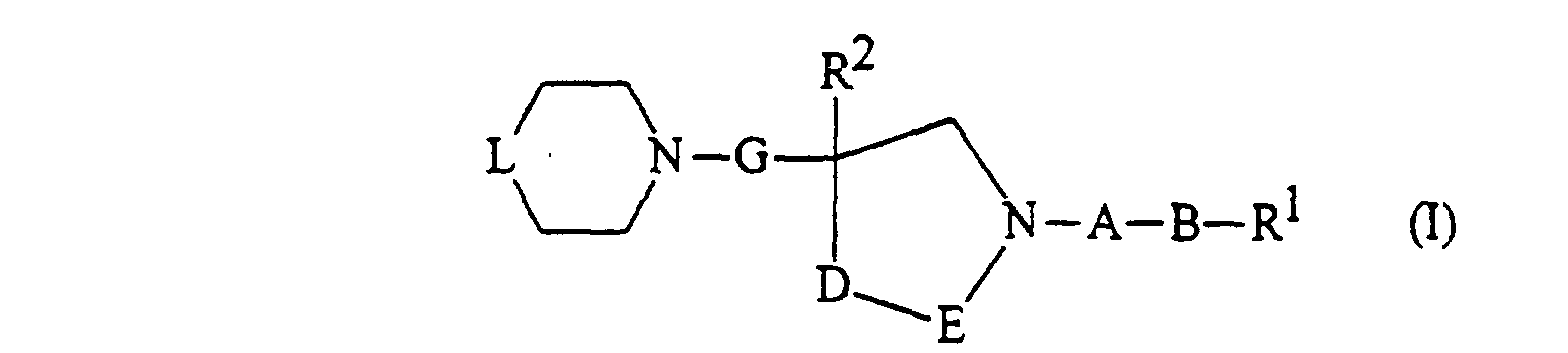 formules dans lesquelles :
- R1 et R2
- sont identiques ou différents, et chacun représente un groupe aryle carbocyclique ayant 5 à 14 atomes de carbone cycliques dans un seul noyau aromatique ou deux ou plusieurs noyaux aromatiques condensés, ou un groupe hétérocyclique aromatique ayant 5 à 7 atomes cycliques dans un seul noyau parmi lesquels 1 à 3 atomes sont des hétéroatomes d'azote et/ou d'oxygène et/ou de soufre, ou un système de noyaux condensés dans lequel au moins l'un des noyaux est un groupe hétérocyclique aromatique tel que défini ci-dessus et le ou chaque autre noyau est un groupe hétérocyclique aromatique tel que défini ci-dessus ou un groupe aryle carbocyclique tel que défini ci-dessus, ledit groupe aryle et ledit groupe hétérocyclique n'étant pas substitués ou étant substitués par au moins l'un des substituants α définis ci-dessous :
- A
- représente un groupe méthylène, un groupe carbonyle ou un groupe sulfonyle ;
- B
- représente une liaison simple entre les groupes représentés par A et R1, un groupe alkylène ayant 1 à 4 atomes de carbone ou un groupe alcénylène ayant 2 à 4 atomes de carbone ;
- D
- représente un atome d'oxygène ou de soufre ;
- E
- représente un groupe alkylène ayant 1 à 6 atomes de carbone, un groupe halogénoalkylène ayant 1 à 6 atomes de carbone, un groupe cycloalcane-1,1-diyle ayant 3 à 6 atomes de carbone, un groupe cycloalcane-1,1-diylméthyle ayant 3 à 6 atomes de carbone dans la portion cycloalcane, ou un groupe cycloalcane-1,1-di(ylméthyle) ayant 3 à 6 atomes de carbone dans la portion cycloalcane ;
- G
- représente un groupe alkylène ayant 1 à 4 atomes de carbone ou un groupe alcénylène ayant 2 à 4 atomes de carbone ;
- L
- représente un groupe de formule -C(R4) (R5)-
dans laquelle
R4 et R5, avec l'atome de carbone auquel ils sont fixés, représentent un groupe cycloalkyle ou hétérocyclique ayant 5 à 10 atomes cycliques, ledit groupe n'étant pas substitué ou étant substitué par au moins l'un des substituants β, définis ci-dessous, et ledit groupe hétérocyclique ayant un seul hétéroatome d'azote et/ou d'oxygène et/ou de soufre, ou bien R4 et R5 représentent, avec l'atome de carbone auquel ils sont fixés, un groupe cycloalkyle ou hétérocyclique tel que défini ci-dessus qui est condensé à un groupe aryle carbocyclique tel que défini ci-dessus ou un groupe hétérocyclique aromatique tel que défini ci-dessus, ledit groupe aryle et ledit groupe hétérocyclique aromatique n'étant pas substitués ou étant substitués par au moins l'un des substituants α, définis ci-dessous ; - R7
- représente un groupe alkyle ayant 1 à 6 atomes de carbone ; et
et leurs sels et esters pharmaceutiquement acceptables.lesdits substituants α sont choisis parmi les atomes d'halogène, les groupes alkyle ayant 1 à 6 atomes de carbone, les groupes halogénoalkyle ayant 1 à 6 atomes de carbone, les groupes alcoxy ayant 1 à 6 atomes de carbone, les groupes acyle carboxyliques aliphatiques ayant 1 à 6 atomes de carbone, les groupes alcanesulfonyle ayant 1 à 6 atomes de carbone, les groupes halogénoalcanesulfonyle ayant 1 à 6 atomes de carbone, les groupes hydroxyle, les groupes carboxy, les groupes alcoxycarbonyle ayant 1 à 6 atomes de carbone dans la portion alcoxy, les groupes acylamino ayant 1 à 6 atomes de carbone, les groupes alcanesulfonylamino ayant 1 à 6 atomes de carbone, les groupes halogénoalcanesulfonylamino ayant 1 à 6 atomes de carbone, les groupes amino, les groupes cyano et les groupes alkylène ayant 1 à 8 atomes de carbone (pour former un groupe cycloalkyle condensé au noyau aryle ou hétérocyclique) ;lesdits substituants β sont :pour la substitution d'un atome de carbone, des groupes oxo, pour la substitution d'un atome d'azote, choisis parmi les groupes acyle aliphatiques, les groupes alcanesulfonyle ayant 1 à 6 atomes de carbone, les groupes alkyle ayant 1 à 6 atomes de carbone qui ne sont pas substitués ou sont substitués par au moins l'un des substituants γ, définis ci-dessous, les groupes aryle carbocycliques tels que définis ci-dessus qui ne sont pas substitués ou sont substitués par au moins l'un des substituants α, définis ci-dessus, et les groupes aralkyle dans lesquels un groupe alkyle ayant 1 à 4 atomes de carbone est substitué par 1 à 3 groupes aryle carbocycliques tels que définis ci-dessus,et, pour la substitution d'un atome de soufre, un ou deux atomes d'oxygène pour former un groupe sulfoxyde ou sulfone ; etlesdits substituants γ sont choisis parmi les atomes d'halogène, les groupes alcoxy ayant 1 à 6 atomes de carbone, les groupes acyle carboxyliques aliphatiques ayant 1 à 6 atomes de carbone, les groupes alcanesulfonyle ayant 1 à 6 atomes de carbone, les groupes halogénoalcanesulfonyle ayant 1 à 6 atomes de carbone, les groupes hydroxyle, les groupes carboxy, les groupes alcoxycarbonyle ayant 1 à 6 atomes de carbone dans la portion alcoxy, les groupes acylamino ayant 1 à 6 atomes de carbone, les groupes amino et les groupes cyano ; - Composé selon la revendication 1, dans lequel E représente un groupe méthylène.
- Composé selon la revendication 2, dans lequel R1 et R2 sont identiques ou différents et chacun représente : un groupe aryle carbocyclique tel que défini dans la revendication 1, un groupe hétérocyclique aromatique tel que défini dans la revendication 1 ou un groupe aryle carbocyclique tel que défini dans la revendication 1 substitué par 1 à 3 des substituants α.
- Composé selon la revendication 2, dans lequel R2 représente un groupe aryle carbocyclique tel que défini dans la revendication 1 ou un groupe aryle carbocyclique tel que défini dans la revendication 1 substitué par 1 à 3 des substituants α.
- Composé selon la revendication 2, dans lequel A représente un groupe carbonyle.
- Composé selon la revendication 2, dans lequel B est une liaison simple.
- Composé selon la revendication 2, dans lequel D est un atome d'oxygène.
- Composé selon la revendication 2, dans lequel G est un groupe alkylène ayant 1 à 4 atomes de carbone.
- Composé selon la revendication 2, dans lequel G est un groupe alkylène ayant 2 ou 3 atomes de carbone.
- Composé selon la revendication 2, dans lequel R4 et R5, avec l'atome de carbone auquel ils sont fixés, représentent un groupe cycloalkyle ou hétérocyclique ayant 5 à 10 atomes cycliques, ledit groupe n'étant pas substitué ou étant substitué par au moins l'un des substituants β, et ledit groupe hétérocyclique ayant un seul hétéroatome d'azote et/ou d'oxygène et/ou de soufre, ou bien R4 et R5, avec l'atome de carbone auquel ils sont fixés, représentent un groupe cycloalkyle ou hétérocyclique tel que défini ci-dessus qui est condensé à un groupe aryle carbocyclique tel que défini dans la revendication 1 ou un groupe hétérocyclique aromatique tel que défini dans la revendication 1, ledit groupe aryle et ledit groupe hétérocyclique aromatique n'étant pas substitués ou étant substitués par au moins un substituant choisi de préférence parmi les substituants α.
- Composé selon la revendication 2, dans lequel :
- R1
- et R2 sont identiques ou différents et chacun représente un groupe aryle carbocyclique tel que défini dans la revendication 1, un groupe hétérocyclique aromatique tel que défini dans la revendication 1 ou un groupe aryle carbocyclique tel que défini dans la revendication 1 substitué par 1 à 3 des substituants α ;
- A
- représente un groupe carbonyle ;
- B
- est une liaison simple ;
- D
- est un atome d'oxygène ;
- G
- est un groupe alkylène ayant 1 à 4 atomes de carbone ;
- L
- représente un groupe de formule -C(R4) (R5)- ; et
- R4
- et R5, avec l'atome de carbone auquel ils sont fixés, représentent un groupe cycloalkyle ou hétérocyclique ayant 5 à 10 atomes cycliques, ledit groupe n'étant pas substitué ou étant substitué par au moins l'un des substituants β, et ledit groupe hétérocyclique ayant un seul hétéroatome d'azote et/ou d'oxygène et/ou de soufre, ou bien R4 et R5, avec l'atome de carbone auquel ils sont fixés, représentent un groupe cycloalkyle ou hétérocyclique tel que défini ci-dessus qui est condensé à un groupe aryle carbocyclique tel que défini dans la revendication 1 ou un groupe hétérocyclique aromatique tel que défini dans la revendication 1, ledit groupe aryle et ledit groupe hétérocyclique aromatique n'étant pas substitués ou étant substitués par au moins un substituant choisi de préférence parmi les substituants α.
- Composé selon la revendication 1, dans lequel E représente un groupe de formule -(CH2)n- dans lequel n est un nombre entier de 2 à 4.
- Composé selon la revendication 12, dans lequel R1 et R2 sont identiques ou différents et chacun représente un groupe aryle carbocyclique tel que défini dans la revendication 1, un groupe hétérocyclique aromatique tel que défini dans la revendication 1 ou un groupe aryle carbocyclique tel que défini dans la revendication 1 substitué par 1 à 3 des substituants α.
- Composé selon la revendication 12, dans lequel R2 représente un groupe aryle carbocyclique tel que défini dans la revendication 1 ou un groupe aryle carbocyclique tel que défini dans la revendication 1 substitué par 1 à 3 des substituants α.
- Composé selon la revendication 12, dans lequel A représente un groupe carbonyle.
- Composé selon la revendication 12, dans lequel B représente une liaison simple.
- Composé selon la revendication 12, dans lequel D représente un atome d'oxygène.
- Composé selon la revendication 12, dans lequel G représente un groupe alkylène ayant 1 à 4 atomes de carbone.
- Composé selon la revendication 12, dans lequel G représente un groupe alkylène ayant 2 ou 3 atomes de carbone.
- Composé selon la revendication 12, dans lequel R4 et R5, avec l'atome de carbone auquel ils sont fixés, représentent un groupe cycloalkyle ou hétérocyclique ayant 5 à 10 atomes cycliques, ledit groupe n'étant pas substitué ou étant substitué par au moins l'un des substituants β, et ledit groupe hétérocyclique ayant un seul hétéroatome d'azote et/ou d'oxygène et/ou de soufre, ou bien R4 et R5, avec l'atome de carbone auquel ils sont fixés, représentent un groupe cycloalkyle ou hétérocyclique tel que défini ci-dessus qui est condensé à un groupe aryle carbocyclique tel que défini dans la revendication 1 ou un groupe hétérocyclique aromatique tel que défini dans la revendication 1, ledit groupe aryle et ledit groupe hétérocyclique aromatique n'étant pas substitués ou étant substitués par au moins un substituant choisi de préférence parmi les substituants α.
- Composé selon la revendication 12, dans lequel n est 2 ou 3.
- Composé selon la revendication 12, dans lequel n est 2.
- Composé selon la revendication 12, dans lequel :
- R1
- et R2 sont identiques ou différents et chacun représente un groupe aryle carbocyclique tel que défini dans la revendication 1, un groupe hétérocyclique aromatique tel que défini dans la revendication 1 ou un groupe aryle carbocyclique tel que défini dans la revendication 1 substitué par 1 à 3 des substituants α ;
- A
- représente un groupe carbonyle ;
- B
- représente une liaison simple ;
- D
- représente un atome d'oxygène ;
- G
- représente un groupe alkylène ayant 1 à 4 atomes de carbone ;
- L
- représente un groupe de formule générale -C(R4)(R5)- ;
- R4
- et R5, avec l'atome de carbone auquel ils sont fixés, représentent un groupe cycloalkyle ou hétérocyclique ayant 5 à 10 atomes cycliques, ledit groupe n'étant pas substitué ou étant substitué par au moins l'un des substituants β, et ledit groupe hétérocyclique ayant un seul hétéroatome d'azote et/ou d'oxygène et/ou de soufre, ou bien R4 et R5, avec l'atome de carbone auquel ils sont fixés, représentent un groupe cycloalkyle ou hétérocyclique tel que défini ci-dessus qui est condensé à un groupe aryle carbocyclique tel que défini dans la revendication 1 ou un groupe hétérocyclique aromatique tel que défini dans la revendication 1, ledit groupe aryle et ledit groupe hétérocyclique aromatique n'étant pas substitués ou étant substitués par au moins un substituant choisi de préférence parmi les substituants α ; et
- n
- est 2 ou 3.
- Composé selon la revendication 1, dans lequel R4 et R5, avec l'atome de carbone auquel ils sont fixés, représentent un groupe de formule :dans laquelle

- J
- représente un groupe alkylène ayant 1 à 6 atomes de carbone ;
- Ar
- représente un groupe aryle carbocyclique tel que défini dans la revendication 1 ou un groupe hétérocyclique aromatique tel que défini dans la revendication 1, condensé au cycle contenant J et S, ledit groupe aryle et ledit groupe hétérocyclique aromatique n'étant pas substitués ou étant substitués par au moins un substituant choisi de préférence parmi les substituants α définis ci-dessus ; et
- S*→O
- représente un groupe sulfoxyde dans lequel l'atome de soufre est en configuration S.
- Composé selon la revendication 24, dans lequel R1 représente un groupe aryle carbocyclique tel que défini dans la revendication 1, un groupe hétérocyclique aromatique tel que défini dans la revendication 1 ou un groupe aryle carbocyclique tel que défini dans la revendication 1 substitué par 1 à 3 des substituants α.
- Composé selon la revendication 24, dans lequel R1 représente un groupe aryle carbocyclique tel que défini dans la revendication 1 ou un groupe aryle carbocyclique tel que défini dans la revendication 1 substitué par 1 à 3 des substituants α1 ; et les substituants α1 sont choisis parmi les groupes alkyle ayant 1 à 6 atomes de carbone, les groupes halogénoalkyle ayant 1 à 6 atomes de carbone et les groupes alcoxy ayant 1 à 6 atomes de carbone.
- Composé selon la revendication 24, dans lequel R2 représente un groupe aryle carbocyclique tel que défini dans la revendication 1 ou un groupe aryle carbocyclique tel que défini dans la revendication 1 substitué par 1 à 3 des substituants α.
- Composé selon la revendication 24, dans lequel R2 représente un groupe aryle carbocyclique tel que défini dans la revendication 1 ou un groupe aryle carbocyclique tel que défini dans la revendication 1 substitué par 1 à 3 atomes d'halogène.
- Composé selon la revendication 24, dans lequel A représente un groupe carbonyle.
- Composé selon la revendication 24, dans lequel B représente une liaison simple.
- Composé selon la revendication 24, dans lequel D représente un atome d'oxygène.
- Composé selon la revendication 24, dans lequel E représente un groupe alkylène en C1-C4 ou un groupe alkylène en C3-C8 qui contient un groupe (cycloalcane en C3-C6)-1,1-diyle.
- Composé selon la revendication 24, dans lequel E représente un groupe méthylène, éthylène, diméthylméthylène, 1,1-diméthyléthylène, 2,2-diméthyléthylène, cyclopropane-1,1-diyle, cyclobutane-1,1-diyle, cyclopentane-1,1-diyle, cyclohexane-1,1-diyle, cyclopropane-1,1-diylméthyle, cyclobutane-1,1-diylméthyle, cyclopentane-1,1-diylméthyle ou cyclohexane-1,1-diylméthyle.
- Composé selon la revendication 24, dans lequel G représente un groupe alkylène en C1-C4.
- Composé selon la revendication 24, dans lequel G représente un groupe alkylène en C2-C3.
- Composé selon la revendication 24, dans lequel J représente un groupe alkylène en C1-C4.
- Composé selon la revendication 24, dans lequel J représente un groupe méthylène ou éthylène.
- Composé selon la revendication 24, dans lequel le cycle Ar représente un groupe aryle tel que défini dans la revendication 1, un groupe aryle tel que défini dans la revendication 1 substitué par 1 à 3 des substituants α ou un groupe hétérocyclique aromatique tel que défini dans la revendication 1.
- Composé selon la revendication 24, dans lequel le cycle Ar représente un groupe aryle carbocyclique tel que défini dans la revendication 1 ou un groupe aryle carbocyclique tel que défini dans la revendication 1 substitué par 1 à 3 des substituants α.
- Composé selon la revendication 24, dans lequel :
- R
- 1 représente un groupe aryle tel que défini dans la revendication 1, un groupe hétérocyclique aromatique tel que défini dans la revendication 1, ou un groupe aryle carbocyclique tel que défini dans la revendication 1 substitué par 1 à 3 des substituants α ;
- R
- 2 représente un groupe aryle carbocyclique tel que défini dans la revendication 1 ou un groupe aryle carbocyclique tel que défini dans la revendication 1 substitué par 1 à 3 des substituants α ;
- A
- représente un groupe carbonyle ;
- B
- représente une liaison simple ;
- D
- représente un atome d'oxygène ;
- E
- représente un groupe alkylène en C1-C4 ou un groupe alkylène en C3-C8 qui contient un groupe (cycloalcane en C3-C6)-1,1-diyle ;
- G
- représente un groupe alkylène en C1-C4 ;
- J
- représente un groupe alkylène en C1-C4 ; et
- Composé selon la revendication 24, dans lequel :
- R1
- représente un groupe aryle carbocyclique tel que défini dans la revendication 1 ou un groupe aryle carbocyclique
1-{2-[2-(3,4-dichlorophényl)-4-(3-méthoxybenzoyl)-morpholine-2-yl]éthyl}spiro[isobenzofuranne-1(3H),4'-pipéridine] ;1-{2-[2-(3,4-dichlorophényl)-4-(3-méthoxybenzoyl) morpholine-2-yl]éthyl}spiro[benzo[c]thiophène-1(3H),4'-pipéridine] ;2-oxyde de 1-{2-[2-(3,4-dichlorophényl)-4-(3-méthoxybenzoyl)morpholine-2-yl]éthyl}spiro[benzo[c]thiophène-1(3H),4'-pipéridine] ;1-{2-[2-(3,4-dichlorophényl)-4-(3-méthoxybenzoyl) morpholine-2-yl]éthyl}spiro[isoquinoléine-1(2H),4'-pipéridine]-3(4H)-one ;(2S)-oxyde de 1-{2-[(5R)-(3,4-dichlorophényl)-3-(3,4,5-triméthoxybenzoyl)oxazolidine-5-yl]éthyl}spiro[benzo[c]-thiophène-1(3H),4'-pipéridine ;(2S)-oxyde de 1-{2-[(5R)-(4-chlorophényl)-3-(3,4,5-triméthoxybenzoyl)oxazolidine-5-yl]éthyl}spiro[benzo[c]-thiophène-1(3H),4'-pipéridine] ;(2S)-oxyde de 1-{2-[(5R)-(4-fluorophényl)-3-(3,4,5-triméthoxybenzoyl)oxazolidine-5-yl]éthyl}spiro[benzo[c]-thiophène-1(3H),4'-pipéridine] ;(2S)-oxyde de 1-{2-[(2R)-(3,4-dichlorophényl)-4-(3,4,5-triméthoxybenzoyl)morpholine-2-yl]éthyl}spiro[benzo[c]-thiophène-1(3H),4'-pipéridine] ;(2S)-oxyde de 1-{2-[(2R)-(4-chlorophényl)-4-(3,4,5-triméthoxybenzoyl)morpholine-2-yl]éthyl}spiro[benzo[c]-thiophène-1(3H),4'-pipéridine] ;(2S)-oxyde de 1-{2-[(2R)-(4-fluorophényl)-4-(3,4,5-triméthoxybenzoyl)morpholine-2-yl]éthyl}spiro[benzo[c]-thiophène-1(3H),4'-pipéridine] ;(2S)-oxyde de 1-{2-[(2R)-(3,4-dichlorophényl)-4-(3,4,5-triméthoxybenzoyl)hexahydro-1,4-oxazépine-2-yl]éthyl}-spiro[benzo[c]thiophène-1(3H),4'-pipéridine] ;(2S)-oxyde de 1-{2-[(2R)-(4-chlorophényl)-4-(3,4,5-triméthoxybenzoyl)hexahydro-1,4-oxazépine-2-yl]éthyl}-spiro[benzo[c]thiophène-1(3H),4'-pipéridine] ; tel que défini dans la revendication 1 substitué par 1 à 3 des substituants α1 ; les substituants α1 étant choisis parmi les groupes alkyle ayant 1 à 6 atomes de carbone, les groupes halogénoalkyle ayant 1 à 6 atomes de carbone et les groupes alcoxy ayant 1 à 6 atomes de carbone ;- R2
- représente un groupe aryle carbocyclique tel que défini dans la revendication 1 ou un groupe aryle carbocyclique tel que défini dans la revendication 1 substitué par 1 à 3 atomes d'halogène ;
- A
- représente un groupe carbonyle ;
- B
- représente une liaison simple ;
- D
- représente un atome d'oxygène ;
- E
- représente un groupe méthylène, éthylène, diméthylméthylène, 1,1-diméthyléthylène, 2,2-diméthyléthylène, cyclopropane-1,1-diyle, cyclobutane-1,1-diyle, cyclopentane-1,1-diyle, cyclohexane-1,1-diyle, cyclopropane-1,1-diylméthyle, cyclobutane-1,1-diylméthyle, cyclopentane-1,1-diylméthyle ou cyclohexane-1,1diylméthyle ;
- G
- représente un groupe alkylène en C2-C3 ;
- J
- représente un groupe méthylène ou éthylène ; et
- Les composés suivants selon la revendication 1 :et leurs sels et esters.1-{2-[2-(3,4-dichlorophényl)-4-(3,4,5-triméthoxybenzoyl)-morpholine-2-yl]éthyl}spiro[benzofuranne-1(3H),4'-pipéridine] ;1-{2-[2-(3,4-dichlorophényl)-4-(3,4,5-triméthoxybenzoyl)-morpholine-2-yl]éthyl}spiro[benzo[c]thiophène-1(3H),4'-pipéridine] ;2-oxyde de 1-{2-[2-(3,4-dichlorophényl)-4-(3,4,5-tri-méthoxybenzoyl)morpholine-2-yl]éthyl}spiro[isobenzo-[c]thiophène-1(3H),4'-pipéridine] ;1-{2-[2-(3,4-dichlorophényl)-4-(3,4,5-triméthoxybenzoyl)-morpholine-2-yl]éthyl}spiro[isoquinoléine-1(2H),4'-pipéridine]-3(4H)-one ;(2S)-oxyde de 1-{2-[(2R)-(4-fluorophényl)-4-(3,4,5-triméthoxybenzoyl)hexahydro-1,4-oxazépine-2-yl]éthyl}-spiro[benzo[c]thiophène-1(3H),4'-pipéridine] ;(2S)-oxyde de 1-{2-[(2R)-(3,4-dichlorophényl)-4-(3-isopropoxyphénylacétyl)morpholine-2-yl]éthyl}spiro[benzo-[c]thiophène-1(3H),4'-pipéridine] ;(2S)-oxyde de 1-{2-[(2R)-(4-chlorophényl)-4-(3-isopropoxyphénylacétyl)morpholine-2-yl]éthyl}spiro [benzo [c]-thiophène-1(3H),4'-pipéridine] ;(2S)-oxyde de 1-{2-[(2R)-(4-fluorophényl)-4-(3-isopropoxyphénylacétyl)morpholine-2-yl]éthyl}spiro[benzo[c]-thiophène-1(3H),4'-pipéridine] ; et(2S)-oxyde de 1-{2-[(2R)-(3,4-dichlorophényl)-5,5-di-méthyl-4-(3,4,5-triméthoxybenzoyl)morpholine-2-yl]éthyl}-spiro[benzo[c]thiophène-1(3H),4'-pipéridine] ;
- Composition pour le traitement ou la prophylaxie de maladies du système nerveux central, de maladies neurodégénératives, de maladies respiratoires, de maladies inflammatoires, d'allergies, de maladies d'hypersensibilité, de maladies ophtalmologiques, de maladies de la peau, de toxicomanies, de maladies somatiques provoquées par le stress, de dystrophie sympathique réflexe, de dépression, de réactions immunitaires indésirables, de maladies associées à une immunopotentialisation, de maladies digestives, des vomissements, de maladies fonctionnelles de la vessie, d'éosinophilie, de maladies provoquées par un flux sanguin anormal et de la douleur, qui comprend une quantité efficace d'un composé actif de formule (I) ou (Ia), ou d'un de ses sels ou esters pharmaceutiquement acceptables, tel que revendiqué dans l'une quelconque des revendications 1 à 42, en mélange avec un support ou diluant pharmaceutiquement acceptable.
- Utilisation d'un composé de formule (I) ou (Ia) ou d'un de ses sels ou esters pharmaceutiquement acceptables, tel que défini dans l'une quelconque des revendications 1 à 42, pour la fabrication d'un médicament destiné au traitement ou à la prophylaxie d'une maladie ou d'un trouble choisi parmi les maladies du système nerveux central, les maladies neurodégénératives, les maladies respiratoires, les maladies inflammatoires, les allergies, les maladies d'hypersensibilité, les maladies ophtalmologiques, les maladies de la peau, les toxicomanies, les maladies somatiques provoquées par le stress, la dystrophie sympathique réflexe, la dépression, les réactions immunitaires indésirables, les maladies associées à une immunopotentialisation, les maladies digestives, les vomissements, les maladies fonctionnelles de la vessie, l'éosinophilie, les maladies provoquées par un flux sanguin anormal et la douleur.
Applications Claiming Priority (9)
| Application Number | Priority Date | Filing Date | Title |
|---|---|---|---|
| JP313828/95 | 1995-12-01 | ||
| JP31382895 | 1995-12-01 | ||
| JP31382895 | 1995-12-01 | ||
| JP33636995 | 1995-12-25 | ||
| JP336369/95 | 1995-12-25 | ||
| JP33636995 | 1995-12-25 | ||
| JP296869/96 | 1996-11-08 | ||
| JP29686996 | 1996-11-08 | ||
| JP29686996 | 1996-11-08 |
Publications (2)
| Publication Number | Publication Date |
|---|---|
| EP0776893A1 EP0776893A1 (fr) | 1997-06-04 |
| EP0776893B1 true EP0776893B1 (fr) | 2002-02-27 |
Family
ID=27338095
Family Applications (1)
| Application Number | Title | Priority Date | Filing Date |
|---|---|---|---|
| EP96308711A Expired - Lifetime EP0776893B1 (fr) | 1995-12-01 | 1996-12-02 | Antagonistes azacycliques du récepteur des tachykinines; NK1 et NK2 |
Country Status (18)
| Country | Link |
|---|---|
| US (2) | US6159967A (fr) |
| EP (1) | EP0776893B1 (fr) |
| CN (1) | CN1142932C (fr) |
| AT (1) | ATE213738T1 (fr) |
| AU (1) | AU719158B2 (fr) |
| CA (1) | CA2191815C (fr) |
| CZ (1) | CZ288498B6 (fr) |
| DE (1) | DE69619479T2 (fr) |
| DK (1) | DK0776893T3 (fr) |
| ES (1) | ES2170211T3 (fr) |
| HU (1) | HU224225B1 (fr) |
| IL (1) | IL119729A (fr) |
| MX (1) | MX9606082A (fr) |
| NO (1) | NO308300B1 (fr) |
| NZ (1) | NZ299859A (fr) |
| PT (1) | PT776893E (fr) |
| RU (1) | RU2135494C1 (fr) |
| TW (1) | TW367327B (fr) |
Cited By (11)
| Publication number | Priority date | Publication date | Assignee | Title |
|---|---|---|---|---|
| US8053440B2 (en) | 2007-02-01 | 2011-11-08 | Resverlogix Corporation | Compounds for the prevention and treatment of cardiovascular diseases |
| US8114995B2 (en) | 2008-06-26 | 2012-02-14 | Resverlogix Corp. | Methods of preparing quinazolinone derivatives |
| US8410109B2 (en) | 2005-07-29 | 2013-04-02 | Resverlogix Corp. | Pharmaceutical compositions for the prevention and treatment of complex diseases and their delivery by insertable medical devices |
| US8952021B2 (en) | 2009-01-08 | 2015-02-10 | Resverlogix Corp. | Compounds for the prevention and treatment of cardiovascular disease |
| US9073878B2 (en) | 2012-11-21 | 2015-07-07 | Zenith Epigenetics Corp. | Cyclic amines as bromodomain inhibitors |
| US9238640B2 (en) | 2009-03-18 | 2016-01-19 | Resverlogix Corp. | Anti-inflammatory agents |
| US9271978B2 (en) | 2012-12-21 | 2016-03-01 | Zenith Epigenetics Corp. | Heterocyclic compounds as bromodomain inhibitors |
| US9610251B2 (en) | 2011-11-01 | 2017-04-04 | Resverlogix Corp. | Pharmaceutical compositions for substituted quinazolinones |
| US9757368B2 (en) | 2009-04-22 | 2017-09-12 | Resverlogix Corp. | Anti-inflammatory agents |
| US9765039B2 (en) | 2012-11-21 | 2017-09-19 | Zenith Epigenetics Ltd. | Biaryl derivatives as bromodomain inhibitors |
| US10111885B2 (en) | 2015-03-13 | 2018-10-30 | Resverlogix Corp. | Compositions and therapeutic methods for the treatment of complement-associated diseases |
Families Citing this family (61)
| Publication number | Priority date | Publication date | Assignee | Title |
|---|---|---|---|---|
| HU224225B1 (hu) * | 1995-12-01 | 2005-06-28 | Sankyo Co. Ltd. | Tachikinin receptor antagonista hatású heterociklusos vegyületek, ezek előállítási eljárása és alkalmazásuk gyógyszerkészítmények előállítására |
| BR9809713A (pt) | 1997-05-30 | 2000-07-11 | Sankyo Co | Composto, medicamento e composição compreendendo o mesmo, uso do composto, e, processos para profilaxia ou tratamento de doenças mediadas com taquicinina, para inibir um receptor nk1 e/ou um receptor nk2, e para profilaxia ou tratamento de asma e/ou bronquite, de rinite, de alergia, e, de incontinência urinária |
| DE69830615T2 (de) * | 1997-12-04 | 2006-03-16 | Sankyo Co., Ltd. | Alicyclische acylierte heterocyclenderivate |
| IL137295A (en) | 1998-01-23 | 2005-12-18 | Sankyo Co | History of spiropipridine and pharmaceutical preparations containing them |
| WO2000034274A1 (fr) * | 1998-12-10 | 2000-06-15 | Sankyo Company, Limited | Derives de la cyclohexylpiperidine |
| US6867203B2 (en) | 1998-12-29 | 2005-03-15 | Abbott Laboratories | Cell adhesion-inhibiting antiinflammatory and immune-suppressive compounds |
| FR2791346B3 (fr) * | 1999-03-25 | 2001-04-27 | Sanofi Sa | Nouveaux derives de morpholine, procede pour leur preparation et compositions pharmaceutiques les contenant |
| FR2796069B3 (fr) * | 1999-07-09 | 2001-08-24 | Sanofi Synthelabo | Nouveaux procedes de preparation de derives de 2-(2- arylmorpholin-2-yl)ethanol substitues, enantiomeriquement purs, et composes intermediaires utiles dans ces procedes |
| AU7952800A (en) * | 1999-10-22 | 2001-04-30 | Sankyo Company Limited | 2-alkoxybenzene derivatives |
| US7163949B1 (en) | 1999-11-03 | 2007-01-16 | Amr Technology, Inc. | 4-phenyl substituted tetrahydroisoquinolines and use thereof |
| MXPA02004330A (es) | 1999-11-03 | 2004-07-30 | Albany Molecular Res Inc | Tetrahidroisoquinolinas aril-y heteroaril-sustituidas y uso de las mismas para bloquear la recaptacion de norepinefrina, dopamina y serotonina.. |
| KR100821410B1 (ko) | 2000-07-11 | 2008-04-10 | 에이엠알 테크놀로지, 인크. | 4-페닐 치환된 테트라하이드로이소퀴놀린 및 이의치료학적 용도 |
| FR2824828B1 (fr) * | 2001-05-21 | 2005-05-20 | Sanofi Synthelabo | Nouveaux derives de piperidinecarboxamide, un procede pour leur preparation et les compositions pharmaceutiques les contenant |
| AU2003242092A1 (en) * | 2002-06-11 | 2003-12-22 | Sankyo Company, Limited | Process for producing cyclic thioether and synthetic intermediate thereof |
| JP2004067673A (ja) * | 2002-06-11 | 2004-03-04 | Sankyo Co Ltd | 環状チオエーテル類の製造法及びその合成中間体 |
| US7396930B2 (en) * | 2002-06-11 | 2008-07-08 | Sankyo Company, Limited | Process for producing cyclic thioether and synthetic intermediate thereof |
| MY141736A (en) * | 2002-10-08 | 2010-06-15 | Elanco Animal Health Ireland | Substituted 1,4-di-piperidin-4-yi-piperazine derivatives and their use as neurokinin antagonists |
| KR20050065613A (ko) * | 2002-10-24 | 2005-06-29 | 상꾜 가부시키가이샤 | 광학 활성인 술폭시드의 제조법 |
| US7365067B2 (en) | 2004-02-25 | 2008-04-29 | Sankyo Company, Limited | Indanol derivative |
| US7560549B2 (en) * | 2004-02-25 | 2009-07-14 | Sankyo Company, Limited | Sulfonyloxy derivatives |
| UA91341C2 (ru) | 2004-07-15 | 2010-07-26 | Амр Текнолоджи, Інк. | Арил- и гетероарилзамещенные тетрагидроизохинолины и их применение для блокирования обратного захвата норэпинефрина, допамина и серотонина |
| FR2873373B1 (fr) * | 2004-07-23 | 2006-09-08 | Sanofi Synthelabo | Derives de 4-arylmorpholin-3-one, leur preparation et leur application en therapeutique |
| TW200621244A (en) * | 2004-08-19 | 2006-07-01 | Vertex Pharma | Modulators of muscarinic receptors |
| WO2006123182A2 (fr) | 2005-05-17 | 2006-11-23 | Merck Sharp & Dohme Limited | Sulfones de cyclohexyle pour le traitement du cancer |
| UA95454C2 (uk) | 2005-07-15 | 2011-08-10 | Амр Текнолоджи, Інк. | Арил- і гетероарилзаміщені тетрагідробензазепіни і їх застосування для блокування зворотного захоплення норепінефрину, допаміну і серотоніну |
| GB0603041D0 (en) | 2006-02-15 | 2006-03-29 | Angeletti P Ist Richerche Bio | Therapeutic compounds |
| US20110218176A1 (en) | 2006-11-01 | 2011-09-08 | Barbara Brooke Jennings-Spring | Compounds, methods, and treatments for abnormal signaling pathways for prenatal and postnatal development |
| CN101190330A (zh) | 2006-11-30 | 2008-06-04 | 深圳市鼎兴生物医药技术开发有限公司 | 胆碱酯酶在拮抗速激肽药物中的应用 |
| AR064777A1 (es) | 2007-01-10 | 2009-04-22 | Inst Di Reserche D Biolog Mole | Indazoles sustituidos con amida como inhibidores de poli (adp- ribosa) polimerasa (parp) |
| WO2008094663A2 (fr) * | 2007-01-31 | 2008-08-07 | Adam Heller | Gestion de la douleur par voie électrochimique |
| EP3103791B1 (fr) | 2007-06-27 | 2018-01-31 | Merck Sharp & Dohme Corp. | Dérivés de 4-carboxybenzylamino utilisés comme inhibiteurs de l'histone désacétylase |
| AR071997A1 (es) | 2008-06-04 | 2010-07-28 | Bristol Myers Squibb Co | Forma cristalina de 6-((4s)-2-metil-4-(2-naftil)-1,2,3,4-tetrahidroisoquinolin-7-il)piridazin-3-amina |
| US9156812B2 (en) | 2008-06-04 | 2015-10-13 | Bristol-Myers Squibb Company | Crystalline form of 6-[(4S)-2-methyl-4-(2-naphthyl)-1,2,3,4-tetrahydroisoquinolin-7-yl]pyridazin-3-amine |
| WO2010114780A1 (fr) | 2009-04-01 | 2010-10-07 | Merck Sharp & Dohme Corp. | Inhibiteurs de l'activité akt |
| EP2429295B1 (fr) | 2009-05-12 | 2013-12-25 | Albany Molecular Research, Inc. | Aryle, hétéroaryle et tétrahydroisoquinolines à hétérocycle substitué et leur utilisation |
| AU2010247763B2 (en) | 2009-05-12 | 2015-12-24 | Albany Molecular Research, Inc. | 7-([1,2,4,]triazolo[1,5,-a]pyridin-6-yl)-4-(3,4-dichlorophenyl)-1,2,3,4- tetrahydroisoquinoline and use thereof |
| US8815894B2 (en) | 2009-05-12 | 2014-08-26 | Bristol-Myers Squibb Company | Crystalline forms of (S)-7-([1,2,4]triazolo[1,5-a]pyridin-6-yl)-4-(3,4-dichlorophenyl)-1,2,3,4-tetrahydroisoquinoline and use thereof |
| US8859776B2 (en) | 2009-10-14 | 2014-10-14 | Merck Sharp & Dohme Corp. | Substituted piperidines that increase p53 activity and the uses thereof |
| CA2805265A1 (fr) | 2010-08-02 | 2012-02-09 | Merck Sharp & Dohme Corp. | Inhibition a mediation par interference arn de catenine (proteine associee a cadherine), expression du gene beta 1 (ctnnb1) a l'aide de petit acide nucleique interferent (sian) |
| WO2012024170A2 (fr) | 2010-08-17 | 2012-02-23 | Merck Sharp & Dohme Corp. | Inhibition médiée par des arn interférents de l'expression génique du virus de l'hépatite b (vhb) à l'aide de petits acides nucléiques interférents (pani) |
| US8883801B2 (en) | 2010-08-23 | 2014-11-11 | Merck Sharp & Dohme Corp. | Substituted pyrazolo[1,5-a]pyrimidines as mTOR inhibitors |
| WO2012030685A2 (fr) | 2010-09-01 | 2012-03-08 | Schering Corporation | Dérivés d'indazole utilisables en tant qu'inhibiteurs de la voie erk |
| US9242981B2 (en) | 2010-09-16 | 2016-01-26 | Merck Sharp & Dohme Corp. | Fused pyrazole derivatives as novel ERK inhibitors |
| WO2012058210A1 (fr) | 2010-10-29 | 2012-05-03 | Merck Sharp & Dohme Corp. | INHIBITION FACILITÉE PAR L'INTERFÉRENCE D'ARN DE L'EXPRESSION D'UN GÈNE AU MOYEN D'ACIDES NUCLÉIQUES INTERFÉRENTS COURTS (siNA) |
| EP2654748B1 (fr) | 2010-12-21 | 2016-07-27 | Merck Sharp & Dohme Corp. | Dérivés d'indazole utiles en tant qu'inhibiteurs de erk |
| WO2012143879A1 (fr) | 2011-04-21 | 2012-10-26 | Piramal Healthcare Limited | Forme cristalline d'un sel d'un dérivé de morpholinosulfonylindole et son procédé de préparation |
| EP2770987B1 (fr) | 2011-10-27 | 2018-04-04 | Merck Sharp & Dohme Corp. | Nouveaux composés qui sont des inhibiteurs d'erk |
| WO2013165816A2 (fr) | 2012-05-02 | 2013-11-07 | Merck Sharp & Dohme Corp. | Compositions de petit acide nucléique interférent (sina) |
| BR102012024778A2 (pt) * | 2012-09-28 | 2014-08-19 | Cristalia Prod Quimicos Farm | Compostos heteroaromáticos; processo para preparar os compostos, composições farmacêuticas, usos e método de tratamento para as dores aguda e crônica |
| WO2014052563A2 (fr) | 2012-09-28 | 2014-04-03 | Merck Sharp & Dohme Corp. | Nouveaux composés inhibiteurs de erk |
| ME02925B (fr) | 2012-11-28 | 2018-04-20 | Merck Sharp & Dohme | Compositions et procédés pour traiter le cancer |
| TW201429969A (zh) | 2012-12-20 | 2014-08-01 | Merck Sharp & Dohme | 作爲hdm2抑制劑之經取代咪唑吡啶 |
| WO2014120748A1 (fr) | 2013-01-30 | 2014-08-07 | Merck Sharp & Dohme Corp. | Purines 2,6,7,8-substituées utilisées en tant qu'inhibiteurs de hdm2 |
| US20160194368A1 (en) | 2013-09-03 | 2016-07-07 | Moderna Therapeutics, Inc. | Circular polynucleotides |
| US10975084B2 (en) | 2016-10-12 | 2021-04-13 | Merck Sharp & Dohme Corp. | KDM5 inhibitors |
| EP3706747B1 (fr) | 2017-11-08 | 2025-09-03 | Merck Sharp & Dohme LLC | Inhibiteurs de prmt5 |
| US10947234B2 (en) | 2017-11-08 | 2021-03-16 | Merck Sharp & Dohme Corp. | PRMT5 inhibitors |
| WO2020033282A1 (fr) | 2018-08-07 | 2020-02-13 | Merck Sharp & Dohme Corp. | Inhibiteurs de prmt5 |
| US11981701B2 (en) | 2018-08-07 | 2024-05-14 | Merck Sharp & Dohme Llc | PRMT5 inhibitors |
| WO2020033288A1 (fr) | 2018-08-07 | 2020-02-13 | Merck Sharp & Dohme Corp. | Inhibiteurs de prmt5 |
| JPWO2020101017A1 (ja) * | 2018-11-15 | 2021-09-30 | 国立大学法人九州大学 | Il−31介在性疾患の予防又は治療剤及び医薬組成物 |
Family Cites Families (17)
| Publication number | Priority date | Publication date | Assignee | Title |
|---|---|---|---|---|
| IE903957A1 (en) * | 1989-11-06 | 1991-05-08 | Sanofi Sa | Aromatic amine compounds, their method of preparation and¹pharmaceutical compositions in which they are present |
| IL99320A (en) * | 1990-09-05 | 1995-07-31 | Sanofi Sa | Arylalkylamines, their preparation and pharmaceutical compositions containing them |
| FR2676054B1 (fr) * | 1991-05-03 | 1993-09-03 | Sanofi Elf | Nouveaux composes n-alkylenepiperidino et leurs enantiomeres, procede pour leur preparation et compositions pharmaceutiques les contenant. |
| FR2676055B1 (fr) * | 1991-05-03 | 1993-09-03 | Sanofi Elf | Composes polycycliques amines et leurs enantiomeres, procede pour leur preparation et compositions pharmaceutiques les contenant. |
| GB9125515D0 (en) * | 1991-11-29 | 1992-01-29 | Merck Sharp & Dohme | Therapeutic agents |
| EP0641346B1 (fr) | 1991-12-18 | 1996-05-29 | GRUPPO LEPETIT S.p.A. | Derives antibiotiques de 7'-amino-naphtazarine |
| DE69412067T2 (de) | 1993-01-28 | 1999-03-25 | Merck & Co., Inc., Rahway, N.J. | Substituierte spiro-azaringen als tachykinine rezeptor antagonisten |
| ATE158580T1 (de) * | 1993-05-06 | 1997-10-15 | Merrell Pharma Inc | Substituierte pyrrolidin-3-alkyl-piperidine verwendbar als tachykinin-antagonisten |
| GB9310713D0 (en) * | 1993-05-24 | 1993-07-07 | Zeneca Ltd | Aryl substituted heterocycles |
| JPH08511522A (ja) * | 1993-06-07 | 1996-12-03 | メルク エンド カンパニー インコーポレーテッド | ニューロキニンアンタゴニストとしてのスピロ置換アザ環 |
| FR2719311B1 (fr) * | 1994-03-18 | 1998-06-26 | Sanofi Sa | Composés antagonistes sélectifs du récepteur NK3 humain et leur utilisation comme médicaments et outils de diagnostic. |
| AU2223495A (en) * | 1994-04-15 | 1995-11-10 | Yamanouchi Pharmaceutical Co., Ltd. | Spiro compound and medicinal composition thereof |
| FR2729954B1 (fr) * | 1995-01-30 | 1997-08-01 | Sanofi Sa | Composes heterocycliques substitues, procede pour leur preparation et compositions pharmaceutiques les contenant |
| FR2729951B1 (fr) * | 1995-01-30 | 1997-04-18 | Sanofi Sa | Nouveaux composes heterocycliques, procede pour leur preparation et compositions pharmaceutiques en contenant |
| FR2729952B1 (fr) * | 1995-01-30 | 1997-04-18 | Sanofi Sa | Composes heterocycliques substitues, procede pour leur preparation et compositions pharmaceutiques les contenant |
| HU224225B1 (hu) * | 1995-12-01 | 2005-06-28 | Sankyo Co. Ltd. | Tachikinin receptor antagonista hatású heterociklusos vegyületek, ezek előállítási eljárása és alkalmazásuk gyógyszerkészítmények előállítására |
| JP3192631B2 (ja) * | 1997-05-28 | 2001-07-30 | 三共株式会社 | 飽和複素環化合物からなる医薬 |
-
1996
- 1996-11-29 HU HU9603298A patent/HU224225B1/hu not_active IP Right Cessation
- 1996-11-29 RU RU96122851A patent/RU2135494C1/ru not_active IP Right Cessation
- 1996-11-30 TW TW085114815A patent/TW367327B/zh not_active IP Right Cessation
- 1996-12-01 IL IL11972996A patent/IL119729A/en not_active IP Right Cessation
- 1996-12-01 CN CNB961238887A patent/CN1142932C/zh not_active Expired - Fee Related
- 1996-12-02 CZ CZ19963521A patent/CZ288498B6/cs not_active IP Right Cessation
- 1996-12-02 CA CA002191815A patent/CA2191815C/fr not_active Expired - Fee Related
- 1996-12-02 AU AU74065/96A patent/AU719158B2/en not_active Ceased
- 1996-12-02 AT AT96308711T patent/ATE213738T1/de not_active IP Right Cessation
- 1996-12-02 DE DE69619479T patent/DE69619479T2/de not_active Expired - Lifetime
- 1996-12-02 NZ NZ299859A patent/NZ299859A/xx unknown
- 1996-12-02 ES ES96308711T patent/ES2170211T3/es not_active Expired - Lifetime
- 1996-12-02 US US08/758,421 patent/US6159967A/en not_active Expired - Fee Related
- 1996-12-02 NO NO965125A patent/NO308300B1/no not_active IP Right Cessation
- 1996-12-02 EP EP96308711A patent/EP0776893B1/fr not_active Expired - Lifetime
- 1996-12-02 DK DK96308711T patent/DK0776893T3/da active
- 1996-12-02 PT PT96308711T patent/PT776893E/pt unknown
- 1996-12-02 MX MX9606082A patent/MX9606082A/es not_active IP Right Cessation
-
2000
- 2000-03-22 US US09/533,061 patent/US6448247B1/en not_active Expired - Fee Related
Cited By (19)
| Publication number | Priority date | Publication date | Assignee | Title |
|---|---|---|---|---|
| US8410109B2 (en) | 2005-07-29 | 2013-04-02 | Resverlogix Corp. | Pharmaceutical compositions for the prevention and treatment of complex diseases and their delivery by insertable medical devices |
| US9199990B2 (en) | 2007-02-01 | 2015-12-01 | Resverlogix Corp. | Compounds for the prevention and treatment of cardiovascular diseases |
| US8889698B2 (en) | 2007-02-01 | 2014-11-18 | Resverlogix Corp. | Compounds for the prevention and treatment of cardiovascular diseases |
| US10532054B2 (en) | 2007-02-01 | 2020-01-14 | Resverlogix Corp. | Compounds for the prevention and treatment of cardiovascular diseases |
| US8053440B2 (en) | 2007-02-01 | 2011-11-08 | Resverlogix Corporation | Compounds for the prevention and treatment of cardiovascular diseases |
| US8114995B2 (en) | 2008-06-26 | 2012-02-14 | Resverlogix Corp. | Methods of preparing quinazolinone derivatives |
| US8952021B2 (en) | 2009-01-08 | 2015-02-10 | Resverlogix Corp. | Compounds for the prevention and treatment of cardiovascular disease |
| US11407719B2 (en) | 2009-03-18 | 2022-08-09 | Resverlogix Corp. | Anti-inflammatory agents |
| US10131640B2 (en) | 2009-03-18 | 2018-11-20 | Resverlogix Corp. | Anti-inflammatory agents |
| US9238640B2 (en) | 2009-03-18 | 2016-01-19 | Resverlogix Corp. | Anti-inflammatory agents |
| US10882828B2 (en) | 2009-03-18 | 2021-01-05 | Resverlogix Corp. | Anti-inflammatory agents |
| US9757368B2 (en) | 2009-04-22 | 2017-09-12 | Resverlogix Corp. | Anti-inflammatory agents |
| US9610251B2 (en) | 2011-11-01 | 2017-04-04 | Resverlogix Corp. | Pharmaceutical compositions for substituted quinazolinones |
| US9765039B2 (en) | 2012-11-21 | 2017-09-19 | Zenith Epigenetics Ltd. | Biaryl derivatives as bromodomain inhibitors |
| US9278940B2 (en) | 2012-11-21 | 2016-03-08 | Zenith Epigenetics Corp. | Cyclic amines as bromodomain inhibitors |
| US9073878B2 (en) | 2012-11-21 | 2015-07-07 | Zenith Epigenetics Corp. | Cyclic amines as bromodomain inhibitors |
| US9271978B2 (en) | 2012-12-21 | 2016-03-01 | Zenith Epigenetics Corp. | Heterocyclic compounds as bromodomain inhibitors |
| US10111885B2 (en) | 2015-03-13 | 2018-10-30 | Resverlogix Corp. | Compositions and therapeutic methods for the treatment of complement-associated diseases |
| US10772894B2 (en) | 2015-03-13 | 2020-09-15 | Resverlogix Corp. | Compositions and therapeutic methods for the treatment of complement-associated diseases |
Also Published As
| Publication number | Publication date |
|---|---|
| CA2191815A1 (fr) | 1997-06-02 |
| US6448247B1 (en) | 2002-09-10 |
| CN1142932C (zh) | 2004-03-24 |
| IL119729A0 (en) | 1997-03-18 |
| PT776893E (pt) | 2002-06-28 |
| NO965125L (no) | 1997-06-02 |
| DK0776893T3 (da) | 2002-03-18 |
| IL119729A (en) | 2001-07-24 |
| HU9603298D0 (en) | 1997-01-28 |
| CZ288498B6 (en) | 2001-06-13 |
| DE69619479T2 (de) | 2002-10-17 |
| CN1157286A (zh) | 1997-08-20 |
| EP0776893A1 (fr) | 1997-06-04 |
| HUP9603298A2 (hu) | 1998-09-28 |
| RU2135494C1 (ru) | 1999-08-27 |
| DE69619479D1 (de) | 2002-04-04 |
| ES2170211T3 (es) | 2002-08-01 |
| NZ299859A (en) | 1997-11-24 |
| AU719158B2 (en) | 2000-05-04 |
| CZ352196A3 (en) | 1997-06-11 |
| ATE213738T1 (de) | 2002-03-15 |
| CA2191815C (fr) | 2005-05-10 |
| HUP9603298A3 (en) | 1999-10-28 |
| US6159967A (en) | 2000-12-12 |
| TW367327B (en) | 1999-08-21 |
| NO308300B1 (no) | 2000-08-28 |
| NO965125D0 (no) | 1996-12-02 |
| MX9606082A (es) | 1998-08-30 |
| HU224225B1 (hu) | 2005-06-28 |
| AU7406596A (en) | 1997-06-05 |
| HK1011366A1 (en) | 1999-07-09 |
Similar Documents
| Publication | Publication Date | Title |
|---|---|---|
| EP0776893B1 (fr) | Antagonistes azacycliques du récepteur des tachykinines; NK1 et NK2 | |
| AU2003223755B2 (en) | Tetrahydropyranyl cyclopentyl tetrahydroisoquinoline modulators of chemokine receptor activity | |
| AU2003286701B2 (en) | Tetrahydropyranyl cyclopentyl benzylamide modulators of chemokine receptor activity | |
| US20210205291A1 (en) | Nitrogenous heterocyclic amide derivative, preparation method thereof, and pharmaceutical application | |
| AU741924B2 (en) | Spiropiperidine derivatives | |
| JP2002316987A (ja) | 2−アルコキシベンゼン誘導体を含有する医薬 | |
| AU734908B2 (en) | Acylated hetero-alicyclic derivatives | |
| HK1011366B (en) | Azaheterocyclic compounds having tachykinin receptor antagonist activity; nk1 and nk2 | |
| KR100484358B1 (ko) | 타키키닌 수용체 길항 작용을 갖는 헤테로시클릭 화합물, 그 의 제법 및 그의 용도 | |
| FI115197B (fi) | Yhdisteen käyttö silmälääkkeen valmistamiseksi yhdistelmänä beta-salpaajan kanssa ja silmätipoiksi tehty, silmissä paikallisesti käytettävä lääke | |
| JP2001011050A (ja) | 含窒素飽和複素環化合物 | |
| JP3017147B2 (ja) | 光学活性スルホキシド誘導体 | |
| RU2174122C1 (ru) | Ацилированные гетероалициклические производные, лекарственное средство, обладающее селективной антагонистической активностью против nk2-рецепторов, способ профилактики или лечения заболевания | |
| JPH11240880A (ja) | 脂環式アシル化複素環誘導体 | |
| JP2002322059A (ja) | 炎症性腸疾患の予防又は治療剤 | |
| JP2000103791A (ja) | 医薬合成のための光学活性スルホキシド誘導体 | |
| HK1031870B (en) | Alicyclic acylated heterocyclic derivatives | |
| JP2000344670A (ja) | 脂環式アシル化複素環誘導体を含有する医薬 | |
| JPH10182650A (ja) | 光学活性スルホキシド誘導体 | |
| JP2001187790A (ja) | 2−アルコキシベンゼン誘導体 | |
| MXPA00005587A (en) | Alicyclic acylated heterocyclic derivatives | |
| JP2002201132A (ja) | 肝炎及び/又は肝障害の予防又は治療剤 | |
| CZ20002051A3 (cs) | Acylované hetero-alicyklické deriváty | |
| HK1032780B (en) | Spiropiperidine derivatives |
Legal Events
| Date | Code | Title | Description |
|---|---|---|---|
| PUAI | Public reference made under article 153(3) epc to a published international application that has entered the european phase |
Free format text: ORIGINAL CODE: 0009012 |
|
| AK | Designated contracting states |
Kind code of ref document: A1 Designated state(s): AT BE CH DE DK ES FI FR GB GR IE IT LI LU MC NL PT SE |
|
| 17P | Request for examination filed |
Effective date: 19971202 |
|
| 17Q | First examination report despatched |
Effective date: 19990712 |
|
| GRAG | Despatch of communication of intention to grant |
Free format text: ORIGINAL CODE: EPIDOS AGRA |
|
| GRAG | Despatch of communication of intention to grant |
Free format text: ORIGINAL CODE: EPIDOS AGRA |
|
| GRAG | Despatch of communication of intention to grant |
Free format text: ORIGINAL CODE: EPIDOS AGRA |
|
| GRAH | Despatch of communication of intention to grant a patent |
Free format text: ORIGINAL CODE: EPIDOS IGRA |
|
| GRAH | Despatch of communication of intention to grant a patent |
Free format text: ORIGINAL CODE: EPIDOS IGRA |
|
| REG | Reference to a national code |
Ref country code: GB Ref legal event code: IF02 |
|
| GRAA | (expected) grant |
Free format text: ORIGINAL CODE: 0009210 |
|
| AK | Designated contracting states |
Kind code of ref document: B1 Designated state(s): AT BE CH DE DK ES FI FR GB GR IE IT LI LU MC NL PT SE |
|
| REF | Corresponds to: |
Ref document number: 213738 Country of ref document: AT Date of ref document: 20020315 Kind code of ref document: T |
|
| REG | Reference to a national code |
Ref country code: CH Ref legal event code: EP |
|
| REG | Reference to a national code |
Ref country code: DK Ref legal event code: T3 |
|
| REG | Reference to a national code |
Ref country code: CH Ref legal event code: NV Representative=s name: A. BRAUN, BRAUN, HERITIER, ESCHMANN AG PATENTANWAE |
|
| REF | Corresponds to: |
Ref document number: 69619479 Country of ref document: DE Date of ref document: 20020404 |
|
| REG | Reference to a national code |
Ref country code: PT Ref legal event code: SC4A Free format text: AVAILABILITY OF NATIONAL TRANSLATION Effective date: 20020315 |
|
| REG | Reference to a national code |
Ref country code: GR Ref legal event code: EP Ref document number: 20020400959 Country of ref document: GR |
|
| REG | Reference to a national code |
Ref country code: ES Ref legal event code: FG2A Ref document number: 2170211 Country of ref document: ES Kind code of ref document: T3 |
|
| ET | Fr: translation filed | ||
| PLBE | No opposition filed within time limit |
Free format text: ORIGINAL CODE: 0009261 |
|
| STAA | Information on the status of an ep patent application or granted ep patent |
Free format text: STATUS: NO OPPOSITION FILED WITHIN TIME LIMIT |
|
| 26N | No opposition filed |
Effective date: 20021128 |
|
| REG | Reference to a national code |
Ref country code: CH Ref legal event code: PFA Owner name: SANKYO COMPANY LIMITED Free format text: SANKYO COMPANY LIMITED#5-1 NIHONBASHI HONCHO 3-CHOME#CHUO-KU, TOKYO 103-0023 (JP) -TRANSFER TO- SANKYO COMPANY LIMITED#5-1 NIHONBASHI HONCHO 3-CHOME#CHUO-KU, TOKYO 103-0023 (JP) |
|
| PGFP | Annual fee paid to national office [announced via postgrant information from national office to epo] |
Ref country code: NL Payment date: 20081215 Year of fee payment: 13 Ref country code: MC Payment date: 20081219 Year of fee payment: 13 Ref country code: LU Payment date: 20081203 Year of fee payment: 13 Ref country code: DK Payment date: 20081212 Year of fee payment: 13 |
|
| PGFP | Annual fee paid to national office [announced via postgrant information from national office to epo] |
Ref country code: PT Payment date: 20081113 Year of fee payment: 13 Ref country code: FI Payment date: 20081212 Year of fee payment: 13 Ref country code: AT Payment date: 20081211 Year of fee payment: 13 |
|
| PGFP | Annual fee paid to national office [announced via postgrant information from national office to epo] |
Ref country code: BE Payment date: 20081017 Year of fee payment: 13 Ref country code: SE Payment date: 20081205 Year of fee payment: 13 |
|
| PGFP | Annual fee paid to national office [announced via postgrant information from national office to epo] |
Ref country code: GR Payment date: 20081120 Year of fee payment: 13 |
|
| REG | Reference to a national code |
Ref country code: PT Ref legal event code: MM4A Free format text: LAPSE DUE TO NON-PAYMENT OF FEES Effective date: 20100602 |
|
| BERE | Be: lapsed |
Owner name: *SANKYO CY LTD Effective date: 20091231 |
|
| REG | Reference to a national code |
Ref country code: NL Ref legal event code: V1 Effective date: 20100701 |
|
| EUG | Se: european patent has lapsed | ||
| PG25 | Lapsed in a contracting state [announced via postgrant information from national office to epo] |
Ref country code: PT Free format text: LAPSE BECAUSE OF NON-PAYMENT OF DUE FEES Effective date: 20100602 Ref country code: MC Free format text: LAPSE BECAUSE OF NON-PAYMENT OF DUE FEES Effective date: 20100701 |
|
| REG | Reference to a national code |
Ref country code: DK Ref legal event code: EBP |
|
| PG25 | Lapsed in a contracting state [announced via postgrant information from national office to epo] |
Ref country code: FI Free format text: LAPSE BECAUSE OF NON-PAYMENT OF DUE FEES Effective date: 20091202 Ref country code: AT Free format text: LAPSE BECAUSE OF NON-PAYMENT OF DUE FEES Effective date: 20091202 |
|
| PG25 | Lapsed in a contracting state [announced via postgrant information from national office to epo] |
Ref country code: NL Free format text: LAPSE BECAUSE OF NON-PAYMENT OF DUE FEES Effective date: 20100701 Ref country code: BE Free format text: LAPSE BECAUSE OF NON-PAYMENT OF DUE FEES Effective date: 20091231 |
|
| PG25 | Lapsed in a contracting state [announced via postgrant information from national office to epo] |
Ref country code: DK Free format text: LAPSE BECAUSE OF NON-PAYMENT OF DUE FEES Effective date: 20100104 |
|
| PGFP | Annual fee paid to national office [announced via postgrant information from national office to epo] |
Ref country code: IE Payment date: 20101217 Year of fee payment: 15 Ref country code: FR Payment date: 20101224 Year of fee payment: 15 |
|
| PGFP | Annual fee paid to national office [announced via postgrant information from national office to epo] |
Ref country code: CH Payment date: 20101215 Year of fee payment: 15 |
|
| PGFP | Annual fee paid to national office [announced via postgrant information from national office to epo] |
Ref country code: GB Payment date: 20101201 Year of fee payment: 15 Ref country code: IT Payment date: 20101218 Year of fee payment: 15 |
|
| PG25 | Lapsed in a contracting state [announced via postgrant information from national office to epo] |
Ref country code: LU Free format text: LAPSE BECAUSE OF NON-PAYMENT OF DUE FEES Effective date: 20091202 |
|
| PG25 | Lapsed in a contracting state [announced via postgrant information from national office to epo] |
Ref country code: SE Free format text: LAPSE BECAUSE OF NON-PAYMENT OF DUE FEES Effective date: 20091203 |
|
| PGFP | Annual fee paid to national office [announced via postgrant information from national office to epo] |
Ref country code: DE Payment date: 20101124 Year of fee payment: 15 |
|
| PGFP | Annual fee paid to national office [announced via postgrant information from national office to epo] |
Ref country code: ES Payment date: 20110112 Year of fee payment: 15 |
|
| REG | Reference to a national code |
Ref country code: CH Ref legal event code: PL |
|
| GBPC | Gb: european patent ceased through non-payment of renewal fee |
Effective date: 20111202 |
|
| REG | Reference to a national code |
Ref country code: FR Ref legal event code: ST Effective date: 20120831 |
|
| REG | Reference to a national code |
Ref country code: IE Ref legal event code: MM4A |
|
| REG | Reference to a national code |
Ref country code: DE Ref legal event code: R119 Ref document number: 69619479 Country of ref document: DE Effective date: 20120703 |
|
| PG25 | Lapsed in a contracting state [announced via postgrant information from national office to epo] |
Ref country code: DE Free format text: LAPSE BECAUSE OF NON-PAYMENT OF DUE FEES Effective date: 20120703 Ref country code: CH Free format text: LAPSE BECAUSE OF NON-PAYMENT OF DUE FEES Effective date: 20111231 Ref country code: GB Free format text: LAPSE BECAUSE OF NON-PAYMENT OF DUE FEES Effective date: 20111202 Ref country code: IE Free format text: LAPSE BECAUSE OF NON-PAYMENT OF DUE FEES Effective date: 20111202 Ref country code: LI Free format text: LAPSE BECAUSE OF NON-PAYMENT OF DUE FEES Effective date: 20111231 |
|
| PG25 | Lapsed in a contracting state [announced via postgrant information from national office to epo] |
Ref country code: IT Free format text: LAPSE BECAUSE OF NON-PAYMENT OF DUE FEES Effective date: 20111202 |
|
| PG25 | Lapsed in a contracting state [announced via postgrant information from national office to epo] |
Ref country code: FR Free format text: LAPSE BECAUSE OF NON-PAYMENT OF DUE FEES Effective date: 20120102 |
|
| REG | Reference to a national code |
Ref country code: ES Ref legal event code: FD2A Effective date: 20130703 |
|
| PG25 | Lapsed in a contracting state [announced via postgrant information from national office to epo] |
Ref country code: ES Free format text: LAPSE BECAUSE OF NON-PAYMENT OF DUE FEES Effective date: 20111203 |