EP0776921A2 - Verfahren zur Herstellung von amorphen Polymerketten in Elastomeren - Google Patents
Verfahren zur Herstellung von amorphen Polymerketten in Elastomeren Download PDFInfo
- Publication number
- EP0776921A2 EP0776921A2 EP96119311A EP96119311A EP0776921A2 EP 0776921 A2 EP0776921 A2 EP 0776921A2 EP 96119311 A EP96119311 A EP 96119311A EP 96119311 A EP96119311 A EP 96119311A EP 0776921 A2 EP0776921 A2 EP 0776921A2
- Authority
- EP
- European Patent Office
- Prior art keywords
- oligomer
- caprolactone
- unit
- group
- chain
- Prior art date
- Legal status (The legal status is an assumption and is not a legal conclusion. Google has not performed a legal analysis and makes no representation as to the accuracy of the status listed.)
- Ceased
Links
- 229920001971 elastomer Polymers 0.000 title claims abstract description 88
- 239000000806 elastomer Substances 0.000 title claims abstract description 71
- 229920006125 amorphous polymer Polymers 0.000 title claims abstract description 63
- 238000000034 method Methods 0.000 title claims abstract description 60
- 239000000178 monomer Substances 0.000 claims abstract description 58
- 238000009826 distribution Methods 0.000 claims abstract description 47
- 229920000642 polymer Polymers 0.000 claims abstract description 35
- 238000002425 crystallisation Methods 0.000 claims abstract description 29
- 238000006243 chemical reaction Methods 0.000 claims abstract description 17
- 150000001875 compounds Chemical class 0.000 claims abstract description 12
- 230000000694 effects Effects 0.000 claims abstract description 4
- PAPBSGBWRJIAAV-UHFFFAOYSA-N ε-Caprolactone Chemical group O=C1CCCCCO1 PAPBSGBWRJIAAV-UHFFFAOYSA-N 0.000 claims description 57
- 150000002009 diols Chemical class 0.000 claims description 35
- 229920002635 polyurethane Polymers 0.000 claims description 35
- 239000004814 polyurethane Substances 0.000 claims description 35
- 229920005862 polyol Polymers 0.000 claims description 32
- 150000003077 polyols Chemical class 0.000 claims description 32
- 230000009477 glass transition Effects 0.000 claims description 20
- 239000005060 rubber Substances 0.000 claims description 17
- 125000004432 carbon atom Chemical group C* 0.000 claims description 15
- 239000003999 initiator Substances 0.000 claims description 15
- LYCAIKOWRPUZTN-UHFFFAOYSA-N Ethylene glycol Chemical compound OCCO LYCAIKOWRPUZTN-UHFFFAOYSA-N 0.000 claims description 11
- UPMLOUAZCHDJJD-UHFFFAOYSA-N 4,4'-Diphenylmethane Diisocyanate Chemical compound C1=CC(N=C=O)=CC=C1CC1=CC=C(N=C=O)C=C1 UPMLOUAZCHDJJD-UHFFFAOYSA-N 0.000 claims description 10
- 125000005442 diisocyanate group Chemical group 0.000 claims description 10
- BWVAOONFBYYRHY-UHFFFAOYSA-N [4-(hydroxymethyl)phenyl]methanol Chemical compound OCC1=CC=C(CO)C=C1 BWVAOONFBYYRHY-UHFFFAOYSA-N 0.000 claims description 8
- 150000002334 glycols Chemical class 0.000 claims description 8
- JOYRKODLDBILNP-UHFFFAOYSA-N Ethyl urethane Chemical compound CCOC(N)=O JOYRKODLDBILNP-UHFFFAOYSA-N 0.000 claims description 7
- -1 alicyclic diols Chemical class 0.000 claims description 7
- 125000003118 aryl group Chemical group 0.000 claims description 7
- 125000002887 hydroxy group Chemical group [H]O* 0.000 claims description 7
- WTPYFJNYAMXZJG-UHFFFAOYSA-N 2-[4-(2-hydroxyethoxy)phenoxy]ethanol Chemical compound OCCOC1=CC=C(OCCO)C=C1 WTPYFJNYAMXZJG-UHFFFAOYSA-N 0.000 claims description 6
- 239000004970 Chain extender Substances 0.000 claims description 6
- 239000004433 Thermoplastic polyurethane Substances 0.000 claims description 6
- 125000004122 cyclic group Chemical group 0.000 claims description 6
- SLCVBVWXLSEKPL-UHFFFAOYSA-N neopentyl glycol Chemical compound OCC(C)(C)CO SLCVBVWXLSEKPL-UHFFFAOYSA-N 0.000 claims description 6
- 229920002803 thermoplastic polyurethane Polymers 0.000 claims description 6
- 239000004632 polycaprolactone Substances 0.000 claims description 5
- 238000006068 polycondensation reaction Methods 0.000 claims description 5
- ALQLPWJFHRMHIU-UHFFFAOYSA-N 1,4-diisocyanatobenzene Chemical compound O=C=NC1=CC=C(N=C=O)C=C1 ALQLPWJFHRMHIU-UHFFFAOYSA-N 0.000 claims description 4
- SXFJDZNJHVPHPH-UHFFFAOYSA-N 3-methylpentane-1,5-diol Chemical compound OCCC(C)CCO SXFJDZNJHVPHPH-UHFFFAOYSA-N 0.000 claims description 4
- PAKCOSURAUIXFG-UHFFFAOYSA-N 3-prop-2-enoxypropane-1,2-diol Chemical compound OCC(O)COCC=C PAKCOSURAUIXFG-UHFFFAOYSA-N 0.000 claims description 3
- KRHYYFGTRYWZRS-UHFFFAOYSA-M Fluoride anion Chemical compound [F-] KRHYYFGTRYWZRS-UHFFFAOYSA-M 0.000 claims description 3
- ORLQHILJRHBSAY-UHFFFAOYSA-N [1-(hydroxymethyl)cyclohexyl]methanol Chemical compound OCC1(CO)CCCCC1 ORLQHILJRHBSAY-UHFFFAOYSA-N 0.000 claims description 3
- 125000000217 alkyl group Chemical group 0.000 claims description 3
- PDXRQENMIVHKPI-UHFFFAOYSA-N cyclohexane-1,1-diol Chemical compound OC1(O)CCCCC1 PDXRQENMIVHKPI-UHFFFAOYSA-N 0.000 claims description 3
- 125000004435 hydrogen atom Chemical group [H]* 0.000 claims description 3
- ICLCCFKUSALICQ-UHFFFAOYSA-N 1-isocyanato-4-(4-isocyanato-3-methylphenyl)-2-methylbenzene Chemical compound C1=C(N=C=O)C(C)=CC(C=2C=C(C)C(N=C=O)=CC=2)=C1 ICLCCFKUSALICQ-UHFFFAOYSA-N 0.000 claims description 2
- 150000004703 alkoxides Chemical group 0.000 claims description 2
- 150000001408 amides Chemical group 0.000 claims description 2
- 125000001142 dicarboxylic acid group Chemical group 0.000 claims description 2
- 125000005843 halogen group Chemical group 0.000 claims description 2
- IQPQWNKOIGAROB-UHFFFAOYSA-N isocyanate group Chemical group [N-]=C=O IQPQWNKOIGAROB-UHFFFAOYSA-N 0.000 claims description 2
- 238000007142 ring opening reaction Methods 0.000 claims description 2
- 239000012974 tin catalyst Substances 0.000 claims description 2
- RUELTTOHQODFPA-UHFFFAOYSA-N toluene 2,6-diisocyanate Chemical compound CC1=C(N=C=O)C=CC=C1N=C=O RUELTTOHQODFPA-UHFFFAOYSA-N 0.000 claims description 2
- 125000004427 diamine group Chemical group 0.000 claims 1
- WGCNASOHLSPBMP-UHFFFAOYSA-N hydroxyacetaldehyde Natural products OCC=O WGCNASOHLSPBMP-UHFFFAOYSA-N 0.000 claims 1
- 229920001610 polycaprolactone Polymers 0.000 description 30
- 230000008025 crystallization Effects 0.000 description 27
- 239000003505 polymerization initiator Substances 0.000 description 26
- 238000005259 measurement Methods 0.000 description 14
- 239000003054 catalyst Substances 0.000 description 12
- 229910021626 Tin(II) chloride Inorganic materials 0.000 description 11
- AXZWODMDQAVCJE-UHFFFAOYSA-L tin(II) chloride (anhydrous) Chemical compound [Cl-].[Cl-].[Sn+2] AXZWODMDQAVCJE-UHFFFAOYSA-L 0.000 description 11
- 244000043261 Hevea brasiliensis Species 0.000 description 10
- 238000010586 diagram Methods 0.000 description 10
- 229920003052 natural elastomer Polymers 0.000 description 10
- 229920001194 natural rubber Polymers 0.000 description 10
- 238000002360 preparation method Methods 0.000 description 9
- 238000004736 wide-angle X-ray diffraction Methods 0.000 description 8
- 238000007796 conventional method Methods 0.000 description 7
- 238000004132 cross linking Methods 0.000 description 7
- 238000013461 design Methods 0.000 description 6
- 229920001519 homopolymer Polymers 0.000 description 6
- 230000001965 increasing effect Effects 0.000 description 6
- 150000002596 lactones Chemical class 0.000 description 6
- 239000000203 mixture Substances 0.000 description 6
- 230000000704 physical effect Effects 0.000 description 6
- 230000000052 comparative effect Effects 0.000 description 5
- 229940117969 neopentyl glycol Drugs 0.000 description 5
- 238000007151 ring opening polymerisation reaction Methods 0.000 description 5
- 238000012360 testing method Methods 0.000 description 5
- 239000005062 Polybutadiene Substances 0.000 description 4
- NINIDFKCEFEMDL-UHFFFAOYSA-N Sulfur Chemical compound [S] NINIDFKCEFEMDL-UHFFFAOYSA-N 0.000 description 4
- WERYXYBDKMZEQL-UHFFFAOYSA-N butane-1,4-diol Chemical compound OCCCCO WERYXYBDKMZEQL-UHFFFAOYSA-N 0.000 description 4
- 238000007334 copolymerization reaction Methods 0.000 description 4
- 238000011835 investigation Methods 0.000 description 4
- 238000002844 melting Methods 0.000 description 4
- 230000008018 melting Effects 0.000 description 4
- 229920001084 poly(chloroprene) Polymers 0.000 description 4
- 229920002857 polybutadiene Polymers 0.000 description 4
- 238000006116 polymerization reaction Methods 0.000 description 4
- 239000002994 raw material Substances 0.000 description 4
- 238000003860 storage Methods 0.000 description 4
- 229910052717 sulfur Inorganic materials 0.000 description 4
- 239000011593 sulfur Substances 0.000 description 4
- UHOVQNZJYSORNB-UHFFFAOYSA-N Benzene Chemical compound C1=CC=CC=C1 UHOVQNZJYSORNB-UHFFFAOYSA-N 0.000 description 3
- DNIAPMSPPWPWGF-UHFFFAOYSA-N Propylene glycol Chemical compound CC(O)CO DNIAPMSPPWPWGF-UHFFFAOYSA-N 0.000 description 3
- ATJFFYVFTNAWJD-UHFFFAOYSA-N Tin Chemical compound [Sn] ATJFFYVFTNAWJD-UHFFFAOYSA-N 0.000 description 3
- YXFVVABEGXRONW-UHFFFAOYSA-N Toluene Chemical compound CC1=CC=CC=C1 YXFVVABEGXRONW-UHFFFAOYSA-N 0.000 description 3
- 230000007423 decrease Effects 0.000 description 3
- 229920006247 high-performance elastomer Polymers 0.000 description 3
- 229920003049 isoprene rubber Polymers 0.000 description 3
- 238000004519 manufacturing process Methods 0.000 description 3
- 125000002496 methyl group Chemical group [H]C([H])([H])* 0.000 description 3
- 150000002978 peroxides Chemical class 0.000 description 3
- 239000002904 solvent Substances 0.000 description 3
- IJGRMHOSHXDMSA-UHFFFAOYSA-N Atomic nitrogen Chemical compound N#N IJGRMHOSHXDMSA-UHFFFAOYSA-N 0.000 description 2
- KAKZBPTYRLMSJV-UHFFFAOYSA-N Butadiene Chemical compound C=CC=C KAKZBPTYRLMSJV-UHFFFAOYSA-N 0.000 description 2
- VGGSQFUCUMXWEO-UHFFFAOYSA-N Ethene Chemical compound C=C VGGSQFUCUMXWEO-UHFFFAOYSA-N 0.000 description 2
- 239000005977 Ethylene Substances 0.000 description 2
- RRHGJUQNOFWUDK-UHFFFAOYSA-N Isoprene Chemical compound CC(=C)C=C RRHGJUQNOFWUDK-UHFFFAOYSA-N 0.000 description 2
- WYURNTSHIVDZCO-UHFFFAOYSA-N Tetrahydrofuran Chemical compound C1CCOC1 WYURNTSHIVDZCO-UHFFFAOYSA-N 0.000 description 2
- 238000013459 approach Methods 0.000 description 2
- IISBACLAFKSPIT-UHFFFAOYSA-N bisphenol A Chemical compound C=1C=C(O)C=CC=1C(C)(C)C1=CC=C(O)C=C1 IISBACLAFKSPIT-UHFFFAOYSA-N 0.000 description 2
- BVFSYZFXJYAPQJ-UHFFFAOYSA-N butyl(oxo)tin Chemical compound CCCC[Sn]=O BVFSYZFXJYAPQJ-UHFFFAOYSA-N 0.000 description 2
- 230000008094 contradictory effect Effects 0.000 description 2
- 229920001577 copolymer Polymers 0.000 description 2
- 238000011161 development Methods 0.000 description 2
- 150000004985 diamines Chemical group 0.000 description 2
- 230000002708 enhancing effect Effects 0.000 description 2
- 230000004927 fusion Effects 0.000 description 2
- 238000005227 gel permeation chromatography Methods 0.000 description 2
- 238000010438 heat treatment Methods 0.000 description 2
- 239000002184 metal Chemical class 0.000 description 2
- GLDOVTGHNKAZLK-UHFFFAOYSA-N octadecan-1-ol Chemical compound CCCCCCCCCCCCCCCCCCO GLDOVTGHNKAZLK-UHFFFAOYSA-N 0.000 description 2
- 229920003225 polyurethane elastomer Polymers 0.000 description 2
- YPFDHNVEDLHUCE-UHFFFAOYSA-N propane-1,3-diol Chemical compound OCCCO YPFDHNVEDLHUCE-UHFFFAOYSA-N 0.000 description 2
- 230000002441 reversible effect Effects 0.000 description 2
- 150000003839 salts Chemical class 0.000 description 2
- 239000000126 substance Substances 0.000 description 2
- PUPZLCDOIYMWBV-UHFFFAOYSA-N (+/-)-1,3-Butanediol Chemical compound CC(O)CCO PUPZLCDOIYMWBV-UHFFFAOYSA-N 0.000 description 1
- SBJCUZQNHOLYMD-UHFFFAOYSA-N 1,5-Naphthalene diisocyanate Chemical compound C1=CC=C2C(N=C=O)=CC=CC2=C1N=C=O SBJCUZQNHOLYMD-UHFFFAOYSA-N 0.000 description 1
- XMNIXWIUMCBBBL-UHFFFAOYSA-N 2-(2-phenylpropan-2-ylperoxy)propan-2-ylbenzene Chemical compound C=1C=CC=CC=1C(C)(C)OOC(C)(C)C1=CC=CC=C1 XMNIXWIUMCBBBL-UHFFFAOYSA-N 0.000 description 1
- OMIGHNLMNHATMP-UHFFFAOYSA-N 2-hydroxyethyl prop-2-enoate Chemical compound OCCOC(=O)C=C OMIGHNLMNHATMP-UHFFFAOYSA-N 0.000 description 1
- CPELXLSAUQHCOX-UHFFFAOYSA-M Bromide Chemical compound [Br-] CPELXLSAUQHCOX-UHFFFAOYSA-M 0.000 description 1
- 239000004215 Carbon black (E152) Substances 0.000 description 1
- VEXZGXHMUGYJMC-UHFFFAOYSA-M Chloride anion Chemical compound [Cl-] VEXZGXHMUGYJMC-UHFFFAOYSA-M 0.000 description 1
- 239000004709 Chlorinated polyethylene Substances 0.000 description 1
- IAYPIBMASNFSPL-UHFFFAOYSA-N Ethylene oxide Chemical compound C1CO1 IAYPIBMASNFSPL-UHFFFAOYSA-N 0.000 description 1
- ALQSHHUCVQOPAS-UHFFFAOYSA-N Pentane-1,5-diol Chemical compound OCCCCCO ALQSHHUCVQOPAS-UHFFFAOYSA-N 0.000 description 1
- 239000004721 Polyphenylene oxide Substances 0.000 description 1
- 229920006172 Tetrafluoroethylene propylene Polymers 0.000 description 1
- 239000003377 acid catalyst Substances 0.000 description 1
- 239000000654 additive Substances 0.000 description 1
- 230000002411 adverse Effects 0.000 description 1
- 125000001931 aliphatic group Chemical group 0.000 description 1
- 150000001336 alkenes Chemical class 0.000 description 1
- 229920001400 block copolymer Polymers 0.000 description 1
- 238000012662 bulk polymerization Methods 0.000 description 1
- MTAZNLWOLGHBHU-UHFFFAOYSA-N butadiene-styrene rubber Chemical compound C=CC=C.C=CC1=CC=CC=C1 MTAZNLWOLGHBHU-UHFFFAOYSA-N 0.000 description 1
- 230000008859 change Effects 0.000 description 1
- 239000013078 crystal Substances 0.000 description 1
- 150000001923 cyclic compounds Chemical class 0.000 description 1
- 125000000113 cyclohexyl group Chemical group [H]C1([H])C([H])([H])C([H])([H])C([H])(*)C([H])([H])C1([H])[H] 0.000 description 1
- VSSAZBXXNIABDN-UHFFFAOYSA-N cyclohexylmethanol Chemical compound OCC1CCCCC1 VSSAZBXXNIABDN-UHFFFAOYSA-N 0.000 description 1
- 230000003247 decreasing effect Effects 0.000 description 1
- 230000001419 dependent effect Effects 0.000 description 1
- HQQADJVZYDDRJT-UHFFFAOYSA-N ethene;prop-1-ene Chemical group C=C.CC=C HQQADJVZYDDRJT-UHFFFAOYSA-N 0.000 description 1
- 230000001747 exhibiting effect Effects 0.000 description 1
- 239000003925 fat Substances 0.000 description 1
- 125000000524 functional group Chemical group 0.000 description 1
- 238000004817 gas chromatography Methods 0.000 description 1
- 229920000578 graft copolymer Polymers 0.000 description 1
- 229910052736 halogen Inorganic materials 0.000 description 1
- 150000002367 halogens Chemical class 0.000 description 1
- XXMIOPMDWAUFGU-UHFFFAOYSA-N hexane-1,6-diol Chemical compound OCCCCCCO XXMIOPMDWAUFGU-UHFFFAOYSA-N 0.000 description 1
- 229930195733 hydrocarbon Natural products 0.000 description 1
- 150000002430 hydrocarbons Chemical class 0.000 description 1
- XMBWDFGMSWQBCA-UHFFFAOYSA-N hydrogen iodide Chemical compound I XMBWDFGMSWQBCA-UHFFFAOYSA-N 0.000 description 1
- 229920002681 hypalon Polymers 0.000 description 1
- 239000007788 liquid Substances 0.000 description 1
- 150000002736 metal compounds Chemical class 0.000 description 1
- 150000007522 mineralic acids Chemical class 0.000 description 1
- 230000004899 motility Effects 0.000 description 1
- GOQYKNQRPGWPLP-UHFFFAOYSA-N n-heptadecyl alcohol Natural products CCCCCCCCCCCCCCCCCO GOQYKNQRPGWPLP-UHFFFAOYSA-N 0.000 description 1
- 229910052757 nitrogen Inorganic materials 0.000 description 1
- FVXBCDWMKCEPCL-UHFFFAOYSA-N nonane-1,1-diol Chemical compound CCCCCCCCC(O)O FVXBCDWMKCEPCL-UHFFFAOYSA-N 0.000 description 1
- 239000003960 organic solvent Substances 0.000 description 1
- 125000001997 phenyl group Chemical group [H]C1=C([H])C([H])=C(*)C([H])=C1[H] 0.000 description 1
- 229920005906 polyester polyol Polymers 0.000 description 1
- 229920000570 polyether Polymers 0.000 description 1
- 230000000379 polymerizing effect Effects 0.000 description 1
- 230000008569 process Effects 0.000 description 1
- 229960004063 propylene glycol Drugs 0.000 description 1
- 235000013772 propylene glycol Nutrition 0.000 description 1
- 229920005604 random copolymer Polymers 0.000 description 1
- 239000011541 reaction mixture Substances 0.000 description 1
- 230000035484 reaction time Effects 0.000 description 1
- 238000011084 recovery Methods 0.000 description 1
- 230000002829 reductive effect Effects 0.000 description 1
- 239000011347 resin Substances 0.000 description 1
- 229920005989 resin Polymers 0.000 description 1
- 239000007858 starting material Substances 0.000 description 1
- 125000001424 substituent group Chemical group 0.000 description 1
- YLQBMQCUIZJEEH-UHFFFAOYSA-N tetrahydrofuran Natural products C=1C=COC=1 YLQBMQCUIZJEEH-UHFFFAOYSA-N 0.000 description 1
- 229920002725 thermoplastic elastomer Polymers 0.000 description 1
- YODZTKMDCQEPHD-UHFFFAOYSA-N thiodiglycol Chemical compound OCCSCCO YODZTKMDCQEPHD-UHFFFAOYSA-N 0.000 description 1
- YUOWTJMRMWQJDA-UHFFFAOYSA-J tin(iv) fluoride Chemical compound [F-].[F-].[F-].[F-].[Sn+4] YUOWTJMRMWQJDA-UHFFFAOYSA-J 0.000 description 1
- 150000004072 triols Chemical class 0.000 description 1
Images




Classifications
-
- C—CHEMISTRY; METALLURGY
- C08—ORGANIC MACROMOLECULAR COMPOUNDS; THEIR PREPARATION OR CHEMICAL WORKING-UP; COMPOSITIONS BASED THEREON
- C08G—MACROMOLECULAR COMPOUNDS OBTAINED OTHERWISE THAN BY REACTIONS ONLY INVOLVING UNSATURATED CARBON-TO-CARBON BONDS
- C08G18/00—Polymeric products of isocyanates or isothiocyanates
- C08G18/06—Polymeric products of isocyanates or isothiocyanates with compounds having active hydrogen
- C08G18/83—Chemically modified polymers
- C08G18/87—Chemically modified polymers by sulfur
-
- C—CHEMISTRY; METALLURGY
- C08—ORGANIC MACROMOLECULAR COMPOUNDS; THEIR PREPARATION OR CHEMICAL WORKING-UP; COMPOSITIONS BASED THEREON
- C08G—MACROMOLECULAR COMPOUNDS OBTAINED OTHERWISE THAN BY REACTIONS ONLY INVOLVING UNSATURATED CARBON-TO-CARBON BONDS
- C08G18/00—Polymeric products of isocyanates or isothiocyanates
- C08G18/06—Polymeric products of isocyanates or isothiocyanates with compounds having active hydrogen
- C08G18/08—Processes
- C08G18/10—Prepolymer processes involving reaction of isocyanates or isothiocyanates with compounds having active hydrogen in a first reaction step
-
- C—CHEMISTRY; METALLURGY
- C08—ORGANIC MACROMOLECULAR COMPOUNDS; THEIR PREPARATION OR CHEMICAL WORKING-UP; COMPOSITIONS BASED THEREON
- C08G—MACROMOLECULAR COMPOUNDS OBTAINED OTHERWISE THAN BY REACTIONS ONLY INVOLVING UNSATURATED CARBON-TO-CARBON BONDS
- C08G18/00—Polymeric products of isocyanates or isothiocyanates
- C08G18/06—Polymeric products of isocyanates or isothiocyanates with compounds having active hydrogen
- C08G18/28—Polymeric products of isocyanates or isothiocyanates with compounds having active hydrogen characterised by the compounds used containing active hydrogen
- C08G18/40—High-molecular-weight compounds
- C08G18/42—Polycondensates having carboxylic or carbonic ester groups in the main chain
- C08G18/4266—Polycondensates having carboxylic or carbonic ester groups in the main chain prepared from hydroxycarboxylic acids and/or lactones
- C08G18/4269—Lactones
- C08G18/4277—Caprolactone and/or substituted caprolactone
-
- C—CHEMISTRY; METALLURGY
- C08—ORGANIC MACROMOLECULAR COMPOUNDS; THEIR PREPARATION OR CHEMICAL WORKING-UP; COMPOSITIONS BASED THEREON
- C08G—MACROMOLECULAR COMPOUNDS OBTAINED OTHERWISE THAN BY REACTIONS ONLY INVOLVING UNSATURATED CARBON-TO-CARBON BONDS
- C08G18/00—Polymeric products of isocyanates or isothiocyanates
- C08G18/06—Polymeric products of isocyanates or isothiocyanates with compounds having active hydrogen
- C08G18/83—Chemically modified polymers
- C08G18/86—Chemically modified polymers by peroxides
-
- C—CHEMISTRY; METALLURGY
- C08—ORGANIC MACROMOLECULAR COMPOUNDS; THEIR PREPARATION OR CHEMICAL WORKING-UP; COMPOSITIONS BASED THEREON
- C08G—MACROMOLECULAR COMPOUNDS OBTAINED OTHERWISE THAN BY REACTIONS ONLY INVOLVING UNSATURATED CARBON-TO-CARBON BONDS
- C08G2250/00—Compositions for preparing crystalline polymers
Definitions
- the present invention relates to a method for preparing an amorphous polymer chain in elastomers by a novel technique differing from conventional ones and to a method for preparing an elastomer having excellent mechanical strength as well as rubber elasticity.
- elastomers rubber elastic bodies
- Typical elastomers include natural rubber a part of which is crosslinked with sulfur, peroxides or the like.
- Such a natural rubber-derived elastomer is a polymeric compound comprising monomer components arranged with stereoregularity and is amorphous in a normal state but it is highly oriented to behave like a crystallized polymer when excessive deformation is applied thereto and, hence, is an ideal elastomer that has a sufficient resistance to wear and a sufficient strength.
- various elastomers with synthetic amorphous polymer chains have been designed or prepared.
- Such conventional amorphous polymer chains include the followings.
- IR isoprene rubber
- BR butadiene rubber
- CR chloroprene rubber
- IR isoprene rubber
- BR butadiene rubber
- CR chloroprene rubber
- IR is a polymer of isoprene which is a polymerization unit of natural rubbers (NR) and designed to have high properties similar to natural rubbers by selectively increasing cis-1,4 bonds to the level observed in natural rubbers.
- BR is known to be a polymer whose crystallizability can be controlled by precisely controlling the micro structures such as cis-1,4-, trans-1,4-, -1,2- or -1,3-addition.
- CR is a crystallizable polymer which comprises mainly a trans-1,4-structure.
- random copolymers such as styrene/butadiene rubber (SBR) and ethylene/propylene rubber (EPR), which are made amorphous by random copolymerization using as one of comonomers a monomer capable forming a homopolymer having a low glass transition temperature (Tg), for example, butadiene, ethylene, etc.
- SBR styrene/butadiene rubber
- EPR ethylene/propylene rubber
- graft or block copolymers such as block SBR, in which two units, i.e., a rubber component and a resin component, are arranged in the form of a main chain and a graft attached thereto or of blocks linked to each other to thereby render the resulting polymer amorphous.
- modified polymers such as chlorosulfonated polyethylene rubber (CSM) and chlorinated polyethylene (CM), in which the corresponding crystallizable homopolymer (e.g., homopolymer of ethylene) having a low Tg is modified to render the resulting polymer noncrystallized or amorphous.
- CSM chlorosulfonated polyethylene rubber
- CM chlorinated polyethylene
- copolymers of a liquid or low crystallizability oligomer having reactive groups on the terminals of the molecule with a chain extender capable of reacting with the terminals are cited. This approach is used typically in the preparation of millable polyurethanes.
- conventional methods for designing amorphous polymer chains include a method for arranging the double bonds in the polymer chain stereoregularly, a method for randomly or alternately copolymerizing a plurality of monomers having different properties such as structural unit length and showing crystallizability when converted into homopolymer to thereby decrease the crystallizability and render the polymer amorphous, a method for graft- or block-copolymerizing a plurality of monomers containing at least one monomer to be made amorphous to render the polymer amorphous as a whole, a method for making the polymer amorphous by chemically modifying a homopolymer which shows crystallizability, a method for polymerizing an amorphous oligomer, and the like.
- amorphous polymer chains having two or more of the above-described features in combination.
- such a high performance elastomer can be prepared using a catalyst such as metallocene or the like with simultaneously controlling stereoregularity, comonomer composition, and molecular weight distribution.
- a catalyst such as metallocene or the like with simultaneously controlling stereoregularity, comonomer composition, and molecular weight distribution.
- the monomers which can be used are limited to olefins so that it is difficult to high performance elastomers having desired characteristics.
- an object of the present invention is to provide a method for preparing an amorphous polymer chain which enables one to manufacture on an industrial scale high performance or high function elastomers that have been difficult to make by conventional methods by a combination of simple processes such as ring-opening polymerization, polyaddition, polycondensation and the like.
- the present invention provides the following:
- the method for preparing an amorphous polymer chain in an elastomer according to the present invention controls the molecular weight distribution of the oligomer so that amorphous polymer chains can be prepared from monomer compositions that have been considered useful in the conventional methods because of too strong a crystallizability, thus enhancing freedom of preparation on an industrial scale.
- the preparation method of the present invention forms a polymer chain having monomer units and a linkage unit connecting the units and controls the manner of how to combine these or arrangement, the number of repetition of the monomer units, and the molecular weight distribution of the monomer units, there by making it possible to design amorphous polymer chains having monomer compositions that have conventionally been considered unusable because of their too strong a crystallizability.
- the preparation method of the present invention can be practiced by using very simple methods such as ring opening polymerization and polyaddition or polycondensation, so that upon industrial scale production, the range in which raw materials for the preparation are selected can be broadened and freedom of design can be increased considerably.
- the crystallizable oligomer means an oligomer having a melting point, and it is desirable to use high melting oligomers having preferably a melting point of 20°C or more, more preferably 30°C or more.
- the monomer unit comprises a single monomer or a plurality of monomers and a predetermined number of the monomer unit(s) forms a diol unit.
- the diol unit and terminal(s) thereof constitutes an oligomer.
- the oligomer may be a combination of a plurality of the linked monomer units, or diol units, linked at both ends thereof. More specifically, an example of the oligomer is poly- ⁇ -caprolactone polyol represented by general formula (I) above.
- R 1 (OH) 2 is used as the polymerization initiator, and the monomer unit is the ⁇ -caprolactone unit embraced by [ ], and m and n indicate the number of ⁇ -caprolactone units.
- the linkage unit may be arranged at least one of the terminals of the monomer unit. However, it is preferred that the linkage unit is arranged at both terminals of the monomer unit so that the oligomer portion can be prevented from crystallization efficiently.
- the noncrystalline or amorphous polymer chain thus prepared must have a glass transition temperature of -20°C or below in order for it to be useful for preparing elastomers.
- controlling the molecular structure itself of the amorphous polymer chain comprising a crystal portion results in controlling the crystallizability and amorphousness of the amorphous polymer chain so that it is possible to prepare high performance or high function elastomers which are prevented from crystallization under normal deformation conditions but develops crystallizability or behaves similarly to a crystallized polymer when deformed excessively to increase mechanical strength.
- polyurethanes comprising a polycaprolactone based polyol having a narrow molecular weight distribution is disclosed in, for example, Examined Published Japanese Patent Application (Kokoku) No. 39007/1988. This is intended to develop polyurethanes having improved recovery of elasticity.
- Polyols having narrow molecular weight distributions are disclosed in Examined Published Japanese Patent Application (Kokoku) No. 56251/1991, Unexamined Published Japanese Patent Application (Kokai) No. 292083/1995 and Unexamined Published Japanese Patent Application (Kokai) No. 196623/1988, respectively. They are intended to provide new polyols.
- the present invention is based on the discovery that concerning polyols, presence of molecules having a molecular weight more than a predetermined value, the portion containing such bigger molecules crystallizes as a whole, while molecules an increase in the number of molecules having a molecular weight not larger than a predetermined molecular weight causes failure to lower the glass transition temperature, Tg, of the elastomer so that no desirable rubber elasticity can be determined.
- the preparation method of the present invention is achieved by designing the polymer chain such that the molecular weight distribution of the oligomers having crystallizability is controlled to small values and the oligomers are connected to each other through a suitable linkage unit.
- a suitable linkage unit In order to arrange and connect the oligomer and linkage unit with regularity, it is desirable that the molecular structure be designed so that such structure can be realized by polyaddition or polycondensation.
- a polyol is used as the oligomer, and a urethane linkage unit is used as the linkage unit.
- the polyol there can be used those which have not been used for the purpose because of having crystallizability, for example, poly- ⁇ -caprolactone based diols.
- the system is designed so that when the polyol having a controlled, narrowed molecular weight distribution is reacted with a diisocyanate, the crystallization of the polyol should be prevented by an influence by the polyurethane linkage unit originated from the diisocyanate.
- the polyol when the polyol is to be used which contains as a major component the poly- ⁇ -caprolactone based diol represented by formula (I) above, use of the average number of the caprolactone units in the poly- ⁇ -caprolactone based diol of 3 to 6 and the molecular weight distribution, Mw/Mn, of 1.5 or below for the caprolactone unit of the poly- ⁇ -caprolactone based diol prevents the crystallization of the poly- ⁇ -caprolactone unit. If the average number of the caprolactone units is 7 or more, there appear portions where the crystallization is not prevented by the urethane linkage units. On the other hand, if there are two or less caprolactone units, the glass transition temperature of the polymer chain exceeds -20°C so that they are unsuitable for use in elastomers.
- the poly- ⁇ -caprolactone based diol is prepared by the reaction between the ⁇ -caprolactone monomer and the polymerization initiator.
- Those represented by formula (I) above are prepared using R 1 (OH) 2 as a polymerization initiator.
- the polymerization initiator is not limited particularly and any compounds may be used as far as they have one or more active hydrogen atoms and form one or more diols after ring-open polymerization. Diols and diamines can be used for the purpose.
- Such an initiator give an influence on the crystallizability of the poly- ⁇ -caprolactone unit as described above. Therefore, in the case where R 1 is a straight chain hydrocarbon, for example, the above-described average number of the caprolactone unit must be controlled to 3 to 6.
- the average number of the caprolactone units may be controlled to 4 to 8. That is, in the method of the present invention, the average number of the caprolactone units is controlled to a predetermined number depending on the type of the polymerization initiator.
- Examples of the short chain initiators which can be used in the present invention include straight chain glycols having 2 to 12 carbon atoms in the main chain thereof, such as ethylene glycol, 1,3-propylene glycol, and 1,4-butylene glycol; diols having a side chain and having up to 12 carbon atoms, such as neopentyl glycol and 3-methyl-1,5-pentanediol; diols having an unsaturated group and having up to 12 carbon atoms, such as 3-allyloxy-1,2-propanediol; and diols having an aromatic ring and having up to 20 carbon atoms, such as 1,4-bis(hydroxyethoxy)benzene and p-xylene glycol; alicyclic diols such as cyclohexanediol and cyclohexanemethanol; and the like. These short chain initiators may be used singly or two or more of them may be used in combination.
- catalysts for preparing poly- ⁇ -caprolactone based polyols which are used in the present invention, selection of catalysts as well as ⁇ -caprolactone and polymerization initiator is important.
- the catalyst which can control the molecular weight distribution of polyol to narrow ranges there can preferably be used metal compound catalysts containing halogens or organic acid radicals, for example, tin dihalides such as chloride, bromide, iodide, etc. and the tin based catalyst represented by the formula (II) above.
- poly- ⁇ -caprolactone based polyols with a narrow molecular weight distribution which are used advantageously in the present invention, it is preferred to polymerize the corresponding ⁇ -caprolactone monomers at low temperatures as low as, preferably, 130°C or below using the tin based catalyst represented by formula (II) above, for example, monobutyltin oxide or tin halides excepting tin fluoride.
- tin based catalyst represented by formula (II) above, for example, monobutyltin oxide or tin halides excepting tin fluoride.
- 196623/1988 polymerizes lactone by ring opening polymerization reaction with an inorganic acid catalyst at a temperature of 100°C or lower instead of 100°C to 200°C used in the preceding techniques to give highly mono-disperse lactone polymers having a molecular weight distribution within the range of 1.0 to 1.2.
- crystallization tends to occur according as the polymerization reaction proceeds so that it has been recommended to perform the reaction in the presence of inert organic solvents such as benzene and toluene.
- this requires an additional step of removing or recovering solvents from the reaction mixture after completion of the reaction, which could be a bar to perform the reaction on an industrial scale.
- the above-described specified poly- ⁇ -caprolactone based diol which is a long chain polyol
- a long chain polyol and chain extenders generally used can be employed in amounts within the range where the object of the present invention is not harmed.
- the generally used long chain polyols there can be used either polyester polyols or polyether polyols, or blends copolymerization products or partially modified products therefrom.
- chain extenders examples include straight chain glycols having 2 to 12 carbon atoms in the main chain, such as ethylene glycol, thiodiethanol, propyleneglycol, and butyleneglycol; diols having an aromatic ring and having up to 20 carbon atoms, such as 1,4-bis(hydroxyethoxy)benzene and p-xylene glycol and hydrogenated products thereof. Additionally, triols such as trimethylol; or stearyl alcohol, hydroxyethyl acrylate, and the like can also be used.
- the polyurethane obtained by the method of the present invention is crosslinked with sulfur
- a compound having an unsaturated bond is used as a part of the polymerization initiator or chain extender in accordance with conventional manner.
- Such a diol can be reacted with a suitable diisocyanate to for an amorphous polymer chain.
- Such an amorphous polymer chain can be converted to a millable polyurethane.
- the amorphous polymer chain can be converted to a millable polyurethane by crosslinking the amorphous polymer chain, as it is or after introduction of suitable crosslinking sites therein, with sulfur, peroxides, metal salts, and the like.
- the polyurethane is adjusted such that its crystallization is prevented under normal deformation conditions whereas under excessive deformation, it develops crystallizability. Accordingly, the millable polyurethane thus obtained has excellent mechanical strength and wear resistance.
- the preparation method of the present invention makes it possible to use a wide variety of raw materials and, hence, has flexibility in use or general-purpose properties.
- the present invention makes it possible to design the polymer chain using even those oligomers that have conventionally been paid no attention because of excessive crystallizability for designing elastomers, thus enhancing freedom in design considerably.
- the above-described oligomer portion have two phases which changes one from another reversibly, i.e., an elastic state or phase where the oligomer shows rubber elasticity under normal use conditions because the oligomer has a limited crystallizability and an orientation crystallization state or phase where the oligomer develops crystallizability due to excessive deformation. Therefore, according to the present invention, the crystallizability of the polymer chain can be adjusted precisely. One of the factors for such a precise adjustment of the crystallizability is, for example, the above-described selection of R1 for polymerization initiator.
- R 1 in the polymerization initiator for reversible development of crystallizability, it is desirable to use straight chain glycols having 2 to 6 carbon atoms, but contains no alkyl side chains such as a methyl group.
- the linkage unit to the lactone directly or indirectly shows ideal reversibility.
- Example of such a compound include p-xylene glycol, 1,4-bis(hydroxyethoxy)benzene (BHEB), and the like.
- amorphous polymer chains designed by the method of the present invention can be converted to an elastomer by crosslinking them as they are or after introduction therein of suitable crosslinking sites with sulfur, peroxides, metal salts, and the like.
- the amorphous polymer chains designed by the method of the present invention can be used as a soft segment for preparing a thermoplastic elastomer as well as for use as raw rubber as described above, and further as a soft segment for preparing castable or thermoplastic polyurethane elastomers.
- Thermoplastic polyurethane elastomers can be prepared with such a soft segment and a hard segment.
- ⁇ -caprolactone used as a starting compound for preparing a castable high strength polyurethane.
- This caprolactone upon ring opening polymerization reaction with R 1 (OH) 2 , a polymerization initiator, and a catalyst, formed a crystallizable oligomer having an ⁇ -caprolactone unit and a hydroxyl group on each end thereof.
- the crystallizability of the repeating unit comprising ⁇ -caprolactone is inhibited by polyurethane linkage unit derived from a diisocyanate and R1 derived from the polymerization initiator.
- ethylene glycol was selected as a polymerization initiator, and a poly- ⁇ -caprolactone based diol was produced by setting the molecular distributions to about 1.4 and about 2.2, respectively, the average number of monomer units to values varying within the range of 2.5 to 8.5.
- the group of Samples 1 to 7 (hereafter, referred to as Group A) had a molecular weight distribution as narrow as about 1.4 while the group of Samples 8 to 14 (hereafter, referred to as Group B) had a molecular weight distribution of about 2.2, which value was within the range usually used in the conventional techniques.
- Table 1 shows the amount of catalyst and reaction temperature used in each reaction, the designed and calculated values of the number of ⁇ -caprolactone units, designed and measured values of average molecular weight, and molecular weight distribution (Mw/Mn).
- crosslinked elastomers were measured for hardness (Hs: JIS A scale) according to JIS K6253, ball rebound (Rb: %) according to JIS K6255 (based on ISO 4662), tensile strength (Tb: MPa) and elongation (Eb: %) according to JIS K6251 (based on ISO 37), tear strength using a notched, an angled test piece (Tr: N/mm) according to JIS K6252 (based on ISO 34).
- Table 3 shows the results obtained.
- the crosslinked elastomers were measured for initial hardness after heating at 60°C for 30 minutes and standing at 23°C for 3 hours. Further, the crosslinked elastomers were also measured for hardness after standing at various temperatures for 3 days. Table 3 also shows the results of these tests.
- Samples 3, 4, 9, and 10 were measured for temperature dependence of ball rebound at -20°C to 60°C.
- Fig. 1 illustrates the results.
- the elastomers in order for the elastomers to have low glass transition temperatures sufficient for practical purposes (e.g., -20°C or below) while prevented from crystallizing, it is useful to highly control the molecular weight distribution of ⁇ -caprolactone. Further, based on the knowledge that what is crystallized is the poly- ⁇ -caprolactone unit, it is considered possible to finely control the crystallizability of the poly- ⁇ -lactone unit, which was impossible by the conventional techniques, by selectively arranging molecules that control the crystallization of the linkage unit at both ends thereof.
- group C consisting of Samples 15 to 19 corresponded to poly- ⁇ -caprolactones having an average number of ⁇ -caprolactone unit of 6 and various molecular weight distributions ranging from1.15 to 2.13
- group D consisting of samples 20 to 24 corresponded to poly- ⁇ -caprolactones having an average number ⁇ -caprolactone of 5 and various molecular weight distributions ranging from 1.18 to 2.21.
- Table 4 shows the amount of catalyst and reaction time used in each reaction, the designed and calculated values of the number of ⁇ -caprolactone units, designed and found values of average molecular weight, and molecular weight distribution (Mw/Mn).
- Table 4 Sample Ini. ⁇ -CL CAT R.Temp NCl AMW AMW NCl Mw/Mn K. P. P. K. ppm °C Dd. Dd. Md. Cd.
- each of the poly- ⁇ -caprolactone based polyols and equimolar amount of 4,4'-diphenylmethane diisocyanate (MDI) were reacted at 100°C for 5 hours to obtain various millable polyurethanes.
- millable polyurethanes were evaluated for their stability as an amorphous polymer chain in terms of changes in physical properties upon storage at low temperatures, i.e., by storing them at low temperatures and measuring their glass transition temperature, Tg, and visually observing their crystallizability at temperatures of -25°C, 5°C and 25°C. Table 5 shows the results obtained. Table 5 Properties of GUM Sample Ini. NCl Mw/Mn Tg Prop. (after 3days) K.
- the present invention attained maximal effects by the use of polyols similar to mono-dispersed polyols as having a molecular weight distribution of 1.5 or less, preferably 1.3 or less, which indicates distribution of caprolactone units.
- the average number of units can be made greater under the conditions where the crystallizability is controlled or limited, it is possible to obtain a glass transition temperature sufficient for practical use as a rubber elastic body so that amorphous elastomers comprising highly crystallizable units that have been contradictory in the prior art can be produced using general purpose production facilities used in rubber industry.
- the "glass transition sufficient for practical use” may be defined, for example, -20°C. This is because at a glass transition temperature of -20°C or higher, the rubber elasticity exhibited at normal temperature cannot be maintained at those low temperatures which are encountered ordinarily, such as 0°C.
- ⁇ -caprolactone was selected as a monomer and the ⁇ -caprolactone and a polymerization initiator were reacted by ring opening polymerization and, hence, the kind of polymerization initiator gave an important influence on the Crystallizability of the resulting amorphous polymer chain.
- Table 7 shows the amount of catalyst and reaction temperature used in each reaction, the designed and calculated values of the number of ⁇ -caprolactone units, designed and found values of average molecular weight, and molecular weight distribution (Mw/Mn).
- millable polyurethanes were evaluated for their stability as an amorphous polymer chain in terms of changes in physical properties upon storage at low temperatures, i.e., by storing them at low temperatures and measuring their glass transition temperature, Tg, and relative crystallizability at -10°C to obtain the results shown in Table 8.
- the relative crystallizability was obtained by measuring heat of fusion of a sample using differential scanning calorimeter (DSC) after holding the sample at -10°C for 10 hours and comparing the data with those of natural rubber, followed by rating them based on the following classes: weak (W), medium (M) and strong (S).
- crosslinked polyurethanes were obtained from the millable polyurethanes of samples 24, 27, 32, 37,39, 42, 47, 51, 56, 60, and 64 in the same manner as described above.
- These crosslinked elastomers were measured for hardness (Hs: JIS A scale) according to JIS K6253, ball rebound (Rb: %) according to JIS K6255 (based on ISO 4662), tensile strength (Tb: MPa) and elongation (Eb: %) according to JIS K6251 (based on ISO 37), tear strength using a notched, an angled test piece (Tr: N/mm) according to JIS K6252 (based on ISO 34).
- the average number of monomer unit should be 6 or less. In other words, when the average number of monomer units is 7 or more, crystallization occurs even at room temperature so that the polyurethane cannot be used as a polymer chain in elastomers. Further, if the polymerization initiator has a methyl group as a side chain, crystallization decreases but strength also decreases considerably.
- the degree of crystallizability of the amorphous polymer chain as described above can be finely or precisely controlled by selecting the number of caprolactone unit, molecular weight distribution of caprolactone unit, the kind of polymerization initiator R 1 , and the like. For example, there can be produced without difficulty those amorphous polymer chains that are amorphous when they are not stretched but are highly oriented so that they behave as crystallized polymer chains when they are stretched to show excellent physical properties. This feature can be more clearly understood by the following tests.
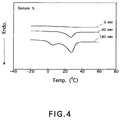
- Figs. 2 to 5 illustrate the results of DSC measurements on the behavior of fusion of each sample after holding it at -10°C for a predetermined time.
- Fig. 6 shows results of DSC measurement on natural rubber (NR) .
- Figs. 7 to 10 illustrate the results of WAXD measurements. Specimens used were each in the form of a 1 mm-thick and 3 mm-wide processed sheet and measurement were conducted at varied elongation (%) at 22°C.
- Samples 11 and 12 in Group B with a broad molecular weight distribution showed a diffraction peak due to crystallization even when the samples were not stretched.
- the peak of 2 ⁇ about 21 degree corresponded to the peak position of ⁇ -caprolactone and, hence, it is presumed that crystallization due to stretching of the crosslinked elastomers is attributable to the crystallization of the repeating unit of caprolactone monomers.
- Samples 4 and 5 in Group A with a narrow molecular weight distribution were in an amorphous state when they were under the conditions of no or low stretching and from their low glass transition temperature, it is presumed that they can become a rubber elastic body or elastomer. At an increased elongation, crystallization was observed. This indicates that although the samples of the present invention behave as a rubber elastic body under deformation conditions which ordinary elastomers encounter, they are highly oriented and behave similarly to crystallized polymer when they are excessively or drastically deformed as in the case of wear, breakage, or the like. In addition, the degree of crystallization can be finely controlled by adjusting the average number of caprolactone unit.
Landscapes
- Chemical & Material Sciences (AREA)
- Health & Medical Sciences (AREA)
- Chemical Kinetics & Catalysis (AREA)
- Medicinal Chemistry (AREA)
- Polymers & Plastics (AREA)
- Organic Chemistry (AREA)
- General Chemical & Material Sciences (AREA)
- Polyurethanes Or Polyureas (AREA)
- Polyesters Or Polycarbonates (AREA)
Applications Claiming Priority (2)
| Application Number | Priority Date | Filing Date | Title |
|---|---|---|---|
| JP313842/95 | 1995-12-01 | ||
| JP31384295 | 1995-12-01 |
Publications (2)
| Publication Number | Publication Date |
|---|---|
| EP0776921A2 true EP0776921A2 (de) | 1997-06-04 |
| EP0776921A3 EP0776921A3 (de) | 1997-08-13 |
Family
ID=18046171
Family Applications (1)
| Application Number | Title | Priority Date | Filing Date |
|---|---|---|---|
| EP96119311A Ceased EP0776921A3 (de) | 1995-12-01 | 1996-12-02 | Verfahren zur Herstellung von amorphen Polymerketten in Elastomeren |
Country Status (2)
| Country | Link |
|---|---|
| US (1) | US6103852A (de) |
| EP (1) | EP0776921A3 (de) |
Families Citing this family (30)
| Publication number | Priority date | Publication date | Assignee | Title |
|---|---|---|---|---|
| JP3559894B2 (ja) | 1998-04-01 | 2004-09-02 | 日産自動車株式会社 | 樹脂製ウィンドウ及びその製法 |
| JP3850663B2 (ja) | 1998-07-23 | 2006-11-29 | テレダイン・インダストリーズ・インコーポレーテッド | 低接触力のばね |
| US6322059B1 (en) * | 1998-07-23 | 2001-11-27 | Barnes Group Inc. | Low contact force spring |
| US6190268B1 (en) * | 1999-07-27 | 2001-02-20 | Callaway Golf Company | Golf ball having a polyurethane cover |
| US7105628B2 (en) | 2002-08-27 | 2006-09-12 | Acushnet Company | Compositions for golf equipment |
| US20050080217A1 (en) * | 2000-12-05 | 2005-04-14 | Hitoshi Shirasaka | Method for producing oil-resistant elastomer and oil-resistant seal member |
| US20060276612A1 (en) * | 2000-12-05 | 2006-12-07 | Hokushin Corporation | Method for producing oil-resistant elastomer and oil-resistant seal member |
| US7098274B2 (en) | 2002-08-27 | 2006-08-29 | Acushnet Company | Compositions for golf equipment |
| US7138477B2 (en) | 2002-08-27 | 2006-11-21 | Acushnet Company | Compositions for golf equipment |
| US7138476B2 (en) | 2002-08-27 | 2006-11-21 | Acushnet Company | Compositions for golf equipment |
| US7101951B2 (en) | 2002-08-27 | 2006-09-05 | Acushnet Company | Compositions for golf equipment |
| US7105623B2 (en) | 2002-08-27 | 2006-09-12 | Acushnet Company | Compositions for golf equipment |
| US7157545B2 (en) | 2002-08-27 | 2007-01-02 | Acushnet Company | Compositions for golf equipment |
| US7138475B2 (en) | 2002-08-27 | 2006-11-21 | Acushnet Company | Compositions for golf equipment |
| US7115703B2 (en) | 2002-08-27 | 2006-10-03 | Acushnet Company | Compositions for golf equipment |
| US7259222B2 (en) * | 2002-08-27 | 2007-08-21 | Acushnet Company | Compositions for use in golf balls |
| US7378483B2 (en) | 2002-08-27 | 2008-05-27 | Acushnet Company | Compositions for golf equipment |
| GB0222522D0 (en) | 2002-09-27 | 2002-11-06 | Controlled Therapeutics Sct | Water-swellable polymers |
| US7265195B2 (en) | 2004-06-02 | 2007-09-04 | Acushnet Company | Compositions for golf equipment |
| US7256249B2 (en) | 2004-06-02 | 2007-08-14 | Acushnet Company | Compositions for golf equipment |
| US7253245B2 (en) | 2004-06-02 | 2007-08-07 | Acushnet Company | Compositions for golf equipment |
| US7276570B2 (en) | 2004-06-02 | 2007-10-02 | Acushnet Company | Compositions for golf equipment |
| US7253242B2 (en) | 2004-06-02 | 2007-08-07 | Acushnet Company | Compositions for golf equipment |
| GB0417401D0 (en) | 2004-08-05 | 2004-09-08 | Controlled Therapeutics Sct | Stabilised prostaglandin composition |
| US20060135725A1 (en) * | 2004-12-21 | 2006-06-22 | Scimed Life Systems, Inc. | New balloon materials |
| JP5151480B2 (ja) * | 2005-08-17 | 2013-02-27 | 旭硝子株式会社 | ポリエステルエーテルポリ(モノ)オールの製造方法およびポリウレタンの製造方法 |
| GB0613333D0 (en) | 2006-07-05 | 2006-08-16 | Controlled Therapeutics Sct | Hydrophilic polyurethane compositions |
| GB0613638D0 (en) | 2006-07-08 | 2006-08-16 | Controlled Therapeutics Sct | Polyurethane elastomers |
| US7986450B2 (en) * | 2006-09-22 | 2011-07-26 | E Ink Corporation | Electro-optic display and materials for use therein |
| GB0620685D0 (en) | 2006-10-18 | 2006-11-29 | Controlled Therapeutics Sct | Bioresorbable polymers |
Citations (7)
| Publication number | Priority date | Publication date | Assignee | Title |
|---|---|---|---|---|
| DE2235811A1 (de) | 1971-07-29 | 1973-02-08 | Upjohn Co | Derivate der 5-methylpyrrol-2carbonsaeure, verfahren zu ihrer herstellung und diese enthaltende herbizide |
| US3806495A (en) | 1971-07-22 | 1974-04-23 | Stamicarbon | Hydroxyl-terminated polylactones |
| JPS5460395A (en) | 1977-10-20 | 1979-05-15 | Toray Ind Inc | Preparation of modified polyester |
| GB2093853A (en) | 1981-02-27 | 1982-09-08 | Daicel Chem | Lactone polymer and polyurethane obtained therefrom |
| EP0117538A2 (de) | 1983-02-24 | 1984-09-05 | Union Carbide Corporation | Polyester-Polyole und Verfahren zu ihrer Herstellung |
| JPS61115924A (ja) | 1984-11-12 | 1986-06-03 | Mitsui Toatsu Chem Inc | 熱可塑性ブロツク共重合体 |
| EP0168499B1 (de) | 1983-12-27 | 1990-06-13 | Daicel Chemical Industries, Ltd. | Polyesteramide |
Family Cites Families (10)
| Publication number | Priority date | Publication date | Assignee | Title |
|---|---|---|---|---|
| GB1272094A (en) * | 1968-03-22 | 1972-04-26 | Inter Polymer Res Corp | Process of preparation of polyesters and derivatives |
| US3651021A (en) * | 1968-05-03 | 1972-03-21 | Union Carbide Corp | Ethylenically unsaturated polylactone-based polyurethane elastomer and vulcanizates therefrom |
| US3899467A (en) * | 1974-05-14 | 1975-08-12 | Upjohn Co | Polyurethanes from 3,3-{40 dimethyl-diphenyl-4,4{40 -diisocyanate polyester diols and bis(hydroxyethyl ether) of hydroquinone |
| DE2554455A1 (de) * | 1975-12-04 | 1977-06-08 | Bayer Ag | Chloroprenpolymerisate |
| JPS57185313A (en) * | 1981-05-08 | 1982-11-15 | Daicel Chem Ind Ltd | Polyurethane and its preparation |
| JP2534053B2 (ja) * | 1987-02-12 | 1996-09-11 | 保土谷化学工業株式会社 | ラクトン重合体の製造方法 |
| JPH02628A (ja) * | 1988-12-01 | 1990-01-05 | Daicel Chem Ind Ltd | 分子量分布の狭いラクトン重合体及びその製造法 |
| JP2764464B2 (ja) * | 1989-10-16 | 1998-06-11 | ニッタ株式会社 | ポリウレタンエラストマーの製造方法 |
| JP3482968B2 (ja) * | 1992-12-24 | 2004-01-06 | ダイセル化学工業株式会社 | ラクトン重合体の製造方法 |
| JP3414029B2 (ja) * | 1994-03-04 | 2003-06-09 | ダイセル化学工業株式会社 | 単分散重合体およびそれらの製造方法 |
-
1996
- 1996-12-02 EP EP96119311A patent/EP0776921A3/de not_active Ceased
- 1996-12-02 US US08/758,882 patent/US6103852A/en not_active Expired - Lifetime
Patent Citations (7)
| Publication number | Priority date | Publication date | Assignee | Title |
|---|---|---|---|---|
| US3806495A (en) | 1971-07-22 | 1974-04-23 | Stamicarbon | Hydroxyl-terminated polylactones |
| DE2235811A1 (de) | 1971-07-29 | 1973-02-08 | Upjohn Co | Derivate der 5-methylpyrrol-2carbonsaeure, verfahren zu ihrer herstellung und diese enthaltende herbizide |
| JPS5460395A (en) | 1977-10-20 | 1979-05-15 | Toray Ind Inc | Preparation of modified polyester |
| GB2093853A (en) | 1981-02-27 | 1982-09-08 | Daicel Chem | Lactone polymer and polyurethane obtained therefrom |
| EP0117538A2 (de) | 1983-02-24 | 1984-09-05 | Union Carbide Corporation | Polyester-Polyole und Verfahren zu ihrer Herstellung |
| EP0168499B1 (de) | 1983-12-27 | 1990-06-13 | Daicel Chemical Industries, Ltd. | Polyesteramide |
| JPS61115924A (ja) | 1984-11-12 | 1986-06-03 | Mitsui Toatsu Chem Inc | 熱可塑性ブロツク共重合体 |
Also Published As
| Publication number | Publication date |
|---|---|
| EP0776921A3 (de) | 1997-08-13 |
| US6103852A (en) | 2000-08-15 |
Similar Documents
| Publication | Publication Date | Title |
|---|---|---|
| EP0776921A2 (de) | Verfahren zur Herstellung von amorphen Polymerketten in Elastomeren | |
| US6008312A (en) | Method for producing millable polyurethanes and polyurethane elastomers | |
| WO2019209348A1 (en) | Polyurethane elastomer with high ultimate elongation | |
| US6323299B1 (en) | Method for producing mixed polyol thermoplastic polyurethane compositions | |
| EP1068252B1 (de) | Polyesterurethan-elastomere und verfahren zu deren herstellung | |
| US5116932A (en) | Hydrolysis resistant polyurethane resins | |
| US20180312623A1 (en) | Polyurethane Elastomer with High Ultimate Elongation | |
| KR100325895B1 (ko) | 압출가능한열가소성의탄성우레아연장된폴리우레탄 | |
| WO2008026367A1 (en) | Process for production of expanded polyurethane elastomer | |
| CN104995228A (zh) | 由遥爪n-烷基化聚酰胺制备的聚合物 | |
| EP0783009B1 (de) | Verfahren zur Herstellung von walzbaren Polyurethanen und Polyurethanelastomeren | |
| JP3303961B2 (ja) | 混練型ポリウレタンエラストマの製造方法およびポリウレタン成形部材 | |
| JP3301528B2 (ja) | エラストマにおけるアモルファス高分子鎖の調製方法 | |
| EP0608976A1 (de) | Esteramid-Copolymeren und ihre Herstellung | |
| CN121866286A (zh) | 热塑性聚氨酯 | |
| CA2191810A1 (en) | Method for preparing amorphous polymer chains in elastomers | |
| JP2643542B2 (ja) | 熱可塑性ポリウレタンの製造方法 | |
| Sánchez-adsuar et al. | Characterization of thermoplastic polyurethanes prepared using different macroglycols | |
| JPS62207316A (ja) | クロロプレンゴム系組成物 | |
| JP3518791B2 (ja) | 混練型ポリウレタン組成物並びにそれを用いたポリウレタン成形体 | |
| DE69634238T2 (de) | Verfahren zur Herstellung von walzbaren Polyurethanen und Polyurethanelastomeren | |
| JP3822998B2 (ja) | エステル系エラストマー及びその製造方法 | |
| Hepburn | Property-structure relationships in polyurethanes | |
| JPS6328447B2 (de) | ||
| Fernández-d'Arlas | Morphology-properties relationship in high-renewable content polyurethanes |
Legal Events
| Date | Code | Title | Description |
|---|---|---|---|
| PUAI | Public reference made under article 153(3) epc to a published international application that has entered the european phase |
Free format text: ORIGINAL CODE: 0009012 |
|
| AK | Designated contracting states |
Kind code of ref document: A2 Designated state(s): CH DE FR GB IT LI NL |
|
| PUAL | Search report despatched |
Free format text: ORIGINAL CODE: 0009013 |
|
| AK | Designated contracting states |
Kind code of ref document: A3 Designated state(s): CH DE FR GB IT LI NL |
|
| 17P | Request for examination filed |
Effective date: 19980213 |
|
| TPAD | Observations by third parties |
Free format text: ORIGINAL CODE: EPIDOS TIPA |
|
| 17Q | First examination report despatched |
Effective date: 20021220 |
|
| 17Q | First examination report despatched |
Effective date: 20021220 |
|
| RAP1 | Party data changed (applicant data changed or rights of an application transferred) |
Owner name: DAICEL CHEMICAL INDUSTRIES, LTD. Owner name: SYNZTEC CO., LTD. |
|
| RAP1 | Party data changed (applicant data changed or rights of an application transferred) |
Owner name: DAICEL CHEMICAL INDUSTRIES, LTD. Owner name: SYNZTEC CO., LTD. |
|
| STAA | Information on the status of an ep patent application or granted ep patent |
Free format text: STATUS: THE APPLICATION HAS BEEN REFUSED |
|
| 18R | Application refused |
Effective date: 20080725 |