EP0776967A2 - Echangeur de chaleur utilisé dans un instrument fonctionnant avec des cycles thermiques - Google Patents
Echangeur de chaleur utilisé dans un instrument fonctionnant avec des cycles thermiques Download PDFInfo
- Publication number
- EP0776967A2 EP0776967A2 EP96202846A EP96202846A EP0776967A2 EP 0776967 A2 EP0776967 A2 EP 0776967A2 EP 96202846 A EP96202846 A EP 96202846A EP 96202846 A EP96202846 A EP 96202846A EP 0776967 A2 EP0776967 A2 EP 0776967A2
- Authority
- EP
- European Patent Office
- Prior art keywords
- temperature
- nucleic acid
- heating
- cooling
- sequence
- Prior art date
- Legal status (The legal status is an assumption and is not a legal conclusion. Google has not performed a legal analysis and makes no representation as to the accuracy of the status listed.)
- Withdrawn
Links
- 230000001351 cycling effect Effects 0.000 title claims abstract description 8
- 238000006243 chemical reaction Methods 0.000 claims abstract description 91
- 238000010438 heat treatment Methods 0.000 claims abstract description 67
- 238000001816 cooling Methods 0.000 claims abstract description 51
- 229910052751 metal Inorganic materials 0.000 claims abstract description 6
- 239000002184 metal Substances 0.000 claims abstract description 6
- 150000007523 nucleic acids Chemical group 0.000 claims description 133
- 230000003321 amplification Effects 0.000 claims description 91
- 238000003199 nucleic acid amplification method Methods 0.000 claims description 91
- 108020004707 nucleic acids Proteins 0.000 claims description 83
- 102000039446 nucleic acids Human genes 0.000 claims description 83
- 239000012530 fluid Substances 0.000 claims description 58
- 108091028043 Nucleic acid sequence Proteins 0.000 claims description 39
- 239000011541 reaction mixture Substances 0.000 claims description 12
- 229910052782 aluminium Inorganic materials 0.000 claims description 4
- XAGFODPZIPBFFR-UHFFFAOYSA-N aluminium Chemical group [Al] XAGFODPZIPBFFR-UHFFFAOYSA-N 0.000 claims description 4
- 239000012809 cooling fluid Substances 0.000 claims 3
- 230000001105 regulatory effect Effects 0.000 claims 2
- 238000000034 method Methods 0.000 description 118
- 239000013615 primer Substances 0.000 description 111
- 102000004190 Enzymes Human genes 0.000 description 60
- 108090000790 Enzymes Proteins 0.000 description 60
- 229940088598 enzyme Drugs 0.000 description 60
- 230000008569 process Effects 0.000 description 58
- 108020004414 DNA Proteins 0.000 description 57
- 239000000047 product Substances 0.000 description 44
- 239000000523 sample Substances 0.000 description 44
- 230000000295 complement effect Effects 0.000 description 43
- 238000011534 incubation Methods 0.000 description 27
- 239000000872 buffer Substances 0.000 description 22
- 238000009396 hybridization Methods 0.000 description 20
- 239000000203 mixture Substances 0.000 description 20
- 238000012545 processing Methods 0.000 description 20
- 108091034117 Oligonucleotide Proteins 0.000 description 19
- 239000002773 nucleotide Substances 0.000 description 19
- 238000003786 synthesis reaction Methods 0.000 description 19
- 230000015572 biosynthetic process Effects 0.000 description 18
- 210000004027 cell Anatomy 0.000 description 18
- 239000007787 solid Substances 0.000 description 18
- 238000001514 detection method Methods 0.000 description 15
- IAZDPXIOMUYVGZ-UHFFFAOYSA-N Dimethylsulphoxide Chemical compound CS(C)=O IAZDPXIOMUYVGZ-UHFFFAOYSA-N 0.000 description 14
- TWRXJAOTZQYOKJ-UHFFFAOYSA-L Magnesium chloride Chemical compound [Mg+2].[Cl-].[Cl-] TWRXJAOTZQYOKJ-UHFFFAOYSA-L 0.000 description 14
- 108090000623 proteins and genes Proteins 0.000 description 14
- 239000007983 Tris buffer Substances 0.000 description 13
- 230000000694 effects Effects 0.000 description 13
- -1 nucleotide triphosphates Chemical class 0.000 description 13
- LENZDBCJOHFCAS-UHFFFAOYSA-N tris Chemical compound OCC(N)(CO)CO LENZDBCJOHFCAS-UHFFFAOYSA-N 0.000 description 13
- XLYOFNOQVPJJNP-UHFFFAOYSA-N water Substances O XLYOFNOQVPJJNP-UHFFFAOYSA-N 0.000 description 13
- KCXVZYZYPLLWCC-UHFFFAOYSA-N EDTA Chemical compound OC(=O)CN(CC(O)=O)CCN(CC(O)=O)CC(O)=O KCXVZYZYPLLWCC-UHFFFAOYSA-N 0.000 description 12
- 108091005904 Hemoglobin subunit beta Proteins 0.000 description 12
- 238000004925 denaturation Methods 0.000 description 11
- 230000036425 denaturation Effects 0.000 description 11
- 239000001226 triphosphate Substances 0.000 description 11
- 235000011178 triphosphate Nutrition 0.000 description 11
- 239000003155 DNA primer Substances 0.000 description 10
- 102100021519 Hemoglobin subunit beta Human genes 0.000 description 10
- 208000037065 Subacute sclerosing leukoencephalitis Diseases 0.000 description 10
- 206010042297 Subacute sclerosing panencephalitis Diseases 0.000 description 10
- 238000004458 analytical method Methods 0.000 description 10
- 238000010586 diagram Methods 0.000 description 10
- 241000589500 Thermus aquaticus Species 0.000 description 9
- 239000003153 chemical reaction reagent Substances 0.000 description 9
- 239000000243 solution Substances 0.000 description 9
- PEDCQBHIVMGVHV-UHFFFAOYSA-N Glycerine Chemical compound OCC(O)CO PEDCQBHIVMGVHV-UHFFFAOYSA-N 0.000 description 8
- FAPWRFPIFSIZLT-UHFFFAOYSA-M Sodium chloride Chemical compound [Na+].[Cl-] FAPWRFPIFSIZLT-UHFFFAOYSA-M 0.000 description 8
- 239000012634 fragment Substances 0.000 description 8
- 239000007788 liquid Substances 0.000 description 8
- 125000003729 nucleotide group Chemical group 0.000 description 8
- 108091008146 restriction endonucleases Proteins 0.000 description 8
- LWIHDJKSTIGBAC-UHFFFAOYSA-K tripotassium phosphate Chemical compound [K+].[K+].[K+].[O-]P([O-])([O-])=O LWIHDJKSTIGBAC-UHFFFAOYSA-K 0.000 description 8
- 102000004594 DNA Polymerase I Human genes 0.000 description 7
- 108010017826 DNA Polymerase I Proteins 0.000 description 7
- 229910001629 magnesium chloride Inorganic materials 0.000 description 7
- 238000012360 testing method Methods 0.000 description 7
- 239000013598 vector Substances 0.000 description 7
- DGVVWUTYPXICAM-UHFFFAOYSA-N β‐Mercaptoethanol Chemical compound OCCS DGVVWUTYPXICAM-UHFFFAOYSA-N 0.000 description 7
- YBJHBAHKTGYVGT-ZKWXMUAHSA-N (+)-Biotin Chemical compound N1C(=O)N[C@@H]2[C@H](CCCCC(=O)O)SC[C@@H]21 YBJHBAHKTGYVGT-ZKWXMUAHSA-N 0.000 description 6
- WEVYAHXRMPXWCK-UHFFFAOYSA-N Acetonitrile Chemical compound CC#N WEVYAHXRMPXWCK-UHFFFAOYSA-N 0.000 description 6
- HEMHJVSKTPXQMS-UHFFFAOYSA-M Sodium hydroxide Chemical compound [OH-].[Na+] HEMHJVSKTPXQMS-UHFFFAOYSA-M 0.000 description 6
- 241000700605 Viruses Species 0.000 description 6
- 238000010367 cloning Methods 0.000 description 6
- 238000010369 molecular cloning Methods 0.000 description 6
- 102000004169 proteins and genes Human genes 0.000 description 6
- 208000007056 sickle cell anemia Diseases 0.000 description 6
- 208000035473 Communicable disease Diseases 0.000 description 5
- 239000003298 DNA probe Substances 0.000 description 5
- 102000016928 DNA-directed DNA polymerase Human genes 0.000 description 5
- 108010014303 DNA-directed DNA polymerase Proteins 0.000 description 5
- 108010042407 Endonucleases Proteins 0.000 description 5
- 102000004533 Endonucleases Human genes 0.000 description 5
- 241000588724 Escherichia coli Species 0.000 description 5
- 238000000502 dialysis Methods 0.000 description 5
- 230000006870 function Effects 0.000 description 5
- 230000035772 mutation Effects 0.000 description 5
- 239000002987 primer (paints) Substances 0.000 description 5
- 238000000926 separation method Methods 0.000 description 5
- VLEIUWBSEKKKFX-UHFFFAOYSA-N 2-amino-2-(hydroxymethyl)propane-1,3-diol;2-[2-[bis(carboxymethyl)amino]ethyl-(carboxymethyl)amino]acetic acid Chemical compound OCC(N)(CO)CO.OC(=O)CN(CC(O)=O)CCN(CC(O)=O)CC(O)=O VLEIUWBSEKKKFX-UHFFFAOYSA-N 0.000 description 4
- 108020004705 Codon Proteins 0.000 description 4
- LFQSCWFLJHTTHZ-UHFFFAOYSA-N Ethanol Chemical compound CCO LFQSCWFLJHTTHZ-UHFFFAOYSA-N 0.000 description 4
- 108060002716 Exonuclease Proteins 0.000 description 4
- 108010010803 Gelatin Proteins 0.000 description 4
- 208000026350 Inborn Genetic disease Diseases 0.000 description 4
- 101710163270 Nuclease Proteins 0.000 description 4
- JLCPHMBAVCMARE-UHFFFAOYSA-N [3-[[3-[[3-[[3-[[3-[[3-[[3-[[3-[[3-[[3-[[3-[[5-(2-amino-6-oxo-1H-purin-9-yl)-3-[[3-[[3-[[3-[[3-[[3-[[5-(2-amino-6-oxo-1H-purin-9-yl)-3-[[5-(2-amino-6-oxo-1H-purin-9-yl)-3-hydroxyoxolan-2-yl]methoxy-hydroxyphosphoryl]oxyoxolan-2-yl]methoxy-hydroxyphosphoryl]oxy-5-(5-methyl-2,4-dioxopyrimidin-1-yl)oxolan-2-yl]methoxy-hydroxyphosphoryl]oxy-5-(6-aminopurin-9-yl)oxolan-2-yl]methoxy-hydroxyphosphoryl]oxy-5-(6-aminopurin-9-yl)oxolan-2-yl]methoxy-hydroxyphosphoryl]oxy-5-(6-aminopurin-9-yl)oxolan-2-yl]methoxy-hydroxyphosphoryl]oxy-5-(6-aminopurin-9-yl)oxolan-2-yl]methoxy-hydroxyphosphoryl]oxyoxolan-2-yl]methoxy-hydroxyphosphoryl]oxy-5-(5-methyl-2,4-dioxopyrimidin-1-yl)oxolan-2-yl]methoxy-hydroxyphosphoryl]oxy-5-(4-amino-2-oxopyrimidin-1-yl)oxolan-2-yl]methoxy-hydroxyphosphoryl]oxy-5-(5-methyl-2,4-dioxopyrimidin-1-yl)oxolan-2-yl]methoxy-hydroxyphosphoryl]oxy-5-(5-methyl-2,4-dioxopyrimidin-1-yl)oxolan-2-yl]methoxy-hydroxyphosphoryl]oxy-5-(6-aminopurin-9-yl)oxolan-2-yl]methoxy-hydroxyphosphoryl]oxy-5-(6-aminopurin-9-yl)oxolan-2-yl]methoxy-hydroxyphosphoryl]oxy-5-(4-amino-2-oxopyrimidin-1-yl)oxolan-2-yl]methoxy-hydroxyphosphoryl]oxy-5-(4-amino-2-oxopyrimidin-1-yl)oxolan-2-yl]methoxy-hydroxyphosphoryl]oxy-5-(4-amino-2-oxopyrimidin-1-yl)oxolan-2-yl]methoxy-hydroxyphosphoryl]oxy-5-(6-aminopurin-9-yl)oxolan-2-yl]methoxy-hydroxyphosphoryl]oxy-5-(4-amino-2-oxopyrimidin-1-yl)oxolan-2-yl]methyl [5-(6-aminopurin-9-yl)-2-(hydroxymethyl)oxolan-3-yl] hydrogen phosphate Polymers Cc1cn(C2CC(OP(O)(=O)OCC3OC(CC3OP(O)(=O)OCC3OC(CC3O)n3cnc4c3nc(N)[nH]c4=O)n3cnc4c3nc(N)[nH]c4=O)C(COP(O)(=O)OC3CC(OC3COP(O)(=O)OC3CC(OC3COP(O)(=O)OC3CC(OC3COP(O)(=O)OC3CC(OC3COP(O)(=O)OC3CC(OC3COP(O)(=O)OC3CC(OC3COP(O)(=O)OC3CC(OC3COP(O)(=O)OC3CC(OC3COP(O)(=O)OC3CC(OC3COP(O)(=O)OC3CC(OC3COP(O)(=O)OC3CC(OC3COP(O)(=O)OC3CC(OC3COP(O)(=O)OC3CC(OC3COP(O)(=O)OC3CC(OC3COP(O)(=O)OC3CC(OC3COP(O)(=O)OC3CC(OC3COP(O)(=O)OC3CC(OC3CO)n3cnc4c(N)ncnc34)n3ccc(N)nc3=O)n3cnc4c(N)ncnc34)n3ccc(N)nc3=O)n3ccc(N)nc3=O)n3ccc(N)nc3=O)n3cnc4c(N)ncnc34)n3cnc4c(N)ncnc34)n3cc(C)c(=O)[nH]c3=O)n3cc(C)c(=O)[nH]c3=O)n3ccc(N)nc3=O)n3cc(C)c(=O)[nH]c3=O)n3cnc4c3nc(N)[nH]c4=O)n3cnc4c(N)ncnc34)n3cnc4c(N)ncnc34)n3cnc4c(N)ncnc34)n3cnc4c(N)ncnc34)O2)c(=O)[nH]c1=O JLCPHMBAVCMARE-UHFFFAOYSA-N 0.000 description 4
- 238000011109 contamination Methods 0.000 description 4
- SUYVUBYJARFZHO-RRKCRQDMSA-N dATP Chemical compound C1=NC=2C(N)=NC=NC=2N1[C@H]1C[C@H](O)[C@@H](COP(O)(=O)OP(O)(=O)OP(O)(O)=O)O1 SUYVUBYJARFZHO-RRKCRQDMSA-N 0.000 description 4
- SUYVUBYJARFZHO-UHFFFAOYSA-N dATP Natural products C1=NC=2C(N)=NC=NC=2N1C1CC(O)C(COP(O)(=O)OP(O)(=O)OP(O)(O)=O)O1 SUYVUBYJARFZHO-UHFFFAOYSA-N 0.000 description 4
- RGWHQCVHVJXOKC-SHYZEUOFSA-J dCTP(4-) Chemical compound O=C1N=C(N)C=CN1[C@@H]1O[C@H](COP([O-])(=O)OP([O-])(=O)OP([O-])([O-])=O)[C@@H](O)C1 RGWHQCVHVJXOKC-SHYZEUOFSA-J 0.000 description 4
- HAAZLUGHYHWQIW-KVQBGUIXSA-N dGTP Chemical compound C1=NC=2C(=O)NC(N)=NC=2N1[C@H]1C[C@H](O)[C@@H](COP(O)(=O)OP(O)(=O)OP(O)(O)=O)O1 HAAZLUGHYHWQIW-KVQBGUIXSA-N 0.000 description 4
- 238000003745 diagnosis Methods 0.000 description 4
- VHJLVAABSRFDPM-QWWZWVQMSA-N dithiothreitol Chemical compound SC[C@@H](O)[C@H](O)CS VHJLVAABSRFDPM-QWWZWVQMSA-N 0.000 description 4
- 102000013165 exonuclease Human genes 0.000 description 4
- 239000008273 gelatin Substances 0.000 description 4
- 229920000159 gelatin Polymers 0.000 description 4
- 235000019322 gelatine Nutrition 0.000 description 4
- 235000011852 gelatine desserts Nutrition 0.000 description 4
- 208000016361 genetic disease Diseases 0.000 description 4
- 230000002068 genetic effect Effects 0.000 description 4
- 235000011187 glycerol Nutrition 0.000 description 4
- 239000000463 material Substances 0.000 description 4
- 239000002480 mineral oil Substances 0.000 description 4
- 235000010446 mineral oil Nutrition 0.000 description 4
- 229940124276 oligodeoxyribonucleotide Drugs 0.000 description 4
- 229910000160 potassium phosphate Inorganic materials 0.000 description 4
- 239000008057 potassium phosphate buffer Substances 0.000 description 4
- 235000011009 potassium phosphates Nutrition 0.000 description 4
- 230000002285 radioactive effect Effects 0.000 description 4
- 239000011780 sodium chloride Substances 0.000 description 4
- PFNFFQXMRSDOHW-UHFFFAOYSA-N spermine Chemical compound NCCCNCCCCNCCCN PFNFFQXMRSDOHW-UHFFFAOYSA-N 0.000 description 4
- 239000007858 starting material Substances 0.000 description 4
- 208000030507 AIDS Diseases 0.000 description 3
- WFDIJRYMOXRFFG-UHFFFAOYSA-N Acetic anhydride Chemical compound CC(=O)OC(C)=O WFDIJRYMOXRFFG-UHFFFAOYSA-N 0.000 description 3
- 108700028369 Alleles Proteins 0.000 description 3
- 108091003079 Bovine Serum Albumin Proteins 0.000 description 3
- 102000053602 DNA Human genes 0.000 description 3
- YMWUJEATGCHHMB-UHFFFAOYSA-N Dichloromethane Chemical compound ClCCl YMWUJEATGCHHMB-UHFFFAOYSA-N 0.000 description 3
- 108060004795 Methyltransferase Proteins 0.000 description 3
- 108010021757 Polynucleotide 5'-Hydroxyl-Kinase Proteins 0.000 description 3
- 102000008422 Polynucleotide 5'-hydroxyl-kinase Human genes 0.000 description 3
- RZCIEJXAILMSQK-JXOAFFINSA-N TTP Chemical compound O=C1NC(=O)C(C)=CN1[C@H]1[C@H](O)[C@H](O)[C@@H](COP(O)(=O)OP(O)(=O)OP(O)(O)=O)O1 RZCIEJXAILMSQK-JXOAFFINSA-N 0.000 description 3
- 238000002835 absorbance Methods 0.000 description 3
- 239000011543 agarose gel Substances 0.000 description 3
- 229960002685 biotin Drugs 0.000 description 3
- 235000020958 biotin Nutrition 0.000 description 3
- 239000011616 biotin Substances 0.000 description 3
- 229940098773 bovine serum albumin Drugs 0.000 description 3
- 230000008859 change Effects 0.000 description 3
- 239000007795 chemical reaction product Substances 0.000 description 3
- 208000037265 diseases, disorders, signs and symptoms Diseases 0.000 description 3
- 238000005516 engineering process Methods 0.000 description 3
- 238000002474 experimental method Methods 0.000 description 3
- 238000004519 manufacturing process Methods 0.000 description 3
- 210000004379 membrane Anatomy 0.000 description 3
- 239000012528 membrane Substances 0.000 description 3
- 238000012544 monitoring process Methods 0.000 description 3
- 239000002777 nucleoside Substances 0.000 description 3
- 238000000746 purification Methods 0.000 description 3
- 230000002829 reductive effect Effects 0.000 description 3
- 230000004044 response Effects 0.000 description 3
- 230000035945 sensitivity Effects 0.000 description 3
- QGZKDVFQNNGYKY-UHFFFAOYSA-N Ammonia Chemical compound N QGZKDVFQNNGYKY-UHFFFAOYSA-N 0.000 description 2
- NLXLAEXVIDQMFP-UHFFFAOYSA-N Ammonia chloride Chemical compound [NH4+].[Cl-] NLXLAEXVIDQMFP-UHFFFAOYSA-N 0.000 description 2
- USFZMSVCRYTOJT-UHFFFAOYSA-N Ammonium acetate Chemical compound N.CC(O)=O USFZMSVCRYTOJT-UHFFFAOYSA-N 0.000 description 2
- 239000005695 Ammonium acetate Substances 0.000 description 2
- VHUUQVKOLVNVRT-UHFFFAOYSA-N Ammonium hydroxide Chemical compound [NH4+].[OH-] VHUUQVKOLVNVRT-UHFFFAOYSA-N 0.000 description 2
- 241000894006 Bacteria Species 0.000 description 2
- HEDRZPFGACZZDS-UHFFFAOYSA-N Chloroform Chemical compound ClC(Cl)Cl HEDRZPFGACZZDS-UHFFFAOYSA-N 0.000 description 2
- 108020004635 Complementary DNA Proteins 0.000 description 2
- 208000032170 Congenital Abnormalities Diseases 0.000 description 2
- GUBGYTABKSRVRQ-WFVLMXAXSA-N DEAE-cellulose Chemical compound OC1C(O)C(O)C(CO)O[C@H]1O[C@@H]1C(CO)OC(O)C(O)C1O GUBGYTABKSRVRQ-WFVLMXAXSA-N 0.000 description 2
- 108020003215 DNA Probes Proteins 0.000 description 2
- 229920001917 Ficoll Polymers 0.000 description 2
- ZHNUHDYFZUAESO-UHFFFAOYSA-N Formamide Chemical compound NC=O ZHNUHDYFZUAESO-UHFFFAOYSA-N 0.000 description 2
- 241000725303 Human immunodeficiency virus Species 0.000 description 2
- CSNNHWWHGAXBCP-UHFFFAOYSA-L Magnesium sulfate Chemical compound [Mg+2].[O-][S+2]([O-])([O-])[O-] CSNNHWWHGAXBCP-UHFFFAOYSA-L 0.000 description 2
- 239000004677 Nylon Substances 0.000 description 2
- 235000014676 Phragmites communis Nutrition 0.000 description 2
- JUJWROOIHBZHMG-UHFFFAOYSA-N Pyridine Chemical compound C1=CC=NC=C1 JUJWROOIHBZHMG-UHFFFAOYSA-N 0.000 description 2
- 102000001218 Rec A Recombinases Human genes 0.000 description 2
- 108010055016 Rec A Recombinases Proteins 0.000 description 2
- 108020004511 Recombinant DNA Proteins 0.000 description 2
- 238000002105 Southern blotting Methods 0.000 description 2
- WYURNTSHIVDZCO-UHFFFAOYSA-N Tetrahydrofuran Chemical compound C1CCOC1 WYURNTSHIVDZCO-UHFFFAOYSA-N 0.000 description 2
- 241000589596 Thermus Species 0.000 description 2
- 241000589499 Thermus thermophilus Species 0.000 description 2
- SWPYNTWPIAZGLT-UHFFFAOYSA-N [amino(ethoxy)phosphanyl]oxyethane Chemical class CCOP(N)OCC SWPYNTWPIAZGLT-UHFFFAOYSA-N 0.000 description 2
- 206010000210 abortion Diseases 0.000 description 2
- 231100000176 abortion Toxicity 0.000 description 2
- 201000006288 alpha thalassemia Diseases 0.000 description 2
- 229940043376 ammonium acetate Drugs 0.000 description 2
- 235000019257 ammonium acetate Nutrition 0.000 description 2
- 239000000908 ammonium hydroxide Substances 0.000 description 2
- 238000003556 assay Methods 0.000 description 2
- 238000000211 autoradiogram Methods 0.000 description 2
- 230000001580 bacterial effect Effects 0.000 description 2
- 208000005980 beta thalassemia Diseases 0.000 description 2
- 230000005540 biological transmission Effects 0.000 description 2
- 230000007698 birth defect Effects 0.000 description 2
- 239000000337 buffer salt Substances 0.000 description 2
- 238000004364 calculation method Methods 0.000 description 2
- 238000012512 characterization method Methods 0.000 description 2
- 238000009833 condensation Methods 0.000 description 2
- 230000005494 condensation Effects 0.000 description 2
- 239000000356 contaminant Substances 0.000 description 2
- 230000003247 decreasing effect Effects 0.000 description 2
- 238000012217 deletion Methods 0.000 description 2
- 230000037430 deletion Effects 0.000 description 2
- 238000013461 design Methods 0.000 description 2
- 238000006642 detritylation reaction Methods 0.000 description 2
- 201000010099 disease Diseases 0.000 description 2
- 238000001962 electrophoresis Methods 0.000 description 2
- 238000010828 elution Methods 0.000 description 2
- 230000002255 enzymatic effect Effects 0.000 description 2
- ZMMJGEGLRURXTF-UHFFFAOYSA-N ethidium bromide Chemical compound [Br-].C12=CC(N)=CC=C2C2=CC=C(N)C=C2[N+](CC)=C1C1=CC=CC=C1 ZMMJGEGLRURXTF-UHFFFAOYSA-N 0.000 description 2
- 229960005542 ethidium bromide Drugs 0.000 description 2
- 210000002196 fr. b Anatomy 0.000 description 2
- 210000000540 fraction c Anatomy 0.000 description 2
- 239000000499 gel Substances 0.000 description 2
- 230000007274 generation of a signal involved in cell-cell signaling Effects 0.000 description 2
- 238000003505 heat denaturation Methods 0.000 description 2
- 230000001976 improved effect Effects 0.000 description 2
- 238000000338 in vitro Methods 0.000 description 2
- 238000003780 insertion Methods 0.000 description 2
- 230000037431 insertion Effects 0.000 description 2
- MYWUZJCMWCOHBA-VIFPVBQESA-N methamphetamine Chemical compound CN[C@@H](C)CC1=CC=CC=C1 MYWUZJCMWCOHBA-VIFPVBQESA-N 0.000 description 2
- 244000005700 microbiome Species 0.000 description 2
- 125000003835 nucleoside group Chemical group 0.000 description 2
- 229920001778 nylon Polymers 0.000 description 2
- 239000002751 oligonucleotide probe Substances 0.000 description 2
- 230000001575 pathological effect Effects 0.000 description 2
- 229940080469 phosphocellulose Drugs 0.000 description 2
- 150000004713 phosphodiesters Chemical class 0.000 description 2
- 239000013612 plasmid Substances 0.000 description 2
- 229920002401 polyacrylamide Polymers 0.000 description 2
- 238000006116 polymerization reaction Methods 0.000 description 2
- 102000054765 polymorphisms of proteins Human genes 0.000 description 2
- 239000001267 polyvinylpyrrolidone Substances 0.000 description 2
- 229920000036 polyvinylpyrrolidone Polymers 0.000 description 2
- 235000013855 polyvinylpyrrolidone Nutrition 0.000 description 2
- 238000001556 precipitation Methods 0.000 description 2
- 238000003793 prenatal diagnosis Methods 0.000 description 2
- 238000004886 process control Methods 0.000 description 2
- 108700042226 ras Genes Proteins 0.000 description 2
- 238000005057 refrigeration Methods 0.000 description 2
- 238000011160 research Methods 0.000 description 2
- 230000002441 reversible effect Effects 0.000 description 2
- 238000012216 screening Methods 0.000 description 2
- 239000004065 semiconductor Substances 0.000 description 2
- AJPJDKMHJJGVTQ-UHFFFAOYSA-M sodium dihydrogen phosphate Chemical compound [Na+].OP(O)([O-])=O AJPJDKMHJJGVTQ-UHFFFAOYSA-M 0.000 description 2
- 229910000162 sodium phosphate Inorganic materials 0.000 description 2
- 241000894007 species Species 0.000 description 2
- 229940063675 spermine Drugs 0.000 description 2
- 230000008093 supporting effect Effects 0.000 description 2
- 230000002194 synthesizing effect Effects 0.000 description 2
- 238000012546 transfer Methods 0.000 description 2
- 238000009736 wetting Methods 0.000 description 2
- OSBLTNPMIGYQGY-UHFFFAOYSA-N 2-amino-2-(hydroxymethyl)propane-1,3-diol;2-[2-[bis(carboxymethyl)amino]ethyl-(carboxymethyl)amino]acetic acid;boric acid Chemical compound OB(O)O.OCC(N)(CO)CO.OC(=O)CN(CC(O)=O)CCN(CC(O)=O)CC(O)=O OSBLTNPMIGYQGY-UHFFFAOYSA-N 0.000 description 1
- BFSVOASYOCHEOV-UHFFFAOYSA-N 2-diethylaminoethanol Chemical compound CCN(CC)CCO BFSVOASYOCHEOV-UHFFFAOYSA-N 0.000 description 1
- 102000002260 Alkaline Phosphatase Human genes 0.000 description 1
- 108020004774 Alkaline Phosphatase Proteins 0.000 description 1
- 108090001008 Avidin Proteins 0.000 description 1
- BTBUEUYNUDRHOZ-UHFFFAOYSA-N Borate Chemical compound [O-]B([O-])[O-] BTBUEUYNUDRHOZ-UHFFFAOYSA-N 0.000 description 1
- UXVMQQNJUSDDNG-UHFFFAOYSA-L Calcium chloride Chemical compound [Cl-].[Cl-].[Ca+2] UXVMQQNJUSDDNG-UHFFFAOYSA-L 0.000 description 1
- CURLTUGMZLYLDI-UHFFFAOYSA-N Carbon dioxide Chemical compound O=C=O CURLTUGMZLYLDI-UHFFFAOYSA-N 0.000 description 1
- 102000003846 Carbonic anhydrases Human genes 0.000 description 1
- 108090000209 Carbonic anhydrases Proteins 0.000 description 1
- 241000606161 Chlamydia Species 0.000 description 1
- 108091026890 Coding region Proteins 0.000 description 1
- RYGMFSIKBFXOCR-UHFFFAOYSA-N Copper Chemical compound [Cu] RYGMFSIKBFXOCR-UHFFFAOYSA-N 0.000 description 1
- 230000004544 DNA amplification Effects 0.000 description 1
- 102000016911 Deoxyribonucleases Human genes 0.000 description 1
- 108010053770 Deoxyribonucleases Proteins 0.000 description 1
- 241000196324 Embryophyta Species 0.000 description 1
- 241000702224 Enterobacteria phage M13 Species 0.000 description 1
- 241000701959 Escherichia virus Lambda Species 0.000 description 1
- 241000193385 Geobacillus stearothermophilus Species 0.000 description 1
- WQZGKKKJIJFFOK-GASJEMHNSA-N Glucose Natural products OC[C@H]1OC(O)[C@H](O)[C@@H](O)[C@@H]1O WQZGKKKJIJFFOK-GASJEMHNSA-N 0.000 description 1
- 244000068988 Glycine max Species 0.000 description 1
- 235000010469 Glycine max Nutrition 0.000 description 1
- 108010062347 HLA-DQ Antigens Proteins 0.000 description 1
- 108010054147 Hemoglobins Proteins 0.000 description 1
- 102000001554 Hemoglobins Human genes 0.000 description 1
- 101000610640 Homo sapiens U4/U6 small nuclear ribonucleoprotein Prp3 Proteins 0.000 description 1
- 102000003960 Ligases Human genes 0.000 description 1
- 108090000364 Ligases Proteins 0.000 description 1
- 241000589496 Meiothermus ruber Species 0.000 description 1
- 241001465754 Metazoa Species 0.000 description 1
- 241000203367 Methanothermus fervidus Species 0.000 description 1
- 102000016943 Muramidase Human genes 0.000 description 1
- 108010014251 Muramidase Proteins 0.000 description 1
- 108010062010 N-Acetylmuramoyl-L-alanine Amidase Proteins 0.000 description 1
- 241000588653 Neisseria Species 0.000 description 1
- 206010028980 Neoplasm Diseases 0.000 description 1
- 101001035556 Notamacropus eugenii Hemoglobin subunit omega Proteins 0.000 description 1
- 108020005187 Oligonucleotide Probes Proteins 0.000 description 1
- 108700020796 Oncogene Proteins 0.000 description 1
- 102000043276 Oncogene Human genes 0.000 description 1
- 108010058846 Ovalbumin Proteins 0.000 description 1
- 108010065081 Phosphorylase b Proteins 0.000 description 1
- 241000218657 Picea Species 0.000 description 1
- 241000224016 Plasmodium Species 0.000 description 1
- 108091028664 Ribonucleotide Proteins 0.000 description 1
- 240000004808 Saccharomyces cerevisiae Species 0.000 description 1
- 101001110823 Saccharomyces cerevisiae (strain ATCC 204508 / S288c) 60S ribosomal protein L6-A Proteins 0.000 description 1
- 101000712176 Saccharomyces cerevisiae (strain ATCC 204508 / S288c) 60S ribosomal protein L6-B Proteins 0.000 description 1
- 241000607142 Salmonella Species 0.000 description 1
- 210000001744 T-lymphocyte Anatomy 0.000 description 1
- 239000008051 TBE buffer Substances 0.000 description 1
- 239000007984 Tris EDTA buffer Substances 0.000 description 1
- 101710162629 Trypsin inhibitor Proteins 0.000 description 1
- 229940122618 Trypsin inhibitor Drugs 0.000 description 1
- 102100040374 U4/U6 small nuclear ribonucleoprotein Prp3 Human genes 0.000 description 1
- 230000005856 abnormality Effects 0.000 description 1
- 238000009825 accumulation Methods 0.000 description 1
- 230000009471 action Effects 0.000 description 1
- 230000003213 activating effect Effects 0.000 description 1
- 230000002411 adverse Effects 0.000 description 1
- 229910021529 ammonia Inorganic materials 0.000 description 1
- 235000019270 ammonium chloride Nutrition 0.000 description 1
- BFNBIHQBYMNNAN-UHFFFAOYSA-N ammonium sulfate Chemical compound N.N.OS(O)(=O)=O BFNBIHQBYMNNAN-UHFFFAOYSA-N 0.000 description 1
- 229910052921 ammonium sulfate Inorganic materials 0.000 description 1
- 235000011130 ammonium sulphate Nutrition 0.000 description 1
- 210000004381 amniotic fluid Anatomy 0.000 description 1
- 230000002528 anti-freeze Effects 0.000 description 1
- 238000013459 approach Methods 0.000 description 1
- 239000007864 aqueous solution Substances 0.000 description 1
- QVGXLLKOCUKJST-UHFFFAOYSA-N atomic oxygen Chemical compound [O] QVGXLLKOCUKJST-UHFFFAOYSA-N 0.000 description 1
- 238000000376 autoradiography Methods 0.000 description 1
- QRUDEWIWKLJBPS-UHFFFAOYSA-N benzotriazole Chemical compound C1=CC=C2N[N][N]C2=C1 QRUDEWIWKLJBPS-UHFFFAOYSA-N 0.000 description 1
- 239000012964 benzotriazole Substances 0.000 description 1
- 239000012472 biological sample Substances 0.000 description 1
- 229910052797 bismuth Inorganic materials 0.000 description 1
- JCXGWMGPZLAOME-UHFFFAOYSA-N bismuth atom Chemical compound [Bi] JCXGWMGPZLAOME-UHFFFAOYSA-N 0.000 description 1
- 210000004369 blood Anatomy 0.000 description 1
- 239000008280 blood Substances 0.000 description 1
- KGBXLFKZBHKPEV-UHFFFAOYSA-N boric acid Chemical compound OB(O)O KGBXLFKZBHKPEV-UHFFFAOYSA-N 0.000 description 1
- 239000004327 boric acid Substances 0.000 description 1
- 239000006227 byproduct Substances 0.000 description 1
- 239000001110 calcium chloride Substances 0.000 description 1
- 229910001628 calcium chloride Inorganic materials 0.000 description 1
- 201000011510 cancer Diseases 0.000 description 1
- 229940041514 candida albicans extract Drugs 0.000 description 1
- 235000011089 carbon dioxide Nutrition 0.000 description 1
- 230000006037 cell lysis Effects 0.000 description 1
- 230000001413 cellular effect Effects 0.000 description 1
- 238000005119 centrifugation Methods 0.000 description 1
- 239000000919 ceramic Substances 0.000 description 1
- 239000003795 chemical substances by application Substances 0.000 description 1
- 210000004252 chorionic villi Anatomy 0.000 description 1
- 238000011097 chromatography purification Methods 0.000 description 1
- 239000013599 cloning vector Substances 0.000 description 1
- 238000004891 communication Methods 0.000 description 1
- 150000001875 compounds Chemical class 0.000 description 1
- 239000004020 conductor Substances 0.000 description 1
- 239000005289 controlled pore glass Substances 0.000 description 1
- 229910052802 copper Inorganic materials 0.000 description 1
- 239000010949 copper Substances 0.000 description 1
- 238000012864 cross contamination Methods 0.000 description 1
- 239000000287 crude extract Substances 0.000 description 1
- 238000012258 culturing Methods 0.000 description 1
- SSJJWVREPZVNBF-DGXVIIAXSA-N dG10 Chemical compound C1=NC(C(NC(N)=N2)=O)=C2N1[C@H](O[C@@H]1COP(O)(=O)O[C@@H]2[C@H](O[C@H](C2)N2C3=C(C(NC(N)=N3)=O)N=C2)COP(O)(=O)O[C@@H]2[C@H](O[C@H](C2)N2C3=C(C(NC(N)=N3)=O)N=C2)COP(O)(=O)O[C@@H]2[C@H](O[C@H](C2)N2C3=C(C(NC(N)=N3)=O)N=C2)COP(O)(=O)O[C@@H]2[C@H](O[C@H](C2)N2C3=C(C(NC(N)=N3)=O)N=C2)COP(O)(=O)O[C@@H]2[C@H](O[C@H](C2)N2C3=C(C(NC(N)=N3)=O)N=C2)COP(O)(=O)O[C@@H]2[C@H](O[C@H](C2)N2C3=C(C(NC(N)=N3)=O)N=C2)COP(O)(=O)O[C@@H]2[C@H](O[C@H](C2)N2C3=C(C(NC(N)=N3)=O)N=C2)COP(O)(=O)O[C@@H]2[C@H](O[C@H](C2)N2C3=C(C(NC(N)=N3)=O)N=C2)CO)C[C@@H]1OP(O)(=O)OC[C@@H](O1)[C@@H](O)C[C@@H]1N1C(N=C(NC2=O)N)=C2N=C1 SSJJWVREPZVNBF-DGXVIIAXSA-N 0.000 description 1
- NHVNXKFIZYSCEB-XLPZGREQSA-N dTTP Chemical compound O=C1NC(=O)C(C)=CN1[C@@H]1O[C@H](COP(O)(=O)OP(O)(=O)OP(O)(O)=O)[C@@H](O)C1 NHVNXKFIZYSCEB-XLPZGREQSA-N 0.000 description 1
- 229940119679 deoxyribonucleases Drugs 0.000 description 1
- 239000005547 deoxyribonucleotide Substances 0.000 description 1
- 125000002637 deoxyribonucleotide group Chemical group 0.000 description 1
- 238000010511 deprotection reaction Methods 0.000 description 1
- 230000029087 digestion Effects 0.000 description 1
- 238000010790 dilution Methods 0.000 description 1
- 239000012895 dilution Substances 0.000 description 1
- 208000035475 disorder Diseases 0.000 description 1
- 239000006185 dispersion Substances 0.000 description 1
- 239000012153 distilled water Substances 0.000 description 1
- 239000013604 expression vector Substances 0.000 description 1
- 238000000605 extraction Methods 0.000 description 1
- 239000011790 ferrous sulphate Substances 0.000 description 1
- 235000003891 ferrous sulphate Nutrition 0.000 description 1
- 230000001605 fetal effect Effects 0.000 description 1
- 210000003754 fetus Anatomy 0.000 description 1
- 238000001914 filtration Methods 0.000 description 1
- 210000003918 fraction a Anatomy 0.000 description 1
- 238000005194 fractionation Methods 0.000 description 1
- 238000007710 freezing Methods 0.000 description 1
- 230000008014 freezing Effects 0.000 description 1
- 239000008103 glucose Substances 0.000 description 1
- 208000006454 hepatitis Diseases 0.000 description 1
- 231100000283 hepatitis Toxicity 0.000 description 1
- 229910052588 hydroxylapatite Inorganic materials 0.000 description 1
- 230000000415 inactivating effect Effects 0.000 description 1
- 230000000977 initiatory effect Effects 0.000 description 1
- 230000003834 intracellular effect Effects 0.000 description 1
- BAUYGSIQEAFULO-UHFFFAOYSA-L iron(2+) sulfate (anhydrous) Chemical compound [Fe+2].[O-]S([O-])(=O)=O BAUYGSIQEAFULO-UHFFFAOYSA-L 0.000 description 1
- 229910000359 iron(II) sulfate Inorganic materials 0.000 description 1
- 230000002427 irreversible effect Effects 0.000 description 1
- 238000002955 isolation Methods 0.000 description 1
- 239000006166 lysate Substances 0.000 description 1
- 229960000274 lysozyme Drugs 0.000 description 1
- 239000004325 lysozyme Substances 0.000 description 1
- 235000010335 lysozyme Nutrition 0.000 description 1
- 229920002521 macromolecule Polymers 0.000 description 1
- 229910052943 magnesium sulfate Inorganic materials 0.000 description 1
- 235000019341 magnesium sulphate Nutrition 0.000 description 1
- 201000004792 malaria Diseases 0.000 description 1
- 239000003550 marker Substances 0.000 description 1
- 230000007246 mechanism Effects 0.000 description 1
- 108020004999 messenger RNA Proteins 0.000 description 1
- 238000012986 modification Methods 0.000 description 1
- 230000004048 modification Effects 0.000 description 1
- 238000002703 mutagenesis Methods 0.000 description 1
- 231100000350 mutagenesis Toxicity 0.000 description 1
- PSHKMPUSSFXUIA-UHFFFAOYSA-N n,n-dimethylpyridin-2-amine Chemical compound CN(C)C1=CC=CC=N1 PSHKMPUSSFXUIA-UHFFFAOYSA-N 0.000 description 1
- 229910052757 nitrogen Inorganic materials 0.000 description 1
- 150000003833 nucleoside derivatives Chemical class 0.000 description 1
- 229940046166 oligodeoxynucleotide Drugs 0.000 description 1
- 210000003463 organelle Anatomy 0.000 description 1
- 229940092253 ovalbumin Drugs 0.000 description 1
- 229910052760 oxygen Inorganic materials 0.000 description 1
- 239000001301 oxygen Substances 0.000 description 1
- 244000045947 parasite Species 0.000 description 1
- 244000052769 pathogen Species 0.000 description 1
- 239000008188 pellet Substances 0.000 description 1
- XYJRXVWERLGGKC-UHFFFAOYSA-D pentacalcium;hydroxide;triphosphate Chemical compound [OH-].[Ca+2].[Ca+2].[Ca+2].[Ca+2].[Ca+2].[O-]P([O-])([O-])=O.[O-]P([O-])([O-])=O.[O-]P([O-])([O-])=O XYJRXVWERLGGKC-UHFFFAOYSA-D 0.000 description 1
- 229910052698 phosphorus Inorganic materials 0.000 description 1
- 230000026731 phosphorylation Effects 0.000 description 1
- 238000006366 phosphorylation reaction Methods 0.000 description 1
- 238000000053 physical method Methods 0.000 description 1
- 229920003023 plastic Polymers 0.000 description 1
- 239000004033 plastic Substances 0.000 description 1
- 238000007747 plating Methods 0.000 description 1
- 230000001376 precipitating effect Effects 0.000 description 1
- 230000037452 priming Effects 0.000 description 1
- 230000001737 promoting effect Effects 0.000 description 1
- UMJSCPRVCHMLSP-UHFFFAOYSA-N pyridine Natural products COC1=CC=CN=C1 UMJSCPRVCHMLSP-UHFFFAOYSA-N 0.000 description 1
- 230000003252 repetitive effect Effects 0.000 description 1
- 238000004007 reversed phase HPLC Methods 0.000 description 1
- 239000002336 ribonucleotide Substances 0.000 description 1
- 125000002652 ribonucleotide group Chemical group 0.000 description 1
- 238000013207 serial dilution Methods 0.000 description 1
- 239000001509 sodium citrate Substances 0.000 description 1
- NLJMYIDDQXHKNR-UHFFFAOYSA-K sodium citrate Chemical compound O.O.[Na+].[Na+].[Na+].[O-]C(=O)CC(O)(CC([O-])=O)C([O-])=O NLJMYIDDQXHKNR-UHFFFAOYSA-K 0.000 description 1
- 238000002415 sodium dodecyl sulfate polyacrylamide gel electrophoresis Methods 0.000 description 1
- 230000006641 stabilisation Effects 0.000 description 1
- 238000011105 stabilization Methods 0.000 description 1
- 238000010186 staining Methods 0.000 description 1
- 238000010561 standard procedure Methods 0.000 description 1
- 238000003756 stirring Methods 0.000 description 1
- 238000003860 storage Methods 0.000 description 1
- 239000000126 substance Substances 0.000 description 1
- 239000006228 supernatant Substances 0.000 description 1
- 230000002459 sustained effect Effects 0.000 description 1
- XSOKHXFFCGXDJZ-UHFFFAOYSA-N telluride(2-) Chemical compound [Te-2] XSOKHXFFCGXDJZ-UHFFFAOYSA-N 0.000 description 1
- YLQBMQCUIZJEEH-UHFFFAOYSA-N tetrahydrofuran Natural products C=1C=COC=1 YLQBMQCUIZJEEH-UHFFFAOYSA-N 0.000 description 1
- 210000001519 tissue Anatomy 0.000 description 1
- YNJBWRMUSHSURL-UHFFFAOYSA-N trichloroacetic acid Chemical compound OC(=O)C(Cl)(Cl)Cl YNJBWRMUSHSURL-UHFFFAOYSA-N 0.000 description 1
- 239000002753 trypsin inhibitor Substances 0.000 description 1
- 239000012137 tryptone Substances 0.000 description 1
- 239000002435 venom Substances 0.000 description 1
- 210000001048 venom Anatomy 0.000 description 1
- 231100000611 venom Toxicity 0.000 description 1
- 108700026220 vif Genes Proteins 0.000 description 1
- 239000012138 yeast extract Substances 0.000 description 1
Images




Classifications
-
- B—PERFORMING OPERATIONS; TRANSPORTING
- B01—PHYSICAL OR CHEMICAL PROCESSES OR APPARATUS IN GENERAL
- B01L—CHEMICAL OR PHYSICAL LABORATORY APPARATUS FOR GENERAL USE
- B01L7/00—Heating or cooling apparatus; Heat insulating devices
- B01L7/52—Heating or cooling apparatus; Heat insulating devices with provision for submitting samples to a predetermined sequence of different temperatures, e.g. for treating nucleic acid samples
-
- B—PERFORMING OPERATIONS; TRANSPORTING
- B01—PHYSICAL OR CHEMICAL PROCESSES OR APPARATUS IN GENERAL
- B01J—CHEMICAL OR PHYSICAL PROCESSES, e.g. CATALYSIS OR COLLOID CHEMISTRY; THEIR RELEVANT APPARATUS
- B01J19/00—Chemical, physical or physico-chemical processes in general; Their relevant apparatus
- B01J19/0046—Sequential or parallel reactions, e.g. for the synthesis of polypeptides or polynucleotides; Apparatus and devices for combinatorial chemistry or for making molecular arrays
-
- C—CHEMISTRY; METALLURGY
- C07—ORGANIC CHEMISTRY
- C07H—SUGARS; DERIVATIVES THEREOF; NUCLEOSIDES; NUCLEOTIDES; NUCLEIC ACIDS
- C07H21/00—Compounds containing two or more mononucleotide units having separate phosphate or polyphosphate groups linked by saccharide radicals of nucleoside groups, e.g. nucleic acids
-
- C—CHEMISTRY; METALLURGY
- C12—BIOCHEMISTRY; BEER; SPIRITS; WINE; VINEGAR; MICROBIOLOGY; ENZYMOLOGY; MUTATION OR GENETIC ENGINEERING
- C12M—APPARATUS FOR ENZYMOLOGY OR MICROBIOLOGY; APPARATUS FOR CULTURING MICROORGANISMS FOR PRODUCING BIOMASS, FOR GROWING CELLS OR FOR OBTAINING FERMENTATION OR METABOLIC PRODUCTS, i.e. BIOREACTORS OR FERMENTERS
- C12M1/00—Apparatus for enzymology or microbiology
- C12M1/36—Apparatus for enzymology or microbiology including condition or time responsive control, e.g. automatically controlled fermentors
-
- B—PERFORMING OPERATIONS; TRANSPORTING
- B01—PHYSICAL OR CHEMICAL PROCESSES OR APPARATUS IN GENERAL
- B01J—CHEMICAL OR PHYSICAL PROCESSES, e.g. CATALYSIS OR COLLOID CHEMISTRY; THEIR RELEVANT APPARATUS
- B01J2219/00—Chemical, physical or physico-chemical processes in general; Their relevant apparatus
- B01J2219/00274—Sequential or parallel reactions; Apparatus and devices for combinatorial chemistry or for making arrays; Chemical library technology
- B01J2219/00277—Apparatus
- B01J2219/00495—Means for heating or cooling the reaction vessels
-
- B—PERFORMING OPERATIONS; TRANSPORTING
- B01—PHYSICAL OR CHEMICAL PROCESSES OR APPARATUS IN GENERAL
- B01J—CHEMICAL OR PHYSICAL PROCESSES, e.g. CATALYSIS OR COLLOID CHEMISTRY; THEIR RELEVANT APPARATUS
- B01J2219/00—Chemical, physical or physico-chemical processes in general; Their relevant apparatus
- B01J2219/00274—Sequential or parallel reactions; Apparatus and devices for combinatorial chemistry or for making arrays; Chemical library technology
- B01J2219/00583—Features relative to the processes being carried out
- B01J2219/0059—Sequential processes
-
- B—PERFORMING OPERATIONS; TRANSPORTING
- B01—PHYSICAL OR CHEMICAL PROCESSES OR APPARATUS IN GENERAL
- B01J—CHEMICAL OR PHYSICAL PROCESSES, e.g. CATALYSIS OR COLLOID CHEMISTRY; THEIR RELEVANT APPARATUS
- B01J2219/00—Chemical, physical or physico-chemical processes in general; Their relevant apparatus
- B01J2219/00274—Sequential or parallel reactions; Apparatus and devices for combinatorial chemistry or for making arrays; Chemical library technology
- B01J2219/0068—Means for controlling the apparatus of the process
- B01J2219/00686—Automatic
- B01J2219/00689—Automatic using computers
-
- B—PERFORMING OPERATIONS; TRANSPORTING
- B01—PHYSICAL OR CHEMICAL PROCESSES OR APPARATUS IN GENERAL
- B01J—CHEMICAL OR PHYSICAL PROCESSES, e.g. CATALYSIS OR COLLOID CHEMISTRY; THEIR RELEVANT APPARATUS
- B01J2219/00—Chemical, physical or physico-chemical processes in general; Their relevant apparatus
- B01J2219/00274—Sequential or parallel reactions; Apparatus and devices for combinatorial chemistry or for making arrays; Chemical library technology
- B01J2219/00718—Type of compounds synthesised
- B01J2219/0072—Organic compounds
- B01J2219/00722—Nucleotides
-
- C—CHEMISTRY; METALLURGY
- C40—COMBINATORIAL TECHNOLOGY
- C40B—COMBINATORIAL CHEMISTRY; LIBRARIES, e.g. CHEMICAL LIBRARIES
- C40B40/00—Libraries per se, e.g. arrays, mixtures
- C40B40/04—Libraries containing only organic compounds
- C40B40/06—Libraries containing nucleotides or polynucleotides, or derivatives thereof
-
- C—CHEMISTRY; METALLURGY
- C40—COMBINATORIAL TECHNOLOGY
- C40B—COMBINATORIAL CHEMISTRY; LIBRARIES, e.g. CHEMICAL LIBRARIES
- C40B60/00—Apparatus specially adapted for use in combinatorial chemistry or with libraries
- C40B60/14—Apparatus specially adapted for use in combinatorial chemistry or with libraries for creating libraries
Definitions
- the invention pertains to the field of apparatus for use in chain reactions for amplifying DNA or RNA (nucleic acids), and to the field of machines for automatically performing this process through temperature cycling.
- the invention concerns a heat exchanger for use in a temperature-cycling instrument.
- nucleic acid sequences in large amounts from small amounts of an existing sequence. Such methods involve cloning of a nucleic acid sequence in an appropriate host system, and culturing the host, wherein the vector in which the nucleic acid sequence has been inserted is replicated, resulting in copies of the vector and hence the sequence. See T. Maniatis, et al., Molecular Cloning:A Laboratory Manual , Cold Spring Harbor Laboratory, pp. 390-401 (1982); and U.S. Patent Nos. 4,416,988 and 4,403,036. The original sequence can also be organically synthesized before insertion in a vector. See U.S. Patent No. 4,293,652.
- a method described by Saiki et al., Science , 230 , 1350-1354 (1985), has been devised for amplifying one or more specific nucleic acid sequences or a mixture thereof using primers, nucleotide triphosphates, and an agent for polymerization, such as DNA polymerase.
- the extension product of one primer when hybridized to the other, becomes a template for the production of the desired specific nucleic acid sequence, and vice versa. The process is repeated as often as necessary to produce the desired amount of the sequence.
- This method is especially useful for performing clinical tests on the DNA or RNA from a fetus or other donor where large amounts of the DNA or RNA are not readily available and more DNA or RNA Rust be manufactured to have a sufficient amount to perform tests.
- the presence of diseases which have unique DNA or RNA signatures can be detected by amplifying a nucleic acid sample from a patient and using various probe procedures to assay for the presence of the nucleic acid sequence being detected In the test.
- Such test might be prenatal diagnosis of sickle cell anemia, as described by Saikl et al., supra , where the amplification of specific ⁇ -globin target sequences in genomic DNA resulted in the exponential increase (220,000 times) of target DNA copies, Increasing sensitivity and speed while reducing the complexity of diagnosis.
- Another test is the diagnosis of the AIDS virus, which is thought to alter the nucleic acid sequence of its victims.
- the amplification method bears some similarity to the molecular cloning methods described above, but does not involve propagation of a host organism, avoiding the hazards and inconvenience therein involved.
- the amplification method does not require synthesis of nucleic acid sequences unrelated to the desired sequence, and thereby obviates the need for extensive purification of the product from a complicated biological mixture.
- the amplification is more efficient than the alternative methods for producing large amounts of nucleic acid sequences from a target sequence and for producing such sequences in a comparatively short period of time.
- nucleic acids amplify more efficiently than others, so some nucleic acid sequence amplifications require more amplification cycles than others. Because the cost of laboratory labor can be high, and the risks to which a laboratory is subjected are high in case of error in erroneously performing amplification, there has arisen a need for a system which can automate the amplification process.
- thermostable enzyme This invention involves a heat exchanger apparatus for use in a temperature-cycling instrument for implementing the amplification process when a thermostable enzyme is employed.
- the use of a thermostable enzyme avoids the need for liquid transferring of the enzyme, which is necessitated when the enzyme is unstable in the presence of heat.
- the invention herein relates to heat exchanger apparatus for use in a temperature-cycling instrument for automated temperature cycling of a plurality of reaction wells comprising:
- This invention also provides an apparatus for performing automated amplification of a plurality of samples, each containing at least one specific nucleic acid sequence comprising:
- Temperature cycling apparatus in which the present heat exchanger apparatus can be used also generally contains a power supply for operation, a structural system to contain all the elements of the apparatus, and a keyboard and display panel to allow control of the apparatus by an operator.
- the receptacle which holds the reagents where the reaction occurs has its temperature controlled by a computer to conform to a certain incubation profile defined by the user.
- a computer to conform to a certain incubation profile defined by the user.
- Three circulating fluid reservoirs and solenoid operated valves, or any other method, may be employed to control temperature.
- the Peltier solid state heat pumps available from Materials Electronics Products Corporation in Trenton, New Jersey, may also be used, as well as a water heat exchanger or any other heating and cooling system which may be controlled by a computer.
- solenoid-operated valves are coupled to the computer such that the proper temperature fluid can be directed through the supported structure for the heat-conducting receptacle at the proper times in the amplification process under computer control.
- the receptacle is switched under computer control between two temperatures by the transmission of a control signal to the solenoid-operated valves at the proper time in the sequence to gate either the hot fluid or the cold fluid through the support structure of the receptacle.
- a temperature sensor coupled to the reaction chamber and the computer is used to provide a signal indicating the actual temperature.
- the computer compares the actual temperature to the desired temperature. An error signal is generated in this fashion which is used to control the apparatus which heats and cools the reaction chambers.
- the computer also keeps track of the elapsed time at particular temperatures to implement the incubation periods in the protocol.
- the basic process that the machine performs to implement the amplification protocol after the starting materials are loaded into the reaction well, in one embodiment using water baths, is as follows.
- the computer signals the solenoid-operated valves to gate the hot fluid through the supporting structure for the reaction chamber thereby heating the contents of the reaction well to the temperature of the hot fluid.
- the amount of time the hot fluid is gated "on" is measured by an elapsed time counter.
- the computer compares the elapsed time the hot fluid has been gated "on" to a variable set in memory.
- this variable can be changed by the user through the user interface. In other embodiments, it may be fixed.
- the computer sends a signal to the solenoid-operated valves to stop the hot fluid flow and gate the cold fluid flow through the supporting structure for the reaction vessel.
- a temperature profile versus time for the reaction chamber is programmed into the computer via the user interface. This causes the computer to control the reaction or reagent vessel temperature in the sequence required by the particular amplification reaction parameters.
- Such an embodiment uses a thermistor or other temperature sensor to monitor the temperature of the reaction chamber and generates an error signal derived by comparing the actual temperature of the reaction chamber to the user-defined temperature profile. The error signal is used to control a heat pump or other heating and cooling apparatus to maintain the desired temperature profile during the high temperature heat-up and high temperature incubation and during the chill-down and low-temperature incubation.
- the computer starts a timer and compares the elapsed time for hot or cold fluid flow or the elapsed time at a particular temperature to a user-defined variable stored in memory for each segment or leg in the temperature profile.
- a user-defined variable stored in memory for each segment or leg in the temperature profile.
- thermoprofile control apparatus and methods for embodiments using hot and cold fluid reservoirs and solenoid-operated valves are equally applicable to embodiments using Peltier heat pumps or other forms of heating and cooling apparatus coupled to the reaction chamber or chambers.
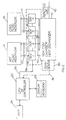
- Figure 1 is a general block diagram of a machine which can perform the amplification process using the thermostable enzyme and Peltier heat pumps to cycle the temperature of the reaction vessels.
- FIG. 2 is a general block diagram of a machine which can perform the thermostable enzyme amplification process herein using water baths to cycle the temperature of the reaction vessels.
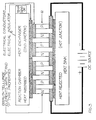
- Figure 3 is a diagram of a solid state heat pump and reaction chamber heat exchanger structure.
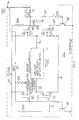
- Figure 4 is a schematic diagram of the interface unit for a solid state heat pump.
- Figure 5 is a diagram of a typical user-defined temperature profile.
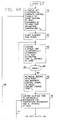
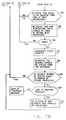
- Figure 6 is comprised of two halves labeled Figure 6A and Figure 6B and comprises a flow diagram for the control software for the empirical embodiments which do not use feedback of the actual reaction chamber temperature.
- Figure 7 is comprised of two halves labeled Figure 7A and Figure 7B and comprises a flow diagram for the control software for the preferred embodiments which use actual temperature feedback signals to monitor the actual temperature of the reacton chamber and compare it to the desired temperature profile.
- heat exchanger 10 supports the reaction well 40, which may be a recess machined into the heat exchanger, but preferably is a plastic container which holds the fluids involved in the reaction and which sits in a recess formed in heat exchanger 10 (hereafter sometimes referred to as plate 1).
- heat exchanger 10 is a heat-conducting block, preferably aluminum, with a plurality of recesses formed therein sized to allow a given number of 0.5 ml (milliliter) Eppendorf tubes to fit therein.
- the purpose of the tubes is to line the reaction well to separate the fluids from the walls of the recesses in the heat exchanger 10 to avoid cross contamination when the same reaction well is used to amplify different nucleic acid sequences.
- the purpose of heat exchanger 10 is to support the tubes and to act as a heat exchanger to transfer thermal energy to and from the fluids stored in the tubes in the reaction wells, such that the reaction components may be incubated at various temperatures for user-defined times.
- heat exchanger 10 must be structured in such a way that the fluids in the reaction wells such as the reaction chamber 40 may be heated and cooled at the appropriate times in the process and for the appropriate duration. Any structure or method may be used to perform this heating and cooling function such as electrical heating and refrigeration apparatus in or connected to heat exchanger 10 such as a heat pump or solid state thermoelectronic coolers. It is only necessary that whatever apparatus is used for this heating and cooling be capable of reaching and sustaining the temperatures involved, and that the apparatus for heating and cooling achieve the user-defined temperature versus time profile.
- one such electrically driven heating and cooling apparatus is a Peltier solid state thermoelectric heat pump 12, available from Melcor Corporation in Trenton, New Jersey.
- a conventional heat pump using a compressor, an evaporator and a condensor will also work for heat pump 12.
- Solid state heat pumps such as Peltier devices are comprised of N and P type bismuth telluride in the form of oriented polycrystalline ingots forming back to back PN junctions and with the ends soldered to copper bus bars interfaced with ceramic plates.
- Figure 3 shows such an arrangement. These heat pumps heat or cool by driving currents through them in particular, known ways to move heat in either direction between a heat sink 14 and the heat exchanger 10.
- These solid state heat pumps have been used by Gilford Instruments Corporation to heat and cool cuvettes, and are available in wattage ranges up to and including 150 watts. These devices are capable of cooling or heating a mass of material to which they are thermally coupled to temperatures in a range from -150 to +110 degrees centigrade. Such semiconductors could be thermally coupled in known ways to heat exchanger 10 or could be directly thermally coupled to the insert tubes or wells. Such semiconductors can be easily controlled to reach and maintain particular temperatures by modulating the currents which flow through them in accordance with the desired temperature level according to standard process control algorithms. The manner of designing such a solid state heat pump system is published In an application note by Melcor (990 Spruce Street, Trenton, NJ 08648 (609)-393-4178).
- heat exchanger 10 is an aluminum plate or some other metal with good heat-conducting properties. Passageways are machined or molded into the metal of the heat exchanger through which heated or cooled fluids may be pumped.
- heat exchanger 10 has a fluid inlet coupled to a tube 42 and a fluid outlet coupled to a tube 44. These two tubes are coupled to the outputs of a fluid multiplexer 46.
- the fluid multiplexer has two pairs of input/output ports. One pair 47 is coupled to high temperature fluid conveyance tubes 48 and 50 and the other pair 49 is coupled to low temperature fluid conveyance tubes 52 and 54.
- Each pair of ports has one input channel and one output channel.
- the first pair has its input channel coupled to tube 48 and its output channel coupled to tube 50.
- the output pair of the fluid multiplexer 46 has one output channel, coupled to the tube 42, and one input channel, coupled to the tube 44.
- the purpose of the fluid multiplexer 46 is to couple selectively either the first input pair, tubes 48 and 50, or the second input pair, tubes 52 and 54, to the output pair 43 in accordance with a select signal on a line 56.
- the tube 48 is coupled in fluid communication to the tube 42 through an internal fluid passage in the fluid multiplexer 46 in the form of a solenoid-operated valve designated SOV 1.
- the tube 50 is coupled to the tube 44 through an internal fluid channel in the fluid control multiplexer 46 in the form of a solenoid-operated valve designated SOV 2.
- SOV solenoid-operated valve
- the temperature of the heat exchanger 10 and the fluids stored in the tubes in the reaction wells such as the well 40 may be controlled by the state of a TEMP SELECT signal on the conductor 56.
- the fluid multiplexer 46 is implemented with four solenoid-operated valves, designated SOV's 1 through 4, which are properly interconnected with the tubes 42, 44, 48, 50, 52 and 54.
- SOV's 1 through 4 any apparatus that can perform the fluid switching noted above will suffice. Indeed, if a solid state or conventional heat pump 12 is used in connection with controlling the temperature of heat exchanger 10, the need for and expense of the fluid multiplexer 46 is eliminated.
- the heated and cooled fluid flowing in the tubes coupled to the fluid multiplexer 46 is pumped from a high temperature fluid reservoir 16 and a low temperature fluid reservoir 18, respectively.
- the purpose of these reservoirs is to maintain a volume of fluid such as water or antifreeze at a constant temperature.
- the high temperature fluid is maintained at a constant temperature of 80 to 105°C, preferably 90-100°C
- the low temperature fluid is maintained at a constant temperature of about 35-60°C, preferably about 37°C to 50°C.
- the reservoirs 16 and 18 are adjustable in terms of the temperatures at which they maintain their fluid reservoirs.
- Water bath 18 is preferably adjustable so as to be able to achieve a reservoir temperature anywhere in the range from -35 to +150°C.
- the water bath 18 preferably has a water capacity of 13 liters and a rapid chill-down feature so as to have a cool-down rate in excess of 100°C per minute. This helps minimize temperature stabilization time. Any type of fluid heating and cooling apparatus which can achieve and maintain such temperatures over the duration of the amplification process will suffice for purposes of the invention. In the preferred embodiment, VWR 1135 and VWR 1155 water baths are used.
- the enzyme used in the amplification process is added to the other reagents in the reaction well 40 initially.
- the enzyme employed herein is a thermostable enzyme, as defined hereinbelow, which can withstand the high temperatures employed to denature the nucleic acid strands. Therefore, a liquid handler is not necessary to add the thermostable enzyme to the reaction well at certain points in the temperature profile. The enzyme may stay in the reaction well 40 at all times.
- Control over the temperature of the reaction vessel is maintained by the CPU 20 in the case of either the embodiment of Figure 1 or the embodiment of Figure 2.
- the CPU runs a control program which will be described in more detail below.
- the control program which is stored in a memory 24, controls the heat pump 12 or the fluid multiplexer 46.
- the user is interrogated by the control program through the CPU 20 and a display/keyboard user interface 22 regarding what temperature profile the user wishes to run.
- the user responds with temperatures on the desired profile and the times the user wants those temperatures to be achieved.
- These responses are read by the CPU 20 from a user interface 22.
- the queries to the user are displayed on the display of the user interface 22, and the user's responses are received via the keyboard thereof.
- control signals generated by the CPU 20 to control the heat pump consist of a pulse train of pulse width modulated control pulses. These pulses are coupled to a heat pump interface circuit 26 on a line 56.
- the circuitry of the heat pump interface is shown in more detail in Figure 4.
- the purpose of this interface circuit is to convert the pulse width modulated control pulses at logic levels from the CPU into high current pulses of the same duration through the solid state heat pump 12.
- Four N channel MOSFET power transistors 30, 32, 34 and 36 are used for this purpose. These transistors are connected in a bridge arrangement with the solid state heat pump 12 as a load. This bridge reverses the direction of current flow through the load 12 under the influence of two control signals from the CPU on lines 39 and 40.
- the cool control signal on line 40 When the cool control signal on line 40 is active, the transistors 34 and 32 are turned on and the transistors 30 and 36 are turned off. The reason for this is that the cool signal is coupled to the gate of the transistor 34 by the line 58 and turns this transistor on.
- the cool signal also turns on a transistor 62 which pulls the gate voltage on the line 64 down to ground potential thereby turning off transistor 36.
- the heat control signal on line 39 is always in the opposite binary state as the cool control signal on line 40.
- the gate 66 of transistor 30 When cool is active, the gate 66 of transistor 30 is low at logic 0 and this transistor will be off.
- the logic 0 on line 66 also turns off a transistor 68, which allows the +15 volt voltage on line 70 to drive the gate 72 of the transistor 32 to a logic 1 level. This turns on transistor 32, thereby completing a current path from right to left through the load 12, i.e., from line 70 and the power supply through the drain and source of transistor 34, through line 76, the load 12 and line 78, and through the drain and source of transistor 32 to ground.
- transistors 30, 68 and 36 are on and transistors 34, 62 and 32 are off.
- the interface circuit of Figure 4 is not necessary. However, some solenoid driver interface will be necessary to allow the CPU to control the solenoid-operated valves. The design of a suitable interface will be well known to those skilled in the art.
- the CPU 20 in the embodiments of either Figure 1 or Figure 2 may be any one of a number of different types of computers. It may be a custom designated computer, an off-the-shelf controller such as the controller available from LFE Corporation in Clinton, Massachusetts, or it may be an IBM or other personal computer, mini-computer or mainframe. Whatever type of computer is used, it must be capable of accepting data from the user regarding the desired temperature profile either in real time or at the time the computer is installed. There should be some mechanism to calculate a "set point” in embodiments using actual temperature sensors such as the sensors 80 in Figures 1 and 2. A "set point" is a target temperature taken from the user-defined temperature profile which can be used in calculating an error signal based upon the error between the actual temperature and the target temperature.
- Typical user-defined temperature profile checkpoints are shown as small circles.
- Checkpoint 1 is characterized by a temperature level L o at the reaction vessel 40 at time T o .
- Checkpoint 2 is characterized by a temperature level L 2 at a later time T 1 .
- Checkpoint 3 is characterized by the existence of a temperature level L 2 at the reaction vessel 40 at a time T 2 and so on. The sections between checkpoints will be called "legs".
- the fixed current in the case of the embodiment of Figure 1 and the fixed temperature level for the reservoirs in the case of the embodiment of Figure 2 will establish a user-defined heating or cooling rate of change for a given mass of the heat exchanger 10 and reaction vessel and contents.
- the user will then define the desired checkpoints and determine the times it takes to heat or cool to these checkpoints at the fixed heating or cooling rate. If the times taken to reach the checkpoints are not acceptable, the heating or cooling rate must be adjusted until the times are right.
- this approach is not very flexible if the heating or cooling rate cannot be adjusted in real time, since the slope of the heating and cooling legs must always be the same using these embodiments, which will be referred to as the "empirical" class of embodiments.
- An alternative empirical type embodiment class is to program the CPU 20 to use different heating and cooling rates on each leg. This allows each leg to have a different slope. This may be accomplished using pulse width modulation, but not using any temperature sensor and actual temperature feedback (illustration of the temperature sensors in dashed lines is intended to symbolize these embodiments) in either of the embodiments of Figures 1 and 2.
- the heating or cooling current flow (or fluid flow in the case of the embodiment of Figure 2) is a stream of pulses.
- the duty cycle is controlled by the CPU 20 such that if a greater heating or cooling rate is needed, the "on" time of the pulses is increased. The reverse situation applies if the heating or cooling rate is to be decreased.
- the user has more freedom to adjust the temperature profile because the empirical time and heating and cooling rate may both be adjusted until the interval between and temperature levels at the checkpoints are as desired.
- the preferred embodiment uses actual temperature feedback and a closed loop control system to control the heating and cooling rate. This allows real time error signal generation to conform the actual temperature profile to the desired temperature profile.
- the CPU 20 is programmed to prompt the user to enter "checkpoints" for the desired temperature profile. Then, the CPU 20 starts a clock running to measure elapsed time and periodically calculates "set points" based upon the desired temperature profile defined by the checkpoints. The calculated set points are targets to achieve and are used in another software routine to generate an error signal.
- the error signal generation routine reads the actual temperature of the reaction chamber from the temperature sensor 80 and compares it to the desired temperature defined by the set point. Typical set points calculated for the temperature profile of Figure 5 are shown by the three x's on leg 1 between checkpoints 1 and 2. The comparison yields an error signal which is used by a pulse width modulation routine to generate the control signals which cause heating or cooling of the reaction chamber by the heating and cooling apparatus.
- the pulse width modulation routine calculates the necessary "on" time or duty cycle for the heat and cool control signals and determines which of these two control signals should be active. The proper control signals are then generated and written to the solid state heat pump interface 26 or to the fluid multiplexer or other heating and cooling apparatus.
- the amplification process which the machine must perform for an empirical time embodiment not using a sensor 80 for the embodiments shown in Figures 1 and 2 is given in flow chart format in Figure 6.
- the process starts at block 74 with a command from the user to start the amplification processing.
- the user Prior to this time the user must have loaded the proper enzyme into the reaction chambers 40 in heat exchanger 10 along with the nucleic acid sequence(s) to be amplified plus the proper reagents defined below.
- the reaction chambers 70 in the heat exchanger 10 may be loaded with the proper starting materials automatically by a conventional liquid handler (not shown) such as a liquid handler from Cetus Corporation in Emeryville, CA. described by U.S. Patent No. 4,478,094.
- the CPU 70 Upon receiving the start command, the CPU 70, in a step 82, retrieves the first checkpoint data and issues the proper signal on the temperature select line 56 in Figure 2 (the method of operation of Figure 6 is equally applicable to the embodiment shown in Figure 1) to cause the opening of the SOV pair 46 to heat the heat exchanger 10 to a high temperature equal to a user-defined level, which will be hereafter referred to as temperature variable L H .
- temperature variable L H will not be a variable, but will be a constant fixed at the temperature of the high temperature reservoir 16.
- variable L H will be user-defined and the CPU 70 will monitor the temperature of the reaction chamber 40 and issue the proper command signal to the temperature control apparatus (solenoid-operated valves plus reservoirs or heat pump interface plus heat pump) to cause it to heat the heat exhanger 10 until the desired temperature is reached, and then will issue the proper commands to the temperature control apparatus to cause the desired temperature to be maintained.
- the temperature control apparatus solenoid-operated valves plus reservoirs or heat pump interface plus heat pump
- the temperature of the reaction chamber 40 during this high-temperature incubation should be maintained at 80-105°C, preferably 90-100°C.
- the minimum temperature at which the denaturation process will occur is 80°C.
- the temperature rise profile to the temperature L H should be as rapid as possible, generally 0.5 to 5 minutes, more preferably 1-3 minutes, to save time in the overall completion time of one cycle.
- the amplification process of these empirical time embodiments involves a high-temperature incubation period for a user-defined, empirically determined time from start of heating to end of incubation.
- the computer starts a clock in step 84 and times the elapsed time from the start of heating toward temperature level L H and compares the elapsed time to a high-temperature incubation time, T H , entered by the user as symbolized by step 86.
- the incubation time variable may be set at any desired non-empirical value by the user in real time.
- the time T H (heating and high temperature incubation time) may be a fixed time which is experimentally determined and then "burned" into a ROM for permanent storage.
- the CPU 20 may monitor the temperature of the heat exchanger 10 such as by use of the temperature sensor 80 shown attached to heat exchanger 10 in Figure 1 and coupled to the CPU 20 through a line 81, and begin timing the high temperature incubation period when plate 1 reaches the, temperature of temperature variable L H .
- variable T H the user sets variable T H at a time which is empirically established to include the time it takes plate 1 to reach the desired temperature L H plus the desired time for high-temperature incubation at temperature L H .
- the variable T H may be set by the user at the amount of time desired for high-temperature incubation at temperature L H without regard for the amount of time it takes for plate 1 to reach temperature L H .
- temperature L H is fixed at 90-100°C.
- Step 90 represents the transmission by the CPU 20 of a command, in the case of the embodiments of Figure 2, to the fluid control multiplexer 46 to select the tubes 52 and 54 to couple to the tubes 42 and 44 such that fluid at the temperature of low-temperature fluid reservoir 18, set at L L by the user manually, begins to flow through the heat exchanger 10.
- the CPU 20 may simply send a command to the heating and cooling apparatus to turn on an electrically driven refrigeration unit thermally coupled to plate 1, such as the Peltier heat pump 12.
- an electrically driven refrigeration unit thermally coupled to plate 1, such as the Peltier heat pump 12.
- the range of chill-down rates from the high temperature to the low temperature which may be successfully used is governed by a balance of considerations.
- a very rapid chill-down, such as by using dry ice to bring the temperature of the reaction chamber down immediately, will inhibit or stop the amplification process.
- slow chill-down will lengthen the overall completion time of one cycle.
- the chill-down rate will range from about 0.5 to 5 minutes, preferably in the range from 1 to 3 minutes.
- a fixed temperature within the range of from about 35 to 60°C is set by the user by manual adjustment of low-temperature fluid reservoir 18 to maintain this temperature in the case of the embodiment of Figure 2.
- the CPU 20 will establish the proper direction of current flow and duty cycle based upon the user entered data for L L .
- the duty cycle may be based upon user-defined data for the particular leg or may be fixed in either type embodiment.
- the temperature range of from about 35 to 60°C is the optimum temperature for the thermostable enzyme used in the amplification protocol.
- the broad range of temperatures at which the amplification protocol can be successfully performed is about 30-35 to 105°C.
- step 92 represents, the process of measuring the elapsed time and comparing it to the user-defined low temperature incubation time T L .
- the optimum time it takes to reach temperature L L is not exactly known, but approximately 1-3 minutes is known to be effective.
- the CPU 20 does not monitor the temperature of plate 1; it only keeps track of the elapsed time since the command was issued to chill plate 1. The user must empirically determine how long it takes to reduce the temperature of plate 1 to temperature L L .
- the CPU 20 in step 92 constantly compares the actual elapsed time to the user-defined time T L . When the required time has passed, processing proceeds to step 94.
- Step 94 symbolizes the process of monitoring for completion of the low-temperature incubation.
- the computer CPU 20 begins tracking elapsed time when temperature L L is reached.
- Step 94 represents the process of the computer comparing the actual elapsed time to a low-temperature incubation time, user-defined variable T L .
- this variable is a real time, user-defined time stored in the memory of the computer, while in other embodiments, the time T L is fixed and permanently stored after being empirically determined.
- step 94 causes processing to proceed to a step 96, which increments a software cycle counter to mark the end of the first cycle. If the actual elapsed time does not equal the time T L , processing proceeds on line 98 to step 92 for another comparison of elapsed time to desired time T L . After step 96, the CPU 20 proceeds to step 100.
- Step 100 and step 102 represent the process of comparison of the cycle count to a user-defined variable in memory representing the desired number of cycles.
- the desired number of cycles is a fixed number, but in the preferred embodiment, the desired number of cycles is a user-defined number. This gives the user the flexibility to vary the number of cycles of amplification performed to account for the differing efficiencies of amplification of different nucleic acid sequences, as described further below. If the cycle count does not match the desired number of cycles, processing proceeds via line 104 to step 106 to reset the elapsed time clock, and from there processing proceeds to step 82 via line 108 where another cycle is begun. If the desired number of cycles has been performed, then processing proceeds to step 108.
- step 108 There it is determined whether the user desires to run another temperature profile stored in another "file" or database. Every temperature profile entered by the user has a link data field in which there is stored the file identification of the next file or temperature profile to be run, if any. The contents of this link field are read in step 108. If the user has made no entry to the link field, then processing proceeds to step 110, and a finished message is displayed. If step 108 finds a file number in the link field, then processing proceeds to step 112. This step resets the elapsed time clock, and retrieves the first checkpoint from the new file. Processing then proceeds, starting at step 82, to run the temperature profile determined by the checkpoints in the new file.
- the control process of Figure 6 shows only two checkpoints for the temperature profile. In other embodiments, a greater number of checkpoints may be used so long as there is a generally high temperature incubation and a generally low temperature incubation at the proper temperatures for sufficient times.
- the CPU 20 in step 81 starts the heating for leg 1 for the user-defined temperature profile at a default rate and starts the clock in step 83.
- the CPU 20 then computes a set point in step 85 as a target temperature and continuously monitors the temperature of plate 1 In step 87 and compares it to the set point on the user-defined temperature profile.
- Step 85 periodically updates the set point by computing the slope of the temperature profiled between user-defined checkpoints and calculating the new set point based upon the slope and elapsed time at the time of the calculation.
- An error signal based on the comparison can be generated by the CPU 20 in step 89.
- This error signal is then converted to the proper control signal to control the heating and cooling apparatus in step 91.
- the error signal is used to change the duty cycle.
- the updated control signal is then output on the line 56 to cause the heating and cooling apparatus to adjust the reaction chamber temperature. If plate 1 became hotter than the desired profile for a particular set point, then the cold fluid would be switched on to cool it in the embodiment of Figure 2.
- the direction of current flow through the solid state heat pump could be reduced or the "on" time of the heat pulse duty cycle could be reduced to reduce the error signal magnitude toward zero.
- step 91 or step 89 if no error is present
- step 93 is performed to compare the actual elapsed time to the user-defined time stored in memory at which the next checkpoint shall have been reached. If the elapsed time is equal to or greater than the checkpoint time, processing proceeds to step 95 to retrieve the time and temperature data for the next checkpoint.
- step 89 The error signal computation of step 89 is done using any known proportional control algorithm.
- Such algorithms are well known and are described in Shinskey, Process Control Systems , 2d ed., Chapter 1 (McGraw Hill 1979) ISBN 0-07-056891x.
- step 99 After retrieval of the time and temperature data for the next checkpoint, the CPU determines in step 99 whether the complete temperature profile has been processed. If the cycle has not been completed, processing returns on line 97 to step 87 to compute the next set point. Processing then continues from step 87 as defined above.
- step 101 is performed to increment the cycle counter (a software counter) to indicate that one complete cycle through the temperature profile has been completed.
- the CPU 20 retrieves from memory the value from a data field in the database indicating the desired number of cycles through the particular temperature profile just completed. This is symbolized by step 103. This value is retrieved from a database that is filled with the checkpoint data and other information supplied by the user via the user interface 22 in Figures 1 and 2 and stored in RAM 24.
- step 105 the number of cycles completed is compared to the user-defined desired number of cycles.
- processing returns to step 81 on line 107.
- the first checkpoint in the same profile is then retrieved, and the processing of the same checkpoints in the current temperature profile starts over again as described above.
- step 109 is performed to determine file linkage. Some users may wish to run one temperature profile for some number of cycles, x, and then run a different temperature profile for a different number of cycles, y, and so on for several different temperature profiles.
- Each temperature profile database is given a file identification number, and each file has a link field In the database for that profile. The content of this link field is retrieved in step 109 and is the file number of the next temperature profile to be performed, i.e., the next file to be "run". If the contents of this link field are zero or some other predetermined code, then no linking is to occur and processing stops with an indication on the display that such is the case.
- step 111 is performed to retrieve the first checkpoint of the new profile and processing continues from step 81 as described above. The linking process is repeated at the end of the next temperature profile and the next until no linking address is found. Processing is then complete.
- the amplification protocol automated by temperature cycling instruments including heat exchanger apparatus of the present invention is a process for amplifying existing nucleic acid sequences using thermostable enzymes.
- the amplification method involves amplifying at least one specific nucleic acid sequence contained in a nucleic acid or a mixture of nucleic acids, wherein if the nucleic acid is double-stranded, it consists of two separated complementary strands of equal or unequal length, which process comprises:
- Steps (d)-(f) may be repeated until the desired level of sequence amplification is obtained.
- the amplification method is useful not only for producing large amounts of an existing completely specified nucleic acid sequence, but also for producing nucleic acid sequences which are known to exist but are not completely specified. In either case an initial copy of the sequence to be amplified must be available, although it need not be pure or a discrete molecule.
- oligonucleotide as used herein is defined as a molecule comprised of two or more deoxyribonucleotides or ribonucleotides, preferably more than three. Its exact size will depend on many factors, which in turn depend on the ultimate function or use of the oligonucleotide.
- the oligonucleotide may be derived synthetically or by cloning.
- primer refers to an oligonucleotide, whether occurring naturally as in a purified restriction digest or produced synthetically, which is capable of acting as a point of initiation of synthesis when placed under conditions in which synthesis of a primer extension product which is complementary to a nucleic acid strand is induced, i.e., in the presence of four different nucleotide triphosphates and a thermostable enzyme at a suitable temperature and pH.
- the primer is preferably single-stranded for maximum efficiency in amplification, but may alternatively be double-stranded. If double-stranded, the primer is first treated to separate its strands before being used to prepare extension products.
- the primer is an oligodeoxyribonucleotide.
- the primer must be sufficiently long to prime the synthesis of extension products in the presence of the thermostable enzyme. The exact lengths of the primers will depend on many factors, including temperature, source of primer and use of the method. For example, depending on the complexity of the target sequence, the oligonucleotide primer typically contains 15-25 or more nucleotides, although it may contain more or fewer nucleotides. Short primer molecules generally require cooler temperatures to form sufficiently stable hybrid complexes with template.
- the primers herein are selected to be “substantially" complementary to the different strands of each specific sequence to be amplified. This means that the primers must be sufficiently complementary to hybridize with their respective strands. Therefore, the primer sequence need not reflect the exact sequence of the template. For example, a non-complementary nucleotide fragment may be attached to the 5' end of the primer, with the remainder of the primer sequence being complementary to the strand. Alternatively, non-complementary bases or longer sequences can be interspersed into the primer, provided that the primer sequence has sufficient complementarity with the sequence of the strand to be amplified to hybridize therewith and thereby form a template for synthesis of the extension product of the other primer. However, for detection purposes, particularly using labeled sequence-specific probes, the primers typically have exact complementarity to obtain the best results.
- restriction endonucleases and “restriction enzymes” refer to bacterial enzymes each of which cut double-stranded DNA at or near a specific nucleotide sequence.
- thermostable enzyme refers to an enzyme which is stable to heat and is heat resistant and catalyzes (facilitates) combination of the nucleotides in the proper manner to form the primer extension products which are complementary to each nucleic acid strand. Generally, the synthesis will be initiated at the 3' end of each primer and will proceed in the 5' direction along the template strand, until synthesis terminates, producing molecules of different lengths. There may be thermostable enzymes, however, which initiate synthesis at the 5' end and proceed in the other direction, using the same process as described above.
- thermostable enzyme herein must satisfy a single criterion to be effective for the amplification reaction, i.e., the enzyme must not become irreversibly denatured (inactivated) when subjected to the elevated temperatures for the time necessary to effect denaturation of double-stranded nucleic acids.
- Irreversible denaturation for purposes herein refers to permanent and complete loss of enzymatic activity.
- the heating conditions necessary for denaturation will depend, e.g., on the buffer salt concentration and the length and nucleotide composition of the nucleic acids being denatured, but typically range from about 90 to about 105°C for a time depending mainly on the temperature and the nucleic acid length, typically about 0.5 to four minutes. Higher temperatures may be tolerated as the buffer salt concentration and/or GC composition of the nucleic acid is increased.
- the enzyme will not become irreversibly denatured at about 90-100°C.
- thermostable enzyme herein preferably has an optimum temperature at which it functions which is higher than about 40°C, which is the temperature below which hybridization of primer to template is promoted.
- enzymes which are active below 40°C, e.g., at 37°C are also within the scope of this invention provided they are heat-stable.
- the optimum temperature ranges from about 50 to 80°C, more preferably 60-80°C.
- enzymes which have been reported in the literature as being resistant to heat include heat-stable polymerases, such as, e.g., poiymerases extracted from the thermophilic bacteria Thermus flavus, Thermus ruber, Thermus thermophilus, Bacillus stearothermophilus (which has a somewhat lower temperature optimum than the others listed), Thermus aquaticus, Thermus lacteus, Thermus rubens, and Methanothermus fervidus.
- heat-stable polymerases such as, e.g., poiymerases extracted from the thermophilic bacteria Thermus flavus, Thermus ruber, Thermus thermophilus, Bacillus stearothermophilus (which has a somewhat lower temperature optimum than the others listed), Thermus aquaticus, Thermus lacteus, Thermus rubens, and Methanothermus fervidus.
- the preferred thermostable enzyme herein is a DNA polymerase isolated from Thermus aquaticus, strain ⁇ T-1, and purified as follows: Thermus aquaticus cells are grown and the polymerase is isolated and purified from the crude extract using the first five steps indicated by Kaledin et al., Biokhimiya , 45 , 644-651 (1980). During the fifth step (DEAE column at pH 7.5), an assay is made for contaminating deoxyribonucleases (endonucleases and exonucleases) and only those fractions with polymerase activity and minimal nuclease contamination are pooled. The last chromatographic purification step uses a phosphocellulose column suggested by Chien et al., J. Bacteriol. , 127 :1550-1557 (1976). Nuclease(s) and polymerase activities are assayed, and only those polymerase fractions with minimal nuclease contamination are pooled.
- Kaledin et al. and Chien et al. report a purified enzyme with a molecular weight of 62-63 kdaltons
- data using the purified protocol described above suggest a molecular weight of about 86-90 kdaltons.
- the amplification process involves a chain reaction for producing, in exponential quantities relative to the number of reaction steps involved, at least one specific nucleic acid sequence given (a) that the ends of the required sequence are known in sufficient detail that oligonucleotides can be synthesized which will hybridize to them, and (b) that a small amount of the sequence is available to initiate the chain reaction.
- the product of the chain reaction will be a discrete nucleic acid duplex with termini corresponding to the ends of the specific primers employed.
- nucleic acid sequence in purified or nonpurified form, can be utilized as the starting nucleic acid(s), provided it contains or is suspected to contain the specific nucleic acid sequence desired.
- the process may employ, for example, DNA or RNA, including messenger RNA, which DNA or RNA may be single-stranded or double-stranded.
- a DNA-RNA hybrid which contains one strand of each may be utilized.
- a mixture of any of these nucleic acids may also be employed, or the nucleic acids produced from a previous amplification reaction herein using the same or different primers may be so utilized.
- the specific nucleic acid sequence to be amplified may be only a fraction of a larger molecule or can be present initially as a discrete molecule, so that the specific sequence constitutes the entire nucleic acid.
- the sequence to be amplified be present initially in a pure form; it may be a minor fraction of a complex mixture, such as a portion of the ⁇ -globin gene contained in whole human DNA (as exemplified in the Saiki et al. article, supra ) or a portion of a nucleic acid sequence due to a particular microorganism which organism might constitute only a very minor fraction of a particular biological sample.
- the starting nucleic acid sequence may contain more than one desired specific nucleic acid sequence which may be the same or different. Therefore, the amplification process is useful not only for producing large amounts of one specific nucleic acid sequence, but also for amplifying simultaneously more than one different specific nucleic acid sequence located on the same or different nucleic acid molecules.
- the nucleic acid(s) may be obtained from any source, for example, from plasmids such as pBR322, from cloned DNA or RNA, or from natural DNA or RNA from any source, including bacteria, yeast, viruses, organelles, and higher organisms such as plants or animals.
- DNA or RNA may be extracted from blood, tissue material such as chorionic villi, or amniotic cells by a variety of techniques such as that described by Maniatis et al., Molecular Cloning (1982), 280-281.
- the cells may be directly used without extraction of the nucleic acid if they are suspended in hypotonic buffer and heated to about 90-100°C, until cell lysis and dispersion of intracellular components occur, generally 1 to 15 minutes. After the heating step the amplification reagents may be added directly to the lysed cells.
- any specific nucleic acid sequence can be produced by the amplification process. It is only necessary that a sufficient number of bases at both ends of the sequence be known in sufficient detail so that two oligonucleotide primers can be prepared which will hybridize to different strands of the desired sequence and at relative positions along the sequence such that an extension product synthesized from one primer, when it is separated from its template (complement), can serve as a template for extension of the other primer into a nucleic acid sequence of defined length.
- the greater the knowledge about the bases at both ends of the sequence the greater can be the specificity of the primers for the target nucleic acid sequence, and thus the greater the efficiency of the process.
- primer may refer to more than one primer, particularly in the case where there is some ambiguity in the information regarding the terminal sequence(s) of the fragment to be amplified. For instance, in the case where a nucleic acid sequence is inferred from protein sequence information, a collection of primers containing sequences representing all possible codon variations based on degeneracy of the genetic code will be used for each strand. One primer from this collection will be homologous with the end of the desired sequence to be amplified.
- the oligonucleotide primers may be prepared using any suitable method, such as, for example, the phosphotriester and phosphodiester methods described above, or automated embodiments thereof.
- diethylphosphoramidites are used as starting materials and may be synthesized as described by Beaucage et al., Tetrahedron Letters (1981), 22 :1859-1862.
- One method for synthesizing oligonucleotides on a modified solid support is described in U.S. Patent No. 4,458,066. It is also possible to use a primer which has been isolated from a biological source (such as a restriction endonuclease digest).
- the specific nucleic acid sequence is produced by using the nucleic acid containing that sequence as a template.
- the first step involves contacting each nucleic acid strand with four different nucleotide triphosphates and one oligonucleotide primer for each different nucleic acid sequence being amplified or detected. If the nucleic acids to be amplified or detected are DNA, then the nucleotide triphosphates are dATP, dCTP, dGTP and TTP.
- the nucleic acid strands are used as a template for the synthesis of additional nucleic acid strands.
- This synthesis can be performed using any suitable method. Generally It occurs in a buffered aqueous solution, preferably at a pH of 7-9, most preferably about 8.
- a molar excess for cloned nucleic acid, usually about 1000:1 primer:template, and for genomic nucleic acid, usually about 10 6 :1 primer:template
- a molar excess for cloned nucleic acid, usually about 1000:1 primer:template, and for genomic nucleic acid, usually about 10 6 :1 primer:template
- the amount of complementary strand may not be known if the process herein is used for diagnostic applications, so that the amount of primer relative to the amount of complementary strand cannot be determined with certainty.
- the amount of primer added will generally be in molar excess over the amount of complementary strand (template) when the sequence to be amplified is contained in a mixture of complicated long-chain nucleic acid strands. A large molar excess is preferred to improve the efficiency of the process.
- the resulting solution is then treated according to whether the nucleic acids being amplified or detected are double or single-stranded. If the nucleic acids are single-stranded, then no denaturation step need be employed, and the reaction mixture is held at a temperature which promotes hybridization of the primer to its complementary target (template) sequence. Such temperature is generally from about 35 to about 65°C or more, preferably about 37°C to about 50°C, for an effective time, generally one-half to five minutes, preferably one-three minutes.
- the complement to the original single-stranded nucleic acid may be synthesized by adding one or two oligonucleotide primers thereto. If an appropriate single primer is added, a primer extension product is synthesized in the presence of the primer, the thermostable enzyme and the nucleotide triphosphates. The product will be partially complementary to the single-stranded nucleic acid and will hybridize with the nucleic acid strand to form a duplex of strands of unequal length which may then be separated into single strands as described above to produce two single separated complementary strands. Alternatively, two appropriate primers may be added to the single-stranded nucleic acid and the reaction carried out.
- nucleic acid contains two strands, it is necessary to separate the strands of the nucleic acid before it can be used as the template.
- This strand separation can be accomplished by any suitable denaturing method including physical, chemical or enzymatic means.
- One preferred physical method of separating the strands of the nucleic acid involves heating the nucleic acid until it is completely (>99%) denatured. Typical heat denaturation involves temperatures ranging from about 90 to 105°C for times generally ranging from about 0.5 to 5 minutes. Preferably the effective denaturing temperature is 90-100°C for 0.5 to 3 minutes.
- Strand separation may also be induced by an enzyme from the class of enzymes known as helicases or the enzyme RecA, which has helicase activity and in the presence of riboATP is known to denature DNA.
- the reaction conditions suitable for separating the strands of nucleic acids with helicases are described by Kuhn Hoffmann-Berling, CSH-Quantitative Biology , 43 :63 (1978), and techniques for using RecA ate reviewed in C. Radding, Ann. Rev. Genetics , 16 :405-37 (1982).
- the denaturation produces two separated complementary strands of equal or unequal length.
- the reaction mixture is allowed to cool to a temperature which promotes hybridization of each primer present to its complementary target (template) sequence.
- This temperature is usually from about 35 to 65°C or more, preferably from about 37°C to about 50°C, maintained for an effective time, generally 0.5 to 5 minutes, and preferably 1-3 minutes. In practical terms, the temperature is simply lowered from about 95°C to about 65°C or to as low as 37°C and hybridization occurs at a temperature within this range.
- the thermostable enzyme may be added at the denaturation step or when the temperature is being reduced to or is in the range for promoting hybridization.
- the reaction mixture is then heated to a temperature at which the activity of the enzyme is promoted or optimized, i.e., a temperature sufficient to increase the activity of the enzyme in facilitating synthesis of the primer extension products from the hybridized primer and template.
- the temperature must actually be sufficient to synthesize an extension product of each primer which is complementary to each nucleic acid template, but must not be so high as to denature each extension product from its complementary template (i.e., the temperature is generally less than about 80-90°C).
- the typical temperature effective for this synthesis reaction generally ranges from about 40 to 80°C, preferably 50-70°C.
- the temperature more preferably ranges from about 60-65°C when a polymerase from Thermus aquaticus is employed.
- the period of time required for this synthesis may range from about 0.5 to 40 minutes or more, depending mainly on the temperature, the length of the nucleic acid, the enzyme and the complexity of the nucleic acid mixture, preferably 1 to 3 minutes. If the nucleic acid is longer, a longer time period is generally required.
- an amount of dimethylsulfoxide (DMSO) which is sufficient to facilitate detection of amplified product is also present in the reaction mixture.
- the DMSO may be added at any step of the process herein, but preferably is present at this step and at all succeeding steps. Most preferably, 5-10% by volume of DMSO is present.
- the newly synthesized strand and its complementary nucleic acid strand form a double-stranded molecule which is used in the succeeding steps of the process.
- the strands of the double-stranded molecule are separated by heat denaturation at a temperature effective to denature the molecule, but not so high that the thermostable enzyme is completely and irreversibly denatured or lnactivated.
- this temperature generally ranges from about 90 to 105°C, more preferably 90-100°C, and the time for denaturation typically ranges from 0.5 to four minutes, depending mainly on the temperature and the nucleic acid length.
- template complementary single-stranded molecule
- the temperature is adjusted to a temperature which is effective to promote the activity of the thermostable enzyme to enable synthesis of a primer extension product using as template the newly synthesized strand from the previous step.
- the temperature again must not be so high as to separate (denature) the extension product from its template, as previously described (usually from 40 to 80°C for 0.5 to 40 minutes, preferably 50 to 70°C for 1-3 minutes). Hybridization may occur during this step, so that the previous step of cooling after denaturation is not required. In such a case using simultaneous steps, a temperature range of 50-70°C is preferred.
- the heating and cooling steps of strand separation, hybridization, and extension product synthesis can be repeated as often as needed to produce the desired quantity of the specific nucleic acid sequence, depending on the ultimate use.
- the only limitation is the amount of the primers, the thermostable enzyme and the nucleotide triphosphates present.
- the steps are repeated at feast once.
- the number of cycles will depend, e.g., on the nature of the sample. For example, fewer cycles will be required if the sample being amplified is pure. If the sample is a complex mixture of nucleic acids, more cycles will be required to amplify the signal sufficiently for its detection.
- the process is repeated at least 20 times.
- sequence-specific probes When labeled sequence-specific probes are employed as described below, preferably the steps are repeated at least five times. When human genomic DNA is employed with such probes, the process is repeated preferably 15-30 times to amplify the sequence sufficiently that a clearly detectable signal is produced, i.e., so that background noise does not interfere with detection.
- the amount of the specific nucleic acid sequence produced will accumulate in an exponential fashion.
- the appropriate number of different oligonucleotide primers are utilized. For example, if two different specific nucleic acid sequences are to be produced, four primers are utilized. Two of the primers are specific for one of the specific nucleic acid sequences and the other two primers are specific for the second specific nucleic acid sequence. In this manner, each of the two different specific sequences can be produced exponentially by the present process.
- the reaction may be halted by inactivating the enzyme in any known manner or by separating the components of the reaction.
- the long products thus produced will act as templates for one or the other of the oligonucleotide primers during subsequent cycles and will produce molecules of the desired sequence [S + ] or [S-These molecules will also function as templates for one or the other of the oligonucleotide primers, producing further [S + ] and [S - ], and thus a chain reaction can be sustained which will result in the accumulation of [S] at an exponential rate relative to the number of cycles.
- each strand which terminates with the oligonucleotide sequence of one primer and the complementary sequence of the other is the specific nucleic acid sequence [S] that is desired to be produced.
- the amount of original nucleic acid remains constant in the entire process, because it is not replicated.
- the amount of the long products Increases linearly because they are produced only from the original nucleic acid.
- the amount of the specific sequence increases exponentially. Thus, the specific sequence will become the predominant species.
- a sequence within a given sequence can be amplified after a given number of amplifications to obtain greater specificity of the reaction by adding after at least one cycle of amplification a set of primers which are complementary to internal sequences (which are not on the ends) of the sequence to be amplified.
- primers may be added at any stage and will provide a shorter amplified fragment.
- a longer fragment can be prepared by using primers with non-complementary ends but having some overlap with the primers previously utilized in the amplification.
- the amplification method may be utilized to clone a particular nucleic acid sequence for insertion into a suitable expression vector.
- the vector may be used to transform an appropriate host organism to produce the gene product of the sequence by standard methods of recombinant DNA technology.
- Such cloning may involve direct ligation into a vector using blunt-end ligation, or use of restriction enzymes to cleave at sites contained within the primers.
- the amplification process can be used for in vitro mutagenesis.
- the oligodeoxyribonucleotide primers need not be exactly complementary to the DNA sequence which is being amplified. It is only necessary that they be able to hybridize to the sequence sufficiently well to extended by the thermostable enzyme.
- the product of an amplification reaction wherein the primers employed are not exactly complementary to the original template will contain the sequence of the primer rather than the template, thereby introducing art in vitro mutation. In further cycles this mutation will be amplified with an undiminished efficiency because no further mispaired priming are required.
- the mutant thus produced may be inserted into an appropriate vector by standard molecular biological techniques and might confer mutant properties on this vector such as the potential for production of an altered protein.
- the primer can contain as part of its sequence a non-complementary sequence, provided that a sufficient amount of the primer contains a sequence which is complementary to the strand to be amplified.
- a nucleotide sequence which is not complementary to the template sequence such as, e.g., a promoter, linker, coding sequence, etc.
- a nucleotide sequence which is not complementary to the template sequence such as, e.g., a promoter, linker, coding sequence, etc.
- sufficient cycles are run to achieve the desired amount of new template containing the non-complementary nucleotide insert. This allows production of large quantities of the combined fragments in a relatively short period of time (e.g., two hours or less) using a simple technique.
- the amplification method may also be used to enable detection and/or characterization of specific nucleic acid sequences associated with infectious diseases, genetic disorders or cellular disorders such as cancer, e.g., oncogenes.
- Amplification is useful when the amount of nucleic acid available for analysis is very small, as, for example, in the prenatal diagnosis of sickle cell anemia using DNA obtained from fetal cells. Amplification is particularly useful if such an analysis is to be done on a small sample using non-radioactive detection techniques which may be inherently insensitive, or where radioactive techniques are being employed, but where rapid detection is desirable.
- genetic diseases may include specific deletions and/or mutations in genomic DNA from any organism, such as, e.g., sickle cell anemia, ⁇ -thalassemia, ⁇ -thalassemia, and the like.
- Sickle cell anemia can be readily detected via oligomer restriction analysis as described by EP Patent Publication 164,054 published December 11, 1985, or via a RFLP-like analysis following amplification of the appropriate DNA sequence by the amplification method.
- ⁇ -Thalassemia can be detected by the absence of a sequence
- ⁇ -thalassemia can be detected by the presence of a polymorphic restriction site closely linked to a mutation that causes the disease.
- All of these genetic diseases may be detected by amplifying the appropriate sequence and analyzing it by Southern blots without using radioactive probes.
- a small sample of DNA from, e.g., amniotic fluid containing a very low level of the desired sequence is amplified, cut with a restriction enzyme, and analyzed via a Southern blotting technique.
- the use of non-radioactive probes is facilitated by the high level of the amplified signal.
- a small sample of DNA may be amplified to a convenient level and then a further cycle of extension reactions performed wherein nucleotide derivatives which are readily detectable (such as 32 P-labeled or biotin-labeled nucleotide triphosphates) are incorporated directly into the final DNA product, which may be analyzed by restriction and electrophoretic separation or any other appropriate method.
- nucleotide derivatives which are readily detectable such as 32 P-labeled or biotin-labeled nucleotide triphosphates
- the nucleic acid may be exposed to a particular restriction endonuclease prior to amplification. Since a sequence which has been cut cannot be amplified, the appearance of an amplified fragment, despite prior restriction of the DNA sample, implies the absence of a site for the endonuclease within the amplified sequence. The presence or absence of an amplified sequence can be detected by an appropriate method.
- the amplification method herein may also be used to detect directly single-nucleotide variations in nucleic acid sequence (such as genomic DNA) using sequence-specific oligonucleotides. Briefly, in this process, the amplified sample is spotted directly on a series of membranes, and each membrane is hybridized with a different labeled sequence-specific oligonucleotide probe. After hybridization the sample is washed and the label is detected. This technique is especially useful in detecting DNA polymorphisms.
- Various infectious diseases can be diagnosed by the presence in clinical samples of specific DNA sequences characteristic of the causative microorganism. These include bacteria, such as Salmonella, Chlamydia, Neisseria; viruses, such as the hepatitis viruses, and parasites, such as the Plasmodium responsible for malaria.
- U.S. Patent Reexamination Certificate B1 4,358,535 issued to Falkow et al. on May 13, 1986 describes the use of specific DNA hybridization probes for the diagnosis of infectious diseases.
- a relatively small number of pathogenic organisms may be present in a clinical sample from an infected patient and the DNA extracted from these may constitute only a very small fraction of the total DNA in the sample. Specific amplification of suspected sequences prior to immobilization and detection by hybridization of the DNA samples could greatly improve the sensitivity and specificity of traditional procedures.
- a specific use of the amplification technology is for detecting or monitoring for the AIDS virus.
- the amplification and detection process is used with primers and probes which are designed to amplify and detect, respectively, nucleic acid sequences which are substantially conserved among the nucleic acids in AIDS viruses and specific to the nucleic acids in AIDS viruses.
- the sequence to be detected must be sufficiently complementary to the nucleic acids in AIDS viruses to initiate polymerization preferably at room temperature in the presence of the enzyme and nucleotide triphosphates.
- the amplification process can also be utilized to produce sufficient quantities of DNA from a single copy human gene such that detection by a simple non-specific DNA stain such as ethidium bromide cna be employed to diagnose DNA directly.
- the amplification process can also be used to detect DNA polymorphisms which may not be associated with any pathological state.
- the amplification process is seen to provide a process for amplifying one or more specific nucleic acid sequences using a chain reaction and a thermostable enzyme, in which reaction primer extension products are produced which can subsequently act as templates for further primer extension reactions.
- the process is especially useful in detecting nucleic acid sequences which are initially present in only very small amounts.
- High molecular weight genomic DNA was isolated from a T cell line, Molt 4, homozygous for normal ⁇ -globin available from the Human Genetic Mutant Cell Depository, Camden, NJ as GM2219C using essentially the method of Maniatis et al., Molecular Cloning (1982), 280-281.
- Thermus aquaticus strain ⁇ T1 available without restriction from the American Type Culture Collection, 12301 Parklawn Drive, Rockville, MD, as ATCC No. 25,104 was grown in flasks in the following medium: Sodium Citrate 1 mM Potassium Phosphate, pH 7.9 5 mM Ammonium Chloride 10 mM Magnesium Sulfate 0.2 mM Calcium Chloride 0.1 mM Sodium Chloride 1 g/l Yeast Extract 1 g/l Tryptone 1 g/l Glucose 2 g/l Ferrous Sulfate 0.01 mM (The pH was adjusted to 8.0 prior to autoclaving.)
- a 10-liter fermentor was inoculated from a seed flask cultured overnight in the above medium at 70°C. A total of 600 ml from the seed flask was used to inoculate 10 liters of the same medium.
- the pH was controlled at 8.0 with ammonium hydroxide with the dissolved oxygen at 40%, with the temperature at 70°C, and with the stirring rate at 400 rpm.
- the above culture of the T. aquaticus cells was harvested by centrifugation after nine hours of cultivation, in late log phase, at a cell density of 1.4 g dry weight/l. Twenty grams of cells was resuspended in 80 ml of a buffer consisting of 50 mM Tris ⁇ HCl pH 7.5, 0.1 mM EDTA. Cells were lysed and the lysate was centrifuged for two hours at 35,000 rpm in a rotor at 4°C.
- fraction A The supernatant was collected (fraction A) and the protein fraction precipitating between 45 and 75% saturation of ammonium sulfate was collected, dissolved in a buffer consisting of 0.2 M potassium phosphate buffer, pH 6.5, 10 mM 2-mercaptoethanol, and 5% glycerine, and finally dialyzed against the same buffer to yield fraction B.
- Fraction B was applied to a 2.2 x 30-cm column of DEAE-cellulose, equilibrated with the above described buffer. The column was then washed with the same buffer and the fractions containing protein (determined by absorbance at 280 nm) were collected. The combined protein fraction was dialyzed against a second buffer, containing 0.01 M potassium phosphate buffer, pH 7.5, 10 mM 2-mercaptoethanol, and 5% glycerine, to yield fraction C.
- Fraction C was applied to a 2.6 x 21-cm column of hydroxyapatite, equilibrated with a second buffer. The column was then washed and the enzyme was eluted with a linear gradient of 0.01-0.5 M potassium phosphate buffer, pH 7.5, containing 10 mM 2-mercaptoethanol and 5% glycerine. Fractions containing DNA polymerase activity (90-180 mM potassium phosphate) were combined, concentrated four-fold using an Amicon stirred cell and ⁇ M10 membrane, and dialyzed against the second buffer to yield fraction D.
- Fraction D was applied to a 1.6 x 28-cm column of DEAE-cellulose, equilibrated with the second buffer. The column was washed and the polymerase was eluted with a linear gradient of 0.01-0.5 M potassium phosphate in the second buffer. The fractions were assayed for contaminating endonuclease(s) and exonuclease(s) by electrophoretically detecting the change in molecular weight of phage ⁇ DNA or supercoiled plasma DNA after incubation with an excess of DNA polymerase (for endonuclease) and after treatment with a restriction enzyme that cleaves the DNA into several fragments (for exonuclease).
- Fraction E was applied to a 9 ml phosphocellulose column and eluted with a 100 ml gradient (0.01-0.4 M KCl gradient in 20 mM potassium phosphate buffer pH 7.5). The fractions were assayed for contaminating endo/exonuclease(s) as described above as well as for polymerase activity (by the method of Kaledin et al.) and then pooled. The pooled fractions were dialyzed against the second buffer, then concentrated by dialysis against 50% glycerine and the second buffer.
- the molecular weight of the polymerase was determined by SDS PAGE. Marker proteins (low molecular weight standards) were phosphorylase B (92,500), bovine serum albumin (66,200), ovalbumin (45,000), carbonic anhydrase (31,000), soybean trypsin inhibitor (21,500), and lysozyme (14,400).
- One microgram of the genomic DNA described above was diluted in an initial 100 ⁇ l aqueous reaction volume containing 25 mM Tris ⁇ HCl buffer (pH 8.0), 50 mM KCl, 10 mM MgCl 2 , 5 mM dithiothreitol, 200 ⁇ g/ml gelatin, 1 ⁇ M of primer PC03, 1 ⁇ M of primer PC04, 1.5 mM dATP, 1.5 mM dCTP, 1.5 mM dGTP and 1.5 mM TTP.
- the sample was heated for 10 minutes at 98°C to denature the genomic DNA, then cooled to room temperature.
- Four microliters of the polymerase from Thermus aquaticus was added to the reaction mixture and overlaid with a 100 ⁇ l mineral oil cap. The sample was then placed in the aluminum heating block of the liquid handling and heating instrument.
- the DNA sample underwent 20 cycles of amplification in the machine, repeating the following program cycle:
- a labeled DNA probe, designated RS24, of the following sequence was prepared:
- This probe was synthesized according to the procedures described in Section I of Example I.
- the probe was labeled by contacting 20 pmole thereof with 4 units of T4 polynucleotide kinase and about 40 pmole ⁇ -32 P-ATP (about 7000 Ci/mmole) in a 40 ⁇ l reaction volume containing 70 mM Tris buffer (pH 7.6), 10 mM MgCl 2 , 1.5 mM spermine and 10 mM dithiothreitol for 60 minutes at 37°C.
- the total volume was then adjusted to 100 ⁇ l with 25 mM EDTA and purified according to the procedure of Maniatis et al., Molecular Cloning (1982), 466-467 over a 1 ml spin dialysis column equilibrated with Tris-EDTA (TE) buffer (10 mM Tris buffer, 0.1 mM EDTA, pH 8.0). TCA precipitation of the reaction product indicated that for RS24 the specific activity was 4.3 ⁇ Ci/pmole and the final concentration was 0.118 pmole/ ⁇ l.
- TE Tris-EDTA
- each hybridized filter was washed twice with 100 ml of 2 x SSPE and 0.1% SDS for 10 minutes at room temperature. Then the filters were treated once with 100 ml of 2 x SSPE, 0.1% SDS at 60°C for 10 minutes.
- the autoradiogram of the dot blots was analyzed after two hours and compared in intensity to standard serial dilution ⁇ -globin reconstructions prepared with Hae III/ Mae I-digested pBR: ⁇ A , where ⁇ A is the wild-type allele, as described in Saiki et al., Science , supra .
- Analysis of the reaction product indicated that the overall amplification efficiency was about 95%, corresponding to a 630,000-fold increase in the ⁇ -globin target sequence.
- Two 1 ug samples of genomic DNA extracted from the Molt 4 cell line as described in Example I were each diluted in a 100 ⁇ l reaction volume containing 50 mM KCl, 25 mM Tris ⁇ HCl buffer pH 8.0, 10 mM MgCl 2 , 1 ⁇ M of primer PC03, 1 ⁇ M of primer PC04, 200 ⁇ g/ml gelatin, 10% dimethylsulfoxide (by volume), 1.5 mM dATP, 1.5 mM dCTP, 1.5 mM dGTP, and 1.5 mM TTP.
- Example II After this mixture was heated for 10 minutes at 98°C to denature the genomic DNA, the samples were cooled to room temperature and 4 ⁇ l of the polymerase from Thermus aquaticus described in Example I was added to each sample. The samples were overlaid with mineral oil to prevent condensation and evaporative loss.
- the second sample was placed in the heat-conducting container of the machine described in more detail hereinabove.
- the heat-conducting container is attached to Peltier heat pumps which adjust the temperature upwards or downwards and a microprocessor controller to control automatically the amplification sequence, the temperature levels, the temperature ramping and the timing of the temperature.
- the second sample was subjected to 25 cycles of amplification, repeating the following program cycle:
- RS18 a labeled DNA probe, designated RS18, of the following sequence was prepared.
- This probe was synthesized according to the procedures described in Section I of Example I.
- the probe was labeled by contacting 10 pmole thereof with 4 units of T4 polynucleotide kinase and about 40 pmole ⁇ -32 P-ATP (about 7000 Ci/mmole) in a 40 ⁇ l reaction volume containing 70 mM Tris ⁇ HCl buffer (pH 7.6), 10 mM MgCl 2 , 1.5 mM spermine and 10 mM dithiothreitol for 60 minutes at 37°C.
- the total volume was then adjusted to 100 ⁇ l with 25 mM EDTA and purified according to the procedure of Maniatis et al., Molecular Cloning (1982), 466-467 over a 1 ml spin dialysis column equilibrated with Tris-EDTA (TE) buffer (10 mM Tris ⁇ HCl buffer, 0.1 mM EDTA, pH 8.0). TCA precipitation of the reaction product indicated that for RS18 the specific activity was 4.6 ⁇ Ci/pmole and the final concentration was 0.114 pmole/ ⁇ l.
- TE Tris-EDTA
- each hybridized filter was washed twice with 100 ml of 2 x SSPE and 0.1% SDS for 10 minutes at room temperature. Then the filters were treated twice more with 100 ml of 5 x SSPE, 0.1% SDS at 60°C for 1) one minute and 2) three minutes, respectively.
- each amplification reaction was loaded onto a 0.5% agarose gel in 1 x TBE buffer (0.089 M Tris borate, 0.089 M boric acid, and 2 mM EDTA) and electrophoresed for 60 minutes at 100V. After staining with ethidium bromide, DNA was visualized by UV fluorescence.
- Example I and this example herein were equally effective in amplifying the DNA, showing discrete high-intensity 110-base pair bands of similar intensity, corresponding to the desired sequence, as well as a few other discrete bands of much lower intensity.
- the amplification method which involves reagent transfer after each cycle using the Klenow fragment of E. coli Polymerase I, gave a DNA smear resulting from the non-specific amplification of many unrelated DNA sequences.
- a total of 1 microgram each of human genomic DNA isolated from the Molt 4 cell line or from the GM2064 cell line (representing a homozygous deletion of the ⁇ - and ⁇ - hemoglobin region and available from the Human Genetic Mutant Cell Depository, Camden, N.J.) as described above was amplified in a 100 ⁇ l reaction volume containing 50 mM KCl, 25 mM Tris ⁇ HCl pH 8, 10 mM MgCl 2 , 200 ⁇ g/ml gelatin, 5 mM beta-mercaptoethanol, 1.5 mM dATP, 1.5 mM dCTP, 1.5 mM dTTP, 1.5 mM dGTP, and 1 ⁇ M of each of the following primers:
- reaction mixtures were heated for 10 minutes at 95°C and then cooled to room temperature. A total of 4 ⁇ l of the polymerase described in Example I was added to each reaction mixture, and then each mixture was overlayed with mineral oil. The reaction mixtures were subjected to 30 cycles of amplification with the following program:
- reaction mixtures were incubated for 20 minutes at 65°C to complete the final extension.
- the mineral oil was extracted with chloroform and the mixtures were stored at 20°C.
- a total of 10 ⁇ l of the amplified product was digested with 0.5 ⁇ g M13mp10 cloning vector, which is publicly available from Boehringer-Mannheim, in a 50 ⁇ l volume containing 50 mM NaCl, 10 mM Tris ⁇ HCl, pH 7.8, 10 mM MgCl 2 , 20 units Pst I and 26 units Hind III for 90 minutes at 37°C.
- the reaction was stopped by freezing at 20°C.
- the volume was adjusted to 110 ⁇ l with TE buffer and loaded (100 ⁇ l) onto a 1 ml BioGel P-4 spin dialysis column. One 0.1 ml fraction was collected and ethanol precipitated.
- the ethanol pellet was resuspended in 15 ⁇ l water, then adjusted to 20 ⁇ l volume containing 50 mM Tris ⁇ HCl, pH 7.8, 10 mM MgCl 2 , 0.5 mM ATP, 10 mM dithiothreitol, and 400 units ligase. This mixture was incubated for three hours at 16°C.
- Restriction site-modified primers may also be used to amplify and clone and partially sequence the human N-ras oncogene and to clone base pair segments of the HLA DQ- ⁇ , DQ- ⁇ and DR- ⁇ genes using the above technique. All of these amplification reactions may be carried out in the presence of 10% by volume dimethylsulfoxide.
- the filters were probed with the primer PC04 to determine the percentage of inserts resulting from amplification and cloning.
- the percentage of ⁇ -globin positive plaques among the amplified primer-positive plaques was approximately 20%. This is an increase of 20-fold over the percentage of ⁇ -globin positive plaques among the primer-positive plaques from the amplification technique using Klenow fragment of E. coli Polymerase I, where the reaction proceeded for two minutes at 25°C, after which the steps of heating to 100°C for two minutes, cooling, adding Klenow fragment, and reacting were repeated nine times.
- Restriction site-modified primers may also be used to amplify and clone and partially sequence the human N-ras oncogene and to clone base pair segments of the HLA DQ- ⁇ , DQ- ⁇ , and DR- ⁇ genes using the above technique. All of these amplification reactions may be carried out in the presence of 10% by volume dimethylsulfoxide.
- the present invention provides heat exchanger apparatus for use in apparatus for performing automated amplification of one or more nucleic acid sequences involving a temperature-cycled chain reaction and a thermostable enzyme, which apparatus has a heat-conducting container for the reagents, means for heating, cooling and maintaining the container to or at any given temperature, and a computer means to generate signals that control the temperature levels.
- the amplification process results in increased yields of amplified product, greater specificity, and fewer steps necessary to carry out the procedure over what has been previously disclosed.
Landscapes
- Chemical & Material Sciences (AREA)
- Health & Medical Sciences (AREA)
- Life Sciences & Earth Sciences (AREA)
- Organic Chemistry (AREA)
- Biochemistry (AREA)
- Engineering & Computer Science (AREA)
- Molecular Biology (AREA)
- Biotechnology (AREA)
- General Health & Medical Sciences (AREA)
- Genetics & Genomics (AREA)
- Bioinformatics & Cheminformatics (AREA)
- Chemical Kinetics & Catalysis (AREA)
- Zoology (AREA)
- Wood Science & Technology (AREA)
- Biomedical Technology (AREA)
- Microbiology (AREA)
- Sustainable Development (AREA)
- Medicinal Chemistry (AREA)
- Clinical Laboratory Science (AREA)
- General Engineering & Computer Science (AREA)
- Apparatus Associated With Microorganisms And Enzymes (AREA)
- Measuring Or Testing Involving Enzymes Or Micro-Organisms (AREA)
- Automatic Analysis And Handling Materials Therefor (AREA)
- Saccharide Compounds (AREA)
- Investigating Or Analysing Biological Materials (AREA)
- Heat-Exchange Devices With Radiators And Conduit Assemblies (AREA)
- Sampling And Sample Adjustment (AREA)
- Physical Or Chemical Processes And Apparatus (AREA)
- Compression-Type Refrigeration Machines With Reversible Cycles (AREA)
Applications Claiming Priority (5)
| Application Number | Priority Date | Filing Date | Title |
|---|---|---|---|
| US83336886A | 1986-02-25 | 1986-02-25 | |
| US89906186A | 1986-08-22 | 1986-08-22 | |
| US899061 | 1986-08-22 | ||
| EP87301669A EP0236069B1 (fr) | 1986-02-25 | 1987-02-25 | Appareil et méthode pour réaliser l'amplification automatique de séquences d'acides nucléiques et essais utilisant des étapes de chauffage et refroidissement |
| US833368 | 1997-04-04 |
Related Parent Applications (1)
| Application Number | Title | Priority Date | Filing Date |
|---|---|---|---|
| EP87301669.5 Division | 1987-02-25 |
Publications (2)
| Publication Number | Publication Date |
|---|---|
| EP0776967A2 true EP0776967A2 (fr) | 1997-06-04 |
| EP0776967A3 EP0776967A3 (fr) | 1997-09-10 |
Family
ID=27125619
Family Applications (2)
| Application Number | Title | Priority Date | Filing Date |
|---|---|---|---|
| EP96202846A Withdrawn EP0776967A3 (fr) | 1986-02-25 | 1987-02-25 | Echangeur de chaleur utilisé dans un instrument fonctionnant avec des cycles thermiques |
| EP87301669A Revoked EP0236069B1 (fr) | 1986-02-25 | 1987-02-25 | Appareil et méthode pour réaliser l'amplification automatique de séquences d'acides nucléiques et essais utilisant des étapes de chauffage et refroidissement |
Family Applications After (1)
| Application Number | Title | Priority Date | Filing Date |
|---|---|---|---|
| EP87301669A Revoked EP0236069B1 (fr) | 1986-02-25 | 1987-02-25 | Appareil et méthode pour réaliser l'amplification automatique de séquences d'acides nucléiques et essais utilisant des étapes de chauffage et refroidissement |
Country Status (13)
| Country | Link |
|---|---|
| EP (2) | EP0776967A3 (fr) |
| JP (2) | JP2613877B2 (fr) |
| KR (1) | KR910006599B1 (fr) |
| AT (1) | ATE152529T1 (fr) |
| AU (2) | AU612316B2 (fr) |
| CA (1) | CA1339653C (fr) |
| DE (3) | DE3752057T2 (fr) |
| DK (1) | DK97887A (fr) |
| ES (1) | ES2033666T1 (fr) |
| GR (1) | GR920300087T1 (fr) |
| IE (1) | IE81124B1 (fr) |
| IL (1) | IL81663A (fr) |
| NZ (1) | NZ219388A (fr) |
Cited By (9)
| Publication number | Priority date | Publication date | Assignee | Title |
|---|---|---|---|---|
| DE29917313U1 (de) * | 1999-10-01 | 2001-02-15 | MWG-BIOTECH AG, 85560 Ebersberg | Vorrichtung zur Durchführung chemischer oder biologischer Reaktionen |
| DE19946427A1 (de) * | 1999-09-28 | 2001-05-03 | Lange Gmbh Dr Bruno | Verfahren und Vorrichtung zum definierten gleichzeitigen Wärmebehandeln von mehreren Probenbehältern |
| WO2003000419A3 (fr) * | 2001-06-21 | 2003-05-08 | Hybaid Ltd | Plaque a puits a echantillons |
| US7727479B2 (en) | 2000-09-29 | 2010-06-01 | Applied Biosystems, Llc | Device for the carrying out of chemical or biological reactions |
| US8676383B2 (en) | 2002-12-23 | 2014-03-18 | Applied Biosystems, Llc | Device for carrying out chemical or biological reactions |
| US9127308B2 (en) | 2002-03-07 | 2015-09-08 | Atlas Genetics Limited | Nucleic acid probes, their synthesis and use |
| US10137452B2 (en) | 2010-04-09 | 2018-11-27 | Life Technologies Corporation | Thermal uniformity for thermal cycler instrumentation using dynamic control |
| US10471431B2 (en) | 2014-02-18 | 2019-11-12 | Life Technologies Corporation | Apparatuses, systems and methods for providing scalable thermal cyclers and isolating thermoelectric devices |
| US10835901B2 (en) | 2013-09-16 | 2020-11-17 | Life Technologies Corporation | Apparatuses, systems and methods for providing thermocycler thermal uniformity |
Families Citing this family (90)
| Publication number | Priority date | Publication date | Assignee | Title |
|---|---|---|---|---|
| CA1339653C (fr) * | 1986-02-25 | 1998-02-03 | Larry J. Johnson | Appareil servant a l'amplification automatisee de sequences nucleotidiques et d'essais au moyen de cycle de chauffage et de refroidissement |
| IL86724A (en) * | 1987-06-19 | 1995-01-24 | Siska Diagnostics Inc | Methods and kits for amplification and testing of nucleic acid sequences |
| CA1323293C (fr) * | 1987-12-11 | 1993-10-19 | Keith C. Backman | Essai utilisant la reorganisation d'une sonde a l'acide nucleique dependant d'une matrice |
| FI79342C (fi) * | 1987-12-23 | 1989-12-11 | Orion Yhtymae Oy | Apparat, del av en apparat och foerfarande foer maongfaldigande av nukleinsyror. |
| ATE92538T1 (de) * | 1988-01-21 | 1993-08-15 | Genentech Inc | Verstaerkung und nachweis von nukleinsaeuresequenzen. |
| US5024934A (en) * | 1988-03-14 | 1991-06-18 | The Board Of Regents, The University Of Texas System | Detection of minimal numbers of neoplastic cells carrying DNA translocations by DNA sequence amplification |
| DE3808942A1 (de) * | 1988-03-17 | 1989-09-28 | Bio Med Gmbh Ges Fuer Biotechn | Inkubator, insbes. fuer die polymerase-ketten-methode |
| GB2233476B (en) * | 1988-03-26 | 1992-01-29 | Peter Duncan Goodearl Dean | Reaction temperature control |
| GB8807297D0 (en) * | 1988-03-26 | 1988-04-27 | Dean P D G | Intelligent heating block |
| GB8814962D0 (en) * | 1988-06-23 | 1988-07-27 | Lep Scient Ltd | Biochemical reaction machine |
| ATE144556T1 (de) * | 1988-06-24 | 1996-11-15 | Amgen Inc | Verfahren und mittel zum nachweis von nukleinsäuresequenzen |
| US5075216A (en) * | 1988-09-23 | 1991-12-24 | Cetus Corporation | Methods for dna sequencing with thermus aquaticus dna polymerase |
| US5066584A (en) * | 1988-09-23 | 1991-11-19 | Cetus Corporation | Methods for generating single stranded dna by the polymerase chain reaction |
| US4865986A (en) * | 1988-10-06 | 1989-09-12 | Coy Corporation | Temperature control apparatus |
| GB8826364D0 (en) * | 1988-11-10 | 1988-12-14 | Sykes B C | Improvements in/relating to temperature sequencing |
| CA1338505C (fr) * | 1989-02-03 | 1996-08-06 | John Bruce Findlay | Cuvette de retenue pour pcr et methode d'utilisation |
| GB8917963D0 (en) * | 1989-08-05 | 1989-09-20 | Scras | Apparatus for repeated automatic execution of a thermal cycle for treatment of biological samples |
| WO1991007504A1 (fr) * | 1989-11-21 | 1991-05-30 | Kindconi Pty. Ltd. | Dispositif ameliore de polymerisation d'adn |
| US5935522A (en) * | 1990-06-04 | 1999-08-10 | University Of Utah Research Foundation | On-line DNA analysis system with rapid thermal cycling |
| US7081226B1 (en) | 1996-06-04 | 2006-07-25 | University Of Utah Research Foundation | System and method for fluorescence monitoring |
| US7273749B1 (en) | 1990-06-04 | 2007-09-25 | University Of Utah Research Foundation | Container for carrying out and monitoring biological processes |
| US6716580B2 (en) | 1990-06-11 | 2004-04-06 | Somalogic, Inc. | Method for the automated generation of nucleic acid ligands |
| AT394911B (de) * | 1990-09-12 | 1992-07-27 | Vaillant Gmbh | Elektronischer raumtemperatur-regler |
| KR100236506B1 (ko) * | 1990-11-29 | 2000-01-15 | 퍼킨-엘머시터스인스트루먼츠 | 폴리머라제 연쇄 반응 수행 장치 |
| US6703236B2 (en) | 1990-11-29 | 2004-03-09 | Applera Corporation | Thermal cycler for automatic performance of the polymerase chain reaction with close temperature control |
| FR2672301A1 (fr) * | 1991-02-01 | 1992-08-07 | Larzul Daniel | Procede et dispositif pour amplifier le nombre d'une sequence definie d'acide nucleique dans un echantillon biologique. |
| US5270183A (en) * | 1991-02-08 | 1993-12-14 | Beckman Research Institute Of The City Of Hope | Device and method for the automated cycling of solutions between two or more temperatures |
| CA2065719A1 (fr) | 1991-04-30 | 1992-10-31 | John B. Findlay | Amplification d'acides nucleiques et methodes de detection faisant appel au cycle rapide de la reaction en chaine a la polymerase |
| US5994056A (en) | 1991-05-02 | 1999-11-30 | Roche Molecular Systems, Inc. | Homogeneous methods for nucleic acid amplification and detection |
| AU2140592A (en) * | 1991-05-17 | 1992-12-30 | Chiron Corporation | Inhibitor of nf-kappa b transcriptional activator and uses thereof |
| WO1992020778A1 (fr) * | 1991-05-24 | 1992-11-26 | Kindconi Pty Limited | Temoin de reaction biochimique |
| DE69213112T2 (de) | 1991-06-20 | 1997-04-03 | Hoffmann La Roche | Verbesserte Methoden zur Nukleinsäure-Amplifizierung |
| CA2074214C (fr) * | 1991-07-23 | 2000-02-22 | Will Bloch | Pcr in situ |
| FI915731A0 (fi) * | 1991-12-05 | 1991-12-05 | Derek Henry Potter | Foerfarande och anordning foer reglering av temperaturen i ett flertal prov. |
| US6033854A (en) * | 1991-12-16 | 2000-03-07 | Biotronics Corporation | Quantitative PCR using blocking oligonucleotides |
| US5567583A (en) * | 1991-12-16 | 1996-10-22 | Biotronics Corporation | Methods for reducing non-specific priming in DNA detection |
| US5348853A (en) * | 1991-12-16 | 1994-09-20 | Biotronics Corporation | Method for reducing non-specific priming in DNA amplification |
| DE69429038T2 (de) * | 1993-07-28 | 2002-03-21 | Pe Corporation (Ny), Norwalk | Vorrichtung und Verfahren zur Nukleinsäurevervielfältigung |
| CA2130517C (fr) * | 1993-09-10 | 1999-10-05 | Walter Fassbind | Reseau de microplateaux pour appareil de production automatique de cycles de temperatures |
| CA2130013C (fr) * | 1993-09-10 | 1999-03-30 | Rolf Moser | Appareil servant a modifier automatiquement la temperature du contenu de differentes eprouvettes |
| US5597694A (en) * | 1993-10-07 | 1997-01-28 | Massachusetts Institute Of Technology | Interspersed repetitive element-bubble amplification of nucleic acids |
| US5622822A (en) | 1994-09-13 | 1997-04-22 | Johnson & Johnson Clinical Diagnostics, Inc. | Methods for capture and selective release of nucleic acids using polyethyleneimine and an anionic phosphate ester surfactant and amplification of same |
| US5705366A (en) | 1994-09-15 | 1998-01-06 | Johnson & Johnson Clinical Diagnostics, Inc. | Coamplification of target nucleic acids using volume exclusion agent in reaction composition, test kit and test device useful therefor |
| US5582988A (en) | 1994-09-15 | 1996-12-10 | Johnson & Johnson Clinical Diagnostics, Inc. | Methods for capture and selective release of nucleic acids using weakly basic polymer and amplification of same |
| GB9501234D0 (en) * | 1995-01-23 | 1995-03-15 | Marshall Biotech Ltd | Thermoregulator |
| JP4540754B2 (ja) | 1996-06-04 | 2010-09-08 | ユニバーシティ オブ ユタ リサーチ ファウンデーション | Pcr中のハイブリダイゼーションのモニタリング |
| EP2156892B1 (fr) * | 1997-03-28 | 2013-05-08 | Applera Corporation | Cycleur thermique pour PCR |
| US7133726B1 (en) | 1997-03-28 | 2006-11-07 | Applera Corporation | Thermal cycler for PCR |
| US6893877B2 (en) | 1998-01-12 | 2005-05-17 | Massachusetts Institute Of Technology | Methods for screening substances in a microwell array |
| EP1054056A4 (fr) * | 1998-02-10 | 2006-10-04 | Toyo Kohan Co Ltd | Appareil pour preparation de genotheque immobilisee, appareil pour amplification de gene, procede de regulation de temperature et procede de comparaison systematique des genes |
| AU777823B2 (en) * | 1999-01-19 | 2004-11-04 | Somalogic, Inc. | Method and apparatus for the automated generation of nucleic acid ligands |
| US7014994B1 (en) | 1999-03-19 | 2006-03-21 | Cornell Research Foundation,Inc. | Coupled polymerase chain reaction-restriction-endonuclease digestion-ligase detection reaction process |
| AU756982B2 (en) | 1999-03-19 | 2003-01-30 | Life Technologies Corporation | Multi-through hole testing plate for high throughput screening |
| JP2001136954A (ja) * | 1999-08-31 | 2001-05-22 | Toshiba Corp | 核酸処理器及び核酸処理方法 |
| WO2001061054A2 (fr) | 2000-02-18 | 2001-08-23 | Board Of Trustees Of The Leland Stanford Junior University | Appareils et procedes de conduite en parallele de reactions sur des microvolumes |
| US20020151040A1 (en) | 2000-02-18 | 2002-10-17 | Matthew O' Keefe | Apparatus and methods for parallel processing of microvolume liquid reactions |
| KR100459896B1 (ko) * | 2002-03-06 | 2004-12-04 | 삼성전자주식회사 | Pcr 칩을 구동하기 위한 온도 제어 방법 및 그 장치 |
| US8277753B2 (en) | 2002-08-23 | 2012-10-02 | Life Technologies Corporation | Microfluidic transfer pin |
| AU2003302264A1 (en) | 2002-12-20 | 2004-09-09 | Biotrove, Inc. | Assay apparatus and method using microfluidic arrays |
| RU2309407C2 (ru) * | 2003-03-31 | 2007-10-27 | Каунсил Оф Сайентифик Энд Индастриал Рисерч | Быстрый, опосредованный нагреванием способ выполнения сорбционного иммуноферментного анализа |
| ATE386267T1 (de) * | 2003-03-31 | 2008-03-15 | Council Scient Ind Res | Schnelles, hitze-vermitteltes verfahren für elisa |
| RU2234119C1 (ru) * | 2003-09-23 | 2004-08-10 | ЗАО "Удел" | Термоциклер |
| EP1735097B1 (fr) | 2004-03-12 | 2016-11-30 | Life Technologies Corporation | Chargement d'ensembles d'echantillons de l'ordre du nanolitre |
| EP2415524A2 (fr) | 2005-03-30 | 2012-02-08 | F. Hoffmann-La Roche AG | Dispositif étanche |
| EP1760465B1 (fr) | 2005-09-06 | 2010-06-23 | Roche Diagnostics GmbH | Dispositif avec une matrice compressible et un profil d'écoulement homogène |
| US8232091B2 (en) | 2006-05-17 | 2012-07-31 | California Institute Of Technology | Thermal cycling system |
| US11001881B2 (en) | 2006-08-24 | 2021-05-11 | California Institute Of Technology | Methods for detecting analytes |
| WO2007143669A2 (fr) | 2006-06-05 | 2007-12-13 | California Institute Of Technology | Micro-réseaux temps réel |
| EP1886727A1 (fr) | 2006-07-14 | 2008-02-13 | Roche Diagnostics GmbH | Dispositif pour analyse |
| JP4918409B2 (ja) | 2006-07-26 | 2012-04-18 | 西川ゴム工業株式会社 | 核酸配列の増幅方法 |
| US8048626B2 (en) | 2006-07-28 | 2011-11-01 | California Institute Of Technology | Multiplex Q-PCR arrays |
| US11525156B2 (en) | 2006-07-28 | 2022-12-13 | California Institute Of Technology | Multiplex Q-PCR arrays |
| US11560588B2 (en) | 2006-08-24 | 2023-01-24 | California Institute Of Technology | Multiplex Q-PCR arrays |
| EP1962084A1 (fr) | 2007-02-21 | 2008-08-27 | Roche Diagnostics GmbH | Appareil d'émission et de détection de faisceaux lumineux |
| EP2127751B1 (fr) | 2008-05-19 | 2012-05-16 | Roche Diagnostics GmbH | Dispositif chauffant - refroidissant amélioré avec solide filme lubricante à sec |
| JP5372418B2 (ja) | 2008-06-23 | 2013-12-18 | 株式会社日立ハイテクノロジーズ | 核酸分析装置,自動分析装置、及び分析方法 |
| EP2331259B1 (fr) * | 2008-09-23 | 2013-09-11 | Koninklijke Philips Electronics N.V. | Procede de cyclage thermique |
| DE202010010523U1 (de) | 2009-09-09 | 2010-11-18 | Helixis, Inc., Carlsbad | Optisches System für Mehrfachreaktionen |
| WO2012018639A2 (fr) | 2010-07-26 | 2012-02-09 | Biomatrica, Inc. | Compositions de stabilisation d'adn, d'arn, de protéines salivaires et d'autres échantillons biologiques lors du transport et du stockage à températures ambiantes |
| EP2598660B1 (fr) | 2010-07-26 | 2017-03-15 | Biomatrica, INC. | Compositions de stabilisation d'adn, d'arn, de protéines dans le sang et d'autres échantillons biologiques lors du transport et du stockage à températures ambiantes |
| US9725703B2 (en) | 2012-12-20 | 2017-08-08 | Biomatrica, Inc. | Formulations and methods for stabilizing PCR reagents |
| JP5820459B2 (ja) * | 2013-12-18 | 2015-11-24 | コーニンクレッカ フィリップス エヌ ヴェKoninklijke Philips N.V. | サーモサイクルデバイス |
| ES2786373T3 (es) | 2014-06-10 | 2020-10-09 | Biomatrica Inc | Estabilización de trombocitos a temperaturas ambiente |
| EP2985603A1 (fr) | 2014-08-13 | 2016-02-17 | Yantai AusBio Laboratories Co., Ltd. | Procédé pour réaliser un essai de liaison de ligand et dispositif pour mettre en oeuvre un tel procédé |
| US9708647B2 (en) | 2015-03-23 | 2017-07-18 | Insilixa, Inc. | Multiplexed analysis of nucleic acid hybridization thermodynamics using integrated arrays |
| US9499861B1 (en) | 2015-09-10 | 2016-11-22 | Insilixa, Inc. | Methods and systems for multiplex quantitative nucleic acid amplification |
| KR20250047404A (ko) | 2015-12-08 | 2025-04-03 | 바이오매트리카 인코포레이티드 | 적혈구 침강 속도의 감소 |
| WO2017155858A1 (fr) | 2016-03-07 | 2017-09-14 | Insilixa, Inc. | Identification de séquence d'acide nucléique à l'aide d'une extension de base unique cyclique en phase solide |
| JP7687957B2 (ja) | 2019-03-14 | 2025-06-03 | インシリクサ, インコーポレイテッド | 時間ゲート蛍光ベースの検出のための方法およびシステム |
| CN113467539B (zh) * | 2021-06-09 | 2023-03-14 | 上海闻泰信息技术有限公司 | 基于余热回收的温控系统、控温方法和电子设备 |
Citations (2)
| Publication number | Priority date | Publication date | Assignee | Title |
|---|---|---|---|---|
| DE3122008A1 (de) | 1980-08-19 | 1982-03-25 | Veb Kombinat Medizin- Und Labortechnik Leipzig, Ddr 7035 Leipzig | Thermostat zum temperieren von probengut |
| EP0110408A2 (fr) | 1982-12-01 | 1984-06-13 | Omron Tateisi Electronics Co. | Commande programmable |
Family Cites Families (16)
| Publication number | Priority date | Publication date | Assignee | Title |
|---|---|---|---|---|
| US3505023A (en) * | 1967-11-13 | 1970-04-07 | Research Corp | Thermally conditioned spot plate |
| US3847200A (en) * | 1972-05-01 | 1974-11-12 | Brinkmann Instr Inc | Apparatus for concentrating laboratory specimens by evaporation |
| FR2360846A1 (fr) * | 1976-06-21 | 1978-03-03 | Luce Joseph | Etuve-refrigerateur a organe unique de chauffe et de refrigeration |
| FR2413708A1 (fr) * | 1977-12-30 | 1979-07-27 | Poudres & Explosifs Ste Nale | Procede et installation de regulation de la temperature d'un corps a partir d'un fluide |
| JPS5526435A (en) * | 1978-08-16 | 1980-02-25 | Hitachi Ltd | Programmer |
| EP0058428B1 (fr) * | 1981-02-18 | 1985-10-09 | Eisai Co., Ltd. | Immuno-essai enzymatique pour la mesure simultanée d'une pluralité d'échantillons et dispositif pour la mise en oeuvre de ce procédé |
| JPS5875064A (ja) * | 1981-10-30 | 1983-05-06 | Eisai Co Ltd | 生化学的検査や免疫反応に用いられる測定装置 |
| DE3149624A1 (de) * | 1981-12-15 | 1983-06-23 | Georg 6050 Offenbach May | Vorrichtung zur regelung der temperatur von stoffen |
| DE3238535A1 (de) * | 1982-10-18 | 1984-04-19 | Planer Products Ltd., Sunbury-on-Thames, Middlesex | Verfahren und apparat zum gesteuerten kuehlen eines produktes |
| JPS59112254A (ja) * | 1982-12-20 | 1984-06-28 | Komatsu Electron Kk | 試料の加熱冷却装置 |
| US4683194A (en) * | 1984-05-29 | 1987-07-28 | Cetus Corporation | Method for detection of polymorphic restriction sites and nucleic acid sequences |
| JPS6130597A (ja) * | 1984-07-20 | 1986-02-12 | Nippon Zeon Co Ltd | ポリヌクレオチド合成装置 |
| US4683202A (en) * | 1985-03-28 | 1987-07-28 | Cetus Corporation | Process for amplifying nucleic acid sequences |
| ES8706823A1 (es) * | 1985-03-28 | 1987-06-16 | Cetus Corp | Un procedimiento para detectar la presencia o ausencia de al menos una secuencia especifica de acidos nucleicos en una muestra |
| CA1339653C (fr) * | 1986-02-25 | 1998-02-03 | Larry J. Johnson | Appareil servant a l'amplification automatisee de sequences nucleotidiques et d'essais au moyen de cycle de chauffage et de refroidissement |
| JPH0467957A (ja) * | 1990-07-09 | 1992-03-03 | Fujitsu Ltd | プリンタのインパクトドット印字ヘッド |
-
1987
- 1987-01-30 CA CA000528641A patent/CA1339653C/fr not_active Expired - Lifetime
- 1987-02-24 KR KR1019870001545A patent/KR910006599B1/ko not_active Expired
- 1987-02-24 NZ NZ219388A patent/NZ219388A/xx unknown
- 1987-02-24 IE IE47487A patent/IE81124B1/en not_active IP Right Cessation
- 1987-02-24 AU AU69180/87A patent/AU612316B2/en not_active Expired
- 1987-02-24 IL IL81663A patent/IL81663A/xx not_active IP Right Cessation
- 1987-02-25 ES ES198787301669T patent/ES2033666T1/es active Pending
- 1987-02-25 EP EP96202846A patent/EP0776967A3/fr not_active Withdrawn
- 1987-02-25 DE DE3752057T patent/DE3752057T2/de not_active Expired - Fee Related
- 1987-02-25 JP JP62040524A patent/JP2613877B2/ja not_active Expired - Lifetime
- 1987-02-25 DE DE0776967T patent/DE776967T1/de active Pending
- 1987-02-25 DK DK097887A patent/DK97887A/da not_active Application Discontinuation
- 1987-02-25 DE DE198787301669T patent/DE236069T1/de active Pending
- 1987-02-25 EP EP87301669A patent/EP0236069B1/fr not_active Revoked
- 1987-02-25 AT AT87301669T patent/ATE152529T1/de not_active IP Right Cessation
-
1991
- 1991-04-29 AU AU76092/91A patent/AU653932B2/en not_active Expired
-
1992
- 1992-12-30 GR GR92300087T patent/GR920300087T1/el unknown
-
1994
- 1994-12-07 JP JP6303979A patent/JPH07303468A/ja active Pending
Patent Citations (2)
| Publication number | Priority date | Publication date | Assignee | Title |
|---|---|---|---|---|
| DE3122008A1 (de) | 1980-08-19 | 1982-03-25 | Veb Kombinat Medizin- Und Labortechnik Leipzig, Ddr 7035 Leipzig | Thermostat zum temperieren von probengut |
| EP0110408A2 (fr) | 1982-12-01 | 1984-06-13 | Omron Tateisi Electronics Co. | Commande programmable |
Non-Patent Citations (1)
| Title |
|---|
| LEWIN R.: "AMPLIFYING DNA BY THE MAGIC OF NUMBERS", SCIENCE, vol. 233, no. 4760, 11 July 1986 (1986-07-11), pages 159, XP009025706 |
Cited By (16)
| Publication number | Priority date | Publication date | Assignee | Title |
|---|---|---|---|---|
| DE19946427C2 (de) * | 1999-09-28 | 2002-07-04 | Lange Gmbh Dr Bruno | Verfahren und Vorrichtung zum definierten gleichzeitigen Wärmebehandeln von mehreren Probenbehältern |
| DE19946427A1 (de) * | 1999-09-28 | 2001-05-03 | Lange Gmbh Dr Bruno | Verfahren und Vorrichtung zum definierten gleichzeitigen Wärmebehandeln von mehreren Probenbehältern |
| US8721972B2 (en) | 1999-10-01 | 2014-05-13 | Applied Biosystems, Llc | Device for the carrying out of chemical or biological reactions |
| US7611674B2 (en) | 1999-10-01 | 2009-11-03 | Applied Biosystems, Llc | Device for the carrying out of chemical or biological reactions |
| US8389288B2 (en) | 1999-10-01 | 2013-03-05 | Applied Biosystems, Llc | Device for the carrying out of chemical or biological reactions |
| US9914125B2 (en) | 1999-10-01 | 2018-03-13 | Applied Biosystems, Llc | Device for the carrying out of chemical or biological reactions |
| DE29917313U1 (de) * | 1999-10-01 | 2001-02-15 | MWG-BIOTECH AG, 85560 Ebersberg | Vorrichtung zur Durchführung chemischer oder biologischer Reaktionen |
| US7727479B2 (en) | 2000-09-29 | 2010-06-01 | Applied Biosystems, Llc | Device for the carrying out of chemical or biological reactions |
| WO2003000419A3 (fr) * | 2001-06-21 | 2003-05-08 | Hybaid Ltd | Plaque a puits a echantillons |
| US9127308B2 (en) | 2002-03-07 | 2015-09-08 | Atlas Genetics Limited | Nucleic acid probes, their synthesis and use |
| US10094800B2 (en) | 2002-03-07 | 2018-10-09 | Atlas Genetics Limited | Assays and apparatus for detecting electrochemical active markers in an electric field |
| US9457351B2 (en) | 2002-12-23 | 2016-10-04 | Applied Biosystems, Llc | Device for carrying out chemical or biological reactions |
| US8676383B2 (en) | 2002-12-23 | 2014-03-18 | Applied Biosystems, Llc | Device for carrying out chemical or biological reactions |
| US10137452B2 (en) | 2010-04-09 | 2018-11-27 | Life Technologies Corporation | Thermal uniformity for thermal cycler instrumentation using dynamic control |
| US10835901B2 (en) | 2013-09-16 | 2020-11-17 | Life Technologies Corporation | Apparatuses, systems and methods for providing thermocycler thermal uniformity |
| US10471431B2 (en) | 2014-02-18 | 2019-11-12 | Life Technologies Corporation | Apparatuses, systems and methods for providing scalable thermal cyclers and isolating thermoelectric devices |
Also Published As
| Publication number | Publication date |
|---|---|
| JP2613877B2 (ja) | 1997-05-28 |
| DE3752057T2 (de) | 1997-09-25 |
| ES2033666T1 (es) | 1993-04-01 |
| AU653932B2 (en) | 1994-10-20 |
| AU6918087A (en) | 1987-08-27 |
| AU612316B2 (en) | 1991-07-11 |
| DK97887A (da) | 1987-08-26 |
| KR910006599B1 (ko) | 1991-08-29 |
| CA1339653C (fr) | 1998-02-03 |
| DE776967T1 (de) | 1997-11-20 |
| AU7609291A (en) | 1991-09-12 |
| EP0236069B1 (fr) | 1997-05-02 |
| EP0776967A3 (fr) | 1997-09-10 |
| DE236069T1 (de) | 1993-02-04 |
| IL81663A (en) | 1991-05-12 |
| EP0236069A3 (fr) | 1990-10-03 |
| KR870007945A (ko) | 1987-09-23 |
| EP0236069A2 (fr) | 1987-09-09 |
| DE3752057D1 (de) | 1997-06-05 |
| JPS62240862A (ja) | 1987-10-21 |
| JPH07303468A (ja) | 1995-11-21 |
| NZ219388A (en) | 1989-02-24 |
| IL81663A0 (en) | 1987-09-16 |
| ATE152529T1 (de) | 1997-05-15 |
| IE81124B1 (en) | 2000-03-22 |
| DK97887D0 (da) | 1987-02-25 |
| GR920300087T1 (en) | 1992-12-30 |
Similar Documents
| Publication | Publication Date | Title |
|---|---|---|
| EP0236069B1 (fr) | Appareil et méthode pour réaliser l'amplification automatique de séquences d'acides nucléiques et essais utilisant des étapes de chauffage et refroidissement | |
| US5038852A (en) | Apparatus and method for performing automated amplification of nucleic acid sequences and assays using heating and cooling steps | |
| US5656493A (en) | System for automated performance of the polymerase chain reaction | |
| US5333675A (en) | Apparatus and method for performing automated amplification of nucleic acid sequences and assays using heating and cooling steps | |
| US6197563B1 (en) | Kits for amplifying and detecting nucleic acid sequences | |
| US6040166A (en) | Kits for amplifying and detecting nucleic acid sequences, including a probe | |
| US4965188A (en) | Process for amplifying, detecting, and/or cloning nucleic acid sequences using a thermostable enzyme | |
| EP0201184B1 (fr) | Procédé pour l'amplification des séquences d'acide nucléique | |
| CA1291429C (fr) | Procede pour amplifier, detecter et (ou) cloner des sequences d'eacidesnucleiques | |
| US4683195A (en) | Process for amplifying, detecting, and/or-cloning nucleic acid sequences | |
| US4800159A (en) | Process for amplifying, detecting, and/or cloning nucleic acid sequences | |
| US5545540A (en) | Isothermal, magnetic particle-mediated acid amplification | |
| CA1338457C (fr) | Enzyme thermostable purifiee | |
| HK1010791B (en) | Oligonucleotides for amplifying nucleic acid sequences and attaching a promoter sequence | |
| JPH0467957B2 (fr) | ||
| HU204080B (en) | Equipment and process for multiplying nucleic acids | |
| CA1333891C (fr) | Enzyme thermostable purifiee | |
| IE83456B1 (en) | Kit for use in amplifying and detecting nucleic acid sequences |
Legal Events
| Date | Code | Title | Description |
|---|---|---|---|
| PUAI | Public reference made under article 153(3) epc to a published international application that has entered the european phase |
Free format text: ORIGINAL CODE: 0009012 |
|
| 17P | Request for examination filed |
Effective date: 19961012 |
|
| AC | Divisional application: reference to earlier application |
Ref document number: 236069 Country of ref document: EP |
|
| AK | Designated contracting states |
Kind code of ref document: A2 Designated state(s): AT BE CH DE ES FR GB GR IT LI LU NL SE |
|
| PUAL | Search report despatched |
Free format text: ORIGINAL CODE: 0009013 |
|
| EL | Fr: translation of claims filed | ||
| TCNL | Nl: translation of patent claims filed | ||
| AK | Designated contracting states |
Kind code of ref document: A3 Designated state(s): AT BE CH DE ES FR GB GR IT LI LU NL SE |
|
| DET | De: translation of patent claims | ||
| TPAD | Observations filed by third parties |
Free format text: ORIGINAL CODE: EPIDOS TIPA |
|
| 17Q | First examination report despatched |
Effective date: 19990429 |
|
| RAP1 | Party data changed (applicant data changed or rights of an application transferred) |
Owner name: APPLERA CORPORATION |
|
| TPAC | Observations filed by third parties |
Free format text: ORIGINAL CODE: EPIDOSNTIPA |
|
| APBN | Date of receipt of notice of appeal recorded |
Free format text: ORIGINAL CODE: EPIDOSNNOA2E |
|
| APBR | Date of receipt of statement of grounds of appeal recorded |
Free format text: ORIGINAL CODE: EPIDOSNNOA3E |
|
| APAF | Appeal reference modified |
Free format text: ORIGINAL CODE: EPIDOSCREFNE |
|
| RAP1 | Party data changed (applicant data changed or rights of an application transferred) |
Owner name: LIFE TECHNOLOGIES CORPORATION |
|
| RAP1 | Party data changed (applicant data changed or rights of an application transferred) |
Owner name: LIFE TECHNOLOGIES CORPORATION |
|
| APBT | Appeal procedure closed |
Free format text: ORIGINAL CODE: EPIDOSNNOA9E |
|
| STAA | Information on the status of an ep patent application or granted ep patent |
Free format text: STATUS: THE APPLICATION HAS BEEN WITHDRAWN |
|
| 18W | Application withdrawn |
Effective date: 20100819 |