EP0777009A2 - Compositions for treating fibers and textiles - Google Patents
Compositions for treating fibers and textiles Download PDFInfo
- Publication number
- EP0777009A2 EP0777009A2 EP96308474A EP96308474A EP0777009A2 EP 0777009 A2 EP0777009 A2 EP 0777009A2 EP 96308474 A EP96308474 A EP 96308474A EP 96308474 A EP96308474 A EP 96308474A EP 0777009 A2 EP0777009 A2 EP 0777009A2
- Authority
- EP
- European Patent Office
- Prior art keywords
- radicals
- fiber
- textile
- formula
- represented
- Prior art date
- Legal status (The legal status is an assumption and is not a legal conclusion. Google has not performed a legal analysis and makes no representation as to the accuracy of the status listed.)
- Withdrawn
Links
Classifications
-
- D—TEXTILES; PAPER
- D06—TREATMENT OF TEXTILES OR THE LIKE; LAUNDERING; FLEXIBLE MATERIALS NOT OTHERWISE PROVIDED FOR
- D06M—TREATMENT, NOT PROVIDED FOR ELSEWHERE IN CLASS D06, OF FIBRES, THREADS, YARNS, FABRICS, FEATHERS OR FIBROUS GOODS MADE FROM SUCH MATERIALS
- D06M15/00—Treating fibres, threads, yarns, fabrics, or fibrous goods made from such materials, with macromolecular compounds; Such treatment combined with mechanical treatment
- D06M15/19—Treating fibres, threads, yarns, fabrics, or fibrous goods made from such materials, with macromolecular compounds; Such treatment combined with mechanical treatment with synthetic macromolecular compounds
- D06M15/21—Macromolecular compounds obtained by reactions only involving carbon-to-carbon unsaturated bonds
- D06M15/327—Macromolecular compounds obtained by reactions only involving carbon-to-carbon unsaturated bonds of unsaturated alcohols or esters thereof
- D06M15/33—Esters containing fluorine
-
- D—TEXTILES; PAPER
- D06—TREATMENT OF TEXTILES OR THE LIKE; LAUNDERING; FLEXIBLE MATERIALS NOT OTHERWISE PROVIDED FOR
- D06M—TREATMENT, NOT PROVIDED FOR ELSEWHERE IN CLASS D06, OF FIBRES, THREADS, YARNS, FABRICS, FEATHERS OR FIBROUS GOODS MADE FROM SUCH MATERIALS
- D06M15/00—Treating fibres, threads, yarns, fabrics, or fibrous goods made from such materials, with macromolecular compounds; Such treatment combined with mechanical treatment
- D06M15/19—Treating fibres, threads, yarns, fabrics, or fibrous goods made from such materials, with macromolecular compounds; Such treatment combined with mechanical treatment with synthetic macromolecular compounds
- D06M15/21—Macromolecular compounds obtained by reactions only involving carbon-to-carbon unsaturated bonds
- D06M15/227—Macromolecular compounds obtained by reactions only involving carbon-to-carbon unsaturated bonds of hydrocarbons, or reaction products thereof, e.g. afterhalogenated or sulfochlorinated
-
- D—TEXTILES; PAPER
- D06—TREATMENT OF TEXTILES OR THE LIKE; LAUNDERING; FLEXIBLE MATERIALS NOT OTHERWISE PROVIDED FOR
- D06M—TREATMENT, NOT PROVIDED FOR ELSEWHERE IN CLASS D06, OF FIBRES, THREADS, YARNS, FABRICS, FEATHERS OR FIBROUS GOODS MADE FROM SUCH MATERIALS
- D06M15/00—Treating fibres, threads, yarns, fabrics, or fibrous goods made from such materials, with macromolecular compounds; Such treatment combined with mechanical treatment
- D06M15/19—Treating fibres, threads, yarns, fabrics, or fibrous goods made from such materials, with macromolecular compounds; Such treatment combined with mechanical treatment with synthetic macromolecular compounds
- D06M15/21—Macromolecular compounds obtained by reactions only involving carbon-to-carbon unsaturated bonds
- D06M15/244—Macromolecular compounds obtained by reactions only involving carbon-to-carbon unsaturated bonds of halogenated hydrocarbons
- D06M15/256—Macromolecular compounds obtained by reactions only involving carbon-to-carbon unsaturated bonds of halogenated hydrocarbons containing fluorine
-
- D—TEXTILES; PAPER
- D06—TREATMENT OF TEXTILES OR THE LIKE; LAUNDERING; FLEXIBLE MATERIALS NOT OTHERWISE PROVIDED FOR
- D06M—TREATMENT, NOT PROVIDED FOR ELSEWHERE IN CLASS D06, OF FIBRES, THREADS, YARNS, FABRICS, FEATHERS OR FIBROUS GOODS MADE FROM SUCH MATERIALS
- D06M15/00—Treating fibres, threads, yarns, fabrics, or fibrous goods made from such materials, with macromolecular compounds; Such treatment combined with mechanical treatment
- D06M15/19—Treating fibres, threads, yarns, fabrics, or fibrous goods made from such materials, with macromolecular compounds; Such treatment combined with mechanical treatment with synthetic macromolecular compounds
- D06M15/21—Macromolecular compounds obtained by reactions only involving carbon-to-carbon unsaturated bonds
- D06M15/263—Macromolecular compounds obtained by reactions only involving carbon-to-carbon unsaturated bonds of unsaturated carboxylic acids; Salts or esters thereof
- D06M15/277—Macromolecular compounds obtained by reactions only involving carbon-to-carbon unsaturated bonds of unsaturated carboxylic acids; Salts or esters thereof containing fluorine
-
- D—TEXTILES; PAPER
- D06—TREATMENT OF TEXTILES OR THE LIKE; LAUNDERING; FLEXIBLE MATERIALS NOT OTHERWISE PROVIDED FOR
- D06M—TREATMENT, NOT PROVIDED FOR ELSEWHERE IN CLASS D06, OF FIBRES, THREADS, YARNS, FABRICS, FEATHERS OR FIBROUS GOODS MADE FROM SUCH MATERIALS
- D06M15/00—Treating fibres, threads, yarns, fabrics, or fibrous goods made from such materials, with macromolecular compounds; Such treatment combined with mechanical treatment
- D06M15/19—Treating fibres, threads, yarns, fabrics, or fibrous goods made from such materials, with macromolecular compounds; Such treatment combined with mechanical treatment with synthetic macromolecular compounds
- D06M15/21—Macromolecular compounds obtained by reactions only involving carbon-to-carbon unsaturated bonds
- D06M15/347—Macromolecular compounds obtained by reactions only involving carbon-to-carbon unsaturated bonds of unsaturated ethers, acetals, hemiacetals, ketones or aldehydes
- D06M15/353—Macromolecular compounds obtained by reactions only involving carbon-to-carbon unsaturated bonds of unsaturated ethers, acetals, hemiacetals, ketones or aldehydes containing fluorine
-
- D—TEXTILES; PAPER
- D06—TREATMENT OF TEXTILES OR THE LIKE; LAUNDERING; FLEXIBLE MATERIALS NOT OTHERWISE PROVIDED FOR
- D06M—TREATMENT, NOT PROVIDED FOR ELSEWHERE IN CLASS D06, OF FIBRES, THREADS, YARNS, FABRICS, FEATHERS OR FIBROUS GOODS MADE FROM SUCH MATERIALS
- D06M15/00—Treating fibres, threads, yarns, fabrics, or fibrous goods made from such materials, with macromolecular compounds; Such treatment combined with mechanical treatment
- D06M15/19—Treating fibres, threads, yarns, fabrics, or fibrous goods made from such materials, with macromolecular compounds; Such treatment combined with mechanical treatment with synthetic macromolecular compounds
- D06M15/37—Macromolecular compounds obtained otherwise than by reactions only involving carbon-to-carbon unsaturated bonds
- D06M15/643—Macromolecular compounds obtained otherwise than by reactions only involving carbon-to-carbon unsaturated bonds containing silicon in the main chain
- D06M15/6433—Macromolecular compounds obtained otherwise than by reactions only involving carbon-to-carbon unsaturated bonds containing silicon in the main chain containing carboxylic groups
-
- D—TEXTILES; PAPER
- D06—TREATMENT OF TEXTILES OR THE LIKE; LAUNDERING; FLEXIBLE MATERIALS NOT OTHERWISE PROVIDED FOR
- D06M—TREATMENT, NOT PROVIDED FOR ELSEWHERE IN CLASS D06, OF FIBRES, THREADS, YARNS, FABRICS, FEATHERS OR FIBROUS GOODS MADE FROM SUCH MATERIALS
- D06M15/00—Treating fibres, threads, yarns, fabrics, or fibrous goods made from such materials, with macromolecular compounds; Such treatment combined with mechanical treatment
- D06M15/19—Treating fibres, threads, yarns, fabrics, or fibrous goods made from such materials, with macromolecular compounds; Such treatment combined with mechanical treatment with synthetic macromolecular compounds
- D06M15/37—Macromolecular compounds obtained otherwise than by reactions only involving carbon-to-carbon unsaturated bonds
- D06M15/643—Macromolecular compounds obtained otherwise than by reactions only involving carbon-to-carbon unsaturated bonds containing silicon in the main chain
- D06M15/65—Macromolecular compounds obtained otherwise than by reactions only involving carbon-to-carbon unsaturated bonds containing silicon in the main chain containing epoxy groups
-
- D—TEXTILES; PAPER
- D06—TREATMENT OF TEXTILES OR THE LIKE; LAUNDERING; FLEXIBLE MATERIALS NOT OTHERWISE PROVIDED FOR
- D06M—TREATMENT, NOT PROVIDED FOR ELSEWHERE IN CLASS D06, OF FIBRES, THREADS, YARNS, FABRICS, FEATHERS OR FIBROUS GOODS MADE FROM SUCH MATERIALS
- D06M23/00—Treatment of fibres, threads, yarns, fabrics or fibrous goods made from such materials, characterised by the process
- D06M23/10—Processes in which the treating agent is dissolved or dispersed in organic solvents; Processes for the recovery of organic solvents thereof
Definitions
- the present invention provides compositions for treating fibers and textiles, and more specifically, to compositions that impart said fibers and textiles with superior water repellency, oil repellency and excellent hand.
- compositions for treating fibers and textiles which include a perfluoroalkyl-radical-containing vinyl polymer are known to impart the properties of water repellency and oil repellency.
- those treatment compositions which are obtained by adding and mixing organopolysiloxanes having hydroxy, epoxy, amino or carboxyl radicals to such vinyl polymers are also known from JP-B 58-1232 and 59-47071, or JP-A 60-75678.
- Our fiber and textile treatment composition comprises:
- component (B) describes those groups represented by the formula -COOR 6 , wherein R 6 , by definition, is not limited to hydrogen atom. Those skilled in the art will appreciate that the term “carboxyl groups”, as used herein, includes carboxyl group derivatives which are in conformity with the general formula -COOR 6 .
- the vinyl polymers having perfluoroalkyl radicals with a carbon number of 5 or greater, component (A) of the present invention are any compound which meets the aforesaid limitations and is conventionally used for fiber treatment.
- homopolymers of reactive monomers having perfluoroalkyl radicals, and copolymers of these monomers with other reactive monomers that do not contain perfluoroalkyl radicals are useful.
- Compounds represented by the formulas below are examples of reactive monomers having perfluoroalkyl radicals.
- Vinyl chloride ethylene, vinyl acetate, vinyl fluoride, acrylamide, methacrylamide, styrene, a-methylstryrene, halogenated alkyl vinyl ether, benzylalkyl ether, alkyl esters of acrylic acid or methacrylic acid, benzyl alkyl ether, vinyl alkyl ketone, cyclohexyl acrylate or methacrylate, anhydrous maleic acid, butadiene, isopropylene, chloropropylene are acceptable in addition to the above.
- These monomers are used alone, or as a combination of two or more, for reaction with our monomers having perfluoroalkyl radicals.
- the ratio of copolymerization (wt%) of the above monomers that contain perfluoroalkyl radicals, and monomers that do not contain perfluoroalkyl radicals is within the range of 10-90 to 90-10. More preferably, the range is from 30-80 to 70-20.
- This type of copolymer is formulated by subjecting the above monomers to copolymerization under solution polymerization, emulsion polymerization or some other well-known method by using radical initiators. Polymerization catalysts used for radical polymerization of vinyl resins are preferable as radical initiators.
- benzoyl peroxide dichlorobenzoyl peroxide, dicumyl peroxide, di-t-butyl peroxide, 1,3-bis(t-butylperoxyisopropyl)benzene, lauryl peroxide, t-butyl peracetate and other organic peroxide catalysts; azobisisobutyronitrile, dimethylazodiisobutyrate and other azo compound catalysts or redox catalysts are all useful herein.
- the copolymerization reaction is conducted in the presence of acetone, methyl isobutyl ketone, methyl ethyl ketone, trichloroethylene, perchloroethylene, trifluoroethane, trichlorotrifluoroethane, toluene and other organic solvents, higher alcohol polyoxyalkylene adducts, higher fatty acid polyoxyalkylenephenol polyoxyalkylene adducts and other emulsification agents and water. It is preferable for the reaction temperature to be within the range of 30-100°C, and the reaction time to be within 1-30 minutes.
- Component (B) of our invention includes organopolysiloxanes having one or more epoxy-radical-containing organic radicals and one or more radicals represented by the above formulas and organic radicals containing epoxy radicals.
- This component, and its aforementioned radicals surprisingly function to improve the hand imparted to fibers and textiles treated therewith, and they also resist removal during laundering.
- Organopolysiloxanes represented by the following general formula are suitable for use as component (B) in the present invention:
- each R is a radical independently selected from monovalent hydrocarbon radicals having 1 - 10 carbon atoms. More specifically, the R groups are preferably methyl, ethyl, propyl, octyl and other alkyl radicals; 2-phenylethyl radicals, 2-phenylpropyl radicals, 3,3,3-tolufluoropropyl; 3,3,3-trifluoropropyl radicals or halogen substituted alkyl radicals; phenyl radicals, tolyl radicals and other aryl radicals or substituted aryl radicals. Among them, methyl radicals are most preferred.
- B* is an organic radical containing an epoxy radical represented by or an organic radical containing an epoxy radical represented by wherein R 1 and R 2 are divalent hydrocarbon radicals, such as ethylene, n-propylene, isopropylene, and n-butylene.
- C* is a radical represented by the formula (II) -R 3 -SiR 3-a (OR 4 ) a or a carboxyl radical represented by the formula (III) -R 5 -COOR 6 .
- R 3 and R 5 are divalent hydrocarbon radicals or sulfur-containing divalent hydrocarbon radicals.
- ethylene radicals, n-propylene radicals, n-butylene radicals and other alkylene radicals or alkylene arylene radicals represented by the formula -(CH 2 ) 2 -C 6 H 4 - are examples of suitable divalent hydrocarbon radicals.
- Groups represented by the formula -CH 2 -S-CH 2 CH 2 -S- and radicals represented by the formula -CH 2 CH 2 -S-CH 2 - are examples of sulfur-containing divalent hydrocarbon radicals.
- R 4 is a hydrogen atom or a monovalent hydrocarbon radical, with methyl and ethyl radicals being preferable as the monovalent hydrocarbon radicals.
- the subscript a is a positive number from 1-3.
- R 6 is a radical selected from the group consisting cf hydrogen atoms, monovalent hydrocarbon radicals and silyl radicals represented by the formula -SiR 3 , wherein R is as defined above.
- A* is a radical selected from the group consisting of R, B* and C*.
- the subscript x is a positive number
- y is 0 or a positive number
- z is 0 or a positive number.
- x + y + z there are no particular limitations concerning the value of (x + y + z), but it is preferable for it to be within the range of 50-1,000. When it is less than 50, the hand of the fibers or textiles after treatment is insufficient. When it exceeds 1,000, there is a decrease in handling properties, productivity, and emulsification properties.
- the content of epoxy-radical-containing organic radicals, carboxyl groups and groups represented by the formula -R 3 -SiR 3-a (OR 4 ) a in these diorganopolysiloxanes is preferable for the content of epoxy-radical-containing organic radicals, carboxyl groups and groups represented by the formula -R 3 -SiR 3-a (OR 4 ) a in these diorganopolysiloxanes to be within the range of 0.5-3 mole% of all the organic radicals that are bonded to silicon atoms.
- the diorganopolysiloxanes represented by general formula (I) are manufactured by the following methods.
- siloxane units that have epoxy-radical-containing organic radicals, and siloxane units that have carboxyl radicals, are bonded in a random fashion.
- siloxane units that have epoxy-radical-containing organic radicals, and siloxane units that have alkoxysilyl radicals are bonded in a random fashion.
- the amount of component (B) that is added to component (A) is within the range of 5-50 parts by weight, and preferably is, 20-40 parts by weight, per 100 parts by weight of component (A). If less than 5 parts by weight of (B) are used, the composition fails to impart the fiber or textile with good hand. If more than 50 parts by weight of (B) are used, then there is a marked decrease in water and oil repellency, in particular, oil repellency.
- the composition of this invention is a composition made up of the above-mentioned components (A) and (B).
- antistatic agents, dye stabilizing agents, anticrease agents, antiseptics, antimildew agents, rust-preventing agents as well as organic solvents such as toluene, xylene, hexane, heptane, perchloroethylene, 1,1,1-trichloroethane and the like can be added and mixed therewith, as long as they do not defeat the desirable properties imparted by our composition to fibers and textiles.
- composition of the present invention is manufactured by means of uniformly mixing components (A) and (B).
- the organopolysiloxanes of component (B) are first either diluted with toluene, xylene, hexane, heptane, perchloroethylene, 1,1,1-trichloroethane or other aromatic organic solvents, aliphatic organic solvent or chlorine organic solvent, or emulsified with water and nonionic surfactants, anionic surfactants, or both. Thereafter, component (A) is added thereto.
- Polyoxyalkylene alkyl ethers polyoxyalkylene alkyl esters, polyoxyalkylene sorbitan alkyl esters, sorbitan alkyl esters, polyethylene glycols, polypropylene glycols and the like are examples of nonionic surfactants that can be used.
- Octylbenzenesulfonic acid and other alkylbenzenesulfonic acids, higher alcohol sulfuric acid esters, polyoxyalkylene alkyl ether sulfuric acid esters, alkylnaphthylsulfonic acid sodium salt, potassium salt, lithium salt or ammonium salt are examples of anionic surfactants.
- the amount in which the surfactants are compounded is within the range of 3-20 parts by weight, per 100 parts by weight of organopolysiloxanes of component (B), and is preferably, within the range of 6-10 parts by weight.
- Emulsification is conducted under ordinary methods by using a homomixer, line mixer, colloid mill, homogenizer, Hobart TM mixer, comb mixer, vacuum emulsification devices and other kneading equipment.
- the method of treating fibers and textiles by the composition of our claimed invention comprises soaking the fibers or textile in said composition; controlling the amount of composition adhered to the fibers or textile by squeezing, for instance by passing through a pair of rollers, and thereafter drying and subjecting the fibers or textile to heat treatment in a drier at a temperature of 120-150°C.
- the amount of composition which adheres depends on the type of fiber or textile. In general, however, it is preferable for the amount to be such that the total amount of component (A) and component (B), with respect to the fibers or textile, is within the range of 0.01-10.0 wt%.
- composition of the present invention imparts superior water repellency, oil repellency and excellent hand to fibers and textiles treated therewith. Furthermore, our composition has a high affinity for fibers. For this reason, our invention has the advantage that it is superior in terms of resistance to laundering, and that the fibers after treatment maintain superior water repellency, oil repellency and excellent hand for long periods of time.
- parts means “parts by weight,” and viscosity is a value obtained at a temperature of 25°C.
- oil repellency and water repellency of the fibers treated by using our fiber treatment composition were measured by the test methods described below.
- Hand was measured based on finger tactile sensation, and was evaluated in the following manner.
- Oil repellency tests were conducted by the procedure of AATCC Test Method 118-1983. Namely, designated standard reagents, shown in Table I, were added dropwise in the amount of 0.05 mL starting from the lower grades, and the wetting of the fiber surface was observed 30 seconds later (to see how the drops permeate the fiber). Then, the highest grade among the standard reagents that did not wet the surface of the fiber was used as the grade of oil repellency.
- the weight of the textile treatment composition adhering to the fabric is equal to the weight of the fabric.
- they were heat treated for 3 minutes in a hot air drier at a temperature of 150°C.
- the hand, oil repellency and water repellency of the fabric obtained were measured, and the results are listed in Table III. It is evident from these results that the fabric treated with our fiber treatment compositions had superior water repellency, oil repellency and hand.
- the claimed compositions are useful as fiber and textile treatment agents.
- Fiber treatment agent compositions were prepared in the same manner as in Application Example 1 with the exception of using diorganopolysiloxanes (e)-(h), represented by the formulas below, instead of using the diorganopolysiloxanes (a)-(d). 100% cotton fabric, as above, was treated with these compositions. The hand, oil repellency and water repellency of the fabric after treatment were measured, and the results are listed in Table III.
- Textile and fiber treatment compositions were prepared in the same manner as in Application Example 1, except that no diorganopolysiloxane (B) was included in the formulations. 100% cotton fabric, as above, was treated with these compositions. The hand, oil repellency and water repellency of the fabric after treatment were measured in the manner previously described, and the results are listed in Table III.
- Example 1 diorganopolysiloxanes (a) A 4 90 Extremely Good (b) A 4 90 Extremely Good (c) A 4 90 Extremely Good (d) A-B 4 90 Extremely Good Comparative Example 1: diorganopolysiloxanes (e) C-B 4 90 Somewhat Insufficient (f) C 3 90 Insufficient (g) C 3 80 Insufficient (h) D-C 2 80 No good Comparative Example 2: diorganopolysiloxane not added D 4 90 No good No treatment D 0 0 ----
- 15 parts of ethyl acrylate and 5 parts of diacetone acrylamide were emulsified in an emulsifier by adding 10 parts of nonionic surfactant, represented by the formula C 12 H 25 O(C 2 H 4 O) 21 H, and 390 parts of water.
- the solution was heated to 62°C and 1 part of ammonium persulfate was added thereto, whereupon the solution was kept at a temperature of 62°C for 2 h and emulsion polymerization conducted.
- a solution was thus prepared, wherein the concentration of the polymer obtained by the copolymerization of the monomers was 20%.
- Fiber and textile treatment compositions were prepared by diluting 30 parts of these copolymer emulsions and 5 parts of organopolysiloxane emulsions with 1965 parts of water. 100% cotton fabric pieces were soaked in the fiber treatment agent compositions obtained. Next, these pieces of fabric were after which they were kept overnight at a temperature of 25°C. The following day, they were heat treated for 3 minutes in a hot air drier at a temperature of 150°C. The hand, oil repellency and water repellency of the fabric obtained were measured, and the results are listed in Table IV. It is evident from these results that the compositions of the present invention, in the emulsified state, will impart superior water repellency, oil repellency and good hand to fiber and textiles treated therewith.
- Component (A) was first prepared in the manner of Application Example 2. Next, the diorganopolysiloxanes (e)-(h) used in Comparative Example 1 were added in the same manner as the diorganopolysiloxanes of Application Example 2. 100% cotton fabric, as above, was treated with these compositions. The hand, oil repellency and water repellency of the fabric after treatment were measured and the results are listed in Table IV.
- Example 2 diorganopolysiloxanes (a) A 4 90-80 Extremely Good (b) A 4 90-80 Extremely Good (c) A 4 90-80 Extremely Good (d) A-B 4 80-90 Extremely Good Comparative Example 3: diorganopolysiloxanes (e) C-B 4 80 Somewhat Insufficient (f) C-D 3 70-80 Insufficient (g) C 3 70-80 Insufficient (h) D 2 70 No good
Landscapes
- Chemical & Material Sciences (AREA)
- Chemical Kinetics & Catalysis (AREA)
- Engineering & Computer Science (AREA)
- Textile Engineering (AREA)
- Dispersion Chemistry (AREA)
- Treatments For Attaching Organic Compounds To Fibrous Goods (AREA)
Abstract
Description
- The present invention provides compositions for treating fibers and textiles, and more specifically, to compositions that impart said fibers and textiles with superior water repellency, oil repellency and excellent hand.
- Compositions for treating fibers and textiles which include a perfluoroalkyl-radical-containing vinyl polymer are known to impart the properties of water repellency and oil repellency. Furthermore, those treatment compositions which are obtained by adding and mixing organopolysiloxanes having hydroxy, epoxy, amino or carboxyl radicals to such vinyl polymers are also known from JP-B 58-1232 and 59-47071, or JP-A 60-75678.
- However, the fiber and textile treatment compositions of the prior art suffer from the drawback that they achieve very poor hand and insufficient water repellency.
- In the present invention, there is provided a novel composition for treating fibers and textiles, which overcomes the drawbacks of the prior art. Our fiber and textile treatment composition comprises:
- (A) 100 parts by weight of vinyl polymer having perfluoroalkyl radicals with a carbon number of 5 or greater, and
- (B) 5-50 parts by weight of organopolysiloxanes that have one or more epoxy-containing organic radicals, and one or more carboxyl groups represented by the formula:
-COOR6
wherein R6 is a monovalent radical selected from the group consisting of hydrogen atoms, hydrocarbon radicals, and silyl radicals represented by the formula:
-SiR3
wherein each R is a radical independently selected from monovalent hydrocarbon radicals having 1-10 carbon atoms or radicals represented by the formula:
-R3-SiR3-a(OR4)a
wherein R is as above, R3 is selected from divalent hydrocarbon radicals or sulfur-containing divalent hydrocarbon radicals, R4 is selected from hydrogen atoms or monovalent hydrocarbon radicals, and a is an integer from 1 to 3. - As used herein for component (B), the term "carboxyl groups" describes those groups represented by the formula -COOR6, wherein R6, by definition, is not limited to hydrogen atom. Those skilled in the art will appreciate that the term "carboxyl groups", as used herein, includes carboxyl group derivatives which are in conformity with the general formula -COOR6.
- It is an object of this invention to provide a novel composition for treating fibers and textiles that impart superior water repellency, oil repellency and excellent hand.
- The vinyl polymers having perfluoroalkyl radicals with a carbon number of 5 or greater, component (A) of the present invention, are any compound which meets the aforesaid limitations and is conventionally used for fiber treatment. For example, homopolymers of reactive monomers having perfluoroalkyl radicals, and copolymers of these monomers with other reactive monomers that do not contain perfluoroalkyl radicals are useful. Compounds represented by the formulas below are examples of reactive monomers having perfluoroalkyl radicals.
- CH2=CHC8F17
- CH2=C(CH3)CH2C10F21
- CF3(CF2)9(CH2)2OCH=CH2
- CF3(CF2)8(CH2)2OCOCH=CH2
- CF3(CF2)7(CH2)11OCOCH=CH2
- CF3(CF2)8(CH2)2OCOC(CH3)=CH2
- CF3(CF2)4CH2OCOC(CH3)=CH2
- (CF3)2CF(CF2)6(CH2)3OCOCH=CH2
- (CF3)2CF(CF2)10(CH2)3OCOCH=CH2
- (CF3)2CF(CF2)6(CH2)2OCOCH=CH2
- CF3(CF2)7SO2N(C3H7)(CH2)2OCOCH=CH2
- CF3(CF2)7SO2N(CH3)(CH2)2OCOC(CH3)=CH2
- (CF3)2CF(CF2)6CH2CH(OH)CH2OCOCH=CH2
- (CF3)2CF(CF2)6CH2CH(OCOCH3)OCOC(CH3)=CH2
- CF2Cl(CF3)CF(CF2)7CONHCOOCH=CH2
- H(CF2)10OCOCH=CH2
- CF2Cl(CF2)10CH2OCOC(CH3)=CH2
- Various compounds, such as N-methylolacrylamide, N-methylolmethacrylamide, glycidyl acrylate, glycidyl methacrylate, aziridinyl acrylate, aziridinyl methacrylate, diacetone acrylamide, diacetone methacrylamide, methylol diacetone acrylamide, methylene diacrylate, ethylene diacrylate, hydroxyalkyl acrylate, hydroxyalkyl methacrylate, 3-fluoro-2-hydroxypropyl methacrylate, are other suitable reactive monomers that do not have perfluoroalkyl radicals. Vinyl chloride, ethylene, vinyl acetate, vinyl fluoride, acrylamide, methacrylamide, styrene, a-methylstryrene, halogenated alkyl vinyl ether, benzylalkyl ether, alkyl esters of acrylic acid or methacrylic acid, benzyl alkyl ether, vinyl alkyl ketone, cyclohexyl acrylate or methacrylate, anhydrous maleic acid, butadiene, isopropylene, chloropropylene are acceptable in addition to the above. These monomers are used alone, or as a combination of two or more, for reaction with our monomers having perfluoroalkyl radicals.
- Preferably, the ratio of copolymerization (wt%) of the above monomers that contain perfluoroalkyl radicals, and monomers that do not contain perfluoroalkyl radicals, is within the range of 10-90 to 90-10. More preferably, the range is from 30-80 to 70-20. This type of copolymer is formulated by subjecting the above monomers to copolymerization under solution polymerization, emulsion polymerization or some other well-known method by using radical initiators. Polymerization catalysts used for radical polymerization of vinyl resins are preferable as radical initiators. For example, benzoyl peroxide, dichlorobenzoyl peroxide, dicumyl peroxide, di-t-butyl peroxide, 1,3-bis(t-butylperoxyisopropyl)benzene, lauryl peroxide, t-butyl peracetate and other organic peroxide catalysts; azobisisobutyronitrile, dimethylazodiisobutyrate and other azo compound catalysts or redox catalysts are all useful herein.
- The copolymerization reaction is conducted in the presence of acetone, methyl isobutyl ketone, methyl ethyl ketone, trichloroethylene, perchloroethylene, trifluoroethane, trichlorotrifluoroethane, toluene and other organic solvents, higher alcohol polyoxyalkylene adducts, higher fatty acid polyoxyalkylenephenol polyoxyalkylene adducts and other emulsification agents and water. It is preferable for the reaction temperature to be within the range of 30-100°C, and the reaction time to be within 1-30 minutes.
- Component (B) of our invention, includes organopolysiloxanes having one or more epoxy-radical-containing organic radicals and one or more radicals represented by the above formulas and organic radicals containing epoxy radicals. This component, and its aforementioned radicals, surprisingly function to improve the hand imparted to fibers and textiles treated therewith, and they also resist removal during laundering. Organopolysiloxanes represented by the following general formula are suitable for use as component (B) in the present invention:

- In the above formula (I), each R is a radical independently selected from monovalent hydrocarbon radicals having 1 - 10 carbon atoms. More specifically, the R groups are preferably methyl, ethyl, propyl, octyl and other alkyl radicals; 2-phenylethyl radicals, 2-phenylpropyl radicals, 3,3,3-tolufluoropropyl; 3,3,3-trifluoropropyl radicals or halogen substituted alkyl radicals; phenyl radicals, tolyl radicals and other aryl radicals or substituted aryl radicals. Among them, methyl radicals are most preferred.
- Also in formula (I) B* is an organic radical containing an epoxy radical represented by


- Also in formula (I), C* is a radical represented by the formula
(II) -R3-SiR3-a(OR4)a
or a carboxyl radical represented by the formula
(III) -R5-COOR6.
- In these formulas, (II) and (III), R3 and R5 are divalent hydrocarbon radicals or sulfur-containing divalent hydrocarbon radicals.
- Specifically, ethylene radicals, n-propylene radicals, n-butylene radicals and other alkylene radicals or alkylene arylene radicals represented by the formula
-(CH2)2-C6H4-
are examples of suitable divalent hydrocarbon radicals. - Groups represented by the formula
-CH2-S-CH2CH2-S-
and radicals represented by the formula
-CH2CH2-S-CH2-
are examples of sulfur-containing divalent hydrocarbon radicals. - In formula (II), R4 is a hydrogen atom or a monovalent hydrocarbon radical, with methyl and ethyl radicals being preferable as the monovalent hydrocarbon radicals. The subscript a is a positive number from 1-3.
- In formula (III), R6 is a radical selected from the group consisting cf hydrogen atoms, monovalent hydrocarbon radicals and silyl radicals represented by the formula -SiR3, wherein R is as defined above.
- In formula (I), A* is a radical selected from the group consisting of R, B* and C*. The subscript x is a positive number, y is 0 or a positive number and z is 0 or a positive number. There are no particular limitations concerning the value of (x + y + z), but it is preferable for it to be within the range of 50-1,000. When it is less than 50, the hand of the fibers or textiles after treatment is insufficient. When it exceeds 1,000, there is a decrease in handling properties, productivity, and emulsification properties. It is preferable for the content of epoxy-radical-containing organic radicals, carboxyl groups and groups represented by the formula -R3-SiR3-a(OR4)a in these diorganopolysiloxanes to be within the range of 0.5-3 mole% of all the organic radicals that are bonded to silicon atoms.
- The diorganopolysiloxanes represented by general formula (I) are manufactured by the following methods.
- For example, the following ingredients may be simultaneously reacted:
- an organic compound represented by the formula
CH2=CH(CH2)8COOSi(CH3)3
- an epoxy-radical-containing organic compound represented by the formula

- and a diorganopolysiloxane having a hydrogen atom in the side chain, represented by the formula
(CH3)3SiO[(CH3)2SiO]x[(CH3)HSiO]ySi(CH3)3
- wherein x is a positive number and y is a positive number, as above;
- in the presence of 10-20 ppm of an addition reaction catalyst such as platinum chloride.
- By adding a small amount of alcohol or a mixture of alcohol with water, the trimethylsilyl radicals are converted to hydrogen atoms; thus, obtaining diorganopolysiloxanes represented by the following formula:

- In this formula, siloxane units that have epoxy-radical-containing organic radicals, and siloxane units that have carboxyl radicals, are bonded in a random fashion.
- In like manner, diorganopolysiloxanes represented by the formula

- Compounds represented by the formulas below are also examples of the organopolysiloxanes of component (B).


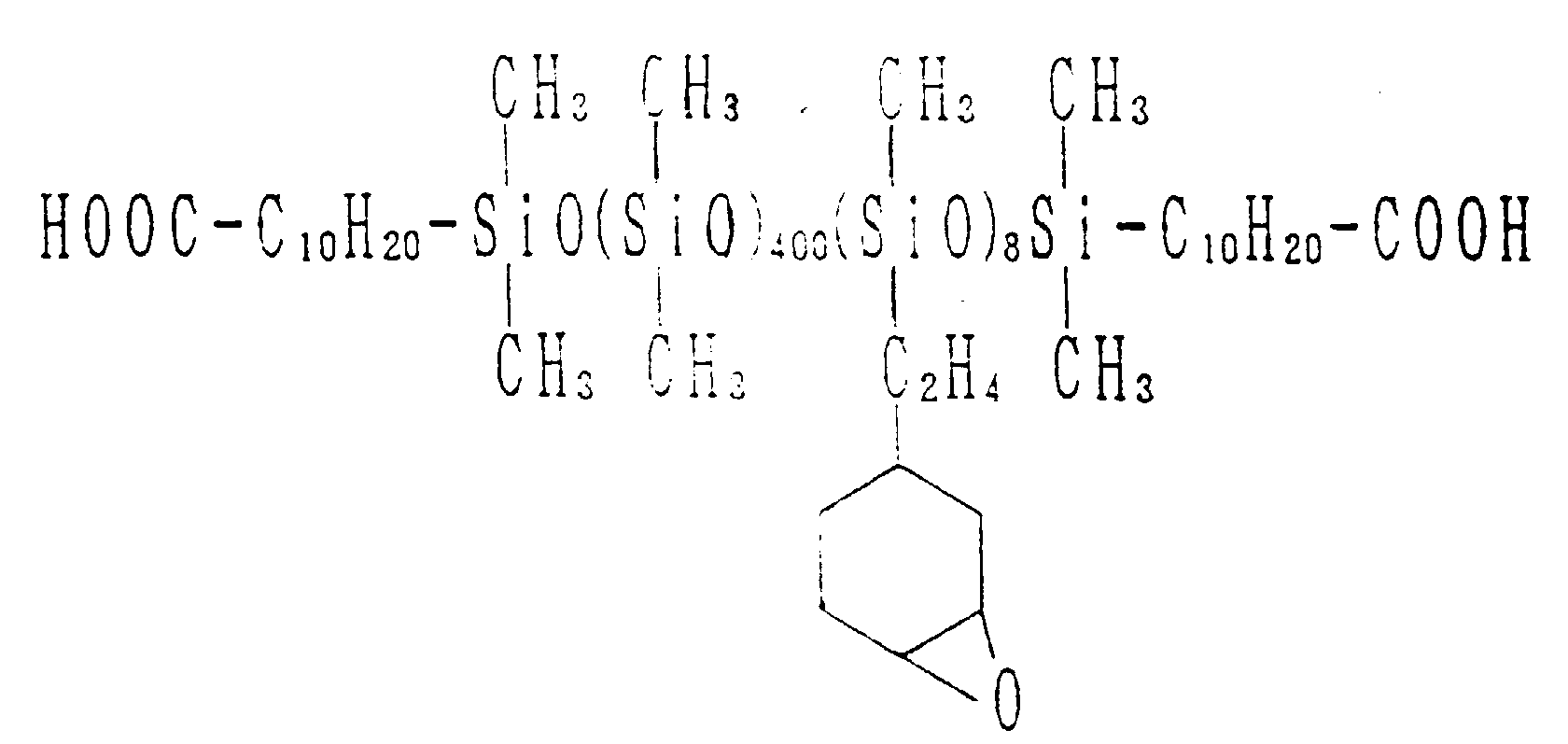


- The amount of component (B) that is added to component (A) is within the range of 5-50 parts by weight, and preferably is, 20-40 parts by weight, per 100 parts by weight of component (A). If less than 5 parts by weight of (B) are used, the composition fails to impart the fiber or textile with good hand. If more than 50 parts by weight of (B) are used, then there is a marked decrease in water and oil repellency, in particular, oil repellency.
- The composition of this invention is a composition made up of the above-mentioned components (A) and (B). However, antistatic agents, dye stabilizing agents, anticrease agents, antiseptics, antimildew agents, rust-preventing agents as well as organic solvents such as toluene, xylene, hexane, heptane, perchloroethylene, 1,1,1-trichloroethane and the like can be added and mixed therewith, as long as they do not defeat the desirable properties imparted by our composition to fibers and textiles.
- The composition of the present invention is manufactured by means of uniformly mixing components (A) and (B). When mixing is performed, the organopolysiloxanes of component (B) are first either diluted with toluene, xylene, hexane, heptane, perchloroethylene, 1,1,1-trichloroethane or other aromatic organic solvents, aliphatic organic solvent or chlorine organic solvent, or emulsified with water and nonionic surfactants, anionic surfactants, or both. Thereafter, component (A) is added thereto. Polyoxyalkylene alkyl ethers, polyoxyalkylene alkyl esters, polyoxyalkylene sorbitan alkyl esters, sorbitan alkyl esters, polyethylene glycols, polypropylene glycols and the like are examples of nonionic surfactants that can be used. Octylbenzenesulfonic acid and other alkylbenzenesulfonic acids, higher alcohol sulfuric acid esters, polyoxyalkylene alkyl ether sulfuric acid esters, alkylnaphthylsulfonic acid sodium salt, potassium salt, lithium salt or ammonium salt are examples of anionic surfactants. The amount in which the surfactants are compounded is within the range of 3-20 parts by weight, per 100 parts by weight of organopolysiloxanes of component (B), and is preferably, within the range of 6-10 parts by weight. Emulsification is conducted under ordinary methods by using a homomixer, line mixer, colloid mill, homogenizer, HobartTM mixer, comb mixer, vacuum emulsification devices and other kneading equipment.
- Generally speaking, the method of treating fibers and textiles by the composition of our claimed invention comprises soaking the fibers or textile in said composition; controlling the amount of composition adhered to the fibers or textile by squeezing, for instance by passing through a pair of rollers, and thereafter drying and subjecting the fibers or textile to heat treatment in a drier at a temperature of 120-150°C. The amount of composition which adheres depends on the type of fiber or textile. In general, however, it is preferable for the amount to be such that the total amount of component (A) and component (B), with respect to the fibers or textile, is within the range of 0.01-10.0 wt%. Fur, wool, silk, hemp, wood fiber, angora, mohair, asbestos, and other natural fibers; rayon, BembergTM, and other regenerated fibers; acetate and other semisynthetic fibers; polyester polyamide, polyacrylonitrile, polyvinyl chloride, vinyon, polyethylene, polypropylene, spandex and other synthetic fibers; glass fiber, carbon fiber, silicon carbide fibers and other inorganic fibers are all examples of fiber materials and woven or nonwoven textiles treatable herein.
- The composition of the present invention imparts superior water repellency, oil repellency and excellent hand to fibers and textiles treated therewith. Furthermore, our composition has a high affinity for fibers. For this reason, our invention has the advantage that it is superior in terms of resistance to laundering, and that the fibers after treatment maintain superior water repellency, oil repellency and excellent hand for long periods of time.
- Next, the present invention is explained in detail by referring to application examples. In these examples, "parts" means "parts by weight," and viscosity is a value obtained at a temperature of 25°C. In addition, the hand, oil repellency and water repellency of the fibers treated by using our fiber treatment composition were measured by the test methods described below.
- Hand was measured based on finger tactile sensation, and was evaluated in the following manner.
- A
- Extremely good
- B
- Good
- C
- Somewhat unsatisfactory
- D
- Bad
- Oil repellency tests were conducted by the procedure of AATCC Test Method 118-1983. Namely, designated standard reagents, shown in Table I, were added dropwise in the amount of 0.05 mL starting from the lower grades, and the wetting of the fiber surface was observed 30 seconds later (to see how the drops permeate the fiber). Then, the highest grade among the standard reagents that did not wet the surface of the fiber was used as the grade of oil repellency.
Table I Grade Standard Reagents 1 Liquid Parafin 2 A mixture of liquid paraffin and n-hexadecane [liquid paraffin:n-hexadecane = 63:35 (volumetric ratio)] 3 n-Hexadecane 4 n-Tetradecane 5 n-Dodecane 6 n-Decane 7 n-Octane 8 n-Heptane - Water repellency tests were conducted based on the method conforming to JIS L 1092 (spraying method), and measured by the standards shown in Table II.
Table II Water Repellency Grades State 100 No wetting of surface was noticed 90 Slight wetting of surface was noticed 80 Water-drop wetting of the surface 70 Considerable portion of the surface was wet 50 The entire surface was wet 0 Both the front and reverse faces were completely wet - 75 parts of reactive monomer, having perfluoroalkyl groups represented by the formula CH2=CHC8F17, and 25 parts of ethyl acrylate were dissolved in 400 parts of a methyl ethyl ketone/toluene mixed solvent (weight ratio 1:1). The solution was heated to 75°C, and 0.4 part of azobisisobutyronitrile was added thereto, whereupon the solution was kept at a temperature of 75°C for 2 h and solution polymerization was conducted. The resulting solution of copolymer had a concentration of 20%.
- One part of each of the four kinds of diorganopolysiloxanes (a)-(d) was added to 15 parts of this copolymer solution, and the mixture was dissolved in 984 parts of toluene. Thus, four kinds of fiber and textile treatment compositions were prepared. Three 25 cm x 25 cm pieces of 100% cotton fabric were coated with these compositions (manufactured by Test Fabrics Inc., USA, Inter Lock Knit™). Next, these pieces of fabric were squeezed using squeezing rollers, to a squeezing ratio of 100% after which they were kept overnight at a temperature of 25°C. A squeezing ratio is defined as the weight of the textile treatment composition adhering to the fabric, divided by the weight of the fabric, expressed as a percent. Accordingly, at a squeezing ratio of 100%, the weight of the textile treatment composition adhering to the fabric is equal to the weight of the fabric. The following day, they were heat treated for 3 minutes in a hot air drier at a temperature of 150°C. The hand, oil repellency and water repellency of the fabric obtained were measured, and the results are listed in Table III. It is evident from these results that the fabric treated with our fiber treatment compositions had superior water repellency, oil repellency and hand. Thus, the claimed compositions are useful as fiber and textile treatment agents.
- In addition, the chemical structures of the four kinds of diorganopolysiloxanes (a)-(d) were used as follows.
-

-

-

-
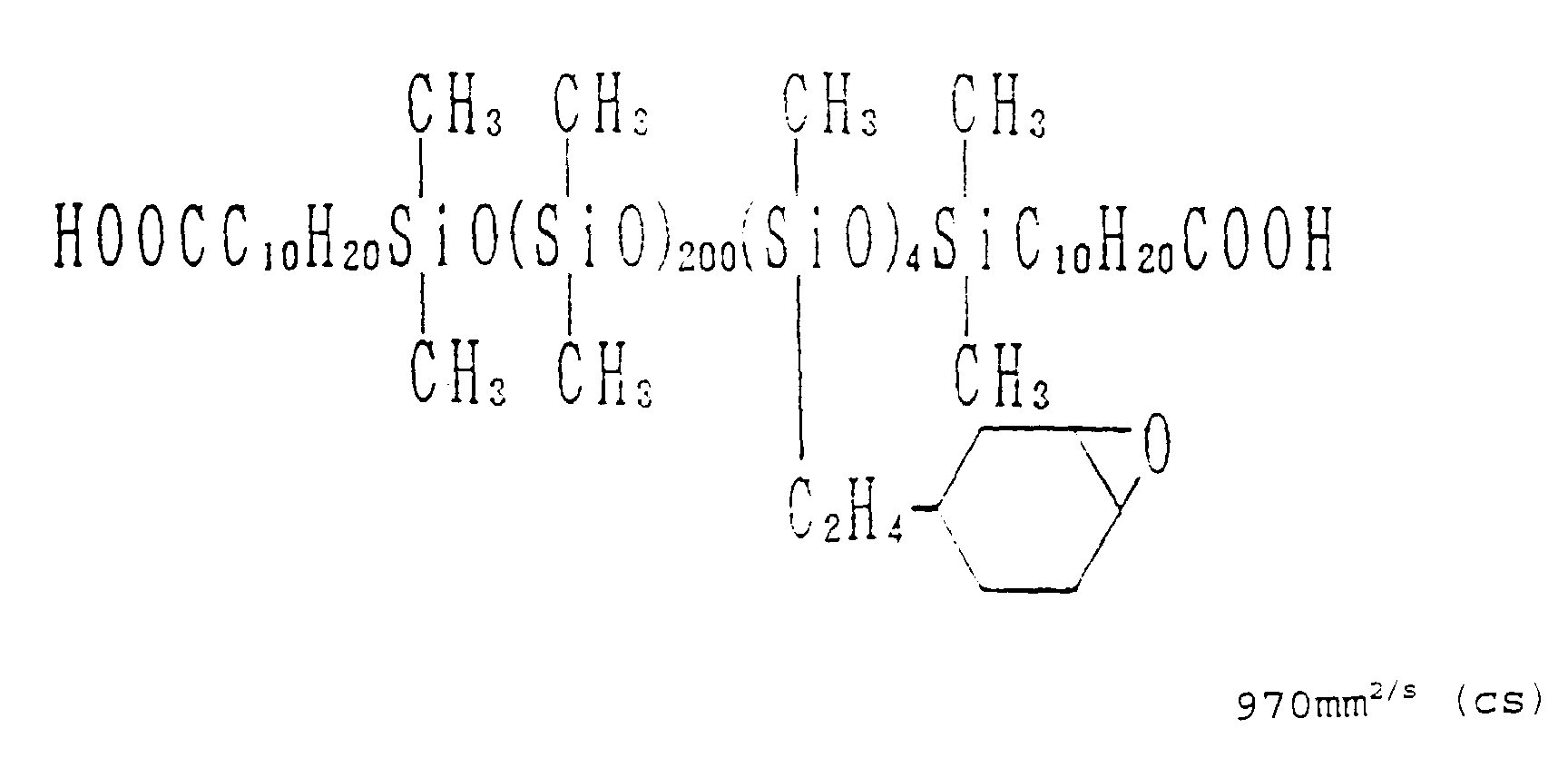
- Fiber treatment agent compositions were prepared in the same manner as in Application Example 1 with the exception of using diorganopolysiloxanes (e)-(h), represented by the formulas below, instead of using the diorganopolysiloxanes (a)-(d). 100% cotton fabric, as above, was treated with these compositions. The hand, oil repellency and water repellency of the fabric after treatment were measured, and the results are listed in Table III.
- The chemical structures of the diorganopolysiloxanes (e)-(h) were as follows:
-

-

-

-

- Textile and fiber treatment compositions were prepared in the same manner as in Application Example 1, except that no diorganopolysiloxane (B) was included in the formulations. 100% cotton fabric, as above, was treated with these compositions. The hand, oil repellency and water repellency of the fabric after treatment were measured in the manner previously described, and the results are listed in Table III.
Table III Hand Oil Repellency Water Repellency Overall Evaluation Application Example 1: diorganopolysiloxanes (a) A 4 90 Extremely Good (b) A 4 90 Extremely Good (c) A 4 90 Extremely Good (d) A-B 4 90 Extremely Good Comparative Example 1: diorganopolysiloxanes (e) C-B 4 90 Somewhat Insufficient (f) C 3 90 Insufficient (g) C 3 80 Insufficient (h) D-C 2 80 No good Comparative Example 2: diorganopolysiloxane not added D 4 90 No good No treatment D 0 0 ---- - 80 parts of reactive monomer having perfluoroalkyl groups, represented by the formula CF3(CF2)9CH2CH2OCH=CH2, 15 parts of ethyl acrylate and 5 parts of diacetone acrylamide were emulsified in an emulsifier by adding 10 parts of nonionic surfactant, represented by the formula C12H25O(C2H4O)21H, and 390 parts of water. The solution was heated to 62°C and 1 part of ammonium persulfate was added thereto, whereupon the solution was kept at a temperature of 62°C for 2 h and emulsion polymerization conducted. A solution was thus prepared, wherein the concentration of the polymer obtained by the copolymerization of the monomers was 20%.
- 400 parts of each of the four kinds of diorganopolysiloxanes (a)-(d) of Application Example 1 were added to 35 parts of a 1:1:1 (weight ratio) mixture of three types of nonionic surfactants represented by the formulas C13H27(-CH2CH2O)5H, C13H27(CH2CH2O)12H, and C13H27(CH2CH2O)21H, and 565 parts of water, and emulsification was conducted by using a comb mixer (rotation speed 2000 rpm), obtaining an emulsion with a 40% concentration.
- Fiber and textile treatment compositions were prepared by diluting 30 parts of these copolymer emulsions and 5 parts of organopolysiloxane emulsions with 1965 parts of water. 100% cotton fabric pieces were soaked in the fiber treatment agent compositions obtained. Next, these pieces of fabric were after which they were kept overnight at a temperature of 25°C. The following day, they were heat treated for 3 minutes in a hot air drier at a temperature of 150°C. The hand, oil repellency and water repellency of the fabric obtained were measured, and the results are listed in Table IV. It is evident from these results that the compositions of the present invention, in the emulsified state, will impart superior water repellency, oil repellency and good hand to fiber and textiles treated therewith.
- Component (A) was first prepared in the manner of Application Example 2. Next, the diorganopolysiloxanes (e)-(h) used in Comparative Example 1 were added in the same manner as the diorganopolysiloxanes of Application Example 2. 100% cotton fabric, as above, was treated with these compositions. The hand, oil repellency and water repellency of the fabric after treatment were measured and the results are listed in Table IV.
Table IV Hand Oil Repellency Water Repellency Overall Evaluation Application Example 2: diorganopolysiloxanes (a) A 4 90-80 Extremely Good (b) A 4 90-80 Extremely Good (c) A 4 90-80 Extremely Good (d) A-B 4 80-90 Extremely Good Comparative Example 3: diorganopolysiloxanes (e) C-B 4 80 Somewhat Insufficient (f) C-D 3 70-80 Insufficient (g) C 3 70-80 Insufficient (h) D 2 70 No good
Claims (4)
- A fiber and textile treatment composition comprising:(A) 100 parts by weight of vinyl polymer having perfluoroalkyl radicals with a carbon number of 5 or greater, and(B) 5-50 parts by weight of organopolysiloxanes that have one or more epoxy-containing organic radicals, and one or more carboxyl groups represented by the formula:
-COOR6
wherein R6 is a monovalent radical selected from the group consisting of hydrogen atoms, hydrocarbon radicals, and silyl radicals represented by the formula:
-SiR3
wherein each R is a radical independently selected from monovalent hydrocarbon radicals having 1-10 carbon atoms or radicals represented by the formula:
-R3-SiR3-a(OR4)a
wherein R is as above, R3 is selected from divalent hydrocarbon radicals or sulfur-containing divalent hydrocarbon radicals, R4 is selected from hydrogen atoms or monovalent hydrocarbon radicals, and a is an integer from 1 to 3. - The composition of Claim 1 further comprising said composition in an aqueous emulsion form.
- The composition of Claim 1 or Claim 2 further comprising an organic solvent.
- A method of treating a fiber or textile, comprising the steps of:(I) immersing and soaking the fiber or textile in a composition according to any of Claims 1 to 3;(II) squeezing said soaked fiber or textile until a squeezing ratio of 100% is obtained;(III) drying the squeezed fiber or textile; and(IV) heating the dried and squeezed fiber or textile to a temperature of 150°C.
Applications Claiming Priority (2)
| Application Number | Priority Date | Filing Date | Title |
|---|---|---|---|
| JP334050/95 | 1995-11-28 | ||
| JP7334050A JPH09143877A (en) | 1995-11-28 | 1995-11-28 | Fiber treatment composition |
Publications (2)
| Publication Number | Publication Date |
|---|---|
| EP0777009A2 true EP0777009A2 (en) | 1997-06-04 |
| EP0777009A3 EP0777009A3 (en) | 1997-12-03 |
Family
ID=18272958
Family Applications (1)
| Application Number | Title | Priority Date | Filing Date |
|---|---|---|---|
| EP96308474A Withdrawn EP0777009A3 (en) | 1995-11-28 | 1996-11-22 | Compositions for treating fibers and textiles |
Country Status (2)
| Country | Link |
|---|---|
| EP (1) | EP0777009A3 (en) |
| JP (1) | JPH09143877A (en) |
Cited By (6)
| Publication number | Priority date | Publication date | Assignee | Title |
|---|---|---|---|---|
| RU2394956C1 (en) * | 2008-12-09 | 2010-07-20 | Учреждение Российской академии наук Институт синтетических полимерных материалов им. Н.С. Ениколопова РАН (ИСПМ РАН) | Method for production of protective hydrophobic and oleophobic coating on textile material |
| US7973107B2 (en) | 2005-05-09 | 2011-07-05 | Daikin Industries, Ltd. | Fluorosilicones and fluorine- and silicon-containing surface treatment agent |
| US8552106B2 (en) | 2008-03-31 | 2013-10-08 | Daikin Industries, Ltd. | Dispersion of fluorosilicones and fluorine- and silicon-containing surface treatment agent |
| US8927667B2 (en) | 2008-02-06 | 2015-01-06 | Daikin Industries, Ltd. | Fluorosilicones and fluorine- and silicon-containing surface treatment agent |
| US9988759B2 (en) | 2008-09-15 | 2018-06-05 | Dow Silicones Corporation | Fluorosilicone polymers and surface treatment agent |
| US12297589B2 (en) | 2019-01-30 | 2025-05-13 | Daikin Industries, Ltd. | Water-repellent softening agent |
Families Citing this family (4)
| Publication number | Priority date | Publication date | Assignee | Title |
|---|---|---|---|---|
| US7335234B2 (en) * | 2002-10-16 | 2008-02-26 | Columbia Insurance Company | Method of treating fibers, carpet yarns and carpets to enhance repellency |
| JP2014009408A (en) * | 2012-06-28 | 2014-01-20 | Mizuno Corp | Hydrophobized hygroscopically exothermic fiber, and fiber structure using the same |
| JP7247897B2 (en) * | 2018-01-15 | 2023-03-29 | Agc株式会社 | FLUOROUS COPOLYMER DISPERSION, PRODUCTION METHOD AND ARTICLE THEREOF |
| CN115667454B (en) * | 2020-05-20 | 2024-03-08 | Agc株式会社 | Water- and oil-resistant agent composition, manufacturing method, articles and water- and oil-resistant paper |
Citations (3)
| Publication number | Priority date | Publication date | Assignee | Title |
|---|---|---|---|---|
| JPS581232B2 (en) | 1980-02-29 | 1983-01-10 | 大日本インキ化学工業株式会社 | Water- and oil-repellent processing method for textile fabric with improved color fastness to rubbing |
| JPS5947071B2 (en) | 1980-07-01 | 1984-11-16 | グンゼ株式会社 | Breathable and waterproof processing method for knitted fabrics, woven fabrics, etc. with excellent wash resistance |
| JPS6075678A (en) | 1983-09-30 | 1985-04-30 | 旭硝子株式会社 | Water and oil repellent process of fabric |
Family Cites Families (5)
| Publication number | Priority date | Publication date | Assignee | Title |
|---|---|---|---|---|
| JPS57154466A (en) * | 1981-03-11 | 1982-09-24 | Toray Industries | Durale water repellent process |
| JPS57205588A (en) * | 1981-06-05 | 1982-12-16 | Toray Industries | Fiber structure having color forming durability |
| DE3431075A1 (en) * | 1984-08-23 | 1986-02-27 | Wacker-Chemie GmbH, 8000 München | ORGANOPOLYSILOXANES WITH SI-TIED HYDROGEN AND SIC-TIED EPOXY GROUPS, METHOD FOR THE PRODUCTION THEREOF AND THE USE OF THESE ORGANOPOLYSILOXANS |
| JPS6170080A (en) * | 1984-09-14 | 1986-04-10 | 東レ株式会社 | Production of durable water repellent cloth |
| US5409620A (en) * | 1993-12-30 | 1995-04-25 | Dow Corning Corporation | Fiber treatment compositions containing organofunctional siloxanes and methods for the preparation thereof |
-
1995
- 1995-11-28 JP JP7334050A patent/JPH09143877A/en active Pending
-
1996
- 1996-11-22 EP EP96308474A patent/EP0777009A3/en not_active Withdrawn
Patent Citations (3)
| Publication number | Priority date | Publication date | Assignee | Title |
|---|---|---|---|---|
| JPS581232B2 (en) | 1980-02-29 | 1983-01-10 | 大日本インキ化学工業株式会社 | Water- and oil-repellent processing method for textile fabric with improved color fastness to rubbing |
| JPS5947071B2 (en) | 1980-07-01 | 1984-11-16 | グンゼ株式会社 | Breathable and waterproof processing method for knitted fabrics, woven fabrics, etc. with excellent wash resistance |
| JPS6075678A (en) | 1983-09-30 | 1985-04-30 | 旭硝子株式会社 | Water and oil repellent process of fabric |
Cited By (7)
| Publication number | Priority date | Publication date | Assignee | Title |
|---|---|---|---|---|
| US7973107B2 (en) | 2005-05-09 | 2011-07-05 | Daikin Industries, Ltd. | Fluorosilicones and fluorine- and silicon-containing surface treatment agent |
| US8461254B2 (en) | 2005-05-09 | 2013-06-11 | Dow Corning Corporation | Fluorosilicones and fluorine- and silicon-containing surface treatment agent |
| US8927667B2 (en) | 2008-02-06 | 2015-01-06 | Daikin Industries, Ltd. | Fluorosilicones and fluorine- and silicon-containing surface treatment agent |
| US8552106B2 (en) | 2008-03-31 | 2013-10-08 | Daikin Industries, Ltd. | Dispersion of fluorosilicones and fluorine- and silicon-containing surface treatment agent |
| US9988759B2 (en) | 2008-09-15 | 2018-06-05 | Dow Silicones Corporation | Fluorosilicone polymers and surface treatment agent |
| RU2394956C1 (en) * | 2008-12-09 | 2010-07-20 | Учреждение Российской академии наук Институт синтетических полимерных материалов им. Н.С. Ениколопова РАН (ИСПМ РАН) | Method for production of protective hydrophobic and oleophobic coating on textile material |
| US12297589B2 (en) | 2019-01-30 | 2025-05-13 | Daikin Industries, Ltd. | Water-repellent softening agent |
Also Published As
| Publication number | Publication date |
|---|---|
| JPH09143877A (en) | 1997-06-03 |
| EP0777009A3 (en) | 1997-12-03 |
Similar Documents
| Publication | Publication Date | Title |
|---|---|---|
| EP2240525B1 (en) | Fluorosilicones and fluorine- and silicon-containing surface treatment agent | |
| KR100952519B1 (en) | Fluorosilicone and fluorine- and silicon-containing surface treatment agents | |
| TWI516509B (en) | Fluorosilicone polymers and surface treatment agent | |
| US6126849A (en) | Aqueous dispersion-type fluorinated water- and oil-repellent | |
| US3854871A (en) | Textile cleaning process for simultaneous dry cleaning and finishing with stain repellent | |
| JP5680529B2 (en) | Fluorosilicone and surface treatment agent | |
| KR102170599B1 (en) | Surface treatment agent | |
| TWI422634B (en) | Aqueous polymer dispersion composition and surface treatment agent | |
| EP0609456B1 (en) | Soil remover for dry cleaning | |
| EP1013736A2 (en) | Water repellent for treating solids | |
| CN101171274A (en) | Fluorosilicone and fluorine-and silicon-containing surface treatment agent | |
| JP3744035B2 (en) | Water-dispersed water / oil repellent composition with excellent stability | |
| EP1735359B1 (en) | Polymeric reaction products from substituted aminosiloxanes | |
| KR100689941B1 (en) | Water / Oil Repellent Aqueous Dispersion Composition | |
| JPH09143877A (en) | Fiber treatment composition | |
| CA1097834A (en) | Resin finishing compositions | |
| JPS581232B2 (en) | Water- and oil-repellent processing method for textile fabric with improved color fastness to rubbing | |
| JP3855499B2 (en) | Water / oil repellent, water / oil repellent composition, treatment method, and article to be treated | |
| JPS597827B2 (en) | Hydrophilic treatment agent | |
| JPS61215683A (en) | Solid material treating agent | |
| MX2007014071A (en) | Fluorosilicones and fluorine- and silicon-containing surface treatment agent. | |
| JPS61236883A (en) | Agent for treating solid material | |
| JPWO1994001510A1 (en) | Dry cleaning stain release agent | |
| JPH0633376A (en) | Method for treating fiber cloth | |
| JPH07216346A (en) | New water and oil repellent |
Legal Events
| Date | Code | Title | Description |
|---|---|---|---|
| PUAI | Public reference made under article 153(3) epc to a published international application that has entered the european phase |
Free format text: ORIGINAL CODE: 0009012 |
|
| AK | Designated contracting states |
Kind code of ref document: A2 Designated state(s): DE FR GB |
|
| PUAL | Search report despatched |
Free format text: ORIGINAL CODE: 0009013 |
|
| AK | Designated contracting states |
Kind code of ref document: A3 Designated state(s): DE FR GB |
|
| 17P | Request for examination filed |
Effective date: 19980121 |
|
| 17Q | First examination report despatched |
Effective date: 20010227 |
|
| STAA | Information on the status of an ep patent application or granted ep patent |
Free format text: STATUS: THE APPLICATION IS DEEMED TO BE WITHDRAWN |
|
| 18D | Application deemed to be withdrawn |
Effective date: 20010710 |