EP0779094A2 - Spinellkatalysator und Verfahren zu dessen Herstellung und Verwendung desselben - Google Patents
Spinellkatalysator und Verfahren zu dessen Herstellung und Verwendung desselben Download PDFInfo
- Publication number
- EP0779094A2 EP0779094A2 EP96117578A EP96117578A EP0779094A2 EP 0779094 A2 EP0779094 A2 EP 0779094A2 EP 96117578 A EP96117578 A EP 96117578A EP 96117578 A EP96117578 A EP 96117578A EP 0779094 A2 EP0779094 A2 EP 0779094A2
- Authority
- EP
- European Patent Office
- Prior art keywords
- catalyst
- spinel
- oxide
- internal combustion
- nox
- Prior art date
- Legal status (The legal status is an assumption and is not a legal conclusion. Google has not performed a legal analysis and makes no representation as to the accuracy of the status listed.)
- Withdrawn
Links
- 239000003054 catalyst Substances 0.000 title claims abstract description 32
- 229910052596 spinel Inorganic materials 0.000 title claims abstract description 23
- 239000011029 spinel Substances 0.000 title claims abstract description 23
- MWUXSHHQAYIFBG-UHFFFAOYSA-N Nitric oxide Chemical compound O=[N] MWUXSHHQAYIFBG-UHFFFAOYSA-N 0.000 claims abstract description 42
- 239000007789 gas Substances 0.000 claims abstract description 16
- 238000002485 combustion reaction Methods 0.000 claims abstract description 12
- GSUYHMMTHJCXEE-UHFFFAOYSA-N [O-2].[Al+3].[Cu]=O.[O-2].[Mg+2] Chemical compound [O-2].[Al+3].[Cu]=O.[O-2].[Mg+2] GSUYHMMTHJCXEE-UHFFFAOYSA-N 0.000 claims abstract 4
- 239000010949 copper Substances 0.000 claims description 12
- 239000011777 magnesium Substances 0.000 claims description 6
- 230000003197 catalytic effect Effects 0.000 claims description 5
- 239000000126 substance Substances 0.000 claims description 5
- KDLHZDBZIXYQEI-UHFFFAOYSA-N Palladium Chemical compound [Pd] KDLHZDBZIXYQEI-UHFFFAOYSA-N 0.000 claims description 4
- BASFCYQUMIYNBI-UHFFFAOYSA-N platinum Chemical compound [Pt] BASFCYQUMIYNBI-UHFFFAOYSA-N 0.000 claims description 4
- -1 rutenium Chemical compound 0.000 claims description 3
- 150000003839 salts Chemical class 0.000 claims description 3
- 229910052684 Cerium Inorganic materials 0.000 claims description 2
- ZOKXTWBITQBERF-UHFFFAOYSA-N Molybdenum Chemical compound [Mo] ZOKXTWBITQBERF-UHFFFAOYSA-N 0.000 claims description 2
- RTAQQCXQSZGOHL-UHFFFAOYSA-N Titanium Chemical compound [Ti] RTAQQCXQSZGOHL-UHFFFAOYSA-N 0.000 claims description 2
- PURJYVIHCDBIRA-UHFFFAOYSA-N [Cu]=O.[O-2].[Al+3].[O-2].[O-2].[Al+3] Chemical compound [Cu]=O.[O-2].[Al+3].[O-2].[O-2].[Al+3] PURJYVIHCDBIRA-UHFFFAOYSA-N 0.000 claims description 2
- 229910052741 iridium Inorganic materials 0.000 claims description 2
- GKOZUEZYRPOHIO-UHFFFAOYSA-N iridium atom Chemical compound [Ir] GKOZUEZYRPOHIO-UHFFFAOYSA-N 0.000 claims description 2
- 229910052750 molybdenum Inorganic materials 0.000 claims description 2
- 239000011733 molybdenum Substances 0.000 claims description 2
- 229910052758 niobium Inorganic materials 0.000 claims description 2
- 239000010955 niobium Substances 0.000 claims description 2
- GUCVJGMIXFAOAE-UHFFFAOYSA-N niobium atom Chemical compound [Nb] GUCVJGMIXFAOAE-UHFFFAOYSA-N 0.000 claims description 2
- 229910052762 osmium Inorganic materials 0.000 claims description 2
- SYQBFIAQOQZEGI-UHFFFAOYSA-N osmium atom Chemical compound [Os] SYQBFIAQOQZEGI-UHFFFAOYSA-N 0.000 claims description 2
- 229910052763 palladium Inorganic materials 0.000 claims description 2
- 229910052697 platinum Inorganic materials 0.000 claims description 2
- 229910052702 rhenium Inorganic materials 0.000 claims description 2
- WUAPFZMCVAUBPE-UHFFFAOYSA-N rhenium atom Chemical compound [Re] WUAPFZMCVAUBPE-UHFFFAOYSA-N 0.000 claims description 2
- 229910052703 rhodium Inorganic materials 0.000 claims description 2
- 239000010948 rhodium Substances 0.000 claims description 2
- MHOVAHRLVXNVSD-UHFFFAOYSA-N rhodium atom Chemical compound [Rh] MHOVAHRLVXNVSD-UHFFFAOYSA-N 0.000 claims description 2
- 239000010936 titanium Substances 0.000 claims description 2
- 229910052719 titanium Inorganic materials 0.000 claims description 2
- WFKWXMTUELFFGS-UHFFFAOYSA-N tungsten Chemical compound [W] WFKWXMTUELFFGS-UHFFFAOYSA-N 0.000 claims description 2
- 229910052721 tungsten Inorganic materials 0.000 claims description 2
- 239000010937 tungsten Substances 0.000 claims description 2
- 229910052720 vanadium Inorganic materials 0.000 claims description 2
- 238000010531 catalytic reduction reaction Methods 0.000 claims 2
- GWXLDORMOJMVQZ-UHFFFAOYSA-N cerium Chemical compound [Ce] GWXLDORMOJMVQZ-UHFFFAOYSA-N 0.000 claims 1
- LEONUFNNVUYDNQ-UHFFFAOYSA-N vanadium atom Chemical compound [V] LEONUFNNVUYDNQ-UHFFFAOYSA-N 0.000 claims 1
- UGFAIRIUMAVXCW-UHFFFAOYSA-N Carbon monoxide Chemical compound [O+]#[C-] UGFAIRIUMAVXCW-UHFFFAOYSA-N 0.000 description 15
- 229910002091 carbon monoxide Inorganic materials 0.000 description 15
- 238000007254 oxidation reaction Methods 0.000 description 9
- 239000000203 mixture Substances 0.000 description 7
- 230000003647 oxidation Effects 0.000 description 7
- CURLTUGMZLYLDI-UHFFFAOYSA-N Carbon dioxide Chemical compound O=C=O CURLTUGMZLYLDI-UHFFFAOYSA-N 0.000 description 6
- 229930195733 hydrocarbon Natural products 0.000 description 6
- 150000002430 hydrocarbons Chemical class 0.000 description 6
- 238000000034 method Methods 0.000 description 6
- 229910052760 oxygen Inorganic materials 0.000 description 6
- 239000002245 particle Substances 0.000 description 5
- XKRFYHLGVUSROY-UHFFFAOYSA-N Argon Chemical compound [Ar] XKRFYHLGVUSROY-UHFFFAOYSA-N 0.000 description 4
- RYGMFSIKBFXOCR-UHFFFAOYSA-N Copper Chemical compound [Cu] RYGMFSIKBFXOCR-UHFFFAOYSA-N 0.000 description 4
- QQONPFPTGQHPMA-UHFFFAOYSA-N Propene Chemical compound CC=C QQONPFPTGQHPMA-UHFFFAOYSA-N 0.000 description 4
- 238000004140 cleaning Methods 0.000 description 4
- 229910052802 copper Inorganic materials 0.000 description 4
- 238000010586 diagram Methods 0.000 description 4
- 238000011835 investigation Methods 0.000 description 4
- 239000001301 oxygen Substances 0.000 description 4
- 239000010453 quartz Substances 0.000 description 4
- VYPSYNLAJGMNEJ-UHFFFAOYSA-N silicon dioxide Inorganic materials O=[Si]=O VYPSYNLAJGMNEJ-UHFFFAOYSA-N 0.000 description 4
- 229910052782 aluminium Inorganic materials 0.000 description 3
- XAGFODPZIPBFFR-UHFFFAOYSA-N aluminium Chemical compound [Al] XAGFODPZIPBFFR-UHFFFAOYSA-N 0.000 description 3
- QVGXLLKOCUKJST-UHFFFAOYSA-N atomic oxygen Chemical compound [O] QVGXLLKOCUKJST-UHFFFAOYSA-N 0.000 description 3
- 229910002092 carbon dioxide Inorganic materials 0.000 description 3
- 239000001569 carbon dioxide Substances 0.000 description 3
- 229910052566 spinel group Inorganic materials 0.000 description 3
- 229910018072 Al 2 O 3 Inorganic materials 0.000 description 2
- 229910052786 argon Inorganic materials 0.000 description 2
- 239000012159 carrier gas Substances 0.000 description 2
- 238000001514 detection method Methods 0.000 description 2
- 230000000694 effects Effects 0.000 description 2
- 239000011159 matrix material Substances 0.000 description 2
- 239000004215 Carbon black (E152) Substances 0.000 description 1
- 229910018565 CuAl Inorganic materials 0.000 description 1
- FYYHWMGAXLPEAU-UHFFFAOYSA-N Magnesium Chemical compound [Mg] FYYHWMGAXLPEAU-UHFFFAOYSA-N 0.000 description 1
- ATJFFYVFTNAWJD-UHFFFAOYSA-N Tin Chemical compound [Sn] ATJFFYVFTNAWJD-UHFFFAOYSA-N 0.000 description 1
- 238000002083 X-ray spectrum Methods 0.000 description 1
- 238000001354 calcination Methods 0.000 description 1
- 230000015556 catabolic process Effects 0.000 description 1
- ZMIGMASIKSOYAM-UHFFFAOYSA-N cerium Chemical compound [Ce][Ce][Ce][Ce][Ce][Ce][Ce][Ce][Ce][Ce][Ce][Ce][Ce][Ce][Ce][Ce][Ce][Ce][Ce][Ce][Ce][Ce][Ce][Ce][Ce][Ce][Ce][Ce][Ce][Ce][Ce][Ce][Ce][Ce][Ce][Ce][Ce][Ce] ZMIGMASIKSOYAM-UHFFFAOYSA-N 0.000 description 1
- 239000003638 chemical reducing agent Substances 0.000 description 1
- 150000001875 compounds Chemical class 0.000 description 1
- 239000000470 constituent Substances 0.000 description 1
- 230000003247 decreasing effect Effects 0.000 description 1
- 230000007613 environmental effect Effects 0.000 description 1
- 230000002349 favourable effect Effects 0.000 description 1
- 229910052749 magnesium Inorganic materials 0.000 description 1
- 238000004519 manufacturing process Methods 0.000 description 1
- 239000000463 material Substances 0.000 description 1
- 238000005259 measurement Methods 0.000 description 1
- 229910052751 metal Inorganic materials 0.000 description 1
- 239000002184 metal Substances 0.000 description 1
- 229910044991 metal oxide Inorganic materials 0.000 description 1
- 150000004706 metal oxides Chemical class 0.000 description 1
- 150000002739 metals Chemical class 0.000 description 1
- 230000000737 periodic effect Effects 0.000 description 1
- 238000003825 pressing Methods 0.000 description 1
- 230000001603 reducing effect Effects 0.000 description 1
- JBQYATWDVHIOAR-UHFFFAOYSA-N tellanylidenegermanium Chemical compound [Te]=[Ge] JBQYATWDVHIOAR-UHFFFAOYSA-N 0.000 description 1
- GPPXJZIENCGNKB-UHFFFAOYSA-N vanadium Chemical compound [V]#[V] GPPXJZIENCGNKB-UHFFFAOYSA-N 0.000 description 1
- 229910001868 water Inorganic materials 0.000 description 1
- 239000011701 zinc Substances 0.000 description 1
Images
Classifications
-
- B—PERFORMING OPERATIONS; TRANSPORTING
- B01—PHYSICAL OR CHEMICAL PROCESSES OR APPARATUS IN GENERAL
- B01D—SEPARATION
- B01D53/00—Separation of gases or vapours; Recovering vapours of volatile solvents from gases; Chemical or biological purification of waste gases, e.g. engine exhaust gases, smoke, fumes, flue gases, aerosols
- B01D53/34—Chemical or biological purification of waste gases
- B01D53/74—General processes for purification of waste gases; Apparatus or devices specially adapted therefor
- B01D53/86—Catalytic processes
- B01D53/8621—Removing nitrogen compounds
- B01D53/8625—Nitrogen oxides
- B01D53/8628—Processes characterised by a specific catalyst
-
- B—PERFORMING OPERATIONS; TRANSPORTING
- B01—PHYSICAL OR CHEMICAL PROCESSES OR APPARATUS IN GENERAL
- B01D—SEPARATION
- B01D53/00—Separation of gases or vapours; Recovering vapours of volatile solvents from gases; Chemical or biological purification of waste gases, e.g. engine exhaust gases, smoke, fumes, flue gases, aerosols
- B01D53/34—Chemical or biological purification of waste gases
- B01D53/92—Chemical or biological purification of waste gases of engine exhaust gases
- B01D53/94—Chemical or biological purification of waste gases of engine exhaust gases by catalytic processes
- B01D53/9404—Removing only nitrogen compounds
- B01D53/9409—Nitrogen oxides
- B01D53/9413—Processes characterised by a specific catalyst
- B01D53/9418—Processes characterised by a specific catalyst for removing nitrogen oxides by selective catalytic reduction [SCR] using a reducing agent in a lean exhaust gas
-
- B—PERFORMING OPERATIONS; TRANSPORTING
- B01—PHYSICAL OR CHEMICAL PROCESSES OR APPARATUS IN GENERAL
- B01J—CHEMICAL OR PHYSICAL PROCESSES, e.g. CATALYSIS OR COLLOID CHEMISTRY; THEIR RELEVANT APPARATUS
- B01J23/00—Catalysts comprising metals or metal oxides or hydroxides, not provided for in group B01J21/00
- B01J23/005—Spinels
-
- B—PERFORMING OPERATIONS; TRANSPORTING
- B01—PHYSICAL OR CHEMICAL PROCESSES OR APPARATUS IN GENERAL
- B01J—CHEMICAL OR PHYSICAL PROCESSES, e.g. CATALYSIS OR COLLOID CHEMISTRY; THEIR RELEVANT APPARATUS
- B01J23/00—Catalysts comprising metals or metal oxides or hydroxides, not provided for in group B01J21/00
- B01J23/70—Catalysts comprising metals or metal oxides or hydroxides, not provided for in group B01J21/00 of the iron group metals or copper
- B01J23/72—Copper
-
- B—PERFORMING OPERATIONS; TRANSPORTING
- B01—PHYSICAL OR CHEMICAL PROCESSES OR APPARATUS IN GENERAL
- B01D—SEPARATION
- B01D2251/00—Reactants
- B01D2251/20—Reductants
- B01D2251/208—Hydrocarbons
-
- B—PERFORMING OPERATIONS; TRANSPORTING
- B01—PHYSICAL OR CHEMICAL PROCESSES OR APPARATUS IN GENERAL
- B01D—SEPARATION
- B01D2255/00—Catalysts
- B01D2255/10—Noble metals or compounds thereof
- B01D2255/102—Platinum group metals
-
- B—PERFORMING OPERATIONS; TRANSPORTING
- B01—PHYSICAL OR CHEMICAL PROCESSES OR APPARATUS IN GENERAL
- B01D—SEPARATION
- B01D2255/00—Catalysts
- B01D2255/20—Metals or compounds thereof
- B01D2255/204—Alkaline earth metals
- B01D2255/2047—Magnesium
-
- B—PERFORMING OPERATIONS; TRANSPORTING
- B01—PHYSICAL OR CHEMICAL PROCESSES OR APPARATUS IN GENERAL
- B01D—SEPARATION
- B01D2255/00—Catalysts
- B01D2255/20—Metals or compounds thereof
- B01D2255/206—Rare earth metals
-
- B—PERFORMING OPERATIONS; TRANSPORTING
- B01—PHYSICAL OR CHEMICAL PROCESSES OR APPARATUS IN GENERAL
- B01D—SEPARATION
- B01D2255/00—Catalysts
- B01D2255/20—Metals or compounds thereof
- B01D2255/207—Transition metals
- B01D2255/20761—Copper
-
- B—PERFORMING OPERATIONS; TRANSPORTING
- B01—PHYSICAL OR CHEMICAL PROCESSES OR APPARATUS IN GENERAL
- B01D—SEPARATION
- B01D2255/00—Catalysts
- B01D2255/40—Mixed oxides
-
- Y—GENERAL TAGGING OF NEW TECHNOLOGICAL DEVELOPMENTS; GENERAL TAGGING OF CROSS-SECTIONAL TECHNOLOGIES SPANNING OVER SEVERAL SECTIONS OF THE IPC; TECHNICAL SUBJECTS COVERED BY FORMER USPC CROSS-REFERENCE ART COLLECTIONS [XRACs] AND DIGESTS
- Y02—TECHNOLOGIES OR APPLICATIONS FOR MITIGATION OR ADAPTATION AGAINST CLIMATE CHANGE
- Y02T—CLIMATE CHANGE MITIGATION TECHNOLOGIES RELATED TO TRANSPORTATION
- Y02T10/00—Road transport of goods or passengers
- Y02T10/10—Internal combustion engine [ICE] based vehicles
- Y02T10/12—Improving ICE efficiencies
Definitions
- the invention relates to a catalyst according to the preamble of claim 1 and 5 and a method for its production according to the preamble of claim 7 and a use of the catalysts, as is known from the generic DE 43 01 470 A1.
- a CuAl 2 O 4 spinel which, with the addition of tin, lead, an element of the 2nd main or subgroup of the periodic table, the element as oxide or salt or in elemental form and subsequent calcination a spinel is united.
- the spinel known in this way is used to decompose N 2 O.
- the use of this catalyst with regard to a catalytic oxidation of CO 2 and NOx, in particular at temperatures of several 100 ° C., is not known.
- a spinel is to be understood as a composition of the general chemical formula A a B b O 4 which, at least microscopically, has a crystallographic or crystal-like cubic lattice structure with surface-centered oxygen ions and tetrahedral and octahedral gaps.
- the A particles and up to 50% of the B particles are arranged in the tetrahedral gaps and the remaining B particles in the octahedral gaps.
- An A or B particle only denotes their crystallographic arrangement. In material terms the A and B particles can be different from one another.
- EP 042 471 B1 discloses a catalyst which is used for the catalytic oxidation of carbon monoxide (CO) to carbon dioxide (CO2) and which has the metals copper (Cu), zinc (Zn) and aluminum (Al) as metal oxides. At least 60% of the Cu present is bound to the Al oxide as a copper oxide-aluminum oxide spinel. Zn oxide with a weight fraction of between 1% and 20% is arranged in the free spaces of the porous spinel.
- the object of the invention is to further develop the generic catalyst on which a good cleaning effect, especially with NOx, is achieved with the best possible stability towards the constituents of exhaust gases.
- the object is achieved according to the invention in the case of an underlying catalyst by the characterizing features of claim 1 or 5 and in the case of an underlying method using the characterizing method steps of claim 7.
- the catalyst is largely stable to the components of the exhaust gases such as H2O, NOx, CO2 and / or SO2, whereby it oxidizes on hydrocarbons and carbon monoxide and on the NOx , in particular has a catalytically reducing effect on NO and NO 2 .
- the reduction of NOx takes place in oxygen-containing gas and in the presence of reducing agents, such as the hydrocarbons just mentioned.
- Hydrocarbons are advantageously present in exhaust gases from internal combustion engines, and in particular in diesel engines in sufficient concentration. Furthermore, it has proven to be advantageous to use these spinels with catalytically active elements palladium, platinum, rhodium, rutenium, osmium, iridium, rhenium and / or rare earths such as lantane and cerium, vanadium, titanium, niobium, molybdenum, tungsten and / or to provide their salts and / or their oxides.
- catalytically active elements palladium, platinum, rhodium, rutenium, osmium, iridium, rhenium and / or rare earths such as lantane and cerium, vanadium, titanium, niobium, molybdenum, tungsten and / or to provide their salts and / or their oxides.
- spinels are also to be regarded as substoichiometric compounds in which the Al 2 O 3 acts as a matrix and which have the characteristic spinel lines in the X-ray spectrum, the spinel of the formal composition AAl 2 O 4 being present in an Al 2 O 3 matrix, so that formally a stoichiometry of A (1-x) Al 2 O 4 results.
- a magnesium / copper / aluminum spinel in particular the composition Mg 0.5 Cu 0.5 Al 2 O 4 , is used as the spinel.
- the spinel is advantageously produced analogously to a method as is known from DE 43 01 4709 A1. 6.5 grams of the split are placed in a vertically arranged quartz reactor (diameter 20 mm, height approx. 500 mm), in which a gas-permeable frit is arranged in the middle to expose the sample. The bed height is approximately 15 mm.
- a furnace is arranged around the quartz reactor, which heats the middle part of the reactor over a length of approximately 100 mm, temperatures of up to 550 ° C. being achievable.
- a gas mixture consisting of 1000 ppm NO, 1000 ppm propene, 10% oxygen and the rest argon as carrier gas is passed through the catalyst.
- the NO concentration behind the reactor is measured using a gas detector, with any NO 2 formed being reduced to NO in a converter before the detection. Simultaneously, your oxidation of hydrocarbons to CO 2 is monitored by measuring the CO 2 content through the gas detector.
- the investigations of this catalyst showed, as with all catalysts according to the invention, a high resistance.
- the specified temperature interval which corresponds approximately to the temperatures that can occur in an exhaust line of an exhaust of an internal combustion engine, in particular a diesel engine.
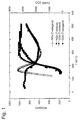
- the course of the NO portion in ppm is shown as a diagram in FIG. 1 as a function of the temperature, with a clear decrease in the NO concentration with increasing temperature being seen, which reaches a low point at approximately 320 ° C.
- the spinel is produced using a method as is known from DE 43 01 4709 A1. 6.5 grams of the split are placed in a vertically arranged quartz reactor (diameter 20 mm, height approx. 500 mm), in which a gas-permeable frit is arranged in the middle to expose the sample. The bed height is approximately 15 mm.
- a furnace is arranged around the quartz reactor, which heats the middle part of the reactor over a length of approximately 100 mm, temperatures of up to 550 ° C. being achievable.
- a gas mixture consisting of 1000 ppm NO, 1000 ppm propene, 10% oxygen and the rest argon as carrier gas is passed through the catalyst.
- the NO concentration behind the reactor is measured using a gas detector, with any NO 2 formed being reduced to NO in a converter before the detection.
- An oxidation of hydrocarbons to CO 2 is simultaneously observed by measuring the CO 2 content by the gas detector.
- the investigations of this catalyst showed, as with all catalysts according to the invention, a high resistance.
- the temperature interval roughly corresponds to the temperatures occurring in an exhaust line of an exhaust pipe of an internal combustion engine, in particular a diesel engine, measurements being taken with increasing and decreasing temperatures and a hysteresis being determined.
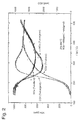
- the course of the NO portion in ppm is shown as a diagram in FIG. 2 as a function of the temperature, with a clear decrease in the NO concentration with increasing temperature being seen, which reaches a low point at approximately 280 ° C.
Landscapes
- Chemical & Material Sciences (AREA)
- Engineering & Computer Science (AREA)
- Chemical Kinetics & Catalysis (AREA)
- Environmental & Geological Engineering (AREA)
- Health & Medical Sciences (AREA)
- Biomedical Technology (AREA)
- Analytical Chemistry (AREA)
- General Chemical & Material Sciences (AREA)
- Oil, Petroleum & Natural Gas (AREA)
- Materials Engineering (AREA)
- Organic Chemistry (AREA)
- Combustion & Propulsion (AREA)
- Catalysts (AREA)
- Exhaust Gas Treatment By Means Of Catalyst (AREA)
- Exhaust Gas After Treatment (AREA)
Abstract
Description
- Die Erfindung betrifft einen Katalysator gemäß dem Oberbegriff des Anspruchs 1 bzw. 5 sowie ein Verfahren zu dessen Herstellung gemäß dem Oberbegriff des Anspruchs 7 sowie eine Verwendung der Katalysatoren, wie es aus der gattungsgemäß zugrundegelegten DE 43 01 470 A1 als bekannt hervorgeht.
- Aus der DE 43 01 470 A1 ist ein CuAl2O4-Spinell bekannt, das unter Zusatz von Zinn, Blei, einem Element der II. Haupt- oder Nebengruppe des Periodensystems der Element als Oxid oder Salz oder in elementarer Form und anschließendem Calzinieren zu einem Spinell vereinigt wird. Das derart vorbekannte Spinell wird zur Zersetzung von N2O eingesetzt. Die Verwendung dieses Katalysators hinsichtlich einer katalytischen Oxidation von CO2 und NOx, insbesondere bei Temperaturen von mehreren 100 °C ist nicht bekannt.
- Unter einem Spinell ist eine Zusammensetzung der allgemeinen chemischen Formel AaBbO4 zu verstehen, das zumindest mikroskopisch eine kristallographische oder kristallähnliche kubische Gitterstruktur mit flächenzentriert angeordneten Sauerstoffionen und tetraedrischen und oktaedrischen Lücken aufweist. In den tetraedrischen Lücken sind die A-Teilchen und bis zu 50% der B-Teilchen und in den oktaedrischen Lücken die restlichen B-Teilchen angeordnet. Dabei bezeichnet ein A- bzw. B-Teilchen nur deren kristallographische Anordnung. In stofflicher Hinsicht können die A-, wie auch die B-Teilchen unterschiedlich zueinander sein.
- Aus Gründen des Umweltschutzes ist die Reinigung von Gasen, insbesondere von Abgasen, wie sie bspw. bei Verbrennungsmotoren und hier vor allem bei Diesel- oder Magermixmotoren anfallen, neben der Verringerung von CO u.a. deren Entstickung, also der Abbau von Stickoxiden (NOx) ein vordringliches Problem.
- Aus der EP 042 471 B1 ist ein zur katalytischen Oxidation von Kohlenmonoxid (CO) zu Kohlendioxid (CO2) verwandter Katalysator bekannt, der die Metalle Kupfer (Cu), Zink (Zn) und Aluminium (Al) als Metalloxide aufweist. Zumindest 60% des vorhandenen Cu ist an das Al-Oxid als Kupferoxid-Aluminiumoxid-Spinell gebunden. In den Freiräumen des porösen Spinells ist Zn-Oxid mit einem Gewichtsanteil zwischen 1% bis 20% angeordnet.
- Von dem aus der EP 042 471 B1 vorbekannten Katalysator ist allerdings nur seine reinigende Wirkung bzgl. des CO's bekannt, die auf einer katalytischen Oxidation des CO's beruht. Ob der Katalysator gleichfalls zur Reinigung von NOx und/oder Kohlenwasserstoffen aufweisenden Gasen, wie sie insbesondere bei den obengenannten Brennkraftmaschinen und bspw. auch in Verbrennungskraftwerken und dgl. anfallen, geeignet ist, ist nicht bekannt.
- Die Aufgabe der Erfindung ist es, den gattungsgemäß zugrundegelegte Katalysator dahingehend weiterzuentwickeln, daß bei einer möglichst guten Stabilität gegenüber den Bestandteilen von Abgasen ist eine gute Reinigungswirkung, insbesondere bei NOx aufweist.
- Die Aufgabe wird bei einem zugrundegelegten Katalysator erfindungsgemäß durch die kennzeichnenden Merkmale des Anspruchs 1 bzw. 5 und bei einem zugrundegelegten Verfahren mit den kennzeichnenden Verfahrensschritte des Anspruchs 7 gelöst. Durch die Verwendung eines MgACuBAlCO4- bzw. eines durch das aus der DE 43 01 470 A1 bekannte Verfahren hergestellten CuACuBAlCO4-Spinells ist der Katalysator gegenüber den Bestandteilen der Abgase wie bspw. H2O, NOx, CO2 und/oder SO2 weitgehend stabil, wobei er auf Kohlenwasserstoffe und Kohlenmonoxid oxidierend und auf das Nox, insbesondere auf NO und NO2 katalytisch reduzierend wirkt. Die Reduktion von NOx findet in sauerstoffhaltigem Gas und in Anwesenheit von Reduktionsmitteln, wie z.B. eben genannten Kohlenwasserstoffen statt. Vorteilhafterweise liegen Kohlenwasserstoffe in Abgasen von Verbrennungsmotoren und hierbei insbesondere bei Dieselmotoren in genügender Konzentration vor. Des weiteren hat es sich als günstig erwiesen, diese Spinelle mit katalytisch aktiven Elemente Palladium, Platin, Rhodium, Rutenium, Osmium, Iridium, Rhenium und/oder seltene Erden wie Lantan und Cer, Vanadium, Titan, Niob, Molybdän, Wolfram und/oder deren Salze und/oder deren Oxide zu versehen.
- Im Sinne der Erfindung sind als Spinelle auch unterstöchiometrische Verbindungen anzusehen, bei denen das Al2O3 als Matrix fungiert und die im Röntgenspektrum die charakterischtischen Spinelllinien aufweisen, wobei der Spinell der formalen Zusammensetzung AAl2O4 in einer Al2O3 Matrix vorliegt, so daß sich formal eine Stöchiometrie von A(1-x)Al2O4 ergibt.
- Zweckmäßige Ausgestaltungen der Erfindung sind den Unteransprüchen entnehmbar. Im übrigen wird die Erfindung anhand von in den Figuren dargestellten Ausführungsbeispielen beschrieben. Dabei zeigt
- Fig. 1
- ein Diagramm einer NOx(NO)-Reduktion und CO-Oxidation über der Temperatur bei einem ein Mg0.5Cu0.5Al2O4-Spinell und
- Fig. 2
- ein Diagramm einer NOx(NO)-Reduktion und CO-Oxidation über der Temperatur bei einem ein CuACuBAl2O4-Spinell.
- Als Spinell wird ein Magnesium/Kupfer/Aluminium-Spinell, insbesondere der Zusammensetzung Mg0.5Cu0.5Al2O4 verwandt. Die Herstellung des Spinells erfolgt günstigerweise analog einem Verfahren, wie es aus der DE 43 01 4709 A1 bekannt ist. Von dem Spinell werden 6,5 Gramm Split in einem senkrecht angeordneten Quarzreaktor (Durchmesser 20 mm, Höhe ca. 500 mm) vorgelegt, bei dem zur Exposition der Probe in dessen Mitte eine gasdurchlässige Fritte angeordnet ist. Die Schütthöhe beträgt etwa 15 mm. Um den Quarzreaktor ist ein Ofen angeordnet, der den Reaktormittelteil auf einer Länge von ca. 100 mm beheizt, wobei Temperaturen bis zu 550 °C erreichbar sind.
- Durch den Katalysator wird ein Gasgemisch hindurchgeleitet, das aus 1000 ppm NO, 1000 ppm Propen, 10% Sauerstoff und dem Rest Argon als Trägergas besteht. Hinter dem Reaktor wird die NO-Konzentration mit einem Gasdetektor gemessen, wobei vor der Detektion eventuell gebildetes NO2 in einem Konverter zu NO reduziert wird. Simultan wird deine Oxidation von Kohlenwasserstoffen zu CO2 durch Messung des CO2-Gehaltes durch den Gasdetektor beobachtet. Die Untersuchungen dieses Katalysators ergab wie bei allen erfindungsgemäßen Katalysatoren eine hohe Beständigkeit.
- Günstigerweise ist in angegebenen Temperaturintervall, das in etwa den Temperaturen entspricht, die in einem Abgasstrang eines Auspuffes einer Verbrennungsmaschine, insbesondere einem Dieselmotor auftreten können.
- Der Verlauf des NO-Anteiles in ppm ist als Diagramm in Figur 1 als Funktion der Temperatur dargestellt, wobei sich eine deutliche Abnahme der NO-Konzentration mit zunehmender Temperatur erkennen läßt, die bei ca. 320 °C einen Tiefpunkt erreicht.
- Weitere Untersuchungen an diesem Katalysator ergaben eine hohe Beständigkeit gegenüber NOx, H2O, CO2 und H2O.
- Als Spinell wird ein mit Kupfer imprägnierter Kupfer/Aluminium-Spinell, insbesondere der Zusammensetzung Cu0.5Cu0.5Al2O4 verwandt. Die Herstellung des Spinells erfolgt mit einem Verfahren, wie es aus der DE 43 01 4709 A1 bekannt ist. Von dem Spinell werden 6,5 Gramm Split in einem senkrecht angeordneten Quarzreaktor (Durchmesser 20 mm, Höhe ca. 500 mm) vorgelegt, bei dem zur Exposition der Probe in dessen Mitte eine gasdurchlässige Fritte angeordnet ist. Die Schütthöhe beträgt etwa 15 mm. Um den Quarzreaktor ist ein Ofen angeordnet, der den Reaktormittelteil auf einer Länge von ca. 100 mm beheizt, wobei Temperaturen bis zu 550 °C erreichbar sind.
- Durch den Katalysator wird ein Gasgemisch hindurchgeleitet, das aus 1000 ppm NO, 1000 ppm Propen, 10% Sauerstoff und dem Rest Argon als Trägergas besteht. Hinter dem Reaktor wird die NO-Konzentration mit einem Gasdetektor gemessen, wobei vor der Detektion eventuell gebildetes NO2 in einem Konverter zu NO reduziert wird. Simultan wird eine Oxidation von Kohlenwasserstoffen zu CO2 durch Messung des CO2-Gehaltes durch den Gasdetektor beobachtet. Die Untersuchungen dieses Katalysators ergab wie bei allen erfindungsgemäßen Katalysatoren eine hohe Beständigkeit.
- Auch hier entspricht das Temperaturintervall in etwa den in einem Abgasstrang eines Auspuffes einer Verbrennungsmaschine, insbesondere einem Dieselmotor auftretenden Temperaturen, wobei bei steigender und bei fallender Temperatur gemessen und eine Hysterese festgestellt wurde.
- Der Verlauf des NO-Anteiles in ppm ist als Diagramm in Figur 2 als Funktion der Temperatur dargestellt, wobei sich eine deutliche Abnahme der NO-Konzentration mit zunehmender Temperatur erkennen läßt, die bei ca. 280 °C einen Tiefpunkt erreicht.
- Weitere Untersuchungen an diesem Katalysator ergaben auch hier eine hohe Beständigkeit gegenüber NOx, H2O, CO2 und H2O.
Claims (7)
- Verwendung eines Katalysators zur katalytischen Reduktion von Stickoxiden (NOx) in Abgasen von Verbrennungsmaschinen und/oder Verbrennungskraftwerken, welcher Katalysator ein Magnesiumoxid-Kupferoxid-Aluminiumoxid-Spinell der chemischen Formel
MgACuBAlCO4
aufweist, wobei gilt:

- Verwendung eines Katalysators nach Anspruch 1,
dadurch gekennzeichnet,
daß der Katalysator ein Magnesiumoxid-Kupferoxid-Alinminiumoxid-Spinell der chemischen Formel
Mg(1-B)CuBAl2O4
aufweist, wobei gilt: 0 < B < 1 mit B>0. - Verwendung eines Katalysators nach Anspruch 1,
dadurch gekennzeichnet,
daß der Katalysator ein Kupferoxid-Magnesiumoxid-Aluminiumoxid-Spinell mit der chemischen Formel
Mg0.5Cu0.5Al2O4
aufweist. - Verwendung eines Katalysators zur katalytischen Reduktion von Stickoxiden (NOx)in Abgasen von Verbrennungsmaschinen und/oder Verbrennungskraftwerken, welcher Katalysator ein mit Kupfer imprägnierter Kupferoxid-Aluminiumoxid-Spinell der chemischen Formel
CuACuBAl2O4
ist, wobei gilt:

- Verwendung eines Katalysators nach einem der Ansprüche 1 oder 4,
dadurch gekennzeichnet,
daß der Katalysator porös ausgebildet ist. - Verwendung eines Katalysators nach wenigstens einem der Ansprüche 1 oder 4,
dadurch gekennzeichnet,
daß der Katalysator zumindest ein katalytisches Element wie Pal ladium, Platin, Rhodium, Rutenium, Osmium, Iridium, Rhenium und/oder seltene Erden wie Lantan und Cer, Vanadium, Titan, Niob, Molybdän, Wolfram und/oder deren Salze und/oder deren Oxide aufweist. - Verwendung eines Katalysators nach wenigstens einem der Ansprüche 1 oder 4,
dadurch gekennzeichnet,
daß der Katalysator im Abgasstrang von Dieselmotoren eingesetzt wird.
Priority Applications (1)
| Application Number | Priority Date | Filing Date | Title |
|---|---|---|---|
| EP00128400A EP1097743A1 (de) | 1995-12-13 | 1996-11-02 | Verwendung eines Spinell-Katalysators zur katalytischen Reduktion von Stickstoffoxiden |
Applications Claiming Priority (2)
| Application Number | Priority Date | Filing Date | Title |
|---|---|---|---|
| DE19546476 | 1995-12-13 | ||
| DE19546476A DE19546476A1 (de) | 1995-12-13 | 1995-12-13 | Katalysator, Verfahren zu dessen Herstellung und Verwendung desselben |
Related Child Applications (1)
| Application Number | Title | Priority Date | Filing Date |
|---|---|---|---|
| EP00128400A Division EP1097743A1 (de) | 1995-12-13 | 1996-11-02 | Verwendung eines Spinell-Katalysators zur katalytischen Reduktion von Stickstoffoxiden |
Publications (2)
| Publication Number | Publication Date |
|---|---|
| EP0779094A2 true EP0779094A2 (de) | 1997-06-18 |
| EP0779094A3 EP0779094A3 (de) | 1997-07-30 |
Family
ID=7779969
Family Applications (2)
| Application Number | Title | Priority Date | Filing Date |
|---|---|---|---|
| EP96117578A Withdrawn EP0779094A3 (de) | 1995-12-13 | 1996-11-02 | Spinellkatalysator und Verfahren zu dessen Herstellung und Verwendung desselben |
| EP00128400A Withdrawn EP1097743A1 (de) | 1995-12-13 | 1996-11-02 | Verwendung eines Spinell-Katalysators zur katalytischen Reduktion von Stickstoffoxiden |
Family Applications After (1)
| Application Number | Title | Priority Date | Filing Date |
|---|---|---|---|
| EP00128400A Withdrawn EP1097743A1 (de) | 1995-12-13 | 1996-11-02 | Verwendung eines Spinell-Katalysators zur katalytischen Reduktion von Stickstoffoxiden |
Country Status (4)
| Country | Link |
|---|---|
| US (1) | US6030589A (de) |
| EP (2) | EP0779094A3 (de) |
| JP (1) | JPH09173788A (de) |
| DE (1) | DE19546476A1 (de) |
Cited By (4)
| Publication number | Priority date | Publication date | Assignee | Title |
|---|---|---|---|---|
| EP1093851A1 (de) * | 1999-10-19 | 2001-04-25 | Basf Aktiengesellschaft | Spinellmonolith-Katalysator und Verfahren zu seiner Herstellung |
| US6723295B1 (en) | 1998-10-21 | 2004-04-20 | Basf Aktiengesellschaft | High-temperature stabile catalysts for decomposing N2O |
| EP2165760A3 (de) * | 1996-03-21 | 2010-05-12 | Basf Catalysts Llc | Kupfer-Aluminium Mischoxid Katalysator, seine Herstellung und seine Verwendungen |
| CN106391040A (zh) * | 2016-11-18 | 2017-02-15 | 河南福流环保科技有限公司 | 一种高效低温脱硝复合催化剂及其制备方法 |
Families Citing this family (14)
| Publication number | Priority date | Publication date | Assignee | Title |
|---|---|---|---|---|
| US6696389B1 (en) * | 1996-02-23 | 2004-02-24 | Daimlerchrysler Ag | Process and apparatus for cleaning a gas flow |
| US8029603B2 (en) | 2009-01-23 | 2011-10-04 | Air Products And Chemicals, Inc. | Pressure swing adsorption cycle for ozone production |
| JP5506292B2 (ja) * | 2009-08-27 | 2014-05-28 | ダイハツ工業株式会社 | 排ガス浄化用触媒 |
| CN102597173A (zh) | 2009-09-08 | 2012-07-18 | 俄亥俄州立大学研究基金会 | 具有原位co2捕集的合成燃料和化学品生产 |
| CA3020406A1 (en) | 2016-04-12 | 2017-10-19 | Ohio State Innovation Foundation | Chemical looping syngas production from carbonaceous fuels |
| JP2020514034A (ja) * | 2017-03-06 | 2020-05-21 | ビーエーエスエフ コーポレーション | 白金族金属と銅−アルミナスピネルを組み合わせた触媒 |
| US11090624B2 (en) | 2017-07-31 | 2021-08-17 | Ohio State Innovation Foundation | Reactor system with unequal reactor assembly operating pressures |
| US10549236B2 (en) * | 2018-01-29 | 2020-02-04 | Ohio State Innovation Foundation | Systems, methods and materials for NOx decomposition with metal oxide materials |
| WO2020033500A1 (en) | 2018-08-09 | 2020-02-13 | Ohio State Innovation Foundation | Systems, methods and materials for hydrogen sulfide conversion |
| WO2020150438A1 (en) | 2019-01-17 | 2020-07-23 | Ohio State Innovation Foundation | Systems, methods and materials for stable phase syngas generation |
| US11453626B2 (en) | 2019-04-09 | 2022-09-27 | Ohio State Innovation Foundation | Alkene generation using metal sulfide particles |
| WO2021034888A1 (en) | 2019-08-19 | 2021-02-25 | Ohio State Innovation Foundation | Mesoporous support-immobilized metal oxide-based nanoparticles |
| WO2021046156A1 (en) | 2019-09-03 | 2021-03-11 | Ohio State Innovation Foundation | Redox reaction facilitated carbon dioxide capture from flue gas and conversion to carbon monoxide |
| WO2022006112A1 (en) | 2020-06-29 | 2022-01-06 | Ohio State Innovation Foundation | Systems and methods for high reactant conversion through multiple reactant flow ratio staging |
Citations (1)
| Publication number | Priority date | Publication date | Assignee | Title |
|---|---|---|---|---|
| DE4301470A1 (de) | 1993-01-21 | 1994-07-28 | Basf Ag | Verfahren zur katalytischen Zersetzung von reinem oder in Gasgemischen enthaltenem Distickstoffmonoxid |
Family Cites Families (13)
| Publication number | Priority date | Publication date | Assignee | Title |
|---|---|---|---|---|
| GB1511841A (en) * | 1974-03-06 | 1978-05-24 | Johnson Matthey Co Ltd | Catalysis |
| JPS5610333A (en) * | 1979-07-06 | 1981-02-02 | Toyota Motor Corp | Catalyst for cleaning up exhaust gas and manufacture of said catalyst |
| JPS5610334A (en) * | 1979-07-06 | 1981-02-02 | Toyota Motor Corp | Catalyst for cleaning up exhaust gas and manufacture of said catalyst |
| NO146046L (de) * | 1980-03-28 | |||
| US4692318A (en) * | 1984-08-13 | 1987-09-08 | Amoco Corporation | Process for simultaneously removing nitrogen oxides, sulfur oxides, and particulates |
| GB8519319D0 (en) * | 1985-07-31 | 1985-09-04 | Shell Int Research | Catalyst |
| DE69115241T2 (de) * | 1991-01-08 | 1996-06-13 | Agency Ind Science Techn | Verfahren zur Entfernung von Stickoxiden aus Abgasen. |
| DE4142900A1 (de) * | 1991-12-23 | 1993-06-24 | Sued Chemie Ag | Verwendung von kupferoxid-aluminiumoxid-magnesiumoxid-katalysatoren zur konvertierung von kohlenmonoxid |
| DE4224881A1 (de) * | 1992-07-28 | 1994-02-03 | Basf Ag | Silberhaltiger Aluminiumoxid-Trägerkatalysator und Verfahren zur katalytischen Zersetzung von reinem oder in Gasgemischen enthaltenem Distickstoffmonoxid |
| JPH0751569A (ja) * | 1993-08-17 | 1995-02-28 | Tosoh Corp | 窒素酸化物浄化触媒 |
| JPH07251074A (ja) * | 1994-03-16 | 1995-10-03 | Nissan Motor Co Ltd | 排ガス浄化用触媒及びその製造方法 |
| FR2718371B1 (fr) * | 1994-04-08 | 1996-05-03 | Rhone Poulenc Chimie | Catalyseurs de réduction des oxydes d'azote à base de spinelles. |
| DE19546484A1 (de) * | 1995-12-13 | 1997-07-10 | Daimler Benz Ag | Verfahren zum Betreiben einer Reinigungsanlage für Gase sowie eine Reinigungsanlage für Gase |
-
1995
- 1995-12-13 DE DE19546476A patent/DE19546476A1/de not_active Withdrawn
-
1996
- 1996-11-02 EP EP96117578A patent/EP0779094A3/de not_active Withdrawn
- 1996-11-02 EP EP00128400A patent/EP1097743A1/de not_active Withdrawn
- 1996-12-12 US US08/763,535 patent/US6030589A/en not_active Expired - Fee Related
- 1996-12-12 JP JP8359363A patent/JPH09173788A/ja active Pending
Patent Citations (1)
| Publication number | Priority date | Publication date | Assignee | Title |
|---|---|---|---|---|
| DE4301470A1 (de) | 1993-01-21 | 1994-07-28 | Basf Ag | Verfahren zur katalytischen Zersetzung von reinem oder in Gasgemischen enthaltenem Distickstoffmonoxid |
Cited By (6)
| Publication number | Priority date | Publication date | Assignee | Title |
|---|---|---|---|---|
| EP2165760A3 (de) * | 1996-03-21 | 2010-05-12 | Basf Catalysts Llc | Kupfer-Aluminium Mischoxid Katalysator, seine Herstellung und seine Verwendungen |
| US6723295B1 (en) | 1998-10-21 | 2004-04-20 | Basf Aktiengesellschaft | High-temperature stabile catalysts for decomposing N2O |
| EP1124623B1 (de) * | 1998-10-21 | 2006-08-02 | Basf Aktiengesellschaft | Verfahren zur katalytischen zersetzung von n2o |
| EP1093851A1 (de) * | 1999-10-19 | 2001-04-25 | Basf Aktiengesellschaft | Spinellmonolith-Katalysator und Verfahren zu seiner Herstellung |
| CN106391040A (zh) * | 2016-11-18 | 2017-02-15 | 河南福流环保科技有限公司 | 一种高效低温脱硝复合催化剂及其制备方法 |
| CN106391040B (zh) * | 2016-11-18 | 2018-12-28 | 河南福流环保科技有限公司 | 一种高效低温脱硝复合催化剂及其制备方法 |
Also Published As
| Publication number | Publication date |
|---|---|
| DE19546476A1 (de) | 1997-06-19 |
| JPH09173788A (ja) | 1997-07-08 |
| EP1097743A1 (de) | 2001-05-09 |
| US6030589A (en) | 2000-02-29 |
| EP0779094A3 (de) | 1997-07-30 |
Similar Documents
| Publication | Publication Date | Title |
|---|---|---|
| EP0779093B1 (de) | Verwendung eines Spinellkatalysators | |
| EP0685253B1 (de) | Katalysator, Verfahren zu dessen Herstellung und Verwendung desselben | |
| EP0687499A1 (de) | Spinell-Katalysator und Verfahren zu dessen Herstellung | |
| EP0779094A2 (de) | Spinellkatalysator und Verfahren zu dessen Herstellung und Verwendung desselben | |
| EP0989903A1 (de) | Speicherkatalysator | |
| EP0791390B1 (de) | Verfahren und Vorrichtung zur katalytischen Gasreinigung | |
| EP2091635B1 (de) | Vanadiumfreier katalysator zur selektiven katalytischen reduktion und verfahren zu seiner herstellung | |
| EP2326416B1 (de) | Stickoxid-speicherkatalysator zum einsatz im kraftfahrzeug in motornaher position | |
| EP0945608B1 (de) | Verfahren zum Betreiben einer Abgasreinigungsanlage enthaltend eine Schwefelfalle und einen Stickoxid-Speicherkatalysator | |
| EP0945165B1 (de) | Verfahren zur Entfernung von Schwefeloxiden aus Abgasen einer Brennkraftmaschine | |
| EP1004347B1 (de) | Katalysator für die Reinigung der Abgase eines Dieselmotors | |
| DE102004040032B4 (de) | Abgasbehandlungskatalysator und Abgasbehandlungsverfahren | |
| DE60110079T2 (de) | Katalysator zum abbau von distickstoffoxid sowie methode zur durchführung von verfahren, welche die bildung von distickstoffoxid beinhalten | |
| DE2758451C2 (de) | ||
| DE3856024T2 (de) | Verfahren zur Behandlung von Abgasen mit einem Kupfer- und Ceroxid enthaltenden Katalysator | |
| EP0779095A1 (de) | Verfahren und Anlage zur katalytischen Gasreinigung | |
| DE19546612A1 (de) | Verfahren zur Reduktion von NOx aus Abgasen | |
| EP0815938B1 (de) | Katalysator zur reinigung von industrie- und autoabgasen | |
| EP1316354A1 (de) | Katalysator zur Verminderung der Stickoxide im Abgas von Magermotoren | |
| DE102011086787A1 (de) | Vorrichtung zum Beseitigen von Emissionen und Verfahren zur Reduzierung von Emissionen im Abgas | |
| DE2907106A1 (de) | Katalysator zur reinigung der abgase von verbrennungskraftmaschinen | |
| DE2245607C2 (de) | ||
| DE2010449B2 (de) | Traegerkatalysator | |
| DE69114512T2 (de) | Verwendung eines trägerkatalysator auf basis eines metalls der platingruppe. | |
| DE2845595A1 (de) | Katalysatorsystem fuer die abgasbehandlung, verfahren zu seiner herstellung und seine verwendung |
Legal Events
| Date | Code | Title | Description |
|---|---|---|---|
| PUAI | Public reference made under article 153(3) epc to a published international application that has entered the european phase |
Free format text: ORIGINAL CODE: 0009012 |
|
| PUAL | Search report despatched |
Free format text: ORIGINAL CODE: 0009013 |
|
| AK | Designated contracting states |
Kind code of ref document: A2 Designated state(s): BE DE FR GB IT |
|
| AK | Designated contracting states |
Kind code of ref document: A3 Designated state(s): BE DE FR GB IT |
|
| 17P | Request for examination filed |
Effective date: 19970716 |
|
| RAP1 | Party data changed (applicant data changed or rights of an application transferred) |
Owner name: BASF AKTIENGESELLSCHAFT Owner name: DAIMLERCHRYSLER AG |
|
| 17Q | First examination report despatched |
Effective date: 20000707 |
|
| STAA | Information on the status of an ep patent application or granted ep patent |
Free format text: STATUS: THE APPLICATION HAS BEEN WITHDRAWN |
|
| 18W | Application withdrawn |
Withdrawal date: 20020528 |