EP0779295B1 - Metallocenverbindung - Google Patents
Metallocenverbindung Download PDFInfo
- Publication number
- EP0779295B1 EP0779295B1 EP96119752A EP96119752A EP0779295B1 EP 0779295 B1 EP0779295 B1 EP 0779295B1 EP 96119752 A EP96119752 A EP 96119752A EP 96119752 A EP96119752 A EP 96119752A EP 0779295 B1 EP0779295 B1 EP 0779295B1
- Authority
- EP
- European Patent Office
- Prior art keywords
- methyl
- olefin
- catalyst
- formula
- metallocene
- Prior art date
- Legal status (The legal status is an assumption and is not a legal conclusion. Google has not performed a legal analysis and makes no representation as to the accuracy of the status listed.)
- Expired - Lifetime
Links
- 150000001336 alkenes Chemical class 0.000 claims abstract description 54
- 150000001875 compounds Chemical class 0.000 claims abstract description 38
- 239000003054 catalyst Substances 0.000 claims abstract description 26
- 238000000034 method Methods 0.000 claims abstract description 21
- 229920000098 polyolefin Polymers 0.000 claims abstract description 18
- YBYIRNPNPLQARY-UHFFFAOYSA-N 1H-indene Natural products C1=CC=C2CC=CC2=C1 YBYIRNPNPLQARY-UHFFFAOYSA-N 0.000 claims abstract description 13
- 125000003454 indenyl group Chemical group C1(C=CC2=CC=CC=C12)* 0.000 claims abstract description 13
- 229910052782 aluminium Inorganic materials 0.000 claims abstract description 12
- 125000000058 cyclopentadienyl group Chemical group C1(=CC=CC1)* 0.000 claims abstract description 12
- 238000004519 manufacturing process Methods 0.000 claims abstract description 12
- 150000001639 boron compounds Chemical class 0.000 claims abstract description 4
- -1 tetramethylcyclopentadienyl Chemical group 0.000 claims description 58
- JRZJOMJEPLMPRA-UHFFFAOYSA-N olefin Natural products CCCCCCCC=C JRZJOMJEPLMPRA-UHFFFAOYSA-N 0.000 claims description 42
- 238000006116 polymerization reaction Methods 0.000 claims description 21
- 239000004215 Carbon black (E152) Substances 0.000 claims description 16
- 229910052726 zirconium Inorganic materials 0.000 claims description 15
- 125000004435 hydrogen atom Chemical group [H]* 0.000 claims description 9
- QCWXUUIWCKQGHC-UHFFFAOYSA-N Zirconium Chemical group [Zr] QCWXUUIWCKQGHC-UHFFFAOYSA-N 0.000 claims description 6
- 229910052735 hafnium Chemical group 0.000 claims description 6
- VBJZVLUMGGDVMO-UHFFFAOYSA-N hafnium atom Chemical group [Hf] VBJZVLUMGGDVMO-UHFFFAOYSA-N 0.000 claims description 5
- RTAQQCXQSZGOHL-UHFFFAOYSA-N Titanium Chemical group [Ti] RTAQQCXQSZGOHL-UHFFFAOYSA-N 0.000 claims description 3
- 229910052719 titanium Inorganic materials 0.000 claims description 3
- 239000010936 titanium Substances 0.000 claims description 3
- 230000000379 polymerizing effect Effects 0.000 claims description 2
- YAXLMFKLUFMTTP-UHFFFAOYSA-L pyrrolidine-1-carbonylazanide;zirconium(2+) Chemical compound [Zr+2].[NH-]C(=O)N1CCCC1.[NH-]C(=O)N1CCCC1 YAXLMFKLUFMTTP-UHFFFAOYSA-L 0.000 claims description 2
- ZSWFCLXCOIISFI-UHFFFAOYSA-N endo-cyclopentadiene Natural products C1C=CC=C1 ZSWFCLXCOIISFI-UHFFFAOYSA-N 0.000 abstract description 8
- 229910052751 metal Inorganic materials 0.000 abstract description 4
- 239000002184 metal Substances 0.000 abstract description 4
- XAGFODPZIPBFFR-UHFFFAOYSA-N aluminium Chemical group [Al] XAGFODPZIPBFFR-UHFFFAOYSA-N 0.000 abstract description 3
- 239000004411 aluminium Substances 0.000 abstract 1
- 229910052739 hydrogen Inorganic materials 0.000 description 45
- YXFVVABEGXRONW-UHFFFAOYSA-N Toluene Chemical compound CC1=CC=CC=C1 YXFVVABEGXRONW-UHFFFAOYSA-N 0.000 description 21
- VLKZOEOYAKHREP-UHFFFAOYSA-N n-Hexane Chemical compound CCCCCC VLKZOEOYAKHREP-UHFFFAOYSA-N 0.000 description 15
- 229930195733 hydrocarbon Natural products 0.000 description 14
- 229910052799 carbon Inorganic materials 0.000 description 13
- 125000003118 aryl group Chemical group 0.000 description 9
- 125000002496 methyl group Chemical group [H]C([H])([H])* 0.000 description 9
- 239000007787 solid Substances 0.000 description 9
- 239000000243 solution Substances 0.000 description 9
- OSFBJERFMQCEQY-UHFFFAOYSA-N propylidene Chemical group [CH]CC OSFBJERFMQCEQY-UHFFFAOYSA-N 0.000 description 8
- YMWUJEATGCHHMB-UHFFFAOYSA-N Dichloromethane Chemical compound ClCCl YMWUJEATGCHHMB-UHFFFAOYSA-N 0.000 description 6
- IMNFDUFMRHMDMM-UHFFFAOYSA-N N-Heptane Chemical compound CCCCCCC IMNFDUFMRHMDMM-UHFFFAOYSA-N 0.000 description 6
- VYPSYNLAJGMNEJ-UHFFFAOYSA-N Silicium dioxide Chemical compound O=[Si]=O VYPSYNLAJGMNEJ-UHFFFAOYSA-N 0.000 description 6
- 125000000217 alkyl group Chemical group 0.000 description 6
- 238000006243 chemical reaction Methods 0.000 description 6
- 239000001257 hydrogen Substances 0.000 description 6
- 239000000203 mixture Substances 0.000 description 6
- UFHFLCQGNIYNRP-UHFFFAOYSA-N Hydrogen Chemical compound [H][H] UFHFLCQGNIYNRP-UHFFFAOYSA-N 0.000 description 5
- 125000004432 carbon atom Chemical group C* 0.000 description 5
- 239000002904 solvent Substances 0.000 description 5
- KAKZBPTYRLMSJV-UHFFFAOYSA-N Butadiene Chemical compound C=CC=C KAKZBPTYRLMSJV-UHFFFAOYSA-N 0.000 description 4
- 239000012876 carrier material Substances 0.000 description 4
- DIOQZVSQGTUSAI-UHFFFAOYSA-N decane Chemical compound CCCCCCCCCC DIOQZVSQGTUSAI-UHFFFAOYSA-N 0.000 description 4
- 150000002430 hydrocarbons Chemical class 0.000 description 4
- 239000012442 inert solvent Substances 0.000 description 4
- 125000001997 phenyl group Chemical group [H]C1=C([H])C([H])=C(*)C([H])=C1[H] 0.000 description 4
- 238000002360 preparation method Methods 0.000 description 4
- 238000003756 stirring Methods 0.000 description 4
- 239000000725 suspension Substances 0.000 description 4
- XLYOFNOQVPJJNP-UHFFFAOYSA-N water Substances O XLYOFNOQVPJJNP-UHFFFAOYSA-N 0.000 description 4
- 125000004429 atom Chemical group 0.000 description 3
- 150000001768 cations Chemical class 0.000 description 3
- 229920001577 copolymer Polymers 0.000 description 3
- 239000002283 diesel fuel Substances 0.000 description 3
- 239000000499 gel Substances 0.000 description 3
- 125000000959 isobutyl group Chemical group [H]C([H])([H])C([H])(C([H])([H])[H])C([H])([H])* 0.000 description 3
- 239000007788 liquid Substances 0.000 description 3
- OFBQJSOFQDEBGM-UHFFFAOYSA-N n-pentane Natural products CCCCC OFBQJSOFQDEBGM-UHFFFAOYSA-N 0.000 description 3
- 239000000843 powder Substances 0.000 description 3
- 238000005086 pumping Methods 0.000 description 3
- 230000035484 reaction time Effects 0.000 description 3
- 239000000377 silicon dioxide Substances 0.000 description 3
- 239000000375 suspending agent Substances 0.000 description 3
- VOITXYVAKOUIBA-UHFFFAOYSA-N triethylaluminium Chemical compound CC[Al](CC)CC VOITXYVAKOUIBA-UHFFFAOYSA-N 0.000 description 3
- PRBHEGAFLDMLAL-GQCTYLIASA-N (4e)-hexa-1,4-diene Chemical compound C\C=C\CC=C PRBHEGAFLDMLAL-GQCTYLIASA-N 0.000 description 2
- UTSOOVRQJFXCBD-UHFFFAOYSA-N 1-(2-cyclopenta-2,4-dien-1-ylpropan-2-yl)-1h-indene Chemical compound C1=CC2=CC=CC=C2C1C(C)(C)C1C=CC=C1 UTSOOVRQJFXCBD-UHFFFAOYSA-N 0.000 description 2
- LIKMAJRDDDTEIG-UHFFFAOYSA-N 1-hexene Chemical compound CCCCC=C LIKMAJRDDDTEIG-UHFFFAOYSA-N 0.000 description 2
- KWKAKUADMBZCLK-UHFFFAOYSA-N 1-octene Chemical compound CCCCCCC=C KWKAKUADMBZCLK-UHFFFAOYSA-N 0.000 description 2
- 238000004009 13C{1H}-NMR spectroscopy Methods 0.000 description 2
- WSSSPWUEQFSQQG-UHFFFAOYSA-N 4-methyl-1-pentene Chemical compound CC(C)CC=C WSSSPWUEQFSQQG-UHFFFAOYSA-N 0.000 description 2
- PNEYBMLMFCGWSK-UHFFFAOYSA-N Alumina Chemical class [O-2].[O-2].[O-2].[Al+3].[Al+3] PNEYBMLMFCGWSK-UHFFFAOYSA-N 0.000 description 2
- XKRFYHLGVUSROY-UHFFFAOYSA-N Argon Chemical compound [Ar] XKRFYHLGVUSROY-UHFFFAOYSA-N 0.000 description 2
- VGGSQFUCUMXWEO-UHFFFAOYSA-N Ethene Chemical compound C=C VGGSQFUCUMXWEO-UHFFFAOYSA-N 0.000 description 2
- 239000005977 Ethylene Substances 0.000 description 2
- RRHGJUQNOFWUDK-UHFFFAOYSA-N Isoprene Chemical compound CC(=C)C=C RRHGJUQNOFWUDK-UHFFFAOYSA-N 0.000 description 2
- TWRXJAOTZQYOKJ-UHFFFAOYSA-L Magnesium chloride Chemical compound [Mg+2].[Cl-].[Cl-] TWRXJAOTZQYOKJ-UHFFFAOYSA-L 0.000 description 2
- URLKBWYHVLBVBO-UHFFFAOYSA-N Para-Xylene Chemical group CC1=CC=C(C)C=C1 URLKBWYHVLBVBO-UHFFFAOYSA-N 0.000 description 2
- ATUOYWHBWRKTHZ-UHFFFAOYSA-N Propane Chemical compound CCC ATUOYWHBWRKTHZ-UHFFFAOYSA-N 0.000 description 2
- PPBRXRYQALVLMV-UHFFFAOYSA-N Styrene Chemical compound C=CC1=CC=CC=C1 PPBRXRYQALVLMV-UHFFFAOYSA-N 0.000 description 2
- 125000001931 aliphatic group Chemical group 0.000 description 2
- 125000001797 benzyl group Chemical group [H]C1=C([H])C([H])=C(C([H])=C1[H])C([H])([H])* 0.000 description 2
- 125000000484 butyl group Chemical group [H]C([*])([H])C([H])([H])C([H])([H])C([H])([H])[H] 0.000 description 2
- 238000004140 cleaning Methods 0.000 description 2
- 238000001816 cooling Methods 0.000 description 2
- 150000001993 dienes Chemical class 0.000 description 2
- 238000009826 distribution Methods 0.000 description 2
- HQQADJVZYDDRJT-UHFFFAOYSA-N ethene;prop-1-ene Chemical group C=C.CC=C HQQADJVZYDDRJT-UHFFFAOYSA-N 0.000 description 2
- 125000001495 ethyl group Chemical group [H]C([H])([H])C([H])([H])* 0.000 description 2
- 239000007789 gas Substances 0.000 description 2
- CPOFMOWDMVWCLF-UHFFFAOYSA-N methyl(oxo)alumane Chemical compound C[Al]=O CPOFMOWDMVWCLF-UHFFFAOYSA-N 0.000 description 2
- UAEPNZWRGJTJPN-UHFFFAOYSA-N methylcyclohexane Chemical compound CC1CCCCC1 UAEPNZWRGJTJPN-UHFFFAOYSA-N 0.000 description 2
- 239000000178 monomer Substances 0.000 description 2
- 230000007935 neutral effect Effects 0.000 description 2
- YWAKXRMUMFPDSH-UHFFFAOYSA-N pentene Chemical compound CCCC=C YWAKXRMUMFPDSH-UHFFFAOYSA-N 0.000 description 2
- 229920000642 polymer Polymers 0.000 description 2
- 230000037048 polymerization activity Effects 0.000 description 2
- QQONPFPTGQHPMA-UHFFFAOYSA-N propylene Natural products CC=C QQONPFPTGQHPMA-UHFFFAOYSA-N 0.000 description 2
- 125000004805 propylene group Chemical group [H]C([H])([H])C([H])([*:1])C([H])([H])[*:2] 0.000 description 2
- 239000000126 substance Substances 0.000 description 2
- 229910052723 transition metal Inorganic materials 0.000 description 2
- 150000003624 transition metals Chemical class 0.000 description 2
- MCULRUJILOGHCJ-UHFFFAOYSA-N triisobutylaluminium Chemical compound CC(C)C[Al](CC(C)C)CC(C)C MCULRUJILOGHCJ-UHFFFAOYSA-N 0.000 description 2
- JLTRXTDYQLMHGR-UHFFFAOYSA-N trimethylaluminium Chemical compound C[Al](C)C JLTRXTDYQLMHGR-UHFFFAOYSA-N 0.000 description 2
- 239000001993 wax Substances 0.000 description 2
- 125000006702 (C1-C18) alkyl group Chemical group 0.000 description 1
- 238000001644 13C nuclear magnetic resonance spectroscopy Methods 0.000 description 1
- 238000005160 1H NMR spectroscopy Methods 0.000 description 1
- UQRONKZLYKUEMO-UHFFFAOYSA-N 4-methyl-1-(2,4,6-trimethylphenyl)pent-4-en-2-one Chemical group CC(=C)CC(=O)Cc1c(C)cc(C)cc1C UQRONKZLYKUEMO-UHFFFAOYSA-N 0.000 description 1
- HBAQYPYDRFILMT-UHFFFAOYSA-N 8-[3-(1-cyclopropylpyrazol-4-yl)-1H-pyrazolo[4,3-d]pyrimidin-5-yl]-3-methyl-3,8-diazabicyclo[3.2.1]octan-2-one Chemical class C1(CC1)N1N=CC(=C1)C1=NNC2=C1N=C(N=C2)N1C2C(N(CC1CC2)C)=O HBAQYPYDRFILMT-UHFFFAOYSA-N 0.000 description 1
- ONJXMLOOLFUVAT-UHFFFAOYSA-N C(=CC(C)=C)[AlH2] Chemical compound C(=CC(C)=C)[AlH2] ONJXMLOOLFUVAT-UHFFFAOYSA-N 0.000 description 1
- VYZAMTAEIAYCRO-UHFFFAOYSA-N Chromium Chemical compound [Cr] VYZAMTAEIAYCRO-UHFFFAOYSA-N 0.000 description 1
- 229920000089 Cyclic olefin copolymer Polymers 0.000 description 1
- XDTMQSROBMDMFD-UHFFFAOYSA-N Cyclohexane Chemical compound C1CCCCC1 XDTMQSROBMDMFD-UHFFFAOYSA-N 0.000 description 1
- MYMOFIZGZYHOMD-UHFFFAOYSA-N Dioxygen Chemical compound O=O MYMOFIZGZYHOMD-UHFFFAOYSA-N 0.000 description 1
- PXGOKWXKJXAPGV-UHFFFAOYSA-N Fluorine Chemical group FF PXGOKWXKJXAPGV-UHFFFAOYSA-N 0.000 description 1
- NHTMVDHEPJAVLT-UHFFFAOYSA-N Isooctane Chemical compound CC(C)CC(C)(C)C NHTMVDHEPJAVLT-UHFFFAOYSA-N 0.000 description 1
- ZOKXTWBITQBERF-UHFFFAOYSA-N Molybdenum Chemical compound [Mo] ZOKXTWBITQBERF-UHFFFAOYSA-N 0.000 description 1
- 238000005481 NMR spectroscopy Methods 0.000 description 1
- 238000010521 absorption reaction Methods 0.000 description 1
- 125000002015 acyclic group Chemical group 0.000 description 1
- 150000001338 aliphatic hydrocarbons Chemical class 0.000 description 1
- 150000001450 anions Chemical class 0.000 description 1
- 239000000010 aprotic solvent Substances 0.000 description 1
- 229910052786 argon Inorganic materials 0.000 description 1
- 150000004945 aromatic hydrocarbons Chemical class 0.000 description 1
- 230000015572 biosynthetic process Effects 0.000 description 1
- 239000001273 butane Substances 0.000 description 1
- 239000000969 carrier Substances 0.000 description 1
- 239000007795 chemical reaction product Substances 0.000 description 1
- 229910052804 chromium Inorganic materials 0.000 description 1
- 239000011651 chromium Substances 0.000 description 1
- 238000007334 copolymerization reaction Methods 0.000 description 1
- 230000008878 coupling Effects 0.000 description 1
- 238000010168 coupling process Methods 0.000 description 1
- 238000005859 coupling reaction Methods 0.000 description 1
- 238000002425 crystallisation Methods 0.000 description 1
- 230000008025 crystallization Effects 0.000 description 1
- 125000004122 cyclic group Chemical group 0.000 description 1
- JVSWJIKNEAIKJW-UHFFFAOYSA-N dimethyl-hexane Natural products CCCCCC(C)C JVSWJIKNEAIKJW-UHFFFAOYSA-N 0.000 description 1
- 229910001882 dioxygen Inorganic materials 0.000 description 1
- 230000000694 effects Effects 0.000 description 1
- 238000006735 epoxidation reaction Methods 0.000 description 1
- 238000001914 filtration Methods 0.000 description 1
- 239000011737 fluorine Chemical group 0.000 description 1
- 229910052731 fluorine Chemical group 0.000 description 1
- 239000011888 foil Substances 0.000 description 1
- 238000010528 free radical solution polymerization reaction Methods 0.000 description 1
- 150000004820 halides Chemical class 0.000 description 1
- 125000001188 haloalkyl group Chemical group 0.000 description 1
- 150000002431 hydrogen Chemical class 0.000 description 1
- 238000005984 hydrogenation reaction Methods 0.000 description 1
- 239000011261 inert gas Substances 0.000 description 1
- 238000006317 isomerization reaction Methods 0.000 description 1
- 239000003446 ligand Substances 0.000 description 1
- 229910001629 magnesium chloride Inorganic materials 0.000 description 1
- 238000002844 melting Methods 0.000 description 1
- 230000008018 melting Effects 0.000 description 1
- 150000002739 metals Chemical class 0.000 description 1
- GYNNXHKOJHMOHS-UHFFFAOYSA-N methyl-cycloheptane Natural products CC1CCCCCC1 GYNNXHKOJHMOHS-UHFFFAOYSA-N 0.000 description 1
- YNPFMWCWRVTGKJ-UHFFFAOYSA-N mianserin hydrochloride Chemical compound [H+].[Cl-].C1C2=CC=CC=C2N2CCN(C)CC2C2=CC=CC=C21 YNPFMWCWRVTGKJ-UHFFFAOYSA-N 0.000 description 1
- 238000002156 mixing Methods 0.000 description 1
- 229910052750 molybdenum Inorganic materials 0.000 description 1
- 239000011733 molybdenum Substances 0.000 description 1
- 238000000465 moulding Methods 0.000 description 1
- TVMXDCGIABBOFY-UHFFFAOYSA-N n-Octanol Natural products CCCCCCCC TVMXDCGIABBOFY-UHFFFAOYSA-N 0.000 description 1
- SYSQUGFVNFXIIT-UHFFFAOYSA-N n-[4-(1,3-benzoxazol-2-yl)phenyl]-4-nitrobenzenesulfonamide Chemical class C1=CC([N+](=O)[O-])=CC=C1S(=O)(=O)NC1=CC=C(C=2OC3=CC=CC=C3N=2)C=C1 SYSQUGFVNFXIIT-UHFFFAOYSA-N 0.000 description 1
- IJDNQMDRQITEOD-UHFFFAOYSA-N n-butane Chemical compound CCCC IJDNQMDRQITEOD-UHFFFAOYSA-N 0.000 description 1
- 238000006384 oligomerization reaction Methods 0.000 description 1
- 125000000538 pentafluorophenyl group Chemical group FC1=C(F)C(F)=C(*)C(F)=C1F 0.000 description 1
- 230000000737 periodic effect Effects 0.000 description 1
- 239000002574 poison Substances 0.000 description 1
- 231100000614 poison Toxicity 0.000 description 1
- 239000001294 propane Substances 0.000 description 1
- 125000001436 propyl group Chemical group [H]C([*])([H])C([H])([H])C([H])([H])[H] 0.000 description 1
- 239000011541 reaction mixture Substances 0.000 description 1
- 229910001220 stainless steel Inorganic materials 0.000 description 1
- 239000010935 stainless steel Substances 0.000 description 1
- 239000007858 starting material Substances 0.000 description 1
- 238000006467 substitution reaction Methods 0.000 description 1
- 239000010414 supernatant solution Substances 0.000 description 1
- 238000010557 suspension polymerization reaction Methods 0.000 description 1
- 238000003786 synthesis reaction Methods 0.000 description 1
- 229920001897 terpolymer Polymers 0.000 description 1
- 239000012815 thermoplastic material Substances 0.000 description 1
- 230000036962 time dependent Effects 0.000 description 1
- 125000003944 tolyl group Chemical group 0.000 description 1
- LFXVBWRMVZPLFK-UHFFFAOYSA-N trioctylalumane Chemical compound CCCCCCCC[Al](CCCCCCCC)CCCCCCCC LFXVBWRMVZPLFK-UHFFFAOYSA-N 0.000 description 1
- WFKWXMTUELFFGS-UHFFFAOYSA-N tungsten Chemical compound [W] WFKWXMTUELFFGS-UHFFFAOYSA-N 0.000 description 1
- 229910052721 tungsten Inorganic materials 0.000 description 1
- 239000010937 tungsten Substances 0.000 description 1
- 125000005023 xylyl group Chemical group 0.000 description 1
Classifications
-
- C—CHEMISTRY; METALLURGY
- C07—ORGANIC CHEMISTRY
- C07F—ACYCLIC, CARBOCYCLIC OR HETEROCYCLIC COMPOUNDS CONTAINING ELEMENTS OTHER THAN CARBON, HYDROGEN, HALOGEN, OXYGEN, NITROGEN, SULFUR, SELENIUM OR TELLURIUM
- C07F17/00—Metallocenes
-
- C—CHEMISTRY; METALLURGY
- C08—ORGANIC MACROMOLECULAR COMPOUNDS; THEIR PREPARATION OR CHEMICAL WORKING-UP; COMPOSITIONS BASED THEREON
- C08F—MACROMOLECULAR COMPOUNDS OBTAINED BY REACTIONS ONLY INVOLVING CARBON-TO-CARBON UNSATURATED BONDS
- C08F10/00—Homopolymers and copolymers of unsaturated aliphatic hydrocarbons having only one carbon-to-carbon double bond
-
- C—CHEMISTRY; METALLURGY
- C08—ORGANIC MACROMOLECULAR COMPOUNDS; THEIR PREPARATION OR CHEMICAL WORKING-UP; COMPOSITIONS BASED THEREON
- C08F—MACROMOLECULAR COMPOUNDS OBTAINED BY REACTIONS ONLY INVOLVING CARBON-TO-CARBON UNSATURATED BONDS
- C08F10/00—Homopolymers and copolymers of unsaturated aliphatic hydrocarbons having only one carbon-to-carbon double bond
- C08F10/02—Ethene
-
- C—CHEMISTRY; METALLURGY
- C08—ORGANIC MACROMOLECULAR COMPOUNDS; THEIR PREPARATION OR CHEMICAL WORKING-UP; COMPOSITIONS BASED THEREON
- C08F—MACROMOLECULAR COMPOUNDS OBTAINED BY REACTIONS ONLY INVOLVING CARBON-TO-CARBON UNSATURATED BONDS
- C08F4/00—Polymerisation catalysts
- C08F4/42—Metals; Metal hydrides; Metallo-organic compounds; Use thereof as catalyst precursors
- C08F4/44—Metals; Metal hydrides; Metallo-organic compounds; Use thereof as catalyst precursors selected from light metals, zinc, cadmium, mercury, copper, silver, gold, boron, gallium, indium, thallium, rare earths or actinides
- C08F4/60—Metals; Metal hydrides; Metallo-organic compounds; Use thereof as catalyst precursors selected from light metals, zinc, cadmium, mercury, copper, silver, gold, boron, gallium, indium, thallium, rare earths or actinides together with refractory metals, iron group metals, platinum group metals, manganese, rhenium technetium or compounds thereof
- C08F4/62—Refractory metals or compounds thereof
- C08F4/64—Titanium, zirconium, hafnium or compounds thereof
- C08F4/642—Component covered by group C08F4/64 with an organo-aluminium compound
- C08F4/6428—Component covered by group C08F4/64 with an organo-aluminium compound with an aluminoxane, i.e. a compound containing an Al-O-Al- group
-
- C—CHEMISTRY; METALLURGY
- C08—ORGANIC MACROMOLECULAR COMPOUNDS; THEIR PREPARATION OR CHEMICAL WORKING-UP; COMPOSITIONS BASED THEREON
- C08F—MACROMOLECULAR COMPOUNDS OBTAINED BY REACTIONS ONLY INVOLVING CARBON-TO-CARBON UNSATURATED BONDS
- C08F4/00—Polymerisation catalysts
- C08F4/42—Metals; Metal hydrides; Metallo-organic compounds; Use thereof as catalyst precursors
- C08F4/44—Metals; Metal hydrides; Metallo-organic compounds; Use thereof as catalyst precursors selected from light metals, zinc, cadmium, mercury, copper, silver, gold, boron, gallium, indium, thallium, rare earths or actinides
- C08F4/60—Metals; Metal hydrides; Metallo-organic compounds; Use thereof as catalyst precursors selected from light metals, zinc, cadmium, mercury, copper, silver, gold, boron, gallium, indium, thallium, rare earths or actinides together with refractory metals, iron group metals, platinum group metals, manganese, rhenium technetium or compounds thereof
- C08F4/62—Refractory metals or compounds thereof
- C08F4/64—Titanium, zirconium, hafnium or compounds thereof
- C08F4/659—Component covered by group C08F4/64 containing a transition metal-carbon bond
- C08F4/65908—Component covered by group C08F4/64 containing a transition metal-carbon bond in combination with an ionising compound other than alumoxane, e.g. (C6F5)4B-X+
-
- C—CHEMISTRY; METALLURGY
- C08—ORGANIC MACROMOLECULAR COMPOUNDS; THEIR PREPARATION OR CHEMICAL WORKING-UP; COMPOSITIONS BASED THEREON
- C08F—MACROMOLECULAR COMPOUNDS OBTAINED BY REACTIONS ONLY INVOLVING CARBON-TO-CARBON UNSATURATED BONDS
- C08F4/00—Polymerisation catalysts
- C08F4/42—Metals; Metal hydrides; Metallo-organic compounds; Use thereof as catalyst precursors
- C08F4/44—Metals; Metal hydrides; Metallo-organic compounds; Use thereof as catalyst precursors selected from light metals, zinc, cadmium, mercury, copper, silver, gold, boron, gallium, indium, thallium, rare earths or actinides
- C08F4/60—Metals; Metal hydrides; Metallo-organic compounds; Use thereof as catalyst precursors selected from light metals, zinc, cadmium, mercury, copper, silver, gold, boron, gallium, indium, thallium, rare earths or actinides together with refractory metals, iron group metals, platinum group metals, manganese, rhenium technetium or compounds thereof
- C08F4/62—Refractory metals or compounds thereof
- C08F4/64—Titanium, zirconium, hafnium or compounds thereof
- C08F4/659—Component covered by group C08F4/64 containing a transition metal-carbon bond
- C08F4/65912—Component covered by group C08F4/64 containing a transition metal-carbon bond in combination with an organoaluminium compound
-
- C—CHEMISTRY; METALLURGY
- C08—ORGANIC MACROMOLECULAR COMPOUNDS; THEIR PREPARATION OR CHEMICAL WORKING-UP; COMPOSITIONS BASED THEREON
- C08F—MACROMOLECULAR COMPOUNDS OBTAINED BY REACTIONS ONLY INVOLVING CARBON-TO-CARBON UNSATURATED BONDS
- C08F4/00—Polymerisation catalysts
- C08F4/42—Metals; Metal hydrides; Metallo-organic compounds; Use thereof as catalyst precursors
- C08F4/44—Metals; Metal hydrides; Metallo-organic compounds; Use thereof as catalyst precursors selected from light metals, zinc, cadmium, mercury, copper, silver, gold, boron, gallium, indium, thallium, rare earths or actinides
- C08F4/60—Metals; Metal hydrides; Metallo-organic compounds; Use thereof as catalyst precursors selected from light metals, zinc, cadmium, mercury, copper, silver, gold, boron, gallium, indium, thallium, rare earths or actinides together with refractory metals, iron group metals, platinum group metals, manganese, rhenium technetium or compounds thereof
- C08F4/62—Refractory metals or compounds thereof
- C08F4/64—Titanium, zirconium, hafnium or compounds thereof
- C08F4/659—Component covered by group C08F4/64 containing a transition metal-carbon bond
- C08F4/6592—Component covered by group C08F4/64 containing a transition metal-carbon bond containing at least one cyclopentadienyl ring, condensed or not, e.g. an indenyl or a fluorenyl ring
- C08F4/65922—Component covered by group C08F4/64 containing a transition metal-carbon bond containing at least one cyclopentadienyl ring, condensed or not, e.g. an indenyl or a fluorenyl ring containing at least two cyclopentadienyl rings, fused or not
- C08F4/65927—Component covered by group C08F4/64 containing a transition metal-carbon bond containing at least one cyclopentadienyl ring, condensed or not, e.g. an indenyl or a fluorenyl ring containing at least two cyclopentadienyl rings, fused or not two cyclopentadienyl rings being mutually bridged
Definitions
- the present invention relates to a metallocene compound and a Process for the preparation of a polyolefin in the presence of this Metallocene compound.
- Metallocene compounds of subgroup 4 of the Periodic Table of the Elements are in combination with methylaluminoxane (MAO) active catalysts for the Polymerization of olefins.
- MAO methylaluminoxane
- the production of Polyolefins with soluble metallocene compounds in combination with Aluminoxanes or other cocatalysts due to their Lewis acidity can convert the neutral metallocene into a cation and stabilize it, known (EP-A-129 368).
- Metallocenes and half-sandwich complexes are not just about Polymerization or oligomerization of olefins of great interest. she can also be used as hydrogenation, epoxidation, isomerization, C-C coupling catalysts are used (Chem. Rev. 1992, 92, 965-994).
- EP-A-0 742046 discloses metallocenebisamides of the metals chromium, molybdenum and tungsten. The task was to provide a new metallocene compound and an economical process for the production of polyolefins. This object is achieved by the metallocene compound of the present invention.
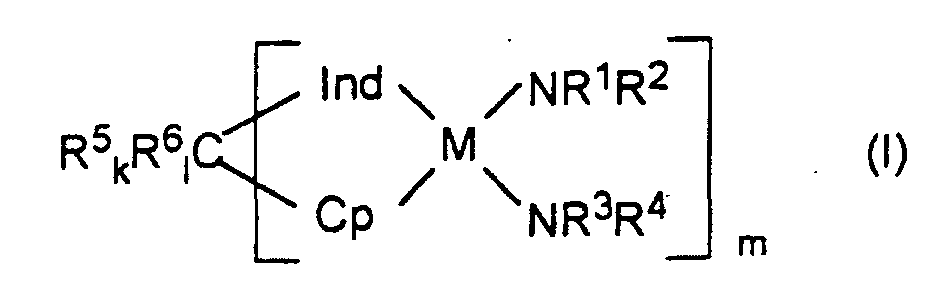
- the present invention thus relates to a metallocene compound of the formula I wherein Cp represents a unsubstituted or substituted cyclopentadienyl, the substituted cyclopentadienyl group is selected from the group consisting of tetramethylcyclopentadienyl, methylcyclopentadienyl, methyl-tert.butylcyclopentadienyl, tert-butylcyclopentadienyl, lsopropylcyclopentadienyl, dimethylcyclopentadienyl, trimethylcyclopentadienyl, trimethylsilylcyclopentadienyl, Trimethylethylcyclopentadienyl, phenylcyclopentadienyl, Diphenylcyclopentadienyl, Ind means unsubstituted or substituted indenyl, where substituted indenyl is selected from the group consisting of 2-methylindeny
- Ind preferably means unsubstituted indenyl.
- R 5 and R 6 are, independently of one another, identical or different, preferably identical, and a hydrogen atom or a C 1 -C 30 hydrocarbon radical such as C 1 -C 20 alkyl or C 6 -C 14 aryl.
- R 5 and R 6 are preferably methyl, ethyl, butyl or phenyl, in particular methyl.
- R 1 and R 3 are, independently of one another, identical or different, a hydrogen atom or a C 1 -C 20 hydrocarbon radical, preferably a C 1 -C 20 hydrocarbon radical such as C 1 -C 20 alkyl or C 6 -C 14 aryl, in particular Methyl.
- R 2 and R 4 are independently the same or different and preferably a C 1 -C 20 hydrocarbon radical such as C 1 -C 20 alkyl or C 6 -C 14 aryl, especially methyl.
- the radicals R 1 , R 2 , R 3 and R 4 are independently the same or different.
- the radicals R 1 , R 2 , R 3 and R 4 are preferably identical and a C 1 -C 20 hydrocarbon radical such as C 1 -C 20 alkyl or C 6 -C 14 aryl, in particular methyl.
- m is preferably 1.
- metallocene compounds of the formula I are: bis (dimethylamido) [ ⁇ 5 : ⁇ 5 -2,2- (cyclopentadienyl) (indenyl) propylidene)] - zirconium bis (dimethylamido) [ ⁇ 5 : ⁇ 5 -2,2- ( cyclopentadienyl) (indenyl) propylidene]] - hafnium bis (dimethylamido) [ ⁇ 5 : ⁇ 5 -2,2- (methylcyclopentadienyl) (indenyl) propylidene)] - zirconium bis (dimethylamido) [ ⁇ 5 : ⁇ 5 -2.2 - (tetramethylcyclopentadienyl) (indenyl) propylidene]] - zirconium bis (dimethylamido) [ ⁇ 5 : ⁇ 5 -2,2- (cyclopentadienyl) (2-methyl-methyl
- the metallocenes according to the invention are highly active catalyst components for olefin polymerization. Depending on the substitution pattern of the ligands the metallocenes are obtained as a mixture of isomers. The metallocenes are preferably used isomerically pure. The use of the racemate is in the sufficient in most cases.
- the pure enantiomer can also be used in the (+) or (-) form.
- An optically active polymer can be produced with the pure enantiomers.
- the configuration isomeric forms of Metallocenes since the polymerization-active center (the metal atom) in these Compounds a polymer with different properties. For certain Applications such as soft molded articles can do this be desirable.
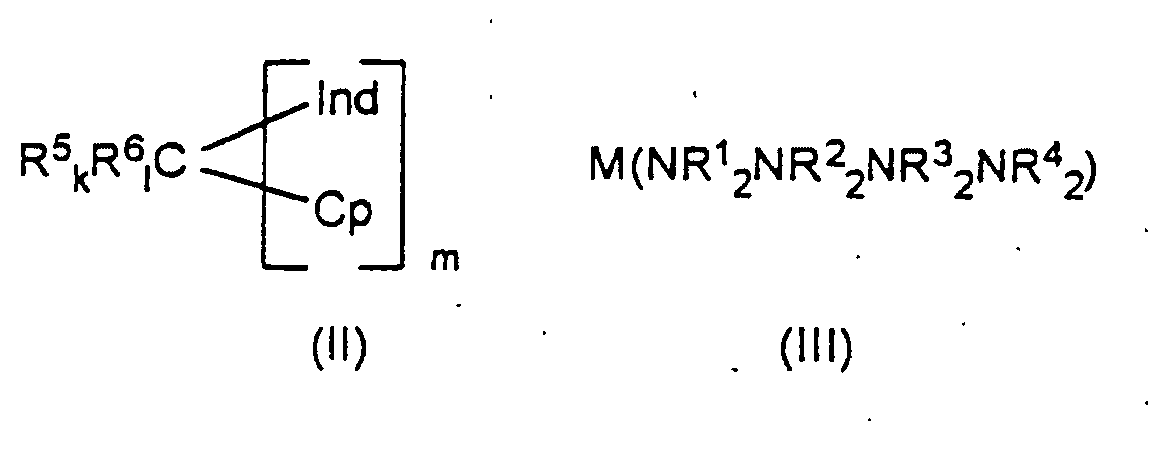
- the metallocene compound of the formula I can be prepared by reacting a compound of the formula II in which Cp denotes an unsubstituted or substituted cyclopentadienyl group, Ind denotes unsubstituted or substituted indenyl, R 5 and R 6 are, independently of one another, the same or different and a hydrogen atom or a C 1 -C 20 represents a hydrocarbon radical and m is 1 or 2, where m is 1 k and l is 1 and m is 2, k and l are zero, with a compound of the formula III, in which M is titanium, zirconium or is hafnium, and R 1 , R 2 , R 3 and R 4, independently of one another, are the same or different and represent a hydrogen atom or a C 1 -C 20 hydrocarbon radical.
- the reaction is preferably carried out in an aprotic solvent, for example toluene or hexane.
- the temperature can be between -78 and 140 ° C, preferably 0 ° C to 110 ° C.
- the compound of the formula II can be used in excess, 1 equivalent of the compound of the formula II and 1 equivalent of the metal tetramide of the formula III are preferably used.
- the present invention also relates to a method for producing a Polyolefin by polymerizing at least one olefin in the presence of a Catalyst of the at least one cocatalyst and at least one Contains metallocene compound of formula I.
- olefins examples include 1-olefins having 2 to 40, preferably 2 to 10, carbon atoms, such as ethylene, propylene, 1-butene, 1-pentene, 1-hexene, 4-methyl-1-pentene or 1-octene, Styrene, dienes such as 1,3-butadiene, isoprene, 1,4-hexadiene or cyclic olefins.
- Ethylene or propylene are preferably homopolymerized in the process according to the invention, or ethylene with one or more acyclic 1-olefins with 3 to 20 C atoms, such as propylene, and / or one or more dienes with 4 to 20 C atoms, such as 1, 3-butadiene, copolymerized.
- Examples of such copolymers are ethylene / propylene copolymers and ethylene / propylene / 1,4-hexadiene copolymers.
- the polymerization is preferred at a temperature of -60 to 250 ° C, particularly preferably 50 to 200 ° C, carried out.
- the pressure is preferred 0.5 to 2000 bar, particularly preferably 5 to 64 bar.
- the polymerization can be in solution, in bulk, in suspension or in the Gas phase, continuous or discontinuous, one or more stages be performed.
- a preferred embodiment is the gas phase and Solution.
- the one used in the process according to the invention preferably contains Catalyst a metallocene compound of formula I and a cocatalyst. It can also be mixtures of two or more metallocene compounds be used, e.g. for the production of polyolefins with wide or multimodal molecular weight distribution.
- each is a cocatalyst in the process according to the invention Compound suitable because of its Lewis acidity the neutral metallocene can convert into a cation and stabilize it ("unstable coordination").
- the cocatalyst or the anion formed from it should not enter into further reactions with the metallocene cation formed (EP 427 697).
- An aluminum compound is preferred as the cocatalyst and / or a boron compound is used.
- the boron compound preferably has the formula R 7 x NH 4-x BR 8 4 , R 7 x PH 4-x BR 8 4 , R 7 3 CBR 8 4 or BR 8 3 , where x is a number from 1 to 4, preferably 3 , means the radicals R 7 are the same or different, preferably the same, and are C 1 -C 10 alkyl or C 6 -C 18 aryl, or two radicals R 7 together with the atoms connecting them form a ring, and the R 8 radicals are the same or different, preferably the same, and are C 6 -C 18 aryl, which can be substituted by alkyl, haloalkyl or fluorine.
- R 7 represents ethyl, propyl, butyl or phenyl and R 8 represents phenyl, pentafluorophenyl, 3,5-bistrifluoromethylphenyl, mesityl, xylyl or tolyl (EP-A-277 003, EP-A-277 004 and EP-A- 426 638).
- An aluminum compound such as aluminoxane is preferred as the cocatalyst and / or an aluminum alkyl used.
- An aluminoxane in particular of the formula IVa for the linear type and / or of the formula IVb for the cyclic type, is particularly preferably used as cocatalyst, where the radicals R 9 in the formulas IVa and IVb are identical or different and are hydrogen or a C 1 -C 20 -hydrocarbon group such as a C 1 -C 18 -alkyl group, a C 6 -C 18 -aryl group or benzyl, and p is an integer from 2 to 50, preferably 10 to 35.
- the radicals R 9 are preferably the same and are hydrogen, methyl, isobutyl, phenyl or benzyl, particularly preferably methyl.
- R 9 radicals are different, they are preferably methyl and hydrogen or, alternatively, methyl and isobutyl, hydrogen or isobutyl preferably being present in a numerical proportion of 0.01 to 40% (of the R 9 radicals).
- the processes for producing the aluminoxanes are known.
- the exact spatial structure of the aluminoxanes is not known (J. Am. Chem. Soc. (1993) 115, 4971). For example, it is conceivable that chains and rings become closed connect larger two-dimensional or three-dimensional structures.
- all aluminoxane solutions are one changing content of unreacted aluminum starting compound, which in free form or as an adduct, together.
- metallocene compound in the Polymerization reaction with a cocatalyst, especially one Pre-activate aluminoxane. This makes the polymerization activity clear elevated.
- the preactivation of the metallocene compound is preferably in Solution made.
- the metallocene compound is preferred in one Solution of the aluminoxane dissolved in an inert hydrocarbon.
- Inert hydrocarbon is an aliphatic or aromatic Hydrocarbon. Toluene is preferably used.
- the concentration of the aluminoxane in the solution is in the range from about 1% by weight to the saturation limit, preferably from 5 to 30% by weight, in each case based on the total amount of solution.
- the metallocene can be used in the same concentration, but it is preferably used in an amount of 10 -4 to 1 mol per mol of aluminoxane.
- the preactivation time is 5 minutes to 60 hours, preferably 5 to 60 minutes. One works at a temperature of -78 to 100 ° C, preferably 0 to 80 ° C.
- the metallocene compound is preferably used in a concentration, based on the transition metal, of 10 -3 to 10 -8 , preferably 10 -4 to 10 -7 mol, transition metal per dm 3 solvent or per dm 3 reactor volume.
- the aluminoxane is preferably used in a concentration of 10 -6 to 10 -1 mol, preferably 10 -5 to 10 -2 mol per dm 3 of solvent or per dm 3 of reactor volume.
- the other cocatalysts mentioned are used in approximately equimolar amounts to the metallocene compound. In principle, however, higher concentrations are also possible.
- the aluminoxane can be prepared in various ways by known methods.
- One of the methods is, for example, that an aluminum hydrocarbon compound and / or a hydridoaluminum hydrocarbon compound is reacted with water (gaseous, solid, liquid or bound - for example as water of crystallization) in an inert solvent (such as toluene).
- an inert solvent such as toluene
- two different aluminum trialkyls are reacted with water in accordance with the desired composition.
- Cleaning is required to remove catalyst poisons present in the olefin with an aluminum compound, preferably an aluminum alkyl, such as Trimethyl aluminum or triethyl aluminum, advantageous. This cleaning can both take place in the polymerization system itself, or the olefin is before Added to the polymerization system with the aluminum compound in contact brought and then separated again.
- an aluminum compound preferably an aluminum alkyl, such as Trimethyl aluminum or triethyl aluminum
- the metallocene compound is preferred in the process according to the invention with the cocatalyst outside the polymerization reactor in one separate step using a suitable solvent. Carrying can be carried out.
- the metallocene compound can be used prepolymerization is carried out.
- this is preferred (or one of the) olefin (s) used in the polymerization.
- the catalyst used in the process according to the invention can be supported. Through the support, for example Control the grain morphology of the polyolefin produced.
- the Metallocene compound first with the carrier and then with the Cocatalyst are implemented. It can also be the cocatalyst first are supported and then reacted with the metallocene compound become. It is also possible the reaction product of metallocene compound and to support cocatalyst.
- Suitable carrier materials are, for example Silica gels, aluminum oxides, solid aluminoxane or other inorganic Carrier materials such as magnesium chloride.
- the carrier material is also a polyolefin powder in finely divided form.
- the supported cocatalyst can be prepared, for example, as in EP-A-567 952 described.
- the cocatalyst e.g. Aluminoxane
- a support such as for example silica gels, aluminum oxides, solid aluminoxane, others inorganic carrier materials or a polyolefin powder in finely divided Mold applied and then implemented with the metallocene.
- Oxides which can be used as inorganic carriers are: flame pyrolytic by burning element halides in one Oxygen gas flame were generated, or as silica gels in certain Grain size distributions and grain shapes can be produced.
- the preparation of the supported cocatalyst can, for example, as described in EP-A-578 838, in the following manner in a stainless steel reactor in an explosion-proof design with a pumping system of the pressure stage 60 bar, with inert gas supply, temperature control by jacket cooling and a second cooling circuit via a heat exchanger on the pumping system respectively.
- the pumping system sucks the contents of the reactor through a connection in the bottom of the reactor with a pump and presses it into a mixer and back through a riser via a heat exchanger into the reactor.
- the mixer is designed so that there is a narrow pipe cross-section in the inlet, where an increased flow velocity occurs, and in its turbulence zone, a thin feed line is guided axially and counter to the direction of flow, through which - clocked - a defined amount of water below 40 bar Argon can be fed.
- the reaction is controlled by a sampler on the pump circuit. In principle, however, other reactors are also suitable. Further possibilities for producing a supported cocatalyst are described in EP-A-578 838.
- the metallocene according to the invention is then applied to the supported cocatalyst by stirring the dissolved metallocene with the supported cocatalyst.
- the solvent is removed and replaced by a hydrocarbon in which both the cocatalyst and the metallocene are insoluble.
- the reaction to the supported catalyst system can be at a temperature from -20 to + 120 ° C, preferably 0 to 100 ° C, particularly preferably at 15 to 40 ° C take place.
- the metallocene is supported with the supported cocatalyst in the Implemented such that the cocatalyst as a suspension with 1 to 40 wt .-%, preferably with 5 to 20 wt .-% in an aliphatic, inert Suspension agents such as n-decane, hexane, heptane, diesel oil with a solution of the Metallocens in an inert solvent such as toluene, hexane, heptane, Dichloromethane or with the finely ground solid of the metallocene is brought together.
- a solution of the metallocene can also be used be reacted with the solid of the cocatalyst.
- the reaction is carried out by intensive mixing, for example by stirring at a molar Al / M 1 ratio of 100/1 to 10000/1, preferably from 100/1 to 3000/1 and a reaction time of 5 to 120 minutes, preferably 10 to 60 Minutes, particularly preferably 10 to 30 minutes under inert conditions.
- a reaction time of 5 to 120 minutes, preferably 10 to 60 Minutes, particularly preferably 10 to 30 minutes under inert conditions.
- changes occur in the color of the reaction mixture, in the course of which the progress of the reaction can be followed, in particular when using the metallocenes according to the invention with absorption maxima in the visible range.
- the supernatant solution is separated off, for example by filtration or decanting.
- the remaining solid is 1 to 5 times with an inert suspending agent such as toluene, n-decane, Hexane, diesel oil, dichloromethane to remove soluble components in the formed catalyst, especially for the removal of unreacted and with soluble metallocene, washed.
- the supported catalyst system thus produced can be dried in vacuo resuspended as a powder or solvent and as Suspension in one of the aforementioned inert suspending agents in the Polymerization system be metered.
- the polymerization as a suspension or solution polymerization becomes a customary for the Ziegler low pressure process inert solvent used.
- a gasoline or hydrogenated Diesel oil fraction can be used.
- Toluene can also be used. Is preferred in polymerized liquid monomers.
- an aluminum alkyl compound such as trimethylaluminium, triethylaluminium, triisobutylaluminium, trioctylaluminum or isoprenylaluminium can additionally be used to inert the polymerization system (for example to separate the olefins present in the catalyst) Reactor are given.
- This is added to the polymerization system in a concentration of 100 to 0.01 mmol Al per kg reactor content.
- Triisobutyl aluminum and triethyl aluminum are preferred in a concentration of 10 to 0.1 mmol Al per kg reactor content.
- the molar Al / M 1 ratio can be chosen to be small in the synthesis of a supported catalyst system.
- the monomers become gaseous or metered in liquid.
- the duration of the polymerization is arbitrary, since that in the invention Process to be used catalyst system only a small shows a time-dependent drop in the polymerization activity.
- the specific metallocene compound described in the present invention is suitable for the production of polyolefins.
- the hardness or melting point of the comonomer content can be varied.
- thermoplastic materials are suitable. These are especially for the production of moldings such as Foils, plates or large hollow bodies (e.g. pipes) are suitable.
- Comonomer amount (s) can be olefin copolymers e.g. Prepare ethylene / propylene / 1,4-hexadiene terpolymers.
Landscapes
- Chemical & Material Sciences (AREA)
- Organic Chemistry (AREA)
- Health & Medical Sciences (AREA)
- Chemical Kinetics & Catalysis (AREA)
- Medicinal Chemistry (AREA)
- Polymers & Plastics (AREA)
- Engineering & Computer Science (AREA)
- Materials Engineering (AREA)
- Crystallography & Structural Chemistry (AREA)
- Transition And Organic Metals Composition Catalysts For Addition Polymerization (AREA)
- Catalysts (AREA)
- Low-Molecular Organic Synthesis Reactions Using Catalysts (AREA)
Description


Weitere Möglichkeiten der Herstellung eines geträgerten Cokatalysators sind in EP-A-578 838 beschrieben. Danach wird das erfindungsgemäße Metallocen auf den geträgerten Cokatalysator aufgebracht, indem das gelöste Metallocen mit dem geträgerten Cokatalysator gerührt wird. Das Lösemittel wird entfernt und durch einen Kohlenwasserstoff ersetzt, in dem sowohl Cokatalysator als auch das Metallocen unlöslich sind.
Im Laufe der Reaktionszeit zur Herstellung des geträgerten Katalysatorsystems treten insbesondere bei der Verwendung der erfindungsgemäßen Metallocene mit Absorptionsmaxima im sichtbaren Bereich Veränderungen in der Farbe der Reaktionsmischung auf, an deren Verlauf sich der Fortgang der Reaktion verfolgen läßt.
Claims (10)
- Metallocenverbindung der Formelworin Cp eine unsubstituierte oder substituierte Cyclopentadienylgruppe bedeutet, wobei die substituierte Cyclopentadienylgruppe ausgewählt ist aus der Gruppe bestehend aus Tetramethylcyclopentadienyl, Methylcyclopentadienyl, Methyl-tert.butylcyclopentadienyl, Tert.-butylcyclopentadienyl, Isopropylcyclopentadienyl, Dimethylcyclopentadienyl, Trimethylcyclopentadienyl, Trimethylsilylcyclopentadienyl, Trimethylethylcyclopentadienyl, Phenylcyclopentadienyl, Diphenylcyclopentadienyl, Ind unsubstituiertes oder substituiertes Indenyl bedeutet, wobei substituiertes Indenyl ausgewählt ist aus der Gruppe bestehend aus 2-Methylindenyl, 2-Ethylindenyl, 2-Isopropylindenyl, 3-Methylindenyl, 3-tert.-butylindenyl, 3-Trimethylsilylindenyl, 2-Methyl-4-phenylindenyl, 2-Ethyl-4-phenylindenyl, 2-Methyl-4-naphthyl-indenyl, 2-Methyl-4-isopropyl-indenyl, 4,5-Benzoindenyl, 2-Methyl-4,5-benzoindenyl, 2-Methyl-α-acenaphthindenyl, 2-Methyl-4,6-diisopropylindenyl,
M Titan, Zirkonium oder Hafnium bedeutet, R1, R2, R3 und R4 unabhängig voneinander gleich oder verschieden sind und ein Wasserstoffatom oder einen C1-C20-Kohlenwasserstoffrest bedeuten, oder M(NR1R2)(NR3R4) für Bis(pyrrolidinamido)-zirkonium steht, R5 und R6 unabhängig voneinander gleich oder verschieden sind und ein Wasserstoffatom oder einen C1-C20-Kohlenwasserstoffrest bedeuten und m gleich 1 oder 2 ist, wobei für m gleich 1 k und I gleich 1 sind und für m gleich 2, k und l gleich Null sind. - Katalysator, enthaltend mindestens eine Metallocenverbindung der Formel I gemäß Anspruch 1 und mindestens einen Cokatalysator.
- Katalysator gemäß Anspruch 2, worin als Cokatalysator eine Aluminiumverbindung und/oder eine Borverbindung verwendet wird.
- Katalysator gemäß Anspruch 2 oder 3, zusätzlich enthaltend einen Träger.
- Katalysator gemäß einem oder mehreren der Ansprüche 2 bis 4, worin die Metallocenverbindung der Formel I vorpolymerisiert ist.
- Verfahren zur Herstellung eines Polyolefins durch Polymerisation mindestens eines Olefins in Gegenwart eines Katalysators gemäß einem oder mehreren der Ansprüche 2 bis 5.
- Polyolefin, herstellbar nach dem Verfahren gemäß Anspruch 6.
- Formteil, enthaltend ein Polyolefin gemäß Anspruch 7.
- Verwendung einer Metallocenverbindung der Formel I gemäß Anspruch 1, zur Olefinpolymerisation.
- Verwendung eines Katalysators gemäß einem oder mehreren der Ansprüche 2 bis 5, zur Olefinpolymerisation.
Applications Claiming Priority (2)
| Application Number | Priority Date | Filing Date | Title |
|---|---|---|---|
| DE19546501A DE19546501A1 (de) | 1995-12-13 | 1995-12-13 | Metallocenverbindung |
| DE19546501 | 1995-12-13 |
Publications (2)
| Publication Number | Publication Date |
|---|---|
| EP0779295A1 EP0779295A1 (de) | 1997-06-18 |
| EP0779295B1 true EP0779295B1 (de) | 2004-10-20 |
Family
ID=7779983
Family Applications (1)
| Application Number | Title | Priority Date | Filing Date |
|---|---|---|---|
| EP96119752A Expired - Lifetime EP0779295B1 (de) | 1995-12-13 | 1996-12-10 | Metallocenverbindung |
Country Status (11)
| Country | Link |
|---|---|
| US (1) | US6040469A (de) |
| EP (1) | EP0779295B1 (de) |
| JP (1) | JP4165720B2 (de) |
| KR (1) | KR970042567A (de) |
| CN (2) | CN1074421C (de) |
| AT (1) | ATE280175T1 (de) |
| AU (1) | AU7421896A (de) |
| BR (1) | BR9605977A (de) |
| CA (1) | CA2192770A1 (de) |
| DE (2) | DE19546501A1 (de) |
| NO (1) | NO965328L (de) |
Families Citing this family (19)
| Publication number | Priority date | Publication date | Assignee | Title |
|---|---|---|---|---|
| JP3566819B2 (ja) * | 1996-10-04 | 2004-09-15 | 関東化学株式会社 | 新規な有機遷移金属化合物 |
| US6284698B1 (en) | 1997-09-15 | 2001-09-04 | The Dow Chemical Company | Highly activated bimetallic complexes and polymerization process |
| DE69807506T2 (de) * | 1997-09-15 | 2003-05-28 | The Dow Chemical Co., Midland | Bimetallische komplexe und diese enthaltende polymerisationskatalysatoren |
| US6235917B1 (en) | 1998-08-28 | 2001-05-22 | The Dow Chemical Company | Dinuclear complexes and polymerization catalysts therefrom |
| US5892079A (en) * | 1997-10-17 | 1999-04-06 | Sri International | Metallocene catalysts and associated methods of preparation and use |
| US5986024A (en) * | 1997-10-17 | 1999-11-16 | Sri International | Preparation of multimodal polymer compositions using multinuclear metallocene catalysts |
| US6096677A (en) * | 1997-10-17 | 2000-08-01 | Sri International | Supported metallocene catalysts |
| EP0933383A1 (de) * | 1998-01-29 | 1999-08-04 | Union Carbide Chemicals & Plastics Technology Corporation | Katalysatorzusammensetzung für die Olefinpolymerisation |
| EP1097161A1 (de) | 1998-07-10 | 2001-05-09 | Exxon Chemical Patents Inc. | Gebundene monocyclopentadienyl- polymerisationskatalysatoren |
| EP0985677A1 (de) * | 1998-09-07 | 2000-03-15 | Industrial Technology Research Institute | Zweikernige Metallocenkatalysator für Olefinpolymerisation |
| US6544919B1 (en) | 1999-10-06 | 2003-04-08 | Sri International | Multinuclear transition metal catalysts for preparation of multimodal polymer compositions |
| IT1314261B1 (it) * | 1999-12-03 | 2002-12-06 | Enichem Spa | Composti metallocenici pontati, processo per la loro preparazione eloro uso come catalizzatori per la polimerizzazione di olefine. |
| JP2002338617A (ja) * | 2001-05-22 | 2002-11-27 | Sumitomo Chem Co Ltd | ビニル化合物重合用触媒成分、ビニル化合物重合用触媒、ビニル化合物重合体の製造方法および遷移金属化合物の使用方法 |
| US7541402B2 (en) * | 2002-10-15 | 2009-06-02 | Exxonmobil Chemical Patents Inc. | Blend functionalized polyolefin adhesive |
| US7700707B2 (en) | 2002-10-15 | 2010-04-20 | Exxonmobil Chemical Patents Inc. | Polyolefin adhesive compositions and articles made therefrom |
| US7550528B2 (en) * | 2002-10-15 | 2009-06-23 | Exxonmobil Chemical Patents Inc. | Functionalized olefin polymers |
| US7223822B2 (en) * | 2002-10-15 | 2007-05-29 | Exxonmobil Chemical Patents Inc. | Multiple catalyst and reactor system for olefin polymerization and polymers produced therefrom |
| WO2004046214A2 (en) | 2002-10-15 | 2004-06-03 | Exxonmobil Chemical Patents Inc. | Multiple catalyst system for olefin polymerization and polymers produced therefrom |
| CN112552428B (zh) * | 2019-09-25 | 2022-08-05 | 中国石油天然气股份有限公司 | 茂金属催化剂及其制备方法与应用 |
Family Cites Families (14)
| Publication number | Priority date | Publication date | Assignee | Title |
|---|---|---|---|---|
| ZA844157B (en) | 1983-06-06 | 1986-01-29 | Exxon Research Engineering Co | Process and catalyst for polyolefin density and molecular weight control |
| US5700749A (en) * | 1986-09-24 | 1997-12-23 | Mitsui Petrochemical Industries, Ltd. | Process for polymerizing olefins |
| PL276385A1 (en) | 1987-01-30 | 1989-07-24 | Exxon Chemical Patents Inc | Method for polymerization of olefines,diolefins and acetylene unsaturated compounds |
| IL85097A (en) | 1987-01-30 | 1992-02-16 | Exxon Chemical Patents Inc | Catalysts based on derivatives of a bis(cyclopentadienyl)group ivb metal compound,their preparation and their use in polymerization processes |
| US5003019A (en) | 1987-03-02 | 1991-03-26 | Mitsui Petrochemical Industries, Ltd. | Cyclo-olefinic random copolymer, olefinic random copolymer, and process for producing cyclo-olefinic random copolymers |
| DE69026907T2 (de) | 1989-10-10 | 1996-10-10 | Fina Technology | Metallocenkatalysator mit Lewissäure und Alkylaluminium |
| ATE137247T1 (de) | 1989-10-30 | 1996-05-15 | Fina Technology | Addition von alkylaluminium zum verbessern eines metallocenkatalysators |
| JP3048653B2 (ja) * | 1991-02-07 | 2000-06-05 | 三菱化学株式会社 | α‐オレフィン重合体の製造 |
| EP0578838A1 (de) | 1992-04-29 | 1994-01-19 | Hoechst Aktiengesellschaft | Katalysator für die Olefinpolymerisation, Verfahren zu seiner Herstellung und seine Verwendung |
| EP0567952B1 (de) | 1992-04-29 | 1997-12-03 | Hoechst Aktiengesellschaft | Katalysator für die Olefinpolymerisation, Verfahren zu seiner Herstellung und seine Verwendung |
| IT1256603B (it) | 1992-10-30 | 1995-12-12 | Enichem Polimeri | Catalizzatore e procedimento per (co) polimerizzare le alfa-olefine |
| IT1273420B (it) * | 1994-04-06 | 1997-07-08 | Spherilene Srl | Composti metallocenici, procedimento per la preparazione e loro utilizzo in catalizzatori per la polimerizzazione delle olefine |
| US5597935A (en) * | 1994-06-01 | 1997-01-28 | University Of Iowa Research Foundation | Synthesis of ansa-metallocene catalysts |
| DE69500979T2 (de) * | 1994-07-22 | 1998-03-05 | Mitsubishi Chem Corp | Katalysatorbestandteil für alpha-Olefinpolymerisation und Verfahren zur Herstellung von alpha-Olefinpolymeren unter Anwendung desselben |
-
1995
- 1995-12-13 DE DE19546501A patent/DE19546501A1/de not_active Withdrawn
-
1996
- 1996-12-06 AU AU74218/96A patent/AU7421896A/en not_active Abandoned
- 1996-12-10 EP EP96119752A patent/EP0779295B1/de not_active Expired - Lifetime
- 1996-12-10 AT AT96119752T patent/ATE280175T1/de not_active IP Right Cessation
- 1996-12-10 DE DE59611121T patent/DE59611121D1/de not_active Expired - Lifetime
- 1996-12-11 KR KR1019960064293A patent/KR970042567A/ko not_active Withdrawn
- 1996-12-12 NO NO965328A patent/NO965328L/no not_active Application Discontinuation
- 1996-12-12 CA CA002192770A patent/CA2192770A1/en not_active Abandoned
- 1996-12-12 US US08/764,526 patent/US6040469A/en not_active Expired - Fee Related
- 1996-12-12 BR BR9605977A patent/BR9605977A/pt not_active Application Discontinuation
- 1996-12-13 JP JP33367396A patent/JP4165720B2/ja not_active Expired - Fee Related
- 1996-12-13 CN CN96121557A patent/CN1074421C/zh not_active Expired - Fee Related
-
2001
- 2001-03-09 CN CN01110987A patent/CN1347921A/zh active Pending
Also Published As
| Publication number | Publication date |
|---|---|
| ATE280175T1 (de) | 2004-11-15 |
| NO965328L (no) | 1997-06-16 |
| DE19546501A1 (de) | 1997-06-19 |
| JPH09183788A (ja) | 1997-07-15 |
| BR9605977A (pt) | 1998-08-25 |
| CN1159449A (zh) | 1997-09-17 |
| JP4165720B2 (ja) | 2008-10-15 |
| KR970042567A (ko) | 1997-07-24 |
| NO965328D0 (no) | 1996-12-12 |
| CN1347921A (zh) | 2002-05-08 |
| CN1074421C (zh) | 2001-11-07 |
| US6040469A (en) | 2000-03-21 |
| AU7421896A (en) | 1997-06-19 |
| CA2192770A1 (en) | 1997-06-14 |
| DE59611121D1 (de) | 2004-11-25 |
| EP0779295A1 (de) | 1997-06-18 |
Similar Documents
| Publication | Publication Date | Title |
|---|---|---|
| EP1325926B1 (de) | Metallocene | |
| EP0816372B1 (de) | Übergangsmetallverbindung | |
| EP0779295B1 (de) | Metallocenverbindung | |
| EP1015463B1 (de) | Verfahren zur herstellung von metallocenen | |
| EP0743317B1 (de) | Metallocene mit einem heterocyclischen Ring und Katalysatoren, die sie enthalten | |
| EP0742046B1 (de) | Organometallverbindungen | |
| EP0748821B1 (de) | Übergangsmetallverbindung | |
| EP0757053A2 (de) | Metallocenverbindung | |
| EP0742225A1 (de) | Organometallverbindung | |
| EP0984973B1 (de) | Stereorigide metallocenverbindung | |
| EP0749985B1 (de) | Stereorigide Metallocenverbindung | |
| EP0707010B1 (de) | Metallocenverbindung | |
| EP0837068A2 (de) | Stereorigide Metallocenverbindung | |
| EP0859798B1 (de) | Katalysatorsystem | |
| EP0749975B1 (de) | Übergangsmetallverbindung | |
| EP0868441A2 (de) | Übergangsmetallverbindung | |
| DE19847320A1 (de) | Metallocene mit starrer Brücke | |
| DE19719104A1 (de) | Stereorigide Metallocenverbindung | |
| DE19642432A1 (de) | Stereorigide Metallocenverbindung | |
| EP0812853A2 (de) | Übergangsmetallverbindung | |
| WO1999015537A1 (de) | Übergangsmetallverbindung |
Legal Events
| Date | Code | Title | Description |
|---|---|---|---|
| PUAI | Public reference made under article 153(3) epc to a published international application that has entered the european phase |
Free format text: ORIGINAL CODE: 0009012 |
|
| AK | Designated contracting states |
Kind code of ref document: A1 Designated state(s): AT BE DE ES FI FR GB IT NL SE |
|
| 17P | Request for examination filed |
Effective date: 19971218 |
|
| RAP1 | Party data changed (applicant data changed or rights of an application transferred) |
Owner name: TARGOR GMBH |
|
| 17Q | First examination report despatched |
Effective date: 20000726 |
|
| RAP1 | Party data changed (applicant data changed or rights of an application transferred) |
Owner name: BASELL POLYOLEFINE GMBH |
|
| RAP1 | Party data changed (applicant data changed or rights of an application transferred) |
Owner name: BASELL POLYOLEFINE GMBH |
|
| APAB | Appeal dossier modified |
Free format text: ORIGINAL CODE: EPIDOS NOAPE |
|
| APAB | Appeal dossier modified |
Free format text: ORIGINAL CODE: EPIDOS NOAPE |
|
| GRAP | Despatch of communication of intention to grant a patent |
Free format text: ORIGINAL CODE: EPIDOSNIGR1 |
|
| RAP1 | Party data changed (applicant data changed or rights of an application transferred) |
Owner name: BASELL POLYOLEFINE GMBH |
|
| GRAS | Grant fee paid |
Free format text: ORIGINAL CODE: EPIDOSNIGR3 |
|
| GRAA | (expected) grant |
Free format text: ORIGINAL CODE: 0009210 |
|
| AK | Designated contracting states |
Kind code of ref document: B1 Designated state(s): AT BE DE ES FI FR GB IT NL SE |
|
| PG25 | Lapsed in a contracting state [announced via postgrant information from national office to epo] |
Ref country code: SE Free format text: LAPSE BECAUSE OF FAILURE TO SUBMIT A TRANSLATION OF THE DESCRIPTION OR TO PAY THE FEE WITHIN THE PRESCRIBED TIME-LIMIT Effective date: 20041020 Ref country code: NL Free format text: LAPSE BECAUSE OF FAILURE TO SUBMIT A TRANSLATION OF THE DESCRIPTION OR TO PAY THE FEE WITHIN THE PRESCRIBED TIME-LIMIT Effective date: 20041020 Ref country code: FI Free format text: LAPSE BECAUSE OF FAILURE TO SUBMIT A TRANSLATION OF THE DESCRIPTION OR TO PAY THE FEE WITHIN THE PRESCRIBED TIME-LIMIT Effective date: 20041020 |
|
| REG | Reference to a national code |
Ref country code: GB Ref legal event code: FG4D Free format text: NOT ENGLISH |
|
| REF | Corresponds to: |
Ref document number: 59611121 Country of ref document: DE Date of ref document: 20041125 Kind code of ref document: P |
|
| PG25 | Lapsed in a contracting state [announced via postgrant information from national office to epo] |
Ref country code: AT Free format text: LAPSE BECAUSE OF NON-PAYMENT OF DUE FEES Effective date: 20041210 |
|
| PG25 | Lapsed in a contracting state [announced via postgrant information from national office to epo] |
Ref country code: BE Free format text: LAPSE BECAUSE OF NON-PAYMENT OF DUE FEES Effective date: 20041231 |
|
| PG25 | Lapsed in a contracting state [announced via postgrant information from national office to epo] |
Ref country code: ES Free format text: LAPSE BECAUSE OF FAILURE TO SUBMIT A TRANSLATION OF THE DESCRIPTION OR TO PAY THE FEE WITHIN THE PRESCRIBED TIME-LIMIT Effective date: 20050131 |
|
| GBT | Gb: translation of ep patent filed (gb section 77(6)(a)/1977) |
Effective date: 20050131 |
|
| NLV1 | Nl: lapsed or annulled due to failure to fulfill the requirements of art. 29p and 29m of the patents act | ||
| BERE | Be: lapsed |
Owner name: BASELL POLYOLEFINE G.M.B.H. Effective date: 20041231 |
|
| RAP2 | Party data changed (patent owner data changed or rights of a patent transferred) |
Owner name: BASELL POLYOLEFINE GMBH |
|
| PLBE | No opposition filed within time limit |
Free format text: ORIGINAL CODE: 0009261 |
|
| STAA | Information on the status of an ep patent application or granted ep patent |
Free format text: STATUS: NO OPPOSITION FILED WITHIN TIME LIMIT |
|
| ET | Fr: translation filed | ||
| 26N | No opposition filed |
Effective date: 20050721 |
|
| BERE | Be: lapsed |
Owner name: *BASELL POLYOLEFINE G.M.B.H. Effective date: 20041231 |
|
| PGFP | Annual fee paid to national office [announced via postgrant information from national office to epo] |
Ref country code: GB Payment date: 20091229 Year of fee payment: 14 Ref country code: FR Payment date: 20100106 Year of fee payment: 14 |
|
| PGFP | Annual fee paid to national office [announced via postgrant information from national office to epo] |
Ref country code: IT Payment date: 20091229 Year of fee payment: 14 |
|
| PGFP | Annual fee paid to national office [announced via postgrant information from national office to epo] |
Ref country code: DE Payment date: 20091222 Year of fee payment: 14 |
|
| GBPC | Gb: european patent ceased through non-payment of renewal fee |
Effective date: 20101210 |
|
| REG | Reference to a national code |
Ref country code: FR Ref legal event code: ST Effective date: 20110831 |
|
| PG25 | Lapsed in a contracting state [announced via postgrant information from national office to epo] |
Ref country code: FR Free format text: LAPSE BECAUSE OF NON-PAYMENT OF DUE FEES Effective date: 20110103 |
|
| REG | Reference to a national code |
Ref country code: DE Ref legal event code: R119 Ref document number: 59611121 Country of ref document: DE Effective date: 20110701 |
|
| PG25 | Lapsed in a contracting state [announced via postgrant information from national office to epo] |
Ref country code: DE Free format text: LAPSE BECAUSE OF NON-PAYMENT OF DUE FEES Effective date: 20110701 Ref country code: GB Free format text: LAPSE BECAUSE OF NON-PAYMENT OF DUE FEES Effective date: 20101210 |
|
| PG25 | Lapsed in a contracting state [announced via postgrant information from national office to epo] |
Ref country code: IT Free format text: LAPSE BECAUSE OF NON-PAYMENT OF DUE FEES Effective date: 20101210 |