EP0779437A1 - Procédé d'assemblage de structures préfabriquées en matériau composite - Google Patents
Procédé d'assemblage de structures préfabriquées en matériau composite Download PDFInfo
- Publication number
- EP0779437A1 EP0779437A1 EP96402500A EP96402500A EP0779437A1 EP 0779437 A1 EP0779437 A1 EP 0779437A1 EP 96402500 A EP96402500 A EP 96402500A EP 96402500 A EP96402500 A EP 96402500A EP 0779437 A1 EP0779437 A1 EP 0779437A1
- Authority
- EP
- European Patent Office
- Prior art keywords
- composite material
- insert
- halves
- assembly
- structures
- Prior art date
- Legal status (The legal status is an assumption and is not a legal conclusion. Google has not performed a legal analysis and makes no representation as to the accuracy of the status listed.)
- Granted
Links
Images
Classifications
-
- B—PERFORMING OPERATIONS; TRANSPORTING
- B29—WORKING OF PLASTICS; WORKING OF SUBSTANCES IN A PLASTIC STATE IN GENERAL
- B29C—SHAPING OR JOINING OF PLASTICS; SHAPING OF MATERIAL IN A PLASTIC STATE, NOT OTHERWISE PROVIDED FOR; AFTER-TREATMENT OF THE SHAPED PRODUCTS, e.g. REPAIRING
- B29C66/00—General aspects of processes or apparatus for joining preformed parts
- B29C66/01—General aspects dealing with the joint area or with the area to be joined
- B29C66/05—Particular design of joint configurations
- B29C66/10—Particular design of joint configurations particular design of the joint cross-sections
- B29C66/11—Joint cross-sections comprising a single joint-segment, i.e. one of the parts to be joined comprising a single joint-segment in the joint cross-section
- B29C66/114—Single butt joints
- B29C66/1142—Single butt to butt joints
-
- B—PERFORMING OPERATIONS; TRANSPORTING
- B29—WORKING OF PLASTICS; WORKING OF SUBSTANCES IN A PLASTIC STATE IN GENERAL
- B29C—SHAPING OR JOINING OF PLASTICS; SHAPING OF MATERIAL IN A PLASTIC STATE, NOT OTHERWISE PROVIDED FOR; AFTER-TREATMENT OF THE SHAPED PRODUCTS, e.g. REPAIRING
- B29C65/00—Joining or sealing of preformed parts, e.g. welding of plastics materials; Apparatus therefor
- B29C65/48—Joining or sealing of preformed parts, e.g. welding of plastics materials; Apparatus therefor using adhesives, i.e. using supplementary joining material; solvent bonding
-
- B—PERFORMING OPERATIONS; TRANSPORTING
- B29—WORKING OF PLASTICS; WORKING OF SUBSTANCES IN A PLASTIC STATE IN GENERAL
- B29C—SHAPING OR JOINING OF PLASTICS; SHAPING OF MATERIAL IN A PLASTIC STATE, NOT OTHERWISE PROVIDED FOR; AFTER-TREATMENT OF THE SHAPED PRODUCTS, e.g. REPAIRING
- B29C65/00—Joining or sealing of preformed parts, e.g. welding of plastics materials; Apparatus therefor
- B29C65/56—Joining or sealing of preformed parts, e.g. welding of plastics materials; Apparatus therefor using mechanical means or mechanical connections, e.g. form-fits
- B29C65/562—Joining or sealing of preformed parts, e.g. welding of plastics materials; Apparatus therefor using mechanical means or mechanical connections, e.g. form-fits using extra joining elements, i.e. which are not integral with the parts to be joined
-
- B—PERFORMING OPERATIONS; TRANSPORTING
- B29—WORKING OF PLASTICS; WORKING OF SUBSTANCES IN A PLASTIC STATE IN GENERAL
- B29C—SHAPING OR JOINING OF PLASTICS; SHAPING OF MATERIAL IN A PLASTIC STATE, NOT OTHERWISE PROVIDED FOR; AFTER-TREATMENT OF THE SHAPED PRODUCTS, e.g. REPAIRING
- B29C65/00—Joining or sealing of preformed parts, e.g. welding of plastics materials; Apparatus therefor
- B29C65/72—Joining or sealing of preformed parts, e.g. welding of plastics materials; Apparatus therefor by combined operations or combined techniques, e.g. welding and stitching
-
- B—PERFORMING OPERATIONS; TRANSPORTING
- B29—WORKING OF PLASTICS; WORKING OF SUBSTANCES IN A PLASTIC STATE IN GENERAL
- B29C—SHAPING OR JOINING OF PLASTICS; SHAPING OF MATERIAL IN A PLASTIC STATE, NOT OTHERWISE PROVIDED FOR; AFTER-TREATMENT OF THE SHAPED PRODUCTS, e.g. REPAIRING
- B29C66/00—General aspects of processes or apparatus for joining preformed parts
- B29C66/40—General aspects of joining substantially flat articles, e.g. plates, sheets or web-like materials; Making flat seams in tubular or hollow articles; Joining single elements to substantially flat surfaces
- B29C66/41—Joining substantially flat articles ; Making flat seams in tubular or hollow articles
- B29C66/43—Joining a relatively small portion of the surface of said articles
-
- B—PERFORMING OPERATIONS; TRANSPORTING
- B29—WORKING OF PLASTICS; WORKING OF SUBSTANCES IN A PLASTIC STATE IN GENERAL
- B29C—SHAPING OR JOINING OF PLASTICS; SHAPING OF MATERIAL IN A PLASTIC STATE, NOT OTHERWISE PROVIDED FOR; AFTER-TREATMENT OF THE SHAPED PRODUCTS, e.g. REPAIRING
- B29C66/00—General aspects of processes or apparatus for joining preformed parts
- B29C66/70—General aspects of processes or apparatus for joining preformed parts characterised by the composition, physical properties or the structure of the material of the parts to be joined; Joining with non-plastics material
- B29C66/72—General aspects of processes or apparatus for joining preformed parts characterised by the composition, physical properties or the structure of the material of the parts to be joined; Joining with non-plastics material characterised by the structure of the material of the parts to be joined
- B29C66/721—Fibre-reinforced materials
-
- F—MECHANICAL ENGINEERING; LIGHTING; HEATING; WEAPONS; BLASTING
- F16—ENGINEERING ELEMENTS AND UNITS; GENERAL MEASURES FOR PRODUCING AND MAINTAINING EFFECTIVE FUNCTIONING OF MACHINES OR INSTALLATIONS; THERMAL INSULATION IN GENERAL
- F16B—DEVICES FOR FASTENING OR SECURING CONSTRUCTIONAL ELEMENTS OR MACHINE PARTS TOGETHER, e.g. NAILS, BOLTS, CIRCLIPS, CLAMPS, CLIPS OR WEDGES; JOINTS OR JOINTING
- F16B11/00—Connecting constructional elements or machine parts by sticking or pressing them together, e.g. cold pressure welding
- F16B11/006—Connecting constructional elements or machine parts by sticking or pressing them together, e.g. cold pressure welding by gluing
-
- B—PERFORMING OPERATIONS; TRANSPORTING
- B29—WORKING OF PLASTICS; WORKING OF SUBSTANCES IN A PLASTIC STATE IN GENERAL
- B29C—SHAPING OR JOINING OF PLASTICS; SHAPING OF MATERIAL IN A PLASTIC STATE, NOT OTHERWISE PROVIDED FOR; AFTER-TREATMENT OF THE SHAPED PRODUCTS, e.g. REPAIRING
- B29C65/00—Joining or sealing of preformed parts, e.g. welding of plastics materials; Apparatus therefor
- B29C65/56—Joining or sealing of preformed parts, e.g. welding of plastics materials; Apparatus therefor using mechanical means or mechanical connections, e.g. form-fits
- B29C65/562—Joining or sealing of preformed parts, e.g. welding of plastics materials; Apparatus therefor using mechanical means or mechanical connections, e.g. form-fits using extra joining elements, i.e. which are not integral with the parts to be joined
- B29C65/564—Joining or sealing of preformed parts, e.g. welding of plastics materials; Apparatus therefor using mechanical means or mechanical connections, e.g. form-fits using extra joining elements, i.e. which are not integral with the parts to be joined hidden in the joint, e.g. dowels or Z-pins
-
- B—PERFORMING OPERATIONS; TRANSPORTING
- B29—WORKING OF PLASTICS; WORKING OF SUBSTANCES IN A PLASTIC STATE IN GENERAL
- B29C—SHAPING OR JOINING OF PLASTICS; SHAPING OF MATERIAL IN A PLASTIC STATE, NOT OTHERWISE PROVIDED FOR; AFTER-TREATMENT OF THE SHAPED PRODUCTS, e.g. REPAIRING
- B29C66/00—General aspects of processes or apparatus for joining preformed parts
- B29C66/70—General aspects of processes or apparatus for joining preformed parts characterised by the composition, physical properties or the structure of the material of the parts to be joined; Joining with non-plastics material
- B29C66/72—General aspects of processes or apparatus for joining preformed parts characterised by the composition, physical properties or the structure of the material of the parts to be joined; Joining with non-plastics material characterised by the structure of the material of the parts to be joined
- B29C66/721—Fibre-reinforced materials
- B29C66/7212—Fibre-reinforced materials characterised by the composition of the fibres
Definitions
- the invention relates to a method of assembling prefabricated structures constructed of composite material, in particular sections or rings of ship hulls, as well as the assembly obtained according to this method.
- the composite material structures consist of a stack of layers of reinforcing materials or fabrics, such as glass, carbon or aramid fibers, and of resin layers. They are obtained by polymerization of the different layers or contact stratification.
- Composite materials do not weld, other assembly systems have been designed using bonding technologies by covering or by making fallen edges or by making joints from layers of composite material arranged in steps .
- the object of the invention is therefore to propose a method of assembling prefabricated elements constructed of composite material, in particular of sections or rings of ship hulls, which allows the assembly to hold levels of breaking stresses of the 'order of those of the composite material constituting the structures to be assembled.
- the invention also aims to propose an assembly of two structures according to the method of the invention.
- the insert is made of metal or of composite material.
- the insert is wedged by a filling material which may be a resin, placed between the two halves of the constituent fabrics of the composite material.
- the insert can also be wedged by wedge-shaped parts which may be made of metal or of composite material.
- the insert is screwed by bolts which may be made of metal or of composite material.
- the invention also relates to an assembly of two structures, characterized in that it includes an interposed insert, centered and glued in an assembly zone, according to the method of the invention.
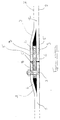
- This figure shows two sections or structures 1 forming part of a hull planking, which have an internal face 7 and an external face 8.
- the structures 1 are made of high strength composite material.
- the method according to the invention consists in a first step in splitting or separating into two fabric thickness halves, in an assembly area 9, the two edges of each structure 1 constructed of composite material.
- the two fabric thickness halves leave a space intended to receive a metal insert 2 which may be made of steel, stainless steel or aluminum alloy resistant to marine corrosion.
- the insert 2 can also be made of high-resistance composite material, based on carbon fibers, glass or aramid.
- a filling material 4 will have been glued in the bottom of the space between the two fabric thickness halves of each structural edge, to wedge the insert.
- the filling material can be a resin.
- the setting of the insert can also be achieved by two wedge-shaped pieces, each being glued in the space between the two fabric thickness halves of each structural edge.
- the insert 2 is glued on either side by a film of glue 6 on each of the two fabric thickness halves.
- the insert 2 will have been centered before bonding in the assembly zone 9 between the fabric thickness halves of each structural edge 1.
- a layer 5 of thin composite material is added either by gluing or by stratification in the assembly zone 9, to constitute the surface continuity of the hull plating on either side of the faces 7 and 8.
- the insert 2 is then held in place by bolts 3, the heads of which are screwed on the side of the external face 8.
- the bolts are made of steel, stainless steel, aluminum alloy or any other metallic or composite material offering good resistance mechanical and resistance to marine corrosion.
- a metal interlayer plate can be placed on either side of the insert 2.
- the assembly according to the invention makes it possible to withstand breaking forces greater than that of the base material of the zone outside assembly, and which can reach 65 tonnes for a structure strip of width 100 mm and thickness 20 mm.
- the method according to the invention is applicable to structures forming part of all types of ships, such as patrol boats or mine hunters.
Landscapes
- Engineering & Computer Science (AREA)
- Mechanical Engineering (AREA)
- General Engineering & Computer Science (AREA)
- Laminated Bodies (AREA)
- Revetment (AREA)
- Lining Or Joining Of Plastics Or The Like (AREA)
- Joining Of Building Structures In Genera (AREA)
- Butt Welding And Welding Of Specific Article (AREA)
Abstract
Description
- L'invention concerne un procédé d'assemblage de structures préfabriquées construites en matériau composite, notamment de tronçons ou anneaux de coques de navires, ainsi que l'assemblage obtenu selon ce procédé.
- Les structures en matériau composite consistent en un empilement de couches de matériaux de renfort ou tissus, tels que fibres de verre, de carbone, ou d'aramide, et de couches de résine. Elles sont obtenues par polymérisation des différentes couches ou stratification de contact.
- On connait des techniques d'assemblage par soudage de tronçons ou d'anneaux préfabriqués composant une structure de navire, qui sont en acier ou en alliages d'aluminium.
- Les matériaux composites ne se soudant pas, il a été conçu d'autres systèmes d'assemblage mettant en oeuvre des technologies de collage par recouvrement ou par confection de bords tombés ou encore par réalisation de joints à partir de couches de matériau composite disposées en gradins.
- Ces technologies de collage n'ont pas permis d'atteindre des niveaux d'efforts de rupture de l'assemblage de l'ordre de ceux tenus par le matériau composite de base dont sont constituées les structures à assembler.
- L'invention a donc pour but de proposer un procédé d'assemblage d'éléments préfabriqués construits en matériau composite, notamment de tronçons ou anneaux de coques de navires, qui permette à l'assemblage de tenir des niveaux d'efforts de rupture de l'ordre de ceux du matériau composite constitutif des structures à assembler.
- L'invention a aussi pour but de proposer un assemblage de deux structures selon le procédé de l'invention.
- L'invention a pour objet un procédé d'assemblage de deux structures préfabriquées construites en matériau composite présentant deux faces, l'une interne, l'autre externe, notamment de tronçons ou anneaux de coques de navires, caractérisé par la succession des étapes suivantes :
- dédoublement dans une zone dite d'assemblage des bords de chacune des deux structures à assembler, par séparation en deux moitiés des tissus constitutifs du matériau composite, pour dégager un espace entre ces deux moitiés,
- intercalement et centrage d'un insert entre les deux moitiés des tissus constitutifs du matériau composite de chaque bord de structure,
- collage de l'insert sur chacune de ces deux moitiés,
- boulonnage de l'insert,
- pose d'une couche de matériau composite de faible épaisseur sur chaque face de la structure, pour constituer la continuité de surface de l'ensemble des deux structures.
- Dans un mode de réalisation préférentiel, l'insert est en métal ou en matériau composite.
- De préférence, l'insert est calé par un matériau de remplissage pouvant être une résine, placé entre les deux moitiés de tissus constitutifs du matériau composite. L'insert peut aussi être calé par des pièces en forme de coin pouvant être en métal ou en matériau composite.
- Préférentiellement, l'insert est vissé par des boulons pouvant être en métal ou en matériau composite.
- L'invention a aussi pour objet un assemblage de deux structures, caractérisé en ce qu'il inclut un insert intercalé, centré et collé dans une zone d'assemblage, selon le procédé de l'invention.
- D'autres caractéristiques apparaitront à la lecture de la description suivante d'un mode de réalisation préférentiel appliqué à l'assemblage de deux tronçons de navire devant former un bordé de carène;cet exemple est donné à titre illustratif et non limitatif, à l'aide de la figure unique annexée représentant l'assemblage des deux tronçons selon l'invention.
- Sur cette figure, on a représenté deux tronçons ou structures 1 entrant dans la constitution d'un bordé de carène, qui présentent une face interne 7 et une face externe 8.
- Les structures 1 sont en matériau composite de haute résistance.
- Le procédé selon l'invention consiste dans un premier temps à dédoubler ou séparer en deux moitiés d'épaisseur de tissus, dans une zone d'assemblage 9, les deux bords de chaque structure 1 construite en matériau composite.
- Les deux moitiés d'épaisseur de tissus dégagent un espace destiné à recevoir un insert métallique 2 pouvant être en acier, acier inox ou en alliage d'aluminium résistant à la corrosion marine. L'insert 2 peut aussi être en matériau composite de haute résistance, à base de fibres de carbone, de verre ou d'aramide.
- Auparavant, un matériau de remplissage 4 aura été collé dans le fond de l'espace compris entre les deux moitiés d'épaisseur de tissus de chaque bord de structure, pour caler l'insert. Le matériau de remplissage peut être une résine. Le calage de l'insert peut aussi être réalisé par deux pièces en forme de coin, chacune étant collée dans l'espace compris entre les deux moitiés d'épaisseur de tissus de chaque bord de structure.
- L'insert 2 est collé de part et d'autre par un film de colle 6 sur chacune des deux moitiés d'épaisseur de tissus.
- L'insert 2 aura été centré avant collage dans la zone d'assemblage 9 entre les moitiés d'épaisseur de tissus de chaque bord de structure 1.
- Une couche 5 de matériau composite de faible épaisseur est ajoutée soit par collage soit par stratification dans la zone d'assemblage 9, pour constituer la continuité de surface du bordé de carène de part et d'autre des faces 7 et 8 .
- L'insert 2 est ensuite maintenu par des boulons 3, dont les têtes sont vissées du côté de la face externe 8. Les boulons sont en acier, acier inox, alliage d'aluminium ou en tout autre matériau métallique ou composite offrant une bonne tenue mécanique et résistance à la corrosion marine.
- Une plaque intercalaire métallique peut être placée de part et d'autre de l'insert 2.
- L'assemblage selon l'invention permet de résister à des efforts de rupture supérieurs à celle du matériau de base de la zone hors assemblage, et pouvant atteindre 65 tonnes pour une bande de structure de largeur 100 mm et d'épaisseur 20 mm.
- Le procédé selon l'invention est applicable à des structures entrant dans la constitution de tous types de navires, tels que des patrouilleurs ou des chasseurs de mines.
Claims (8)
- Procédé d'assemblage de deux structures préfabriquées construites en matériau composite présentant deux faces, l'une interne, l'autre externe, notamment de tronçons ou anneaux de coques de navires, caractérisé par la succession des étapes suivantes :- dédoublement dans une zone dite d'assemblage (9) des bords de chacune des deux structures (1) à assembler, par séparation en deux moitiés des tissus constitutifs du matériau composite, pour dégager un espace entre ces deux moitiés,- intercalement et centrage d'un insert (2) entre les deux moitiés des tissus constitutifs du matériau composite de chaque bord de structure- collage de l'insert (2) sur chacune de ces deux moitiés,- boulonnage de l'insert (2,3),- pose d'une couche de matériau composite (5) de faible épaisseur sur chaque face de la structure (1), pour constituer la continuité de surface de l'ensemble des deux structures.
- Procédé d'assemblage selon la revendication 1, caractérisé en ce que l'insert (2) est en métal ou en matériau composite.
- Procédé d'assemblage selon l'une des revendications 1 à 2, caractérisé en ce que l'insert (2) est calé par un matériau de remplissage placé entre les deux moitiés de tissus constitutifs du matériau composite, pour chaque bord de structure.
- Procédé d'assemblage selon la revendication 3, caractérisé en ce que le matériau de remplissage est une résine.
- Procédé d'assemblage selon l'une des revendications 1 à 2, caractérisé en ce que l'insert est calé par deux pièces en forme de coin, collées dans l'espace compris entre les deux moitiés d'épaisseur de tissus de chaque bord de structure (1).
- Procédé d'assemblage selon la revendication 5, caractérisé en ce que les pièces en forme de coin sont en métal ou en matériau composite.
- Procédé d'assemblage selon l'une des revendications 1 à 6, caractérisé en ce que les boulons (3) sont en métal ou en matériau composite.
- Assemblage de deux structures, caractérisé en ce qu'il inclut un insert (2) intercalé, centré et collé dans une zone d'assemblage (9), selon le procédé de l'une des revendications 1 à 7.
Applications Claiming Priority (2)
| Application Number | Priority Date | Filing Date | Title |
|---|---|---|---|
| FR9514855 | 1995-12-14 | ||
| FR9514855A FR2742492B1 (fr) | 1995-12-14 | 1995-12-14 | Procede d'assemblage de structures prefabriquees en materiau composite |
Publications (2)
| Publication Number | Publication Date |
|---|---|
| EP0779437A1 true EP0779437A1 (fr) | 1997-06-18 |
| EP0779437B1 EP0779437B1 (fr) | 2000-02-09 |
Family
ID=9485519
Family Applications (1)
| Application Number | Title | Priority Date | Filing Date |
|---|---|---|---|
| EP96402500A Expired - Lifetime EP0779437B1 (fr) | 1995-12-14 | 1996-11-21 | Procédé d'assemblage de structures préfabriquées en matériau composite |
Country Status (6)
| Country | Link |
|---|---|
| EP (1) | EP0779437B1 (fr) |
| DE (1) | DE69606610T2 (fr) |
| DK (1) | DK0779437T3 (fr) |
| ES (1) | ES2142560T3 (fr) |
| FR (1) | FR2742492B1 (fr) |
| NO (1) | NO315950B1 (fr) |
Cited By (1)
| Publication number | Priority date | Publication date | Assignee | Title |
|---|---|---|---|---|
| US9242715B2 (en) | 2008-10-20 | 2016-01-26 | Airbus Operations Limited | Joint between aircraft components |
Citations (3)
| Publication number | Priority date | Publication date | Assignee | Title |
|---|---|---|---|---|
| DE1169653B (de) * | 1959-07-27 | 1964-05-06 | August Moralt Holzindustrie | Aus zwei oder mehreren Koerpern unter Verwendung von mindestens einem Holz-werkstofformling gebildeter Verbundkoerper |
| US3960460A (en) * | 1973-07-14 | 1976-06-01 | Artur Fischer | Connector for elements made of structural foam |
| FR2557932A1 (fr) * | 1984-01-10 | 1985-07-12 | Carrez Pierre | Procede pour abouter deux panneaux sandwichs avec ame en nid-d'abeilles et panneau composite obtenu par ce procede |
-
1995
- 1995-12-14 FR FR9514855A patent/FR2742492B1/fr not_active Expired - Fee Related
-
1996
- 1996-11-21 DE DE69606610T patent/DE69606610T2/de not_active Expired - Lifetime
- 1996-11-21 ES ES96402500T patent/ES2142560T3/es not_active Expired - Lifetime
- 1996-11-21 EP EP96402500A patent/EP0779437B1/fr not_active Expired - Lifetime
- 1996-11-21 DK DK96402500T patent/DK0779437T3/da active
- 1996-12-13 NO NO19965355A patent/NO315950B1/no not_active IP Right Cessation
Patent Citations (3)
| Publication number | Priority date | Publication date | Assignee | Title |
|---|---|---|---|---|
| DE1169653B (de) * | 1959-07-27 | 1964-05-06 | August Moralt Holzindustrie | Aus zwei oder mehreren Koerpern unter Verwendung von mindestens einem Holz-werkstofformling gebildeter Verbundkoerper |
| US3960460A (en) * | 1973-07-14 | 1976-06-01 | Artur Fischer | Connector for elements made of structural foam |
| FR2557932A1 (fr) * | 1984-01-10 | 1985-07-12 | Carrez Pierre | Procede pour abouter deux panneaux sandwichs avec ame en nid-d'abeilles et panneau composite obtenu par ce procede |
Cited By (1)
| Publication number | Priority date | Publication date | Assignee | Title |
|---|---|---|---|---|
| US9242715B2 (en) | 2008-10-20 | 2016-01-26 | Airbus Operations Limited | Joint between aircraft components |
Also Published As
| Publication number | Publication date |
|---|---|
| DE69606610T2 (de) | 2000-06-21 |
| EP0779437B1 (fr) | 2000-02-09 |
| NO315950B1 (no) | 2003-11-17 |
| DK0779437T3 (da) | 2000-07-24 |
| NO965355L (no) | 1997-06-16 |
| NO965355D0 (no) | 1996-12-13 |
| ES2142560T3 (es) | 2000-04-16 |
| FR2742492B1 (fr) | 1998-02-20 |
| FR2742492A1 (fr) | 1997-06-20 |
| DE69606610D1 (de) | 2000-03-16 |
Similar Documents
| Publication | Publication Date | Title |
|---|---|---|
| CN1262413C (zh) | 复合结构的层板 | |
| EP2200899B1 (fr) | Eclissage de raidisseurs en oméga au niveau d'une jonction circonférentielle d'un fuselage d'avion | |
| EP2115233A2 (fr) | Panneau composite métallique et procede de fabrication | |
| EP3991238A1 (fr) | Batterie de stockage d'électricité et véhicule | |
| EP0779437B1 (fr) | Procédé d'assemblage de structures préfabriquées en matériau composite | |
| EP3989688B1 (fr) | Coffre de toit, véhicule équipé d'un tel coffre et procédé de fabrication associé | |
| EP0521793B1 (fr) | Procédé d'assemblage de superstructures composites sur une coque métallique de navire | |
| CA1265174A (fr) | Structure de navire a effet de surface et quilles laterales | |
| EP2142876B1 (fr) | Panneaux de cloison pare-balles | |
| FR2552017A1 (fr) | Panneau composite de haute resistance | |
| FR2670517A1 (fr) | Element de franchissement pour le franchissement d'obstacles. | |
| FR2571077A1 (fr) | Panneau composite de construction et procede de fabrication du panneau. | |
| EP3178991B1 (fr) | Joint isolant de rail | |
| CA2572807C (fr) | Crapaud anticorrosif isolant et compose integralement d'une composition polymerique | |
| FR2713327A1 (fr) | Panneau structural de protection balistique, thermique et électromagnétique. | |
| EP1743986A2 (fr) | Plaque alvéolaire multiparois | |
| FR2728603A1 (fr) | Panneau structural resistant au feu | |
| FR2967607A1 (fr) | Ame pour structure de type sandwich, structure de type sandwich comprenant une telle ame, procede de fabrication d’une telle ame | |
| EP0557170A1 (fr) | Couverture isolante et étanche pour bâtiment | |
| FR2492433A1 (fr) | Dispositif de liaison pour elements modulaires de construction comprenant des profiles metalliques de section en u et assemblage de tels profiles | |
| EP4684954A1 (fr) | Panneau pour le coffrage de beton | |
| Lelan et al. | Superstructures en matériaux composites | |
| EP0242485A1 (fr) | Structure de navire à effet de surface et à quilles latérales | |
| FR2776720A1 (fr) | Systeme d'assemblage de profiles | |
| FR2701232A1 (fr) | Panneau composite destiné notamment à la constitution de parois. |
Legal Events
| Date | Code | Title | Description |
|---|---|---|---|
| PUAI | Public reference made under article 153(3) epc to a published international application that has entered the european phase |
Free format text: ORIGINAL CODE: 0009012 |
|
| 17P | Request for examination filed |
Effective date: 19961129 |
|
| AK | Designated contracting states |
Kind code of ref document: A1 Designated state(s): BE DE DK ES GB IT NL SE |
|
| GRAG | Despatch of communication of intention to grant |
Free format text: ORIGINAL CODE: EPIDOS AGRA |
|
| GRAG | Despatch of communication of intention to grant |
Free format text: ORIGINAL CODE: EPIDOS AGRA |
|
| GRAH | Despatch of communication of intention to grant a patent |
Free format text: ORIGINAL CODE: EPIDOS IGRA |
|
| 17Q | First examination report despatched |
Effective date: 19990520 |
|
| GRAH | Despatch of communication of intention to grant a patent |
Free format text: ORIGINAL CODE: EPIDOS IGRA |
|
| GRAA | (expected) grant |
Free format text: ORIGINAL CODE: 0009210 |
|
| AK | Designated contracting states |
Kind code of ref document: B1 Designated state(s): BE DE DK ES GB IT NL SE |
|
| ITF | It: translation for a ep patent filed | ||
| GBT | Gb: translation of ep patent filed (gb section 77(6)(a)/1977) |
Effective date: 20000209 |
|
| REF | Corresponds to: |
Ref document number: 69606610 Country of ref document: DE Date of ref document: 20000316 |
|
| GBT | Gb: translation of ep patent filed (gb section 77(6)(a)/1977) |
Free format text: M: THE FOLLOWING EUROPEAN PATENTS WERE ADVERTISED IN ERROR IN JOURNAL 5781 DATED 1 MARCH 2000 AS HAVING BEEN FILED UNDER SECTION 77(6)(A) ON 8 FEBRUARY 2000. |
|
| REG | Reference to a national code |
Ref country code: ES Ref legal event code: FG2A Ref document number: 2142560 Country of ref document: ES Kind code of ref document: T3 |
|
| EN | Fr: translation not filed | ||
| REG | Reference to a national code |
Ref country code: DK Ref legal event code: T3 |
|
| EN4 | Fr: notification of non filing translation in an earlier bopi is erroneous | ||
| PG25 | Lapsed in a contracting state [announced via postgrant information from national office to epo] |
Ref country code: ES Free format text: LAPSE BECAUSE OF NON-PAYMENT OF DUE FEES Effective date: 20001122 |
|
| PLBE | No opposition filed within time limit |
Free format text: ORIGINAL CODE: 0009261 |
|
| STAA | Information on the status of an ep patent application or granted ep patent |
Free format text: STATUS: NO OPPOSITION FILED WITHIN TIME LIMIT |
|
| 26N | No opposition filed | ||
| REG | Reference to a national code |
Ref country code: GB Ref legal event code: IF02 |
|
| REG | Reference to a national code |
Ref country code: ES Ref legal event code: FD2A Effective date: 20011214 |
|
| PGFP | Annual fee paid to national office [announced via postgrant information from national office to epo] |
Ref country code: DK Payment date: 20121026 Year of fee payment: 17 |
|
| PGFP | Annual fee paid to national office [announced via postgrant information from national office to epo] |
Ref country code: DE Payment date: 20121113 Year of fee payment: 17 |
|
| PGFP | Annual fee paid to national office [announced via postgrant information from national office to epo] |
Ref country code: SE Payment date: 20121123 Year of fee payment: 17 Ref country code: GB Payment date: 20121127 Year of fee payment: 17 Ref country code: IT Payment date: 20121128 Year of fee payment: 17 Ref country code: BE Payment date: 20121129 Year of fee payment: 17 |
|
| PGFP | Annual fee paid to national office [announced via postgrant information from national office to epo] |
Ref country code: NL Payment date: 20121016 Year of fee payment: 17 |
|
| BERE | Be: lapsed |
Owner name: ETAT FRANCAIS REPRESENTE PAR LE DELEGUE GENERAL PO Effective date: 20131130 |
|
| REG | Reference to a national code |
Ref country code: NL Ref legal event code: V1 Effective date: 20140601 |
|
| REG | Reference to a national code |
Ref country code: DK Ref legal event code: EBP Effective date: 20131130 |
|
| REG | Reference to a national code |
Ref country code: SE Ref legal event code: EUG |
|
| GBPC | Gb: european patent ceased through non-payment of renewal fee |
Effective date: 20131121 |
|
| REG | Reference to a national code |
Ref country code: DE Ref legal event code: R119 Ref document number: 69606610 Country of ref document: DE Effective date: 20140603 |
|
| PG25 | Lapsed in a contracting state [announced via postgrant information from national office to epo] |
Ref country code: NL Free format text: LAPSE BECAUSE OF NON-PAYMENT OF DUE FEES Effective date: 20140601 Ref country code: DE Free format text: LAPSE BECAUSE OF NON-PAYMENT OF DUE FEES Effective date: 20140603 Ref country code: SE Free format text: LAPSE BECAUSE OF NON-PAYMENT OF DUE FEES Effective date: 20131122 Ref country code: IT Free format text: LAPSE BECAUSE OF NON-PAYMENT OF DUE FEES Effective date: 20131121 |
|
| PG25 | Lapsed in a contracting state [announced via postgrant information from national office to epo] |
Ref country code: BE Free format text: LAPSE BECAUSE OF NON-PAYMENT OF DUE FEES Effective date: 20131130 |
|
| PG25 | Lapsed in a contracting state [announced via postgrant information from national office to epo] |
Ref country code: DK Free format text: LAPSE BECAUSE OF NON-PAYMENT OF DUE FEES Effective date: 20131130 |
|
| PG25 | Lapsed in a contracting state [announced via postgrant information from national office to epo] |
Ref country code: GB Free format text: LAPSE BECAUSE OF NON-PAYMENT OF DUE FEES Effective date: 20131121 |