EP0780104A2 - Bestrahlungsgerät zur Aushärtung von Kunststoffen - Google Patents
Bestrahlungsgerät zur Aushärtung von Kunststoffen Download PDFInfo
- Publication number
- EP0780104A2 EP0780104A2 EP96114350A EP96114350A EP0780104A2 EP 0780104 A2 EP0780104 A2 EP 0780104A2 EP 96114350 A EP96114350 A EP 96114350A EP 96114350 A EP96114350 A EP 96114350A EP 0780104 A2 EP0780104 A2 EP 0780104A2
- Authority
- EP
- European Patent Office
- Prior art keywords
- laser diode
- housing
- radiation
- light
- curing
- Prior art date
- Legal status (The legal status is an assumption and is not a legal conclusion. Google has not performed a legal analysis and makes no representation as to the accuracy of the status listed.)
- Granted
Links
- 229920003023 plastic Polymers 0.000 title claims abstract description 15
- 239000004033 plastic Substances 0.000 title claims abstract description 15
- 239000000126 substance Substances 0.000 title 1
- 230000005855 radiation Effects 0.000 claims abstract description 27
- 238000011156 evaluation Methods 0.000 claims abstract description 3
- 238000000034 method Methods 0.000 claims description 6
- 229920006351 engineering plastic Polymers 0.000 claims description 3
- 230000017525 heat dissipation Effects 0.000 description 2
- 239000000463 material Substances 0.000 description 2
- 230000015572 biosynthetic process Effects 0.000 description 1
- 229910052736 halogen Inorganic materials 0.000 description 1
- 150000002367 halogens Chemical class 0.000 description 1
- 238000005088 metallography Methods 0.000 description 1
- 230000003287 optical effect Effects 0.000 description 1
- 239000013307 optical fiber Substances 0.000 description 1
- 230000011664 signaling Effects 0.000 description 1
- 230000008719 thickening Effects 0.000 description 1
Images

Classifications
-
- A—HUMAN NECESSITIES
- A61—MEDICAL OR VETERINARY SCIENCE; HYGIENE
- A61C—DENTISTRY; APPARATUS OR METHODS FOR ORAL OR DENTAL HYGIENE
- A61C19/00—Dental auxiliary appliances
- A61C19/003—Apparatus for curing resins by radiation
-
- A—HUMAN NECESSITIES
- A61—MEDICAL OR VETERINARY SCIENCE; HYGIENE
- A61C—DENTISTRY; APPARATUS OR METHODS FOR ORAL OR DENTAL HYGIENE
- A61C19/00—Dental auxiliary appliances
- A61C19/003—Apparatus for curing resins by radiation
- A61C19/004—Hand-held apparatus, e.g. guns
Definitions
- the invention relates to an irradiation device for curing plastics with a housing, on which a light exit part is arranged, and a method for operating the device.
- Such radiation devices are widely known from the prior art.
- an irradiation device for curing dental plastics is known.
- This device is designed as a hand-held device in which the housing contains a lamp, for example a halogen lamp, as the light source.
- the housing also contains the electrical connections required for the generation of light, possibly a transformer for converting the mains voltage into the operating voltage of the light source, as well as air ducts, a fan and openings for dissipating the heat generated during operation of the radiation device.
- the light is coupled inside the housing into a light guide, which serves as a light exit part and at the end of which is arranged outside the housing, the light generated by the light source emerges. The emerging light is used to harden plastics.
- the radiation device known from DE 34 11 996 can be used flexibly as a hand-held device for curing dental plastics, wherein curing can take place both in the patient's mouth and, for example, from a work table.
- stationary radiation devices which have an irradiation space arranged in the interior of their housing. In such devices, the light exit part is arranged inside the housing and directed into the radiation chamber.
- Stationary devices are also known in which a light guide is guided to the outside as a light exit part. In this case, a handle is arranged at the outer end of the light guide with which the light guide is guided becomes.
- Such arrangements are used in a similar way to the one described above as a hand-held device, but have a limited local range due to the limited length of the light guide.
- the object of the present invention is to provide, starting from the arrangements known from the prior art, an irradiation device and a method for operating the device, which can have a simple structure and a low weight and at the same time enable optimal radiation.
- the light exit part has at least one laser diode for emitting radiation in the wavelength range from approximately 320 nm to approximately 550 nm, in particular from approximately 400 nm to 500 nm.
- This allows light-curing plastics to be cured.
- the heat generated when using laser diodes as the radiation source is negligible, so that the usual means for heat dissipation can be dispensed with.
- the laser diode can be supplied with power via a practically arbitrarily long cable, so that the components which are necessary and well known for generating the electrical energy can be permanently installed at a suitable location.
- the radiation device itself can be made very small and handy and can be used very flexibly.
- the energy supply for such radiation devices in a manner similar to the usual electrical network, in which energy can be tapped from different sockets. All that is required for irradiation at any location is a housing which can be made very small as a handle and on which the light exit part is arranged, which carries the laser diode at its outer end.
- the radiation device can be designed as a handheld device or as a stationary device. While the good manageability and mobility of handheld devices are made possible by small dimensions, a stationary device can be closely adapted to the size of the radiation chamber.
- such an arrangement has the advantage that the energy required is significantly lower than in conventional devices, since laser diodes, as described above, have a significantly higher efficiency than conventional ones Identify lamps. This also has the consequence that the safety for the operator is increased by working with lower currents and voltages.
- the irradiation device expediently has a sensor or a similar arrangement for measuring the intensity of the light emitted by the laser diode, which via an evaluation unit for evaluating and further processing the intensity signal with a display, for. B. is connected to an optical display to indicate that the operator falls below a predetermined limit of the intensity of the radiation from the laser diode.
- the housing preferably has a handle part with a switch, so that operation is facilitated.
- the object on which the invention is based is achieved for a method for operating the device described in the introduction in that the operating current of the laser diode is pulsed.
- a laser diode can be operated pulsed with a higher current.
- the pulse frequency can be increased during operation, so that the build-up of voltages in the material to be irradiated is prevented.
- the operating current of the laser diode can be increased up to the possible maximum value.
- the usual circuit arrangements familiar to the person skilled in the art can be used for the pulse operation of the laser diode.
- the invention is further directed to the use of the radiation device according to the invention for curing dental plastics.
- Very small amounts of plastic are cured, particularly in a dental practice or at the dental technician's.
- these small amounts can be cured particularly advantageously, since the light beam from the laser diode can be easily guided. Due to the possibility of making the housing very small with the handle, it can also be irradiated at almost any point in the patient's mouth.
- the radiation device can also be used for curing engineering plastics, for example plastics that are used in histology or metallography to embed samples.
- the radiation device according to the invention in FIG. 1 has a housing 1 which has a feed line 2 for the electrical energy supply.
- the housing 1 is designed as a housing of a non-stationary hand-held device. It has a handle part 3 with a switch 4.
- the handle part is essentially cylindrical, a light exit part 5 being arranged at one end of the cylinder and the laser diode 6 being arranged at its outer end.
- the light exit part 4 has the shape of a flexible rod that can be bent according to the needs at the irradiation site.
- the laser diode 6 emits beams in the wavelength range from approximately 320 to 550 nm, in particular 400 to 500 nm.
- the radiation energy influences the time required for the plastic to harden and can be controlled accordingly.
- the radiation device has a control LED, which functions as a display 7 for signaling that the age of the laser diode 6 has fallen below a predetermined limit intensity. Conventional and known arrangements can be used to measure and evaluate the intensity of the radiation from the laser diode 6.
- the housing 1 as a whole can be designed as a grip part 3, the grip part 3 having the form of a thickening of the light exit part 5.
- the light exit part is a plurality of laser diodes
- a stationary irradiation device with an irradiation chamber arranged in the housing 1 can have a multiplicity of laser diodes 6 which surround the irradiation space from several sides, so that a plastic part to be cured is irradiated uniformly on all sides can be.
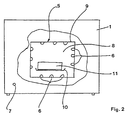
- a radiation device is shown in FIG.
- a conventional radiation chamber 8 is arranged in a housing 1 and is surrounded by laser diodes 6.
- the laser diodes 6 can be arranged on a cage-like frame 9 around the receptacle 10 for the part 11 to be irradiated (eg dental part).
- the display 7 is arranged on the housing 1 in addition to the control elements (not shown in FIG. 2).
- the laser diodes 6 can be operated in a pulsed manner. From the beginning of the radiation, the pulse frequency and the current are continuously increased. This increase in intensity prevents the formation of tensions in the material to be irradiated (dental plastics or engineering plastics).
Landscapes
- Health & Medical Sciences (AREA)
- Oral & Maxillofacial Surgery (AREA)
- Dentistry (AREA)
- Epidemiology (AREA)
- Life Sciences & Earth Sciences (AREA)
- Animal Behavior & Ethology (AREA)
- General Health & Medical Sciences (AREA)
- Public Health (AREA)
- Veterinary Medicine (AREA)
- Heating, Cooling, Or Curing Plastics Or The Like In General (AREA)
- Dental Tools And Instruments Or Auxiliary Dental Instruments (AREA)
- Photometry And Measurement Of Optical Pulse Characteristics (AREA)
Abstract
Description
- Die Erfindung betrifft ein Bestrahlungsgerät zur Aushärtung von Kunststoffen mit einem Gehäuse, an dem ein Lichtaustrittsteil angeordnet ist sowie ein Verfahren zum Betreiben des Gerätes.
- Derartige Bestrahlungsgeräte sind aus dem Stand der Technik vielfach bekannt. Beispielsweise aus DE 34 11 996 ist ein Bestrahlungsgerät zur Aushärtung von Dentalkunststoffen bekannt. Dieses Gerät ist als Handgerät ausgebildet, bei dem das Gehäuse als Lichtquelle eine Lampe, beispielsweise eine Halogenlampe enthält. Das Gehäuse enthält des weiteren die zur Lichterzeugung benötigten elektrischen Anschlüsse, gegebenenfalls einen Transformator zum Umsetzen der Netzspannung in die Betriebsspannung der Lichtquelle sowie außerdem Luftführungskanäle, einen Ventilator und Öffnungen zur Abfuhr der beim Betrieb des Bestrahlungsgerätes erzeugten Wärme. Das Licht wird im Inneren des Gehäuses in einen Lichtleiter eingekoppelt, der als Lichtaustrittsteil dient und an dessen außerhalb des Gehäuses angeordnetem Ende das von der Lichtquelle erzeugte Licht austritt. Das austretende Licht wird zur Aushärtung von Kunststoffen verwendet. Das aus DE 34 11 996 bekannte Bestrahlungsgerät ist als Handgerät flexibel einsetzbar zur Aushärtung von Dentalkunststoffen, wobei eine Aushärtung sowohl im Mund des Patienten als auch beispielsweise aus einem Arbeitstisch erfolgen kann. Des weiteren sind stationäre Bestrahlungsgeräte bekannt, die einen im Inneren ihres Gehäuses angeordneten Bestrahlungsraum aufweisen. Bei derartigen Geräten ist auf das Lichtaustrittsteil innerhalb des Gehäuses angeordnet und in den Bestrahlungsraum gerichtet. Es sind auch stationäre Geräte bekannt, bei denen als Lichtaustrittsteil ein Lichtleiter nach außen geführt wird. Dabei ist an dem äußeren Ende des Lichtleiters ein Handgriff angeordnet, mit dem der Lichtleiter geführt wird. Derartige Anordnungen werden ähnlich wie die oben beschriebene als Handgerät genutzt, haben jedoch aufgrund der begrenzten Länge des Lichtleiters eine begrenzte örtliche Reichweite.
- Allen derartigen Geräten ist ein recht komplizierter Aufbau gemeinsam, da nicht nur Licht über eine mehr oder weniger große Distanz beispielsweise mit einem Lichtleiter geführt werden muß, sondern es muß auch die entstehende Wärme auf geeignete Weise abgeführt werden. Die ausreichende Wärmeabfuhr bedingt entsprechend große Abmessungen des Gehäuses sowie zusätzliche Einbauten, wie Ventilatoren.
- Aufgabe der vorliegenden Erfindung ist es, ausgehend von den aus dem Stand der Technik bekannten Anordnungen eine Bestrahlungsgerät und ein Verfahren zum Betreiben des Gerätes bereit zu stellen, das einen einfachen Aufbau und ein geringes Eigengewicht aufweisen kann und gleichzeitig eine optimale Bestrahlung ermöglicht.
- Erfindungsgemäß wird diese Aufgabe dadurch gelöst, daß das Lichtaustrittsteil mindestens eine Laserdiode zur Aussendung einer Strahlung im Wellenlängenbereich von etwa 320 nm bis etwas 550 nm, insbesondere von etwa 400 nm bis 500 nm aufweist. Dadurch können lichthärtende Kunststoffe ausgehärtet werden. Die bei der Verwendung von Laserdioden als Strahlungsquelle entstehende Wärme ist vernachlässigbar gering, so daß auf die üblichen Mittel zur Wärmeabfuhr verzichtet werden kann. Außerdem kann die Stromversorgung der Laserdiode über ein praktisch beliebig langes Kabel erfolgen, so daß die zur Erzeugung der elektrischen Energie notwendigen und hinreichend bekannten Bauelemente an einem passenden Ort fest installiert werden können. Dadurch kann das Bestrahlungsgerät selbst sehr klein und handlich ausgebildet werden und ist sehr flexibel einsetzbar. Beispielsweise ist es möglich, die Energieversorgung für derartige Bestrahlungsgeräte ähnlich dem üblichen elektrischen Netz auszulegen, bei dem an verschiedenen Steckdosen Energie abgegriffen werden kann. So benötigt man zur Bestrahlung an beliebigen Orten lediglich ein Gehäuse, das als Griffstück sehr klein ausgebildet werden kann und an dem das Lichtaustrittsteil angeordnet ist, das an seinem äußeren Ende die Laserdiode trägt. Das Bestrahlungsgerät kann dabei als Handgerät oder als stationäres Gerät ausgebildet sein. Während bei Handgeräten die gute Handhabbarkeit und Beweglichkeit durch geringe Abmessungen ermöglicht werden, kann ein stationäres Gerät der Größe der Bestrahlungskammer eng angepaßt werden. Darüber hinaus hat eine derartige Anordnung den Vorteil, daß die benötigte Energie wesentlich geringer ist als bei herkömmlichen Geräten, da Laserdioden, wie oben beschrieben, einen wesentlich höheren Wirkungsgrad als herkömmliche Lampen ausweisen. Dies hat außerdem zur Folge, daß durch die Arbeit mit niedrigeren Strömen und Spannungen die Sicherheit für die Bedienperson erhöht wird.
- Das Bestrahlungsgerät weist zweckmäßigerweise einen Sensor oder eine ähnliche Anordnung zur Messung der Intensität des von der Laserdiode abgestrahlten Lichtes auf, der über eine Auswerteeinheit zur Auswertung und Weiterverarbeitung des Intensitätssignals mit einer Anzeige, z. B. einer optischen Anzeige verbunden ist, um ein Unterschreiten eines vorbestimmten Grenzwertes der Intensität der Strahlung der Laserdiode der Bedienperson anzugeben.
- Vorzugsweise weist das Gehäuse ein Griffteil mit Schalter auf, so daß die Bedienung erleichtert wird.
- Die der Erfindung zugrundeliegende Aufgabe wird für ein Verfahren zum Betreiben des eingangs beschriebenen Gerätes dadurch gelöst, daß der Betriebsstrom der Laserdiode gepulst ist. Dadurch kann eine wesentlich höhere Intensität erreicht werden. Eine Laserdiode kann gepulst mit höherem Strom betrieben werden. Die Pulsfrequenz kann während des Betriebs erhöht werden, so daß der Aufbau von Spannungen in dem zu bestrahlenden Material verhindert wird. Während oder nach der Erhöhung der Pulsfrequenz kann der Betriebsstrom der Laserdiode bis zu dem möglichen Maximalwert erhöht werden. Für den Impulsbetrieb der Laserdiode können die üblichen, dem Fachmann geläufigen Schaltungsanordnungen verwendet werden.
- Die Erfindung ist weiterhin auf die Verwendung des erfindungsgemäßen Bestrahlungsgerätes zur Aushärtung von Dentalkunststoffen gerichtet. Gerade in einer Zahnarztpraxis oder auch beim Dentaltechniker werden sehr kleine Kunststoffmengen ausgehärtet. Mit dem erfindungsgemäßen Bestrahlungsgerät lassen sich diese kleinen Mengen besonders vorteilhaft aushärten, da der Lichtstrahl der Laserdiode gut führbar ist. Durch die Möglichkeit, das Gehäuse mit dem Handgriff sehr klein auszubilden, kann auch im Mund des Patienten an nahezu jeder beliebigen Stelle bestrahlt werden.
- Erfindungsgemäß ist das Bestrahlungsgerät auch zur Aushärtung von technischen Kunststoffen zu verwenden, beispielsweise von Kunststoffen, die in der Histologie oder Metallographie zur Einbettung von Proben verwendet werden.
- Nachfolgend wird ein Ausführungsbeispiel der Erfindung anhand einer Zeichnung näher erläutert.
- Fig. 1 zeigt ein erfindungsgemäßes Handgerät und
- Fig. 2 zeigt ein erfindungsgemäßes stationäres Gerät, schematisch.
- Das erfindungsgemäße Bestrahlungsgerät in Figur 1 weist ein Gehäuse 1 auf, das eine Zuleitung 2 für die elektrische Energiezufuhr besitzt. Das Gehäuse 1 ist als Gehäuse eines nicht ortsfesten Handgerätes ausgestaltet. Es weist ein Griffteil 3 auf mit einem Schalter 4. Das Griffteil ist im wesentlichen zylinderförmig ausgebildet, wobei an einem Ende des Zylinders ein Lichtaustrittsteil 5 angeordnet ist, an dessen äußerem Ende die Laserdiode 6 angeordnet ist. Das Lichtaustrittsteil 4 hat die Form eines flexibelen Stabes, der entsprechend den Notwendigkeiten am Bestrahlungsort gebogen werden kann. Die Laserdiode 6 sendet Strahlen im Wellenlängenbereich von etwa 320 bis 550 nm, insbesondere 400 bis 500 nm aus. Die Strahlungsenergie beeinflußt die Zeit, die zur Aushärtung des Kunststoffes notwendig ist und ist entsprechend steuerbar.
- Das Bestrahlungsgerät weist eine Kontroll-LED auf, die als Anzeige 7 zum Signalisieren des alterungsbedingten Unterschreitens einer vorbestimmten Grenzintensität der Stahlung der Laserdiode 6 fungiert. Zur Messung und Auswertung der Intensität der Stahlung der Laserdiode 6 können übliche und bekannte Anordnungen verwendet werden.
- Anstelle der in der Zeichnung dargestellten Anordnung sind auch andere Anordnungen bzw. Ausbildungen eines Gehäuses mit Griffteil denkbar. Beispielsweise kann das Gehäuse 1 als Ganzes als Griffteil 3 ausgebildet sein, wobei das Griffteil 3 die Form einer Verdickung des Lichtaustrittsteiles 5 hat.
- Auch Ausführungsformen der Erfindung sind denkbar, bei denen das Lichtaustrittsteil mehrere Laserdioden beträgt, beispielsweise ein stationäres Bestrahlungsgerät mit einer im Gehäuse 1 angeordneten Bestrahlungskammer kann eine Vielzahl von Laserdioden 6 aufweisen, die den Bestrahlungsraum von mehreren Seiten umgeben, so daß ein auszuhärtendes Kunststoffteil allseitig gleichmäßig bestrahlt werden kann. In Figur 2 wird ein derartiges Bestahlungsgerät dargestellt. In einem Gehäuse 1 ist ein üblicher Bestrahlungsraum 8 angeordnet, der von Laserdioden 6 umgeben ist. Die Laserdioden 6 können an einem käfigähnlichen Gestell 9 um die Aufnahme 10 für das zu bestahlende Teil 11 (z. B. Dentalteil) angeordnet sein. An dem Gehäuse 1 ist neben in Figur 2 nicht dargestellten Bedienelementen die Anzeige 7 angeordnet.
- Die Laserdioden 6 können gepulst betrieben werden. Ab Beginn der Bestrahlung werden die Pulsfrequenz und der Strom kontinuierlich erhöht. Durch diese Intensitätssteigerung wird die Ausbildung von Spannungen in dem zu bestrahlenden Material (Dentalkunststoffe oder technische Kunststoffe) verhindert.
Claims (10)
- Bestrahlungsgerät zur Aushärtung von Kunststoffen mit einem Gehäuse, an dem ein Lichtaustrittsteil angeordnet ist, dadurch gekennzeichnet, daß das Lichtaustrittsteil (5) mindestens eine Laserdiode (6) zur Aussendung einer Strahlung im Wellenlängenbereich von etwa 320 nm bis 550 nm aufweist.
- Bestrahlungsgerät nach Anspruch 1, dadurch gekennzeichnet, daß das Gehäuse (1) ein Griffteil (3) mit Schalter (4) aufweist.
- Bestrahlungsgerät nach Anspruch 1 oder 2, dadurch gekennzeichnet, daß ein Sensor zur Messerung der Intensität des von der Laserdiode (6) abgestrahlten Lichtes vorgesehen ist, der über eine Auswerteeinheit mit einer Anzeige (7) verbunden ist zur Anzeige des Abfalls der Lichtintensität der Laserdiode (6) unter einen vorbestimmten Grenzwert.
- Bestrahlungsgerät nach einem der Ansprüche 1 bis 3, dadurch gekennzeichnet, daß es als Handgerät ausgebildet ist.
- Bestrahlungsgerät nach einem der Ansprüche 1 bis 3, dadurch gekennzeichnet, daß es als stationäres Gerät ausgebildet ist.
- Verfahren zum Betreiben eines Gerätes nach einem der Ansprüche 1 bis 5, dadurch gekennzeichnet, daß der Betriebsstrom der Laserdioden (6) gepulst ist.
- Verfahren nach Anspruch 6, dadurch gekennzeichnet, daß während des Betriebs die Pulsfrequenz erhöht wird.
- Verfahren nach Anspruch 7, dadurch gekennzeichnet, daß während oder nach der Erhöhung der Pulsfrequenz der Betriebsstrom der Laserdioden (6) erhöht wird.
- Verwendung des Bestrahlungsgerätes nach Anspruch 1 zur Aushärtung von Dentalkunststoffen.
- Verwendung des Bestrahlungsgerätes nach Anspruch 1 zur Aushärtung von technischen Kunststoffen.
Applications Claiming Priority (4)
| Application Number | Priority Date | Filing Date | Title |
|---|---|---|---|
| DE19548330 | 1995-12-22 | ||
| DE19548330 | 1995-12-22 | ||
| DE19619155A DE19619155C2 (de) | 1995-12-22 | 1996-05-11 | Bestrahlungsgerät zur Aushärtung von Kunststoffen, sowie Verfahren und Verwendungen |
| DE19619155 | 1996-05-11 |
Publications (3)
| Publication Number | Publication Date |
|---|---|
| EP0780104A2 true EP0780104A2 (de) | 1997-06-25 |
| EP0780104A3 EP0780104A3 (de) | 1997-12-03 |
| EP0780104B1 EP0780104B1 (de) | 2001-12-12 |
Family
ID=26021620
Family Applications (1)
| Application Number | Title | Priority Date | Filing Date |
|---|---|---|---|
| EP96114350A Expired - Lifetime EP0780104B1 (de) | 1995-12-22 | 1996-09-07 | Verfahren zum Betreiben eines Bestrahlungsgerät zur Aushärtung von Kunststoffen |
Country Status (5)
| Country | Link |
|---|---|
| EP (1) | EP0780104B1 (de) |
| JP (1) | JPH09183134A (de) |
| AT (1) | ATE210413T1 (de) |
| AU (1) | AU7418696A (de) |
| CA (1) | CA2190226A1 (de) |
Cited By (4)
| Publication number | Priority date | Publication date | Assignee | Title |
|---|---|---|---|---|
| WO1999022667A1 (en) * | 1997-11-03 | 1999-05-14 | Minnesota Mining And Manufacturing Company | Hand-held intraoral curing apparatus |
| EP1436806A4 (de) * | 2001-10-17 | 2005-01-05 | Coltene Whaledent Inc | Aushärtlampenvorrichtung mit elektronischer stimme |
| WO2006133167A1 (en) | 2005-06-07 | 2006-12-14 | Fusion Uv Systems, Inc. | Solid-state light sources for curing and surface modification |
| EP2545882A1 (de) * | 2011-07-11 | 2013-01-16 | GC Corporation | Polymerisationsvorrichtung für Dentaltechnologie |
Families Citing this family (4)
| Publication number | Priority date | Publication date | Assignee | Title |
|---|---|---|---|---|
| DE19636266A1 (de) * | 1996-09-06 | 1998-03-12 | Kaltenbach & Voigt | Verfahren und Vorrichtung zum Aushärten von lichtempfindlichen polymeren Zusammensetzungen |
| US6419483B1 (en) | 2000-03-01 | 2002-07-16 | 3M Innovative Properties Company | Method and apparatus for curling light-curable dental materials |
| US7134875B2 (en) * | 2002-06-28 | 2006-11-14 | 3M Innovative Properties Company | Processes for forming dental materials and device |
| DE102007022205A1 (de) | 2007-05-11 | 2008-11-13 | Kaltenbach & Voigt Gmbh | Handgerät zur Abgabe eines pastösen Füllungsmaterials |
Citations (1)
| Publication number | Priority date | Publication date | Assignee | Title |
|---|---|---|---|---|
| EP0755662A1 (de) | 1995-07-24 | 1997-01-29 | THERA Patent GmbH & Co. KG Gesellschaft für industrielle Schutzrechte | Lichtpolymerisationsgerät |
Family Cites Families (9)
| Publication number | Priority date | Publication date | Assignee | Title |
|---|---|---|---|---|
| DE3411996A1 (de) * | 1984-03-31 | 1985-10-03 | Kulzer & Co GmbH, 6393 Wehrheim | Bestrahlungseinheit, wie ein polymerisationsgeraet zur vorzugsweisen aushaertung von dentalkunststoffen im mund |
| US4826431A (en) * | 1986-06-12 | 1989-05-02 | Kabushiki Kaisha Morita Seisakusho | Medical laser handpiece |
| DE3644347A1 (de) * | 1986-12-19 | 1988-06-30 | Siemens Ag | Verfahren zum betreiben einer leuchtdiode |
| DE3910438A1 (de) * | 1989-03-31 | 1990-10-04 | Kulzer & Co Gmbh | Verfahren und vorrichtung zur polymerisation eines koerpers aus dentalkunststoff |
| JPH04359481A (ja) * | 1991-06-05 | 1992-12-11 | Matsushita Electric Ind Co Ltd | 半導体発光素子 |
| EP0556461B1 (de) * | 1992-02-19 | 1998-01-14 | Sony Corporation | Halbleiterlaser |
| JPH0773140B2 (ja) * | 1993-02-09 | 1995-08-02 | 日本電気株式会社 | 半導体レーザ |
| GB9309397D0 (en) * | 1993-05-07 | 1993-06-23 | Patel Bipin C M | Laser treatment |
| US5420768A (en) * | 1993-09-13 | 1995-05-30 | Kennedy; John | Portable led photocuring device |
-
1996
- 1996-09-07 AT AT96114350T patent/ATE210413T1/de not_active IP Right Cessation
- 1996-09-07 EP EP96114350A patent/EP0780104B1/de not_active Expired - Lifetime
- 1996-11-13 CA CA002190226A patent/CA2190226A1/en not_active Abandoned
- 1996-12-05 AU AU74186/96A patent/AU7418696A/en not_active Abandoned
- 1996-12-16 JP JP8336004A patent/JPH09183134A/ja not_active Withdrawn
Patent Citations (1)
| Publication number | Priority date | Publication date | Assignee | Title |
|---|---|---|---|---|
| EP0755662A1 (de) | 1995-07-24 | 1997-01-29 | THERA Patent GmbH & Co. KG Gesellschaft für industrielle Schutzrechte | Lichtpolymerisationsgerät |
Cited By (6)
| Publication number | Priority date | Publication date | Assignee | Title |
|---|---|---|---|---|
| WO1999022667A1 (en) * | 1997-11-03 | 1999-05-14 | Minnesota Mining And Manufacturing Company | Hand-held intraoral curing apparatus |
| EP1436806A4 (de) * | 2001-10-17 | 2005-01-05 | Coltene Whaledent Inc | Aushärtlampenvorrichtung mit elektronischer stimme |
| US7167829B2 (en) | 2001-10-17 | 2007-01-23 | Coltene / Whaledent Inc. | Curing lamp apparatus giving operating conditions with electronic voice |
| WO2006133167A1 (en) | 2005-06-07 | 2006-12-14 | Fusion Uv Systems, Inc. | Solid-state light sources for curing and surface modification |
| EP2545882A1 (de) * | 2011-07-11 | 2013-01-16 | GC Corporation | Polymerisationsvorrichtung für Dentaltechnologie |
| US8680494B2 (en) | 2011-07-11 | 2014-03-25 | Gc Corporation | Polymerization apparatus for dental technology |
Also Published As
| Publication number | Publication date |
|---|---|
| CA2190226A1 (en) | 1997-06-23 |
| ATE210413T1 (de) | 2001-12-15 |
| EP0780104B1 (de) | 2001-12-12 |
| AU7418696A (en) | 1997-06-26 |
| JPH09183134A (ja) | 1997-07-15 |
| EP0780104A3 (de) | 1997-12-03 |
Similar Documents
| Publication | Publication Date | Title |
|---|---|---|
| DE19619155C2 (de) | Bestrahlungsgerät zur Aushärtung von Kunststoffen, sowie Verfahren und Verwendungen | |
| EP0780103A2 (de) | Bestrahlungsgerät | |
| EP0827723B1 (de) | Verfahren und Vorrichtung zum Aushärten von lichtempfindlichen polymeren Zusammensetzungen | |
| DE69816716T2 (de) | Zahnärtzliches Handstück mit Beleuchtungsmittel | |
| DE3719561C2 (de) | Medizinisches Lichtbestrahlungshandstück | |
| DE69920236T2 (de) | Zahnärztliches Handstück zur Fotopolymerisation kompatibel zu der Energieversorgungseinrichtung von anderen Handstücken | |
| EP0880945A2 (de) | Lichtpolymerisationsgerät | |
| EP1372518B1 (de) | Laserbehandlungsgerät mit beleuchtungssystem | |
| DE3910438C2 (de) | ||
| EP0755662A1 (de) | Lichtpolymerisationsgerät | |
| EP0862896A2 (de) | Vorrichtung zum Erkennen von Karies, Plaque oder bakteriellem Befall an Zähnen | |
| DE2927260A1 (de) | Xenon lichtquelle | |
| EP0780104B1 (de) | Verfahren zum Betreiben eines Bestrahlungsgerät zur Aushärtung von Kunststoffen | |
| DE19850834B4 (de) | Zahnärztliches Präparationsinstrument | |
| DE102007042108A1 (de) | Elektronenquelle | |
| DE2363202C3 (de) | Optischer Schnellanalysator | |
| DE3516773A1 (de) | Vorrichtung zum aushaerten von lichthaertendem fingernagel- oder fussnagelersatz | |
| DE3840984A1 (de) | Vorrichtung zum polymerisieren von halogenlichthaertenden kunststoffmaterialien | |
| DE9017070U1 (de) | Regelbare Lichtabgabeeinrichtung, insbesondere zum Aushärten von lichtempfindlichen Dentalwerkstoffen | |
| DE2701229A1 (de) | Zahnaerztliches handstueck | |
| DE3739009C2 (de) | Zahnärztliche Einrichtung mit Mitteln zur Zufuhr von HF- und NF-Energie an ein zahnärztliches Handstück | |
| WO2003007047A1 (de) | Vorrichtung zur beleuchtung eines betrachtungsfeldes, beispielsweise eines objektfeldes unter einem mikroskop, durch eine zusatzbeleuchtung | |
| EP0753287A2 (de) | Handpolymerisationsgerät | |
| DE4032658A1 (de) | Kaltlichtprojektor | |
| CH695539A5 (de) | Verfahren und Vorrichtung zur Visualisation von Kunststoffwerkstoffen in der Medizintechnik. |
Legal Events
| Date | Code | Title | Description |
|---|---|---|---|
| PUAI | Public reference made under article 153(3) epc to a published international application that has entered the european phase |
Free format text: ORIGINAL CODE: 0009012 |
|
| 17P | Request for examination filed |
Effective date: 19960917 |
|
| AK | Designated contracting states |
Kind code of ref document: A2 Designated state(s): AT CH DE FR GB IT LI NL |
|
| PUAL | Search report despatched |
Free format text: ORIGINAL CODE: 0009013 |
|
| AK | Designated contracting states |
Kind code of ref document: A3 Designated state(s): AT CH DE FR GB IT LI NL |
|
| TPAD | Observations filed by third parties |
Free format text: ORIGINAL CODE: EPIDOS TIPA |
|
| RAP1 | Party data changed (applicant data changed or rights of an application transferred) |
Owner name: HERAEUS KULZER GMBH & CO.KG |
|
| 17Q | First examination report despatched |
Effective date: 20000605 |
|
| RTI1 | Title (correction) |
Free format text: METHOD FOR DRIVING AN IRRADIATION APPARATUS FOR CURING PLASTIC SUBSTANCES |
|
| GRAG | Despatch of communication of intention to grant |
Free format text: ORIGINAL CODE: EPIDOS AGRA |
|
| GRAG | Despatch of communication of intention to grant |
Free format text: ORIGINAL CODE: EPIDOS AGRA |
|
| GRAG | Despatch of communication of intention to grant |
Free format text: ORIGINAL CODE: EPIDOS AGRA |
|
| GRAH | Despatch of communication of intention to grant a patent |
Free format text: ORIGINAL CODE: EPIDOS IGRA |
|
| GRAH | Despatch of communication of intention to grant a patent |
Free format text: ORIGINAL CODE: EPIDOS IGRA |
|
| GRAA | (expected) grant |
Free format text: ORIGINAL CODE: 0009210 |
|
| AK | Designated contracting states |
Kind code of ref document: B1 Designated state(s): AT CH DE FR GB IT LI NL |
|
| REF | Corresponds to: |
Ref document number: 210413 Country of ref document: AT Date of ref document: 20011215 Kind code of ref document: T |
|
| REG | Reference to a national code |
Ref country code: CH Ref legal event code: NV Representative=s name: KIRKER & CIE SA Ref country code: CH Ref legal event code: EP |
|
| REG | Reference to a national code |
Ref country code: GB Ref legal event code: IF02 |
|
| GBT | Gb: translation of ep patent filed (gb section 77(6)(a)/1977) |
Effective date: 20011212 |
|
| REF | Corresponds to: |
Ref document number: 59608439 Country of ref document: DE Date of ref document: 20020124 |
|
| ET | Fr: translation filed | ||
| PGFP | Annual fee paid to national office [announced via postgrant information from national office to epo] |
Ref country code: CH Payment date: 20020816 Year of fee payment: 7 |
|
| PGFP | Annual fee paid to national office [announced via postgrant information from national office to epo] |
Ref country code: NL Payment date: 20020827 Year of fee payment: 7 Ref country code: AT Payment date: 20020827 Year of fee payment: 7 |
|
| PGFP | Annual fee paid to national office [announced via postgrant information from national office to epo] |
Ref country code: GB Payment date: 20020904 Year of fee payment: 7 |
|
| PGFP | Annual fee paid to national office [announced via postgrant information from national office to epo] |
Ref country code: DE Payment date: 20020907 Year of fee payment: 7 |
|
| PGFP | Annual fee paid to national office [announced via postgrant information from national office to epo] |
Ref country code: FR Payment date: 20020909 Year of fee payment: 7 |
|
| PLBQ | Unpublished change to opponent data |
Free format text: ORIGINAL CODE: EPIDOS OPPO |
|
| PLAV | Examination of admissibility of opposition |
Free format text: ORIGINAL CODE: EPIDOS OPEX |
|
| PLBI | Opposition filed |
Free format text: ORIGINAL CODE: 0009260 |
|
| PLAV | Examination of admissibility of opposition |
Free format text: ORIGINAL CODE: EPIDOS OPEX |
|
| PLBF | Reply of patent proprietor to notice(s) of opposition |
Free format text: ORIGINAL CODE: EPIDOS OBSO |
|
| 26 | Opposition filed |
Opponent name: 3M ESPE AG Effective date: 20020909 |
|
| NLR1 | Nl: opposition has been filed with the epo |
Opponent name: 3M ESPE AG |
|
| PG25 | Lapsed in a contracting state [announced via postgrant information from national office to epo] |
Ref country code: GB Free format text: LAPSE BECAUSE OF NON-PAYMENT OF DUE FEES Effective date: 20030907 Ref country code: AT Free format text: LAPSE BECAUSE OF NON-PAYMENT OF DUE FEES Effective date: 20030907 |
|
| PG25 | Lapsed in a contracting state [announced via postgrant information from national office to epo] |
Ref country code: LI Free format text: LAPSE BECAUSE OF NON-PAYMENT OF DUE FEES Effective date: 20030930 Ref country code: CH Free format text: LAPSE BECAUSE OF NON-PAYMENT OF DUE FEES Effective date: 20030930 |
|
| PG25 | Lapsed in a contracting state [announced via postgrant information from national office to epo] |
Ref country code: NL Free format text: LAPSE BECAUSE OF NON-PAYMENT OF DUE FEES Effective date: 20040401 Ref country code: DE Free format text: LAPSE BECAUSE OF NON-PAYMENT OF DUE FEES Effective date: 20040401 |
|
| PLCK | Communication despatched that opposition was rejected |
Free format text: ORIGINAL CODE: EPIDOSNREJ1 |
|
| GBPC | Gb: european patent ceased through non-payment of renewal fee |
Effective date: 20030907 |
|
| REG | Reference to a national code |
Ref country code: CH Ref legal event code: PL |
|
| RTI2 | Title (correction) |
Free format text: METHOD FOR DRIVING AN IRRADIATION APPARATUS FOR CURING PLASTIC SUBSTANCES |
|
| RTI2 | Title (correction) |
Free format text: METHOD FOR DRIVING AN IRRADIATION APPARATUS FOR CURING PLASTIC SUBSTANCES |
|
| PG25 | Lapsed in a contracting state [announced via postgrant information from national office to epo] |
Ref country code: FR Free format text: LAPSE BECAUSE OF NON-PAYMENT OF DUE FEES Effective date: 20040528 |
|
| NLV4 | Nl: lapsed or anulled due to non-payment of the annual fee |
Effective date: 20040401 |
|
| RTI2 | Title (correction) |
Free format text: METHOD FOR DRIVING AN IRRADIATION APPARATUS FOR CURING PLASTIC SUBSTANCES |
|
| REG | Reference to a national code |
Ref country code: FR Ref legal event code: ST |
|
| PLBN | Opposition rejected |
Free format text: ORIGINAL CODE: 0009273 |
|
| STAA | Information on the status of an ep patent application or granted ep patent |
Free format text: STATUS: OPPOSITION REJECTED |
|
| 27O | Opposition rejected |
Effective date: 20040401 |
|
| PG25 | Lapsed in a contracting state [announced via postgrant information from national office to epo] |
Ref country code: IT Free format text: LAPSE BECAUSE OF NON-PAYMENT OF DUE FEES;WARNING: LAPSES OF ITALIAN PATENTS WITH EFFECTIVE DATE BEFORE 2007 MAY HAVE OCCURRED AT ANY TIME BEFORE 2007. THE CORRECT EFFECTIVE DATE MAY BE DIFFERENT FROM THE ONE RECORDED. Effective date: 20050907 |