EP0780157B1 - Rutheniumkomplexe mit einem chiralen, zweizähnigen Phosphinoxazolin-Liganden zur enantioselektiven Transferhydrierung von prochiralen Ketonen - Google Patents
Rutheniumkomplexe mit einem chiralen, zweizähnigen Phosphinoxazolin-Liganden zur enantioselektiven Transferhydrierung von prochiralen Ketonen Download PDFInfo
- Publication number
- EP0780157B1 EP0780157B1 EP96120522A EP96120522A EP0780157B1 EP 0780157 B1 EP0780157 B1 EP 0780157B1 EP 96120522 A EP96120522 A EP 96120522A EP 96120522 A EP96120522 A EP 96120522A EP 0780157 B1 EP0780157 B1 EP 0780157B1
- Authority
- EP
- European Patent Office
- Prior art keywords
- alkyl
- complex
- formula
- group
- aryl
- Prior art date
- Legal status (The legal status is an assumption and is not a legal conclusion. Google has not performed a legal analysis and makes no representation as to the accuracy of the status listed.)
- Expired - Lifetime
Links
- 239000003446 ligand Substances 0.000 title claims description 30
- 238000009901 transfer hydrogenation reaction Methods 0.000 title claims description 13
- 239000012327 Ruthenium complex Substances 0.000 title claims description 6
- 125000003118 aryl group Chemical group 0.000 claims description 27
- 125000000217 alkyl group Chemical group 0.000 claims description 21
- 150000002576 ketones Chemical class 0.000 claims description 17
- KFZMGEQAYNKOFK-UHFFFAOYSA-N Isopropanol Chemical compound CC(C)O KFZMGEQAYNKOFK-UHFFFAOYSA-N 0.000 claims description 15
- -1 halide ion Chemical class 0.000 claims description 15
- 125000004178 (C1-C4) alkyl group Chemical group 0.000 claims description 12
- 125000001997 phenyl group Chemical group [H]C1=C([H])C([H])=C(*)C([H])=C1[H] 0.000 claims description 11
- 150000001450 anions Chemical class 0.000 claims description 9
- 125000000753 cycloalkyl group Chemical group 0.000 claims description 8
- 229910052739 hydrogen Inorganic materials 0.000 claims description 8
- RIOQSEWOXXDEQQ-UHFFFAOYSA-N triphenylphosphine Chemical compound C1=CC=CC=C1P(C=1C=CC=CC=1)C1=CC=CC=C1 RIOQSEWOXXDEQQ-UHFFFAOYSA-N 0.000 claims description 8
- 125000003545 alkoxy group Chemical group 0.000 claims description 7
- 125000003710 aryl alkyl group Chemical group 0.000 claims description 7
- 125000004432 carbon atom Chemical group C* 0.000 claims description 7
- 239000001257 hydrogen Substances 0.000 claims description 7
- 125000004435 hydrogen atom Chemical group [H]* 0.000 claims description 7
- 239000002585 base Substances 0.000 claims description 6
- 125000003178 carboxy group Chemical group [H]OC(*)=O 0.000 claims description 6
- 125000001424 substituent group Chemical group 0.000 claims description 6
- 125000004453 alkoxycarbonyl group Chemical group 0.000 claims description 5
- 125000004414 alkyl thio group Chemical group 0.000 claims description 5
- 125000001072 heteroaryl group Chemical group 0.000 claims description 5
- 125000004442 acylamino group Chemical group 0.000 claims description 4
- 125000004423 acyloxy group Chemical group 0.000 claims description 4
- 125000005110 aryl thio group Chemical group 0.000 claims description 4
- 125000004104 aryloxy group Chemical group 0.000 claims description 4
- 230000003197 catalytic effect Effects 0.000 claims description 4
- 239000000460 chlorine Substances 0.000 claims description 4
- 150000001875 compounds Chemical class 0.000 claims description 4
- 239000002243 precursor Substances 0.000 claims description 4
- 150000003333 secondary alcohols Chemical class 0.000 claims description 4
- ZAMOUSCENKQFHK-UHFFFAOYSA-N Chlorine atom Chemical compound [Cl] ZAMOUSCENKQFHK-UHFFFAOYSA-N 0.000 claims description 3
- 150000008044 alkali metal hydroxides Chemical class 0.000 claims description 3
- 229910052799 carbon Inorganic materials 0.000 claims description 3
- 229910052801 chlorine Inorganic materials 0.000 claims description 3
- 125000001153 fluoro group Chemical group F* 0.000 claims description 3
- 239000012442 inert solvent Substances 0.000 claims description 3
- 238000004519 manufacturing process Methods 0.000 claims description 3
- 125000004437 phosphorous atom Chemical group 0.000 claims description 3
- 229910052698 phosphorus Inorganic materials 0.000 claims description 3
- VXNZUUAINFGPBY-UHFFFAOYSA-N 1-Butene Chemical group CCC=C VXNZUUAINFGPBY-UHFFFAOYSA-N 0.000 claims description 2
- MDFFNEOEWAXZRQ-UHFFFAOYSA-N aminyl Chemical group [NH2] MDFFNEOEWAXZRQ-UHFFFAOYSA-N 0.000 claims description 2
- 150000004292 cyclic ethers Chemical class 0.000 claims description 2
- 125000005843 halogen group Chemical group 0.000 claims description 2
- 239000000852 hydrogen donor Substances 0.000 claims description 2
- XNEFVTBPCXGIRX-UHFFFAOYSA-N methanesulfinic acid Chemical compound CS(O)=O XNEFVTBPCXGIRX-UHFFFAOYSA-N 0.000 claims description 2
- 125000006413 ring segment Chemical group 0.000 claims description 2
- IDXDWPWXHTXJMZ-UHFFFAOYSA-N tris(2,4,6-trimethylphenyl)phosphane Chemical compound CC1=CC(C)=CC(C)=C1P(C=1C(=CC(C)=CC=1C)C)C1=C(C)C=C(C)C=C1C IDXDWPWXHTXJMZ-UHFFFAOYSA-N 0.000 claims description 2
- COIOYMYWGDAQPM-UHFFFAOYSA-N tris(2-methylphenyl)phosphane Chemical compound CC1=CC=CC=C1P(C=1C(=CC=CC=1)C)C1=CC=CC=C1C COIOYMYWGDAQPM-UHFFFAOYSA-N 0.000 claims description 2
- 125000000229 (C1-C4)alkoxy group Chemical group 0.000 claims 2
- 150000001491 aromatic compounds Chemical class 0.000 claims 2
- 229910052736 halogen Inorganic materials 0.000 claims 2
- 150000002367 halogens Chemical class 0.000 claims 2
- 239000002253 acid Substances 0.000 claims 1
- 150000001993 dienes Chemical class 0.000 claims 1
- 229920006395 saturated elastomer Polymers 0.000 claims 1
- YXFVVABEGXRONW-UHFFFAOYSA-N Toluene Chemical compound CC1=CC=CC=C1 YXFVVABEGXRONW-UHFFFAOYSA-N 0.000 description 21
- 239000003054 catalyst Substances 0.000 description 12
- RTZKZFJDLAIYFH-UHFFFAOYSA-N Diethyl ether Chemical compound CCOCC RTZKZFJDLAIYFH-UHFFFAOYSA-N 0.000 description 10
- 125000001449 isopropyl group Chemical group [H]C([H])([H])C([H])(*)C([H])([H])[H] 0.000 description 9
- KWOLFJPFCHCOCG-UHFFFAOYSA-N Acetophenone Chemical compound CC(=O)C1=CC=CC=C1 KWOLFJPFCHCOCG-UHFFFAOYSA-N 0.000 description 6
- UHOVQNZJYSORNB-UHFFFAOYSA-N Benzene Chemical compound C1=CC=CC=C1 UHOVQNZJYSORNB-UHFFFAOYSA-N 0.000 description 6
- YMWUJEATGCHHMB-UHFFFAOYSA-N Dichloromethane Chemical compound ClCCl YMWUJEATGCHHMB-UHFFFAOYSA-N 0.000 description 6
- VURFVHCLMJOLKN-UHFFFAOYSA-N diphosphane Chemical compound PP VURFVHCLMJOLKN-UHFFFAOYSA-N 0.000 description 6
- VLKZOEOYAKHREP-UHFFFAOYSA-N n-Hexane Chemical compound CCCCCC VLKZOEOYAKHREP-UHFFFAOYSA-N 0.000 description 6
- HFPZCAJZSCWRBC-UHFFFAOYSA-N p-cymene Chemical compound CC(C)C1=CC=C(C)C=C1 HFPZCAJZSCWRBC-UHFFFAOYSA-N 0.000 description 6
- 238000006243 chemical reaction Methods 0.000 description 5
- 125000002496 methyl group Chemical group [H]C([H])([H])* 0.000 description 5
- 150000003254 radicals Chemical class 0.000 description 5
- 150000003303 ruthenium Chemical class 0.000 description 5
- CSCPPACGZOOCGX-UHFFFAOYSA-N Acetone Chemical compound CC(C)=O CSCPPACGZOOCGX-UHFFFAOYSA-N 0.000 description 4
- HEDRZPFGACZZDS-UHFFFAOYSA-N Chloroform Chemical compound ClC(Cl)Cl HEDRZPFGACZZDS-UHFFFAOYSA-N 0.000 description 4
- UFHFLCQGNIYNRP-UHFFFAOYSA-N Hydrogen Chemical compound [H][H] UFHFLCQGNIYNRP-UHFFFAOYSA-N 0.000 description 4
- WYURNTSHIVDZCO-UHFFFAOYSA-N Tetrahydrofuran Chemical compound C1CCOC1 WYURNTSHIVDZCO-UHFFFAOYSA-N 0.000 description 4
- HEDRZPFGACZZDS-MICDWDOJSA-N Trichloro(2H)methane Chemical compound [2H]C(Cl)(Cl)Cl HEDRZPFGACZZDS-MICDWDOJSA-N 0.000 description 4
- 238000002425 crystallisation Methods 0.000 description 4
- 230000008025 crystallization Effects 0.000 description 4
- 125000001495 ethyl group Chemical group [H]C([H])([H])C([H])([H])* 0.000 description 4
- 125000005842 heteroatom Chemical group 0.000 description 4
- 125000000959 isobutyl group Chemical group [H]C([H])([H])C([H])(C([H])([H])[H])C([H])([H])* 0.000 description 4
- 125000004108 n-butyl group Chemical group [H]C([H])([H])C([H])([H])C([H])([H])C([H])([H])* 0.000 description 4
- 239000000047 product Substances 0.000 description 4
- WEVYAHXRMPXWCK-UHFFFAOYSA-N Acetonitrile Chemical compound CC#N WEVYAHXRMPXWCK-UHFFFAOYSA-N 0.000 description 3
- 0 CC(C)C1*=C(c2c(*3c4ccccc4-c4c3cccc4)cccc2)OC1 Chemical compound CC(C)C1*=C(c2c(*3c4ccccc4-c4c3cccc4)cccc2)OC1 0.000 description 3
- 238000005481 NMR spectroscopy Methods 0.000 description 3
- XYFCBTPGUUZFHI-UHFFFAOYSA-N Phosphine Chemical compound P XYFCBTPGUUZFHI-UHFFFAOYSA-N 0.000 description 3
- JFDZBHWFFUWGJE-UHFFFAOYSA-N benzonitrile Chemical compound N#CC1=CC=CC=C1 JFDZBHWFFUWGJE-UHFFFAOYSA-N 0.000 description 3
- BTANRVKWQNVYAZ-UHFFFAOYSA-N butan-2-ol Chemical compound CCC(C)O BTANRVKWQNVYAZ-UHFFFAOYSA-N 0.000 description 3
- 125000002915 carbonyl group Chemical group [*:2]C([*:1])=O 0.000 description 3
- 238000000034 method Methods 0.000 description 3
- 239000000203 mixture Substances 0.000 description 3
- 125000004123 n-propyl group Chemical group [H]C([H])([H])C([H])([H])C([H])([H])* 0.000 description 3
- 229910052703 rhodium Inorganic materials 0.000 description 3
- 239000010948 rhodium Substances 0.000 description 3
- 239000000758 substrate Substances 0.000 description 3
- 125000000999 tert-butyl group Chemical group [H]C([H])([H])C(*)(C([H])([H])[H])C([H])([H])[H] 0.000 description 3
- BSMGLVDZZMBWQB-UHFFFAOYSA-N 2-methyl-1-phenylpropan-1-one Chemical compound CC(C)C(=O)C1=CC=CC=C1 BSMGLVDZZMBWQB-UHFFFAOYSA-N 0.000 description 2
- 125000003504 2-oxazolinyl group Chemical group O1C(=NCC1)* 0.000 description 2
- UQRONKZLYKUEMO-UHFFFAOYSA-N 4-methyl-1-(2,4,6-trimethylphenyl)pent-4-en-2-one Chemical group CC(=C)CC(=O)Cc1c(C)cc(C)cc1C UQRONKZLYKUEMO-UHFFFAOYSA-N 0.000 description 2
- YNQLUTRBYVCPMQ-UHFFFAOYSA-N Ethylbenzene Chemical compound CCC1=CC=CC=C1 YNQLUTRBYVCPMQ-UHFFFAOYSA-N 0.000 description 2
- BZLVMXJERCGZMT-UHFFFAOYSA-N Methyl tert-butyl ether Chemical compound COC(C)(C)C BZLVMXJERCGZMT-UHFFFAOYSA-N 0.000 description 2
- UFWIBTONFRDIAS-UHFFFAOYSA-N Naphthalene Chemical compound C1=CC=CC2=CC=CC=C21 UFWIBTONFRDIAS-UHFFFAOYSA-N 0.000 description 2
- 150000001414 amino alcohols Chemical class 0.000 description 2
- RDOXTESZEPMUJZ-UHFFFAOYSA-N anisole Chemical compound COC1=CC=CC=C1 RDOXTESZEPMUJZ-UHFFFAOYSA-N 0.000 description 2
- 125000004429 atom Chemical group 0.000 description 2
- 150000001735 carboxylic acids Chemical class 0.000 description 2
- 238000009903 catalytic hydrogenation reaction Methods 0.000 description 2
- MVPPADPHJFYWMZ-UHFFFAOYSA-N chlorobenzene Chemical compound ClC1=CC=CC=C1 MVPPADPHJFYWMZ-UHFFFAOYSA-N 0.000 description 2
- 239000006184 cosolvent Substances 0.000 description 2
- DHCWLIOIJZJFJE-UHFFFAOYSA-L dichlororuthenium Chemical compound Cl[Ru]Cl DHCWLIOIJZJFJE-UHFFFAOYSA-L 0.000 description 2
- 239000000386 donor Substances 0.000 description 2
- 125000004475 heteroaralkyl group Chemical group 0.000 description 2
- 125000003261 o-tolyl group Chemical group [H]C1=C([H])C(*)=C(C([H])=C1[H])C([H])([H])[H] 0.000 description 2
- 125000001037 p-tolyl group Chemical group [H]C1=C([H])C(=C([H])C([H])=C1*)C([H])([H])[H] 0.000 description 2
- 229910000073 phosphorus hydride Inorganic materials 0.000 description 2
- 230000035484 reaction time Effects 0.000 description 2
- 238000010992 reflux Methods 0.000 description 2
- MHOVAHRLVXNVSD-UHFFFAOYSA-N rhodium atom Chemical compound [Rh] MHOVAHRLVXNVSD-UHFFFAOYSA-N 0.000 description 2
- 229910052707 ruthenium Inorganic materials 0.000 description 2
- 125000002914 sec-butyl group Chemical group [H]C([H])([H])C([H])([H])C([H])(*)C([H])([H])[H] 0.000 description 2
- 239000002904 solvent Substances 0.000 description 2
- KDYFGRWQOYBRFD-UHFFFAOYSA-N succinic acid Chemical compound OC(=O)CCC(O)=O KDYFGRWQOYBRFD-UHFFFAOYSA-N 0.000 description 2
- YLQBMQCUIZJEEH-UHFFFAOYSA-N tetrahydrofuran Natural products C=1C=COC=1 YLQBMQCUIZJEEH-UHFFFAOYSA-N 0.000 description 2
- 229910052723 transition metal Inorganic materials 0.000 description 2
- 150000003624 transition metals Chemical class 0.000 description 2
- 238000005292 vacuum distillation Methods 0.000 description 2
- GMDYDZMQHRTHJA-SNVBAGLBSA-N (1r)-2-methyl-1-phenylpropan-1-ol Chemical compound CC(C)[C@@H](O)C1=CC=CC=C1 GMDYDZMQHRTHJA-SNVBAGLBSA-N 0.000 description 1
- JMSUNAQVHOHLMX-ZETCQYMHSA-N (1s)-1-cyclohexylethanol Chemical compound C[C@H](O)C1CCCCC1 JMSUNAQVHOHLMX-ZETCQYMHSA-N 0.000 description 1
- RRKODOZNUZCUBN-CCAGOZQPSA-N (1z,3z)-cycloocta-1,3-diene Chemical compound C1CC\C=C/C=C\C1 RRKODOZNUZCUBN-CCAGOZQPSA-N 0.000 description 1
- PONXTPCRRASWKW-LSLKUGRBSA-N (2s)-1,2-diphenylethane-1,2-diamine Chemical compound C1([C@H](N)C(N)C=2C=CC=CC=2)=CC=CC=C1 PONXTPCRRASWKW-LSLKUGRBSA-N 0.000 description 1
- WAPNOHKVXSQRPX-SSDOTTSWSA-N (R)-1-phenylethanol Chemical compound C[C@@H](O)C1=CC=CC=C1 WAPNOHKVXSQRPX-SSDOTTSWSA-N 0.000 description 1
- LAXRNWSASWOFOT-UHFFFAOYSA-J (cymene)ruthenium dichloride dimer Chemical compound [Cl-].[Cl-].[Cl-].[Cl-].[Ru+2].[Ru+2].CC(C)C1=CC=C(C)C=C1.CC(C)C1=CC=C(C)C=C1 LAXRNWSASWOFOT-UHFFFAOYSA-J 0.000 description 1
- UOCLXMDMGBRAIB-UHFFFAOYSA-N 1,1,1-trichloroethane Chemical compound CC(Cl)(Cl)Cl UOCLXMDMGBRAIB-UHFFFAOYSA-N 0.000 description 1
- SCYULBFZEHDVBN-UHFFFAOYSA-N 1,1-Dichloroethane Chemical compound CC(Cl)Cl SCYULBFZEHDVBN-UHFFFAOYSA-N 0.000 description 1
- RYHBNJHYFVUHQT-UHFFFAOYSA-N 1,4-Dioxane Chemical compound C1COCCO1 RYHBNJHYFVUHQT-UHFFFAOYSA-N 0.000 description 1
- OCJBOOLMMGQPQU-UHFFFAOYSA-N 1,4-dichlorobenzene Chemical compound ClC1=CC=C(Cl)C=C1 OCJBOOLMMGQPQU-UHFFFAOYSA-N 0.000 description 1
- RIFKADJTWUGDOV-UHFFFAOYSA-N 1-cyclohexylethanone Chemical compound CC(=O)C1CCCCC1 RIFKADJTWUGDOV-UHFFFAOYSA-N 0.000 description 1
- RTBFRGCFXZNCOE-UHFFFAOYSA-N 1-methylsulfonylpiperidin-4-one Chemical compound CS(=O)(=O)N1CCC(=O)CC1 RTBFRGCFXZNCOE-UHFFFAOYSA-N 0.000 description 1
- LNETULKMXZVUST-UHFFFAOYSA-N 1-naphthoic acid Chemical compound C1=CC=C2C(C(=O)O)=CC=CC2=C1 LNETULKMXZVUST-UHFFFAOYSA-N 0.000 description 1
- 238000001644 13C nuclear magnetic resonance spectroscopy Methods 0.000 description 1
- 238000005160 1H NMR spectroscopy Methods 0.000 description 1
- 125000003903 2-propenyl group Chemical group [H]C([*])([H])C([H])=C([H])[H] 0.000 description 1
- MGADZUXDNSDTHW-UHFFFAOYSA-N 2H-pyran Chemical compound C1OC=CC=C1 MGADZUXDNSDTHW-UHFFFAOYSA-N 0.000 description 1
- CSDQQAQKBAQLLE-UHFFFAOYSA-N 4-(4-chlorophenyl)-4,5,6,7-tetrahydrothieno[3,2-c]pyridine Chemical compound C1=CC(Cl)=CC=C1C1C(C=CS2)=C2CCN1 CSDQQAQKBAQLLE-UHFFFAOYSA-N 0.000 description 1
- QTBSBXVTEAMEQO-UHFFFAOYSA-M Acetate Chemical compound CC([O-])=O QTBSBXVTEAMEQO-UHFFFAOYSA-M 0.000 description 1
- CPELXLSAUQHCOX-UHFFFAOYSA-M Bromide Chemical compound [Br-] CPELXLSAUQHCOX-UHFFFAOYSA-M 0.000 description 1
- FERIUCNNQQJTOY-UHFFFAOYSA-M Butyrate Chemical compound CCCC([O-])=O FERIUCNNQQJTOY-UHFFFAOYSA-M 0.000 description 1
- FERIUCNNQQJTOY-UHFFFAOYSA-N Butyric acid Natural products CCCC(O)=O FERIUCNNQQJTOY-UHFFFAOYSA-N 0.000 description 1
- VEXZGXHMUGYJMC-UHFFFAOYSA-M Chloride anion Chemical compound [Cl-] VEXZGXHMUGYJMC-UHFFFAOYSA-M 0.000 description 1
- VGGSQFUCUMXWEO-UHFFFAOYSA-N Ethene Chemical compound C=C VGGSQFUCUMXWEO-UHFFFAOYSA-N 0.000 description 1
- 239000005977 Ethylene Substances 0.000 description 1
- OFOBLEOULBTSOW-UHFFFAOYSA-N Malonic acid Chemical class OC(=O)CC(O)=O OFOBLEOULBTSOW-UHFFFAOYSA-N 0.000 description 1
- XBDQKXXYIPTUBI-UHFFFAOYSA-M Propionate Chemical compound CCC([O-])=O XBDQKXXYIPTUBI-UHFFFAOYSA-M 0.000 description 1
- KJTLSVCANCCWHF-UHFFFAOYSA-N Ruthenium Chemical compound [Ru] KJTLSVCANCCWHF-UHFFFAOYSA-N 0.000 description 1
- DTQVDTLACAAQTR-UHFFFAOYSA-M Trifluoroacetate Chemical compound [O-]C(=O)C(F)(F)F DTQVDTLACAAQTR-UHFFFAOYSA-M 0.000 description 1
- 238000007171 acid catalysis Methods 0.000 description 1
- 125000002252 acyl group Chemical group 0.000 description 1
- 150000001298 alcohols Chemical class 0.000 description 1
- 229910052783 alkali metal Inorganic materials 0.000 description 1
- 229910000102 alkali metal hydride Inorganic materials 0.000 description 1
- 150000008046 alkali metal hydrides Chemical class 0.000 description 1
- 150000001340 alkali metals Chemical class 0.000 description 1
- 150000001350 alkyl halides Chemical class 0.000 description 1
- 125000000746 allylic group Chemical group 0.000 description 1
- 150000001413 amino acids Chemical class 0.000 description 1
- JFCQEDHGNNZCLN-UHFFFAOYSA-N anhydrous glutaric acid Natural products OC(=O)CCCC(O)=O JFCQEDHGNNZCLN-UHFFFAOYSA-N 0.000 description 1
- 239000012298 atmosphere Substances 0.000 description 1
- 150000001559 benzoic acids Chemical class 0.000 description 1
- 125000001797 benzyl group Chemical group [H]C1=C([H])C([H])=C(C([H])=C1[H])C([H])([H])* 0.000 description 1
- 238000009835 boiling Methods 0.000 description 1
- 239000003638 chemical reducing agent Substances 0.000 description 1
- 150000008280 chlorinated hydrocarbons Chemical class 0.000 description 1
- 125000001309 chloro group Chemical group Cl* 0.000 description 1
- 229910052802 copper Inorganic materials 0.000 description 1
- HPXRVTGHNJAIIH-UHFFFAOYSA-N cyclohexanol Chemical compound OC1CCCCC1 HPXRVTGHNJAIIH-UHFFFAOYSA-N 0.000 description 1
- 125000000113 cyclohexyl group Chemical group [H]C1([H])C([H])([H])C([H])([H])C([H])(*)C([H])([H])C1([H])[H] 0.000 description 1
- 125000000058 cyclopentadienyl group Chemical group C1(=CC=CC1)* 0.000 description 1
- XCIXKGXIYUWCLL-UHFFFAOYSA-N cyclopentanol Chemical compound OC1CCCC1 XCIXKGXIYUWCLL-UHFFFAOYSA-N 0.000 description 1
- 125000001511 cyclopentyl group Chemical group [H]C1([H])C([H])([H])C([H])([H])C([H])(*)C1([H])[H] 0.000 description 1
- 229940117389 dichlorobenzene Drugs 0.000 description 1
- 238000004821 distillation Methods 0.000 description 1
- 150000002081 enamines Chemical class 0.000 description 1
- ZSWFCLXCOIISFI-UHFFFAOYSA-N endo-cyclopentadiene Natural products C1C=CC=C1 ZSWFCLXCOIISFI-UHFFFAOYSA-N 0.000 description 1
- 150000002084 enol ethers Chemical class 0.000 description 1
- 150000002170 ethers Chemical class 0.000 description 1
- 125000000524 functional group Chemical group 0.000 description 1
- 238000004817 gas chromatography Methods 0.000 description 1
- 150000004820 halides Chemical class 0.000 description 1
- 150000002390 heteroarenes Chemical class 0.000 description 1
- 125000000623 heterocyclic group Chemical group 0.000 description 1
- 239000002815 homogeneous catalyst Substances 0.000 description 1
- 229930195733 hydrocarbon Natural products 0.000 description 1
- 150000002430 hydrocarbons Chemical class 0.000 description 1
- XMBWDFGMSWQBCA-UHFFFAOYSA-N hydrogen iodide Chemical compound I XMBWDFGMSWQBCA-UHFFFAOYSA-N 0.000 description 1
- 238000005984 hydrogenation reaction Methods 0.000 description 1
- 125000002883 imidazolyl group Chemical group 0.000 description 1
- 150000002466 imines Chemical class 0.000 description 1
- 238000011065 in-situ storage Methods 0.000 description 1
- 125000001041 indolyl group Chemical group 0.000 description 1
- 239000011261 inert gas Substances 0.000 description 1
- 229910052741 iridium Inorganic materials 0.000 description 1
- 229910052742 iron Inorganic materials 0.000 description 1
- 239000007788 liquid Substances 0.000 description 1
- AUHZEENZYGFFBQ-UHFFFAOYSA-N mesitylene Substances CC1=CC(C)=CC(C)=C1 AUHZEENZYGFFBQ-UHFFFAOYSA-N 0.000 description 1
- 125000001827 mesitylenyl group Chemical group [H]C1=C(C(*)=C(C([H])=C1C([H])([H])[H])C([H])([H])[H])C([H])([H])[H] 0.000 description 1
- XNEFVTBPCXGIRX-UHFFFAOYSA-M methanesulfinate Chemical compound CS([O-])=O XNEFVTBPCXGIRX-UHFFFAOYSA-M 0.000 description 1
- UZKWTJUDCOPSNM-UHFFFAOYSA-N methoxybenzene Substances CCCCOC=C UZKWTJUDCOPSNM-UHFFFAOYSA-N 0.000 description 1
- 125000002950 monocyclic group Chemical group 0.000 description 1
- 229910052759 nickel Inorganic materials 0.000 description 1
- 229910052757 nitrogen Inorganic materials 0.000 description 1
- 125000004433 nitrogen atom Chemical group N* 0.000 description 1
- 239000013110 organic ligand Substances 0.000 description 1
- 229910052763 palladium Inorganic materials 0.000 description 1
- 239000003208 petroleum Substances 0.000 description 1
- 229910052697 platinum Inorganic materials 0.000 description 1
- 125000003367 polycyclic group Chemical group 0.000 description 1
- 239000000843 powder Substances 0.000 description 1
- 239000002244 precipitate Substances 0.000 description 1
- 238000002360 preparation method Methods 0.000 description 1
- 125000001436 propyl group Chemical group [H]C([*])([H])C([H])([H])C([H])([H])[H] 0.000 description 1
- 125000004076 pyridyl group Chemical group 0.000 description 1
- 125000000714 pyrimidinyl group Chemical group 0.000 description 1
- 125000000168 pyrrolyl group Chemical group 0.000 description 1
- 125000002943 quinolinyl group Chemical group N1=C(C=CC2=CC=CC=C12)* 0.000 description 1
- 239000011541 reaction mixture Substances 0.000 description 1
- 238000007363 ring formation reaction Methods 0.000 description 1
- 239000007787 solid Substances 0.000 description 1
- 238000006467 substitution reaction Methods 0.000 description 1
- 239000001384 succinic acid Substances 0.000 description 1
- 229910052719 titanium Inorganic materials 0.000 description 1
- 229940066528 trichloroacetate Drugs 0.000 description 1
- SFEBPWPPVGRFOA-UHFFFAOYSA-M trifluoromethanesulfinate Chemical compound [O-]S(=O)C(F)(F)F SFEBPWPPVGRFOA-UHFFFAOYSA-M 0.000 description 1
- SFEBPWPPVGRFOA-UHFFFAOYSA-N trifluoromethanesulfinic acid Chemical compound OS(=O)C(F)(F)F SFEBPWPPVGRFOA-UHFFFAOYSA-N 0.000 description 1
- 229910052725 zinc Inorganic materials 0.000 description 1
- 229910052726 zirconium Inorganic materials 0.000 description 1
Classifications
-
- C—CHEMISTRY; METALLURGY
- C07—ORGANIC CHEMISTRY
- C07C—ACYCLIC OR CARBOCYCLIC COMPOUNDS
- C07C29/00—Preparation of compounds having hydroxy or O-metal groups bound to a carbon atom not belonging to a six-membered aromatic ring
- C07C29/132—Preparation of compounds having hydroxy or O-metal groups bound to a carbon atom not belonging to a six-membered aromatic ring by reduction of an oxygen containing functional group
- C07C29/136—Preparation of compounds having hydroxy or O-metal groups bound to a carbon atom not belonging to a six-membered aromatic ring by reduction of an oxygen containing functional group of >C=O containing groups, e.g. —COOH
- C07C29/143—Preparation of compounds having hydroxy or O-metal groups bound to a carbon atom not belonging to a six-membered aromatic ring by reduction of an oxygen containing functional group of >C=O containing groups, e.g. —COOH of ketones
-
- B—PERFORMING OPERATIONS; TRANSPORTING
- B01—PHYSICAL OR CHEMICAL PROCESSES OR APPARATUS IN GENERAL
- B01J—CHEMICAL OR PHYSICAL PROCESSES, e.g. CATALYSIS OR COLLOID CHEMISTRY; THEIR RELEVANT APPARATUS
- B01J31/00—Catalysts comprising hydrides, coordination complexes or organic compounds
- B01J31/16—Catalysts comprising hydrides, coordination complexes or organic compounds containing coordination complexes
- B01J31/18—Catalysts comprising hydrides, coordination complexes or organic compounds containing coordination complexes containing nitrogen, phosphorus, arsenic or antimony as complexing atoms, e.g. in pyridine ligands, or in resonance therewith, e.g. in isocyanide ligands C=N-R or as complexed central atoms
- B01J31/189—Catalysts comprising hydrides, coordination complexes or organic compounds containing coordination complexes containing nitrogen, phosphorus, arsenic or antimony as complexing atoms, e.g. in pyridine ligands, or in resonance therewith, e.g. in isocyanide ligands C=N-R or as complexed central atoms containing both nitrogen and phosphorus as complexing atoms, including e.g. phosphino moieties, in one at least bidentate or bridging ligand
-
- B—PERFORMING OPERATIONS; TRANSPORTING
- B01—PHYSICAL OR CHEMICAL PROCESSES OR APPARATUS IN GENERAL
- B01J—CHEMICAL OR PHYSICAL PROCESSES, e.g. CATALYSIS OR COLLOID CHEMISTRY; THEIR RELEVANT APPARATUS
- B01J31/00—Catalysts comprising hydrides, coordination complexes or organic compounds
- B01J31/16—Catalysts comprising hydrides, coordination complexes or organic compounds containing coordination complexes
- B01J31/24—Phosphines, i.e. phosphorus bonded to only carbon atoms, or to both carbon and hydrogen atoms, including e.g. sp2-hybridised phosphorus compounds such as phosphabenzene, phosphole or anionic phospholide ligands
- B01J31/2404—Cyclic ligands, including e.g. non-condensed polycyclic ligands, the phosphine-P atom being a ring member or a substituent on the ring
-
- B—PERFORMING OPERATIONS; TRANSPORTING
- B01—PHYSICAL OR CHEMICAL PROCESSES OR APPARATUS IN GENERAL
- B01J—CHEMICAL OR PHYSICAL PROCESSES, e.g. CATALYSIS OR COLLOID CHEMISTRY; THEIR RELEVANT APPARATUS
- B01J2231/00—Catalytic reactions performed with catalysts classified in B01J31/00
- B01J2231/60—Reduction reactions, e.g. hydrogenation
- B01J2231/64—Reductions in general of organic substrates, e.g. hydride reductions or hydrogenations
- B01J2231/641—Hydrogenation of organic substrates, i.e. H2 or H-transfer hydrogenations, e.g. Fischer-Tropsch processes
- B01J2231/643—Hydrogenation of organic substrates, i.e. H2 or H-transfer hydrogenations, e.g. Fischer-Tropsch processes of R2C=O or R2C=NR (R= C, H)
-
- B—PERFORMING OPERATIONS; TRANSPORTING
- B01—PHYSICAL OR CHEMICAL PROCESSES OR APPARATUS IN GENERAL
- B01J—CHEMICAL OR PHYSICAL PROCESSES, e.g. CATALYSIS OR COLLOID CHEMISTRY; THEIR RELEVANT APPARATUS
- B01J2531/00—Additional information regarding catalytic systems classified in B01J31/00
- B01J2531/80—Complexes comprising metals of Group VIII as the central metal
- B01J2531/82—Metals of the platinum group
- B01J2531/821—Ruthenium
-
- C—CHEMISTRY; METALLURGY
- C07—ORGANIC CHEMISTRY
- C07B—GENERAL METHODS OF ORGANIC CHEMISTRY; APPARATUS THEREFOR
- C07B2200/00—Indexing scheme relating to specific properties of organic compounds
- C07B2200/07—Optical isomers
-
- C—CHEMISTRY; METALLURGY
- C07—ORGANIC CHEMISTRY
- C07C—ACYCLIC OR CARBOCYCLIC COMPOUNDS
- C07C2601/00—Systems containing only non-condensed rings
- C07C2601/12—Systems containing only non-condensed rings with a six-membered ring
- C07C2601/14—The ring being saturated
Definitions
- the present invention relates to chiral ruthenium complexes of the general formula (I) RuX 1 X 2 L 1 L 2 with a chiral ligand L 2 , which are suitable for the enantioselective transfer hydrogenation of prochiral ketones.
- transition metals such as Ti, Zr, Fe, Ru, Rh, Ir, Ni, Pd, Pt, Cu and Zn
- a heterocyclic imine element compound as a bidentate, chiral ligand and a second organic ligand, such as ⁇ 3 allyl, ⁇ 5 cyclopentadienyl, CO, ethylene, norborndiene, cyclooctadiene, acetonitrile and benzonitrile.
- transition metal complexes are used for enantioselective allylic substitution and also as homogeneous catalysts in the catalytic hydrogenation of ketones.
- the invention is therefore based on the object of a better one Catalyst for the transfer hydrogenation of prochiral ketones to provide.
- the catalyst be easily accessible, ensure high enantioselectivity and be useful for the reduction of ketones of any kind.
- alkyl means a straight-chain or branched alkyl group with preferably 1 to 6 and in particular 1 to 4 carbon atoms.
- alkyl groups are methyl, ethyl, n-propyl, i-propyl, n-butyl, i-butyl, sec-butyl and t-butyl.
- Cycloalkyl preferably means C 5 -C 8 cycloalkyl and in particular cyclopentyl and cyclohexyl.
- Aromatic or aryl represents benzene, naphthalene or phenyl, ⁇ - or ⁇ -naphthyl.
- C 1 -C 4 alkyl-substituted aromatics are, for example, toluene, mesitylene or p-cymene.
- the heteroaryl groups are preferably 5- or 6-membered heteroaromatics with one or two nitrogen atoms, which may contain further aromatics condensed on. Examples are pyrrolyl, imidazolyl, pyridyl, pyrimidyl, indolyl, quinolinyl etc.
- An aralkyl or heteroaralkyl group represents a monovalent radical in which a C 1 -C 4 alkylene chain carries an aryl or heteroaryl group.
- Acyl represents RCO, where R in particular represents H or C 1 -C 4 alkyl.
- the C 1 -C 10 carboxylic acids whose anions can be used as ligand X 1 or X 2 in the complex according to the invention are linear or branched alkane carboxylic acids which may have 1, 2 or 3 chlorine or fluorine atoms or corresponding ones Derivatives of benzoic acid or naphthoic acid.
- Preferred complexes are those in which X 1 or X 2 independently of one another represent halide, in particular chloride, bromide and / or iodide or the anion of a C 1 -C 4 -carboxylic acid, in particular acetate, propionate and / or butyrate.
- X 1 and X 2 together can represent the dianion of a 1,3-, 1,4- or 1,5-dicarboxylic acid. This includes derivatives of malonic acid, succinic acid or glutaric acid.
- Preferred ligands L 1 in the complexes according to the invention having the formula (I) are PF 3 and phosphine ligands of the general formula (II) in which the groups R 1 , R 2 and R 3 are, independently of one another, preferably for linear or branched C 1 -C 4 -Alkyl groups or phenyl groups, which are optionally substituted by 1, 2 or 3 C 1 -C 4 -alkyl groups. In particular, it is methyl, ethyl, n-propyl, i-propyl, n-butyl and i-butyl or phenyl, ortho- or para-tolyl, para-isopropylphenyl or mesityl.
- Very particularly preferred complexes contain as ligands L 1 triphenylphosphine, tri-C 1 -C 4 alkylphosphine, tritolylphosphine or trimesitylphosphine.
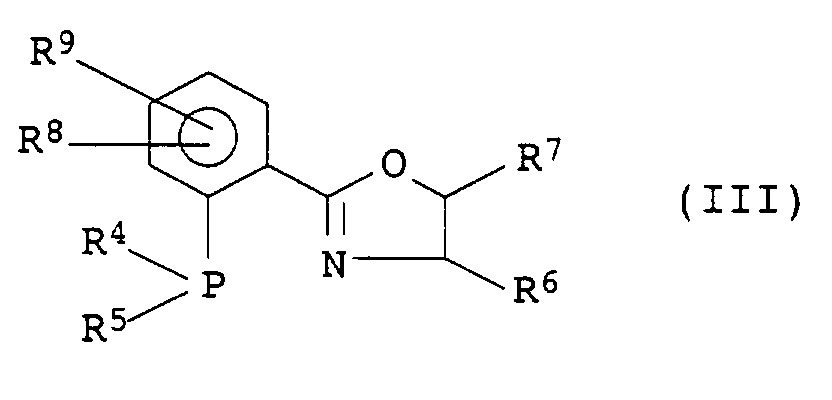
- the groups R 4 and R 5 independently of one another are preferably C 1 -C 4 -alkyl, in particular branched C 1 -C 4 -alkyl, or aryl which may be replaced by 1, 2 or 3 C 1 -C 4 alkyl groups is substituted.
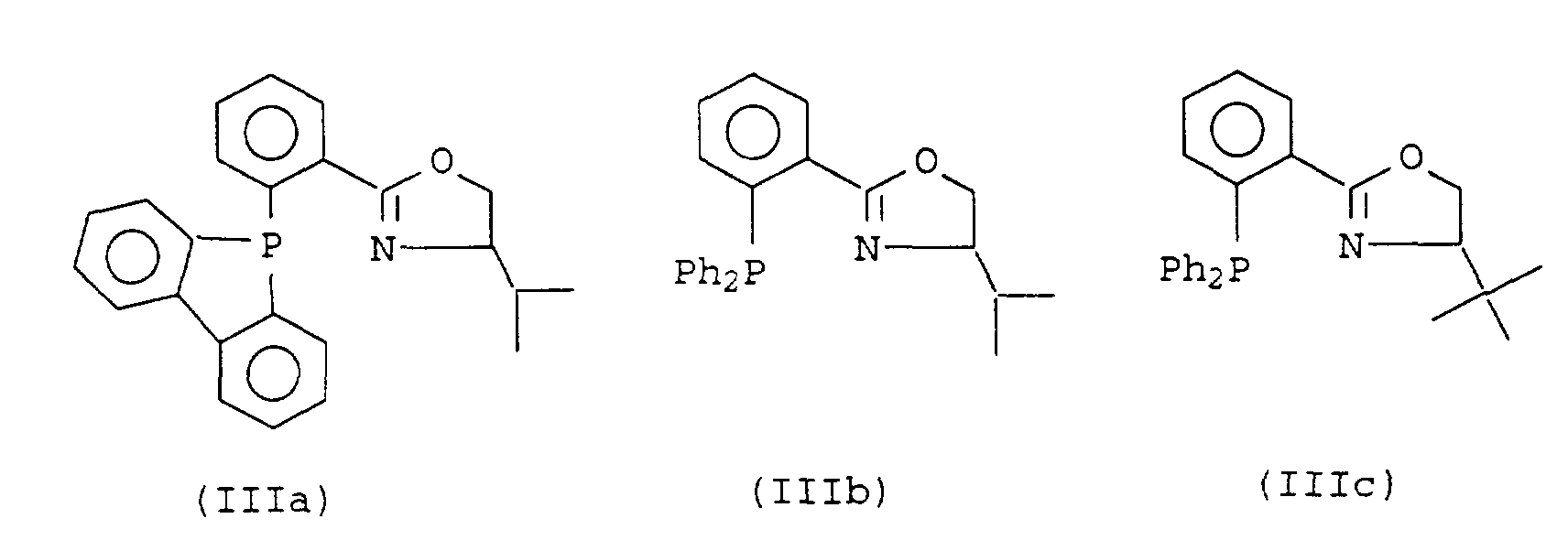
- R 4 and R 5 are particularly preferably independently of one another methyl, ethyl, n-propyl, i-propyl, n-butyl, i-butyl, phenyl, ortho- or para-tolyl, mesityl, ⁇ - or ⁇ -naphthyl. If R 4 and R 5 together with the P atom to which they are attached form a heterocyclic ring, then R 4 and R 5 preferably together represent n-butylene, n-pentylene or 2,2'-biphenylene.
- R 6 represents methyl, ethyl, propyl, i-propyl, n-butyl, 2-butyl, i-butyl, t-butyl, phenyl and benzyl and particularly preferably i-propyl and t-butyl.
- Atoms or groups for R 7 which are preferred according to the invention are hydrogen, methyl or phenyl and particularly preferably hydrogen.
- the absolute configuration of the carbon atoms in the oxazoline part which carry the substituents R 6 and R 7 can be (R) or (S) independently of one another. According to the invention, only those ligands L 2 are suitable in which the configuration on the C atom which carries R 6 is uniform (R) or (S).
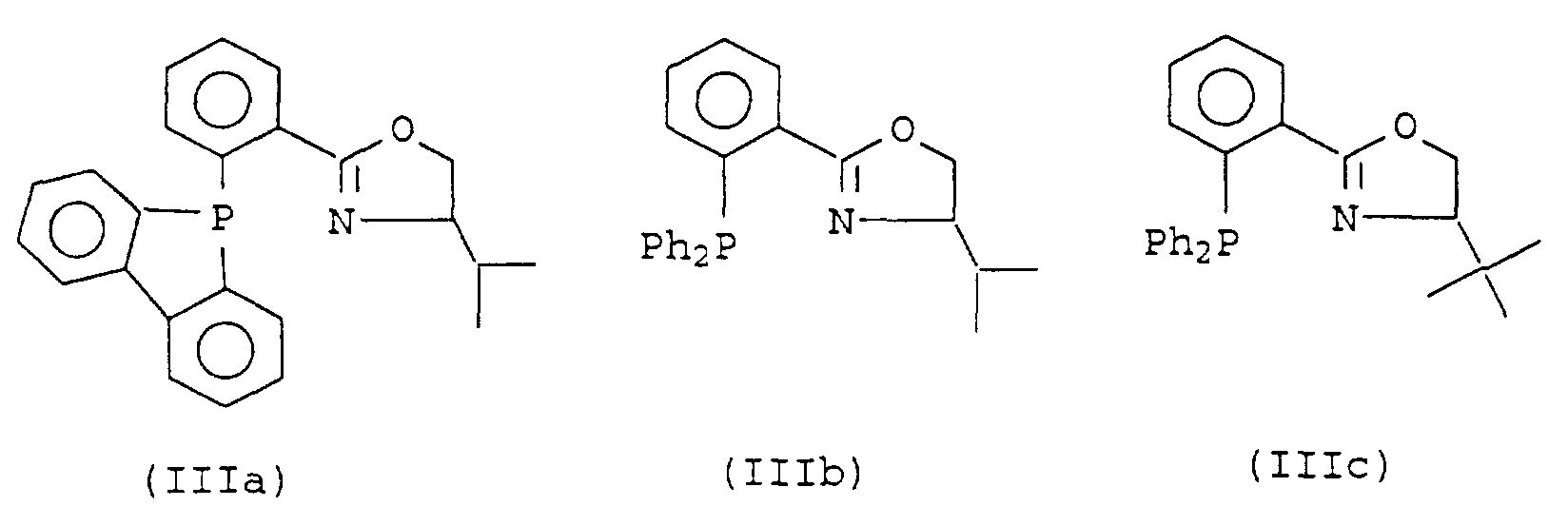
- the ligand L 2 is particularly preferably a compound of the formulas (IIIa), (IIIb) or (IIIc) with (R) or (S) configuration on the C atom which bears the alkyl group.
- the ligands L 2 according to the invention are known or can be prepared analogously to known methods. They are prepared, for example, starting from chiral amino alcohols of the general formula (V) by an acid catalysis ring closure reaction with o-fluoroaryl nitriles of the general formula (VI) to give the chiral 2- (o-fluoroaryl) oxazoline derivatives of the general formula (VII) (Bolm et al , Chem. Ber. 1991, 124, 1173). These can then be converted with a suitably substituted phosphine anion to the desired ligand L 2 of the general formula (III) (Williamson et al, Synlett, 1993, 509).
- the complexes according to the invention are prepared by reacting a chiral ligand of the general formula (III) with a precursor complex of the formula RuX 1 X 2 L 1 L 2 L 3 , in which X 1 , X 2 and L 1 have the meaning indicated above, L 2 and L 3 are the same or different and are selected from aromatics which may have 1, 2 or 3 alkyl substituents, in particular p-cymene, or triarylphosphines, in particular triphenylphosphine.
- the ligands L 2 and L 3 may be absent, especially if the precursor complexes are in dimeric or oligomeric form.
- Suitable complexes are, for example, RuCl 2 (PPh 3 ) 3 , [RuCl 2 (p-cymene)] 2 .
- the reaction is carried out in an inert solvent, for example an aromatic which optionally carries 1, 2 or 3 C 1 -C 4 -alkyl substituents or chlorine atoms, preferably benzene, toluene, ethylbenzene, p-cymene, chlorobenzene, dichlorobenzene, or an ether, preferably Diethyl ether, tetrahydrofuran, methyl t-butyl ether, anisole, or a haloalkane, for example dichloromethane, chloroform, dichloroethane, trichloroethane, at temperatures in the range from 0 ° C. to 150 ° C., preferably from 10 ° C. to 100 ° C., particularly preferred at room temperature.
- R and R ' are prochiral ketones and the transfer hydrogenation catalyzed by the complexes according to the invention to the corresponding alcohols is enantioselective.
- the enantiomeric excess is more than 60% (ee), preferably more than 90% (ee).
- radicals R and R ' There are in principle no restrictions with regard to the type of radicals R and R '. They stand independently of one another for straight-chain or branched alkyl, aryl, (hetero) aryl or (hetero) aralkyl groups, it being possible for all groups in turn to have further groups such as alkyl, (hetero) aryl or (hetero) aralkyl groups.
- One of the radicals R and R ' is preferably an aryl or heteroaryl group.
- the carbonyl function to be reduced can also be built into a mono- or polycyclic ring structure.
- the radicals R and R 'can have functional groups independently of one another.
- the process according to the invention for enantioselective transfer hydrogenation of prochiral ketones is usually carried out by reacting the ketone with a hydrogen donor, preferably a secondary alcohol, in particular i-propanol, 2-butanol, cyclopentanol or cyclohexanol, especially i-propanol, in the presence of catalytic amounts of one or more the complexes according to the invention and catalytic amounts of a base.
- the catalysts are used in amounts of 0.001 to 10 mol% per carbonyl function to be reduced, preferably 0.01 to 1 mol%, in particular 0.05 to 0.5 mol%.
- the amount of base, based on the catalyst, is in the range of 0.5-100 molar equivalents, preferably 1-50 molar eq., In particular 5-30 moleq.
- Suitable bases are alkali metal hydroxides, alkali metal C 1 -C 4 alcoholates, alkali metal hydrides or calcium hydride. Alkali metal hydroxides or alcoholates are preferably used.
- the reaction can be carried out in the secondary alcohol, if it is liquid, as a solvent.
- cosolvents can be used, preferably ethers such as diethyl ether, tetrahydrofuran, methyl t-butyl ether, dioxane, pyran or hydrocarbons, light petroleum fractions, preferably hexane, and chlorinated hydrocarbons, for example dichloromethane or chloroform.
- the reaction is carried out in the range from -30 ° C to 150 ° C, preferably 20 ° C to 100 ° C, and, if the solvent has a lower boiling temperature, under pressure.
- the reaction time is in the range of 15 min. until 12 h.
- the reaction mixture is worked up in a conventional manner, and the product is obtained, for example, by distillation or crystallization.
- a ruthenium complex according to the invention is generated from a suitable ruthenium precursor complex and a ligand L 2 of the general formula (III) in an inert solvent, for example one of the cosolvents mentioned, and then the prochiral ketone, the secondary alcohol and the base are added and the Mixture reacted.
- the transfer hydrogenation can be carried out with one prepared in situ Catalyst from one of Examples 1 to 5 as follows be performed.
Landscapes
- Chemical & Material Sciences (AREA)
- Organic Chemistry (AREA)
- Inorganic Chemistry (AREA)
- Engineering & Computer Science (AREA)
- Materials Engineering (AREA)
- Chemical Kinetics & Catalysis (AREA)
- Organic Low-Molecular-Weight Compounds And Preparation Thereof (AREA)
- Catalysts (AREA)
- Low-Molecular Organic Synthesis Reactions Using Catalysts (AREA)
Description


| Substrat | Katalysator | Reaktionsdauer | Wertprodukt | Ausbeute | (ee) |
| Acetophenon | Bsp 1 | 60 min | (R)-1-Phenylethanol | 83% | 94% |
| Isobutyrophenon | Bsp 2 | 30 min | (R)-1-Phenyl-2-methylpropanol | 83% | 93% |
| Cyclohexylmethylketon | Bsp 3 | 60 min | (S)-1-Cyclohexylethanol | 70% | 60% |
Claims (13)
- Chirale Rutheniumkomplexe der allgemeinen Formel (I),wobei die absolute Konfiguration an den Kohlenstoffatomen, die R6 und R7 tragen, unabhängig voneinander (S) oder (R) ist.X1 und X2 gleich oder verschieden sind und für ein Halogenidion, das Anion einer C1-C10-Carbonsäure, die gegebenenfalls 1, 2 oder 3 Chlor- oder Fluoratome trägt, das Anion der Methansulfinsäure oder der Trifluormethansulfinsäure stehen oderX1 und X2 zusammen für das Dianion einer 1,3-, 1,4- oder 1,5-Dicarbonsäure stehen,L1 für einen cyclischen Ether mit 5-6 Ringatomen,einen Aromaten, der gegebenenfalls 1, 2 oder 3 Alkylgruppen als Substituenten aufweist,PF3, odereinen Liganden der allgemeinen Formel (II)L2 für einen zweizähnigen, chiralen Liganden der allgemeinen Formel (III) steht,in der R4 und R5 gleich oder verschieden sind und für eine Alkylgruppe, Cycloalkylgruppe oder Arylgruppe, die gegebenenfalls 1, 2 oder 3 Substituenten aufweist, die unabhängig voneinander ausgewählt sind unter Alkylgruppen, Alkoxygruppen oder Halogenatomen, stehen, wobei einer der Reste R4 oder R5 auch ein Wasserstoffatom sein kann, oder in der
 R4 und R5 zusammen mit dem Phosphoratom, an das sie gebunden sind, für einen gesättigten C5-C7-Ring, der gegebenenfalls mit einem oder zwei Arylkernen kondensiert ist, stehen,R6 für eine Alkylgruppe, die gegebenenfalls eine oder mehrere Gruppen aufweist, die ausgewählt sind unter OH, SH, NH2, COOH Aryloxy, Alkoxy, Arylthio, Alkylthio, Acyloxy, Alkoxycarbonyl, Acylamino,oder eine Aralkylgruppe, Heteroaralkylgruppe, Arylgruppe oder Heteroarylgruppe steht,R7 für Wasserstoff, eine Alkyl-, Aryl- oder Aralkylgruppe steht,R8 und R9 gleich oder verschieden sind und für Wasserstoff, C1-C4-Alkyl- oder für C1-C4-Alkoxygruppen stehen oderR8 und R9 gemeinsam einen ankondensierten Cycloalkyl- oder Arylring bedeuten,
- Komplexe nach Anspruch 1 der allgemeinen Formel (I), in der X1 und X2 gleich oder verschieden sind und für Halogen oder das Anion einer C1-C4-Carbonsäure stehen.
- Komplexe nach einem der vorhergehenden Ansprüche der allgemeinen Formel (I), worin L1 ein Ligand der allgemeinen Formel (II) ist.
- Komplexe nach Anspruch 3, wobei in Formel (II) R1, R2 und R3 gleich oder verschieden sind und für C1-C4-Alkyl, oder Phenyl, das gegebenenfalls durch C1-C4-Alkyl substituiert ist, stehen.
- Komplexe nach Anspruch 4, in denen L1 für Triphenylphosphin, Tri-C1-C4-alkylphosphin, Tritolylphosphin oder Trimesitylphosphin steht.
- Komplexe nach einem der vorhergehenden Ansprüche, wobei R4 und R5 in Formel (III) gleich oder verschieden sind und für C1-C4-Alkyl, insbesondere verzweigtes C1-C4-Alkyl, Aryl, das gegebenenfalls durch 1, 2 oder 3 C1-C4-Alkylgruppen substituiert ist, oder
R4 und R5 zusammen für n-Butylen, n-Pentylen oder 2,2'-Biphenylen stehen. - Komplexe nach einem der vorhergehenden Ansprüche, wobei R6 in Formel (III) für C1-C4-Alkyl, Phenyl oder (CH2)nX steht, wobei X für Phenyl, 4-Imidazolyl, 3-Indolyl, α- oder β-Naphthyl, NH2, OH, SH, SCH3, COOH oder COO-C1-C4-Alkyl steht und n = 1, 2 oder 3 ist.
- Komplexe nach einem der vorhergehenden Ansprüche der allgemeinen Formel (I), in der X1 und X2 für Halogen und L1 für Triphenylphosphin stehen.
- Komplexe nach einem der vorhergehenden Ansprüche, in dem der chirale, zweizähnige Ligand eine Verbindung der Formeln (IIIa), (IIIb) oder (IIIc) ist, wobei das C-Atom, das die Alkylgruppe trägt, einheitlich (R) oder (S) ist.
- Verfahren zur Herstellung der Komplexe nach einem der Ansprüche 1 bis 9, dadurch gekennzeichnet, daß man einen Vorläuferkomplex der allgemeinen Formel RuX1X2L1L2L3, in der X1, X2 und L1 die in Anspruch 1 angegebenen Bedeutungen besitzen und L2, L3 gleich oder verschieden sind und für einen Aromaten, Triarylphosphin, Trialkylphosphin, CO oder ein Dien stehen, in einem inerten Lösungsmittel mit dem jeweiligen Liganden der Formel (III) umsetzt.
- Verwendung der Komplexe nach einem der Ansprüche 1 bis 9 zur enantioselektiven Transferhydrierung von prochiralen Ketonen.
- Verwendung nach Anspruch 11, wobei man als Wasserstoffdonor einen sekundären Alkohol, insbesondere Isopropanol verwendet.
- Verwendung nach Anspruch 11 oder 12, wobei man in Gegenwart katalytischer Mengen einer Base, insbesondere Alkalimetallhydroxiden oder -alkoholaten arbeitet.
Applications Claiming Priority (2)
| Application Number | Priority Date | Filing Date | Title |
|---|---|---|---|
| DE19548399 | 1995-12-22 | ||
| DE19548399A DE19548399A1 (de) | 1995-12-22 | 1995-12-22 | Rutheniumkomplexe mit einem chiralen, zweizähnigen Phosphinoxazolin-Liganden zur enantioselektiven Transferhydrierung von prochiralen Ketonen |
Publications (2)
| Publication Number | Publication Date |
|---|---|
| EP0780157A1 EP0780157A1 (de) | 1997-06-25 |
| EP0780157B1 true EP0780157B1 (de) | 2002-04-03 |
Family
ID=7781187
Family Applications (1)
| Application Number | Title | Priority Date | Filing Date |
|---|---|---|---|
| EP96120522A Expired - Lifetime EP0780157B1 (de) | 1995-12-22 | 1996-12-19 | Rutheniumkomplexe mit einem chiralen, zweizähnigen Phosphinoxazolin-Liganden zur enantioselektiven Transferhydrierung von prochiralen Ketonen |
Country Status (5)
| Country | Link |
|---|---|
| US (1) | US5693820A (de) |
| EP (1) | EP0780157B1 (de) |
| JP (1) | JP3878703B2 (de) |
| CA (1) | CA2192226C (de) |
| DE (2) | DE19548399A1 (de) |
Cited By (1)
| Publication number | Priority date | Publication date | Assignee | Title |
|---|---|---|---|---|
| US7317131B2 (en) | 2000-09-13 | 2008-01-08 | Firmenich Sa | Catalytic hydrogenation processes |
Families Citing this family (16)
| Publication number | Priority date | Publication date | Assignee | Title |
|---|---|---|---|---|
| GB9706321D0 (en) * | 1997-03-26 | 1997-05-14 | Zeneca Ltd | Catalytic hydrogenation |
| WO1999024410A1 (en) | 1997-11-12 | 1999-05-20 | The Penn State Research Foundation | Transition metal-catalyzed reactions based on chiral amine oxazolinyl ligands |
| US6472533B1 (en) * | 1999-04-08 | 2002-10-29 | The Texas A & M University System | Ligands for chiral catalysis |
| ITMI20011758A1 (it) * | 2001-08-09 | 2003-02-10 | Ciba Sc Holding Ag | Ligandi |
| ATE493416T1 (de) | 2007-05-04 | 2011-01-15 | Mallinckrodt Inc | Verbessertes verfahren zur herstellung von 6- alpha-hydroxy-n-alkylierten opiaten |
| JP2010533719A (ja) | 2007-07-17 | 2010-10-28 | マリンクロッド・インコーポレイテッド | 還元的アミノ化によるn−アルキル化オピエートの調製 |
| CA2738628C (en) * | 2008-09-30 | 2017-07-04 | Mallinckrodt Inc. | Processes for the selective amination of ketomorphinans |
| US8946419B2 (en) | 2009-02-23 | 2015-02-03 | Mallinckrodt Llc | (+)-6-hydroxy-morphinan or (+)-6-amino-morphinan derivatives |
| US8471023B2 (en) * | 2009-06-11 | 2013-06-25 | Mallinckrodt Llc | Reductive amination of 6-keto normorphinans by catalytic hydrogen transfer |
| CA2764915C (en) | 2009-06-11 | 2017-07-11 | Mallinckrodt Llc | Preparation of 6-alpha-amino n-substituted morphinans by catalytic hydrogen transfer |
| WO2011038169A2 (en) | 2009-09-24 | 2011-03-31 | Mallinckrodt Inc. | One-pot preparation of hexahydroisoquinolines from amides |
| WO2011038172A1 (en) | 2009-09-24 | 2011-03-31 | Mallinckrodt Inc. | One-pot preparation of hexahydroisoquinolines from dihydroisoquinolines |
| ES2698408T3 (es) | 2011-06-09 | 2019-02-04 | SpecGx LLC | Aminación reductora de 6-ceto morfinanos por transferencia de hidrógeno catalítico |
| KR20140063763A (ko) | 2011-09-08 | 2014-05-27 | 말린크로트 엘엘씨 | 중간체를 단리하지 않는 알칼로이드의 제조 방법 |
| US20180030074A1 (en) * | 2014-11-05 | 2018-02-01 | Shozo Furumoto | Phosphonium compound and production method therefor |
| JPWO2023153494A1 (de) * | 2022-02-14 | 2023-08-17 |
Family Cites Families (6)
| Publication number | Priority date | Publication date | Assignee | Title |
|---|---|---|---|---|
| JPS63145291A (ja) * | 1986-12-09 | 1988-06-17 | Takasago Corp | ルテニウム−ホスフイン錯体 |
| JPH0757758B2 (ja) * | 1988-10-24 | 1995-06-21 | 高砂香料工業株式会社 | ルテニウム―ホスフィン錯体 |
| KR0144567B1 (ko) * | 1989-03-03 | 1998-07-15 | 오노 알버어스 | 카르보닐화촉매시스템 |
| JP2796884B2 (ja) * | 1990-08-30 | 1998-09-10 | 高砂香料工業株式会社 | 光学活性γ―ブチロラクトン誘導体の製造方法 |
| FR2693190B1 (fr) * | 1992-07-02 | 1994-09-23 | Elf Aquitaine | Procédé d'hydrogénation énantiosélectif de la double liaison C=O OXO. |
| DE4243030A1 (de) * | 1992-12-18 | 1994-06-23 | Basf Ag | Iminverbindungen |
-
1995
- 1995-12-22 DE DE19548399A patent/DE19548399A1/de not_active Withdrawn
-
1996
- 1996-12-05 CA CA002192226A patent/CA2192226C/en not_active Expired - Fee Related
- 1996-12-19 EP EP96120522A patent/EP0780157B1/de not_active Expired - Lifetime
- 1996-12-19 DE DE59609005T patent/DE59609005D1/de not_active Expired - Fee Related
- 1996-12-20 US US08/777,743 patent/US5693820A/en not_active Expired - Lifetime
- 1996-12-24 JP JP35548996A patent/JP3878703B2/ja not_active Expired - Fee Related
Cited By (2)
| Publication number | Priority date | Publication date | Assignee | Title |
|---|---|---|---|---|
| US7317131B2 (en) | 2000-09-13 | 2008-01-08 | Firmenich Sa | Catalytic hydrogenation processes |
| US7579295B2 (en) | 2000-09-13 | 2009-08-25 | Firmenich Sa | Catalytic hydrogenation processes |
Also Published As
| Publication number | Publication date |
|---|---|
| JPH09249677A (ja) | 1997-09-22 |
| CA2192226A1 (en) | 1997-06-23 |
| JP3878703B2 (ja) | 2007-02-07 |
| EP0780157A1 (de) | 1997-06-25 |
| CA2192226C (en) | 2005-04-19 |
| US5693820A (en) | 1997-12-02 |
| DE19548399A1 (de) | 1997-06-26 |
| DE59609005D1 (de) | 2002-05-08 |
Similar Documents
| Publication | Publication Date | Title |
|---|---|---|
| DE2424543C2 (de) | Chlor-Rhodium-Komplexe mit einem stereoisomeren Diphosphin-Liganden, ihre Herstellung und ihre Verwendung bei der asymmetrischen Hydrierung | |
| DE60306795T2 (de) | Ruthenium-komplexe als (pre)katalysatoren für metathesereaktionen | |
| EP0643065B1 (de) | Neue Bisphosphine für asymmetrische Hydrierkatalysatoren | |
| EP2459579B1 (de) | Imidazolgruppenhaltige phosphinoboran-verbindungen und verfahren zur herstellung von imidazolgruppenhaltige phosphorverbindungen | |
| EP0780157A1 (de) | Rutheniumkomplexe mit einem chiralen, zweizähnigen Phosphinoxazolin-Liganden zur enantioselektiven Transferhydrierung von prochiralen Ketonen | |
| DE69114986T2 (de) | Eine Phosphino-Binapthyl-Verbindung und Übergangsmetall-Komplexe davon. | |
| EP0646590A1 (de) | Mit Fluoralkyl substituierte Ferrocenyldiphosphine als Liganden für homogene Katalysatoren | |
| EP0582692B1 (de) | Diphosphinliganden | |
| EP1507783B1 (de) | Hydroxydiphosphine und deren verwendung in der katalyse | |
| DE60313357T2 (de) | Verfahren zur katalytischen hydrierung von kohlenstoff-heteroatom-doppelbindungen | |
| EP0579797B1 (de) | Diphosphinliganden | |
| WO2021001240A1 (de) | Hydrierung von estern zu alkoholen in gegenwart eines ru-pnn-komplexes | |
| DE602004008478T2 (de) | Biphosphinrutheniumkomplexe mit chiralen diaminliganden als katalysatoren | |
| DE69921588T2 (de) | Aminophosphin-Metallkomplex für asymmetrische Reaktionen | |
| EP1175426B1 (de) | Bidentate organophosphorliganden und ihre verwendung | |
| DE69123025T2 (de) | Verfahren zur Herstellung von optisch aktiven Gamma-butyrolactonderivaten | |
| DE60102587T2 (de) | Chirale ligande für asymmetrische katalysatoren | |
| DE3153690C2 (de) | ||
| EP1483276B1 (de) | Ferrocenylliganden und ihre verwendung in der katalyse | |
| EP2107065A1 (de) | Ruthenium-Komplexe mit (P-P)-koordinierten Di-Phosphor-Donorliganden sowie Verfahren zu ihrer Herstellung | |
| EP1499625B1 (de) | Ferrocenylliganden und ein verfahren zur herstellung solcher liganden | |
| WO2002014330A1 (de) | Cycloaliphatisch-aromatische diphosphine und ihre verwendung in der katalyse | |
| EP1161437B1 (de) | Phosphabenzolverbindungen und ihre verwendung als liganden für hydroformylierungskatalysatoren | |
| DE60307724T2 (de) | Neue Diphosphinverbindung, Zwischenprodukte für deren Herstellung, Übergangsmetallkomplex enthaltend die Verbindung als Ligand und Katalysator für asymmetrische Hydrierungen, welcher den Komplex enthält | |
| DE69914889T2 (de) | Asymmetrische hydrierung |
Legal Events
| Date | Code | Title | Description |
|---|---|---|---|
| PUAI | Public reference made under article 153(3) epc to a published international application that has entered the european phase |
Free format text: ORIGINAL CODE: 0009012 |
|
| AK | Designated contracting states |
Kind code of ref document: A1 Designated state(s): CH DE ES FR GB IT LI NL |
|
| 17P | Request for examination filed |
Effective date: 19971203 |
|
| 17Q | First examination report despatched |
Effective date: 19991029 |
|
| GRAG | Despatch of communication of intention to grant |
Free format text: ORIGINAL CODE: EPIDOS AGRA |
|
| GRAG | Despatch of communication of intention to grant |
Free format text: ORIGINAL CODE: EPIDOS AGRA |
|
| GRAH | Despatch of communication of intention to grant a patent |
Free format text: ORIGINAL CODE: EPIDOS IGRA |
|
| REG | Reference to a national code |
Ref country code: GB Ref legal event code: IF02 |
|
| GRAH | Despatch of communication of intention to grant a patent |
Free format text: ORIGINAL CODE: EPIDOS IGRA |
|
| GRAA | (expected) grant |
Free format text: ORIGINAL CODE: 0009210 |
|
| AK | Designated contracting states |
Kind code of ref document: B1 Designated state(s): CH DE ES FR GB IT LI NL |
|
| PG25 | Lapsed in a contracting state [announced via postgrant information from national office to epo] |
Ref country code: IT Free format text: LAPSE BECAUSE OF FAILURE TO SUBMIT A TRANSLATION OF THE DESCRIPTION OR TO PAY THE FEE WITHIN THE PRESCRIBED TIME-LIMIT;WARNING: LAPSES OF ITALIAN PATENTS WITH EFFECTIVE DATE BEFORE 2007 MAY HAVE OCCURRED AT ANY TIME BEFORE 2007. THE CORRECT EFFECTIVE DATE MAY BE DIFFERENT FROM THE ONE RECORDED. Effective date: 20020403 |
|
| REG | Reference to a national code |
Ref country code: CH Ref legal event code: NV Representative=s name: SCHMAUDER & PARTNER AG PATENTANWALTSBUERO Ref country code: CH Ref legal event code: EP |
|
| REF | Corresponds to: |
Ref document number: 59609005 Country of ref document: DE Date of ref document: 20020508 |
|
| GBT | Gb: translation of ep patent filed (gb section 77(6)(a)/1977) |
Effective date: 20020614 |
|
| ET | Fr: translation filed | ||
| PG25 | Lapsed in a contracting state [announced via postgrant information from national office to epo] |
Ref country code: ES Free format text: LAPSE BECAUSE OF FAILURE TO SUBMIT A TRANSLATION OF THE DESCRIPTION OR TO PAY THE FEE WITHIN THE PRESCRIBED TIME-LIMIT Effective date: 20021030 |
|
| PLBE | No opposition filed within time limit |
Free format text: ORIGINAL CODE: 0009261 |
|
| STAA | Information on the status of an ep patent application or granted ep patent |
Free format text: STATUS: NO OPPOSITION FILED WITHIN TIME LIMIT |
|
| 26N | No opposition filed |
Effective date: 20030106 |
|
| PGFP | Annual fee paid to national office [announced via postgrant information from national office to epo] |
Ref country code: NL Payment date: 20081203 Year of fee payment: 13 Ref country code: CH Payment date: 20081230 Year of fee payment: 13 |
|
| PGFP | Annual fee paid to national office [announced via postgrant information from national office to epo] |
Ref country code: FR Payment date: 20081212 Year of fee payment: 13 |
|
| PGFP | Annual fee paid to national office [announced via postgrant information from national office to epo] |
Ref country code: DE Payment date: 20081211 Year of fee payment: 13 |
|
| PGFP | Annual fee paid to national office [announced via postgrant information from national office to epo] |
Ref country code: GB Payment date: 20081217 Year of fee payment: 13 |
|
| REG | Reference to a national code |
Ref country code: CH Ref legal event code: PCAR Free format text: SCHMAUDER & PARTNER AG PATENT- UND MARKENANWAELTE VSP;ZWAENGIWEG 7;8038 ZUERICH (CH) |
|
| REG | Reference to a national code |
Ref country code: NL Ref legal event code: V1 Effective date: 20100701 |
|
| REG | Reference to a national code |
Ref country code: CH Ref legal event code: PL |
|
| GBPC | Gb: european patent ceased through non-payment of renewal fee |
Effective date: 20091219 |
|
| REG | Reference to a national code |
Ref country code: FR Ref legal event code: ST Effective date: 20100831 |
|
| PG25 | Lapsed in a contracting state [announced via postgrant information from national office to epo] |
Ref country code: NL Free format text: LAPSE BECAUSE OF NON-PAYMENT OF DUE FEES Effective date: 20100701 Ref country code: LI Free format text: LAPSE BECAUSE OF NON-PAYMENT OF DUE FEES Effective date: 20091231 Ref country code: FR Free format text: LAPSE BECAUSE OF NON-PAYMENT OF DUE FEES Effective date: 20091231 Ref country code: CH Free format text: LAPSE BECAUSE OF NON-PAYMENT OF DUE FEES Effective date: 20091231 |
|
| PG25 | Lapsed in a contracting state [announced via postgrant information from national office to epo] |
Ref country code: DE Free format text: LAPSE BECAUSE OF NON-PAYMENT OF DUE FEES Effective date: 20100701 |
|
| PG25 | Lapsed in a contracting state [announced via postgrant information from national office to epo] |
Ref country code: GB Free format text: LAPSE BECAUSE OF NON-PAYMENT OF DUE FEES Effective date: 20091219 |