EP0780250A2 - Feineinstellung eines MacPherson-Federbeines: Vorrichtung zur Einstellung auf dem Federbein und Bank zum Messen - Google Patents
Feineinstellung eines MacPherson-Federbeines: Vorrichtung zur Einstellung auf dem Federbein und Bank zum Messen Download PDFInfo
- Publication number
- EP0780250A2 EP0780250A2 EP96119526A EP96119526A EP0780250A2 EP 0780250 A2 EP0780250 A2 EP 0780250A2 EP 96119526 A EP96119526 A EP 96119526A EP 96119526 A EP96119526 A EP 96119526A EP 0780250 A2 EP0780250 A2 EP 0780250A2
- Authority
- EP
- European Patent Office
- Prior art keywords
- cup
- axis
- rod
- leg
- spring
- Prior art date
- Legal status (The legal status is an assumption and is not a legal conclusion. Google has not performed a legal analysis and makes no representation as to the accuracy of the status listed.)
- Granted
Links
- 239000000725 suspension Substances 0.000 title claims abstract description 27
- 230000035939 shock Effects 0.000 claims abstract description 46
- 239000006096 absorbing agent Substances 0.000 claims abstract description 43
- 238000013519 translation Methods 0.000 claims description 9
- 230000006835 compression Effects 0.000 claims description 6
- 238000007906 compression Methods 0.000 claims description 6
- 238000000034 method Methods 0.000 claims description 4
- 230000008878 coupling Effects 0.000 claims description 3
- 238000010168 coupling process Methods 0.000 claims description 3
- 238000005859 coupling reaction Methods 0.000 claims description 3
- 125000006850 spacer group Chemical group 0.000 claims description 3
- 239000011248 coating agent Substances 0.000 claims description 2
- 238000000576 coating method Methods 0.000 claims description 2
- 230000003100 immobilizing effect Effects 0.000 claims description 2
- 238000009434 installation Methods 0.000 claims description 2
- 230000002427 irreversible effect Effects 0.000 claims description 2
- KJFBVJALEQWJBS-XUXIUFHCSA-N maribavir Chemical compound CC(C)NC1=NC2=CC(Cl)=C(Cl)C=C2N1[C@H]1O[C@@H](CO)[C@H](O)[C@@H]1O KJFBVJALEQWJBS-XUXIUFHCSA-N 0.000 abstract 1
- 238000005259 measurement Methods 0.000 description 19
- 238000010008 shearing Methods 0.000 description 10
- 238000013461 design Methods 0.000 description 7
- 238000012937 correction Methods 0.000 description 6
- 230000002301 combined effect Effects 0.000 description 5
- 208000031968 Cadaver Diseases 0.000 description 4
- 238000004519 manufacturing process Methods 0.000 description 4
- 230000009471 action Effects 0.000 description 3
- 230000006978 adaptation Effects 0.000 description 3
- 238000006243 chemical reaction Methods 0.000 description 3
- 239000006185 dispersion Substances 0.000 description 3
- 230000000694 effects Effects 0.000 description 3
- 238000012423 maintenance Methods 0.000 description 3
- 238000012986 modification Methods 0.000 description 3
- 230000004048 modification Effects 0.000 description 3
- KWGRBVOPPLSCSI-WPRPVWTQSA-N (-)-ephedrine Chemical compound CN[C@@H](C)[C@H](O)C1=CC=CC=C1 KWGRBVOPPLSCSI-WPRPVWTQSA-N 0.000 description 2
- 230000008901 benefit Effects 0.000 description 2
- 230000008859 change Effects 0.000 description 2
- 238000010276 construction Methods 0.000 description 2
- 238000001514 detection method Methods 0.000 description 2
- 238000001914 filtration Methods 0.000 description 2
- 238000005457 optimization Methods 0.000 description 2
- 238000012545 processing Methods 0.000 description 2
- 230000003542 behavioural effect Effects 0.000 description 1
- 230000000295 complement effect Effects 0.000 description 1
- 238000005520 cutting process Methods 0.000 description 1
- 230000007547 defect Effects 0.000 description 1
- 238000011161 development Methods 0.000 description 1
- 238000006073 displacement reaction Methods 0.000 description 1
- 238000009826 distribution Methods 0.000 description 1
- 210000005069 ears Anatomy 0.000 description 1
- 238000002474 experimental method Methods 0.000 description 1
- 230000007246 mechanism Effects 0.000 description 1
- 239000002184 metal Substances 0.000 description 1
- 238000000465 moulding Methods 0.000 description 1
- 208000020016 psychiatric disease Diseases 0.000 description 1
- 230000009467 reduction Effects 0.000 description 1
- 238000007670 refining Methods 0.000 description 1
- 238000011160 research Methods 0.000 description 1
- 238000004904 shortening Methods 0.000 description 1
Images







Classifications
-
- B—PERFORMING OPERATIONS; TRANSPORTING
- B60—VEHICLES IN GENERAL
- B60G—VEHICLE SUSPENSION ARRANGEMENTS
- B60G17/00—Resilient suspensions having means for adjusting the spring or vibration-damper characteristics, for regulating the distance between a supporting surface and a sprung part of vehicle or for locking suspension during use to meet varying vehicular or surface conditions, e.g. due to speed or load
- B60G17/015—Resilient suspensions having means for adjusting the spring or vibration-damper characteristics, for regulating the distance between a supporting surface and a sprung part of vehicle or for locking suspension during use to meet varying vehicular or surface conditions, e.g. due to speed or load the regulating means comprising electric or electronic elements
- B60G17/018—Resilient suspensions having means for adjusting the spring or vibration-damper characteristics, for regulating the distance between a supporting surface and a sprung part of vehicle or for locking suspension during use to meet varying vehicular or surface conditions, e.g. due to speed or load the regulating means comprising electric or electronic elements characterised by the use of a specific signal treatment or control method
- B60G17/0185—Resilient suspensions having means for adjusting the spring or vibration-damper characteristics, for regulating the distance between a supporting surface and a sprung part of vehicle or for locking suspension during use to meet varying vehicular or surface conditions, e.g. due to speed or load the regulating means comprising electric or electronic elements characterised by the use of a specific signal treatment or control method for failure detection
-
- B—PERFORMING OPERATIONS; TRANSPORTING
- B60—VEHICLES IN GENERAL
- B60G—VEHICLE SUSPENSION ARRANGEMENTS
- B60G15/00—Resilient suspensions characterised by arrangement, location or type of combined spring and vibration damper, e.g. telescopic type
- B60G15/02—Resilient suspensions characterised by arrangement, location or type of combined spring and vibration damper, e.g. telescopic type having mechanical spring
- B60G15/06—Resilient suspensions characterised by arrangement, location or type of combined spring and vibration damper, e.g. telescopic type having mechanical spring and fluid damper
- B60G15/067—Resilient suspensions characterised by arrangement, location or type of combined spring and vibration damper, e.g. telescopic type having mechanical spring and fluid damper characterised by the mounting on the vehicle body or chassis of the spring and damper unit
- B60G15/068—Resilient suspensions characterised by arrangement, location or type of combined spring and vibration damper, e.g. telescopic type having mechanical spring and fluid damper characterised by the mounting on the vehicle body or chassis of the spring and damper unit specially adapted for MacPherson strut-type suspension
-
- B—PERFORMING OPERATIONS; TRANSPORTING
- B60—VEHICLES IN GENERAL
- B60G—VEHICLE SUSPENSION ARRANGEMENTS
- B60G15/00—Resilient suspensions characterised by arrangement, location or type of combined spring and vibration damper, e.g. telescopic type
- B60G15/02—Resilient suspensions characterised by arrangement, location or type of combined spring and vibration damper, e.g. telescopic type having mechanical spring
- B60G15/06—Resilient suspensions characterised by arrangement, location or type of combined spring and vibration damper, e.g. telescopic type having mechanical spring and fluid damper
- B60G15/062—Resilient suspensions characterised by arrangement, location or type of combined spring and vibration damper, e.g. telescopic type having mechanical spring and fluid damper the spring being arranged around the damper
- B60G15/063—Resilient suspensions characterised by arrangement, location or type of combined spring and vibration damper, e.g. telescopic type having mechanical spring and fluid damper the spring being arranged around the damper characterised by the mounting of the spring on the damper
-
- B—PERFORMING OPERATIONS; TRANSPORTING
- B60—VEHICLES IN GENERAL
- B60G—VEHICLE SUSPENSION ARRANGEMENTS
- B60G15/00—Resilient suspensions characterised by arrangement, location or type of combined spring and vibration damper, e.g. telescopic type
- B60G15/02—Resilient suspensions characterised by arrangement, location or type of combined spring and vibration damper, e.g. telescopic type having mechanical spring
- B60G15/06—Resilient suspensions characterised by arrangement, location or type of combined spring and vibration damper, e.g. telescopic type having mechanical spring and fluid damper
- B60G15/07—Resilient suspensions characterised by arrangement, location or type of combined spring and vibration damper, e.g. telescopic type having mechanical spring and fluid damper the damper being connected to the stub axle and the spring being arranged around the damper
-
- F—MECHANICAL ENGINEERING; LIGHTING; HEATING; WEAPONS; BLASTING
- F16—ENGINEERING ELEMENTS AND UNITS; GENERAL MEASURES FOR PRODUCING AND MAINTAINING EFFECTIVE FUNCTIONING OF MACHINES OR INSTALLATIONS; THERMAL INSULATION IN GENERAL
- F16F—SPRINGS; SHOCK-ABSORBERS; MEANS FOR DAMPING VIBRATION
- F16F1/00—Springs
- F16F1/02—Springs made of steel or other material having low internal friction; Wound, torsion, leaf, cup, ring or the like springs, the material of the spring not being relevant
- F16F1/04—Wound springs
- F16F1/041—Wound springs with means for modifying the spring characteristics
-
- B—PERFORMING OPERATIONS; TRANSPORTING
- B60—VEHICLES IN GENERAL
- B60G—VEHICLE SUSPENSION ARRANGEMENTS
- B60G2200/00—Indexing codes relating to suspension types
- B60G2200/10—Independent suspensions
- B60G2200/14—Independent suspensions with lateral arms
- B60G2200/142—Independent suspensions with lateral arms with a single lateral arm, e.g. MacPherson type
-
- B—PERFORMING OPERATIONS; TRANSPORTING
- B60—VEHICLES IN GENERAL
- B60G—VEHICLE SUSPENSION ARRANGEMENTS
- B60G2200/00—Indexing codes relating to suspension types
- B60G2200/40—Indexing codes relating to the wheels in the suspensions
- B60G2200/44—Indexing codes relating to the wheels in the suspensions steerable
-
- B—PERFORMING OPERATIONS; TRANSPORTING
- B60—VEHICLES IN GENERAL
- B60G—VEHICLE SUSPENSION ARRANGEMENTS
- B60G2200/00—Indexing codes relating to suspension types
- B60G2200/40—Indexing codes relating to the wheels in the suspensions
- B60G2200/46—Indexing codes relating to the wheels in the suspensions camber angle
-
- B—PERFORMING OPERATIONS; TRANSPORTING
- B60—VEHICLES IN GENERAL
- B60G—VEHICLE SUSPENSION ARRANGEMENTS
- B60G2200/00—Indexing codes relating to suspension types
- B60G2200/40—Indexing codes relating to the wheels in the suspensions
- B60G2200/462—Toe-in/out
-
- B—PERFORMING OPERATIONS; TRANSPORTING
- B60—VEHICLES IN GENERAL
- B60G—VEHICLE SUSPENSION ARRANGEMENTS
- B60G2200/00—Indexing codes relating to suspension types
- B60G2200/40—Indexing codes relating to the wheels in the suspensions
- B60G2200/464—Caster angle
-
- B—PERFORMING OPERATIONS; TRANSPORTING
- B60—VEHICLES IN GENERAL
- B60G—VEHICLE SUSPENSION ARRANGEMENTS
- B60G2202/00—Indexing codes relating to the type of spring, damper or actuator
- B60G2202/30—Spring/Damper and/or actuator Units
- B60G2202/31—Spring/Damper and/or actuator Units with the spring arranged around the damper, e.g. MacPherson strut
- B60G2202/312—The spring being a wound spring
-
- B—PERFORMING OPERATIONS; TRANSPORTING
- B60—VEHICLES IN GENERAL
- B60G—VEHICLE SUSPENSION ARRANGEMENTS
- B60G2202/00—Indexing codes relating to the type of spring, damper or actuator
- B60G2202/40—Type of actuator
- B60G2202/42—Electric actuator
-
- B—PERFORMING OPERATIONS; TRANSPORTING
- B60—VEHICLES IN GENERAL
- B60G—VEHICLE SUSPENSION ARRANGEMENTS
- B60G2202/00—Indexing codes relating to the type of spring, damper or actuator
- B60G2202/40—Type of actuator
- B60G2202/42—Electric actuator
- B60G2202/424—Electric actuator electrostrictive materials, e.g. piezoelectric actuator
-
- B—PERFORMING OPERATIONS; TRANSPORTING
- B60—VEHICLES IN GENERAL
- B60G—VEHICLE SUSPENSION ARRANGEMENTS
- B60G2204/00—Indexing codes related to suspensions per se or to auxiliary parts
- B60G2204/10—Mounting of suspension elements
- B60G2204/12—Mounting of springs or dampers
- B60G2204/124—Mounting of coil springs
-
- B—PERFORMING OPERATIONS; TRANSPORTING
- B60—VEHICLES IN GENERAL
- B60G—VEHICLE SUSPENSION ARRANGEMENTS
- B60G2204/00—Indexing codes related to suspensions per se or to auxiliary parts
- B60G2204/10—Mounting of suspension elements
- B60G2204/12—Mounting of springs or dampers
- B60G2204/124—Mounting of coil springs
- B60G2204/1242—Mounting of coil springs on a damper, e.g. MacPerson strut
-
- B—PERFORMING OPERATIONS; TRANSPORTING
- B60—VEHICLES IN GENERAL
- B60G—VEHICLE SUSPENSION ARRANGEMENTS
- B60G2204/00—Indexing codes related to suspensions per se or to auxiliary parts
- B60G2204/10—Mounting of suspension elements
- B60G2204/12—Mounting of springs or dampers
- B60G2204/128—Damper mount on vehicle body or chassis
-
- B—PERFORMING OPERATIONS; TRANSPORTING
- B60—VEHICLES IN GENERAL
- B60G—VEHICLE SUSPENSION ARRANGEMENTS
- B60G2204/00—Indexing codes related to suspensions per se or to auxiliary parts
- B60G2204/40—Auxiliary suspension parts; Adjustment of suspensions
- B60G2204/41—Elastic mounts, e.g. bushings
-
- B—PERFORMING OPERATIONS; TRANSPORTING
- B60—VEHICLES IN GENERAL
- B60G—VEHICLE SUSPENSION ARRANGEMENTS
- B60G2204/00—Indexing codes related to suspensions per se or to auxiliary parts
- B60G2204/40—Auxiliary suspension parts; Adjustment of suspensions
- B60G2204/418—Bearings, e.g. ball or roller bearings
-
- B—PERFORMING OPERATIONS; TRANSPORTING
- B60—VEHICLES IN GENERAL
- B60G—VEHICLE SUSPENSION ARRANGEMENTS
- B60G2204/00—Indexing codes related to suspensions per se or to auxiliary parts
- B60G2204/40—Auxiliary suspension parts; Adjustment of suspensions
- B60G2204/419—Gears
-
- B—PERFORMING OPERATIONS; TRANSPORTING
- B60—VEHICLES IN GENERAL
- B60G—VEHICLE SUSPENSION ARRANGEMENTS
- B60G2204/00—Indexing codes related to suspensions per se or to auxiliary parts
- B60G2204/40—Auxiliary suspension parts; Adjustment of suspensions
- B60G2204/421—Pivoted lever mechanisms for mounting suspension elements, e.g. Watt linkage
-
- B—PERFORMING OPERATIONS; TRANSPORTING
- B60—VEHICLES IN GENERAL
- B60G—VEHICLE SUSPENSION ARRANGEMENTS
- B60G2204/00—Indexing codes related to suspensions per se or to auxiliary parts
- B60G2204/40—Auxiliary suspension parts; Adjustment of suspensions
- B60G2204/43—Fittings, brackets or knuckles
-
- B—PERFORMING OPERATIONS; TRANSPORTING
- B60—VEHICLES IN GENERAL
- B60G—VEHICLE SUSPENSION ARRANGEMENTS
- B60G2204/00—Indexing codes related to suspensions per se or to auxiliary parts
- B60G2204/40—Auxiliary suspension parts; Adjustment of suspensions
- B60G2204/44—Centering or positioning means
-
- B—PERFORMING OPERATIONS; TRANSPORTING
- B60—VEHICLES IN GENERAL
- B60G—VEHICLE SUSPENSION ARRANGEMENTS
- B60G2204/00—Indexing codes related to suspensions per se or to auxiliary parts
- B60G2204/61—Adjustable during maintenance
-
- B—PERFORMING OPERATIONS; TRANSPORTING
- B60—VEHICLES IN GENERAL
- B60G—VEHICLE SUSPENSION ARRANGEMENTS
- B60G2204/00—Indexing codes related to suspensions per se or to auxiliary parts
- B60G2204/62—Adjustable continuously, e.g. during driving
-
- B—PERFORMING OPERATIONS; TRANSPORTING
- B60—VEHICLES IN GENERAL
- B60G—VEHICLE SUSPENSION ARRANGEMENTS
- B60G2206/00—Indexing codes related to the manufacturing of suspensions: constructional features, the materials used, procedures or tools
- B60G2206/01—Constructional features of suspension elements, e.g. arms, dampers, springs
- B60G2206/90—Maintenance
- B60G2206/92—Tools or equipment used for assembling
- B60G2206/921—Coil spring compressor
-
- B—PERFORMING OPERATIONS; TRANSPORTING
- B60—VEHICLES IN GENERAL
- B60G—VEHICLE SUSPENSION ARRANGEMENTS
- B60G2400/00—Indexing codes relating to detected, measured or calculated conditions or factors
- B60G2400/40—Steering conditions
-
- B—PERFORMING OPERATIONS; TRANSPORTING
- B60—VEHICLES IN GENERAL
- B60G—VEHICLE SUSPENSION ARRANGEMENTS
- B60G2600/00—Indexing codes relating to particular elements, systems or processes used on suspension systems or suspension control systems
- B60G2600/08—Failure or malfunction detecting means
-
- B—PERFORMING OPERATIONS; TRANSPORTING
- B60—VEHICLES IN GENERAL
- B60G—VEHICLE SUSPENSION ARRANGEMENTS
- B60G2800/00—Indexing codes relating to the type of movement or to the condition of the vehicle and to the end result to be achieved by the control action
- B60G2800/24—Steering, cornering
-
- F—MECHANICAL ENGINEERING; LIGHTING; HEATING; WEAPONS; BLASTING
- F16—ENGINEERING ELEMENTS AND UNITS; GENERAL MEASURES FOR PRODUCING AND MAINTAINING EFFECTIVE FUNCTIONING OF MACHINES OR INSTALLATIONS; THERMAL INSULATION IN GENERAL
- F16F—SPRINGS; SHOCK-ABSORBERS; MEANS FOR DAMPING VIBRATION
- F16F1/00—Springs
- F16F1/02—Springs made of steel or other material having low internal friction; Wound, torsion, leaf, cup, ring or the like springs, the material of the spring not being relevant
- F16F1/04—Wound springs
- F16F1/12—Attachments or mountings
-
- F—MECHANICAL ENGINEERING; LIGHTING; HEATING; WEAPONS; BLASTING
- F16—ENGINEERING ELEMENTS AND UNITS; GENERAL MEASURES FOR PRODUCING AND MAINTAINING EFFECTIVE FUNCTIONING OF MACHINES OR INSTALLATIONS; THERMAL INSULATION IN GENERAL
- F16F—SPRINGS; SHOCK-ABSORBERS; MEANS FOR DAMPING VIBRATION
- F16F1/00—Springs
- F16F1/36—Springs made of rubber or other material having high internal friction, e.g. thermoplastic elastomers
- F16F1/38—Springs made of rubber or other material having high internal friction, e.g. thermoplastic elastomers with a sleeve of elastic material between a rigid outer sleeve and a rigid inner sleeve or pin, i.e. bushing-type
- F16F1/3835—Springs made of rubber or other material having high internal friction, e.g. thermoplastic elastomers with a sleeve of elastic material between a rigid outer sleeve and a rigid inner sleeve or pin, i.e. bushing-type characterised by the sleeve of elastic material, e.g. having indentations or made of materials of different hardness
Definitions
- the present invention relates to Mac Pherson type suspensions.
- Figure 1 shows such a suspension. It is known that this type of suspension comprises a strut 1 consisting essentially of a shock absorber participating at the same time in guiding the wheel.
- the damper comprises a body 2 and a rod 3.
- the upper end 30 of the rod bears on the vehicle body at a point of articulation 31 generally materialized by an elastic articulation.
- a helical spring 4 is mounted between an upper cup 40 and a lower cup 41.
- the lower cup 41 is supported on the body 2 of the shock absorber and the upper cup 40 is supported on the body of the vehicle, generally also by the through filtering carried out by said elastic articulation, filtering which may in certain embodiments be the same for the spring and for the damper.
- the body 2 is made integral with a hub carrier 5. There is therefore no degree of freedom between the body 2 and the hub carrier 5.
- a lower arm 6 is articulated on one side on the body of the vehicle and of the other on the hub carrier 5 by the articulation 65.
- the hub carrier 5 supports a hub 50, on which is mounted a wheel 51 fitted with its tire 52.
- the strut 1 exerts forces on the body from both the spring and the shock absorber. Although the exact location of the point of application of these forces is difficult, and depends in particular on the exact construction of the strut 1, it is known that the control of the shearing force which the rod 3 of the shock absorber undergoes is decisive for the proper functioning of suspensions of this type.
- the reaction R ⁇ of the vehicle body on the strut Its direction passes through point C, this being defined by the intersection of the effort B ⁇ exerted by the lower arm 6 on the joint 65 and the result of the forces S ⁇ that the ground exerts on the tire 52.
- the present invention provides means for the practical optimization of each of the vehicles produced in series. Indeed, it turned out that the inevitable dispersions of The characteristics of all the components of the suspension, and more specifically of the strut, could cause quite significant variations in behavior from one vehicle to another.
- the invention proposes the elements necessary for optimization and a method for optimizing the distribution of the reaction. R ⁇ between the push P ⁇ of spring 4 and shearing force T ⁇ in the rod 3, as well as the torque Cp exerted by the spring around the pivot axis.
- the invention proposes to introduce into a strut comprising a spring whose inclination has been calculated beforehand so that the residual shearing force T ⁇ is optimized, for example made as low as possible, elements making it possible to more finely adjust the value of this residual shear force T ⁇ or of the couple Cp.
- T ⁇ and of the torque Cp actually obtained on production vehicles.
- the objective of the invention is to be able to act on the location of the centers of thrust of the spring on the upper cup and on the lower cup, as well as on the orientation of said thrusts, without acting on the usual parameters of geometry of a suspension, which are the camber angle, the tilt angle of the pivot, and the caster angle, which remain unchanged.
- the invention provides a strut for MacPherson type wheel suspension, comprising a shock absorber provided with a body and a rod, said leg comprising a helical spring surrounding said rod, comprising a lower bearing cup supported by the shock absorber body, said lower cup comprising a lower seat receiving one of the ends of said spring, and an upper bearing cup intended to bear on the body of the vehicle, where appropriate by means of a connecting member, said upper cup comprising an upper seat receiving the other end of said spring, said upper cup being traversed by said rod, the damper body having a bearing surface for attachment to a hub carrier cooperating with means of 'hooking, said hub holder defining an axis of rotation of said wheel, said hooking means imposing a predetermined azimuthal position between the body and the hub carrier, characterized in that said leg comprises means for adjusting the relative position of the axis of the spring with respect to said bearing hanging.
- the means for hooking to a carrier hub comprise means for indexing (that is to say for locating) the relative orientation of the body of the shock absorber with respect to the hub carrier, said indexing means being arranged on or in the vicinity of the bearing hanging. It is for example a graduated sector allowing to locate and make changing the relative position of the body 2 with respect to the hub carrier 5. This thus acts on the relative angular position and / or on the eccentricity of the lower cup.
- the strut has a ball stop 42 visible in FIGS. 2, 5, 6, 8 to 14, 22, 23, and 26 to 30 whose role is that the deflection is not thwarted by the spring 4.
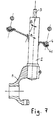
- FIG. 5 illustrates a leg whose ball stop 42, also located under the lower cup 41, is inclined so that the normal to the bearing surface of the lower cup forms an angle ⁇ with respect to the axis of the rod 3.
- FIG. 6 shows that, by relative rotation of the body 2 with respect to the hub carrier 5, the orientation of the axis of the thrust ball 42 and the attitude of the spring 4 on the cup are varied lower 41.
- a combination of the eccentricity e and the inclination ⁇ can also be used.
- the lower cup 41 d 'support of the spring 4 is integral with the body 2 of the damper.
- the axis of the lower cup is inclined at an angle ⁇ relative to the axis of the shock body 2 and / or offset by a distance e relative to the axis of the shock body 2.
- the adjustment consists in angularly orienting the body 2 of the shock absorber relative to the hub carrier 5. The modification of said orientation makes it possible to change the position of the lower cup 41 relative to the upper cup and thus to adjust the direction spring thrust 4.
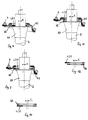
- Figures 8 to 12 illustrate an adjustment by rotation of an eccentric: the lower cup 41 is mounted on the damper body 2 via an eccentric 420 adjustable in rotation.
- the eccentric can be part of the ball stop 42 ( Figures 10 and 12) or be independent of it ( Figures 8, 9 and 11).
- the rotation of the eccentric 420 relative to the body 2 (FIGS. 8 and 9), or the rotation of the eccentric 420 relative to the cup 41 (FIG. 11) displaces the cup 41 or relative to the body 2.
- Figures 13 and 14 show the setting using a wedge wedge 71 having a section of maximum thickness and a section of minimum thickness diametrically opposite to the previous one, the thickness varying continuously between said sections, said wedge wedge 71 supporting said lower cup by one of its faces, said wedge wedge 71 being adjustable by relative rotation.
- This arrangement finds application for example in the case of a front strut, in which the ball stop 42 is located under the lower cup 41.
- the use as explained of a wedge such as the wedge 71 to support the upper cup (use not shown) would also act on the upper cup.
- the wedge wedge 71 is interposed between the lower cup 41 and the ball stop 42 (fig. 13), or between the ball stop 42 and the support flange 25 secured to the body 2 of the shock absorber (fig. 14).
- the axis of the bearing face of the flange 26 can be inclined at an angle ⁇ relative to the axis of the body 2 of the shock absorber (fig. 15), and could also support a shim skew.
- the adjustment consists in angularly orienting the wedge wedge 71, with respect to said cup 41 (FIG. 13) or with respect to said body 2 (FIG. 14).
- the wedge wedge 71 will be preferably secured to the lower cup 41 (fig. 13) or to the support flange 25 (fig. 14) by means of a mechanical stop device, or by collage.
- the same adjustment principle also applies to struts lacking a ball stop, or to struts in which the ball stop 42 is located above the upper spring support cup.
- FIG. 16 illustrates a ring 78 forming a spacer interposed between spring 4 and cup, here the lower cup 41.
- the seat of one of the cups is materialized by said ring 78 disposed around the periphery of said cup 41, which can rotate in rotation around said periphery , said ring forming a spacer between the spring and said cup, the bearing surface of said ring on the cup being a surface of revolution, said ring forming having a section of maximum thickness and a section of minimum thickness, said ring being adjustable by relative rotation with respect to said cup.
- the ring 79 in addition to a variable thickness, has a seat eccentric with respect to the bearing surface on the cup 41, which is of revolution.
- the adjustment is made by relative rotation of the ring 78 or 79 relative to the cup 41, the spring 4 remaining in abutment on the ring without relative movement.
- the eccentric nature of the ring can also be used independently of the thickness variation property, if the shape of the spring allows it.
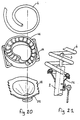
- said adjustment means essentially comprise the following arrangement: the lower cup 41 is placed on a flange 21 secured to the body 2 of the shock absorber, said flange forming a slide guiding said cup in translation in a plane cutting the axis of l shock absorber, said leg comprising means for selecting a chosen relative position of said lower cup relative to said flange and for immobilizing said lower cup and said flange in the chosen position.
- the relative translation between lower cup 41 and flange 21 takes place in a direction perpendicular to the plane of FIGS. 19 and 21.
- a toothing 22 is produced on two parallel and opposite edges of the flange 21 forming a slide (FIG. 18 and 20). This toothing provides both guiding in translation (by said parallel edges) of the lower cup 41 and allows immobilization in the relative position, by the toothing itself.
- the lower cup 41 can be produced by stamping a metal sheet ( Figures 18 and 19).
- the lower cup has two folded parallel edges.
- a rib 23, visible in FIG. 18, is produced in the middle of each of the folded edges. This rib 23 engages in the teeth 22 of the flange 21 to freeze the chosen relative position.
- the lower cup 41 can also be produced by molding ( Figures 20 and 21). This lower cup then has two ears 24 (FIG. 20) having on their lower face an imprint complementary to the toothing 22. This imprint engages in the toothing 22 of the flange 21 in order to freeze the chosen relative position.
- the adjustment elements described above can of course be useful for making corrections, whatever the method of detecting vehicle behavior disorders. They can be used separately or, for some of them, combined together.
- the invention makes it possible to comply with much closer tolerances on the real characteristics of the struts mounted on vehicles.
- the adjustment elements can be used in conjunction with a measurement, for example of the shearing force applied to the rod, for example by decoupling the top of the rod from the upper cup or more generally from the body connection member. , and by measuring the effort necessary to maintain the top of the rod in its initial configuration, or by any suitable method.
- the measurement of the characteristics of the steering system is also relevant for act on the adjustment elements.
- the shear force on the rod is also relevant for act on the adjustment elements.
- the torque around the pivot axis is also relevant for act on the adjustment elements.
- the torque at the wheel is also relevant for act on the adjustment elements.
- parameters that can be measured such as the shear force on the rod, the torque around the pivot axis, or the torque at the wheel, or other parameters if they are representative, directly or indirectly, of the operation of the struts in real use on the vehicle for which they are designed.
- the plate 90 is mounted on the frame 92 by means of a first group of three links B1, B2, B3, mounted by ball joint or by equivalent elastic decoupling which has in measures the advantage of not introducing friction (localized thinning of the rod) on the one hand on the face of said plate 90 opposite the face receiving said connecting member, and on the other hand on configurable housings arranged on the frame 92 opposite said plate 90, the precise position of said housings essentially constituting said configuration means, and by means of a second group of three coplanar links B4, B5, B6, mounted by ball joint on the one hand on said opposite plate and on the other hand on said frame so that their plane is perpendicular to the axis of the rod, at least one of said links comprising a sensor I of tensile and compression force.
- at least two of said links of the second group B4, B5, B6, or all three include such a sensor I.
- the best location for E is that it corresponds to the place in space in relation to the strut where point C is located when the strut is mounted on the vehicle for which it is designed. If we want to measure the torque Cp, the best location for E is that it corresponds to the place in space in relation to the strut where point 66 is located when the strut is mounted on the vehicle for which it is designed. In both cases, a good approximation of the measurements is obtained without changing the bench settings, that is to say by carrying out the two measurements with a single configuration of the bench, if the latter is adjusted so that point E either located on the segment connecting 66 to C.
- point E results from the complete geometric characteristics of the vehicle concerned.
- the reader is referred to the introductory part of this memo, where it is recalled, with the help of FIG. 1, where the points C and 66 are located, depending on the exact shape of the hub carrier, of the position of the joint 65, the size of the tires.
- the bench is adjusted by a mechanism allowing the housing to be moved, or the bench is associated with a certain number of cassettes adjusted in advance, for installation on a rapid bench, for example by snap-fastening, each cassette corresponding to a vehicle .
- the strut was previously assembled. However, its measurement on a bench requires that the shock absorber rod is not linked to the upper cup. For all the legs intended to be mounted on the body via the upper cup, it suffices not to mount (or dismantle) the end of the rod, and to push it back into the body. In the case where the upper cup is mounted on the end of the rod, it is advisable to provide an adaptation part having the same configuration as the top of the rod, in order to be able to mount the leg on the measuring bench, while leaving the shock absorber rod unstressed and pushed back into the shock body.
- the leg is mounted on the plate 90 by its upper cup 40 (or by an adaptation piece) exactly as it would be mounted on the body of the vehicle, that is to say so that the elastic articulation of the rod of the shock absorber (point 31) is located in the appropriate place.
- the body 2 of the shock absorber is mounted on the mandrel 91, by embedding.
- the bench allows the spring 4 to be compressed into the position it will have under the effect of the weight of the vehicle, by relative approximation of the mandrel 91 relative to the plate 90, by a translation parallel to the axis of the damper.
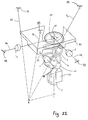
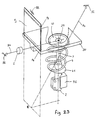
- FIG. 23 shows an alternative embodiment of the measurement bench, in which the plate 90 is mounted on the frame 92 by means of a plate P3 mounted by axis on the one hand on the face of said plate 90 opposite the face receiving said connecting member, and on the other hand on the frame 92 (configurable axis) opposite said plate 90 (equivalent elastic axes or blades), and by means of a link B3 whose axis intersects the defined plane by the plate P3 at E, mounted by ball joints on the one hand on the face of said plate opposite to the face receiving said connecting member, and on the other hand in a configurable housing arranged on the frame 92 opposite said plate 90, the determination of the position of said housing and of said configurable axis essentially constituting said configuration means, and by means of a second link B4 mounted by ball joint on the one hand on said plate 90 and on the other hand on said frame 92 so that said second rod is perpendicular to the axis of the rod, said second rod comprising a sensor I of tensile and compression
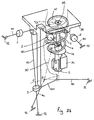
- FIG. 24 shows another alternative embodiment of the measurement bench, in which the plate 90 comprises a column 900 arranged substantially parallel to the strut. It is mounted on the frame 92 by means of two links B1 and B2 which are arranged, with respect to the strut to be measured, in the plane of the lower suspension triangle (see arm 6 in FIG. 1).
- the links B1 and B2 converge at a point D which coincides with the geometric location of point 66 (center of the ball 65 of the arm 6, see Figure 1).
- the plate 90 is mounted on the frame 92 also by means of a link B3 arranged in the plane of the wheel, in the direction of the load. S ⁇ .
- the axis of the link B3 passes through the point C.
- the plate 90 is mounted on the frame 92 also by means of the links B4 and B6 located in a plane perpendicular to the axis of the shock absorber, are perpendicular to each other and converge at point 31.
- the plate 90 is mounted on the frame 92 also by means of a link B5 parallel to the link B6.
- the plane defined by the links B5 and B6 is perpendicular to the axis of the pivot 80 and cuts it at point 31.
- the links B3, B4, B5 and B6 are fitted with sensors I.
- the rod of the shock absorber is not coupled to the cup 40, the spring is compressed just as the nominal load of the vehicle would.
- This measurement bench records the following values: B4 directly measures the shear force transverse to the shock absorber rod, B5 and B6 measure the shear force longitudinal to the shock absorber rod, B5 measures the torque Cp generated by the spring around the pivot axis 80, and B3 measures the vertical load seen by the vehicle wheel in the same state of compression of the spring.
- B4 directly measures the shear force transverse to the shock absorber rod
- B5 and B6 measure the shear force longitudinal to the shock absorber rod
- B5 measures the torque Cp generated by the spring around the pivot axis 80
- B3 measures the vertical load seen by the vehicle wheel in the same state of compression of the spring.
- the configuration of the bench is analogous to what has been explained before, by acting on the anchors of the various rods on the frame.
- Such a bench therefore comprises a first group of two rods B1 and B2 coplanar and axes concurrent with the pivot axis 80, substantially at the center of the ball joint of the lower arm, a second group of two rods B4 and B6 coplanar and arranged so that their plane is perpendicular to the axis of the rod at the height of said elastic articulation receiving said rod, and it further comprises a rod B5 coplanar with B6 so that the plane formed by the rods B5 and B6 is perpendicular to the pivot axis 80 and cuts said pivot axis at the height of said elastic articulation, and a link B3 located in the median plane of the wheel.
- a bench having two measurement systems as described, and making it possible to simultaneously receive a right leg and a left leg intended for the same vehicle.
- Such a bench has the advantage of being able to obtain, under conditions extremely close to reality, a direct reading of the combined effect that these two legs will exert on the vehicle's steering system, by appropriate processing of the signal delivered by the sensors of the two measurement systems. The result of these measurements makes it possible to finely adjust the combined effect of the two legs on the steering system by acting on an adjustment element of each of these two legs.
- FIG. 25 An example of such an adjustment bench is shown in Figure 25. After adjustment, these two legs are paired and mounted on the same vehicle. We see two positions identical to what has just been exposed, each provided with a plate 90 and a mandrel 91.
- the links B1, B2, B3 are adjusted to compete at point E, chosen according to the geometric characteristics of the vehicle to be equipped with the pair of struts. Some of these links include a tensile / compression force sensor I as explained above.
- the two mandrels 91 are mounted on cross member 94 sliding on the frame 92.
- the cross member 94 slides along the frame 92 under the action of the jack 93. In this way, the bench makes it possible to simultaneously compress the springs of each of the struts .
- the invention also proposes a specific adaptation to steering trains, illustrated in FIGS. 26 to 34.
- a turning movement actuated by the steering system connected to the hub carrier 5 by a link 53 via a ball joint
- the leg, hub carrier, hub and wheel assembly pivots around the pivot axis 80, defined by points 31 and 66.
- the strut 1 has a thrust bearing 42 which allows a deflection to be carried out without biasing the spring 4 in torsion. Indeed, the thrust of the spring 4 is exerted between the body of the vehicle and the body 2 of the shock absorber. Said damper body performs a rotation about the pivot axis 80.
- This ball bearing 42 can be located either between the body and the elastic joint, or between the elastic joint and the upper cup 40 of the spring, as shown in FIGS. 26 and 27, or finally between the lower cup 41 and the body 2 of the shock absorber.
- the axis of rotation 70 of the ball bearing is generally distinct from the pivot axis 80. In all known embodiments, these two axes intersect. Indeed, the axis of the thrust ball is generally coincident with the common axis of the rod 3 and the body 2 of the shock absorber. This configuration makes it possible to [imitate the torque effects Cp that the thrust P of the spring can exert around the pivot axis 80, and which act on the balance of the steering system by means of the link 53.
- the present invention proposes an evolution of the design of the struts making it possible to control and even to finely adjust the torque effects Cp that the spring thrust causes to appear around the pivot axis 80, thus making it possible to better control the share.
- suspension struts in the behavior of the steering system without any modification to the geometry (characteristic angles and offsets) of the front axle.
- This invention therefore offers suspension designers a completely independent additional degree of design freedom. parameters usually taken into account in the definition of a front axle.
- This additional design parameter also offers a possibility of adjustment allowing easier adjustment of the strut and thus shortening the development time of the suspension of a future vehicle.
- the strut of a Mac Pherson type wheel suspension comprising a shock absorber provided with a body and a rod, said leg comprising a helical spring surrounding said rod, comprising a lower bearing cup supported by the shock absorber body, said lower cup comprising a lower seat receiving one of the ends of said spring, and an upper bearing cup intended to bear on the body of the vehicle, said upper cup comprising an upper seat receiving the other of the ends of said spring, said upper cup being traversed by said rod, the damper body comprising a bearing surface for attachment to a hub carrier cooperate with attachment means, said hub carrier defining an axis of rotation of said wheel, one of the upper and lower cups containing a ball stop authorizing the turning of the hub carrier, is characterized in that l the axis of said ball stop and the pivot axis are non-concurrent.
- the invention thus provides a strut for steering wheel suspension of the Mac Pherson type, in which the axis of rotation 70 of the ball bearing 42 is positioned so that it does not cut the pivot axis 80 This axis of rotation will thus be either parallel to the pivot axis, or not coplanar with the pivot axis. It is then possible, in these two cases, to define a distance d between these two axes. This distance d is the smallest measurable distance between two respective points on these axes. It is raised in a direction perpendicular to each of these axes, as shown in FIG. 27 or 29 in the particular case of a stop 42 located above the upper cup 40.
- the spring exerts a thrust force P on the lower cup 41.
- This thrust P passes through the ball thrust 42.
- This ball thrust 42 having a very low internal friction, the thrust P of the spring exerts under these conditions a moment of rotation zero along the axis 70 of the stop.
- This zero moment results in the fact that the thrust direction P of the spring intersects the axis 70 of the thrust bearing 42 at a point B as shown in FIGS. 28 and 29.
- the direction of thrust P from point B does not intersect the pivot axis 80, it follows that the thrust P of the spring exerts around the pivot axis 80 a torque Cp proportional to the component of said thrust P of the spring perpendicular to the pivot axis and to the distance d previously described. Perfect control of the distance d and its orientation makes it possible to give the torque Cp a very precise value.
- This distance d can be defined at the design of the strut, so as to better control the combined effects of the couples Cp of the right and left legs on the steering system.
- this distance d can be adjusted.
- This setting can thus be used in particular to bring about a possible correction of the steering behavior, during vehicle maintenance operations. It is also possible to carry out the adjustment during the leg assembly operation, thanks to a bench capable of measuring the torque Cp.
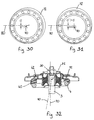
- Figures 27, 30 to 32 illustrate an eccentric ball bearing 42.
- the adjustment is made by relative rotation between a shim 72 mounted centrally in the support directly in contact with the vehicle body, said shim 72 having an eccentric housing for receiving the thrust ball 42. It can be seen, for example, that the axis of the stopper is further from the pivot axis 80 in Figure 31 than in Figure 30. In this example, the adjustment is an operation made in the vehicle maintenance workshop, or when mounting the strut on a measurement bench.
- the means for adjusting the distance d can act by translation of the stop, without changing the orientation of its axis, for example by orienting the upper ring 74 of the stop 42 which is eccentric relative to the rod 3 of the damper ( Figures 30 to 34).
- This adjustment will be defined in such a way that it will modify the spring's thrust characteristics as little as possible, and in particular its rigidity.
- This is how the translation of the stopper will preferably be carried out along a plane perpendicular to the geometric axis of the spring, and its tilting will be carried out around an axis preferably intersecting the geometric axis of the spring.
- the distance d can also be adjusted while the vehicle is running to correct a steering behavior fault as soon as it is detected.
- the fault may be noted by the driver of the vehicle.
- the correction made by adjusting the distance d will be carried out by an actuator controlled by the driver of the vehicle himself.
- Fault detection can also be automatic, for example by measuring the torque that must be exerted at the wheel to keep the vehicle on a straight path.
- the adjustment of the distance d can be controlled by a fully automatic active correction system.
- Figures 33 and 34 show an embodiment including a motorized system for varying the distance d.
- the upper ring 74 of the ball bearing 42 is supported on a low friction coating.
- This ring 74 is guided in rotation about an axis 73 perpendicular to the plane of said ring and located at a point on its periphery, and comprises, opposite this axis, an actuated rack 75 by a pinion 76 linked to the axis of an electric motorization system 77.
- This motorization 77 has an irreversibility characteristic, that is to say that a torque exerted on the axis of the pinion 76 cannot cause its rotation in the absence of electrical supply voltage.
- This motorization can be produced for example by means of an electric motor coupled to an irreversible reduction gear, for example a worm screw system, or it can be produced by means of a piezoelectric motor directly driving the pinion 75.
Landscapes
- Engineering & Computer Science (AREA)
- Mechanical Engineering (AREA)
- General Engineering & Computer Science (AREA)
- Vehicle Body Suspensions (AREA)
Applications Claiming Priority (4)
| Application Number | Priority Date | Filing Date | Title |
|---|---|---|---|
| FR9515891 | 1995-12-19 | ||
| FR9515891A FR2742381A1 (fr) | 1995-12-19 | 1995-12-19 | Reglage precis d'une jambe de force de suspension mac pherson : moyens de reglage sur la jambe et banc de mesure |
| FR9603921 | 1996-03-26 | ||
| FR9603921 | 1996-03-26 |
Publications (3)
| Publication Number | Publication Date |
|---|---|
| EP0780250A2 true EP0780250A2 (de) | 1997-06-25 |
| EP0780250A3 EP0780250A3 (de) | 1998-05-06 |
| EP0780250B1 EP0780250B1 (de) | 2003-04-02 |
Family
ID=26232419
Family Applications (1)
| Application Number | Title | Priority Date | Filing Date |
|---|---|---|---|
| EP96119526A Expired - Lifetime EP0780250B1 (de) | 1995-12-19 | 1996-12-05 | Feineinstellung eines MacPherson-Federbeines: Vorrichtung zur Einstellung auf dem Federbein und Bank zum Messen |
Country Status (7)
| Country | Link |
|---|---|
| US (2) | US5947459A (de) |
| EP (1) | EP0780250B1 (de) |
| JP (1) | JPH09220918A (de) |
| KR (1) | KR970034054A (de) |
| CN (1) | CN1068835C (de) |
| BR (1) | BR9606068A (de) |
| DE (1) | DE69627116T2 (de) |
Cited By (10)
| Publication number | Priority date | Publication date | Assignee | Title |
|---|---|---|---|---|
| JPH1159155A (ja) * | 1997-08-08 | 1999-03-02 | Chuo Spring Co Ltd | 圧縮コイルばね外挿ショックアブソーバ |
| DE19806829C1 (de) * | 1998-02-18 | 1999-08-19 | Btr Avs Technical Centre Gmbh | Oberer Federteller für ein Federbein |
| WO2000048854A1 (fr) | 1999-02-19 | 2000-08-24 | Compagnie Generale Des Etablissements Michelin-Michelin & Cie | Jambe de force d'une suspension de roue de type mac pherson |
| WO2000056560A1 (fr) | 1999-03-19 | 2000-09-28 | Compagnie Generale Des Etablissements Michelin-Michelin & Cie | Jambe de force de suspension mac pherson et procede de reglage correspondant |
| WO2000056504A1 (fr) | 1999-03-19 | 2000-09-28 | Compagnie Generale Des Etablissements Michelin-Michelin & Cie | Procede et dispositif de montage precis d'une jambe de force de suspension mac pherson |
| FR2804376A1 (fr) | 2000-02-01 | 2001-08-03 | Michelin Ets | Methode de compensation du tirage d'un vehicule equipe de suspension mac pherson et jambe de force permettant cette compensation |
| EP0925965A3 (de) * | 1997-12-11 | 2004-05-06 | Showa Corporation | Aufhängungssystem |
| EP1596268A3 (de) * | 2004-05-14 | 2006-08-02 | Audi Ag | Lagervorrichtung für eine Federanordnung |
| WO2010136091A1 (de) * | 2009-05-27 | 2010-12-02 | Anvis Deutschland Gmbh | Elastisches federbeinkopflager für ein kraftfahrzeug und verfahren zum einstellen einer druckvorspannung in einem elastischen ringkörper des federbeinkopflagers |
| DE102019134789A1 (de) * | 2019-12-17 | 2021-06-17 | Audi Ag | Radaufhängung für ein Fahrzeug |
Families Citing this family (44)
| Publication number | Priority date | Publication date | Assignee | Title |
|---|---|---|---|---|
| DE69627116T2 (de) * | 1995-12-19 | 2003-12-24 | Compagnie Generale Des Etablissements Michelin-Michelin & Cie., Clermont-Ferrand | Feineinstellung eines MacPherson-Federbeines: Vorrichtung zur Einstellung auf dem Federbein und Bank zum Messen |
| US6079700A (en) * | 1998-10-09 | 2000-06-27 | Chrysler Corporation | Vehicle shock absorber spring seat pad having a spring--containment peripheral flange |
| DE10036048B4 (de) * | 1999-08-18 | 2010-04-22 | Zf Sachs Ag | Federbein mit einem Achsschenkel |
| DE10023194B4 (de) * | 2000-05-11 | 2004-10-14 | Dr.Ing.H.C. F. Porsche Ag | Aufbaustruktur für ein Kraftfahrzeug mit vorderen Federbeinaufnahmen |
| US6382645B1 (en) | 2000-12-04 | 2002-05-07 | Northstar Manufacturing Co., Inc. | Offset upper strut mount |
| JP2002178736A (ja) * | 2000-12-14 | 2002-06-26 | Chuo Spring Co Ltd | 自動車用懸架コイルばね及び該懸架コイルばねを備えたストラット型懸架装置 |
| JP2002234324A (ja) * | 2001-02-08 | 2002-08-20 | Chuo Spring Co Ltd | 自動車用懸架コイルばね及び該懸架コイルばねを備えたストラット型懸架装置 |
| KR100397982B1 (ko) * | 2001-02-21 | 2003-09-19 | 현대자동차주식회사 | 차량용 현가장치의 지오메트리 특성 학습장치 |
| NL1017842C2 (nl) * | 2001-04-12 | 2002-10-15 | Skf Ab | Schokbrekermodule. |
| DE10238788B4 (de) * | 2002-08-23 | 2004-07-29 | Lehmann, Bernhard, Dr. | Optimierung der Federkennlinie einer Federdämpfereinheit für eine Kraftfahrzeug-Radaufhängung |
| US6773197B2 (en) * | 2002-10-09 | 2004-08-10 | Trw Inc. | Ball joint |
| FR2847515B1 (fr) * | 2002-11-27 | 2006-07-14 | Roulements Soc Nouvelle | Butee de suspension instrumentee en deformation pour mesurer les efforts |
| FR2847516B1 (fr) * | 2002-11-27 | 2005-01-28 | Roulements Soc Nouvelle | Butee de suspension instrumentee en rotation pour mesurer les efforts verticaux |
| DE10258936A1 (de) * | 2002-12-17 | 2004-07-01 | Volkswagen Ag | Federbein für eine Kraftfahrzeug-Radaufhängung |
| US6843472B2 (en) | 2003-01-21 | 2005-01-18 | The Pullman Company | Upper shock mount isolator with integral air spring housing pivot bearing |
| US20040169324A1 (en) * | 2003-02-28 | 2004-09-02 | Bottene Marlon V. | Strut spring seat |
| US20040169323A1 (en) * | 2003-02-28 | 2004-09-02 | Bottene Marlon V. | MacPherson strut spring coil mounts |
| JP3944907B2 (ja) * | 2003-03-14 | 2007-07-18 | マツダ株式会社 | 自動車のフロントサスペンション装置 |
| US7117982B2 (en) * | 2003-06-13 | 2006-10-10 | Kayaba Industry Co., Ltd. | Shock absorber |
| JP4254599B2 (ja) * | 2004-04-01 | 2009-04-15 | トヨタ自動車株式会社 | ストラット式サスペンション |
| JP2006088962A (ja) * | 2004-09-27 | 2006-04-06 | Toyota Motor Corp | ストラット式サスペンション |
| DE102004058698B3 (de) * | 2004-12-06 | 2006-02-09 | Muhr Und Bender Kg | Radaufhängung mit Federverstellung für Kraftfahrzeuge |
| DE102005032449A1 (de) * | 2005-07-12 | 2007-01-18 | Zf Friedrichshafen Ag | Federteller-Auflage |
| JP4890013B2 (ja) * | 2005-12-01 | 2012-03-07 | トヨタ自動車株式会社 | ストラット式サスペンション |
| US7677551B2 (en) * | 2006-03-15 | 2010-03-16 | Kyocera Mita Corporation | Document conveying apparatus |
| US7946163B2 (en) | 2007-04-02 | 2011-05-24 | Penske Racing Shocks | Methods and apparatus for developing a vehicle suspension |
| JP4577345B2 (ja) | 2007-09-26 | 2010-11-10 | トヨタ自動車株式会社 | ナックル及びナックルの製造方法 |
| DE102008006087A1 (de) * | 2008-01-25 | 2009-07-30 | Thyssenkrupp Bilstein Suspension Gmbh | Federbein mit verstellbarem Federteller |
| DE102008024978B4 (de) * | 2008-05-23 | 2015-07-23 | Bayerische Motoren Werke Aktiengesellschaft | Radaufhängung eines zweispurigen Fahrzeugs |
| US8302980B2 (en) * | 2010-12-23 | 2012-11-06 | GM Global Technology Operations LLC | Eccentric steering axis strut top mount |
| US8696004B2 (en) * | 2011-12-08 | 2014-04-15 | Tenneco Automotive Operating Company Inc. | Spring seat having an installation land/step |
| US9458905B2 (en) * | 2012-09-20 | 2016-10-04 | Steelcase Inc. | Spring assembly and method |
| US9796235B2 (en) * | 2013-04-30 | 2017-10-24 | Nissan Motor Co., Ltd. | Suspension device for in-wheel motor driven wheel |
| JP6240442B2 (ja) * | 2013-09-06 | 2017-11-29 | 株式会社ショーワ | スプリングシート |
| CN104913919B (zh) * | 2015-06-16 | 2018-09-07 | 西华大学 | 橡胶隔振器动静态性能测试装置 |
| JP6613095B2 (ja) * | 2015-10-01 | 2019-11-27 | 日本発條株式会社 | 懸架用コイルばね |
| DE102015119692B4 (de) | 2015-11-13 | 2025-03-13 | Thyssenkrupp Ag | Aufnahmeanordnung einer Tragfeder für ein Federbein |
| JP6871707B2 (ja) * | 2016-09-30 | 2021-05-12 | ヤマハ発動機株式会社 | ショックアブソーバ、車両、雪上車 |
| JP7153021B2 (ja) | 2017-01-19 | 2022-10-13 | ドォフテック ピーティーワイ リミテッド | 車両サスペンション設定を制御する為の電気機械デバイス |
| CN109520566B (zh) * | 2018-11-23 | 2023-12-08 | 中国船舶重工集团公司第七一九研究所 | 一种可显示受力和变形的隔振器 |
| WO2022077059A1 (en) | 2020-10-13 | 2022-04-21 | Doftek Pty Ltd | Wheel alignment systems |
| CN112254944A (zh) * | 2020-10-19 | 2021-01-22 | 奇瑞商用车(安徽)有限公司 | 新能源汽车减振器总成下安装支架焊接强度试验装置及试验方法 |
| KR20230060000A (ko) | 2021-10-27 | 2023-05-04 | 현대자동차주식회사 | 독립 코너모듈 |
| CN116223060B (zh) * | 2023-02-15 | 2025-05-02 | 阿维塔科技(重庆)有限公司 | 一种零件冲压通过性检测方法 |
Family Cites Families (17)
| Publication number | Priority date | Publication date | Assignee | Title |
|---|---|---|---|---|
| GB1237938A (de) * | 1967-10-28 | 1971-07-07 | ||
| US3857276A (en) * | 1969-11-13 | 1974-12-31 | Monroe Belgium Nv | Shock absorber testing apparatus |
| ZA706176B (en) * | 1969-11-13 | 1971-05-27 | Monroe Belgium Nv | Shock absorber testing apparatus |
| SE377497B (de) * | 1973-01-17 | 1975-07-07 | R P S Graham | |
| DE2445406C2 (de) * | 1974-09-23 | 1980-02-14 | Gebr. Hofmann Gmbh & Co Kg, Maschinenfabrik, 6100 Darmstadt | Verfahren und Vorrichtung zum Prüfen von Schwingungsdampfern eines Fahrzeuges |
| US4026578A (en) * | 1976-04-07 | 1977-05-31 | Mattson Charles T | Vehicular wheel adjusting device |
| GB2100681B (en) * | 1981-06-19 | 1984-08-30 | Samefa Ag | Measuring apparatus for checking the spring strut of a vehicle front wheel suspension |
| US4424697A (en) * | 1981-09-25 | 1984-01-10 | Carver James L | Wheel mounting suspension strut camber correcting tool |
| IT1155316B (it) * | 1982-04-21 | 1987-01-28 | Fiat Auto Spa | Sospensione per una ruota di un veicolo |
| DE3312453C2 (de) * | 1983-04-07 | 1996-04-25 | Fichtel & Sachs Ag | Justierbares Federbein |
| JPS62286816A (ja) * | 1986-06-03 | 1987-12-12 | Nissan Motor Co Ltd | サスペンシヨン荷重検出装置 |
| JPS6490807A (en) * | 1987-09-30 | 1989-04-07 | Mazda Motor | Strut type suspension of vehicle |
| US4863187A (en) * | 1988-03-28 | 1989-09-05 | Artz William P | Camber adjustment device with finite camber adjustment settings |
| FR2641741B1 (fr) * | 1988-12-28 | 1991-05-03 | Peugeot | Dispositif de suspension pour vehicule automobile |
| AT393248B (de) * | 1990-02-01 | 1991-09-10 | Steyr Daimler Puch Ag | Radaufhaengung |
| US5942673A (en) * | 1996-05-24 | 1999-08-24 | Hitachi, Ltd. | Vehicle testing system and testing method |
| DE69627116T2 (de) * | 1995-12-19 | 2003-12-24 | Compagnie Generale Des Etablissements Michelin-Michelin & Cie., Clermont-Ferrand | Feineinstellung eines MacPherson-Federbeines: Vorrichtung zur Einstellung auf dem Federbein und Bank zum Messen |
-
1996
- 1996-12-05 DE DE69627116T patent/DE69627116T2/de not_active Expired - Fee Related
- 1996-12-05 EP EP96119526A patent/EP0780250B1/de not_active Expired - Lifetime
- 1996-12-18 BR BR9606068A patent/BR9606068A/pt not_active IP Right Cessation
- 1996-12-18 KR KR1019960067177A patent/KR970034054A/ko not_active Withdrawn
- 1996-12-18 US US08/769,713 patent/US5947459A/en not_active Expired - Fee Related
- 1996-12-19 JP JP8339908A patent/JPH09220918A/ja active Pending
- 1996-12-19 CN CN96114060A patent/CN1068835C/zh not_active Expired - Fee Related
-
1999
- 1999-06-08 US US09/327,988 patent/US6082720A/en not_active Expired - Fee Related
Non-Patent Citations (1)
| Title |
|---|
| None |
Cited By (14)
| Publication number | Priority date | Publication date | Assignee | Title |
|---|---|---|---|---|
| JPH1159155A (ja) * | 1997-08-08 | 1999-03-02 | Chuo Spring Co Ltd | 圧縮コイルばね外挿ショックアブソーバ |
| EP0925965A3 (de) * | 1997-12-11 | 2004-05-06 | Showa Corporation | Aufhängungssystem |
| DE19806829C1 (de) * | 1998-02-18 | 1999-08-19 | Btr Avs Technical Centre Gmbh | Oberer Federteller für ein Federbein |
| US6612553B1 (en) | 1999-02-19 | 2003-09-02 | Compagnie Generale Des Etablissements Michelin-Michelin & Cie | Shock strut of McPherson wheel suspension |
| WO2000048854A1 (fr) | 1999-02-19 | 2000-08-24 | Compagnie Generale Des Etablissements Michelin-Michelin & Cie | Jambe de force d'une suspension de roue de type mac pherson |
| US6854720B2 (en) | 1999-02-19 | 2005-02-15 | Compagnie Generale Des Etablissements Michelin-Michelin & Cie | Strut for a MacPherson-type wheel suspension |
| WO2000056560A1 (fr) | 1999-03-19 | 2000-09-28 | Compagnie Generale Des Etablissements Michelin-Michelin & Cie | Jambe de force de suspension mac pherson et procede de reglage correspondant |
| WO2000056504A1 (fr) | 1999-03-19 | 2000-09-28 | Compagnie Generale Des Etablissements Michelin-Michelin & Cie | Procede et dispositif de montage precis d'une jambe de force de suspension mac pherson |
| WO2001056819A1 (fr) * | 2000-02-01 | 2001-08-09 | Société de Technologie Michelin | Méthode de compensation du tirage d'un véhicule équipé de suspension macpherson |
| FR2804376A1 (fr) | 2000-02-01 | 2001-08-03 | Michelin Ets | Methode de compensation du tirage d'un vehicule equipe de suspension mac pherson et jambe de force permettant cette compensation |
| EP1596268A3 (de) * | 2004-05-14 | 2006-08-02 | Audi Ag | Lagervorrichtung für eine Federanordnung |
| WO2010136091A1 (de) * | 2009-05-27 | 2010-12-02 | Anvis Deutschland Gmbh | Elastisches federbeinkopflager für ein kraftfahrzeug und verfahren zum einstellen einer druckvorspannung in einem elastischen ringkörper des federbeinkopflagers |
| DE102019134789A1 (de) * | 2019-12-17 | 2021-06-17 | Audi Ag | Radaufhängung für ein Fahrzeug |
| DE102019134789B4 (de) * | 2019-12-17 | 2021-07-01 | Audi Ag | Radaufhängung für ein Fahrzeug |
Also Published As
| Publication number | Publication date |
|---|---|
| CN1157226A (zh) | 1997-08-20 |
| US5947459A (en) | 1999-09-07 |
| DE69627116D1 (de) | 2003-05-08 |
| MX9606484A (es) | 1998-06-30 |
| CN1068835C (zh) | 2001-07-25 |
| DE69627116T2 (de) | 2003-12-24 |
| JPH09220918A (ja) | 1997-08-26 |
| BR9606068A (pt) | 1998-09-01 |
| EP0780250B1 (de) | 2003-04-02 |
| US6082720A (en) | 2000-07-04 |
| EP0780250A3 (de) | 1998-05-06 |
| KR970034054A (ko) | 1997-07-22 |
Similar Documents
| Publication | Publication Date | Title |
|---|---|---|
| EP0780250A2 (de) | Feineinstellung eines MacPherson-Federbeines: Vorrichtung zur Einstellung auf dem Federbein und Bank zum Messen | |
| EP0391757B1 (de) | Vorrichtung zur Nacheichung einer Brillenglasscheifmaschine zum Ausgleich der Schleifscheibenabnutzung | |
| EP2605952B1 (de) | Scheinwerfer für zweiradfahrzeug | |
| WO2011107674A1 (fr) | Véhicule électrique comportant au moins trois roues | |
| EP1070609A1 (de) | Kraftfahrzeug ausgerüstet mit einem System zur Radsturzsteuerung bei Kurvenfahrten | |
| FR2788011A1 (fr) | Procede d'hydroformage d'une barre d'essieu avant de vehicule automobile | |
| EP1276656A2 (de) | Aufnahmevorrichtung eines rads und radaufhängung, die diese aufnahmevorrichtung enthält | |
| FR2641503A1 (fr) | Suspension a carrossage variable pour vehicule automobile | |
| FR2790312A1 (fr) | Dispositif pour determiner la distance entre une carrosserie de vehicule et une roue du vehicule | |
| EP1765615A1 (de) | Kraftfahrzeugfederungsvorrichtung | |
| EP0354113A1 (de) | Vorrichtung zur Lageregelung eines Kraftfahrzeuges | |
| EP1885594B1 (de) | Strassenfahrzeug mit pendelfahrgastzelle | |
| EP0489638B1 (de) | Aufhängungsvorrichtung, insbesondere für gelenktes Rad eines Kraftfahrzeugs | |
| EP1572475B1 (de) | Radträger, radaufhängung und fahrzeug mit einem solchen radträger | |
| FR2797418A1 (fr) | Suspension de roue d'un vehicule automobile | |
| FR2802494A1 (fr) | Direction pour chariot elevateur a contrepoids | |
| FR2900622A1 (fr) | Vehicule automobile a direction a cremaillere | |
| EP1810853B1 (de) | Aktive Radaufhängung für ein Kraftfahrzeug mit Steuerung zur Eingrenzung der Rollbewegung | |
| EP2553419B1 (de) | Verfahren zur charakterisierung und optimierung des verhaltens eines fahrzeuges | |
| FR2742381A1 (fr) | Reglage precis d'une jambe de force de suspension mac pherson : moyens de reglage sur la jambe et banc de mesure | |
| FR2792274A1 (fr) | Vehicule a pendularite variable guidee | |
| FR2912507A1 (fr) | Dispositif de controle ameliore d'un banc de controle de chassis de vehicules automobiles. | |
| FR2702440A1 (fr) | Dispositif de réglage de la chasse d'un véhicule, notamment d'un kart. | |
| FR2745760A1 (fr) | Vehicule motorise a roues a motorisation independante | |
| FR2864619A1 (fr) | Dispositif permettant de controler un banc destine a mesurer, regler et/ou controler un train roulant de vehicule |
Legal Events
| Date | Code | Title | Description |
|---|---|---|---|
| PUAI | Public reference made under article 153(3) epc to a published international application that has entered the european phase |
Free format text: ORIGINAL CODE: 0009012 |
|
| AK | Designated contracting states |
Kind code of ref document: A2 Designated state(s): BE DE ES FR GB IT SE |
|
| PUAL | Search report despatched |
Free format text: ORIGINAL CODE: 0009013 |
|
| AK | Designated contracting states |
Kind code of ref document: A3 Designated state(s): BE DE ES FR GB IT SE |
|
| 17P | Request for examination filed |
Effective date: 19981106 |
|
| 17Q | First examination report despatched |
Effective date: 20000224 |
|
| GRAG | Despatch of communication of intention to grant |
Free format text: ORIGINAL CODE: EPIDOS AGRA |
|
| GRAG | Despatch of communication of intention to grant |
Free format text: ORIGINAL CODE: EPIDOS AGRA |
|
| GRAG | Despatch of communication of intention to grant |
Free format text: ORIGINAL CODE: EPIDOS AGRA |
|
| GRAH | Despatch of communication of intention to grant a patent |
Free format text: ORIGINAL CODE: EPIDOS IGRA |
|
| GRAH | Despatch of communication of intention to grant a patent |
Free format text: ORIGINAL CODE: EPIDOS IGRA |
|
| GRAA | (expected) grant |
Free format text: ORIGINAL CODE: 0009210 |
|
| AK | Designated contracting states |
Designated state(s): BE DE ES FR GB IT SE |
|
| PG25 | Lapsed in a contracting state [announced via postgrant information from national office to epo] |
Ref country code: IT Free format text: LAPSE BECAUSE OF FAILURE TO SUBMIT A TRANSLATION OF THE DESCRIPTION OR TO PAY THE FEE WITHIN THE PRE;WARNING: LAPSES OF ITALIAN PATENTS WITH EFFECTIVE DATE BEFORE 2007 MAY HAVE OCCURRED AT ANY TIME BEFORE 2007. THE CORRECT EFFECTIVE DATE MAY BE DIFFERENT FROM THE ONE RECORDED.SCRIBED TIME-LIMIT Effective date: 20030402 |
|
| REG | Reference to a national code |
Ref country code: GB Ref legal event code: FG4D Free format text: NOT ENGLISH |
|
| REF | Corresponds to: |
Ref document number: 69627116 Country of ref document: DE Date of ref document: 20030508 Kind code of ref document: P |
|
| PG25 | Lapsed in a contracting state [announced via postgrant information from national office to epo] |
Ref country code: SE Free format text: LAPSE BECAUSE OF FAILURE TO SUBMIT A TRANSLATION OF THE DESCRIPTION OR TO PAY THE FEE WITHIN THE PRESCRIBED TIME-LIMIT Effective date: 20030702 |
|
| GBT | Gb: translation of ep patent filed (gb section 77(6)(a)/1977) | ||
| PG25 | Lapsed in a contracting state [announced via postgrant information from national office to epo] |
Ref country code: ES Free format text: LAPSE BECAUSE OF FAILURE TO SUBMIT A TRANSLATION OF THE DESCRIPTION OR TO PAY THE FEE WITHIN THE PRESCRIBED TIME-LIMIT Effective date: 20031030 |
|
| PG25 | Lapsed in a contracting state [announced via postgrant information from national office to epo] |
Ref country code: BE Free format text: LAPSE BECAUSE OF NON-PAYMENT OF DUE FEES Effective date: 20031231 |
|
| PLBE | No opposition filed within time limit |
Free format text: ORIGINAL CODE: 0009261 |
|
| STAA | Information on the status of an ep patent application or granted ep patent |
Free format text: STATUS: NO OPPOSITION FILED WITHIN TIME LIMIT |
|
| 26N | No opposition filed |
Effective date: 20040105 |
|
| BERE | Be: lapsed |
Owner name: CIE GENERALE DES ETS *MICHELIN-MICHELIN & CIE Effective date: 20031231 |
|
| PGFP | Annual fee paid to national office [announced via postgrant information from national office to epo] |
Ref country code: GB Payment date: 20071218 Year of fee payment: 12 |
|
| PGFP | Annual fee paid to national office [announced via postgrant information from national office to epo] |
Ref country code: DE Payment date: 20071221 Year of fee payment: 12 |
|
| PGFP | Annual fee paid to national office [announced via postgrant information from national office to epo] |
Ref country code: FR Payment date: 20071217 Year of fee payment: 12 |
|
| GBPC | Gb: european patent ceased through non-payment of renewal fee |
Effective date: 20081205 |
|
| REG | Reference to a national code |
Ref country code: FR Ref legal event code: ST Effective date: 20090831 |
|
| PG25 | Lapsed in a contracting state [announced via postgrant information from national office to epo] |
Ref country code: DE Free format text: LAPSE BECAUSE OF NON-PAYMENT OF DUE FEES Effective date: 20090701 |
|
| PG25 | Lapsed in a contracting state [announced via postgrant information from national office to epo] |
Ref country code: GB Free format text: LAPSE BECAUSE OF NON-PAYMENT OF DUE FEES Effective date: 20081205 |
|
| PG25 | Lapsed in a contracting state [announced via postgrant information from national office to epo] |
Ref country code: FR Free format text: LAPSE BECAUSE OF NON-PAYMENT OF DUE FEES Effective date: 20081231 |