EP0780372B3 - Dérivés d'acide 3-amino-2-mercaptobenzoique et procédés pour leur préparation - Google Patents
Dérivés d'acide 3-amino-2-mercaptobenzoique et procédés pour leur préparation Download PDFInfo
- Publication number
- EP0780372B3 EP0780372B3 EP96810865.4A EP96810865A EP0780372B3 EP 0780372 B3 EP0780372 B3 EP 0780372B3 EP 96810865 A EP96810865 A EP 96810865A EP 0780372 B3 EP0780372 B3 EP 0780372B3
- Authority
- EP
- European Patent Office
- Prior art keywords
- unsubstituted
- substituted
- formula
- compound
- alkyl
- Prior art date
- Legal status (The legal status is an assumption and is not a legal conclusion. Google has not performed a legal analysis and makes no representation as to the accuracy of the status listed.)
- Expired - Lifetime
Links
- 0 CC(*)(C=C1)C=C(*)c2c1nc(*)[s]2 Chemical compound CC(*)(C=C1)C=C(*)c2c1nc(*)[s]2 0.000 description 8
Classifications
-
- C—CHEMISTRY; METALLURGY
- C07—ORGANIC CHEMISTRY
- C07D—HETEROCYCLIC COMPOUNDS
- C07D285/00—Heterocyclic compounds containing rings having nitrogen and sulfur atoms as the only ring hetero atoms, not provided for by groups C07D275/00 - C07D283/00
- C07D285/01—Five-membered rings
- C07D285/02—Thiadiazoles; Hydrogenated thiadiazoles
- C07D285/14—Thiadiazoles; Hydrogenated thiadiazoles condensed with carbocyclic rings or ring systems
-
- C—CHEMISTRY; METALLURGY
- C07—ORGANIC CHEMISTRY
- C07C—ACYCLIC OR CARBOCYCLIC COMPOUNDS
- C07C319/00—Preparation of thiols, sulfides, hydropolysulfides or polysulfides
- C07C319/02—Preparation of thiols, sulfides, hydropolysulfides or polysulfides of thiols
-
- C—CHEMISTRY; METALLURGY
- C07—ORGANIC CHEMISTRY
- C07C—ACYCLIC OR CARBOCYCLIC COMPOUNDS
- C07C319/00—Preparation of thiols, sulfides, hydropolysulfides or polysulfides
- C07C319/02—Preparation of thiols, sulfides, hydropolysulfides or polysulfides of thiols
- C07C319/12—Preparation of thiols, sulfides, hydropolysulfides or polysulfides of thiols by reactions not involving the formation of mercapto groups
-
- C—CHEMISTRY; METALLURGY
- C07—ORGANIC CHEMISTRY
- C07C—ACYCLIC OR CARBOCYCLIC COMPOUNDS
- C07C323/00—Thiols, sulfides, hydropolysulfides or polysulfides substituted by halogen, oxygen or nitrogen atoms, or by sulfur atoms not being part of thio groups
- C07C323/50—Thiols, sulfides, hydropolysulfides or polysulfides substituted by halogen, oxygen or nitrogen atoms, or by sulfur atoms not being part of thio groups containing thio groups and carboxyl groups bound to the same carbon skeleton
- C07C323/62—Thiols, sulfides, hydropolysulfides or polysulfides substituted by halogen, oxygen or nitrogen atoms, or by sulfur atoms not being part of thio groups containing thio groups and carboxyl groups bound to the same carbon skeleton having the sulfur atom of at least one of the thio groups bound to a carbon atom of a six-membered aromatic ring of the carbon skeleton
- C07C323/63—Thiols, sulfides, hydropolysulfides or polysulfides substituted by halogen, oxygen or nitrogen atoms, or by sulfur atoms not being part of thio groups containing thio groups and carboxyl groups bound to the same carbon skeleton having the sulfur atom of at least one of the thio groups bound to a carbon atom of a six-membered aromatic ring of the carbon skeleton the carbon skeleton being further substituted by nitrogen atoms, not being part of nitro or nitroso groups
-
- C—CHEMISTRY; METALLURGY
- C07—ORGANIC CHEMISTRY
- C07C—ACYCLIC OR CARBOCYCLIC COMPOUNDS
- C07C327/00—Thiocarboxylic acids
- C07C327/20—Esters of monothiocarboxylic acids
- C07C327/26—Esters of monothiocarboxylic acids having carbon atoms of esterified thiocarboxyl groups bound to carbon atoms of six-membered aromatic rings
-
- C—CHEMISTRY; METALLURGY
- C07—ORGANIC CHEMISTRY
- C07C—ACYCLIC OR CARBOCYCLIC COMPOUNDS
- C07C335/00—Thioureas, i.e. compounds containing any of the groups, the nitrogen atoms not being part of nitro or nitroso groups
- C07C335/04—Derivatives of thiourea
- C07C335/16—Derivatives of thiourea having nitrogen atoms of thiourea groups bound to carbon atoms of six-membered aromatic rings of a carbon skeleton
- C07C335/22—Derivatives of thiourea having nitrogen atoms of thiourea groups bound to carbon atoms of six-membered aromatic rings of a carbon skeleton being further substituted by carboxyl groups
-
- C—CHEMISTRY; METALLURGY
- C07—ORGANIC CHEMISTRY
- C07D—HETEROCYCLIC COMPOUNDS
- C07D277/00—Heterocyclic compounds containing 1,3-thiazole or hydrogenated 1,3-thiazole rings
- C07D277/60—Heterocyclic compounds containing 1,3-thiazole or hydrogenated 1,3-thiazole rings condensed with carbocyclic rings or ring systems
- C07D277/62—Benzothiazoles
- C07D277/68—Benzothiazoles with hetero atoms or with carbon atoms having three bonds to hetero atoms with at the most one bond to halogen, e.g. ester or nitrile radicals, directly attached in position 2
- C07D277/82—Nitrogen atoms
Definitions
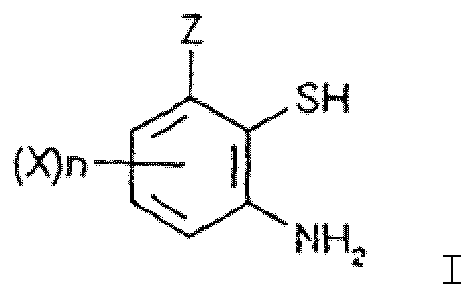
- the invention relates to a compound of the formula I and the disulfide thereof and salts thereof, processes for the preparation thereof and the use thereof for the preparation of compounds having a microbicidal and plant-immunizing action, of the formula III
- the compounds of the formula I have at least one basic group and can thus form acid addition salts. These are formed, for example, with mineral acids, for example sulfuric acid, a phosphoric acid or a hydrogen halide acid, with organic carboxylic acids, for example acetic acid or oxalic, malonic, maleic, fumaric or phthalic acid, with hydroxycarboxylic acids, for example ascorbic, lactic, malic, tartaric or citric acid, or with benzoic acid, or with organic sulfonic acids, for example methane- or p-toluenesulfonic acid.
- mineral acids for example sulfuric acid, a phosphoric acid or a hydrogen halide acid
- organic carboxylic acids for example acetic acid or oxalic, malonic, maleic, fumaric or phthalic acid
- hydroxycarboxylic acids for example ascorbic, lactic, malic, tartaric or citric acid, or with benzoic acid
- Suitable salts with bases are, for example, metal salts, such as alkali metal or alkaline earth metal salts, for example sodium, potassium or magnesium salts, or salts with ammonia or an organic amine, such as morpholine, piperidine, pyrrolidine, a mono-, di- or tri-lower alkylamine, for example ethyl-, diethyl-, triethyl- or dimethylpropyl-amine, or a mono-, di- or trihydroxy-lower alkylamine, for example mono-, di- or triethanolamine. If appropriate, corresponding inner salts can furthermore be formed.
- metal salts such as alkali metal or alkaline earth metal salts, for example sodium, potassium or magnesium salts
- salts with ammonia or an organic amine such as morpholine, piperidine, pyrrolidine, a mono-, di- or tri-lower alkylamine, for example ethyl-, diethyl-, trieth
- Hydrocarbon radicals can be saturated or unsaturated and open-chain or cyclic, or a mixture of open-chain and cyclic, for example cyclopropylmethyl or benzyl.
- Alkyl groups are straight-chain or branched, depending on the number of carbon atoms, and are, for example, methyl, ethyl, n-propyl, iso-propyl, n-butyl, sec-butyl, iso-butyl, tert-butyl, sec-amyl, tert-amyl, 1-hexyl or 3-hexyl.
- Unsaturated hydrocarbon radicals are alkenyl, alkynyl or alkenynyl groups with at least 3 multiple bonds, for example butadienyl, hexatrienyl, 2-penten-4-ynyl.
- Alkenyl is to be understood as meaning straight-chain or branched alkenyl, for example allyl, methallyl, 1-methylvinyl or but-2-en-1-yl. Alkenyl radicals with a chain length of 3 to 4 carbon atoms are preferred.
- Alkynyl can likewise be straight-chain or branched, depending on the number of carbon atoms, for example propargyl, but-1-yn-1-yl and but-1-yn-3-yl. Propargyl is preferred.
- Cyclic unsaturated hydrocarbon radicals can be aromatic, for example phenyl and naphthyl, or non-aromatic, for example cyclopentenyl, cyclohexenyl, cycloheptenyl and cyclooctadienyl, or partly aromatic, for example tetrahydronaphthyl and indanyl.
- Halogen or halo and Hal are fluorine, chlorine, bromine or iodine, preferably fluorine, chlorine or bromine.
- Haloalkyl can contain identical or different halogen atoms, for example fluoromethyl, difluoromethyl, difluorochloromethyl, trifluoromethyl, chloromethyl, dichloromethyl, trichloromethyl, 2,2,2-trifluoroethyl, 2-fluoroethyl, 2-chloroethyl, 2,2,2-trichloroethyl and 3,3,3-trifluoropropyl.
- halogen atoms for example fluoromethyl, difluoromethyl, difluorochloromethyl, trifluoromethyl, chloromethyl, dichloromethyl, trichloromethyl, 2,2,2-trifluoroethyl, 2-fluoroethyl, 2-chloroethyl, 2,2,2-trichloroethyl and 3,3,3-trifluoropropyl.
- Alkoxy is, for example, methoxy, ethoxy, propyloxy, i-propyloxy, n-butyloxy, iso-butyloxy, sec-butyloxy and tert-butyloxy; preferably methoxy and ethoxy.
- Haloalkoxy is, for example, difluoromethoxy, trifluoromethoxy, 2,2,2-trifluoroethoxy, 1,1,2,2-tetrafluoroethoxy, 2-fluoroethoxy, 2-chloroethoxy and 2,2-difluoroethoxy.
- Cycloalkyl is cyclopropyl, cyclobutyl, cyclopentyl or cyclohexyl.
- Alkanoyl is either straight-chain or branched. Examples are formyl, acetyl, propionyl, butyryl, pivaloyl or octanoyl.
- a heterocyclyl radical is understood as meaning 5- or 6-membered aromatic and nonaromatic rings with heteroatoms N, O and/or S.
- An unsubstituted or substituted benzo group can furthermore be fused onto such a heterocyclyl radical bonded to the remainder of the molecule.
- heterocyclyl groups are pyridyl, pyrimidinyl, imidazolyl, thiazolyl, 1,3,4-thiadiazolyl, triazolyl, thienyl, furanyl, pyrrolyl, morpholinyl, oxazolyl and the corresponding partly or totally hydrogenated rings.
- heterocyclyl groups with a fused-on benzo group examples include quinolyl, isoquinolyl, benzoxazolyl, quinoxalinyl, benzothiazolyl, benzimidazolyl, indolyl and indolinyl.
- the compounds of the formula I according to the invention allow a novel access to the compounds of the formula III, which is shown in Equation 1.
- This synthesis is distinguished by easy accessibility of the percursor, use of customary reactants and good yields, even in cases where an intermediate product is not isolated.
- the present invention likewise relates to this synthesis.
- the precursors of the formula V are compounds which are obtainable industrially or can be prepared by known methods, for example by reduction of the corresponding nitro compounds.
- reaction stages can be carried out as follows:
- compounds of the formula I can be prepared in accordance with Equation 2 via the corresponding benzodithiazolium salts VI or hydroxybenzodithiazoles VII ( Houben-Weyl, E8d, Heteroarene [Heteroarenes] III, Part 4; page 2 et seq . and page 59 et seq .).
- benzodithiazolium salts VI and VII can also be further reacted in situ, without isolation and under suitable conditions ( J. Chem. Soc. 1970, 2250 , Houben Weyl E8d, Heteroarene [Heteroarenes] III, Part 4, page 59 et seq . (specifically page 93 et seq.)), to give benzothiadiazoles III or IIIa.
- the reactions described are carried out in a manner known per se, for example in the absence or, usually, in the presence of a suitable solvent or diluent or of a mixture thereof, the reaction being carried out, as required, with cooling, at room temperature or with heating, for example in a temperature range from about -80°C up to the boiling point of the reaction medium, preferably from about -20°C to about+170°C, and, if necessary, in a closed vessel, under pressure, in an inert gas atmosphere and/or under anhydrous conditions.
- Diazotizations i.e. the reaction of a primary amine with nitrous acid or with an inorganic or organic nitrite, are advantageously carried out at -20°C to +30°C.
- Leaving groups are, for example, fluorine, chlorine, bromine, iodine, C 1 -C 8 alkylthio, such as methylthio, ethylthio or propylthio, C 1 -Calkanoyloxy, such as acetoxy, (halogeno)-C 1 -C 8 alkanesulfonyloxy, such as methanesulfonyloxy, ethanesulfonyloxy or trifluoromethanesulfonyloxy, or substituted or unsubstituted phenylsulfonyloxy, such as benzenesulfonyloxy or p-toluenesulfonyloxy, imidazolyl, triazolyl, hydroxyl or water, preferably chlorine, bromine, iodine and p-toluenesulfonyloxy.
- C 1 -C 8 alkylthio such as methylthio,
- Suitable bases are, for example, alkali metal or alkaline earth metal hydroxides, hydrides, amides, alkanolates, carbonates, dialkylamides or alkylsilylamides, alkylamines, alkylenediamines, non-alkylated or N-alkylated, saturated or unsaturated cycloalkylamines, basic heterocyclic compounds, ammonium hydroxides and carbocyclic amines.
- Examples are sodium hydroxide, hydride, amide, methanolate and carbonate, potassium tert-butanolate and carbonate, lithium diisopropylamide, potassium bis(trimethylsilyl)amide, calcium hydride, triethylamine, triethylenediamine, cyclohexylamine, N-cyclohexyl-N,N-dimethylamine, N,N-diethylaniline, pyridine, 4-(N,N-dimethylamino)pyridine, N-methylmorpholine, benzyl-trimethyl-ammonium hydroxide and 1,8-diazabicyclo[5.4.0]-undec-5-ene (DBU).
- DBU 1,8-diazabicyclo[5.4.0]-undec-5-ene
- the reactants can be reacted with one another as such, i.e. without addition of a solvent or diluent, for example in the melt.
- a solvent or diluent for example in the melt.
- the addition of an inert solvent or diluent or of a mixture thereof is usually advantageous.
- solvents or diluents are: aromatic, aliphatic and alicyclic hydrocarbons and halogenated hydrocarbons, such as benzene, toluene, xylene, chlorobenzene, bromobenzene, petroleum ether, hexane, cyclohexane, methylene chloride, chloroform, dichloroethane ortrichloroethane; ethers, such as diethyl ether, tert-butyl methyl ether, tetrahydrofuran or dioxane; ketones, such as acetone or methyl ethyl ketones; alcohols, such as methanol, ethanol, propanol, butanol, ethylene glycol or glycerol; esters, such as ethyl acetate or butyl acetate; amides, such as N,N-dimethylformamide, N, N-dimethylacetamide, N-methylpyr
- Bases employed in excess can also be used as solvents or diluents.
- the reaction can also be carried out under phase transfer catalysis in an organic solvent, for example methylene chloride or toluene, in the presence of an aqueous basic solution, for example sodium hydroxide solution, and a phase transfer catalyst, for example tetrabutylammonium hydrogen sulfate.
- an organic solvent for example methylene chloride or toluene
- an aqueous basic solution for example sodium hydroxide solution
- a phase transfer catalyst for example tetrabutylammonium hydrogen sulfate.
- the invention furthermore relates to the following preparation processes, in which, in the formulae mentioned under (1) to (6), the substituents are as defined in Equation 1.:
- the invention furthermore relates to the novel intermediate of the formula II and the present application discloses an intermediate of formula IV or salts thereof, in which:
- Preferred compounds of the formulae II, and VI are those in which:
- the title compound can be isolated from the filtrate by acidification to pH 5.5, with severe cooling and stirring at a maximum of O°C, and extraction with ethyl acetate/tetrahydrofuran (8:2) and washing with concentrated sodium chloride solution. Because of the risk of the formation of the disulfide, the potassium salt in the filtrate (potassium 3-amino-2-mercapto-benzoate) is preferably further reacted directly.
- the filtered aqueous solution, resulting from the above hydrolysis from 17.6 mmol of methyl 2-aminobenzothiazole-7-carboxylate, of the potassium salt of 3-amino-2-mercapto-benzoic acid is rendered acid with 31.6 ml of concentrated sulfuric acid under a nitrogen atmosphere at a maximum of 0°C, while stirring thoroughly and cooling severely, a solution of 1.28 g (18.6 mmol) of sodium nitrite in 3.4 ml of water is added dropwise below the surface at a maximum of 10°C, and the mixture is then stirred for 4 hours, the temperature being allowed to rise to about 25°C.
- HPLC analysis shows a content of more than 83% of the pure title compound, in addition to 8-18% of isomeric methyl 2-amino-benzothiazole-5-carboxylate.
- Suspension in and brief heating at 70°C with ethyl acetate, cooling to 30°C and filtration give the pure title compound of melting point > 250°C. If the reaction is carried out in acetic acid (instead of in chlorobenzene), the content of the undesired isomeric methyl 2-amino-benzothiazole-5-carboxylate is only about 5%.
- Example 8 Direct preparation of benzo-1,2,3-thiadiazole-7-carboxylic acid from methyl 2-aminobenzothiazole-7-carboxylate
- Example 9 Direct preparation of benzo-1,2,3-thiadiazole-7-carboxylic acid from 2-methylamino-benzothiazole-7-carboxylic acid
- a suspension of 150 g of 2-methylaminobenzothiazole-7-carboxylic acid (92.7%) and 596 g of 47% KOH is kept at 155°C/1.7-1.8 bar in an autoclave for 12 hours and is then clarified by filtration at 20-25°C.
- the filtrate is added dropwise to 635 g of 37% hydrochloric acid and 50 ml of methanol are added.
- 200 g of 30% aqueous sodium nitrite solution are added dropwise to the suspension at -10° to -5°C and the mixture is allowed to react completely at -5° to 0°c for 2 hours. Filtration with suction and washing with water gives 112 g of crude benzo-1,2,3-thiadiazole-7-carboxylic acid of melting point 260-262°C.
- HPLC analysis shows a content of 90-93% of the pure title compound.
- methyl 2-amino-7-methoxycarbonylbenzoate are introduced into 3.4 g of potassium hydroxide solution 50% under a nitrogen atmosphere and while stirring and the mixture is kept in a bomb tube at 120°C for 12 hours. It is then cooled, a further 1.3 g of potassium hydroxide solution 50% are added under an inert atmosphere and the mixture is kept at 150°C for another 4 hours. It is then cooled and added dropwise, under an inert atmosphere at 0°C, to an amount of dilute sulfuric acid such that a pH of 5.5 results. The precipitate which forms is filtered off and washed with ice-water. After drying under a high vacuum, the title compound of melting point 255-258°C, which contains traces of the corresponding disulfide on the basis of the mass spectrum, results.
- a solution of 163 g of bromine and 50 g of 100% acetic acid is added dropwise to a suspension of 212 g of 3-(N'-methylthioureido)-benzoic acid and 500 g of 100% acetic acid at 45-50°C in the course of 2 hours.
- the mixture is then heated to 90-100°C in the course of 2.5 hours and is allowed to react for a further 2 hours until the release of the gas has ended.
- 150 g of acetic acid have been distilled off at 80-85°C under reduced pressure
- 200 g of water are added and the mixture is brought to pH 2 by dropwise addition of 30% sodium hydroxide solution.
- a solution of 39.2 g of methyl isothiocyanate and 50 g of 100% acetic acid is added dropwise to a suspension of 70 g of 3-amino-benzoic acid and 250 g of 100% acetic acid at 75-80°C in the course of 50 minutes.
- a solution from which 3-(N'-methylthioureido)-benzoic acid slowly precipitates out in crystalline form is temporarily formed. After the mixture has been allowed to react completely for 2 hours, it is cooled to 50° and a solution of 81.5 g of bromine and 50 g of 100% acetic acid is added dropwise at 45-50°C in the course of 2 hours.
- Table 1 Compounds of the formula Compound No. (X) n Z Physical data/melting point 1.1 4-F COOCH 3 1.2 5-F COOCH 3 1.3 6-F COOCH 3 125-127°C (disulfide) 1.4 4,6-di-F COOCH 3 1.5 4,5-di-F COOCH 3 1.6 5,6-di-F COOCH 3 1.7 4,5,6-tri-F COOCH 3 1.8 H COOCH 3 174-175°C 1.9 H COOC 2 H 5 1.10 H COOC 3 H 7 -n 1.11 H COOC 3 H 7 -i 1.12 H COOC 6 H 13 -n 1.13 4-F COOC 2 H 5 1.14 6-F COOC 2 H 5 1.15 5-F COOC 2 H 5 1.16 H COSCH 3 1.17 H CN 1.18 H COOH 255-258°C 1.19 4-F COOH 1.20 5-F COOH 1.21 6-F
Landscapes
- Chemical & Material Sciences (AREA)
- Organic Chemistry (AREA)
- Chemical Kinetics & Catalysis (AREA)
- Organic Low-Molecular-Weight Compounds And Preparation Thereof (AREA)
- Thiazole And Isothizaole Compounds (AREA)
- Agricultural Chemicals And Associated Chemicals (AREA)
- Plural Heterocyclic Compounds (AREA)
- Pharmaceuticals Containing Other Organic And Inorganic Compounds (AREA)
- Cephalosporin Compounds (AREA)
- Nitrogen- Or Sulfur-Containing Heterocyclic Ring Compounds With Rings Of Six Or More Members (AREA)
- Heterocyclic Carbon Compounds Containing A Hetero Ring Having Nitrogen And Oxygen As The Only Ring Hetero Atoms (AREA)
- Acyclic And Carbocyclic Compounds In Medicinal Compositions (AREA)
- Peptides Or Proteins (AREA)
- Medicines That Contain Protein Lipid Enzymes And Other Medicines (AREA)
Claims (17)
- Composé de formule I
dans lequel:X est un fluor,n vaut 0, 1, 2 ou 3;Z est CN, CO-A ou CS-A,A est un atome d'hydrogène ou un groupe OR1, SR2 et N(R3)R4;R1 à R4 sont des atomes d'hydrogène, un radical hydrocarboné à chaîne ouverte, saturé ou insaturé, substitué ou non substitué, ne contenant pas plus de 8 atomes de carbone, un radical hydrocarboné cyclique, saturé ou insaturé, substitué ou non substitué, ne contenant pas plus de 10 atomes de carbone, un groupe benzyle ou phénéthyle substitué ou non substitué, un groupe alcanoyle substitué ou non substitué, ne contenant pas plus de 8 atomes de carbone, un groupe benzoyle substitué ou non substitué ou un radical hétérocyclyle substitué ou non substitué; ouR3 et R4, conjointement avec l'atome d'azote auquel ils sont fixés, forment un radical hétérocyclique à 5 ou 6 chaînons, substitué ou non substitué comportant 1-3 hétéroatomes 0, S et/ou N; à l'exception d'un composé dans lequel n est 0 et Z vaut CN ou CONH2 ou COOH. - Composé selon la revendication 1, dans lequel:Z est CN, CO-A ou CS-A,A est OR1, SR2 ou N(R3)R4; et dans lesquelsR1, R2 et R3 sont des atomes d'hydrogène, des groupes alkyle en C1-C8, non substitués ou substitués par 1-5 atomes d'halogène, cycloalkyle en C3-C6, alcoxy en C1-C4, phénoxy, benzyloxyacyloxy en C1-C4, benzoyloxy, hydroxyle, nitro, cyano, alcanoyle en C1-C4, benzoyle, carboxyle, alcoxycarbonyle en C1-C4, benzyloxycarbonyle, amino, alkylamino en C1-C4, dialkylamino en C1-C4 ou hétérocyclyle; alcényle en C3-C6 non substitué ou substitué par 1-5 atomes d'halogène; alcynyle en C3-C6; cycloalkyle en C3-C6; alcanoyle en C1-C4; phényle, benzyle ou phénéthyle, dont les noyaux phényle sont non substitués ou substitués une à trois fois par des substituants halogène, hydroxyle, alkyle en C1-C4, halogénoalkyle en C1-C2, alcoxy en C1-C2, halogénoalcoxy en C1-C2 ou nitro, ou naphtyle, benzoyle ou hétérocyclyle, non substitués ou substitués une à trois fois par des substituants identiques ou différents choisis parmi les halogènes et les groupes alkyle en C1-C2, halogénométhyle ou nitro; ouR4 est un atome d'hydrogène, un groupe alkyle en C1-C6, phényle ou benzyle; ouR3 et R4, conjointement avec l'atome d'azote auquel ils sont fixés, forment un noyau à 5 ou 6 chaînons comportant 1-2 hétéroatomes 0, S et/ou N, où les noyaux mentionnés sont non substitués ou substitués une fois ou deux fois par des substituants identiques ou différents choisis parmi les halogènes et les groupes alkyle en C1-C3 ou alcoxycarbonyle en C1-C2.
- Composé selon la revendication 2, dans lequel:n vaut 0 ou 1;Z est CN ou CO-A,A est OR1, SR2 ou N(R3)R4; et dans lequel R1 à R4 sont tels que définis dans la revendication 2.
- Composé selon la revendication 3, dans lequel:n vaut 0 ou 1;Z est CN ou CO-A,A est OR1 ou SR2; etR1 et R2 sont des atomes d'hydrogène; des groupes alkyle en C1-C6, non substitués ou substitués par 1-3 atomes d'halogène, cycloalkyle en C3-C6 ou alcoxy en C1-C2; alcényle en C3-C4, non substitué ou substitué par 1-3 atomes halogène; alcynyle en C3-C4; cycloalkyle en C3-C6 ou phényle, benzyle ou phénéthyle, dont les noyaux phényle sont non substitués ou substitués une fois ou deux fois par des halogènes ou des groupes hydroxyle, alkyle en C1-C4, halogénoalkyle en C1-C2, alcoxy en C1-C2, halogénoalcoxy en C1-C2 ou nitro.
- Procédé de préparation d'un composé de formule I ou d'un de ses sels,

X, n et Z sont tels que définis pour la formule I, et dans laquelle
T est un atome d'hydrogène, un groupe alkyle en C1-C6, alcényle en C3-C6, alcynyle en C3-C6, cycloalkyle en C3-C6, ou phényle, benzyle ou phénéthyle, substitué ou non substitué;
avec une base forte aqueuse pour donner un composé de formule la ou un de ses sels, et à faire ensuite réagir ce dernier pour obtenir un composé de formule I, dans laquelle X, n et Z sont tels que définis pour la formule I. - Procédé de préparation d'un composé de formule la ou d'un de ses sels

X, n et Z sont tels que définis pour la formule I, et dans laquelle
T est un atome d'hydrogène, un groupe alkyle en C1-C6, alcényle en C3-C6, alcynyle en C3-C6, cycloalkyle en C3-C6, ou phényle, benzyle ou phénéthyle, substitué ou non substitué;
avec une base forte aqueuse. - Procédé selon la revendication 6, dans lequel on utilise comme base une solution d'hydroxyde de potassium ou une solution d'hydroxyde de sodium.
- Procédé selon la revendication 6, dans lequel la réaction est réalisée à une température de 120-150°C sous une pression de 1-5 bars.
- Procédé de préparation d'un composé de formule III dans laquelle
X, n et Z sont tels que définis pour la formule I, et dans laquelle
T est un atome d'hydrogène, un groupe alkyle en C1-C6, alcényle en C3-C6, alcynyle en C3-C6, cycloalkyle en C3-C6, ou phényle, benzyle ou phénéthyle, substitué ou non substitué;
 a) faire réagir un composé de formule II dans laquelle
X, n et Z sont tels que définis pour la formule I, et dans laquelle
T est un atome d'hydrogène, un groupe alkyle en C1-C6, alcényle en C3-C6, alcynyle en C3-C6, cycloalkyle en C3-C6, ou phényle, benzyle ou phénéthyle, substitué ou non substitué;
avec une base forte aqueuse pour obtenir un composé de formule la ou un de ses sels et, le cas échéant, soitb1) le convertir en un composé de formule IIIa par diazotation avec de l'acide nitreux ou un nitrite organique ou minéral et, le cas échéant, à convertir ce dernier en un composé de formule III; soitb2) le convertir en un composé de formule I et convertir ce dernier en un composé de formule III par diazotation avec de l'acide nitreux ou un nitrite organique ou minéral. - Procédé de préparation d'un composé de formule IIIa

X, n et Z sont tels que définis pour la formule I, et dans laquelle
T est un atome d'hydrogène, un groupe alkyle en C1-C6, alcényle en C3-C6, alcynyle en C3-C6, cycloalkyle en C3-C6, ou phényle, benzyle ou phénéthyle, substitué ou non substitué;
avec une base forte aqueuse pour obtenir un composé de formule la ou un de ses sels et à convertir ce dernier directement, sans l'isoler, en un composé de formule IIIa par diazotation avec de l'acide nitreux ou un nitrite organique ou minéral. - Procédé selon la revendication 10, dans lequel la première étape réactionnelle est réalisée dans une solution d'hydroxyde de potassium à 120-170°C sous une pression de 1-5 bars, et dans lequel la diazotation est réalisée avec du nitrite de sodium.
- Procédé de préparation d'un composé de formule I

X, n et Z sont tels que définis pour la formule I,
dans des conditions neutres ou basiques. - Procédé de préparation d'un composé de formule II ou d'un de ses sels

- Composé de formule II
 X est un fluor,n vaut 0, 1, 2 ou 3;T est un atome d'hydrogène ou un groupe alkyle en C1-C6, alcényle en C3-C6, alcynyle en C3-C6, cycloalkyle en C3-C6 ou phényle, benzyle ou phénéthyle, substitué ou non substitué;Z est CN, CO-A ou CS-A,A est un atome d'hydrogène ou un groupe halogéno, OR1, SR2 et N(R3)R4;R1 à R4 sont des atomes d'hydrogène ou des radicaux hydrocarbonés à chaîne ouverte, saturés ou insaturés, substitués ou non substitués, ne contenant pas plus de 8 atomes de carbone, des radicaux hydrocarbonés cycliques, saturés ou insaturés, substitués ou non substitués, ne contenant pas plus de 10 atomes de carbone, benzyle ou phénéthyle substitués ou non substitués, des groupes alcanoyle substitués ou non substitués ne contenant pas plus de 8 atomes de carbone, des groupes benzoyle substitués ou non substitués ou des radicaux hétérocyclyle substitués ou non substitués; ouR3 et R4, conjointement avec l'atome d'azote auquel ils sont fixés, forment des radicaux hétérocycliques à 5 ou 6 chaînons, substitués ou non substitués, comportant 1-3 hétéroatomes 0, S et/ou N; et à l'exception des composés, dans lesquels Z est COOH ou COOC2H5, n vaut 0 et T est un atome d'hydrogène.
 - Composé selon la revendication 14, dans lequel:n vaut 0 ou 1;T est un atome d'hydrogène ou un groupe alkyle en C1-C6;Z est CN ou CO-A,A est OR1, SR2 ou N(R3)R4; et dans lesquels R1 à R4 sont tels que définis pour la revendication 2.
- Composé selon la revendication 15, dans lequel:A est OR1 ou SR2; etR1 et R2 sont des atomes d'hydrogène ou des groupes alkyle en C1-C6, non substitués ou substitués par 1-3 atomes d'halogène, cycloalkyle en C3-C6, ou alcoxy en C1-C2, alcényle en C3-C4, non substitués ou substitués par 1-3 atomes d'halogène, alcynyle en C3-C4, cycloalkyle en C3-C6, ou phényle, benzyle ou phénéthyle, dont les noyaux phényle sont non substitués ou substitués une fois ou deux fois par des groupes halogéno, hydroxyle, alkyle en C1-C4, halogénoalkyle en C1-C2, alcoxy en C1-C2, halogénoalcoxy en C1-C2 ou nitro.
- Composé selon la revendication 16, dans lequel:n vaut 0;T est un atome d'hydrogène ou un groupe méthyle;Z est CO-A,A est OR1; etR1 est un atome d'hydrogène ou un groupe alkyle en C1-C6, qui est non substitué ou substitué par 1-3 atomes d'halogène, ou alcoxy en C1-C2, cycloalkyle en C3-C6, ou phényle, benzyle ou phénéthyle, dont les groupes phényle sont non substitués ou substitués une fois ou deux fois par un groupe halogéno, hydroxyle, alkyle en C1-C4, halogénoalkyle en C1-C2, alcoxy en C1-C2, halogénoalcoxy en C1-C2 ou nitro.
Priority Applications (1)
| Application Number | Priority Date | Filing Date | Title |
|---|---|---|---|
| DE69616956.8T DE69616956T3 (de) | 1995-12-21 | 1996-12-12 | 3-Amino-2-mercaptobenzoesäure-Derivate und Verfahren zu ihrer Herstellung |
Applications Claiming Priority (4)
| Application Number | Priority Date | Filing Date | Title |
|---|---|---|---|
| CH363795 | 1995-12-21 | ||
| CH3637/95 | 1995-12-21 | ||
| CH363795 | 1995-12-21 | ||
| US08/770,353 US5770758A (en) | 1995-12-21 | 1996-12-20 | 3-amino-2-mercaptobenzoic acid derivatives and processes for their preparation |
Publications (4)
| Publication Number | Publication Date |
|---|---|
| EP0780372A2 EP0780372A2 (fr) | 1997-06-25 |
| EP0780372A3 EP0780372A3 (fr) | 1997-09-17 |
| EP0780372B1 EP0780372B1 (fr) | 2001-11-14 |
| EP0780372B3 true EP0780372B3 (fr) | 2013-05-22 |
Family
ID=25693502
Family Applications (1)
| Application Number | Title | Priority Date | Filing Date |
|---|---|---|---|
| EP96810865.4A Expired - Lifetime EP0780372B3 (fr) | 1995-12-21 | 1996-12-12 | Dérivés d'acide 3-amino-2-mercaptobenzoique et procédés pour leur préparation |
Country Status (21)
| Country | Link |
|---|---|
| US (1) | US5770758A (fr) |
| EP (1) | EP0780372B3 (fr) |
| JP (1) | JP4217924B2 (fr) |
| KR (1) | KR100470887B1 (fr) |
| CN (2) | CN1078888C (fr) |
| AT (1) | ATE208760T1 (fr) |
| AU (1) | AU713526B2 (fr) |
| BR (1) | BR9606092A (fr) |
| CA (1) | CA2193460C (fr) |
| CZ (1) | CZ291857B6 (fr) |
| DE (1) | DE69616956T3 (fr) |
| DK (1) | DK0780372T3 (fr) |
| ES (1) | ES2168121T7 (fr) |
| HU (1) | HU221600B (fr) |
| IL (3) | IL119819A (fr) |
| MX (2) | MXPA02000515A (fr) |
| PL (1) | PL187885B1 (fr) |
| PT (1) | PT780372E (fr) |
| RU (1) | RU2176241C2 (fr) |
| SK (1) | SK283840B6 (fr) |
| ZA (1) | ZA9610774B (fr) |
Families Citing this family (18)
| Publication number | Priority date | Publication date | Assignee | Title |
|---|---|---|---|---|
| US6002013A (en) * | 1995-12-21 | 1999-12-14 | Novartis Corporation | 3-amino-2-mercaptobenzoic acid derivatives and processes for their preparation |
| GB9724586D0 (en) * | 1997-11-20 | 1998-01-21 | Rhone Poulenc Agriculture | New herbicides |
| CA2499128C (fr) | 2002-09-25 | 2012-07-31 | Memory Pharmaceuticals Corporation | Indazoles, benzothiazoles et benzoisothiazoles, leur preparation et leurs utilisations |
| DE10313887A1 (de) * | 2003-03-27 | 2004-10-28 | Fraunhofer-Gesellschaft zur Förderung der angewandten Forschung e.V. | Verfahren zum selektiven Gewinnen von Gold aus goldhaltigen Materialien |
| PL2368554T3 (pl) | 2003-04-08 | 2015-05-29 | Progenics Pharm Inc | Preparaty farmaceutyczne zawierające metylonaltrekson |
| BRPI0412502A (pt) * | 2003-07-10 | 2006-09-19 | Achillion Pharmaceuticals Inc | derivados de ariltiouréia substituìda úteis como inibidores de replicação viral |
| WO2005092890A2 (fr) | 2004-03-25 | 2005-10-06 | Memory Pharmaceuticals Corporation | Indazoles, benzothiazoles, benzoisothiazoles, benzisoxazoles, et leur preparation et leurs utilisations |
| AR057325A1 (es) | 2005-05-25 | 2007-11-28 | Progenics Pharm Inc | Sintesis de (s)-n-metilnaltrexona, composiciones farmaceuticas y usos |
| AR057035A1 (es) | 2005-05-25 | 2007-11-14 | Progenics Pharm Inc | SíNTESIS DE (R)-N-METILNALTREXONA, COMPOSICIONES FARMACÉUTICAS Y USOS |
| WO2007103250A2 (fr) * | 2006-03-02 | 2007-09-13 | Mallinckrodt Inc. | Composes de thiadiazole et utilisations desdits composes |
| TWI489984B (zh) | 2006-08-04 | 2015-07-01 | Wyeth Corp | 用於非經腸道傳輸化合物之配方及其用途 |
| MX2009010550A (es) | 2007-03-29 | 2009-12-14 | Progenics Pharm Inc | Formas de cristal de bromuro de (r)-n-metilnaltrexona y uso de las mismas. |
| JP5469593B2 (ja) | 2007-03-29 | 2014-04-16 | ワイス・エルエルシー | 末梢性オピオイド受容体アンタゴニストおよびその使用 |
| WO2008121348A2 (fr) | 2007-03-29 | 2008-10-09 | Progenics Pharmaceuticals, Inc. | Antagonistes de récepteurs opioïdes périphériques, et leurs utilisations |
| AU2008349873B2 (en) | 2008-02-06 | 2014-02-13 | Progenics Pharmaceuticals, Inc. | Preparation and use of (R),(R)-2,2'-bis-methylnaltrexone |
| CA2676881C (fr) | 2008-09-30 | 2017-04-25 | Wyeth | Antagonistes de recepteurs opioides peripheriques, et leurs utilisations |
| CN101492429B (zh) * | 2008-12-10 | 2010-12-15 | 上海泰禾(集团)有限公司 | 一种苯并-[1,2,3]-噻二唑-7-甲酸三氟乙酯的提纯方法 |
| CN117024373B (zh) * | 2023-08-23 | 2025-07-25 | 首建科技有限公司 | 一种2-氨基-4-甲基苯并噻唑的制备工艺 |
Family Cites Families (9)
| Publication number | Priority date | Publication date | Assignee | Title |
|---|---|---|---|---|
| US4150140A (en) * | 1976-12-23 | 1979-04-17 | The Upjohn Company | Benzothiazolyl oxanic acids, esters and salts |
| DE2757924A1 (de) * | 1977-12-24 | 1979-07-05 | Hoechst Ag | Verfahren zur herstellung von vinylchlorid-polymerisaten |
| DE3601286A1 (de) * | 1986-01-17 | 1987-07-23 | Consiglio Nazionale Ricerche | Sammelmittel fuer die selektive flotation von blei- und zinkerzen und verfahren zu deren herstellung |
| DE3876211D1 (de) | 1987-08-21 | 1993-01-07 | Ciba Geigy Ag | Benzothiadiazole und ihre verwendung in verfahren und mitteln gegen pflanzenkrankheiten. |
| ATE95815T1 (de) * | 1989-02-21 | 1993-10-15 | Ciba Geigy Ag | Mittel zum schutz von pflanzen gegen krankheiten. |
| EP0529600B1 (fr) | 1991-08-30 | 1996-11-06 | Hoechst Aktiengesellschaft | Procédé de préparation de 2-aminobenzothiazoles |
| JPH0690518A (ja) * | 1992-09-09 | 1994-03-29 | Toshiba Corp | 地絡継電器 |
| JP3310104B2 (ja) * | 1994-04-04 | 2002-07-29 | 三新化学工業株式会社 | 2−アミノチオフェノール類の製造方法 |
| PL319692A1 (en) * | 1994-10-17 | 1997-08-18 | Ciba Geigy Ag | Method of obtaining substituted 3-amino benzonitriles |
-
1996
- 1996-12-12 AT AT96810865T patent/ATE208760T1/de active
- 1996-12-12 DE DE69616956.8T patent/DE69616956T3/de not_active Expired - Lifetime
- 1996-12-12 DK DK96810865T patent/DK0780372T3/da active
- 1996-12-12 ES ES96810865T patent/ES2168121T7/es active Active
- 1996-12-12 PT PT96810865T patent/PT780372E/pt unknown
- 1996-12-12 EP EP96810865.4A patent/EP0780372B3/fr not_active Expired - Lifetime
- 1996-12-12 IL IL11981996A patent/IL119819A/en not_active IP Right Cessation
- 1996-12-12 IL IL13390096A patent/IL133900A/en not_active IP Right Cessation
- 1996-12-19 PL PL96317601A patent/PL187885B1/pl unknown
- 1996-12-19 CZ CZ19963773A patent/CZ291857B6/cs not_active IP Right Cessation
- 1996-12-19 MX MXPA02000515A patent/MXPA02000515A/es active IP Right Grant
- 1996-12-19 SK SK1636-96A patent/SK283840B6/sk not_active IP Right Cessation
- 1996-12-19 CA CA002193460A patent/CA2193460C/fr not_active Expired - Fee Related
- 1996-12-19 BR BR9606092A patent/BR9606092A/pt active IP Right Grant
- 1996-12-19 MX MX9606665A patent/MX9606665A/es unknown
- 1996-12-19 HU HU9603527A patent/HU221600B/hu not_active IP Right Cessation
- 1996-12-20 RU RU96124374/04A patent/RU2176241C2/ru not_active IP Right Cessation
- 1996-12-20 US US08/770,353 patent/US5770758A/en not_active Expired - Lifetime
- 1996-12-20 CN CN96117901A patent/CN1078888C/zh not_active Expired - Lifetime
- 1996-12-20 ZA ZA9610774A patent/ZA9610774B/xx unknown
- 1996-12-20 CN CNB001316702A patent/CN1163491C/zh not_active Expired - Lifetime
- 1996-12-20 JP JP35519496A patent/JP4217924B2/ja not_active Expired - Lifetime
- 1996-12-20 AU AU76404/96A patent/AU713526B2/en not_active Ceased
-
2000
- 2000-01-06 IL IL13390000A patent/IL133900A0/xx active IP Right Grant
-
2004
- 2004-06-30 KR KR1020040050522A patent/KR100470887B1/ko not_active Expired - Lifetime
Also Published As
Similar Documents
| Publication | Publication Date | Title |
|---|---|---|
| EP0780372B1 (fr) | Dérivés d'acide 3-amino-2-mercaptobenzoique et procédés pour leur préparation | |
| KR920010393B1 (ko) | 헤테로아릴옥시아세트아미드의 제조방법 | |
| MXPA96006665A (en) | Derivatives of 3-amino-2-mercaptobenzoico acid and processes for its preparation | |
| US20110306772A1 (en) | Process for the preparation of 2-chloro-5-chloromethyl-thiazole | |
| JPH0460990B2 (fr) | ||
| US3717651A (en) | Thiazoles | |
| US6498265B2 (en) | 3-amino-2-mercaptobenzoic acid derivatives and processes for their preparation | |
| US6380422B1 (en) | 3-amino-2-mercaptobenzoic acid derivatives and processes for their preparation | |
| US6002013A (en) | 3-amino-2-mercaptobenzoic acid derivatives and processes for their preparation | |
| WO1997023469A9 (fr) | Procede de preparation du 2-chloro-5-chloromethyl-thiazole | |
| KR100471948B1 (ko) | 3-아미노-2-머캅토벤조산유도체및이들의제조방법 | |
| CA1094081A (fr) | Procede d'obtention de composes a base de 2-hydroxy- benzothiazole | |
| KR940008923B1 (ko) | 아미노아세토니트릴 유도체 | |
| JPH0710857B2 (ja) | 中間体化合物 | |
| WO1997014688A1 (fr) | PROCEDE DE PREPARATION DE DERIVES DE L'ACIDE α-CHLOROMETHYLPHENYLACETIQUE | |
| KR20040007446A (ko) | 시아노티오아세트아미드 유도체 및 이의 제조 방법 | |
| JPS60136578A (ja) | フラン類またはチオフエン類のグリオギザル酸ハロゲニド化合物の製法 | |
| KR19990044421A (ko) | 벤질 치환 로다닌 유도체의 제조 방법 | |
| MXPA98001756A (en) | Process for the preparation of rodanin derivatives benzil substitui | |
| DE4435250A1 (de) | Verfahren zur Herstellung von substituierten Thiadiazolylmethoxycumarinen |
Legal Events
| Date | Code | Title | Description |
|---|---|---|---|
| PUAI | Public reference made under article 153(3) epc to a published international application that has entered the european phase |
Free format text: ORIGINAL CODE: 0009012 |
|
| AK | Designated contracting states |
Kind code of ref document: A2 Designated state(s): AT BE CH DE DK ES FI FR GB GR IE IT LI LU NL PT SE |
|
| PUAL | Search report despatched |
Free format text: ORIGINAL CODE: 0009013 |
|
| AK | Designated contracting states |
Kind code of ref document: A3 Designated state(s): AT BE CH DE DK ES FI FR GB GR IE IT LI LU NL PT SE |
|
| K1C3 | Correction of patent application (complete document) published |
Effective date: 19970625 |
|
| 17P | Request for examination filed |
Effective date: 19980216 |
|
| RAP1 | Party data changed (applicant data changed or rights of an application transferred) |
Owner name: NOVARTIS-ERFINDUNGEN VERWALTUNGSGESELLSCHAFT M.B.H |
|
| RAP1 | Party data changed (applicant data changed or rights of an application transferred) |
Owner name: NOVARTIS-ERFINDUNGEN VERWALTUNGSGESELLSCHAFT M.B. Owner name: NOVARTIS AG |
|
| 17Q | First examination report despatched |
Effective date: 19990525 |
|
| GRAG | Despatch of communication of intention to grant |
Free format text: ORIGINAL CODE: EPIDOS AGRA |
|
| RAP1 | Party data changed (applicant data changed or rights of an application transferred) |
Owner name: SYNGENTA PARTICIPATIONS AG |
|
| GRAG | Despatch of communication of intention to grant |
Free format text: ORIGINAL CODE: EPIDOS AGRA |
|
| GRAH | Despatch of communication of intention to grant a patent |
Free format text: ORIGINAL CODE: EPIDOS IGRA |
|
| GRAH | Despatch of communication of intention to grant a patent |
Free format text: ORIGINAL CODE: EPIDOS IGRA |
|
| GRAA | (expected) grant |
Free format text: ORIGINAL CODE: 0009210 |
|
| AK | Designated contracting states |
Kind code of ref document: B1 Designated state(s): AT BE CH DE DK ES FI FR GB GR IE IT LI LU NL PT SE |
|
| REF | Corresponds to: |
Ref document number: 208760 Country of ref document: AT Date of ref document: 20011115 Kind code of ref document: T |
|
| REG | Reference to a national code |
Ref country code: CH Ref legal event code: EP |
|
| REG | Reference to a national code |
Ref country code: IE Ref legal event code: FG4D |
|
| REF | Corresponds to: |
Ref document number: 69616956 Country of ref document: DE Date of ref document: 20011220 |
|
| REG | Reference to a national code |
Ref country code: GB Ref legal event code: IF02 |
|
| REG | Reference to a national code |
Ref country code: DK Ref legal event code: T3 |
|
| ET | Fr: translation filed | ||
| REG | Reference to a national code |
Ref country code: PT Ref legal event code: SC4A Free format text: AVAILABILITY OF NATIONAL TRANSLATION Effective date: 20020117 |
|
| REG | Reference to a national code |
Ref country code: GR Ref legal event code: EP Ref document number: 20020400491 Country of ref document: GR |
|
| REG | Reference to a national code |
Ref country code: ES Ref legal event code: FG2A Ref document number: 2168121 Country of ref document: ES Kind code of ref document: T3 |
|
| PLBE | No opposition filed within time limit |
Free format text: ORIGINAL CODE: 0009261 |
|
| 26N | No opposition filed | ||
| PLCP | Request for limitation filed |
Free format text: ORIGINAL CODE: EPIDOSNLIM1 |
|
| PLCQ | Request for limitation of patent found admissible |
Free format text: ORIGINAL CODE: 0009231 |
|
| LIM1 | Request for limitation found admissible |
Free format text: SEQUENCE NO: 1; FILED AFTER OPPOSITION PERIOD Filing date: 20100324 |
|
| PLCO | Limitation procedure: reply received to communication from examining division + time limit |
Free format text: ORIGINAL CODE: EPIDOSNLIR3 |
|
| PLCO | Limitation procedure: reply received to communication from examining division + time limit |
Free format text: ORIGINAL CODE: EPIDOSNLIR3 |
|
| PLCR | Communication despatched that request for limitation of patent was allowed |
Free format text: ORIGINAL CODE: 0009245 |
|
| REG | Reference to a national code |
Ref country code: DE Ref legal event code: R097 Ref document number: 69616956 Country of ref document: DE |
|
| REG | Reference to a national code |
Ref country code: DE Ref legal event code: R056 Ref document number: 69616956 Country of ref document: DE Effective date: 20130104 |
|
| PLCN | Payment of fee for limitation of patent |
Free format text: ORIGINAL CODE: EPIDOSNRAL3 |
|
| PUAM | (expected) publication of b3 document |
Free format text: ORIGINAL CODE: 0009410 |
|
| STAA | Information on the status of an ep patent application or granted ep patent |
Free format text: STATUS: THE PATENT HAS BEEN LIMITED |
|
| REG | Reference to a national code |
Ref country code: DE Ref legal event code: R097 Ref document number: 69616956 Country of ref document: DE Ref country code: DE Ref legal event code: R056 Ref document number: 69616956 Country of ref document: DE |
|
| REG | Reference to a national code |
Ref country code: CH Ref legal event code: AELM |
|
| REG | Reference to a national code |
Ref country code: SE Ref legal event code: REB3 Effective date: 20130522 |
|
| REG | Reference to a national code |
Ref country code: NL Ref legal event code: T3 |
|
| REG | Reference to a national code |
Ref country code: DE Ref legal event code: R082 Ref document number: 69616956 Country of ref document: DE |
|
| REG | Reference to a national code |
Ref country code: GR Ref legal event code: EP Ref document number: 20130401741 Country of ref document: GR Effective date: 20130920 |
|
| PGFP | Annual fee paid to national office [announced via postgrant information from national office to epo] |
Ref country code: DK Payment date: 20141124 Year of fee payment: 19 |
|
| PGFP | Annual fee paid to national office [announced via postgrant information from national office to epo] |
Ref country code: LU Payment date: 20141219 Year of fee payment: 19 Ref country code: IE Payment date: 20141127 Year of fee payment: 19 Ref country code: GR Payment date: 20141125 Year of fee payment: 19 Ref country code: ES Payment date: 20141205 Year of fee payment: 19 Ref country code: SE Payment date: 20141205 Year of fee payment: 19 Ref country code: FI Payment date: 20141202 Year of fee payment: 19 Ref country code: CH Payment date: 20141126 Year of fee payment: 19 |
|
| PGFP | Annual fee paid to national office [announced via postgrant information from national office to epo] |
Ref country code: FR Payment date: 20141124 Year of fee payment: 19 Ref country code: PT Payment date: 20141125 Year of fee payment: 19 Ref country code: NL Payment date: 20141209 Year of fee payment: 19 Ref country code: AT Payment date: 20141124 Year of fee payment: 19 |
|
| PGFP | Annual fee paid to national office [announced via postgrant information from national office to epo] |
Ref country code: IT Payment date: 20141215 Year of fee payment: 19 |
|
| PGFP | Annual fee paid to national office [announced via postgrant information from national office to epo] |
Ref country code: BE Payment date: 20141205 Year of fee payment: 19 |
|
| PGFP | Annual fee paid to national office [announced via postgrant information from national office to epo] |
Ref country code: GB Payment date: 20151125 Year of fee payment: 20 |
|
| PGFP | Annual fee paid to national office [announced via postgrant information from national office to epo] |
Ref country code: DE Payment date: 20151230 Year of fee payment: 20 |
|
| PG25 | Lapsed in a contracting state [announced via postgrant information from national office to epo] |
Ref country code: BE Free format text: LAPSE BECAUSE OF NON-PAYMENT OF DUE FEES Effective date: 20151231 |
|
| REG | Reference to a national code |
Ref country code: PT Ref legal event code: MM4A Free format text: LAPSE DUE TO NON-PAYMENT OF FEES Effective date: 20160613 |
|
| PG25 | Lapsed in a contracting state [announced via postgrant information from national office to epo] |
Ref country code: LU Free format text: LAPSE BECAUSE OF NON-PAYMENT OF DUE FEES Effective date: 20151212 |
|
| REG | Reference to a national code |
Ref country code: CH Ref legal event code: PL |
|
| REG | Reference to a national code |
Ref country code: SE Ref legal event code: EUG |
|
| REG | Reference to a national code |
Ref country code: AT Ref legal event code: MM01 Ref document number: 208760 Country of ref document: AT Kind code of ref document: T Effective date: 20151212 |
|
| PG25 | Lapsed in a contracting state [announced via postgrant information from national office to epo] |
Ref country code: PT Free format text: LAPSE BECAUSE OF NON-PAYMENT OF DUE FEES Effective date: 20160613 Ref country code: SE Free format text: LAPSE BECAUSE OF NON-PAYMENT OF DUE FEES Effective date: 20151213 |
|
| REG | Reference to a national code |
Ref country code: NL Ref legal event code: MM Effective date: 20160101 |
|
| REG | Reference to a national code |
Ref country code: FR Ref legal event code: ST Effective date: 20160831 |
|
| REG | Reference to a national code |
Ref country code: GR Ref legal event code: ML Ref document number: 20130401741 Country of ref document: GR Effective date: 20160707 |
|
| PG25 | Lapsed in a contracting state [announced via postgrant information from national office to epo] |
Ref country code: LI Free format text: LAPSE BECAUSE OF NON-PAYMENT OF DUE FEES Effective date: 20151231 Ref country code: NL Free format text: LAPSE BECAUSE OF NON-PAYMENT OF DUE FEES Effective date: 20160101 Ref country code: CH Free format text: LAPSE BECAUSE OF NON-PAYMENT OF DUE FEES Effective date: 20151231 Ref country code: IE Free format text: LAPSE BECAUSE OF NON-PAYMENT OF DUE FEES Effective date: 20151212 |
|
| PG25 | Lapsed in a contracting state [announced via postgrant information from national office to epo] |
Ref country code: FR Free format text: LAPSE BECAUSE OF NON-PAYMENT OF DUE FEES Effective date: 20151231 Ref country code: AT Free format text: LAPSE BECAUSE OF NON-PAYMENT OF DUE FEES Effective date: 20151212 Ref country code: GR Free format text: LAPSE BECAUSE OF NON-PAYMENT OF DUE FEES Effective date: 20160707 |
|
| REG | Reference to a national code |
Ref country code: DE Ref legal event code: R071 Ref document number: 69616956 Country of ref document: DE Ref country code: DK Ref legal event code: EBP Effective date: 20151231 |
|
| PG25 | Lapsed in a contracting state [announced via postgrant information from national office to epo] |
Ref country code: IT Free format text: LAPSE BECAUSE OF NON-PAYMENT OF DUE FEES Effective date: 20151212 |
|
| REG | Reference to a national code |
Ref country code: GB Ref legal event code: PE20 Expiry date: 20161211 |
|
| PG25 | Lapsed in a contracting state [announced via postgrant information from national office to epo] |
Ref country code: GB Free format text: LAPSE BECAUSE OF EXPIRATION OF PROTECTION Effective date: 20161211 Ref country code: DK Free format text: LAPSE BECAUSE OF NON-PAYMENT OF DUE FEES Effective date: 20151231 |
|
| PG25 | Lapsed in a contracting state [announced via postgrant information from national office to epo] |
Ref country code: PT Free format text: LAPSE BECAUSE OF EXPIRATION OF PROTECTION Effective date: 20161219 |
|
| PG25 | Lapsed in a contracting state [announced via postgrant information from national office to epo] |
Ref country code: ES Free format text: LAPSE BECAUSE OF NON-PAYMENT OF DUE FEES Effective date: 20151213 |
|
| PG25 | Lapsed in a contracting state [announced via postgrant information from national office to epo] |
Ref country code: FI Free format text: LAPSE BECAUSE OF NON-PAYMENT OF DUE FEES Effective date: 20151212 Ref country code: PT Free format text: LAPSE BECAUSE OF EXPIRATION OF PROTECTION Effective date: 20160621 |
|
| REG | Reference to a national code |
Ref country code: ES Ref legal event code: FD2A Effective date: 20180507 |