EP0780888A2 - Verfahren zur Herstellung einer Gateelektrode für eine MOS-Struktur - Google Patents
Verfahren zur Herstellung einer Gateelektrode für eine MOS-Struktur Download PDFInfo
- Publication number
- EP0780888A2 EP0780888A2 EP96119052A EP96119052A EP0780888A2 EP 0780888 A2 EP0780888 A2 EP 0780888A2 EP 96119052 A EP96119052 A EP 96119052A EP 96119052 A EP96119052 A EP 96119052A EP 0780888 A2 EP0780888 A2 EP 0780888A2
- Authority
- EP
- European Patent Office
- Prior art keywords
- layer
- spacer
- gate electrode
- gate
- electrode
- Prior art date
- Legal status (The legal status is an assumption and is not a legal conclusion. Google has not performed a legal analysis and makes no representation as to the accuracy of the status listed.)
- Granted
Links
Images

Classifications
-
- H—ELECTRICITY
- H10—SEMICONDUCTOR DEVICES; ELECTRIC SOLID-STATE DEVICES NOT OTHERWISE PROVIDED FOR
- H10D—INORGANIC ELECTRIC SEMICONDUCTOR DEVICES
- H10D64/00—Electrodes of devices having potential barriers
- H10D64/01—Manufacture or treatment
- H10D64/011—Manufacture or treatment of electrodes ohmically coupled to a semiconductor
-
- H—ELECTRICITY
- H10—SEMICONDUCTOR DEVICES; ELECTRIC SOLID-STATE DEVICES NOT OTHERWISE PROVIDED FOR
- H10D—INORGANIC ELECTRIC SEMICONDUCTOR DEVICES
- H10D64/00—Electrodes of devices having potential barriers
- H10D64/01—Manufacture or treatment
- H10D64/013—Manufacture or treatment of electrodes having a conductor capacitively coupled to a semiconductor by an insulator
- H10D64/01302—Manufacture or treatment of electrodes having a conductor capacitively coupled to a semiconductor by an insulator the insulator being formed after the semiconductor body, the semiconductor being silicon
- H10D64/01304—Manufacture or treatment of electrodes having a conductor capacitively coupled to a semiconductor by an insulator the insulator being formed after the semiconductor body, the semiconductor being silicon characterised by the conductor
- H10D64/01326—Aspects related to lithography, isolation or planarisation of the conductor
- H10D64/01328—Aspects related to lithography, isolation or planarisation of the conductor by defining the conductor using a sidewall spacer mask, a transformation under a mask or a plating at a sidewall
-
- Y—GENERAL TAGGING OF NEW TECHNOLOGICAL DEVELOPMENTS; GENERAL TAGGING OF CROSS-SECTIONAL TECHNOLOGIES SPANNING OVER SEVERAL SECTIONS OF THE IPC; TECHNICAL SUBJECTS COVERED BY FORMER USPC CROSS-REFERENCE ART COLLECTIONS [XRACs] AND DIGESTS
- Y10—TECHNICAL SUBJECTS COVERED BY FORMER USPC
- Y10S—TECHNICAL SUBJECTS COVERED BY FORMER USPC CROSS-REFERENCE ART COLLECTIONS [XRACs] AND DIGESTS
- Y10S438/00—Semiconductor device manufacturing: process
- Y10S438/942—Masking
- Y10S438/947—Subphotolithographic processing
Definitions
- Short channel MOS structures especially short channel MOSFETs, are required for fast switching.
- Short channel MOSFETs have a short gate length.
- short-channel MOS transistors achieve short gate delay times.
- Gate electrodes are usually formed by structuring a conductive layer using a photolithographically generated mask. Gate electrodes with dimensions below 100 nm, as are required for short-channel MOS transistors, can no longer be structured using optical lithography. For these structure sizes, for example, the use of electron beam lithography is currently required.
- the invention is based on the problem of specifying a further method for producing a gate electrode for a MOS structure, with which structure sizes smaller than the resolution limit of the lithography used can be achieved in the gate electrode.
- the gate electrode is formed by structuring an electrode layer.
- the lateral extension of the gate electrode is determined by a spacer which is formed from the same material as the gate electrode.
- a spacer which is formed from the same material as the gate electrode.
- a hard mask is formed, which is used to structure the gate electrode.
- the spacer consisting of the same material is removed at the same time. A separate step to remove the Spacers are therefore no longer required. Nevertheless, the gate electrode is produced with essentially vertical flanks.
- the spacer is formed on a flank of a step, preferably by depositing a layer with a conformal edge covering and then anisotropically etching the layer.
- the step is created in an auxiliary layer that covers the upper 3.0% 3.0% area of the electrode layer.
- the auxiliary layer is continuously produced from one and the same material.
- the level of the step is set via the etching time when the step is formed. This has the advantage that only one etching process is required to form the hard mask.
- the auxiliary layer is preferably formed from TEOS-SiO 2 and the electrode layer and the spacer from polysilicon. These materials can be etched with one another with good selectivity in standard processes.
- a gate dielectric 2 is applied to a substrate 1, for example a monocrystalline silicon wafer or an SOI substrate.
- the gate dielectric 2 is formed, for example, by thermal oxidation from SiO 2 in a layer thickness of, for example, 3 to 4 nm (see FIG. 1).
- An electrode layer 3 is applied to the gate dielectric 2.
- the electrode layer 3 consists, for example, of doped polysilicon and has a thickness of, for example, 100 nm.
- the electrode layer 3 is doped, for example, with a dopant concentration in the range 10 21 cm -3 .
- An auxiliary layer 4 is applied to the electrode layer 3 in a layer thickness of, for example, 200 nm.
- the auxiliary layer 4 is formed from SiO 2 , for example, in a TEOS process.
- a photoresist mask 5 is generated on the surface of the auxiliary layer 4 and defines the position of a flank of a gate electrode to be produced later.
- Anisotropic etching for example using CHF 3 -RIE (reactive ion etching), subsequently produces a step in the auxiliary layer 4 with a substantially vertical flank (see FIG. 2).
- the step has a height of, for example, 150 nm.
- the surface of the electrode layer 3 therefore remains covered by the step-like structured auxiliary layer 4.
- the level of the step is controlled via the etching time.
- the photoresist mask 5 is then removed.
- a layer 6 with an essentially conformal edge covering is deposited over the entire surface (see FIG. 3).
- Layer 6 is deposited, for example, from polysilicon in a layer thickness of, for example, 100 nm.
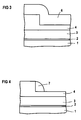
- Horizontal parts of the layer 6 are removed by anisotropic etching, for example with HBr-RIE, and a spacer 7 remains on the flank of the step-like structured auxiliary layer 4 (see FIG. 4).
- the spacer 7 forms a closed curve when viewed from above. If this shape is undesirable for the gate electrode, the spacer 7 can be structured wet-chemically with the aid of a lacquer mask (not shown). The curvature of the spacer 7 can be restricted to its upper part by making the flank of the step-like structured auxiliary layer higher.
- the auxiliary layer 4 is then structured using the spacer 7 as an etching mask.
- a hard mask 8 is created from the auxiliary layer 4.
- the auxiliary layer 4 consists continuously of, for example, deposited SiO 2 (TEOS), it is structured, for example, in an anisotropic CHF 3 and CF 4 etching process. This has a good selectivity with respect to polysilicon, so that the surface of the electrode layer 3 which was initially exposed on the one side of the spacer 7 when the auxiliary layer 4 is etched is only slightly etched.
- the electrode layer 3 is structured by anisotropic etching with HBr, for example. This creates a gate electrode 9.
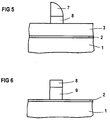
- the spacer 7, which consists of the same material as the gate electrode 9, is removed in this etching process (see FIG. 6).
Landscapes
- Insulated Gate Type Field-Effect Transistor (AREA)
- Electrodes Of Semiconductors (AREA)
- Drying Of Semiconductors (AREA)
- Static Random-Access Memory (AREA)
- Thin Film Transistor (AREA)
Abstract
Description
- MOS-Strukturen mit kurzer Kanallänge, speziell Kurzkanal-MOSFETs, werden für schnelle Schaltungen benötigt. Kurzkanal-MOSFETs weisen eine kurze Gatelänge auf. Bei niedrigen Betriebsspannungen werden mit Kurzkanal-MOS-Transistoren kleine Gatterverzögerungszeiten erzielt.
- Gateelektroden werden üblicherweise durch Strukturierung einer leitfähigen Schicht mit Hilfe einer photolithographisch erzeugten Maske gebildet. Gateelektroden mit Abmessungen unterhalb 100 nm, wie sie für Kurzkanal-MOS-Transistoren benötigt werden, sind unter Verwendung von optischer Lithographie nicht mehr zu strukturieren. Für diese Strukturgrößen ist zum Beispiel derzeit der Einsatz von Elektronenstrahllithographie erforderlich.
- In US-PS 4.358.340 ist vorgeschlagen, zur Herstellung einer Gateelektrode für eine MOS-Struktur auf einem Siliziumsubstrat zunächst eine Stufenstruktur aus SiO2 zu bilden. Die Oberfläche des Siliziumsubstrats ist vollständig mit SiO2 bedeckt. An einer Flanke der Stufenstruktur wird durch konforme Abscheidung einer Polysiliziumschicht und anisotropes Ätzen der Polysiliziumschicht ein Spacer erzeugt. Der Spacer wird schließlich als Ätzmaske verwendet, um die Stufenstruktur außerhalb des Spacers zu entfernen. Der Spacer wird dotiert und als Gateelektrode verwendet. Die Abmessung der Gateelektrode hängt von der Weite des Spacers am Fuß der Stufe ab und ist unabhängig von der minimal herstellbaren Strukturgröße in der verwendeten Lithographie. Bei diesem Verfahren besteht die Gefahr des Durchätzens des Gateoxids, insbesondere, wenn die Gateoxiddicke nur wenige Nanometer betragt, was für sub-100 nm- Kurzkanaltransistoren unerläßlich ist.
- Ein weiteres Verfahren zur Herstellung von Gatelektroden mit Strukturgrößen unterhalb der Auflösungsgrenze der verwendeten Lithographie ist aus C. Johnson et al, IBM Technical Disclosure Bulletin, Vol. 26, Nr. 9, 1984, Seiten 4587 bis 4589, bekannt. Dabei wird auf einem Substrat, das mit einem Gateoxid, einer Polysiliziumschicht und einer Siliziumdioxidschicht versehen ist, aus Photolack eine Struktur erzeugt, die eine im wesentlichen senkrechte Flanke aufweist. An der Flanke wird durch konforme Abscheidung und anschließendes anisotropes Ätzen einer Schicht aus Si3N4 oder SiO2 ein Spacer erzeugt. Dieser Spacer wird als Ätzmaske zur Bildung der Gateelektrode durch Strukturierung der Polysiliziumschicht verwendet. Um ein Verfließen der Photolackstruktur bei der Bildung des Spacers zu vermeiden, wird der Photolack durch UV-Bestrahlung gehärtet. Nach Strukturierung der Gateelektrode wird der Spacer entfernt.
- Der Erfindung liegt das Problem zugrunde, ein weiteres Verfahren zur Herstellung einer Gateelektrode für eine MOS-Struktur anzugeben, mit dem in der Gateelektrode Strukturgrößen kleiner als die Auflösungsgrenze der verwendeten Lithographie erzielt werden können.
- Dieses Problem wird erfindungsgemäß gelöst durch ein Verfahren gemäß Anspruch 1. Weitere Ausgestaltungen der Erfindung gehen aus den übrigen Ansprüchen hervor.
- In dem erfindungsgemäßen Verfahren wird die Gateelektrode durch Strukturierung einer Elektrodenschicht gebildet. Die laterale Ausdehnung der Gateelektrode wird durch einen Spacer bestimmt, der aus demselben Material wie die Gateelektrode gebildet wird. Unter Verwendung des Spacers als Ätzmaske wird eine Hartmaske gebildet, die zur Strukturierung der Gateelektrode verwendet wird. Bei der Strukturierung der Gateelektrode wird der aus demselben Material bestehende Spacer gleichzeitig mit entfernt. Ein separater Schritt zur Entfernung des Spacers entfällt somit. Dennoch wird die Gateelektrode mit im wesentlichen senkrechten Flanken erzeugt.
- Da in dem erfindungsgemäßen Verfahren keine Lackmaske erforderlich ist, wird das Durchätzen extrem dünner Gatedielektrika bei der Gatestrukturierung vermieden.
- Der Spacer wird an einer Flanke einer Stufe vorzugsweise durch Abscheidung einer Schicht mit konformer Kantenbedeckung und anschließendes anisotropes Ätzen der Schicht gebildet. Die Stufe wird in einer Hilfsschicht erzeugt, die die Ober 3,0 % 3,0 % fläche der Elektrodenschicht bedeckt.
- Die Hilfsschicht wird durchgehend aus ein und demselben Material erzeugt. Die Höhe der Stufe wird über die Ätzzeit bei der Bildung der Stufe eingestellt. Dies hat den Vorzug, daß bei der Bildung der Hartmaske nur ein Ätzprozeß erforderlich ist. Vorzugsweise wird die Hilfsschicht aus TEOS-SiO2 und die Elektrodenschicht und der Spacer aus Polysilizium gebildet. Diese Materialien sind in Standardprozessen mit guter Selektivität zueinander ätzbar.
- Im folgenden wird die Erfindung anhand der Figuren und eines Ausführungsbeispiels näher erläutert.
- Figur 1
- zeigt ein Halbleitersubstrat mit einem Gatedielektrikum, einer Elektrodenschicht, einer Hilfsschicht und einer Photolackmaske.
- Figur 2
- zeigt das Halbleitersubstrat nach Bildung einer Stufe in der Hilfsschicht.
- Figur 3
- zeigt das Halbleitersubstrat nach Abscheidung einer Schicht mit konformer Kantenbedeckung.
- Figur 4
- zeigt das Halbleitersubstrat nach Bildung eines Spacers.
- Figur 5
- zeigt das Halbleitersubstrat nach Bildung einer Hartmaske.
- Figur 6
- zeigt das Halbleitersubstrat nach Bildung einer Gateelektrode durch Strukturierung der Elektrodenschicht.
- Auf ein Substrat 1, zum Beispiel eine monokristalline Siliziumscheibe oder ein SOI-Substrat wird ein Gatedielektrikum 2 aufgebracht. Das Gatedielektrikum 2 wird zum Beispiel durch thermische Oxidation aus SiO2 in einer Schichtdicke von zum Beispiel 3 bis 4 nm gebildet (siehe Figur 1).
- Auf das Gatedielektrikum 2 wird eine Elektrodenschicht 3 aufgebracht. Die Elektrodenschicht 3 besteht zum Beispiel aus dotiertem Polysilizium und weist eine Dicke von zum Beispiel 100 nm auf. Die Elektrodenschicht 3 ist zum Beispiel dotiert mit einer Dotierstoffkonzentration im Bereich 1021 cm-3.
- Auf die Elektrodenschicht 3 wird eine Hilfsschicht 4 in einer Schichtdicke von zum Beispiel 200 nm aufgebracht. Die Hilfsschicht 4 wird zum Beispiel in einem TEOS-Verfahren aus SiO2 gebildet.
- Auf der Oberfläche der Hilfsschicht 4 wird eine Photolackmaske 5 erzeugt, die die Lage einer Flanke einer später herzustellenden Gateelektrode definiert.
- Durch anisotropes Ätzen zum Beispiel mit CHF3-RIE (Reactive Ion Etching) wird nachfolgend in der Hilfsschicht 4 eine Stufe mit einer im wesentlichen senkrechten Flanke erzeugt (siehe Figur 2). Die Stufe weist eine Höhe von zum Beispiel 150 nm auf. Die Oberfläche der Elektrodenschicht 3 bleibt daher von der stufenförmig strukturierten Hilfsschicht 4 bedeckt.
- Die Höhe der Stufe wird über die Ätzzeit gesteuert. Anschließend wird die Photolackmaske 5 entfernt.
- Es wird ganzflächig eine Schicht 6 mit im wesentlichen konformer Kantenbedeckung abgeschieden (siehe Figur 3). Die Schicht 6 wird zum Beispiel aus Polysilizium in einer Schichtdicke von zum Beispiel 100 nm abgeschieden.
- Durch anisotropes Ätzen zum Beispiel mit HBr-RIE werden waagerechte Teile der Schicht 6 entfernt, und es verbleibt an der Flanke der stufenförmig strukturierten Hilfsschichtt 4 ein Spacer 7 (siehe Figur 4). Der Spacer 7 bildet in der Aufsicht eine geschlossene Kurve. Wenn diese Form für die Gateelektrode unerwünscht ist, kann der Spacer 7 mit Hilfe einer Lackmaske naßchemisch strukturiert werden (nicht dargestellt). Die Krümmung des Spacers 7 kann auf seinen oberen Teil beschränkt werden, indem man die Flanke der stufenförmig strukturierten Hilfsschicht höher ausführt.
- Unter Verwendung des Spacers 7 als Ätzmaske wird anschließend die Hilfsschicht 4 strukturiert. Dabei entsteht aus der Hilfsschicht 4 eine Hartmaske 8. Besteht die Hilfsschicht 4 durchgehend aus zum Beispiel abgeschiedenem SiO2 (TEOS), so erfolgt ihre Strukturierung zum Beispiel in einem anisotropen CHF3 und CF4-Ätzprozeß. Dieser weist eine gute Selektivität in Bezug auf Polysilizium auf, so daß die beim Ätzen der Hilfsschicht 4 auf der einen Seite des Spacers 7 zunächst freigelegte Oberfläche der Elektrodenschicht 3 nur geringfügig angeätzt wird.
- Schließlich wird die Elektrodenschicht 3 durch anisotropes Ätzen mit zum Beispiel HBr strukturiert. Dabei entsteht eine Gateelektrode 9. Gleichzeitig wird in diesem Ätzprozeß der Spacer 7, der aus demselben Material wie die Gateelektrode 9 besteht, entfernt (siehe Figur 6).
-
- 1
- Substrat
- 2
- Gatedielektrikum
- 3
- Elektrodenschicht
- 4
- Hilfsschicht
- 5
- Photolackmaske
- 6
- Schicht mit konformer Kantenbedeckung
- 7
- Spacer
- 8
- Hartmaske
- 9
- Gateelektrode
Claims (3)
- Verfahren zur Herstellung einer Gateelektrode einer MOS-Struktur,- bei dem auf ein Halbleitersubstrat (1), das mit einem Gatedielektrikum (2) versehen ist, eine Elektrodenschicht (3) aufgebracht wird,- bei dem auf die Elektrodenschicht (3) eine Hilfsschicht (4) aufgebracht wird,- bei dem in der Hilfsschicht (4) eine Stufe erzeugt wird, wobei die Oberfläche der Elektrodenschicht (3) von der stufenförmig strukturierten Hilfsschicht (4) bedeckt bleibt,- bei dem an der Stufe ein Spacer (7) aus dem Material der Elektrodenschicht (3) gebildet wird,- bei dem aus der stufenförmig strukturierten Hilfsschicht (4) durch anisotropes Ätzen unter Verwendung des Spacers (7) als Ätzmaske eine Hartmaske (8) gebildet wird,- bei dem die Gateelektrode (9) durch anisotropes Ätzen der Elektrodenschicht (3) unter Verwendung der Hartmaske (8) als Ätzmaske gebildet wird,- bei dem die Hilfsschicht (4), der Spacer (7), das Gatedielektrikum (2) und die Elektrodenschicht (3) unter Verwendung von nur zwei Schichtmaterialien gebildet werden.
- Verfahren nach Anspruch 1,
bei dem der Spacer (7) durch Abscheidung einer Schicht (6) mit konformer Kantenbedeckung und anschließendes anisotropes Ätzen gebildet wird. - Verfahren nach Anspruch 1 oder 2,
bei dem die Hilfsschicht (4) und das Gatedielektrikum (2) aus SiO2 und die Elektrodenschicht (3) und der Spacer aus Polysilizium gebildet werden.
Applications Claiming Priority (2)
| Application Number | Priority Date | Filing Date | Title |
|---|---|---|---|
| DE19548056 | 1995-12-21 | ||
| DE19548056A DE19548056C1 (de) | 1995-12-21 | 1995-12-21 | Verfahren zur Herstellung einer Gateelektrode für eine MOS-Struktur |
Publications (3)
| Publication Number | Publication Date |
|---|---|
| EP0780888A2 true EP0780888A2 (de) | 1997-06-25 |
| EP0780888A3 EP0780888A3 (de) | 1997-07-16 |
| EP0780888B1 EP0780888B1 (de) | 2002-02-06 |
Family
ID=7780964
Family Applications (1)
| Application Number | Title | Priority Date | Filing Date |
|---|---|---|---|
| EP96119052A Expired - Lifetime EP0780888B1 (de) | 1995-12-21 | 1996-11-27 | Verfahren zur Herstellung einer Gateelektrode für eine MOS-Struktur |
Country Status (7)
| Country | Link |
|---|---|
| US (1) | US5705414A (de) |
| EP (1) | EP0780888B1 (de) |
| JP (1) | JP3899152B2 (de) |
| KR (1) | KR100395667B1 (de) |
| AT (1) | ATE213094T1 (de) |
| DE (2) | DE19548056C1 (de) |
| TW (2) | TW383412B (de) |
Families Citing this family (26)
| Publication number | Priority date | Publication date | Assignee | Title |
|---|---|---|---|---|
| US5714039A (en) * | 1995-10-04 | 1998-02-03 | International Business Machines Corporation | Method for making sub-lithographic images by etching the intersection of two spacers |
| DE19548058C2 (de) * | 1995-12-21 | 1997-11-20 | Siemens Ag | Verfahren zur Herstellung eines MOS-Transistors |
| US5893735A (en) * | 1996-02-22 | 1999-04-13 | Siemens Aktiengesellschaft | Three-dimensional device layout with sub-groundrule features |
| US5923981A (en) * | 1996-12-31 | 1999-07-13 | Intel Corporation | Cascading transistor gate and method for fabricating the same |
| US6159861A (en) * | 1997-08-28 | 2000-12-12 | Nec Corporation | Method of manufacturing semiconductor device |
| US6225201B1 (en) * | 1998-03-09 | 2001-05-01 | Advanced Micro Devices, Inc. | Ultra short transistor channel length dictated by the width of a sidewall spacer |
| US6069044A (en) * | 1998-03-30 | 2000-05-30 | Texas Instruments-Acer Incorporated | Process to fabricate ultra-short channel nMOSFETS with self-aligned silicide contact |
| US6261912B1 (en) * | 1999-08-10 | 2001-07-17 | United Microelectronics Corp. | Method of fabricating a transistor |
| US6362057B1 (en) | 1999-10-26 | 2002-03-26 | Motorola, Inc. | Method for forming a semiconductor device |
| US6630405B1 (en) | 1999-12-20 | 2003-10-07 | Chartered Semiconductor Manufacturing Ltd. | Method of gate patterning for sub-0.1 μm technology |
| US6184116B1 (en) | 2000-01-11 | 2001-02-06 | Taiwan Semiconductor Manufacturing Company | Method to fabricate the MOS gate |
| DE10030391C2 (de) * | 2000-06-21 | 2003-10-02 | Infineon Technologies Ag | Verfahren zur Herstellung einer Anschlussfläche für vertikale sublithographische Halbleiterstrukturen |
| US6960806B2 (en) * | 2001-06-21 | 2005-11-01 | International Business Machines Corporation | Double gated vertical transistor with different first and second gate materials |
| US6967351B2 (en) * | 2001-12-04 | 2005-11-22 | International Business Machines Corporation | Finfet SRAM cell using low mobility plane for cell stability and method for forming |
| US6720231B2 (en) * | 2002-01-28 | 2004-04-13 | International Business Machines Corporation | Fin-type resistors |
| US6709982B1 (en) * | 2002-11-26 | 2004-03-23 | Advanced Micro Devices, Inc. | Double spacer FinFET formation |
| US6762448B1 (en) | 2003-04-03 | 2004-07-13 | Advanced Micro Devices, Inc. | FinFET device with multiple fin structures |
| US6716686B1 (en) | 2003-07-08 | 2004-04-06 | Advanced Micro Devices, Inc. | Method for forming channels in a finfet device |
| US7498225B1 (en) | 2003-12-04 | 2009-03-03 | Advanced Micro Devices, Inc. | Systems and methods for forming multiple fin structures using metal-induced-crystallization |
| US7521371B2 (en) * | 2006-08-21 | 2009-04-21 | Micron Technology, Inc. | Methods of forming semiconductor constructions having lines |
| US7670914B2 (en) * | 2006-09-28 | 2010-03-02 | Globalfoundries Inc. | Methods for fabricating multiple finger transistors |
| CN101536153B (zh) * | 2006-11-06 | 2011-07-20 | Nxp股份有限公司 | 制造fet栅极的方法 |
| US7772048B2 (en) * | 2007-02-23 | 2010-08-10 | Freescale Semiconductor, Inc. | Forming semiconductor fins using a sacrificial fin |
| US11942133B2 (en) * | 2021-09-02 | 2024-03-26 | Kepler Computing Inc. | Pedestal-based pocket integration process for embedded memory |
| US12069866B2 (en) | 2021-09-02 | 2024-08-20 | Kepler Computing Inc. | Pocket integration process for embedded memory |
| US12525543B1 (en) | 2021-10-01 | 2026-01-13 | Kepler Computing Inc. | Integration process for fabricating embedded memory |
Citations (1)
| Publication number | Priority date | Publication date | Assignee | Title |
|---|---|---|---|---|
| US4358340A (en) | 1980-07-14 | 1982-11-09 | Texas Instruments Incorporated | Submicron patterning without using submicron lithographic technique |
Family Cites Families (3)
| Publication number | Priority date | Publication date | Assignee | Title |
|---|---|---|---|---|
| JP2699179B2 (ja) * | 1988-09-20 | 1998-01-19 | 株式会社サクラクレパス | 筆記用水性インキ組成物 |
| USH986H (en) * | 1989-06-09 | 1991-11-05 | International Business Machines Corporation | Field effect-transistor with asymmetrical structure |
| US5202272A (en) * | 1991-03-25 | 1993-04-13 | International Business Machines Corporation | Field effect transistor formed with deep-submicron gate |
-
1995
- 1995-12-21 DE DE19548056A patent/DE19548056C1/de not_active Expired - Fee Related
-
1996
- 1996-11-19 TW TW085114187A patent/TW383412B/zh not_active IP Right Cessation
- 1996-11-27 AT AT96119052T patent/ATE213094T1/de active
- 1996-11-27 EP EP96119052A patent/EP0780888B1/de not_active Expired - Lifetime
- 1996-11-27 DE DE59608704T patent/DE59608704D1/de not_active Expired - Lifetime
- 1996-12-16 JP JP35255496A patent/JP3899152B2/ja not_active Expired - Lifetime
- 1996-12-19 TW TW085115696A patent/TW334567B/zh not_active IP Right Cessation
- 1996-12-19 KR KR1019960067909A patent/KR100395667B1/ko not_active Expired - Lifetime
- 1996-12-23 US US08/779,944 patent/US5705414A/en not_active Expired - Lifetime
Patent Citations (1)
| Publication number | Priority date | Publication date | Assignee | Title |
|---|---|---|---|---|
| US4358340A (en) | 1980-07-14 | 1982-11-09 | Texas Instruments Incorporated | Submicron patterning without using submicron lithographic technique |
Non-Patent Citations (1)
| Title |
|---|
| C. JOHNSON ET AL., IBM TECHNICAL DISCLOSURE BULLETIN, vol. 26, no. 9, 1984, pages 4587 - 4589 |
Also Published As
| Publication number | Publication date |
|---|---|
| TW334567B (en) | 1998-06-21 |
| EP0780888A3 (de) | 1997-07-16 |
| EP0780888B1 (de) | 2002-02-06 |
| DE19548056C1 (de) | 1997-03-06 |
| TW383412B (en) | 2000-03-01 |
| ATE213094T1 (de) | 2002-02-15 |
| JPH09181303A (ja) | 1997-07-11 |
| KR100395667B1 (ko) | 2003-11-17 |
| US5705414A (en) | 1998-01-06 |
| JP3899152B2 (ja) | 2007-03-28 |
| KR970052527A (ko) | 1997-07-29 |
| DE59608704D1 (de) | 2002-03-21 |
Similar Documents
| Publication | Publication Date | Title |
|---|---|---|
| EP0780888B1 (de) | Verfahren zur Herstellung einer Gateelektrode für eine MOS-Struktur | |
| DE4138842C2 (de) | Gateelektrode und Verfahren zu deren Herstellung | |
| DE68917995T2 (de) | Verfahren zum Herstellen einer Halbleitervorrichtung. | |
| DE10393565B4 (de) | Verfahren zur Herstellung eines Halbleiterelements mit einer U-förmigen Gate-Struktur | |
| DE3787421T2 (de) | Verfahren zum Herstellen von Strukturen, einschliesslich nichtflüchtiger Speicherzellen vom EEPROM-Typ, mit selbstausrichtenden Siliziumschichten und dazugehörige Transistoren. | |
| DE69426747T2 (de) | Verfahren zur Herstellung des Gates eines Transistors | |
| DE60211396T2 (de) | Verfahren zur Herstellung von einem Gatter-Dielektrikum mit veränderlicher Dielektrizitätskonstante | |
| DE112006002726B4 (de) | Isolierung von selbstausgerichteten Gates | |
| DE3245276A1 (de) | Verfahren zum ausbilden von submikrometer-merkmalen in halbleiterbauelementen | |
| DE69627975T2 (de) | MOS-Transistor und Verfahren zu seiner Herstellung | |
| WO2000021118A2 (de) | Verfahren zur herstellung eines vertikalen mosfets | |
| EP0868742B1 (de) | Verfahren zur herstellung eines mos-transistors | |
| DE10012112C2 (de) | Steg-Feldeffekttransistor und Verfahren zum Herstellen eines Steg-Feldeffekttransistors | |
| DE10052208C2 (de) | Verfahren zur Herstellung eines Feldeffekttransistors mittels einer Justiertechnologie auf der Grundlage von Seitenwandabstandselementen | |
| DE60131334T2 (de) | Halbleiterbauelement mit zweifachem gate und dessen herstellungsverfahren | |
| EP1060515A1 (de) | Elektrisch programmierbare speicherzellenanordnung und verfahren zu deren herstellung | |
| EP1540712B1 (de) | Herstellungsverfahren für eine halbleiterstruktur | |
| EP0416141A1 (de) | Verfahren zur Herstellung eines FET mit asymmetrisch angeordnetem Gate-Bereich | |
| DE10153619A1 (de) | Verfahren zur Herstellung eines Gate-Schichtenstapels für eine integrierte Schaltungsanordnung | |
| DE19534780A1 (de) | Verfahren zum Erzeugen sehr kleiner Strukturweiten auf einem Halbleitersubstrat | |
| WO2005038930A2 (de) | Verfahren zum strukturieren und feldeffekttransistoren | |
| DE69509698T2 (de) | Verfahren zur Herstellung eines Feldeffekttransistors mit isoliertem Gate und kurzem Kanal, und entsprechender Transistor | |
| DE112006001520B4 (de) | Prozess für die Herstellung erhabener Source- und Drain-Gebiete mit zu entfernenden Abstandshaltern, wobei "Mausohren" vermieden werden | |
| DE10249216B3 (de) | Herstellungsverfahren für ein Kontaktloch in einer Halbleiterstruktur | |
| EP1869711A2 (de) | Herstellung von vdmos-transistoren mit optimierter gatekontaktierung |
Legal Events
| Date | Code | Title | Description |
|---|---|---|---|
| PUAI | Public reference made under article 153(3) epc to a published international application that has entered the european phase |
Free format text: ORIGINAL CODE: 0009012 |
|
| PUAL | Search report despatched |
Free format text: ORIGINAL CODE: 0009013 |
|
| AK | Designated contracting states |
Kind code of ref document: A2 Designated state(s): AT DE FR GB IE IT |
|
| AK | Designated contracting states |
Kind code of ref document: A3 Designated state(s): AT DE FR GB IE IT |
|
| 17P | Request for examination filed |
Effective date: 19971022 |
|
| GRAG | Despatch of communication of intention to grant |
Free format text: ORIGINAL CODE: EPIDOS AGRA |
|
| 17Q | First examination report despatched |
Effective date: 20001201 |
|
| RAP1 | Party data changed (applicant data changed or rights of an application transferred) |
Owner name: INFINEON TECHNOLOGIES AG |
|
| GRAG | Despatch of communication of intention to grant |
Free format text: ORIGINAL CODE: EPIDOS AGRA |
|
| GRAH | Despatch of communication of intention to grant a patent |
Free format text: ORIGINAL CODE: EPIDOS IGRA |
|
| GRAG | Despatch of communication of intention to grant |
Free format text: ORIGINAL CODE: EPIDOS AGRA |
|
| GRAH | Despatch of communication of intention to grant a patent |
Free format text: ORIGINAL CODE: EPIDOS IGRA |
|
| GRAH | Despatch of communication of intention to grant a patent |
Free format text: ORIGINAL CODE: EPIDOS IGRA |
|
| GRAA | (expected) grant |
Free format text: ORIGINAL CODE: 0009210 |
|
| REG | Reference to a national code |
Ref country code: GB Ref legal event code: IF02 |
|
| AK | Designated contracting states |
Kind code of ref document: B1 Designated state(s): AT DE FR GB IE IT |
|
| REF | Corresponds to: |
Ref document number: 213094 Country of ref document: AT Date of ref document: 20020215 Kind code of ref document: T |
|
| REF | Corresponds to: |
Ref document number: 59608704 Country of ref document: DE Date of ref document: 20020321 |
|
| GBT | Gb: translation of ep patent filed (gb section 77(6)(a)/1977) |
Effective date: 20020411 |
|
| ET | Fr: translation filed | ||
| PLBE | No opposition filed within time limit |
Free format text: ORIGINAL CODE: 0009261 |
|
| STAA | Information on the status of an ep patent application or granted ep patent |
Free format text: STATUS: NO OPPOSITION FILED WITHIN TIME LIMIT |
|
| 26N | No opposition filed |
Effective date: 20021107 |
|
| REG | Reference to a national code |
Ref country code: FR Ref legal event code: PLFP Year of fee payment: 20 |
|
| PGFP | Annual fee paid to national office [announced via postgrant information from national office to epo] |
Ref country code: GB Payment date: 20151118 Year of fee payment: 20 Ref country code: IE Payment date: 20151119 Year of fee payment: 20 Ref country code: IT Payment date: 20151125 Year of fee payment: 20 |
|
| PGFP | Annual fee paid to national office [announced via postgrant information from national office to epo] |
Ref country code: FR Payment date: 20151119 Year of fee payment: 20 Ref country code: AT Payment date: 20151119 Year of fee payment: 20 |
|
| PGFP | Annual fee paid to national office [announced via postgrant information from national office to epo] |
Ref country code: DE Payment date: 20160115 Year of fee payment: 20 |
|
| REG | Reference to a national code |
Ref country code: DE Ref legal event code: R071 Ref document number: 59608704 Country of ref document: DE |
|
| REG | Reference to a national code |
Ref country code: GB Ref legal event code: PE20 Expiry date: 20161126 |
|
| REG | Reference to a national code |
Ref country code: IE Ref legal event code: MK9A |
|
| REG | Reference to a national code |
Ref country code: AT Ref legal event code: MK07 Ref document number: 213094 Country of ref document: AT Kind code of ref document: T Effective date: 20161127 |
|
| PG25 | Lapsed in a contracting state [announced via postgrant information from national office to epo] |
Ref country code: IE Free format text: LAPSE BECAUSE OF EXPIRATION OF PROTECTION Effective date: 20161127 Ref country code: GB Free format text: LAPSE BECAUSE OF EXPIRATION OF PROTECTION Effective date: 20161126 |