EP0781328B1 - Activateurs tels que l'acetosyringone - Google Patents
Activateurs tels que l'acetosyringone Download PDFInfo
- Publication number
- EP0781328B1 EP0781328B1 EP95931922A EP95931922A EP0781328B1 EP 0781328 B1 EP0781328 B1 EP 0781328B1 EP 95931922 A EP95931922 A EP 95931922A EP 95931922 A EP95931922 A EP 95931922A EP 0781328 B1 EP0781328 B1 EP 0781328B1
- Authority
- EP
- European Patent Office
- Prior art keywords
- peroxidase
- laccase
- enzyme
- hydrogen peroxide
- alkyl
- Prior art date
- Legal status (The legal status is an assumption and is not a legal conclusion. Google has not performed a legal analysis and makes no representation as to the accuracy of the status listed.)
- Expired - Lifetime
Links
- 0 Cc(cc1*)c(CCC(N=N[C@@]2C=CC(c(cc3)cc(OC)c3N=Nc3ccc(c(*)cc(*)c4N)c4c3O)=CC2OC)=C2O)c2c1N Chemical compound Cc(cc1*)c(CCC(N=N[C@@]2C=CC(c(cc3)cc(OC)c3N=Nc3ccc(c(*)cc(*)c4N)c4c3O)=CC2OC)=C2O)c2c1N 0.000 description 5
Images

Classifications
-
- C—CHEMISTRY; METALLURGY
- C12—BIOCHEMISTRY; BEER; SPIRITS; WINE; VINEGAR; MICROBIOLOGY; ENZYMOLOGY; MUTATION OR GENETIC ENGINEERING
- C12N—MICROORGANISMS OR ENZYMES; COMPOSITIONS THEREOF; PROPAGATING, PRESERVING, OR MAINTAINING MICROORGANISMS; MUTATION OR GENETIC ENGINEERING; CULTURE MEDIA
- C12N9/00—Enzymes; Proenzymes; Compositions thereof; Processes for preparing, activating, inhibiting, separating or purifying enzymes
- C12N9/0004—Oxidoreductases (1.)
-
- C—CHEMISTRY; METALLURGY
- C11—ANIMAL OR VEGETABLE OILS, FATS, FATTY SUBSTANCES OR WAXES; FATTY ACIDS THEREFROM; DETERGENTS; CANDLES
- C11D—DETERGENT COMPOSITIONS; USE OF SINGLE SUBSTANCES AS DETERGENTS; SOAP OR SOAP-MAKING; RESIN SOAPS; RECOVERY OF GLYCEROL
- C11D3/00—Other compounding ingredients of detergent compositions covered in group C11D1/00
- C11D3/16—Organic compounds
- C11D3/20—Organic compounds containing oxygen
- C11D3/2068—Ethers
-
- C—CHEMISTRY; METALLURGY
- C11—ANIMAL OR VEGETABLE OILS, FATS, FATTY SUBSTANCES OR WAXES; FATTY ACIDS THEREFROM; DETERGENTS; CANDLES
- C11D—DETERGENT COMPOSITIONS; USE OF SINGLE SUBSTANCES AS DETERGENTS; SOAP OR SOAP-MAKING; RESIN SOAPS; RECOVERY OF GLYCEROL
- C11D3/00—Other compounding ingredients of detergent compositions covered in group C11D1/00
- C11D3/0005—Other compounding ingredients characterised by their effect
- C11D3/0021—Dye-stain or dye-transfer inhibiting compositions
-
- C—CHEMISTRY; METALLURGY
- C11—ANIMAL OR VEGETABLE OILS, FATS, FATTY SUBSTANCES OR WAXES; FATTY ACIDS THEREFROM; DETERGENTS; CANDLES
- C11D—DETERGENT COMPOSITIONS; USE OF SINGLE SUBSTANCES AS DETERGENTS; SOAP OR SOAP-MAKING; RESIN SOAPS; RECOVERY OF GLYCEROL
- C11D3/00—Other compounding ingredients of detergent compositions covered in group C11D1/00
- C11D3/16—Organic compounds
- C11D3/38—Products with no well-defined composition, e.g. natural products
- C11D3/386—Preparations containing enzymes, e.g. protease or amylase
- C11D3/38654—Preparations containing enzymes, e.g. protease or amylase containing oxidase or reductase
-
- C—CHEMISTRY; METALLURGY
- C11—ANIMAL OR VEGETABLE OILS, FATS, FATTY SUBSTANCES OR WAXES; FATTY ACIDS THEREFROM; DETERGENTS; CANDLES
- C11D—DETERGENT COMPOSITIONS; USE OF SINGLE SUBSTANCES AS DETERGENTS; SOAP OR SOAP-MAKING; RESIN SOAPS; RECOVERY OF GLYCEROL
- C11D3/00—Other compounding ingredients of detergent compositions covered in group C11D1/00
- C11D3/16—Organic compounds
- C11D3/20—Organic compounds containing oxygen
- C11D3/2003—Alcohols; Phenols
- C11D3/2006—Monohydric alcohols
- C11D3/2034—Monohydric alcohols aromatic
Definitions
- the invention relates to a method of oxidizing a compound with a phenol oxidizing enzyme and an enhancing agent.
- the invention also relates to a detergent additive and to a detergent composition.
- a phenol oxidizing enzyme an enzyme which by using hydrogen peroxide or molecular oxygen, is capable of oxidizing organic compounds containing phenolic groups.
- examples of such enzymes are peroxidases and oxidases.
- oxidizable substances e.g., metal ions and phenolic compounds such as 7-hydroxycoumarin, vanillin, and p-hydroxybenzenesulfonate
- accelerators or enhancing agents able to enhance enzymatic bleaching reactions cf. e.g. WO 92/18683, WO 92/18687, and Kato M and Shimizu S , Plant Cell Physiol. 1985 26 (7), pp. 1291-1301 (cf. Table 1 in particular)
- enhancing agents e.g., phenothiazines and phenoxazines.
- Fig. 1 shows the bleaching of gradually added Acid Blue 45 in phosphate/borate buffer pH 10 at 35°C;
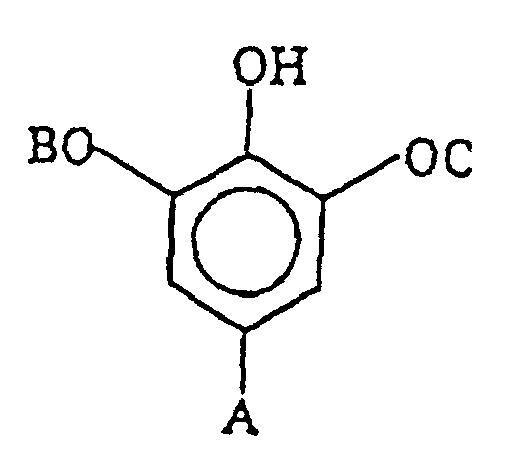
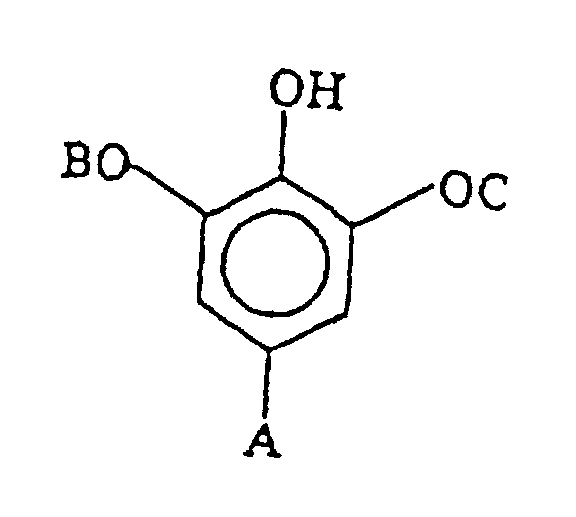
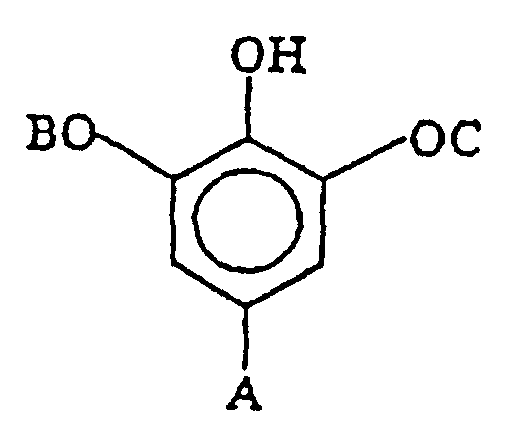
- a in the above mentioned formula is -CO-E, in which E may be -H, -OH, -R, or -OR; R being a C 1 -C 16 alkyl, preferably a C 1 -C 8 alkyl, which alkyl may be saturated or unsaturated, branched or unbranched and optionally substituted with a carboxy, sulfo or amino group; and B and C may be the same or different and selected from C m H 2m+1 ; 1 ⁇ m ⁇ 5.
- the enhancing agent is acetosyringone, syringaldehyde, methylsyringate, syringic acid, ethylsyringate, propylsyringate, butylsyringate, hexylsyringate, octylsyringate or ethyl 3-(4-hydroxy-3,5-dimethoxyphenyl)acrylate.
- the enhancing agent of the invention may be present in concentrations of from 0.01 to 1000 ⁇ M, more preferred 0.1 to 250 ⁇ M, most preferred 1 to 100 ⁇ M.
- the enhancing agents described in the present application may be prepared using methods well known to those skilled in the art; some of the enhancing agents are also commercially available.
- Ethyl 3-(4-hydroxy-3,5-dimethoxyphenyl)acrylate was synthesised from syringaldehyde and triethyl phosphonoacetate in ethanol/sodium ethanolate.
- the product was after purification characterised by 1 H-NMR and 13 C-NMR (showing spectra as expected) and the melting point was 68-70°C.
- the source may be hydrogen peroxide or a hydrogen peroxide precursor for in situ production of hydrogen peroxide, e.g., percarbonate or perborate, or a hydrogen peroxide generating enzyme system, e.g., an oxidase and a substrate for the oxidase, e.g., an amino acid oxidase and a suitable amino acid, or a peroxycarboxylic acid or a salt thereof.
- Hydrogen peroxide may be added at the beginning or during the process, e.g., in an amount corresponding to levels of from 0.001-25 mM, particularly to levels of from 0.01-1 mM.
- the phenol oxidizing enzyme requires molecular oxygen, molecular oxygen from the atmosphere will usually be present in sufficient quantity. If more O 2 is needed, additional oxygen may be added.
- the enzyme of the phenol oxidizing enzyme may be an enzyme possessing peroxidase activity or a laccase or a laccase related enzyme as described below.
- Compounds possessing peroxidase activity may be any peroxidase enzyme comprised by the enzyme classification (EC 1.11.1.7), or any fragment derived therefrom, exhibiting peroxidase activity, or synthetic or semisynthetic derivatives thereof (e.g. porphyrin ring systems or microperoxidases, cf. e.g. US Patent 4,077,768, EP Patent Application 537,381, International Patent Applications WO 91/05858 and WO 92/16634).
- peroxidase enzyme comprised by the enzyme classification (EC 1.11.1.7), or any fragment derived therefrom, exhibiting peroxidase activity, or synthetic or semisynthetic derivatives thereof (e.g. porphyrin ring systems or microperoxidases, cf. e.g. US Patent 4,077,768, EP Patent Application 537,381, International Patent Applications WO 91/05858 and WO 92/16634).
- the peroxidase employed in the method of the invention is producible by plants (e.g. horseradish or soybean peroxidase) or microorganisms such as fungi or bacteria.
- plants e.g. horseradish or soybean peroxidase
- microorganisms such as fungi or bacteria.
- Some preferred fungi include strains belonging to the subdivision Deuteromycotina, class Hyphomycetes, e.g.
- fungi include strains belonging to the subdivision Basidiomycotina, class Basidiomycetes, e.g. Coprinus, Phanerochaete, Coriolus or Trametes, in particular Coprinus cinereus f. microsporus (IFO 8371), Coprinus macrorhizus , Phanerochaete chrysosporium (e.g. NA-12) or Trametes (previously called Polyporus ), e.g. T. versicolor (e.g. PR4 28-A).
- Basidiomycotina class Basidiomycetes
- Coprinus cinereus f. microsporus IFO 8371
- Coprinus macrorhizus e.g. NA-12
- Trametes previously called Polyporus
- T. versicolor e.g. PR4 28-A
- fungi include strains belonging to the subdivision Zygomycotina, class Mycoraceae, e.g. Rhizonus or Mucor, in particular Mucor hiemalis.
- Some preferred bacteria include strains of the order Actinomycetales, e.g. Streptomyces spheroides (ATTC 23965), Streptomyces thermoviolaceus (IFO 12382) or Streptoverticillum verticillium ssp. verticillium.
- Actinomycetales e.g. Streptomyces spheroides (ATTC 23965), Streptomyces thermoviolaceus (IFO 12382) or Streptoverticillum verticillium ssp. verticillium.
- Bacillus pumilus ATCC 12905
- Bacillus stearothermophilus Rhodobacter sphaeroides
- Rhodomonas palustri Rhodomonas palustri
- Streptococcus lactis Pseudomonas purrocinia
- Pseudomonas fluorescens NRRL B-11.
- bacteria include strains belonging to Myxococcus , e.g. M. virescens.
- the peroxidase may furthermore be one which is producible by a method comprising cultivating a host cell transformed with a recombinant DNA vector which carries a DNA sequence encoding said peroxidase as well as DNA sequences encoding functions permitting the expression of the DNA sequence encoding the peroxidase, in a culture medium under conditions permitting the expression of the peroxidase and recovering the peroxidase from the culture.
- a recombinantly produced peroxidase is a peroxidase derived from a Coprinus sp., in particular C. macrorhizus or C. cinereus according to WO 92/16634.
- compounds possessing peroxidase activity comprise peroxidase enzymes and peroxidase active fragments derived from cytochromes, haemoglobin or peroxidase enzymes, and synthetic or semisynthetic derivatives thereof, e.g., iron porphyrins, and iron phthalocyanines and derivatives thereof.
- 1 peroxidase unit is the amount of enzyme that catalyzes the conversion of 1 ⁇ mole hydrogen peroxide per minute at the following analytical conditions: 0.88 mM hydrogen peroxide, 1.67 mM 2,2'-azinobis(3-ethylbenzothiazoline-6-sulfonate), 0.1 M phosphate buffer, pH 7.0, incubated at 30°C, photometrically followed at 418 nm.
- laccases and laccase related enzymes comprise any laccase enzyme comprised by the enzyme classification (EC 1.10.3.2), any catechol oxidase enzyme comprised by the enzyme classification (EC 1.10.3.1), any bilirubin oxidase enzyme comprised by the enzyme classification (EC 1.3.3.5) or any monophenol monooxygenase enzyme comprised by the enzyme classification (EC 1.14.99.1).
- the above mentioned enzymes may be derived from plants, bacteria or fungi (including filamentous fungi and yeasts) and suitable examples include a laccase derivable from a strain of Aspergillus , Neurospora , e.g., N. crassa , Podospora , Botrytis , Collybia , Fomes , Lentinus , Pleurotus , Trametes, e.g., T. villosa and T. versicolor , Rhizoctonia , e.g., R. solani, Coprinus , e.g., C. cinereus, C. comatus , C. friesii, and C.
- Psathyrella e.g., P. condelleana
- Panaeolus e.g., P. papilionaceus
- Myceliophthora e.g., M. thermophila
- Polyporus e.g., P. pinsitus
- Phlebia e.g., P. radita (WO 92/01046)
- Coriolus e.g., C. hirsutus (JP 2-238885).
- the laccase or the laccase related enzyme may furthermore be one which is producible by a method comprising cultivating a host cell transformed with a recombinant DNA vector which carries a DNA sequence encoding said laccase as well as DNA sequences encoding functions permitting the expression of the DNA sequence encoding the laccase, in a culture medium under conditions permitting the expression of the laccase enzyme, and recovering the laccase from the culture.
- LACU Laccase Activity
- Laccase activity is determined from the oxidation of syringaldazin under aerobic conditions.
- the violet colour produced is photometered at 530 nm.
- the analytical conditions are 19 ⁇ M syringaldazin, 23.2 mM acetate buffer, pH 5.5, 30°C, 1 min. reaction time.
- LACU laccase unit
- the method of the invention finds application for bleaching of a textile dye or colorant or textile dyes or colorants in solution.
- Colorants and dyes are broad classes of natural and synthetic compounds. The following description and examples of dyes/colorants are not intended to be in any way limiting to the scope of the invention as claimed:
- Synthetic textile dyes bleachable by the method of the invention are typically azo compounds (with one or several azo, or diazenediyl, groups), as exemplified by Acid Red 151, Direct Blue 1, Direct Brown 44, and Orange II, or anthraquinone compounds, as exemplified by Acid Blue 45: Other structural motifs may occur together with these, as exemplified in the formula of Reactive Blue 19:
- Some dyes furthermore carry groups capable of coupling to fabric surfaces (reactive dyes), and some dyes are complexed to metal ions. These modifications will often not influence the applicability of the present invention.
- a different structure bleachable by the method of the invention is the indigo moiety, here exemplified by the soluble dye indigo carmine:
- dyes and colorants may be of natural origin or may be synthesized as identical to or resembling natural structures.
- Examples of categories of coloured substances extractable from vegetable sources are polyphenolic, anthocyanine and carotenoid compounds.
- a specific embodiment of the present invention is provided by household and institutional laundering processes.
- dyes and colorants present on fabrics may leach into the washing or rinsing liquor and discoloration of the laundry may result.
- Bleaching of the coloured compounds in solution by the method of the invention may counteract this undesirable effect.
- Other systems for dye transfer inhibition are known in the art (e.g. WO 91/05839).
- dyes leached into process water during textile processing may be bleached by the method of the invention to prevent undesirable deposition.
- Other systems are known in the art (e.g. WO 92/18697).
- the method of the invention finds application in bleaching of pulp for paper production.
- the invention provides a method for bleaching of lignin-containing material, in particular bleaching of pulp for paper production, which method comprises treatment of the lignin or lignin containing material with a phenol oxidizing enzyme and an enhancing agent as described in the present invention.
- the method of the invention finds application for lignin modification, e.g., in the manufacture of wood composites, e.g., wood fibre materials such as chipboards, fibre boards, or particle boards, or in the manufacture of laminated wood products, such as laminated beams and plywood.
- wood composites e.g., wood fibre materials such as chipboards, fibre boards, or particle boards
- laminated wood products such as laminated beams and plywood.
- the method of the invention finds application in treatment of waste water, e.g., waste water from the chemical or pharmaceutical industry, from dye manufacturing, from dye-works, from the textile industry, or from pulp production (cf. e.g. US 4,623,465, or JP-A-2-31887).
- waste water e.g., waste water from the chemical or pharmaceutical industry
- dye manufacturing from dye-works
- textile industry or from pulp production (cf. e.g. US 4,623,465, or JP-A-2-31887).
- the invention provides a method for treatment of waste water from dye manufacturing, from dye-works, from textile industry, or from pulp manufacturing, the method comprising treatment of the waste water with a phenol oxidizing enzyme in the presence of an enhancing agent of the invention.
- the enhancing agent may be added at the beginning of the process or later, in one or several additions.
- the phenol oxidizing enzyme may be present in concentrations of from 0.001-100 mg enzyme protein per liter.
- the enhancing agent and the phenol oxidizing enzyme may typically be a component of a detergent composition. As such, it may be included in the detergent composition in the form of a detergent additive.
- Preferred detergent additive formulations are granulates, in particular non-dusting granulates, liquids, in particular stabilized liquids, or slurries.
- Non-dusting granulates may be produced, e.g., as disclosed in US 4,106,991 and 4,661,452 (both to Novo Industri A/S) and may optionally be coated by methods known in the art.
- waxy coating materials are poly(ethylene oxide) products (polyethyleneglycol, PEG) with mean molecular weights of 1000 to 20000; ethoxylated nonylphenols having from 16 to 50 ethylene oxide units; ethoxylated fatty alcohols in which the alcohol contains from 12 to 20 carbon atoms and in which there are 15 to 80 ethylene oxide units; fatty alcohols; fatty acids; and mono- and di- and triglycerides of fatty acids.
- Liquid enzyme preparations may, for instance, be stabilized by adding a polyol such as propylene glycol, a sugar or sugar alcohol, lactic acid or boric acid according to established methods. Other enzyme stabilizers are well known in the art. Protected enzymes may be prepared according to the method disclosed in EP 238,216.
- the detergent composition of the invention may be in any convenient form, e.g. as powder, granules, paste or liquid.
- a liquid detergent may be aqueous, typically containing up to 70% water and 0-30% organic solvent, or nonaqueous.
- the detergent composition comprises one or more surfactants, each of which may be anionic, nonionic, cationic, or zwitterionic.
- the detergent will usually contain 0-50% of anionic surfactant such as linear alkylbenzenesulfonate (LAS), alpha-olefinsulfonate (AOS), alkyl sulfate (fatty alcohol sulfate) (AS), alcohol ethoxysulfate (AEOS or AES), secondary alkanesulfonates (SAS), alpha-sulfo fatty acid methyl esters, alkyl- or alkenylsuccinic acid, or soap.
- anionic surfactant such as linear alkylbenzenesulfonate (LAS), alpha-olefinsulfonate (AOS), alkyl sulfate (fatty alcohol sulfate) (AS), alcohol ethoxysulfate (AEOS or AES), secondary alkanesulfonates (SAS), alpha-
- nonionic surfactant such as alcohol ethoxylate (AEO or AE), carboxylated alcohol ethoxylates, nonylphenol ethoxylate, alkylpolyglycoside, alkyldimethylamine oxide, ethoxylated fatty acid monoethanolamide, fatty acid monoethanolamide, or polyhydroxy alkyl fatty acid amide (e.g. as described in WO 92/06154).
- AEO or AE alcohol ethoxylate
- carboxylated alcohol ethoxylates such as carboxylated alcohol ethoxylates, nonylphenol ethoxylate, alkylpolyglycoside, alkyldimethylamine oxide, ethoxylated fatty acid monoethanolamide, fatty acid monoethanolamide, or polyhydroxy alkyl fatty acid amide (e.g. as described in WO 92/06154).
- the detergent composition may additionally comprise one or more other enzymes, such as amylases, lipases, cutinases, proteases, and cellulases.
- enzymes such as amylases, lipases, cutinases, proteases, and cellulases.
- the detergent may contain 1-65% of a detergent builder or complexing agent such as zeolite, diphosphate, triphosphate, phosphonate, citrate, nitrilotriacetic acid (NTA), ethylenediaminetetraacetic acid (EDTA), diethylenetriaminepentaacetic acid (DTPA), alkyl- or alkenylsuccinic acid, soluble silicates or layered silicates (e.g. SKS-6 from Hoechst).
- a detergent builder or complexing agent such as zeolite, diphosphate, triphosphate, phosphonate, citrate, nitrilotriacetic acid (NTA), ethylenediaminetetraacetic acid (EDTA), diethylenetriaminepentaacetic acid (DTPA), alkyl- or alkenylsuccinic acid, soluble silicates or layered silicates (e.g. SKS-6 from Hoechst).
- the detergent may also be unbuilt, i.e.
- the detergent may comprise one or more polymers.
- examples are carboxymethylcellulose (CMC), poly(vinyl-pyrrolidone) (PVP), polyethyleneglycol (PEG), poly(vinyl alcohol) (PVA), polycarboxylates such as polyacrylates, maleic/acrylic acid copolymers and lauryl methacrylate/acrylic acid copolymers.
- CMC carboxymethylcellulose
- PVP poly(vinyl-pyrrolidone)
- PEG polyethyleneglycol
- PVA poly(vinyl alcohol)
- polycarboxylates such as polyacrylates, maleic/acrylic acid copolymers and lauryl methacrylate/acrylic acid copolymers.
- the detergent may additionally contain other bleaching systems which may comprise a H 2 O 2 source such as perborate or percarbonate which may be combined with a peracid-forming bleach activator such as tetraacetylethylenediamine (TAED) or nonanoyloxybenzenesulfonate (NOBS).
- TAED tetraacetylethylenediamine
- NOBS nonanoyloxybenzenesulfonate
- the bleaching system may comprise peroxyacids of, e.g., the amide, imide, or sulfone type.
- the enzymes of the detergent composition of the invention may be stabilized using conventional stabilizing agents, e.g. a polyol such as propylene glycol or glycerol, a sugar or sugar alcohol, lactic acid, boric acid, or a boric acid derivative such as, e.g., an aromatic borate ester, and the composition may be formulated as described in, e.g., Wo 92/19709 and WO 92/19708.
- stabilizing agents e.g. a polyol such as propylene glycol or glycerol
- a sugar or sugar alcohol lactic acid, boric acid, or a boric acid derivative such as, e.g., an aromatic borate ester
- the detergent may also contain other conventional detergent ingredients such as, e.g., fabric conditioners including clays, foam boosters, suds suppressors, anti-corrosion agents, soil-suspending agents, anti-soil-redeposition agents, dyes, bactericides, optical brighteners, or perfume.
- fabric conditioners including clays, foam boosters, suds suppressors, anti-corrosion agents, soil-suspending agents, anti-soil-redeposition agents, dyes, bactericides, optical brighteners, or perfume.
- the pH (measured in aqueous solution at use concentration) will usually be neutral or alkaline, e.g., in the range of 7-11.
- SBP soy bean peroxidase
- 125 ml of crude SBP were adjusted to pH 7, diluted to 2.3 mS and filtered through 0.8 ⁇ filter.
- the sample was applied to 300 ml DEAE column equilibrated with 20 mM phosphate pH 7.0 and the peroxidase eluted with a 1 M NaCl linear gradient in the same buffer. Fractions with peroxidase activity were pooled.
- Reagents were mixed in a thermostated cuvette at 30°C and the bleaching was started by addition of hydrogen peroxide.
- the bleaching was detected spectrophotometrically at 610 nm, which is the wavelength of the absorption peak of DB1. Bleaching was followed for 4 minutes, and the reduction in absorbance (100x(A 610nm,start -A 610nm,4min. )/A 610nm,start %) was determined.
- a 610nm,start was determined by replacement of hydrogen peroxide with water. Bleaching of Direct Blue 1 with SBP in 4 Minutes Enhancer % DB1 bleaching in 4 min. pH 6 pH 8 pH 10 10x[SBP] No 0.7 ⁇ 0.7 ⁇ 0.7 acetosyringone 19.8 20.0 3.3
- CiP Coprinus cinereus peroxidase
- CiP CiP Dilutions were made in a solution of 0.15 gram/l of Triton X-405.
- the bleaching rate of Direct Blue 1 (DB1) by purified CiP was determined using the following conditions: Final concentration 200 ⁇ l 50 mM Britton-Robinson buffer 10 mM 200 ⁇ l DB1 ⁇ 3.0 Abs. Units (610 nm) 0.6 (A 610nm ) 200 ⁇ l 0.40 mg/l CiP (pH 8.5) 0.08 mg/l (pH 8.5) or 0.80 mg/l CiP (pH 10.5) 0.16 mg/l (pH 10.5) 200 ⁇ l 25 ⁇ M enhancer 5 ⁇ M 200 ⁇ l 100 ⁇ M H 2 O 2 20 ⁇ M
- Reagents were mixed in a thermostated cuvette at 30°C and the bleaching was started by addition of hydrogen peroxide.
- the bleaching was detected spectrophotometrically at 610 nm, which is the wavelength of the absorption peak of DB1. Bleaching was followed for 1 minute, and the initial reduction in absorbance, - ⁇ mAbs/minute, was determined.
- Bleaching of the dye Direct Blue 1 at various pH values was conducted using a laccase obtained from Coprinus comatus , Coprinus friesii , Coprinus plicatilis , Panaeolus papilionaceus or Psathyrella condolleana and methylsyringate.
- the strains were inoculated on PDA agar plates (PDA: 39 g/l potato dextrose agar) and grown at 26°C for 3 days. Shake flasks were then inoculated with 6-8 small squares ( ⁇ 0.5 cm x 0.5 cm) of agar containing mycelium and fermented for 3-10 days at 26°C and 200 rpm using the following medium: Deposit no.
- the bleaching rate of DB1 was determined using the following conditions: Final concentration 400 ⁇ l 50 mM Britton-Robinson buffer, (pH 5.5, 7.0, and 8.5 respectively), 20 mM 200 ⁇ l DB1 ⁇ 3.0 Abs. Units (610 nm) 0.6 (A 610nm ) 200 ⁇ l 50 ⁇ M methylsyringate 10 ⁇ M 200 ⁇ l laccase at pH 5 and 7: 4 LACU/l at pH 8.5: 20 LACU/l
- Reagents were mixed in a 1 ml thermostated cuvette at 30°C and the bleaching was started by addition of the laccase.
- the bleaching was followed spectrophotometrically at 610 nm, which is the wavelength of the absorption peak of DB1, with readings every 5 sec. for a period of 5 minutes.
- the initial bleaching rate was determined from the first linear part of the absorbance curve.
- the laccase was obtained in the following way: Coprinus cinereus (IFO 30116 - freely available to the public from Institute of Fermentation, Osaka (IFO) under the indicated deposit number) was inoculated from a PDA agar slant (PDA: 39 g/l potato dextrose agar) into a 100 ml shake flask containing medium A (Medium A is described in Example 3). The culture was cultivated for 6 days at 26°C and 100 rpm. A 10-liter fermentor containing medium A was inoculated with the 100 ml culture broth. The fermentation ran for 6 days at 26°C and 100 rpm. The culture broth was filtrated and concentrated by ultrafiltration. Further purification was carried out using hydrophobic interaction chromatography followed by anionic exchange chromatography. This process resultated in a preparation with a laccase activity of 3.6 LACU/ml. The estimated purity was >80% on a protein basis.
- the bleaching rate of DB1 was determined using the following conditions: Final concentration 400 ⁇ l 50 mM Britton-Robinson buffer, (pH 5.5, 7.0 and 8.5 respectively), 20 mM 200 ⁇ l DB1 ⁇ 3.0 Abs. Units (610 nm) 0.6 (A 610nm ) 200 ⁇ l 50 ⁇ M enhancing agent 10 ⁇ M 200 ⁇ l C. cinereus laccase 1 mg/l
- Reagents were mixed in a 1 ml thermostated cuvette at 30°C and the bleaching was started by addition of the laccase.
- the bleaching was followed spectrophotometrically at 610 nm, which is the wavelength of the absorption peak of DB1, with readings every 5 sec. for a period of 5 minutes.
- the initial bleaching rate was determined from the first linear part of the absorbance curve.
- Bleaching of the dye Direct Blue 1 at various pH values was conducted using Coprinus cinereus laccase and the enhancing agent acetosyringone.
- the laccase was obtained as described in Example 5.
- the bleaching rate of DB1 was determined using the following conditions: Final concentration 400 ⁇ l 50 mM Britton-Robinson buffer, (pH 4, 5, 6, 7, and 8 respectively), 20 mM 200 ⁇ l DB1 ⁇ 3.0 Abs. Units (610 nm) 0.6 (A 610nm ) 200 ⁇ l 50 ⁇ M acetosyringone 10 ⁇ M 200 ⁇ l C. cinereus laccase 3.2 mg/l
- Reagents were mixed in a 1 cm thermostated cuvette at 30°C and the bleaching was started by addition of the laccase.
- the bleaching was detected spectrophotometrically at 610 nm, which is the wavelength of the absorption peak of DB1. After 5 sec. bleaching was followed for 4 minutes.
- Laccase obtained from Trametes villosa 800 ml culture broth of Trametes villosa, CBS 678.70, was filtered with filter aid to give a clear filtrate, which was concentrated and washed by ultrafiltration on a membrane with a cut-off of 6-8 kDa.
- One ml samples of concentrated preparation was applied onto a Q-Sepharose HP column (Pharmacia, Sweden) equilibrated with 0.1 M fosfate pH 7, and the laccase was eluted with a flat NaCl gradient around 0.25 M. Fractions with laccase activity from 10 runs were pooled and concentrated by ultrafiltration to an activity of 500 LACU/ml.
- the bleaching was detected spectrophotometrically at 610 nm, which is the absorption peak of DB1. After 5 sec. bleaching was followed for 4 minutes.
- dye transfer inhibition systems for laundry applications should be tested in a real wash where dyed fabrics give off dyes to the wash solution as a result of the combined action of the detergent, temperature and mechanical agitation taking place.
- a magnetically stirred beaker was used as the reaction vessel and dye was added gradually from a stock solution (using a Metrohm 725 dosimat).
- the solution was monitored spectrophotometrically using a Zeiss multichannel spectrometer (MCS) equipped with a fibre-optics immersion probe.
- MCS Zeiss multichannel spectrometer
- the laccase was recovered from a 10-liter fermentation of Coprinus cinereus (IFO 30116) as described in Example 4.
- Fig. 1 shows the results of the bleaching tests. The following symbols are used: (I): Only dye addition; (II): Dye addition in the presence of Laccase; (III): Dye addition in the presence of Laccase + acetosyringone.
- Liquid detergent and powder detergent as typically met in the North American market place; both detergents contained no bleaching system.
- Laccase system Laccase at a level of 10 mg/l with the enhancing agent acetosyringone at a level of 10 ⁇ M.
- Myceliophthora thermophila laccase produced as described in PCT/US95/06815).
- Laccase systems M. thermophila laccase at a level of 0.87 mg/l with the enhancing agent acetosyringone (AS) or the enhancing agent methylsyringate (MS) at a level of 10 ⁇ M.
- AS enhancing agent acetosyringone
- MS enhancing agent methylsyringate
Landscapes
- Chemical & Material Sciences (AREA)
- Life Sciences & Earth Sciences (AREA)
- Engineering & Computer Science (AREA)
- Wood Science & Technology (AREA)
- Organic Chemistry (AREA)
- Chemical Kinetics & Catalysis (AREA)
- Oil, Petroleum & Natural Gas (AREA)
- Health & Medical Sciences (AREA)
- Genetics & Genomics (AREA)
- Emergency Medicine (AREA)
- Zoology (AREA)
- Bioinformatics & Cheminformatics (AREA)
- General Health & Medical Sciences (AREA)
- Biomedical Technology (AREA)
- Microbiology (AREA)
- Molecular Biology (AREA)
- Biochemistry (AREA)
- General Engineering & Computer Science (AREA)
- Medicinal Chemistry (AREA)
- Biotechnology (AREA)
- Detergent Compositions (AREA)
- Enzymes And Modification Thereof (AREA)
- Pharmaceuticals Containing Other Organic And Inorganic Compounds (AREA)
- Cephalosporin Compounds (AREA)
- Acyclic And Carbocyclic Compounds In Medicinal Compositions (AREA)
- Preparation Of Compounds By Using Micro-Organisms (AREA)
- Fire-Extinguishing Compositions (AREA)
- Saccharide Compounds (AREA)
- Polysaccharides And Polysaccharide Derivatives (AREA)
Claims (26)
- Un procédé pour décolorer des teintures ou des colorants en solution avec une enzyme oxydant les phénols, caractérisé par la présence d'un activateur répondant à la formule suivante :dans laquelle formule A est un groupe comme -D, -CH=CH-D, - CH=CH-CH=CH-D, -CH=N-D, -N=N-D ou -N=CH-D, où D est choisi parmi le groupe comprenant -CO-E, -SO2-E, -N-XY et -N+-XYZ, où E peut être -H, -OH, -R ou -OR et X et Y et Z peuvent être identiques ou différents et choisis parmi -H et -R, R étant un radical alkyle en C1-C16, de préférence un radical alkyle en C1-C8, lequel radical alkyle peut être saturé ou insaturé, ramifié ou non ramifié et, éventuellement, substitué avec un radical carboxy, sulfo ou amino ; et B et C peuvent être identiques ou différents et choisis parmi CmH2m+1, 1 ≤ m ≤ 5.
- Un procédé selon la revendication 1, dans lequel l'agent activateur est choisi parmi le groupe comprenant l'acétosyringone, le syringaldéhyde, le méthylsyringate et l'acide syringique.
- Un procédé selon les revendications 1-2, dans lequel l'enzyme oxydant les phénols est une peroxydase et une source de peroxyde d'hydrogène.
- Un procédé selon la revendication 3, dans lequel la peroxydase est la peroxydase de raifort, la peroxydase de soja ou une enzyme peroxydase dérivée de Coprinus, par exemple C. cinereus ou C. macrorhizus ou de Bacillus, par exemple B. pumilus ou Myxococcus, par exemple M. virescens.
- Un procédé selon la revendication 3 ou 4, dans lequel la source ,d'hydrogène-peroxydase est du peroxyde d'hydrogène ou un précurseur de peroxyde d'hydrogène, par exemple un perborate ou un percarbonate, ou un système d'enzyme générant du peroxyde d'hydrogène, par exemple une oxydase ou son substrat, ou un acide peroxycarboxylique ou un sel de celui-ci.
- Un procédé selon la revendication 1, dans lequel l'enzyme oxydant les phénols est une laccase ou une enzyme apparentée à une laccase conjointement avec de 'l'oxygène.
- Un procédé selon la revendication 6, dans lequel la laccase est dérivée de Trametes, par exemple Trametes villosa ou de Coprinus, par exemple Coprinus cinereus, ou d'une bilirubine-oxydase dérivée de Myrothecium, par exemple M. verrucaria.
- Un procédé selon l'une quelconque des revendications 1 à 7, dans lequel ledit procédé est un procédé pour inhiber le transfert d'un colorant textile à partir d'un tissu teint sur un autre tissu lorsque lesdits tissus sont lavés conjointement dans une liqueur de lavage.
- Un procédé selon la revendication 8, dans lequel l'activateur est ajouté au début ou pendant le procédé.
- Un procédé selon l'une quelconque des revendications 8 et 9, dans lequel la concentration de l'agent activateur se situe dans la gamme de 0,01 à 1 000 µM, de préférence de 0,1 à 250 µM, mieux encore de 1 à 100 µM.
- Un additif détergent comprenant une enzyme oxydant les phénols et un agent activateur de formule :dans laquelle formule A est un groupe comme -D, -CH=CH-D, - CH=CH=CH=CH-D, -CH=N-D, -N=N-D ou -N=CH-D, où D est choisi parmi le groupe comprenant -CO-E, -SO2-E, -N-XY et -N+-XYZ, où E peut être -H, -OH, -R ou -OR et X et Y et Z peuvent être identiques ou différents et choisis parmi -H et -R, R étant un radical alkyle en C1-C16, de préférence un radical alkyle en C1-C8, lequel radical alkyle peut être saturé ou insaturé, ramifié ou non ramifié et, éventuellement, substitué avec un radical carboxy, sulfo ou amino ; et B et C peuvent être identiques ou différents et choisis parmi CmH2m+1, 1 ≤ m ≤ 5.
- Un additif détergent selon la revendication 11, dans lequel l'agent activateur est choisi parmi le groupe comprenant l'acétosyringone, le syringaldéhyde, le méthylsyringate et l'acide syringique.
- Un additif détergent selon les revendications 11-12, dans lequel l'enzyme oxydant les phénols est une peroxydase et une source de peroxyde d'hydrogène.
- Un additif détergent selon la revendication 13, dans lequel la peroxydase est la peroxydase de raifort, la peroxydase de soja ou une enzyme peroxydase dérivée de Coprinus, par exemple C, cinereus ou C. macrorhizus, ou de Bacillus, par exemple B. pumilus, ou Myxococcus, par exemple M. virescens.
- Un additif détergent selon les revendications 13-14, dans lequel la source de peroxyde d'hydrogène est du peroxyde d'hydrogène ou un précurseur de peroxyde d'hydrogène, par exemple du perborate ou du percarbonate, ou un système d'enzyme générant du peroxyde d'hydrogène, par exemple une oxydase et un substrat approprié, ou un acide peroxycarboxylique ou un sel de celui-ci.
- Un additif détergent selon la revendication 11, dans lequel l'enzyme oxydant les phénols est une laccase ou une enzyme apparentée à une laccase conjointement avec de l'oxygène.
- Un additif détergent selon la revendication 16, dans lequel la laccase est dérivée de Trametes, par exemple Trametes villosa ou Coprinus, par exemple Coprinus cinereus, ou la bilirubine-oxydase dérivée de Myrothecium, par exemple M. verrucaria.
- Un additif détergent selon l'une quelconque des revendications 11 à 17, fourni sous la forme d'un granulat, de préférence d'un granulat non poudreux, d'un liquide, en particulier d'un liquide stabilisé, d'une bouillie ou d'une enzyme protégée.
- Une composition détergente comprenant une enzyme oxydant les phénols, un tensioactif et un agent activateur de formule :dans laquelle formule A est un groupe comme -D, - CH=CH-D, - CH=CH-CH=CH-D,-CH=N-D, -N=N-D ou -N=CH-D, où D est choisi parmi le groupe comprenant -CO-E, -SO2-E, -N-XY et -N+-XYZ, où E peut être -H, -OH, -R ou -OR et X et Y et Z peuvent être identiques ou différents et choisis parmi -H et -R, R étant un radical alkyle en C1-C16, de préférence un radical alkyle en C1-C8, lequel radical alkyle peut être saturé ou insaturé, ramifié ou non ramifié et, éventuellement, substitué avec un radical carboxy, sulfo ou amino ; et B et C peuvent être identiques ou différents et choisis parmi CmH2m+1, 1 ≤ m ≤ 5.
- Une composition détergente selon la revendication 19, dans laquelle l'agent activateur est choisi parmi le groupe comprenant l'acétosyringone, le syringaldéhyde, le méthylsyringate et l'acide syringique.
- Une composition détergente selon la revendication 20, dans laquelle l'enzyme oxydant les phénols est une peroxydase et une source de peroxyde d'hydrogène.
- Une composition détergente selon la revendication 21, dans laquelle la peroxydase est la peroxydase de raifort, la peroxydase de soja ou une enzyme peroxydase dérivée de Coprinus, par exemple C. cinereus ou C. macrorhizus, ou de Bacillus, par. exemple B. pumilus, ou de Myxococcus, par exemple M. virescens.
- Une composition détergente selon les revendications 21-22, dans laquelle la source de peroxyde d'hydrogène est du peroxyde d'hydrogène ou un précurseur de peroxyde d'hydrogène, par exemple du perborate ou du percarbonate, ou un système d'enzyme générant du peroxyde d'hydrogène, par exemple une oxydase et son substrat, ou un acide peroxycarboxylique ou un sel de celui-ci.
- Une composition détergente selon la revendication 19, dans laquelle l'enzyme oxydant les phénols est une laccase ou une enzyme apparentée à une laccase conjointement avec de l'oxygène.
- Une composition détergente selon la revendication 24, dans laquelle la laccase est dérivée de Trametes, par exemple Trametes villosa ou de Coprinus, par exemple Coprinus cinereus, ou de bilirubine-oxydase dérivée de Myrothecium, par exemple M. verrucaria.
- Une composition détergente selon l'une quelconque des revendications 19 à 25, qui comprend, en outre, une ou plusieurs autres enzymes, en particulier une protéase, une lipase, une amylase, une cellulase et/ou une cutinase.
Applications Claiming Priority (10)
| Application Number | Priority Date | Filing Date | Title |
|---|---|---|---|
| DK1109/94 | 1994-09-27 | ||
| DK110994 | 1994-09-27 | ||
| DK110994 | 1994-09-27 | ||
| DK952/95 | 1995-08-25 | ||
| DK95295 | 1995-08-25 | ||
| DK95295 | 1995-08-25 | ||
| DK1044/95 | 1995-09-19 | ||
| DK104495 | 1995-09-19 | ||
| DK104495 | 1995-09-19 | ||
| PCT/DK1995/000384 WO1996010079A1 (fr) | 1994-09-27 | 1995-09-27 | Activateurs tels que l'acetosyringone |
Publications (2)
| Publication Number | Publication Date |
|---|---|
| EP0781328A1 EP0781328A1 (fr) | 1997-07-02 |
| EP0781328B1 true EP0781328B1 (fr) | 2002-12-04 |
Family
ID=27221018
Family Applications (1)
| Application Number | Title | Priority Date | Filing Date |
|---|---|---|---|
| EP95931922A Expired - Lifetime EP0781328B1 (fr) | 1994-09-27 | 1995-09-27 | Activateurs tels que l'acetosyringone |
Country Status (12)
| Country | Link |
|---|---|
| US (1) | US5912405A (fr) |
| EP (1) | EP0781328B1 (fr) |
| JP (1) | JP3691516B2 (fr) |
| KR (1) | KR970706388A (fr) |
| CN (1) | CN1104498C (fr) |
| AT (1) | ATE229070T1 (fr) |
| AU (1) | AU3517695A (fr) |
| BR (1) | BR9509046A (fr) |
| DE (1) | DE69529080T2 (fr) |
| FI (1) | FI971262L (fr) |
| MX (1) | MX9702041A (fr) |
| WO (1) | WO1996010079A1 (fr) |
Families Citing this family (61)
| Publication number | Priority date | Publication date | Assignee | Title |
|---|---|---|---|---|
| EP0781328B1 (fr) * | 1994-09-27 | 2002-12-04 | Novozymes A/S | Activateurs tels que l'acetosyringone |
| WO1997041215A1 (fr) * | 1996-04-29 | 1997-11-06 | Novo Nordisk A/S | Compositions liquides, non aqueuses et a base d'enzyme |
| WO1997042825A1 (fr) * | 1996-05-09 | 1997-11-20 | Novo Nordisk A/S | Compositions antimicrobiennes de peroxydase |
| MA24177A1 (fr) * | 1996-05-13 | 1997-12-31 | Procter & Gamble | Composition detergente comprenant un enzyme laccase et un polymere inhibiteur de transfert de colorant |
| MA24176A1 (fr) * | 1996-05-13 | 1997-12-31 | Procter & Gamble | Detergent comprenant un enzyme protease et un enzyme laccase |
| WO1998023716A2 (fr) * | 1996-11-25 | 1998-06-04 | Unilever N.V. | Procede d'oxydation enzymatique |
| US6100080A (en) * | 1996-12-18 | 2000-08-08 | Novo Nordisk A/S | Method for enzymatic treatment of biofilm |
| AU8020398A (en) * | 1997-06-10 | 1998-12-30 | Unilever Plc | Method for enhancing the activity of an enzyme, bleach composition, detergent composition and process for inhibiting dye transfer |
| CA2293304A1 (fr) * | 1997-06-13 | 1998-12-17 | Unilever Plc | Enzymes de blanchiment |
| EP1002041B1 (fr) * | 1997-07-09 | 2003-03-05 | The Procter & Gamble Company | Compositions de lavage/nettoyage contenant une oxydoreductase |
| EP1002042B1 (fr) * | 1997-07-09 | 2002-12-18 | The Procter & Gamble Company | Compositions de lavage/nettoyage contenant un cytochrome |
| US6204234B1 (en) * | 1997-07-09 | 2001-03-20 | The Proctor & Gamble Company | Cleaning compositions comprising a specific oxygenase |
| US6492316B1 (en) | 1997-07-09 | 2002-12-10 | The Procter & Gamble Company | Cleaning compositions comprising a cytochrome |
| US6251845B1 (en) | 1997-07-09 | 2001-06-26 | The Procter & Gamble Company | Detergent compositions comprising an oxygenase enzyme and cofactor to remove body soils |
| WO1999002638A1 (fr) * | 1997-07-09 | 1999-01-21 | The Procter & Gamble Company | Compositions detergentes comprenant une oxygenase specifique |
| US6074631A (en) * | 1997-08-14 | 2000-06-13 | Novo Nordisk A/S | Reduction of malodour |
| US6080391A (en) * | 1997-08-14 | 2000-06-27 | Novo Nordisk A/S | Reduction of malodour |
| US6228128B1 (en) | 1997-11-10 | 2001-05-08 | Charlotte Johansen | Antimicrobial activity of laccases |
| JP2001522784A (ja) * | 1997-11-10 | 2001-11-20 | ノボ ノルディスク アクティーゼルスカブ | ラッカーゼの抗菌活性 |
| JP2003527450A (ja) | 1998-05-01 | 2003-09-16 | ノボ ノルディスク アクティーゼルスカブ | N−ヒドロキシアセトアニリドの様な増強剤 |
| AU6046199A (en) * | 1998-09-17 | 2000-04-03 | Novozymes North America, Inc. | Methods for deinking and decolorizing printed paper |
| US6572843B1 (en) | 1998-12-01 | 2003-06-03 | Novozymes, A/S | Method for treating hair |
| WO2000032158A1 (fr) * | 1998-12-01 | 2000-06-08 | Novozymes A/S | Procede de traitement des cheveux |
| US6322596B1 (en) | 1999-01-26 | 2001-11-27 | Kimberly-Clark Worldwide, Inc. | Method of decolorizing a dyed material in a predetermined pattern |
| AU766409B2 (en) * | 1999-05-06 | 2003-10-16 | Novozymes A/S | A process for production of paper materials with improved wet strength |
| US7063970B1 (en) * | 1999-05-06 | 2006-06-20 | Norozymes A/S | Enzymatic preservation of water based paints |
| US6610172B1 (en) | 1999-05-06 | 2003-08-26 | Novozymes A/S | Process for treating pulp with laccase and a mediator to increase paper wet strength |
| BR0011820A (pt) | 1999-06-23 | 2002-03-19 | Unilever Nv | Processo para o aumento da atividade de uma enzima de oxidação de fenol,composição enzimática de branqueamento,composição detergente de branqueamento,e,processo para remoção de manchas coloridas de tecidos em processo de lavagem |
| AU5403500A (en) * | 1999-06-23 | 2001-01-31 | Breel, Greta J. | Bleaching detergent compositions |
| CA2391231A1 (fr) * | 1999-08-10 | 2001-02-15 | Novozymes A/S | Reduction des mauvaises odeurs dans une litiere pour animaux souillee |
| AU5822301A (en) * | 2000-05-08 | 2001-11-20 | Novozymes A/S | Oxidoreductase mediated antimicrobial activity |
| US20030096394A1 (en) * | 2001-09-10 | 2003-05-22 | Cheng Huai N. | Laccase activity enhancers |
| DE10257389A1 (de) | 2002-12-06 | 2004-06-24 | Henkel Kgaa | Flüssiges saures Waschmittel |
| WO2004067582A1 (fr) * | 2003-01-28 | 2004-08-12 | Akzo Nobel Coatings International B.V. | Composition durcissable comprenant un compose possedant des groupes olefiniquement insatures et polymerisables par polymerisation radicalaire, une enzyme d'oxydoreduction et un groupe a fonction thiol |
| CA2535526C (fr) | 2003-08-11 | 2015-09-29 | Diversa Corporation | Laccases, acides nucleiques codant pour ces enzymes et procedes permettant de les produire et de les utiliser |
| DE102004020015A1 (de) * | 2004-04-21 | 2005-11-10 | Henkel Kgaa | Textilpflegemittel |
| WO2007054034A1 (fr) * | 2005-11-11 | 2007-05-18 | Novozymes A/S | Utilisations de laccase |
| DE102006012018B3 (de) | 2006-03-14 | 2007-11-15 | Henkel Kgaa | Farbschützendes Waschmittel |
| EP2002382B1 (fr) * | 2006-03-31 | 2010-08-25 | BRITISH TELECOMMUNICATIONS public limited company | Procédé et dispositif d'obtention d'informations d'article à l'aide d'étiquettes rfid |
| US20100047533A1 (en) * | 2006-07-27 | 2010-02-25 | Eva Almansa | Biocatalytic Hydrophilization of Polyolefines |
| EP2567024A1 (fr) | 2010-05-05 | 2013-03-13 | Basf Se | Composition fibreuse pour la fabrication de papier et de carton |
| US9222078B2 (en) | 2010-07-01 | 2015-12-29 | Novozymes A/S | Bleaching of pulp |
| WO2012038466A1 (fr) | 2010-09-21 | 2012-03-29 | Novozymes A/S | Élimination de sélénocyanate ou de sélénite de solutions aqueuses |
| EP2702153B1 (fr) | 2011-04-28 | 2018-12-12 | Novozymes, Inc. | Polypeptides à activité endoglucanase et polynucléotides codant pour les polypeptides |
| EP2753749B1 (fr) | 2011-09-09 | 2019-03-27 | Novozymes A/S | Amélioration des propriétés de matières papiers |
| CN102650108B (zh) * | 2012-04-19 | 2014-06-04 | 华中科技大学 | 一种利用木质纤维素原料生产纤维板的方法 |
| EP2740840A1 (fr) | 2012-12-07 | 2014-06-11 | Novozymes A/S | Amélioration de drainage de pâte à papier |
| WO2014090940A1 (fr) | 2012-12-14 | 2014-06-19 | Novozymes A/S | Élimination de souillures issues de la peau |
| DE102014210791A1 (de) * | 2014-06-05 | 2015-12-17 | Henkel Ag & Co. Kgaa | Waschmittel, enthaltend mindestens eine Laccase als Farbübertragungsinhibitor |
| EP3210596A1 (fr) | 2016-02-29 | 2017-08-30 | G.L. Pharma GmbH | Composition pharmaceutique empêchant l'abus de médicament |
| EP3231420A1 (fr) | 2016-02-29 | 2017-10-18 | G.L. Pharma GmbH | Compositions pharmaceutiques empêchant les abus |
| EP3210630A1 (fr) | 2016-02-29 | 2017-08-30 | G.L. Pharma GmbH | Abus-dissuasives compositions pharmaceutiques |
| WO2019035038A1 (fr) | 2017-08-18 | 2019-02-21 | The Procter & Gamble Company | Agent de nettoyage |
| CA3071071A1 (fr) | 2017-08-18 | 2019-02-21 | The Procter & Gamble Company | Procede de nettoyage |
| WO2019035037A1 (fr) | 2017-08-18 | 2019-02-21 | The Procter & Gamble Company | Kit de nettoyage |
| BR112020022593A2 (pt) | 2018-05-31 | 2021-02-09 | Novozymes A/S | método para tratar polpa de dissolução, polpa de dissolução, fibra têxtil ou celulose derivatizada, e, uso de uma monoxigenase lítica de polissacarídeo. |
| BR112022001394A2 (pt) | 2019-07-26 | 2022-03-22 | Novozymes As | Tratamento enzimático de polpa de papel |
| CN110637970B (zh) * | 2019-09-30 | 2021-07-20 | 中国农业科学院北京畜牧兽医研究所 | 丁香醛作为参与漆酶降解霉菌毒素的介体的应用 |
| EP4053328A1 (fr) | 2021-03-02 | 2022-09-07 | CHT Germany GmbH | Traitement combiné de blanchiment pour textiles |
| US12564326B2 (en) | 2022-10-25 | 2026-03-03 | GE Precision Healthcare LLC | Non-invasive bilirubin detection using induced photoreaction |
| WO2025242789A1 (fr) | 2024-05-22 | 2025-11-27 | Ligamore Aps | Procédé de production de compositions de fibres textiles renforcées |
Family Cites Families (15)
| Publication number | Priority date | Publication date | Assignee | Title |
|---|---|---|---|---|
| PE14291A1 (es) * | 1989-10-13 | 1991-04-27 | Novo Nordisk As | Procedimiento para inhibir la transferencia de tintes |
| ATE155539T1 (de) * | 1991-04-12 | 1997-08-15 | Novo Nordisk As | Entfernung überschüssigen farbstoffes von neuen textilien |
| WO1992018683A1 (fr) * | 1991-04-12 | 1992-10-29 | Novo Nordisk A/S | Procede de blanchiment de textiles colores |
| FI952648A7 (fi) * | 1992-12-01 | 1995-07-28 | Novozymes As | Entsymaattisten reaktioiden tehostaminen |
| DK144392D0 (da) * | 1992-12-01 | 1992-12-01 | Novo Nordisk As | Aktivering af enzymer |
| WO1996006930A1 (fr) * | 1994-08-26 | 1996-03-07 | Novo Nordisk A/S | Laccases obtenues a partir de coprinaceae |
| EP0781328B1 (fr) * | 1994-09-27 | 2002-12-04 | Novozymes A/S | Activateurs tels que l'acetosyringone |
| DE69526104T2 (de) * | 1994-10-20 | 2002-11-07 | Novozymes A/S, Bagsvaerd | Bleichverfahren unter verwendung eines phenol-oxidierenden enzymsystems und einem verstärkenden mittel |
| AU6870096A (en) * | 1995-09-19 | 1997-04-09 | Novo Nordisk A/S | Stain bleaching |
| WO1997025468A1 (fr) * | 1996-01-12 | 1997-07-17 | Novo Nordisk A/S | Tissu traite avec de la cellulase et de l'oxydoreductase |
| WO1997040229A1 (fr) * | 1996-04-19 | 1997-10-30 | Novo Nordisk A/S | Tissu traite par cellulase et enzyme hybride comprenant une enzyme oxydant le phenol |
| WO1997040127A1 (fr) * | 1996-04-19 | 1997-10-30 | Novo Nordisk A/S | Blanchissage de tissus a l'aide d'une enzyme hybride contenant une enzyme oxydant un phenol qui est fusionnee a un domaine de liaison de la cellulose |
| WO1997041215A1 (fr) * | 1996-04-29 | 1997-11-06 | Novo Nordisk A/S | Compositions liquides, non aqueuses et a base d'enzyme |
| WO1997042825A1 (fr) * | 1996-05-09 | 1997-11-20 | Novo Nordisk A/S | Compositions antimicrobiennes de peroxydase |
| US5752900A (en) * | 1997-03-13 | 1998-05-19 | Holland, Jr.; Robert R. | Exercise belt apparatus |
-
1995
- 1995-09-27 EP EP95931922A patent/EP0781328B1/fr not_active Expired - Lifetime
- 1995-09-27 BR BR9509046A patent/BR9509046A/pt not_active IP Right Cessation
- 1995-09-27 KR KR1019970701771A patent/KR970706388A/ko not_active Abandoned
- 1995-09-27 WO PCT/DK1995/000384 patent/WO1996010079A1/fr not_active Ceased
- 1995-09-27 CN CN95195321A patent/CN1104498C/zh not_active Expired - Fee Related
- 1995-09-27 JP JP51128996A patent/JP3691516B2/ja not_active Expired - Lifetime
- 1995-09-27 FI FI971262A patent/FI971262L/fi unknown
- 1995-09-27 MX MX9702041A patent/MX9702041A/es not_active IP Right Cessation
- 1995-09-27 AT AT95931922T patent/ATE229070T1/de not_active IP Right Cessation
- 1995-09-27 US US08/793,022 patent/US5912405A/en not_active Expired - Fee Related
- 1995-09-27 DE DE69529080T patent/DE69529080T2/de not_active Expired - Lifetime
- 1995-09-27 AU AU35176/95A patent/AU3517695A/en not_active Abandoned
Also Published As
| Publication number | Publication date |
|---|---|
| CN1158636A (zh) | 1997-09-03 |
| CN1104498C (zh) | 2003-04-02 |
| AU3517695A (en) | 1996-04-19 |
| JPH10506282A (ja) | 1998-06-23 |
| ATE229070T1 (de) | 2002-12-15 |
| US5912405A (en) | 1999-06-15 |
| FI971262A7 (fi) | 1997-03-26 |
| EP0781328A1 (fr) | 1997-07-02 |
| FI971262A0 (fi) | 1997-03-26 |
| MX9702041A (es) | 1997-06-28 |
| DE69529080D1 (en) | 2003-01-16 |
| BR9509046A (pt) | 1998-07-14 |
| KR970706388A (ko) | 1997-11-03 |
| JP3691516B2 (ja) | 2005-09-07 |
| WO1996010079A1 (fr) | 1996-04-04 |
| FI971262L (fi) | 1997-03-26 |
| DE69529080T2 (de) | 2003-09-04 |
Similar Documents
| Publication | Publication Date | Title |
|---|---|---|
| EP0781328B1 (fr) | Activateurs tels que l'acetosyringone | |
| MXPA97002041A (en) | Intensifiers such as acetosiring | |
| US5700769A (en) | Enhancement of enzyme reactions | |
| EP0707637B1 (fr) | Renforcement de reactions aux laccases | |
| EP0679183B1 (fr) | Amelioration de reactions enzymatiques | |
| KR100296853B1 (ko) | 재조합리파아제및알파-아밀라제변이체 | |
| KR100305140B1 (ko) | 프로테아제변이체 | |
| US5855621A (en) | Dye transfer inhibition | |
| WO1994012620A1 (fr) | Amelioration de reactions enzymatiques | |
| WO1997011217A1 (fr) | Blanchiment de taches | |
| IE63940B1 (en) | Dye transfer inhibition | |
| US5801035A (en) | L-amino acid oxidase | |
| WO1996006930A1 (fr) | Laccases obtenues a partir de coprinaceae | |
| US5948661A (en) | Myxococcus peroxidase | |
| US6110884A (en) | Protease variants | |
| EP0763094A1 (fr) | Preparation inhibant le transfert des couleurs et composition detergente contenant une telle preparation | |
| CA2201334C (fr) | Activateurs tels que l'acetosyringone | |
| WO1997031088A1 (fr) | Preparation contenant de la peroxydase enrobee et composition contenant une telle preparation |
Legal Events
| Date | Code | Title | Description |
|---|---|---|---|
| PUAI | Public reference made under article 153(3) epc to a published international application that has entered the european phase |
Free format text: ORIGINAL CODE: 0009012 |
|
| 17P | Request for examination filed |
Effective date: 19970428 |
|
| AK | Designated contracting states |
Kind code of ref document: A1 Designated state(s): AT BE CH DE DK ES FR GB GR IE IT LI LU NL PT SE |
|
| RAP1 | Party data changed (applicant data changed or rights of an application transferred) |
Owner name: NOVOZYMES A/S |
|
| GRAG | Despatch of communication of intention to grant |
Free format text: ORIGINAL CODE: EPIDOS AGRA |
|
| 17Q | First examination report despatched |
Effective date: 20020213 |
|
| GRAG | Despatch of communication of intention to grant |
Free format text: ORIGINAL CODE: EPIDOS AGRA |
|
| GRAH | Despatch of communication of intention to grant a patent |
Free format text: ORIGINAL CODE: EPIDOS IGRA |
|
| GRAH | Despatch of communication of intention to grant a patent |
Free format text: ORIGINAL CODE: EPIDOS IGRA |
|
| GRAA | (expected) grant |
Free format text: ORIGINAL CODE: 0009210 |
|
| AK | Designated contracting states |
Kind code of ref document: B1 Designated state(s): AT BE CH DE DK ES FR GB GR IE IT LI LU NL PT SE |
|
| PG25 | Lapsed in a contracting state [announced via postgrant information from national office to epo] |
Ref country code: NL Free format text: LAPSE BECAUSE OF FAILURE TO SUBMIT A TRANSLATION OF THE DESCRIPTION OR TO PAY THE FEE WITHIN THE PRESCRIBED TIME-LIMIT Effective date: 20021204 Ref country code: LI Free format text: LAPSE BECAUSE OF FAILURE TO SUBMIT A TRANSLATION OF THE DESCRIPTION OR TO PAY THE FEE WITHIN THE PRESCRIBED TIME-LIMIT Effective date: 20021204 Ref country code: IT Free format text: LAPSE BECAUSE OF FAILURE TO SUBMIT A TRANSLATION OF THE DESCRIPTION OR TO PAY THE FEE WITHIN THE PRESCRIBED TIME-LIMIT;WARNING: LAPSES OF ITALIAN PATENTS WITH EFFECTIVE DATE BEFORE 2007 MAY HAVE OCCURRED AT ANY TIME BEFORE 2007. THE CORRECT EFFECTIVE DATE MAY BE DIFFERENT FROM THE ONE RECORDED. Effective date: 20021204 Ref country code: GR Free format text: LAPSE BECAUSE OF FAILURE TO SUBMIT A TRANSLATION OF THE DESCRIPTION OR TO PAY THE FEE WITHIN THE PRESCRIBED TIME-LIMIT Effective date: 20021204 Ref country code: FR Free format text: LAPSE BECAUSE OF FAILURE TO SUBMIT A TRANSLATION OF THE DESCRIPTION OR TO PAY THE FEE WITHIN THE PRESCRIBED TIME-LIMIT Effective date: 20021204 Ref country code: CH Free format text: LAPSE BECAUSE OF FAILURE TO SUBMIT A TRANSLATION OF THE DESCRIPTION OR TO PAY THE FEE WITHIN THE PRESCRIBED TIME-LIMIT Effective date: 20021204 Ref country code: BE Free format text: LAPSE BECAUSE OF FAILURE TO SUBMIT A TRANSLATION OF THE DESCRIPTION OR TO PAY THE FEE WITHIN THE PRESCRIBED TIME-LIMIT Effective date: 20021204 Ref country code: AT Free format text: LAPSE BECAUSE OF FAILURE TO SUBMIT A TRANSLATION OF THE DESCRIPTION OR TO PAY THE FEE WITHIN THE PRESCRIBED TIME-LIMIT Effective date: 20021204 |
|
| REF | Corresponds to: |
Ref document number: 229070 Country of ref document: AT Date of ref document: 20021215 Kind code of ref document: T |
|
| REG | Reference to a national code |
Ref country code: GB Ref legal event code: FG4D |
|
| REG | Reference to a national code |
Ref country code: CH Ref legal event code: EP |
|
| REG | Reference to a national code |
Ref country code: IE Ref legal event code: FG4D |
|
| REF | Corresponds to: |
Ref document number: 69529080 Country of ref document: DE Date of ref document: 20030116 |
|
| PG25 | Lapsed in a contracting state [announced via postgrant information from national office to epo] |
Ref country code: SE Free format text: LAPSE BECAUSE OF FAILURE TO SUBMIT A TRANSLATION OF THE DESCRIPTION OR TO PAY THE FEE WITHIN THE PRESCRIBED TIME-LIMIT Effective date: 20030304 Ref country code: DK Free format text: LAPSE BECAUSE OF FAILURE TO SUBMIT A TRANSLATION OF THE DESCRIPTION OR TO PAY THE FEE WITHIN THE PRESCRIBED TIME-LIMIT Effective date: 20030304 |
|
| PG25 | Lapsed in a contracting state [announced via postgrant information from national office to epo] |
Ref country code: PT Free format text: LAPSE BECAUSE OF FAILURE TO SUBMIT A TRANSLATION OF THE DESCRIPTION OR TO PAY THE FEE WITHIN THE PRESCRIBED TIME-LIMIT Effective date: 20030305 |
|
| NLV1 | Nl: lapsed or annulled due to failure to fulfill the requirements of art. 29p and 29m of the patents act | ||
| REG | Reference to a national code |
Ref country code: CH Ref legal event code: PL |
|
| PG25 | Lapsed in a contracting state [announced via postgrant information from national office to epo] |
Ref country code: ES Free format text: LAPSE BECAUSE OF FAILURE TO SUBMIT A TRANSLATION OF THE DESCRIPTION OR TO PAY THE FEE WITHIN THE PRESCRIBED TIME-LIMIT Effective date: 20030627 |
|
| PG25 | Lapsed in a contracting state [announced via postgrant information from national office to epo] |
Ref country code: LU Free format text: LAPSE BECAUSE OF NON-PAYMENT OF DUE FEES Effective date: 20030927 |
|
| PG25 | Lapsed in a contracting state [announced via postgrant information from national office to epo] |
Ref country code: IE Free format text: LAPSE BECAUSE OF NON-PAYMENT OF DUE FEES Effective date: 20030929 |
|
| PLBE | No opposition filed within time limit |
Free format text: ORIGINAL CODE: 0009261 |
|
| STAA | Information on the status of an ep patent application or granted ep patent |
Free format text: STATUS: NO OPPOSITION FILED WITHIN TIME LIMIT |
|
| EN | Fr: translation not filed | ||
| 26N | No opposition filed |
Effective date: 20030905 |
|
| REG | Reference to a national code |
Ref country code: IE Ref legal event code: MM4A |
|
| PGFP | Annual fee paid to national office [announced via postgrant information from national office to epo] |
Ref country code: GB Payment date: 20090923 Year of fee payment: 15 |
|
| PGFP | Annual fee paid to national office [announced via postgrant information from national office to epo] |
Ref country code: DE Payment date: 20091001 Year of fee payment: 15 |
|
| GBPC | Gb: european patent ceased through non-payment of renewal fee |
Effective date: 20100927 |
|
| REG | Reference to a national code |
Ref country code: DE Ref legal event code: R119 Ref document number: 69529080 Country of ref document: DE Effective date: 20110401 |
|
| PG25 | Lapsed in a contracting state [announced via postgrant information from national office to epo] |
Ref country code: DE Free format text: LAPSE BECAUSE OF NON-PAYMENT OF DUE FEES Effective date: 20110401 |
|
| PG25 | Lapsed in a contracting state [announced via postgrant information from national office to epo] |
Ref country code: GB Free format text: LAPSE BECAUSE OF NON-PAYMENT OF DUE FEES Effective date: 20100927 |