EP0782206B1 - Matériau actif positif pour pile secondaire au lithium, procédé de fabrication et pile secondaire au lithium - Google Patents
Matériau actif positif pour pile secondaire au lithium, procédé de fabrication et pile secondaire au lithium Download PDFInfo
- Publication number
- EP0782206B1 EP0782206B1 EP96120921A EP96120921A EP0782206B1 EP 0782206 B1 EP0782206 B1 EP 0782206B1 EP 96120921 A EP96120921 A EP 96120921A EP 96120921 A EP96120921 A EP 96120921A EP 0782206 B1 EP0782206 B1 EP 0782206B1
- Authority
- EP
- European Patent Office
- Prior art keywords
- positive electrode
- active material
- electrode active
- lithium secondary
- secondary battery
- Prior art date
- Legal status (The legal status is an assumption and is not a legal conclusion. Google has not performed a legal analysis and makes no representation as to the accuracy of the status listed.)
- Expired - Lifetime
Links
Images


Classifications
-
- H—ELECTRICITY
- H01—ELECTRIC ELEMENTS
- H01M—PROCESSES OR MEANS, e.g. BATTERIES, FOR THE DIRECT CONVERSION OF CHEMICAL ENERGY INTO ELECTRICAL ENERGY
- H01M4/00—Electrodes
- H01M4/02—Electrodes composed of, or comprising, active material
- H01M4/36—Selection of substances as active materials, active masses, active liquids
- H01M4/48—Selection of substances as active materials, active masses, active liquids of inorganic oxides or hydroxides
- H01M4/52—Selection of substances as active materials, active masses, active liquids of inorganic oxides or hydroxides of nickel, cobalt or iron
- H01M4/525—Selection of substances as active materials, active masses, active liquids of inorganic oxides or hydroxides of nickel, cobalt or iron of mixed oxides or hydroxides containing iron, cobalt or nickel for inserting or intercalating light metals, e.g. LiNiO2, LiCoO2 or LiCoOxFy
-
- H—ELECTRICITY
- H01—ELECTRIC ELEMENTS
- H01M—PROCESSES OR MEANS, e.g. BATTERIES, FOR THE DIRECT CONVERSION OF CHEMICAL ENERGY INTO ELECTRICAL ENERGY
- H01M10/00—Secondary cells; Manufacture thereof
- H01M10/05—Accumulators with non-aqueous electrolyte
- H01M10/052—Li-accumulators
- H01M10/0525—Rocking-chair batteries, i.e. batteries with lithium insertion or intercalation in both electrodes; Lithium-ion batteries
-
- H—ELECTRICITY
- H01—ELECTRIC ELEMENTS
- H01M—PROCESSES OR MEANS, e.g. BATTERIES, FOR THE DIRECT CONVERSION OF CHEMICAL ENERGY INTO ELECTRICAL ENERGY
- H01M4/00—Electrodes
- H01M4/02—Electrodes composed of, or comprising, active material
- H01M4/13—Electrodes for accumulators with non-aqueous electrolyte, e.g. for lithium-accumulators; Processes of manufacture thereof
- H01M4/133—Electrodes based on carbonaceous material, e.g. graphite-intercalation compounds or CFx
-
- H—ELECTRICITY
- H01—ELECTRIC ELEMENTS
- H01M—PROCESSES OR MEANS, e.g. BATTERIES, FOR THE DIRECT CONVERSION OF CHEMICAL ENERGY INTO ELECTRICAL ENERGY
- H01M4/00—Electrodes
- H01M4/02—Electrodes composed of, or comprising, active material
- H01M4/36—Selection of substances as active materials, active masses, active liquids
- H01M4/48—Selection of substances as active materials, active masses, active liquids of inorganic oxides or hydroxides
- H01M4/485—Selection of substances as active materials, active masses, active liquids of inorganic oxides or hydroxides of mixed oxides or hydroxides for inserting or intercalating light metals, e.g. LiTi2O4 or LiTi2OxFy
-
- H—ELECTRICITY
- H01—ELECTRIC ELEMENTS
- H01M—PROCESSES OR MEANS, e.g. BATTERIES, FOR THE DIRECT CONVERSION OF CHEMICAL ENERGY INTO ELECTRICAL ENERGY
- H01M4/00—Electrodes
- H01M4/02—Electrodes composed of, or comprising, active material
- H01M4/36—Selection of substances as active materials, active masses, active liquids
- H01M4/48—Selection of substances as active materials, active masses, active liquids of inorganic oxides or hydroxides
- H01M4/50—Selection of substances as active materials, active masses, active liquids of inorganic oxides or hydroxides of manganese
- H01M4/505—Selection of substances as active materials, active masses, active liquids of inorganic oxides or hydroxides of manganese of mixed oxides or hydroxides containing manganese for inserting or intercalating light metals, e.g. LiMn2O4 or LiMn2OxFy
-
- Y—GENERAL TAGGING OF NEW TECHNOLOGICAL DEVELOPMENTS; GENERAL TAGGING OF CROSS-SECTIONAL TECHNOLOGIES SPANNING OVER SEVERAL SECTIONS OF THE IPC; TECHNICAL SUBJECTS COVERED BY FORMER USPC CROSS-REFERENCE ART COLLECTIONS [XRACs] AND DIGESTS
- Y02—TECHNOLOGIES OR APPLICATIONS FOR MITIGATION OR ADAPTATION AGAINST CLIMATE CHANGE
- Y02E—REDUCTION OF GREENHOUSE GAS [GHG] EMISSIONS, RELATED TO ENERGY GENERATION, TRANSMISSION OR DISTRIBUTION
- Y02E60/00—Enabling technologies; Technologies with a potential or indirect contribution to GHG emissions mitigation
- Y02E60/10—Energy storage using batteries
Definitions
- the present invention relates to an active material for a lithium secondary battery, a method of producing thereof, and a lithium secondary battery per se using the active material.
- an aqueous solution type battery such as a lead battery and a nickel-cadmium battery has been used mainly as a general-purpose battery.
- the aqueous solution type battery is excellent in cycle characteristic but it is not said to be satisfactory in terms of battery weight and energy density.
- non-aqueous electrolyte battery high in battery voltage and having high energy density has begun to be used recently.
- a typical example of the non-aqueous electrolyte battery is a lithium secondary battery in which material capable of reversible intercalation of lithium ions is used as an electrode material.
- the energy density of a lithium secondary battery is 60-125 Wh/kg and 190-310 Wh/l whereas the energy density of a lead battery is 20-40 Wh/kg and 50-100 Wh/l
- the energy density of a nickel-cadmium battery is 30-60 Wh/kg and 100-160 Wh/l
- the energy density of a nickel-hydrogen battery is 45-65 Wh/kg and 160-200 Wh/l.
- lithium secondary batteries are expected to be used as supply electric sources for portable appliances relatively which consume large amounts of electric power because they are excellent in energy density as described above, improvement in safety and further improvement in cycle characteristic are required as one important problem. Improvement in thermal stability of active materials is important for improvement in safety whereas reversibility (doping and de-doping) of intercalation of positive and negative active materials is of course also important for improvement in the cycle characteristics.
- positive electrode active materials for use in lithium secondary batteries there are composite oxides of lithium and transition metals and composite oxides of lithium, transition metals and non-transition metals.
- Li x MO 2 transition metal; 0.5 ⁇ x ⁇ 1.10) as disclosed in Japanese Patent Unexamined Publication No. Hei-4-249074 and Li x M y N z O 2 (M: at least one kind selected from the group of transition metals; N: at least one kind selected from the group of non-transition metals; 0.05 ⁇ x ⁇ 1.10; 0.85 ⁇ y ⁇ 1.00; 0 ⁇ z ⁇ 0.10) as disclosed in Japanese Patent Unexamined Publication No. Hei-4-22066 are known.
- Li secondary batteries using these positive electrode active materials it is a fact that no battery exhibiting sufficient safety and sufficient cycle characteristic while keeping high energy density has been obtained under present circumstances.
- non-aqueous electrolyte lithium secondary battery which contains lithiated nickel dioxide as the positive electrode active material.
- a part of nickel of lithium in LiNiO 2 is substituted with Mg, Ca, Sr, Ba, Al, Cr, B and Co which may be employed solely or in combination.
- said prior art document teaches to substitute the Ni with Al.
- EP-A-0 845 824 discloses a lithium secondary battery and a cathode active material for use in lithium secondary batteries wherein lithiated nickel dioxide containing aluminum is used as said cathode active material and wherein the molar ratio x of aluminum to the sum of aluminum and nickel in said lithiated nickel dioxide containing aluminum is in the range of 0.10 to 0.20, preferably 0.11 to 0.15 wherein the ratio of Li / (Ni + Al) can be 1.0.
- lithiated doped nickel oxides can be used as the active material in a secondary battery.
- such complex lithium oxides can be represented by LiNi 0.797 Co 0.101 Al 0.102 O 2 or LiNi 0.785 Co 0.161 Al 0.054 O 2 .
- the present invention aims at providing a method of producing a positive electrode active material for a lithium secondary battery.
- the positive electrode active material for a lithium secondary battery according to the present invention comprises LiNi 1-x-y-z CO x Mn y Al z O 2 wherein x, y and z satisfy relations of 0 ⁇ y ⁇ 0.3, 0 ⁇ x ⁇ 0.25, 0 ⁇ z ⁇ 0.15 and x+y ⁇ 0.4.
- the inventive method of producing a positive electrode active material for a lithium secondary battery comprises the steps of mixing at least one of ⁇ -Ni 1-x-y Co x Mn y (OH) 2 and ⁇ -Ni 1-x-y Co x Mn y OOH in which x and y satisfy relations of 0 ⁇ y ⁇ 0.3, 0 ⁇ x ⁇ 0.25, a Li supply source material which is a Li chemical compound used at a time of forming Li-Ni-Co-Al composite oxide, and an Al supply source material which is an Al chemical compound used at a time of forming Li-Ni-Co-Al composite oxide; and burning the resulting mixture.
- the value of the present invention is in that the optimum proportion of Ni, Co, Mn and Al not only for improving cycle characteristic remarkably but also for improving battery safety without lowering of energy density is found out. As a result, it can be made possible to provide a lithium secondary battery excellent both in cycle characteristic and in thermal stability and easy to handle.
- the amounts of Co, Mn and Al are preferably selected to be not larger than those values respectively.
- Li-Ni-Co-Mn-Al composite oxides were prepared while x was set to 0, 0.10, 0.15, 0.20 and 0.25, y was set to 0, 0.1, 0.2, 0.3 and 0.4 and z was set to 0.05, 0.15 and 0.20 in LiNi 1-x-y-z Co x Mn y Al z O 2 .
- the burning temperature and the oxygen partial pressure may be selected suitably to be in a range of from 300 to 950°C and in a range of from 9.8 to 9800 KPa (0.1 to 100 atm), respectively.
- acetylene black granule was prepared by kneading, granulating and drying 98 parts by weight of acetylene black and 2 parts by weight of CMC as a binding agent. Then, the granule was ground by a ball mill using a 3.0 mm-diameter zirconia ball to thereby prepare a carbon type electrically conductive agent.
- the specific surface area of acetylene black used herein was not smaller than 30 m 2 /g.
- ketchen black, furnace black and the like are used singly or in combination.
- binder examples include: polytetrafluoroethylene; rubber type high molecules; mixtures of polytetrafluoroethylene, rubber type high molecules and cellulose type high molecules; copolymers mainly containing polyvinylidene fluoride; etc.
- the electrode substrate examples include an aluminum lath board, a stainless steel plate, etc.
- An 80 20 weight proportion mixture of mesocarbon microbeads which is formed from mesophase globules as raw material generated in a pitch-carbonating process and flake artificial graphite was used as a lithium ion intercalation member.
- N-methyl pyrolidone was added suitably to the intercalation member with use of styrene-butadiene rubber as a binder to form paste.
- the paste was applied onto a substrate of copper foil and dried to prepare a negative electrode.
- the particle size of mesocarbon black microbeads and flake artificial graphite was in a range of from 5 to 50 ⁇ m and the surface area thereof was in a range of from 4 to 20 m 2 /g.
- Non-aqueous electrolyte was prepared by dissolving 1 mol/l of LiPF 6 in a 1:1 volume proportion mixture solvent of ethylene carbonate and diethyl carbonate.
- the non-aqueous electrolyte is not limited to the above description, but various solutions, for example, a solution obtained by dissolving a solute such as LiBF 6 , LiClO 4 , or the like, in a solvent such as sulfolane, propylene carbonate, gamma-butyrolactone, 1,2-butylene carbonate, dimethyl carbonate, or the like, or a mixture solvent of any of those mentioned above and a low boiling point solvent such as 1,2-dimethoxyethane, or the like, can be used.
- a solute such as LiBF 6 , LiClO 4 , or the like
- a solvent such as sulfolane, propylene carbonate, gamma-butyrolactone, 1,2-butylene carbonate, dimethyl carbonate,
- a polyethylene porous film having a thickness of 25 ⁇ m, a porosity of 40 %, a mean through-hole size of 0.01 ⁇ m and a shear strength of 0.7 kg in a width of 10 mm was used as a separator.
- the separator is not limited specifically, but various separators used heretofore may be used.
- Fig. 1 is a schematic view of this battery.
- Main constituent elements of this battery are a positive electrode 1, a negative electrode 2, a separator 3, a positive electrode terminal 4, a case 5 serving as a negative electrode terminal, an electrolytic solution (not shown), etc.
- Tables 1 to 5 show the mean values of electric discharge capacities at the 50th cycle of each of the respective batteries.
- each section the value shown in the upper portion of each section is of the battery using the positive electrode active material synthesized with ⁇ -Ni 1-x Co x Mn y (OH) 2 as starting material, and the parenthesezed values in the lower portion of each section is of the battery using the positive electrode active material synthesized with individual hydroxides of nickel, cobalt and manganese as starting material.
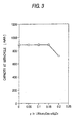
- lithium secondary batteries using the positive electrode active material satisfying the relations of 0 ⁇ x ⁇ 0.25, 0 ⁇ y ⁇ 0.3, 0 ⁇ z ⁇ 0.15 and x + y ⁇ 0.4 when 0 ⁇ y ⁇ 0.3 in LiNi 1-x-y-z Co x Mn y Al z O 2 are also excellent in cycle characteristic.
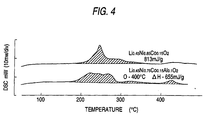
- z 0 is not preferable because addition of Al has an operational effect of improving battery safety by reducing the heating reaction rate as well as reducing the total heat release value.
- the fact that the heat release peak in the DSC data is broad is an evidence of the above description. Suppression of heat releasing is very important for battery safety in abnormal use.
- batteries in the upper portions in the respective sections in Tables 1 to 5 using ⁇ -Ni 1-x Co x Mn y (OH) z synthesized by co-precipitation, Al(OH) 3 and LiOH as raw materials for preparing a positive electrode active material are superior to batteries parenthesezed in the lower portions in the respective sections in Tables 1 to 5 using respective hydroxides of Li, Ni, Co and Mn.
- the value of the present invention is in that the optimum proportion of Ni, Co, Mn and Al not only for improving cycle characteristic remarkably but also for improving battery safety without lowering of energy density is found out. As a result, it can be made possible to provide a lithium secondary battery excellent both in cycle characteristic and in thermal stability and easy to handle.
Landscapes
- Chemical & Material Sciences (AREA)
- Chemical Kinetics & Catalysis (AREA)
- Electrochemistry (AREA)
- General Chemical & Material Sciences (AREA)
- Engineering & Computer Science (AREA)
- Inorganic Chemistry (AREA)
- Materials Engineering (AREA)
- Manufacturing & Machinery (AREA)
- Battery Electrode And Active Subsutance (AREA)
- Secondary Cells (AREA)
Claims (10)
- Matière active d'électrode positive pour batterie secondaire au lithium, comprenant LiNi1-x-y-zCoxMnyAlzO2 où x, y et z satisfont les relations 0 < y ≤ 0,3, 0 ≤ x ≤ 0,25, 0 < z ≤ 0,15 et x + y ≤ 0,4.
- Matière active d'électrode positive selon la revendication 1, où x satisfait la relation 0 ≤ x ≤ 0,2.
- Matière active d'électrode positive selon la revendication 2, où x satisfait la relation 0 ≤ x ≤ 0,1.
- Matière active d'électrode positive selon la revendication 2, où y satisfait la relation 0,1 ≤ y ≤ 0,2.
- Procédé. de production d'une matière active d'électrode positive pour batterie secondaire au lithium comprenant les étapes :de mélange d'au moins une substance parmi β-Ni1-x-yCOxMny(OH)2 et β-Ni1-x-yCoxMnyOOH où x et y satisfont les relations 0 < y ≤ 0,3, 0 ≤ x ≤ 0,25, d'un matériau formant source d'apport de Li qui est un composé chimique de Li utilisé au moment de la formation d'un oxyde composite de Li-Ni-Co-Al, et d'un matériau formant source d'apport de Al qui est un composé chimique de Al utilisé au moment de la formation d'un oxyde composite de Li-Ni-Co-Al ; etde calcination du mélange résultant.
- Procédé de production d'une matière active d'électrode positive selon la revendication 5, où x satisfait la relation 0 ≤ x ≤ 0,2.
- Procédé de production d'une matière active d'électrode positive selon la revendication 6, où x satisfait la relation 0 ≤ x ≤ 0,1.
- Procédé de production d'une matière active d'électrode positive selon la revendication 5, où ledit composé chimique de Li comprend au moins un composé parmi LiOH, Li2CO3 et LiNO3.
- Procédé de production d'une matière active d'électrode positive selon la revendication 5, où ledit composé chimique de Al comprend au moins un composé parmi Al(OH)3 et Al2O3.
- Batterie secondaire au lithium comprenant une électrode positive, une électrode négative, un séparateur, une borne d'électrode positive, un boítier servant de borne d'électrode négative et une solution électrolytique ; où la matière active de ladite électrode positive comprend LiNi1-x-y-zCoxMnyAlzO2 où x, y et z satisfont les relations 0 < y ≤ 0,3, 0 ≤ x ≤ 0,25, 0 < z ≤ 0,15 et x + y ≤ 0,4.
Applications Claiming Priority (6)
| Application Number | Priority Date | Filing Date | Title |
|---|---|---|---|
| JP353033/95 | 1995-12-29 | ||
| JP35303395 | 1995-12-29 | ||
| JP35303395 | 1995-12-29 | ||
| JP342516/96 | 1996-12-05 | ||
| JP34251696A JP3897387B2 (ja) | 1995-12-29 | 1996-12-05 | リチウム二次電池用正極活物質の製造方法 |
| JP34251696 | 1996-12-05 |
Publications (2)
| Publication Number | Publication Date |
|---|---|
| EP0782206A1 EP0782206A1 (fr) | 1997-07-02 |
| EP0782206B1 true EP0782206B1 (fr) | 2003-04-16 |
Family
ID=26577284
Family Applications (1)
| Application Number | Title | Priority Date | Filing Date |
|---|---|---|---|
| EP96120921A Expired - Lifetime EP0782206B1 (fr) | 1995-12-29 | 1996-12-27 | Matériau actif positif pour pile secondaire au lithium, procédé de fabrication et pile secondaire au lithium |
Country Status (4)
| Country | Link |
|---|---|
| EP (1) | EP0782206B1 (fr) |
| JP (1) | JP3897387B2 (fr) |
| CN (1) | CN1139138C (fr) |
| DE (1) | DE69627462T2 (fr) |
Cited By (5)
| Publication number | Priority date | Publication date | Assignee | Title |
|---|---|---|---|---|
| US7211237B2 (en) | 2003-11-26 | 2007-05-01 | 3M Innovative Properties Company | Solid state synthesis of lithium ion battery cathode material |
| US7368071B2 (en) | 2001-08-07 | 2008-05-06 | 3M Innovative Properties Company | Cathode compositions for lithium ion batteries |
| US8241791B2 (en) | 2001-04-27 | 2012-08-14 | 3M Innovative Properties Company | Cathode compositions for lithium-ion batteries |
| US8679670B2 (en) | 2007-06-22 | 2014-03-25 | Boston-Power, Inc. | CID retention device for Li-ion cell |
| US20220223831A1 (en) * | 2021-01-08 | 2022-07-14 | Semiconductor Energy Laboratory Co., Ltd. | Secondary battery and manufacturing method of positive electrode active material |
Families Citing this family (46)
| Publication number | Priority date | Publication date | Assignee | Title |
|---|---|---|---|---|
| JP2002289261A (ja) * | 2001-01-16 | 2002-10-04 | Matsushita Electric Ind Co Ltd | 非水電解質二次電池 |
| US20010036577A1 (en) * | 1996-11-28 | 2001-11-01 | Kenji Nakane | Lithium secondary battery and cathode active material for ues in lithium secondary battery |
| CA2234874C (fr) * | 1997-04-15 | 2009-06-30 | Sanyo Electric Co., Ltd. | Materiau de fabrication de cathode a utiliser dans une batterie activee par electrolytes non aqueux, processus de preparation et batterie activee par electrolytes non aqueux |
| JP2008195610A (ja) * | 1997-05-19 | 2008-08-28 | Showa Denko Kk | リチウム含有複合金属酸化物、その製造方法及び用途 |
| JP3142522B2 (ja) | 1998-07-13 | 2001-03-07 | 日本碍子株式会社 | リチウム二次電池 |
| AU1084300A (en) * | 1998-10-16 | 2000-05-08 | Pacific Lithium Limited | Lithium manganese oxide and methods of manufacture |
| US6730435B1 (en) * | 1999-10-26 | 2004-05-04 | Sumitomo Chemical Company, Limited | Active material for non-aqueous secondary battery, and non-aqueous secondary battery using the same |
| US6998069B1 (en) * | 1999-12-03 | 2006-02-14 | Ferro Gmbh | Electrode material for positive electrodes of rechargeable lithium batteries |
| US6350543B2 (en) * | 1999-12-29 | 2002-02-26 | Kimberly-Clark Worldwide, Inc. | Manganese-rich quaternary metal oxide materials as cathodes for lithium-ion and lithium-ion polymer batteries |
| JP5026629B2 (ja) * | 2000-03-15 | 2012-09-12 | ソニー株式会社 | 非水電解質電池用正極及び非水電解質電池 |
| US6660432B2 (en) | 2000-09-14 | 2003-12-09 | Ilion Technology Corporation | Lithiated oxide materials and methods of manufacture |
| JP4813453B2 (ja) * | 2000-11-16 | 2011-11-09 | 日立マクセルエナジー株式会社 | リチウム含有複合酸化物および非水二次電池 |
| EP1295851A4 (fr) | 2000-11-16 | 2008-08-20 | Hitachi Maxell | Oxyde composite a teneur en lithium et cellule secondaire non aqueuse utilisant cet oxyde, et procede de fabrication associe |
| JP4635386B2 (ja) * | 2001-07-13 | 2011-02-23 | 株式会社Gsユアサ | 正極活物質およびこれを用いた非水電解質二次電池 |
| US6878490B2 (en) | 2001-08-20 | 2005-04-12 | Fmc Corporation | Positive electrode active materials for secondary batteries and methods of preparing same |
| JP4981508B2 (ja) * | 2001-10-25 | 2012-07-25 | パナソニック株式会社 | 正極活物質およびこれを含む非水電解質二次電池 |
| JP4813450B2 (ja) * | 2001-11-22 | 2011-11-09 | 日立マクセルエナジー株式会社 | リチウム含有複合酸化物およびそれを用いた非水二次電池 |
| EP1357616B1 (fr) * | 2002-03-25 | 2012-11-28 | Sumitomo Chemical Company, Limited | Matièrie active d'électrode positive pour batterie secondaire et non-aqueux |
| US7410511B2 (en) | 2002-08-08 | 2008-08-12 | Matsushita Electric Industrial Co., Ltd. | Production method of positive electrode active material for non-aqueous electrolyte secondary battery and positive electrode active material |
| NZ538480A (en) * | 2003-04-17 | 2007-12-21 | Seimi Chem Kk | Lithium-nickel-cobalt-manganese containing composite oxide, material for positive electrode active material for lithium secondary battery, and methods for producing these |
| JP4578790B2 (ja) * | 2003-09-16 | 2010-11-10 | Agcセイミケミカル株式会社 | リチウム−ニッケル−コバルト−マンガン−アルミニウム含有複合酸化物の製造方法 |
| FR2873497B1 (fr) * | 2004-07-23 | 2014-03-28 | Accumulateurs Fixes | Accumulateur electrochimique au lithium fonctionnant a haute temperature |
| WO2006070977A1 (fr) | 2004-12-31 | 2006-07-06 | Iucf-Hyu (Industry-University Cooperation Foundation Hanyang University) | Materiaux actifs de cathode a double couche pour batterie auxiliaire au lithium, procede d'obtention des materiaux actifs et batterie auxiliaire au lithium utilisant lesdits materiaux actifs |
| KR100759377B1 (ko) | 2005-04-21 | 2007-09-19 | 삼성에스디아이 주식회사 | 리튬 이차 전지 |
| JP4909347B2 (ja) | 2006-06-09 | 2012-04-04 | Agcセイミケミカル株式会社 | 非水電解質二次電池用正極活物質の製造方法。 |
| JP5339766B2 (ja) | 2007-04-12 | 2013-11-13 | パナソニック株式会社 | 非水電解質二次電池 |
| KR101271852B1 (ko) | 2007-08-10 | 2013-06-07 | 유미코르 | 황을 함유하는 도핑된 리튬 전이금속 산화물 |
| KR101640937B1 (ko) | 2009-11-13 | 2016-07-20 | 삼성에스디아이 주식회사 | 리튬 이차 전지 |
| JP5471591B2 (ja) * | 2010-02-26 | 2014-04-16 | 東洋インキScホールディングス株式会社 | 電極用導電性組成物 |
| JP2015043258A (ja) * | 2011-12-22 | 2015-03-05 | パナソニック株式会社 | 密閉型電池 |
| US9520593B2 (en) | 2012-03-31 | 2016-12-13 | Iucf-Hyu (Industry-University Cooperation Foundation Hanyang University) | Method of preparing cathode active material precursor for lithium rechargeable battery, cathode active material precursor for lithium rechargeable battery prepared thereby, and cathode active material formed using the cathode active material precursor |
| WO2015006058A1 (fr) | 2013-07-09 | 2015-01-15 | Dow Global Technologies Llc | Matériau actif positif mélangé comprenant un oxyde métallique de lithium et un phosphate métallique de lithium |
| CN103985856A (zh) * | 2014-05-16 | 2014-08-13 | 海宁美达瑞新材料科技有限公司 | 一种镍钴铝酸锂正极材料及其制备方法 |
| EP3235028B1 (fr) | 2014-12-18 | 2021-05-12 | Dow Global Technologies LLC | Batterie au lithium-ion présentant une stabilité thermique améliorée |
| KR20170072032A (ko) | 2015-12-16 | 2017-06-26 | 삼성에스디아이 주식회사 | 리튬 이차 전지용 전해액 및 이를 포함하는 리튬 이차 전지 |
| CN105489886A (zh) * | 2016-01-11 | 2016-04-13 | 山东玉皇新能源科技有限公司 | 一种高振实密度的镍钴铝三元正极材料及其制备方法 |
| CN105845928B (zh) * | 2016-06-17 | 2019-05-31 | 天津中聚新能源科技有限公司 | 一种锂离子动力电池及其制备方法 |
| KR102539250B1 (ko) * | 2017-07-14 | 2023-06-01 | 바스프 에스이 | 전극 활물질의 제조 방법 |
| GB2566473B (en) | 2017-09-14 | 2020-03-04 | Dyson Technology Ltd | Magnesium salts |
| GB2566472B (en) | 2017-09-14 | 2020-03-04 | Dyson Technology Ltd | Magnesium salts |
| GB2569388B (en) | 2017-12-18 | 2022-02-02 | Dyson Technology Ltd | Compound |
| GB2569390A (en) | 2017-12-18 | 2019-06-19 | Dyson Technology Ltd | Compound |
| GB2569392B (en) | 2017-12-18 | 2022-01-26 | Dyson Technology Ltd | Use of aluminium in a cathode material |
| GB2569389B (en) * | 2017-12-18 | 2022-02-09 | Dyson Technology Ltd | Compound |
| GB2569387B (en) | 2017-12-18 | 2022-02-02 | Dyson Technology Ltd | Electrode |
| CN115956063A (zh) * | 2020-08-20 | 2023-04-11 | 株式会社半导体能源研究所 | 正极活性物质的制造方法 |
Citations (3)
| Publication number | Priority date | Publication date | Assignee | Title |
|---|---|---|---|---|
| EP0806397A1 (fr) * | 1995-11-24 | 1997-11-12 | Fuji Chemical Industry Co., Ltd. | Oxyde composite lithium-nickel, son procede de preparation, et materiau actif positif destine a une batterie secondaire |
| WO1998006670A1 (fr) * | 1996-08-12 | 1998-02-19 | Fuji Chemical Industry Co., Ltd. | Oxyde composite de lithium/nickel/cobalt, procede pour sa preparation, et materiau actif de cathode pour batterie rechargeable |
| EP0845824A1 (fr) * | 1996-11-28 | 1998-06-03 | Sumitomo Chemical Company Limited | Pile secondaire au lithium et materiau actif cathodique pour pile secondaire au lithium |
Family Cites Families (5)
| Publication number | Priority date | Publication date | Assignee | Title |
|---|---|---|---|---|
| DE3680249D1 (de) * | 1985-05-10 | 1991-08-22 | Asahi Chemical Ind | Sekundaerbatterie. |
| JP3079382B2 (ja) | 1990-05-17 | 2000-08-21 | 旭化成工業株式会社 | 非水系二次電池 |
| JPH04249074A (ja) | 1991-02-05 | 1992-09-04 | Sony Corp | 非水電解質二次電池の製造方法 |
| EP0714144B1 (fr) * | 1994-11-22 | 1999-09-15 | Sumitomo Chemical Company Limited | Cathode pour pile secondaire au lithium et sa méthode de production |
| US5631105A (en) * | 1995-05-26 | 1997-05-20 | Matsushita Electric Industrial Co., Ltd. | Non-aqueous electrolyte lithium secondary battery |
-
1996
- 1996-12-05 JP JP34251696A patent/JP3897387B2/ja not_active Expired - Lifetime
- 1996-12-27 CN CNB961140887A patent/CN1139138C/zh not_active Expired - Lifetime
- 1996-12-27 EP EP96120921A patent/EP0782206B1/fr not_active Expired - Lifetime
- 1996-12-27 DE DE69627462T patent/DE69627462T2/de not_active Expired - Fee Related
Patent Citations (3)
| Publication number | Priority date | Publication date | Assignee | Title |
|---|---|---|---|---|
| EP0806397A1 (fr) * | 1995-11-24 | 1997-11-12 | Fuji Chemical Industry Co., Ltd. | Oxyde composite lithium-nickel, son procede de preparation, et materiau actif positif destine a une batterie secondaire |
| WO1998006670A1 (fr) * | 1996-08-12 | 1998-02-19 | Fuji Chemical Industry Co., Ltd. | Oxyde composite de lithium/nickel/cobalt, procede pour sa preparation, et materiau actif de cathode pour batterie rechargeable |
| EP0845824A1 (fr) * | 1996-11-28 | 1998-06-03 | Sumitomo Chemical Company Limited | Pile secondaire au lithium et materiau actif cathodique pour pile secondaire au lithium |
Cited By (7)
| Publication number | Priority date | Publication date | Assignee | Title |
|---|---|---|---|---|
| US8241791B2 (en) | 2001-04-27 | 2012-08-14 | 3M Innovative Properties Company | Cathode compositions for lithium-ion batteries |
| US8685565B2 (en) | 2001-04-27 | 2014-04-01 | 3M Innovative Properties Company | Cathode compositions for lithium-ion batteries |
| US7368071B2 (en) | 2001-08-07 | 2008-05-06 | 3M Innovative Properties Company | Cathode compositions for lithium ion batteries |
| US7211237B2 (en) | 2003-11-26 | 2007-05-01 | 3M Innovative Properties Company | Solid state synthesis of lithium ion battery cathode material |
| US7488465B2 (en) | 2003-11-26 | 2009-02-10 | 3M Innovative Properties Company | Solid state synthesis of lithium ion battery cathode material |
| US8679670B2 (en) | 2007-06-22 | 2014-03-25 | Boston-Power, Inc. | CID retention device for Li-ion cell |
| US20220223831A1 (en) * | 2021-01-08 | 2022-07-14 | Semiconductor Energy Laboratory Co., Ltd. | Secondary battery and manufacturing method of positive electrode active material |
Also Published As
| Publication number | Publication date |
|---|---|
| CN1139138C (zh) | 2004-02-18 |
| CN1156910A (zh) | 1997-08-13 |
| DE69627462D1 (de) | 2003-05-22 |
| JPH09237631A (ja) | 1997-09-09 |
| EP0782206A1 (fr) | 1997-07-02 |
| JP3897387B2 (ja) | 2007-03-22 |
| DE69627462T2 (de) | 2003-10-30 |
Similar Documents
| Publication | Publication Date | Title |
|---|---|---|
| EP0782206B1 (fr) | Matériau actif positif pour pile secondaire au lithium, procédé de fabrication et pile secondaire au lithium | |
| US5718989A (en) | Positive electrode active material for lithium secondary battery | |
| EP1391959B1 (fr) | Batterie secondaire à électrolyte nonaqueux | |
| US6582854B1 (en) | Lithium ion secondary battery, cathode active material therefor and production thereof | |
| EP1903627B1 (fr) | Matériau actif de cathode pour une batterie au lithium | |
| KR970007518B1 (ko) | 재충전가능한 리튬전지 및 전지에 사용하는 애노드의 제조방법 | |
| EP1909345B1 (fr) | Matériau actif à cathode pour une batterie au lithium | |
| US6818351B2 (en) | Mixed cathode active material for lithium secondary battery | |
| JP4177574B2 (ja) | リチウム二次電池 | |
| JP2001266879A (ja) | 非水電解液二次電池 | |
| EP1439591B1 (fr) | Accumulateur a ions lithium | |
| KR100725705B1 (ko) | 리튬 이차 전지용 전극 활물질 | |
| KR20030076431A (ko) | 비수 전해질 이차 전지 | |
| KR100660949B1 (ko) | 자체회복 가능한 갈륨 합금 전극, 이를 이용한 리튬 이차전지 및 갈륨 합금 전극 제조방법 | |
| JPH1145715A (ja) | 非水電解質二次電池とその負極の製造法 | |
| JPH06349493A (ja) | 二次電池 | |
| US6482546B1 (en) | Rechargeable lithium battery | |
| JPH11111291A (ja) | 非水二次電池用正極材料及びこれを用いた電池 | |
| KR20000071371A (ko) | 비수성 전해질 전지 | |
| EP0810680B1 (fr) | Batterie à électrolyte non-aqueux avec électrode en carbone | |
| JP4795509B2 (ja) | 非水電解質電池 | |
| KR101602419B1 (ko) | 양극활물질, 이를 포함하는 양극 및 상기 양극을 채용한 리튬전지 | |
| EP0987780A2 (fr) | Batterie à électrolyte non-aqueux | |
| KR100560537B1 (ko) | 비수계 전해질 이차 전지용 음극 활물질, 그의 제조 방법및 그를 포함하는 비수계 전해질 이차 전지 | |
| JP3268924B2 (ja) | 非水電解質電池 |
Legal Events
| Date | Code | Title | Description |
|---|---|---|---|
| PUAI | Public reference made under article 153(3) epc to a published international application that has entered the european phase |
Free format text: ORIGINAL CODE: 0009012 |
|
| AK | Designated contracting states |
Kind code of ref document: A1 Designated state(s): DE FR GB |
|
| 17P | Request for examination filed |
Effective date: 19971009 |
|
| 17Q | First examination report despatched |
Effective date: 19990713 |
|
| GRAG | Despatch of communication of intention to grant |
Free format text: ORIGINAL CODE: EPIDOS AGRA |
|
| GRAG | Despatch of communication of intention to grant |
Free format text: ORIGINAL CODE: EPIDOS AGRA |
|
| GRAH | Despatch of communication of intention to grant a patent |
Free format text: ORIGINAL CODE: EPIDOS IGRA |
|
| GRAH | Despatch of communication of intention to grant a patent |
Free format text: ORIGINAL CODE: EPIDOS IGRA |
|
| GRAA | (expected) grant |
Free format text: ORIGINAL CODE: 0009210 |
|
| AK | Designated contracting states |
Designated state(s): DE FR GB |
|
| REG | Reference to a national code |
Ref country code: GB Ref legal event code: FG4D |
|
| REF | Corresponds to: |
Ref document number: 69627462 Country of ref document: DE Date of ref document: 20030522 Kind code of ref document: P |
|
| PG25 | Lapsed in a contracting state [announced via postgrant information from national office to epo] |
Ref country code: GB Free format text: LAPSE BECAUSE OF NON-PAYMENT OF DUE FEES Effective date: 20031227 |
|
| ET | Fr: translation filed | ||
| PLBE | No opposition filed within time limit |
Free format text: ORIGINAL CODE: 0009261 |
|
| STAA | Information on the status of an ep patent application or granted ep patent |
Free format text: STATUS: NO OPPOSITION FILED WITHIN TIME LIMIT |
|
| 26N | No opposition filed |
Effective date: 20040119 |
|
| PG25 | Lapsed in a contracting state [announced via postgrant information from national office to epo] |
Ref country code: DE Free format text: LAPSE BECAUSE OF NON-PAYMENT OF DUE FEES Effective date: 20040701 |
|
| GBPC | Gb: european patent ceased through non-payment of renewal fee |
Effective date: 20031227 |
|
| PG25 | Lapsed in a contracting state [announced via postgrant information from national office to epo] |
Ref country code: FR Free format text: LAPSE BECAUSE OF NON-PAYMENT OF DUE FEES Effective date: 20040831 |
|
| REG | Reference to a national code |
Ref country code: FR Ref legal event code: ST |