EP0783023B1 - Polymer Dispergiermittel für pigmentierten Tinten - Google Patents
Polymer Dispergiermittel für pigmentierten Tinten Download PDFInfo
- Publication number
- EP0783023B1 EP0783023B1 EP96309009A EP96309009A EP0783023B1 EP 0783023 B1 EP0783023 B1 EP 0783023B1 EP 96309009 A EP96309009 A EP 96309009A EP 96309009 A EP96309009 A EP 96309009A EP 0783023 B1 EP0783023 B1 EP 0783023B1
- Authority
- EP
- European Patent Office
- Prior art keywords
- methacrylate
- acrylate
- copolymer
- segment
- ethyleneoxy
- Prior art date
- Legal status (The legal status is an assumption and is not a legal conclusion. Google has not performed a legal analysis and makes no representation as to the accuracy of the status listed.)
- Expired - Lifetime
Links
Classifications
-
- C—CHEMISTRY; METALLURGY
- C09—DYES; PAINTS; POLISHES; NATURAL RESINS; ADHESIVES; COMPOSITIONS NOT OTHERWISE PROVIDED FOR; APPLICATIONS OF MATERIALS NOT OTHERWISE PROVIDED FOR
- C09D—COATING COMPOSITIONS, e.g. PAINTS, VARNISHES OR LACQUERS; FILLING PASTES; CHEMICAL PAINT OR INK REMOVERS; INKS; CORRECTING FLUIDS; WOODSTAINS; PASTES OR SOLIDS FOR COLOURING OR PRINTING; USE OF MATERIALS THEREFOR
- C09D11/00—Inks
- C09D11/30—Inkjet printing inks
- C09D11/32—Inkjet printing inks characterised by colouring agents
- C09D11/324—Inkjet printing inks characterised by colouring agents containing carbon black
- C09D11/326—Inkjet printing inks characterised by colouring agents containing carbon black characterised by the pigment dispersant
-
- C—CHEMISTRY; METALLURGY
- C08—ORGANIC MACROMOLECULAR COMPOUNDS; THEIR PREPARATION OR CHEMICAL WORKING-UP; COMPOSITIONS BASED THEREON
- C08F—MACROMOLECULAR COMPOUNDS OBTAINED BY REACTIONS ONLY INVOLVING CARBON-TO-CARBON UNSATURATED BONDS
- C08F290/00—Macromolecular compounds obtained by polymerising monomers on to polymers modified by introduction of aliphatic unsaturated end or side groups
- C08F290/02—Macromolecular compounds obtained by polymerising monomers on to polymers modified by introduction of aliphatic unsaturated end or side groups on to polymers modified by introduction of unsaturated end groups
- C08F290/06—Polymers provided for in subclass C08G
- C08F290/068—Polysiloxanes
-
- C—CHEMISTRY; METALLURGY
- C08—ORGANIC MACROMOLECULAR COMPOUNDS; THEIR PREPARATION OR CHEMICAL WORKING-UP; COMPOSITIONS BASED THEREON
- C08L—COMPOSITIONS OF MACROMOLECULAR COMPOUNDS
- C08L51/00—Compositions of graft polymers in which the grafted component is obtained by reactions only involving carbon-to-carbon unsaturated bonds; Compositions of derivatives of such polymers
- C08L51/08—Compositions of graft polymers in which the grafted component is obtained by reactions only involving carbon-to-carbon unsaturated bonds; Compositions of derivatives of such polymers grafted on to macromolecular compounds obtained otherwise than by reactions only involving unsaturated carbon-to-carbon bonds
-
- Y—GENERAL TAGGING OF NEW TECHNOLOGICAL DEVELOPMENTS; GENERAL TAGGING OF CROSS-SECTIONAL TECHNOLOGIES SPANNING OVER SEVERAL SECTIONS OF THE IPC; TECHNICAL SUBJECTS COVERED BY FORMER USPC CROSS-REFERENCE ART COLLECTIONS [XRACs] AND DIGESTS
- Y10—TECHNICAL SUBJECTS COVERED BY FORMER USPC
- Y10S—TECHNICAL SUBJECTS COVERED BY FORMER USPC CROSS-REFERENCE ART COLLECTIONS [XRACs] AND DIGESTS
- Y10S260/00—Chemistry of carbon compounds
- Y10S260/38—Ink
Definitions
- This invention relates to dispersants used in pigmented ink formulations for ink jet printers.
- Ink jet printing is accomplished by ejecting ink from a nozzle toward paper or another print medium.
- the ink is driven from the nozzle toward the medium in a variety of ways.
- electrostatic printing the ink is driven by an electrostatic field.
- squeeze tube Another ink jet printing procedure, known as squeeze tube, employs a piezo-electric element in the ink nozzle. Electrically-caused distortions of the piezo-electric element pump the ink through the nozzle and toward the print medium.
- thermal or bubble ink jet printing the ink is driven from the nozzle toward the print medium by the formation of an expanding vapor phase bubble in the nozzle.
- Ink compositions for use in ink jet printers generally comprise deionized water, a water soluble or water miscible organic solvent, and a colorant. Frequently, the colorant is a soluble dye.
- the colorant is a soluble dye.
- inks comprising soluble dyes can exhibit many problems, such as poor water-fastness, poor light-fastness, clogging of the jetting channels as a result of solvent evaporation and changes in the dye's solubility, dye crystallization, ink bleeding and feathering on the printed page, poor thermal stability, chemical instability, and ease of oxidation. Many of these problems can be minimized by replacing the soluble dyes used in ink formulations with insoluble pigments.
- pigments have superior properties when compared to dyes, including good water-fastness, good light-fastness, thermal stability, oxidative stability, and compatibility with both coated/treated and plain papers.
- the insoluble pigment is generally stabilized in a dispersion by a polymeric component.
- most pigment inks stabilized by polymers in aqueous media are based on an electrostatic stabilizing mechanism in which the hydrophobic group in the dispersant acts as an anchor adsorbed on the pigment particle surface through acid-base, electron donor/acceptor, Van der Waals forces, or physical absorption.
- the hydrophilic group in the dispersant is extended into the aqueous medium to keep the dispersant soluble and to set up an electrosteric layer to prevent aggregation of the particles.
- the polymeric dispersants utilized in these compositions are preferably block polymers containing hydrophobic and hydrophilic segments.
- U.S. Patent Application Serial Number 08/360,200, Beach, et al., (EP-0722994A) describes stabilizers used for pigmented inks. These stabilizers are graft polymers which contain a carboxylic acid-containing hydrophilic polymeric backbone to which is grafted a hydrophobic group, oligomer or polymer connected by the reaction of the carboxylic acid group on the backbone with the functional group on the hydrophobe.
- Such stabilizers include aliphatic or alkyl aryl amines condensed with polyacrylic acid, amine-terminated acrylic esters condensed with polyacrylic acid, amine- terminated polyoxyalkylene polymers condensed with polyacrylic acid, and amine polymer backbones condensed with acid-containing hydrophobic segments.
- EP-A-0556649 describes triblock copolymers for use as dispersants in aqueous ink compositions.
- the triblock polymers comprise a hydrophilic polymer, a polymer which is capable of binding to particulate pigment, and a third polymer which is hydrophobic or hydrophilic.
- the present invention relates to aqueous ink compositions which include polymeric dispersants.
- these compositions for use in ink jet printers comprise from 0.5% to 10% of an insoluble pigment, from 0.25% to 10% of the polymeric dispersant described below, and an aqueous carrier.
- the graft copolymers, used as dispersants in the ink jet compositions have a molecular weight of from 1,500 to 20,000, and comprise:
- the present invention also relates to graft copolymers as described above, wherein hydrophilic monomeric units of the hydrophilic polymeric segment and the hydrophobic polymeric segment are in a ratio of 10:1 to 100:1, and the hydrophobic polymeric segment and the stabilizing segment are in a ratio of 1:0.5 to 1:5. All percentages and ratios, used herein, are "by weight” unless otherwise specified. All molecular weights, used herein, are number average molecular weights unless otherwise specified.
- the present invention relates to polymeric dispersants used to stabilize aqueous pigment ink compositions, as well as pigment ink compositions containing those dispersants.
- the polymers of the present invention have a molecular weight of from 1,500 to 20,000, preferably from 2,000 to 10,000, most preferably 2,500 to 5,000.
- the polymers function to stabilize the pigment dispersion in the aqueous ink composition.
- the polymers also assist in the redispersion of the pigment after drying out of the nozzle during printer shutdown.
- the polymers provide for inks having good water-fastness, light-fastness and excellent print quality and optical density characteristics.
- the polymers of the present invention are graft copolymers comprising three distinct segments: a hydrophilic polymeric segment, a hydrophobic segment which incorporates a hydrolytically stable siloxy substituent, and a stabilizing segment. Each of these segments will be described in detail below.
- the hydrophilic portion of the polymer helps control polymer solubility in the ink composition.
- the hydrophilic segment will include acidic functional groups, such as carboxylic or sulfonic acid groups, and it is prepared, for example, by polymerizing hydrophilic monomers. Suitable hydrophilic polymers will be known to those skilled in the art. Preferred hydrophilic segments contain carboxyl substituents.
- the hydrophilic segment is an acrylic or methacrylic polymer or a copolymer thereof.
- the hydrophilic segment can comprise an acrylic copolymer, such as a copolymer of acrylic acid with another monomer, such as styrene, which does not interfere with the hydrophilic character of the segment.
- Hydrophilic segments which may be used in the present invention are disclosed in U.S. Patent 5,219,945, Dicker, et al., issued June 15, 1993; U.S. Patent 5,085,698, Ma, et al., issued February 4, 1992; and U.S. Patent 5,221,334, Ma, et al., issued June 22, 1993.
- the hydrophilic segment comprises from 20% to 80% of the entire polymeric dispersant.
- the hydrophilic segment itself must be long enough such that it acts to provide a stabilizing function to the dispersant.
- the hydrophobic polymeric segment comprises a polymer or copolymer containing a hydrolytically stable linear or branched siloxyl substituent. This segment functions as the anchor to adsorb the dispersant onto the pigment particle surface.
- a siloxyl substituent (an oligomeric siloxane) has the formula: wherein n is from 1 to 50, preferably from 2 to 16, R 1 to R 5 are independently alkyl or aryl, preferably lower alkyl (C 1 - C 6 ), phenyl or benzyl, and may optionally be substituted with a variety of non-interfering substituents. For branched siloxy substituents, R 4 and/or R 5 are siloxyl substituents.
- the siloxyl substituent will be terminated with a lower alkyl group.
- R 1 and R 3 - R 5 are preferably methyl, i.e., the siloxyl substituent is a dimethyl polysiloxane; and R 2 is preferably butyl.
- Acryloyl or methacryloyl-terminated polydialkylsiloxane macromers are preferred hydrophobic polymeric segments.
- the siloxyl substituent is hydrolytically stable in that it does not react with water under neutral conditions.
- the preferred hydrophobic polymeric segment is derived from a macromer having the formula: wherein n is from 2 to 16, and each R is independently benzyl, siloxyl, or lower alkyl (C 1 - C 6 , preferably C 1 - C 4 ).
- R 1 and R 3 - R 7 are preferably methyl
- R 2 is preferably butyl
- R 8 is preferably a methacryl oxypropyl group.
- the hydrophobic segment is an acrylate or methacrylate ester (oxo or thio), or an amide polymer having a siloxyl substituent (e.g., an oligomeric siloxane grafted to a polyacrylate or polymethacrylate).
- Suitable hydrophobic copolymers having a siloxyl substituent will be known to those skilled in the art.
- the hydrophobic segment has a molecular weight of from 400 to 3,000, preferably from 400 to 2,000, more preferably from 800 to 1,200, most preferably about 900.
- the third segment of the copolymer also acts to help bind the dispersant to the pigment particles as well as to enhance the stabilizing efficacy of the entire polymer.
- the stabilizing segment is preferably selected from either a reactive surfactant or a protective colloid macromer material or a non-siloxyl hydrophobic monomer. This segment has a molecular weight of from 200 to 2,000, preferably from 200 to 1,000.
- the stabilizing segment must include a moiety which enables it to polymerize into the remainder of the polymer. Preferred stabilizing segments accomplish that through the inclusion of an acrylic group.
- Reactive surfactants contain both hydrophobic and hydrophilic moieties and not only function as surfactants in the conventional manner but also tend to effectively uniformly coat insoluble particles in a dispersion. These materials can have the properties of nonionic or anionic surfactants.
- Protective colloids are reactive polymers derived from cellulose (methyl cellulose, hydroxymethyl cellulose, and hydroxyethyl cellulose), polyvinyl alcohols and polyglycols. These products can provide the protective qualities of methyl cellulose, hydroxyethyl cellulose, or polyglycols without the attendant disadvantages of these products, such as water sensitivity and poor compatibility with certain compounding formulations.
- Non-siloxyl hydrophobic monomers may be derived from long chain aliphatic groups, long chain alcohols, and alkyl aryl alcohols. Examples of such materials would include stearyl or lauryl acrylate or methacrylate or nonyl phenol acrylate or methacrylate.
- stabilizing segments Materials which can be used as stabilizing segments are commercially available, for example, from Monomer-Polymer & Dajac Laboratories, Inc., Feasterville, Pennsylvania, and Aldrich Chemical, Milwaukee, Wisconsin.
- reactive surfactants include nonylphenoxy poly(ethyleneoxy)- acrylate (containing from 1 to 40 moles of ethylene oxide), nonylphenoxy poly(ethyleneoxy) - methacrylate (containing from 1 to 40 moles of ethylene oxide), nonylphenoxy poly(ethyleneoxy) - crotonate (containing from 5 to
- protective colloid materials include hydroxyethylcellulose acrylate, hydroxyethylcellulose methacrylate, methoxypoly(ethyleneoxy) acrylate (containing from 5 to 40 moles of ethylene oxide), methoxypoly(ethyleneoxy) methacrylate (containing from 5 to 40 moles of ethylene oxide), methylcellulose acrylate, methylcellulose methacrylate, methylcellulose crotonate, stearyloxypoly(ethyleneoxy) acrylate (containing from 1 to 40 moles of ethylene oxide), and stearyloxypoly(ethyleneoxy) methacrylate (containing from 10 to 40 moles of ethylene oxide). Mixtures of these materials may be used.
- Preferred stabilizing segments which may be used in the polymers of the present invention include stearyl acrylate, stearyl methacrylate, lauryl acrylate, lauryl methacrylate, nonylphenol acrylate, nonylphenol methacrylate, nonylphenoxy poly(ethyleneoxy) n methacrylate, wherein n is from 1 to 40, preferably from 6 to 15; nonylphenoxy poly(ethyleneoxy) n acrylate, wherein n is from 1 to 40, preferably from 6 to 15; methoxypoly(ethyleneoxy) n methacrylate, wherein n is from 5 to 40, preferably from 5 to 15; methoxypoly(ethyleneoxy) n acrylate, wherein n is from 5 to 40, preferably from 5 to 15; stearyloxypoly(ethyleneoxy) n methacrylate, wherein n is from 1 to 20; stearyloxypoly(ethyleneoxy) n acrylate, wherein n is from 1 to 20;
- Particularly preferred stabilizing segments include stearyl methacrylate (having a molecular weight of about 325), stearyl acrylate, lauryl methacrylate, lauryl acrylate, nonylphenoxy PEG-10 methacrylate, trimethylsiloxy-terminated PEG 4-5 methacrylate, PPG-4-nonylphenol acrylate, and trihydroperfluoro undecyl methacrylate.
- Stearyl methacrylate is particularly preferred. Mixtures may be used.
- the graft copolymers of the present invention can be made by standard synthetic techniques such as those described in Steven's Polymer Chemistry, An Introduction, Oxford University Press (1990). Free radical polymerization is the preferred method of synthesis. Such a free radical polymerization reaction utilizes initiators and chain transfer agents to control the polymer molecular weight. Any conventional free radical initiator and chain transfer agent materials known in the art may be used in the present invention as long as they are compatible with the reactants being utilized.
- Preferred free radical initiators are of the azo-type or peroxide-type (preferably the azo-type) and preferred chain transfer agents include C 4 to C 18 (preferably C 12 to C 16 ) alkylthiol groups. Particularly preferred is n-C 12 thiol.
- the graft copolymer dispersants of the present invention require a relatively low molecular weight in order to achieve the particle stability and low viscosity required for use in stable ink jet printing inks. This may result in the selection of a polar solvent polymerization process for making the copolymers. Such a process controls the molecular weight and uniformity of the copolymers by maintaining solubility of all the starting materials (free radical initiator, hydrophobic and hydrophilic monomers, and chain transfer agents), as well as the resultant copolymer.
- a typical copolymer recovery process from a polar polymerization solvent would comprise the following steps:
- copolymer powder could then be dissolved in an aqueous base and used in the preparation of an ink jet printing ink. This process can be costly and unnecessarily complicated.
- Preferred processes for the recovery of the copolymer dispersant from the polar organic polymerization solvent not only simplify the recovery of the copolymer dispersant, but also result in improved print quality properties for ink jet inks made from those dispersants in that the tendency of the inks to form satellites and splatter is reduced.
- these preferred processes are:
- the polar solvent is first stripped from the copolymer by a standard process that can convert the copolymer solution to a dry powder, such as vacuum tray drying, rotary evaporator drying, drum drying, rotary cylindrical vacuum drying, or spray drying.
- the dry copolymer powder is then dissolved in the aqueous base so that it can be used in the preparation of pigmented ink jet inks.
- aqueous base e.g., a KOH solution
- the temperature of this mixture is slowly increased to distill off the solvent until the temperature reaches about 100°C at which time all polar organic solvent is removed.
- Additional aqueous base e.g., a KOH solution
- a KOH solution is added to the solution to raise the pH to from 7 to 8.5, preferably about 7.5. The solution is then ready for use in formulating a pigmented ink jet ink.
- the molecular weight of the dispersant polymer is from 1,500 to 20,000, preferably from 2,000 to 10,000. It is preferred that the ratio in the polymeric dispersant be from 10 to 100 hydrophilic monomeric units to 1 hydrophobic polymeric segment, preferably from 15 to 50 hydrophilic monomeric units to 1 hydrophobic polymeric segment.
- the ratio of hydrophobic polymeric segment to stabilizing segment is from 1 to 0.5 hydrophobic polymeric segments to from 1 to 5 stabilizing segments (preferably 1:1).
- a particularly preferred polymeric dispersant of the present invention is one comprising in its backbone the following structural formula wherein x is from 5 to 100, preferably from 15 to 50; y is from 1 to 2, most preferably about 1; z is from 1 to 5, preferably from 1 to 2, most preferably about 1; a is from 3 to 45, preferably from 3 to 24, most preferably about 9; b is from 3 to 29, preferably from 5 to 17, most preferably from 15 to 17; c is from 2 to 8, preferably about 3; and d is from 0 to 7, preferably about 3.
- the end groups on the dispersants of this invention are not limited. For illustrative purposes, they can include thio-substituted hydrocarbons, as well as hydrogen.
- all structural units represented by x, y, and z herein to be randomly dispersed throughout the polymer backbone.
- aqueous ink compositions of the present invention comprise from 0.5% to 10% of an insoluble pigment, from 0.25% to 10%, preferably from 0.5% to 5%, of the polymeric dispersant discussed above, and an aqueous carrier.
- pigments may be selected for use in the aqueous inks of the present invention.
- the key selection criteria for the pigment is that they must be dispersable in the aqueous medium.
- the term "pigment”, as used herein, means an insoluble colorant.
- the pigment particles are sufficiently small to permit free flow of the ink through the ink jet printing device, especially at the ejecting nozzles that usually have a diameter ranging from 10 microns to 50 microns.
- the particle size also has an influence on pigment dispersion stability, which is critical throughout the life of the ink.
- the range of useful particle size is from 0.05 micron to 15 microns.
- the pigment particle size should range from 0.05 micron to 5 microns and, most preferably, from 0.05 micron to 1 micron.
- Useful pigments are described in U.S. Patent 5,085,698, Ma, et al., issued February 4, 1992.
- the selected pigment may be used in dry or wet form.
- pigments are usually manufactured in aqueous media and the resulting pigment is obtained as water wet presscake.
- presscake form the pigment is not agglomerated to the extent that it is in dry form.
- pigments in water wet presscake form do not require as much deflocculation in the process of preparing the inks as do dry pigments.
- Fine particles of metal or metal oxides may also be used to practice the invention.
- metal and metal oxides are suitable for the preparation of magnetic ink jet inks.
- Fine particle size oxides such as silica, alumina and titania may also be used.
- finely divided metal particles such as copper, iron, steel, aluminum and alloys, may be selected for appropriate applications.
- Pigments suitable for use in the present invention include, for example, azo pigments, such as azo lakes, insoluble azo pigments, condensed azo pigments and chelate azo pigments, polycyclic pigments, perylene pigments, anthraquinone pigments, quinacridone pigments, dioxazine pigments, thioindigo pigments, isoindolinone pigments, quinophthalone pigments, and dry lakes.
- Useful organic pigments include nitro pigments, nitroso pigments, aniline black and daylight fluorescent pigments.
- Preferred pigments include titanium oxide, iron oxide, and carbon black.
- Examples of commercially available pigments which may be used in the present invention include the following: Heliogen® Blue L 6901F (BASF), Heliogen® Blue NBD 7010 (BASF), Heliogen® Blue K 7090 (BASF), Heucophthal® Blue G XBT-583D (Heubach), Irgalite® Rubine 4BL (Ciba-Geigy), Quindo® Magenta (Mobay), Indofast® Brilliant Scarlet (Mobay), Hostaperm® Scarlet GO (Hoechst), Permanent Rubine F6B (Hoechst), Monastral® Scarlet (Ciba-Geigy), Raven® 1170 (Col.
- the amount of pigment used in the inks may vary depending on their structure, but generally the pigments are used in a range of from 0.5% to 10%, preferably from 2 to 6%, by weight of the ink composition.
- the pigment to dispersant (weight) ratio is preferably about 3:1, but may vary from 1:1 to 6:1.
- the third component of the ink composition of the present invention is the aqueous carrier medium which is generally present at from about 80% to about 99% of the composition.
- the aqueous carrier medium comprises water (preferably deionized water) and, preferably, at least one water soluble organic solvent. Selection of a suitable carrier mixture depends on the requirements of the specific application involved, such as desired surface tension and viscosity, the selected pigment, the desired drying time of the ink, and the type of paper onto which the ink will be printed.
- water soluble organic solvents that may be selected include (1) alcohols, such as methyl alcohol, ethyl alcohol, n-propyl alcohol, iso-propyl alcohol, n-butyl alcohol, sec-butyl alcohol, t-butyl alcohol, iso-butyl alcohol, furfuryl alcohol, and tetrahydrofurfuryl alcohol; (2) ketones or ketoalcohols, such as acetone, methyl ethyl ketone and diacetone alcohol; (3) ethers, such as tetrahydrofuran and dioxane; (4) esters, such as ethyl acetate, ethyl lactate, ethylene carbonate and propylene carbonate; (5) polyhydric alcohols, such as ethylene glycol, diethylene glycol, triethylene glycol, propylene glycol, tetraethylene glycol, polyethylene glycol, glycerol, 2-methyl - 2,4-pentanediol, 1,2,6
- Preferred water soluble organic solvents include polyhydric alcohols, such as ethylene glycol, propylene glycol, butylene glycol, triethylene glycol, 1,2,6-hexanetriol, thiodiglycol, hexylene glycol, and diethylene glycol; diols, such as butanediol, pentanediol, hexanediol and homologous diols; glycol ethers, such as propylene glycol laureate; glycerol; polyalkyl glycols, such as polyethylene glycol; and lower alkyl ethers of polyhydric alcohols, such as ethylene glycol monomethyl or monoethyl ether, diethylene glycol methyl or ethyl ether, and triethylene glycol monomethyl or monoethyl ether.
- Particularly preferred organic solvents include ethylene glycol, diethylene glycol, and tetraethylene glycol.
- the aqueous carrier medium contains a mixture of water and organic solvent
- that mixture usually contains from 25% water/75% organic solvent to 95% water/5% organic solvent.
- the preferred ratios range from 50% water/50% organic solvent to 95% water/5% organic solvent. Percentages are based on the total weight of the aqueous carrier medium, not the entire composition.
- the ink compositions of the present invention are manufactured using procedures well known in the art, such as those described in U.S. Patent 5,085,698, Ma, et al., issued February 4, 1992.
- the ink is preferably prepared by mixing the pigment, dispersant and deionized water together in an attritor to form a concentrate.
- the pigment concentrate is ground until the appropriate particle size is obtained.
- the concentrate is then diluted with water and the appropriate formulation components added to give the desired ink.
- surfactants may be added to modify the surface tension of the ink and to control the penetration of the ink into the paper. Suitable surfactants include nonionic, amphoteric and ionic surfactants.
- Other additives, such as biocides, humectants, chelating agents, and viscosity modifiers, may be added to the ink composition at their art-established levels.
- the process for preparing pigmented ink jet inks typically requires that they have their particles reduced in size using a grinding mill.
- the requirement that the inks have a shelf life stability of two years or more requires that the median pigment particle size be less than about 200 nm, preferably less than about 140 nm.
- This particle size requirement is achieved by extensive shearing of the pigment particles using small grinding media.
- Typical of the media used in the preparation of pigmented inks includes spherical particles made from stainless steel, zirconium silicate, zirconium oxide and glass.
- the high surface area particulate media used in this grinding process sometimes wears off into the ink dispersion, contaminating the final formulation. The contamination, depending on the type and quantity, can adversely affect ink performance.
- the contamination can result in pH alteration as a result of the media reacting with formulation chemicals, difficult ink filtration, and a decrease in ink functional stability through the life of the print cartridge.
- Preferred grinding media are spherical ceramic particles having a highly smooth and uniform exterior surface, a high density and high hardness.
- a particularly preferred grinding medium for use in preparing the inks of the present invention is the material commercially available under the name YTZ Ceramic Beads, commercially available from S.E. Firestone Associates, Philadelphia, Pa. and manufactured by Nippon Kagaku Togyo. This material is in the form of spherical ceramic particles having a core of a high purity zirconium oxide treated with yttrium to make the spheres highly wear resistant.
- the particles are perfect spheres having a very smooth and uniform exterior surface, a density of 6.0 grams per cubic centimeter, and hardness of 91. Examples of processes for making such materials are described in Japanese Published Application 57-191234, published November 25, 1982, and Japanese Published Application 56-145118, published November 11, 1981.
- a polymeric dispersant of the present invention is made as follows.
- the mixture is allowed to cool to room temperature and then added slowly to rapidly stirred hexane 1.0L.
- the resulting solid is isolated by vacuum filtration and dried in vacuum overnight at 80C.
- the yield of the reaction varies from 85% to 90%.
- the co-polymer is characterized by proton NMR and GPC.
- the co-polymer dispersant stock solution is prepared as follows: A 400 mL beaker containing 40 g of DI water is set on a hot plate with a magnetic stirrer. The co-polymer, 12 g, is added to the beaker while stirring, then 18 g of 20% KOH is added to the system. The mixture is heated to 50C for 2 hours. The pH is adjusted to 7.5 by addition of 20% KOH. Then DI water is added to bring the total weight to 100 g.
- Preparation A Components Amount Carbon Black (Degussa Corp., Special Black 4A) 27.0g MAA-co-PDMS-co-Nonylphenol-PEG-10-MA stock solution 75.0g DI Water 52.4g Ethylene glycol 25.6g
- Preparation B Components Amount Carbon Black (Degussa Corp., FW18) 20.3g MAA-co-PDMS-co-Nonylphenol-PEG-10-MA 67.5g DI Water 92.2g
- Preparations A and B are made as follows.
- the components are premixed by mechanical stirring until there are no visible lumps.
- the mixture is dispersed by an attrition process using a Szegvari attritor model 01 std with 10-12 mesh zirconium silicate shot at a speed of 700 rpm.
- the attrition process is typically performed for a minimum of one hour, however, longer times at controlled temperature can also be used.
- the carbon black dispersion mix is removed from the attritor and let down, by the addition of DI water, to a final premix percent solids of 17.5%.
- An ink is prepared by mixing the concentrated premix dispersion Preparation A with ethylene glycol and DI water.
- the formulation is given below: Components Amount Premix Dispersion Preparation A 38.0g Ethylene Glycol 19.5g DI Water 75.0g Proxel® GXL 0.27g
- the final pH of the ink is adjusted to 8.0 by the addition of 20% KOH.
- the ink is filtered through a series of filters with the final filter being 1.2 microns.
- the median particle size determined by Leeds and Northrop Microtrac UPA 150 measurement is about 190 nm.
- An ink composition is prepared, using the same procedure as for Ink A, above, except that MAA-co-PDMS-co-Trimethylsiloxy-terminated PEG (4-5) Methacrylate is used as the dispersant.
- An ink composition is prepared, using the same procedure as for Ink A, above, except that MAA-co-PDMS-co-Stearyl Methacrylate is used as the dispersant.
- An ink composition is prepared, using the same procedure as for Ink A above, except that MAA-co-PDMS-co-PPG-4-Nonylphenol acrylate is used as the dispersant.
- An ink is prepared by mixing the concentrated premix dispersion Preparation B with diethylene glycol, tetraethylene glycol and DI water.
- Components Amount Premix Dispersion Preparation B 83.3g Diethylene Glycol 15.0g Tetraethylene Glycol 5.0g DI Water 96.3g Proxel® GXL 0.4g
- the final pH of the ink is adjusted to 8.0 by the addition of 20% KOH.
- the ink is filtered through a series of filters with the final filter being 1.2 microns.
- the median particle size is about 140 nm.
- An ink composition is prepared, using the same procedure as for Ink E, above, except that MAA-Co-PDMS-Co-Trimethylsiloxy-terminated PEG 4-5 methacrylate is used as dispersant.
- An ink composition is prepared, using the same procedure as for Ink E, above, except that MAA-co-PDMS-co-Stearyl Methacrylate is used as dispersant.
- An ink composition is prepared, using the same procedure as for Ink E, above, except that MAA-Co-PDMS-Co-PPG-4-Nonylphenol acrylate is used as dispersant.
- the inks described above are print tested using an IBM Model IJ4076 printer, manufactured by Lexmark International.
- the print samples are generated on IBM Multisystem bond paper and are tested using the following procedures:
- a second polymeric dispersant of the present invention is made as follows.
- the mixture is allowed to cool to room temperature and then added slowly to rapidly stirred hexane 1.0L.
- the resulting solid is isolated by vacuum filtration and dried in vacuum overnight at 80C.
- the yield of the reaction is about 85%.
- the co-polymer is characterized by proton NMR and GPC.
- This polymeric dispersant is formulated into a pigment ink composition as described in the present application.
- the ink composition shows excellent stability, print characteristics, water-fastness, light-fastness, optical density, and in-use printer maintenance characteristics.
Landscapes
- Chemical & Material Sciences (AREA)
- Organic Chemistry (AREA)
- Health & Medical Sciences (AREA)
- Chemical Kinetics & Catalysis (AREA)
- Medicinal Chemistry (AREA)
- Polymers & Plastics (AREA)
- Life Sciences & Earth Sciences (AREA)
- Engineering & Computer Science (AREA)
- Materials Engineering (AREA)
- Wood Science & Technology (AREA)
- Inks, Pencil-Leads, Or Crayons (AREA)
- Macromonomer-Based Addition Polymer (AREA)
- Ink Jet Recording Methods And Recording Media Thereof (AREA)
- Emulsifying, Dispersing, Foam-Producing Or Wetting Agents (AREA)
Claims (18)
- Eine wäßrige Tintenzusammensetzung für Tintenstrahldrucker, die 0,5% bis 10% eines unlöslichen Pigments, 0,25% bis 10% des nachstehend definierten Copolymers und einen wäßrigen Träger enthält, wobei das Copolymer ein Pfropf-Copolymer mit einem Molekulargewicht von 1500 bis 20000 ist, das enthält:(a) ein hydrophiles polymeres Segment,(b) ein hydrophobes polymeres Segment mit einem Molekulargewicht von 400 bis 3000, das einen hydrolysebeständigen Siloxyl-Substituenten enthält, und(c) ein stabilisierendes Segment mit einem Molekulargewicht von 200 bis 2000, ausgewählt aus der Gruppe, bestehend aus reaktiven Tensid-Makromeren, Schutzkolloid-Makromeren und hydrophoben Nichtsiloxyl-Monomeren.
- Eine Tintenzusammensetzung gemäß Anspruch 1, bei der in der Copolymerkomponente die hydrophilen monomeren Einheiten des hydrophilen polymeren Segments und das hydrophobe polymere Segment in einem Verhältnis von 10:1 bis 100:1 stehen und das hydrophobe polymere Segment und das stabilisierende Segment in einem Verhältnis von 1:0,5 bis 1:5 stehen.
- Eine Tintenzusammensetzung gemäß Anspruch 1 oder Anspruch 2, bei der das hydrophile polymere Segment des Copolymers ein Acrylat- oder Methacrylatpolymer ist.
- Eine Tintenzusammensetzung gemäß Anspruch 3, bei der das hydrophobe polymere Segment des Copolymers ein acryloyl- oder methacryloyl-terminiertes Polydialkylsiloxan-Makromer ist.
- Eine Tintenzusammensetzung gemäß irgendeinem vorhergehenden Anspruch, bei der das stabilisierende Segment des Copolymers ausgewählt ist aus der Gruppe, bestehend aus Stearylacrylat, Stearylmethacrylat, Laurylacrylat, Laurylmethacrylat, Nonylphenolacrylat, Nonylphenolmethacrylat, Nonylphenoxypoly(ethylenoxy)n-methacrylat, wobei n 1 bis 40 ist, Nonylphenoxypoly(ethylenoxy)n-acrylat, wobei n 1 bis 40 ist, Methoxypoly(ethylenoxy)nmethacrylat,
wobei n 5 bis 40 ist, Methyloxypoly(ethylenoxy)nacrylat, wobei n 5 bis 40 ist, Stearyloxypoly(ethylenoxy)nmethacrylat, wobei n 1 bis 20 ist, Stearyloxypoly(ethylenoxy)nacrylat, wobei n 1 bis 20 ist, fluoriertem C1-C18-Alkylmethacrylat, fluoriertem C1-C18-Alkylacrylat, Poly(propylenglycol)methylethermethacrylat, Poly(propylenglycol)methyletheracrylat, Poly(propylenglycol)-4-nonylphenolethermethacrylat, Poly(propylenglycol)-4-nonylphenoletheracrylat, methacryloxytrimethylsiloxy-terminiertem Polyethylenoxid, acryloxytrimethylsiloxy-terminiertem Polyethylenoxid und Mischungen davon. - Eine Tintenzusammensetzung gemäß irgendeinem vorhergehenden Anspruch, bei der das hydrophobe Segment des Copolymers ein Molekulargewicht von 400 bis 2000 hat und einen Dimethylpolysiloxy-Substituenten enthält.
- Eine Tintenzusammensetzung gemäß Anspruch 6, bei der das Copolymer in seiner Hauptkette eine Struktureinheit der Formelenthält, wobei x 5 bis 100 ist, y 1 bis 2 ist, z 1 bis 5 ist, a 3 bis 45 ist, b 3 bis 29 ist, c 2 bis 8 ist und d 0 bis 7 ist.
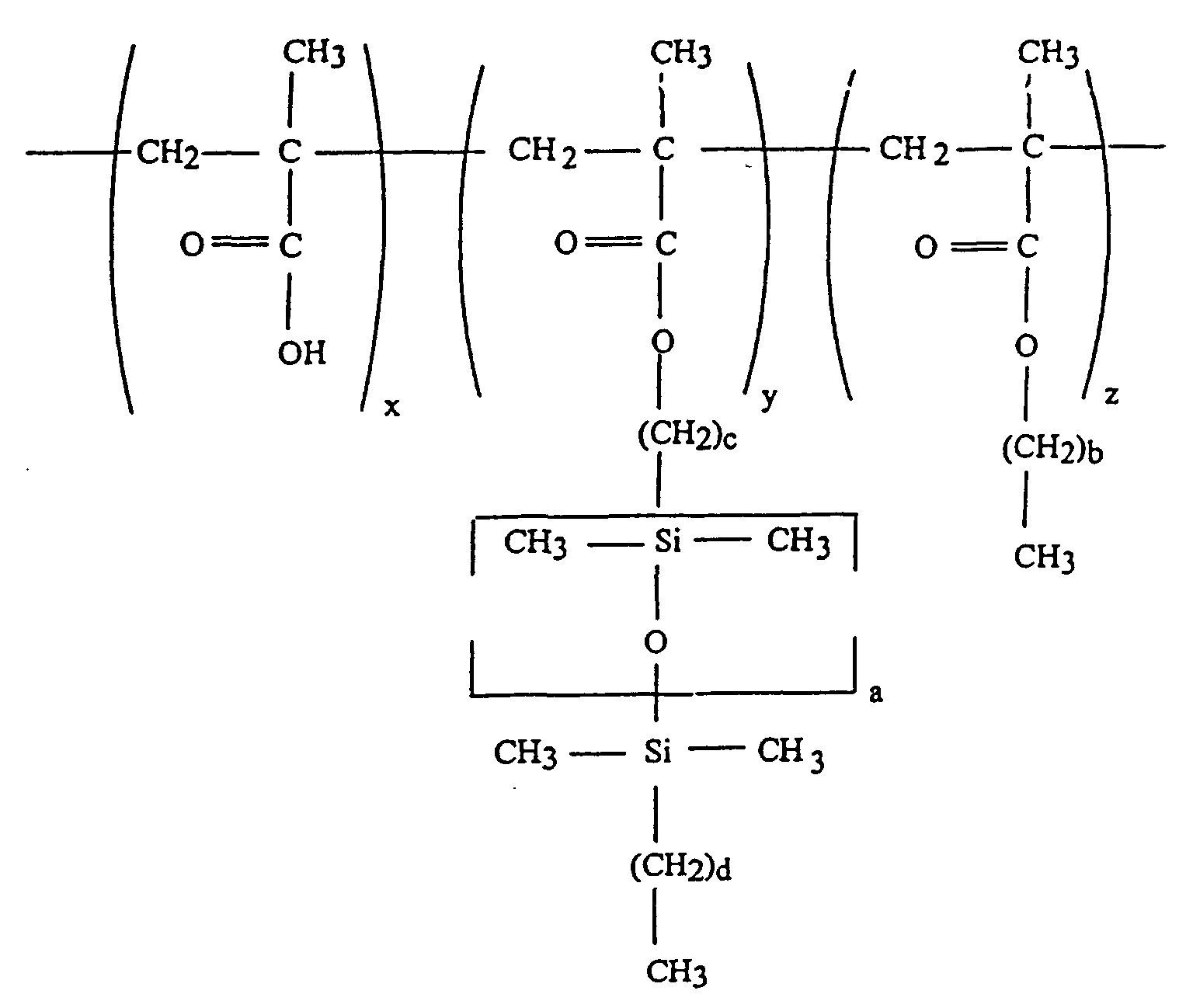
- Eine Tintenzusammensetzung gemäß Anspruch 7, bei der x 15 bis 50 ist, y etwa 1 ist, z etwa 1 ist, a etwa 9 ist, b 15 bis 17 ist, c etwa 3 ist und d etwa 3 ist.
- Ein Pfropf-Copolymer mit einem Molekulargewicht von 1500 bis 20000, das enthält:wobei die hydrophilen monomeren Einheiten des hydrophilen polymeren Segments und das hydrophobe polymere Segment in einem Verhältnis von 10:1 bis 100:1 stehen und das hydrophobe polymere Segment und das stabilisierende Segment in einem Verhältnis von 1:0,5 bis 1:5 stehen.(a) ein hydrophiles polymeres Segment,(b) ein hydrophobes polymeres Segment mit einem Molekulargewicht von 400 bis 3000, das einen hydrolysebeständigen Siloxyl-Substituenten enthält, und(c) ein stabilisierendes Segment mit einem Molekulargewicht von 200 bis 2000, ausgewählt aus der Gruppe, bestehend aus reaktiven Tensid-Makromeren, Schutzkolloid-Makromeren und hydrophoben Nichtsiloxyl-Monomeren,
- Ein Copolymer gemäß Anspruch 9, bei dem das hydrophile polymere Segment einen Carboxy-Substituenten enthält.
- Ein Copolymer gemäß Anspruch 10, bei dem das hydrophobe polymere Segment ein acryloyl- oder methacryloyl-terminiertes Polydialkylsiloxan-Makromer ist.
- Ein Copolymer gemäß Anspruch 11, bei dem das stabilisierende Segment ausgewählt ist aus der Gruppe, bestehend aus Stearyl-acrylat, Stearylmethacrylat, Laurylacrylat, Laurylmethacrylat, Nonylphenolacrylat, Nonylphenolmethacrylat, Nonylphenoxypoly(ethylenoxy)nmethacrylat, wobei n 1 bis 40 ist, Nonylphenoxypoly(ethylenoxy)nacrylat, wobei n 1 bis 40 ist, Methoxypoly(ethylenoxy)nmethacrylat, wobei n 5 bis 40 ist, Methoxypoly(ethylenoxy)n-acrylat, wobei n 5 bis 40 ist, Stearyloxypoly(ethylenoxy)nmethacrylat, wobei n 1 bis 20 ist, Stearyloxypoly(ethylenoxy)nacrylat,
wobei n 1 bis 20 ist, fluoriertem C1-C18-Alkylmethacrylat, fluoriertem C1-C18-Alkylacrylat, Poly(propylenglycol)methylethermethacrylat, Poly(propylenglycol)methyletheracrylat, Poly(propylenglycol)-4-nonylphenolethermethacrylat, Poly(propylenglycol)-4-nonylphenoletheracrylat, methacryloxytrimethylsiloxy-terminiertem Polyethylenoxid, acryloxytrimethylsiloxy-terminiertem Polyethylenoxid und Mischungen davon. - Ein Copolymer gemäß Anspruch 12, bei dem das hydrophile polymere Segment ein Acrylat- oder Methacrylatpolymer ist.
- Ein Copolymer gemäß Anspruch 13, bei dem das hydrophobe polymere Segment ein Molekulargewicht von 400 bis 2000 hat und einen Dimethylpolysiloxy-Substituenten enthält.
- Ein Copolymer gemäß Anspruch 14 mit einem Molekulargewicht von 2000 bis 10000.
- Ein Copolymer gemäß Anspruch 15, bei dem das stabilisierende Segment ausgewählt ist aus der Gruppe, bestehend aus Stearylmethacrylat, Stearylacrylat, Laurylmethacrylat, Laurylacrylat, Nonylphenol-PEG-10-methacrylat, trimethylsiloxy-terminiertem PEG-4-5-methacrylat, PPG-4-Nonylphenolacrylat und Trihydroperfluorundecylmethacrylat.
- Ein Copolymer gemäß Anspruch 9, das in seiner Hauptkette eine Struktureinheit der Formel:enthält, wobei x 5 bis 100 ist, y 1 bis 2 ist, z 1 bis 5 ist, a 3 bis 45 ist, b 3 bis 29 ist, c 2 bis 8 ist und d 0 bis 7 ist.

- Ein Copolymer gemäß Anspruch 17, bei dem x 15 bis 50 ist, y etwa 1 ist, z etwa 1 ist, a etwa 9 ist, b 15 bis 17 ist, c etwa 3 ist und d etwa 3 ist.
Applications Claiming Priority (4)
| Application Number | Priority Date | Filing Date | Title |
|---|---|---|---|
| US08/578,138 US5714538A (en) | 1995-12-26 | 1995-12-26 | Polymeric dispersants for pigmented inks |
| US578138 | 1995-12-26 | ||
| US08/667,269 US5719204A (en) | 1995-12-26 | 1996-06-20 | Pigmented inks with polymeric dispersants |
| US667269 | 1996-06-20 |
Publications (3)
| Publication Number | Publication Date |
|---|---|
| EP0783023A2 EP0783023A2 (de) | 1997-07-09 |
| EP0783023A3 EP0783023A3 (de) | 1998-08-26 |
| EP0783023B1 true EP0783023B1 (de) | 2002-03-13 |
Family
ID=27077437
Family Applications (1)
| Application Number | Title | Priority Date | Filing Date |
|---|---|---|---|
| EP96309009A Expired - Lifetime EP0783023B1 (de) | 1995-12-26 | 1996-12-11 | Polymer Dispergiermittel für pigmentierten Tinten |
Country Status (4)
| Country | Link |
|---|---|
| US (1) | US5719204A (de) |
| EP (1) | EP0783023B1 (de) |
| JP (1) | JP3882064B2 (de) |
| DE (1) | DE69619784T2 (de) |
Families Citing this family (85)
| Publication number | Priority date | Publication date | Assignee | Title |
|---|---|---|---|---|
| US5716435A (en) * | 1995-01-27 | 1998-02-10 | Toyo Ink Manufacturing Co., Ltd. | Recording fluid for ink-jet printing and process for the production thereof |
| US6538049B1 (en) * | 1995-12-26 | 2003-03-25 | Lexmark International, Inc. | Ink compositions |
| US6267807B1 (en) * | 1996-06-20 | 2001-07-31 | Lexmark International, Inc. | Method for grinding colorants |
| US6117921A (en) * | 1996-08-30 | 2000-09-12 | E. I. Du Pont De Nemours And Company | Process for making printed images using pigmented ink jet compositions |
| US5925692A (en) * | 1997-03-12 | 1999-07-20 | Lexmark International, Inc. | High performance ink compositions |
| US5994427A (en) * | 1997-03-12 | 1999-11-30 | Lexmark International, Inc. | High performance ink compositions with non-benzidine based colorants |
| US6063834A (en) * | 1997-12-08 | 2000-05-16 | Lexmark International, Inc. | Wet-rub resistant ink compositions |
| US6203605B1 (en) * | 1998-03-20 | 2001-03-20 | Scitex Digital Printing, Inc. | Process for improving dried film resistivity of a chemically modified carbon black dispersion |
| US6124376A (en) * | 1998-08-24 | 2000-09-26 | Xerox Corporation | Ink composition for ink jet printing |
| US6277183B1 (en) | 1998-10-08 | 2001-08-21 | Cabot Corporation | Ink compositions containing metal oxides |
| JP3582434B2 (ja) * | 1998-12-17 | 2004-10-27 | セイコーエプソン株式会社 | インクジェット捺染用インク組成物 |
| US6177498B1 (en) | 1999-02-19 | 2001-01-23 | Hewlett-Packard Company | Ink-jet ink compositions comprising a latex polymer and diol additives |
| JP3582448B2 (ja) * | 1999-03-12 | 2004-10-27 | セイコーエプソン株式会社 | インクジェット捺染用インク組成物 |
| US6231654B1 (en) | 1999-04-30 | 2001-05-15 | Macdermid Acumen, Inc. | Ink composition and a method of making the ink composition |
| DE10022371A1 (de) * | 1999-05-20 | 2000-11-23 | Bayer Ag | Pfropfcopolymere enthaltende Feststoffpräparationen |
| US6133347A (en) | 1999-07-09 | 2000-10-17 | Mbt Holding Ag | Oligomeric dispersant |
| US6908955B2 (en) * | 1999-07-09 | 2005-06-21 | Construction Research & Technology Gmbh | Oligomeric dispersant |
| US6861459B2 (en) * | 1999-07-09 | 2005-03-01 | Construction Research & Technology Gmbh | Oligomeric dispersant |
| US6174357B1 (en) | 1999-07-20 | 2001-01-16 | Lexmark International, Inc. | Pigment-based ink compositions |
| US6225370B1 (en) | 1999-07-26 | 2001-05-01 | Lexmark International, Inc. | Ink compositions |
| US6548571B1 (en) * | 1999-08-30 | 2003-04-15 | Xerox Corporation | Ink compositions and processes |
| US6376597B1 (en) * | 1999-12-16 | 2002-04-23 | Ppg Industries Ohio, Inc. | Pigment dispersions containing dispersants having pendent hydrophilic polymeric segments prepared by controlled radical polymerization |
| DE60043333D1 (de) * | 1999-12-28 | 2009-12-31 | Kao Corp | Tinte auf Wasserbasis |
| DE10048258B4 (de) * | 2000-09-29 | 2004-08-19 | Byk-Chemie Gmbh | Verlaufmittel für Oberflächenbeschichtungen |
| US6398357B1 (en) | 2000-10-10 | 2002-06-04 | Lexmark International, Inc | Method of inkjet printing using ink having high wetting agent levels |
| KR100409081B1 (ko) * | 2001-01-09 | 2003-12-11 | 주식회사 엘지화학 | 분산안정성이 우수한 안료형 잉크 조성물 |
| US6528557B2 (en) | 2001-02-02 | 2003-03-04 | Xerox Corporation | Inks comprising linear Asbs‘A’ block copolymers of alkylene oxide and siloxane |
| US6613815B2 (en) | 2001-02-02 | 2003-09-02 | Xerox Corporation | Inks comprising linear ABSCS′B′A′or BASCS′A′B′alkylene oxide/siloxane block copolymers |
| DE60201050T2 (de) * | 2001-06-12 | 2005-09-08 | Kao Corp. | Tinte auf Wasserbasis |
| DE10129854A1 (de) | 2001-06-21 | 2003-01-02 | Bayer Ag | Wässrige Sekundärdispersionen |
| US7504189B2 (en) * | 2001-08-03 | 2009-03-17 | Lexmark International, Inc. | Chemically prepared toner and process therefor |
| US6652634B1 (en) * | 2001-08-03 | 2003-11-25 | Lexmark International, Inc. | Polymeric dispersants used for aqueous pigmented inks for ink-jet printing |
| US6991884B2 (en) * | 2001-08-03 | 2006-01-31 | Lexmark International, Inc. | Chemically prepared toner and process therefor |
| US6861458B2 (en) * | 2001-11-15 | 2005-03-01 | Xerox Corporation | Photoprotective and lightfastness-enhancing siloxanes |
| US6569511B1 (en) * | 2001-11-15 | 2003-05-27 | Xerox Corporation | Recording sheets with lightfastness-enhancing siloxanes |
| US6803395B2 (en) * | 2001-11-15 | 2004-10-12 | Xerox Corporation | Photoprotective and lightfastness-enhancing siloxanes |
| US7368487B2 (en) | 2001-11-15 | 2008-05-06 | 3M Innovative Properties Company | Aqueous ink jet printable compositions |
| US6582510B1 (en) | 2002-04-16 | 2003-06-24 | Arco Chemical Technology, L.P. | Use of comb-branched copolymers as pigment dispersants |
| US20030225185A1 (en) * | 2002-06-04 | 2003-12-04 | Akers Charles Edward | Encapsulated pigment for ink-jet ink formulations nad methods of producing same |
| KR100523726B1 (ko) * | 2002-07-30 | 2005-10-27 | (주)레드자이언트 | 잉크젯 프린터용 컬러 잉크 조성물 |
| US20040024084A1 (en) * | 2002-08-05 | 2004-02-05 | Bradley Leonard Beach | Hydroxyacid-free dispersants and inks |
| ES2250838T3 (es) * | 2002-09-05 | 2006-04-16 | Rohm And Haas Company | Procedimiento de reproduccion de particulas solidas finas y sus dispersiones. |
| US6709096B1 (en) | 2002-11-15 | 2004-03-23 | Lexmark International, Inc. | Method of printing and layered intermediate used in inkjet printing |
| US6896724B2 (en) * | 2002-12-26 | 2005-05-24 | Lexmark International, Inc. | Pigmented inks and methods to improve ink performance |
| US7030175B2 (en) * | 2003-02-06 | 2006-04-18 | Hewlett-Packard Development Company, L.P. | Ink jet latex having reactive surfactant stabilization |
| JP2005036029A (ja) * | 2003-07-15 | 2005-02-10 | Canon Finetech Inc | インクジェットプリンター用水性インク |
| US7001936B2 (en) * | 2003-07-16 | 2006-02-21 | Lexmark International, Inc. | Pigmented inkjet ink |
| JP4662762B2 (ja) * | 2004-12-28 | 2011-03-30 | 富士フイルム株式会社 | インクジェット記録用インク及びこれを用いた平版印刷版 |
| WO2006125731A1 (en) * | 2005-05-26 | 2006-11-30 | Ciba Specialty Chemicals Holding Inc. | Slip- and leveling agent |
| WO2007134959A1 (en) * | 2006-05-18 | 2007-11-29 | Ciba Holding Inc. | Slip- and leveling agent |
| US20080057231A1 (en) * | 2006-06-27 | 2008-03-06 | Jun Li | Ink Jet Recording Sheet for Pigmented Ink |
| WO2008047592A1 (en) * | 2006-10-05 | 2008-04-24 | Toagosei Co., Ltd. | Aqueous coating agent |
| WO2008055244A2 (en) | 2006-10-31 | 2008-05-08 | Sensient Colors Inc. | Modified pigments and methods for making and using the same |
| US8188179B2 (en) * | 2006-12-14 | 2012-05-29 | Canon Kabushiki Kaisha | Ink-jet recording pigment ink |
| EP2530128A2 (de) * | 2006-12-19 | 2012-12-05 | Seiko Epson Corporation | Pigmentdispersion, Tintenzusammensetzung, Tintensatz und Aufzeichnungsvorrichtung |
| EP2332676A1 (de) * | 2006-12-19 | 2011-06-15 | Seiko Epson Corporation | Tintenstrahlaufzeichnung und aufgezeichnetes Material |
| US7799888B2 (en) * | 2007-04-27 | 2010-09-21 | Gelest, Inc. | Low molecular weight siloxanes with one functional group |
| EP3483222A3 (de) | 2007-08-23 | 2019-08-07 | Sensient Colors LLC | Selbstdispergierte pigmente und ihre herstellung und verwendung |
| US20090168013A1 (en) * | 2007-12-27 | 2009-07-02 | Kunzler Jay F | Trimethylsilyl-Capped Polysiloxane Macromonomers Containing Polar Fluorinated Side-Chains |
| JP5365024B2 (ja) * | 2008-02-19 | 2013-12-11 | 東亞合成株式会社 | シリコーン系グラフト共重合体およびその製造方法 |
| JP5610722B2 (ja) | 2008-08-08 | 2014-10-22 | キヤノン株式会社 | インクジェット用インク、インクジェット記録方法、インクカートリッジ、記録ユニット、及びインクジェット記録装置 |
| JP2010168411A (ja) * | 2009-01-20 | 2010-08-05 | Seiko Epson Corp | 表面処理顔料、インク組成物、及びインクジェット記録方法 |
| US8092874B2 (en) | 2009-02-27 | 2012-01-10 | Eastman Kodak Company | Inkjet media system with improved image quality |
| JP2011140609A (ja) * | 2009-04-07 | 2011-07-21 | Seiko Epson Corp | 耐水化アルミニウム顔料および耐水化アルミニウム顔料分散液、それらを含有する水性インク組成物、ならびに耐水化アルミニウム顔料分散液の製造方法 |
| EP2417202A2 (de) | 2009-04-07 | 2012-02-15 | Sensient Colors LLC | Selbstdispergierende teilchen und verfahren zu ihrer herstellung und verwendung |
| JP2011132483A (ja) * | 2009-04-07 | 2011-07-07 | Seiko Epson Corp | 耐水化アルミニウム顔料分散液およびそれを含有する水性インク組成物、ならびに耐水化アルミニウム顔料分散液の製造方法 |
| JP2010265422A (ja) * | 2009-05-18 | 2010-11-25 | Seiko Epson Corp | 表面処理顔料、インク組成物、及びインクジェット記録方法 |
| US8419176B2 (en) | 2009-05-29 | 2013-04-16 | Eastman Kodak Company | Aqueous compositions with improved silicon corrosion characteristics |
| US8256885B2 (en) * | 2009-07-15 | 2012-09-04 | Lexmark International, Inc. | Cyan inkjet ink having improved print quality with porous photo media |
| US8328920B2 (en) * | 2009-07-15 | 2012-12-11 | Lexmark International, Inc. | Inkjet ink having improved high resolution nozzle plate compatibility |
| US8277550B2 (en) * | 2009-07-15 | 2012-10-02 | Lexmark International, Inc. | Yellow inkjet ink having improved print quality with porous photo media |
| US8282723B2 (en) * | 2009-07-15 | 2012-10-09 | Lexmark International, Inc. | Magenta inkjet ink having improved print quality with porous photo media |
| US20110123714A1 (en) | 2009-11-24 | 2011-05-26 | Hwei-Ling Yau | Continuous inkjet printer aquous ink composition |
| US8398191B2 (en) | 2009-11-24 | 2013-03-19 | Eastman Kodak Company | Continuous inkjet printer aquous ink composition |
| US8430492B2 (en) | 2010-08-31 | 2013-04-30 | Eastman Kodak Company | Inkjet printing fluid |
| US8434857B2 (en) | 2010-08-31 | 2013-05-07 | Eastman Kodak Company | Recirculating fluid printing system and method |
| US8465578B2 (en) | 2011-03-31 | 2013-06-18 | Eastman Kodak Company | Inkjet printing ink set |
| WO2012149324A1 (en) | 2011-04-29 | 2012-11-01 | Eastman Kodak Company | Recirculating inkjet printing fluid, system and method |
| US8764161B2 (en) | 2011-08-31 | 2014-07-01 | Eastman Kodak Company | Printing fluids including a humectant |
| US9573361B2 (en) * | 2011-10-06 | 2017-02-21 | Canon Kabushiki Kaisha | Image-forming method |
| US20130237661A1 (en) | 2011-12-22 | 2013-09-12 | Thomas B. Brust | Inkjet ink composition |
| US20140231674A1 (en) | 2013-02-18 | 2014-08-21 | Wayne Lee Cook | Ink jet printer composition and use |
| US9523011B2 (en) | 2014-06-23 | 2016-12-20 | Eastman Kodak Company | Recirculating inkjet printing fluid |
| WO2017037123A1 (en) * | 2015-08-31 | 2017-03-09 | Byk-Chemie Gmbh | Copolymers containing polysiloxane macromonomer units, process of their preparation and their use in coating compositions and polymeric moulding compounds |
| US20180037764A1 (en) | 2016-08-02 | 2018-02-08 | Funai Electric Co., Ltd. | Ink-set, ink composition, and image forming method |
Family Cites Families (27)
| Publication number | Priority date | Publication date | Assignee | Title |
|---|---|---|---|---|
| DE3115532A1 (de) * | 1980-04-17 | 1982-01-28 | Canon K.K., Tokyo | Tintenstrahl-aufzeichnungsverfahren und aufzeichnungstinte fuer die aufzeichnung auf einem bildempfangsmaterial |
| DE3151924A1 (de) | 1981-12-30 | 1983-07-07 | Bayer Ag, 5090 Leverkusen | Waessrige polysiloxanzubereitungen |
| US4778862A (en) | 1987-01-28 | 1988-10-18 | The Glidden Company | Fluorine and acrylic modified silicone resins |
| US5166276A (en) * | 1989-07-12 | 1992-11-24 | Mitsubishi Petrochemical Company Ltd. | Polymer for hair-care products |
| JP2815684B2 (ja) * | 1989-07-12 | 1998-10-27 | 三菱化学株式会社 | 毛髪化粧料用ポリマー |
| US4981902A (en) * | 1989-08-07 | 1991-01-01 | Minnesota Mining And Manufacturing Company | Polysiloxane-grafted copolymer non-pressure sensitive topical binder composition and method of coating therewith |
| US5221334A (en) | 1990-04-11 | 1993-06-22 | E. I. Du Pont De Nemours And Company | Aqueous pigmented inks for ink jet printers |
| US5085698A (en) | 1990-04-11 | 1992-02-04 | E. I. Du Pont De Nemours And Company | Aqueous pigmented inks for ink jet printers |
| JPH0457862A (ja) * | 1990-06-28 | 1992-02-25 | Canon Inc | インク及びこれを用いたインクジェット記録方法 |
| US5180425A (en) * | 1991-11-05 | 1993-01-19 | E. I. Du Pont De Nemours And Company | Aqueous ink jet inks containing polyol/alkylene oxide condensates as cosolvents |
| DE4139090A1 (de) * | 1991-11-28 | 1993-06-03 | Stockhausen Chem Fab Gmbh | Verwendung von copolymerisaten mit polysiloxan-einheiten zur behandlung von leder und pelzen |
| US5219945A (en) | 1992-02-20 | 1993-06-15 | E. I. Du Pont De Nemours And Company | ABC triblock methacrylate polymers |
| DE69325401T2 (de) * | 1992-02-20 | 1999-11-25 | E.I. Du Pont De Nemours & Co., Inc. | Dreiblock-Polymer Dispersionsmittel enthaltende Wasserdispersionen |
| US5310778A (en) * | 1992-08-25 | 1994-05-10 | E. I. Du Pont De Nemours And Company | Process for preparing ink jet inks having improved properties |
| JP2666030B2 (ja) * | 1992-09-21 | 1997-10-22 | 昭和高分子株式会社 | 水性シリコーン系グラフト共重合体エマルジョンの製造方法 |
| US5268027A (en) * | 1992-12-22 | 1993-12-07 | E. I. Du Pont De Nemours And Company | Alkylpolyol ethers as cosolvents for ink jet inks |
| US5302197A (en) * | 1992-12-30 | 1994-04-12 | E. I. Du Pont De Nemours And Company | Ink jet inks |
| JP3406639B2 (ja) * | 1993-05-24 | 2003-05-12 | 株式会社リコー | 樹脂の製造方法 |
| JPH07314887A (ja) * | 1994-03-30 | 1995-12-05 | Canon Inc | 画像形成方法及びこれに用いるインクセットとインクジェット用機器 |
| JPH07278480A (ja) * | 1994-04-11 | 1995-10-24 | Japan Synthetic Rubber Co Ltd | インクジェット記録インク用重合体微粒子 |
| US5973025A (en) * | 1994-04-12 | 1999-10-26 | Sri International | Aqueous ink compositions containing a binder of a neutralized acidic resin |
| US5418277A (en) | 1994-04-26 | 1995-05-23 | E. I. Du Pont De Nemours And Company | Aqueous ink jet inks containing fluorinated polymers |
| US5589522A (en) | 1994-12-21 | 1996-12-31 | Lexmark International, Inc. | Ink composition |
| JPH08245733A (ja) * | 1995-03-10 | 1996-09-24 | Toyo Ink Mfg Co Ltd | 水性樹脂分散体 |
| JP3512129B2 (ja) * | 1995-06-14 | 2004-03-29 | 株式会社日本触媒 | 着色剤組成物 |
| JP3621173B2 (ja) * | 1995-12-14 | 2005-02-16 | 富士ゼロックス株式会社 | インクジェット記録用インクおよびインクジェット記録方法 |
| US5656071A (en) * | 1995-12-26 | 1997-08-12 | Lexmark International, Inc. | Ink compositions |
-
1996
- 1996-06-20 US US08/667,269 patent/US5719204A/en not_active Expired - Lifetime
- 1996-12-11 DE DE69619784T patent/DE69619784T2/de not_active Expired - Lifetime
- 1996-12-11 EP EP96309009A patent/EP0783023B1/de not_active Expired - Lifetime
- 1996-12-26 JP JP35728996A patent/JP3882064B2/ja not_active Expired - Fee Related
Also Published As
| Publication number | Publication date |
|---|---|
| JP3882064B2 (ja) | 2007-02-14 |
| DE69619784T2 (de) | 2002-10-02 |
| JPH09188732A (ja) | 1997-07-22 |
| EP0783023A2 (de) | 1997-07-09 |
| DE69619784D1 (de) | 2002-04-18 |
| US5719204A (en) | 1998-02-17 |
| EP0783023A3 (de) | 1998-08-26 |
Similar Documents
| Publication | Publication Date | Title |
|---|---|---|
| EP0783023B1 (de) | Polymer Dispergiermittel für pigmentierten Tinten | |
| US5714538A (en) | Polymeric dispersants for pigmented inks | |
| EP0781819B1 (de) | Tintenstrahl-Tintenzusammensetzungen | |
| US6538049B1 (en) | Ink compositions | |
| EP0518225B1 (de) | Wässrige, pigmentierte Tinten für Tintenstrahldrucker | |
| EP0851014B1 (de) | Tintenstrahltinten enthaltend Hydrosole als Polymerzusätze | |
| MXPA96006340A (en) | It compositions | |
| EP0633914B1 (de) | Wässrige Tintenzusammensetzung | |
| US5205861A (en) | Aqueous ink jet inks containing alkylene oxide condensates of certain nitrogen heterocyclic compounds as cosolvents | |
| US5180425A (en) | Aqueous ink jet inks containing polyol/alkylene oxide condensates as cosolvents | |
| EP0826751B1 (de) | Wässrige Dispersionen enthaltend Pfropfcopolymere als Dispergiermittel | |
| EP0915138B1 (de) | Blockcopolymere von Oxazolinen und Oxazinen als Pigmentdispergiermittel und ihre Verwendung für Tintenstrahldrucktinten | |
| GB2317181A (en) | Graft copolymers having particular utility as pigmented ink dispersants | |
| EP1423482A1 (de) | Polymere dispergiermittel für wässrige pigmenthaltige tintenstrahldrucktinten | |
| CN101528870B (zh) | 用于颜料型油墨配方的粘结剂 | |
| WO2006019662A1 (en) | Pigment dispersion with polymeric dispersant | |
| US5869564A (en) | Ink composition | |
| EP1624032B1 (de) | Wässrige Tinten für Tintenstrahldruck | |
| JPH11349871A (ja) | インク組成物 | |
| EP3030619A2 (de) | Wässrige tintenstrahldruck-tinten enthaltend polymere bindemittel mit komponenten, die mit cellulose in wechselwirkung stehen | |
| EP1753816B1 (de) | Polymere dispergiermittel zur verbesserung des schmierens beim drucken |
Legal Events
| Date | Code | Title | Description |
|---|---|---|---|
| PUAI | Public reference made under article 153(3) epc to a published international application that has entered the european phase |
Free format text: ORIGINAL CODE: 0009012 |
|
| AK | Designated contracting states |
Kind code of ref document: A2 Designated state(s): DE FR GB |
|
| PUAL | Search report despatched |
Free format text: ORIGINAL CODE: 0009013 |
|
| AK | Designated contracting states |
Kind code of ref document: A3 Designated state(s): DE FR GB |
|
| 17P | Request for examination filed |
Effective date: 19981214 |
|
| 17Q | First examination report despatched |
Effective date: 19991122 |
|
| GRAG | Despatch of communication of intention to grant |
Free format text: ORIGINAL CODE: EPIDOS AGRA |
|
| GRAG | Despatch of communication of intention to grant |
Free format text: ORIGINAL CODE: EPIDOS AGRA |
|
| GRAH | Despatch of communication of intention to grant a patent |
Free format text: ORIGINAL CODE: EPIDOS IGRA |
|
| GRAH | Despatch of communication of intention to grant a patent |
Free format text: ORIGINAL CODE: EPIDOS IGRA |
|
| REG | Reference to a national code |
Ref country code: GB Ref legal event code: IF02 |
|
| GRAA | (expected) grant |
Free format text: ORIGINAL CODE: 0009210 |
|
| AK | Designated contracting states |
Kind code of ref document: B1 Designated state(s): DE FR GB |
|
| REF | Corresponds to: |
Ref document number: 69619784 Country of ref document: DE Date of ref document: 20020418 |
|
| ET | Fr: translation filed | ||
| PLBE | No opposition filed within time limit |
Free format text: ORIGINAL CODE: 0009261 |
|
| STAA | Information on the status of an ep patent application or granted ep patent |
Free format text: STATUS: NO OPPOSITION FILED WITHIN TIME LIMIT |
|
| 26N | No opposition filed |
Effective date: 20021216 |
|
| REG | Reference to a national code |
Ref country code: GB Ref legal event code: 732E Free format text: REGISTERED BETWEEN 20131107 AND 20131113 |
|
| REG | Reference to a national code |
Ref country code: DE Ref legal event code: R082 Ref document number: 69619784 Country of ref document: DE Representative=s name: ABITZ & PARTNER PATENTANWAELTE MBB, DE Effective date: 20131107 Ref country code: DE Ref legal event code: R082 Ref document number: 69619784 Country of ref document: DE Representative=s name: ABITZ & PARTNER, DE Effective date: 20131107 Ref country code: DE Ref legal event code: R081 Ref document number: 69619784 Country of ref document: DE Owner name: FUNAI ELECTRIC CO., LTD, DAITO CITY, JP Free format text: FORMER OWNER: LEXMARK INTERNATIONAL, INC., LEXINGTON, KY., US Effective date: 20131107 Ref country code: DE Ref legal event code: R081 Ref document number: 69619784 Country of ref document: DE Owner name: FUNAI ELECTRIC CO., LTD, JP Free format text: FORMER OWNER: LEXMARK INTERNATIONAL, INC., LEXINGTON, US Effective date: 20131107 |
|
| REG | Reference to a national code |
Ref country code: FR Ref legal event code: TP Owner name: FUNAI ELECTRIC CO LTD, JP Effective date: 20140102 |
|
| PGFP | Annual fee paid to national office [announced via postgrant information from national office to epo] |
Ref country code: DE Payment date: 20141202 Year of fee payment: 19 Ref country code: GB Payment date: 20141210 Year of fee payment: 19 |
|
| PGFP | Annual fee paid to national office [announced via postgrant information from national office to epo] |
Ref country code: FR Payment date: 20141208 Year of fee payment: 19 |
|
| REG | Reference to a national code |
Ref country code: DE Ref legal event code: R119 Ref document number: 69619784 Country of ref document: DE |
|
| GBPC | Gb: european patent ceased through non-payment of renewal fee |
Effective date: 20151211 |
|
| REG | Reference to a national code |
Ref country code: FR Ref legal event code: ST Effective date: 20160831 |
|
| PG25 | Lapsed in a contracting state [announced via postgrant information from national office to epo] |
Ref country code: GB Free format text: LAPSE BECAUSE OF NON-PAYMENT OF DUE FEES Effective date: 20151211 Ref country code: DE Free format text: LAPSE BECAUSE OF NON-PAYMENT OF DUE FEES Effective date: 20160701 |
|
| PG25 | Lapsed in a contracting state [announced via postgrant information from national office to epo] |
Ref country code: FR Free format text: LAPSE BECAUSE OF NON-PAYMENT OF DUE FEES Effective date: 20151231 |