EP0783050B1 - Verfahren zur Verbesserung der Stabilität von leitfähigen Polymeren - Google Patents
Verfahren zur Verbesserung der Stabilität von leitfähigen Polymeren Download PDFInfo
- Publication number
- EP0783050B1 EP0783050B1 EP19960308864 EP96308864A EP0783050B1 EP 0783050 B1 EP0783050 B1 EP 0783050B1 EP 19960308864 EP19960308864 EP 19960308864 EP 96308864 A EP96308864 A EP 96308864A EP 0783050 B1 EP0783050 B1 EP 0783050B1
- Authority
- EP
- European Patent Office
- Prior art keywords
- stabilizing agent
- aqueous solution
- pyrrole compound
- compound
- pyrrole
- Prior art date
- Legal status (The legal status is an assumption and is not a legal conclusion. Google has not performed a legal analysis and makes no representation as to the accuracy of the status listed.)
- Expired - Lifetime
Links
- 238000000034 method Methods 0.000 title claims description 24
- 229920001940 conductive polymer Polymers 0.000 title description 13
- 230000002708 enhancing effect Effects 0.000 title 1
- KAESVJOAVNADME-UHFFFAOYSA-N 1H-pyrrole Natural products C=1C=CNC=1 KAESVJOAVNADME-UHFFFAOYSA-N 0.000 claims description 50
- 239000003381 stabilizer Substances 0.000 claims description 39
- -1 pyrrole compound Chemical class 0.000 claims description 33
- 239000007800 oxidant agent Substances 0.000 claims description 25
- 239000004744 fabric Substances 0.000 claims description 23
- 239000000463 material Substances 0.000 claims description 21
- 229920000128 polypyrrole Polymers 0.000 claims description 21
- 239000004753 textile Substances 0.000 claims description 20
- 239000002019 doping agent Substances 0.000 claims description 19
- 239000000758 substrate Substances 0.000 claims description 17
- 150000001450 anions Chemical class 0.000 claims description 16
- 239000007864 aqueous solution Substances 0.000 claims description 15
- 150000001875 compounds Chemical class 0.000 claims description 13
- 238000006116 polymerization reaction Methods 0.000 claims description 13
- ZXDDPOHVAMWLBH-UHFFFAOYSA-N 2,4-Dihydroxybenzophenone Chemical group OC1=CC(O)=CC=C1C(=O)C1=CC=CC=C1 ZXDDPOHVAMWLBH-UHFFFAOYSA-N 0.000 claims description 10
- 229910021578 Iron(III) chloride Inorganic materials 0.000 claims description 10
- RBTARNINKXHZNM-UHFFFAOYSA-K iron trichloride Chemical group Cl[Fe](Cl)Cl RBTARNINKXHZNM-UHFFFAOYSA-K 0.000 claims description 10
- 229910052751 metal Inorganic materials 0.000 claims description 8
- 239000002184 metal Substances 0.000 claims description 8
- MMNWSHJJPDXKCH-UHFFFAOYSA-N 9,10-dioxoanthracene-2-sulfonic acid Chemical compound C1=CC=C2C(=O)C3=CC(S(=O)(=O)O)=CC=C3C(=O)C2=C1 MMNWSHJJPDXKCH-UHFFFAOYSA-N 0.000 claims description 7
- 230000001590 oxidative effect Effects 0.000 claims description 6
- VCJMYUPGQJHHFU-UHFFFAOYSA-N iron(3+);trinitrate Chemical compound [Fe+3].[O-][N+]([O-])=O.[O-][N+]([O-])=O.[O-][N+]([O-])=O VCJMYUPGQJHHFU-UHFFFAOYSA-N 0.000 claims description 5
- 229910006069 SO3H Inorganic materials 0.000 claims description 4
- 239000012965 benzophenone Substances 0.000 claims description 4
- 125000000896 monocarboxylic acid group Chemical group 0.000 claims description 4
- 125000000020 sulfo group Chemical group O=S(=O)([*])O[H] 0.000 claims description 4
- DEQUKPCANKRTPZ-UHFFFAOYSA-N (2,3-dihydroxyphenyl)-phenylmethanone Chemical compound OC1=CC=CC(C(=O)C=2C=CC=CC=2)=C1O DEQUKPCANKRTPZ-UHFFFAOYSA-N 0.000 claims description 3
- ZLMJMSJWJFRBEC-UHFFFAOYSA-N Potassium Chemical compound [K] ZLMJMSJWJFRBEC-UHFFFAOYSA-N 0.000 claims description 3
- RWCCWEUUXYIKHB-UHFFFAOYSA-N benzophenone Chemical compound C=1C=CC=CC=1C(=O)C1=CC=CC=C1 RWCCWEUUXYIKHB-UHFFFAOYSA-N 0.000 claims description 3
- 230000000536 complexating effect Effects 0.000 claims description 3
- LYKRPDCJKSXAHS-UHFFFAOYSA-N phenyl-(2,3,4,5-tetrahydroxyphenyl)methanone Chemical compound OC1=C(O)C(O)=CC(C(=O)C=2C=CC=CC=2)=C1O LYKRPDCJKSXAHS-UHFFFAOYSA-N 0.000 claims description 3
- 229910052700 potassium Inorganic materials 0.000 claims description 3
- 239000011591 potassium Substances 0.000 claims description 3
- 230000015572 biosynthetic process Effects 0.000 claims description 2
- 230000002194 synthesizing effect Effects 0.000 claims description 2
- LHOWRPZTCLUDOI-UHFFFAOYSA-K iron(3+);triperchlorate Chemical compound [Fe+3].[O-]Cl(=O)(=O)=O.[O-]Cl(=O)(=O)=O.[O-]Cl(=O)(=O)=O LHOWRPZTCLUDOI-UHFFFAOYSA-K 0.000 claims 2
- 238000003786 synthesis reaction Methods 0.000 claims 1
- 229920000642 polymer Polymers 0.000 description 12
- 238000006243 chemical reaction Methods 0.000 description 11
- 239000000523 sample Substances 0.000 description 11
- OKKJLVBELUTLKV-UHFFFAOYSA-N Methanol Chemical compound OC OKKJLVBELUTLKV-UHFFFAOYSA-N 0.000 description 9
- 239000000376 reactant Substances 0.000 description 9
- 239000002322 conducting polymer Substances 0.000 description 7
- 239000000835 fiber Substances 0.000 description 7
- XLYOFNOQVPJJNP-UHFFFAOYSA-N water Substances O XLYOFNOQVPJJNP-UHFFFAOYSA-N 0.000 description 7
- 239000000243 solution Substances 0.000 description 6
- 238000012360 testing method Methods 0.000 description 6
- 230000007423 decrease Effects 0.000 description 5
- 238000005259 measurement Methods 0.000 description 5
- 150000002739 metals Chemical class 0.000 description 5
- 239000003495 polar organic solvent Substances 0.000 description 4
- 229920000728 polyester Polymers 0.000 description 4
- CSCPPACGZOOCGX-UHFFFAOYSA-N Acetone Chemical compound CC(C)=O CSCPPACGZOOCGX-UHFFFAOYSA-N 0.000 description 3
- LFQSCWFLJHTTHZ-UHFFFAOYSA-N Ethanol Chemical compound CCO LFQSCWFLJHTTHZ-UHFFFAOYSA-N 0.000 description 3
- 238000000137 annealing Methods 0.000 description 3
- 150000003233 pyrroles Chemical class 0.000 description 3
- SQGYOTSLMSWVJD-UHFFFAOYSA-N silver(1+) nitrate Chemical compound [Ag+].[O-]N(=O)=O SQGYOTSLMSWVJD-UHFFFAOYSA-N 0.000 description 3
- 238000003878 thermal aging Methods 0.000 description 3
- 125000004209 (C1-C8) alkyl group Chemical group 0.000 description 2
- AZQWKYJCGOJGHM-UHFFFAOYSA-N 1,4-benzoquinone Chemical compound O=C1C=CC(=O)C=C1 AZQWKYJCGOJGHM-UHFFFAOYSA-N 0.000 description 2
- MHAJPDPJQMAIIY-UHFFFAOYSA-N Hydrogen peroxide Chemical compound OO MHAJPDPJQMAIIY-UHFFFAOYSA-N 0.000 description 2
- KFZMGEQAYNKOFK-UHFFFAOYSA-N Isopropanol Chemical compound CC(C)O KFZMGEQAYNKOFK-UHFFFAOYSA-N 0.000 description 2
- NBIIXXVUZAFLBC-UHFFFAOYSA-N Phosphoric acid Chemical compound OP(O)(O)=O NBIIXXVUZAFLBC-UHFFFAOYSA-N 0.000 description 2
- 239000004698 Polyethylene Substances 0.000 description 2
- WGLPBDUCMAPZCE-UHFFFAOYSA-N Trioxochromium Chemical compound O=[Cr](=O)=O WGLPBDUCMAPZCE-UHFFFAOYSA-N 0.000 description 2
- 239000002253 acid Substances 0.000 description 2
- 239000000654 additive Substances 0.000 description 2
- 230000000996 additive effect Effects 0.000 description 2
- 230000032683 aging Effects 0.000 description 2
- 125000003118 aryl group Chemical group 0.000 description 2
- QVGXLLKOCUKJST-UHFFFAOYSA-N atomic oxygen Chemical compound [O] QVGXLLKOCUKJST-UHFFFAOYSA-N 0.000 description 2
- 238000000576 coating method Methods 0.000 description 2
- 239000002131 composite material Substances 0.000 description 2
- 230000003750 conditioning effect Effects 0.000 description 2
- 238000009792 diffusion process Methods 0.000 description 2
- 230000000694 effects Effects 0.000 description 2
- 238000011835 investigation Methods 0.000 description 2
- 229910021645 metal ion Inorganic materials 0.000 description 2
- 239000000203 mixture Substances 0.000 description 2
- 239000000178 monomer Substances 0.000 description 2
- 239000003960 organic solvent Substances 0.000 description 2
- 229910052760 oxygen Inorganic materials 0.000 description 2
- 239000001301 oxygen Substances 0.000 description 2
- VLTRZXGMWDSKGL-UHFFFAOYSA-N perchloric acid Chemical class OCl(=O)(=O)=O VLTRZXGMWDSKGL-UHFFFAOYSA-N 0.000 description 2
- 229920000767 polyaniline Polymers 0.000 description 2
- 229920000573 polyethylene Polymers 0.000 description 2
- 229920006254 polymer film Polymers 0.000 description 2
- 239000011541 reaction mixture Substances 0.000 description 2
- JOXIMZWYDAKGHI-UHFFFAOYSA-N toluene-4-sulfonic acid Chemical compound CC1=CC=C(S(O)(=O)=O)C=C1 JOXIMZWYDAKGHI-UHFFFAOYSA-N 0.000 description 2
- 229910000667 (NH4)2Ce(NO3)6 Inorganic materials 0.000 description 1
- 0 *c(cc1)cc(*)c1C(c1c(*)cc(*)cc1)=O Chemical compound *c(cc1)cc(*)c1C(c1c(*)cc(*)cc1)=O 0.000 description 1
- 229940005561 1,4-benzoquinone Drugs 0.000 description 1
- LBLYYCQCTBFVLH-UHFFFAOYSA-N 2-Methylbenzenesulfonic acid Chemical compound CC1=CC=CC=C1S(O)(=O)=O LBLYYCQCTBFVLH-UHFFFAOYSA-N 0.000 description 1
- NHQDETIJWKXCTC-UHFFFAOYSA-N 3-chloroperbenzoic acid Chemical compound OOC(=O)C1=CC=CC(Cl)=C1 NHQDETIJWKXCTC-UHFFFAOYSA-N 0.000 description 1
- RJWBTWIBUIGANW-UHFFFAOYSA-N 4-chlorobenzenesulfonic acid Chemical compound OS(=O)(=O)C1=CC=C(Cl)C=C1 RJWBTWIBUIGANW-UHFFFAOYSA-N 0.000 description 1
- JAJIPIAHCFBEPI-UHFFFAOYSA-N 9,10-dioxoanthracene-1-sulfonic acid Chemical compound O=C1C2=CC=CC=C2C(=O)C2=C1C=CC=C2S(=O)(=O)O JAJIPIAHCFBEPI-UHFFFAOYSA-N 0.000 description 1
- QTBSBXVTEAMEQO-UHFFFAOYSA-M Acetate Chemical compound CC([O-])=O QTBSBXVTEAMEQO-UHFFFAOYSA-M 0.000 description 1
- 229920002972 Acrylic fiber Polymers 0.000 description 1
- QGZKDVFQNNGYKY-UHFFFAOYSA-O Ammonium Chemical compound [NH4+] QGZKDVFQNNGYKY-UHFFFAOYSA-O 0.000 description 1
- OKTJSMMVPCPJKN-UHFFFAOYSA-N Carbon Chemical compound [C] OKTJSMMVPCPJKN-UHFFFAOYSA-N 0.000 description 1
- 229910021592 Copper(II) chloride Inorganic materials 0.000 description 1
- 229920000742 Cotton Polymers 0.000 description 1
- DGAQECJNVWCQMB-PUAWFVPOSA-M Ilexoside XXIX Chemical compound C[C@@H]1CC[C@@]2(CC[C@@]3(C(=CC[C@H]4[C@]3(CC[C@@H]5[C@@]4(CC[C@@H](C5(C)C)OS(=O)(=O)[O-])C)C)[C@@H]2[C@]1(C)O)C)C(=O)O[C@H]6[C@@H]([C@H]([C@@H]([C@H](O6)CO)O)O)O.[Na+] DGAQECJNVWCQMB-PUAWFVPOSA-M 0.000 description 1
- GRYLNZFGIOXLOG-UHFFFAOYSA-N Nitric acid Chemical compound O[N+]([O-])=O GRYLNZFGIOXLOG-UHFFFAOYSA-N 0.000 description 1
- 239000004677 Nylon Substances 0.000 description 1
- 229920002292 Nylon 6 Polymers 0.000 description 1
- 229920002302 Nylon 6,6 Polymers 0.000 description 1
- 239000004952 Polyamide Substances 0.000 description 1
- 239000004743 Polypropylene Substances 0.000 description 1
- 229920000297 Rayon Polymers 0.000 description 1
- QAOWNCQODCNURD-UHFFFAOYSA-N Sulfuric acid Chemical compound OS(O)(=O)=O QAOWNCQODCNURD-UHFFFAOYSA-N 0.000 description 1
- 230000002378 acidificating effect Effects 0.000 description 1
- 150000007513 acids Chemical class 0.000 description 1
- 238000013019 agitation Methods 0.000 description 1
- 150000001338 aliphatic hydrocarbons Chemical class 0.000 description 1
- 229910052783 alkali metal Inorganic materials 0.000 description 1
- ROOXNKNUYICQNP-UHFFFAOYSA-N ammonium peroxydisulfate Substances [NH4+].[NH4+].[O-]S(=O)(=O)OOS([O-])(=O)=O ROOXNKNUYICQNP-UHFFFAOYSA-N 0.000 description 1
- VAZSKTXWXKYQJF-UHFFFAOYSA-N ammonium persulfate Chemical compound [NH4+].[NH4+].[O-]S(=O)OOS([O-])=O VAZSKTXWXKYQJF-UHFFFAOYSA-N 0.000 description 1
- 229910001870 ammonium persulfate Inorganic materials 0.000 description 1
- 239000004760 aramid Substances 0.000 description 1
- 229920006231 aramid fiber Polymers 0.000 description 1
- 150000004945 aromatic hydrocarbons Chemical class 0.000 description 1
- 125000000732 arylene group Chemical group 0.000 description 1
- 239000012298 atmosphere Substances 0.000 description 1
- SRSXLGNVWSONIS-UHFFFAOYSA-N benzenesulfonic acid Chemical compound OS(=O)(=O)C1=CC=CC=C1 SRSXLGNVWSONIS-UHFFFAOYSA-N 0.000 description 1
- 229940092714 benzenesulfonic acid Drugs 0.000 description 1
- 229910052799 carbon Inorganic materials 0.000 description 1
- 125000004432 carbon atom Chemical group C* 0.000 description 1
- 239000003575 carbonaceous material Substances 0.000 description 1
- 230000015556 catabolic process Effects 0.000 description 1
- 239000000919 ceramic Substances 0.000 description 1
- 229910001914 chlorine tetroxide Inorganic materials 0.000 description 1
- ZCDOYSPFYFSLEW-UHFFFAOYSA-N chromate(2-) Chemical class [O-][Cr]([O-])(=O)=O ZCDOYSPFYFSLEW-UHFFFAOYSA-N 0.000 description 1
- 239000011248 coating agent Substances 0.000 description 1
- 230000001427 coherent effect Effects 0.000 description 1
- 230000021615 conjugation Effects 0.000 description 1
- 239000013068 control sample Substances 0.000 description 1
- ORTQZVOHEJQUHG-UHFFFAOYSA-L copper(II) chloride Chemical compound Cl[Cu]Cl ORTQZVOHEJQUHG-UHFFFAOYSA-L 0.000 description 1
- 230000007547 defect Effects 0.000 description 1
- 238000006731 degradation reaction Methods 0.000 description 1
- 239000002270 dispersing agent Substances 0.000 description 1
- 239000006185 dispersion Substances 0.000 description 1
- 238000004090 dissolution Methods 0.000 description 1
- 238000009472 formulation Methods 0.000 description 1
- 239000011521 glass Substances 0.000 description 1
- 229930195733 hydrocarbon Natural products 0.000 description 1
- 150000002430 hydrocarbons Chemical class 0.000 description 1
- 239000012784 inorganic fiber Substances 0.000 description 1
- 229910000360 iron(III) sulfate Inorganic materials 0.000 description 1
- 229910003002 lithium salt Inorganic materials 0.000 description 1
- 159000000002 lithium salts Chemical class 0.000 description 1
- 238000004519 manufacturing process Methods 0.000 description 1
- 150000002736 metal compounds Chemical class 0.000 description 1
- 238000012986 modification Methods 0.000 description 1
- 230000004048 modification Effects 0.000 description 1
- YZMHQCWXYHARLS-UHFFFAOYSA-N naphthalene-1,2-disulfonic acid Chemical compound C1=CC=CC2=C(S(O)(=O)=O)C(S(=O)(=O)O)=CC=C21 YZMHQCWXYHARLS-UHFFFAOYSA-N 0.000 description 1
- 229910017604 nitric acid Inorganic materials 0.000 description 1
- 150000002826 nitrites Chemical class 0.000 description 1
- 229910052755 nonmetal Inorganic materials 0.000 description 1
- 229920001778 nylon Polymers 0.000 description 1
- VLTRZXGMWDSKGL-UHFFFAOYSA-M perchlorate Chemical compound [O-]Cl(=O)(=O)=O VLTRZXGMWDSKGL-UHFFFAOYSA-M 0.000 description 1
- 150000002978 peroxides Chemical class 0.000 description 1
- 150000004965 peroxy acids Chemical class 0.000 description 1
- 125000000864 peroxy group Chemical group O(O*)* 0.000 description 1
- XCRBXWCUXJNEFX-UHFFFAOYSA-N peroxybenzoic acid Chemical compound OOC(=O)C1=CC=CC=C1 XCRBXWCUXJNEFX-UHFFFAOYSA-N 0.000 description 1
- JRKICGRDRMAZLK-UHFFFAOYSA-L persulfate group Chemical group S(=O)(=O)([O-])OOS(=O)(=O)[O-] JRKICGRDRMAZLK-UHFFFAOYSA-L 0.000 description 1
- 239000004014 plasticizer Substances 0.000 description 1
- 229920002647 polyamide Polymers 0.000 description 1
- 238000012667 polymer degradation Methods 0.000 description 1
- 230000000379 polymerizing effect Effects 0.000 description 1
- 229920000098 polyolefin Polymers 0.000 description 1
- 229920001155 polypropylene Polymers 0.000 description 1
- 229920006306 polyurethane fiber Polymers 0.000 description 1
- 239000012286 potassium permanganate Substances 0.000 description 1
- 239000000843 powder Substances 0.000 description 1
- 238000002360 preparation method Methods 0.000 description 1
- 230000001737 promoting effect Effects 0.000 description 1
- 239000010453 quartz Substances 0.000 description 1
- 150000004053 quinones Chemical class 0.000 description 1
- 239000002964 rayon Substances 0.000 description 1
- VYPSYNLAJGMNEJ-UHFFFAOYSA-N silicon dioxide Inorganic materials O=[Si]=O VYPSYNLAJGMNEJ-UHFFFAOYSA-N 0.000 description 1
- 229910052708 sodium Inorganic materials 0.000 description 1
- 239000011734 sodium Substances 0.000 description 1
- 159000000000 sodium salts Chemical class 0.000 description 1
- 239000002904 solvent Substances 0.000 description 1
- 238000007655 standard test method Methods 0.000 description 1
- 229920002994 synthetic fiber Polymers 0.000 description 1
- 239000012209 synthetic fiber Substances 0.000 description 1
- 238000010998 test method Methods 0.000 description 1
- UGNWTBMOAKPKBL-UHFFFAOYSA-N tetrachloro-1,4-benzoquinone Chemical compound ClC1=C(Cl)C(=O)C(Cl)=C(Cl)C1=O UGNWTBMOAKPKBL-UHFFFAOYSA-N 0.000 description 1
- 238000007669 thermal treatment Methods 0.000 description 1
- 238000005303 weighing Methods 0.000 description 1
- 210000002268 wool Anatomy 0.000 description 1
Images

Classifications
-
- D—TEXTILES; PAPER
- D06—TREATMENT OF TEXTILES OR THE LIKE; LAUNDERING; FLEXIBLE MATERIALS NOT OTHERWISE PROVIDED FOR
- D06M—TREATMENT, NOT PROVIDED FOR ELSEWHERE IN CLASS D06, OF FIBRES, THREADS, YARNS, FABRICS, FEATHERS OR FIBROUS GOODS MADE FROM SUCH MATERIALS
- D06M13/00—Treating fibres, threads, yarns, fabrics or fibrous goods made from such materials, with non-macromolecular organic compounds; Such treatment combined with mechanical treatment
- D06M13/244—Treating fibres, threads, yarns, fabrics or fibrous goods made from such materials, with non-macromolecular organic compounds; Such treatment combined with mechanical treatment with compounds containing sulfur or phosphorus
- D06M13/248—Treating fibres, threads, yarns, fabrics or fibrous goods made from such materials, with non-macromolecular organic compounds; Such treatment combined with mechanical treatment with compounds containing sulfur or phosphorus with compounds containing sulfur
- D06M13/256—Sulfonated compounds esters thereof, e.g. sultones
-
- C—CHEMISTRY; METALLURGY
- C08—ORGANIC MACROMOLECULAR COMPOUNDS; THEIR PREPARATION OR CHEMICAL WORKING-UP; COMPOSITIONS BASED THEREON
- C08G—MACROMOLECULAR COMPOUNDS OBTAINED OTHERWISE THAN BY REACTIONS ONLY INVOLVING UNSATURATED CARBON-TO-CARBON BONDS
- C08G61/00—Macromolecular compounds obtained by reactions forming a carbon-to-carbon link in the main chain of the macromolecule
- C08G61/12—Macromolecular compounds containing atoms other than carbon in the main chain of the macromolecule
- C08G61/122—Macromolecular compounds containing atoms other than carbon in the main chain of the macromolecule derived from five- or six-membered heterocyclic compounds, other than imides
- C08G61/123—Macromolecular compounds containing atoms other than carbon in the main chain of the macromolecule derived from five- or six-membered heterocyclic compounds, other than imides derived from five-membered heterocyclic compounds
- C08G61/124—Macromolecular compounds containing atoms other than carbon in the main chain of the macromolecule derived from five- or six-membered heterocyclic compounds, other than imides derived from five-membered heterocyclic compounds with a five-membered ring containing one nitrogen atom in the ring
-
- D—TEXTILES; PAPER
- D06—TREATMENT OF TEXTILES OR THE LIKE; LAUNDERING; FLEXIBLE MATERIALS NOT OTHERWISE PROVIDED FOR
- D06M—TREATMENT, NOT PROVIDED FOR ELSEWHERE IN CLASS D06, OF FIBRES, THREADS, YARNS, FABRICS, FEATHERS OR FIBROUS GOODS MADE FROM SUCH MATERIALS
- D06M13/00—Treating fibres, threads, yarns, fabrics or fibrous goods made from such materials, with non-macromolecular organic compounds; Such treatment combined with mechanical treatment
- D06M13/10—Treating fibres, threads, yarns, fabrics or fibrous goods made from such materials, with non-macromolecular organic compounds; Such treatment combined with mechanical treatment with compounds containing oxygen
- D06M13/12—Aldehydes; Ketones
- D06M13/127—Mono-aldehydes, e.g. formaldehyde; Monoketones
-
- D—TEXTILES; PAPER
- D06—TREATMENT OF TEXTILES OR THE LIKE; LAUNDERING; FLEXIBLE MATERIALS NOT OTHERWISE PROVIDED FOR
- D06M—TREATMENT, NOT PROVIDED FOR ELSEWHERE IN CLASS D06, OF FIBRES, THREADS, YARNS, FABRICS, FEATHERS OR FIBROUS GOODS MADE FROM SUCH MATERIALS
- D06M13/00—Treating fibres, threads, yarns, fabrics or fibrous goods made from such materials, with non-macromolecular organic compounds; Such treatment combined with mechanical treatment
- D06M13/10—Treating fibres, threads, yarns, fabrics or fibrous goods made from such materials, with non-macromolecular organic compounds; Such treatment combined with mechanical treatment with compounds containing oxygen
- D06M13/152—Treating fibres, threads, yarns, fabrics or fibrous goods made from such materials, with non-macromolecular organic compounds; Such treatment combined with mechanical treatment with compounds containing oxygen having a hydroxy group bound to a carbon atom of a six-membered aromatic ring
-
- D—TEXTILES; PAPER
- D06—TREATMENT OF TEXTILES OR THE LIKE; LAUNDERING; FLEXIBLE MATERIALS NOT OTHERWISE PROVIDED FOR
- D06M—TREATMENT, NOT PROVIDED FOR ELSEWHERE IN CLASS D06, OF FIBRES, THREADS, YARNS, FABRICS, FEATHERS OR FIBROUS GOODS MADE FROM SUCH MATERIALS
- D06M13/00—Treating fibres, threads, yarns, fabrics or fibrous goods made from such materials, with non-macromolecular organic compounds; Such treatment combined with mechanical treatment
- D06M13/10—Treating fibres, threads, yarns, fabrics or fibrous goods made from such materials, with non-macromolecular organic compounds; Such treatment combined with mechanical treatment with compounds containing oxygen
- D06M13/165—Ethers
-
- D—TEXTILES; PAPER
- D06—TREATMENT OF TEXTILES OR THE LIKE; LAUNDERING; FLEXIBLE MATERIALS NOT OTHERWISE PROVIDED FOR
- D06M—TREATMENT, NOT PROVIDED FOR ELSEWHERE IN CLASS D06, OF FIBRES, THREADS, YARNS, FABRICS, FEATHERS OR FIBROUS GOODS MADE FROM SUCH MATERIALS
- D06M13/00—Treating fibres, threads, yarns, fabrics or fibrous goods made from such materials, with non-macromolecular organic compounds; Such treatment combined with mechanical treatment
- D06M13/10—Treating fibres, threads, yarns, fabrics or fibrous goods made from such materials, with non-macromolecular organic compounds; Such treatment combined with mechanical treatment with compounds containing oxygen
- D06M13/184—Carboxylic acids; Anhydrides, halides or salts thereof
- D06M13/207—Substituted carboxylic acids, e.g. by hydroxy or keto groups; Anhydrides, halides or salts thereof
-
- D—TEXTILES; PAPER
- D06—TREATMENT OF TEXTILES OR THE LIKE; LAUNDERING; FLEXIBLE MATERIALS NOT OTHERWISE PROVIDED FOR
- D06M—TREATMENT, NOT PROVIDED FOR ELSEWHERE IN CLASS D06, OF FIBRES, THREADS, YARNS, FABRICS, FEATHERS OR FIBROUS GOODS MADE FROM SUCH MATERIALS
- D06M15/00—Treating fibres, threads, yarns, fabrics, or fibrous goods made from such materials, with macromolecular compounds; Such treatment combined with mechanical treatment
- D06M15/19—Treating fibres, threads, yarns, fabrics, or fibrous goods made from such materials, with macromolecular compounds; Such treatment combined with mechanical treatment with synthetic macromolecular compounds
- D06M15/21—Macromolecular compounds obtained by reactions only involving carbon-to-carbon unsaturated bonds
- D06M15/356—Macromolecular compounds obtained by reactions only involving carbon-to-carbon unsaturated bonds of other unsaturated compounds containing nitrogen, sulfur, silicon or phosphorus atoms
- D06M15/3562—Macromolecular compounds obtained by reactions only involving carbon-to-carbon unsaturated bonds of other unsaturated compounds containing nitrogen, sulfur, silicon or phosphorus atoms containing nitrogen
-
- D—TEXTILES; PAPER
- D06—TREATMENT OF TEXTILES OR THE LIKE; LAUNDERING; FLEXIBLE MATERIALS NOT OTHERWISE PROVIDED FOR
- D06M—TREATMENT, NOT PROVIDED FOR ELSEWHERE IN CLASS D06, OF FIBRES, THREADS, YARNS, FABRICS, FEATHERS OR FIBROUS GOODS MADE FROM SUCH MATERIALS
- D06M15/00—Treating fibres, threads, yarns, fabrics, or fibrous goods made from such materials, with macromolecular compounds; Such treatment combined with mechanical treatment
- D06M15/19—Treating fibres, threads, yarns, fabrics, or fibrous goods made from such materials, with macromolecular compounds; Such treatment combined with mechanical treatment with synthetic macromolecular compounds
- D06M15/37—Macromolecular compounds obtained otherwise than by reactions only involving carbon-to-carbon unsaturated bonds
- D06M15/61—Polyamines polyimines
-
- H—ELECTRICITY
- H01—ELECTRIC ELEMENTS
- H01B—CABLES; CONDUCTORS; INSULATORS; SELECTION OF MATERIALS FOR THEIR CONDUCTIVE, INSULATING OR DIELECTRIC PROPERTIES
- H01B1/00—Conductors or conductive bodies characterised by the conductive materials; Selection of materials as conductors
- H01B1/06—Conductors or conductive bodies characterised by the conductive materials; Selection of materials as conductors mainly consisting of other non-metallic substances
- H01B1/12—Conductors or conductive bodies characterised by the conductive materials; Selection of materials as conductors mainly consisting of other non-metallic substances organic substances
- H01B1/124—Intrinsically conductive polymers
- H01B1/127—Intrinsically conductive polymers comprising five-membered aromatic rings in the main chain, e.g. polypyrroles, polythiophenes
-
- Y—GENERAL TAGGING OF NEW TECHNOLOGICAL DEVELOPMENTS; GENERAL TAGGING OF CROSS-SECTIONAL TECHNOLOGIES SPANNING OVER SEVERAL SECTIONS OF THE IPC; TECHNICAL SUBJECTS COVERED BY FORMER USPC CROSS-REFERENCE ART COLLECTIONS [XRACs] AND DIGESTS
- Y10—TECHNICAL SUBJECTS COVERED BY FORMER USPC
- Y10T—TECHNICAL SUBJECTS COVERED BY FORMER US CLASSIFICATION
- Y10T442/00—Fabric [woven, knitted, or nonwoven textile or cloth, etc.]
- Y10T442/20—Coated or impregnated woven, knit, or nonwoven fabric which is not [a] associated with another preformed layer or fiber layer or, [b] with respect to woven and knit, characterized, respectively, by a particular or differential weave or knit, wherein the coating or impregnation is neither a foamed material nor a free metal or alloy layer
- Y10T442/2033—Coating or impregnation formed in situ [e.g., by interfacial condensation, coagulation, precipitation, etc.]
-
- Y—GENERAL TAGGING OF NEW TECHNOLOGICAL DEVELOPMENTS; GENERAL TAGGING OF CROSS-SECTIONAL TECHNOLOGIES SPANNING OVER SEVERAL SECTIONS OF THE IPC; TECHNICAL SUBJECTS COVERED BY FORMER USPC CROSS-REFERENCE ART COLLECTIONS [XRACs] AND DIGESTS
- Y10—TECHNICAL SUBJECTS COVERED BY FORMER USPC
- Y10T—TECHNICAL SUBJECTS COVERED BY FORMER US CLASSIFICATION
- Y10T442/00—Fabric [woven, knitted, or nonwoven textile or cloth, etc.]
- Y10T442/20—Coated or impregnated woven, knit, or nonwoven fabric which is not [a] associated with another preformed layer or fiber layer or, [b] with respect to woven and knit, characterized, respectively, by a particular or differential weave or knit, wherein the coating or impregnation is neither a foamed material nor a free metal or alloy layer
- Y10T442/2418—Coating or impregnation increases electrical conductivity or anti-static quality
-
- Y—GENERAL TAGGING OF NEW TECHNOLOGICAL DEVELOPMENTS; GENERAL TAGGING OF CROSS-SECTIONAL TECHNOLOGIES SPANNING OVER SEVERAL SECTIONS OF THE IPC; TECHNICAL SUBJECTS COVERED BY FORMER USPC CROSS-REFERENCE ART COLLECTIONS [XRACs] AND DIGESTS
- Y10—TECHNICAL SUBJECTS COVERED BY FORMER USPC
- Y10T—TECHNICAL SUBJECTS COVERED BY FORMER US CLASSIFICATION
- Y10T442/00—Fabric [woven, knitted, or nonwoven textile or cloth, etc.]
- Y10T442/20—Coated or impregnated woven, knit, or nonwoven fabric which is not [a] associated with another preformed layer or fiber layer or, [b] with respect to woven and knit, characterized, respectively, by a particular or differential weave or knit, wherein the coating or impregnation is neither a foamed material nor a free metal or alloy layer
- Y10T442/2418—Coating or impregnation increases electrical conductivity or anti-static quality
- Y10T442/2459—Nitrogen containing
Definitions
- This invention relates generally to conducting polymers, and in particular to polypyrrole formed on a substrate, such as a textile fabric, in which the polypyrrole coating has been made more stable due to the inclusion of a stabilizing agent.
- the rate of decay is related to the choice of dopant anion, the method of preparation, and the conditions of the aging.
- the decay is significantly more rapid in the presence of air, indicating that the reaction of oxygen with the polymer backbone is responsible for a significant portion of the conductivity loss.
- Conducting polymer coated fabrics have the advantages of light weight, ease of manufacture, low cost, and a wide range of surface conductivities when compared to metals and carbon coated products. Nevertheless, a major limitation precluding the use of conducting polymers and conducting polymer coated fabrics in several application is the lack of conductivity stability of the polymers relative to metals and carbon-based materials.
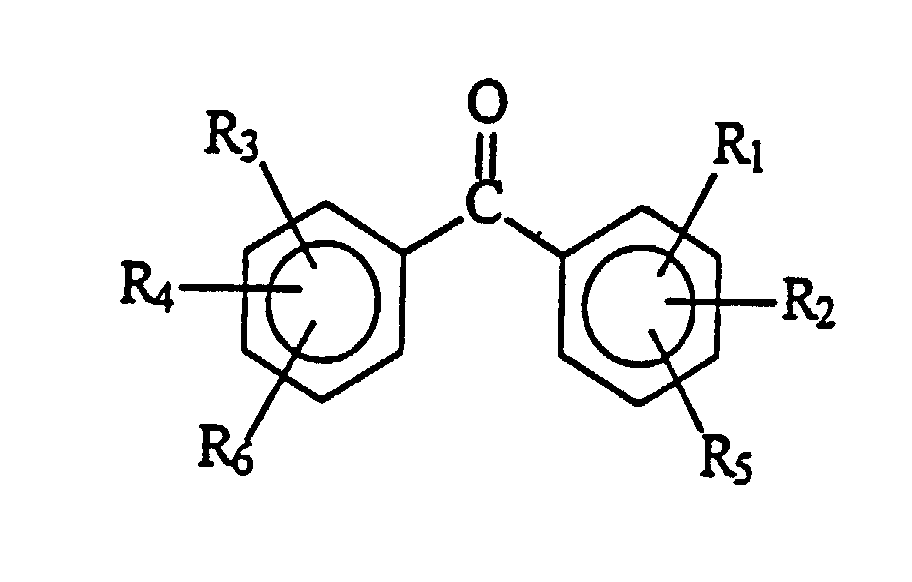
- a process for synthesizing a pyrrole compound having improved stability by the oxidative polymerization of an aqueous solution of a pyrrole compound in the presence of a oxidizing agent, dopant anion and a stabilizing agent having the formula; wherein R 1 , R 2 , R 3 and R 4 are independently selected from H, OH and OR, and R is C 1 -C 8 alkyl; R 5 and R 6 are independently selected from H, COOH and SO 3 H; and the ratio of the pyrrole compound to the stabilizing agent, by weight is from 1:100 to 1:0.01.
- a composite material of the polypyrrole compound on a substrate such as a textile fabric, which is made by contacting the substrate with the aqueous solution of reactants during polymerization.
- the composite material and method of the present invention has the advantages that the conductivity of the polymer (1) briefly increases when the polymer is heated above ambient temperatures; and (2) then decreases at a rate that is substantially slower than conductive polymers synthesized without a stabilizing agent.
- the invention comprises one or more of the following features:
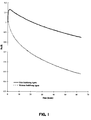
- Figure 1 is a graph of the change in resistivity measured as the initial resistivity (R 0 ) divided by the present resistivity (R) plotted as a function of time at 100°C for polypyrrole both with and without the stabilizing agent.
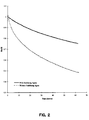
- Figure 2 is a graph comparing the change in resistivity of polypyrrole both with and without the stabilizing agent plotted as a function of time at 100° C, wherein the initial increase in conductivity of the polypyrrole sample containing the stabilizing agent has been compensated for by selecting the lowest value of R as R 0 .
- Figure 3 is a graph of the change in resistivity of polypyrrole samples both with and without the stabilizing agent plotted as a function of time at 100° C, wherein the ratio of the pyrrole to stabilizing agent in the aqueous liquor is 1:4.
- aryl and arylene are intended to be limited to single and fused double ring aromatic hydrocarbons. Unless otherwise specified, aliphatic hydrocarbons are from 1 to 12 carbons in length and cycloaliphatic hydrocarbons comprise from 3 to 8 carbon atoms.
- the invention is directed to the oxidative polymerization of a pyrrole compound in an aqueous solution, preferably in the presence of a substrate, thereby forming a conductive polymer film thereon.
- oxidative polymerization of pyrrole to form a conductive textile material may be found in the following patents: US-A- 4,803,096; US-A- 4,877,646; US-A- 4,975,317; and US-A- 5,108,829.
- pyrrole compound is intended to include pyrrole and substituted pyrrole monomers which may be polymerized and made conductive with a suitable dopant anion. Examples include 3- and 3,4-alkyl and aryl substrated pyrrole, N-alkyl pyrrole, and N-aryl pyrrole.
- polypyrrole compound is intended to include polymers made from such pyrrole compounds and combinations thereof. Preferably, pyrrole is polymerized to form polypyrrole.
- the pyrrole compound may be present in the aqueous reactant liquor at a concentration of from 0.01 to 5 grams per liter, preferably 1 to 3 grams per liter.
- An oxidizing agent capable of oxidizing the pyrrole compound and promoting polymerization is also employed in the aqueous liquor.
- Suitable oxidizing agents are known to those with skill in the art and include chemical compounds containing a metal ion which is capable of changing its valance during the polymerization of the pyrrole compounds and include polyvalent metal containing compounds such as perchlorates, permangenates and chromates in general and the following compounds: FeCl 3 , Fe 2 (SO 4 ) 3 , KMnO 4 , Fe(NO 3 ) 3 , Fe(ClO 4 ), K 3 (Fe(CN) 6 ), H 3 PO 4 •12MoO 3 , H 3 PO 4 •12WO 3 , CrO 3 (NH 4 ) 2 Ce(NO 3 ) 6 , CuCl 2 and AgNO 3 .
- non-metal compounds such as nitrites, quinones, peroxides, peracids, persulfates, perborates and perchlorates particularly HNO 3 , 1,4-benzoquinone, tetrachloro- 1,4-benzoquinone, hydrogen peroxide, peroxy acidic acid, peroxy benzoic acid, 3-chloroperoxybenzoic acid, ammonium persulfate and ammonium perborate.
- the alkali metal salts such as the sodium, potassium or lithium salts of the above compounds can also be used.
- the oxidizing agent contains a metal ion capable of complexing with the stabilizing agent, thereby acting as a dispersant or solubilizing agent in the aqueous reactant liquor.
- Ferric chloride has been found to be particularly useful as the oxidizing agent.
- the oxidizing agent is generally provided in the aqueous reactant liquor in a molar ratio relative to the pyrrole compound in the range of 1:1 to 4:1, preferably 2:1 to 3:1.
- the concentration of the oxidizing agent is an important factor in controlling the rate of reaction and those with skill in the art will recognize that higher or lower amounts of the oxidizing agent may be employed to control the rate of polymerization or to assure maximum utilization of the pyrrole compound.
- Some oxidizing agents, such as ferric chloride may perform as both an oxidizing agent and a dopant anion, in which case the molar ratio of the oxidizing agent to the pyrrole compound may be even greater than 4:1.
- the dopant anion may be present in the aqueous reactant liquor during polymerization.
- suitable dopant anions are known in the art and appear in the relevant literature, as well as the references cited herein.
- aryl sulfonic acids such as benzenesulfonic acid, p -toluenesulfonic acid, p -chlorobenzenesulfonic acid, naphthalene disulfonic acid and anthraquinone sulfonic acid, particularly anthraquinone-2-sulfonic acid.
- the polymerization reaction may be conducted at a pH of from 1 to 5, preferably from 1 to 3.
- increased acidity can be conveniently provided by acids such as HCl or H 2 SO 4 .
- a substrate such as a textile material
- the textile material may be in the form of staple, continuous filaments, spun yarn, continuous multifilament yarn or in the form of a fabric.
- the textile material is in the form of a woven or knit fabric constructed from continuous multifilament yarn at the time the polymer film is deposited on the fibers.
- a wide variety of natural and synthetic fibers may be used as the textile material.
- the following substrate materials may be employed: polyamide fibers, including nylon, such as nylon 6 and nylon 6,6, and aramid fibers; polyester fibers, such as polyethylene teraphthalate (PET), polyolefin fibers, such as polypropylene and polyethylene, acrylic fibers, polyurethane fibers, cellulosic fibers, such as cotton, rayon and acetate; silk and wool fibers, and high modulus inorganic fibers, such as glass, quartz and ceramic fibers.
- PET polyethylene teraphthalate
- polyolefin fibers such as polypropylene and polyethylene
- acrylic fibers such as polyurethane fibers
- cellulosic fibers such as cotton, rayon and acetate
- silk and wool fibers silk and wool fibers
- high modulus inorganic fibers such as glass, quartz and ceramic fibers.
- the conductive polymer may be formed on the textile material in amounts corresponding to about 0.5% to about 4%, preferably 1.0% to about 3%, by weight based on the weight of the textile.
- a polymer film of about 2 grams may be formed on the fabric.
- the film thickness may range from 0.05 to about 2 microns, preferably from about 0.1 to 1 micron.
- a stabilizing agent is dispersed or dissolved in the aqueous reactant liquor.
- the stabilizing agent has the formula: wherein R 1 , R 2 , R 3 and R 4 are independently selected from H, OH and OR, and R is C 1 -C 8 alkyl; R 5 and R 6 are independently selected from H, COOH and SO 3 H; and the ratio of the pyrrole compound to the stabilizing agent, by weight is from 1:100 to 1:0.01.
- at least one of R 1 , R 2 , R 3 and R 4 is OH, most preferably R 1 is OH.
- R 5 and R 6 are H.
- suitable compounds include benzophenone, dihydroxybenzophenone, especially 2,4-dihydroxybenzophenone, tetrahydroxybenzophenone, especially 2, 2 1 , 4, 4 1 - tetrahydroxybenzophoneone and 2,4-dihydroxy -5-especially sulfonate-benzophenone.
- the ratio of the pyrrole to the stabilizing agent, by weight is from 1:100 to 1:0.01, preferably 1:20 to 1:0.05.
- the stabilizing agent is sparingly soluble in the aqueous reactant liquor. Dispersion or dissolution of the stabilizing agent can be accomplished more easily by first dissolving the stabilizing agent in a small amount of a polar organic solvent, particularly a water miscible organic solvent, prior to adding the stabilizing agent to the aqueous liquor.
- a polar organic solvent particularly a water miscible organic solvent
- one part of the stabilizing agent may be dissolved in from one to four parts of the polar organic solvent.
- Suitable polar organic solvents include methanol, ethanol, isopropanol, and acetone, with methanol being preferred.
- the solution of the stabilizing agent and polar organic solvent may be conveniently added to a concentrated solution of the oxidizing agent, and then the mixture diluted with water to the desired final concentration.
- the polymerization reaction is typically initiated by combining the pyrrole compound, oxidizing agent, dopant anion and stabilizing agent in an aqueous liquor, which optionally has a substrate, such as textile material present.
- a substrate such as textile material present.
- the rate of the polymerization reaction is influenced by a number of factors, particularly the reaction temperature, selection of the oxidizing agent and its concentration relative to the pyrrole compound, pH, surface area of the substrate, and agitation.
- the polymerization reaction can be run as a batch reaction or continuously, by replenishing the reactants.
- the batch reaction typically takes from 45 minutes to four hours to complete.
- Electrically conductive textiles having a resistivity of 1000 ⁇ per square or less, preferably 500 ⁇ per square or less may be produced according to the present invention.
- Standard test methods are available in the textile industry and, in particular, AATCC test method 76-1982 is available and has been used for the purpose of measuring resistivity of textile fabrics. According to this methods, two parallel electrodes 2 inches long are contacted with the fabric and placed 1 inch apart. Resistivity may then be measured with a standard ohm meter capable of measuring values between 1 and 20 million ohms.
- Polyester fabric 7.50 grams Water 140.00 grams Pyrrole 0.20 grams 2,4-Dihydroxybenzophenone 0.20 grams Anthraquinone-2-sulfonic acid 0.22 grams 38.9% Ferric Chloride solution 2.90 grams
- the 2,4-dihydroxybenzophenone was first dissolved in 10 ml of methanol and added to the 38.9% ferric chloride solution. A dark brown complex was formed which was introduced into the jar containing the water. Next, the anthraquinone-2-sulfonate (sodium salt) was introduced and the fabric was wet with this solution. Finally, the jar was charged with pyrrole and tumbled for 120 minutes.
- the resulting fabric was a dark gray/black color and was allowed to air dry.
- a 2" x 2" sample was cut from the fabric and placed in a four-probe conductivity testing device. A current was passed through the sample and the voltage drop between two contacts was measured, thus determining the resistivity of the sample.
- the testing device containing the sample was placed in a forced air oven held at 100 °C. The resistivity was recorded continuously over a 64 hour period with data accumulated every 3 minutes.
- An identical test was conducted on fabric produced in the same way without any 2,4-dihydroxybenzophenone added to the reaction mixture. In each case the relative resistivity change, reported as the initial resistivity (R o ) divided by the present resistivity (R), is plotted as function of time as shown in Figure 1.
- the sample containing the 2,4-dihydroxybenzophenone displays an initial increase in conductivity, and then a slower decrease than the control sample. After 60 hours, the control has lost nearly 50% of its initial conductivity, whereas the sample of the present invention has lost only 11% of its initial resistivity.
- polymers with a more compact and smooth morphology inhibit diffusion of oxygen through the film, thus allowing for greater stability.
- the stability enhancement described in this invention may be due to the influence of the additive on the morphology of the conducting polymer film and the increased order brought about by plastization of the polymer by the additive during thermal aging.
- the following example demonstrates that the increase in stability and the increase in initial conductivity is related to the amount of the stabilizing agent introduced into the conducting polymer film.
- polyester fabric was made conducting according to the method described in Example 1 with the exception of a lower concentration of monomer, dopant, and oxidant as described in the formulation below.
- Polyester fabric 7.50 grams Water 140.00 grams Pyrrole 0.05 grams 2,4-Dihydroxybenzophenone 0.20 grams Anthraquinone-2-sulfonic acid 0.06 grams 38.9% Ferric Chloride solution 0.73 grams
- Example 3 A sample of this fabric was subjected to conductivity measurements as described for Example 1.
- the fabric of Example 2 was compared to an identically treated fabric, made without any 2,4-dihydroxybenzophenone present in the reaction liquor. The results of the testing are shown below in Figure 3.
- Example 2 The aging tests in Example 2 show an even more dramatic increase in the initial conductivity and in the stability of the sample.
Landscapes
- Textile Engineering (AREA)
- Engineering & Computer Science (AREA)
- Chemical & Material Sciences (AREA)
- Chemical Kinetics & Catalysis (AREA)
- Health & Medical Sciences (AREA)
- Spectroscopy & Molecular Physics (AREA)
- Physics & Mathematics (AREA)
- Medicinal Chemistry (AREA)
- Polymers & Plastics (AREA)
- Organic Chemistry (AREA)
- Polyoxymethylene Polymers And Polymers With Carbon-To-Carbon Bonds (AREA)
- Treatments For Attaching Organic Compounds To Fibrous Goods (AREA)
- Compositions Of Macromolecular Compounds (AREA)
- Macromolecular Compounds Obtained By Forming Nitrogen-Containing Linkages In General (AREA)
Claims (20)
- Bei einem Verfahren zum Synthetisieren einer Polypyrrolverbindung in einer wäßrigen Lösung einer Pyrrolverbindung, eines Oxydationsmittels und eines Dotandanions eine Verbesserung bestehend aus der Zugabe zur wäßrigen Lösung eines Stabilisationsmittels mit der Formel:wobei R1, R2, R3 und R4 unabhängig von H, OH und OR ausgesucht werden und R ein C1-C8 Alkyl ist; R5 und R6 unabhängig aus H, COOH und SO3H ausgesucht werden; und das Gewichtsverhältnis zwischen der Pyrrolverbindung und dem Stabilisationsmittel zwischen 1:100 und 1:0,01 beträgt,
- Verfahren gemäß Anspruch 1, wobei ein Textilsubstrat während der Synthese in der wäßrigen Lösung vorhanden ist und die Polypyrrolverbindung auf dem Substrat abgeschieden wird.
- Verfahren gemäß Anspruch 2, wobei das Gewichtsverhältnis zwischen der Pyrrolverbindung und dem Stabilisationsmittel zwischen 1:20 und 1:0,05 beträgt.
- Verfahren gemäß Anspruch 3, wobei die wäßrige Lösung zwischen 0,01 bis 5 Gramm pro Liter Pyrrolverbindung enthält, das Oxydationsmittel Eisen(III)-chlorid und das Stabilisationsmittel 2,4-Dihydroxybenzophenon ist.
- Verfahren gemäß Anspruch 3, wobei das Stabilisationsmittel aus der Gruppe, die aus Benzophenon, Dihydroxybenzophenon und Tetrahydroxybenzophenon besteht, ausgesucht wird.
- Verfahren gemäß Anspruch 5, wobei die wäßrige Lösung zwischen 0,01 bis 5 Gramm pro Liter Pyrrolverbindung enthält.
- Verfahren gemäß Anspruch 3, wobei das Stabilisationsmittel die folgende Formel hat:

- Verfahren gemäß Anspruch 7, wobei das Oxydationsmittel eine metallhaltige Verbindung ist, die mit dem Stabilisationsmittel einen Komplex bilden kann.
- Verfahren gemäß Anspruch 7, wobei das Oxydationsmittel aus der Gruppe, die aus Eisen(III)-chlorid, Kaliumpermanganat, Eisen(III)-nitrat und Eisen(III)-perchlorat besteht, ausgesucht wird.
- Verfahren gemäß Anspruch 8, wobei die wäßrige Lösung zwischen 0,01 und 5 Gramm pro Liter Pyrrolverbindung enthält und das Dotandanion eine Anthrachinon-2-sulfonsäure ist.
- Ein leitfähiges Textilmaterial erhältlich durch das Verfahren bestehend aus der oxydativen Polymerisation einer wäßrigen Lösung einer Pyrrolverbindung bei Vorhandensein eines Oxydationsmittels, eines Dotandanions und eines Stabilisationsmittels mit der Formel:wobei R1, R2, R3 und R4 unabhängig aus H, OH und OR ausgesucht werden und R ein C1-C8 Alkyl ist; und R5 und R6 unabhängig aus H, COOH und SO3H ausgesucht werden; und das Gewichtsverhältnis zwischen der Pyrrolverbindung und dem Stabilisationsmittel zwischen 1:100 und 1:0,01 beträgt, und ein Textilsubstrat, wobei ein Film einer Polypyrrolverbindung auf dem Substrat abgeschieden wird.

- Material gemäß Anspruch 11, wobei das Textilsubstrat die Form einer Web- oder Wirkware hat.
- Material gemäß Anspruch 11, wobei das Gewichtsverhältnis zwischen der Pyrrolverbindung und dem Stabilisationsmittel zwischen 1:20 und 1:0,05 beträgt.
- Verfahren gemäß Anspruch 13, wobei das Stabilisationamittel die folgende Formel hat:

- Material gemäß Anspruch 14, wobei das Oxydationsmittel eine metallhaltige Verbindung ist, die mit dem Stabilisationsmittel einen Komplex bilden kann.
- Material gemäß Anspruch 13, wobei das Stabilisationsmittel aus der Gruppe, die aus Benzophenon, Dihydroxybenzophenon und Tetrahydroxybenzophenon besteht, ausgesucht wird.
- Material gemäß Anspruch 16, wobei die wäßrige Lösung zwischen 0,01 und 5 Gramm pro Liter Pyrrolverbindung enthält.
- Material gemäß Anspruch 17, wobei das Oxydationsmittel aus der Gruppe, die aus Eisen(III)-chlorid, Kaliumpermanganat, Eisen(III)-nitrat und Eisen(III)-perchlorat besteht, ausgesucht wird.
- Material gemäß Anspruch 15, wobei die wäßrige Lösung zwischen 0,01 und 5 Gramm pro Liter Pyrrolverbindung enthält und das Dotandanion Anthrachinon-2-sulfonsäure ist.
- Material gemäß Anspruch 13, wobei die wäßrige Lösung zwischen 0,01 und 5 Gramm pro Liter Pyrrolverbindung enthält, das Oxydationsmittel Eisen(III)-chlorid, das Stabilisationsmittel 2,4-Dihydroxybenzophenon und das Textilsubstrat eine Web- oder Wirkware ist.
Applications Claiming Priority (2)
| Application Number | Priority Date | Filing Date | Title |
|---|---|---|---|
| US572997 | 1995-12-15 | ||
| US08/572,997 US5716893A (en) | 1995-12-15 | 1995-12-15 | Method of enhancing the stability of conductive polymers |
Publications (3)
| Publication Number | Publication Date |
|---|---|
| EP0783050A2 EP0783050A2 (de) | 1997-07-09 |
| EP0783050A3 EP0783050A3 (de) | 1997-11-19 |
| EP0783050B1 true EP0783050B1 (de) | 1999-05-06 |
Family
ID=24290225
Family Applications (1)
| Application Number | Title | Priority Date | Filing Date |
|---|---|---|---|
| EP19960308864 Expired - Lifetime EP0783050B1 (de) | 1995-12-15 | 1996-12-06 | Verfahren zur Verbesserung der Stabilität von leitfähigen Polymeren |
Country Status (6)
| Country | Link |
|---|---|
| US (2) | US5716893A (de) |
| EP (1) | EP0783050B1 (de) |
| JP (1) | JP3712805B2 (de) |
| CA (1) | CA2191529A1 (de) |
| DE (1) | DE69602343T2 (de) |
| ES (1) | ES2133902T3 (de) |
Families Citing this family (14)
| Publication number | Priority date | Publication date | Assignee | Title |
|---|---|---|---|---|
| IT1304534B1 (it) * | 1998-03-26 | 2001-03-19 | Rossi Danilo De | Procedimento per l'ottenimento di film di polimeri elettroconduttoriattraverso trattamento con agenti droganti da polimeri neutri e |
| US6346491B1 (en) * | 1999-05-28 | 2002-02-12 | Milliken & Company | Felt having conductivity gradient |
| US7282261B2 (en) | 2003-02-13 | 2007-10-16 | National University Of Singapore | Method of enhancing the stability of electroactive polymers and redox active materials |
| US6894512B2 (en) * | 2003-03-24 | 2005-05-17 | Israel Aircraft Industries Ltd. | Method for detecting hidden corrosion and a sensor for use in the same |
| US7236139B2 (en) * | 2004-12-10 | 2007-06-26 | Bae Systems Information And Electronic Systems Integration Inc. | Low backscatter polymer antenna with graded conductivity |
| US7510745B2 (en) * | 2005-09-09 | 2009-03-31 | The Hong Kong Polytechnic University | Methods for coating conducting polymer |
| US7943066B2 (en) | 2006-10-06 | 2011-05-17 | The University Of New Brunswick | Electrically conductive paper composite |
| US8013776B2 (en) * | 2007-05-07 | 2011-09-06 | Milliken & Company | Radar camouflage fabric |
| US8507102B1 (en) | 2012-08-07 | 2013-08-13 | Fownes Brothers & Co., Inc. | Conductive leather materials and methods for making the same |
| JP6245920B2 (ja) * | 2013-10-07 | 2017-12-13 | 日本バイリーン株式会社 | 電子共役系ポリマーに被覆された多孔性基材の製造方法 |
| JP6460624B2 (ja) * | 2013-10-16 | 2019-01-30 | テイボー株式会社 | ペン先 |
| US10221519B2 (en) | 2014-12-10 | 2019-03-05 | Fownes Brothers & Co., Inc. | Water-repellant conductive fabrics and methods for making the same |
| US10827846B2 (en) | 2016-10-28 | 2020-11-10 | Sleep Number Corporation | Bed with foot warming system |
| WO2020236909A1 (en) * | 2019-05-20 | 2020-11-26 | Board Of Regents, The University Of Texas System | 3-d compositions with integrated conductive polymers for water purification and oil separation |
Family Cites Families (11)
| Publication number | Priority date | Publication date | Assignee | Title |
|---|---|---|---|---|
| US4697001A (en) * | 1984-09-04 | 1987-09-29 | Rockwell International Corporation | Chemical synthesis of conducting polypyrrole |
| US4803096A (en) * | 1987-08-03 | 1989-02-07 | Milliken Research Corporation | Electrically conductive textile materials and method for making same |
| US4975317A (en) * | 1987-08-03 | 1990-12-04 | Milliken Research Corporation | Electrically conductive textile materials and method for making same |
| US4981718A (en) * | 1988-06-27 | 1991-01-01 | Milliken Research Corporation | Method for making electrically conductive textile materials |
| US4877646A (en) * | 1988-06-27 | 1989-10-31 | Milliken Research Corporation | Method for making electrically conductive textile materials |
| US5211810A (en) * | 1990-08-09 | 1993-05-18 | International Paper Company | Electrically conductive polymeric materials and related method of manufacture |
| US5176851A (en) * | 1990-09-04 | 1993-01-05 | Milliken Research Corporation | Method for enhancing polyaniline conductivity |
| FR2672897B1 (fr) * | 1991-02-19 | 1993-04-23 | Thomson Csf | Procede d'obtention de polymeres conducteurs stables thermiquement. |
| US5108829A (en) * | 1991-04-03 | 1992-04-28 | Milliken Research Corporation | Anthraquinone-2-sulfonic acid doped conductive textiles |
| US5198266A (en) * | 1991-04-29 | 1993-03-30 | Rockwell International Corporation | Stabilizing shelf life conductivity of conductive coatings |
| FR2704567B1 (fr) * | 1993-04-30 | 1995-06-23 | Commissariat Energie Atomique | Procede de preparation d'une nappe de materiau poreux revetue d'un polymere conducteur electronique et produit obtenu par ce procede. |
-
1995
- 1995-12-15 US US08/572,997 patent/US5716893A/en not_active Expired - Lifetime
-
1996
- 1996-11-28 CA CA 2191529 patent/CA2191529A1/en not_active Abandoned
- 1996-12-06 DE DE69602343T patent/DE69602343T2/de not_active Expired - Fee Related
- 1996-12-06 EP EP19960308864 patent/EP0783050B1/de not_active Expired - Lifetime
- 1996-12-06 ES ES96308864T patent/ES2133902T3/es not_active Expired - Lifetime
- 1996-12-11 JP JP33120996A patent/JP3712805B2/ja not_active Expired - Fee Related
-
1997
- 1997-05-05 US US08/851,504 patent/US5833884A/en not_active Expired - Lifetime
Also Published As
| Publication number | Publication date |
|---|---|
| JP3712805B2 (ja) | 2005-11-02 |
| US5833884A (en) | 1998-11-10 |
| CA2191529A1 (en) | 1997-06-16 |
| JPH09286902A (ja) | 1997-11-04 |
| EP0783050A2 (de) | 1997-07-09 |
| DE69602343T2 (de) | 1999-11-18 |
| ES2133902T3 (es) | 1999-09-16 |
| US5716893A (en) | 1998-02-10 |
| EP0783050A3 (de) | 1997-11-19 |
| DE69602343D1 (de) | 1999-06-10 |
Similar Documents
| Publication | Publication Date | Title |
|---|---|---|
| US4803096A (en) | Electrically conductive textile materials and method for making same | |
| US4975317A (en) | Electrically conductive textile materials and method for making same | |
| US4877646A (en) | Method for making electrically conductive textile materials | |
| US5716893A (en) | Method of enhancing the stability of conductive polymers | |
| US4981718A (en) | Method for making electrically conductive textile materials | |
| US5849415A (en) | Molecularly bonded inherently conductive polymers on substrates and shaped articles thereof | |
| US5030508A (en) | Method for making electrically conductive textile materials | |
| USRE35278E (en) | Process for producing electrically conductive composites and composites produced therein | |
| US4604427A (en) | Method of forming electrically conductive polymer blends | |
| US6083562A (en) | Methods for making antistatic fibers [and methods for making the same] | |
| US4374893A (en) | Textiles with improved conducting properties and processes for their manufacture | |
| Varesano et al. | Improving electrical performances of wool textiles: synthesis of conducting polypyrrole on the fiber surface | |
| US5108829A (en) | Anthraquinone-2-sulfonic acid doped conductive textiles | |
| JP4513783B2 (ja) | 透明電気伝導性ポリマー | |
| Kuhn | Characterization and application of polypyrrole-coated textiles | |
| Maiti et al. | Flexible non-metallic electro-conductive textiles | |
| EP0355518A2 (de) | Elektrisch leitende Artikel | |
| JPH08509760A (ja) | 導電性ポリマー被覆多孔質材料の製造方法、及びこの方法によって得られる製品 | |
| US5248554A (en) | Process for impregnating filaments of p-aramid yarns with polyanilines | |
| US5176851A (en) | Method for enhancing polyaniline conductivity | |
| He et al. | Preparation of polyaniline/nylon conducting fabric by layer‐by‐layer assembly method | |
| JP6693786B2 (ja) | 導電性繊維 | |
| Mehmood et al. | Optimization of polymerization conditions and thermal degradation of conducting polypyrrole coated polyester fabrics | |
| Liu et al. | Latex-like water-borne polyaniline for coating applications | |
| JPH08148027A (ja) | 導電性複合体の製造方法 |
Legal Events
| Date | Code | Title | Description |
|---|---|---|---|
| PUAI | Public reference made under article 153(3) epc to a published international application that has entered the european phase |
Free format text: ORIGINAL CODE: 0009012 |
|
| AK | Designated contracting states |
Kind code of ref document: A2 Designated state(s): BE CH DE ES FR GB IT LI SE |
|
| RAX | Requested extension states of the european patent have changed |
Free format text: AL;LT;LV;RO;SI |
|
| PUAL | Search report despatched |
Free format text: ORIGINAL CODE: 0009013 |
|
| RBV | Designated contracting states (corrected) |
Designated state(s): BE CH DE ES FR GB IT LI SE |
|
| RHK1 | Main classification (correction) |
Ipc: C08G 61/12 |
|
| AK | Designated contracting states |
Kind code of ref document: A3 Designated state(s): AT BE CH DE DK ES FI FR GB GR IE IT LI LU MC NL PT SE |
|
| AX | Request for extension of the european patent |
Free format text: AL;LT;LV;RO;SI |
|
| 17P | Request for examination filed |
Effective date: 19971204 |
|
| GRAG | Despatch of communication of intention to grant |
Free format text: ORIGINAL CODE: EPIDOS AGRA |
|
| 17Q | First examination report despatched |
Effective date: 19980915 |
|
| GRAG | Despatch of communication of intention to grant |
Free format text: ORIGINAL CODE: EPIDOS AGRA |
|
| GRAH | Despatch of communication of intention to grant a patent |
Free format text: ORIGINAL CODE: EPIDOS IGRA |
|
| GRAH | Despatch of communication of intention to grant a patent |
Free format text: ORIGINAL CODE: EPIDOS IGRA |
|
| GRAA | (expected) grant |
Free format text: ORIGINAL CODE: 0009210 |
|
| AK | Designated contracting states |
Kind code of ref document: B1 Designated state(s): BE CH DE ES FR GB IT LI SE |
|
| REG | Reference to a national code |
Ref country code: CH Ref legal event code: EP |
|
| REF | Corresponds to: |
Ref document number: 69602343 Country of ref document: DE Date of ref document: 19990610 |
|
| REG | Reference to a national code |
Ref country code: CH Ref legal event code: NV Representative=s name: E. BLUM & CO. PATENTANWAELTE |
|
| ET | Fr: translation filed | ||
| REG | Reference to a national code |
Ref country code: ES Ref legal event code: FG2A Ref document number: 2133902 Country of ref document: ES Kind code of ref document: T3 |
|
| PLBE | No opposition filed within time limit |
Free format text: ORIGINAL CODE: 0009261 |
|
| STAA | Information on the status of an ep patent application or granted ep patent |
Free format text: STATUS: NO OPPOSITION FILED WITHIN TIME LIMIT |
|
| 26N | No opposition filed | ||
| REG | Reference to a national code |
Ref country code: GB Ref legal event code: IF02 |
|
| PGFP | Annual fee paid to national office [announced via postgrant information from national office to epo] |
Ref country code: SE Payment date: 20020923 Year of fee payment: 7 |
|
| PGFP | Annual fee paid to national office [announced via postgrant information from national office to epo] |
Ref country code: CH Payment date: 20020924 Year of fee payment: 7 |
|
| PGFP | Annual fee paid to national office [announced via postgrant information from national office to epo] |
Ref country code: BE Payment date: 20021004 Year of fee payment: 7 |
|
| PGFP | Annual fee paid to national office [announced via postgrant information from national office to epo] |
Ref country code: ES Payment date: 20021204 Year of fee payment: 7 |
|
| PGFP | Annual fee paid to national office [announced via postgrant information from national office to epo] |
Ref country code: FR Payment date: 20031124 Year of fee payment: 8 |
|
| PGFP | Annual fee paid to national office [announced via postgrant information from national office to epo] |
Ref country code: GB Payment date: 20031126 Year of fee payment: 8 |
|
| PGFP | Annual fee paid to national office [announced via postgrant information from national office to epo] |
Ref country code: DE Payment date: 20031203 Year of fee payment: 8 |
|
| PG25 | Lapsed in a contracting state [announced via postgrant information from national office to epo] |
Ref country code: SE Free format text: LAPSE BECAUSE OF NON-PAYMENT OF DUE FEES Effective date: 20031207 |
|
| PG25 | Lapsed in a contracting state [announced via postgrant information from national office to epo] |
Ref country code: ES Free format text: LAPSE BECAUSE OF NON-PAYMENT OF DUE FEES Effective date: 20031209 |
|
| PG25 | Lapsed in a contracting state [announced via postgrant information from national office to epo] |
Ref country code: LI Free format text: LAPSE BECAUSE OF NON-PAYMENT OF DUE FEES Effective date: 20031231 Ref country code: CH Free format text: LAPSE BECAUSE OF NON-PAYMENT OF DUE FEES Effective date: 20031231 Ref country code: BE Free format text: LAPSE BECAUSE OF NON-PAYMENT OF DUE FEES Effective date: 20031231 |
|
| BERE | Be: lapsed |
Owner name: *MILLIKEN RESEARCH CORP. Effective date: 20031231 |
|
| EUG | Se: european patent has lapsed | ||
| REG | Reference to a national code |
Ref country code: CH Ref legal event code: PL |
|
| PG25 | Lapsed in a contracting state [announced via postgrant information from national office to epo] |
Ref country code: GB Free format text: LAPSE BECAUSE OF NON-PAYMENT OF DUE FEES Effective date: 20041206 |
|
| REG | Reference to a national code |
Ref country code: ES Ref legal event code: FD2A Effective date: 20031209 |
|
| PG25 | Lapsed in a contracting state [announced via postgrant information from national office to epo] |
Ref country code: DE Free format text: LAPSE BECAUSE OF NON-PAYMENT OF DUE FEES Effective date: 20050701 |
|
| GBPC | Gb: european patent ceased through non-payment of renewal fee |
Effective date: 20041206 |
|
| PG25 | Lapsed in a contracting state [announced via postgrant information from national office to epo] |
Ref country code: FR Free format text: LAPSE BECAUSE OF NON-PAYMENT OF DUE FEES Effective date: 20050831 |
|
| REG | Reference to a national code |
Ref country code: FR Ref legal event code: ST |
|
| PG25 | Lapsed in a contracting state [announced via postgrant information from national office to epo] |
Ref country code: IT Free format text: LAPSE BECAUSE OF NON-PAYMENT OF DUE FEES;WARNING: LAPSES OF ITALIAN PATENTS WITH EFFECTIVE DATE BEFORE 2007 MAY HAVE OCCURRED AT ANY TIME BEFORE 2007. THE CORRECT EFFECTIVE DATE MAY BE DIFFERENT FROM THE ONE RECORDED. Effective date: 20051206 |