EP0783326B1 - Procede de preparation d'agents chelateurs macrocycliques et formation de chelates et leurs conjugues - Google Patents
Procede de preparation d'agents chelateurs macrocycliques et formation de chelates et leurs conjugues Download PDFInfo
- Publication number
- EP0783326B1 EP0783326B1 EP94929190A EP94929190A EP0783326B1 EP 0783326 B1 EP0783326 B1 EP 0783326B1 EP 94929190 A EP94929190 A EP 94929190A EP 94929190 A EP94929190 A EP 94929190A EP 0783326 B1 EP0783326 B1 EP 0783326B1
- Authority
- EP
- European Patent Office
- Prior art keywords
- hydrogen
- chelating agent
- independently
- chr
- alkyl
- Prior art date
- Legal status (The legal status is an assumption and is not a legal conclusion. Google has not performed a legal analysis and makes no representation as to the accuracy of the status listed.)
- Expired - Lifetime
Links
- 0 CC(CC1)*CC1P* Chemical compound CC(CC1)*CC1P* 0.000 description 1
Classifications
-
- A—HUMAN NECESSITIES
- A61—MEDICAL OR VETERINARY SCIENCE; HYGIENE
- A61K—PREPARATIONS FOR MEDICAL, DENTAL OR TOILETRY PURPOSES
- A61K51/00—Preparations containing radioactive substances for use in therapy or testing in vivo
- A61K51/02—Preparations containing radioactive substances for use in therapy or testing in vivo characterised by the carrier, i.e. characterised by the agent or material covalently linked or complexing the radioactive nucleus
- A61K51/04—Organic compounds
- A61K51/08—Peptides, e.g. proteins, carriers being peptides, polyamino acids, proteins
- A61K51/10—Antibodies or immunoglobulins; Fragments thereof, the carrier being an antibody, an immunoglobulin or a fragment thereof, e.g. a camelised human single domain antibody or the Fc fragment of an antibody
-
- C—CHEMISTRY; METALLURGY
- C07—ORGANIC CHEMISTRY
- C07K—PEPTIDES
- C07K16/00—Immunoglobulins [IG], e.g. monoclonal or polyclonal antibodies
- C07K16/18—Immunoglobulins [IG], e.g. monoclonal or polyclonal antibodies against material from animals or humans
- C07K16/28—Immunoglobulins [IG], e.g. monoclonal or polyclonal antibodies against material from animals or humans against receptors, cell surface antigens or cell surface determinants
- C07K16/30—Immunoglobulins [IG], e.g. monoclonal or polyclonal antibodies against material from animals or humans against receptors, cell surface antigens or cell surface determinants from tumour cells
- C07K16/3046—Stomach, Intestines
-
- A—HUMAN NECESSITIES
- A61—MEDICAL OR VETERINARY SCIENCE; HYGIENE
- A61K—PREPARATIONS FOR MEDICAL, DENTAL OR TOILETRY PURPOSES
- A61K51/00—Preparations containing radioactive substances for use in therapy or testing in vivo
- A61K51/02—Preparations containing radioactive substances for use in therapy or testing in vivo characterised by the carrier, i.e. characterised by the agent or material covalently linked or complexing the radioactive nucleus
- A61K51/04—Organic compounds
- A61K51/08—Peptides, e.g. proteins, carriers being peptides, polyamino acids, proteins
- A61K51/10—Antibodies or immunoglobulins; Fragments thereof, the carrier being an antibody, an immunoglobulin or a fragment thereof, e.g. a camelised human single domain antibody or the Fc fragment of an antibody
- A61K51/1093—Antibodies or immunoglobulins; Fragments thereof, the carrier being an antibody, an immunoglobulin or a fragment thereof, e.g. a camelised human single domain antibody or the Fc fragment of an antibody conjugates with carriers being antibodies
-
- A—HUMAN NECESSITIES
- A61—MEDICAL OR VETERINARY SCIENCE; HYGIENE
- A61P—SPECIFIC THERAPEUTIC ACTIVITY OF CHEMICAL COMPOUNDS OR MEDICINAL PREPARATIONS
- A61P35/00—Antineoplastic agents
-
- C—CHEMISTRY; METALLURGY
- C07—ORGANIC CHEMISTRY
- C07K—PEPTIDES
- C07K16/00—Immunoglobulins [IG], e.g. monoclonal or polyclonal antibodies
- C07K16/46—Hybrid immunoglobulins
Definitions
- the present invention relates to a process for preparing isothiocyanato functionalized macrocyclic chelating agents and to a process for conjugating the macrocyclic chelating agents to biological molecules.
- Metal ions may be attached to biological molecules by means of bifunctional chelating agents.
- bifunctional chelating agents are compounds which contain a metal-binding moiety which forms a chelate with metal ions and a second functional group, which is chemically reactive in nature and is capable of forming a covalent bond with biological molecules.
- the reactive functionality is usually one of the various known useful chemically reactive groups such as bromoacetyl group, a diazonium ion, an isothiocyanate or a carboxylic acid derivative, the reactive functionalities are capable of binding to a protein (e.g., the lysine moiety of an antibody).
- the biological molecules usually recognize distinctive external or internal cell markers and, thus, act as target directing groups for the metal ion.
- radionuclide chelates of such antibody/chelating agent conjugates are useful in diagnostic and/or therapeutic applications as a means of conveying the radionuclide to a cancer or tumor cell. See, for example, Meares et al., Anal. Biochem., 142, 68-78 (1984); and Krejcarek et al., Biochem. and Biophys. Res. Comm ., 77 , 581-585 (1977).
- EDTA ethylenediaminetetraacetic acid
- DTPA diethylenetriaminepentaacetic acid
- radionuclides with a high specific activity When using short-lived radionuclides, radionuclides with a high specific activity, radionuclides with high energy or a radionuclide with a combination of these properties, it is desirable to chelate the radionuclide to the target directing group as close as possible to the time of injection into a patient to provide maximum specific radioactivity and minimum degradation of the radioimmunoglobulin.
- the rapid sequestration of metal ions by these chelating agents allows the preparation of the radionuclide/antibody/chelating agent conjugates to be prepared by activating the chelating agent, reacting the chelating agent with an antibody and then chelating the radionuclide to form a chelate conjugate followed by purification of the chelate conjugate.
- chelating agents such as EDTA and DTPA rapidly chelate the radionuclide, they suffer from the disadvantage that such binding is kinetically labile.
- the use of labile radionuclides for antibody labeling in this manner allows substitutionally labile trace metals (which may not be radioactive) to be incorporated into this chelate. Competition for such non-radioactive trace metals diminishes the biological efficacy of a radionuclide/antibody/chelating agent complex since a lower quantity of radionuclide is delivered to the target site.
- chelating agents such as EDTA and DTPA
- EDTA and DTPA EDTA and DTPA
- DOTA 1,4,7,10-tetraazacyclododecane-N,N',N",N"'-tetraacetic acid
- DOTA 1,4,7,10-tetraazacyclododecane-N,N',N",N"'-tetraacetic acid
- a disadvantage in the use of macrocylic chelating agents is the relatively slow chelation rates which take place at room temperature, see for example, Mirzadeh et al., Bioconjugate Chem., 1, 59-65 (1990).
- the medium in which the chelation takes place is often heated to increase the rate of chelation.
- U.S. Patent 5,006,643 discloses the preparation of isocyanato functionalized macrocycles containing primary or secondary amines by first reacting the chelating agent with rhodium and then activating the chelate.
- PCT application WO 93/20852 published on October 28, 1993 discloses an improved process for preparing conjugates by purifying the macrocyclic chelating agents on acid washed silica gel. Purifying the chelating agents in this manner allows activation of the chelating agent with thiophosgene to form an isothiocyanate derivative prior to the chelation of a metal ion.
- the chelation of a metal ion in the disclosed process can proceed rapidly at room temperature.
- the disclosed process still suffers from the disadvantage that the metal ion is reacted with the chelating agent prior to conjugation with a biological molecule. This is particularly disadvantageous when the metal ion is a short-lived radionuclide.
- the present invention is defined by the subject matter of claims 1 - 21. Particularly, the present invention is to a process for preparing chelate conjugates comprising:
- the present invention also provides a process for preparing chelate conjugates comprising:
- the present invention is also to a chelate conjugate prepared by any of the aforementioned processes.
- the present invention also provides for a chelating agent conjugate prepared by the process of:
- the ability to prepare a chelating agent conjugate prior to addition of a metal ion to form a chelate conjugate has several advantages, particularly when the metal ion is a radionuclide and the chelate conjugate is used as a radiopharmaceutical or radiodiagnostic agent.
- the chelating agent conjugate can be prepared efficiently, is substantially metal free and can be used for application at any time with adequate storage; b) the process is simplified and radiation hazards are greatly reduced by the fact that radioactive material is not involved in most of the preparation; c) radiolabeling of the chelating agent conjugate requires only a few minutes of contact time with the radioactive material and damage to the biological molecule due to radiolysis is minimized; and d) radiolabeling and purification steps are simplified and could be performed by a radiopharmacist at the site of application with little need for sophisticated instrumentation. The latter process could also be performed with simple liquid transferring devices which would aid in limiting the exposure to the radioactive material.
- the present invention is to a chelating agent conjugate comprising a biological molecule conjugated to a chelating agent of Formula I wherein the chelating agent conjugate contains less than about three percent aggregate formation as measured by high performance liquid chromatography.
- the present invention is to a chelate conjugate comprising a metal ion, a chelating agent and a biological molecule wherein the metal ion is bound by the chelating agent, the chelating agent is conjugated to the biological molecule and the chelating agent is of Formula I wherein the chelate conjugate contains less than about five percent aggregate formation as measured by high performance liquid chromatography.
- chelating agent means a compound capable of chelating or sequestering a metal ion.
- chelate means a chelating agent which has chelated a metal ion.
- bifunctional chelating agent refers to compounds that have a moiety capable of chelating a metal ion and a linker/spacer moiety covalently bonded to the chelating moiety that is capable of being activated or functionalized to serve as a means to covalently attach to a biological molecule.
- biological molecule refers to any hormone, antigen, hapten or protein, such as an antibody or antibody fragment, which functions to recognize a specific biological target site.
- a biological molecule when attached to a functionalized chelate, serves to carry the attached metal ion to specific targeted tissues.
- the biological material is a protein. More preferably the biological material is an antibody or antibody fragment.
- antibody refers to any polyclonal, monoclonal, chimeric, heteroantibody, recombinant or derivatives thereof. Preferably the antibody is a monoclonal antibody.
- antibody fragment includes Fab fragments and F(ab') 2 fragments and any portion of an antibody, including recombinants and derivatives thereof, having specificity toward a desired epitope or epitopes. The antibody fragments may be produced by conventional enzymatic methods or by genetic or protein engineering techniques, such as the production of single chain antibodies.
- activated or “activating” in relation to a chelating agent means the chelating agent has been modified with a functional group which is capable of forming a covalent bond with a biological molecule.
- chelating agent conjugate refers to a biological material covalently attached to a bifunctional chelating agent.
- chelate conjugate refers to a biological material covalently attached to a chelate.
- antibody/chelate conjugate refers to an antibody which is covalently attached to a bifunctional chelate, (i.e., the bifunctional chelating agent having a chelated metal ion).
- extraneous metal ion as used herein means any metal ion other than a desired metal ion intentionally placed in contact with the chelating agent to form a chelate.
- the ability to form a chelating agent conjugate prior to the chelation of a metal ion, as shown in Scheme I, has several advantages, as stated above, particularly when the metal ion is a radionuclide.
- a particular advantage is the chelating agent conjugate can be prepared, stored and the metal ion chelated shortly before use.
- a chelating agent conjugate by the process of the present invention results in a chelating agent conjugate that generally contains less than about three percent aggregate formation as measured by high performance liquid chromatography (HPLC).
- HPLC high performance liquid chromatography
- the chelating agent conjugate formed by a process of the present invention contains less than about two percent aggregate formation as measured by HPLC. More preferred, the chelating agent conjugates prepared by a process of the present invention contains less than about one percent aggregate formation.
- a chelate conjugate prepared by the process of the present invention generally contains less than about five percent aggregate formation as measured by HPLC. Preferably the chelate conjugate has less than about four percent aggregate formation. More preferably the chelate conjugate has less than three percent aggregate formation.
- a chelate conjugate prepared by the process of the present invention also allows incorporation of the desired metal ion into a high percentage of chelating agent conjugates.
- Acid washing of the silica gel prior to use of the gel for purifying a chelating agent provides a process for reducing extraneous metal ions, specifically calcium ions (Ca 2+ ), during the purification of macrocylic chelating agents by flash chromatography using silica gel as disclosed in PCT application WO93/20852 published on October 28, 1993.
- the washing of the silica gel with a strong mineral acid, such as hydrochloric, nitric, sulfuric, perchloric or hydrobromic, prior to use substantially reduces the amount of undesired metal ions bound to the chelating agent during the purification process.
- the mineral acid used to wash the silica gel is hydrochloric acid. Procedures for washing silica gel with a strong acid to remove impurities are known in the art, see, for example, Ralph K. Iler, The Chemistry of Silica , John Wiley & Sons (1979).
- the elimination of undesired metal ions from the macrocyclic chelating agents during the initial purification results in several advantages in the subsequent steps for forming a chelate conjugate.
- the elimination of undesired bound metal ions from the macrocyclic chelating agents allows rapid chelation of the desired metal ions at room temperature as opposed to heating or long reaction times required to displace the calcium.
- the ability to perform the chelation step at room temperature, rather than at temperatures which would destroy the functionalizing group, allows the activation of the macrocyclic bifunctional chelating agent prior to chelation of the metal ion.
- the ability to functionalize the macrocyclic chelating agent prior to chelation of the metal ion is particularly advantageous as the activated chelating agent can be synthesized, conjugated to a biological molecule to form a chelating agent conjugate, stored if desired, and then reacted with the metal ion shortly before use.
- the metal ion is a radionuclide with a half life of 10 days or less, as a significant amount of radiolysis can occur during the time necessary for functionalizing the chelate, conjugation, and purification of the products from each step.
- the present process can be used for many classes of ligands including any tri to hexa -(carboxamidomethylated), -(phosphonomethylated), or - (phosphinomethylated) polyazamacrocycle where the polyazamacrocycle has 3 to 6 nitrogens in the ring and the total number of atoms in the ring is 9 to 24 atoms.
- ligands including any tri to hexa -(carboxamidomethylated), -(phosphonomethylated), or - (phosphinomethylated) polyazamacrocycle where the polyazamacrocycle has 3 to 6 nitrogens in the ring and the total number of atoms in the ring is 9 to 24 atoms.
- aminocarboxylic acid chelating agents aminophosphonic chelating agents
- polyaza chelating agents containing secondary and tertiary amines are preferred polyazamacrocyclic chelating agents.
- Preferred amines of the polyaza chelating agents of Formula I are tertiary amines, preferably where r is 0 and each Q is (CHR 5 ) p CO 2 R.
- IA-IF The preparation of IA-IF is given in European Patent publication No. 0,353,450, published February 7, 1990, and European Patent publication No. 0,420,942, published April 10, 1991.
- a chelating agent conjugate comprising a protein conjugated to a chelating agent of the formula: wherein:
- the present invention is to a chelate conjugate comprising a radionuclide, a chelating agent and a protein wherein the radionuclide is bound by the chelating agent, the chelating agent is conjugated to the protein, and the chelating agent is of the formula as shown above, wherein the chelate conjugate, upon conjugation of said chelate to said protein, contains less than about three percent aggregate formation as measured by high performance liquid chromatography.
- Aminophosphonic acid derivatives of ligands can be prepared by a number of known synthetic techniques. Of particular importance is the reaction of a compound containing at least one reactive amine hydrogen with carbonyl compound (aldehyde or ketone) and phosphorous acid or derivative thereof. [See the procedure of Moeoritzer and Irani, J . Org . Chem ., 31 , 1603 (1966)].
- the polyaza chelating agents of the present invention purified by flash chromatography on acid washed silica gel can be activated with any of the known functional groups capable of forming a covalent bond with a biological molecule.
- functional groups are isothiocyanate, bromoacetamide, maleimide, imidoester, thiophthalamide, diazonium and carboxyl.
- the use of polyaza chelating agents which are essentially free of undesired metal ions are particularly important when using functionalizing groups which are pH and/or thermally unstable, such as isothiocyanate.
- the activating functional groups are located at positions R 2 or R 4 of Formula I on the macrocyclic chelating agent.
- the reaction of the thiophosgene with the chelating agent is at a pH from about 1 to about 7.
- the pH is from 1 to 5. More preferably, the pH is from 1 to 3.
- the reaction is preferably carried out in an aqueous environment having an acid concentration of from about 0.005 to about 0.5 normal (N), preferably about 0.01 to about 0.2 N as disclosed in PCT application 93/20852 published on October 28, 1993.
- the acid can be any mineral acid, preferably hydrochloric acid.
- the reaction between the chelating agent and thiophosgene in a dilute acid with vigorous mixing and excess thiophosgene is very fast and usually complete in less than 5 minutes at room temperature (about 15°C to about 25°C). Higher or lower temperatures can be used (e.g., about 0°C to about 50°C) but room temperature is preferred.
- the amount of excess thiophosgene added to the mixture depends on the concentration of the polyaza chelating agent. The lower the concentration of chelating agent, the larger the excess of thiophosgene to insure the rapid and complete conversion of amine to isothiocyanate. For example, if the concentration of chelating agent is 10 -3 M, the ratio of thiophosgene to chelating agent is 5-20:1. If the concentration of chelating agent is 10 -8 M, the ratio of thiophosgene to chelating agent is several thousand times larger (i.e., 10 5 :1). The excess thiophosgene is removed by conventional techniques such as evaporation, chromatography or extraction.
- Rapid mixing of thiophosgene with the aqueous solution may be accomplished using conventional equipment known to those skilled in the art which is capable of producing sufficient shear to produce dispersion of the thiophosgene within the aqueous solution.
- Illustrative of such mixing means is the use of a Waring blender for large scale preparations and with a MIXXORTM type mixer available from Alltech Inc., for smaller scale preparations.
- the obtained purity of the isothiocyanato activated chelating agent is about 90 to about 95 percent as measured by high performance liquid chromatography.
- the chelating agent can then be conjugated to a biological molecule.
- the biomolecule is a monoclonal antibody or fragment thereof which is specific for a selected cell-surface target site.
- Such antibodies may be commercially available or may be made by standard somatic cell hybridization techniques.
- An example of a suitable monoclonal antibody is CC49, one of a series of monoclonal antibodies specific for TAG-72 (tumor associated glycoprotein) described in published PCT Application No. WO 89/00692, on January 26, 1989, and published PCT Application No. WO 90/04410, on May 3, 1990.
- the chelate and protein are mixed in a molar ratio of greater than 1:10 and less than about 100:1 depending on the protein and protein concentration. Ratios of about 0.5:1 to about 4:1 are preferred.
- thiocyanate derivatized chelating agents to biological molecules are well known in the art.
- an isothiocyanato linkage is formed with the ⁇ -amino group of lysine.
- the conjugation generally involves reacting the functionalized chelating agent with the biological molecule from 2 to 18 hours in an aqueous buffered solution at pH 6-10 at room temperature.
- the purity of the activated chelating agent obtained by the process of the present invention allows conjugation to a biological material, preferably a protein, to be done at temperatures from 25°C to 40°C, preferably 30°C to 40°C, without the expected increase in degradation of the chelating agent activated group (i.e., hydrolysis of the isothiocyanate) or protein.
- a biological material preferably a protein
- temperatures from 25°C to 40°C, preferably 30°C to 40°C
- an increase in the rate of formation of protein aggregates and hydrolysis of the chelate activated groups would be expected in addition to an increased conjugation rate.
- elevated temperature results in a much faster conjugation rate increase relative to the rate of increase of undesired byproduct formation (e.g., chelating agent hydrolysis and protein aggregates).
- the chelating agent conjugate can then be placed in contact with a metal ion to form a chelate conjugate.
- a metal ion whether a radioactive metal ion or not, can be used, the chelate conjugate formed should have reasonable stability such that the metal complex is not readily disassociated. Radionuclides are preferred because of the use of the resulting products in a radiopharmaceutical drug for therapy and/or diagnosis.
- Preferred radioactive isotopes are those of samarium (Sm-153), holmium (Ho-166), ytterbium (Yb-175), lutetium (Lu-177), gadolinium (Gd-159), lanthanum (La-140), praseodymium (Pr-142), promethium (Pm-149), yttrium (Y-90) and indium (In-111).
- Radionuclides can be produced in several ways.
- a nuclide is bombarded with neutrons to obtain a radionuclide, e.g., Sm-152 + neutron ⁇ Sm-153 + gamma
- Another method of obtaining radionuclides is to bombard nuclides with particles produced by a linear accelerator or a cyclotron. Yet another way is to isolate the radionuclide from a mixture of fission products.
- the method of obtaining the nuclides employed in the present invention is not critical thereto.
- a metal ion, such as a radionuclide can be complexed with the chelate conjugate by adding the chelate conjugates to a solution of the metal ion.
- Sequestration of the metal ion occurs readily upon mixing in an aqueous solution at a pH of 1 to 10.
- the reaction is carried out in a medium having a pH of 1 to 7 and more preferably 5 to 7.
- Ambient temperatures of 10°C to 40°C can be readily employed for metal ion chelation.
- the amount of metal ion employed may be from trace amounts to an amount in excess of equimolar with the chelate conjugate.
- the sequestration of the metal ion occurs at room temperature, between 15°C to 22°C.
- an additional amount of a chelating agent can be added to remove any excess metal ion present.
- the chelation should be done in a buffer selected such that the cationic moiety of the buffer does not associate with the chelating agent or that the anionic moiety of the buffer does not associate with a lanthanide metal ion.
- associate is meant interference or inhibitions with the chelation of the metal ion by the chelating agent.
- suitable buffers include alkali metal salts of acetate, and amine buffers which do not contain a primary amine.
- Suitable amine buffers include N-[2-hydroxyethyl]piperazine-N'-[2-ethanesulfonic acid] (HEPES) and 2-[N-Morpholino]ethanesulfonic acid (MES). It has been found that standard buffers utilized for biological systems, such as phosphate, citrate, carbonate and succinate have a detrimental effect on chelation of metal ions by the chelating agent conjugates or chelate conjugates of the present invention, particularly when the metal ion is a lanthanide.
- chelate conjugates In the process of preparing chelate conjugates of the present invention, it is generally necessary to remove any buffer solutions present in the preparation of the chelating agent conjugate which may interfere with the subsequent step of chelating a metal ion. It has also been found that when preparing chelate conjugates by the present disclosed process, chelate conjugates can be purified more quickly and with greater efficiency than by the preparation of chelate conjugates wherein the metal ion is complexed with the chelating agent prior to forming a chelate conjugate. Purification of the chelate conjugates can be done utilizing standard techniques in the art, such as by gel filtration.
- Mass spectra (fast atom bombardment with xenon) were obtained on a Vacuum Generators ZAB HS mass spectrometer. Samples for mass spectral analysis were prepared by dissolution in a 3:1 mixture of dithiothreitol:dithioerythritol (magic bullet) unless otherwise stated.
- HPLC of radioactive samples was performed using a gel filtration column (DuPont ZORBAXTM GF-250 9.4 x 250 mm) with a flow rate of 1.5 mL per minute and equipped with radioactivity and ultraviolet light detectors.
- the mobile phase was 0.25 M, pH 6.0 sodium citrate/10 percent acetonitrile.
- containers for the conjugation reaction and for storage of the conjugate were soaked in 10% (v/v) nitric acid for 48 hours and rinsed thoroughly with deionized water prior to contacting the antibody solution.
- Buffer solutions were either made with extra pure reagents or decontaminated by passage through a chelating resin (CHELEXTM 100, BioRad) before contacting any unlabeled antibody and/or conjugate. Chelation experiments in general were followed by HPLC with UV and radioactivity dual detectors.
- the extent of chelation was monitored by HPLC as described above.
- the aqueous layer was added to 100 mL of acetonitrile and the solution reduced to dryness on a rotary evaporator (fitted with a vacuum pump) at room temperature.
- the solid obtained was further dried for 2 hours at room temperature on a vacuum line.
- the yield was 321 mg (90 percent yield) of an off-white solid.
- Samples prepared in an identical manner except that the reaction was carried out by the addition of 20 to 50 percent by volume chloroform prior to mixing were 84 to 89 percent pure as measured by HPLC.
- Example 2 To 20 ⁇ L of SCN-PA-DOTA (4.88 x 10 -3 moles in water) prepared as described in Example 2 was added 100 ⁇ L of Lu-177 (50 microcurries, 1mM in 0.05N HCI) to give a molar ratio of chelating agent to Lu-177 of about 1:1. The solution was mixed on a vortex mixer for about 5 seconds, 100 ⁇ L of HEPES buffer (0.5 M, pH 7) were added and the solution mixed for 5 minutes. The pH was measured and adjusted to between pH 6-7 with HEPES buffer if necessary. The reaction was allowed to proceed for another 5 minutes at room temperature and the yield of [ 177 Lu(SCN-A-DOTA)] was 91.4 percent as determined by HPLC.
- the [ 177 Lu(SCN-PA-DOTA)] complex was purified by placing the sample on a reverse phase cartridge (PRP-1 MINI-CLEANTM column, 80 ⁇ L) which had been pretreated with 800 ⁇ L acetonitrile, 400 ⁇ L of water and 800 ⁇ L 10 percent by volume acetonitrile in 20 mM carbonate buffer, pH 9.5. After loading the complex onto the column, the reaction vial was rinsed with a 200 ⁇ L and then a 600 ⁇ L of 10 percent by volume acetonitrile in carbonate buffer, the washes also being placed on the column.
- PRP-1 MINI-CLEANTM column 80 ⁇ L
- the reaction vial was rinsed with a 200 ⁇ L and then a 600 ⁇ L of 10 percent by volume acetonitrile in carbonate buffer, the washes also being placed on the column.
- the complex was then eluted from the column using a 1:2 ratio of carbonate buffer (20 mM, pH 9.5):acetonitrile. Approximately 80 percent of the radioactivity was recovered in the second 50 ⁇ L elution volume.
- the conjugation reaction was terminated by isolation and purification of the conjugate on a gel filtration column (PD-10 column, SEPHADEXTM G-25, medium, 9 mL) which had been equilibrated with phosphate buffered saline.
- a gel filtration column PD-10 column, SEPHADEXTM G-25, medium, 9 mL
- IgG CC49 (1.25 mL of about a 10.4 mg/mL solution) was added 1 mL of a DTPA solution (0.25 M, pH 6) and the solution concentrated in a concentrator (30 K, CENTRICONTM) by centrifugation on a DuPont Sorvall centrifuge (RT 6000B) for 45 minutes at 5500 rpm.
- the DTPA treated antibody solution was washed 2 times with 1.5 mL each of a carbonate buffer (20 mM; pH 9.5 ⁇ 0.1), and further concentrated to yield 0.9 mL of an antibody solution of approximately 12 mg/ml of CC49.
- 177 Lu (1mM in 0.05 N HCl). This solution was mixed on a vortex mixer, and after 15 minutes at room temperature, 25 ⁇ L of a DTPA solution (0.25 M, pH 6) was added. The amount of 177 Lu incorporation was determined by HPLC analysis.
- a CC49 PA-DOTA conjugate was prepared and purified as described in Example 6 from 32 nmole (4.8 mg) of CC49 and 96 nmole of SCN-PA-DOTA in 600 ⁇ L of carbonate buffer at pH 9.5 for 3 hours.
- MES buffer 20 mM, pH 6.2
- ETMP ethylenediamine-tetramethylenephosphoric acid
- Monoclonal antibody CC49 was conjugated and radiolabeled as per Example 7, except that half of the conjugate was chelated at pH 7 in HEPES buffer, and DTPA (diethylenetriaminopentaacetic acid) was used to scavenge unbound Lu-177.
- the final purification was accomplished by ion exchange chromatography on either SEPHADEXTM QAE or DOWEXTM AG1 x 8 column pre-washed with 3 x 5 mL of deionized water.
- the labeled antibody was eluted off with PBS. Results shown in Table III are comparable to those described in Example 7.
- the monoclonal antibody chelating agent conjugate (PA-DOTA-CC49) mixture was loaded on the pre-treated gel filtration column (Sephacryl S-200, using a Pharmacia BIOPROCESSTM System I with a BPG 200/950 column).
- the purified monoclonal antibody chelating agent conjugate was eluted with an ammonium acetate buffer (25 mM, pH 7).
- the conjugate obtained had a protein concentration of approximately 1.5 to 2 mg/mL. It was further concentrated to around 5 - 6 mg/mL.
- the conjugate was then stored in aliquots at -70°C. In general a 80% over-all yield was achieved based on protein concentration.
- a PA-DOTA-CC49 conjugate was prepared as per Example 9 and stored in 0.9 mL aliquots in glass serum vials each sealed with a TEFLONTM coated gray rubber stopper and an aluminium cap at -70°C.
- One vial of the conjugate was removed and analyzed at certain time intervals for its chelatability with 177 Lu (excess and limited amount) and retention of immunoreactivity by its binding to a BSM agrose gel. Results confirmed that the conjugate could be stored at -70°C for prolonged periods of time (assayed out to about 4 months) without significant loss of chelatability or immunoreactivity.
- chelate conjugates were prepared as outlined in Process A and B in Scheme I.
- Sample 1 (Process A) was prepared by mixing equal molar quantities of SCN-PA-DOTA with 177 Lu at pH 6-7,and purification by reverse phase chromatography. Conjugation of [ 177 Lu(SCN-PA-DOTA)]- with CC49 was done at pH 9.5 ⁇ 0.1 for 90 min. at 37°C and yielded a chelate conjugate containing approximately 0.8 177 Lu/Ab.
- Sample 2 (Process B), which contained 1.1 177 Lu/Ab, was prepared as described in Example 6. The samples were charaterized by HPLC immunoreactivity and trichloroacetic acid precipitation. Results, shown in Table IV, indicated that the two preparations were comparable with respect to the in vitro properties examined.
- a chelating agent conjugate (PA-DOTA-CC49) in 25 mM ammonium actetate buffer at pH 7, prepared as per Example 10, was added 3.8 ⁇ L of 153 Sm with carrier added (2 mM Sm in 0.10 N Hydrochloric acid), the solution was mixed and allowed to sit at room temperature for 15 minutes. Upon completion of the chelation of the 153 Sm, 3 ⁇ L of a 5 mM DTPA solution was added, and the solution was again mixed. The percent 153 Sm associated with the conjugate was determined by HPLC on a gel filtration column (GF-250 column to be 83 ⁇ 12 percent.
- the 153 Sm labeled antibody was purified by passing through an anion exchange resin (SEPHADEXTM QAE column), and characterized by HPLC, PAGE-SDS gel coupled with autoradiography and immunoreactivity assay. The results showed that 98.4 percent of the 153 Sm was bound to antibody with less than 0.3 percent aggregate formation with immunoreactivity by binding to BSM of 97.7 ⁇ 0.35 percent.
- SEPHADEXTM QAE column anion exchange resin
- the 90 Y labeled antibody was purified by passing through a BioRad AG-1 x8 column and characterized by HPLC, and BSM immunoreactivity assay. In general, in the purified material greater than 98 percent of the 90 Y was bound to the antibody and immunoreactivity, as measured by binding to BMS, was about 93-95 percent.
- Table VIII show an inhibitory effect of citrate and phosphate, among the anions; and calcium and manganese among the cations on the chelation of the PA-DOTA-CC49 conjugate.
Landscapes
- Health & Medical Sciences (AREA)
- Life Sciences & Earth Sciences (AREA)
- Chemical & Material Sciences (AREA)
- Immunology (AREA)
- Proteomics, Peptides & Aminoacids (AREA)
- Organic Chemistry (AREA)
- General Health & Medical Sciences (AREA)
- Medicinal Chemistry (AREA)
- Veterinary Medicine (AREA)
- Public Health (AREA)
- Animal Behavior & Ethology (AREA)
- Pharmacology & Pharmacy (AREA)
- Optics & Photonics (AREA)
- Physics & Mathematics (AREA)
- Molecular Biology (AREA)
- Genetics & Genomics (AREA)
- Epidemiology (AREA)
- Biophysics (AREA)
- Biochemistry (AREA)
- General Chemical & Material Sciences (AREA)
- Chemical Kinetics & Catalysis (AREA)
- Cell Biology (AREA)
- Nuclear Medicine, Radiotherapy & Molecular Imaging (AREA)
- Peptides Or Proteins (AREA)
- Medicines Containing Antibodies Or Antigens For Use As Internal Diagnostic Agents (AREA)
- Organic Low-Molecular-Weight Compounds And Preparation Thereof (AREA)
- Nitrogen And Oxygen Or Sulfur-Condensed Heterocyclic Ring Systems (AREA)
- Medicines That Contain Protein Lipid Enzymes And Other Medicines (AREA)
- Solid-Sorbent Or Filter-Aiding Compositions (AREA)
- Pharmaceuticals Containing Other Organic And Inorganic Compounds (AREA)
Claims (21)
- Procédé pour préparer un conjugé de chélate, qui comprend :(i) la purification d'un agent chélateur polyaza par chromatographie sur une colonne de gel de silice, le gel de silice étant lavé avec un acide avant l'introduction de l'agent chélateur polyaza sur la colonne et l'agent chélateur polyaza répondant à la formule :dans laquelle :
 étant entendu qu'au moins deux des Q et Q1 doivent être autres que des atomes d'hydrogène et qu'au moins un Q doit être un groupe (CHR5)pP(O)OHR6;chaque Q représente, indépendamment, un atome d'hydrogène ou un groupe (CHR5)pCO2R, (CHR5)pPO3H2, ou (CHR5)pP(O)OHR6 ;Q1 représente un atome d'hydrogène ou un groupe (CHR5)wCO2R ;chaque R représente, indépendamment, un atome d'hydrogène, un groupe benzyle ou un groupe alkyle en C1 à C4 ;étant entendu que n est égal à 1 lorsque X et/ou Y forment une liaison carbone-carbone supplémentaire et que la somme de r et w est égale à 0 ou 1 ;chaque R5 représente, indépendamment, un atome d'hydrogène, un groupe alkyle en C1 à C4 ou un groupe (alkyl en C1 à C2)phényle ;chaque R6 représente, indépendamment, un groupe -OH ou alkyle en C1 à C4 ;X et Y représentent chacun, indépendamment, un atome d'hydrogène ou peuvent être pris avec un X ou Y adjacent pour former une liaison carbone-carbone supplémentaire ;n est égal à 0 ou 1 ;m désigne un nombre entier ayant une valeur de 0 à 10, bornes incluses ;p est égal à 1 ou 2 ;r est égal à 0 ou 1 ;w est égal à 0 ou 1 ;étant entendu que R2 et R4 ne peuvent pas être simultanément des atomes d'hydrogène, mais que l'un de R2 et R4 doit être un atome d'hydrogène ;R2 et R4 représentent chacun, indépendamment, un atome d'hydrogène ou un groupe amino ;R3 représente un atome d'hydrogène ou un groupe alcoxy en C1 à C4, -OCH2CO2H ou hydroxyle ;(ii) la mise en contact de l'agent chélateur polyaza purifié avec du thiophosgène dans un milieu aqueux, en l'absence de solvant organique, à un pH d'environ 1 à environ 5, pour former un agent chélateur polyaza activé par un groupe isothiocyanato, et la récupération de l'agent chélateur polyaza activé par un groupe isothiocyanato ;(iii) la mise en contact de l'agent chélateur polyaza activé par un groupe isothiocyanato avec une protéine pour former un conjugué de l'agent chélateur, et la récupération du conjugué de l'agent chélateur ; et(iv) la mise en contact du conjugué de l'agent chélateur avec un ion de radionucléide pour former un conjugué de chélate, et la récupération du conjugué de chélate.
 - Procédé selon la revendication 1, dans lequel r est égal à 0 et chaque Q représente un groupe (CHR5)pCO2R.
- Procédé selon la revendication 1. dans lequel l'agent chélateur est l'acide α-[2-(4-aminophényl)éthyl]-1,4,7,10-tétraazacyclododécane-1,4,7,10-tétraacétique.
- Procédé selon l'une quelconque des revendications 1 à 3, dans lequel le radionucléide est 153Sm, 166HO, 175Yb, 177Lu, 159Gd, 140La, 142Pr, 149Pm, 90Y ou 111In.
- Procédé selon la revendication 4, dans lequel le radionucléide est 177Lu.
- Procédé selon la revendication 1, dans lequel l'étape (iii) comprend la réaction de l'agent chélateur polyaza activé par un groupe isothiocyanato avec un anticorps à environ 37°C.
- Procédé selon la revendication 1, dans lequel un ajoute un agent chélateur au conjugué de chélate formé dans l'étape (iv) pour éliminer l'ion métallique en excès.
- Conjugué de chélate préparé par le procédé selon la revendication 1.
- Procédé pour préparer un conjugué de chélate, qui comprend :ledit procédé comprenant les améliorations suivantes :(i) la purification d'un agent chélateur polyaza de formule :dans laquelle :
 étant entendu qu'au moins deux des Q et Q1 doivent être autres que des atomes d'hydrogène et qu'au moins un Q doit être un groupe (CHR5)pP(O)OHR6;chaque Q représente, indépendamment, un atome d'hydrogène ou un groupe (CHR5)pCO2R, (CHR5)pPO3H2, ou (CHR5)pP(O)OHR6 ;Q1 représente un atome d'hydrogène ou un groupe (CHR5)wCO2R;chaque R représente, indépendamment, un atome d'hydrogène, un groupe benzyle ou un groupe alkyle en C1 à C4 ;étant entendu que n est égal à 1 lorsque X et/ou Y forment une liaison carbone-carbone supplémentaire et que la somme de r et w est égale à 0 ou 1 ;chaque R5 représente, indépendamment, un atome d'hydrogène, un groupe alkyle en C1 à C4 ou un groupe (alkyl en C1 à C2)phényle ;chaque R6 représente, indépendamment, un groupe OH ou alkyle en C1 à C4 ;X et Y représentent chacun, indépendamment, un atome d'hydrogène ou peuvent être pris avec un X ou Y adjacent pour former une liaison carbone-carbone supplémentaire ;n est égal à 0 ou 1 ;m désigne un nombre entier ayant une valeur de 0 à 10, bornes incluses ;p est égal à 1 ou 2 ;r est égal à 0 ou 1 ;w est égal à 0 ou 1 ;R2 et R4 représentent chacun, indépendamment, un atome d'hydrogène ou un groupe amino ;R3 représente un atome d'hydrogène ou un groupe alcoxy en C1 à C4, -OCH2CO2H ou hydroxyle ;étant entendu que R2 et R4 ne peuvent pas être simultanément des atomes d'hydrogène, mais que l'un de R2 et R4 doit être un atome d'hydrogène ;(ii) la mise en contact de l'agent chélateur polyaza purifié avec du thiophosgène pour former un agent chélateur polyaza activé par un groupe isothiocyanato, et la récupération de l'agent chélateur polyaza activé par un groupe isothiocyanato ;(iii) la mise en contact de l'agent chélateur polyaza activé par un groupe isothiocyanato avec une protéine, pour former un conjugué d'agent chélateur ; et(iv) la mise en contact du conjugué d'agent chélateur avec un radionucléide pour former un conjugué de chélate, et la récupération du conjugné de chélate ;dans l'étape (i) : la purification de l'agent chélateur polyaza par chromatographie sur une colonne de gel de silice, le gel de silice étant lavé par un acide avant l'introduction de l'agent chélateur polyaza sur la colonne ;dans l'étape (ii) : la mise en contact de l'agent chélateur polyaza purifié avec du thiophosgène dans un milieu aqueux, en l'absence de solvant organique, à un pH d'environ 1 à environ 5 ;
etdans l'étape (iii) : la mise en contact de l'agent chélateur polyaza activé par un groupe isothiocyanato avec une molécule biologique à une température comprise entre environ 25°C et environ 40°C. - Conjugué de chélate selon la revendication 9, qui contient moins d'environ 5% de formation d'agrégat, ce pourcentage étant mesuré par chromatographie en phase liquide à haute performance.
- Conjugué d'agent chélateur qui est préparé par le procédé consistant à :(i) purifier un agent chélateur polyaza par chromatographie sur une colonne de gel de silice, le gel de silice étant lavé par un acide avant l'introduction de l'agent chélateur polyaza sur la colonne, et l'agent chélateur polyaza répondant à la fomule :dans laquelle ;
 étant entendu qu'au moins deux des Q et Q1 doivent être autres que des atomes d'hydrogène et qu'au moins un Q doit être un groupe (CHR5)pP(O)OHR6 ;chaque Q représente, indépendamment, un atome d'hydrogène ou un groupe (CHR5)pCO2R, (CHR5)pPO3H2, ou (CHR5)pP(O)OHR6 ;Q1 représente un atome d'hydrogène ou un groupe (CHR5)wCO2R ;chaque R représente, indépendamment, un atome d'hydrogène, un groupe benzyle ou un groupe alkyle en C1 à C4 ;étant entendu que n est égal à 1 lorsque X et/ou Y forment une liaison carbone-carbone supplémentaire et que la somme de r et w est égale à 0 ou 1 ;chaque R5 représente, indépendamment, un atome d'hydrogène, un groupe alkyle en C1 à C4 ou un groupe (alkyl en C1 à C2)phényle ;chaque R6 représente, indépendamment, un groupe -OH ou alkyle en C1 à C4 ;X et Y représentent chacun, indépendamment, un atome d'hydrogène ou peuvent être pris avec un X ou Y adjacent pour former une liaison carbone-carbone supplémentaire ;n est égal à 0 ou 1 ;m désigne un nombre entier ayant une valeur de 0 à 10, bornes incluses ;p est égal à 1 ou 2 ;r est égal à 0 ou 1 ;w est égal à 0 ou 1 ;étant entendu que R2 et R4 ne peuvent pas être simultanément des atomes d'hydrogène, mais que l'un de R2 et R4 doit être un atome d'hydrogène ;R2 et R4 représentent chacun, indépendamment, un atome d'hydrogène ou un groupe amino ;R3 représente un atome d'hydrogène ou un groupe alcoxy en C1 à C4, OCH2CO2H ou hydroxyle ;(ii) mettre en contact l'agent chélateur polyaza purifié avec du thiophosgène pour former un agent chélateur polyaza activé par un groupe isothiocyanato, et récupérer l'agent chélateur polyaza activé par un groupe isothiocyanato ; et(iii) mettre en contact l'agent chélateur pulyaza activé par un groupe isothiocyanato avec une protéine, pour former un conjugué d'agent chélateur.
 - Conjugué d'agent chélateur selon la revendication 11, qui contient moins d'environ 3% de formation d'agrégat, ce pourcentage étant mesuré par chromatographie en phase liquide à haute performance.
- Conjugué d'agent chélateur, qui comprend une protéine associée à un agent chélateur de formule :dans laquelle :
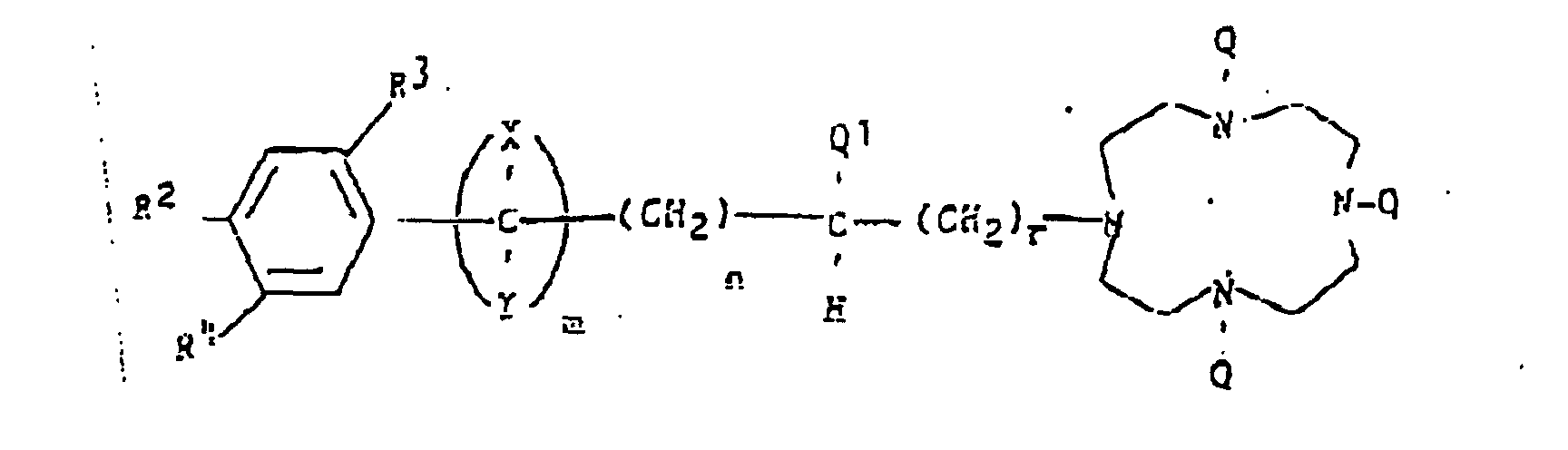 étant entendu qu'au moins deux des Q et Q1 doivent être autres que des atomes d'hydrogène et qu'au moins un Q doit être un groupe (CHR5)pP(O)OHR6;chaque Q représente, indépendamment, un atome d'hydrogène ou un groupe (CHR5)pCO2R, (CHR5)pPO3H2, ou (CHR5)pP(O)OHR6 ;Q1 représente un atome d'hydrogène ou un groupe (CHR5)wCO2R ;chaque R représente, indépendamment, un atome d'hydrogène, un groupe benzyle ou un groupe alkyle en C1 à C4;érant entendu que n est égal à 1 lorsque X et/ou Y forment une liaison carbone-carbone supplémentaire et que la somme de r et w est égale à 0 ou 1 ;chaque R5 représente, indépendamment, un atome d'hydrogène, un groupe alkyle en C1 à C4 ou un groupe (alkyl en C1 à C2)phényle ;chaque R" représente, indépendamment, un groupe -OH ou alkyle en C1 à C4 ;X et Y représentent chacun, indépendamment, un atome d'hydrogène ou peuvent être pris avec un X ou Y adjacent pour former une liaison carbone carbone supplémentaire ;n est égal à 0 ou 1 ;m désigne un nombre entier ayant une valeur de 0 à 10, bornes incluses ;p est égal à 1 on 2 ;r est égal à 0 ou 1 ;w est égal à 0 ou 1 ;étant entendu que R2 et R4 ne peuvent pas être simultanément des atomes d'hydrogène, mais que l'un de R2 et R4 doit être un atome d'hydrogène ;R2 et R4 représentent chacun, indépendamment, un atome d'hydrogène ou un groupe amino ;R3 représente un atome d'hydrogène ou un groupe alcoxy en C1 à C4, -OCH2CO2H ou hydroxyle ;
ledit conjugué d'agent chélateur, obtenu par union dudit agent chélateur avec ladite protéine, contenant moins d'environ 3% de formation d'agrégat, ce pourcentage étant mesuré par chromatographie en phase liquide à haute performance. - Conjugué de chélate comprenant un radionucléide, un agent chélateur et une protéine, dans lequel le radionucléide est fixé par l'agent chélateur, l'agent chélateur est associé à la protéine et l'agent chélateur est un composé de formule :dans laquelle :
 étant entendu qu'au moins deux des Q et Q1 doivent être autres que des atomes d'hydrogène et qu'au moins un Q doit être un groupe (CHR5)pP(O)OHR6 ;chaque Q représente, indépendamment, un atome d'hydrogène ou un groupe (CHR5)pCO2R, (CHR5)pPO3H2, ou (CHR5)pP(O)OHR6 ;Q1 représente un atome d'hydrogène ou un groupe (CHR5)wCO2R ;chaque R représente, indépendamment, un atome d'hydrogène, un groupe benzyle ou un groupe alkyle en C1 à C4 ;étant entendu que n est égal à 1 lorsque X et/ou Y forment une liaison carbone-carbone supplémentaire et que la somme de r et w est égale à 0 ou 1 ;chaque R5 représente, indépendamment, un atome d'hydrogène, un groupe alkyle en C1 à C4 ou un groupe (alkyl en C1 à C2)phényle ;chaque R6 représente, indépendamment, un groupe -OH ou alkyle en C1 à C4 ;X et Y représentent chacun, indépendamment, un atome d'hydrogène ou peuvent être pris avec un X ou Y adjacent pour former une liaison carbone-carbone supplémentaire ;n est égal à 0 ou 1 ;m désigne un nombre entier ayant une valeur de 0 à 10, bornes incluses ;p est égal à 1 ou 2 ;r est égal à 0 ou 1 ;w est égal à 0 ou 1 ;étant entendu que R2 et R4 ne peuvent pas être simultanément des atomes d'hydrogène, mais que l'un de R2 et R4 doit être un atome d'hydrogène ; ledit conjugué de chélate, obtenu par union dudit chélate avec ladite protéine, contenant moins d'environ 5% de formation d'agrégat, ce pourcentage étant mesuré par chromatographie en phase liquide à haute performance.R2 et R4 représentent chacun, indépendamment, un atome d'hydrogène ou un groupe amino ;R3 représente un atome d'hydrogène ou un groupe alcoxy en C1 à C4, -OCH2CO2H ou hydroxyle ;
 - Conjugué de chélate selon la revendication 14, dans lequel r est égal à 0 et chaque Q représente un groupe (CHR5)pCO2R,
- Conjugué de chélate selon la revendication 14, dans lequel l'agent chélateur est l'acide α-[2-(4-aminophényl)éthyl]-1,4,7,10-tétraazacyclododécane-1,4,7,10-tétracétique.
- Conjugué de chélate selon la revendication 14, dans lequel le radionucléide est 153Sm, 166HO, 175Yb, 177Lu, 159Gd, 140La, 142Pr, 149Pm, 90Y ou 111In.
- Coujugué de chélate selon la revendication 17, dans lequel le radionucléide est 177Lu.
- Procédé pour préparer un conjugué d'agent chélateur, qui comprend :(i) la purification d'un agent chélateur polyaza par chromatographie sur une colonne de gel de silice, le gel de silice étant lavé avec un acide avant l'introduction de l'agent chélateur polyaza sur la colonne et l'agent chélateur polyaza répondant à la formule :dans laquelle :
 étant entendu qu'au moins deux des Q et Q1 doivent être autres que des atomes d'hydrogène et qu'au moins un Q doit être un groupe (CHR5)pP(O)OHR6 ;chaque Q représente, indépendamment, un atome d'hydrogène ou un groupe (CHR5)pCO2R, (CHR5)pPO3H2, ou (CHR5)pP(O)OHR6;Q1 représente un atome d'hydrogène ou un groupe (CHR5)wCO2R ;chaque R représente, indépendamment, un atome d'hydrogène, un groupe benzyle ou un groupe alkyle en C1 à C4 ;étant entendu que n est égal à 1 lorsque X et/ou Y forment une liaison carbone-carbone supplémentaire et que la somme de r et w est égale à 0 ou 1 ;chaque R5 représente, indépendamment, un atome d'hydrogène, un groupe alkyle en C1 à C4 ou un groupe (alkyl en C1 à C2)phényle ;chaque R6 représente, indépendamment, un groupe -OH ou alkyle en C1 à C4 ;X et Y représentent chacun, indépendamment, un atome d'hydrogène ou peuvent être pris avec un X ou Y adjacent pour former une liaison carbone-carbone supplémentaire ;n est égal à 0 ou 1 ;m désigne un nombre entier ayant une valeur de 0 à 10, bornes incluses ;p est égal à 1 ou 2 ;r est égal à 0 ou 1 ;w est égal à 0 ou 1 ;étant entendu que R2 et R4 ne peuvent pas être simultanément des atomes d'hydrogène, mais que l'un de R2 et R4 doit être ou atome d'hydrogène ;R2 et R4 représentent chacun, indépendamment, un atome d'hydrogène ou un groupe amino ;R3 représente un atome d'hydrogène ou un groupe alcoxy en C1 à C4, -OCH2CO2H ou hydroxyle ;(ii) la mise en contact de l'agent chélateur polyaza purifié avec du thiophosgène pour former un agent chélateur polyaza activé par un groupe isothiocyanato, et la récupération de l'agent chélateur polyaza activé par un groupe isothiocyanato ; et(iii) la mise en contact de l'agent chélateur polyaza activé par un groupe isothiocyanato avec une protéine pour former un conjugué d'agent chélateur.
 - Conjugué d'agent chélateur, qui comprend une protéine associée à un agent chélateur de formule :dans laquelle :
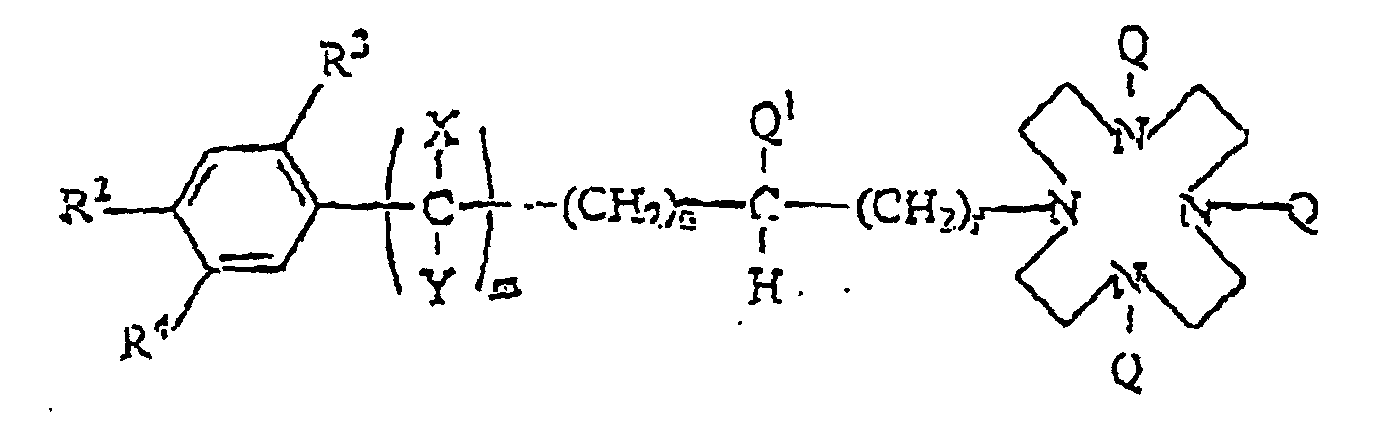 étant entendu qu'au moins deux des Q et Q1 doivent être autres que des atomes d'hydrogène et qu'au moins un Q doit être un groupe (CHR5)pP(O)OHR6 ;chaque Q représente, indépendamment, un atome d'hydrogène ou un groupe (CHR5)pCO2R, (CHR5)pPO3H2, ou (CHR5)pP(O)OHR6;Q1 représente un atome d'hydrogène ou un groupe (CHR5)wCO2R ;chaque R représente, indépendamment, un atome d'hydrogène, un groupe benzyle ou un groupe alkyle en C1 à C4 ;étant entendu que n est égal à 1 lorsque X et/ou Y forment une liaison carbone-carbone supplémentaire et que la somme de r et w est égale à 0 ou 1 ;chaque R5 représente, indépendamment, un atome d'hydrogène, un groupe alkyle en C1 à C4 ou un groupe (alkyl en C1 à C2)phényle ;chaque R6 représente, indépendamment, un groupe -OH ou alkyle en C1 à C4 ;X at Y représentent chacun, indépendamment, un atome d'hydrogène ou peuvent être pris avec un X ou Y adjacent pour former une liaison carbone-carbone supplémentaire ;n est égal à 0 ou 1 ;m désigne un nombre entier ayant une valeur de 0 à 10, bornes incluses ;p est égal à 1 ou 2 ;r est égal à 0 ou 1 ;w est égal à 0 ou 1 ;étant entendu que R2 et R4 ne peuvent pas être simultanément des atomes d'hydrogène, mais que l'un de R2 et R4 doit être un atome d'hydrogène ;R2 et R4 représentent chacun, indépendamment, un atome d'hydrogène ou un groupe amino ;R3 représente un atome d'hydrogène ou un groupe alcoxy en C, à C4, -OCH2CO2H ou hydroxyle ;
ledit conjugué d'agent chélateur, obtenu par union dudit agent chélateur avec ladite protéine, contenant moins d'environ 3% de formation d'agrégat, ce pourcentage étant mesuré par chromatographie en phase liquide à haute performance. - Conjugué de chélate comprenant un radionucléide, un agent chélateur et une protéine, dans lequel le radionucléide est fixé par l'agent chélateur, l'agent chélateur est associé à la protéine, et l'agent chélateur répond à la formule :dans laquelle :
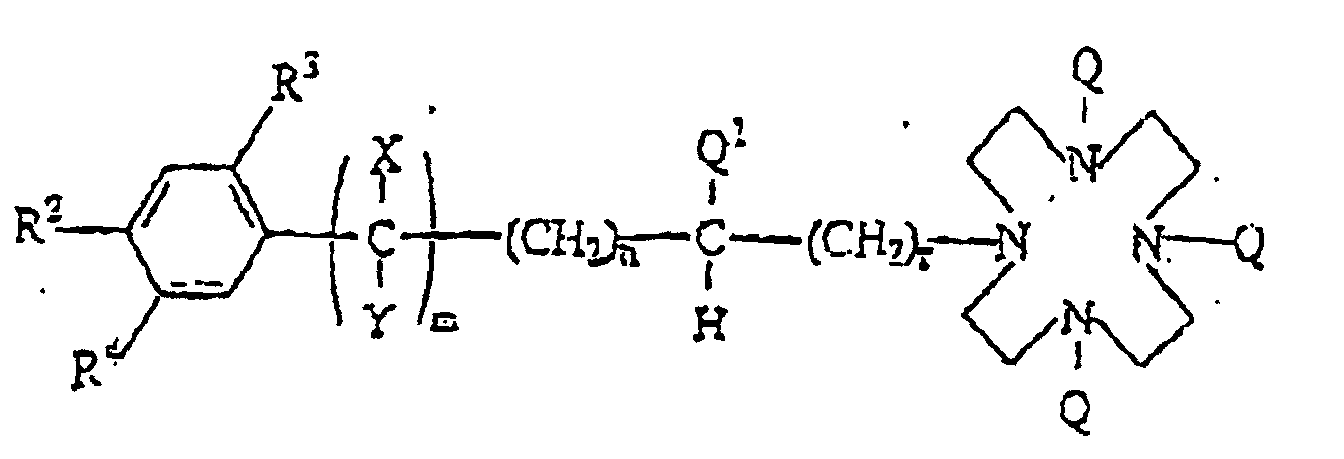 étant entendu qu'au moins deux des Q et Q1 doivent être autres que des atomes d'hydrogène et qu'au moins un Q doit être un groupe (CHR5)pP(O)OHR6 ;chaque Q représente, indépendamment, un atome d'hydrogène ou un groupe (CHR5)wCO2R, (CHR5)pPO3H2, ou (CHR5)pP(O)OHR6 ;Q1 représente un atome d'hydrogène ou un groupe (CHR5)wCO2R ;chaque R représente, indépendamment, un atome d'hydrogène, un groupe benzyle ou un groupe alkyle en C1 à C4 ;étant entendu que n est égal à 1 lorsque X et/ou Y forment une liaison carbone-carbone supplémentaire et que la somme de r et w est égale à 0 ou 1 ;chaque R5 représente, indépendamment, un atome d'hydrogène, un groupe alkyle en C1 à C4 on un groupe (alkyl en C1 à C2)phényle ;chaque R6 représente, indépendamment, un groupe -OH ou alkyle en C1 à C4 ;X et Y représentent chacun, indépendamment, un atome d'hydrogène ou peuvent être pris avec un X ou Y adjacent pour former une liaison carbone-carbone supplémentaire ;n est égal à 0 ou 1 ;m désigne un nombre entier ayant une valeur de 0 à 10, bornes incluses ;p est égal à 1 ou 2 ;r est égal à 0 ou 1 ;w est égal à 0 ou 1 ;étant entendu que R2 et R4 ne peuvent pas être simultanément des atomes d'hydrogène, mais que l'un de R2 et R4 doit être un atome d'hydrogène ; ledit conjugué de chélate, obtenu par union dudit chélate avec ladite protéine, contenant moins d'environ 3% de formation d'agrégat, ce pourcentage étant mesuré par chromatographie en phase liquide à haute performance.R2 et R4 représentent chacun, indépendamment, un atome d'hydrogène ou un groupe amino ;R3 représente un atome d'hydrogène ou un groupe alcoxy en C1 à C4, -OCH2CO2H ou hydroxyle ;
Applications Claiming Priority (1)
| Application Number | Priority Date | Filing Date | Title |
|---|---|---|---|
| PCT/US1994/010304 WO1996007435A1 (fr) | 1994-09-07 | 1994-09-07 | Procede de preparation d'agents chelateurs macrocycliques et formation de chelates et leurs conjugues |
Publications (2)
| Publication Number | Publication Date |
|---|---|
| EP0783326A1 EP0783326A1 (fr) | 1997-07-16 |
| EP0783326B1 true EP0783326B1 (fr) | 2004-02-04 |
Family
ID=22242968
Family Applications (1)
| Application Number | Title | Priority Date | Filing Date |
|---|---|---|---|
| EP94929190A Expired - Lifetime EP0783326B1 (fr) | 1994-09-07 | 1994-09-07 | Procede de preparation d'agents chelateurs macrocycliques et formation de chelates et leurs conjugues |
Country Status (7)
| Country | Link |
|---|---|
| EP (1) | EP0783326B1 (fr) |
| JP (1) | JPH10505357A (fr) |
| KR (1) | KR100367264B1 (fr) |
| AT (1) | ATE258806T1 (fr) |
| AU (1) | AU698763B2 (fr) |
| DE (1) | DE69433534T2 (fr) |
| WO (1) | WO1996007435A1 (fr) |
Families Citing this family (1)
| Publication number | Priority date | Publication date | Assignee | Title |
|---|---|---|---|---|
| JP7225820B2 (ja) | 2019-01-21 | 2023-02-21 | 株式会社アイシン | 車両用開閉体制御装置 |
Family Cites Families (4)
| Publication number | Priority date | Publication date | Assignee | Title |
|---|---|---|---|---|
| US5006643A (en) * | 1987-06-24 | 1991-04-09 | The Dow Chemical Company | Process for preparing isothiocyanato functionalized metal complexes |
| CA1341373C (fr) * | 1988-06-24 | 2002-07-02 | Roberta C. Cheng | Agents chelateurs bifonctionnels macrocycliques, leurs complexes et leurs conjugues d'anticorps |
| GB9115287D0 (en) * | 1991-07-15 | 1991-08-28 | Antibioticos Spa | Process for the preparation of cephalosporins intermediates |
| JPH07505886A (ja) * | 1992-04-13 | 1995-06-29 | ザ ダウ ケミカル カンパニー | マクロ環状キレート化剤の製造方法及びキレートの形成並びにその結合体 |
-
1994
- 1994-09-07 EP EP94929190A patent/EP0783326B1/fr not_active Expired - Lifetime
- 1994-09-07 DE DE69433534T patent/DE69433534T2/de not_active Expired - Lifetime
- 1994-09-07 AU AU78339/94A patent/AU698763B2/en not_active Ceased
- 1994-09-07 AT AT94929190T patent/ATE258806T1/de not_active IP Right Cessation
- 1994-09-07 KR KR1019970701605A patent/KR100367264B1/ko not_active Expired - Fee Related
- 1994-09-07 JP JP8509448A patent/JPH10505357A/ja not_active Ceased
- 1994-09-07 WO PCT/US1994/010304 patent/WO1996007435A1/fr not_active Ceased
Also Published As
| Publication number | Publication date |
|---|---|
| DE69433534D1 (de) | 2004-03-11 |
| EP0783326A1 (fr) | 1997-07-16 |
| WO1996007435A1 (fr) | 1996-03-14 |
| KR970706024A (ko) | 1997-11-03 |
| AU7833994A (en) | 1996-03-27 |
| KR100367264B1 (ko) | 2003-03-15 |
| DE69433534T2 (de) | 2004-07-08 |
| AU698763B2 (en) | 1998-11-05 |
| JPH10505357A (ja) | 1998-05-26 |
| ATE258806T1 (de) | 2004-02-15 |
Similar Documents
| Publication | Publication Date | Title |
|---|---|---|
| JP2831073B2 (ja) | 大環状二官能キレート剤、その錯体及びそれらの抗体接合体 | |
| CA2039218C (fr) | Adduits d'acide boronique et de complexes metalliques de dioxime permettant le marquage des proteines et d'autres composes amines | |
| KR100245941B1 (ko) | 카복스아미드 변성된 폴리아민 킬레이트제 및 방사성 착화합물 및 결합체 | |
| Lewis et al. | A facile, water-soluble method for modification of proteins with DOTA. Use of elevated temperature and optimized pH to achieve high specific activity and high chelate stability in radiolabeled immunoconjugates | |
| US5756065A (en) | Macrocyclic tetraazacyclododecane conjugates and their use as diagnostic and therapeutic agents | |
| US5652361A (en) | Macrocyclic ligands and complexes | |
| JP2555391B2 (ja) | 金属キレートー蛋白質複合体を形成するための主鎖多置換キレート | |
| Smith-Jones et al. | Antibody labeling with copper-67 using the bifunctional macrocycle 4-[(1, 4, 8, 11-tetraazacyclotetradec-1-yl) methyl] benzoic acid | |
| CA2487908C (fr) | Ligands macrocycliques pendants de type scorpionates, complexes et compositions contenant ces derniers, et leurs procedes d'utilisation | |
| EP0329481A2 (fr) | Composés anchimères et radiométal chélatants | |
| Ruser et al. | Synthesis and evaluation of two new bifunctional carboxymethylated tetraazamacrocyclic chelating agents for protein labeling with indium-111 | |
| US20150157742A1 (en) | SYNTHESIS OF BIOLOGICAL COMPOUNDS LABELED WITH THE ALPHA EMITTER Ac-225 | |
| EP0783326B1 (fr) | Procede de preparation d'agents chelateurs macrocycliques et formation de chelates et leurs conjugues | |
| EP0662842A1 (fr) | Procede de preparation d'agents de chelation macrocycliques et de formation de leurs chelates et conjugues | |
| AU2006298827B2 (en) | Biotin diaminoderivatives and their conjugates with macrocyclic chelating agents | |
| JPH06505795A (ja) | キレート化剤 | |
| AU677006C (en) | Process for preparing macrocyclic chelating agents and formation of chelates and conjugates thereof | |
| CA2199387A1 (fr) | Procede de preparation d'agents chelateurs macrocycliques et formation de chelates et leurs conjugues | |
| WO1994026315A1 (fr) | Complexes et conjugues de complexes d'acides bicyclopolyazamacrocyclocarboxyliques, procedes de preparation de ces derniers et d'utilisation en tant que produits radiopharmaceutiques | |
| EP0575583A1 (fr) | Complexes d'acides bicyclopolyazamacrocyclocarboxyliques, leurs conjugues, leurs procedes de preparation et leurs utilisations comme agents radiopharmaceutiques | |
| CA2836313A1 (fr) | Synthese de composes biologiques etiquetes avec l'emetteur alpha ac-225 | |
| Subramanian et al. | 9. Bifunctional chelating agents for radiometal-labeled | |
| JPH05239039A (ja) | テクネチウムまたはレニウムで物質を標識する方法 | |
| JPH05178826A (ja) | 二官能性キレート化剤、それと蛋白質との複合体及びその用途 |
Legal Events
| Date | Code | Title | Description |
|---|---|---|---|
| PUAI | Public reference made under article 153(3) epc to a published international application that has entered the european phase |
Free format text: ORIGINAL CODE: 0009012 |
|
| 17P | Request for examination filed |
Effective date: 19970304 |
|
| AK | Designated contracting states |
Kind code of ref document: A1 Designated state(s): AT BE CH DE DK ES FR GB GR IE IT LI LU MC NL PT SE |
|
| RAP3 | Party data changed (applicant data changed or rights of an application transferred) |
Owner name: THE DOW CHEMICAL COMPANY |
|
| 17Q | First examination report despatched |
Effective date: 19991220 |
|
| GRAP | Despatch of communication of intention to grant a patent |
Free format text: ORIGINAL CODE: EPIDOSNIGR1 |
|
| GRAS | Grant fee paid |
Free format text: ORIGINAL CODE: EPIDOSNIGR3 |
|
| GRAA | (expected) grant |
Free format text: ORIGINAL CODE: 0009210 |
|
| AK | Designated contracting states |
Kind code of ref document: B1 Designated state(s): AT BE CH DE DK ES FR GB GR IE IT LI LU MC NL PT SE |
|
| PG25 | Lapsed in a contracting state [announced via postgrant information from national office to epo] |
Ref country code: NL Free format text: LAPSE BECAUSE OF FAILURE TO SUBMIT A TRANSLATION OF THE DESCRIPTION OR TO PAY THE FEE WITHIN THE PRESCRIBED TIME-LIMIT Effective date: 20040204 Ref country code: LI Free format text: LAPSE BECAUSE OF FAILURE TO SUBMIT A TRANSLATION OF THE DESCRIPTION OR TO PAY THE FEE WITHIN THE PRESCRIBED TIME-LIMIT Effective date: 20040204 Ref country code: IT Free format text: LAPSE BECAUSE OF FAILURE TO SUBMIT A TRANSLATION OF THE DESCRIPTION OR TO PAY THE FEE WITHIN THE PRE;WARNING: LAPSES OF ITALIAN PATENTS WITH EFFECTIVE DATE BEFORE 2007 MAY HAVE OCCURRED AT ANY TIME BEFORE 2007. THE CORRECT EFFECTIVE DATE MAY BE DIFFERENT FROM THE ONE RECORDED.SCRIBED TIME-LIMIT Effective date: 20040204 Ref country code: CH Free format text: LAPSE BECAUSE OF FAILURE TO SUBMIT A TRANSLATION OF THE DESCRIPTION OR TO PAY THE FEE WITHIN THE PRESCRIBED TIME-LIMIT Effective date: 20040204 Ref country code: BE Free format text: LAPSE BECAUSE OF FAILURE TO SUBMIT A TRANSLATION OF THE DESCRIPTION OR TO PAY THE FEE WITHIN THE PRESCRIBED TIME-LIMIT Effective date: 20040204 Ref country code: AT Free format text: LAPSE BECAUSE OF FAILURE TO SUBMIT A TRANSLATION OF THE DESCRIPTION OR TO PAY THE FEE WITHIN THE PRESCRIBED TIME-LIMIT Effective date: 20040204 |
|
| REG | Reference to a national code |
Ref country code: GB Ref legal event code: FG4D |
|
| REG | Reference to a national code |
Ref country code: CH Ref legal event code: EP |
|
| REG | Reference to a national code |
Ref country code: IE Ref legal event code: FG4D |
|
| REF | Corresponds to: |
Ref document number: 69433534 Country of ref document: DE Date of ref document: 20040311 Kind code of ref document: P |
|
| PG25 | Lapsed in a contracting state [announced via postgrant information from national office to epo] |
Ref country code: SE Free format text: LAPSE BECAUSE OF FAILURE TO SUBMIT A TRANSLATION OF THE DESCRIPTION OR TO PAY THE FEE WITHIN THE PRESCRIBED TIME-LIMIT Effective date: 20040504 Ref country code: GR Free format text: LAPSE BECAUSE OF FAILURE TO SUBMIT A TRANSLATION OF THE DESCRIPTION OR TO PAY THE FEE WITHIN THE PRESCRIBED TIME-LIMIT Effective date: 20040504 Ref country code: DK Free format text: LAPSE BECAUSE OF FAILURE TO SUBMIT A TRANSLATION OF THE DESCRIPTION OR TO PAY THE FEE WITHIN THE PRESCRIBED TIME-LIMIT Effective date: 20040504 |
|
| PG25 | Lapsed in a contracting state [announced via postgrant information from national office to epo] |
Ref country code: ES Free format text: LAPSE BECAUSE OF FAILURE TO SUBMIT A TRANSLATION OF THE DESCRIPTION OR TO PAY THE FEE WITHIN THE PRESCRIBED TIME-LIMIT Effective date: 20040515 |
|
| NLV1 | Nl: lapsed or annulled due to failure to fulfill the requirements of art. 29p and 29m of the patents act | ||
| REG | Reference to a national code |
Ref country code: CH Ref legal event code: PL |
|
| PG25 | Lapsed in a contracting state [announced via postgrant information from national office to epo] |
Ref country code: LU Free format text: LAPSE BECAUSE OF NON-PAYMENT OF DUE FEES Effective date: 20040907 Ref country code: IE Free format text: LAPSE BECAUSE OF NON-PAYMENT OF DUE FEES Effective date: 20040907 |
|
| ET | Fr: translation filed | ||
| PG25 | Lapsed in a contracting state [announced via postgrant information from national office to epo] |
Ref country code: MC Free format text: LAPSE BECAUSE OF NON-PAYMENT OF DUE FEES Effective date: 20040930 |
|
| PLBE | No opposition filed within time limit |
Free format text: ORIGINAL CODE: 0009261 |
|
| STAA | Information on the status of an ep patent application or granted ep patent |
Free format text: STATUS: NO OPPOSITION FILED WITHIN TIME LIMIT |
|
| 26N | No opposition filed |
Effective date: 20041105 |
|
| REG | Reference to a national code |
Ref country code: IE Ref legal event code: MM4A |
|
| PG25 | Lapsed in a contracting state [announced via postgrant information from national office to epo] |
Ref country code: PT Free format text: LAPSE BECAUSE OF NON-PAYMENT OF DUE FEES Effective date: 20040704 |
|
| PGFP | Annual fee paid to national office [announced via postgrant information from national office to epo] |
Ref country code: GB Payment date: 20120905 Year of fee payment: 19 |
|
| PGFP | Annual fee paid to national office [announced via postgrant information from national office to epo] |
Ref country code: DE Payment date: 20120905 Year of fee payment: 19 Ref country code: FR Payment date: 20120926 Year of fee payment: 19 |
|
| GBPC | Gb: european patent ceased through non-payment of renewal fee |
Effective date: 20130907 |
|
| REG | Reference to a national code |
Ref country code: FR Ref legal event code: ST Effective date: 20140530 |
|
| REG | Reference to a national code |
Ref country code: DE Ref legal event code: R119 Ref document number: 69433534 Country of ref document: DE Effective date: 20140401 |
|
| PG25 | Lapsed in a contracting state [announced via postgrant information from national office to epo] |
Ref country code: GB Free format text: LAPSE BECAUSE OF NON-PAYMENT OF DUE FEES Effective date: 20130907 |
|
| PG25 | Lapsed in a contracting state [announced via postgrant information from national office to epo] |
Ref country code: FR Free format text: LAPSE BECAUSE OF NON-PAYMENT OF DUE FEES Effective date: 20130930 Ref country code: DE Free format text: LAPSE BECAUSE OF NON-PAYMENT OF DUE FEES Effective date: 20140401 |