EP0785197A2 - 2-Oxo- und 2-Thio-1,2-dihydrochinolinyl-oxazolidinone - Google Patents
2-Oxo- und 2-Thio-1,2-dihydrochinolinyl-oxazolidinone Download PDFInfo
- Publication number
- EP0785197A2 EP0785197A2 EP97100026A EP97100026A EP0785197A2 EP 0785197 A2 EP0785197 A2 EP 0785197A2 EP 97100026 A EP97100026 A EP 97100026A EP 97100026 A EP97100026 A EP 97100026A EP 0785197 A2 EP0785197 A2 EP 0785197A2
- Authority
- EP
- European Patent Office
- Prior art keywords
- carbon atoms
- chain
- straight
- different
- phenyl
- Prior art date
- Legal status (The legal status is an assumption and is not a legal conclusion. Google has not performed a legal analysis and makes no representation as to the accuracy of the status listed.)
- Withdrawn
Links
- 125000000217 alkyl group Chemical group 0.000 claims abstract description 96
- 125000004453 alkoxycarbonyl group Chemical group 0.000 claims abstract description 37
- 125000002252 acyl group Chemical group 0.000 claims abstract description 34
- 125000003545 alkoxy group Chemical group 0.000 claims abstract description 20
- 125000001624 naphthyl group Chemical group 0.000 claims abstract description 20
- 229910052760 oxygen Inorganic materials 0.000 claims abstract description 20
- 229910052801 chlorine Inorganic materials 0.000 claims abstract description 18
- 125000003944 tolyl group Chemical group 0.000 claims abstract description 17
- 125000000753 cycloalkyl group Chemical group 0.000 claims abstract description 16
- 229910052794 bromium Inorganic materials 0.000 claims abstract description 15
- 125000003178 carboxy group Chemical group [H]OC(*)=O 0.000 claims abstract description 14
- 229910052717 sulfur Inorganic materials 0.000 claims abstract description 14
- 125000001797 benzyl group Chemical group [H]C1=C([H])C([H])=C(C([H])=C1[H])C([H])([H])* 0.000 claims abstract description 13
- 229910052731 fluorine Inorganic materials 0.000 claims abstract description 13
- 150000003839 salts Chemical class 0.000 claims abstract description 13
- 125000001584 benzyloxycarbonyl group Chemical group C(=O)(OCC1=CC=CC=C1)* 0.000 claims abstract description 10
- UYWQUFXKFGHYNT-UHFFFAOYSA-N phenylmethyl ester of formic acid Natural products O=COCC1=CC=CC=C1 UYWQUFXKFGHYNT-UHFFFAOYSA-N 0.000 claims abstract description 10
- 125000004001 thioalkyl group Chemical group 0.000 claims abstract description 10
- 125000003342 alkenyl group Chemical group 0.000 claims abstract description 7
- 125000005931 tert-butyloxycarbonyl group Chemical group [H]C([H])([H])C(OC(*)=O)(C([H])([H])[H])C([H])([H])[H] 0.000 claims abstract description 7
- 125000002757 morpholinyl group Chemical group 0.000 claims abstract description 5
- 125000004433 nitrogen atom Chemical group N* 0.000 claims abstract description 5
- 125000004193 piperazinyl group Chemical group 0.000 claims abstract description 5
- 125000005936 piperidyl group Chemical group 0.000 claims abstract description 5
- 125000000719 pyrrolidinyl group Chemical group 0.000 claims abstract description 5
- 125000003118 aryl group Chemical group 0.000 claims abstract description 4
- 125000006239 protecting group Chemical group 0.000 claims abstract description 3
- YMWUJEATGCHHMB-UHFFFAOYSA-N Dichloromethane Chemical compound ClCCl YMWUJEATGCHHMB-UHFFFAOYSA-N 0.000 claims description 128
- 125000004432 carbon atom Chemical group C* 0.000 claims description 114
- 150000001875 compounds Chemical class 0.000 claims description 79
- 125000001997 phenyl group Chemical group [H]C1=C([H])C([H])=C(*)C([H])=C1[H] 0.000 claims description 75
- YXFVVABEGXRONW-UHFFFAOYSA-N Toluene Chemical compound CC1=CC=CC=C1 YXFVVABEGXRONW-UHFFFAOYSA-N 0.000 claims description 55
- 229910052739 hydrogen Inorganic materials 0.000 claims description 51
- 239000001257 hydrogen Substances 0.000 claims description 50
- UFHFLCQGNIYNRP-UHFFFAOYSA-N Hydrogen Chemical compound [H][H] UFHFLCQGNIYNRP-UHFFFAOYSA-N 0.000 claims description 43
- -1 hydroxy, pyridyl Chemical group 0.000 claims description 42
- 125000002023 trifluoromethyl group Chemical group FC(F)(F)* 0.000 claims description 39
- 150000002431 hydrogen Chemical class 0.000 claims description 31
- 125000001559 cyclopropyl group Chemical group [H]C1([H])C([H])([H])C1([H])* 0.000 claims description 24
- 125000000113 cyclohexyl group Chemical group [H]C1([H])C([H])([H])C([H])([H])C([H])(*)C([H])([H])C1([H])[H] 0.000 claims description 21
- 125000001511 cyclopentyl group Chemical group [H]C1([H])C([H])([H])C([H])([H])C([H])(*)C1([H])[H] 0.000 claims description 21
- ZAMOUSCENKQFHK-UHFFFAOYSA-N Chlorine atom Chemical compound [Cl] ZAMOUSCENKQFHK-UHFFFAOYSA-N 0.000 claims description 20
- VOPWNXZWBYDODV-UHFFFAOYSA-N Chlorodifluoromethane Chemical compound FC(F)Cl VOPWNXZWBYDODV-UHFFFAOYSA-N 0.000 claims description 18
- 239000000460 chlorine Substances 0.000 claims description 18
- 238000000034 method Methods 0.000 claims description 17
- WKBOTKDWSSQWDR-UHFFFAOYSA-N Bromine atom Chemical compound [Br] WKBOTKDWSSQWDR-UHFFFAOYSA-N 0.000 claims description 16
- 239000001301 oxygen Substances 0.000 claims description 16
- WFDIJRYMOXRFFG-UHFFFAOYSA-N Acetic anhydride Chemical compound CC(=O)OC(C)=O WFDIJRYMOXRFFG-UHFFFAOYSA-N 0.000 claims description 15
- XTHFKEDIFFGKHM-UHFFFAOYSA-N Dimethoxyethane Chemical compound COCCOC XTHFKEDIFFGKHM-UHFFFAOYSA-N 0.000 claims description 15
- 125000004093 cyano group Chemical group *C#N 0.000 claims description 15
- 229910052736 halogen Inorganic materials 0.000 claims description 15
- 150000002367 halogens Chemical class 0.000 claims description 15
- GDTBXPJZTBHREO-UHFFFAOYSA-N bromine Substances BrBr GDTBXPJZTBHREO-UHFFFAOYSA-N 0.000 claims description 14
- 238000006243 chemical reaction Methods 0.000 claims description 14
- 239000011737 fluorine Substances 0.000 claims description 12
- 239000012442 inert solvent Substances 0.000 claims description 12
- 125000004434 sulfur atom Chemical group 0.000 claims description 12
- HEDRZPFGACZZDS-UHFFFAOYSA-N Chloroform Chemical compound ClC(Cl)Cl HEDRZPFGACZZDS-UHFFFAOYSA-N 0.000 claims description 11
- QVGXLLKOCUKJST-UHFFFAOYSA-N atomic oxygen Chemical compound [O] QVGXLLKOCUKJST-UHFFFAOYSA-N 0.000 claims description 9
- 125000000051 benzyloxy group Chemical group [H]C1=C([H])C([H])=C(C([H])=C1[H])C([H])([H])O* 0.000 claims description 9
- 125000005518 carboxamido group Chemical group 0.000 claims description 9
- 125000002496 methyl group Chemical group [H]C([H])([H])* 0.000 claims description 9
- YYROPELSRYBVMQ-UHFFFAOYSA-N 4-toluenesulfonyl chloride Chemical compound CC1=CC=C(S(Cl)(=O)=O)C=C1 YYROPELSRYBVMQ-UHFFFAOYSA-N 0.000 claims description 7
- MYMOFIZGZYHOMD-UHFFFAOYSA-N Dioxygen Chemical compound O=O MYMOFIZGZYHOMD-UHFFFAOYSA-N 0.000 claims description 7
- PXIPVTKHYLBLMZ-UHFFFAOYSA-N Sodium azide Chemical compound [Na+].[N-]=[N+]=[N-] PXIPVTKHYLBLMZ-UHFFFAOYSA-N 0.000 claims description 7
- 150000001412 amines Chemical class 0.000 claims description 7
- 239000003814 drug Substances 0.000 claims description 7
- CPPKAGUPTKIMNP-UHFFFAOYSA-N cyanogen fluoride Chemical compound FC#N CPPKAGUPTKIMNP-UHFFFAOYSA-N 0.000 claims description 6
- 150000002170 ethers Chemical class 0.000 claims description 6
- 238000002360 preparation method Methods 0.000 claims description 6
- 125000004568 thiomorpholinyl group Chemical group 0.000 claims description 6
- 125000003866 trichloromethyl group Chemical group ClC(Cl)(Cl)* 0.000 claims description 6
- 150000001204 N-oxides Chemical class 0.000 claims description 5
- YLNSNVGRSIOCEU-ZCFIWIBFSA-N [(2r)-oxiran-2-yl]methyl butanoate Chemical compound CCCC(=O)OC[C@H]1CO1 YLNSNVGRSIOCEU-ZCFIWIBFSA-N 0.000 claims description 4
- 150000001408 amides Chemical group 0.000 claims description 4
- 125000001153 fluoro group Chemical group F* 0.000 claims description 4
- 229910052744 lithium Inorganic materials 0.000 claims description 4
- IZXIZTKNFFYFOF-UHFFFAOYSA-N 2-Oxazolidone Chemical class O=C1NCCO1 IZXIZTKNFFYFOF-UHFFFAOYSA-N 0.000 claims description 3
- 125000003903 2-propenyl group Chemical group [H]C([*])([H])C([H])=C([H])[H] 0.000 claims description 3
- 239000002253 acid Substances 0.000 claims description 3
- 150000007513 acids Chemical class 0.000 claims description 3
- 150000001540 azides Chemical class 0.000 claims description 3
- 125000001495 ethyl group Chemical group [H]C([H])([H])C([H])([H])* 0.000 claims description 3
- 125000002887 hydroxy group Chemical group [H]O* 0.000 claims description 3
- CFHGBZLNZZVTAY-UHFFFAOYSA-N lawesson's reagent Chemical compound C1=CC(OC)=CC=C1P1(=S)SP(=S)(C=2C=CC(OC)=CC=2)S1 CFHGBZLNZZVTAY-UHFFFAOYSA-N 0.000 claims description 3
- VNWKTOKETHGBQD-UHFFFAOYSA-N methane Natural products C VNWKTOKETHGBQD-UHFFFAOYSA-N 0.000 claims description 3
- 125000001160 methoxycarbonyl group Chemical group [H]C([H])([H])OC(*)=O 0.000 claims description 3
- 125000000449 nitro group Chemical group [O-][N+](*)=O 0.000 claims description 3
- 125000004178 (C1-C4) alkyl group Chemical group 0.000 claims description 2
- 239000002168 alkylating agent Substances 0.000 claims description 2
- 229940100198 alkylating agent Drugs 0.000 claims description 2
- CSKNSYBAZOQPLR-UHFFFAOYSA-N benzenesulfonyl chloride Chemical class ClS(=O)(=O)C1=CC=CC=C1 CSKNSYBAZOQPLR-UHFFFAOYSA-N 0.000 claims description 2
- 239000003795 chemical substances by application Substances 0.000 claims description 2
- 238000004519 manufacturing process Methods 0.000 claims description 2
- 125000001424 substituent group Chemical group 0.000 claims description 2
- 238000005987 sulfurization reaction Methods 0.000 claims description 2
- YCKRFDGAMUMZLT-UHFFFAOYSA-N Fluorine atom Chemical compound [F] YCKRFDGAMUMZLT-UHFFFAOYSA-N 0.000 claims 4
- 201000010099 disease Diseases 0.000 claims 1
- 208000037265 diseases, disorders, signs and symptoms Diseases 0.000 claims 1
- 125000002827 triflate group Chemical group FC(S(=O)(=O)O*)(F)F 0.000 claims 1
- 125000003917 carbamoyl group Chemical group [H]N([H])C(*)=O 0.000 abstract description 3
- 125000005843 halogen group Chemical group 0.000 abstract 3
- 125000003088 (fluoren-9-ylmethoxy)carbonyl group Chemical group 0.000 abstract 1
- 125000004076 pyridyl group Chemical group 0.000 abstract 1
- 125000005505 thiomorpholino group Chemical group 0.000 abstract 1
- 125000005425 toluyl group Chemical group 0.000 abstract 1
- ZBZJXHCVGLJWFG-UHFFFAOYSA-N trichloromethyl(.) Chemical group Cl[C](Cl)Cl ZBZJXHCVGLJWFG-UHFFFAOYSA-N 0.000 abstract 1
- SMWDFEZZVXVKRB-UHFFFAOYSA-N Quinoline Chemical compound N1=CC=CC2=CC=CC=C21 SMWDFEZZVXVKRB-UHFFFAOYSA-N 0.000 description 96
- OKKJLVBELUTLKV-UHFFFAOYSA-N Methanol Chemical compound OC OKKJLVBELUTLKV-UHFFFAOYSA-N 0.000 description 87
- IAZDPXIOMUYVGZ-UHFFFAOYSA-N Dimethylsulphoxide Chemical compound CS(C)=O IAZDPXIOMUYVGZ-UHFFFAOYSA-N 0.000 description 38
- WEVYAHXRMPXWCK-UHFFFAOYSA-N Acetonitrile Chemical compound CC#N WEVYAHXRMPXWCK-UHFFFAOYSA-N 0.000 description 34
- XEKOWRVHYACXOJ-UHFFFAOYSA-N Ethyl acetate Chemical compound CCOC(C)=O XEKOWRVHYACXOJ-UHFFFAOYSA-N 0.000 description 31
- 239000000243 solution Substances 0.000 description 25
- 239000000203 mixture Substances 0.000 description 24
- WYURNTSHIVDZCO-UHFFFAOYSA-N Tetrahydrofuran Chemical compound C1CCOC1 WYURNTSHIVDZCO-UHFFFAOYSA-N 0.000 description 23
- RTZKZFJDLAIYFH-UHFFFAOYSA-N Diethyl ether Chemical compound CCOCC RTZKZFJDLAIYFH-UHFFFAOYSA-N 0.000 description 22
- ZMXDDKWLCZADIW-UHFFFAOYSA-N N,N-Dimethylformamide Chemical compound CN(C)C=O ZMXDDKWLCZADIW-UHFFFAOYSA-N 0.000 description 22
- 239000002904 solvent Substances 0.000 description 21
- XLYOFNOQVPJJNP-UHFFFAOYSA-N water Substances O XLYOFNOQVPJJNP-UHFFFAOYSA-N 0.000 description 20
- ZMANZCXQSJIPKH-UHFFFAOYSA-N Triethylamine Chemical compound CCN(CC)CC ZMANZCXQSJIPKH-UHFFFAOYSA-N 0.000 description 18
- 238000005160 1H NMR spectroscopy Methods 0.000 description 16
- 238000005481 NMR spectroscopy Methods 0.000 description 16
- 239000013078 crystal Substances 0.000 description 15
- VYPSYNLAJGMNEJ-UHFFFAOYSA-N Silicium dioxide Chemical compound O=[Si]=O VYPSYNLAJGMNEJ-UHFFFAOYSA-N 0.000 description 14
- 239000000741 silica gel Substances 0.000 description 14
- 229910002027 silica gel Inorganic materials 0.000 description 14
- HEMHJVSKTPXQMS-UHFFFAOYSA-M sodium hydroxide Inorganic materials [OH-].[Na+] HEMHJVSKTPXQMS-UHFFFAOYSA-M 0.000 description 14
- QGZKDVFQNNGYKY-UHFFFAOYSA-N Ammonia Chemical compound N QGZKDVFQNNGYKY-UHFFFAOYSA-N 0.000 description 13
- LFQSCWFLJHTTHZ-UHFFFAOYSA-N Ethanol Chemical compound CCO LFQSCWFLJHTTHZ-UHFFFAOYSA-N 0.000 description 12
- 238000004992 fast atom bombardment mass spectroscopy Methods 0.000 description 12
- 125000006297 carbonyl amino group Chemical group [H]N([*:2])C([*:1])=O 0.000 description 11
- 125000004005 formimidoyl group Chemical group [H]\N=C(/[H])* 0.000 description 11
- PXGOKWXKJXAPGV-UHFFFAOYSA-N Fluorine Chemical compound FF PXGOKWXKJXAPGV-UHFFFAOYSA-N 0.000 description 10
- MVPPADPHJFYWMZ-UHFFFAOYSA-N chlorobenzene Chemical compound ClC1=CC=CC=C1 MVPPADPHJFYWMZ-UHFFFAOYSA-N 0.000 description 10
- 238000004587 chromatography analysis Methods 0.000 description 10
- CSCPPACGZOOCGX-UHFFFAOYSA-N Acetone Chemical compound CC(C)=O CSCPPACGZOOCGX-UHFFFAOYSA-N 0.000 description 9
- 229910000069 nitrogen hydride Inorganic materials 0.000 description 9
- MZRVEZGGRBJDDB-UHFFFAOYSA-N N-Butyllithium Chemical compound [Li]CCCC MZRVEZGGRBJDDB-UHFFFAOYSA-N 0.000 description 8
- VLKZOEOYAKHREP-UHFFFAOYSA-N n-Hexane Chemical compound CCCCCC VLKZOEOYAKHREP-UHFFFAOYSA-N 0.000 description 8
- 239000011541 reaction mixture Substances 0.000 description 8
- 239000011734 sodium Substances 0.000 description 8
- 239000002585 base Substances 0.000 description 7
- 239000000725 suspension Substances 0.000 description 7
- YLQBMQCUIZJEEH-UHFFFAOYSA-N tetrahydrofuran Natural products C=1C=COC=1 YLQBMQCUIZJEEH-UHFFFAOYSA-N 0.000 description 7
- UHOVQNZJYSORNB-UHFFFAOYSA-N Benzene Chemical compound C1=CC=CC=C1 UHOVQNZJYSORNB-UHFFFAOYSA-N 0.000 description 6
- WSFSSNUMVMOOMR-UHFFFAOYSA-N Formaldehyde Chemical compound O=C WSFSSNUMVMOOMR-UHFFFAOYSA-N 0.000 description 6
- KRKNYBCHXYNGOX-UHFFFAOYSA-N citric acid Chemical compound OC(=O)CC(O)(C(O)=O)CC(O)=O KRKNYBCHXYNGOX-UHFFFAOYSA-N 0.000 description 6
- 239000012074 organic phase Substances 0.000 description 6
- BWHMMNNQKKPAPP-UHFFFAOYSA-L potassium carbonate Chemical compound [K+].[K+].[O-]C([O-])=O BWHMMNNQKKPAPP-UHFFFAOYSA-L 0.000 description 6
- PAMIQIKDUOTOBW-UHFFFAOYSA-N 1-methylpiperidine Chemical compound CN1CCCCC1 PAMIQIKDUOTOBW-UHFFFAOYSA-N 0.000 description 5
- DGAQECJNVWCQMB-PUAWFVPOSA-M Ilexoside XXIX Chemical compound C[C@@H]1CC[C@@]2(CC[C@@]3(C(=CC[C@H]4[C@]3(CC[C@@H]5[C@@]4(CC[C@@H](C5(C)C)OS(=O)(=O)[O-])C)C)[C@@H]2[C@]1(C)O)C)C(=O)O[C@H]6[C@@H]([C@H]([C@@H]([C@H](O6)CO)O)O)O.[Na+] DGAQECJNVWCQMB-PUAWFVPOSA-M 0.000 description 5
- 239000000284 extract Substances 0.000 description 5
- 239000000047 product Substances 0.000 description 5
- 229920001817 Agar Polymers 0.000 description 4
- JUJWROOIHBZHMG-UHFFFAOYSA-N Pyridine Chemical compound C1=CC=NC=C1 JUJWROOIHBZHMG-UHFFFAOYSA-N 0.000 description 4
- 239000004480 active ingredient Substances 0.000 description 4
- 239000008272 agar Substances 0.000 description 4
- 238000001914 filtration Methods 0.000 description 4
- 239000005457 ice water Substances 0.000 description 4
- ZCSHNCUQKCANBX-UHFFFAOYSA-N lithium diisopropylamide Chemical compound [Li+].CC(C)[N-]C(C)C ZCSHNCUQKCANBX-UHFFFAOYSA-N 0.000 description 4
- 229920006395 saturated elastomer Polymers 0.000 description 4
- NHQDETIJWKXCTC-UHFFFAOYSA-N 3-chloroperbenzoic acid Chemical compound OOC(=O)C1=CC=CC(Cl)=C1 NHQDETIJWKXCTC-UHFFFAOYSA-N 0.000 description 3
- QTBSBXVTEAMEQO-UHFFFAOYSA-N Acetic acid Chemical compound CC(O)=O QTBSBXVTEAMEQO-UHFFFAOYSA-N 0.000 description 3
- 0 C/[S@](/CC(C=C1)=C(C=C*)NC1=O)=C\[*@@](C=*)N(CC(CN*)O1)C1=O Chemical compound C/[S@](/CC(C=C1)=C(C=C*)NC1=O)=C\[*@@](C=*)N(CC(CN*)O1)C1=O 0.000 description 3
- VEXZGXHMUGYJMC-UHFFFAOYSA-N Hydrochloric acid Chemical compound Cl VEXZGXHMUGYJMC-UHFFFAOYSA-N 0.000 description 3
- MHAJPDPJQMAIIY-UHFFFAOYSA-N Hydrogen peroxide Chemical compound OO MHAJPDPJQMAIIY-UHFFFAOYSA-N 0.000 description 3
- SJRJJKPEHAURKC-UHFFFAOYSA-N N-Methylmorpholine Chemical compound CN1CCOCC1 SJRJJKPEHAURKC-UHFFFAOYSA-N 0.000 description 3
- KWYUFKZDYYNOTN-UHFFFAOYSA-M Potassium hydroxide Chemical compound [OH-].[K+] KWYUFKZDYYNOTN-UHFFFAOYSA-M 0.000 description 3
- XXMIKRQMCNYMEB-UHFFFAOYSA-N [chloro(fluoro)-lambda3-bromanyl]formonitrile Chemical compound C(#N)Br(F)Cl XXMIKRQMCNYMEB-UHFFFAOYSA-N 0.000 description 3
- TUCNEACPLKLKNU-UHFFFAOYSA-N acetyl Chemical compound C[C]=O TUCNEACPLKLKNU-UHFFFAOYSA-N 0.000 description 3
- 230000029936 alkylation Effects 0.000 description 3
- 238000005804 alkylation reaction Methods 0.000 description 3
- 230000000844 anti-bacterial effect Effects 0.000 description 3
- 239000008346 aqueous phase Substances 0.000 description 3
- PZUKTUYUULTSSW-UHFFFAOYSA-N benzyl n-quinolin-6-ylcarbamate Chemical compound C=1C=C2N=CC=CC2=CC=1NC(=O)OCC1=CC=CC=C1 PZUKTUYUULTSSW-UHFFFAOYSA-N 0.000 description 3
- 229960001701 chloroform Drugs 0.000 description 3
- 230000000694 effects Effects 0.000 description 3
- 229940052308 general anesthetics halogenated hydrocarbons Drugs 0.000 description 3
- 150000008282 halocarbons Chemical class 0.000 description 3
- 229910052757 nitrogen Inorganic materials 0.000 description 3
- 239000000825 pharmaceutical preparation Substances 0.000 description 3
- 229910000027 potassium carbonate Inorganic materials 0.000 description 3
- 239000002244 precipitate Substances 0.000 description 3
- 238000010992 reflux Methods 0.000 description 3
- 229910052708 sodium Inorganic materials 0.000 description 3
- VZGDMQKNWNREIO-UHFFFAOYSA-N tetrachloromethane Chemical compound ClC(Cl)(Cl)Cl VZGDMQKNWNREIO-UHFFFAOYSA-N 0.000 description 3
- RYHBNJHYFVUHQT-UHFFFAOYSA-N 1,4-Dioxane Chemical compound C1COCCO1 RYHBNJHYFVUHQT-UHFFFAOYSA-N 0.000 description 2
- ZWEHNKRNPOVVGH-UHFFFAOYSA-N 2-Butanone Chemical compound CCC(C)=O ZWEHNKRNPOVVGH-UHFFFAOYSA-N 0.000 description 2
- BSKHPKMHTQYZBB-UHFFFAOYSA-N 2-methylpyridine Chemical compound CC1=CC=CC=N1 BSKHPKMHTQYZBB-UHFFFAOYSA-N 0.000 description 2
- HBAQYPYDRFILMT-UHFFFAOYSA-N 8-[3-(1-cyclopropylpyrazol-4-yl)-1H-pyrazolo[4,3-d]pyrimidin-5-yl]-3-methyl-3,8-diazabicyclo[3.2.1]octan-2-one Chemical class C1(CC1)N1N=CC(=C1)C1=NNC2=C1N=C(N=C2)N1C2C(N(CC1CC2)C)=O HBAQYPYDRFILMT-UHFFFAOYSA-N 0.000 description 2
- 241000894006 Bacteria Species 0.000 description 2
- ROSDSFDQCJNGOL-UHFFFAOYSA-N Dimethylamine Chemical compound CNC ROSDSFDQCJNGOL-UHFFFAOYSA-N 0.000 description 2
- VZCYOOQTPOCHFL-OWOJBTEDSA-N Fumaric acid Chemical compound OC(=O)\C=C\C(O)=O VZCYOOQTPOCHFL-OWOJBTEDSA-N 0.000 description 2
- KFZMGEQAYNKOFK-UHFFFAOYSA-N Isopropanol Chemical compound CC(C)O KFZMGEQAYNKOFK-UHFFFAOYSA-N 0.000 description 2
- AFVFQIVMOAPDHO-UHFFFAOYSA-N Methanesulfonic acid Chemical compound CS(O)(=O)=O AFVFQIVMOAPDHO-UHFFFAOYSA-N 0.000 description 2
- JGFZNNIVVJXRND-UHFFFAOYSA-N N,N-Diisopropylethylamine (DIPEA) Chemical compound CCN(C(C)C)C(C)C JGFZNNIVVJXRND-UHFFFAOYSA-N 0.000 description 2
- CTQNGGLPUBDAKN-UHFFFAOYSA-N O-Xylene Chemical compound CC1=CC=CC=C1C CTQNGGLPUBDAKN-UHFFFAOYSA-N 0.000 description 2
- OFBQJSOFQDEBGM-UHFFFAOYSA-N Pentane Chemical compound CCCCC OFBQJSOFQDEBGM-UHFFFAOYSA-N 0.000 description 2
- KFSLWBXXFJQRDL-UHFFFAOYSA-N Peracetic acid Chemical compound CC(=O)OO KFSLWBXXFJQRDL-UHFFFAOYSA-N 0.000 description 2
- NBIIXXVUZAFLBC-UHFFFAOYSA-N Phosphoric acid Chemical compound OP(O)(O)=O NBIIXXVUZAFLBC-UHFFFAOYSA-N 0.000 description 2
- FAPWRFPIFSIZLT-UHFFFAOYSA-M Sodium chloride Chemical compound [Na+].[Cl-] FAPWRFPIFSIZLT-UHFFFAOYSA-M 0.000 description 2
- QAOWNCQODCNURD-UHFFFAOYSA-N Sulfuric acid Chemical compound OS(O)(=O)=O QAOWNCQODCNURD-UHFFFAOYSA-N 0.000 description 2
- 239000013543 active substance Substances 0.000 description 2
- 239000003513 alkali Substances 0.000 description 2
- 239000004599 antimicrobial Substances 0.000 description 2
- WPYMKLBDIGXBTP-UHFFFAOYSA-N benzoic acid Chemical compound OC(=O)C1=CC=CC=C1 WPYMKLBDIGXBTP-UHFFFAOYSA-N 0.000 description 2
- 230000037396 body weight Effects 0.000 description 2
- 125000004744 butyloxycarbonyl group Chemical group 0.000 description 2
- 229950005499 carbon tetrachloride Drugs 0.000 description 2
- 125000006360 carbonyl amino methylene group Chemical group [H]N(C([*:1])=O)C([H])([H])[*:2] 0.000 description 2
- PFKFTWBEEFSNDU-UHFFFAOYSA-N carbonyldiimidazole Chemical compound C1=CN=CN1C(=O)N1C=CN=C1 PFKFTWBEEFSNDU-UHFFFAOYSA-N 0.000 description 2
- 238000002512 chemotherapy Methods 0.000 description 2
- 239000000470 constituent Substances 0.000 description 2
- 239000012043 crude product Substances 0.000 description 2
- XBDQKXXYIPTUBI-UHFFFAOYSA-N dimethylselenoniopropionate Natural products CCC(O)=O XBDQKXXYIPTUBI-UHFFFAOYSA-N 0.000 description 2
- 238000002330 electrospray ionisation mass spectrometry Methods 0.000 description 2
- 238000001704 evaporation Methods 0.000 description 2
- 230000008020 evaporation Effects 0.000 description 2
- 229930195733 hydrocarbon Natural products 0.000 description 2
- 150000002430 hydrocarbons Chemical class 0.000 description 2
- 230000002401 inhibitory effect Effects 0.000 description 2
- 238000011081 inoculation Methods 0.000 description 2
- JVTAAEKCZFNVCJ-UHFFFAOYSA-N lactic acid Chemical compound CC(O)C(O)=O JVTAAEKCZFNVCJ-UHFFFAOYSA-N 0.000 description 2
- YNESATAKKCNGOF-UHFFFAOYSA-N lithium bis(trimethylsilyl)amide Chemical compound [Li+].C[Si](C)(C)[N-][Si](C)(C)C YNESATAKKCNGOF-UHFFFAOYSA-N 0.000 description 2
- LULAYUGMBFYYEX-UHFFFAOYSA-N metachloroperbenzoic acid Natural products OC(=O)C1=CC=CC(Cl)=C1 LULAYUGMBFYYEX-UHFFFAOYSA-N 0.000 description 2
- QARBMVPHQWIHKH-UHFFFAOYSA-N methanesulfonyl chloride Chemical compound CS(Cl)(=O)=O QARBMVPHQWIHKH-UHFFFAOYSA-N 0.000 description 2
- 244000005700 microbiome Species 0.000 description 2
- 244000052769 pathogen Species 0.000 description 2
- 239000012071 phase Substances 0.000 description 2
- TYJJADVDDVDEDZ-UHFFFAOYSA-M potassium hydrogencarbonate Chemical compound [K+].OC([O-])=O TYJJADVDDVDEDZ-UHFFFAOYSA-M 0.000 description 2
- UMJSCPRVCHMLSP-UHFFFAOYSA-N pyridine Natural products COC1=CC=CN=C1 UMJSCPRVCHMLSP-UHFFFAOYSA-N 0.000 description 2
- 125000004550 quinolin-6-yl group Chemical group N1=CC=CC2=CC(=CC=C12)* 0.000 description 2
- 150000003254 radicals Chemical class 0.000 description 2
- 239000007787 solid Substances 0.000 description 2
- 238000001228 spectrum Methods 0.000 description 2
- UCSJYZPVAKXKNQ-HZYVHMACSA-N streptomycin Chemical compound CN[C@H]1[C@H](O)[C@@H](O)[C@H](CO)O[C@H]1O[C@@H]1[C@](C=O)(O)[C@H](C)O[C@H]1O[C@@H]1[C@@H](NC(N)=N)[C@H](O)[C@@H](NC(N)=N)[C@H](O)[C@H]1O UCSJYZPVAKXKNQ-HZYVHMACSA-N 0.000 description 2
- 238000012360 testing method Methods 0.000 description 2
- VZCYOOQTPOCHFL-UHFFFAOYSA-N trans-butenedioic acid Natural products OC(=O)C=CC(O)=O VZCYOOQTPOCHFL-UHFFFAOYSA-N 0.000 description 2
- ITMCEJHCFYSIIV-UHFFFAOYSA-M triflate Chemical compound [O-]S(=O)(=O)C(F)(F)F ITMCEJHCFYSIIV-UHFFFAOYSA-M 0.000 description 2
- RIOQSEWOXXDEQQ-UHFFFAOYSA-N triphenylphosphine Chemical compound C1=CC=CC=C1P(C=1C=CC=CC=1)C1=CC=CC=C1 RIOQSEWOXXDEQQ-UHFFFAOYSA-N 0.000 description 2
- 238000001665 trituration Methods 0.000 description 2
- 239000008096 xylene Substances 0.000 description 2
- JVVXZOOGOGPDRZ-UHFFFAOYSA-N (1,4a-dimethyl-7-propan-2-yl-2,3,4,9,10,10a-hexahydrophenanthren-1-yl)methanamine Chemical compound NCC1(C)CCCC2(C)C3=CC=C(C(C)C)C=C3CCC21 JVVXZOOGOGPDRZ-UHFFFAOYSA-N 0.000 description 1
- USVUMBVUBZZCBD-NSHDSACASA-N (5r)-5-(azidomethyl)-3-quinolin-6-yl-1,3-oxazolidin-2-one Chemical compound O=C1O[C@@H](CN=[N+]=[N-])CN1C1=CC=C(N=CC=C2)C2=C1 USVUMBVUBZZCBD-NSHDSACASA-N 0.000 description 1
- VWSTZJOYEHDQKQ-LLVKDONJSA-N (5r)-5-(hydroxymethyl)-3-quinolin-6-yl-1,3-oxazolidin-2-one Chemical compound O=C1O[C@@H](CO)CN1C1=CC=C(N=CC=C2)C2=C1 VWSTZJOYEHDQKQ-LLVKDONJSA-N 0.000 description 1
- HLQZCKCLUMZFBY-IDMXKUIJSA-N (5s)-5-(aminomethyl)-3-quinolin-6-yl-1,3-oxazolidin-2-one;dihydrochloride Chemical compound Cl.Cl.O=C1O[C@@H](CN)CN1C1=CC=C(N=CC=C2)C2=C1 HLQZCKCLUMZFBY-IDMXKUIJSA-N 0.000 description 1
- SCYULBFZEHDVBN-UHFFFAOYSA-N 1,1-Dichloroethane Chemical compound CC(Cl)Cl SCYULBFZEHDVBN-UHFFFAOYSA-N 0.000 description 1
- PPQJCISYYXZCAE-UHFFFAOYSA-N 1,10-phenanthroline;hydrate Chemical compound O.C1=CN=C2C3=NC=CC=C3C=CC2=C1 PPQJCISYYXZCAE-UHFFFAOYSA-N 0.000 description 1
- OCJBOOLMMGQPQU-UHFFFAOYSA-N 1,4-dichlorobenzene Chemical compound ClC1=CC=C(Cl)C=C1 OCJBOOLMMGQPQU-UHFFFAOYSA-N 0.000 description 1
- LBLYYCQCTBFVLH-UHFFFAOYSA-N 2-Methylbenzenesulfonic acid Chemical compound CC1=CC=CC=C1S(O)(=O)=O LBLYYCQCTBFVLH-UHFFFAOYSA-N 0.000 description 1
- ZNOVTXRBGFNYRX-UHFFFAOYSA-N 2-[[4-[(2-amino-5-methyl-4-oxo-1,6,7,8-tetrahydropteridin-6-yl)methylamino]benzoyl]amino]pentanedioic acid Chemical compound C1NC=2NC(N)=NC(=O)C=2N(C)C1CNC1=CC=C(C(=O)NC(CCC(O)=O)C(O)=O)C=C1 ZNOVTXRBGFNYRX-UHFFFAOYSA-N 0.000 description 1
- BMYNFMYTOJXKLE-UHFFFAOYSA-N 3-azaniumyl-2-hydroxypropanoate Chemical compound NCC(O)C(O)=O BMYNFMYTOJXKLE-UHFFFAOYSA-N 0.000 description 1
- WHIHIKVIWVIIER-UHFFFAOYSA-N 3-chlorobenzoyl chloride Chemical compound ClC(=O)C1=CC=CC(Cl)=C1 WHIHIKVIWVIIER-UHFFFAOYSA-N 0.000 description 1
- OIHIFFPUXGDRDR-AWEZNQCLSA-N 6-[(5s)-5-(acetamidomethyl)-2-oxo-1,3-oxazolidin-3-yl]-n-methyl-n-(methylcarbamoyl)-2-oxoquinoline-1-carboxamide Chemical compound C1=C2C=CC(=O)N(C(=O)N(C)C(=O)NC)C2=CC=C1N1C[C@H](CNC(C)=O)OC1=O OIHIFFPUXGDRDR-AWEZNQCLSA-N 0.000 description 1
- NLHHRLWOUZZQLW-UHFFFAOYSA-N Acrylonitrile Chemical compound C=CC#N NLHHRLWOUZZQLW-UHFFFAOYSA-N 0.000 description 1
- 239000005711 Benzoic acid Substances 0.000 description 1
- OYPRJOBELJOOCE-UHFFFAOYSA-N Calcium Chemical compound [Ca] OYPRJOBELJOOCE-UHFFFAOYSA-N 0.000 description 1
- XDTMQSROBMDMFD-UHFFFAOYSA-N Cyclohexane Chemical compound C1CCCCC1 XDTMQSROBMDMFD-UHFFFAOYSA-N 0.000 description 1
- FEWJPZIEWOKRBE-JCYAYHJZSA-N Dextrotartaric acid Chemical compound OC(=O)[C@H](O)[C@@H](O)C(O)=O FEWJPZIEWOKRBE-JCYAYHJZSA-N 0.000 description 1
- BWLUMTFWVZZZND-UHFFFAOYSA-N Dibenzylamine Chemical compound C=1C=CC=CC=1CNCC1=CC=CC=C1 BWLUMTFWVZZZND-UHFFFAOYSA-N 0.000 description 1
- 241000606768 Haemophilus influenzae Species 0.000 description 1
- BZLVMXJERCGZMT-UHFFFAOYSA-N Methyl tert-butyl ether Chemical compound COC(C)(C)C BZLVMXJERCGZMT-UHFFFAOYSA-N 0.000 description 1
- 241001430197 Mollicutes Species 0.000 description 1
- 102000010909 Monoamine Oxidase Human genes 0.000 description 1
- 108010062431 Monoamine oxidase Proteins 0.000 description 1
- 241000187480 Mycobacterium smegmatis Species 0.000 description 1
- 125000003047 N-acetyl group Chemical group 0.000 description 1
- YTMLCCYOWNLLMR-NSHDSACASA-N NC[C@@H](CN1c2cc3cccnc3cc2)OC1=O Chemical compound NC[C@@H](CN1c2cc3cccnc3cc2)OC1=O YTMLCCYOWNLLMR-NSHDSACASA-N 0.000 description 1
- OFOBLEOULBTSOW-UHFFFAOYSA-N Propanedioic acid Natural products OC(=O)CC(O)=O OFOBLEOULBTSOW-UHFFFAOYSA-N 0.000 description 1
- KEAYESYHFKHZAL-UHFFFAOYSA-N Sodium Chemical compound [Na] KEAYESYHFKHZAL-UHFFFAOYSA-N 0.000 description 1
- FEWJPZIEWOKRBE-UHFFFAOYSA-N Tartaric acid Natural products [H+].[H+].[O-]C(=O)C(O)C(O)C([O-])=O FEWJPZIEWOKRBE-UHFFFAOYSA-N 0.000 description 1
- OKJPEAGHQZHRQV-UHFFFAOYSA-N Triiodomethane Natural products IC(I)I OKJPEAGHQZHRQV-UHFFFAOYSA-N 0.000 description 1
- 235000011054 acetic acid Nutrition 0.000 description 1
- 239000008186 active pharmaceutical agent Substances 0.000 description 1
- 230000010933 acylation Effects 0.000 description 1
- 238000005917 acylation reaction Methods 0.000 description 1
- 102000019997 adhesion receptor Human genes 0.000 description 1
- 108010013985 adhesion receptor Proteins 0.000 description 1
- 150000001298 alcohols Chemical class 0.000 description 1
- 229910001854 alkali hydroxide Inorganic materials 0.000 description 1
- 229910052783 alkali metal Inorganic materials 0.000 description 1
- 150000008044 alkali metal hydroxides Chemical class 0.000 description 1
- 229910052784 alkaline earth metal Inorganic materials 0.000 description 1
- 150000001351 alkyl iodides Chemical class 0.000 description 1
- 230000002152 alkylating effect Effects 0.000 description 1
- 229910000147 aluminium phosphate Inorganic materials 0.000 description 1
- 229910021529 ammonia Inorganic materials 0.000 description 1
- 150000003863 ammonium salts Chemical class 0.000 description 1
- 239000003242 anti bacterial agent Substances 0.000 description 1
- 229940088710 antibiotic agent Drugs 0.000 description 1
- 239000002246 antineoplastic agent Substances 0.000 description 1
- 244000052616 bacterial pathogen Species 0.000 description 1
- SRSXLGNVWSONIS-UHFFFAOYSA-N benzenesulfonic acid Chemical compound OS(=O)(=O)C1=CC=CC=C1 SRSXLGNVWSONIS-UHFFFAOYSA-N 0.000 description 1
- 229940092714 benzenesulfonic acid Drugs 0.000 description 1
- 235000010233 benzoic acid Nutrition 0.000 description 1
- HSDAJNMJOMSNEV-UHFFFAOYSA-N benzyl chloroformate Chemical compound ClC(=O)OCC1=CC=CC=C1 HSDAJNMJOMSNEV-UHFFFAOYSA-N 0.000 description 1
- 238000002815 broth microdilution Methods 0.000 description 1
- FJDQFPXHSGXQBY-UHFFFAOYSA-L caesium carbonate Chemical compound [Cs+].[Cs+].[O-]C([O-])=O FJDQFPXHSGXQBY-UHFFFAOYSA-L 0.000 description 1
- 229910000024 caesium carbonate Inorganic materials 0.000 description 1
- 239000011575 calcium Substances 0.000 description 1
- 229910052791 calcium Inorganic materials 0.000 description 1
- 150000004649 carbonic acid derivatives Chemical class 0.000 description 1
- 150000001735 carboxylic acids Chemical class 0.000 description 1
- 239000000969 carrier Substances 0.000 description 1
- 239000007795 chemical reaction product Substances 0.000 description 1
- DDKMFOUTRRODRE-UHFFFAOYSA-N chloromethanone Chemical compound Cl[C]=O DDKMFOUTRRODRE-UHFFFAOYSA-N 0.000 description 1
- 235000015165 citric acid Nutrition 0.000 description 1
- 230000001332 colony forming effect Effects 0.000 description 1
- 238000001816 cooling Methods 0.000 description 1
- 229940127089 cytotoxic agent Drugs 0.000 description 1
- 230000003247 decreasing effect Effects 0.000 description 1
- 229940117389 dichlorobenzene Drugs 0.000 description 1
- HPNMFZURTQLUMO-UHFFFAOYSA-N diethylamine Chemical compound CCNCC HPNMFZURTQLUMO-UHFFFAOYSA-N 0.000 description 1
- 238000010790 dilution Methods 0.000 description 1
- 239000012895 dilution Substances 0.000 description 1
- UXGNZZKBCMGWAZ-UHFFFAOYSA-N dimethylformamide dmf Chemical compound CN(C)C=O.CN(C)C=O UXGNZZKBCMGWAZ-UHFFFAOYSA-N 0.000 description 1
- CCIVGXIOQKPBKL-UHFFFAOYSA-M ethanesulfonate Chemical compound CCS([O-])(=O)=O CCIVGXIOQKPBKL-UHFFFAOYSA-M 0.000 description 1
- 239000006260 foam Substances 0.000 description 1
- 239000001530 fumaric acid Substances 0.000 description 1
- 235000011087 fumaric acid Nutrition 0.000 description 1
- 239000007789 gas Substances 0.000 description 1
- 229940047650 haemophilus influenzae Drugs 0.000 description 1
- GNOIPBMMFNIUFM-UHFFFAOYSA-N hexamethylphosphoric triamide Chemical compound CN(C)P(=O)(N(C)C)N(C)C GNOIPBMMFNIUFM-UHFFFAOYSA-N 0.000 description 1
- 208000015181 infectious disease Diseases 0.000 description 1
- 239000002054 inoculum Substances 0.000 description 1
- 150000007529 inorganic bases Chemical class 0.000 description 1
- 229910052500 inorganic mineral Inorganic materials 0.000 description 1
- INQOMBQAUSQDDS-UHFFFAOYSA-N iodomethane Chemical compound IC INQOMBQAUSQDDS-UHFFFAOYSA-N 0.000 description 1
- 229960003350 isoniazid Drugs 0.000 description 1
- QRXWMOHMRWLFEY-UHFFFAOYSA-N isoniazide Chemical compound NNC(=O)C1=CC=NC=C1 QRXWMOHMRWLFEY-UHFFFAOYSA-N 0.000 description 1
- 150000002576 ketones Chemical class 0.000 description 1
- 239000004310 lactic acid Substances 0.000 description 1
- 235000014655 lactic acid Nutrition 0.000 description 1
- YWOCJYAVEPBMRN-UHFFFAOYSA-N lithium silylazanide Chemical class [Li+].[SiH3][NH-] YWOCJYAVEPBMRN-UHFFFAOYSA-N 0.000 description 1
- 159000000003 magnesium salts Chemical class 0.000 description 1
- VZCYOOQTPOCHFL-UPHRSURJSA-N maleic acid Chemical compound OC(=O)\C=C/C(O)=O VZCYOOQTPOCHFL-UPHRSURJSA-N 0.000 description 1
- 239000011976 maleic acid Substances 0.000 description 1
- 229940098779 methanesulfonic acid Drugs 0.000 description 1
- HAMGRBXTJNITHG-UHFFFAOYSA-N methyl isocyanate Chemical compound CN=C=O HAMGRBXTJNITHG-UHFFFAOYSA-N 0.000 description 1
- 229940073584 methylene chloride Drugs 0.000 description 1
- GRVDJDISBSALJP-UHFFFAOYSA-N methyloxidanyl Chemical compound [O]C GRVDJDISBSALJP-UHFFFAOYSA-N 0.000 description 1
- 239000011707 mineral Substances 0.000 description 1
- ADJBCIFDUFHGAM-LBPRGKRZSA-N n-[[(5s)-2-oxo-3-(2-oxo-1h-quinolin-6-yl)-1,3-oxazolidin-5-yl]methyl]acetamide Chemical compound O=C1O[C@@H](CNC(=O)C)CN1C1=CC=C(NC(=O)C=C2)C2=C1 ADJBCIFDUFHGAM-LBPRGKRZSA-N 0.000 description 1
- ZUNOYMUNSZSGJZ-ZDUSSCGKSA-N n-[[(5s)-3-(1-methyl-2-oxoquinolin-6-yl)-2-oxo-1,3-oxazolidin-5-yl]methyl]acetamide Chemical compound O=C1O[C@@H](CNC(=O)C)CN1C1=CC=C(N(C)C(=O)C=C2)C2=C1 ZUNOYMUNSZSGJZ-ZDUSSCGKSA-N 0.000 description 1
- AOMVSJSYSMQUOP-ZDUSSCGKSA-N n-[[(5s)-3-(1-methyl-2-oxoquinolin-6-yl)-2-oxo-1,3-oxazolidin-5-yl]methyl]ethanethioamide Chemical compound O=C1O[C@@H](CNC(=S)C)CN1C1=CC=C(N(C)C(=O)C=C2)C2=C1 AOMVSJSYSMQUOP-ZDUSSCGKSA-N 0.000 description 1
- AGHPYFBKRKBFAP-ZDUSSCGKSA-N n-[[(5s)-3-(1-methylsulfonyl-2-oxoquinolin-6-yl)-2-oxo-1,3-oxazolidin-5-yl]methyl]acetamide Chemical compound O=C1O[C@@H](CNC(=O)C)CN1C1=CC=C(N(C(=O)C=C2)S(C)(=O)=O)C2=C1 AGHPYFBKRKBFAP-ZDUSSCGKSA-N 0.000 description 1
- NVZMMQGFXXHKMC-ZDUSSCGKSA-N n-[[(5s)-3-[1-(hydroxymethyl)-2-oxoquinolin-6-yl]-2-oxo-1,3-oxazolidin-5-yl]methyl]acetamide Chemical compound O=C1O[C@@H](CNC(=O)C)CN1C1=CC=C(N(CO)C(=O)C=C2)C2=C1 NVZMMQGFXXHKMC-ZDUSSCGKSA-N 0.000 description 1
- XZDUFMCXMOWCOV-AWEZNQCLSA-N n-acetyl-n-[[(5s)-2-oxo-3-(2-oxo-1h-quinolin-6-yl)-1,3-oxazolidin-5-yl]methyl]acetamide Chemical compound O=C1O[C@@H](CN(C(=O)C)C(C)=O)CN1C1=CC=C(NC(=O)C=C2)C2=C1 XZDUFMCXMOWCOV-AWEZNQCLSA-N 0.000 description 1
- YZMHQCWXYHARLS-UHFFFAOYSA-N naphthalene-1,2-disulfonic acid Chemical compound C1=CC=CC2=C(S(O)(=O)=O)C(S(=O)(=O)O)=CC=C21 YZMHQCWXYHARLS-UHFFFAOYSA-N 0.000 description 1
- LYGJENNIWJXYER-UHFFFAOYSA-N nitromethane Chemical compound C[N+]([O-])=O LYGJENNIWJXYER-UHFFFAOYSA-N 0.000 description 1
- 231100000252 nontoxic Toxicity 0.000 description 1
- 230000003000 nontoxic effect Effects 0.000 description 1
- 150000007530 organic bases Chemical class 0.000 description 1
- 239000003960 organic solvent Substances 0.000 description 1
- XSXHWVKGUXMUQE-UHFFFAOYSA-N osmium dioxide Inorganic materials O=[Os]=O XSXHWVKGUXMUQE-UHFFFAOYSA-N 0.000 description 1
- 239000007800 oxidant agent Substances 0.000 description 1
- 150000002924 oxiranes Chemical class 0.000 description 1
- 239000002245 particle Substances 0.000 description 1
- 239000003208 petroleum Substances 0.000 description 1
- 239000000546 pharmaceutical excipient Substances 0.000 description 1
- 235000010482 polyoxyethylene sorbitan monooleate Nutrition 0.000 description 1
- 229920000053 polysorbate 80 Polymers 0.000 description 1
- RPDAUEIUDPHABB-UHFFFAOYSA-N potassium ethoxide Chemical compound [K+].CC[O-] RPDAUEIUDPHABB-UHFFFAOYSA-N 0.000 description 1
- BDAWXSQJJCIFIK-UHFFFAOYSA-N potassium methoxide Chemical compound [K+].[O-]C BDAWXSQJJCIFIK-UHFFFAOYSA-N 0.000 description 1
- 159000000001 potassium salts Chemical class 0.000 description 1
- 239000000843 powder Substances 0.000 description 1
- 125000002924 primary amino group Chemical group [H]N([H])* 0.000 description 1
- MFDFERRIHVXMIY-UHFFFAOYSA-N procaine Chemical compound CCN(CC)CCOC(=O)C1=CC=C(N)C=C1 MFDFERRIHVXMIY-UHFFFAOYSA-N 0.000 description 1
- 229960004919 procaine Drugs 0.000 description 1
- BDERNNFJNOPAEC-UHFFFAOYSA-N propan-1-ol Chemical compound CCCO BDERNNFJNOPAEC-UHFFFAOYSA-N 0.000 description 1
- 238000011321 prophylaxis Methods 0.000 description 1
- 235000019260 propionic acid Nutrition 0.000 description 1
- 238000000746 purification Methods 0.000 description 1
- IUVKMZGDUIUOCP-BTNSXGMBSA-N quinbolone Chemical compound O([C@H]1CC[C@H]2[C@H]3[C@@H]([C@]4(C=CC(=O)C=C4CC3)C)CC[C@@]21C)C1=CCCC1 IUVKMZGDUIUOCP-BTNSXGMBSA-N 0.000 description 1
- RJSRSRITMWVIQT-UHFFFAOYSA-N quinolin-6-amine Chemical compound N1=CC=CC2=CC(N)=CC=C21 RJSRSRITMWVIQT-UHFFFAOYSA-N 0.000 description 1
- 239000002464 receptor antagonist Substances 0.000 description 1
- 229940044551 receptor antagonist Drugs 0.000 description 1
- 238000001953 recrystallisation Methods 0.000 description 1
- 230000002829 reductive effect Effects 0.000 description 1
- 238000013207 serial dilution Methods 0.000 description 1
- ODZPKZBBUMBTMG-UHFFFAOYSA-N sodium amide Chemical compound [NH2-].[Na+] ODZPKZBBUMBTMG-UHFFFAOYSA-N 0.000 description 1
- CDBYLPFSWZWCQE-UHFFFAOYSA-L sodium carbonate Substances [Na+].[Na+].[O-]C([O-])=O CDBYLPFSWZWCQE-UHFFFAOYSA-L 0.000 description 1
- 229910000029 sodium carbonate Inorganic materials 0.000 description 1
- 239000011780 sodium chloride Substances 0.000 description 1
- 239000012312 sodium hydride Substances 0.000 description 1
- 229910000104 sodium hydride Inorganic materials 0.000 description 1
- 238000003756 stirring Methods 0.000 description 1
- 229960005322 streptomycin Drugs 0.000 description 1
- 239000000126 substance Substances 0.000 description 1
- 150000003460 sulfonic acids Chemical class 0.000 description 1
- 230000009885 systemic effect Effects 0.000 description 1
- 239000011975 tartaric acid Substances 0.000 description 1
- 235000002906 tartaric acid Nutrition 0.000 description 1
- CYTQBVOFDCPGCX-UHFFFAOYSA-N trimethyl phosphite Chemical compound COP(OC)OC CYTQBVOFDCPGCX-UHFFFAOYSA-N 0.000 description 1
Classifications
-
- C—CHEMISTRY; METALLURGY
- C07—ORGANIC CHEMISTRY
- C07D—HETEROCYCLIC COMPOUNDS
- C07D413/00—Heterocyclic compounds containing two or more hetero rings, at least one ring having nitrogen and oxygen atoms as the only ring hetero atoms
- C07D413/02—Heterocyclic compounds containing two or more hetero rings, at least one ring having nitrogen and oxygen atoms as the only ring hetero atoms containing two hetero rings
- C07D413/04—Heterocyclic compounds containing two or more hetero rings, at least one ring having nitrogen and oxygen atoms as the only ring hetero atoms containing two hetero rings directly linked by a ring-member-to-ring-member bond
-
- A—HUMAN NECESSITIES
- A61—MEDICAL OR VETERINARY SCIENCE; HYGIENE
- A61P—SPECIFIC THERAPEUTIC ACTIVITY OF CHEMICAL COMPOUNDS OR MEDICINAL PREPARATIONS
- A61P31/00—Antiinfectives, i.e. antibiotics, antiseptics, chemotherapeutics
- A61P31/04—Antibacterial agents
-
- C—CHEMISTRY; METALLURGY
- C07—ORGANIC CHEMISTRY
- C07D—HETEROCYCLIC COMPOUNDS
- C07D215/00—Heterocyclic compounds containing quinoline or hydrogenated quinoline ring systems
- C07D215/02—Heterocyclic compounds containing quinoline or hydrogenated quinoline ring systems having no bond between the ring nitrogen atom and a non-ring member or having only hydrogen atoms or carbon atoms directly attached to the ring nitrogen atom
- C07D215/16—Heterocyclic compounds containing quinoline or hydrogenated quinoline ring systems having no bond between the ring nitrogen atom and a non-ring member or having only hydrogen atoms or carbon atoms directly attached to the ring nitrogen atom with hetero atoms or with carbon atoms having three bonds to hetero atoms with at the most one bond to halogen, e.g. ester or nitrile radicals, directly attached to ring carbon atoms
- C07D215/38—Nitrogen atoms
-
- Y—GENERAL TAGGING OF NEW TECHNOLOGICAL DEVELOPMENTS; GENERAL TAGGING OF CROSS-SECTIONAL TECHNOLOGIES SPANNING OVER SEVERAL SECTIONS OF THE IPC; TECHNICAL SUBJECTS COVERED BY FORMER USPC CROSS-REFERENCE ART COLLECTIONS [XRACs] AND DIGESTS
- Y02—TECHNOLOGIES OR APPLICATIONS FOR MITIGATION OR ADAPTATION AGAINST CLIMATE CHANGE
- Y02P—CLIMATE CHANGE MITIGATION TECHNOLOGIES IN THE PRODUCTION OR PROCESSING OF GOODS
- Y02P20/00—Technologies relating to chemical industry
- Y02P20/50—Improvements relating to the production of bulk chemicals
- Y02P20/55—Design of synthesis routes, e.g. reducing the use of auxiliary or protecting groups
Definitions
- the present invention relates to 2-oxo and 2-thio-1,2-dihydroquinolinyl-oxazolidinones, processes for their preparation and their use as medicaments, in particular as antibacterial medicaments.
- N-aryloxazolidinones with antibacterial activity are known, for example, from publication EP 311 090.
- 3- (nitrogen-substituted) phenyl-5-beta-amidomethyloxazolidin-2-ones are known from EP 609 905 A1.
- WO 93 08 179 A discloses oxazolidinone derivatives with a monoamine oxidase inhibitory effect and in EP 645 376 with an effect as an adhesion receptor antagonist.
- Physiologically acceptable salts of the oxazolidinones according to the invention can be salts with mineral acids, carboxylic acids or sulfonic acids.
- salts with customary bases such as, for example, alkali metal salts (for example sodium or potassium salts), alkaline earth metal salts (for example calcium or magnesium salts) or ammonium salts derived from ammonia or organic amines such as, for example, diethylamine, triethylamine, ethyldiisopropylamine, procaine, dibenzylamine , N-methylmorpholine, dihydroabietylamine, 1-ephenamine or methyl-piperidine.
- alkali metal salts for example sodium or potassium salts
- alkaline earth metal salts for example calcium or magnesium salts
- ammonium salts derived from ammonia or organic amines such as, for example, diethylamine, triethylamine, ethyldiisopropylamine, procaine, dibenzylamine , N-methylmorpholine, dihydroabietylamine, 1-ephenamine or methyl-piperidine.
- Reaction products with C 1 -C 4 alkyl halides, in particular C 1 -C 4 alkyl iodides, can also function as salts.
- the compounds according to the invention can exist in stereoisomeric forms which either behave like image and mirror image (enantiomers) or do not behave like image and mirror image (diastereomers).
- the invention relates to both the enantiomers or diastereomers or their respective mixtures. Like the diastereomers, the racemic forms can be separated into the stereoisomerically uniform constituents in a known manner.
- the customary solvents which do not change under the reaction conditions are suitable as solvents.
- solvents preferably include alcohols such as methanol, ethanol, propanol or isopropanol, or ethers such as diethyl ether, dioxane, 1,2-dimethoxyethane, tetrahydrofuran, glycol dimethyl ether or tert-butyl methyl ether, or ketones such as acetone or butanone, or amides such as dimethylformamide or hexamethyl-phosphoric acid triamide, or hydrocarbons such as hexane, benzene, dichlorobenzene, xylene or toluene, or dimethyl sulfoxide, acetonitrile, ethyl acetate, or halogenated hydrocarbons such as methylene chloride, chloroform or carbon tetrachloride, or pyridine, picoline or N-methylpiperidine.
- ethers such as
- the usual inorganic or organic bases are suitable as bases.
- bases preferably include alkali hydroxides such as sodium or potassium hydroxide, or alkali carbonates such as sodium or potassium carbonate, or alkali alcoholates such as sodium or potassium methoxide, or sodium or potassium ethoxide, or organic amines such as ethyldiisopropylamine, triethylamine, picoline, pyridine or N-methylpiperidine, or amides such as sodium amide or lithium diisopropylamide, or lithium-N-silylalkylamides, such as, for example, lithium-N- (bis) triphenysilylamide or lithium alkyls such as n-butyllithium.
- alkali hydroxides such as sodium or potassium hydroxide
- alkali carbonates such as sodium or potassium carbonate
- alkali alcoholates such as sodium or potassium methoxide, or sodium or potassium ethoxide
- organic amines such as eth
- the base is used in an amount of 1 mol to 10 mol, preferably 1 mol to 3 mol, based on 1 mol of the compounds of the general formulas (Ib), (II), (III) or (IV).
- organic solvents which do not change under the reaction conditions are suitable as solvents for the alkylation.
- solvents for the alkylation preferably include ethers such as diethyl ether, dioxane, tetrahydrofuran, glycol dimethyl ether or hydrocarbons such as benzene, toluene, xylene, hexane, cyclohexane or petroleum fractions, or halogenated hydrocarbons such as dichloromethane, trichloromethane, tetrachloromethane, dichlorethylene, trichlorethylene or chlorobenzene or chlorobenzene or chlorobenzene or chlorobenzene or chlorobenzene or chlorobenzene or chlorobenzene , Dimethyl sulfoxide, dimethylformamide, acetonitrile, acetone or nitromethane. It is also possible to use mixtures of the solvents mentioned. Acetonitrile, dimethyl sulfoxide and dimethyl
- the alkylation is carried out in the solvents listed above at temperatures from 0 ° C. to + 150 ° C., preferably at room temperature to + 100 ° C., under normal pressure.
- the first step of process [B] takes place in one of the ethers listed above with lithium alkyl compounds or lithium N-silylamides, such as, for example, n-butyllithium, lithium diisopropylamide or lithium bistrimethylsilylamide, preferably in tetrahydrofuran and lithium bis-trimethylsilylamide or n-butyllithium, in a temperature range from -100 ° C to + 20 ° C, preferably from -75 ° C to -40 ° C.
- lithium alkyl compounds or lithium N-silylamides such as, for example, n-butyllithium, lithium diisopropylamide or lithium bistrimethylsilylamide, preferably in tetrahydrofuran and lithium bis-trimethylsilylamide or n-butyllithium, in a temperature range from -100 ° C to + 20 ° C, preferably from -75 ° C to -40 ° C.
- solvents listed above preferably methylene chloride, dimethylformamide and 1,2-dimethoxyethane, are used for the individual steps.
- the acylation is generally carried out in one of the ethers or halogenated hydrocarbons listed above, preferably tetrahydrofuran or methylene chloride, in a temperature range from -30 ° C. to 50 ° C., preferably from -10 ° C. to room temperature.
- the free amine function is blocked in a temperature range from 150 ° C. to 200 ° C., preferably at 180 ° C. and normal pressure.
- the minimum inhibitory concentrations were determined by serial dilution on Iso-Sensitest Agar (Oxoid). A series of agar plates were prepared for each test substance, which contained decreasing concentrations of the active ingredient at twice the dilution. The agar plates were inoculated with a multipoint inoculator (Denley). Overnight cultures of the pathogens were used for inoculation, which were previously diluted so that each inoculation point contained approximately 10 4 colony-forming particles. The inoculated agar plates were incubated at 37 ° C and the germ growth was read after about 20 hours. The MIC value ( ⁇ g / ml) indicates the lowest active substance concentration at which no growth was visible to the naked eye.
- the MIC determination was carried out based on the method of bouillon microdilution described by Swenson [cf. J.M. Swenson, C. Thornberry, U.A. Silcox, Rapidly growing mycobacteria. Testing of susceptibility to 34 antimicrobial agents by broth microdilution. Antimicrobial Agents and Chemotherapy Vol, 22, 186-192 (1982)]. Deviating from this was the brain-heart extract medium mixed with 0.1 vol.% Tween 80.
- the mycobacterial strains used were obtained from the DSM (German Collection of Microorganisms, Braunschweig). They were incubated in a humid chamber at 37 ° C.
- the MIC values were read after 2-4 days when the preparation-free controls were cloudy due to growth.
- the MIC value is defined as the lowest preparation concentration that completely inhibits macroscopically visible growth.
- the compounds of the general formulas (I), (Ia), (Ib), (Ic), (Id), (Ie), (If) and (Ig) according to the invention have a broad antibacterial spectrum, especially against positive bacteria as well as mycobacteria, Haemophilus influenzae, anaerobic germs and for fast growing mycobacteria. These properties enable their use as chemotherapeutic agents in human and veterinary medicine.
- the compounds according to the invention are particularly effective against bacteria and bacterial-like microorganisms such as mycoplasmas. They are therefore particularly well suited for the prophylaxis and chemotherapy of local and systemic infections in human and veterinary medicine that are caused by such pathogens.
- the present invention includes pharmaceutical preparations which, in addition to non-toxic, inert pharmaceutically suitable excipients, contain one or contain several compounds according to the invention or which consist of one or more active substances according to the invention, and processes for the preparation of these preparations.
- the active ingredient (s) can optionally also be in microencapsulated form in one or more of the above-mentioned carriers.
- the therapeutically active compounds should be present in the pharmaceutical preparations listed above in a concentration of about 0.1 to 99.5, preferably about 0.5 to 95% by weight of the total mixture.
- the pharmaceutical preparations listed above can also contain further active pharmaceutical ingredients.
- the active ingredient (s) according to the invention in total amounts of about 0.5 to about 500, preferably 5 to 100 mg / kg of body weight per 24 hours, optionally in the form multiple doses to achieve the desired results.
- a single dose contains the active ingredient (s) according to the invention preferably in amounts of about 1 to about 80, in particular 3 to 30 mg / kg of body weight.
- the compounds according to the invention can also be combined with other antibiotics for the purpose of widening the spectrum of activity and in order to achieve an increase in activity.
Landscapes
- Chemical & Material Sciences (AREA)
- Organic Chemistry (AREA)
- Health & Medical Sciences (AREA)
- Chemical Kinetics & Catalysis (AREA)
- Life Sciences & Earth Sciences (AREA)
- General Chemical & Material Sciences (AREA)
- Medicinal Chemistry (AREA)
- Nuclear Medicine, Radiotherapy & Molecular Imaging (AREA)
- Communicable Diseases (AREA)
- Pharmacology & Pharmacy (AREA)
- Oncology (AREA)
- Animal Behavior & Ethology (AREA)
- General Health & Medical Sciences (AREA)
- Public Health (AREA)
- Veterinary Medicine (AREA)
- Pharmaceuticals Containing Other Organic And Inorganic Compounds (AREA)
- Nitrogen And Oxygen Or Sulfur-Condensed Heterocyclic Ring Systems (AREA)
- Plural Heterocyclic Compounds (AREA)
- Heterocyclic Carbon Compounds Containing A Hetero Ring Having Nitrogen And Oxygen As The Only Ring Hetero Atoms (AREA)
Abstract
Description
- Die vorliegende Erfindung betrifft 2-Oxo- und 2-Thio-1,2-dihydrochinolinyl-oxazolidinone, Verfahren zu ihrer Herstellung und ihre Verwendung als Arzneimittel, insbesondere als antibakterielle Arzneimittel.
- N-Aryloxazolidinone mit antibakterieller Wirkung sind beispielsweise aus der Publikation EP 311 090 bekannt. Außerdem sind 3-(Stickstoff-substituierte)phenyl-5-beta-amidomethyloxazolidin-2-one aus der EP 609 905 A1 bekannt.
- Ferner sind in der WO 93 08 179 A Oxazolidinonderivate mit einer Monoaminoxidase inhibitorischen Wirkung und in der EP 645 376 mit Wirkung als Adhäsionsrezeptor-Antagonisten publiziert.
- Die vorliegende Erfindung betrifft 2-Oxo- und 2-Thio-1,2-dihydrochinolinyl-oxazolidinone der allgemeinen Formel (I)

- A
- für ein Sauerstoff- oder ein Schwefelatom steht,
- D
- für Wasserstoff oder für Cycloalkyl mit 3 bis 6 Kohlenstoffatomen steht, oder
für geradkettiges oder verzweigtes Alkoxycarbonyl mit bis zu 4 Kohlenstoffatomen steht, oder
für geradkettiges oder verzweigtes Alkyl oder Alkenyl mit jeweils bis zu 9 Kohlenstoffatomen steht, das gegebenenfalls durch Cyano, Trifluormethyl, Halogen, Hydroxy, Pyridyl, Phenyl, Carboxyl, Carboxamido, geradkettiges oder verzweigtes Alkoxycarbonyl mit bis zu 5 Kohlenstoffatomen, Naphthyl, Cycloalkyl mit 3 bis 6 Kohlenstoffatomen, und/oder durch eine Gruppe der Formel -(CO)a-NR2R3,
worin - a
- eine Zahl 0 oder 1 bedeutet,
- R2, R3, R4, R6 und R7
- gleich oder verschieden sind und Wasserstoff, geradkettiges oder verzweigtes Alkyl mit bis zu 5 Kohlenstoffatomen oder Phenyl bedeuten,
oder - R2 und R3
- gemeinsam mit dem Stickstoffatom einen Morpholinyl-, Thiomorpholinyl-, Pyrrolidinyl-, Piperazinyl- oder Piperidylring bilden, die gegebenenfalls, auch über die freie N-Funktion, durch geradkettiges oder verzweigtes Alkyl oder Acyl mit jeweils bis zu 4 Kohlenstoffatomen substituiert sind,
- b
- eine Zahl 0, 1 oder 2 bedeutet,
- R5 und R8
- gleich oder verschieden sind und geradkettiges oder verzweigtes Alkyl mit bis zu 6 Kohlenstoffatomen, Benzyl, Phenyl oder Tolyl bedeuten,
oder - D
- für geradkettiges oder verzweigtes Acyl mit bis zu 5 Kohlenstoffatomen steht, das gegebenenfalls durch Trifluormethyl, Trichlormethyl oder eine Gruppe der Formel -OR9 substituiert ist,
worin - R9
- Wasserstoff oder geradkettiges oder verzweigtes Alkyl mit bis zu 5 Kohlenstoffatomen bedeutet, das gegebenenfalls durch Phenyl oder Naphthyl substituiert ist,
oder - D
- für eine Gruppe der Formel -(CT)d-NR10R11, -(CO)e-NR12-CO-NR13R14, -NR15-SO2R16, R17R18-N-SO2-, R19-S(O)f oder -CO-R20 steht,
worin - T
- ein Sauerstoff- oder Schwefelatom bedeutet,
- d und e
- gleich oder verschieden sind und die oben angegebene Bedeutung von a haben und mit dieser gleich oder verschieden sind,
- R10, R11, R12, R13, R14, R15, R17 und R18
- die jeweils oben angegebene Bedeutung von R2, R3 und R4 haben und mit dieser gleich oder verschieden sind,
- f
- die oben angegebene Bedeutung von b hat und mit dieser gleich oder verschieden ist,
- R16 und R19
- gleich oder verschieden sind und die oben angegebene Bedeutung von R5 und R8 haben,
- R20
- Aryl mit 6 bis 10 Kohlenstoffatomen bedeutet, das gegebenenfalls durch Halogen substituiert ist,
- E und L
- gleich oder verschieden sind und für Wasserstoff, Carboxy, Halogen, Cyano, Formyl, Trifluormethyl, Nitro, für geradkettiges oder verzweigtes Alkyl mit bis zu 4 Kohlenstoffatomen stehen,
- R1
- für Azido, Hydroxy oder für eine Gruppe der Formel -OR21, O-SO2R22 oder -NR23R24 steht,
worin - R21
- geradkettiges oder verzweigtes Acyl mit bis zu 6 Kohlenstoffatomen oder eine Hydroxyschutzgruppe bedeutet,
- R22
- geradkettiges oder verzweigtes Alkyl mit bis zu 5 Kohlenstoffatomen, Phenyl oder Tolyl bedeutet,
- R23 und R24
- gleich oder verschieden sind und
Cycloalkyl mit 3 bis 6 Kohlenstoffatomen, Wasserstoff, Phenyl oder geradkettiges oder verzweigtes Alkoxy mit bis zu 6 Kohlenstoffatomen, tert.Butoxycarbonyl, Fluorenyloxycarbonyl oder Benzyloxycarbonyl bedeuten, oder
geradkettiges oder verzweigtes Alkyl mit bis zu 6 Kohlenstoffatomen bedeuten, das gegebenenfalls durch Cyano oder Alkoxycarbonyl mit bis zu 4 Kohlenstoffatomen substituiert ist,
oder - R23 und/oder R24
- eine Gruppe der Formel -CT'-R25, P(O)(OR26)(OR27) oder -SO2-R28 bedeutet,
worin - T
- die oben angegebene Bedeutung von T hat und mit dieser gleich oder verschieden ist,
- R25
- Cycloalkyl mit 3 bis 6 Kohlenstoffatomen, Trifluormethyl oder geradkettiges oder verzweigtes Alkoxy mit bis zu 6 Kohlenstoffatomen, Phenyl, Benzyloxy oder Wasserstoff bedeutet, oder
geradkettiges oder verzweigtes Alkyl mit bis zu 6 Kohlenstoffatomen bedeutet, das gegebenenfalls durch geradkettiges oder verzweigtes Alkoxycarbonyl mit bis zu 5 Kohlenstoffatomen, Cyano, Fluor, Chlor, Brom oder Trifluormethyl substituiert ist, oder
geradkettiges oder verzweigtes Thioalkyl oder Acyl mit jeweils bis zu 5 Kohlenstoffatomen bedeutet, oder eine Gruppe der Formel -NR29R30 bedeutet,
worin - R29 und R30
- gleich oder verschieden sind und Wasserstoff, Phenyl oder geradkettiges oder verzweigtes Alkyl mit bis zu 4 Kohlenstoffatomen bedeuten, oder
- R26 und R27
- gleich oder verschieden sind und Wasserstoff oder geradkettiges oder verzweigtes Alkyl mit bis zu 4 Kohlenstoffatomen bedeuten,
- R28
- geradkettiges oder verzweigtes Alkyl mit bis zu 4 Kohlenstoffatomen oder Phenyl bedeutet,
- Physiologisch unbedenkliche Salze der erfindungsgemäßen Oxazolidinone können Salze mit Mineralsäuren, Carbonsäuren oder Sulfonsäuren sein. Besonders bevorzugt sind z.B. Salze mit Chlorwasserstoffsäure, Bromwasserstoffsäure, Schwefelsäure, Phosphorsäure, Methansulfonsäure, Ethansulfonsäure, Toluolsulfonsäure, Benzolsulfonsäure, Naphthalindisulfonsäure, Essigsaure, Propionsäure, Milchsäure, Weinsäure, Zitronensäure, Fumarsäure, Maleinsäure oder Benzoesäure.
- Als Salze können weiterhin Salze mit üblichen Basen genannt werden, wie beispielsweise Alkalimetallsalze (z.B. Natrium- oder Kaliumsalze), Erdalkalisalze (z.B. Calcium- oder Magnesiumsalze) oder Ammoniumsalze, abgeleitet von Ammoniak oder organischen Aminen wie beispielsweise Diethylamin, Triethylamin, Ethyldiisopropylamin, Prokain, Dibenzylamin, N-Methylmorpholin, Dihydroabietylamin, 1-Ephenamin oder Methyl-piperidin.
- Als Salze können außerdem Reaktionsprodukte mit C1-C4-Alkylhalogenide, insbesondere C1-C4-Alkyliodide fungieren.
- Die erfindungsgemäßen Verbindungen können in stereoisomeren Formen, die sich entweder wie Bild und Spiegelbild (Enantiomere), oder die sich nicht wie Bild und Spiegelbild (Diastereomere) verhalten, existieren. Die Erfindung betrifft sowohl die Enantiomeren oder Diastereomeren oder deren jeweiligen Mischungen. Die Racemformen lassen sich ebenso wie die Diastereomeren in bekannter Weise in die stereoisomer einheitlichen Bestandteile trennen.
- Bevorzugt sind Verbindungen der allgemeinen Formel (I),
in welcher - A
- für ein Sauerstoff- oder ein Schwefelatom steht,
- D
- für Wasserstoff, Cyclopropyl, Cyclopentyl oder Cyclohexyl steht, oder
für geradkettiges oder verzweigtes Alkoxycarbonyl mit bis zu 3 Kohlenstoffatomen steht, oder
für geradkettiges oder verzweigtes Alkyl oder Alkenyl mit jeweils bis zu 6 Kohlenstoffatomen steht, das gegebenenfalls durch Cyano, Trifluormethyl, Fluor, Chlor, Brom, Hydroxy, Pyridyl, Phenyl, Carboxyl, Carboxamido, geradkettiges oder verzweigtes Alkoxycarbonyl mit bis zu 4 Kohlenstoffatomen, Naphthyl, Cyclopropyl, Cyclopentyl oder Cyclohexyl und/oder durch eine Gruppe der Formel -(CO)a-NR2R3, R4-N-SO2-R5, R6R7-N-SO2- oder R8-S(O)b substituiert ist,
worin - a
- eine Zahl 0 oder 1 bedeutet,
- R2, R3, R4, R6 und R7
- gleich oder verschieden sind und Wasserstoff, geradkettiges oder verzweigtes Alkyl mit bis zu 3 Kohlenstoffatomen oder Phenyl bedeuten,
oder - R2 und R3
- gemeinsam mit dem Stickstoffatom einen Morpholinyl-, Thiomorpholinyl-, Pyrrolidinyl-, Piperazinyl- oder Piperidylring bilden, die gegebenenfalls, auch über die freie N-Funktion, durch geradkettiges oder verzweigtes Alkyl oder Acyl mit jeweils bis zu 3 Kohlenstoffatomen substituiert sind,
- b
- eine Zahl 0, 1 oder 2 bedeutet,
- R5 und R8
- gleich oder verschieden sind und geradkettiges oder verzweigtes Alkyl mit bis zu 4 Kohlenstoffatomen, Benzyl, Phenyl oder Tolyl bedeuten,
oder - D
- für geradkettiges oder verzweigtes Acyl mit bis zu 4 Kohlenstoffatomen steht, das gegebenenfalls durch Trifluormethyl, Trichlormethyl oder eine Gruppe der Formel -OR9 substituiert ist,
worin - R9
- Wasserstoff oder geradkettiges oder verzweigtes Alkyl mit bis zu 4 Kohlenstoffatomen bedeutet, das gegebenenfalls durch Phenyl oder Naphthyl substituiert ist,
oder - D
- für eine Gruppe der Formel -(CT)d-NR10R11, -(CO)e-NR12-CO-NR13R14, -NR15-SO2R16, R17R18-N-SO2-, R19-S(O)f oder -CO-R20 steht,
worin - T
- ein Sauerstoff- oder Schwefelatom bedeutet,
- d und e
- gleich oder verschieden sind und
die oben angegebene Bedeutung von a haben und mit dieser gleich oder verschieden sind, - R10, R11, R12, R13, R14, R15, R17 und R18
- die jeweils oben angegebene Bedeutung von R2, R3 und R4 haben und mit dieser gleich oder verschieden sind,
- f
- die oben angegebene Bedeutung von b hat und mit dieser gleich oder verschieden ist,
- R16 und R19
- gleich oder verschieden sind und die oben angegebene Bedeutung von R5 und R8 haben,
- R20
- Phenyl oder Naphthyl bedeutet, das gegebenenfalls durch Fluor, Chlor oder Brom substituiert ist,
- E und L
- gleich oder verschieden sind und
für Wasserstoff, Fluor, Chlor, Brom, Cyano, Methyl oder Trifluormethyl steht, - R1
- für Azido, Hydroxy oder für eine Gruppe der Formel -OR21, O-SO2R22 oder -NR23R24 steht,
worin - R21
- geradkettiges oder verzweigtes Acyl mit bis zu 5 Kohlenstoffatomen oder Benzyl bedeutet,
- R22
- geradkettiges oder verzweigtes Alkyl mit bis zu 4 Kohlenstoffatomen, Phenyl oder Tolyl bedeutet,
- R23 und R24
- gleich oder verschieden sind und
Cyclopropyl, Cyclopentyl, Cyclohexyl, Wasserstoff, Phenyl oder geradkettiges oder verzweigtes Alkoxy mit bis zu 5 Kohlenstoffatomen, tert.Butoxycarbonyl oder Benzyloxycarbonyl bedeuten, oder geradkettiges oder verzweigtes Alkyl mit bis zu 4 Kohlenstoffatomen bedeuten, das gegebenenfalls durch Cyano oder durch geradkettiges oder verzweigtes Alkoxycarbonyl mit bis zu 3 Kohlenstoffatomen substituiert ist,
oder - R23 und/oder R24
- eine Gruppe der Formel -CT'-R25, P(O)(OR26)(OR27) oder -SO2-R28 bedeutet,
worin - T
- die oben angegebene Bedeutung von T hat und mit dieser gleich oder verschieden ist,
- R25
- Cyclopropyl, Cyclopentyl, Cyclohexyl, Trifluormethyl oder
geradkettiges oder verzweigtes Alkoxy mit bis zu 5 Kohlenstoffatomen, Phenyl, Benzyloxy oder Wasserstoff bedeutet, oder
geradkettiges oder verzweigtes Alkyl mit bis zu 5 Kohlenstoffatomen bedeutet, das gegebenenfalls durch geradkettiges oder verzweigtes Alkoxycarbonyl mit bis zu 4 Kohlenstoffatomen, Cyano, Fluor, Chlor, Brom oder Trifluormethyl substituiert ist, oder
geradkettiges oder verzweigtes Thioalkyl oder Acyl mit jeweils bis zu 4 Kohlenstoffatomen bedeutet, oder eine Gruppe der Formel -NR29R30 bedeutet,
worin - R29 und R30
- gleich oder verschieden sind und Wasserstoff, Phenyl oder geradkettiges oder verzweigtes Alkyl mit bis zu 3 Kohlenstoffatomen bedeuten,
- R26 und R27
- gleich oder verschieden sind und Wasserstoff oder geradkettiges oder verzweigtes Alkyl mit bis zu 3 Kohlenstoffatomen bedeuten,
- R28
- geradkettiges oder verzweigtes Alkyl mit bis zu 3 Kohlenstoffatomen oder Phenyl bedeutet,
- Besonders bevorzugt sind Verbindungen der allgemeinen Formel (I),
in welcher - A
- für ein Sauerstoff- oder ein Schwefelatom steht,
- D
- für Wasserstoff, Cyclopropyl, Cyclopentyl, Cyclohexyl, Allyl oder für geradkettiges oder verzweigtes Alkyl mit bis zu 5 Kohlenstoffatomen steht, das gegebenenfalls durch Cyano, Hydroxy, Trifluormethyl, Fluor, Chlor, Phenyl, Carboxyl, Carboxamido, geradkettiges oder verzweigtes Alkoxycarbonyl mit bis zu 3 Kohlenstoffatomen, Cyclopropyl, Cyclopentyl oder Cyclohexyl und/oder durch eine Gruppe der Formel -(CO)a-NR2R3, R4-N-SO2-R5, R6R7N-SO2- oder R8-S(O)b substituiert ist,
worin - a
- eine Zahl 0 oder 1 bedeutet,
- R2, R3, R4, R6 und R7
- gleich oder verschieden sind und Wasserstoff oder Methyl bedeuten,
- b
- eine Zahl 0, 1 oder 2 bedeutet,
- R5 und R8
- gleich oder verschieden sind und
geradkettiges oder verzweigtes Alkyl mit bis zu 3 Kohlenstoffatomen, Benzyl, Phenyl oder Tolyl bedeuten,
oder - D
- für eine Gruppe der Formel -(CT)d-NR10R11, -(CO)e-NR12-CO-NR13R14, -NR15-SO2R16, R17R18N-SO2-, R19-S(O)f oder -CO-R20 steht,
worin - T
- ein Sauerstoff- oder Schwefelatom bedeutet,
- d und e
- gleich oder verschieden sind und
die oben angegebene Bedeutung von a haben und mit dieser gleich oder verschieden sind, - R10, R11, R12, R13, R14, R15, R17 und R18
- die jeweils oben angegebene Bedeutung von R2, R3 und R4 haben und mit dieser gleich oder verschieden sind,
- f
- die oben angegebene Bedeutung von b hat und mit dieser gleich oder verschieden ist,
- R16 und R19
- gleich oder verschieden sind und die oben angegebene Bedeutung von R5 und R8 haben,
- R20
- Phenyl oder Naphthyl bedeutet, das gegebenenfalls durch Fluor, Chlor oder Brom substituiert ist,
- E und L
- gleich oder verschieden sind und für Wasserstoff oder Fluor stehen,
- R1
- für Azido, Hydroxy oder für eine Gruppe der Formel -OR21, O-SO2R22 oder -NR23R24 steht,
worin - R21
- geradkettiges oder verzweigtes Acyl mit bis zu 4 Kohlenstoffatomen bedeutet,
- R22
- Methyl oder Toluolyl bedeutet,
- R23 und R24
- gleich oder verschieden sind und
Cyclopropyl, Wasserstoff, Phenyl oder geradkettiges oder verzweigtes Alkoxy mit bis zu 4 Kohlenstoffatomen, tert.-Butoxycarbonyl oder Benzyloxycarbonyl bedeuten, oder
geradkettiges oder verzweigtes Alkyl mit bis zu 3 Kohlenstoffatomen bedeuten, das gegebenenfalls durch Cyano oder Methoxycarbonyl substituiert ist,
oder - R23 und/oder R24
- eine Gruppe der Formel -CT'-R25 bedeutet,
worin - T'
- die oben angegebene Bedeutung von T hat und mit dieser gleich oder verschieden ist,
- R25
- Cyclopropyl, Cyclopentyl, Cyclohexyl, Trifluormethyl oder
geradkettiges oder verzweigtes Alkoxy mit bis zu 4 Kohlenstoffatomen, Phenyl, Benzyloxy oder Wasserstoff bedeutet, oder
geradkettiges oder verzweigtes Alkyl mit bis zu 4 Kohlenstoffatomen bedeutet, das gegebenenfalls durch geradkettiges oder verzweigtes Alkoxycarbonyl mit bis zu 3 Kohlenstoffatomen, Cyano, Fluor, Chlor, Brom oder Trifluormethyl substituiert ist, oder
geradkettiges oder verzweigtes Thioalkyl oder Acyl mit jeweils bis zu 3 Kohlenstoffatomen bedeutet, oder eine Gruppe der Formel -NR29R30 bedeutet,
worin - R29 und R30
- gleich oder verschieden sind und Wasserstoff, Phenyl, Methyl oder Ethyl bedeuten,
- Ganz besonders bevorzugt sind Verbindungen der allgemeinen Formel (I),
in welcher - E und L
- für Wasserstoff stehen und der Oxazolidinonrest in den Positionen 6 oder 7 an den 1,2-Dihydrochinolinylring angebunden ist.
- Außerdem wurden Verfahren zur Herstellung der erfindungsgemäßen Verbindungen der allgemeinen Formel(I) gefunden, dadurch gekennzeichnet, daß man
- [A] N-Oxide der allgemeinen Formel (II)

- E und L
- die oben angegebene Bedeutung haben
und - R1
- die oben angegebene Bedeutung hat, vorzugsweise aber für den Rest der Formel -NH-CO-NR31 steht,
worin - R31
- geradkettiges oder verzweigtes Alkyl mit bis zu 4 Kohlenstoffatomen bedeutet,

- R1, E und L
- die oben angegebene Bedeutung haben
und - A'
- für Sauerstoff steht,
oder - [B] Verbindungen der allgemeinen Formel (Ib)

- E und L
- die oben angegebene Bedeutung haben
mit Alkylierungsmitteln der allgemeinen Formel (III)
D'-X (III),
in welcher- D'
- die oben angegebene Bedeutung hat aber nicht für Wasserstoff steht
und - X
- für Trifluormethansulfonat oder Halogen steht,
und gegebenenfalls die anderen unter R1 aufgeführten Substituenten nach üblichen Methoden einführt,
oder - [C] Verbindungen der allgemeinen Formel (IV)

- A', D', E und
- L die oben angegebene Bedeutung haben,


- A', D', E und L
- die oben angegebene Bedeutung haben,
diese durch Umsetzung mit (C1-C4)-Alkyl- oder Phenylsulfonsäurechloriden in inerten Lösemitteln und in Anwesenheit einer Base in die entsprechenden Verbindungen der allgemeinen Formel (Id)
- A', D', E, L und R22
- die oben angegebene Bedeutung haben,
anschließend mit Natriumazid in inerten Lösemitteln die Azide der allgemeinen Formel (Ie)
- A', D', E und L
- die oben angegebene Bedeutung haben,
diese in einem weiteren Schritt durch Umsetzung mit Alkylphosphiten oder PPh3, vorzugsweise (CH3O)3P in inerten Lösemitteln und mit Säuren in die Amine der allgemeinen Formel (If)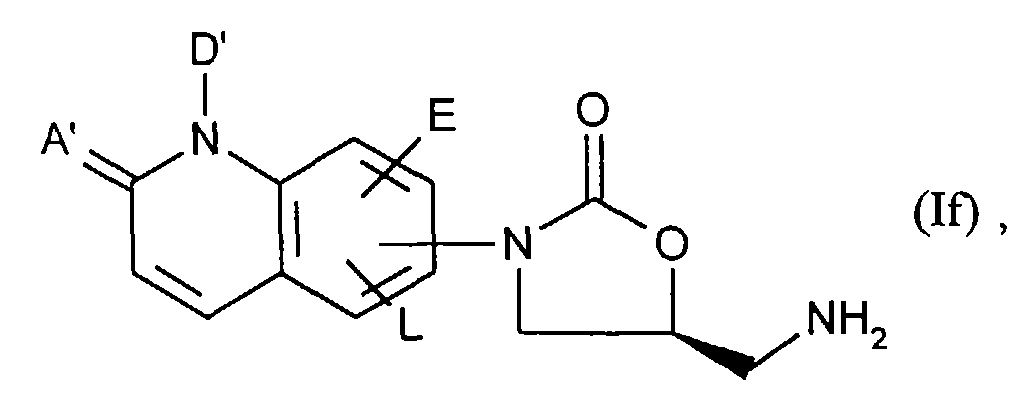
- A', D', E und L
- die oben angegebene Bedeutung haben,
und durch Umsetzung mit Acetanhydrid oder anderen Acylierungsmitteln der allgemeinen Formel (VI)
R32-CT'-R25 (VI),
in welcher- R25 und T'
- die angegebene Bedeutung haben
und - R32
- für Halogen, vorzugsweise für Chlor oder für den Rest -OCOR25 steht,

- A', D', E, L, T' und R25
- die oben angegebene Bedeutung haben
und im Fall
- Die erfindungsgemäßen Verfahrensvarianten können durch das folgende Formelschema beispielhaft erläutert werden:


- Als Lösemittel eignen sich in Abhängigkeit von den einzelnen Verfahrensschritten die üblichen Lösemittel, die sich unter den Reaktionsbedingungen nicht verändern. Hierzu gehören bevorzugt Alkohole wie Methanol, Ethanol, Propanol oder Isopropanol, oder Ether wie Diethylether, Dioxan, 1,2-Dimethoxyethan, Tetrahydrofuran, Glykoldimethylether oder tert.Butylmethylether, oder Ketone wie Aceton oder Butanon, oder Amide wie Dimethylformamid oder Hexamethyl-phosphorsäuretriamid, oder Kohlenwasserstoffe wie Hexan, Benzol, Dichlorbenzol, Xylol oder Toluol, oder Dimethylsulfoxid, Acetonitril, Essigester, oder Halogenkohlenwasserstoffe wie Methylenchlorid, Chloroform oder Tetrachlorkohlenstoff, oder Pyridin, Picolin oder N-Methylpiperidin. Ebenso können Gemische der genannten Lösemittel verwendet werden.
- Als Basen eignen sich in Abhängigkeit von den einzelnen Verfahrensschritten die üblichen anorganischen oder organischen Basen. Hierzu gehören bevorzugt Alkalihydroxide wie beispielsweise Natrium- oder Kaliumhydroxid, oder Alkalicarbonate wie Natrium- oder Kaliumcarbonat, oder Alkalialkoholate wie beispielsweise Natrium- oder Kaliummethanolat, oder Natrium- oder Kaliumethanolat, oder organische Amine wie Ethyldiisopropylamin, Triethylamin, Picolin, Pyridine oder N-Methylpiperidin, oder Amide wie Natriumamid oder Lithiumdiisopropylamid, oder Lithium-N-silylalkylamide, wie beispielsweise Lithium-N-(bis)triphenysilylamid oder Lithiumalkyle wie n-Butyllithium.
- Die Base wird in einer Menge von 1 mol bis 10 mol, bevorzugt von 1 mol bis 3 mol bezogen auf 1mol der Verbindungen der allgemeinen Formeln (Ib), (II), (III) bzw. (IV) eingesetzt.
- Alle Umsetzungen werden im allgemeinen bei normalem, erhöhtem oder bei erniedrigtem Druck durchgeführt (z.B. 0,5 bis 5 bar). Im allgemeinen arbeitet man bei Normaldruck.
- Als Lösemittel für die Alkylierung eignen sich übliche organische Lösemittel, die sich unter den Reaktionsbedingungen nicht verändern. Hierzu gehören bevorzugt Ether wie Diethylether, Dioxan, Tetrahydrofuran, Glykoldimehylether, oder Kohlenwasserstoffe wie Benzol, Toluol, Xylol, Hexan, Cyclohexan oder Erdölfraktionen, oder Halogenkohlenwasserstoffe wie Dichlormethan, Trichlormethan, Tetrachlormethan, Dichlorethylen, Trichlorethylen oder Chlorbenzol, oder Essigester, oder Triethylamin, Pyridin, Dimethylsulfoxid, Dimethylformamid, Acetonitril, Aceton oder Nitromethan. Ebenso ist es möglich, Gemische der genannten Lösemittel zu verwenden. Bevorzugt sind Acetonitril, Dimethylsulfoxid und Dimethylformamid.
- Die Alkylierung wird in den oben aufgeführten Lösemitteln bei Temperaturen von 0°C bis +150°C, vorzugsweise bei Raumtemperatur bis +100°C, bei Normaldruck durchgeführt.
- Der erste Schritt des Verfahrens [B] erfolgt in einem der oben aufgeführten Ether mit Lithiumalkylverbindungen oder Lithium-N-silylamiden, wie beispielsweise n-Butyllithium, Lithiumdiisopropylamid oder Lithium-bistrimethylsilylamid, vorzugsweise in Tetrahydrofuran und Lithium-bis-trimethylsilylamid oder n-Butyllithium, in einem Temperaturbereich von -100°C bis +20°C, vorzugsweise von -75°C bis -40°C.
- Im weiteren werden für die einzelnen Schritte die oben aufgeführten Lösemittel, vorzugsweise Methylenchlorid, Dimethylformamid und 1,2-Dimethoxyethan eingesetzt.
- Die Acylierung erfolgt im allgemeinen in einem der oben aufgeführten Ether oder Halogenkohlenwasserstoffen, vorzugsweise Tetrahydrofuran oder Methylenchlorid, in einem Temperaturbereich von -30°C bis 50°C, bevorzugt von -10°C bis Raumtemperatur.
- Die Verbindungen der allgemeinen Formel (II) sind neu und können hergestellt werden, indem man
Verbindungen der allgemeinen Formel (VII)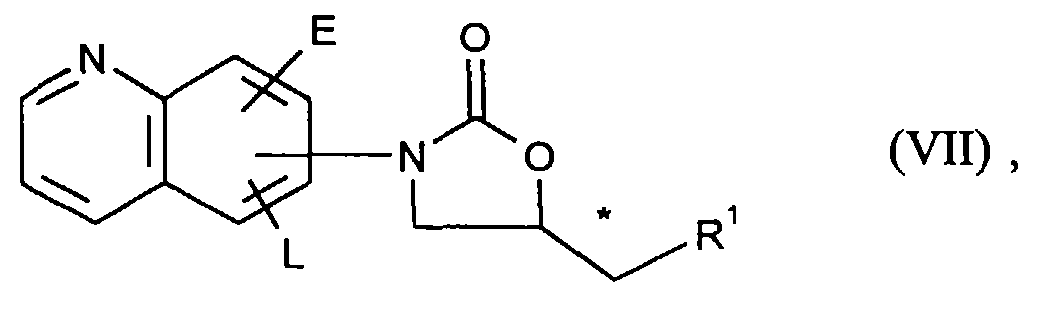
- R1, E und L
- die oben angegebene Bedeutung haben,
- Die Verbindungen der allgemeinen Formel (VII) können hergestellt werden, indem man in Analogie zu dem oben aufgeführten Verfahren [C] Verbindungen der allgemeinen Formel (VIII)

- E und L
- die oben angegebene Bedeutung haben,
- Die Verbindungen der allgemeinen Formeln (III), (V), (VI) und (VIII) sind an sich bekannt oder nach üblichen Methoden herstellbar.
- Die Verbindungen der allgemeinen Formel (IV) sind neu und können hergestellt werden, indem man
in bekannten Aminen der allgemeinen Formel (IX)
- E und L
- die oben angegebene Bedeutung haben,
- Die Blockierung der freien Aminfunktion erfolgt in einem Temperaturbereich von 150°C bis 200°C, vorzugsweise bei 180°C und Normaldruck.
- Die Verbindungen der allgemeinen Formeln (Ia) - (Ig) sind neu und können jeweils wie oben beschrieben hergestellt werden.
- Die minimalen Hemmkonzentrationen (MHK) wurden per Reihenverdünnungsverfahren auf Iso-Sensitest Agar (Oxoid) bestimmt. Für jede Prüfungssubstanz wurde eine Reihe von Agarplatten hergestellt, die bei jeweils doppelter Verdünnung abfallende Konzentrationen des Wirkstoffes enthielten. Die Agarplatten wurden mit einem Multipoint-Inokulator (Denley) beimpft. Zum Beimpfen wurden Übernachtkulturen der Erreger verwandt, die zuvor so verdünnt wurden, daß jeder Impfpunkt ca. 104 koloniebildende Partikel enthielt. Die beimpften Agarplatten wurden bei 37°C bebrütet, und das Keimwachstum wurde nach ca. 20 Stunden abgelesen. Der MHK-Wert (µg/ml) gibt die niedrigste Wirkstoffkonzentration an, bei der mit bloßem Auge kein Wachstum zu erkennen war.
MHK-Werte (µg/ml): Bsp. -Nr. Staph. 133 Staph. 48N Staph 25701 Staph. 9TV E. coli Neumann Klebs. 57 USA Psdm. Bonn 3 2 2 2 1 >64 >64 >64 4 4 8 4 2 >64 >64 - 5 16 16 16 8 >64 >64 >64 7 8 8 8 2 >32 >32 >32 12 8 8 8 4 >64 >64 >64 - Für schnellwachsende Mykobakterien wurde die MHK-Bestimmung in Anlehnung an die von Swenson beschriebene Methode der Bouillon-Mikrodilution durchgeführt [vgl. J.M. Swenson, C. Thornberry, U.A. Silcox, Rapidly growing mycobacteria. Testing of susceptibility to 34 antimicrobial agents by broth microdilution. Antimicrobial Agents and Chemotherapy Vol, 22, 186-192 (1982)]. Abweichend davon war das mit 0,1 Vol.% Tween 80 versetzte Hirn-Herzextrakt Medium.
- Die verwendeten Mykobakterienstämme wurden von der DSM (Dt. Sammlung von Mikroorganismen, Braunschweig) bezogen. Sie wurden in einer feuchten Kammer bei 37°C bebrütet.
- Die MHK-Werte wurden nach 2-4 Tagen abgelesen, wenn die präparatfreien Kontrollen durch Wachstum trüb waren. Der MHK-Wert definiert sich als die niedrigste Präparatkonzentration, die makroskopisch sichtbares Wachstum völlig inhibiert.
MHK-Werte: Mycobacterium smegmatis Stamm: DSM 43061 DSM 43465 Inoculum [/ml] 2,20E+04 3,10E+04 Bsp.-Nr. 3 2 8 4 4 8 6 8 4 Isoniazid 4 1 Streptomycin 4 4 - Die erfindungsgemäßen Verbindungen der allgemeinen Formeln (I), (Ia), (Ib), (Ic), (Id), (Ie), (If) und (Ig) weisen bei geringer Toxizität ein breites antibakterielles Spektrum, speziell gegen gram-positive Bakterien sowie Mycobacterien, Haemophilus influenzae, anaerobe Keime und für schnellwachsende Mykobakterien auf. Diese Eigenschaften ermöglichen ihre Verwendung als chemotherapeutische Wirkstoffe in der Human- und Tiermedizin.
- Besonders wirksam sind die erfindungsgemäßen Verbindungen gegen Bakterien und bakterienähnliche Mikroorganismen wie Mycoplasmen. Sie sind daher besonders gut zur Prophylaxe und Chemotherapie von lokalen und systemischen Infektionen in der Human- und Tiermedizin geeignet, die durch solche Erreger hervorgerufen werden.
- Zur vorliegenden Erfindung gehören pharmazeutische Zubereitungen, die neben nicht-toxischen, inerten pharmazeutisch geeigneten Trägerstoffen eine oder mehrere erfindungsgemäße Verbindungen enthalten oder die aus einem oder mehreren erfindungsgemäßen Wirkstoffen bestehen, sowie Verfahren zur Herstellung dieser Zubereitungen.
- Der oder die Wirkstoffe können gegebenenfalls in einem oder mehreren der oben angegebenen Trägerstoffe auch in mikroverkapselter Form vorliegen.
- Die therapeutisch wirksamen Verbindungen sollen in den oben aufgeführten pharmazeutischen Zubereitungen in einer Konzentration von etwa 0,1 bis 99,5, vorzugsweise von etwa 0,5 bis 95 Gew.-%, der Gesamtmischung vorhanden sein.
- Die oben aufgeführten pharmazeutischen Zubereitungen können außer den erfindungsgemäßen Verbindungen auch weitere pharmazeutische Wirkstoffe enthalten.
- Im allgemeinen hat es sich sowohl in der Human- als auch in der Veterinärmedizin als vorteilhaft erwiesen, den oder die erfindungsgemäßen Wirkstoffe in Gesamtmengen von etwa 0,5 bis etwa 500, vorzugsweise 5 bis 100 mg/kg Körpergewicht je 24 Stunden, gegebenenfalls in Form mehrerer Einzelgaben, zur Erzielung der gewünschten Ergebnisse zu verabreichen. Eine Einzelgabe enthält den oder die erfindungsgemäßen Wirkstoffe vorzugsweise in Mengen von etwa 1 bis etwa 80, insbesondere 3 bis 30mg/kg Körpergewicht.
- Die erfindungsgemäßen Verbindungen können zum Zweck der Erweiterung des Wirkungsspektrums und um eine Wirkungssteigerung zu erreichen auch mit anderen Antibiotika kombiniert werden.
-
- Z
- Benzyloxycarbonyl
- Boc
- tert.Butyloxycarbonyl
- DMF
- Dimethylformamid
- Ph
- Phenyl
- Me
- Methyl
- THF
- Tetrahydrofuran
- CDI
- Carbonyldiimidazol
- DCE
- Dichlorethan
-

- Zu einer auf 0°C gekühlten, gerührten Lösung von 10,0 g (69,36 mmol) 6-Aminochinolin in 160 ml Wasser und 80 ml THF werden innerhalb von 30 min 13,0 ml (76,28 mmol) Chlorameisensäurebenzylester getropft, wobei pH = 10 durch gleichzeitige Zugabe einer 4 N NaOH Lösung gehalten wird. Man rührt noch 2 h bei 0°C nach, dampft das THF im Vakuum ab und extrahiert den Rückstand mit 3 x 50 ml Ethylacetat. Die vereinigten organischen Extrakte werden über MgSO4 getrocknet, das Lösemittel wird im Vakuum abgedampft und der Rückstand durch Chromatographie an 450 g Kieselgel (Toluol : Ethylacetat 1:4) gereinigt. Man erhält 11,60 g (60%) der Titelverbindung als Kristalle.
- Schmp.: 122°C
- Rf = 0,43 (Toluol : Ethylacetat 1:4)
- MS (EI) m/z = 278 (M+)
- 1H-NMR (300 MHz, D6-DMSO): δ = 5,22 (s, 2H, CH2O); 7,3 - 7,5 (m, 6H, Ph, Chinolin-H); 7,78 (dd, J = 1,5, 9 Hz, 1H, Chinolin-H); 7,96 (d, J = 9 Hz, 1H, Chinolin-H); 8,17 (d, J = 1,5 Hz, 1H, Chinolin H-5); 8,25 (d, J = 9 Hz, 1H, Chinolin-H); 8,77 (m, 1H, Chinolin H-2).
-

- Eine auf -78°C gekühlte, gerührte Lösung von 3,28 g (11,78 mmol) 6-Benzyloxycarbonylamino-chinolin und 1 mg 1,10-Phenanthrolinhydrat in 30 ml wasserfreiem THF wird bis zum Farbumschlag langsam mit 4,70 ml (11,78 mmol) einer 2,5 M Lösung von n-Butyllithium in n-Hexan versetzt. Danach tropft man 1,67 ml (11,78 mmol) (R)-Glycidylbutyrat zu und erlaubt der Reaktionsmischung sich innerhalb von 16 h auf Raumtemperatur zu erwärmen. Danach werden innerhalb von 15 min 30 ml gesättigte wässrige NH4Cl-Lösung zugetropft. Die Wasserphase wird mit 3 x 60 ml Ethylacetat extrahiert, die organischen Phasen werden vereinigt, mit 2 x 50 ml NaCl-Lösung gewaschen und über MgSO4 getrocknet. Nach Abdampfen des Lösemittels im Vakuum, Verreiben des Rückstands mit Ether und Umkristallisation aus 25 ml Ethanol erhält man 1,30 g (45%) der Titelverbindung als farblose Kristalle.
- Schmp.: 165°C
- Rf = 0,08 (Toluol : Ethylacetat 1:4)
- MS (DCI, NH3) m/z = 245 (M+H)+
- 1H-NMR (250 MHz, D6-DMSO) δ = 3,6 - 3,8 (m, 2H, CH2O); 4,00 (dd, J = 7, 10 Hz, 1H, H-4 trans); 4,25 (dd, J = 10, 10 Hz, 1H, H-4 cis); 4,78 (m, 1H, H-5); 5,25 (t, J = 6 Hz, 1H, OH); 7,52 (dd, J = 4, 9 Hz, 1H, Chinolin H-3); 7,92 (d, J = 1,5 Hz, 1H, Chinolin H-5); 8,02 (d, J = 10 Hz, 1H, Chinolin H-8); 8,3 (m, 2H, Chinolin H-4,7); 8,82 (m, 1H, Chinolin H-2).
-
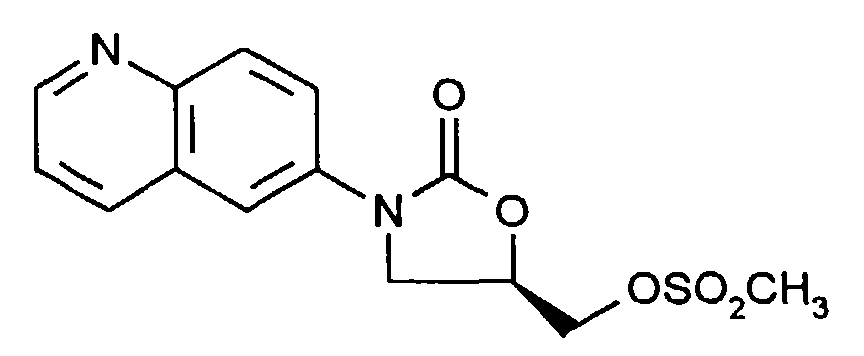
- Eine auf 0°C gekühlte, gerührte Lösung von 48,19 g (197 mmol) der Verbindung aus Beispiel II und 33 ml (236 mmol) Triethylamin in 300 ml wasserfreiem Dichlormethan wird langsam mit 19,80 ml (256 mmol) Methansulfonsäurechlorid versetzt. Man rührt 10 min. bei 0-5°C nach und rührt das Gemisch in 700 ml Eiswasser ein. Die organische Phase wird abgetrennt, mit 100 ml gesättigter NaHCO3-Lösung und 100 ml Eiswasser gewaschen und über MgSO4 getrocknet. Das Lösemittel wird im Vakuum eingedampft und der Rückstand mit 50 ml Ether verrührt, abgesaugt und im Hochvakuum getrocknet. Man erhält 46,0 g (72%) der Titelverbindung als farblose Kristalle.
- Schmp.: 143°C
- Rf = 0,14 (Toluol : Ethylacetat 1:9)
- MS (DCI, NH3) m/z = 323 (M+H)+
- 1H-NMR (200 MHz, D6-DMSO) δ = 3,27 (s, 3H, OSO2CH3); 4,00 (dd, J = 7, 10 Hz, 1H, H-4 trans); 4,36 (dd, J = 10, 10 Hz, 1H, H-4 cis); 4,57 (m, 2H, CH 2O); 5,10 (m, 1H, H-5); 7,53 (dd, J = 4, 9 Hz, 1H, Chinolin H-3); 7,93 (d, J = 1,5 Hz, 1H, Chinolin H-5); 8.06 (d, J = 10 Hz, 1H, Chinolin H-8); 8,25 (dd, J = 1,5, 10 Hz, 1H, Chinolin H-7); 8,36 (d, J = 9 Hz, 1H, Chinolin H-4); 8,84 (m, 1H, Chinolin H-2).
-

- Eine gerührte Lösung von 4,71 g (14,60 mmol) der Verbindung aus Beispiel III in 16 ml wasserfreiem DMF wird mit 1,14 g (17,52 mmol) Natriumazid versetzt und 3 h bei 70°C gerührt. Man läßt auf Raumtemperatur abkühlen und rührt in 50 ml Eiswasser ein. Der entstandene Niederschlag wird durch Filtration abgetrennt, dreimal mit 20 ml Wasser gewaschen und an der Luft getrocknet. Man erhält 3,50 g (89%) der Titelverbindung als helle Kristalle.
- Schmp.: ab 92°C
- Rf = 0,20 (Toluol : Ethylacetat 1:9)
- MS (DCI, NH3) m/z = 270 (M+H)+
- 1H-NMR (250 MHz, D6-DMSO) δ = 3,71 (m, 2H, CH2N3); 3,95 (dd, J = 6, 8 Hz, 1H, H-4 trans); 4,30 (dd, J = 8, 8 Hz, 1H, H-4 cis); 4,98 (m, 1H, H-5); 7,52 (dd, J = 9 Hz, 1H, Chinolin H-3); 7,94 (d, J = 1,5 Hz, 1H, Chinolin H-5); 8,06 (d, J = 10 Hz, 1H, Chinolin H-8); 8,25 (dd, J = 1,5 Hz, 10 Hz, 1H, Chinolin H-7); 8,34 (d, J = 9 Hz, 1H, Chinolin H-4); 8,84 (m, 1H, Chinolin H-2).
-
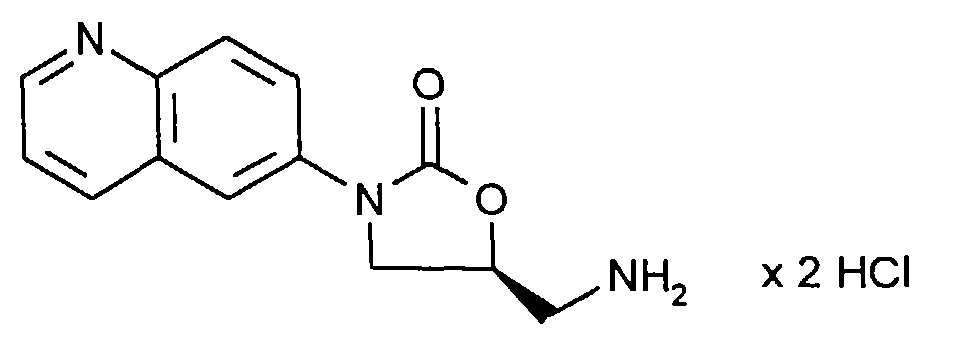
- Eine gerührte Lösung von 29,38 g (109 mmol) der Verbindung aus Beispiel IV in 80 ml 1,2-Dimethoxyethan wird auf 50°C erwärmt. Man tropft langsam 25 ml (130 mmol) Trimethylphosphit zu (Gasentwicklung) und rührt nach beendeter Zugabe noch 2 h bei 90°C nach. Nun tropft man 3,3 ml 6 N HCl zu und rührt nochmals 6,5 h bei 100°C nach. Man läßt auf Raumtemperatur abkühlen und trennt das entstandene Öl ab. Das Öl wird in wenig Acetonitril gelöst, mit 50 ml Toluol versetzt, im Vakuum eingeengt und im Hochvakuum über NaOH getrocknet. Man erhält 30,5 g (99%) der Titelverbindung. Der Hartschaum wird aus Ethanol umkristallisiert.
- Schmp.: 80°C (Zers.)
- Rf = 0,37 (Acetonitril : Wasser 4:1)
- MS (FAB) m/z = 244 (M+H)+
- 1H-NMR (250 MHz, D6-DMSO): δ = 3,35 (m, 2H, CH 2NH2); 4,08 (dd, J = 7, 9 Hz, 1H, H-4 trans); 4,39 (dd, J = 9, 9 Hz, 1H, H-4 cis); 5,10 (m, 1H, H-5); 7,90 (dd, J = 4, 9 Hz, 1H, Chinolin H-3); 8,17 (d, J = 1,5 Hz, 1H, Chinolin H-5); 8,3 - 8,6 (m, 3H, Chinolin H-8, 7,5); 8,90 (d, J = 9 Hz, 1H, Chinolin H-4); 9,10 (m, 1H, Chinolin H-2).
-

- Eine gerührte Lösung von 30,0 g (108 mmol) der Verbindung aus Beispiel V in 240 ml THF wird mit einer Lösung von 10 g Natriumhydroxid in 20 ml Wasser versetzt, wobei pH 7,1 entsteht. Dazu tropft man bei 0-5°C langsam 11,6 ml (120 mmol) Acetanhydrid in 12 ml THF und hält pH = 9 durch gleichzeitige Zugabe einer 5 N wäßrigen NaOH-Lösung. Man rührt 1 h bei 0°C nach und dampft das Lösemittel im Vakuum ab. Der Rückstand wird mit 2 x 40 ml Wasser gut verrührt, abgetrennt und im Hochvakuum über Sicapent getrocknet. Man erhält 19,16 g (62%) der Titelverbindung als farblose Kristalle.
- Schmp.: 146°C
- Rf = 0,33 (Dichlormethan : Methanol 9:1)
- MS (FAB) m/z = 286 (M+H)+
- 1H-NMR (250 MHz, D6-DMSO) δ = 1,85 (s, 3H, COCH3); 3,50 (t, J = 6,5 Hz, 2H, CH2N); 3,90 (dd, J = 7, 9 HZ, 1H, H-4 trans); 4,28 (dd, J = 9, 10 Hz, 1H, H-4 cis); 4,80 (m, 1H, H-5); 7,52 (dd, J = 4, 9 Hz, 1H, Chinolin H-3); 7,88 (d, J = 1,5 Hz, 1H, Chinolin H-5); 8,05 (d, J = 10 Hz, 1H, Chinolin H-8); 8,25 (dd, J = 1-5, 10 Hz, Chinolin H-7); 8,34 (d, J = 9 Hz, 1H, Chinolin H-4); 8,82 (m, 1H, Chinolin H-2).
-

- Eine gerührte Lösung von 500 mg (1,75 mmol) der Verbindung aus Beispiel VI in 5 ml Dichlormethan wird mit 832 mg (3,85 mmol) 80%iger m-Chlorperbenzosäure versetzt und 16 h bei Raumtemperatur gerührt. Danach wird die Reaktionsmischung in 20 ml gesättigter wäßrige Na2CO3-Lösung eingerührt. Die wäßrige Phase wird abgetrennt und im Vakuum eingedampft. Man gibt 25 ml Toluol und 1,5 g Kieselgel zu und dampft erneut ein. Der Rückstand wird durch Chromatographie an 50 g Kieselgel (Dichlormethan : Methanol 4:1) gereinigt. Die produkthaltigen Fraktionen werden vereinigt und mit 200 ml Ether versetzt. Der entstandene Niederschlag wird durch Filtration abgetrennt und im Hochvakuum getrocknet. Man erhält 453 mg (86%) der Titelverbindung als farblose Kristalle.
- Schmp.: 191°C (Zers.)
- Rf = 0,15 (Dichlormethan : Methanol 9:1)
- MS (FAB) m/z = 302 (M+H)+
- 1H-NMR (300 MHz, D6-DMSO): δ = 1,85 (s, 3H, COCH3); 3,50 (m, 2H, CH2N); 3,91 (dd, J = 7, 10 Hz, 1H, H-4 trans); 4,28 (dd, J = 10, 10 Hz, 1H, H-4 cis); 4,82 (m, 1H, H-5); 7,3 - 7,5 (m, 2H); 7,9 (m, 1H); 8,0 (s, 1H, Chinolin H-5); 8,3 (m, 1H); 8,50 (m, 1H, Chinolin H-2).
-
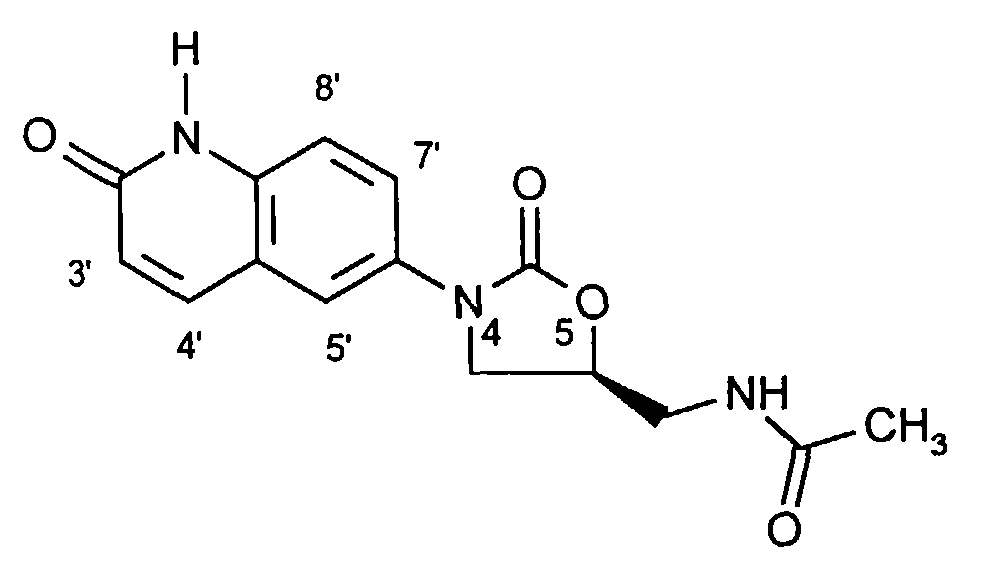
- Eine Suspension von 2,73 g (9,10 mmol) des N-Oxids aus Beispiels VII und 2,59 g (13,59 mmol) p-Toluolsulfonsäurechlorid in 35 ml Chloroform wird mit 27,20 ml (27,20 mmol) einer 10%igen wäßrigen Kaliumcarbonatlösung versetzt und 4 h bei Raumtemperatur gut durchgerührt. Danach wird das Reaktionsgemisch zur Trockene eingedampft und an 100 g Kieselgel (Acetonitril : Wasser 95:5) chromatographiert. Die produkthaltigen Fraktionen werden gesammelt, das Lösemittel wird im Vakuum abgedampft und das erhaltene Produkt wird im Hochvakuum getrocknet. Man erhält 2,34 g (86% d.Th.) der Titelverbindung als hellbeige Kristalle.
- Schmp.: ab 207°C (Zers.)
- Rf = 0,40 (Acetonitril : Wasser 9:1)
- MS (DCI, NH3): m/z = 302 (M+H)+, 319 (M+NH4)+
- 1H-NMR (200 MHz, D6-DMSO): δ = 1,85 (s, 3H, CH3CO); 3,42 (t, J = 6,5 Hz, 2H, CH2N); 3,78 (dd, J = 7, 9 Hz, 1H, H-4 trans); 4,15 (dd, J = 9, 10 Hz, 1H, H-4 cis); 4,75 (m, 1H, H-5); 6,52 (d, J = 10 Hz, 1H, H-3'); 7,32 (d, J = 10 Hz, 1H, H-4'); 7,73 (d, J = 2 Hz, 1H, H-5'); 7,80 (dd, J = 2, 10 Hz, 1H, H-7'); 7,91 (d, J = 10 Hz, 1H, H-8'); 8,27 (m, 1H, CONH); 11,73 (bs, 1H, NH).
- Eine gerührte Suspension von 652 mg (1,90 mmol) der Verbindung aus Beispiel 2 in 20 ml wasserfreiem Methanol wird mit 66 mg (0.20 mmol) Caesiumcarbonat versetzt und 1 h bei Raumtemperatur gerührt. Das Lösemittel wird im Vakuum abgedampft und der Rückstand wird mit 30 ml Ether verrührt. Der Niederschlag wird durch Filtration abgetrennt, mit 25 ml Wasser und 5 ml Ether gewaschen und im Hochvakuum getrocknet. Man erhält 358 mg (57%) der Titelverbindung als helle Kristalle.
- Schmp.: 232-233°C
-

- Eine gerührte Suspension von 5,45 g (10,53 mmol) des wasserfreien N-Oxids aus Beispiel VII in 50 ml Essigsäureanhydrid wird 24 h zum Rückfluß erhitzt, wobei eine klare Lösung entsteht. Das Gemisch darf abkühlen und wird am Rotationsverdampfer zur Trockene eingeengt. Der Rückstand wird mit 30 ml Toluol versetzt und erneut zur Trockene eingeengt. Dieser Vorgang wird noch zweimal wiederholt, dann wird das Rohprodukt durch Filtration an 10 g Kieselgel (Dichlormethan : Methanol 95:5) und durch Chromatographie an 100 g Kieselgel (Acetonitril : Wasser 98:2) gereinigt. Man erhält 1,84 g (58%) der Titelverbindung.
- Schmp.: 135-137°C
- Rf = 0,33 (Dichlormethan : Methanol 9.1) / 0,48 (Acetonitril : Wasser 95:5)
- MS (DCI, NH3) m/z = 344 (M+H)+
- 1H-NMR (200 MHz, D6-DMSO) δ = 2,38 (s, 6H, CH3CO); 3,84 (dd, J = 7, 9 Hz, 1H- H-4 trans); 4,10 (m, 2H, CH2N); 4,20 (dd, J = 9, 10 Hz, 1H, H-4 cis); 4,82 (m, 1H, H-5); 6,52 (d, J = 10 Hz, 1H, H-3'); 7,33 (d, J = 10 Hz, 1H, H-4'); 7,78 (m, 2H; H-5', H-7'); 7,92 (d, J = 10 Hz, 1H, H-8'); 11,78 (bs, 1H, NH). IR (KBr) ν = 3449, 1735, 1701, 1654, 1560, 1507, 1437 cm-1
-
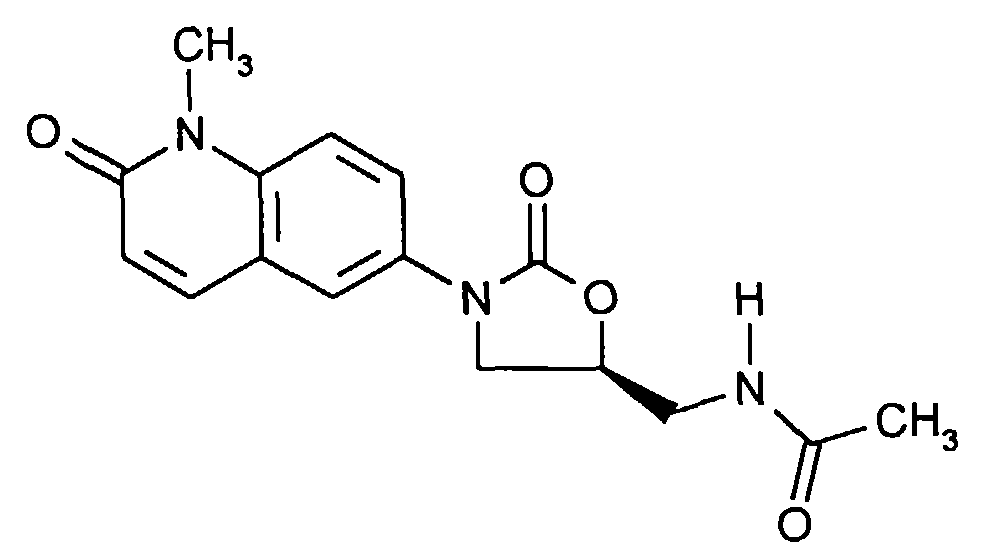
- Eine Suspension von 100 mg (0,33 mmol) der Verbindung aus Beispiel 1 und 1,36 mg (0,99 mmol) Kaliumcarbonat in 4 ml wasserfreiem DMF wird mit 67 µl (1,73 mmol) Jodmethan versetzt und 1 h bei 70°C gerührt. Dann wird das Reaktionsgeinisch zur Trockne eingeengt, der Rückstand wird mit einem Gemisch aus 20 ml Wasser und 10 ml Dichlormethan versetzt, die organische Phase wird abgetrennt und die wäßrige Phase wird mehrmals mit Dichlormethan extrahiert. Die vereinigten Extrakte werden über MgSO4 getrocknet. Das Lösemittel wird im Vakuum abgedampft, und der Rückstand wird durch Chromatographie an 10 g Kieselgel (Dichlormethan : Methanol 95:5) gereinigt. Man erhält 60 mg (59%) der Titelverbindung als farblose Kristalle.
- Schmp.: 252°C
- Rf = 0,29 (Dichlormethan : Methanol 9:1)
- MS (DCI, NH3) m/z = 316 (M+H)+
- 1H-NMR (200 MHz, D6-DMSO) δ = 1,85 (s, 3H, CH3CO); 3,44 (m, 2H, CH2N); 3,60 (s, 3H, NCH3); 3,81 (dd, J = 7, 9 Hz, 1H, H-4 trans); 4,17 (dd, J = 9, 10 Hz, 1H, H-4 cis); 4,78 (m, 1H, H-5); 6,65 (d, J = 10 Hz, 1H, H-3'); 7,59 (d, J = 10 Hz, 1H, H-4'); 7,80 (d, J = 1,5 Hz, 1H, H-5'); 7,92 (m, 2H, H-7', H-8'); 8,28 (t, J = 6 Hz, 1H, CONH).
- IR (KBr): ν = 3291, 1740, 1664, 1560, 1449, 1231, 1116, 812, 536 cm-1
- Wie für Beispiel 3 beschrieben erhielt man durch Alkylierung der Verbindung aus Beispiel 1 mit den entsprechenden Alkyliodiden die in Tabelle 1 aufgeführten Produkte:
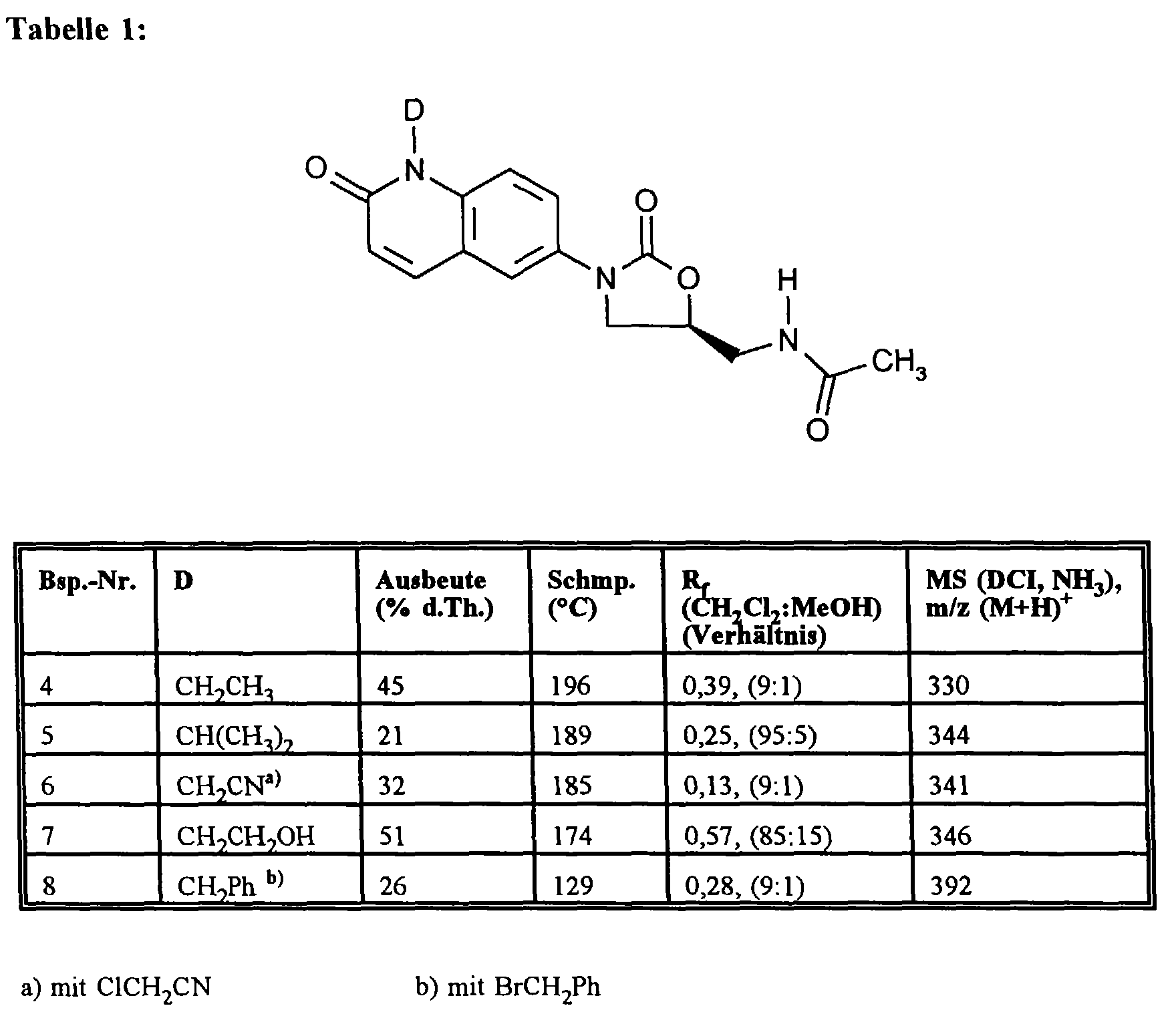
-

- Eine Lösung von 10 mg (0,03 mmol) der Cyanoverbindung aus Beispiel 5 in 0,2 ml Aceton wird mit 60 µl (0.06 mmol) einer 1M wässrigen Kaliumcarbonat-Lösung und mit 40 µl (0,18 mmol) 30% H2O2 versetzt und 2 h bei Raumtemperatur gerührt. Danach wird die Reaktionsmischung mit 1 ml Toluol versetzt, im Vakuum zur Trockne eingedampft, und der Rückstand wird durch Chromatographie an 1 g Kieselgel (Dichlormethan : Methanol 95:5) gereinigt. Man erhält 7,2 mg (66%) der Titelverbindung als farblose Kristalle.
- Rf = 0,11 (Dichlormethan : Methanol 9:1)
- MS (DCI, NH3) m/z = 359 (M+H)+, 376 (M+NH4)+
- 1H-NMR (200 MHz, D6-DMSO): δ = 1,85 (s, 3H, COCH3); 3,45 (m, 2H, CH2N); 3,79 (dd, J = 6, 9 Hz, 1H, H-4 trans); 4,18 (dd, J = 9, 10 Hz, 1H, H-4 cis); 4,77 (m, 1H, H-5); 4,88 (s, 2H, NCH2CON); 6,65 (d, J = 10 Hz, 1H, H-3'); 7,27 (bs, 1H, CONH2); 7,32 (d, J = 10 Hz, 1H, H-4'); 7,70 (bs, 1H, CONH2); 7,85 (m, 2H, H-5', H-7'); 7,96 (d, J = 10 Hz, 1H, H-8'); 8,28 (t, J= 6,5 Hz, 1H, CONHCH2).
-

- Eine gerührte Suspension von 100 mg (0,33 mmol) der Verbindung aus Beispiel 1 in 3,3 ml (3,3 mmol) 30%iger wäßriger Formalinlösung wird 2 h zum Rückfluß erhitzt. Danach wird im Vakuum zur Trockne eingedampft, der Rückstand mit 10 ml Toluol versetzt und erneut eingedampft. Der zurückbleibende Feststoff wird mit 5 ml Ether verrieben, abgesaugt und im Hochvakuum getrocknet. Man erhält 104 mg (95%) der Titelverbindung als helles Pulver.
-

- 500 mg (0,48 mmol) der Verbindung aus Beispiel 1 werden in 5 ml heißem Ethanol gelöst, mit 0,36 ml 30%iger wäßriger Formalinlösung und 46 µl (0,53 mmol) 51%iger wäßriger Dimethylamin-Lösung versetzt und 8 h zum Rückfluß erhitzt. Die Aufarbeitung erfolgte wie für Beispiel 9 beschrieben. Man erhält 139 mg (81%) der Titelverbindung als Feststoff.
-

- Eine auf 0°C gekühlte, gerührte Lösung von 100 mg (0,33 mmol) der Verbindung aus Beispiel 1 und 0,56 ml (3,96 mmol) Triethylamin in 10 ml wasserfreiem Dichlormethan wird langsam mit 0,27 ml (3,44 mmol) Methansulfonsäurechlorid versetzt. Man rührt 4 h bei 20°C nach und rührt das Gemisch in 5 ml Eiswasser ein. Die organische Phase wird abgetrennt, mit 5 ml gesättigter NaHCO3-Lösung gewaschen und über MgSO4 getrocknet. Das Lösemittel wird im Vakuum eingedampft und der Rückstand wird durch Chromatographie an 5 g Kieselgel (Dichlormethan : Methanol 95:5) gereinigt. Man erhält 224 mg (20%) der Titelverbindung als farblose Kristalle.
- Schmp.: 171-173°C
- Rf = 0,72 (Acetonitril : Wasser 95:5)
- MS (FAB) m/z = 380 (M+H)+ 402 (M+Na)+
- 1H-NMR (200 MHz, D6-DMSO) δ = 1,84 (s, 3H, COCH3); 3,48 (t, J = 6 Hz, 2H, CH2N); 3,79 (s, 3H, CH3SO2); 3,90 (dd, J = 7, 9 Hz, 1H, H-4 trans); 4,27 (dd, J = 9, 9 Hz, 1H, H-4 cis); 4,80 (m, 1H, H-5); 7,42 (d, J = 10 Hz, 1H, H-3'); 8,03 (m, 2H, H-4', H-5'); 8,30 (m, 7H, H-7', CONH); 8,59 (d, J = 10 Hz, 1H, H-8').
- IR (KBr) ν = 3338, 1734, 1654, 1600, 1549, 1517, 1364, 1170, 1140, 986, 813, 528 cm-1
-

- Zu einer gerührten, auf 0°C gekühlten Lösung von 150 mg (0,50 mmol) der Verbindung aus Beispiel 1 und 0,21 ml (1,50 mmol) Triethylamin in 5 ml wasserfreiem DMF gibt man langsam 175 mg (1,00 mmol) 3-Chlorbenzoylchlorid. Man rührt 2 h bei 0°C nach, verdünnt mit 20 ml Wasser und 50 ml Dichlormethan, trennt die organische Phase ab, extrahiert die wäßrige Phase mehrfach mit 5 ml Dichlormethan und trocknet die vereinigten organischen Extrakte über MgSO4. Nach Abdampfen des Lösemittels im Vakuum, Reinigen des Rohproduktes durch Chromatographie an 15 g Kieselgel (Dichlormethan : Methanol 95:5) und Verreiben des Rückstands mit Ether erhält man 95 mg (43%) der Titelverbindung als Kristalle.
- Schmp.: 172-174°C
- Rf = 0,47 (Dichlormethan : Methanol 9:1)
- MS (DCI, NH3): m/z = 440 (M+H)+
- 1H-NMR (300 MHz, D6-DMSO): δ = 1,86 (s, 3H, COCH3); 3,50 (t, J = 6 Hz, 2H, CH2N); 3,92 (dd, J = 7, 9 Hz, 1H, H-4 trans); 4,30 (dd, J = 9, 10 Hz, 1H, H-4 cis); 4,82 (m, 1H, H-5); 7,56 (d, J = 10 Hz, 1H, H-3'); 7,65 - 8,35 (m, 8H, H-arom., CONH); 8,58 (d, J = 9 Hz, 1H, H-8').
- IR (KBr): ν = 3284, 1740, 1654, 1560, 1517, 1424, 1258, 1216, 888, 740 cm-1
-

- Zu einer gerührten, auf 0°C gekühlten Suspension von 16 mg (0.40 mmol) Natriumhydrid (60% in Öl) in 2 ml wasserfreiem DMF gibt man portionsweise 100 mg (0,33 mmol) der Verbindung aus Beispiel 1 und rührt bis zum Ende der Wasserstoffentwicklung. Zu der entstandenen klaren Lösung tropft man innerhalb von 5 min 65 µl (0,99 mmol) Acrylnitril. Das Kühlbad wird entfernt, und nach 15 min. wird die Reaktion durch Zugabe von 1 ml 1 N Zitronensäure abgebrochen. Das Reaktionsgemisch wird in eine Mischung aus 10 ml Dichlormethan und 5 ml Wasser gegossen und gut durchgerührt. Die organische Phase wird abgetrennt, die Wasserphase wird mehrmals mit 5 ml Dichlormethan extrahiert und die vereinigten Extrakte werden über MgSO4 getrocknet. Das Lösemittel wird im Vakuum abgedampft und der Rückstand durch Chromatographie an 5 g Kieselgel (Dichlormethan : Methanol 95:5) gereinigt. Man erhalt 30 mg (26%) der Titelverbindung als farblose Kristalle.
- Schmp.: 124-125°C
- Rf = 0,17 (Dichlormethan : Methanol 9:1)
- MS (FAB) m/z = 355 (M+H)+
- 1H-NMR (250 MHz, D6-DMSO) δ =2,08, 2,12 (s, 3H, COCH3); 2,70- 2,90 (m, 2H, CH2CN); 3,5 - 3,9 (m, 5H, CH2N, H-4 trans); 4,15 (dd, J = 9, 10 Hz, 1H, H-4 cis); 4,90 (m, 1H, H-5); 6,52 (d, J = 10 Hz, 1H, H-3'); 7,31 (d, J = 10 Hz, 1H, H-4'); 7,80 (m, 2H, H-5', H-7'); 7,91 (dd, J = 2, 10 Hz, 1H, H-8'); 11,90 (bs, 1H, NH).
- In Analogie zu Beispiel 14 erhält man das in Tabelle 2 beschriebene Michaeladdukt:

-

- Eine Suspension von 100 mg (0,33 mmol) der Verbindung aus Beispiel 1 in 1,8 ml DMF wird mit 0,58 ml (10,0 mmol) Methylisocyanat und 0,69 ml (5,0 mmol) Triethylamin versetzt und 100 h bei 50°C gerührt. Danach darf die Reaktionsmischung abkühlen und die flüchtigen Bestandteile werden im Vakuum entfernt. Der Rückstand wird durch Chromatographie an 25 g Kieselgel (Dichlormethan : Methanol 95:5) gereinigt. Die produkthaltigen Fraktionen werden gesammelt und das Lösemittel wird im Vakuum abgedampft. Der Rückstand wird in 0,2 ml Dichlormethan : Methanol 95:5 gelöst und durch langsame Zugabe von 2 ml Ether und 2 ml Pentan gefallt. Man erhält 22 mg (19%) der Titelverbindung als helle Kristalle.
- Schmp.: ab 112°C (Zers.)
- Rf = 0,14 (Dichlormethan : Methanol 9:1)
- MS (FAB) m/z == 416 (M+H)+, 438 (M+Na)+
- 1H-NMR (200 MHz, D6-DMSO): δ = 1,85 (s, 3H, COCH3); 2,85 (m, 3H, CH3N); 2,96 (s, 3H, CH3N); 3,44 (t, J = 5 Hz, 2H, CH2N); 3,81 (dd, J = 6, 9 Hz, 1H, H-4 trans); 4,19 (dd, J = 9, 10 Hz, 1H, H-4 cis); 4,78 (m, 1H, H-5); 5,73 (bs, 1H, CONHCH3); 6,72 (d, J = 10 Hz, 1H, H-3'); 7,30 (d, J = 10 Hz, H-4'); 7,90 (m, 2H, H-5', H-7'); 8,12 (d, J = 10 Hz, 1H, H-8'); 8,28 (t, J = 6 Hz, 1H, CONHCH2).
-

- Eine gerührte Lösung von 125 mg (0,40 mmol) der Verbindung aus Beispiel 3 und 162 mg (0,40 mmol) Lawessons Reagenz in 5 ml wasserfreiem 1,2-Dimethoxyethan wurde 2 h auf 100°C erwärmt. Danach durfte das Reaktionsgemisch abkühlen, man setzte 20 g Kieselgel zu und dampfte das Lösungsmittel im Vakuum ab. Der Rückstand wurde auf eine Säule gegeben und durch Chromatographie an 200 g Kieselgel (Ethylacetat) gereinigt. Man erhielt 22 mg (17 %) der Titelverbindung als helle Kristalle.
- Schmp.: 158 - 160°C
- Rf = 0,46 (Dichlormethan : Methanol 9 : 1)
- MS (DCI, NH3) m/z = 332 (M+H)+
- 1H-NMR (200 MHz, D6-DMSO): δ = 2,45 (s, 3H, CH3CS); 3,61 (s, 3H, NCH3); 3,8 - 4,0 (m, 3H, CH2N, H-4 trans); 4,22 (dd, J = 9, 10 Hz, 1H, H-4 cis); 5,00 (m, 1H, H-5); 6,65 (d, J = 10 Hz, 1H, H-3); 7,58 (d, J = 10 Hz, 1H, H-4'); 7,82 (d, J = 1,5 Hz, 1H, H-5'); 7,9 (m, 2H, H-7', H-8'); 10,41 (bt, 1H, CONH).
Claims (11)
- Oxazolidinon-Verbindungen der allgemeinen Formel (I)
 A für ein Sauerstoff- oder ein Schwefelatom steht,D für Wasserstoff oder für Cycloalkyl mit 3 bis 6 Kohlenstoffatomen steht, oder
für geradkettiges oder verzweigtes Alkoxycarbonyl mit bis zu 4 Kohlenstoffatomen steht, oder
für geradkettiges oder verzweigtes Alkyl oder Alkenyl mit jeweils bis zu 9 Kohlenstoffatomen steht, das gegebenenfalls durch Cyano, Trifluormethyl, Halogen, Hydroxy, Pyridyl, Phenyl, Carboxyl, Carboxamido, geradkettiges oder verzweigtes Alkoxycarbonyl mit bis zu 5 Kohlenstoffatomen, Naphthyl, Cycloalkyl mit 3 bis 6 Kohlenstoffatomen, und/oder durch eine Gruppe der Formel -(CO)a-NR2R3,
worina eine Zahl 0 oder 1 bedeutet,R2, R3, R4, R6 und R7 gleich oder verschieden sind und Wasserstoff, geradkettiges oder verzweigtes Alkyl mit bis zu 5 Kohlenstoffatomen oder Phenyl bedeuten,
oderR2 und R3 gemeinsam mit dem Stickstoffatom einen Morpholinyl-, Thiomorpholinyl-, Pyrrolidinyl-, Piperazinyl- oder Piperidylring bilden, die gegebenenfalls, auch über die freie N-Funktion, durch geradkettiges oder verzweigtes Alkyl oder Acyl mit jeweils bis zu 4 Kohlenstoffatomen substituiert sind,b eine Zahl 0, 1 oder 2 bedeutet,R5 und R8 gleich oder verschieden sind und
geradkettiges oder verzweigtes Alkyl mit bis zu 6 Kohlenstoffatomen, Benzyl, Phenyl oder Tolyl bedeuten,
oderD für geradkettiges oder verzweigtes Acyl mit bis zu 5 Kohlenstoffatomen steht, das gegebenenfalls durch Trifluormethyl, Trichlormethyl oder eine Gruppe der Formel -OR9 substituiert ist,
worinR9 Wasserstoff oder geradkettiges oder verzweigtes Alkyl mit bis zu 5 Kohlenstoffatomen bedeutet, das gegebenenfalls durch Phenyl oder Naphthyl substituiert ist,
oderD für eine Gruppe der Formel -(CT)d-NR10R11, -(CO)e-NR12-CO-NR13R14, -NR15-SO2R16, R17R18-N-SO2-, R19-S(O)f oder -CO-R20 steht,
worinT ein Sauerstoff- oder Schwefelatom bedeutet,d und e gleich oder verschieden sind und die oben angegebene Bedeutung a haben und mit dieser gleich oder verschieden sind,R10, R11, R12, R13, R14, R15, R17 und R18 die jeweils oben angegebene Bedeutung von R2, R3 und R4 haben und mit dieser gleich oder verschieden sind,f die oben angegebene Bedeutung von b hat und mit dieser gleich oder verschieden ist,R16 und R19 gleich oder verschieden sind und die oben angegebene Bedeutung von R5 und R8 haben,R20 Aryl mit 6 bis 10 Kohlenstoffatomen bedeutet, das gegebenenfalls durch Halogen substituiert ist,E und L gleich oder verschieden sind und
für Wasserstoff, Carboxy, Halogen, Cyano, Formyl, Trifluormethyl, Nitro,
für geradkettiges oder verzweigtes Alkyl mit bis zu 4 Kohlenstoffatomen stehen,R1 für Azido, Hydroxy oder für eine Gruppe der Formel -OR21, O-SO2R22 oder -NR23R24 steht,
worinR21 geradkettiges oder verzweigtes Acyl mit bis zu 6 Kohlenstoffatomen oder eine Hydroxyschutzgruppe bedeutet,R22 geradkettiges oder verzweigtes Alkyl mit bis zu 5 Kohlenstoffatomen, Phenyl oder Tolyl bedeutet,R23 und R24 gleich oder verschieden sind und
Cycloalkyl mit 3 bis 6 Kohlenstoffatomen, Wasserstoff, Phenyl oder geradkettiges oder verzweigtes Alkoxy mit bis zu 6 Kohlenstoffatomen, tert.Butoxycarbonyl, Fluorenyloxycarbonyl oder Benzyloxycarbonyl bedeuten, oder
geradkettiges oder verzweigtes Alkyl mit bis zu 6 Kohlenstoffatomen bedeuten, das gegebenenfalls durch Cyano oder Alkoxycarbonyl mit bis zu 4 Kohlenstoffatomen substituiert ist,
oderR23 und/oder R24 eine Gruppe der Formel -CT'-R25, P(O)(OR26)(OR27) oder -SO2-R28 bedeutet,
worinT' die oben angegebene Bedeutung von T hat und mit dieser gleich oder verschieden ist,R25 Cycloalkyl mit 3 bis 6 Kohlenstoffatomen, Trifluormethyl oder geradkettiges oder verzweigtes Alkoxy mit bis zu 6 Kohlenstoffatomen, Phenyl, Benzyloxy oder Wasserstoff bedeutet, oder
geradkettiges oder verzweigtes Alkyl mit bis zu 6 Kohlenstoffatomen bedeutet, das gegebenenfalls durch geradkettiges oder verzweigtes Alkoxycarbonyl mit bis zu 5 Kohlenstoffatomen, Cyano, Fluor, Chlor, Brom oder Trifluormethyl substituiert ist, oder geradkettiges oder verzweigtes Thioalkyl oder Acyl mit jeweils bis zu 5 Kohlenstoffatomen bedeutet, oder
eine Gruppe der Formel -NR29R30 bedeutet,
worinR29 und R30 gleich oder verschieden sind und Wasserstoff, Phenyl oder geradkettiges oder verzweigtes Alkyl mit bis zu 4 Kohlenstoffatomen bedeuten, oderR26 und R27 gleich oder verschieden sind und Wasserstoff
oder
geradkettiges oder verzweigtes Alkyl mit bis zu 4 Kohlenstoffatomen bedeuten,R28 geradkettiges oder verzweigtes Alkyl mit bis zu 4 Kohlenstoffatomen oder Phenyl bedeutet,und deren Salze und Isomere. - Verbindungen der allgemeinen Formel (I) nach Anspruch 1
in welcherA für ein Sauerstoff- oder ein Schwefelatom steht,D für Wasserstoff, Cyclopropyl, Cyclopentyl oder Cyclohexyl steht, oder
für geradkettiges oder verzweigtes Alkoxycarbonyl mit bis zu 3 Kohlenstoffatomen steht, oder
für geradkettiges oder verzweigtes Alkyl oder Alkenyl mit jeweils bis zu 6 Kohlenstoffatomen steht, das gegebenenfalls durch Cyano, Trifluormethyl, Fluor, Chlor, Brom, Hydroxy, Pyridyl, Phenyl, Carboxyl, Carboxamido, geradkettiges oder verzweigtes Alkoxycarbonyl mit bis zu 4 Kohlenstoffatomen, Naphthyl, Cyclopropyl, Cyclopentyl oder Cyclohexyl und/oder durch eine Gruppe der Formel -(CO)a-NR2R3, R4-N-SO2-R5, R6R7-N-SO2- oder R8-S(O)b substituiert ist,
worina eine Zahl 0 oder 1 bedeutet,R2, R3, R4, R6 und R7 gleich oder verschieden sind und
Wasserstoff geradkettiges oder verzweigtes Alkyl mit bis zu 3 Kohlenstoffatomen oder Phenyl bedeuten,
oderR2 und R3 gemeinsam mit dem Stickstoffatom einen Morpholinyl-, Thiomorpholinyl-, Pyrrolidinyl-, Piperazinyl- oder Piperidylring bilden, die gegebenenfalls, auch über die freie N-Funktion, durch geradkettiges oder verzweigtes Alkyl oder Acyl mit jeweils bis zu 3 Kohlenstoffatomen substituiert sind,b eine Zahl 0, 1 oder 2 bedeutet,R5 und R8 gleich oder verschieden sind und
geradkettiges oder verzweigtes Alkyl mit bis zu 4 Kohlenstoffatomen, Benzyl, Phenyl oder Tolyl bedeuten,
oderD für geradkettiges oder verzweigtes Acyl mit bis zu 4 Kohlenstoffatomen steht, das gegebenenfalls durch Trifluormethyl, Trichlormethyl oder eine Gruppe der Formel -OR9 substituiert ist,
worinR9 Wasserstoff oder geradkettiges oder verzweigtes Alkyl mit bis zu 4 Kohlenstoffatomen bedeutet, das gegebenenfalls durch Phenyl oder Naphthyl substituiert ist,
oderD für eine Gruppe der Formel -(CT)d-NR10R11, -(CO)e-NR12-CO-NR13R14, -NR15-SO2R16, R17R18-N-SO2-, R19-S(O)f oder -CO-R20 steht,
worinT ein Sauerstoff- oder Schwefelatom bedeutet,d und e gleich oder verschieden sind und
die oben angegebene Bedeutung von a haben und mit dieser gleich oder verschieden sind,R10, R11, R12, R13, R14, R15 R17 und R18 die jeweils oben angegebene Bedeutung von R2, R3 und R4 haben und mit dieser gleich oder verschieden sind,f die oben angegebene Bedeutung von b hat und mit dieser gleich oder verschieden ist,R16 und R19 gleich oder verschieden sind und die oben angegebene Bedeutung von R5 und R8 haben,R20 Phenyl oder Naphthyl bedeutet, das gegebenenfalls durch Fluor, Chlor oder Brom substituiert ist,E und L gleich oder verschieden sind und
für Wasserstoff, Fluor, Chlor, Brom, Cyano, Methyl oder Trifluormethyl steht,R1 für Azido, Hydroxy oder für eine Gruppe der Formel -OR21, O-SO2R22 oder -NR23R24 steht,
worinR21 geradkettiges oder verzweigtes Acyl mit bis zu 5 Kohlenstoffatomen oder Benzyl bedeutet,R22 geradkettiges oder verzweigtes Alkyl mit bis zu 4 Kohlenstoffatomen, Phenyl oder Tolyl bedeutet,R23 und R24 gleich oder verschieden sind und
Cyclopropyl, Cyclopentyl, Cyclohexyl, Wasserstoff, Phenyl oder geradkettiges oder verzweigtes Alkoxy mit bis zu 5 Kohlenstoffatomen, tert.Butoxycarbonyl oder Benzyloxycarbonyl bedeuten, oder
geradkettiges oder verzweigtes Alkyl mit bis zu 4 Kohlenstoffatomen bedeuten, das gegebenenfalls durch Cyano oder durch geradkettiges oder verzweigtes Alkoxycarbonyl mit bis zu 3 Kohlenstoffatomen substituiert ist,
oderR23 und/oder R24 ei ne Gruppe der Formel -CT'-R25, P(O)(OR26)(OR27) oder -SO2-R28 bedeutet,
worinT' die oben angegebene Bedeutung von T hat und mit dieser gleich oder verschieden ist,R25 Cyclopropyl, Cyclopentyl, Cyclohexyl, Trifluormethyl oder geradkettiges oder verzweigtes Alkoxy mit bis zu 5 Kohlenstoffatomen, Phenyl, Benzyloxy oder Wasserstoff bedeutet, oder
geradkettiges oder verzweigtes Alkyl mit bis zu 5 Kohlenstoffatomen bedeutet, das gegebenenfalls durch geradkettiges oder verzweigtes Alkoxycarbonyl mit bis zu 4 Kohlenstoffatomen, Cyano, Fluor, Chlor, Brom oder Trifluormethyl substituiert ist, oder geradkettiges oder verzweigtes Thioalkyl oder Acyl mit jeweils bis zu 4 Kohlenstoffatomen bedeutet, oder
eine Gruppe der Formel -NR29R30 bedeutet,
worinR29 und R30 gleich oder verschieden sind und Wasserstoff, Phenyl oder geradkettiges oder verzweigtes Alkyl mit bis zu 3 Kohlenstoffatomen bedeuten,R26 und R27 gleich oder verschieden sind und Wasserstoff oder geradkettiges oder verzweigtes Alkyl mit bis zu 3 Kohlenstoffatomen bedeuten,R28 geradkettiges oder verzweigtes Alkyl mit bis zu 3 Kohlenstoffatomen oder Phenyl bedeutet,und deren Salze und Isomere. - Verbindungen der allgemeinen Formel (I) nach Anspruch 1
in welcherA für ein Sauerstoff- oder ein Schwefelatom steht,D für Wasserstoff, Cyclopropyl, Cyclopentyl, Cyclohexyl, Allyl oder für geradkettiges oder verzweigtes Alkyl mit bis zu 5 Kohlenstoffatomen steht, das gegebenenfalls durch Cyano, Hydroxy, Trifluormethyl, Fluor, Chlor, Phenyl, Carboxyl, Carboxamido, geradkettiges oder verzweigtes Alkoxycarbonyl mit bis zu 3 Kohlenstoffatomen, Cyclopropyl, Cyclopentyl oder Cyclohexyl und/oder durch eine Gruppe der Formel -(CO)a-NR2R3, R4-N-SO2-R5, R6R7N-SO2- oder R8-S(O)b substituiert ist,
worina eine Zahl 0 oder 1 bedeutet,R2, R3, R4, R6 und R7 gleich oder verschieden sind und Wasserstoff oder Methyl bedeuten,b eine Zahl 0, 1 oder 2 bedeutet,R5 und R8 gleich oder verschieden sind und
geradkettiges oder verzweigtes Alkyl mit bis zu 3 Kohlenstoffatomen, Benzyl, Phenyl oder Tolyl bedeuten,
oderD für eine Gruppe der Formel -(CT)d-NR10R11, -(CO)e-NR12-CO-NR13R14, -NR15-SO2R16, R17R18N-SO2-, R19-S(O)f oder -CO-R20 steht,
worinT ein Sauerstoff- oder Schwefelatom bedeutet,d und e gleich oder verschieden sind und
die oben angegebene Bedeutung von a haben und mit dieser gleich oder verschieden sind,R10, R11, R12, R13, R14, R15, R17 und R18 die jeweils oben angegebene Bedeutung von R2, R3 und R4 haben und mit dieser gleich oder verschieden sind,f die oben angegebene Bedeutung von b hat und mit dieser gleich oder verschieden ist,R16 und R19 gleich oder verschieden sind und die oben angegebene Bedeutung von R5 und R8 haben,R20 Phenyl oder Naphthyl bedeutet, das gegebenenfalls durch Fluor, Chlor oder Brom substituiert ist,E und L gleich oder verschieden sind und für Wasserstoff oder Fluor
stehen,R1 für Azido, Hydroxy oder für eine Gruppe der Formel -OR21, O-SO2R22 oder -NR23R24 steht,
worinR21 geradkettiges oder verzweigtes Acyl mit bis zu 4 Kohlenstoffatomen bedeutet,R22 Methyl oder Tolyl bedeutet,R23 und R24 gleich oder verschieden sind und
Cyclopropyl, Wasserstoff, Phenyl oder geradkettiges oder verzweigtes Alkoxy mit bis zu 4 Kohlenstoffatomen, tert.Butoxycarbonyl oder Benzyloxycarbonyl bedeuten, oder
geradkettiges oder verzweigtes Alkyl mit bis zu 3 Kohlenstoffatomen bedeuten, das gegebenenfalls durch Cyano oder Methoxycarbonyl substituiert ist,
oderR23 und/oder R24 eine Gruppe der Formel -CT'-R25 bedeutet,
worinT' die oben angegebene Bedeutung von T hat und mit dieser gleich oder verschieden ist,R25 Cyclopropyl, Cyclopentyl, Cyclohexyl, Trifluormethyl oder geradkettiges oder verzweigtes Alkoxy mit bis zu 4 Kohlenstoffatomen, Phenyl, Benzyloxy oder Wasserstoff bedeutet, oder
geradkettiges oder verzweigtes Alkyl mit bis zu 4 Kohlenstoffatomen bedeutet, das gegebenenfalls durch geradkettiges oder verzweigtes Alkoxycarbonyl mit bis zu 3 Kohlenstoffatomen, Cyano, Fluor, Chlor, Brom oder Trifluormethyl substituiert ist, oder
geradkettiges oder verzweigtes Thioalkyl oder Acyl mit jeweils bis zu 3 Kohlenstoffatomen bedeutet, oder
eine Gruppe der Formel -NR29R30 bedeutet,
worinR29 und R30 gleich oder verschieden sind und Wasserstoff, Phenyl, Methyl oder Ethyl bedeuten,und deren Salze und Isomere. - Verbindungen der allgemeinen Formel (I) nach Anspruch 1
in welcherE und L für Wasserstoff stehen und der Oxazolidinonrest in den Positionen 6 oder 7 an den 1,2-Dihydrochinolinylring angebunden ist. - Verfahren zur Herstellung von Verbindungen der allgemeinen Formel (I) nach Anspruch 1, dadurch gekennzeichnet, daß man[A] N-Oxide der allgemeinen Formel (II)
 E und L die in Anspruch 1 angegebene Bedeutung haben,
undR1 die in Anspruch 1 angegebene Bedeutung hat, vorzugsweise aber für den Rest der Formel -NH-CO-NR31 steht,
worinR31 geradkettiges oder verzweigtes Alkyl mit bis zu 4 Kohlenstoffatomen bedeutet,durch Umsetzung mit Ac2O oder p-TsCl/K2CO3 in inerten Lösemitteln zunächst in die Verbindungen der allgemeinen Formel (Ia) R1, E und L die oben angegebene Bedeutung haben
undA' für Sauerstoff steht,umsetzt,
oder[B] Verbindungen der allgemeinen Formel (Ib) E und L die oben angegebene Bedeutung haben,R31 für C1-C4-Acyl oder Alkoxycarbonyl steht,mit Alkylierungsmitteln der allgemeinen Formel (III)
D'-X (III),
in welcherD' die in Anspruch 1 angegebene Bedeutung von D hat aber nicht für Wasserstoff steht,
undX für Trifluormethansulfonat oder Halogen steht,in inerten Lösemitteln und in Anwesenheit einer Base umsetzt,
und gegebenenfalls die anderen unter R1 aufgeführten Substituenten nach üblichen Methoden einführt,
oder[C] Verbindungen der allgemeinen Formel (IV) A', D', E und L die oben angegebene Bedeutung haben,zunächst durch Umsetzung mit Lithiumalkylen in Ethern und R-Glycidylbutyrat der Formel (V)
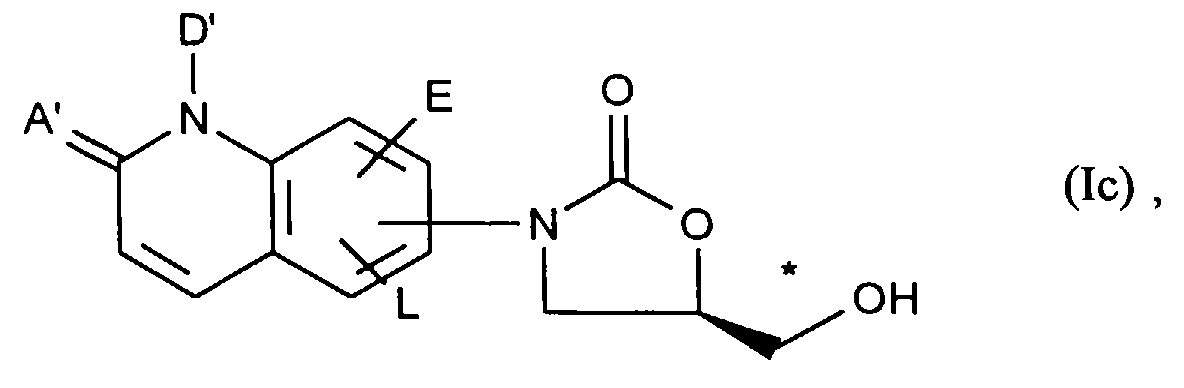 A', D', E und L die oben angegebene Bedeutung haben,überführt,
die durch Umsetzung mit (C1-C4)-Alkyl- oder Phenylsulfonsäurechloriden in inerten Lösemitteln und in Anwesenheit einer Base in die entsprechenden Verbindungen der allgemeinen Formel (Id)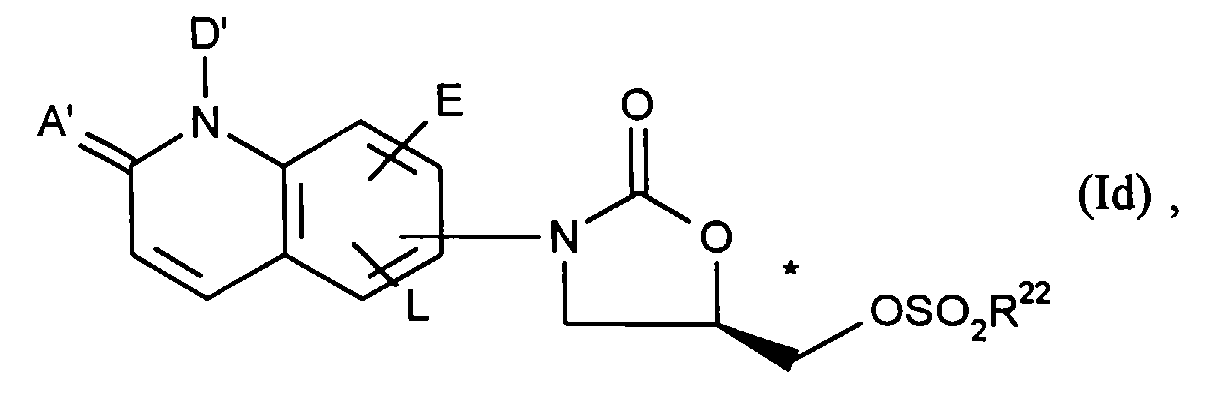 A', D', E und L die oben angegebene Bedeutung haben undR22 die in Anspruch 1 angegebene Bedeutung hat,überführt,
anschließend mit Natriumazid in inerten Lösemitteln die Azide der allgemeinen Formel (Ie) A', D', E und L die oben angegebene Bedeutung haben,herstellt,
die in einem weiteren Schritt durch Umsetzung mit Alkylphosphiten oder PPh3 in inerten Lösemitteln und mit Säuren in die Amine der allgemeinen Formel (If) A', D', E und L die oben angegebene Bedeutung haben,überführt,
und durch Umsetzung mit Acetanhydrid oder anderen Acylierungsmitteln der allgemeinen Formel (VI)
R32-CT'-R25 (VI),
in welcherR25 die in Anspruch 1 angegebene Bedeutung hat undT' die in Anspruch 1 angegebene Bedeutung von T hat
undR32 für Halogen oder für den Rest -OCOR25 steht,in inerten Lösemitteln die Verbindungen der allgemeinen Formel (Ig) A', D', E, L, T' und R25 die oben angegebene Bedeutung habenherstellt,
und im Fall
- Verbindungen der allgemeinen Formel (II)
 R1, E und L die in Anspruch 1 angegebene Bedeutung haben.
 - Verbindungen der allgemeinen Formel (IV)
 A' für Sauerstoff steht,D' die in Anspruch 1 angegebene Bedeutung von D hat aber nicht für Wasserstoff steht, undE und L die in Anspruch 1 angegebene Bedeutung haben.
 - Verbindungen der allgemeinen Formel (VII)
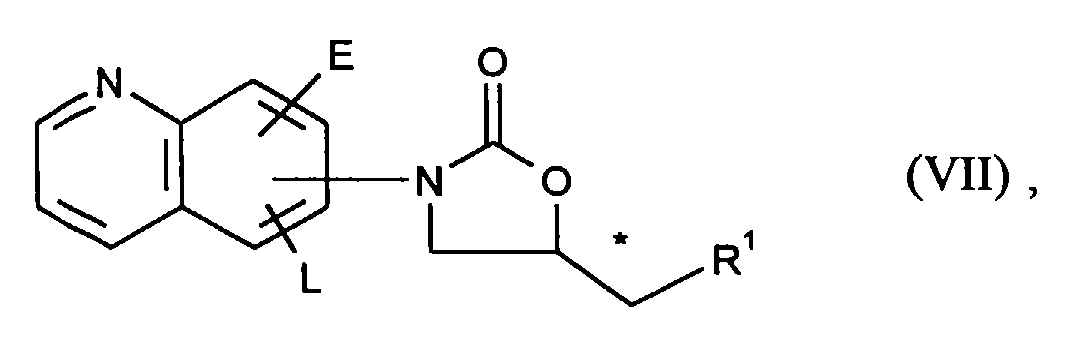 R1, E und L die in Anspruch 1 angegebene Bedeutung haben.
 - Verbindungen nach einem der Ansprüche 1 bis 4 zur Verwendung bei der Bekämpfung von Krankheiten.
- Verwendung von Verbindungen nach einem der Ansprüche 1 bis 4 zur Herstellung von Arzneimitteln.
- Arzneimittel enthaltend Verbindungen nach einem der Ansprüche 1 bis 4.
Applications Claiming Priority (2)
| Application Number | Priority Date | Filing Date | Title |
|---|---|---|---|
| DE19601265A DE19601265A1 (de) | 1996-01-16 | 1996-01-16 | 2-Oxo- und 2-Thio-1,2-dihydrochinolinyl-oxazolidinone |
| DE19601265 | 1996-01-16 |
Publications (2)
| Publication Number | Publication Date |
|---|---|
| EP0785197A2 true EP0785197A2 (de) | 1997-07-23 |
| EP0785197A3 EP0785197A3 (de) | 1999-02-10 |
Family
ID=7782816
Family Applications (1)
| Application Number | Title | Priority Date | Filing Date |
|---|---|---|---|
| EP97100026A Withdrawn EP0785197A3 (de) | 1996-01-16 | 1997-01-03 | 2-Oxo- und 2-Thio-1,2-dihydrochinolinyl-oxazolidinone |
Country Status (28)
| Country | Link |
|---|---|
| US (1) | US5861413A (de) |
| EP (1) | EP0785197A3 (de) |
| JP (1) | JPH09194478A (de) |
| KR (1) | KR970059174A (de) |
| AR (1) | AR005458A1 (de) |
| AU (1) | AU711924B2 (de) |
| BG (1) | BG62257B1 (de) |
| BR (1) | BR9700688A (de) |
| CA (1) | CA2194945A1 (de) |
| CO (1) | CO4520188A1 (de) |
| CZ (1) | CZ12897A3 (de) |
| DE (1) | DE19601265A1 (de) |
| EE (1) | EE9700019A (de) |
| HN (1) | HN1996000124A (de) |
| HR (1) | HRP960614A2 (de) |
| HU (1) | HUP9700126A3 (de) |
| IL (1) | IL119994A0 (de) |
| NO (1) | NO970174L (de) |
| NZ (1) | NZ314057A (de) |
| PE (1) | PE35398A1 (de) |
| PL (1) | PL317930A1 (de) |
| SG (1) | SG46764A1 (de) |
| SK (1) | SK5897A3 (de) |
| SV (1) | SV1997000002A (de) |
| TN (1) | TNSN97009A1 (de) |
| TR (1) | TR199601002A1 (de) |
| YU (1) | YU1097A (de) |
| ZA (1) | ZA97302B (de) |
Cited By (2)
| Publication number | Priority date | Publication date | Assignee | Title |
|---|---|---|---|---|
| WO2005093134A3 (en) * | 2004-03-01 | 2006-05-04 | Atotech Deutschland Gmbh | Iron-phosphorus electroplating bath and method |
| EP1567520A4 (de) * | 2002-12-04 | 2006-08-02 | Glaxo Group Ltd | Chinoline und stickstoffhaltige derivatedavon und deren verwendung als antibakterielle mittel |
Families Citing this family (32)
| Publication number | Priority date | Publication date | Assignee | Title |
|---|---|---|---|---|
| GB9601666D0 (en) * | 1996-01-27 | 1996-03-27 | Zeneca Ltd | Chemical compounds |
| DE19802239A1 (de) * | 1998-01-22 | 1999-07-29 | Bayer Ag | Neue mit Bicyclen substituierte Oxazolidinone |
| WO1999037630A1 (en) | 1998-01-23 | 1999-07-29 | Versicor, Inc. | Oxazolidinone combinatorial libraries, compositions and methods of preparation |
| KR20010052615A (ko) | 1998-06-05 | 2001-06-25 | 다비드 에 질레스 | 옥사졸리디논 유도체, 이것의 제조 방법 및 이것을함유하는 약학 조성물 |
| GB9928568D0 (en) | 1999-12-03 | 2000-02-02 | Zeneca Ltd | Chemical compounds |
| MY127336A (en) | 2000-03-22 | 2006-11-30 | Upjohn Co | Container for linezolid iv solution |
| US6514529B2 (en) | 2000-03-22 | 2003-02-04 | Pharmacia & Upjohn Company | Oxazolidinone tablet formulation |
| GB0009803D0 (en) * | 2000-04-25 | 2000-06-07 | Astrazeneca Ab | Chemical compounds |
| JP2004501965A (ja) | 2000-06-30 | 2004-01-22 | ファルマシア・アンド・アップジョン・カンパニー | 細菌感染を治療するための組成物および方法 |
| ATE319710T1 (de) | 2000-12-21 | 2006-03-15 | Pharmacia & Upjohn Co Llc | Antimikrobielle chinolonderivate und ihre verwendung zur behandlung bakterieller infektionen |
| WO2003031443A1 (de) | 2001-10-04 | 2003-04-17 | Morphochem Aktiengesellschaft für kombinatorische Chemie | Dual action antibiotics |
| WO2003031441A1 (en) * | 2001-10-04 | 2003-04-17 | Morphochen Aktiengesellschaft Für Kombinatorische Chemie | Multiple action compounds |
| US7141588B2 (en) * | 2002-02-25 | 2006-11-28 | Pfizer, Inc. | N-aryl-2-oxazolidinone-5-carboxamides and their derivatives |
| AR038536A1 (es) * | 2002-02-25 | 2005-01-19 | Upjohn Co | N-aril-2-oxazolidinona-5- carboxamidas y sus derivados |
| WO2004014897A1 (en) * | 2002-08-12 | 2004-02-19 | Pharmacia & Upjohn Company Llc | N-aryl-2-oxazolidinones and their derivatives |
| AU2002339721A1 (en) * | 2002-09-20 | 2004-04-08 | Lupin Limited | Oxazolidinone derivatives, process for their preperation and their use as antimycobacterial agents |
| WO2004045616A1 (en) * | 2002-11-21 | 2004-06-03 | Pharmacia & Upjohn Company Llc | N-(4-(piperazin-1-yl)-phenyl-2-oxazolidinone-5-carboxamide derivates and related compounds as antibacterial agents |
| EP1594865A2 (de) * | 2003-02-07 | 2005-11-16 | Warner-Lambert Company LLC | Antibakterielle mittel |
| EP1594494A1 (de) * | 2003-02-07 | 2005-11-16 | Warner-Lambert Company LLC | Mittels bizyklischem ring n-substituierte oxazolidinon-derivate zur verwendung als antibakterielle wirkstoffe |
| US20040204463A1 (en) * | 2003-04-01 | 2004-10-14 | Harris Christina Renee | N-aryl-2-oxazolidinone-5-carboxamides and their derivatives |
| ES2308171T3 (es) | 2003-04-30 | 2008-12-01 | Morphochem Aktiengesellschaft Fur Kombinatorische Chemie | Uso de antibioticos hibridos de oxazolidinona-quinolina para el tratamiento del antrax y de otras infecciones. |
| DE10340485B4 (de) | 2003-09-03 | 2015-05-13 | Morphochem AG Aktiengesellschaft für kombinatorische Chemie | Verfahren zur Herstellung von Oxazolidinon-Chinolon Hybriden |
| US7304050B2 (en) * | 2003-09-16 | 2007-12-04 | Pfizer Inc. | Antibacterial agents |
| US8158797B2 (en) | 2003-12-18 | 2012-04-17 | Morphochem Aktiengesellschaft Fur Kombinatorische Chemie | Oxazolidinone-quinolone hybrid antibiotics |
| CA2549675C (en) | 2003-12-18 | 2012-11-20 | Morphochem Aktiengesellschaft Fur Kombinatorische Chemie | Oxazolidinone-quinolone hybrid antibiotics |
| BRPI0513083A (pt) * | 2004-08-06 | 2008-04-22 | Pharmacia & Upjohn Co Llc | oxazolidinonas contendo oxindóis como agentes antibacterianos |
| MY150958A (en) | 2005-06-16 | 2014-03-31 | Astrazeneca Ab | Compounds for the treatment of multi-drug resistant bacterial infections |
| US20100144717A1 (en) * | 2006-12-15 | 2010-06-10 | Janelle Comita-Prevoir | 2-quinolinone and 2-quinoxalinone-derivatives and their use as antibacterial agents |
| TW200831517A (en) * | 2006-12-15 | 2008-08-01 | Astrazeneca Ab | Chemical compounds |
| JP5404652B2 (ja) * | 2008-02-22 | 2014-02-05 | アクテリオン ファーマシューティカルズ リミテッド | オキサゾリジノン誘導体 |
| JP2017523213A (ja) * | 2014-08-06 | 2017-08-17 | ノバルティス アーゲー | 抗菌薬としてのキノロン誘導体 |
| KR102943446B1 (ko) * | 2020-10-26 | 2026-04-01 | 주식회사 아이비스바이오 | 포말리도마이드로부터 3,6'-디티오포말리도마이드를 선택적으로 합성하는 방법 |
Citations (4)
| Publication number | Priority date | Publication date | Assignee | Title |
|---|---|---|---|---|
| EP0311090A1 (de) | 1987-10-09 | 1989-04-12 | The Du Pont Merck Pharmaceutical Company | Aminomethyl-oxo-oxazolidinyl-cycloalkylbenzen-Derivate, nützlich als antibakterielles Mittel |
| WO1993008179A1 (fr) | 1991-10-23 | 1993-04-29 | Eisai Co., Ltd. | Derive d'oxazolidone |
| EP0609905A1 (de) | 1988-09-15 | 1994-08-10 | The Upjohn Company | 3-(Stickstoff substituierte)phenyl-5-beta-amidomethyloxazoliden-2-one |
| EP0645376A1 (de) | 1993-09-23 | 1995-03-29 | MERCK PATENT GmbH | Substituierte 1-Phenyl-oxazolidin-2-on Derivate deren Herstellung und der Verwendung als Adhäsionsrezeptor-Antagonisten |
Family Cites Families (8)
| Publication number | Priority date | Publication date | Assignee | Title |
|---|---|---|---|---|
| US4705799A (en) * | 1983-06-07 | 1987-11-10 | E. I. Du Pont De Nemours And Company | Aminomethyl oxooxazolidinyl benzenes useful as antibacterial agents |
| US4965268A (en) * | 1987-10-09 | 1990-10-23 | E. I. Du Pont De Nemours And Company | Aminomethyl oxooxazolidinyl cycloalkylbenzene derivatives useful as antibacterial agents |
| US4942183A (en) * | 1987-10-16 | 1990-07-17 | E. I. Du Pont De Nemours And Company | Aminomethyl oxooxazolidinyl aroylbenzene derivatives useful as antibacterial agents |
| CA1320730C (en) * | 1987-10-16 | 1993-07-27 | The Du Pont Merck Pharmaceutical Company | Aminomethyl oxooxazolidinyl aroylbenzene derivatives useful as antibacterial agents |
| US5254577A (en) * | 1988-07-29 | 1993-10-19 | The Du Pont Merck Pharmaceutical Company | Aminomethyloxooxazolidinyl arylbenzene derivatives useful as antibacterial agents |
| US5164510A (en) * | 1988-09-15 | 1992-11-17 | The Upjohn Company | 5'Indolinyl-5β-amidomethyloxazolidin-2-ones |
| TW286317B (de) * | 1993-12-13 | 1996-09-21 | Hoffmann La Roche | |
| DE4425612A1 (de) * | 1994-07-20 | 1996-04-04 | Bayer Ag | 6-gliedrige stickstoffhaltige Heteroaryl-oxazolidinone |
-
1996
- 1996-01-16 DE DE19601265A patent/DE19601265A1/de not_active Withdrawn
- 1996-12-12 TR TR96/01002A patent/TR199601002A1/xx unknown
- 1996-12-23 HR HR19601265.1A patent/HRP960614A2/hr not_active Application Discontinuation
- 1996-12-27 HN HN1996000124A patent/HN1996000124A/es unknown
-
1997
- 1997-01-03 EP EP97100026A patent/EP0785197A3/de not_active Withdrawn
- 1997-01-09 US US08/781,002 patent/US5861413A/en not_active Expired - Fee Related
- 1997-01-09 AU AU10097/97A patent/AU711924B2/en not_active Ceased
- 1997-01-13 JP JP9015889A patent/JPH09194478A/ja active Pending
- 1997-01-13 IL IL11999497A patent/IL119994A0/xx unknown
- 1997-01-13 NZ NZ314057A patent/NZ314057A/en unknown
- 1997-01-13 CA CA002194945A patent/CA2194945A1/en not_active Abandoned
- 1997-01-14 YU YU1097A patent/YU1097A/sh unknown
- 1997-01-14 PE PE1997000019A patent/PE35398A1/es not_active Application Discontinuation
- 1997-01-14 AR ARP970100134A patent/AR005458A1/es unknown
- 1997-01-14 PL PL97317930A patent/PL317930A1/xx unknown
- 1997-01-14 BG BG101131A patent/BG62257B1/bg unknown
- 1997-01-15 SK SK58-97A patent/SK5897A3/sk unknown
- 1997-01-15 KR KR1019970001029A patent/KR970059174A/ko not_active Withdrawn
- 1997-01-15 CZ CZ97128A patent/CZ12897A3/cs unknown
- 1997-01-15 TN TNTNSN97009A patent/TNSN97009A1/fr unknown
- 1997-01-15 NO NO970174A patent/NO970174L/no unknown
- 1997-01-15 BR BR9700688A patent/BR9700688A/pt not_active Application Discontinuation
- 1997-01-15 ZA ZA97302A patent/ZA97302B/xx unknown
- 1997-01-15 SG SG1997000088A patent/SG46764A1/en unknown
- 1997-01-15 EE EE9700019A patent/EE9700019A/xx unknown
- 1997-01-15 HU HU9700126A patent/HUP9700126A3/hu unknown
- 1997-01-15 CO CO97001471A patent/CO4520188A1/es unknown
- 1997-01-16 SV SV1997000002A patent/SV1997000002A/es unknown
Patent Citations (4)
| Publication number | Priority date | Publication date | Assignee | Title |
|---|---|---|---|---|
| EP0311090A1 (de) | 1987-10-09 | 1989-04-12 | The Du Pont Merck Pharmaceutical Company | Aminomethyl-oxo-oxazolidinyl-cycloalkylbenzen-Derivate, nützlich als antibakterielles Mittel |
| EP0609905A1 (de) | 1988-09-15 | 1994-08-10 | The Upjohn Company | 3-(Stickstoff substituierte)phenyl-5-beta-amidomethyloxazoliden-2-one |
| WO1993008179A1 (fr) | 1991-10-23 | 1993-04-29 | Eisai Co., Ltd. | Derive d'oxazolidone |
| EP0645376A1 (de) | 1993-09-23 | 1995-03-29 | MERCK PATENT GmbH | Substituierte 1-Phenyl-oxazolidin-2-on Derivate deren Herstellung und der Verwendung als Adhäsionsrezeptor-Antagonisten |
Non-Patent Citations (1)
| Title |
|---|
| SWENSON J.M., THORNBERRY C., SILCOX U.A.: "Rapidly growing mycobacteria: Testing of susceptibility to 34 antimicrobial agents by broth microdilution.", ANTIMICROBIAL AGENTS AND CHEMOTHERAPY., vol. 22, 1982, pages 186 - 192 |
Cited By (3)
| Publication number | Priority date | Publication date | Assignee | Title |
|---|---|---|---|---|
| EP1567520A4 (de) * | 2002-12-04 | 2006-08-02 | Glaxo Group Ltd | Chinoline und stickstoffhaltige derivatedavon und deren verwendung als antibakterielle mittel |
| US7491714B2 (en) | 2002-12-04 | 2009-02-17 | Glaxo Group Limited | Quinolines and nitrogenated derivatives thereof and their use as antibacterial agents |
| WO2005093134A3 (en) * | 2004-03-01 | 2006-05-04 | Atotech Deutschland Gmbh | Iron-phosphorus electroplating bath and method |
Also Published As
| Publication number | Publication date |
|---|---|
| ZA97302B (en) | 1997-07-17 |
| TR199601002A1 (tr) | 1997-08-21 |
| AR005458A1 (es) | 1999-06-23 |
| BR9700688A (pt) | 1998-09-01 |
| BG62257B1 (bg) | 1999-06-30 |
| NO970174D0 (no) | 1997-01-15 |
| HN1996000124A (es) | 1997-06-18 |
| IL119994A0 (en) | 1997-04-15 |
| YU1097A (sh) | 1999-12-27 |
| CZ12897A3 (en) | 1997-08-13 |
| MX9700419A (es) | 1997-07-31 |
| CA2194945A1 (en) | 1997-07-17 |
| AU711924B2 (en) | 1999-10-21 |
| SG46764A1 (en) | 1998-02-20 |
| NZ314057A (en) | 1998-11-25 |
| SK5897A3 (en) | 1997-09-10 |
| BG101131A (en) | 1998-04-30 |
| SV1997000002A (es) | 1997-08-29 |
| HUP9700126A3 (en) | 1999-05-28 |
| AU1009797A (en) | 1997-07-24 |
| HUP9700126A2 (hu) | 1998-12-28 |
| CO4520188A1 (es) | 1997-10-15 |
| HRP960614A2 (en) | 1998-02-28 |
| PE35398A1 (es) | 1998-08-29 |
| EE9700019A (et) | 1997-08-15 |
| KR970059174A (ko) | 1997-08-12 |
| DE19601265A1 (de) | 1997-07-17 |
| PL317930A1 (en) | 1997-07-21 |
| JPH09194478A (ja) | 1997-07-29 |
| EP0785197A3 (de) | 1999-02-10 |
| NO970174L (no) | 1997-07-17 |
| TNSN97009A1 (fr) | 2005-03-15 |
| HU9700126D0 (en) | 1997-02-28 |
| US5861413A (en) | 1999-01-19 |
Similar Documents
| Publication | Publication Date | Title |
|---|---|---|
| EP0789025B1 (de) | Substituierte Oxazolidinone und ihre Verwendung als antibakterielle Arzneimittel | |
| DE19601265A1 (de) | 2-Oxo- und 2-Thio-1,2-dihydrochinolinyl-oxazolidinone | |
| EP0785201A1 (de) | Heteroatomhaltige Cyclopentanopyridyl-Oxazolidinone | |
| EP0738726B1 (de) | Heteroatomhaltige Benzocyclopentanoxazolidinone mit antibakteriellen Wirkung | |
| EP0789026A1 (de) | Heteroaryl-Oxazolidinone und ihre Verwendung als antibakterielle Arzneimittel | |
| EP0694543A1 (de) | 6-gliedrige stickstoffhaltige Heteroaryl-Oxazolidinone | |
| DE69421285T2 (de) | Substituierte oxazine und thiazine oxazolidinone als antimikrobielle mittel | |
| EP0697412A1 (de) | Benzoxazolyl- und Benzothiazolyloxazolidinone | |
| EP0785200A2 (de) | Pyrido-annellierte Thienyl- und Furanyl-Oxazolidinone | |
| DE69529670T2 (de) | Oxazolidinon derivate und diese enthaltende pharmazeutische zusammensetzungen | |
| DE4425609A1 (de) | Benzofuranyl- und Benzothienyloxazolidinone | |
| DE4425613A1 (de) | 5-gliedrige Heteroaryl-oxazolidinone | |
| DE69625515T2 (de) | Benzooxazine als antimikrobielle mittel | |
| DE19730847A1 (de) | Tricyclisch substituierte Oxazolidinone | |
| DE69818294T2 (de) | Oxazolidinone derivate und pharmazeutische zusammensetzungen | |
| DE19802239A1 (de) | Neue mit Bicyclen substituierte Oxazolidinone | |
| DE4430639A1 (de) | Verwendung von 5-substituierten Pyridin- und Hexahydrochinolin-3-carbonsäurederivaten | |
| DE602005006101T2 (de) | Substituierte chinoline und deren verwendung als inhibitoren von mycobakterien | |
| DE19649095A1 (de) | Neue Heteroaryl-Oxazolidinone | |
| DE68924221T2 (de) | Imidazolderivate. | |
| DE10133277A1 (de) | ß-Alanin-Derivate | |
| DE4139749A1 (de) | Chinolylmethoxyphenyl-essigsaeureamide | |
| DE19901306A1 (de) | Neue Oxazolidinone | |
| EP0544168B1 (de) | Verwendung von Aminoalkyl-substituierten 5,6-Dihydro-dibenz(b,e)azepin-6,11-dion-11-oximen als antivirale Mittel | |
| EP0545171A1 (de) | Chinolymethoxyphenylessigsäure-acylamide und -harnstoffe |
Legal Events
| Date | Code | Title | Description |
|---|---|---|---|
| PUAI | Public reference made under article 153(3) epc to a published international application that has entered the european phase |
Free format text: ORIGINAL CODE: 0009012 |
|
| AK | Designated contracting states |
Kind code of ref document: A2 Designated state(s): AT BE CH DE DK ES FI FR GB GR IE IT LI LU MC NL PT SE |
|
| AX | Request for extension of the european patent |
Free format text: LT PAYMENT 970103;LV PAYMENT 970103;RO PAYMENT 970103;SI PAYMENT 970103 |
|
| PUAL | Search report despatched |
Free format text: ORIGINAL CODE: 0009013 |
|
| AK | Designated contracting states |
Kind code of ref document: A3 Designated state(s): AT BE CH DE DK ES FI FR GB GR IE IT LI LU MC NL PT SE |
|
| AX | Request for extension of the european patent |
Free format text: LT PAYMENT 970103;LV PAYMENT 970103;RO PAYMENT 970103;SI PAYMENT 970103 |
|
| 17P | Request for examination filed |
Effective date: 19990810 |
|
| STAA | Information on the status of an ep patent application or granted ep patent |
Free format text: STATUS: THE APPLICATION HAS BEEN WITHDRAWN |
|
| 18W | Application withdrawn |
Withdrawal date: 19991018 |