EP0785419A2 - Sprachaktivitätserkennung - Google Patents
Sprachaktivitätserkennung Download PDFInfo
- Publication number
- EP0785419A2 EP0785419A2 EP97100813A EP97100813A EP0785419A2 EP 0785419 A2 EP0785419 A2 EP 0785419A2 EP 97100813 A EP97100813 A EP 97100813A EP 97100813 A EP97100813 A EP 97100813A EP 0785419 A2 EP0785419 A2 EP 0785419A2
- Authority
- EP
- European Patent Office
- Prior art keywords
- parameters
- speech signal
- speech
- frame
- predetermined set
- Prior art date
- Legal status (The legal status is an assumption and is not a legal conclusion. Google has not performed a legal analysis and makes no representation as to the accuracy of the status listed.)
- Granted
Links
Images

Classifications
-
- G—PHYSICS
- G01—MEASURING; TESTING
- G01L—MEASURING FORCE, STRESS, TORQUE, WORK, MECHANICAL POWER, MECHANICAL EFFICIENCY, OR FLUID PRESSURE
- G01L3/00—Measuring torque, work, mechanical power, or mechanical efficiency, in general
Definitions
- the present invention is related to another pending Patent Application, entitled USAGE OF VOICE ACTIVITY DETECTION FOR EFFICIENT CODING OF SPEECH, filed on the same date, with Serial No. , and also assigned to the present assignee.
- the disclosure of the Related Application is incorporated herein by reference.
- the present invention relates to speech coding in communication systems and more particularly to dual-mode speech coding schemes.
- Modem communication systems rely heavily on digital speech processing in general and digital speech compression in particular. Examples of such communication systems are digital telephony trunks, voice mail, voice annotation, answering machines, digital voice over data links, etc.
- a speech communication system is typically comprised of an encoder, a communication channel and a decoder.
- the speech encoder converts a speech which has been digitized into a bit-stream.
- the bit-stream is transmitted over the communication channel (which can be a storage medium), and is converted again into a digitized speech by the decoder at the other end.
- the ratio between the number of bits needed for the representation of the digitized speech and the number of bits in the bit-stream is the compression ratio.
- a compression ratio of 12 to 16 is achievable while keeping a high quality of reconstructed speech.
- a considerable portion of the normal speech is comprised of silence, up to an average of 60% during a two-way conversation.
- the speech input device such as a microphone, picks up the environment noise.
- the noise level and characteristics can vary considerably, from a quite room to a noisy street or a fast moving car.
- most of the noise sources carry less information than the speech and hence a higher compression ratio is achievable during the silence periods.
- speech will be denoted as “active-voice” and silence or background noise will be denoted as “non-active-voice”.
- the above argument leads to the concept of dual-mode speech coding schemes, which are usually also variable-rate coding schemes.
- the different modes of the input signal (active-voice or non-active-voice) are determined by a signal classifier, which can operate external to, or within, the speech encoder.
- a different coding scheme is employed for the non-active-voice signal, using less bits and resulting in an overall higher average compression ratio.
- the classifier output is binary, and is commonly called "voicing decision.”
- the classifier is also commonly called Voice Activity Detector ("VAD").
- the VAD algorithm operates on frames of digitized speech.
- the frame duration usually coincided with the frames of the speech coder.
- the VAD is using a set of parameters, extracted from the input speech signal, to make the voicing decision. These parameters usually include energies and spectral parameters.
- a typical VAD operation is based on the comparison of such set of instantaneous parameters to a set of parameters which represents the background noise characteristics. Since the noise characteristics are unknown beforehand, they are usually modeled as a running average estimates of the energies and the spectral parameters during non-active voice frames.
- FIG. 1 A schematic representation of a speech communication system which employs a VAD for a higher compression rate is depicted in Figure 1 .
- the input to the speech encoder (110) is the digitized incoming speech signal (105).
- the VAD (125) provides the voicing decision (140), which is used as a switch (145) between the active-voice encoder (120) and the non-active-voice encoder (115).
- Either the active-voice bit-stream (135) or the non-active-voice bit-stream (130), together with the voicing decision (140) are transmitted through the communication channel (150).
- the voicing decision is used in the switch (160) to select the non-active-voice decoder (165) or the active-voice decoder (170). For each frame, the output of either decoders is used as the reconstructed speech (175).
- a method for generating frame voicing decisions for an incoming speech signal having periods of active voice and non-active voice for a speech encoder in a speech communication system.
- the method first extracts a predetermined set of parameters from the incoming speech signal for each frame and then makes a frame voicing decision of the incoming speech signal for each frame according to a set of difference measures extracted from the predetermined set of parameters.
- the predetermined set of extracted parameters comprises a description of the spectrum of the incoming speech signal based on line spectral frequencies ("LSF"). Additional parameters may include full band energy, low band energy and zero crossing rate.
- the way to make a frame voicing decision of the incoming speech signal for each frame according to the set of difference measures is by finding a union of sub-spaces with each sub-space being described by a linear function of at least a pair of parameters from the predetermined set of parameters.
- a voice activity detection method and apparatus for a speech communication system is disclosed.
- the present invention is described in terms of functional block diagrams and process flow charts, which are the ordinary means for those skilled in the art of speech coding to communicate among themselves.
- the present invention is not limited to any specific programing languages, since those skilled in the art can readily determine the most suitable way of implementing the teaching of the present invention.
- a Voice Activity Detection (VAD) module is used to generate a voicing decision which switches between an active-voice encoder/decoder and a non-active-voice encoder/decoder.
- the binary voicing decision is either 1 (TRUE) for the active-voice or 0 (FALSE) for the non-active-voice.
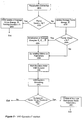
- the VAD flowchart of operation is given in Figure 2 .
- the VAD operates on frames of digitized speech.
- the frames are processed in time order and are consecutively numbered from the beginning of each conversation/recording.
- the parameters are the frame full band energy, the frame low-band energy, a set of spectral parameters called Line Spectral Frequencies ("LSF") and the frame zero crossing rate.
- LSF Line Spectral Frequencies
- the average frame energy is updated at block (215) and an initialization block (220) for the running averages of the background noise characteristics takes place.
- the average frame energy update block (215) takes place.
- a set of difference parameters is calculated. This set is generated as difference measures between the current frame parameters and the running averages of the background noise characteristics. Four difference measures are calculated:
- the initial voicing decision is made at the next block (235), using multi-boundary decision regions in the space of the four difference measures.
- the active-voice decision is given as the union of the decision regions and the non-active-voice decision is its complementary logical decision.
- the initial decision does not take into account neighboring past frames, which can help in decision smoothing, considering the stationarity of the speech signal.
- Energy consideration, together with neighboring past frames decisions, are used in block (240) for decision smoothing.
- the difference parameters were generated at block (230) as a difference between the current frame parameters and the running averages of the background noise characteristics. These running averages are updated in block (250). Since the running averages are updated only in the presence of background noise, and not in the presence of speech, few energy thresholds are tested at block (245), and an update takes place only if the thresholds are met.
- the parameters extraction module can be shared between the VAD (125), the active-voice encoder (120) and the non-active-voice encoder (115).
- the primary set of parameters is the set of autocorrelation coefficients, which is derived according to ITU-T, Study Group 15 Contribution - Q. 12/15, Draft Recommendation G.729, June 8, 1995, Version 5.0, or DIGITAL SPEECH - Coding for Low Bit Rate Communication Systems by A.M. Kondoz, John Wiley & Son, 1994, England.
- the set of autocorrelation coefficients will be denoted by
- a set of linear prediction coefficients is derived from the autocorrelation and a set of is derived from the set of linear prediction coefficients, as described in ITU-T, Study Group 15 Contribution - Q. 12/15, Draft Recommendation G.729, June 8, 1995, Version 5.0, or DIGITAL SPEECH - Coding for Low Bit Rate Communication Systems by A.M. Kondoz, John Wiley & Son, 1994, England.
- the low band energy E l measured on 0 to F l Hz band is computed as follows: where h is the impulse response of an FIR filter with cutoff frequency at F l Hz, R is the Toeplitz autocorrelation matrix with the autocorrelation coefficients on each diagonal, and N is a predetermined normalization factor.
- the running average for the frame energy is denoted by E ⁇ .
- the spectral parameters of the background noise denoted by are initialized to the constant values
- the average of the background noise zero-crossings, denoted by ZC ⁇ is initialized to the constant value ZC ⁇ 0 .
- the initialization procedure uses the initial value of the running average of the frame energy - E ⁇ , which can also be modified by this initialization.
- the initialization procedure is illustrated as follows:
- the four difference parameters lie in the four dimensional Euclidean space.
- Each possible vector of difference parameters defines a point in that space.
- a predetermined decision region of the four dimensional Euclidean space, bounded by three dimensional hyper-planes, is defined as non-active-voice region , and its complementary is defined as active-voice region .
- Each of the three dimensional hyper-planes is defining a section of the boundary of that decision region.
- each hyper-plane is perpendicular to some two axes of the four dimensional Euclidean space.
- the initial voicing decision, obtained in block (235), is denoted by I VD .
- the initial voicing decision is 0 ("FALSE”). If the vector of the four difference parameters lies within the active-voice region , the initial voicing decision is 1 ("TRUE").
- the active-voice region is defined as the union of all active-voice sub-spaces, and the non-active-voice region is its complementary region of intersection of all non-active-voice sub-spaces.
- the initial voicing decision is smoothed to reflect the long term stationary nature of the speech signal.
- the smoothing is done in three stages.
- the smoothed voicing decision of the frame, the previous frame and frame before the previous frame are denoted by S 0 VD , S -1 VD and S -2 VD , respectively.
- S -1 VD is initialized to 1
- S -2 VD is initialized to 1.
- F -1 VD For the second smoothing stage define one Boolean parameter F -1 VD .
- F -1 VD is initialized to 1.
- C e a counter denoted by C e , which is initialized to 0.
- E -1 the energy of the previous frame.
- the third smoothing stage is:
- the running averages of the background noise characteristics are updated at the last stage of the VAD algorithm.
- the following conditions are tested and the updating takes place only if these conditions are met: if [ E ⁇ 1 ⁇ 2 ⁇ ( E ⁇ - E ⁇ f ) - T 5 ] and ( E ⁇ ⁇ T 6 ) then update .
- the running averages of the background noise characteristics are updated using first order AR update.
- a different AR coefficient is used for each parameter.
- E ⁇ f be the AR coefficient for the update of E ⁇ l
- ⁇ ZC be the AR coefficient for the update of ZC
- ⁇ LSF be the AR coefficient for the update of The number of frames which were classified as non-active-voice is counted by C n .
- the coefficients ⁇ ZC , and ⁇ LSF depend on the value of C n .
Landscapes
- Physics & Mathematics (AREA)
- General Physics & Mathematics (AREA)
- Compression, Expansion, Code Conversion, And Decoders (AREA)
- Time-Division Multiplex Systems (AREA)
Applications Claiming Priority (2)
| Application Number | Priority Date | Filing Date | Title |
|---|---|---|---|
| US589509 | 1996-01-22 | ||
| US08/589,509 US5774849A (en) | 1996-01-22 | 1996-01-22 | Method and apparatus for generating frame voicing decisions of an incoming speech signal |
Publications (3)
| Publication Number | Publication Date |
|---|---|
| EP0785419A2 true EP0785419A2 (de) | 1997-07-23 |
| EP0785419A3 EP0785419A3 (de) | 1998-09-02 |
| EP0785419B1 EP0785419B1 (de) | 2003-05-02 |
Family
ID=24358312
Family Applications (1)
| Application Number | Title | Priority Date | Filing Date |
|---|---|---|---|
| EP97100813A Expired - Lifetime EP0785419B1 (de) | 1996-01-22 | 1997-01-20 | Sprachaktivitätserkennung |
Country Status (4)
| Country | Link |
|---|---|
| US (1) | US5774849A (de) |
| EP (1) | EP0785419B1 (de) |
| JP (1) | JP3363336B2 (de) |
| DE (1) | DE69721347D1 (de) |
Cited By (11)
| Publication number | Priority date | Publication date | Assignee | Title |
|---|---|---|---|---|
| WO2000017856A1 (en) * | 1998-09-18 | 2000-03-30 | Conexant Systems, Inc. | Method and apparatus for detecting voice activity in a speech signal |
| GB2360428A (en) * | 2000-03-15 | 2001-09-19 | Motorola Israel Ltd | Voice activity detection |
| WO2003063138A1 (en) * | 2002-01-24 | 2003-07-31 | Motorola Inc | Voice activity detector and validator for noisy environments |
| KR100655953B1 (ko) | 2006-02-06 | 2006-12-11 | 한양대학교 산학협력단 | 웨이블릿 패킷 변환을 이용한 음성 처리 시스템 및 그 방법 |
| KR100789084B1 (ko) | 2006-11-21 | 2007-12-26 | 한양대학교 산학협력단 | 웨이블릿 패킷 영역에서 비선형 구조의 과중 이득에 의한음질 개선 방법 |
| US8005672B2 (en) * | 2004-10-08 | 2011-08-23 | Trident Microsystems (Far East) Ltd. | Circuit arrangement and method for detecting and improving a speech component in an audio signal |
| CN101625857B (zh) * | 2008-07-10 | 2012-05-09 | 新奥特(北京)视频技术有限公司 | 一种自适应的语音端点检测方法 |
| RU2450368C2 (ru) * | 2007-09-28 | 2012-05-10 | Квэлкомм Инкорпорейтед | Средство обнаружения голосовой активности с использованием нескольких микрофонов |
| US8223988B2 (en) | 2008-01-29 | 2012-07-17 | Qualcomm Incorporated | Enhanced blind source separation algorithm for highly correlated mixtures |
| WO2013068634A1 (en) * | 2011-11-10 | 2013-05-16 | Nokia Corporation | A method and apparatus for detecting audio sampling rate |
| US10580416B2 (en) | 2015-07-06 | 2020-03-03 | Nokia Technologies Oy | Bit error detector for an audio signal decoder |
Families Citing this family (27)
| Publication number | Priority date | Publication date | Assignee | Title |
|---|---|---|---|---|
| US5937381A (en) * | 1996-04-10 | 1999-08-10 | Itt Defense, Inc. | System for voice verification of telephone transactions |
| US5970447A (en) * | 1998-01-20 | 1999-10-19 | Advanced Micro Devices, Inc. | Detection of tonal signals |
| US6711540B1 (en) * | 1998-09-25 | 2004-03-23 | Legerity, Inc. | Tone detector with noise detection and dynamic thresholding for robust performance |
| US6574334B1 (en) | 1998-09-25 | 2003-06-03 | Legerity, Inc. | Efficient dynamic energy thresholding in multiple-tone multiple frequency detectors |
| WO2000046789A1 (en) * | 1999-02-05 | 2000-08-10 | Fujitsu Limited | Sound presence detector and sound presence/absence detecting method |
| US20020116186A1 (en) * | 2000-09-09 | 2002-08-22 | Adam Strauss | Voice activity detector for integrated telecommunications processing |
| US7230955B1 (en) * | 2002-12-27 | 2007-06-12 | At & T Corp. | System and method for improved use of voice activity detection |
| US7272552B1 (en) * | 2002-12-27 | 2007-09-18 | At&T Corp. | Voice activity detection and silence suppression in a packet network |
| JP3963850B2 (ja) * | 2003-03-11 | 2007-08-22 | 富士通株式会社 | 音声区間検出装置 |
| US7412376B2 (en) * | 2003-09-10 | 2008-08-12 | Microsoft Corporation | System and method for real-time detection and preservation of speech onset in a signal |
| US7596488B2 (en) * | 2003-09-15 | 2009-09-29 | Microsoft Corporation | System and method for real-time jitter control and packet-loss concealment in an audio signal |
| US8219391B2 (en) * | 2005-02-15 | 2012-07-10 | Raytheon Bbn Technologies Corp. | Speech analyzing system with speech codebook |
| US20070033042A1 (en) * | 2005-08-03 | 2007-02-08 | International Business Machines Corporation | Speech detection fusing multi-class acoustic-phonetic, and energy features |
| US7962340B2 (en) * | 2005-08-22 | 2011-06-14 | Nuance Communications, Inc. | Methods and apparatus for buffering data for use in accordance with a speech recognition system |
| US8775168B2 (en) * | 2006-08-10 | 2014-07-08 | Stmicroelectronics Asia Pacific Pte, Ltd. | Yule walker based low-complexity voice activity detector in noise suppression systems |
| CN101246688B (zh) * | 2007-02-14 | 2011-01-12 | 华为技术有限公司 | 一种对背景噪声信号进行编解码的方法、系统和装置 |
| ES2533626T3 (es) * | 2007-03-02 | 2015-04-13 | Telefonaktiebolaget L M Ericsson (Publ) | Métodos y adaptaciones en una red de telecomunicaciones |
| CN101335000B (zh) * | 2008-03-26 | 2010-04-21 | 华为技术有限公司 | 编码的方法及装置 |
| KR20100006492A (ko) | 2008-07-09 | 2010-01-19 | 삼성전자주식회사 | 부호화 방식 결정 방법 및 장치 |
| JP5460709B2 (ja) | 2009-06-04 | 2014-04-02 | パナソニック株式会社 | 音響信号処理装置および方法 |
| CN102044242B (zh) * | 2009-10-15 | 2012-01-25 | 华为技术有限公司 | 语音激活检测方法、装置和电子设备 |
| CN102884575A (zh) | 2010-04-22 | 2013-01-16 | 高通股份有限公司 | 话音活动检测 |
| US8898058B2 (en) * | 2010-10-25 | 2014-11-25 | Qualcomm Incorporated | Systems, methods, and apparatus for voice activity detection |
| US20130090926A1 (en) * | 2011-09-16 | 2013-04-11 | Qualcomm Incorporated | Mobile device context information using speech detection |
| US9785706B2 (en) * | 2013-08-28 | 2017-10-10 | Texas Instruments Incorporated | Acoustic sound signature detection based on sparse features |
| US10354671B1 (en) * | 2017-02-21 | 2019-07-16 | Oben, Inc. | System and method for the analysis and synthesis of periodic and non-periodic components of speech signals |
| CN108962285B (zh) * | 2018-07-20 | 2023-04-14 | 浙江万里学院 | 一种基于人耳掩蔽效应划分子带的语音端点检测方法 |
Family Cites Families (11)
| Publication number | Priority date | Publication date | Assignee | Title |
|---|---|---|---|---|
| DE3370423D1 (en) * | 1983-06-07 | 1987-04-23 | Ibm | Process for activity detection in a voice transmission system |
| US5276765A (en) * | 1988-03-11 | 1994-01-04 | British Telecommunications Public Limited Company | Voice activity detection |
| JPH07113840B2 (ja) * | 1989-06-29 | 1995-12-06 | 三菱電機株式会社 | 音声検出器 |
| US4975956A (en) * | 1989-07-26 | 1990-12-04 | Itt Corporation | Low-bit-rate speech coder using LPC data reduction processing |
| US5255339A (en) * | 1991-07-19 | 1993-10-19 | Motorola, Inc. | Low bit rate vocoder means and method |
| US5734789A (en) * | 1992-06-01 | 1998-03-31 | Hughes Electronics | Voiced, unvoiced or noise modes in a CELP vocoder |
| US5509102A (en) * | 1992-07-01 | 1996-04-16 | Kokusai Electric Co., Ltd. | Voice encoder using a voice activity detector |
| US5278944A (en) * | 1992-07-15 | 1994-01-11 | Kokusai Electric Co., Ltd. | Speech coding circuit |
| US5596680A (en) * | 1992-12-31 | 1997-01-21 | Apple Computer, Inc. | Method and apparatus for detecting speech activity using cepstrum vectors |
| JPH06332492A (ja) * | 1993-05-19 | 1994-12-02 | Matsushita Electric Ind Co Ltd | 音声検出方法および検出装置 |
| JP3182032B2 (ja) * | 1993-12-10 | 2001-07-03 | 株式会社日立国際電気 | 音声符号化通信方式及びその装置 |
-
1996
- 1996-01-22 US US08/589,509 patent/US5774849A/en not_active Expired - Lifetime
-
1997
- 1997-01-20 EP EP97100813A patent/EP0785419B1/de not_active Expired - Lifetime
- 1997-01-20 DE DE69721347T patent/DE69721347D1/de not_active Expired - Lifetime
- 1997-01-21 JP JP00858897A patent/JP3363336B2/ja not_active Expired - Fee Related
Cited By (16)
| Publication number | Priority date | Publication date | Assignee | Title |
|---|---|---|---|---|
| WO2000017856A1 (en) * | 1998-09-18 | 2000-03-30 | Conexant Systems, Inc. | Method and apparatus for detecting voice activity in a speech signal |
| GB2360428A (en) * | 2000-03-15 | 2001-09-19 | Motorola Israel Ltd | Voice activity detection |
| WO2001080220A3 (en) * | 2000-03-15 | 2002-05-23 | Motorola Israel Ltd | Voice activity detection apparatus and method |
| GB2360428B (en) * | 2000-03-15 | 2002-09-18 | Motorola Israel Ltd | Voice activity detection apparatus and method |
| CN1307613C (zh) * | 2002-01-24 | 2007-03-28 | 摩托罗拉公司 | 用于噪声环境的话音活动检测器和验证器 |
| WO2003063138A1 (en) * | 2002-01-24 | 2003-07-31 | Motorola Inc | Voice activity detector and validator for noisy environments |
| US8005672B2 (en) * | 2004-10-08 | 2011-08-23 | Trident Microsystems (Far East) Ltd. | Circuit arrangement and method for detecting and improving a speech component in an audio signal |
| KR100655953B1 (ko) | 2006-02-06 | 2006-12-11 | 한양대학교 산학협력단 | 웨이블릿 패킷 변환을 이용한 음성 처리 시스템 및 그 방법 |
| KR100789084B1 (ko) | 2006-11-21 | 2007-12-26 | 한양대학교 산학협력단 | 웨이블릿 패킷 영역에서 비선형 구조의 과중 이득에 의한음질 개선 방법 |
| RU2450368C2 (ru) * | 2007-09-28 | 2012-05-10 | Квэлкомм Инкорпорейтед | Средство обнаружения голосовой активности с использованием нескольких микрофонов |
| US8954324B2 (en) | 2007-09-28 | 2015-02-10 | Qualcomm Incorporated | Multiple microphone voice activity detector |
| US8223988B2 (en) | 2008-01-29 | 2012-07-17 | Qualcomm Incorporated | Enhanced blind source separation algorithm for highly correlated mixtures |
| CN101625857B (zh) * | 2008-07-10 | 2012-05-09 | 新奥特(北京)视频技术有限公司 | 一种自适应的语音端点检测方法 |
| WO2013068634A1 (en) * | 2011-11-10 | 2013-05-16 | Nokia Corporation | A method and apparatus for detecting audio sampling rate |
| US9542149B2 (en) | 2011-11-10 | 2017-01-10 | Nokia Technologies Oy | Method and apparatus for detecting audio sampling rate |
| US10580416B2 (en) | 2015-07-06 | 2020-03-03 | Nokia Technologies Oy | Bit error detector for an audio signal decoder |
Also Published As
| Publication number | Publication date |
|---|---|
| EP0785419A3 (de) | 1998-09-02 |
| DE69721347D1 (de) | 2003-06-05 |
| US5774849A (en) | 1998-06-30 |
| EP0785419B1 (de) | 2003-05-02 |
| JPH09198099A (ja) | 1997-07-31 |
| JP3363336B2 (ja) | 2003-01-08 |
Similar Documents
| Publication | Publication Date | Title |
|---|---|---|
| US5774849A (en) | Method and apparatus for generating frame voicing decisions of an incoming speech signal | |
| US6188981B1 (en) | Method and apparatus for detecting voice activity in a speech signal | |
| EP0785541B1 (de) | Verwendung von Sprachaktivitätserkennung zur effizienten Sprachkodierung | |
| Benyassine et al. | ITU-T Recommendation G. 729 Annex B: a silence compression scheme for use with G. 729 optimized for V. 70 digital simultaneous voice and data applications | |
| US5574823A (en) | Frequency selective harmonic coding | |
| US5812965A (en) | Process and device for creating comfort noise in a digital speech transmission system | |
| US4815134A (en) | Very low rate speech encoder and decoder | |
| JP3996213B2 (ja) | 入力標本列処理方法 | |
| US7286982B2 (en) | LPC-harmonic vocoder with superframe structure | |
| US5384891A (en) | Vector quantizing apparatus and speech analysis-synthesis system using the apparatus | |
| US6289311B1 (en) | Sound synthesizing method and apparatus, and sound band expanding method and apparatus | |
| CA1301072C (en) | Speech coding transmission equipment | |
| US20010034601A1 (en) | Voice activity detection apparatus, and voice activity/non-activity detection method | |
| US5937375A (en) | Voice-presence/absence discriminator having highly reliable lead portion detection | |
| JPH08505715A (ja) | 定常的信号と非定常的信号との識別 | |
| US5839102A (en) | Speech coding parameter sequence reconstruction by sequence classification and interpolation | |
| US6915257B2 (en) | Method and apparatus for speech coding with voiced/unvoiced determination | |
| US6144935A (en) | Tunable perceptual weighting filter for tandem coders | |
| EP1497631B1 (de) | Erzeugung von lsf-vektoren | |
| US5812966A (en) | Pitch searching time reducing method for code excited linear prediction vocoder using line spectral pair | |
| US20090299737A1 (en) | Method for adapting for an interoperability between short-term correlation models of digital signals | |
| Stegmann et al. | Robust classification of speech based on the dyadic wavelet transform with application to CELP coding | |
| US5459784A (en) | Dual-tone multifrequency (DTMF) signalling transparency for low-data-rate vocoders | |
| Rebolledo et al. | A multirate voice digitizer based upon vector quantization | |
| JPH0651799A (ja) | 音声メッセージ符号化装置と復号化装置とを同期化させる方法 |
Legal Events
| Date | Code | Title | Description |
|---|---|---|---|
| PUAI | Public reference made under article 153(3) epc to a published international application that has entered the european phase |
Free format text: ORIGINAL CODE: 0009012 |
|
| AK | Designated contracting states |
Kind code of ref document: A2 Designated state(s): DE FR GB |
|
| PUAL | Search report despatched |
Free format text: ORIGINAL CODE: 0009013 |
|
| AK | Designated contracting states |
Kind code of ref document: A3 Designated state(s): DE FR GB |
|
| 17P | Request for examination filed |
Effective date: 19990224 |
|
| RIC1 | Information provided on ipc code assigned before grant |
Free format text: 7G 10L 19/02 A |
|
| 17Q | First examination report despatched |
Effective date: 20020125 |
|
| GRAH | Despatch of communication of intention to grant a patent |
Free format text: ORIGINAL CODE: EPIDOS IGRA |
|
| GRAH | Despatch of communication of intention to grant a patent |
Free format text: ORIGINAL CODE: EPIDOS IGRA |
|
| GRAH | Despatch of communication of intention to grant a patent |
Free format text: ORIGINAL CODE: EPIDOS IGRA |
|
| GRAH | Despatch of communication of intention to grant a patent |
Free format text: ORIGINAL CODE: EPIDOS IGRA |
|
| GRAA | (expected) grant |
Free format text: ORIGINAL CODE: 0009210 |
|
| AK | Designated contracting states |
Designated state(s): DE FR GB |
|
| PG25 | Lapsed in a contracting state [announced via postgrant information from national office to epo] |
Ref country code: FR Free format text: LAPSE BECAUSE OF FAILURE TO SUBMIT A TRANSLATION OF THE DESCRIPTION OR TO PAY THE FEE WITHIN THE PRESCRIBED TIME-LIMIT Effective date: 20030502 |
|
| REG | Reference to a national code |
Ref country code: GB Ref legal event code: FG4D |
|
| REF | Corresponds to: |
Ref document number: 69721347 Country of ref document: DE Date of ref document: 20030605 Kind code of ref document: P |
|
| PG25 | Lapsed in a contracting state [announced via postgrant information from national office to epo] |
Ref country code: DE Free format text: LAPSE BECAUSE OF FAILURE TO SUBMIT A TRANSLATION OF THE DESCRIPTION OR TO PAY THE FEE WITHIN THE PRESCRIBED TIME-LIMIT Effective date: 20030805 |
|
| PG25 | Lapsed in a contracting state [announced via postgrant information from national office to epo] |
Ref country code: GB Free format text: LAPSE BECAUSE OF NON-PAYMENT OF DUE FEES Effective date: 20040120 |
|
| PLBE | No opposition filed within time limit |
Free format text: ORIGINAL CODE: 0009261 |
|
| STAA | Information on the status of an ep patent application or granted ep patent |
Free format text: STATUS: NO OPPOSITION FILED WITHIN TIME LIMIT |
|
| 26N | No opposition filed |
Effective date: 20040203 |
|
| EN | Fr: translation not filed | ||
| GBPC | Gb: european patent ceased through non-payment of renewal fee |
Effective date: 20040120 |