EP0786890A2 - Zuweisung von Betriebsmitteln in einem Mehrträger-Mobilfunksystem mit mehreren Benutzern - Google Patents
Zuweisung von Betriebsmitteln in einem Mehrträger-Mobilfunksystem mit mehreren Benutzern Download PDFInfo
- Publication number
- EP0786890A2 EP0786890A2 EP97300516A EP97300516A EP0786890A2 EP 0786890 A2 EP0786890 A2 EP 0786890A2 EP 97300516 A EP97300516 A EP 97300516A EP 97300516 A EP97300516 A EP 97300516A EP 0786890 A2 EP0786890 A2 EP 0786890A2
- Authority
- EP
- European Patent Office
- Prior art keywords
- carriers
- band
- resource allocation
- communication
- transmitting
- Prior art date
- Legal status (The legal status is an assumption and is not a legal conclusion. Google has not performed a legal analysis and makes no representation as to the accuracy of the status listed.)
- Granted
Links
Images







Classifications
-
- H—ELECTRICITY
- H04—ELECTRIC COMMUNICATION TECHNIQUE
- H04L—TRANSMISSION OF DIGITAL INFORMATION, e.g. TELEGRAPHIC COMMUNICATION
- H04L5/00—Arrangements affording multiple use of the transmission path
- H04L5/02—Channels characterised by the type of signal
- H04L5/023—Multiplexing of multicarrier modulation signals, e.g. multi-user orthogonal frequency division multiple access [OFDMA]
- H04L5/026—Multiplexing of multicarrier modulation signals, e.g. multi-user orthogonal frequency division multiple access [OFDMA] using code division
Definitions
- This invention relates to a communication resource allocation method and apparatus for allocating signals of plural users in a predetermined band for transmission.
- FDMA frequency division multiple access
- TDMA time division multiple access
- CDMA code division multiple access
- CDMA is a communication resource allocation methods in which a particular code is allocated to each of mobile stations, a modulated wave on the same carrier is spread in the form of spectrum by this code and transmitted to the same base station and a receiving side encodes respective waves by synchronizing to identify a desired mobile station.
- the base station occupies all the band by spread spectrum and transmits to respective mobile stations in the same interval of time and by use of the same frequency band. Then, each mobile station de-spreads signals having a fixed spread band width transmitted from the base station to fetch an appropriate signal. Additionally, the base station identifies respective mobile stations by mutually different codes for spreading.
- CDMA makes it possible to communicate by each direct call if the particular code is determined between the base station and each of respective mobile stations. Additionally, CDMA provides excellent secrecy in communication and therefore suitable for radio transmission using a mobile station, such as a cellular phone or the like.
- CDMA makes it difficult to place signals transmitted from different mobile stations in strict orthogonal relationship, so that they cannot be separated from each other completely, whereby other mobile stations are interfering sources. Further, if an application band width is defined, other band widths cannot be applied.
- FIG. 1 illustrates a model for extracting, by de-spreading, a particular user s signal from eight mobile station (user) signals multiplexed by coding. If it is intended to extract, by de-spreading, U 0 from eight user signals U 0 - U 7 multiplexed by coding, although user signal U 0 can be extracted, the other seven user signals U 1 - U 7 handled by the same base station interfere. As a result, as shown in FIG. 1B, noise from the other signals U 1 - U 7 ride on the signal U 0 , so deteriorating S/N characteristics. Thus, radio transmission using the CDMA has a narrow service area because radio wave transmission is lowered due to this deterioration. Further, because interference using the other users can be suppressed only by a spreading gain obtained in a process of spectrum de-spreading, the users (mobile stations) capable of connecting to the base station is limited so that the capacity of channel is reduced.
- the spreading band width is usually fixed and the number of users which can be multiplexed is limited, therefore the CDMA cannot flexibly cope with respective conditions in frequency allocation different depending on countries. Thus, only a relatively narrow band width can be defined, so that a maximum user rate is also limited.
- an allocation method comprising:allocating plural carriers continuously in a predetermined band; and allocating some numbers of said carriers continuously as a carrier group in accordance with information to be transferred.
- the hereinafter described embodiments of the present invention can provide a communication resource allocation method and apparatus wherein separation of signals among respective users can be achieved completely so as to prevent deterioration of such characteristics as S/N or the like, the number of users which can be multiplexed can be secured to its maximum extent depending on the band width and transmission rate can be changed.
- FIGS. 1A, 1B are diagrams showing multiple access by CDMA and the limit of the multiple access.
- FIG. 2 is a block diagram showing a schematic construction of an embodiment of a communication resource allocation method and apparatus according to the present invention.
- FIG. 3 is a block diagram showing a detailed construction of the major parts of the above embodiment.
- FIG. 4 is a block diagram showing the construction of a mobile station receiving signals transmitted from the above embodiment.
- FIGs. 5A, 5B are diagrams showing multiple access conducted by the above embodiment.
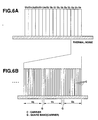
- FIG. 6 is a diagram showing a placement of carriers within a band and allocation thereof to user according to the above embodiment.
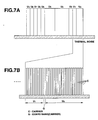
- FIG. 7 is a diagram showing variable transmission rates according to the above embodiment.
- FIG. 8 is a diagram for explaining the operation of the present embodiment using the OFDM processing.
- FIG. 9 is a diagram showing a case in which allocation of frequency is wide.
- FIG. 10 is a diagram showing a case in which allocation of frequency is narrow.
- FIG. 11 is a diagram showing a case in which allocation of frequency is particularly wide.
- FIG. 12 is a diagram showing a case in which the present invention is applied to broadcasting equipment.
- FIG. 13 is a diagram showing a broadcasting receiver.
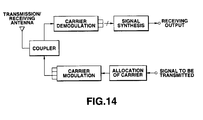
- FIG. 14 is a diagram showing a communication terminal apparatus.
- FIG. 15 is a diagram showing an example of base station equipment corresponding to a mobile station such as a cellular phone or the like.
- FIG. 16 is a diagram showing an example of a computer apparatus accessing an internet or the like through optical fiber or telephone line or the like.
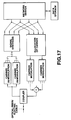
- FIG. 17 is a diagram showing an example of a network server to be connected to internet or the like.
- FIG. 18 is a diagram showing an example of application of the present invention to internet.
- the communication resource allocation method and apparatus of the present invention is applied to a base station 10, as shown in FIG. 2, which has multiple access to a plurality of user signals for transmission with mobile stations, such as cellular phone or automobile telephone.
- This base station 10 includes a multi-carrier modulation section 11 for placing a plurality of carriers continuously within a preliminarily allocated band and for dividing and modulating the carriers, and an adder 12 for synthesizing a plurality of the carriers modulated by this multi-carrier modulation section 11. Then, a synthesized output from the adder 12 is transmitted through an antenna 13.
- the base station 10 conducts communication resource allocation for multiple access by dividing a plurality of the carriers, placed continuously within a preliminarily allocated band having a predetermined width, for respective mobile stations.
- This communication resource allocation method is called band division multiple access method (BDMA) here.
- This BDMA is different from frequency division multiple access (FDMA).
- the FDMA refers to a communication resource allocation method in which a relatively low transmission rate is determined and a plurality of carriers which are not always sequential are placed on frequency axis.
- the BDMA refers to a communication resource allocation method in which, as described above, a relatively wide band is initially allocated to a base station and then divided to respective mobile stations under the base station and is different from the above FDMA.
- the multi-carrier modulation section 11 contains a plurality of (m+1) multi-carrier modulators 11 0 , 11 1 ⁇ 11 m depending on user signals U' 0 , U' 1 ⁇ U' m divided for respective users.
- FIG. 3 shows, for example, the construction of the multi-carrier modulator 11 0 .
- carrier allocators 20 allocates a user signal U' 0 to a plurality of carriers and the allocated signals are modulated by carrier modulation circuits 21 1 , 21 2 , ⁇ 21 n .
- the outputs modulated by the respective carrier modulation circuits 21 1 , 21 2 , ⁇ 21 n are supplied to the adder 12.
- the carrier modulation signals transmitted from an antenna 13 are received by mobile stations 30 which are respective users as shown in FIG. 4. If this mobile station receives, for example, the carrier modulation user signal U 0 , the respective carrier demodulation circuits 32 1 , 32 2 ⁇ 32 n of the carrier demodulation section 32 demodulate respective carrier modulation signals. Then, the respective demodulation signals are synthesized by a signal synthesizer 33.
- the mobile station 30 fetches the carrier modulation user signal U 0 by filtering, by means of a band-pass filter, from a plurality of carrier modulation signals transmitted from the base station by communication resource allocation method of the BDMA, for example, 16 carrier modulation user signals U 0 , U 1 , ⁇ U 15 shown in FIG. 4A, in such a manner as shown in FIG. 5B.
- This is made possible by carrier modulation in which the base station 10 divides a band according to the BDMA. In this case, separation of the respective carrier modulation signals among users can be achieved by the filter completely. That is, the other carrier modulation user signals U 1 , ⁇ U 15 handled by the same base station do not become an interference source. Thus, no other carrier modulation user signals rides on a fetched carrier modulation user signal U 0 , thereby preventing deterioration of S/N ratio.
- the base station can determine the number of users which can be multiplexed depending on a predetermined band width.
- narrow band carriers are placed continuously in respective band of each of user signal carriers allocated to the base station 10 by the multi-carrier modulation section 11. Namely, in each of the bands of respective user signals U 0 , U 1 , ⁇ U 15 shown in FIG. 6A, the multi-carrier modulation section 11 places the carrier C as shown in FIG. 6B.
- the number of the carriers to be allocated to a single user is assumed to be 10, it is permissible that the number is one minimum.
- the multi-carrier modulation section 11 places a single carrier having 0 power as a guard band G on the border of each band to minimize an interference of a band in the neighborhood between users placed nearby.
- a single carrier having 0 power as a guard band G on the border of each band to minimize an interference of a band in the neighborhood between users placed nearby.
- the multi-carrier modulation section 11 is capable of changing transmission rate by making the number of the carriers C allocated to the users variable. That is, the multi-carrier modulation section 11 is capable of making the division width of a single band variable by dividing the band to an arbitrary number of the carriers C depending on user condition so as to achieve modification of the transmission rate. Division of the carriers C in the carrier modulation user signal U0 and the carrier modulation user signal U 1 shown in FIG. 7A can be achieved by mutually different numbers as shown in FIG. 7B. Therefore, the carrier modulation user signal U 0 can be transmitted by twice the transmission rate of the carrier modulation user signal U 1 .
- the multi-carrier modulation section 11 may place the plurality of the above carriers continuously as shown in FIG. 8 by orthogonal frequency division multiplex (OFDM) processing.
- OFDM orthogonal frequency division multiplex
- pulse waveforms each represented by h(t) are placed on time axis, information symbol of xk is posed thereon and the pulse waveforms are slid with respect to each other to be overlapped.
- time axis t is replaced with frequency axis f. That is, f is replaced with t, symbol time T is replaced with carrier distance B and waveform generation filter H(f) is replaced with time window (t).
- the expression (3) can be obtained as shown below.
- This expression (3) presents modulated waves of the unit of an hour under the OFDM.
- this expression (3) indicates that a modulation symbols of xk are placed on frequency axis, they are modulated by the multi-carrier represented by exp(-j2 ⁇ kBt), and that time window w(t) limits the modulation because the modulation symbols xk modulated continuously are not located on time axis.
- the modulation timings of the modulation signals of each carrier need to be synchronous with each other.
- descending channels from the base station to the mobile stations are synchronous with each other for the base station to transmit signals thereto at a time, therefore there being no problem.
- ascending channels from the mobiles stations to the base station need to be synchronous between the respective mobile stations, the carriers allocated to the respective mobile stations are sent all at once and can be synchronous, therefore there being no problem.
- each of the mobile stations conducts time alignment for adjusting transmission time. This enables synchronization of modulation timing among the respective mobiles stations, therefore there being no problem.
- the multi-carrier modulation section 11 may divide the carrier modulation user signals as shown in FIGs. 9, 11.
- FIG. 9 shows a case of allocation of a relatively wide frequency band.
- FIG. 10 shows a case of allocation of a relatively narrow frequency band.
- the frequency band to be allocated is narrow, it can be also operated suitably for that limitation.
- the transmission rate to be allocated to a single user can be made especially wide so that there is no limitation with respect to maximum transmission speed for service.
- the communication resource allocation method and apparatus is capable of separating the carriers between the respective users through a filter, it can suppress an interference from the other users sufficiently, thereby making it possible to prevent deterioration of S/N characteristics.
- the number of users which can be multiplexed is not limited by an interference from the other users, and can be freely determined depending on the band width to be allocated, obtaining to its maximum extent. By changing the number of the carriers to be allocated to users, it is possible to change transmission rate or achieve a variable rate. Further, it is possible to arbitrarily set the guard band by placing a carrier having 0 power. If the OFDM is used in multi-carrier modulation, the guard band is not needed between the carriers of different users, thereby making it possible to raise frequency availability.
- system bands allocated to, for example, 5M Hz, 10M Hz, 20M Hz or the like can be operated individually with flexibility. Further, there is no limitation in maximum bit rate which can serve for users and how the maximum bit rate which can serve for users can be changed is determined depending on the band to be allocated. Whatever the system band is, it is possible to realize communication with a narrower band. That is, even if the system band is allocated to 5M Hz or 10M Hz, communication with a narrower band is possible, so that upper compatibility can be realized.
- the present invention can be applied to machines and equipment in various fields.
- FIG. 12 is a diagram showing a case in which the present invention is applied to broadcasting equipment. The operation thereof is substantially the same as the above embodiments.
- FIG. 13 is a diagram showing a broadcasting receiver. This can be applied to TV broadcasting, radio broadcasting or the like and further to ground wave broadcasting and satellite broadcasting.
- FIG. 14 is a diagram showing a communication terminal apparatus. The present invention can be applied to cellular phones which will be substituted for conventional GSM, PCS, PHS or the like.
- FIG. 15 is a diagram showing an example of base station equipment corresponding to a mobile station such as a cellular phone or the like. Here, waves transmitted from a plurality of the mobile stations are connected to circuit network.
- FIG. 13 is a diagram showing a broadcasting receiver. This can be applied to TV broadcasting, radio broadcasting or the like and further to ground wave broadcasting and satellite broadcasting.
- FIG. 14 is a diagram showing a communication terminal apparatus. The present invention can be applied to cellular phones which will be substituted for conventional G
- FIG. 16 is a diagram showing an example of a computer apparatus for accessing an internet or the like through optical fiber or telephone line or the like.
- the present invention can be applied to communications other than radio transmission.
- FIG. 17 is a diagram showing an example of a network server to be connected to internet or the like.
- FIG. 18 shows a case of application of the present invention to internet shown in FIGs. 16, 17.
- ADSL asymmetric digital subscriber line
- ascending and descending bands can be provided on a conventional telephone band by the BDMA system.
Landscapes
- Engineering & Computer Science (AREA)
- Signal Processing (AREA)
- Computer Networks & Wireless Communication (AREA)
- Mobile Radio Communication Systems (AREA)
- Input Circuits Of Receivers And Coupling Of Receivers And Audio Equipment (AREA)
- Communication Control (AREA)
- Radio Relay Systems (AREA)
- Hydroponics (AREA)
Applications Claiming Priority (3)
| Application Number | Priority Date | Filing Date | Title |
|---|---|---|---|
| JP1295496 | 1996-01-29 | ||
| JP12954/96 | 1996-01-29 | ||
| JP01295496A JP3780551B2 (ja) | 1996-01-29 | 1996-01-29 | 多元接続による信号送信方法及び装置 |
Publications (3)
| Publication Number | Publication Date |
|---|---|
| EP0786890A2 true EP0786890A2 (de) | 1997-07-30 |
| EP0786890A3 EP0786890A3 (de) | 2000-08-09 |
| EP0786890B1 EP0786890B1 (de) | 2007-04-25 |
Family
ID=11819675
Family Applications (1)
| Application Number | Title | Priority Date | Filing Date |
|---|---|---|---|
| EP97300516A Expired - Lifetime EP0786890B1 (de) | 1996-01-29 | 1997-01-28 | Zuweisung von Betriebsmitteln in einem Mehrträger-Mobilfunksystem mit mehreren Benutzern |
Country Status (9)
| Country | Link |
|---|---|
| US (1) | US6400679B1 (de) |
| EP (1) | EP0786890B1 (de) |
| JP (1) | JP3780551B2 (de) |
| CN (1) | CN1082754C (de) |
| AT (1) | ATE360946T1 (de) |
| AU (1) | AU710869B2 (de) |
| DE (1) | DE69737641T2 (de) |
| ID (1) | ID16090A (de) |
| SG (1) | SG64963A1 (de) |
Cited By (20)
| Publication number | Priority date | Publication date | Assignee | Title |
|---|---|---|---|---|
| EP0915586A1 (de) * | 1997-11-07 | 1999-05-12 | Sony International (Europe) GmbH | Mehrträgerübertragung, kompatible zum existierenden GSM-System |
| EP0938208A1 (de) * | 1998-02-22 | 1999-08-25 | Sony International (Europe) GmbH | Mehrträgerübertragung, kompatible zum existierenden GSM-System |
| FR2777407A1 (fr) * | 1998-04-10 | 1999-10-15 | Wavecom Sa | Signal de radiotelephonie cellulaire a canal supplementaire affecte au sens descendant, procede, systeme, mobile et station de base correspondant |
| WO1999065155A1 (en) * | 1998-06-08 | 1999-12-16 | Telefonaktiebolaget Lm Ericsson (Publ) | Frequency-hopping in a bandwidth-on-demand system |
| WO2000052861A1 (fr) * | 1999-03-04 | 2000-09-08 | Sony Corporation | Dispositif et procede d'emission, et support correspondant |
| WO2001026264A1 (fr) * | 1999-09-30 | 2001-04-12 | Fujitsu Limited | Emetteur, recepteur et procede d'emission dans un systeme d'emission a ondes porteuses multiples |
| WO2003021829A1 (en) * | 2001-08-30 | 2003-03-13 | Fujitsu Limited | Multi-carrier cdma transmission system and transmission method |
| EP0910181A3 (de) * | 1997-10-17 | 2003-07-09 | Lucent Technologies Inc. | Dynamische und optimisierte CDMA breitband Modulation |
| WO2004004269A1 (en) * | 2002-06-27 | 2004-01-08 | Nortel Networks Limited | Dual-mode shared ofdm methods/transmitters, receivers and systems |
| WO2004014015A1 (en) * | 2002-07-31 | 2004-02-12 | Koninklijke Philips Electronics N.V. | Adaptive bandwidth device according to quality of service values |
| EP1478148A1 (de) * | 2003-05-15 | 2004-11-17 | Siemens Aktiengesellschaft | Drahtloses Mehrträgerkommunikationsverfahren mit dynamischer Aufteilung der Frequenzbreite und Anzahl der Subbänder |
| WO2006128973A1 (en) * | 2005-06-03 | 2006-12-07 | Nokia Siemens Networks Oy | Receiver, transmitter and variable bandwidth transmission method |
| US7170850B2 (en) | 2000-03-06 | 2007-01-30 | Sony Corporation | Transmission apparatus and method and providing medium thereof |
| WO2007074371A3 (en) * | 2005-12-27 | 2007-10-04 | Nokia Corp | Apparatus, method and computer program product providing frequency domain multiplexed multicast and unicast transmissions |
| WO2009046357A1 (en) * | 2007-10-05 | 2009-04-09 | Qualcomm Incorporated | Inactivity-based multi-carrier allocation in wireless networks |
| EP1919152A3 (de) * | 2002-06-27 | 2009-07-08 | Nortel Networks Limited | Gemeinsame Dual-Mode-OFDM-Verfahren/-Sender, -Empfänger und -Systeme |
| EP2023646A4 (de) * | 2006-04-27 | 2012-12-19 | Kyocera Corp | Mobilkommunikationssystem, basisstationseinrichtung und mobilkommunikationssystem-frequenzzuteilungsverfahren |
| EP2037606A4 (de) * | 2006-05-29 | 2014-02-19 | Kyocera Corp | Drahtlose basisstation und verfahren zur steuerung einer drahtlosen basisstation |
| US9191138B2 (en) | 2000-12-15 | 2015-11-17 | Adaptix, Inc. | OFDMA with adaptive subcarrier-cluster configuration and selective loading |
| US9832304B2 (en) | 2001-06-27 | 2017-11-28 | Skky, Llc | Media delivery platform |
Families Citing this family (24)
| Publication number | Priority date | Publication date | Assignee | Title |
|---|---|---|---|---|
| US6539050B1 (en) * | 1997-06-26 | 2003-03-25 | Hughes Electronics Corporation | Method for transmitting wideband signals via a communication system adapted for narrow-band signal transmission |
| US6510147B1 (en) | 1997-07-15 | 2003-01-21 | Hughes Electronics Corporation | Method and apparatus for orthogonally overlaying variable chip rate spread spectrum signals |
| JP4081821B2 (ja) * | 1998-02-26 | 2008-04-30 | ソニー株式会社 | 基地局装置及び通信方法 |
| JP2000013295A (ja) * | 1998-06-22 | 2000-01-14 | Victor Co Of Japan Ltd | 無線通信システム及び同期マルチキャリアマルチビーム送信装置 |
| EP1128592A3 (de) * | 2000-02-23 | 2003-09-17 | NTT DoCoMo, Inc. | Mehrträger-CDMA und Kanalschätzung |
| JPWO2003055252A1 (ja) * | 2001-12-21 | 2005-04-28 | 三菱電機株式会社 | 無線通信システムおよび送信機 |
| US6914539B2 (en) * | 2002-10-07 | 2005-07-05 | General Electric Company | System and method for a low rate, in-band broadcast communication for medical telemetry |
| US20050041619A1 (en) * | 2003-08-22 | 2005-02-24 | Karabinis Peter D. | Wireless systems, methods and devices employing forward- and/or return-link carriers having different numbers of sub-band carriers |
| US20050207441A1 (en) * | 2004-03-22 | 2005-09-22 | Onggosanusi Eko N | Packet transmission scheduling in a multi-carrier communications system |
| CN102820962B (zh) * | 2004-10-29 | 2015-04-08 | 富士通株式会社 | 基于多载波传输方式的通信装置 |
| WO2006046307A1 (ja) | 2004-10-29 | 2006-05-04 | Fujitsu Limited | マルチキャリア伝送方式による通信装置および通信システム |
| CN102098261B (zh) * | 2004-10-29 | 2016-04-20 | 富士通株式会社 | 基于多载波传输方式的通信装置及通信系统 |
| WO2006046696A1 (ja) | 2004-10-29 | 2006-05-04 | Sharp Kabushiki Kaisha | 通信方法および無線送信機 |
| US7573851B2 (en) | 2004-12-07 | 2009-08-11 | Adaptix, Inc. | Method and system for switching antenna and channel assignments in broadband wireless networks |
| CN101103571B (zh) | 2005-01-18 | 2011-12-14 | 夏普株式会社 | 无线通信装置、便携式终端以及无线通信方法 |
| KR100631210B1 (ko) * | 2005-02-18 | 2006-10-04 | 삼성전자주식회사 | IF direct sampling 방식을 적용한 수신기의 복조회로 |
| KR100959207B1 (ko) | 2005-03-02 | 2010-05-19 | 후지쯔 가부시끼가이샤 | 서브캐리어 전송 방법, 기지국 및 이동국 |
| JP4476968B2 (ja) | 2006-06-19 | 2010-06-09 | 株式会社エヌ・ティ・ティ・ドコモ | 移動通信システムにおける基地局、ユーザ装置、送信方法及び受信方法 |
| US8169955B2 (en) * | 2006-06-19 | 2012-05-01 | Atc Technologies, Llc | Systems and methods for orthogonal frequency division multiple access (OFDMA) communications over satellite links |
| JP4378368B2 (ja) * | 2006-09-13 | 2009-12-02 | 京セラ株式会社 | 移動体通信システム、基地局装置、移動局装置、およびマルチキャリア通信方法 |
| TWI355552B (en) * | 2007-10-17 | 2012-01-01 | Au Optronics Corp | Pixel structure |
| EP2337245B1 (de) * | 2009-12-17 | 2013-04-10 | Alcatel Lucent | Optische OFDM-Übertragung mit variabler Übertragungsrate |
| JP6268900B2 (ja) * | 2013-10-11 | 2018-01-31 | 富士通株式会社 | 伝送装置、伝送システム及び伝送方法 |
| CN108400810B (zh) * | 2018-01-31 | 2020-09-25 | 中国人民解放军陆军工程大学 | 基于时间频率的通信卫星频率资源可视化管理方法 |
Family Cites Families (13)
| Publication number | Priority date | Publication date | Assignee | Title |
|---|---|---|---|---|
| US3488445A (en) * | 1966-11-14 | 1970-01-06 | Bell Telephone Labor Inc | Orthogonal frequency multiplex data transmission system |
| US3824597A (en) * | 1970-11-09 | 1974-07-16 | Data Transmission Co | Data transmission network |
| EP0085614B1 (de) * | 1982-01-28 | 1989-08-09 | Fujitsu Limited | System zum Senden und Empfangen von Daten |
| US4858225A (en) | 1987-11-05 | 1989-08-15 | International Telecommunications Satellite | Variable bandwidth variable center-frequency multibeam satellite-switched router |
| US5103459B1 (en) | 1990-06-25 | 1999-07-06 | Qualcomm Inc | System and method for generating signal waveforms in a cdma cellular telephone system |
| US5151919A (en) | 1990-12-17 | 1992-09-29 | Ericsson-Ge Mobile Communications Holding Inc. | Cdma subtractive demodulation |
| SE9203384L (sv) * | 1992-11-13 | 1993-10-25 | Televerket | Förfarande och anordning för dynamisk allokering av multipla bärvågskanaler för multipelaccess genom frekvensmultiplexering |
| US5479447A (en) | 1993-05-03 | 1995-12-26 | The Board Of Trustees Of The Leland Stanford, Junior University | Method and apparatus for adaptive, variable bandwidth, high-speed data transmission of a multicarrier signal over digital subscriber lines |
| US5446727A (en) | 1993-11-30 | 1995-08-29 | Motorola Inc. | Method and apparatus for time aligning signals for reception in a code-division multiple access communication system |
| JP3421880B2 (ja) | 1994-10-05 | 2003-06-30 | ソニー株式会社 | 復調装置 |
| US5729570A (en) * | 1994-12-08 | 1998-03-17 | Stanford Telecommunications, Inc. | Orthogonal code division multiple access communication system having multicarrier modulation |
| US5978413A (en) * | 1995-08-28 | 1999-11-02 | Bender; Paul E. | Method and system for processing a plurality of multiple access transmissions |
| US5790514A (en) * | 1996-08-22 | 1998-08-04 | Tellabs Operations, Inc. | Multi-point OFDM/DMT digital communications system including remote service unit with improved receiver architecture |
-
1996
- 1996-01-29 JP JP01295496A patent/JP3780551B2/ja not_active Expired - Lifetime
-
1997
- 1997-01-21 US US08/785,792 patent/US6400679B1/en not_active Expired - Lifetime
- 1997-01-23 SG SG1997000158A patent/SG64963A1/en unknown
- 1997-01-27 ID IDP970224A patent/ID16090A/id unknown
- 1997-01-28 EP EP97300516A patent/EP0786890B1/de not_active Expired - Lifetime
- 1997-01-28 AU AU12349/97A patent/AU710869B2/en not_active Expired
- 1997-01-28 DE DE69737641T patent/DE69737641T2/de not_active Expired - Lifetime
- 1997-01-28 AT AT97300516T patent/ATE360946T1/de active
- 1997-01-29 CN CN97102985A patent/CN1082754C/zh not_active Expired - Lifetime
Non-Patent Citations (1)
| Title |
|---|
| None |
Cited By (39)
| Publication number | Priority date | Publication date | Assignee | Title |
|---|---|---|---|---|
| US6810030B1 (en) | 1997-10-17 | 2004-10-26 | Lucent Technology | Dynamic and smart spreading for wideband CDMA |
| EP0910181A3 (de) * | 1997-10-17 | 2003-07-09 | Lucent Technologies Inc. | Dynamische und optimisierte CDMA breitband Modulation |
| US6535501B1 (en) | 1997-11-07 | 2003-03-18 | Sony International (Europe) Gmbh | Transmission method and transmission apparatus for transmitting signals on the basis of a OFDM/TDMA-system in a GSM/system |
| EP0915586A1 (de) * | 1997-11-07 | 1999-05-12 | Sony International (Europe) GmbH | Mehrträgerübertragung, kompatible zum existierenden GSM-System |
| EP0938208A1 (de) * | 1998-02-22 | 1999-08-25 | Sony International (Europe) GmbH | Mehrträgerübertragung, kompatible zum existierenden GSM-System |
| US6545997B1 (en) | 1998-02-22 | 2003-04-08 | Sony International (Europe) Gmbh | Transmission method and transmission apparatus for transmitting signals on the basis of a OFDM/TDMA-system with pilot symbols |
| FR2777407A1 (fr) * | 1998-04-10 | 1999-10-15 | Wavecom Sa | Signal de radiotelephonie cellulaire a canal supplementaire affecte au sens descendant, procede, systeme, mobile et station de base correspondant |
| WO1999053644A1 (fr) * | 1998-04-10 | 1999-10-21 | Wavecom | Signal de radiotelephonie cellulaire a canal supplementaire affecte au sens descendant, procede, systeme, mobile et station de base correspondants |
| US6862451B1 (en) | 1998-04-10 | 2005-03-01 | Wavecom | Cellular radio signal with additional channel assigned to downlink, corresponding method, system and base station |
| MY119664A (en) * | 1998-06-08 | 2005-06-30 | Ericsson Telefon Ab L M | Frequency-hopping in a bandwidth-on-demand system |
| US6246713B1 (en) | 1998-06-08 | 2001-06-12 | Telefonaktiebolaget Lm Ericsson (Publ) | Frequency-hopping in a bandwidth-on-demand system |
| WO1999065155A1 (en) * | 1998-06-08 | 1999-12-16 | Telefonaktiebolaget Lm Ericsson (Publ) | Frequency-hopping in a bandwidth-on-demand system |
| WO2000052861A1 (fr) * | 1999-03-04 | 2000-09-08 | Sony Corporation | Dispositif et procede d'emission, et support correspondant |
| US6980509B1 (en) | 1999-03-04 | 2005-12-27 | Sony Corporation | Transmitting device and method, and providing medium |
| US7006429B2 (en) | 1999-09-30 | 2006-02-28 | Fujitsu Limited | Transmitter, receiver and transmitting method in multi-carrier transmission system |
| WO2001026264A1 (fr) * | 1999-09-30 | 2001-04-12 | Fujitsu Limited | Emetteur, recepteur et procede d'emission dans un systeme d'emission a ondes porteuses multiples |
| US7170850B2 (en) | 2000-03-06 | 2007-01-30 | Sony Corporation | Transmission apparatus and method and providing medium thereof |
| US9344211B2 (en) | 2000-12-15 | 2016-05-17 | Adaptix, Inc. | OFDMA with adaptive subcarrier-cluster configuration and selective loading |
| US9210708B1 (en) | 2000-12-15 | 2015-12-08 | Adaptix, Inc. | OFDMA with adaptive subcarrier-cluster configuration and selective loading |
| US9219572B2 (en) | 2000-12-15 | 2015-12-22 | Adaptix, Inc. | OFDMA with adaptive subcarrier-cluster configuration and selective loading |
| US9191138B2 (en) | 2000-12-15 | 2015-11-17 | Adaptix, Inc. | OFDMA with adaptive subcarrier-cluster configuration and selective loading |
| US9203553B1 (en) | 2000-12-15 | 2015-12-01 | Adaptix, Inc. | OFDMA with adaptive subcarrier-cluster configuration and selective loading |
| US9832304B2 (en) | 2001-06-27 | 2017-11-28 | Skky, Llc | Media delivery platform |
| US7386031B2 (en) | 2001-08-30 | 2008-06-10 | Fujitsu Limited | Mulitcarrier CDMA transmission system and transmission method |
| WO2003021829A1 (en) * | 2001-08-30 | 2003-03-13 | Fujitsu Limited | Multi-carrier cdma transmission system and transmission method |
| WO2004004269A1 (en) * | 2002-06-27 | 2004-01-08 | Nortel Networks Limited | Dual-mode shared ofdm methods/transmitters, receivers and systems |
| US7551546B2 (en) | 2002-06-27 | 2009-06-23 | Nortel Networks Limited | Dual-mode shared OFDM methods/transmitters, receivers and systems |
| EP1919152A3 (de) * | 2002-06-27 | 2009-07-08 | Nortel Networks Limited | Gemeinsame Dual-Mode-OFDM-Verfahren/-Sender, -Empfänger und -Systeme |
| WO2004014015A1 (en) * | 2002-07-31 | 2004-02-12 | Koninklijke Philips Electronics N.V. | Adaptive bandwidth device according to quality of service values |
| KR101048194B1 (ko) | 2003-05-15 | 2011-07-08 | 지멘스 악티엔게젤샤프트 | 주파수 폭 및 복수의 부대역을 동적으로 분할하는 무선 멀티-캐리어 통신 방법 |
| EP1478148A1 (de) * | 2003-05-15 | 2004-11-17 | Siemens Aktiengesellschaft | Drahtloses Mehrträgerkommunikationsverfahren mit dynamischer Aufteilung der Frequenzbreite und Anzahl der Subbänder |
| WO2004102913A1 (de) * | 2003-05-15 | 2004-11-25 | Siemens Aktiengesellschaft | Drahtloses mehrträgerkommunikationsverfahren mit dynamischer aufteilung der frequenzbreite und anzahl der subbänder |
| WO2006128973A1 (en) * | 2005-06-03 | 2006-12-07 | Nokia Siemens Networks Oy | Receiver, transmitter and variable bandwidth transmission method |
| WO2007074371A3 (en) * | 2005-12-27 | 2007-10-04 | Nokia Corp | Apparatus, method and computer program product providing frequency domain multiplexed multicast and unicast transmissions |
| US8553613B2 (en) | 2006-04-27 | 2013-10-08 | Kyocera Corporation | Mobile communication system, base station device and frequency allocation method for mobile communication system |
| EP2023646A4 (de) * | 2006-04-27 | 2012-12-19 | Kyocera Corp | Mobilkommunikationssystem, basisstationseinrichtung und mobilkommunikationssystem-frequenzzuteilungsverfahren |
| EP2037606A4 (de) * | 2006-05-29 | 2014-02-19 | Kyocera Corp | Drahtlose basisstation und verfahren zur steuerung einer drahtlosen basisstation |
| US8681711B2 (en) | 2007-10-05 | 2014-03-25 | Qualcomm Incorporated | Inactivity-based multi-carrier allocation in wireless networks |
| WO2009046357A1 (en) * | 2007-10-05 | 2009-04-09 | Qualcomm Incorporated | Inactivity-based multi-carrier allocation in wireless networks |
Also Published As
| Publication number | Publication date |
|---|---|
| JPH09205411A (ja) | 1997-08-05 |
| SG64963A1 (en) | 1999-05-25 |
| AU710869B2 (en) | 1999-09-30 |
| AU1234997A (en) | 1997-08-07 |
| CN1082754C (zh) | 2002-04-10 |
| DE69737641D1 (de) | 2007-06-06 |
| CN1169070A (zh) | 1997-12-31 |
| ATE360946T1 (de) | 2007-05-15 |
| US6400679B1 (en) | 2002-06-04 |
| EP0786890B1 (de) | 2007-04-25 |
| ID16090A (id) | 1997-09-04 |
| EP0786890A3 (de) | 2000-08-09 |
| DE69737641T2 (de) | 2007-12-27 |
| JP3780551B2 (ja) | 2006-05-31 |
Similar Documents
| Publication | Publication Date | Title |
|---|---|---|
| EP0786890B1 (de) | Zuweisung von Betriebsmitteln in einem Mehrträger-Mobilfunksystem mit mehreren Benutzern | |
| EP0676105B1 (de) | Verfahren und anordnung zur dynamischen zuteilung mehrerer trägerwellenkanäle für mehrfachzugriff durch frequenzmultiplex | |
| CN1113489C (zh) | 用于操作包括工作在公共频率范围的码分多址和频分多址/时分多址通信系统的电信网络的方法和设备 | |
| EP1179902B1 (de) | Sender, empfänger und verfahren zur nachrichtenübertragung | |
| US8149780B2 (en) | Multiplexing scheme in a communication system | |
| EP2187544B1 (de) | Basisstation, mobilstation, verteiltes drahtloses antennenkommunikationssystem, verfahren zur pilotkanalerzeugung, verfahren zur synchronisationskanalerzeugung und antennenauswahlsystem | |
| KR100428331B1 (ko) | 통신 단말 장치, 기지국 장치 및 무선 통신 방법 | |
| US9083436B2 (en) | Full duplex communication system using disjoint spectral blocks | |
| US6385190B1 (en) | Mobile communications system which uses TDMA for speech data and OFDM for control/extended data | |
| EP2259532B1 (de) | Auswahl der Pilotfrequenzen | |
| JPS6335025A (ja) | デジタル無線伝送系 | |
| KR20100102712A (ko) | 심볼 통신 방법 | |
| KR20050040058A (ko) | 직교 주파수 분할 다중 방식을 사용하는 통신 시스템에서기지국 구분을 위한 파일럿 패턴 세트 송수신 장치 및 방법 | |
| CN1252647A (zh) | 码分多址发射机及产生组合的高速率和低速率信号的方法 | |
| KR100543259B1 (ko) | 송신방법, 수신방법, 송신장치 및 수신장치 | |
| US6996080B1 (en) | Chip-synchronous CDMA multiplexer and method resulting in constant envelope signals | |
| CN1310893A (zh) | Ocdma卫星通信系统功率通量密度抑制 | |
| US5533030A (en) | Radiotelephone system with the character of a local or auxiliary communications apparatus | |
| KR100648475B1 (ko) | 통신자원할당방법및장치 | |
| US20060187872A1 (en) | Multiaccess techniques for mobile and stationary cellular communications | |
| KR19990061918A (ko) | 부호 분할 방식의 채널 할당방법 및 장치 | |
| EP2056501A1 (de) | Basisstation | |
| MXPA00002096A (en) | A method for assigning spreading codes |
Legal Events
| Date | Code | Title | Description |
|---|---|---|---|
| PUAI | Public reference made under article 153(3) epc to a published international application that has entered the european phase |
Free format text: ORIGINAL CODE: 0009012 |
|
| AK | Designated contracting states |
Kind code of ref document: A2 Designated state(s): AT DE FR GB NL |
|
| PUAL | Search report despatched |
Free format text: ORIGINAL CODE: 0009013 |
|
| AK | Designated contracting states |
Kind code of ref document: A3 Designated state(s): AT DE FR GB NL |
|
| 17P | Request for examination filed |
Effective date: 20010111 |
|
| GRAP | Despatch of communication of intention to grant a patent |
Free format text: ORIGINAL CODE: EPIDOSNIGR1 |
|
| GRAS | Grant fee paid |
Free format text: ORIGINAL CODE: EPIDOSNIGR3 |
|
| GRAA | (expected) grant |
Free format text: ORIGINAL CODE: 0009210 |
|
| AK | Designated contracting states |
Kind code of ref document: B1 Designated state(s): AT DE FR GB NL |
|
| REG | Reference to a national code |
Ref country code: GB Ref legal event code: FG4D |
|
| REF | Corresponds to: |
Ref document number: 69737641 Country of ref document: DE Date of ref document: 20070606 Kind code of ref document: P |
|
| ET | Fr: translation filed | ||
| PLBE | No opposition filed within time limit |
Free format text: ORIGINAL CODE: 0009261 |
|
| STAA | Information on the status of an ep patent application or granted ep patent |
Free format text: STATUS: NO OPPOSITION FILED WITHIN TIME LIMIT |
|
| 26N | No opposition filed |
Effective date: 20080128 |
|
| REG | Reference to a national code |
Ref country code: GB Ref legal event code: 746 Effective date: 20120703 |
|
| REG | Reference to a national code |
Ref country code: DE Ref legal event code: R084 Ref document number: 69737641 Country of ref document: DE Effective date: 20120614 |
|
| REG | Reference to a national code |
Ref country code: FR Ref legal event code: PLFP Year of fee payment: 20 |
|
| PGFP | Annual fee paid to national office [announced via postgrant information from national office to epo] |
Ref country code: NL Payment date: 20160120 Year of fee payment: 20 |
|
| PGFP | Annual fee paid to national office [announced via postgrant information from national office to epo] |
Ref country code: DE Payment date: 20160120 Year of fee payment: 20 |
|
| PGFP | Annual fee paid to national office [announced via postgrant information from national office to epo] |
Ref country code: GB Payment date: 20160120 Year of fee payment: 20 Ref country code: FR Payment date: 20160121 Year of fee payment: 20 Ref country code: AT Payment date: 20160121 Year of fee payment: 20 |
|
| REG | Reference to a national code |
Ref country code: DE Ref legal event code: R071 Ref document number: 69737641 Country of ref document: DE |
|
| REG | Reference to a national code |
Ref country code: NL Ref legal event code: MK Effective date: 20170127 |
|
| REG | Reference to a national code |
Ref country code: GB Ref legal event code: PE20 Expiry date: 20170127 |
|
| REG | Reference to a national code |
Ref country code: AT Ref legal event code: MK07 Ref document number: 360946 Country of ref document: AT Kind code of ref document: T Effective date: 20170128 |
|
| PG25 | Lapsed in a contracting state [announced via postgrant information from national office to epo] |
Ref country code: GB Free format text: LAPSE BECAUSE OF EXPIRATION OF PROTECTION Effective date: 20170127 |