EP0787122B1 - Kalzium-rezeptor aktive verbindungen - Google Patents
Kalzium-rezeptor aktive verbindungen Download PDFInfo
- Publication number
- EP0787122B1 EP0787122B1 EP95940547A EP95940547A EP0787122B1 EP 0787122 B1 EP0787122 B1 EP 0787122B1 EP 95940547 A EP95940547 A EP 95940547A EP 95940547 A EP95940547 A EP 95940547A EP 0787122 B1 EP0787122 B1 EP 0787122B1
- Authority
- EP
- European Patent Office
- Prior art keywords
- compound
- medicament
- cell
- calcium
- ethylamine
- Prior art date
- Legal status (The legal status is an assumption and is not a legal conclusion. Google has not performed a legal analysis and makes no representation as to the accuracy of the status listed.)
- Expired - Lifetime
Links
- 150000001875 compounds Chemical class 0.000 title claims description 165
- 239000011575 calcium Substances 0.000 title description 58
- 229910052791 calcium Inorganic materials 0.000 title description 57
- OYPRJOBELJOOCE-UHFFFAOYSA-N Calcium Chemical compound [Ca] OYPRJOBELJOOCE-UHFFFAOYSA-N 0.000 title description 55
- -1 methylenedioxy Chemical group 0.000 claims abstract description 35
- 150000003839 salts Chemical class 0.000 claims abstract description 29
- 125000001997 phenyl group Chemical group [H]C1=C([H])C([H])=C(*)C([H])=C1[H] 0.000 claims abstract description 22
- 125000003917 carbamoyl group Chemical group [H]N([H])C(*)=O 0.000 claims abstract description 11
- CBOIHMRHGLHBPB-UHFFFAOYSA-N hydroxymethyl Chemical compound O[CH2] CBOIHMRHGLHBPB-UHFFFAOYSA-N 0.000 claims abstract description 11
- 125000004001 thioalkyl group Chemical group 0.000 claims abstract description 11
- 125000002777 acetyl group Chemical group [H]C([H])([H])C(*)=O 0.000 claims abstract description 9
- UUFQTNFCRMXOAE-UHFFFAOYSA-N 1-methylmethylene Chemical compound C[CH] UUFQTNFCRMXOAE-UHFFFAOYSA-N 0.000 claims abstract description 8
- JCXJVPUVTGWSNB-UHFFFAOYSA-N Nitrogen dioxide Chemical compound O=[N]=O JCXJVPUVTGWSNB-UHFFFAOYSA-N 0.000 claims abstract description 7
- 125000002147 dimethylamino group Chemical group [H]C([H])([H])N(*)C([H])([H])[H] 0.000 claims abstract description 7
- 125000002485 formyl group Chemical group [H]C(*)=O 0.000 claims abstract description 7
- 125000003668 acetyloxy group Chemical group [H]C([H])([H])C(=O)O[*] 0.000 claims abstract description 6
- 208000037265 diseases, disorders, signs and symptoms Diseases 0.000 claims description 59
- 102000003982 Parathyroid hormone Human genes 0.000 claims description 46
- 108090000445 Parathyroid hormone Proteins 0.000 claims description 46
- 239000000199 parathyroid hormone Substances 0.000 claims description 46
- 229960001319 parathyroid hormone Drugs 0.000 claims description 46
- 201000010099 disease Diseases 0.000 claims description 32
- 230000002159 abnormal effect Effects 0.000 claims description 26
- 208000035475 disorder Diseases 0.000 claims description 26
- 239000003814 drug Substances 0.000 claims description 24
- 238000002360 preparation method Methods 0.000 claims description 24
- 210000000988 bone and bone Anatomy 0.000 claims description 19
- 201000002980 Hyperparathyroidism Diseases 0.000 claims description 16
- 125000004178 (C1-C4) alkyl group Chemical group 0.000 claims description 10
- 125000004767 (C1-C4) haloalkoxy group Chemical group 0.000 claims description 10
- 125000004765 (C1-C4) haloalkyl group Chemical group 0.000 claims description 10
- 229910052736 halogen Inorganic materials 0.000 claims description 10
- 125000000229 (C1-C4)alkoxy group Chemical group 0.000 claims description 9
- 208000006386 Bone Resorption Diseases 0.000 claims description 9
- 230000024279 bone resorption Effects 0.000 claims description 9
- 150000002367 halogens Chemical class 0.000 claims description 9
- 229910052739 hydrogen Inorganic materials 0.000 claims description 9
- 239000001257 hydrogen Substances 0.000 claims description 9
- 230000009286 beneficial effect Effects 0.000 claims description 8
- 239000008194 pharmaceutical composition Substances 0.000 claims description 8
- 125000001424 substituent group Chemical group 0.000 claims description 8
- 125000002496 methyl group Chemical group [H]C([H])([H])* 0.000 claims description 7
- UFHFLCQGNIYNRP-UHFFFAOYSA-N Hydrogen Chemical compound [H][H] UFHFLCQGNIYNRP-UHFFFAOYSA-N 0.000 claims description 6
- 230000003247 decreasing effect Effects 0.000 claims description 4
- 230000002401 inhibitory effect Effects 0.000 claims description 4
- 150000002431 hydrogen Chemical class 0.000 claims description 3
- 230000000121 hypercalcemic effect Effects 0.000 claims description 3
- WAYJXSZMNNFMJB-OAHLLOKOSA-N n-[(1r)-1-(3-methoxyphenyl)ethyl]-3-phenylprop-2-en-1-amine Chemical compound COC1=CC=CC([C@@H](C)NCC=CC=2C=CC=CC=2)=C1 WAYJXSZMNNFMJB-OAHLLOKOSA-N 0.000 claims description 3
- GYLWJWFJXCSSEQ-QGZVFWFLSA-N 3-(2,4-dimethylphenyl)-n-[(1r)-1-(3-methoxyphenyl)ethyl]prop-2-en-1-amine Chemical compound COC1=CC=CC([C@@H](C)NCC=CC=2C(=CC(C)=CC=2)C)=C1 GYLWJWFJXCSSEQ-QGZVFWFLSA-N 0.000 claims description 2
- 208000013725 Chronic Kidney Disease-Mineral and Bone disease Diseases 0.000 claims description 2
- 206010020772 Hypertension Diseases 0.000 claims description 2
- 230000004079 mineral homeostasis Effects 0.000 claims description 2
- GHOWWAXHVHBIMW-GOSISDBHSA-N n-[(1r)-1-(3-methoxyphenyl)ethyl]-3-(2,4,6-trimethylphenyl)prop-2-en-1-amine Chemical compound COC1=CC=CC([C@@H](C)NCC=CC=2C(=CC(C)=CC=2C)C)=C1 GHOWWAXHVHBIMW-GOSISDBHSA-N 0.000 claims description 2
- RSAAPVHJGLZQRQ-MRXNPFEDSA-N n-[(1r)-1-(3-methoxyphenyl)ethyl]-3-(3-methylphenyl)prop-2-en-1-amine Chemical compound COC1=CC=CC([C@@H](C)NCC=CC=2C=C(C)C=CC=2)=C1 RSAAPVHJGLZQRQ-MRXNPFEDSA-N 0.000 claims description 2
- QPFXIXVKSWSOOA-MRXNPFEDSA-N n-[(1r)-1-(3-methoxyphenyl)ethyl]-3-(4-methylphenyl)prop-2-en-1-amine Chemical compound COC1=CC=CC([C@@H](C)NCC=CC=2C=CC(C)=CC=2)=C1 QPFXIXVKSWSOOA-MRXNPFEDSA-N 0.000 claims description 2
- DAYBCARINBQRQO-QGZVFWFLSA-N n-[(1r)-1-(3-methoxyphenyl)ethyl]-3-(4-propan-2-ylphenyl)prop-2-en-1-amine Chemical compound COC1=CC=CC([C@@H](C)NCC=CC=2C=CC(=CC=2)C(C)C)=C1 DAYBCARINBQRQO-QGZVFWFLSA-N 0.000 claims description 2
- 201000006409 renal osteodystrophy Diseases 0.000 claims description 2
- 125000004432 carbon atom Chemical group C* 0.000 claims 10
- QUSNBJAOOMFDIB-UHFFFAOYSA-N Ethylamine Chemical compound CCN QUSNBJAOOMFDIB-UHFFFAOYSA-N 0.000 claims 4
- CTUOCNACZZWKAM-IAGOWNOFSA-N COc1cccc(c1)[C@@H](C)NC[C@H](C)C=Cc1ccccc1 Chemical compound COc1cccc(c1)[C@@H](C)NC[C@H](C)C=Cc1ccccc1 CTUOCNACZZWKAM-IAGOWNOFSA-N 0.000 claims 1
- 208000010191 Osteitis Deformans Diseases 0.000 claims 1
- 208000027868 Paget disease Diseases 0.000 claims 1
- 208000027202 mammary Paget disease Diseases 0.000 claims 1
- 229910001410 inorganic ion Inorganic materials 0.000 abstract description 58
- 125000001624 naphthyl group Chemical group 0.000 abstract 5
- 125000000217 alkyl group Chemical group 0.000 abstract 2
- 125000001797 benzyl group Chemical group [H]C1=C([H])C([H])=C(C([H])=C1[H])C([H])([H])* 0.000 abstract 2
- 125000000051 benzyloxy group Chemical group [H]C1=C([H])C([H])=C(C([H])=C1[H])C([H])([H])O* 0.000 abstract 2
- 125000003545 alkoxy group Chemical group 0.000 abstract 1
- 125000004438 haloalkoxy group Chemical group 0.000 abstract 1
- 125000001188 haloalkyl group Chemical group 0.000 abstract 1
- 125000001475 halogen functional group Chemical group 0.000 abstract 1
- 210000004027 cell Anatomy 0.000 description 212
- 102000013830 Calcium-Sensing Receptors Human genes 0.000 description 117
- 108010050543 Calcium-Sensing Receptors Proteins 0.000 description 117
- 230000000694 effects Effects 0.000 description 111
- 229910001424 calcium ion Inorganic materials 0.000 description 82
- BHPQYMZQTOCNFJ-UHFFFAOYSA-N Calcium cation Chemical compound [Ca+2] BHPQYMZQTOCNFJ-UHFFFAOYSA-N 0.000 description 81
- 102000005962 receptors Human genes 0.000 description 60
- 108020003175 receptors Proteins 0.000 description 60
- 230000000849 parathyroid Effects 0.000 description 59
- 230000028327 secretion Effects 0.000 description 38
- 230000002092 calcimimetic effect Effects 0.000 description 27
- 239000002299 complementary DNA Substances 0.000 description 20
- 230000004044 response Effects 0.000 description 19
- 210000003771 C cell Anatomy 0.000 description 15
- 108020004999 messenger RNA Proteins 0.000 description 15
- 210000002997 osteoclast Anatomy 0.000 description 15
- 238000000338 in vitro Methods 0.000 description 14
- 210000003292 kidney cell Anatomy 0.000 description 14
- 230000015572 biosynthetic process Effects 0.000 description 13
- 230000003834 intracellular effect Effects 0.000 description 13
- 238000000034 method Methods 0.000 description 13
- 150000007523 nucleic acids Chemical class 0.000 description 13
- 102000055006 Calcitonin Human genes 0.000 description 12
- 108060001064 Calcitonin Proteins 0.000 description 12
- BBBFJLBPOGFECG-VJVYQDLKSA-N calcitonin Chemical compound N([C@H](C(=O)N[C@@H](CC(C)C)C(=O)NCC(=O)N[C@@H](CCCCN)C(=O)N[C@@H](CC(C)C)C(=O)N[C@@H](CO)C(=O)N[C@@H](CCC(N)=O)C(=O)N[C@@H](CCC(O)=O)C(=O)N[C@@H](CC(C)C)C(=O)N[C@@H](CC=1NC=NC=1)C(=O)N[C@@H](CCCCN)C(=O)N[C@@H](CC(C)C)C(=O)N[C@@H](CCC(N)=O)C(=O)N[C@@H]([C@@H](C)O)C(=O)N[C@@H](CC=1C=CC(O)=CC=1)C(=O)N1[C@@H](CCC1)C(=O)N[C@@H](CCCNC(N)=N)C(=O)N[C@@H]([C@@H](C)O)C(=O)N[C@@H](CC(N)=O)C(=O)N[C@@H]([C@@H](C)O)C(=O)NCC(=O)N[C@@H](CO)C(=O)NCC(=O)N[C@@H]([C@@H](C)O)C(=O)N1[C@@H](CCC1)C(N)=O)C(C)C)C(=O)[C@@H]1CSSC[C@H](N)C(=O)N[C@@H](CO)C(=O)N[C@@H](CC(N)=O)C(=O)N[C@@H](CC(C)C)C(=O)N[C@@H](CO)C(=O)N[C@@H]([C@@H](C)O)C(=O)N1 BBBFJLBPOGFECG-VJVYQDLKSA-N 0.000 description 12
- 229960004015 calcitonin Drugs 0.000 description 12
- 210000000287 oocyte Anatomy 0.000 description 12
- 210000001789 adipocyte Anatomy 0.000 description 11
- SIPUZPBQZHNSDW-UHFFFAOYSA-N bis(2-methylpropyl)aluminum Chemical compound CC(C)C[Al]CC(C)C SIPUZPBQZHNSDW-UHFFFAOYSA-N 0.000 description 11
- YFHXZQPUBCBNIP-UHFFFAOYSA-N fura-2 Chemical compound CC1=CC=C(N(CC(O)=O)CC(O)=O)C(OCCOC=2C(=CC=3OC(=CC=3C=2)C=2OC(=CN=2)C(O)=O)N(CC(O)=O)CC(O)=O)=C1 YFHXZQPUBCBNIP-UHFFFAOYSA-N 0.000 description 11
- 239000000203 mixture Substances 0.000 description 11
- 229910000033 sodium borohydride Inorganic materials 0.000 description 11
- 239000012279 sodium borohydride Substances 0.000 description 11
- 230000001126 calcilytic effect Effects 0.000 description 10
- 238000004519 manufacturing process Methods 0.000 description 10
- 108020004707 nucleic acids Proteins 0.000 description 10
- 102000039446 nucleic acids Human genes 0.000 description 10
- 230000001052 transient effect Effects 0.000 description 10
- 241000269370 Xenopus <genus> Species 0.000 description 9
- 230000004094 calcium homeostasis Effects 0.000 description 9
- 230000007423 decrease Effects 0.000 description 9
- 150000002466 imines Chemical class 0.000 description 9
- 238000001727 in vivo Methods 0.000 description 9
- 230000003278 mimic effect Effects 0.000 description 9
- 108090000623 proteins and genes Proteins 0.000 description 9
- 238000010561 standard procedure Methods 0.000 description 9
- CJWGCBRQAHCVHW-SSDOTTSWSA-N (1r)-1-(3-methoxyphenyl)ethanamine Chemical compound COC1=CC=CC([C@@H](C)N)=C1 CJWGCBRQAHCVHW-SSDOTTSWSA-N 0.000 description 8
- 230000001174 ascending effect Effects 0.000 description 8
- 210000003169 central nervous system Anatomy 0.000 description 8
- 238000004587 chromatography analysis Methods 0.000 description 8
- 239000012230 colorless oil Substances 0.000 description 8
- 230000000968 intestinal effect Effects 0.000 description 8
- 210000002381 plasma Anatomy 0.000 description 8
- 239000000243 solution Substances 0.000 description 8
- 210000001685 thyroid gland Anatomy 0.000 description 8
- 238000010626 work up procedure Methods 0.000 description 8
- IVOMOUWHDPKRLL-KQYNXXCUSA-N Cyclic adenosine monophosphate Chemical compound C([C@H]1O2)OP(O)(=O)O[C@H]1[C@@H](O)[C@@H]2N1C(N=CN=C2N)=C2N=C1 IVOMOUWHDPKRLL-KQYNXXCUSA-N 0.000 description 7
- VEXZGXHMUGYJMC-UHFFFAOYSA-N Hydrochloric acid Chemical compound Cl VEXZGXHMUGYJMC-UHFFFAOYSA-N 0.000 description 7
- 102000003923 Protein Kinase C Human genes 0.000 description 7
- 108090000315 Protein Kinase C Proteins 0.000 description 7
- IVOMOUWHDPKRLL-UHFFFAOYSA-N UNPD107823 Natural products O1C2COP(O)(=O)OC2C(O)C1N1C(N=CN=C2N)=C2N=C1 IVOMOUWHDPKRLL-UHFFFAOYSA-N 0.000 description 7
- 238000003556 assay Methods 0.000 description 7
- 229940095074 cyclic amp Drugs 0.000 description 7
- 210000001035 gastrointestinal tract Anatomy 0.000 description 7
- 238000009396 hybridization Methods 0.000 description 7
- 230000001965 increasing effect Effects 0.000 description 7
- 229910052500 inorganic mineral Inorganic materials 0.000 description 7
- 235000010755 mineral Nutrition 0.000 description 7
- 239000011707 mineral Substances 0.000 description 7
- 210000001428 peripheral nervous system Anatomy 0.000 description 7
- 102000004169 proteins and genes Human genes 0.000 description 7
- 241000283690 Bos taurus Species 0.000 description 6
- YMWUJEATGCHHMB-UHFFFAOYSA-N Dichloromethane Chemical compound ClCCl YMWUJEATGCHHMB-UHFFFAOYSA-N 0.000 description 6
- 208000001132 Osteoporosis Diseases 0.000 description 6
- HEMHJVSKTPXQMS-UHFFFAOYSA-M Sodium hydroxide Chemical compound [OH-].[Na+] HEMHJVSKTPXQMS-UHFFFAOYSA-M 0.000 description 6
- 239000002253 acid Substances 0.000 description 6
- 239000002552 dosage form Substances 0.000 description 6
- 230000002267 hypothalamic effect Effects 0.000 description 6
- 230000005764 inhibitory process Effects 0.000 description 6
- WOPAHKKTEVUGOE-OAHLLOKOSA-N n-[(1r)-1-(3-methoxyphenyl)ethyl]-3-phenylpropan-1-amine Chemical compound COC1=CC=CC([C@@H](C)NCCCC=2C=CC=CC=2)=C1 WOPAHKKTEVUGOE-OAHLLOKOSA-N 0.000 description 6
- 230000000144 pharmacologic effect Effects 0.000 description 6
- PHEDXBVPIONUQT-RGYGYFBISA-N phorbol 13-acetate 12-myristate Chemical compound C([C@]1(O)C(=O)C(C)=C[C@H]1[C@@]1(O)[C@H](C)[C@H]2OC(=O)CCCCCCCCCCCCC)C(CO)=C[C@H]1[C@H]1[C@]2(OC(C)=O)C1(C)C PHEDXBVPIONUQT-RGYGYFBISA-N 0.000 description 6
- 230000001817 pituitary effect Effects 0.000 description 6
- 230000001105 regulatory effect Effects 0.000 description 6
- 239000000523 sample Substances 0.000 description 6
- 210000002966 serum Anatomy 0.000 description 6
- PUZPDOWCWNUUKD-UHFFFAOYSA-M sodium fluoride Chemical compound [F-].[Na+] PUZPDOWCWNUUKD-UHFFFAOYSA-M 0.000 description 6
- 210000001712 subfornical organ Anatomy 0.000 description 6
- 238000003786 synthesis reaction Methods 0.000 description 6
- 210000001519 tissue Anatomy 0.000 description 6
- 238000011282 treatment Methods 0.000 description 6
- 210000004509 vascular smooth muscle cell Anatomy 0.000 description 6
- YJXUXANREVNZLH-PFEQFJNWSA-N 3-(2-chlorophenyl)-n-[(1r)-1-(3-methoxyphenyl)ethyl]propan-1-amine;hydrochloride Chemical compound Cl.COC1=CC=CC([C@@H](C)NCCCC=2C(=CC=CC=2)Cl)=C1 YJXUXANREVNZLH-PFEQFJNWSA-N 0.000 description 5
- 108091003079 Bovine Serum Albumin Proteins 0.000 description 5
- UXVMQQNJUSDDNG-UHFFFAOYSA-L Calcium chloride Chemical compound [Cl-].[Cl-].[Ca+2] UXVMQQNJUSDDNG-UHFFFAOYSA-L 0.000 description 5
- 108010081690 Pertussis Toxin Proteins 0.000 description 5
- MMWCIQZXVOZEGG-HOZKJCLWSA-N [(1S,2R,3S,4S,5R,6S)-2,3,5-trihydroxy-4,6-diphosphonooxycyclohexyl] dihydrogen phosphate Chemical compound O[C@H]1[C@@H](O)[C@H](OP(O)(O)=O)[C@@H](OP(O)(O)=O)[C@H](O)[C@H]1OP(O)(O)=O MMWCIQZXVOZEGG-HOZKJCLWSA-N 0.000 description 5
- 239000012190 activator Substances 0.000 description 5
- 210000004369 blood Anatomy 0.000 description 5
- 239000008280 blood Substances 0.000 description 5
- 210000001772 blood platelet Anatomy 0.000 description 5
- 229940098773 bovine serum albumin Drugs 0.000 description 5
- 239000000872 buffer Substances 0.000 description 5
- 239000001110 calcium chloride Substances 0.000 description 5
- 229910001628 calcium chloride Inorganic materials 0.000 description 5
- 230000000747 cardiac effect Effects 0.000 description 5
- 150000001982 diacylglycerols Chemical class 0.000 description 5
- 150000002500 ions Chemical class 0.000 description 5
- 210000002510 keratinocyte Anatomy 0.000 description 5
- 210000003734 kidney Anatomy 0.000 description 5
- 210000004216 mammary stem cell Anatomy 0.000 description 5
- 230000002829 reductive effect Effects 0.000 description 5
- JWZZKOKVBUJMES-UHFFFAOYSA-N (+-)-Isoprenaline Chemical compound CC(C)NCC(O)C1=CC=C(O)C(O)=C1 JWZZKOKVBUJMES-UHFFFAOYSA-N 0.000 description 4
- TWRXJAOTZQYOKJ-UHFFFAOYSA-L Magnesium chloride Chemical compound [Mg+2].[Cl-].[Cl-] TWRXJAOTZQYOKJ-UHFFFAOYSA-L 0.000 description 4
- 241001465754 Metazoa Species 0.000 description 4
- 230000009471 action Effects 0.000 description 4
- 150000001413 amino acids Chemical group 0.000 description 4
- 230000001746 atrial effect Effects 0.000 description 4
- 239000002585 base Substances 0.000 description 4
- 210000000227 basophil cell of anterior lobe of hypophysis Anatomy 0.000 description 4
- 230000001413 cellular effect Effects 0.000 description 4
- 230000003292 diminished effect Effects 0.000 description 4
- 210000002615 epidermis Anatomy 0.000 description 4
- 238000009472 formulation Methods 0.000 description 4
- 210000002406 gastrin-secreting cell Anatomy 0.000 description 4
- 229940088597 hormone Drugs 0.000 description 4
- 239000005556 hormone Substances 0.000 description 4
- 210000002865 immune cell Anatomy 0.000 description 4
- 229940039009 isoproterenol Drugs 0.000 description 4
- 208000014643 parathyroid gland adenoma Diseases 0.000 description 4
- 230000036470 plasma concentration Effects 0.000 description 4
- 210000000512 proximal kidney tubule Anatomy 0.000 description 4
- 239000000018 receptor agonist Substances 0.000 description 4
- 229940044601 receptor agonist Drugs 0.000 description 4
- 210000004927 skin cell Anatomy 0.000 description 4
- 230000001225 therapeutic effect Effects 0.000 description 4
- 210000005239 tubule Anatomy 0.000 description 4
- LUZOFMGZMUZSSK-LRDDRELGSA-N (-)-indolactam V Chemical compound C1[C@@H](CO)NC(=O)[C@H](C(C)C)N(C)C2=CC=CC3=C2C1=CN3 LUZOFMGZMUZSSK-LRDDRELGSA-N 0.000 description 3
- QTBSBXVTEAMEQO-UHFFFAOYSA-N Acetic acid Chemical compound CC(O)=O QTBSBXVTEAMEQO-UHFFFAOYSA-N 0.000 description 3
- WSNMPAVSZJSIMT-UHFFFAOYSA-N COc1c(C)c2COC(=O)c2c(O)c1CC(O)C1(C)CCC(=O)O1 Chemical class COc1c(C)c2COC(=O)c2c(O)c1CC(O)C1(C)CCC(=O)O1 WSNMPAVSZJSIMT-UHFFFAOYSA-N 0.000 description 3
- 108020004635 Complementary DNA Proteins 0.000 description 3
- RTZKZFJDLAIYFH-UHFFFAOYSA-N Diethyl ether Chemical compound CCOCC RTZKZFJDLAIYFH-UHFFFAOYSA-N 0.000 description 3
- YQYJSBFKSSDGFO-UHFFFAOYSA-N Epihygromycin Natural products OC1C(O)C(C(=O)C)OC1OC(C(=C1)O)=CC=C1C=C(C)C(=O)NC1C(O)C(O)C2OCOC2C1O YQYJSBFKSSDGFO-UHFFFAOYSA-N 0.000 description 3
- 239000007995 HEPES buffer Substances 0.000 description 3
- 208000037147 Hypercalcaemia Diseases 0.000 description 3
- LUZOFMGZMUZSSK-UHFFFAOYSA-N Indolactam-V Natural products C1C(CO)NC(=O)C(C(C)C)N(C)C2=CC=CC3=C2C1=CN3 LUZOFMGZMUZSSK-UHFFFAOYSA-N 0.000 description 3
- AFVFQIVMOAPDHO-UHFFFAOYSA-N Methanesulfonic acid Chemical compound CS(O)(=O)=O AFVFQIVMOAPDHO-UHFFFAOYSA-N 0.000 description 3
- 206010028980 Neoplasm Diseases 0.000 description 3
- OFOBLEOULBTSOW-UHFFFAOYSA-N Propanedioic acid Natural products OC(=O)CC(O)=O OFOBLEOULBTSOW-UHFFFAOYSA-N 0.000 description 3
- 108091034057 RNA (poly(A)) Proteins 0.000 description 3
- 230000001919 adrenal effect Effects 0.000 description 3
- 238000004458 analytical method Methods 0.000 description 3
- 239000002775 capsule Substances 0.000 description 3
- 238000006243 chemical reaction Methods 0.000 description 3
- KRKNYBCHXYNGOX-UHFFFAOYSA-N citric acid Chemical compound OC(=O)CC(O)(C(O)=O)CC(O)=O KRKNYBCHXYNGOX-UHFFFAOYSA-N 0.000 description 3
- 238000010367 cloning Methods 0.000 description 3
- 230000007547 defect Effects 0.000 description 3
- 230000002950 deficient Effects 0.000 description 3
- 230000009699 differential effect Effects 0.000 description 3
- DEFVIWRASFVYLL-UHFFFAOYSA-N ethylene glycol bis(2-aminoethyl)tetraacetic acid Chemical compound OC(=O)CN(CC(O)=O)CCOCCOCCN(CC(O)=O)CC(O)=O DEFVIWRASFVYLL-UHFFFAOYSA-N 0.000 description 3
- 230000005284 excitation Effects 0.000 description 3
- 238000002474 experimental method Methods 0.000 description 3
- 230000000148 hypercalcaemia Effects 0.000 description 3
- 208000030915 hypercalcemia disease Diseases 0.000 description 3
- 238000002347 injection Methods 0.000 description 3
- 239000007924 injection Substances 0.000 description 3
- 230000019948 ion homeostasis Effects 0.000 description 3
- PGHMRUGBZOYCAA-UHFFFAOYSA-N ionomycin Natural products O1C(CC(O)C(C)C(O)C(C)C=CCC(C)CC(C)C(O)=CC(=O)C(C)CC(C)CC(CCC(O)=O)C)CCC1(C)C1OC(C)(C(C)O)CC1 PGHMRUGBZOYCAA-UHFFFAOYSA-N 0.000 description 3
- PGHMRUGBZOYCAA-ADZNBVRBSA-N ionomycin Chemical compound O1[C@H](C[C@H](O)[C@H](C)[C@H](O)[C@H](C)/C=C/C[C@@H](C)C[C@@H](C)C(/O)=C/C(=O)[C@@H](C)C[C@@H](C)C[C@@H](CCC(O)=O)C)CC[C@@]1(C)[C@@H]1O[C@](C)([C@@H](C)O)CC1 PGHMRUGBZOYCAA-ADZNBVRBSA-N 0.000 description 3
- DLEDLHFNQDHEOJ-UDTOXTEMSA-N mezerein Chemical compound O([C@@H]1[C@H]([C@@]23[C@H]4[C@](C(C(C)=C4)=O)(O)[C@H](O)[C@@]4(CO)O[C@H]4[C@H]3[C@H]3O[C@@](O2)(O[C@]31C(C)=C)C=1C=CC=CC=1)C)C(=O)\C=C\C=C\C1=CC=CC=C1 DLEDLHFNQDHEOJ-UDTOXTEMSA-N 0.000 description 3
- DLEDLHFNQDHEOJ-KVZAMRGJSA-N mezerein Natural products CC1C(OC(=O)C=C/C=C/c2ccccc2)C3(OC4(OC3C5C6OC6(CO)C(O)C7(O)C(C=C(C)C7=O)C15O4)c8ccccc8)C(=C)C DLEDLHFNQDHEOJ-KVZAMRGJSA-N 0.000 description 3
- 210000002990 parathyroid gland Anatomy 0.000 description 3
- 239000013612 plasmid Substances 0.000 description 3
- 230000008488 polyadenylation Effects 0.000 description 3
- 108091008146 restriction endonucleases Proteins 0.000 description 3
- 239000011775 sodium fluoride Substances 0.000 description 3
- 235000013024 sodium fluoride Nutrition 0.000 description 3
- 239000000126 substance Substances 0.000 description 3
- JOXIMZWYDAKGHI-UHFFFAOYSA-N toluene-4-sulfonic acid Chemical compound CC1=CC=C(S(O)(=O)=O)C=C1 JOXIMZWYDAKGHI-UHFFFAOYSA-N 0.000 description 3
- 239000013598 vector Substances 0.000 description 3
- XLYOFNOQVPJJNP-UHFFFAOYSA-N water Substances O XLYOFNOQVPJJNP-UHFFFAOYSA-N 0.000 description 3
- JKMHFZQWWAIEOD-UHFFFAOYSA-N 2-[4-(2-hydroxyethyl)piperazin-1-yl]ethanesulfonic acid Chemical compound OCC[NH+]1CCN(CCS([O-])(=O)=O)CC1 JKMHFZQWWAIEOD-UHFFFAOYSA-N 0.000 description 2
- FWMNVWWHGCHHJJ-SKKKGAJSSA-N 4-amino-1-[(2r)-6-amino-2-[[(2r)-2-[[(2r)-2-[[(2r)-2-amino-3-phenylpropanoyl]amino]-3-phenylpropanoyl]amino]-4-methylpentanoyl]amino]hexanoyl]piperidine-4-carboxylic acid Chemical compound C([C@H](C(=O)N[C@H](CC(C)C)C(=O)N[C@H](CCCCN)C(=O)N1CCC(N)(CC1)C(O)=O)NC(=O)[C@H](N)CC=1C=CC=CC=1)C1=CC=CC=C1 FWMNVWWHGCHHJJ-SKKKGAJSSA-N 0.000 description 2
- KDCGOANMDULRCW-UHFFFAOYSA-N 7H-purine Chemical compound N1=CNC2=NC=NC2=C1 KDCGOANMDULRCW-UHFFFAOYSA-N 0.000 description 2
- VTYYLEPIZMXCLO-UHFFFAOYSA-L Calcium carbonate Chemical compound [Ca+2].[O-]C([O-])=O VTYYLEPIZMXCLO-UHFFFAOYSA-L 0.000 description 2
- 102000005701 Calcium-Binding Proteins Human genes 0.000 description 2
- 108010045403 Calcium-Binding Proteins Proteins 0.000 description 2
- HEDRZPFGACZZDS-UHFFFAOYSA-N Chloroform Chemical compound ClC(Cl)Cl HEDRZPFGACZZDS-UHFFFAOYSA-N 0.000 description 2
- 108020004414 DNA Proteins 0.000 description 2
- FEWJPZIEWOKRBE-JCYAYHJZSA-N Dextrotartaric acid Chemical compound OC(=O)[C@H](O)[C@@H](O)C(O)=O FEWJPZIEWOKRBE-JCYAYHJZSA-N 0.000 description 2
- QRLVDLBMBULFAL-UHFFFAOYSA-N Digitonin Natural products CC1CCC2(OC1)OC3C(O)C4C5CCC6CC(OC7OC(CO)C(OC8OC(CO)C(O)C(OC9OCC(O)C(O)C9OC%10OC(CO)C(O)C(OC%11OC(CO)C(O)C(O)C%11O)C%10O)C8O)C(O)C7O)C(O)CC6(C)C5CCC4(C)C3C2C QRLVDLBMBULFAL-UHFFFAOYSA-N 0.000 description 2
- ZHNUHDYFZUAESO-UHFFFAOYSA-N Formamide Chemical compound NC=O ZHNUHDYFZUAESO-UHFFFAOYSA-N 0.000 description 2
- WQZGKKKJIJFFOK-GASJEMHNSA-N Glucose Natural products OC[C@H]1OC(O)[C@H](O)[C@@H](O)[C@@H]1O WQZGKKKJIJFFOK-GASJEMHNSA-N 0.000 description 2
- DHMQDGOQFOQNFH-UHFFFAOYSA-N Glycine Chemical compound NCC(O)=O DHMQDGOQFOQNFH-UHFFFAOYSA-N 0.000 description 2
- 239000012981 Hank's balanced salt solution Substances 0.000 description 2
- 206010020707 Hyperparathyroidism primary Diseases 0.000 description 2
- 206010053198 Inappropriate antidiuretic hormone secretion Diseases 0.000 description 2
- 241000124008 Mammalia Species 0.000 description 2
- 108091028043 Nucleic acid sequence Proteins 0.000 description 2
- NBIIXXVUZAFLBC-UHFFFAOYSA-N Phosphoric acid Chemical compound OP(O)(O)=O NBIIXXVUZAFLBC-UHFFFAOYSA-N 0.000 description 2
- 201000000981 Primary Hyperparathyroidism Diseases 0.000 description 2
- 102000001708 Protein Isoforms Human genes 0.000 description 2
- 108010029485 Protein Isoforms Proteins 0.000 description 2
- VYPSYNLAJGMNEJ-UHFFFAOYSA-N Silicium dioxide Chemical compound O=[Si]=O VYPSYNLAJGMNEJ-UHFFFAOYSA-N 0.000 description 2
- FAPWRFPIFSIZLT-UHFFFAOYSA-M Sodium chloride Chemical compound [Na+].[Cl-] FAPWRFPIFSIZLT-UHFFFAOYSA-M 0.000 description 2
- QAOWNCQODCNURD-UHFFFAOYSA-N Sulfuric acid Chemical compound OS(O)(=O)=O QAOWNCQODCNURD-UHFFFAOYSA-N 0.000 description 2
- GXBMIBRIOWHPDT-UHFFFAOYSA-N Vasopressin Natural products N1C(=O)C(CC=2C=C(O)C=CC=2)NC(=O)C(N)CSSCC(C(=O)N2C(CCC2)C(=O)NC(CCCN=C(N)N)C(=O)NCC(N)=O)NC(=O)C(CC(N)=O)NC(=O)C(CCC(N)=O)NC(=O)C1CC1=CC=CC=C1 GXBMIBRIOWHPDT-UHFFFAOYSA-N 0.000 description 2
- 108010004977 Vasopressins Proteins 0.000 description 2
- 102000002852 Vasopressins Human genes 0.000 description 2
- 230000009102 absorption Effects 0.000 description 2
- 238000010521 absorption reaction Methods 0.000 description 2
- 230000003281 allosteric effect Effects 0.000 description 2
- 150000001412 amines Chemical class 0.000 description 2
- KBZOIRJILGZLEJ-LGYYRGKSSA-N argipressin Chemical compound C([C@H]1C(=O)N[C@@H](CCC(N)=O)C(=O)N[C@@H](CC(N)=O)C(=O)N[C@@H](CSSC[C@@H](C(N[C@@H](CC=2C=CC(O)=CC=2)C(=O)N1)=O)N)C(=O)N1[C@@H](CCC1)C(=O)N[C@@H](CCCN=C(N)N)C(=O)NCC(N)=O)C1=CC=CC=C1 KBZOIRJILGZLEJ-LGYYRGKSSA-N 0.000 description 2
- 230000008901 benefit Effects 0.000 description 2
- 230000000903 blocking effect Effects 0.000 description 2
- 244000309466 calf Species 0.000 description 2
- 101150058049 car gene Proteins 0.000 description 2
- 239000000969 carrier Substances 0.000 description 2
- 150000001768 cations Chemical class 0.000 description 2
- 230000008859 change Effects 0.000 description 2
- HCAJEUSONLESMK-UHFFFAOYSA-N cyclohexylsulfamic acid Chemical compound OS(=O)(=O)NC1CCCCC1 HCAJEUSONLESMK-UHFFFAOYSA-N 0.000 description 2
- 230000001419 dependent effect Effects 0.000 description 2
- UVYVLBIGDKGWPX-KUAJCENISA-N digitonin Chemical compound O([C@@H]1[C@@H]([C@]2(CC[C@@H]3[C@@]4(C)C[C@@H](O)[C@H](O[C@H]5[C@@H]([C@@H](O)[C@@H](O[C@H]6[C@@H]([C@@H](O[C@H]7[C@@H]([C@@H](O)[C@H](O)CO7)O)[C@H](O)[C@@H](CO)O6)O[C@H]6[C@@H]([C@@H](O[C@H]7[C@@H]([C@@H](O)[C@H](O)[C@@H](CO)O7)O)[C@@H](O)[C@@H](CO)O6)O)[C@@H](CO)O5)O)C[C@@H]4CC[C@H]3[C@@H]2[C@@H]1O)C)[C@@H]1C)[C@]11CC[C@@H](C)CO1 UVYVLBIGDKGWPX-KUAJCENISA-N 0.000 description 2
- UVYVLBIGDKGWPX-UHFFFAOYSA-N digitonine Natural products CC1C(C2(CCC3C4(C)CC(O)C(OC5C(C(O)C(OC6C(C(OC7C(C(O)C(O)CO7)O)C(O)C(CO)O6)OC6C(C(OC7C(C(O)C(O)C(CO)O7)O)C(O)C(CO)O6)O)C(CO)O5)O)CC4CCC3C2C2O)C)C2OC11CCC(C)CO1 UVYVLBIGDKGWPX-UHFFFAOYSA-N 0.000 description 2
- 125000004925 dihydropyridyl group Chemical group N1(CC=CC=C1)* 0.000 description 2
- 208000037765 diseases and disorders Diseases 0.000 description 2
- 231100000673 dose–response relationship Toxicity 0.000 description 2
- 229940079593 drug Drugs 0.000 description 2
- CCIVGXIOQKPBKL-UHFFFAOYSA-M ethanesulfonate Chemical compound CCS([O-])(=O)=O CCIVGXIOQKPBKL-UHFFFAOYSA-M 0.000 description 2
- 230000000763 evoking effect Effects 0.000 description 2
- 210000003722 extracellular fluid Anatomy 0.000 description 2
- 239000012458 free base Substances 0.000 description 2
- 230000006870 function Effects 0.000 description 2
- 239000008103 glucose Substances 0.000 description 2
- 201000008284 inappropriate ADH syndrome Diseases 0.000 description 2
- 230000004941 influx Effects 0.000 description 2
- NOESYZHRGYRDHS-UHFFFAOYSA-N insulin Chemical compound N1C(=O)C(NC(=O)C(CCC(N)=O)NC(=O)C(CCC(O)=O)NC(=O)C(C(C)C)NC(=O)C(NC(=O)CN)C(C)CC)CSSCC(C(NC(CO)C(=O)NC(CC(C)C)C(=O)NC(CC=2C=CC(O)=CC=2)C(=O)NC(CCC(N)=O)C(=O)NC(CC(C)C)C(=O)NC(CCC(O)=O)C(=O)NC(CC(N)=O)C(=O)NC(CC=2C=CC(O)=CC=2)C(=O)NC(CSSCC(NC(=O)C(C(C)C)NC(=O)C(CC(C)C)NC(=O)C(CC=2C=CC(O)=CC=2)NC(=O)C(CC(C)C)NC(=O)C(C)NC(=O)C(CCC(O)=O)NC(=O)C(C(C)C)NC(=O)C(CC(C)C)NC(=O)C(CC=2NC=NC=2)NC(=O)C(CO)NC(=O)CNC2=O)C(=O)NCC(=O)NC(CCC(O)=O)C(=O)NC(CCCNC(N)=N)C(=O)NCC(=O)NC(CC=3C=CC=CC=3)C(=O)NC(CC=3C=CC=CC=3)C(=O)NC(CC=3C=CC(O)=CC=3)C(=O)NC(C(C)O)C(=O)N3C(CCC3)C(=O)NC(CCCCN)C(=O)NC(C)C(O)=O)C(=O)NC(CC(N)=O)C(O)=O)=O)NC(=O)C(C(C)CC)NC(=O)C(CO)NC(=O)C(C(C)O)NC(=O)C1CSSCC2NC(=O)C(CC(C)C)NC(=O)C(NC(=O)C(CCC(N)=O)NC(=O)C(CC(N)=O)NC(=O)C(NC(=O)C(N)CC=1C=CC=CC=1)C(C)C)CC1=CN=CN1 NOESYZHRGYRDHS-UHFFFAOYSA-N 0.000 description 2
- 238000007918 intramuscular administration Methods 0.000 description 2
- 238000007912 intraperitoneal administration Methods 0.000 description 2
- JVTAAEKCZFNVCJ-UHFFFAOYSA-N lactic acid Chemical compound CC(O)C(O)=O JVTAAEKCZFNVCJ-UHFFFAOYSA-N 0.000 description 2
- 239000003446 ligand Substances 0.000 description 2
- 210000004185 liver Anatomy 0.000 description 2
- 229910001629 magnesium chloride Inorganic materials 0.000 description 2
- VZCYOOQTPOCHFL-UPHRSURJSA-N maleic acid Chemical compound OC(=O)\C=C/C(O)=O VZCYOOQTPOCHFL-UPHRSURJSA-N 0.000 description 2
- 238000013507 mapping Methods 0.000 description 2
- 238000005259 measurement Methods 0.000 description 2
- 230000007246 mechanism Effects 0.000 description 2
- 239000002609 medium Substances 0.000 description 2
- 230000030991 negative regulation of bone resorption Effects 0.000 description 2
- 239000003921 oil Substances 0.000 description 2
- 235000019198 oils Nutrition 0.000 description 2
- 239000002674 ointment Substances 0.000 description 2
- 210000000056 organ Anatomy 0.000 description 2
- 239000012044 organic layer Substances 0.000 description 2
- 230000011164 ossification Effects 0.000 description 2
- 230000001599 osteoclastic effect Effects 0.000 description 2
- 239000000546 pharmaceutical excipient Substances 0.000 description 2
- 239000008196 pharmacological composition Substances 0.000 description 2
- 230000001766 physiological effect Effects 0.000 description 2
- 239000004033 plastic Substances 0.000 description 2
- 229920003023 plastic Polymers 0.000 description 2
- 229920001184 polypeptide Polymers 0.000 description 2
- 108090000765 processed proteins & peptides Proteins 0.000 description 2
- 102000004196 processed proteins & peptides Human genes 0.000 description 2
- 230000002035 prolonged effect Effects 0.000 description 2
- 238000012216 screening Methods 0.000 description 2
- 239000002904 solvent Substances 0.000 description 2
- ATHGHQPFGPMSJY-UHFFFAOYSA-N spermidine Chemical compound NCCCCNCCCN ATHGHQPFGPMSJY-UHFFFAOYSA-N 0.000 description 2
- PFNFFQXMRSDOHW-UHFFFAOYSA-N spermine Chemical compound NCCCNCCCCNCCCN PFNFFQXMRSDOHW-UHFFFAOYSA-N 0.000 description 2
- 238000010186 staining Methods 0.000 description 2
- UCSJYZPVAKXKNQ-HZYVHMACSA-N streptomycin Chemical compound CN[C@H]1[C@H](O)[C@@H](O)[C@H](CO)O[C@H]1O[C@@H]1[C@](C=O)(O)[C@H](C)O[C@H]1O[C@@H]1[C@@H](NC(N)=N)[C@H](O)[C@@H](NC(N)=N)[C@H](O)[C@H]1O UCSJYZPVAKXKNQ-HZYVHMACSA-N 0.000 description 2
- 238000007920 subcutaneous administration Methods 0.000 description 2
- 239000006228 supernatant Substances 0.000 description 2
- 230000002459 sustained effect Effects 0.000 description 2
- 238000007910 systemic administration Methods 0.000 description 2
- 230000008685 targeting Effects 0.000 description 2
- VZCYOOQTPOCHFL-UHFFFAOYSA-N trans-butenedioic acid Natural products OC(=O)C=CC(O)=O VZCYOOQTPOCHFL-UHFFFAOYSA-N 0.000 description 2
- 229960003726 vasopressin Drugs 0.000 description 2
- AAWZDTNXLSGCEK-LNVDRNJUSA-N (3r,5r)-1,3,4,5-tetrahydroxycyclohexane-1-carboxylic acid Chemical compound O[C@@H]1CC(O)(C(O)=O)C[C@@H](O)C1O AAWZDTNXLSGCEK-LNVDRNJUSA-N 0.000 description 1
- RMDBHIHGJNGKDD-QPJJXVBHSA-N (e)-3-(2-methylphenyl)prop-2-enenitrile Chemical compound CC1=CC=CC=C1\C=C\C#N RMDBHIHGJNGKDD-QPJJXVBHSA-N 0.000 description 1
- QMICLBLOVTXNIY-ZZXKWVIFSA-N (e)-3-(3-methylphenyl)prop-2-enenitrile Chemical compound CC1=CC=CC(\C=C\C#N)=C1 QMICLBLOVTXNIY-ZZXKWVIFSA-N 0.000 description 1
- WHECQDVQLPVCRX-NSCUHMNNSA-N (e)-3-(4-methylphenyl)prop-2-enenitrile Chemical compound CC1=CC=C(\C=C\C#N)C=C1 WHECQDVQLPVCRX-NSCUHMNNSA-N 0.000 description 1
- ZWKNLRXFUTWSOY-QPJJXVBHSA-N (e)-3-phenylprop-2-enenitrile Chemical compound N#C\C=C\C1=CC=CC=C1 ZWKNLRXFUTWSOY-QPJJXVBHSA-N 0.000 description 1
- 108091032973 (ribonucleotides)n+m Proteins 0.000 description 1
- RTCUCQWIICFPOD-UHFFFAOYSA-N 1-naphthalen-1-ylethanamine Chemical compound C1=CC=C2C(C(N)C)=CC=CC2=C1 RTCUCQWIICFPOD-UHFFFAOYSA-N 0.000 description 1
- SGTNSNPWRIOYBX-UHFFFAOYSA-N 2-(3,4-dimethoxyphenyl)-5-{[2-(3,4-dimethoxyphenyl)ethyl](methyl)amino}-2-(propan-2-yl)pentanenitrile Chemical compound C1=C(OC)C(OC)=CC=C1CCN(C)CCCC(C#N)(C(C)C)C1=CC=C(OC)C(OC)=C1 SGTNSNPWRIOYBX-UHFFFAOYSA-N 0.000 description 1
- QKNYBSVHEMOAJP-UHFFFAOYSA-N 2-amino-2-(hydroxymethyl)propane-1,3-diol;hydron;chloride Chemical compound Cl.OCC(N)(CO)CO QKNYBSVHEMOAJP-UHFFFAOYSA-N 0.000 description 1
- MSOYJTDJKBEDPF-UHFFFAOYSA-N 2-methyl-3-phenylprop-2-enenitrile Chemical compound N#CC(C)=CC1=CC=CC=C1 MSOYJTDJKBEDPF-UHFFFAOYSA-N 0.000 description 1
- ZOOGRGPOEVQQDX-UUOKFMHZSA-N 3',5'-cyclic GMP Chemical compound C([C@H]1O2)OP(O)(=O)O[C@H]1[C@@H](O)[C@@H]2N1C(N=C(NC2=O)N)=C2N=C1 ZOOGRGPOEVQQDX-UUOKFMHZSA-N 0.000 description 1
- UDFISJYISOZLBT-UHFFFAOYSA-N 3-(2,4,6-trimethylphenyl)prop-2-enenitrile Chemical compound CC1=CC(C)=C(C=CC#N)C(C)=C1 UDFISJYISOZLBT-UHFFFAOYSA-N 0.000 description 1
- SIDPHDBNVFBRCA-UHFFFAOYSA-N 3-(2,4-dimethylphenyl)prop-2-enenitrile Chemical compound CC1=CC=C(C=CC#N)C(C)=C1 SIDPHDBNVFBRCA-UHFFFAOYSA-N 0.000 description 1
- XOVFJALSPQANIT-MRXNPFEDSA-N 3-(2-chlorophenyl)-n-[(1r)-1-naphthalen-1-ylethyl]propan-1-amine Chemical compound N([C@H](C)C=1C2=CC=CC=C2C=CC=1)CCCC1=CC=CC=C1Cl XOVFJALSPQANIT-MRXNPFEDSA-N 0.000 description 1
- MMTXIUJWFHJGBA-UHFFFAOYSA-N 3-(2-chlorophenyl)propanenitrile Chemical compound ClC1=CC=CC=C1CCC#N MMTXIUJWFHJGBA-UHFFFAOYSA-N 0.000 description 1
- PSICSBYCRZULNK-UHFFFAOYSA-N 3-(4-propan-2-ylphenyl)prop-2-enenitrile Chemical compound CC(C)C1=CC=C(C=CC#N)C=C1 PSICSBYCRZULNK-UHFFFAOYSA-N 0.000 description 1
- TVZGACDUOSZQKY-LBPRGKRZSA-N 4-aminofolic acid Chemical compound C1=NC2=NC(N)=NC(N)=C2N=C1CNC1=CC=C(C(=O)N[C@@H](CCC(O)=O)C(O)=O)C=C1 TVZGACDUOSZQKY-LBPRGKRZSA-N 0.000 description 1
- QTBSBXVTEAMEQO-UHFFFAOYSA-M Acetate Chemical compound CC([O-])=O QTBSBXVTEAMEQO-UHFFFAOYSA-M 0.000 description 1
- 206010001497 Agitation Diseases 0.000 description 1
- 102000002260 Alkaline Phosphatase Human genes 0.000 description 1
- 108020004774 Alkaline Phosphatase Proteins 0.000 description 1
- GUBGYTABKSRVRQ-XLOQQCSPSA-N Alpha-Lactose Chemical compound O[C@@H]1[C@@H](O)[C@@H](O)[C@@H](CO)O[C@H]1O[C@@H]1[C@@H](CO)O[C@H](O)[C@H](O)[C@H]1O GUBGYTABKSRVRQ-XLOQQCSPSA-N 0.000 description 1
- 208000024827 Alzheimer disease Diseases 0.000 description 1
- 208000019901 Anxiety disease Diseases 0.000 description 1
- 101800001288 Atrial natriuretic factor Proteins 0.000 description 1
- 102400001282 Atrial natriuretic peptide Human genes 0.000 description 1
- 101800001890 Atrial natriuretic peptide Proteins 0.000 description 1
- 208000023275 Autoimmune disease Diseases 0.000 description 1
- 210000002237 B-cell of pancreatic islet Anatomy 0.000 description 1
- 208000010392 Bone Fractures Diseases 0.000 description 1
- YYBYNWCNHTUTPM-NTCAYCPXSA-N CC(C(C=CC1)=CC1OC)NC/C(/C)=C/c1ccccc1 Chemical compound CC(C(C=CC1)=CC1OC)NC/C(/C)=C/c1ccccc1 YYBYNWCNHTUTPM-NTCAYCPXSA-N 0.000 description 1
- PAPFUGRNPODFRV-AYAUWGRQSA-N C[C@H](c1cc(OC)ccc1)NC/C=C/c1ccccc1C Chemical compound C[C@H](c1cc(OC)ccc1)NC/C=C/c1ccccc1C PAPFUGRNPODFRV-AYAUWGRQSA-N 0.000 description 1
- IFHJRTJKFIOMEU-ASNKMWSDSA-N C[C@H](c1cccc(OC)c1)NC/C(/C)=C/c1ccccc1 Chemical compound C[C@H](c1cccc(OC)c1)NC/C(/C)=C/c1ccccc1 IFHJRTJKFIOMEU-ASNKMWSDSA-N 0.000 description 1
- 102000000584 Calmodulin Human genes 0.000 description 1
- 108010041952 Calmodulin Proteins 0.000 description 1
- 241000282472 Canis lupus familiaris Species 0.000 description 1
- OKTJSMMVPCPJKN-UHFFFAOYSA-N Carbon Chemical compound [C] OKTJSMMVPCPJKN-UHFFFAOYSA-N 0.000 description 1
- 206010007559 Cardiac failure congestive Diseases 0.000 description 1
- 101150015280 Cel gene Proteins 0.000 description 1
- 102000019034 Chemokines Human genes 0.000 description 1
- 108010012236 Chemokines Proteins 0.000 description 1
- KRKNYBCHXYNGOX-UHFFFAOYSA-K Citrate Chemical compound [O-]C(=O)CC(O)(CC([O-])=O)C([O-])=O KRKNYBCHXYNGOX-UHFFFAOYSA-K 0.000 description 1
- 108091026890 Coding region Proteins 0.000 description 1
- 102000008186 Collagen Human genes 0.000 description 1
- 108010035532 Collagen Proteins 0.000 description 1
- 102000029816 Collagenase Human genes 0.000 description 1
- 108060005980 Collagenase Proteins 0.000 description 1
- 206010010904 Convulsion Diseases 0.000 description 1
- AAWZDTNXLSGCEK-UHFFFAOYSA-N Cordycepinsaeure Natural products OC1CC(O)(C(O)=O)CC(O)C1O AAWZDTNXLSGCEK-UHFFFAOYSA-N 0.000 description 1
- MMWCIQZXVOZEGG-XJTPDSDZSA-N D-myo-Inositol 1,4,5-trisphosphate Chemical compound O[C@@H]1[C@H](O)[C@@H](OP(O)(O)=O)[C@H](OP(O)(O)=O)[C@@H](O)[C@@H]1OP(O)(O)=O MMWCIQZXVOZEGG-XJTPDSDZSA-N 0.000 description 1
- 102000004594 DNA Polymerase I Human genes 0.000 description 1
- 108010017826 DNA Polymerase I Proteins 0.000 description 1
- 102000016928 DNA-directed DNA polymerase Human genes 0.000 description 1
- 108010014303 DNA-directed DNA polymerase Proteins 0.000 description 1
- 206010012289 Dementia Diseases 0.000 description 1
- 206010012735 Diarrhoea Diseases 0.000 description 1
- 239000006144 Dulbecco’s modified Eagle's medium Substances 0.000 description 1
- 206010049119 Emotional distress Diseases 0.000 description 1
- 241000283086 Equidae Species 0.000 description 1
- 241000282326 Felis catus Species 0.000 description 1
- 206010016654 Fibrosis Diseases 0.000 description 1
- OZLGRUXZXMRXGP-UHFFFAOYSA-N Fluo-3 Chemical compound CC1=CC=C(N(CC(O)=O)CC(O)=O)C(OCCOC=2C(=CC=C(C=2)C2=C3C=C(Cl)C(=O)C=C3OC3=CC(O)=C(Cl)C=C32)N(CC(O)=O)CC(O)=O)=C1 OZLGRUXZXMRXGP-UHFFFAOYSA-N 0.000 description 1
- 102400000921 Gastrin Human genes 0.000 description 1
- 108010052343 Gastrins Proteins 0.000 description 1
- 108010010803 Gelatin Proteins 0.000 description 1
- 229930182566 Gentamicin Natural products 0.000 description 1
- CEAZRRDELHUEMR-URQXQFDESA-N Gentamicin Chemical compound O1[C@H](C(C)NC)CC[C@@H](N)[C@H]1O[C@H]1[C@H](O)[C@@H](O[C@@H]2[C@@H]([C@@H](NC)[C@@](C)(O)CO2)O)[C@H](N)C[C@@H]1N CEAZRRDELHUEMR-URQXQFDESA-N 0.000 description 1
- 102000051325 Glucagon Human genes 0.000 description 1
- 108060003199 Glucagon Proteins 0.000 description 1
- 239000004471 Glycine Substances 0.000 description 1
- 206010019196 Head injury Diseases 0.000 description 1
- 208000010496 Heart Arrest Diseases 0.000 description 1
- 206010019280 Heart failures Diseases 0.000 description 1
- 241000282412 Homo Species 0.000 description 1
- 208000023105 Huntington disease Diseases 0.000 description 1
- 206010021143 Hypoxia Diseases 0.000 description 1
- 108090001061 Insulin Proteins 0.000 description 1
- 102000004877 Insulin Human genes 0.000 description 1
- JVTAAEKCZFNVCJ-UHFFFAOYSA-M Lactate Chemical compound CC(O)C([O-])=O JVTAAEKCZFNVCJ-UHFFFAOYSA-M 0.000 description 1
- GUBGYTABKSRVRQ-QKKXKWKRSA-N Lactose Natural products OC[C@H]1O[C@@H](O[C@H]2[C@H](O)[C@@H](O)C(O)O[C@@H]2CO)[C@H](O)[C@@H](O)[C@H]1O GUBGYTABKSRVRQ-QKKXKWKRSA-N 0.000 description 1
- CSNNHWWHGAXBCP-UHFFFAOYSA-L Magnesium sulfate Chemical compound [Mg+2].[O-][S+2]([O-])([O-])[O-] CSNNHWWHGAXBCP-UHFFFAOYSA-L 0.000 description 1
- 102000018697 Membrane Proteins Human genes 0.000 description 1
- 108010052285 Membrane Proteins Proteins 0.000 description 1
- 229920000168 Microcrystalline cellulose Polymers 0.000 description 1
- 208000020161 Mineral related disease Diseases 0.000 description 1
- 229920000881 Modified starch Polymers 0.000 description 1
- 206010049816 Muscle tightness Diseases 0.000 description 1
- 229930193140 Neomycin Natural products 0.000 description 1
- 206010029164 Nephrotic syndrome Diseases 0.000 description 1
- 108010040722 Neurokinin-2 Receptors Proteins 0.000 description 1
- 201000005625 Neuroleptic malignant syndrome Diseases 0.000 description 1
- 238000000636 Northern blotting Methods 0.000 description 1
- 208000021384 Obsessive-Compulsive disease Diseases 0.000 description 1
- 206010031240 Osteodystrophy Diseases 0.000 description 1
- 229910019142 PO4 Inorganic materials 0.000 description 1
- 208000018737 Parkinson disease Diseases 0.000 description 1
- 229930182555 Penicillin Natural products 0.000 description 1
- JGSARLDLIJGVTE-MBNYWOFBSA-N Penicillin G Chemical compound N([C@H]1[C@H]2SC([C@@H](N2C1=O)C(O)=O)(C)C)C(=O)CC1=CC=CC=C1 JGSARLDLIJGVTE-MBNYWOFBSA-N 0.000 description 1
- 241000288906 Primates Species 0.000 description 1
- AAWZDTNXLSGCEK-ZHQZDSKASA-N Quinic acid Natural products O[C@H]1CC(O)(C(O)=O)C[C@H](O)C1O AAWZDTNXLSGCEK-ZHQZDSKASA-N 0.000 description 1
- 102100028255 Renin Human genes 0.000 description 1
- 108090000783 Renin Proteins 0.000 description 1
- BUGBHKTXTAQXES-UHFFFAOYSA-N Selenium Chemical compound [Se] BUGBHKTXTAQXES-UHFFFAOYSA-N 0.000 description 1
- 238000012300 Sequence Analysis Methods 0.000 description 1
- 238000002105 Southern blotting Methods 0.000 description 1
- 229920002472 Starch Polymers 0.000 description 1
- 208000006011 Stroke Diseases 0.000 description 1
- 102100037342 Substance-K receptor Human genes 0.000 description 1
- 229930006000 Sucrose Natural products 0.000 description 1
- CZMRCDWAGMRECN-UGDNZRGBSA-N Sucrose Chemical compound O[C@H]1[C@H](O)[C@@H](CO)O[C@@]1(CO)O[C@@H]1[C@H](O)[C@@H](O)[C@H](O)[C@@H](CO)O1 CZMRCDWAGMRECN-UGDNZRGBSA-N 0.000 description 1
- QAOWNCQODCNURD-UHFFFAOYSA-L Sulfate Chemical compound [O-]S([O-])(=O)=O QAOWNCQODCNURD-UHFFFAOYSA-L 0.000 description 1
- 241000282898 Sus scrofa Species 0.000 description 1
- 101710137500 T7 RNA polymerase Proteins 0.000 description 1
- FEWJPZIEWOKRBE-UHFFFAOYSA-N Tartaric acid Natural products [H+].[H+].[O-]C(=O)C(O)C(O)C([O-])=O FEWJPZIEWOKRBE-UHFFFAOYSA-N 0.000 description 1
- 208000000323 Tourette Syndrome Diseases 0.000 description 1
- 208000016620 Tourette disease Diseases 0.000 description 1
- 102000004338 Transferrin Human genes 0.000 description 1
- 108090000901 Transferrin Proteins 0.000 description 1
- 206010052779 Transplant rejections Diseases 0.000 description 1
- 102000004903 Troponin Human genes 0.000 description 1
- 108090001027 Troponin Proteins 0.000 description 1
- GLNADSQYFUSGOU-GPTZEZBUSA-J Trypan blue Chemical compound [Na+].[Na+].[Na+].[Na+].C1=C(S([O-])(=O)=O)C=C2C=C(S([O-])(=O)=O)C(/N=N/C3=CC=C(C=C3C)C=3C=C(C(=CC=3)\N=N\C=3C(=CC4=CC(=CC(N)=C4C=3O)S([O-])(=O)=O)S([O-])(=O)=O)C)=C(O)C2=C1N GLNADSQYFUSGOU-GPTZEZBUSA-J 0.000 description 1
- 208000025865 Ulcer Diseases 0.000 description 1
- 108091023045 Untranslated Region Proteins 0.000 description 1
- 108010027570 Xanthine phosphoribosyltransferase Proteins 0.000 description 1
- INAPMGSXUVUWAF-GCVPSNMTSA-N [(2r,3s,5r,6r)-2,3,4,5,6-pentahydroxycyclohexyl] dihydrogen phosphate Chemical compound OC1[C@H](O)[C@@H](O)C(OP(O)(O)=O)[C@H](O)[C@@H]1O INAPMGSXUVUWAF-GCVPSNMTSA-N 0.000 description 1
- 235000011054 acetic acid Nutrition 0.000 description 1
- 150000007513 acids Chemical class 0.000 description 1
- 230000004913 activation Effects 0.000 description 1
- 239000011543 agarose gel Substances 0.000 description 1
- 230000004075 alteration Effects 0.000 description 1
- 229910000147 aluminium phosphate Inorganic materials 0.000 description 1
- 230000001668 ameliorated effect Effects 0.000 description 1
- 239000002647 aminoglycoside antibiotic agent Substances 0.000 description 1
- 229960003896 aminopterin Drugs 0.000 description 1
- 230000001195 anabolic effect Effects 0.000 description 1
- 239000003242 anti bacterial agent Substances 0.000 description 1
- 229940088710 antibiotic agent Drugs 0.000 description 1
- 230000036506 anxiety Effects 0.000 description 1
- 238000013459 approach Methods 0.000 description 1
- 239000008346 aqueous phase Substances 0.000 description 1
- 150000003975 aryl alkyl amines Chemical class 0.000 description 1
- 239000012298 atmosphere Substances 0.000 description 1
- 239000003855 balanced salt solution Substances 0.000 description 1
- 230000004888 barrier function Effects 0.000 description 1
- SRSXLGNVWSONIS-UHFFFAOYSA-M benzenesulfonate Chemical compound [O-]S(=O)(=O)C1=CC=CC=C1 SRSXLGNVWSONIS-UHFFFAOYSA-M 0.000 description 1
- 229940077388 benzenesulfonate Drugs 0.000 description 1
- SRSXLGNVWSONIS-UHFFFAOYSA-N benzenesulfonic acid Chemical compound OS(=O)(=O)C1=CC=CC=C1 SRSXLGNVWSONIS-UHFFFAOYSA-N 0.000 description 1
- 229940092714 benzenesulfonic acid Drugs 0.000 description 1
- WQZGKKKJIJFFOK-VFUOTHLCSA-N beta-D-glucose Chemical compound OC[C@H]1O[C@@H](O)[C@H](O)[C@@H](O)[C@@H]1O WQZGKKKJIJFFOK-VFUOTHLCSA-N 0.000 description 1
- 239000003833 bile salt Substances 0.000 description 1
- 229940093761 bile salts Drugs 0.000 description 1
- 238000004166 bioassay Methods 0.000 description 1
- 230000003115 biocidal effect Effects 0.000 description 1
- 230000004071 biological effect Effects 0.000 description 1
- 230000006696 biosynthetic metabolic pathway Effects 0.000 description 1
- 238000004159 blood analysis Methods 0.000 description 1
- 230000023555 blood coagulation Effects 0.000 description 1
- 210000004204 blood vessel Anatomy 0.000 description 1
- 210000002449 bone cell Anatomy 0.000 description 1
- 230000010072 bone remodeling Effects 0.000 description 1
- 230000001593 cAMP accumulation Effects 0.000 description 1
- 229910000019 calcium carbonate Inorganic materials 0.000 description 1
- 239000001506 calcium phosphate Substances 0.000 description 1
- 229910000389 calcium phosphate Inorganic materials 0.000 description 1
- 235000011010 calcium phosphates Nutrition 0.000 description 1
- 210000001736 capillary Anatomy 0.000 description 1
- 229910052799 carbon Inorganic materials 0.000 description 1
- NSQLIUXCMFBZME-MPVJKSABSA-N carperitide Chemical compound C([C@H]1C(=O)NCC(=O)NCC(=O)N[C@@H](CCCNC(N)=N)C(=O)N[C@@H](CCSC)C(=O)N[C@@H](CC(O)=O)C(=O)N[C@@H](CCCNC(N)=N)C(=O)N[C@H](C(NCC(=O)N[C@@H](C)C(=O)N[C@@H](CCC(N)=O)C(=O)N[C@@H](CO)C(=O)NCC(=O)N[C@@H](CC(C)C)C(=O)NCC(=O)N[C@@H](CSSC[C@@H](C(=O)N1)NC(=O)[C@H](CO)NC(=O)[C@H](CO)NC(=O)[C@H](CCCNC(N)=N)NC(=O)[C@H](CCCNC(N)=N)NC(=O)[C@H](CC(C)C)NC(=O)[C@@H](N)CO)C(=O)N[C@@H](CC(N)=O)C(=O)N[C@@H](CO)C(=O)N[C@@H](CC=1C=CC=CC=1)C(=O)N[C@@H](CCCNC(N)=N)C(=O)N[C@@H](CC=1C=CC(O)=CC=1)C(O)=O)=O)[C@@H](C)CC)C1=CC=CC=C1 NSQLIUXCMFBZME-MPVJKSABSA-N 0.000 description 1
- 125000002091 cationic group Chemical group 0.000 description 1
- 230000005779 cell damage Effects 0.000 description 1
- 230000003915 cell function Effects 0.000 description 1
- 208000037887 cell injury Diseases 0.000 description 1
- 230000004663 cell proliferation Effects 0.000 description 1
- 239000006285 cell suspension Substances 0.000 description 1
- 230000003833 cell viability Effects 0.000 description 1
- 230000036755 cellular response Effects 0.000 description 1
- 239000001913 cellulose Substances 0.000 description 1
- 229920002678 cellulose Polymers 0.000 description 1
- 235000010980 cellulose Nutrition 0.000 description 1
- 238000005119 centrifugation Methods 0.000 description 1
- AOXOCDRNSPFDPE-UKEONUMOSA-N chembl413654 Chemical compound C([C@H](C(=O)NCC(=O)N[C@H](CC=1C2=CC=CC=C2NC=1)C(=O)N[C@H](CCSC)C(=O)N[C@H](CC(O)=O)C(=O)N[C@H](CC=1C=CC=CC=1)C(N)=O)NC(=O)[C@@H](C)NC(=O)[C@@H](CCC(O)=O)NC(=O)[C@@H](CCC(O)=O)NC(=O)[C@@H](CCC(O)=O)NC(=O)[C@H](CCC(O)=O)NC(=O)[C@H](CCC(O)=O)NC(=O)[C@H](CC(C)C)NC(=O)[C@H](CC=1C2=CC=CC=C2NC=1)NC(=O)[C@H]1N(CCC1)C(=O)CNC(=O)[C@@H](N)CCC(O)=O)C1=CC=C(O)C=C1 AOXOCDRNSPFDPE-UKEONUMOSA-N 0.000 description 1
- 239000003153 chemical reaction reagent Substances 0.000 description 1
- 239000003795 chemical substances by application Substances 0.000 description 1
- 210000004978 chinese hamster ovary cell Anatomy 0.000 description 1
- WORJEOGGNQDSOE-UHFFFAOYSA-N chloroform;methanol Chemical compound OC.ClC(Cl)Cl WORJEOGGNQDSOE-UHFFFAOYSA-N 0.000 description 1
- 230000007882 cirrhosis Effects 0.000 description 1
- 208000019425 cirrhosis of liver Diseases 0.000 description 1
- 235000015165 citric acid Nutrition 0.000 description 1
- 239000013599 cloning vector Substances 0.000 description 1
- 229920001436 collagen Polymers 0.000 description 1
- 229960002424 collagenase Drugs 0.000 description 1
- 229940075614 colloidal silicon dioxide Drugs 0.000 description 1
- 238000009833 condensation Methods 0.000 description 1
- 230000005494 condensation Effects 0.000 description 1
- 210000002808 connective tissue Anatomy 0.000 description 1
- 230000001054 cortical effect Effects 0.000 description 1
- 239000006071 cream Substances 0.000 description 1
- 238000012258 culturing Methods 0.000 description 1
- 230000001086 cytosolic effect Effects 0.000 description 1
- 230000007812 deficiency Effects 0.000 description 1
- 238000001739 density measurement Methods 0.000 description 1
- 230000000881 depressing effect Effects 0.000 description 1
- 230000000994 depressogenic effect Effects 0.000 description 1
- 238000013461 design Methods 0.000 description 1
- 239000003599 detergent Substances 0.000 description 1
- 235000005911 diet Nutrition 0.000 description 1
- 230000000378 dietary effect Effects 0.000 description 1
- 230000004069 differentiation Effects 0.000 description 1
- 230000029087 digestion Effects 0.000 description 1
- HSUGRBWQSSZJOP-RTWAWAEBSA-N diltiazem Chemical compound C1=CC(OC)=CC=C1[C@H]1[C@@H](OC(C)=O)C(=O)N(CCN(C)C)C2=CC=CC=C2S1 HSUGRBWQSSZJOP-RTWAWAEBSA-N 0.000 description 1
- 229960004166 diltiazem Drugs 0.000 description 1
- 238000010494 dissociation reaction Methods 0.000 description 1
- 230000005593 dissociations Effects 0.000 description 1
- 210000005232 distal tubule cell Anatomy 0.000 description 1
- 230000009429 distress Effects 0.000 description 1
- 230000000668 effect on calcium Effects 0.000 description 1
- 230000002900 effect on cell Effects 0.000 description 1
- 239000012636 effector Substances 0.000 description 1
- 230000002124 endocrine Effects 0.000 description 1
- 206010015037 epilepsy Diseases 0.000 description 1
- 210000003743 erythrocyte Anatomy 0.000 description 1
- 150000002148 esters Chemical class 0.000 description 1
- ZMMJGEGLRURXTF-UHFFFAOYSA-N ethidium bromide Chemical compound [Br-].C12=CC(N)=CC=C2C2=CC=C(N)C=C2[N+](CC)=C1C1=CC=CC=C1 ZMMJGEGLRURXTF-UHFFFAOYSA-N 0.000 description 1
- 229960005542 ethidium bromide Drugs 0.000 description 1
- 238000001704 evaporation Methods 0.000 description 1
- 230000007717 exclusion Effects 0.000 description 1
- 239000013604 expression vector Substances 0.000 description 1
- 238000013265 extended release Methods 0.000 description 1
- 238000010230 functional analysis Methods 0.000 description 1
- VPSRLGDRGCKUTK-UHFFFAOYSA-N fura-2-acetoxymethyl ester Chemical compound CC(=O)OCOC(=O)CN(CC(=O)OCOC(C)=O)C1=CC=C(C)C=C1OCCOC(C(=C1)N(CC(=O)OCOC(C)=O)CC(=O)OCOC(C)=O)=CC2=C1OC(C=1OC(=CN=1)C(=O)OCOC(C)=O)=C2 VPSRLGDRGCKUTK-UHFFFAOYSA-N 0.000 description 1
- IECPWNUMDGFDKC-MZJAQBGESA-N fusidic acid Chemical class O[C@@H]([C@@H]12)C[C@H]3\C(=C(/CCC=C(C)C)C(O)=O)[C@@H](OC(C)=O)C[C@]3(C)[C@@]2(C)CC[C@@H]2[C@]1(C)CC[C@@H](O)[C@H]2C IECPWNUMDGFDKC-MZJAQBGESA-N 0.000 description 1
- 239000000499 gel Substances 0.000 description 1
- 239000008273 gelatin Substances 0.000 description 1
- 229920000159 gelatin Polymers 0.000 description 1
- 235000019322 gelatine Nutrition 0.000 description 1
- 235000011852 gelatine desserts Nutrition 0.000 description 1
- 229960002518 gentamicin Drugs 0.000 description 1
- 210000004907 gland Anatomy 0.000 description 1
- MASNOZXLGMXCHN-ZLPAWPGGSA-N glucagon Chemical compound C([C@@H](C(=O)N[C@H](C(=O)N[C@@H](CCC(N)=O)C(=O)N[C@@H](CC=1C2=CC=CC=C2NC=1)C(=O)N[C@@H](CC(C)C)C(=O)N[C@@H](CCSC)C(=O)N[C@@H](CC(N)=O)C(=O)N[C@@H]([C@@H](C)O)C(O)=O)C(C)C)NC(=O)[C@H](CC(O)=O)NC(=O)[C@H](CCC(N)=O)NC(=O)[C@H](C)NC(=O)[C@H](CCCNC(N)=N)NC(=O)[C@H](CCCNC(N)=N)NC(=O)[C@H](CO)NC(=O)[C@H](CC(O)=O)NC(=O)[C@H](CC(C)C)NC(=O)[C@H](CC=1C=CC(O)=CC=1)NC(=O)[C@H](CCCCN)NC(=O)[C@H](CO)NC(=O)[C@H](CC=1C=CC(O)=CC=1)NC(=O)[C@H](CC(O)=O)NC(=O)[C@H](CO)NC(=O)[C@@H](NC(=O)[C@H](CC=1C=CC=CC=1)NC(=O)[C@@H](NC(=O)CNC(=O)[C@H](CCC(N)=O)NC(=O)[C@H](CO)NC(=O)[C@@H](N)CC=1NC=NC=1)[C@@H](C)O)[C@@H](C)O)C1=CC=CC=C1 MASNOZXLGMXCHN-ZLPAWPGGSA-N 0.000 description 1
- 229960004666 glucagon Drugs 0.000 description 1
- 229930182480 glucuronide Natural products 0.000 description 1
- 150000008134 glucuronides Chemical class 0.000 description 1
- ZDXPYRJPNDTMRX-UHFFFAOYSA-N glutamine Natural products OC(=O)C(N)CCC(N)=O ZDXPYRJPNDTMRX-UHFFFAOYSA-N 0.000 description 1
- 210000002175 goblet cell Anatomy 0.000 description 1
- 239000003102 growth factor Substances 0.000 description 1
- 230000010243 gut motility Effects 0.000 description 1
- 230000036541 health Effects 0.000 description 1
- 210000002837 heart atrium Anatomy 0.000 description 1
- 230000003284 homeostatic effect Effects 0.000 description 1
- 206010020718 hyperplasia Diseases 0.000 description 1
- 230000007954 hypoxia Effects 0.000 description 1
- 230000001976 improved effect Effects 0.000 description 1
- 238000007901 in situ hybridization Methods 0.000 description 1
- 238000011065 in-situ storage Methods 0.000 description 1
- 238000011534 incubation Methods 0.000 description 1
- 239000004615 ingredient Substances 0.000 description 1
- 230000000977 initiatory effect Effects 0.000 description 1
- 229940125396 insulin Drugs 0.000 description 1
- 238000001990 intravenous administration Methods 0.000 description 1
- 208000002551 irritable bowel syndrome Diseases 0.000 description 1
- 230000000155 isotopic effect Effects 0.000 description 1
- 239000004310 lactic acid Substances 0.000 description 1
- 235000014655 lactic acid Nutrition 0.000 description 1
- 239000008101 lactose Substances 0.000 description 1
- 150000002611 lead compounds Chemical class 0.000 description 1
- 230000000670 limiting effect Effects 0.000 description 1
- 229960004488 linolenic acid Drugs 0.000 description 1
- 239000007788 liquid Substances 0.000 description 1
- 239000006193 liquid solution Substances 0.000 description 1
- 230000007774 longterm Effects 0.000 description 1
- 239000011976 maleic acid Substances 0.000 description 1
- 239000003550 marker Substances 0.000 description 1
- 239000000463 material Substances 0.000 description 1
- 230000001404 mediated effect Effects 0.000 description 1
- 238000002844 melting Methods 0.000 description 1
- 230000008018 melting Effects 0.000 description 1
- 230000004060 metabolic process Effects 0.000 description 1
- 229940098779 methanesulfonic acid Drugs 0.000 description 1
- DZNKOAWEHDKBEP-UHFFFAOYSA-N methyl 2-[6-[bis(2-methoxy-2-oxoethyl)amino]-5-[2-[2-[bis(2-methoxy-2-oxoethyl)amino]-5-methylphenoxy]ethoxy]-1-benzofuran-2-yl]-1,3-oxazole-5-carboxylate Chemical compound COC(=O)CN(CC(=O)OC)C1=CC=C(C)C=C1OCCOC(C(=C1)N(CC(=O)OC)CC(=O)OC)=CC2=C1OC(C=1OC(=CN=1)C(=O)OC)=C2 DZNKOAWEHDKBEP-UHFFFAOYSA-N 0.000 description 1
- HPNSFSBZBAHARI-UHFFFAOYSA-N micophenolic acid Natural products OC1=C(CC=C(C)CCC(O)=O)C(OC)=C(C)C2=C1C(=O)OC2 HPNSFSBZBAHARI-UHFFFAOYSA-N 0.000 description 1
- 229940016286 microcrystalline cellulose Drugs 0.000 description 1
- 235000019813 microcrystalline cellulose Nutrition 0.000 description 1
- 239000008108 microcrystalline cellulose Substances 0.000 description 1
- 230000001483 mobilizing effect Effects 0.000 description 1
- 210000003205 muscle Anatomy 0.000 description 1
- 230000035772 mutation Effects 0.000 description 1
- 229960000951 mycophenolic acid Drugs 0.000 description 1
- HPNSFSBZBAHARI-RUDMXATFSA-N mycophenolic acid Chemical compound OC1=C(C\C=C(/C)CCC(O)=O)C(OC)=C(C)C2=C1C(=O)OC2 HPNSFSBZBAHARI-RUDMXATFSA-N 0.000 description 1
- LNOPIUAQISRISI-UHFFFAOYSA-N n'-hydroxy-2-propan-2-ylsulfonylethanimidamide Chemical compound CC(C)S(=O)(=O)CC(N)=NO LNOPIUAQISRISI-UHFFFAOYSA-N 0.000 description 1
- IFHJRTJKFIOMEU-MRXNPFEDSA-N n-[(1r)-1-(3-methoxyphenyl)ethyl]-2-methyl-3-phenylprop-2-en-1-amine Chemical compound COC1=CC=CC([C@@H](C)NCC(C)=CC=2C=CC=CC=2)=C1 IFHJRTJKFIOMEU-MRXNPFEDSA-N 0.000 description 1
- PAPFUGRNPODFRV-MRXNPFEDSA-N n-[(1r)-1-(3-methoxyphenyl)ethyl]-3-(2-methylphenyl)prop-2-en-1-amine Chemical compound COC1=CC=CC([C@@H](C)NCC=CC=2C(=CC=CC=2)C)=C1 PAPFUGRNPODFRV-MRXNPFEDSA-N 0.000 description 1
- 239000007922 nasal spray Substances 0.000 description 1
- 230000009125 negative feedback regulation Effects 0.000 description 1
- 229960004927 neomycin Drugs 0.000 description 1
- 208000009928 nephrosis Diseases 0.000 description 1
- 231100001027 nephrosis Toxicity 0.000 description 1
- 231100000417 nephrotoxicity Toxicity 0.000 description 1
- 210000005036 nerve Anatomy 0.000 description 1
- 230000004770 neurodegeneration Effects 0.000 description 1
- 208000015122 neurodegenerative disease Diseases 0.000 description 1
- 210000002569 neuron Anatomy 0.000 description 1
- 239000002858 neurotransmitter agent Substances 0.000 description 1
- 150000002825 nitriles Chemical class 0.000 description 1
- 231100000252 nontoxic Toxicity 0.000 description 1
- 230000003000 nontoxic effect Effects 0.000 description 1
- 239000003960 organic solvent Substances 0.000 description 1
- 210000000963 osteoblast Anatomy 0.000 description 1
- 208000019906 panic disease Diseases 0.000 description 1
- 201000003686 parathyroid adenoma Diseases 0.000 description 1
- 229940049954 penicillin Drugs 0.000 description 1
- 230000002093 peripheral effect Effects 0.000 description 1
- 238000002135 phase contrast microscopy Methods 0.000 description 1
- NBIIXXVUZAFLBC-UHFFFAOYSA-K phosphate Chemical compound [O-]P([O-])([O-])=O NBIIXXVUZAFLBC-UHFFFAOYSA-K 0.000 description 1
- 239000010452 phosphate Substances 0.000 description 1
- 230000000704 physical effect Effects 0.000 description 1
- 230000006461 physiological response Effects 0.000 description 1
- 239000013600 plasmid vector Substances 0.000 description 1
- 229920001223 polyethylene glycol Polymers 0.000 description 1
- 208000028173 post-traumatic stress disease Diseases 0.000 description 1
- 230000003389 potentiating effect Effects 0.000 description 1
- 244000144977 poultry Species 0.000 description 1
- 230000008569 process Effects 0.000 description 1
- 230000035755 proliferation Effects 0.000 description 1
- 210000005234 proximal tubule cell Anatomy 0.000 description 1
- 238000000746 purification Methods 0.000 description 1
- ZHNFLHYOFXQIOW-LPYZJUEESA-N quinine sulfate dihydrate Chemical compound [H+].[H+].O.O.[O-]S([O-])(=O)=O.C([C@H]([C@H](C1)C=C)C2)C[N@@]1[C@@H]2[C@H](O)C1=CC=NC2=CC=C(OC)C=C21.C([C@H]([C@H](C1)C=C)C2)C[N@@]1[C@@H]2[C@H](O)C1=CC=NC2=CC=C(OC)C=C21 ZHNFLHYOFXQIOW-LPYZJUEESA-N 0.000 description 1
- 230000009103 reabsorption Effects 0.000 description 1
- 238000011160 research Methods 0.000 description 1
- 230000004043 responsiveness Effects 0.000 description 1
- 230000000284 resting effect Effects 0.000 description 1
- 201000000306 sarcoidosis Diseases 0.000 description 1
- 201000000980 schizophrenia Diseases 0.000 description 1
- 229910052711 selenium Inorganic materials 0.000 description 1
- 239000011669 selenium Substances 0.000 description 1
- 230000035945 sensitivity Effects 0.000 description 1
- 239000000741 silica gel Substances 0.000 description 1
- 229910002027 silica gel Inorganic materials 0.000 description 1
- 239000011780 sodium chloride Substances 0.000 description 1
- BEOOHQFXGBMRKU-UHFFFAOYSA-N sodium cyanoborohydride Chemical compound [Na+].[B-]C#N BEOOHQFXGBMRKU-UHFFFAOYSA-N 0.000 description 1
- 239000007787 solid Substances 0.000 description 1
- 229940063673 spermidine Drugs 0.000 description 1
- 229940063675 spermine Drugs 0.000 description 1
- 208000020431 spinal cord injury Diseases 0.000 description 1
- 239000008107 starch Substances 0.000 description 1
- 235000019698 starch Nutrition 0.000 description 1
- 230000004936 stimulating effect Effects 0.000 description 1
- 230000000638 stimulation Effects 0.000 description 1
- 238000003860 storage Methods 0.000 description 1
- 229960005322 streptomycin Drugs 0.000 description 1
- 239000005720 sucrose Substances 0.000 description 1
- YCUVUDODLRLVIC-VPHDGDOJSA-N sudan black b Chemical compound C1=CC(=C23)NC(C)(C)NC2=CC=CC3=C1\N=N\C(C1=CC=CC=C11)=CC=C1\N=N\C1=CC=CC=C1 YCUVUDODLRLVIC-VPHDGDOJSA-N 0.000 description 1
- 235000000346 sugar Nutrition 0.000 description 1
- 150000008163 sugars Chemical class 0.000 description 1
- IIACRCGMVDHOTQ-UHFFFAOYSA-M sulfamate Chemical compound NS([O-])(=O)=O IIACRCGMVDHOTQ-UHFFFAOYSA-M 0.000 description 1
- 239000000829 suppository Substances 0.000 description 1
- 238000001356 surgical procedure Methods 0.000 description 1
- 239000000725 suspension Substances 0.000 description 1
- 238000013268 sustained release Methods 0.000 description 1
- 208000024891 symptom Diseases 0.000 description 1
- 208000011580 syndromic disease Diseases 0.000 description 1
- 230000009885 systemic effect Effects 0.000 description 1
- 239000003826 tablet Substances 0.000 description 1
- 239000011975 tartaric acid Substances 0.000 description 1
- 235000002906 tartaric acid Nutrition 0.000 description 1
- 229940095064 tartrate Drugs 0.000 description 1
- 238000002560 therapeutic procedure Methods 0.000 description 1
- 238000011200 topical administration Methods 0.000 description 1
- 230000000699 topical effect Effects 0.000 description 1
- 231100000331 toxic Toxicity 0.000 description 1
- 230000002588 toxic effect Effects 0.000 description 1
- 231100000419 toxicity Toxicity 0.000 description 1
- 230000001988 toxicity Effects 0.000 description 1
- 238000013518 transcription Methods 0.000 description 1
- 230000035897 transcription Effects 0.000 description 1
- 230000002103 transcriptional effect Effects 0.000 description 1
- 239000012581 transferrin Substances 0.000 description 1
- QORWJWZARLRLPR-UHFFFAOYSA-H tricalcium bis(phosphate) Chemical compound [Ca+2].[Ca+2].[Ca+2].[O-]P([O-])([O-])=O.[O-]P([O-])([O-])=O QORWJWZARLRLPR-UHFFFAOYSA-H 0.000 description 1
- 210000002993 trophoblast Anatomy 0.000 description 1
- 230000010245 tubular reabsorption Effects 0.000 description 1
- 238000011144 upstream manufacturing Methods 0.000 description 1
- 230000036325 urinary excretion Effects 0.000 description 1
- 238000005353 urine analysis Methods 0.000 description 1
- 230000002227 vasoactive effect Effects 0.000 description 1
- 235000015112 vegetable and seed oil Nutrition 0.000 description 1
- 239000008158 vegetable oil Substances 0.000 description 1
- 229960001722 verapamil Drugs 0.000 description 1
- 230000035899 viability Effects 0.000 description 1
- 239000011710 vitamin D Substances 0.000 description 1
- 229940046008 vitamin d Drugs 0.000 description 1
- 238000010792 warming Methods 0.000 description 1
- 238000005406 washing Methods 0.000 description 1
Images



Classifications
-
- G—PHYSICS
- G01—MEASURING; TESTING
- G01N—INVESTIGATING OR ANALYSING MATERIALS BY DETERMINING THEIR CHEMICAL OR PHYSICAL PROPERTIES
- G01N33/00—Investigating or analysing materials by specific methods not covered by groups G01N1/00 - G01N31/00
- G01N33/48—Biological material, e.g. blood, urine; Haemocytometers
- G01N33/50—Chemical analysis of biological material, e.g. blood, urine; Testing involving biospecific ligand binding methods; Immunological testing
- G01N33/68—Chemical analysis of biological material, e.g. blood, urine; Testing involving biospecific ligand binding methods; Immunological testing involving proteins, peptides or amino acids
- G01N33/6872—Intracellular protein regulatory factors and their receptors, e.g. including ion channels
-
- A—HUMAN NECESSITIES
- A61—MEDICAL OR VETERINARY SCIENCE; HYGIENE
- A61K—PREPARATIONS FOR MEDICAL, DENTAL OR TOILETRY PURPOSES
- A61K31/00—Medicinal preparations containing organic active ingredients
- A61K31/13—Amines
- A61K31/135—Amines having aromatic rings, e.g. ketamine, nortriptyline
-
- A—HUMAN NECESSITIES
- A61—MEDICAL OR VETERINARY SCIENCE; HYGIENE
- A61K—PREPARATIONS FOR MEDICAL, DENTAL OR TOILETRY PURPOSES
- A61K31/00—Medicinal preparations containing organic active ingredients
- A61K31/13—Amines
- A61K31/135—Amines having aromatic rings, e.g. ketamine, nortriptyline
- A61K31/137—Arylalkylamines, e.g. amphetamine, epinephrine, salbutamol, ephedrine or methadone
-
- A—HUMAN NECESSITIES
- A61—MEDICAL OR VETERINARY SCIENCE; HYGIENE
- A61P—SPECIFIC THERAPEUTIC ACTIVITY OF CHEMICAL COMPOUNDS OR MEDICINAL PREPARATIONS
- A61P13/00—Drugs for disorders of the urinary system
- A61P13/12—Drugs for disorders of the urinary system of the kidneys
-
- A—HUMAN NECESSITIES
- A61—MEDICAL OR VETERINARY SCIENCE; HYGIENE
- A61P—SPECIFIC THERAPEUTIC ACTIVITY OF CHEMICAL COMPOUNDS OR MEDICINAL PREPARATIONS
- A61P19/00—Drugs for skeletal disorders
-
- A—HUMAN NECESSITIES
- A61—MEDICAL OR VETERINARY SCIENCE; HYGIENE
- A61P—SPECIFIC THERAPEUTIC ACTIVITY OF CHEMICAL COMPOUNDS OR MEDICINAL PREPARATIONS
- A61P19/00—Drugs for skeletal disorders
- A61P19/08—Drugs for skeletal disorders for bone diseases, e.g. rachitism, Paget's disease
-
- A—HUMAN NECESSITIES
- A61—MEDICAL OR VETERINARY SCIENCE; HYGIENE
- A61P—SPECIFIC THERAPEUTIC ACTIVITY OF CHEMICAL COMPOUNDS OR MEDICINAL PREPARATIONS
- A61P19/00—Drugs for skeletal disorders
- A61P19/08—Drugs for skeletal disorders for bone diseases, e.g. rachitism, Paget's disease
- A61P19/10—Drugs for skeletal disorders for bone diseases, e.g. rachitism, Paget's disease for osteoporosis
-
- A—HUMAN NECESSITIES
- A61—MEDICAL OR VETERINARY SCIENCE; HYGIENE
- A61P—SPECIFIC THERAPEUTIC ACTIVITY OF CHEMICAL COMPOUNDS OR MEDICINAL PREPARATIONS
- A61P3/00—Drugs for disorders of the metabolism
-
- A—HUMAN NECESSITIES
- A61—MEDICAL OR VETERINARY SCIENCE; HYGIENE
- A61P—SPECIFIC THERAPEUTIC ACTIVITY OF CHEMICAL COMPOUNDS OR MEDICINAL PREPARATIONS
- A61P3/00—Drugs for disorders of the metabolism
- A61P3/12—Drugs for disorders of the metabolism for electrolyte homeostasis
- A61P3/14—Drugs for disorders of the metabolism for electrolyte homeostasis for calcium homeostasis
-
- A—HUMAN NECESSITIES
- A61—MEDICAL OR VETERINARY SCIENCE; HYGIENE
- A61P—SPECIFIC THERAPEUTIC ACTIVITY OF CHEMICAL COMPOUNDS OR MEDICINAL PREPARATIONS
- A61P35/00—Antineoplastic agents
-
- A—HUMAN NECESSITIES
- A61—MEDICAL OR VETERINARY SCIENCE; HYGIENE
- A61P—SPECIFIC THERAPEUTIC ACTIVITY OF CHEMICAL COMPOUNDS OR MEDICINAL PREPARATIONS
- A61P43/00—Drugs for specific purposes, not provided for in groups A61P1/00-A61P41/00
-
- A—HUMAN NECESSITIES
- A61—MEDICAL OR VETERINARY SCIENCE; HYGIENE
- A61P—SPECIFIC THERAPEUTIC ACTIVITY OF CHEMICAL COMPOUNDS OR MEDICINAL PREPARATIONS
- A61P5/00—Drugs for disorders of the endocrine system
- A61P5/18—Drugs for disorders of the endocrine system of the parathyroid hormones
- A61P5/20—Drugs for disorders of the endocrine system of the parathyroid hormones for decreasing, blocking or antagonising the activity of PTH
-
- A—HUMAN NECESSITIES
- A61—MEDICAL OR VETERINARY SCIENCE; HYGIENE
- A61P—SPECIFIC THERAPEUTIC ACTIVITY OF CHEMICAL COMPOUNDS OR MEDICINAL PREPARATIONS
- A61P9/00—Drugs for disorders of the cardiovascular system
- A61P9/08—Vasodilators for multiple indications
-
- A—HUMAN NECESSITIES
- A61—MEDICAL OR VETERINARY SCIENCE; HYGIENE
- A61P—SPECIFIC THERAPEUTIC ACTIVITY OF CHEMICAL COMPOUNDS OR MEDICINAL PREPARATIONS
- A61P9/00—Drugs for disorders of the cardiovascular system
- A61P9/10—Drugs for disorders of the cardiovascular system for treating ischaemic or atherosclerotic diseases, e.g. antianginal drugs, coronary vasodilators, drugs for myocardial infarction, retinopathy, cerebrovascula insufficiency, renal arteriosclerosis
-
- A—HUMAN NECESSITIES
- A61—MEDICAL OR VETERINARY SCIENCE; HYGIENE
- A61P—SPECIFIC THERAPEUTIC ACTIVITY OF CHEMICAL COMPOUNDS OR MEDICINAL PREPARATIONS
- A61P9/00—Drugs for disorders of the cardiovascular system
- A61P9/12—Antihypertensives
-
- C—CHEMISTRY; METALLURGY
- C07—ORGANIC CHEMISTRY
- C07C—ACYCLIC OR CARBOCYCLIC COMPOUNDS
- C07C211/00—Compounds containing amino groups bound to a carbon skeleton
- C07C211/01—Compounds containing amino groups bound to a carbon skeleton having amino groups bound to acyclic carbon atoms
- C07C211/26—Compounds containing amino groups bound to a carbon skeleton having amino groups bound to acyclic carbon atoms of an unsaturated carbon skeleton containing at least one six-membered aromatic ring
- C07C211/27—Compounds containing amino groups bound to a carbon skeleton having amino groups bound to acyclic carbon atoms of an unsaturated carbon skeleton containing at least one six-membered aromatic ring having amino groups linked to the six-membered aromatic ring by saturated carbon chains
-
- C—CHEMISTRY; METALLURGY
- C07—ORGANIC CHEMISTRY
- C07C—ACYCLIC OR CARBOCYCLIC COMPOUNDS
- C07C211/00—Compounds containing amino groups bound to a carbon skeleton
- C07C211/01—Compounds containing amino groups bound to a carbon skeleton having amino groups bound to acyclic carbon atoms
- C07C211/26—Compounds containing amino groups bound to a carbon skeleton having amino groups bound to acyclic carbon atoms of an unsaturated carbon skeleton containing at least one six-membered aromatic ring
- C07C211/28—Compounds containing amino groups bound to a carbon skeleton having amino groups bound to acyclic carbon atoms of an unsaturated carbon skeleton containing at least one six-membered aromatic ring having amino groups linked to the six-membered aromatic ring by unsaturated carbon chains
-
- C—CHEMISTRY; METALLURGY
- C07—ORGANIC CHEMISTRY
- C07C—ACYCLIC OR CARBOCYCLIC COMPOUNDS
- C07C211/00—Compounds containing amino groups bound to a carbon skeleton
- C07C211/01—Compounds containing amino groups bound to a carbon skeleton having amino groups bound to acyclic carbon atoms
- C07C211/26—Compounds containing amino groups bound to a carbon skeleton having amino groups bound to acyclic carbon atoms of an unsaturated carbon skeleton containing at least one six-membered aromatic ring
- C07C211/30—Compounds containing amino groups bound to a carbon skeleton having amino groups bound to acyclic carbon atoms of an unsaturated carbon skeleton containing at least one six-membered aromatic ring the six-membered aromatic ring being part of a condensed ring system formed by two rings
-
- C—CHEMISTRY; METALLURGY
- C07—ORGANIC CHEMISTRY
- C07C—ACYCLIC OR CARBOCYCLIC COMPOUNDS
- C07C217/00—Compounds containing amino and etherified hydroxy groups bound to the same carbon skeleton
- C07C217/54—Compounds containing amino and etherified hydroxy groups bound to the same carbon skeleton having etherified hydroxy groups bound to carbon atoms of at least one six-membered aromatic ring and amino groups bound to acyclic carbon atoms or to carbon atoms of rings other than six-membered aromatic rings of the same carbon skeleton
- C07C217/56—Compounds containing amino and etherified hydroxy groups bound to the same carbon skeleton having etherified hydroxy groups bound to carbon atoms of at least one six-membered aromatic ring and amino groups bound to acyclic carbon atoms or to carbon atoms of rings other than six-membered aromatic rings of the same carbon skeleton with amino groups linked to the six-membered aromatic ring, or to the condensed ring system containing that ring, by carbon chains not further substituted by singly-bound oxygen atoms
- C07C217/58—Compounds containing amino and etherified hydroxy groups bound to the same carbon skeleton having etherified hydroxy groups bound to carbon atoms of at least one six-membered aromatic ring and amino groups bound to acyclic carbon atoms or to carbon atoms of rings other than six-membered aromatic rings of the same carbon skeleton with amino groups linked to the six-membered aromatic ring, or to the condensed ring system containing that ring, by carbon chains not further substituted by singly-bound oxygen atoms with amino groups and the six-membered aromatic ring, or the condensed ring system containing that ring, bound to the same carbon atom of the carbon chain
-
- C—CHEMISTRY; METALLURGY
- C07—ORGANIC CHEMISTRY
- C07C—ACYCLIC OR CARBOCYCLIC COMPOUNDS
- C07C217/00—Compounds containing amino and etherified hydroxy groups bound to the same carbon skeleton
- C07C217/54—Compounds containing amino and etherified hydroxy groups bound to the same carbon skeleton having etherified hydroxy groups bound to carbon atoms of at least one six-membered aromatic ring and amino groups bound to acyclic carbon atoms or to carbon atoms of rings other than six-membered aromatic rings of the same carbon skeleton
- C07C217/56—Compounds containing amino and etherified hydroxy groups bound to the same carbon skeleton having etherified hydroxy groups bound to carbon atoms of at least one six-membered aromatic ring and amino groups bound to acyclic carbon atoms or to carbon atoms of rings other than six-membered aromatic rings of the same carbon skeleton with amino groups linked to the six-membered aromatic ring, or to the condensed ring system containing that ring, by carbon chains not further substituted by singly-bound oxygen atoms
- C07C217/62—Compounds containing amino and etherified hydroxy groups bound to the same carbon skeleton having etherified hydroxy groups bound to carbon atoms of at least one six-membered aromatic ring and amino groups bound to acyclic carbon atoms or to carbon atoms of rings other than six-membered aromatic rings of the same carbon skeleton with amino groups linked to the six-membered aromatic ring, or to the condensed ring system containing that ring, by carbon chains not further substituted by singly-bound oxygen atoms linked by carbon chains having at least three carbon atoms between the amino groups and the six-membered aromatic ring or the condensed ring system containing that ring
-
- C—CHEMISTRY; METALLURGY
- C07—ORGANIC CHEMISTRY
- C07C—ACYCLIC OR CARBOCYCLIC COMPOUNDS
- C07C225/00—Compounds containing amino groups and doubly—bound oxygen atoms bound to the same carbon skeleton, at least one of the doubly—bound oxygen atoms not being part of a —CHO group, e.g. amino ketones
- C07C225/02—Compounds containing amino groups and doubly—bound oxygen atoms bound to the same carbon skeleton, at least one of the doubly—bound oxygen atoms not being part of a —CHO group, e.g. amino ketones having amino groups bound to acyclic carbon atoms of the carbon skeleton
- C07C225/14—Compounds containing amino groups and doubly—bound oxygen atoms bound to the same carbon skeleton, at least one of the doubly—bound oxygen atoms not being part of a —CHO group, e.g. amino ketones having amino groups bound to acyclic carbon atoms of the carbon skeleton the carbon skeleton being unsaturated
- C07C225/16—Compounds containing amino groups and doubly—bound oxygen atoms bound to the same carbon skeleton, at least one of the doubly—bound oxygen atoms not being part of a —CHO group, e.g. amino ketones having amino groups bound to acyclic carbon atoms of the carbon skeleton the carbon skeleton being unsaturated and containing six-membered aromatic rings
-
- C—CHEMISTRY; METALLURGY
- C07—ORGANIC CHEMISTRY
- C07C—ACYCLIC OR CARBOCYCLIC COMPOUNDS
- C07C317/00—Sulfones; Sulfoxides
- C07C317/26—Sulfones; Sulfoxides having sulfone or sulfoxide groups and nitrogen atoms, not being part of nitro or nitroso groups, bound to the same carbon skeleton
- C07C317/32—Sulfones; Sulfoxides having sulfone or sulfoxide groups and nitrogen atoms, not being part of nitro or nitroso groups, bound to the same carbon skeleton with sulfone or sulfoxide groups bound to carbon atoms of six-membered aromatic rings of the carbon skeleton
-
- C—CHEMISTRY; METALLURGY
- C07—ORGANIC CHEMISTRY
- C07C—ACYCLIC OR CARBOCYCLIC COMPOUNDS
- C07C323/00—Thiols, sulfides, hydropolysulfides or polysulfides substituted by halogen, oxygen or nitrogen atoms, or by sulfur atoms not being part of thio groups
- C07C323/23—Thiols, sulfides, hydropolysulfides or polysulfides substituted by halogen, oxygen or nitrogen atoms, or by sulfur atoms not being part of thio groups containing thio groups and nitrogen atoms, not being part of nitro or nitroso groups, bound to the same carbon skeleton
- C07C323/31—Thiols, sulfides, hydropolysulfides or polysulfides substituted by halogen, oxygen or nitrogen atoms, or by sulfur atoms not being part of thio groups containing thio groups and nitrogen atoms, not being part of nitro or nitroso groups, bound to the same carbon skeleton having the sulfur atom of at least one of the thio groups bound to a carbon atom of a six-membered aromatic ring of the carbon skeleton
- C07C323/32—Thiols, sulfides, hydropolysulfides or polysulfides substituted by halogen, oxygen or nitrogen atoms, or by sulfur atoms not being part of thio groups containing thio groups and nitrogen atoms, not being part of nitro or nitroso groups, bound to the same carbon skeleton having the sulfur atom of at least one of the thio groups bound to a carbon atom of a six-membered aromatic ring of the carbon skeleton having at least one of the nitrogen atoms bound to an acyclic carbon atom of the carbon skeleton
-
- C—CHEMISTRY; METALLURGY
- C07—ORGANIC CHEMISTRY
- C07D—HETEROCYCLIC COMPOUNDS
- C07D319/00—Heterocyclic compounds containing six-membered rings having two oxygen atoms as the only ring hetero atoms
- C07D319/10—1,4-Dioxanes; Hydrogenated 1,4-dioxanes
- C07D319/14—1,4-Dioxanes; Hydrogenated 1,4-dioxanes condensed with carbocyclic rings or ring systems
- C07D319/16—1,4-Dioxanes; Hydrogenated 1,4-dioxanes condensed with carbocyclic rings or ring systems condensed with one six-membered ring
- C07D319/18—Ethylenedioxybenzenes, not substituted on the hetero ring
-
- G—PHYSICS
- G01—MEASURING; TESTING
- G01N—INVESTIGATING OR ANALYSING MATERIALS BY DETERMINING THEIR CHEMICAL OR PHYSICAL PROPERTIES
- G01N33/00—Investigating or analysing materials by specific methods not covered by groups G01N1/00 - G01N31/00
- G01N33/48—Biological material, e.g. blood, urine; Haemocytometers
- G01N33/50—Chemical analysis of biological material, e.g. blood, urine; Testing involving biospecific ligand binding methods; Immunological testing
- G01N33/53—Immunoassay; Biospecific binding assay; Materials therefor
- G01N33/566—Immunoassay; Biospecific binding assay; Materials therefor using specific carrier or receptor proteins as ligand binding reagents where possible specific carrier or receptor proteins are classified with their target compounds
-
- G—PHYSICS
- G01—MEASURING; TESTING
- G01N—INVESTIGATING OR ANALYSING MATERIALS BY DETERMINING THEIR CHEMICAL OR PHYSICAL PROPERTIES
- G01N2500/00—Screening for compounds of potential therapeutic value
- G01N2500/10—Screening for compounds of potential therapeutic value involving cells
-
- G—PHYSICS
- G01—MEASURING; TESTING
- G01N—INVESTIGATING OR ANALYSING MATERIALS BY DETERMINING THEIR CHEMICAL OR PHYSICAL PROPERTIES
- G01N2800/00—Detection or diagnosis of diseases
- G01N2800/04—Endocrine or metabolic disorders
Definitions
- This invention relates to the use of compounds able to modulate one or more inorganic ion receptor activities.
- One such specialized cell is the parathyroid cell which secretes parathyroid hormone (PTH).
- PTH is the principal endocrine factor regulating Ca 2+ homeostasis in the blood and extracellular fluids.
- PTH by acting on bone and kidney cells, increases the level of Ca 2+ in the blood. This increase in [Ca 2+ ] then acts as a negative feedback signal, depressing PTH secretion.
- the reciprocal relationship between [Ca 2+ ] and PTH secretion forms the essential mechanism maintaining bodily Ca 2+ homeostasis.
- Extracellular Ca 2+ acts directly on parathyroid cells to regulate PTH secretion.
- the existence of a parathyroid cell surface protein which detects changes in [Ca 2+ ] has been confirmed. Brown et al., 366 Nature 574, 1993. In parathyroid cells, this protein acts as a receptor for extracellular Ca 2+ ("the calcium receptor"), and detects changes in [Ca 2+ ] and to initiate a functional cellular response, PTH secretion.
- Extracellular Ca 2+ can exert effects on different cell functions, reviewed in Nemeth et al. , 11 Cell Calcium 319, 1990.
- the role of extracellular Ca 2+ in parafollicular (C-cells) and parathyroid cells is discussed in Nemeth, 11 Cell Calcium 323, 1990. These cells have been shown to express similar Ca 2+ receptor. Brown et al ., 366 Nature 574, 1993; Mithal et al. , 9 Suppl. 1 J. Bone and Mineral Res. s282, 1994; Rogers et al., 9 Suppl. 1 J. Bone and Mineral Res. s409, 1994; Garrett et al. , 9 Suppl. 1 J. Bone and Mineral Res. s409, 1994.
- Nemeth et al ., PCT/US93/01642, International Publication Number WO 94/18959, and Nemeth et al ., PCT/US92/07175, International Publication Number WO 93/04373, describe various compounds which can modulate the effect of an inorganic ion on a cell having an inorganic ion receptor.
- the present invention features compounds able to modulate one or more activities of an inorganic ion receptor and methods for treating diseases or disorders by modulating inorganic ion receptor activity.
- Preferred compounds can mimic or block the effect of extracellular calcium on a cell surface calcium receptor.
- Diseases or disorders which can be treated by modulating inorganic ion receptor activity include one or more of the following types: (1) those characterized by abnormal inorganic ion homeostasis, preferably calcium homeostasis; (2) those characterized by an abnormal amount of an extracellular or intracellular messenger whose production can be affected by inorganic ion receptor activity, preferably calcium receptor activity; (3) those characterized by an abnormal effect ( e.g., a different effect in kind or magnitude) of an intracellular or extracellular messenger which can itself be ameliorated by inorganic ion receptor activity, preferably calcium receptor activity; and (4) other diseases or disorders in which modulation of inorganic ion receptor activity, preferably calcium receptor activity will exert a beneficial effect, for example, in diseases or disorders where the production of an intracellular or extracellular messenger stimulated by receptor activity compensates for an abnormal amount of a different messenger.
- extracellular messengers whose secretion and/or effect can be affected by modulating inorganic ion receptor activity include inorganic ions, hormones, neurotransmitters, growth factors, and chemokines.
- intracellular messengers include cAMP, cGMP, IP 3 , and diacylglycerol.
- a compound of this invention preferably modulates calcium receptor activity and is used in the treatment of diseases or disorders which can be affected by modulating one or more activities of a calcium receptor.
- Calcium receptor proteins enable certain specialized cells to respond to changes in extracellular Ca 2+ concentration. For example, extracellular Ca 2+ inhibits the secretion of parathyroid hormone from parathyroid cells, inhibits bone resorption by osteoclasts, and stimulates secretion of calcitonin from C-cells.
- the compound is used to treat a disease or disorder characterized by abnormal bone and mineral homeostasis, more preferably calcium homeostasis.
- Extracellular Ca 2+ is under tight homeostatic control and controls various processes such as blood clotting, nerve and muscle excitability, and proper bone formation.
- Abnormal calcium homeostasis is characterized by one or more of the following activities: (1) an abnormal increase or decrease in serum calcium; (2) an abnormal increase or decrease in urinary excretion of calcium; (3) an abnormal increase or decrease in bone calcium levels, for example, as assessed by bone mineral density measurements; (4) an abnormal absorption of dietary calcium; (5) an abnormal increase or decrease in the production and/or release of messengers which affect serum calcium levels such as parathyroid hormone and calcitonin; and (6) an abnormal change in the response elicited by messengers which affect serum calcium levels.
- the abnormal increase or decrease in these different aspects of calcium homeostasis is relative to that occurring in the general population and is generally associated with a disease or disorder.
- Inorganic ion receptor-modulating compound include ionomimetics, ionolytics, calcimimetics, and calcilytics. Ionomimetics are compounds which bind to an inorganic ion receptor and mimic ( i.e.
- the compound affects one or more calcium receptor activities.
- Calcimimetics are ionomimetics which effects one or more calcium receptor activities and bind to a calcium receptor.
- Ionolytics are compounds which bind to an inorganic ion receptor and block ( i.e. , inhibit or diminish) one or more activities caused by an inorganic ion at an inorganic ion receptor.
- the compound affects one or more calcium receptor activities.
- Calcilytics are ionolytics which block one or more calcium receptor activities evoked by extracellular calcium and bind to a calcium receptor.
- Ionomimetics and ionolytics may bind at the same receptor site as the native inorganic ion ligand binds or can bind at a different site (e.g. , allosteric site).
- NPS R -467 binding to a calcium receptor results in calcium receptor activity and, thus, NPS R -467 is classified as a calcimimetic.
- NPS R -467 binds to the calcium receptor at a different site (i.e ., an allosteric site) than extracellular calcium.
- a measure of a compounds effectiveness can be determined by calculating the EC 50 or IC 50 for that compound.
- the EC 50 is the concentration of a compound which causes a half maximal mimicking effect.
- the IC 50 is the concentration of compound which causes a half-maximal blocking effect.
- EC 50 and IC 50 for compounds at a calcium receptor can be determined by assaying one or more of the activities of extracellular calcium at a calcium receptor.
- assays for measuring EC 50 , and IC 50 are described Nemeth et al ., PCT/US93/01642, International Publication Number WO 94/18959, WO 95/11221 and Nemeth et al ., PCT/US92/07175, International Publication Number WO 93/04373, and below.
- Such assays include oocyte expression assays and measuring increases in intracellular calcium ion concentration ([Ca 2+ ] i ) due to calcium receptor activity.
- such assays measure the release or inhibition of a particular hormone associated with activity of a calcium receptor.
- An inorganic ion receptor-modulating compound preferably selectively targets inorganic ion receptor activity in a particular cell.
- selective targeting of a calcium receptor activity is achieved by a compound exerting a greater effect on a calcium receptor activity in one cell type than at another cell type for a given concentration of compound.
- the differential effect is 10-fold or greater as measured in vivo or in vitro . More preferably, the differential effect is measured in vivo and the compound concentration is measured as the plasma concentration or extracellular fluid concentration and the measured effect is the production of extracellular messengers such as plasma calcitonin, parathyroid hormone, or plasma calcium.
- the compound selectively targets PTH secretion over calcitonin secretion.
- the compound is either a calcimimetic or calcilytic having an EC 50 or IC 50 at a calcium receptor of less than or equal to 5 ⁇ M, and even more preferably less than or equal to 1 ⁇ M, 100 nmolar, 10 nmolar, or 1 nmolar using one of the assays described below. More preferably, the assay measures intracellular Ca 2+ in HEK 293 cells transformed with nucleic acid expressing the human parathyroid calcium receptor and loaded with fura-2. Lower EC 50 's or IC 50 's are advantageous since they allow lower concentrations of compounds to be used in vivo or in vitro . The discovery of compounds with low EC 50 's and IC 50 's enables the design and synthesis of additional compounds having similar or improved potency, effectiveness, and/or selectivity.
- a first aspect the present invention features an inorganic ion receptor modulating compound having the formula: wherein Ar 3 is phenyl optionally substituted with 0 to 5 substituents each independently selected from the group consisting of: C 1-4 alkyl, halogen, C 1-4 alkoxy, C 1-4 thioalkyl, methylenedioxy, C 1-4 haloalkyl, C 1-4 haloalkoxy, OH, CH 2 OH, CONH 2 , CN, acetoxy, benzyl, benzyloxy, dimethylbenzyl, NO 2 , CHO, CH 3 CH(OH), N(CH 3 ) 2 , acetyl, and ethylene dioxy; independently selected from the group consisting of C 1-4 alkyl, halogen, C 1-4 alkoxy, C 1-4 thioalkyl, methylenedioxy, C 1-4 haloalkyl, C 1-4 haloalkoxy, OH, CH 2 OH, CONH 2 ,
- compositions made up of an inorganic ion receptor-modulating compound described herein and a physiologically acceptable carrier.
- a "pharmacological composition” refers to a composition in a form suitable for administration into a mammal, preferably a human.
- the pharmaceutical composition contains a sufficient amount of a calcium receptor modulating compound in a proper pharmaceutical form to exert a therapeutic effect on a human.
- compositions can also be formulated as pharmaceutically acceptable salts (e.g. , acid addition salts) and complexes thereof.
- pharmaceutically acceptable salts e.g. , acid addition salts
- the preparation of such salts can facilitate the pharmacological use of a compound by altering its physical characteristics without preventing it from exerting a physiological effect.
- the present invention features a method for treating a patient by modulating inorganic ion receptor activity using inorganic ion receptor modulating compounds described herein.
- the method involves administering to the patient a pharmaceutical composition containing a therapeutically effective amount of an inorganic ion receptor-modulating compound.
- the disease or disorder is treated by modulating calcium receptor activity by administering to the patient a therapeutically effective amount of a calcium receptor-modulating compound.
- Inorganic ion receptor-modulating compounds can be used to treat patients.
- a "patient” refers to a mammal in which modulation of an inorganic ion receptor will have a beneficial effect. Patients in need of treatment involving modulation of inorganic ion receptors can be identified using standard techniques known to those in the medical profession.
- a patient is a human having a disease or disorder characterized by one more of the following: (1) abnormal inorganic ion homeostasis, more preferably abnormal calcium homeostasis; (2) an abnormal level of a messenger whose production or secretion is affected by inorganic ion receptor activity, more preferably affected by calcium receptor activity; and (3) an abnormal level or activity of a messenger whose function is affected by inorganic ion receptor activity, more preferably affected by calcium receptor activity.
- terapéuticaally effective amount is meant an amount of a compound which relieves to some extent one or more symptoms of the disease or disorder in the patient; or returns to normal either partially or completely one or more physiological or biochemical parameters associated with or causative of the disease or disorder.
- the patient has a disease or disorder characterized by an abnormal level of one or more calcium receptor-regulated components and the compound is active on a calcium receptor of a cell selected from the group consisting of: parathyroid cell, bone osteoclast, juxtaglomerular kidney cell, proximal tubule kidney cell, distal tubule kidney cell, central nervous system cell, peripheral nervous system cell, cell of the thick ascending limb of Henle's loop and/or collecting duct, keratinocyte in the epidermis, parafollicular cell in the thyroid (C-cell), intestinal cell, platelet, vascular smooth muscle cell, cardiac atrial cell, gastrin-secreting cell, glucagon-secreting cell, kidney mesangial cell, mammary cell, beta cell, fat/adipose cell, immune cell, GI tract cell, skin cell, adrenal cell, pituitary cell, hypothalamic cell and cell of the subfornical organ.
- a cell selected from the group consisting of: parathyroid cell, bone osteo
- the cells are chosen from the group consisting of: parathyroid cell, central nervous system cell, peripheral nervous system cell, cell of the thick ascending limb of Henle's loop and/or collecting duct in the kidney, parafollicular cell in the thyroid (C-cell), intestinal cell, GI tract cell, pituitary cell, hypothalamic cell and cell of the subfornical organ.
- the compound is a calcimimetic acting on a parathyroid cell calcium receptor and reduces the level of parathyroid hormone in the serum of the patient. More preferably, the level is reduced to a degree sufficient to cause a decrease in plasma Ca 2+ . Most preferably, the parathyroid hormone level is reduced to that present in a normal individual.
- the compound is a calcilytic acting on a parathyroid cell calcium receptor and increases the level of parathyroid hormone in the serum of the patient. More preferably, the level is increased to a degree sufficient to cause an increase in bone mineral density of a patient.
- Patients in need of such treatments can be identified by standard medical techniques, such as blood or urine analysis. For example, by detecting a deficiency of protein whose production or secretion is affected by changes in inorganic ion concentrations, or by detecting abnormal levels of inorganic ions or hormones which effect inorganic ion homeostasis.
- the present invention features compounds able to modulate one or more inorganic ion receptor activities, preferably the compound can mimic or block an effect of an extracellular ion on a cell having an inorganic ion receptor, more preferably the extracellular ion is Ca 2+ and the effect is on a cell having a calcium receptor.
- Publications concerned with the calcium activity, calcium receptor and/or calcium receptor modulating-compounds include the following: Brown et al. , Nature 366 : 574, 1993; Nemeth et al ., PCT/US93/01642, International Publication Number WO 94/18959; Nemeth et al ., PCT/US92/07175, International Publication Number WO 93/04373; Shoback and Chen, J. Bone Mineral Res. 9: 293 (1994); and Racke et al. , FEBS Lett. 333 : 132, (1993). These publications are not admitted to be prior art to the claimed invention.
- Calcium receptors are present on different cell types and can have different activities in different cell types.
- the pharmacological effects of the following cells, in response to calcium is consistent with the presence of a calcium receptor: parathyroid cell, bone osteoclast, juxtaglomerular kidney cell, proximal tubule kidney cell, distal tubule kidney cell, central nervous system cell, peripheral nervous system cell, cell of the thick ascending limb of Henle's loop and/or, collecting duct, keratinocyte in the epidermis, parafollicular cell in the thyroid (C-cell), intestinal cell, platelet, vascular smooth muscle cell, cardiac atrial cell, gastrin-secreting cell, glucagon-secreting cell, kidney mesangial cell, mammary cell, beta cell, fat/adipose cell, immune cell, GI tract cell, skin cell, adrenal cell, pituitary cell, hypothalamic cell and-cell of the subfornical organ.
- the calcium receptor on these different cell types may be different. It is also possible that a cell can have more than one type of calcium receptor. Comparison of calcium receptor activities and amino acid sequences from different cells indicate that distinct calcium receptor types exist. For example, calcium receptors can respond to a variety of di- and trivalent cations. The parathyroid calcium receptor responds to calcium and Gd 3+ , while osteoclasts respond to divalent cations such as calcium, but do not respond to Gd 3+ . Thus, the parathyroid calcium receptor is pharmacologically distinct from the calcium receptor on the osteoclast.
- the nucleic acid sequences encoding calcium receptors present in parathyroid cells and C-cells indicate that these receptors have a very similar amino acid structure. Nevertheless, calcimimetic compounds exhibit differential pharmacology and regulate different activities at parathyroid cells and C-cells. Thus, pharmacological properties of calcium receptors may vary, significantly depending upon the cell type or organ in which they are expressed even though the calcium receptors may have similar or even identical structures.
- Calcium receptors in general, have a low affinity for extracellular Ca 2+ (apparent K d generally greater than about 0.5 mM). Calcium receptors may include a free or bound effector mechanism as defined by Cooper, Bloom and Roth, "The Biochemical Basis of Neuropharmacology", Ch. 4, and are thus distinct from intracellular calcium receptors, e.g ., calmodulin and the troponins.
- Calcium receptors respond to changes in extracellular calcium levels. The exact changes depend on the particular receptor and cell line containing the receptor. For example, the in vitro effect of calcium on the calcium receptor in a parathyroid cell includes the following:
- the effect of calcium on other calcium receptors in different cells can be readily determined. Such effects may be similar in regard to the increase in internal calcium observed in parathyroid cells. However, the effect is expected to differ in other aspects, such as causing or inhibiting the release of a hormone other than parathyroid hormone.
- Inorganic ion receptor modulating compounds modulate one or more inorganic ion receptor activities.
- Preferred calcium receptor modulating compounds are calcimimetics and calcilytics.
- Inorganic ion receptor modulating compounds can be identified by screening compounds which are modelled after a compound shown to have a particular activity ( i.e ., a lead compound).
- a preferred method of measuring calcium receptor activity is to measure changes in [Ca 2+ ] i .
- Changes in [Ca 2+ ] i can be measured using different techniques such by using HEK 293 cells transduced with nucleic acid expressing the human parathyroid calcium receptor and loaded with fura-2; and by measuring an increase in Cl - current in a Xenopus oocyte injected with nucleic acid coding for a calcium receptor.
- poly(A) + mRNA can be obtained from cells expressing a calcium receptor, such as a parathyroid cell, bone osteoclast, juxtaglomerular kidney cell, proximal tubule kidney cell, distal tubule kidney cell, cell of the thick ascending limb of Henle's loop and/or collecting duct, keratinocyte in the epidermis, parafollicular cell in the thyroid (C-cell), intestinal cell, central nervous cell, peripheral nervous system cell, platelet, vascular smooth muscle cell, cardiac atrial cell, gastrin-secreting cell, glucagon-secreting cell, kidney mesangial cell, mammary cell, beta cell, fat/adipose cell, immune cell, and GI tract cell.
- the nucleic acid is from a parathyroid cell, C-cell, or osteoclast. More preferably, the nucleic acid
- the calcium receptor modulating compound is a calcimimetic which inhibits bone resorption in vivo by an osteoclast; inhibits bone resorption in vitro by an osteoclast; stimulates calcitonin secretion in vitro or in vivo from a c-cell; inhibits parathyroid hormone secretion from a parathyroid cell in vitro and decreases PTH secretion in vivo ; elevates calcitonin levels in vivo ; or blocks osteoclastic bone resorption in vitro and inhibits bone resorption in vivo .
- the calcium receptor modulating compound is a calcilytic which evokes the secretion of parathyroid hormone from parathyroid cells in vitro and elevates the level of parathyroid hormone in vivo.
- the compound selectively targets inorganic ion receptor activity, more preferably calcium receptor activity, in a particular cell.
- inorganic ion receptor activity more preferably calcium receptor activity
- the compound exerts a greater effect on inorganic ion receptor activity in one cell type than at another cell type for a given concentration of compound.
- the differential effect is 10-fold or greater.
- the concentration refers to blood plasma concentration and the measured effect is the production of extracellular messengers such as plasma calcitonin, parathyroid hormone or plasma calcium.
- the compound selectively targets PTH secretion over calcitonin secretion.
- the compound has an EC 50 or IC 50 less than or equal to 5 ⁇ M at one or more, but not all cells chosen from the group consisting of: parathyroid cell, bone osteoclast, juxtaglomerular kidney cell, proximal tubule kidney cell, distal tubule kidney cell, central nervous system cell, peripheral nervous system cell, cell of the thick ascending limb of Henle's loop and/or collecting duct, keratinocyte in the epidermis, parafollicular cell in the thyroid (C-cell), intestinal cell, platelet, vascular smooth muscle cell, cardiac atrial cell, gastrin-secreting cell, glucagon-secreting cell, kidney mesangial cell, mammary cell, beta cell, fat/adipose cell, immune cell, GI tract cell, skin cell, adrenal cell, pituitary cell, hypothalamic cell and cell of the subfornical organ.
- parathyroid cell bone osteoclast
- juxtaglomerular kidney cell proximal tubule
- the cells are chosen from the group consisting of parathyroid cell, central nervous system cell, peripheral nervous system cell, cell of the thick ascending limb of Henle's loop and/or collecting duct in the kidney, parafollicular cell in the thyroid (C-cell), intestinal cell, GI tract cell, pituitary cell, hypothalamic cell and cell of the subfornical organ.
- C-cell parafollicular cell in the thyroid
- intestinal cell GI tract cell
- pituitary cell pituitary cell
- hypothalamic cell cell of the subfornical organ.
- inorganic ion receptor modulating compounds mimic or block the effects of an extracellular ion on a cell having an inorganic ion receptor, such that the compounds achieve a therapeutic effect.
- Inorganic ion receptor modulating compounds may have the same, or different, effects on cells having different types of inorganic ion receptor morphology (e.g., such as cells having normal inorganic ion receptors, a normal number of inorganic ion receptor, an abnormal inorganic ion receptor, and an abnormal number of inorganic ion receptors).
- Calcium receptor modulating compounds preferably mimic or block all of the effects of extracellular ion in a cell having a calcium receptor.
- calcimimetics need not possess all the biological activities of extracellular Ca 2+ .
- calcilytics need not block all of the activities caused by extracellular calcium.
- different calcimimetics and different calcilytics do not need to bind to the same site on the calcium receptor as does extracellular Ca 2+ to exert their effects.
- Inorganic modulating compounds need not effect inorganic receptor activity to the same extent or in exactly the same manner as the natural ligand.
- a calcimimetic may effect calcium receptor activity to a different extent, to a different duration, by binding to a different binding site, or by having a different affinity, compared to calcium acting at a calcium receptor.
- Structure II compounds have the formula: wherein A-r 3 is phenyl optionally substituted with 0 to 5 substituents each independently selected from the group consisting of: C 1-4 alkyl, halogen, C 1-4 alkoxy, C 1-4 thioalkyl, methylenedioxy, C 1-4 haloalkyl, C 1-4 haloalkoxy, OH, CH 2 OH, CONH 2 , CN, acetoxy, benzyl, benzyloxy, dimethylbenzyl, NO 2 , CHO, CH 3 CH(OH), N(CH 3 ) 2 , acetyl, and ethylene dioxy; independently selected from the group consisting of C 1-4 alkyl, halogen, C 1-4 alkoxy, C 1-4 thioalkyl, methylenedioxy, C 1-4 haloalkyl, C 1-4 haloalkoxy, OH, CH 2 OH, CONH 2 , CN, and acetoxy; R 8 is either
- R 10 is methyl the chiral carbon it is attached to is the ( R ) stereoisomer.
- the ⁇ -methyl in Structure II is an ( R )- ⁇ - methyl.
- calcimimetics possess one or more and preferably all of the following activities when tested on parathyroid cells in vitro :
- the compound as measured by the bioassays described herein, or by Nemeth et al. , PCT/US93/01642, International Publication Number WO 94/18959 has one or more, more preferably all of the following activities: evokes a transient increase in internal calcium, having a duration of less that 30 seconds (preferably by mobilizing internal calcium); evokes a rapid increase in [Ca 2+ ] i , occurring within thirty seconds; evokes a sustained increase (greater than thirty seconds) in [Ca 2+ ] i (preferably by causing an influx of external calcium); evokes an increase in inositol-1,4,5-triphosphate or diacylglycerol levels, preferably within less than 60 seconds; and inhibits dopamine- or isoproterenol-stimulated cyclic AMP formation.
- the transient increase in [Ca 2+ ] i is preferably abolished by pretreatment of the cell for ten minutes with 10 mM sodium fluoride, or the transient increase is diminished by brief pretreatment (not more than ten minutes) of the cell with an activator of protein kinase C, preferably, phorbol myristate acetate (PMA), mezerein or (-) indolactam V.
- an activator of protein kinase C preferably, phorbol myristate acetate (PMA), mezerein or (-) indolactam V.
- a compound to block the activity of extracellular calcium at a calcium receptor can be determined using standard techniques based on the present disclosure. (See, also Nemeth et al. , PCT/US93/01642, International Publication Number WO 94/18959.)
- compounds which block the effect of extracellular calcium when used in reference to a parathyroid cell, possess one or more, and preferably all of the following characteristics when tested on parathyroid cells in vitro:
- diseases or disorders which can be treated by modulating calcium receptor activity are known in the art.
- diseases or disorders which can be treated by modulating calcium receptor activity can be identified based on the functional responses of cells regulated by calcium receptor activity.
- Functional responses of cells regulated by calcium receptor are know in the art, including PTH secretion by parathyroid cells, calcitonin secretion by C-cells, and bone resorption by osteoclasts.
- Such functional responses are associated with different diseases or disorders.
- hyperparathyroidism results in elevated levels of PTH. in the plasma. Decreasing the plasma levels of PTH offers an effective means of treating hyperparathyroidism.
- increasing plasma levels of calcitonin is associated with an inhibition of bone resorption. Inhibiting bone resorption is an effective treatment for osteoporosis.
- modulation of calcium receptor activity can be used to treat diseases such as hyperparathyroidism, and osteoporosis.
- osteoporosis is an age-related disorder characterized by loss of bone mass and increased risk of bone fracture.
- Compounds can be used to block osteoclastic bone resorption either directly (e.g. , an osteoclast ionomimetic compound) or indirectly by increasing endogenous calcitonin levels (e.g. , a C-cell calcimimetic).
- endogenous calcitonin levels e.g. , a C-cell calcimimetic
- a calcilytic active on the parathyroid cell calcium receptor will increase circulating levels of parathyroid hormone, stimulating bone formation. All three of these approaches will result in beneficial effects to patients suffering from osteoporosis.
- Additional diseases or disorders can be identified by identifying additional cellular functional responses, associated with a disease or disorder, which are regulated by calcium receptor activity.
- Diseases or disorder which can be treated by modulating other inorganic ion receptors can be identified in an analogous manner.
- the inorganic ion receptor-modulating compounds of the present invention can exert an affect at an inorganic ion receptor causing one or more cellular effects ultimately producing a therapeutic effect.
- Calcium receptor-modulating compounds of the present invention can exert an effect on calcium receptor causing one or more cellular effects ultimately producing a therapeutic effect.
- Different diseases can be treated by the present invention by targeting cells having a calcium receptor.
- HPT primary hyperparathyroidism
- a defect associated with the major type of HPT is a diminished sensitivity of parathyroid cells to negative feedback regulation by extracellular Ca 2+ .
- the "set-point" for extracellular Ca 2+ is shifted to the right so that higher than normal concentrations of extracellular Ca 2+ are required to depress PTH secretion.
- primary HPT even high concentrations of extracellular Ca 2+ often depress PTH secretion only partially.
- secondary (uremic) HPT a similar increase in the set-point for extracellular Ca 2+ is observed even though the degree to which Ca 2+ suppresses PTH secretion is normal.
- Calcimimetics appear to be useful for treating both abnormal PTH secretion and osteodystrophy in such patients.
- Compounds that mimic the action of extracellular Ca 2+ are beneficial in the long-term management of both primary and secondary HPT. Such compounds provide the added impetus required to suppress PTH secretion which the hypercalcemic condition alone cannot achieve and, thereby, help to relieve the hypercalcemic condition. Compounds with greater efficacy than extracellular Ca 2+ may overcome the apparent nonsuppressible component of PTH secretion which is particularly troublesome in the major form of primary HPT caused by adenoma of the parathyroid gland. Alternatively or additionally, such compounds can depress synthesis of PTH, as prolonged hypercalcemia has been shown to depress the levels of preproPTH mRNA in bovine and human adenomatous parathyroid tissue. Prolonged hypercalcemia also depresses parathyroid cell proliferation in vitro , so calcimimetics can also be effective in limiting the parathyroid cell hyperplasia characteristic of secondary HPT.
- Cells other than parathyroid cells can respond directly to physiological changes in the concentration of extracellular Ca 2+ .
- calcitonin secretion from parafollicular cells in the thyroid is regulated by changes in the concentration of extracellular Ca 2+ .
- Isolated osteoclasts respond to increases in the concentration of extracellular Ca 2+ with corresponding increases in [Ca 2- ] i that arise partly from the mobilization of intracellular Ca 2+ . Increases in [Ca 2+ ] i in osteoclasts are associated with the inhibition of bone resorption. Release of alkaline phosphatase from bone-forming osteoblasts is directly stimulated by calcium.
- Renin secretion from juxtaglomerular cells in the kidney is depressed by increased concentrations of extracellular Ca 2+ .
- Extracellular Ca 2+ causes the mobilization of intracellular Ca 2+ in these cells.
- Other kidney cells respond to calcium as follows: elevated Ca 2+ inhibits formation of 1,25(OH) 2 -vitamin D by proximal tubule cells, stimulates production of calcium-binding protein in distal tubule cells, and inhibits tubular reabsorption of Ca 2+ and Mg 2+ and the action of vasopressin on the thick ascending limb of Henle's loop (MTAL), reduces vasopressin action in the cortical collecting duct cells, and affects vascular smooth muscle cells in blood vessels of the renal glomerulus.
- MTAL Henle's loop
- Calcium also promotes the differentiation of intestinal goblet cells, mammary cells, and skin cells; inhibits atrial natriuretic peptide secretion from cardiac atria; reduces cAMP accumulation in platelets; alters gastrin and glucagon secretion; acts on vascular smooth muscle cells to modify cell secretion of vasoactive factors; and affects cells of the central nervous system and peripheral nervous system.
- Ca 2+ in addition to its ubiquitous role as an intracellular signal, also functions as an extracellular signal to regulate the responses of certain specialized cells.
- Compounds of this invention can be used in the treatment of diseases or disorders associated with disrupted Ca 2+ responses in these cells.
- Specific diseases and disorders which might be treated or prevented, based upon the affected cells also include those of the central nervous system such as seizures, stroke, head trauma, spinal cord injury, hypoxia-induced nerve cell damage such as in cardiac arrest or neonatal distress, epilepsy, neurodegenerative diseases such as Alzheimer's disease, Huntington's disease and Parkinson's disease, dementia, muscle tension, depression, anxiety, panic disorder, obsessive-compulsive disorder, post-traumatic stress disorder, schizophrenia, neuroleptic malignant syndrome, and Tourette's syndrome; diseases involving excess water reabsorption by the kidney such as syndrome of inappropriate ADH secretion (SIADH), cirrhosis, congestive heart failure, and nephrosis; hypertension; preventing and/or decreasing renal toxicity from cationic antibiotics (e.g. , aminoglycoside antibiotics); gut motility disorders such as diarrhea, and spastic colon; GI ulcer diseases; GI diseases with excessive calcium absorption such as sarcoidosis; and autoimmune diseases and organ transplant rejection.
- calcium receptor-modulating compounds of the present invention will typically be used in therapy for human patients, they may also be used to treat similar or identical diseases in other warm-blooded animal species such as other primates, farm animals such as swine, cattle, and poultry; and sports animals and pets such as horses, dogs and cats.
- the different compounds described by the present invention can be used to treat different diseases or disorders by modulating inorganic ion receptor activity, preferably calcium receptor activity.
- the compounds of the invention can be formulated for a variety of modes of administration, including systemic and topical or localized administration. Techniques and formulations generally may be found in Remington's Pharmaceutical Sciences , Mack Publishing Co., Easton, PA. Administration of ionomimetics and ionolytics is discussed by Nemeth et al. , PCT/US93/01642, International Publication Number WO 94/18959.
- Suitable dosage forms depend upon the use or the route of entry, for example oral, transdermal, or by injection. Such dosage forms should allow the compound to reach a target cell whether the target cell is present in a multicellular host or in culture. For example, pharmacological compounds or compositions injected into the blood stream should be soluble. Other factors are known in the art, and include considerations such as toxicity and dosage form which retard the compound or composition from exerting its effect.
- Compounds can also be formulated as pharmaceutically acceptable salts (e.g. , acid addition salts) and complexes thereof.
- Pharmaceutically acceptable salts are non-toxic salts at the concentration at which they are administered. The preparation of such salts can facilitate the pharmacological use by altering the physical characteristic of the compound without preventing it from exerting its physiological effect. Useful alterations in physical properties include lowering the melting point to facilitate transmucosal administration and increasing the solubility to facilitate administering higher concentrations of the drug.
- Pharmaceutically acceptable salts include acid addition salts such as those containing sulfate, hydrochloride, maleate, phosphate, sulfamate, acetate, citrate, lactate, tartrate, methanesulfonate, ethanesulfonate, benzenesulfonate, p -toluenesulfonate, cyclohexylsulfamate and quinate.
- salts can be obtained from acids such as hydrochloric acid, maleic acid, sulfuric acid, phosphoric acid, sulfamic acid, acetic acid, citric acid, lactic acid, tartaric acid, malonic acid, methanesulfonic acid, ethanesulfonic acid, benzenesulfonic acid, p-toluenesulfonic acid, cyclohexylsulfamic acid, and quinic acid.
- acids such as hydrochloric acid, maleic acid, sulfuric acid, phosphoric acid, sulfamic acid, acetic acid, citric acid, lactic acid, tartaric acid, malonic acid, methanesulfonic acid, ethanesulfonic acid, benzenesulfonic acid, p-toluenesulfonic acid, cyclohexylsulfamic acid, and quinic acid.
- salts can be prepared by standard techniques. For example, the free base form of a compound is dissolved in a suitable solvent, such as an aqueous or aqueous-alcohol solution, containing the appropriate acid and then isolated by evaporating the solution. In another example, a salt is prepared by reacting the free base and acid in an organic solvent.
- a suitable solvent such as an aqueous or aqueous-alcohol solution
- Carriers or excipients can also be used to facilitate administration of the compound.
- carriers and excipients include calcium carbonate, calcium phosphate, various sugars such as lactose, glucose, or sucrose, or types of starch, cellulose derivatives, gelatin, vegetable oils, polyethylene glycols and physiologically compatible solvents.
- the compositions or pharmaceutical composition can be administered by different routes including intravenously, intraperitoneal, subcutaneous, and intramuscular, orally, topically, or transmucosaliy.
- oral administration is preferred.
- injection may be used, e.g ., intramuscular, intravenous, intraperitoneal, and subcutaneous.
- the compounds of the invention are formulated in liquid solutions, preferably in physiologically compatible buffers such as Hank's solution or Ringer's solution.
- the compounds may be formulated in solid form and redissolved or suspended immediately prior to use. Lyophilized forms can also be produced.
- Systemic administration can also be by transmucosal or transdermal means, or the compounds can be administered orally.
- penetrants appropriate to the barrier to be permeated are used in the formulation.
- penetrants are generally known in the art, and include, for example, for transmucosal administration, bile salts and fusidic acid derivatives.
- detergents may be used to facilitate permeation.
- Transmucosal administration may be through nasal sprays, for example, or using suppositories.
- the compounds can be formulated into conventional oral administration dosage forms such as capsules, tablets, and liquid preparations.
- the compounds of the invention can be formulated into ointments, salves, gels, or creams, as is generally known in the art.
- a therapeutically effective amount is between about 1 nmole and 3 ⁇ mole of the compound, preferably 0.1 nmole and 1 ⁇ mole depending on its EC 50 or IC 50 and on the age and size of the patient, and the disease or disorder associated with the patient. Generally, it is an amount between about 0.1 and 50 mg/kg, preferably 0.01 and 20 mg/kg of the animal to be treated.
- Example 1 Cloning of Human Parathyroid Calcium Receptor From a Human Parathyroid Gland Adenoma Tumor
- This example describes the cloning of a human parathyroid calcium receptor from a human parathyroid gland adenoma tumor using pBoPCaR1 as a hybridization probe (See, Nemeth et al. , PCT/US93/01642, International Publication Number WO 94/18959).
- the probe was used to identify nucleic acid encoding human parathyroid gland calcium receptor by cross-hybridization at reduced stringency.
- RNA was prepared from a human parathyroid gland adenoma tumor removed from a 39-year-old Caucasian male diagnosed with primary hyperparathyroidism.
- Northern blot analysis of this mRNA using pBoPCaR1 as a hybridization probe identified calcium receptor transcripts of about 5 Kb and about 4 Kb.
- a cDNA library was constructed from the mRNA. Double-stranded cDNA larger than 3 Kbp were size-selected on an agarose gel and ligated into the cloning vector lambda ZapII. Five hundred thousand primary recombinant phage were screened with the 5.2 Kbp cDNA insert of pBoPCaR1 as a hybridization probe.
- the pBoPCaR1 insert was labeled by random-primed synthesis using [ 32 P]-dCTP to a specific activity of 1 x 10 9 cpm/ ⁇ g.
- the primary screen identified about 250 positive clones identified by hybridization to pBoPCaR1. Seven of these clones were taken through secondary and tertiary screens to isolate single clones that hybridized to the pBoPCaR1 probe. These seven clones were analyzed by restriction enzyme mapping and Southern blot analysis. Three of the clones contained cDNA inserts of about 5 Kbp and appear to be full-length clones corresponding to the 5 Kb mRNA. Two of the clones contain cDNA inserts of about 4 Kbp and appear to be full-length clones corresponding to the 4 Kb mRNA.
- Restriction enzyme mapping of the two different sized inserts indicate that they share regions of sequence similarity in their 5' ends, but diverge in their 3' end sequences.
- DNA sequence analyses indicate that the smaller insert may result from alternative polyadenylation upstream of the polyadenylation site used in the larger insert.
- cDNA inserts for both size classes were subcloned into the plasmid vector pBluescript SK. Linearization followed by in vitro transcription using T7 RNA polymerase produced cRNA transcripts. The cRNA transcripts were injected into Xenopus oocytes (150 ng/ ⁇ l RNA; 50 nl/oocyte) for functional analysis. Following incubation periods of 2-4 days, the oocytes were assayed for the presence of functional calcium receptors. Both clone types gave rise to functional calcium receptors as assessed by the stimulation of calcium-activated chloride currents upon addition of appropriate calcium receptor agonists.
- NPS R -467 and NPS R -568 activated the oocyte-expressed receptor at about the same concentrations known to be effective for the native parathyroid cell receptor.
- both clones encode a functional, human parathyroid cell calcium receptor.
- Plasmids were prepared by subcloning each size class of insert into pBluescript thereby producing pHuPCaR 5.2 and pHuCaR 4.0.
- the nucleic acid sequence, and amino acid sequence, of the inserts are shown in SEQ. ID. Nos. 1 and 2.
- sequence variations exist at the 5' end of the inserts. These distinct sequences correspond to untranslated regions and may have arisen due to alternative transcriptional initiation and/or splicing.
- the alternative mRNA splicing is predicted to insert 10 additional amino acids into the CaR polypeptide encoded by the pHuPCaR5.2 cDNA at a site between aa#536 and aa#537 in polypeptide encoded by pHuPCaR4.0 cDNA.
- pHuPCaR4.0 encodes glutamine (Gln) at aa#925 and glycine (Gly) at position 990 whereas pHuPCaR5.2 encodes arg (Arg) at both equivalent positions.
- the human CaR gene encodes for Gln and Arg, respectively, at these positions.
- pHuPCaR4.0 cDNA compared to human DNA appears to represent a true sequence polymorphism within the human population while the single base change in pHuPCaR5.2 probably reflects a mutation which occurred during its cloning.
- Both cDNAs encode functional calcium receptors as demonstrated by the ability of Xenopus oocytes injected with cRNA prepared from these cDNA clones to respond to 10 mM extracellular calcium as ascertained by Cl- conductance. However, it is possible that these two receptor isoforms are functionally and/or pharmacologically distinct.
- the first vector contains the selectable marker gene for xanthine-guanine phosphoribosyltransferase (gpt) allowing stably transfected cells to overcome the blockade of the purine biosynthetic pathway imposed by addition of 2 ⁇ g/ml aminopterin and 25 ⁇ g/ml mycophenolic acid.
- gpt xanthine-guanine phosphoribosyltransferase
- the second' vector encodes a gene conferring resistance to the antibiotic hygromycin (used at 200 ⁇ g/ml).
- HuPCaR 5.2 and HuPCaR 4.0 cDNAs (SEQ. ID. NOs. 1 and 2, respectively) were removed from the parent bluescript plasmid with Not I and Hind III restriction enzymes and then either ligated directly into Not I + Hind III digested Cep4B or treated with the klenow fragment of DNA polymerase prior to blunt-end ligation into Sma I digested pMSG.
- the pMSG subclone containing the HuPCaR 5.2 insert was transfected into CHO cells as discussed above. Selection has resulted in 20 resistant clones which are being characterized.
- The-Cep4B subclone containing the HuPCaR 5.2 insert was transfected into HEK 293 cells as described above. Selection with hygromycin resulted in a pool of stable clones. Clones expressing the HuPCaR 4.0 receptor isoform were prepared similarly.
- Cells obtained from the pool of hygromycin selected HEK 293 cells transfected with Cep4B containing the HuPCaR 5.2 insert were plated on collagen coated Aklar squares which had been placed into individual wells of 12-well tissue culture plates. Two to six days later, medium was removed and the cells washed with balanced salt solution and 1 ml of buffer containing 1 ⁇ M fura2-AM, 1 mM CaCl 2 and 0.1% BSA and 1 mM CaCl 2 . Measurements of fluorescence in response to calcium receptor agonists were performed at 37°C in a spectrofluorimeter using excitation and emission wavelengths of 340 and 510 nm, respectively.
- Fmax was determined after addition of ionomycin (40 ⁇ M) and the apparent Fmin was determined by addition of 0.3 M EGTA, 2.5 M Tris-HCl; pH 10. Robust increases in [Ca 2+ ] i were observed in response to the addition of the following calcium receptor agonists: Ca 2+ (10 mM), Mg 2+ (20 mM) and NPS R -467. Control cells expressing functional substance K receptors did not respond to these calcimimetic compounds.
- Example 3 Using Fura-2 Loaded Parathyroid cells To Measure to Calcium Receptor Activity
- This section describes procedures used to obtain parathyroid cells from calves and humans, and to use the parathyroid cells to measure calcium receptor activity.
- Parathyroid glands were obtained from freshly slaughtered calves (12-15 weeks old) at a local abattoir and transported to the laboratory in ice-cold parathyroid cell buffer (PCB) which contains (mM): NaCl, 126; KCl, 4; MgCl 2 , 1; Na-HEPES, 20; pH 7.4; glucose, 5.6, and variable amounts of CaCl 2 , e.g. , 1.25 mM.
- PCB parathyroid cell buffer
- Human parathyroid glands were obtained from patients undergoing surgical removal of parathyroid tissue for primary or uremic hyperparathyroidism (uremic HPT), and were treated similarly to bovine tissue.
- Dissociated parathyroid cells were prepared by collagenase digestion and then purified by centrifugation in Percoll buffer. The resultant parathyroid cell preparation was essentially devoid of red blood cells, adipocytes, and capillary tissue as assessed by phase contrast microscopy and Sudan black B staining. Dissociated and purified parathyroid cells were present as small clusters containing 5 to 20 cells. Cellular viability, as indexed by exclusion of trypan blue or ethidium bromide, was routinely 95%.
- ITS* is a premixed solution containing insulin, transferrin, selenium, and bovine serum albumin (BSA)-linolenic acid (Collaborative Research, Bedford, MA).
- BSA bovine serum albumin
- Purified parathyroid cells were resuspended in 1.25 mM CaCl 2 -2% BSA-PCB containing 1 ⁇ M fura-2-acetoxymethylester and incubated at 37°C for 20 minutes. The cells were then pelleted, resuspended in the same buffer, but lacking the ester, and incubated a further 15 minutes at 37°C. The cells were subsequently washed twice with PCB containing 0.5 mM CaCl 2 and 0.5% BSA and maintained at room temperature (about 20°C). Immediately before use, the cells were diluted five-fold with prewarmed 0.5 mM CaCl 2 -PCB to obtain a final BSA concentration of 0.1%. The concentration of cells in the cuvette used for fluorescence recording was 1-2 x 10 6 /ml.
- the fluorescence of indicator-loaded cells was measured at 37°C in a spectrofluorimeter (Biomedical Instrumentation Group, University of Pennsylvania, Philadelphia, PA) equipped with a thermostated cuvette holder and magnetic stirrer using excitation and emission wavelengths of 340 and 510 nm, respectively. This fluorescence indicates the level of cytosolic Ca 2+ . Fluorescence signals were calibrated using digitonin (50 ⁇ g/ml, final) to obtain maximum fluorescence (F max ), and EGTA (10 mM, pH 8.3, final) to obtain minimal fluorescence (F min ), and a dissociation constant of 224 nM. Leakage of dye is dependent on temperature and most occurs within the first 2 minutes after warming the cells in the cuvette.
- Dye leakage increases only very slowly thereafter.
- cells were placed in the cuvette and stirred at 37°C for 2-3 minutes. The cell suspension was then removed, the cells pelleted, and the supernatant returned to a clean cuvette. The supernatant was then treated with digitonin and EGTA to estimate dye leakage, which is typically 10-15% of the total Ca 2+ -dependent fluorescent signal. This estimate was subtracted from the apparent F min .
- Example 4 Using Fura-2 Loaded HEK 293/pHuPCaR4.0 Cells To Measure to Calcium Receptor Activity
- HEK 293 cells transfected with pHuPCaR4.0 were loaded with fura-2 by incubating the cells in Dulbecco's modified Eagle's media buffered with 20 mM HEPES containing about 5 ⁇ M fluo-3/AM for one hour at room temperature. Cell were then rinsed with Hank's balanced salt solution buffered with 20 mM HEPES containing 1 mM CaCl 2 and 1 mM MgCl 2 . Compounds to be tested were then added to the cells and fluorescence was measured (excitation and emission wavelengths of 340 and 510 nm, respectively).
- Table 2 summarizes the results of different experiments where the EC 50 was calculated either parathyroid cells, or HEK 293/pHuPCaR4.0, loaded with fura-2. Cells were loaded with fura-2 and assayed as described in Example 2 (for parathyroid cells) or Example 3 (for HEK 293/pHuPCaR4.0 cells).
- Table 1.a Calcimimetic compounds which produce greater than 40% response at 3.3 ng/mL in HEK-293 cells expressing the human calcium receptor .
- Calcimimetic compounds which produce greater than 40% response at 33 ng/mL in HEK-293 cells expressing the human calcium receptor Compound Code % activity at four concentrations (ng/mL) 3300 330 33 3.3 Reference compounds R-568 95 69 24 12C 134 125 98 39 12G 139 139 81 35 12E 117 121 73 23 Table 1.b.2 Calcimimetic compounds which produce greater than 40% response at 33 ng/mL in HEK-293 cells expressing the human calcium receptor Compound Code % activity at four concentrations (ng/mL) 3300 330 33 3.3 reference compounds R568 95 69 24 12B 130 110 56 4 8T 85 55 13 12D 128 109 52 5 Table 1.c.
- Calcimimetic compounds which produce greater than 40% response at 330 ng/mL in HEK-293 cells expressing the human calcium receptor Compound Code % activity at four concentrations (ng/mL) 3300 330 33 3.3 reference compounds R568 95 69 24 TABLE 2 Arylalkylamine Calcimimetics from Figure 1 Active at the Parathyroid Cell Calcium Receptor In Vitro (EC 50 ⁇ 5 ⁇ M) Compound Code (from Fig. 1) EC 50 ( ⁇ M) Compound Code (from Fig. 1) EC 50 ( ⁇ M) NPS R -467 2.0 NPS R -568 0.60 12Z not claimed 0.11 8T 1.8 11D 1.8
- the compounds described herein can be synthesized using standard techniques such as those described by Nemeth et al. , PCT/US93/01642, International Publication Number WO 94/18959. Examples describing representative syntheses of compounds described in the text are provided below.
- the amines in these syntheses were purchased from Aldrich Chemical Co., Milwaukee, WI, or from Celgene Corp., Warren, NJ, or were prepared synthetically using standard techniques. All other reagent chemicals were purchased from Aldrich Chemical Co.
- Proper dosing can also be carried out using standard techniques. For example, in one set of experiments, 10 - 400 mg oral doses of NPS ( R )-568 hydrochloride showed pharmacological activity in human subjects. Significant levels of the O -glucuronide conjugate of 17Q, a principal metabolite of NPS ( R )-568, was observed in human plasma following oral administration of NPS ( R )-568 hydrochloride. Thus, the glucuronide conjugate of 17Q may be exerting some beneficial effect.
- Suitable dosage ranges, formulations, and dosage forms for other compounds described herein can also be determined by one skilled in art based on the teachings provided in the application.
Landscapes
- Chemical & Material Sciences (AREA)
- Health & Medical Sciences (AREA)
- Organic Chemistry (AREA)
- Life Sciences & Earth Sciences (AREA)
- Engineering & Computer Science (AREA)
- General Health & Medical Sciences (AREA)
- Medicinal Chemistry (AREA)
- Veterinary Medicine (AREA)
- Public Health (AREA)
- Animal Behavior & Ethology (AREA)
- Pharmacology & Pharmacy (AREA)
- Chemical Kinetics & Catalysis (AREA)
- Nuclear Medicine, Radiotherapy & Molecular Imaging (AREA)
- General Chemical & Material Sciences (AREA)
- Bioinformatics & Cheminformatics (AREA)
- Hematology (AREA)
- Immunology (AREA)
- Molecular Biology (AREA)
- Urology & Nephrology (AREA)
- Biomedical Technology (AREA)
- Physical Education & Sports Medicine (AREA)
- Cell Biology (AREA)
- General Physics & Mathematics (AREA)
- Food Science & Technology (AREA)
- Epidemiology (AREA)
- Rheumatology (AREA)
- Pathology (AREA)
- Biochemistry (AREA)
- Biotechnology (AREA)
- Analytical Chemistry (AREA)
- Microbiology (AREA)
- Physics & Mathematics (AREA)
- Cardiology (AREA)
- Diabetes (AREA)
- Heart & Thoracic Surgery (AREA)
- Orthopedic Medicine & Surgery (AREA)
- Proteomics, Peptides & Aminoacids (AREA)
- Emergency Medicine (AREA)
- Endocrinology (AREA)
- Obesity (AREA)
Claims (24)
- Verbindung zur Verwendung als ein Medikament mit der Formel:

Ar4 Phenyl ist, welches gegebenenfalls mit 0-5 Substituenten substituiert ist, die jeweils unabhängig ausgewählt sind aus: C1-4-Alkyl, Halogen, C1-4-Alkoxy, C1-4-Thioalkyl, Methylendioxy, C1-4-Halogenalkyl, C1-4-Halogenalkoxy, OH, CH2OH, CONH2, CN und Acetoxy;
R8 entweder Wasserstoff oder Phenyl ist;
R9 entweder Wasserstoff oder Methyl ist; und
R10 entweder Wasserstoff, Methyl oder Phenyl ist;
oder ein pharmazeutisch verträgliches Salz oder ein pharmazeutisch verträglicher Komplex davon. - Verbindung gemäß Anspruch 1, wobei Ar3 Phenyl ist, welches gegebenenfalls mit 0-5 Substituenten substituiert ist, die jeweils unabhängig ausgewählt sind aus: Halogen, C1-4-Alkyl, C1-4-Alkoxy, C1-4-Thioalkyl, Methylendioxy, C1-4-Halogenalkyl, C1-4-Halogenalkoxy, OH, CH2OH, CONH2, CN, Acetoxy, Benzyl, Benzyloxy, Dimethylbenzyl, NO2, CHO, CH3CH(OH), N(CH3)2, Acetyl und Ethylendioxy;
Ar4 Phenyl ist, welches gegebenenfalls mit 0-5 Substituenten substituiert ist, die jeweils unabhängig ausgewählt sind aus: C1-4-Alkyl, Halogen, C1-4-Alkoxy, C1-4-Thioalkyl, Methylendioxy, C1-4-Halogenalkyl, C1-4-Halogenalkoxy, OH, CH2OH, CONH2, CN und Acetoxy. - Verbindung gemäß Anspruch 2, wobei Ar3 Phenyl ist, welches gegebenenfalls mit 0-5 Substituenten substituiert ist, die jeweils unabhängig ausgewählt sind aus: C1-4-Alkyl mit 1 bis 3 Kohlenstoffatomen, Halogen, C1-4-Alkoxy mit 1 bis 3 Kohlenstoffatomen, C1-4-Thioalkyl mit 1 bis 3 Kohlenstoffatomen, Methylendioxy, C1-4-Halogenalkyl mit 1 bis 3 Kohlenstoffatomen, C1-4-Halogenalkoxy mit 1 bis 3 Kohlenstoffatomen, OH, CH2OH, CONH2, CN, Acetoxy, Benzyl, Benzyloxy, Dimethylbenzyl, NO2, CHO, CH3CH(OH), N(CH3)2, Acetyl und Ethylendioxy; und
Ar4 Phenyl ist, welches gegebenenfalls mit 0-5 Substituenten substituiert ist, die jeweils unabhängig ausgewählt sind aus: C1-4-Alkyl mit 1 bis 3 Kohlenstoffatomen, Halogen, C1-4-Alkoxy mit 1 bis 3 Kohlenstoffatomen, C1-4-Thioalkyl mit 1 bis 3 Kohlenstoffatomen, Methylendioxy, C1-4-Halogenalkyl mit 1 bis 3 Kohlenstoffatomen, C1-4-Halogenalkoxy mit 1 bis 3 Kohlenstoffatomen, OH, CH2OH, CONH2, CN und Acetoxy. - Verbindung zur Verwendung als ein Medikament mit einer Formel, ausgewählt aus:

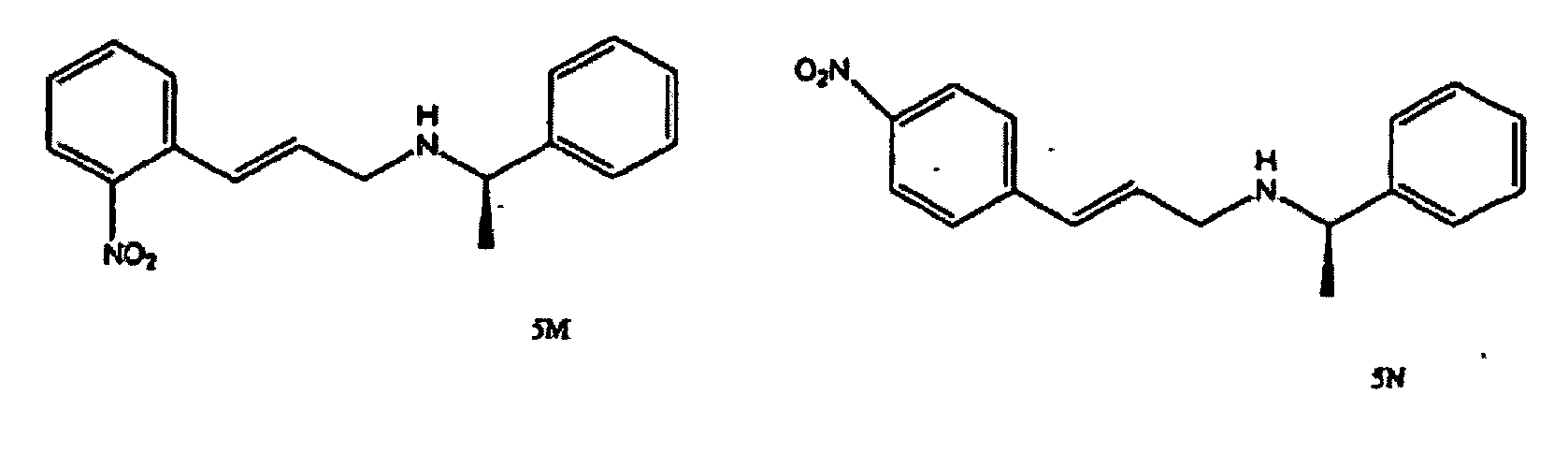


- Verbindung der Nummer 12C (R)-N-[3-(2-Methylphenyl)prop-2-enyl]prop2-enyl]-1-(3-methoxyphenyl)ethylamin oder ein pharmazeutisch verträgliches Salz oder ein pharmazeutisch verträglicher Komplex davon zur Verwendung als ein Medikament.
- Verbindung 12D (R)-N-[3-(2,4,6-Trimethylphenyl)prop-2-enyl]-1-(3-methoxyphenyl)ethylamin oder ein pharmazeutisch verträgliches Salz oder ein pharmazeutisch verträglicher Komplex davon zur Verwendung als ein Medikament.
- Verbindung 12E (R)-[3-(4-Isopropylphenyl)prop-2-enyl]-1-(3-methoxyphenyl)ethylamin oder ein pharmazeutisch verträgliches Salz oder ein pharmazeutisch verträglicher Komplex davon zur Verwendung als ein Medikament.
- Verbindung 12F (R)-N-[3-(2,4-Dimethylphenyl)prop-2-enyl]-1-(3-methoxyphenyl)ethylamin oder ein pharmazeutisch verträgliches Salz oder ein pharmazeutisch verträglicher Komplex davon zur Verwendung als ein Medikament.
- Verbindung 12G (R)-N-[3-(3-Methylphenyl)prop-2-enyl]-1-(3-methoxyphenyl)ethylamin oder ein pharmazeutisch verträgliches Salz oder ein pharmazeutisch verträglicher Komplex davon zur Verwendung als ein Medikament.
- Verbindung 25E (R)-N-(3-Phenylprop-2-en-1-yl)-1-(3-methoxyphenyl)ethylamin oder ein pharmazeutisch verträgliches Salz oder ein pharmazeutisch verträglicher Komplex davon zur Verwendung als ein Medikament.
- Verbindung 25G (R)-N-(2-Methyl-3-phenylprop-2-enyl)-1-(3-methoxyphenyl)ethylamin oder ein pharmazeutisch verträgliches Salz oder ein pharmazeutisch verträglicher Komplex davon zur Verwendung als ein Medikament.
- Verbindung 25H (R,R)-N-(2-Methyl-4-phenylbut-3-enyl)-1-(3-methoxyphenyl)ethylamin oder ein pharmazeutisch verträgliches Salz oder ein pharmazeutisch verträglicher Komplex davon zur Verwendung als ein Medikament.
- Verbindung 25I (S,R)-N-(2-Methyl-4-phenylbut-3-enyl)-1-(3-methoxyphenyl)ethylamin oder ein pharmazeutisch verträgliches Salz oder ein pharmazeutisch verträglicher Komplex davon zur Verwendung als ein Medikament.
- Arzneimittel, umfassend eine therapeutisch wirksame Menge einer Verbindung nach einem der Ansprüche 1 bis 13.
- Verwendung einer Verbindung nach einem der Ansprüche 1 bis 13 für die Herstellung eines Medikaments zur Behandlung eines Patienten mit einer Erkrankung oder Störung, die durch abnormale Knochen- und Mineralhomeostase gekennzeichnet ist.
- Verwendung einer Verbindung nach einem der Ansprüche 1 bis 13 für die Herstellung eines Medikaments zur Behandlung eines Patienten mit Hyperparathyroidismus.
- Verwendung einer Verbindung nach einem der Ansprüche 1 bis 13 für die Herstellung eines Medikaments zur Behandlung eines Patienten mit Paget-Syndrom.
- Verwendung einer Verbindung nach einem der Ansprüche 1 bis 13 für die Herstellung eines Medikaments zur Behandlung eines Patienten mit Osteoporose.
- Verwendung einer Verbindung nach einem der Ansprüche 1 bis 13 für die Herstellung eines Medikaments zur Behandlung eines Patienten mit Hypertonie.
- Verwendung einer Verbindung nach einem der Ansprüche 1 bis 13 für die Herstellung eines Medikaments zur Behandlung eines Patienten mit renaler Osteodystrophie.
- Verwendung einer Verbindung nach einem der Ansprüche 1 bis 13 für die Herstellung eines Medikaments zur Behandlung eines Patienten mit einer hypercalcämischen Störung.
- Verwendung der Verbindung der Nummer 12B (R)-N-[3-(4-Methylphenyl)prop-2-enyl]-1-(3-methoxyphenyl)ethylamin oder eines pharmazeutisch verträglichen Salzes oder Komplexes davon für die Herstellung eines Medikaments zur Senkung des Parathyreoid-Hormonspiegels in einem Patienten zum Erreichen einer heilsamen Wirkung.
- Verwendung der Verbindung der Nummer 25E (R)-N-(3-Phenylprop-2-en-1-yl)-1-(3-methoxyphenyl)ethylamin oder eines pharmazeutisch verträglichen Salzes oder Komplexes davon für die Herstellung eines Medikaments zur Senkung des Parathyreoid-Hormonspiegels in einem Patienten zum Erreichen einer heilsamen Wirkung.
- Verwendung der Verbindung der Nummer 25E (R)-N-(3-Phenylprop-2-en-1-yl)-1-(3-methoxyphenyl)ethylamin oder eines pharmazeutisch verträglichen Salzes oder Komplexes davon für die Herstellung eines Medikaments zur Verhinderung von Knochenresorption in einem Patienten.
Priority Applications (6)
| Application Number | Priority Date | Filing Date | Title |
|---|---|---|---|
| EP04026530A EP1553078A1 (de) | 1994-10-21 | 1995-10-23 | Kalzium-Rezeptor aktive Verbindungen |
| EP01204920A EP1203761B1 (de) | 1994-10-21 | 1995-10-23 | Kalzium-Rezeptor aktive Verbindungen |
| EP02019566A EP1275635A1 (de) | 1994-10-21 | 1995-10-23 | Kalzium-Rezeptor aktive Verbindungen |
| NL300199C NL300199I2 (nl) | 1994-10-21 | 2005-06-10 | Calcium-receptor actieve verbindingen. |
| FR05C0029C FR05C0029I2 (fr) | 1994-10-21 | 2005-06-30 | Composés capables de moduler l'activité du récepteur de calcium |
| LU91182C LU91182I2 (fr) | 1994-10-21 | 2005-07-18 | Cinacalcet |
Applications Claiming Priority (5)
| Application Number | Priority Date | Filing Date | Title |
|---|---|---|---|
| WOPCT/US94/12117 | 1994-10-21 | ||
| PCT/US1994/012117 WO1995011221A1 (en) | 1991-08-23 | 1994-10-21 | Calcium receptor-active arylalkyl amines |
| US08/353,784 US6011068A (en) | 1991-08-23 | 1994-12-08 | Calcium receptor-active molecules |
| US353784 | 1994-12-08 | ||
| PCT/US1995/013704 WO1996012697A2 (en) | 1994-10-21 | 1995-10-23 | Calcium receptor-active compounds |
Related Child Applications (2)
| Application Number | Title | Priority Date | Filing Date |
|---|---|---|---|
| EP02019566A Division EP1275635A1 (de) | 1994-10-21 | 1995-10-23 | Kalzium-Rezeptor aktive Verbindungen |
| EP01204920A Division EP1203761B1 (de) | 1994-10-21 | 1995-10-23 | Kalzium-Rezeptor aktive Verbindungen |
Publications (3)
| Publication Number | Publication Date |
|---|---|
| EP0787122A2 EP0787122A2 (de) | 1997-08-06 |
| EP0787122B1 true EP0787122B1 (de) | 2007-04-11 |
| EP0787122B9 EP0787122B9 (de) | 2007-10-17 |
Family
ID=23390556
Family Applications (4)
| Application Number | Title | Priority Date | Filing Date |
|---|---|---|---|
| EP02019566A Withdrawn EP1275635A1 (de) | 1994-10-21 | 1995-10-23 | Kalzium-Rezeptor aktive Verbindungen |
| EP95940547A Expired - Lifetime EP0787122B9 (de) | 1994-10-21 | 1995-10-23 | Kalzium-rezeptor aktive verbindungen |
| EP04026530A Withdrawn EP1553078A1 (de) | 1994-10-21 | 1995-10-23 | Kalzium-Rezeptor aktive Verbindungen |
| EP01204920A Expired - Lifetime EP1203761B1 (de) | 1994-10-21 | 1995-10-23 | Kalzium-Rezeptor aktive Verbindungen |
Family Applications Before (1)
| Application Number | Title | Priority Date | Filing Date |
|---|---|---|---|
| EP02019566A Withdrawn EP1275635A1 (de) | 1994-10-21 | 1995-10-23 | Kalzium-Rezeptor aktive Verbindungen |
Family Applications After (2)
| Application Number | Title | Priority Date | Filing Date |
|---|---|---|---|
| EP04026530A Withdrawn EP1553078A1 (de) | 1994-10-21 | 1995-10-23 | Kalzium-Rezeptor aktive Verbindungen |
| EP01204920A Expired - Lifetime EP1203761B1 (de) | 1994-10-21 | 1995-10-23 | Kalzium-Rezeptor aktive Verbindungen |
Country Status (25)
| Country | Link |
|---|---|
| US (1) | US6211244B1 (de) |
| EP (4) | EP1275635A1 (de) |
| JP (3) | JP2882882B2 (de) |
| KR (2) | KR100403094B1 (de) |
| CN (2) | CN1312116C (de) |
| AT (2) | ATE287390T1 (de) |
| AU (1) | AU709303B2 (de) |
| BR (1) | BRPI9509411B8 (de) |
| CA (1) | CA2202879C (de) |
| CZ (2) | CZ290670B6 (de) |
| DE (4) | DE122005000033I1 (de) |
| DK (1) | DK1203761T3 (de) |
| ES (2) | ES2285707T3 (de) |
| FR (1) | FR05C0029I2 (de) |
| HK (2) | HK1046900B (de) |
| HU (2) | HU228150B1 (de) |
| LU (1) | LU91182I2 (de) |
| NL (1) | NL300199I2 (de) |
| NZ (1) | NZ297157A (de) |
| PL (1) | PL183499B1 (de) |
| PT (1) | PT1203761E (de) |
| RU (1) | RU2195446C2 (de) |
| TW (2) | TW568896B (de) |
| UA (1) | UA55374C2 (de) |
| WO (1) | WO1996012697A2 (de) |
Families Citing this family (142)
| Publication number | Priority date | Publication date | Assignee | Title |
|---|---|---|---|---|
| DE4426245A1 (de) | 1994-07-23 | 1996-02-22 | Gruenenthal Gmbh | 1-Phenyl-3-dimethylamino-propanverbindungen mit pharmakologischer Wirkung |
| EP1275635A1 (de) * | 1994-10-21 | 2003-01-15 | Nps Pharmaceuticals, Inc. | Kalzium-Rezeptor aktive Verbindungen |
| WO1997005252A2 (en) * | 1995-07-26 | 1997-02-13 | Nps Pharmaceuticals, Inc. | Chimeric receptors and methods for identifying compounds active at metabotropic glutamate receptors and the use of such compounds in the treatment of neurological disorders and diseases |
| JP4117506B2 (ja) * | 1996-05-01 | 2008-07-16 | エヌピーエス ファーマシューティカルズ インコーポレイテッド | 無機イオン活性化合物 |
| EP1770083B1 (de) * | 1996-05-01 | 2009-04-29 | Nps Pharmaceuticals, Inc. | Inorganische am Ionen-Rezeptor aktive Verbindungen |
| EP1258471B1 (de) * | 1996-05-01 | 2007-01-24 | Nps Pharmaceuticals, Inc. | Verbindungen, die auf anorganische Ionen-Rezeptoren wirken |
| WO1998001417A1 (en) * | 1996-07-08 | 1998-01-15 | Kirin Beer Kabushiki Kaisha | Calcium receptor-active compounds |
| US6210964B1 (en) * | 1997-08-18 | 2001-04-03 | The Brigham And Women's Hospital, Inc. | Avian extracellular calcium-sensing receptor |
| AU760889B2 (en) | 1998-10-14 | 2003-05-22 | Ortho-Mcneil Pharmaceutical, Inc. | 1,2-disubstituted cyclopropanes |
| US20040214889A1 (en) * | 1999-07-31 | 2004-10-28 | Smithkline Beecham Corporation | Calcilytic compounds |
| EP1074539B1 (de) * | 1999-08-04 | 2007-10-17 | Sumitomo Chemical Company, Limited | Verfahren zur Herstellung von optisch aktiver 3,3,3-Trifluor-2-hydroxy-2-methylpropionsäure und deren Salze |
| JP4595178B2 (ja) * | 1999-08-04 | 2010-12-08 | 住友化学株式会社 | アミン化合物、中間体、製造法および光学分割剤 |
| US6797842B2 (en) * | 2000-05-11 | 2004-09-28 | Central Glass Company, Limited | Process for producing optically active 1-(fluoro- or trifluoromethyl-substituted phenyl) ethylamine and process for purifying same |
| FR2809396B1 (fr) * | 2000-05-24 | 2005-10-14 | Centre Nat Rech Scient | Nouvelles molecules possedant une activite calcimimetique et leur mode de preparation |
| AR038658A1 (es) * | 2001-06-15 | 2005-01-26 | Novartis Ag | Derivados de 4-aril-2(1h) quinazolinona y 4-aril-quinazolina 2-sustituidas, un proceso para su preparacion, composiciones farmaceuticas y el uso de dichos derivados para la preparacion de un medicamento |
| US6908935B2 (en) | 2002-05-23 | 2005-06-21 | Amgen Inc. | Calcium receptor modulating agents |
| US7176322B2 (en) * | 2002-05-23 | 2007-02-13 | Amgen Inc. | Calcium receptor modulating agents |
| US6849761B2 (en) | 2002-09-05 | 2005-02-01 | Wyeth | Substituted naphthoic acid derivatives useful in the treatment of insulin resistance and hyperglycemia |
| GB0230015D0 (en) * | 2002-12-23 | 2003-01-29 | Novartis Ag | Organic compounds |
| US7105537B2 (en) * | 2003-01-28 | 2006-09-12 | Bristol-Myers Squibb Company | 2-substituted cyclic amines as calcium sensing receptor modulators |
| US7205322B2 (en) * | 2003-02-12 | 2007-04-17 | Bristol-Myers Squibb Company | Thiazolidine compounds as calcium sensing receptor modulators |
| US7265145B2 (en) * | 2003-05-28 | 2007-09-04 | Bristol-Myers Squibb Company | Substituted piperidines and pyrrolidines as calcium sensing receptor modulators and method |
| FR2855754B1 (fr) * | 2003-06-05 | 2005-07-08 | Oreal | Compsition, notamment cosmetique, comprenant une amine carbonylee |
| AR045637A1 (es) * | 2003-09-12 | 2005-11-02 | Amgen Inc | Formulacion de disolucion rapida de un compuesto activo frente a los receptores de calcio |
| US20050186658A1 (en) * | 2003-10-17 | 2005-08-25 | Nps Pharmaceuticals, Inc. | Chimeric metabotropic glutamate receptors and uses thereof |
| JP4629036B2 (ja) | 2004-05-28 | 2011-02-09 | 田辺三菱製薬株式会社 | アリールアルキルアミン化合物及びその製法 |
| US20050288377A1 (en) * | 2004-06-14 | 2005-12-29 | Cantor Thomas L | Use of calcimimetic as an adynamic bone disease related treatment |
| WO2006008171A1 (en) * | 2004-07-22 | 2006-01-26 | Dsm Ip Assets B.V. | Process for the preparation of a diastereomerically enriched compound |
| US7361789B1 (en) | 2004-07-28 | 2008-04-22 | Amgen Inc. | Dihydronaphthalene compounds, compositions, uses thereof, and methods for synthesis |
| CA2601669A1 (en) * | 2005-03-17 | 2006-09-28 | Amgen Inc. | Methods of decreasing calcification |
| FR2885129B1 (fr) | 2005-04-29 | 2007-06-15 | Proskelia Sas | Nouveaux derives de l'ureee substituee parun thiazole ou benzothiazole, leur procede de preparation, leur application a titre de medicaments, les compositions pharmaceutiques les renfermant et utilisation. |
| WO2006125026A2 (en) * | 2005-05-16 | 2006-11-23 | Teva Pharmaceutical Industries, Ltd. | Process for preparing cinacalcet hydrochloride |
| JP2008507567A (ja) * | 2005-05-23 | 2008-03-13 | テバ ファーマシューティカル インダストリーズ リミティド | 非晶性シナカルセト塩酸塩及びその調製 |
| EP1883618B1 (de) * | 2005-05-23 | 2009-10-14 | Teva Pharmaceutical Industries Ltd. | Verfahren zur herstellung von cinacalcet hydrochlorid kristallform i |
| CA2620469C (en) * | 2005-09-02 | 2014-04-01 | Amgen Inc. | Methods of modulating intestinal fluid balance |
| US7595161B2 (en) | 2005-11-10 | 2009-09-29 | Hansjoerg Martin Rothe | Efficacy of calcimimetic agents |
| EP1828098A1 (de) * | 2005-11-22 | 2007-09-05 | Teva Pharmaceutical Industries Ltd | Kristallformen von cinacalcet hci und verfahren zu ihrer herstellung |
| US7875609B2 (en) * | 2005-11-25 | 2011-01-25 | Galapagos Sasu | Urea derivatives, processes for their preparation, their use as medicaments, and pharmaceutical compositions containing them |
| US20070129444A1 (en) * | 2005-12-06 | 2007-06-07 | Mallinckrodt Inc. | Novel weight reduction composition and uses thereof |
| PT3095447T (pt) | 2006-02-03 | 2022-01-24 | Opko Renal Llc | Tratamento da insuficiência e deficiência de vitamina d com 25-hidroxivitamina d2 e 25-hidroxivitamina d3 |
| MX2008012061A (es) | 2006-03-23 | 2008-12-17 | Amgen Inc | Metodos y composiciones para elaborar y utilizar polimorfos de cinacalcet. |
| WO2007124465A2 (en) * | 2006-04-20 | 2007-11-01 | Amgen Inc. | Stable emulsion formulations |
| TW200808297A (en) * | 2006-04-27 | 2008-02-16 | Teva Pharma | Process for the preparation of cinacalcet base |
| EP1928817A1 (de) * | 2006-04-27 | 2008-06-11 | Teva Pharmaceutical Industries Ltd | Verfahren zur herstellung von cinacalcetbase |
| DK2037936T3 (da) | 2006-06-21 | 2014-09-22 | Opko Renal Llc | Fremgangsmåde til behandling og forebyggelse af sekundær hyperparathyroidisme |
| WO2008000423A1 (en) * | 2006-06-27 | 2008-01-03 | Sandoz Ag | Crystalline form of cinacalcet |
| EP1914224A1 (de) * | 2006-10-19 | 2008-04-23 | Sandoz AG | Amorphes Cinacalcethydrochlorid |
| WO2008000422A1 (en) * | 2006-06-27 | 2008-01-03 | Sandoz Ag | Amorphous form of cinacalcet |
| GB0613674D0 (en) | 2006-07-10 | 2006-08-16 | Proskelia Sas | Derivatives of urea and related diamines, methods for their manufacture, and uses therefor |
| WO2008027522A2 (en) * | 2006-09-01 | 2008-03-06 | Teva Pharmaceutical Industries Ltd. | Solid composites of a calicum receptor-active compound |
| CA2663436A1 (en) * | 2006-10-04 | 2008-04-10 | Pfizer Products Inc. | Pyrido[4,3-d]pyrimidin-4(3h)-one derivatives as calcium receptor antagonists |
| MX2009003981A (es) * | 2006-10-26 | 2009-04-27 | Amgen Inc | Agentes moduladores del receptor de calcio. |
| WO2008058236A2 (en) * | 2006-11-08 | 2008-05-15 | Dr. Reddy's Labortories, Ltd. | Methods for preparing cinacalcet hydrochloride |
| WO2008063645A1 (en) * | 2006-11-20 | 2008-05-29 | Teva Pharmaceutical Industries Ltd. | Process for preparing cinacalcet |
| WO2008075173A2 (en) * | 2006-12-15 | 2008-06-26 | Ruprecht-Karls-Universität Heidelberg | Methods for treating podocyte-related disorders |
| CA2681582C (en) * | 2007-03-30 | 2015-07-14 | Amgen Inc. | Methods of treating bowel disorders |
| CA2701638A1 (en) * | 2007-04-02 | 2008-10-09 | Concert Pharmaceuticals Inc. | Pharmaceutical calcimimetics |
| CA2683628C (en) | 2007-04-25 | 2018-03-06 | Cytochroma Inc. | Method of treating vitamin d insufficiency and deficiency |
| KR101691876B1 (ko) | 2007-04-25 | 2017-01-02 | 사이토크로마 인코포레이티드 | 비타민 d 화합물과 밀랍성 담체를 포함하는 경구 조절성 방출 조성물 |
| ES2499015T3 (es) * | 2007-05-08 | 2014-09-26 | Ajinomoto Co., Inc. | Agente profiláctico o terapéutico para la diarrea |
| ES2569483T3 (es) | 2007-06-21 | 2016-05-11 | Amgen Inc. | Métodos para sintetizar cinacalcet y sales del mismo |
| ITMI20071261A1 (it) | 2007-06-22 | 2008-12-23 | Dipharma Francis Srl | Procedimento per la preparazione di cinacalcet |
| CA2692598A1 (en) | 2007-07-10 | 2009-01-15 | Amgen Inc. | Derivatives of urea and related diamines, methods for their manufacture, and uses therefor |
| US20090093652A1 (en) * | 2007-08-16 | 2009-04-09 | Michal Rafilovich | Crystalline forms cinacalcet fumarate and cinacalcet succinate and processes for preparation thereof |
| CA2706076A1 (en) * | 2007-11-23 | 2009-05-28 | Leo Pharma A/S | Novel cyclic hydrocarbon compounds for the treatment of diseases |
| WO2009107660A1 (ja) | 2008-02-25 | 2009-09-03 | 味の素株式会社 | 糖尿病又は肥満病の予防又は治療剤 |
| JPWO2009107579A1 (ja) * | 2008-02-25 | 2011-06-30 | 味の素株式会社 | コク味付与剤 |
| WO2009119554A1 (ja) | 2008-03-24 | 2009-10-01 | 味の素株式会社 | 消化管の重炭酸分泌促進剤 |
| CA2719256A1 (en) * | 2008-03-28 | 2009-10-01 | Amgen Inc. | Methods of treating epithelial injury |
| WO2009128523A1 (ja) | 2008-04-17 | 2009-10-22 | 味の素株式会社 | 免疫賦活剤 |
| EP2321256B1 (de) * | 2008-06-18 | 2014-11-12 | ERREGIERRE S.p.A. | Verfahren zur synthese von cinacalcet hydrochlorid |
| US20110178326A1 (en) * | 2008-08-06 | 2011-07-21 | Actavis Group Ptc Ehf | Unsaturated cinacalcet salts and processes for preparing cinacalcet hydrochloride |
| WO2010021351A1 (ja) | 2008-08-22 | 2010-02-25 | 第一三共株式会社 | シクロアルキルアミン誘導体 |
| WO2010043721A1 (en) | 2008-10-17 | 2010-04-22 | Oryzon Genomics, S.A. | Oxidase inhibitors and their use |
| WO2010067204A1 (en) | 2008-12-08 | 2010-06-17 | Actavis Group Ptc Ehf | Highly pure cinacalcet or a pharmaceutically acceptable salt thereof |
| US8993808B2 (en) | 2009-01-21 | 2015-03-31 | Oryzon Genomics, S.A. | Phenylcyclopropylamine derivatives and their medical use |
| WO2010086129A1 (en) | 2009-01-27 | 2010-08-05 | Rathiopharm Gmbh | Inclusion complex comprising cinacalcet and cyclodextrin |
| AU2010215520B2 (en) | 2009-02-19 | 2016-07-21 | F.I.S. - Fabbrica Italiana Sintetici S.P.A. | Process for preparing Cinacalcet hydrochloride |
| NZ595023A (en) | 2009-03-05 | 2013-09-27 | Cipla Ltd | Process for the preparation of cinacalcet and salts thereof, and intermediates for use in the process |
| EP2406211B1 (de) | 2009-03-09 | 2018-06-27 | Megafine Pharma (P) Ltd. | Neues verfahren zur herstellung von cinacalcet und neues zwischenprodukt davon |
| WO2010104882A1 (en) | 2009-03-10 | 2010-09-16 | Amgen Inc. | Methods of modulating sperm motility |
| WO2010103429A1 (en) | 2009-03-10 | 2010-09-16 | Pfizer Inc. | 1,1-(Dimethyl-Ethylamino)-2-Hydroxy-Propoxy]-Ethyl}-3-Methyl-Biphenyl-4- Carboxylic Acid Derivatives As Calcium Receptor Antagonists |
| WO2010118055A1 (en) * | 2009-04-09 | 2010-10-14 | Cognition Therapeutics, Inc. | Inhibitors of cognitive decline |
| WO2010128388A2 (en) | 2009-05-08 | 2010-11-11 | Aurobindo Pharma Limited | An improved process for the preparation of intermediate compounds useful for the preparation of cinacalcet |
| WO2010136037A1 (en) | 2009-05-27 | 2010-12-02 | Leo Pharma A/S | Novel calcium sensing receptor modulating compounds and pharmaceutical use thereof |
| JP2012528084A (ja) * | 2009-05-27 | 2012-11-12 | レオ ファーマ アクティーゼルスカブ | 新規のカルシウム感知受容体調節化合物およびその医薬用途 |
| WO2010150837A1 (ja) * | 2009-06-25 | 2010-12-29 | 第一三共株式会社 | インドリン誘導体 |
| RU2012107457A (ru) | 2009-07-31 | 2013-09-10 | Когнишн Терапьютикс, Инк. | Ингибиторы ухудшения когнитивных способностей |
| ES2445532T3 (es) | 2009-09-10 | 2014-03-03 | Zach System S.P.A. | Proceso para preparar cinacalcet |
| US8759586B2 (en) | 2009-09-16 | 2014-06-24 | Ranbaxy Laboratories Limited | Processes for the preparation of cinacalcet |
| WO2011035941A1 (en) | 2009-09-25 | 2011-03-31 | Oryzon Genomics S.A. | Lysine specific demethylase-1 inhibitors and their use |
| AU2010315805B2 (en) | 2009-09-29 | 2015-09-17 | Nektar Therapeutics | Oligomer-calcimimetic conjugates and related compounds |
| US8722732B2 (en) | 2009-09-29 | 2014-05-13 | Nektar Therapeutics | Oligomer-calcimimetic conjugates and related compounds |
| US8946296B2 (en) | 2009-10-09 | 2015-02-03 | Oryzon Genomics S.A. | Substituted heteroaryl- and aryl-cyclopropylamine acetamides and their use |
| EP2314286A1 (de) | 2009-10-21 | 2011-04-27 | Ratiopharm GmbH | Schmelzgranuliertes Cinacalcet |
| WO2011050499A1 (zh) * | 2009-11-02 | 2011-05-05 | 上海威智医药科技有限公司 | 盐酸西那卡塞的合成方法 |
| IT1396623B1 (it) * | 2009-11-26 | 2012-12-14 | Dipharma Francis Srl | Procedimento per la preparazione di cinacalcet e suoi intermedi |
| WO2011106574A2 (en) | 2010-02-24 | 2011-09-01 | Oryzon Genomics, S.A. | Inhibitors for antiviral use |
| WO2011106106A2 (en) | 2010-02-24 | 2011-09-01 | Oryzon Genomics, S.A. | Lysine demethylase inhibitors for diseases and disorders associated with hepadnaviridae |
| US11672809B2 (en) | 2010-03-29 | 2023-06-13 | Eirgen Pharma Ltd. | Methods and compositions for reducing parathyroid levels |
| RS55348B1 (sr) | 2010-04-19 | 2017-03-31 | Oryzon Gnomics S A | Inhibitori lizin specifične demetilaze-1 i njihova upotreba |
| US9012511B2 (en) | 2010-05-19 | 2015-04-21 | Alkermes Pharma Ireland Limited | Nanoparticulate cinacalcet compositions |
| EP2588445A1 (de) * | 2010-06-30 | 2013-05-08 | Leo Pharma A/S | Neue polymorphe form einer calcimimetischen verbindung |
| US8946474B2 (en) | 2010-06-30 | 2015-02-03 | Leo Pharma A/S | Polymorphic form of a calcimimetic compound |
| US8921606B2 (en) * | 2010-07-16 | 2014-12-30 | Hetero Research Foundation | Process for cinacalcet hydrochloride |
| EP2598480B1 (de) | 2010-07-29 | 2019-04-24 | Oryzon Genomics, S.A. | Cyclopropylaminderivate als lsd1-hemmer |
| DK2598482T3 (en) | 2010-07-29 | 2018-06-14 | Oryzon Genomics Sa | ARYLCYCLOPROPYLAMINE-BASED DEMETHYLASE INHIBITORS OF LSD1 AND THEIR MEDICAL USE |
| WO2012045883A1 (en) | 2010-10-08 | 2012-04-12 | Oryzon Genomics S.A. | Cyclopropylamine inhibitors of oxidases |
| CN101993379B (zh) * | 2010-10-22 | 2013-06-19 | 能特科技股份有限公司 | 一种盐酸西那卡塞的制备方法 |
| RU2013128981A (ru) | 2010-11-26 | 2015-01-10 | Лео Фарма А/С | Соединения, активные в отношении чувствительных к кальцию рецепторов |
| CN103270018A (zh) | 2010-11-26 | 2013-08-28 | 利奥制药有限公司 | 钙敏感受体激活化合物 |
| WO2012069421A1 (en) | 2010-11-26 | 2012-05-31 | Leo Pharma A/S | Calcium-sensing receptor-active compounds |
| WO2012069402A1 (en) | 2010-11-26 | 2012-05-31 | Leo Pharma A/S | Substituted cyclopentyl - azines as casr- active compounds |
| WO2012072713A2 (en) | 2010-11-30 | 2012-06-07 | Oryzon Genomics, S.A. | Lysine demethylase inhibitors for diseases and disorders associated with flaviviridae |
| AU2011342896A1 (en) | 2010-12-13 | 2013-07-04 | Quiapeg Pharmaceuticals Ab | Functionalized polymers |
| EP2712315B1 (de) | 2011-02-08 | 2021-11-24 | Oryzon Genomics, S.A. | Lysindemethylase-hemmer für myeloproliferative erkrankungen |
| US9469597B2 (en) | 2011-10-20 | 2016-10-18 | Oryzon Genomics S.A. | (Hetero)aryl cyclopropylamine compounds as LSD1 inhibitors |
| AU2012324803B9 (en) | 2011-10-20 | 2017-08-24 | Oryzon Genomics, S.A. | (hetero)aryl cyclopropylamine compounds as LSD1 inhibitors |
| CZ2011770A3 (cs) | 2011-11-25 | 2013-01-16 | Zentiva, K.S. | Zpusob výroby Cinacalcetu |
| CN103450027B (zh) | 2012-05-29 | 2015-07-29 | 上海京新生物医药有限公司 | 盐酸西那卡塞的制备方法 |
| AU2013276219B2 (en) | 2012-06-12 | 2018-03-08 | Quiapeg Pharmaceuticals Ab | Conjugates of biologically active molecules to functionalized polymers |
| US20150344407A1 (en) * | 2012-08-21 | 2015-12-03 | The Board Of Regents Of The University Of Texas System | Fendiline derivatives and methods of use thereof |
| HK1211916A1 (en) * | 2012-08-27 | 2016-06-03 | Lupin Atlantis Holdings Sa | Arylalkylamine compounds as calcium sensing receptor modulators |
| FR2995307A1 (fr) | 2012-09-07 | 2014-03-14 | Prod Chim Auxiliaires Et De Synthese | Procede de preparation du cinacalcet et de ses sels pharmaceutiquement acceptables |
| PL2730279T3 (pl) | 2012-11-09 | 2015-12-31 | K H S Pharma Holding Gmbh | Preparaty cynakalcetu o natychmiastowym uwalnianiu |
| ES2737756T3 (es) | 2012-12-21 | 2020-01-15 | Synthon Bv | Composición de comprimido que comprende clorhidrato de cinacalcet |
| KR101847947B1 (ko) | 2013-03-15 | 2018-05-28 | 옵코 아이피 홀딩스 Ⅱ 인코포레이티드 | 안정화되고 변형된 비타민 d 방출 제형 |
| WO2014207691A1 (en) | 2013-06-26 | 2014-12-31 | Jubilant Life Sciences Limited | Disintegrant free composition of cinacalcet |
| WO2015116923A1 (en) | 2014-01-31 | 2015-08-06 | Cognition Therapeutics, Inc. | Isoindoline compositions and methods for treating neurodegenerative disease |
| EP3148972B1 (de) | 2014-05-27 | 2019-08-21 | Cardioxyl Pharmaceuticals, Inc. | Pyrazolonderivate als nitroxyldonatoren |
| CN104045568A (zh) * | 2014-06-18 | 2014-09-17 | 中山奕安泰医药科技有限公司 | 一种合成(r)-1–(萘-1-基)乙胺的新工艺 |
| US10220047B2 (en) | 2014-08-07 | 2019-03-05 | Opko Ireland Global Holdings, Ltd. | Adjunctive therapy with 25-hydroxyvitamin D and articles therefor |
| CN104478736B (zh) * | 2014-12-16 | 2016-07-13 | 成都启泰医药技术有限公司 | 一种盐酸西那卡塞的制备方法 |
| US20180155270A1 (en) | 2015-05-29 | 2018-06-07 | Lupin Limited | Process for preparation of cinacalcet intermediate and cinacalcet hydrochloride |
| KR20180123100A (ko) | 2016-03-28 | 2018-11-14 | 옵코 아일랜드 글로벌 홀딩스 리미티드 | 비타민 d 치료 방법 |
| CN110545850A (zh) | 2017-03-10 | 2019-12-06 | 奎亚培格制药公司 | 可释放的缀合物 |
| ES3063712T3 (en) | 2017-05-15 | 2026-04-20 | Cognition Therapeutics Inc | Compositions for treating neurodegenerative diseases |
| EP3849660A1 (de) | 2018-09-12 | 2021-07-21 | QuiaPEG Pharmaceuticals AB | Lösbare glp-1-konjugate |
| CN111196759B (zh) * | 2018-11-16 | 2023-03-24 | 上海博志研新药物技术有限公司 | 盐酸西那卡塞及其中间体的制备方法 |
| MX2022002282A (es) * | 2019-08-28 | 2022-03-25 | Unilever Ip Holdings B V | Compuestos novedosos para aclarar la piel. |
| US20230147129A1 (en) | 2020-03-27 | 2023-05-11 | Som Innovation Biotech, S.A. | Compounds for use in the treatment of synucleinopathies |
| RU2739376C1 (ru) * | 2020-07-24 | 2020-12-23 | Федеральное государственное бюджетное учреждение науки Институт элементоорганических соединений им. А.Н. Несмеянова Российской академии наук (ИНЭОС РАН) | Способ получения фендилина |
Family Cites Families (100)
| Publication number | Priority date | Publication date | Assignee | Title |
|---|---|---|---|---|
| US2276618A (en) | 1942-03-17 | N-phenylaliphatic bihxdroxithenyl- | ||
| US2930731A (en) | 1952-04-08 | 1960-03-29 | Upjohn Co | Bis[beta-(ortho-hydrocarbonoxyphenyl)iso-propyl]amines |
| BE570596A (de) | 1957-08-26 | |||
| BE621300A (de) | 1961-08-14 | |||
| US3262977A (en) | 1962-03-10 | 1966-07-26 | Chinoin Gyogyszer Es Vegyeszet | N-aralkyl-1, 1-diphenyl-propylamine derivatives |
| NL293886A (de) | 1962-06-19 | 1965-04-12 | Merck Ag E | |
| US3318952A (en) | 1964-01-22 | 1967-05-09 | Sandoz Ag | Dibenzylsulfamides |
| US3459767A (en) | 1965-08-10 | 1969-08-05 | Pfizer & Co C | Aminomethylindoles |
| GB1109924A (en) | 1965-11-29 | 1968-04-18 | Roche Products Ltd | Novel substituted diphenylalkyl amines and a process for the manufacture thereof |
| DE1618005A1 (de) | 1966-09-22 | 1971-09-09 | Thomae Gmbh Dr K | Verfahren zur Herstellung von neuen Amino-dihalogen-phenyl-aethylaminen |
| CH480791A (de) | 1967-01-17 | 1969-11-15 | Ciba Geigy | Schädlingsbekämpfungsmittel |
| GB1263987A (en) | 1969-05-30 | 1972-02-16 | Allen & Hanburys Ltd | Phenethylamine derivatives |
| US4129598A (en) * | 1972-05-31 | 1978-12-12 | Synthelabo | Phenylethylamine derivatives |
| GB1448437A (en) | 1973-02-24 | 1976-09-08 | Beecham Group Ltd | Diphenylpropylamines |
| US3862925A (en) | 1973-07-05 | 1975-01-28 | American Home Prod | Preparation of somatotropin release inhibiting factor and intermediates therefor |
| US4000197A (en) * | 1973-07-23 | 1976-12-28 | The University Of Iowa Research Foundation | Asymmetric synthesis of phenylisopropylamines |
| US3842067A (en) | 1973-07-27 | 1974-10-15 | American Home Prod | Synthesis of(des-asn5)-srif and intermediates |
| JPS5726506B2 (de) | 1974-03-08 | 1982-06-04 | ||
| US4014937A (en) | 1974-08-26 | 1977-03-29 | Pfizer Inc. | 3,4-And 3,5-dialkoxyphenethylamines |
| HU169507B (de) | 1974-09-25 | 1976-12-28 | ||
| US3987201A (en) | 1974-12-24 | 1976-10-19 | Eli Lilly And Company | Method for treating arrhythmia |
| US4105602A (en) | 1975-02-10 | 1978-08-08 | Armour Pharmaceutical Company | Synthesis of peptides with parathyroid hormone activity |
| JPS5390272A (en) | 1977-01-13 | 1978-08-08 | Sendai Fukusokan Kagaku Kenkiy | Method of producing optically active salsolizine |
| US4608391A (en) | 1977-07-05 | 1986-08-26 | Cornell Research Foundation Inc. | Catecholamine derivatives, a process for their preparation and pharmaceutical compositions thereof |
| US4289787A (en) | 1977-12-19 | 1981-09-15 | Eli Lilly And Company | Quaternary ammonium antiarrhythmic drugs |
| DD144050A5 (de) | 1978-06-05 | 1980-09-24 | Ciba Geigy Ag | Verfahren zur herstellung von n-alkylierten aminoalkoholen |
| DE2825961A1 (de) | 1978-06-14 | 1980-01-03 | Basf Ag | Fungizide amine |
| DK268779A (da) | 1978-07-03 | 1980-01-04 | Lilly Co Eli | Fremgangsmaade til fremstilling af phenethanolaminer |
| US4391826A (en) | 1978-07-03 | 1983-07-05 | Eli Lilly And Company | Phenethanolamines, compositions containing the same, and method for effecting weight control |
| ZA794872B (en) | 1978-09-20 | 1980-11-26 | Schering Corp | A phenylalkylaminoethylsalicylamide,its preparation and pharmaceutical compositions containing it |
| FR2436773A1 (fr) | 1978-09-22 | 1980-04-18 | Roussel Uclaf | Nouveaux derives du 3-(aminoethyl) phenol et leurs sels, procede de preparation et application a titre de medicaments |
| DE2841184C2 (de) * | 1978-09-22 | 1986-09-25 | Hochtemperatur-Reaktorbau GmbH, 4600 Dortmund | Vorrichtung zur Durchmischung der Heißgassträhnen bei einem gasgekühlten Hochtemperaturreaktor |
| US4360511A (en) | 1978-11-29 | 1982-11-23 | Medi-Physics, Inc. | Amines useful as brain imaging agents |
| DD150456A5 (de) | 1979-03-01 | 1981-09-02 | Ciba Geigy Ag | Verfahren zur herstellung von derivaten des 3-amino-1,2-propandiols |
| US4338333A (en) | 1979-06-16 | 1982-07-06 | Beecham Group Limited | Ethanamine derivatives their preparation and use in pharmaceutical compositions |
| JPS603387B2 (ja) | 1980-07-10 | 1985-01-28 | 住友化学工業株式会社 | 新規光学活性イミダゾリジン−2−オン誘導体およびその製法 |
| HU183430B (en) | 1981-05-12 | 1984-05-28 | Chinoin Gyogyszer Es Vegyeszet | Process for producing cyclodextrine inclusion complexes of n-bracket-1-phenylethyl-bracket closed-3,3-diphenylpropylamine or n-bracket-1-phenylethyl-bracket closed-3,3-diphenylpropylamine-hydrochloride |
| US4591605A (en) | 1981-11-10 | 1986-05-27 | Research Foundation Of State University Of New York | Method and ingestible formulation for inhibiting the secretion of stomach acid |
| US4658060A (en) | 1982-04-26 | 1987-04-14 | Schering Corporation | Preparation of (-)-5-(beta)-1-hydroxy-2-((beta)-1-methyl-3-phenylpropyl)aminoethyl) salicylamide |
| DE3225879A1 (de) | 1982-07-10 | 1984-01-12 | Basf Ag, 6700 Ludwigshafen | Trans-3-(4'-tert.-butylcyclohexyl-1')-2-methyl-1-dialkyl-aminopropane, ihre herstellung und verwendung als arzneimittel |
| CA1258454A (en) | 1982-08-10 | 1989-08-15 | Leo Alig | Phenethanolamines |
| US4647446A (en) | 1982-08-18 | 1987-03-03 | The Regents Of The University Of California | Rapid brain scanning radiopharmaceutical |
| JPS5950358A (ja) | 1982-09-14 | 1984-03-23 | Sumitomo Chem Co Ltd | 光学活性なカルボン酸をグラフトしたクロマトグラフ充填剤およびそれを用いる鏡像体混合物の分離法 |
| US4677101A (en) | 1983-09-26 | 1987-06-30 | Merck & Co., Inc. | Substituted dihydroazepines useful as calcium channel blockers |
| US4661635A (en) | 1983-11-21 | 1987-04-28 | Mcneilab, Inc. | Aralykyl (arylethynyl)aralkyl amines and their use as vasodilators and antihypertensives |
| US5334628A (en) | 1984-06-09 | 1994-08-02 | Kaken Pharmaceutical Co., Ltd. | Amine derivatives, processes for preparing the same and fungicides containing the same |
| US4587253A (en) | 1984-07-30 | 1986-05-06 | Merck & Co., Inc. | Bridged pyridine compounds useful as calcium channel blockers and analgesics |
| US4609494A (en) | 1985-02-21 | 1986-09-02 | Merck & Co., Inc. | 5-acetyl-3,4,5,6-tetrahydro-4-oxo-2,6-methano-2H-1,3,5-benzothiazocine(benzodiazocine)-11-carboxylates useful as calcium channel blockers |
| US4839369A (en) | 1985-04-16 | 1989-06-13 | Rorer Pharmaceutical Corporation | Aryl and heteroaryl ethers as agents for the treatment of hypersensitive ailments |
| GB8522186D0 (en) | 1985-09-06 | 1985-10-09 | Erba Farmitalia | Cycloalkyl-substituted 4-aminophenyl derivatives |
| DE3541181A1 (de) | 1985-11-21 | 1987-05-27 | Basf Ag | Propylamine, verfahren zu ihrer herstellung und ihre verwendung als fungizide |
| US4675321A (en) | 1986-02-07 | 1987-06-23 | Merck & Co., Inc. | Substituted pyrimidines useful as calcium channel blockers |
| US5034514A (en) | 1986-03-17 | 1991-07-23 | Cetus Corporation | Novel cross-linking agents |
| US5030576A (en) | 1986-04-30 | 1991-07-09 | Genentech, Inc. | Receptors for efficient determination of ligands and their antagonists or agonists |
| US4808718A (en) | 1986-05-06 | 1989-02-28 | Merck & Co., Inc. | Fused polycyclic and bridged compounds useful as calcium channel blockers |
| HU200591B (en) | 1986-07-11 | 1990-07-28 | Chinoin Gyogyszer Es Vegyeszet | Process for producing new diphenyl propylamine derivatives and pharmaceutical compositions comprising such compounds |
| IL83163A (en) | 1986-07-18 | 1991-06-10 | Erba Carlo Spa | Cycloalkyl-substituted 4-pyridyl derivatives,their preparation and pharmaceutical compositions containing them |
| HU207280B (en) | 1986-09-25 | 1993-03-29 | Chinoin Gyogyszer Es Vegyeszet | Process for producing new phenyl-alkyl-amines and pharmaceutical compositions containing them |
| US4925664A (en) | 1986-10-20 | 1990-05-15 | University Of Utah | Spider toxins and methods for their use as blockers of calcium channels and amino acid receptor function |
| US5064657A (en) | 1986-10-20 | 1991-11-12 | University Of Utah | Spider toxins and methods for their use as blockers of amino acid receptor function |
| ES2052583T3 (es) | 1986-12-04 | 1994-07-16 | Asahi Chemical Ind | Derivados de peptidos relacionados con el gel calcitonina. |
| GB8709871D0 (en) | 1987-04-27 | 1987-06-03 | Turner R C | Peptides |
| GB8720115D0 (en) | 1987-08-26 | 1987-09-30 | Cooper G J S | Treatment of diabetes mellitus |
| US4916145A (en) | 1987-07-10 | 1990-04-10 | Hoffmann-La Roche Inc. | Substituted n-[(pyridyl)alkyl]aryl-carboxamide |
| DE68924372T2 (de) | 1988-01-11 | 1996-05-09 | Amylin Pharmaceuticals Inc | Behandlung von diabetes mellitus typ 2. |
| US5001251A (en) | 1988-01-15 | 1991-03-19 | E. R. Squibb & Sons, Inc. | Optical resolution of DL-3-acylthio-2-methylpropanoic acid |
| CA1341170C (en) | 1988-04-04 | 2001-01-16 | Steven B. Ellis | Calcium channel compositions and methods |
| US5082837A (en) | 1988-06-28 | 1992-01-21 | Merrell Dow Pharmaceuticals | Lactamimides as calcium antagonists |
| US4925873A (en) | 1988-09-01 | 1990-05-15 | E. R. Squibb & Sons, Inc. | Method of treating skin injuries using thromboxane A2 receptor antagonists |
| JPH02200658A (ja) | 1989-01-28 | 1990-08-08 | Kumiai Chem Ind Co Ltd | N―(置換)ベンジルカルボン酸アミド誘導体及び除草剤 |
| RU2005717C1 (ru) * | 1989-02-17 | 1994-01-15 | Такеда кемикал-индастриз Лтд | Способ получения производных аралкиламинов или их кислотно-аддитивных солей |
| US5011834A (en) | 1989-04-14 | 1991-04-30 | State Of Oregon, Acting By And Through The Oregon State Board Of Higher Education, Acting For And On Behalf Of The Oregon Health Sciences University And The University Of Oregon | PCP receptor ligands and the use thereof |
| DD298412A5 (de) | 1989-04-28 | 1992-02-20 | ������@���Kk�� | Verfahren zur herstellung von polypeptiden, die geeignet sind als antagonisten exzitatorischer aminosaeure-neurotransmitter und/oder blocker der calciumkanaele |
| EP0597830A1 (de) | 1989-07-03 | 1994-05-25 | New York University Nyu Medical Center | Verwendung von Polyaminen als die Ionenkanäle regulierenden Wirkstoffe |
| GB8915712D0 (en) | 1989-07-08 | 1989-08-31 | Macintyre Iain | Medical treatment |
| US5021599A (en) | 1989-08-31 | 1991-06-04 | Serpentix Conveyor Corporation | Redox-responsive anion receptors |
| US5053337A (en) | 1989-10-30 | 1991-10-01 | Neurogenetic Corporation | DNA encoding an α2B -adrenergic receptor |
| CA2071897A1 (en) | 1989-12-28 | 1991-06-29 | Richard A. Glennon | Sigma receptor ligands and the use thereof |
| JP2818958B2 (ja) | 1990-02-23 | 1998-10-30 | 塩野義製薬株式会社 | 4―(4―アルコキシフェニル)―2―ブチルアミン誘導体およびその製造法 |
| US5096908A (en) | 1990-05-04 | 1992-03-17 | Eli Lilly And Company | Method of inhibiting gastric acid secretion |
| AU8876591A (en) | 1990-11-02 | 1992-05-26 | Upjohn Company, The | Indole-3-methanamines useful as anti-diabetic, anti-obesity and anti-atherosclerotic agents |
| EP0940139B1 (de) | 1991-02-08 | 2005-02-02 | Scion Pharmaceuticals, Inc. | Substituierte Guanidine und Derivate hiervon als Modulatoren der Freisetzung von Neurotransmittern und neue Methode zur Identifizierung von Inhibitoren der Neurotransmitter-Freisetzung |
| US5312928A (en) | 1991-02-11 | 1994-05-17 | Cambridge Neuroscience | Calcium channel antagonists and methodology for their identification |
| DE69206306T2 (de) * | 1991-04-08 | 1996-06-13 | Sumitomo Chemical Co | Optisch aktive Sekundär-Aminverbindung, Verfahren zur Herstellung einer optisch aktiven Sekundär-Aminverbindung und Verfahren zur Herstellung optisch aktiver Carbonsäure durch die Verwendung dieser Verbindung. |
| AU702629B2 (en) | 1991-08-23 | 1999-02-25 | Nps Pharmaceuticals, Inc. | Calcium receptor-active arylalkyl amines |
| US5763569A (en) | 1991-08-23 | 1998-06-09 | The Brigham And Women's Hospital, Inc | Calcium receptor-active molecules |
| US5688938A (en) | 1991-08-23 | 1997-11-18 | The Brigham & Women's Hospital, Inc. | Calcium receptor-active molecules |
| DE69233586T2 (de) * | 1991-08-23 | 2006-09-28 | NPS Pharmaceuticals, Inc., Salt Lake City | Kalzium-Rezeptor aktive Verbindungen |
| ES2111650T3 (es) | 1991-11-12 | 1998-03-16 | Pfizer | Derivados aciclicos de etilenodiamina como antagonistas de receptores de la sustancia p. |
| ATE149484T1 (de) | 1991-12-30 | 1997-03-15 | Janssen Pharmaceutica Nv | Alpha-substituierte benzenmethanamin-derivate |
| AU3588693A (en) | 1992-01-29 | 1993-09-01 | Smithkline Beecham Corporation | N-benzyloxamic acid, oxamate, and oxamide derivatives and their use as TNF and PDE IV inhibitors |
| JP3175339B2 (ja) * | 1992-10-07 | 2001-06-11 | 住友化学工業株式会社 | 光学活性アミン化合物、その製法、その中間体及びその用途 |
| AU3777093A (en) * | 1993-02-23 | 1994-09-14 | Brigham And Women's Hospital | Calcium receptor-active molecules |
| JP2964639B2 (ja) * | 1993-05-19 | 1999-10-18 | 東レ株式会社 | 混繊複合仮撚糸およびその製造方法ならびにその糸を用いてなる編織物 |
| US5631401A (en) * | 1994-02-09 | 1997-05-20 | Abbott Laboratories | Inhibitors of protein farnesyltransferase and squalene synthase |
| EP1275635A1 (de) * | 1994-10-21 | 2003-01-15 | Nps Pharmaceuticals, Inc. | Kalzium-Rezeptor aktive Verbindungen |
| US7043457B1 (en) | 2000-06-28 | 2006-05-09 | Probuild, Inc. | System and method for managing and evaluating network commodities purchasing |
| US20060283332A1 (en) | 2001-12-11 | 2006-12-21 | Garman Michael H | Hot beverage maker |
| US8526300B2 (en) | 2008-03-31 | 2013-09-03 | Ericsson Ab | Method and apparatus for providing resiliency in multicast networks |
| KR101411428B1 (ko) | 2012-07-12 | 2014-06-24 | 한국과학기술원 | 집광식 휴대용 형광 검출 시스템 |
-
1995
- 1995-10-23 EP EP02019566A patent/EP1275635A1/de not_active Withdrawn
- 1995-10-23 HU HU9802491A patent/HU228150B1/hu active Protection Beyond IP Right Term
- 1995-10-23 DK DK01204920T patent/DK1203761T3/da active
- 1995-10-23 KR KR10-2000-7003440A patent/KR100403094B1/ko not_active Expired - Fee Related
- 1995-10-23 PL PL95319812A patent/PL183499B1/pl unknown
- 1995-10-23 DE DE200512000033 patent/DE122005000033I1/de active Pending
- 1995-10-23 EP EP95940547A patent/EP0787122B9/de not_active Expired - Lifetime
- 1995-10-23 US US08/546,998 patent/US6211244B1/en not_active Expired - Lifetime
- 1995-10-23 RU RU97108069/04A patent/RU2195446C2/ru not_active IP Right Cessation
- 1995-10-23 ES ES95940547T patent/ES2285707T3/es not_active Expired - Lifetime
- 1995-10-23 WO PCT/US1995/013704 patent/WO1996012697A2/en not_active Ceased
- 1995-10-23 CZ CZ19971182A patent/CZ290670B6/cs not_active IP Right Cessation
- 1995-10-23 AU AU41957/96A patent/AU709303B2/en not_active Expired
- 1995-10-23 ES ES01204920T patent/ES2234768T3/es not_active Expired - Lifetime
- 1995-10-23 DE DE69533948T patent/DE69533948T2/de not_active Expired - Lifetime
- 1995-10-23 AT AT01204920T patent/ATE287390T1/de active
- 1995-10-23 EP EP04026530A patent/EP1553078A1/de not_active Withdrawn
- 1995-10-23 CN CNB021302251A patent/CN1312116C/zh not_active Expired - Fee Related
- 1995-10-23 CA CA002202879A patent/CA2202879C/en not_active Expired - Lifetime
- 1995-10-23 PT PT01204920T patent/PT1203761E/pt unknown
- 1995-10-23 KR KR1019970702598A patent/KR100293621B1/ko not_active Expired - Lifetime
- 1995-10-23 JP JP8514118A patent/JP2882882B2/ja not_active Expired - Lifetime
- 1995-10-23 DE DE1995633948 patent/DE122005000033I2/de active Active
- 1995-10-23 HU HU0700718A patent/HU229474B1/hu unknown
- 1995-10-23 BR BRPI9509411 patent/BRPI9509411B8/pt active IP Right Grant
- 1995-10-23 EP EP01204920A patent/EP1203761B1/de not_active Expired - Lifetime
- 1995-10-23 NZ NZ297157A patent/NZ297157A/xx not_active IP Right Cessation
- 1995-10-23 CN CNB951970054A patent/CN1147459C/zh not_active Expired - Lifetime
- 1995-10-23 UA UA97052226A patent/UA55374C2/uk unknown
- 1995-10-23 AT AT95940547T patent/ATE359259T1/de not_active IP Right Cessation
- 1995-10-23 DE DE69535461T patent/DE69535461T2/de not_active Expired - Lifetime
- 1995-11-03 TW TW084111615A patent/TW568896B/zh not_active IP Right Cessation
- 1995-11-03 TW TW092127732A patent/TW200402407A/zh unknown
-
1998
- 1998-01-29 JP JP01656398A patent/JP4002338B2/ja not_active Expired - Fee Related
-
2001
- 2001-10-21 CZ CZ20014662A patent/CZ292709B6/cs not_active IP Right Cessation
-
2002
- 2002-10-31 HK HK02107939.7A patent/HK1046900B/en not_active IP Right Cessation
-
2003
- 2003-07-12 HK HK03105050.3A patent/HK1052685A1/en unknown
-
2005
- 2005-06-10 NL NL300199C patent/NL300199I2/nl unknown
- 2005-06-30 FR FR05C0029C patent/FR05C0029I2/fr active Active
- 2005-07-18 LU LU91182C patent/LU91182I2/fr unknown
-
2007
- 2007-02-22 JP JP2007042364A patent/JP4353985B2/ja not_active Expired - Fee Related
Also Published As
Similar Documents
| Publication | Publication Date | Title |
|---|---|---|
| EP0787122B9 (de) | Kalzium-rezeptor aktive verbindungen | |
| EP0907631B1 (de) | Verbindungen , die auf anorganische ionen-rezeptoren wirken | |
| US6001884A (en) | Calcium receptor-active molecules | |
| EP0724561B1 (de) | Kalzium - receptor aktive arylalkylamine | |
| EP1258471B1 (de) | Verbindungen, die auf anorganische Ionen-Rezeptoren wirken | |
| HK1002454B (en) | Calcium receptor-active compounds | |
| AU747853B2 (en) | Calcium receptor-active compounds | |
| EP1770083B1 (de) | Inorganische am Ionen-Rezeptor aktive Verbindungen | |
| HK1077807A (en) | Calcium receptor-active compounds | |
| HK1102806B (en) | Inorganic ion receptor-active compounds | |
| HK1051995B (en) | Inorganic ion receptor-active compounds |
Legal Events
| Date | Code | Title | Description |
|---|---|---|---|
| PUAI | Public reference made under article 153(3) epc to a published international application that has entered the european phase |
Free format text: ORIGINAL CODE: 0009012 |
|
| 17P | Request for examination filed |
Effective date: 19970424 |
|
| AK | Designated contracting states |
Kind code of ref document: A2 Designated state(s): AT BE CH DE DK ES FR GB GR IE IT LI LU MC NL PT SE |
|
| 17Q | First examination report despatched |
Effective date: 19991013 |
|
| GRAP | Despatch of communication of intention to grant a patent |
Free format text: ORIGINAL CODE: EPIDOSNIGR1 |
|
| GRAS | Grant fee paid |
Free format text: ORIGINAL CODE: EPIDOSNIGR3 |
|
| RAP1 | Party data changed (applicant data changed or rights of an application transferred) |
Owner name: NPS PHARMACEUTICALS, INC. |
|
| GRAA | (expected) grant |
Free format text: ORIGINAL CODE: 0009210 |
|
| AK | Designated contracting states |
Kind code of ref document: B1 Designated state(s): AT BE CH DE DK ES FR GB GR IE IT LI LU MC NL PT SE |
|
| REG | Reference to a national code |
Ref country code: GB Ref legal event code: FG4D |
|
| REG | Reference to a national code |
Ref country code: CH Ref legal event code: EP |
|
| REG | Reference to a national code |
Ref country code: IE Ref legal event code: FG4D |
|
| REF | Corresponds to: |
Ref document number: 69535461 Country of ref document: DE Date of ref document: 20070524 Kind code of ref document: P |
|
| PG25 | Lapsed in a contracting state [announced via postgrant information from national office to epo] |
Ref country code: SE Free format text: LAPSE BECAUSE OF FAILURE TO SUBMIT A TRANSLATION OF THE DESCRIPTION OR TO PAY THE FEE WITHIN THE PRESCRIBED TIME-LIMIT Effective date: 20070711 |
|
| PG25 | Lapsed in a contracting state [announced via postgrant information from national office to epo] |
Ref country code: PT Free format text: LAPSE BECAUSE OF FAILURE TO SUBMIT A TRANSLATION OF THE DESCRIPTION OR TO PAY THE FEE WITHIN THE PRESCRIBED TIME-LIMIT Effective date: 20070911 |
|
| REG | Reference to a national code |
Ref country code: CH Ref legal event code: NV Representative=s name: A. BRAUN, BRAUN, HERITIER, ESCHMANN AG PATENTANWAE |
|
| ET | Fr: translation filed | ||
| NLV1 | Nl: lapsed or annulled due to failure to fulfill the requirements of art. 29p and 29m of the patents act | ||
| REG | Reference to a national code |
Ref country code: ES Ref legal event code: FG2A Ref document number: 2285707 Country of ref document: ES Kind code of ref document: T3 |
|
| REG | Reference to a national code |
Ref country code: HK Ref legal event code: GR Ref document number: 1002454 Country of ref document: HK |
|
| PG25 | Lapsed in a contracting state [announced via postgrant information from national office to epo] |
Ref country code: AT Free format text: LAPSE BECAUSE OF FAILURE TO SUBMIT A TRANSLATION OF THE DESCRIPTION OR TO PAY THE FEE WITHIN THE PRESCRIBED TIME-LIMIT Effective date: 20070411 |
|
| PG25 | Lapsed in a contracting state [announced via postgrant information from national office to epo] |
Ref country code: BE Free format text: LAPSE BECAUSE OF FAILURE TO SUBMIT A TRANSLATION OF THE DESCRIPTION OR TO PAY THE FEE WITHIN THE PRESCRIBED TIME-LIMIT Effective date: 20070411 |
|
| PG25 | Lapsed in a contracting state [announced via postgrant information from national office to epo] |
Ref country code: NL Free format text: LAPSE BECAUSE OF FAILURE TO SUBMIT A TRANSLATION OF THE DESCRIPTION OR TO PAY THE FEE WITHIN THE PRESCRIBED TIME-LIMIT Effective date: 20070411 Ref country code: DK Free format text: LAPSE BECAUSE OF FAILURE TO SUBMIT A TRANSLATION OF THE DESCRIPTION OR TO PAY THE FEE WITHIN THE PRESCRIBED TIME-LIMIT Effective date: 20070411 |
|
| PLBE | No opposition filed within time limit |
Free format text: ORIGINAL CODE: 0009261 |
|
| STAA | Information on the status of an ep patent application or granted ep patent |
Free format text: STATUS: NO OPPOSITION FILED WITHIN TIME LIMIT |
|
| 26N | No opposition filed |
Effective date: 20080114 |
|
| PG25 | Lapsed in a contracting state [announced via postgrant information from national office to epo] |
Ref country code: GR Free format text: LAPSE BECAUSE OF FAILURE TO SUBMIT A TRANSLATION OF THE DESCRIPTION OR TO PAY THE FEE WITHIN THE PRESCRIBED TIME-LIMIT Effective date: 20070712 |
|
| REG | Reference to a national code |
Ref country code: CH Ref legal event code: PFA Owner name: NPS PHARMACEUTICALS, INC. Free format text: NPS PHARMACEUTICALS, INC.#383 COLOROW DRIVE#SALT LAKE CITY, UT 84108 (US) -TRANSFER TO- NPS PHARMACEUTICALS, INC.#383 COLOROW DRIVE#SALT LAKE CITY, UT 84108 (US) |
|
| PGFP | Annual fee paid to national office [announced via postgrant information from national office to epo] |
Ref country code: MC Payment date: 20081002 Year of fee payment: 14 Ref country code: LU Payment date: 20081031 Year of fee payment: 14 Ref country code: IE Payment date: 20081027 Year of fee payment: 14 |
|
| PG25 | Lapsed in a contracting state [announced via postgrant information from national office to epo] |
Ref country code: MC Free format text: LAPSE BECAUSE OF NON-PAYMENT OF DUE FEES Effective date: 20091031 |
|
| PG25 | Lapsed in a contracting state [announced via postgrant information from national office to epo] |
Ref country code: IE Free format text: LAPSE BECAUSE OF NON-PAYMENT OF DUE FEES Effective date: 20091023 |
|
| PGFP | Annual fee paid to national office [announced via postgrant information from national office to epo] |
Ref country code: DE Payment date: 20101020 Year of fee payment: 16 |
|
| PGFP | Annual fee paid to national office [announced via postgrant information from national office to epo] |
Ref country code: IT Payment date: 20101023 Year of fee payment: 16 Ref country code: GB Payment date: 20101020 Year of fee payment: 16 |
|
| PG25 | Lapsed in a contracting state [announced via postgrant information from national office to epo] |
Ref country code: LU Free format text: LAPSE BECAUSE OF NON-PAYMENT OF DUE FEES Effective date: 20091023 |
|
| PGFP | Annual fee paid to national office [announced via postgrant information from national office to epo] |
Ref country code: FR Payment date: 20111103 Year of fee payment: 17 Ref country code: ES Payment date: 20111115 Year of fee payment: 17 Ref country code: CH Payment date: 20111012 Year of fee payment: 17 |
|
| REG | Reference to a national code |
Ref country code: CH Ref legal event code: PL |
|
| GBPC | Gb: european patent ceased through non-payment of renewal fee |
Effective date: 20121023 |
|
| REG | Reference to a national code |
Ref country code: FR Ref legal event code: ST Effective date: 20130628 |
|
| PG25 | Lapsed in a contracting state [announced via postgrant information from national office to epo] |
Ref country code: GB Free format text: LAPSE BECAUSE OF NON-PAYMENT OF DUE FEES Effective date: 20121023 Ref country code: LI Free format text: LAPSE BECAUSE OF NON-PAYMENT OF DUE FEES Effective date: 20121031 Ref country code: CH Free format text: LAPSE BECAUSE OF NON-PAYMENT OF DUE FEES Effective date: 20121031 Ref country code: DE Free format text: LAPSE BECAUSE OF NON-PAYMENT OF DUE FEES Effective date: 20130501 |
|
| REG | Reference to a national code |
Ref country code: DE Ref legal event code: R119 Ref document number: 69535461 Country of ref document: DE Effective date: 20130501 |
|
| PG25 | Lapsed in a contracting state [announced via postgrant information from national office to epo] |
Ref country code: IT Free format text: LAPSE BECAUSE OF NON-PAYMENT OF DUE FEES Effective date: 20121023 Ref country code: FR Free format text: LAPSE BECAUSE OF NON-PAYMENT OF DUE FEES Effective date: 20121031 |
|
| REG | Reference to a national code |
Ref country code: ES Ref legal event code: FD2A Effective date: 20140116 |
|
| PG25 | Lapsed in a contracting state [announced via postgrant information from national office to epo] |
Ref country code: ES Free format text: LAPSE BECAUSE OF NON-PAYMENT OF DUE FEES Effective date: 20121024 |