EP0788191A2 - Connecteur - Google Patents
Connecteur Download PDFInfo
- Publication number
- EP0788191A2 EP0788191A2 EP97100270A EP97100270A EP0788191A2 EP 0788191 A2 EP0788191 A2 EP 0788191A2 EP 97100270 A EP97100270 A EP 97100270A EP 97100270 A EP97100270 A EP 97100270A EP 0788191 A2 EP0788191 A2 EP 0788191A2
- Authority
- EP
- European Patent Office
- Prior art keywords
- housing
- contact
- locking
- connector
- slide
- Prior art date
- Legal status (The legal status is an assumption and is not a legal conclusion. Google has not performed a legal analysis and makes no representation as to the accuracy of the status listed.)
- Granted
Links
- 238000003780 insertion Methods 0.000 claims abstract description 6
- 230000037431 insertion Effects 0.000 claims abstract description 6
- IHQKEDIOMGYHEB-UHFFFAOYSA-M sodium dimethylarsinate Chemical class [Na+].C[As](C)([O-])=O IHQKEDIOMGYHEB-UHFFFAOYSA-M 0.000 claims abstract description 5
- 239000011810 insulating material Substances 0.000 claims abstract description 4
- 210000002105 tongue Anatomy 0.000 description 7
- 238000002347 injection Methods 0.000 description 3
- 239000007924 injection Substances 0.000 description 3
- 238000004519 manufacturing process Methods 0.000 description 1
- 230000002093 peripheral effect Effects 0.000 description 1
- 239000000243 solution Substances 0.000 description 1
Images

Classifications
-
- H—ELECTRICITY
- H01—ELECTRIC ELEMENTS
- H01R—ELECTRICALLY-CONDUCTIVE CONNECTIONS; STRUCTURAL ASSOCIATIONS OF A PLURALITY OF MUTUALLY-INSULATED ELECTRICAL CONNECTING ELEMENTS; COUPLING DEVICES; CURRENT COLLECTORS
- H01R13/00—Details of coupling devices of the kinds covered by groups H01R12/70 or H01R24/00 - H01R33/00
- H01R13/40—Securing contact members in or to a base or case; Insulating of contact members
- H01R13/42—Securing in a demountable manner
- H01R13/436—Securing a plurality of contact members by one locking piece or operation
- H01R13/4361—Insertion of locking piece perpendicular to direction of contact insertion
- H01R13/4362—Insertion of locking piece perpendicular to direction of contact insertion comprising a temporary and a final locking position
-
- H—ELECTRICITY
- H01—ELECTRIC ELEMENTS
- H01R—ELECTRICALLY-CONDUCTIVE CONNECTIONS; STRUCTURAL ASSOCIATIONS OF A PLURALITY OF MUTUALLY-INSULATED ELECTRICAL CONNECTING ELEMENTS; COUPLING DEVICES; CURRENT COLLECTORS
- H01R13/00—Details of coupling devices of the kinds covered by groups H01R12/70 or H01R24/00 - H01R33/00
- H01R13/40—Securing contact members in or to a base or case; Insulating of contact members
- H01R13/42—Securing in a demountable manner
- H01R13/428—Securing in a demountable manner by resilient locking means on the contact members; by locking means on resilient contact members
Definitions
- the invention relates to a connector with a housing made of insulating material, which has at least two mutually parallel rows of contact chambers, in which contact elements can be used, and with a safety slide, which is orthogonal to the direction of insertion of the connector in a gap of the housing to secure the contact elements used can be inserted.
- Connectors are known for example from DE 3 537 722 A1.
- an intermediate web is attached in the associated surrounding housing, on which a securing edge is formed, which is formed when the Contact housing protrudes into the outer housing in each contact chamber and thereby grips behind an edge of the contact elements.
- a secondary securing of the plug contacts within the plug connector and the socket contacts within the plug connector is also required.
- the plug contacts or socket contacts have been inserted into their respective associated housings (plug strips, relay sockets, etc.) which consist of insulating material, latching elements engage in corresponding openings in these housings and latch there.
- the secondary fuse is realized in that after the assembly of the connector housing or the socket housing and the aforementioned primary locking of the plug contacts or socket contacts, plastic elements are brought into a position in which they engage behind the contour of the contacts.
- the plastic elements for the secondary fuse are here as sliding devices, for. B. sliding strips, which are inserted orthogonally to the direction of insertion into the connector plug or into the connector socket and engage with one or more protruding webs edges of the contacts used in the contact chambers of the housing. For safety reasons, these safety slides can only be inserted into the connector housing or into the connector socket when the respective contacts are in the desired position in their contact chambers.
- the protruding slide can not reach behind the contact with its protruding contour, because it contacts the contact and it is therefore impossible to insert the safety slide.
- a non-insertable safety slide is noticeable during assembly, so that the connection of the connector plug or connector socket to the corresponding lines must be checked.
- the safety slide has so far always been implemented in such a way that it only implements a single fuse, namely the secondary fuse of the contacts inserted into the contact chambers.
- the primary securing of the contact elements takes place in specially designed projections or recesses on the outer walls of the contact chambers, which are completely implemented in the connector.
- DE 44 07 950 A1 has already described a connector with primary and secondary fuse options, in which one is used as a primary fuse with a first latching tongue of the contact element cooperating primary locking edge is arranged on a fixed contact chamber wall.
- the opposite second contact chamber wall is designed as a safety slide movable transversely to the plugging direction, which has a segmented and thus interrupted latching edge with the possibility of passage for a second latching tongue on the contact element.
- the present invention has for its object to provide a connector in which the primary and secondary fuse principle can be implemented in a simple manner, wherein the contact element need only have a single latching tongue.
- the two broad sides of the locking slide each have a primary locking edge running over their entire wide side, can snap into the locking hooks of the contact elements inserted into the contact chambers, and the two wide sides of the locking slide each have a segmented secondary locking projection edge running below the primary locking edge .
- the individual segments are spaced so far apart that a contact element can be inserted between two segments. This has the advantage that the contact elements can be easily inserted into the housing.
- the secondary latching projections can reach behind the contours or edges of the contact elements for their secondary securing.
- the housing expediently has a spring element on its bottom of the gap facing the insertion direction, into which the safety slide is inserted, in which the safety slide can be latched. This ensures that the safety slide can not easily slide out of the housing when the connector is tilted.
- a groove is preferably machined into the bottom of the gap of the housing, into which a projection arranged on the underside of the safety slide can be snapped.
- the spring element in the housing has a first recess and a second recess, the second recess being arranged closer to the interior of the housing.
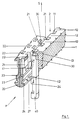
- FIG. 1 a possible embodiment of a connector according to the invention is shown in perspective.
- Reference number 1 denotes the housing of the plug connector and reference number 20 denotes a safety slide 20 which can be inserted orthogonally to the plug direction S into a gap 2 of the housing 1.
- a contact element 40 which is already inserted into a contact chamber 30 and is designed here as a contact socket can be seen in FIG.
- a contact chamber 30 is only formed by inserting the safety slide 20 into the gap 2.
- the housing 1 has slots 11 on its inner wall facing the gap 2, which, spaced apart from one another, each extend parallel in the plug-in direction S. When viewed from above, these slots have a U-shaped cross-sectional shape. Between the individual slots 11 there are webs 12 which separate the slots 11 from one another.
- each contact chamber 30 is closed at its upper edge by a peripheral edge 13 which has a smaller diameter than the contact element 40.
- the boundary is identified by reference number 13.
- the safety slide 20 has an approximately anchor-shaped cross-sectional shape.
- primary locking edges 23 are formed, on which locking hooks 41 of the contact elements 40 can snap into place.
- the primary locking edge 23 preferably extends over the entire width of the locking slide 20.
- secondary locking projections 24 are provided below these two primary locking edges 23, which can engage behind a contour 42 of the contact element 40 in order to provide a second locking so that the contact element 40 no longer can be pulled out of the contact chamber 30.
- the individual secondary locking projections 24 are spaced apart from one another to such an extent that a contact element 40 can easily be inserted between two attachable secondary locking projections 24.
- the space between two secondary locking projections 24 is designated by reference numeral 27.
- the safety slide 20 has a plurality of longitudinal openings, which are referred to below as auxiliary openings 22 and run parallel to the contact chambers 30.
- auxiliary openings 22 are arranged in alignment with the intermediate spaces 27 between the secondary locking projections 24 and serve to release the locking tongue 41 from the primary locking edge 23 by passing a suitable pin through the auxiliary opening 22 and pressing the locking tongue 41 from the primary locking edge 41.
- the safety slide 20 When assembling the connector, the safety slide 20 is first inserted into the housing 1 in a way that the contact element 40 can be inserted into the contact chamber formed by the safety slide 20 and slot 11. When the contact element 40 is inserted correctly, the latching tongue 41 rips behind the primary latching edge 23, so that primary securing is achieved. Then, for secondary securing, the safety slide 20 is moved in accordance with the direction of the arrow P, as a result of which one of the secondary latching projections 24 can engage behind the contour 42 of the contact element 40.
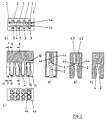
- FIG. 2 shows various views of the safety slide 20 from FIG. 1.
- FIG. 2a shows a side view
- FIG. 2b shows a view from below
- FIG. 2c shows a view from above
- FIGS. 2d and 2e each show sectional views through the safety slide 20 from FIG. 2a along the section lines D-D and E-E.
- Figure 2f shows a plan view of the left end of the safety slide shown in Figure 2a.
- the reference numerals already known from FIG. 1 are used again for the same parts.
- the wall sections 21 on the two opposite broad and outer sides of the safety slide 20 can clearly be seen, which represent a wall of the adjacent contact chambers 30 in the assembled state of the housing and the inserted safety slide.
- FIG. 3 shows the housing 1 of the plug connector already shown in detail from FIG. 1 in a cross-sectional illustration (see FIG. 3a), in a top view (see FIG. 3b), in a view from below (see FIG. 3c) and in sectional views in FIGS. 3d, 3e and 3f along the section lines DD, EE and FF of Figure 3a.
- the safety slide 20 and the bottom of the gap 2 of the housing 1 have a sliding link guide which is adapted to one another in order to hold the safety slide 20 in place within the housing 1.
- the openings for the contact chambers of the connector are identified by the reference number 3.
- a slide groove 10 with two recesses 14, 15 lying next to one another is incorporated on the bottom 4 of the gap 2, as shown in FIG. 3.
- This link groove 10 with the recesses 14, 15 cooperates with a bow-shaped projection 25 on the underside of the safety slide.
- the link projection 25 has one on its center protruding link nose 26, which can engage in the two mentioned recesses 14, 15 of the link groove 10.
- the safety slide 20 is in its pre-latched position. In this position, the contact elements 40 inserted into the respective contact chambers 30 are secured primarily by the primary locking edge 23 already explained, but are not yet secured secondarily. This is only achieved when the safety slide 20 is pushed into the second recess 15. For an operator, these two locking positions are readily recognizable, since a certain amount of force has to be applied when the safety slide 20 is pushed into the gap 2 of the housing 1.
- the set guide described can in principle be designed as desired, it has proven to be expedient to provide a pre-locking position and a final locking position.
- the contact elements can already be inserted into the contact chambers 30 and primarily locked, whereby the contact elements are initially held due to each primary locking device.
- the safety slide 20 is completely pushed into the gap 2 of the housing 1, the final securing of the contact elements 40 is then carried out.
- the housing 1 has channels 43, between which connecting webs 44 are arranged.
- These connecting webs 44 are integrally formed on the housing 1 and, starting from the upper contour of the housing 1 shown in FIGS. 3d and 3e, end at the bottom 4 of the gap 2.
- Two such connecting webs 44 are assigned to each opening 3, the two connecting webs being spaced apart 44 are each arranged on the wall of the respective opening 3 facing the center of the housing.
Landscapes
- Connector Housings Or Holding Contact Members (AREA)
- Coupling Device And Connection With Printed Circuit (AREA)
- Details Of Connecting Devices For Male And Female Coupling (AREA)
Applications Claiming Priority (2)
| Application Number | Priority Date | Filing Date | Title |
|---|---|---|---|
| DE19603479A DE19603479C1 (de) | 1996-01-31 | 1996-01-31 | Steckverbinder |
| DE19603479 | 1996-01-31 |
Publications (3)
| Publication Number | Publication Date |
|---|---|
| EP0788191A2 true EP0788191A2 (fr) | 1997-08-06 |
| EP0788191A3 EP0788191A3 (fr) | 1998-11-04 |
| EP0788191B1 EP0788191B1 (fr) | 2002-04-10 |
Family
ID=7784164
Family Applications (1)
| Application Number | Title | Priority Date | Filing Date |
|---|---|---|---|
| EP97100270A Expired - Lifetime EP0788191B1 (fr) | 1996-01-31 | 1997-01-09 | Connecteur |
Country Status (4)
| Country | Link |
|---|---|
| US (1) | US5810626A (fr) |
| EP (1) | EP0788191B1 (fr) |
| DE (2) | DE19603479C1 (fr) |
| ES (1) | ES2174136T3 (fr) |
Cited By (1)
| Publication number | Priority date | Publication date | Assignee | Title |
|---|---|---|---|---|
| EP0903812A3 (fr) * | 1997-09-23 | 1999-12-08 | Framatome Connectors International | Connecteur enfichable ayant un boítier avec dispositif de verrouillage secondaire |
Families Citing this family (1)
| Publication number | Priority date | Publication date | Assignee | Title |
|---|---|---|---|---|
| CN115986449A (zh) | 2018-03-16 | 2023-04-18 | 富加宜(美国)有限责任公司 | 高密度电连接器 |
Citations (1)
| Publication number | Priority date | Publication date | Assignee | Title |
|---|---|---|---|---|
| DE3537722A1 (de) | 1985-10-23 | 1987-04-23 | Grote & Hartmann | Elektrischer stecker |
Family Cites Families (7)
| Publication number | Priority date | Publication date | Assignee | Title |
|---|---|---|---|---|
| DE3330151A1 (de) * | 1983-08-20 | 1985-03-07 | Stocko Metallwarenfabriken Henkels Und Sohn Gmbh & Co, 5600 Wuppertal | Gehaeuse fuer elektrische steckkontakte |
| DE3725668A1 (de) * | 1987-08-03 | 1989-02-16 | Bosch Gmbh Robert | Vielpolige steckvorrichtung |
| DE3810209A1 (de) * | 1988-03-25 | 1989-10-05 | Grote & Hartmann | Elektrischer steckverbinder |
| JPH07114132B2 (ja) * | 1990-05-16 | 1995-12-06 | 矢崎総業株式会社 | コネクタ |
| US5116236A (en) * | 1990-11-05 | 1992-05-26 | Molex Incorporated | Electrical connector with terminal position assurance component |
| US5044991A (en) * | 1990-11-05 | 1991-09-03 | Molex Incorporated | Electrical connector with terminal position assurance component |
| DE4407950C1 (de) * | 1994-03-09 | 1995-08-17 | Siemens Ag | Elektrischer Steckverbinder mit einer Verriegelungseinrichtung mit Kontaktvorschub |
-
1996
- 1996-01-31 DE DE19603479A patent/DE19603479C1/de not_active Expired - Fee Related
-
1997
- 1997-01-09 DE DE59706923T patent/DE59706923D1/de not_active Expired - Fee Related
- 1997-01-09 EP EP97100270A patent/EP0788191B1/fr not_active Expired - Lifetime
- 1997-01-09 ES ES97100270T patent/ES2174136T3/es not_active Expired - Lifetime
- 1997-01-31 US US08/791,624 patent/US5810626A/en not_active Expired - Fee Related
Patent Citations (1)
| Publication number | Priority date | Publication date | Assignee | Title |
|---|---|---|---|---|
| DE3537722A1 (de) | 1985-10-23 | 1987-04-23 | Grote & Hartmann | Elektrischer stecker |
Cited By (1)
| Publication number | Priority date | Publication date | Assignee | Title |
|---|---|---|---|---|
| EP0903812A3 (fr) * | 1997-09-23 | 1999-12-08 | Framatome Connectors International | Connecteur enfichable ayant un boítier avec dispositif de verrouillage secondaire |
Also Published As
| Publication number | Publication date |
|---|---|
| US5810626A (en) | 1998-09-22 |
| EP0788191A3 (fr) | 1998-11-04 |
| DE19603479C1 (de) | 1997-04-10 |
| ES2174136T3 (es) | 2002-11-01 |
| DE59706923D1 (de) | 2002-05-16 |
| EP0788191B1 (fr) | 2002-04-10 |
Similar Documents
| Publication | Publication Date | Title |
|---|---|---|
| DE3735205C2 (fr) | ||
| DE69324334T2 (de) | Elektrische Verbinderanordnung mit Anschlussausrichtungssystem | |
| DE102012209298B4 (de) | Elektrischer Steckverbinder, Steckverbinderanordnung sowie Verfahren zum Montieren des Steckverbinders | |
| EP2058904B1 (fr) | Connecteur à fiches hermaphrodite | |
| EP0847604B1 (fr) | Connecteur electrique pourvu d'un coulisseau de stabilisation du contact | |
| EP3396786A1 (fr) | Dispositif de connecteur | |
| DE69600062T2 (de) | Elektrischer Verbinder | |
| EP3096410B1 (fr) | Connecteur a fiches comprenant un verrou destine au verrouillage secondaire de partenaires de contact | |
| DE69300900T2 (de) | Elektrischer Verbinder. | |
| EP0831559A2 (fr) | Connecteur à fiche | |
| EP0831561A2 (fr) | Assemblage de connecteurs électriques | |
| EP1411596B1 (fr) | Connecteur à fiche ayant un élément de retenue | |
| DE19638368A1 (de) | Steckverbinder | |
| DE19706636A1 (de) | Elektrische Anschlußvorrichtung für in einer Reihe angeordnete Verbraucher, insbesondere Magnetventile | |
| DE102012218028A1 (de) | Stecker und Bausatz für einen Stecker | |
| EP2054973A1 (fr) | Connecteur mâle avec verrouillage secondaire pour une connexion électrique enfichable | |
| EP0788191B1 (fr) | Connecteur | |
| DE9308144U1 (de) | Elektrischer Verbinder mit Primär- und Sekundärverriegelung der Kontaktelemente | |
| DE19532623A1 (de) | Elektrischer Stecker mit einem Betätigungsschieber | |
| DE19538613A1 (de) | Elektrischer Verbinder | |
| DE102017213105A1 (de) | Elektrisches Kontaktgehäuse zur vereinfachten Kontaktassemblage | |
| DE9205859U1 (de) | Steckverbinderanordnung | |
| DE19602435C1 (de) | Steckverbinder | |
| DE19706992B4 (de) | Anordnung zur Sicherung mindestens eines elektrischen Kontaktes in einem Gehäuse | |
| DE19709198A1 (de) | Steckeranordnung mit einem Betätigungsschieber |
Legal Events
| Date | Code | Title | Description |
|---|---|---|---|
| PUAI | Public reference made under article 153(3) epc to a published international application that has entered the european phase |
Free format text: ORIGINAL CODE: 0009012 |
|
| AK | Designated contracting states |
Kind code of ref document: A2 Designated state(s): BE DE ES FR GB IT SE |
|
| PUAL | Search report despatched |
Free format text: ORIGINAL CODE: 0009013 |
|
| AK | Designated contracting states |
Kind code of ref document: A3 Designated state(s): BE DE ES FR GB IT SE |
|
| 17P | Request for examination filed |
Effective date: 19981204 |
|
| 17Q | First examination report despatched |
Effective date: 19991125 |
|
| RAP1 | Party data changed (applicant data changed or rights of an application transferred) |
Owner name: TYCO ELECTRONICS LOGISTICS AG |
|
| GRAG | Despatch of communication of intention to grant |
Free format text: ORIGINAL CODE: EPIDOS AGRA |
|
| GRAG | Despatch of communication of intention to grant |
Free format text: ORIGINAL CODE: EPIDOS AGRA |
|
| GRAH | Despatch of communication of intention to grant a patent |
Free format text: ORIGINAL CODE: EPIDOS IGRA |
|
| GRAH | Despatch of communication of intention to grant a patent |
Free format text: ORIGINAL CODE: EPIDOS IGRA |
|
| REG | Reference to a national code |
Ref country code: GB Ref legal event code: IF02 |
|
| GRAA | (expected) grant |
Free format text: ORIGINAL CODE: 0009210 |
|
| AK | Designated contracting states |
Kind code of ref document: B1 Designated state(s): BE DE ES FR GB IT SE |
|
| REF | Corresponds to: |
Ref document number: 59706923 Country of ref document: DE Date of ref document: 20020516 |
|
| PG25 | Lapsed in a contracting state [announced via postgrant information from national office to epo] |
Ref country code: SE Free format text: LAPSE BECAUSE OF FAILURE TO SUBMIT A TRANSLATION OF THE DESCRIPTION OR TO PAY THE FEE WITHIN THE PRESCRIBED TIME-LIMIT Effective date: 20020710 |
|
| GBT | Gb: translation of ep patent filed (gb section 77(6)(a)/1977) |
Effective date: 20020703 |
|
| REG | Reference to a national code |
Ref country code: ES Ref legal event code: FG2A Ref document number: 2174136 Country of ref document: ES Kind code of ref document: T3 |
|
| PGFP | Annual fee paid to national office [announced via postgrant information from national office to epo] |
Ref country code: GB Payment date: 20021210 Year of fee payment: 7 |
|
| PG25 | Lapsed in a contracting state [announced via postgrant information from national office to epo] |
Ref country code: BE Free format text: LAPSE BECAUSE OF NON-PAYMENT OF DUE FEES Effective date: 20030131 |
|
| PLBE | No opposition filed within time limit |
Free format text: ORIGINAL CODE: 0009261 |
|
| STAA | Information on the status of an ep patent application or granted ep patent |
Free format text: STATUS: NO OPPOSITION FILED WITHIN TIME LIMIT |
|
| 26N | No opposition filed |
Effective date: 20030113 |
|
| PG25 | Lapsed in a contracting state [announced via postgrant information from national office to epo] |
Ref country code: GB Free format text: LAPSE BECAUSE OF NON-PAYMENT OF DUE FEES Effective date: 20040109 |
|
| GBPC | Gb: european patent ceased through non-payment of renewal fee |
Effective date: 20040109 |
|
| PGFP | Annual fee paid to national office [announced via postgrant information from national office to epo] |
Ref country code: FR Payment date: 20060117 Year of fee payment: 10 |
|
| PGFP | Annual fee paid to national office [announced via postgrant information from national office to epo] |
Ref country code: ES Payment date: 20060126 Year of fee payment: 10 |
|
| PGFP | Annual fee paid to national office [announced via postgrant information from national office to epo] |
Ref country code: IT Payment date: 20060131 Year of fee payment: 10 |
|
| PGFP | Annual fee paid to national office [announced via postgrant information from national office to epo] |
Ref country code: DE Payment date: 20060228 Year of fee payment: 10 |
|
| PG25 | Lapsed in a contracting state [announced via postgrant information from national office to epo] |
Ref country code: DE Free format text: LAPSE BECAUSE OF NON-PAYMENT OF DUE FEES Effective date: 20070801 |
|
| REG | Reference to a national code |
Ref country code: FR Ref legal event code: ST Effective date: 20070930 |
|
| REG | Reference to a national code |
Ref country code: ES Ref legal event code: FD2A Effective date: 20070110 |
|
| PG25 | Lapsed in a contracting state [announced via postgrant information from national office to epo] |
Ref country code: FR Free format text: LAPSE BECAUSE OF NON-PAYMENT OF DUE FEES Effective date: 20070131 |
|
| PG25 | Lapsed in a contracting state [announced via postgrant information from national office to epo] |
Ref country code: ES Free format text: LAPSE BECAUSE OF NON-PAYMENT OF DUE FEES Effective date: 20070110 |
|
| PG25 | Lapsed in a contracting state [announced via postgrant information from national office to epo] |
Ref country code: IT Free format text: LAPSE BECAUSE OF NON-PAYMENT OF DUE FEES Effective date: 20070109 |