EP0789020B1 - Procédé de préparation de dioxoquinazolines - Google Patents
Procédé de préparation de dioxoquinazolines Download PDFInfo
- Publication number
- EP0789020B1 EP0789020B1 EP97300632A EP97300632A EP0789020B1 EP 0789020 B1 EP0789020 B1 EP 0789020B1 EP 97300632 A EP97300632 A EP 97300632A EP 97300632 A EP97300632 A EP 97300632A EP 0789020 B1 EP0789020 B1 EP 0789020B1
- Authority
- EP
- European Patent Office
- Prior art keywords
- carbon atoms
- group
- optionally substituted
- anthranylamide
- phosgene
- Prior art date
- Legal status (The legal status is an assumption and is not a legal conclusion. Google has not performed a legal analysis and makes no representation as to the accuracy of the status listed.)
- Expired - Lifetime
Links
Classifications
-
- C—CHEMISTRY; METALLURGY
- C07—ORGANIC CHEMISTRY
- C07D—HETEROCYCLIC COMPOUNDS
- C07D239/00—Heterocyclic compounds containing 1,3-diazine or hydrogenated 1,3-diazine rings
- C07D239/70—Heterocyclic compounds containing 1,3-diazine or hydrogenated 1,3-diazine rings condensed with carbocyclic rings or ring systems
- C07D239/72—Quinazolines; Hydrogenated quinazolines
- C07D239/95—Quinazolines; Hydrogenated quinazolines with hetero atoms directly attached in positions 2 and 4
- C07D239/96—Two oxygen atoms
Definitions
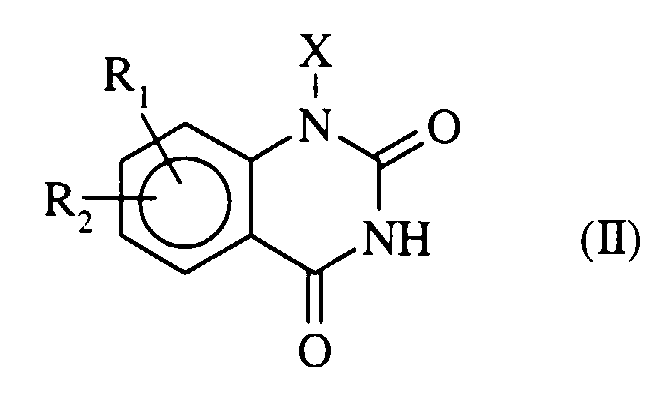
- the present invention relates to a process for producing dioxoquinazolines. More particularly, it relates to a process for producing a dioxoquinazoline which comprises reacting an anthranylamide, corresponding to the dioxoquinazoline, with a reaction product of a pyridine and phosgene.
- Dioxoquinazolines are useful as an intermediate for antiphlogistic, remedy for diabetic complication, etc. It is known that dioxoquinazolines are produced by reacting anthranylamides with carbonyldiimidazole (e.g. JP-A-62-96476). However, this process had a problem that the expensive carbonyldiimidazole is used as a reactant. Processes for producing 3-substituted 2,4-dioxoquinazolines involving the reaction of the corresponding anthranylamide with phosgene or related compounds are known from EP-A-0129128, FR-A-1503564, DE-A-3712782 and DD-A-151308. DD-A-232702 discloses that 3-substituted and 3-unsubstituted 2,4-dioxoquinazolines may be produced by reacting the corresponding anthranylamide with phosgene.
- Amount of the organic solvent used is usually from 0.5 to 40-fold amount by weight, preferably from 1 to 20 fold amount by weight, based on the amount of the pyridine.
- the reaction of a pyridine and phosgene is usually carried out at a temperature of from about -10 to 60°C, preferably from about 0 to 50°C.
- R 1 and R 2 in anthranylamide (I), which are same or different, are a hydrogen atom, a halogen atom, a nitro group, a lower alkyl group which is optionally substituted by one or more halogen atoms, an aralkyl group which is optionally substituted by one or more halogen atoms, a lower alkoxy group which is optionally substituted by one or more halogen atoms, a lower alkoxycarbonyl group which is optionally substituted by one or more halogen atoms or a group represented by YNR 3 R 4 , wherein Y represents a direct bond, a lower alkylene group or a carbonyl group, and R 3 and R 4 , which are same or different, are a lower alkyl group, or N, R 3 and R 4 together form a five- or six-membered heterocycle which optionally contains a further hetero atom, said heterocycle being optionally substituted.
- halogen atom examples include chlorine, bromine and fluorine.
- lower contain from 1 to 6 carbon atoms.
- Lower alkoxycarbonyl means a lower alkoxy group bonded to a carbonyl group.
- Examples of the lower alkyl group which is optionally substituted by one or more halogen atoms, as R 1 , R 2 and X, include a lower alkyl group such as methyl, ethyl, propyl, i-propyl, butyl, i-butyl, t-butyl, pentyl, i-pentyl and hexyl; a monohalo lower alkyl group such as chloromethyl, bromomethyl and chloropropyl; a dihalo lower alkyl group such as 1,2-dichloroethyl, 1,2-dibromoethyl and 2,2-dichloroethyl; and trihalo lower alkyl group such as trifluoromethyl.
- a lower alkyl group such as methyl, ethyl, propyl, i-propyl, butyl, i-butyl, t-butyl, pentyl, i-pentyl
- the aralkyl group which is optionally substituted by one or more halogen atoms, as R 1 and R 2 , contains alkyl of 1 to 6 carbon atoms as the alkyl moiety and contains phenyl or naphthyl as the aryl moiety. Examples include benzyl, phenylethyl, 4-chlorobenzyl, 2,4-dichlorobenzyl and 2,4-dibromobenzyl.
- Examples of the unsubstituted lower alkoxy group, as R 1 and R 2 include methoxy, ethoxy, propoxy, i-propoxy, butoxy, i-butoxy, t-butoxy, pentyloxy, i-pentyloxy and hexyloxy.
- the further hetero atom is nitrogen, oxygen or sulfur.
- N, R 3 and R 4 in NR 3 R 4 together form a five- or six-membered heterocycle which optionally has another hetero atom are pyrrolyl, 2H,4H-pyrrolyl, pyrrolidino, pyrazolyl, piperidino, morpholino and imidazolyl.
- Examples of the lower alkylene group as Z include straight chain or branched lower alkylene group, such as methylene, methylmethylene, dimethylene, 2-methyldimethylene, trimethylene, tetramethylene, pentamethylene and hexamethylene. Among them, methylene and methylmethylene are preferred.
- Examples of a lower alkyl group and an aralkyl group as R 5 include a lower alkyl group and an aralkyl group, respectively, exemplified above as R 1 and R 2 .
- Reaction of the anthranylamide with a reaction product of a pyridine and phosgene is usually carried out by adding an anthranylamide (I) or a mixture thereof with a solvent to the reaction product of a pyridine and phosgene.
- the solvent include an organic solvent inert to the reaction.
- the solvent include the above-exemplified organic solvents used for the reaction of a pyridine and phosgene.
- the solvent may be different from the solvent used for the reaction of a pyridine and phosgene.
- Amount of the organic solvent, if used, is usually from 0.5 to 50 fold amount by weight, preferably from 1 to 20 fold amount by weight, based on the amount of the anthranylamide (I).
- Reaction of the anthranylamide with a reaction product of a pyridine and phosgene is usually carried out at a temperature of from about 0 to 100 °C, preferably from about 20 to 80 °C.
- an amine is added to the reaction together with the anthranylamide (I) or after the anthranylamide (I) is added in order to accelerate the reaction. This measure is particularly effective when the phosgene is used in a 0.5 to 1.5 fold molar amount relative to the amount of the pyridine.
- Amount of the amine is usually from about 0.1 to 5 fold molar amount, preferably from about 0.3 to 2 fold molar amount based on the molar amount of phosgene used in the reaction of a pyridine compound and phosgene.
- the resulting dioxoquinazoline (II) can be purified further, if necessary.
- dioxoquinazolines (II) can be produced easily using a reaction product of a pyridine and phosgene, which is inexpensive. Therefore, process of the present invention is advantageous from the industrial view.
Landscapes
- Chemical & Material Sciences (AREA)
- Organic Chemistry (AREA)
- Plural Heterocyclic Compounds (AREA)
- Organic Low-Molecular-Weight Compounds And Preparation Thereof (AREA)
- Nitrogen And Oxygen Or Sulfur-Condensed Heterocyclic Ring Systems (AREA)
Claims (9)
- Procédé de production d'une dioxoquinazoline de formule (II):dans laquelle R1 et R2 représentent de façon indépendante un atome d'hydrogène, un atome d'halogène, un groupe nitro, un groupe alkyle ayant 1 à 6 atomes de carbone éventuellement substitué par un ou plusieurs atomes d'halogène, un groupe aralkyle éventuellement substitué par un ou plusieurs atomes d'halogène et contenant un phényle ou un naphtyle en tant que fragment aryle et contenant un alkyle de 1 à 6 atomes de carbone en tant que fragment alkyle, un groupe alcoxy ayant 1 à 6 atomes de carbone éventuellement substitué par un ou plusieurs atomes d'halogène, un groupe alcoxycarbonyle éventuellement substitué par un ou plusieurs atomes d'halogène et contenant un alcoxy de 1 à 6 atomes de carbone comme fragment alcoxy ou un groupe représenté par YNR3R4, dans lequel Y représente une liaison directe, un groupe alkylène ayant 1 à 6 atomes de carbone ou un groupe carbonyle et R3 et R4 représentent de façon indépendante un groupe alkyle ayant 1 à 6 atomes de carbone ou N, R3 et R4 forment ensemble un hétérocycle à cinq ou six côtés contenant éventuellement un autre hétéroatome choisi parmi l'azote, l'oxygène et le soufre, ledit hétérocycle étant éventuellement substitué, les substituants éventuels étant choisis parmi les groupes alkyle ayant 1 à 6 atomes de carbone, éventuellement substitués par un ou plusieurs atomes d'halogène, les groupes aralkyle éventuellement substitués par un ou plusieurs atomes d'halogène ou par un groupe alcoxy ayant 1 à 6 atomes de carbone et contenant un phényle ou un naphtyle comme fragment aryle et contenant un alkyle de 1 à 6 atomes de carbone comme fragment alkyle et le groupe phénylcarbonyle éventuellement substitué par un groupe alcoxy ayant 1 à 6 atomes de carbone, et X représente un groupe alkyle ayant 1 à 6 atomes de carbone éventuellement substitué par un ou plusieurs atomes d'halogène ou un groupe représenté par ZCO2R5, où Z représente un groupe alkylène ayant 1 à 6 atomes de carbone et R5 représente un groupe alkyle ayant 1 à 6 atomes de carbone ou un groupe aralkyle contenant un phényle ou un naphtyle en tant que fragment aryle et contenant un alkyle de 1 à 6 atomes de carbone en tant que fragment alkyle, comprenant la réaction d'un anthranylamide de formule (I):
 dans laquelle X, R1 et R2 sont tels que définis ci-dessus,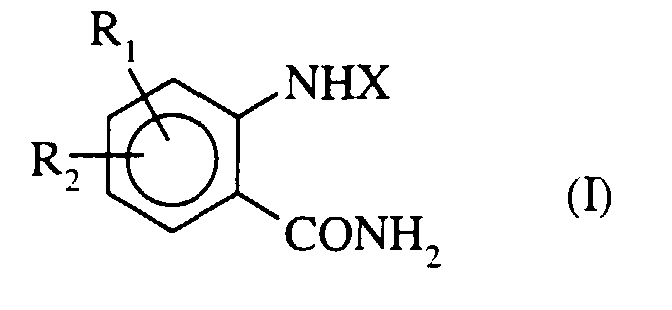
avec le produit de réaction d'un composé pyridinique et du phosgène, le composé pyridinique étant au moins un composé choisi parmi la pyridine, la 2-picoline, la 3-picoline, la 4-picoline, la 2-chloropyridine, la 3-chloropyridine, la 4-chloropyridine, la 2,4-lutidine et la 2,6-lutidine, procédé dans lequel on fait réagir premièrement le composé pyridinique et le phosgène et ensuite on ajoute l'anthranylamide au mélange réactionnel. - Procédé selon la revendication 1, dans lequel le composé pyridinique est utilisé en une quantité molaire égale à 1 à 20 fois la quantité molaire de l'anthranylamide de formule (I).
- Procédé selon la revendication 1 ou 2, dans lequel le phosgène est utilisé en une quantité molaire égale à 0,1 à 2 fois la quantité molaire du composé pyridinique.
- Procédé selon une quelconque des revendications précédentes, dans lequel on ajoute une amine au mélange réactionnel en même temps que l'anthranylamide de formule (I) ou après addition de l'anthranylamide de formule (I).
- Procédé selon la revendication 4, dans lequel l'amine est utilisée en une quantité molaire égale à 0,1 à 5 fois la quantité molaire de phosgène.
- Procédé selon la revendication 4 ou 5, dans lequel l'amine est un composé pyridinique ou une amine tertiaire.
- Procédé selon la revendication 6, dans lequel l'amine tertiaire est au moins un composé choisi parmi la triéthylamine, la tributylamine, l'éthyldiisopropylamine, la N,N-diméthylaniline et la N,N-diéthylaniline.
- Procédé selon une quelconque des revendications précédentes, dans lequel la réaction est conduite en présence d'un solvant organique.
- Procédé selon la revendication 8, dans lequel le solvant organique est au moins un solvant choisi parmi les éthers cycliques, les Glymes, les hydrocarbures aromatiques, les hydrocarbures aliphatiques, les hydrocarbures halogénés, les esters aliphatiques et les nitriles aliphatiques.
Applications Claiming Priority (3)
| Application Number | Priority Date | Filing Date | Title |
|---|---|---|---|
| JP1665096 | 1996-02-01 | ||
| JP16650/96 | 1996-02-01 | ||
| JP1665096 | 1996-02-01 |
Publications (2)
| Publication Number | Publication Date |
|---|---|
| EP0789020A1 EP0789020A1 (fr) | 1997-08-13 |
| EP0789020B1 true EP0789020B1 (fr) | 2000-04-12 |
Family
ID=11922232
Family Applications (1)
| Application Number | Title | Priority Date | Filing Date |
|---|---|---|---|
| EP97300632A Expired - Lifetime EP0789020B1 (fr) | 1996-02-01 | 1997-01-31 | Procédé de préparation de dioxoquinazolines |
Country Status (4)
| Country | Link |
|---|---|
| US (1) | US5780628A (fr) |
| EP (1) | EP0789020B1 (fr) |
| CA (1) | CA2196510C (fr) |
| DE (1) | DE69701647T2 (fr) |
Families Citing this family (1)
| Publication number | Priority date | Publication date | Assignee | Title |
|---|---|---|---|---|
| WO2002102793A2 (fr) * | 2001-06-19 | 2002-12-27 | Warner-Lambert Company Llc | Agents antibacteriens |
Family Cites Families (16)
| Publication number | Priority date | Publication date | Assignee | Title |
|---|---|---|---|---|
| DE232702C (fr) * | ||||
| DE151308C (fr) * | ||||
| US3274194A (en) * | 1963-03-29 | 1966-09-20 | Miles Lab | Quinazolinedione derivatives |
| GB1137111A (en) * | 1965-06-15 | 1968-12-18 | Maumee Chemical Company | Production of 3-substituted- and 1,3-disubstituted-2,4(1h,3h)-quinazolinediones, andthe 2,4 thio and dithio analogues thereof |
| DE1545632A1 (de) * | 1965-10-07 | 1969-08-07 | Basf Ag | Verfahren zur Herstellung von 2,4-Dioxo-? |
| US4016166A (en) * | 1973-12-14 | 1977-04-05 | Hisamitsu Pharmaceutical Co., Inc. | 1-Nitrophenylquinazoline-2,4(1H,3H)-diones |
| CA1161036A (fr) * | 1980-05-15 | 1984-01-24 | Masayuki Ishikawa | Composes de quinazoline-dione, procede de production et applications en pharmacie |
| DD151308A1 (de) * | 1980-06-06 | 1981-10-14 | Manfred Suesse | Verfahren zur herstellung von chinazolin-2,4-dion-3-essigsaeuren |
| JPS57146741A (en) * | 1981-03-06 | 1982-09-10 | Yasumitsu Tamura | Preparation of alpha-alkoxyvinyl carbonate ester |
| DD232702A1 (de) * | 1982-09-20 | 1986-02-05 | Adw Ddr | Verfahren zur herstellung von 1,2,3,4-tetrahydrochinazolin-2,4-dion-essigsaeuren, deren salzen und estern |
| DE3321969A1 (de) * | 1983-06-18 | 1984-12-20 | Troponwerke GmbH & Co KG, 5000 Köln | 2-pyrimidinyl-1-piperazin-derivate, verfahren zu ihrer herstellung und diese enthaltende arzneimittel |
| DE3347526A1 (de) * | 1983-12-30 | 1985-07-11 | Troponwerke GmbH & Co KG, 5000 Köln | Verfahren zur herstellung substituierter chinazolin-2.4(1h.3h)-dione |
| GB8413155D0 (en) * | 1984-05-23 | 1984-06-27 | Ici Plc | Chemical process |
| GB8524663D0 (en) * | 1985-10-07 | 1985-11-13 | Fujisawa Pharmaceutical Co | Quinazoline derivatives |
| DE3712782A1 (de) * | 1987-04-13 | 1988-11-03 | Schering Ag | Anellierte uracilderivate, verfahren zu ihrer herstellung und ihre verwendung als herbizide mittel |
| JP3166215B2 (ja) * | 1991-07-25 | 2001-05-14 | 住友化学工業株式会社 | 1,2−ナフトキノンジアジド−5−スルホニルクロリドの製造方法 |
-
1997
- 1997-01-31 DE DE69701647T patent/DE69701647T2/de not_active Expired - Fee Related
- 1997-01-31 CA CA002196510A patent/CA2196510C/fr not_active Expired - Fee Related
- 1997-01-31 US US08/791,551 patent/US5780628A/en not_active Expired - Fee Related
- 1997-01-31 EP EP97300632A patent/EP0789020B1/fr not_active Expired - Lifetime
Also Published As
| Publication number | Publication date |
|---|---|
| US5780628A (en) | 1998-07-14 |
| EP0789020A1 (fr) | 1997-08-13 |
| CA2196510C (fr) | 2000-08-01 |
| DE69701647D1 (de) | 2000-05-18 |
| DE69701647T2 (de) | 2000-09-07 |
| CA2196510A1 (fr) | 1997-08-02 |
Similar Documents
| Publication | Publication Date | Title |
|---|---|---|
| KR920000761B1 (ko) | 치환된 2-피리미디닐-1-피페라진 유도체의 제조방법 | |
| US6166208A (en) | Preparation of fungicidal quinazolinones and useful intermediates | |
| US5206372A (en) | Preparation of 2-chloropyridine derivatives | |
| US4987232A (en) | Preparation of 2-chloropyridine 3-carboxylic acid esters | |
| EP0537611B1 (fr) | Procédé de préparation de N-(aryl)-1,2,4-triazolopyrimidine-2-sulfonamides substitués | |
| Sugimoto et al. | Activation of dithiocarbamate by 2-halothiazolium salts | |
| US20220194898A1 (en) | Method of preparing a don prodrug from l-pyroglutamic acid | |
| KR940003754B1 (ko) | 제초성 이미다졸리닐 벤조산, 니코틴산 및 퀴놀린-3-카르복실산, 산부가염 또는 그 에스테르 및 염의 제조방법 | |
| EP0789020B1 (fr) | Procédé de préparation de dioxoquinazolines | |
| WO2001036383A1 (fr) | Procede de preparation de sulfamides | |
| US5274166A (en) | Dithiocarbamic acid salt, process for production thereof, and process for production of isothiocyanate using said dithiocarbamic acid salt | |
| US5534637A (en) | Starting materials for prepartion of sulfonylurea derivatives and process for preparing the same | |
| US5162529A (en) | Process for the preparation of 5-hydroxy-3,4,5,6-tetrahydro-pyrimidine derivatives | |
| US5602251A (en) | Arthropodicidal oxadiazine intermediate | |
| JPH09268180A (ja) | ジオキソキナゾリン類の製造方法 | |
| US6320053B1 (en) | Preparation of heteroarylcarboxamides | |
| US10487062B1 (en) | Regioselective one-step process for synthesizing 2-hydroxyquinoxaline | |
| JPH09291080A (ja) | ジオキソキナゾリン類の製造方法 | |
| KR20000075934A (ko) | 퀴나졸린 유도체의 제조방법 | |
| KR101069226B1 (ko) | 3,4-디클로로-n-(2-시아노페닐)-5-이소티아졸카복사미드의 제조방법 | |
| JPS61267569A (ja) | 4−オキソ−4h−ピラン−3−カルボキサミド化合物の製造法 | |
| US5981749A (en) | Process for producing isatoic anhydrides | |
| US4075201A (en) | Bis carbamate derivatives of diazetidine diones | |
| JP2002145867A (ja) | キナゾリン誘導体の製造方法 | |
| JP2002145868A (ja) | キナゾリン誘導体の製造方法 |
Legal Events
| Date | Code | Title | Description |
|---|---|---|---|
| PUAI | Public reference made under article 153(3) epc to a published international application that has entered the european phase |
Free format text: ORIGINAL CODE: 0009012 |
|
| AK | Designated contracting states |
Kind code of ref document: A1 Designated state(s): CH DE FR GB IT LI NL SE |
|
| 17P | Request for examination filed |
Effective date: 19980123 |
|
| 17Q | First examination report despatched |
Effective date: 19980602 |
|
| GRAG | Despatch of communication of intention to grant |
Free format text: ORIGINAL CODE: EPIDOS AGRA |
|
| GRAG | Despatch of communication of intention to grant |
Free format text: ORIGINAL CODE: EPIDOS AGRA |
|
| GRAH | Despatch of communication of intention to grant a patent |
Free format text: ORIGINAL CODE: EPIDOS IGRA |
|
| GRAH | Despatch of communication of intention to grant a patent |
Free format text: ORIGINAL CODE: EPIDOS IGRA |
|
| GRAA | (expected) grant |
Free format text: ORIGINAL CODE: 0009210 |
|
| AK | Designated contracting states |
Kind code of ref document: B1 Designated state(s): CH DE FR GB IT LI NL SE |
|
| REG | Reference to a national code |
Ref country code: CH Ref legal event code: EP |
|
| ITF | It: translation for a ep patent filed | ||
| REF | Corresponds to: |
Ref document number: 69701647 Country of ref document: DE Date of ref document: 20000518 |
|
| REG | Reference to a national code |
Ref country code: CH Ref legal event code: NV Representative=s name: A. BRAUN, BRAUN, HERITIER, ESCHMANN AG PATENTANWAE |
|
| ET | Fr: translation filed | ||
| PG25 | Lapsed in a contracting state [announced via postgrant information from national office to epo] |
Ref country code: LI Free format text: LAPSE BECAUSE OF NON-PAYMENT OF DUE FEES Effective date: 20010131 Ref country code: GB Free format text: LAPSE BECAUSE OF NON-PAYMENT OF DUE FEES Effective date: 20010131 Ref country code: CH Free format text: LAPSE BECAUSE OF NON-PAYMENT OF DUE FEES Effective date: 20010131 |
|
| PG25 | Lapsed in a contracting state [announced via postgrant information from national office to epo] |
Ref country code: SE Free format text: LAPSE BECAUSE OF NON-PAYMENT OF DUE FEES Effective date: 20010201 |
|
| PLBE | No opposition filed within time limit |
Free format text: ORIGINAL CODE: 0009261 |
|
| STAA | Information on the status of an ep patent application or granted ep patent |
Free format text: STATUS: NO OPPOSITION FILED WITHIN TIME LIMIT |
|
| 26N | No opposition filed | ||
| PG25 | Lapsed in a contracting state [announced via postgrant information from national office to epo] |
Ref country code: NL Free format text: LAPSE BECAUSE OF NON-PAYMENT OF DUE FEES Effective date: 20010801 |
|
| REG | Reference to a national code |
Ref country code: CH Ref legal event code: PL |
|
| GBPC | Gb: european patent ceased through non-payment of renewal fee |
Effective date: 20010131 |
|
| PG25 | Lapsed in a contracting state [announced via postgrant information from national office to epo] |
Ref country code: FR Free format text: LAPSE BECAUSE OF NON-PAYMENT OF DUE FEES Effective date: 20010928 |
|
| NLV4 | Nl: lapsed or anulled due to non-payment of the annual fee |
Effective date: 20010801 |
|
| EUG | Se: european patent has lapsed |
Ref document number: 97300632.3 |
|
| PG25 | Lapsed in a contracting state [announced via postgrant information from national office to epo] |
Ref country code: DE Free format text: LAPSE BECAUSE OF NON-PAYMENT OF DUE FEES Effective date: 20011101 |
|
| REG | Reference to a national code |
Ref country code: FR Ref legal event code: ST |
|
| PG25 | Lapsed in a contracting state [announced via postgrant information from national office to epo] |
Ref country code: IT Free format text: LAPSE BECAUSE OF NON-PAYMENT OF DUE FEES;WARNING: LAPSES OF ITALIAN PATENTS WITH EFFECTIVE DATE BEFORE 2007 MAY HAVE OCCURRED AT ANY TIME BEFORE 2007. THE CORRECT EFFECTIVE DATE MAY BE DIFFERENT FROM THE ONE RECORDED. Effective date: 20050131 |